EP2520342A1 - Transformable exercise machine for functional exercising - Google Patents
Transformable exercise machine for functional exercising Download PDFInfo
- Publication number
- EP2520342A1 EP2520342A1 EP10841356A EP10841356A EP2520342A1 EP 2520342 A1 EP2520342 A1 EP 2520342A1 EP 10841356 A EP10841356 A EP 10841356A EP 10841356 A EP10841356 A EP 10841356A EP 2520342 A1 EP2520342 A1 EP 2520342A1
- Authority
- EP
- European Patent Office
- Prior art keywords
- loop
- exercise machine
- supporting
- cord
- exercising
- Prior art date
- Legal status (The legal status is an assumption and is not a legal conclusion. Google has not performed a legal analysis and makes no representation as to the accuracy of the status listed.)
- Withdrawn
Links
Images


Classifications
-
- A—HUMAN NECESSITIES
- A63—SPORTS; GAMES; AMUSEMENTS
- A63B—APPARATUS FOR PHYSICAL TRAINING, GYMNASTICS, SWIMMING, CLIMBING, OR FENCING; BALL GAMES; TRAINING EQUIPMENT
- A63B23/00—Exercising apparatus specially adapted for particular parts of the body
- A63B23/035—Exercising apparatus specially adapted for particular parts of the body for limbs, i.e. upper or lower limbs, e.g. simultaneously
- A63B23/12—Exercising apparatus specially adapted for particular parts of the body for limbs, i.e. upper or lower limbs, e.g. simultaneously for upper limbs or related muscles, e.g. chest, upper back or shoulder muscles
-
- A—HUMAN NECESSITIES
- A63—SPORTS; GAMES; AMUSEMENTS
- A63B—APPARATUS FOR PHYSICAL TRAINING, GYMNASTICS, SWIMMING, CLIMBING, OR FENCING; BALL GAMES; TRAINING EQUIPMENT
- A63B21/00—Exercising apparatus for developing or strengthening the muscles or joints of the body by working against a counterforce, with or without measuring devices
- A63B21/15—Arrangements for force transmissions
- A63B21/151—Using flexible elements for reciprocating movements, e.g. ropes or chains
- A63B21/154—Using flexible elements for reciprocating movements, e.g. ropes or chains using special pulley-assemblies
-
- A—HUMAN NECESSITIES
- A63—SPORTS; GAMES; AMUSEMENTS
- A63B—APPARATUS FOR PHYSICAL TRAINING, GYMNASTICS, SWIMMING, CLIMBING, OR FENCING; BALL GAMES; TRAINING EQUIPMENT
- A63B21/00—Exercising apparatus for developing or strengthening the muscles or joints of the body by working against a counterforce, with or without measuring devices
- A63B21/40—Interfaces with the user related to strength training; Details thereof
- A63B21/4001—Arrangements for attaching the exercising apparatus to the user's body, e.g. belts, shoes or gloves specially adapted therefor
- A63B21/4011—Arrangements for attaching the exercising apparatus to the user's body, e.g. belts, shoes or gloves specially adapted therefor to the lower limbs
- A63B21/4015—Arrangements for attaching the exercising apparatus to the user's body, e.g. belts, shoes or gloves specially adapted therefor to the lower limbs to the foot
-
- A—HUMAN NECESSITIES
- A63—SPORTS; GAMES; AMUSEMENTS
- A63B—APPARATUS FOR PHYSICAL TRAINING, GYMNASTICS, SWIMMING, CLIMBING, OR FENCING; BALL GAMES; TRAINING EQUIPMENT
- A63B21/00—Exercising apparatus for developing or strengthening the muscles or joints of the body by working against a counterforce, with or without measuring devices
- A63B21/40—Interfaces with the user related to strength training; Details thereof
- A63B21/4027—Specific exercise interfaces
- A63B21/4033—Handles, pedals, bars or platforms
- A63B21/4035—Handles, pedals, bars or platforms for operation by hand
-
- A—HUMAN NECESSITIES
- A63—SPORTS; GAMES; AMUSEMENTS
- A63B—APPARATUS FOR PHYSICAL TRAINING, GYMNASTICS, SWIMMING, CLIMBING, OR FENCING; BALL GAMES; TRAINING EQUIPMENT
- A63B21/00—Exercising apparatus for developing or strengthening the muscles or joints of the body by working against a counterforce, with or without measuring devices
- A63B21/40—Interfaces with the user related to strength training; Details thereof
- A63B21/4041—Interfaces with the user related to strength training; Details thereof characterised by the movements of the interface
- A63B21/4043—Free movement, i.e. the only restriction coming from the resistance
-
- A—HUMAN NECESSITIES
- A63—SPORTS; GAMES; AMUSEMENTS
- A63B—APPARATUS FOR PHYSICAL TRAINING, GYMNASTICS, SWIMMING, CLIMBING, OR FENCING; BALL GAMES; TRAINING EQUIPMENT
- A63B23/00—Exercising apparatus specially adapted for particular parts of the body
- A63B23/035—Exercising apparatus specially adapted for particular parts of the body for limbs, i.e. upper or lower limbs, e.g. simultaneously
- A63B23/03516—For both arms together or both legs together; Aspects related to the co-ordination between right and left side limbs of a user
- A63B23/03533—With separate means driven by each limb, i.e. performing different movements
-
- A—HUMAN NECESSITIES
- A63—SPORTS; GAMES; AMUSEMENTS
- A63B—APPARATUS FOR PHYSICAL TRAINING, GYMNASTICS, SWIMMING, CLIMBING, OR FENCING; BALL GAMES; TRAINING EQUIPMENT
- A63B23/00—Exercising apparatus specially adapted for particular parts of the body
- A63B23/035—Exercising apparatus specially adapted for particular parts of the body for limbs, i.e. upper or lower limbs, e.g. simultaneously
- A63B23/0355—A single apparatus used for either upper or lower limbs, i.e. with a set of support elements driven either by the upper or the lower limb or limbs
-
- A—HUMAN NECESSITIES
- A63—SPORTS; GAMES; AMUSEMENTS
- A63B—APPARATUS FOR PHYSICAL TRAINING, GYMNASTICS, SWIMMING, CLIMBING, OR FENCING; BALL GAMES; TRAINING EQUIPMENT
- A63B23/00—Exercising apparatus specially adapted for particular parts of the body
- A63B23/035—Exercising apparatus specially adapted for particular parts of the body for limbs, i.e. upper or lower limbs, e.g. simultaneously
- A63B23/12—Exercising apparatus specially adapted for particular parts of the body for limbs, i.e. upper or lower limbs, e.g. simultaneously for upper limbs or related muscles, e.g. chest, upper back or shoulder muscles
- A63B23/1209—Involving a bending of elbow and shoulder joints simultaneously
-
- A—HUMAN NECESSITIES
- A63—SPORTS; GAMES; AMUSEMENTS
- A63B—APPARATUS FOR PHYSICAL TRAINING, GYMNASTICS, SWIMMING, CLIMBING, OR FENCING; BALL GAMES; TRAINING EQUIPMENT
- A63B7/00—Freely-suspended gymnastic apparatus
- A63B7/02—Swinging rings; Trapezes
-
- A—HUMAN NECESSITIES
- A63—SPORTS; GAMES; AMUSEMENTS
- A63B—APPARATUS FOR PHYSICAL TRAINING, GYMNASTICS, SWIMMING, CLIMBING, OR FENCING; BALL GAMES; TRAINING EQUIPMENT
- A63B23/00—Exercising apparatus specially adapted for particular parts of the body
- A63B23/035—Exercising apparatus specially adapted for particular parts of the body for limbs, i.e. upper or lower limbs, e.g. simultaneously
- A63B23/12—Exercising apparatus specially adapted for particular parts of the body for limbs, i.e. upper or lower limbs, e.g. simultaneously for upper limbs or related muscles, e.g. chest, upper back or shoulder muscles
- A63B23/1209—Involving a bending of elbow and shoulder joints simultaneously
- A63B23/1236—Push-ups in horizontal position, i.e. eccentric movement
-
- A—HUMAN NECESSITIES
- A63—SPORTS; GAMES; AMUSEMENTS
- A63B—APPARATUS FOR PHYSICAL TRAINING, GYMNASTICS, SWIMMING, CLIMBING, OR FENCING; BALL GAMES; TRAINING EQUIPMENT
- A63B7/00—Freely-suspended gymnastic apparatus
Definitions
- the present invention relates to devices for exercising separate portions of the body or entire groups of muscles simultaneously, and can be used for developing the main motor qualities: strength, endurance, flexibility, dexterity and coordination.
- the closest prior art 'prototype' of the proposed solution is an exercise machine comprising a handle with an attached flexible bar in the form of cord with a holding bight, an idler pulley with a binding collar, and the handle is made in the form of a rubberized loop (see RU 84 722 U1 , cl. A63B 23/00, publ. 20.07.2009, report No. 20).
- Disadvantages of the known device are: a low functionality for dynamic exercises, because when a user exercises with the arms positioned at the shoulder length, the cord hooked on the pulley rubs the body of the execising person, hindering the progress of training; a low operating capability related to the necessity of attaching thereof to a special hook only, and impossibility of transformation of the prior art device for different training procedures.
- Another disadvantage is an inconvenience of using the prototype, conditioned by fact that, in case of contact of the hand and forearm of the arm grasping the handle with the cord, the latter depresses the wrist and forearm with the bundle being the hardest part of the cord.
- one of disadvantages of the prior art device is poor hygiene of using thereof, because the same handle is used for hand grasping as well as for foot securing.
- the object of the present invention and its technical effect is to enhance the convenience of use of an exercise machine by means of elimination of rubbing the user's body with the cord during the carrying out of exercises with the user's arms, elimination of a negative impact of the loop with a bundle on the wrist in the training process, increasing the efficiency of using the device for feet training, extension of the application field of the exercise machine by means of making the attachment universal and providing a transformation capacity of the exercise machine, as well as increasing the safety of use of the exercise machine by means of improvement of the hygienic conditions of training.
- a functional training exercise machine comprising: two supporting loops with handles; a cord; a first pulley; a second pulley; two straps; at least two carabiners, a TIBLOC (rope clamp, ascender), and a spacing bar.
- Each aforesaid supporting loop is made of a band and provided on the handle-side with a second load-carrying supporting loop and a third limiting loop, while the other end of the supporting loop is made in the form of loop for connection to the carabiner;
- the TIBLOC is attached to a carabiner;
- the TIBLOC is arranged on the cord having both ends in the form of loops for connection to the carabiner, while the straps are also provided with loop-shaped members for connection to the carabiner and with pouches for attaching the spacing bar having a length corresponding to the shoulder width of the exercising person.
- the straps are made in the form of twin band with cross stitches forming loop-shaped elements for fastening the carabiners;
- the handles are made in the form of cylinders of low-elastic material with a relief coating for comfort grip;
- - surface of handles is made of leather
- the spacing bar is collapsible and consists of a set of bushings with cylindrical protrusions wherein each protrusion has a smaller diameter than that of the respective bushing;
- the length of the spacing bar is selected for 10-15 cm wider than the shoulder width of the exercising person
- the used pulleys correspond to rolls of a mountain climbing outfit with a hole for fastening a carabiner
- the cord corresponds to a rope of the mountain climbing outfit
- connection of the band of supporting loop engaged with the handle has an Y-like shape
- the second load-carrying supporting loop is connected through a hole in the handle.
- Fig. 1 depicts the exercise machine for functional training, fitted with collar (hook)
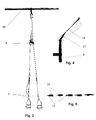
- Fig. 2 shows an exercise machine fitted to spaced racks
- Fig. 3 an exercise machine transformed into one-pulley apparatus for feet training is shown
- Fig. 4 shows in a detail a load-carrying supporting loop against the wrist of an exercising person at the grip of the handle
- Fig. 5 illustrates the spacing bar
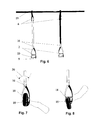
- Fig. 6 shows an exercise machine transformed into a "rings" type apparatus
- Fig. 7 shows in a detail a load-carrying supporting loop with exercising person's foot with upward-pointing toes
- Fig. 8 shows in a detail a load-carrying supporting loop with exercising person's foot with downward-pointing toes.
- the exercise machine for functional exercising comprises two load-carrying supporting loops with handles, a cord and a first pulley, a second pulley, two straps, at least two carabiners, a TIBLOC, and a spacing bar.
- Each load-carrying supporting loop is provided on the handle-side with a second load-carrying supporting loop and a third limiting loop, while the other end of the supporting loop is made in the form of loop for connection to the carabiner;
- the TIBLOC is attached to a carabiner;
- the TIBLOC is arranged on the cord having both ends in the form of loops for connection to the carabiner, while the straps are also provided with loop-shaped members for connection to a carabiner hook and with pouches for attaching the spacing bar, the length of which is for 10-15 cm more than the shoulder width of the execising person.
- the straps are made in the form of a twin band with cross stitches to fasten the carbiner.
- the handles are made in the form of rigid or low-elastic cylinders with relief coating for comfort grip.
- the surface of the handles is rubberized, or
- the surface of the handles is made of leather.
- the planes of the second load-carrying supporting loop and third limiting loop are mutually perpendicular to one another.
- the spacing bar is collapsible and consists of a set of bushings with cylindrical protrusions, wherein each protrusion has a diameter lessof smallerthan a diameter of the respective bushing.
- the pulleys correspond to those used in a mountain climbing outfit with a hole for securing the pulley onto gear the carabiner.
- the quick opening of such pulleys allows a fast mounting, assembling and transforming of the exercise machine.
- the cord corresponds to a dynamic rope of a mountain climbing outfit.
- the load-carrying supporting loop is made of one band threaded through the handle, the ends of which at the point of connection (looping) are secured in a Y-shaped configuration, at an angle of 20 to 70 degree, and the connection point of the supporting loop bands is covered with a patch.
- the second load-carrying supporting loop is connected (looped) through a hole in the handle.
- the second load-carrying supporting loop and third limiting loop are made in the form of band.
- the exercise machine for functional exercising is used as follows.
- the claimed exercise machine is used for functional exercising and can ensure heavy loads for the exercising person, because the moving structure of the exercise machine makes the exercising person's muscles getting involved in work to stabilize the body in space.
- the assembling of elements of the exercise machine is made with the carabiners, which connect the supporting loops with the cord interacting with the pulleys as well as with the carabiners.
- the straps may be attached to almost any support: a ring, hook, horizontal bar, ledge, or, for example, may be secured in a gap between a door panel and a door frame.
- Such universality of the fixing is ensured by that fact that the straps are flexible bands furnished with locks in the form of carabiners at both ends of the straps, whereas the carabiner may be fasten to a loop element of the strap at any point thereof, so the strap may be attached or winded around a horizontal bar, a tree branch, a ledge, etc.
- This design feature of the strap ensures a possibility of adjustment of the suspension height of the exercise machine by choosing the corresponding place on the strap with cross stitches for fastening to carabiner.
- the spacing bar with corresponding pouches on the straps provides for the location of the supporting loops hanging down approximately at the distance of shoulder width of the exercising person (a little more than the shoulder width), which is optimal in terms of biomechanics of human's movement for carrying out dynamic exercises focusing on the development of the upper body when the exercising person leans on the handles. In this case, rubbing the exercising person's skin by the supporting loop is eliminated, which increases the comfort and efficiency of the exercises.
- the spacing bar itself is collapsible and consists of separate elements in the form of bushings with cylindrical protrusions, making possible to adjust the length of spacing bar corresponding the parameters of exercising person (10-15 cm wider than the shoulder width).
- the spacing bar is used in those cases, when the straps are attached to the support at one point and the load on the supporting loops causes approaching the opposite ends of the straps with the pulleys hanging on them. If the straps are attached in spaced points ( FIG. 2 ), for example, on vertical supports of wall bars, the spacing bar may not be installed.
- the ends of the straps are connected with the pulleys by the carabiners, through which rolls the cord is threaded.
- the TIBLOC is attached to the cord ensuring the easy adjustment of the exercise machine's length by moving the TIBLOC along the cord.
- the length of cord is about 3 meters.
- One of the supporting loops is fastened to one of the ends of the cord with the carabiner, the other supporting loop is fastened to the TIBLOC so that the distance between the handles and the pulleys facilitates a convenient and effective exercising.
- its end may be fastened to the corresponding carabiner ( FIG. 1 ).
- the length of the supporting loops is about 800 mm, so that the TIBLOC does not contact with the exercising person's body.
- the supporting loop comprises the second load-carrying supporting loop to put the foot in it during exercising the feet muscles.
- the third limiting loop jointly with the handle ensure securing the foot in the second load-carrying supporting loop, which allows an effective exercising of the legs in a wide range of lifting angle without foot slipping.
- the effect of the presence of the second load-carrying supporting loop and securing of the foot is a convenience feeling during exercising and improvement of the hygienic conditions at the use of the exercise machine, because the foot is not put on the handle, which also facilitates the progress of the exercising and increases the safety of the exercise machine.
- a characteristic of the load-carrying supporting loop is also a covering patch and the connection of the bands (the ends of bands) threaded through the open end hole in the handle, which are fastened in an Y-shaped manner ( FIG. 7 ), i.e. at an angle with each other, while this angle depends on the hardness of the bands' material could be in a range 20 to 70 degree, that in case of loading on the loop, ensures turning the plane of bands' connection, which plane is oriented parallel to the axis of the handle.
- Such parallel arrangement of the plane of bands' connection excludes a negative effect of the frontal part of the band acting upon the wrist, and it increases the effectiveness of exercising.
- the point of connection does not protrude to the direction of the exercising persons arm, and, in case of contacting with the arm, it overlays at the wrist with the flat side thereof ( FIG. 4 ), excluding a skin injury.
- the exercise machine ( FIG. 3 ) may be effectively used for feet exercising or exercising of the feet and arms simultaneously.
- Next transformation of the claimed exercise machine ( FIG. 6 ) is its implementation in the form of supporting loops fastened to the horizontal bar.
- the exercise machine takes the form of a "ring" apparatus and may be effectively used for power exercising, being a characteristic of gymnastic rings.
- the claimed exercise machine may be installed also on the door panel with fastening the straps to the gap between the door panel and door frame.
- the exercise machine for functional exercising may be manufactured based on commercially available and certified items of mountain climbing equipment: straps, carabiners, synthetic ropes, TIBLOCS, etc.
- the claimed exercise machine ensures increasing exercise convenience, inter alia due to elimination of rubbing the cord and the body during arm exercising, elimination of a negative effect of the supporting loop on the wrist during exercising, improvement of exercise efficiency during feet exercising, expansion of the application field of the device due to the attachment universal providing the transformation capacity of the exercise machine to expand the range of exercises, and increasing the safety of use by means of improvement of the hygienic conditions of exercising.
Landscapes
- Health & Medical Sciences (AREA)
- Orthopedic Medicine & Surgery (AREA)
- General Health & Medical Sciences (AREA)
- Physical Education & Sports Medicine (AREA)
- Life Sciences & Earth Sciences (AREA)
- Biophysics (AREA)
- Rehabilitation Tools (AREA)
Abstract
Description
- The present invention relates to devices for exercising separate portions of the body or entire groups of muscles simultaneously, and can be used for developing the main motor qualities: strength, endurance, flexibility,
dexterity and coordination. - The closest prior art 'prototype' of the proposed solution is an exercise machine comprising a handle with an attached flexible bar in the form of cord with a holding bight, an idler pulley with a binding collar, and the handle is made in the form of a rubberized loop (see
RU 84 722 U1 - Disadvantages of the known device are: a low functionality for dynamic exercises, because when a user exercises with the arms positioned at the shoulder length, the cord hooked on the pulley rubs the body of the execising person, hindering the progress of training; a low operating capability related to the necessity of attaching thereof to a special hook only, and impossibility of transformation of the prior art device for different training procedures.
- Another disadvantage is an inconvenience of using the prototype, conditioned by fact that, in case of contact of the hand and forearm of the arm grasping the handle with the cord, the latter depresses the wrist and forearm with the bundle being the hardest part of the cord.
- Yet, another disadvantage is impossibility of the prior art device to fix the foot inside the loop, resulting in that the foot, supported by the loop, may move against the handle, and even drop out from the loop, which leads to a decrease of the training effect and is associated with discomfort in the training process. These inconveniences limit applications of the aforementioned prior art device.
- In addition, one of disadvantages of the prior art device is poor hygiene of using thereof, because the same handle is used for hand grasping as well as for foot securing.
- The object of the present invention and its technical effect is to enhance the convenience of use of an exercise machine by means of elimination of rubbing the user's body with the cord during the carrying out of exercises with the user's arms, elimination of a negative impact of the loop with a bundle on the wrist in the training process, increasing the efficiency of using the device for feet training, extension of the application field of the exercise machine by means of making the attachment universal and providing a transformation capacity of the exercise machine, as well as increasing the safety of use of the exercise machine by means of improvement of the hygienic conditions of training.
- This object has been achieved by providing a functional training exercise machine comprising: two supporting loops with handles; a cord; a first pulley; a second pulley; two straps; at least two carabiners, a TIBLOC (rope clamp, ascender), and a spacing bar. Each aforesaid supporting loop is made of a band and provided on the handle-side with a second load-carrying supporting loop and a third limiting loop, while the other end of the supporting loop is made in the form of loop for connection to the carabiner; the TIBLOC is attached to a carabiner; the TIBLOC is arranged on the cord having both ends in the form of loops for connection to the carabiner, while the straps are also provided with loop-shaped members for connection to the carabiner and with pouches for attaching the spacing bar having a length corresponding to the shoulder width of the exercising person.
- Features:
- - the straps with the pulleys, as well as the cord with the supporting loops are connected to each other by means of the carbiners;
- - the straps are made in the form of twin band with cross stitches forming loop-shaped elements for fastening the carabiners;
- - the handles are made in the form of cylinders of low-elastic material with a relief coating for comfort grip;
- - surface of the handles is rubberized,
- - surface of handles is made of leather;
- - the planes of the second load-carrying supporting loop and the third limiting loop are mutually perpendicular to one another;
- - the spacing bar is collapsible and consists of a set of bushings with cylindrical protrusions wherein each protrusion has a smaller diameter than that of the respective bushing;
- - the length of the spacing bar is selected for 10-15 cm wider than the shoulder width of the exercising person;
- - the used pulleys correspond to rolls of a mountain climbing outfit with a hole for fastening a carabiner;
- - the cord corresponds to a rope of the mountain climbing outfit;
- - the connection of the band of supporting loop engaged with the handle has an Y-like shape,
- - the angle of mutual arrangement of the bands forming the support at the point of their connection amounts from 20 to 70 degrees,
- - the point of connection of bands forming the supporting loop is covered with a patch;
- - the second load-carrying supporting loop is connected through a hole in the handle.
- The claimed invention is illustrated by the drawings, where
Fig. 1 depicts the exercise machine for functional training, fitted with collar (hook),Fig. 2 shows an exercise machine fitted to spaced racks, inFig. 3 an exercise machine transformed into one-pulley apparatus for feet training is shown,Fig. 4 shows in a detail a load-carrying supporting loop against the wrist of an exercising person at the grip of the handle,Fig. 5 illustrates the spacing bar,Fig. 6 shows an exercise machine transformed into a "rings" type apparatus,Fig. 7 shows in a detail a load-carrying supporting loop with exercising person's foot with upward-pointing toes,Fig. 8 shows in a detail a load-carrying supporting loop with exercising person's foot with downward-pointing toes. - The following reference numerals are utilized in the drawings:
- 1 -supporting loop,
- 2 - handle,
- 3 - cord,
- 4 - pulley
- 5 - strap,
- 6 - carabiner
- 7 - TIBLOC,
- 8 - spacing bar,
- 9 - second load-carrying supporting loop,
- 10 - third limiting loop,
- 11 - loop-shaped elements of the straps,
- 12 - pouches for attaching the spacing bar,
- 13 - cross stitches of the straps, forming loop-shaped elements for fastening to the carabiner,
- 14 - sockets of the spacing bar,
- 15 - cylindrical elements (protrusions) of the spacing bar,
- 16 - patch covering the point of Y-shaped connection of the bands of supporting loop,
- 17 - exercising person's hand,
- 18 - exercising person's foot,
- 19 - horizontal bar,
- 20 - angle of fitting the bands of a load carrying supporting loop.
- The exercise machine for functional exercising comprises two load-carrying supporting loops with handles, a cord and a first pulley, a second pulley, two straps, at least two carabiners, a TIBLOC, and a spacing bar. Each load-carrying supporting loop is provided on the handle-side with a second load-carrying supporting loop and a third limiting loop, while the other end of the supporting loop is made in the form of loop for connection to the carabiner; the TIBLOC is attached to a carabiner; the TIBLOC is arranged on the cord having both ends in the form of loops for connection to the carabiner, while the straps are also provided with loop-shaped members for connection to a carabiner hook and with pouches for attaching the spacing bar, the length of which is for 10-15 cm more than the shoulder width of the execising person.
- The straps are made in the form of a twin band with cross stitches to fasten the carbiner.
- The handles are made in the form of rigid or low-elastic cylinders with relief coating for comfort grip.
- The surface of the handles is rubberized, or
- the surface of the handles is made of leather.
- The planes of the second load-carrying supporting loop and third limiting loop are mutually perpendicular to one another.
- The spacing bar is collapsible and consists of a set of bushings with cylindrical protrusions, wherein each protrusion has a diameter lessof smallerthan a diameter of the respective bushing.
- The pulleys correspond to those used in a mountain climbing outfit with a hole for securing the pulley onto gear the carabiner. The quick opening of such pulleys allows a fast mounting, assembling and transforming of the exercise machine.
- The cord corresponds to a dynamic rope of a mountain climbing outfit.
- The load-carrying supporting loop is made of one band threaded through the handle, the ends of which at the point of connection (looping) are secured in a Y-shaped configuration, at an angle of 20 to 70 degree, and the connection point of the supporting loop bands is covered with a patch.
- The second load-carrying supporting loop is connected (looped) through a hole in the handle. The second load-carrying supporting loop and third limiting loop are made in the form of band.
- The exercise machine for functional exercising is used as follows.
- The claimed exercise machine is used for functional exercising and can ensure heavy loads for the exercising person, because the moving structure of the exercise machine makes the exercising person's muscles getting involved in work to stabilize the body in space.
- The assembling of elements of the exercise machine is made with the carabiners, which connect the supporting loops with the cord interacting with the pulleys as well as with the carabiners. The straps may be attached to almost any support: a ring, hook, horizontal bar, ledge, or, for example, may be secured in a gap between a door panel and a door frame. Such universality of the fixing is ensured by that fact that the straps are flexible bands furnished with locks in the form of carabiners at both ends of the straps, whereas the carabiner may be fasten to a loop element of the strap at any point thereof, so the strap may be attached or winded around a horizontal bar, a tree branch, a ledge, etc. This design feature of the strap ensures a possibility of adjustment of the suspension height of the exercise machine by choosing the corresponding place on the strap with cross stitches for fastening to carabiner.
- The spacing bar with corresponding pouches on the straps provides for the location of the supporting loops hanging down approximately at the distance of shoulder width of the exercising person (a little more than the shoulder width), which is optimal in terms of biomechanics of human's movement for carrying out dynamic exercises focusing on the development of the upper body when the exercising person leans on the handles. In this case, rubbing the exercising person's skin by the supporting loop is eliminated, which increases the comfort and efficiency of the exercises. The spacing bar itself is collapsible and consists of separate elements in the form of bushings with cylindrical protrusions, making possible to adjust the length of spacing bar corresponding the parameters of exercising person (10-15 cm wider than the shoulder width).
- The spacing bar is used in those cases, when the straps are attached to the support at one point and the load on the supporting loops causes approaching the opposite ends of the straps with the pulleys hanging on them. If the straps are attached in spaced points (
FIG. 2 ), for example, on vertical supports of wall bars, the spacing bar may not be installed. - The ends of the straps are connected with the pulleys by the carabiners, through which rolls the cord is threaded. The TIBLOC is attached to the cord ensuring the easy adjustment of the exercise machine's length by moving the TIBLOC along the cord. The length of cord is about 3 meters.
- One of the supporting loops is fastened to one of the ends of the cord with the carabiner, the other supporting loop is fastened to the TIBLOC so that the distance between the handles and the pulleys facilitates a convenient and effective exercising. To eliminate the cord dangling, its end may be fastened to the corresponding carabiner (
FIG. 1 ). The length of the supporting loops is about 800 mm, so that the TIBLOC does not contact with the exercising person's body. - In addition to the handle, the supporting loop comprises the second load-carrying supporting loop to put the foot in it during exercising the feet muscles.
- The third limiting loop jointly with the handle ensure securing the foot in the second load-carrying supporting loop, which allows an effective exercising of the legs in a wide range of lifting angle without foot slipping. The effect of the presence of the second load-carrying supporting loop and securing of the foot is a convenience feeling during exercising and improvement of the hygienic conditions at the use of the exercise machine, because the foot is not put on the handle, which also facilitates the progress of the exercising and increases the safety of the exercise machine.
- A characteristic of the load-carrying supporting loop is also a covering patch and the connection of the bands (the ends of bands) threaded through the open end hole in the handle, which are fastened in an Y-shaped manner (
FIG. 7 ), i.e. at an angle with each other, while this angle depends on the hardness of the bands' material could be in arange 20 to 70 degree, that in case of loading on the loop, ensures turning the plane of bands' connection, which plane is oriented parallel to the axis of the handle. Such parallel arrangement of the plane of bands' connection excludes a negative effect of the frontal part of the band acting upon the wrist, and it increases the effectiveness of exercising. The point of connection does not protrude to the direction of the exercising persons arm, and, in case of contacting with the arm, it overlays at the wrist with the flat side thereof (FIG. 4 ), excluding a skin injury. The presence of the patch in the place of bands' overlap made of soft material or leather, cushions the contact, and allows the exercising person to pay more attention to the process of exercising without distraction caused by side annoyances. - One of aforementioned transformations of the claimed exercise machine is elimination of one pulley, if necessary. In this form, the exercise machine (
FIG. 3 ) may be effectively used for feet exercising or exercising of the feet and arms simultaneously. - Next transformation of the claimed exercise machine (
FIG. 6 ) is its implementation in the form of supporting loops fastened to the horizontal bar. In this case, the exercise machine takes the form of a "ring" apparatus and may be effectively used for power exercising, being a characteristic of gymnastic rings. - The claimed exercise machine may be installed also on the door panel with fastening the straps to the gap between the door panel and door frame.
- The exercise machine for functional exercising may be manufactured based on commercially available and certified items of mountain climbing equipment: straps, carabiners, synthetic ropes, TIBLOCS, etc.
- Thus, the claimed exercise machine ensures increasing exercise convenience, inter alia due to elimination of rubbing the cord and the body during arm exercising, elimination of a negative effect of the supporting loop on the wrist during exercising, improvement of exercise efficiency during feet exercising, expansion of the application field of the device due to the attachment universal providing the transformation capacity of the exercise machine to expand the range of exercises, and increasing the safety of use by means of improvement of the hygienic conditions of exercising.
Claims (15)
- A functional exercising machine, comprising two supporting loops with handles, cord and pulley, characterized in, that it has a second pulley, two straps, at least two carabiners, a Tibloc and a spacing bar, and each of the supporting loops is made from band and provided on the handle-side with a second load-carrying supporting loop and a third limiting loop, and at the other end of the supporting loop there is a loop to connect to the carabiner, the Tibloc with an attached carabiner is arranged on the cord, at both ends of which there are loops to connect to the carabiner, straps are also provided with loop-shaped elements to connect to the safety carabiner, as well as with pouches to attach the spacing bar, its length is selected on base of the width of the shoulders of the exercising person.
- The exercise machine of claim 1, wherein the straps with the pulleys and the cord with the supporting loop are connected to each other with carabiners.
- The exercise machine of claim 1, wherein the straps comprise a twin band with cross stiches, forming loop-shaped elements for the connection to carabiners.
- The exercise machine of claim 1, wherein the handles are made in a form of cylinders of low-elastic material with relief coating for convenient grip.
- The exercise machine of claim 1, wherein the surface of handles is rubberized.
- The exercise machine of claim 1, wherein the surface of handles is coated with leather.
- The exercise machine of claim 1, wherein the planes of the second carrying loop and third limiting loops are oriented mutually perpendicular.
- The exercise machine of claim 1, wherein the spacing bar is collapsible and consists of a set of bushings with cylindrical protrusions of smaller diameter.
- The exercise machine of claim 1, wherein the selected length of the spacing bar is 10-15 cm longer than the width of the shoulders of the exercising person.
- The exercise machine of claim 1, whrerein the pulleys correspond to pulleys of a mountain climbing outfit with a hole for fastening a carabiner.
- The exercise machine of claim 1, wherein the used cord corresponds to a rope of a mountain climbing outfit.
- The exercise machine of claim 1, wherein the connection of the bands of the supporting loop equipped with the handle is Y-shaped.
- The exercise machine of claim 1, whrein the angle of configuration of the bands of the supporting loop at the point of their connection amounts 20 to 70 degrees.
- The exercise machine of claim 1, wherein the connection point of the bands of supporting loop is covered with a patch.
- The exercise machine of claim 1, wherein the second supporting loop is connected through a hole in the handle.
Applications Claiming Priority (2)
| Application Number | Priority Date | Filing Date | Title |
|---|---|---|---|
| RU2009149074/12A RU2409405C1 (en) | 2009-12-30 | 2009-12-30 | Transformable training apparatus for functional training |
| PCT/RU2010/000761 WO2011081564A1 (en) | 2009-12-30 | 2010-12-16 | Transformable exercise machine for functional exercising |
Publications (2)
| Publication Number | Publication Date |
|---|---|
| EP2520342A1 true EP2520342A1 (en) | 2012-11-07 |
| EP2520342A4 EP2520342A4 (en) | 2014-01-22 |
Family
ID=44226693
Family Applications (1)
| Application Number | Title | Priority Date | Filing Date |
|---|---|---|---|
| EP10841356.8A Withdrawn EP2520342A4 (en) | 2009-12-30 | 2010-12-16 | Transformable exercise machine for functional exercising |
Country Status (5)
| Country | Link |
|---|---|
| US (1) | US20120277074A1 (en) |
| EP (1) | EP2520342A4 (en) |
| EA (1) | EA020400B1 (en) |
| RU (1) | RU2409405C1 (en) |
| WO (1) | WO2011081564A1 (en) |
Cited By (3)
| Publication number | Priority date | Publication date | Assignee | Title |
|---|---|---|---|---|
| US20130165301A1 (en) * | 2011-12-27 | 2013-06-27 | Christie Thrasher-Rudd | Resistance training device and method |
| EP2799119A1 (en) * | 2013-05-02 | 2014-11-05 | S.B.T. Core Trainer Inc. | Exerci device |
| EP3656448A4 (en) * | 2017-06-21 | 2022-01-26 | Kine Dynamics, S.L. | Improved device for suspension training |
Families Citing this family (19)
| Publication number | Priority date | Publication date | Assignee | Title |
|---|---|---|---|---|
| US10532240B2 (en) * | 2011-12-27 | 2020-01-14 | Christine Thrasher-Rudd | Resistance training device and method |
| US9707428B1 (en) * | 2012-11-20 | 2017-07-18 | Paul Mitalski | Multifunctional exercise apparatuses, systems and methods of using the same |
| US9849327B2 (en) * | 2012-11-30 | 2017-12-26 | Gorgi Nikkaran | Exercise apparatus |
| US9446280B2 (en) | 2013-09-13 | 2016-09-20 | Matthew Feinman | Apparatus for resistance-based fitness training |
| US9265985B2 (en) * | 2013-12-09 | 2016-02-23 | Balanced Body, Inc. | Convertible arm cord loop handle |
| US9821188B2 (en) * | 2014-08-18 | 2017-11-21 | Stripe Fitness Llc | Exercise device for suspended body weight training |
| CN104524738A (en) * | 2014-12-17 | 2015-04-22 | 鲁德庆 | Hanging ring |
| US9764177B2 (en) | 2015-03-31 | 2017-09-19 | Mad Dogg Athletics, Inc. | Physical fitness training system |
| US9895566B2 (en) * | 2015-06-13 | 2018-02-20 | Adam Zbinden | Hookless ankle-based inversion device |
| EP3310446A4 (en) * | 2015-06-18 | 2019-03-06 | Nikkaran, Gorgi | Exercise apparatus |
| RU174558U1 (en) * | 2016-11-28 | 2017-10-19 | Александр Николаевич Капкин | TRANSFORMABLE SIMULATOR |
| US20190275396A1 (en) * | 2018-03-09 | 2019-09-12 | Gary Irwin | Apparatus for Increasing Core Strength and Improving Balance |
| CA3015120A1 (en) * | 2018-08-23 | 2020-02-23 | Jason Gervais Kenzle | Unconventional strike system |
| USD872200S1 (en) * | 2019-07-24 | 2020-01-07 | Intent Sports Llc | Resistance exercise band |
| RU2746399C1 (en) * | 2020-08-12 | 2021-04-13 | Сергей Александрович Пряников | Multifunctional sling trainer |
| WO2022094349A1 (en) * | 2020-10-29 | 2022-05-05 | Bou Rabee Khalid | Exercise apparatus including weight bar |
| RU2761997C1 (en) * | 2021-01-12 | 2021-12-14 | Леонид Валерьевич Волков | L. volkov simulator |
| US12005291B1 (en) * | 2023-03-28 | 2024-06-11 | Exemplar Design, Llc | Suspended body weight trainer |
| US20240399191A1 (en) * | 2023-03-28 | 2024-12-05 | Exemplar Design, Llc | Suspended Body Weight Trainer |
Family Cites Families (18)
| Publication number | Priority date | Publication date | Assignee | Title |
|---|---|---|---|---|
| NL6384C (en) * | 1918-11-06 | |||
| US4431184A (en) * | 1980-07-21 | 1984-02-14 | Lew Hyok S | Aerial gymnastic exerciser |
| US5556369A (en) * | 1986-11-10 | 1996-09-17 | Roberts; William J. | Exercise device |
| US5048825A (en) * | 1990-09-14 | 1991-09-17 | Kelly Peggy L | Portable doorway and floor stand excerciser for use by wheelchair occupants. |
| US5209712A (en) * | 1991-06-24 | 1993-05-11 | Frederic Ferri | Proprioceptive exercise, training and therapy apparatus |
| US5178590A (en) * | 1991-10-30 | 1993-01-12 | Hershel M. Stephens | Aerial exercise assembly |
| US5221241A (en) * | 1992-01-13 | 1993-06-22 | Bare Ii Frank L | Gymnastic training device |
| DE4328866A1 (en) * | 1993-07-27 | 1995-02-02 | H Dr Med Kobeissi | Device for the mobilisation of the shoulder joint |
| US5468205A (en) * | 1994-11-02 | 1995-11-21 | Mcfall; Michael | Portable door mounted exercise apparatus |
| WO1996030086A1 (en) * | 1995-03-27 | 1996-10-03 | Rupert Reiter | Suspended trimming device |
| US6267711B1 (en) * | 1998-07-09 | 2001-07-31 | Robert Sylvester Hinds | Elastic cord exercise assembly |
| US7025172B2 (en) * | 2002-04-29 | 2006-04-11 | James Gregory | Fixed strand descending and lowering system |
| US7090622B2 (en) * | 2003-04-09 | 2006-08-15 | Fitness Anywhere, Inc. | Exercise device grips and accessories for exercise devices |
| US7255666B2 (en) * | 2004-09-03 | 2007-08-14 | Cardenas Anthony J | Multi-function swing apparatus for total-body exercise, stretching, yoga, spinal traction, gymnastics, inversion therapy, spinal manipulation and weightless coupling and sky chair |
| KR200436896Y1 (en) * | 2007-08-07 | 2007-10-15 | 유창근 | Fitness exercise aids |
| US7909748B2 (en) * | 2008-10-31 | 2011-03-22 | Reebok International Ltd. | Exercise apparatus |
| RU84722U1 (en) * | 2008-12-30 | 2009-07-20 | Николай Владимирович Долинов | SPORTS SIMULATOR |
| RU93685U1 (en) * | 2010-01-13 | 2010-05-10 | Дмитрий Анатольевич Желдаков | SIMULATOR FOR FUNCTIONAL TRAINING AND SUPPORT LOOP |
-
2009
- 2009-12-30 RU RU2009149074/12A patent/RU2409405C1/en not_active IP Right Cessation
-
2010
- 2010-12-16 EP EP10841356.8A patent/EP2520342A4/en not_active Withdrawn
- 2010-12-16 US US13/518,156 patent/US20120277074A1/en not_active Abandoned
- 2010-12-16 WO PCT/RU2010/000761 patent/WO2011081564A1/en not_active Ceased
- 2010-12-16 EA EA201200592A patent/EA020400B1/en not_active IP Right Cessation
Cited By (4)
| Publication number | Priority date | Publication date | Assignee | Title |
|---|---|---|---|---|
| US20130165301A1 (en) * | 2011-12-27 | 2013-06-27 | Christie Thrasher-Rudd | Resistance training device and method |
| US9427622B2 (en) * | 2011-12-27 | 2016-08-30 | Christie Thrasher-Rudd | Resistance training device and method |
| EP2799119A1 (en) * | 2013-05-02 | 2014-11-05 | S.B.T. Core Trainer Inc. | Exerci device |
| EP3656448A4 (en) * | 2017-06-21 | 2022-01-26 | Kine Dynamics, S.L. | Improved device for suspension training |
Also Published As
| Publication number | Publication date |
|---|---|
| EA020400B1 (en) | 2014-10-30 |
| EA201200592A1 (en) | 2012-11-30 |
| US20120277074A1 (en) | 2012-11-01 |
| EP2520342A4 (en) | 2014-01-22 |
| RU2409405C1 (en) | 2011-01-20 |
| WO2011081564A1 (en) | 2011-07-07 |
Similar Documents
| Publication | Publication Date | Title |
|---|---|---|
| US20120277074A1 (en) | Transformable exercise machine for functional exercising | |
| US8317667B1 (en) | Portable exercise device and method of using the same | |
| US5336151A (en) | Body exercise device | |
| US10486008B2 (en) | Looped suspension exercise system | |
| US5209712A (en) | Proprioceptive exercise, training and therapy apparatus | |
| US6634998B2 (en) | Multipurpose exercise apparatus | |
| US7833141B2 (en) | Exercise apparatus and methods | |
| US9375596B2 (en) | Suspension training device | |
| US11123593B2 (en) | Exercise accessories and system | |
| US20050085350A1 (en) | Swiveling exercise strap for stretching | |
| US20140073496A1 (en) | Exercise apparatus | |
| US20120202658A1 (en) | Wearable exercise equipment | |
| US5468205A (en) | Portable door mounted exercise apparatus | |
| US20120329620A1 (en) | Exercise apparatus | |
| US20090062087A1 (en) | Adjustable exercise apparatus | |
| US20150148204A1 (en) | Hands Free Exercise Device | |
| US20120100968A1 (en) | Abdominal exercise device | |
| US20140274593A1 (en) | Resistance push-up apparatus | |
| US20140080687A1 (en) | Resistance-based exercise device | |
| US20180185693A1 (en) | Rehabilitation fitness and exercise system | |
| US11020306B2 (en) | Unweighting devices | |
| US9707428B1 (en) | Multifunctional exercise apparatuses, systems and methods of using the same | |
| US20070015641A1 (en) | Body vest gym | |
| US20110275493A1 (en) | Dynamic anchor strap for use with a pole for stretching exercise | |
| US11484747B2 (en) | Portable door mounted exercise apparatus |
Legal Events
| Date | Code | Title | Description |
|---|---|---|---|
| PUAI | Public reference made under article 153(3) epc to a published international application that has entered the european phase |
Free format text: ORIGINAL CODE: 0009012 |
|
| 17P | Request for examination filed |
Effective date: 20120730 |
|
| AK | Designated contracting states |
Kind code of ref document: A1 Designated state(s): AL AT BE BG CH CY CZ DE DK EE ES FI FR GB GR HR HU IE IS IT LI LT LU LV MC MK MT NL NO PL PT RO RS SE SI SK SM TR |
|
| DAX | Request for extension of the european patent (deleted) | ||
| A4 | Supplementary search report drawn up and despatched |
Effective date: 20140107 |
|
| RIC1 | Information provided on ipc code assigned before grant |
Ipc: A63B 7/02 20060101ALI20131219BHEP Ipc: A63B 23/00 20060101AFI20131219BHEP |
|
| STAA | Information on the status of an ep patent application or granted ep patent |
Free format text: STATUS: THE APPLICATION IS DEEMED TO BE WITHDRAWN |
|
| 18D | Application deemed to be withdrawn |
Effective date: 20140805 |