EP2519687B1 - Puncture resistant fabric - Google Patents
Puncture resistant fabric Download PDFInfo
- Publication number
- EP2519687B1 EP2519687B1 EP10840682.8A EP10840682A EP2519687B1 EP 2519687 B1 EP2519687 B1 EP 2519687B1 EP 10840682 A EP10840682 A EP 10840682A EP 2519687 B1 EP2519687 B1 EP 2519687B1
- Authority
- EP
- European Patent Office
- Prior art keywords
- fabric
- coating composition
- silane
- particles
- dialdehyde
- Prior art date
- Legal status (The legal status is an assumption and is not a legal conclusion. Google has not performed a legal analysis and makes no representation as to the accuracy of the status listed.)
- Not-in-force
Links
Images
Classifications
-
- D—TEXTILES; PAPER
- D06—TREATMENT OF TEXTILES OR THE LIKE; LAUNDERING; FLEXIBLE MATERIALS NOT OTHERWISE PROVIDED FOR
- D06M—TREATMENT, NOT PROVIDED FOR ELSEWHERE IN CLASS D06, OF FIBRES, THREADS, YARNS, FABRICS, FEATHERS OR FIBROUS GOODS MADE FROM SUCH MATERIALS
- D06M11/00—Treating fibres, threads, yarns, fabrics or fibrous goods made from such materials, with inorganic substances or complexes thereof; Such treatment combined with mechanical treatment, e.g. mercerising
- D06M11/32—Treating fibres, threads, yarns, fabrics or fibrous goods made from such materials, with inorganic substances or complexes thereof; Such treatment combined with mechanical treatment, e.g. mercerising with oxygen, ozone, ozonides, oxides, hydroxides or percompounds; Salts derived from anions with an amphoteric element-oxygen bond
- D06M11/36—Treating fibres, threads, yarns, fabrics or fibrous goods made from such materials, with inorganic substances or complexes thereof; Such treatment combined with mechanical treatment, e.g. mercerising with oxygen, ozone, ozonides, oxides, hydroxides or percompounds; Salts derived from anions with an amphoteric element-oxygen bond with oxides, hydroxides or mixed oxides; with salts derived from anions with an amphoteric element-oxygen bond
- D06M11/45—Oxides or hydroxides of elements of Groups 3 or 13 of the Periodic Table; Aluminates
-
- D—TEXTILES; PAPER
- D06—TREATMENT OF TEXTILES OR THE LIKE; LAUNDERING; FLEXIBLE MATERIALS NOT OTHERWISE PROVIDED FOR
- D06M—TREATMENT, NOT PROVIDED FOR ELSEWHERE IN CLASS D06, OF FIBRES, THREADS, YARNS, FABRICS, FEATHERS OR FIBROUS GOODS MADE FROM SUCH MATERIALS
- D06M11/00—Treating fibres, threads, yarns, fabrics or fibrous goods made from such materials, with inorganic substances or complexes thereof; Such treatment combined with mechanical treatment, e.g. mercerising
- D06M11/32—Treating fibres, threads, yarns, fabrics or fibrous goods made from such materials, with inorganic substances or complexes thereof; Such treatment combined with mechanical treatment, e.g. mercerising with oxygen, ozone, ozonides, oxides, hydroxides or percompounds; Salts derived from anions with an amphoteric element-oxygen bond
- D06M11/36—Treating fibres, threads, yarns, fabrics or fibrous goods made from such materials, with inorganic substances or complexes thereof; Such treatment combined with mechanical treatment, e.g. mercerising with oxygen, ozone, ozonides, oxides, hydroxides or percompounds; Salts derived from anions with an amphoteric element-oxygen bond with oxides, hydroxides or mixed oxides; with salts derived from anions with an amphoteric element-oxygen bond
- D06M11/46—Oxides or hydroxides of elements of Groups 4 or 14 of the Periodic Table; Titanates; Zirconates; Stannates; Plumbates
-
- D—TEXTILES; PAPER
- D06—TREATMENT OF TEXTILES OR THE LIKE; LAUNDERING; FLEXIBLE MATERIALS NOT OTHERWISE PROVIDED FOR
- D06M—TREATMENT, NOT PROVIDED FOR ELSEWHERE IN CLASS D06, OF FIBRES, THREADS, YARNS, FABRICS, FEATHERS OR FIBROUS GOODS MADE FROM SUCH MATERIALS
- D06M11/00—Treating fibres, threads, yarns, fabrics or fibrous goods made from such materials, with inorganic substances or complexes thereof; Such treatment combined with mechanical treatment, e.g. mercerising
- D06M11/77—Treating fibres, threads, yarns, fabrics or fibrous goods made from such materials, with inorganic substances or complexes thereof; Such treatment combined with mechanical treatment, e.g. mercerising with silicon or compounds thereof
- D06M11/79—Treating fibres, threads, yarns, fabrics or fibrous goods made from such materials, with inorganic substances or complexes thereof; Such treatment combined with mechanical treatment, e.g. mercerising with silicon or compounds thereof with silicon dioxide, silicic acids or their salts
-
- D—TEXTILES; PAPER
- D06—TREATMENT OF TEXTILES OR THE LIKE; LAUNDERING; FLEXIBLE MATERIALS NOT OTHERWISE PROVIDED FOR
- D06M—TREATMENT, NOT PROVIDED FOR ELSEWHERE IN CLASS D06, OF FIBRES, THREADS, YARNS, FABRICS, FEATHERS OR FIBROUS GOODS MADE FROM SUCH MATERIALS
- D06M13/00—Treating fibres, threads, yarns, fabrics or fibrous goods made from such materials, with non-macromolecular organic compounds; Such treatment combined with mechanical treatment
- D06M13/10—Treating fibres, threads, yarns, fabrics or fibrous goods made from such materials, with non-macromolecular organic compounds; Such treatment combined with mechanical treatment with compounds containing oxygen
- D06M13/12—Aldehydes; Ketones
- D06M13/123—Polyaldehydes; Polyketones
-
- D—TEXTILES; PAPER
- D06—TREATMENT OF TEXTILES OR THE LIKE; LAUNDERING; FLEXIBLE MATERIALS NOT OTHERWISE PROVIDED FOR
- D06M—TREATMENT, NOT PROVIDED FOR ELSEWHERE IN CLASS D06, OF FIBRES, THREADS, YARNS, FABRICS, FEATHERS OR FIBROUS GOODS MADE FROM SUCH MATERIALS
- D06M13/00—Treating fibres, threads, yarns, fabrics or fibrous goods made from such materials, with non-macromolecular organic compounds; Such treatment combined with mechanical treatment
- D06M13/50—Treating fibres, threads, yarns, fabrics or fibrous goods made from such materials, with non-macromolecular organic compounds; Such treatment combined with mechanical treatment with organometallic compounds; with organic compounds containing boron, silicon, selenium or tellurium atoms
- D06M13/503—Treating fibres, threads, yarns, fabrics or fibrous goods made from such materials, with non-macromolecular organic compounds; Such treatment combined with mechanical treatment with organometallic compounds; with organic compounds containing boron, silicon, selenium or tellurium atoms without bond between a carbon atom and a metal or a boron, silicon, selenium or tellurium atom
- D06M13/507—Organic silicon compounds without carbon-silicon bond
-
- D—TEXTILES; PAPER
- D06—TREATMENT OF TEXTILES OR THE LIKE; LAUNDERING; FLEXIBLE MATERIALS NOT OTHERWISE PROVIDED FOR
- D06M—TREATMENT, NOT PROVIDED FOR ELSEWHERE IN CLASS D06, OF FIBRES, THREADS, YARNS, FABRICS, FEATHERS OR FIBROUS GOODS MADE FROM SUCH MATERIALS
- D06M13/00—Treating fibres, threads, yarns, fabrics or fibrous goods made from such materials, with non-macromolecular organic compounds; Such treatment combined with mechanical treatment
- D06M13/50—Treating fibres, threads, yarns, fabrics or fibrous goods made from such materials, with non-macromolecular organic compounds; Such treatment combined with mechanical treatment with organometallic compounds; with organic compounds containing boron, silicon, selenium or tellurium atoms
- D06M13/51—Compounds with at least one carbon-metal or carbon-boron, carbon-silicon, carbon-selenium, or carbon-tellurium bond
- D06M13/513—Compounds with at least one carbon-metal or carbon-boron, carbon-silicon, carbon-selenium, or carbon-tellurium bond with at least one carbon-silicon bond
-
- D—TEXTILES; PAPER
- D06—TREATMENT OF TEXTILES OR THE LIKE; LAUNDERING; FLEXIBLE MATERIALS NOT OTHERWISE PROVIDED FOR
- D06M—TREATMENT, NOT PROVIDED FOR ELSEWHERE IN CLASS D06, OF FIBRES, THREADS, YARNS, FABRICS, FEATHERS OR FIBROUS GOODS MADE FROM SUCH MATERIALS
- D06M15/00—Treating fibres, threads, yarns, fabrics, or fibrous goods made from such materials, with macromolecular compounds; Such treatment combined with mechanical treatment
- D06M15/19—Treating fibres, threads, yarns, fabrics, or fibrous goods made from such materials, with macromolecular compounds; Such treatment combined with mechanical treatment with synthetic macromolecular compounds
- D06M15/37—Macromolecular compounds obtained otherwise than by reactions only involving carbon-to-carbon unsaturated bonds
- D06M15/39—Aldehyde resins; Ketone resins; Polyacetals
-
- D—TEXTILES; PAPER
- D06—TREATMENT OF TEXTILES OR THE LIKE; LAUNDERING; FLEXIBLE MATERIALS NOT OTHERWISE PROVIDED FOR
- D06M—TREATMENT, NOT PROVIDED FOR ELSEWHERE IN CLASS D06, OF FIBRES, THREADS, YARNS, FABRICS, FEATHERS OR FIBROUS GOODS MADE FROM SUCH MATERIALS
- D06M15/00—Treating fibres, threads, yarns, fabrics, or fibrous goods made from such materials, with macromolecular compounds; Such treatment combined with mechanical treatment
- D06M15/19—Treating fibres, threads, yarns, fabrics, or fibrous goods made from such materials, with macromolecular compounds; Such treatment combined with mechanical treatment with synthetic macromolecular compounds
- D06M15/37—Macromolecular compounds obtained otherwise than by reactions only involving carbon-to-carbon unsaturated bonds
- D06M15/39—Aldehyde resins; Ketone resins; Polyacetals
- D06M15/423—Amino-aldehyde resins
-
- D—TEXTILES; PAPER
- D06—TREATMENT OF TEXTILES OR THE LIKE; LAUNDERING; FLEXIBLE MATERIALS NOT OTHERWISE PROVIDED FOR
- D06M—TREATMENT, NOT PROVIDED FOR ELSEWHERE IN CLASS D06, OF FIBRES, THREADS, YARNS, FABRICS, FEATHERS OR FIBROUS GOODS MADE FROM SUCH MATERIALS
- D06M15/00—Treating fibres, threads, yarns, fabrics, or fibrous goods made from such materials, with macromolecular compounds; Such treatment combined with mechanical treatment
- D06M15/19—Treating fibres, threads, yarns, fabrics, or fibrous goods made from such materials, with macromolecular compounds; Such treatment combined with mechanical treatment with synthetic macromolecular compounds
- D06M15/37—Macromolecular compounds obtained otherwise than by reactions only involving carbon-to-carbon unsaturated bonds
- D06M15/643—Macromolecular compounds obtained otherwise than by reactions only involving carbon-to-carbon unsaturated bonds containing silicon in the main chain
-
- D—TEXTILES; PAPER
- D06—TREATMENT OF TEXTILES OR THE LIKE; LAUNDERING; FLEXIBLE MATERIALS NOT OTHERWISE PROVIDED FOR
- D06M—TREATMENT, NOT PROVIDED FOR ELSEWHERE IN CLASS D06, OF FIBRES, THREADS, YARNS, FABRICS, FEATHERS OR FIBROUS GOODS MADE FROM SUCH MATERIALS
- D06M15/00—Treating fibres, threads, yarns, fabrics, or fibrous goods made from such materials, with macromolecular compounds; Such treatment combined with mechanical treatment
- D06M15/19—Treating fibres, threads, yarns, fabrics, or fibrous goods made from such materials, with macromolecular compounds; Such treatment combined with mechanical treatment with synthetic macromolecular compounds
- D06M15/37—Macromolecular compounds obtained otherwise than by reactions only involving carbon-to-carbon unsaturated bonds
- D06M15/643—Macromolecular compounds obtained otherwise than by reactions only involving carbon-to-carbon unsaturated bonds containing silicon in the main chain
- D06M15/6436—Macromolecular compounds obtained otherwise than by reactions only involving carbon-to-carbon unsaturated bonds containing silicon in the main chain containing amino groups
-
- D—TEXTILES; PAPER
- D06—TREATMENT OF TEXTILES OR THE LIKE; LAUNDERING; FLEXIBLE MATERIALS NOT OTHERWISE PROVIDED FOR
- D06M—TREATMENT, NOT PROVIDED FOR ELSEWHERE IN CLASS D06, OF FIBRES, THREADS, YARNS, FABRICS, FEATHERS OR FIBROUS GOODS MADE FROM SUCH MATERIALS
- D06M23/00—Treatment of fibres, threads, yarns, fabrics or fibrous goods made from such materials, characterised by the process
- D06M23/08—Processes in which the treating agent is applied in powder or granular form
-
- Y—GENERAL TAGGING OF NEW TECHNOLOGICAL DEVELOPMENTS; GENERAL TAGGING OF CROSS-SECTIONAL TECHNOLOGIES SPANNING OVER SEVERAL SECTIONS OF THE IPC; TECHNICAL SUBJECTS COVERED BY FORMER USPC CROSS-REFERENCE ART COLLECTIONS [XRACs] AND DIGESTS
- Y10—TECHNICAL SUBJECTS COVERED BY FORMER USPC
- Y10T—TECHNICAL SUBJECTS COVERED BY FORMER US CLASSIFICATION
- Y10T442/00—Fabric [woven, knitted, or nonwoven textile or cloth, etc.]
- Y10T442/20—Coated or impregnated woven, knit, or nonwoven fabric which is not [a] associated with another preformed layer or fiber layer or, [b] with respect to woven and knit, characterized, respectively, by a particular or differential weave or knit, wherein the coating or impregnation is neither a foamed material nor a free metal or alloy layer
- Y10T442/2615—Coating or impregnation is resistant to penetration by solid implements
-
- Y—GENERAL TAGGING OF NEW TECHNOLOGICAL DEVELOPMENTS; GENERAL TAGGING OF CROSS-SECTIONAL TECHNOLOGIES SPANNING OVER SEVERAL SECTIONS OF THE IPC; TECHNICAL SUBJECTS COVERED BY FORMER USPC CROSS-REFERENCE ART COLLECTIONS [XRACs] AND DIGESTS
- Y10—TECHNICAL SUBJECTS COVERED BY FORMER USPC
- Y10T—TECHNICAL SUBJECTS COVERED BY FORMER US CLASSIFICATION
- Y10T442/00—Fabric [woven, knitted, or nonwoven textile or cloth, etc.]
- Y10T442/20—Coated or impregnated woven, knit, or nonwoven fabric which is not [a] associated with another preformed layer or fiber layer or, [b] with respect to woven and knit, characterized, respectively, by a particular or differential weave or knit, wherein the coating or impregnation is neither a foamed material nor a free metal or alloy layer
- Y10T442/273—Coating or impregnation provides wear or abrasion resistance
-
- Y—GENERAL TAGGING OF NEW TECHNOLOGICAL DEVELOPMENTS; GENERAL TAGGING OF CROSS-SECTIONAL TECHNOLOGIES SPANNING OVER SEVERAL SECTIONS OF THE IPC; TECHNICAL SUBJECTS COVERED BY FORMER USPC CROSS-REFERENCE ART COLLECTIONS [XRACs] AND DIGESTS
- Y10—TECHNICAL SUBJECTS COVERED BY FORMER USPC
- Y10T—TECHNICAL SUBJECTS COVERED BY FORMER US CLASSIFICATION
- Y10T442/00—Fabric [woven, knitted, or nonwoven textile or cloth, etc.]
- Y10T442/20—Coated or impregnated woven, knit, or nonwoven fabric which is not [a] associated with another preformed layer or fiber layer or, [b] with respect to woven and knit, characterized, respectively, by a particular or differential weave or knit, wherein the coating or impregnation is neither a foamed material nor a free metal or alloy layer
- Y10T442/2762—Coated or impregnated natural fiber fabric [e.g., cotton, wool, silk, linen, etc.]
- Y10T442/277—Coated or impregnated cellulosic fiber fabric
- Y10T442/2803—Polymeric coating or impregnation from a silane or siloxane not specified as lubricant or water repellent
-
- Y—GENERAL TAGGING OF NEW TECHNOLOGICAL DEVELOPMENTS; GENERAL TAGGING OF CROSS-SECTIONAL TECHNOLOGIES SPANNING OVER SEVERAL SECTIONS OF THE IPC; TECHNICAL SUBJECTS COVERED BY FORMER USPC CROSS-REFERENCE ART COLLECTIONS [XRACs] AND DIGESTS
- Y10—TECHNICAL SUBJECTS COVERED BY FORMER USPC
- Y10T—TECHNICAL SUBJECTS COVERED BY FORMER US CLASSIFICATION
- Y10T442/00—Fabric [woven, knitted, or nonwoven textile or cloth, etc.]
- Y10T442/60—Nonwoven fabric [i.e., nonwoven strand or fiber material]
- Y10T442/603—Including strand or fiber material precoated with other than free metal or alloy
Definitions
- nonwoven fabrics or webs are useful in a wide variety of industrial, medical, and home environments where the fabrics may be subjected to sharp objects which can cut or penetrate the fabric.
- Nonwoven fabrics or webs are cost-advantaged in many of these applications.
- the term "nonwoven fabric or web” generally refers to a web having a structure of individual fibers or threads which are interlaid, but not in an identifiable manner as in a knitted fabric. Examples of suitable nonwoven fabrics or webs include, but are not limited to, meltblown webs, spunbond webs, carded webs, etc.
- the basis weight of the nonwoven web may generally vary, such as from about 0.1 grams per square meter ("gsm") to about 120 gsm or more.
- a variety of protective garments may be formed from woven and nonwoven fabrics such as coveralls, gowns, gloves and protective sleeves. While such garments may offer protection from fluids and bacteria, it would be an additional benefit if such garments could also reduce the incidents of sharps injuries to the wearer from cuts and punctures. It would also be beneficial if these garments maintained their breathability, drapability and comfort.
- SMS laminates generally include nonwoven outer layers of spunbonded polyolefins and an inner barrier layer of meltblown polyolefin.
- meltblown web generally refers to a nonwoven web that is formed by a process in which a molten thermoplastic material is extruded through a plurality of fine, usually circular, die capillaries as molten fibers into converging high velocity gas (e.g.
- meltblown fibers may be microfibers that are substantially continuous or discontinuous, generally smaller than 10 microns in diameter, and generally tacky when deposited onto a collecting surface.
- spunbond web generally refers to a web containing small diameter substantially continuous fibers.
- the fibers are formed by extruding a molten thermoplastic material from a plurality of fine, usually circular, capillaries of a spinnerette with the diameter of the extruded fibers then being rapidly reduced as by, for example, eductive drawing and/or other well-known spunbonding mechanisms.
- the production of spunbond webs is widely known.
- Spunbond fibers are generally not tacky when they are deposited onto a collecting surface and may have diameters less than about 40 microns, and are often between about 5 to about 20 microns.
- the wrapped medical instruments may be subjected to sterilization and stored in environments where the protective sterilization wrap may fail due to tears, holes or cuts from the contents of the sterilization wrap or by collision or abrasion caused by external objects. These tears, holes or cuts may create a breach in the fabric which renders the medical instruments unusable. While SMS and other nonwoven fabrics may be relatively durable and inhibit the strikethrough of fluids or the penetration of bacteria, their ability to provide adequate durability and cut resistance could be improved.
- a nonwoven fabric includes a plurality of coated fibers, each coated fiber being formed from a fiber having an exterior surface and a coating composition disposed on at least a portion of the exterior surface of the fiber, the coating comprising a silane and dialdehyde, wherein the weight percent of the dialdehyde in the coating composition is greater than the weight percent of the silane in the coating composition.
- at least about 50% of the visible exterior surface of the fiber is coated with the coating composition.
- at least about 75% and, in particular embodiments, at least about 90% of the visible exterior surface of the fiber may be coated with the coating composition.
- the fibers may also be corona treated to enhance application of the coating to the fibers.
- the coating includes an aminofunctionalized silane and a dialdehyde such as glutaraldehyde, wherein the weight percent of dialdehyde is greater than the weight percent of silane.
- the weight percent of dialdehyde is at least twice the weight percent of silane, and may be at least four times the weight percent of silane in the coating composition.
- aminopropyltriethoxysilane (APTES) or hexamethyldisilazane (HDMS) may be utilized as the silane, although other aminofunctionalized silanes are also suitable.
- the fabric is air permeable or breathable and may be formed from any of a variety of materials and processes.
- the nonwoven fabric may be a laminate that includes a spunbond layer and a meltblown layer.
- the application of the coating to the nonwoven fabric may increase the average puncture resistance of the fabric by at least about 10% and, in certain embodiments, may increase the average puncture resistance of the fabric by at least about 25%.
- a nonwoven fabric may include a plurality of coated fibers, the coating including a plurality of particles, silane and dialdehyde such as glutaraldehyde, the weight percent of the dialdehyde in the coating being greater than the weight percent of silane.
- the weight percent of dialdehyde is at least about twice the weight percent of silane in the coating composition.
- the weight percent of dialdehyde is at least about twice the weight percent of particles in the coating composition.
- the particles may be silica, titanium dioxide, alumina or any one of a variety of other particles. While the size of the particles may vary greatly, the particles are preferably nanoparticles having an average particle size of less than about 250 nanometers or, in selected embodiments, less than about 150 nanometers.
- the application of the coating having particles to the nonwoven fabric may increase the average puncture resistance of the fabric by at least about 10% and, in certain embodiments, may increase the average puncture resistance of the fabric by at least about 20% or more.
- the present invention additionally includes a method of coating a fibrous material which includes the steps of preparing a coating composition by mixing about one part by weight particles with at least about 0.25 parts by weight silane, at least about 4 parts by weight dialdehyde and a solvent.
- Various solvents may be used in the present invention, such as ethanol, propanol and mixtures of ethanol or propanol with water.
- the method may further include the steps of combining the silane and dialdehyde, and then adding the particles to the silane and dialdehyde mixture.
- a nonwoven fibrous material is provided and the coating composition is applied to the fibrous material to increase the basis weight of the fibrous material by about 0.5 gsm to about 6 gsm, although other ranges of coating levels may also be appropriate in selected embodiments.
- the method of the present invention may also include the step of subjecting the nonwoven fibrous material to corona treatment.
- the fibrous material includes a plurality of fibers and wherein the coating composition covers at least about 75% of the exterior surface of a plurality of the fibers.
- the breathability of the coated nonwoven fibrous material may be at least about 90% of the breathability of the uncoated nonwoven fibrous material.
- the present invention is generally directed to a non-woven fabric having a coating which improves the average puncture resistance of the fabric while maintaining the breathability of the fabric.
- the coating includes silane and dialdehyde.
- the coating may include silane, dialdehyde and nanoparticles.
- silanes are also suitable for use in the present invention, such as, for example, tetraethoxysilane (TEOS) which has the formula Si(OC 2 H 5 ) 4 .
- TEOS can be used as a crosslinking agent in silicone polymers.
- 2-aminopropyltriethoxysilane (“APTES”) is an aminofunctional organosilane which is also suitable for use in the present invention.
- APTES provides superior bonds between inorganic substrates and organic polymers, and is represented by the chemical formula NH 2 CH 2 CH 2 CH 2 Si(OC 2 H 5 ) 3 .
- Hexamethyldisilazane (HMDS) is a chemical compound with the formula HN[Si(CH 3 ) 3 ] 2 .
- aminofunctional silanes include hexamethylsilazane and heptamethyldisilazane.
- suitable compounds include 3-aminopropyltriethoxysilane, bis[(3-triethoxysilyl)propyl]amine, 3-aminopropyltrimethoxysilane, 3-aminopropylmethyldiethoxysilane, 3-aminopropylmethyldimethoxysilane, aminoethylaminopropyltrimethoxysilane, aminoethylaminopropyltriethoxysilane, aminoethylaminopropylmethyldimethoxysilane, aminoethylaminopropylmethyldiethoxysilane, aminoethylaminomethyltriethoxysilane, aminoethylaminomethylmethyldiethoxysilane, diethylenetriaminopropyltrimethoxysilane, diethylenetriaminopropyltriethoxysilane, di
- a dialdehyde compound is also used in the coating composition, and can be selected from alkyl or aromatic dialdehydes such as ethanedial (also known as glyoxal), butanedial (also known as succinaldehyde), pentanedial (also known as glutaraldehyde), and 1-4 benzenedicarboxaldehyde (also known as phthalic dicarboxaldehyde).
- Glutaraldehyde was selected as the dialdehyde compound to be utilized in the examples of the present invention.
- Glutaraldehyde is a colorless liquid with a pungent odor that has many uses such as crosslinking.
- glutaraldehyde reacts with the silane to form a matrix.
- Glutaraldehyde was obtained from the Sigma-Aldrich Chemical Company (Milwaukee WI) and was used for each of the examples in Table 1.
- particles such as nanoparticles may be added to the silane and dialdehyde at any time during the mixing process.
- nanoparticles may include particles having an average diameter of less than about 1000 nanometers, although it is to be understood that larger particles may be useful in particular embodiments of the present invention.
- the size of the nanoparticles will impact the ability of the nanoparticle to be adequately incorporated into the matrix of the coating. Although the size of the nanoparticles may be varied widely, the nanoparticle should be sufficiently small to enable its incorporation into the silane/ dialdehyde network.
- the nanoparticles may have an average diameter of are less than about 500 nm, and in other embodiments less than about 250 nm, while in selected embodiments preferably less than about 100 nm.
- the selection of the appropriate size of the particle for a particular application may also depend upon the desired rate of deformation of the coating.
- the size of the nanoparticle that may be suitable for different embodiments of the present invention may also depend, in part, on the fabric that is selected for coating.
- large nanoparticles having an average diameter of greater than about 400 nanometers may be suitable for use in a coating composition for a fabric that has a very high level of breathability, a large void size and a large fiber size.
- Such a fabric may include one or two layers of a spunbond material having a basis weight in the range of about 1.0 to about 3.0 oz/yd 2 (osy) (33.9 gsm to about 102 gsm (grams per square meter)).
- nanoparticles may be suitable.
- nanoparticles having an average diameter of less than about 100 nanometers may be suitable for use in a nonwoven fabric which includes a meltblown layer having a basis weight in the range of about 0.2 to about 1.0 osy (6.8 gsm to about 33.9 gsm).
- silica particles may be particularly suitable for use in the present invention.
- titanium dioxide, alumina, calcium carbonate, zeolite, laponite, magnesium oxide, carbon, copper, silver, polypropylene, polystyrene, and polylactic acid and other particles may also be used in the present invention.
- the particles in the composition can be of any general shape, and may have shapes such as an oblate or prolate spheroid, ovoid, discs, cylindrical or irregular shapes such as flakes and string-of-pearls.
- the nonwoven fabrics of the present invention will show reduced linting when compared with a comparative base nonwoven fabric.
- Linting may be measured according to a Gelbo linting test (described below).
- a nonwoven fabric coated in accordance with the present invention may demonstrate a reduction in the number of lint particles from about 10% to about 100%.
- a nonwoven fabric coated in accordance with the present invention may demonstrate a reduction in the number of lint particles between 0.3 and 0.5 microns in size of up to about 10%.
- a nonwoven fabric coated in accordance with the present invention may demonstrate a reduction in the number of lint particles between 0.5 microns and 1.0 microns in size of up to about 17%. In an even further embodiment, a nonwoven fabric coated in accordance with the present invention may demonstrate a reduction in the number of lint particles between 1.0 and 5.0 microns in size of up to about 50%.
- Puncture testing is commonly used to determine the strength of a material, and was conducted to determine the increase in average puncture resistance that the coatings disclosed herein may provide. Although there are numerous ways to perform puncture testing, the samples of Table 1 were subjected to the following test protocol. A constant rate of extension tensile tester was utilized in combination with a load cell that permits the peak load results to fall between about 10% and about 90% of the capacity of the load cell. The extension tensile tester utilized was the MTS 810, available from MTS Systems Corporation (Research Triangle Park, NC). Suitable load cells may be obtained from Instron Corporation (Canton, MA) or MTS Systems Corporation or another suitable vendor.
- a blade having a substantially flat edge was positioned perpendicular to the plane of the nonwoven sample to be tested, and at an angle of 45 degrees with respect to the machine direction of the fabric.
- machine direction or “MD” generally refers to the direction in which a material is produced.
- cross-machine direction or “CD” refers to the direction perpendicular to the machine direction.
- the cross-section of the blade which was utilized to puncture the nonwoven fabric had a thickness of 2 mm and a length of 30 mm.
- the height of the blade (that is, the length of the blade extending upwardly from the fabric) was 20 mm.
- Testing software such as, for example, MTS Testworks®, is suitable for determining the required values.
- tensile tester parameters included a cross-head speed of 2030 cm per minute (800 inches per minute), a break sensitivity of twenty percent, and slack compensation of 10 grams-force.
- a test specimen of at least about 152.4 mm by 152.4 mm (6 inches by 6 inches) was positioned within the tester and clamped in place using a round circular rubber ring having a diameter of 10 cm (four inches).
- About 13.8 N/cm 2 (20 psi) was applied to the circular ring to hold the test specimen in place.
- three samples were prepared and tested for puncture resistance. The average of the maximum tensile force for the three samples was calculated and is shown in Table 1 as the Average Puncture Resistance.
- the average puncture resistance of all samples measured should show an increase over the average puncture resistance of the base fabric. It is not required that the puncture resistance of every individual sample evaluated be greater than the base fabric.
- the base sample was subjected to puncture resistance testing and had an average puncture resistance (peak load) of 1491 N (335 ib-f).
- the percent increase in average puncture resistance for all samples is reported in Table 1 and was calculated by subtracting from the average puncture resistance of the sample the average puncture resistance of the base fabric (1489 N), multiplying by 100 and dividing by the average puncture resistance of the base fabric (1489 N).
- a unique and unexpected result of the present invention is the change in the sound that is made when the blade punctures the material of the examples, even though all examples remained flexible, drapable and breathable.
- Table 1 a distinct "pop" was heard when the blade penetrated the sample. This sound was not heard on the base control sample. Without wishing to be bound to any particular theory, it is believed that the loud "pop" is caused by the coated fabric being able to absorb more energy prior to a catastrophic break.
- the opening formed in the coated fabric is a clean cut.
- the opening formed in the base fabric is fuzzy. It is believed that the base fabric opening is formed by the elongation of individual fibers before failure.
- the examples also investigate when the particles should be added during the preparation of the coating composition. Specifically, experiments were conducted where the nanoparticles were added at the beginning of the reaction ("Pre"), at the end of the reaction ("Post"), and where half the particles were added at the beginning and half the particles added at the end of the reaction (50-50). While not wishing to be held to a particular theory, it is believed that when the nanoparticles are added to the silane and glutaraldehyde at the beginning of the reaction, the nanoparticles appear to be better incorporated into the composition.
- the nanoparticles When the nanoparticles are added after the reaction of the silane and glutaraldehyde, it is thought that the nanoparticles link the ends of the silane/glutaraldehyde mixture into a network having some cross-linking. This cross-linking may occur at the beginning of the reaction or at the end of the synthesis if the particles are sufficiently small to diffuse into the gel.
- the coating that was applied to the SMS material was a 1:0.25:4 weight ratio of 15 nm silica particles, APTES and glutaraldehyde, respectively.
- APTES and 20 ml of ethanol were stirred in a 50 ml round bottomed flask with a magnetic stir bar at room temperature for about 20 minutes.
- This solution was then poured into one gram of silica nanoparticles and the mixture was stirred for 20 minutes at ambient temperature.
- the mixture was then added to 20 ml of a 50% by weight solution of glutaraldehyde in deionized water and stirred at room temperature for about 60 minutes.
- This reaction sequence is referred to as "Pre" in Table 1.
- Each of three 152.4 mm by 152.4 mm (6 inch by 6 inch) squares of SMS was separately placed into this mixture and permitted to soak for at least one to about ten seconds.
- the square of SMS was then passed through an Atlas Laboratory Wringer (model number LW-824, which is available from the Atlas Electric Company, Chicago IL) at a nip pressure of 6.8 kg and at the wringer's standard speed.
- Each square of SMS was air-dried in a fume hood at ambient temperature for at least about five hours and then subjected to puncture testing according to the methodology described above.
- the coating increased the average puncture resistance of the base fabric by 43%.
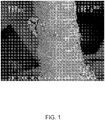
- a coated fiber of an embodiment of the present invention is shown in the photomicrograph of Figure 1 . While not all fibers are required to be fully coated, all the visible exterior surface area of the fiber shown in Figure 1 is coated and additional coating is adhered to the fiber in clumps.
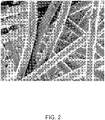
- Figure 2 shows a plurality of such fibers in a nonwoven web, and demonstrates that the coating composition permits the fabric to retain a significant portion of its original breathability by adhering to fibers rather than filling in the interstices in the nonwoven web.
- at least about 50% of the fiber is coated with the coating composition, although other embodiments may include fibers which have at least about 60% of their visible exterior surface coated with the coating composition.
- Still other embodiments may include fibers having at least about 75% of their visible exterior surface coated with the coating composition, or in particular embodiments may have at least about 90% of their visible exterior surface coated. It is not necessary that the entire exterior surface of the fiber be coated with the coating composition, as synergies may be obtained by the mere layering of fibers in the nonwoven web. Similarly, additional synergies may be obtained by the layering of one or more nonwovens which have been treated with the coating of the present invention.
- the bright areas of the backscattered electron image are detected and isolated so that the total exposed area of the particles can be measured.
- An outline may be created which estimates the perimeter of the entire fiber, some of which may be covered by the coating composition.
- Standard image analysis software such as IMIX by Princeton Gamma Tech, may be used to calculate the areas and determine the percent area of the visible exterior surface of the fiber which is coated by coating composition by dividing the area of the fiber which is coated with the coating composition by the estimated area of the fiber and multiplying by 100. While this process is inexact, it can provide a rough estimate of the percent area of the fiber which is coated with the coating composition.
- APTES was added to glutaraldehyde in a 0.25:4, ratio using the mixing, application and testing methodology described above, without the addition of particles.
- the increase in average puncture resistance was 75%.
- TEOS was added to glutaraldehyde in a ratio of 0.25:4 by weight (example 23) and provided an increase in average puncture resistance of 22%. While not wishing to be held to a particular theory, the substantial difference in average puncture resistance between these two examples may indicate that aminofunctional silanes may provide a greater improvement in the average puncture resistance than other silanes.
- the coating composition of example 3 was prepared using a 1:0.25:4 weight ratio of silica particles having an average diameter of about 15 nm, APTES and glutaraldehyde. While the process of producing the exemplary coating composition described above is similar to the process by which example 3 was prepared, it is of note that the nanoparticles were added "post", that is, after the APTES and glutaraldehyde were combined. The increase in average puncture resistance was 41 %.
- Example 4 was prepared using a ratio of 1:0.25:4 by weight of 15nm silica particles, APTES and glutaraldehyde. Half of the silica nanoparticles were added at the beginning of the reaction (as in the "Pre” reaction sequence of example 1) and half of the silica nanoparticles were added at the end of the reaction (as in the "Post” reaction sequence of example 3). This reaction sequence has been designated "50-50" in Table 1, indicating that 50% of the particles by weight were added during the reaction sequence and 50% of the particles by weight were added at the end of the reaction sequence. The increase in average puncture resistance for example 4 was 24%.
- example 5 was prepared using a 50-50 process with silica particles having an average diameter of about 15 nm, APTES and glutaraldehyde in a ratio by weight of 2:0.25:4, respectively.
- the increase in average puncture resistance was 30%.
- Example 6 was prepared using a ratio of 1:0.25:4 by weight of silica particles, APTES and glutaraldehyde.
- Half of the silica nanoparticles by weight had an average diameter of 15 nm, and these nanoparticles were added at the beginning of the reaction.
- the remaining half of the silica nanoparticles by weight had an average diameter of 400 nm, and these nanoparticles were added at the end of the reaction.
- the increase in average puncture resistance was 26%.
- example 19 also utilized silica nanoparticles in which half of the nanoparticles by weight had an average diameter of 400 nm and the remaining nanoparticles had an average diameter of 15 nm.
- the 400 nm silica nanoparticles were added earlier in the process while the 15 nm silica nanoparticles were added at the end of the process.
- the coating of example 19 increased the average puncture resistance of the SMS by 20%.
- examples 7 and 8 the 15 nm silica particles were added to APTES and glutaraldehyde in the same manner as was used for example 1.
- the weight ratio for example 7 was 1:0.25:8 and 1:1:4 for example 8.
- the increase in average puncture resistance provided by examples 7 and 8 were 62% and 55%, respectively.
- Examples 9 through 14 were prepared using APTES, glutaraldehyde and silica particles having an average diameter of about 55 nm, although the reaction sequence and weight ratios for the examples varied.
- the increase in average puncture resistance varied from 19% to 65% for these samples. From these examples, the increase in size of the nanoparticles from 15 to 55 nm did not appear to impact the function of the coating on the SMS. It is possible that, for other substrates, a similar increase in size of the nanoparticles may impact the increase in average puncture resistance obtained.
- Examples 15 through 18, 20 and 21 were formed from APTES, glutaraldehyde and 400 nm silica particles, with varying reaction sequences and weight ratios.
- the increase in average puncture resistance varied from 14% to 84%. This level of variation may be due in part to the size of the silica nanoparticles with respect to the voids in the meltblown layer of the SMS material.
- Examples 22, 24 and 25 investigate the use of silica nanoparticles with TEOS and HMDS rather than APTES.
- the coating composition with TEOS and nanoparticles functioned well by providing increases in average puncture resistance of 55% and 44%, respectively.
- Example 25 utilized HMDS as the silane, and increased the average puncture resistance of the base material by 67%. Further tests conducted on Example 25 included Taber Abrasion Test (Table 2), sliding compression test (toughness) (Table 3) and linting test (torsion test to determine coating durability)(Table 4).
- Example 25 were submitted for Taber Abrasion testing (using Standard Test Method 2204 dated 11-23-2010 test type method A) and the results (average of two samples) shown in Table 2, which shows that Example 25 has higher resistance to abrasion than the Base fabric. Table 2 - Taber Abrasion Test. No. Taber Abrasion Final Rating Base 2 25 4
- Example 25 was also submitted for Sliding Compression testing (using Standard Test Method 4566 dated September 29, 2009) and the results (average of three samples) are shown in Table 3, which shows that Example 25 has improved toughness compared to the Base fabric. Table 3 - Sliding Compression Testing. No. Sliding Compression Wf in grams Base 867 (STD 64) 25 1150 (STD 108)
- the Base fabric and Example 25 were also submitted for resistance to linting testing.
- the amount of lint for a given sample was determined according to the Gelbo Lint Test.
- the Gelbo Lint Test determines the relative number of particles released from a fabric when it is subjected to a continuous flexing and twisting movement. It is performed in accordance with INDA test method 160.1-92.
- a 228.6 mm by 228.6 mm (9 inch by 9 inch) square sample is placed in a flexing chamber. As the sample is flexed, air is withdrawn from the chamber at 0.0283 m 3 per minute (1 cubic foot per minute) for counting in a laser particle counter.
- the particle counter counts the particles by size using channels to size the particles.
- Example 25 has a coating that is very durable, giving rise to no detectable linting or dusting.
- the results show that the Base fabric has higher linting that the coated fabric Example 25.
- the Example 25 results are negative (showing an improvement) because the results for the Base fabric has been subtracted from the results for Example 25 for each size range.
- Examples 26 and 27 evaluated the use of titanium dioxide as the nanoparticle of the composition, with increases in average puncture resistance of 36% and 72%.
- examples 28 and 29 evaluated the use of alumina as the nanoparticle of the composition, with increases in average puncture resistance of 71% and 27%.
- the examples shown demonstrate that the coating composition of the present invention is able to increase the average puncture resistance of a nonwoven fabric.
Landscapes
- Engineering & Computer Science (AREA)
- Textile Engineering (AREA)
- Chemical & Material Sciences (AREA)
- Chemical Kinetics & Catalysis (AREA)
- Inorganic Chemistry (AREA)
- Organic Chemistry (AREA)
- Chemical Or Physical Treatment Of Fibers (AREA)
- Materials For Medical Uses (AREA)
- Treatments For Attaching Organic Compounds To Fibrous Goods (AREA)
Applications Claiming Priority (2)
| Application Number | Priority Date | Filing Date | Title |
|---|---|---|---|
| US12/647,613 US8709959B2 (en) | 2009-12-28 | 2009-12-28 | Puncture resistant fabric |
| PCT/IB2010/055883 WO2011080649A2 (en) | 2009-12-28 | 2010-12-16 | Puncture resistant fabric |
Publications (3)
| Publication Number | Publication Date |
|---|---|
| EP2519687A2 EP2519687A2 (en) | 2012-11-07 |
| EP2519687A4 EP2519687A4 (en) | 2015-10-14 |
| EP2519687B1 true EP2519687B1 (en) | 2017-03-01 |
Family
ID=44188108
Family Applications (1)
| Application Number | Title | Priority Date | Filing Date |
|---|---|---|---|
| EP10840682.8A Not-in-force EP2519687B1 (en) | 2009-12-28 | 2010-12-16 | Puncture resistant fabric |
Country Status (7)
| Country | Link |
|---|---|
| US (1) | US8709959B2 (enExample) |
| EP (1) | EP2519687B1 (enExample) |
| JP (1) | JP5627140B2 (enExample) |
| AU (1) | AU2010337911B2 (enExample) |
| CA (1) | CA2781838C (enExample) |
| MX (1) | MX2012007628A (enExample) |
| WO (1) | WO2011080649A2 (enExample) |
Families Citing this family (11)
| Publication number | Priority date | Publication date | Assignee | Title |
|---|---|---|---|---|
| WO2011127259A2 (en) * | 2010-04-07 | 2011-10-13 | University Of Delaware | Puncture and/or cut resistant glove having maximized dexterity, tactility, and comfort |
| WO2012174204A2 (en) | 2011-06-17 | 2012-12-20 | Fiberweb, Inc. | Vapor permeable, substantially water impermeable multilayer article |
| US10369769B2 (en) | 2011-06-23 | 2019-08-06 | Fiberweb, Inc. | Vapor-permeable, substantially water-impermeable multilayer article |
| EP2723568B1 (en) | 2011-06-23 | 2017-09-27 | Fiberweb, LLC | Vapor permeable, substantially water impermeable multilayer article |
| US9765459B2 (en) | 2011-06-24 | 2017-09-19 | Fiberweb, Llc | Vapor-permeable, substantially water-impermeable multilayer article |
| KR101797556B1 (ko) * | 2014-12-29 | 2017-11-14 | 도레이케미칼 주식회사 | 항바이러스 여재용 양전하 코팅제, 항바이러스 여재 및 이의 제조방법 |
| CN105882075B (zh) * | 2016-06-02 | 2018-05-04 | 江苏盛纺纳米材料科技股份有限公司 | 一种熔喷复合纳米抗菌超柔软非织造材料及制备方法 |
| GB201720899D0 (en) * | 2017-12-14 | 2018-01-31 | Don & Low Ltd | Improved nonwoven fabric |
| CN110130114A (zh) * | 2019-04-25 | 2019-08-16 | 王兵兵 | 一种生物质石墨烯面料及其制备方法 |
| CN115595801B (zh) * | 2022-10-10 | 2023-12-05 | 温州市丰盛鞋业有限公司 | 一种防刺穿透气鞋面及其生产工艺 |
| GB2624381B (en) * | 2022-11-11 | 2026-02-11 | Qinetiq Ltd | Protective materials |
Family Cites Families (25)
| Publication number | Priority date | Publication date | Assignee | Title |
|---|---|---|---|---|
| US4269603A (en) * | 1979-05-04 | 1981-05-26 | Riegel Textile Corporation | Non-formaldehyde durable press textile treatment |
| CA1290994C (en) | 1984-07-30 | 1991-10-22 | Mikhail Milad Girgis | Flexible, chemically treated bundles of fibers, woven and nonwoven fabrics and coated fabrics thereof |
| US5087499A (en) * | 1990-05-09 | 1992-02-11 | Sullivan Thomas M | Puncture-resistant and medicinal treatment garments and method of manufacture thereof |
| DE69109017T2 (de) * | 1990-08-10 | 1995-08-31 | Osi Specialties Inc | Silicon-Textilveredelungsmittel. |
| US5200263A (en) * | 1991-08-13 | 1993-04-06 | Gould Arnold S | Puncture and cut resistant material and article |
| US5407612A (en) * | 1991-08-13 | 1995-04-18 | Gould; Arnold S. | Method for making puncture and cut resistant material and article |
| US5993935A (en) * | 1991-10-11 | 1999-11-30 | 3M Innovative Properties Company | Covalently reactive particles incorporated in a continous porous matrix |
| US5368930A (en) * | 1991-11-15 | 1994-11-29 | Samples; C. Robert | Thin elastomeric article having increasing puncture resistance |
| US5529837A (en) * | 1994-02-28 | 1996-06-25 | Shin-Etsu Chemical Co., Ltd. | Silicone coated base material and air bag base material |
| WO1995032857A1 (en) | 1994-05-31 | 1995-12-07 | Kim Patchett | Puncture resistant material |
| US5776839A (en) * | 1996-10-10 | 1998-07-07 | Milliken Research Corporation | Dilatant powder coated fabric and containment articles formed therefrom |
| US5817433A (en) * | 1997-01-16 | 1998-10-06 | Darras; Robert | Cut and puncture resistant surgical glove |
| CA2294160A1 (en) * | 1997-06-30 | 1999-01-07 | Kimberly-Clark Worldwide, Inc. | Medical packaging material and process for making same |
| US6730393B1 (en) | 1997-10-08 | 2004-05-04 | Honeywell International, Inc. | Cut-resistant polymeric sheets and articles formed therefrom |
| US6080474A (en) * | 1997-10-08 | 2000-06-27 | Hoechst Celanese Corporation | Polymeric articles having improved cut-resistance |
| US6667424B1 (en) * | 1998-10-02 | 2003-12-23 | Kimberly-Clark Worldwide, Inc. | Absorbent articles with nits and free-flowing particles |
| US7582343B1 (en) * | 1999-06-15 | 2009-09-01 | Kimberly-Clark Worldwide, Inc. | Elastomeric article with fine colloidal silica surface treatment, and its preparation |
| FR2796086B1 (fr) * | 1999-07-06 | 2002-03-15 | Rhodianyl | Articles files resistant a l'abrasion |
| AU8028800A (en) | 1999-10-18 | 2001-04-30 | Warwick Mills, Inc. | Coated protective fabrics |
| WO2001029118A1 (en) * | 1999-10-19 | 2001-04-26 | Commonwealth Scientific And Industrial Research Organisation | Preparation of functional polymeric surface |
| US6893989B2 (en) * | 1999-10-21 | 2005-05-17 | Twaron Products V.O.F. | Stab-resisting material, a coated carrier to be used therewith, and clothing made of said material |
| US20050053642A1 (en) * | 2000-08-23 | 2005-03-10 | Mathias Ulbricht | Biocompatible materials |
| US7226878B2 (en) * | 2003-05-19 | 2007-06-05 | The University Of Delaware | Advanced body armor utilizing shear thickening fluids |
| JP2006124866A (ja) | 2004-10-28 | 2006-05-18 | Ohara Palladium Kagaku Kk | 繊維用加工剤およびそれを用いた繊維製品ならびに繊維布帛類の加工方法 |
| US9163338B2 (en) | 2007-04-11 | 2015-10-20 | Drexel University | Fibrous mats containing chitosan nanofibers |
-
2009
- 2009-12-28 US US12/647,613 patent/US8709959B2/en active Active
-
2010
- 2010-12-16 CA CA2781838A patent/CA2781838C/en not_active Expired - Fee Related
- 2010-12-16 EP EP10840682.8A patent/EP2519687B1/en not_active Not-in-force
- 2010-12-16 MX MX2012007628A patent/MX2012007628A/es active IP Right Grant
- 2010-12-16 JP JP2012546529A patent/JP5627140B2/ja not_active Expired - Fee Related
- 2010-12-16 WO PCT/IB2010/055883 patent/WO2011080649A2/en not_active Ceased
- 2010-12-16 AU AU2010337911A patent/AU2010337911B2/en not_active Ceased
Non-Patent Citations (1)
| Title |
|---|
| None * |
Also Published As
| Publication number | Publication date |
|---|---|
| CA2781838A1 (en) | 2011-07-07 |
| US8709959B2 (en) | 2014-04-29 |
| WO2011080649A2 (en) | 2011-07-07 |
| EP2519687A2 (en) | 2012-11-07 |
| US20110159759A1 (en) | 2011-06-30 |
| CA2781838C (en) | 2015-08-25 |
| WO2011080649A3 (en) | 2011-11-17 |
| AU2010337911A1 (en) | 2012-06-21 |
| JP5627140B2 (ja) | 2014-11-19 |
| EP2519687A4 (en) | 2015-10-14 |
| MX2012007628A (es) | 2012-08-01 |
| AU2010337911B2 (en) | 2014-10-23 |
| JP2013515876A (ja) | 2013-05-09 |
Similar Documents
| Publication | Publication Date | Title |
|---|---|---|
| AU2010337911B2 (en) | Puncture resistant fabric | |
| US8366816B2 (en) | Adsorption filter material with integrated particle- and/or aerosolfiltering function and its use | |
| NL2006634C2 (en) | Antimicrobial fabric. | |
| AU2001232232B9 (en) | Nonwoven fabric, process for producing the same, sanitary material, and sanitary supply | |
| CA2579566C (en) | Adsorptive filtering material with integrated particle-and/or aerosol-filtering function and use thereof | |
| EP0245933B2 (en) | Non-woven fabric comprising at least one spun-bonded layer | |
| DE69208405T2 (de) | Gegen Durchdringung von Flüssigkeit beständiger saugfähiger Schichtstoff | |
| KR20220115588A (ko) | 기능화된 텍스타일 재료의 조립체 및 이의 사용 방법 | |
| US20100080841A1 (en) | Fibrous articles with one or more polyelectrolyte layers thereon and methods for making the same | |
| DE202018100242U1 (de) | Luftdurchlässiges Flächenfiltermaterial | |
| US20110155141A1 (en) | Wearable Article That Stiffens Upon Sudden Force | |
| US20130039968A1 (en) | Materials and processes for producing antitoxic fabrics | |
| EP1902836A1 (en) | Breathable laminate with a high abrasion resistance and method of manufacturing the same | |
| KR100324052B1 (ko) | 보호라미네이트의제조방법 | |
| CN112549717A (zh) | 一种复合布及其制备方法与应用 | |
| FI123878B (fi) | Antimikrobinen haavaside ja menetelmä sen valmistamiseksi | |
| EP4188143B1 (en) | Articles with anti-viral properties | |
| JP2014000155A (ja) | フィルタ | |
| CN112899878B (zh) | 一种耐辐射聚丙烯无纺布 | |
| JP2005060904A (ja) | 有害化学物質を吸着分解する繊維構造体 | |
| WO2022098299A1 (en) | Copper nanoparticle formulation to promote rapid pathogen inactivation | |
| JP2003166106A (ja) | 防護服用材料及び防護服 | |
| Amid | Hybrid particle-meltblown nonwovens-structure property relationships | |
| JP2008266860A (ja) | 不燃性不織布 |
Legal Events
| Date | Code | Title | Description |
|---|---|---|---|
| PUAI | Public reference made under article 153(3) epc to a published international application that has entered the european phase |
Free format text: ORIGINAL CODE: 0009012 |
|
| 17P | Request for examination filed |
Effective date: 20120621 |
|
| AK | Designated contracting states |
Kind code of ref document: A2 Designated state(s): AL AT BE BG CH CY CZ DE DK EE ES FI FR GB GR HR HU IE IS IT LI LT LU LV MC MK MT NL NO PL PT RO RS SE SI SK SM TR |
|
| DAX | Request for extension of the european patent (deleted) | ||
| A4 | Supplementary search report drawn up and despatched |
Effective date: 20150914 |
|
| RIC1 | Information provided on ipc code assigned before grant |
Ipc: D06M 11/45 20060101ALI20150908BHEP Ipc: D06M 13/12 20060101ALI20150908BHEP Ipc: D06M 11/78 20060101AFI20150908BHEP |
|
| GRAP | Despatch of communication of intention to grant a patent |
Free format text: ORIGINAL CODE: EPIDOSNIGR1 |
|
| INTG | Intention to grant announced |
Effective date: 20160929 |
|
| GRAS | Grant fee paid |
Free format text: ORIGINAL CODE: EPIDOSNIGR3 |
|
| GRAA | (expected) grant |
Free format text: ORIGINAL CODE: 0009210 |
|
| AK | Designated contracting states |
Kind code of ref document: B1 Designated state(s): AL AT BE BG CH CY CZ DE DK EE ES FI FR GB GR HR HU IE IS IT LI LT LU LV MC MK MT NL NO PL PT RO RS SE SI SK SM TR |
|
| REG | Reference to a national code |
Ref country code: GB Ref legal event code: FG4D |
|
| REG | Reference to a national code |
Ref country code: CH Ref legal event code: EP Ref country code: AT Ref legal event code: REF Ref document number: 871484 Country of ref document: AT Kind code of ref document: T Effective date: 20170315 |
|
| REG | Reference to a national code |
Ref country code: IE Ref legal event code: FG4D |
|
| REG | Reference to a national code |
Ref country code: DE Ref legal event code: R096 Ref document number: 602010040478 Country of ref document: DE |
|
| REG | Reference to a national code |
Ref country code: NL Ref legal event code: MP Effective date: 20170301 |
|
| REG | Reference to a national code |
Ref country code: LT Ref legal event code: MG4D |
|
| REG | Reference to a national code |
Ref country code: AT Ref legal event code: MK05 Ref document number: 871484 Country of ref document: AT Kind code of ref document: T Effective date: 20170301 |
|
| PG25 | Lapsed in a contracting state [announced via postgrant information from national office to epo] |
Ref country code: FI Free format text: LAPSE BECAUSE OF FAILURE TO SUBMIT A TRANSLATION OF THE DESCRIPTION OR TO PAY THE FEE WITHIN THE PRESCRIBED TIME-LIMIT Effective date: 20170301 Ref country code: NO Free format text: LAPSE BECAUSE OF FAILURE TO SUBMIT A TRANSLATION OF THE DESCRIPTION OR TO PAY THE FEE WITHIN THE PRESCRIBED TIME-LIMIT Effective date: 20170601 Ref country code: LT Free format text: LAPSE BECAUSE OF FAILURE TO SUBMIT A TRANSLATION OF THE DESCRIPTION OR TO PAY THE FEE WITHIN THE PRESCRIBED TIME-LIMIT Effective date: 20170301 Ref country code: HR Free format text: LAPSE BECAUSE OF FAILURE TO SUBMIT A TRANSLATION OF THE DESCRIPTION OR TO PAY THE FEE WITHIN THE PRESCRIBED TIME-LIMIT Effective date: 20170301 Ref country code: GR Free format text: LAPSE BECAUSE OF FAILURE TO SUBMIT A TRANSLATION OF THE DESCRIPTION OR TO PAY THE FEE WITHIN THE PRESCRIBED TIME-LIMIT Effective date: 20170602 |
|
| PG25 | Lapsed in a contracting state [announced via postgrant information from national office to epo] |
Ref country code: LV Free format text: LAPSE BECAUSE OF FAILURE TO SUBMIT A TRANSLATION OF THE DESCRIPTION OR TO PAY THE FEE WITHIN THE PRESCRIBED TIME-LIMIT Effective date: 20170301 Ref country code: ES Free format text: LAPSE BECAUSE OF FAILURE TO SUBMIT A TRANSLATION OF THE DESCRIPTION OR TO PAY THE FEE WITHIN THE PRESCRIBED TIME-LIMIT Effective date: 20170301 Ref country code: AT Free format text: LAPSE BECAUSE OF FAILURE TO SUBMIT A TRANSLATION OF THE DESCRIPTION OR TO PAY THE FEE WITHIN THE PRESCRIBED TIME-LIMIT Effective date: 20170301 Ref country code: BG Free format text: LAPSE BECAUSE OF FAILURE TO SUBMIT A TRANSLATION OF THE DESCRIPTION OR TO PAY THE FEE WITHIN THE PRESCRIBED TIME-LIMIT Effective date: 20170601 Ref country code: SE Free format text: LAPSE BECAUSE OF FAILURE TO SUBMIT A TRANSLATION OF THE DESCRIPTION OR TO PAY THE FEE WITHIN THE PRESCRIBED TIME-LIMIT Effective date: 20170301 Ref country code: RS Free format text: LAPSE BECAUSE OF FAILURE TO SUBMIT A TRANSLATION OF THE DESCRIPTION OR TO PAY THE FEE WITHIN THE PRESCRIBED TIME-LIMIT Effective date: 20170301 |
|
| PG25 | Lapsed in a contracting state [announced via postgrant information from national office to epo] |
Ref country code: NL Free format text: LAPSE BECAUSE OF FAILURE TO SUBMIT A TRANSLATION OF THE DESCRIPTION OR TO PAY THE FEE WITHIN THE PRESCRIBED TIME-LIMIT Effective date: 20170301 |
|
| PG25 | Lapsed in a contracting state [announced via postgrant information from national office to epo] |
Ref country code: CZ Free format text: LAPSE BECAUSE OF FAILURE TO SUBMIT A TRANSLATION OF THE DESCRIPTION OR TO PAY THE FEE WITHIN THE PRESCRIBED TIME-LIMIT Effective date: 20170301 Ref country code: IT Free format text: LAPSE BECAUSE OF FAILURE TO SUBMIT A TRANSLATION OF THE DESCRIPTION OR TO PAY THE FEE WITHIN THE PRESCRIBED TIME-LIMIT Effective date: 20170301 Ref country code: RO Free format text: LAPSE BECAUSE OF FAILURE TO SUBMIT A TRANSLATION OF THE DESCRIPTION OR TO PAY THE FEE WITHIN THE PRESCRIBED TIME-LIMIT Effective date: 20170301 Ref country code: SK Free format text: LAPSE BECAUSE OF FAILURE TO SUBMIT A TRANSLATION OF THE DESCRIPTION OR TO PAY THE FEE WITHIN THE PRESCRIBED TIME-LIMIT Effective date: 20170301 Ref country code: EE Free format text: LAPSE BECAUSE OF FAILURE TO SUBMIT A TRANSLATION OF THE DESCRIPTION OR TO PAY THE FEE WITHIN THE PRESCRIBED TIME-LIMIT Effective date: 20170301 |
|
| PG25 | Lapsed in a contracting state [announced via postgrant information from national office to epo] |
Ref country code: IS Free format text: LAPSE BECAUSE OF FAILURE TO SUBMIT A TRANSLATION OF THE DESCRIPTION OR TO PAY THE FEE WITHIN THE PRESCRIBED TIME-LIMIT Effective date: 20170701 Ref country code: SM Free format text: LAPSE BECAUSE OF FAILURE TO SUBMIT A TRANSLATION OF THE DESCRIPTION OR TO PAY THE FEE WITHIN THE PRESCRIBED TIME-LIMIT Effective date: 20170301 Ref country code: PL Free format text: LAPSE BECAUSE OF FAILURE TO SUBMIT A TRANSLATION OF THE DESCRIPTION OR TO PAY THE FEE WITHIN THE PRESCRIBED TIME-LIMIT Effective date: 20170301 Ref country code: PT Free format text: LAPSE BECAUSE OF FAILURE TO SUBMIT A TRANSLATION OF THE DESCRIPTION OR TO PAY THE FEE WITHIN THE PRESCRIBED TIME-LIMIT Effective date: 20170703 |
|
| REG | Reference to a national code |
Ref country code: DE Ref legal event code: R097 Ref document number: 602010040478 Country of ref document: DE |
|
| REG | Reference to a national code |
Ref country code: FR Ref legal event code: PLFP Year of fee payment: 8 |
|
| PLBE | No opposition filed within time limit |
Free format text: ORIGINAL CODE: 0009261 |
|
| STAA | Information on the status of an ep patent application or granted ep patent |
Free format text: STATUS: NO OPPOSITION FILED WITHIN TIME LIMIT |
|
| PG25 | Lapsed in a contracting state [announced via postgrant information from national office to epo] |
Ref country code: DK Free format text: LAPSE BECAUSE OF FAILURE TO SUBMIT A TRANSLATION OF THE DESCRIPTION OR TO PAY THE FEE WITHIN THE PRESCRIBED TIME-LIMIT Effective date: 20170301 |
|
| PGFP | Annual fee paid to national office [announced via postgrant information from national office to epo] |
Ref country code: FR Payment date: 20171227 Year of fee payment: 8 |
|
| 26N | No opposition filed |
Effective date: 20171204 |
|
| PG25 | Lapsed in a contracting state [announced via postgrant information from national office to epo] |
Ref country code: SI Free format text: LAPSE BECAUSE OF FAILURE TO SUBMIT A TRANSLATION OF THE DESCRIPTION OR TO PAY THE FEE WITHIN THE PRESCRIBED TIME-LIMIT Effective date: 20170301 |
|
| PGFP | Annual fee paid to national office [announced via postgrant information from national office to epo] |
Ref country code: DE Payment date: 20171229 Year of fee payment: 8 |
|
| REG | Reference to a national code |
Ref country code: CH Ref legal event code: PL |
|
| REG | Reference to a national code |
Ref country code: IE Ref legal event code: MM4A |
|
| PG25 | Lapsed in a contracting state [announced via postgrant information from national office to epo] |
Ref country code: MT Free format text: LAPSE BECAUSE OF NON-PAYMENT OF DUE FEES Effective date: 20171216 Ref country code: LU Free format text: LAPSE BECAUSE OF NON-PAYMENT OF DUE FEES Effective date: 20171216 |
|
| REG | Reference to a national code |
Ref country code: BE Ref legal event code: MM Effective date: 20171231 |
|
| PG25 | Lapsed in a contracting state [announced via postgrant information from national office to epo] |
Ref country code: IE Free format text: LAPSE BECAUSE OF NON-PAYMENT OF DUE FEES Effective date: 20171216 |
|
| PG25 | Lapsed in a contracting state [announced via postgrant information from national office to epo] |
Ref country code: LI Free format text: LAPSE BECAUSE OF NON-PAYMENT OF DUE FEES Effective date: 20171231 Ref country code: CH Free format text: LAPSE BECAUSE OF NON-PAYMENT OF DUE FEES Effective date: 20171231 Ref country code: BE Free format text: LAPSE BECAUSE OF NON-PAYMENT OF DUE FEES Effective date: 20171231 |
|
| PG25 | Lapsed in a contracting state [announced via postgrant information from national office to epo] |
Ref country code: MC Free format text: LAPSE BECAUSE OF FAILURE TO SUBMIT A TRANSLATION OF THE DESCRIPTION OR TO PAY THE FEE WITHIN THE PRESCRIBED TIME-LIMIT Effective date: 20170301 Ref country code: HU Free format text: LAPSE BECAUSE OF FAILURE TO SUBMIT A TRANSLATION OF THE DESCRIPTION OR TO PAY THE FEE WITHIN THE PRESCRIBED TIME-LIMIT; INVALID AB INITIO Effective date: 20101216 |
|
| REG | Reference to a national code |
Ref country code: DE Ref legal event code: R119 Ref document number: 602010040478 Country of ref document: DE |
|
| PG25 | Lapsed in a contracting state [announced via postgrant information from national office to epo] |
Ref country code: CY Free format text: LAPSE BECAUSE OF NON-PAYMENT OF DUE FEES Effective date: 20170301 Ref country code: DE Free format text: LAPSE BECAUSE OF NON-PAYMENT OF DUE FEES Effective date: 20190702 Ref country code: FR Free format text: LAPSE BECAUSE OF NON-PAYMENT OF DUE FEES Effective date: 20181231 |
|
| PG25 | Lapsed in a contracting state [announced via postgrant information from national office to epo] |
Ref country code: MK Free format text: LAPSE BECAUSE OF FAILURE TO SUBMIT A TRANSLATION OF THE DESCRIPTION OR TO PAY THE FEE WITHIN THE PRESCRIBED TIME-LIMIT Effective date: 20170301 |
|
| PG25 | Lapsed in a contracting state [announced via postgrant information from national office to epo] |
Ref country code: TR Free format text: LAPSE BECAUSE OF FAILURE TO SUBMIT A TRANSLATION OF THE DESCRIPTION OR TO PAY THE FEE WITHIN THE PRESCRIBED TIME-LIMIT Effective date: 20170301 |
|
| PG25 | Lapsed in a contracting state [announced via postgrant information from national office to epo] |
Ref country code: AL Free format text: LAPSE BECAUSE OF FAILURE TO SUBMIT A TRANSLATION OF THE DESCRIPTION OR TO PAY THE FEE WITHIN THE PRESCRIBED TIME-LIMIT Effective date: 20170301 |
|
| PGFP | Annual fee paid to national office [announced via postgrant information from national office to epo] |
Ref country code: GB Payment date: 20231227 Year of fee payment: 14 |
|
| GBPC | Gb: european patent ceased through non-payment of renewal fee |
Effective date: 20241216 |
|
| PG25 | Lapsed in a contracting state [announced via postgrant information from national office to epo] |
Ref country code: GB Free format text: LAPSE BECAUSE OF NON-PAYMENT OF DUE FEES Effective date: 20241216 |