EP2485263A1 - Solarzellenelement und herstellungsverfahren dafür - Google Patents
Solarzellenelement und herstellungsverfahren dafür Download PDFInfo
- Publication number
- EP2485263A1 EP2485263A1 EP10818931A EP10818931A EP2485263A1 EP 2485263 A1 EP2485263 A1 EP 2485263A1 EP 10818931 A EP10818931 A EP 10818931A EP 10818931 A EP10818931 A EP 10818931A EP 2485263 A1 EP2485263 A1 EP 2485263A1
- Authority
- EP
- European Patent Office
- Prior art keywords
- solar cell
- semiconductor substrate
- cell element
- hole
- holes
- Prior art date
- Legal status (The legal status is an assumption and is not a legal conclusion. Google has not performed a legal analysis and makes no representation as to the accuracy of the status listed.)
- Withdrawn
Links
Images



Classifications
-
- H—ELECTRICITY
- H10—SEMICONDUCTOR DEVICES; ELECTRIC SOLID-STATE DEVICES NOT OTHERWISE PROVIDED FOR
- H10F—INORGANIC SEMICONDUCTOR DEVICES SENSITIVE TO INFRARED RADIATION, LIGHT, ELECTROMAGNETIC RADIATION OF SHORTER WAVELENGTH OR CORPUSCULAR RADIATION
- H10F77/00—Constructional details of devices covered by this subclass
- H10F77/20—Electrodes
- H10F77/206—Electrodes for devices having potential barriers
- H10F77/211—Electrodes for devices having potential barriers for photovoltaic cells
-
- H—ELECTRICITY
- H10—SEMICONDUCTOR DEVICES; ELECTRIC SOLID-STATE DEVICES NOT OTHERWISE PROVIDED FOR
- H10F—INORGANIC SEMICONDUCTOR DEVICES SENSITIVE TO INFRARED RADIATION, LIGHT, ELECTROMAGNETIC RADIATION OF SHORTER WAVELENGTH OR CORPUSCULAR RADIATION
- H10F10/00—Individual photovoltaic cells, e.g. solar cells
-
- H—ELECTRICITY
- H10—SEMICONDUCTOR DEVICES; ELECTRIC SOLID-STATE DEVICES NOT OTHERWISE PROVIDED FOR
- H10F—INORGANIC SEMICONDUCTOR DEVICES SENSITIVE TO INFRARED RADIATION, LIGHT, ELECTROMAGNETIC RADIATION OF SHORTER WAVELENGTH OR CORPUSCULAR RADIATION
- H10F10/00—Individual photovoltaic cells, e.g. solar cells
- H10F10/10—Individual photovoltaic cells, e.g. solar cells having potential barriers
- H10F10/14—Photovoltaic cells having only PN homojunction potential barriers
-
- H—ELECTRICITY
- H10—SEMICONDUCTOR DEVICES; ELECTRIC SOLID-STATE DEVICES NOT OTHERWISE PROVIDED FOR
- H10F—INORGANIC SEMICONDUCTOR DEVICES SENSITIVE TO INFRARED RADIATION, LIGHT, ELECTROMAGNETIC RADIATION OF SHORTER WAVELENGTH OR CORPUSCULAR RADIATION
- H10F77/00—Constructional details of devices covered by this subclass
- H10F77/20—Electrodes
- H10F77/206—Electrodes for devices having potential barriers
- H10F77/211—Electrodes for devices having potential barriers for photovoltaic cells
- H10F77/219—Arrangements for electrodes of back-contact photovoltaic cells
- H10F77/227—Arrangements for electrodes of back-contact photovoltaic cells for emitter wrap-through [EWT] photovoltaic cells, e.g. interdigitated emitter-base back-contacts
-
- Y—GENERAL TAGGING OF NEW TECHNOLOGICAL DEVELOPMENTS; GENERAL TAGGING OF CROSS-SECTIONAL TECHNOLOGIES SPANNING OVER SEVERAL SECTIONS OF THE IPC; TECHNICAL SUBJECTS COVERED BY FORMER USPC CROSS-REFERENCE ART COLLECTIONS [XRACs] AND DIGESTS
- Y02—TECHNOLOGIES OR APPLICATIONS FOR MITIGATION OR ADAPTATION AGAINST CLIMATE CHANGE
- Y02E—REDUCTION OF GREENHOUSE GAS [GHG] EMISSIONS, RELATED TO ENERGY GENERATION, TRANSMISSION OR DISTRIBUTION
- Y02E10/00—Energy generation through renewable energy sources
- Y02E10/50—Photovoltaic [PV] energy
- Y02E10/547—Monocrystalline silicon PV cells
Definitions
- the present invention relates to a solar cell element and a method for manufacturing the same.
- Examples of the back contact solar cell element include a through-hole type back contact solar cell in which a semiconductor substrate such as a silicon substrate includes through holes formed at a plurality of predetermined positions thereof and a conductive member is loaded in the through holes so that electrodes on a light-receiving surface and electrodes on a back surface are connected to each other.
- a current occurring per unit area is larger in a peripheral portion of the solar cell element than in a central portion thereof, because of an incident light multiple-reflected from other solar cell elements.
- a solar cell element of the present invention is a solar cell element comprising a semiconductor substrate with a first surface serving as a light-receiving surface, a second surface that is a back surface of the first surface, and a plurality of through holes formed so as to extend from the first surface to the second surface, wherein an area of an opening of each of the plurality of through holes increases as the through hole is located closer to a peripheral portion of the semiconductor substrate relative to a central portion thereof.
- a solar cell module of the present invention includes the solar cell element.
- a method for manufacturing a solar cell element includes forming the plurality of through holes by irradiating the semiconductor substrate with a laser from a specific position while varying an angle of the irradiation.
- an opening of each of the through holes is made larger as the through hole is located closer to an outer edge of the element, thereby substantially reducing a difference in the resistance among the through holes. That is, current densities in the electrodes in the central portion and in the peripheral portion can be made uniform. This can reduce a series resistance component of the entire solar cell element, and thus improve a photoelectric conversion efficiency.
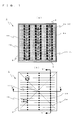
- FIG. 1 A solar cell element 1 according to the present invention will be described with reference to FIG. 1 and FIG. 2 that shows an enlarged cross-sectional view of a part of the solar cell element 1 shown in FIG. 1 .
- the solar cell element 1 of the present invention comprises a semiconductor substrate 5 including a first surface 1b for receiving sunlight, and a second surface 1a located at the back side thereof, and a plurality of through holes 8 formed through between the first surface 1b and the second surface 1a.
- a conductive load material is loaded in the through holes 8, thus forming through hole electrodes 2b.
- light-receiving surface electrodes 2a formed on the first surface 1b of the semiconductor substrate 5 are a plurality of fine-straight-line electrodes arranged substantially at regular intervals. Furthermore, about three through hole electrodes 2b are connected onto each light-receiving surface electrode 2a.
- a current density per one through hole electrode 2b can be reduced, and thus a resistance in the entire solar cell element 1 can be reduced.
- Electrodes formed on the second surface 1a correspond to these electrodes of the first surface 1b, in the following manner.
- a plurality of first electrodes 2 each having a rectangular shape and each electrically connected to the through hole electrode 2b are arranged in straight lines immediately below the through hole electrodes 2b and substantially at regular intervals.
- One first electrode 2 is connected to one or more of the through hole electrodes 2b.
- second electrodes 3 of the polarity different from that of the first electrodes 2 are provided.
- the second electrodes 3 include a collector electrode 3a and output electrodes 3b. That is, the collector electrode 3a is arranged in a portion other than the first electrodes 2 arranged in straight lines and therearound, and the output electrodes 3b are formed on the collector electrode 3a.
- Each of the output electrodes 3b serves as an electrode for extracting an output of the collector electrode 3a.
- the semiconductor substrate 5 has one conductive type. As shown in FIG. 2(a) and (b) , the semiconductor substrate 5 includes, on the first surface 1b and the second surface 1a, an opposite-conductive-type semiconductor layer 6 (a first opposite-conductive-type layer 6a and a third opposite-conductive-type layer 6c) having the conductive type different from that of the semiconductor substrate 5.
- an opposite-conductive-type semiconductor layer 6 a first opposite-conductive-type layer 6a and a third opposite-conductive-type layer 6c
- a second opposite-conductive-type layer 6b is provided on an inner surface of the electrode through hole 8 of the semiconductor substrate 5.
- the opposite-conductive-type layer 6 is of N-type, and the opposite-conductive-type layer 6 is formed by diffusing an N-type impurity such as phosphorus in a surface of the semiconductor substrate 5 and an inner surface of the electrode through hole 8.
- a high-concentration doped layer 10 can be formed simultaneously with the formation of the collector electrode 3a by applying and baking the aluminum. This enables carriers generated in the semiconductor substrate 5 to be efficiently collected.
- the high concentration means having a higher impurity concentration than a concentration of the one conductive type impurity in the semiconductor substrate 1.
- the light-receiving surface electrodes 2a are provided on the first surface 1b, and the through hole electrodes 2b are provided within the electrode through holes 8.
- the first electrodes 2 are provided on the opposite-conductive-type semiconductor layer 6, and the collector electrode 3a and the output electrodes 3b serving as the second electrode 3 are provided in a region where the opposite-conductive-type semiconductor layer 6 is not formed.
- a separation groove 9a is provided around each first electrode 2 in a surrounding manner, and furthermore a separation groove 9b is provided in a peripheral portion of the second surface 1a of the semiconductor substrate 5.
- One embodiment of the solar cell element of the present invention is a solar cell element comprising a semiconductor substrate including a first surface serving as a light-receiving surface, a second surface that is a back surface of the first surface, and a plurality of through holes formed so as to extend from the first surface to the second surface. An area of an opening of each of the plurality of through holes increases as the through hole is located closer to a peripheral portion of the semiconductor substrate relative to a central portion thereof.
- a larger hole diameter is given to the through hole 8 located closer to the outer edge of the solar cell element 1, and thereby a difference in the resistance among the through holes 8 can be substantially reduced.
- a density of a current 32 increases toward the outer edge of the solar cell element 1 because of multiple-reflection lights as shown in FIG. 6
- the through hole 8 located closer to the outer edge has a larger hole diameter.
- current densities in the electrodes in the central portion 5a and in the peripheral portion 5b can be made uniform. This can reduce a series resistance component of the entire solar cell element 1, and thus improve a photoelectric conversion efficiency.
- the through hole 8 of the solar cell element 1 includes the conductive load material loaded therein so that the through hole electrode 2b is formed, it is expressed as the through hole 8 for the sake of convenience. From the viewpoint of stabilization of conduction between the first surface 1b and the second surface 1a, it is preferable that the area of the opening of the through hole 8 in the first surface 1b is equal to the area of the opening thereof in the second surface 1a. It is preferable that the cross-section of the through hole 8 parallel to the first surface 1b and the second surface 1a is constant, because it can prevent the through hole 8 from including a narrowed portion, which may otherwise increase the resistance.
- an angle formed between a center line of each of the plurality of through holes and the first surface decreases as the through hole is located closer to the peripheral portion of the semiconductor substrate relative to the central portion thereof.
- extended lines of the center lines of the plurality of through holes converge to a intersection point located at the first surface side.
- the first surface of the semiconductor substrate has a quadrangular shape, and the intersection point is located on a perpendicular line that is perpendicular to the semiconductor substrate and that passes through an intersection between diagonal lines of the semiconductor substrate.
- each of the plurality of through holes 8 increases as the through hole 8 is located closer to the peripheral portion 5b of the semiconductor substrate 5 relative to the central portion 5a thereof.
- the center lines 12 of the electrode through holes 8 converge to and intersect one another at one point 11 that is located in a space at the first surface 1b side of the semiconductor substrate 5.
- a line segment connecting the one point 11 at the first surface 1b side to an intersection 11 a between the diagonal lines of the semiconductor substrate 5 serves as the perpendicular line to the semiconductor substrate 5.
- a length of the through hole 8 extending from the first surface 1b to the second surface 1a can be made larger as the through hole 8 is located closer to the peripheral portion 5b of the semiconductor substrate 5 relative to the central portion 5a thereof.
- the corrosion of the entire through hole 8 due to entry of moisture or the like from the peripheral portion 5b of the solar cell element 1 can be more reduced in a location closer to the peripheral portion 8.
- the same effects as those of the present application can be obtained in a case where the through hole 8 is inclined in the opposite direction.
- the plurality of through holes include first through holes located in the central portion and second through holes located closer to the peripheral portion side than the first through holes, each of the first through holes having the opening with a circular shape, each of the second through holes having the opening with an elliptical shape.
- a first through hole 8a is located at the central portion 5a side, and second through holes 8b, 8c, 8d, and 8e are located closer to the peripheral portion 5b side than the first through hole.
- the electrode through hole 8 having an elliptical shape has an increased opening area, which enhances a current collecting effect.
- the second through holes are located radially from the first through hole.
- the semiconductor substrate has one conductive type, and an opposite-conductive-type semiconductor layer is formed at an inner side surface of the through hole.
- the opposite-conductive-type layer 6b is formed at an inner wall of the through hole 8, a leakage current at this portion can be suppressed.
- the inner side surface of the through hole has a larger surface roughness than that of the first surface and the second surface.
- This roughened surface increases an area for contact with the conductive load material, and thus the intensity of bonding therebetween can be improved. Additionally, this etching can remove a damaged layer that has occurred in cutting out of a silicon ingot mentioned above, and moreover can roughen the first surface 1b, too. Therefore, reflection of light incident on the solar cell element 1 can be suppressed, and the photoelectric conversion efficiency thereof can be further improved.
- a P-type silicon substrate doped with boron for example, is prepared.
- This silicon substrate may be a silicon substrate comprised of a single-crystalline silicon substrate or a poly-crystalline silicon substrate that has been cut out of a silicon ingot.
- the shape of the silicon substrate may be a square or a rectangle having a side length of about 140 to 180 mm, for example. The thickness of this may be about 150 to 300 ⁇ m.
- the electrode through holes 8 are formed to extend between the first surface 1b and the second surface 1a of the semiconductor substrate 5.
- the method for manufacturing the solar cell element of the present invention includes a step of forming a plurality of through holes by irradiating the semiconductor substrate with a laser from a specific position while varying an angle of the irradiation.
- the electrode through holes 8 are formed, for example, in a direction from the first surface 1b side toward the second surface 1a side of the semiconductor substrate 5, by using mechanical drilling, water-jet machining, a laser apparatus, or the like. Particularly, a laser or the like is preferably used, in order to prevent occurrence of micro-cracking during and after the formation of the electrode through holes 8.
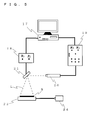
- FIG. 5 shows an outline of a laser apparatus that efficiently forms the electrode through holes 8 according to the present invention.
- the laser apparatus according to the present invention includes an information processing part 17, a laser oscillator part 20, a laser control part 19, a mirror 21, a mirror control section 18, and a mounting table 22.
- the specific position corresponds to the reference numeral 11 of FIG. 3 .
- the laser oscillator part 20 has a function to oscillate a laser for melt and removing a part of the semiconductor substrate 5.
- the laser include an excimer laser, a YAG (yttrium, aluminum, garnet) laser a YVO 4 (yttrium, vanadate) laser, and the like.
- the laser control part 19 controls a laser output and the like.
- the laser control part 19 controls, adjusts, and stabilizes the laser output and the like, and may include, for example: a power supply circuit for supplying power to the laser oscillator part 20; a temperature sensor, a temperature adjustment circuit, a cooling water passage, and a cooling water tank for detecting and controlling a temperature of the laser oscillator part 20; a filter and a blower for supplying air not containing dust to the laser oscillator part 20 and an optical system; an exhaust duct for removing fume caused by evaporation of the semiconductor substrate 5 due to laser irradiation; an air blowing apparatus for flowing the fume into the duct; a shielding unit for preventing a laser light from leaking to the outside; and a pyroelectric sensor for monitoring a beam output at predetermined time intervals.
- the mirror 21 has a function for adjusting a direction (angle) of the laser oscillated by the laser oscillator part 20, and, for example, a galvano mirror is preferably used therefor.
- the mirror control section 18 has a function for controlling an angle or the like of the mirror 21 based on information (program) inputted in advance. That is, the mirror control section 18 controls the angle or the like of the mirror 21 so as to irradiate a predetermined position on the semiconductor substrate 5 with the laser.
- a convex lens, a flat field lens, an F ⁇ lens, or the like, may be arranged between the mirror 21 and the semiconductor substrate 5 in order to converge and focus the laser.
- the mounting table 22 has a function for supporting the semiconductor substrate 5 on a mounting plane.
- the mounting table 22 may be configured such that a through hole 8 extending from the mounting plane to a surface opposite to the mounting plane is formed near a central portion of the mounting plane, so that the semiconductor substrate 5 is fixed to the mounting table 22 by using a vacuum pump or the like from the back surface side of the mounting table 19. If a movable mechanism such as a servomotor controlled by a sequencer or the like is attached to the mounting table 22 so that the mounting table 22 can be freely movable in two-axial directions, the semiconductor substrate 5 can be freely transported to, for example, a laser irradiation position and a take-out position for taking out the semiconductor substrate 5. Therefore, the step of forming the electrode through holes 8 can be efficiently performed.
- a sequencer is adopted for the information processing part 17, and thereby the information processing part 17 processes information of the mounting table 22 having the semiconductor substrate 5 mounted thereon, the mirror 21, and the laser oscillator part 20, and transmits an instruction to start or complete the formation of the electrode through holes 8 to the laser oscillator part 20 and the mirror control section 18.
- Such a laser apparatus enables the electrode through holes 8 having regular inclinations to be efficiently and surely formed.
- the specific position is set to be a position at the first surface side and above the semiconductor substrate.
- the specific position is set to be a position above an intersection between the diagonal lines of the first surface of the semiconductor substrate.
- the semiconductor substrate 5 including the electrode through holes 8 formed therein is etched about 5 to 20 ⁇ m with an aqueous solution containing about 10 to 30% of sodium hydroxide at 60 to 90 °C.
- the inner side surface of the electrode through hole 8 is also etched, and a surface thereof is roughened.
- the opposite-conductive-type layer 6 is formed on the surface of the semiconductor substrate 5.
- P phosphorus
- N + type having a sheet resistance of about 60 to 300 ⁇ / ⁇ .
- a PN junction portion is formed.
- the opposite-conductive-type layer 6 can be simultaneously formed on both surfaces of the semiconductor substrate 5 and on the inner wall of the electrode through hole 8.
- an anti-reflection coating 7 on the first opposite-conductive-type layer 6a.
- a material of the anti-reflection coating 7 a silicone nitride coating, a titanium oxide coating, or the like, may be adopted.
- the light-receiving surface electrodes 2a and the through hole electrodes 2b are formed on the semiconductor substrate 5.
- These electrodes can be formed by applying a conductive paste to the first surface 1b of the semiconductor substrate 5 through an application process such as a screen printing method.
- these electrodes can be formed by baking a conductive paste comprised of silver and the like at a maximum temperature of 500 to 850°C for about several tens of seconds to several tens of minutes.
- the collector electrode 3a is formed on the second surface 1a of the semiconductor substrate 5.
- a conductive paste can be applied to the second surface 1a of the semiconductor substrate 5 by the screen printing method.
- a conductive paste comprised of aluminum and the like is applied in a predetermined electrode shape serving as the collector electrode 3a, and baked at a maximum temperature of 500 to 850°C for about several tens of seconds to several tens of minutes. Thereby, the collector electrode 3a is formed. This also enables formation of the high-concentration doped layer 10 having one conductive type semiconductor impurity diffused at a high concentration.
- the first electrodes 2, the output electrodes 3b, and a third electrode 4 are formed on the second surface 1a of the semiconductor substrate 5.
- a conductive paste may be applied to the second surface 1a of the semiconductor substrate 5 through the above-mentioned application process.
- a conductive paste comprised of silver and the like is applied so as to have an electrode shape shown in FIG. 1(a) by using the screen printing method, and baked at a maximum temperature of 500 to 850°C for about several tens of seconds to several tens of minutes. Thereby, the first electrodes 2, the output electrodes 3b, and the third electrode 4 are formed.
- PN junction isolation can be performed by a blasting process and a laser machining process.
- powdered silicon oxide, powered alumina, or the like is blasted by high pressure only to the peripheral portion of the second surface 1a, to scrape the opposite-conductive-type layer in the peripheral portion of the second surface 1a.
- the separation groove 9b is formed at a peripheral end portion of the second surface 1a.
- a region other than the first electrodes 2, the collector electrode 3a, and the third electrode 4 is irradiated with a laser light by using a YAG laser (wavelength 1064 nm), an SH (second harmonic eneration)-YAG laser (wavelength 532nm), or the like, to thereby form a rectangular separation groove 9a.
Landscapes
- Photovoltaic Devices (AREA)
Applications Claiming Priority (2)
| Application Number | Priority Date | Filing Date | Title |
|---|---|---|---|
| JP2009222820 | 2009-09-28 | ||
| PCT/JP2010/066845 WO2011037261A1 (ja) | 2009-09-28 | 2010-09-28 | 太陽電池素子及びその製造方法 |
Publications (1)
| Publication Number | Publication Date |
|---|---|
| EP2485263A1 true EP2485263A1 (de) | 2012-08-08 |
Family
ID=43796000
Family Applications (1)
| Application Number | Title | Priority Date | Filing Date |
|---|---|---|---|
| EP10818931A Withdrawn EP2485263A1 (de) | 2009-09-28 | 2010-09-28 | Solarzellenelement und herstellungsverfahren dafür |
Country Status (5)
| Country | Link |
|---|---|
| US (1) | US20120152348A1 (de) |
| EP (1) | EP2485263A1 (de) |
| JP (1) | JP5073103B2 (de) |
| CN (1) | CN102484151A (de) |
| WO (1) | WO2011037261A1 (de) |
Families Citing this family (2)
| Publication number | Priority date | Publication date | Assignee | Title |
|---|---|---|---|---|
| US8742477B1 (en) * | 2010-12-06 | 2014-06-03 | Xilinx, Inc. | Elliptical through silicon vias for active interposers |
| NL1038916C2 (en) * | 2011-07-01 | 2013-01-07 | Stichting Energie | Photovoltaic cell with wrap through connections. |
Family Cites Families (10)
| Publication number | Priority date | Publication date | Assignee | Title |
|---|---|---|---|---|
| JP2866982B2 (ja) | 1990-08-28 | 1999-03-08 | 京セラ株式会社 | 太陽電池素子 |
| JP2931451B2 (ja) | 1991-09-19 | 1999-08-09 | 京セラ株式会社 | 太陽電池素子 |
| JP2958203B2 (ja) | 1992-12-15 | 1999-10-06 | 京セラ株式会社 | 太陽電池素子の製造方法 |
| EP0881694A1 (de) * | 1997-05-30 | 1998-12-02 | Interuniversitair Micro-Elektronica Centrum Vzw | Solarzelle und Verfahren zu ihrer Herstellung |
| JP2000138236A (ja) * | 1998-08-26 | 2000-05-16 | Mitsubishi Electric Corp | 半導体装置 |
| US7390740B2 (en) * | 2004-09-02 | 2008-06-24 | Micron Technology, Inc. | Sloped vias in a substrate, spring-like contacts, and methods of making |
| US20070186971A1 (en) * | 2005-01-20 | 2007-08-16 | Nanosolar, Inc. | High-efficiency solar cell with insulated vias |
| EP2104147B1 (de) * | 2006-12-26 | 2015-04-15 | Kyocera Corporation | Solarzellenelement und verfahren zur herstellung eines solarzellenelements |
| JP4902472B2 (ja) * | 2007-09-18 | 2012-03-21 | 三洋電機株式会社 | 太陽電池及び太陽電池モジュール |
| KR101108474B1 (ko) * | 2009-05-14 | 2012-01-31 | 엘지전자 주식회사 | 태양 전지 |
-
2010
- 2010-09-28 EP EP10818931A patent/EP2485263A1/de not_active Withdrawn
- 2010-09-28 CN CN2010800383795A patent/CN102484151A/zh active Pending
- 2010-09-28 JP JP2011533081A patent/JP5073103B2/ja not_active Expired - Fee Related
- 2010-09-28 WO PCT/JP2010/066845 patent/WO2011037261A1/ja not_active Ceased
- 2010-09-28 US US13/393,196 patent/US20120152348A1/en not_active Abandoned
Non-Patent Citations (1)
| Title |
|---|
| See references of WO2011037261A1 * |
Also Published As
| Publication number | Publication date |
|---|---|
| US20120152348A1 (en) | 2012-06-21 |
| WO2011037261A1 (ja) | 2011-03-31 |
| JPWO2011037261A1 (ja) | 2013-02-21 |
| JP5073103B2 (ja) | 2012-11-14 |
| CN102484151A (zh) | 2012-05-30 |
Similar Documents
| Publication | Publication Date | Title |
|---|---|---|
| CA2432300C (en) | Semiconductor wafer processing to increase the usable planar surface area | |
| JP5328363B2 (ja) | 太陽電池素子の製造方法および太陽電池素子 | |
| US20110036402A1 (en) | Photovoltaic power device and manufacturing method thereof | |
| EP2239788A1 (de) | Solarbatterieelement und verfahren zur herstellung eines solarbatterieelements | |
| KR20110059724A (ko) | 레이저 재료 제거 방법 및 장치 | |
| EP3552245B1 (de) | Verfahren zur herstellung von schindelsolarmodulen | |
| CN101765920A (zh) | 太阳能电池模块 | |
| WO2009133607A1 (ja) | 光起電力装置およびその製造方法 | |
| US20150056743A1 (en) | Manufacturing method of solar cell | |
| EP2485263A1 (de) | Solarzellenelement und herstellungsverfahren dafür | |
| JP2010010493A (ja) | 太陽電池セルおよびその製造方法 | |
| JP2011146678A (ja) | 太陽電池素子の製造方法 | |
| CN201931206U (zh) | 晶硅太阳能电池钻孔设备 | |
| US20130037527A1 (en) | Fixture for Drilling Vias in Back-Contact Solar Cells | |
| JP6313086B2 (ja) | 結晶シリコン太陽電池およびその製造方法、太陽電池モジュールの製造方法、集光型太陽電池モジュールの製造方法 | |
| KR20120067362A (ko) | 백 콘택 태양 전지들 내에서의 비아들의 레이저 드릴링 | |
| EP2469602B1 (de) | Herstellungsverfahren für eine Elektrode | |
| JP2005260157A (ja) | 太陽電池セルおよび太陽電池モジュール | |
| JP5388761B2 (ja) | 太陽電池素子の製造方法および太陽電池素子の製造装置 | |
| JP2012023139A (ja) | エッチング方法 | |
| AU2013201557A1 (en) | Process for decreasing the reflectivity of a semiconductor material | |
| JP2011009663A (ja) | 太陽電池素子の製造方法および太陽電池素子の製造装置 | |
| AU2007202916A1 (en) | Solar Cell |
Legal Events
| Date | Code | Title | Description |
|---|---|---|---|
| PUAI | Public reference made under article 153(3) epc to a published international application that has entered the european phase |
Free format text: ORIGINAL CODE: 0009012 |
|
| 17P | Request for examination filed |
Effective date: 20120222 |
|
| AK | Designated contracting states |
Kind code of ref document: A1 Designated state(s): AL AT BE BG CH CY CZ DE DK EE ES FI FR GB GR HR HU IE IS IT LI LT LU LV MC MK MT NL NO PL PT RO SE SI SK SM TR |
|
| DAX | Request for extension of the european patent (deleted) | ||
| STAA | Information on the status of an ep patent application or granted ep patent |
Free format text: STATUS: THE APPLICATION HAS BEEN WITHDRAWN |
|
| 18W | Application withdrawn |
Effective date: 20130718 |