EP2481986A2 - Gasturbinenbrennkammer - Google Patents
Gasturbinenbrennkammer Download PDFInfo
- Publication number
- EP2481986A2 EP2481986A2 EP20120152843 EP12152843A EP2481986A2 EP 2481986 A2 EP2481986 A2 EP 2481986A2 EP 20120152843 EP20120152843 EP 20120152843 EP 12152843 A EP12152843 A EP 12152843A EP 2481986 A2 EP2481986 A2 EP 2481986A2
- Authority
- EP
- European Patent Office
- Prior art keywords
- fuel
- air hole
- air
- orifice
- flame
- Prior art date
- Legal status (The legal status is an assumption and is not a legal conclusion. Google has not performed a legal analysis and makes no representation as to the accuracy of the status listed.)
- Granted
Links
Images


Classifications
-
- F—MECHANICAL ENGINEERING; LIGHTING; HEATING; WEAPONS; BLASTING
- F23—COMBUSTION APPARATUS; COMBUSTION PROCESSES
- F23R—GENERATING COMBUSTION PRODUCTS OF HIGH PRESSURE OR HIGH VELOCITY, e.g. GAS-TURBINE COMBUSTION CHAMBERS
- F23R3/00—Continuous combustion chambers using liquid or gaseous fuel
- F23R3/28—Continuous combustion chambers using liquid or gaseous fuel characterised by the fuel supply
- F23R3/286—Continuous combustion chambers using liquid or gaseous fuel characterised by the fuel supply having fuel-air premixing devices
-
- F—MECHANICAL ENGINEERING; LIGHTING; HEATING; WEAPONS; BLASTING
- F23—COMBUSTION APPARATUS; COMBUSTION PROCESSES
- F23R—GENERATING COMBUSTION PRODUCTS OF HIGH PRESSURE OR HIGH VELOCITY, e.g. GAS-TURBINE COMBUSTION CHAMBERS
- F23R3/00—Continuous combustion chambers using liquid or gaseous fuel
- F23R3/28—Continuous combustion chambers using liquid or gaseous fuel characterised by the fuel supply
- F23R3/34—Feeding into different combustion zones
- F23R3/343—Pilot flames, i.e. fuel nozzles or injectors using only a very small proportion of the total fuel to insure continuous combustion
-
- F—MECHANICAL ENGINEERING; LIGHTING; HEATING; WEAPONS; BLASTING
- F23—COMBUSTION APPARATUS; COMBUSTION PROCESSES
- F23R—GENERATING COMBUSTION PRODUCTS OF HIGH PRESSURE OR HIGH VELOCITY, e.g. GAS-TURBINE COMBUSTION CHAMBERS
- F23R2900/00—Special features of, or arrangements for continuous combustion chambers; Combustion processes therefor
- F23R2900/00014—Reducing thermo-acoustic vibrations by passive means, e.g. by Helmholtz resonators
Definitions
- the present invention relates to a gas turbine combustor and an operating method therefor.
- Gas turbines need to further reduce NOx emissions from the standpoint of environmental protection.
- Measures to be taken to reduce NOx emissions from a gas turbine combustor include the use of a premixed combustor. In this case, however, there is concern about occurrence of a flash-back phenomenon, i.e., a phenomenon of flame entering the inside of the premixed combustor.
- JP-2003-148734-A discloses a combustor configured to include fuel nozzles adapted to supply fuel to a combustion chamber and air holes located on the downstream side of the fuel nozzles and adapted to supply air.
- a jet hole of the fuel nozzle and a corresponding air hole are disposed on the same axis. This combustor achieves a balance between anti-flash back performance and low-NOx combustion.
- JP-2010-133621-A discloses means for defining the outlet position and direction of an air hole and preventing flame from adhering to the outlet of the air hole. Unlike the disclosure of JP-2003-148734-A , a discharge amount of NOx can further be reduced by increasing a distance over which fuel and air are mixed with each other.
- JP-2010-133621-A measures are not sufficiently discussed which are taken to suppress the occurrence of combustion oscillation resulting from the variation of a flame surface.
- a gas turbine combustor including a combustion chamber to which fuel and air are supplied; an air hole adapted to supply air to the combustion chamber; a fuel nozzle adapted to supply gaseous fuel to the air hole; and an orifice adapted to allow the gaseous fuel supplied to the air hole to cause a pressure drop.
- the present invention can provide the gas turbine combustor that can suppress combustion oscillation resulting from the variation of a flame surface.
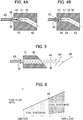
- Fig. 3 is a system diagram illustrating an overall configuration of a gas turbine plant 9 for power generation.
- a gas turbine for power generation includes a compressor 1, a combustor 2, a turbine 3, a generator 8 and a shaft 7.
- the compressor 1 pressurizes suction air 15 to generate high-pressure air 16.
- the combustor 2 burns the high pressure air 16 generated by the compressor 1 and gaseous fuel from a fuel system 60 to generate high-temperature combustion gas 18.
- the turbine 3 is driven by the high-temperature combustion gas 18 generated by the combustor 2.
- the generator 8 is rotated by the drive of the turbine 3 to generate electric power.
- the shaft 7 integrally connects the compressor 1, the turbine 3 and the generator 8.
- the combustor 2 is housed inside a casing 4.
- the combustor 2 has a burner 6 located at its head portion.
- the combustor 2 has a substantially cylindrical combustor liner 10 located on the downstream side of the burner 6 inside the combustor 2.
- the combustor liner 10 is adapted to isolate the high-pressure air from the combustion gas.
- a flow sleeve 11 is disposed on the outer circumference of the combustor liner 10 so as to serve as an outer circumferential wall defining an airflow path.
- the airflow path is adapted to permit the high-pressure air to flow downward.
- the flow sleeve 11 has a diameter greater than that of the combustor liner 10 and is disposed almost concentrically with the combustor liner 10.
- a transition piece 12 is disposed on the downstream side of the combustor liner 10 so as to lead the high-temperature combustion gas 18 generated in a combustion chamber 5 of the combustor 2 to the turbine 3.
- a flow sleeve 13 is disposed on the outer circumferential side of the transition piece 12.
- the suction air 15 is compressed by the compressor 1 to become the high-pressure air 16.
- the high-pressure air 16 is filled inside the casing 4 and then flows into the space between the transition piece 12 and the flow sleeve 13 to convection-cool the transition piece 12 from the outer wall surface.
- the high-pressure air 16 passes through an annular flow passage defined between the flow sleeve 11 and the combustor liner 10 and flows toward the head portion of the combustor 2. While flowing, the high-pressure air 16 is used to convection-cool the combustor liner 10.
- the high-pressure air 16 partially flows into the inside of the combustor liner 10 from a number of cooling holes provided in the combustor liner 10 and is used for film-cooling the combustor liner 10.
- the remainder of the high-pressure air 16 that has not been used for the film-cooling of the combustor liner 10, i.e., air 17 for combustion flows into the combustion chamber 5 from a number of air holes 32 provided in an air hole plate 31 located on the upstream side of the combustion chamber 5.
- the air 17 for combustion flowing into the combustor liner 10 from the air holes 32 is burned in the combustion chamber 5 along with the fuel jetted from fuel nozzles 25 to generate the high-temperature combustion gas 18.
- This high-temperature combustion gas 18 is supplied to the turbine 3 via the transition piece 12.
- the high-temperature combustion gas 18 having driven the turbine 3 is discharged and becomes exhaust gas 19.
- the driving force obtained by the turbine 3 is transmitted to the compressor 1 and the generator 8 through the shaft 7.
- a part of driving force obtained by the turbine 3 drives the compressor 1 to compress air 15 to generate the high-pressure air 16. Meanwhile, the other part of the driving force obtained by the turbine 3 rotates the generator 8 to generate electric power.
- the burner 6 has two fuel systems: a fuel system 61 and a fuel system 62. These fuel systems 61 and 62 have respective fuel flow regulating valves 21. A flow rate of the fuel from the fuel system 61 is regulated by a fuel flow regulating valve 21a whereas a flow rate of the fuel from the fuel system 62 is regulated by a fuel flow regulating valve 21b. In this way, electricity to be generated by the gas turbine plant 9 is controlled.
- a fuel shutoff valve 20 for interrupting fuel to flow is installed to the upstream side of a bifurcation of the two fuel systems 61 and 62.
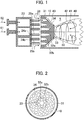
- the details of the burner 6 are shown in a cross-sectional view of Fig. 1 .
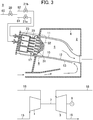
- the air hole plate 31 is shown in a front view of Fig. 2 as viewed from the combustion chamber 5. The details are hereinafter described with reference to Figs. 1 and 2 .
- the burner 6 of the present embodiment is such that a number of the fuel nozzles 25 adapted to jet fuel are attached to a fuel header 23.
- a number of the air holes 32 installed in the air hole plate 31 are each arranged to face a corresponding one of the fuel nozzles 25.
- gaseous fuel from each of the fuel nozzles 25 is supplied to a corresponding one of the air holes 32.
- the air holes 32 are arranged on three rows of concentric circles.
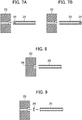
- Fig. 4A is a detailed view of the air hole 32 and the fuel nozzle 25.
- the air hole 32 of the present embodiment is bent at the middle of a flow path, i.e., has two central axes.
- An upstream side central axis 51 is parallel to a burner central axis 50 (i.e. the central axis of the air hole plate 31) shown in Fig. 1
- a downstream side central axis 52 has an angle relative to the burner central axis 50.
- a swirl flow 40 shown in Fig. 1 can be formed in the combustion chamber 5.
- an air flow 30 moves in such a manner as to surround the circumference of fuel jet 26.
- Swirls 45 occur at the boundary surface between the fuel jet 26 and the air flow 30 due to a velocity difference and a density difference, causing the flow turbulence.
- This flow turbulence transfers and stirs fuel and air in the radial direction for mixing them.
- a number of the coaxial flows of the fuel jets 26 and the air flows 30 are formed to increase the interfaces between fuel and air. Fuel and air mix with each other at each coaxial flow. The mixture in which fuel and air are sufficiently mixed with each other is jetted from the outlets of the air holes 32 toward the combustion chamber 5. Therefore, flame temperature distribution of premixed flame 42 formed as shown in Fig. 1 is made uniform, which can reduce the amount of NOx generation.
- the fuel nozzle 25 is shaped as a circular cylinder to its leading end. However, in order to further promote the mixing of fuel with air, it is effective to provide a projection 27 at the leading end of the fuel nozzle 25 as shown in Fig. 4B .
- the leading end of the fuel nozzle 25 is inserted into the inside of the air hole 32, which further promotes the mixing of fuel with air. If the leading end of the fuel nozzle is inserted into the inside of the air hole 32, the air flow 30 moving around the leading end of the fuel nozzle 25 is increased in velocity. In addition to this, the projection 27 causes strong flow turbulence, which generates swirls 46.
- the air hole plate 31 of the present embodiment is such that the center of the burner 6 projects toward the combustion chamber 5 from the outer circumferential portion thereof.
- First-row air holes 32a have respective outlets arranged in a flat surface 33 of the burner leading end vertical to the burner central axis 50.
- second- and third-row air holes 32b have respective outlets arranged in an inclined plane 34 of the air hole plate 31.
- all the downstream side central axes 52 of the air holes 32 of the present embodiment are arranged inclinedly with respect to the direction of the burner central axis 50. In this way, the strong swirl flow 40 is formed in the combustion chamber 5 to cause a large recirculation flow 41.
- the recirculation flow 41 is formed at a position where a part of the air hole plate 31 projects into the combustion chamber 5. Entrainment due to the recirculation flow 41 causes a flow 43 moving toward the recirculation flow 41 at a position close to the inclined plane 34 of the air plate 31. This flow 43 prevents the high-temperature combustion gas located at the central portion from flowing toward the second- and third-row air holes 32b.
- the high-temperature combustion gas is stably supplied by the recirculation flow 41 to the vicinity of the flat surface 33 of the burner leading end, which holds flame at the outlets of the first-row air holes 32a.
- heat is not supplied to the vicinity of the second-and third-row air holes 32b.
- a flow resulting from the entrainment eliminates a stagnation region, so that flame is not held.
- conical flame 42 as shown in the figure is formed.
- the second- and third-row conical jet nozzles mix fuel with air more due to the abrupt expansion at the outlet of the air hole 32b and to a long distance in which the flame 42 is reached from the outlet of the air hole 32b.
- the discharge amount of NOx discharged from the combustor 2 can be reduced significantly.
- the distance is increased in which the mixed gas of fuel and air reaches the frame 42 from the outlets of the second- and third-row air holes 32b.
- the outer circumferential portion of the flame 42 becomes easy to vary in the burner-axial direction and this variation is likely to develop into combustion oscillation.
- a combustion oscillation-generating mechanism is described with reference to Fig. 5 .
- a flame surface of the flame 42 is formed at a position where the flow velocity of an unburned mixture balances with the propagating speed of the flame.
- a swirl flow 40 is formed by a number of jets in the combustion chamber 5; therefore, a very turbulent turbulence-field is formed in the combustion chamber 5, in which the flame surface varies.
- the conical flame 42 is formed in order to reduce the discharge amount of NOx; therefore, the flame 42 are likely to largely vary in the burner-axial direction, such as shift to a position 42' after a short period of time.
- the flame 42 varies in the axial direction to cause a pressure variation, which propagates toward the upstream side.
- Such behavior is shown with arrow 48.
- a fuel flow rate is varied by the differential pressure between the front and rear of a fuel nozzle; therefore, the fuel flow rate is varied by the pressure variation due to the variation of the flame surface.
- the variation of the fuel flow rate varies the fuel-air ratio of the mixture passing through the air hole 32.
- Such behavior is shown with arrow 49.
- the variation in the fuel-air ratio of the mixture varies the combustion velocity of the flame 42.
- the position where the flow velocity of the unburned mixture balances with the propagating speed of the flame is varied to further vary the position of the flame surface.
- a feedback loop is formed to cause combustion oscillation.
- the fuel nozzle 25 of the present embodiment has a portion that abruptly narrows and then abruptly expands a flow path through which fuel passes. This portion is called an orifice 24 in the present embodiment.
- the orifice 24 in the present embodiment allows the gaseous fuel supplied to the air hole 32 to cause a pressure drop inside the fuel nozzle 25.
- Each of second- and third-row fuel nozzles 25b influenced by the flame surface variation has an orifice 24b with a small diameter.
- Such an orifice 24b provides sufficiently large differential pressure for the pressure variation resulting from the flame surface variation. In this way, a variation value relative to the average value of the differential pressures between the front and rear of the fuel nozzles is relatively reduced and consequently the flow rate variation of fuel can be reduced. Thus, the occurrence of the combustion oscillation can be suppressed.
- the combustor for a gas turbine has to stably hold flame under wide conditions from start-up to a 100%-load.
- a supply fuel flow rate is low and the overall fuel-air ratio is low. If fuel is supplied to all the fuel nozzles, fuel becomes lean, so that flame becomes unstable. Thus, a large amount of unburned fuel is likely to occur.
- a method is widely employed in which a diffusion burner is arranged at the center of the burner to form diffusion flame for stable combustion under the part-load condition. However, this method discharges a large amount of NOx under the 100%-load condition.
- Fig. 6 illustrates one example of the operation of the combustor 2 from ignition to a 100%-load condition in the present embodiment.
- the combustor 2 is operated by only the fuel supplied from the fuel system 61 under the operation from the ignition to the part-load condition 58.
- the part-load condition 58 is reached, the fuel supplied from the fuel system 61 is reduced and fuel supplied from the fuel system 62 is added according to the reduced fuel.
- fuel is supplied from the fuel system 61 only to first-row fuel nozzles 25a under the part-load condition as shown in Fig. 6 . Since the fuel flow rate supplied for each nozzle is increased, the fuel jet 26 passes through the air flow 30 and spurts into the combustion chamber 5 while remaining non-mixed. Then, while the fuel jet 26 mixes with air jetted from the second- and third-row air holes 32b in the combustion chamber 5, diffusion flame can be formed.
- the diameter (an opening area) of each of orifices 24a arranged at the first row is made greater than that (an opening area) of each of the orifices 24b arranged at the second and third rows.
- the differential pressure between the front and rear of the orifice 24a is reduced.
- the outlets of the air holes 32a for stabilizing flame are limited to a narrow area.
- the pressure difference at the outlet of the fuel nozzle 25a is limited to a further small level. Therefore, the variation or deviation of the fuel flow rate is hard to occur.
- the fuel supply system is divided into the two fuel supply systems: the fuel supply system 61 adapted to supply fuel to the fuel nozzles 25a paired with the corresponding air holes 32a holding flame at the air hole outlets; and the fuel supply system 62 adapted to supply fuel to the fuel nozzles 25b paired with the corresponding air holes 32b not holding flame at the air hole outlets.
- the diameter of each of the orifices 24b installed at the fuel nozzles 25b is made smaller than that of each of the orifices 24a installed at the fuel nozzles 25a. In this way, suppression of the occurrence of combustion oscillation and the occurrence of unburned fuel even under the part-load condition is operated.
- the orifice installation method involves manufacturing an orifice 24 integrally with a fuel nozzle 25 and attaching the integral piece to the fuel header 23.
- the orifice 24 is located at the root of the fuel nozzle 25.
- the orifice 24 may be located at the leading end of the fuel nozzle.
- the present method is effective for the case where fuel and air are not mixed because the jet velocity of fuel is increased. As shown in Fig.
- another method may involve providing a small-diameter path in the fuel header 23 at a position of upstream side of a fuel nozzle installation position and using it as an orifice 24.
- another method may involve manufacturing an orifice 24 as a member separate from a fuel nozzle 25 and from a fuel header 23 and joining them together by welding or press fitting.
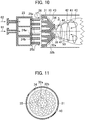
- Fig. 10 is a cross-sectional view illustrating a variation of the present embodiment, reinforcing the stability of flame.
- Fig. 11 is a front view of Fig. 10 .
- the outlets of the first-row air holes 32a are arranged in the flat surface 33 located at the leading end of the burner 6 vertical to the burner central axis 50.
- the burner similarly, the burner partially projects toward the combustion chamber 5, but, the burner central portion is recessed with respect to the combustion chamber 5.
- the outlets of the first-row air holes 32a are arranged in an inclined plane 35.
- a flow 44 moving toward the outer circumferential portion from the burner center is generated.
- the combustion gas is supplied to the outlets of the first-row air holes 32a by the recirculation flow 41, so that flame is held at the outlets of the first-row air holes 32a.
- An area 47 close to the outlets of the first-row air holes 32a is surrounded at its circumference by the inclined plane 35 of the air hole plate 31. In this area 47, a flow is stabilized without undergoing disturbance from the circumference thereof. Thus, since a flame-holding point undergoes no disturbance, well-stabilized flame can be formed.
- a flow 43 moving toward the burner center from the outer circumferential portion occurs in the vicinity of the inclined plane 34 on which the outlets of the second- and third-row air holes 32b are arranged. Therefore, the combustion gas is not supplied to the outlets of the second- and third-row air holes 32b, so that flame is not held in the vicinity of the outlets.
- conical flame 42 can be formed, which can similarly reduce the discharge amount of NOx.
- the combustor 2 of the present embodiment described above includes the air hole plate 31, the first fuel nozzles 25a and the second fuel nozzles 25b.
- the air hole plate 31 is located on the upstream side of the combustion chamber 5 and has the first holes 32a and the second air holes 32b installed on the outer circumferential side of the first air holes.
- the first fuel nozzles 25 are adapted to supply gaseous fuel to the air holes 32a.
- the second fuel nozzles 25b are adapted to supply gaseous fuel to the air holes 32b.
- the above combustor is operated to jet the mixed gas of fuel and air from the air holes 32 to the combustion chamber 5, such operation may be likely to cause combustion oscillation due to the variation of the flame surface as described above.
- the combustor 2 of the present embodiment further has the orifices 24b adapted to allow the gaseous fuel supplied to the air holes 32b to cause a pressure drop.
- the orifice 24b causes the pressure drop through the fuel nozzle 25b, which ensures the differential pressure in the front and rear of the fuel nozzle 25b. This can suppress the combustion oscillation resulting from the variation of the flame surface.
- the present embodiment has both the first orifices 24a adapted to allow the gaseous fuel supplied to the air holes 32a to cause a pressure drop and the second orifices 24b adapted to allow the gaseous fuel supplied to the air holes 32b to cause a pressure drop.
- the opening area of the second orifice 24b is smaller than that of the first orifice 24a.
- the fuel system in the present embodiment is divided into the fuel system 61 adapted to supply fuel to the first fuel nozzles 25a and the fuel system 62 adapted to supply fuel to the second fuel nozzles 25b.
- fuel can appropriately be supplied to each fuel nozzle and the differential pressure between the front and rear of each fuel nozzle can appropriately be controlled.
- the present embodiment has flame-holding means for promoting flame-holding in the area of the air hole plate 31 where the first air holes 32a are installed.
- the air hole plate 31 has the inclined plane 34, which protrudes toward the downstream side gradually as going to the radial inside.
- the combustion chamber side outlets of the second air holes 32b are provided on the inclined planes 34. In this way, the flow 43 moving toward the burner center and the recirculation flow 41 can be caused, it can provide the high-performance combustor that is stable with less discharge amount of NOx.
- all the central axes of the air holes 32 are arranged inclinedly with respect to the burner central axis 50.
- the flow 43 moving toward the burner center further serves as means for suppressing adhesion of flame in the area of the air hole plate 31 where the second air holes 32b are installed.
- Fig. 12 is a cross-sectional view illustrating a second embodiment.
- Fig. 13 is a front view of a burner as viewed from a combustion chamber side.
- the second embodiment is such that fuel nozzles 25a to which fuel is supplied from a fuel system 61 are arranged on two rows of concentric circles.
- Two-row air holes 32a are arranged to correspond to the fuel nozzles 25a.
- the two-row air holes 32a have respective outlets arranged on a flat surface 33 located at a leading end of a conically shaped air hole plate 31 extending toward a combustion chamber 5.
- Air holes 32 from a first row to a fourth row have respective central axes each inclined with respect to a burner central axis 50.
- a swirl flow 40 is formed on downstream side of the burner, thereby a large recirculation flow 41 is formed.
- This recirculation flow 41 returns high-temperature combustion gas from flame 42 to the upstream side.
- the high-temperature combustion gas supplies heat to the outlets of first-row air holes 32a, thereby stably holding flame at the outlets of the first-row air holes 32a.
- the combustion gas passes through a gap between pre-mixture jets jetted from the first-row air holes 32a and supplies heat to the vicinity of the second-row air hole outlets, thereby stably holding flame also at the outlets of second-row air holes 32a.
- the recirculation flow 41 is formed at a position where a part of the air hole plate 31 projects into the combustion chamber 5, entrainment resulting from the recirculation flow 41 causes a flow 43 moving toward the recirculation flow 41 in the vicinity of an inclined plane 34 of the air hole plate 31.
- This flow 43 prevents the high-temperature combustion gas at a central portion from flowing out toward third- and fourth-row air holes 32b. This prevents heat from being supplied to the vicinities of the outlets of the third- and fourth-row air holes 32b. Accordingly, flame is not held at the outlets of the air holes 32b.
- outlets of the fourth-row air holes 32b are distant from flame 42 and the flow 43 moving toward the recirculation flow 41 acts not to supply high-temperature combustion gas to the outlets of the fourth-row air hole air holes 32b. Therefore, as in the present embodiment, the outlets of the fourth-row air holes 32b may be arranged in a flat portion 36 located at the outer circumferential portion of the air hole plate 31.
- each fuel nozzle 25b corresponding to each of the air holes 32b can provide a sufficiently large pressure difference between the front and rear of the fuel nozzle through an orifice 24b.
- This orifice 24b is adapted to abruptly narrow and then abruptly expand a flow path through which fuel passes, thereby causing a pressure drop. Even if the flame surface of the conical flame 42 varies, the variation in fuel flow rate can be suppressed to a low level. Accordingly, the occurrence of combustion oscillation can be suppressed.
- An orifice 24a installed in each of the fuel nozzles 25a not influenced by the variation of the flame surface is greater in diameter than that of the orifice 24b.
- the differential pressure between the front and rear of the fuel nozzle is suppressed to a low level, thereby a large amount of fuel can be allowed to flow.
- a large amount of fuel is supplied only to the first- and second-row fuel nozzles 25a under a part-load condition to form a fuel rich area, which makes it possible to form diffusion flame.
- a total amount of fuel supplied to the burner is small under the part-load condition, so that average temperature inside the combustion chamber 5 is low. Therefore, flame is unstable and unburned fuel is likely to occur.
- the diffusion flame is formed to provide stable flame, thereby making it possible to suppress the occurrence of unburned fuel.
- a balance can be achieved between a reduction in the discharge amount of NOx, and the suppression of combustion oscillation and the suppression of generation of unburned fuel under the part-load condition.
- the present embodiment has the increased number of rows compared with that of the first embodiment, thereby enlarging the entire burner. Therefore, the present invention is suitable for a gas turbine generating more electricity. In addition, the area holding flame is wide; therefore, the stability of flame can be reinforced.
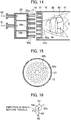
- Fig. 14 is a cross-sectional view illustrating a third embodiment.
- Fig. 15 is a front view of Fig. 14 .
- the third embodiment has almost the same configuration as that of the first embodiment.
- an air hole plate 31 has a flat-shaped surface facing a combustion chamber 5.
- the outlets of the second- and third-row air holes 32b are arranged in the inclined plane, thereby preventing the flame 42 from adhering to the air hole outlets.
- Fig. 16 is a front view illustrating one of first-row air holes 32a of the present embodiment as viewed from the combustion chamber 5.
- an air hole central axis 52a projected onto a plane vertical to the burner central axis 50 is configured to reduce a distance 55 between the burner central axis 50 and the air hole central axis 52a as going toward the downstream side from a first-row air hole outlet center 54.
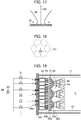
- Fig. 17 shows a line 56 resulting from projecting, onto a two-dimensional surface, a stream line drawn by the mixture jetted from the first-row air hole 32a.
- the mixture jetted from the air hole once comes close to the burner central axis 50 and then spreads toward the outer circumferential side.
- Fig. 18 is a cross-sectional view taken along line A-A in Fig. 17 .
- a mixture jet 57 jetted from each of the first-row air holes 32a is in contact with mixture jets adjacent thereto.
- the high-temperature combustion gas returned by the recirculation flow 41 is confined inside the first-row mixture jets 57. Sufficient heat is not transmitted to the vicinity of the outlets of the second- and third-row air holes 32b. Thus, it is possible to prevent flame adhering to the air hole outlets.
- the present embodiment can prevent flame from adhering to the outlets of the second- and third-row air holes 32b.
- the conical flame 42 as shown in Fig. 14 can be formed. With this, fuel can be burned in a state where fuel and air are well-mixed, so that the discharge amount of NOx can be reduced.
- an orifice 24b having a small diameter is installed in each fuel nozzle 25b corresponding to each of the second- and third-row air holes 32b in which flame is not held at each of the air hole outlets. This suppresses the variation of the fuel flow rate resulting from the flame variation, which suppresses the occurrence of combustion oscillation.
- An orifice 24a is installed in each first-row fuel nozzle 25a corresponding to each of the air holes 32a holding flame at its outlet.
- the flame surface downstream of this orifice 24a does not vary, hence, there is no concern of the variation in fuel flow rate.
- the orifice 24a has a larger diameter than that of each of the second- and third orifices 24b. Accordingly, the orifice 24a allows fuel to flow at a greater flow rate.
- fuel is supplied only to the fuel nozzles 25a under a part-load condition, so that rich fuel can be supplied into the combustion chamber 5, thereby forming diffusion flame.
- Fig. 19 is a cross-sectional view of a fourth embodiment.
- Fig. 20 is a front view of an air hole plate 31 as viewed from a combustion chamber 5.
- a single burner is configured by combining seven burners 6a each having the same configuration as that of the first embodiment. This burner is effective for a gas turbine generating large amount of electricity.
- the burner 6a has a center projecting toward a combustion chamber 5.
- First-row air holes 32a have outlets arranged on a flat surface 33 located at the leading end of the burner.
- Second- and third-row air holes 32b have outlets located on an inclined plane 34 inclined with respect to the burner central axis.
- Fuel nozzles 25a are paired with air holes 32a whereas fuel nozzles 25b are paired with air holes 32b.
- Orifices 24a each installed in a corresponding one of the fuel nozzles 25a is smaller in diameter smaller than that of each of orifices 24b installed in a corresponding one of the fuel nozzles 25b.
- flame is held at the outlets of the first-row air holes 32a of each burner 6a. Meanwhile, flame is not held at the outlets of the second- and third-row air holes 32b, so that conical flame 42 is formed.
- a discharge amount of NOx can be suppressed to a low level.
- the orifice 24b installed in the fuel nozzle 25b corresponding to the air hole 32b can provide sufficiently large differential pressure between the front and rear of the fuel nozzle. Even if the flame surface of the conical flame 42 is varied, a variation in fuel flow rate can be suppressed to a low level, which can suppress the occurrence of combustion oscillation.
- the orifice 24a installed in the fuel nozzle 25a not influenced by the variation of the flame surface is greater in diameter than that of the orifice 24b. This suppresses the differential pressure between the front and rear of the fuel nozzle to a low level.
- the orifice 24a allows a large amount of fuel to flow.
- the large amount of fuel is supplied only to the first-row fuel nozzles 25a to form the fuel rich area, thereby forming diffusion flame.
- the total amount of the fuel supplied to the burner is small under a part-load condition. Since the average temperature inside the combustion chamber 5 is low, flame becomes unstable and unburned fuel is likely to occur. However, the present embodiment can form stable flame by forming the diffusion flame, thereby suppressing the occurrence of unburned fuel. As described above, a balance can be achieved between the reduced discharge amount of NOx, and the suppression of combustion oscillation and the suppression of the generation of unburned fuel under a part-load condition.
- the first embodiment has the separate fuel systems supplying fuel to the first-row fuel nozzles 25a and the second- and third-row fuel nozzles 25b.
- a fuel supply system is divided into a fuel supply system adapted to supply fuel to the first-row fuel nozzles 25a of each of the burners 6a and a fuel supply system adapted to supply fuel to the second- and third-row fuel nozzles 25b.
- the fuel supply system adapted to supply fuel to the first-row fuel nozzle 25a and the fuel supply system adapted to supply fuel to the second- and third-row fuel nozzles 25b are divided for each burner 6a.
- the fuel supply system can flexibly be operated according to operating conditions.
- a single fuel system may be made to supply fuel to the first-row fuel nozzles 25a of a plurality of the burners 6a.
- a single fuel system may be made to supply fuel to the second-and third-row fuel nozzles 25b of a plurality of the burners 6a.
- FIG. 21 A variation of the fourth embodiment is shown in Fig. 21 .
- a central burner 6c of seven burners is such that all the outlets of three-row air holes 32c are arranged on a flat surface 33. Flame 39 is held at all the outlets of the air holes 32c.
- Three-row Fuel nozzles 25c are paired with the air holes 32c.
- An orifice 24c attached to each fuel nozzle 25c of the central burner 6c is greater in diameter than that of an orifice 24b installed in each of the second- and third-row fuel nozzles 25b of external burners 6b.
- the central burner 6c holds the flame 39 at all the outlets of the air holes 32c; therefore, the flame 39 is highly stabilized. In addition, the central burner 6c can assist the holding of conical flame 42 formed by the external burners 6b.
- the flame 39 has a flame surface hard to be varied; therefore, even if the diameter of the orifice 24c is increased, there is no concern about combustion oscillation. Fuel is supplied only to the central burner 6c under a part-load condition, which can bring a fuel rich state at the air hole outlets, thereby forming diffusion flame. Accordingly, combustion stability can be formed, which can suppress the occurrence of unburned fuel.
- the combustor of the present variation described above includes the plurality of first burners 6b each having the first air holes 32a, the first fuel nozzles 25a, the second air holes 32b and the second fuel nozzles 25b; and the second burner 6c having the third air nozzles 32c, the third fuel nozzles 25c adapted to supply gaseous fuel to the third air holes 32c, and disposed to be surrounded by the plurality of first burners 6b.
- the combustor includes the first orifices 24a each adapted to allow the gaseous fuel supplied to the first air hole 32a to cause a pressure drop; the second orifices 24b each adapted to allow the gaseous fuel supplied to the second air hole 32b to cause a pressure drop; and the third orifices 24c each adapted to allow the gaseous fuel supplied to the third air hole 32c to cause a pressure drop.
- the second orifice 24b has the opening area smaller than that of each of the first orifice 24a and the third orifice 24c.
Landscapes
- Engineering & Computer Science (AREA)
- Chemical & Material Sciences (AREA)
- Combustion & Propulsion (AREA)
- Mechanical Engineering (AREA)
- General Engineering & Computer Science (AREA)
- Pre-Mixing And Non-Premixing Gas Burner (AREA)
Applications Claiming Priority (1)
| Application Number | Priority Date | Filing Date | Title |
|---|---|---|---|
| JP2011014682A JP5470662B2 (ja) | 2011-01-27 | 2011-01-27 | ガスタービン燃焼器 |
Publications (3)
| Publication Number | Publication Date |
|---|---|
| EP2481986A2 true EP2481986A2 (de) | 2012-08-01 |
| EP2481986A3 EP2481986A3 (de) | 2017-12-20 |
| EP2481986B1 EP2481986B1 (de) | 2019-04-17 |
Family
ID=45531785
Family Applications (1)
| Application Number | Title | Priority Date | Filing Date |
|---|---|---|---|
| EP12152843.4A Active EP2481986B1 (de) | 2011-01-27 | 2012-01-27 | Gasturbinenbrennkammer |
Country Status (3)
| Country | Link |
|---|---|
| US (1) | US9027349B2 (de) |
| EP (1) | EP2481986B1 (de) |
| JP (1) | JP5470662B2 (de) |
Cited By (6)
| Publication number | Priority date | Publication date | Assignee | Title |
|---|---|---|---|---|
| CN104633708A (zh) * | 2013-11-13 | 2015-05-20 | 三菱日立电力系统株式会社 | 燃气轮机燃烧器 |
| EP2980483A1 (de) * | 2014-08-01 | 2016-02-03 | Mitsubishi Hitachi Power Systems, Ltd. | Gasturbinenbrennkammer |
| EP3263990A1 (de) * | 2016-07-01 | 2018-01-03 | Mitsubishi Hitachi Power Systems, Ltd. | Brennstoffdüse einer gasturbinenbrennkammer, herstellungsverfahren dafür und gasturbinenbrennkammer |
| CN115585479A (zh) * | 2022-11-14 | 2023-01-10 | 哈尔滨广瀚动力技术发展有限公司 | 一种燃气轮机扩压装置 |
| EP4235027A1 (de) * | 2022-02-28 | 2023-08-30 | Sofinter S.p.A. | Brennergruppe für einen kessel und verfahren zum betrieb der brennergruppe |
| US12510245B2 (en) | 2022-02-28 | 2025-12-30 | Sofinter Spa | Burner assembly for a steam production boiler assembly and method for operating said burner assembly |
Families Citing this family (29)
| Publication number | Priority date | Publication date | Assignee | Title |
|---|---|---|---|---|
| JP5458121B2 (ja) * | 2012-01-27 | 2014-04-02 | 株式会社日立製作所 | ガスタービン燃焼器およびガスタービン燃焼器の運転方法 |
| KR101371291B1 (ko) * | 2012-05-04 | 2014-03-07 | 고등기술연구원연구조합 | 비 용융 및 부분 용융형 분류층 가스화기 |
| DE102012216080A1 (de) | 2012-08-17 | 2014-02-20 | Dürr Systems GmbH | Brenner |
| JP6068117B2 (ja) * | 2012-12-05 | 2017-01-25 | 三菱日立パワーシステムズ株式会社 | 燃焼器 |
| JP6158504B2 (ja) * | 2012-12-20 | 2017-07-05 | 三菱日立パワーシステムズ株式会社 | バーナ |
| US9453429B2 (en) * | 2013-03-11 | 2016-09-27 | General Electric Company | Flow sleeve for thermal control of a double-wall turbine shell and related method |
| JP6022389B2 (ja) * | 2013-03-25 | 2016-11-09 | 三菱日立パワーシステムズ株式会社 | ガスタービン燃焼器 |
| JP6092007B2 (ja) * | 2013-06-06 | 2017-03-08 | 三菱日立パワーシステムズ株式会社 | ガスタービン燃焼器 |
| JP6210810B2 (ja) * | 2013-09-20 | 2017-10-11 | 三菱日立パワーシステムズ株式会社 | デュアル燃料焚きガスタービン燃焼器 |
| US9259807B2 (en) * | 2013-12-13 | 2016-02-16 | General Electric Company | Method for repairing a bundled tube fuel injector |
| US9709279B2 (en) | 2014-02-27 | 2017-07-18 | General Electric Company | System and method for control of combustion dynamics in combustion system |
| US9709278B2 (en) | 2014-03-12 | 2017-07-18 | General Electric Company | System and method for control of combustion dynamics in combustion system |
| US9644846B2 (en) | 2014-04-08 | 2017-05-09 | General Electric Company | Systems and methods for control of combustion dynamics and modal coupling in gas turbine engine |
| US9845956B2 (en) | 2014-04-09 | 2017-12-19 | General Electric Company | System and method for control of combustion dynamics in combustion system |
| US20150330636A1 (en) * | 2014-05-13 | 2015-11-19 | General Electric Company | System and method for control of combustion dynamics in combustion system |
| US9845732B2 (en) | 2014-05-28 | 2017-12-19 | General Electric Company | Systems and methods for variation of injectors for coherence reduction in combustion system |
| US10113747B2 (en) | 2015-04-15 | 2018-10-30 | General Electric Company | Systems and methods for control of combustion dynamics in combustion system |
| JP6863718B2 (ja) * | 2016-11-21 | 2021-04-21 | 三菱パワー株式会社 | ガスタービン燃焼器 |
| CN107143881B (zh) * | 2017-05-16 | 2020-02-14 | 西北工业大学 | 一种用于燃气轮机低污染燃烧室的多点直接喷射头结构 |
| CN107143880B (zh) * | 2017-05-16 | 2020-02-14 | 西北工业大学 | 一种用于燃气轮机低污染燃烧室的贫油多点直接喷射头 |
| US10982593B2 (en) * | 2017-06-16 | 2021-04-20 | General Electric Company | System and method for combusting liquid fuel in a gas turbine combustor with staged combustion |
| CN108952972B (zh) * | 2018-07-17 | 2019-11-05 | 绍兴市览海环保科技有限公司 | 一种提高发电厂发电效率的方法 |
| JP7044669B2 (ja) * | 2018-09-05 | 2022-03-30 | 三菱重工業株式会社 | ガスタービン燃焼器 |
| JP7287811B2 (ja) * | 2019-03-25 | 2023-06-06 | 三菱重工業株式会社 | 燃焼器及びガスタービン |
| JP2021055971A (ja) * | 2019-10-01 | 2021-04-08 | 三菱パワー株式会社 | ガスタービン燃焼器 |
| JP7245150B2 (ja) * | 2019-12-16 | 2023-03-23 | 三菱重工業株式会社 | ガスタービン燃焼器 |
| CN111649354B (zh) * | 2020-06-15 | 2022-03-29 | 江苏科技大学 | 一种三旋流分级旋流器及其燃烧室 |
| JP7476424B2 (ja) | 2021-03-31 | 2024-04-30 | 三菱重工業株式会社 | 燃焼器及びガスタービン |
| DE112023000354T5 (de) * | 2022-01-20 | 2024-08-22 | Mitsubishi Heavy Industries, Ltd. | Steuerverfahren für gasturbinenbrennkammer und steuervorrichtung für gasturbinenbrennkammer |
Citations (2)
| Publication number | Priority date | Publication date | Assignee | Title |
|---|---|---|---|---|
| JP2003148734A (ja) | 2001-08-29 | 2003-05-21 | Hitachi Ltd | ガスタービン燃焼器およびガスタービン燃焼器の運転方法 |
| JP2010133621A (ja) | 2008-12-04 | 2010-06-17 | Hitachi Ltd | ガスタービン燃焼器 |
Family Cites Families (14)
| Publication number | Priority date | Publication date | Assignee | Title |
|---|---|---|---|---|
| US5097666A (en) * | 1989-12-11 | 1992-03-24 | Sundstrand Corporation | Combustor fuel injection system |
| JP3494753B2 (ja) * | 1995-04-26 | 2004-02-09 | 株式会社日立製作所 | ガスタービン燃焼器 |
| GB9827051D0 (en) * | 1998-12-09 | 1999-02-03 | Alstom Gas Turbines Ltd | Gas reaction chamber |
| US6205765B1 (en) * | 1999-10-06 | 2001-03-27 | General Electric Co. | Apparatus and method for active control of oscillations in gas turbine combustors |
| US6442939B1 (en) * | 2000-12-22 | 2002-09-03 | Pratt & Whitney Canada Corp. | Diffusion mixer |
| US6813889B2 (en) | 2001-08-29 | 2004-11-09 | Hitachi, Ltd. | Gas turbine combustor and operating method thereof |
| US6928823B2 (en) * | 2001-08-29 | 2005-08-16 | Hitachi, Ltd. | Gas turbine combustor and operating method thereof |
| JP2003097291A (ja) * | 2001-09-20 | 2003-04-03 | Mitsubishi Heavy Ind Ltd | 燃料ノズル加工方法および燃料ノズル加工装置 |
| JP3940705B2 (ja) * | 2003-06-19 | 2007-07-04 | 株式会社日立製作所 | ガスタービン燃焼器及びその燃料供給方法 |
| JP2008111651A (ja) * | 2006-10-02 | 2008-05-15 | Hitachi Ltd | ガスタービン燃焼器及びガスタービン燃焼器の燃料供給方法 |
| JP4906689B2 (ja) * | 2007-11-29 | 2012-03-28 | 株式会社日立製作所 | バーナ,燃焼装置及び燃焼装置の改造方法 |
| JP4872992B2 (ja) | 2008-09-12 | 2012-02-08 | 株式会社日立製作所 | 燃焼器,燃焼器の燃料供給方法及び燃焼器の改造方法 |
| US20110016866A1 (en) * | 2009-07-22 | 2011-01-27 | General Electric Company | Apparatus for fuel injection in a turbine engine |
| JP5103454B2 (ja) | 2009-09-30 | 2012-12-19 | 株式会社日立製作所 | 燃焼器 |
-
2011
- 2011-01-27 JP JP2011014682A patent/JP5470662B2/ja active Active
-
2012
- 2012-01-25 US US13/358,227 patent/US9027349B2/en active Active
- 2012-01-27 EP EP12152843.4A patent/EP2481986B1/de active Active
Patent Citations (2)
| Publication number | Priority date | Publication date | Assignee | Title |
|---|---|---|---|---|
| JP2003148734A (ja) | 2001-08-29 | 2003-05-21 | Hitachi Ltd | ガスタービン燃焼器およびガスタービン燃焼器の運転方法 |
| JP2010133621A (ja) | 2008-12-04 | 2010-06-17 | Hitachi Ltd | ガスタービン燃焼器 |
Cited By (11)
| Publication number | Priority date | Publication date | Assignee | Title |
|---|---|---|---|---|
| CN104633708A (zh) * | 2013-11-13 | 2015-05-20 | 三菱日立电力系统株式会社 | 燃气轮机燃烧器 |
| EP2873923A1 (de) * | 2013-11-13 | 2015-05-20 | Mitsubishi Hitachi Power Systems, Ltd. | Gasturbinenbrennkammer |
| US9765971B2 (en) | 2013-11-13 | 2017-09-19 | Mitsubishi Hitachi Power Systems, Ltd. | Gas turbine combustor |
| EP2980483A1 (de) * | 2014-08-01 | 2016-02-03 | Mitsubishi Hitachi Power Systems, Ltd. | Gasturbinenbrennkammer |
| EP3263990A1 (de) * | 2016-07-01 | 2018-01-03 | Mitsubishi Hitachi Power Systems, Ltd. | Brennstoffdüse einer gasturbinenbrennkammer, herstellungsverfahren dafür und gasturbinenbrennkammer |
| CN107559880A (zh) * | 2016-07-01 | 2018-01-09 | 三菱日立电力系统株式会社 | 燃气轮机燃烧器的燃料喷嘴及其制造方法、燃气轮机燃烧器 |
| CN107559880B (zh) * | 2016-07-01 | 2019-08-13 | 三菱日立电力系统株式会社 | 燃气轮机燃烧器的燃料喷嘴及其制造方法、燃气轮机燃烧器 |
| US11511378B2 (en) | 2016-07-01 | 2022-11-29 | Mitsubishi Heavy Industries, Ltd. | Fuel nozzle of gas turbine combustor and manufacturing method thereof, and gas turbine combustor |
| EP4235027A1 (de) * | 2022-02-28 | 2023-08-30 | Sofinter S.p.A. | Brennergruppe für einen kessel und verfahren zum betrieb der brennergruppe |
| US12510245B2 (en) | 2022-02-28 | 2025-12-30 | Sofinter Spa | Burner assembly for a steam production boiler assembly and method for operating said burner assembly |
| CN115585479A (zh) * | 2022-11-14 | 2023-01-10 | 哈尔滨广瀚动力技术发展有限公司 | 一种燃气轮机扩压装置 |
Also Published As
| Publication number | Publication date |
|---|---|
| EP2481986A3 (de) | 2017-12-20 |
| US9027349B2 (en) | 2015-05-12 |
| JP5470662B2 (ja) | 2014-04-16 |
| JP2012154570A (ja) | 2012-08-16 |
| EP2481986B1 (de) | 2019-04-17 |
| US20120192568A1 (en) | 2012-08-02 |
Similar Documents
| Publication | Publication Date | Title |
|---|---|---|
| EP2481986B1 (de) | Gasturbinenbrennkammer | |
| EP2711628B1 (de) | Gasturbinenbrennkammer mit flammformgebenden Luftzufuhrlöchern | |
| JP5948489B2 (ja) | ガスタービン燃焼器 | |
| US7426833B2 (en) | Gas turbine combustor and fuel supply method for same | |
| EP2065645B1 (de) | Brenner und Gasturbinenbrennkammer | |
| JP4922878B2 (ja) | ガスタービン燃焼器 | |
| JP5372815B2 (ja) | ガスタービン燃焼器 | |
| US20140096502A1 (en) | Burner for a gas turbine | |
| EP2620708B1 (de) | Gasturbinenbrennkammer und Betriebsverfahren dafür | |
| JP2018004138A (ja) | ガスタービン燃焼器 | |
| JP2015114098A (ja) | 予混合パイロットノズルを備える燃料噴射器 | |
| CN102032569A (zh) | 燃烧器 | |
| JP2008111651A (ja) | ガスタービン燃焼器及びガスタービン燃焼器の燃料供給方法 | |
| JP6228434B2 (ja) | ガスタービン燃焼器 | |
| JP2011141113A (ja) | 内蔵通路を備えた燃料ノズル及びその作動方法 | |
| US20160377290A1 (en) | Gas turbine combustor | |
| JP2009531642A (ja) | 熱発生器作動用のバーナ | |
| JP2011226723A (ja) | 低NOx燃焼器 | |
| JP5372814B2 (ja) | ガスタービン燃焼器、及び運転方法 | |
| JP2014105886A (ja) | 燃焼器 | |
| JP4854613B2 (ja) | 燃焼装置及びガスタービン燃焼器 | |
| US20250180209A1 (en) | Gas turbine combustor and gas turbine | |
| JP2021063464A (ja) | ガスタービン燃焼器 | |
| JP6068117B2 (ja) | 燃焼器 | |
| US12449130B2 (en) | Combustor and gas turbine |
Legal Events
| Date | Code | Title | Description |
|---|---|---|---|
| PUAI | Public reference made under article 153(3) epc to a published international application that has entered the european phase |
Free format text: ORIGINAL CODE: 0009012 |
|
| 17P | Request for examination filed |
Effective date: 20120302 |
|
| AK | Designated contracting states |
Kind code of ref document: A2 Designated state(s): AL AT BE BG CH CY CZ DE DK EE ES FI FR GB GR HR HU IE IS IT LI LT LU LV MC MK MT NL NO PL PT RO RS SE SI SK SM TR |
|
| AX | Request for extension of the european patent |
Extension state: BA ME |
|
| RAP1 | Party data changed (applicant data changed or rights of an application transferred) |
Owner name: MITSUBISHI HITACHI POWER SYSTEMS, LTD. |
|
| RAP1 | Party data changed (applicant data changed or rights of an application transferred) |
Owner name: MITSUBISHI HITACHI POWER SYSTEMS, LTD. |
|
| PUAL | Search report despatched |
Free format text: ORIGINAL CODE: 0009013 |
|
| AK | Designated contracting states |
Kind code of ref document: A3 Designated state(s): AL AT BE BG CH CY CZ DE DK EE ES FI FR GB GR HR HU IE IS IT LI LT LU LV MC MK MT NL NO PL PT RO RS SE SI SK SM TR |
|
| AX | Request for extension of the european patent |
Extension state: BA ME |
|
| RIC1 | Information provided on ipc code assigned before grant |
Ipc: F23R 3/28 20060101AFI20171113BHEP |
|
| GRAP | Despatch of communication of intention to grant a patent |
Free format text: ORIGINAL CODE: EPIDOSNIGR1 |
|
| STAA | Information on the status of an ep patent application or granted ep patent |
Free format text: STATUS: GRANT OF PATENT IS INTENDED |
|
| INTG | Intention to grant announced |
Effective date: 20181018 |
|
| GRAS | Grant fee paid |
Free format text: ORIGINAL CODE: EPIDOSNIGR3 |
|
| GRAA | (expected) grant |
Free format text: ORIGINAL CODE: 0009210 |
|
| STAA | Information on the status of an ep patent application or granted ep patent |
Free format text: STATUS: THE PATENT HAS BEEN GRANTED |
|
| AK | Designated contracting states |
Kind code of ref document: B1 Designated state(s): AL AT BE BG CH CY CZ DE DK EE ES FI FR GB GR HR HU IE IS IT LI LT LU LV MC MK MT NL NO PL PT RO RS SE SI SK SM TR |
|
| REG | Reference to a national code |
Ref country code: GB Ref legal event code: FG4D |
|
| REG | Reference to a national code |
Ref country code: CH Ref legal event code: EP |
|
| REG | Reference to a national code |
Ref country code: DE Ref legal event code: R096 Ref document number: 602012059008 Country of ref document: DE |
|
| REG | Reference to a national code |
Ref country code: AT Ref legal event code: REF Ref document number: 1121952 Country of ref document: AT Kind code of ref document: T Effective date: 20190515 Ref country code: IE Ref legal event code: FG4D |
|
| REG | Reference to a national code |
Ref country code: NL Ref legal event code: MP Effective date: 20190417 |
|
| REG | Reference to a national code |
Ref country code: LT Ref legal event code: MG4D |
|
| PG25 | Lapsed in a contracting state [announced via postgrant information from national office to epo] |
Ref country code: NL Free format text: LAPSE BECAUSE OF FAILURE TO SUBMIT A TRANSLATION OF THE DESCRIPTION OR TO PAY THE FEE WITHIN THE PRESCRIBED TIME-LIMIT Effective date: 20190417 |
|
| PG25 | Lapsed in a contracting state [announced via postgrant information from national office to epo] |
Ref country code: FI Free format text: LAPSE BECAUSE OF FAILURE TO SUBMIT A TRANSLATION OF THE DESCRIPTION OR TO PAY THE FEE WITHIN THE PRESCRIBED TIME-LIMIT Effective date: 20190417 Ref country code: SE Free format text: LAPSE BECAUSE OF FAILURE TO SUBMIT A TRANSLATION OF THE DESCRIPTION OR TO PAY THE FEE WITHIN THE PRESCRIBED TIME-LIMIT Effective date: 20190417 Ref country code: ES Free format text: LAPSE BECAUSE OF FAILURE TO SUBMIT A TRANSLATION OF THE DESCRIPTION OR TO PAY THE FEE WITHIN THE PRESCRIBED TIME-LIMIT Effective date: 20190417 Ref country code: LT Free format text: LAPSE BECAUSE OF FAILURE TO SUBMIT A TRANSLATION OF THE DESCRIPTION OR TO PAY THE FEE WITHIN THE PRESCRIBED TIME-LIMIT Effective date: 20190417 Ref country code: AL Free format text: LAPSE BECAUSE OF FAILURE TO SUBMIT A TRANSLATION OF THE DESCRIPTION OR TO PAY THE FEE WITHIN THE PRESCRIBED TIME-LIMIT Effective date: 20190417 Ref country code: PT Free format text: LAPSE BECAUSE OF FAILURE TO SUBMIT A TRANSLATION OF THE DESCRIPTION OR TO PAY THE FEE WITHIN THE PRESCRIBED TIME-LIMIT Effective date: 20190817 Ref country code: HR Free format text: LAPSE BECAUSE OF FAILURE TO SUBMIT A TRANSLATION OF THE DESCRIPTION OR TO PAY THE FEE WITHIN THE PRESCRIBED TIME-LIMIT Effective date: 20190417 Ref country code: NO Free format text: LAPSE BECAUSE OF FAILURE TO SUBMIT A TRANSLATION OF THE DESCRIPTION OR TO PAY THE FEE WITHIN THE PRESCRIBED TIME-LIMIT Effective date: 20190717 |
|
| PG25 | Lapsed in a contracting state [announced via postgrant information from national office to epo] |
Ref country code: PL Free format text: LAPSE BECAUSE OF FAILURE TO SUBMIT A TRANSLATION OF THE DESCRIPTION OR TO PAY THE FEE WITHIN THE PRESCRIBED TIME-LIMIT Effective date: 20190417 Ref country code: GR Free format text: LAPSE BECAUSE OF FAILURE TO SUBMIT A TRANSLATION OF THE DESCRIPTION OR TO PAY THE FEE WITHIN THE PRESCRIBED TIME-LIMIT Effective date: 20190718 Ref country code: LV Free format text: LAPSE BECAUSE OF FAILURE TO SUBMIT A TRANSLATION OF THE DESCRIPTION OR TO PAY THE FEE WITHIN THE PRESCRIBED TIME-LIMIT Effective date: 20190417 Ref country code: BG Free format text: LAPSE BECAUSE OF FAILURE TO SUBMIT A TRANSLATION OF THE DESCRIPTION OR TO PAY THE FEE WITHIN THE PRESCRIBED TIME-LIMIT Effective date: 20190717 Ref country code: RS Free format text: LAPSE BECAUSE OF FAILURE TO SUBMIT A TRANSLATION OF THE DESCRIPTION OR TO PAY THE FEE WITHIN THE PRESCRIBED TIME-LIMIT Effective date: 20190417 |
|
| REG | Reference to a national code |
Ref country code: AT Ref legal event code: MK05 Ref document number: 1121952 Country of ref document: AT Kind code of ref document: T Effective date: 20190417 |
|
| PG25 | Lapsed in a contracting state [announced via postgrant information from national office to epo] |
Ref country code: IS Free format text: LAPSE BECAUSE OF FAILURE TO SUBMIT A TRANSLATION OF THE DESCRIPTION OR TO PAY THE FEE WITHIN THE PRESCRIBED TIME-LIMIT Effective date: 20190817 |
|
| REG | Reference to a national code |
Ref country code: DE Ref legal event code: R097 Ref document number: 602012059008 Country of ref document: DE |
|
| PG25 | Lapsed in a contracting state [announced via postgrant information from national office to epo] |
Ref country code: CZ Free format text: LAPSE BECAUSE OF FAILURE TO SUBMIT A TRANSLATION OF THE DESCRIPTION OR TO PAY THE FEE WITHIN THE PRESCRIBED TIME-LIMIT Effective date: 20190417 Ref country code: RO Free format text: LAPSE BECAUSE OF FAILURE TO SUBMIT A TRANSLATION OF THE DESCRIPTION OR TO PAY THE FEE WITHIN THE PRESCRIBED TIME-LIMIT Effective date: 20190417 Ref country code: DK Free format text: LAPSE BECAUSE OF FAILURE TO SUBMIT A TRANSLATION OF THE DESCRIPTION OR TO PAY THE FEE WITHIN THE PRESCRIBED TIME-LIMIT Effective date: 20190417 Ref country code: AT Free format text: LAPSE BECAUSE OF FAILURE TO SUBMIT A TRANSLATION OF THE DESCRIPTION OR TO PAY THE FEE WITHIN THE PRESCRIBED TIME-LIMIT Effective date: 20190417 Ref country code: EE Free format text: LAPSE BECAUSE OF FAILURE TO SUBMIT A TRANSLATION OF THE DESCRIPTION OR TO PAY THE FEE WITHIN THE PRESCRIBED TIME-LIMIT Effective date: 20190417 Ref country code: SK Free format text: LAPSE BECAUSE OF FAILURE TO SUBMIT A TRANSLATION OF THE DESCRIPTION OR TO PAY THE FEE WITHIN THE PRESCRIBED TIME-LIMIT Effective date: 20190417 |
|
| PLBE | No opposition filed within time limit |
Free format text: ORIGINAL CODE: 0009261 |
|
| STAA | Information on the status of an ep patent application or granted ep patent |
Free format text: STATUS: NO OPPOSITION FILED WITHIN TIME LIMIT |
|
| PG25 | Lapsed in a contracting state [announced via postgrant information from national office to epo] |
Ref country code: IT Free format text: LAPSE BECAUSE OF FAILURE TO SUBMIT A TRANSLATION OF THE DESCRIPTION OR TO PAY THE FEE WITHIN THE PRESCRIBED TIME-LIMIT Effective date: 20190417 Ref country code: SM Free format text: LAPSE BECAUSE OF FAILURE TO SUBMIT A TRANSLATION OF THE DESCRIPTION OR TO PAY THE FEE WITHIN THE PRESCRIBED TIME-LIMIT Effective date: 20190417 |
|
| 26N | No opposition filed |
Effective date: 20200120 |
|
| PG25 | Lapsed in a contracting state [announced via postgrant information from national office to epo] |
Ref country code: TR Free format text: LAPSE BECAUSE OF FAILURE TO SUBMIT A TRANSLATION OF THE DESCRIPTION OR TO PAY THE FEE WITHIN THE PRESCRIBED TIME-LIMIT Effective date: 20190417 |
|
| PG25 | Lapsed in a contracting state [announced via postgrant information from national office to epo] |
Ref country code: SI Free format text: LAPSE BECAUSE OF FAILURE TO SUBMIT A TRANSLATION OF THE DESCRIPTION OR TO PAY THE FEE WITHIN THE PRESCRIBED TIME-LIMIT Effective date: 20190417 |
|
| PG25 | Lapsed in a contracting state [announced via postgrant information from national office to epo] |
Ref country code: MC Free format text: LAPSE BECAUSE OF FAILURE TO SUBMIT A TRANSLATION OF THE DESCRIPTION OR TO PAY THE FEE WITHIN THE PRESCRIBED TIME-LIMIT Effective date: 20190417 |
|
| REG | Reference to a national code |
Ref country code: CH Ref legal event code: PL |
|
| REG | Reference to a national code |
Ref country code: BE Ref legal event code: MM Effective date: 20200131 |
|
| PG25 | Lapsed in a contracting state [announced via postgrant information from national office to epo] |
Ref country code: LU Free format text: LAPSE BECAUSE OF NON-PAYMENT OF DUE FEES Effective date: 20200127 |
|
| PG25 | Lapsed in a contracting state [announced via postgrant information from national office to epo] |
Ref country code: BE Free format text: LAPSE BECAUSE OF NON-PAYMENT OF DUE FEES Effective date: 20200131 Ref country code: CH Free format text: LAPSE BECAUSE OF NON-PAYMENT OF DUE FEES Effective date: 20200131 Ref country code: LI Free format text: LAPSE BECAUSE OF NON-PAYMENT OF DUE FEES Effective date: 20200131 |
|
| REG | Reference to a national code |
Ref country code: DE Ref legal event code: R082 Ref document number: 602012059008 Country of ref document: DE Representative=s name: MERH-IP MATIAS ERNY REICHL HOFFMANN PATENTANWA, DE Ref country code: DE Ref legal event code: R081 Ref document number: 602012059008 Country of ref document: DE Owner name: MITSUBISHI POWER, LTD., JP Free format text: FORMER OWNER: MITSUBISHI HITACHI POWER SYSTEMS, LTD., YOKOHAMA, JP |
|
| PG25 | Lapsed in a contracting state [announced via postgrant information from national office to epo] |
Ref country code: IE Free format text: LAPSE BECAUSE OF NON-PAYMENT OF DUE FEES Effective date: 20200127 |
|
| PG25 | Lapsed in a contracting state [announced via postgrant information from national office to epo] |
Ref country code: MT Free format text: LAPSE BECAUSE OF FAILURE TO SUBMIT A TRANSLATION OF THE DESCRIPTION OR TO PAY THE FEE WITHIN THE PRESCRIBED TIME-LIMIT Effective date: 20190417 Ref country code: CY Free format text: LAPSE BECAUSE OF FAILURE TO SUBMIT A TRANSLATION OF THE DESCRIPTION OR TO PAY THE FEE WITHIN THE PRESCRIBED TIME-LIMIT Effective date: 20190417 |
|
| PG25 | Lapsed in a contracting state [announced via postgrant information from national office to epo] |
Ref country code: MK Free format text: LAPSE BECAUSE OF FAILURE TO SUBMIT A TRANSLATION OF THE DESCRIPTION OR TO PAY THE FEE WITHIN THE PRESCRIBED TIME-LIMIT Effective date: 20190417 |
|
| PGFP | Annual fee paid to national office [announced via postgrant information from national office to epo] |
Ref country code: DE Payment date: 20241203 Year of fee payment: 14 |
|
| PGFP | Annual fee paid to national office [announced via postgrant information from national office to epo] |
Ref country code: GB Payment date: 20251204 Year of fee payment: 15 |
|
| PGFP | Annual fee paid to national office [announced via postgrant information from national office to epo] |
Ref country code: FR Payment date: 20251128 Year of fee payment: 15 |