EP2480253B1 - Adsorption von immunpotentiatoren auf unlöslichen metallsalzen - Google Patents
Adsorption von immunpotentiatoren auf unlöslichen metallsalzen Download PDFInfo
- Publication number
- EP2480253B1 EP2480253B1 EP11767839.1A EP11767839A EP2480253B1 EP 2480253 B1 EP2480253 B1 EP 2480253B1 EP 11767839 A EP11767839 A EP 11767839A EP 2480253 B1 EP2480253 B1 EP 2480253B1
- Authority
- EP
- European Patent Office
- Prior art keywords
- compound
- alkyl
- amino
- compounds
- adsorbed
- Prior art date
- Legal status (The legal status is an assumption and is not a legal conclusion. Google has not performed a legal analysis and makes no representation as to the accuracy of the status listed.)
- Active
Links
- 0 Cc1c(Cc(ccc(OCCOCCC(*=O)(F)F)c2)c2OC)c(N)nc(N)n1 Chemical compound Cc1c(Cc(ccc(OCCOCCC(*=O)(F)F)c2)c2OC)c(N)nc(N)n1 0.000 description 5
- JHARJIBSGLZPJN-UHFFFAOYSA-N CC(C)(C[n]1c(NC)nc2c(N)nc(cc(cc3)OCCOCCCP(O)OC)c3c12)O Chemical compound CC(C)(C[n]1c(NC)nc2c(N)nc(cc(cc3)OCCOCCCP(O)OC)c3c12)O JHARJIBSGLZPJN-UHFFFAOYSA-N 0.000 description 1
- KSJSJEQUHWWQKR-UHFFFAOYSA-N CC(C)(C[n]1c2c(cccc3)c3nc(N)c2nc1COCCCC(F)(F)P(O)(O)=O)O Chemical compound CC(C)(C[n]1c2c(cccc3)c3nc(N)c2nc1COCCCC(F)(F)P(O)(O)=O)O KSJSJEQUHWWQKR-UHFFFAOYSA-N 0.000 description 1
- JRGKCAYQYWSFCQ-QZNDUUOJSA-N CC(O)OC[C@H](CSC[C@@H](C(NCCCC(F)(F)P(O)(O)=O)=O)N)OC(C)=O Chemical compound CC(O)OC[C@H](CSC[C@@H](C(NCCCC(F)(F)P(O)(O)=O)=O)N)OC(C)=O JRGKCAYQYWSFCQ-QZNDUUOJSA-N 0.000 description 1
- YWCTZQPULXNBMQ-UHFFFAOYSA-N CCOCc1nc(c(N)nc2c3cccc2)c3[n]1CCCP(O)(O)=O Chemical compound CCOCc1nc(c(N)nc2c3cccc2)c3[n]1CCCP(O)(O)=O YWCTZQPULXNBMQ-UHFFFAOYSA-N 0.000 description 1
- ZQNGFLXTCHOHPV-UHFFFAOYSA-N COCCOc(nc1N)cc(N2Cc(cc3)ccc3OCCCCP(O)(O)=O)c1NC2=O Chemical compound COCCOc(nc1N)cc(N2Cc(cc3)ccc3OCCCCP(O)(O)=O)c1NC2=O ZQNGFLXTCHOHPV-UHFFFAOYSA-N 0.000 description 1
- KPHUREWEXRSGNA-UHFFFAOYSA-O COCC[OH+]c(nc1[n]2Cc3ccc(CP(O)(O)=O)cc3)nc(N)c1nc2O Chemical compound COCC[OH+]c(nc1[n]2Cc3ccc(CP(O)(O)=O)cc3)nc(N)c1nc2O KPHUREWEXRSGNA-UHFFFAOYSA-O 0.000 description 1
- VQMOJMMCAWMCAQ-UHFFFAOYSA-N Cc(cc1)cc(nc2N)c1c1c2ncc(CCc(cc2)c(C)cc2OCCCP(O)(O)=O)c1 Chemical compound Cc(cc1)cc(nc2N)c1c1c2ncc(CCc(cc2)c(C)cc2OCCCP(O)(O)=O)c1 VQMOJMMCAWMCAQ-UHFFFAOYSA-N 0.000 description 1
- XXJFOVZZZZWBFG-UHFFFAOYSA-N Cc1c(CCc2cc(c(ccc(C(C(F)(F)P(O)(O)=O)=O)c3)c3nc3N)c3nc2)ccc(OC)c1 Chemical compound Cc1c(CCc2cc(c(ccc(C(C(F)(F)P(O)(O)=O)=O)c3)c3nc3N)c3nc2)ccc(OC)c1 XXJFOVZZZZWBFG-UHFFFAOYSA-N 0.000 description 1
- KMXDAWHMOTZLTL-UHFFFAOYSA-N Cc1c(CCc2cnc3c(N)nc(cc(CCC(O)=O)cc4)c4c3c2)ccc(OCCOCCOCCOCCP(O)(O)=O)c1 Chemical compound Cc1c(CCc2cnc3c(N)nc(cc(CCC(O)=O)cc4)c4c3c2)ccc(OCCOCCOCCOCCP(O)(O)=O)c1 KMXDAWHMOTZLTL-UHFFFAOYSA-N 0.000 description 1
- XUWXQRKGUDNWAS-UHFFFAOYSA-N Cc1c(Cc2ccc(CC(NCCO)=O)cc2OC)c(NCCCP(O)(O)=O)nc(N)n1 Chemical compound Cc1c(Cc2ccc(CC(NCCO)=O)cc2OC)c(NCCCP(O)(O)=O)nc(N)n1 XUWXQRKGUDNWAS-UHFFFAOYSA-N 0.000 description 1
- YDMUFBYDAYSSIG-UHFFFAOYSA-N Cc1c(Cc2ccc(CC(OC)=O)cc2OC)c(NCCCP(O)(O)=O)nc(N)n1 Chemical compound Cc1c(Cc2ccc(CC(OC)=O)cc2OC)c(NCCCP(O)(O)=O)nc(N)n1 YDMUFBYDAYSSIG-UHFFFAOYSA-N 0.000 description 1
- VCDASFNUGXVXPB-UHFFFAOYSA-N Cc1cc(C)c(CCc2cnc3c(N)nc(cc(C)cc4)c4c3c2)cc1 Chemical compound Cc1cc(C)c(CCc2cnc3c(N)nc(cc(C)cc4)c4c3c2)cc1 VCDASFNUGXVXPB-UHFFFAOYSA-N 0.000 description 1
Images











Classifications
-
- C—CHEMISTRY; METALLURGY
- C07—ORGANIC CHEMISTRY
- C07F—ACYCLIC, CARBOCYCLIC OR HETEROCYCLIC COMPOUNDS CONTAINING ELEMENTS OTHER THAN CARBON, HYDROGEN, HALOGEN, OXYGEN, NITROGEN, SULFUR, SELENIUM OR TELLURIUM
- C07F9/00—Compounds containing elements of Groups 5 or 15 of the Periodic Table
- C07F9/02—Phosphorus compounds
- C07F9/547—Heterocyclic compounds, e.g. containing phosphorus as a ring hetero atom
- C07F9/6561—Heterocyclic compounds, e.g. containing phosphorus as a ring hetero atom containing systems of two or more relevant hetero rings condensed among themselves or condensed with a common carbocyclic ring or ring system, with or without other non-condensed hetero rings
-
- A—HUMAN NECESSITIES
- A61—MEDICAL OR VETERINARY SCIENCE; HYGIENE
- A61K—PREPARATIONS FOR MEDICAL, DENTAL OR TOILETRY PURPOSES
- A61K45/00—Medicinal preparations containing active ingredients not provided for in groups A61K31/00 - A61K41/00
- A61K45/06—Mixtures of active ingredients without chemical characterisation, e.g. antiphlogistics and cardiaca
-
- A—HUMAN NECESSITIES
- A61—MEDICAL OR VETERINARY SCIENCE; HYGIENE
- A61K—PREPARATIONS FOR MEDICAL, DENTAL OR TOILETRY PURPOSES
- A61K31/00—Medicinal preparations containing organic active ingredients
- A61K31/66—Phosphorus compounds
- A61K31/661—Phosphorus acids or esters thereof not having P—C bonds, e.g. fosfosal, dichlorvos, malathion or mevinphos
-
- A—HUMAN NECESSITIES
- A61—MEDICAL OR VETERINARY SCIENCE; HYGIENE
- A61K—PREPARATIONS FOR MEDICAL, DENTAL OR TOILETRY PURPOSES
- A61K31/00—Medicinal preparations containing organic active ingredients
- A61K31/66—Phosphorus compounds
- A61K31/661—Phosphorus acids or esters thereof not having P—C bonds, e.g. fosfosal, dichlorvos, malathion or mevinphos
- A61K31/6615—Compounds having two or more esterified phosphorus acid groups, e.g. inositol triphosphate, phytic acid
-
- A—HUMAN NECESSITIES
- A61—MEDICAL OR VETERINARY SCIENCE; HYGIENE
- A61K—PREPARATIONS FOR MEDICAL, DENTAL OR TOILETRY PURPOSES
- A61K31/00—Medicinal preparations containing organic active ingredients
- A61K31/66—Phosphorus compounds
- A61K31/662—Phosphorus acids or esters thereof having P—C bonds, e.g. foscarnet, trichlorfon
-
- A—HUMAN NECESSITIES
- A61—MEDICAL OR VETERINARY SCIENCE; HYGIENE
- A61K—PREPARATIONS FOR MEDICAL, DENTAL OR TOILETRY PURPOSES
- A61K39/00—Medicinal preparations containing antigens or antibodies
- A61K39/02—Bacterial antigens
-
- A—HUMAN NECESSITIES
- A61—MEDICAL OR VETERINARY SCIENCE; HYGIENE
- A61K—PREPARATIONS FOR MEDICAL, DENTAL OR TOILETRY PURPOSES
- A61K39/00—Medicinal preparations containing antigens or antibodies
- A61K39/02—Bacterial antigens
- A61K39/05—Actinobacteria, e.g. Actinomyces, Streptomyces, Nocardia, Bifidobacterium, Gardnerella, Corynebacterium; Propionibacterium
-
- A—HUMAN NECESSITIES
- A61—MEDICAL OR VETERINARY SCIENCE; HYGIENE
- A61K—PREPARATIONS FOR MEDICAL, DENTAL OR TOILETRY PURPOSES
- A61K39/00—Medicinal preparations containing antigens or antibodies
- A61K39/02—Bacterial antigens
- A61K39/08—Clostridium, e.g. Clostridium tetani
-
- A—HUMAN NECESSITIES
- A61—MEDICAL OR VETERINARY SCIENCE; HYGIENE
- A61K—PREPARATIONS FOR MEDICAL, DENTAL OR TOILETRY PURPOSES
- A61K39/00—Medicinal preparations containing antigens or antibodies
- A61K39/02—Bacterial antigens
- A61K39/09—Lactobacillales, e.g. aerococcus, enterococcus, lactobacillus, lactococcus, streptococcus
- A61K39/092—Streptococcus
-
- A—HUMAN NECESSITIES
- A61—MEDICAL OR VETERINARY SCIENCE; HYGIENE
- A61K—PREPARATIONS FOR MEDICAL, DENTAL OR TOILETRY PURPOSES
- A61K39/00—Medicinal preparations containing antigens or antibodies
- A61K39/02—Bacterial antigens
- A61K39/095—Neisseria
-
- A—HUMAN NECESSITIES
- A61—MEDICAL OR VETERINARY SCIENCE; HYGIENE
- A61K—PREPARATIONS FOR MEDICAL, DENTAL OR TOILETRY PURPOSES
- A61K39/00—Medicinal preparations containing antigens or antibodies
- A61K39/12—Viral antigens
- A61K39/125—Picornaviridae, e.g. calicivirus
- A61K39/13—Poliovirus
-
- A—HUMAN NECESSITIES
- A61—MEDICAL OR VETERINARY SCIENCE; HYGIENE
- A61K—PREPARATIONS FOR MEDICAL, DENTAL OR TOILETRY PURPOSES
- A61K39/00—Medicinal preparations containing antigens or antibodies
- A61K39/12—Viral antigens
- A61K39/145—Orthomyxoviridae, e.g. influenza virus
-
- A—HUMAN NECESSITIES
- A61—MEDICAL OR VETERINARY SCIENCE; HYGIENE
- A61K—PREPARATIONS FOR MEDICAL, DENTAL OR TOILETRY PURPOSES
- A61K39/00—Medicinal preparations containing antigens or antibodies
- A61K39/12—Viral antigens
- A61K39/29—Hepatitis virus
- A61K39/292—Serum hepatitis virus, hepatitis B virus, e.g. Australia antigen
-
- A—HUMAN NECESSITIES
- A61—MEDICAL OR VETERINARY SCIENCE; HYGIENE
- A61K—PREPARATIONS FOR MEDICAL, DENTAL OR TOILETRY PURPOSES
- A61K39/00—Medicinal preparations containing antigens or antibodies
- A61K39/39—Medicinal preparations containing antigens or antibodies characterised by the immunostimulating additives, e.g. chemical adjuvants
-
- A—HUMAN NECESSITIES
- A61—MEDICAL OR VETERINARY SCIENCE; HYGIENE
- A61P—SPECIFIC THERAPEUTIC ACTIVITY OF CHEMICAL COMPOUNDS OR MEDICINAL PREPARATIONS
- A61P31/00—Antiinfectives, i.e. antibiotics, antiseptics, chemotherapeutics
- A61P31/04—Antibacterial agents
-
- A—HUMAN NECESSITIES
- A61—MEDICAL OR VETERINARY SCIENCE; HYGIENE
- A61P—SPECIFIC THERAPEUTIC ACTIVITY OF CHEMICAL COMPOUNDS OR MEDICINAL PREPARATIONS
- A61P31/00—Antiinfectives, i.e. antibiotics, antiseptics, chemotherapeutics
- A61P31/12—Antivirals
-
- A—HUMAN NECESSITIES
- A61—MEDICAL OR VETERINARY SCIENCE; HYGIENE
- A61P—SPECIFIC THERAPEUTIC ACTIVITY OF CHEMICAL COMPOUNDS OR MEDICINAL PREPARATIONS
- A61P37/00—Drugs for immunological or allergic disorders
- A61P37/02—Immunomodulators
- A61P37/04—Immunostimulants
-
- A—HUMAN NECESSITIES
- A61—MEDICAL OR VETERINARY SCIENCE; HYGIENE
- A61P—SPECIFIC THERAPEUTIC ACTIVITY OF CHEMICAL COMPOUNDS OR MEDICINAL PREPARATIONS
- A61P43/00—Drugs for specific purposes, not provided for in groups A61P1/00-A61P41/00
-
- C—CHEMISTRY; METALLURGY
- C07—ORGANIC CHEMISTRY
- C07D—HETEROCYCLIC COMPOUNDS
- C07D471/00—Heterocyclic compounds containing nitrogen atoms as the only ring hetero atoms in the condensed system, at least one ring being a six-membered ring with one nitrogen atom, not provided for by groups C07D451/00 - C07D463/00
- C07D471/02—Heterocyclic compounds containing nitrogen atoms as the only ring hetero atoms in the condensed system, at least one ring being a six-membered ring with one nitrogen atom, not provided for by groups C07D451/00 - C07D463/00 in which the condensed system contains two hetero rings
- C07D471/04—Ortho-condensed systems
-
- C—CHEMISTRY; METALLURGY
- C07—ORGANIC CHEMISTRY
- C07D—HETEROCYCLIC COMPOUNDS
- C07D487/00—Heterocyclic compounds containing nitrogen atoms as the only ring hetero atoms in the condensed system, not provided for by groups C07D451/00 - C07D477/00
- C07D487/02—Heterocyclic compounds containing nitrogen atoms as the only ring hetero atoms in the condensed system, not provided for by groups C07D451/00 - C07D477/00 in which the condensed system contains two hetero rings
- C07D487/04—Ortho-condensed systems
-
- C—CHEMISTRY; METALLURGY
- C07—ORGANIC CHEMISTRY
- C07F—ACYCLIC, CARBOCYCLIC OR HETEROCYCLIC COMPOUNDS CONTAINING ELEMENTS OTHER THAN CARBON, HYDROGEN, HALOGEN, OXYGEN, NITROGEN, SULFUR, SELENIUM OR TELLURIUM
- C07F9/00—Compounds containing elements of Groups 5 or 15 of the Periodic Table
- C07F9/02—Phosphorus compounds
- C07F9/547—Heterocyclic compounds, e.g. containing phosphorus as a ring hetero atom
- C07F9/645—Heterocyclic compounds, e.g. containing phosphorus as a ring hetero atom having two nitrogen atoms as the only ring hetero atoms
-
- C—CHEMISTRY; METALLURGY
- C07—ORGANIC CHEMISTRY
- C07F—ACYCLIC, CARBOCYCLIC OR HETEROCYCLIC COMPOUNDS CONTAINING ELEMENTS OTHER THAN CARBON, HYDROGEN, HALOGEN, OXYGEN, NITROGEN, SULFUR, SELENIUM OR TELLURIUM
- C07F9/00—Compounds containing elements of Groups 5 or 15 of the Periodic Table
- C07F9/02—Phosphorus compounds
- C07F9/547—Heterocyclic compounds, e.g. containing phosphorus as a ring hetero atom
- C07F9/645—Heterocyclic compounds, e.g. containing phosphorus as a ring hetero atom having two nitrogen atoms as the only ring hetero atoms
- C07F9/6509—Six-membered rings
- C07F9/6512—Six-membered rings having the nitrogen atoms in positions 1 and 3
-
- C—CHEMISTRY; METALLURGY
- C07—ORGANIC CHEMISTRY
- C07F—ACYCLIC, CARBOCYCLIC OR HETEROCYCLIC COMPOUNDS CONTAINING ELEMENTS OTHER THAN CARBON, HYDROGEN, HALOGEN, OXYGEN, NITROGEN, SULFUR, SELENIUM OR TELLURIUM
- C07F9/00—Compounds containing elements of Groups 5 or 15 of the Periodic Table
- C07F9/02—Phosphorus compounds
- C07F9/547—Heterocyclic compounds, e.g. containing phosphorus as a ring hetero atom
- C07F9/6558—Heterocyclic compounds, e.g. containing phosphorus as a ring hetero atom containing at least two different or differently substituted hetero rings neither condensed among themselves nor condensed with a common carbocyclic ring or ring system
- C07F9/65583—Heterocyclic compounds, e.g. containing phosphorus as a ring hetero atom containing at least two different or differently substituted hetero rings neither condensed among themselves nor condensed with a common carbocyclic ring or ring system each of the hetero rings containing nitrogen as ring hetero atom
-
- C—CHEMISTRY; METALLURGY
- C07—ORGANIC CHEMISTRY
- C07F—ACYCLIC, CARBOCYCLIC OR HETEROCYCLIC COMPOUNDS CONTAINING ELEMENTS OTHER THAN CARBON, HYDROGEN, HALOGEN, OXYGEN, NITROGEN, SULFUR, SELENIUM OR TELLURIUM
- C07F9/00—Compounds containing elements of Groups 5 or 15 of the Periodic Table
- C07F9/02—Phosphorus compounds
- C07F9/547—Heterocyclic compounds, e.g. containing phosphorus as a ring hetero atom
- C07F9/6561—Heterocyclic compounds, e.g. containing phosphorus as a ring hetero atom containing systems of two or more relevant hetero rings condensed among themselves or condensed with a common carbocyclic ring or ring system, with or without other non-condensed hetero rings
- C07F9/65616—Heterocyclic compounds, e.g. containing phosphorus as a ring hetero atom containing systems of two or more relevant hetero rings condensed among themselves or condensed with a common carbocyclic ring or ring system, with or without other non-condensed hetero rings containing the ring system having three or more than three double bonds between ring members or between ring members and non-ring members, e.g. purine or analogs
-
- A—HUMAN NECESSITIES
- A61—MEDICAL OR VETERINARY SCIENCE; HYGIENE
- A61K—PREPARATIONS FOR MEDICAL, DENTAL OR TOILETRY PURPOSES
- A61K39/00—Medicinal preparations containing antigens or antibodies
- A61K2039/555—Medicinal preparations containing antigens or antibodies characterised by a specific combination antigen/adjuvant
- A61K2039/55505—Inorganic adjuvants
-
- A—HUMAN NECESSITIES
- A61—MEDICAL OR VETERINARY SCIENCE; HYGIENE
- A61K—PREPARATIONS FOR MEDICAL, DENTAL OR TOILETRY PURPOSES
- A61K39/00—Medicinal preparations containing antigens or antibodies
- A61K2039/555—Medicinal preparations containing antigens or antibodies characterised by a specific combination antigen/adjuvant
- A61K2039/55511—Organic adjuvants
-
- Y—GENERAL TAGGING OF NEW TECHNOLOGICAL DEVELOPMENTS; GENERAL TAGGING OF CROSS-SECTIONAL TECHNOLOGIES SPANNING OVER SEVERAL SECTIONS OF THE IPC; TECHNICAL SUBJECTS COVERED BY FORMER USPC CROSS-REFERENCE ART COLLECTIONS [XRACs] AND DIGESTS
- Y02—TECHNOLOGIES OR APPLICATIONS FOR MITIGATION OR ADAPTATION AGAINST CLIMATE CHANGE
- Y02A—TECHNOLOGIES FOR ADAPTATION TO CLIMATE CHANGE
- Y02A50/00—TECHNOLOGIES FOR ADAPTATION TO CLIMATE CHANGE in human health protection, e.g. against extreme weather
- Y02A50/30—Against vector-borne diseases, e.g. mosquito-borne, fly-borne, tick-borne or waterborne diseases whose impact is exacerbated by climate change
Definitions
- the invention is in the field of formulating immunopotentiating compounds for in vivo use. More particularly, the invention relates to the design of immunopotentiating agents for formulation by association with insoluble metal salts e.g. by adsorption.
- pathogen-associated molecular patterns PAMPs
- TLRs Toll-like receptors
- TLRs A number of different TLRs have been characterized. These TLRs bind and become activated by different ligands, which in turn are located on different organisms or structures. The development of immunopotentiator compounds that are capable of eliciting responses in specific TLRs is of interest in the art.
- reference I describes certain lipopeptide molecules that are TLR2 agonists.
- References 2 to 5 each describe classes of small molecule agonists of TLR7.
- References 6 & 7 describe TLR7 and TLR8 agonists for treatment of diseases.
- These various compounds include small molecule immunopotentiators (SMIPs).
- These compounds have typically been selected for their TLR-modulating activity, without attention to their pharmacokinetic or pharmacodynamic (PK/PD) properties or for their retention at an injection site where they can usefully exert an immunostimulatory effect.
- the compounds may thus have poor PK/PD or retention profiles when introduced in vivo.
- it may be desirable to modify the systemic exposure of the compounds e.g. to minimise potential systemic side effects in widespread prophylactic immunisations, or to maintain systemic exposure in an emergency immunotherapeutic setting.
- injection of a TLR7 active SMIP into a subject initially results in high serum concentration which quickly drops, and injected compounds can be fully cleared from muscle within 24 hours.
- PK/PD of immunopotentiators and in particular TLR agonists
- insoluble metal salts such as aluminium salts.
- Stable adsorption of the compounds ideally takes place by ligand exchange, but known SMIPs typically lack suitable functional groups.
- SMIPs can be modified to introduce an adsorptive moiety, such as a phosphonate group, which can then mediate adsorption.
- modified SMIPs in particular, TLR7 agonists
- TLR7 agonists can retain their in vivo immunological activity even when delivered in an adsorbed form, and so the improved PK/PD properties are not at the expense of immunostimulating activity.
- adsorption of TLR7 agonists is shown herein to improve their immunostimulatory activity.
- adsorption of the compounds can reduce peak serum concentrations and increase residence times at sites of intramuscular injection, which can contribute to modifying and controlling the level of systemic exposure.
- High systemic exposure can elicit the production of high levels of proinflammatory cytokines in the blood, so higher residence time at an injection site can help to minimise the production of proinflammatory cytokines in the blood, thus improving safety and/or tolerability of the compounds.
- Cellular uptake of the compounds can also be enhanced by adsorption.
- the invention enables the modification of SMIPs to contain at least one adsorptive moiety such that the modified SMIP has the ability to adsorb to insoluble metal salt adjuvants.
- the inventors have realised the broad applicability of this modification and subsequent formulation for immunopotentiating agents as a whole. Therefore, described herein are a broad range of functionalised immunopotentiating compounds and compositions comprising these functionalised compounds that are illustrative of the present invention.
- the presence of the adsorptive moiety enables the TLR agonist to be formulated with an insoluble metal salt adjuvant in order to modify or improve its pharmacokinetic and pharmacodynamic profile, to increase the duration of its retention at a site of intramuscular injection, and/or to increase its immunostimulatory effect.
- the invention provides a TLR7 agonist selected from compounds according to any of formulae (C), (D), (E), and (H): wherein:
- the invention provides a TLR8 agonist selected from compounds according to formula (G): wherein:
- the second aspect includes such agonists of formulae (G) adsorbed to an insoluble metal salt.
- the invention provides a composition comprising the agonist compound and an insoluble metal salt, wherein the agonist compound is adsorbed onto the insoluble metal salt.
- the present disclosure provides a process for preparing an adjuvant complex, comprising a step of mixing a TLR agonist with an insoluble metal salt such that the TLR agonist adsorbs to the insoluble metal salt to form the complex.
- the TLR agonist is preferably a TLR agonist as variously described above.
- the disclosure also provides an adjuvant complex obtained or obtainable by this process.
- the complex can be mixed with an immunogen to provide an immunogenic composition.
- Also provided in the present disclosure is a process for preparing a sterile adjuvant complex, comprising steps of: (i) mixing a TLR agonist with an insoluble metal salt such that the TLR agonist adsorbs to the insoluble metal salt to form the complex; and (ii) sterilising the complex.
- the agonist is preferably an agonist as variously described above.
- the disclosure also provides a sterile adjuvant complex obtained or obtainable by this process.
- the sterile complex can be mixed with an immunogen to provide an immunogenic composition. Sterilisation can be conveniently achieved by autoclaving (or similar procedures [8]).
- the disclosure also provides a process for preparing a sterile adjuvant complex, comprising steps of: (i) sterilising a solution or suspension of a TLR agonist; and (ii) combining the sterilised solution or suspension with a sterile insoluble metal salt.
- the disclosure also provides a process for preparing a sterile adjuvant complex, comprising steps of: (i) sterilising an insoluble metal salt; and (ii) combining the sterilised insoluble metal salt with a sterile solution or suspension of a TLR agonist.
- the disclosure also provides a process for preparing a sterile adjuvant complex, comprising a step of combining a sterile solution or suspension of a TLR agonist with a sterile insoluble metal salt.
- Sterilisation of the TLR agonist solution/suspension can conveniently be achieved by sterile filtration, and this material can be prepared in concentrated form.
- Sterilisation of the insoluble metal salt can conveniently be achieved by autoclaving.
- the sterile insoluble metal salt will typically be an aqueous suspension.
- the present disclosure also provides a process for preparing an immunogenic composition, wherein the process comprises mixing a TLR agonist, an insoluble metal salt, and an immunogen, thereby providing the immunogenic composition.
- the disclosure also provides an immunogenic composition obtained or obtainable by this process.
- the TLR agonist is not compound 13 herein.
- the immunogen is not a three-protein mixture of 287-953, 936-741 and 961c as disclosed in references 40 & 73.
- the disclosure also provides a process for preparing an immunogenic composition, comprising one of: (i) combining an immunogen with a mixture comprising a TLR agonist and an insoluble metal salt; (ii) combining an insoluble metal salt with a mixture comprising a TLR agonist and an immunogen; or (iii) combining a TLR agonist with a mixture comprising an insoluble metal salt and an immunogen.
- the disclosure also provides an immunogenic composition obtained or obtainable by this process.
- the TLR agonist is not compound 13 herein.
- the immunogen is not a three-protein mixture of 287-953, 936-741 and 961c as disclosed in references 40 & 73.
- the disclosure also provides a method for modifying or improving the pharmacokinetic profile of an immunopotentiator, and/or for increasing the time for which an immunopotentiator is retained at a site of intramuscular injection, the method comprising: chemically modifying the immunopotentiator to form a modified immunopotentiator by the introduction of an adsorptive group.
- the adsorptive group may be joined to the immunopotentiator via a linker group (e.g.
- the modified compound can adsorb to an insoluble metal salt.
- the method may further comprise: adsorbing the modified immunopotentiator to an insoluble metal salt.
- This adsorption can modify or improve the pharmacokinetic profile of the modified immunopotentiator, and/or can increase the time for which it is retained at a site of intramuscular injection, relative to the unmodified immunopotentiator.
- the method may further comprise a step of combining a modified adsorptive immunopotentiator with an immunogen e.g. to provide a vaccine composition.
- the present disclosure also provides a composition
- a composition comprising: (a) an adjuvant complex comprising a TLR agonist adsorbed to an insoluble metal salt; and (b) at least two different immunogens.
- the TLR agonist is preferably a TLR agonist as variously described above.
- the TLR agonist is not compound 13 herein.
- the immunogen is not a three-protein mixture of 287-953, 936-741 and 961c as disclosed in references 40 & 73.
- the disclosure also provides a process for preparing an immunogenic composition, comprising one of: (i) combining at least two different immunogens with a mixture comprising a TLR agonist and an insoluble metal salt; (ii) combining an insoluble metal salt with a mixture comprising a TLR agonist and at least two different immunogens; (iii) combining a TLR agonist with a mixture comprising an insoluble metal salt and at least two different immunogens; or (iv) combining in any order a TLR agonist, an insoluble metal salt, a first immunogen and a second immunogen.
- composition comprising: (a) an adjuvant complex comprising a first TLR agonist adsorbed to an insoluble metal salt; and (b) an adjuvant complex comprising a second TLR agonist adsorbed to an insoluble metal salt.
- the composition can also include one or more immunogens.
- the disclosure also provides a process for preparing an adjuvant complex, comprising steps of (i) preparing an aqueous mixture of a TLR agonist and a soluble aluminium salt; then (ii) adding a non-aluminium salt to the aqueous mixture in order to form a precipitated aluminium salt to which the TLR agonist is adsorbed.
- the TLR agonist is preferably a TLR agonist as variously described above.
- the disclosure also provides an adjuvant complex obtained or obtainable by this process.
- the complex can be mixed with an immunogen to provide an immunogenic composition.
- the disclosure also provides a process for preparing an immunogenic composition, comprising a step of mixing (i) an aqueous mixture of a TLR agonist and a soluble aluminium salt with (ii) a buffered aqueous mixture of an immunogen, wherein the mixing step causes precipitation of an aluminium salt to which the TLR agonist and the immunogen are adsorbed.
- the TLR agonist is preferably a TLR agonist as variously described above.
- the disclosure also provides an immunogenic composition obtained or obtainable by this process.
- an assay for analysing an adjuvant complex which comprises a TLR agonist adsorbed to an insoluble metal salt, comprising steps of: (i) treating the complex to desorb TLR agonist from the insoluble metal salt; then (ii) detecting the desorbed TLR agonist.
- the disclosure provides a composition comprising a TLR agonist and an aluminium hydroxyphosphate adjuvant, wherein at least 50% (e.g. ⁇ 60%, ⁇ 70%, ⁇ 80%, ⁇ 85%, ⁇ 90%, ⁇ 95%, ⁇ 98%, ⁇ 99%,) of the TLR agonist is adsorbed onto the aluminium hydroxyphosphate, with the proviso that the TLR agonist:
- the disclosure also provides a method for preparing an adjuvant complex, comprising steps of mixing an insoluble aluminium salt with a complex of a TLR agonist and an insoluble aluminium salt, thereby lowering the ratio of TLR agonist to aluminium. After mixing, the new mixture can be incubated to permit redistribution of the TLR agonist onto the added aluminium salt.
- This method permits a bulk complex having a high SMIP:Al +++ ratio to be diluted to a complex having a desired SMIP:Al +++ ratio.
- the bulk can be used as the basis of several dilutions, thus simplifying overall manufacture of multiple different end products.
- the insoluble aluminium salt which is added is ideally free from TLR agonists, or else has a different SMIP:Al +++ ratio than the other material, thus permitting an overall change in ratio.
- the aluminium salt in the two mixed materials is preferably the same salt.
- the first aspect of the invention provides TLR7 agonists of formulae (C), (D), (E), or (H).
- the first aspect of the invention provides compounds of formula (C).
- the first aspect of the invention also and independently provides compounds of formula (D).
- the first aspect of the invention also and independently provides compounds of formula (E).
- the first aspect of the invention also and independently provides compounds of formula (H).
- the 'parent' compounds of formulae (C), (D), (E) and (H) are useful TLR7 agonists (see references 2-5 and 11-27) but are modified herein by attachment of a phosphorus-containing moiety.
- Compounds of formulae (C), (D), (E) and (H) can thus be used with various aspects of the invention and the present disclosure.
- X is O;
- L is selected from C 1 -C 6 alkylene and -((CH 2 ) p O) q (CH 2 ) p - each optionally substituted with 1 to 4 substituents independently selected from halo, OH, C 1 -C 4 alkyl, -OP(O)(OH) 2 and -P(O)(OH) 2 ; each p is independently selected from 1, 2 and 3; and q is selected from 1 and 2.
- P 3 is selected from C 1 -C 6 alkyl, CF 3 , and -((CH 2 ) p O) q (CH 2 ) p O s -and -Y-L-X-P(O)(OR X )(OR Y );
- P 4 is selected from -C 1 -C 6 alkylaryl and -Y-L-X-P(O)(OR X )(OR Y );
- X C is CH;
- X is a covalent bond;
- L is selected from C 1 -C 6 alkylene and -((CH 2 ) p O) q (CH 2 ) p - each optionally substituted with 1 to 4 substituents independently selected from halo, OH, C 1 -C 4 alkyl, - OP(O)(OH) 2 and -P(O)(OH) 2 ; each p is independently selected from 1, 2 and 3; q is 1 or 2.
- X is a covalent bond
- L is selected from C 1 -C 6 alkylene and -((CH 2 ) p O) q (CH 2 ) p - each optionally substituted with 1 to 4 substituents independently selected from halo, OH, C 1 -C 4 alkyl, -OP(O)(OH) 2 and -P(O)(OH) 2
- each p is independently selected from 1, 2 and 3
- q is selected from 1 and 2.
- P 3 is selected from C 1 -C 6 alkyl, CF 3 , and -((CH 2 ) p O) q (CH 2 ) p O s -and -Y-L-X-P(O)(OR X )(OR Y );
- P 4 is selected from -C 1 -C 6 alkylaryl and -Y-L-X-P(O)(OR X )(OR Y );
- X C is N;
- X is a covalent bond;
- L is selected from C 1 -C 6 alkylene and -((CH 2 ) p O) q (CH 2 ) p - each optionally substituted with 1 to 4 substituents independently selected from halo, OH, C 1 -C 4 alkyl, -OP(O)(OH) 2 and -P(O)(OH) 2 ; each p is independently selected from 1, 2 and 3; q is selected from 1 and 2.
- P 5 is selected from C 1 -C 6 alkyl, and -Y-L-X-P(O)(OR X )(OR Y ).
- X is O;
- L is selected from C 1 -C 6 alkylene and - ((CH 2 ) p O) q (CH 2 ) p - each optionally substituted with 1 to 4 substituents independently selected from halo, OH, C 1 -C 4 alkyl, -OP(O)(OH) 2 and -P(O)(OH) 2 ; each p is independently selected from 1, 2 and 3; and q is selected from 1 and 2.
- X is a covalent bond
- L is selected from C 1 -C 6 alkylene and - ((CH 2 ) p O) q (CH 2 ) p - each optionally substituted with 1 to 4 substituents independently selected from halo, OH, C 1 -C 4 alkyl, -OP(O)(OH) 2 and -P(O)(OH) 2
- each p is independently selected from 1, 2 and 3
- q is selected from I and 2.
- X is O;
- L is selected from C 1 -C 6 alkylene and - ((CH 2 ) p O) q (CH 2 ) p - each optionally substituted with I to 4 substituents independently selected from halo, OH, C 1 -C 4 alkyl, -OP(O)(OH) 2 and -P(O)(OH) 2 ; each p is independently selected from 1, 2 and 3; and q is selected from I and 2.
- X is a covalent bond
- L is selected from C 1 -C 6 alkylene and - ((CH 2 ) p O) q (CH 2 ) p - each optionally substituted with I to 4 substituents independently selected from halo, OH, C 1 -C 4 alkyl, -OP(O)(OH) 2 and -P(O)(OH) 2 ; each p is independently selected from 1, 2 and 3; and q is selected from 1 and 2.
- X E is CH 2
- P 8 is C 1 -C 6 alkoxy optionally substituted with -Y-L-X-P(O)(OR X )(OR Y ).
- P 9 is -NHC 1 -C 6 alkyl optionally substituted with OH and C 1 -C 6 alkyl, and -Y-L-X-P(O)(OR X )(OR Y ).
- a compound of formula (C) is not a compound in which P 4 is -Y-L-X-P(O)(OR X )(OR Y ).
- P 4 is selected from H, C 1 -C 6 alkyl, -C 1 -C 6 alkylaryl.
- Preferred compounds of formulae (C), (D) and (E) are compounds (6), (7), (8), (67), (68), (69) and (70) as disclosed below.
- the invention provides each of compounds (6), (7), (8), (67), (68), (69) and (70).
- X H1 -X H2 is CR H2 R H3 , R H2 and R H3 are H, X H3 is N, X is a covalent bond;
- L is selected from C 1 -C 6 alkylene and -((CH 2 ) p O) q (CH 2 ) p - each optionally substituted with 1 to 4 substituents independently selected from halo, OH, C 1 -C 4 alkyl, -OP(O)(OH) 2 and - P(O)(OH) 2 ; each p is independently selected from 1, 2 and 3; and q is selected from I and 2.
- X H1 -X H2 is CR H2 R H3 , R H2 and R H3 are H, X H3 is N, X is O;
- L is selected from C 1 -C 6 alkylene and -((CH 2 ) p O) q (CH 2 ) p - each optionally substituted with I to 4 substituents independently selected from halo, OH, C 1 -C 4 alkyl, -OP(O)(OH) 2 and -P(O)(OH) 2 ; each p is independently selected from 1, 2 and 3; and q is selected from I and 2.
- a TLR agonist of the invention for example, a compound of formula (H), is not one of the following two compounds;
- the second aspect of the invention provides compounds of formula (G).
- the 'parent' compounds of formula (G) are useful TLR8 agonists (see references 6 & 7) but are modified herein by attachment of a phosphorus-containing moiety.
- Compounds of formulae (G) can thus be used with various aspects of the invention, and the present disclosure.
- the compounds have structures according to formula (G');
- X G is C and ----- represents a double bond.
- X is a covalent bond
- L is selected from C 1 -C 6 alkylene and -((CH 2 ) p O) q (CH 2 ) p - each optionally substituted with 1 to 4 substituents independently selected from halo, OH, C 1 -C 4 alkyl, -OP(O)(OH) 2 and -P(O)(OH) 2
- each p is independently selected from 1, 2 and 3
- q is selected from 1 and 2.
- X is O;
- L is selected from C 1 -C 6 alkylene and - ((CH 2 ) p O) q (CH 2 ) p - each optionally substituted with 1 to 4 substituents independently selected from halo, OH, C 1 -C 4 alkyl, -OP(O)(OH) 2 and -P(O)(OH) 2 ; each p is independently selected from 1, 2 and 3; and q is selected from I and 2.
- Preferred TLR agonists are water-soluble. Thus they can form a homogenous solution when mixed in an aqueous buffer with water at pH 7 at 25°C and I atmosphere pressure to give a solution which has a concentration of at least 50 ⁇ g/ml.
- the term "water-soluble” thus excludes substances that are only sparingly soluble under these conditions.
- preferred water-soluble TLR agonists are soluble in water at a pH between 4 and 10 e.g. between 5 and 9, between 6 and 8, or preferably between 6.5 and 7.5.
- the adsorptive moieties referred to above are functional groups which are capable of adsorbing to an insoluble metal salt (for example to an insoluble aluminium salt, such as aluminium oxyhydroxide) e.g. by ligand exchange or any other suitable mechanism.
- an insoluble metal salt for example to an insoluble aluminium salt, such as aluminium oxyhydroxide
- the adsorptive moiety can endow an active compound (e.g. the TLR agonist) with the ability to be adsorbed to an insoluble metal salt.
- Ligand exchange is a mechanism of adsorption whereby chemical moieties on an immunopotentiator compound exchange with chemical moieties on the surface of an insoluble metal salt, thereby resulting in adsorption of the immunopotentiator to the surface of the metal salt.
- This is the major mechanism of adsorption for phosphorylated proteins such as HBsAg [28,29].
- an immunopotentiator can comprise an adsorptive moiety such as a phosphonate group, which can exchange with groups on the surface of the salt, such as hydroxyl groups on aluminium oxyhydroxide.
- adsorption can take place by any other suitable mechanism e.g. by electrostatic or hydrophobic means [30] (or by a combination of mechanisms).
- TLR agonist may instead be trapped in void spaces within aggregates of the metal salt (e.g. as discussed in reference 31), but this entrapment can be enhanced by the presence of the adsorptive group. In other embodiments there may be a mixture of adsorbed and entrapped TLR agonist.
- Phosphorus-containing adsorptive moieties are particularly useful, and so an adsorptive moiety may comprise a phosphate, a phosphonate, a phosphinate, a phosphonite, a phosphinite, etc.
- One useful adsorptive moiety comprises at least one phosphate group.
- a preferred adsorptive moiety comprises at least one phosphonate group.
- a TLR agonist may include a phosphate (optionally substituted) or phosphonate (optionally substituted) by which it can adsorb to an insoluble metal salt.
- Phosphorous-containing groups employed with the invention may exist in a number of protonated and deprotonated forms depending on the pH of the surrounding environment, for example the pH of the solvent in which they are dissolved. Therefore, although a particular form may be illustrated it is intended, unless otherwise mentioned, for these illustrations to merely be representative and not limiting to a specific protonated or deprotonated form.
- phosphate group this has been illustrated as -OP(O)(OH) 2 but the definition includes the protonated forms -[OP(O)(OH 2 )(OH)] + and -[OP(O)(OH 2 ) 2 ] 2+ that may exist at a pH below 7, and the deprotonated forms -[OP(O)(OH)(O)] - and [OP(O)(O) 2 ] 2- that may exist at a pH above 7.
- compositions disclosed herein can exist as pharmaceutically acceptable salts.
- the compounds may be used in the form of their pharmaceutcally acceptable salts i.e. physiologically or toxicologically tolerable salt (which includes, when appropriate, pharmaceutically acceptable base addition salts and pharmaceutically acceptable acid addition salts).
- Alternatives to phosphorus-containing functional groups to provide an adsorptive TLR agonist are nitrate and/or sulphate groups.
- Compounds useful with the invention may include a single adsorptive moiety, or may include more than one e.g. between 2 and 15 adsorptive moieties. Typically a compound will include 1, 2 or 3 adsorptive moieties.
- immunopotentiators can adsorb to insoluble metal salts, thereby forming an adsorbed complex.
- they can be adsorbed to insoluble calcium salts (e.g. calcium phosphate) or, preferably, to insoluble aluminium salts.
- insoluble calcium salts e.g. calcium phosphate
- aluminium salts have a long history of use in vaccines.
- Aluminium salts which include hydroxide ions are the preferred insoluble metal salts for use with the present invention.
- a TLR agonist is adsorbed to such insoluble salts e.g. a compound of formula (C), (D), (E), (G), or (H).
- Useful aluminium salts include, but are not limited to, aluminium hydroxide, aluminium oxyhydroxide, and aluminium hydroxyphosphates (including aluminium hydroxyphosphate sulfate). Such salts are described e.g. in chapters 8 & 9 of reference 32.
- Preferred salts for adsorption of immunopotentiators are aluminium oxyhydroxides and/or aluminium hydroxyphosphate. These have surface hydroxyl moieties which can readily undergo ligand exchange with phosphorus-containing groups (e.g. phosphates, phosphonates) to provide stable adsorption.
- phosphorus-containing groups e.g. phosphates, phosphonates
- aluminium hydroxide typically aluminium oxyhydroxide salts, which are usually at least partially crystalline.
- Aluminium oxyhydroxide which can be represented by the formula AlO(OH)
- IR infrared
- adsorption band at 1070cm -1
- a strong shoulder at 3090-3100cm -1 (chapter 9 of ref. 32).
- the degree of crystallinity of an aluminium hydroxide adjuvant is reflected by the width of the diffraction band at half height (WHH), with poorly-crystalline particles showing greater line broadening due to smaller crystallite sizes.
- the surface area increases as WHH increases, and adjuvants with higher WHH values have been seen to have greater capacity for antigen adsorption.
- a fibrous morphology e.g. as seen in transmission electron micrographs
- aluminium hydroxide adjuvants e.g. with needle-like particles with diameters about 2nm.
- the pl of aluminium hydroxide adjuvants is typically about 11 i.e. the adjuvant itself has a positive surface charge at physiological pH.
- Adsorptive capacities of between 1.8-2.6 mg protein per mg Al +++ at pH 7.4 have been reported for aluminium hydroxide adjuvants.
- the adjuvants commonly known as "aluminium phosphate” are typically aluminium hydroxyphosphates, often also containing a small amount of sulfate (i.e. aluminium hydroxyphosphate sulfate). They may be obtained by precipitation, and the reaction conditions and concentrations during precipitation influence the degree of substitution of phosphate for hydroxyl in the salt. Hydroxyphosphates generally have a PO 4 /Al molar ratio between 0.3 and 1.2. Hydroxyphosphates can be distinguished from strict AlPO 4 by the presence of hydroxyl groups. For example, an IR spectrum band at 3164cm -1 ( e.g. when heated to 200°C) indicates the presence of structural hydroxyls (chapter 9 of reference 32).
- the PO 4 /Al 3+ molar ratio of an aluminium phosphate adjuvant will generally be between 0.3 and 1.2, preferably between 0.8 and 1.2, and more preferably 0.95 ⁇ 0.1.
- the aluminium phosphate will generally be amorphous, particularly for hydroxyphosphate salts.
- a typical adjuvant is amorphous aluminium hydroxyphosphate with PO 4 /Al molar ratio between 0.84 and 0.92, included at 0.6mg Al 3+ /ml.
- the aluminium phosphate will generally be particulate ( e.g. plate-like morphology as seen in transmission electron micrographs, with primary particles in the range of 50nm). Typical diameters of the particles are in the range 0.5-20 ⁇ m ( e.g. about 5-10 ⁇ m) after any antigen adsorption.
- Adsorptive capacities of between 0.7-1.5 mg protein per mg Al +++ at pH 7.4 have been reported for aluminium phosphate adjuvants.
- a composition including an TLR agonist of the invention adsorbed to a metal salt can also include a buffer (e.g. a phosphate or a histidine or a Tris buffer).
- a buffer e.g. a phosphate or a histidine or a Tris buffer.
- concentration of phosphate ions in the buffer should be less than 50mM e.g. ⁇ 40mM, ⁇ 30mM, ⁇ 20mM, ⁇ 10mM, or ⁇ 5mM, or between 1-15mM.
- compositions containing adsorbed immunopotentiators will generally be suspensions having a cloudy appearance. This can mask contaminating bacterial growth and so a composition of the invention may include a preservative such as thiomersal or 2-phenoxyethanol. It is preferred that a composition should be substantially free from (e.g. ⁇ 10 ⁇ g/ml) mercurial material e.g. thiomersal-free. Vaccines containing no mercury are more preferred.
- a composition can include a mixture of both an aluminium oxyhydroxide and an aluminium hydroxyphosphate, and an immunopotentiator may be adsorbed to one or both of these salts.
- the concentration of Al +++ in a composition for administration to a patient is preferably less than 10mg/ml e.g. ⁇ 5 mg/ml, ⁇ 4 mg/ml, ⁇ 3 mg/ml, ⁇ 2 mg/ml, ⁇ 1 mg/ml, etc.
- a preferred range of Al +++ in a composition of the invention is between 0.3 and 1mg/ml or between 0.3-0.5mg/ml. A maximum of 0.85mg/dose is preferred. Because the inclusion of a TLR agonist can improve the adjuvant effect of aluminium salts then the invention advantageously permits lower amounts of Al +++ per dose, and so a composition of the invention can usefully include between 10 and 250 ⁇ g of Al +++ per unit dose.
- compositions of the invention may have an Al +++ concentration between 10 and 500 ⁇ g/ml e.g. between 10-300 ⁇ g/ml, between 10-200 ⁇ g/ml, or between 10-100 ⁇ g/ml.
- the weight ratio of agonist to Al +++ will be less than 5:1 e.g . less than 4:1, less than 3:1, less than 2:1, or less than 1:1.
- the maximum concentration of TLR agonist would be 2.5mg/ml.
- higher or lower levels can be used; a lower mass of TLR agonist than of Al +++ is typical e.g. per dose, 100 ⁇ g of TLR agonist with 0.2mg Al +++ .
- a composition includes a TLR agonist and an insoluble metal salt
- at least 50% (by mass) of the immunopotentiator in the composition is adsorbed to the metal salt e.g. ⁇ 60%, ⁇ 70%, ⁇ 80%, ⁇ 85%, ⁇ 90%, ⁇ 92%, ⁇ 94%, ⁇ 95%, ⁇ 96%, ⁇ 97%, ⁇ 98%, ⁇ 99%, or even 100%.
- a minimum of 80% adsorption is typical, and at least 90% or 95% is preferred.
- an adsorbed SMIP can display a longer residence time (e.g. at least 2x longer) in muscle after intramuscular injection, relative to the same SMIP injected in non-adsorbed form. Some clearance can occur, but a detectable portion of the injected SMIP will still be present.
- an adsorbed SMIP can, when injected intramuscularly, still be present in the injected muscle at least 12 hours later e.g. 24 hours later.
- an adsorbed SMIP can display a lower peak serum concentration, relative to the same SMIP injected in non-adsorbed form. This peak is usually expressed as a Cmax value.
- an adsorbed SMIP can, when injected intramuscularly, have a lower serum Cmax value than the same SMIP when injected intramuscularly in non-adsorbed form (e.g. ⁇ 95% of the non-adsorbed Cmax, ⁇ 80% of the non-adsorbed Cmax, ⁇ 50% of the non-adsorbed Cmax, or even ⁇ 30% of the non-adsorbed Cmax).
- an adsorbed SMIP can display a lower total systemic exposure after injection, relative to the same SMIP injected in non-adsorbed form.
- Levels of systemic exposure are usually expressed as AUC (area under the concentration-time curve) values (e.g. in nM ⁇ hr).
- AUC area under the concentration-time curve
- an adsorbed SMIP can, when injected intramuscularly, have a lower serum AUC value in the 24 hours following injection than the same SMIP when injected intramuscularly in non-adsorbed form (e.g. ⁇ 90% of the non-adsorbed AUC, ⁇ 80% of the non-adsorbed AUC, or even ⁇ 50% of the non-adsorbed AUC, etc.).
- Adsorbed immunopotentiators of the invention are useful during immunisation.
- An adsorbed complex of the invention can thus be used in conjunction with one or more immunogen(s).
- the complex and immunogen(s) can be provided as an admixture, or can be provided separately for use after mixing.
- an immunopotentiators of the invention can be combined with an immunogen in the absence of an insoluble-metal salt, and can thereafter either be administered to a mammal or can be combined with an insoluble metal salt for later administration to a mammal.
- the invention can be used with a wide range of immunogens, for treating or protecting against a wide range of diseases.
- the immunogen may elicit an immune response that protects against a viral disease (e.g. due to an enveloped or non-enveloped virus), a bacterial disease ( e.g. due to a Gram negative or a Gram positive bacterium), a fungal disease, a parasitic disease, an auto-immune disease, or any other disease.
- the immunogen may also be useful in immunotherapy e.g. for treating a tumour/cancer, Alzheimer's disease, or an addiction.
- the immunogen may take various forms e.g. a whole organism, an outer-membrane vesicle, a polypeptide, a saccharide, a liposaccharide, a conjugate (e.g. of carrier and a hapten, or of a carrier and a saccharide or liposaccharide), etc.
- a polypeptide it will typically be a surface polypeptide e.g. an adhesin, a hemagglutinin, an envelope glycoprotein, a spike glycoprotein, etc.
- the immunogen may elicit an immune response against an influenza virus, including influenza A and B viruses.
- influenza virus immunogen Various forms of influenza virus immunogen are currently available, typically based either on live virus or on inactivated virus.
- Inactivated vaccines may be based on whole virions, split virions, or on purified surface antigens.
- Influenza antigens can also be presented in the form of virosomes.
- Hemagglutinin is the main immunogen in current inactivated vaccines, and vaccine doses are standardised by reference to HA levels, typically measured by SRID.
- Existing vaccines typically contain about 15 ⁇ g of HA per strain, although lower doses can be used e.g. for children, or in pandemic situations, or when using an adjuvant.
- compositions may include between 0.1 and 150 ⁇ g of HA per influenza strain, preferably between 0.1 and 50 ⁇ g e.g. 0.1-20 ⁇ g, 0.1-15 ⁇ g, 0.1-10 ⁇ g, 0.1-7.5 ⁇ g, 0.5-5 ⁇ g, etc.
- Particular doses include e.g. about 45, about 30, about 15, about 10, about 7.5, about 5, about 3.8, about 3.75, about 1.9, about 1.5, etc. per strain.
- HA mass for each strain included in the vaccine e.g . such that the HA mass for each strain is within 10% of the mean HA mass per strain, and preferably within 5% of the mean.
- dosing is measured by median tissue culture infectious dose (TCID 50 ) rather than HA content, and a TCID 50 of between 10 6 and 10 8 (preferably between 10 6.5 -10 7.5 ) per strain is typical.
- TCID 50 median tissue culture infectious dose
- cell lines that support influenza virus replication may be used.
- the cell line will typically be of mammalian origin e.g. MDCK.
- Influenza A virus immunogens may be from any suitable HA subtype strain e.g. H1, H3, H5, H7, H9 etc., such as a H1N1, H3N2 and/or H5N1 strain.
- the immunogen may elicit an immune response against a Candida fungus such as C.albicans.
- the immunogen may be a ⁇ -glucan, which may be conjugated to a carrier protein.
- the glucan may include ⁇ -1,3 and/or ⁇ -1,6 linkages Suitable immunogens include those disclosed in references 36 & 37
- the immunogen may elicit an immune response against a Streptococcus bacterium, including S.agalactiae, S.pneumoniae and S.pyogenes
- the immunogen may be a capsular sacchande, which may be conjugated to a carrier protein
- the saccharide may be from one or more of serotypes Ia, Ib, II, III, and/or V
- the saccharide may be from one or more of serotypes 1, 3, 4, 5, 6B, 7F, 9V, 14, 18C, 19F, and/or 23F.
- polypeptide immunogens may be used to elicit a protective anti-streptococcal immune response e g comprising RrgB, as disclosed in reference 38.
- the immunogen may elicit an immune response against a Staphylococcus bacterium, including S.aureus or S.epidermidis .
- the immunogen may comprise an IsdA antigen, an IsdB antigen, a ClfA antigen, a ClfB antigen, a SdrD antigen, a Spa antigen, an EsxA antigen, an EsxB antigen, a Sta006 antigen, a hemolysin, and/or a Sta011 antigen.
- Suitable S . aureus immunogens and their combinations are disclosed in reference 39
- the immunogen may elicit an immune response against a meningococcal bacterium ( Neisseria meningitidis ).
- the immunogen may be a capsular saccharide, which may be conjugated to a carrier protein Capsular saccharides are particularly useful for protecting against meningococcal serogroups A, C, W135 and/or Y.
- polypeptide immunogens and/or outer membrane vesicles may be used to elicit a protective anti-meningococcal immune response, particularly for use against serogroup B e g as disclosed in reference 40.
- a typical amount of capsular sacchande per unit dose of a vaccine is between 2.5-10 ⁇ g, although lower doses can be used with the invention due to the antigen-sparing nature of the adjuvants.
- the immunogen may elicit an immune response against a hepatitis virus, such as a hepatitis A virus, a hepatitis B virus, a hepatitis C virus and/or a hepatitis E virus
- a hepatitis virus such as a hepatitis A virus, a hepatitis B virus, a hepatitis C virus and/or a hepatitis E virus
- the immunogen may be hepatitis B virus surface antigen (HBsAg).
- HBsAg hepatitis B virus surface antigen
- a typical amount of HBsAg per unit dose of a vaccine is between 5-20 ⁇ g, but lower doses can be used with the invention due to the antigen-sparing nature of the adjuvants.
- the immunogen may elicit an immune response against a respiratory syncytial virus.
- Immunogens may be from a group A RSV and/or a group B RSV Suitable immunogens may comprise the F and/or G glycoproteins or fragments thereof e . g as disclosed in references 41 & 42
- the immunogen may elicit an immune response against a Chlamydia bacterium, including C. trachomatis and C.pneumoniae.
- Suitable immunogens include those disclosed in references 43-49.
- the immunogen may elicit an immune response against an Escherichia coli bacterium, including extraintestinal pathogenic strains.
- Suitable immunogens include those disclosed in references 50-52
- the immunogen may elicit an immune response against a coronavirus, such as the human SARS coronavirus.
- a coronavirus such as the human SARS coronavirus.
- Suitable immunogens may comprise the spike glycoprotein.
- the immunogen may elicit an immune response against a Helicobacter pylori bacterium.
- Suitable immunogens include CagA [53-56], VacA [57,58], and/or NAP [59-61].
- the immunogen may elicit an immune response against a Corynebacterium diphtheriae bacterium.
- Suitable immunogens include diphtheria toxoid ("DT").
- DT diphtheria toxoid
- a typical amount of DT per unit dose of a pediatric vaccine is between 15-30 Lf ("limes flocculating dose"), although lower doses can be used with the invention due to the antigen-sparing nature of the adjuvants.
- Lower amounts are also typical in adolescent or adult booster vaccines e.g. between 1-10 Lf/dose.
- the immunogen may elicit an immune response against a Clostridium tetani bacterium.
- Suitable immunogens include tetanus toxoid ("TT").
- TT tetanus toxoid
- a typical amount of TT per unit dose of a pediatric vaccine is between 5-15 Lf ("limes flocculating dose"), although lower doses can be used with the invention due to the antigen-sparing nature of the adjuvants.
- Lower amounts are also typical in adolescent or adult booster vaccines e.g. between 1-5 Lf/dose.
- the immunogen may elicit an immune response against a Bordetella pertussis bacterium.
- Pertussis antigens are either cellular (whole cell, in the form of inactivated B.pertussis cells; 'wP') or acellular ('aP'). Where acellular antigens are used, one, two or (preferably) three of the following antigens are included: (1) detoxified pertussis toxin (pertussis toxoid, or 'PT'); (2) filamentous hemagglutinin ('FHA'); (3) pertactin (also known as the '69 kiloDalton outer membrane protein').
- the PT may be chemically detoxified or may be a mutant PT in which enzymatic activity has been reduced by mutagenesis [62] e.g. the 9K/129G double mutant [63].
- FHA and pertactin it is also possible to include fimbriae (e.g. agglutinogens 2 and 3) in an acellular pertussis antigen component.
- a typical amount of PT in a pediatric vaccine is 10-30 ⁇ g/dose.
- a typical amount of FHA in a pediatric vaccine is 15-30 ⁇ g/dose.
- a typical amount of pertactin in a pediatric vaccine is 2-10 ⁇ g/dose.
- Lower doses can be used with the invention due to the antigen-sparing nature of the adjuvants. Lower amounts are also typical in booster vaccines e.g. ⁇ 3 times lower.
- the immunogen may elicit an immune response against a Haemophilus influenzae type B bacterium ("Hib").
- Suitable immunogens include conjugates of the Hib capsular saccharide ("PRP) e.g. conjugated to tetanus toxoid, diphtheria toxoid, the CRM 197 derivative of diphtheria toxoid, H.influenzae protein D, and an outer membrane protein complex from serogroup B meningococcus.
- a typical amount of Hib conjugate (measured as saccharide) is between 2.5-15 ⁇ g per dose, although lower doses can be used with the invention due to the antigen-sparing nature of the adjuvants.
- the immunogen may elicit an immune response against a poliovirus.
- Suitable immunogens include inactivated viruses.
- a typical composition will include three poliovirus antigens - poliovirus Type I (e.g. Mahoney strain), poliovirus Type 2 ( e.g. MEF-1 strain), and poliovirus Type 3 (e.g. Saukett strain).
- a typical amount of poliovirus per dose is 40 DU ("D-antigen unit") for Type 1, 8 DU for Type 2, and 32 DU for Type 3, although lower doses can be used with the invention due to the antigen-sparing nature of the adjuvants.
- the immunogen may elicit an immune response against a cytomegalovirus ('CMV').
- the immunogen may be a recombinant glycoprotein B e.g. the soluble antigen used in reference 64.
- the immunogen may elicit an immune response against a human immunodeficiency virus e.g . against HIV-1 or HIV-2.
- the immunogen may be a HIV envelope glycoprotein.
- engineered envelope glycoproteins are available, such as gp140, which can form oligomers (referred to as 'o-gp140').
- the gp140 polypeptide includes the gp120 sequence and the ectodomain of gp41 [65], and has been reported to be a better immunogen than gp120 [66].
- a useful envelope glycoprotein may include a portion of gp41 but not include its transmembrane domain.
- the gp140 form of the envelope glycoprotein can have its V2 loop deleted, to give gp140 ⁇ V2 mutants, and such delections have been reported to improve immunogenicity.
- the ⁇ V2 mutants of gp140 have been shown to form trimers [67].
- the immunogen may elicit an immune response against rabies virus.
- a suitable immunogen is an inactivated rabies virus [68, RabAvertTM].
- the immunogen may elicit an immune response against a human papillomavirus.
- Useful immunogens are L1 capsid proteins, which can assemble to form structures known as virus-like particles (VLPs).
- the VLPs can be produced by recombinant expression of L1 in yeast cells (e.g. in S.cerevisiae) or in insect cells (e.g. in Spodoptera cells, such as S.frugiperda, or in Drosophila cells).
- yeast cells plasmid vectors can carry the L1 gene(s); for insect cells, baculovirus vectors can carry the L1 gene(s).
- the composition includes L1 VLPs from both HPV-16 and HPV-18 strains. This bivalent combination has been shown to be highly effective [69].
- HPV-16 and HPV-18 strains it is also possible to include L1 VLPs from HPV-6 and HPV-11 strains.
- the immunogen may elicit an immune response against a tumour antigen, such as MAGE-1, MAGE-2, MAGE-3 (MAGE-A3), MART-1/Melan A, tyrosinase, gp100, TRP-2, etc.
- a tumour antigen such as MAGE-1, MAGE-2, MAGE-3 (MAGE-A3), MART-1/Melan A, tyrosinase, gp100, TRP-2, etc.
- the immunogen may elicit an immunotherapeutic response against lung cancer, melanoma, breast cancer, prostate cancer, etc.
- the immunogen may elicit an immune response against a hapten conjugated to a carrier protein, where the hapten is a drug of abuse [70].
- hapten is a drug of abuse [70].
- examples include, but are not limited to, opiates, marijuana, amphetamines, cocaine, barbituates, glutethimide, methyprylon, chloral hydrate, methaqualone, benzodiazepines, LSD, nicotine, anticholinergic drugs, antipsychotic drugs, tryptamine, other psychomimetic drugs, sedatives, phencyclidine, psilocybine, volatile nitrite, and other drugs inducing physical and/or psychological dependence.
- compositions for immunisation against Neisseria meningitidis are provided.
- the invention is particularly useful for immunising against meningococcus e.g. against serogroup B.
- compositions with multiple different immunogens are provided.
- the present disclosure provides a composition comprising an adjuvant complex of the disclosure in combination with at least two different immunogens.
- the disclosure also provides a kit comprising (i) an adjuvant complex in a first container and (ii) at least one immunogen in a second container.
- the first container can optionally include at least one immunogen in addition to the complex.
- the TLR agonist in the adjuvant complex can be any agonist as disclosed herein.
- the TLR agonist is a TLR7 agonist according to any of formulae, (C), (D), (E), or (H). In some embodiments the TLR agonist is a TLR8 agonist according to formula (G).
- the "at least two different immunogens" can include at least one bacterial antigen and at least one viral antigen.
- the "at least two different immunogens” include only bacterial immunogens then they ideally include immunogens for at least two different species of bacteria (thus, for instance, excluding a combination of different meningococcal capsular saccharides, as these are all from a single species).
- the "at least two different immunogens” should not be conjugated to each other. Thus a conjugate of a Hib saccharide and a tetanus toxoid is not "at least two different immunogens" as used herein.
- compositions including: (i) a diphtheria toxoid, a tetanus toxoid, and an acellular pertussis antigen e.g .
- a pertussis toxoid comprising a pertussis toxoid, filamentous hemagglutinin and/or pertactin;
- influenzae type B capsular saccharide conjugate a hepatitis B virus surface antigen, and an inactivated poliovirus antigen; or (vii) a hepatitis A virus antigen and a hepatitis B virus antigen.
- composition includes an inactivated poliovirus antigen it preferably includes antigens from each of poliovirus Type I (e.g. Mahoney strain), poliovirus Type 2 (e.g. MEF-1 strain), and poliovirus Type 3 (e.g. Saukett strain).
- poliovirus Type I e.g. Mahoney strain
- poliovirus Type 2 e.g. MEF-1 strain
- poliovirus Type 3 e.g. Saukett strain
- composition includes a pertussis antigen it ideally does not include whole inactivated B.pertussis cells i.e. it is ideally an acellular vaccine.
- a composition of the invention may include further antigens e.g. from further pathogens.
- these antigens may be from N.meningitidis (one or more of serogroups A, B, C, W 135 and/or Y) or S.pneumoniae.
- compositions may include two or three of: (i) one or more of D, T, Pa, HBsAg, Hib and/or poliovirus antigens; (ii) a conjugated capsular saccharide from one or more of meningococcal serogroups A, C, W135 and/or Y; (iii) a polypeptide antigen from meningococcus, such as a fHbp.
- compositions of the invention which include multiple immunogens preferably do not include any bacterial outer membrane vesicles.
- TLR agonists which comprise an adsorptive moiety and a TLR agonist moiety.
- the adsorptive moiety confers the ability to adsorb to an insoluble metal salt (see above), whereas the TLR agonist moiety confers the ability to agonise a Toll-like receptor.
- a TLR agonist of the invention would thus function as a TLR agonist even without its adsorptive moiety.
- TLR agonists of the invention can activate any of TLR1, TLR2, TLR3, TLR4, TLR5, TLR6, TLR7, TLR8, TLR9 or TLR11.
- the compound is preferably an agonist of TLR1, TLR2, TLR3, TLR4, TLR5, TLR6, TLR7, TLR8, TLR9, TLR10 or TLR11.
- a more preferred subgroup is TLR2, TLR7 and TLR8.
- Another preferred subgroup is TLR2 and TLR7.
- a TLR agonist is an agonist of a human TLR.
- Agonist activity of a compound against any particular Toll-like receptor can be determined by standard assays. Companies such as Imgenex, Invivogen supply cell lines which are stably co-transfected with human TLR genes and NF ⁇ B, plus suitable reporter genes, for measuring TLR activation pathways. They are designed for sensitivity, broad working range dynamics and can be used for high-throughput screening. Constitutive expression of one or two specific TLRs is typical in such cell lines. See also reference 74.
- a composition may include first and second TLR agonists. These two agonists are different from each other and they target different TLRs. Both agonists are adsorbed to an aluminium salt. They may be co-adsorbed to an aluminium salt or they may be separately adsorbed to aluminium salts (preferably the same salt e.g . both to aluminium hydroxide) and then combined. TLR combinations are known from e.g . reference 75.
- the disclosure provides a process for preparing an adjuvant complex, comprising steps of (i) preparing an aqueous mixture of a TLR agonist and a soluble aluminium salt; then (ii) adding a non-aluminium salt to the aqueous mixture in order to form a precipitated aluminium salt to which the TLR agonist is adsorbed.
- the disclosure also provides a process for preparing an immunogenic composition, comprising a step of mixing (i) an aqueous mixture of a TLR agonist and a soluble aluminium salt with (ii) a buffered aqueous mixture of an immunogen, wherein the mixing step causes precipitation of an aluminium salt to which the TLR agonist and the immunogen are adsorbed.
- the disclosure also provides a process for preparing an immunogenic composition, comprising a step of mixing (i) an aqueous solution of a soluble aluminium salt with (ii) a buffered aqueous mixture of an immunogen and a TLR agonist, wherein the mixing step causes precipitation of an aluminium salt to which the TLR agonist and the immunogen are adsorbed.
- the disclosure also provides a process for preparing an immunogenic composition, comprising a step of mixing (i) an aqueous solution of a soluble aluminium salt and an immunogen with (ii) a buffered aqueous mixture of a TLR agonist, wherein the mixing step causes precipitation of an aluminium salt to which the TLR agonist and the immunogen are adsorbed.
- the disclosure also provides immunogenic compositions obtained or obtainable by these processes.
- the soluble aluminium salt will typically be alum (KAl(SO 4 ) 2 , typically as KAl(SO 4 ) 2 .12H 2 O) or aluminium chloride. Adding an alternative anion to this soluble salt can cause an aluminium salt adjuvant to precipitate in situ.
- the alternative anion is typical ly added as part of a buffer.
- a phosphate buffer is added to the soluble aluminium salt then an aluminium phosphate adjuvant can precipitate.
- the buffer will typically be an acetate, carbonate, or phosphate buffer. Addition of the buffer to an alum solution leads to precipitation of an amorphous aluminium hydroxy(buffer anion)sulfate e.g. aluminium hydroxyphosphatesulfate (see chapter 9 of reference 32).
- the immunogen and the TLR agonist can adsorb to the precipitated salt.
- the process may involve addition of a solution of a desired immunogen in a phosphate buffer.
- These processes can lead to compositions in which immunogen and/or TLR agonist are adsorbed to an aluminium hydroxyphosphatesulfate.
- an assay for analysing an adjuvant complex which comprises a TLR agonist adsorbed to an insoluble metal salt, comprising steps of: (i) treating the complex to desorb TLR agonist from the insoluble metal salt; then (ii) detecting the desorbed TLR agonist.
- the complex can be treated with an adsorptive compound which has higher affinity for the metal salt and which thus displaces the adsorbed TLR agonist.
- Another method involves incubating the complex with a high concentration of a phosphate buffer, such that the buffer ions displace the adsorbed TLR agonist.
- Another method uses mixtures of salts and detergents e.g. see reference 76.
- Another method dissolves the insoluble metal salt, thus destroying adsorption at the same time; suitable ways of dissolving such salts include e.g. citrate at an appropriate pH can be used to dissolve aluminium salt adjuvants, as can other polybasic or ⁇ -hydroxy-carboxylic acids.
- Detection in step (ii) can be qualitative, quantitative, or semi-quantitative.
- the detection step can merely confirm that desorption has occurred, or can be used to quantify the amount of agonist which had been adsorbed to the metal salt.
- Techniques such as HPLC can be used for quantitative detection of desorbed agonists.
- the disclosure also provides an assay for analysing an adjuvant complex which comprises a TLR agonist adsorbed to an insoluble metal salt, comprising steps of: (i) treating the complex to desorb TLR agonist from the insoluble metal salt; then (ii) testing the biological activity of the desorbed TLR agonist.
- Techniques for testing for the agonists' activity are well known in the art (see above).
- This assay particularly when activity is analysed quantitatively, can be used to confirm the stability of adsorbed material e.g. to check that the total activity of material which was adsorbed to the salts is retained after desorption. If all material is desorbed, but activity has been lost, this can indicate that the material has degraded while it was adsorbed.
- the invention provides a pharmaceutical composition comprising a TLR agonist of the invention and an insoluble metal salt.
- This composition can also include an immunogen.
- the disclosure provides a method for preparing a pharmaceutical composition, comprising a step of combining a TLR agonist of the invention with one or more pharmaceutically acceptable excipients.
- the disclosure also provides a method for preparing a pharmaceutical composition, comprising a step of combining a complex of the invention with one or more pharmaceutically acceptable excipients.
- compositions usually include components in addition to the TLR agonist, insoluble metal salt and/or immunogen e.g. they typically include one or more pharmaceutical carrier(s) and/or excipient(s). A thorough discussion of such components is available in reference 77.
- compositions are preferably in aqueous form, particularly at the point of administration, but they can also be presented in non-aqueous liquid forms or in dried forms e.g. as gelatin capsules, or as lyophilisates, etc.
- compositions may include one or more preservatives, such as thiomersal or 2-phenoxyethanol.
- preservatives such as thiomersal or 2-phenoxyethanol.
- Mercury-free compositions are preferred, and preservative-free vaccines can be prepared.
- compositions can include a physiological salt, such as a sodium salt e.g. to control tonicity.
- a physiological salt such as a sodium salt e.g. to control tonicity.
- Sodium chloride (NaCl) is typical, which may be present at between 1 and 20 mg/ml e.g. 10 ⁇ 2 mg/ml or 9 mg/ml.
- Other salts that may be present include potassium chloride, potassium dihydrogen phosphate, disodium phosphate dehydrate, magnesium chloride, calcium chloride, etc.
- compositions can have an osmolality of between 200 mOsm/kg and 400 mOsm/kg, e.g . between 240-360 mOsm/kg, or between 290-310 mOsm/kg.
- compositions may include compounds (with or without an insoluble metal salt) in plain water (e.g. w.f.i.) but will usually include one or more buffers.
- Typical buffers include: a phosphate buffer; a Tris buffer; a borate buffer; a succinate buffer; a histidine buffer (particularly with an aluminium hydroxide adjuvant); or a citrate buffer.
- Buffer salt s will typically be included in the 5-20mM range. If a phosphate buffer is used then the concentration of phosphate ions should, in some embodiments, be ⁇ 50mM (see above) e.g. ⁇ 10mM.
- compositions typically have a pH between 5.0 and 9.5 e.g. between 6.0 and 8.0.
- compositions are preferably sterile.
- compositions preferably non-pyrogenic e.g. containing ⁇ 1 EU (endotoxin unit, a standard measure) per dose, and preferably ⁇ 0.1 EU per dose.
- ⁇ 1 EU endotoxin unit, a standard measure
- compositions are preferably gluten free.
- compositions are suitable for administration to animal (and, in particular, human) patients, and thus include both human and veterinary uses. They may be used in a method of raising an immune response in a patient, comprising the step of administering the composition to the patient. Compositions may be administered before a subject is exposed to a pathogen and/or after a subject is exposed to a pathogen.
- compositions may be prepared in unit dose form.
- a unit dose may have a volume of between 0.1-1.0ml e.g. about 0.5ml.
- the disclosure also provides a delivery device (e.g. syringe, nebuliser, sprayer, inhaler, dermal patch, etc .) containing a pharmaceutical composition of the invention e.g. containing a unit dose.
- a delivery device e.g. syringe, nebuliser, sprayer, inhaler, dermal patch, etc .
- a pharmaceutical composition of the invention e.g. containing a unit dose.
- This device can be used to administer the composition to a vertebrate subject.
- the disclosure also provides a sterile container (e.g. a vial) containing a pharmaceutical composition of the invention e.g . containing a unit dose.
- a sterile container e.g. a vial
- a pharmaceutical composition of the invention e.g . containing a unit dose.
- the disclosure also provides a unit dose of a pharmaceutical composition of the invention.
- the disclosure also provides a hermetically sealed container containing a pharmaceutical composition of the invention.
- Suitable containers include e.g. a vial.
- the disclosure also provides a kit comprising first and second kit components, wherein: (i) the first kit component comprises an insoluble metal salt and an immunogen; and (ii) the second kit component comprises a TLR agonist compound of the invention.
- the second component ideally does not include an insoluble metal salt and/or does not include an immunogen.
- the first and second components can be combined to provide a composition suitable for administration to a subject.
- kits comprising first and second kit components, wherein: (i) the first kit component comprises an insoluble metal salt and a TLR agonist compound of the invention; and (ii) the second kit component comprises an immunogen.
- the second component ideally does not include an insoluble metal salt and/or a TLR agonist.
- the second component is lyophilised.
- the first and second components can be combined to provide a pharmaceutical composition suitable for administration to a subject.
- kits comprising first and second kit components, wherein: (i) the first kit component comprises an immunogen and a TLR agonist compound of the invention; and (ii) the second kit component comprises an insoluble metal salt.
- the second component ideally does not include an immunogen and/or a TLR agonist.
- the first and second components can be combined to provide a pharmaceutical composition suitable for administration to a subject.
- kits comprise two vials. In other embodiments they comprise one ready-filled syringe and one vial, with the contents of the syringe being mixed with the contents of the vial prior to injection.
- a syringe/vial arrangement is useful where the vial's contents are lyophilised.
- the first and second kit components will both be in aqueous liquid form.
- compositions of the invention may be prepared in various forms.
- the compositions may be prepared as injectables, either as liquid solutions or suspensions.
- Solid forms suitable for solution in, or suspension in, liquid vehicles prior to injection can also be prepared (e.g. a lyophilised composition or a spray-freeze dried composition).
- the composition may be prepared for topical administration e.g. as an ointment, cream or powder.
- the composition may be prepared for oral administration e.g. as a tablet or capsule, as a spray, or as a syrup (optionally flavoured).
- the composition may be prepared for pulmonary administration e.g. by an inhaler, using a fine powder or a spray.
- the composition may be prepared as a suppository or pessary.
- the composition may be prepared for nasal, aural or ocular administration e.g. as a spray or drops.
- the composition may be in kit form, designed such that a combined composition is reconstituted just prior to administration to a patient.
- kits may comprise one or more antigens in liquid form and one or more lyophilised antigens. Injectables for intramuscular administration are typical.
- Compositions comprise an effective amount of a TLR agonist i.e. an amount which, when administered to an individual, either in a single dose or as part of a series, is effective for enhancing the immune response to a co-administered immunogen.
- a TLR agonist i.e. an amount which, when administered to an individual, either in a single dose or as part of a series, is effective for enhancing the immune response to a co-administered immunogen.
- This amount can vary depending upon the health and physical condition of the individual to be treated, age, the taxonomic group of individual to be treated ( e.g. non-human primate, primate, etc.), the capacity of the individual's immune system to synthesise antibodies, the degree of protection desired, the formulation of the vaccine, the treating doctor's assessment of the medical situation, and other relevant factors.
- the amount will fall in a relatively broad range that can be determined through routine trials. An amount of between 1-1000 ⁇ g/dose can be used e.g.
- concentration of a TLR agonist in a composition of the invention may be from 2-2000 ⁇ g/ml e.g. from 10-200 ⁇ g/ml,or about 10, 20, 40, 50, 100 or 200 ⁇ g/ml, and ideally ⁇ 600 ⁇ g/ml. These ranges of doses, and specific dosages, are particularly useful for compounds of formula (I-A) or (IV).
- the disclosure provides a TLR agonist, complex and/or composition of the invention, for use in a method of raising an immune response in a subject.
- the disclosure also provides the use of a TLR agonist or complex of the invention in the manufacture of a medicament for raising an immune response in a subject.
- the disclosure also provides the use of (i) a TLR agonist as defined herein and (ii) an insoluble metal salt in the manufacture of a medicament for raising an immune response in a subject.
- the disclosure also provides the use of (i) a TLR agonist as defined herein (ii) an insoluble metal salt and (iii) an immunogen in the manufacture of a medicament (e.g. a vaccine) for raising an immune response in a subject.
- the invention is suitable for raising immune responses in human or non-human animal (in particular mammal) subjects.
- Compositions prepared according to the invention may be used to treat both children and adults.
- the immune response stimulated by these uses will generally include an antibody response, preferably a protective antibody response.
- Methods for assessing antibody responses after immunisation are well known in the art.
- Treatment can be by a single dose schedule or a multiple dose schedule. Multiple doses may be used in a primary immunisation schedule and/or in a booster immunisation schedule. Administration of more than one dose (typically two doses) is particularly useful in immunologically na ⁇ ve patients. Multiple doses will typically be administered at least 1 week apart ( e.g. about 2 weeks, about 3 weeks, about 4 weeks, about 6 weeks, about 8 weeks, about 10 weeks, about 12 weeks, etc. ) .
- Reference Compound 1 (3-(2-(2-(4-(2-(5-amino-8-methylbenzo[f][1,7]naphthyridin-2-yl)ethyl)-3-methylphenoxy)ethoxy)ethoxy)-1,1-difluoropropyl)phosphonic acid
- Reference Compound 13 (3-(4-(2-(5-amino-8-methylbenzo[f][1,7]naphthyridin-2-yl)ethyl)-3-methylphenoxy)propyl)phosphonic acid
- Reference Compound 15 (4-(2-(2-(4-(2-(5-amino-8-methylbenzo[f][1,7]naphthyridin-2-yl)ethyl)-3-methylphenoxy)ethoxy)ethoxy)-1,1-difluorobutyl)phosphonic acid
- Reference Compound 16 (3-((R)-2-amino-3-(((R)-2,3-bis(dodecanoyloxy)propyl)thio)propanamido)propyl)phosphonic acid
- Reference Compound 18 ((12R,16R)-12-amino-16-(dodecanoyloxy)-1,1-difluoro-11,19-dioxo-4,7,18-trioxa-14-thia-10-azatriacontyl)phosphonic acid
- Reference Compound 20 (3-(4-(2-((R)-2-amino-3-(((R)-2,3-bis(dodecanoyloxy)propyl)thio)propanamido)ethyl)phenoxy)propyl)phosphonic acid
- Reference Compound 22 (3-((1-((R)-2-amino-3-(((R)-2,3-bis(dodecanoyloxy)propyl)thio)propanamido)cyclopropyl)methoxy)propyl)phosphonic acid
- Reference Compound 60 3-(5-amino-2-(2-methyl-4-(2-(2-(2-(2-(2-(2-(2-(2-phosphonoethoxy)ethoxy)ethoxy)phenethyl)benzo[f][1,7]naphthyridin-8-yl)propanoic acid
- Reference Compound 64 4-((R)-2-amino-3-((R)-2,3-bis(dodecanoyloxy)propylthio)propanamido)-1,1-difluorobutylphosphonic acid
- Reference Compound 72 ((14R,18R)-14-amino-18-(dodecanoyloxy)-13,21-dioxo-3,6,9,20-tetraoxa-16-thia-12-azadotriacontyl)phosphonic acid
- Reference Compound 75 ((9R,13R)-9-amino-13-(dodecanoyloxy)-1,1-difluoro-8,16-dioxo-4,15-dioxa-11-thia-7-azaheptacosyl)phosphonic acid
- Reference Compound 80 ((14R,18R)-14-amino-18-dodecanamido-13-oxo-3,6,9,20-tetraoxa-16-thia-12-azadotriacontyl)phosphonic acid
- Reference Compound 90 ((14R,18R)-18-((decylcarbamoyl)oxy)-13,21-dioxo-14-palmitamido-3,6,9,20-tetraoxa-16-thia-12,22-diazadotriacontyl)phosphonic acid
- Reference Compound 100 ((14R,18R)-14-amino-18-((dodecyloxy)methyl)-13,20-dioxo-3,6,9,19-tetraoxa-16-thia-12,21-diazahentriacontyl)phosphonic acid
- the disclosure also provides a composition comprising two or more of said compounds 1 to 62.
- the disclosure also provides a composition comprising two or more of said compounds 1 to 66.
- the disclosure also provides a composition comprising two or more of said compounds 1 to 102.
- Compounds 1 to 15, 23 to 51, 60 to 62, 67 to 71, and 102 are phospho-modified TLR7 agonists which are useful with the invention.
- Compounds 16 to 22, 63 to 66 and 72 to 101 are phospho-modified TLR2 agonists which are useful with the invention.
- Compounds 52 to 59 are phospho-modified TLR8 agonists which are useful with the invention.
- alkyl includes saturated hydrocarbon residues including:
- alkylene refers to the divalent hydrocarbon radical derived from an alkyl group, and shall be construed in accordance with the definition above.
- alkenyl includes monounsaturated hydrocarbon residues including:
- alkenylene refers to the divalent hydrocarbon radical derived from an alkenyl group, and shall be construed in accordance with the definition above.
- alkoxy includes O-linked hydrocarbon residues including:
- Halo is selected from Cl, F, Br and I. Halo is preferably F.
- aryl includes a single or fused aromatic ring system containing 6 or 10 carbon atoms; wherein, unless otherwise stated, each occurrence of aryl may be optionally substituted with up to 5 substituents independently selected from (C 1 -C 6 )alkyl, (C 1 -C 6 )alkoxy, OH, halo, CN, COOR 14 , CF 3 and NR 14 R 15 ; as defined above. Typically, aryl will be optionally substituted with 1, 2 or 3 substituents. Optional substituents are selected from those stated above. Examples of suitable aryl groups include phenyl and naphthyl (each optionally substituted as stated above).
- Arylene refers the divalent radical derived from an aryl group, and shall be construed in accordance with the definition above.
- heteroaryl includes a 5, 6, 9 or 10 membered mono- or bi-cyclic aromatic ring, containing 1 or 2 N atoms and, optionally, an NR 14 atom, or one NR 14 atom and an S or an O atom, or one S atom, or one O atom; wherein, unless otherwise stated, said heteroaryl may be optionally substituted with 1, 2 or 3 substituents independently selected from (C 1 -C 6 )alkyl, (C 1 -C 6 )alkoxy, OH, halo, CN, COOR 14 , CF 3 and NR 14 R 15 ; as defined below.
- heteroaryl groups include thienyl, furanyl, pyrrolyl, pyrazolyl, imidazoyl, oxazolyl, isoxazolyl, thiazolyl, isothiazolyl, triazolyl, oxadiazolyl, thiadiazolyl, tetrazolyl, pyridinyl, pyridazinyl, pyrimidinyl, pyrazinyl, indolyl, benzimidazolyl, benzotriazolyl, quinolinyl and isoquinolinyl (optionally substituted as stated above).
- Heteroarylene refers the divalent radical derived from heteroaryl, and shall be construed in accordance with the definition above.
- heterocyclyl is a C-linked or N-linked 3 to 10 membered non-aromatic, mono- or bicyclic ring, wherein said heterocycloalkyl ring contains, where possible, 1, 2 or 3 heteroatoms independently selected from N, NR 14 , S(O)q and O; and said heterocycloalkyl ring optionally contains, where possible, 1 or 2 double bonds, and is optionally substituted on carbon with I or 2 substituents independently selected from (C 1 -C 6 )alkyl, (C 1 -C 6 )alkoxy, OH, CN, CF 3 , halo, COOR 14 , NR 14 R 15 and aryl.
- R 14 and R 15 are independently selected from H and (C 1 -C 6 )alkyl.
- composition comprising X may consist exclusively of X or may include something additional e.g. X + Y.
- a process comprising a step of mixing two or more components does not require any specific order of mixing.
- components can be mixed in any order. Where there are three components then two components can be combined with each other, and then the combination may be combined with the third component, etc.
- animal (and particularly bovine) materials are used in the culture of cells, they should be obtained from sources that are free from transmissible spongiform encaphalopathies (TSEs), and in particular free from bovine spongiform encephalopathy (BSE). Overall, it is preferred to culture cells in the total absence of animal-derived materials.
- TSEs transmissible spongiform encaphalopathies
- BSE bovine spongiform encephalopathy
- a compound is administered to the body as part of a composition then that compound may alternatively be replaced by a suitable prodrug.
- the disclaimed compounds should include at least one adsorptive moiety.
- Example compounds 1, 2, 3, 4, 5, and 13 ( Figure 12 ) include a phosphonate group attached to compound O's phenyl ring via ethylene glycol linkers.
- the phosphonate provides a group which could undergo ligand exchange with an aluminium salt whereas the ethylene glycol linkers increase water solubility of the compounds.
- Compounds 2, 3, 4 & 5 additionally include a carboxyl moiety which also serves to improve water solubility.
- the phosphonate in compounds 1, 3, 4 and 5 includes two electronegative fluoro substituents on the ⁇ carbon, aiming to improve solubility.
- Example compound 102 includes a phosphate group attached to compound O's phenyl ring.
- the phosphate provides a group which could undergo ligand exchange with an aluminium salt.
- Compound 102 is synthesised as disclosed in reference 10.
- Adsorption of compounds to aluminium hydroxide (Al-H) is studied at various pH.
- Compound 13 (0.5 mg/mL) is dissolved in 10 mM NaOH (pH 6.5 or pH 9) and added to aluminium hydroxide adjuvant (2 mg/mL) resulting in a 100 ⁇ g/dose formulation.
- the supernatant is evaluated with HPLC using a ballistic gradient (from 10% CH 3 CN-0.1%TFA to 100% CH 3 CN-0.1%TFA in 2.5 minutes) on a C18 (50 cm x 4.6 mm) ACE column at 45°C.
- the supernatant is evaluated at room temperature and at 37°C after 1 hour, 5 hours and 24 hours. A control without aluminium hydroxide is also evaluated.
- Compound 12 (1 mg/mL) is tested in the same way at pH 9. Compound 12 is also tested at pH 6.7 in 10 mM histidine buffer. Again, compound 10 is not present in the supernatant when aluminium hydroxide is included in the formulation, at either pH and either temperature.
- An organic solvent extraction method is used to evaluate whether compound 13 is covalently bound to the aluminium hydroxide.
- the formulation is prepared as follows: 2 mg/ml aluminium hydroxide, 100 ⁇ g/dose compound 13, 10 mM histidine buffer; adjust pH to 9.
- a control formulation without aluminium hydroxide is also prepared. 1 ml of the formulation is mixed with 1 ml of KH 2 PO 4 1 M pH 9 (0.5M final conc, pH 9) and left in gentle agitation overnight at 37°C. If the compound adsorbs to the aluminium salt by ligand exchange then the free phosphate anions will displace it.
- Organic extraction is then performed: 1 ml of each sample is mixed with 1 ml of n-butanol and vortexed.
- Phospho compound 1 is intrinsically fluorescent. Confocal microscopy of the Al-H adjuvant (3 mg/ml) before and after mixing with compound 1 (0.25 mg/ml) visually shows that the phospho compound associates with particles of the insoluble metal salt. Flow cytometry with compound 2 shows similar results: compound O is seen as a separate population in the presence of Al-H, whereas compound 2 co-localizes with the Al-H.
- a desorption protocol is used to further confirm binding of the phospho-compounds to Al-H.
- the compound/Al-H formulation (fluorescent) is treated with 0.5 M phosphate buffer and then washed with either water (for water soluble compounds) or butanol (for poorly water soluble compounds). The washed Al-H is then analyzed and, like Al-H before having been mixed with a phospho-compound, shows no fluorescence.
- Stability studies show that the adsorbed compounds are stable for several weeks, both in terms of compound stability and adsorption. All of compounds 1, 2, 3, 4, 5 & 13 show at least 95% adsorption over at least a 3 week period. Continued study of compounds 2 and 5 show that they are stable for 6 weeks or more. Continued RP-HPLC studies of compound 2 with Al-H, even in the presence of the 5CVMB antigens (see below), showed that the antigens and the TLR7 agonist both remained stably adsorbed without degradation for at least 24 weeks in aqueous conditions at 4°C, or for at least 4 weeks at 37°C. Osmolarity and pH also remained within acceptable ranges over the storage period.
- Figure 14 shows desorption of compound 1 stored at 100°C, pH 7, for up to 5 hours. Desorption begins quickly, with increasing levels of potassium phosphate (10mM, 100mM, 500mM) leading to increased desorption (20%, 60%, 80%) after an hour, but not increasing much further after 5 hours. At 10mM phosphate the compound remains >70% bound after 5 hours at 100°C, and >80% bound after 5 hours at 70°C.
- Compound 102 was tested for adsorption to Al-H.
- Alum Adsorption Alum adsorption samples were prepared with 3mg/mL aluminum hydroxide and 0.5mg/mL of compound 2 without a buffer.
- a net negative charge with 100 ⁇ g of SMIP does not exclude the possibility that the Al-H surface has regions with a partial positive charge. Such regions may be available for antigen adsorption by charge-based mechanisms.
- Al-P adjuvant Adsorption of compounds 1, 2 and 5 to an aluminium phosphate (Al-P) adjuvant is also studied.
- the Al-P adjuvant is chemically a hydroxyphosphate salt with a PO 4 /Al molar ratio of about 0.9 and a PZC about 5.7.
- the adjuvant is tested in 'plain' form or after pre-treatment with increasing concentrations of phosphate buffer (10mM, 50mM, 100mM, 250mM and 500mM) in an attempt to saturate adsorptive sites on the adjuvant. Incubation was for 8 hours in 10mM histidine buffer with 0.4mg/ml of the compound and 3mg/ml Al-P.
- Results are as follows, showing % adsorption for two experiments per compound: Pre-treatment with phosphate buffer (mM) 0 10 50 100 250 500 Cmpd 1 91.6 84.2 21.4 10.1 17.1 14.6 Cmpd 1 85.3 8.7 10.9 14.5 18.2 Cmpd 2 97.4 92.3 81.6 61.6 51.9 67.5 Cmpd 2 94.0 81.5 59.2 5.2.0 62.2 Cmpd 5 60 0.4 5.9 0.0 1.8 0.0 Cmpd 5 0.0 2.4 0.0 2.0 0.0
- Adsorption of compound 2 to a commercially-available calcium phosphate adjuvant was studied at pH 6.4, without histidine buffer. Two formulations are prepared, both with 1.12mg/ml Ca ++ but with either 0.25mg/mL or 0.125mg/ml compound 2. Adsorption was around 90% for both formulations.
- Compound 6 can be synthesized according to according to the scheme shown below, the reference numerals referring to the compounds shown in the scheme below, and not relating to the compound numbering established elsewhere in this application.
- the compound identified with reference numeral 29 in the scheme below is Compound 6 of the invention.
- alkylation of commercially available adenine 24 with benzyl bromide 10 (described in ref. 88, Ex 25 Step 1) provides intermediate 25.
- the aryl chloride of 25 is then substituted with 2-methoxyethanol to provide intermediate 26.
- Bromination of 26 then furnishes intermediate 27.
- Treatment of 27 with sodium methoxide then provides 28.
- Intermediate 28 is then hydrolyzed with bromotrimethyl silane to deliver phosphonic acid 29.
- Step 1 diethyl 4-((6-amino-2-chloro-9H-purin-9-yl)methyl)benzylphosphonate
- Step 2 diethyl 4-((6-amino-2-(2-methoxyethoxy)-9H-purin-9-yl)methyl)benzylphosphonate
- Step 3 diethyl 4-((6-amino-8-bromo-2-(2-methoxyethoxy)-9H-purin-9-yl)methyl)benzylphosphonate
- Step 4 diethyl 4-((6-amino-8-methoxy-2-(2-methoxyethoxy)-9H-purin-9-yl)methyl)benzylphosphonate
- Step 5 4-((6-amino-2-(2-methoxyethoxy)-8-oxo-7H-purin-9(8H)-yl)methyl)benzyl)phosphonic acid
- HEK293 cells which are stably transfected with human TLR7 and an NF- ⁇ B-driven luciferase reporter vector (pNifty-Luciferase).
- pNifty-Luciferase an NF- ⁇ B-driven luciferase reporter vector
- normal HEK293 transfected with pNifty-Luc are used.
- Cells are cultured in DMEM supplemented with 2 mM L-glutamine, 10% heart inactivated FBS, 1% penicillin and streptomycin, 2 ⁇ g/ml puromycin and 5 ⁇ g/ml of blasticidin.
- Bright-GloTM Luciferase assay buffer and substrate are supplied by Promega.
- Cells are plated at 25,000 cells/well in 384-well plates in a final volume of 50 ⁇ l of media. Cells are allowed to adhere to the plates after overnight (18 hours) culture at 37°C and 5% CO 2 . Serially-diluted experimental and positive control compounds are then dispensed to each well and incubated for 7 hours at 37°C and 5% CO 2 . Cells stimulated with DMSO alone serve as negative controls. After the incubation, 30 ⁇ l of the pre-mix assay buffer and substrate buffer are added to each well according to manufacturer's instructions. The luminescence signal is read on a CLIPR machine with an integration time of 20 seconds per plate. Dose response curves are generated for each compound and EC 50 values were determined as the concentration that gives 50% of the maximal signal. EC 50 values are also compared to the activity of resiquimod (set to 100%).
- Compound 67 can be synthesized according to according to the scheme shown below, the reference numerals referring to the compounds shown in the scheme below, and not relating to the compound numbering established elsewhere in this application.
- the compound identified with reference numeral 16 in the scheme below is Compound 67 of the invention.
- alkylation of pyridine 9 (described in ref. 18, Preparation 67) with benzyl bromide 10 (described in ref. 88, Ex 25 Step 1) furnishes intermediate 11.
- Amination of 11 with ammonia then delivers pyridine 12.
- the aryl bromide of 12 is then substituted with 2-methoxyethanol to provide intermediate 13.
- Hydrogenation of 13 then furnishes diamine 14.
- Treatment of 14 with acetic acid under microwave conditions then delivers deazapurine 15.
- Intermediate 15 is then hydrolyzed with bromotrimethyl silane to deliver phosphonic acid 16.
- Step 1 ethyl (2,6-dibromo-3-nitropyridin-4-yl)(4-((diethoxyphosphoryl)methyl)benzyl)carbamate
- Step 2 ethyl (2-amino-6-bromo-3-nitropyridin-4-yl)(4-((diethoxyphosphoryl)methyl)benzyl)carbamate
- Step 3 ethyl (2-amino-6-(2-methoxyethoxy)-3-nitropyridin-4-yl)(4-((diethoxyphosphoryl)methyl)benzyl)carbamate
- Step 4 ethyl (2,3-diamino-6-(2-methoxyethoxy)pyridin-4-yl)(4-((diethoxyphosphoryl)methyl)benzyl)carbamate
- Step 5 diethyl 4-((4-amino-6-(2-methoxyethoxy)-2-oxo-2,3-dihydro-1H-imidazo[4.5-c]pyridin-1-yl)methyl)benzylphosphonate
- Step 6 (4-((4-amino-6-(2-methoxyethoxy)-2-oxo-2,3-dihydro-1H-imidazo[4,5-c]pyridin-1-yl)methyl)benzyl)phosphonic acid
- Compound 7 has a EC 50 of 66 ⁇ M (55%) in the HEK293 assay disclosed above but is inactive in splenocytes and hPBMCs. It is insoluble in histidine buffer at pH 6.8.
- Modified forms of compound 7, with longer ethylene glycol linkers, are also prepared (compounds 37 and 68).
- Compound 68 has a EC 50 of 28 ⁇ M (75%) in HEK293 cells but, again, is inactive in splenocytes and hPBMCs. Unlike compound (7) it is soluble in histidine buffer at pH 6.8.
- Compound 68 can be synthesized according to according to the scheme shown below, the reference numerals referring to the compounds shown in the scheme below, and not relating to the compound numbering established elsewhere in this application.
- the compound identified with reference numeral 23 in the scheme below is Compound 68 of the invention.
- Step 1 diethyl (2-(2-(2-(2-((2-chloro-3-nitroquinolin-4-yl)amino)ethoxy)ethoxy)ethyl)phosphonate
- Step 2 diethyl (2-(2-(2-(2-((3-amino-2-chloroquinolin-4-yl)amino)ethoxy)ethoxy)ethyl)phosphonate
- Step 3 diethyl (2-(2-(2-(2-(2-(4-amino-2-(ethoxymethyl)-1H-imidazo[4,5-c]quinolin-1-yl)ethoxy)ethoxy)ethyl)phosphonate
- Step 4 (2-(2-(2-(2-(4-amino-2-(ethoxymethyl)-1H-imidazo[4,5-c]quinolin-1-yl)ethoxy)ethoxy)ethoxy)ethyl)phosphonic acid
- Compound 8 has a EC 50 of 7.3 ⁇ M (81%) in the HEK293 assay disclosed above. In splenocytes it shows an EC 50 of 3.1 ⁇ M (184%). In hPBMCs it shows an EC 50 of 10.4 (50%). It is insoluble in histidine buffer at pH 6.8.
- Compound (69) shows an EC 50 of 47.4 ⁇ M (36%) in HEK293 cells but is inactive in splenocytes and hPBMCs. It is insoluble in histidine buffer at pH 6.8. Compound 70 also had poor solubility.
- Compound 71 shows an EC 50 of 2.7 ⁇ M (53%) in HEK293. In splenocytes it shows an EC 50 of 10.5 ⁇ M (239%). In hPBMCs it shows an EC 50 of 9.5 (50%). It is soluble in histidine buffer at pH 6.8.
- Compound 71 can be synthesized according to according to the scheme shown below, the reference numerals referring to the compounds shown in the scheme below, and not relating to the compound numbering established elsewhere- in this application.
- the compound identified with reference numeral 8 in the scheme below is Compound 71 of the invention.
- Step 1 diethyl (1,1-difluoro-3-(2-(4-formyl-3-methoxyphenoxy)ethoxy)propyl)phosphonate
- Step 2 (E)-ethyl 2-(4-(2-(3-(diethoxyphosphoryl)-3,3-difluoropropoxy)ethoxy)-2-methoxybenzylidene)-3-oxobutanoate
- Step 3 diethyl (3-(2-(4-((2-amino-4-hydroxy-6-methylpyrimidin-5-yl)methyl)-3-methoxyphenoxy)ethoxy)-1,1-difluoropropyl)phosphonate
- Step 4 2-amino-5-(4-(2-(3-(diethoxyphosphoryl)-3,3-difluoropropoxy)ethoxy)-2-methoxybenzyl)-6-methylpyrimidin-4-yl 2,4,6-trimethylbenzenesulfonate
- the resulting mixture was transferred to a separatory funnel and washed with chloroform three times.
- the combined organic layers were dried over anhydrous Na 2 SO 4 and the volatiles were removed in vacuo.
- the resulting residue was purified by a COMBIFLASHTM system using a gradient of 0-5% MeOH/DCM to provide the title compound (41%) as a solid.
- Step 5 diethyl (3-(2-(4-((2-amino-4-methyl-6-(pentylamino)pyrimidin-5-yl)methyl)-3-methoxyphenoxy)ethoxy)-1,1-difluoropropyl)phosphonate
- Step 6 (3-(2-(4-((2-amino-4-methyl-6-(pentylamino)pyrimidin-5-yl)methyl)-3-methoxyphenoxy)ethoxy)-1,1-difluoropropyl)phosphonic acid
- TLR2-pre (5R,9R)-9-(dodecanoyloxy)-1-(9H-fluoren-9-yl)-3,12-dioxo-2,11-dioxa-7-thia-4-azatricosane-5-carboxylic acid
- Step 2 (R)-tert-butyl 2-(((9H-fluoren-9-yl)methoxy)carbonylamino)-3-((R)-2,3-dihydroxypropylthio)propanoate (10)
- Step 4 (5R,9R)-9-(dodecanoyloxy)-1-(9H-fluoren-9-yl)-3,12-dioxo-2,11-dioxa-7-thia-4-azatricosane-5-carboxylic acid ("TLR2-pre")
- Step 1 diethyl 2-(2-(2-iodoethoxy)ethoxy)ethylphosphonate
- 1,2-bis(2-iodoethoxy)ethane (1.0 eq) was mixed with triethyl phosphate (1 eq) then heated to 160 °C for 20 minutes by microwave.
- the crude mixture was purified by flash chromatography on a COMBIFLASHTM system using 85-100% EtOAc/Hex to give diethyl 2-(2-(2-iodoethoxy)ethoxy)ethylphosphonate as a colorless oil.
- Step 2 diethyl 2-(2-(2-azidoethoxy)ethoxy)ethylphosphonate
- Step 4 (11R,15R)-11-(((9H-fluoren-9-yl)methoxy)carbonylamino)-15-(dodecanoyloxy)-10,18-dioxo-3,6,17-trioxa-13-thia-9-azanonacosylphosphoryl diethyl ester
- Step 5 (11R,15R)-11-amino-15-(dodecanoyloxy)-10,18-dioxo-3,6,17-trioxa-13-thia-9-azanonacosyl phosphoryl diethyl ester
- Step 6 (11R,15R)-11-amino-15-(dodecanoyloxy)-10,18-dioxo-3,6,17-trioxa-13-thia-9-azanonacosyl phosphonic acid.
- trypan blue is able to "quench" compound 2's fluorescence, but trypan blue is not able to permeate live cells.
- Cells which were not pre-treated with cytochalasin D remained highly fluorescent after treatment with trypan blue, meaning that compound 2 is located inside the cells. Cellular uptake was time-dependent.
- Monocyte activation markers CD40 and CD80 were studied in response to compounds 1, 2 and 5, either alone or adsorbed to Al-H, or to LPS (positive control). The adsorbed compounds were tested at 5 different concentrations, either at a fixed Al +++ dose or with simple dilution.
- Figure 20 shows CD40 activation
- Figure 21 shows CD80 activation using compound 2, both markers indicate greater activation in the presence of adsorbed SMIP than with soluble SMIP The same trend was seen with compounds 1 and 5.
- the cytokine activation profile of compound 2 was compared in soluble and adsorbed form. There was no significant observable difference in IL-8, IL-6, TNF- ⁇ or 1L-1 ⁇ responses.
- adsorption of compound 2 to Al-H results in an enhanced uptake of the SMIP into the cell, and in a higher degree of cell activation when compared to incubation with unadsorbed SMIP
- Cellular uptake of SMIP is mediated by an active process of internalization that is time- and dose-dependent.
- Compounds 1, 2, 3 and 5 are administered to Balb/C mice by intramuscular injection at 100 ⁇ g (4mg/kg), either with buffer alone or after adsorption to an Al-H adjuvant Systemic serum exposure of the compounds is followed for 24 hours.
- Figures 1 to 4 whereas the unadsorbed compounds have a high initial serum concentration which rapidly declines, adsorbed compounds show a much flatter response which is sustained for a longer period Similar systemic serum exposure profiles were seen in rats
- Figure 23 shows serum exposure of compounds (A) 6 (B) 67 (C) 68 and (D) 71 for 24 hours after injection AUCs were as follows (nM hr), and for these four compounds were in all cases higher when adsorbed: 6 67 68 71 Compound 7176 3573 1391 2093 + Al-H 13424 8110 2759 4219
- FIG 16 shows similar data for a TLR2 agonist (compound 74) AUCs of this compound and compound 80, both TLR2 agonists of interest, were reduced by adsorption to Al-H: 74 80 Compound 37425 20749 + Al-H 3389 7264
- Cmax values were as follows, in general showing a reduction when adsorbed: TLR7 TLR2 2 5 6 67 68 71 74 80 Compound 5600 9273 6124 4057 2122 2603 1937 2823 + Al-H 465 3319 5521 4514 1721 1807 317 180
- Serum cytokines are measured 24 hours after immunization with compound 1, with or without Al-H, or with buffer alone Levels of IL-6 and mKC are both about ⁇ 4-fold higher after administration of compound 1 without Al-H, and levels of MCP-1are ⁇ 20-fold higher (compared to vehicle alone). In contrast, when administered in combination with Al-H the levels are increased to a lesser degree, being ⁇ 2-fold higher (see Figure 10 ; see also Figure 11 for results with compound 2) For compounds 67, 68 & 71 systemic cytokines were generally reduced or unaffected by adsorption to Al-H, whereas for compound 6 levels of several cytokines (e g IFN- ⁇ , IL1- ⁇ , IL12-p40) were enhanced
- Adsorption of compound 1 to Al-H decreases both the proportion of CD4+ T-cells which are also CD69+ and the proportion of CD19+ B-cells which are also CD86+, and this effect is seen in both the spleen and in draining lymph nodes
- adsorption reduces the proportion of CD86+ B-cells from ⁇ 75% to ⁇ 15%.
- a similar reduction in activation of B cells is seen when compounds 6, 67 & 68 are adsorbed to Al-H ( Figure 25 e.g compare group f to group c).
- Muscle levels of compounds 1, 2, 3, 4, 5 & 13 are measured 24 hours after intramuscular injection (100 ⁇ g) in Balb/C mice (3 per group) in combination with protein antigens, with or without Al-H. Except for compound 13, the phospho-compounds are undetectable if injected without Al-H, but are readily detected if injected with Al-H (see Figure 5 ). Compound 13 is poorly soluble in histidine buffer, pH 6 8, which explains its different behaviour The soluble 'parent' compounds, without modifications to favour adsorption, are also cleared from muscle very rapidly.
- Adsorption has been shown to: (i) increase cellular uptake of SMIPs; (ii) increase residence time of SMIPs at sites of intramuscular injection, where they can continue to exert an immunostimulatory effect; (iii) reduce levels of general B cell activation, thus advantageously minimising general and non-specific immunostimulation; (iv) decrease Cmax; and (v) modify serum exposure profiles, with the potential either to increase or decrease overall systemic exposure thus achieving useful in vivo properties as desired e.g.
- adsorption can be used to reduce systemic exposure and cytokine stimulation, or for emeregency immunotherapeutic situations it can be used to increase systemic exposure.
- adsorption to modify the in vivo behaviour of SMIPs in this way has not previously been reported.
- Reference 40 discloses a vaccine for serogroup B meningococcus ('MenB') made from three separate polypeptides ('5CVMB'). These polypeptides can adsorb to Al-H, and SDS-PAGE is used to check if this adsorption can still occur after adsorption of compound 1 to the Al-H.
- Compound 1 is dissolved in 10mM NaOH at 0.5mg/ml final concentration, then combined with excess Al-H at a 1:6 weight ratio in the presence of 10mM histidine (final concentration).
- the pH is adjusted to 9.2 and the mixture is gently agitated for 3 hours at room temperature, allowing the reaction to occur.
- the mixture was centrifuged at 5000g for 10 minutes and the supernatant discarded.
- the pellet (Al-H with adsorbed compound 1) is resuspended in the initial buffer to obtain the starting concentration of Al-H.
- the pH was adjusted to 6.5.
- the modified Al-H is then used for the formulation with the MenB antigens.
- antigens are also formulated in parallel with 'plain' Al-H.
- the formulated antigens are centrifuged and the supernatant is tested by SDS-PAGE for presence of the three polypeptides.
- supernatants are treated with trichloroacetic acid (TCA) to precipitate proteins.
- formulated antigens are treated with 0.5 M phosphate buffer prior to analysis, to desorb any adsorbed antigens.
- Figure 6 shows SDS-PAGE of supernatants. Pre-adsorption of compound to the Al-H does not prevent adsorption of the MenB antigens. Further studies showed that antigen adsorption still occurred even with a 5-fold excess of TLR agonist.
- the MenB antigens are tested for in vivo immunogenic potency using a serum bactericidal antibody (SBA) assay.
- SBA serum bactericidal antibody
- Figure 7 shows bactericidal titers against strain NZ98 of sera obtained after immunization with SCVMB combined with (a) Al-H alone, (b) Al-H + 25 ⁇ g compound 1, (c) Al-H + 100 ⁇ g compound 1, (d) compound 1 alone, or (e) Al-H and MenB outer membrane vesicles.
- Pre-adsorption of compound 1 to Al-H gives a large increase in SBA titer, and much greater than would be expected based on results seen with compound 1 alone.
- MenB-specific antibody responses are enhanced.
- Compound 2 is pre-adsorbed to Al-H to investigate strain coverage of sera obtained after immunization with a modified 5CVMB in which the GNA2091/1870 fusion protein is replaced by the '936-10A-10A' protein disclosed in ref. 91 (SEQ ID NO: 126 therein; SEQ ID NO: 4 herein).
- the following table shows titers against five different strains after formulating the three polypeptides with (a) Al-H alone, (b) Al-H + 25 ⁇ g outer membrane vesicles, (c) Al-H with 100 ⁇ g of compound 2, (d) Al-H with 25 ⁇ g of compound 2, (e) Al-H with 5 ⁇ g of compound 2, or (f) Al-H + a particulate TLR9 agonist: MC58 NZ98 961-5945 UK355 599 (a) 16384 1024 16384 256 65536 (b) 32768 4096 8192 2048 >65536 (c) >65536 16384 32768 4096 >65536 (d) 32768 2048 16384 1024 >65536 (e) >65536 4096 8192 2048 >65536 (f) >65536 8192 16384 2048 >65536
- the 5CVMB vaccine was also tested in CD-1 mice with TLR7 agonist compounds 6, 67, 68 & 71.
- the antigens were administered at days 0 & 14 with (a) buffer (b) the agonist compound (c) Al-H alone (d) the agonist compound + Al-H or (e) as a positive control for compound 6 only, resiquimod + Al-H.
- SBA titers at day 28 are as follows: (a) (b) (c) (d) (e) 6 64 282 256 4016 1033 67 64 64 244 949 - 68 64 - 244 404 - 71 64 65 244 1653 -
- adsorption to insoluble metal salts can thus improve immunostimulatory activity.
- the "Combo-1" vaccine from reference 39 includes a mixture of four polypeptides (EsxAB, Sta006, Sta011, and Hla-H35L) and this combination is effective for immunising against S. aureus.
- Reference 39 tested Combo-1 with an Al-H adjuvant, and it was decided to test Al-H in combination with adsorbed compound 2.
- Balb/C mice (3 intramuscular injections) and considered IgG titers, T cell responses and protective efficacy.
- Figure 19 shows IgG titers against the individual polypeptides in Combo-1.
- the titer obtained using the Al-H/compound 2 adjuvant combination was higher than the titer obtained using Al-H alone (**, p ⁇ 0.05). Similar results were seen using Al-H with 1, 5, 25 or 50 ⁇ g of compound 2.
- the percentage of antigen-specific CD4 + T cells that produce IL-4 and IL-13 was higher (although not statistically significant) when using Al-H compared to unadjuvanted Combo-1, but immunization using the Al-H/compound 2 combination reduced this effect at all doses except the lowest, indicating that the Th2-polarizing effect of Al-H was counterbalanced by the Th1-polarizing effect of the TLR7 agonist.
- Trimeric F glycoprotein of respiratory syncytial virus is formulated with various adjuvants, including compounds 2, 5 and example 161 from reference 4 (25 ⁇ g or 100 ⁇ g per dose), with or without Al-H Balb/C mice (6 per group) are immunized at days 0 and 21 and immune responses are assessed at days 35 and 42. The formulation was well tolerated in various test animals.
- Figure 18 shows F-specific IgG titers (GMT, 6 mice per group) 3 weeks after a single dose of 2 ⁇ g trimeric F protein. Neutralization titers at day 35 are shown in Figure 15 , including comparisons to other adjuvants.
- Compound 2 plus Al-H increased both total IgG titers and neutralization titers compared to Al-H alone, and the enhancement was higher than that observed for other TLR agonists.
- TLR7 agonists disclosed above were also useful for enhancing the immunogenicity of HIV gp120 when adsorbed to Al-H and then administered to monkeys. Results were better than with Al-H alone.
- Compound 2 (10 ⁇ g/dose) was adsorbed to Al-H (100 ⁇ g Al +++ /dose) and tested as an adjuvant with o-gp140 ⁇ V2 from South African HIV subtype C strain TV1. Immunisations used 10 ⁇ g protein in BALB/c mice (5 per group) on days 0 & 21 (50 ⁇ l in a single quad muscle). Other adjuvants were also tested. Figure 26 shows that the best results were obtained using compound 2 adsorbed to Al-H.
- Al-H was used to adjuvant influenza virus hemagglutinin, with or without adsorbed compound 2. Animals received 2 doses of adjuvanted antigen. As shown in Figure 17A , total IgG titers were similar in the two groups after the first dose, but after the second dose the presence of compound 2 led to higher titers. In addition, Figure 17B shows that Al-H alone favoured an IgG1 isotype response (Th2-type) whereas the addition of compound 2 led to a balanced IgG1/IgG2a response (Th1/Th2).
- the INFANRIX HEXATM product from GlaxoSmithKline contains ⁇ 30IU diphtheria toxoid, ⁇ 40IU tetanus toxoid, an acellular pertussis component (25/25/8 ⁇ g of PT/FHA/pertactin), 10 ⁇ g HBsAg, a trivalent IPV component (40/8/32 DU of types 1/2/3), and 10 ⁇ g Hib conjugate.
- the vaccine is presented as a 5-valent aqueous vaccine which is used to reconstitute the Hib conjugate from its lyophilised form, to give a 0.5ml aqueous unit dose for human infants which contains 0.95mg aluminium hydroxide and 1.45mg aluminium phosphate.
- Osmolarity and pH were measured after combining the components in order to ensure physiological acceptability.
- the pH was between 6.2 and 7.1 and osmolarity was between 290-320 mOsm/kg.
- the pH was between 5.5 and 6.8 and osmolarity was between 260-320 mOsm/kg.
- a buffer control had pH 7.3 and 276 mOsm/kg.
- mice female Balb/c, 4 weeks old were immunised intramuscularly with 100 ⁇ l of each composition ( i . e . 1/5 human dose) at days 0 and 28 Sera were collected 14 days after each injection
- IgG antibody titers were as follows No adjuvant Al-H MF59 Al-H/cmpd 1 Infanrix-6 3-valent vaccines DT 750 21626 15693 23395 - TT 13120 17868 22458 23131 - Pertactin 639 7209 10258 12857 - PT 2501 8270 7212 9938 - FHA 3982 12057 14098 23008 - 6-valent vaccine DT 1751 18914 13982 23102 21581 TT 12729 16756 22229 23267 15998 Pertactin 333 6299 9363 5153 10809 PT 3069 3384 4823 6484 6052 FHA 4558 7206 16201 19383 11051 Hib 177 8
- IgG responses were also investigated by subclass For most of the antigens in the 6-valent vaccines the adjuvants had little effect on IgG 1 titers, but they did increase IgG2a and IgG2b titers. The best IgG2a and IgG2b titers were obtained with the adsorbed complex, and then with MF59
- the pH was between 6.1 and 7.0 and osmolarity was between 275-320 mOsm/kg.
- a buffer control had pH 7.3 and 285 mOsm/kg.
- the complex of Al-H and compound I was prepared at 3 strengths having 2mg/ml Al-H with either 5 ⁇ g, 25 ⁇ g or 100 ⁇ g of compound 1 per dose.
- a 1:100 antigen dose was tested in unadjuvanted form or with Al-H alone.
- a 1:100 dilution of INFANRIX HEXA was also used for comparison.
- the pH was between 6.2 and 7.3 and osmolarity was between 270-320 mOsm/kg.
- a buffer control had pH 7.3 and 280 mOsm/kg.
- mice were immunised as before.
- Total serum IgG titers after 2 immunisations were as follows: No adjuvant Infanrix Hexa Al-H Al-H + compound 1 100 25 5 DT 584 6282 10849 21571 20865 11788 TT 3426 5415 6857 16041 15124 6236 Pertactin 48 3017 6053 6158 6697 3815 PT 3351 1751 2699 2476 2696 3079 FHA 262 7886 5626 7369 8634 6120 Hib 126 109 310 936 792 390 HBsAg 88 240 369 4062 2308 1154
- Compound 2 was adsorbed to Al-H as disclosed above. This adsorbed material was then mixed with plain Al-H. Flow cytometry showed a shift of fluorescence for the entire Al-H population, indicating redistribution of the adsorbed compound onto the new Al-H.
- a bulk mixture of Al-H and an adsorbed SMIP can be prepared at a high SMIP concentration, and this bulk can be diluted with plain Al-H to give a desired SMIP strength.
- This arrangement can simplify manufacture of several different strengths of day-to-day adjuvant from a single bulk.
- the modified 5CVMB combination was prepared in lyophilised form [92] with 10% sucrose, 3.84mg/ml NaCl and 10mM phosphate buffer (pH 7.0). This material was reconstituted with an aqueous adjuvant component with 500 ⁇ g/ml of compound 2, 3mg/ml Al-H, 2% sucrose, 6.25mg/ml NaCl and 10mM histidine buffer (pH 6.3).
- This material was compared to an aqueous formulation of the same materials (500 ⁇ g/ml compound 2, 10mM histidine buffer pH 6.3, 6.25mg/ml NaCl, 2% sucrose, 3mg/ml Al-H).
- the TLR7 agonist remained adsorbed to Al-H after mixing with the lyophilised antigens.
- Antigen adsorption was checked after mixing (time 0) and after 24 hours of storage at 2-8°C or at room temperature. Antigen adsorption was comparable in the lyophilised/reconstituted formulation and in the fully-aqueous formulation. Both formulations were stable for 24 hours.
- antigens and adjuvant can be stored separately for extemporaneous mixing at the point of use.
Landscapes
- Health & Medical Sciences (AREA)
- Chemical & Material Sciences (AREA)
- Life Sciences & Earth Sciences (AREA)
- General Health & Medical Sciences (AREA)
- Organic Chemistry (AREA)
- Medicinal Chemistry (AREA)
- Pharmacology & Pharmacy (AREA)
- Animal Behavior & Ethology (AREA)
- Public Health (AREA)
- Veterinary Medicine (AREA)
- Epidemiology (AREA)
- Immunology (AREA)
- Mycology (AREA)
- Microbiology (AREA)
- Virology (AREA)
- Chemical Kinetics & Catalysis (AREA)
- General Chemical & Material Sciences (AREA)
- Molecular Biology (AREA)
- Biochemistry (AREA)
- Nuclear Medicine, Radiotherapy & Molecular Imaging (AREA)
- Communicable Diseases (AREA)
- Bioinformatics & Cheminformatics (AREA)
- Oncology (AREA)
- Engineering & Computer Science (AREA)
- Pulmonology (AREA)
- Pharmaceuticals Containing Other Organic And Inorganic Compounds (AREA)
- Medicines Containing Antibodies Or Antigens For Use As Internal Diagnostic Agents (AREA)
- Medicines That Contain Protein Lipid Enzymes And Other Medicines (AREA)
- Peptides Or Proteins (AREA)
Claims (15)
- TLR7-Agonist, ausgewählt aus Verbindungen gemäß einer der Formeln (C), (D), (E) oder (H):

 (a) P3 aus H, C1-C6-Alkyl, CF3 und -((CH2)pO)q(CH2)pOs-und -Y-L-X-P(O) (ORX) (ORY) ausgewählt ist und P4 aus H, C1-C6-Alkyl, C1-C6-Alkylaryl und -Y-L-X-P(O)(ORX)(ORY) ausgewählt ist; mit der Maßgabe, dass mindestens eine der Variablen P3 und P4 für -Y-L-X-P(O) (ORX) (ORY) steht,(b) P5 aus H, C1-C6-Alkyl und -Y-L-X-P(O) (ORX) (ORY) ausgewählt ist; P6 aus H, C1-C6-Alkyl, jeweils gegebenenfalls substituiert durch 1 bis 3 aus C1-C4-Alkyl und OH ausgewählte Substituenten, und -Y-L-X-P(O) (ORX) (ORY) ausgewählt ist und P7 aus H, C1-C6-Alkyl, -((CH2)pO)q(CH2)pOs-, -NH-C1-C6-Alkyl und -Y-L-X-P(O) (ORX) (ORY) ausgewählt ist; mit der Maßgabe, dass mindestens eine der Variablen P5, P6 und P7 für -Y-L-X-P(O) (ORX) (ORY) steht;(c) P8 aus H, C1-C6-Alkyl, C1-C6-Alkoxy, -NH-C1-C6-Alkyl, jeweils gegebenenfalls substituiert durch OH, und -Y-L-X-P(O)(ORX) (ORY) ausgewählt ist und P9 und P10 jeweils unabhängig voneinander aus H, C1-C6-Alkyl, C1-C6-Alkoxy, -NH-C1-C6-Alkyl, jeweils gegebenenfalls substituiert durch OH und C1-C6-Alkyl, und -Y-L-X-P(O) (ORX) (ORY) ausgewählt sind; mit der Maßgabe, dass mindestens eine der Variablen P8, P9 oder P10 für -Y-L-X-P(O)(ORX) (ORY) steht;(d) P16 und jedes P18 jeweils unabhängig voneinander aus H, C1-C6-Alkyl und -Y-L-X-P(O)(ORX) (ORY) ausgewählt sind; P17 aus H, C1-C6-Alkyl, Aryl, Heteroaryl, C1-C6-Alkylaryl, C1-C6-Alkylheteroaryl, C1-C6-Alkylaryl-Y-L-X-P(O) (ORX) (ORY) und -Y-L-X-P(O) (ORX) (ORY), jeweils gegebenenfalls substituiert durch 1 bis 2 aus C1-C6-Alkyl oder Heterocyclyl ausgewählte Substituenten, ausgewählt ist; mit der Maßgabe, dass mindestens eine der Variablen P16, P17 oder ein P18 eine -Y-L-X-P(O) (ORX) (ORY) -Gruppierung enthält;RX und RY unabhängig voneinander aus H und C1-C6-Alkyl ausgewählt sind;RC, RD und RH jeweils unabhängig voneinander aus H und C1-C6-Alkyl ausgewählt sind;XC aus CH und N ausgewählt ist;RE aus H, C1-C6-Alkyl, C1-C6-Alkoxy, C(O)-C1-C6-Alkyl, Halogen und - ((CH2)pO)q(CH2)p- ausgewählt ist;XE aus einer kovalenten Bindung, CRE2RE3 und NRE4 ausgewählt ist;RE2, RE3 und RE4 unabhängig voneinander aus H und C1-C6-Alkyl ausgewählt sind;XH1-XH2 aus -CRH2RH3-, -CRH2RH3-CRH2RH3-, -C(O)CRH2RH3-, -C(O)CRH2RH3-, -CRH2RH3C(O)-, -NRH4C(O)-, C(O)NRH4-, CRH2RH3-S (0) 2 und -CRH2=CRH2- ausgewählt ist;RH2, RH3 und RH4 jeweils unabhängig voneinander aus H, C1-C6-Alkyl und P18 ausgewählt sind;XH3 aus N und CN ausgewählt ist;X aus einer kovalenten Bindung, O und NH ausgewählt ist;Y aus einer kovalenten Bindung, O, C(O), S und NH ausgewählt ist;L aus einer kovalenten Bindung, C1-C6-Alkylen, C1-C6-Alkenylen, Arylen, Heteroarylen, C1-C6-Alkylenoxy und -((CH2)pO)q(CH2)p-, jeweils gegebenenfalls substituiert durch 1 bis 4 unabhängig voneinander aus Halogen, OH, C1-C4-Alkyl, -OP(O)(OH)2 und -P(O)(OH)2 ausgewählte Substituenten, ausgewählt ist;m aus 0 oder 1 ausgewählt ist;jedes p unabhängig voneinander aus 1, 2, 3, 4, 5 und 6 ausgewählt ist;q aus 1, 2, 3 und 4 ausgewählt ist unds aus 0 und 1 ausgewählt ist.
 - TLR7-Agonist aus Anspruch 1, ausgewählt aus Verbindungen der Formeln (C), (D) und (E), wobei die Verbindungen Strukturen gemäß den nachstehend gezeigten Formeln (C'), (D') und (E') aufweisen:

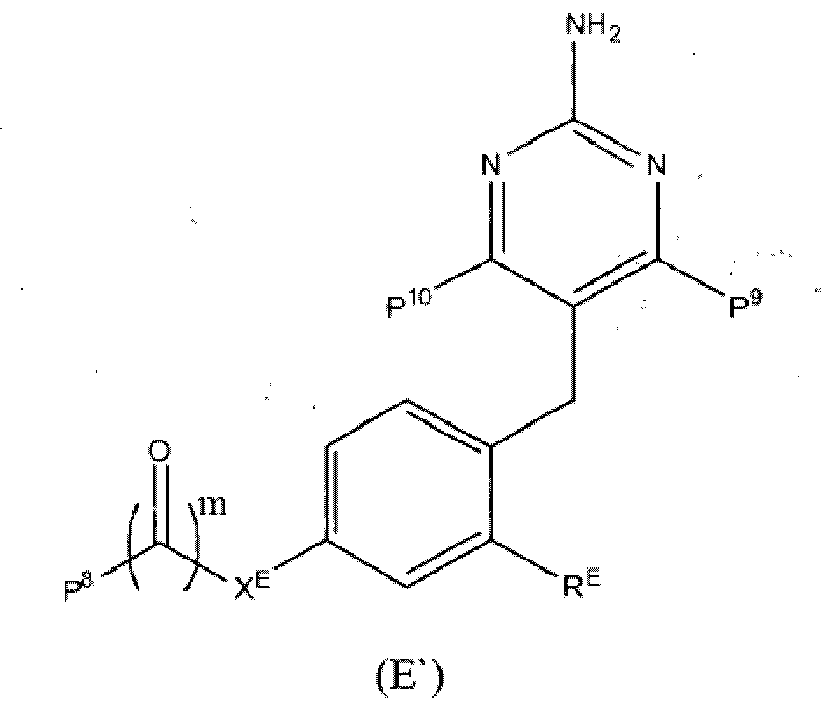
- TLR7-Agonist nach Anspruch 1 oder 2, ausgewählt aus den Formeln (C) oder (C'), wobei P3 aus C1-C6-Alkyl, CF3 und -((CH2)pO)q(CH2)pOs- und -Y-L-X-P(O) (ORX) (ORY) ausgewählt ist; P4 aus -C1-C6-Alkylaryl und -Y-L-X-P(O)(ORX)(ORY) ausgewählt ist; XC für CH steht; X für eine kovalente Bindung steht; L aus C1-C6-Alkylen und - ((CH2)pO)q(CH2)p-, jeweils gegebenenfalls substituiert durch 1 bis 4 unabhängig voneinander aus Halogen, OH, C1-C4-Alkyl, -OP(O)(OH)2 und -P(O)(OH)2 ausgewählte Substituenten, ausgewählt ist; jedes p unabhängig voneinander aus 1, 2 und 3 ausgewählt ist; q für 1 oder 2 steht.
- TLR7-Agonist nach Anspruch 1 oder 2, ausgewählt aus den Formeln (C) oder (C'), wobei P3 aus C1-C6-Alkyl, CF3 und -((CH2)pO)q(CH2)pOs- und -Y-L-X-P(O) (ORX) (ORY) ausgewählt ist; P4 aus -C1-C6-Alkylaryl und -Y-L-X-P(O)(ORX)(ORY) ausgewählt ist; XC für N steht; X für eine kovalente Bindung steht; L aus C1-C6-Alkylen und - ((CH2)pO)q(CH2)p-, jeweils gegebenenfalls substituiert durch 1 bis 4 unabhängig voneinander aus Halogen, OH, C1-C4-Alkyl, -OP(O)(OH)2 und -P(O)(OH)2 ausgewählte Substituenten, ausgewählt ist; jedes p unabhängig voneinander aus 1, 2 und 3 ausgewählt ist; q für 1 oder 2 steht.
- TLR7-Agonist nach Anspruch 1 oder 2, ausgewählt aus den Formeln (D) oder (D`), wobei P5 aus C1-C6-Alkyl und -Y-L-X-P(O) (ORX) (ORY) ausgewählt ist.
- TLR7-Agonist nach Anspruch 1 oder 2, ausgewählt aus den Formeln (E) oder (E`), wobei XE für CH2 steht, P8 für gegebenenfalls durch -Y-L-X-P(O) (ORX) (ORY) substituiertes C1-C6-Alkoxy steht.
- TLR7-Agonist nach Anspruch 1 oder 2, ausgewählt aus den Formeln (E) oder (E'), wobei P9 für gegebenenfalls durch OH und C1-C6-Alkyl substituiertes -NH-C1-C6-Alkyl steht und -Y-L-X-P(O) (ORX) (ORY) steht.
- TLR7-Agonist nach Anspruch 1 oder 2, ausgewählt aus den Formeln (C) oder (C'), bei dem es sich nicht um eine Verbindung handelt, in der P4 für -Y-L-X-P(O)(ORX) (ORY) steht.
- TLR7-Agonist nach Anspruch 1 oder 2, ausgewählt aus den Formeln (C) oder (C'), wobei P4 aus H, C1-C6-Alkyl, -C1-C6-Alkylaryl ausgewählt ist.
- Eine der folgenden Verbindungen:


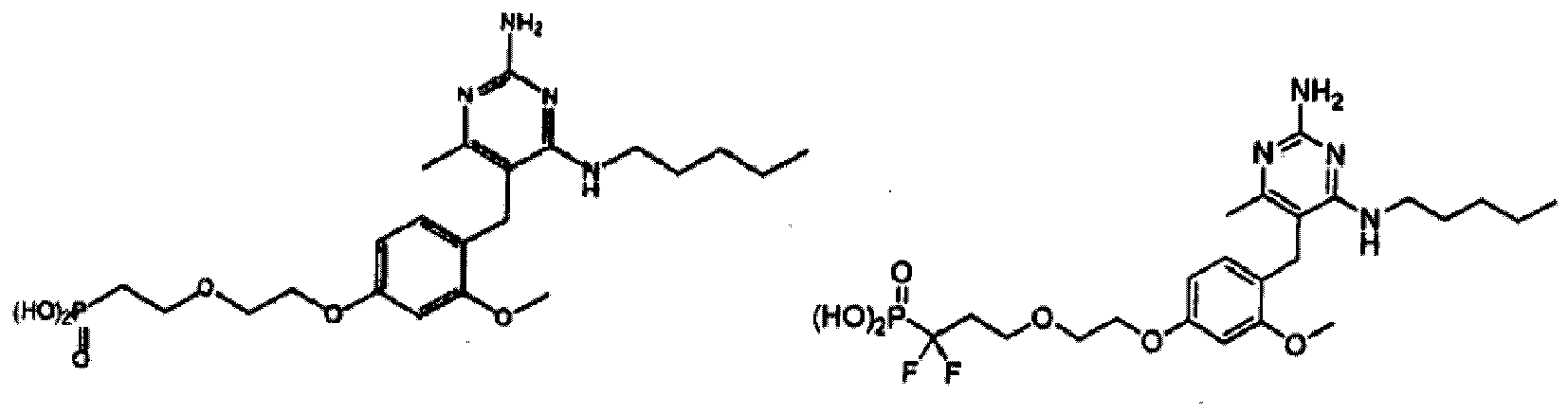
- Verbindung der Formel (G)
 P11 aus H, C1-C6-Alkyl, C1-C6-Alkoxy, NRVRW und -Y-L-X-P(O) (ORX) (ORY) ausgewählt ist;P12 aus H, C1-C6-Alkyl, Aryl, gegebenenfalls durch -C(O)NRVRW substituiert, und -Y-L-X-P(O) (ORX) (ORY) ausgewählt ist;P13, P14 und P15 unabhängig voneinander aus H, C1-C6-Alkyl, C1-C6-Alkoxy und -Y-L-X-P(O) (ORX) (ORY) ausgewählt sind;mit der Maßgabe, dass mindestens eine der Variablen P11, P12, P13, P14 oder P15 für -Y-L-X-P(O) (ORX) (ORY) steht;RV und RW unabhängig voneinander aus H, C1-C6-Alkyl ausgewählt sind oder zusammen mit dem Stickstoffatom,an das sie gebunden sind, einen 4- bis 7-gliedrigen heterocyclischen Ring bilden;XG aus C, CH und N ausgewählt ist;----- für eine fakultative Doppelbindung steht, wobei XG für C steht, wenn ----- für eine Doppelbindung steht; undRG aus H und C1-C6-Alkyl ausgewählt ist;X aus einer kovalenten Bindung, O und NH ausgewählt ist;Y aus einer kovalenten Bindung, O, C(O), S und NH ausgewählt ist;L aus einer kovalenten Bindung, C1-C6-Alkylen, C1-C6-Alkenylen, Arylen, Heteroarylen, C1-C6-Alkylenoxy und -((CH2)pO)q(CH2)p-, jeweils gegebenenfalls substituiert durch 1 bis 4 unabhängig voneinander aus Halogen, OH, C1-C4-Alkyl, -OP(O)(OH)2 und -P(O)(OH)2 ausgewählte Substituenten, ausgewählt ist;jedes p unabhängig voneinander aus 1, 2, 3, 4, 5 und 6 ausgewählt ist undq aus 1, 2, 3 und 4 ausgewählt ist.
 - Verbindung nach Anspruch 11, wobei die Verbindung der Formel (G) eine Struktur gemäß der nachstehend gezeigten Formel (G') aufweist:

- TLR7-Agonist nach Anspruch 1 oder 2 oder Verbindung nach Anspruch 11 oder 12, wobei X für O steht; L aus C1-C6-Alkylen und -((CH2)pO)q(CH2)p-, jeweils gegebenenfalls substituiert durch 1 bis 4 unabhängig voneinander aus Halogen, OH, C1-C4-Alkyl, -OP(O)(OH)2 und -P(O)(OH)2 ausgewählte Substituenten, ausgewählt ist; jedes p unabhängig voneinander aus 1, 2 und 3 ausgewählt ist und q aus 1 und 2 ausgewählt ist.
- TLR7-Agonist nach Anspruch 1 oder 2 oder Verbindung nach Anspruch 11 oder 12, wobei X für eine kovalente Bindung steht; L aus C1-C6-Alkylen und - ((CH2)pO)q(CH2)p-, jeweils gegebenenfalls substituiert durch 1 bis 4 unabhängig voneinander aus Halogen, OH, C1-C4-Alkyl, -OP(O)(OH)2 und -P(O)(OH)2 ausgewählte Substituenten, ausgewählt ist; jedes p unabhängig voneinander aus 1, 2 und 3 ausgewählt ist und q aus 1 und 2 ausgewählt ist.
- Zusammensetzung, umfassend einen TLR-Agonisten oder eine Verbindung nach einem der vorhergehenden Ansprüche und ein unlösliches Metallsalz.
Priority Applications (1)
| Application Number | Priority Date | Filing Date | Title |
|---|---|---|---|
| EP14150998.4A EP2719395A1 (de) | 2010-09-01 | 2011-09-01 | Adsorption von Immunpotentiatoren auf unlöslichen Metallsalzen |
Applications Claiming Priority (4)
| Application Number | Priority Date | Filing Date | Title |
|---|---|---|---|
| US37912610P | 2010-09-01 | 2010-09-01 | |
| US201161448394P | 2011-03-02 | 2011-03-02 | |
| US201161466887P | 2011-03-23 | 2011-03-23 | |
| PCT/US2011/050231 WO2012031140A1 (en) | 2010-09-01 | 2011-09-01 | Adsorption of immunopotentiators to insoluble metal salts |
Related Child Applications (1)
| Application Number | Title | Priority Date | Filing Date |
|---|---|---|---|
| EP14150998.4A Division EP2719395A1 (de) | 2010-09-01 | 2011-09-01 | Adsorption von Immunpotentiatoren auf unlöslichen Metallsalzen |
Publications (2)
| Publication Number | Publication Date |
|---|---|
| EP2480253A1 EP2480253A1 (de) | 2012-08-01 |
| EP2480253B1 true EP2480253B1 (de) | 2014-01-22 |
Family
ID=44786079
Family Applications (2)
| Application Number | Title | Priority Date | Filing Date |
|---|---|---|---|
| EP11767839.1A Active EP2480253B1 (de) | 2010-09-01 | 2011-09-01 | Adsorption von immunpotentiatoren auf unlöslichen metallsalzen |
| EP14150998.4A Ceased EP2719395A1 (de) | 2010-09-01 | 2011-09-01 | Adsorption von Immunpotentiatoren auf unlöslichen Metallsalzen |
Family Applications After (1)
| Application Number | Title | Priority Date | Filing Date |
|---|---|---|---|
| EP14150998.4A Ceased EP2719395A1 (de) | 2010-09-01 | 2011-09-01 | Adsorption von Immunpotentiatoren auf unlöslichen Metallsalzen |
Country Status (13)
| Country | Link |
|---|---|
| US (3) | US20120177681A1 (de) |
| EP (2) | EP2480253B1 (de) |
| JP (1) | JP2013538217A (de) |
| CN (2) | CN105999275A (de) |
| AU (2) | AU2011295853A1 (de) |
| BR (1) | BR112013005134A2 (de) |
| CA (1) | CA2810011A1 (de) |
| EA (1) | EA201390341A1 (de) |
| ES (1) | ES2458355T3 (de) |
| MX (1) | MX343914B (de) |
| NZ (1) | NZ608362A (de) |
| SG (1) | SG188360A1 (de) |
| WO (1) | WO2012031140A1 (de) |
Families Citing this family (46)
| Publication number | Priority date | Publication date | Assignee | Title |
|---|---|---|---|---|
| EP1261723B1 (de) * | 2000-02-28 | 2008-02-27 | Novartis Vaccines and Diagnostics S.r.l. | Hybride expression von neisseria proteinen |
| ES2577514T3 (es) | 2005-08-22 | 2016-07-15 | The Regents Of The University Of California | Antagonistas de TLR |
| US8846697B2 (en) * | 2006-05-31 | 2014-09-30 | The Regents Of The University Of California | Purine analogs |
| DK2510946T3 (en) | 2007-02-07 | 2015-11-02 | Univ California | Conjugates of synthetic fluorescent agonists and their applications |
| MX2010008697A (es) * | 2008-02-07 | 2010-12-07 | Univ California | Tratamiento de enfermedades de la vejiga con un activador de tlr7. |
| EP2396328A2 (de) * | 2009-02-11 | 2011-12-21 | The Regents of The University of California | Modulatoren des toll-ähnlichen rezeptors und behandlung von krankheiten |
| JP5988492B2 (ja) | 2009-09-02 | 2016-09-07 | ノバルティス アーゲー | Tlr活性モジュレーターを含む免疫原性組成物 |
| EP2549990A1 (de) * | 2010-03-23 | 2013-01-30 | Irm Llc | Verbindungen (cysteinbasierte lipopeptide) und zusammensetzungen als tlr2-agonisten zur behandlung von infektionen, entzündungen, atemwegserkrankungen etc. |
| EP2480253B1 (de) * | 2010-09-01 | 2014-01-22 | Novartis AG | Adsorption von immunpotentiatoren auf unlöslichen metallsalzen |
| AU2012222883A1 (en) * | 2011-03-02 | 2013-10-17 | Novartis Ag | Combination vaccines with lower doses of antigen and/or adjuvant |
| AU2012279018B2 (en) | 2011-07-05 | 2017-06-08 | Children's Medical Center Corporation | N-terminal deleted GP120 immunogens |
| BR112014004782A2 (pt) | 2011-09-01 | 2017-03-21 | Novartis Ag | formulações adjuvantes de antígenos de staphylococcus aureus |
| WO2013052095A2 (en) | 2011-10-03 | 2013-04-11 | Duke University | Vaccine |
| PT2822947T (pt) * | 2012-03-07 | 2016-09-26 | Glaxosmithkline Biologicals Sa | Sais de arginina de um agonista de tlr7 |
| JP2015510872A (ja) * | 2012-03-07 | 2015-04-13 | ノバルティス アーゲー | Streptococcuspneumoniae抗原の増強された製剤 |
| JP2015509520A (ja) | 2012-03-07 | 2015-03-30 | ノバルティス アーゲー | 狂犬病ウイルス免疫原のアジュバント化製剤 |
| CN104159602B (zh) | 2012-03-08 | 2017-10-24 | 葛兰素史密丝克莱恩生物有限公司 | 加强疫苗的含佐剂制剂 |
| EP2822584A1 (de) | 2012-03-08 | 2015-01-14 | Novartis AG | Kombinationsimpfstoffe mit tlr4-agonisten |
| RU2015106930A (ru) | 2012-09-06 | 2016-10-20 | Новартис Аг | Комбинированные вакцины с менингококком серогруппы в и к/д/с |
| CN104918634A (zh) | 2012-10-12 | 2015-09-16 | 葛兰素史密丝克莱恩生物有限公司 | 用于组合疫苗的非交联无细胞百日咳抗原 |
| US9827190B2 (en) | 2013-02-01 | 2017-11-28 | Glaxosmithkline Biologicals Sa | Intradermal delivery of immunological compositions comprising toll-like receptor 7 agonists |
| CN105828835A (zh) | 2013-05-10 | 2016-08-03 | 诺华股份有限公司 | 避免流感疫苗中的发作性嗜睡病风险 |
| JP2016532712A (ja) * | 2013-09-05 | 2016-10-20 | イミューン デザイン コーポレイション | 薬物中毒に対するワクチン組成物 |
| BE1022744B1 (fr) | 2014-03-26 | 2016-08-29 | Glaxosmithkline Biologicals Sa | Antigenes staphylococciques mutants |
| EP3061826A1 (de) | 2015-02-27 | 2016-08-31 | Novartis AG | Flavivirus-replikons |
| US11697851B2 (en) | 2016-05-24 | 2023-07-11 | The Regents Of The University Of California | Early ovarian cancer detection diagnostic test based on mRNA isoforms |
| EP3510036B1 (de) | 2016-09-07 | 2021-07-21 | GlaxoSmithKline Biologicals SA | Imidazochinolinderivate und deren verwendung in der therapie |
| AU2017372722B2 (en) * | 2016-12-05 | 2021-09-09 | Apros Therapeutics, Inc. | Pyrimidine compounds containing acidic groups |
| US10786502B2 (en) | 2016-12-05 | 2020-09-29 | Apros Therapeutics, Inc. | Substituted pyrimidines containing acidic groups as TLR7 modulators |
| AR111760A1 (es) | 2017-05-19 | 2019-08-14 | Novartis Ag | Compuestos y composiciones para el tratamiento de tumores sólidos mediante administración intratumoral |
| KR20200101954A (ko) | 2017-12-19 | 2020-08-28 | 메사추세츠 인스티튜트 오브 테크놀로지 | 항원-아주반트 커플링 시약 및 사용 방법 |
| CN110317202B (zh) * | 2018-03-30 | 2021-12-24 | 江苏恒瑞医药股份有限公司 | 氰基吡咯并杂芳基类衍生物、其制备方法及其在医药上的应用 |
| WO2019196918A1 (zh) * | 2018-04-13 | 2019-10-17 | 罗欣药业(上海)有限公司 | 五元杂环并嘧啶类化合物、药物组合物及用途 |
| US10876217B2 (en) * | 2018-04-13 | 2020-12-29 | Molecular Surface Technologies, Llc | Electrochemical attachment of phosphonic acids to metallic substrates and osteoconductive medical devices containing same |
| US20210228713A1 (en) * | 2018-06-04 | 2021-07-29 | Apros Therapeutics, Inc. | Tlr7 peptide conjugates |
| JP7351859B2 (ja) * | 2018-06-04 | 2023-09-27 | アプロス セラピューティクス, インコーポレイテッド | Tlr7の調節に関係する疾患を処置するのに有用な酸性基を含むピリミジン化合物 |
| JP7539867B2 (ja) | 2019-04-05 | 2024-08-26 | 住友ファーマ株式会社 | 水溶性アジュバント |
| EP3972636A4 (de) * | 2019-05-23 | 2023-08-02 | The University Of Montana | Impfstoffadjuvantien basierend auf tlr-rezeptor-liganden |
| JP2022538974A (ja) | 2019-06-26 | 2022-09-07 | マサチューセッツ インスチテュート オブ テクノロジー | 免疫調節融合タンパク質-金属水酸化物錯体およびその方法 |
| EP3777884A1 (de) | 2019-08-15 | 2021-02-17 | GlaxoSmithKline Biologicals S.A. | Immunogene zusammensetzung |
| CA3154475A1 (en) * | 2019-09-23 | 2021-04-01 | Nanjing Zhengxiang Pharmaceuticals Co., Ltd. | Phosphodiesterase inhibitors and use |
| CN112778372B (zh) * | 2019-11-11 | 2025-09-23 | 苏州泽璟生物制药股份有限公司 | 咪唑并喹啉取代磷酸酯类激动剂及其制备方法和应用 |
| CN111643661A (zh) * | 2020-06-08 | 2020-09-11 | 王竹林 | 新型免疫佐剂、化合物及其应用 |
| CA3208424A1 (en) * | 2021-02-22 | 2022-08-25 | David M. Ferguson | Immunomodulators and immunomodulator conjugates |
| CN121693509A (zh) * | 2023-06-07 | 2026-03-17 | 维申医药(南通)有限公司 | Toll样受体激动剂杂环类衍生物及其制备和应用 |
| WO2025240361A1 (en) * | 2024-05-13 | 2025-11-20 | The Board Of Trustees Of The Leland Stanford Junior University | Enpp1 and/or enpp3 inhibitors |
Family Cites Families (90)
| Publication number | Priority date | Publication date | Assignee | Title |
|---|---|---|---|---|
| EP0114787B1 (de) | 1983-01-25 | 1991-09-25 | Ciba-Geigy Ag | Neue Peptidderivate |
| US5059258A (en) | 1989-08-23 | 1991-10-22 | Aluminum Company Of America | Phosphonic/phosphinic acid bonded to aluminum hydroxide layer |
| US6699474B1 (en) | 1990-08-20 | 2004-03-02 | Erich Hugo Cerny | Vaccine and immunserum against drugs of abuse |
| US5936076A (en) | 1991-08-29 | 1999-08-10 | Kirin Beer Kabushiki Kaisha | αgalactosylceramide derivatives |
| CA2383007A1 (en) | 1992-03-02 | 1993-09-16 | Chiron S.P.A. | Helicobacter pylori proteins useful for vaccines and diagnostics |
| FR2718452B1 (fr) | 1994-04-06 | 1996-06-28 | Pf Medicament | Elément d'immunogène, agent immunogène, composition pharmaceutique et procédé de préparation. |
| GB2303855B (en) | 1994-07-01 | 1998-10-28 | Rican Limited | Helicobacter pylori antigenic protein preparation and immunoassays |
| EP0793656B1 (de) * | 1994-11-24 | 2003-03-26 | Basilea Pharmaceutica AG | Neue benzylpyrimidine |
| GB2324093A (en) | 1996-01-04 | 1998-10-14 | Rican Limited | Helicobacter pylori bacterioferritin |
| GB9623233D0 (en) | 1996-11-07 | 1997-01-08 | Smithkline Beecham Biolog | Vaccine composition |
| US6406705B1 (en) | 1997-03-10 | 2002-06-18 | University Of Iowa Research Foundation | Use of nucleic acids containing unmethylated CpG dinucleotide as an adjuvant |
| GB9828000D0 (en) | 1998-12-18 | 1999-02-10 | Chiron Spa | Antigens |
| US6451810B1 (en) * | 1999-06-10 | 2002-09-17 | 3M Innovative Properties Company | Amide substituted imidazoquinolines |
| US6756382B2 (en) * | 1999-06-10 | 2004-06-29 | 3M Innovative Properties Company | Amide substituted imidazoquinolines |
| DE10012370A1 (de) | 2000-03-14 | 2001-09-27 | Chiron Behring Gmbh & Co | Adjuvans für Vakzinen |
| GB0108364D0 (en) | 2001-04-03 | 2001-05-23 | Glaxosmithkline Biolog Sa | Vaccine composition |
| EP2166019A3 (de) | 2000-07-03 | 2010-06-09 | Novartis Vaccines and Diagnostics S.r.l. | Immunisierung gegen Chlamydia pneumoniae |
| FR2827605B1 (fr) | 2001-07-20 | 2004-07-16 | Pf Medicament | Nouveaux peptides derives de la proteine g du vrs et leur utilisation dans un vaccin |
| ES2312649T3 (es) | 2001-12-12 | 2009-03-01 | Novartis Vaccines And Diagnostics S.R.L. | Inmunizacion frente a chlamydia trachomatis. |
| GB0211118D0 (en) | 2002-05-15 | 2002-06-26 | Polonelli Luciano | Vaccines |
| US7273852B2 (en) | 2002-06-13 | 2007-09-25 | The Research Foundation Of The City University Of New York | Synthetic C-glycolipid and its use for treating cancer, infectious diseases and autoimmune diseases |
| HUE047780T2 (hu) | 2002-10-11 | 2020-05-28 | Glaxosmithkline Biologicals Sa | Polipeptid vakcinák hipervirulens meningokokkusz vonalak elleni széles-spektrumú védelemre |
| US7818252B2 (en) | 2003-02-20 | 2010-10-19 | Gilat Satellite Networks, Ltd | Enforcement of network service level agreements |
| DE602004031115D1 (de) * | 2003-06-16 | 2011-03-03 | Acad Of Science Czech Republic | Pyrimidinverbindungen mit phosphonatgruppen als antivirale nucleotidanaloga |
| CN1812809A (zh) | 2003-06-26 | 2006-08-02 | 希龙公司 | 用于沙眼衣原体的免疫原性组合物 |
| JP2005089334A (ja) | 2003-09-12 | 2005-04-07 | Sumitomo Pharmaceut Co Ltd | 8−ヒドロキシアデニン化合物 |
| US7771726B2 (en) | 2003-10-08 | 2010-08-10 | New York University | Use of synthetic glycolipids as universal adjuvants for vaccines against cancer and infectious diseases |
| WO2005084306A2 (en) | 2004-03-02 | 2005-09-15 | Chiron Corporation | Immunogenic compositions for chlamydia pneunomiae |
| GB0405787D0 (en) | 2004-03-15 | 2004-04-21 | Chiron Srl | Low dose vaccines |
| CN1964626A (zh) | 2004-03-31 | 2007-05-16 | 纽约大学 | 新型合成c-糖脂、其合成及其治疗传染病、癌症和自身免疫性疾病的用途 |
| DK1858919T3 (da) | 2005-02-18 | 2012-07-16 | Novartis Vaccines & Diagnostic | Immunogener fra uropathogen Escherichia coli |
| SG160329A1 (en) | 2005-02-18 | 2010-04-29 | Novartis Vaccines & Diagnostic | Proteins and nucleic acids from meningitis/sepsis-associated escherichia coli |
| US8222257B2 (en) * | 2005-04-01 | 2012-07-17 | The Regents Of The University Of California | Phosphono-pent-2-en-1-yl nucleosides and analogs |
| US8133973B2 (en) | 2005-05-12 | 2012-03-13 | Novartis Vaccines And Diagnostics, S.R.L. | Immunogenic compositions for Chlamydia trachomatis |
| AR056396A1 (es) | 2005-06-27 | 2007-10-10 | Glaxosmithkline Biolog Sa | Composicion inmunogenica |
| TWI382019B (zh) | 2005-08-19 | 2013-01-11 | Array Biopharma Inc | 作為類鐸受體(toll-like receptor)調節劑之胺基二氮雜呯 |
| TW200801003A (en) | 2005-09-16 | 2008-01-01 | Astrazeneca Ab | Novel compounds |
| WO2007034917A1 (ja) | 2005-09-22 | 2007-03-29 | Dainippon Sumitomo Pharma Co., Ltd. | 新規なアデニン化合物 |
| TW200745114A (en) | 2005-09-22 | 2007-12-16 | Astrazeneca Ab | Novel compounds |
| US20090192153A1 (en) | 2005-09-22 | 2009-07-30 | Dainippon Sumitomo Pharma Co., Ltd. a corporation of Japan | Novel adenine compound |
| WO2007034916A1 (ja) | 2005-09-22 | 2007-03-29 | Dainippon Sumitomo Pharma Co., Ltd. | 新規アデニン化合物 |
| EP1939202A4 (de) | 2005-09-22 | 2010-06-16 | Dainippon Sumitomo Pharma Co | Neue adeninverbindung |
| NZ567979A (en) | 2005-11-04 | 2012-02-24 | Novartis Vaccines & Diagnostic | Adjuvanted influenza vaccines including a cytokine-inducing agents which is an agonist of Toll-Like Receptor 7 |
| GB0524066D0 (en) | 2005-11-25 | 2006-01-04 | Chiron Srl | 741 ii |
| CA2633142A1 (en) | 2005-12-22 | 2007-10-04 | Novartis Vaccines And Diagnostics, S.R.L. | Chlamydial antigens |
| BRPI0707945A2 (pt) * | 2006-02-17 | 2011-05-17 | Pfizer Ltd | derivados de 3-deazapurina como modulares de tlr7 |
| EP2010537B1 (de) | 2006-03-23 | 2011-12-28 | Novartis AG | Imidazochinoxalinverbindungen als immunmodulatoren |
| EP2007765B1 (de) | 2006-03-23 | 2012-06-27 | Novartis AG | Immunstimulierende verbindungen |
| JP2009542645A (ja) | 2006-07-05 | 2009-12-03 | アストラゼネカ・アクチエボラーグ | Tlr7のモジュレーターとして作用する8−オキソアデニン誘導体 |
| ES2437871T3 (es) | 2006-07-07 | 2014-01-14 | Gilead Sciences, Inc. | Moduladores del receptor tipo toll 7 |
| EP2064230A2 (de) | 2006-08-16 | 2009-06-03 | Novartis AG | Immungene aus uropathogenen escherichia coli |
| GB0616306D0 (en) | 2006-08-16 | 2006-09-27 | Novartis Ag | Vaccines |
| CA2662051A1 (en) | 2006-09-07 | 2008-03-13 | Glaxosmithkline Biologicals S.A. | Vaccine |
| WO2008047174A1 (en) | 2006-10-18 | 2008-04-24 | Centre National De La Recherche Scientifique | Alpha-galactosylceramide analogs, their methods of manufacture, intermediate compounds useful in these methods, and pharmaceutical compositions containing them |
| AR065372A1 (es) | 2007-02-19 | 2009-06-03 | Smithkline Beecham Corp | Derivados de purina |
| AR065784A1 (es) | 2007-03-20 | 2009-07-01 | Dainippon Sumitomo Pharma Co | Derivados de 8-oxo adenina,medicamentos que los contienen y usos como agentes terapeuticos para enfermedades alergicas, antivirales o antibacterianas. |
| DK2155743T3 (da) | 2007-05-08 | 2012-11-05 | Astrazeneca Ab | Imidazoquinoliner med immunmodulerende egenskaber |
| ATE501136T1 (de) | 2007-08-03 | 2011-03-15 | Pfizer Ltd | Imidazopyridinone |
| MX340096B (es) | 2007-10-19 | 2016-06-27 | Glaxosmithkline Biologicals Sa | Formulaciones de vacuna meningococica. |
| PE20091236A1 (es) | 2007-11-22 | 2009-09-16 | Astrazeneca Ab | Derivados de pirimidina como immunomoduladores de tlr7 |
| JP5415449B2 (ja) | 2007-12-24 | 2014-02-12 | ノバルティス アーゲー | 吸着されたインフルエンザワクチンのためのアッセイ |
| PT2268618E (pt) | 2008-03-03 | 2015-10-12 | Novartis Ag | Compostos e composições moduladores da actividade tlr |
| SI2276486T1 (sl) | 2008-03-24 | 2014-01-31 | 4Sc Discovery Gmbh | Novi substituirani imidazokinolini |
| EP2303236A4 (de) | 2008-07-01 | 2012-09-26 | Univ Emory | Synergistische induktion von humoraler und zellulärer immunität mittels kombinatorischer aktivierung von toll-like-rezeptoren |
| WO2010014913A1 (en) | 2008-08-01 | 2010-02-04 | Ventirx Pharmaceuticals, Inc. | Toll-like receptor agonist formulations and their use |
| TWM352127U (en) | 2008-08-29 | 2009-03-01 | Bestac Advanced Material Co Ltd | Polishing pad |
| HRP20180063T1 (hr) * | 2008-10-24 | 2018-02-23 | Glaxosmithkline Biologicals Sa | Lipidirani derivati imidazokinolina |
| DK2364314T3 (da) * | 2008-12-09 | 2014-05-12 | Gilead Sciences Inc | Modulatorer af toll-lignende receptorer |
| GB0822633D0 (en) | 2008-12-11 | 2009-01-21 | Novartis Ag | Formulation |
| NZ700477A (en) | 2009-02-17 | 2016-04-29 | Glaxosmithkline Biolog Sa | Inactivated dengue virus vaccine with aluminium-free adjuvant |
| DK2510947T3 (en) | 2009-04-14 | 2016-03-21 | Glaxosmithkline Biolog Sa | Compositions for Immunization against Staphylococcus aureus. |
| AU2010242352B2 (en) | 2009-05-01 | 2016-01-07 | Osaka University | Novel malaria vaccine |
| US20120076814A1 (en) | 2009-06-01 | 2012-03-29 | Novartis Ag | Combinations of pneumococcal rrgb clades |
| WO2010144734A1 (en) | 2009-06-10 | 2010-12-16 | Novartis Ag | Benzonaphthyridine-containing vaccines |
| JP2013502918A (ja) | 2009-08-27 | 2013-01-31 | ノバルティス アーゲー | 髄膜炎菌fHBP配列を含むハイブリッドポリペプチド |
| JP5988492B2 (ja) * | 2009-09-02 | 2016-09-07 | ノバルティス アーゲー | Tlr活性モジュレーターを含む免疫原性組成物 |
| JO3257B1 (ar) | 2009-09-02 | 2018-09-16 | Novartis Ag | مركبات وتركيبات كمعدلات لفاعلية tlr |
| US20130259898A1 (en) * | 2009-11-09 | 2013-10-03 | National Jewish Health | Vaccine Composition |
| EP2549990A1 (de) * | 2010-03-23 | 2013-01-30 | Irm Llc | Verbindungen (cysteinbasierte lipopeptide) und zusammensetzungen als tlr2-agonisten zur behandlung von infektionen, entzündungen, atemwegserkrankungen etc. |
| WO2011130379A1 (en) | 2010-04-13 | 2011-10-20 | Novartis Ag | Benzonapthyridine compositions and uses thereof |
| EP2480253B1 (de) | 2010-09-01 | 2014-01-22 | Novartis AG | Adsorption von immunpotentiatoren auf unlöslichen metallsalzen |
| ES2630029T3 (es) | 2010-12-14 | 2017-08-17 | Glaxosmithkline Biologicals Sa | Análisis de citometría de flujo de materiales adsorbidos en sales metálicas |
| AU2012222883A1 (en) | 2011-03-02 | 2013-10-17 | Novartis Ag | Combination vaccines with lower doses of antigen and/or adjuvant |
| BR112014004782A2 (pt) | 2011-09-01 | 2017-03-21 | Novartis Ag | formulações adjuvantes de antígenos de staphylococcus aureus |
| JP2015510872A (ja) | 2012-03-07 | 2015-04-13 | ノバルティス アーゲー | Streptococcuspneumoniae抗原の増強された製剤 |
| JP2015509520A (ja) | 2012-03-07 | 2015-03-30 | ノバルティス アーゲー | 狂犬病ウイルス免疫原のアジュバント化製剤 |
| PT2822947T (pt) | 2012-03-07 | 2016-09-26 | Glaxosmithkline Biologicals Sa | Sais de arginina de um agonista de tlr7 |
| CN104159602B (zh) | 2012-03-08 | 2017-10-24 | 葛兰素史密丝克莱恩生物有限公司 | 加强疫苗的含佐剂制剂 |
| RU2015106930A (ru) | 2012-09-06 | 2016-10-20 | Новартис Аг | Комбинированные вакцины с менингококком серогруппы в и к/д/с |
| US20150258190A1 (en) | 2012-10-25 | 2015-09-17 | Novartis Ag | Nicotinamide as adjuvant |
-
2011
- 2011-09-01 EP EP11767839.1A patent/EP2480253B1/de active Active
- 2011-09-01 JP JP2013527322A patent/JP2013538217A/ja active Pending
- 2011-09-01 US US13/223,793 patent/US20120177681A1/en not_active Abandoned
- 2011-09-01 CA CA2810011A patent/CA2810011A1/en not_active Abandoned
- 2011-09-01 BR BR112013005134A patent/BR112013005134A2/pt not_active Application Discontinuation
- 2011-09-01 EA EA201390341A patent/EA201390341A1/ru unknown
- 2011-09-01 WO PCT/US2011/050231 patent/WO2012031140A1/en not_active Ceased
- 2011-09-01 MX MX2013002475A patent/MX343914B/es active IP Right Grant
- 2011-09-01 NZ NZ608362A patent/NZ608362A/en not_active IP Right Cessation
- 2011-09-01 CN CN201610393896.3A patent/CN105999275A/zh active Pending
- 2011-09-01 SG SG2013015573A patent/SG188360A1/en unknown
- 2011-09-01 US US13/820,370 patent/US9315530B2/en active Active
- 2011-09-01 CN CN201180052204.4A patent/CN103313725B/zh not_active Expired - Fee Related
- 2011-09-01 ES ES11767839.1T patent/ES2458355T3/es active Active
- 2011-09-01 EP EP14150998.4A patent/EP2719395A1/de not_active Ceased
- 2011-09-01 AU AU2011295853A patent/AU2011295853A1/en not_active Abandoned
-
2016
- 2016-04-07 US US15/093,652 patent/US10098949B2/en active Active
- 2016-06-28 AU AU2016204450A patent/AU2016204450A1/en not_active Abandoned
Also Published As
| Publication number | Publication date |
|---|---|
| EA201390341A1 (ru) | 2013-08-30 |
| SG188360A1 (en) | 2013-04-30 |
| NZ608362A (en) | 2015-11-27 |
| US20160213776A1 (en) | 2016-07-28 |
| US10098949B2 (en) | 2018-10-16 |
| AU2016204450A1 (en) | 2016-07-28 |
| ES2458355T3 (es) | 2014-05-05 |
| JP2013538217A (ja) | 2013-10-10 |
| CA2810011A1 (en) | 2012-03-08 |
| CN103313725A (zh) | 2013-09-18 |
| AU2011295853A1 (en) | 2013-04-04 |
| BR112013005134A2 (pt) | 2018-04-24 |
| CN105999275A (zh) | 2016-10-12 |
| EP2480253A1 (de) | 2012-08-01 |
| US20130274465A1 (en) | 2013-10-17 |
| US9315530B2 (en) | 2016-04-19 |
| CN103313725B (zh) | 2016-06-29 |
| US20120177681A1 (en) | 2012-07-12 |
| MX2013002475A (es) | 2013-08-01 |
| WO2012031140A1 (en) | 2012-03-08 |
| EP2719395A1 (de) | 2014-04-16 |
| MX343914B (es) | 2016-11-18 |
Similar Documents
| Publication | Publication Date | Title |
|---|---|---|
| EP2480253B1 (de) | Adsorption von immunpotentiatoren auf unlöslichen metallsalzen | |
| EP2822947B1 (de) | Argininsalze eines tlr7 agonisten | |
| AU2008227128B2 (en) | Conjugates of synthetic TLR agonists and uses therefor | |
| US20140363461A1 (en) | Adjuvanted formulations of staphylococcus aureus antigens | |
| JP5814933B2 (ja) | 免疫増強化合物の均質な懸濁物およびその使用 | |
| AU2016204453A1 (en) | Adsorption of immunopotentiators to insoluble metal salts | |
| AU2013203167A1 (en) | Adsorption of immunopotentiators to insoluble metal salts | |
| ATTRACTIVE et al. | The scientific journey of a novel adjuvant (AS37) from bench to bedside |
Legal Events
| Date | Code | Title | Description |
|---|---|---|---|
| PUAI | Public reference made under article 153(3) epc to a published international application that has entered the european phase |
Free format text: ORIGINAL CODE: 0009012 |
|
| 17P | Request for examination filed |
Effective date: 20120424 |
|
| AK | Designated contracting states |
Kind code of ref document: A1 Designated state(s): AL AT BE BG CH CY CZ DE DK EE ES FI FR GB GR HR HU IE IS IT LI LT LU LV MC MK MT NL NO PL PT RO RS SE SI SK SM TR |
|
| DAX | Request for extension of the european patent (deleted) | ||
| 17Q | First examination report despatched |
Effective date: 20130206 |
|
| GRAP | Despatch of communication of intention to grant a patent |
Free format text: ORIGINAL CODE: EPIDOSNIGR1 |
|
| INTG | Intention to grant announced |
Effective date: 20130819 |
|
| RIN1 | Information on inventor provided before grant (corrected) |
Inventor name: YUE, KATHY Inventor name: PAN, JIANFENG Inventor name: LI, YONGKAI Inventor name: ZHANG, XIAOYUE Inventor name: CORTEZ, ALEX Inventor name: SKIBINSKI, DAVID, A.G. Inventor name: WU, TOM, YAO-HSIANG Inventor name: SINGH, MANMOHAN Inventor name: HOFFMAN, TIMOTHY, Z. Inventor name: ZOU, YEFEN |
|
| GRAS | Grant fee paid |
Free format text: ORIGINAL CODE: EPIDOSNIGR3 |
|
| GRAA | (expected) grant |
Free format text: ORIGINAL CODE: 0009210 |
|
| AK | Designated contracting states |
Kind code of ref document: B1 Designated state(s): AL AT BE BG CH CY CZ DE DK EE ES FI FR GB GR HR HU IE IS IT LI LT LU LV MC MK MT NL NO PL PT RO RS SE SI SK SM TR |
|
| REG | Reference to a national code |
Ref country code: GB Ref legal event code: FG4D |
|
| REG | Reference to a national code |
Ref country code: CH Ref legal event code: EP |
|
| REG | Reference to a national code |
Ref country code: AT Ref legal event code: REF Ref document number: 650443 Country of ref document: AT Kind code of ref document: T Effective date: 20140215 |
|
| REG | Reference to a national code |
Ref country code: IE Ref legal event code: FG4D |
|
| REG | Reference to a national code |
Ref country code: DE Ref legal event code: R096 Ref document number: 602011004832 Country of ref document: DE Effective date: 20140306 |
|
| REG | Reference to a national code |
Ref country code: CH Ref legal event code: NV Representative=s name: E. BLUM AND CO. AG PATENT- UND MARKENANWAELTE , CH |
|
| REG | Reference to a national code |
Ref country code: NL Ref legal event code: T3 |
|
| REG | Reference to a national code |
Ref country code: ES Ref legal event code: FG2A Ref document number: 2458355 Country of ref document: ES Kind code of ref document: T3 Effective date: 20140505 |
|
| REG | Reference to a national code |
Ref country code: AT Ref legal event code: MK05 Ref document number: 650443 Country of ref document: AT Kind code of ref document: T Effective date: 20140122 |
|
| REG | Reference to a national code |
Ref country code: LT Ref legal event code: MG4D |
|
| PG25 | Lapsed in a contracting state [announced via postgrant information from national office to epo] |
Ref country code: NO Free format text: LAPSE BECAUSE OF FAILURE TO SUBMIT A TRANSLATION OF THE DESCRIPTION OR TO PAY THE FEE WITHIN THE PRESCRIBED TIME-LIMIT Effective date: 20140422 Ref country code: IS Free format text: LAPSE BECAUSE OF FAILURE TO SUBMIT A TRANSLATION OF THE DESCRIPTION OR TO PAY THE FEE WITHIN THE PRESCRIBED TIME-LIMIT Effective date: 20140522 Ref country code: LT Free format text: LAPSE BECAUSE OF FAILURE TO SUBMIT A TRANSLATION OF THE DESCRIPTION OR TO PAY THE FEE WITHIN THE PRESCRIBED TIME-LIMIT Effective date: 20140122 |
|
| PG25 | Lapsed in a contracting state [announced via postgrant information from national office to epo] |
Ref country code: SE Free format text: LAPSE BECAUSE OF FAILURE TO SUBMIT A TRANSLATION OF THE DESCRIPTION OR TO PAY THE FEE WITHIN THE PRESCRIBED TIME-LIMIT Effective date: 20140122 Ref country code: AT Free format text: LAPSE BECAUSE OF FAILURE TO SUBMIT A TRANSLATION OF THE DESCRIPTION OR TO PAY THE FEE WITHIN THE PRESCRIBED TIME-LIMIT Effective date: 20140122 Ref country code: FI Free format text: LAPSE BECAUSE OF FAILURE TO SUBMIT A TRANSLATION OF THE DESCRIPTION OR TO PAY THE FEE WITHIN THE PRESCRIBED TIME-LIMIT Effective date: 20140122 Ref country code: CY Free format text: LAPSE BECAUSE OF FAILURE TO SUBMIT A TRANSLATION OF THE DESCRIPTION OR TO PAY THE FEE WITHIN THE PRESCRIBED TIME-LIMIT Effective date: 20140122 Ref country code: PT Free format text: LAPSE BECAUSE OF FAILURE TO SUBMIT A TRANSLATION OF THE DESCRIPTION OR TO PAY THE FEE WITHIN THE PRESCRIBED TIME-LIMIT Effective date: 20140522 |
|
| PG25 | Lapsed in a contracting state [announced via postgrant information from national office to epo] |
Ref country code: HR Free format text: LAPSE BECAUSE OF FAILURE TO SUBMIT A TRANSLATION OF THE DESCRIPTION OR TO PAY THE FEE WITHIN THE PRESCRIBED TIME-LIMIT Effective date: 20140122 Ref country code: RS Free format text: LAPSE BECAUSE OF FAILURE TO SUBMIT A TRANSLATION OF THE DESCRIPTION OR TO PAY THE FEE WITHIN THE PRESCRIBED TIME-LIMIT Effective date: 20140122 Ref country code: LV Free format text: LAPSE BECAUSE OF FAILURE TO SUBMIT A TRANSLATION OF THE DESCRIPTION OR TO PAY THE FEE WITHIN THE PRESCRIBED TIME-LIMIT Effective date: 20140122 |
|
| REG | Reference to a national code |
Ref country code: DE Ref legal event code: R097 Ref document number: 602011004832 Country of ref document: DE |
|
| PG25 | Lapsed in a contracting state [announced via postgrant information from national office to epo] |
Ref country code: CZ Free format text: LAPSE BECAUSE OF FAILURE TO SUBMIT A TRANSLATION OF THE DESCRIPTION OR TO PAY THE FEE WITHIN THE PRESCRIBED TIME-LIMIT Effective date: 20140122 Ref country code: EE Free format text: LAPSE BECAUSE OF FAILURE TO SUBMIT A TRANSLATION OF THE DESCRIPTION OR TO PAY THE FEE WITHIN THE PRESCRIBED TIME-LIMIT Effective date: 20140122 Ref country code: RO Free format text: LAPSE BECAUSE OF FAILURE TO SUBMIT A TRANSLATION OF THE DESCRIPTION OR TO PAY THE FEE WITHIN THE PRESCRIBED TIME-LIMIT Effective date: 20140122 Ref country code: DK Free format text: LAPSE BECAUSE OF FAILURE TO SUBMIT A TRANSLATION OF THE DESCRIPTION OR TO PAY THE FEE WITHIN THE PRESCRIBED TIME-LIMIT Effective date: 20140122 |
|
| PG25 | Lapsed in a contracting state [announced via postgrant information from national office to epo] |
Ref country code: PL Free format text: LAPSE BECAUSE OF FAILURE TO SUBMIT A TRANSLATION OF THE DESCRIPTION OR TO PAY THE FEE WITHIN THE PRESCRIBED TIME-LIMIT Effective date: 20140122 Ref country code: SK Free format text: LAPSE BECAUSE OF FAILURE TO SUBMIT A TRANSLATION OF THE DESCRIPTION OR TO PAY THE FEE WITHIN THE PRESCRIBED TIME-LIMIT Effective date: 20140122 |
|
| PLBE | No opposition filed within time limit |
Free format text: ORIGINAL CODE: 0009261 |
|
| STAA | Information on the status of an ep patent application or granted ep patent |
Free format text: STATUS: NO OPPOSITION FILED WITHIN TIME LIMIT |
|
| 26N | No opposition filed |
Effective date: 20141023 |
|
| REG | Reference to a national code |
Ref country code: DE Ref legal event code: R097 Ref document number: 602011004832 Country of ref document: DE Effective date: 20141023 |
|
| PG25 | Lapsed in a contracting state [announced via postgrant information from national office to epo] |
Ref country code: LU Free format text: LAPSE BECAUSE OF FAILURE TO SUBMIT A TRANSLATION OF THE DESCRIPTION OR TO PAY THE FEE WITHIN THE PRESCRIBED TIME-LIMIT Effective date: 20140901 Ref country code: MC Free format text: LAPSE BECAUSE OF FAILURE TO SUBMIT A TRANSLATION OF THE DESCRIPTION OR TO PAY THE FEE WITHIN THE PRESCRIBED TIME-LIMIT Effective date: 20140122 |
|
| PG25 | Lapsed in a contracting state [announced via postgrant information from national office to epo] |
Ref country code: SI Free format text: LAPSE BECAUSE OF FAILURE TO SUBMIT A TRANSLATION OF THE DESCRIPTION OR TO PAY THE FEE WITHIN THE PRESCRIBED TIME-LIMIT Effective date: 20140122 |
|
| REG | Reference to a national code |
Ref country code: IE Ref legal event code: MM4A |
|
| PG25 | Lapsed in a contracting state [announced via postgrant information from national office to epo] |
Ref country code: IE Free format text: LAPSE BECAUSE OF NON-PAYMENT OF DUE FEES Effective date: 20140901 |
|
| PG25 | Lapsed in a contracting state [announced via postgrant information from national office to epo] |
Ref country code: SM Free format text: LAPSE BECAUSE OF FAILURE TO SUBMIT A TRANSLATION OF THE DESCRIPTION OR TO PAY THE FEE WITHIN THE PRESCRIBED TIME-LIMIT Effective date: 20140122 |
|
| PG25 | Lapsed in a contracting state [announced via postgrant information from national office to epo] |
Ref country code: BG Free format text: LAPSE BECAUSE OF FAILURE TO SUBMIT A TRANSLATION OF THE DESCRIPTION OR TO PAY THE FEE WITHIN THE PRESCRIBED TIME-LIMIT Effective date: 20140122 Ref country code: GR Free format text: LAPSE BECAUSE OF FAILURE TO SUBMIT A TRANSLATION OF THE DESCRIPTION OR TO PAY THE FEE WITHIN THE PRESCRIBED TIME-LIMIT Effective date: 20140423 Ref country code: MT Free format text: LAPSE BECAUSE OF FAILURE TO SUBMIT A TRANSLATION OF THE DESCRIPTION OR TO PAY THE FEE WITHIN THE PRESCRIBED TIME-LIMIT Effective date: 20140122 |
|
| PG25 | Lapsed in a contracting state [announced via postgrant information from national office to epo] |
Ref country code: TR Free format text: LAPSE BECAUSE OF FAILURE TO SUBMIT A TRANSLATION OF THE DESCRIPTION OR TO PAY THE FEE WITHIN THE PRESCRIBED TIME-LIMIT Effective date: 20140122 Ref country code: HU Free format text: LAPSE BECAUSE OF FAILURE TO SUBMIT A TRANSLATION OF THE DESCRIPTION OR TO PAY THE FEE WITHIN THE PRESCRIBED TIME-LIMIT; INVALID AB INITIO Effective date: 20110901 |
|
| REG | Reference to a national code |
Ref country code: FR Ref legal event code: PLFP Year of fee payment: 6 |
|
| REG | Reference to a national code |
Ref country code: FR Ref legal event code: PLFP Year of fee payment: 7 |
|
| REG | Reference to a national code |
Ref country code: GB Ref legal event code: 732E Free format text: REGISTERED BETWEEN 20170921 AND 20170927 |
|
| REG | Reference to a national code |
Ref country code: GB Ref legal event code: 732E Free format text: REGISTERED BETWEEN 20170928 AND 20171004 |
|
| REG | Reference to a national code |
Ref country code: ES Ref legal event code: PC2A Owner name: NOVARTIS AG Effective date: 20171121 |
|
| REG | Reference to a national code |
Ref country code: BE Ref legal event code: PD Owner name: GLAXOSMITHKLINE BIOLOGICALS SA; BE Free format text: DETAILS ASSIGNMENT: CHANGE OF OWNER(S), FUSIONNER; FORMER OWNER NAME: IRM LLC Effective date: 20170801 Ref country code: BE Ref legal event code: PD Owner name: GLAXOSMITHKLINE BIOLOGICALS SA; BE Free format text: DETAILS ASSIGNMENT: CHANGE OF OWNER(S), FUSIONNER; FORMER OWNER NAME: NOVARTIS INTERNATIONAL PHARMACEUTICAL LTD. Effective date: 20170801 Ref country code: BE Ref legal event code: PD Owner name: GLAXOSMITHKLINE BIOLOGICALS SA; BE Free format text: DETAILS ASSIGNMENT: CHANGE OF OWNER(S), FUSIONNER; FORMER OWNER NAME: NOVARTIS AG Effective date: 20170801 Ref country code: ES Ref legal event code: PC2A Owner name: GLAXOSMITHKLINE BIOLOGICALS S.A. Effective date: 20171124 |
|
| REG | Reference to a national code |
Ref country code: FR Ref legal event code: TQ Owner name: GLAXOSMITHKLINE BIOLOGICALS S.A., BE Effective date: 20180205 Ref country code: FR Ref legal event code: TP Owner name: GLAXOSMITHKLINE BIOLOGICALS S.A., BE Effective date: 20180205 |
|
| PG25 | Lapsed in a contracting state [announced via postgrant information from national office to epo] |
Ref country code: MK Free format text: LAPSE BECAUSE OF FAILURE TO SUBMIT A TRANSLATION OF THE DESCRIPTION OR TO PAY THE FEE WITHIN THE PRESCRIBED TIME-LIMIT Effective date: 20140122 |
|
| REG | Reference to a national code |
Ref country code: FR Ref legal event code: PLFP Year of fee payment: 8 |
|
| PG25 | Lapsed in a contracting state [announced via postgrant information from national office to epo] |
Ref country code: AL Free format text: LAPSE BECAUSE OF FAILURE TO SUBMIT A TRANSLATION OF THE DESCRIPTION OR TO PAY THE FEE WITHIN THE PRESCRIBED TIME-LIMIT Effective date: 20140122 |
|
| REG | Reference to a national code |
Ref country code: NL Ref legal event code: PD Owner name: IRM LLC; BM Free format text: DETAILS ASSIGNMENT: CHANGE OF OWNER(S), ASSIGNMENT; FORMER OWNER NAME: NOVARTIS AG Effective date: 20211222 |
|
| PGFP | Annual fee paid to national office [announced via postgrant information from national office to epo] |
Ref country code: NL Payment date: 20230822 Year of fee payment: 13 |
|
| PGFP | Annual fee paid to national office [announced via postgrant information from national office to epo] |
Ref country code: IT Payment date: 20230822 Year of fee payment: 13 Ref country code: GB Payment date: 20230823 Year of fee payment: 13 |
|
| PGFP | Annual fee paid to national office [announced via postgrant information from national office to epo] |
Ref country code: FR Payment date: 20230822 Year of fee payment: 13 Ref country code: DE Payment date: 20230822 Year of fee payment: 13 Ref country code: BE Payment date: 20230822 Year of fee payment: 13 |
|
| PGFP | Annual fee paid to national office [announced via postgrant information from national office to epo] |
Ref country code: ES Payment date: 20231002 Year of fee payment: 13 |
|
| PGFP | Annual fee paid to national office [announced via postgrant information from national office to epo] |
Ref country code: CH Payment date: 20231001 Year of fee payment: 13 |
|
| REG | Reference to a national code |
Ref country code: DE Ref legal event code: R119 Ref document number: 602011004832 Country of ref document: DE |
|
| REG | Reference to a national code |
Ref country code: CH Ref legal event code: PL |
|
| REG | Reference to a national code |
Ref country code: NL Ref legal event code: MM Effective date: 20241001 |
|
| GBPC | Gb: european patent ceased through non-payment of renewal fee |
Effective date: 20240901 |
|
| PG25 | Lapsed in a contracting state [announced via postgrant information from national office to epo] |
Ref country code: NL Free format text: LAPSE BECAUSE OF NON-PAYMENT OF DUE FEES Effective date: 20241001 |
|
| PG25 | Lapsed in a contracting state [announced via postgrant information from national office to epo] |
Ref country code: DE Free format text: LAPSE BECAUSE OF NON-PAYMENT OF DUE FEES Effective date: 20250401 |
|
| PG25 | Lapsed in a contracting state [announced via postgrant information from national office to epo] |
Ref country code: GB Free format text: LAPSE BECAUSE OF NON-PAYMENT OF DUE FEES Effective date: 20240901 |
|
| REG | Reference to a national code |
Ref country code: BE Ref legal event code: MM Effective date: 20240930 |
|
| PG25 | Lapsed in a contracting state [announced via postgrant information from national office to epo] |
Ref country code: BE Free format text: LAPSE BECAUSE OF NON-PAYMENT OF DUE FEES Effective date: 20240930 Ref country code: IT Free format text: LAPSE BECAUSE OF NON-PAYMENT OF DUE FEES Effective date: 20240901 |
|
| PG25 | Lapsed in a contracting state [announced via postgrant information from national office to epo] |
Ref country code: FR Free format text: LAPSE BECAUSE OF NON-PAYMENT OF DUE FEES Effective date: 20240930 |
|
| PG25 | Lapsed in a contracting state [announced via postgrant information from national office to epo] |
Ref country code: CH Free format text: LAPSE BECAUSE OF NON-PAYMENT OF DUE FEES Effective date: 20240930 |
|
| REG | Reference to a national code |
Ref country code: ES Ref legal event code: FD2A Effective date: 20251024 |
|
| PG25 | Lapsed in a contracting state [announced via postgrant information from national office to epo] |
Ref country code: ES Free format text: LAPSE BECAUSE OF NON-PAYMENT OF DUE FEES Effective date: 20240902 |