EP2477914B1 - System und verfahren zur vereinzelung und kommissionierung von artikeln - Google Patents
System und verfahren zur vereinzelung und kommissionierung von artikeln Download PDFInfo
- Publication number
- EP2477914B1 EP2477914B1 EP11712751.4A EP11712751A EP2477914B1 EP 2477914 B1 EP2477914 B1 EP 2477914B1 EP 11712751 A EP11712751 A EP 11712751A EP 2477914 B1 EP2477914 B1 EP 2477914B1
- Authority
- EP
- European Patent Office
- Prior art keywords
- article
- handling device
- articles
- detection system
- data processing
- Prior art date
- Legal status (The legal status is an assumption and is not a legal conclusion. Google has not performed a legal analysis and makes no representation as to the accuracy of the status listed.)
- Active
Links
Images
Classifications
-
- B—PERFORMING OPERATIONS; TRANSPORTING
- B65—CONVEYING; PACKING; STORING; HANDLING THIN OR FILAMENTARY MATERIAL
- B65G—TRANSPORT OR STORAGE DEVICES, e.g. CONVEYORS FOR LOADING OR TIPPING, SHOP CONVEYOR SYSTEMS OR PNEUMATIC TUBE CONVEYORS
- B65G1/00—Storing articles, individually or in orderly arrangement, in warehouses or magazines
- B65G1/02—Storage devices
- B65G1/04—Storage devices mechanical
- B65G1/137—Storage devices mechanical with arrangements or automatic control means for selecting which articles are to be removed
-
- G—PHYSICS
- G06—COMPUTING OR CALCULATING; COUNTING
- G06F—ELECTRIC DIGITAL DATA PROCESSING
- G06F17/00—Digital computing or data processing equipment or methods, specially adapted for specific functions
-
- B—PERFORMING OPERATIONS; TRANSPORTING
- B25—HAND TOOLS; PORTABLE POWER-DRIVEN TOOLS; MANIPULATORS
- B25J—MANIPULATORS; CHAMBERS PROVIDED WITH MANIPULATION DEVICES
- B25J15/00—Gripping heads and other end effectors
- B25J15/0052—Gripping heads and other end effectors multiple gripper units or multiple end effectors
- B25J15/0057—Gripping heads and other end effectors multiple gripper units or multiple end effectors mounted on a turret
-
- B—PERFORMING OPERATIONS; TRANSPORTING
- B25—HAND TOOLS; PORTABLE POWER-DRIVEN TOOLS; MANIPULATORS
- B25J—MANIPULATORS; CHAMBERS PROVIDED WITH MANIPULATION DEVICES
- B25J15/00—Gripping heads and other end effectors
- B25J15/06—Gripping heads and other end effectors with vacuum or magnetic holding means
- B25J15/0616—Gripping heads and other end effectors with vacuum or magnetic holding means with vacuum
-
- B—PERFORMING OPERATIONS; TRANSPORTING
- B25—HAND TOOLS; PORTABLE POWER-DRIVEN TOOLS; MANIPULATORS
- B25J—MANIPULATORS; CHAMBERS PROVIDED WITH MANIPULATION DEVICES
- B25J9/00—Program-controlled manipulators
- B25J9/0093—Program-controlled manipulators co-operating with conveyor means
-
- B—PERFORMING OPERATIONS; TRANSPORTING
- B25—HAND TOOLS; PORTABLE POWER-DRIVEN TOOLS; MANIPULATORS
- B25J—MANIPULATORS; CHAMBERS PROVIDED WITH MANIPULATION DEVICES
- B25J9/00—Program-controlled manipulators
- B25J9/16—Program controls
- B25J9/1694—Program controls characterised by use of sensors other than normal servo-feedback from position, speed or acceleration sensors, perception control, multi-sensor controlled systems, sensor fusion
- B25J9/1697—Vision controlled systems
-
- B—PERFORMING OPERATIONS; TRANSPORTING
- B65—CONVEYING; PACKING; STORING; HANDLING THIN OR FILAMENTARY MATERIAL
- B65G—TRANSPORT OR STORAGE DEVICES, e.g. CONVEYORS FOR LOADING OR TIPPING, SHOP CONVEYOR SYSTEMS OR PNEUMATIC TUBE CONVEYORS
- B65G47/00—Article or material-handling devices associated with conveyors; Methods employing such devices
- B65G47/74—Feeding, transfer, or discharging devices of particular kinds or types
- B65G47/90—Devices for picking-up and depositing articles or materials
- B65G47/91—Devices for picking-up and depositing articles or materials incorporating pneumatic, e.g. suction, grippers
- B65G47/918—Devices for picking-up and depositing articles or materials incorporating pneumatic, e.g. suction, grippers with at least two picking-up heads
-
- B—PERFORMING OPERATIONS; TRANSPORTING
- B65—CONVEYING; PACKING; STORING; HANDLING THIN OR FILAMENTARY MATERIAL
- B65G—TRANSPORT OR STORAGE DEVICES, e.g. CONVEYORS FOR LOADING OR TIPPING, SHOP CONVEYOR SYSTEMS OR PNEUMATIC TUBE CONVEYORS
- B65G2203/00—Indexing code relating to control or detection of the articles or the load carriers during conveying
- B65G2203/04—Detection means
- B65G2203/041—Camera
-
- B—PERFORMING OPERATIONS; TRANSPORTING
- B65—CONVEYING; PACKING; STORING; HANDLING THIN OR FILAMENTARY MATERIAL
- B65G—TRANSPORT OR STORAGE DEVICES, e.g. CONVEYORS FOR LOADING OR TIPPING, SHOP CONVEYOR SYSTEMS OR PNEUMATIC TUBE CONVEYORS
- B65G47/00—Article or material-handling devices associated with conveyors; Methods employing such devices
- B65G47/52—Devices for transferring articles or materials between conveyors i.e. discharging or feeding devices
Definitions
- the invention relates to a system for separating and picking articles and a method suitable for this purpose.
- a method for storage of pharmacy articles is known, are poured in the article with parallelepiped packaging from a container on a conveyor belt and thus fed to a detection device.
- the detection device comprises four scanners which are to be arranged so that the barcodes arranged on the narrow sides, the bottom or the lid of the packaging can be detected.
- the detection devices are connected to a computer unit in which a database for storing the detected barcodes is installed. So that the scanners can detect the barcode, transparent surfaces are provided in the conveyor belt and on its edge areas.
- one of the packages is in an unfavorable position, it is separated out by means of a sorting device, for example a mechanically operated reject flap or a compressed air nozzle, and conveyed via a return device to the beginning of the conveyor belt.
- a sorting device for example a mechanically operated reject flap or a compressed air nozzle
- the article goes through the same procedure again, hoping that this time it will come to rest in a position on the conveyor belt that makes it possible to identify it by means of the scanners. If the article is recognized, it arrives at a measuring device with the help of which the outer dimensions of the article are determined. Subsequently, the article is stored by means of a gantry robot in a drawer.
- the method known from the prior art thus requires an identification of the article before a singulation can be performed. If an identification does not succeed, the article must be discarded. For this purpose, a screening device and a return device are required. Thus, the separation of the articles is associated with a high technical complexity.
- DE 10 2007 077 411 A1 discloses a method and apparatus for storing drug packages.
- the packages which are in drawers in a drawer shelf, are to be singulated and then identified by their inscription. Unidentifiable packages are sorted out after an identification attempt or thrown back into the output bin.
- DE 10 2007 038 837 A1 is directed to a method and an apparatus for the implementation of parcels, which should be suitable for the singulation of parcels. Unidentified articles are deposited at a predetermined position (pallet at the storage position E). The articles sold there should then be sorted "manually or by an additional robot".
- the handling device can not continue working if the identification of an article is impossible or incorrect.
- the object of the invention is to eliminate the disadvantages of the prior art.
- a system for the separation and order picking of articles is to be specified, which enables a secure identification and thus prevents a rejection and return of the article.
- a method is to be specified, which allows the separation and order picking of articles, in particular with this system.
- the system and method according to the invention are characterized in that the article received by the handling device from the first transport device is no longer returned to this transport device, especially not even if the recorded article can not be identified. If an article can not initially be identified by the second detection device, the article is deposited in the deposition zone, which preferably directly adjoins the second detection device. The handling device resumes the deposited article from there so that the article has a changed position in relation to the handling device. If, for example, the bar code on the article is covered by a component of the handling device, for example a gripper, then the article can be deposited on the storage zone and the reinsertion of the article in a changed position exposing the barcode, so that the article after this intermediate step now the second detection device can be fed again for identification.
- a component of the handling device for example a gripper
- n is a predetermined integer greater than 0 and is for example 1, 2 or 3. If the item still can not be identified, it will be discarded, for example, by depositing on a rejection zone. There can be decided by a warehouseman on the follow-up of the unidentified article. Such a rejection may, for example, be required if the barcode attached to the article is damaged.
- the system according to the invention and the method according to the invention are particularly suitable for the separation of varietal articles such as, for example, pharmacy articles, but can also be used for the separation of other articles.
- An advantage of the invention is that the separation can be used for picking non-sorted delivered articles that differ in their identity, their external shape, their weight and / or other features.
- the singulation can be automated in a non-pure manner, ie. H. be performed without human intervention, which in contrast to the prior art, a comparatively low mechanical complexity is required.
- the first detection device is an optoelectronic detection device, which is directed to the first transport device.
- the first detection device may be a camera, such as a CCD camera, which continuously or discontinuously records images of the articles delivered on the transport device.
- the first detection device expediently not only detects the position of the delivered articles on the first transport device, but additionally also other features of the article.
- These features of the article may, for example, the outer shape of the article, for. Cylindrical, spherical, cuboid or pyramidal; Elements of the outer shape of the article, z. B. a round, triangular, quadrangular surface; a classification of the article by its weight, size or material, eg. Solid paperboard packaging or variable-shape packaging such as sachets, such as tea bags or bath brine bags; and combinations of any of these features with one or more other of these features.
- Such a classification by weight may be obtained, for example, from the data concerning the external dimensions of the article as well as the data on the external material of the article. For example, in the case of pharmacy articles from the images taken by the first detection device, it can be determined by software whether they are glass bottles, ie a high-weight article or packs of packet size N1 according to the pack size regulation, ie a low-weight article.
- the captured images are preferably evaluated by means of image processing software stored in the data processing device.
- the image processing software together with the first detection device forms an image processing system.
- This image processing system can, for example, use a light-section method based on the principle of the metrological triangulation method known per se. By means of the triangulation method, the positional coordinates of the articles and thus their position can be calculated mathematically. In this way, the articles can be captured in any manner found. A required in the prior art Zubringung in a transport container is no longer required.
- the data transmitted from the first detector to the data processing device is not used to identify the article.
- the data processing device After the position and, if given, further features of an article located on the first transport device have been determined in the data processing device, the data processing device generates control signals for the handling device and transmits them to the handling device. This causes the handling device to receive the article from the first transport device and to guide it to the second acquisition device.
- the handling device is expediently a robot, for example a robot with articulated arm or swivel arm.
- the robot is a robot with multiple axes of motion.
- the Robtor should have at least one gripping or suction device for receiving the article from the first transport device.
- the robot has a plurality of gripping or suction devices, wherein each of these gripping or suction devices are adapted to receive articles with predetermined characteristics.
- These features are the features that have been determined from the images taken by the first detector. On the basis of these features can thus a gripping or suction device the handling device are selected, which is specially adapted to the male article.
- the second detection device is intended to identify the article received by the handling device.
- identification information that is applied to the article, for example the barcode
- the central pharmaceutical number (PZN) which can be present as a barcode
- PZN central pharmaceutical number
- the second detection device is expediently a scanner such as a barcode scanner. The second detection device should detect this identification information and transmit it to the data processing device. In the data processing device, the identification information detected by the second detection device is compared with a database stored there.
- the article is deposited by the handling device on the second transport device, preferably at a storage location specified by the data processing device.
- the storage location of the identified article is preferably calculated by the data processing device on the second transport device and generated for the handling device control signals and transmitted to the handling device, so that the handling device for storing the identified article at the predetermined storage location on the second transport device is caused. This completes the separation of the articles.
- identification information information such as "detection of the barcode is not possible" or an associated code is transmitted to the data processing device. This information is referred to here as identification information.
- control signals for the handling device can be generated by the data processing device and transmitted to the handling device.
- the handling device sets the unidentified article on the storage zone, which is arranged downstream of the second detection device, and takes this, preferably immediately after storage, again on.
- the article is received by the handling device in a slightly different position, so that the identification information should no longer be covered by the gripping or suction device of the handling device.
- changed position of the article in relation to the handling position shall be understood to mean that the contact point (s) between the article and the gripping or sucking device of the handling device before depositing on the deposition zone is different from the points of contact therebetween Article and the gripping or suction device of the handling device after the resumption of the storage zone differ.
- This can be achieved, for example, by turning the article on the storage zone.
- This turn can be effected by means of the handle device, for example by a rotation of the gripping or suction device along an axis of rotation of the gripping or suction device.
- the first transport device is preferably a conveyor belt.
- the second transport device is preferably a conveyor belt.
- the delivered articles are in upwardly open transport containers, for example trays, which are transported on the first transport device.
- trays In such a tray are typically a variety of different items, such as pharmacy items.
- a variety of tubs, which are filled with articles in any combination, will transported on the conveyor belt to the first detection device.
- the first detection device for example a CCD camera, is fastened above the conveyor belt, for example on the ceiling, and directed onto the open upper side of the tubs.
- Also at the storage locations of the identified articles can be provided upwardly open transport containers, for example trays, which are located on the second transport device, for example a conveyor belt.
- the identified articles are then deposited by the handling device in troughs predetermined by the data processing device, whereby the singulation is completed.
- the trays can be guided by means of the second transport device to a next processing station of the logistics, for example, a warehouse or shipping.
- the data processing device preferably also calculates the storage location of the identified article on the second transport device and generates control signals for the handling device and transmits them to the handling device so that the handling device is arranged to deposit the identified article at the predetermined storage location on the second transport device.
- the data processing device also controls the first and / or second transport device, for example the feed of the conveyor belts.
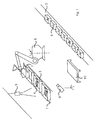
- the in the FIGS. 1 and 2 shown embodiment of the system according to the invention comprises a first transport device 1 in the form of a first conveyor belt and a second transport device 2 in the form of a second conveyor belt.
- On the first conveyor belt 1 are first trays 3.
- the delivered articles 4 are filled, the trays can be filled with a variety of different items that differ in their characteristics, such as identity, size, weight and others , The tubs are thus not sorted with the delivered articles 4 filled.
- the detection device 5 is a CCD camera, which is arranged above the first conveyor belt 1 and directed vertically downwards onto the first conveyor belt.
- the camera 5 is designed so that it can completely detect the visible from above the interior of a tub 3. (In Fig. 2 if the detector 5 is not shown for ease of illustration.)
- the CCD camera 5 continuously takes pictures of the articles 4 located in the trays 3.
- the images are transmitted to a data processing device (not shown).
- the data processing device processes the images by means of software and thus determines from the images the position of the articles 4 in the trough 3.
- the software detects further features of each of the articles 4, for example the external shape of the article 4, its size and its packaging material , Based on this information, a classification of the article 4 in the tub 3 is made. Is the article 4, for example, cough syrup in In a glass bottle, Article 4 is classified in the categories "heavy" and "cylindrical".
- the identity of the article 4 is not calculated from the images, since due to the location of the article 4 in the tub 3, the necessary identification information from the camera 5 can not be detected.
- a gripping device 7 of the handling device 6 is selected, which is suitable for receiving the article 4 from the trough 3.
- the handling device 6 is in this embodiment of the invention, an articulated-arm robot with multiple grippers 7, which are each designed for specific gripping tasks.
- the robot 6 is rotatable about a vertical axis r.
- the data processing device generates control signals for the robot 6 and transmits the control signals thereto.
- the robot 6 removes an article 4 from the trough 3 which is also predetermined by the data processing device.
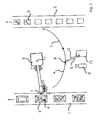
- the article 4 is conveyed by the robot 6 along the path A to point B lying in this path.
- the second detecting device 8 which is arranged between the first and the second conveyor belt 1, 2, directed.
- the second detection means 8 is a bar code scanner. The barcode scanner is used to identify the recorded item at point A.
- the barcode scanner 8 detects the barcode which is applied to the article 4 and transmits it to the data processing device. If the barcode scanner 8 can not detect the barcode, for example because the barcode is hidden by the gripper or because the barcode is damaged, the information "Barcode detection impossible" or an associated code is transmitted to the data processing device. This is also an identification information, even if this information is insufficient to identify the article 4.
- the identification information is transmitted to the data processing device.
- that of the barcode scanner recorded barcode with a stored there database of barcodes, in which each barcode is assigned to a specific article compared. If the article 4 has been identified on the basis of the identification information, the article 4 is transported by the robot 6 along path C to a second trough 9 and deposited in this trough 9.
- the trough 9 is located on the second conveyor belt 2.
- the trough 9, in which the identified article is to be deposited is specified by the data processing device, and the corresponding control signals are transmitted from the data processing device to the robot 6.
- the storage location, ie the trough 9, and the identity of the article 4 located there, are stored in the data processing device.
- the method can start again, that is, the robot 6 in the manner described another article 4 removed from the tub 3, identified and stored in a predetermined tray 9.
- the data processing device If the identification information transmitted by the barcode scanner 8 to the data processing device is insufficient to identify the article 4 at point B, for example because the barcode is concealed by the gripper or because the barcode is damaged, the data processing device generates control signals for the identification device Robot 6 generated and transmitted to this, which cause a storage of the unidentified article 4 on the storage zone 10.
- the article puts the way D back.
- the storage zone 10 may be, for example, a table or a tub. Immediately after the filing of the article 4 on the storage zone 10 of the robot 6 takes the just filed article 4 again, but in a slightly different position, so that the identification information should no longer be covered by the gripping or suction device of the handling device.
- the article 4 is transported along path C to a predetermined trough 9 as described above and stored there. If the identification is not successful again, the article 4 can be deposited once more on the storage zone 10, where it can be turned over and taken up again, for example. Subsequently, it is again conveyed to item B for acquiring identification information. If, even this time, it is not possible to identify the article 4, for example because the barcode is damaged, the article 4 is discarded, for which it can be transported, for example, along route C to a given trough 9, especially for non-identifiable articles 4 is determined. Once the article 4 is stored in a tub 9, the robot can record another article from a tub 3, whereby the process is repeated.
Landscapes
- Engineering & Computer Science (AREA)
- Mechanical Engineering (AREA)
- Robotics (AREA)
- Physics & Mathematics (AREA)
- Theoretical Computer Science (AREA)
- Data Mining & Analysis (AREA)
- Databases & Information Systems (AREA)
- Mathematical Physics (AREA)
- Software Systems (AREA)
- General Engineering & Computer Science (AREA)
- General Physics & Mathematics (AREA)
Description
- Die Erfindung betrifft ein System zur Vereinzelung und Kommissionierung von Artikeln sowie ein dazu geeignetes Verfahren.
- Aus
DE 43 18 341 B4 ist ein Verfahren zur Lagerung von Apothekenartikeln bekannt, bei dem Artikel mit quaderförmigen Verpackungen aus einem Gebinde auf ein Transportband geschüttet und damit einer Erfassungseinrichtung zugeführt werden. Die Erfassungseinrichtung umfasst vier Scanner, die so angeordnet sein sollen, dass die an den Schmalseiten, dem Boden oder dem Deckel der Verpackung angeordneten Barcodes erfasst werden können. Die Erfassungseinrichtungen sind an eine Rechnereinheit angeschlossen, in der eine Datenbank zur Speicherung der erfassten Barcodes installiert ist. Damit die Scanner den Barcode erfassen können, sind in dem Transportband und an dessen Randbereichen durchsichtige Flächen vorgesehen. Befindet sich eine der Verpackungen in einer ungünstigen Lage so wird sie mittels einer Aussortiervorrichtung, beispielsweise einer mechanisch betriebenen Abweisklappe oder einer Pressluftdüse, ausgesondert und über eine Rückführvorrichtung an den Beginn des Transportbandes befördert. Der Artikel durchläuft damit dasselbe Prozedere erneut, in der Hoffnung, dass er diesmal in einer Lage auf dem Transportband zu liegen kommt, die seine Identifizierung mittels der Scanner ermöglicht. Wird der Artikel erkannt, so gelangt er zu einer Vermessungseinrichtung, mit deren Hilfe die Außenabmessungen des Artikels bestimmt werden. Anschließend wird der Artikel mittels eines Portalroboters in einer Schublade abgelegt. - Das aus dem Stand der Technik bekannte Verfahren erfordert somit eine Identifizierung des Artikels, bevor eine Vereinzelung durchgeführt werden kann. Gelingt eine Identifizierung nicht, muss der Artikel ausgesondert werden. Dazu sind eine Aussonderungsvorrichtung und eine Rückführvorrichtung erforderlich. Damit ist die Vereinzelung der Artikel insgesamt mit einem hohen technischen Aufwand verbunden.
-
DE 10 2007 077 411 A1 offenbart ein Verfahren und eine Vorrichtung zum Einlagern von Arzneimittelverpackungen. Die Verpackungen, die sich in Schubladen in einem Schubladenregal befinden, sollen vereinzelt und anschließend anhand ihrer Beschriftung identifiziert werden. Nicht identifizierbare Verpackungen werden nach einem Identifizierungsversuch aussortiert oder in den Ausgangsbehälter zurückgeworfen. -
DE 10 2007 038 837 A1 ist auf ein Verfahren und eine Vorrichtung zur Umsetzung von Stückgut gerichtet, die für die Vereinzelung von Paketen geeignet sein soll. Nicht identifizierte Artikel werden an einer vorgegebenen Position (Palette an der Ablageposition E) abgelegt. Die dort abgesetzten Artikel sollen dann "manuell oder durch einen zusätzlichen Roboter" nachsortiert werden. -
EP 1 260 436 A1 offenbart ein System geeignet zur Vereinzelung und Kommissionierung von Artikeln, umfassend - eine erste Transporteinrichtung zur Aufnahme und zum Transport angelieferter Artikel;
- eine zweite Transporteinrichtung zur Aufnahme und zum Transport vereinzelter Artikel ;
- eine erste Erfassungseinrichtung zur Erfassung zumindest der Position der Artikel auf der ersten Transporteinrichtung ;
- eine Handhabungseinrichtung zur separaten Entnahme von Artikeln von der ersten Transporteinrichtung und deren Überführung auf die zweite Transporteinrichtung ;
- eine Datenverarbeitungseinrichtung zur Verarbeitung der von der ersten Erfassungseinrichtung erfassten Daten und zur Steuerung der Handhabungseinrichtung.
-
US 2008/0267759 A1 offenbart: - ein Verfahren zur Vereinzelung und Kommissionierung von Artikeln, umfassend
- (a) die Erfassung zumindest der Position angelieferter Artikel, die sich auf einer ersten Transporteinrichtung befinden;
- (b) die Aufnahme eines in Schritt (a) erfassten Artikels von der ersten Transporteinrichtung mittels einer Handhabungseinrichtung;
- (e) die Ablage des Artikels auf einer zweiten Transporteinrichtung.
- In beiden Systeme, kann die Handhabungseinrichtung nicht weiterarbeiten, wenn die Identifizierung eines Artikel unmöglich oder unkorrekt ist.
- Aufgabe der Erfindung ist es, die Nachteile nach dem Stand der Technik zu beseitigen. Es soll insbesondere ein System zur Vereinzelung und Kommissionierung von Artikeln angegeben werden, das eine sichere Identifizierung ermöglicht und so eine Aussonderung und Rückführung des Artikels verhindert. Ferner soll ein Verfahren angegeben werden, das die Vereinzelung und Kommissionierung von Artikeln insbesondere mit diesem System ermöglicht.
- Diese Aufgabe wird durch die Merkmale der Ansprüche 1 und 7 gelöst. Zweckmäßige Ausgestaltungen der Erfindungen ergeben sich aus den Merkmalen der Ansprüche 2 bis 6 sowie 8 bis 11.
- Nach Maßgabe der Erfindung ist ein System zur Vereinzelung und Kommissionierung von Artikeln, insbesondere von Apothekenartikeln, vorgesehen, das
- eine erste Transporteinrichtung zur Aufnahme und zum Transport angelieferter Artikel;
- eine zweite Transporteinrichtung zur Aufnahme und zum Transport vereinzelter Artikel;
- eine erste Erfassungseinrichtung zur Erfassung zumindest der Position der Artikel auf der ersten Transporteinrichtung;
- eine Handhabungseinrichtung zur separaten Entnahme von Artikeln von der ersten Transporteinrichtung und deren Überführung auf die zweite Transporteinrichtung;
- eine zweite Erfassungseinrichtung zur Identifizierung der Artikel;
- eine Ablagezone, die der zweiten Erfassungseinrichtung nachgeordnet ist, zur Zwischenlagerung eines von der zweiten Erfassungseinrichtung nicht identifizierten Artikels und dessen Positionsänderung in Bezug auf dessen Lage in der Handhabungseinrichtung; und
- eine Datenverarbeitungseinrichtung zur Verarbeitung der von der ersten und zweiten Erfassungseinrichtung erfassten Daten und zur Steuerung der Handhabungseinrichtung;
- Nach Maßgabe der Erfindung ist ferner ein Verfahren zur Vereinzelung und Kommissionierung von Artikeln, insbesondere von Apothekenartikeln, vorgesehen, das folgende Schritte umfasst:
- (a) die Erfassung zumindest der Position angelieferter Artikel, die sich auf einer ersten Transporteinrichtung befinden;
- (b) die Aufnahme eines in Schritt (a) erfassten Artikels von der Transporteinrichtung mittels einer Handhabungseinrichtung;
- (c) die Führung des in Schritt (b) von der Handhabungseinrichtung aufgenommenen Artikels zu einer zweiten Erfassungseinrichtung;
- (d) die Identifizierung des Artikels von der zweiten Erfassungseinrichtung oder, wenn die Identifizierung misslingt, die Ablage des Artikels auf eine Ablagezone, die der zweiten Erfassungseinrichtung nachgeordnet ist, und erneute Aufnahme des Artikels mittels der Handhabungseinrichtung von der Ablagezone unter Veränderung der Position des Artikels in Bezug auf dessen Lage in der Handhabungseinrichtung und Wiederholung der Schritte (c) und (d) bis zur Identifizierung des Artikels; und
- (e) die Ablage des identifizierten Artikels auf einer zweiten Transporteinrichtung.
- Das erfindungsgemäße System und Verfahren zeichnen sich dadurch aus, dass der von der Handhabungseinrichtung von der ersten Transporteinrichtung aufgenommene Artikel nicht mehr auf diese Transporteinrichtung zurückgeführt wird, insbesondere auch dann nicht, wenn der aufgenommene Artikel nicht identifiziert werden kann. Wenn ein Artikel zunächst von der zweiten Erfassungseinrichtung nicht identifiziert werden kann, wird der Artikel in der Ablagezone abgelegt, die vorzugsweise unmittelbar an die zweite Erfassungseinrichtung angrenzt. Die Handhabungseinrichtung nimmt den abgelegten Artikel von dort so wieder auf, dass der Artikel eine veränderte Lage in Bezug auf die Handhabungseinrichtung aufweist. Ist beispielsweise der Barcode auf dem Artikel durch einen Bestandteil der Handhabungseinrichtung, beispielsweise einen Greifer verdeckt, so ermöglicht die Ablage des Artikels auf der Ablagezone und die Neuaufnahme des Artikels in veränderter Lage eine Freilegung des Barcodes, so dass der Artikel nach diesem Zwischenschritt nun der zweiten Erfassungseinrichtung erneut zur Identifizierung zugeführt werden kann. Sollte auch dann eine Identifizierung nicht möglich sein, kann die Ablage auf der Ablagezone und die erneute Aufnahme mit veränderter Lage wiederholt werden. Der Schritt Ablage eines nicht identifiziertes Artikels auf der Ablagezone und dessen Aufnahme von der Ablagezone in veränderter Lage wird n-mal ausgeführt, wobei n eine vorgegebene Ganzzahl größer 0 ist und beispielsweise 1, 2 oder 3 beträgt. Kann der Artikel trotzdem nicht identifiziert werden, wird er ausgesondert, beispielsweise durch Ablage auf einer Aussonderungszone. Dort kann durch einen Lageristen über die Weiterbehandlung des nicht-identifizierten Artikels entschieden werden. Eine solche Aussonderung kann beispielsweise dann erforderlich sein, wenn der auf dem Artikel angebrachte Barcode beschädigt ist.
- Das erfindungsgemäße System und das erfindungsgemäße Verfahren sind insbesondere für die Vereinzelung von sortenunreinen Artikeln wie beispielsweise von Apothekenartikeln geeignet, kann aber auch für die Vereinzelung anderer Artikel verwendet werden. Ein Vorteil der Erfindung liegt darin, dass die Vereinzelung zur Kommissionierung nicht sortenrein angelieferter Artikel, die sich hinsichtlich ihrer Identität, ihrer äußeren Gestalt, ihres Gewichtes und/oder anderer Merkmale unterscheiden, verwendet werden kann. Unter Verwendung des erfindungsgemäßen Systems und des erfindungsgemäßen Verfahrens kann die Vereinzelung nichtsorteinrein angelieferter Artikel automatisiert, d. h. ohne menschliche Eingriffe, ausgeführt werden, wobei im Gegensatz zum Stand der Technik ein vergleichsweise geringer maschineller Aufwand erforderlich ist.
- Vorzugsweise ist die erste Erfassungseinrichtung eine optoelektronische Erfassungseinrichtung, die auf die erste Transporteinrichtung gerichtet ist. Beispielsweise kann die erste Erfassungseinrichtung eine Kamera wie eine CCD-Kamera sein, die kontinuierlich oder diskontinuierlich Bilder der auf der Transporteinrichtung befindlichen angelieferten Artikel aufnimmt.
- Zweckmäßigerweise erfasst die erste Erfassungseinrichtung nicht nur die Position der angelieferten Artikel auf der ersten Transporteinrichtung, sondern zusätzlich auch weitere Merkmale des Artikels. Bei diesen Merkmalen des Artikels kann es sich beispielsweise um die äußere Form des Artikels, z. B. zylindrisch, kugelförmig, quaderförmig oder pyramidenförmig; Elemente der äußeren Form des Artikels, z. B. eine runde, dreieckige, viereckige Oberfläche; eine Klassifizierung des Artikels nach dessen Gewicht, Größe oder Material, z. B. feste Verpackung aus Pappe oder Verpackung mit variabler Gestalt wie Beutel, beispielsweise Teebeutel oder Badesalzbeutel; sowie um Kombinationen eines dieser Merkmale mit einem oder mehreren weiteren dieser Merkmale handeln.
- Diese Merkmale des Artikels sowie dessen Position auf der ersten Transporteinrichtung werden aus den Daten, im Falle einer Kamera aus den Bildern, die von der ersten Erfassungseinrichtung an die Datenverarbeitungseinrichtung übermittelt werden, mittels einer Software errechnet. Anhand der gewonnenen Daten kann die Klassifizierung der Artikel in vorgegebene Gruppen, beispielsweise in Bezug auf das Merkmal Größe in eine Klasse mit einer Größe unter einem vorgegebenen Grenzwert (Klein-Klasse) und eine Klasse mit einer Größe bei oder über dem vorgegebenen Grenzwert (Groß-Klasse) vorgenommen werden. Aus den ermittelten Daten kann ferner auf das Gewicht des Artikels geschlossen werden, so dass eine Klassifizierung des Artikels nach dem Gewicht des Artikels, z. B. in eine Gruppe mit einem Gewicht unter einem vorgegebenen Grenzwert (Leicht-Klasse) oder eine Gruppe mit einem Gewicht bei oder über einem vorgegebenen Grenzwert (Schwer-Klasse), vorgenommen werden kann. Eine solche Klassifizierung nach Gewicht kann beispielsweise anhand der Daten, die die äußeren Abmessungen des Artikels betreffen, sowie den Daten über das äußere Material des Artikels gewonnen werden. Beispielsweise kann bei Apothekenartikeln aus den von der ersten Erfassungseinrichtung aufgenommenen Bildern mittels einer Software ermittelt werden, ob es sich um Glasflaschen, d. h. um einen Artikel mit hohem Gewicht, oder um Tablettenschachteln der Packungsgröße N1 gemäß der Packungsgrößenverordnung, d. h. einem Artikel mit geringem Gewicht handelt.
- Die aufgenommenen Bilder werden vorzugsweise mittels einer Bildverarbeitungssoftware, die in der Datenverarbeitungsvorrichtung gespeichert ist, ausgewertet. Die Bildverarbeitungssoftware bildet zusammen mit der ersten Erfassungseinrichtung ein Bildverarbeitungssystem. Dieses Bildverarbeitungssystem kann beispielsweise ein Lichtschnittverfahren nutzen, das auf dem Prinzip des an sich bekannten messtechnischen Triangulationsverfahrens beruht. Mittels des Triangulationsverfahrens können die Lagekoordinaten der Artikel und damit dessen Position mathematisch berechnet werden. Auf diese Weise können die Artikel in jeder vorgefundenen Art und Weise erfasst werden. Eine nach dem Stand der Technik erforderlich Zubringung in einem Transportbehälter ist nicht länger erforderlich.
- Die Daten, die von der ersten Erfassungseinrichtung an die Datenverarbeitungseinrichtung übermittelt werden, werden nicht zur Identifizierung des Artikels genutzt.
- Nachdem in der Datenverarbeitungseinrichtung die Position und, falls vorgegeben, weitere Merkmale eines auf der ersten Transporteinrichtung befindlichen Artikels ermittelt worden sind, generiert die Datenverarbeitungseinrichtung Steuersignale für die Handhabungseinrichtung und übermittelt diese an die Handhabungseinrichtung. Damit wird die Handhabungseinrichtung veranlasst, den Artikel von der ersten Transporteinrichtung aufzunehmen und zur zweiten Erfassungseinrichtung zu führen.
- Die Handhabungseinrichtung ist zweckmäßigerweise ein Roboter, beispielweise ein Roboter mit Knickarm oder Schwenkarm. Vorzugsweise ist der Roboter ein Roboter mit mehreren Bewegungsachsen. Der Robtor sollte zumindest eine Greif- oder Saugeinrichtung zur Aufnahme des Artikels von der ersten Transporteinrichtung aufweisen. Vorzugsweise weist der Roboter mehrere Greif- oder Saugeinrichtungen auf, wobei jede dieser Greif- oder Saugeinrichtungen zur Aufnahme von Artikeln mit vorgegebenen Merkmalen angepasst sind. Diese Merkmale sind die Merkmale, die aus den Bildern, die von der ersten Erfassungseinrichtung aufgenommen worden sind, ermittelt wurden. Anhand dieser Merkmale kann somit eine Greif- oder Saugeinrichtung der Handhabungseinrichtung ausgewählt werden, die an den aufzunehmenden Artikel speziell angepasst ist.
- Die zweite Erfassungseinrichtung soll den von der Handhabungseinrichtung aufgenommenen Artikel identifizieren. Dazu können Identifizierungsinformationen, die auf den Artikel aufgebracht sind, beispielsweise der Barcode, genutzt werden. Bei Apothekenartikeln kann beispielsweise die Pharmazentralnummer (PZN), die als Barcode vorliegen kann, zur Identifizierung genutzt werden. Die zweite Erfassungseinrichtung ist zweckmäßigerweise ein Scanner wie ein Barcode-Scanner. Die zweite Erfassungseinrichtung soll diese Identifizierungsinformationen erfassen und an die Datenverarbeitungseinrichtung übermitteln. In der Datenverarbeitungseinrichtung werden die von der zweiten Erfassungseinrichtung erfassten Identifizierungsinformationen mit einer dort hinterlegten Datenbank verglichen. Ist der Artikel anhand der Identifizierungsinformationen identifiziert worden, im Falle von Apothekenartikel als Präparat eines bestimmten Herstellers in einer bestimmten Packungsgröße, wird der Artikel von der Handhabungseinrichtung auf der zweiten Transporteinrichtung, vorzugsweise an einem von der Datenverarbeitungseinrichtung vorgegebenen Ablageort abgelegt. Dazu wird bevorzugt von der Datenverarbeitungseinrichtung der Ablageort des identifizierten Artikels auf der zweiten Transporteinrichtung errechnet und für die Handhabungseinrichtung Steuersignale generiert und an die Handhabungseinrichtung übermittelt, so dass die Handhabungseinrichtung zur Ablage des identifizieren Artikels am vorgegebenen Ablageort auf der zweiten Transporteinrichtung veranlasst wird. Damit ist die Vereinzelung der Artikel abgeschlossen.
- Kann die zweite Erfassungseinrichtung die Identifizierungsinformationen nicht erfassen, so wird beispielsweise eine Information wie "Erfassung des Barcodes nicht möglich" oder ein dafür stehender Code an die Datenverarbeitungseinrichtung übermittelt. Auch diese Information wird hier als Identifizierungsinformation bezeichnet.
- Sollte der Artikel anhand der von der zweiten Erfassungseinrichtung an die Datenverarbeitungseinrichtung übermittelten Identifizierungsinformationen nicht identifiziert werden können, beispielsweise weil der von dem Artikel aufgebrachte Barcode von der Greif- oder Saugeinrichtung der Handhabungseinrichtung ganz oder teilweise verdeckt ist, so können von der Datenverarbeitungseinrichtung Steuersignale für die Handhabungseinrichtung generiert und an die Handhabungseinrichtung übermittelt werden. Daraufhin legt die Handhabungseinrichtung den nicht-identifizierten Artikel auf die Ablagezone, die der zweiten Erfassungseinrichtung nachgeordnet ist, ab und nimmt diesen, vorzugsweise unmittelbar nach Ablage, wieder auf. Dabei wird der Artikel von der Handhabungseinrichtung in etwas veränderter Lage aufgenommen, so dass die Identifizierungsinformationen nun nicht mehr von der Greif- oder Saugeinrichtung der Handhabungseinrichtung verdeckt sein sollten. Der Ausdruck "veränderte Lage des Artikels in Bezug auf die Handhabungsposition" soll in der vorliegenden Erfindung so verstanden werden, dass der oder die Kontaktpunkte zwischen dem Artikel und der Greif- oder Saugeinrichtung der Handhabungseinrichtung vor dem Ablegen auf der Ablagezone sich von den Kontaktpunkten zwischen diesem Artikel und der Greif- oder Saugeinrichtung der Handhabungseinrichtung nach der Wiederaufnahme von der Ablagezone unterscheiden. Dies kann beispielsweise durch eine Wendung des Artikels auf der Ablagezone erreicht werden. Diese Wendung kann mittels der Handhabeeinrichtung, beispielsweise durch eine Drehung der Greif- oder Saugeinrichtung entlang einer Rotationsachse der Greif- oder Saugeinrichtung bewirkt werden. Nach der Wiederaufnahme des Artikels wird dieser zu der zweiten Erfassungseinrichtung zurückgeführt, um erneut Identifizierungsinformationen zu ermitteln.
- Bei der ersten Transporteinrichtung handelt es sich vorzugsweise um ein Förderband. Auch die zweite Transporteinrichtung ist vorzugsweise ein Förderband.
- Es kann vorteilhaft sein, wenn die angelieferten Artikel sich in nach oben offenen Transportbehältern, beispielsweise Wannen, befinden, die auf der ersten Transporteinrichtung transportiert werden. In einer solchen Wanne befinden sich typischerweise eine Vielzahl unterschiedlicher Artikel, beispielsweise Apothekenartikel. Eine Vielzahl von Wannen, die mit Artikeln in beliebiger Zusammenstellung gefüllt sind, wird auf dem Förderband zu der ersten Erfassungseinrichtung transportiert. Die erste Erfassungseinrichtung, beispielsweise eine CCD-Kamera, ist oberhalb des Förderbandes, beispielsweise an der Decke, befestigt und auf die offene Oberseite der Wannen gerichtet.
- Auch an den Ablageorten der identifizierten Artikel können nach oben offene Transportbehälter, beispielsweise Wannen, vorgesehen sein, die sich auf der zweiten Transporteinrichtung, beispielsweise einem Förderband befinden. Die identifizierten Artikel werden dann von der Handhabungseinrichtung in von der Datenverarbeitungseinrichtung vorgegebenen Wannen abgelegt, wodurch die Vereinzelung abgeschlossen wird. Die Wannen können mittels der zweiten Transporteinrichtung zu einer nächsten Bearbeitungsstation der Logistik, beispielsweise einem Lager oder dem Versand, geführt werden.
- Die Datenverarbeitungseinrichtung ist in an sich bekannter Weise mit den übrigen Komponenten des Systems, beispielsweise über Kabel oder kabellose Kommunikationsmittel verbunden. Die Datenverarbeitungseinrichtung zeichnet sich in einer Ausführungsform der Erfindung dadurch aus, dass
- (i) die erste Erfassungseinrichtung in Schritt (a) Bilder der angelieferten Artikel aufnimmt und an die Datenverarbeitungseinrichtung übermittelt;
- (ii) ein in der Datenverarbeitungseinrichtung gespeichertes Computerprogramm zumindest die Position angelieferter Artikel bestimmt;
- (iii) die Datenverarbeitungseinrichtung Steuerungssignale für die Handhabungseinrichtung generiert und an die Handhabungseinrichtung übermittelt;
- (iv) die Handhabungseinrichtung einen Artikel aufgrund dieser Steuersignale von der ersten Transporteinrichtung aufnimmt und zu der zweiten Erfassungseinrichtung führt;
- (v) die zweite Erfassungseinrichtung Identifizierungsinformationen vom dem Artikel erfasst und diese an die Datenverarbeitungseinrichtung übermittelt;
- (vi) in der Datenverarbeitungseinrichtung die von der zweiten Erfassungseinrichtung erfassten Identifizierungsinformationen mit einer Datenbank verglichen werden und, wenn der Artikel nicht identifiziert werden kann, von der Datenverarbeitungseinrichtung Steuersignale für die Handhabungseinrichtung generiert und an die Handhabungseinrichtung übermittelt werden, so dass die Handhabungseinrichtung zur Ablage des Artikels auf die Ablagezone, die der zweiten Erfassungseinrichtung nachgeordnet ist, zur erneuten Aufnahme des Artikels von der Ablagezone unter Veränderung der Position des Artikels in Bezug auf dessen Lage in der Handhabungseinrichtung und zur erneuten Führung des Artikels zur zweiten Erfassungseinrichtung veranlasst wird, sowie Wiederholung der Schritte (v) und (vi) bis der Artikel identifiziert worden ist.
- Vorzugsweise errechnet die Datenverarbeitungseinrichtung ferner den Ablageort des identifizierten Artikels auf der zweiten Transporteinrichtung und generiert für die Handhabungseinrichtung Steuersignale und übermittelt diese an die Handhabungseinrichtung, so dass die Handhabungseinrichtung zur Ablage des identifizieren Artikels am vorgegebenen Ablageort auf der zweiten Transporteinrichtung veranlasst wird.
- Zweckmäßigerweise steuert die Datenverarbeitungseinrichtung auch die erste und/oder zweite Transporteinrichtung, beispielsweise den Vorschub der Förderbänder.
- Die Erfindung wird nachstehend anhand von Ausführungsbeispielen, die die Erfindung nicht einschränken sollen, unter Bezugnahme auf die Zeichnungen näher erläutert. Dabei zeigt
- Fig. 1
- eine schematische perspektivische Darstellung einer Ausführungsform des erfindungsgemäßen Systems; und
- Fig. 2
- eine schematische Draufsicht auf die in
Fig. 1 gezeigte Ausführungsform des erfindungsgemäßen Systems. - Die in den
Figuren 1 und2 gezeigte Ausführungsform des erfindungsgemäßen Systems weist eine erste Transporteinrichtung 1 in Form eines ersten Förderbandes und eine zweite Transporteinrichtung 2 in Form eines zweiten Förderbandes auf. Auf dem ersten Förderband 1 befinden sich erste Wannen 3. In diese Wannen 3 werden die angelieferten Artikel 4 gefüllt, wobei die Wannen mit einer Vielzahl unterschiedlicher Artikel befüllt sein können, die sich in ihren Merkmalen, wie Identität, Größe, Gewicht und anderen, unterscheiden. Die Wannen sind somit nichtsortenrein mit den angelieferten Artikeln 4 befüllt. - Auf dem ersten Förderband 1 werden die Wannen 3 mit den angelieferten Artikeln 4 zu der ersten Erfassungseinrichtung 5 geführt. In der gezeigten Ausführungsform ist die Erfassungseinrichtung 5 eine CCD-Kamera, die oberhalb des ersten Förderbandes 1 angeordnet und senkrecht nach unten auf das erste Förderband gerichtet ist. Die Kamera 5 ist dabei so ausgelegt, dass sie den von oben sichtbaren Innenraum einer Wanne 3 vollständig erfassen kann. (In
Fig. 2 ist die Erfassungseinrichtung 5 zur Vereinfachung der Darstellung nicht gezeigt.) - Die CCD-Kamera 5 nimmt kontinuierlich Bilder von den in den Wannen 3 befindlichen Artikeln 4 auf. Die Bilder werden an eine Datenverarbeitungseinrichtung (nicht gezeigt) übermittelt. Die Datenverarbeitungseinrichtung verarbeitet die Bilder mittels einer Software und ermittelt so aus den Bildern die Position der Artikel 4 in der Wanne 3. Ferner werden mittels der Software weitere Merkmale jedes der Artikels 4 ermittelt, beispielsweise die äußere Form des Artikels 4, seine Größe und dessen Verpackungsmaterial. Anhand dieser Informationen wird eine Klassifizierung des Artikels 4 in der Wanne 3 vorgenommen. Ist der Artikel 4 beispielsweise Hustensaft in einer Glasflasche wird der Artikel 4 in die Klassen "schwer" und "zylinderförmig" eingeordnet. Die Identität des Artikels 4 wird aus den Bildern nicht errechnet, da aufgrund der Lage der Artikel 4 in der Wanne 3 die notwendigen Identifizierungsinformationen von der Kamera 5 nicht erfasst werden können. Auf Basis der Merkmale und der Klassifikationsergebnisse wird eine Greifeinrichtung 7 der Handhabungseinrichtung 6 ausgewählt, die für die Aufnahme des Artikels 4 aus der Wanne 3 geeignet ist. Die Handhabungseinrichtung 6 ist in dieser Ausführungsform der Erfindung ein Knickarm-Roboter mit mehreren Greifern 7, die jeweils für spezielle Greifaufgaben ausgelegt sind. Der Roboter 6 ist um eine senkrechte Achse r drehbar.
- Die Datenverarbeitungseinrichtung generiert Steuersignale für den Roboter 6 und übermittelt die Steuersignale an diesen. Der Roboter 6 entnimmt mittels des von der Datenverarbeitungseinrichtung vorgegebenen Greifers 7 einen ebenfalls von der Datenverarbeitungseinrichtung vorgegebenen Artikel 4 aus der Wanne 3. Der Artikel 4 wird von dem Roboter 6 entlang des Weges A bis zu Punkt B, der auf diesem Weg liegt befördert. Auf Punkt B ist die zweite Erfassungseinrichtung 8, die zwischen dem ersten und dem zweiten Förderband 1, 2 angeordnet ist, gerichtet. In dieser Ausführungsform ist die zweite Erfassungseinrichtung 8 ein Barcode-Scanner. Mittels des Barcode-Scanners soll die Identifizierung des aufgenommenen Artikels an Punkt A vorgenommen werden.
- Der Barcode-Scanner 8 erfasst den Barcode, der auf den Artikel 4 aufgebracht ist und übermittelt diesen an die Datenverarbeitungseinrichtung. Kann der Barcode-Scanner 8 den Barcode nicht erfassen, beispielsweise weil der Barcode durch den Greifer verdeckt ist oder weil der Barcode beschädigt ist, wird die Information "Erfassung des Barcodes nicht möglich" oder ein dafür stehender Code an die Datenverarbeitungseinrichtung übermittelt. Auch dies ist eine Identifizierungsinformation, auch wenn diese Information nicht ausreicht, um den Artikel 4 zu identifizieren.
- Die Identifizierungsinformationen werden an die Datenverarbeitungseinrichtung übermittelt. In der Datenverarbeitungseinrichtung wird der von dem Barcode-Scanner erfasste Barcode mit einer dort hinterlegten Datenbank von Barcodes, in der jeder Barcode einem bestimmten Artikel zuordnet ist, verglichen. Ist der Artikel 4 anhand der Identifizierungsinformationen identifiziert worden, wird der Artikel 4 von dem Robtor 6 entlang Weg C zu einer zweiten Wanne 9 transportiert und in diese Wanne 9 abgelegt. Die Wanne 9 befindet sich auf dem zweiten Transportband 2. Die Wanne 9, in die der identifizierte Artikel ablegt werden soll, wird von der Datenverarbeitungseinrichtung vorgegeben, und die entsprechenden Steuersignale werden von der Datenverarbeitungseinrichtung an den Roboter 6 übermittelt. Der Ablageort, d. h. die Wanne 9, und die Identität des dort befindlichen Artikels 4, werden in der Datenverarbeitungseinrichtung gespeichert.
- Damit kann das Verfahren erneut beginnen, dass heißt vom Roboter 6 in beschriebener Art und Weise ein weiterer Artikel 4 aus der Wanne 3 entnommen, identifiziert und in einer vorgegebenen Wanne 9 abgelegt werden.
- Reichen die von dem Barcode-Scanner 8 an die Datenverarbeitungseinrichtung übermittelten Identifizierungsinformationen nicht aus, um den Artikel 4 an Punkt B zu identifizieren, beispielsweise weil der Barcode durch den Greifer verdeckt ist oder weil der Barcode beschädigt ist, so werden von der Datenverarbeitungseinrichtung Steuersignale für den Roboter 6 generiert und an diesen übermittelt, die eine Ablage des nicht-identifizierten Artikels 4 auf der Ablagezone 10 veranlassen. Dabei legt der Artikel den Weg D zurück. Die Ablagezone 10 kann beispielsweise ein Tisch oder eine Wanne sein. Unmittelbar nach der Ablage des Artikels 4 auf der Ablagezone 10 nimmt der Roboter 6 den soeben abgelegten Artikel 4 erneut auf, allerdings in etwas veränderter Lage, so dass die Identifizierungsinformationen nun nicht mehr von der Greif- oder Saugeinrichtung der Handhabungseinrichtung verdeckt sein sollten. Dies wird beispielsweise erreicht, indem der Artikel von dem Roboter in gewendeter Lage wiederaufgenommen wird, zum Beispiel indem durch eine Drehung der Greif- oder Saugeinrichtung entlang einer Rotationsachse der Artikel mittels eines Greifers, der ein anderer Greifer 7 als der Greifer vor der Ablage des Artikels auf der Ablagezone 10 sein kann (aber nicht muss), zunächst gedreht wird. Anschließend wird der Artikel 4 von dem Roboter über einen Greifer 7 wieder aufgenommen. Auch dieser Greifer 7 kann ein anderer Greifer 7 als der Greifer vor der Ablage des Artikels auf der Ablagezone 10 sein, dies ist jedoch nicht zwingend erforderlich. Nach der Wiederaufnahme des Artikels 4 wird dieser auf Weg E erneut zu Punkt B zurückgeführt. Dort versucht der Barcode-Scanner erneut, Identifizierungsinformationen zu ermitteln. Gelingt die Identifizierung des Artikels 4, beispielsweise weil der zunächst verdeckte Barcode nun freiliegt, so wird der Artikel wie oben beschrieben entlang Weg C zu einer vorgegebenen Wanne 9 transportiert und dort abgelegt. Gelingt die Identifizierung erneut nicht, so kann der Artikel 4 ein weiteres Mal auf der Ablagezone 10 abgelegt, dort beispielsweise gewendet und wieder aufgenommen werden. Anschließend wird er erneut zu Punkt B zur Erfassung von Identifizierungsinformationen befördert. Gelingt es auch dieses Mal nicht, den Artikel 4 zu identifizieren, beispielsweise weil der Barcode beschädigt ist, so wird der Artikel 4 ausgesondert, wobei er dazu beispielsweise entlang Weg C zu einer vorgegebenen Wanne 9 transportiert werden kann, die speziell für nicht-identifizierbare Artikel 4 bestimmt ist. Sobald der Artikel 4 in einer Wanne 9 abgelegt ist, kann der Roboter einen weiteren Artikel aus einer Wanne 3 aufnehmen, womit sich das Verfahren wiederholt.
-
- 1
- erstes Förderband
- 2
- zweites Förderband
- 3
- erste Wanne
- 4
- Artikel
- 5
- Kamera
- 6
- Roboter
- 7
- Greifer
- 8
- Barcodescanner
- 9
- zweite Wanne
- 10
- Ablagezone
Claims (11)
- System zur Vereinzelung und Kommissionierung von Artikeln, insbesondere von Apothekenartikeln, umfassend- eine erste Transporteinrichtung (1) zur Aufnahme und zum Transport angelieferter Artikel (4);- eine zweite Transporteinrichtung (2) zur Aufnahme und zum Transport vereinzelter Artikel (4);- eine erste Erfassungseinrichtung (5) zur Erfassung zumindest der Position der Artikel (4) auf der ersten Transporteinrichtung (1);- eine Handhabungseinrichtung (6) zur separaten Entnahme von Artikeln (4) von der ersten Transporteinrichtung (1) und deren Überführung auf die zweite Transporteinrichtung (2);- eine zweite Erfassungseinrichtung (8) zur Identifizierung der Artikel (4);- eine Ablagezone (10), die der zweiten Erfassungseinrichtung (8) nachgeordnet ist, zur Zwischenlagerung eines von der zweiten Erfassungseinrichtung (8) nicht identifizierten Artikels (4) und dessen Positionsänderung in Bezug auf dessen Lage in der Handhabungseinrichtung (6); und- eine Datenverarbeitungseinrichtung zur Verarbeitung der von der ersten und zweiten Erfassungseinrichtung (5, 8) erfassten Daten und zur Steuerung der Handhabungseinrichtung (6);wobei die zweite Erfassungseinrichtung (8) der ersten Erfassungseinrichtung (5) nachgeschaltet ist und wobei die zweite Erfassungseinrichtung (8) zwischen der ersten und zweiten Transporteinrichtung (1, 2) angeordnet und auf einen Punkt (B) des Weges gerichtet ist, den ein von der Handhabungseinrichtung (6) von der ersten Transporteinrichtung (1) entnommener Artikel (4) bei dessen Überführung zu der zweiten Transporteinrichtung (2) zurücklegt.
- System nach Anspruch 1,
dadurch gekennzeichnet,
dass die erste Erfassungseinrichtung (5) eine optoelektronische Erfassungseinrichtung ist, die auf die erste Transporteinrichtung (1) gerichtet ist. - System nach Anspruch 1 oder Anspruch 2,
dadurch gekennzeichnet,
dass die zweite Erfassungseinrichtung (8) ein Barcode-Scanner ist. - System nach einem der vorstehenden Ansprüche,
dadurch gekennzeichnet,
dass die Handhabungseinrichtung (6) mindestens eine Greif- oder Saugeinrichtung (7) aufweist. - System nach einem der vorstehenden Ansprüche,
dadurch gekennzeichnet,
dass die Handhabungseinrichtung (6) mehrere Greif- und/oder Saugeinrichtungen (7) aufweist, wobei für die Entnahme eines Artikels (4) von der ersten Transporteinrichtung (1) eine dieser Greif- und/oder Saugeinrichtungen (7) auf Basis der von der ersten Erfassungseinrichtung (5) erfassten Daten auswählbar ist. - System nach einem der vorstehenden Ansprüche,
dadurch gekennzeichnet,
dass die Handhabungseinrichtung (6) ein Roboter mit mehreren Bewegungsachsen ist. - Verfahren zur Vereinzelung und Kommissionierung von Artikeln, insbesondere von Apothekenartikeln, umfassend(a) die Erfassung zumindest der Position angelieferter Artikel (4), die sich auf einer ersten Transporteinrichtung (1) befinden;(b) die Aufnahme eines in Schritt (a) erfassten Artikels (4) von der ersten Transporteinrichtung (1) mittels einer Handhabungseinrichtung (6);(c) die Führung des in Schritt (b) von der Handhabungseinrichtung (6) aufgenommenen Artikels (4) zu einer zweiten Erfassungseinrichtung (8);(d) die Identifizierung des Artikels (4) von der zweiten Erfassungseinrichtung (8) oder, wenn die Identifizierung misslingt, die Ablage des Artikels (4) auf eine Ablagezone (10), die der zweiten Erfassungseinrichtung (8) nachgeordnet ist, und erneute Aufnahme des Artikels (4) mittels der Handhabungseinrichtung (6) von der Ablagezone (10) unter Veränderung der Position des Artikels (4) in Bezug auf dessen Lage in der Handhabungseinrichtung (6) und Wiederholung der Schritte (c) und (d) bis zur Identifizierung des Artikels (4); und(e) die Ablage des identifizierten Artikels (4) auf einer zweiten Transporteinrichtung (2).
- Verfahren nach Anspruch 7,
dadurch gekennzeichnet,
dass in Schritt (a) neben der Position angelieferter Artikel (4) auch deren Dimensionen ermittelt werden und im Falle einer Handhabungseinrichtung (6) mit mehreren Greif- und/oder Saugeinrichtungen (7) eine dieser Greif- und/oder Saugeinrichtungen (7) auf Basis der ermittelten Dimension des Artikels (4) ausgewählt wird. - Verfahren nach Anspruch 7 oder Anspruch 8,
dadurch gekennzeichnet,
dass in Schritt (a) die angelieferten Artikel (4) sich in nach oben offenen Transportbehältern (3) befinden, die auf der ersten Transporteinrichtung (1) zu der ersten Erfassungseinrichtung (5) zur Erfassung zumindest der Position der angelieferten Artikel (4) in den Transportbehältern (3) transportiert werden; und dass in Schritt (e) die vereinzelten Artikel (4) in nach oben offene Transportbehälter (9) abgelegt werden, die sich auf der zweiten Transporteinrichtung (2) befinden. - Verfahren nach einem der Ansprüche 7 bis 9,
dadurch gekennzeichnet,
dass eine Datenverarbeitungseinrichtung vorgesehen ist, wobei(i) die erste Erfassungseinrichtung in Schritt (a) Bilder der angelieferten Artikel (4) aufnimmt und an eine Datenverarbeitungseinrichtung übermittelt;(ii) ein in der Datenverarbeitungseinrichtung gespeichertes Computerprogramm zumindest die Position angelieferter Artikel (4) bestimmt;(iii) die Datenverarbeitungseinrichtung Steuerungssignale für die Handhabungseinrichtung (6) generiert und an die Handhabungseinrichtung (6) übermittelt;(iv) die Handhabungseinrichtung (6) einen Artikel (4) aufgrund dieser Steuersignale von der ersten Transporteinrichtung (1) aufnimmt und zu der zweiten Erfassungseinrichtung (8) führt;(v) die zweite Erfassungseinrichtung (8) Identifizierungsinformationen von dem Artikel (4) erfasst und diese an die Datenverarbeitungseinrichtung übermittelt; und(vi) in der Datenverarbeitungseinrichtung die von der zweiten Erfassungseinrichtung (8) erfassten Identifizierungsinformationen mit einer Datenbank verglichen werden und, wenn der Artikel (4) nicht identifiziert werden kann, von der Datenverarbeitungseinrichtung Steuersignale für die Handhabungseinrichtung (6) generiert und an die Handhabungseinrichtung (6) übermittelt werden, so dass die Handhabungseinrichtung (6) zur Ablage des Artikel (4) auf die Ablagezone (10), die der zweiten Erfassungseinrichtung (8) nachgeordnet ist, zur erneuten Aufnahme des Artikels (4) von der Ablagezone (10) unter Veränderung der Position des Artikels (4) in Bezug auf dessen Lage in der Handhabungseinrichtung (6) und zur erneuten Führung des Artikels (4) zur zweiten Erfassungseinrichtung (8) veranlasst wird, sowie Wiederholung der Schritte (v) und (vi) bis der Artikel (4) identifiziert worden ist. - Verfahren nach Anspruch 10,
dadurch gekennzeichnet,
dass die Datenverarbeitungseinrichtung ferner den Ablageort des identifizierten Artikels auf der zweiten Transporteinrichtung (2) errechnet und für die Handhabungseinrichtung (6) Steuersignale generiert und an die Handhabungseinrichtung (6) übermittelt, so dass die Handhabungseinrichtung (6) zur Ablage des identifizieren Artikels (4) am vorgegebenen Ablageort auf der zweiten Transporteinrichtung (2) veranlasst wird.
Applications Claiming Priority (2)
| Application Number | Priority Date | Filing Date | Title |
|---|---|---|---|
| DE102010002317.5A DE102010002317B4 (de) | 2010-02-24 | 2010-02-24 | System und Verfahren zur Vereinzelung und Kommissionierung von Artikeln |
| PCT/DE2011/075029 WO2011103872A1 (de) | 2010-02-24 | 2011-02-21 | System und verfahren zur vereinzelung und kommissionierung von artikeln |
Publications (2)
| Publication Number | Publication Date |
|---|---|
| EP2477914A1 EP2477914A1 (de) | 2012-07-25 |
| EP2477914B1 true EP2477914B1 (de) | 2013-04-17 |
Family
ID=44144842
Family Applications (1)
| Application Number | Title | Priority Date | Filing Date |
|---|---|---|---|
| EP11712751.4A Active EP2477914B1 (de) | 2010-02-24 | 2011-02-21 | System und verfahren zur vereinzelung und kommissionierung von artikeln |
Country Status (5)
| Country | Link |
|---|---|
| US (1) | US20130110280A1 (de) |
| EP (1) | EP2477914B1 (de) |
| CA (1) | CA2790521A1 (de) |
| DE (1) | DE102010002317B4 (de) |
| WO (1) | WO2011103872A1 (de) |
Cited By (20)
| Publication number | Priority date | Publication date | Assignee | Title |
|---|---|---|---|---|
| CN109051629A (zh) * | 2018-07-02 | 2018-12-21 | 成都精位科技有限公司 | 物料掉落的确定方法、装置及系统 |
| CN110431093A (zh) * | 2017-03-30 | 2019-11-08 | 德马泰克公司 | 分体机器人物品拣放系统 |
| CN110662707A (zh) * | 2017-03-23 | 2020-01-07 | 伯克希尔格雷股份有限公司 | 用于处理包括自动移动矩阵箱的物体的系统和方法 |
| US10988323B2 (en) | 2017-10-27 | 2021-04-27 | Berkshire Grey, Inc. | Maintenance systems for use in systems and methods for processing objects including mobile matrix carrier systems |
| US11055504B2 (en) | 2017-04-18 | 2021-07-06 | Berkshire Grey, Inc. | Systems and methods for separating objects using a vacuum roller with one or more object processing systems |
| US11080496B2 (en) | 2017-04-18 | 2021-08-03 | Berkshire Grey, Inc. | Systems and methods for separating objects using vacuum diverts with one or more object processing systems |
| US11126807B2 (en) | 2017-04-18 | 2021-09-21 | Berkshire Grey, Inc. | Systems and methods for processing objects including space efficient distribution stations and automated output processing |
| US11200390B2 (en) | 2017-04-18 | 2021-12-14 | Berkshire Grey, Inc. | Systems and methods for separating objects using drop conveyors with one or more object processing systems |
| US11205059B2 (en) | 2017-04-18 | 2021-12-21 | Berkshire Grey, Inc. | Systems and methods for separating objects using conveyor transfer with one or more object processing systems |
| US11301654B2 (en) | 2017-04-18 | 2022-04-12 | Berkshire Grey Operating Company, Inc. | Systems and methods for limiting induction of objects to one or more object processing systems |
| US11373134B2 (en) | 2018-10-23 | 2022-06-28 | Berkshire Grey Operating Company, Inc. | Systems and methods for dynamic processing of objects with data verification |
| US11390459B2 (en) | 2017-03-20 | 2022-07-19 | Berkshire Grey Operating Company, Inc. | Systems and methods for processing objects including mobile matrix carrier systems |
| US11407589B2 (en) | 2018-10-25 | 2022-08-09 | Berkshire Grey Operating Company, Inc. | Systems and methods for learning to extrapolate optimal object routing and handling parameters |
| WO2022165545A1 (de) | 2021-02-04 | 2022-08-11 | Knapp Ag | System zur vereinzelung und identifizierung von artikeln |
| US11416695B2 (en) | 2017-04-18 | 2022-08-16 | Berkshire Grey Operating Company, Inc. | Systems and methods for distributing induction of objects to a plurality of object processing systems |
| US11493910B2 (en) | 2017-03-23 | 2022-11-08 | Berkshire Grey Operating Company, Inc. | Systems and methods for processing objects, including automated mobile matrix carriers |
| WO2023035019A1 (de) | 2021-09-07 | 2023-03-16 | Knapp Ag | System zur vereinzelung und identifizierung von artikeln |
| WO2023095049A1 (de) * | 2021-11-29 | 2023-06-01 | Ferag Ag | Vorrichtung zum beladungsmanagement von transporteinheiten eines fördersystems |
| DE102022128069A1 (de) | 2022-10-24 | 2024-04-25 | IGZ Ingenieurgesellschaft für logistische Informationssysteme mbH | Kommissioniersystem, Ablagestruktur und Verfahren zum Umlagern von Artikeln mit einem Umgreif-Ablageplatz |
| US12441553B2 (en) | 2022-03-23 | 2025-10-14 | Berkshire Grey Operating Company, Inc. | Buffering systems and methods for dynamic processing of objects |
Families Citing this family (101)
| Publication number | Priority date | Publication date | Assignee | Title |
|---|---|---|---|---|
| AT511558B1 (de) * | 2011-05-30 | 2013-04-15 | Knapp Ag | Knickarmgreifer |
| DE102011053547B4 (de) * | 2011-09-13 | 2019-11-21 | Apologistics Gmbh | Verfahren und System zum Lagern und Kommissionieren von Artikeln, insbesondere von Apothekenartikeln |
| US9978036B1 (en) * | 2011-09-14 | 2018-05-22 | Express Scripts Strategic Development, Inc. | Methods and systems for unit of use product inventory |
| US9451810B2 (en) * | 2011-11-18 | 2016-09-27 | Nike, Inc. | Automated identification of shoe parts |
| US8849620B2 (en) | 2011-11-18 | 2014-09-30 | Nike, Inc. | Automated 3-D modeling of shoe parts |
| US8958901B2 (en) * | 2011-11-18 | 2015-02-17 | Nike, Inc. | Automated manufacturing of shoe parts |
| US10552551B2 (en) | 2011-11-18 | 2020-02-04 | Nike, Inc. | Generation of tool paths for shore assembly |
| US8755925B2 (en) * | 2011-11-18 | 2014-06-17 | Nike, Inc. | Automated identification and assembly of shoe parts |
| PL400280A1 (pl) * | 2012-08-07 | 2014-02-17 | Nutrifarm Spólka Z Ograniczona Odpowiedzialnoscia | Automatyczny system do magazynowania i kompletacji, zwlaszcza farmaceutyków i/lub suplementów zywosci |
| AT514162A1 (de) * | 2013-04-09 | 2014-10-15 | Knapp Ag | Lager- und Kommissioniersystem zum vollautomatisierten Erkennen und Kommissionieren von Artikeln |
| EP2818433B1 (de) * | 2013-06-25 | 2016-08-10 | SSI Schäfer Peem GmbH | Automatisierte Kommissionierzelle und Verfahren zum automatisierten Kommissionieren von A+-Stückgütern |
| DE202013103555U1 (de) | 2013-08-07 | 2014-11-13 | Kuka Systems Gmbh | Logistiksystem |
| GB201402263D0 (en) | 2014-02-10 | 2014-03-26 | Ocado Ltd | Intermediate holding facility for picking station |
| US10127514B2 (en) * | 2014-04-11 | 2018-11-13 | Intelligrated Headquarters Llc | Dynamic cubby logic |
| ES2612433T3 (es) * | 2014-06-26 | 2017-05-16 | Pai Industriale S.P.A. | Sistema y procedimiento relacionado para clasificar una pluralidad de bolsas de tipo almohada que contienen productos salados |
| CN106999987B (zh) * | 2014-10-29 | 2019-08-02 | 菲韦斯内部物流单一股东股份公司 | 用于将物品进给到分类机的装置及其分类机和方法 |
| US9950863B2 (en) | 2015-02-25 | 2018-04-24 | Dematic Corp. | Automated order fulfillment system and method |
| NO339783B1 (en) * | 2015-06-11 | 2017-01-30 | Jakob Hatteland Logistics As | Storage system |
| CN107848654B (zh) * | 2015-06-12 | 2023-02-28 | Tgw物流集团有限公司 | 用于将货物拣选到袋子中的方法 |
| EP4219093B1 (de) | 2015-08-26 | 2025-04-02 | Berkshire Grey Operating Company, Inc. | Systeme und verfahren zur bereitstellung von kontaktdetektion in einem gelenkarm |
| US11370128B2 (en) | 2015-09-01 | 2022-06-28 | Berkshire Grey Operating Company, Inc. | Systems and methods for providing dynamic robotic control systems |
| CA2997280C (en) | 2015-09-01 | 2022-12-13 | Berkshire Grey, Inc. | Systems and methods for providing dynamic robotic control systems |
| EP3347780B1 (de) | 2015-09-11 | 2023-06-07 | Berkshire Grey Operating Company, Inc. | Robotersysteme und verfahren zur identifikation und verarbeitung von verschiedenen objekten |
| DE102015117241B4 (de) * | 2015-10-09 | 2018-11-15 | Deutsche Post Ag | Ansteuerung einer Förderanlage |
| ES2929729T3 (es) | 2015-11-13 | 2022-12-01 | Berkshire Grey Operating Company Inc | Sistemas de clasificación para proporcionar clasificación de una variedad de objetos |
| CA3007359C (en) | 2015-12-04 | 2023-03-21 | Berkshire Grey, Inc. | Systems and methods for dynamic processing of objects |
| US10730078B2 (en) | 2015-12-04 | 2020-08-04 | Berkshire Grey, Inc. | Systems and methods for dynamic sortation of objects |
| US9937532B2 (en) | 2015-12-18 | 2018-04-10 | Berkshire Grey Inc. | Perception systems and methods for identifying and processing a variety of objects |
| US12350713B2 (en) | 2015-12-18 | 2025-07-08 | Berkshire Grey Operating Company, Inc. | Perception systems and methods for identifying and processing a variety of objects |
| EP4046761B1 (de) | 2016-01-08 | 2025-03-26 | Berkshire Grey Operating Company, Inc. | Systeme und verfahren zur erfassung und bewegung von objekten |
| CA3178174A1 (en) | 2016-02-08 | 2017-08-17 | Berkshire Grey Operating Company, Inc. | Systems and methods for providing processing of a variety of objects employing motion planning |
| JP6988965B2 (ja) * | 2016-03-08 | 2022-01-05 | 株式会社湯山製作所 | 薬剤認識装置 |
| EP3458385A1 (de) | 2016-05-17 | 2019-03-27 | Liebherr-Verzahntechnik GmbH | Kommissioniersystem |
| WO2017198281A1 (de) * | 2016-05-17 | 2017-11-23 | Liebherr-Verzahntechnik Gmbh | Kommissionierzelle |
| US10926954B2 (en) * | 2016-08-04 | 2021-02-23 | Liebherr Verzahntechnik Gmbh | Picking system |
| JP6614075B2 (ja) | 2016-09-07 | 2019-12-04 | 株式会社ダイフク | 物品積載設備 |
| NL2017599B1 (en) * | 2016-10-10 | 2018-04-16 | Rijk Zwaan Zaadteelt En Zaadhandel Bv | Method and system for picking up and collecting plant matter |
| WO2018089486A1 (en) | 2016-11-08 | 2018-05-17 | Berkshire Grey Inc. | Systems and methods for processing objects |
| EP3544911B1 (de) | 2016-11-28 | 2023-10-18 | Berkshire Grey Operating Company, Inc. | System zur vereinzelung von objekten zur verarbeitung |
| CN110049933A (zh) | 2016-12-06 | 2019-07-23 | 伯克希尔格雷股份有限公司 | 用于提供车辆中的物体处理的系统和方法 |
| AT519452B1 (de) | 2017-01-18 | 2018-07-15 | Tgw Logistics Group Gmbh | Verfahren und Vorrichtung zum Kommissionieren von Waren |
| CN115319788A (zh) | 2017-03-06 | 2022-11-11 | 伯克希尔格雷运营股份有限公司 | 用于有效地移动各种物体的系统和方法 |
| US11270371B2 (en) * | 2017-03-10 | 2022-03-08 | Walmart Apollo, Llc | System and method for order packing |
| CN113233078B (zh) | 2017-03-17 | 2022-09-16 | 伯克希尔格雷运营股份有限公司 | 用于处理物体的包括线性机架系统的系统和方法 |
| EP3601108A1 (de) | 2017-03-20 | 2020-02-05 | Berkshire Grey, Inc. | Systeme und verfahren zur verarbeitung von objekten mit einem auto-shuttle-system |
| CN110446671B (zh) | 2017-03-20 | 2021-09-03 | 伯克希尔格雷股份有限公司 | 用于处理物体的包括线性机架系统的系统和方法 |
| CA3056922C (en) | 2017-03-22 | 2023-06-13 | Berkshire Grey, Inc. | Systems and methods for processing objects, including automated radial processing stations |
| US10941000B2 (en) | 2017-03-23 | 2021-03-09 | Berkshire Grey, Inc. | Systems and methods for processing objects, including automated linear processing stations |
| EP3601113B1 (de) | 2017-03-24 | 2024-12-18 | Berkshire Grey Operating Company, Inc. | Systeme und verfahren zur verarbeitung von objekten mit automatisierter verarbeitung |
| KR20250105490A (ko) * | 2017-04-14 | 2025-07-08 | 가부시키가이샤 유야마 세이사쿠쇼 | 약제 분류 장치, 분류 용기 및 약제 반환 방법 |
| WO2018200503A1 (en) | 2017-04-24 | 2018-11-01 | Berkshire Grey, Inc. | Systems and methods for providing singulation of objects for processing using object movement redistribution |
| DE102017110861B4 (de) | 2017-05-18 | 2025-01-30 | Ssi Schäfer Automation Gmbh | Vorrichtung und Verfahren zum Steuern eines Materialflusses an einem Materialfluss-Knotenpunkt |
| US11102942B2 (en) * | 2017-06-14 | 2021-08-31 | Grow Solutions Tech Llc | Systems and methods for removing defective seeds and plants in a grow pod |
| US10723019B2 (en) | 2017-08-02 | 2020-07-28 | Berkshire Grey, Inc. | Systems and methods for acquiring and moving objects having complex outer surfaces |
| CN108698224A (zh) * | 2017-08-23 | 2018-10-23 | 深圳蓝胖子机器人有限公司 | 机器人码放货物的方法、控制机器人码放货物的系统及机器人 |
| CN107725552A (zh) * | 2017-09-26 | 2018-02-23 | 江苏唯侓机器人科技有限公司 | 一种手机辅料自动贴合机及其运行方法 |
| JP7109904B2 (ja) | 2017-11-02 | 2022-08-01 | 株式会社東芝 | 取り出しシステム |
| JP7130971B2 (ja) * | 2018-02-02 | 2022-09-06 | 富士電機株式会社 | 搬送装置及び搬送方法 |
| US20190240830A1 (en) * | 2018-02-05 | 2019-08-08 | Nongshim Engineering Co., Ltd. | Cable conveying apparatus |
| US10843333B2 (en) | 2018-03-05 | 2020-11-24 | Berkshire Grey, Inc. | Systems and methods for processing objects, including automated re-circulating processing stations |
| DE102018114026B4 (de) * | 2018-06-12 | 2020-08-13 | Ssi Schäfer Automation Gmbh | Zweistufige Kommissionierung mittels Sorter mit hochdynamischen Sorterschalen |
| US11731792B2 (en) | 2018-09-26 | 2023-08-22 | Dexterity, Inc. | Kitting machine |
| US12486061B2 (en) | 2018-09-26 | 2025-12-02 | Dexterity, Inc. | Robotic kitting system |
| US10822181B2 (en) | 2018-10-30 | 2020-11-03 | Taiwan Semiconductor Manufacturing Co., Ltd. | Systems and methods for die transfer |
| US10870204B2 (en) | 2019-01-25 | 2020-12-22 | Mujin, Inc. | Robotic system control method and controller |
| US10456915B1 (en) * | 2019-01-25 | 2019-10-29 | Mujin, Inc. | Robotic system with enhanced scanning mechanism |
| DE102019201229A1 (de) * | 2019-01-31 | 2020-08-06 | Krones Ag | Greifroboter zum Aufnehmen und Abstellen von ausgestatteten Flaschen und/oder ausgestatteten Gebinden, Behandlungsanlage für Flaschen und/oder Gebinde und Verfahren zum Betreiben der Behandlungsanlage für Flaschen und/oder Gebinde |
| CN109823759A (zh) * | 2019-02-12 | 2019-05-31 | 郑州市质量技术监督检验测试中心 | 一种基于综合性应用平台的分类式强检器具管理装置 |
| CN113396035A (zh) | 2019-02-27 | 2021-09-14 | 伯克希尔格雷股份有限公司 | 用于在可编程运动系统中的软管布线的系统和方法 |
| DE102019110516B3 (de) * | 2019-04-23 | 2020-09-10 | IGZ Ingenieurgesellschaft für logistische Informationssysteme mbH | Endeffektor mit durch Drehen aktivierbaren Sauggreifern |
| EP3959050B1 (de) | 2019-04-25 | 2024-04-17 | Berkshire Grey Operating Company, Inc. | System und verfahren zur aufrechterhaltung der lebensdauer von vakuumschläuchen in schlauchführungssystemen in programmierbaren bewegungssystemen |
| DE102019112867A1 (de) * | 2019-05-16 | 2020-11-19 | Homag Automation Gmbh | Robotergreifer, Industrieroboter, Handhabungssystem und Verfahren zur Entnahme plattenförmiger Werkstücke von einem Stapel |
| IT201900007341A1 (it) * | 2019-05-27 | 2020-11-27 | Deenova S R L | Apparecchiatura per confezionare dei prodotti, ed in particolare per riconfezionare dei prodotti già precedentemente confezionati |
| JP7161207B2 (ja) | 2019-06-21 | 2022-10-26 | 株式会社イシダ | 物品排出システム |
| WO2020263942A1 (en) | 2019-06-24 | 2020-12-30 | Berkshire Grey, Inc. | Systems and methods for providing shipping of orders in an order fulfillment center |
| US11590659B2 (en) | 2019-07-02 | 2023-02-28 | Intelligrated Headquarters, Llc | Robotic sortation system |
| US11738447B2 (en) | 2019-07-29 | 2023-08-29 | Nimble Robotics, Inc. | Storage systems and methods for robotic picking |
| US11724880B2 (en) | 2019-07-29 | 2023-08-15 | Nimble Robotics, Inc. | Storage systems and methods for robotic picking |
| JP7491543B2 (ja) | 2019-09-26 | 2024-05-28 | 株式会社イシダ | 計量装置 |
| PL3808685T3 (pl) * | 2019-10-16 | 2025-05-12 | Apo.Com Group Gmbh | Urządzenie i sposób sortowania i komisjonowania artykułów |
| NO20191511A1 (en) * | 2019-12-20 | 2021-06-21 | Autostore Tech As | Picking system, storage system comprising a picking system and method of picking |
| PL4126398T3 (pl) * | 2020-04-03 | 2026-03-16 | Beumer Group A/S | System zrobotyzowany typu „podnieś i umieść”, sposób, zastosowanie i system sortujący |
| TWI754914B (zh) * | 2020-04-10 | 2022-02-11 | 張志陸 | 自動倉儲系統用的水平揀料裝置 |
| DE102020111231B3 (de) | 2020-04-24 | 2021-09-16 | IGZ Ingenieurgesellschaft für logistische Informationssysteme mbH | Endeffektor mit Stabilisierungsbeinen für Kommissionierroboter, Kommissionierroboter mit einem solchen Endeffektor und Verfahren zum Steuern eins Kommissionierroboters |
| US11478942B1 (en) * | 2020-06-03 | 2022-10-25 | Amazon Technologies, Inc. | Robotic picking assemblies configured to grasp multiple items |
| CA3189565A1 (en) | 2020-07-22 | 2022-01-27 | Berkshire Grey Operating Company, Inc. | Systems and methods for object processing using a passively collapsing vacuum gripper |
| CA3189612A1 (en) | 2020-07-22 | 2022-01-27 | Berkshire Grey Operating Company, Inc. | Systems and methods for object processing using a vacuum gripper that provides object retention by evacuation |
| US11932129B2 (en) | 2020-12-21 | 2024-03-19 | Nimble Robotics, Inc. | Mobile robot having pneumatic charging system |
| JP7619884B2 (ja) * | 2021-04-27 | 2025-01-22 | 川崎重工業株式会社 | 廃棄物処理システム |
| US11905115B2 (en) * | 2021-04-30 | 2024-02-20 | Dexterity, Inc. | Robotic system for identifying items |
| DE102021117261B3 (de) | 2021-07-05 | 2022-10-13 | IGZ Ingenieurgesellschaft für logistische Informationssysteme mbH | Endeffektor mit Artikelgreifern und Ladungsträgergreifer |
| US12304755B2 (en) | 2021-07-19 | 2025-05-20 | Target Brands, Inc. | Automated item picking systems and methods |
| US12030731B2 (en) * | 2021-09-21 | 2024-07-09 | Rios Intelligent Machines, Inc. | Automated production work cell |
| WO2023064392A1 (en) | 2021-10-15 | 2023-04-20 | Berkshire Grey Operating Company, Inc. | Systems and method for providing detection processing with velocity matching |
| NO347833B1 (en) * | 2021-11-30 | 2024-04-15 | Autostore Tech As | A system for transporting a product item to an access station |
| WO2023141260A1 (en) | 2022-01-21 | 2023-07-27 | Berkshire Grey Operating Company, Inc. | Systems and methods for object processing with programmable motion devices using yawing grippers |
| AT526215B1 (de) * | 2022-06-08 | 2025-06-15 | Tgw Logistics Group Gmbh | Transfervorrichtung und Verfahren zum Handhaben von Packeinheiten |
| US12240644B2 (en) * | 2022-06-24 | 2025-03-04 | InTunes Products, LLC | Bud sorting and packaging apparatus, systems and methods |
| KR102517177B1 (ko) * | 2022-09-06 | 2023-04-03 | 파워오토메이션 주식회사 | 하이브리드 이형부품 삽입로봇용 부품 사전 검사 장치 |
| DE102024130539A1 (de) | 2024-10-21 | 2026-04-23 | IGZ Ingenieurgesellschaft für logistische Informationssysteme mbH | Kommissionierroboter mit Etikettiervorrichtung |
| DE102024130552A1 (de) | 2024-10-21 | 2026-04-23 | IGZ Ingenieurgesellschaft für logistische Informationssysteme mbH | Endeffektor mit einer die Bild- oder Datenerfassungsvorrichtung, Kommissionierroboter und Verfahren zum Steuern eines Kommissionierroboters |
Family Cites Families (13)
| Publication number | Priority date | Publication date | Assignee | Title |
|---|---|---|---|---|
| JPS5845884A (ja) * | 1981-09-14 | 1983-03-17 | 株式会社妙徳製作所 | 自動機械化装置 |
| SE452428B (sv) * | 1983-07-11 | 1987-11-30 | Asea Ab | Robotinstallation for montering |
| JPS6022283A (ja) * | 1983-07-19 | 1985-02-04 | Nec Corp | パタ−ンマツチング装置 |
| US4991719A (en) * | 1989-03-03 | 1991-02-12 | Speed Sort, Inc. | Method and apparatus for sorting randomly positioned items minimizing sorting conveyor movement |
| JPH05217014A (ja) * | 1992-02-07 | 1993-08-27 | Fujitsu Ltd | バーコード読み取り方法 |
| US5370216A (en) * | 1993-03-05 | 1994-12-06 | Shibuya Kogyo Co., Ltd. | Apparatus for aligning vessels |
| DE4318341B4 (de) | 1993-04-10 | 2009-02-19 | Christoph Schausten | Verfahren zur Lagerung von Apotheken-Artikeln und Vorrichtung zur Durchführung eines solchen Verfahrens |
| DE29701564U1 (de) * | 1997-01-30 | 1997-03-27 | Gerhard Schubert GmbH, 74564 Crailsheim | Pickerstraße mit entgegengesetztem Traytransport |
| US6520317B2 (en) * | 2001-04-27 | 2003-02-18 | Abb Inc. | Packaging and casing system |
| US6711880B2 (en) * | 2001-05-23 | 2004-03-30 | Sig Pack Systems Ag | Apparatus for, and method of, feeding piece goods to a tubular-bag packaging station |
| DE102007007411A1 (de) * | 2007-02-12 | 2008-08-14 | Michael Marquardt | Verfahren und Vorrichtung zum Einlagern von Arzneimittelpackungen |
| CA2630133A1 (en) * | 2007-04-27 | 2008-10-27 | Axium Inc. | Order picking system |
| DE102007038837A1 (de) * | 2007-08-16 | 2009-02-19 | BIBA - Bremer Institut für Produktion und Logistik GmbH | Verfahren und Vorrichtung zur Umsetzung von Stückgut |
-
2010
- 2010-02-24 DE DE102010002317.5A patent/DE102010002317B4/de not_active Expired - Fee Related
-
2011
- 2011-02-21 WO PCT/DE2011/075029 patent/WO2011103872A1/de not_active Ceased
- 2011-02-21 CA CA2790521A patent/CA2790521A1/en not_active Abandoned
- 2011-02-21 EP EP11712751.4A patent/EP2477914B1/de active Active
- 2011-02-21 US US13/581,170 patent/US20130110280A1/en not_active Abandoned
Cited By (64)
| Publication number | Priority date | Publication date | Assignee | Title |
|---|---|---|---|---|
| US12145798B2 (en) | 2017-03-20 | 2024-11-19 | Berkshire Grey Operating Company, Inc. | Systems and methods for processing objects including mobile matrix carrier systems |
| US11814245B2 (en) | 2017-03-20 | 2023-11-14 | Berkshire Grey Operating Company, Inc. | Systems and methods for processing objects including mobile matrix carrier systems |
| US11390459B2 (en) | 2017-03-20 | 2022-07-19 | Berkshire Grey Operating Company, Inc. | Systems and methods for processing objects including mobile matrix carrier systems |
| CN110662707B (zh) * | 2017-03-23 | 2021-12-14 | 伯克希尔格雷股份有限公司 | 用于处理包括自动移动矩阵箱的物体的系统和方法 |
| CN110662707A (zh) * | 2017-03-23 | 2020-01-07 | 伯克希尔格雷股份有限公司 | 用于处理包括自动移动矩阵箱的物体的系统和方法 |
| US12282321B2 (en) | 2017-03-23 | 2025-04-22 | Berkshire Grey Operating Company, Inc. | Systems and methods for processing objects, including automated mobile matrix carriers |
| US12032367B2 (en) | 2017-03-23 | 2024-07-09 | Berkshire Grey Operating Company, Inc. | Systems and methods for processing objects, including automated mobile matrix bins |
| US12474698B2 (en) | 2017-03-23 | 2025-11-18 | Berkshire Grey Operating Company, Inc. | Systems and methods for processing objects, including automated mobile matrix bins |
| US11493910B2 (en) | 2017-03-23 | 2022-11-08 | Berkshire Grey Operating Company, Inc. | Systems and methods for processing objects, including automated mobile matrix carriers |
| CN110431093A (zh) * | 2017-03-30 | 2019-11-08 | 德马泰克公司 | 分体机器人物品拣放系统 |
| US12475340B2 (en) | 2017-04-18 | 2025-11-18 | Berkshire Grey Operating Company, Inc. | Systems and methods for separating objects using conveyor transfer with one or more object processing systems |
| US11748584B2 (en) | 2017-04-18 | 2023-09-05 | Berkshire Grey Operating Company, Inc. | Systems and methods for separating objects using drop conveyors with one or more object processing systems |
| US12182656B2 (en) | 2017-04-18 | 2024-12-31 | Berkshire Grey Operating Company, Inc. | Systems and methods for separating objects using drop conveyors with one or more object processing systems |
| US11205059B2 (en) | 2017-04-18 | 2021-12-21 | Berkshire Grey, Inc. | Systems and methods for separating objects using conveyor transfer with one or more object processing systems |
| US11301654B2 (en) | 2017-04-18 | 2022-04-12 | Berkshire Grey Operating Company, Inc. | Systems and methods for limiting induction of objects to one or more object processing systems |
| US12164992B2 (en) | 2017-04-18 | 2024-12-10 | Berkshire Grey Operating Company, Inc. | Systems and methods for separating objects using vacuum diverts with one or more object processing systems |
| US12153994B2 (en) | 2017-04-18 | 2024-11-26 | Berkshire Grey Operating Company, Inc. | Systems and methods for processing objects including space efficient distribution stations and automated output processing |
| US12561538B2 (en) | 2017-04-18 | 2026-02-24 | Berkshire Grey Operating Company, Inc. | Systems and methods for separating objects using vacuum diverts with one or more object processing systems |
| US12536394B2 (en) | 2017-04-18 | 2026-01-27 | Berkshire Grey Operating Company, Inc. | Systems and methods for separating objects using drop conveyors with one or more object processing systems |
| US11416695B2 (en) | 2017-04-18 | 2022-08-16 | Berkshire Grey Operating Company, Inc. | Systems and methods for distributing induction of objects to a plurality of object processing systems |
| US11481566B2 (en) | 2017-04-18 | 2022-10-25 | Berkshire Grey Operating Company, Inc. | Systems and methods for separating objects using a vacuum roller with one or more object processing systems |
| US11126807B2 (en) | 2017-04-18 | 2021-09-21 | Berkshire Grey, Inc. | Systems and methods for processing objects including space efficient distribution stations and automated output processing |
| US11537807B2 (en) | 2017-04-18 | 2022-12-27 | Berkshire Grey Operating Company, Inc. | Systems and methods for separating objects using vacuum diverts with one or more object processing systems |
| US11055504B2 (en) | 2017-04-18 | 2021-07-06 | Berkshire Grey, Inc. | Systems and methods for separating objects using a vacuum roller with one or more object processing systems |
| US12112229B2 (en) | 2017-04-18 | 2024-10-08 | Berkshire Grey Operating Company, Inc. | Systems and methods for distributing induction of objects to a plurality of object processing systems |
| US12106175B2 (en) | 2017-04-18 | 2024-10-01 | Berkshire Grey Operating Company, Inc. | Systems and methods for separating objects using conveyor transfer with one or more object processing systems |
| US12099895B2 (en) | 2017-04-18 | 2024-09-24 | Berkshire Grey Operating Company, Inc. | Systems and methods for limiting induction of objects to one or more object processing systems |
| US11080496B2 (en) | 2017-04-18 | 2021-08-03 | Berkshire Grey, Inc. | Systems and methods for separating objects using vacuum diverts with one or more object processing systems |
| US12380295B2 (en) | 2017-04-18 | 2025-08-05 | Berkshire Grey Operating Company, Inc. | Systems and methods for separating objects using a vacuum roller with one or more object processing systems |
| US11681884B2 (en) | 2017-04-18 | 2023-06-20 | Berkshire Grey Operating Company, Inc. | Systems and methods for separating objects using conveyor transfer with one or more object processing systems |
| US11734526B2 (en) | 2017-04-18 | 2023-08-22 | Berkshire Grey Operating Company, Inc. | Systems and methods for distributing induction of objects to a plurality of object processing systems |
| US11200390B2 (en) | 2017-04-18 | 2021-12-14 | Berkshire Grey, Inc. | Systems and methods for separating objects using drop conveyors with one or more object processing systems |
| US12462126B2 (en) | 2017-04-18 | 2025-11-04 | Berkshire Grey Operating Company, Inc. | Systems and methods for distributing induction of objects to a plurality of object processing systems |
| US11868840B2 (en) | 2017-04-18 | 2024-01-09 | Berkshire Grey Operating Company, Inc. | Systems and methods for separating objects using a vacuum roller with one or more object processing systems |
| US11842248B2 (en) | 2017-04-18 | 2023-12-12 | Berkshire Grey Operating Company, Inc. | Systems and methods for processing objects including space efficient distribution stations and automated output processing |
| US11847513B2 (en) | 2017-04-18 | 2023-12-19 | Berkshire Grey Operating Company, Inc. | Systems and methods for separating objects using vacuum diverts with one or more object processing systems |
| US11597615B2 (en) | 2017-10-27 | 2023-03-07 | Berkshire Grey Operating Company, Inc. | Discontinuous grid system for use in systems and methods for processing objects including mobile matrix carrier systems |
| US11577920B2 (en) | 2017-10-27 | 2023-02-14 | Berkshire Grey Operating Company, Inc. | Systems and methods for processing objects including mobile matrix carrier systems |
| US11814246B2 (en) | 2017-10-27 | 2023-11-14 | Berkshire Grey Operating Company, Inc. | Bin infeed and removal systems and methods for processing objects including mobile matrix carrier systems |
| US11673742B2 (en) | 2017-10-27 | 2023-06-13 | Berkshire Grey Operating Company, Inc. | Systems and methods for processing objects including mobile matrix carrier systems |
| US12195274B2 (en) | 2017-10-27 | 2025-01-14 | Berkshire Grey Operating Company, Inc. | Mobile carriers for use in systems and methods for processing objects including mobile matrix carrier systems |
| US12098027B2 (en) | 2017-10-27 | 2024-09-24 | Berkshire Grey Operating Company, Inc. | Maintenance systems for use in systems and methods for processing objects including mobile matrix carrier systems |
| US11661275B2 (en) | 2017-10-27 | 2023-05-30 | Berkshire Grey Operating Company, Inc. | Maintenance systems for use in systems and methods for processing objects including mobile matrix carrier systems |
| US11117760B2 (en) | 2017-10-27 | 2021-09-14 | Berkshire Grey, Inc. | Systems and methods for processing objects including mobile matrix carrier systems |
| US11866255B2 (en) | 2017-10-27 | 2024-01-09 | Berkshire Grey Operating Company, Inc. | Discontinuous grid system for use in systems and methods for processing objects including mobile matrix carrier systems |
| US11148890B2 (en) | 2017-10-27 | 2021-10-19 | Berkshire Grey, Inc. | Mobile carriers for use in systems and methods for processing objects including mobile matrix carrier systems |
| US11084660B2 (en) | 2017-10-27 | 2021-08-10 | Berkshire Grey, Inc. | Bin infeed and removal systems and methods for processing objects including mobile matrix carrier systems |
| US10988323B2 (en) | 2017-10-27 | 2021-04-27 | Berkshire Grey, Inc. | Maintenance systems for use in systems and methods for processing objects including mobile matrix carrier systems |
| US12157632B2 (en) | 2017-10-27 | 2024-12-03 | Berkshire Grey Operating Company, Inc. | Discontinuous grid system for use in systems and methods for processing objects including mobile matrix carrier systems |
| US12252340B2 (en) | 2017-10-27 | 2025-03-18 | Berkshire Grey Operating Company, Inc. | Movement systems and method for processing objects including mobile matrix carrier systems |
| US12157631B2 (en) | 2017-10-27 | 2024-12-03 | Berkshire Grey Operating Company, Inc. | Bin infeed and removal systems and methods for processing objects including mobile matrix carrier systems |
| US11161689B2 (en) | 2017-10-27 | 2021-11-02 | Berkshire Grey, Inc. | Movement systems and method for processing objects including mobile matrix carrier systems |
| CN109051629A (zh) * | 2018-07-02 | 2018-12-21 | 成都精位科技有限公司 | 物料掉落的确定方法、装置及系统 |
| US11373134B2 (en) | 2018-10-23 | 2022-06-28 | Berkshire Grey Operating Company, Inc. | Systems and methods for dynamic processing of objects with data verification |
| US12154064B2 (en) | 2018-10-23 | 2024-11-26 | Berkshire Grey Operating Company, Inc. | Systems and methods for dynamic processing of objects with data verification |
| US12157634B2 (en) | 2018-10-25 | 2024-12-03 | Berkshire Grey Operating Company, Inc. | Systems and methods for learning to extrapolate optimal object routing and handling parameters |
| US11407589B2 (en) | 2018-10-25 | 2022-08-09 | Berkshire Grey Operating Company, Inc. | Systems and methods for learning to extrapolate optimal object routing and handling parameters |
| WO2022165545A1 (de) | 2021-02-04 | 2022-08-11 | Knapp Ag | System zur vereinzelung und identifizierung von artikeln |
| US12552041B2 (en) | 2021-02-04 | 2026-02-17 | Knapp Ag | System for separating and identifying articles |
| WO2023035019A1 (de) | 2021-09-07 | 2023-03-16 | Knapp Ag | System zur vereinzelung und identifizierung von artikeln |
| WO2023095049A1 (de) * | 2021-11-29 | 2023-06-01 | Ferag Ag | Vorrichtung zum beladungsmanagement von transporteinheiten eines fördersystems |
| US12441553B2 (en) | 2022-03-23 | 2025-10-14 | Berkshire Grey Operating Company, Inc. | Buffering systems and methods for dynamic processing of objects |
| EP4360814A1 (de) | 2022-10-24 | 2024-05-01 | IGZ Ingenieurgesellschaft für logistische Informationssysteme mbH | Kommissioniersystem, ablagestruktur und verfahren zum umlagern von artikeln mit einem umgreif-ablageplatz |
| DE102022128069A1 (de) | 2022-10-24 | 2024-04-25 | IGZ Ingenieurgesellschaft für logistische Informationssysteme mbH | Kommissioniersystem, Ablagestruktur und Verfahren zum Umlagern von Artikeln mit einem Umgreif-Ablageplatz |
Also Published As
| Publication number | Publication date |
|---|---|
| DE102010002317B4 (de) | 2018-06-14 |
| DE102010002317A1 (de) | 2011-08-25 |
| WO2011103872A1 (de) | 2011-09-01 |
| EP2477914A1 (de) | 2012-07-25 |
| US20130110280A1 (en) | 2013-05-02 |
| CA2790521A1 (en) | 2011-09-01 |
Similar Documents
| Publication | Publication Date | Title |
|---|---|---|
| DE102010002317B4 (de) | System und Verfahren zur Vereinzelung und Kommissionierung von Artikeln | |
| EP3571020B1 (de) | Verfahren und vorrichtung zum kommissionieren von waren | |
| EP3012198B9 (de) | Vorrichtung und verfahren zum umgang mit artikeln | |
| DE102012102333A1 (de) | Automatisiertes System und Verfahren zur Kommissionierung von Artikeln, insbesondere von Apothekenartikeln | |
| DE3731589A1 (de) | Verfahren und vorrichtung zum verteilen von postgut | |
| EP2483178B2 (de) | Verfahren und system zum lagern und kommissionieren von artikeln | |
| DE112017004045T5 (de) | Vollständig validierter materialtransport mit pendelbehälterliefersystem | |
| DE102011053547B4 (de) | Verfahren und System zum Lagern und Kommissionieren von Artikeln, insbesondere von Apothekenartikeln | |
| WO2017198281A1 (de) | Kommissionierzelle | |
| EP2112100A1 (de) | Vorrichtung und Verfahren zum Umsortieren von Stückgutzusammenstellungen | |
| DE102007038837A1 (de) | Verfahren und Vorrichtung zur Umsetzung von Stückgut | |
| EP3826924A1 (de) | Handhabungs- und/oder verpackungsvorrichtung und verfahren zum verpacken von artikeln | |
| EP3686113A1 (de) | Handhabungs- und/oder verpackungsvorrichtung und verfahren zur umverpackung von artikelgruppen | |
| AT524439B1 (de) | System zur Vereinzelung und Identifizierung von Artikeln | |
| EP2354047B1 (de) | Verfahren zum Zusammenstellen und Verpacken von Waren für den Versand | |
| WO2023095049A1 (de) | Vorrichtung zum beladungsmanagement von transporteinheiten eines fördersystems | |
| EP4198822B1 (de) | Getränkekasten mit zentrierfunktion für flaschen und zusätzlicher aussparung für serialisierungsanwendung | |
| EP4440959A1 (de) | Vorrichtung zum beladungsmanagement von transporteinheiten eines fördersystems | |
| EP4194109A1 (de) | Sortieranlage und verfahren für stückgüter mit zylindrischer endstelleneinrichtung | |
| DE102013000923A1 (de) | Verfahren zum Sortieren von Flaschen | |
| AT525383A1 (de) | System zur Vereinzelung und Identifizierung von Artikeln | |
| EP4442375A1 (de) | Vorrichtung und verfahren zum sortieren von objekten | |
| EP3045412A1 (de) | Vorrichtung zum Vereinzeln von in einem automatisierten Lager einzulagernden Stückgütern | |
| DE102023130658A1 (de) | Verfahren und System zum Sortieren von Getränkebehältern | |
| EP4404120A1 (de) | Verfahren zur kommissionierung von rezeptpflichtigen apothekenartikeln |
Legal Events
| Date | Code | Title | Description |
|---|---|---|---|
| PUAI | Public reference made under article 153(3) epc to a published international application that has entered the european phase |
Free format text: ORIGINAL CODE: 0009012 |
|
| 17P | Request for examination filed |
Effective date: 20120419 |
|
| AK | Designated contracting states |
Kind code of ref document: A1 Designated state(s): AL AT BE BG CH CY CZ DE DK EE ES FI FR GB GR HR HU IE IS IT LI LT LU LV MC MK MT NL NO PL PT RO RS SE SI SK SM TR |
|
| GRAP | Despatch of communication of intention to grant a patent |
Free format text: ORIGINAL CODE: EPIDOSNIGR1 |
|
| DAX | Request for extension of the european patent (deleted) | ||
| GRAS | Grant fee paid |
Free format text: ORIGINAL CODE: EPIDOSNIGR3 |
|
| GRAA | (expected) grant |
Free format text: ORIGINAL CODE: 0009210 |
|
| AK | Designated contracting states |
Kind code of ref document: B1 Designated state(s): AL AT BE BG CH CY CZ DE DK EE ES FI FR GB GR HR HU IE IS IT LI LT LU LV MC MK MT NL NO PL PT RO RS SE SI SK SM TR |
|
| REG | Reference to a national code |
Ref country code: GB Ref legal event code: FG4D Free format text: NOT ENGLISH |
|
| REG | Reference to a national code |
Ref country code: CH Ref legal event code: EP |
|
| REG | Reference to a national code |
Ref country code: IE Ref legal event code: FG4D Free format text: LANGUAGE OF EP DOCUMENT: GERMAN |
|
| REG | Reference to a national code |
Ref country code: AT Ref legal event code: REF Ref document number: 607146 Country of ref document: AT Kind code of ref document: T Effective date: 20130515 |
|
| REG | Reference to a national code |
Ref country code: DE Ref legal event code: R096 Ref document number: 502011000633 Country of ref document: DE Effective date: 20130620 |
|
| REG | Reference to a national code |
Ref country code: LT Ref legal event code: MG4D |
|
| REG | Reference to a national code |
Ref country code: NL Ref legal event code: VDEP Effective date: 20130417 |
|
| PG25 | Lapsed in a contracting state [announced via postgrant information from national office to epo] |
Ref country code: SE Free format text: LAPSE BECAUSE OF FAILURE TO SUBMIT A TRANSLATION OF THE DESCRIPTION OR TO PAY THE FEE WITHIN THE PRESCRIBED TIME-LIMIT Effective date: 20130417 Ref country code: ES Free format text: LAPSE BECAUSE OF FAILURE TO SUBMIT A TRANSLATION OF THE DESCRIPTION OR TO PAY THE FEE WITHIN THE PRESCRIBED TIME-LIMIT Effective date: 20130728 Ref country code: GR Free format text: LAPSE BECAUSE OF FAILURE TO SUBMIT A TRANSLATION OF THE DESCRIPTION OR TO PAY THE FEE WITHIN THE PRESCRIBED TIME-LIMIT Effective date: 20130718 Ref country code: NO Free format text: LAPSE BECAUSE OF FAILURE TO SUBMIT A TRANSLATION OF THE DESCRIPTION OR TO PAY THE FEE WITHIN THE PRESCRIBED TIME-LIMIT Effective date: 20130717 Ref country code: SI Free format text: LAPSE BECAUSE OF FAILURE TO SUBMIT A TRANSLATION OF THE DESCRIPTION OR TO PAY THE FEE WITHIN THE PRESCRIBED TIME-LIMIT Effective date: 20130417 Ref country code: PT Free format text: LAPSE BECAUSE OF FAILURE TO SUBMIT A TRANSLATION OF THE DESCRIPTION OR TO PAY THE FEE WITHIN THE PRESCRIBED TIME-LIMIT Effective date: 20130819 Ref country code: FI Free format text: LAPSE BECAUSE OF FAILURE TO SUBMIT A TRANSLATION OF THE DESCRIPTION OR TO PAY THE FEE WITHIN THE PRESCRIBED TIME-LIMIT Effective date: 20130417 Ref country code: LT Free format text: LAPSE BECAUSE OF FAILURE TO SUBMIT A TRANSLATION OF THE DESCRIPTION OR TO PAY THE FEE WITHIN THE PRESCRIBED TIME-LIMIT Effective date: 20130417 Ref country code: IS Free format text: LAPSE BECAUSE OF FAILURE TO SUBMIT A TRANSLATION OF THE DESCRIPTION OR TO PAY THE FEE WITHIN THE PRESCRIBED TIME-LIMIT Effective date: 20130817 |
|
| PG25 | Lapsed in a contracting state [announced via postgrant information from national office to epo] |
Ref country code: PL Free format text: LAPSE BECAUSE OF FAILURE TO SUBMIT A TRANSLATION OF THE DESCRIPTION OR TO PAY THE FEE WITHIN THE PRESCRIBED TIME-LIMIT Effective date: 20130417 Ref country code: BG Free format text: LAPSE BECAUSE OF FAILURE TO SUBMIT A TRANSLATION OF THE DESCRIPTION OR TO PAY THE FEE WITHIN THE PRESCRIBED TIME-LIMIT Effective date: 20130717 Ref country code: HR Free format text: LAPSE BECAUSE OF FAILURE TO SUBMIT A TRANSLATION OF THE DESCRIPTION OR TO PAY THE FEE WITHIN THE PRESCRIBED TIME-LIMIT Effective date: 20130417 Ref country code: CY Free format text: LAPSE BECAUSE OF FAILURE TO SUBMIT A TRANSLATION OF THE DESCRIPTION OR TO PAY THE FEE WITHIN THE PRESCRIBED TIME-LIMIT Effective date: 20130417 Ref country code: LV Free format text: LAPSE BECAUSE OF FAILURE TO SUBMIT A TRANSLATION OF THE DESCRIPTION OR TO PAY THE FEE WITHIN THE PRESCRIBED TIME-LIMIT Effective date: 20130417 Ref country code: RS Free format text: LAPSE BECAUSE OF FAILURE TO SUBMIT A TRANSLATION OF THE DESCRIPTION OR TO PAY THE FEE WITHIN THE PRESCRIBED TIME-LIMIT Effective date: 20130417 |
|
| PG25 | Lapsed in a contracting state [announced via postgrant information from national office to epo] |
Ref country code: EE Free format text: LAPSE BECAUSE OF FAILURE TO SUBMIT A TRANSLATION OF THE DESCRIPTION OR TO PAY THE FEE WITHIN THE PRESCRIBED TIME-LIMIT Effective date: 20130417 Ref country code: CZ Free format text: LAPSE BECAUSE OF FAILURE TO SUBMIT A TRANSLATION OF THE DESCRIPTION OR TO PAY THE FEE WITHIN THE PRESCRIBED TIME-LIMIT Effective date: 20130417 Ref country code: SK Free format text: LAPSE BECAUSE OF FAILURE TO SUBMIT A TRANSLATION OF THE DESCRIPTION OR TO PAY THE FEE WITHIN THE PRESCRIBED TIME-LIMIT Effective date: 20130417 Ref country code: DK Free format text: LAPSE BECAUSE OF FAILURE TO SUBMIT A TRANSLATION OF THE DESCRIPTION OR TO PAY THE FEE WITHIN THE PRESCRIBED TIME-LIMIT Effective date: 20130417 |
|
| PLBE | No opposition filed within time limit |
Free format text: ORIGINAL CODE: 0009261 |
|
| STAA | Information on the status of an ep patent application or granted ep patent |
Free format text: STATUS: NO OPPOSITION FILED WITHIN TIME LIMIT |
|
| PG25 | Lapsed in a contracting state [announced via postgrant information from national office to epo] |
Ref country code: NL Free format text: LAPSE BECAUSE OF FAILURE TO SUBMIT A TRANSLATION OF THE DESCRIPTION OR TO PAY THE FEE WITHIN THE PRESCRIBED TIME-LIMIT Effective date: 20130417 Ref country code: RO Free format text: LAPSE BECAUSE OF FAILURE TO SUBMIT A TRANSLATION OF THE DESCRIPTION OR TO PAY THE FEE WITHIN THE PRESCRIBED TIME-LIMIT Effective date: 20130417 |
|
| 26N | No opposition filed |
Effective date: 20140120 |
|
| REG | Reference to a national code |
Ref country code: DE Ref legal event code: R097 Ref document number: 502011000633 Country of ref document: DE Effective date: 20140120 |
|
| BERE | Be: lapsed |
Owner name: APOLOGISTICS G.M.B.H. Effective date: 20140228 |
|
| PG25 | Lapsed in a contracting state [announced via postgrant information from national office to epo] |
Ref country code: LU Free format text: LAPSE BECAUSE OF FAILURE TO SUBMIT A TRANSLATION OF THE DESCRIPTION OR TO PAY THE FEE WITHIN THE PRESCRIBED TIME-LIMIT Effective date: 20140221 Ref country code: MC Free format text: LAPSE BECAUSE OF FAILURE TO SUBMIT A TRANSLATION OF THE DESCRIPTION OR TO PAY THE FEE WITHIN THE PRESCRIBED TIME-LIMIT Effective date: 20130417 |
|
| REG | Reference to a national code |
Ref country code: CH Ref legal event code: PL |
|
| PG25 | Lapsed in a contracting state [announced via postgrant information from national office to epo] |
Ref country code: LI Free format text: LAPSE BECAUSE OF NON-PAYMENT OF DUE FEES Effective date: 20140228 Ref country code: CH Free format text: LAPSE BECAUSE OF NON-PAYMENT OF DUE FEES Effective date: 20140228 |
|
| REG | Reference to a national code |
Ref country code: IE Ref legal event code: MM4A |
|
| PG25 | Lapsed in a contracting state [announced via postgrant information from national office to epo] |
Ref country code: IE Free format text: LAPSE BECAUSE OF NON-PAYMENT OF DUE FEES Effective date: 20140221 Ref country code: BE Free format text: LAPSE BECAUSE OF NON-PAYMENT OF DUE FEES Effective date: 20140228 |
|
| REG | Reference to a national code |
Ref country code: FR Ref legal event code: PLFP Year of fee payment: 6 |
|
| PG25 | Lapsed in a contracting state [announced via postgrant information from national office to epo] |
Ref country code: MT Free format text: LAPSE BECAUSE OF FAILURE TO SUBMIT A TRANSLATION OF THE DESCRIPTION OR TO PAY THE FEE WITHIN THE PRESCRIBED TIME-LIMIT Effective date: 20130417 |
|
| PG25 | Lapsed in a contracting state [announced via postgrant information from national office to epo] |
Ref country code: SM Free format text: LAPSE BECAUSE OF FAILURE TO SUBMIT A TRANSLATION OF THE DESCRIPTION OR TO PAY THE FEE WITHIN THE PRESCRIBED TIME-LIMIT Effective date: 20130417 |
|
| PG25 | Lapsed in a contracting state [announced via postgrant information from national office to epo] |
Ref country code: HU Free format text: LAPSE BECAUSE OF FAILURE TO SUBMIT A TRANSLATION OF THE DESCRIPTION OR TO PAY THE FEE WITHIN THE PRESCRIBED TIME-LIMIT; INVALID AB INITIO Effective date: 20110221 Ref country code: TR Free format text: LAPSE BECAUSE OF FAILURE TO SUBMIT A TRANSLATION OF THE DESCRIPTION OR TO PAY THE FEE WITHIN THE PRESCRIBED TIME-LIMIT Effective date: 20130417 |
|
| REG | Reference to a national code |
Ref country code: FR Ref legal event code: PLFP Year of fee payment: 7 |
|
| REG | Reference to a national code |
Ref country code: FR Ref legal event code: PLFP Year of fee payment: 8 |
|
| PG25 | Lapsed in a contracting state [announced via postgrant information from national office to epo] |
Ref country code: MK Free format text: LAPSE BECAUSE OF FAILURE TO SUBMIT A TRANSLATION OF THE DESCRIPTION OR TO PAY THE FEE WITHIN THE PRESCRIBED TIME-LIMIT Effective date: 20130417 |
|
| PG25 | Lapsed in a contracting state [announced via postgrant information from national office to epo] |
Ref country code: AL Free format text: LAPSE BECAUSE OF FAILURE TO SUBMIT A TRANSLATION OF THE DESCRIPTION OR TO PAY THE FEE WITHIN THE PRESCRIBED TIME-LIMIT Effective date: 20130417 |
|
| REG | Reference to a national code |
Ref country code: DE Ref legal event code: R082 Ref document number: 502011000633 Country of ref document: DE Representative=s name: MAIKOWSKI & NINNEMANN PATENTANWAELTE PARTNERSC, DE |
|
| REG | Reference to a national code |
Ref country code: DE Ref legal event code: R081 Ref document number: 502011000633 Country of ref document: DE Owner name: APO.COM GROUP GMBH, DE Free format text: FORMER OWNER: APOLOGISTICS GMBH, 04416 MARKKLEEBERG, DE |
|
| REG | Reference to a national code |
Ref country code: AT Ref legal event code: HC Ref document number: 607146 Country of ref document: AT Kind code of ref document: T Owner name: APO.COM GROUP GMBH, DE Effective date: 20241022 |
|
| PGFP | Annual fee paid to national office [announced via postgrant information from national office to epo] |
Ref country code: GB Payment date: 20260218 Year of fee payment: 16 |
|
| PGFP | Annual fee paid to national office [announced via postgrant information from national office to epo] |
Ref country code: DE Payment date: 20260218 Year of fee payment: 16 |
|
| PGFP | Annual fee paid to national office [announced via postgrant information from national office to epo] |
Ref country code: AT Payment date: 20260220 Year of fee payment: 16 |
|
| PGFP | Annual fee paid to national office [announced via postgrant information from national office to epo] |
Ref country code: IT Payment date: 20260219 Year of fee payment: 16 |
|
| PGFP | Annual fee paid to national office [announced via postgrant information from national office to epo] |
Ref country code: FR Payment date: 20260218 Year of fee payment: 16 |