EP2470682B1 - Weichmagnetischer ferritischer chromstahl - Google Patents
Weichmagnetischer ferritischer chromstahl Download PDFInfo
- Publication number
- EP2470682B1 EP2470682B1 EP10771635.9A EP10771635A EP2470682B1 EP 2470682 B1 EP2470682 B1 EP 2470682B1 EP 10771635 A EP10771635 A EP 10771635A EP 2470682 B1 EP2470682 B1 EP 2470682B1
- Authority
- EP
- European Patent Office
- Prior art keywords
- magnetic
- chromium
- steel
- nickel
- annealing
- Prior art date
- Legal status (The legal status is an assumption and is not a legal conclusion. Google has not performed a legal analysis and makes no representation as to the accuracy of the status listed.)
- Active
Links
Images



Classifications
-
- C—CHEMISTRY; METALLURGY
- C22—METALLURGY; FERROUS OR NON-FERROUS ALLOYS; TREATMENT OF ALLOYS OR NON-FERROUS METALS
- C22C—ALLOYS
- C22C38/00—Ferrous alloys, e.g. steel alloys
- C22C38/60—Ferrous alloys, e.g. steel alloys containing lead, selenium, tellurium, or antimony, or more than 0.04% by weight of sulfur
-
- C—CHEMISTRY; METALLURGY
- C22—METALLURGY; FERROUS OR NON-FERROUS ALLOYS; TREATMENT OF ALLOYS OR NON-FERROUS METALS
- C22C—ALLOYS
- C22C38/00—Ferrous alloys, e.g. steel alloys
- C22C38/02—Ferrous alloys, e.g. steel alloys containing silicon
-
- C—CHEMISTRY; METALLURGY
- C22—METALLURGY; FERROUS OR NON-FERROUS ALLOYS; TREATMENT OF ALLOYS OR NON-FERROUS METALS
- C22C—ALLOYS
- C22C38/00—Ferrous alloys, e.g. steel alloys
- C22C38/04—Ferrous alloys, e.g. steel alloys containing manganese
-
- C—CHEMISTRY; METALLURGY
- C22—METALLURGY; FERROUS OR NON-FERROUS ALLOYS; TREATMENT OF ALLOYS OR NON-FERROUS METALS
- C22C—ALLOYS
- C22C38/00—Ferrous alloys, e.g. steel alloys
- C22C38/18—Ferrous alloys, e.g. steel alloys containing chromium
- C22C38/40—Ferrous alloys, e.g. steel alloys containing chromium with nickel
- C22C38/42—Ferrous alloys, e.g. steel alloys containing chromium with nickel with copper
-
- C—CHEMISTRY; METALLURGY
- C22—METALLURGY; FERROUS OR NON-FERROUS ALLOYS; TREATMENT OF ALLOYS OR NON-FERROUS METALS
- C22C—ALLOYS
- C22C38/00—Ferrous alloys, e.g. steel alloys
- C22C38/18—Ferrous alloys, e.g. steel alloys containing chromium
- C22C38/40—Ferrous alloys, e.g. steel alloys containing chromium with nickel
- C22C38/44—Ferrous alloys, e.g. steel alloys containing chromium with nickel with molybdenum or tungsten
-
- C—CHEMISTRY; METALLURGY
- C22—METALLURGY; FERROUS OR NON-FERROUS ALLOYS; TREATMENT OF ALLOYS OR NON-FERROUS METALS
- C22C—ALLOYS
- C22C38/00—Ferrous alloys, e.g. steel alloys
- C22C38/18—Ferrous alloys, e.g. steel alloys containing chromium
- C22C38/40—Ferrous alloys, e.g. steel alloys containing chromium with nickel
- C22C38/46—Ferrous alloys, e.g. steel alloys containing chromium with nickel with vanadium
-
- C—CHEMISTRY; METALLURGY
- C22—METALLURGY; FERROUS OR NON-FERROUS ALLOYS; TREATMENT OF ALLOYS OR NON-FERROUS METALS
- C22C—ALLOYS
- C22C38/00—Ferrous alloys, e.g. steel alloys
- C22C38/18—Ferrous alloys, e.g. steel alloys containing chromium
- C22C38/40—Ferrous alloys, e.g. steel alloys containing chromium with nickel
- C22C38/48—Ferrous alloys, e.g. steel alloys containing chromium with nickel with niobium or tantalum
-
- C—CHEMISTRY; METALLURGY
- C22—METALLURGY; FERROUS OR NON-FERROUS ALLOYS; TREATMENT OF ALLOYS OR NON-FERROUS METALS
- C22C—ALLOYS
- C22C38/00—Ferrous alloys, e.g. steel alloys
- C22C38/18—Ferrous alloys, e.g. steel alloys containing chromium
- C22C38/40—Ferrous alloys, e.g. steel alloys containing chromium with nickel
- C22C38/52—Ferrous alloys, e.g. steel alloys containing chromium with nickel with cobalt
-
- C—CHEMISTRY; METALLURGY
- C21—METALLURGY OF IRON
- C21D—MODIFYING THE PHYSICAL STRUCTURE OF FERROUS METALS; GENERAL DEVICES FOR HEAT TREATMENT OF FERROUS OR NON-FERROUS METALS OR ALLOYS; MAKING METAL MALLEABLE, e.g. BY DECARBURISATION OR TEMPERING
- C21D1/00—General methods or devices for heat treatment, e.g. annealing, hardening, quenching or tempering
- C21D1/26—Methods of annealing
-
- C—CHEMISTRY; METALLURGY
- C21—METALLURGY OF IRON
- C21D—MODIFYING THE PHYSICAL STRUCTURE OF FERROUS METALS; GENERAL DEVICES FOR HEAT TREATMENT OF FERROUS OR NON-FERROUS METALS OR ALLOYS; MAKING METAL MALLEABLE, e.g. BY DECARBURISATION OR TEMPERING
- C21D2211/00—Microstructure comprising significant phases
- C21D2211/005—Ferrite
Definitions
- the invention relates to a soft magnetic ferritic chromium steel and its use.
- Such steels are widely known and, depending on their particular composition, are suitable for a variety of uses depending on the composition.
- U.S. Patent 5,496,515 a ferritic stainless steel with improved machinability.
- This steel consists of at most 0.17% carbon, up to 2.0% silicon, up to 2.0% manganese, up to 0.55% sulfur, 11 to 20% chromium, up to 3.0% molybdenum, at most 30 x 10 - 4 % calcium, below 1.0% nickel and over 70 x 10 -4 % oxygen with precipitates from the phase diagram CaO-SiO 2 -Al 2 O 3 , remainder iron including impurities caused by melting.
- the relatively wide range of chromium content speaks against the magnetic properties of the steel, and even more so because precipitations based on CaO, SiO 2 and Al 2 O 3 are particularly unfavorable in terms of magnetic properties.
- US Patent 2007 01 66 183 describes a corrosion resistant ferritic chrome steel having at most 0.025% carbon, at most 0.025% nitrogen, 1.0 to 2.0% silicon, at most 0.6% manganese, 0.15 to 0.40 % Sulfur, 12 to 14% chromium, up to 0.5% copper, 0.5 to 1.3% molybdenum, 0.5 to 1.3% vanadium, up to 0.02% aluminum and up to 0.5% nickel, The remainder iron, whose corrosion resistance is impaired in view of the presence of manganese sulfides in the structure.
- German patent specification describes 10 2004 063 161 B4 a catalytically deformable chromium stainless steel containing 0.005 to 0.05% carbon, up to 0.01% nitrogen, 0.3 to 1.0% manganese, 0.15 to 0.65% sulfur, 14 to 20% chromium, 0.2 up to 1.0% copper, 0.1 to 1.0% molybdenum, 0.005 to 0.08% niobium, vanadium and titanium, up to 0.8% nickel and 0.01 to 0.1% lead, either individually or side by side , 01 to 0.5% bismuth, 0.01 to 0.1% arsenic, 0.01 to 0.1% antimony, 0.005 to 0.08% zirconium, and each to 0.20% selenium and tellurium, balance iron including contaminants due to melting.
- the steel because of its good machinability, in particular its good machinability, homogeneous structure and uniform distribution of sulphide precipitation phases after cold working and subsequent annealing with controlled cooling, is used as a material for making printer nozzles, nibs, chemical and electronic injectors, Spinnerets and components with small dimensions and / or recesses, in particular holes suitable.
- the sulfides of manganese, nickel, cobalt and vanadium prove favorable.
- the respective precipitation phases are disadvantageous for a soft-magnetic use, which is why this steel has a very good Mikrozerspaniana, but is not suitable for magnetic applications.
- soft magnetic ferritic steels must have a high reproducibility in terms of their coercive force. Accordingly, a deterioration of its coercive force caused by the cold working can be eliminated by annealing with the aim of reducing the work hardening again and thereby regaining the initial state before cold working as much as possible. However, this is only possible if the microstructure is thermodynamically sufficiently stable.
- ferritic chromium steels not only have to be sufficiently resistant to corrosion, but also have favorable soft-magnetic properties and must be easy to machine, in particular easy to machine.
- this is not achievable in many cases, which is related to the fact that the ferritic steels are very soft and therefore it comes during welding or deformation to welds and adhesions on the material.
- adhesions or weldings cause a low tool life associated with a defective surface quality, in particular smoothness.
- the reason for this is that the adhesions and welds resulting from cold welding under the influence of the cutting pressure are torn off.
- the practice requires as far as possible burr-free holes, grooves or blind holes.
- the chip formation and thus the machinability can be improved and improve the tendency to sticking by the presence of precipitates of certain phases in the structure or a local hardening.
- this is associated with a deterioration of the magnetic properties and in particular an increase in the coercive force.
- the problem of the soft magnetic ferritic chromium steels is therefore still to achieve a good machinability in conjunction with a low coercive force and sufficient corrosion resistance.
- the precipitates reduce the occurrence of cold welding during machining and thus increase the tool life.
- some precipitates are magnetically nearly impermeable. The consequence of this is an increase in coercive force.
- the magnetic flux or magnetic flux lines characterizing it bypass the precipitates mentioned, requiring higher magnetic field strengths and energies with respect to a given magnetic flux, as reflected in increased coercive force.
- the electrochemical corrosion potential of the precipitates is greatly different and therefore forms areas of increased corrosion resistance. Although this could be counteracted by an increase in the chromium content, however, the chromium is non-magnetic and thus deteriorates the ferromagnetic properties of the steel.
- FIG. 1 the drawing schematically.
- 1 denotes the ferritic matrix, 2 magnetic field lines, 3 magnetically permeable precipitates, 4 magnetically hardly permeable precipitates and 4 the grain boundaries.
- the problem underlying the invention is to provide a soft magnetic ferritic steel, which is characterized by good machinability with low tendency to burr formation during machining, high corrosion resistance and in particular good reproducibility of its properties.
- the solution to this problem is a specific composition of the steel with certain sulphide precipitates and, on the other hand, prevents the formation of harmful precipitates.
- the steel preferably contains 0.001 to 0.020% carbon at least 0.001% nitrogen 0.65 to 0.70% manganese maximum 14.0% chrome 0.1 to 0.5% copper up to 2.5% molybdenum 0.1 to 0.35% niobium at least 0.005% titanium and 0.1 to 0.5% nickel singly or side by side.
- the aluminum is a very strong oxidizing agent and combines with the oxygen of the melt to very stable Tonerdeausscheidungen that increase the magnetic coercive force in magnetic steels due to their low magnetic permeability and susceptibility or their diamagnetism.
- the steel therefore contains at most 0.025%, preferably at most 0.020% aluminum.
- the carbon is not undesirable, but it increases the strength and hardenability. In addition, it forms with the elements chromium, titanium, vanadium, niobium and tungsten carbides, which reduce both the corrosion resistance and the coercive force increase adversely. In addition, since carbon promotes the formation of austenite, the steel should contain as little carbon as possible and the carbon content should not exceed 0.025%.
- Nitrogen forms hard precipitates with aluminum, chromium, titanium, vanadium and niobium, magnetically unfavorable in soft magnetic steels and also has an austenite-stabilizing effect.
- the nitrogen content is therefore not more than 0.02%.
- Chromium as a carbide former, increases wear resistance and provides at least 12% corrosion resistance, although chromium, at over 18.0% as a diamagnetic alloying element, reduces magnetization in the ferrite.
- the chromium content is therefore 12.0 to 18.0%.
- the molybdenum reduces the critical cooling rate and forms stable carbides with the carbon. In combination with the chromium, it improves the corrosion resistance, but also increases the magnetic resistance as a diamagnetic element.
- the molybdenum content is therefore 0.5 to 3.0%.
- the vanadium is a strong carbide, nitride and sulfide former; it occurs in several oxidation states and also forms mixed sulphides with high magnetic permeability (susceptibility), in particular as a consequence of reactions with the ferromagnetic nickel and cobalt. Furthermore, vanadium sulfides are advantageous for good chip breaking. The vanadium also forms important nuclei together with the niobium. A vanadium content of 0.4 to 1.2% therefore ensures both favorable magnetic properties and high corrosion resistance. Preferably, the vanadium content is at least 0.5%.
- the titanium is a strong deoxidizer and forms stable oxides, carbides, nitrides and sulfides, but with unfavorable magnetic properties.
- the titanium content is therefore only 0.06% at the most.
- the niobium is also one of the strong carbide, nitride and sulfide formers; It also stabilizes the ferrite and, as sulfide formers, forms primary nuclei that act as centers of crystallization.
- the niobium content is therefore 0.002 to 0.35%.
- the manganese forms sulfides with vacancies which have a very high magnetic permeability (susceptibility). With ferromagnetic metals such as nickel and cobalt, manganese also forms mixed sulfides. In addition, the manganese sulfide, in particular stabilized manganese sulfide improves the chip breaking behavior. On the other hand, manganese also stabilizes austenite. The manganese content is therefore 0.30 to 1.5%, preferably at most 0.7%.
- the sulfur at 0.20 to 0.35% forms sulfides, with the help of which the machinability is improved. These sulfides act as breaker nuclei and therefore improve the separation of the chips. However, since sulfur also forms substoichiometric sulfides and mixed sulfides with vanadium, manganese, cobalt and nickel, thermal post-treatment is recommended for improving magnetic properties and corrosion resistance.
- nickel and cobalt are ferromagnetic metals, but in chromium steels they expand the austenitic gamma region at the expense of ferrite. Since both elements with the sulfur form magnetically stable sulfides with high magnetic susceptibility, the nickel content is 0.01 to 1.0% and the cobalt content is 0.01 to 0.4%.
- annealing below this temperature range is recommended.
- the annealing temperature is preferably at most 380 ° C.
- the steel according to the invention is also characterized by a low coercive force and is therefore suitable, for example, for the production of solenoid valves, which should have the lowest possible residual magnetism when switching off the current to supply a coil to avoid permanent magnetic force effects and the associated reduction in switching speed ,
- the steel according to the invention is further characterized by a high corrosion resistance, which ensures a maintenance of the surface state and is just in functional components of great importance to keep the coefficient of friction and the surface roughness and smoothness constant for the longest possible use.
- Functional components are to be understood here as meaning metallic components which are used under the action of forces and accelerations, for example components of a device for injecting fuel into an engine or like the parts of a solenoid valve. Functional components are generally subject to heavy wear, corrosion and magnetic forces.
- the invention aims to avoid alloy components and precipitates with a high magnetic resistance, which displace the magnetic flux or flux lines.
- the chromium steel is therefore composed so that it contains primarily only those precipitates which have a good magnetic permeability, i. paramagnetic.
- the invention avoids precipitates having a high magnetic resistance or poor magnetic permeability.
- the analysis avoids precipitates having a high magnetic resistance or poor magnetic permeability.
- the second mechanism of action results from the fact that the micro-machinability is reduced by thermally modified, sulfide-promoting, in particular burr-reducing sulfides.
- the third mechanism of action results from the fact that the corrosion sensitivity of sulfur-containing precipitates is reduced by a thermodynamic stabilization and interaction with certain elements in the matrix by means of a solid-state reaction.
- annealing preferably pendulum annealing
- pendulum annealing can be at a higher temperature stoichiometric, so not the actual proportions in the material corresponding and defects containing precipitates in the way of Transform solid-state reactions into more stable precipitates that no longer react with elements of the steel matrix and therefore retain their specific properties as in the present case, the magnetic permeability.
- a certain temperature range is required because at high temperatures certain elements remain dissolved in the steel matrix, while at too low temperatures, the diffusion and exchange reactions take place too slowly. Accordingly, the range of the annealing temperature is of crucial importance.
- the embedded in the basic structure sulfides can be modified accordingly in the pendulum annealing advantageous.
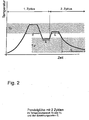
- a pendulum annealing with, for example, 1 to 3 cycles can take place at a temperature of 600 to 900 ° C for a period of 30 to 160 minutes and a final annealing for at least 30 minutes at temperatures below 400 ° C, as can be seen from the diagram of Fig. 2 results. Between two cycles in each case the temperature is reduced to under, ie here, for example, below 600 ° C, as in Fig. 2 is illustrated.
- the pendulum annealing In pendulum annealing, the sulfide precipitates stabilize, which subsequently show less solubility in contact with corrosive media and water resulting in better corrosion resistance. Surprisingly, the pendulum annealing also has an effect on improving the magnetic properties. This may be attributed to the fact that the ferromagnetic elements in the order of nickel, cobalt have an increasing affinity for sulfur and therefore can be effectively incorporated into the sulfide precipitates in pendulum annealing also in this order.
- Me may mean, for example, vanadium, niobium or manganese, while in the reaction equations 3 and 4, the cobalt may also be replaced by nickel.
- Manganese sulphides can also form mixed sulphides despite the high density of vacancies. Accordingly, MeCo and MeNi mixed sulfides of manganese and vanadium, whose nickel and / or cobalt content originate from the basic structure, can form from the resulting sulfides. This may be the reason why the susceptibility as a measure of the magnetic permeability (permeability) of Manganese and vanadium sulfide due to the incorporation of the ferromagnetic cobalt and nickel advantageously increased in these sulfides.
- the cobalt sulfide or mixed sulfide resulting from the reaction equations 1 or 3 has a higher magnetic susceptibility than the nickel sulfide according to Equation 2, it shows why the effect of the cobalt is better than that of the nickel, although both effects are advantageous.
- the expensive cobalt seems to have a stronger effect than the nickel, which also reacts with sulfur.
- the nickel content should not exceed 1% and the cobalt content should not exceed 0.5%.
- the improvement in corrosion resistance achievable with pendulum annealing can be explained by the fact that the sulfides formed during annealing are more thermodynamically stable and thus less soluble.
- This stabilization of the sulfide precipitations has a positive effect insofar as further annealing treatments, for example after cold forming and at higher temperatures, for example at 800 ° C., hardly influence the coercive force. This is advantageous in that it is associated with a higher manufacturing reliability and reproducibility of the material properties.
- the steel according to the invention has a low coercive force, which is maintained even under the influence of higher temperatures, because the magnetizable precipitates are thermodynamically stable or stabilized by the annealing according to the invention, in particular pendulum annealing.
- This annealing serves the purpose of preventing further reactions of precipitates. This ultimately results in a high constancy of the magnetic properties.
- Samples 1 to 3 are samples according to the invention, while samples V 1 and V 4 concern comparison samples.
- Table 2 shows the coercive force of the test steels as a function of the number of annealing treatments and the pendulum annealing.
- Tests 1 to 3 and 8 to 15 relate to an annealing treatment customary with ferritic chromium steels at 800 ° C., while experiments 4 to 7 were subjected to pendulum annealing in the critical temperature-time range. While in the comparison steels 8 to 15, the coercive force HC is higher and accordingly less favorable than in the steels of the experiments 4 to 7 according to the invention, these have uniformly low coercive force in each case two pendulum annealing.
- Table 4 shows the results of a modified salt spray test.
- the samples covered by the invention and the comparative samples were sprayed for 120 hours in a test chamber with a 3% NaCl solution in a first series of experiments.
- the 3% NaCl solution additionally contained 3% sodium sulfite (Na 2 SO 3 ) and 3% ammonium chloride (NH 4 Cl) and 5% methanol.
- This series of experiments is marked in Table 4 with "Z”.
- the table also indicates in hours the period of time that passed before the first spots of rust or rust appeared. If this was not the case, the samples were marked by the note "none".
- the samples were evaluated as 1 to 5 in terms of the frequency and / or amount of rusting spots.
- 1 stands for "no rust”
- 2 for two to three rust spots
- 3 for three to four rust spots
- 4 for four to five rust spots
- 5 for "rust spots larger than 2 mm 2 ".
- ferritic manganese steels Since cold working always increases the coercive force, ferritic manganese steels must always be subjected to annealing after cold working to reduce the increased coercive force in order to reduce the increase in coercive force and, if possible, to return to their initial value.
- the pendulum annealing is therefore directed to stabilize the partially unstable sulfides and thus their magnetic permeability. Accordingly, it is essential that the sulfides are thermodynamically stabilized and do not change in an annealing, such as a stress relief annealing.
- the steel according to the invention is characterized by a high manufacturing reliability and reproducibility, as evidenced by the results of tests 4 and 5.
- These experimental results show that thermodynamically stabilizing the sulphide precipitates by means of pendulum annealing in the steel according to the invention is also advantageous in micro-machining by means of lower GB values and in particular leads to a lower burr formation.
- the better corrosion resistance of the steels as the results of Experiments 4 to 7 compared to the experiments 8 to 15 illustrate.
Landscapes
- Chemical & Material Sciences (AREA)
- Engineering & Computer Science (AREA)
- Materials Engineering (AREA)
- Mechanical Engineering (AREA)
- Metallurgy (AREA)
- Organic Chemistry (AREA)
- Soft Magnetic Materials (AREA)
- Manufacturing Of Steel Electrode Plates (AREA)
Description
- Die Erfindung bezieht sich auf einen weichmagnetischen ferritischen Chromstahl und dessen Verwendung.
- Derartige Stähle sind in großer Zahl bekannt und eignen sich je nach ihrer speziellen Zusammensetzung für eine Vielzahl von Verwendungszwecken je nach der Zusammensetzung im einzelnen.
- So beschreibt die deutsche Patentschrift
695 17 533 T2 einen korrosionsbeständigen ferritischen Automatenstahl mit einer Koerzitivkraft von höchstens 398 A/m, im günstigsten Falle von 239 A/m bei einer Sättigungsinduktion von über 10 kG und einem elektrischen Widerstand von mindestens 80 µ-Ω-Zentimeter. Dieser Stahl besteht aus höchstens 0,3% Kohlenstoff, höchstens 0,06% Stickstoff, 0,7 bis 1,4% Silizium, 0,1 bis 2,0% Mangan, 0,1 bis 0,5% Schwefel, 15 bis 20% Chrom, bis 0,25% Kupfer, 0,8 bis 3% Molybdän, 0,10 bis 0,60% Niob, bis 0,02% Titan, bis 0,05% Aluminium und bis 0,6% Nickel. Rest Eisen einschließlich erschmelzungsbedingter Verunreinigungen. Der weite Bereich der Koerzitivkraft zeigt, dass sich der Stahl hinsichtlich seiner magnetischen Ausscheidungen nicht im Gleichgewichtszustand befindet, h.h. thermodynamisch instabil ist. - Seine Eigenschaften sind erheblich von seiner Wärmebehandlung im Anschluß an ein Warmwalzen bei 1065 bis 870 °C abhängig. Diese Wärmebehandlung besteht in einem 1 bis 4 Stunden dauernden Glühen bei 800 bis 1100 °C mit anschließendem langsam Abkühlen zur Vermeidung übermäßiger Restspannungen, jedoch so schnell, dass das Ausscheiden schädlicher Phasen, beispielsweise von Karbiden, im geglühten Zustand auf ein Minimum reduziert wird. Die Reproduzierbarkeit der Koerzitivkraft mit geringer Streuung ist daher äußerst problematisch.
- Des weiteren beschreibt die
US-Patentschrift 5 496 515 einen ferritischen rostfreien Stahl mit verbesserter Bearbeitbarkeit. Dieser Stahl besteht aus höchstens 0,17% Kohlenstoff, bis 2,0% Silizium, bis 2,0% Mangan, bis 0,55% Schwefel, 11 bis 20% Chrom, bis 3,0% Molybdän, höchsten 30 x 10-4% Kalzium, unter 1,0% Nickel und über 70 x 10-4% Sauerstoff mit Ausscheidungen aus dem Phasendiagramm CaO-SiO2-Al2O3, Rest Eisen einschließlich erschmelzungsbedingter Verunreinigungen. Der verhältnismäßig weite Bereich des Chromgehalts spricht gegen die magnetischen Eigenschaften des Stahls, und dies um so mehr, als Ausscheidungen auf der Basis von CaO, SiO2 und Al2O3 bezüglich der magnetischen Eigenschaften besonders ungünstig sind. - Des weiteren beschreibt die US-Patentschrift 2007 01 66 183 einen korrosionsbeständigen ferritischen Chromstahl mit höchstens 0,025% Kohlenstoff, höchstens 0,025% Stickstoff, 1,0 bis 2,0% Silizium, höchstens 0,6% Mangan, 0,15 bis 0,40% Schwefel, 12 bis 14% Chrom, bis 0,5% Kupfer, 0,5 bis 1,3% Molybdän, 0,5 bis 1,3% Vanadium, bis 0,02% Aluminium und bis 0,5% Nickel, Rest Eisen, dessen Korrosionsbeständigkeit jedoch angesichts der Anwesenheit von Mangansulfiden im Gefüge beeinträchtigt ist.
- Schließlich beschreibt die deutsche Patentschrift
10 2004 063 161 B4 einen katlverformbaren 'korrosionsbeständigen Chromstahl mit 0,005 bis 0,05% Kohlenstoff, bis 0,01% Stickstoff, 0,3 bis 1,0% Mangan, 0,15 bis 0,65% Schwefel, 14 bis 20% Chrom, 0,2 bis 1,0% Kupfer, 0,1 bis 1,0% Molybdän, 0,005 bis 0,08% Niob, Vanadium und Titan, bis 0,8% Nickel sowie einzeln oder nebeneinander 0,01 bis 0,1% Blei, 0,01 bis 0,5% Vismut, 0,01 bis 0,1% Arsen, 0,01 bis 0,1% Antimon, 0,005 bis 0,08% Zirkonium, und jeweils bis 0,20% Selen und Tellur, Rest Eisen einschließlich erschmelzungsbedingter Verunreinigungen. Der Stahl ist wegen seiner guten mechanischen Bearbeitbarkeit, insbesondere seiner guten Zerspanbarkeit, seines homogenen Gefüges sowie seiner gleichmäßigen Verteilung der sulfidischen Ausscheidungsphasen nach einem Kaltverformen und einem anschließenden Glühen mit gesteuerter Abkühlung als Werkstoff zum Herstellen von Druckerdüsen, Schreibminenspitzen, Einspritzdüsen für chemische und elektronische Geräte, Spinndüsen sowie Komponenten mit kleinen Abmessungen und/oder Ausnehmungen, insbesondere Bohrungen geeignet. Dabei erweisen sich die Sulfide des Mangans, des Nickels, des Kobalts und des Vanadiums als günstig. Die betreffenden Ausscheidungsphasen sind für eine weichmagnetische Verwendung jedoch nachteilig, weshalb dieser Stahl zwar eine sehr gute Mikrozerspanbarkeit besitzt, jedoch für magnetische Anwendungsfälle nicht geeignet ist. -
US 2003/0086810 A1 undUS 5769974 beschreiben ähnliche ferritische nichtrostende Stähle. - Die steigenden Anforderungen an die Schalt- und Steuerfrequenzen magnetischer Funktionselemente und die Produktionskosten sowie das Problem der Reproduzierbarkeit mit geringer Streubreite erfordern jedoch neue Werkstoffe, insbesondere solche, die sich rasch ändernden magnetischen Feldern ausgesetzt sind und diese insbesondere im Bereich kleiner magnetischer Feldstärken möglichst unmittelbar, d.h. verzögerungsarm weiterleiten. Das jedoch setzt eine niedrige Koerzitivkraft bzw. einen weichmagnetischen Werkstoff voraus.
- Weichmagnetische ferritische Stähle müssen jedoch hinsichtlich ihrer Koerzitivkraft eine hohe Reproduzierbarkeit besitzen. Demgemäß läßt sich eine durch die Kaltverformung verursachte Beeinträchtigung ihrer Koerzitivkraft durch ein Weichglühen mit dem Ziel beseitigen, die Kaltverfestigung wieder abzubauen und dabei möglichst den Ausgangszustand vor dem Kaltverformen wieder zu erreichen. Dies ist jedoch nur dann möglich, wenn das Gefüge thermodynamisch hinreichend stabil ist.
- Des weiteren müssen ferritische Chromstähle nicht nur hinreichend korrosionsbeständig sein, sondern auch günstige weichmagnetische Eigenschaften besitzen sowie gut bearbeitbar, insbesondere gut zerspanbar sein. Dies ist jedoch in vielen Fällen nicht erreichbar, was damit zusammenhängt, dass die ferritischen Stähle sehr weich sind und es demzufolge beim Zerspanen oder auch Verformen zu Anschweißungen und Anklebungen am Werkstoff kommt. Derartige Anklebungen oder Anschweißungen bewirken einerseits eine geringe Werkzeugstandzeit verbunden mit einer mangelhaften Oberflächengüte, insbesondere -glätte. Der Grund dafür liegt darin, dass die durch ein Kaltverschweißen unter dem Einfluß des Schneiddrucks entstehenden Anklebungen und Anschweißungen abgerissen werden. Die Praxis verlangt jedoch möglichst gratfreie Bohrungen, Nuten oder Sacklöcher. Besonders nachteilig ist dabei eine Gratbildung, wie sie beim Bohren von Löchern mit einem geringen Durchmesser unter 0,8 mm auftritt. Bei derartigen Bohrungen ist die Spandicke nur sehr gering; sie liegt im allgemeinen unter 0,1 mm, so dass der Span sich am Bohrungsrand unter verschiedenen Winkeln ausbildet, sich aber auch einrollt (vgl.
Fig. 3 ), so dass stets ein aufwendiges Nachbearbeiten mit entsprechenden Kosten erforderlich ist. - Zwar läßt sich die Spanbildung und damit die Zerspanbarkeit verbessern und die Neigung zu Verklebungen durch die Anwesenheit von Ausscheidungen bestimmter Phasen im Gefüge oder ein örtliches Aufhärten verbessern. Das ist jedoch mit eine Beeinträchtigung der magnetischen Eigenschaften und insbesondere einer Erhöhung der Koerzitivkraft verbunden.
- Das Problem der weichmagnetischen ferritischen Chromstähle ist demzufolge nach wie vor, eine gute Zerspanbarkeit in Verbindung mit einer niedrigen Koerzitivkraft und hinreichender Korrosionsbeständigkeit zu erreichen.
- Die Ausscheidungen vermindern zwar beim Zerspanen das Entstehen von Kaltverschweißungen und erhöhen auf diese Weise die Werkzeugstandszeit. Von großem Nachteil ist jedoch, dass manche Ausscheidungen magnetisch nahezu undurchlässig sind. Die Folge davon ist eine Erhöhung der Koerzitivkraft. Der Grund dafür ist, dass der magnetische Fluß bzw. die diesen charakterisierenden magnetischen Flußlinien die erwähnten Ausscheidungen umgehen, was im Hinblick auf einen bestimmten Magnetfluß höhere magnetische Feldstärken und Energien erforderlich macht, wie das in einer erhöhten Koerzitivkraft zum Ausdruck kommt. Hinzu kommt, dass im Vergleich zur ferritischen Matrix das elektrochemische Korrosionspotential der Ausscheidungen in starkem Maße unterschiedlich ist und daher Bereiche erhöhter Korrosionsbeständigkeit bilden. Dem ließe sich zwar durch eine Erhöhung des Chromgehalts entgegenwirken, jedoch ist das Chrom unmagnetisch und verschlechtert damit die ferromagnetischen Eigenschaften des Stahls.
- Wie die Verhältnisse in der Praxis liegen, zeigt
Fig. 1 der Zeichnung schematisch. Darin kennzeichnet 1 die ferritische Matrix, 2 magnetische Feldlinien, 3 magnetisch durchlässige Ausscheidungen, 4 magnetisch kaum durchlässige Ausscheidungen und 4 die Korngrenzen. - Vor diesem Hintergrund besteht das der Erfindung zugrundeliegende Problem darin, einen weichmagnetischen ferritischen Stahl zu schaffen, der sich durch eine gute Zerspanbarkeit mit geringer Neigung zur Gratbildung beim Zerspanen, eine hohe Korrosionsbeständigkeit und insbesondere eine gute Reproduzierbarkeit seiner Eigenschaften auszeichnet.
- Die Lösung dieses Problems besteht in einer bestimmten Zusammensetzung des Stahls mit bestimmten Sulfidausscheidungen und vermeidet andererseits das Entstehen schädlicher Ausscheidungen.
- Im einzelnen besteht die Lösung des Problems in einem weichmagnetischen ferritischen Chromstahl mit
bis 0,025% Kohlenstoff bis 0,02% Stickstoff 0,5 bis 1,8% Silizium 0,30 bis 1,5% Mangan 0,20 bis 0,35% Schwefel 12,0 bis 18,0% Chrom 0,05 bis 0,8% Kupfer 0,5 bis 3,0% Molybdän 0,02 bis 0,35% Niob 0,4 bis 1,2% Vanadium bis 0,06% Titan 0,001 bis 0,02% Aluminium bis 0,02% Kalzium 0,01 bis 1,0% Nickel 0,01 bis 0,4% Kobalt bis 0,004% Bor, - Der Stahl enthält vorzugsweise
0,001 bis 0,020% Kohlenstoff mindestens 0,001% Stickstoff 0,65 bis 0,70% Mangan höchstens 14,0% Chrom 0,1 bis 0,5% Kupfer bis 2,5% Molybdän 0,1 bis 0,35% Niob mindestens 0,005% Titan - Dabei können die Gehalte an Nickel und Kobalt der Bedingung:

sowie das Verhältnis von Niob und Vanadium der Bedingung
genügen. - Das Aluminium ist ein sehr starkes Oxidationsmittel und verbindet sich mit dem Sauerstoff der Schmelze zu sehr stabilem Tonerdeausscheidungen, die in Magnetstählen aufgrund ihrer geringen magnetischen Durchlässigkeit und Suszeptibilität bzw. ihres Diamagnetismus die Koerzitivkraft erhöhen. Der Stahl enthält daher höchstens 0,025%, vorzugsweise höchstens 0,020% Aluminium.
- Der Kohlenstoff ist nicht unerwünscht, aber er erhöht die Festigkeit und Härtbarkeit. Außerdem bildet er mit den Elementen Chrom, Titan, Vanadium, Niob und Wolfram Karbide, die sowohl die Korrosionsbeständigkeit verringern als auch die Koerzitivkraft nachteilig erhöhen. Da zudem der Kohlenstoff das Entstehen von Austenit fördert, sollte der Stahl möglichst wenig Kohlenstoff enthalten und der Kohlenstoffgehalt 0,025% nicht übersteigen.
- Der Stickstoff bildet mit Aluminium, Chrom, Titan, Vanadium und Niob harte, in weichmagnetischen Stählen magnetisch ungünstige Ausscheidungen und wirkt zudem austenitstabilisierend. Der Stickstoffgehalt beträgt daher höchstens 0,02%.
- Das Chrom erhöht als Karbidbildner die Verschleißfestigkeit und gewährleistet bei einem Gehalt von mindestens 12% eine ausreichende Korrosionsbeständigkeit, wenngleich Chrom bei einem Gehalt über 18,0% als diamagnetisches Legierungselement die Magnetisierung im Ferrit verringert. Der Chromgehalt beträgt daher 12,0 bis 18,0%.
- Das Molybdän verringert die kritische Abkühlungsgeschwindigkeit und bildet mit dem Kohlenstoff stabile Karbide. In Kombination mit dem Chrom verbessert es die Korrosionsbeständigkeit, erhöht aber auch als diamagnetisches Element den magnetischen Widerstand. Der Molybdängehalt beträgt daher 0,5 bis 3,0%.
- Das Vanadium ist ein starker Karbid-, Nitrid- und Sulfidbildner; es tritt in mehreren Oxidationsstufen auf und bildet auch Mischsulfide mit hoher magnetischer Durchlässigkeit (Suszeptibilität) insbesondere als Folge von Reaktionen mit dem ferromagnetischen Nickel und Kobalt. Des weiteren sind Vanadiumsulfide für einen guten Spanbruch von Vorteil. Das Vanadium bildet zudem zusammen mit dem Niob wichtige Kristallisationskeime. Ein Vanadiumgehalt von 0,4 bis 1,2% gewährleistet daher sowohl günstige magnetische Eigenschaften als auch eine hohe Korrosionsbeständigkeit. Vorzugsweise beträgt der Vanadiumgehalt mindestens 0,5%.
- Das Titan ist ein starkes Desoxidationsmittel und bildet stabile Oxide, Karbide, Nitride und Sulfide, jedoch mit ungünstigen magnetischen Eigenschaften. Der Titangehalt beträgt daher nur höchstens 0,06%.
- Auch das Niob zählt zu den starken Karbid-, Nitrid- und Sulfidbildnern; es stabilisiert zudem den Ferrit und bildet als Sulfidbildner Primärkeime, die als Kristallisationszentren wirken. Der Niobgehalt beträgt daher 0,002 bis 0,35%.
- Das Mangan bildet Sulfide mit Leerstellen, die eine sehr hohe magnetische Durchlässigkeit (Suszeptibilität) aufweisen. Mit ferromagnetischen Metallen wie Nickel und Kobalt bildet das Mangan zudem Mischsulfide. Darüber hinaus verbessert das Mangansulfid, insbesondere stabilisiertes Mangansulfid das Spanbruchverhalten. Andererseits stabilisiert das Mangan jedoch auch den Austenit. Der Mangangehalt beträgt daher 0,30 bis 1,5%, vorzugsweise höchstens 0,7%.
- Der Schwefel mit 0,20 bis 0,35% bildet Sulfide, mit deren Hilfe die Zerspanbarkeit verbessert wird. Diese Sulfide wirken als Bruchkeime und verbessern daher das Trennen der Späne. Da der Schwefel jedoch auch unterstöchiometrische Sulfide und Mischsulfide mit Vanadium, Mangan, Kobalt und Nickel bildet, empfiehlt sich eine thermische Nachbehandlung zur Verbesserung der magnetischen Eigenschaften und der Korrosionsbeständigkeit.
- Nickel und Kobalt gehören neben dem Eisen zu den ferromagnetischen Metallen, erweitern jedoch in Chromstählen das austenitische Gamma-Gebiet auf Kosten des Ferrits. Da beide Elemente mit dem Schwefel magnetisch stabile Sulfide mit hoher magnetischer Suszeptibilität bilden, beträgt der Nickelgehalt 0,01 bis 1,0% und der Kobaltgehalt 0,01 bis 0,4%.
- Da Kobalt sowohl in einer kubischen als auch in einer hexagonalen Modifikation vorliegt und die Umwandlung im Temperaturbereich von 400 bis 450 °C stattfindet, empfiehlt sich ein Glühen unterhalb dieses Temperaturbereichs. Die Glühtemperatur beträgt vorzugsweise höchstens 380 °C.
- Der erfindungsgemäße Stahl zeichnet sich zudem durch eine geringe Koerzitivkraft aus und eignet sich deswegen beispielsweise zum Herstellen von Magnetventilen, die beim Abschalten des Stroms zur Versorgung einer Spule einen möglichst geringen Restmagnetismus aufweisen sollen, um bleibende magnetische Kraftwirkungen und die damit verbundene Verringerung der Schaltgeschwindigkeit zu vermeiden.
- Der Stahl nach der Erfindung zeichnet sich des weiteren durch eine hohe Korrosionsbeständigkeit aus, die eine Beibehaltung des Oberflächenzustandes gewährleistet und gerade bei Funktionskomponenten von großer Bedeutung ist, um den Reibungsbeiwert bzw. die Oberflächenrauhigkeit und -glätte für eine möglichst lange Verwendungsdauer konstant zu halten. Dies gilt namentlich für die Korrosionsbeständigkeit an Luft, im Wasser, gegenüber Salzen sowie den Abgasen von Verbrennungsmotoren wie beispielsweise Schwefeldioxid und Biokraftstoffen.
- Unter Funktionskomponenten sind hier metallische Bauteile zu verstehen, die unter der Einwirkung von Kräften und Beschleunigungen eingesetzt werden wie beispielsweise Komponenten einer Vorrichtung zum Einspritzen von Kraftstoff bei einem Motor oder wie die Teile eines Magnetventils. Funktionskomponenten unterliegen im allgemeinen einer starken Beanspruchung auf Verschleiß, Korrosion und magnetische Kräfte.
- Insgesamt basiert die Erfindung auf drei Wirkungsmechanismen.
- Zum einen zielt die Erfindung darauf ab, Legierungsbestandteile und Ausscheidungen mit einem hohen magnetischen Widerstand, die den magnetischen Fluß bzw. die Flußlinien verdrängen, zu vermeiden. Der Chromstahl ist daher so zusammengesetzt, dass er vorrangig nur solche Ausscheidungen enthält, die eine gute magnetische Durchlässigkeit aufweisen, d.h. paramagnetisch sind. Andererseits vermeidet die Erfindung Ausscheidungen mit einem hohen magnetischen Widerstand oder schlechter magnetischer Durchlässigkeit. Andererseits vermeidet die Analyse Ausscheidungen mit einem hohen magnetischen Widerstand oder schlechter magnetischen Durchlässigkeit.
- Der zweite Wirkungsmechanismus ergibt sich daraus, dass die Mikrozerspanbarkeit durch thermisch modifizierte zerspanungsfördernde, insbesondere die Gratbildung beim Bohren vermindernde Sulfide verringert wird.
- Der dritte Wirkungsmechanismus ergibt sich schließlich daraus, dass die Korrosionsempfindlichkeit schwefelenthaltender Ausscheidungen durch eine thermodynamische Stabilisierung und Wechselreaktion mit bestimmten Elementen in der Matrix im Wege einer Festkörperreaktion verringert wird.
- Des weiteren haben umfangreiche Untersuchungen gezeigt, dass sich schwefelhaltige Ausscheidungen durch ein Diffusions-Wechselglühen, im folgenden als Pendelglühen bezeichnet, in ihren Eigenschaften, insbesondere den magnetischen Eigenschaften sowie hinsichtlich ihrer Korrosionsbeständigkeit und Mikrozerspanbarkeit vorteilhaft verändern lassen. Versuche haben dabei ergeben, dass die sich bei hohen Temperaturen bildenden Metallsulfide vom Typ MeS und Me2S3 sowie Sulfide mit Fehl- oder Gitterleerstellen nicht einheitlich stöchiometrisch zusammengesetzt sind und auch als Mischungen vorliegen. Diese Sulfide bzw. Sulfidgemische lassen sich sowohl hinsichtlich ihrer Zusammensetzung als auch ihrer Eigenschaften durch ein solches Pendelglühen in Wechselwirkung mit bestimmten Elementen des Grundgefüges modifizieren.
- Versuche haben in diesem Zusammenhang ergeben, dass die Sulfide von Metallen, die in mehreren Oxidationsstufen und/oder unterstöchiometischen Verbindungen vorliegen können, wie im Falle von Mangan, Titan, Vanadium und Niob unterschiedlich stabile Sulfide bilden. In der Tabelle 1 sind die im vorliegenden Zusammenhang wichtigsten Sulfide und deren thermodynamischen Bildungswärmen aufgeführt. Sämtliche Bildungswärmen sind negativ, woraus sich ergibt, dass sich die betreffenden Verbindungen bzw. Ausscheidungen ohne Zwang bilden. Dabei ist die Neigung zum Entstehen der Ausscheidungen um so größer, je höher die negativen Bildungswärmen sind.
- Durch ein Glühen, vorzugsweise Pendelglühen, lassen sich bei höherer Temperatur unterstöchiometrische, also nicht den tatsächlichen Mengenverhältnissen im Werkstoff entsprechende und Fehlstellen aufweisende Ausscheidungen im Wege von Festkörperreaktionen in stabilere Ausscheidungen umwandeln, die nicht mehr mit Elementen der Stahlmatrix reagieren und daher ihre spezifischen Eigenschaften wie im vorliegenden Fall die magnetische Durchlässigkeit beibehalten. Dafür ist ein bestimmter Temperaturbereich erforderlich, weil bei zu hohen Temperaturen bestimmte Elemente in der Stahlmatrix gelöst bleiben, während bei zu niedrigen Temperaturen die Diffusions- und Austauschreaktionen zu langsam ablaufen. Demgemäß kommt dem Bereich der Glühtemperatur eine entscheidende Bedeutung zu.
- Die im Grundgefüge eingelagerten Sulfide lassen sich demgemäß beim Pendelglühen vorteilhaft modifizieren. Ein solches Pendelglühen mit beispielsweise 1 bis 3 Zyklen kann bei einer Dauer von 30 bis 160 Minuten bei 600 bis 900 °C und einem mindestens 30 minütigen Schlußglühen bei Temperaturen unter 400 °C stattfinden, wie sich das aus dem Diagramm der
Fig. 2 ergibt. Zwischen je zwei Zyklen wird dabei die Temperatur auf unter To, d.h. hier beispielsweise unter 600 °C verringert, wie das inFig. 2 veranschaulicht ist. - Bei dem Pendelglühen stabilisieren sich die Sulfidausscheidungen, die danach eine geringere Löslichkeit im Kontakt mit korrodierenden Medien und Wasser mit der Folge einer besseren Korrosionsbeständigkeit zeigen. Überraschenderweise wirkt sich das Pendelglühen auch in einer Verbesserung der magnetischen Eigenschaften aus. Das dürfte sich darauf zurückführen lassen, dass die ferromagnetischen Elemente in der Reihenfolge Nickel, Kobalt eine zunehmende Affinität zum Schwefel besitzen und sich daher beim Pendelglühen auch in dieser Reihenfolge wirksam in die Sulfidausscheidungen einbauen lassen.
- Bei diesem Pendelglühen dürften sich die folgenden Festkörperreaktionen bzw. Sulfidausscheidungen abspielen:
Me2S3 + Co → 2 MeS + CoS (1)
Me2S3 + Ni → 2 MeS + NiS (2)
MeS2 + Co → 2 (Me0,5Co0,5) S (3)
MeS1-x + xCo → (Me, Co) S (4)
- In den Gleichungen 1 bis 4 kann Me beispielsweise Vanadium, Niob oder Mangan bedeuten, während in den Reaktionsgleichungen 3 und 4 das Kobalt auch durch Nickel ersetzt sein kann. Mangansulfide können trotz hoher Dichte an Leerstellen auch Mischsulfide bilden. Aus den entstehenden Sulfiden können sich demgemäß MeCo- und MeNi-Mischsulfide des Mangans und Vanadiums bilden, deren Nickel- und/oder Kobaltanteil aus dem Grundgefüge stammt. Dies dürfte der Grund dafür sein, dass sich die Suszeptibilität als Maß der magnetischen Durchlässigkeit (Permeabilität) von Mangan- und Vanadiumsulfid infolge des Einbaus des ferromagnetischen Kobalts und Nickels in diese Sulfide vorteilhaft erhöht. Da das nach den Reaktionsgleichungen 1 oder 3 entstehende Kobaltsulfid oder -mischsulfid eine höhere magnetische Suszeptibilität besitzt als das Nickelsulfid nach Gleichung 2 zeigt sich, warum die Wirkung des Kobalts besser ist als die des Nickels, wenngleich beide Wirkungen vorteilhaft sind. Dabei scheint das teure Kobalt eine stärkere Wirkung zu haben als das ebenfalls mit Schwefel reagierende Nickel. Da es sich jedoch in beiden Fällen um wirksame Austenitbildner handelt, sollte der Nickelgehalt 1 % und der Kobaltgehalt 0,5% nicht übersteigen.
- Die mit dem Pendelglühen erreichbare Verbesserung der Korrosionsbeständigkeit erklärt sich daraus, dass die beim Glühen entstehenden Sulfide thermodynamisch stabiler und damit schwerer löslich sind. Diese Stabilisierung der Sulfidausscheidungen wirkt sich insofern positiv aus, als weitere Glühbehandlungen, beispielsweise nach einem Kaltverformen und bei höheren Temperaturen, etwa bei 800 °C die Koerzitivkraft kaum beeinflussen. Das ist insofern von Vorteil, als damit eine höhere Fertigungssicherheit und Reproduzierbarkeit der Werkstoffeigenschaften verbunden ist.
- Bei Versuchen hat sich zudem gezeigt, dass nur jene Teilmenge der Sulfide einer Modifizierung nach den Reaktionsgleichungen 1 bis 4 zugänglich ist, der außerhalb einer 1:1-Stöchiometrie von Me und Schwefel liegt und von der Keimbildung abhängt. Höhere Kobalt- und/oder Nickelgehalte sind auch von daher nicht förderlich. Der Summengehalt dieser Elemente, d.h. (%Ni) + 3 (%Co) sollte daher bei 0,3 bis 1,0 liegen, da andernfalls auch ein längeres oder mehrmaliges Pendelglühen keine wesentliche Änderung des Gefüges bewirkt. Der Grund hierfür liegt darin, dass das Eindiffundieren von Kobalt und auch Nickel in die Sulfidausscheidungen nur dann wirksam ist, wenn diese Ausscheidungen gesättigt sind. Daraus folgt, dass hierfür nur geringe Mengen an Kobalt und Nickel erforderlich sind.
- Der erfindungsgemäße Stahl besitzt eine geringe Koerzitivkraft, die auch unter dem Einfluß höherer Temperaturen erhalten bleibt, weil die magnetisierbaren Ausscheidungen durch das erfindungsgemäße Glühen, insbesondere Pendelglühen thermodynamisch stabil bzw. stabilisiert sind. Dieses Glühen dient dem Zweck, keine weitere Reaktionen von Ausscheidungen mehr zu ermöglichen. Damit ergibt sich letztendlich eine hohe Konstanz der magnetischen Eigenschaften.
Tabelle 1 Sulfidausscheidungen Bildungswärme Kcal/mol MnS -52,2 MnS2 -53,5 NiS -19,6 NiS0,84 -19,7 CoS -19,8 CoS2 -36,6 Co3S3 -35,2 NbS -50,0 NbS2 -84,8 VS -64,0 V2S3 -227,0 CuS -12,7 Tabelle 2 Verbindung Magnetische Eigenschaften Susceptibility Bewertung der Ausscheidung TIC schlecht TiN schlecht Cr3C2 schlecht Cr23C6 schlecht NbC schlecht NbN schlecht MnS 5630,0 sehr gut MnS 3850,0 sehr gut NiS 190,0 sehr gut CoS 225,0 sehr gut VS 600,00 sehr gut V2S3 1560,0 sehr gut CaO schlecht CaO.Al2O3 schlecht CaO.2 Al2O3 schlecht SiO2 schlecht Al2O3 schlecht TiO2 schlecht PbS schlecht AS2S3 schlecht Sb2S3 schlecht - Die Proben mit der Zusammensetzung nach Tabelle 3 wurden in einem Mittelfrequenzofen unter Argon erschmolzen, in eine längliche Form vergossen und 30 Minuten bei 1200 °C geglüht sowie anschließend auf 980 °C abgeglüht und bei dieser Temperatur zu Stäben ausgeschmiedet. Nach dem Abkühlen auf Raumtemperatur wurden die Stäbe abgedreht und dabei vollständig vom Zunder befreit sowie abschließend zwei Stunden bei 800 °C unter Wasserstoff geglüht. Dabei handelt es sich bei den Proben 1 bis 3 um erfindungsgemäße Proben, während die Proben V1 und V4 Vergleichsproben betreffen.
- Zur Bewertung der Koerzitivkraft, der Korrosionsbeständigkeit, des Spanbruch- und Gratbildungsverhaltens beim Mikrobohren sowie zur Beurteilung der Wirkung des Glühens, insbesondere des Pendelglühens, wurden zylindrische Proben mit einer Länge von 10 mm und einem Durchmesser von 9 mm verwendet. Dabei wurde die Koerzitivkraft mit einem handelsüblichen Koerzimeter ermittelt.
- In der Tabelle 2 ist die Koerzitivkraft der Versuchsstähle in Abhängigkeit von der Zahl der Glühbehandlungen sowie des Pendelglühens verzeichnet. Dabei betreffen die Versuche 1 bis 3 und 8 bis 15 eine bei ferritischen Chromstählen übliche Glühbehandlung bei 800 °C, während die Versuche 4 bis 7 ein Pendelglühen in dem kritischen Temperatur-Zeit-Bereich unterworfen wurden. Während bei den Vergleichsstählen 8 bis 15 die Koerzitivkraft HC höher und demgemäß ungünstiger ist als bei den erfindungsgemäßen Stählen der Versuche 4 bis 7, weisen diese bei jeweils zwei Pendelglühungen einheitlich eine niedrige Koerzitivkraft auf.
- Die Versuche zeigen des weiteren, dass das Pendelglühen zu gleichmäßigen Ergebnissen führt, und zwar auch dann, wenn ein Kaltverformen und ein Zusatzglühen stattfindet. Dies beweist ein Vergleich der Versuche 4 und 5, im Vergleich zu den Versuchen 8, 9 und 14, 15.
- Aus der Tabelle 4 sind die Ergebnisse eines modifizierten Salzsprühtests ersichtlich. Bei diesen Korrosionsversuchen wurden die unter die Erfindung fallenden Proben und die Vergleichsproben in einer ersten Versuchsserie 120 Stunden in einer Testkammer mit einer 3%-tigen NaCl-Lösung besprüht. Bei einer zweiten Versuchsserie enthielt die 3%-tige NaCl-Lösung zusätzlich noch 3% Natriumsulfit (Na2SO3) und 3% Ammoniumchlorid (NH4Cl) sowie 5% Methanol. Diese Versuchsserie ist in Tabelle 4 mit "Z" gekennzeichnet. Die Tabelle gibt auch in Stunden den Zeitraum an, der verging, bis sich erste Rostflecken oder Rostpunkte zeigten. Soweit das nicht der Fall war, wurden die Proben durch den Hinweis "keine" gekennzeichnet.
- Des weiteren wurden die Proben nach 240 Stunden hinsichtlich der Häufigkeit und/oder Menge der aufgetretenen Roststellen mit 1 bis 5 bewertet. Dabei steht 1 für "kein Rost", 2 für zwei bis drei Roststellen, 3 für drei bis vier Roststellen, 4 für vier bis fünf Roststellen und 5 für "Roststellen größer als 2 mm2".
- Schließlich wurden die Proben auch Mikrobohrversuchen mit Fein- und Mikrobohrern aus Hartmetall eines Durchmessers Db von 0,5 mm und einer Drehzahl von 35.000 Upm unterworfen. Die Bohrungstiefe betrug bei allen Versuchen einheitlich 4,0 mm. Dabei wurde die Tendenz zur Gratbildung aus jeweils zwei Werten abgeleitet, und zwar durch die Gratbreite GB und die Grathöhe H. Dabei wurde die Gratbreite nach der Formel

sowie die Grathöhe H entsprechendFig. 3 ausgemessen. Dazu veranschaulichen die Aufnahmen derFig. 4 bis 6 und8 die starke Gratbildung beim Mikrobohren von Proben aus einem herkömmlichen ferritischen Chromstahl im Vergleich zu der nahezu gratfreien Bohrung eines erfindungsgemäßen Stahls (Fig. 7 ). - Die Versuchsergebnisse zeigen eindeutig, dass sich das Pendelglühen vorteilhaft auf die Koerzitivkraft, die Mikrozerspanbarkeit und das Korrosionsverhalten auswirkt, ohne dass sich bei einem etwaigen Kaltverformen mit anschließendem Glühen wesentliche Veränderungen ergeben.
- Da ein Kaltverformen stets die Koerzitivkraft erhöht, müssen ferritische Manganstähle nach dem Kaltverformen stets zum Abbau der erhöhten Koerzitivkraft einem Glühen unterworfen werden, um den Anstieg der Koerzitivkraft wieder abzubauen und nach Möglichkeit deren Ausgangswert wieder zu erreichen. Dabei ergaben sich bislang jedoch Schwierigkeiten, weil die Sulfide nicht stabilisiert waren und daher untereinander reagierten. Das Pendelglühen ist daher darauf gerichtet, die teilweise instabilen Sulfide und damit auch deren magnetische Durchlässigkeit zu stabilisieren. Demgemäß kommt es wesentlich darauf an, dass die Sulfide thermodynamisch stabilisiert sind und sich bei einem Glühen, beispielsweise einem Spannungsfreiglühen nicht mehr verändern.
- Der Stahl nach der Erfindung zeichnet sich durch eine hohe Fertigungssicherheit bzw. Reproduzierbarkeit aus, was die Ergebnisse der Versuche 4 und 5 belegen. Diese Versuchsergebnisse zeigen, dass ein thermodynamisches Stabilisieren der Sulfidausscheidungen im Wege eines Pendelglühens bei dem Stahl nach der Erfindung auch beim Mikrozerspanen durch niedrigere GB-Werte von Vorteil ist und insbesondere zu einer geringeren Gratbildung führt. Hinzu kommt die bessere Korrosionsbeständigkeit der Stähle, wie die Ergebnisse der Versuche 4 bis 7 im Vergleich zu den Versuchen 8 bis 15 veranschaulichen.
Tabelle 3 Stahl Nr. C N Si Mn P S Cr Cu Mo Nb Ti V Ni Co Al 1 0,018 0,008 1,33 0,62 0,025 0,27 12,40 0,30 1,50 0,10 0,02 0,82 0,35 0,03 0,006 2 0,010 0,015 1,34 0,71 0,020 0,30 13,20 0,24 1,05 0,25 0,01 1,18 0,28 0,06 0,003 3 0,022 0,008 1,66 0,64 0,028 0,31 13,92 0,35 1,80 0,15 0,01 1,08 0,36 0,10 0,003 V1 0,021 0,015 1,55 0,95 0,022 0,06 14,02 0,32 1,30 n.n. 0,06 0,60 0,55 0,50 0,012 V2 0,020 0,020 1,64 0,55 0,024 0,20 12,90 0,22 0,08 n.n. n.n. 0,55 0,45 n.n. 0,020 V3 0,015 0,020 1,30 0,25 0,039 0,38 13,50 0,34 1,00 n.n. n.n. 1,15 0,20 n.n. 0,010 V4 0,010 0,022 1,02 1,20 0,026 0,36 13,55 0,25 2,00 0,05 0,24 0,35 4,35 n.n. 0,015 n.n.: nicht nachweisbar Tabelle 4 Vers. Nr. KORROSIONSTEST 120 h MIKROZER-SPANUNGSTEST 3%NaCl Bewegung 3%NaCl + Z Bewertunq GB H 1 95 2 85 3 0,07 0,06 2 110 3 96 3 0,08 0,05 3 98 3 90 3 0,07 0,06 4 keine 1 keine 1 0,03 0,01 5 keine 1 keine 1 0,03 0,01 6 keine 1 115 2 0,03 0,01 7 keine 1 keine 1 0,03 0,03 8 keine 1 keine 1 0,21 0,14 9 keine 1 keine 1 0,20 0,09 10 88 5 75 5 0,13 0,09 11 90 4 88 5 0,12 0,09 12 96 3 86 5 0,09 0,11 13 110 3 95 4 0,10 0,08 14 keine 1 110 3 0,11 0,07 15 keine 1 115 3 0,10 0,08 Tabelle 5 PENDELGLÜHEN Verformung Glühen 2 h in wasserstoff, °C HC (A/m) Stahl Nr. Vers. Nr. To(h) Tu(h) To(h) Tu(h) 1 1 keine keine keine keine keine 800 156 3 2 keine keine keine keine keine 800 151 1 3 keine keine keine keine 15% 800 161 1 4 680 (2h) 360 (1h) 680 (2h) RT keine keine 132 1 5 680 (2h) 360 (1h) 680 (2h) RT 15% 800 132 3 6 680 (2h) 370 (2h) 690 (2h) RT keine keine 142 4 7 680 (2h) 370 (2h) 690 (2h) RT keine keine 146 V1 8 keine keine keine keine keine 800 182 V1 9 keine keine keine keine 15% 800 175 V2 10 keine keine keine keine keine 800 215 V2 11 keine keine keine keine 15% 800 209 V3 12 keine keine keine keine keine 800 220 V3 13 keine keine keine keine 15% 800 180 V4 14 keine keine keine keine keine 800 192 V4 15 keine keine keine keine 15% 800 182
Claims (8)
- Weichmagnetischer ferritischer Chromstahl aus
bis 0,025% Kohlenstoff, bis 0,02% Stickstoff, 0,5 bis 1,8% Silizium, 0,30 bis 1,5% Mangan, 0,20 bis 0,35% Schwefel, 12,0 bis 18,0% Chrom, 0,05 bis 0,8% Kupfer, 0,5 bis 3,0% Molybdän, 0,02 bis 0,35% Niob, 0,4 bis 1,2% Vanadium, bis 0,06% Titan, 0,001 bis 0,02% Aluminium, bis 0,02% Kalzium, 0,01 bis 1,0% Nickel, 0,01 bis 0,4% Kobalt bis 0,004% Bor - Chromstahl nach Anspruch 1 mit 0,001 bis 0,020% Kohlenstoff, mindestens 0,001% Stickstoff, 0,65 bis 0,70% Mangan, bis 14,0% Chrom, 0,1 bis 0,5% Kupfer, bis 2,5% Molybdän, mindestens 0,02% Niob, mindestens 0,005% Titan und 0,1 bis 0,5% Nickel einzeln oder nebeneinander.
- Chromstahl nach Anspruch 1 oder 2, bei dem der Gesamtgehalt an Nickel und Kobalt

beträgt. - Chromstahl nach einem der Ansprüche 1 bis 3, bei dem das Verhältnis von Niob und Vanadium

beträgt. - Chromstahl nach einem der Ansprüche 1 bis 4, dadurch gekennzeichnet, dass der Stahl einem Pendelglühen von 30 bis 160 min. bei 600 bis 900 °C und einem mindestens 30-minütigen Schlußglühen bei einer Temperatur unter 400 °C unterworfen worden ist.
- Verwendung eines Chromstahls nach einem der Ansprüche 1 bis 5 als korrosionsbeständiger gratarm mikrozerspanbarer Werkstoff.
- Verwendung eines Stahls nach einem der Ansprüche 1 bis 5 als korrosionsbeständiger Werkstoff mit geringer Koerzitivkraft für magnetische Funktionselemente.
- Verwendung eines Stahls und den Ansprüchen 1 bis 5 als Werkstoff zum Herstellen von Magnetventilen, Kraftfahrzeug-Einspitzsystemen, Regelventilen, Magnetfeldabschirmungen in Plasmakammern, physikalischen und medizinisch-physikalisehen Geräten.
Applications Claiming Priority (2)
| Application Number | Priority Date | Filing Date | Title |
|---|---|---|---|
| DE200910038386 DE102009038386A1 (de) | 2009-08-24 | 2009-08-24 | Weichmagnetischer ferritischer Chromstahl |
| PCT/EP2010/005150 WO2011023349A1 (de) | 2009-08-24 | 2010-08-23 | Weichmagnetischer ferritischer chromstahl |
Publications (2)
| Publication Number | Publication Date |
|---|---|
| EP2470682A1 EP2470682A1 (de) | 2012-07-04 |
| EP2470682B1 true EP2470682B1 (de) | 2014-12-24 |
Family
ID=43416827
Family Applications (1)
| Application Number | Title | Priority Date | Filing Date |
|---|---|---|---|
| EP10771635.9A Active EP2470682B1 (de) | 2009-08-24 | 2010-08-23 | Weichmagnetischer ferritischer chromstahl |
Country Status (3)
| Country | Link |
|---|---|
| EP (1) | EP2470682B1 (de) |
| DE (1) | DE102009038386A1 (de) |
| WO (1) | WO2011023349A1 (de) |
Families Citing this family (8)
| Publication number | Priority date | Publication date | Assignee | Title |
|---|---|---|---|---|
| DE102014202570A1 (de) * | 2014-02-12 | 2015-08-13 | BSH Hausgeräte GmbH | Elektrischer Antriebsmotor, Pumpe und Haushaltsgerät mit einer solchen Pumpe |
| JP6801721B2 (ja) * | 2016-12-08 | 2020-12-16 | 日本製鉄株式会社 | 軟磁性部品用鋼材、軟磁性部品、及び、軟磁性部品の製造方法 |
| JP7043877B2 (ja) * | 2018-02-21 | 2022-03-30 | Tdk株式会社 | 軟磁性合金および磁性部品 |
| CN116590626A (zh) * | 2023-05-18 | 2023-08-15 | 山东正方禾泰智驱机械有限公司 | 一种镍钼合金钢及其制备方法 |
| CN117737558A (zh) * | 2023-12-21 | 2024-03-22 | 抚顺特殊钢股份有限公司 | 一种汽车燃油喷射系统用软磁材料的制备方法 |
| CN118272734B (zh) * | 2024-05-31 | 2024-08-20 | 西安钢研功能材料股份有限公司 | 一种高强耐腐蚀软磁合金及其棒材的制备方法 |
| CN121428432A (zh) * | 2025-11-06 | 2026-01-30 | 北京科技大学 | 一种Ti、Cu协同强化的细晶高强韧软磁不锈钢和包含其的型材及所述型材的制备方法 |
| CN121518916B (zh) * | 2026-01-15 | 2026-04-21 | 东北大学 | 一种兼具高强度、高韧性且电磁性能优异的软磁钢中厚板及其制造方法 |
Family Cites Families (9)
| Publication number | Priority date | Publication date | Assignee | Title |
|---|---|---|---|---|
| DE1783136C2 (de) * | 1965-10-22 | 1975-10-02 | Stahlwerke Suedwestfalen Ag, 5930 Huettental-Geisweid | Verwendung eines gut zerspanbaren, nichtrostenden magnetisch weichen Chromtstahles für Magnetventile |
| US3615367A (en) * | 1968-07-31 | 1971-10-26 | Armco Steel Corp | Low-loss magnetic core of ferritic structure containing chromium |
| FR2720410B1 (fr) | 1994-05-31 | 1996-06-28 | Ugine Savoie Sa | Acier inoxydable ferritique à usinabilité améliorée. |
| EP0786140B1 (de) | 1994-10-11 | 2000-06-14 | Crs Holdings, Inc. | Korrosionsfestes magnetmaterial |
| US5769974A (en) * | 1997-02-03 | 1998-06-23 | Crs Holdings, Inc. | Process for improving magnetic performance in a free-machining ferritic stainless steel |
| DE10143390B4 (de) * | 2001-09-04 | 2014-12-24 | Stahlwerk Ergste Westig Gmbh | Kaltverformbarer korrosionsbeständiger Chromstahl |
| FR2832734B1 (fr) * | 2001-11-26 | 2004-10-08 | Usinor | Acier inoxydable ferritique au soufre, utilisable pour des pieces ferromagnetiques |
| DE102004063161B4 (de) | 2004-04-01 | 2006-02-02 | Stahlwerk Ergste Westig Gmbh | Kaltverformbarer Chromstahl |
| US20070166183A1 (en) | 2006-01-18 | 2007-07-19 | Crs Holdings Inc. | Corrosion-Resistant, Free-Machining, Magnetic Stainless Steel |
-
2009
- 2009-08-24 DE DE200910038386 patent/DE102009038386A1/de not_active Withdrawn
-
2010
- 2010-08-23 EP EP10771635.9A patent/EP2470682B1/de active Active
- 2010-08-23 WO PCT/EP2010/005150 patent/WO2011023349A1/de not_active Ceased
Also Published As
| Publication number | Publication date |
|---|---|
| EP2470682A1 (de) | 2012-07-04 |
| DE102009038386A8 (de) | 2011-06-22 |
| DE102009038386A1 (de) | 2011-03-03 |
| WO2011023349A1 (de) | 2011-03-03 |
Similar Documents
| Publication | Publication Date | Title |
|---|---|---|
| WO2011023349A1 (de) | Weichmagnetischer ferritischer chromstahl | |
| DE60215655T2 (de) | Martensitischer nichtrostender stahl | |
| DE69604341T2 (de) | Martensitischer. rostfreier stahl mit guter beständigkeit gegen lochfrasskorrosion und mit hoher härte | |
| DE60214456T2 (de) | Martensitischer rostfreier Stahl mit hoher Härte und guter Korrosionsbeständigkeit | |
| DE69423930T2 (de) | Martensitisches rostfreies Stahl mit verbesserter Bearbeitbarkeit | |
| DE69710445T2 (de) | Selbstkompensierende Spiralfeder für mechanische Uhrwerkunruhspiralfederoszillator und Verfahren zu deren Herstellung | |
| DE3114533C2 (de) | ||
| DE19644517A1 (de) | Federstahl mit ausgezeichneter Widerstandsfähigkeit gegenüber Wasserstoffversprödung und Ermüdung | |
| DE19941411B4 (de) | Turbinen- oder Kesselbauteil | |
| DE4233269C2 (de) | Hochfester Federstahl | |
| DE3049906A1 (en) | Amorphous alloys | |
| DE19934989B4 (de) | Magnetisches Verbundelement, Verfahren zum Herstellen des ferromagnetischen Teils desselben sowie Verfahren zum Herstellen des unmagnetischen Teils desselben | |
| DE10305568A1 (de) | Verschleißfeste Legierung enthaltend Restaustenit für Ventilsitzeinsätze | |
| DE69805278T2 (de) | Verfahren zum verbessern der magnetischen eigenschaften ferritischer, rostfreier automatenstähle | |
| DE60115232T2 (de) | Stahllegierung, werkzeug zum plastiggiessen und zähgehärteter rohling für plastikgiesswerkzeuge | |
| DE4498699B4 (de) | Verwendung eines Rostfreien Stahls mit ausgezeichnetem Korrosionswiderstand gegenüber Salzschmelzen | |
| DE2447137B2 (de) | Gegen gruebchenkorrosion bestaendige stahllegierung | |
| AT410447B (de) | Warmarbeitsstahlgegenstand | |
| DE2253148C3 (de) | Verfahren zur Herstellung eines ferritischen, korrosionsbeständigen Stahls und dessen Verwendung | |
| DE60207983T2 (de) | Ausscheidungsgehärteter weichmagnetischer rostfreier ferritischer Stahl | |
| DE60029364T2 (de) | Automatenlegierung | |
| DE4143075C2 (de) | Verwendung eines noch kaltverformbaren elektromagnetischen rostfreien Stahls als Material für elektronisch gesteuerte Kraftstoffeinspritzsysteme | |
| DE3854091T2 (de) | WÄRMEBESTÄNDIGER AUSTENITISCHER Al-STAHL MIT AUSGEZEICHNETEN WARMVERARBEITUNGSEIGENSCHAFTEN. | |
| AT394581B (de) | Verfahren zur herstellung eines ni-fe-legierungsbleches mit ausgezeichneten gleichstrommagnetischen und wechselstrommagnetischen eigenschaften | |
| DE2755537A1 (de) | Austenitischer rostfreier stahl |
Legal Events
| Date | Code | Title | Description |
|---|---|---|---|
| PUAI | Public reference made under article 153(3) epc to a published international application that has entered the european phase |
Free format text: ORIGINAL CODE: 0009012 |
|
| 17P | Request for examination filed |
Effective date: 20120323 |
|
| AK | Designated contracting states |
Kind code of ref document: A1 Designated state(s): AL AT BE BG CH CY CZ DE DK EE ES FI FR GB GR HR HU IE IS IT LI LT LU LV MC MK MT NL NO PL PT RO SE SI SK SM TR |
|
| DAX | Request for extension of the european patent (deleted) | ||
| REG | Reference to a national code |
Ref country code: DE Ref legal event code: R079 Ref document number: 502010008588 Country of ref document: DE Free format text: PREVIOUS MAIN CLASS: C22C0038600000 Ipc: C22C0038040000 |
|
| GRAP | Despatch of communication of intention to grant a patent |
Free format text: ORIGINAL CODE: EPIDOSNIGR1 |
|
| INTG | Intention to grant announced |
Effective date: 20140711 |
|
| RIC1 | Information provided on ipc code assigned before grant |
Ipc: C22C 38/42 20060101ALI20140630BHEP Ipc: C22C 38/44 20060101ALI20140630BHEP Ipc: C22C 38/60 20060101ALI20140630BHEP Ipc: C22C 38/46 20060101ALI20140630BHEP Ipc: C22C 38/02 20060101ALI20140630BHEP Ipc: C22C 38/48 20060101ALI20140630BHEP Ipc: C22C 38/04 20060101AFI20140630BHEP Ipc: C22C 38/52 20060101ALI20140630BHEP Ipc: C21D 1/26 20060101ALI20140630BHEP |
|
| RAP1 | Party data changed (applicant data changed or rights of an application transferred) |
Owner name: ZAPP PRECISION METALS GMBH |
|
| GRAS | Grant fee paid |
Free format text: ORIGINAL CODE: EPIDOSNIGR3 |
|
| GRAA | (expected) grant |
Free format text: ORIGINAL CODE: 0009210 |
|
| AK | Designated contracting states |
Kind code of ref document: B1 Designated state(s): AL AT BE BG CH CY CZ DE DK EE ES FI FR GB GR HR HU IE IS IT LI LT LU LV MC MK MT NL NO PL PT RO SE SI SK SM TR |
|
| REG | Reference to a national code |
Ref country code: GB Ref legal event code: FG4D Free format text: NOT ENGLISH |
|
| REG | Reference to a national code |
Ref country code: CH Ref legal event code: EP |
|
| REG | Reference to a national code |
Ref country code: IE Ref legal event code: FG4D Free format text: LANGUAGE OF EP DOCUMENT: GERMAN |
|
| REG | Reference to a national code |
Ref country code: AT Ref legal event code: REF Ref document number: 703181 Country of ref document: AT Kind code of ref document: T Effective date: 20150115 |
|
| REG | Reference to a national code |
Ref country code: CH Ref legal event code: NV Representative=s name: E. BLUM AND CO. AG PATENT- UND MARKENANWAELTE , CH |
|
| REG | Reference to a national code |
Ref country code: DE Ref legal event code: R096 Ref document number: 502010008588 Country of ref document: DE Effective date: 20150219 |
|
| REG | Reference to a national code |
Ref country code: SE Ref legal event code: TRGR |
|
| REG | Reference to a national code |
Ref country code: NL Ref legal event code: T3 |
|
| PG25 | Lapsed in a contracting state [announced via postgrant information from national office to epo] |
Ref country code: FI Free format text: LAPSE BECAUSE OF FAILURE TO SUBMIT A TRANSLATION OF THE DESCRIPTION OR TO PAY THE FEE WITHIN THE PRESCRIBED TIME-LIMIT Effective date: 20141224 Ref country code: LT Free format text: LAPSE BECAUSE OF FAILURE TO SUBMIT A TRANSLATION OF THE DESCRIPTION OR TO PAY THE FEE WITHIN THE PRESCRIBED TIME-LIMIT Effective date: 20141224 Ref country code: NO Free format text: LAPSE BECAUSE OF FAILURE TO SUBMIT A TRANSLATION OF THE DESCRIPTION OR TO PAY THE FEE WITHIN THE PRESCRIBED TIME-LIMIT Effective date: 20150324 |
|
| REG | Reference to a national code |
Ref country code: LT Ref legal event code: MG4D |
|
| PG25 | Lapsed in a contracting state [announced via postgrant information from national office to epo] |
Ref country code: GR Free format text: LAPSE BECAUSE OF FAILURE TO SUBMIT A TRANSLATION OF THE DESCRIPTION OR TO PAY THE FEE WITHIN THE PRESCRIBED TIME-LIMIT Effective date: 20150325 Ref country code: HR Free format text: LAPSE BECAUSE OF FAILURE TO SUBMIT A TRANSLATION OF THE DESCRIPTION OR TO PAY THE FEE WITHIN THE PRESCRIBED TIME-LIMIT Effective date: 20141224 Ref country code: LV Free format text: LAPSE BECAUSE OF FAILURE TO SUBMIT A TRANSLATION OF THE DESCRIPTION OR TO PAY THE FEE WITHIN THE PRESCRIBED TIME-LIMIT Effective date: 20141224 |
|
| PG25 | Lapsed in a contracting state [announced via postgrant information from national office to epo] |
Ref country code: RO Free format text: LAPSE BECAUSE OF FAILURE TO SUBMIT A TRANSLATION OF THE DESCRIPTION OR TO PAY THE FEE WITHIN THE PRESCRIBED TIME-LIMIT Effective date: 20141224 Ref country code: CZ Free format text: LAPSE BECAUSE OF FAILURE TO SUBMIT A TRANSLATION OF THE DESCRIPTION OR TO PAY THE FEE WITHIN THE PRESCRIBED TIME-LIMIT Effective date: 20141224 Ref country code: ES Free format text: LAPSE BECAUSE OF FAILURE TO SUBMIT A TRANSLATION OF THE DESCRIPTION OR TO PAY THE FEE WITHIN THE PRESCRIBED TIME-LIMIT Effective date: 20141224 Ref country code: EE Free format text: LAPSE BECAUSE OF FAILURE TO SUBMIT A TRANSLATION OF THE DESCRIPTION OR TO PAY THE FEE WITHIN THE PRESCRIBED TIME-LIMIT Effective date: 20141224 Ref country code: SK Free format text: LAPSE BECAUSE OF FAILURE TO SUBMIT A TRANSLATION OF THE DESCRIPTION OR TO PAY THE FEE WITHIN THE PRESCRIBED TIME-LIMIT Effective date: 20141224 |
|
| PG25 | Lapsed in a contracting state [announced via postgrant information from national office to epo] |
Ref country code: PL Free format text: LAPSE BECAUSE OF FAILURE TO SUBMIT A TRANSLATION OF THE DESCRIPTION OR TO PAY THE FEE WITHIN THE PRESCRIBED TIME-LIMIT Effective date: 20141224 Ref country code: IS Free format text: LAPSE BECAUSE OF FAILURE TO SUBMIT A TRANSLATION OF THE DESCRIPTION OR TO PAY THE FEE WITHIN THE PRESCRIBED TIME-LIMIT Effective date: 20150424 |
|
| REG | Reference to a national code |
Ref country code: DE Ref legal event code: R097 Ref document number: 502010008588 Country of ref document: DE |
|
| PG25 | Lapsed in a contracting state [announced via postgrant information from national office to epo] |
Ref country code: DK Free format text: LAPSE BECAUSE OF FAILURE TO SUBMIT A TRANSLATION OF THE DESCRIPTION OR TO PAY THE FEE WITHIN THE PRESCRIBED TIME-LIMIT Effective date: 20141224 |
|
| PLBE | No opposition filed within time limit |
Free format text: ORIGINAL CODE: 0009261 |
|
| STAA | Information on the status of an ep patent application or granted ep patent |
Free format text: STATUS: NO OPPOSITION FILED WITHIN TIME LIMIT |
|
| 26N | No opposition filed |
Effective date: 20150925 |
|
| PG25 | Lapsed in a contracting state [announced via postgrant information from national office to epo] |
Ref country code: SI Free format text: LAPSE BECAUSE OF FAILURE TO SUBMIT A TRANSLATION OF THE DESCRIPTION OR TO PAY THE FEE WITHIN THE PRESCRIBED TIME-LIMIT Effective date: 20141224 |
|
| REG | Reference to a national code |
Ref country code: IE Ref legal event code: MM4A |
|
| PG25 | Lapsed in a contracting state [announced via postgrant information from national office to epo] |
Ref country code: IE Free format text: LAPSE BECAUSE OF NON-PAYMENT OF DUE FEES Effective date: 20150823 |
|
| REG | Reference to a national code |
Ref country code: FR Ref legal event code: PLFP Year of fee payment: 7 |
|
| PG25 | Lapsed in a contracting state [announced via postgrant information from national office to epo] |
Ref country code: MT Free format text: LAPSE BECAUSE OF FAILURE TO SUBMIT A TRANSLATION OF THE DESCRIPTION OR TO PAY THE FEE WITHIN THE PRESCRIBED TIME-LIMIT Effective date: 20141224 |
|
| PG25 | Lapsed in a contracting state [announced via postgrant information from national office to epo] |
Ref country code: BG Free format text: LAPSE BECAUSE OF FAILURE TO SUBMIT A TRANSLATION OF THE DESCRIPTION OR TO PAY THE FEE WITHIN THE PRESCRIBED TIME-LIMIT Effective date: 20141224 Ref country code: SM Free format text: LAPSE BECAUSE OF FAILURE TO SUBMIT A TRANSLATION OF THE DESCRIPTION OR TO PAY THE FEE WITHIN THE PRESCRIBED TIME-LIMIT Effective date: 20141224 Ref country code: HU Free format text: LAPSE BECAUSE OF FAILURE TO SUBMIT A TRANSLATION OF THE DESCRIPTION OR TO PAY THE FEE WITHIN THE PRESCRIBED TIME-LIMIT; INVALID AB INITIO Effective date: 20100823 |
|
| PG25 | Lapsed in a contracting state [announced via postgrant information from national office to epo] |
Ref country code: CY Free format text: LAPSE BECAUSE OF FAILURE TO SUBMIT A TRANSLATION OF THE DESCRIPTION OR TO PAY THE FEE WITHIN THE PRESCRIBED TIME-LIMIT Effective date: 20141224 |
|
| REG | Reference to a national code |
Ref country code: FR Ref legal event code: PLFP Year of fee payment: 8 |
|
| PG25 | Lapsed in a contracting state [announced via postgrant information from national office to epo] |
Ref country code: TR Free format text: LAPSE BECAUSE OF FAILURE TO SUBMIT A TRANSLATION OF THE DESCRIPTION OR TO PAY THE FEE WITHIN THE PRESCRIBED TIME-LIMIT Effective date: 20141224 |
|
| PG25 | Lapsed in a contracting state [announced via postgrant information from national office to epo] |
Ref country code: MK Free format text: LAPSE BECAUSE OF FAILURE TO SUBMIT A TRANSLATION OF THE DESCRIPTION OR TO PAY THE FEE WITHIN THE PRESCRIBED TIME-LIMIT Effective date: 20141224 |
|
| PG25 | Lapsed in a contracting state [announced via postgrant information from national office to epo] |
Ref country code: PT Free format text: LAPSE BECAUSE OF FAILURE TO SUBMIT A TRANSLATION OF THE DESCRIPTION OR TO PAY THE FEE WITHIN THE PRESCRIBED TIME-LIMIT Effective date: 20141224 |
|
| REG | Reference to a national code |
Ref country code: FR Ref legal event code: PLFP Year of fee payment: 9 |
|
| PG25 | Lapsed in a contracting state [announced via postgrant information from national office to epo] |
Ref country code: AL Free format text: LAPSE BECAUSE OF FAILURE TO SUBMIT A TRANSLATION OF THE DESCRIPTION OR TO PAY THE FEE WITHIN THE PRESCRIBED TIME-LIMIT Effective date: 20141224 |
|
| P01 | Opt-out of the competence of the unified patent court (upc) registered |
Effective date: 20230513 |
|
| PGFP | Annual fee paid to national office [announced via postgrant information from national office to epo] |
Ref country code: LU Payment date: 20240820 Year of fee payment: 15 |
|
| PGFP | Annual fee paid to national office [announced via postgrant information from national office to epo] |
Ref country code: NL Payment date: 20240821 Year of fee payment: 15 |
|
| PGFP | Annual fee paid to national office [announced via postgrant information from national office to epo] |
Ref country code: DE Payment date: 20240819 Year of fee payment: 15 Ref country code: MC Payment date: 20240820 Year of fee payment: 15 |
|
| PGFP | Annual fee paid to national office [announced via postgrant information from national office to epo] |
Ref country code: GB Payment date: 20240822 Year of fee payment: 15 |
|
| PGFP | Annual fee paid to national office [announced via postgrant information from national office to epo] |
Ref country code: BE Payment date: 20240820 Year of fee payment: 15 |
|
| PGFP | Annual fee paid to national office [announced via postgrant information from national office to epo] |
Ref country code: FR Payment date: 20240821 Year of fee payment: 15 |
|
| PGFP | Annual fee paid to national office [announced via postgrant information from national office to epo] |
Ref country code: CH Payment date: 20240901 Year of fee payment: 15 |
|
| PGFP | Annual fee paid to national office [announced via postgrant information from national office to epo] |
Ref country code: AT Payment date: 20240819 Year of fee payment: 15 |
|
| PGFP | Annual fee paid to national office [announced via postgrant information from national office to epo] |
Ref country code: IT Payment date: 20240830 Year of fee payment: 15 Ref country code: SE Payment date: 20240821 Year of fee payment: 15 |
|
| REG | Reference to a national code |
Ref country code: DE Ref legal event code: R082 Ref document number: 502010008588 Country of ref document: DE Representative=s name: HOFFMANN EITLE PATENT- UND RECHTSANWAELTE PART, DE |
|
| REG | Reference to a national code |
Ref country code: DE Ref legal event code: R119 Ref document number: 502010008588 Country of ref document: DE |
|
| REG | Reference to a national code |
Ref country code: CH Ref legal event code: H13 Free format text: ST27 STATUS EVENT CODE: U-0-0-H10-H13 (AS PROVIDED BY THE NATIONAL OFFICE) Effective date: 20260324 |
|
| PG25 | Lapsed in a contracting state [announced via postgrant information from national office to epo] |
Ref country code: MC Free format text: LAPSE BECAUSE OF NON-PAYMENT OF DUE FEES Effective date: 20250901 |
|
| REG | Reference to a national code |
Ref country code: NL Ref legal event code: MM Effective date: 20250901 |
|
| PG25 | Lapsed in a contracting state [announced via postgrant information from national office to epo] |
Ref country code: AT Free format text: LAPSE BECAUSE OF NON-PAYMENT OF DUE FEES Effective date: 20250823 |
|
| PG25 | Lapsed in a contracting state [announced via postgrant information from national office to epo] |
Ref country code: LU Free format text: LAPSE BECAUSE OF NON-PAYMENT OF DUE FEES Effective date: 20250823 |
|
| REG | Reference to a national code |
Ref country code: AT Ref legal event code: MM01 Ref document number: 703181 Country of ref document: AT Kind code of ref document: T Effective date: 20250823 |
|
| PG25 | Lapsed in a contracting state [announced via postgrant information from national office to epo] |
Ref country code: CH Free format text: LAPSE BECAUSE OF NON-PAYMENT OF DUE FEES Effective date: 20250831 |
|
| GBPC | Gb: european patent ceased through non-payment of renewal fee |
Effective date: 20250823 |