EP2468791A1 - Verwendung von Thiocarbonaten in Epoxidharzformulierungen zur Oberflächenverbesserung - Google Patents
Verwendung von Thiocarbonaten in Epoxidharzformulierungen zur Oberflächenverbesserung Download PDFInfo
- Publication number
- EP2468791A1 EP2468791A1 EP10196427A EP10196427A EP2468791A1 EP 2468791 A1 EP2468791 A1 EP 2468791A1 EP 10196427 A EP10196427 A EP 10196427A EP 10196427 A EP10196427 A EP 10196427A EP 2468791 A1 EP2468791 A1 EP 2468791A1
- Authority
- EP
- European Patent Office
- Prior art keywords
- epoxy resin
- general formula
- ether
- compound
- radical
- Prior art date
- Legal status (The legal status is an assumption and is not a legal conclusion. Google has not performed a legal analysis and makes no representation as to the accuracy of the status listed.)
- Withdrawn
Links
- 229920000647 polyepoxide Polymers 0.000 title claims abstract description 93
- 239000000203 mixture Substances 0.000 title claims abstract description 66
- 238000009472 formulation Methods 0.000 title claims abstract description 52
- 239000003822 epoxy resin Substances 0.000 claims abstract description 91
- 150000001875 compounds Chemical class 0.000 claims abstract description 56
- 150000001412 amines Chemical class 0.000 claims abstract description 45
- WSFSSNUMVMOOMR-UHFFFAOYSA-N Formaldehyde Chemical compound O=C WSFSSNUMVMOOMR-UHFFFAOYSA-N 0.000 claims abstract description 33
- 229920000768 polyamine Polymers 0.000 claims abstract description 23
- 239000003795 chemical substances by application Substances 0.000 claims abstract description 20
- 229910052717 sulfur Inorganic materials 0.000 claims abstract description 20
- 125000001931 aliphatic group Chemical group 0.000 claims abstract description 16
- ISWSIDIOOBJBQZ-UHFFFAOYSA-N Phenol Chemical compound OC1=CC=CC=C1 ISWSIDIOOBJBQZ-UHFFFAOYSA-N 0.000 claims abstract description 15
- 125000003118 aryl group Chemical group 0.000 claims abstract description 14
- 238000000034 method Methods 0.000 claims abstract description 13
- 229910052760 oxygen Inorganic materials 0.000 claims abstract description 13
- -1 epoxide compound Chemical class 0.000 claims description 30
- NINIDFKCEFEMDL-UHFFFAOYSA-N Sulfur Chemical compound [S] NINIDFKCEFEMDL-UHFFFAOYSA-N 0.000 claims description 26
- RTZKZFJDLAIYFH-UHFFFAOYSA-N Diethyl ether Chemical compound CCOCC RTZKZFJDLAIYFH-UHFFFAOYSA-N 0.000 claims description 24
- WVDDGKGOMKODPV-UHFFFAOYSA-N Benzyl alcohol Chemical compound OCC1=CC=CC=C1 WVDDGKGOMKODPV-UHFFFAOYSA-N 0.000 claims description 21
- 239000011593 sulfur Substances 0.000 claims description 17
- 239000004848 polyfunctional curative Substances 0.000 claims description 16
- 238000000576 coating method Methods 0.000 claims description 15
- 239000001301 oxygen Substances 0.000 claims description 12
- LCFVJGUPQDGYKZ-UHFFFAOYSA-N Bisphenol A diglycidyl ether Chemical compound C=1C=C(OCC2OC2)C=CC=1C(C)(C)C(C=C1)=CC=C1OCC1CO1 LCFVJGUPQDGYKZ-UHFFFAOYSA-N 0.000 claims description 10
- 229910052739 hydrogen Inorganic materials 0.000 claims description 10
- 239000001257 hydrogen Substances 0.000 claims description 10
- IISBACLAFKSPIT-UHFFFAOYSA-N bisphenol A Chemical compound C=1C=C(O)C=CC=1C(C)(C)C1=CC=C(O)C=C1 IISBACLAFKSPIT-UHFFFAOYSA-N 0.000 claims description 9
- GYZLOYUZLJXAJU-UHFFFAOYSA-N diglycidyl ether Chemical compound C1OC1COCC1CO1 GYZLOYUZLJXAJU-UHFFFAOYSA-N 0.000 claims description 9
- 150000002431 hydrogen Chemical class 0.000 claims description 9
- QVGXLLKOCUKJST-UHFFFAOYSA-N atomic oxygen Chemical compound [O] QVGXLLKOCUKJST-UHFFFAOYSA-N 0.000 claims description 8
- 239000002131 composite material Chemical class 0.000 claims description 8
- 150000002118 epoxides Chemical group 0.000 claims description 8
- 125000002023 trifluoromethyl group Chemical group FC(F)(F)* 0.000 claims description 8
- 235000019445 benzyl alcohol Nutrition 0.000 claims description 7
- 238000002360 preparation method Methods 0.000 claims description 7
- 239000004593 Epoxy Substances 0.000 claims description 6
- 229920001451 polypropylene glycol Polymers 0.000 claims description 6
- XUCHXOAWJMEFLF-UHFFFAOYSA-N bisphenol F diglycidyl ether Chemical compound C1OC1COC(C=C1)=CC=C1CC(C=C1)=CC=C1OCC1CO1 XUCHXOAWJMEFLF-UHFFFAOYSA-N 0.000 claims description 5
- 238000006243 chemical reaction Methods 0.000 claims description 5
- 230000008569 process Effects 0.000 claims description 5
- 229920005989 resin Polymers 0.000 claims description 5
- 239000011347 resin Substances 0.000 claims description 5
- 244000226021 Anacardium occidentale Species 0.000 claims description 4
- 239000000853 adhesive Substances 0.000 claims description 4
- 230000001070 adhesive effect Effects 0.000 claims description 4
- WERYXYBDKMZEQL-UHFFFAOYSA-N butane-1,4-diol Chemical compound OCCCCO WERYXYBDKMZEQL-UHFFFAOYSA-N 0.000 claims description 4
- 235000020226 cashew nut Nutrition 0.000 claims description 4
- 238000005266 casting Methods 0.000 claims description 4
- 239000004359 castor oil Substances 0.000 claims description 4
- 235000019438 castor oil Nutrition 0.000 claims description 4
- 239000000835 fiber Chemical class 0.000 claims description 4
- ZEMPKEQAKRGZGQ-XOQCFJPHSA-N glycerol triricinoleate Natural products CCCCCC[C@@H](O)CC=CCCCCCCCC(=O)OC[C@@H](COC(=O)CCCCCCCC=CC[C@@H](O)CCCCCC)OC(=O)CCCCCCCC=CC[C@H](O)CCCCCC ZEMPKEQAKRGZGQ-XOQCFJPHSA-N 0.000 claims description 4
- 238000010030 laminating Methods 0.000 claims description 4
- 238000004519 manufacturing process Methods 0.000 claims description 4
- 239000000463 material Substances 0.000 claims description 4
- 238000004382 potting Methods 0.000 claims description 4
- 239000000565 sealant Substances 0.000 claims description 4
- 239000002904 solvent Substances 0.000 claims description 3
- KFUSXMDYOPXKKT-VIFPVBQESA-N (2s)-2-[(2-methylphenoxy)methyl]oxirane Chemical compound CC1=CC=CC=C1OC[C@H]1OC1 KFUSXMDYOPXKKT-VIFPVBQESA-N 0.000 claims description 2
- BBBUAWSVILPJLL-UHFFFAOYSA-N 2-(2-ethylhexoxymethyl)oxirane Chemical compound CCCCC(CC)COCC1CO1 BBBUAWSVILPJLL-UHFFFAOYSA-N 0.000 claims description 2
- SYEWHONLFGZGLK-UHFFFAOYSA-N 2-[1,3-bis(oxiran-2-ylmethoxy)propan-2-yloxymethyl]oxirane Chemical compound C1OC1COCC(OCC1OC1)COCC1CO1 SYEWHONLFGZGLK-UHFFFAOYSA-N 0.000 claims description 2
- AOBIOSPNXBMOAT-UHFFFAOYSA-N 2-[2-(oxiran-2-ylmethoxy)ethoxymethyl]oxirane Chemical compound C1OC1COCCOCC1CO1 AOBIOSPNXBMOAT-UHFFFAOYSA-N 0.000 claims description 2
- MECNWXGGNCJFQJ-UHFFFAOYSA-N 3-piperidin-1-ylpropane-1,2-diol Chemical compound OCC(O)CN1CCCCC1 MECNWXGGNCJFQJ-UHFFFAOYSA-N 0.000 claims description 2
- QHPQWRBYOIRBIT-UHFFFAOYSA-N 4-tert-butylphenol Chemical compound CC(C)(C)C1=CC=C(O)C=C1 QHPQWRBYOIRBIT-UHFFFAOYSA-N 0.000 claims description 2
- 241000196324 Embryophyta Species 0.000 claims description 2
- BRLQWZUYTZBJKN-UHFFFAOYSA-N Epichlorohydrin Chemical compound ClCC1CO1 BRLQWZUYTZBJKN-UHFFFAOYSA-N 0.000 claims description 2
- ORLQHILJRHBSAY-UHFFFAOYSA-N [1-(hydroxymethyl)cyclohexyl]methanol Chemical compound OCC1(CO)CCCCC1 ORLQHILJRHBSAY-UHFFFAOYSA-N 0.000 claims description 2
- 239000002253 acid Substances 0.000 claims description 2
- 150000001735 carboxylic acids Chemical class 0.000 claims description 2
- 238000001816 cooling Methods 0.000 claims description 2
- 230000007797 corrosion Effects 0.000 claims description 2
- 238000005260 corrosion Methods 0.000 claims description 2
- 239000003651 drinking water Substances 0.000 claims description 2
- 235000020188 drinking water Nutrition 0.000 claims description 2
- 238000011049 filling Methods 0.000 claims description 2
- SLGWESQGEUXWJQ-UHFFFAOYSA-N formaldehyde;phenol Chemical compound O=C.OC1=CC=CC=C1 SLGWESQGEUXWJQ-UHFFFAOYSA-N 0.000 claims description 2
- XXMIOPMDWAUFGU-UHFFFAOYSA-N hexane-1,6-diol Chemical compound OCCCCCCO XXMIOPMDWAUFGU-UHFFFAOYSA-N 0.000 claims description 2
- SLCVBVWXLSEKPL-UHFFFAOYSA-N neopentyl glycol Chemical compound OCC(C)(C)CO SLCVBVWXLSEKPL-UHFFFAOYSA-N 0.000 claims description 2
- 229920003986 novolac Polymers 0.000 claims description 2
- 239000010466 nut oil Substances 0.000 claims description 2
- 229920001568 phenolic resin Polymers 0.000 claims description 2
- 238000007789 sealing Methods 0.000 claims description 2
- 239000010865 sewage Substances 0.000 claims description 2
- 239000000758 substrate Substances 0.000 claims description 2
- 230000009182 swimming Effects 0.000 claims description 2
- QGJOPFRUJISHPQ-NJFSPNSNSA-N carbon disulfide-14c Chemical compound S=[14C]=S QGJOPFRUJISHPQ-NJFSPNSNSA-N 0.000 claims 1
- DXHPZXWIPWDXHJ-UHFFFAOYSA-N carbon monosulfide Chemical compound [S+]#[C-] DXHPZXWIPWDXHJ-UHFFFAOYSA-N 0.000 claims 1
- 150000003839 salts Chemical class 0.000 claims 1
- 230000006872 improvement Effects 0.000 abstract description 5
- 125000005842 heteroatom Chemical group 0.000 abstract 4
- 125000004122 cyclic group Chemical group 0.000 abstract 1
- 150000003254 radicals Chemical class 0.000 description 44
- 238000001723 curing Methods 0.000 description 24
- VYPSYNLAJGMNEJ-UHFFFAOYSA-N Silicium dioxide Chemical compound O=[Si]=O VYPSYNLAJGMNEJ-UHFFFAOYSA-N 0.000 description 14
- XLYOFNOQVPJJNP-UHFFFAOYSA-N water Substances O XLYOFNOQVPJJNP-UHFFFAOYSA-N 0.000 description 13
- RNLHGQLZWXBQNY-UHFFFAOYSA-N 3-(aminomethyl)-3,5,5-trimethylcyclohexan-1-amine Chemical compound CC1(C)CC(N)CC(C)(CN)C1 RNLHGQLZWXBQNY-UHFFFAOYSA-N 0.000 description 10
- HXOYEKUNPUDUPM-UHFFFAOYSA-N 1,3-oxathiolane-2-thione Chemical class S=C1OCCS1 HXOYEKUNPUDUPM-UHFFFAOYSA-N 0.000 description 9
- 230000000875 corresponding effect Effects 0.000 description 9
- 150000004985 diamines Chemical class 0.000 description 9
- 239000010453 quartz Substances 0.000 description 9
- UFHFLCQGNIYNRP-UHFFFAOYSA-N Hydrogen Chemical compound [H][H] UFHFLCQGNIYNRP-UHFFFAOYSA-N 0.000 description 8
- NLYAJNPCOHFWQQ-UHFFFAOYSA-N kaolin Chemical compound O.O.O=[Al]O[Si](=O)O[Si](=O)O[Al]=O NLYAJNPCOHFWQQ-UHFFFAOYSA-N 0.000 description 8
- RREANTFLPGEWEN-MBLPBCRHSA-N 7-[4-[[(3z)-3-[4-amino-5-[(3,4,5-trimethoxyphenyl)methyl]pyrimidin-2-yl]imino-5-fluoro-2-oxoindol-1-yl]methyl]piperazin-1-yl]-1-cyclopropyl-6-fluoro-4-oxoquinoline-3-carboxylic acid Chemical compound COC1=C(OC)C(OC)=CC(CC=2C(=NC(\N=C/3C4=CC(F)=CC=C4N(CN4CCN(CC4)C=4C(=CC=5C(=O)C(C(O)=O)=CN(C=5C=4)C4CC4)F)C\3=O)=NC=2)N)=C1 RREANTFLPGEWEN-MBLPBCRHSA-N 0.000 description 7
- 239000000047 product Substances 0.000 description 7
- JZUHIOJYCPIVLQ-UHFFFAOYSA-N 2-methylpentane-1,5-diamine Chemical compound NCC(C)CCCN JZUHIOJYCPIVLQ-UHFFFAOYSA-N 0.000 description 6
- 239000007789 gas Substances 0.000 description 6
- 239000000126 substance Substances 0.000 description 6
- 239000000945 filler Substances 0.000 description 5
- 229910052757 nitrogen Inorganic materials 0.000 description 5
- 229920000962 poly(amidoamine) Polymers 0.000 description 5
- CNPURSDMOWDNOQ-UHFFFAOYSA-N 4-methoxy-7h-pyrrolo[2,3-d]pyrimidin-2-amine Chemical compound COC1=NC(N)=NC2=C1C=CN2 CNPURSDMOWDNOQ-UHFFFAOYSA-N 0.000 description 4
- CURLTUGMZLYLDI-UHFFFAOYSA-N Carbon dioxide Chemical compound O=C=O CURLTUGMZLYLDI-UHFFFAOYSA-N 0.000 description 4
- 239000009261 D 400 Substances 0.000 description 4
- MYMOFIZGZYHOMD-UHFFFAOYSA-N Dioxygen Chemical compound O=O MYMOFIZGZYHOMD-UHFFFAOYSA-N 0.000 description 4
- FDLQZKYLHJJBHD-UHFFFAOYSA-N [3-(aminomethyl)phenyl]methanamine Chemical compound NCC1=CC=CC(CN)=C1 FDLQZKYLHJJBHD-UHFFFAOYSA-N 0.000 description 4
- 230000001133 acceleration Effects 0.000 description 4
- OTBHHUPVCYLGQO-UHFFFAOYSA-N bis(3-aminopropyl)amine Chemical compound NCCCNCCCN OTBHHUPVCYLGQO-UHFFFAOYSA-N 0.000 description 4
- 235000013312 flour Nutrition 0.000 description 4
- LNEPOXFFQSENCJ-UHFFFAOYSA-N haloperidol Chemical compound C1CC(O)(C=2C=CC(Cl)=CC=2)CCN1CCCC(=O)C1=CC=C(F)C=C1 LNEPOXFFQSENCJ-UHFFFAOYSA-N 0.000 description 4
- 125000004430 oxygen atom Chemical group O* 0.000 description 4
- PZVANPGBOPAOIK-UHFFFAOYSA-N (1,3,3-trimethylcyclohexyl)methanamine Chemical compound CC1(C)CCCC(C)(CN)C1 PZVANPGBOPAOIK-UHFFFAOYSA-N 0.000 description 3
- 125000004178 (C1-C4) alkyl group Chemical group 0.000 description 3
- DPQHRXRAZHNGRU-UHFFFAOYSA-N 2,4,4-trimethylhexane-1,6-diamine Chemical compound NCC(C)CC(C)(C)CCN DPQHRXRAZHNGRU-UHFFFAOYSA-N 0.000 description 3
- NDXNCTAJOQSKIO-UHFFFAOYSA-N 2-butyl-2-ethylpentane-1,5-diamine Chemical compound CCCCC(CC)(CN)CCCN NDXNCTAJOQSKIO-UHFFFAOYSA-N 0.000 description 3
- IGSBHTZEJMPDSZ-UHFFFAOYSA-N 4-[(4-amino-3-methylcyclohexyl)methyl]-2-methylcyclohexan-1-amine Chemical compound C1CC(N)C(C)CC1CC1CC(C)C(N)CC1 IGSBHTZEJMPDSZ-UHFFFAOYSA-N 0.000 description 3
- VTYYLEPIZMXCLO-UHFFFAOYSA-L Calcium carbonate Chemical compound [Ca+2].[O-]C([O-])=O VTYYLEPIZMXCLO-UHFFFAOYSA-L 0.000 description 3
- QGJOPFRUJISHPQ-UHFFFAOYSA-N Carbon disulfide Chemical compound S=C=S QGJOPFRUJISHPQ-UHFFFAOYSA-N 0.000 description 3
- RPNUMPOLZDHAAY-UHFFFAOYSA-N Diethylenetriamine Chemical compound NCCNCCN RPNUMPOLZDHAAY-UHFFFAOYSA-N 0.000 description 3
- 238000005576 amination reaction Methods 0.000 description 3
- TZCXTZWJZNENPQ-UHFFFAOYSA-L barium sulfate Chemical compound [Ba+2].[O-]S([O-])(=O)=O TZCXTZWJZNENPQ-UHFFFAOYSA-L 0.000 description 3
- VHRGRCVQAFMJIZ-UHFFFAOYSA-N cadaverine Chemical compound NCCCCCN VHRGRCVQAFMJIZ-UHFFFAOYSA-N 0.000 description 3
- OSGAYBCDTDRGGQ-UHFFFAOYSA-L calcium sulfate Chemical compound [Ca+2].[O-]S([O-])(=O)=O OSGAYBCDTDRGGQ-UHFFFAOYSA-L 0.000 description 3
- 239000007788 liquid Substances 0.000 description 3
- VLKZOEOYAKHREP-UHFFFAOYSA-N n-Hexane Chemical compound CCCCCC VLKZOEOYAKHREP-UHFFFAOYSA-N 0.000 description 3
- 239000000843 powder Substances 0.000 description 3
- KIDHWZJUCRJVML-UHFFFAOYSA-N putrescine Chemical compound NCCCCN KIDHWZJUCRJVML-UHFFFAOYSA-N 0.000 description 3
- 125000000467 secondary amino group Chemical group [H]N([*:1])[*:2] 0.000 description 3
- 239000000243 solution Substances 0.000 description 3
- 125000001424 substituent group Chemical group 0.000 description 3
- XFNJVJPLKCPIBV-UHFFFAOYSA-N trimethylenediamine Chemical compound NCCCN XFNJVJPLKCPIBV-UHFFFAOYSA-N 0.000 description 3
- 230000002087 whitening effect Effects 0.000 description 3
- IAUKWGFWINVWKS-UHFFFAOYSA-N 1,2-di(propan-2-yl)naphthalene Chemical compound C1=CC=CC2=C(C(C)C)C(C(C)C)=CC=C21 IAUKWGFWINVWKS-UHFFFAOYSA-N 0.000 description 2
- OPCJOXGBLDJWRM-UHFFFAOYSA-N 1,2-diamino-2-methylpropane Chemical compound CC(C)(N)CN OPCJOXGBLDJWRM-UHFFFAOYSA-N 0.000 description 2
- NLLOEPZYASPYON-UHFFFAOYSA-N 1,3-dioxolane-2-thione Chemical class S=C1OCCO1 NLLOEPZYASPYON-UHFFFAOYSA-N 0.000 description 2
- DAJDXKBYZZGECL-UHFFFAOYSA-N 1,3-oxathiolan-2-one Chemical class O=C1OCCS1 DAJDXKBYZZGECL-UHFFFAOYSA-N 0.000 description 2
- PWGJDPKCLMLPJW-UHFFFAOYSA-N 1,8-diaminooctane Chemical compound NCCCCCCCCN PWGJDPKCLMLPJW-UHFFFAOYSA-N 0.000 description 2
- XPNHFNJYPSXRRG-UHFFFAOYSA-N 1-[2-(2-aminobutoxy)ethoxy]butan-2-amine Chemical compound CCC(N)COCCOCC(N)CC XPNHFNJYPSXRRG-UHFFFAOYSA-N 0.000 description 2
- VTAMQDCTAXRISX-UHFFFAOYSA-N 1-[2-(2-aminopropoxy)ethoxy]propan-2-amine Chemical compound CC(N)COCCOCC(C)N VTAMQDCTAXRISX-UHFFFAOYSA-N 0.000 description 2
- WDQDOALSJXWMIU-UHFFFAOYSA-N 1-n-(1-aminopentan-3-yl)pentane-1,3-diamine Chemical compound CCC(N)CCNC(CC)CCN WDQDOALSJXWMIU-UHFFFAOYSA-N 0.000 description 2
- VGKUQBORKKSJMG-UHFFFAOYSA-N 2,2,6-trimethylcyclohexane-1,4-diamine Chemical compound CC1CC(N)CC(C)(C)C1N VGKUQBORKKSJMG-UHFFFAOYSA-N 0.000 description 2
- DDHUNHGZUHZNKB-UHFFFAOYSA-N 2,2-dimethylpropane-1,3-diamine Chemical compound NCC(C)(C)CN DDHUNHGZUHZNKB-UHFFFAOYSA-N 0.000 description 2
- YXOKJIRTNWHPFS-UHFFFAOYSA-N 2,5-dimethylhexane-1,6-diamine Chemical compound NCC(C)CCC(C)CN YXOKJIRTNWHPFS-UHFFFAOYSA-N 0.000 description 2
- GXVUZYLYWKWJIM-UHFFFAOYSA-N 2-(2-aminoethoxy)ethanamine Chemical compound NCCOCCN GXVUZYLYWKWJIM-UHFFFAOYSA-N 0.000 description 2
- FZZMTSNZRBFGGU-UHFFFAOYSA-N 2-chloro-7-fluoroquinazolin-4-amine Chemical compound FC1=CC=C2C(N)=NC(Cl)=NC2=C1 FZZMTSNZRBFGGU-UHFFFAOYSA-N 0.000 description 2
- POTQBGGWSWSMCX-UHFFFAOYSA-N 3-[2-(3-aminopropoxy)ethoxy]propan-1-amine Chemical compound NCCCOCCOCCCN POTQBGGWSWSMCX-UHFFFAOYSA-N 0.000 description 2
- ANOPCGQVRXJHHD-UHFFFAOYSA-N 3-[3-(3-aminopropyl)-2,4,8,10-tetraoxaspiro[5.5]undecan-9-yl]propan-1-amine Chemical compound C1OC(CCCN)OCC21COC(CCCN)OC2 ANOPCGQVRXJHHD-UHFFFAOYSA-N 0.000 description 2
- YOOSAIJKYCBPFW-UHFFFAOYSA-N 3-[4-(3-aminopropoxy)butoxy]propan-1-amine Chemical compound NCCCOCCCCOCCCN YOOSAIJKYCBPFW-UHFFFAOYSA-N 0.000 description 2
- XUSNPFGLKGCWGN-UHFFFAOYSA-N 3-[4-(3-aminopropyl)piperazin-1-yl]propan-1-amine Chemical compound NCCCN1CCN(CCCN)CC1 XUSNPFGLKGCWGN-UHFFFAOYSA-N 0.000 description 2
- OXEZLYIDQPBCBB-UHFFFAOYSA-N 4-(3-piperidin-4-ylpropyl)piperidine Chemical compound C1CNCCC1CCCC1CCNCC1 OXEZLYIDQPBCBB-UHFFFAOYSA-N 0.000 description 2
- HMJBXEZHJUYJQY-UHFFFAOYSA-N 4-(aminomethyl)octane-1,8-diamine Chemical compound NCCCCC(CN)CCCN HMJBXEZHJUYJQY-UHFFFAOYSA-N 0.000 description 2
- JHCBFGGESJQAIQ-UHFFFAOYSA-N 4-[(4-amino-3,5-dimethylcyclohexyl)methyl]-2,6-dimethylcyclohexan-1-amine Chemical compound C1C(C)C(N)C(C)CC1CC1CC(C)C(N)C(C)C1 JHCBFGGESJQAIQ-UHFFFAOYSA-N 0.000 description 2
- OZTBUYKEBWNOKR-UHFFFAOYSA-N 4-[(4-amino-3-ethyl-5-methylcyclohexyl)methyl]-2-ethyl-6-methylcyclohexan-1-amine Chemical compound C1C(C)C(N)C(CC)CC1CC1CC(CC)C(N)C(C)C1 OZTBUYKEBWNOKR-UHFFFAOYSA-N 0.000 description 2
- HCJLTNJVGXHKTN-UHFFFAOYSA-N 4-[(4-amino-3-ethylcyclohexyl)methyl]-2-ethylcyclohexan-1-amine Chemical compound C1CC(N)C(CC)CC1CC1CC(CC)C(N)CC1 HCJLTNJVGXHKTN-UHFFFAOYSA-N 0.000 description 2
- DZIHTWJGPDVSGE-UHFFFAOYSA-N 4-[(4-aminocyclohexyl)methyl]cyclohexan-1-amine Chemical compound C1CC(N)CCC1CC1CCC(N)CC1 DZIHTWJGPDVSGE-UHFFFAOYSA-N 0.000 description 2
- QTKDDPSHNLZGRO-UHFFFAOYSA-N 4-methylcyclohexane-1,3-diamine Chemical compound CC1CCC(N)CC1N QTKDDPSHNLZGRO-UHFFFAOYSA-N 0.000 description 2
- ZYRAUVPYOBILQC-UHFFFAOYSA-N 4-n-cyclohexyl-2-methyl-2-n-(2-methylpropyl)pentane-2,4-diamine Chemical compound CC(C)CNC(C)(C)CC(C)NC1CCCCC1 ZYRAUVPYOBILQC-UHFFFAOYSA-N 0.000 description 2
- IGIHHPIIGJTTNT-UHFFFAOYSA-N 7-methyloctane-1,4,8-triamine Chemical compound NCC(C)CCC(N)CCCN IGIHHPIIGJTTNT-UHFFFAOYSA-N 0.000 description 2
- 239000005995 Aluminium silicate Substances 0.000 description 2
- GMTFURRRXIRGLH-UHFFFAOYSA-N C12CCCC2C2(CN)CC1CC2 Chemical compound C12CCCC2C2(CN)CC1CC2 GMTFURRRXIRGLH-UHFFFAOYSA-N 0.000 description 2
- OKTJSMMVPCPJKN-UHFFFAOYSA-N Carbon Chemical compound [C] OKTJSMMVPCPJKN-UHFFFAOYSA-N 0.000 description 2
- LYCAIKOWRPUZTN-UHFFFAOYSA-N Ethylene glycol Chemical compound OCCO LYCAIKOWRPUZTN-UHFFFAOYSA-N 0.000 description 2
- PIICEJLVQHRZGT-UHFFFAOYSA-N Ethylenediamine Chemical compound NCCN PIICEJLVQHRZGT-UHFFFAOYSA-N 0.000 description 2
- FUIFPVKJGLFULI-UHFFFAOYSA-N [3,5-bis(aminomethyl)cyclohexyl]methanamine Chemical compound NCC1CC(CN)CC(CN)C1 FUIFPVKJGLFULI-UHFFFAOYSA-N 0.000 description 2
- IDWDEHYPSCTKFU-UHFFFAOYSA-N [3,5-bis(aminomethyl)phenyl]methanamine Chemical compound NCC1=CC(CN)=CC(CN)=C1 IDWDEHYPSCTKFU-UHFFFAOYSA-N 0.000 description 2
- OXIKYYJDTWKERT-UHFFFAOYSA-N [4-(aminomethyl)cyclohexyl]methanamine Chemical compound NCC1CCC(CN)CC1 OXIKYYJDTWKERT-UHFFFAOYSA-N 0.000 description 2
- ISKQADXMHQSTHK-UHFFFAOYSA-N [4-(aminomethyl)phenyl]methanamine Chemical compound NCC1=CC=C(CN)C=C1 ISKQADXMHQSTHK-UHFFFAOYSA-N 0.000 description 2
- 239000000654 additive Substances 0.000 description 2
- 230000000996 additive effect Effects 0.000 description 2
- 125000000217 alkyl group Chemical group 0.000 description 2
- XAGFODPZIPBFFR-UHFFFAOYSA-N aluminium Chemical compound [Al] XAGFODPZIPBFFR-UHFFFAOYSA-N 0.000 description 2
- 229910052782 aluminium Inorganic materials 0.000 description 2
- WNROFYMDJYEPJX-UHFFFAOYSA-K aluminium hydroxide Chemical compound [OH-].[OH-].[OH-].[Al+3] WNROFYMDJYEPJX-UHFFFAOYSA-K 0.000 description 2
- 235000012211 aluminium silicate Nutrition 0.000 description 2
- 150000008064 anhydrides Chemical class 0.000 description 2
- PXKLMJQFEQBVLD-UHFFFAOYSA-N bisphenol F Chemical compound C1=CC(O)=CC=C1CC1=CC=C(O)C=C1 PXKLMJQFEQBVLD-UHFFFAOYSA-N 0.000 description 2
- RGTXVXDNHPWPHH-UHFFFAOYSA-N butane-1,3-diamine Chemical compound CC(N)CCN RGTXVXDNHPWPHH-UHFFFAOYSA-N 0.000 description 2
- 235000010216 calcium carbonate Nutrition 0.000 description 2
- 239000001569 carbon dioxide Substances 0.000 description 2
- 229910002092 carbon dioxide Inorganic materials 0.000 description 2
- 150000001732 carboxylic acid derivatives Chemical class 0.000 description 2
- 239000007795 chemical reaction product Substances 0.000 description 2
- 239000011248 coating agent Substances 0.000 description 2
- 239000000470 constituent Substances 0.000 description 2
- VKIRRGRTJUUZHS-UHFFFAOYSA-N cyclohexane-1,4-diamine Chemical compound NC1CCC(N)CC1 VKIRRGRTJUUZHS-UHFFFAOYSA-N 0.000 description 2
- YQLZOAVZWJBZSY-UHFFFAOYSA-N decane-1,10-diamine Chemical compound NCCCCCCCCCCN YQLZOAVZWJBZSY-UHFFFAOYSA-N 0.000 description 2
- 235000014113 dietary fatty acids Nutrition 0.000 description 2
- 239000003085 diluting agent Substances 0.000 description 2
- 150000002009 diols Chemical class 0.000 description 2
- QFTYSVGGYOXFRQ-UHFFFAOYSA-N dodecane-1,12-diamine Chemical compound NCCCCCCCCCCCCN QFTYSVGGYOXFRQ-UHFFFAOYSA-N 0.000 description 2
- 230000000694 effects Effects 0.000 description 2
- 230000007613 environmental effect Effects 0.000 description 2
- 125000003700 epoxy group Chemical group 0.000 description 2
- 150000002148 esters Chemical class 0.000 description 2
- 125000001033 ether group Chemical group 0.000 description 2
- IWBOPFCKHIJFMS-UHFFFAOYSA-N ethylene glycol bis(2-aminoethyl) ether Chemical compound NCCOCCOCCN IWBOPFCKHIJFMS-UHFFFAOYSA-N 0.000 description 2
- 239000000194 fatty acid Substances 0.000 description 2
- 229930195729 fatty acid Natural products 0.000 description 2
- 150000004665 fatty acids Chemical class 0.000 description 2
- 229910052736 halogen Inorganic materials 0.000 description 2
- 150000002367 halogens Chemical class 0.000 description 2
- 230000036541 health Effects 0.000 description 2
- PWSKHLMYTZNYKO-UHFFFAOYSA-N heptane-1,7-diamine Chemical compound NCCCCCCCN PWSKHLMYTZNYKO-UHFFFAOYSA-N 0.000 description 2
- GKQPCPXONLDCMU-CCEZHUSRSA-N lacidipine Chemical compound CCOC(=O)C1=C(C)NC(C)=C(C(=O)OCC)C1C1=CC=CC=C1\C=C\C(=O)OC(C)(C)C GKQPCPXONLDCMU-CCEZHUSRSA-N 0.000 description 2
- AMXOYNBUYSYVKV-UHFFFAOYSA-M lithium bromide Chemical compound [Li+].[Br-] AMXOYNBUYSYVKV-UHFFFAOYSA-M 0.000 description 2
- 125000002496 methyl group Chemical group [H]C([H])([H])* 0.000 description 2
- QMXSDTGNCZVWTB-UHFFFAOYSA-N n',n'-bis(3-aminopropyl)propane-1,3-diamine Chemical compound NCCCN(CCCN)CCCN QMXSDTGNCZVWTB-UHFFFAOYSA-N 0.000 description 2
- GBTLMWXVQMOHRC-UHFFFAOYSA-N n'-(1-aminopentan-3-yl)-2-methylpentane-1,5-diamine Chemical compound NCCC(CC)NCCCC(C)CN GBTLMWXVQMOHRC-UHFFFAOYSA-N 0.000 description 2
- JMKDQQHHEVODCB-UHFFFAOYSA-N n'-(3-aminopropyl)-n'-(2-ethylhexyl)propane-1,3-diamine Chemical compound CCCCC(CC)CN(CCCN)CCCN JMKDQQHHEVODCB-UHFFFAOYSA-N 0.000 description 2
- UGUSYZFDZRVLFZ-UHFFFAOYSA-N n'-(3-aminopropyl)-n'-cyclohexylpropane-1,3-diamine;n'-(3-aminopropyl)-n'-propylpropane-1,3-diamine Chemical compound NCCCN(CCC)CCCN.NCCCN(CCCN)C1CCCCC1 UGUSYZFDZRVLFZ-UHFFFAOYSA-N 0.000 description 2
- NYNKJVPRTLBJNQ-UHFFFAOYSA-N n'-(3-aminopropyl)-n'-dodecylpropane-1,3-diamine Chemical compound CCCCCCCCCCCCN(CCCN)CCCN NYNKJVPRTLBJNQ-UHFFFAOYSA-N 0.000 description 2
- ZKKMLXOYLORBLV-UHFFFAOYSA-N n'-(3-aminopropyl)-n'-ethylpropane-1,3-diamine Chemical compound NCCCN(CC)CCCN ZKKMLXOYLORBLV-UHFFFAOYSA-N 0.000 description 2
- KMBPCQSCMCEPMU-UHFFFAOYSA-N n'-(3-aminopropyl)-n'-methylpropane-1,3-diamine Chemical compound NCCCN(C)CCCN KMBPCQSCMCEPMU-UHFFFAOYSA-N 0.000 description 2
- YRGVKPIUZUOJSJ-UHFFFAOYSA-N n,n'-dibutylethane-1,2-diamine Chemical compound CCCCNCCNCCCC YRGVKPIUZUOJSJ-UHFFFAOYSA-N 0.000 description 2
- LDQWVRMGQLAWMN-UHFFFAOYSA-N n,n'-diethylhexane-1,6-diamine Chemical compound CCNCCCCCCNCC LDQWVRMGQLAWMN-UHFFFAOYSA-N 0.000 description 2
- SXJVFQLYZSNZBT-UHFFFAOYSA-N nonane-1,9-diamine Chemical compound NCCCCCCCCCN SXJVFQLYZSNZBT-UHFFFAOYSA-N 0.000 description 2
- WTSXICLFTPPDTL-UHFFFAOYSA-N pentane-1,3-diamine Chemical compound CCC(N)CCN WTSXICLFTPPDTL-UHFFFAOYSA-N 0.000 description 2
- 125000001997 phenyl group Chemical group [H]C1=C([H])C([H])=C(*)C([H])=C1[H] 0.000 description 2
- WVDDGKGOMKODPV-ZQBYOMGUSA-N phenyl(114C)methanol Chemical compound O[14CH2]C1=CC=CC=C1 WVDDGKGOMKODPV-ZQBYOMGUSA-N 0.000 description 2
- 239000000049 pigment Substances 0.000 description 2
- 229920000909 polytetrahydrofuran Polymers 0.000 description 2
- 230000002028 premature Effects 0.000 description 2
- 125000002924 primary amino group Chemical group [H]N([H])* 0.000 description 2
- WGYKZJWCGVVSQN-UHFFFAOYSA-N propylamine Chemical group CCCN WGYKZJWCGVVSQN-UHFFFAOYSA-N 0.000 description 2
- AOHJOMMDDJHIJH-UHFFFAOYSA-N propylenediamine Chemical compound CC(N)CN AOHJOMMDDJHIJH-UHFFFAOYSA-N 0.000 description 2
- 102220322207 rs766173332 Human genes 0.000 description 2
- 239000004576 sand Substances 0.000 description 2
- 238000007086 side reaction Methods 0.000 description 2
- 125000004434 sulfur atom Chemical group 0.000 description 2
- 125000001302 tertiary amino group Chemical group 0.000 description 2
- 239000002562 thickening agent Substances 0.000 description 2
- 230000001988 toxicity Effects 0.000 description 2
- 231100000419 toxicity Toxicity 0.000 description 2
- MBYLVOKEDDQJDY-UHFFFAOYSA-N tris(2-aminoethyl)amine Chemical compound NCCN(CCN)CCN MBYLVOKEDDQJDY-UHFFFAOYSA-N 0.000 description 2
- KLNPWTHGTVSSEU-UHFFFAOYSA-N undecane-1,11-diamine Chemical compound NCCCCCCCCCCCN KLNPWTHGTVSSEU-UHFFFAOYSA-N 0.000 description 2
- 239000012855 volatile organic compound Substances 0.000 description 2
- WUEHOBBABKCBHF-UHFFFAOYSA-N 1-n,1-n-bis(2-aminopropyl)propane-1,2-diamine Chemical compound CC(N)CN(CC(C)N)CC(C)N WUEHOBBABKCBHF-UHFFFAOYSA-N 0.000 description 1
- IFJYEFKWFQAKDZ-UHFFFAOYSA-N 3,3,5-trimethyl-n-propan-2-yl-5-[(propan-2-ylamino)methyl]cyclohexan-1-amine Chemical compound CC(C)NCC1(C)CC(NC(C)C)CC(C)(C)C1 IFJYEFKWFQAKDZ-UHFFFAOYSA-N 0.000 description 1
- YHCFCGMLDLHIOQ-UHFFFAOYSA-N 3-(1-amino-2-methylpropyl)-3,5,5-trimethyl-n-propan-2-ylcyclohexan-1-amine Chemical compound CC(C)NC1CC(C)(C)CC(C)(C(N)C(C)C)C1 YHCFCGMLDLHIOQ-UHFFFAOYSA-N 0.000 description 1
- VPWNQTHUCYMVMZ-UHFFFAOYSA-N 4,4'-sulfonyldiphenol Chemical class C1=CC(O)=CC=C1S(=O)(=O)C1=CC=C(O)C=C1 VPWNQTHUCYMVMZ-UHFFFAOYSA-N 0.000 description 1
- ZCYVEMRRCGMTRW-UHFFFAOYSA-N 7553-56-2 Chemical compound [I] ZCYVEMRRCGMTRW-UHFFFAOYSA-N 0.000 description 1
- 229930185605 Bisphenol Natural products 0.000 description 1
- WKBOTKDWSSQWDR-UHFFFAOYSA-N Bromine atom Chemical compound [Br] WKBOTKDWSSQWDR-UHFFFAOYSA-N 0.000 description 1
- 0 CC(C)(**)*NC1NC1N Chemical compound CC(C)(**)*NC1NC1N 0.000 description 1
- KXDHJXZQYSOELW-UHFFFAOYSA-M Carbamate Chemical compound NC([O-])=O KXDHJXZQYSOELW-UHFFFAOYSA-M 0.000 description 1
- ZAMOUSCENKQFHK-UHFFFAOYSA-N Chlorine atom Chemical compound [Cl] ZAMOUSCENKQFHK-UHFFFAOYSA-N 0.000 description 1
- 208000005156 Dehydration Diseases 0.000 description 1
- 206010015946 Eye irritation Diseases 0.000 description 1
- 239000013032 Hydrocarbon resin Substances 0.000 description 1
- 206010020751 Hypersensitivity Diseases 0.000 description 1
- IMNFDUFMRHMDMM-UHFFFAOYSA-N N-Heptane Chemical compound CCCCCCC IMNFDUFMRHMDMM-UHFFFAOYSA-N 0.000 description 1
- 229920003171 Poly (ethylene oxide) Polymers 0.000 description 1
- 239000004721 Polyphenylene oxide Substances 0.000 description 1
- UCKMPCXJQFINFW-UHFFFAOYSA-N Sulphide Chemical compound [S-2] UCKMPCXJQFINFW-UHFFFAOYSA-N 0.000 description 1
- WYURNTSHIVDZCO-UHFFFAOYSA-N Tetrahydrofuran Chemical compound C1CCOC1 WYURNTSHIVDZCO-UHFFFAOYSA-N 0.000 description 1
- 239000007983 Tris buffer Substances 0.000 description 1
- QLBRROYTTDFLDX-UHFFFAOYSA-N [3-(aminomethyl)cyclohexyl]methanamine Chemical compound NCC1CCCC(CN)C1 QLBRROYTTDFLDX-UHFFFAOYSA-N 0.000 description 1
- DPNYVVLIXCRDQZ-UHFFFAOYSA-N [5-(aminomethyl)-2-bicyclo[2.2.1]heptanyl]methanamine [6-(aminomethyl)-2-bicyclo[2.2.1]heptanyl]methanamine Chemical compound NCC1CC2CC1CC2CN.NCC1CC2CC(CN)C1C2 DPNYVVLIXCRDQZ-UHFFFAOYSA-N 0.000 description 1
- CIUQDSCDWFSTQR-UHFFFAOYSA-N [C]1=CC=CC=C1 Chemical compound [C]1=CC=CC=C1 CIUQDSCDWFSTQR-UHFFFAOYSA-N 0.000 description 1
- YKTSYUJCYHOUJP-UHFFFAOYSA-N [O--].[Al+3].[Al+3].[O-][Si]([O-])([O-])[O-] Chemical compound [O--].[Al+3].[Al+3].[O-][Si]([O-])([O-])[O-] YKTSYUJCYHOUJP-UHFFFAOYSA-N 0.000 description 1
- 230000009471 action Effects 0.000 description 1
- 230000007815 allergy Effects 0.000 description 1
- 239000003963 antioxidant agent Substances 0.000 description 1
- 150000005840 aryl radicals Chemical class 0.000 description 1
- 239000010428 baryte Substances 0.000 description 1
- 229910052601 baryte Inorganic materials 0.000 description 1
- 239000011324 bead Substances 0.000 description 1
- 125000001797 benzyl group Chemical group [H]C1=C([H])C([H])=C(C([H])=C1[H])C([H])([H])* 0.000 description 1
- 230000015572 biosynthetic process Effects 0.000 description 1
- MRNZSTMRDWRNNR-UHFFFAOYSA-N bis(hexamethylene)triamine Chemical compound NCCCCCCNCCCCCCN MRNZSTMRDWRNNR-UHFFFAOYSA-N 0.000 description 1
- GDTBXPJZTBHREO-UHFFFAOYSA-N bromine Substances BrBr GDTBXPJZTBHREO-UHFFFAOYSA-N 0.000 description 1
- 229910052794 bromium Inorganic materials 0.000 description 1
- 239000001273 butane Substances 0.000 description 1
- 239000006227 byproduct Substances 0.000 description 1
- 229910000019 calcium carbonate Inorganic materials 0.000 description 1
- 239000006229 carbon black Substances 0.000 description 1
- 235000019241 carbon black Nutrition 0.000 description 1
- 239000000460 chlorine Substances 0.000 description 1
- 229910052801 chlorine Inorganic materials 0.000 description 1
- 238000011109 contamination Methods 0.000 description 1
- 230000002596 correlated effect Effects 0.000 description 1
- 238000007278 cyanoethylation reaction Methods 0.000 description 1
- 125000000113 cyclohexyl group Chemical group [H]C1([H])C([H])([H])C([H])([H])C([H])(*)C([H])([H])C1([H])[H] 0.000 description 1
- 230000006378 damage Effects 0.000 description 1
- DIOQZVSQGTUSAI-UHFFFAOYSA-N decane Chemical compound CCCCCCCCCC DIOQZVSQGTUSAI-UHFFFAOYSA-N 0.000 description 1
- 230000007547 defect Effects 0.000 description 1
- 230000006735 deficit Effects 0.000 description 1
- 238000011161 development Methods 0.000 description 1
- ZBCBWPMODOFKDW-UHFFFAOYSA-N diethanolamine Chemical compound OCCNCCO ZBCBWPMODOFKDW-UHFFFAOYSA-N 0.000 description 1
- 239000000539 dimer Substances 0.000 description 1
- 238000002845 discoloration Methods 0.000 description 1
- 239000010459 dolomite Substances 0.000 description 1
- 229910000514 dolomite Inorganic materials 0.000 description 1
- 125000001495 ethyl group Chemical group [H]C([H])([H])C([H])([H])* 0.000 description 1
- 238000002474 experimental method Methods 0.000 description 1
- 231100000013 eye irritation Toxicity 0.000 description 1
- 239000010433 feldspar Substances 0.000 description 1
- 239000011521 glass Substances 0.000 description 1
- 125000003827 glycol group Chemical group 0.000 description 1
- 125000000623 heterocyclic group Chemical group 0.000 description 1
- SYECJBOWSGTPLU-UHFFFAOYSA-N hexane-1,1-diamine Chemical compound CCCCCC(N)N SYECJBOWSGTPLU-UHFFFAOYSA-N 0.000 description 1
- NAQMVNRVTILPCV-UHFFFAOYSA-N hexane-1,6-diamine Chemical compound NCCCCCCN NAQMVNRVTILPCV-UHFFFAOYSA-N 0.000 description 1
- 239000008240 homogeneous mixture Substances 0.000 description 1
- 229920006270 hydrocarbon resin Polymers 0.000 description 1
- 230000007062 hydrolysis Effects 0.000 description 1
- 238000006460 hydrolysis reaction Methods 0.000 description 1
- 125000004356 hydroxy functional group Chemical group O* 0.000 description 1
- WGCNASOHLSPBMP-UHFFFAOYSA-N hydroxyacetaldehyde Natural products OCC=O WGCNASOHLSPBMP-UHFFFAOYSA-N 0.000 description 1
- 229910052740 iodine Inorganic materials 0.000 description 1
- 239000011630 iodine Substances 0.000 description 1
- 238000013035 low temperature curing Methods 0.000 description 1
- 238000005259 measurement Methods 0.000 description 1
- WSFSSNUMVMOOMR-NJFSPNSNSA-N methanone Chemical compound O=[14CH2] WSFSSNUMVMOOMR-NJFSPNSNSA-N 0.000 description 1
- 239000010445 mica Substances 0.000 description 1
- 229910052618 mica group Inorganic materials 0.000 description 1
- 239000003607 modifier Substances 0.000 description 1
- 238000013008 moisture curing Methods 0.000 description 1
- DTSDBGVDESRKKD-UHFFFAOYSA-N n'-(2-aminoethyl)propane-1,3-diamine Chemical compound NCCCNCCN DTSDBGVDESRKKD-UHFFFAOYSA-N 0.000 description 1
- KGHYGBGIWLNFAV-UHFFFAOYSA-N n,n'-ditert-butylethane-1,2-diamine Chemical compound CC(C)(C)NCCNC(C)(C)C KGHYGBGIWLNFAV-UHFFFAOYSA-N 0.000 description 1
- IJDNQMDRQITEOD-UHFFFAOYSA-N n-butane Chemical compound CCCC IJDNQMDRQITEOD-UHFFFAOYSA-N 0.000 description 1
- OFBQJSOFQDEBGM-UHFFFAOYSA-N n-pentane Natural products CCCCC OFBQJSOFQDEBGM-UHFFFAOYSA-N 0.000 description 1
- SZAKLCJYJPSLRQ-UHFFFAOYSA-N oxathiolane-3-thione Chemical compound S=C1CCOS1 SZAKLCJYJPSLRQ-UHFFFAOYSA-N 0.000 description 1
- 230000036961 partial effect Effects 0.000 description 1
- SCHTXWZFMCQMBH-UHFFFAOYSA-N pentane-1,3,5-triamine Chemical compound NCCC(N)CCN SCHTXWZFMCQMBH-UHFFFAOYSA-N 0.000 description 1
- 239000010451 perlite Substances 0.000 description 1
- 235000019362 perlite Nutrition 0.000 description 1
- 150000002989 phenols Chemical class 0.000 description 1
- 239000004014 plasticizer Substances 0.000 description 1
- 229920001281 polyalkylene Polymers 0.000 description 1
- 229920000570 polyether Polymers 0.000 description 1
- 239000003755 preservative agent Substances 0.000 description 1
- 150000003141 primary amines Chemical class 0.000 description 1
- 239000011044 quartzite Substances 0.000 description 1
- 239000011541 reaction mixture Substances 0.000 description 1
- 239000001054 red pigment Substances 0.000 description 1
- 230000009467 reduction Effects 0.000 description 1
- 229920003987 resole Polymers 0.000 description 1
- 230000000241 respiratory effect Effects 0.000 description 1
- 150000003335 secondary amines Chemical class 0.000 description 1
- 230000035945 sensitivity Effects 0.000 description 1
- 239000000377 silicon dioxide Substances 0.000 description 1
- 125000006850 spacer group Chemical group 0.000 description 1
- 239000007858 starting material Substances 0.000 description 1
- 238000003756 stirring Methods 0.000 description 1
- 239000012209 synthetic fiber Substances 0.000 description 1
- 229920002994 synthetic fiber Polymers 0.000 description 1
- 239000000454 talc Substances 0.000 description 1
- 229910052623 talc Inorganic materials 0.000 description 1
- 125000000999 tert-butyl group Chemical group [H]C([H])([H])C(*)(C([H])([H])[H])C([H])([H])[H] 0.000 description 1
- 238000012360 testing method Methods 0.000 description 1
- 229920001187 thermosetting polymer Polymers 0.000 description 1
- 230000001960 triggered effect Effects 0.000 description 1
- 150000004072 triols Chemical class 0.000 description 1
- 239000000080 wetting agent Substances 0.000 description 1
- 239000010456 wollastonite Substances 0.000 description 1
- 229910052882 wollastonite Inorganic materials 0.000 description 1
- GFQYVLUOOAAOGM-UHFFFAOYSA-N zirconium(iv) silicate Chemical compound [Zr+4].[O-][Si]([O-])([O-])[O-] GFQYVLUOOAAOGM-UHFFFAOYSA-N 0.000 description 1
Classifications
-
- C—CHEMISTRY; METALLURGY
- C09—DYES; PAINTS; POLISHES; NATURAL RESINS; ADHESIVES; COMPOSITIONS NOT OTHERWISE PROVIDED FOR; APPLICATIONS OF MATERIALS NOT OTHERWISE PROVIDED FOR
- C09D—COATING COMPOSITIONS, e.g. PAINTS, VARNISHES OR LACQUERS; FILLING PASTES; CHEMICAL PAINT OR INK REMOVERS; INKS; CORRECTING FLUIDS; WOODSTAINS; PASTES OR SOLIDS FOR COLOURING OR PRINTING; USE OF MATERIALS THEREFOR
- C09D163/00—Coating compositions based on epoxy resins; Coating compositions based on derivatives of epoxy resins
-
- C—CHEMISTRY; METALLURGY
- C08—ORGANIC MACROMOLECULAR COMPOUNDS; THEIR PREPARATION OR CHEMICAL WORKING-UP; COMPOSITIONS BASED THEREON
- C08G—MACROMOLECULAR COMPOUNDS OBTAINED OTHERWISE THAN BY REACTIONS ONLY INVOLVING UNSATURATED CARBON-TO-CARBON BONDS
- C08G59/00—Polycondensates containing more than one epoxy group per molecule; Macromolecules obtained by polymerising compounds containing more than one epoxy group per molecule using curing agents or catalysts which react with the epoxy groups
- C08G59/14—Polycondensates modified by chemical after-treatment
- C08G59/1405—Polycondensates modified by chemical after-treatment with inorganic compounds
- C08G59/1411—Polycondensates modified by chemical after-treatment with inorganic compounds containing sulfur
-
- C—CHEMISTRY; METALLURGY
- C08—ORGANIC MACROMOLECULAR COMPOUNDS; THEIR PREPARATION OR CHEMICAL WORKING-UP; COMPOSITIONS BASED THEREON
- C08G—MACROMOLECULAR COMPOUNDS OBTAINED OTHERWISE THAN BY REACTIONS ONLY INVOLVING UNSATURATED CARBON-TO-CARBON BONDS
- C08G59/00—Polycondensates containing more than one epoxy group per molecule; Macromolecules obtained by polymerising compounds containing more than one epoxy group per molecule using curing agents or catalysts which react with the epoxy groups
- C08G59/18—Macromolecules obtained by polymerising compounds containing more than one epoxy group per molecule using curing agents or catalysts which react with the epoxy groups ; e.g. general methods of curing
- C08G59/40—Macromolecules obtained by polymerising compounds containing more than one epoxy group per molecule using curing agents or catalysts which react with the epoxy groups ; e.g. general methods of curing characterised by the curing agents used
- C08G59/4007—Curing agents not provided for by the groups C08G59/42 - C08G59/66
- C08G59/4064—Curing agents not provided for by the groups C08G59/42 - C08G59/66 sulfur containing compounds
-
- C—CHEMISTRY; METALLURGY
- C08—ORGANIC MACROMOLECULAR COMPOUNDS; THEIR PREPARATION OR CHEMICAL WORKING-UP; COMPOSITIONS BASED THEREON
- C08G—MACROMOLECULAR COMPOUNDS OBTAINED OTHERWISE THAN BY REACTIONS ONLY INVOLVING UNSATURATED CARBON-TO-CARBON BONDS
- C08G59/00—Polycondensates containing more than one epoxy group per molecule; Macromolecules obtained by polymerising compounds containing more than one epoxy group per molecule using curing agents or catalysts which react with the epoxy groups
- C08G59/18—Macromolecules obtained by polymerising compounds containing more than one epoxy group per molecule using curing agents or catalysts which react with the epoxy groups ; e.g. general methods of curing
- C08G59/68—Macromolecules obtained by polymerising compounds containing more than one epoxy group per molecule using curing agents or catalysts which react with the epoxy groups ; e.g. general methods of curing characterised by the catalysts used
- C08G59/687—Macromolecules obtained by polymerising compounds containing more than one epoxy group per molecule using curing agents or catalysts which react with the epoxy groups ; e.g. general methods of curing characterised by the catalysts used containing sulfur
-
- C—CHEMISTRY; METALLURGY
- C08—ORGANIC MACROMOLECULAR COMPOUNDS; THEIR PREPARATION OR CHEMICAL WORKING-UP; COMPOSITIONS BASED THEREON
- C08K—Use of inorganic or non-macromolecular organic substances as compounding ingredients
- C08K3/00—Use of inorganic substances as compounding ingredients
- C08K3/01—Use of inorganic substances as compounding ingredients characterized by their specific function
- C08K3/013—Fillers, pigments or reinforcing additives
-
- C—CHEMISTRY; METALLURGY
- C08—ORGANIC MACROMOLECULAR COMPOUNDS; THEIR PREPARATION OR CHEMICAL WORKING-UP; COMPOSITIONS BASED THEREON
- C08K—Use of inorganic or non-macromolecular organic substances as compounding ingredients
- C08K5/00—Use of organic ingredients
- C08K5/36—Sulfur-, selenium-, or tellurium-containing compounds
- C08K5/45—Heterocyclic compounds having sulfur in the ring
- C08K5/46—Heterocyclic compounds having sulfur in the ring with oxygen or nitrogen in the ring
Definitions
- the present invention relates to the use of certain thiocarbonates in curable epoxy resin formulations for surface improvement.
- the present invention relates to correspondingly cured epoxy resin formulations and products made therefrom.
- carbamation represents an undesirable side reaction.
- the carbamation takes place in epoxy resins by the reaction of primary amines with carbon dioxide with the aid of atmospheric moisture according to the following equation:
- the corresponding carbamate can no longer react with the epoxy resin, resulting in curing and film defects. These are manifested in particular by undesirable quality variations in the surfaces of the products which are produced starting from the epoxy resin formulations.
- benzyl alcohol is often used.
- the use of benzyl alcohol is no longer desirable for reasons of environmental and health protection and is unlikely to be permitted in the future.
- a curable epoxy resin formulation is known in which a thiocarbonate or carbonate compound is used to avoid carbamation.
- a thiocarbonate or carbonate compound is used to avoid carbamation.
- an amine hardener is used in the JP 2005-255852 mandatorily using a Mannich base formed as a formaldehyde condensate between a phenol and an aliphatic polyamine.
- Mannich bases A disadvantage of these Mannich bases is the use of phenol as starting material, since the resulting Mannich bases often comprise unreacted phenol. Due to the toxicity of free phenol, phenol-based Mannich bases can not be used in many applications.
- Another disadvantage of using conventional Mannich bases according to JP 2005-255852 is that they are made using formaldehyde. Formaldehyde is among other things responsible for the development of allergies, skin, respiratory and eye irritation.
- Another major disadvantage of Mannich base hardeners is the high viscosity that results from their production due to the formation of oligomers and by-products. Thus, the reaction of phenols with formaldehyde in a conventional Mannichbasensynthese under basic conditions form high molecular weight and relatively high viscosity Resole.
- the object of the present invention is therefore to provide epoxy resin formulations which have an improved surface even when cured at low temperatures, in particular 15 ° C. or less and improved stability against carbamation, in particular when exposed to early water, and in which no Mannich base hardeners are used ,
- the amine hardener does not comprise a Mannich base which is obtained by a formaldehyde condensate between a phenol and an aliphatic mono- or polyamine.
- the amine curing agent does not comprise a Mannich base structure unit of the following general formula in which the radicals R 'and R "are an optionally substituted C 1 -C 6 -alkyl radical and the phenyl ring may optionally have further substituents.
- the above-described thiocarbonates are useful for improving the stability of the cured epoxy resin formulation to carbamation, which generally results in white discoloration and surface damage of the cured epoxy resin formulation.
- the early water stability of the cured epoxy resin formulation can be improved by the additive according to the invention.
- radicals Z 1 , Z 2 and Z 3 in each case independently of one another, can stand for oxygen or sulfur with the proviso that at least one radical of Z 1 , Z 2 and Z 3 is sulfur.
- the compounds of general formula (I) may have the following combinations of radicals Z 1 , Z 2 and Z 3 : Table 1 connection Z 1 Z 2 Z 3 (Ia) O O S (Ib) O S S (Ic) O S O
- the compounds of general formula (I) may be 1,3-dioxolane-2-thiones (compound of general formula (Ia)) and, on the other hand, 1,3-oxathiolane-2-thiones (Compound of general formula (Ib)) act.
- the radicals Z 1 and Z 2 each correspond to an oxygen atom.
- a radical of Z 1 or Z 2 corresponds to an oxygen atom and the other radical Z 1 or Z 2 corresponds to a sulfur atom.
- the compounds of general formula (I) may be 1,3-oxathiolan-2-ones (compound of general formula (Ic)).
- a radical of Z 1 or Z 2 corresponds to an oxygen atom and the other radical Z 1 or Z 2 corresponds to a sulfur atom.
- all three types of connection are referred to collectively as thiocarbonates.
- the compound of the general formula (I) has one or more structural units of the type on, where for binding of the radicals Z 1 or Z 2 to the radical R 2 .
- R 2 is an optionally substituted radical C x H 2x-1 with x being 1 to 5. It is particularly preferred that x is 2, so that the compound of general formula (I) a heterocyclic five-membered ring.
- suitable substituents may be selected from the group consisting of hydroxy; Halogen; C 1 -C 6 alkoxy, C 1 -C 6 alkyl; and halogen, in particular chlorine, bromine or iodine.
- radicals Z 1a , Z 2a and Z 3a can each have the following meaning: Table 2 connection Z 1a Z 2a Z 3a (III-a) O O S (III-b) O S S (III-c) O S O
- radicals Z 1b , Z 2b and Z 3b can each have the following meaning: Table 3 connection Z 1b Z 2b Z 3b (III-d) O O S (III-e) O S S (III-f) O S O
- a C 1 -C 4 -alkyl radical is preferably understood as meaning methyl or ethyl, particularly preferably methyl.
- radicals R 3 and R 4 preferably have the following meanings: Table 4 connection R 3 R 4 (III-1) CH 3 CH 3 (III-2) CF 3 CF 3 (III-3) CH 3 C 6 H 5 (III-4) CH 3 CH 2 CH 3 (III-5) C 6 H 5 C 6 H 5 (III-6) H H
- the present invention in particular comprises compounds of the general formula (III) in which the meanings for the radicals R 3 and R 4 of the compounds (III-1) to (III-6) according to Table 4 are arbitrary with the meanings for the radicals Z 1a , Z 2a , Z 3a , Z 1b , Z 2b and Z 3b of the compounds (III-a) to (III-f) according to Tables 2 and 3 are combined.
- the compounds of the general formula (IV) can have the respective meanings for Z 1a , Z 2a and Z 3a according to Table 2 and the respective meanings for Z 1b , Z 2b and Z 3b according to Table 3.
- Further suitable compounds of the general formula (I) are the following compounds of the general formulas (Va), (Vb), (VIa) and (VIb): where in the general formulas (Va), (Vb), (VIa) and (VIb) the radical R 5 is a linear or branched alkyl radical, in particular a linear or branched C 1 -C 18 -alkyl radical, or an aryl radical, in particular a phenyl radical.
- Z 1 , Z 2 and Z 3 have one of the above meanings and the radical R 6 is a C 1 -C 6 -alkoxy radical or a C 1 -C 6 -alkyl radical, in particular tert-butyl.
- inventively provided compounds of general formula (I) can be prepared by known methods of the prior art. Corresponding methods are for example in Organic Letters 2002, Vol. 4, no. 15, 2561-2563 . Journal of Organic Chemistry, 1993, 58, 6198 and Journal of Organic Chemistry, 1995, 60, 473 described. As known in the art, the corresponding thiocarbonates are obtained by reacting epoxide compounds with carbon disulfide (CS 2 ) or carbon dioxide sulfide (COS).
- CS 2 carbon disulfide
- COS carbon dioxide sulfide
- the epoxide compound used for the preparation of the thiocarbonates to be used according to the invention is in particular selected from the group consisting of bisphenol A diglycidyl ether (BADGE), bisphenol F diglycidyl ether (BFDGE), polypropylene glycol diglycidyl ether, polytetrahydrofurandiglycidyl ether, linear and branched C 1 -C 18 alkyl glycidyl ether (for example, C 12 / C 14 alkyl glycidyl ether, C 13 / C 15 alkyl glycidyl ether, 2-ethylhexyl glycidyl ether), para-tert-butylphenol monoglycidyl ether, o-cresyl glycidyl ether, glycidyl ether of cashew nut oil, diglycidyl ether of dialcohols such as 1,4-butanediol, 1 , 6-
- the epoxide compound for preparing the compounds of the general formula (I) is bisphenol A diglycidyl ether (BADGE).
- the radicals R 7 or R 8 may be, for example, multivalent linear and branched C 1 -C 18 -alkyl chains which comprise one or more oxygen atoms in their alkyl chain.
- radicals R 7 and R 8 may be butane, hexane, polyoxypropylene glycol, polyoxyethylene glycol, polytetrahydrofuran, or polypropylene glycol chains.
- radicals R 7 and R 8 may also be spacers based on bisphenols, which are described in more detail below.
- radicals preferably have the following meanings: connection R 9 R 10 (VIII-a) H H (VIII-b) CH 3 CH 3 (VIII-c) CF 3 CF 3 (VIII-d) CH 3 C 6 H 5 (VIII-e) CH 3 CH 2 CH 3 (VIII-f) C 6 H 5 C 6 H 5
- the epoxy resins used in the context of the present invention are particularly preferably based on the glycidyl ethers of bisphenol A and bisphenol F. Also mixtures of corresponding glycidyl ethers, for example of bisphenol A diglycidyl ether and bisphenol F diglycidyl ether may be used in the present invention.
- the epoxy resin formulation to be used in the invention comprises at least one amine curing agent.
- these are not amine hardeners based on Mannich bases, which are obtained starting from formaldehyde, phenol and an amine.
- the amine hardener in the curable epoxy resin formulation is a diamine or triamine (polyamine).
- the addition of the epoxy resin formulation with the compound of the general formula (I) makes it possible to dispense with the addition of benzyl alcohol to the curable epoxy formulation. Therefore, it is particularly preferred if the epoxy resin formulation has no benzyl alcohol, since the use of benzyl alcohol for reasons of environmental and health protection is no longer desirable or may no longer be permitted in the future.
- a low-temperature curing epoxy resin formulation is understood to mean a formulation which is cured at a temperature of 15 ° C. or less.
- the present invention therefore also relates to the use of the compounds of the general formula (1) described above, in which the stability of the epoxy resin formulation to carbamation when the composition is exposed to early water or high humidity, in particular a relative humidity of greater than 60%, especially at low temperatures of 15 ° C or less.
- the early water resistance in the context of the present invention describes the resistance of an epoxy resin formulation in an incompletely through-hardened state (in the period 0 to 14 days after application at ⁇ 15 ° C. and> 60% relative atmospheric humidity) to water.
- a period of 0 to 7 days after application at 8 ° C. and 80% relative atmospheric humidity has proven to be suitable for testing the early water resistance.
- Another object of the present invention are cured epoxy resin formulations which are obtained with the addition of compounds of general formula (I) and are characterized by improved stability to carbamation, especially in early water stress and curing at temperatures of 15 ° C or less.
- the coatings, adhesives, sealants, laminating, impregnating and casting resins, potting compounds and fillers, composites, fiber composites and model materials produced using the thiocarbonates provided according to the invention are also distinguished by a high resistance to early water, especially at low temperatures of 15 ° C. or less and are also the subject of the present invention.
- Under coatings are but above all not only floor coatings for living areas, lounges, public buildings, such as schools, kindergartens, authorities, hospitals; Industrial buildings, factories and warehouses, walkways and lanes, industrial plants, workshops, clean rooms, multi-storey car parks, garages and decks and bridges.
- these include coatings for tank systems, drip pans, cooling towers, pipes, for sealing roofs, cellars, containers for example for drinking water, swimming pools, sewage treatment plants, as well as coatings for corrosion, flame and acid protection metallic and other surfaces and substrates.
- the present invention therefore also relates to the use of a compound of the general formula (I) described above, wherein, in addition to the surface improvement, an acceleration of the curing of the epoxy resin formulation takes place. It is particularly preferred if this acceleration of the curing at a temperature below 20 ° C, preferably below 15 ° C, more preferably below 10 ° C, occurs.
- the content of compound of the general formula (I) in the curable epoxy resin formulation, in each case based on the epoxy resin, is preferably 1 to 50% by weight, preferably 2 to 30% by weight, particularly preferably 2.5 to 25% by weight. %.
- the present invention does not require a Mannich base as a hardener component for the epoxy resin, the resulting epoxy resin is free of phenol, which is advantageous because of the toxicity of free phenol. Also on the use Formaldehyde can be dispensed with in the context of the present invention.
- benzyl alcohol to prevent the carbamation of the amine hardener component can be dispensed with.
- epoxy resin formulations prepared using thiocarbonates, low-solvent or solvent-free coatings, adhesives, sealants, laminating, impregnating and casting resins, potting and filling compounds, composites, fiber composites and model materials can be produced.
- the amine curing agent does not comprise a Mannich base structure unit of the following general formula in which the radicals R 'and R "are an optionally substituted C 1 -C 6 -alkyl radical and the phenyl ring may optionally have further substituents.
- a combination of epoxy resin to be cured with the compound of the general formula (I) is generally provided and then reacted with a corresponding amine curing agent.
- This process according to the invention is used for the production of coatings, adhesives, sealants, laminating, impregnating and casting resins, potting compounds and fillers, composite materials, fiber composites and model materials, which are thus likewise the subject matter of the present invention.
- 400 g of diisopropylnaphthalene and 0.5 g of LiBr are initially charged and treated with good stirring with 155 g of CS 2 .
- 400 g of epoxy resin A are added rapidly and stirred at room temperature overnight.
- Another 400 g of epoxy resin A are added to the reaction mixture and heated to 50 ° C internal temperature for 6 to 8 hours.
- Component A1 (comparison):
- a component A1 was prepared from 29.95 g of epoxy resin A, 8.56 g of epoxy resin F, 0.26 g of bentone SD 2, 19.34 g of quartz powder Dorsilit 10000 Mipur, 19.34 g of Sikron M 500, 4.28 g of epoxides No 8, 0.86 g Byk A-525, 2.995 g Bayferrox 130 BM and 14.44 g Ruetasolv DI.
- Component A2 (according to the invention):
- a component A2 was prepared from 27.01 g of epoxy resin A, 8.13 g of epoxy resin F, 0.26 g of bentone SD 2, 19.34 g of quartz powder Dorsilit 10000 Mipur, 19.34 g of Sikron M 500, 4.28 g of epoxides No 8, 0.86 g of Byk A-525, 2.995 g of Bayferrox 130 BM, 13.00 g of Ruetasolv DI, and 4.81 g of the 1,3-oxathiolanthione mixture described above.
- Component A3 (according to the invention):
- a component A3 was prepared from 24.06 g of epoxy resin A, 7.70 g of epoxy resin F, 0.26 g of bentone SD 2, 19.34 g of quartz powder Dorsilit 10000 Mipur, 19.34 g of Sikron M 500, 4.28 g of epoxides No 8, 0.86 g of Byk A-525, 2.995 g of Bayferrox 130 BM, 11.55 g of Ruetasolv DI, and 9.63 g of the 1,3-oxathiolanthione mixture described above.
- Component A4 (according to the invention):
- a component A4 was made up of 19.86 g epoxy resin A, 5.98 g epoxy resin F, 0.26 g bentone SD 2, 19.34 g quartz flour Dorsilite 10000 Mipur, 19.34 g Sikron M 500, 4.28 g epoxides No 8, 0.86 g Byk A-525, 2.995 g Bayferrox 130 BM, 9.56 g Ruetasolv DI and 30 g of the 1,3-oxathiolanthione mixture described above.
- Component A5 (according to the invention):
- a component A5 was prepared from 0.54 g epoxy resin A, 4.28 g epoxy resin F, 0.26 g bentone SD 2, 19.34 g quartz flour Dorsilite 10000 Mipur, 19.34 g Sikron M 500, 4.28 g epoxides No 8, 0.86 g Byk A-525, 2.995 g Bayferrox 130 BM, 14.44 g Ruetasolv DI and 48.13 g of the 1,3-oxathiolanthione mixture described above.
- a component B1 was prepared from 20 g Vestamin IPD, 20 g m-xylenediamine, 40 g Novares LS 500 and 20 g Ruetasolv DI.
- Component B2 was prepared from 50 grams of Vestamin IPD and 50 grams of m-xylenediamine.
- Components A1 and B1 were mixed in a ratio of 82:18 by weight.
- Components A3 and B1 were mixed in a ratio of 83:17 by weight.
- Components A4 and B1 were mixed in the ratio 81:19 by weight.
- Components A1 and B2 were mixed in a ratio of 92: 8 by weight.
- Components A3 and B2 were mixed by weight in a ratio of 93: 7.
- Components A4 and B2 were mixed in a ratio of 93: 7 by weight.
- Components A5 and B2 were mixed by weight in a ratio of 93: 7.
- Example 1 Example 2
- Example 3 Example 4
- Example 5 Example 6
- Example 7 24 hours 4/1/2 3/1/0 0/0/0 *** / 2/4 4/0/1 2/0/1 0/0/0 48 h 2/1/2 3/1/0 0/0/0 4 ** / 1/2 3/0/1 2/0/1 0/0/0 72 h 1/1/1 1/1/0 0/0/0 4 ** / 1/2 3/0/1 2/0/0 0/0 168 h 1/1/1 1/1/0 0/0/0 4 ** / 1/2 3/0/0 2/0/0 0/0/0/0/0/0/0
- Example 4 Example 5
- Example 6 Example 7
- Example 8 24 hours - * - * - * 58 47 48 h 26 55 66 66 61 72 h 60 66 68 70 62 168 h 72 73 74 75 68 * Measurement not yet possible, since still insufficiently cured.
Landscapes
- Chemical & Material Sciences (AREA)
- Organic Chemistry (AREA)
- Health & Medical Sciences (AREA)
- Chemical Kinetics & Catalysis (AREA)
- Medicinal Chemistry (AREA)
- Polymers & Plastics (AREA)
- Inorganic Chemistry (AREA)
- General Chemical & Material Sciences (AREA)
- Life Sciences & Earth Sciences (AREA)
- Engineering & Computer Science (AREA)
- Materials Engineering (AREA)
- Wood Science & Technology (AREA)
- Epoxy Resins (AREA)
Abstract
Beschrieben wird die Verwendung von Thiocarbonatverbindungen in härtbaren Epoxidharzformulierungen.
Description
- Die vorliegende Erfindung betrifft die Verwendung von bestimmten Thiocarbonaten in härtbaren Epoxidharzformulierungen zur Oberflächenverbesserung.
- Des Weiteren betrifft die vorliegende Erfindung entsprechend gehärtete Epoxidharzformulierungen sowie daraus hergestellte Produkte.
- Bei der Verwendung von aminhärtenden Epoxidharzformulierungen stellt die Carbamatisierung eine unerwünschte Nebenreaktion dar. Die Carbamatisierung erfolgt bei Epoxidharzen durch die Reaktion von primären Aminen mit Kohlendioxid unter Mitwirkung von Luftfeuchtigkeit gemäß nachfolgender Reaktionsgleichung:

- Das entsprechende Carbamat kann nicht mehr mit dem Epoxidharz reagieren, was zu Aushärtungs- und Filmstörungen führt. Diese äußern sich insbesondere durch unerwünschte Qualitätsschwankungen in den Oberflächen der Produkte, die ausgehend von den Epoxidharzformulierungen hergestellt werden.
- Um diese Nebenreaktion der Carbamatisierung bei Epoxidharzen zu vermeiden, wird häufig Benzylalkohol eingesetzt. Der Einsatz von Benzylalkohol ist jedoch aus Gründen des Umwelt- und Gesundheitsschutzes nicht mehr erwünscht bzw. in Zukunft voraussichtlich auch nicht mehr zugelassen.
- Daher besteht Bedarf nach einer alternativen Lösung zur Oberflächenverbesserung von gehärteten Epoxidharzformulierungen, insbesondere wenn die Epoxidharzformulierung bei Temperaturen von 15 °C oder weniger, insbesondere 10 °C oder weniger, speziell 5 °C oder weniger, gehärtet wird. Diese sollen insbesondere zu einer Vermeidung der Carbamatisierung von Epoxidharzen, insbesondere bei frühzeitiger Wasserbelastung des aushärtenden Epoxidharzes, führen.
- Eine mögliche Lösung dieses Problems stellt die Verwendung von Aminen dar, die nicht zu einer unerwünschten Carbamatisierung neigen. Allerdings reagieren Amine, die nicht zu einer unerwünschten Carbamatisierung neigen, in der gewünschten Aushärtungsreaktion, vor allem bei Temperaturen von 15 °C oder weniger, sehr langsam (z. B. sekundäre Amine oder Amine der Produktreihe Jeffamine®) oder ergeben spröde Oberflächen (z. B. Amine der Produktreihe Gaskamine®), was zu langen Wartezeiten nach der Beschichtung oder zu einer verringerten Belastbarkeit führt.
- Aus der
JP 2005-255852 JP 2005-255852 - Ein Nachteil dieser Mannichbasen liegt in der Verwendung von Phenol als Ausgangsmaterial, da die erhaltenen Mannichbasen häufig noch nicht umgesetztes Phenol umfassen. Aufgrund der Toxizität von freiem Phenol sind auf Phenol basierende Mannichbasen für viele Anwendungsbereiche nicht einsetzbar. Ein weiterer Nachteil bei der Verwendung von herkömmlichen Mannichbasen gemäß
JP 2005-255852 - Daher ist die Verwendung von Mannichbasenhärtern in entsprechenden Epoxidharzformulierungen prinzipiell nachteilig. Die Lösung, die die
JP 2005-255852 JP 2005-255852 JP 2005-255852 - Gelöst wird diese Aufgabe völlig überraschend durch die Verwendung von
- (1) mindestens einer Verbindung der allgemeinen Formel (I)

- Z1, Z2 und Z3, jeweils unabhängig voneinander, für Sauerstoff oder Schwefel mit der Maßgabe stehen, dass mindestens ein Rest von Z1, Z2 und Z3 für Schwefel steht;
- R1 für Wasserstoff, einen aliphatischen oder heteroaliphatischen Rest, einen araliphatischen oder heteroaliphatischen Rest, einen cycloaliphatischen oder heterocyclischen aliphatischen Rest, einen aromatischen oder heteroaromatischen Rest steht;
- R2 für einen gegebenenfalls substituierten Rest CxH2x-1 mit x gleich 1 bis 5 steht; und
- n für eine ganzzahlige Zahl von 1 bis 5 steht;
- (2) mindestens ein Epoxidharz und
- (3) mindestens einen Aminhärter,
- Die erfindungsgemäße Verwendung ist dann dadurch gekennzeichnet, dass der Aminhärter keine Mannichbase umfasst, die erhalten wird durch ein Formaldehyd-Kondensat zwischen einem Phenol und einem aliphatischen Mono- oder Polyamin.
- Insbesondere umfasst der Aminhärter keine Mannichbasen-Struktureinheit der folgenden allgemeinen Formel

- Hierdurch ist gewährleistet, dass als Aminhärter keine Mannichbasen, wie sie von der
JP 2005-255852 - Insbesondere eignen sich die vorbeschriebenen Thiocarbonate zur Verbesserung der Stabilität der gehärteten Epoxidharzformulierung gegenüber einer Carbamatisierung, welche im Allgemeinen zu einer Weißverfärbung und zu Oberflächenschäden der gehärteten Epoxidharzformulierung führt.
Ferner lässt sich durch die erfindungsgemäße Additivierung die Frühwasserstabilität der gehärteten Epoxidharzformulierung verbessern. - Darüber hinaus wurde im Rahmen der vorliegenden Erfindung festgestellt, dass durch die Additivierung der härtbaren Epoxidharzformulierung durch die Verbindung der allgemeinen Formel (I), insbesondere bei tiefen Temperaturen, eine Beschleunigung der Aushärtung erreicht werden kann.
- Im Nachfolgenden wird zunächst die Verbindung der allgemeinen Formel (I) näher erläutert.
- Bei der Verbindung der allgemeinen Formel (I)

- Die Verbindungen der allgemeinen Formel (I) können folgende Kombinationen der Reste Z1, Z2 und Z3 aufweisen:
Tabelle 1Verbindung Z1 Z2 Z3 (Ia) O O S (Ib) O S S (Ic) O S O - Im Fall von Z3 gleich Schwefel, kann es bei den Verbindungen der allgemeinen Formel (I) um 1,3-Dioxolan-2-thione (Verbindung der allgemeinen Formel (Ia)) und andererseits um 1,3-Oxathiolan-2-thione (Verbindung der allgemeinen Formel (Ib)) handeln. Wenn im Rahmen der vorliegenden Erfindung ein 1,3-Dioxolan-2-thion verwendet wird, so entsprechen die Reste Z1 und Z2 jeweils einem Sauerstoffatom. Wird im Rahmen der vorliegenden Erfindung ein 1,3-Oxathiolan-2-thion verwendet, so entspricht ein Rest von Z1 oder Z2 einem Sauerstoffatom und der andere Rest Z1 oder Z2 entspricht einem Schwefelatom. Im Fall von Z3 gleich Sauerstoff, kann es bei den Verbindungen der allgemeinen Formel (I) um 1,3-Oxathiolan-2-one (Verbindung der allgemeinen Formel (Ic)) handeln. Wenn im Rahmen der vorliegenden Erfindung ein 1,3-Oxathiolan-2-on verwendet, so entspricht ein Rest von Z1 oder Z2 einem Sauerstoffatom und der andere Rest Z1 oder Z2 entspricht einem Schwefelatom. Im Folgenden werden alle drei Verbindungsarten vereinfachend zusammen als Thiocarbonate bezeichnet.
- Die Verbindung der allgemeinen Formel (I) weist eine oder mehrere Struktureinheiten der Art


- In der vorstehenden Formel (I) steht R2 für eine einen gegebenenfalls substituierten Rest CxH2x-1 mit x gleich 1 bis 5. Besonders bevorzugt ist es, wenn x gleich 2 ist, so dass die Verbindung der allgemeinen Formel (I) einen heterocyclischen Fünfring umfasst.
- Wenn der Rest R2 substituiert ist, so können geeignete Substituenten ausgewählt werden aus der Gruppe, bestehend aus Hydroxy; Halogen; C1-C6-Alkoxy, C1-C6-Alkyl; und Halogen, insbesondere Chlor, Brom oder Iod.
- Die Verbindungen der allgemeinen Formel (I) können beispielsweise die folgende allgemeine Struktur (II) aufweisen,

- die Reste Z1, Z2 und Z3 die vorstehenden Bedeutungen aufweisen; und
- die Reste R3 und R4, jeweils unabhängig voneinander, für Wasserstoff, C1-C4-Alkyl, Trifluormethyl oder Aryl stehen.
- Die Verbindungen der allgemeinen Formel (I) können beispielsweise auch die folgende allgemeine Struktur (III) aufweisen

- Z1a, Z2a, Z3a, Z1b, Z2b und Z3b jeweils unabhängig voneinander für Schwefel oder Sauerstoff mit der Maßgabe stehen, dass zumindest ein Rest von Z1a, Z2a und Z3a für Schwefel und zumindest ein Rest von Z1b, Z2b und Z3b für Schwefel steht; und
- R3 und R4, jeweils unabhängig voneinander, für Wasserstoff, C1-C4-Alkyl, Trifluormethyl oder Aryl stehen.
- In der allgemeinen Formel (III) können die Reste Z1a, Z2a und Z3a jeweils die folgende Bedeutung aufweisen:
Tabelle 2 Verbindung Z1a Z2a Z3a (III-a) O O S (III-b) O S S (III-c) O S O - In der allgemeinen Formel (III) können die Reste Z1b, Z2b und Z3b jeweils die folgende Bedeutung aufweisen:
Tabelle 3 Verbindung Z1b Z2b Z3b (III-d) O O S (III-e) O S S (III-f) O S O - Im Rahmen der vorliegenden Erfindung wird unter einem C1-C4-Alkylrest vorzugsweise Methyl oder Ethyl, besonders bevorzugt Methyl, verstanden.
- In der vorstehenden allgemeinen Formel (III) weisen die Reste R3 und R4 bevorzugt folgende Bedeutungen auf:
Tabelle 4 Verbindung R3 R4 (III-1) CH3 CH3 (III-2) CF3 CF3 (III-3) CH3 C6H5 (III-4) CH3 CH2CH3 (III-5) C6H5 C6H5 (III-6) H H - Von der vorliegenden Erfindung sind insbesondere Verbindungen der allgemeinen Formel (III) umfasst, in welchen die Bedeutungen für die Reste R3 und R4 der Verbindungen (III-1) bis (III-6) gemäß Tabelle 4 beliebig mit den Bedeutungen für die Reste Z1a, Z2a, Z3a, Z1b, Z2b und Z3b der Verbindungen (III-a) bis (III-f) gemäß Tabellen 2 und 3 kombiniert werden.
- Besonders bevorzugt wird im Rahmen der vorliegenden Erfindung die folgende Verbindung der Formel (IV) basierend auf dem Bisphenol A-Diglycidylether (BisA-DTC) verwendet:

in welchen: - Z1a, Z2a, Z3a, Z1b, Z2b und Z3b, jeweils unabhängig voneinander für Schwefel oder Sauerstoff mit der Maßgabe stehen, dass zumindest ein Rest von Z1a, Z2a und Z3a für Schwefel und zumindest ein Rest von Z1b, Z2b und Z3b für Schwefel steht.
- Die Verbindungen der allgemeinen Formel (IV) können dabei die jeweiligen Bedeutungen für Z1a, Z2a und Z3a gemäß Tabelle 2 und die jeweiligen Bedeutungen für Z1b, Z2b und Z3b gemäß Tabelle 3 aufweisen.
Weitere geeignete Verbindungen der allgemeinen Formel (I) sind die folgenden Verbindungen der allgemeinen Formeln (Va), (Vb), (VIa) und (VIb):

- Ein allgemeines Beispiel für eine entsprechende Verbindung der allgemeinen Formel (Va) bzw. (Vb) ist im Folgenden dargestellt:

- in welcher Z1, Z2 und Z3 eine der vorstehenden Bedeutungen aufweisen und der Rest R6 für einen C1-C6-Alkoxyrest oder einen C1-C6-Alkylrest, insbesondere tert-Butyl, steht.
- Die erfindungsgemäß vorgesehenen Verbindungen der allgemeinen Formel (I) können nach bekannten Verfahren des Standes der Technik hergestellt werden. Entsprechende Verfahren sind beispielsweise in Organic Letters 2002, Vol. 4, No. 15, 2561 - 2563, Journal of Organic Chemistry, 1993, 58, 6198 und Journal of Organic Chemistry, 1995, 60, 473 beschrieben. Wie aus diesem Stand der Technik bekannt, werden die entsprechenden Thiocarbonate durch Umsetzung von Epoxidverbindungen mit Kohlendisulfid (CS2) oder Kohlenoxidsulfid (COS) erhalten.
- Die für die Herstellung der erfindungsgemäß zu verwendenden Thiocarbonate verwendete Epoxidverbindung wird insbesondere ausgewählt aus der Gruppe, bestehend aus Bisphenol A-diglycidylether (BADGE), Bisphenol F-diglycidylether (BFDGE), Polypropylenglykoldiglycidylether, Polytetrahydrofurandiglycidylether, linearen und verzweigten C1-C18-Alkylglycidylether (beispielsweise C12/C14-Alkylglycidylether, C13/C15-Alkylglycidylether, 2-Ethylhexylglycidylether), para-tert.-Butylphenolmonoglycidylether, o-Cresylglycidylether, Glycidylether des Cashewnusschalenöls, Diglycidylether von Dialkoholen wie beispielsweise 1,4-Butandiol, 1,6-Hexandiol, Neopentylglykol, Cyclohexandimethanol, Glycerintriglycidylether, Trimethylolpropanetriglycidylether, Polyglycerol-3-glycidylether, Polyoxypropylenglykoltriglycidylether, Rizinusöltriglycidylether, Pentaerythrityltetraglycidylether, Rizinusölpolyglycidylether, Glycidylester von C1-C18-Carbonsäuren, Addukten von Bisphenol A und Epichlorhydrin und Polyglycidylether von Phenol-Formaldehyd-Novolaken.
- Insbesondere handelt es sich bei der Epoxidverbindung zur Herstellung der Verbindungen der allgemeinen Formel (I) um Bisphenol A-diglycidylether (BADGE).
- Im Folgenden werden weitere Bestandteile der erfindungsgemäßen Epoxidharz-Zusammensetzung beschrieben.
- Die härtbare Epoxidharzformulierung umfasst mindestens ein härtbares Epoxidharz, in welchem Verbindungen der allgemeinen Formel (VII) verwendet werden

- m
- für eine ganzzahlige Zahl größer gleich 2, besonders bevorzugt für 2, steht; und
- R7
- für einen m-wertigen organischen Rest steht, der m Epoxidgruppen der Verbindung der allgemeinen Formel (VII) miteinander verbindet.
- Insbesondere kann es sich bei der Verbindung der allgemeinen Formel (VII) um Verbindungen der allgemeinen Formel (VIII) handeln
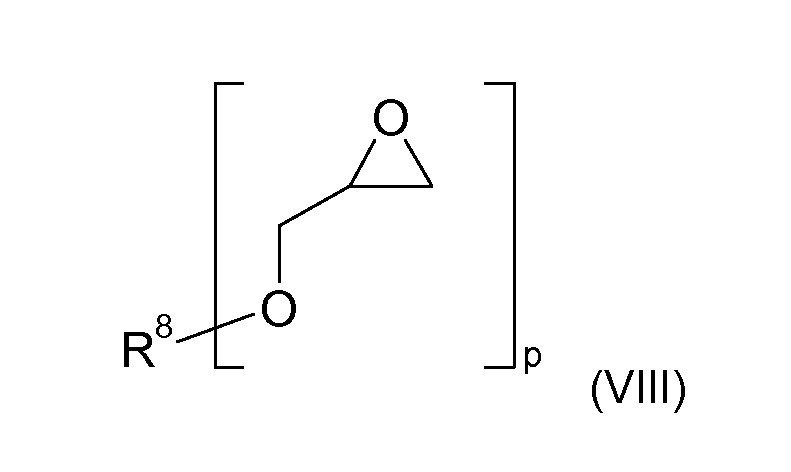
- p
- für eine ganzzahlige Zahl größer gleich 2, besonders bevorzugt für 2, steht; und
- R8
- für einen m-wertigen organischen Rest steht, der p Epoxidgruppen der Verbindung der allgemeinen Formel (VIII) miteinander verbindet.
- Bei den Resten R7 oder R8 kann es sich beispielsweise um mehrwertige lineare und verzweigte C1-C18-Alkylketten handeln, die in ihrer Alkylkette ein oder mehrere Sauerstoffatome umfassen.
- Insbesondere kann es sich bei den Resten R7 und R8 um Butan-, Hexan-, Polyoxypropylenglykol-, Polyoxyethylenglykol-, Polytetrahydrofuran-, oder Polypropylenglykolketten handeln.
- Bei den Resten R7 und R8 kann es sich ferner um Spacer auf Basis von Bisphenolen handeln, die im weiteren näher beschrieben werden.
- Insbesondere ist es bevorzugt, wenn das Epoxidharz auf einer EpoxidVerbindung der allgemeinen Formel (IX) basiert

- R9 und R10, jeweils unabhängig voneinander, für Wasserstoff, C1-C4-Alkyl, Trifluormethyl oder Aryl stehen.
- In der vorstehenden allgemeinen Formel (IX) weisen die Reste bevorzugt folgende Bedeutungen auf:
Verbindung R9 R10 (VIII-a) H H (VIII-b) CH3 CH3 (VIII-c) CF3 CF3 (VIII-d) CH3 C6H5 (VIII-e) CH3 CH2CH3 (VIII-f) C6H5 C6H5 - Besonders bevorzugt basieren die im Rahmen der vorliegenden Erfindung verwendeten Epoxidharze auf den Glycidylethern von Bisphenol A und Bisphenol F. Auch Mischungen von entsprechenden Glycidylethern, beispielsweise von Bisphenol A-Diglycidylether und Bisphenol F-Diglycidylether, können im Rahmen der vorliegenden Erfindung verwendet werden.
- Wie zuvor bereits offenbart umfasst die erfindungsgemäß zu verwendende Epoxidharzformulierung mindestens einen Aminhärter. Hierbei handelt es sich insbesondere nicht um Aminhärter auf Basis von Mannichbasen, die ausgehend von Formaldehyd, Phenol und einem Amin erhalten werden.
- Besonders bevorzugt werden Aminverbindungen in der härtbaren Epoxidharzzusammensetzung der allgemeine Formel (X) verwendet:
NR11R12R13 (X),
in welcher: - R11, R12 und R13, jeweils unabhängig voneinander, für Wasserstoff, einen aliphatischen oder heteroaliphatischen Rest, einen araliphatischen oder heteroaliphatischen Rest, einen cycloaliphatischen oder heterocycloaliphatischen Rest, einen aromatischen oder heteroaromatischen Rest stehen, wobei die jeweiligen Reste substituiert sein können und mindestens ein Rest von R11, R12 und R13 für Wasserstoff steht.
- Im Rahmen der vorliegenden Erfindung ist es insbesondere bevorzugt, wenn der Aminhärter in der härtbaren Epoxidharzformulierung ein Diamin oder Triamin (Polyamin) ist.
- Entsprechende Polyamine können aus der folgenden Gruppe ausgewählt werden:
- (1) aliphatische, cycloaliphatische oder arylaliphatische Diamine, beispielsweise Ethylendiamin, 1,2-Propandiamin, 1,3-Propandiamin, 2-Methyl-1,2-propandiamin, 2,2-Dimethyl-1,3-propandiamin, 1,3-Butandiamin, 1,4-Butandiamin, 1,3-Pentandiamin (DAMP), 1,5-Pentandiamin, 1,5-Diamino-2-methylpentan (MPMD), 2-Butyl-2-ethyl-1,5-pentandiamin (C11-Neodiamin), 1,6-Hexandiamin, 2,5-Dimethyl-1,6-hexandiamin, 2,2,4- und 2,4,4-Trimethylhexamethylendiamin (TMD), 1,7-Heptandiamin, 1,8-Octandiamin, 1,9-Nonandiamin, 1,10-Decandiamin, 1,11-Undecandiamin, 1,12-Dodecandiamin, 1,2-, 1,3- und 1,4-Diaminocyclohexan, Bis-(4-aminocyclohexyl)-methan (H12-MDA), Bis-(4-amino-3-methylcyclohexyl)-methan, Bis-(4-amino-3-ethylcyclohexyl)-methan, Bis-(4-amino-3,5-dimethylcyclohexyl)-methan, Bis-(4-amino-3-ethyl-5-methylcyclohexyl)-methan (M-MECA), 3-Aminomethyl-3,5,5-trimethylcyclohexan, 1-Amino-3-aminomethyl-3,5,5-trimethylcyclohexan (= Isophorondiamin oder IPDA), 2-und 4-Methyl-1,3-diaminocyclohexan und Mischungen davon, 1,3- und 1,4-Bis-(aminomethyl)-cyclohexan, 2,5(2,6 )-Bis-(aminomethyl)-bicyclo[2.2.1]heptan (NBDA), 3(4),8(9)-Bis-(aminomethyl)-tricyclo[5.2.1.02,6]decan, 1,4-Diamino-2,2,6-trimethylcyclohexan (TMCDA), 1,8-M enthandiamin, 3 , 9-Bis-(3-aminopropyl)-2,4,8,10-tetraoxaspiro[5.5]undecan sowie 1,3- und 1,4-Xylylendiamin;
- (2) Ethergruppen-haltige aliphatische Diamine, beispielsweise Bis-(2-aminoethyl)ether, 3,6-Dioxaoctan-1,8-diamin, 4,7-Dioxadecan-1,10-diamin, 4,7-Dioxadecan-2,9-diamin, 4 , 9-Dioxadodecan-1,12-diamin, 5,8-Dioxadodecan-3,10-diamin und höhere Oligomere dieser Diamine, Bis-(3-aminopropyl)poly-tetrahydrofurane und andere Polytetrahydrofurandiamine mit Molekulargewichten im Bereich von beispielsweise 350 bis 5200, sowie Polyoxyalkylen-Diamine. Letztere stellen typischerweise Produkte aus der Aminierung von Polyoxyalkylen-Diolen dar und sind beispielsweise erhältlich unter dem Namen Jeffamine® (von Huntsman), unter dem Namen Polyetheramin (von BASF) oder unter dem Namen PC Amine® (von Nitroil). Insbesondere geeignete Polyoxyalkylen-Diamine sind Jeffamine® D-230, Jeffamine® D-400, Jeffamine® D-2000, Jeffamine® D-4000, Jeffamine® XTJ-511, Jeffamine® ED-600, Jeffamine® ED-900, Jeffamine® ED-2003, Jeffamine® XTJ-568, Jeffamine® XTJ-569, Jeffamine® XTJ-523, Jeffamine® XTJ-536, Jeffamine® XTJ-542, Jeffamine® XTJ-559, Jeffamine® EDR-104, Jeffamine® EDR-148, Jeffamine® EDR-176; Polyetheramin D 230, Polyetheramin D 400 und Polyetheramin D 2000, PC Amine® DA 250, PC Amine® DA 400, PC Amine® DA 650 und PC Amine® DA 2000;
- (3) aliphatische, cycloaliphatische oder arylaliphatische Triamine wie 4-Aminomethyl-1,8-octandiamin, 1,3,5-Tris-(aminomethyl)-benzol, 1,3,5-Tris-(aminomethyl)-cyclohexan, Tris-(2-aminoethyl)-amin, Tris-(2-aminopropyl)-amin, Tris-(3-aminopropyl)-amin;
- (4) Polyoxyalkylen-Triamine, welche typischerweise Produkte aus der Aminierung von Polyoxyalkylen-Triolen darstellen und beispielsweise erhältlich sind unter dem Handelsnamen Jeffamine® (von Huntsman), unter dem Namen Polyetheramin (von BASF) oder unter dem Namen PC Amine® (von Nitroil), wie zum Beispiel Jeffamine® T-403, Jeffamine® T-3000, Jeffamine® T-5000; Polyetheramin T403, Polyetheramin T5000; und PC Amine® TA 403, PC Amine® TA 5000;
- (5) sekundäre und primäre Aminogruppen aufweisende Polyamine, beispielsweise Diethylentriamin (DETA), Dipropylentriamin (DPTA), Bishexamethylentriamin (BHMT), 3-(2-Aminoethyl)aminopropylamin, N3-(3-Aminopentyl)-1,3-pentandiamin, N 5-(3-Aminopropyl)-2-methyl-1,5-pentandiamin, N5-(3-Amino-1-ethylpropyl)-2-methyl-1,5-pentandiamin;
- (6) tertiäre Aminogruppen aufweisende Polyamine, wie beispielsweise N,N'-Bis-(aminopropyl)-piperazin, N,N-Bis-(3-aminopropyl)methylamin, N,N-Bis-(3-aminopropyl)ethylamin, N,N-Bis-(3-aminopropyl)propylamin N,N-Bis-(3-aminopropyl)cyclohexylamin, N,N-Bis-(3-aminopropyl)-2-ethyl-hexylamin, sowie die Produkte aus der doppelten Cyanoethylierung und nachfolgender Reduktion von Fettaminen, welche abgeleitet sind von natürlichen Fettsäuren, wie N,N-Bis-(3-aminopropyl)-dodecylamin und N,N-Bis-(3-aminopropyl)-talgalkylamin, erhältlich als Triameen® Y12D und Triameen® YT (von Akzo Nobel);
- (7) sekundäre Aminogruppen aufweisende Polyamine, wie beispielsweise N,N'-Dibutylethylendiamin; N,N'-Di-tert.butyl-ethylendiamin, N,N'-Diethyl-1,6-hexandiamin, 1-(1-Methylethyl-amino)-3-(1-methylethyl-aminomethyl)-3,5,5-trimethylcyclohexan (Jefflink® 754 von Huntsman), N4-Cyclohexyl-2-methyl-N2-(2-methylpropyl)-2,4-pentandiamin, N,N'-Dialkyl-1,3-xylylendiamin, Bis-(4-(N-alkylamino)-cyclohexyl)-methan, 4,4'-Trimethylendipiperidin, N-alkylierte Polyetheramine, beispielsweise die Jeffamine®-Typen SD-231, SD-401, SD-404 und SD-2001 (von Huntsman); weiterhin sogenannte Polyamidoamine. Als Polyamidoamin wird das Reaktionsprodukt aus einer ein- oder mehrwertigen Carbonsäure, beziehungsweise deren Ester oder Anhydride, und einem aliphatischen, cycloaliphatischen oder aromatischen Polyamin bezeichnet, wobei das Polyamin im stöchiometrischen Überschuss eingesetzt wird. Als mehrwertige Carbonsäure wird üblicherweise eine sogenannte Dimerfettsäure verwendet, und als Polyamin wird üblicherweise ein Polyalkylenamin wie beispielsweise TETA verwendet. Kommerziell erhältliche Polyamidoamine sind beispielsweise Versamid® 100, 125, 140 und 150 (von Cognis), Aradur 223, 250 und 848 (von Huntsman), Euretek® 3607, Euretek 530® (von Huntsman), Beckopox® EH 651, EH 654, EH 655, EH 661 und EH 663 (von Cytec); und
- (8) Umsetzungsprodukte, welche erhalten werden durch Umsetzung der unter (1) bis (7) genannten Amine mit einem Unterschuss Epoxyverbindung (Epoxy-Amin-Addukte).
- Bevorzugt wird der Aminhärter ausgewählt aus der Gruppe, bestehend aus 1,5-Diamino-2-methylpentan (MPMD), 2-Butyl-2-ethyl-1,5-pentandiamin (C11-Neodiamin), 2,2,4- und 2,4,4-Trimethylhexamethylendiamin (TMD), Bis-(4-amino-3-methylcyclohexyl)-methan, 3-Aminomethyl-3,5,5-trimethylcyclohexan, 1-Amino-3-aminomethyl-3,5,5-trimethylcyclohexan (= Isophorondiamin oder IPDA), 1,3-Bis-(aminomethyl)cyclohexan, 3(4),8(9)-Bis-(aminomethyl)-tricyclo[5.2.1.02,6]decan, 1,3-Xylylendiamin, Diethylentriamin (DETA), Dipropylentriamin (DPTA) und ein Ethergruppen-haltiges Diamin aus der Aminierung eines Polyoxyalkylen-Diols mit einem Molekulargewicht von 500 bis 5000 g/mol, insbesondere Jeffamine® D-230 und Jeffamine® D-400.
- Weitere bevorzugte Aminhärter sind
- primäre, sekundäre und tertiäre Aminogruppen aufweisende Polyamine, beispielsweise Gaskamine® A 229, Gaskamine® 240, Gaskamine® 328 (von Mitsubishi Gas Chemical); und
- auf Cashewnussschalenöl (cashew nut shell liquid) basierende Amine, beispielsweise aus der Phenalkamine Curing Agent Serie der Cardolite Corporation.
- Weitere übliche Bestandteile der Epoxidharzformulierung können sein:
- Pigmente, Pigmentpasten und/oder Füllstoffe (z.B. aus der Gruppe von Schwerspat (BaSO4), Calciumcarbonat, Dolomit, Calciumsulfat, Talkum, Kaolin, Glimmer, Feldspat, Wollastonit, Aluminiumsilikat, Zirkonsilikat, Siliziumdioxid in Form von Sand, Quarz, Quarzmehl, Quarzit, Perlit, Glaskugeln; Aluminiumhydroxid, Ruße, Graphitpulver, synthetische Fasern), Antioxidantien, Verlaufs- bzw. Verdickungsmittel, Entschäumer/Entlüfter und/oder Netzmittel, Reaktivverdünner, Lösungsmittel, Konservierungsmittel und Weichmacher.
- Durch die Additivierung der Epoxidharzformulierung mit der Verbindung der allgemeinen Formel (I) kann auf den Zusatz von Benzylalkohol zu der härtbaren Epoxidformulierung verzichtet werden. Daher ist es insbesondere bevorzugt, wenn die Epoxidharzformulierung keinen Benzylalkohol aufweist, da der Einsatz von Benzylalkohol aus Gründen des Umwelt- und Gesundheitsschutzes nicht mehr erwünscht ist bzw. in Zukunft gegebenenfalls nicht mehr zugelassen sein wird.
- Die erfindungsgemäße Verwendung ist insbesondere dann bevorzugt, wenn eine Epoxidharzformulierung gegenüber einer möglichen Carbamatisierung geschützt werden soll, welche ausgelöst wird durch die Belastung der bei tiefen Temperaturen aushärtenden Epoxidharzformulierung mit Frühwasser oder hoher Luftfeuchtigkeit, insbesondere einer relativen Luftfeuchtigkeit von größer 60 %. Im Rahmen der vorliegenden Erfindung wird unter einer bei tiefen Temperaturen aushärtenden Epoxidharzformulierung eine Formulierung verstanden, die bei einer Temperatur von 15 °C oder weniger ausgehärtet wird.
- Die vorliegende Erfindung betrifft daher auch die Verwendung der zuvor beschriebenen Verbindungen der allgemeinen Formel (1), in welcher die Stabilität der Epoxidharzformulierung gegenüber Carbamatisierung bei Belastung der Zusammensetzung mit Frühwasser oder hoher Luftfeuchtigkeit, insbesondere einer relativen Luftfeuchtigkeit von größer 60 %, insbesondere bei tiefen Temperaturen von 15 °C oder weniger verbessert wird.
- Die Frühwasserbeständigkeit im Rahmen der vorliegenden Erfindung beschreibt dabei die Beständigkeit einer Epoxidharzformulierung in nicht vollständig durchgehärtetem Zustand (im Zeitraum 0 bis 14 Tagen nach Applikation bei < 15 °C und > 60 % relativer Luftfeuchtigkeit) gegenüber Wasser. Zur Prüfung der Frühwasserbeständigkeit hat sich im Rahmen der vorliegenden Erfindung ein Zeitraum 0 bis 7 Tagen nach Applikation bei 8 °C und 80 % relativer Luftfeuchtigkeit als geeignet erwiesen.
- Weiterer Gegenstand der vorliegenden Erfindung sind gehärtete Epoxidharzformulierungen, die unter Additivierung mit Verbindungen der allgemeinen Formel (I) erhalten werden und sich durch eine verbesserte Stabilität gegenüber Carbamatisierung, insbesondere bei Frühwasserbelastung und Aushärtung bei Temperaturen von 15 °C oder weniger, auszeichnen.
- Auch die unter Verwendung der erfindungsgemäß vorgesehenen Thiocarbonate hergestellten Beschichtungen, Klebstoffe, Dichtstoffe, Laminier-, Tränk- und Gießharze, Verguss- und Spachtelmassen, Verbundwerkstoffe, Faserverbundstoffe und Modellwerkstoffe zeichnen sich durch eine hohe Frühwasserbeständigkeit besonders bei tiefen Temperaturen von 15 °C oder weniger aus und sind ebenfalls Gegenstand der vorliegenden Erfindung. Unter Beschichtungen sind hierbei vor allem aber nicht nur Bodenbeschichtungen für Wohnbereiche, Aufenthaltsräume, öffentliche Gebäude, wie beispielsweise Schulen, Kindergärten, Behörden, Krankenhäuser; Industriebauten, Fabrik- und Lagerhallen, Geh- und Verbindungswege, Industrieanlagen, Werkstätten, Reinräume, Parkhäuser, -garagen und -decks und Brücken zu verstehen. Weiterhin sind darunter Beschichtungen für Tankanlagen, Auffangwannen, Kühltürme, Rohre, zur Abdichtung von Dächern, Kellern, Behältern beispielsweise für Trinkwasser, Schwimmbäder, Kläranlagen zu verstehen, sowie Beschichtungen zum Korrosions-, Flamm- und Säureschutz metallischer und anderer Oberflächen und Untergründe.
- Zusätzlich zu dem erfindungsgemäßen Effekt der Oberflächenverbesserung, insbesondere gegenüber Einwirkung von Frühwasser, wird durch die vorliegende Erfindung auch eine Beschleunigung der Aushärtung der Epoxidharzformulierung erreicht.
- Die vorliegende Erfindung betrifft daher auch die Verwendung einer zuvor beschriebenen Verbindung der allgemeinen Formel (I), wobei zusätzlich zu der Oberflächenverbesserung auch eine Beschleunigung der Aushärtung der Epoxidharzformulierung erfolgt. Dabei ist es insbesondere bevorzugt, wenn diese Beschleunigung der Aushärtung bei einer Temperatur unterhalb von 20 °C, bevorzugt unterhalb von 15 °C, besonders bevorzugt unterhalb von 10 °C, auftritt.
- Der Gehalt an Verbindung der allgemeinen Formel (I) in der härtbaren Epoxidharzformulierung, jeweils bezogen auf das Epoxidharz, beträgt vorzugsweise 1 bis 50 Gew.-%, bevorzugt 2 bis 30 Gew.-%, besonders bevorzugt 2,5 bis 25 Gew.-%.
- Die vorliegende Erfindung führt zu einer Vielzahl an Vorteilen:
- Da die vorliegende Erfindung keine Mannichbase als Härterkomponente für das Epoxidharz erfordert, ist das resultierende Epoxidharz frei von Phenol, was aufgrund der Toxizität von freiem Phenol von Vorteil ist. Auch auf die Verwendung von Formaldehyd kann im Rahmen der vorliegenden Erfindung verzichtet werden.
- Auch kann auf die Verwendung von Benzylalkohol zur Verhinderung der Carbamatisierung der Aminhärterkomponente verzichtet werden.
- Da im Rahmen der vorliegenden Erfindung auf Formaldehyd-haltige und Phenolhaltige Mannichbasen sowie auf Benzylalkohol verzichtet wird, besteht kein Problem hinsichtlich der Exposition mit diesen Verbindungen. Somit können VOC-freie (VOC = Volatile Organic Compounds) Epoxidharzformulierungen hergestellt werden, die insbesondere auch in geschlossenen Räumen Anwendung finden können.
- Aus den unter Verwendung von Thiocarbonaten hergestellten Epoxidharzformulierungen lassen sich lösemittelarme oder lösemittelfreie Beschichtungen, Klebstoffe, Dichtstoffe, Laminier-, Tränk- und Gießharze, Verguss- und Spachtelmassen, Verbundwerkstoffe, Faserverbundstoffe und Modellwerkstoffe herstellen.
- Weiterer Gegenstand der vorliegenden Erfindung ist ein Verfahren zur Herstellung von gehärteten Epoxidharzformulierungen mit einer verbesserten Oberfläche besonders bei Aushärtung bei tiefen Temperaturen von 15 °C oder weniger durch Härten einer Epoxidverbindung mit mindestens einem Aminhärter, wobei die Härtung in Gegenwart von mindestens einer Verbindung der allgemeinen Formel (I) durchgeführt wird

- Z1, Z2 und Z3, jeweils unabhängig voneinander, für Sauerstoff oder Schwefel stehen;
- R1 für Wasserstoff, einen aliphatischen oder heteroaliphatischen Rest, einen araliphatischen oder heteroaliphatischen Rest, einen cycloaliphatischen oder heterocyclischen aliphatischen Rest, einen aromatischen oder heteroaromatischen Rest steht;
- R2 für einen gegebenenfalls substituierten Rest CxH2x-1 mit X gleich 1 bis 5 steht; und
- n für eine ganzzahlige Zahl von 1 bis 5 steht;
- Insbesondere umfasst der Aminhärter keine Mannichbasen-Struktureinheit der folgenden allgemeinen Formel

- Im Rahmen dieses Verfahrens wird im Allgemeinen eine Kombination von zu härtendem Epoxidharz mit der Verbindung der allgemeinen Formel (I) bereitgestellt und dann mit einem entsprechenden Aminhärter umgesetzt.
- In diesem Verfahren werden die zuvor beschriebenen Bestandteile einer Verbindung der allgemeinen Formel (I), eines Epoxidharzes und eines Aminhärters verwendet. Insoweit wird auf die obigen Ausführungen verwiesen.
- Dieses erfindungsgemäße Verfahren dient zur Herstellung von Beschichtungen, Klebstoffen, Dichtstoffen, Laminier-, Tränk- und Gießharze, Verguss- und Spachtelmassen, Verbundwerkstoffe, Faserverbundstoffe und Modellwerkstoffe, die somit ebenfalls Gegenstand der vorliegenden Erfindung sind.
- Die vorliegende Erfindung wird anhand der nachfolgenden Beispiele näher erläutert.
- 400 g Diisopropylnaphthalin und 0,5 g LiBr werden vorgelegt und unter gutem Rühren mit 155 g CS2 versetzt. 400 g Epoxidharz A werden zügig zugegeben und bei Raumtemperatur über Nacht gerührt. Weitere 400 g Epoxidharz A werden zur Reaktionsmischung gegeben und 6 bis 8 h auf 50 °C Innentemperatur erhitzt.
- Eine Komponente A1 wurde aus 29,95 g Epoxidharz A, 8,56 g Epoxidharz F, 0,26 g Bentone SD 2, 19,34 g Quarzmehl Dorsilit 10000 Mipur, 19,34 g Sikron M 500, 4,28 g Epoxide No 8, 0,86 g Byk A-525, 2,995 g Bayferrox 130 BM und 14,44 g Ruetasolv DI hergestellt.
- Eine Komponente A2 wurde aus 27,01 g Epoxidharz A, 8,13 g Epoxidharz F, 0,26 g Bentone SD 2, 19,34 g Quarzmehl Dorsilit 10000 Mipur, 19,34 g Sikron M 500, 4,28 g Epoxide No 8, 0,86 g Byk A-525, 2,995 g Bayferrox 130 BM, 13,00 g Ruetasolv DI und 4,81 g der oben beschriebenen 1,3-Oxathiolanthion-Mischung hergestellt.
- Eine Komponente A3 wurde aus 24,06 g Epoxidharz A, 7,70 g Epoxidharz F, 0,26 g Bentone SD 2, 19,34 g Quarzmehl Dorsilit 10000 Mipur, 19,34 g Sikron M 500, 4,28 g Epoxide No 8, 0,86 g Byk A-525, 2,995 g Bayferrox 130 BM, 11,55 g Ruetasolv DI und 9,63 g der oben beschriebenen 1,3-Oxathiolanthion-Mischung hergestellt.
- Eine Komponente A4 wurde aus 19,86 g Epoxidharz A, 5,98 g Epoxidharz F, 0,26 g Bentone SD 2, 19,34 g Quarzmehl Dorsilit 10000 Mipur, 19,34 g Sikron M 500, 4,28 g Epoxide No 8, 0,86 g Byk A-525, 2,995 g Bayferrox 130 BM, 9,56 g Ruetasolv DI und 30 g der oben beschriebenen 1,3-Oxathiolanthion-Mischung hergestellt.
- Eine Komponente A5 wurde aus 0,54 g Epoxidharz A, 4,28 g Epoxidharz F, 0,26 g Bentone SD 2, 19,34 g Quarzmehl Dorsilit 10000 Mipur, 19,34 g Sikron M 500, 4,28 g Epoxide No 8, 0,86 g Byk A-525, 2,995 g Bayferrox 130 BM, 14,44 g Ruetasolv DI und 48,13 g der oben beschriebenen 1,3-Oxathiolanthion-Mischung hergestellt.
- Eine Komponente B1 wurde aus 20 g Vestamin IPD, 20 g m-Xylendiamin, 40 g Novares LS 500 und 20 g Ruetasolv DI hergestellt.
- Eine Komponente B2 wurde aus 50 g Vestamin IPD und 50 g m-Xylendiamin hergestellt.
- Alle Proben wurden bei 8 °C und 80 % relativer Luftfeuchtigkeit gehärtet. In den einzelnen Anwendungsbeispielen wurde das stöchiometrische Verhältnis der funktionellen Epoxidgruppen und gegebenenfalls Thiocarbonatgruppen (aus Epoxidharz und gegebenenfalls erfindungsgemäßer Additivierung durch die 1,3-Oxathiolanthion-Verbindung) sowie Aminhärter konstant gehalten.
- Komponenten A1 und B1 wurden im Verhältnis 82:18 bezüglich des Gewichts gemischt.
- Komponenten A3 und B1 wurden im Verhältnis 83:17 bezüglich des Gewichts gemischt.
- Komponenten A4 und B1 wurden im Verhältnis 81:19 bezüglich des Gewichts gemischt.
- Komponenten A1 und B2 wurden im Verhältnis 92:8 bezüglich des Gewichts gemischt.
- Komponenten A3 und B2 wurden im Verhältnis 93:7 bezüglich des Gewichts gemischt.
- Komponenten A4 und B2 wurden im Verhältnis 93:7 bezüglich des Gewichts gemischt.
- Komponenten A5 und B2 wurden im Verhältnis 93:7 bezüglich des Gewichts gemischt.
- Zur Ermittlung der Frühwasserbeständigkeit wurden Aluminiumplatten (115 cm2) mit 1,75 kg/m2 der jeweiligen Formulierungen der Komponenten A und B beschichtet (Schichtdicke ca. 2 mm). Die Komponente B wurde dazu zur Komponente A gegeben und bis zum Vorliegen einer homogenen Mischung gerührt. Die resultierende Mischung wurde mit einem Spachtel gleichmäßig auf der Aluminiumplatte verteilt.
- Die Oberflächen der bei 8 °C und 80% rel. Luftfeuchte aushärtenden Systeme aus den Beispielen 1 bis 7 werden nach 24 h, 48 h, 72 h und 168 h jeweils für 24 h mit einem feuchten Schwamm belegt und dieser mit einem Becher abgedeckt. Die Oberflächen wurden im Anschluss hinsichtlich ihres Glanzes und des Weißanlaufens nach Skala 1 an drei Stellen (Auflagefläche Schwamm, unbelegte Fläche, Fläche unter Becher neben Schwamm) beurteilt.
t Beispiel 1 Beispiel 2 Beispiel 3 Beispiel 4 Beispiel 5 Beispiel 6 Beispiel7 24 h 4/1/2 3/1/0 0/0/0 ***/2/4 4/0/1 2/0/1 0/0/0 48 h 2/1/2 3/1/0 0/0/0 4**/1/2 3/0/1 2/0/1 0/0/0 72 h 1/1/1 1/1/0 0/0/0 4**/1/2 3/0/1 2/0/0 0/0/0 168 h 1/1/1 1/1/0 0/0/0 4**/1/2 3/0/0 2/0/0 0/0/0 -
6 Weiß angelaufen mit tiefen Rissen 5 Weiß angelaufen mit kleinen Rissen 4 100% weiß angelaufen 3 100% schwach weiß angelaufen 2 Teilweiße weiß angelaufen (50-90%) 1 Teilweiße weiß angelaufen (0-50%) 0 Nicht weiß angelaufen *** Schwamm klebt stark an Oberfläche
** Schwamm klebt an Oberfläche
* Schwamm klebt leicht an Oberfläche - Die Härtungsgeschwindigkeit wurde anhand der Messung der Shore Härte D der aushärtenden Beschichtung bei 2 mm Schichtdicke verfolgt.
t Beispiel 4 Beispiel 5 Beispiel 6 Beispiel 7 Beispiel8 24 h -* -* -* 58 47 48 h 26 55 66 66 61 72 h 60 66 68 70 62 168 h 72 73 74 75 68 * Messung noch nicht möglich, da noch unzureichend ausgehärtet. - Es zeigte sich, dass die Proben der Formulierungen, welche unter Verwendung des 1,3-Oxathiolan-2-thions hergestellt wurden, deutlich glänzender und vor allem auch bei Frühwasserbelastung resistenter gegen ein Weißanlaufen, welches durch eine Carbamatisierung ausgelöst wird, sind.
- Diese Beispiele zeigen, dass durch Zusatz des 1,3-Oxathiolan-2-thions es möglich ist, benzylalkoholfreie Beschichtungen zu formulieren, die den bisherigen, insbesondere bei tiefen Temperaturen hinsichtlich Frühwasserbelastbarkeit und Härtungsgeschwindigkeit, überlegen sind. Aus der höheren Aushärtungsgeschwindigkeit ergibt sich die Möglichkeit, ein breiteres Spektrum an Aminen einzusetzen, beispielsweise solche, die billiger sind, aber für die bisherigen Systeme zu langsam waren in der Härtungsreaktion. Weiterhin ist ein Verzicht auf Benzylalkohol möglich, der es erlaubt VOC-freie Beschichtungen, die auch bei tiefen Temperaturen aushärten ohne weiß anzulaufen, herzustellen.
Es wurde festgestellt, dass die Härtungsgeschwindigkeit bei gleicher Zusammensetzung der Komponente B in allen Versuchsreihen mit dem zunehmenden Anteil an dem 1,3-Oxathiolan-2-thion steigt. - In den zuvor beschriebenen Anwendungsbeispielen wurden folgende Komponenten verwendet:
Name Funktion Hersteller EPIKOTE™ Resin 828LVEL Epoxidharz A Momentive Specialty Chemicals EPIKOTE ™ Resin 862 Epoxidharz F Momentive Specialty Chemicals Bentone® SD2 Verdickungsmittel Elementis Specialties Dorsilit® 10000 Mipur Füllstoff Quarzmehl Dorfner Sikron® M 500 Füllstoff Quarzmehl Quarzwerke GmbH HELOXY ™ Modifier Z8 Epoxide No 8: Epoxid-Reaktivverdünner Momentive Specialty Chemicals BYK®-A 525 Entlüftungsmittel Byk Chemie Bayferrox® 130 BM Rotpigment Lanxess RUETASOLV® DI Weichmacher RKS GmbH Vestamin® IPD aliphatisches Amin Evonik Degussa m-Xylylendiamin Amin Mitsubishi Gas Chemical Novares LS 500 Flüssiges Kohlenwasserstoffharz Rütgers Germany GmbH Bisphenol-A-Oxathiolanthion (BPA-DTC) Modifiziertes Harz Eigene Herstellung
in welcher der Aminhärter keine Mannichbase umfasst, die erhalten wird durch ein Formaldehyd-Kondensat zwischen einem Phenol und einem aliphatischen Mono- oder Polyamin.
Claims (15)
- Verwendung von(1) mindestens einer Verbindung der allgemeinen Formel (I)
 - Z1, Z2 und Z3, jeweils unabhängig voneinander, für Sauerstoff oder Schwefel mit der Maßgabe stehen, dass zumindest ein Rest von Z1, Z2 und Z3 für Schwefel steht;- R1 für Wasserstoff, einen aliphatischen oder heteroaliphatischen Rest, einen araliphatischen oder heteroaliphatischen Rest, einen cycloaliphatischen oder heterocyclischen aliphatischen Rest, einen aromatischen oder heteroaromatischen Rest steht;- R2 für einen gegebenenfalls substituierten Rest CxH2x-1 mit x gleich 1 bis 5 steht; und- n für eine ganzzahlige Zahl von 1 bis 5 steht;in einer härtbaren Epoxidharzformulierung, umfassend(2) mindestens ein Epoxidharz und(3) mindestens einen Aminhärter,zur Oberflächenverbesserung der gehärteten Epoxidharzformulierung, dadurch gekennzeichnet, dass der mindestens eine Aminhärter keine Mannichbase umfasst, die erhalten wird durch ein Formaldehyd-Kondensat zwischen einem Phenol und einem aliphatischen Mono- oder Polyamin.
 - Verwendung nach Anspruch 1, dadurch gekennzeichnet, dass in der Verbindung der allgemeinen Formel (I) die Reste Z1, Z2 und Z3 eine der folgenden Bedeutungen aufweisen:
Verbindung Z1 Z2 Z3 (Ia) O O S (Ib) O S S (Ic) O S O - Verwendung nach Anspruch 1 oder 2, dadurch gekennzeichnet, dass die Verbindung der allgemeinen Formel (I) der allgemeinen Formel (II) entspricht
 - die Reste Z1, Z2 und Z3 die vorstehenden Bedeutungen aufweisen; und- die Reste R3 und R4, jeweils unabhängig voneinander, für Wasserstoff, C1-C4-Alkyl, Trifluormethyl oder Aryl stehen.
 - Verwendung nach Anspruch 1 oder 2, dadurch gekennzeichnet, dass die Verbindung der allgemeinen Formel (I) der allgemeinen Formel (III) entspricht
 - Z1a, Z2a, Z3a, Z1b, Z2b und Z3b jeweils unabhängig voneinander für Schwefel oder Sauerstoff mit der Maßgabe stehen, dass zumindest ein Rest von Z1a, Z2a und Z3a für Schwefel und zumindest ein Rest von Z1b, Z2b und Z3b für Schwefel steht; und- R3 und R4, jeweils unabhängig voneinander, für Wasserstoff, C1-C4-Alkyl, Trifluormethyl oder Aryl stehen.
 - Verwendung nach einem der Ansprüche 1 bis 4, dadurch gekennzeichnet, dass das Epoxidharz auf einer Epoxidverbindung der allgemeinen Formel (VII) basiert:
 m für eine ganzzahlige Zahl größer gleich 2, besonders bevorzugt für 2, steht; undR7 für einen m-wertigen organischen Rest steht, der m Epoxidgruppen der Verbindung der allgemeinen Formel (VII) miteinander verbindet.
 - Verwendung nach einem der Ansprüche 1 bis 5, dadurch gekennzeichnet, dass die Epoxidharzformulierung keinen Benzylalkohol umfasst.
- Verwendung nach einem der Ansprüche 1 bis 6, dadurch gekennzeichnet, dass die Verbindung der allgemeinen Formel (I) durch Umsetzung von(a) mindestens einer Epoxidverbindung mit(b) Schwefelkohlenstoff, Kohlenoxidsulfid oder einer Mischung davon in Gegenwart eines Salzes erhalten wird.
- Verwendung nach Anspruch 7, dadurch gekennzeichnet, dass die Epoxidverbindung ausgewählt wird aus der Gruppe, bestehend aus Bisphenol A-diglycidylether (BADGE), Bisphenol F-diglycidylether (BFDGE), Polypropylenglykoldiglycidylether, Polytetrahydrofurandiglycidylether, linearen und verzweigten C1-C18-Alkylglycidylether (beispielsweise C12/C14-Alkylglycidylether, C13/C15-Alkylglycidylether, 2-Ethylhexylglycidylether), para-tert.-Butylphenolmonoglycidylether, o-Cresylglycidylether, Glycidylether des Cashewnusschalenöls, Diglycidylether von Dialkoholen wie beispielsweise 1,4-Butandiol, 1,6-Hexandiol, Neopentylglykol, Cyclohexandimethanol; Glycerintriglycidylether, Trimethylolpropanetriglycidylether, Polyglycerol-3-glycidylether, Polyoxypropylenglykoltriglycidylether, Rizinusöltriglycidylether, Pentaerythrityltetraglycidylether, Rizinusölpolyglycidylether, Glycidylester von C1-C18-Carbonsäuren, Addukten von Bisphenol A und Epichlorhydrin und Polyglycidylether von Phenol-Formaldehyd-Novolaken.
- Verwendung nach Anspruch 8, dadurch gekennzeichnet, dass die Epoxidverbindung Bisphenol-A-diglycidylether (BADGE) ist.
- Verwendung nach einem der Ansprüche 1 bis 9, dadurch gekennzeichnet, dass der Gehalt an Verbindung der allgemeinen Formel (I) in der härtbaren Epoxidharzformulierung, bezogen auf das zu härtende Epoxidharz, 1 bis 50 Gew.-% beträgt.
- Verwendung nach einem der Ansprüche 1 bis 10 zur Herstellung von lösemittelarmen oder lösemittelfreien Beschichtungen, insbesondere Bodenbeschichtungen für Wohnbereiche, Aufenthaltsräume, öffentliche Gebäude, Industriebauten, Fabrik- und Lagerhallen, Geh- und Verbindungswege, Industrieanlagen, Werkstätten, Reinräume, Parkhäuser, -garagen sowie - decks und Brücken, Beschichtungen für Tankanlagen, Auffangwannen, Kühltürme, Rohre, zur Abdichtung von Dächern, Kellern, Behältern, wie für Trinkwasser, Schwimmbäder und Kläranlagen, Beschichtungen zum Korrosions-, Flamm- und Säureschutz metallischer und anderer Oberflächen und Untergründe; Klebstoffen, Dichtstoffen, Laminier-, Tränk- und Gießharze, Verguss- und Spachtelmassen, Verbundwerkstoffe, Faserverbundstoffe und Modellwerkstoffe.
- Verfahren zur Herstellung von gehärteten Epoxidharzformulierungen mit verbesserter Oberfläche durch Härten eines Epoxidharzes mit mindestens einem Aminhärter, dadurch gekennzeichnet, dass die Härtung in Gegenwart von mindestens einer Verbindung der allgemeinen Formel (I) gemäß der Definition in einem der Ansprüche 1 bis 4 durchgeführt wird.
- Verfahren nach Anspruch 12, dadurch gekennzeichnet, dass in dem Verfahren ein Epoxidharz mit den Merkmalen gemäß Anspruch 5 verwendet wird.
- Verfahren nach Anspruch 12 oder 13, dadurch gekennzeichnet, dass in dem Verfahren ein Aminhärter verwendet wird.
- Gehärtetes Epoxidharz, erhältlich nach einem Verfahren gemäß einem der Ansprüche 12 bis 14.
Priority Applications (2)
| Application Number | Priority Date | Filing Date | Title |
|---|---|---|---|
| EP10196427A EP2468791A1 (de) | 2010-12-22 | 2010-12-22 | Verwendung von Thiocarbonaten in Epoxidharzformulierungen zur Oberflächenverbesserung |
| PCT/EP2011/073644 WO2012085120A2 (de) | 2010-12-22 | 2011-12-21 | Verwendung von thiocarbonaten in epoxidharzformulierungen zur oberflächenverbesserung |
Applications Claiming Priority (1)
| Application Number | Priority Date | Filing Date | Title |
|---|---|---|---|
| EP10196427A EP2468791A1 (de) | 2010-12-22 | 2010-12-22 | Verwendung von Thiocarbonaten in Epoxidharzformulierungen zur Oberflächenverbesserung |
Publications (1)
| Publication Number | Publication Date |
|---|---|
| EP2468791A1 true EP2468791A1 (de) | 2012-06-27 |
Family
ID=44223527
Family Applications (1)
| Application Number | Title | Priority Date | Filing Date |
|---|---|---|---|
| EP10196427A Withdrawn EP2468791A1 (de) | 2010-12-22 | 2010-12-22 | Verwendung von Thiocarbonaten in Epoxidharzformulierungen zur Oberflächenverbesserung |
Country Status (2)
| Country | Link |
|---|---|
| EP (1) | EP2468791A1 (de) |
| WO (1) | WO2012085120A2 (de) |
Cited By (12)
| Publication number | Priority date | Publication date | Assignee | Title |
|---|---|---|---|---|
| CN104789083A (zh) * | 2015-04-20 | 2015-07-22 | 无锡市太湖防腐材料有限公司 | 基于环氧树脂的快干磷酸锌防腐蚀底漆及其制备方法 |
| WO2019034473A1 (en) | 2017-08-17 | 2019-02-21 | Basf Se | PROCESS FOR PRODUCING A POLYMER HAVING URETHAN GROUPS |
| WO2019034470A1 (en) | 2017-08-17 | 2019-02-21 | Basf Se | PROCESS FOR PRODUCING A POLYMER HAVING URETHANE GROUPS |
| WO2019034469A1 (en) | 2017-08-17 | 2019-02-21 | Basf Se | PROCESS FOR THE PREPARATION OF THIOCARBONATES |
| WO2020043517A1 (en) | 2018-08-28 | 2020-03-05 | Basf Se | Polymers of a compound comprising a monothiocarbonate group and an ethylenically unsaturated group |
| WO2020109053A1 (en) | 2018-11-30 | 2020-06-04 | Basf Se | Coating composition or sealant comprising a compound with a five-membered cyclic monothiocarbonat group |
| US10711116B2 (en) | 2014-09-23 | 2020-07-14 | Fischerwerke Gmbh & Co. Kg | Fixing systems having fine-particle fillers |
| WO2020148421A1 (en) | 2019-01-18 | 2020-07-23 | Basf Se | Method for the preparation of thiocarbonates |
| WO2020161281A1 (en) | 2019-02-08 | 2020-08-13 | Basf Se | Preparation of a cured polymer comprising urethane groups and silicon atoms |
| CN113316570A (zh) * | 2019-01-18 | 2021-08-27 | 巴斯夫欧洲公司 | 制备具有环状单硫代碳酸酯基团的化合物的方法 |
| US12486438B2 (en) | 2018-07-04 | 2025-12-02 | Basf Se | Adhesive method using two-component adhesives based on compounds having cyclothiocarbonate units |
| EP4741438A1 (de) | 2024-11-06 | 2026-05-13 | Basf Se | Oxathiolanongruppenhaltiges additiv in einer härtbaren epoxidharzzusammensetzung |
Citations (7)
| Publication number | Priority date | Publication date | Assignee | Title |
|---|---|---|---|---|
| US3554967A (en) * | 1969-01-21 | 1971-01-12 | Gen Tire & Rubber Co | Accelerated epoxy-amine resinous compositions catalyzed with -sh yielding material |
| JP2000204159A (ja) * | 1998-11-10 | 2000-07-25 | Nippon Paint Co Ltd | 硬化性組成物及び塗料 |
| JP2003041227A (ja) * | 2001-05-21 | 2003-02-13 | Sanyo Chem Ind Ltd | コンタクト接着剤 |
| JP2003263921A (ja) * | 2002-03-08 | 2003-09-19 | Kyocera Chemical Corp | 導電性ペースト |
| JP2004047191A (ja) * | 2002-07-10 | 2004-02-12 | Kyocera Chemical Corp | 絶縁性ペースト |
| JP2005255852A (ja) | 2004-03-11 | 2005-09-22 | Aica Kogyo Co Ltd | エポキシ樹脂系塗り床材用組成物及び塗り床材 |
| US20070149726A1 (en) * | 2004-07-13 | 2007-06-28 | Yukio Isobe | Curable compositions having improved adhesion performance |
-
2010
- 2010-12-22 EP EP10196427A patent/EP2468791A1/de not_active Withdrawn
-
2011
- 2011-12-21 WO PCT/EP2011/073644 patent/WO2012085120A2/de not_active Ceased
Patent Citations (7)
| Publication number | Priority date | Publication date | Assignee | Title |
|---|---|---|---|---|
| US3554967A (en) * | 1969-01-21 | 1971-01-12 | Gen Tire & Rubber Co | Accelerated epoxy-amine resinous compositions catalyzed with -sh yielding material |
| JP2000204159A (ja) * | 1998-11-10 | 2000-07-25 | Nippon Paint Co Ltd | 硬化性組成物及び塗料 |
| JP2003041227A (ja) * | 2001-05-21 | 2003-02-13 | Sanyo Chem Ind Ltd | コンタクト接着剤 |
| JP2003263921A (ja) * | 2002-03-08 | 2003-09-19 | Kyocera Chemical Corp | 導電性ペースト |
| JP2004047191A (ja) * | 2002-07-10 | 2004-02-12 | Kyocera Chemical Corp | 絶縁性ペースト |
| JP2005255852A (ja) | 2004-03-11 | 2005-09-22 | Aica Kogyo Co Ltd | エポキシ樹脂系塗り床材用組成物及び塗り床材 |
| US20070149726A1 (en) * | 2004-07-13 | 2007-06-28 | Yukio Isobe | Curable compositions having improved adhesion performance |
Non-Patent Citations (5)
| Title |
|---|
| DATABASE WPI Week 200063, Derwent World Patents Index; AN 2000-649441, XP002648863 * |
| DATABASE WPI Week 200332, Derwent World Patents Index; AN 2003-336804, XP002648862 * |
| JOURNAL OF ORGANIC CHEMISTRY, vol. 58, 1993, pages 6198 |
| JOURNAL OF ORGANIC CHEMISTRY, vol. 60, 1995, pages 473 |
| ORGANIC LETTERS, vol. 4, no. 15, 2002, pages 2561 - 2563 |
Cited By (40)
| Publication number | Priority date | Publication date | Assignee | Title |
|---|---|---|---|---|
| US11795301B2 (en) | 2014-09-23 | 2023-10-24 | Fischerwerke Gmbh & Co. Kg | Fixing systems having fine-particle fillers |
| US10711116B2 (en) | 2014-09-23 | 2020-07-14 | Fischerwerke Gmbh & Co. Kg | Fixing systems having fine-particle fillers |
| CN104789083A (zh) * | 2015-04-20 | 2015-07-22 | 无锡市太湖防腐材料有限公司 | 基于环氧树脂的快干磷酸锌防腐蚀底漆及其制备方法 |
| CN104789083B (zh) * | 2015-04-20 | 2017-07-25 | 无锡市太湖防腐材料有限公司 | 基于环氧树脂的快干磷酸锌防腐蚀底漆及其制备方法 |
| KR20200041930A (ko) * | 2017-08-17 | 2020-04-22 | 바스프 에스이 | 우레탄 기를 갖는 중합체의 제조 방법 |
| WO2019034470A1 (en) | 2017-08-17 | 2019-02-21 | Basf Se | PROCESS FOR PRODUCING A POLYMER HAVING URETHANE GROUPS |
| CN111032735A (zh) * | 2017-08-17 | 2020-04-17 | 巴斯夫欧洲公司 | 制备具有氨基甲酸酯基团的聚合物的方法 |
| CN111032736A (zh) * | 2017-08-17 | 2020-04-17 | 巴斯夫欧洲公司 | 制备具有氨基甲酸酯基团的聚合物的方法 |
| US11780964B2 (en) | 2017-08-17 | 2023-10-10 | Basf Se | Process for the manufacturing of a polymer with urethane groups |
| KR20200041927A (ko) * | 2017-08-17 | 2020-04-22 | 바스프 에스이 | 우레탄 기를 갖는 중합체의 제조 방법 |
| US11247979B2 (en) | 2017-08-17 | 2022-02-15 | Basf Se | Method for the preparation of thiocarbonates |
| WO2019034469A1 (en) | 2017-08-17 | 2019-02-21 | Basf Se | PROCESS FOR THE PREPARATION OF THIOCARBONATES |
| EP3954678A1 (de) | 2017-08-17 | 2022-02-16 | Basf Se | Fünfgliedrige zyklische monothiocarbonate |
| US12049458B2 (en) | 2017-08-17 | 2024-07-30 | Basf Se | Thiocarbonate compounds |
| US11958823B2 (en) | 2017-08-17 | 2024-04-16 | Basf Se | Process for the manufacturing of a polymer with urethane groups |
| JP2020531624A (ja) * | 2017-08-17 | 2020-11-05 | ビーエーエスエフ ソシエタス・ヨーロピアBasf Se | ウレタン基を有するポリマーを製造する方法 |
| JP2020531616A (ja) * | 2017-08-17 | 2020-11-05 | ビーエーエスエフ ソシエタス・ヨーロピアBasf Se | ウレタン基を有するポリマーを製造する方法 |
| WO2019034473A1 (en) | 2017-08-17 | 2019-02-21 | Basf Se | PROCESS FOR PRODUCING A POLYMER HAVING URETHAN GROUPS |
| US12486438B2 (en) | 2018-07-04 | 2025-12-02 | Basf Se | Adhesive method using two-component adhesives based on compounds having cyclothiocarbonate units |
| US12060458B2 (en) | 2018-08-28 | 2024-08-13 | Basf Se | Polymers of a compound comprising a monothiocarbonate group and an ethylenically unsaturated group |
| WO2020043517A1 (en) | 2018-08-28 | 2020-03-05 | Basf Se | Polymers of a compound comprising a monothiocarbonate group and an ethylenically unsaturated group |
| EP3887427A1 (de) * | 2018-11-30 | 2021-10-06 | Basf Se | Beschichtungszusammensetzung oder dichtungsmittel mit einer verbindung mit einer fünfgliedrigen cyclischen monothiocarbonatgruppe |
| CN113166403A (zh) * | 2018-11-30 | 2021-07-23 | 巴斯夫欧洲公司 | 包含具有五元环状单硫代碳酸酯基团的化合物的涂料组合物或密封剂 |
| JP2022508261A (ja) * | 2018-11-30 | 2022-01-19 | ビーエーエスエフ ソシエタス・ヨーロピア | 5員環モノチオカーボネート基を有する化合物を含むコーティング組成物又はシーラント |
| WO2020109053A1 (en) | 2018-11-30 | 2020-06-04 | Basf Se | Coating composition or sealant comprising a compound with a five-membered cyclic monothiocarbonat group |
| US12286510B2 (en) | 2018-11-30 | 2025-04-29 | Basf Se | Coating composition or sealant comprising a compound with a five- membered cyclic monothiocarbonate group |
| US20210395454A1 (en) * | 2018-11-30 | 2021-12-23 | Basf Se | Coating composition or sealant comprising a compound with a five-membered cyclic monothiocarbonate group |
| CN113166403B (zh) * | 2018-11-30 | 2023-12-15 | 巴斯夫欧洲公司 | 包含具有五元环状单硫代碳酸酯基团的化合物的涂料组合物或密封剂 |
| KR20210095920A (ko) * | 2018-11-30 | 2021-08-03 | 바스프 에스이 | 5원 시클릭 모노티오카르보네이트 기를 갖는 화합물을 포함하는 코팅 조성물 또는 실란트 |
| WO2020148421A1 (en) | 2019-01-18 | 2020-07-23 | Basf Se | Method for the preparation of thiocarbonates |
| US11897861B2 (en) | 2019-01-18 | 2024-02-13 | Basf Se | Method for the preparation of compounds with cyclic monothiocarbonate groups |
| CN113316570A (zh) * | 2019-01-18 | 2021-08-27 | 巴斯夫欧洲公司 | 制备具有环状单硫代碳酸酯基团的化合物的方法 |
| US12286416B2 (en) | 2019-01-18 | 2025-04-29 | Basf Se | Method for the preparation of thiocarbonates |
| US11384207B2 (en) | 2019-02-08 | 2022-07-12 | Basf Se | Preparation of a cured polymer comprising urethane groups and silicon atoms |
| WO2020161355A1 (en) | 2019-02-08 | 2020-08-13 | Basf Se | One-component sealant or adhesive composition |
| WO2020161281A1 (en) | 2019-02-08 | 2020-08-13 | Basf Se | Preparation of a cured polymer comprising urethane groups and silicon atoms |
| US11365289B2 (en) * | 2019-02-08 | 2022-06-21 | Basf Se | One-component sealant or adhesive composition |
| KR102842391B1 (ko) | 2019-02-08 | 2025-08-06 | 바스프 에스이 | 1-성분 실란트 또는 접착제 조성물 |
| KR20210124376A (ko) * | 2019-02-08 | 2021-10-14 | 바스프 에스이 | 1-성분 실란트 또는 접착제 조성물 |
| EP4741438A1 (de) | 2024-11-06 | 2026-05-13 | Basf Se | Oxathiolanongruppenhaltiges additiv in einer härtbaren epoxidharzzusammensetzung |
Also Published As
| Publication number | Publication date |
|---|---|
| WO2012085120A3 (de) | 2012-11-22 |
| WO2012085120A2 (de) | 2012-06-28 |
Similar Documents
| Publication | Publication Date | Title |
|---|---|---|
| WO2012085120A2 (de) | Verwendung von thiocarbonaten in epoxidharzformulierungen zur oberflächenverbesserung | |
| EP2776488B1 (de) | Härter für epoxidharz-beschichtungen | |
| EP2731927B1 (de) | Emissionsarmer härter für epoxidharze | |
| EP3344677B1 (de) | Emissionsarme epoxidharz-zusammensetzung | |
| EP2336213B1 (de) | Niedrigviskose Epoxidharz-Zusammensetzung mit geringem Blushing | |
| EP2776490B1 (de) | Härter für epoxidharz-beschichtungen | |
| EP2288639B1 (de) | Polyamin mit reduziertem blushing und dessen verwendung als härter für epoxidharze | |
| EP2731979B1 (de) | Härter für epoxidharze | |
| EP2776489B1 (de) | Aromatische aminogruppen aufweisende härter für epoxidharze | |
| EP2651876A1 (de) | Polyamine mit sekundären aliphatischen aminogruppen | |
| EP3180382B1 (de) | Amin für emissionsarme epoxidharz-zusammensetzungen | |
| EP3144335A1 (de) | Amin für emissionsarme epoxidharz-zusammensetzungen | |
| EP2776486B1 (de) | Pyridinylgruppen aufweisende härter für epoxidharze | |
| EP3144334A1 (de) | Härter für emissionsarme epoxidharz-zusammensetzungen | |
| EP3252091B1 (de) | Tetrahydrofuran-diamin | |
| EP3344678A1 (de) | Amin für emissionsarme epoxidharz-zusammensetzungen | |
| WO2014108380A1 (de) | Reduktion der benzylalkoholemissionen von epoxyaminformulierungen durch zugabe von cyclodextrin | |
| WO2017202778A1 (de) | 1-phenyl-1,2-ethandiol als ersatz von benzylalkohol in amin gehärteten epoxidharzmaterialien |
Legal Events
| Date | Code | Title | Description |
|---|---|---|---|
| AK | Designated contracting states |
Kind code of ref document: A1 Designated state(s): AL AT BE BG CH CY CZ DE DK EE ES FI FR GB GR HR HU IE IS IT LI LT LU LV MC MK MT NL NO PL PT RO RS SE SI SK SM TR |
|
| AX | Request for extension of the european patent |
Extension state: BA ME |
|
| PUAI | Public reference made under article 153(3) epc to a published international application that has entered the european phase |
Free format text: ORIGINAL CODE: 0009012 |
|
| STAA | Information on the status of an ep patent application or granted ep patent |
Free format text: STATUS: THE APPLICATION IS DEEMED TO BE WITHDRAWN |
|
| 18D | Application deemed to be withdrawn |
Effective date: 20130103 |