EP2468060B1 - Method for transmitting data in a wireless network, and wireless network therefor - Google Patents
Method for transmitting data in a wireless network, and wireless network therefor Download PDFInfo
- Publication number
- EP2468060B1 EP2468060B1 EP10745401.9A EP10745401A EP2468060B1 EP 2468060 B1 EP2468060 B1 EP 2468060B1 EP 10745401 A EP10745401 A EP 10745401A EP 2468060 B1 EP2468060 B1 EP 2468060B1
- Authority
- EP
- European Patent Office
- Prior art keywords
- receiver
- sensing
- channel request
- wireless network
- resource
- Prior art date
- Legal status (The legal status is an assumption and is not a legal conclusion. Google has not performed a legal analysis and makes no representation as to the accuracy of the status listed.)
- Not-in-force
Links
- 238000000034 method Methods 0.000 title claims description 32
- 238000004891 communication Methods 0.000 claims description 11
- 230000005540 biological transmission Effects 0.000 claims description 10
- 238000001228 spectrum Methods 0.000 description 17
- 238000010586 diagram Methods 0.000 description 5
- 230000004048 modification Effects 0.000 description 5
- 238000012986 modification Methods 0.000 description 5
- 238000012544 monitoring process Methods 0.000 description 5
- 230000009471 action Effects 0.000 description 3
- 230000008901 benefit Effects 0.000 description 3
- 230000001105 regulatory effect Effects 0.000 description 3
- 230000001149 cognitive effect Effects 0.000 description 2
- 230000036541 health Effects 0.000 description 2
- 238000012545 processing Methods 0.000 description 2
- 230000005856 abnormality Effects 0.000 description 1
- 230000001419 dependent effect Effects 0.000 description 1
- 238000005265 energy consumption Methods 0.000 description 1
- 239000002360 explosive Substances 0.000 description 1
- 230000007246 mechanism Effects 0.000 description 1
- 238000012806 monitoring device Methods 0.000 description 1
- 230000000737 periodic effect Effects 0.000 description 1
- 230000001960 triggered effect Effects 0.000 description 1
- 239000002699 waste material Substances 0.000 description 1
Images
Classifications
-
- H—ELECTRICITY
- H04—ELECTRIC COMMUNICATION TECHNIQUE
- H04W—WIRELESS COMMUNICATION NETWORKS
- H04W74/00—Wireless channel access
- H04W74/08—Non-scheduled access, e.g. ALOHA
- H04W74/0808—Non-scheduled access, e.g. ALOHA using carrier sensing, e.g. carrier sense multiple access [CSMA]
- H04W74/0816—Non-scheduled access, e.g. ALOHA using carrier sensing, e.g. carrier sense multiple access [CSMA] with collision avoidance
-
- H—ELECTRICITY
- H04—ELECTRIC COMMUNICATION TECHNIQUE
- H04W—WIRELESS COMMUNICATION NETWORKS
- H04W16/00—Network planning, e.g. coverage or traffic planning tools; Network deployment, e.g. resource partitioning or cells structures
- H04W16/14—Spectrum sharing arrangements between different networks
-
- H—ELECTRICITY
- H04—ELECTRIC COMMUNICATION TECHNIQUE
- H04W—WIRELESS COMMUNICATION NETWORKS
- H04W84/00—Network topologies
- H04W84/18—Self-organising networks, e.g. ad-hoc networks or sensor networks
Definitions
- the present invention relates to a method for transmitting data in a wireless network. More precisely, the present invention relates to a method for establishing a communication link between a resource-constrained transmitter and a receiver in such a network.
- This invention is, for example, relevant for body sensor networks or personal area networks.
- Wireless sensor networks are being increasingly used to realize applications in domains like healthcare monitoring, building automation and lighting, or wireless connectivity and controls. This, in parallel with the explosive growth of wireless applications and services, has led to a scarcity of available licensed spectrum for allocation. To deal with the need to improve utilization of radio spectrum, more flexible spectrum sharing models like secondary spectrum sharing are being considered. As a consequence, an increasing portion of next-generation wireless networks will likely operate on secondary basis on licensed spectrum. Such operation refers to the situation where a secondary system is allowed to operate on the same radio spectrum that has been allocated to a licensed system (also referred to as a primary system). The secondary system is constrained to operate under the condition that its transmission does not result in harmful interference to the primary system beyond a certain specified limit. This requirement can be met by spectrum sensing, which involves the determination that a channel is vacant before it can be used by the secondary system.
- Devices included in Personal area networks, or in body sensor networks, that operate on secondary basis on licensed spectrum require operating protocols carrrying out sensing features.
- Body sensor networks comprise many sensor nodes, used for measuring physiological parameters and for transmitting them to a sensor hub or gateway.
- the topology of such networks is generally asymmetric, since sensor nodes are required to be energy-efficient, while the sensor hub, or gateway, can be more complex with greater hardware and software capabilities.
- the data flow is largely from the sensor nodes to the hub or gateway.
- sensor nodes which are required to transmit information to a sensor hub, or gateway, must have a long life-time as compared to their resource capacity, since these nodes are generally intended to be placed on a human body, and thus can not carry out large batteries, and can not be wirely powered either. Accordingly, having each sensor node perform periodic sensing, as required in a transmitter-centric network, is highly energy-consuming for sensor nodes, and require frequent replacement or load of these nodes, which is almost incompatible with correct operation of body sensor networks.
- radios based on the IEEE 802.15.4 Physical/MAC layer may be reused with suitable protocol modifications.
- a sporadic channel assessment is adopted instead of continuously sensing the medium. Once an empty channel is found, the network is setup on that channel. Different radios contend for that channel through carrier sense multiple access protocols or variations of it.
- Yet another object of the invention is to propose a method that can be used as a MAC modification such that, in combination with the 802.15.4 PHY, the radios may be used to meet regulatory constraints of secondary spectrum use.
- Another aspect of the invention relates to a wireless network comprising at least one resource-constrained transmitter and one receiver able to carry out a method according to the invention.
- the invention proposes a receiver-centric protocol, wherein a network can be correctly operated without requiring any role of a resource-constrained transmitter in the sensing and determination of channel availability for communication. - Accordingly, the invention proposes a method for transmitting data from a resource-constrained transmitter to a receiver in a wireless network, according to claim 1.
- the wireless network is, for example, a health monitoring network
- the resource-constrained transmitter is a body sensor node whose task is to monitor patient vital signs and transmit this data to a receiver, which is a sensor hub or gateway.
- Body sensor nodes are characterized in that they offer restricted resources, in terms of power, and memory. This invention is not limited to the case where the network comprises only one node, but is suitable for any number of nodes.
- the step of sensing the network is performed periodically by the receiver during predetermined sensing slots.
- the step of sending a channel request is performed before expiration of a short delay after a sensing slot.
- the method comprises the step for the receiver, of going into a power saving mode until next sensing slot in case no channel request is received at expiration of the short delay.
- the step of sensing the network is performed upon receiving a channel request from the resource-constrained transmitter.
- This embodiment has the advantage of reducing energy spending, because the sensing action is performed only when necessary.
- the first embodiment is highly advantageous in case where the transmitter regularly transmits data, because it allows saving time, since the sensing step is already performed when data has to be transmitted.
- the step of sending a channel request is performed during one of regular pre-allocated time slots known by the receiver, which means that the receiver only has to listen during particular slots, and can enter into a power saving mode after a pre-allocated time slot, in case no request is received, until the next pre-allocated time slot.
- the determination of channel availability by the receiver is performed by taking into account transmission characteristics of the resource-constrained transmitter, and of other devices in the network.
- the present invention relates to a method for transmitting data from a resource-constrained transmitter to a receiver, in a wireless network.
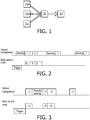
- a wireless sensor network topology typical in patient monitoring applications, depicted in Figure 1 .
- a number of body sensor nodes (21a, 21b, 21c) monitor patient vital signs and communicate measured information over a short-range wireless link to a sensor hub/gateway 22.
- the sensor hub 22 then transmits the gathered results to a processing unit 23.
- the body sensor nodes corresponding to the above-mentioned resource-constrained transmitters, have restricted capabilities in terms of power and memory. Indeed, such sensors are generally small devices, intended for being wirelessly placed on a human body, and thus they have to be power-independent, and to have a small size.
- Communication between the sensor hub 22 and the remote processing unit 23 is performed via a wireless link, for example via a telemetry link or a WLAN.
- the sensor hub regularly performs sensing of the vicinity, during predetermined "sensing" slots, in order to determine channels that might be available for communication between body sensor nodes of the network, and the receiver.
- the body sensor nodes have the task of monitoring patient vital signs and of transmitting this data on a regular basis, or when some abnormality in patient condition is noted, requiring immediate alert.
- Event "Trigger” when there is a need for transmitting data to the sensor hub (event "Trigger"), a Channel Request (Ch_Req) beacon is transmitted to the sensor hub. This transmission may be done in time division multiple access, in slot 4 that is preallocated to the sensor node.
- the body sensor node is aware of when the sensing slots are scheduled, and then sends the Ch_Req only immediately after a sensing slot.
- the sensing slot is followed by a time slot 1, wherein possible Ch_Req beacons are received from body sensor nodes. If a Ch_Req is actually received by the Sensor hub during slot 1, then the available channel information allocations to requesting sensor nodes, possibly including time resource for transmission, are broadcast in the form of a Ch_Alloc beacon, during slot 2.
- the determination of channel availability by the sensor hub may take into account the transmission characteristics of the primary systems, i.e. the licensed devices operating in the same vicinity, as well as other unlicensed devices, such as body sensor nodes.
- the Ch_Alloc beacon is listened to by the sensor nodes during slot 5. Upon receiving this information, the sensor node transmits its data using the allocated resource block 6, corresponding to a listening slot 3 for the sensor hub.
- the sensor hub may goes into a silent power saving mode till the next sensing slot.
- the sensing slots are scheduled with a periodicity such that the QoS latency requirement of the body sensor nodes transmission is satisfied. Sensing with such a periodicity also means that the sensor hub performs sensing even if there is no Ch_Req. This can lead to unnecessary energy consumption at the sensor hub in case when sensor nodes are seldom triggered.
- the sensor hub does not perform regularly sensing. Then, when a body sensor node needs to transmit data (event “Trigger” in the diagram), a Channel Request (Ch_Req) is transmitted from the body sensor node to the sensor hub. This transmission is performed in slot 14, which is preallocated to the sensor node. This preallocated slot 14 corresponds to a slot 11 during which the sensor hub is into receiving mode.
- the receiver i.e. the sensor hub, reacts to a Ch_Req by performing sensing ("Reactive sensing") to determine channel availability. As in the first embodiment, the determination of channel availability may take into account the transmission characteristics of the primary systems as well as other body sensor networks in the vicinity.
- the sensor hub boradcasts a Ch_Alloc beacon comprising the available channel information allocations to requesting sensor nodes. This broadcasting is done during slot 12, immediately following the "Reactive sensing" slot.
- the sensor node listens to the Ch_Alloc beacon over slot 15. Upon receipt of the beacon, the sensor node transmits its data by means of the allocated resource block 16.
- slots 11, where possible Ch_Req may be received from a body sensor node are scheduled with a periodicity such that the QoS latency requirement of the body sensor node transmissions is satisfied.
- the second embodiment herein described has the advantage that the sensor hub does not need to perform sensing periodically as required in sensing protocol, but performing sensing only when required, thus saving resources.
- the protocol of the first embodiment is highly advantageous in configuration wherein sensor nodes regularly transmit data.
- Both embodiments present the common advantage, as compared with prior art methods, that the sensing action is performed by the sensor hub, and not by the sensor nodes. This makes it possible to save resources of the sensor nodes, which do not have to waste power for this action.
- the present invention is more especially dedicated to health monitoring device, but is suitable for a variety of wireless sensor networks including body sensor networks and personal area networks.
- the proposed sensing protocols may be applied to achieve wireless connectivity on secondary basis for body sensor networks, using for example 802.15.4 radios, to operate in new medical bands such as 2.36-2.4 GHz and will find application in next-generation wireless patient monitoring systems.
Landscapes
- Engineering & Computer Science (AREA)
- Computer Networks & Wireless Communication (AREA)
- Signal Processing (AREA)
- Mobile Radio Communication Systems (AREA)
Priority Applications (1)
| Application Number | Priority Date | Filing Date | Title |
|---|---|---|---|
| EP10745401.9A EP2468060B1 (en) | 2009-08-17 | 2010-07-27 | Method for transmitting data in a wireless network, and wireless network therefor |
Applications Claiming Priority (3)
| Application Number | Priority Date | Filing Date | Title |
|---|---|---|---|
| EP09305760 | 2009-08-17 | ||
| PCT/IB2010/053397 WO2011021121A1 (en) | 2009-08-17 | 2010-07-27 | Method for transmitting data in a wireless network, and wireless network therefor |
| EP10745401.9A EP2468060B1 (en) | 2009-08-17 | 2010-07-27 | Method for transmitting data in a wireless network, and wireless network therefor |
Publications (2)
| Publication Number | Publication Date |
|---|---|
| EP2468060A1 EP2468060A1 (en) | 2012-06-27 |
| EP2468060B1 true EP2468060B1 (en) | 2017-03-08 |
Family
ID=43135437
Family Applications (1)
| Application Number | Title | Priority Date | Filing Date |
|---|---|---|---|
| EP10745401.9A Not-in-force EP2468060B1 (en) | 2009-08-17 | 2010-07-27 | Method for transmitting data in a wireless network, and wireless network therefor |
Country Status (6)
| Country | Link |
|---|---|
| US (1) | US9445435B2 (enExample) |
| EP (1) | EP2468060B1 (enExample) |
| JP (1) | JP5813640B2 (enExample) |
| KR (1) | KR101665682B1 (enExample) |
| CN (1) | CN102577574A (enExample) |
| WO (1) | WO2011021121A1 (enExample) |
Families Citing this family (7)
| Publication number | Priority date | Publication date | Assignee | Title |
|---|---|---|---|---|
| JP6416113B2 (ja) | 2013-11-29 | 2018-10-31 | 株式会社東芝 | 無線装置、無線通信システムおよび無線通信方法 |
| JP6469475B2 (ja) * | 2015-02-20 | 2019-02-13 | 国立大学法人電気通信大学 | ワイヤレスセンサネットワークシステムおよび情報収集方法 |
| KR102319698B1 (ko) | 2015-05-29 | 2021-11-01 | 삼성전자 주식회사 | 무선 통신 시스템에서 데이터 송수신 방법 및 장치 |
| US9943229B1 (en) * | 2016-12-08 | 2018-04-17 | General Electric Copany | Systems and methods for monitoring patient health |
| DE102019203357A1 (de) * | 2018-03-12 | 2019-09-12 | Apple Inc. | Energieplanungsprofil zum Stromsparen bei Benutzerausrüstungsvorrichtungen (UE) |
| CN114982367B (zh) * | 2020-01-14 | 2025-03-18 | 韩国电子通信研究院 | 用于支持多链路的无线lan中的str的方法和装置 |
| KR102403603B1 (ko) * | 2020-11-30 | 2022-05-31 | (주)엔키아 | 데이터채널과 제어 채널을 이용한 센서 데이터 수집 방법 및 시스템 |
Citations (2)
| Publication number | Priority date | Publication date | Assignee | Title |
|---|---|---|---|---|
| KR101071213B1 (ko) | 2009-07-14 | 2011-10-10 | 성균관대학교산학협력단 | 무선 멀티 홉 네트워크를 위한 방법 |
| US8194592B2 (en) | 2009-01-15 | 2012-06-05 | Honeywell International Inc. | Wireless monitoring and alarm system |
Family Cites Families (15)
| Publication number | Priority date | Publication date | Assignee | Title |
|---|---|---|---|---|
| DE19930509A1 (de) * | 1999-07-03 | 2001-01-04 | Philips Corp Intellectual Pty | Drahtloses Netzwerk zur Anforderung eines kollisionsbehafteten Kanals |
| DE60223144T2 (de) * | 2002-09-26 | 2008-08-07 | Vkr Holding A/S | Verfahren zur Steuerung von mindestens einem Sender und / oder einem Empfänger, ein Informationsvermittlungssystem, und die Verwendung des Verfahrens und des Systems |
| JP2005031826A (ja) * | 2003-07-09 | 2005-02-03 | Hitachi Ltd | センサデバイスおよびその制御方法 |
| US20050154933A1 (en) * | 2003-07-22 | 2005-07-14 | Hsu Tseng J. | System and method for wake on wireless lan |
| JP2006140821A (ja) * | 2004-11-12 | 2006-06-01 | Yamatake Corp | 無線通信システム |
| CN1780457A (zh) * | 2004-11-24 | 2006-05-31 | 北京三星通信技术研究有限公司 | 无线信道资源分配方法 |
| CN101189897A (zh) * | 2005-04-18 | 2008-05-28 | 传感电子公司 | 改进无线通信的信道选择方法 |
| US8979756B2 (en) | 2005-05-06 | 2015-03-17 | Koninklijke Philips N.V. | Wireless medical monitoring device |
| KR100717962B1 (ko) * | 2005-07-15 | 2007-05-14 | 전자부품연구원 | 다수의 노드를 포함하는 무선 네트워크 시스템에서의데이터 전송 제어 방법 및 이를 이용한 센서 네트워크시스템 및 기록 매체 |
| CN100411486C (zh) * | 2005-07-18 | 2008-08-13 | 上海原动力通信科技有限公司 | 配置多频点小区高速下行分组接入过程物理资源的方法 |
| JP4931112B2 (ja) * | 2006-06-26 | 2012-05-16 | パナソニック株式会社 | 火災報知システム |
| JP4189417B2 (ja) * | 2006-08-28 | 2008-12-03 | 株式会社東芝 | 無線通信装置および方法 |
| JP4919204B2 (ja) | 2006-10-13 | 2012-04-18 | 国立大学法人神戸大学 | センサネットワークシステム及びメディアアクセス制御方法 |
| JP4975602B2 (ja) * | 2007-12-20 | 2012-07-11 | 日本電信電話株式会社 | 無線通信方法及び無線通信システム |
| KR101443213B1 (ko) * | 2008-10-10 | 2014-09-24 | 삼성전자주식회사 | 동적으로 할당되는 공용제어채널 정보를 이용한 인지 무선 통신 방법 |
-
2010
- 2010-07-27 CN CN201080036527XA patent/CN102577574A/zh active Pending
- 2010-07-27 JP JP2012525228A patent/JP5813640B2/ja not_active Expired - Fee Related
- 2010-07-27 KR KR1020127006761A patent/KR101665682B1/ko not_active Expired - Fee Related
- 2010-07-27 WO PCT/IB2010/053397 patent/WO2011021121A1/en not_active Ceased
- 2010-07-27 EP EP10745401.9A patent/EP2468060B1/en not_active Not-in-force
- 2010-07-27 US US13/389,308 patent/US9445435B2/en not_active Expired - Fee Related
Patent Citations (2)
| Publication number | Priority date | Publication date | Assignee | Title |
|---|---|---|---|---|
| US8194592B2 (en) | 2009-01-15 | 2012-06-05 | Honeywell International Inc. | Wireless monitoring and alarm system |
| KR101071213B1 (ko) | 2009-07-14 | 2011-10-10 | 성균관대학교산학협력단 | 무선 멀티 홉 네트워크를 위한 방법 |
Non-Patent Citations (6)
| Title |
|---|
| AKAN O ET AL.: "Cognitive radio sensor network s", IEEE NETWORK, vol. 23, 1 July 2009 (2009-07-01), NEW YORK , NY, US, pages 34 - 40, XP011271574, ISSN: 0890-8044 |
| ALAEDDINE EL FAWAL, JEAN-YVES LE BOUDEC, RUBEN MERZ, BOZIDAR RADUNOVIC, JÖRG WIDMER, GIAN MARIO MAGGIO: "Tradeoff Analysis of PHY aware MAC in Low-Rate, Low- Power UWB networks", EPFL TECHNICAL REPORT IC/2005/032, 2005, pages 1 - 10, XP055444334, Retrieved from the Internet <URL:http://icapeople.epfl.ch/widmer/files/IC_TECH_REPORT_2005032.pdf> |
| G. CHAO: "An Introduction to Zigbee / IEEE 802.15.4", pages 61pp |
| KEVIN KLUES: "Power Management in Wireless Networks", 24 April 2006 (2006-04-24), pages 1 - 24, XP055444344, Retrieved from the Internet <URL:http://www.cse.wustl.edu/~jain/cse574-06/energy_mgmt.htm> |
| KOHVAKKA ET AL.: "Performance Analysis of IEEE 802.15.4 and ZigBee for Large-Scale Wireless Sensor Network Applications", PROCEEDINGS OF THE 3RD ACM INTERNATIONAL WORKSHOP ON PERFORMANCE EVALUATION OF WIRELESS AD-HOC, SENSORS AND UBIQUITOUS NETWORKS, 6 October 2006 (2006-10-06), XP058318616 |
| SANG-SEON BYUN ET AL.: "Dynamic Spectrum Allocation in Wireless Cognitive Sensor Networks: Improving Fairness and Energy Efficiency", VEHICULAR TECHNOLOGY CONFERENCE , 2008 . VTC 2008-FALL. IEEE 68 TH, 21 September 2008 (2008-09-21), PISCATAWAY, NJ, USA, pages 1 - 5, XP031352482, ISBN: 978-1-4244-1721-6 |
Also Published As
| Publication number | Publication date |
|---|---|
| US20120134292A1 (en) | 2012-05-31 |
| US9445435B2 (en) | 2016-09-13 |
| JP2013502796A (ja) | 2013-01-24 |
| KR20120062781A (ko) | 2012-06-14 |
| CN102577574A (zh) | 2012-07-11 |
| JP5813640B2 (ja) | 2015-11-17 |
| EP2468060A1 (en) | 2012-06-27 |
| KR101665682B1 (ko) | 2016-10-24 |
| WO2011021121A1 (en) | 2011-02-24 |
Similar Documents
| Publication | Publication Date | Title |
|---|---|---|
| Kumar et al. | A comprehensive study of IoT and WSN MAC protocols: Research issues, challenges and opportunities | |
| CN102342166B (zh) | 对短距离无线网络的改进 | |
| Kabara et al. | MAC protocols used by wireless sensor networks and a general method of performance evaluation | |
| CN102342136B (zh) | 人体局域网的改进 | |
| EP2468060B1 (en) | Method for transmitting data in a wireless network, and wireless network therefor | |
| Olatinwo et al. | Towards achieving efficient MAC protocols for WBAN-enabled IoT technology: A review | |
| US10891248B2 (en) | Configuring wireless communications according to multiple communication protocols | |
| Rismanian Yazdi et al. | A priority-based MAC protocol for energy consumption and delay guaranteed in wireless body area networks | |
| EP2314122B1 (en) | A medium access control (mac) protocol for body area networks | |
| Sruthi | Medium access control protocols for wireless body area networks: A survey | |
| EP1662730A1 (en) | Method and apparatus for sharing channel among coordinator-based wireless networks | |
| Ashraf et al. | Energy-efficient dynamic channel allocation algorithm in wireless body area network | |
| EP3255931A1 (en) | Configuring wireless communications and an advertising event according to multiple communication protocols | |
| CN105722228A (zh) | 面向无线体域网的可控时延多频道mac协议 | |
| Pradha et al. | Scheduled access strategy for improving sensor node battery life time and delay analysis of wireless body area network | |
| Ullah | RFID-enabled MAC protocol for WBAN | |
| Bouani et al. | A comprehensive survey of medium access control protocols for wireless body area networks | |
| Xia et al. | MAC protocols for cyber-physical systems | |
| Samal et al. | Energy-efficient time-sharing multichannel mac protocol for wireless body area networks | |
| EP3481093A1 (en) | Super-frame realignment mechanism to enable inter-wireless sensor network communications | |
| Kim et al. | An adaptive beaconing MAC protocol providing energy-efficient healthcare service | |
| Matsuo et al. | Performance of simple and Smart PHY/MAC mechanisms for Body Area Networks | |
| Kaur et al. | Wireless body area network: Performance analysis of polling access MAC protocol | |
| KR101234251B1 (ko) | 슈퍼프레임 구조를 이용한 동적 채널 할당 방법 및 이를 이용한 통신 장치 | |
| Goyal et al. | TDMA based delay sensitive and energy efficient protocol for WBAN |
Legal Events
| Date | Code | Title | Description |
|---|---|---|---|
| PUAI | Public reference made under article 153(3) epc to a published international application that has entered the european phase |
Free format text: ORIGINAL CODE: 0009012 |
|
| 17P | Request for examination filed |
Effective date: 20120319 |
|
| AK | Designated contracting states |
Kind code of ref document: A1 Designated state(s): AL AT BE BG CH CY CZ DE DK EE ES FI FR GB GR HR HU IE IS IT LI LT LU LV MC MK MT NL NO PL PT RO SE SI SK SM TR |
|
| DAX | Request for extension of the european patent (deleted) | ||
| RAP1 | Party data changed (applicant data changed or rights of an application transferred) |
Owner name: KONINKLIJKE PHILIPS N.V. |
|
| RAP1 | Party data changed (applicant data changed or rights of an application transferred) |
Owner name: PHILIPS LIGHTING HOLDING B.V. |
|
| GRAP | Despatch of communication of intention to grant a patent |
Free format text: ORIGINAL CODE: EPIDOSNIGR1 |
|
| RIC1 | Information provided on ipc code assigned before grant |
Ipc: H04W 74/08 20090101AFI20160901BHEP Ipc: H04W 16/14 20090101ALN20160901BHEP Ipc: H04W 84/18 20090101ALN20160901BHEP |
|
| INTG | Intention to grant announced |
Effective date: 20160916 |
|
| RIC1 | Information provided on ipc code assigned before grant |
Ipc: H04W 74/08 20090101AFI20160906BHEP Ipc: H04W 16/14 20090101ALN20160906BHEP Ipc: H04W 84/18 20090101ALN20160906BHEP |
|
| GRAS | Grant fee paid |
Free format text: ORIGINAL CODE: EPIDOSNIGR3 |
|
| STAA | Information on the status of an ep patent application or granted ep patent |
Free format text: STATUS: GRANT OF PATENT IS INTENDED |
|
| GRAA | (expected) grant |
Free format text: ORIGINAL CODE: 0009210 |
|
| STAA | Information on the status of an ep patent application or granted ep patent |
Free format text: STATUS: THE PATENT HAS BEEN GRANTED |
|
| AK | Designated contracting states |
Kind code of ref document: B1 Designated state(s): AL AT BE BG CH CY CZ DE DK EE ES FI FR GB GR HR HU IE IS IT LI LT LU LV MC MK MT NL NO PL PT RO SE SI SK SM TR |
|
| REG | Reference to a national code |
Ref country code: GB Ref legal event code: FG4D |
|
| REG | Reference to a national code |
Ref country code: CH Ref legal event code: EP Ref country code: AT Ref legal event code: REF Ref document number: 874580 Country of ref document: AT Kind code of ref document: T Effective date: 20170315 |
|
| REG | Reference to a national code |
Ref country code: IE Ref legal event code: FG4D |
|
| REG | Reference to a national code |
Ref country code: DE Ref legal event code: R096 Ref document number: 602010040585 Country of ref document: DE |
|
| REG | Reference to a national code |
Ref country code: LT Ref legal event code: MG4D |
|
| REG | Reference to a national code |
Ref country code: NL Ref legal event code: MP Effective date: 20170308 |
|
| REG | Reference to a national code |
Ref country code: FR Ref legal event code: PLFP Year of fee payment: 8 |
|
| PG25 | Lapsed in a contracting state [announced via postgrant information from national office to epo] |
Ref country code: LT Free format text: LAPSE BECAUSE OF FAILURE TO SUBMIT A TRANSLATION OF THE DESCRIPTION OR TO PAY THE FEE WITHIN THE PRESCRIBED TIME-LIMIT Effective date: 20170308 Ref country code: FI Free format text: LAPSE BECAUSE OF FAILURE TO SUBMIT A TRANSLATION OF THE DESCRIPTION OR TO PAY THE FEE WITHIN THE PRESCRIBED TIME-LIMIT Effective date: 20170308 Ref country code: NO Free format text: LAPSE BECAUSE OF FAILURE TO SUBMIT A TRANSLATION OF THE DESCRIPTION OR TO PAY THE FEE WITHIN THE PRESCRIBED TIME-LIMIT Effective date: 20170608 Ref country code: HR Free format text: LAPSE BECAUSE OF FAILURE TO SUBMIT A TRANSLATION OF THE DESCRIPTION OR TO PAY THE FEE WITHIN THE PRESCRIBED TIME-LIMIT Effective date: 20170308 Ref country code: GR Free format text: LAPSE BECAUSE OF FAILURE TO SUBMIT A TRANSLATION OF THE DESCRIPTION OR TO PAY THE FEE WITHIN THE PRESCRIBED TIME-LIMIT Effective date: 20170609 |
|
| REG | Reference to a national code |
Ref country code: AT Ref legal event code: MK05 Ref document number: 874580 Country of ref document: AT Kind code of ref document: T Effective date: 20170308 |
|
| PG25 | Lapsed in a contracting state [announced via postgrant information from national office to epo] |
Ref country code: ES Free format text: LAPSE BECAUSE OF FAILURE TO SUBMIT A TRANSLATION OF THE DESCRIPTION OR TO PAY THE FEE WITHIN THE PRESCRIBED TIME-LIMIT Effective date: 20170308 Ref country code: BG Free format text: LAPSE BECAUSE OF FAILURE TO SUBMIT A TRANSLATION OF THE DESCRIPTION OR TO PAY THE FEE WITHIN THE PRESCRIBED TIME-LIMIT Effective date: 20170608 Ref country code: SE Free format text: LAPSE BECAUSE OF FAILURE TO SUBMIT A TRANSLATION OF THE DESCRIPTION OR TO PAY THE FEE WITHIN THE PRESCRIBED TIME-LIMIT Effective date: 20170308 Ref country code: LV Free format text: LAPSE BECAUSE OF FAILURE TO SUBMIT A TRANSLATION OF THE DESCRIPTION OR TO PAY THE FEE WITHIN THE PRESCRIBED TIME-LIMIT Effective date: 20170308 |
|
| PG25 | Lapsed in a contracting state [announced via postgrant information from national office to epo] |
Ref country code: NL Free format text: LAPSE BECAUSE OF FAILURE TO SUBMIT A TRANSLATION OF THE DESCRIPTION OR TO PAY THE FEE WITHIN THE PRESCRIBED TIME-LIMIT Effective date: 20170308 |
|
| PG25 | Lapsed in a contracting state [announced via postgrant information from national office to epo] |
Ref country code: RO Free format text: LAPSE BECAUSE OF FAILURE TO SUBMIT A TRANSLATION OF THE DESCRIPTION OR TO PAY THE FEE WITHIN THE PRESCRIBED TIME-LIMIT Effective date: 20170308 Ref country code: AT Free format text: LAPSE BECAUSE OF FAILURE TO SUBMIT A TRANSLATION OF THE DESCRIPTION OR TO PAY THE FEE WITHIN THE PRESCRIBED TIME-LIMIT Effective date: 20170308 Ref country code: CZ Free format text: LAPSE BECAUSE OF FAILURE TO SUBMIT A TRANSLATION OF THE DESCRIPTION OR TO PAY THE FEE WITHIN THE PRESCRIBED TIME-LIMIT Effective date: 20170308 Ref country code: IT Free format text: LAPSE BECAUSE OF FAILURE TO SUBMIT A TRANSLATION OF THE DESCRIPTION OR TO PAY THE FEE WITHIN THE PRESCRIBED TIME-LIMIT Effective date: 20170308 Ref country code: EE Free format text: LAPSE BECAUSE OF FAILURE TO SUBMIT A TRANSLATION OF THE DESCRIPTION OR TO PAY THE FEE WITHIN THE PRESCRIBED TIME-LIMIT Effective date: 20170308 Ref country code: SK Free format text: LAPSE BECAUSE OF FAILURE TO SUBMIT A TRANSLATION OF THE DESCRIPTION OR TO PAY THE FEE WITHIN THE PRESCRIBED TIME-LIMIT Effective date: 20170308 |
|
| PG25 | Lapsed in a contracting state [announced via postgrant information from national office to epo] |
Ref country code: SM Free format text: LAPSE BECAUSE OF FAILURE TO SUBMIT A TRANSLATION OF THE DESCRIPTION OR TO PAY THE FEE WITHIN THE PRESCRIBED TIME-LIMIT Effective date: 20170308 Ref country code: PT Free format text: LAPSE BECAUSE OF FAILURE TO SUBMIT A TRANSLATION OF THE DESCRIPTION OR TO PAY THE FEE WITHIN THE PRESCRIBED TIME-LIMIT Effective date: 20170710 Ref country code: PL Free format text: LAPSE BECAUSE OF FAILURE TO SUBMIT A TRANSLATION OF THE DESCRIPTION OR TO PAY THE FEE WITHIN THE PRESCRIBED TIME-LIMIT Effective date: 20170308 Ref country code: IS Free format text: LAPSE BECAUSE OF FAILURE TO SUBMIT A TRANSLATION OF THE DESCRIPTION OR TO PAY THE FEE WITHIN THE PRESCRIBED TIME-LIMIT Effective date: 20170708 |
|
| REG | Reference to a national code |
Ref country code: DE Ref legal event code: R026 Ref document number: 602010040585 Country of ref document: DE |
|
| PLBI | Opposition filed |
Free format text: ORIGINAL CODE: 0009260 |
|
| PLAX | Notice of opposition and request to file observation + time limit sent |
Free format text: ORIGINAL CODE: EPIDOSNOBS2 |
|
| 26 | Opposition filed |
Opponent name: MOLNIA, DAVID Effective date: 20171208 |
|
| PG25 | Lapsed in a contracting state [announced via postgrant information from national office to epo] |
Ref country code: DK Free format text: LAPSE BECAUSE OF FAILURE TO SUBMIT A TRANSLATION OF THE DESCRIPTION OR TO PAY THE FEE WITHIN THE PRESCRIBED TIME-LIMIT Effective date: 20170308 |
|
| PG25 | Lapsed in a contracting state [announced via postgrant information from national office to epo] |
Ref country code: SI Free format text: LAPSE BECAUSE OF FAILURE TO SUBMIT A TRANSLATION OF THE DESCRIPTION OR TO PAY THE FEE WITHIN THE PRESCRIBED TIME-LIMIT Effective date: 20170308 |
|
| REG | Reference to a national code |
Ref country code: CH Ref legal event code: PL |
|
| REG | Reference to a national code |
Ref country code: IE Ref legal event code: MM4A |
|
| PLBB | Reply of patent proprietor to notice(s) of opposition received |
Free format text: ORIGINAL CODE: EPIDOSNOBS3 |
|
| PG25 | Lapsed in a contracting state [announced via postgrant information from national office to epo] |
Ref country code: IE Free format text: LAPSE BECAUSE OF NON-PAYMENT OF DUE FEES Effective date: 20170727 Ref country code: CH Free format text: LAPSE BECAUSE OF NON-PAYMENT OF DUE FEES Effective date: 20170731 Ref country code: LI Free format text: LAPSE BECAUSE OF NON-PAYMENT OF DUE FEES Effective date: 20170731 |
|
| REG | Reference to a national code |
Ref country code: BE Ref legal event code: MM Effective date: 20170731 |
|
| PG25 | Lapsed in a contracting state [announced via postgrant information from national office to epo] |
Ref country code: LU Free format text: LAPSE BECAUSE OF NON-PAYMENT OF DUE FEES Effective date: 20170727 |
|
| REG | Reference to a national code |
Ref country code: FR Ref legal event code: PLFP Year of fee payment: 9 |
|
| PG25 | Lapsed in a contracting state [announced via postgrant information from national office to epo] |
Ref country code: BE Free format text: LAPSE BECAUSE OF NON-PAYMENT OF DUE FEES Effective date: 20170731 |
|
| PG25 | Lapsed in a contracting state [announced via postgrant information from national office to epo] |
Ref country code: MT Free format text: LAPSE BECAUSE OF NON-PAYMENT OF DUE FEES Effective date: 20170727 |
|
| RAP2 | Party data changed (patent owner data changed or rights of a patent transferred) |
Owner name: PHILIPS LIGHTING HOLDING B.V. |
|
| RAP2 | Party data changed (patent owner data changed or rights of a patent transferred) |
Owner name: SIGNIFY HOLDING B.V. |
|
| PG25 | Lapsed in a contracting state [announced via postgrant information from national office to epo] |
Ref country code: HU Free format text: LAPSE BECAUSE OF FAILURE TO SUBMIT A TRANSLATION OF THE DESCRIPTION OR TO PAY THE FEE WITHIN THE PRESCRIBED TIME-LIMIT; INVALID AB INITIO Effective date: 20100727 Ref country code: MC Free format text: LAPSE BECAUSE OF FAILURE TO SUBMIT A TRANSLATION OF THE DESCRIPTION OR TO PAY THE FEE WITHIN THE PRESCRIBED TIME-LIMIT Effective date: 20170308 |
|
| REG | Reference to a national code |
Ref country code: DE Ref legal event code: R100 Ref document number: 602010040585 Country of ref document: DE |
|
| PG25 | Lapsed in a contracting state [announced via postgrant information from national office to epo] |
Ref country code: CY Free format text: LAPSE BECAUSE OF NON-PAYMENT OF DUE FEES Effective date: 20170308 |
|
| PG25 | Lapsed in a contracting state [announced via postgrant information from national office to epo] |
Ref country code: MK Free format text: LAPSE BECAUSE OF FAILURE TO SUBMIT A TRANSLATION OF THE DESCRIPTION OR TO PAY THE FEE WITHIN THE PRESCRIBED TIME-LIMIT Effective date: 20170308 |
|
| PLCK | Communication despatched that opposition was rejected |
Free format text: ORIGINAL CODE: EPIDOSNREJ1 |
|
| PLBN | Opposition rejected |
Free format text: ORIGINAL CODE: 0009273 |
|
| STAA | Information on the status of an ep patent application or granted ep patent |
Free format text: STATUS: OPPOSITION REJECTED |
|
| PG25 | Lapsed in a contracting state [announced via postgrant information from national office to epo] |
Ref country code: TR Free format text: LAPSE BECAUSE OF FAILURE TO SUBMIT A TRANSLATION OF THE DESCRIPTION OR TO PAY THE FEE WITHIN THE PRESCRIBED TIME-LIMIT Effective date: 20170308 |
|
| 27O | Opposition rejected |
Effective date: 20190924 |
|
| PG25 | Lapsed in a contracting state [announced via postgrant information from national office to epo] |
Ref country code: AL Free format text: LAPSE BECAUSE OF FAILURE TO SUBMIT A TRANSLATION OF THE DESCRIPTION OR TO PAY THE FEE WITHIN THE PRESCRIBED TIME-LIMIT Effective date: 20170308 |
|
| PGFP | Annual fee paid to national office [announced via postgrant information from national office to epo] |
Ref country code: FR Payment date: 20200728 Year of fee payment: 11 Ref country code: DE Payment date: 20200729 Year of fee payment: 11 Ref country code: GB Payment date: 20200724 Year of fee payment: 11 |
|
| REG | Reference to a national code |
Ref country code: DE Ref legal event code: R119 Ref document number: 602010040585 Country of ref document: DE |
|
| GBPC | Gb: european patent ceased through non-payment of renewal fee |
Effective date: 20210727 |
|
| PG25 | Lapsed in a contracting state [announced via postgrant information from national office to epo] |
Ref country code: GB Free format text: LAPSE BECAUSE OF NON-PAYMENT OF DUE FEES Effective date: 20210727 Ref country code: DE Free format text: LAPSE BECAUSE OF NON-PAYMENT OF DUE FEES Effective date: 20220201 |
|
| PG25 | Lapsed in a contracting state [announced via postgrant information from national office to epo] |
Ref country code: FR Free format text: LAPSE BECAUSE OF NON-PAYMENT OF DUE FEES Effective date: 20210731 |