EP2459163B2 - Hautschutzmittel, insebsondere gegen hydrophobe (lipophile) und hydrophile (lipophobe) schadstoffe - Google Patents
Hautschutzmittel, insebsondere gegen hydrophobe (lipophile) und hydrophile (lipophobe) schadstoffe Download PDFInfo
- Publication number
- EP2459163B2 EP2459163B2 EP10726519.1A EP10726519A EP2459163B2 EP 2459163 B2 EP2459163 B2 EP 2459163B2 EP 10726519 A EP10726519 A EP 10726519A EP 2459163 B2 EP2459163 B2 EP 2459163B2
- Authority
- EP
- European Patent Office
- Prior art keywords
- skin
- skin protection
- protection composition
- weight
- review
- Prior art date
- Legal status (The legal status is an assumption and is not a legal conclusion. Google has not performed a legal analysis and makes no representation as to the accuracy of the status listed.)
- Active
Links
Images

Classifications
-
- A—HUMAN NECESSITIES
- A61—MEDICAL OR VETERINARY SCIENCE; HYGIENE
- A61K—PREPARATIONS FOR MEDICAL, DENTAL OR TOILETRY PURPOSES
- A61K8/00—Cosmetics or similar toiletry preparations
- A61K8/18—Cosmetics or similar toiletry preparations characterised by the composition
- A61K8/72—Cosmetics or similar toiletry preparations characterised by the composition containing organic macromolecular compounds
- A61K8/73—Polysaccharides
-
- A—HUMAN NECESSITIES
- A61—MEDICAL OR VETERINARY SCIENCE; HYGIENE
- A61K—PREPARATIONS FOR MEDICAL, DENTAL OR TOILETRY PURPOSES
- A61K8/00—Cosmetics or similar toiletry preparations
- A61K8/18—Cosmetics or similar toiletry preparations characterised by the composition
- A61K8/72—Cosmetics or similar toiletry preparations characterised by the composition containing organic macromolecular compounds
- A61K8/73—Polysaccharides
- A61K8/733—Alginic acid; Salts thereof
-
- A—HUMAN NECESSITIES
- A61—MEDICAL OR VETERINARY SCIENCE; HYGIENE
- A61K—PREPARATIONS FOR MEDICAL, DENTAL OR TOILETRY PURPOSES
- A61K8/00—Cosmetics or similar toiletry preparations
- A61K8/18—Cosmetics or similar toiletry preparations characterised by the composition
- A61K8/72—Cosmetics or similar toiletry preparations characterised by the composition containing organic macromolecular compounds
- A61K8/73—Polysaccharides
- A61K8/737—Galactomannans, e.g. guar; Derivatives thereof
-
- A—HUMAN NECESSITIES
- A61—MEDICAL OR VETERINARY SCIENCE; HYGIENE
- A61K—PREPARATIONS FOR MEDICAL, DENTAL OR TOILETRY PURPOSES
- A61K8/00—Cosmetics or similar toiletry preparations
- A61K8/18—Cosmetics or similar toiletry preparations characterised by the composition
- A61K8/72—Cosmetics or similar toiletry preparations characterised by the composition containing organic macromolecular compounds
- A61K8/84—Cosmetics or similar toiletry preparations characterised by the composition containing organic macromolecular compounds obtained by reactions otherwise than those involving only carbon-carbon unsaturated bonds
- A61K8/87—Polyurethanes
-
- A—HUMAN NECESSITIES
- A61—MEDICAL OR VETERINARY SCIENCE; HYGIENE
- A61Q—SPECIFIC USE OF COSMETICS OR SIMILAR TOILETRY PREPARATIONS
- A61Q17/00—Barrier preparations; Preparations brought into direct contact with the skin for affording protection against external influences, e.g. sunlight, X-rays or other harmful rays, corrosive materials, bacteria or insect stings
Definitions
- the invention relates to a skin protection agent, in particular against oily (hydrophobic) pollutants, which can also be used in the case of alternating exposure, i.e. exposure to both hydrophilic and hydrophobic pollutants and in the case of heavy dirt exposure.
- oily (hydrophobic) pollutants which can also be used in the case of alternating exposure, i.e. exposure to both hydrophilic and hydrophobic pollutants and in the case of heavy dirt exposure.
- the diverse products offered for hygiene, body care and cosmetics such as skin cleansing, skin protection and skin care products, therefore not only primarily serve to cleanse, protect and care for the skin, but they also maintain the quality of life and ensure the well-being of people.
- the human skin represents the connection, but at the same time also the boundary, of the human body with its outside world. In particular, it is through it that contact is made with everything that the human organism needs to live - but also with everything that can endanger it.
- the skin can be exposed to a wide variety of different substances. Even substances not generally considered hazardous can, upon long-term contact, lead to skin damage such as dry skin, brittle, cracked skin with impaired barrier function, and/or an increased risk of allergies.
- skin protection products must take into account the fact that each person's skin reacts differently to external environmental influences, and therefore, significant individual differences in the skin's reaction to these influences can be observed.
- skin protectants must be free of known penetration-promoting ingredients such as urea.
- Particularly beneficial skin protection products include those that, in addition to their protective effect against harmful substances, also reduce the adhesion of highly adhesive contaminants such as water-insoluble contaminants caused by oils, varnishes, graphite, metal dust, adhesives, synthetic resins, etc., or that have a cleansing effect themselves through special ingredients. This allows subsequent skin cleansing to be carried out much faster and with less irritation, which naturally has a positive effect on the skin's condition.
- Such particularly beneficial skin protection products are marketed by Evonik Stockhausen GmbH, Krefeld, under the brand name TRAVABON ® . Accordingly, product descriptions and corresponding compositions are already known to experts and can be found as online publications (URL: http://www.leber-gmbh.de/downloads/ schemesblaetter/hautschutz/travabon.pdf).
- Skin protectants are intended to protect human skin from a wide variety of external hazards, such as weathering, water and aqueous solutions, chemicals, and contaminants of all kinds.
- anhydrous skin protectants coat the human skin with a "barrier" or protective film that cannot be absorbed by the skin.
- this protective film is applied to the skin in such a way that its presence is not noticed by the environment, as it is invisible to the environment and imperceptible to the user.
- most products available on the market contain large amounts—for example, up to 25% by weight—of absorbent, well-covering, and skin-adherent, non-toxic inorganic solids in pigment form.
- oxides such as zinc and titanium dioxide, alkaline earth metal carbonates and bicarbonates, and sulfates, particularly their magnesium, calcium, and strontium salts.
- other mineral silicates such as aluminum silicates, magnesium aluminum silicates, bentonites, kaolins, and talc are also suitable.
- These inorganic pigments act as barrier agents by forming a physical protective layer on the skin.
- such inorganic barrier agents such as kaolin or talc, give the user a very unpleasant, dry skin sensation. In extreme heat, when the user is sweating, or when wearing gloves, the skin feels “sticky.” This significantly reduces user acceptance of the use of such skin protection products in the workplace.
- skin protectants are available commercially that are designed to provide protection against both hydrophilic (lipophobic) and hydrophobic (lipophilic) pollutants, thus ensuring a certain level of protection for the skin even under frequently changing stress conditions. Nevertheless, such ambivalent skin protectants are often limited in their effectiveness compared to skin protectants whose application spectrum is restricted to either exclusively hydrophilic (lipophobic) or exclusively hydrophobic (lipophilic) pollutants.
- skin protectants include products with astringent properties. These products utilize special tannins as ingredients to harden the outermost cells of the stratum corneum. This increases the skin's mechanical resilience and barrier function. This makes such skin protectants suitable for both increased skin stress from mechanical influences and frequently alternating skin exposure to aqueous and oily substances.
- WO2001/70271 a skin protectant containing, in addition to glycerin and water, carrageenan, locust bean flour and algin.
- WO 2005016364 a skin protectant that contains Chondrus Crispus in addition to glycerin and water and is US$4,900,550
- a skin protection product is described that, in addition to water, polyglycol, and polysorbate, also contains carrageenan, gum arabic, tragacanth, and locust bean flour.
- the skin in the workplace can be exposed to a wide variety of different substances, whereby even substances that are not generally considered hazardous substances can lead to skin damage after long-term exposure.
- a skin protection product that offers improved protection for the skin even under frequently changing stress conditions, i.e. protection against both hydrophilic (lipophobic) and hydrophobic (lipophilic) pollutants and shows a comparable cleansing effect and comparable protection against skin contamination during use.
- these skin protection products are intended to provide the user with an improved – i.e., more pleasant – skin feeling than commercially available skin protection products with physical barrier agents, such as kaolin, talc, etc.
- the task was therefore to provide a skin protection agent which, even under frequently changing exposure to pollutants, in particular hydrophobic (lipophilic) and hydrophilic (lipophobic) pollutants, has a preferably at least comparable cleaning effect to the skin protection agents known in the prior art and preferably causes a "pleasant" skin feeling during use, and which is preferably free of fluorosurfactants and silicones, as well as a corresponding manufacturing process for such a skin protection agent.
- the object of the invention was achieved by a skin protection agent, in particular against hydrophobic (lipophilic) and hydrophilic (lipophobic) pollutants according to claim 1.
- Preferred embodiments of the invention are the subject of the dependent claims.
- hydrophobic polymers i.e., polymers that dissolve only turbidly in water, with a nephelometric turbidity value greater than 40, offer good protection against oily pollutants as barrier-forming components in skin protection products.
- the skin protection product according to the invention not only protects against oily, hydrophobic (lipophilic) pollutants, but also against alternating exposure, i.e., exposure to both hydrophilic and hydrophobic pollutants and heavy soiling.
- hydrophobic polymers, as barrier-forming components in skin protection products would only protect against hydrophilic (lipophobic) pollutants, i.e., against aqueous pollutants.
- hydrophobic (lipophilic) pollutants particularly oily pollutants, in the skin protection products according to the invention, was completely unexpected.
- the present invention therefore relates to skin protection agents as described in the claims and below, their use as protection agents against hydrophilic (lipophobic) pollutants or as protection agents against both hydrophobic (lipophilic) and hydrophilic (lipophobic) pollutants and, if appropriate, to facilitate skin cleansing after soiling, as well as a process for producing corresponding skin protection agents.
- the skin protection agents according to the invention have the advantage that they offer good protection against lipophilic pollutants even without the presence of silicone or fluorosurfactants. By omitting these surfactants, the known disadvantages of accidentally transferring lipophilicity or hydrophobicity to handled workpieces are avoided.
- the skin protection agents according to the invention also have the advantage that their use can provide good protection not only against lipophilic but also against hydrophilic noxious substances.
- the skin protection agents according to the invention therefore offer particularly good protection during activities in which contact with both lipophilic and hydrophilic noxious substances may occur.
- the skin protection agent according to the invention in particular against hydrophobic (lipophilic) pollutants, is characterized in that it contains at least one barrier-forming component, wherein a 1 wt. % solution of this barrier-forming component in water has a nephelometric turbidity value, determined by turbidimetry, greater than 40 (NTU), preferably greater than 50 and preferably greater than 60.
- NTU nephelometric turbidity value
- the nephemological turbidity value can be determined, for example, using a turbidimeter of the type HACH Turbidimeter 2100P ISO from the Hach Company, Loveland, Colorado (USA) using round cuvettes with screw caps from the Hach Company, Loveland, Colorado (USA), catalog number 24347-06 and using the calibration substances StablCal Solution HACH ( ⁇ 0.1 NTU), catalog number 26597-42, StablCal Solution HACH (20 NTU), catalog number 26601-42, StablCal Solution HACH (100 NTU), catalog number 26602-42 and StablCal Solution HACH (800 NTU), catalog number 26605-42, all also from the Hach Company.
- the proportion of barrier-forming components, whose 1 wt.% solution in water has a nephelometric turbidity value as indicated above, in the total composition of the skin protection agent according to the invention is preferably from 0.01 to 5 wt.%, preferably from 0.03 to 5 wt.% and particularly preferably from 0.03 to 3 wt.%.
- Any barrier-forming component which can be used in cosmetic formulations and whose 1 wt.% solution in water has a nephelometric turbidity value in the ranges specified above can be used in the skin protection agent according to the invention.
- the skin protection agent according to the invention contains one or more naturally occurring and/or synthetically produced, preferably naturally occurring polymers, whose 1 wt.% solution in water has a nephelometric turbidity value in the ranges specified above, as a barrier-forming component.
- Polymers that can be used as barrier-forming components, whose 1 wt. % solution in water has a nephelometric turbidity value within the ranges specified above, are particularly preferably polysaccharides contained in the skin protection agents according to the invention, which can particularly advantageously be selected from the group of gums.
- Gums include, for example, plant or tree saps that harden in air and form resins, or extracts from aquatic plants. From this group, gum arabic, locust bean flour, tragacanth, karaya, guar gum, pectin, gellan gum, carrageenan, agar, algin, chondrus, xanthan gum, etc., or mixtures thereof, can be selected according to the invention.
- polysaccharides are in particular alginates, i.e. salts and esters of alginic acid, preferably sodium alginate or Chondrus crispus (carrageenan) as well as the plant gum known under the INCI name Biosaccharide Gum-4.
- alginates i.e. salts and esters of alginic acid, preferably sodium alginate or Chondrus crispus (carrageenan) as well as the plant gum known under the INCI name Biosaccharide Gum-4.
- Polymers that can be used as barrier-forming components whose 1 wt.% solution in water has a nephelometric turbidity value in the ranges specified above are also preferably polyurethanes and polyacrylates.
- the skin protection agents according to the invention offer protection against skin contamination and also show a comparable cleaning effect to the skin protection products known in the prior art, it can be advantageous if the skin protection agents according to the invention contain at least one surfactant.
- surfactants can be harmful to human skin per se, and some surfactants can also promote penetration, thus counteracting the desired effect of a skin protection agent, namely preventing the penetration of harmful substances into the skin.
- the skin protection products according to the invention preferably only use surfactants that ensure that the protective effect of the product as a whole is not impaired.
- the surfactants used should have good skin compatibility, especially because skin protection products are "leave-on" products and are intended to remain on the user's skin for an extended period of time.
- Particularly preferred surfactants are therefore mild or skin-compatible surfactants, which can be contained alone or in combination in the skin protection agents according to the invention.
- zwitterionic surfactants especially the so-called betaines, such as N-alkyl-N,N-dimethylammonium glycinates, for example cocoalkyl -dimethylammonium glycinate, N-acyl-aminopropyl-N,N-dimethylammonium glycinates, for example cocoacylaminopropyldimethylammonium glycinate, and 2-alkyl-3-carboxymethyl-3-hydroxyethyl-imidazolines, each with 8 to 18 carbon atoms in the alkyl or acyl group, as well as cocoacylaminoethylhydroxyethylcarboxymethylglycinate.
- a particularly preferred zwitterionic surfactant is the fatty acid amide derivative known by the INCI name Cocamidopropyl Betaine.
- Surfactants which can preferably be used according to the invention are amphoteric surfactants, in particular -acyl-/dialkylethylenediamine, for example sodium acylamphoacetate, disodium acylamphodipropionate, disodium alkylamphodiacetate, sodium acylamphohydroxypropylsulfonate, disodium acylamphodiacetate and sodium acylamphopropionate, -N-alkylamino acids, for example aminopropylalkylglutamide, alkylaminopropionic acid, sodium alkylimidodipropionate and lauroamphocarboxyglycinate.
- Surfactants which can be used particularly preferably according to the invention are polyethylene and polypropylene glycol derivatives, in particular polypropylene glycol ethers, which preferably have at least 6 C atoms, such as, for example, Laureth-6 or Oleth-5.
- Very particularly preferred surfactants are preferably selected from the group comprising: sodium stearoyl glutamate, sodium cocoamphoacetate, disodium cocoyl glutamate, sodium cocoamphopropionate, dioctyl sodium sulfosuccinate, and sodium lauryl sarcosinate.
- the skin protection agents according to the invention preferably contain from 1 to 12% by weight, preferably 1 to 10% by weight and very particularly preferably 1 to 8% by weight of active substance, based on the total composition of the skin protection agent, of at least one, preferably mild, surfactant, preferably selected from the surfactants mentioned above.
- the skin protection agents according to the invention may contain polyols and their derivatives, in particular from 0.1 to 5 wt.%, preferably from 1 to 5 wt.%, and most preferably from 2 to 4 wt.%, based on the total composition of the skin protection agent, e.g., as a moisturizer.
- polyols and their derivatives in particular from 0.1 to 5 wt.%, preferably from 1 to 5 wt.%, and most preferably from 2 to 4 wt.%, based on the total composition of the skin protection agent, e.g., as a moisturizer.
- propylene glycol which is known to promote penetration, exhibits no negative effects on the protective effect.
- polyols which can be used alone or as a mixture with one or more other polyols, are understood to mean all compounds that fall under the definition given in Römpp's Lexikon der Chemie, Version 3.4 Römpp Online, Georg Thieme Verlag.
- conventional polyalcohols or polyhydroxy compounds suitable for cosmetic and/or pharmaceutical formulations i.e., physiologically acceptable polyalcohols or polyhydroxy compounds, preferably having 2 to 15 carbon atoms and at least 2 hydroxyl groups, are suitable.
- Examples include polyhydric alcohols such as straight-chain, branched, or cyclic alkanols having 2 to 15, preferably 2 to 6, carbon atoms, with glycerol and/or 1,2-propanediol being particularly preferred.
- glycols such as polyethylene glycols, polypropylene glycols, but also sugars and sugar derivatives, preferably fructose, glucose, sucrose, sugar alcohols, in particular sorbitol, mannitol, etc., can be contained in the skin protection agents according to the invention.
- the polyols or polyol derivatives preferably have free OH groups and are therefore preferably not compounds whose OH groups are etherified.
- the skin protection agent according to the invention preferably also contains water as a component.
- the proportion of water in the overall composition is preferably from 50 to 90 wt.%, based on the overall composition of the skin protection agent.
- the skin protection agents according to the invention may optionally contain, as further components, auxiliaries, additives, and/or active ingredients such as dyes, solubilizers, complexing agents, tanning agents, pigments, sequestering agents, sunscreen filters, or perfumes or fragrances, pH regulators, stabilizers, preservatives, for example parabens, i.e., p-hydroxybenzoic acid alkyl esters, such as methyl-, ethyl-, propyl-, and/or butylparaben, as well as phenoxyethanol, etc., antioxidants, and/or oily or aqueous care components.
- the proportion of these further components is preferably in the amounts customary for cosmetic and/or pharmaceutical formulations.
- the proportion of the further components is preferably from 0.01 to 25% by weight, preferably 0.05 to 10% by weight, based on the total weight of the skin protection agent, the person skilled in the art selecting the proportion by weight of these components such that there is no impairment of the barrier formation of the skin protection agents according to the invention due to possible penetration-promoting properties of these auxiliaries, additives and/or active ingredients.
- the skin protection agents according to the invention exhibit an excellent protective effect when exposed to both hydrophilic and hydrophobic pollutants and when exposed to heavy dirt, without containing any of the inorganic pigments commonly used in skin protection agents, such as oxides, e.g. zinc and titanium dioxide, alkaline earth metal carbonates and hydrogen carbonates and sulfates, in particular their magnesium, calcium and strontium salts, as well as silicon dioxide or silica gels, mineral silicates such as aluminum silicates, magnesium aluminum silicates, bentonites, kaolins and in particular talc, the skin protection agents according to the invention can contain up to 10% by weight, based on the total weight of the skin protection agent, of inorganic pigments, in particular selected from the aforementioned inorganic pigments, as additives, for example to improve the feel of the skin or to introduce a sun protection factor.
- inorganic pigments commonly used in skin protection agents, such as oxides, e.g. zinc and titanium dioxide, alkaline earth metal carbonates and hydrogen carbonates and s
- the skin protection agent as a further component in the skin protection agents according to the invention can improve the skin barrier, particularly in the case of already damaged skin, thereby effectively supporting skin regeneration.
- All known tanning agents suitable for cosmetic applications can be included as synthetic or natural tanning agents in the skin protection agent.
- synthetic tanning agents are those selected from the group comprising synthans, e.g.
- Phenolsulfonic acid-phenol-urea-methanal condensates sodium salts of phenolsulfonic acid-formaldehyde polycondensates (TAMOL PP - manufacturer: BASF AG, Ludwigshafen, or those sold under the trade name Eucoriol ® - INCI name: "Sodium Bischlorophenyl Sulfamine” (manufacturer: Evonik Stockhausen GmbH, Krefeld).
- Natural tanning agents are, for example, tannins or spray-dried witch hazel extracts, etc., with an addition of Hamamelis virginiana as a natural tanning agent in an amount of 0.1 to 5 wt.%, based on the total amount of the skin protection product, being particularly preferred.
- the skin protection agents according to the invention are preferably silicone-free and advantageously also do not contain any environmentally harmful fluorosurfactants as ingredients. This ensures that no paint defects occur during further processing of workpieces if skin protection agent residues are found on the workpieces to be painted.
- the agents according to the invention are particularly advantageous for use in the automotive and paint industries, as well as the rubber processing industry, in contrast to skin protection products containing silicone or fluorosurfactants.
- Particularly preferred skin protection agents according to the invention are, for example, the skin protection agents listed in the examples described below, in particular those which can be found in Tables 1 to 4.
- the skin protectants according to the invention can be used as protectants against hydrophilic (lipophobic) pollutants and, advantageously, even as protectants against both hydrophobic (lipophilic) and hydrophilic (lipophobic) pollutants. Furthermore, the use of the skin protectant according to the invention can facilitate skin cleansing.
- the invention further relates to a process for producing skin protection agents, in particular against hydrophobic (lipophilic) pollutants, wherein a barrier-forming component for producing the agent is selected such that the nephelometric turbidity value of the barrier-forming component of the skin protection agent is determined by means of turbidimetry and at least one barrier-forming component, the 1 wt.% solution of which in water has a nephelometric turbidity value greater than 40 (NTU), is used for producing the skin protection agent.
- a barrier-forming component for producing the agent is selected such that the nephelometric turbidity value of the barrier-forming component of the skin protection agent is determined by means of turbidimetry and at least one barrier-forming component, the 1 wt.% solution of which in water has a nephelometric turbidity value greater than 40 (NTU), is used for producing the skin protection agent.
- the process according to the invention makes it possible to obtain skin protection agents whose property or protection profile could not be achieved so far, namely the guarantee of a protective effect against both oily and aqueous noxae and simultaneous protection against dirt, ie also the adhesion of strongly adhering soiling such as water-insoluble soiling caused by oils, varnishes, graphite, metal dusts, adhesives, Synthetic resins, etc., can be reduced by the skin protection agents according to the invention.
- a particular advantage is that subsequent skin cleansing can be carried out much faster and with less damage to the skin.
- the skin protection agents according to the invention do not require any inorganic barrier agents or inorganic pigments such as kaolin or talc, which can give the user a very unpleasant dry skin feeling in hot weather or when wearing gloves, thus significantly improving user acceptance of the use of skin protection agents in the workplace.
- NTU value nephelometric turbidity
- Nephelometry is an optical analytical method for determining the solid content in suspensions, aerosols or turbid dispersions, etc.
- the turbidity measurement is based on the Faraday-Tyndall effect, which measures the intensity of the scattered light.
- the turbidity was determined by measuring the decrease in intensity of the light through the scattering medium (turbidimetry).
- the calibration curve is in Fig. 1
- the measuring instrument was calibrated according to the specifications and instructions of the instrument manufacturer – Hach Company, Loveland, Colorado (USA) – using a stabilized formazin standard, which is offered as a standardized solution by Anlagen personnel under the brand name StablCal® (see section 4 "Chemicals" and the catalog numbers (cat.) listed there). It was important to ensure that the measuring solutions were free of air bubbles.
- sample (Tables 6a and 6b) were made up to 100.0 g with ultrapure water and stirred for 2 h on a magnetic stirrer at 500 rpm. After 3 h of standing time, the sample was measured.
- the prepared solutions were poured into the designated cuvettes, free of air bubbles, and measured with the freshly calibrated turbidimeter.
- the displayed value indicated the turbidity in the form of the nephelometric turbidity value (NTU value).
- 3-dimensional skin models have a structure analogous to human skin. They can also be used as test models to investigate barrier repair after damage with model irritants (see A. zur Mühlen et al, "Using skin models to assess the effects of a protective cream on skin barrier function", Skin Pharmacol. Physiol 17(4):167-179 ).
- a 3-dimensional skin model with a 1:1 mixture of undecylenic acid:ethyl acetate as the model irritant was used to characterize the condition of the skin models by analyzing inflammatory parameters (IL-1 ⁇ ) and LDH and MTT levels. Regeneration of the skin barrier was only possible when damage was in the subtoxic range, i.e., when the model noxious agent did not cause massive cell damage.
- the EST 1000 skin models from CellSystems ® Biotechnologiemaschinemaschine GmbH were transferred to 6-well cell culture plates containing 900 ⁇ l of maintenance medium each.
- the cultures were pre-incubated for one hour at 37 °C and 5% CO 2 .
- the activity of lactate dehydrogenase (LDH) in the medium was determined, and the entire maintenance medium (900 ⁇ l) was replaced.
- LDH lactate dehydrogenase
- 30 ⁇ l of a 50% 1:1 mixture of undecylenic acid/ethyl acetate in PBS (phosphate buffer) was pipetted onto the corresponding skin models as a model noxious agent for oily noxious agents.
- the negative controls were then only PBS (PBS with Ca and Mg, available from Biochrom, Berlin, Germany) was added. After 40 min, the LDH activity in the medium was determined again, and all samples were washed 3 times with 500 ⁇ l PBS. After that, another A media change took place. Subsequently, 30 ⁇ l of the corresponding test substance (see also plate loading) was pipetted onto the surface of the cultures.
- PBS PBS with Ca and Mg, available from Biochrom, Berlin, Germany
- the skin protection agent was applied to the skin model with a sterile swab before applying the model noxa.
- the LDH test is a common in vitro cytotoxicity test. Its principle is based on the determination of the enzyme activity of lactate dehydrogenase (LDH) in the cytoplasm, which is released from destroyed or damaged cells and is thus detectable in vitro in cell culture media. Lactate dehydrogenase is a stable cytoplasmic enzyme that is rapidly released into the cell culture media when the cell membrane is disrupted. LDH activity is determined using an enzymatic assay. The greater the degree of cell damage, the greater the amount of LDH released into the media.
- LDH lactate dehydrogenase
- LDH activity was quantified using a commercially available LDH test kit from Roche Diagnostics, Mannheim, Germany, and according to the manufacturer's instructions. For the determination of LDH activity, an LDH dilution series (LDH, Roche Diagnostics, Mannheim, Germany) was used as a standard.
- the MTT test is a cytotoxicity test.
- Cells are treated in vitro with the eponymous dye , a yellow tetrazolium salt , to measure their viability, or the proportion of living cells, compared to a control sample of cells.
- Interleukins are peptide hormones belonging to the cytokine family, meaning they are endogenous messenger substances of the cells of the immune system. Interleukin-1 is produced by macrophages , endothelial cells , fibroblasts , and some other cells and is a pro-inflammatory signaling substance. IL-1 ⁇ plays an important role in maintaining the skin barrier function. Quantification of the above-mentioned parameters was performed using commercially available test kits (Interleukin 1 ⁇ , R&D Systems GmbH, Wiesbaden-Norderstedt, Germany) and was carried out according to the manufacturer's instructions.
- Test areas/fields were marked on the volar forearm of volunteers. The baseline skin values were then determined by visual inspection. Following this determination, the skin protection product was applied to the forearm. One control field and one field, serving as a positive standard, remained untreated or bare.
- the Finn chambers were removed and rinsed with water.
- the TEWL and corneometer values were again determined and visually assessed.
- the test procedure was repeated for 4 days, and on the 5th day, the skin values (TEWL, corneometer, and visual assessment) were measured.
- the test for frequently changing skin stress was carried out as follows: In the morning, 2.5 wt% sodium lauryl sulfate solution (SDS) was applied to the skin of the test subjects, and in the afternoon an ethyl acetate/undecylenic acid mixture (1:1) was applied for 30 minutes each.
- SDS sodium lauryl sulfate solution
- a mixture of oil, grease and various pigments containing 54.15 wt% Castrol engine oil, 18.05 wt% Vaseline, 18.05 wt% Adeps Lanae, 3.61 wt% graphite, 5.42 wt% lamp black and 0.72 wt% iron oxide was used as model dirt.
- NTU value nephelometric turbidity value
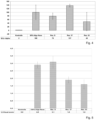
- inventive formulations 37 and 53 showed a significantly reduced amount of released LDH, i.e. these formulations showed a significant protective effect in contrast to the non-inventive formulation D.
- inventive formulations 37 and 53 showed a significantly increased cell viability, i.e. these formulations showed a significant protective effect in contrast to the non-inventive formulation D.
- the interleukin 1 ⁇ release was determined as described above.
- the results of the measurements can be Fig. 4 and the following Table 9. ⁇ b>Table 9: ⁇ /b> Results of the determination of interleukin 1 ⁇ release
- Interleukin 1 ⁇ Standard deviation control 2 0.2 50% oily pollutants 100 40.5 Rez. D 79 17.4 Review 37 137 7.8 Review 53 49 50.9
- Non-inventive formulation D showed no inflammatory reaction because all the cells had already died; regeneration of the skin barrier was no longer possible.
- Inventive formulation 37 showed a mild inflammatory reaction, analogous to mild damage. In accordance with the minimal damage, formulation 53 showed virtually no inflammatory reaction.
- the repetitive occlusive irritation under alternating stress was determined as described above.
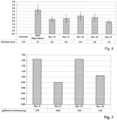
- the results of the measurements can be Fig. 6 and the following Table 11. ⁇ b>Table 11: ⁇ /b> Results of the determination of repetitive occlusive irritation during alternating stress Visual Score Standard deviation control 0.0 0.0 100% oily noxae + watery noxae 3.7 0.7 Review 19 2.3 0.4 Review 37 2.4 0.6 Review 48 2.8 0.6 Review 53 2.6 0.6 Review 67 1.9 0.3
- Handwashing tests were carried out as described above for formulations according to the invention and not according to the invention, as well as a blank sample.
- the test results can be Fig. 7 and the following Table 12. ⁇ b>Table 12: ⁇ /b> Results of the hand washing tests Residual contamination Rez. D 1.65 Review 37 0.8 Review 45 1.65 Review 53 1.05
- the hand washing tests show that the skin protection agents according to the invention also facilitate or promote the cleansing of the skin.
Landscapes
- Health & Medical Sciences (AREA)
- Life Sciences & Earth Sciences (AREA)
- Animal Behavior & Ethology (AREA)
- General Health & Medical Sciences (AREA)
- Public Health (AREA)
- Veterinary Medicine (AREA)
- Birds (AREA)
- Epidemiology (AREA)
- Dermatology (AREA)
- Cosmetics (AREA)
- Medicinal Preparation (AREA)
Description
- Die Erfindung betrifft ein Hautschutzmittel, insbesondere gegen ölige (hydrophobe) Schadstoffe, das auch bei Wechselbelastung, d.h. bei Belastung von sowohl hydrophilen als auch hydrophoben Schadstoffen und bei starker Schmutzbelastung einsetzbar ist.
- Die menschliche Haut ist mit einer Oberfläche von ca. 1,5 bis 2,0 m2 das oberflächengrößte Organ des Menschen, das für den Körper lebenswichtige Funktionen wahrnimmt. Hierfür enthält die Haut Blut- und Lymphgefäße, durch deren Wände hindurch der Austausch von Lymphflüssigkeit, Gasen, Nähr- und Abfallstoffen stattfinden kann, um z.B. Ernährung und Stoffwechsel zu gewährleisten. Weitere Funktionen der Haut sind die Regelung der Körpertemperatur, der Schutz des Körpers gegen Austrocknung und gegen äußere mechanische, chemische und bakterielle Einwirkungen. So halten die Sekrete von Hauttalgdrüsen die Haut geschmeidig und helfen bei der Regulierung des Wasserhaushaltes der Haut. Darüber hinaus vermittelt die Haut unter anderem über freie Nervenendigungen dem Organismus Tast-, Wärme- und Kälte- und Schmerzreize und hat somit die Funktion eines Sinnesorgans.
- Die mannigfaltigen für Hygiene, Körperpflege und Kosmetik angebotenen Produkte, wie z.B. Hautreinigungs-, Hautschutz- und Hautpflegeprodukte dienen daher nicht nur primär der Reinigung, dem Schutz bzw. der Pflege der Haut, sondern sie erhalten auch die Lebensqualität und sichern das Wohlbefinden des Menschen.
- Als Körperhülle stellt die menschliche Haut die Verbindung, aber zugleich auch Abgrenzung des menschlichen Körpers mit seiner Außenwelt dar. Insbesondere erfolgt über sie die Kontaktaufnahme mit allem, was der menschliche Organismus zum Leben benötigt - aber auch was sie gefährden kann.
- Insbesondere am Arbeitsplatz kann die Haut einer Vielzahl von Arbeitsstoffen unterschiedlichster Art ausgesetzt sein und auch Arbeitsstoffe, die gemeinhin nicht als Gefahrstoffe gelten, können bei Langzeitkontakt zu Hautschäden wie z.B. Hauttrockenheit, spröder rissiger Haut mit gestörter Barrierewirkung und / oder erhöhtem Allergierisiko führen. Neben solchen Langzeiteinflüssen bereits schwach irritierender Substanzen sowie der Vielfältigkeit der am Arbeitsplatz eingesetzten Arbeitsstoffe müssen Hautschutzmittel dem Umstand Rechnung tragen, dass die Haut des Menschen individuell verschieden auf äußere Umwelteinflüsse reagiert bzw. hierdurch dann individuell starke Unterschiede der Hautreaktion auf diese Einflüsse beobachtet werden.
- Hautschutzmittel können entsprechend ihren Einsatzgebieten in folgende Kategorien eingeteilt werden (vgl. Dr. Jens Burfeindt, Dr. Dirk Mehlan, Dr. Wolfgang Röcher in "sicher ist sicher" - Arbeitsschutz aktuell, 12 (2006), 547 - 551):
- Schutz vor Arbeitsstoffen
- Erleichterung der Hautreinigung
- Schutz vor Quellung und Hornhauterweichung bei Feuchtarbeit
- Schutz vor UV-Strahlen
- Weitere Anforderungen, die an moderne Hautschutzmittel gestellt werden, sind insbesondere, dass die Griffigkeit der Hände möglichst wenig beeinträchtigt wird bzw. es muss gewährleistet sein, dass die verwendeten Hautschutzmittel mit den jeweiligen Arbeitsmaterialien bzw. - prozessen, wie sie beispielsweise in der Automobil- und Lackindustrie sowie der gummiverarbeitenden Industrie vorkommen, verträglich sind, d.h. sie müssen z.B. silikonfrei, fettfrei, fettarm etc. sein:
So ist beispielsweise besonders nachteilig an Hautschutzpräparaten, die Silikone als Inhaltsstoffe enthalten, dass diese Präparate auf Gegenständen z.B. auf Werkstoffen bzw. Werkstücken Rückstände hinterlassen können, wenn solche Werkstücke per Hand einem weiteren Arbeitsgang zugeführt werden. Daher können bei zu lackierenden Werkstücken die Beschäftigten solche silikonhaltigen Hautschutzmittel nicht einsetzen. Diese sehr schwer entfernbaren Silikonrückstände wirken nämlich bei der Weiterverarbeitung dieser Werkstücke wie z. B. Lackieren oder Vulkanisieren stark störend und führen zu Lackierungsfehlern wie z.B. Lackbenetzungsstörungen bzw. Kraterbildung auf den Werkstücken. Somit können, insbesondere in der Automobil- und Lackindustrie sowie der gummiverarbeitenden Industrie silikonhaltige Hautschutzprodukte trotz ihrer hervorragenden Schutzwirkung und Akzeptanz beim Anwender nicht zum Einsatz kommen. - Darüber hinaus müssen Hautschutzmittel frei von bekannten penetrationsfördernden Inhaltsstoffen wie z.B. Harnstoff sein.
- Weiterhin sollen aus ökologischen Gründen moderne Hautschutzmittel auch frei von fluorhaltigen Tensiden sein. Solche Fluortenside enthaltenden Hautschutzmittel sind nicht nur ökologisch bedenklich, sondern können ebenfalls - wie im Falle der oben beschriebenen silikonhaltigen Hautschutzmittel - bei der Weiterverarbeitung von Werkstücken zu Lackierungsfehlern führen, wenn sich entsprechende Hautschutzpräparatrückstände auf den zu lackierenden Werkstücken befunden haben.
- Die Wirkung eines Hautschutzmittels beruht erfahrungsgemäß auf einem Zusammenspiel physikalischer und physiologischer Effekte der einzelnen Inhaltsstoffe in der Gesamtformulierung. Insbesondere macht man sich die seit dem Altertum bekannte allgemeine Regel "Similia similibus solvuntur" ("Ähnliches wird von Ähnlichem gelöst") zunutze und setzt z.B. bei hydrophilen (lipophoben) Stoffen ein Hautschutzmittel ein, das ein entgegengesetzes Eigenschaftsprofil aufweist, also hydrophob (lipophil) ist. Darüberhinaus können Pigmente oder filmbildende Substanzen die Diffusion eines Arbeitsstoffes in die Haut verzögern und somit die Gefahr eines schädigenden Effektes für die Haut vermindern.
- Als besonders vorteilhafte Hautschutzmittel sind auch solche Mittel zu nennen, die neben ihrer Schutzwirkung gegen Schadstoffe auch die Haftung stark haftender Verschmutzungen wie z.B. wasserunlöslicher Verschmutzungen durch Öle, Lacke, Graphit, Metallstäube, Klebestoffe, Kunstharze etc. vermindern, oder durch spezielle Inhaltsstoffe selbst eine Reinigungswirkung ausüben. Hierdurch kann die anschließende Hautreinigung wesentlich schneller und hautschonender durchgeführt werden, was sich natürlich positiv auf den Hautzustand auswirkt. Solche besonders vorteilhaften Hautschutzmittel werden von der Fa. Evonik Stockhausen GmbH, Krefeld unter der Markenbezeichnung TRAVABON® im Markt vertrieben. Entsprechend sind bereits Produktbeschreibungen und entsprechende Zusammensetzungen dem Fachmann bekannt, und als Internet-Publikationen auffindbar (URL:http://www.leber-gmbh.de/downloads/datenblaetter/hautschutz/travabon.pdf).
- Hautschutzmittel sollen die menschliche Haut vor den unterschiedlichsten Gefährdungen der Außenwelt schützen, wie z.B. Witterungseinflüsse, Wasser und wässrige Lösungen, Chemikalien sowie Verschmutzungen jedweder Art. Üblicherweise überziehen solche Hautschutzmittel in wasserfreier Form die menschliche Haut mit einem "Barriere"- bzw. Schutzfilm, der von der Haut nicht absorbiert werden kann. Idealerweise ist dieser Schutzfilm dergestalt auf der Haut appliziert, dass sein Vorhandensein von der Umwelt nicht bemerkt wird, da er für diese unsichtbar bzw. für den Anwender auf dessen Haut nicht spürbar ist. Dennoch enthalten die meisten am Markt erhältlichen Produkte große Mengen - beispielsweise bis zu 25 Gew.-% - an saugfähigen, gut deckenden sowie an der Haut gut haftenden, ungiftigen anorganischen Feststoffen in Pigmentform. Exemplarisch seien hier Oxide, wie z.B. Zink- und Titandioxid, die Erdalkalicarbonate und -hydrogencarbonate sowie - sulfate, insbesondere deren Magnesium-, Calcium- und Strontiumsalze genannt. Weiterhin sind neben Siliziumdioxid sowie Kieselgelen mineralische Silikate wie z.B. Aluminiumsilikate, Magnesium-Aluminium-Silicate, Bentonite, Kaoline und Talkum zu nennen. Solche anorganischen Pigmente wirken als Barrieremittel, in dem sie auf der Haut eine physikalische Schutzschicht ausbilden. Solche anorganischen Barrieremittel wie z.B. Kaolin oder Talkum vermitteln jedoch dem Anwender ein sehr unangenehmes trockenes Hautgefühl. Bei großer Hitze bzw. wenn der Anwender schwitzt oder er Handschuhe trägt, fühlt sich die Haut "klebrig" an. Hierdurch wird die Akzeptanz der Anwender hinsichtlich des Einsatzes solcher Hautschutzmittel am Arbeitsplatz deutlich herabgesetzt.
- Darüber hinaus werden im Handel Hautschutzmittel angeboten, die sowohl gegen hydrophile (lipophobe) als auch gegen hydrophobe (lipophile) Schadstoffe Schutz bieten sollen, um einen gewissen Schutz für die Haut auch bei häufig wechselnder Beanspruchung ermöglichen zu können. Nichtsdestoweniger sind solche ambivalenten Hautschutzmittel oftmals in ihrer Wirksamkeit eingeschränkt im Vergleich zu Hautschutzmitteln, deren Einsatzspektrum sich lediglich entweder ausschließlich auf hydrophile (lipophobe) oder ausschließlich auf hydrophobe (lipophile) Schadstoffe beschränkt.
- Weitere im Handel erhältliche Hautschutzmittel sind Mittel mit adstringierenden Eigenschaften, die durch die Verwendung von speziellen Gerbstoffen als Inhaltsstoffen deren adstringierende Wirkung dergestalt nutzen, dass die obersten Zellen der Hornhaut verfestigt werden. Hierdurch wird eine Erhöhung der mechanischen Belastbarkeit und der Barrierewirkung der Haut erreicht. Hieraus resultiert die Eignung solcher Hautschutzmittel sowohl bei erhöhter Beanspruchung der Haut durch mechanische Einwirkungen als auch bei häufig wechselnder Hautbelastung durch wässrige und ölige Stoffe.
- In Stand der Technik sind entsprechend einige Hautschutzmittel, welche pflegende oder Hautabdichtene bzw. barrierebildende Substanzen enthalten bekannt. Diesbezüglich offenbart
WO2001/70271 WO 2005016364 ein Hautschutzmittel, das neben Glycerin und Wasser Chondrus Crispus enthält und inUS 4,900,550 wird ein Hautschutzmittel beschrieben, das neben Wasser und Polyglycol und Polysorbat auch Carrageen, Gummi Arabicum, Tragacanth und Johannisbrotmehl. Eine weitere Schutzcreme enthaltend Barriere-bildende Substanzen und gleichzeitig wirksam gegen öllösliche Arbeitsstoffe ist bekannt unter dem Handelsnamen "Ligana Mulit Tec", und wird von der Firma Greven Hautschutz GmbH & Co. KG vertrieben. Entsprechende Produktinformationen sind auf der Internetseite (www.peter-greven.com) zu finden. - Wie bereits zuvor gesagt kann die Haut am Arbeitsplatz einer Vielzahl von Arbeitsstoffen unterschiedlichster Art ausgesetzt sein, wobei auch Arbeitsstoffe, die gemeinhin nicht als Gefahrstoffe gelten, bei Langzeiteinfluss zu Hautschädigungen führen können. Es hat sich jedoch gezeigt, dass im Hinblick auf die gesamte Bandbreite an denkbaren Arbeitsstoffen und den daraus resultierenden vielfältigen Einsatzgebieten von Hautschutzmitteln am Arbeitsplatz gerade ein immer größer werdender Bedarf an einem Hautschutzmittel besteht, das insbesondere eine verbesserte Schutzwirkung für die Haut auch bei häufig wechselnder Beanspruchung, d.h. Schutz sowohl gegen hydrophile (lipophobe) als auch gegen hydrophobe (lipophile) Schadstoffe bietet und eine vergleichbare Reinigungswirkung bzw. einen vergleichbaren Schutz vor Hautverschmutzungen bei der Anwendung zeigt.
- Nichtsdestoweniger sollen diese Hautschutzmittel dem Anwender ein verbessertes - sprich "ein angenehmeres" Hautgefühl vermitteln als die im Handel erhältlichen Hautschutzprodukte mit physikalischen Barrieremitteln, wie z.B. Kaolin, Talkum etc.
- Um einen Schutz vor Schmutz zu bieten, sprich eine vereinfachte Reinigung zu gewährleisten, werden dann den Produkten Tenside zugesetzt. Die meisten Tenside erhöhen allerdings die Penetration von Schadstoffen, so dass bis jetzt kein Hautschutzmittel auf dem Markt erhältlich ist, das einen Schutz vor öligen und wässrigen Noxen und einen Schutz vor Schmutz bietet.
- Aufgabe war es daher, ein Hautschutzmittel, welches auch bei häufig wechselnder Schadstoffbeanspruchung, insbesondere durch hydrophobe (lipophile) als auch hydrophile (lipophobe) Schadstoffe, eine vorzugsweise mindestens vergleichbarer Reinigungswirkung wie die im Stand der Technik bekannten Hautschutzmittel aufweist sowie bei der Anwendung vorzugsweise ein "angenehmes" Hautgefühl bewirkt, und welche vorzugsweise fluortensid- und silikonfrei ist, sowie ein entsprechendes Herstellungsverfahren eines solchen Hautschutzmittels bereitzustellen.
- Die erfindungsgemäße Aufgabe wurde durch ein Hautschutzmittel, insbesondere gegen hydrophobe (lipophile) als auch gegen hydrophile (lipophobe) Schadstoffe gemäß Anspruch 1 gelöst. Bevorzugte Ausführungsformen der Erfindung sind Gegenstand der Unteransprüche.
- Es war völlig überraschend, dass hydrophobe Polymere, d.h. Polymere, die sich nur trüb in Wasser lösen, mit einem nephelometrischen Trübungswert größer 40, als barrierebildende Komponente in Hautschutzmitteln einen guten Schutz gegen ölige Noxen bieten. Darüber hinaus schützt das erfindungsgemäße Hautschutzmittel nicht nur gegen ölige, hydrophobe (liphophile) Schadstoffe, sondern auch bei Wechselbelastung, d.h. bei Belastung von sowohl hydro- philen als auch hydrophoben Schadstoffen und bei starker Schmutzbelastung. Demgegenüber war zu erwarten, dass hydrophobe Polymere als barrierebildende Komponenten in Hautschutzmitteln ausschließlich vor hydrophilen (lipophoben) Schadstoffen, d.h. vor wäßrigen Noxen schützen. Dass diese in den erfindungsgemäßen Hautschutzmitteln ebenfalls auch vor hydrophoben (lipophilen) Schadstoffen, insbesondere öligen Noxen schützen, war völlig unerwartet.
- Gegenstand der vorliegenden Erfindung sind deshalb Hautschutzmittel wie in den Ansprüchen und nachfolgend beschrieben, deren Verwendung als Schutzmittel gegen hydrophile (lipophobe) Schadstoffe bzw. als Schutzmittel sowohl gegen hydrophobe (lipophile) als auch gegen hydrophile (lipophobe) Schadstoffe und ggf. zur Erleichterung der Hautreinigung nach Verschmutzung sowie ein Verfahren zur Herstellung entsprechender Hautschutzmittel.
- Die erfindungsgemäßen Hautschutzmittel haben den Vorteil, dass sie auch ohne das Vorhandensein von Silikon- oder Fluortensiden einen guten Schutz vor lipophilen Noxen bieten. Durch den Verzicht der genannten Tenside werden die bekannten Nachteile des versehentlichen Übertragens der Lipohilie bzw. Hydrophobie auf angefasste Werkstücke vermieden.
- Die erfindungsgemäßen Hautschutzmittel haben außerdem den Vorteil, dass ihre Anwendung nicht nur einen guten Schutz vor lipophilen Noxen sondern auch vor hydrophilen Noxen bieten kann. Die erfindungsgemäßen Hautschutzmittel bieten deshalb einen besonders guten Schutz bei Tätigkeiten, bei denen sowohl ein Kontakt mit lipohilen als auch mit hydrophilen Noxen Vorkommen kann.
- Die erfindungsgemäßen Hautschutzmittel und deren Verwendung sowie ein Verfahren zu deren Herstellung werden nachfolgend beispielhaft beschrieben, ohne dass die Erfindung auf diese beispielhaften Ausführungsformen beschränkt sein soll. Sind nachfolgend Bereiche, allgemeine Formeln oder Verbindungsklassen angegeben, so sollen diese nicht nur die entsprechenden Bereiche oder Gruppen von Verbindungen umfassen, die explizit erwähnt sind, sondern auch alle Teilbereiche und Teilgruppen von Verbindungen, die durch Herausnahme von einzelnen Werten (Bereichen) oder Verbindungen erhalten werden können. Werden im Rahmen der vorliegenden Beschreibung Dokumente zitiert, so soll deren Inhalt, insbesondere bezüglich der in Bezug genommenen Sachverhalte vollständig zum Offenbarungsgehalt der vorliegenden Erfindung gehören. Wenn nicht anders angegeben sind bei Angaben in Prozent immer Massen-% bzw. Gew.-% gemeint. Sind nachfolgend Mittelwerte angegeben, so sind diese, wenn nicht anders angegeben, die zahlengemittelten Mittelwerte. Wird im Rahmen der vorliegenden Erfindung von Lösungen von Polymeren in Wasser gesprochen, so sind darunter auch solche Lösungen, Dispersionen und/oder Suspensionen zu verstehen, in denen Teile der Polymeren gelöst und Teile der Polymeren ungelöst oder gequollen vorliegen.
- Das erfindungsgemäße Hautschutzmittel, insbesondere gegen hydrophobe (lipophile) Schadstoffe, zeichnet sich dadurch aus, dass es mindestens eine barrierebildende Komponente, wobei eine 1 gew.-%ige Lösung dieser barrierebildenden Komponente in Wasser einen nephelometrischen Trübungswert, bestimmt mittels Turbidimetrie, größer 40 (NTU), vorzugsweise größer 50 und bevorzugt größer 60 aufweist, enthält.
- Der nephemologische Trübungswert kann z. B. unter Verwendung eines Turbidimeters vom Typ HACH Turbidimeter 2100P ISO der Fa. Hach Company, Loveland, Colorado (USA) unter Verwendung von Rundküvetten mit Schraubverschluss der Fa. Hach Company, Loveland, Colorado (USA), Katalog-Nummer 24347-06 und unter Verwendung der Kalibriersusbstanzen StablCal Solution HACH (< 0,1 NTU), Katalognummer 26597-42, StablCal Solution HACH (20 NTU), Katalognummer 26601-42, StablCal Solution HACH (100 NTU), Katalognummer 26602-42 und StablCal Solution HACH (800 NTU), Katalognummer 26605-42, alle ebenfalls von der Firma Hach Company, bestimmt werden.
- Der Anteil an barrierebildenden Komponenten, deren 1 gew.-%ige Lösung in Wasser einen nephelometrischen Trübungswert wie oben angegeben aufweist, an der Gesamtzusammensetzung des erfindungsgemäßen Hautschutzmittels (NTU) beträgt vorzugsweise von 0,01 bis 5 Gew.-%, bevorzugt von 0,03 bis 5 Gew.-% und besonders bevorzugt von 0,03 bis 3 Gew.-%.
- In dem erfindungsgemäßen Hautschutzmittel kann jede in kosmetischen Rezepturen einsetzbare barrierebildende Komponente, deren 1 gew.-%ige Lösung in Wasser einen nephelometrischen Trübungswert in den oben angegebenen Bereichen aufweist, eingesetzt werden.
- Bevorzugt sind in dem erfindungsgemäßen Hautschutzmittel ein oder mehrere natürlich vorkommende und/oder synthetisch hergestellte, voprzugsweise natürlich vorkommende Polymere, deren 1 gew.-%ige Lösung in Wasser einen nephelometrischen Trübungswert in den oben angegebenen Bereichen aufweisen, als barrierebildende Komponente enthalten.
- Als barrierebildende Komponenten einsetzbare Polymere, deren 1 gew.-%ige Lösung in Wasser einen nephelometrischen Trübungswert in den oben angegebenen Bereichen aufweisen, sind besonders bevorzugt Polysaccharide in den erfindungsgemäßen Hautschutzmitteln enthalten, die besonders vorteilhaft aus der Gruppe der Gummen ausgewählt sein können. Zu den Gummen zählt man z. B. Pflanzen- oder Baumsäfte, die an der Luft erhärten und Harze bilden oder Extrakte aus Wasserpflanzen. Aus dieser Gruppe können erfindungsgemäß insbesondere Gummi Arabicum, Johannisbrotmehl, Tragacanth, Karaya, Guar Gummi, Pektin, Gellan Gummi, Carrageen, Agar, Algine, Chondrus, Xanthan Gummi etc. oder Mischungen daraus ausgewählt werden.
- Weitere besonders bevorzugte Polysaccharide sind insbesondere Alginate, d.h. Salze und Ester der Alginsäure, vorzugsweise Natriumalginat bzw. Chondrus Crispus (Carrageen) sowie das unter der INCI-Bezeichnung Biosaccharide Gum-4 bekannte Pflanzengummi.
- Als barrierebildende Komponenten, deren 1 gew.-%ige Lösung in Wasser einen nephelometrischen Trübungswert in den oben angegebenen Bereichen aufweisen, einsetzbare Polymere sind des Weiteren bevorzugt Polyurethane und Polyacrylate.
- Um zu gewährleisten, dass die erfindungsgemäßen Hautschutzmittel einen Schutz vor Hautverschmutzungen bieten und auch eine vergleichbare Reinigungswirkung zeigen wie die im Stand der Technik bekannten Hautschutzprodukte, kann es vorteilhaft sein, wenn die erfindungsgemäßen Hautschutzmittel mindestens ein Tensid enthalten.
- Prinzipiell können in dem erfindungsgemäßen Hautschutzmittel alle Tenside, insbesondere für die Anwendung in kosmetischen Mitteln geeigneten Tenside eingesetzt werden. Hierbei sollte berücksichtigt werden, dass Tenside für die menschliche Haut per se Noxen darstellen können bzw. manche Tenside überdies penetrationsfördernd sein können, so dass dies dem für ein Hautschutzmittel gewünschten Effekt, nämlich gerade die Penetration von Schadstoffen in die Haut zu verhindern, zuwider läuft.
- Somit werden in den erfindungsgemäßen Hautschutzmitteln vorzugsweise nur solche Tenside eingesetzt, bei denen sichergestellt ist, dass hierdurch die Schutzwirkung des Mittels als ganzes nicht beeinträchtigt ist. Weiterhin sollten die einsetzbaren Tenside eine gute Hautverträglichkeit aufweisen, insbesondere auch deshalb, weil es sich bei Hautschutzmitteln um "Leave on" Produkte handelt bzw. das Mittel über einen längeren Zeitraum auf der Haut des Anwenders verbleiben soll.
- Besonders bevorzugte Tenside sind deshalb milde bzw. hautverträgliche Tenside, die allein oder in Kombination in den erfindungsgemäßen Hautschutzmitteln enthalten sein können.
- Solche Tenside sind beispielsweise Aminosäuretenside, insbesondere Acylaminosäuren und deren Salze, wie
- Acylglutamate, beispielsweise Natriumacylglutamat, Di-TEA-palmitoylaspartat und Natrium Caprylic/Capric Glutamat,
- Acylpeptide, beispielsweise Palmitoyl hydrolysiertes Milchprotein, Natrium Cocoyl hydrolysiertes Soja Protein und Natrium-/Kalium Cocoyl hydrolysiertes Kollagen, Sarcosinate, beispielsweise Myristoyl Sarcosin, TEA-lauroyl Sarcosinat, Natriumlauroylsarcosinat und Natriumcocoylsarkosinat,
-Acyltauride, beispielsweise Natriumlauroyltaurat und Natriummethylcocoyltaurat, -Isethionate, insbesondere Acylisethionate mit 8 bis 24 C-Atomen, z. B. Natrium-/Ammoniumcocoyl-isethionat, - Sulfosuccinate, beispielsweise Dioctylnatriumsulfosuccinat, Dinatriumlaurethsulfosuccinat, Dinatriumlaurylsulfosuccinat und Dinatriumundecylenamido MEA-Sulfosuccinat.
- Weitere einsetzbare milde Tenside können zwitterionische Tenside, insbesondere die sogenannten Betaine, wie z.B. die N-Alkyl-N,N-dimethylammonium-glycinate, beispielsweise das Kokosalkyl-dimethylammoniumglycinat, N-Acyl-aminopropyl-N,N-dimethylammoniumglycinate, beispielsweise das Kokosacylaminopropyldimethylammoniumglycinat, und 2-Alkyl-3-carboxymethyl-3-hydroxyethyl-imidazoline mit jeweils 8 bis 18 C-Atomen in der Alkyl- oder Acylgruppe sowie das Kokosacylaminoethylhydroxyethylcarboxymethylglycinat. Ein besonders bevorzugtes zwitterionisches Tensid ist das unter der INCI-Bezeichnung Cocamidopropyl Betaine bekannte Fettsäureamid-Derivat.
- Erfindungsgemäß bevorzugt einsetzbare Tenside sind amphotere Tenside, insbesondere -Acyl-/dialkylethylendiamin, beispielsweise Natriumacylamphoacetat, Dinatriumacylamphodipropionat,Dinatriumalkylamphodiacetat, Natriumacylamphohydroxypropylsulfonat, Dinatriumacylamphodiacetat und Natriumacylamphopropionat,
-N-Alkylaminosäuren, beispielsweise Aminopropylalkylglutamid, Alkylaminopropionsäure, Natriumalkylimidodipropionat und Lauroamphocarboxyglycinat.
-N-Alkyl- oder N-Alkenylbetaine mit mindestens 8 C-Atomen, wie z. B. Laurylamidopropylbetain und Oleylamidopropylbetain. - Erfindungsgemäß besonders bevorzugt einsetzbare Tenside sind Polyethylen- und Polypropylenglycolderivate, insbesondere Polypropylenglycolether, die vorzugsweise mindestens 6 C-Atome aufweisen, wie beispielsweise Laureth-6 oder Oleth-5.
- Ganz besonders bevorzugte Tenside, von denen vorzugsweise mindestens eines in den erfindungsgemäßen Hautschutzmitteln enthalten ist, sind vorzugsweise ausgewählt aus der Gruppe umfassend: Natrium Stearoyl Glutamat, Natrium Cocoamphoacetat, Dinatrium Cocoyl Glutamat, Natrium Cocoamphopropionat, Dioctyl Natrium Sulfosuccinat, und Natrium Lauryl Sarkosinat.
- Die erfindungsgemäßen Hautschutzmittel enthalten vorzugsweise von 1 bis 12 Gew.-%, bevorzugt 1 bis 10 Gew.-% und ganz besonders bevorzugt 1 bis 8 Gew.-% Aktivsubstanz, bezogen auf die Gesamtzusammensetzung des Hautschutzmittels, mindestens eines, vorzugsweise milden Tensids, bevorzugt ausgewählt aus den vorstehend genannten Tensiden.
- In den erfindungsgemäßen Hautschutzmitteln können Polyole sowie deren Derivate, insbesondere von 0,1 bis 5 Gew.-%, bevorzugt von 1 bis 5 Gew.-% und ganz besonders bevorzugt von 2 bis 4 Gew.-%, bezogen auf die Gesamtzusammensetzung des Hautschutzmittels, z. B. als Moisturizer, enthalten sein. Überraschend war, dass Propylenglykol, das als penetrationsfödernd bekannt ist, keine negativen Eigenschaften auf die Schutzwirkung zeigt.
- Als Polyole, die allein oder als Mischung mit einem weiteren oder mehreren anderen Polyolen eingesetzt werden können, werden erfindungsgemäß alle Verbindungen verstanden, die unter die in Römpp's Lexikon der Chemie, Version 3.4 Römpp Online, Georg Thieme Verlag angegebenen Definition fallen. Insbesondere kommen übliche für kosmetische und/oder pharmazeutische Formulierungen geeignete, d.h. physiologisch verträgliche Polyalkohole bzw. Polyhydoxyverbindungen, vorzugsweise mit 2 bis 15 Kohlenstoffatomen und mindestens 2 Hydroxylgruppen in betracht. Exemplarisch sind hier mehrwertige Alkohole wie geradkettige, verzweigte oder cyclische Alkanole mit 2 bis 15, vorzugsweise 2 bis 6 Kohlenstoffatomen zu nennen, wobei Glyzerin und/oder 1,2 Propandiol besonders bevorzugt sind. Darüber hinaus können Glykole, wie z.B. Polyethylenglykole, Polypropylenglykole aber auch Zucker und Zuckerderivate, vorzugsweise Fructose, Glucose, Saccharose, Zuckeralkohole, insbesondere Sorbit, Mannit etc. in den erfindungsgemäßen Hautschutzmitteln enthalten sein. Die Polyole bzw. Polyolderivate weisen vorzugsweise freie OH-Gruppen auf und sind damit bevorzugt keine Verbindungen, deren OH-Gruppen verethert sind.
- Als Komponente weist das erfindungsgemäße Hautschutzmittel vorzugsweise außerdem Wasser auf. Vorzugsweise beträgt der Anteil an Wasser an der Gesamtzusammensetzung von 50 bis 90 Gew.-%, bezogen auf die Gesamtzusammensetzung des Hautschutzmittels.
- Als weitere Komponenten können die erfindungsgemäßen Hautschutzmittel gegebenenfalls, Hilfs-, Zusatz- und/oder Wirkstoffe wie z.B. Farbstoffe, Lösungsvermittler, Komplexbildner, Gerbstoffe, Pigmente, Sequestrierungsmittel, Lichtschutzfilter oder Parfüm- bzw. Duftstoffe, pH-Regulatoren, Stabilisatoren, Konservierungsmittel, beispielsweise Parabene, d.h. p-Hydroxybenzoesäurealkylester, wie z.B. Methyl-, Ethyl-, Propyl- und/oder Butylparaben, sowie Phenoxyethanol etc., Antioxidantien und/oder ölige oder wässrige Pflegekomponenten als weitere Komponenten enthalten. Vorzugsweise liegt der Anteil dieser weiteren Komponenten in den für kosmetische und/oder pharmazeutische Formulierungen üblichen Mengen. Bevorzugt beträgt der Anteil der weiteren Komponenten von 0,01 bis 25 Gew.-%, vorzugsweise 0,05 bis 10 Gew.-%, bezogen auf das Gesamtgewicht des Hautschutzmittels, wobei der Fachmann den Gewichtsanteil dieser Komponenten so wählt, dass es zu keiner Beeinträchtigung der Barrierebildung der erfindungsgemäßen Hautschutzmittel aufgrund möglicher penetrationsfördernden Eigenschaften dieser Hilfs-, Zusatz- und/oder Wirkstoffe kommt.
- Obgleich die erfindungsgemäßen Hautschutzmittel eine hervorragende Schutzwirkung bei Belastung von sowohl hydrophilen als auch hydrophoben Schadstoffen und bei starker Schmutzbelastung zeigen, ohne Anteile an den in Hautschutzmitteln üblicher Weise verwendeten anorganischen Pigmenten wie beispielsweise Oxide, z.B. Zink- und Titandioxid, Erdalkalicarbonate und -hydrogencarbonate sowie -sulfate, insbesondere deren Magnesium-, Calcium- und Strontiumsalze sowie Siliziumdioxid bzw. Kieselgelen, mineralische Silikate wie z.B. Aluminiumsilikate, Magnesium-Aluminium-Silicate, Bentonite, Kaoline und insbesondere Talkum zu enthalten, können die erfindungsgemäßen Hautschutzmittel bis zu 10 Gew.-%, bezogen auf das Gesamtgewicht des Hautschutzmittels, an anorganischen Pigmenten, insbesondere ausgewählt aus den zuvor genannten anorganischen Pigmenten als Zusatzstoffe enthalten, um beispielsweise das Hautgefühl zu verbessern oder einen Sonnenschutzfaktor einzuführen.
- Durch den Zusatz von synthetischen und/oder natürlichen Gerbstoffen, vorzugsweise von 0,1 bis 5 Gew.-%, vorzugsweise 0,5 bis 2 Gew.-% und besonders bevorzugt 0,5 bis 1,5 Gew.-% bezogen auf die Gesamtzusammensetzung des Hautschutzmittels als weitere Komponente in den erfindungsgemäßen Hautschutzmitteln kann eine Verbesserung der Hautbarriere, insbesondere auch bei bereits vorgeschädigter Haut erreicht werden, wodurch eine wirksame Unterstützung der Hautregeneration bewirkt wird. Als synthetische oder natürliche Gerbstoffe können alle bekannten Gerbstoffe, die für kosmetische Anwendungen geeignet sind, in dem Hautschutzmittel enthalten sein. Vorzugsweise sind als synthetische Gerbstoffe solche ausgewählt aus der Gruppe umfassend Synthane, z.B.
- Phenolsulfonsäure-Phenol-Harnstoff-Methanal-Kondensate, Natriumsalze von Phenolsulfosäure-Formaldehyd-Polykondensaten (TAMOL PP - Hersteller BASF AG, Ludwigshafen, oder die unter dem Handelsnamen Eucoriol® - INCI-Bezeichnung: "Sodium Bischlorophenyl Sulfamine" (Hersteller: Evonik Stockhausen GmbH, Krefeld) enthalten. Natürliche Gerbstoffe sind z.B. Tannine oder sprühgetrocknete Hamamelisextrakte etc., wobei ein Zusatz in einer Menge von 0,1 bis 5 Gew.-%, bezogen auf die Gesamtmenge des Hautschutzmittels, von Hamamelis virginiana als natürlicher Gerbstoff besonders bevorzugt ist.
- Die erfindungsgemäßen Hautschutzmittel sind vorzugsweise silikonfrei bzw. weisen vorteilhaft auch keine ökologisch bedenklichen Fluortenside als Inhaltsstoffe auf. Somit ist gewährleistet, dass bei der Weiterverarbeitung von Werkstücken keine Lackierungsfehler auftreten, wenn sich Hautschutzpräparatrückstände auf den zu lackierenden Werkstücken befinden würden. Somit sind die erfindungsgemäßen Mittel besonders vorteilhaft insbesondere in der Automobil- und Lackindustrie sowie der gummiverarbeitenden Industrie einsetzbar im Gegensatz zu Silikon- bzw. flourtensidhaltigen Hautschutzprodukten.
- Erfindungsgemäß bevorzugt sind insbesondere Hautschutzmittel, die
- a.) von 1 bis 12 Gew.-% mindestens eines Tensids,
- b.) von 0,1 bis 5 Gew.-% mindestens eines Polyols und/oder Polyolderivats,
- c.) 0 bis 5 Gew.-% kosmetische und/oder
pharmazeutische Hilfs-, Zusatz- und/oder Wirkstoffe, - d.) 0,01 bis 5 Gew.-% mindestens einer barrierebildenden Komponente deren 1 gew.-%ige Lösung in Wasser einen nephelometrischen Trübungswert größer 40 (NTU) aufweist, und
- e.) Wasser enthalten,
- Ganz besonders bevorzugte erfindungsgemäße Hautschutzmittel sind z. B. die in den unten beschriebenen Beispielen aufgeführten Hautschutzmittel, insbesondere jene, welche den Tabellen 1 bis 4 entnommen werden können.
- Die erfindungsgemäßen Hautschutzmittel können als Schutzmittel gegen hydrophile (lipophobe) Schadstoffe und vorteilhafterweise sogar als Schutzmittel sowohl gegen hydrophobe (lipophile) als auch gegen hydrophile (lipophobe) Schadstoffe verwendet werden. Überdies kann die Verwendung des erfindungsgemäßen Hautschutzmittels die Hautreinigung erleichtern.
- Die Erfindung betrifft überdies ein Verfahren zur Herstellung von Hautschutzmitteln, insbesondere gegen hydrophobe (lipophile) Schadstoffe, wobei eine barrierebildende Komponente zur Herstellung des Mittels dergestalt ausgewählt wird, dass der nephelometrische Trübungswert der barrierebildenden Komponente des Hautschutzmittels mittels Turbidimetrie bestimmt wird und mindestens eine barrierebildende Komponente, deren 1 gew.-%ige Lösung in Wasser einen nephelometrischen Trübungswert größer 40 (NTU) aufweist, zur Herstellung des Hautschutzmittels verwendet wird.
- Erfindungsgemäß bevorzugt ist ein Verfahren, bei dem jeweils bezogen auf die Gesamtzusammensetzung des Hautschutzmittels, zur Herstellung des Hautschutzmittels
- a.) von 1 bis 12 Gew.-% mindestens eines Tensids,
- b.) von 0,1 bis 5 Gew.-% mindestens eines Polyols und/oder Polyolderivats,
- c.) 0 bis 5 Gew.-% kosmetische und/oder
pharmazeutische Hilfs-, Zusatz- und/oder Wirkstoffe, - d.) 0,01 bis 5 Gew.-% mindestens einer barrierebildenden Komponente deren 1 gew.-%ige Lösung in Wasser einen nephelometrischen Trübungswert größer 40 (NTU) aufweist, und
- e.) Wasser,
- Vorteilhaft ist, dass durch das erfindungsgemäße Verfahren Hautschutzmittel erhältlich sind, deren Eigenschafts- bzw. Schutzprofil bisher noch nicht erhalten werden konnte, nämlich die Gewährleistung einer Schutzwirkung sowohl vor öligen als auch wässrigen Noxen bei gleichzeitigem Schutz vor Schmutz, d.h. auch die Haftung stark haftender Verschmutzungen wie z.B. wasserunlöslicher Verschmutzungen durch Öle, Lacke, Graphit, Metallstäube, Klebestoffe, Kunstharze etc. kann durch die erfindungsgemäßen Hautschutzmittel vermindert werden. Besonders vorteilhaft ist hierdurch, dass eine anschließende Hautreinigung wesentlich schnellerund hautschonender durchgeführt werden kann.
- Weiterhin vorteilhaft ist, dass für die erfindungsgemäßen Hautschutzmittel keine anorganischen Barrieremittel bzw. anorganische Pigmente wie z.B. Kaolin oder Talkum benötigt werden, die dem Anwender ein sehr unangenehmes trockenes Hautgefühl bei Hitze oder beim Tragen von Handschuhen vermitteln können, wodurch die Akzeptanz der Anwender hinsichtlich des Einsatzes von Hautschutzmitteln am Arbeitsplatz deutlich verbessert wird.
- Die vorliegende Erfindung wird an Hand der
Figuren 1 bis 7 näher erläutert, ohne darauf beschränkt zu sein. -
Fig. 1 zeigt die Kalibrierkurve zur Bestimmung des nephelometrischen Trübungswertes (NTU-Wert). Darin bedeutet NG: Nachweisgrenze, EG: Erfassungsgrenze und BG: Bestimmungsgrenze. -
Fig. 2 zeigt die Ergebnisse der Bestimmung der LDH-Aktivität. (3D-Hautmodell) -
Fig. 3 zeigt die Ergebnisse der Zell-Viabilität (Standard- MTT-Test). (3D-Hautmodell) -
Fig. 4 zeigt die Ergebnisse der Bestimmung der Interleukin 1α-Freisetzung. (3D-Hautmodell) -
Fig. 5 zeigt die Ergebnisse der Bestimmung der repetitiven okklusiven Irritation. -
Fig. 6 zeigt die Ergebnisse der Bestimmung der repetitiven okklusiven Irritation bei Wechselbelastung. -
Fig. 7 zeigt die Ergebnisse der Handwaschtests. - Im Folgenden wird die Erfindung anhand von Beispielen, und Untersuchungen, insbesondere die Hautverträglichkeitsprüfung mit Hilfe des Duhring-Kammer-Testes, Prüfung auf Störung der Hautbarriere mit Hilfe des Tewameters und Prüfung der Reinigungskraft mit Hilfe des Handwaschtests und Ex vivo Verfahren wie z.B. das 3D-Hautmodell etc. sowie Figuren in Form von Diagrammen beschrieben.
- Diese Erläuterungen sind lediglich beispielhaft und schränken die hier vorliegende Erfindung nicht ein. Die angegebenen Mengenangaben, Anteile und Prozentanteile sind, soweit nicht anders angegeben, auf das Gewicht und die Gesamtmenge bzw. auf das Gesamtgewicht der erfindungsgemäßen Hautschutzmittel bezogen.
- Messung der Trübung (nicht gelöster Bestandteile) in wässrigen Medien.
- Die Nephelometrie ist ein optisches Analysenverfahren zur Bestimmung des Feststoffanteiles in Suspensionen, Aerosolen bzw. trüben Dispersionen etc. Die Trübungsmessung hierbei beruht auf dem Faraday-Tyndall-Effekt, bei dem man die Intensität des Streulichtes misst.
- Mit dem erfindungsgemäß verwendeten Turbidimeter wurde durch Messung der Intensitätsabnahme des Lichtes durch das streuende Medium die Trübung bestimmt (Turbidimetrie).
-
- HACH Turbidimeter 2100P ISO der Fa. Hach Company, Loveland, Colorado (USA)
- Wasseraufbereitungsgerät ELGA PURELAB Classic der Fa. ELGA Labwater, Celle (Deutschland).
- Rundküvetten mit Schraubverschluss Hach Cat. 24347-06
- beheizbarer Magnetrührer
- allgemeine Laborausrüstung
-
- Ultrareines Wasser
- StablCal Solution HACH < 0,1 NTU Cat. 26597-42
- StablCal Solution HACH 20 NTU Cat. 26601-42
- StablCal Solution HACH 100 NTU Cat. 26602-42
- StablCal Solution HACH 800 NTU Cat. 26605-42
- Die Kalibrierung wurde unter Verwendung von Carrageenan (Viscarin® PC209 von FMC Biopolymer, Philadelphia (USA)) durchgeführt.
- Die Kalibrierkurve ist in
Fig. 1 dargestellt. Die Berechnung der Kalibrierung erfolgte nach DIN 38402 Teil 51:Ergebnisse für Funktion: Y= 40,25x - 2,92 N= 5 Messwerte Korrelationskoeffizient r 0,999 Reststandardabweichung sy 2,427 Verfahrensabweichung sx0 0,060 Rel. Verfahrensstandardabweichung Vx0 4,467 - Die Kalibrierung des Messgerätes erfolgte nach Angaben und Anleitung des Geräteherstellers - Fa. Hach Company, Loveland, Colorado (USA) - mit Hilfe eines stabilisierten Formazinstandards, der von der Fa. Fach unter der Marke StablCal® als standardisierte Lösung angeboten wird (siehe Punkt 4 "Chemikalien" und dort angegebene Katalognummern (cat.)). Hierbei war zu beachten ist, dass die Messlösungen luftblasenfrei waren.
- 0,1, 1,0, 2,0 und/oder 3,0 g Probe (Tabellen 6a und 6b) wurden mit ultrareinem Wasser auf 100,0 g aufgefüllt und für 2 h auf dem Magnetrührer bei 500 rpm gerührt. Nach 3 Std. Standzeit wurde die Probe gemessen.
- Die vorbereiteten Lösungen wurden luftblasenfrei in die dafür vorgesehenen Küvetten eingefüllt und mit dem zuvor frisch kalibrierten Turbidimeter gemessen. Der angezeigte Wert gab die Trübung in Form des nephelometrischen Trübungswertes (NTU-Wert) an.
- 3- dimensionale Hautmodelle besitzen einen analogen Aufbau wie die Humanhaut. Sie können auch als Testmodelle verwendet werden, um die Barrierereparatur nach Schädigung mit Modellirritantien zu untersuchen (vgl. A. zur Mühlen et al, "Using skin models to assess the effects of a protection cream on skin barrier function", Skin Pharmacol. Physiol 17 (4): 167-179).
- Um die Beeinflussung von Wirkstoffen auf den Lipid-Gehalt der Haut zu analysieren, wurde unter Verwendung eines solchen 3-dimensionalen Hautmodells mit einem 1:1 Gemisch Undecylensäure: Ethylacetat als Modellirritans über die Analyse der Entzündungsparameter (IL-1α) und des LDH- und MTT-Wertes der Zustand der Hautmodelle charakterisiert. Nur wenn eine Schädigung im subtoxischen Bereich vorlag, d.h. durch die Modellnoxe keine massive Zellschädigung hervorgerufen wird, konnte eine Regeneration der Hautbarriere erfolgen.
- Die Hautmodelle EST 1000 der Firma CellSystems® Biotechnologie Vertrieb GmbH wurden in 6-well Zellkulturplatten mit je 900 µl "Maintenance Medium" überführt. Die Kulturen wurden bei 37 °C und 5 % CO2 eine Stunde präinkubiert. Nach der Präinkubationsphase wurde die Aktivität der Lactatdehydrogenase (LDH) im Medium bestimmt und das komplette "Maintenance Medium" (900 µl) ausgetauscht. Anschließend wurde 30 µl 50% einer 1:1 Mischung Undecylensäure/Ethylacetat als Modellnoxe für ölige Noxen in PBS (Phosphatpuffer) auf die entsprechenden Hautmodelle pipettiert. Auf die Negativkontrollen
wurde nur PBS (PBS mit Ca und Mg, erhältlich von Biochrom, Berlin, Deutschland) gegeben. Nach 40 min wurde die LDH-Aktivität im Medium erneut bestimmt und alle Proben 3 x mit 500 µl PBS gewaschen. Danach fand erneut ein Medienwechsel statt. Anschließend wurden je 30 µl der entsprechenden Prüfsubstanz (siehe auch Plattenbelegung) auf die Oberfläche der Kulturen pipettiert. - Nach 24 h Inkubation wurde die LDH-Aktivität bestimmt. Die Hautmodelle wurden anschließend einem MTT-Test (24 und 48h) unterzogen.
- Zum Test der Hautschutzprodukte wurde das Hautschutzmittel vor Applikation der Modellnoxe auf das Hautmodell mit einem sterilen Tupfer aufgetragen.
- Der LDH-Test ist ein üblicher In-vitro-Zytotoxizitätstest, dessen Prinzip auf der Bestimmung der Enzymaktivität von Laktatdehydrogenase (LDH) im Zytoplasma basiert, das aus zerstörten oder beschädigten Zellen freigesetzt wird und somit im in vitro im Zellkulturmedium nachweisbar ist. Die Laktatdehydrogenase ist ein stabiles zytoplasmatisches Enzym, das sehr schnell in das Zellkulturmedium abgegeben wird, wenn die Zellmembran zerstört ist. Die LDH-Aktivität wird mittels eines enzymatischen Tests bestimmt. Hierbei gilt: Je höher der Grad der Zellschädigung ist, desto größer ist die Menge an freigesetztem LDH im Medium.
- Die Quantifizierung der LDH-Aktivität wurde mit einem kommerziell erhältlichen LDH-Test-Kit der Fa. Roche Diagnostics, Mannheim, Deutschland durchgeführt und fand nach Herstellerangaben statt. Bei der Bestimmung der Aktivität der LDH wurde eine LDH- Verdünnungsreihe (LDH, Roche Diagnostics, Mannheim, Deutschland) als Standard mitgeführt.
- Der MTT-Test ist ein Zytotoxizität-Test. Zellen werden in vitro mit dem namensgebenden Farbstoff, einem gelben Tetrazoliumsalz, behandelt, um ihre Lebensfähigkeit beziehungsweise den Anteil lebender Zellen im Vergleich zu einer Kontrollprobe von Zellen zu messen.
- Die Vitalität der Zellen wurde mit dem Standard MTT-Test bestimmt. Hierbei wurde das gelbe Tertazolium-Salz MTT (Thiazolyl Blue Tetrazolium Bromide, Hersteller: Fa. Sigma)
durch mitochondriale Dehydrogenase metabolisch aktiver Zellen in einen blauen Formazan-Farbstoff reduziert, der anschließend photometrisch bestimmt wurde. - Interleukine (IL-x) sind zu den Zytokinen zählende Peptidhormone, d. h. sie sind körpereigene Botenstoffe der Zellen des Immunsystems, Interleukin-1 wird von Makrophagen, Endothelzellen, Fibroblasten und einigen anderen Zellen gebildet und ist ein entzündungsfördernder Signalstoff. IL1α spielt eine wichtige Rolle bei der Erhaltung der Hautbarrierfunktion. Die Quantifizierung der oben genannten Parameter wurde mit kommerziell erhältlichen Test-Kits (Interleukin 1α, R&D Systems GmbH, Wiesbaden- Norderstedt, Deutschland) durchgeführt und fand nach Herstellerangaben statt.
- Auf dem volaren Unterarm von Probanden wurden Testflächen/Felder markiert. Anschließend wurden die Ausgangswerte der Haut durch visuelle Begutachtung bestimmt. Nach dieser Bestimmung wurde dann das Hautschutzprodukt auf dem Unterarm aufgetragen. Ein Kontrollfeld und ein Feld als Positivstandard blieben unbehandelt bzw. frei.
- Nach 10 min Einwirkzeit wurde überschüssiges Produkt abgetupft. Danach wurden Finn Kammern mit einer 1:1 Mischung Undecylensäure/Ethylacetat als Modellnoxe für ölige Noxen bzw. 2,5 %iger Natriumlaurylsulfatlösung (SDS) als Modellnoxe für wässrige Noxen auf die Testfelder gesetzt. Ein Testfeld blieb als Kontrollfeld frei.
- Nach 30 min bei Tests auf Schutzwirkung des Hautschutzmittels gegen ölige Noxen bzw. 60 min bei Tests des Mittels gegen wässrige Noxen wurden die Finn Kammern abgenommen und mit Wasser abgespült. Am nächsten Tag vor dem nächsten Testzyklus wurden wieder der TEWL-Wert und der Corneometerwert bestimmt und visuell begutachtet. Die Testprozedur wurde 4 Tage lang wiederholt, am 5. Tag erfolgten dann die Messungen der Hautwerte (TEWL, Corneometer und visuelle Begutachtung).
- Der Test auf häufig wechselnde Belastung der Haut wurde wie folgt durchgeführt:
Den Probanden wurde morgens 2,5 gew.-%ige Natriumlaurylsulfatlösung (SDS) auf die Haut aufgetragen, nachmittags erfolgte Auftragung eines Ethylacetat/Undecylensäure- Gemisches (1:1) für jeweils 30 min. - Die visuelle Bewertung erfolgte nach dem in der Tabelle 0 angegebenen Bewertungsschema.
Tabelle 0: Bewertungsschema für die visuelle Bewertung. Kriterien Symptome Punkte R = Rötung Negativ 0 (Erythem) sehr leichtes, punktförmiges oder diffuses Erythem 1 gut erkennbares, scharf begrenztes Erythem 2 mittelstarkes Erythem 3 starkes, feurig-rotes Erythem mit Ödem oder epidermalem Defekt (Bläschen, Nekrosen) 4 S = Schuppung Negativ 0 Trockenheit, Glanzeffekt 1 feine Schuppung 2 mäßige Schuppung 3 starke Schuppung mit Abschilferungen 4 F = Fissuren Negativ 0 (Risse) sehr oberflächliche epidermale Separation 1 einzelne oder mehrere weite Fissuren 2 tiefe Fissuren mit Blutung und Exsudation 3 - Lag eine Bewertung zwischen zwei Bewertungspunkten, konnte zur weiteren Differenzierung die Beurteilung in 0,5er Schritten erfolgen. Anschließend wurde der Mittelwert aus der Summe der einzelnen Irritationswerte von R, S und F gebildet.
- Der orientierende Handwaschtest wurde mit 10 Probanden wie folgt durchgeführt:
- 1,2 g Testprodukt wurden aufgetragen und eingerieben
- 0,5 g Schmutz wurde auf den Handinnenflächen und auf den Handrücken verrieben
- 1 ml Wasser wurde zugefügt und 30 sec. gewaschen
- nochmals wurde 1 ml Wasser zugefügt und 30 sec. waschen gelassen
- unter fließendem kalten Wasser wurde abgespült
- die Beurteilung der Reinigungswirkung erfolgte nach der 6-Punkte-Skala
- Als Modellschmutz wurde eine Mischung aus Öl, Fett und verschiedenen Pigmenten, die 54,15 Gew.-% Castrol-Motoröl, 18,05 Gew.-% Vaseline, 18,05 Gew.-% Adeps Lanae, 3,61 Gew.-% Graphit, 5,42 Gew.-% Flammruß und 0,72 Gew.-% Eisenoxid enthielt, verwendet.
- Der Grad der Restverschmutzung auf der Handinnenfläche und dem Handrücken wurde im Anschluss an die Waschung nach der folgenden 6-Punkte-Skala bewertet.
- 0 =sauber
- 1 = leichte Restverschmutzung
- 2 = mittlere Restverschmutzung
- 3 = starke Restverschmutzung
- 4 = sehr starke Restverschmutzung
- 5 = kein Reinigungseffekt
- Um eine bessere Differenzierung der Reinigungswirkung zu erhalten, erfolgte die Beurteilung durch den/die Durchführende(n) in 0,5er-Schritten.
- Es wurden die in den nachfolgenden Tabellen 1 bis 5 aufgeführten Rezepturen hergestellt, wobei die Eignung der barrierebildenden Komponenten zuvor über die Bestimmung des nephelometrischen Trübungswertes (NTU-Wert) ermittelt worden war. Der NTU-Wert kann Tabelle 6 entnommen werden. Die Herstellung der erfindungsgemäßen Hautschutzmittel erfolgte dann durch Zusammenrühren der in den Tabellen genannten Komponenten mittels der in der Kosmetik bekannten üblichen Verfahren.
Tabelle 1: Rezepturen Inhaltsstoffe (INCI-Bezeichnungen) in Gew. -% Rez. 1 Rez. 2 Rez. 3 Rez. 4 Rez. 5 Ethylhexyl Stearate 4,00 4,00 4,00 4,00 4,00 Glyceryl Stearate SE 3,50 3,50 3,50 3,50 3,50 Glycerin 3,00 3,00 3,00 3,00 3,00 Cetearyl Alcohol 2,50 2,50 2,50 2,50 2,50 Sodium Bischlorophenyl Sulfamine 2,10 2,10 2,10 2,10 2,10 Isopropyl Palmitate 2,00 2,00 2,00 2,00 2,00 Glycol Distearate 2,00 2,00 2,00 2,00 2,00 Biosaccaride Gum-4 1) 5,00 2,00 - - - Chondrus Crispus (carrageenan)2) - - 2,00 - - Polyurethane-32 3) - - - 1,00 - Sodium Alginate 4) - - - - 2,00 Ceteareth-6 1,20 1,20 1,20 1,20 1,20 Ceteareth-25 0,30 0,30 0,30 0,30 0,30 Phenoxyethanol 0,72 0,72 0,72 0,72 0,72 Methylparaben 0,20 0,20 0,20 0,20 0,20 Ethylparaben 0,02 0,02 0,02 0,02 0,02 Propylparaben 0,02 0,02 0,02 0,02 0,02 Butylparaben 0,02 0,02 0,02 0,02 0,02 Isobutylparaben 0,02 0,02 0,02 0,02 0,02 Parfum 0,20 0,20 0,20 0,20 0,20 Aqua ad 100 ad 100 ad 100 ad 100 ad 100 1) Glycofilm® 1,5P von Solabia (ca. 1,5%ige Lösung) 2) Viscarin® PC209 Carrageenan von FMC Biopolymer, Philadelphia (USA) bzw. FMC Europe, Brüssel (Belgien) 3) Baycusan® C1003 von Bayer MaterialScience AG, Leverkusen (Deutschland) 4) Kelcosol® von ISP Tabelle 1: Fortsetzung Inhaltsstoffe (INCI-Bezeichnungen) in Gew. -% Rez. 6 Rez. 7 Rez. 8 Ethylhexyl Stearate 4,00 4,00 4,00 Glyceryl Stearate SE 3,50 3,50 3,50 Glycerin 3,00 3,00 3,00 Cetearyl Alcohol 2,50 2,50 2,50 Sodium Bischlorophenyl Sulfamine 2,10 2,10 2,10 Isopropyl Palmitate 2,00 2,00 2,00 Glycol Distearate 2,00 2,00 2,00 Hydrolyzed Sclerotium Gum 5) 2,00 - - Polyglutamic acid 6) - 2,00 - Polyvinyl alcohole 7) - - 2,00 Ceteareth-6 1,20 1,20 1,20 Ceteareth-25 0,30 0,30 0,30 Phenoxyethanol 0,72 0,72 0,72 Methylparaben 0,20 0,20 0,20 Ethylparaben 0,02 0,02 0,02 Propylparaben 0,02 0,02 0,02 Butylparaben 0,02 0,02 0,02 Isobutylparaben 0,02 0,02 0,02 Parfüm 0,20 0,20 0,20 Aqua ad 100 ad 100 ad 100 5) Tego Cosmo LSG von Evonik Goldschmidt, Essen 6) Tego Cosmo PGA von Evonik Goldschmidt, Essen 7) Mowiol 4-88 von Clariant 8) Viscarin 389 von FMC Biopolymer 9) Rewoteric AM C von Evonik Goldschmidt (40 -%ige Lösung) 10) Plantacare ACG 35 = Plantapon ACG LC von Cognis (35 -%ige Lösung) 11) Rewoteric AM KSF 40 von Evonik Goldschmidt (40 -%ige Lösung) 12) Rapithix A60 von ISP 13) Rewopol SB FA 30 B von Evonik Goldschmidt (33 -%ige Lösung) 14) Rapithix A100 von ISP 15) Baycusan C1000 von Bayer MaterialScience AG, Leverkusen (Deutschland) 16) Hostapon SCI von Clariant (85%ig) 17) Tegocel HPM 50 von Evonik Goldschmidt, Essen Tabelle 2: Rezepturen Inhaltsstoffe (INCI-Bezeichnungen) in Gew. -% Rez. 9 Rez. 10 Rez. 11 Rez. 12 Rez. 13 Ethylhexyl Stearate 4,00 4,00 4,00 4,00 4,00 Glyceryl Stearate SE 3,50 3,50 3,50 3,50 3,50 Glycerin 3,00 3,00 3,00 3,00 3,00 Cetearyl Alcohol 1,75 1,75 1,75 1,75 1,75 Sodium Bischlorophenyl Sulfamine 2,00 2,00 2,00 2,00 2,00 Isopropyl Palmitate 2,00 2,00 2,00 2,00 2,00 Glycol Distearate 2,00 2,00 2,00 2,00 2,00 Biosaccaride Gum-4 1) 5,00 2,00 - - - Chondrus Crispus 2) - - 0,25 - - Polyurethane-32 3) - - - 0,25 - Sodium Alginate 4) - - - - 0,25 Ceteareth-6 1,20 1,20 1,20 1,20 1,20 Ceteareth-25 0,30 0,30 0,30 0,30 0,30 Phenoxyethanol 0,72 0,72 0,72 0,72 0,72 Methylparaben 0,20 0,20 0,20 0,20 0,20 Ethylparaben 0,02 0,02 0,02 0,02 0,02 Propylparaben 0,02 0,02 0,02 0,02 0,02 Butylparaben 0,02 0,02 0,02 0,02 0,02 Isobutylparaben 0,02 0,02 0,02 0,02 0,02 Parfum 0,20 0,20 0,20 0,20 0,20 Aqua Ad 100 ad 100 ad 100 ad 100 ad 100 Tabelle 3: Rezepturen Inhaltsstoffe (INCI-Bezeichnungen) in Gew. -% Rez. 14 Rez. 15 Rez. 16 Rez. 17 Rez. 18 Ethylhexyl Stearate 4,00 4,00 4,00 4,00 4,00 Glyceryl Stearate SE 3,50 3,50 3,50 3,50 3,50 Glycerin 3,00 3,00 3,00 3,00 3,00 Cetearyl Alcohol 0,500 1,75 1,75 1,75 1,75 Sodium Bischlorophenyl Sulfamine 2,00 2,00 2,00 2,00 2,00 Isopropyl Palmitate 2,00 2,00 2,00 2,00 2,00 Sodium Stearoyl Glutamate 1,44 1,44 1,44 1,44 1,44 Cetearyl Alcohol 0,50 0,50 0,50 0,50 0,50 Biosaccaride Gum-4 v 5,00 1,00 - - - Chondrus Crispus Z) - - 0,25 - - Polyurethane-32 3) - - - 0,25 - Sodium Alginate 4) - - - - 0,25 Phenoxyethanol 0,72 0,72 0,72 0,72 0,72 Methylparaben 0,20 0,20 0,20 0,20 0,20 Ethylparaben 0,02 0,02 0,02 0,02 0,02 Propylparaben 0,02 0,02 0,02 0,02 0,02 Butylparaben 0,02 0,02 0,02 0,02 0,02 Isobutylparaben 0,02 0,02 0,02 0,02 0,02 Parfum 0,20 0,20 0,20 0,20 0,20 Sodium Chloride 0,03 0,03 0,03 0,03 0,03 Aqua Ad 100 ad 100 ad 100 ad 100 ad 100 Tabelle 3: Fortsetzung Inhaltsstoffe (INCI-Bezeichnungen) in Gew. -% Rez. 19 Rez. 20 Ceteareth-25 1,50 1,50 Polyglyceryl-3 Methylglucose Distearate 3,50 3,50 Cetylstearylalkohol 0,50 0,50 Isopropylpalmitat 2,00 2,00 Isooctylstearat 4,00 4,00 Glycerin 3,00 3,00 Disodium Laureth Sulfosuccinate 13) 8,00 Natrium Benzoat 0,60 0,60 Milchsäure 80%ig 0,30 0,30 Zinksalicylate 1,00 1,00 Gingko 0,10 0,10 Xanthan Gum 0,25 0,25 Biosaccaride Gum-4 1) 2,00 2,00 Aqua ad 100 ad 100 


Tabelle 4: Fortsetzung Inhaltsstoffe (INCI-Bezeichnungen) in Gew. - % Rez. 39 Rez. 40 Rez. 41 Rez. 42 Rez. 43 Glycerin 3,00 3,00 3,00 3,00 3,00 Propylene Glycol - - - - - Capric/Caprylic Triglyceride 2,00 2,00 2,00 2,00 2,00 Sodium Polyacrylate 0,87 0,87 0,87 0,87 0,87 Hydrogenated Polydecene 0,51 0,51 0,51 0,51 0,51 Trideceth-6 0,09 0,09 0,09 0,09 0,09 Biosaccaride Gum-4 1) 5,00 2,00 - - - Chondrus Crispus 2) - - 2,00 - - Polyurethane-32 3) - - - 2,00 - Sodium Alginate 4) - - - - 2,00 Sodium Cocoamphoacetate 9) 8,00 8,00 8,00 8,00 8,00 Disodium Cocoyl Glutamate 10) - - - - - Sodium Cocoamphopropionate 11) - - - - - Phenoxyethanol 0,72 0,72 0,72 0,72 0,72 Methylparaben 0,20 0,20 0,20 0,20 0,20 Ethylparaben 0,02 0,02 0,02 0,02 0,02 Propylparaben 0,02 0,02 0,02 0,02 0,02 Butylparaben 0,02 0,02 0,02 0,02 0,02 Isobutylparaben 0,02 0,02 0,02 0,02 0,02 Parfum 0,20 0,20 0,20 0,20 0,20 Aqua ad 100 ad 100 ad 100 ad 100 ad 100 Tabelle 4: Fortsetzung * Rezepturen außerhalb des beanspruchten Bereichs Inhaltsstoffe (INCI-Bezeichnungen) in Gew. -% *Rez. 44 Rez. 45 Rez. 46 Rez. 47 Rez. 48 Glycerin 3,00 3,00 3,00 3,00 3,00 Propylene Glycol - - - - - Capric/Caprylic Triglyceride 2,00 2,00 2,00 2,00 2,00 Sodium Polyacrylate 12)) 0,87 0,87 0,87 0,87 0,87 Hydrogenated Polydecene 12) 0,51 0,51 0,51 0,51 0,51 Trideceth-6 12) 0,09 0,09 0,09 0,09 0,09 Biosaccaride Gum-41) 5,00 2,00 - - 2,00 Chondrus Crispus 2) - - 2,00 - - Polyurethane-32 3) - - - 2,00 - Sodium Alginate 4) - - - - 2,00 Sodium Cocoamphoacetate 9) - - - - - Disodium Laureth Sulfosuccinate 13) 18,00 12,00 8,00 8,00 12,00 Sodium Cocoamphopropionate 11) - - - - - Phenoxyethanol 0,72 0,72 0,72 0,72 0,72 Methylparaben 0,20 0,20 0,20 0,20 0,20 Ethylparaben 0,02 0,02 0,02 0,02 0,02 Propylparaben 0,02 0,02 0,02 0,02 0,02 Butylparaben 0,02 0,02 0,02 0,02 0,02 Isobutylparaben 0,02 0,02 0,02 0,02 0,02 Parfum 0,20 0,20 0,20 0,20 0,20 Aqua ad 100 ad 100 ad 100 ad 100 ad 100 Tabelle 4: Fortsetzung Inhaltsstoffe (INCI-Bezeichnungen) in Gew. -% Rez. 49 Rez. 50 Rez. 51 Rez. 52 Rez. 53 Glycerin 3,00 3,00 3,00 3,00 3,00 Propylene Glycol - - - - - Capric/Caprylic Triglyceride 2,00 2,00 2,00 2,00 2,00 Sodium Polyacrylate 12) 0,87 0,87 0,87 0,87 0,87 Hydrogenated Polydecene 12) 0,51 0,51 0,51 0,51 0,51 Trideceth-6 12) 0,09 0,09 0,09 0,09 0,09 Biosaccaride Gum-4 1) 5,00 2,00 - - - Chondrus Crispus 2) - - 2,00 - - Polyurethane-32 3) - - - 2,00 - Sodium Alginate 4) - - - - 2,00 Sodium Cocoamphoacetate 9) - - - - - Disodium Cocoyl Glutamate 10) - - - - - Sodium Cocoamphopropionate 11) 8,00 8,00 8,00 8,00 12,00 Phenoxyethanol 0,72 0,72 0,72 0,72 0,72 Methylparaben 0,20 0,20 0,20 0,20 0,20 Ethylparaben 0,02 0,02 0,02 0,02 0,02 Propylparaben 0,02 0,02 0,02 0,02 0,02 Butylparaben 0,02 0,02 0,02 0,02 0,02 Isobutylparaben 0,02 0,02 0,02 0,02 0,02 Parfum 0,20 0,20 0,20 0,20 0,20 Aqua ad 100 ad 100 ad 100 ad 100 ad 100 Tabelle 4: Fortsetzung Inhaltsstoffe (INCI- Bezeichnungen) in Gew. -% Rez. 54 Rez. 55 Rez. 56 Rez. 57 Rez. 58 Glycerin Propylene Glycol 3,00 3,00 3,00 3,00 3,00 Capric/Caprylic Triglyceride 2,00 2,00 2,00 2,00 2,00 Sodium Polyacrylate 12) 0,87 0,87 0,87 0,87 0,87 Hydrogenated Polydecene 12) 0,51 0,51 0,51 0,51 0,51 Trideceth-6 12) 0,09 0,09 0,09 0,09 0,09 Biosaccaride Gum-4 1) 5,00 2,00 - - - Chondrus Crispus 2) - - 2,00 - - Polyurethane-32 3) - - - 2,00 - Sodium Alginate 4) - - - - 2,00 Sodium Cocoamphoacetate9) - - - - - Disodium Cocoyl Glutamate 10) - - - - - Sodium Cocoamphopropionate 8,00 8,00 8,00 8,00 8,00 Phenoxyethanol 0,72 0,72 0,72 0,72 0,72 Methylparaben 0,20 0,20 0,20 0,20 0,20 Ethylparaben 0,02 0,02 0,02 0,02 0,02 Propylparaben 0,02 0,02 0,02 0,02 0,02 Butylparaben 0,02 0,02 0,02 0,02 0,02 Isobutylparaben 0,02 0,02 0,02 0,02 0,02 Parfum 0,20 0,20 0,20 0,20 0,20 Aqua ad 100 ad 100 ad 100 ad 100 ad 100 Tabelle 4: Fortsetzung * Rezepturen außerhalb des beanspruchten Bereichs Inhaltsstoffe (INCI-Bezeichnungen) in Gew. - % Rez. 59 Rez. 60 Rez. 61 *Rez. 62 Rez. 63 Trisodium dicarboxymethyl alaninate 0,01 0,01 0,01 0,01 0,01 Phenoxyethanol 0,94 0,94 0,94 0,94 0,94 Propylenglykol 3,50 3,50 3,50 3,50 3,50 Capric/Caprylic Triglyceride 2,00 2,00 2,00 2,00 2,00 Parfum 0,20 0,20 0,20 0,20 0,20 Sodium polyacrylate 14) 1,00 1,00 1,00 1,00 Sodium Alginate 4) 2,00 Biosaccaride Gum-4 1) 2,00 2,00 2,00 2,00 2,00 Sodium Cocoamphoacetate 9) 12,00 - - 18,00 6,00 Disodium Laureth Sulfosuccinate 13) - 12,00 - - - Sodium Cocoamphopropionate 11) - - 12,00 - - Aqua ad 100 ad 100 ad 100 ad 100 ad 100 Tabelle 4: Fortsetzung Inhaltsstoffe (INCI- Bezeichnungen) in Gew. -% Rez. 64 Rez. 65 Cremophor A6 (BASF) 1,20 1,20 Cremophor A25 (BASF) 0,30 0,30 Glyceryl Stearate SE 3,50 3,50 Glycerin 3,00 3,00 Cetylstearyl Alcohol 2,50 2,50 Ethylenglycoldistearate 2,00 2,00 Isopropyl Palmitate 2,00 2,00 Isooctylsterate 4,00 4,00 Polyurethane-32 3) 2,00 - Polyurethane-34 15) - 2,00 Phenoxyethanol 0,72 0,72 Methylparaben 0,20 0,20 Ethylparaben 0,02 0,02 Propylparaben 0,02 0,02 Butylparaben 0,02 0,02 Isobutylparaben 0,02 0,02 Parfum 0,20 0,20 Aqua ad 100 ad 100 Tabelle 4: Fortsetzung * Rezepturen außerhalb des beanspruchten Bereichs Inhaltsstoffe (INCI-Bezeichnungen) in Gew. -% *Rez. 66 *Rez. 67 Decyl cocoate 8,00 8,00 Ethylhexyl palmitate 5,00 5,00 Cetyl ricinoleate 2,00 2,00 Cetearyl alcohol 1,00 1,00 Vitamin E acetate 0,50 0,50 Sucrose stearate 2,00 2,00 Cetearyl glucoside 0,50 0,50 Hydrolyzed sclerotium gum 0,20 0,20 Propylene glycol 4,00 4,00 Glycerin 4,00 4,00 Panthenol 0,50 0,50 Chondrus Crispus 2) 2,00 2,00 Disodium Laureth Sulfosuccinate 13) 8,00 Sodium Cocoamphopropionate 11) 12,00 Phenoxyethanol 0,72 0,72 Methylparaben 0,20 0,20 Ethylparaben 0,02 0,02 Propylparaben 0,02 0,02 Butylparaben 0,02 0,02 Isobutylparaben 0,02 0,02 Parfum 0,20 0,20 Aqua ad 100 ad 100 Tabelle 5: Nicht erfindungsgemäße Rezepturen Inhaltsstoffe (INCI-Bezeichnungen) in Gew. -% Rez. A Rez. B Rez. C Rez. D Tale 21,00 21,00 21,00 21,00 Glycerin 7,00 7,00 7,00 7,00 Silica 3,00 3,00 3,00 3,00 Glyceryl Stearate 2,90 2,90 2,90 2,90 Laureth-10 2,00 2,00 2,00 2,00 Bentonite 0,99 0,99 0,99 0,99 Sodium Phosphate 0,46 0,46 0,46 0,46 Lactic Acid 0,20 0,20 0,20 0,20 Potassium Sorbate 0,30 0,30 0,30 0,30 Dioctyl Sodium Sulfosuccinate 0,02 0,02 0,02 0,02 Silver Chloride 0,002 0,002 0,002 0,002 Propylene Glycol 0,002 0,002 0,002 0,002 Titanium Dioxide 0,003 0,003 0,003 0,003 Sodium Cocoamphoacetate 9) 8,00 - - - Disodium Cocoyl Glutamate 10) - 8,00 - - Sodium Cocoamphopropionate11) - - 8,00 - Sodium cocoyl isethionat16) - - - 9,00 Parfum 0,20 0,20 0,20 0,20 Aqua ad 100 ad 100 ad 100 ad 100 Tabelle 5: Fortsetzung Inhaltsstoffe (INCI-Bezeichnungen) in Gew. -% Rez. E Ethylhexyl Stearate 4,00 Glyceryl Stearate SE 3,50 Glycerin 3,00 Cetearyl Alcohol 2,50 Sodium Bischlorophenyl Sulfamine 2,10 Isopropyl Palmitate 2,00 Glycol Distearate 2,00 Hydroxypropylcellulose 17) 2,00 Ceteareth-6 1,20 Ceteareth-25 0,30 Phenoxyethanol 0,72 Methylparaben 0,20 Ethylparaben 0,02 Propylparaben 0,02 Butylparaben 0,02 Isobutylparaben 0,02 Parfum 0,20 Aqua ad 100 Tabelle 6: Nephlometrischer Trübungswert (NTU, Nephelometrie Turbidity Unit) Probe (INCI-Bezeichnungen) 1 gew.-%ige Lösung 2 gew-%ige Lösung 3 gew-%ige Lösung Sodium Alginate 4) (Kelcosol® von ISP) 90 160 192 Sodium Alginate (Algogel® 3020 von Degussa Texturant Systems France SAS) 72 152 202 Biosaccaride Gum-4 v (Glycofilm® 1,5 P (H20 98%) von C.H. Erbslöh KG, Krefeld) 66 112 ---* Chondrus Crispus (carrageenan)A (Viscarin® PC209 Carrageenan von FMC Biopolymer) 48 84 120 Xanthan Gum (Rhodicare S) 37 78 ---* Hydrolyzed Sclerotium Gum b) Tego Cosmo LSG 21 41 92 Sodium Carboxymethylcellulose WALOCEL® CRT 2000 15 29 ---* Hydroxypropycellulose Klucel® 10 21,0 ---* Hydroxypropyl Methylcellulose17) Tegocel HPM 50 5 9 14 Polyglutamic acid 6) Tego Cosmo PGA 4,9 9,5 14,4 Polyvinyl alcohole 7) Mowiol® 4-88 (Fa. Clariant) 0,7 1,0 1,5 Tabelle 6: Fortsetzung Probe 0,1 gew-%ige. Lösung/ WS 1 gew-%ige Lösung/ WS Polyurethane-34 1b) Baycusan® C 1000 (H20: 56 %) 173 > 1000 ** Polyurethane-32 Baycusan® C 1003 (H20: 48,4%) 510 > 1000 ** Sodium polyacrylate 14) Rapithix® A 100 (H20: 0,4%)** 443 _* * Messung nicht möglich (Lufteinschlüsse, zu hohe Viscosität, Wassergehalt). ** Ein Messwert > 1000 ist außerhalb des vorgegebenen Messbereichs des Gerätes. - Erfindungsgemäße und nicht erfindungsgemäß Rezepturen wurden aufgetragen und anschließend die LDH-Aktivität gemessen. In einer Blindprobe wurden die Noxen ohne vorheriges Aufbringen einer Rezeptur aufgebracht und die LDH-Aktivität bestimmt. Die Ergebnisse der Messungen können
Fig. 2 sowie der nachfolgenden Tabelle 7 entnommen werden.Tabelle 7: Ergebnis der Bestimmung der LDH-Aktivität LDH Standardabweichung Kontrolle 0 0 50 % ölige Noxen 572 194 Rez. D 947 28 Rez. 37 497 221 Rez. 53 142 22 - Die erfindungsgemäßen Rezepturen 37 und 53 zeigten eine deutlich verringerte Menge an freigesetztem LDH, d.h. diese Rezepturen zeigten eine signifikante Schutzwirkung im Gegensatz zur nicht erfindungsgemäßen Rezeptur D.
- Für erfindungsgemäße und nicht erfindungsgemäße Rezepturen sowie eine Blindprobe wurde die Zell-Viabilität gemessen. Die Ergebnisse der Messungen können
Fig. 3 sowie der nachfolgenden Tabelle 8 entnommen werden.Tabelle 8: Ergebnis der Bestimmung der Zell-Viabilität MTT Standardabweichung Kontrolle 100 3,1 50 % ölige Noxen 18 6,1 Rez. D 1 0,1 Rez. 37 25 12,3 Rez. 53 74 8,8 - Die erfindungsgemäßen Rezepturen 37 und 53 zeigten eine deutlich erhöhte Zellviabilität, d.h. diese Rezepturen zeigten eine signifikante Schutzwirkung im Gegensatz zur nicht erfindungsgemäßen Rezeptur D.
- Für erfindungsgemäße und nicht erfindungsgemäße Rezepturen sowie eine Blindprobe wurde wie oben beschrieben die Interleukin 1α-Freisetzung bestimmt. Die Ergebnisse der Messungen können
Fig. 4 sowie der nachfolgenden Tabelle 9 entnommen werden.Tabelle 9: Ergebnis der Bestimmung der Interleukin 1α-Freisetzung Interleukin 1α Standardabweichung Kontrolle 2 0,2 50 % ölige Noxen 100 40,5 Rez. D 79 17,4 Rez. 37 137 7,8 Rez. 53 49 50,9 - Die nicht erfindungsgemäßen Rezeptur D zeigte keine Entzündungsreaktion, da die Zellen bereits alle abgestorben waren; eine Regeneration der Hautbarriere war nicht mehr möglich. Die erfindungsgemäße Rezeptur 37 zeigte eine leichte Erzündungsreaktion analog zu einer leichten Schädigung. Rezeptur 53 zeigte entsprechend der kaum vorhandenen Schädigung, so gut wie keine Entzündungsreaktion.
- Für erfindungsgemäße und nicht erfindungsgemäße Rezepturen sowie eine Blindprobe wurde wie oben beschrieben die repetitive okklusive Irritation bestimmt. Die Ergebnisse der Messungen können
Fig. 5 sowie der nachfolgenden Tabelle 10 entnommen werden.Tabelle 10: Ergebnis der Bestimmung der repetitiven okklusiven Irritation Visual Score Standardabweichung Kontrolle 0,0 0,0 50 % ölige Noxen 2,9 0,2 Rez. D 3,1 0,4 Rez. 37 1,9 0,2 Rez. 53 1,6 0,3 - Wie Tabelle 10 entnommen werden kann, wurden mit den erfindungsgemäßen Rezepturen deutlich geringere Visual Score Werte erhalten als mit der nicht erfindungsgemäßen Rezeptur D.
- Für einige erfindungsgemäße Rezepturen sowie eine Blindprobe wurde wie oben beschrieben die repetitive okklusive Irritation bei Wechselbelastung bestimmt. Die Ergebnisse der Messungen können
Fig. 6 sowie der nachfolgenden Tabelle 11 entnommen werden.Tabelle 11: Ergebnis der Bestimmung der repetitiven okklusiven Irritation bei Wechselbelastung Visual Score Standardabweichung Kontrolle 0,0 0,0 100 % ölige Noxen + wässrige Noxen 3,7 0,7 Rez. 19 2,3 0,4 Rez. 37 2,4 0,6 Rez. 48 2,8 0,6 Rez. 53 2,6 0,6 Rez. 67 1,9 0,3 - Der Tabelle 11 kann entnommen werden, dass durch die Verwendung der erfindungsgemäßen Hautschutzmittel bei einer abwechselnden Einwirkung von öligen und wässrigen Noxen nur eine geringe Schädigung zu beobachten ist.
- Für erfindungsgemäße und nicht erfindungsgemäße Rezepturen sowie eine Blindprobe wurden Handwaschtest wie oben beschrieben durchgeführt. Die Ergebnisse der Test können
Fig. 7 sowie der nachfolgenden Tabelle 12 entnommen werden.Tabelle 12: Ergebnisse der Handwaschtests Restverschmutzung Rez. D 1,65 Rez. 37 0,8 Rez. 45 1,65 Rez. 53 1,05 - Die Handwaschtests zeigen, dass die erfindungsgemäßen Hautschutzmittel auch die Reinigung der Haut erleichtern bzw. fördern.
Claims (10)
- Hautschutzmittel, dadurch gekennzeichnet, dass das Mittel jeweils bezogen auf die Gesamtzusammensetzung des Hautschutzmittels,a) von 1 bis 12 Gew.-% mindestens eines Tensids,b) von 0,1 bis 5 Gew.-% mindestens eines Polyols und/oder Polyolderivats,c) von 0 bis 5 Gew.-% kosmetische und/oder pharmazeutische Hilfs-, Zusatz- und/oder Wirkstoffe,d) von 0,01 bis 5 Gew.-% einer barrierebildenden Komponente, die aus Gummi arabicum, Johannisbrotkernmehl, Traganth, Karayagummi, Guarkernmehl, Pektin, Gellangummi, Carrageen, Agar, Alginaten, Chondrus crispus (Carrageen) und Biosaccharide Gum-4 oder einem Gemisch aus zwei oder
mehreren dieser Polymere ausgewählt wird unde) Wasser,enthält, wobei sich die Mengen der Komponenten a.) bis e.) zu 100 Gew.-% ergänzen, und wobei eine 1 gew.-%ige Lösung der barrierebildenden Komponente in Wasser einen nephelometrischen Trübungswert, bestimmt mittels Turbidimetrie, größer 40 (NTU) aufweist. - Hautschutzmittel nach Anspruch 1, dadurch gekennzeichnet, dass der Anteil der mindestens einen barrierebil- denden Komponente 0,03 bis 5 Gew.-% und besonders bevorzugt 0,03 bis 3 Gew.-% bezogen auf die Gesamtzu- sammensetzung des Hautschutzmittels beträgt.
- Hautschutzmittel nach Anspruch 1 oder 2, dadurch gekennzeichnet, dass das mindestens eine Tensid aus der Gruppe umfassend Aminosäuretenside, Acylpeptide, Sarcosinate, Acyltauride, Isethionate, Sulfosuccinate, zwitter- ionische und amphotere Tenside oder aus der Gruppe der Polyethylen- und/oder Polypropylenglykolderivate aus- gewählt wird.
- Hautschutzmittel nach einem der Ansprüche 1 bis 3, dadurch gekennzeichnet, dass das mindestens eine Polyol und/oder Polyolderivat Glyzerin und/oder 1,2-Propandiol ist.
- Hautschutzmittel nach einem der Ansprüche 1 bis 4, dadurch gekennzeichnet, dass das Mittel 0,05 bis 5 Gew.-
%, bezogen auf die Gesamtzusammensetzung, eines oder mehrerer Hilfs-, Zusatz- und/oder Wirkstoffe enthält. - Hautschutzmittel nach einem der Ansprüche 1 bis 5, dadurch gekennzeichnet, dass das Mittel fluortensid- und silikonfrei ist.
- Hautschutzmittel nach einem der Ansprüche 1 bis 6 zur Verwendung als Schutzmittel gegen hydrophile (lipophobe)
Schadstoffe. - Hautschutzmittel nach einem der Ansprüche 1 bis 6 zur Verwendung als Schutzmittel gegen hydrophobe (lipophile) Schadstoffe sowie hydrophile (lipophobe) Stoffe.
- Hautschutzmittel nach einem der Ansprüche 1 bis 6 zur Verwendung für die Erleichterung der nicht therapeutischen Hautreinigung nach Verschmutzung.
- Verfahren zur Herstellung von Hautschutzmitteln, insbesondere gegen hydrophobe (lipophile) Schadstoffe, wobei eine Zusammensetzung nach einem der Ansprüche 1 bis 6 zur Herstellung des Hautschutzmittels eingesetzt wird
Priority Applications (1)
| Application Number | Priority Date | Filing Date | Title |
|---|---|---|---|
| PL10726519.1T PL2459163T5 (pl) | 2009-07-31 | 2010-06-30 | Środek chroniący skórę, w szczególności przed hydrofobowymi (lipofilowymi) i hydrofilowymi (lipofobowymi) substancjami szkodliwymi |
Applications Claiming Priority (2)
| Application Number | Priority Date | Filing Date | Title |
|---|---|---|---|
| DE102009028143A DE102009028143A1 (de) | 2009-07-31 | 2009-07-31 | Hautschutzmittel, insbesondere gegen hydrophobe (lipophile) als auch gegen hydrophile (lipophobe) Schadstoffe |
| PCT/EP2010/059244 WO2011012394A1 (de) | 2009-07-31 | 2010-06-30 | Hautschutzmittel, insbesondere gegen hydrophobe (lipophile) als auch gegen hydrophile (lipophobe) schadstoffe |
Publications (3)
| Publication Number | Publication Date |
|---|---|
| EP2459163A1 EP2459163A1 (de) | 2012-06-06 |
| EP2459163B1 EP2459163B1 (de) | 2018-04-04 |
| EP2459163B2 true EP2459163B2 (de) | 2025-04-16 |
Family
ID=42338239
Family Applications (1)
| Application Number | Title | Priority Date | Filing Date |
|---|---|---|---|
| EP10726519.1A Active EP2459163B2 (de) | 2009-07-31 | 2010-06-30 | Hautschutzmittel, insebsondere gegen hydrophobe (lipophile) und hydrophile (lipophobe) schadstoffe |
Country Status (10)
| Country | Link |
|---|---|
| US (1) | US8673879B2 (de) |
| EP (1) | EP2459163B2 (de) |
| CN (1) | CN102470094A (de) |
| AU (1) | AU2010278214B2 (de) |
| BR (1) | BR112012002227B1 (de) |
| CA (1) | CA2768443C (de) |
| DE (1) | DE102009028143A1 (de) |
| MX (1) | MX2012001149A (de) |
| PL (1) | PL2459163T5 (de) |
| WO (1) | WO2011012394A1 (de) |
Families Citing this family (13)
| Publication number | Priority date | Publication date | Assignee | Title |
|---|---|---|---|---|
| FR2936150B1 (fr) * | 2008-09-19 | 2013-09-06 | Dermathologiques D Uriage Lab | Nouvelles compositions dermatologiques protectrices de la peau et des muqueuses |
| DE102009028156A1 (de) | 2009-07-31 | 2011-02-03 | Evonik Stockhausen Gmbh | Schäumbare O/W-Emulsion |
| DE102011004815A1 (de) | 2011-02-28 | 2012-08-30 | Evonik Stockhausen Gmbh | Haut- und Handreinigungsmittel enthaltend superabsorbierende Partikel |
| KR20140104430A (ko) * | 2011-12-15 | 2014-08-28 | 콜게이트-파아므올리브캄파니 | 폴리우레탄-34를 함유하는 클렌징 조성물 |
| CN102961266B (zh) * | 2012-12-07 | 2014-07-02 | 纳润(厦门)科技有限公司 | 一种皮肤表面油漆油污隔离膜及其制备方法 |
| CN107920982B (zh) * | 2015-07-22 | 2021-09-24 | 莱雅公司 | 含有氨基酸表面活性剂的用于清洁角蛋白材料的组合物 |
| KR20170050390A (ko) * | 2015-10-30 | 2017-05-11 | (주)아모레퍼시픽 | 음전하 물질을 포함하는 미세먼지 방진용 조성물 |
| KR101653755B1 (ko) * | 2016-01-06 | 2016-09-02 | 주식회사 씨앤피코스메틱스 | 미세먼지 차단용 화장료 조성물 |
| CN107281004A (zh) * | 2016-03-31 | 2017-10-24 | 科思创聚合物(中国)有限公司 | 化妆品组合物 |
| IL247192A0 (en) * | 2016-08-08 | 2016-12-29 | Ahava - Dead Sea Laboratories Ltd | Preparations containing Dead Sea water and polysaccharides and their use as skin protectors |
| ES2889579T3 (es) | 2017-02-17 | 2022-01-12 | Imertech Sas | Uso de un mineral particulado para reducir la contaminación |
| JP7587928B2 (ja) * | 2020-05-15 | 2024-11-21 | 株式会社 資生堂 | 金属アレルギー原因物質ブロック剤 |
| US12257064B2 (en) * | 2021-09-09 | 2025-03-25 | Sephora USA, Inc. | Personalized skin care from skin scanning |
Citations (1)
| Publication number | Priority date | Publication date | Assignee | Title |
|---|---|---|---|---|
| EP1066366B1 (de) † | 1998-04-03 | 2005-08-24 | Unilever Plc | Waschmittel |
Family Cites Families (26)
| Publication number | Priority date | Publication date | Assignee | Title |
|---|---|---|---|---|
| US4900550A (en) | 1987-08-19 | 1990-02-13 | Amy Allene Cosmetiques, Inc. | Skin care cosmetic regime |
| DE19748921C2 (de) | 1997-10-30 | 2001-02-22 | Stockhausen Chem Fab Gmbh | Hautverträgliche Handreiniger, insbesondere Grobhandreiniger |
| AU2001245954A1 (en) * | 2000-03-23 | 2001-10-03 | Collaborative Technologies, Inc. | Acid-stable base compositions for preparing surfactant free topical compositions |
| DE10040873A1 (de) | 2000-08-18 | 2002-02-28 | Stockhausen Chem Fab Gmbh | Hautapplikationsmittel |
| DE10040884A1 (de) | 2000-08-18 | 2002-03-28 | Stockhausen Chem Fab Gmbh | Mittel zur Reinigung der Haut |
| DE10113053A1 (de) | 2001-03-15 | 2002-09-19 | Beiersdorf Ag | Selbstschäumende oder schaumförmige Zubereitungen mit anorganischen Gelbildnern und organischen Hydrololloiden |
| DE10120927A1 (de) | 2001-04-30 | 2002-10-31 | Stockhausen Chem Fab Gmbh | Verwendung von multiplen Emulsionen als Hautschutzprodukte |
| WO2003026609A1 (de) | 2001-09-20 | 2003-04-03 | Stockhausen Gmbh & Co.Kg | Haut-und handreinigungsmittel |
| DE10333443A1 (de) | 2003-07-23 | 2005-02-10 | Goldschmidt Ag | Emulgator für dünnflüssige W/O-Emulsionen auf Basis von teilvernetzten Polyglycerinestern der Polyhydroxystearinsäure |
| US20050063932A1 (en) | 2003-08-14 | 2005-03-24 | Natalie Dilallo | Skin care compositions including hexapeptide complexes and methods of their manufacture |
| DE10342449A1 (de) | 2003-09-13 | 2005-04-07 | Beiersdorf Ag | Verwendung von Sauerstoff in kosmetischen oder dermatologischen Zubereitungen |
| DE10357452A1 (de) | 2003-12-03 | 2005-06-30 | Beiersdorf Ag | Kosmetische Zubereitungen mit einem Gehalt an Licochalcon A oder einem Extrakt aus Radix Glycyrrhizae inflatae, enthaltend Licochalcon A, und organischen Verdicker |
| DE102004026684A1 (de) | 2004-05-28 | 2005-12-29 | Stockhausen Gmbh | Hautreinigungsmittel, insbesondere zur Entfernung von Druckfarben und/oder Tintenverschmutzungen |
| DE102004046603A1 (de) | 2004-09-25 | 2006-03-30 | Goldschmidt Gmbh | Mittel mit Depotwirkung zur Bekämpfung von Mikroorganismen |
| DE102004055549A1 (de) | 2004-11-17 | 2006-05-18 | Goldschmidt Gmbh | Verfahren zur Herstellung hochkonzentrierter fließfähiger wässriger Lösungen von Betainen |
| DE102004062775A1 (de) | 2004-12-21 | 2006-06-29 | Stockhausen Gmbh | Alkoholischer Pumpschaum |
| DE102005003164A1 (de) | 2005-01-21 | 2006-07-27 | Goldschmidt Gmbh | Polyglycerinpartialester von Polyricinolsäure und mehrfunktionellen Carbonsäuren und deren Verwendung zur Herstellung von Emulsionen und Dispersionen |
| DE102005011785A1 (de) | 2005-03-11 | 2006-09-21 | Goldschmidt Gmbh | Langzeitstabile kosmetische Emulsionen |
| DE102005051222A1 (de) | 2005-10-26 | 2007-05-03 | Goldschmidt Gmbh | Flüssige, PEG-freie, kalt verarbeitbare Öl-in-Wasser-Emulgatoren, erhältlich durch Kombination von Emulgatoren auf der Basis von Polyolpartialestern und Säurepartialestern |
| ES2561839T3 (es) * | 2006-11-09 | 2016-03-01 | Lubrizol Advanced Materials, Inc. | Polímeros que mitigan la irritación y sus usos |
| DE102006053360A1 (de) | 2006-11-10 | 2008-05-15 | Evonik Stockhausen Gmbh | Hautreinigungsmittel, insbesondere Kälteschutzcreme |
| DE102006053500A1 (de) | 2006-11-14 | 2008-05-15 | Evonik Goldschmidt Gmbh | Antimikrobielle Zusammensetzungen |
| DE102007022693A1 (de) | 2007-05-11 | 2009-01-15 | Evonik Stockhausen Gmbh | Haut- und Händereinigungsmittel mit hydrophilen Emollients |
| DE102007027030A1 (de) | 2007-06-08 | 2008-12-11 | Evonik Goldschmidt Gmbh | Stabile, niedrigviskose kosmetische Zusammensetzungen enthaltend Esterquats und/oder Dialkylquats |
| DE102007040000A1 (de) | 2007-08-23 | 2009-02-26 | Evonik Goldschmidt Gmbh | Zwitterionische Verbindungen und deren Verwendung |
| DE102008026051A1 (de) | 2008-05-30 | 2009-12-03 | Evonik Stockhausen Gmbh | Haut- und Handreinigungsmittel |
-
2009
- 2009-07-31 DE DE102009028143A patent/DE102009028143A1/de not_active Withdrawn
-
2010
- 2010-06-30 MX MX2012001149A patent/MX2012001149A/es active IP Right Grant
- 2010-06-30 CN CN2010800340446A patent/CN102470094A/zh active Pending
- 2010-06-30 EP EP10726519.1A patent/EP2459163B2/de active Active
- 2010-06-30 US US13/379,489 patent/US8673879B2/en active Active
- 2010-06-30 PL PL10726519.1T patent/PL2459163T5/pl unknown
- 2010-06-30 CA CA2768443A patent/CA2768443C/en active Active
- 2010-06-30 BR BR112012002227-0A patent/BR112012002227B1/pt active IP Right Grant
- 2010-06-30 AU AU2010278214A patent/AU2010278214B2/en active Active
- 2010-06-30 WO PCT/EP2010/059244 patent/WO2011012394A1/de not_active Ceased
Patent Citations (1)
| Publication number | Priority date | Publication date | Assignee | Title |
|---|---|---|---|---|
| EP1066366B1 (de) † | 1998-04-03 | 2005-08-24 | Unilever Plc | Waschmittel |
Non-Patent Citations (1)
| Title |
|---|
| STOCKHAUSEN: "Travabon und Travabon S", 1 January 2005 (2005-01-01), pages 1 - 6, XP002593712, Retrieved from the Internet <URL:http://www.leber-gmbh.de/Downloads/Datenblaetter/Hautschutz/Travabon.pdf> [retrieved on 20100727] † |
Also Published As
| Publication number | Publication date |
|---|---|
| BR112012002227A2 (pt) | 2016-06-07 |
| MX2012001149A (es) | 2012-04-19 |
| DE102009028143A1 (de) | 2011-02-03 |
| AU2010278214A1 (en) | 2012-01-19 |
| CA2768443C (en) | 2018-10-16 |
| WO2011012394A1 (de) | 2011-02-03 |
| US8673879B2 (en) | 2014-03-18 |
| RU2012107129A (ru) | 2013-09-10 |
| PL2459163T5 (pl) | 2025-11-12 |
| BR112012002227B1 (pt) | 2017-07-04 |
| PL2459163T3 (pl) | 2018-08-31 |
| AU2010278214B2 (en) | 2013-10-31 |
| EP2459163A1 (de) | 2012-06-06 |
| US20120101060A1 (en) | 2012-04-26 |
| CN102470094A (zh) | 2012-05-23 |
| EP2459163B1 (de) | 2018-04-04 |
| CA2768443A1 (en) | 2011-02-03 |
Similar Documents
| Publication | Publication Date | Title |
|---|---|---|
| EP2459163B1 (de) | Hautschutzmittel, insebsondere gegen hydrophobe (lipophile) und hydrophile (lipophobe) schadstoffe | |
| EP2986345B1 (de) | Zusammensetzung enthaltend ölkörper, fettsäuren, aminosäuretenside und n-methyl-n-acylglucamine | |
| US6342208B1 (en) | Oil-in-water emulsion containing C10-C24 fatty acid derivatives for treating skin of mammals | |
| EP3074092A1 (de) | Verwendung von glucamiden zur verbesserung der silikondeposition | |
| EP3226834B1 (de) | Reinigungszubereitungen enthaltend aktivkohle | |
| WO2003043599A1 (de) | Hautreinigungszubereitung | |
| CN107374992A (zh) | 番茄红素抗皱紧致修护面膜 | |
| EP2654705A2 (de) | Wirkstoffkombinationen aus glucosylglyceriden und einem oder mehreren milden tensiden | |
| Kulawik-Pióro et al. | Determining the quality of hydrophobic barrier creams by rheological measurements, sensory analysis, pH determination and permeation time measurements | |
| EP4041412B1 (de) | Reinigungszubereitung enthaltend caesalpinia spinosa gum | |
| EP2945611B1 (de) | Peelende reinigungszubereitung mit wasserlöslichen kristallen | |
| DE102005003708B4 (de) | Verwendung von Hautpflegeöl mit Kakaobutter | |
| KR102767842B1 (ko) | 가교 고분자 천연 계면활성제를 함유하는 저자극 클렌징 화장료 조성물 | |
| DE102010022062A1 (de) | Kosmetisches Körperreinigungsmittel mit nicht spürbarem Fehlen von alkoxylierten Tensiden | |
| RU2574895C2 (ru) | Средство защиты кожи, особенно от воздействия как гидрофобных (липофильных), так и гидрофильных (липофобных) вредных веществ | |
| DE102014204998A1 (de) | Seifenhaltige Reinigungszubereitungen | |
| US20250312257A1 (en) | Surfactant Concentrates | |
| DE102016206252A1 (de) | Neuartige schäumende Zubereitungen | |
| EP2459159A2 (de) | Wässrige barrierelösung zum schutz der haut gegen nicht wasserlösliche substanzen | |
| WO2004018606A1 (de) | Abrasive reinigungszubereitungen | |
| IT202100021869A1 (it) | Farina di semi di carrubo come texturizzante attivo, e come agente reologico in un’associazione con gomma sclerotica | |
| EP1938782A1 (de) | Abschminkmittel |
Legal Events
| Date | Code | Title | Description |
|---|---|---|---|
| PUAI | Public reference made under article 153(3) epc to a published international application that has entered the european phase |
Free format text: ORIGINAL CODE: 0009012 |
|
| 17P | Request for examination filed |
Effective date: 20111228 |
|
| AK | Designated contracting states |
Kind code of ref document: A1 Designated state(s): AL AT BE BG CH CY CZ DE DK EE ES FI FR GB GR HR HU IE IS IT LI LT LU LV MC MK MT NL NO PL PT RO SE SI SK SM TR |
|
| RAP1 | Party data changed (applicant data changed or rights of an application transferred) |
Owner name: EVONIK DEGUSSA GMBH |
|
| DAX | Request for extension of the european patent (deleted) | ||
| 17Q | First examination report despatched |
Effective date: 20140919 |
|
| RAP1 | Party data changed (applicant data changed or rights of an application transferred) |
Owner name: DEB IP LIMITED |
|
| STAA | Information on the status of an ep patent application or granted ep patent |
Free format text: STATUS: EXAMINATION IS IN PROGRESS |
|
| GRAP | Despatch of communication of intention to grant a patent |
Free format text: ORIGINAL CODE: EPIDOSNIGR1 |
|
| STAA | Information on the status of an ep patent application or granted ep patent |
Free format text: STATUS: GRANT OF PATENT IS INTENDED |
|
| INTG | Intention to grant announced |
Effective date: 20171020 |
|
| GRAS | Grant fee paid |
Free format text: ORIGINAL CODE: EPIDOSNIGR3 |
|
| GRAA | (expected) grant |
Free format text: ORIGINAL CODE: 0009210 |
|
| STAA | Information on the status of an ep patent application or granted ep patent |
Free format text: STATUS: THE PATENT HAS BEEN GRANTED |
|
| AK | Designated contracting states |
Kind code of ref document: B1 Designated state(s): AL AT BE BG CH CY CZ DE DK EE ES FI FR GB GR HR HU IE IS IT LI LT LU LV MC MK MT NL NO PL PT RO SE SI SK SM TR |
|
| REG | Reference to a national code |
Ref country code: GB Ref legal event code: FG4D Free format text: NOT ENGLISH |
|
| REG | Reference to a national code |
Ref country code: CH Ref legal event code: EP |
|
| REG | Reference to a national code |
Ref country code: AT Ref legal event code: REF Ref document number: 984806 Country of ref document: AT Kind code of ref document: T Effective date: 20180415 |
|
| REG | Reference to a national code |
Ref country code: DE Ref legal event code: R096 Ref document number: 502010014828 Country of ref document: DE |
|
| REG | Reference to a national code |
Ref country code: IE Ref legal event code: FG4D Free format text: LANGUAGE OF EP DOCUMENT: GERMAN |
|
| REG | Reference to a national code |
Ref country code: NL Ref legal event code: FP |
|
| REG | Reference to a national code |
Ref country code: SE Ref legal event code: TRGR |
|
| REG | Reference to a national code |
Ref country code: FR Ref legal event code: PLFP Year of fee payment: 9 |
|
| REG | Reference to a national code |
Ref country code: LT Ref legal event code: MG4D |
|
| PG25 | Lapsed in a contracting state [announced via postgrant information from national office to epo] |
Ref country code: LT Free format text: LAPSE BECAUSE OF FAILURE TO SUBMIT A TRANSLATION OF THE DESCRIPTION OR TO PAY THE FEE WITHIN THE PRESCRIBED TIME-LIMIT Effective date: 20180404 Ref country code: AL Free format text: LAPSE BECAUSE OF FAILURE TO SUBMIT A TRANSLATION OF THE DESCRIPTION OR TO PAY THE FEE WITHIN THE PRESCRIBED TIME-LIMIT Effective date: 20180404 Ref country code: ES Free format text: LAPSE BECAUSE OF FAILURE TO SUBMIT A TRANSLATION OF THE DESCRIPTION OR TO PAY THE FEE WITHIN THE PRESCRIBED TIME-LIMIT Effective date: 20180404 Ref country code: NO Free format text: LAPSE BECAUSE OF FAILURE TO SUBMIT A TRANSLATION OF THE DESCRIPTION OR TO PAY THE FEE WITHIN THE PRESCRIBED TIME-LIMIT Effective date: 20180704 Ref country code: FI Free format text: LAPSE BECAUSE OF FAILURE TO SUBMIT A TRANSLATION OF THE DESCRIPTION OR TO PAY THE FEE WITHIN THE PRESCRIBED TIME-LIMIT Effective date: 20180404 Ref country code: BG Free format text: LAPSE BECAUSE OF FAILURE TO SUBMIT A TRANSLATION OF THE DESCRIPTION OR TO PAY THE FEE WITHIN THE PRESCRIBED TIME-LIMIT Effective date: 20180704 |
|
| PG25 | Lapsed in a contracting state [announced via postgrant information from national office to epo] |
Ref country code: HR Free format text: LAPSE BECAUSE OF FAILURE TO SUBMIT A TRANSLATION OF THE DESCRIPTION OR TO PAY THE FEE WITHIN THE PRESCRIBED TIME-LIMIT Effective date: 20180404 Ref country code: GR Free format text: LAPSE BECAUSE OF FAILURE TO SUBMIT A TRANSLATION OF THE DESCRIPTION OR TO PAY THE FEE WITHIN THE PRESCRIBED TIME-LIMIT Effective date: 20180705 Ref country code: LV Free format text: LAPSE BECAUSE OF FAILURE TO SUBMIT A TRANSLATION OF THE DESCRIPTION OR TO PAY THE FEE WITHIN THE PRESCRIBED TIME-LIMIT Effective date: 20180404 |
|
| PG25 | Lapsed in a contracting state [announced via postgrant information from national office to epo] |
Ref country code: PT Free format text: LAPSE BECAUSE OF FAILURE TO SUBMIT A TRANSLATION OF THE DESCRIPTION OR TO PAY THE FEE WITHIN THE PRESCRIBED TIME-LIMIT Effective date: 20180806 |
|
| REG | Reference to a national code |
Ref country code: DE Ref legal event code: R026 Ref document number: 502010014828 Country of ref document: DE |
|
| PLBI | Opposition filed |
Free format text: ORIGINAL CODE: 0009260 |
|
| PLAX | Notice of opposition and request to file observation + time limit sent |
Free format text: ORIGINAL CODE: EPIDOSNOBS2 |
|
| PG25 | Lapsed in a contracting state [announced via postgrant information from national office to epo] |
Ref country code: DK Free format text: LAPSE BECAUSE OF FAILURE TO SUBMIT A TRANSLATION OF THE DESCRIPTION OR TO PAY THE FEE WITHIN THE PRESCRIBED TIME-LIMIT Effective date: 20180404 Ref country code: SK Free format text: LAPSE BECAUSE OF FAILURE TO SUBMIT A TRANSLATION OF THE DESCRIPTION OR TO PAY THE FEE WITHIN THE PRESCRIBED TIME-LIMIT Effective date: 20180404 Ref country code: RO Free format text: LAPSE BECAUSE OF FAILURE TO SUBMIT A TRANSLATION OF THE DESCRIPTION OR TO PAY THE FEE WITHIN THE PRESCRIBED TIME-LIMIT Effective date: 20180404 Ref country code: EE Free format text: LAPSE BECAUSE OF FAILURE TO SUBMIT A TRANSLATION OF THE DESCRIPTION OR TO PAY THE FEE WITHIN THE PRESCRIBED TIME-LIMIT Effective date: 20180404 |
|
| 26 | Opposition filed |
Opponent name: BEIERSDORF AG Effective date: 20190104 |
|
| PG25 | Lapsed in a contracting state [announced via postgrant information from national office to epo] |
Ref country code: IT Free format text: LAPSE BECAUSE OF FAILURE TO SUBMIT A TRANSLATION OF THE DESCRIPTION OR TO PAY THE FEE WITHIN THE PRESCRIBED TIME-LIMIT Effective date: 20180404 Ref country code: SM Free format text: LAPSE BECAUSE OF FAILURE TO SUBMIT A TRANSLATION OF THE DESCRIPTION OR TO PAY THE FEE WITHIN THE PRESCRIBED TIME-LIMIT Effective date: 20180404 |
|
| REG | Reference to a national code |
Ref country code: BE Ref legal event code: MM Effective date: 20180630 |
|
| PG25 | Lapsed in a contracting state [announced via postgrant information from national office to epo] |
Ref country code: LU Free format text: LAPSE BECAUSE OF NON-PAYMENT OF DUE FEES Effective date: 20180630 Ref country code: MC Free format text: LAPSE BECAUSE OF FAILURE TO SUBMIT A TRANSLATION OF THE DESCRIPTION OR TO PAY THE FEE WITHIN THE PRESCRIBED TIME-LIMIT Effective date: 20180404 |
|
| PLBB | Reply of patent proprietor to notice(s) of opposition received |
Free format text: ORIGINAL CODE: EPIDOSNOBS3 |
|
| PG25 | Lapsed in a contracting state [announced via postgrant information from national office to epo] |
Ref country code: BE Free format text: LAPSE BECAUSE OF NON-PAYMENT OF DUE FEES Effective date: 20180630 Ref country code: SI Free format text: LAPSE BECAUSE OF FAILURE TO SUBMIT A TRANSLATION OF THE DESCRIPTION OR TO PAY THE FEE WITHIN THE PRESCRIBED TIME-LIMIT Effective date: 20180404 |
|
| REG | Reference to a national code |
Ref country code: AT Ref legal event code: MM01 Ref document number: 984806 Country of ref document: AT Kind code of ref document: T Effective date: 20180630 |
|
| PG25 | Lapsed in a contracting state [announced via postgrant information from national office to epo] |
Ref country code: AT Free format text: LAPSE BECAUSE OF NON-PAYMENT OF DUE FEES Effective date: 20180630 |
|
| PG25 | Lapsed in a contracting state [announced via postgrant information from national office to epo] |
Ref country code: MT Free format text: LAPSE BECAUSE OF FAILURE TO SUBMIT A TRANSLATION OF THE DESCRIPTION OR TO PAY THE FEE WITHIN THE PRESCRIBED TIME-LIMIT Effective date: 20180404 |
|
| PG25 | Lapsed in a contracting state [announced via postgrant information from national office to epo] |
Ref country code: TR Free format text: LAPSE BECAUSE OF FAILURE TO SUBMIT A TRANSLATION OF THE DESCRIPTION OR TO PAY THE FEE WITHIN THE PRESCRIBED TIME-LIMIT Effective date: 20180404 |
|
| PG25 | Lapsed in a contracting state [announced via postgrant information from national office to epo] |
Ref country code: HU Free format text: LAPSE BECAUSE OF FAILURE TO SUBMIT A TRANSLATION OF THE DESCRIPTION OR TO PAY THE FEE WITHIN THE PRESCRIBED TIME-LIMIT; INVALID AB INITIO Effective date: 20100630 |
|
| PG25 | Lapsed in a contracting state [announced via postgrant information from national office to epo] |
Ref country code: MK Free format text: LAPSE BECAUSE OF NON-PAYMENT OF DUE FEES Effective date: 20180404 Ref country code: CY Free format text: LAPSE BECAUSE OF FAILURE TO SUBMIT A TRANSLATION OF THE DESCRIPTION OR TO PAY THE FEE WITHIN THE PRESCRIBED TIME-LIMIT Effective date: 20180404 |
|
| PG25 | Lapsed in a contracting state [announced via postgrant information from national office to epo] |
Ref country code: IS Free format text: LAPSE BECAUSE OF FAILURE TO SUBMIT A TRANSLATION OF THE DESCRIPTION OR TO PAY THE FEE WITHIN THE PRESCRIBED TIME-LIMIT Effective date: 20180804 |
|
| APBM | Appeal reference recorded |
Free format text: ORIGINAL CODE: EPIDOSNREFNO |
|
| APBP | Date of receipt of notice of appeal recorded |
Free format text: ORIGINAL CODE: EPIDOSNNOA2O |
|
| APAH | Appeal reference modified |
Free format text: ORIGINAL CODE: EPIDOSCREFNO |
|
| APBQ | Date of receipt of statement of grounds of appeal recorded |
Free format text: ORIGINAL CODE: EPIDOSNNOA3O |
|
| P01 | Opt-out of the competence of the unified patent court (upc) registered |
Effective date: 20230531 |
|
| APBU | Appeal procedure closed |
Free format text: ORIGINAL CODE: EPIDOSNNOA9O |
|
| PUAH | Patent maintained in amended form |
Free format text: ORIGINAL CODE: 0009272 |
|
| STAA | Information on the status of an ep patent application or granted ep patent |
Free format text: STATUS: PATENT MAINTAINED AS AMENDED |
|
| 27A | Patent maintained in amended form |
Effective date: 20250416 |
|
| AK | Designated contracting states |
Kind code of ref document: B2 Designated state(s): AL AT BE BG CH CY CZ DE DK EE ES FI FR GB GR HR HU IE IS IT LI LT LU LV MC MK MT NL NO PL PT RO SE SI SK SM TR |
|
| REG | Reference to a national code |
Ref country code: DE Ref legal event code: R102 Ref document number: 502010014828 Country of ref document: DE |
|
| PGFP | Annual fee paid to national office [announced via postgrant information from national office to epo] |
Ref country code: NL Payment date: 20250520 Year of fee payment: 16 |
|
| PGFP | Annual fee paid to national office [announced via postgrant information from national office to epo] |
Ref country code: DE Payment date: 20250520 Year of fee payment: 16 |
|
| PGFP | Annual fee paid to national office [announced via postgrant information from national office to epo] |
Ref country code: GB Payment date: 20250520 Year of fee payment: 16 |
|
| PGFP | Annual fee paid to national office [announced via postgrant information from national office to epo] |
Ref country code: FR Payment date: 20250520 Year of fee payment: 16 |
|
| REG | Reference to a national code |
Ref country code: SE Ref legal event code: RPEO |
|
| PGFP | Annual fee paid to national office [announced via postgrant information from national office to epo] |
Ref country code: CZ Payment date: 20250529 Year of fee payment: 16 |
|
| REG | Reference to a national code |
Ref country code: NL Ref legal event code: FP |
|
| PGFP | Annual fee paid to national office [announced via postgrant information from national office to epo] |
Ref country code: IE Payment date: 20250522 Year of fee payment: 16 |
|
| PGFP | Annual fee paid to national office [announced via postgrant information from national office to epo] |
Ref country code: SE Payment date: 20250520 Year of fee payment: 16 |
|
| PGFP | Annual fee paid to national office [announced via postgrant information from national office to epo] |
Ref country code: CH Payment date: 20250701 Year of fee payment: 16 |
|
| PGFP | Annual fee paid to national office [announced via postgrant information from national office to epo] |
Ref country code: PL Payment date: 20250522 Year of fee payment: 16 |