EP2450318A2 - Verfahren und Vorrichtung zur durchgehenden Bildung von kristallisiertem Glas - Google Patents
Verfahren und Vorrichtung zur durchgehenden Bildung von kristallisiertem Glas Download PDFInfo
- Publication number
- EP2450318A2 EP2450318A2 EP11008815A EP11008815A EP2450318A2 EP 2450318 A2 EP2450318 A2 EP 2450318A2 EP 11008815 A EP11008815 A EP 11008815A EP 11008815 A EP11008815 A EP 11008815A EP 2450318 A2 EP2450318 A2 EP 2450318A2
- Authority
- EP
- European Patent Office
- Prior art keywords
- belt
- glass plate
- shaped
- temperature
- crystallized glass
- Prior art date
- Legal status (The legal status is an assumption and is not a legal conclusion. Google has not performed a legal analysis and makes no representation as to the accuracy of the status listed.)
- Ceased
Links
- 239000011521 glass Substances 0.000 title claims abstract description 251
- 238000000034 method Methods 0.000 title claims abstract description 30
- 239000006060 molten glass Substances 0.000 claims abstract description 59
- 238000002844 melting Methods 0.000 claims abstract description 48
- 230000008018 melting Effects 0.000 claims abstract description 47
- 238000007493 shaping process Methods 0.000 claims abstract description 40
- 239000000463 material Substances 0.000 claims abstract description 34
- 238000005520 cutting process Methods 0.000 claims abstract description 32
- 239000013078 crystal Substances 0.000 claims abstract description 29
- 230000015572 biosynthetic process Effects 0.000 claims abstract description 20
- 238000001816 cooling Methods 0.000 claims abstract description 14
- 238000005096 rolling process Methods 0.000 claims abstract description 11
- 238000002425 crystallisation Methods 0.000 claims description 50
- 230000008025 crystallization Effects 0.000 claims description 50
- 238000010583 slow cooling Methods 0.000 claims description 27
- 239000007788 liquid Substances 0.000 claims description 19
- 238000007669 thermal treatment Methods 0.000 abstract description 37
- 238000010438 heat treatment Methods 0.000 description 24
- 238000004519 manufacturing process Methods 0.000 description 11
- 238000003825 pressing Methods 0.000 description 11
- GWEVSGVZZGPLCZ-UHFFFAOYSA-N Titan oxide Chemical compound O=[Ti]=O GWEVSGVZZGPLCZ-UHFFFAOYSA-N 0.000 description 8
- MCMNRKCIXSYSNV-UHFFFAOYSA-N Zirconium dioxide Chemical compound O=[Zr]=O MCMNRKCIXSYSNV-UHFFFAOYSA-N 0.000 description 8
- 230000000717 retained effect Effects 0.000 description 8
- DLYUQMMRRRQYAE-UHFFFAOYSA-N tetraphosphorus decaoxide Chemical compound O1P(O2)(=O)OP3(=O)OP1(=O)OP2(=O)O3 DLYUQMMRRRQYAE-UHFFFAOYSA-N 0.000 description 8
- 238000003756 stirring Methods 0.000 description 7
- GOLCXWYRSKYTSP-UHFFFAOYSA-N Arsenious Acid Chemical compound O1[As]2O[As]1O2 GOLCXWYRSKYTSP-UHFFFAOYSA-N 0.000 description 6
- VYPSYNLAJGMNEJ-UHFFFAOYSA-N Silicium dioxide Chemical compound O=[Si]=O VYPSYNLAJGMNEJ-UHFFFAOYSA-N 0.000 description 6
- 238000000137 annealing Methods 0.000 description 4
- 239000002994 raw material Substances 0.000 description 4
- FUJCRWPEOMXPAD-UHFFFAOYSA-N Li2O Inorganic materials [Li+].[Li+].[O-2] FUJCRWPEOMXPAD-UHFFFAOYSA-N 0.000 description 3
- KKCBUQHMOMHUOY-UHFFFAOYSA-N Na2O Inorganic materials [O-2].[Na+].[Na+] KKCBUQHMOMHUOY-UHFFFAOYSA-N 0.000 description 3
- PNEYBMLMFCGWSK-UHFFFAOYSA-N aluminium oxide Inorganic materials [O-2].[O-2].[O-2].[Al+3].[Al+3] PNEYBMLMFCGWSK-UHFFFAOYSA-N 0.000 description 3
- 229910052681 coesite Inorganic materials 0.000 description 3
- 238000007796 conventional method Methods 0.000 description 3
- 229910052593 corundum Inorganic materials 0.000 description 3
- 229910052906 cristobalite Inorganic materials 0.000 description 3
- XUCJHNOBJLKZNU-UHFFFAOYSA-M dilithium;hydroxide Chemical compound [Li+].[Li+].[OH-] XUCJHNOBJLKZNU-UHFFFAOYSA-M 0.000 description 3
- 230000007246 mechanism Effects 0.000 description 3
- 238000002156 mixing Methods 0.000 description 3
- 239000000377 silicon dioxide Substances 0.000 description 3
- 229910052682 stishovite Inorganic materials 0.000 description 3
- 230000008961 swelling Effects 0.000 description 3
- 229910052905 tridymite Inorganic materials 0.000 description 3
- XLYOFNOQVPJJNP-UHFFFAOYSA-N water Substances O XLYOFNOQVPJJNP-UHFFFAOYSA-N 0.000 description 3
- 229910001845 yogo sapphire Inorganic materials 0.000 description 3
- 230000008859 change Effects 0.000 description 2
- 239000000498 cooling water Substances 0.000 description 2
- 239000010432 diamond Substances 0.000 description 2
- 229910003460 diamond Inorganic materials 0.000 description 2
- 238000009826 distribution Methods 0.000 description 2
- 230000009477 glass transition Effects 0.000 description 2
- 238000000227 grinding Methods 0.000 description 2
- 239000000155 melt Substances 0.000 description 2
- 230000001376 precipitating effect Effects 0.000 description 2
- 230000008569 process Effects 0.000 description 2
- 239000000758 substrate Substances 0.000 description 2
- 229910000831 Steel Inorganic materials 0.000 description 1
- CNLWCVNCHLKFHK-UHFFFAOYSA-N aluminum;lithium;dioxido(oxo)silane Chemical compound [Li+].[Al+3].[O-][Si]([O-])=O.[O-][Si]([O-])=O CNLWCVNCHLKFHK-UHFFFAOYSA-N 0.000 description 1
- YXTPWUNVHCYOSP-UHFFFAOYSA-N bis($l^{2}-silanylidene)molybdenum Chemical compound [Si]=[Mo]=[Si] YXTPWUNVHCYOSP-UHFFFAOYSA-N 0.000 description 1
- 238000001354 calcination Methods 0.000 description 1
- 239000003795 chemical substances by application Substances 0.000 description 1
- 239000004035 construction material Substances 0.000 description 1
- 238000010411 cooking Methods 0.000 description 1
- 230000008878 coupling Effects 0.000 description 1
- 238000010168 coupling process Methods 0.000 description 1
- 238000005859 coupling reaction Methods 0.000 description 1
- 238000005336 cracking Methods 0.000 description 1
- 230000000694 effects Effects 0.000 description 1
- 230000005611 electricity Effects 0.000 description 1
- 239000012467 final product Substances 0.000 description 1
- 239000005357 flat glass Substances 0.000 description 1
- 239000002737 fuel gas Substances 0.000 description 1
- 239000004615 ingredient Substances 0.000 description 1
- 239000000203 mixture Substances 0.000 description 1
- 229910021343 molybdenum disilicide Inorganic materials 0.000 description 1
- 230000003287 optical effect Effects 0.000 description 1
- 238000001556 precipitation Methods 0.000 description 1
- 239000000047 product Substances 0.000 description 1
- 230000035939 shock Effects 0.000 description 1
- 238000004904 shortening Methods 0.000 description 1
- 239000006104 solid solution Substances 0.000 description 1
- 239000010959 steel Substances 0.000 description 1
- 238000011144 upstream manufacturing Methods 0.000 description 1
- 239000002023 wood Substances 0.000 description 1
- 229910000500 β-quartz Inorganic materials 0.000 description 1
- 229910052644 β-spodumene Inorganic materials 0.000 description 1
Images

Classifications
-
- C—CHEMISTRY; METALLURGY
- C03—GLASS; MINERAL OR SLAG WOOL
- C03B—MANUFACTURE, SHAPING, OR SUPPLEMENTARY PROCESSES
- C03B13/00—Rolling molten glass, i.e. where the molten glass is shaped by rolling
- C03B13/04—Rolling non-patterned sheets continuously
-
- C—CHEMISTRY; METALLURGY
- C03—GLASS; MINERAL OR SLAG WOOL
- C03B—MANUFACTURE, SHAPING, OR SUPPLEMENTARY PROCESSES
- C03B25/00—Annealing glass products
- C03B25/04—Annealing glass products in a continuous way
- C03B25/06—Annealing glass products in a continuous way with horizontal displacement of the glass products
- C03B25/08—Annealing glass products in a continuous way with horizontal displacement of the glass products of glass sheets
-
- C—CHEMISTRY; METALLURGY
- C03—GLASS; MINERAL OR SLAG WOOL
- C03B—MANUFACTURE, SHAPING, OR SUPPLEMENTARY PROCESSES
- C03B32/00—Thermal after-treatment of glass products not provided for in groups C03B19/00, C03B25/00 - C03B31/00 or C03B37/00, e.g. crystallisation, eliminating gas inclusions or other impurities; Hot-pressing vitrified, non-porous, shaped glass products
- C03B32/02—Thermal crystallisation, e.g. for crystallising glass bodies into glass-ceramic articles
-
- C—CHEMISTRY; METALLURGY
- C03—GLASS; MINERAL OR SLAG WOOL
- C03C—CHEMICAL COMPOSITION OF GLASSES, GLAZES OR VITREOUS ENAMELS; SURFACE TREATMENT OF GLASS; SURFACE TREATMENT OF FIBRES OR FILAMENTS MADE FROM GLASS, MINERALS OR SLAGS; JOINING GLASS TO GLASS OR OTHER MATERIALS
- C03C10/00—Devitrified glass ceramics, i.e. glass ceramics having a crystalline phase dispersed in a glassy phase and constituting at least 50% by weight of the total composition
- C03C10/0018—Devitrified glass ceramics, i.e. glass ceramics having a crystalline phase dispersed in a glassy phase and constituting at least 50% by weight of the total composition containing SiO2, Al2O3 and monovalent metal oxide as main constituents
- C03C10/0027—Devitrified glass ceramics, i.e. glass ceramics having a crystalline phase dispersed in a glassy phase and constituting at least 50% by weight of the total composition containing SiO2, Al2O3 and monovalent metal oxide as main constituents containing SiO2, Al2O3, Li2O as main constituents
-
- C—CHEMISTRY; METALLURGY
- C03—GLASS; MINERAL OR SLAG WOOL
- C03C—CHEMICAL COMPOSITION OF GLASSES, GLAZES OR VITREOUS ENAMELS; SURFACE TREATMENT OF GLASS; SURFACE TREATMENT OF FIBRES OR FILAMENTS MADE FROM GLASS, MINERALS OR SLAGS; JOINING GLASS TO GLASS OR OTHER MATERIALS
- C03C3/00—Glass compositions
- C03C3/04—Glass compositions containing silica
- C03C3/076—Glass compositions containing silica with 40% to 90% silica, by weight
- C03C3/097—Glass compositions containing silica with 40% to 90% silica, by weight containing phosphorus, niobium or tantalum
-
- Y—GENERAL TAGGING OF NEW TECHNOLOGICAL DEVELOPMENTS; GENERAL TAGGING OF CROSS-SECTIONAL TECHNOLOGIES SPANNING OVER SEVERAL SECTIONS OF THE IPC; TECHNICAL SUBJECTS COVERED BY FORMER USPC CROSS-REFERENCE ART COLLECTIONS [XRACs] AND DIGESTS
- Y02—TECHNOLOGIES OR APPLICATIONS FOR MITIGATION OR ADAPTATION AGAINST CLIMATE CHANGE
- Y02P—CLIMATE CHANGE MITIGATION TECHNOLOGIES IN THE PRODUCTION OR PROCESSING OF GOODS
- Y02P40/00—Technologies relating to the processing of minerals
- Y02P40/50—Glass production, e.g. reusing waste heat during processing or shaping
- Y02P40/57—Improving the yield, e-g- reduction of reject rates
Definitions
- the present invention is related to a method of continuously forming crystallized glass and an apparatus of continuously forming crystallized glass.
- crystallized glass is obtained by melting a raw glass material containing nuclei-forming ingredients, shaping the molten glass into a crystallizable glass plate, and applying a crystallization thermal treatment on the crystallizable glass plate.
- the reference 1 has disclosed an apparatus of continuously forming crystallized glass, which performs the melting, shaping, crystallizing, annealing and finally the cutting steps on raw glass materials in a continuous order.
- the crystallizing step becomes the rate control step.
- the length of the crystallization device (roller-hearth kiln) is designed to be 250-300 m to ensure that the thermal treatment time for crystallization is sufficient.
- the multi-stage heat treatment is needed in the crystallization thermal treatment, and the temperature distribution inside the crystallization device is divided into multi-staged zones. Specifically, the crystallization thermal treatment is required to be divided into a first thermal treatment step of forming nuclei and a second thermal treatment step of growing crystals.
- the first thermal treatment step includes placing crystallizable glass in a furnace with a lower temperature, and then increasing the temperature to a temperature sufficient for nuclei formation. Additionally, since the thermal treatment temperature of the second thermal treatment step is higher than that of the first thermal treatment step, a step of increasing temperature is required between the first and the second thermal treatment steps.
- the temperature distribution inside a crystallization device is designed based on the aforementioned thoughts.
- the crystallization device includes a temperature-holding zone used for retaining a belt-shaped glass plate at a temperature around the glass transition temperature; a first temperature-raising zone used for raising the temperature of the belt-shaped glass plate to a nuclei-forming temperature; a nuclei-forming zone used for retaining the belt-shaped glass plate at the nuclei-forming temperature; a second temperature-raising zone used for raising the temperature of the belt-shaped glass plate to a crystal-growth temperature; a crystal-growth zone used for retaining the belt-shaped glass plate at the crystal-growth temperature; and an annealing zone used for eliminating the deformation of the belt-shaped crystallized glass plate.
- Reference 1 Japanese Patent Application No. 2005-41726 .
- a method of continuously forming crystallized glass if the crystallization thermal treatment step is improved, the thermal treatment time necessary for crystallization may be reduced and the throughput may be increased.
- One objective of the present invention is to provide a method of continuously forming crystallized glass to reduce the thermal treatment time necessary for crystallizing a belt-shaped glass plate.
- another objective of the present invention is to provide an apparatus of continuously forming crystallized glass to shorten the thermal treatment zone necessary for crystallizing a belt-shaped glass plate.
- the crystallizable glass may also be crystallized by directly placing it in a furnace with a higher temperature, at or around the conventional crystal-growth temperature; and a single thermal treatment may be applied to achieve both of nuclei formation and crystal growth, thereby accomplishing the present invention.
- the specific mechanisms necessary for solving the aforementioned problems are described as follows:
- a method of continuously forming crystallized glass includes:
- An apparatus of continuously forming crystallized glass includes:
- the apparatus recited in the above item (3) further includes:
- a method of continuously forming crystallized glass capable of reducing the thermal treatment time necessary for crystallizing a belt-shaped glass plate is provided. Furthermore, according to the present invention, an apparatus of continuously forming crystallized glass capable of shortening the thermal treatment zone necessary for crystallizing a belt-shaped glass plate is provided.
- Fig. 1 shows a schematic view of one embodiment of an apparatus of continuously forming crystallized glass according to the present invention.
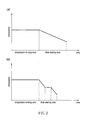
- Figs. 2A and 2B respectively show a graph illustrating the temperature gradient inside a crystallization device in one embodiment of an apparatus of continuously forming crystallized glass according to the present invention.
- the first aspect of the present invention is to provide a method of continuously forming crystallized glass, including:
- the method of continuously forming crystallized glass according to the present invention may melt, shape, crystallize, anneal and finally cut the raw glass material in a continuous order by sequentially comprising the melting, shaping, crystallizing and cutting steps.
- the melting step heats a raw glass material to obtain molten glass.
- the heating temperature is not specifically limited as long as it is sufficient to melt the raw glass material.
- the melting step may further include mixing the raw glass material prior to melting it. In view of the operatability, a preferable embodiment is to continuously mix the raw glass material until it is melted.
- the shaping step rolls the molten glass to form a belt-shaped glass plate.
- the shape-rolling method may be a conventional method, such as a roller-shaping method using a pair of rollers to press the molten glass.
- the crystallizing step crystallizes the belt-shaped glass plate to form a belt-shaped crystallized glass plate. The details concerning the crystallizing step will be described below.
- the cutting step cuts the belt-shaped crystallized glass plate into a predetermined length.
- the cutting method may be a conventional method, such as a cutting method using a diamond cutter or a water jet cutting method.
- the crystallizing step retains the belt-shaped glass plate at a temperature necessary for nuclei formation and crystal growth, thereby forming nuclei and crystallizing the belt-shaped glass plate to a belt-shaped crystallized glass plate (referred to as "temperature-holding step"), and then slowly cools the belt-shaped crystallized glass plate (referred to as “slow-cooling step”).
- the crystallizing step includes the temperature-holding step and the slow-cooling step, and produces the belt-shaped crystallized glass plate from the belt-shaped glass plate.
- the temperature-holding step retains the surrounding environment of the belt-shaped glass plate within a predetermined temperature range enabling the nuclei formation and crystal growth (preferably, a nearly constant temperature). It is supposed that both of nuclei formation and crystal growth may occur simultaneously within the belt-shaped glass plate in the temperature-holding step.
- the present invention shortens the thermal treatment time necessary for crystallizing the belt-shaped glass plate by modifying the thermal treatment necessary for crystallization into the temperature-holding step. Furthermore, since the thermal treatment time necessary for crystallizing the belt-shaped glass plate is shortened, the overall time necessary for continuously forming the crystallized glass may be shortened accordingly. B esides, the time spent on the slow-cooling step may be increased without extending the overall treatment time for the crystallizing step.
- advantages of the present invention include effectively eliminating the deformation of the belt-shaped crystallized glass plate obtained from crystallization, and obtaining crystallized glass with higher strength.
- the present invention may prevent ripples, deformations, breaks and cracks from occurring in the belt-shaped crystallized glass plate by modifying the thermal treatment necessary for crystallization into the temperature-holding step.
- the mechanism it is supposed as follows, though it is not limited to a specific theory.
- the crystallizable glass swells during the process of heating, and shrinks in the course of nuclei formation and crystal growth. Therefore, when a heating zone, a temperature-holding zone necessary for nuclei formation, a heating zone for the next stage, and a temperature-holding zone necessary for crystal growth are placed sequentially in a crystallization device, the swelling portion and the shrinking portion of the belt-shaped glass plate passing through the crystallization device would be adjacent and alternately occur.
- the thermal treatment step necessary for crystallization is the temperature-holding step, while the surrounding temperature of the belt-shaped glass plate is retained within a predetermined temperature range.
- the nuclei formation and crystal growth may occur simultaneously; therefore, it is supposed that in a piece of continuous belt-shaped glass plate, the swelling and shrinking portions thereof will not be adjacent and alternately occur, thereby preventing ripples, deformations, breaks and cracks from occurring in the belt-shaped crystallized glass plate.
- the holding temperature and time for the temperature-holding step are not specifically limited, and can be adequately selected to give a condition necessary for fully precipitating and growing crystals.
- the holding temperature for the temperature-holding step may be set at or around the crystal-growth temperature used in conventional manufacturing methods of crystallized glass.
- the temperature may be within a range of 700-1200°C, preferably a range of 750-1100°C, more preferably a range of 800-1050°C, and is preferably retained at a nearly consistent value (variation below ⁇ 5 °C).
- the holding time for the temperature-holding step may be the time necessary for crystal growth in conventional manufacturing methods of crystallized glass.
- the crystallization is expected to be fully accomplished within the time range, typically being around 0.1-3 hours.
- the nuclei formation may be facilitated by adding nucleus forming agents, such as TiO 2 , ZrO 2 , P 2 O 5 and F 2 , into a raw glass material in advance.
- the slow-cooling step slowly cools the belt-shaped crystallized glass plate after crystallizing the belt-shaped glass plate to the belt-shaped crystallized glass plate, which is used to prevent the permanent deformation of the belt-shaped crystallized glass plate while generating homogeneous glass.
- slow-cooling means to cool down at a cooling rate sufficient to eliminate deformation. Obviously, the slower the cooling rate is, the less the permanent deformations are.
- the temperature gradient of the slow-cooling step could be reduced, or the temperature gradient may be divided into multiple stages. Accordingly, the present invention can more efficiently eliminate the deformation of the belt-shaped crystallized glass plate obtained from crystallization, and obtain crystallized glass with higher strength.
- a method of continuously forming crystallized glass according to the present invention further includes:
- a grinding step of grinding a surface of the glass plate to adjust its thickness or to polish the surface, or a processing step of processing the glass plate into a predetermined size or shape may be applied on the belt-shaped crystallized glass plate obtained from completing all the abovementioned steps.
- a method of continuously forming crystallized glass according to the present invention is compatible to the following apparatus of continuously forming crystallized glass according to the present invention.
- the second aspect of the present invention is to provide an apparatus of continuously forming crystallized glass, including:
- the apparatus of continuously forming crystallized glass according to the present invention may melt, shape, crystallize, anneal and finally cut the glass raw material in a continuous order by sequentially comprising the melting, shaping, crystallization and cutting devices.
- the melting device melts a raw glass material.
- the melting device may be made of a furnace including a heating device sufficient for melting the raw glass material, and may be any one of conventional glass-melting furnaces.
- the melting device may include a mixing device for mixing the raw glass material in the front part of the heating device sufficient for melting the raw glass material.
- the shaping device rolls the molten glass into a belt-shaped glass plate.
- the shape-rolling method is not specifically limited, for example, it may be a roller-shaping method using a pair of rollers to press the molten glass.
- the crystallization device crystallizes the belt-shaped glass plate to form the belt-shaped crystallized glass plate.
- the crystallization device includes the temperature-holding and slow-cooling zones which will be described in details below, and performs crystallization and annealing of the belt-shaped glass plate.
- the cutting device cuts the belt-shaped crystallized glass plate into a predetermined length.
- the cutting method may be a conventional method, such as a cutting method using a diamond cutter or a water jet cutting method.
- the crystallization device includes the temperature-holding zone and the slow-cooling zone.
- the temperature-holding zone retains the ambient temperature therein within the temperature range enabling the nuclei formation and crystal growth (preferably, a nearly constant temperature).
- nuclei formation and crystal growth preferably, a nearly constant temperature.
- the present invention may shorten the thermal treatment time necessary for crystallizing the belt-shaped glass plate by using the thermal treatment zone necessary for crystallization as the temperature-holding zone.
- the temperature-holding zone of the present invention may be shorter than the thermal treatment zone necessary for crystallizing the belt-shaped glass plate in a conventional manufacturing method. Furthermore, since the thermal treatment zone necessary for crystallizing the belt-shaped glass plate may be shortened, the overall length of the apparatus of continuously forming crystallized glass may be reduced. Alternatively, the slow-cooling zone may be lengthened without increasing the overall length of the crystallization device. If the slow-cooling zone is extended, the temperature gradient of the slow-cooling step would be smaller, or the temperature gradient may be divided into multiple stages. Therefore, the present invention can more effectively eliminate the deformation of the belt-shaped crystallized glass plate, and obtain crystallized glass with higher strength. Moreover, the present invention may prevent ripples, deformations, breaks and cracks from occurring in the belt-shaped crystallized glass plate by using the thermal treatment zone necessary for crystallization as the temperature-holding zone.
- the ambient temperature of the temperature-holding zone is not specifically limited, and can be adequately selected to give a temperature sufficient for fully precipitating and growing crystals.
- the ambient temperature for the temperature-holding zone may be set at or around the crystal-growth temperature used in conventional manufacturing methods of crystallized glass.
- the temperature may be within a range of 700-1200°C, preferably a range of 750-1100°C, more preferably a range of 800-1050°C, and is preferably retained at a nearly consistent value (variation below ⁇ 5 °C).
- the length of the temperature-holding zone and the conveying speed of the belt-shaped glass plate in the temperature-holding zone are not specifically limited, and an adequate condition may be selected to ensure enough time for full crystal precipitation and growth.
- the time range may be a time range necessary for crystal growth in conventional manufacturing methods of crystallized glass, typically being around 0.1-3 hours.
- the conveying speed of the belt-shaped glass plate in the temperature-holding zone may be adequately selected based on the throughput of the melting device and/or the shaping device.
- the length of the temperature-holding zone may be shortened accordingly; while the conveying speed of the belt-shaped glass plate in the temperature-holding zone is too fast, the length of the temperature-holding zone may be extended accordingly.
- the slow-cooling zone slowly cools the belt-shaped crystallized glass plate after the belt-shaped glass plate is crystallized to the belt-shaped crystallized glass plate, which is used to eliminate the permanent deformation of the belt-shaped crystallized glass plate while generating homogeneous glass.
- the thermal treatment zone necessary for crystallizing the belt-shaped glass plate may be reduced, the length of the slow-cooling zone may be increased without extending the overall length of the crystallization device. Therefore, the temperature gradient of the slow-cooling zone could be reduced, or the temperature gradient may be divided into multiple stages.
- the present invention can more efficiently eliminate the deformation of the belt-shaped crystallized glass plate, and obtain crystallized glass with higher strength.
- an apparatus of continuously forming crystallized glass according to the present invention may further include:
- the apparatus of continuously forming crystallized glass according to the present invention may homogenize the molten glass, control the viscosity of the molten glass, prevent the molten glass from devitrifying, and supply the molten glass at a predetermined rate to the shaping device by disposing the adjusting device and the devitrification-preventing device.
- One preferable embodiment of the adjusting device may consist of a homogenizing device used for homogenizing the molten glass, a viscosity-controlling device used for controlling the viscosity of the molten glass, and a liquid-level-controlling device used for controlling the liquid level of the molten glass.
- the homogenizing device may be a device used for stirring the molten glass.
- the viscosity-controlling device may be a heating device used for heating the molten glass.
- the liquid-level-controlling device may be used to detect the liquid level of the molten glass supplied from the melting device to the adjusting device, feed back the signal corresponding to the change of liquid level into a raw glass material supply device used for supplying the raw glass material, and modify the supply amount of the raw material supplied to the melting device. Since the liquid level of the molten glass passing through the adjusting device may be measured and the supply amount of the raw material may be modified by the liquid-level-controlling device, the thickness of the belt-shaped glass plate obtained from the shaping device may be controlled at a predetermined value. Therefore, the manufacturing process of crystallized glass may be automated and mass-produced, while the stability of quality may be ensured and the management of procedures may be achieved easily.
- the preferable embodiment of an apparatus of continuously forming crystallized glass according to the present invention may further include a pressing roller, between the shaping device and the crystallization device, used for pressing the belt-shaped glass plate obtained from the shaping device.
- the surface of the belt-shaped glass plate obtained from the shaping device is planarized by the pressing roller. By disposing the pressing roller, the belt-shaped glass plate obtained from the shaping device is planarized and then supplied to the crystallization device.
- the apparatus of continuously forming crystallized glass according to the present invention may generate crystallized glass from a raw glass material by a continuous shaping process, thereby being a preferable apparatus of manufacturing crystallized glass, which may be widely applied in a substrate for high-tech products (such as a substrate for a color filter or an image sensor), a bracket used in calcining electronic parts, a panel of a electromagnetic cooking device, optical parts, a shelve used in an electronic microwave oven, a window glass for a fireproof door, a windshield for an oil furnace or a wood stove, and construction materials.
- Fig. 1 shows an apparatus of continuously forming crystallized glass including a melting device 11, an adjusting device 12 (a front oven 12), an devitrification-preventing device 13, a roller-shaping device 14, a crystallization device 17 (a roller-hearth kiln 17), and a cutting device 27.
- the melting device 11 melts a raw glass material to molten glass, and includes an intermittent furnace capable of melting, clarifying and finally homogenizing the raw glass material, or a continuous furnace coupling the components respectively performing each function mentioned above.
- the molten glass obtained from the melting device 11 is conveyed to the front oven 12 configured downstream from the conveying direction.
- the front oven 12 clarifies and homogenizes the molten glass, while adjusting the viscosity and liquid level of the molten glass.
- the front oven 12 there are a liquid-level-controlling device 12a, a stirring device 12b, a heating device 12c and a thermocouple 12d.
- the liquid-level-controlling device 12a is used for detecting the liquid level of the molten glass, feeding back the signal corresponding to the change of liquid level into a raw glass material supply device (not shown) used for supplying the raw glass material to the melting device 11, and modifying the supply amount of the raw material.
- the liquid level in the front oven 12 is adjusted to a predetermined value.
- the stirring device 12b is used for stirring and homogenizing the molten glass.
- the heating device 12c and the thermocouple 12d are used for adjusting the temperature of the molten glass, and adjusting the viscosity of the molten glass to a predetermined value.
- the molten glass flowing out of the front oven 12 is supplied to the devitrification-preventing device 13 configured downstream from the conveying direction.
- the devitrification-preventing device 13 there are a temperature-holding device 13a, an edge 13b, a brace 13c, and a heating device 13d.
- the temperature-holding device 13a is used for maintaining the molten glass at a predetermined temperature.
- the edge 13b is used for pushing the molten glass to the roller-shaping device 14.
- the brace 13c is a support for holding the edge 13b.
- the heating device 13d is configured through the brace 13c, and the brace 13c and the edge 13b may be heated by the heating device 13d.
- the devitrification-preventing device 13 may retain the molten glass to be supplied to the roller-shaping device 14 at a predetermined temperature by keeping the molten glass warm via the temperature-holding device 13a and by heating the molten glass via the heating device 13d, so as to prevent the molten glass from devitrifying.
- the molten glass flowing through the devitrification-preventing device 13 from the front oven 12 is supplied to the roller-shaping device 14 configured downstream from the conveying direction.
- the roller-shaping device 14 is used for rolling the molten glass into a belt-shaped glass plate.
- the roller-shaping device 14 there are a top roller 14a, a bottom roller 14b, and a cooling water tank 14c.
- the top roller 14a and the bottom roller 14b are commercially available, and made of materials with high hot strength and excellent resistances to heat, heat shock and heat cracking.
- the top roller 14a and the bottom roller 14b are configured oppositely, and used for rolling the molten glass supplied in-between the pair of the rollers into a belt shape.
- the cooling water tank 14c is used for continuously supplying water to cool down the molten glass therein, and cooling the rolled belt-shaped glass while maintaining the belt shape.
- the belt-shaped glass formed by the roller-shaping device 14 is conveyed by a conveying device 15 configured downstream from the conveying direction.
- the conveying device 15 consists of a mechanism capable of conveying the belt-shaped glass plate, such as a number of rollers or a heatproof conveyer, so as to convey the rolled belt-shaped glass plate.
- a pressing roller 16 is provided above the upstream part of the conveying device 15, and the pressing roller 16 is used for pressing the belt-shaped glass plate formed by the roller-shaping device 14.
- the pressing roller 16 is made of the steel with good heat resistance, and consists of one to several rollers.
- the flat belt-shaped glass plate A is formed by pressing the belt-shaped glass (formed by the roller-shaping device 14) with the pressing roller 16. Furthermore, based on the surface characters of the belt-shaped glass plate formed by the roller-shaping device 14, the pressing roller 16 is not necessary and may be omitted.
- the belt-shaped glass plate A is conveyed by the conveying device 15, and supplied to the crystallization device 17.
- the crystallization device 17 consists of a temperature-holding zone used for retaining the belt-shaped glass plate A at a temperature necessary for nuclei formation and crystal growth, thereby forming nuclei and crystallizing the belt-shaped glass plate A to the belt-shaped crystallized glass plate B; and a slow-cooling zone 26, configured in the rear of the temperature-holding zone 25, used for slowly cooling the belt-shaped crystallized glass plate B, so as to obtain the belt-shaped crystallized glass plate B from the belt-shaped glass plate A.
- the temperature-holding zone 25 and the slow-cooling zone 26 control the ambient temperature in their individual zone, so that a heating curve shown in Figs.
- the heating curve shown in Fig. 2A is in the case of setting the temperature gradient of the slow-cooling zone as a low-gradient.
- the heating curve shown in Fig. 2B is in the case of setting the temperature gradient of the slow-cooling zone as a multiple staged gradient including a pattern from fast-cooling stage, temperature-holding stage to fast-cooling stage.
- the crystallization device 17 is a commercially available roller-hearth kiln, and is provided with a heating device 18, a conveying roller 19, a thermocouple 20, and a stirring device 28.
- One or more heating devices 18 are configured on the sidewalls of the kiln above and beneath the conveying roller 19 in the temperature-holding zone 25 and the slow-cooling zone 26; and the thermocouple 20 is configured above each heating device 18, so as to control the temperature with a variation below ⁇ 5°C.
- the stirring device 28 is used for stirring air inside each zone, and homogenizing the temperature in each zone. The thermal treatment for crystallization can be thoroughly performed, and the crystallization of the rolled belt-shaped glass plate can be easily and thoroughly achieved by the said devices.
- the heating source may be adequately selected based on the temperature required, such as a SiC heating device, an molybdenum disilicide heater, fuel gas, and electricity.
- the conveying roller 19 is made of heatproof rollers, and used for nonstop and continuously conveying the belt-shaped glass plate within the crystallization device 17.
- the belt-shaped glass plate A formed by the roller-shaping device 14 is promptly, directly and continuously conveyed to the temperature-holding zone 25 in the crystallization device 17.
- the temperature-holding zone 25 retains the belt-shaped glass plate A at a temperature necessary for nuclei formation and crystal growth, thereby forming nuclei and crystallizing the belt-shaped glass plate A to a belt-shaped crystallized glass plate B, and provides a predetermined temperature range enabling the belt-shaped glass plate A to form nuclei and grow crystals inside the zone.
- the slow-cooling zone 26 slowly cools the belt-shaped crystallized glass plate B so as to eliminate the permanent deformation of the belt-shaped crystallized glass plate B and form homogeneous glass.
- the slow-cooling zone 26 provides a predetermined temperature gradient shown in Figs. 2A or 2B , and the temperature inside is slowly cooled along the direction of conveying the belt-shaped crystallized glass plate B to the exit of the crystallization device 17.
- the belt-shaped crystallized glass plate B obtained from crystallizing the belt-shaped glass plate A by the crystallization device 17, is conveyed to the cutting device 27 configured downstream from the conveying direction.
- the cutting device 27 is used for cutting the belt-shaped crystallized glass plate B into a predetermined size.
- the crystallized glass plate C obtained from the cutting device 27 is conveyed to a secondary processing factory, and then made into a final product by a secondary process.
- a raw glass material consisting of, by mass percent, SiO 2 63.5%, Al 2 O 3 21.5%, MgO 0.5%, ZnO 1.5%, BaO 1.8%, TiO 2 2.8%, ZrO 2 1.5%, B 2 O 3 0.3%, P 2 O 5 1.0%, Na 2 O 0.7%, K 2 O 0.5%, Li 2 O 3.6%, As 2 O 3 0.5%, and V 2 O 5 0.3%, was added into a crucible.
- the raw glass material was melted at 1670°C, and shape-rolled into a plate sized 20cmx20cmx4mm. The glass plate was placed in a thermal treatment furnace, in which the temperature was retained at 880°C for 30 minutes, and then cooled at a rate of 10°C/min.
- a raw glass material consisting of, by mass percent, SiO 2 64.0%, Al 2 O 3 22.0%, MgO 0.5%, ZnO 1.0%, BaO 2.0%, TiO 2 2.5%, ZrO 2 1.5%, B 2 O 3 0.3%, P 2 O 5 0.8%, Na 2 O 0.8%, K 2 O 0.3%, Li 2 O 3.8%, and As 2 O 3 0.5%, was added into a crucible.
- the raw glass material was melted at 1650°C, and shape-rolled into a plate sized 20cmx20cmx4mm. The glass plate was placed in a thermal treatment furnace, in which the temperature was retained at 1000°C for 30 minutes, and then cooled at a rate of 10°C/min.
- a raw glass material consisting of, by mass percent, SiO 2 63.5%, Al 2 O 3 21.5%, MgO 0.5%, ZnO 1.5%, BaO 1.8%, TiO 2 2.8%, ZrO 2 1.5%, B 2 O 3 0.3%, P 2 O 5 1.0%, Na 2 O 0.7%, K 2 O 0.5%, Li 2 O 3.6%, As 2 O 3 0.5%, and V 2 O 5 0.3%, was added into a crucible.
- the raw glass material was melted at 1670°C, and shape-rolled into a plate sized 20cmx20cmx4mm.
- the glass plate After cooling down to around the glass transition temperature, the glass plate was placed in a thermal treatment furnace, in which the temperature was retained at 600°C for 10 minutes, then increased to 730°C at a rate of 10°C/min, retained at 730°C for 20 minutes, increased to 880°C at a rate of 10°C/min, retained at 880°C for 30 minutes, and then cooled at a rate of 10°C/min.
- ⁇ -quartz solid solution precipitated as main crystals to give a black crystallized glass plate. No ripples, deformations, breaks and cracks were observed in the crystallized glass plate, and the appearance of the crystallized glass plate was smooth and fine.
Landscapes
- Chemical & Material Sciences (AREA)
- Engineering & Computer Science (AREA)
- Materials Engineering (AREA)
- Organic Chemistry (AREA)
- Ceramic Engineering (AREA)
- Crystallography & Structural Chemistry (AREA)
- Life Sciences & Earth Sciences (AREA)
- Chemical Kinetics & Catalysis (AREA)
- General Chemical & Material Sciences (AREA)
- Geochemistry & Mineralogy (AREA)
- Thermal Sciences (AREA)
- Physics & Mathematics (AREA)
- Dispersion Chemistry (AREA)
- Re-Forming, After-Treatment, Cutting And Transporting Of Glass Products (AREA)
- Glass Compositions (AREA)
Applications Claiming Priority (1)
| Application Number | Priority Date | Filing Date | Title |
|---|---|---|---|
| JP2010250133A JP5603207B2 (ja) | 2010-11-08 | 2010-11-08 | 結晶化ガラスの連続成形方法および結晶化ガラスの連続成形装置 |
Publications (2)
| Publication Number | Publication Date |
|---|---|
| EP2450318A2 true EP2450318A2 (de) | 2012-05-09 |
| EP2450318A3 EP2450318A3 (de) | 2013-03-20 |
Family
ID=44992479
Family Applications (1)
| Application Number | Title | Priority Date | Filing Date |
|---|---|---|---|
| EP11008815A Ceased EP2450318A3 (de) | 2010-11-08 | 2011-11-07 | Verfahren und Vorrichtung zur durchgehenden Bildung von kristallisiertem Glas |
Country Status (5)
| Country | Link |
|---|---|
| US (1) | US20120111058A1 (de) |
| EP (1) | EP2450318A3 (de) |
| JP (1) | JP5603207B2 (de) |
| CN (1) | CN102531339B (de) |
| TW (1) | TWI455896B (de) |
Cited By (1)
| Publication number | Priority date | Publication date | Assignee | Title |
|---|---|---|---|---|
| GB2555129A (en) * | 2016-10-20 | 2018-04-25 | Tung Chang Machinery And Eng Co Ltd | Glass heating furnace |
Families Citing this family (7)
| Publication number | Priority date | Publication date | Assignee | Title |
|---|---|---|---|---|
| CN103274588B (zh) * | 2013-05-03 | 2016-04-06 | 中国科学院过程工程研究所 | 一种利用形变调控微晶玻璃的析晶方法 |
| CN104445881A (zh) * | 2014-12-16 | 2015-03-25 | 河北省沙河玻璃技术研究院 | 一种厚板微晶玻璃的成型装置及成型方法 |
| CN104960072B (zh) * | 2015-05-22 | 2017-07-14 | 东莞亦准自动化科技有限公司 | 一种在线微晶石板成型机 |
| CN105271642B (zh) * | 2015-11-09 | 2017-05-17 | 江西新凤微晶玉石有限公司 | 微晶玻璃薄板的制备工艺 |
| JP6938081B2 (ja) * | 2017-03-23 | 2021-09-22 | 株式会社オハラ | 連続結晶化ガラス成形体の製造方法および装置 |
| CN109369021A (zh) * | 2018-10-15 | 2019-02-22 | 基智精密科技(深圳)有限公司 | 玻璃生产设备及玻璃制备方法 |
| WO2022255198A1 (ja) * | 2021-05-31 | 2022-12-08 | Agc株式会社 | 結晶化ガラスの製造方法 |
Citations (2)
| Publication number | Priority date | Publication date | Assignee | Title |
|---|---|---|---|---|
| JP2005041726A (ja) | 2003-07-25 | 2005-02-17 | Ta Hsiang Containers Ind Co Ltd | 結晶化ガラスの連続成形装置 |
| JP2010250133A (ja) | 2009-04-17 | 2010-11-04 | Konica Minolta Business Technologies Inc | 現像装置及び画像形成装置 |
Family Cites Families (15)
| Publication number | Priority date | Publication date | Assignee | Title |
|---|---|---|---|---|
| US3841856A (en) * | 1972-11-14 | 1974-10-15 | K Bondarev | Method of production of white divitrified glass material |
| US4977110A (en) * | 1990-01-12 | 1990-12-11 | Corning Incorporated | Beige-tinted glass-ceramics |
| CN1160678A (zh) * | 1996-03-22 | 1997-10-01 | 沈阳化工综合利用研究所 | 制备硝酸钾并联产氮、钾复合肥的方法 |
| DE10238607B4 (de) * | 2002-08-16 | 2006-04-27 | Schott Ag | Verfahren zur Formung von Glas oder Glaskeramik und dessen Verwendung |
| DE10245234B4 (de) * | 2002-09-27 | 2011-11-10 | Schott Ag | Kristallisierbares Glas, seine Verwendung zur Herstellung einer hochsteifen, bruchfesten Glaskeramik mit gut polierbarer Oberfläche sowie Verwendung der Glaskeramik |
| BRPI0300644B8 (pt) * | 2003-02-20 | 2022-04-26 | Fundacao Univ Federal De Sao Carlos | Processo de preparação de biosilicatos particulados, bioativos e reabsorvíveis, composições para preparar ditos biosilicatos e biosilicatos particulados bioativos e reabsorvíveis. |
| DE102005033908B3 (de) * | 2005-07-15 | 2006-05-18 | Schott Ag | Gefloatetes, in eine Glaskeramik umwandelbares Flachglas und Verfahren zu seiner Herstellung |
| JP4451860B2 (ja) * | 2005-08-30 | 2010-04-14 | 建權玻璃開発股▲はん▼有限公司 | 模様付き結晶化ガラス物品及びその製造方法 |
| WO2007049149A2 (en) * | 2005-10-28 | 2007-05-03 | Hyattville Company Ltd. | Continuous method and system for manufacturing of polycrystalline glass-ceramic compositions |
| JP4467597B2 (ja) * | 2007-04-06 | 2010-05-26 | 株式会社オハラ | 無機組成物物品 |
| JP2009023865A (ja) * | 2007-07-18 | 2009-02-05 | Jian Quan Glass Development Co Ltd | 模様付き結晶化ガラス物品及びその製造方法 |
| JP4523021B2 (ja) * | 2007-07-18 | 2010-08-11 | 建權玻璃開発股▲はん▼有限公司 | 模様付き結晶化ガラス物品及びその製造方法 |
| CN100526256C (zh) * | 2007-09-26 | 2009-08-12 | 中国地质大学(武汉) | 利用高温磷渣液制备建筑装饰用磷渣铸石的生产工艺 |
| CN101519277A (zh) * | 2008-02-25 | 2009-09-02 | 岑春华 | 用磷渣生产压延式微晶玻璃装饰板材的方法 |
| CN101792264A (zh) * | 2010-04-20 | 2010-08-04 | 香港福山实业有限公司 | 一种微晶玉石及其制备方法 |
-
2010
- 2010-11-08 JP JP2010250133A patent/JP5603207B2/ja not_active Expired - Fee Related
-
2011
- 2011-09-20 US US13/237,855 patent/US20120111058A1/en not_active Abandoned
- 2011-10-07 TW TW100136508A patent/TWI455896B/zh not_active IP Right Cessation
- 2011-10-13 CN CN201110310280.2A patent/CN102531339B/zh active Active
- 2011-11-07 EP EP11008815A patent/EP2450318A3/de not_active Ceased
Patent Citations (2)
| Publication number | Priority date | Publication date | Assignee | Title |
|---|---|---|---|---|
| JP2005041726A (ja) | 2003-07-25 | 2005-02-17 | Ta Hsiang Containers Ind Co Ltd | 結晶化ガラスの連続成形装置 |
| JP2010250133A (ja) | 2009-04-17 | 2010-11-04 | Konica Minolta Business Technologies Inc | 現像装置及び画像形成装置 |
Cited By (1)
| Publication number | Priority date | Publication date | Assignee | Title |
|---|---|---|---|---|
| GB2555129A (en) * | 2016-10-20 | 2018-04-25 | Tung Chang Machinery And Eng Co Ltd | Glass heating furnace |
Also Published As
| Publication number | Publication date |
|---|---|
| TWI455896B (zh) | 2014-10-11 |
| JP5603207B2 (ja) | 2014-10-08 |
| HK1170472A1 (en) | 2013-03-01 |
| US20120111058A1 (en) | 2012-05-10 |
| CN102531339A (zh) | 2012-07-04 |
| JP2012101957A (ja) | 2012-05-31 |
| EP2450318A3 (de) | 2013-03-20 |
| CN102531339B (zh) | 2015-07-29 |
| TW201219323A (en) | 2012-05-16 |
Similar Documents
| Publication | Publication Date | Title |
|---|---|---|
| EP2450318A2 (de) | Verfahren und Vorrichtung zur durchgehenden Bildung von kristallisiertem Glas | |
| JP4369695B2 (ja) | 結晶化ガラスの連続成形装置 | |
| TWI519495B (zh) | 結晶化玻璃的連續成形方法以及結晶化玻璃的連續成形設備 | |
| KR102403027B1 (ko) | 세라믹화 가능한 녹색 유리 성분의 제조 방법, 및 세라믹화 가능한 녹색 유리 성분, 및 유리 세라믹 물품 | |
| CN104203846A (zh) | 用于在玻璃成型过程中减小来自成型体的辐射热损失的设备 | |
| JP2020063183A (ja) | ガラス生産装置及びガラス製造方法 | |
| US5588979A (en) | Apparatus for continuously forming and processing a glass-ceramic | |
| TWI487675B (zh) | 產生玻璃片之融流處理 | |
| TWI491569B (zh) | 結晶化玻璃的連續成形方法以及結晶化玻璃的連續成形設備 | |
| CN102822103B (zh) | 玻璃板制造方法 | |
| JP2865539B2 (ja) | 結晶化ガラスの連続成形加工装置 | |
| HK1170472B (en) | Method and apparatus of continuously forming crystallized glass | |
| US3810743A (en) | Thermal conditioning of molten glass | |
| CN116813188A (zh) | 连续结晶板状玻璃成型体的成型方法和制造装置 | |
| HK1178875B (en) | Consecutive molding method for crystallized glass and device thereof | |
| HK1175770B (en) | Consecutive molding method for crystallized glass and device thereof |
Legal Events
| Date | Code | Title | Description |
|---|---|---|---|
| PUAI | Public reference made under article 153(3) epc to a published international application that has entered the european phase |
Free format text: ORIGINAL CODE: 0009012 |
|
| AK | Designated contracting states |
Kind code of ref document: A2 Designated state(s): AL AT BE BG CH CY CZ DE DK EE ES FI FR GB GR HR HU IE IS IT LI LT LU LV MC MK MT NL NO PL PT RO RS SE SI SK SM TR |
|
| AX | Request for extension of the european patent |
Extension state: BA ME |
|
| PUAL | Search report despatched |
Free format text: ORIGINAL CODE: 0009013 |
|
| AK | Designated contracting states |
Kind code of ref document: A3 Designated state(s): AL AT BE BG CH CY CZ DE DK EE ES FI FR GB GR HR HU IE IS IT LI LT LU LV MC MK MT NL NO PL PT RO RS SE SI SK SM TR |
|
| AX | Request for extension of the european patent |
Extension state: BA ME |
|
| RIC1 | Information provided on ipc code assigned before grant |
Ipc: C03B 25/08 20060101ALI20130211BHEP Ipc: C03B 32/02 20060101ALI20130211BHEP Ipc: C03C 10/12 20060101ALI20130211BHEP Ipc: C03B 13/04 20060101AFI20130211BHEP |
|
| 17P | Request for examination filed |
Effective date: 20130909 |
|
| RBV | Designated contracting states (corrected) |
Designated state(s): AL AT BE BG CH CY CZ DE DK EE ES FI FR GB GR HR HU IE IS IT LI LT LU LV MC MK MT NL NO PL PT RO RS SE SI SK SM TR |
|
| 17Q | First examination report despatched |
Effective date: 20140106 |
|
| STAA | Information on the status of an ep patent application or granted ep patent |
Free format text: STATUS: THE APPLICATION HAS BEEN REFUSED |
|
| 18R | Application refused |
Effective date: 20161223 |