EP2425497B1 - Befestigungsvorrichtung zum befestigen eines anschlusssteckers an einem grundgehäuse - Google Patents
Befestigungsvorrichtung zum befestigen eines anschlusssteckers an einem grundgehäuse Download PDFInfo
- Publication number
- EP2425497B1 EP2425497B1 EP10719734.5A EP10719734A EP2425497B1 EP 2425497 B1 EP2425497 B1 EP 2425497B1 EP 10719734 A EP10719734 A EP 10719734A EP 2425497 B1 EP2425497 B1 EP 2425497B1
- Authority
- EP
- European Patent Office
- Prior art keywords
- fastening
- connector
- region
- plug
- housing
- Prior art date
- Legal status (The legal status is an assumption and is not a legal conclusion. Google has not performed a legal analysis and makes no representation as to the accuracy of the status listed.)
- Not-in-force
Links
Images



Classifications
-
- H—ELECTRICITY
- H01—ELECTRIC ELEMENTS
- H01R—ELECTRICALLY-CONDUCTIVE CONNECTIONS; STRUCTURAL ASSOCIATIONS OF A PLURALITY OF MUTUALLY-INSULATED ELECTRICAL CONNECTING ELEMENTS; COUPLING DEVICES; CURRENT COLLECTORS
- H01R13/00—Details of coupling devices of the kinds covered by groups H01R12/70 or H01R24/00 - H01R33/00
- H01R13/62—Means for facilitating engagement or disengagement of coupling parts or for holding them in engagement
- H01R13/627—Snap or like fastening
- H01R13/6275—Latching arms not integral with the housing
-
- H—ELECTRICITY
- H01—ELECTRIC ELEMENTS
- H01R—ELECTRICALLY-CONDUCTIVE CONNECTIONS; STRUCTURAL ASSOCIATIONS OF A PLURALITY OF MUTUALLY-INSULATED ELECTRICAL CONNECTING ELEMENTS; COUPLING DEVICES; CURRENT COLLECTORS
- H01R13/00—Details of coupling devices of the kinds covered by groups H01R12/70 or H01R24/00 - H01R33/00
- H01R13/62—Means for facilitating engagement or disengagement of coupling parts or for holding them in engagement
- H01R13/639—Additional means for holding or locking coupling parts together, after engagement, e.g. separate keylock, retainer strap
Definitions
- the invention relates to a fastening device for fastening a connector plug to a base housing by means of a fastening element. Furthermore, the invention relates to a connector assembly with such a fastening device.
- a connector usually has a plug housing consisting of an insulating material with at least one conductor connecting element arranged therein and a plug contact connected to the conductor connecting element.
- the connector may be formed as a screw terminal on which a screw shaft is provided on the connector housing, via which a screw can be inserted into the interior of the connector housing.
- a base housing may be provided, which is usually arranged via solder pins on the circuit board and has a slot for attaching the connector plug.
- Such plug assemblies are mainly used where a contact protection of the connector plug to the circuit board is desired.
- fastening devices which have a fastening means.
- fastening means are usually on the connector and / or on the base housing special receiving elements, for example in the form of openings provided, in which the fastening means in the attached state, ie in the state when the Connector is attached to the base housing, engages.
- This increases on the one hand the design effort of such connector assemblies and also the fasteners are usually so arranged on the connector and the base housing that they are difficult to access for a user and thus cumbersome to operate. Replacing the fasteners is considerably more difficult and is usually possible only with additional tools.
- the EP 2 321 875 A0 is an older post-published document and must be considered for novelty under Article 54 (3) EPC. From the EP 2 321 875 A0 An electrical connector assembly is known.
- the connector assembly has a printed circuit board 204, a pin strip 206 which can be plugged onto the printed circuit board 204 and a cable connection 8 which can be inserted into the pin header.
- the circuit board 204 has openings 258, in which engage the pins 228 of the pin header 206.
- the pin strip 206 has, in addition to the pin 228, contact pins 212 for electrical connection to the printed circuit board 204 and a plug-in receptacle with a latching nose 236th having tab 232 for receiving the electrical cable connection 8. By inserting the cable connection 8 into the plug-in receptacle of the pin strip 206, the latching nose 236 engages behind the housing 22 of the cable connection 8.
- the invention is therefore based on the object to provide a fastening device for placement on a connector and a base housing having plug assembly available, which is characterized by a simple structural design, is easy to use and replaced at any time or retrofitted to existing connector assembly can, and is also securely attached.
- the inventive device for placement on a connector and a base housing having plug assembly has a fastener for Attaching the connector plug to the base housing, wherein the connector has a connector housing with a screw shaft.
- the fastening element has a first fastening region and a second fastening region, the first fastening region has a hook element for attachment to the screw shaft of the connector housing and the second fastening region of the fastening element can be fastened to an outer surface of the base housing, characterized in that the hook element is in the unsecured state as a Wall surface of the fastener is formed and the hook member in the attached state, an opening on the fastener releases, in which the screw shaft can be clamped.
- the fastening device according to the invention is characterized in that compared to the known fastening devices in this case no additional receiving elements are more needed to attach a fastener to the connector and the base housing, since for-attachment only already existing on the connector assembly elements are used by the fastener on the one hand is fastened to the slot opening present on the connector plug and on the other hand is fastened to an outer surface of the basic housing, without the need for additional receiving elements being provided on the outer surface of the basic housing.
- Such a fastening device according to the invention can be used be retrofitted to existing connector assemblies at any time. Elaborate constructions for such fastening devices for attaching a connector plug to a base housing thus accounts, which saves both costs and time. By saving additional receiving elements for the fastener also the required space for Such a fastening device can be substantially reduced.
- the hook element In a fixed state of the fastening element, the hook element is arranged at an angle ⁇ 90 ° to the surface of the fastening element.
- the fastener In the attached state, the fastener is attached to the connector and to the base housing.
- the hook element engages on the outer surface or on an outer edge of the screw shaft, so that the hook element hooks on the outer surface of the screw shaft and is thereby held or fixed to the screw shaft.
- the hook element When hooked, the hook element is spread apart by the fastening element, so that the hook element is arranged at an angle ⁇ 90 °, preferably at an angle between 10 ° and 45 ° to the surface of the fastening element, in particular to the surface of the fastening element facing the plug housing ,
- the hook element formed in the unsecured state as a wall surface can be bent downwards so that an opening is formed on the fastening element.
- this opening is in the attached state of the fastener introduced the screw shaft, so that the screw shaft is clamped between the hook member and the webs formed as lateral surfaces of the fastener.
- the hook element is thus not a separate component, which must be additionally attached to the fastener, but it is part of the fastener. As a result, both material and the production costs for such a fastener can be reduced.
- the fact that the screw shaft is clamped in the released by the hook member opening, the fastener particularly slip-resistant clamped to the connector.
- the fastening element is designed as a film hinge and the fastening element is pivotally mounted at its first mounting region on the screw shaft.
- the fastening element is designed as a film hinge, it has a rather flat, plate-like shape, so that the fastener requires only a small space and thus can be used as possible space-saving.
- the fastening element is preferably formed from a plastic material, so that the fastening element is electrically insulating and thus can serve as a shock protection.
- the fastening element is preferably designed to be resilient, wherein the hook element is preferably designed as a spring element, so that the fastening element is pivotably mounted on the screw shaft at its first fastening region.
- the first fastening region can be fastened to the screw shaft by means of an adhesive bond.
- the hook element is preferably fastened to the screw shaft by means of the adhesive connection, so that the fastening element can be fixed particularly securely in a fixed position at its first fastening region by hooking into the screw shaft as well as by an adhesive connection, so that slippage of the fastening element occurs even in strong positions Loads can be prevented.
- the fastener in the fastened state of the fastener, is arranged such that the fastener spans from the first mounting portion to the second mounting portion a first side surface of the base housing, wherein in the fastened state of the fastener, the second mounting portion on a transverse to the first Side surface disposed second side surface of the base housing rests.
- the basic housing is thereby clamped by the fastening element and pressed against the plug housing of the connector. This makes it possible to connect the connector firmly to the base housing, without additional connection elements are necessary on the base housing.
- the attachment itself is easy to implement, since the first attached to the first attachment portion fastener can be slid over the first side surface of the base housing until the part of the fastener is provided on the second attachment portion, on the second transverse to the first side surface arranged side surface comes to rest and thus engages behind the second side surface of the base housing.
- the Fixing element or the fastening device is characterized particularly easy to handle without that additional tools would be necessary.
- the second attachment region preferably has a latching lug.
- the connector can be pressed in a simple manner to the basic housing. The basic housing is thereby clamped between the locking lug and the connector.
- the fastening element has a bearing element which can be inserted into a corresponding bearing recess provided on the plug housing.
- the fastening element can be fastened in the fastened state to the connector in addition to its first fastening region.
- the fastening element has a grip portion, which is provided in the region of the first attachment region.
- the handle is provided on the first mounting portion, the release of the fastener of the base housing is particularly easy to handle, in particular, when the actuating element is resilient and is mounted at its first mounting portion pivotally mounted on the screw shaft.
- an actuation of the fastener alone on the easily accessible from the operator side grip portion is possible.
- the release of the actuating element and thus the Connector plug from the base housing can thus be done in a simple manner by pressing the handle portion with a finger. The use of an aid or an additional tool is therefore no longer necessary.
- the hook element is designed as a spring element, it is ensured that, when the handle section is not actuated, the fastening element always remains in its fastened, locked state.
- the invention relates to a connector assembly with a connector and a base housing, wherein the connector is fastened to the base housing by means of a fastening device as above and further developed.
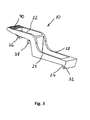
- Fig. 1 schematically shows a fastening device according to the invention with a fastening element 10, which is attached to a connector 12 and connectable to the connector plug 12 basic housing 14.
- the connector 12 has a connector housing 16 consisting of an insulating material with conductor connection elements arranged therein and plug contacts (not shown here) connected to the conductor connection elements.
- the connector 12 is formed as a screw terminal, in which 16 three screw holes 18 are provided on the connector housing, wherein in Fig. 1 , due to the perspective shown here, two of the three screw shafts 18 are covered by the fastener 10. About each of the screw shafts 18 a screw is inserted into the interior of the plug housing 16 in each case.
- the base housing 14 is provided which can be attached by means of solder pins 20 to the circuit board and a plurality of slots not shown here for attaching the connector plug 12 has.
- the fastening element 10 is designed as a film hinge made of a plastic, which has a first fastening region 22 and a second fastening region 24. By means of the first fastening region 22, the fastening element 10 can be fastened to the connecting plug 12.
- the first fastening region 22 of the fastening element 10 has a hook element 26.
- the hook element 26 is preferably flat, wherein the side surfaces 28 of the fastening element 10 are formed as webs, through which the fastening element 10 has sufficient stability. In the unfastened state of the fastener 10, that is, when the fastener 10 is not attached to the plug assembly, the hook member 26 is formed as a wall surface of the fastener 10.
- the hook element 26 formed in the unsecured state as a wall surface can be bent downwards so that an opening 30 is formed on the fastening element 10.
- this opening 30 is in the attached state, as in Fig. 1 shown at least a portion of the screw shaft 18 is inserted, in particular the part of the screw shaft 18, which is arranged elevated from the outer surface of the plug housing 16 so that the screw shaft 18 is clamped between the hook member 26 and the side surfaces 28 formed as webs of the fastener 10.
- the hook element 26 is designed as a spring element, so that the fastening element 10 is mounted at its first attachment portion 22 pivotally mounted on the screw shaft 18.
- the fastener 10 can act as a kind of rocker.
- the fastening element 10 Due to the pivot point of the fastening element 10 on the first fastening region 22, the fastening element 10 is in the position when applying a tensile force on the connector 12 and / or the base housing 14 to remain in its position and not to be solved from this.
- the second fastening region 24 of the fastening element 10 is provided opposite the first fastening region 22 at the other end of the fastening element 10.
- the second fastening region 24 has a latching nose 32 which, in the fastened state of the fastening element 10, abuts against an outer surface of the base housing 14 such that the latching nose 32 engages behind the base housing 14, so that the base housing 14 is clamped between the connector 12 and the latching nose 32 ,
- Fig. 2 is shown in the transfer of the fastener 10 from the unfastened state in the fastened state, the fastener 10 is first hooked to the first mounting portion of the screw shaft 18 of the connector 12. Subsequently, the remainder of the fastener 10 is slid over preferably the entire length of a first side surface 34 of the base housing 14 until the detent 32 abuts the second side surface 36 of the base housing 12 disposed transversely of the first side surface 34 so that the detent 16 engages second side surface 34 of the base housing 14 engages behind.
- the hook element 26 additionally has a bearing element 38 which can be inserted into a corresponding bearing recess provided on the connector housing 16 (not shown here).
- the fastening element 10 also has a grip section 40.
- the handle portion 40 is provided in the region of the first mounting portion 22, the handle portion 40 protrudes beyond the edge region of the plug housing 16 of the connector 12, the fastener 10 can be easily operated by hand and thereby the connector 12 is easily detached from the base housing 14 become. This is particularly advantageous when the plug assembly is arranged, for example, in a cabinet so that there is very little free space between the end face of the plug assembly and the housing wall of the cabinet.
- Characterized in that the fastener 10 can be easily operated by pressing a finger on the handle portion 40, no additional tool for releasing the connector plug 12 is necessary.
- the grip portion 40 preferably has grooved depressions as gripping aid and anti-slip device upon actuation of the grip portion 40.
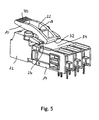
- Fig. 4 and Fig. 5 show two further possible embodiments of such a fastening device, in particular for such a fastener 10, wherein the in Fig. 4 and Fig. 5 fasteners shown have a shorter length than those in Fig. 1 shown embodiment of a fastener.
- the fastener 10 does not span the entire length of the first side surface 34 of the base housing 14.
Landscapes
- Details Of Connecting Devices For Male And Female Coupling (AREA)
- Connector Housings Or Holding Contact Members (AREA)
Description
- Die Erfindung betrifft eine Befestigungsvorrichtung zum Befestigen eines Anschlusssteckers an einem Grundgehäuse mittels eines Befestigungselements. Ferner betrifft die Erfindung eine Steckeranordnung mit einer derartigen Befestigungsvorrichtung.
- Ein Anschlussstecker weist üblicherweise ein aus einem Isolierstoff bestehendes Steckergehäuse mit mindestens einem darin angeordneten Leiteranschlusselement und einen mit dem Leiteranschlusselement verbundenen Steckkontakt auf. Der Anschlussstecker kann dabei als Schraubanschlussklemme ausgebildet sein, an welcher an dem Steckergehäuse ein Schraubenschacht vorgesehen ist, über welchen eine Schraube in den Innenraum des Steckergehäuses eingeführt werden kann. Zum Befestigen eines derartigen Anschlusssteckers an einer Leiterplatte kann ein Grundgehäuse vorgesehen sein, welches üblicherweise über Lötstifte an der Leiterplatte angeordnet ist und einen Steckplatz zum Aufstecken des Anschlusssteckers aufweist. Derartige Steckeranordnungen kommen vor allem da zum Einsatz, wo ein Berührschutz des Anschlusssteckers an der Leiterplatte gewünscht ist.
- Um eine sichere Verbindung zwischen dem Anschlussstecker und dem Grundgehäuse herzustellen, ist es bekannt Befestigungsvorrichtungen, welche ein Befestigungsmittel aufweisen, vorzusehen. Für die Befestigungsmittel sind meist an dem Anschlussstecker und/oder an dem Grundgehäuse spezielle Aufnahmeelemente, beispielsweise in Form von Öffnungen, vorgesehen, in welche die Befestigungsmittel im befestigten Zustand, d.h. in dem Zustand, wenn der Anschlussstecker an dem Grundgehäuse befestigt ist, eingreift. Dies erhöht zum einen den Konstruktionsaufwand derartiger Steckeranordnungen und zudem sind die Befestigungselemente dabei meist derart an dem Anschlussstecker und dem Grundgehäuse angeordnet, dass sie für einen Benutzer nur schwer zugänglich und dadurch umständlich betätigbar sind. Ein Auswechseln der Befestigungselemente ist dadurch erheblich erschwert und ist meist nur mit zusätzlichem Werkzeug möglich. Dadurch, dass zur Befestigung des Befestigungselements zusätzliche Aufnahmeelemente notwendig sind, ist ein Nachrüsten einer Steckeranordnung mit derartigen Befestigungselementen meist überhaupt nicht möglich. Ferner benötigen derartige Befestigungsmittel meist einen größeren zusätzlichen Bauraum, wodurch der gesamte benötigte Bauraum der Steckeranordnung zusammen mit dem Befestigungselement insbesondere beim Einbau in Schaltschränke zu großen Problemen führen kann.
- Aus der
US 7 128 595 B2 ist der Gegenstand gemäß dem Oberbegriff des Anspruchs 1 bekannt. - Die
EP 2 321 875 A0 ist ein älteres nachveröffentlichtes Dokument und gemäß Artikel 54(3) EPÜ für die Neuheit zu berücksichtigen. Aus derEP 2 321 875 A0 ist eine elektrische Steckverbinderbaugruppe bekannt. Die Steckverbinderbaugruppe weist eine Leiterplatte 204, eine auf die Leiterplatte 204 aufsteckbare Stiftleiste 206 und einen in die Stiftleiste einsteckbaren Kabelanschluss 8 auf. Die Leiterplatte 204 weist Öffnungen 258 auf, in welche die Zapfen 228 der Stiftleiste 206 eingreifen. Die Stiftleiste 206 weist neben den Zapfen 228, Kontaktstifte 212 zur elektrischen Verbindung mit der Leiterplatte 204 und eine Steckaufnahme mit einer eine Rastnase 236 aufweisenden Lasche 232 zur Aufnahme des elektrischen Kabelanschlusses 8 auf. Durch Einstecken des Kabelanschlusses 8 in die Steckaufnahme der Stiftleiste 206 hintergreift die Rastnase 236 das Gehäuse 22 des Kabelanschlusses 8. - Der Erfindung liegt daher die Aufgabe zu Grunde, eine Befestigungsvorrichtung zur Anordnung an einer einen Anschlussstecker und ein Grundgehäuse aufweisenden Steckeranordnung zur Verfügung zu stellen, welche sich durch eine einfache konstruktive Ausgestaltung auszeichnet, leicht zu bedienen ist und jederzeit ausgetauscht bzw. an bestehenden Steckeranordnung nachgerüstet werden kann, und zudem sicher befestigt ist.
- Die Lösung der Aufgabe erfolgt erfindungsgemäß durch die Merkmale des Anspruchs 1. Vorteilhafte Ausgestaltungen der Erfindung sind in den Unteransprüchen angegeben.
- Die erfindungsgemäße Vorrichtung zur Anordnung an einer einen Anschlussstecker und ein Grundgehäuse aufweisende Steckeranordnung weist ein Befestigungselement zum Befestigen des Anschlusssteckers an dem Grundgehäuse auf, wobei der Anschlussstecker ein Steckergehäuse mit einem Schraubenschacht aufweist. Das Befestigungselement weist einen ersten Befestigungsbereich und einen zweiten Befestigungsbereich auf, der erste Befestigungsbereich ein Hakenelement zur Befestigung an dem Schraubenschacht des Steckergehäuses aufweist und der zweite Befestigungsbereich des Befestigungselements an einer Außenfläche des Grundgehäuses befestigbar ist, dadurch gekennzeichnet, dass das Hakenelement im unbefestigten Zustand als eine Wandfläche des Befestigungselements ausgebildet ist und das Hakenelement im befestigten Zustand eine Öffnung an dem Befestigungselement freigibt, in der der Schraubenschacht einklemmbar ist.
- Mittels der erfindungsgemäßen Befestigungsvorrichtung kann ein unbeabsichtigtes Lösen des Anschlusssteckers von dem Grundgehäuse verhindert werden. Die erfindungsgemäße Befestigungsvorrichtung zeichnet sich dadurch aus, dass gegenüber den bekannten Befestigungsvorrichtungen hierbei keine zusätzlichen Aufnahmeelemente mehr benötigt werden, um ein Befestigungselement an dem Anschlussstecker und dem Grundgehäuse zu befestigen, da zur-Befestigung nur bereits an der Steckeranordnung vorhandenen Elemente genutzt werden, indem das Befestigungselement zum einen an der an dem Anschlussstecker vorhandenen Schachtöffnung befestigt wird und zum anderen an einer Außenfläche des Grundgehäuses befestigt wird, ohne dass an der Außenfläche des Grundgehäuses zusätzliche Aufnahmeelemente vorgesehen sein müssen. Dadurch, dass zur Befestigung nur bereits an der Steckeranordnung vorhandene Elemente genutzt werden, kann eine derartige erfindungsgemäße Befestigungsvorrichtung jederzeit an bereits vorhandene Steckeranordnungen nachgerüstet werden. Aufwendige Konstruktionen für derartige Befestigungsvorrichtungen zur Befestigung eines Anschlusssteckers an einem Grundgehäuse entfallen damit, was sowohl Kosten als auch Zeit spart. Durch das Einsparen von zusätzlichen Aufnahmeelementen für das Befestigungselement kann zudem der benötigte Bauraum für eine derartige Befestigungsvorrichtung wesentlich reduziert werden.
- In einem befestigten Zustand des Befestigungselements ist das Hakenelement mit einem Winkel < 90° zu der Oberfläche des Befestigungselements angeordnet. Im befestigten Zustand ist das Befestigungselement an dem Anschlussstecker und an dem Grundgehäuse befestigt. Das Hakenelement verrastet dabei an der Außenfläche bzw. an einer Außenkante des Schraubenschachts, so dass sich das Hakenelement an der Außenfläche des Schraubenschachts einhakt und dadurch an dem Schraubenschacht gehalten bzw. fixiert wird. Im eingehakten Zustand ist das Hakenelement von dem Befestigungselement abgespreizt, so dass das Hakenelement mit einem Winkel < 90°, vorzugsweise mit einem Winkel zwischen 10° und 45° zu der Oberfläche des Befestigungselements, insbesondere zu der dem Steckergehäuses zugewandten Oberfläche des Befestigungselements, angeordnet ist.
- Zum Befestigen des Hakenelements an dem Schraubenschacht kann das im unbefestigten Zustand als Wandfläche ausgebildete Hakenelement nach unten gebogen werden, so dass eine Öffnung an dem Befestigungselement entsteht. In diese Öffnung ist im befestigten Zustand des Befestigungselements der Schraubenschacht eingeführt, so dass der Schraubenschacht zwischen dem Hakenelement und den als Stegen ausgebildeten Seitenflächen des Befestigungselements festgeklemmt ist. Das Hakenelement ist damit kein gesondertes Bauteil, welches zusätzlich an dem Befestigungselement angebracht werden muss, sondern es ist ein Teil des Befestigungselements. Dadurch kann sowohl Material als auch der Fertigungsaufwand für ein derartiges Befestigungselement reduziert werden. Zudem ist dadurch, dass der Schraubenschacht in die durch das Hakenelement freigegebene Öffnung eingeklemmt wird, das Befestigungselement besonders verrutschsicher an dem Anschlussstecker anklemmbar.
- Nach einer bevorzugten Ausgestaltung der Erfindung ist das Befestigungselement als Filmscharnier ausgebildet und das Befestigungselement ist an seinem ersten Befestigungsbereich schwenkbar an dem Schraubenschacht gelagert. Dadurch, dass das Befestigungselement als Filmscharnier ausgebildet ist, weist es eine eher flache, plattenförmige Form auf, so dass das Befestigungselement nur einen geringen Bauraum benötigt und dadurch möglichst Platz sparend eingesetzt werden kann. Das Befestigungselement ist dabei vorzugsweise aus einem Kunststoffmaterial geformt, so dass das Befestigungselement elektrisch isolierend ist und damit als Berührschutz dienen kann. Ferner ist das Befestigungselement vorzugsweise federnd ausgestaltet, wobei das Hakenelement vorzugsweise als Federelement ausgestaltet, so dass das Befestigungselement an seinem ersten Befestigungsbereich schwenkbar an dem Schraubenschacht gelagert ist. Dadurch ist eine besonders einfache Handhabung des Betätigungselements für einen Bediener ermöglicht. Weiter ist es bevorzugt vorgesehen, dass der erste Befestigungsbereich mittels einer Klebverbindung an dem Schraubenschacht befestigbar ist. Dabei ist vorzugsweise das Hakenelement mittels der Klebverbindung an dem Schraubenschacht befestigt, so dass das Befestigungselement an seinem ersten Befestigungsbereich sowohl durch Einhaken in den Schraubenschacht als auch durch eine Klebverbindung besonders sicher in einer festen Position fixierbar ist, so dass ein Verrutschen des Befestigungselements auch bei starken Belastungen verhindert werden kann.
- Gemäß einer weiter vorteilhaften Ausgestaltung der Erfindung ist im befestigten Zustand des Befestigungselements das Befestigungselement derart angeordnet, dass das Befestigungselement von dem ersten Befestigungsbereich zu dem zweiten Befestigungsbereich eine erste Seitenfläche des Grundgehäuses überspannt, wobei im befestigten Zustand des Befestigungselements der zweite Befestigungsbereich an einer quer zur ersten Seitenfläche angeordneten zweiten Seitenfläche des Grundgehäuses anliegt. Das Grundgehäuse wird dadurch von dem Befestigungselement eingespannt und an das Steckergehäuse des Anschlusssteckers angedrückt. Dadurch ist es möglich, den Anschlussstecker fest mit dem Grundgehäuse zu verbinden, ohne dass an dem Grundgehäuse zusätzliche Anschlusselemente notwendig sind. Zudem ist die Befestigung selber einfach zu realisieren, da das zunächst an dem ersten Befestigungsbereich befestigte Befestigungselement über die erste Seitenfläche des Grundgehäuses geschoben werden kann, bis der Teil des Befestigungselements an dem der zweite Befestigungsbereich vorgesehen ist, an der zweiten quer zur ersten Seitenfläche angeordneten Seitenfläche zum anliegen kommt und damit die zweite Seitenfläche des Grundgehäuses hintergreift. Das Befestigungselement bzw. die Befestigungsvorrichtung ist dadurch besonders einfach zu handhaben ohne, dass zusätzliche Werkzeuge notwendig wären.
- Zum Hintergreifen der zweiten Seitenfläche des Grundgehäuses weist der zweite Befestigungsbereich vorzugsweise eine Rastnase auf. Mittels der Rastnase kann der Anschlussstecker auf einfache Art und Weise an das Grundgehäuse angedrückt werden. Das Grundgehäuse wird dadurch zwischen der Rastnase und dem Anschlussstecker eingespannt.
- Zudem weist das Befestigungselement gemäß einer weiteren vorteilhaften Ausgestaltung der Erfindung ein Lagerelement auf, welches in eine korrespondierende an dem Steckergehäuse vorgesehene Lagerausnehmung einsteckbar ist. Mittels des Lagerelements kann das Befestigungselement im befestigten Zustand zusätzlich zu seinem ersten Befestigungsbereich an dem Anschlussstecker befestigt werden.
- Nach einer weiteren vorteilhaften Ausgestaltung der Erfindung weist das Befestigungselement einen Griffabschnitt auf, welcher im Bereich des ersten Befestigungsbereiches vorgesehen ist. Dadurch, dass der Griff an dem ersten Befestigungsbereich vorgesehen ist, ist das Lösen des Befestigungselements von dem Grundgehäuse besonders einfach handhabbar, insbesondere, wenn das Betätigungselement federnd ausgebildet ist und an seinem ersten Befestigungsbereich schwenkbar an dem Schraubenschacht gelagert ist. Dadurch ist eine Betätigung des Befestigungselements alleine über den von der Bedienerseite leicht zugänglichen Griffabschnitt möglich. Das Lösen des Betätigungselements und damit des Anschlusssteckers von dem Grundgehäuse kann somit auf einfache Art und Weise durch Betätigung des Griffabschnitts mit einem Finger erfolgen. Die Verwendung eines Hilfsmittels oder eines zusätzlichen Werkzeuges ist damit nicht mehr notwendig. Ist das Hakenelement als Federelement ausgestaltet, ist dafür gesorgt, dass bei Nichtbetätigung des Griffabschnitts das Befestigungselement stets in seinem befestigten, verriegelten Zustand verbleibt.
- Ferner betrifft die Erfindung eine Steckeranordnung mit einem Anschlussstecker und einem Grundgehäuse, wobei der Anschlussstecker an dem Grundgehäuse mittels einer wie vorstehend aus- und weitergebildeten Befestigungsvorrichtung befestigbar ist.
- Nachfolgend wird die Erfindung unter Bezugnahme auf die anliegenden Zeichnungen anhand bevorzugter Ausführungsformen näher erläutert.
- Es zeigen
- Fig. 1
- eine perspektivische schematische Darstellung einer erfindungsgemäßen Befestigungsvorrichtung im befestigten Zustand gemäß einer ersten Ausführungsform,
- Fig. 2
- eine perspektivische schematische Darstellung der in
Fig. 1 gezeigten Befestigungsvorrichtung zusammen mit einem Anschlussstecker und einem Grundgehäuse, - Fig. 3
- eine perspektivische schematische Darstellung der in
Fig. 1 gezeigten Befestigungsvorrichtung im unbefestigten Zustand, - Fig. 4
- eine perspektivische schematische Darstellung einer erfindungsgemäßen Befestigungsvorrichtung im befestigten Zustand gemäß einer zweiten Ausführungsform, und
- Fig. 5
- eine perspektivische schematische Darstellung einer erfindungsgemäßen Befestigungsvorrichtung im befestigten Zustand gemäß einer dritten Ausführungsform.
-
Fig. 1 zeigt schematisch eine erfindungsgemäße Befestigungsvorrichtung mit einem Befestigungselement 10, welches an einem Anschlussstecker 12 und einem mit dem Anschlussstecker 12 verbindbaren Grundgehäuse 14 befestigt ist. Der Anschlussstecker 12 weist ein aus einem Isolierstoff bestehendes Steckergehäuse 16 mit darin angeordneten Leiteranschlusselementen und mit den Leiteranschlusselementen verbundenem Steckkontakten (hier nicht dargestellt) auf. Der Anschlussstecker 12 ist als Schraubanschlussklemme ausgebildet, bei welcher an dem Steckergehäuse 16 drei Schraubenschächte 18 vorgesehen sind, wobei inFig. 1 , aufgrund der hier gezeigten Perspektive, zwei der drei Schraubenschächte 18 durch das Befestigungselement 10 verdeckt sind. Über jeden der Schraubenschächte 18 ist jeweils eine Schraube in den Innenraum des Steckergehäuses 16 eingeführt. Zum Befestigen eines derartigen Anschlusssteckers 12 an einer hier nicht dargestellten Leiterplatte ist das Grundgehäuse 14 vorgesehen, welches mittels Lötstiften 20 an der Leiterplatte befestigt werden kann und mehrere hier nicht dargestellte Steckplätze zum Aufstecken des Anschlusssteckers 12 aufweist. - Das Befestigungselement 10 ist als aus einem Kunststoff hergestelltes Filmscharnier ausgebildet, welches einen ersten Befestigungsbereich 22 und einen zweiten Befestigungsbereich 24 aufweist. Mittels des ersten Befestigungsbereichs 22 ist das Befestigungselement 10 an dem Anschlussstecker 12 befestigbar. Der erste Befestigungsbereich 22 des Befestigungselements 10 weist ein Hakenelement 26 auf. Das Hakenelement 26 ist vorzugsweise flächig ausgebildet, wobei die Seitenflächen 28 des Befestigungselements 10 als Stege ausgebildet sind, durch welche das Befestigungselement 10 eine ausreichende Stabilität aufweist. Im unbefestigten Zustand des Befestigungselements 10, d.h., wenn das Befestigungselement 10 nicht an der Steckeranordnung befestigt ist, ist das Hakenelement 26 als eine Wandfläche des Befestigungselements 10 ausgebildet. Zum Befestigen des Hakenelements 26 an dem Schraubenschacht 18 kann das im unbefestigten Zustand als Wandfläche ausgebildete Hakenelement 26 nach unten gebogen werden, so dass eine Öffnung 30 an dem Befestigungselement 10 entsteht. In diese Öffnung 30 ist im befestigten Zustand, wie in
Fig. 1 gezeigt, zumindest ein Teil des Schraubenschachts 18 eingeführt, insbesondere der Teil des Schraubenschachts 18, welcher von der Außenfläche des Steckergehäuses 16 erhöht angeordnet ist, so dass der Schraubenschacht 18 zwischen dem Hakenelement 26 und den als Stegen ausgebildeten Seitenflächen 28 des Befestigungselements 10 festgeklemmt ist. Das Hakenelement 26 ist dabei als Federelement ausgestaltet, so dass das Befestigungselement 10 an seinem ersten Befestigungsbereich 22 schwenkbar an dem Schraubenschacht 18 gelagert ist. Das Befestigungselement 10 kann dabei als eine Art Wippe fungieren. Durch den Schwenkpunkt des Befestigungselements 10 an dem ersten Befestigungsbereich 22 ist das Befestigungselement 10 in der Lage bei Aufbringung einer Zugkraft am Anschlussstecker 12 und/oder am Grundgehäuse 14 in seiner Position zu verbleiben und sich nicht aus dieser zu lösen. - Der zweite Befestigungsbereich 24 des Befestigungselements 10 ist gegenüber dem ersten Befestigungsbereich 22 an dem anderen Ende des Befestigungselements 10 vorgesehen. Der zweite Befestigungsbereich 24 weist eine Rastnase 32 auf, welche im befestigten Zustand des Befestigungselement 10 derart an einer Außenfläche des Grundgehäuses 14 anliegt, dass die Rastnase 32 das Grundgehäuse 14 hintergreift, so dass das Grundgehäuse 14 zwischen dem Anschlussstecker 12 und der Rastnase 32 festgeklemmt ist.
- Wie in
Fig. 2 gezeigt, wird bei der Überführung des Befestigungselements 10 von dem unbefestigten Zustand in den befestigten Zustand das Befestigungselement 10 zuerst mit dem ersten Befestigungsbereich an dem Schraubenschacht 18 des Anschlusssteckers 12 eingehakt. Anschließend wird der Rest des Befestigungselements 10 über vorzugsweise die gesamte Länge einer ersten Seitenfläche 34 des Grundgehäuses 14 geschoben, bis die Rastnase 32 an der zweiten quer zur ersten Seitenfläche 34 angeordneten Seitenfläche 36 des Grundgehäuses 12 zum Anliegen kommt, so dass damit die Rastnase 16 die zweite Seitenfläche 34 des Grundgehäuses 14 hintergreift. - Um eine besonders sichere, insbesondere verrutschsichere, Befestigung des Befestigungselement 10 an dem Anschlussstecker 12 zu realisieren, weist das Hakenelement 26 zusätzlich ein Lagerelement 38 auf, welches in eine korrespondierende an dem Steckergehäuse 16 vorgesehene Lagerausnehmung (hier nicht dargestellt) einsteckbar ist.
- Im Bereich des ersten Befestigungsbereichs 22 weist das Befestigungselement 10 ferner einen Griffabschnitt 40 auf. Dadurch, dass der Griffabschnitt 40 im Bereich des ersten Befestigungsbereiches 22 vorgesehen ist, wobei der Griffabschnitt 40 über den Randbereich des Steckergehäuses 16 des Anschlusssteckers 12 hinausragt, kann das Befestigungselement 10 leicht von Hand betätigt werden und dadurch der Anschlussstecker 12 leicht von dem Grundgehäuse 14 gelöst werden. Dies ist insbesondere dann von Vorteil, wenn die Steckeranordnung beispielsweise in einem Schaltschrank so angeordnet ist, dass nur sehr wenig Freiraum zwischen der Stirnseite der Steckeranordnung und der Gehäusewand des Schaltschrankes besteht. Dadurch, dass das Befestigungselement 10 einfach durch Drücken mittels eines Fingers auf den Griffabschnitt 40 betätigt werden kann, ist kein zusätzliches Werkzeug zum Lösen des Anschlusssteckers 12 notwendig. Der Griffabschnitt 40 weist vorzugsweise rillenförmige Vertiefungen als Greifhilfe und Rutschsicherung bei Betätigung des Griffabschnittes 40 auf.
-
Fig. 4 undFig. 5 zeigen zwei weitere mögliche Ausführungsformen für eine derartige Befestigungsvorrichtung, insbesondere für ein derartiges Befestigungselement 10, wobei die inFig. 4 undFig. 5 gezeigten Befestigungselemente eine kürzere Länge aufweisen, als die inFig. 1 gezeigte Ausführungsform eines Befestigungselementes. InFig. 5 überspannt im befestigten Zustand das Befestigungselement 10 nicht die gesamte Länge der ersten Seitenfläche 34 des Grundgehäuses 14.Bezugszeichenliste Befestigungselement 10 Anschlussstecker 12 Grundgehäuse 14 Steckergehäuse 16 Schraubenschacht 18 Lötstift 20 Erster Befestigungsbereich 22 Zweiter Befestigungsbereich 24 Hakenelement 26 Seitenfläche des Befestigungselements 28 Öffnung 30 Rastnase 32 Erste Seitenfläche des Grundgehäuses 34 Zweite Seitenfläche des Grundgehäuses 36 Lagerelement 38 Griffabschnitt 40
Claims (8)
- Befestigungsvorrichtung, ausgebildet zur Anordnung an einer einen Anschlussstecker (12) und ein Grundgehäuse (14) aufweisende Steckeranordnung, mit einem Befestigungselement (10) zum Befestigen des Anschlusssteckers (12) an dem Grundgehäuse (14), wobei der Anschlussstecker (12) ein Steckergehäuse (16) mit einem Schraubenschacht (18) aufweist, wobei das Befestigungselement (10) einen ersten Befestigungsbereich (22) und einen zweiten Befestigungsbereich (24) aufweist, der erste Befestigungsbereich (22) ein Hakenelement (26) zur Befestigung an dem Schraubenschacht (18) des Steckergehäuses (16) aufweist und der zweite Befestigungsbereich (24) des Befestigungselements (10) an einer Außenfläche des Grundgehäuses (14) befestigbar ist, dadurch gekennzeichnet, dass das Hakenelement (26) im unbefestigten Zustand als eine Wandfläche des Befestigungselements (10) ausgebildet ist und das Hakenelement (26) im befestigten Zustand eine Öffnung (30) an dem Befestigungselement (10) freigibt, in der der Schraubenschacht (18) einklemmbar ist.
- Befestigungsvorrichtung nach Anspruch 1, dadurch gekennzeichnet, dass das Befestigungselement (10) als Filmscharnier ausgebildet ist und das Befestigungselement (10) an seinem ersten Befestigungsbereich (22) schwenkbar an dem Schraubenschacht (18) gelagert ist.
- Befestigungsvorrichtung nach einem der Ansprüche 1 bis 2, dadurch gekennzeichnet, dass der erste Befestigungsbereich (22) mittels einer Klebeverbindung an dem Schraubenschacht (18) befestigbar ist.
- Befestigungsvorrichtung nach einem der Ansprüche 1 bis 3, dadurch gekennzeichnet, dass im befestigten Zustand des Befestigungselements (10) das Befestigungselement (10) derart angeordnet ist, dass das Befestigungselement (10) von dem ersten Befestigungsbereich (22) zu dem zweiten Befestigungsbereich (24) eine erste Seitenfläche (34) des Grundgehäuses (14) überspannt, wobei im befestigten Zustand des Befestigungselements (10) der zweite Befestigungsbereich (24) an einer quer zur ersten Seitenfläche (34) angeordneten zweiten Seitenfläche (36) des Grundgehäuses (14) anliegt.
- Befestigungsvorrichtung nach Anspruch 4, dadurch gekennzeichnet, dass der zweite Befestigungsbereich (24) eine Rastnase (32) zum Hintergreifen der zweiten Seitenfläche (36) des Grundgehäuses (14) aufweist.
- Befestigungsvorrichtung nach einem der Ansprüche 1 bis 5, dadurch gekennzeichnet, dass das Befestigungselement (10) ein Lagerelement (38) aufweist, welches in eine korrespondierende an dem Steckergehäuse (16) vorgesehene Lagerausnehmung einsteckbar ist.
- Befestigungsvorrichtung nach einem der Ansprüche 1 bis 6, dadurch gekennzeichnet, dass das Befestigungselement (10) einen Griffabschnitt (40) aufweist, welcher im Bereich des ersten Befestigungsbereiches (22) vorgesehen ist.
- Steckeranordnung mit einem Anschlussstecker (12) und einem Grundgehäuse (14), dadurch gekennzeichnet, dass der Anschlussstecker (12) an dem Grundgehäuse (14) mittels einer Befestigungsvorrichtung nach einem der Ansprüche 1 bis 7 befestigbar ist.
Applications Claiming Priority (2)
| Application Number | Priority Date | Filing Date | Title |
|---|---|---|---|
| DE102009018715A DE102009018715A1 (de) | 2009-04-27 | 2009-04-27 | Befestigungsvorrichtung zum Befestigen eines Anschlusssteckers an einem Grundgehäuse |
| PCT/EP2010/002572 WO2010124842A1 (de) | 2009-04-27 | 2010-04-27 | Befestigungsvorrichtung zum befestigen eines anschlusssteckers an einem grundgehäuse |
Publications (2)
| Publication Number | Publication Date |
|---|---|
| EP2425497A1 EP2425497A1 (de) | 2012-03-07 |
| EP2425497B1 true EP2425497B1 (de) | 2015-01-07 |
Family
ID=42289777
Family Applications (1)
| Application Number | Title | Priority Date | Filing Date |
|---|---|---|---|
| EP10719734.5A Not-in-force EP2425497B1 (de) | 2009-04-27 | 2010-04-27 | Befestigungsvorrichtung zum befestigen eines anschlusssteckers an einem grundgehäuse |
Country Status (5)
| Country | Link |
|---|---|
| US (1) | US8616910B2 (de) |
| EP (1) | EP2425497B1 (de) |
| CN (1) | CN102428615B (de) |
| DE (1) | DE102009018715A1 (de) |
| WO (1) | WO2010124842A1 (de) |
Families Citing this family (7)
| Publication number | Priority date | Publication date | Assignee | Title |
|---|---|---|---|---|
| WO2013077991A1 (en) * | 2011-11-23 | 2013-05-30 | 3M Innovative Properties Company | Latching connector assembly |
| DE102014107950B4 (de) | 2014-06-05 | 2022-02-03 | Wago Verwaltungsgesellschaft Mbh | Steckverbinderanordnung und Löseelement hierzu |
| DE102017124670B4 (de) * | 2017-10-23 | 2022-03-24 | Wago Verwaltungsgesellschaft Mbh | Elektrische Steckverbindung |
| DE102019111164A1 (de) | 2019-04-30 | 2020-11-05 | Wago Verwaltungsgesellschaft Mbh | Steckverbinder einer elektrischen Steckverbindung sowie Set aus Steckverbinder und Funktionselement |
| JP7653769B2 (ja) | 2019-04-30 | 2025-03-31 | ヴァーゴ・フェアヴァルトゥングスゲゼルシャフト・エムベーハー | 電気コネクタ機構のコネクタ、およびそれによって形成される電気コネクタ機構 |
| LU500296B1 (de) * | 2021-06-17 | 2022-12-20 | Phoenix Contact Gmbh & Co | Variabel positionierbare Rastlasche und Steckverbinder |
| DE202021105957U1 (de) | 2021-11-01 | 2023-02-03 | WAGO Verwaltungsgesellschaft mit beschränkter Haftung | Zubehörelement und Set aus einem Funktionsbauteil und einem Zubehörelement |
Citations (11)
| Publication number | Priority date | Publication date | Assignee | Title |
|---|---|---|---|---|
| DE8813990U1 (de) * | 1988-11-09 | 1988-12-22 | F. Wieland Elektrische Industrie Gmbh, 8600 Bamberg | Verriegelungsvorrichtung für steckbare Anschlußklemmleisten für gedruckte Schaltungen |
| EP0813269A2 (de) * | 1996-06-14 | 1997-12-17 | PHOENIX CONTACT GmbH & Co. | Elektrischer Verbinder |
| WO2000055710A1 (de) * | 1999-03-16 | 2000-09-21 | Grzelka Elektronik Gmbh | Stromanschluss |
| US6394824B1 (en) * | 2001-04-04 | 2002-05-28 | Hon Hai Precision Ind. Co., Ltd. | Electrical connector |
| US7128595B2 (en) * | 2005-03-23 | 2006-10-31 | Amphenol Corporation | Electrical connector with positive lock |
| EP1734551A1 (de) * | 2005-06-15 | 2006-12-20 | Moeller GmbH | Steckvorrichtung für eine elektrische Schaltvorrichtung |
| EP1898436A2 (de) * | 2006-09-09 | 2008-03-12 | Moeller GmbH | Steckvorrichtung zum Stecken auf eine elektrische Schaltvorrichtung |
| US7438569B2 (en) * | 2006-09-08 | 2008-10-21 | Tyco Electronics Corporation | Low profile socket connector |
| WO2008125314A1 (de) * | 2007-04-12 | 2008-10-23 | Phoenix Contact Gmbh & Co. Kg | Elektrisches übergabemodul |
| DE202009002159U1 (de) * | 2009-02-14 | 2010-07-15 | Weidmüller Interface GmbH & Co. KG | Steckverbinder, insbesondere für Leiterplatten |
| EP2321875A2 (de) * | 2008-08-15 | 2011-05-18 | 3M Innovative Properties Company | Elektrische steckverbinderanordnung |
Family Cites Families (9)
| Publication number | Priority date | Publication date | Assignee | Title |
|---|---|---|---|---|
| US6350159B1 (en) * | 2000-09-19 | 2002-02-26 | Hon Hai Precision Ind. Co., Ltd. | Arrangement for preventing mismating of connectors having different numbers of terminals |
| TW491424U (en) * | 2000-12-04 | 2002-06-11 | Delta Electronics Inc | Inserting and fixing device |
| DE20201609U1 (de) * | 2002-02-01 | 2003-06-18 | Weidmüller Interface GmbH & Co., 32760 Detmold | Steckverbinder |
| KR101080356B1 (ko) * | 2003-10-13 | 2011-11-04 | 삼성전자주식회사 | 박막 트랜지스터, 박막 트랜지스터 표시판 및 표시 장치 |
| US7114980B1 (en) * | 2005-08-11 | 2006-10-03 | Hon Hai Precision Ind. Co., Ltd | Cable connector assembly with latching mechanism |
| DE102005058969B4 (de) * | 2005-12-09 | 2008-01-03 | Phoenix Contact Gmbh & Co. Kg | Verriegelungsvorrichtung für Steckerteil und Grundleiste eines elektrischen Steckverbinders |
| US7226307B1 (en) * | 2006-07-27 | 2007-06-05 | Jess-Link Products Co., Ltd. | Plug connector |
| US20080050961A1 (en) * | 2006-08-24 | 2008-02-28 | Hon Hai Precision Ind. Co., Ltd. | Electrical connector with improved latching structure |
| US7534125B1 (en) * | 2008-02-26 | 2009-05-19 | Tyco Electronics Corporation | Electrical connector having a multi-directional latching mechanism |
-
2009
- 2009-04-27 DE DE102009018715A patent/DE102009018715A1/de not_active Withdrawn
-
2010
- 2010-04-27 US US13/266,456 patent/US8616910B2/en not_active Expired - Fee Related
- 2010-04-27 CN CN201080018850.4A patent/CN102428615B/zh not_active Expired - Fee Related
- 2010-04-27 WO PCT/EP2010/002572 patent/WO2010124842A1/de not_active Ceased
- 2010-04-27 EP EP10719734.5A patent/EP2425497B1/de not_active Not-in-force
Patent Citations (11)
| Publication number | Priority date | Publication date | Assignee | Title |
|---|---|---|---|---|
| DE8813990U1 (de) * | 1988-11-09 | 1988-12-22 | F. Wieland Elektrische Industrie Gmbh, 8600 Bamberg | Verriegelungsvorrichtung für steckbare Anschlußklemmleisten für gedruckte Schaltungen |
| EP0813269A2 (de) * | 1996-06-14 | 1997-12-17 | PHOENIX CONTACT GmbH & Co. | Elektrischer Verbinder |
| WO2000055710A1 (de) * | 1999-03-16 | 2000-09-21 | Grzelka Elektronik Gmbh | Stromanschluss |
| US6394824B1 (en) * | 2001-04-04 | 2002-05-28 | Hon Hai Precision Ind. Co., Ltd. | Electrical connector |
| US7128595B2 (en) * | 2005-03-23 | 2006-10-31 | Amphenol Corporation | Electrical connector with positive lock |
| EP1734551A1 (de) * | 2005-06-15 | 2006-12-20 | Moeller GmbH | Steckvorrichtung für eine elektrische Schaltvorrichtung |
| US7438569B2 (en) * | 2006-09-08 | 2008-10-21 | Tyco Electronics Corporation | Low profile socket connector |
| EP1898436A2 (de) * | 2006-09-09 | 2008-03-12 | Moeller GmbH | Steckvorrichtung zum Stecken auf eine elektrische Schaltvorrichtung |
| WO2008125314A1 (de) * | 2007-04-12 | 2008-10-23 | Phoenix Contact Gmbh & Co. Kg | Elektrisches übergabemodul |
| EP2321875A2 (de) * | 2008-08-15 | 2011-05-18 | 3M Innovative Properties Company | Elektrische steckverbinderanordnung |
| DE202009002159U1 (de) * | 2009-02-14 | 2010-07-15 | Weidmüller Interface GmbH & Co. KG | Steckverbinder, insbesondere für Leiterplatten |
Also Published As
| Publication number | Publication date |
|---|---|
| WO2010124842A1 (de) | 2010-11-04 |
| DE102009018715A1 (de) | 2010-11-04 |
| US8616910B2 (en) | 2013-12-31 |
| US20120045922A1 (en) | 2012-02-23 |
| CN102428615B (zh) | 2014-06-18 |
| EP2425497A1 (de) | 2012-03-07 |
| CN102428615A (zh) | 2012-04-25 |
Similar Documents
| Publication | Publication Date | Title |
|---|---|---|
| DE102008006258B4 (de) | Vorrichtung zum Abziehen einer Anschlussklemme | |
| EP3248248B1 (de) | Elektrische anschlussklemme mit zweiteiligem betätigungselement | |
| DE102019135203A1 (de) | Anschlussanordnung, Anschlusseinrichtung sowie elektronisches Gerät | |
| EP2625747B2 (de) | Zusatzanschlussstecker | |
| EP3084891B1 (de) | Metallisches schutzleiteranschlusselement und elektrische reihenklemme | |
| EP3021421B1 (de) | Anschlussvorrichtung für mehrleiterkabel | |
| DE202016105358U1 (de) | Steckkontakt mit Schneid-Klemm-Gabel | |
| WO2010124842A1 (de) | Befestigungsvorrichtung zum befestigen eines anschlusssteckers an einem grundgehäuse | |
| EP2135330A1 (de) | Elektrisches übergabemodul | |
| EP1912285A1 (de) | Elektrisches oder elektronisches Gerät | |
| DE102017128604A1 (de) | Elektrische Steckverbindung zur Datenübertragung | |
| WO2017081197A1 (de) | Steckkontakt | |
| EP1245139A1 (de) | Bestätigungselement zum ein- und aushebeln von flachbaugruppen mit verriegelungsschieber, frontelement für eine flachbaugruppe mit betätigungselement und baugruppenträger zur aufnahme von flachbaugruppen | |
| EP2356892B1 (de) | Befestigungselement für eine erweiterungskarte sowie entsprechende anordnung eines befestigungselements mit einer erweiterungskarte in einem computersystem | |
| EP3698440B1 (de) | Befestigungsklemme | |
| DE102014117699B4 (de) | Leiterklemmeneinrichtung | |
| AT505733A2 (de) | Elektronisches gerät und leiterplatte mit steckerleiste | |
| DE102020103845A1 (de) | Baugruppe eines Steckverbinderteils, Steckverbinderteil und elektronisches Gerät | |
| DE102022113144A1 (de) | Steckverbinder mit einer rasteinrichtung zur verriegelung einer steckverbindung mit einem gegensteckverbinder, gegensteckverbinder sowie anordnung mit einem steckverbinder und einem gegensteckverbinder | |
| DE102019113069B3 (de) | Halterahmen und Steckverbinder mit einem derartigen Halterahmen | |
| EP3300175B1 (de) | Steckkontakt mit schneid-klemm-gabel | |
| WO2011073342A1 (de) | Verbindungssystem zum verbinden eines einreihigen gehäuses mit einem anschlusselement | |
| DE102020112214A1 (de) | Leiterplattenklemmelement, Anschlusseinheit, Leiterplattenanschlussanordnung sowie elektronisches Gerät | |
| DE102022125266A1 (de) | Anschlussklemme | |
| EP4292171A1 (de) | Elektrischer steckverbinder |
Legal Events
| Date | Code | Title | Description |
|---|---|---|---|
| PUAI | Public reference made under article 153(3) epc to a published international application that has entered the european phase |
Free format text: ORIGINAL CODE: 0009012 |
|
| 17P | Request for examination filed |
Effective date: 20111123 |
|
| AK | Designated contracting states |
Kind code of ref document: A1 Designated state(s): AT BE BG CH CY CZ DE DK EE ES FI FR GB GR HR HU IE IS IT LI LT LU LV MC MK MT NL NO PL PT RO SE SI SK SM TR |
|
| DAX | Request for extension of the european patent (deleted) | ||
| 17Q | First examination report despatched |
Effective date: 20130308 |
|
| REG | Reference to a national code |
Ref country code: DE Ref legal event code: R079 Ref document number: 502010008678 Country of ref document: DE Free format text: PREVIOUS MAIN CLASS: H01R0013639000 Ipc: H01R0013627000 |
|
| GRAP | Despatch of communication of intention to grant a patent |
Free format text: ORIGINAL CODE: EPIDOSNIGR1 |
|
| RIC1 | Information provided on ipc code assigned before grant |
Ipc: H01R 13/627 20060101AFI20140711BHEP Ipc: H01R 13/639 20060101ALI20140711BHEP |
|
| INTG | Intention to grant announced |
Effective date: 20140731 |
|
| GRAS | Grant fee paid |
Free format text: ORIGINAL CODE: EPIDOSNIGR3 |
|
| GRAA | (expected) grant |
Free format text: ORIGINAL CODE: 0009210 |
|
| AK | Designated contracting states |
Kind code of ref document: B1 Designated state(s): AT BE BG CH CY CZ DE DK EE ES FI FR GB GR HR HU IE IS IT LI LT LU LV MC MK MT NL NO PL PT RO SE SI SK SM TR |
|
| REG | Reference to a national code |
Ref country code: GB Ref legal event code: FG4D Free format text: NOT ENGLISH |
|
| REG | Reference to a national code |
Ref country code: CH Ref legal event code: EP |
|
| REG | Reference to a national code |
Ref country code: IE Ref legal event code: FG4D Free format text: LANGUAGE OF EP DOCUMENT: GERMAN |
|
| REG | Reference to a national code |
Ref country code: AT Ref legal event code: REF Ref document number: 706305 Country of ref document: AT Kind code of ref document: T Effective date: 20150215 |
|
| REG | Reference to a national code |
Ref country code: DE Ref legal event code: R096 Ref document number: 502010008678 Country of ref document: DE Effective date: 20150219 |
|
| REG | Reference to a national code |
Ref country code: FR Ref legal event code: PLFP Year of fee payment: 6 |
|
| REG | Reference to a national code |
Ref country code: NL Ref legal event code: VDEP Effective date: 20150107 |
|
| REG | Reference to a national code |
Ref country code: LT Ref legal event code: MG4D |
|
| PG25 | Lapsed in a contracting state [announced via postgrant information from national office to epo] |
Ref country code: HR Free format text: LAPSE BECAUSE OF FAILURE TO SUBMIT A TRANSLATION OF THE DESCRIPTION OR TO PAY THE FEE WITHIN THE PRESCRIBED TIME-LIMIT Effective date: 20150107 Ref country code: SE Free format text: LAPSE BECAUSE OF FAILURE TO SUBMIT A TRANSLATION OF THE DESCRIPTION OR TO PAY THE FEE WITHIN THE PRESCRIBED TIME-LIMIT Effective date: 20150107 Ref country code: ES Free format text: LAPSE BECAUSE OF FAILURE TO SUBMIT A TRANSLATION OF THE DESCRIPTION OR TO PAY THE FEE WITHIN THE PRESCRIBED TIME-LIMIT Effective date: 20150107 Ref country code: FI Free format text: LAPSE BECAUSE OF FAILURE TO SUBMIT A TRANSLATION OF THE DESCRIPTION OR TO PAY THE FEE WITHIN THE PRESCRIBED TIME-LIMIT Effective date: 20150107 Ref country code: NO Free format text: LAPSE BECAUSE OF FAILURE TO SUBMIT A TRANSLATION OF THE DESCRIPTION OR TO PAY THE FEE WITHIN THE PRESCRIBED TIME-LIMIT Effective date: 20150407 Ref country code: BG Free format text: LAPSE BECAUSE OF FAILURE TO SUBMIT A TRANSLATION OF THE DESCRIPTION OR TO PAY THE FEE WITHIN THE PRESCRIBED TIME-LIMIT Effective date: 20150407 Ref country code: LT Free format text: LAPSE BECAUSE OF FAILURE TO SUBMIT A TRANSLATION OF THE DESCRIPTION OR TO PAY THE FEE WITHIN THE PRESCRIBED TIME-LIMIT Effective date: 20150107 |
|
| PG25 | Lapsed in a contracting state [announced via postgrant information from national office to epo] |
Ref country code: PL Free format text: LAPSE BECAUSE OF FAILURE TO SUBMIT A TRANSLATION OF THE DESCRIPTION OR TO PAY THE FEE WITHIN THE PRESCRIBED TIME-LIMIT Effective date: 20150107 Ref country code: IS Free format text: LAPSE BECAUSE OF FAILURE TO SUBMIT A TRANSLATION OF THE DESCRIPTION OR TO PAY THE FEE WITHIN THE PRESCRIBED TIME-LIMIT Effective date: 20150507 Ref country code: LV Free format text: LAPSE BECAUSE OF FAILURE TO SUBMIT A TRANSLATION OF THE DESCRIPTION OR TO PAY THE FEE WITHIN THE PRESCRIBED TIME-LIMIT Effective date: 20150107 Ref country code: GR Free format text: LAPSE BECAUSE OF FAILURE TO SUBMIT A TRANSLATION OF THE DESCRIPTION OR TO PAY THE FEE WITHIN THE PRESCRIBED TIME-LIMIT Effective date: 20150408 Ref country code: NL Free format text: LAPSE BECAUSE OF FAILURE TO SUBMIT A TRANSLATION OF THE DESCRIPTION OR TO PAY THE FEE WITHIN THE PRESCRIBED TIME-LIMIT Effective date: 20150107 |
|
| REG | Reference to a national code |
Ref country code: DE Ref legal event code: R097 Ref document number: 502010008678 Country of ref document: DE |
|
| PG25 | Lapsed in a contracting state [announced via postgrant information from national office to epo] |
Ref country code: SK Free format text: LAPSE BECAUSE OF FAILURE TO SUBMIT A TRANSLATION OF THE DESCRIPTION OR TO PAY THE FEE WITHIN THE PRESCRIBED TIME-LIMIT Effective date: 20150107 Ref country code: DK Free format text: LAPSE BECAUSE OF FAILURE TO SUBMIT A TRANSLATION OF THE DESCRIPTION OR TO PAY THE FEE WITHIN THE PRESCRIBED TIME-LIMIT Effective date: 20150107 Ref country code: RO Free format text: LAPSE BECAUSE OF FAILURE TO SUBMIT A TRANSLATION OF THE DESCRIPTION OR TO PAY THE FEE WITHIN THE PRESCRIBED TIME-LIMIT Effective date: 20150107 Ref country code: CZ Free format text: LAPSE BECAUSE OF FAILURE TO SUBMIT A TRANSLATION OF THE DESCRIPTION OR TO PAY THE FEE WITHIN THE PRESCRIBED TIME-LIMIT Effective date: 20150107 Ref country code: EE Free format text: LAPSE BECAUSE OF FAILURE TO SUBMIT A TRANSLATION OF THE DESCRIPTION OR TO PAY THE FEE WITHIN THE PRESCRIBED TIME-LIMIT Effective date: 20150107 |
|
| PLBE | No opposition filed within time limit |
Free format text: ORIGINAL CODE: 0009261 |
|
| STAA | Information on the status of an ep patent application or granted ep patent |
Free format text: STATUS: NO OPPOSITION FILED WITHIN TIME LIMIT |
|
| PG25 | Lapsed in a contracting state [announced via postgrant information from national office to epo] |
Ref country code: LU Free format text: LAPSE BECAUSE OF FAILURE TO SUBMIT A TRANSLATION OF THE DESCRIPTION OR TO PAY THE FEE WITHIN THE PRESCRIBED TIME-LIMIT Effective date: 20150427 Ref country code: MC Free format text: LAPSE BECAUSE OF FAILURE TO SUBMIT A TRANSLATION OF THE DESCRIPTION OR TO PAY THE FEE WITHIN THE PRESCRIBED TIME-LIMIT Effective date: 20150107 |
|
| REG | Reference to a national code |
Ref country code: CH Ref legal event code: PL |
|
| 26N | No opposition filed |
Effective date: 20151008 |
|
| REG | Reference to a national code |
Ref country code: IE Ref legal event code: MM4A |
|
| PG25 | Lapsed in a contracting state [announced via postgrant information from national office to epo] |
Ref country code: CH Free format text: LAPSE BECAUSE OF NON-PAYMENT OF DUE FEES Effective date: 20150430 Ref country code: LI Free format text: LAPSE BECAUSE OF NON-PAYMENT OF DUE FEES Effective date: 20150430 |
|
| PG25 | Lapsed in a contracting state [announced via postgrant information from national office to epo] |
Ref country code: SI Free format text: LAPSE BECAUSE OF FAILURE TO SUBMIT A TRANSLATION OF THE DESCRIPTION OR TO PAY THE FEE WITHIN THE PRESCRIBED TIME-LIMIT Effective date: 20150107 |
|
| REG | Reference to a national code |
Ref country code: FR Ref legal event code: PLFP Year of fee payment: 7 |
|
| PG25 | Lapsed in a contracting state [announced via postgrant information from national office to epo] |
Ref country code: IE Free format text: LAPSE BECAUSE OF NON-PAYMENT OF DUE FEES Effective date: 20150427 |
|
| REG | Reference to a national code |
Ref country code: AT Ref legal event code: MM01 Ref document number: 706305 Country of ref document: AT Kind code of ref document: T Effective date: 20150427 |
|
| PG25 | Lapsed in a contracting state [announced via postgrant information from national office to epo] |
Ref country code: AT Free format text: LAPSE BECAUSE OF NON-PAYMENT OF DUE FEES Effective date: 20150427 |
|
| PGFP | Annual fee paid to national office [announced via postgrant information from national office to epo] |
Ref country code: FR Payment date: 20160423 Year of fee payment: 7 |
|
| PG25 | Lapsed in a contracting state [announced via postgrant information from national office to epo] |
Ref country code: MT Free format text: LAPSE BECAUSE OF FAILURE TO SUBMIT A TRANSLATION OF THE DESCRIPTION OR TO PAY THE FEE WITHIN THE PRESCRIBED TIME-LIMIT Effective date: 20150107 |
|
| PG25 | Lapsed in a contracting state [announced via postgrant information from national office to epo] |
Ref country code: HU Free format text: LAPSE BECAUSE OF FAILURE TO SUBMIT A TRANSLATION OF THE DESCRIPTION OR TO PAY THE FEE WITHIN THE PRESCRIBED TIME-LIMIT; INVALID AB INITIO Effective date: 20100427 Ref country code: SM Free format text: LAPSE BECAUSE OF FAILURE TO SUBMIT A TRANSLATION OF THE DESCRIPTION OR TO PAY THE FEE WITHIN THE PRESCRIBED TIME-LIMIT Effective date: 20150107 |
|
| PG25 | Lapsed in a contracting state [announced via postgrant information from national office to epo] |
Ref country code: CY Free format text: LAPSE BECAUSE OF FAILURE TO SUBMIT A TRANSLATION OF THE DESCRIPTION OR TO PAY THE FEE WITHIN THE PRESCRIBED TIME-LIMIT Effective date: 20150107 |
|
| PG25 | Lapsed in a contracting state [announced via postgrant information from national office to epo] |
Ref country code: BE Free format text: LAPSE BECAUSE OF NON-PAYMENT OF DUE FEES Effective date: 20150430 Ref country code: PT Free format text: LAPSE BECAUSE OF FAILURE TO SUBMIT A TRANSLATION OF THE DESCRIPTION OR TO PAY THE FEE WITHIN THE PRESCRIBED TIME-LIMIT Effective date: 20150507 |
|
| PGFP | Annual fee paid to national office [announced via postgrant information from national office to epo] |
Ref country code: GB Payment date: 20170427 Year of fee payment: 8 |
|
| PG25 | Lapsed in a contracting state [announced via postgrant information from national office to epo] |
Ref country code: TR Free format text: LAPSE BECAUSE OF FAILURE TO SUBMIT A TRANSLATION OF THE DESCRIPTION OR TO PAY THE FEE WITHIN THE PRESCRIBED TIME-LIMIT Effective date: 20150107 |
|
| REG | Reference to a national code |
Ref country code: FR Ref legal event code: ST Effective date: 20171229 |
|
| PG25 | Lapsed in a contracting state [announced via postgrant information from national office to epo] |
Ref country code: FR Free format text: LAPSE BECAUSE OF NON-PAYMENT OF DUE FEES Effective date: 20170502 |
|
| PG25 | Lapsed in a contracting state [announced via postgrant information from national office to epo] |
Ref country code: MK Free format text: LAPSE BECAUSE OF FAILURE TO SUBMIT A TRANSLATION OF THE DESCRIPTION OR TO PAY THE FEE WITHIN THE PRESCRIBED TIME-LIMIT Effective date: 20150107 |
|
| GBPC | Gb: european patent ceased through non-payment of renewal fee |
Effective date: 20180427 |
|
| PG25 | Lapsed in a contracting state [announced via postgrant information from national office to epo] |
Ref country code: GB Free format text: LAPSE BECAUSE OF NON-PAYMENT OF DUE FEES Effective date: 20180427 |
|
| PGFP | Annual fee paid to national office [announced via postgrant information from national office to epo] |
Ref country code: IT Payment date: 20190419 Year of fee payment: 10 |
|
| PG25 | Lapsed in a contracting state [announced via postgrant information from national office to epo] |
Ref country code: IT Free format text: LAPSE BECAUSE OF NON-PAYMENT OF DUE FEES Effective date: 20200427 |
|
| P01 | Opt-out of the competence of the unified patent court (upc) registered |
Effective date: 20230424 |
|
| PGFP | Annual fee paid to national office [announced via postgrant information from national office to epo] |
Ref country code: DE Payment date: 20240627 Year of fee payment: 15 |
|
| REG | Reference to a national code |
Ref country code: DE Ref legal event code: R119 Ref document number: 502010008678 Country of ref document: DE |
|
| PG25 | Lapsed in a contracting state [announced via postgrant information from national office to epo] |
Ref country code: DE Free format text: LAPSE BECAUSE OF NON-PAYMENT OF DUE FEES Effective date: 20251104 |