EP2411212B1 - Partie à crochets d'une fermeture auto agrippante à crochets et boucles comprenant un élément à crochets fixé à un stratifie elastique - Google Patents
Partie à crochets d'une fermeture auto agrippante à crochets et boucles comprenant un élément à crochets fixé à un stratifie elastique Download PDFInfo
- Publication number
- EP2411212B1 EP2411212B1 EP10710869.8A EP10710869A EP2411212B1 EP 2411212 B1 EP2411212 B1 EP 2411212B1 EP 10710869 A EP10710869 A EP 10710869A EP 2411212 B1 EP2411212 B1 EP 2411212B1
- Authority
- EP
- European Patent Office
- Prior art keywords
- film
- layer
- zone
- resilient
- films
- Prior art date
- Legal status (The legal status is an assumption and is not a legal conclusion. Google has not performed a legal analysis and makes no representation as to the accuracy of the status listed.)
- Active
Links
Images



Classifications
-
- B—PERFORMING OPERATIONS; TRANSPORTING
- B32—LAYERED PRODUCTS
- B32B—LAYERED PRODUCTS, i.e. PRODUCTS BUILT-UP OF STRATA OF FLAT OR NON-FLAT, e.g. CELLULAR OR HONEYCOMB, FORM
- B32B5/00—Layered products characterised by the non- homogeneity or physical structure, i.e. comprising a fibrous, filamentary, particulate or foam layer; Layered products characterised by having a layer differing constitutionally or physically in different parts
- B32B5/14—Layered products characterised by the non- homogeneity or physical structure, i.e. comprising a fibrous, filamentary, particulate or foam layer; Layered products characterised by having a layer differing constitutionally or physically in different parts characterised by a layer differing constitutionally or physically in different parts, e.g. denser near its faces
-
- A—HUMAN NECESSITIES
- A61—MEDICAL OR VETERINARY SCIENCE; HYGIENE
- A61F—FILTERS IMPLANTABLE INTO BLOOD VESSELS; PROSTHESES; DEVICES PROVIDING PATENCY TO, OR PREVENTING COLLAPSING OF, TUBULAR STRUCTURES OF THE BODY, e.g. STENTS; ORTHOPAEDIC, NURSING OR CONTRACEPTIVE DEVICES; FOMENTATION; TREATMENT OR PROTECTION OF EYES OR EARS; BANDAGES, DRESSINGS OR ABSORBENT PADS; FIRST-AID KITS
- A61F13/00—Bandages or dressings; Absorbent pads
- A61F13/15—Absorbent pads, e.g. sanitary towels, swabs or tampons for external or internal application to the body; Supporting or fastening means therefor; Tampon applicators
- A61F13/15577—Apparatus or processes for manufacturing
- A61F13/15585—Apparatus or processes for manufacturing of babies' napkins, e.g. diapers
- A61F13/15593—Apparatus or processes for manufacturing of babies' napkins, e.g. diapers having elastic ribbons fixed thereto; Devices for applying the ribbons
-
- A—HUMAN NECESSITIES
- A61—MEDICAL OR VETERINARY SCIENCE; HYGIENE
- A61F—FILTERS IMPLANTABLE INTO BLOOD VESSELS; PROSTHESES; DEVICES PROVIDING PATENCY TO, OR PREVENTING COLLAPSING OF, TUBULAR STRUCTURES OF THE BODY, e.g. STENTS; ORTHOPAEDIC, NURSING OR CONTRACEPTIVE DEVICES; FOMENTATION; TREATMENT OR PROTECTION OF EYES OR EARS; BANDAGES, DRESSINGS OR ABSORBENT PADS; FIRST-AID KITS
- A61F13/00—Bandages or dressings; Absorbent pads
- A61F13/15—Absorbent pads, e.g. sanitary towels, swabs or tampons for external or internal application to the body; Supporting or fastening means therefor; Tampon applicators
- A61F13/15577—Apparatus or processes for manufacturing
- A61F13/15756—Applying tabs, strips, tapes, loops; Knotting the ends of pads
-
- A—HUMAN NECESSITIES
- A61—MEDICAL OR VETERINARY SCIENCE; HYGIENE
- A61F—FILTERS IMPLANTABLE INTO BLOOD VESSELS; PROSTHESES; DEVICES PROVIDING PATENCY TO, OR PREVENTING COLLAPSING OF, TUBULAR STRUCTURES OF THE BODY, e.g. STENTS; ORTHOPAEDIC, NURSING OR CONTRACEPTIVE DEVICES; FOMENTATION; TREATMENT OR PROTECTION OF EYES OR EARS; BANDAGES, DRESSINGS OR ABSORBENT PADS; FIRST-AID KITS
- A61F13/00—Bandages or dressings; Absorbent pads
- A61F13/15—Absorbent pads, e.g. sanitary towels, swabs or tampons for external or internal application to the body; Supporting or fastening means therefor; Tampon applicators
- A61F13/45—Absorbent pads, e.g. sanitary towels, swabs or tampons for external or internal application to the body; Supporting or fastening means therefor; Tampon applicators characterised by the shape
- A61F13/49—Absorbent pads, e.g. sanitary towels, swabs or tampons for external or internal application to the body; Supporting or fastening means therefor; Tampon applicators characterised by the shape specially adapted to be worn around the waist, e.g. diapers or nappies
- A61F13/49007—Form-fitting, self-adjusting disposable diapers
- A61F13/49009—Form-fitting, self-adjusting disposable diapers with elastic means
- A61F13/4902—Form-fitting, self-adjusting disposable diapers with elastic means characterised by the elastic material
-
- A—HUMAN NECESSITIES
- A61—MEDICAL OR VETERINARY SCIENCE; HYGIENE
- A61F—FILTERS IMPLANTABLE INTO BLOOD VESSELS; PROSTHESES; DEVICES PROVIDING PATENCY TO, OR PREVENTING COLLAPSING OF, TUBULAR STRUCTURES OF THE BODY, e.g. STENTS; ORTHOPAEDIC, NURSING OR CONTRACEPTIVE DEVICES; FOMENTATION; TREATMENT OR PROTECTION OF EYES OR EARS; BANDAGES, DRESSINGS OR ABSORBENT PADS; FIRST-AID KITS
- A61F13/00—Bandages or dressings; Absorbent pads
- A61F13/15—Absorbent pads, e.g. sanitary towels, swabs or tampons for external or internal application to the body; Supporting or fastening means therefor; Tampon applicators
- A61F13/56—Supporting or fastening means
- A61F13/62—Mechanical fastening means ; Fabric strip fastener elements, e.g. hook and loop
- A61F13/622—Fabric strip fastener elements, e.g. hook and loop
-
- B—PERFORMING OPERATIONS; TRANSPORTING
- B32—LAYERED PRODUCTS
- B32B—LAYERED PRODUCTS, i.e. PRODUCTS BUILT-UP OF STRATA OF FLAT OR NON-FLAT, e.g. CELLULAR OR HONEYCOMB, FORM
- B32B25/00—Layered products comprising a layer of natural or synthetic rubber
- B32B25/04—Layered products comprising a layer of natural or synthetic rubber comprising rubber as the main or only constituent of a layer, which is next to another layer of the same or of a different material
- B32B25/08—Layered products comprising a layer of natural or synthetic rubber comprising rubber as the main or only constituent of a layer, which is next to another layer of the same or of a different material of synthetic resin
-
- B—PERFORMING OPERATIONS; TRANSPORTING
- B32—LAYERED PRODUCTS
- B32B—LAYERED PRODUCTS, i.e. PRODUCTS BUILT-UP OF STRATA OF FLAT OR NON-FLAT, e.g. CELLULAR OR HONEYCOMB, FORM
- B32B25/00—Layered products comprising a layer of natural or synthetic rubber
- B32B25/10—Layered products comprising a layer of natural or synthetic rubber next to a fibrous or filamentary layer
-
- B—PERFORMING OPERATIONS; TRANSPORTING
- B32—LAYERED PRODUCTS
- B32B—LAYERED PRODUCTS, i.e. PRODUCTS BUILT-UP OF STRATA OF FLAT OR NON-FLAT, e.g. CELLULAR OR HONEYCOMB, FORM
- B32B25/00—Layered products comprising a layer of natural or synthetic rubber
- B32B25/14—Layered products comprising a layer of natural or synthetic rubber comprising synthetic rubber copolymers
-
- B—PERFORMING OPERATIONS; TRANSPORTING
- B32—LAYERED PRODUCTS
- B32B—LAYERED PRODUCTS, i.e. PRODUCTS BUILT-UP OF STRATA OF FLAT OR NON-FLAT, e.g. CELLULAR OR HONEYCOMB, FORM
- B32B27/00—Layered products comprising a layer of synthetic resin
- B32B27/06—Layered products comprising a layer of synthetic resin as the main or only constituent of a layer, which is next to another layer of the same or of a different material
- B32B27/08—Layered products comprising a layer of synthetic resin as the main or only constituent of a layer, which is next to another layer of the same or of a different material of synthetic resin
-
- B—PERFORMING OPERATIONS; TRANSPORTING
- B32—LAYERED PRODUCTS
- B32B—LAYERED PRODUCTS, i.e. PRODUCTS BUILT-UP OF STRATA OF FLAT OR NON-FLAT, e.g. CELLULAR OR HONEYCOMB, FORM
- B32B27/00—Layered products comprising a layer of synthetic resin
- B32B27/12—Layered products comprising a layer of synthetic resin next to a fibrous or filamentary layer
-
- B—PERFORMING OPERATIONS; TRANSPORTING
- B32—LAYERED PRODUCTS
- B32B—LAYERED PRODUCTS, i.e. PRODUCTS BUILT-UP OF STRATA OF FLAT OR NON-FLAT, e.g. CELLULAR OR HONEYCOMB, FORM
- B32B27/00—Layered products comprising a layer of synthetic resin
- B32B27/30—Layered products comprising a layer of synthetic resin comprising vinyl (co)polymers; comprising acrylic (co)polymers
- B32B27/302—Layered products comprising a layer of synthetic resin comprising vinyl (co)polymers; comprising acrylic (co)polymers comprising aromatic vinyl (co)polymers, e.g. styrenic (co)polymers
-
- B—PERFORMING OPERATIONS; TRANSPORTING
- B32—LAYERED PRODUCTS
- B32B—LAYERED PRODUCTS, i.e. PRODUCTS BUILT-UP OF STRATA OF FLAT OR NON-FLAT, e.g. CELLULAR OR HONEYCOMB, FORM
- B32B27/00—Layered products comprising a layer of synthetic resin
- B32B27/30—Layered products comprising a layer of synthetic resin comprising vinyl (co)polymers; comprising acrylic (co)polymers
- B32B27/308—Layered products comprising a layer of synthetic resin comprising vinyl (co)polymers; comprising acrylic (co)polymers comprising acrylic (co)polymers
-
- B—PERFORMING OPERATIONS; TRANSPORTING
- B32—LAYERED PRODUCTS
- B32B—LAYERED PRODUCTS, i.e. PRODUCTS BUILT-UP OF STRATA OF FLAT OR NON-FLAT, e.g. CELLULAR OR HONEYCOMB, FORM
- B32B27/00—Layered products comprising a layer of synthetic resin
- B32B27/32—Layered products comprising a layer of synthetic resin comprising polyolefins
- B32B27/327—Layered products comprising a layer of synthetic resin comprising polyolefins comprising polyolefins obtained by a metallocene or single-site catalyst
-
- B—PERFORMING OPERATIONS; TRANSPORTING
- B32—LAYERED PRODUCTS
- B32B—LAYERED PRODUCTS, i.e. PRODUCTS BUILT-UP OF STRATA OF FLAT OR NON-FLAT, e.g. CELLULAR OR HONEYCOMB, FORM
- B32B27/00—Layered products comprising a layer of synthetic resin
- B32B27/36—Layered products comprising a layer of synthetic resin comprising polyesters
-
- B—PERFORMING OPERATIONS; TRANSPORTING
- B32—LAYERED PRODUCTS
- B32B—LAYERED PRODUCTS, i.e. PRODUCTS BUILT-UP OF STRATA OF FLAT OR NON-FLAT, e.g. CELLULAR OR HONEYCOMB, FORM
- B32B27/00—Layered products comprising a layer of synthetic resin
- B32B27/40—Layered products comprising a layer of synthetic resin comprising polyurethanes
-
- B—PERFORMING OPERATIONS; TRANSPORTING
- B32—LAYERED PRODUCTS
- B32B—LAYERED PRODUCTS, i.e. PRODUCTS BUILT-UP OF STRATA OF FLAT OR NON-FLAT, e.g. CELLULAR OR HONEYCOMB, FORM
- B32B3/00—Layered products comprising a layer with external or internal discontinuities or unevennesses, or a layer of non-planar shape; Layered products comprising a layer having particular features of form
- B32B3/10—Layered products comprising a layer with external or internal discontinuities or unevennesses, or a layer of non-planar shape; Layered products comprising a layer having particular features of form characterised by a discontinuous layer, i.e. formed of separate pieces of material
- B32B3/18—Layered products comprising a layer with external or internal discontinuities or unevennesses, or a layer of non-planar shape; Layered products comprising a layer having particular features of form characterised by a discontinuous layer, i.e. formed of separate pieces of material characterised by an internal layer formed of separate pieces of material which are juxtaposed side-by-side
-
- B—PERFORMING OPERATIONS; TRANSPORTING
- B32—LAYERED PRODUCTS
- B32B—LAYERED PRODUCTS, i.e. PRODUCTS BUILT-UP OF STRATA OF FLAT OR NON-FLAT, e.g. CELLULAR OR HONEYCOMB, FORM
- B32B3/00—Layered products comprising a layer with external or internal discontinuities or unevennesses, or a layer of non-planar shape; Layered products comprising a layer having particular features of form
- B32B3/26—Layered products comprising a layer with external or internal discontinuities or unevennesses, or a layer of non-planar shape; Layered products comprising a layer having particular features of form characterised by a particular shape of the outline of the cross-section of a continuous layer; characterised by a layer with cavities or internal voids ; characterised by an apertured layer
- B32B3/266—Layered products comprising a layer with external or internal discontinuities or unevennesses, or a layer of non-planar shape; Layered products comprising a layer having particular features of form characterised by a particular shape of the outline of the cross-section of a continuous layer; characterised by a layer with cavities or internal voids ; characterised by an apertured layer characterised by an apertured layer, the apertures going through the whole thickness of the layer, e.g. expanded metal, perforated layer, slit layer regular cells B32B3/12
-
- B—PERFORMING OPERATIONS; TRANSPORTING
- B32—LAYERED PRODUCTS
- B32B—LAYERED PRODUCTS, i.e. PRODUCTS BUILT-UP OF STRATA OF FLAT OR NON-FLAT, e.g. CELLULAR OR HONEYCOMB, FORM
- B32B5/00—Layered products characterised by the non- homogeneity or physical structure, i.e. comprising a fibrous, filamentary, particulate or foam layer; Layered products characterised by having a layer differing constitutionally or physically in different parts
- B32B5/02—Layered products characterised by the non- homogeneity or physical structure, i.e. comprising a fibrous, filamentary, particulate or foam layer; Layered products characterised by having a layer differing constitutionally or physically in different parts characterised by structural features of a fibrous or filamentary layer
- B32B5/022—Non-woven fabric
-
- B—PERFORMING OPERATIONS; TRANSPORTING
- B32—LAYERED PRODUCTS
- B32B—LAYERED PRODUCTS, i.e. PRODUCTS BUILT-UP OF STRATA OF FLAT OR NON-FLAT, e.g. CELLULAR OR HONEYCOMB, FORM
- B32B5/00—Layered products characterised by the non- homogeneity or physical structure, i.e. comprising a fibrous, filamentary, particulate or foam layer; Layered products characterised by having a layer differing constitutionally or physically in different parts
- B32B5/22—Layered products characterised by the non- homogeneity or physical structure, i.e. comprising a fibrous, filamentary, particulate or foam layer; Layered products characterised by having a layer differing constitutionally or physically in different parts characterised by the presence of two or more layers which are next to each other and are fibrous, filamentary, formed of particles or foamed
- B32B5/24—Layered products characterised by the non- homogeneity or physical structure, i.e. comprising a fibrous, filamentary, particulate or foam layer; Layered products characterised by having a layer differing constitutionally or physically in different parts characterised by the presence of two or more layers which are next to each other and are fibrous, filamentary, formed of particles or foamed one layer being a fibrous or filamentary layer
- B32B5/26—Layered products characterised by the non- homogeneity or physical structure, i.e. comprising a fibrous, filamentary, particulate or foam layer; Layered products characterised by having a layer differing constitutionally or physically in different parts characterised by the presence of two or more layers which are next to each other and are fibrous, filamentary, formed of particles or foamed one layer being a fibrous or filamentary layer another layer next to it also being fibrous or filamentary
-
- B—PERFORMING OPERATIONS; TRANSPORTING
- B32—LAYERED PRODUCTS
- B32B—LAYERED PRODUCTS, i.e. PRODUCTS BUILT-UP OF STRATA OF FLAT OR NON-FLAT, e.g. CELLULAR OR HONEYCOMB, FORM
- B32B7/00—Layered products characterised by the relation between layers; Layered products characterised by the relative orientation of features between layers, or by the relative values of a measurable parameter between layers, i.e. products comprising layers having different physical, chemical or physicochemical properties; Layered products characterised by the interconnection of layers
- B32B7/04—Interconnection of layers
- B32B7/05—Interconnection of layers the layers not being connected over the whole surface, e.g. discontinuous connection or patterned connection
-
- B—PERFORMING OPERATIONS; TRANSPORTING
- B32—LAYERED PRODUCTS
- B32B—LAYERED PRODUCTS, i.e. PRODUCTS BUILT-UP OF STRATA OF FLAT OR NON-FLAT, e.g. CELLULAR OR HONEYCOMB, FORM
- B32B7/00—Layered products characterised by the relation between layers; Layered products characterised by the relative orientation of features between layers, or by the relative values of a measurable parameter between layers, i.e. products comprising layers having different physical, chemical or physicochemical properties; Layered products characterised by the interconnection of layers
- B32B7/04—Interconnection of layers
- B32B7/12—Interconnection of layers using interposed adhesives or interposed materials with bonding properties
-
- B—PERFORMING OPERATIONS; TRANSPORTING
- B32—LAYERED PRODUCTS
- B32B—LAYERED PRODUCTS, i.e. PRODUCTS BUILT-UP OF STRATA OF FLAT OR NON-FLAT, e.g. CELLULAR OR HONEYCOMB, FORM
- B32B7/00—Layered products characterised by the relation between layers; Layered products characterised by the relative orientation of features between layers, or by the relative values of a measurable parameter between layers, i.e. products comprising layers having different physical, chemical or physicochemical properties; Layered products characterised by the interconnection of layers
- B32B7/04—Interconnection of layers
- B32B7/12—Interconnection of layers using interposed adhesives or interposed materials with bonding properties
- B32B7/14—Interconnection of layers using interposed adhesives or interposed materials with bonding properties applied in spaced arrangements, e.g. in stripes
-
- A—HUMAN NECESSITIES
- A61—MEDICAL OR VETERINARY SCIENCE; HYGIENE
- A61F—FILTERS IMPLANTABLE INTO BLOOD VESSELS; PROSTHESES; DEVICES PROVIDING PATENCY TO, OR PREVENTING COLLAPSING OF, TUBULAR STRUCTURES OF THE BODY, e.g. STENTS; ORTHOPAEDIC, NURSING OR CONTRACEPTIVE DEVICES; FOMENTATION; TREATMENT OR PROTECTION OF EYES OR EARS; BANDAGES, DRESSINGS OR ABSORBENT PADS; FIRST-AID KITS
- A61F13/00—Bandages or dressings; Absorbent pads
- A61F13/01—Non-adhesive bandages or dressings
- A61F13/01034—Non-adhesive bandages or dressings characterised by a property
- A61F13/01038—Flexibility, stretchability or elasticity
-
- A—HUMAN NECESSITIES
- A61—MEDICAL OR VETERINARY SCIENCE; HYGIENE
- A61F—FILTERS IMPLANTABLE INTO BLOOD VESSELS; PROSTHESES; DEVICES PROVIDING PATENCY TO, OR PREVENTING COLLAPSING OF, TUBULAR STRUCTURES OF THE BODY, e.g. STENTS; ORTHOPAEDIC, NURSING OR CONTRACEPTIVE DEVICES; FOMENTATION; TREATMENT OR PROTECTION OF EYES OR EARS; BANDAGES, DRESSINGS OR ABSORBENT PADS; FIRST-AID KITS
- A61F13/00—Bandages or dressings; Absorbent pads
- A61F13/02—Adhesive bandages or dressings
- A61F13/0269—Tapes for dressing attachment
-
- A—HUMAN NECESSITIES
- A61—MEDICAL OR VETERINARY SCIENCE; HYGIENE
- A61F—FILTERS IMPLANTABLE INTO BLOOD VESSELS; PROSTHESES; DEVICES PROVIDING PATENCY TO, OR PREVENTING COLLAPSING OF, TUBULAR STRUCTURES OF THE BODY, e.g. STENTS; ORTHOPAEDIC, NURSING OR CONTRACEPTIVE DEVICES; FOMENTATION; TREATMENT OR PROTECTION OF EYES OR EARS; BANDAGES, DRESSINGS OR ABSORBENT PADS; FIRST-AID KITS
- A61F13/00—Bandages or dressings; Absorbent pads
- A61F13/15—Absorbent pads, e.g. sanitary towels, swabs or tampons for external or internal application to the body; Supporting or fastening means therefor; Tampon applicators
- A61F13/45—Absorbent pads, e.g. sanitary towels, swabs or tampons for external or internal application to the body; Supporting or fastening means therefor; Tampon applicators characterised by the shape
- A61F13/49—Absorbent pads, e.g. sanitary towels, swabs or tampons for external or internal application to the body; Supporting or fastening means therefor; Tampon applicators characterised by the shape specially adapted to be worn around the waist, e.g. diapers or nappies
- A61F13/49007—Form-fitting, self-adjusting disposable diapers
- A61F13/49009—Form-fitting, self-adjusting disposable diapers with elastic means
- A61F13/49014—Form-fitting, self-adjusting disposable diapers with elastic means the elastic means is located at the side panels
- A61F13/49015—Form-fitting, self-adjusting disposable diapers with elastic means the elastic means is located at the side panels the elastic means being elastic panels
-
- A—HUMAN NECESSITIES
- A61—MEDICAL OR VETERINARY SCIENCE; HYGIENE
- A61F—FILTERS IMPLANTABLE INTO BLOOD VESSELS; PROSTHESES; DEVICES PROVIDING PATENCY TO, OR PREVENTING COLLAPSING OF, TUBULAR STRUCTURES OF THE BODY, e.g. STENTS; ORTHOPAEDIC, NURSING OR CONTRACEPTIVE DEVICES; FOMENTATION; TREATMENT OR PROTECTION OF EYES OR EARS; BANDAGES, DRESSINGS OR ABSORBENT PADS; FIRST-AID KITS
- A61F13/00—Bandages or dressings; Absorbent pads
- A61F2013/00089—Wound bandages
- A61F2013/00119—Wound bandages elastic
- A61F2013/00127—Wound bandages elastic fixation means
-
- B—PERFORMING OPERATIONS; TRANSPORTING
- B32—LAYERED PRODUCTS
- B32B—LAYERED PRODUCTS, i.e. PRODUCTS BUILT-UP OF STRATA OF FLAT OR NON-FLAT, e.g. CELLULAR OR HONEYCOMB, FORM
- B32B2262/00—Composition or structural features of fibres which form a fibrous or filamentary layer or are present as additives
- B32B2262/02—Synthetic macromolecular fibres
- B32B2262/0253—Polyolefin fibres
-
- B—PERFORMING OPERATIONS; TRANSPORTING
- B32—LAYERED PRODUCTS
- B32B—LAYERED PRODUCTS, i.e. PRODUCTS BUILT-UP OF STRATA OF FLAT OR NON-FLAT, e.g. CELLULAR OR HONEYCOMB, FORM
- B32B2262/00—Composition or structural features of fibres which form a fibrous or filamentary layer or are present as additives
- B32B2262/02—Synthetic macromolecular fibres
- B32B2262/0276—Polyester fibres
-
- B—PERFORMING OPERATIONS; TRANSPORTING
- B32—LAYERED PRODUCTS
- B32B—LAYERED PRODUCTS, i.e. PRODUCTS BUILT-UP OF STRATA OF FLAT OR NON-FLAT, e.g. CELLULAR OR HONEYCOMB, FORM
- B32B2262/00—Composition or structural features of fibres which form a fibrous or filamentary layer or are present as additives
- B32B2262/14—Mixture of at least two fibres made of different materials
-
- B—PERFORMING OPERATIONS; TRANSPORTING
- B32—LAYERED PRODUCTS
- B32B—LAYERED PRODUCTS, i.e. PRODUCTS BUILT-UP OF STRATA OF FLAT OR NON-FLAT, e.g. CELLULAR OR HONEYCOMB, FORM
- B32B2270/00—Resin or rubber layer containing a blend of at least two different polymers
-
- B—PERFORMING OPERATIONS; TRANSPORTING
- B32—LAYERED PRODUCTS
- B32B—LAYERED PRODUCTS, i.e. PRODUCTS BUILT-UP OF STRATA OF FLAT OR NON-FLAT, e.g. CELLULAR OR HONEYCOMB, FORM
- B32B2307/00—Properties of the layers or laminate
- B32B2307/50—Properties of the layers or laminate having particular mechanical properties
-
- B—PERFORMING OPERATIONS; TRANSPORTING
- B32—LAYERED PRODUCTS
- B32B—LAYERED PRODUCTS, i.e. PRODUCTS BUILT-UP OF STRATA OF FLAT OR NON-FLAT, e.g. CELLULAR OR HONEYCOMB, FORM
- B32B2307/00—Properties of the layers or laminate
- B32B2307/50—Properties of the layers or laminate having particular mechanical properties
- B32B2307/51—Elastic
-
- B—PERFORMING OPERATIONS; TRANSPORTING
- B32—LAYERED PRODUCTS
- B32B—LAYERED PRODUCTS, i.e. PRODUCTS BUILT-UP OF STRATA OF FLAT OR NON-FLAT, e.g. CELLULAR OR HONEYCOMB, FORM
- B32B2307/00—Properties of the layers or laminate
- B32B2307/50—Properties of the layers or laminate having particular mechanical properties
- B32B2307/582—Tearability
- B32B2307/5825—Tear resistant
-
- B—PERFORMING OPERATIONS; TRANSPORTING
- B32—LAYERED PRODUCTS
- B32B—LAYERED PRODUCTS, i.e. PRODUCTS BUILT-UP OF STRATA OF FLAT OR NON-FLAT, e.g. CELLULAR OR HONEYCOMB, FORM
- B32B2307/00—Properties of the layers or laminate
- B32B2307/70—Other properties
- B32B2307/718—Weight, e.g. weight per square meter
-
- B—PERFORMING OPERATIONS; TRANSPORTING
- B32—LAYERED PRODUCTS
- B32B—LAYERED PRODUCTS, i.e. PRODUCTS BUILT-UP OF STRATA OF FLAT OR NON-FLAT, e.g. CELLULAR OR HONEYCOMB, FORM
- B32B2437/00—Clothing
-
- B—PERFORMING OPERATIONS; TRANSPORTING
- B32—LAYERED PRODUCTS
- B32B—LAYERED PRODUCTS, i.e. PRODUCTS BUILT-UP OF STRATA OF FLAT OR NON-FLAT, e.g. CELLULAR OR HONEYCOMB, FORM
- B32B2535/00—Medical equipment, e.g. bandage, prostheses or catheter
-
- B—PERFORMING OPERATIONS; TRANSPORTING
- B32—LAYERED PRODUCTS
- B32B—LAYERED PRODUCTS, i.e. PRODUCTS BUILT-UP OF STRATA OF FLAT OR NON-FLAT, e.g. CELLULAR OR HONEYCOMB, FORM
- B32B2555/00—Personal care
-
- B—PERFORMING OPERATIONS; TRANSPORTING
- B32—LAYERED PRODUCTS
- B32B—LAYERED PRODUCTS, i.e. PRODUCTS BUILT-UP OF STRATA OF FLAT OR NON-FLAT, e.g. CELLULAR OR HONEYCOMB, FORM
- B32B2555/00—Personal care
- B32B2555/02—Diapers or napkins
-
- Y—GENERAL TAGGING OF NEW TECHNOLOGICAL DEVELOPMENTS; GENERAL TAGGING OF CROSS-SECTIONAL TECHNOLOGIES SPANNING OVER SEVERAL SECTIONS OF THE IPC; TECHNICAL SUBJECTS COVERED BY FORMER USPC CROSS-REFERENCE ART COLLECTIONS [XRACs] AND DIGESTS
- Y10—TECHNICAL SUBJECTS COVERED BY FORMER USPC
- Y10T—TECHNICAL SUBJECTS COVERED BY FORMER US CLASSIFICATION
- Y10T428/00—Stock material or miscellaneous articles
- Y10T428/24—Structurally defined web or sheet [e.g., overall dimension, etc.]
- Y10T428/24008—Structurally defined web or sheet [e.g., overall dimension, etc.] including fastener for attaching to external surface
- Y10T428/24017—Hook or barb
Definitions
- the present invention relates to a laminate comprising at least one elastic film fixed by adhesive to at least one layer of nonwoven, in particular two layers of nonwoven respectively upper and lower.
- This type of laminate is used, in particular, in applications in the field of clothing, in particular disposable, such as diapers and incontinence devices for adults, or in the medical field, in the form of elastic bandage.
- diapers these laminates are conventionally used in the parts forming the belt around the waist of the baby.
- these laminates are used to produce the elastic flaps which guarantee that the diaper is held firmly on the baby, in particular elastically, the flap, forming a hook part, carrying for example male elements of a self-gripping, in particular hooks, intended for example to cooperate with loops of a central part of the belt of the diaper.
- Laminates of this kind are already known in the prior art, in particular from French patent application no. 05 11 343 filed November 8, 2005 in the name of the plaintiff.
- the laminates described therein are intended in particular to be fixed on one side to the frame of the diaper and on the other side to a narrow strip comprising hooks.
- the nonwovens constituting these laminates of the prior art are either nonwovens which have no capacity for extension, or nonwovens which can be stretched in one direction.
- a laminate comprising two layers of nonwoven which sandwich an elastic element, this elastic element consisting of a core of elastic material and two skins on either side of the core which have been previously stretched and secured in the stretched state to the core, itself in the stretched state, so that once secured the skins retract at the same time as the core to form undulations.
- the element consisting of the core and the two skins is thus endowed with elasticity between its length at rest and its maximum length when it is stretched so that the skins no longer form undulations.
- the laminate manufacturing process is thus complex and time consuming.
- WO-A-01/53076 there is known a laminate comprising two layers of nonwovens sandwiching a layer of a single piece of elastic material.
- a non-elastic reinforcing film between the elastic layer and a layer of nonwoven, there is interposed a non-elastic reinforcing film, with interposition of glue on both sides of the reinforcing film, to bond it on the one hand to the nonwoven and on the other goes to the elastic layer.
- This bonding of several films means that the process of manufacturing laminate is complex and time consuming.
- US5773374 A describes an elastic material for use in clothing, for example in diapers.
- the present invention aims to overcome the drawbacks of the prior art by proposing a laminate, comprising at least one elastic film fixed by adhesive between two layers of nonwoven, which can be obtained in a very simple manner, particularly suitable to very large scale manufacturing and which at the same time is easier to assemble to a diaper, and in particular to the frame of the diaper, and to which it is easier, also, to assemble a narrow width element comprising hooks to form a hook part for allow the closure of this diaper.
- a hook part of a self-gripping closure with hooks and loops, in particular for a diaper is as defined in claim 1, improvements being defined in the sub claims 2 to 9.
- the single-piece stratum is a stratum obtained by extruding a material or by co-extruding several materials.
- said an elastic zone in the form of a film is in direct contact with at least one layer of nonwoven, with the interposition of a layer of adhesive, in particular of glue.
- the laminate has a width measured in the transverse direction between the two left and right end edges, a thickness measured in the stacking direction of the laminate layers and a length in the direction perpendicular to the width direction and the thickness direction, the layers or layers of nonwoven and adhesive extending over the entire width of the laminate, while the sum of the widths of the zone (s) in the form of elastic film (s) ( s) is strictly less than the width of the laminate and the sum of the widths of the film-shaped area (s) reinforcement is also strictly less than the width of the laminate.
- the zone (s) in the form of reinforcing film (s) and the zone (s) in the form of elastic film (s), before their fixing at least one layer of nonwoven, are formed into a single piece or film by coextrusion so that their lateral edges come into mutual contact.
- the materials of the reinforcement films and of the elastic film (s), for example thermoplastic and elastomeric materials, are extruded contiguous to each other, so that the reinforcement films and the elastic film form a single piece .
- the zone or zones in the form of reinforcing films consist of a material, resulting from a formulation or recipe including in particular thermoplastic materials, optionally elastomeric, which gives iso-charge according to the method of elongation test described below, lower elongation properties than the area or areas in the form of elastic films.
- these areas are inelastic.
- the hook part With the hook part according to the invention, it is now possible to obtain, with the same grammage of the nonwovens used, improved resistance to lateral traction and good fixing of the hook part at its edges to the frame of a layer. pants, or, for a lower grammage of at least one of the nonwovens used, in particular between 5 and 20 g / m 2 , preferably between 5 and 15 g / m 2 , in particular between 5 and 10 g / m 2 , as good a fixing as for parts with hooks of the prior art comprising nonwovens of higher grammage.
- the hook ply consisting of a base strip and a plurality of hooking elements coming from the strip, is fixed, for example by gluing, hot calendering, ultrasonic welding or the like, on an external face of the at least one nonwoven forming the laminate, at the edge on an area which is located above or below one of the reinforcement areas, in particular lateral.
- the hook ply consisting of a base strip and a plurality of hooking elements from the strip, is fixed, for example by gluing, hot calendering, ultrasonic welding or the like, on an external face of at least one of the lateral and / or central reinforcement zones.
- the two layers of adhesive in particular glue, respectively between each nonwoven and the layer of a piece or in one piece consisting of at least two reinforcement zones in the form of a film and at least one elastic zone in the form of a film are produced in such a way that between the nonwoven and the part (s) forming an elastic zone of the intermediate layer, the adhesive is deposited in the form of strips separated from each other by strips without adhesive.
- the nonwoven has an extension capacity in the transverse direction, in which case the separate adhesive strips make it possible to provide the laminate with elasticity, or the nonwoven chosen is not extensible, and it is then activated by stretching the assembly transversely so that on the adhesive strips will clump together non-woven fiber fibers, while that between the strips of glue will form in the nonwoven of the hollow parts, and, after stretching, the nonwoven will have peak shapes and hollow shapes and may be stretched.
- the thickness of the layer of a single piece or in one piece, comprising the film-shaped reinforcement zone (s) and the elastic zone (s) in form of film (s), at the junctions between the reinforcement zones and the elastic zones is substantially constant, in particular constant.
- the two zones each have a thickness over the junction region that is smaller than near the junction, the sum of the thicknesses of the two film-shaped zones at the junction being substantially equal to l thickness of one or other of the film-shaped zones near the junction.
- the junction between two elastic and reinforcing zones takes place according to a beveled interface.
- the sum of the widths of the film-like elastic zone (s) and of the film-shaped reinforcement zone (s), including that of the central area when provided, is substantially equal to the width of the laminate, so that the end reinforcement areas extend substantially exactly to the respective end edge of the laminate.
- the widths of the elastic zone (s) in the form of film (s) and of the reinforcement zone (s) in the form of film (s), including including that of the central zone when provided, are such that one of the two end reinforcement zones extends substantially exactly to the respective lateral edge while the other of the two end reinforcement zones extends beyond the respective lateral edge, so as to protrude outside the laminate.
- the widths of the elastic zone (s) in the form of film (s) and of the reinforcement zone (s) in the form of film (s), including including that of the central zone when it is provided are such that one of the two end reinforcement zones extends substantially exactly to the respective lateral edge while the other of the two end reinforcement zones extends below their respective lateral edge, so as to form an edge which consists of only one nonwoven or two nonwovens and a layer of intermediate glue.
- each of the film-shaped reinforcement zones it can be envisaged, independently of the other, that it extends either exactly to its respective lateral edge, or beyond this respective edge, or below of this respective edge.
- the present invention also relates to a method for obtaining a hook part according to the invention as defined in claim 10.
- the co-extruded film consisting of the elastic film (s) and the reinforcing film (s) is made of one or more material (s) impermeable, in particular to air and / or liquids .
- At least one hook element comprising a base band and hooks coming from the band, is fixed to the laminate, a loop element is fixed to the front part and the arrangement is such that the closure of the layer around the waist of the wearer is done by the cooperation between the hooks of the intermediate part and the loops of the front part.
- the intermediate parts are fixed to the front part in a non-removable manner, for example by welding.
- the present invention also relates to a diaper as defined in claim 11.
- a laminate 1 comprising a first lower layer 2 of nonwoven and a second upper layer 3 of nonwoven. Between these two layers 2 and 3 lower and upper nonwoven (in the figure, there is shown the cross-sectional view, knowing that the laminate as a whole is an element whose length is perpendicular to the plane of the Figures 1 and 2 ), an intermediate stratum 4 is formed.
- This intermediate stratum 4 is made up of a film 5 of left lateral reinforcement made of thermoplastic material, of a left elastic film 6 made of elastomeric material, of a central reinforcing film 7 made of thermoplastic material, of a right elastic film 8 made of elastomeric material and a right lateral reinforcing film 9 made of thermoplastic material.
- Layers 10 and 11 of glues are interposed between each layer of nonwoven and the intermediate layer 4.
- the total width of the laminate is equal to the width of each nonwoven as well as the width of each layer of adhesive.
- the sum of the widths of the three reinforcing films and the two elastic films is equal to the width of the laminate.
- the two left and right reinforcement films extend to the respective left and right edge of the laminate. It is also conceivable that a small selvedge without reinforcing strip is formed on each edge of the laminate (see the figure 13 ) or on the contrary one or both films protrude from the respective edge (see figures .7, 8, 11 or 12 ). In all cases, one of the edges of the two end reinforcement films is the location of the points of the set of end reinforcement films which are furthest from the elastic film or films.
- the thickness of the stratum measured in the vertical direction in the figure is constant or substantially constant over the transverse extent of each zone elastic or reinforcement.
- the thickness of the elastic zones varies in an increasing and then decreasing manner, passing through a maximum between its two junctions with the reinforcement zones, but the thicknesses of the elastic film (s) (s) and the zone (s) of reinforcement are such that at their respective junction, the upper and / or lower surfaces of the layer are substantially without roughness or discontinuity.
- the elastic film or films have a grammage approximately 10 to 25% greater than that of the reinforcing film or films, the elastic film or films having for example a grammage of 55 g / m 2 while the film or films reinforcement have a grammage of 45 g / m 2 .
- each film (of reinforcement and elastic) is less than the thickness of the film outside the junction.
- each film of the junction has a part of smaller thickness which comes to assemble in superposition with the part of smaller thickness of the other film of the junction.
- the superimposition thus creates at the interface between the two films, as shown in the figure 21 , a kind of step.
- thermoplastic and elastic or elastomeric materials it may however happen in practice at the interface connections between the two thermoplastic and elastic or elastomeric materials, that they form small swellings linked to the fact that the sum of the thicknesses of the end portions which are superposed is slightly greater than the thicknesses of the two films on either side of the junction.
- the term “film or elastic zone in a given direction” is understood to mean a film or a zone which substantially resumes its initial shape after having been stretched or stretched in the given direction, at ambient temperature.
- it is a film or an area which retains only a small residual deformation or afterglow after deformation and slackening (permanent set or SET), namely less than 10%, more preferably less than 5% of the initial length, for an extension of 100% of the initial length of the sample, at room temperature (T ⁇ 23 ° C).
- the elastic film is capable of undergoing an elongation at break of at least 300% at room temperature and, preferably, an elongation of at least 600%, and more preferably at least 1000%, at temperature ambient and for a stretching speed of 508 mm / min.
- the material of which the elastic film is can be either a pure elastomer, or mixtures having an elastomeric phase or a material which always exhibits substantially elastomeric properties at room temperature, such as for example polyolefins derived from metallocene type catalysis. It can also include a charge of thermoplastic material to help, among other things, to form the stratum in one piece with the reinforcing films.
- SET remanence, or SET
- the sample is conditioned in a normal atmosphere, as defined in standard ASTDM 5170, temperature of 23 ° C ⁇ 2 ° C and relative humidity of 50% ⁇ 5%.
- a dynamometer conforming to standard EN 10002 is used as the apparatus, in particular the Synergie 200H, 1 column available from the company MTS Systems Corp, U.S.A., together with a user software TESTWORKS 4.04 B.
- the sample is prepared by punching out the product whose elasticity is to be measured into a rectangular-shaped sample (for example 45mm wide in the MD direction (direction of the machine, perpendicular to the plane of the figure 1 ) and of a length in the direction CD (transverse direction, horizontal direction at the figure 1 ) of 60mm).
- a rectangular-shaped sample for example 45mm wide in the MD direction (direction of the machine, perpendicular to the plane of the figure 1 ) and of a length in the direction CD (transverse direction, horizontal direction at the figure 1 ) of 60mm).
- the product is stretched to 100% by vertical displacement of the jaws, after application of a preload of the order of 0.05 N, then it is held in the position for 30 seconds (first cycle), then it is allowed to return to the initial position where it is left for 60 seconds, then it is stretched again to 100%, it is maintained for 30 seconds (second cycle) and it returns to the initial position.
- first cycle a preload of the order of 0.05 N
- second cycle a preload of the order of 0.05 N
- the elastic film is capable of undergoing an elongation at break of at least 300% at room temperature and, preferably, an elongation of at least 600%, and more preferably at least 1000%, at temperature ambient and for a stretching speed of 508 mm / min.
- the material of which is the film elastic may be either a pure elastomer, or mixtures having an elastomeric phase or a material which always has substantially elastomeric properties at room temperature, such as for example polyolefins derived from metallocene type catalysis. It can also include a charge of thermoplastic material to help, among other things, to form the stratum in one piece with the reinforcing films.
- the material of the elastic film can be a heat-shrinkable or non-heat-shrinkable elastic material. It can be formed, in particular, from polymers, such as copolymers of different types of monomer unit, for example alternating such as AB, or block, for example AAABBB, or statistical, for example AABABBAAABA, all of which of the network obtained can have different structures, either linear of type ABA, or radial of type AB, index n (n> 2), or diblock of type AB which are elastomeric, for example the copolymers styrene / isoprene (SI), styrene / isoprene / styrene (SIS), styrene / butadiene / styrene (SBS), styrene-ethylene / butylene-styrene (SEBS), styrene-ethylene / propylene-st
- polymers such as copo
- elastomers with each other or with non-elastomers modifying certain characteristics other than elasticity can also be taken into account.
- polymer such as polyvinyl styrene, polystyrenes or poly ⁇ -methyl-styrene, polyesters epoxy, polyolefins, for example polyethylenes or certain acetates ethylene / vinyl, preferably those of high molecular weight.
- the elastic film material may be, in particular, a styrene-isoprene-styrene, available for example from the company Kraton Polymers, under the name KRATON D (registered trademark), or from the company DEXCO POLYMERS LP under the name VECTOR SBC 4211 (Trademark).
- a thermoplastic polyurethane elastomer in particular PELLATHANE (registered trademark) 2102-75A from the company The Dow Chemical Company.
- styrene-butadiene-styrene in particular KRATON D-2122 (registered trademark) from the company Kraton Polymers, or VECTOR SBC 4461 (registered trademark) from the company Dexco Polymers LP. It is also possible to use a styrene-ethylene / butylene, in particular KRATON G-2832 (Registered trademark) from the company Kraton Polymers, or a styrene-ethylene-butylene-styrene block copolymer (SEBS), in particular KRATON (Registered trademark) .
- SEBS styrene-ethylene-butylene-styrene block copolymer
- polyolefin polymers having the characteristics of elastomers, in particular resulting from metallocene catalysis, such as VISTAMAXX VM-1120 (registered trademark), available from the company Exxon Mobil Chemical or EPDM-filled polymers of the Santoprene type.
- an adhesive such as non-reactive hot melt adhesives, for example H2511 from Bostick, or a reactive adhesive, in particular AX75E from Bostik, or reactive PU adhesives.
- these adhesives will have a chemical nature similar or compatible with a material making up the elastic film and / or the thermoplastic or reinforcing film described above.
- spunbond and / or meltblown and / or carded calendered and / or spunlace type nonwovens may be used and having as base material one or more polyolefins, preferably polypropylene, polyester or a mixture of those this.
- the “spunbond” nonwoven is based on long fibers or filaments, having a titer in dTex (mass in grams divided by a length of 10,000 m of thread) of between 1 dTex and 6 dTex, for example 2.2 dTex.
- the layers may be of different types and / or of different materials.
- the or at least one of the nonwovens or the two nonwovens has (have) a basis weight of between 5 and 25 g / m2, in particular between 5 and 15 g / m 2 , more particularly between 5 and 10 g / m2.
- the nonwoven when the nonwoven is a nonwoven which has no capacity to stretch by itself and must be activated, the grammage is between 5 and 20 g / m 2 , in particular is approximately 15 g / m 2 for a spunbond or around 8g / m 2 for a meltblown.
- the nonwoven does not need to be activated for the laminate to have elastic capacities, that is to say when the nonwoven has the capacities to stretch by itself over an elongation range going at least up to 50%, preferably at least 100%
- the grammage is preferably between 15 and 25 g / m 2 , for example is 22g / m 2 for a calendered card or 25g / m 2 for a spunlace.
- the two nonwovens in the case where there are two, may be different from each other.
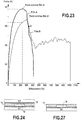
- the two elements, in particular the two films are tested with the above method, so as to obtain their respective characteristic curve.
- Each curve has a given peak point to which a respective given elongation corresponds.
- the smaller of the two given elongations of the two curves is chosen as the reference elongation or the elongation given in the case where the two given elongations are identical and for this given elongation we compare the two stretching forces of each curve and the element having the greatest stretching force for this reference elongation is the least stretchable element.
- the reference elongation is the elongation corresponding to the apex point of the film A, namely approximately 240% and at this reference elongation, the curve of the film A gives a stretching force of approximately 40 N and the curve of the film B has a stretching force of approximately 32.5 N, so that film A is the least stretchable.
- thermoplastics for example polyethylene, polypropylene, polyester or any similar material, as well as materials of the family.
- thermoplastic elastomers used for the elastic film but however so that the reinforcing film is in all cases of lesser elongation than the elastic film), which ensures good compatibility of the materials forming the stratum of a in one piece.
- a thermoplastic material having good compatibility with the elastic or elastomeric material of the elastic film will be chosen. so that the connection between them along their respective edges, after cooling, is as strong as possible.
- material for reinforcing films are polyethylene Riblene MV 10 (registered trademark) from the company Polimeri Europa, or MG 9621 from the company Boréalis, or LD259 or LD655 from the company Exxon Mobil Chemical.
- the strips of adhesive 10 and 11 are continuous at the interface between each nonwoven and each strip reinforcement and consist of strips of glue separated from each other by zones in the form of strips without glue. Reinforcement films and nonwovens could not be continuously bonded, for example by making separate strips of glue at this level, or even spot bonding or by random spraying.
- the reinforcement strips and the elastic films are deposited between the two nonwovens by co-extrusion. They are each assembled by co-extrusion, so that in the co-extrusion tool, they come into contact along their lateral edges 12, 13, 14 and 17 respectively in a state of softened material and under pressure.
- the intimate contact of the two edges of the two softened materials with one another elastic bands and reinforcing bands means that the two materials join together in the tooling and retains this junction after cooling.
- the elastic film can be based on a thermoplastic elastomer while the reinforcing strips can be thermoplastic, which ensures ease mutual fastening of the two interfaces on the lateral edges.
- the laminate comprises a film 18 consisting of a central elastic film 16 and two lateral reinforcement strips (15, 19).
- the laminate comprises a film 18 consisting of a central elastic film 16 and two lateral reinforcement strips (15, 19).
- the other characteristics of the laminate of the figure 2 are identical to what has been described for the laminate of the figure 1 .
- the installation comprises an extruder 101 which forms by extrusion two ribbons 201, 202 of elastic films which by means of belt systems 203 and rollers 204 are transported between two rolls at the same time as two layers of nonwoven 301 and 401 to be fixed there by cooling of the elastomeric material between the nonwovens in a fixing unit 500.
- the nonwoven 301 is unwound from a reel 302
- the second nonwoven 401 is unwound from a reel 402.
- From the extruder 102 are also formed three tapes 203, 204, 205 of thermoplastic material.
- the five ribbons 201 to 205 are co-extruded next to each other with their contiguous edges, so that at the outlet of the co-extrusion tooling and thereafter after cooling, they form only one room.
- the complex consisting of nonwovens 301 and 401 and elastic and thermoplastic ribbons 201 to 205, namely the complex 601, is then laminated in a calender 600, cut to the correct width in a cutting system 700 in width comprising knives 701 circulars, then passes through a welding unit 800, allowing a welding of the longitudinal edges.
- the nonwovens are finally activated by defibrillation, in an activation unit 900.
- the laminate as a whole is wound on a reel 1000 into a roll 1001 which can then be brought directly to the diaper manufacturing units for depositing on a diaper.
- the elastic or elastomeric film or films have a thickness of between 20 microns and 120 microns. "Likewise, the reinforcing strips preferably have the same thickness.
- thermoplastic reinforcing films can be chosen so that one of them extends exactly to one of the left or right edges of the laminate, while at the other edge , either the strip also extends to the right or left edge exactly, or protrudes a small distance outside beyond the edge of the laminate, or on the contrary ends in withdrawal from this edge so as to form a small selvedge, especially without reinforcing film.
- a hook ply of thermoplastic material consisting of a strip of thermoplastic material from which hooking elements protrude, including hooks.
- the width of this hook strip is less than the width of the reinforcing strip.
- the fixing of this strip or of these hook strips can be done by adhesive, glue or welding, in particular by ultrasound.
- the reinforcing films were extruded from the same extruder 102.
- a third extruder could also be provided for extruding one of the zones with a thermoplastic formulation different from the other reinforcement zone.
- the layer 4 comprises two elastic films and three reinforcing films. It is also possible to provide for this layer to be composed of a multiplicity of elastic and reinforcement zones with a respective number greater than or equal to 4.
- elastic and / or reinforcing film (s) to allow easy readability.
- each film is carried out according to the usual rules of the art in extrusion and optionally includes agents of the “processing aids” type, bulking agents, anti UV, antiblock, etc.
- FIGS 7 to 20 are shown other embodiments of a laminate according to the invention, in which, compared to the embodiments of Figures 1 and 2 , we varied the number and / or the widths of the nonwoven layers, the number of elastic films, the number of reinforcement films, the widths of the reinforcement films, the relative positioning of the reinforcement films relative to the edges of the laminate, the positioning of an element comprising hooks .
- the embodiments which are obtained by combining two or more of the embodiments of the figures 1, 2 , 6 to 18 , in particular when one takes in one of these embodiments one or more characteristics which are not found in another of the embodiments described and when this or these characteristics are added to said one of these embodiments to audit another of the embodiments.
- the same reference numbers as in Figures 1 and 2 we were used to describe identical elements.
- the layer 4 comprises three reinforcing films 5, 7 and 9 and two elastic films 6 and 8.
- FIG 8 there is shown an embodiment substantially identical to that of the figure 7 , except for the fact that it also has a lower nonwoven layer, which also extends only on the elastic films.
- FIG 9 yet another embodiment is shown which is substantially identical to that of the figure 7 , except for the fact that a lower layer of nonwoven has been added thereto which extends over the entire width of the intermediate layer, exactly from one edge to the other of this layer.
- FIG 10 there is shown an embodiment substantially identical to that of the figure 9 , except that the lower nonwoven extends beyond the side edges of the intermediate layer.
- FIG 11 there is shown an embodiment substantially identical to that of the figure 9 , with the exception that the lower nonwoven extends below the lateral edges of the intermediate layer, the two end reinforcement films projecting laterally beyond the two lower and upper nonwovens.
- FIG 12 there is shown an embodiment substantially identical to that of the figure 1 , except that the two end reinforcement films project laterally beyond the two upper and lower nonwovens.
- FIG 13 there is shown an embodiment substantially identical to that of the figure 1 , except that the two end reinforcement films do not extend to the lateral edges of the laminate while remaining laterally in relation to the two nonwovens.
- FIG 14 there is shown an embodiment substantially identical to that of the figure 1 , except that the upper layer of nonwoven does not extend to the end edges of the intermediate layer, the two reinforcing films and the lower layer of nonwoven extending laterally beyond the top layer of nonwoven.
- FIG 15 there is shown an embodiment substantially identical to that of the figure 1 , except that the upper layer of nonwoven does not extend over the central film, leaving the latter bare, bare surface which can be used for direct attachment of an element comprising hooks, as shown in the figure 18 .
- FIG 16 there is shown an embodiment identical to that of the figure 6 , except for the fact that the element comprising hooks is fixed to the upper nonwoven at the level of the central film and not at the level of one of the end reinforcement films.
- FIG 17 there is shown the embodiment of the figure 14 which has been attached to an end portion of the end reinforcement film which projects beyond the upper nonwoven layer an element having hooks.
- FIG 19 there is shown a laminate comprising only an elastic film and an end reinforcement film.
- the reinforcing film extends from the elastic film to the side edge (left in the figure).
- the end edge of the reinforcing film on the side opposite to said elastic film is the location of the points of the end reinforcing film furthest from any elastic film.
- the layer alternately comprises five reinforcing films and four elastic films.
- FIG 24 there is shown an embodiment of a laminate according to the invention, comprising an upper nonwoven layer and a lower nonwoven layer.
- the intermediate layer comprises in succession, co-extruded together, a film of reinforcement, an elastic film and a reinforcement film.
- the two reinforcing films tend to overlap above the elastic film until forming a small film above the elastic film, the film of reinforcing material (less stretchable than the elastomeric material) connecting the two reinforcement films.
- the film with respect to the thickness of elastic material, is sufficiently thin, however, so that the layer retains its elastic character at the level of the elastic film.
- the film is in direct contact (with glue interposition only) with the upper nonwoven.
- the laminate of the figure 27 is shown a variant of the embodiment of the laminate of the figure 24 , the laminate of the figure 27 being identical to the laminate of the figure 24 except that it does not have the upper nonwoven layer and the intermediate adhesive layer between the co-extruded layer and the upper nonwoven layer. So the upper surface of this laminate of the figure 27 is it made up only of the material forming the reinforcing strip and the bridge portion above the elastic layer, possibly with a hook strip fixed to this upper surface.
- the layer 100 consists of a frame formed by a stack of an impermeable outer covering 101 and a lining 102 on the side of the body permeable to body fluids. Between the covering and the lining, there is an absorbent material.
- the chassis forms a front portion 104, intended to be on the front side of the wearer of the diaper when it is worn, a rear portion 105, intended to be on the rear side of the wearer of the diaper, when it is worn, and a crotch portion 106, connecting the rear and front portions.
- a loop part 107 On the front part, on the outside face of the outside cover 101, a loop part 107, for example in the form of a loop knit, has been arranged, for example by gluing, ultrasonic welding or the like. a loop woven or a loop nonwoven.
- the intermediate hook parts 103 consisting of one of the laminates described above to which hooks have been attached intended to cooperate with the loops from the front part to close the panty layer around the size of the wearer.
- the hooks are fixed at one of the reinforcing strips, either directly above it, or with the interposition of the layer of nonwoven fabric located above the reinforcing strip.
- the intermediate parts 103 are joined to the rear part, on both sides of these, preferably, as shown, substantially at the upper level of the rear part.
- This meeting can be done directly or indirectly.
- each intermediate part can be fixed directly to the rear part by using adhesive, thermal or ultrasonic welding and the like.
- One can also provide an intermediate piece helping this meeting and even make sure that the intermediate parts 103 are made in one piece or in one piece with the rear part.
- the fixing of each intermediate part to the upper lateral edges of the part back of the frame of the layer is made at the level of the reinforcement strip or of one of the reinforcement strips of the laminate constituting this intermediate part, either directly or with the interposition of the nonwoven layer lying above this reinforcement strip , the presence of this reinforcing strip facilitating this fixing.
- FIG 26 another embodiment of a layer according to the invention is shown.
- the intermediate parts 103 ′ are joined at the same time to the rear part (as in the embodiment of the figure 25 ) and at part 104 'before. in a manner analogous to the way in which the rear and intermediate parts are brought together.
- the intermediate parts are also, as in the embodiment of the figure 25 , consisting of one of the laminates described above.
- the intermediate part 103 ′ does not have hooks and that the meeting with the front part is not removable as is the case in the embodiment of the figure 25 by the cooperation of hooks and loops. So in this embodiment of the figure 26 , it is not necessary to provide a loop part in the front part.
- each intermediate part to the lateral upper edges of the rear part and of the front part of the frame of the layer is made at the level of a respective of the reinforcing strips of the laminate constituting this intermediate part, either directly or with the interposition of the non-woven layer lying above this reinforcing strip, the presence of the reinforcing strips facilitating this fixing.
Landscapes
- Health & Medical Sciences (AREA)
- Engineering & Computer Science (AREA)
- Animal Behavior & Ethology (AREA)
- Veterinary Medicine (AREA)
- Biomedical Technology (AREA)
- Heart & Thoracic Surgery (AREA)
- Vascular Medicine (AREA)
- Life Sciences & Earth Sciences (AREA)
- Epidemiology (AREA)
- General Health & Medical Sciences (AREA)
- Public Health (AREA)
- Manufacturing & Machinery (AREA)
- Textile Engineering (AREA)
- Mechanical Engineering (AREA)
- Chemical & Material Sciences (AREA)
- Chemical Kinetics & Catalysis (AREA)
- Absorbent Articles And Supports Therefor (AREA)
- Slide Fasteners, Snap Fasteners, And Hook Fasteners (AREA)
- Laminated Bodies (AREA)
Description
- La présente invention se rapporte à un stratifié comportant au moins un film élastique fixé par de l'adhésif à au moins une couche de non tissé, notamment deux couches de non-tissé respectivement supérieure et inférieure. Ce genre de stratifié est utilisé, en particulier, dans des applications dans le domaine des vêtements, notamment jetables, tels que des couches-culottes et des dispositifs contre l'incontinence pour adulte, ou dans le domaine médical, sous la forme de bandage élastique. Dans les couches-culottes, ces stratifiés sont classiquement utilisés dans les parties formant la ceinture autour de la taille du bébé. Dans le cas d'une application particulièrement avantageuse pour les couches-culottes, ces stratifiés sont utilisés pour réaliser les rabats élastiques qui garantissent que la couche-culotte est maintenue fermement sur le bébé, notamment élastiquement, le rabat, formant une partie à crochet, portant par exemple des éléments mâles d'un auto agrippant, notamment des crochets, destinés par exemple à coopérer avec des boucles d'une partie centrale de la ceinture de la couche culotte.
- On connaît déjà, dans l'art antérieur, des stratifiés de ce genre, notamment de la demande de brevet français n°
05 11343 - De
US-A-6245401 , on connaît un stratifié, comportant une strate, constituée d'un film élastique et de deux films moins élastiques mais perméables à la vapeur d'eau, et une couche de non tissé, qui peut être utilisé en tant que le recouvrement extérieur imperméable aux liquides d'un châssis de couche culotte. - De
US-A-5773374 , on connaît un stratifié comportant deux couches de non tissé qui prennent en sandwich un élément élastique, cet élément élastique étant constitué d'une âme en un matériau élastique et de deux peaux de part et d'autre de l'âme qui ont été préalablement étirées et solidarisées à l'état étirées à l'âme, elle même à l'état étiré, de sorte que une fois solidarisées les peaux se rétractent en même temps que l'âme pour former des ondulations. L'élément constitué de l'âme et des deux peaux est ainsi doué d'élasticité entre sa longueur au repos et sa longueur maximale lorsqu'il est étiré de sorte que les peaux ne forment plus d'ondulations. Le procédé de fabrication du stratifié est ainsi complexe et prend beaucoup de temps. - De
WO-A-01/53076 - De
US 2005/0060849A1 , il est connu de co-extruder deux bandes, l'une en un matériau élastomérique et l'autre en un matériau thermoplastique dans lequel on peut mouler des crochets, la co extrusion se faisant sur une couche support, sans interposition de colle, puis on sépare, en tirant dans la direction CD, les deux bandes co extrudées l'une à l'autre pour obtenir au final des éléments à crochets individuels. -
US6195850 B1 décrit des systèmes de fermeture à crochets et boucles pour des couches-culottes. -
US5773374 A décrit un matériau élastique destiné à être utilisé dans les vêtements, par exemple dans les couches-culottes. - Dans un cas comme dans l'autre, il est difficile soit de réaliser le stratifié, notamment parce qu'il est constitué d'un grand nombre de pièces, ce qui le rend complexe, soit d'assurer à grande vitesse la fixation du stratifié soit au châssis de la couche-culotte soit au rabat à crochets sauf à utiliser des non tissés supérieur et inférieur ayant des grammages élevés, ce qui a un effet défavorable sur les coûts de production à grande échelle.
- Suivant un autre art antérieur, il est connu de traiter des zones du ou des non tissés pour annihiler les propriétés élastiques du stratifié au niveau de ces zones, par exemple par adjonction d'une couche complémentaire de film rigide ou de non tissé en sur épaisseur du stratifié. Cependant, dans ce cas également, le traitement est coûteux et peu propice à une mise en oeuvre sur des lignes de fabrication rapides et à grande échelle.
- La présente invention vise à surmonter les inconvénients de l'art antérieur en proposant un stratifié, comportant au moins un film élastique fixé par adhésif entre deux couches de non-tissé, que l'on peut obtenir d'une manière très simple, particulièrement adaptée à une fabrication à très grande échelle et qui dans le même temps est plus simple à assembler à une couche-culotte, et notamment au châssis de la couche, et auquel il est plus facile, également, d'assembler un élément de largeur étroite comportant des crochets pour former une partie à crochets pour permettre la fermeture de cette couche-culotte.
- Suivant l'invention, une partie à crochets d'une fermeture auto agrippante à crochets et boucles, notamment pour une couche culotte, est telle que définie à la revendication 1, des perfectionnements étant définis aux sous revendications 2 à 9.
- Suivant l'invention, on entend d'une seule pièce, une strate qui n'est pas constituée par la fixation ensemble de plusieurs pièces, notamment films, à l'aide de moyen de fixation intermédiaire, telle qu'un adhésif ou de la colle. En particulier, la strate d'une seule pièce est une strate obtenue en extrudant un matériau ou en co-extrudant plusieurs matériaux.
- En particulier, ladite une zone élastique en forme de film est en contact direct avec au moins une couche de non tissé, avec interposition d'une couche d'adhésif, notamment de colle.
- De préférence, le stratifié a une largeur mesurée dans la direction transversale entre les deux bords gauche et droit d'extrémité, une épaisseur mesurée dans la direction d'empilement des strates du stratifié et une longueur dans la direction perpendiculaire à la direction en largeur et la direction en épaisseur, les couches ou nappes de non-tissé et d'adhésif s'étendant sur toute la largeur du stratifié, tandis que la somme des largeurs de la ou des zone(s) en forme de film(s) élastique(s) est strictement inférieure à la largeur du stratifié et la somme des largeurs de la ou des zones en forme de film(s) de renforcement est également strictement inférieure à la largeur du stratifié.
- En particulier, suivant un mode de réalisation préféré de l'invention, la ou les zones en forme de film(s) de renforcement et la ou les zone(s) en forme de film(s) élastique(s), avant leur fixation à la au moins une couche de non tissé, sont formés en une pièce ou film unique par coextrusion de sorte que leurs bords latéraux viennent en contact mutuel. Les matières des films de renforcement et du ou des film(s) élastique(s), par exemple des matières thermoplastiques et élastométiques, sont extrudées contiguës les unes aux autres, de sorte que les films de renforcement et le film élastique forment une pièce unique.
- De préférence, la ou les zones en forme de films de renforcement sont constituées d'une matière, issue d'une formulation ou recette intégrant notamment des matières thermoplastiques, éventuellement élastomériques, qui confère à iso charge suivant la méthode de test d'élongation décrite ci après des propriétés moindres d'élongation que la ou les zones en forme de films élastiques. De préférence, ces zones sont inélastiques.
- Avec la partie à crochets suivant l'invention, on peut maintenant obtenir, à grammage égal des non tissés utilisés, une résistance améliorée à la traction latérale et une bonne fixation de la partie à crochets au niveau de ses bords au châssis d'une couche culotte, ou, pour un grammage plus faible de l'un au moins des non tissés utilisés, notamment compris entre 5 et 20 g/m2, de préférence entre 5 et 15 g/m2, en particulier entre 5 et 10 g/m2, une aussi bonne fixation que pour des parties à crochets de l'art antérieur comportant des non tissés de plus fort grammage.
- Suivant un mode de réalisation préféré, la nappe à crochets, constituée d'une bande de base et d'une pluralité d'éléments d'accrochage issus de la bande, est fixée, par exemple par collage, calandrage à chaud, soudure à ultrasons ou analogue, sur une face extérieure du au moins un non tissé formant le stratifié, au niveau du bord sur une zone qui se trouve au dessus ou en dessous d'une des zones de renforcement, notamment latérales.
- Suivant un autre mode de réalisation, la nappe à crochets, constituée d'une bande de base et d'une pluralité d'éléments d'accrochage issus de là bande, est fixée, par exemple par collage, calandrage à chaud, soudure à ultrasons ou analogue, sur une face extérieure d'au moins une des zones de renforcement latérales et/ou central.
- Suivant un mode de réalisation préféré de l'invention, les deux couches d'adhésif, notamment de colle, entre respectivement chaque non-tissé et la strate d'une pièce ou d'un seul tenant constituée d'au moins deux zones de renforcement en forme de film et d'au moins une zone élastique en forme de film sont réalisées de telle manière qu'entre le non-tissé et la ou les partie(s) formant une zone élastique de la strate intermédiaire, l'adhésif se trouve déposé sous forme de bandes séparées les unes des autres par des bandes sans adhésif.
- Soit le non-tissé a une capacité d'extension dans la direction transversale, auquel cas les bandes de colle séparées permettent d'assurer au stratifié une élasticité, soit le non-tissé choisi n'est pas extensible, et il est alors activé en étirant l'ensemble transversalement de sorte que sur les bandes de colle vont s'agglutiner des amas de fibres de non-tissé, tandis qu'entre les bandes de colle vont se former dans le non-tissé des parties en creux, et, après écirement, le non-tissé aura des formes en crêtes et des formes en creux et pourra être étiré.
- De préférence, l'épaisseur de la strate d'une pièce ou d'un seul tenant, comportant la ou les zone(s) de renforcement en forme de film(s) et la ou les zone(s) élastique(s) en forme de film(s), au niveau des jonctions entre les zones de renforcement et les zone élastiques est sensiblement constante, notamment constante. En particulier, au niveau des jonctions les deux zones ont chacune sur la région de jonction une épaisseur plus petite qu'à proximité de la jonction, la somme des épaisseurs des deux zones en forme de films au niveau de la jonction étant sensiblement égale à l'épaisseur de l'une ou l'autre des zones en forme de films à proximité de la jonction.
- Suivant un autre mode de réalisation, la jonction entre deux zones élastique et de renforcement s'effectue suivant une interface en biseau.
- De préférence, la somme des largeurs de la ou des zone(s) élastique(s) en forme de film(s) et de la ou des zone(s) de renforcement en forme de film(s), y compris celle de la zone centrale lorsqu'elle est prévue, est égale sensiblement à la largeur du stratifié, de sorte que les zones de renforcement d'extrémité s'étendent sensiblement exactement jusqu'au bord d'extrémité respectif du stratifié.
- Suivant une autre application de grand intérêt également, les largeurs de la ou des zone(s) élastique(s) en forme de film(s) et de la ou des zone(s) de renforcement en forme de film(s), y compris celle de la zone centrale lorsqu'elle est prévue, sont telles que l'une des deux zones de renforcement d'extrémité s'étend sensiblement exactement jusqu'au bord latéral respectif tandis que l'autre des deux zones de renforcement d'extrémité s'étend au delà du bord latéral respectif, de manière à dépasser hors du stratifié.
- Suivant encore une autre application de grand intérêt, les largeurs de la ou des zone(s) élastique(s) en forme de film(s) et de la ou des zone(s) de renforcement en forme de film(s), y compris celle de la zone centrale lorsqu'elle est prévue, sont telles que l'une des deux zones de renforcement d'extrémité s'étend sensiblement exactement jusqu'au bord latéral respectif tandis que l'autre des deux zones de renforcement d'extrémité s'étend en deçà dé leur bord latéral respectif, de manière à former une lisière qui n'est constitué que d'un non tissé ou de deux non tissés et d'une couche de colle intermédiaire.
- Cependant, pour chacune des zones de renforcement en forme de film, on peut envisager, indépendamment de l'autre, qu'elle s'étende soit exactement jusqu'à son bord latéral respectif, soit au delà de ce bord respectif, soit en deçà de ce bord respectif.
- La présente invention se rapporte également à un procédé d'obtention d'une partie à crochets suivant l'invention comme défini à la revendication 10.
- De préférence, le film co extrudé constitué du ou des film(s) élastique(s) et du ou des film(s) de renforcement est en un ou plusieurs matériau(x) imperméables, notamment à l'air et/ou aux liquides.
- Suivant un autre aspect de l'invention, celle ci vise une couche culotte définissant une partie avant, une partie arrière et une partie d'entrejambe reliant la partie avant et la partie arrière, et deux parties intermédiaires latérales reliant les bords latéraux supérieurs gauche et droit de la partie arrière avec les bords latéraux supérieurs respectivement gauche et droit de la partie avant, chaque partie intermédiaire étant réunie de manière fixe, par exemple par soudure, à un bord latéral supérieur respectif de la partie arrière, et chaque partie intermédiaire comportant un stratifié s'étendant dans une direction transversale entre deux bords latéraux respectivement gauche et droit, comprenant une strate fixée à au moins une couche de non tissé par une couche d'adhésif, notamment interposée entre deux couches de non tissé en étant fixée respectivement par une couche d'adhésif respective à chaque couche de non tissé, la strate étant d'une pièce ou d'un seul tenant et comportant une zone élastique en forme de film, notamment en un matériau élastomérique, caractérisée en ce que :
- la strate d'une pièce ou d'un seul tenant comprend au moins une zone de renforcement d'extrémité en forme de film qui s'étend à partir de la zone élastique en forme de film en allant vers l'un des bords latéraux ;
- aucune zone élastique ne se trouvant entre le dit un des bords latéraux et la zone de renforcement en forme de film; et
- la au moins une zone de renforcement en forme de film étant moins étirable que la dite une zone élastique en forme de film, notamment est moins élastique, et préférablement n'est pas élastique, par exemple est en une matière thermoplastique, et
- la au moins une zone élastique en forme de film est en contact avec une ou les deux couches d'adhésif interposées entre le ou les non tissés et la strate.
- Suivant un mode de réalisation avantageux, au moins un élément à crochets, comportant une bande de base et des crochets issus de la bande, est fixé sur le stratifié, un élément à boucles est fixé à la partie avant et l'agencement est tel que la fermeture de la couche autour de la taille du porteur se fait par la coopération entre les crochets de la partie intermédiaire et les boucles de la partie avant.
- Suivant un autre mode de réalisation également avantageux, les parties intermédiaires sont fixées à la partie avant de manière non amovible, par exemple par soudure.
- La présente invention vise également une couche culotte comme définie à la revendication 11.
- A titre d'exemple, on décrit maintenant un mode de réalisation de l'invention en se rapportant aux dessins dans lesquels :
- la
Figure 1 représente une vue en coupe transversale schématique d'un mode de réalisation d'un stratifié suivant l'invention; - la
Figure 2 représente une vue en coupe transversale schématique d'un autre mode de réalisation d'un stratifié suivant l'invention; - la
Figure 3 représente une vue en perspective d'une installation de production d'un stratifié suivant l'invention, notamment des stratifiés desfigures 1 et 2 ; - la
Figure 4 est un schéma représentant un échantillon de matériau élastique ou élastomérique préparé pour en déterminer le SET, - la
Figure 5 représente la forme de la courbe d'hystérésis obtenue lors de la détermination du SET d'un matériau, notamment élastique ou élastomérique. - La
Figure 6 représente un autre mode de réalisation d'un stratifié suivant l'invention, qui correspond au stratifié de lafigure 1 auquel a été ajouté sur le dessus, un élément comportant des crochets. - Les
figures 7 à 20 représentent d'autres modes de réalisation possible d'un stratifié suivant l'invention ; - La
figure 21 représente une vue en coupe transversale de la strate du mode de réalisation de lafigure 1 après avoir été formé par extrusion et avant d'être assemblée à une ou deux couches de non tissé ; - La
figure 22 représente une partie de la vue de lafigure 21 d'une strate ayant une interface film élastique - film de renforcement réalisée en biseau ; - La
figure 23 représente des exemples de courbes donnant l'étirement en fonction de la force pour le test de caractère étirable relatif ; - La
figure 24 représente encore un autre mode de réalisation d'un stratifié suivant l'invention ; - La
figure 25 représente un mode de réalisation d'une couche culotte suivant l'invention incorporant une oreille ou patte de fermeture à crochets incorporant un stratifié comme décrit aux figures précédentes ; - La
figure 26 représente vue en perspective un autre mode de réalisation d'une couche culotte suivant l'invention ; et - La
figure 27 représente encore un autre mode de réalisation d'un stratifié suivant l'invention. - A la
Figure 1 , il est représenté un stratifié 1 comportant une première couche 2 inférieure de non-tissé et une deuxième couche 3 supérieure de non-tissé. Entre ces deux couches 2 et 3 inférieure et supérieure de non-tissé (à la figure, il est représenté la vue en coupe transversale, sachant que le stratifié dans son ensemble est un élément dont la longueur est perpendiculaire au plan desfigures 1 et 2 ), il est formée une strate 4 intermédiaire. Cette strate 4 intermédiaire est constituée d'un film 5 de renforcement latéral gauche en matière thermoplastique, d'un film 6 élastique gauche en matière élastomérique, d'un film 7 de renforcement central en matière thermoplastique, d'un film 8 élastique droit en matière élastomérique et d'un film de renforcement 9 latéral droite en matière thermoplastique. Des couches 10 et 11 de colles sont interposées entre chaque couche de non tissé et la strate 4 intermédiaire. La largeur totale du stratifié est égale à la largeur de chaque non tissé ainsi qu'à la largeur de chaque couche de colle. La somme des largeurs des trois films de renforcement et des deux films élastiques est égale à la largeur.du stratifié. - Les deux films de renforcement gauche et droite s'étendent jusqu'au bord respectif gauche et droit du stratifié. On peut également envisager qu'une petite lisière sans bande de renforcement soit formée à chaque bord du stratifié (voir la
figure 13 ) ou qu'au contraire l'un ou les deux films dépassent du bord respectif (voirfigures .7, 8, 11 ou 12 ). Dans tous les cas, l'un des bords des deux films de renforcement d'extrémité est le lieu des points de l'ensemble des films de renforcement d'extrémité qui sont les plus éloignés du ou des films élastiques. - Comme on peut le voir à la
figure 21 , l'épaisseur de la strate mesurée dans la direction verticale à la figure, c'est-à-dire perpendiculairement à la direction en largeur et à la direction en longueur de défilement est constante ou sensiblement constante sur l'étendue transversale de chaque zone élastique ou de renforcement. Cependant, comme on peut le voir sur cette même figure, l'épaisseur des zones élastiques varie de manière croissante puis décroissante en passant par un maximum entre ses deux jonctions avec les zones de renforcement, mais les épaisseurs du ou des film(s) élastique(s) et de la ou des zone(s) de renforcement sont telles qu'au niveau de leur jonction respective, les surfaces supérieure et/ou inférieure de la strate sont sensiblement sans aspérité ni discontinuité. - Ainsi par exemple, le ou les films élastiques ont un grammage environ 10 à 25% supérieur à celui du ou des films de renforcement, le ou les films élastiques ayant par exemple un grammage de 55 g/m2 tandis que le ou les films de renforcement ont un grammage de 45 g/m2.
- Sur le tronçon de jonction ou liaison, qui s'étend sur une largeur en général comprise entre 3 et 10 mm, notamment 5mm, l'épaisseur de chaque film (de renforcement et élastique) est inférieure à l'épaisseur du film en dehors de la jonction. Ainsi, chaque film de la jonction comporte une partie de plus petite épaisseur qui vient s'assembler en superposition avec la partie de plus petite épaisseur de l'autre film de la jonction. La superposition crée ainsi au niveau de l'interface entre les deux films, comme représenté à la
figure 21 , une sorte d'échelon. On pourrait également avoir comme forme pour l'interface un biseau comme représenté à lafigure 22 . - Il peut cependant arriver dans la pratique au niveau des liaisons d'interface entre les deux matières thermoplastique et élastique ou élastomérique, qu'ils se forment de petits renflements liés au fait que la somme des épaisseurs des parties d'extrémité qui se superposent soit légèrement supérieure aux épaisseurs des deux films de part et d'autre de la jonction.
- Dans la présente invention, on entend par film ou zone élastique dans une direction donnée un film ou une zone qui reprend sensiblement sa forme initiale après avoir été étiré ou allongé dans la direction donnée, à la température ambiante. De préférence il s'agit d'un film ou d'une zone qui ne conserve qu'une petite déformation résiduelle ou rémanence après déformation et relâchement (permanent set ou SET), à savoir inférieure à 10 %, plus préférablement inférieure à 5 % de la longueur initiale, pour un allongement de 100 % de la longueur initiale de l'échantillon, à température ambiante (T∼ 23°C).
- Plus préférablement, le film élastique est capable de subir un allongement à la rupture d'au moins 300 % à température ambiante et, de préférence, un allongement d'au moins 600 %, et plus préférablement d'au moins 1000 %, à température ambiante et pour une vitesse d'étirement de 508 mm/min. Le matériau en lequel est le film élastique peut être soit un élastomère pur, soit des mélanges ayant une phase élastomérique ou une matière qui présente toujours des propriétés sensiblement élastomériques à la température ambiante, comme par exemple des polyoléfines issus de catalyse type métallocène. Il peut également comporter une charge de matière thermoplastique pour entre autre aider à la formation de la strate d'un seul tenant avec les films de renforcements.
- Pour mesurer la rémanence, ou SET, d'un échantillon, et donc déterminer s'il s'agit d'un échantillon d'un élément, notamment un film, élastique, on utilise la méthode suivante :
On conditionne l'échantillon dans une atmosphère normale, telle que définie dans la norme ASTDM 5170, température de 23°C ± 2°C et humidité relative de 50% ± 5%. - On utilise comme appareillage un dynamomètre conforme à la norme EN 10002, notamment le Synergie 200H, 1 colonne disponible auprès de la société MTS Systems Corp, U.S.A., conjointement avec un logiciel d'utilisation TESTWORKS 4.04 B.
- On prépare l'échantillon en découpant à l'emporte pièce le produit dont on souhaite mesurer l'élasticité en un échantillon de forme rectangulaire (par exemple de 45mm de largeur dans le sens MD (direction de la machine, perpendiculairement au plan de la
figure 1 ) et d'une longueur dans le sens CD (direction transversale, direction horizontale à lafigure 1 ) de 60mm). - On positionne l'échantillon encre les mâchoires de part et d'autre de la zone donc on souhaite tester l'élasticité et de chaque côté, comme représenté schématiquement à la
figure 4 ; - Les paramètres sont sélectionnés comme suit :
- Distance inter mâchoires : 20mm
- Vitesse machine : 254 mm/min
- Nombre de cycles : 2
- Allongement du produit : 100% à vitesse constante
- On étire le produit à 100% par déplacement vertical des mâchoires, après application d'une précharge de l'ordre de 0,05 N, puis on le maintien dans la position pendant 30 secondes (premier cycle), puis on le laisse revenir à la position initiale où on le laisse 60 secondes, puis on l'étire de nouveau à 100%, on le maintien pendant 30 secondes (deuxième cycle) et on revient à la position initiale. On obtient alors la courbe donnant la force d'étirement en N en fonction de l'allongement en %, celle-ci présentant une hystérésis, qui peut alors être caractérisée par le SET (n=2), à savoir le point de la courbe de départ du deuxième cycle qui coupe l'axe des X (élongation en %) à la
figure 5 . - Plus préférablement, le film élastique est capable de subir un allongement à la rupture d'au moins 300 % à température ambiante et, de préférence, un allongement d'au moins 600 %, et plus préférablement d'au moins 1000 %, à température ambiante et pour une vitesse d'étirement de 508 mm/min. Le matériau en lequel est le film élastique peut être soit un élastomère pur, soit des mélanges ayant une phase élastomérique ou une matière qui présente toujours des propriétés sensiblement élastomériques à la température ambiante, comme par exemple des polyoléfines issus de catalyse type métallocène. Il peut également comporter une charge de matière thermoplastique pour entre autre aider à la formation de la strate d'un seul tenant avec les films de renforcements.
- Le matériau du film élastique, notamment élastomérique, peut être un matériau élastique thermo-rétrécissable ou non thermo-rétrécissable. Il peut être formé, en particulier, à partir de polymères, tels que des copolymères de différents types de motif de monomères, par exemple alterné tel que A-B, ou séquencé, par exemple A-A-A-B-B-B, ou statistique, par exemple A-A-B-A-B-B-A-A-A-B-A, dont l'ensemble du réseau obtenu peut avoir différentes structures, soit linéaires de type A-B-A, soit radiales de type A-B, indice n (n>2), soit diblock de type A-B qui sont élastomériques, par exemple les copolymères styrène/isoprène (SI), styrène/isoprène/styrène (SIS), styrène/butadiène/styrène (SBS), styrène-éthylène/butylène-styrène (SEBS), styrène-éthylène/propylène-styrène (SEPS) ou SIBS. Des mélanges de ces élastomères les uns avec les autres ou avec des non élastomères modifiant certaines caractéristiques autres que l'élasticité peuvent également être pris en compte. Par exemple jusqu'à 50 % en poids mais, de préférence, moins de 30 % en poids de polymère peuvent être ajoutés en tant qu'ajout raidisseur, tels que des polyvinyles styrène, des polystyrènes ou des poly α-méthyl-styrène, polyesters époxy, polyoléfines, par exemple des polyéthylènes ou certains acétates d'éthylène/vinyle, de préférence ceux de poids moléculaire élevé.
- Le matériau du film élastique peut être, notamment, un styrène-isoprène-styrène, disponible par exemple auprès de la Société Kraton Polymers, sous la dénomination KRATON D(Marque déposée), ou de la société DEXCO POLYMERS LP sous la dénomination VECTOR SBC 4211 (Marque déposée). On peut également utiliser un élastomère thermoplastique de polyuréthane, notamment le PELLATHANE (Marque déposée) 2102-75A de la Société The Dow Chemical Company. On peut utiliser également un styrène-butadiène-styrène, notamment le KRATON D-2122 (Marque déposée) de la société Kraton Polymers , ou le VECTOR SBC 4461 (Marque déposée)de la société Dexco Polymers LP. On peut aussi utiliser un styrène-éthylène/butylène, notamment le KRATON G-2832 (Marque déposée) de la société Kraton Polymers, ou un copolymère séquencé styrène-éthylène-butylène-styrène (SEBS), notamment le KRATON (Marque déposée) G2703. On peut également utiliser un copolymère d'acrylate d'isooctyle et d'acide acrylique suivant des rapports de monomère de 90/10. On peut également utiliser un copolymère séquencé polyamide polyéther PEBAX (Marque déposée) 2533 de la société Arkema.
- D'autres matériaux possibles sont des polymères polyoléfines ayant les caractéristiques des élastomères, notamment issus de la catalyse métallocène, tel le VISTAMAXX VM-1120 (Marque déposée), disponible auprès de la société Exxon Mobil Chemical ou des polymères chargés EPDM du type Santoprène.
- Dans le cas où de la colle est utilisée comme adhésif pour fixer les films élastiques et les films thermoplastiques aux non tissés et éventuellement les non tissés entre eux, on peut, suivant l'invention, utiliser une colle telle que des colles hot melt non réactive, par exemple la H2511 de Bostick, ou une colle réactive, notamment la AX75E de Bostik, ou des colles PU réactives.
- De préférence, ces colles auront une nature chimique similaire ou compatible avec une matière composant le film élastique et/ou le film thermoplastique ou de renforcement décrit ci dessus.
- Concernant les non tissés, on peut utiliser des non tissés de type spunbond et/ou meltblown et/ou cardé calandré et/ou spunlace et ayant comme matériau de base un ou des polyoléfines, de préférence du polypropylène, du polyester ou un mélange de ceux ci. En particulier, le non tissé « spunbond » est à base de fibres longues ou filaments, ayant un titre en dTex (masse en gramme divisée par une longueur de 10000 m de fil) compris entre 1 dTex et 6 dTex, par exemple 2,2 dTex. En particulier lorsque le stratifié comporte deux couches de non tissé, les couches peuvent être de types différents et/ou de matériaux différents.
- De préférence le ou au moins l'un des non tissés ou les deux non tissés a(ont) un grammage compris entre 5 et 25 g/m2, notamment entre 5 et 15 g/m2, plus particulièrement entre 5 et 10 g/m2.
- En particulier, lorsque le non tissé est un non tissé qui n'a pas de capacité à s'étirer de soi même et doit être activé, le grammage est compris entre 5 et 20 g/m2, notamment est d'environ 15g/m2 pour un spunbond ou d'environ 8g/m2 pour un meltblown. Lorsque le non tissé n'a pas besoin d'être activé pour que le stratifié est des capacités élastiques, c'est à dire lorsque le non tissé a des capacités à s'étirer de soi même sur un domaine d'allongement allant au moins jusqu'à 50%, de préférence au moins 100%, le grammage est de préférence compris entre 15 et 25 g/m2, par exemple est de 22g /m2 pour un cardé calandré ou de 25g/m2 pour un spunlace. En outre, il est à noter que les deux non tissé, dans le cas où il y en a deux, peuvent être différents l'un de l'autre.
- Pour déterminer si un élément, notamment un film, est plus étirable qu'un autre élément, par exemple un autre film, suivant l'invention, on peut utiliser un test d'allongement sous effort jusqu'à la rupture comme suit :
On utilise comme appareillage un dynamomètre conforme à la norme EN 10002, par exemple le même que pour le test d'élasticité ci dessus, à savoir le Synergie 200H, 1 colonne, disponible auprès de la société MTS Systems Corp, USA, conjointement avec un logiciel d'utilisation TESTWORKS 4.04 B. On prépare l'échantillon en forme rectangulaire, par exemple de 45 mm de largeur et d'une longueur de 60 mm. On positionne l'échantillon entre les mâchoires de part et d'autre de la zone dont on souhaite tester l'allongement et de chaque côté, comme représenté schématiquement à lafigure 4 . Les paramètres sont sélectionnés comme suit : - Distance inter mâchoires : 20 mm
- Vitesse machine : 254 mm/min
- Allongement du produit : jusqu'à rupture à vitesse constante
- Après avoir appliqué une précharge de 0,05 N, on étire le produit jusqu'à sa rupture par déplacement vertical des mâchoires. On obtient alors pour chaque échantillon la courbe caractéristique donnant la force d'étirement en N en fonction de l'allongement en %, comme représenté à la
figure 23 . Chaque courbe comporte un point sommet, à partir duquel l'allongement croît à force décroissante. Ce sommet correspond au passage à l'état de ruine de l'élément. - Pour déterminer lequel de deux éléments, notamment de deux films, est le moins étirable, on teste avec la méthode ci dessus les deux éléments, notamment les deux films, de manière à obtenir leur courbe caractéristique respective. Chaque courbe présente un point sommet donné auquel correspond un allongement donné respectif. On choisit alors comme allongement de référence le plus petit des deux allongements donnés des deux courbes ou l'allongement donné dans le cas où les deux, allongements donnés sont identiques et pour cet allongement donné le plus petit on compare les deux forces d'étirement de chaque courbe et l'élément ayant pour cet allongement de référence la force d'étirement la plus grande est l'élément le moins étirable. Ainsi, par exemple à la
figure 23 , l'allongement de référence est l'allongement correspondant au point sommet du film A, à savoir environ 240% et à cet allongement de référence, la courbe du film A donne une force d'étirement d'environ 40 N et la courbe du film B une force d'étirement d'environ 32,5 N, de sorte que c'est le film A qui est le moins étirable. - Concernant le matériau des bandes de renforcement, on peut choisir une matière ou un mélange de plusieurs matières telles que celles de la famille des thermoplastiques, par exemple le polyéthylène, le polypropylène, le polyester ou toute matière analogue, ainsi que des matières de la famille des élastomères thermoplastiques utilisées pour le film élastique (mais cependant de sorte que le film de renforcement soit dans tous les cas de moindre allongement que le film élastique), ce qui permet d'assurer une bonne compatibilité des matériaux venant former la strate d'un seul tenant. On choisira de préférence un matériau thermoplastique ayant une bonne compatibilité avec le matériau élastique ou élastomérique du film élastique pour que la liaison entre eux le long de leur bord respectif, après refroidissement, soit la plus forte possible. Des exemples précis de matière pour les films de renforcement sont le polyéthylène Riblène MV 10 (marque déposée) de la société Polimeri Europa, ou le MG 9621 de la société Boréalis, ou le LD259 ou LD655 de la société Exxon Mobil Chemical.
- Entre la strate 4 intermédiaire constitué des tronçons 5, 6, 7, 8 et 9, il est prévu des couches de colle 10 et 11. Les bandes de colles 10 et 11 sont continues à l'interface entre chaque non-tissé et chaque bande de renforcement et sont constituées de bandes de colle séparées les unes des autres par des zones en forme de bandes sans colle. On pourrait ne pas coller en continu les films de renforcement et les non tissés, par exemple en réalisant à ce niveau là des bandes de colles séparées, ou même un collage par points ou par pulvérisation aléatoire. Les bandes de renforcement et les films élastiques sont déposés entre les deux non-tissés par co-extrusion. Ils sont chacun assemblés par co-extrusion, de sorte que dans l'outillage de co-extrusion, ils viennent en contact le long de leur bords latéraux 12, 13, 14 et 17 respectifs dans un état de matière ramollie et sous pression. Le contact intime des deux bords des deux matières ramollies l'une avec l'autre des bandes élastiques et des bandes de renforcement fait que les deux matières se solidarisent l'une à l'autre dans l'outillage et conserve cette jonction après refroidissement. Ainsi, par exemple, le film élastique peut être à base d'élastomère thermoplastique tandis que les bandes de renforcement peuvent être thermoplastiques, ce qui assure une facilité des fixations mutuelles des deux interfaces sur les bords latéraux.
- A la
figure 2 , il est représenté un autre mode de réalisation dans lequel le stratifié comporte un film 18 constitué d'un film 16 élastique central et deux bandes (15, 19) de renforcement latérales. Dans ce mode de réalisation, il n'y a pas de bande de renforcement centrale et un seul film élastique. Les autres caractéristiques du stratifié de lafigure 2 sont identiques à ce qui a été décrit pour le stratifié de lafigure 1 . - A la
figure 3 , il est représenté une installation de fabrication d'un stratifié suivant l'invention: l'installation comporte une extrudeuse 101 qui forme par extrusion deux rubans 201, 202 de films élastiques qui par l'intermédiaire de systèmes à courroies 203 et galets 204 sont transportés entre deux rouleaux en même temps que deux couches de non tissé 301 et 401 pour y être fixés par refroidissement de la matière élastomérique entre les non tissés dans une unité de fixation 500. Le non tissé 301 est déroulé à partir d'une bobine 302. Le deuxième non tissé 401 est déroulé d'une bobine 402. De l'extrudeuse 102 sont également formés trois rubans 203, 204, 205 en matière thermoplastique. Les cinq rubans 201 à 205 sont co-extrudés les uns à côté des autres en ayant leur bords contigus, de sorte qu'en sortie d'outillage de co-extrusion et par la suite après refroidissement, ils ne forment plus qu'une unique pièce. Le complexe constitué des non tissés 301 et 401 et des rubans élastiques et thermoplastiques 201 à 205, est à savoir le complexe 601, est ensuite laminé dans une calandre 600, découpé à la bonne largeur dans un système de découpe 700 en largeur comportant des couteaux 701 circulaires, puis passe dans une unité de soudure 800, permettant une soudure des bords longitudinaux. Les non tissés sont enfin activés par défibrillation, dans une unité 900 d'activation. - A la sortie de l'unité 900 d'activation, le stratifié dans son ensemble est enroulé sur un enrouleur 1000 en un rouleau 1001 qui pourra ensuite être amené directement sur les unités de fabrication des couches culottes pour la dépose sur une couche culotte.
- De préférence, le ou les films élastiques ou élastomériques ont une épaisseur comprise entre 20 microns et 120 microns." De même les bandes de renforcement ont de préférence la même épaisseur.
- Suivant les applications, on peut choisir les dimensions des films de renforcement en matière thermoplastique de sorte que l'une d'entre elle s'étende exactement jusqu'à un des bords gauche ou droit du stratifié, tandis qu'à l'autre bord, soit la bande s'étend également jusqu'au bord droit ou gauche exactement, soit dépasse d'une petite distance à l'extérieur au delà du bord du stratifié, soit au contraire se termine en retrait de ce bord de manière à former une petite lisière, notamment sans film de renforcement.
- A la
figure 6 , on a représenté la stratifié de lafigure 1 auquel a été fixé sur le non tissé supérieur, dans la zone en face ou en correspondance avec la bande de renforcement gauche une nappe à crochet en matière thermoplastique, constituée d'une bande en matière thermoplastique de laquelle font saillie des éléments d'accrochage, notamment des crochets. La largeur de cette bande à crochets est inférieure à la largeur de la bande de renforcement. On pourrait également prévoir une telle bande au dessus de l'une ou de toutes les autres bandes de renforcement des modes de réalisations desfigures 1 et 2 , suivant l'application choisie. La fixation de cette bande ou de ces bandes à crochets peut se faire par adhésif, colle ou soudure notamment à ultrason. - Dans les exemples décrits ci dessus, on a utilisé deux couches de non tissés identiques. On peut également prévoir deux couches en des matières non tissés différentes ou ayant des grammages différents, et on peut également prévoir une seule couche de non tissé au lieu de deux.
- Dans les exemples décrits ci dessus, on a extrudé les films de renforcement à partir d'une même extrudeuse 102. On pourrait également prévoir une troisième extrudeuse pour extruder une des zones avec une formulation en matière thermoplastique différente de l'autre zone de renforcement.
- Dans les exemples ci dessus, la strate 4 comporte deux films élastiques et trois films de renforcement. On peut également prévoir que cette strate soit composée d'une multiplicité de zones élastiques et de renfort avec un nombre respectif supérieur ou égal à 4.
- En outre, on peut prévoir d'ajouter des colorants, sous forme de mélange maître (masterbatch), sous forme liquide ou sous forme de poudre, jusqu'à 7 %, de préférence inférieur à 1%, dans la formulation du ou des films élastiques et/ou du ou des film(s) de renforcement pour en permettre une lisibilité aisée.
- De même, la formulation de chaque film est réalisée suivant les règles de l'art usuelle en extrusion et intègre éventuellement des agents de type « processing aids », gonflants, anti UV, antiblock, etc.
- Au
figures 7 à 20 , sont représentés d'autres modes de réalisation d'un stratifié suivant l'invention, dans lesquels, par rapport aux modes de réalisation desfigures 1 et 2 , on a fait varier le nombre et/ou les largeurs des couches de non tissé, le nombre de films élastiques, le nombre de films de renforcement, les largeurs des films de renforcement, le positionnement relatif des films de renforcement par rapport aux bords du stratifié, le positionnement d'un élément comportant des crochets. Bien évidemment, il est également contenu dans la présente description les modes de réalisation que l'on obtient en combinant deux ou plusieurs des modes des réalisation desfigures 1 , 2 ,6 à 18 , notamment lorsque l'on prend dans l'un de ces modes de réalisation une ou des caractéristiques que l'on ne retrouve pas dans un autre des modes de'réalisation décrits et que l'on ajoute cette ou ces caractéristiques dudit un de ces modes de réalisation audit un autre des modes de réalisation.
Dans ces figures, les mêmes références numériques qu'aufigures 1 et 2 on été utilisées pour décrire des éléments identiques. - A la
figure 7 , il est décrit un stratifié ne comportant qu'une couche supérieure de non tissé, qui ne s'étend que sur les deux films élastiques 6 et 8. La strate 4 comporte trois films de renforcement 5, 7 et 9 et deux films élastiques 6 et 8. - A la
figure 8 , il est représenté un mode de réalisation sensiblement identique à celui de lafigure 7 , à l'exception du fait qu'il comporte également une couche de non tissé inférieure, qui elle aussine s'étend que sur les films élastiques. - A la
figure 9 , il est représenté encore un autre mode de réalisation qui est sensiblement identique à celui de lafigure 7 , à l'exception du fait qu'on y a ajouté une couche de non tissé inférieure qui s'étend sur toute la largeur de la strate intermédiaire, exactement d'un bord à l'autre de cette strate. - A la
figure 10 , il est représenté un mode de réalisation sensiblement identique à celui de lafigure 9 , à l'exception du fait que le non tissé inférieur s'étend au delà des bords latéraux de la strate intermédiaire. - A la
figure 11 , il est représenté un mode de réalisation sensiblement identique à celui de lafigure 9 , à l'exception du fait que le non tissé inférieur s'étend en deçà des bords latéraux de la strate intermédiaire, les deux films de renforcement d'extrémité faisant saillie latéralement au delà des deux non tissés inférieur et supérieur. - A la
figure 12 , il est représenté un mode de réalisation sensiblement identique à celui de lafigure 1 , à l'exception du fait que les deux films de renforcement d'extrémité font saillie latéralement au delà des deux non tissés inférieur et supérieur. - A la
figure 13 , il est représenté un mode de réalisation sensiblement identique à celui de lafigure 1 , à l'exception du fait que les deux films de renforcement d'extrémité ne s'étendent pas jusqu'aux bords latéraux du stratifié en restant en retrait latéralement par rapport aux deux non tissés. - A la
figure 14 , il est représenté un mode de réalisation sensiblement identique à celui de lafigure 1 , à l'exception du fait que la couche supérieure de non tissé ne s'étend pas jusqu'aux bords d'extrémité de la strate intermédiaire, les deux films de renforcements et la couche inférieure de non tissé s'étendant latéralement au delà de la couche supérieure de non tissé. - A la
figure 15 , il est représenté un mode de réalisation sensiblement identique à celui de lafigure 1 , à l'exception du fait que la couche supérieure de non tissé ne s'étend pas au dessus du film central, laissant ce dernier à nu, surface à nue qui peut servir à la fixation directe d'un élément comportant des crochets, comme représenté à lafigure 18 . - A la
figure 16 , il est représenté un mode de réalisation identique à celui de lafigure 6 , à l'exception du fait que l'élément comportant des crochets est fixé au non tissé supérieur au niveau du film central et non au niveau d'un des films de renforcement d'extrémité. - A la
figure 17 , il est représenté le mode de réalisation de lafigure 14 auquel a été fixé sur une partie d'extrémité du film de renforcement d'extrémité qui fait saillie au delà de la couche supérieure de non tissé un élément comportant des crochets. - A la
figure 18 , il est représenté le mode de réalisation de lafigure 15 auquel a été fixé sur la partie laissée à nue du film central un élément comportant des crochets. - A la
figure 19 , il est représenté un stratifié ne comportant qu'un film élastique et qu'un film de renforcement d'extrémité. Le film de renforcement s'étend du film élastique jusqu'au bord latéral (gauche à la figure). Le bord d'extrémité du film de renforcement du côté opposé au dit un film élastique est le lieu des points du film de renforcement d'extrémité les plus éloignés de tout film élastique. - A la
figure 20 , il est représenté un stratifié dans lequel la strate comporte en alternance cinq films de renforcement et quatre films élastiques. - A la
figure 24 , il est représenté un mode de réalisation d'un stratifié suivant l'invention, comportant une couche de non tissé supérieure et une couche de non tissé inférieure. La strate intermédiaire comporte en succession, co extrudés ensembles, un film de renforcement, un film élastique et un film de renforcement. Lors de l'extrusion, les deux films de renforcement ont tendance à déborder au dessus du film élastique jusqu'à former une petite pellicule au dessus du film élastique, la pellicule en matériau de renforcement (moins étirable que le matériau élastomérique) reliant les deux films de renfort. La pellicule, par rapport à l'épaisseur de matériau élastique, est suffisamment mince cependant pour que la strate conserve son caractère élastique au niveau du film élastique. La pellicule est en contact direct (avec interposition de colle uniquement) avec le non tissé supérieur. Du côté inférieur, il y a contact direct entre le film élastomérique et le non tissé inférieur(avec interposition de points ou lignes de colle uniquement) et entre les films de renfort et le non tissé inférieur. A lafigure 27 , il est représenté une variante du mode de réalisation du stratifié de lafigure 24 , le stratifié de lafigure 27 étant identique au stratifié de lafigure 24 à l'exception du fait qu'il ne comporte pas la couche de non tissé supérieure et la couche de colle intermédiaire entre la strate co-extrudée et la couche de non tissé supérieure. Ainsi, la surface supérieure de ce stratifié de lafigure 27 est elle constituée uniquement de la matière formant la bande de renfort et la partie en pont au dessus de la couche élastique, avec éventuellement une bande à crochets fixée à cette surface supérieure. - A la
figure 25 , il est représenté une couche culotte disposée sensiblement à plat et non refermée sur elle même. La couche 100 est constituée d'un châssis formé d'un empilement d'un recouvrement 101 extérieur imperméable et d'une doublure 102 du côté du corps perméable aux liquides corporels. Entre le recouvrement et la doublure, il est disposé un matériau absorbant. - Le châssis forme une partie 104 avant, destinée à se trouver du côté avant du porteur de la couche lorsqu'elle est portée, une partie 105 arrière, destinée à se trouver du côté arrière du porteur de la couche, lorsqu'elle est portée, et une partie 106 d'entrejambe, reliant les parties arrière et avant. Sur la partie avant, sur la face extérieure du recouvrement 101 extérieur, il a été disposé, par exemple par collage, soudure à ultra sons ou analogue une partie 107 à boucles, par exemple sous la forme d'un tricot à boucles, d'un tissé à boucles ou d'un non tissé à boucles.
- Des deux bords opposés de la partie arrière du châssis font saillie des parties 103 intermédiaires à crochets constitué d'un des stratifiés décrits précédemment auquel on a fixé des crochets destinés à coopérer avec les boucles issues de la partie avant pour fermer la couche culotte autour de la taille du porteur. En particulier les crochets sont fixés au niveau d'une des bandes de renfort, soit directement dessus, soit avec interposition de la couche de non tissé se trouvant au dessus de la bande de renfort.
- Les parties intermédiaires 103 sont réunies à la partie arrière, des deux côté de celles ci, de préférence, comme représenté, sensiblement au niveau supérieur de la partie arrière. Cette réunion peut se faire de manière directe ou indirecte. Par exemple, on peut fixer directement chaque partie intermédiaire à la partie arrière par utilisation d'adhésif, soudure thermique ou à ultra son et analogue. On peut également prévoir une pièce intermédiaire aidant à cette réunion et même faire en sorte que les parties intermédiaire 103 soient réalisées d'une pièce ou d'un seul tenant avec la partie arrière. La fixation de chaque partie intermédiaire aux bords supérieurs latéraux de la partie arrière du châssis de la couche se fait au niveau de la bande de renfort ou d'une des bandes de renfort du stratifié constituant cette partie intermédiaire, soit directement soit avec interposition de la couche de non tissé se trouvant au dessus de cette bande de renfort, la présence de cette bande de renfort facilitant cette fixation.
- A la
figure 26 , il est représenté un autre mode de réalisation d'une couche suivant l'invention. Dans ce mode de réalisation les parties 103' intermédiaires sont réunies à la fois à la partie arrière (comme dans le mode de réalisation de lafigure 25 ) et à la partie 104' avant . d'une manière analogue à la façon dont sont réunies les parties arrières et intermédiaires. Les parties intermédiaires sont également, comme dans le mode de réalisation de lafigure 25 , constituées d'un des stratifiés décrits précédemment. La seule différence est que dans ce mode de réalisation la partie intermédiaire 103' ne comporte pas de crochets et que la réunion avec la partie avant n'est pas amovible comme c'est le cas dans le mode de réalisation de lafigure 25 par la coopération des crochets et des boucles. Ainsi, dans ce mode de réalisation de lafigure 26 , il n'est pas nécessaire de prévoir une partie à boucles dans la partie avant. La fixation de chaque partie intermédiaire aux bords supérieurs latéraux de la partie arrière et de la partie avant du châssis de la couche se fait au niveau d'une respective des bandes de renfort du stratifié constituant cette partie intermédiaire, soit directement, soit avec interposition de la couche de non tissé se trouvant au dessus de cette bande de renfort, la présence des bandes de renfort facilitant cette fixation.
Claims (11)
- Partie à crochets d'une fermeture auto agrippante à crochets et boucles, notamment pour une couche culotte, comportant un élément à crochets comportant une nappe de laquelle font saillie des crochets et un élément stratifié fixé à l'élément à crochets, le stratifié s'étendant dans une direction transversale entre deux bords latéraux respectivement gauche et droit, comprenant une strate étant d'une pièce ou d'un seul tenant fixée à au moins une couche (2, 3) de non tissé par une couche d'adhésif, notamment interposée entre deux couches de non tissé en étant fixée par une couche d'adhésif respective à chaque couche de non tissé, la strate comportant une zone (6 ; 16) élastique en forme de film, notamment en un matériau élastomérique, caractérisée en ce que :- la strate d'une pièce ou d'un seul tenant comprend au moins une zone (5 ; 15) de renforcement d'extrémité en forme de film qui s'étend à partir de la zone élastique en forme de film en allant vers l'un des bords latéraux ;- aucune zone élastique ne se trouvant entre le dit un des bords latéraux et la zone de renforcement en forme de film ;- la au moins une zone (5 ; 15) de renforcement en forme de film étant moins étirable que la dite une zone élastique en forme de film, notamment est moins élastique, et préférablement n'est pas élastique, par exemple est en une matière thermoplastique, et- la au moins une zone (6 ; 16) élastique en forme de film est en contact avec une ou les deux couches d'adhésif interposées entre le ou les non tissés et la strate.
- Partie à crochets suivant la revendication 1, caractérisée en ce que la strate d'une pièce ou d'un seul tenant comprend deux zones (5, 9 ; 15, 19) de renforcement d'extrémité en forme de films de part et d'autre de la dite une zone élastique en forme de film.
- Partie à crochets suivant la revendication 1 ou 2, caractérisé en ce que la strate est interposée entre deux couches ou nappes de non tissé et fixée respectivement par une couche d'adhésif respective à chaque couche ou nappe de non tissé.
- Partie à crochets suivant la revendication 1, 2 ou 3, caractérisé en ce que la strate d'un seul tenant comporte une deuxième zone (8) élastique en forme de film à distance de ladite une zone élastique en forme de film et, outre les deux zones de renforcement d'extrémité, une zone (7) centrale en forme de film s'étendant entre ladite une zone élastique en forme de film et la deuxième zone élastique en forme de film.
- Partie à crochets suivant l'une des revendications 1 à 4, caractérisé en ce que les épaisseurs du ou des film(s) élastique(s) et de la ou des zone(s) de renforcement sont telles qu'au niveau de leur jonction respective, les surfaces supérieure et/ou inférieure de la strate sont sensiblement sans aspérité ni discontinuité.
- Partie à crochets suivant la revendication 5, caractérisée en ce que au niveau des jonctions les deux films ont chacun une épaisseur plus petite qu'à proximité de la jonction, la somme des épaisseurs des deux films au niveau de la jonction étant sensiblement égale à l'épaisseur de l'un ou l'autre des films à proximité de la jonction.
- Partie à crochets suivant la revendication 6, caractérisée en ce que la jonction entre deux zones élastique et de renforcement s'effectue au niveau de la jonction suivant une interface en forme d'échelon.
- Partie à crochets suivant l'une des revendications précédentes, caractérisée en ce que l'élément à crochets est fixé sur une face extérieure du stratifié, sur une zone qui se trouve au niveau d'une des zones de renforcement d'extrémité en forme de film(s).
- Partie à crochets suivant l'une des revendications 1 à 8, caractérisée en ce que la ou au moins l'une des couches de non tissés a un grammage compris entre 5 et 15 g/m2.
- Procédé d'obtention d'une partie à crochets suivant l'une des revendications 1 à 9, caractérisé en ce que les zones en forme de films (5, 7, 9 ; 15, 19) de renforcement et le ou les zones en forme de film(s) (6, 8 ; 16) élastique(s) sont formées par co-extrusion de sorte que les matières formant les zones en forme de films viennent en contact le long de leurs bords latéraux (12, 13, 14, 17) respectifs dans un état de matière ramollie et sous pression dans l'outillage de co-extrusion de sorte que la ou les zone(s) de renforcement en forme de film(s) et la ou les zone(s) élastique(s) en forme de film(s) forment une strate d'une seule pièce ou d'un seul tenant en sortie d'outillage de co-extrusion, et conserve cette unité après refroidissement.
- Couche culotte comportant une fermeture auto agrippante ayant une partie à boucles et une partie à crochets suivant l'une des revendications 1 à 9, chacune fixée ou solidarisée à la couche culotte de manière à coopérer entre elles pour fermer la couche culotte, notamment au niveau de la ceinture de la couche culotte.
Priority Applications (1)
| Application Number | Priority Date | Filing Date | Title |
|---|---|---|---|
| EP20170217.2A EP3718764B1 (fr) | 2009-03-23 | 2010-03-05 | Stratifie elastique et non tisse renforce |
Applications Claiming Priority (2)
| Application Number | Priority Date | Filing Date | Title |
|---|---|---|---|
| FR0901339A FR2943356B1 (fr) | 2009-03-23 | 2009-03-23 | Stratifie elastique et non tisse renforce |
| PCT/FR2010/000190 WO2010109087A1 (fr) | 2009-03-23 | 2010-03-05 | Stratifie elastique et non tisse renforce |
Related Child Applications (2)
| Application Number | Title | Priority Date | Filing Date |
|---|---|---|---|
| EP20170217.2A Division EP3718764B1 (fr) | 2009-03-23 | 2010-03-05 | Stratifie elastique et non tisse renforce |
| EP20170217.2A Division-Into EP3718764B1 (fr) | 2009-03-23 | 2010-03-05 | Stratifie elastique et non tisse renforce |
Publications (2)
| Publication Number | Publication Date |
|---|---|
| EP2411212A1 EP2411212A1 (fr) | 2012-02-01 |
| EP2411212B1 true EP2411212B1 (fr) | 2020-06-24 |
Family
ID=41170952
Family Applications (2)
| Application Number | Title | Priority Date | Filing Date |
|---|---|---|---|
| EP20170217.2A Active EP3718764B1 (fr) | 2009-03-23 | 2010-03-05 | Stratifie elastique et non tisse renforce |
| EP10710869.8A Active EP2411212B1 (fr) | 2009-03-23 | 2010-03-05 | Partie à crochets d'une fermeture auto agrippante à crochets et boucles comprenant un élément à crochets fixé à un stratifie elastique |
Family Applications Before (1)
| Application Number | Title | Priority Date | Filing Date |
|---|---|---|---|
| EP20170217.2A Active EP3718764B1 (fr) | 2009-03-23 | 2010-03-05 | Stratifie elastique et non tisse renforce |
Country Status (11)
| Country | Link |
|---|---|
| US (1) | US8998874B2 (fr) |
| EP (2) | EP3718764B1 (fr) |
| JP (3) | JP6317063B2 (fr) |
| KR (2) | KR20110139231A (fr) |
| CN (1) | CN102361747B (fr) |
| BR (1) | BRPI1013519B1 (fr) |
| CA (1) | CA2750401C (fr) |
| FR (1) | FR2943356B1 (fr) |
| MX (1) | MX2011009889A (fr) |
| TW (1) | TWI520718B (fr) |
| WO (1) | WO2010109087A1 (fr) |
Cited By (2)
| Publication number | Priority date | Publication date | Assignee | Title |
|---|---|---|---|---|
| EP4483855A1 (fr) | 2023-06-27 | 2025-01-01 | Nitto Advanced Film Gronau GmbH | Couche supérieure pour un article d'hygiène jetable et article d'hygiène jetable |
| EP4484117A1 (fr) | 2023-06-27 | 2025-01-01 | Nitto Advanced Film Gronau GmbH | Film composite co-extrudé et procédé de fabrication d'un film composite co-extrudé |
Families Citing this family (28)
| Publication number | Priority date | Publication date | Assignee | Title |
|---|---|---|---|---|
| EP2301502B1 (fr) * | 2009-09-28 | 2014-04-30 | Mondi Consumer Packaging Technologies GmbH | Procédé de fabrication d'éléments de fermeture de couche |
| US8895126B2 (en) | 2010-12-31 | 2014-11-25 | Kimberly-Clark Worldwide, Inc. | Segmented films with high strength seams |
| US9469091B2 (en) | 2012-08-08 | 2016-10-18 | 3M Innovative Properties Company | Method of making extensible web laminates |
| JP6340369B2 (ja) * | 2012-09-10 | 2018-06-06 | トレデガー フィルム プロダクツ コーポレイション | 弾性的な積層体を形成する方法 |
| US10272655B2 (en) | 2012-10-02 | 2019-04-30 | 3M Innovative Properties Company | Film with alternating stripes and strands and apparatus and method for making the same |
| US9944043B2 (en) * | 2012-10-02 | 2018-04-17 | 3M Innovative Properties Company | Laminates and methods of making the same |
| US20140248471A1 (en) | 2013-03-01 | 2014-09-04 | 3M Innovative Properties Company | Film with Layered Segments and Apparatus and Method for Making the Same |
| WO2014179370A1 (fr) | 2013-05-03 | 2014-11-06 | The Procter & Gamble Company | Articles absorbants comprenant des stratifiés étirés |
| JP6321928B2 (ja) * | 2013-07-18 | 2018-05-09 | 日東電工株式会社 | 伸縮性積層体およびそれを含む物品 |
| US9962301B2 (en) * | 2013-12-19 | 2018-05-08 | The Procter & Gamble Company | Absorbent article with compound material web |
| EP3237187B1 (fr) | 2014-12-24 | 2018-11-14 | 3M Innovative Properties Company | Filet polymère avec rubans et fils et procédés de fabrication associé |
| JP6579705B2 (ja) * | 2015-09-29 | 2019-09-25 | クミ化成株式会社 | 構造体及びその製造方法 |
| JP6870212B2 (ja) * | 2016-04-01 | 2021-05-12 | 株式会社三洋物産 | 遊技機 |
| CN109070408B (zh) * | 2016-04-29 | 2021-05-25 | 埃普利克斯公司 | 用于形成保持元件的改进方法和改进设备 |
| FR3050625B1 (fr) * | 2016-04-29 | 2019-08-09 | Aplix | Dispositif de retenue a crochets ameliore |
| EP3747414B1 (fr) * | 2016-08-12 | 2024-12-11 | The Procter & Gamble Company | Procédé et appareil d'assemblage d'articles absorbants |
| JP2020532377A (ja) * | 2017-09-01 | 2020-11-12 | アプリックスAplix | 成人用失禁用具 |
| WO2019155765A1 (fr) * | 2018-02-06 | 2019-08-15 | 株式会社瑞光 | Feuille étirable, article jetable utilisant une feuille étirable, et procédé de fabrication associé |
| FR3079166B1 (fr) | 2018-03-21 | 2023-10-20 | Aplix Sa | Ensemble lamine, couche culotte comprenant un tel ensemble et procede de fabrication d'un tel ensemble |
| DE102019104225A1 (de) * | 2019-02-20 | 2020-08-20 | Rkw Se | Dehnbares Windelelement |
| WO2020213521A1 (fr) * | 2019-04-16 | 2020-10-22 | デンカ株式会社 | Bande de liaison |
| US11944522B2 (en) | 2019-07-01 | 2024-04-02 | The Procter & Gamble Company | Absorbent article with ear portion |
| FR3098144B1 (fr) | 2019-07-04 | 2022-01-07 | Aplix Sa | Stratifié élastique à crochets |
| US12605290B2 (en) | 2020-06-09 | 2026-04-21 | The Procter & Gamble Company | Article having a bond pattern |
| CN117320676A (zh) * | 2021-03-12 | 2023-12-29 | 雅柏利股份公司 | 用于失禁用具的拉伸层压片 |
| JP7825346B2 (ja) * | 2021-07-27 | 2026-03-06 | マイクロワークス株式会社 | フィルム、光透過積層体、カバーフィルム及び多重層電子装備 |
| EP4163113B1 (fr) * | 2021-10-06 | 2024-08-14 | Fameccanica.Data S.p.A. | Appareil et procédé de fabrication de bandes en couches, en particulier pour une utilisation dans la fabrication de produits sanitaires |
| CN115816944A (zh) * | 2022-12-22 | 2023-03-21 | 湖北金龙非织造布有限公司 | 一种高透气性复合膜及其应用 |
Family Cites Families (17)
| Publication number | Priority date | Publication date | Assignee | Title |
|---|---|---|---|---|
| FR511343A (fr) | 1917-03-02 | 1920-12-22 | Pierre Max Raoul Salles | Support pour ampoules électriques |
| JPS62285969A (ja) * | 1986-06-03 | 1987-12-11 | Kao Corp | 伸縮性を有する止着テ−プ基材 |
| JPH07180748A (ja) * | 1993-12-24 | 1995-07-18 | Shinko Kogyo Kk | 無端状ベルトとその製造方法 |
| JPH08187113A (ja) * | 1995-01-07 | 1996-07-23 | Nitto Denko Corp | 止め具 |
| US5773374A (en) * | 1995-04-24 | 1998-06-30 | Wood; Leigh E. | Composite materials and process |
| JP3549625B2 (ja) * | 1995-07-05 | 2004-08-04 | 日東電工株式会社 | 伸長可能な固定用テープ |
| JP2001517099A (ja) * | 1996-01-16 | 2001-10-02 | エイブリー・デニソン・コーポレーション | 使い捨ておむつ用の伸張可能な機械的な/粘着性の締め付け体 |
| US6051094A (en) * | 1997-10-06 | 2000-04-18 | 3M Innovative Properties Company | Closure system for disposable absorbent article |
| DE19806452C2 (de) * | 1998-02-17 | 2001-07-05 | Nordenia Technologies Gmbh | Thermoplastische Folie mit elastischen Eigenschaften |
| US6245401B1 (en) * | 1999-03-12 | 2001-06-12 | Kimberly-Clark Worldwide, Inc. | Segmented conformable breathable films |
| JP4020541B2 (ja) * | 1999-08-23 | 2007-12-12 | 花王株式会社 | 使い捨ておむつのファスニングテープ |
| TW583085B (en) * | 2000-01-24 | 2004-04-11 | Tredegar Film Prod Corp | Stiffened lane elastic laminate |
| US6740071B2 (en) | 2001-12-12 | 2004-05-25 | Paragon Trade Brands, Inc. | Absorbent garment tab having zones of different elasticity |
| US7172008B2 (en) * | 2003-09-18 | 2007-02-06 | Velcro Industries B.V. | Hook fasteners and methods of making the same |
| US7870652B2 (en) * | 2005-12-22 | 2011-01-18 | The Procter & Gamble Company | Fasteners having improved comfort |
| JP2007196609A (ja) * | 2006-01-30 | 2007-08-09 | Kodama Chemical Industry Co Ltd | 共押出しシートの製造方法 |
| WO2009042556A1 (fr) | 2007-09-26 | 2009-04-02 | Avery Dennison Corporation | Stratifié élastique |
-
2009
- 2009-03-23 FR FR0901339A patent/FR2943356B1/fr active Active
-
2010
- 2010-03-05 JP JP2012501337A patent/JP6317063B2/ja active Active
- 2010-03-05 US US13/258,047 patent/US8998874B2/en active Active
- 2010-03-05 WO PCT/FR2010/000190 patent/WO2010109087A1/fr not_active Ceased
- 2010-03-05 KR KR1020117022101A patent/KR20110139231A/ko not_active Ceased
- 2010-03-05 KR KR1020177013027A patent/KR101871130B1/ko active Active
- 2010-03-05 BR BRPI1013519-7A patent/BRPI1013519B1/pt active IP Right Grant
- 2010-03-05 MX MX2011009889A patent/MX2011009889A/es active IP Right Grant
- 2010-03-05 EP EP20170217.2A patent/EP3718764B1/fr active Active
- 2010-03-05 EP EP10710869.8A patent/EP2411212B1/fr active Active
- 2010-03-05 CN CN201080013897.1A patent/CN102361747B/zh active Active
- 2010-03-05 CA CA2750401A patent/CA2750401C/fr active Active
- 2010-03-23 TW TW099108440A patent/TWI520718B/zh not_active IP Right Cessation
-
2016
- 2016-01-14 JP JP2016005096A patent/JP6329571B2/ja active Active
-
2018
- 2018-04-20 JP JP2018081258A patent/JP2018138188A/ja active Pending
Non-Patent Citations (1)
| Title |
|---|
| None * |
Cited By (4)
| Publication number | Priority date | Publication date | Assignee | Title |
|---|---|---|---|---|
| EP4483855A1 (fr) | 2023-06-27 | 2025-01-01 | Nitto Advanced Film Gronau GmbH | Couche supérieure pour un article d'hygiène jetable et article d'hygiène jetable |
| EP4484117A1 (fr) | 2023-06-27 | 2025-01-01 | Nitto Advanced Film Gronau GmbH | Film composite co-extrudé et procédé de fabrication d'un film composite co-extrudé |
| DE102023116943A1 (de) | 2023-06-27 | 2025-01-02 | Nitto Advanced Film Gronau Gmbh | Coextrusionsverbundfolie und Verfahren zur Herstellung einer Coextrusionsverbundfolie |
| DE102023116947A1 (de) | 2023-06-27 | 2025-01-02 | Nitto Advanced Film Gronau Gmbh | Decklage für einen Einweg-Hygieneartikel und Einweg-Hygieneartikel |
Also Published As
| Publication number | Publication date |
|---|---|
| EP2411212A1 (fr) | 2012-02-01 |
| EP3718764B1 (fr) | 2026-08-05 |
| TWI520718B (zh) | 2016-02-11 |
| KR101871130B1 (ko) | 2018-06-25 |
| JP2016073827A (ja) | 2016-05-12 |
| FR2943356B1 (fr) | 2011-07-08 |
| JP6329571B2 (ja) | 2018-05-23 |
| TW201039804A (en) | 2010-11-16 |
| KR20110139231A (ko) | 2011-12-28 |
| JP2012521239A (ja) | 2012-09-13 |
| CA2750401A1 (fr) | 2010-09-30 |
| FR2943356A1 (fr) | 2010-09-24 |
| WO2010109087A1 (fr) | 2010-09-30 |
| EP3718764A1 (fr) | 2020-10-07 |
| MX2011009889A (es) | 2011-09-30 |
| JP2018138188A (ja) | 2018-09-06 |
| BRPI1013519A2 (pt) | 2016-04-05 |
| CN102361747B (zh) | 2015-04-22 |
| CA2750401C (fr) | 2017-07-04 |
| JP6317063B2 (ja) | 2018-04-25 |
| US8998874B2 (en) | 2015-04-07 |
| KR20170056031A (ko) | 2017-05-22 |
| US20120022490A1 (en) | 2012-01-26 |
| CN102361747A (zh) | 2012-02-22 |
| BRPI1013519B1 (pt) | 2020-02-04 |
Similar Documents
| Publication | Publication Date | Title |
|---|---|---|
| CA2750401C (fr) | Stratifie elastique et non tisse renforce | |
| CA2564497C (fr) | Complexe non tisse - elastomere extrude | |
| EP1849599B2 (fr) | Procédé et dispositif pour impartir de l'élasticité à un stratifié non tissé-elastomère et stratifié ainsi obtenu | |
| CA2810190C (fr) | Stratifie elastique a resistance aux efforts renforcee | |
| EP3768210B1 (fr) | Ensemble lamine, couche culotte comprenant un tel ensemble et procede de fabrication d'un tel ensemble | |
| JP5371951B2 (ja) | 弾性不織布複合材の製法 | |
| US8298205B2 (en) | Elastic laminate and absorbent article comprising the laminate | |
| FR2721950A1 (fr) | Procede pour relier une bande elastique a un substrat partiellement elastique se deplacant en continu | |
| EP2088981B1 (fr) | Article absorbent comprenant un stratifié élastique | |
| TW200803799A (en) | A pant-type absorbent article and a method for producing pant-type absorbent articles | |
| FR3007272A1 (fr) | Gamme d'articles absorbants jetables pouvant s'ajuster a un large eventail de porteurs | |
| CN100574735C (zh) | 生产一次性吸收制品的方法 | |
| US20180037020A1 (en) | Method for producing a composite elastic tape | |
| WO2021001492A1 (fr) | Stratifié élastique à crochets | |
| EP2733240B1 (fr) | Non-tissé de filaments thermoplastiques filés-liés ayant des propriétés de soudabilité améliorées et procédé de fabrication d'un tel non-tissé | |
| WO2026068792A1 (fr) | Stratifié élastique à couche en matière élastomère renforcé |
Legal Events
| Date | Code | Title | Description |
|---|---|---|---|
| PUAI | Public reference made under article 153(3) epc to a published international application that has entered the european phase |
Free format text: ORIGINAL CODE: 0009012 |
|
| 17P | Request for examination filed |
Effective date: 20110922 |
|
| AK | Designated contracting states |
Kind code of ref document: A1 Designated state(s): AT BE BG CH CY CZ DE DK EE ES FI FR GB GR HR HU IE IS IT LI LT LU LV MC MK MT NL NO PL PT RO SE SI SK SM TR |
|
| DAX | Request for extension of the european patent (deleted) | ||
| STAA | Information on the status of an ep patent application or granted ep patent |
Free format text: STATUS: EXAMINATION IS IN PROGRESS |
|
| 17Q | First examination report despatched |
Effective date: 20170804 |
|
| REG | Reference to a national code |
Ref country code: DE Ref legal event code: R079 Ref document number: 602010064715 Country of ref document: DE Free format text: PREVIOUS MAIN CLASS: B32B0005140000 Ipc: B32B0027120000 |
|
| RIC1 | Information provided on ipc code assigned before grant |
Ipc: B32B 27/12 20060101AFI20191203BHEP |
|
| GRAP | Despatch of communication of intention to grant a patent |
Free format text: ORIGINAL CODE: EPIDOSNIGR1 |
|
| STAA | Information on the status of an ep patent application or granted ep patent |
Free format text: STATUS: GRANT OF PATENT IS INTENDED |
|
| INTG | Intention to grant announced |
Effective date: 20200123 |
|
| RAP1 | Party data changed (applicant data changed or rights of an application transferred) |
Owner name: APLIX |
|
| GRAS | Grant fee paid |
Free format text: ORIGINAL CODE: EPIDOSNIGR3 |
|
| GRAA | (expected) grant |
Free format text: ORIGINAL CODE: 0009210 |
|
| STAA | Information on the status of an ep patent application or granted ep patent |
Free format text: STATUS: THE PATENT HAS BEEN GRANTED |
|
| AK | Designated contracting states |
Kind code of ref document: B1 Designated state(s): AT BE BG CH CY CZ DE DK EE ES FI FR GB GR HR HU IE IS IT LI LT LU LV MC MK MT NL NO PL PT RO SE SI SK SM TR |
|
| REG | Reference to a national code |
Ref country code: GB Ref legal event code: FG4D Free format text: NOT ENGLISH |
|
| REG | Reference to a national code |
Ref country code: CH Ref legal event code: EP |
|
| REG | Reference to a national code |
Ref country code: AT Ref legal event code: REF Ref document number: 1283480 Country of ref document: AT Kind code of ref document: T Effective date: 20200715 |
|
| REG | Reference to a national code |
Ref country code: DE Ref legal event code: R096 Ref document number: 602010064715 Country of ref document: DE |
|
| REG | Reference to a national code |
Ref country code: IE Ref legal event code: FG4D Free format text: LANGUAGE OF EP DOCUMENT: FRENCH |
|
| REG | Reference to a national code |
Ref country code: SE Ref legal event code: TRGR |
|
| PG25 | Lapsed in a contracting state [announced via postgrant information from national office to epo] |
Ref country code: NO Free format text: LAPSE BECAUSE OF FAILURE TO SUBMIT A TRANSLATION OF THE DESCRIPTION OR TO PAY THE FEE WITHIN THE PRESCRIBED TIME-LIMIT Effective date: 20200924 Ref country code: GR Free format text: LAPSE BECAUSE OF FAILURE TO SUBMIT A TRANSLATION OF THE DESCRIPTION OR TO PAY THE FEE WITHIN THE PRESCRIBED TIME-LIMIT Effective date: 20200925 Ref country code: FI Free format text: LAPSE BECAUSE OF FAILURE TO SUBMIT A TRANSLATION OF THE DESCRIPTION OR TO PAY THE FEE WITHIN THE PRESCRIBED TIME-LIMIT Effective date: 20200624 Ref country code: LT Free format text: LAPSE BECAUSE OF FAILURE TO SUBMIT A TRANSLATION OF THE DESCRIPTION OR TO PAY THE FEE WITHIN THE PRESCRIBED TIME-LIMIT Effective date: 20200624 |
|
| REG | Reference to a national code |
Ref country code: LT Ref legal event code: MG4D |
|
| PG25 | Lapsed in a contracting state [announced via postgrant information from national office to epo] |
Ref country code: HR Free format text: LAPSE BECAUSE OF FAILURE TO SUBMIT A TRANSLATION OF THE DESCRIPTION OR TO PAY THE FEE WITHIN THE PRESCRIBED TIME-LIMIT Effective date: 20200624 Ref country code: LV Free format text: LAPSE BECAUSE OF FAILURE TO SUBMIT A TRANSLATION OF THE DESCRIPTION OR TO PAY THE FEE WITHIN THE PRESCRIBED TIME-LIMIT Effective date: 20200624 Ref country code: BG Free format text: LAPSE BECAUSE OF FAILURE TO SUBMIT A TRANSLATION OF THE DESCRIPTION OR TO PAY THE FEE WITHIN THE PRESCRIBED TIME-LIMIT Effective date: 20200924 |
|
| REG | Reference to a national code |
Ref country code: NL Ref legal event code: MP Effective date: 20200624 |
|
| REG | Reference to a national code |
Ref country code: AT Ref legal event code: MK05 Ref document number: 1283480 Country of ref document: AT Kind code of ref document: T Effective date: 20200624 |
|
| PG25 | Lapsed in a contracting state [announced via postgrant information from national office to epo] |
Ref country code: NL Free format text: LAPSE BECAUSE OF FAILURE TO SUBMIT A TRANSLATION OF THE DESCRIPTION OR TO PAY THE FEE WITHIN THE PRESCRIBED TIME-LIMIT Effective date: 20200624 |
|
| PG25 | Lapsed in a contracting state [announced via postgrant information from national office to epo] |
Ref country code: ES Free format text: LAPSE BECAUSE OF FAILURE TO SUBMIT A TRANSLATION OF THE DESCRIPTION OR TO PAY THE FEE WITHIN THE PRESCRIBED TIME-LIMIT Effective date: 20200624 Ref country code: PT Free format text: LAPSE BECAUSE OF FAILURE TO SUBMIT A TRANSLATION OF THE DESCRIPTION OR TO PAY THE FEE WITHIN THE PRESCRIBED TIME-LIMIT Effective date: 20201026 Ref country code: AT Free format text: LAPSE BECAUSE OF FAILURE TO SUBMIT A TRANSLATION OF THE DESCRIPTION OR TO PAY THE FEE WITHIN THE PRESCRIBED TIME-LIMIT Effective date: 20200624 Ref country code: IT Free format text: LAPSE BECAUSE OF FAILURE TO SUBMIT A TRANSLATION OF THE DESCRIPTION OR TO PAY THE FEE WITHIN THE PRESCRIBED TIME-LIMIT Effective date: 20200624 Ref country code: SM Free format text: LAPSE BECAUSE OF FAILURE TO SUBMIT A TRANSLATION OF THE DESCRIPTION OR TO PAY THE FEE WITHIN THE PRESCRIBED TIME-LIMIT Effective date: 20200624 Ref country code: EE Free format text: LAPSE BECAUSE OF FAILURE TO SUBMIT A TRANSLATION OF THE DESCRIPTION OR TO PAY THE FEE WITHIN THE PRESCRIBED TIME-LIMIT Effective date: 20200624 Ref country code: CZ Free format text: LAPSE BECAUSE OF FAILURE TO SUBMIT A TRANSLATION OF THE DESCRIPTION OR TO PAY THE FEE WITHIN THE PRESCRIBED TIME-LIMIT Effective date: 20200624 Ref country code: RO Free format text: LAPSE BECAUSE OF FAILURE TO SUBMIT A TRANSLATION OF THE DESCRIPTION OR TO PAY THE FEE WITHIN THE PRESCRIBED TIME-LIMIT Effective date: 20200624 |
|
| PG25 | Lapsed in a contracting state [announced via postgrant information from national office to epo] |
Ref country code: PL Free format text: LAPSE BECAUSE OF FAILURE TO SUBMIT A TRANSLATION OF THE DESCRIPTION OR TO PAY THE FEE WITHIN THE PRESCRIBED TIME-LIMIT Effective date: 20200624 Ref country code: SK Free format text: LAPSE BECAUSE OF FAILURE TO SUBMIT A TRANSLATION OF THE DESCRIPTION OR TO PAY THE FEE WITHIN THE PRESCRIBED TIME-LIMIT Effective date: 20200624 Ref country code: IS Free format text: LAPSE BECAUSE OF FAILURE TO SUBMIT A TRANSLATION OF THE DESCRIPTION OR TO PAY THE FEE WITHIN THE PRESCRIBED TIME-LIMIT Effective date: 20201024 |
|
| REG | Reference to a national code |
Ref country code: DE Ref legal event code: R097 Ref document number: 602010064715 Country of ref document: DE |
|
| PG25 | Lapsed in a contracting state [announced via postgrant information from national office to epo] |
Ref country code: DK Free format text: LAPSE BECAUSE OF FAILURE TO SUBMIT A TRANSLATION OF THE DESCRIPTION OR TO PAY THE FEE WITHIN THE PRESCRIBED TIME-LIMIT Effective date: 20200624 |
|
| PLBE | No opposition filed within time limit |
Free format text: ORIGINAL CODE: 0009261 |
|
| STAA | Information on the status of an ep patent application or granted ep patent |
Free format text: STATUS: NO OPPOSITION FILED WITHIN TIME LIMIT |
|
| 26N | No opposition filed |
Effective date: 20210325 |
|
| PG25 | Lapsed in a contracting state [announced via postgrant information from national office to epo] |
Ref country code: SI Free format text: LAPSE BECAUSE OF FAILURE TO SUBMIT A TRANSLATION OF THE DESCRIPTION OR TO PAY THE FEE WITHIN THE PRESCRIBED TIME-LIMIT Effective date: 20200624 |
|
| PG25 | Lapsed in a contracting state [announced via postgrant information from national office to epo] |
Ref country code: MC Free format text: LAPSE BECAUSE OF FAILURE TO SUBMIT A TRANSLATION OF THE DESCRIPTION OR TO PAY THE FEE WITHIN THE PRESCRIBED TIME-LIMIT Effective date: 20200624 |
|
| REG | Reference to a national code |
Ref country code: CH Ref legal event code: PL |
|
| GBPC | Gb: european patent ceased through non-payment of renewal fee |
Effective date: 20210305 |
|
| PG25 | Lapsed in a contracting state [announced via postgrant information from national office to epo] |
Ref country code: IE Free format text: LAPSE BECAUSE OF NON-PAYMENT OF DUE FEES Effective date: 20210305 Ref country code: GB Free format text: LAPSE BECAUSE OF NON-PAYMENT OF DUE FEES Effective date: 20210305 Ref country code: CH Free format text: LAPSE BECAUSE OF NON-PAYMENT OF DUE FEES Effective date: 20210331 Ref country code: LU Free format text: LAPSE BECAUSE OF NON-PAYMENT OF DUE FEES Effective date: 20210305 Ref country code: LI Free format text: LAPSE BECAUSE OF NON-PAYMENT OF DUE FEES Effective date: 20210331 |
|
| PGFP | Annual fee paid to national office [announced via postgrant information from national office to epo] |
Ref country code: BE Payment date: 20220316 Year of fee payment: 13 |
|
| PG25 | Lapsed in a contracting state [announced via postgrant information from national office to epo] |
Ref country code: HU Free format text: LAPSE BECAUSE OF FAILURE TO SUBMIT A TRANSLATION OF THE DESCRIPTION OR TO PAY THE FEE WITHIN THE PRESCRIBED TIME-LIMIT; INVALID AB INITIO Effective date: 20100305 Ref country code: CY Free format text: LAPSE BECAUSE OF FAILURE TO SUBMIT A TRANSLATION OF THE DESCRIPTION OR TO PAY THE FEE WITHIN THE PRESCRIBED TIME-LIMIT Effective date: 20200624 |
|
| P01 | Opt-out of the competence of the unified patent court (upc) registered |
Effective date: 20230517 |
|
| REG | Reference to a national code |
Ref country code: BE Ref legal event code: MM Effective date: 20230331 |
|
| PG25 | Lapsed in a contracting state [announced via postgrant information from national office to epo] |
Ref country code: BE Free format text: LAPSE BECAUSE OF NON-PAYMENT OF DUE FEES Effective date: 20230331 |
|
| PG25 | Lapsed in a contracting state [announced via postgrant information from national office to epo] |
Ref country code: MK Free format text: LAPSE BECAUSE OF FAILURE TO SUBMIT A TRANSLATION OF THE DESCRIPTION OR TO PAY THE FEE WITHIN THE PRESCRIBED TIME-LIMIT Effective date: 20200624 |
|
| PG25 | Lapsed in a contracting state [announced via postgrant information from national office to epo] |
Ref country code: MT Free format text: LAPSE BECAUSE OF FAILURE TO SUBMIT A TRANSLATION OF THE DESCRIPTION OR TO PAY THE FEE WITHIN THE PRESCRIBED TIME-LIMIT Effective date: 20200624 |
|
| PGFP | Annual fee paid to national office [announced via postgrant information from national office to epo] |
Ref country code: SE Payment date: 20260320 Year of fee payment: 17 |
|
| PGFP | Annual fee paid to national office [announced via postgrant information from national office to epo] |
Ref country code: DE Payment date: 20260313 Year of fee payment: 17 |
|
| PGFP | Annual fee paid to national office [announced via postgrant information from national office to epo] |
Ref country code: FR Payment date: 20260318 Year of fee payment: 17 |
|
| PGFP | Annual fee paid to national office [announced via postgrant information from national office to epo] |
Ref country code: TR Payment date: 20260216 Year of fee payment: 17 |