EP2408602B1 - Schneidmaschine mit einem flüssigkeitsschmierungszufuhrsystem mit einem gesteuerten flüssigkeitspegel - Google Patents
Schneidmaschine mit einem flüssigkeitsschmierungszufuhrsystem mit einem gesteuerten flüssigkeitspegel Download PDFInfo
- Publication number
- EP2408602B1 EP2408602B1 EP10709675.2A EP10709675A EP2408602B1 EP 2408602 B1 EP2408602 B1 EP 2408602B1 EP 10709675 A EP10709675 A EP 10709675A EP 2408602 B1 EP2408602 B1 EP 2408602B1
- Authority
- EP
- European Patent Office
- Prior art keywords
- main channel
- liquid
- work
- piece platform
- liquid lubrication
- Prior art date
- Legal status (The legal status is an assumption and is not a legal conclusion. Google has not performed a legal analysis and makes no representation as to the accuracy of the status listed.)
- Active
Links
Images






Classifications
-
- B—PERFORMING OPERATIONS; TRANSPORTING
- B28—WORKING CEMENT, CLAY, OR STONE
- B28D—WORKING STONE OR STONE-LIKE MATERIALS
- B28D7/00—Accessories specially adapted for use with machines or devices of the preceding groups
- B28D7/02—Accessories specially adapted for use with machines or devices of the preceding groups for removing or laying dust, e.g. by spraying liquids; for cooling work
-
- B—PERFORMING OPERATIONS; TRANSPORTING
- B24—GRINDING; POLISHING
- B24B—MACHINES, DEVICES, OR PROCESSES FOR GRINDING OR POLISHING; DRESSING OR CONDITIONING OF ABRADING SURFACES; FEEDING OF GRINDING, POLISHING, OR LAPPING AGENTS
- B24B27/00—Other grinding machines or devices
- B24B27/06—Grinders for cutting-off
-
- B—PERFORMING OPERATIONS; TRANSPORTING
- B24—GRINDING; POLISHING
- B24B—MACHINES, DEVICES, OR PROCESSES FOR GRINDING OR POLISHING; DRESSING OR CONDITIONING OF ABRADING SURFACES; FEEDING OF GRINDING, POLISHING, OR LAPPING AGENTS
- B24B55/00—Safety devices for grinding or polishing machines; Accessories fitted to grinding or polishing machines for keeping tools or parts of the machine in good working condition
- B24B55/02—Equipment for cooling the grinding surfaces, e.g. devices for feeding coolant
-
- B—PERFORMING OPERATIONS; TRANSPORTING
- B26—HAND CUTTING TOOLS; CUTTING; SEVERING
- B26D—CUTTING; DETAILS COMMON TO MACHINES FOR PERFORATING, PUNCHING, CUTTING-OUT, STAMPING-OUT OR SEVERING
- B26D7/00—Details of apparatus for cutting, cutting-out, stamping-out, punching, perforating, or severing by means other than cutting
- B26D7/08—Means for treating work or cutting member to facilitate cutting
- B26D7/088—Means for treating work or cutting member to facilitate cutting by cleaning or lubricating
-
- B—PERFORMING OPERATIONS; TRANSPORTING
- B28—WORKING CEMENT, CLAY, OR STONE
- B28D—WORKING STONE OR STONE-LIKE MATERIALS
- B28D1/00—Working stone or stone-like materials, e.g. brick, concrete or glass, not provided for elsewhere; Machines, devices, tools therefor
- B28D1/02—Working stone or stone-like materials, e.g. brick, concrete or glass, not provided for elsewhere; Machines, devices, tools therefor by sawing
- B28D1/04—Working stone or stone-like materials, e.g. brick, concrete or glass, not provided for elsewhere; Machines, devices, tools therefor by sawing with circular or cylindrical saw-blades or saw-discs
- B28D1/047—Working stone or stone-like materials, e.g. brick, concrete or glass, not provided for elsewhere; Machines, devices, tools therefor by sawing with circular or cylindrical saw-blades or saw-discs with the work mounted on a carriage
-
- B—PERFORMING OPERATIONS; TRANSPORTING
- B28—WORKING CEMENT, CLAY, OR STONE
- B28D—WORKING STONE OR STONE-LIKE MATERIALS
- B28D7/00—Accessories specially adapted for use with machines or devices of the preceding groups
- B28D7/04—Accessories specially adapted for use with machines or devices of the preceding groups for supporting or holding work or conveying or discharging work
-
- B—PERFORMING OPERATIONS; TRANSPORTING
- B26—HAND CUTTING TOOLS; CUTTING; SEVERING
- B26D—CUTTING; DETAILS COMMON TO MACHINES FOR PERFORATING, PUNCHING, CUTTING-OUT, STAMPING-OUT OR SEVERING
- B26D1/00—Cutting through work characterised by the nature or movement of the cutting member or particular materials not otherwise provided for; Apparatus or machines therefor; Cutting members therefor
- B26D1/01—Cutting through work characterised by the nature or movement of the cutting member or particular materials not otherwise provided for; Apparatus or machines therefor; Cutting members therefor involving a cutting member which does not travel with the work
- B26D1/12—Cutting through work characterised by the nature or movement of the cutting member or particular materials not otherwise provided for; Apparatus or machines therefor; Cutting members therefor involving a cutting member which does not travel with the work having a cutting member moving about an axis
- B26D1/14—Cutting through work characterised by the nature or movement of the cutting member or particular materials not otherwise provided for; Apparatus or machines therefor; Cutting members therefor involving a cutting member which does not travel with the work having a cutting member moving about an axis with a circular cutting member, e.g. disc cutter
- B26D1/143—Cutting through work characterised by the nature or movement of the cutting member or particular materials not otherwise provided for; Apparatus or machines therefor; Cutting members therefor involving a cutting member which does not travel with the work having a cutting member moving about an axis with a circular cutting member, e.g. disc cutter rotating about a stationary axis
-
- B—PERFORMING OPERATIONS; TRANSPORTING
- B26—HAND CUTTING TOOLS; CUTTING; SEVERING
- B26D—CUTTING; DETAILS COMMON TO MACHINES FOR PERFORATING, PUNCHING, CUTTING-OUT, STAMPING-OUT OR SEVERING
- B26D1/00—Cutting through work characterised by the nature or movement of the cutting member or particular materials not otherwise provided for; Apparatus or machines therefor; Cutting members therefor
- B26D1/01—Cutting through work characterised by the nature or movement of the cutting member or particular materials not otherwise provided for; Apparatus or machines therefor; Cutting members therefor involving a cutting member which does not travel with the work
- B26D1/12—Cutting through work characterised by the nature or movement of the cutting member or particular materials not otherwise provided for; Apparatus or machines therefor; Cutting members therefor involving a cutting member which does not travel with the work having a cutting member moving about an axis
- B26D1/14—Cutting through work characterised by the nature or movement of the cutting member or particular materials not otherwise provided for; Apparatus or machines therefor; Cutting members therefor involving a cutting member which does not travel with the work having a cutting member moving about an axis with a circular cutting member, e.g. disc cutter
- B26D1/143—Cutting through work characterised by the nature or movement of the cutting member or particular materials not otherwise provided for; Apparatus or machines therefor; Cutting members therefor involving a cutting member which does not travel with the work having a cutting member moving about an axis with a circular cutting member, e.g. disc cutter rotating about a stationary axis
- B26D1/153—Cutting through work characterised by the nature or movement of the cutting member or particular materials not otherwise provided for; Apparatus or machines therefor; Cutting members therefor involving a cutting member which does not travel with the work having a cutting member moving about an axis with a circular cutting member, e.g. disc cutter rotating about a stationary axis with inclined cutting member
Definitions
- the invention relates to the field of cutting machines, and more particularly, to cutting machines including a liquid lubrication delivery system. More in particular the invention relates to a work-piece platform as per the preamble of independent device claim 1 and a method as per the preamble of independent method claim 23. Such a work-piece platform and such a method are known from US20040035273 .
- Typical tile and masonry saws have cooling mechanisms because as the blade rotates and cuts through a piece of tile, the friction between the blade and the tile generates heat. Such heat can be damaging to the blade.
- tile saws that have a sub-surface basin filled with static coolant, such as water.
- static coolant such as water.
- the blade extends into the basin and at least a portion of the blade's perimeter is always submerged in the water.
- the blade rotates in the water cooling the blade. Although heat damage is reduced by the cooling, part of the blade is always submerged in the water, which can be damaging.
- tile saw with a cooling mechanism employs nozzles directed toward the top and/or sides of the cutting blade.
- the nozzles are integrated with the blade guard housing.
- the nozzles are positioned outside the blade guard but are directed at the blade from above the work-piece to be cut.
- the present disclosure is directed to a cutting machine having a liquid lubrication delivery system.
- This cutting machine having a liquid lubrication delivery system contains and controls liquid lubricant to efficiently cool, lubricate, and remove debris from a cutting blade.
- One embodiment takes the form of a cutting machine having a liquid lubrication delivery system that includes a work-piece platform having a main channel establishing an elongate recessed space in the upper surface of the work-piece platform.
- the main channel has a bottom opposite, a first side, and a second side.
- a perimeter of a cutting blade of the cutting machine can be received in the main channel during cutting operations.
- the liquid lubrication delivery system includes a liquid delivery portion at the upstream end of the main channel and a liquid leveler portion at the downstream end of the main channel.
- the liquid delivery portion has at least one liquid lubrication inlet having a discharge within the main channel.
- the liquid lubrication inlet is configured to promote flow of discharged lubricant from a liquid source in the main channel predominantly in one lengthwise direction from a liquid source.
- the liquid from the liquid source is transferred to the main channel by a lubricant distribution manifold via the liquid lubrication inlets; each liquid lubrication inlet has an inlet end open to the lubricant distribution manifold and a discharge opening open to the main channel.
- the configuration of the inlets along the main channel fosters sufficient flow speed of liquid within the main channel to provide an adequate sweeping flow that removes debris from the main channel and cools the cutting blade.
- the lubrication inlets can be tapered, positioned at an angle to the longitudinal axis of the main channel, and/or serially spaced lengthwise along the main channel.
- Such configuration pressurizes lubrication liquid as it passes through an inlet and causes it to contact the opposing wall of the main channel upon exit. This disperses the liquid to fill the main channel. Because the liquid is pressurized and constantly flowing through the inlets, liquid flows through the main channel and out an open end at a downstream end. Also, because of this arrangement, the majority of the liquid generally flows in one lengthwise direction down the main channel.
- the liquid leveler portion has at least one outlet recessed into the upper surface of the work-piece platform.
- Each outlet has a mouth within one of the sides of the main channel.
- the outlet also has an outlet end opposite to the mouth.
- the outlet is configured to remove excess discharged lubricant from the main channel, whereby the excess discharged lubricant flows from the mouth to the outlet end of the at least one outlet.
- the configuration of the at least one outlet allows for a controlled liquid level in the main channel.
- the outlet is declined from the mouth to the outlet end, which opens to an orifice that is fluidly connected to the liquid source. The outlet declines such that the mouth is at a higher altitude than the outlet end.
- liquid lubrication delivery system can more readily maintain a predetermined liquid level in the main channel by removing excess liquid and recycling the excess discharged liquid back to the liquid source.
- the cutting machine described herein has a liquid lubrication delivery system to maintain a relatively constant level and velocity of flowing liquid lubricant in the main channel to cool a cutting blade or grinding blade. Also, this cutting machine minimizes the overspray typically associated with cutting tools employing lubrication delivery systems. As a result, the cutting machine described herein having a liquid lubrication delivery system provides a more compact cutting machine that effectively and efficiently cools a cutting blade and controls liquid lubricant delivery to the cutting blade.
- brim is defined as the upper edge of anything that is hollow.
- the brim of a main channel is the upper edge of the main channel, specifically this can be the upper edge of one of the side walls of the main channel.
- the brim of other portions of the liquid lubrication system can have brim.
- the term "mouth” is defined as any opening, inlet, cleft, groove, recess, or any other opening that provides an entrance or an exit to a main channel.
- the exit can be configured in the form of a trough, passageway, tube, channel or other similar feature. Further definitions will be presented below.
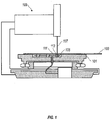
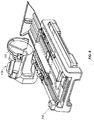
- a cutting machine 109 having a liquid lubrication delivery system including a work-piece platform 101, a main channel 105 recessed in an upper surface of the work-piece platform 101 and which receives a perimeter of a cutting blade 107 of the cutting machine 109.
- the liquid lubrication delivery system includes a liquid delivery portion and a liquid leveler portion.
- the liquid delivery portion (not labeled) has liquid lubrication inlets 111 having discharge openings 112 into the main channel 105 are also depicted.
- the platform 101 is shown having an upper surface for supporting a work-piece 103 thereupon.
- Such a work-piece 103 can be of a sheet-type such as the case with ceramic tile, clay tile, stone, marble, or other similar sheet-type material.
- the work-piece 103 can also be of non-sheet-type material such as bricks, pavers, or the like.
- the main channel 105 establishes an elongate recessed space into the upper surface of the platform 101.
- the main channel 105 is defined by a bottom 102 opposite to the upper surface of the platform 101, a first side 104, and a second side 106.
- the first and second sides, 104, 106 are perpendicular to the bottom 102 and upper surface of the platform 101.
- the main channel 105 is open and forms an open slot that is deep enough to receive a perimeter of the cutting blade 107 of the cutting machine 109 during cutting operations.
- the main channel 105 includes a brim 108.
- the brim 108 can be level with the upper surface of the platform, recessed slightly from the upper surface of the platform, slightly raised in relation to the platform, or some combination thereof. These configurations will be herein referred to as being proximate to the upper surface of the platform 101.
- at least one liquid lubrication inlet 111 has a discharge opening 112 that opens into the main channel 105.
- the liquid lubrication inlet 111 is configured to promote flow of discharged lubricant in the main channel 105 predominantly in one lengthwise direction of the main channel 105.
- the liquid lubrication inlet 111 and the discharge opening 112 are configured to generally discharge lubricant in a direction away from the first end or upstream end of the channel 105.
- liquid lubrication inlet 111 can be used as seen in FIGS. 4 and 5 .
- the main channel 105 must be sufficiently wide and deep to accommodate the prescribed volume of liquid being delivered from the liquid lubrication inlet 111 but narrow and shallow enough to maintain a steady flow and velocity of delivered liquid within the main channel 105.
- the liquid lubrication inlets 111 are fluidly connected to at least one lubricant distribution manifold 113.
- the lubricant distribution manifold 113 fluidly connects the main channel 105 with a liquid source. Liquid from the liquid source, such as a basin, faucet, reservoir, or the like is transferred to the main channel 105 by the lubricant distribution manifold 113 via the liquid lubrication inlets 111.
- Each liquid lubrication inlet 111 has an inlet end 117 open to the lubricant distribution manifold 113 and a discharge opening 112 open to the main channel 105.
- lubricant distribution manifold 113 can be used to deliver liquid from the liquid source to the main channel 105.
- two lubricant distribution manifolds 113 are shown fluidly connected to the main channel 105, one on each side of the main channel 105, by liquid lubrication inlets 111.
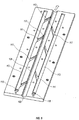
- FIGS. 5 and 9 provide more detailed views of exemplary lubricant distribution manifolds 113.
- a manifold 113 is positioned on each side of and parallel to the main channels 105.
- At one end of the manifold 113 is an entry point 116 through which liquid from a liquid source enters.
- Multiple liquid lubrication inlets 111 fluidly connect each manifold 113 to a main channel 105.
- the inlets 111 can be of uniform longitudinal shapes but can also be tapered as shown in FIG. 5 .
- the inlet can be tapered from the inlet end 117 to the discharge opening 112.
- the inlets 111 are oriented such that the longitudinal axis of each inlet 111 is oriented at an angle to the longitudinal axis of the main channel 105. As liquid continuously enters the manifold 113, the liquid is forced through the inlets 111 into the main channel 105. The velocity and direction of flow in the main channel 105 is determined at least in part by the shape, size, width, and orientation of the inlets 111.
- inlets 111 are serially spaced apart lengthwise along the main channel 105. Referring to FIG. 5 , the direction of liquid flow is shown by the arrow at the top of the figure.
- Liquid travels through the main channel 105 from the upstream end (closest to the bottom of the figure) to the downstream end (at the top of the figure). Threaded apertures and capped apertures are also shown to demonstrate how the liquid lubrication delivery system can be configured and attached to a cutting machine 109.
- a lubrication inlet 111 is positioned close to a first end of the respective main channel 105, the upstream end. Such positioning aids in thoroughly removing and flushing out any debris and dust that can build up in the main channel 105 during cutting operations.
- the manifold 113 can be attached to the work-piece platform 101 in different ways.
- the manifold 113 can be machined as a separate piece and bolted onto the work-piece platform 101. In this way, the work-piece platform 101 can be interchanged with a platform that does not include the above described liquid lubrication delivery system.
- the manifold 113 can be cast into the work-piece platform 101.
- FIGS. 4 , 6 , and 10 show a liquid lubrication delivery system having more than one main channel 105 recessed at the upper surface of the work-piece platform 101.
- the additional main channels 105 can be used for different types of cuts, such as miter cuts, bevel cuts, plunge cuts, or others.
- Each of these main channels 105 include lubrication inlets 111 connected to manifolds 113.
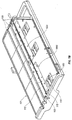
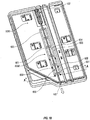
- FIGS. 6 , 7 , and 10 the liquid delivery portion 100 and the liquid leveler portion 600 are illustrated.
- the main channel 105 includes first end 1000 and a second end 6000.
- FIGS. 4 , 6 , and 10 show a liquid lubrication delivery system having more than one main channel 105 recessed at the upper surface of the work-piece platform 101.
- the additional main channels 105 can be used for different types of cuts, such as miter cuts, bevel cuts, plunge cuts, or others.
- Each of these main channels 105 include lubrication inlets 111 connected to manifolds 113
- the first end is an upstream end 1000
- the second end is a downstream end 6000.
- the upstream end 1000 is where the liquid lubrication is delivered to the main channel.
- the downstream end 6000 is where the blade of a cutting machine will enter the main channel 105.
- the arrow at the upper right side of the FIG. 6 illustrates the direction of liquid flow within the main channel 105. As illustrated, the movement of the blade of the cutting machine will travel through the main channel 105 in a direction opposite to the direction of liquid flow within the main channel 105.
- the arrow at the bottom of FIG. 10 illustrates the direction of liquid flow within the main channel 105 travels from the top of FIG. 10 towards the bottom of FIG. 10 .
- the upstream end 1000 of the main channel 105, where the liquid delivery portion 100 is located is towards the top of FIG. 10
- the downstream end 6000 of the main channel 105, where the liquid leveler portion 600 is located is towards the bottom of FIG. 10 .
- the flow of the liquid lubrication can be in the opposite direction in relation to the path of blade travel.
- the liquid leveler portion 600 of the liquid lubrication delivery system includes at least one outlet 601 formed in one of the sides of the channel 105.
- the at least one outlet 601 is recessed into the upper surface of the platform 101. Details of the liquid leveler portion 600 will be described with respect to FIGS. 11 and 12 , however a brief description of the liquid leveler portion 600 will be provided.
- the liquid leveler as described herein has at least one outlet.
- the liquid leveler portion 600 comprises a plurality of outlets 601. Specifically, there are twelve outlets 601 fluidly connected to the main channel 105. Additionally, the particular embodiment illustrated in FIGS.
- each outlet 601 includes an outlet 601 on each side of the main channel 105.
- Each outlet 601 has two sides, a bottom, and an open top side. Additionally, each outlet 601 has a mouth formed within one side of the main channel 105 and open to the main channel 105.
- Each outlet 601 also has an outlet end open to an outlet channel 605.
- each outlet channel 605 there are two outlet channels 605.
- the two outlet channels 605 are located on each side of the main channel 105 and parallel to the main channel 105. While the illustrated embodiment shows each outlet channel 605 oriented parallel to the main channel 105, one of ordinary skill in the art will appreciate that the outlet channel 605 can be oriented perpendicular to the main channel 105.
- Each outlet channel 605 can include at least one orifice 609 within the bottom surface of the outlet channel and proximate to the downstream end of the main channel 105 and to the downstream end of the outlet channel 605. In the particular embodiment illustrated, each outlet channel 605 has three orifices 609 within the bottom surface of the outlet channel 605.
- the orifice 609 is located proximate to the downstream 6000 end of the main channel 105 closest to the exit of liquid flow out of the main channel 105 and the entry point of the blade of a cutting machine.
- the orifice 609 provides an exit aperture for the excess discharged liquid that is moved from the main channel 105 into the outlet channel 605.
- the at least one outlet 601 can terminate at a drain that is located adjacent to one of the first side or the second side of the channel 105 and at a predetermined distance from the first side or the second side.
- liquid leveler portion 600 of the liquid lubrication delivery system can have fewer or more than two outlet channels 605, each having fewer or more than the three orifices 609 illustrated in FIGS. 6 , 7 , and 10 .
- the plurality of outlets 601 are serially spaced apart lengthwise along the main channel 105.
- the each of the plurality of outlets 601 is also oriented at an angle to the longitudinal or lengthwise axis of the main channel 105.
- the outlets 601 are angled towards the lengthwise direction of flow of discharged lubricant in the main channel 105.
- the outlets 601 to the left of the main channel 105 are oriented at an acute angle that is clockwise from the longitudinal axis of the main channel 105.
- outlets 601 to the left of the main channel 105 are oriented at an angle beginning from the longitudinal axis of the main channel 105 and moving away from the main channel 105 in a clockwise direction.
- the outlets 601 to the right of the main channel 105 are oriented at an acute angle that is counter-clockwise from the longitudinal axis of the main channel 105.
- the outlets 601 to the right of the main channel 105 are oriented at an angle beginning from the longitudinal axis of the main channel 105 and moving away from the main channel 105 in a counter-clockwise direction.
- the outlets 601 are oriented at an angle that promotes flow of the excess discharged lubricant in the same lengthwise direction as the flow of lubricant within the main channel 105.
- the outlets 605 need not be oriented at an acute angle to the longitudinal axis of the main channel 105.
- the outlets 605 can be oriented at ninety degrees to the longitudinal axis of the main channel 105 or the outlets 605.
- the outlets 605 can be oriented at an angle that promotes flow of excess discharged lubricant in a direction opposite to the direction of flow within the main channel 105.
- the work-piece platform 101 includes a backstop 118 (on which an edge of a work-piece 103 rests. This provides guidance and resistance to the operator as he moves the work-piece 103 against the cutting blade 107 to cut the work-piece 103. While the illustrated embodiment shows a backstop 118, one of ordinary skill in the art will appreciate that the work-piece platform 101 does not necessarily include a backstop 118.
- the manifold can be covered by a manifold cover 115 to further prevent overspray and promote uniform and steady flow of liquid to and through the main channel 105 of the liquid lubrication delivery system. While the illustrated embodiment includes a manifold cover 115, one of ordinary skill in the art will appreciate that the liquid lubrication delivery system does not necessarily include a manifold cover 115.
- the liquid leveler portion 600 can be covered by a liquid leveler cover 620. While the illustrated example in FIG. 7B shows a single piece liquid leveler cover 620, one of ordinary skill in the art will appreciate that the liquid leveler cover 620 can include a plurality of pieces.
- the liquid leveler 620 can include a plurality of cover pieces that fit over each outlet 601. Additionally, the liquid leveler cover 620 can include a cover piece that fits over the outlet channel 605.
- the manifold cover 115 or the liquid leveler cover 620 can be made of polyurethane, plastic, a sheet of metal, or any other material that can be coupled to the work-piece platform 101.
- the manifold cover 115 and the liquid leveler cover 620 can be coupled to the work-piece platform 101 by any means that secures the manifold cover 115 and the liquid leveler cover 620 to the platform 101.
- the manifold cover 115 or liquid leveler cover 620 can be glued to the upper surface of the platform 101.
- the manifold cover 115 or liquid leveler cover 620 can be coupled to the platform 101 by fasteners, nuts and bolts, or screws.
- the manifold cover 115 or the liquid leveler cover 620 can be shaped to fit, snap, or slip into a corresponding shape or opening in the upper surface of the work-piece platform 101.
- FIG. 8 depicts another embodiment of a cutting machine 109 having a liquid lubrication delivery system.
- the system additionally includes an upper liquid lubrication distribution system 110 positioned above the work-piece platform 101 such that it discharges lubricating liquid directly onto the cutting blade 107 at a location above the work-piece platform 101.
- This embodiment can also include a valve 114 fluidly connected between the liquid lubrication inlet 111 and the upper liquid lubrication distribution system 110.
- Such valve 114 can be used to allow the operator to dispense liquid lubrication to the main channel 105 or the upper liquid lubrication distribution system 110 or to both the upper liquid distribution system 110 and the main channel 105.
- FIG. 9 is an illustration of an alternative embodiment of the liquid delivery portion 100 of a liquid lubrication delivery system having more than one main channel 105.
- the liquid delivery portion includes a plurality of manifolds 113 that are each attached to at least one of the main channels 105.
- FIG. 9 depicts how the previously described manifolds 113 can be configured and attached to a liquid lubrication delivery system having multiple main channels 105.
- two main channels 105 are each connected to two lubricant distribution manifolds 113, but the main channels 105 share a distribution manifold 113.
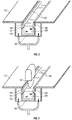
- FIG. 11 illustrates a partial view of the work-piece platform 101 illustrated in FIG. 10 showing a cross-section taken at line A-A of the downstream end 6000 of the platform 101.
- FIG. 12 is a close-up view of FIG. 11 .
- the at least one outlet 601 is recessed into the upper surface of the platform 101.
- the outlet 601 has two sides, a bottom, an open top side, and a mouth 602 formed within one of the first side 104 and second side 104 of the main channel 105 at the brim 108.
- the outlet is configured to remove excess discharged lubricant from the main channel 105.
- the mouth 602 is open to the main channel 105 such that any lubricant discharged into the main channel 105 that that exceeds a predetermined level enters the mouth 602 and flows through the outlet 601 and out of the main channel 105, thereby maintaining a suitable level of liquid lubricant.
- the outlet 601 can also include an outlet end 603 opposite to the mouth 602 and spaced a predetermined distance away from the brim 608 of the main channel 105, whereby the outlet 601 promotes the flow of excess liquid lubrication from the mouth 602 to the outlet end 603.
- the outlet 601 is downwardly inclined from the brim 108 of the main channel 105 to the outlet end 603.
- the bottom surface of the outlet 601 has a negative slope thereby promoting flow of excess discharged lubricant from the main channel 105 downward and away from the main channel 105.
- the outlet 601 is downwardly inclined and has the outlet end 603 open to an outlet channel 605 that is oriented parallel to the main channel 105.
- the portion 604 of the upper surface where the outlets 601 are recessed is also downwardly inclined to correspond with the downward incline of the outlet 601.
- the outlet channel includes an orifice 609 through the bottom surface.
- the orifice 609 can be fluidly connected to the liquid lubrication source, thereby allowing the excess discharged lubricant that flows from the main channel 105 into the outlet channel 605 to flow back into the liquid lubrication source and be recycled in the liquid lubrication delivery system.
- the orifice 609 can be open to the ground or to the surrounding environment and the excess discharged lubricant that flows from the main channel into the outlet channel 605 will fall to the ground or be expelled into the surrounding environment.
- the orifice 609 can be open to and in fluid communication with a drain pan (not shown) located beneath the work-piece platform 101.
- FIG. 12 illustrates the relationship of the depth of the main channel 105 and the liquid leveler portion 600 of the liquid lubrication delivery system.
- the main channel 105 has a first depth 611 measured from the bottom 102 to the brim 108 of the main channel 105.
- Recessed within the sides 104, 106 of the main channel 105 proximate to the brim 108 is the mouth 602 of the outlet 601.
- the mouth 602 of each of the outlets 601 has a relatively shallow depth which allows a predetermined level of liquid lubricant to remain in the main channel 105.
- the outlet channel 605 located on each side of and parallel to the main channel 105 each has a second depth 613. As illustrated in FIG. 12 , the second depth 613 is less than the first depth 611. However, one of ordinary skill in the art will appreciate that in another embodiment, the second depth 613 can be equal to the first depth 611.
- FIG. 13 illustrates an alternative embodiment of the liquid leveler portion 600 of the liquid lubrication delivery system that does not include an outlet channel.
- the liquid leveler portion 600 is located at a downstream end 6000 of the main channel 105 of the work-piece platform 601.
- the direction of liquid flow in the main channel 105 is represented by the arrow at the bottom of FIG. 13 and indicates liquid flows in the main channel 105 from the top to the bottom of FIG. 13 .
- the liquid leveler portion 600 illustrated includes an outlet 601 and an orifice 609. The outlet 601 is recessed within the upper surface of the work-piece platform 101 at a downstream end of the main channel 105.
- the outlet 601 has a mouth 602 within the one of the sides 104, 106 of the main channel 105 proximate to the brim 108 of the main channel 105.
- An orifice 609 is located within the outlet 601 opposite to the mouth 602.
- the outlet 601 is configured to promote flow of excess discharged lubricant from the main channel 105 away from the main channel 105 in a direction perpendicular to the main channel 105.
- the excess discharged lubricant in the main channel that exceeds the mouth 602 of the outlet will enter the outlet 601 via the mouth 602.
- the level of discharged lubricant in the main channel 605 can be maintained at a suitable level. As described in the previous embodiment illustrated in FIGS.
- the orifice 609 can be in fluid communication with the liquid lubrication source, thereby allows the excess discharged lubricant from the main channel 105 to be recycled back into the liquid lubrication delivery system.
- the orifice 609 can be open to the ground to expel the excess discharged lubricant into the surrounding environment. While the illustrated embodiment in FIG. 13 shows the liquid leveler portion 600 having six outlets 601 with each outlet 601 having an orifice 609, one of ordinary skill in the art will appreciate that the liquid leveler portion 600 can have as few as one outlet 605 or more than six outlets 605. Additionally, one of ordinary skill in the art will appreciate that each outlet 605 does not require an orifice 609, so long as the liquid lever portion 600 has at least one orifice 609.
- FIGS. 1-13 contemplate a cutting machine having a liquid lubrication delivery system having a work-piece platform 101 that can be moveable or stationary with respect to the cutting machine.
- the work-piece platform 101 can be stationary or fixed and the cutting machine 109 moves relative thereto as an operator guides the cutting machine 109 to travel across the work-piece platform 101.
- the work-piece platform 101 can be moveable with respect to the cutting machine 109 such that the cutting machine 109 remains stationary and the operator moves the work-piece platform 101 relative the cutting machine 109.
- the work-piece platform 101 and the cutting tool can be fixed in relation to each other such that the operator rests the work-piece 103 on top of the work-piece platform 101 and feeds the work-piece 103 towards the cutting blade 107 of the cutting machine 109.
- the cutting machine 109 can be a tile saw, a miter saw, a masonry saw, a circular saw, or the like.
- the cutting machine 109 can also be a grinding machine.
- Additional attachments can also be used in conjunction with the above described cutting machine 109 having a liquid lubrication delivery system to further control and prevent overspray.
- Such attachments can include but are not limited to a blade guard surrounding the cutting blade, splash curtains, water pans, or splash guards.
- liquid lubrication is dispensed under pressure from a liquid lubrication source to the entry point 116 of the manifold 113 of the liquid delivery portion 100 of the cutting machine 109 having a prescribed liquid lubrication delivery system.
- the liquid lubrication source can be integrated into the cutting machine 109 or can be separate.
- the liquid delivery portion 100 is located at the upstream end 1000 of the main channel 105, which is opposite to the end of the main channel 105 where the cutting blade will enter.
- the manifold 113 of the liquid delivery portion 100 is of an optimal width such that the liquid lubrication can be pushed through the inlets 111 into the main channel 105 at a sufficient velocity.
- the size, tapering, and orientation of the inlets 111 along the main channel 105 foster sufficient flow speed therein to provide an adequate sweeping flow of liquid lubrication through the main channel 105.
- the lubrication inlets 111 are tapered, positioned at an angle to the longitudinal axis of the main channel 105, and serially spaced lengthwise along the main channel 105, the pressurized liquid lubrication passes through an inlet 111 and contacts the opposing wall of the main channel 105, thereby dispersing the liquid lubrication to fill the main channel 105.
- the liquid lubrication is pressurized and constantly flowing through the inlets 111, the liquid lubrication flows through the main channel 105 and out an open end at the downstream end of the main channel 105. Also, because of this arrangement, the liquid lubrication only flows in one lengthwise direction down the main channel 105.
- the main channel 105 is dimensioned to contain the liquid lubrication within the main channel 105 and to maintain a substantially constant depth and velocity of liquid lubrication flowing through the main channel 105.
- the liquid lubrication system includes a liquid leveler portion 600 located at the downstream end 6000 of the main channel 105 that assists in maintaining a substantially constant depth and velocity of liquid lubrication flowing through the main channel 105.
- the mouth 602 of the outlets 601 of the liquid leveler portion 600 is placed within a side 104, 106 of the main channel 105 proximate to the brim 108 of the main channel and above a predetermined height that is representative of the liquid lubrication level height that is to be maintained in the main channel 105.
- the outlets 605 of the liquid leveler 600 are of an optimal width and downwardly inclined such that the liquid lubrication will flow from the mouth 602 of the outlet 605 and into an orifice 609 fluidly connected to the outlet 605, when the level of liquid lubrication in the main channel 108 exceeds the predetermined height.
- the downward incline provides a plenum for the liquid lubrication in the outlet 601, thereby drawing excess liquid lubrication in the main channel 105 that exceeds the predetermined liquid lubrication level away and out from the main channel and down towards the outlet channel 605.
- the excess liquid lubrication accumulates in the outlet channel 605
- the excess liquid lubrication is pushed down the outlet channel 605 towards the orifices 609 at the end of the outlet channel 605.
- the orifices 609 are open and in fluid communication with the liquid lubrication source. The openness of the orifices 609 creates a pressure difference between the atmospheric pressure above the outlet channel 105 and the atmospheric pressure beneath the orifice.
- the liquid lubrication within the outlet channel 105 is drawn to and through the orifice 609, thereby constantly draining the outlet channel 105.
- the orifices are in fluid communication with the liquid lubrication source, the excess liquid lubrication from the main channel 105 is recycled back into the liquid lubrication system, thereby assuring enough liquid lubrication to fill the main channel 105 and enough liquid lubrication to pump through liquid lubrication system to maintain a constant velocity of liquid lubrication flow through the main channel 105.
- the fluid communication between the liquid leveler portion 105 and the liquid lubrication source reduces the amount of wasted liquid lubrication.
- the operator When the operator is ready to cut a piece of tile 103, he places the tile 103 on top of the work-piece platform 101 such that a back edge of the piece of tile 103 abuts the backstop 118 of the work-piece platform 101. The operator then guides the work-piece platform 101 and tile 103 towards the cutting blade 107. As the platform 101 moves closer to the blade 107, the liquid lubrication flowing at the downstream end of the main channel 105 comes into contact with the blade 107 to begin cooling the blade. Then, as the tile 103 approaches the blade 107, the tile 103 is cut, and the liquid lubrication in the main channel 105, which is now below the tile 103, flows across the blade 107 and continues to cool the blade 107 as the tile 103 is cut.
- liquid lubrication is below the tile 103 and the lubrication inlets 111 are positioned to direct a constant flow of liquid lubrication down the main channel 105, liquid lubrication that would normally have been directed upwards and onto the tile 103 by the centrifugal force of the spinning blade 107 is diminished. Also, because the flow of liquid lubrication is in generally in one direction down the main channel away from the operator, any liquid lubrication or overspray that would typically have been sprayed onto the operator and his work area is diminished. Dust or debris that results from cutting tile 103 is also reduced because the constant flow of liquid lubrication in the main channel 105 takes on and pushes such dust and debris downstream of the main channel 105 and out the open end of the main channel 105.
- liquid lubricant or coolant is contained in the main channel 105 and maintained at a constant height and velocity, thereby efficiently cooling and lubricating the cutting blade 107, while minimizing overspray, debris build-up, and wasted liquid.
Landscapes
- Engineering & Computer Science (AREA)
- Mechanical Engineering (AREA)
- Mining & Mineral Resources (AREA)
- Life Sciences & Earth Sciences (AREA)
- Forests & Forestry (AREA)
- Sawing (AREA)
- Auxiliary Devices For Machine Tools (AREA)
Claims (24)
- Werkstückträger (101), umfassend:eine obere Fläche, um ein zu schneidendes Werkstück (103) zu halten,einen Hauptkanal (105), der eine Ausnehmung in der oberen Fläche definiert, wobei der Hauptkanal (105) einen Boden (102) gegenüber der oberen Fläche, eine erste laterale Seite (104) und eine der ersten lateralen Seite gegenüberliegende zweite laterale Seite (106) umfasst, wobei der Hauptkanal dazu ausgelegt ist, einen Umfang eines Schneidmessers (107) aufzunehmen, dadurch gekennzeichnet, dass der Werkstückträger (101) ferner Folgendes umfasst:ein unter Druck stehendes Flüssigschmiermittel,einen unter Druck stehenden Schmiermittelverteilerkanal (113), in dem das unter Druck stehende Flüssigschmiermittel untergebracht ist,wenigstens einen Flüssigschmiermitteleinlass (111), der eine Abführöffnung (112) aufweist, die dazu ausgelegt ist, ein Schmiermittel durch den wenigstens einen Flüssigschmiermitteleinlass (111) abzuführen, wobei der wenigstens eine Flüssigschmiermitteleinlass (111) in der ersten lateralen Seite (104) und/oder der zweiten lateralen Seite (106) des Hauptkanals (105) in dem Hauptkanal (105) angeordnet ist, wobei die Abführöffnung (112) an einem ersten Ende des Hauptkanals (105) festgelegt und dazu ausgelegt ist, Schmiermittel in einer von dem ersten Ende des Hauptkanals (105) wegführenden Richtung abzuführen, wobei der wenigstens eine Flüssigschmiermitteleinlass (111) in einem Winkel relativ zu einer längs verlaufenden Erstreckungsrichtung des Hauptkanals (105) angeordnet ist, um Schmiermittel in einer zu einem stromabwärts gelegenen Ende des Hauptkanals (105) führenden Richtung zu leiten, undwenigstens einen Auslass, der an dem stromabwärts gelegenen Ende des Hauptkanals (105) ausgebildet ist,wobei der Hauptkanal (105) dazu ausgelegt ist, ein Flüssigkeitsvolumen, das über den wenigstens einen Flüssigschmiermitteleinlass (111) aus dem unter Druck stehenden Schmiermittelverteilerkanal (113) aufgenommen wird, zu fassen, undwobei die Flüssigkeit, während sie sich in dem unter Druck stehenden Schmiermittelverteilerkanal (113) befindet, über einen von einer Flüssigschmiermittelquelle gelieferten Druck unter Druck gesetzt wird.
- Werkstückträger nach Anspruch 1, wobei der wenigstens eine Flüssigschmiermitteleinlass (111) eine Vielzahl von Flüssigschmiermitteleinlässen umfasst.
- Werkstückträger nach Anspruch 2, wobei der wenigstens eine Flüssigschmiermitteleinlass (111) eine Vielzahl von Flüssigschmiermitteleinlässen umfasst, die entlang einer Länge des Hauptkanals (105) hintereinander beabstandet sind.
- Werkstückträger nach einem der vorhergehenden Ansprüche, wobei der unter Druck stehende Schmiermittelverteilerkanal (113) auf wenigstens einer Seite des Hauptkanals festgelegt ist.
- Werkstückträger nach einem der vorhergehenden Ansprüche, wobei sich der unter Druck stehende Schmiermittelverteilerkanal (113) im Wesentlichen über eine Länge des Hauptkanals (105) erstreckt.
- Werkstückträger nach einem der vorhergehenden Ansprüche, wobei der wenigstens eine Flüssigschmiermitteleinlass (111) eine Vielzahl von Flüssigschmiermitteleinlässen umfasst, die wenigstens einen Flüssigschmiermitteleinlass auf der ersten lateralen Seite des Hauptkanals (105) und wenigstens einen Flüssigschmiermitteleinlass auf der zweiten lateralen Seite des Hauptkanals aufweisen, wobei sich wenigstens eine Abführöffnung (112) der Flüssigschmiermitteleinlässe in den Hauptkanal (105) öffnet und wobei die Vielzahl von Flüssigschmiermitteleinlässen den Hauptkanal fluidisch mit dem Schmiermittelverteilerkanal (113) verbindet.
- Werkstückträger nach einem der vorhergehenden Ansprüche, wobei sich der Schmiermittelverteilerkanal (113) relativ zu dem Hauptkanal (105) neben oder parallel zu diesem befindet, z.B. auf einer oder beiden Seiten des Hauptkanals.
- Werkstückträger nach einem der vorhergehenden Ansprüche, wobei der wenigstens eine Auslass (601) eine Mündung (602) in einer ersten lateralen Seite (104) oder einer zweiten lateralen Seite (106) des Hauptkanals umfasst.
- Werkstückträger nach einem der vorhergehenden Ansprüche, wobei der wenigstens eine Auslass (601) an einem Abfluss endet, der angrenzend an die erste laterale Seite (104) oder die zweite laterale Seite (106) des Hauptkanals (105) und in einem vorgegebenen Abstand von der ersten lateralen Seite oder der zweiten lateralen Seite festgelegt ist.
- Werkstückträger nach einem der vorhergehenden Ansprüche, wobei der wenigstens eine Auslass (601) zwischen einem ersten Ende des Hauptkanals und einem zweiten Ende des Hauptkanals liegt.
- Werkstückträger nach einem der vorhergehenden Ansprüche, wobei der Hauptkanal (105) eine erste Tiefe (611) aufweist und der wenigstens eine Auslass (601) eine zweite Tiefe (613) aufweist und die zweite Tiefe geringer als die erste Tiefe ist.
- Werkstückträger nach einem der vorhergehenden Ansprüche, wobei sich der wenigstens eine Auslass (601) von einem Rand (108) des Hauptkanals (105) weg von der oberen Fläche nach unten erstreckt.
- Werkstückträger nach einem der vorhergehenden Ansprüche, wobei der wenigstens eine Auslass (601) eine Vielzahl von Auslässen umfasst, die eine jeweilige Mündung (602) aufweisen, wobei die jeweiligen Mündungen in Längsrichtung entlang dem Hauptkanal (105) hintereinander beabstandet sind.
- Werkstückträger nach einem der vorhergehenden Ansprüche, wobei der wenigstens eine Auslass (601) in einem Winkel zu einer Längsachse des Hauptkanals (105) ausgerichtet ist.
- Werkstückträger nach Anspruch 14, wobei der Auslass (601) zu der Längsrichtung des Stroms von abgeführtem Schmiermittel in dem Hauptkanal hin abgewinkelt ist.
- Werkstückträger nach Anspruch 15, wobei der Winkel neunzig Grad zu der Längsachse beträgt.
- Werkstückträger nach Anspruch 15, wobei der Winkel im Uhrzeigersinn von der Längsachse spitz ist, wodurch überschüssiges abgeführtes Schmiermittel in der gleichen Längsrichtung wie der Strom des Schmiermittels in dem Hauptkanal (105) strömt.
- Werkstückträger nach einem der vorhergehenden Ansprüche, ferner umfassend eine mit dem Auslass (601) in fluidischer Verbindung stehende Drosselblende (609).
- Werkstückträger nach einem der vorhergehenden Ansprüche, wobei der wenigstens eine Auslass (601) ferner wenigstens einen Auslasskanal (605) umfasst, der vorzugsweise im Wesentlichen parallel zu dem Hauptkanal (105) ausgerichtet ist.
- Werkstückträger nach einem der vorhergehenden Ansprüche, wobei der wenigstens eine Flüssigschmiermitteleinlass (111) von einem Einlassende zu der Abführöffnung konisch zuläuft.
- Werkstückträger (101) nach Anspruch 1, wobei die Ausnehmung längserstreckt ist und sich entlang einer gesamten Länge des Hauptkanals (105) erstreckt, um zu verhindern, dass Flüssigkeit in dem Hauptkanal (105) durch den Boden (102) strömt.
- Schneidmaschine (109), die ein Flüssigschmiermittelsystem aufweist und einen Werkstückträger (101) nach einem der Ansprüche 1 bis 21 umfasst.
- Verfahren zum Zuführen von Schneidflüssigkeit zu einer Schneidmaschine (109), wobei das Verfahren Folgendes umfasst:Bereitstellen eines Werkstückträgers (101), um ein Werkstück (103) zu halten, wobei der Werkstückträger (101) einen Hauptkanal (105) umfasst, der eine Ausnehmung in einer oberen Fläche des Werkstückträgers (101) definiert, die einen Boden (102) gegenüber der oberen Fläche, eine erste laterale Seite (104) und eine der ersten lateralen Seite (104) gegenüberliegende zweite laterale Seite (106) umfasst, wobei der Hauptkanal (105) dazu ausgelegt ist, einen Umfang eines Schneidmessers (107) aufzunehmen, und einen unter Druck stehenden Schmiermittelverteilerkanal (113),gekennzeichnet durchdas Abführen von Flüssigschmiermittel durch wenigstens einen Flüssigschmiermitteleinlass (111), der eine Abführöffnung (112) in dem Hauptkanal (105) aufweist, wobei der wenigstens eine Flüssigschmiermitteleinlass (111) in der ersten Seite (104) und/oder der zweiten Seite (106) des Hauptkanals (105) angeordnet ist, wobei der wenigstens eine Flüssigschmiermitteleinlass (111) in einem Winkel relativ zu einer längs verlaufenden Erstreckungsrichtung des Hauptkanals (105) angeordnet ist, um Schmiermittel in einer zu einem stromabwärts gelegenen Ende des Hauptkanals (105) führenden Richtung zu leiten, undAufrechterhalten eines Stands des Flüssigschmiermittels in dem Hauptkanal (105) über wenigstens einen Auslass (601), der an dem stromabwärts gelegenen Ende des Hauptkanals (105) ausgebildet ist,wobei der Hauptkanal (105) dazu ausgelegt ist, ein Flüssigkeitsvolumen, das über den wenigstens einen Flüssigschmiermitteleinlass (111) aus dem unter Druck stehenden Flüssigschmiermittelverteilerkanal (113) aufgenommen wird, zu fassen, undwobei die Flüssigkeit, während sie sich in dem unter Druck stehenden Flüssigschmiermittelverteilerkanal (113) befindet, über einen von einer Flüssigschmiermittelquelle gelieferten Druck unter Druck gesetzt wird.
- Verfahren nach Anspruch 23, wobei die Schneidmaschine (109) eine Schneidmaschine nach Anspruch 22 ist.
Applications Claiming Priority (2)
| Application Number | Priority Date | Filing Date | Title |
|---|---|---|---|
| PCT/US2009/037352 WO2010107425A1 (en) | 2009-03-17 | 2009-03-17 | Cutting machine with a liquid lubrication delivery system |
| PCT/US2010/027691 WO2010107937A1 (en) | 2009-03-17 | 2010-03-17 | Cutting machine with a liquid lubrication delivery system having a controlled liquid level |
Publications (2)
| Publication Number | Publication Date |
|---|---|
| EP2408602A1 EP2408602A1 (de) | 2012-01-25 |
| EP2408602B1 true EP2408602B1 (de) | 2019-11-27 |
Family
ID=41334460
Family Applications (1)
| Application Number | Title | Priority Date | Filing Date |
|---|---|---|---|
| EP10709675.2A Active EP2408602B1 (de) | 2009-03-17 | 2010-03-17 | Schneidmaschine mit einem flüssigkeitsschmierungszufuhrsystem mit einem gesteuerten flüssigkeitspegel |
Country Status (3)
| Country | Link |
|---|---|
| EP (1) | EP2408602B1 (de) |
| CA (1) | CA2755807C (de) |
| WO (2) | WO2010107425A1 (de) |
Families Citing this family (6)
| Publication number | Priority date | Publication date | Assignee | Title |
|---|---|---|---|---|
| JP6722917B2 (ja) * | 2016-04-26 | 2020-07-15 | 三星ダイヤモンド工業株式会社 | スクライブヘッドユニット |
| US10252444B2 (en) | 2017-04-14 | 2019-04-09 | Tti (Macao Commercial Offshore) Limited | Tile saw |
| US11433464B2 (en) | 2018-08-28 | 2022-09-06 | Techtronic Power Tools Technology Limited | Tile saw |
| CN109434690B (zh) * | 2018-12-28 | 2020-09-04 | 苏州极普智能科技有限公司 | 一种基于制模专用的模具工作台 |
| CN110341059B (zh) * | 2019-07-18 | 2021-02-26 | 湖北佳旺建设有限公司 | 一种建筑工程用瓷砖切断装置 |
| CN112643346B (zh) * | 2020-11-23 | 2022-03-18 | 山东利信新材料有限公司 | 一种金属加工用铝锭切边打磨设备 |
Family Cites Families (15)
| Publication number | Priority date | Publication date | Assignee | Title |
|---|---|---|---|---|
| US2201658A (en) * | 1939-07-28 | 1940-05-21 | Porter Mcleod Machine Tool Co | Cutoff machine |
| US2507437A (en) * | 1948-12-15 | 1950-05-09 | Gorton George Machine Co | Coolant return system |
| US3069950A (en) * | 1958-01-23 | 1962-12-25 | Ty Sa Man Machine Company | High speed friction saw having liquid cooling means |
| US3170352A (en) * | 1958-01-23 | 1965-02-23 | Tysaman Machine Company Inc | Guard for machine tools |
| SU686885A1 (ru) * | 1975-01-06 | 1979-09-28 | Petrov Vasilij P | Устройство дл резки |
| SU912522A1 (ru) * | 1980-07-04 | 1982-03-15 | Всесоюзный Научно-Исследовательский Институт Теплоизоляционных И Акустических Строительных Материалов И Изделий | Установка дл резки |
| US5127391A (en) * | 1989-02-01 | 1992-07-07 | Keefe Kevin M O | Tile and marble cutting saw apparatus and method |
| US6272961B1 (en) * | 2000-02-07 | 2001-08-14 | Wy Peron Lee | Cutting machine with built-in miter cutting feature |
| US6672188B2 (en) * | 2001-01-30 | 2004-01-06 | Wy Peron Lee | Frame structure for power saw machine |
| US6508244B2 (en) * | 2001-05-01 | 2003-01-21 | Wy Peron Lee | Tile cutting guide arrangement for power saw machine |
| US6752139B2 (en) * | 2002-08-13 | 2004-06-22 | Wy Peron Lee | Worktable for cutting machine |
| US7021305B2 (en) * | 2002-08-26 | 2006-04-04 | Wy Peron Lee | Cutting guide arrangement for power saw machine |
| US8286539B2 (en) * | 2002-11-01 | 2012-10-16 | Black & Decker Inc. | Tile saw |
| JP4860177B2 (ja) * | 2005-05-09 | 2012-01-25 | エステック株式会社 | ガラス板等ワークの切断方法及び装置 |
| TWM316117U (en) * | 2007-01-19 | 2007-08-01 | Yue-Ting Chen | Device to adjust the cutting angle of cutting machine |
-
2009
- 2009-03-17 WO PCT/US2009/037352 patent/WO2010107425A1/en not_active Ceased
-
2010
- 2010-03-17 WO PCT/US2010/027691 patent/WO2010107937A1/en not_active Ceased
- 2010-03-17 CA CA2755807A patent/CA2755807C/en active Active
- 2010-03-17 EP EP10709675.2A patent/EP2408602B1/de active Active
Non-Patent Citations (1)
| Title |
|---|
| None * |
Also Published As
| Publication number | Publication date |
|---|---|
| CA2755807A1 (en) | 2010-09-23 |
| WO2010107425A1 (en) | 2010-09-23 |
| WO2010107937A1 (en) | 2010-09-23 |
| CA2755807C (en) | 2017-07-25 |
| EP2408602A1 (de) | 2012-01-25 |
Similar Documents
| Publication | Publication Date | Title |
|---|---|---|
| US11040464B2 (en) | Cutting machine with a liquid lubrication delivery system having a controlled liquid level | |
| EP2408602B1 (de) | Schneidmaschine mit einem flüssigkeitsschmierungszufuhrsystem mit einem gesteuerten flüssigkeitspegel | |
| US11554517B2 (en) | Tile saw | |
| JP4210307B2 (ja) | 切粉排出構造を有する工作機械 | |
| US7128505B2 (en) | Apparatus for preventing chips and/or cutting liquid from being scattered in machine tool | |
| US7114494B2 (en) | Fluid pickup assembly and blade guard for a pavement treatment apparatus | |
| CN103963170B (zh) | 台锯 | |
| US8869787B2 (en) | Hand-operated implement comprising a cutting chain for cutting mineral and metal materials | |
| AU779637B2 (en) | Waste containment system and method for an abrading or cutting device | |
| US20020017817A1 (en) | Concrete cutting machine | |
| KR101838980B1 (ko) | 저장탱크용 거품제거장치 | |
| US10702973B2 (en) | Coolant flow guide for grinder | |
| JP7068036B2 (ja) | 気液分離機構 | |
| CN212096659U (zh) | 一种高粘材料切割装置 | |
| JP3657865B2 (ja) | 帯鋸盤 | |
| EP1232832A2 (de) | System zur Entfernung von Spänen von den Oberflächen einer spanabhebenden Werkzeugmaschine | |
| JP2002126941A (ja) | ブローチ盤用流体噴出装置 | |
| CN115721969B (zh) | 油水分离装置和油水分离方法 | |
| JPH06170685A (ja) | 工作機械のベッド上面洗浄装置 | |
| JPH07155649A (ja) | スプレー装置 | |
| JPH0236668Y2 (de) | ||
| JPS6251723B2 (de) |
Legal Events
| Date | Code | Title | Description |
|---|---|---|---|
| PUAI | Public reference made under article 153(3) epc to a published international application that has entered the european phase |
Free format text: ORIGINAL CODE: 0009012 |
|
| 17P | Request for examination filed |
Effective date: 20111014 |
|
| AK | Designated contracting states |
Kind code of ref document: A1 Designated state(s): AT BE BG CH CY CZ DE DK EE ES FI FR GB GR HR HU IE IS IT LI LT LU LV MC MK MT NL NO PL PT RO SE SI SK SM TR |
|
| DAX | Request for extension of the european patent (deleted) | ||
| STAA | Information on the status of an ep patent application or granted ep patent |
Free format text: STATUS: EXAMINATION IS IN PROGRESS |
|
| 17Q | First examination report despatched |
Effective date: 20171004 |
|
| GRAP | Despatch of communication of intention to grant a patent |
Free format text: ORIGINAL CODE: EPIDOSNIGR1 |
|
| STAA | Information on the status of an ep patent application or granted ep patent |
Free format text: STATUS: GRANT OF PATENT IS INTENDED |
|
| RIC1 | Information provided on ipc code assigned before grant |
Ipc: B26D 7/08 20060101ALI20190214BHEP Ipc: B26D 1/153 20060101ALN20190214BHEP Ipc: B28D 1/04 20060101ALI20190214BHEP Ipc: B28D 7/04 20060101ALI20190214BHEP Ipc: B24B 55/02 20060101ALI20190214BHEP Ipc: B26D 1/143 20060101ALN20190214BHEP Ipc: B28D 7/02 20060101AFI20190214BHEP Ipc: B24B 27/06 20060101ALI20190214BHEP |
|
| RIC1 | Information provided on ipc code assigned before grant |
Ipc: B26D 1/153 20060101ALN20190215BHEP Ipc: B28D 1/04 20060101ALI20190215BHEP Ipc: B24B 27/06 20060101ALI20190215BHEP Ipc: B26D 1/143 20060101ALN20190215BHEP Ipc: B28D 7/02 20060101AFI20190215BHEP Ipc: B28D 7/04 20060101ALI20190215BHEP Ipc: B26D 7/08 20060101ALI20190215BHEP Ipc: B24B 55/02 20060101ALI20190215BHEP |
|
| INTG | Intention to grant announced |
Effective date: 20190305 |
|
| GRAJ | Information related to disapproval of communication of intention to grant by the applicant or resumption of examination proceedings by the epo deleted |
Free format text: ORIGINAL CODE: EPIDOSDIGR1 |
|
| STAA | Information on the status of an ep patent application or granted ep patent |
Free format text: STATUS: EXAMINATION IS IN PROGRESS |
|
| GRAS | Grant fee paid |
Free format text: ORIGINAL CODE: EPIDOSNIGR3 |
|
| STAA | Information on the status of an ep patent application or granted ep patent |
Free format text: STATUS: GRANT OF PATENT IS INTENDED |
|
| GRAP | Despatch of communication of intention to grant a patent |
Free format text: ORIGINAL CODE: EPIDOSNIGR1 |
|
| INTC | Intention to grant announced (deleted) | ||
| RIC1 | Information provided on ipc code assigned before grant |
Ipc: B28D 1/04 20060101ALI20190625BHEP Ipc: B26D 1/153 20060101ALN20190625BHEP Ipc: B26D 7/08 20060101ALI20190625BHEP Ipc: B24B 27/06 20060101ALI20190625BHEP Ipc: B26D 1/143 20060101ALN20190625BHEP Ipc: B24B 55/02 20060101ALI20190625BHEP Ipc: B28D 7/04 20060101ALI20190625BHEP Ipc: B28D 7/02 20060101AFI20190625BHEP |
|
| INTG | Intention to grant announced |
Effective date: 20190710 |
|
| GRAA | (expected) grant |
Free format text: ORIGINAL CODE: 0009210 |
|
| STAA | Information on the status of an ep patent application or granted ep patent |
Free format text: STATUS: THE PATENT HAS BEEN GRANTED |
|
| AK | Designated contracting states |
Kind code of ref document: B1 Designated state(s): AT BE BG CH CY CZ DE DK EE ES FI FR GB GR HR HU IE IS IT LI LT LU LV MC MK MT NL NO PL PT RO SE SI SK SM TR |
|
| REG | Reference to a national code |
Ref country code: GB Ref legal event code: FG4D |
|
| REG | Reference to a national code |
Ref country code: CH Ref legal event code: EP |
|
| REG | Reference to a national code |
Ref country code: AT Ref legal event code: REF Ref document number: 1206172 Country of ref document: AT Kind code of ref document: T Effective date: 20191215 |
|
| REG | Reference to a national code |
Ref country code: DE Ref legal event code: R096 Ref document number: 602010062129 Country of ref document: DE |
|
| REG | Reference to a national code |
Ref country code: IE Ref legal event code: FG4D |
|
| REG | Reference to a national code |
Ref country code: NL Ref legal event code: MP Effective date: 20191127 |
|
| REG | Reference to a national code |
Ref country code: LT Ref legal event code: MG4D |
|
| PG25 | Lapsed in a contracting state [announced via postgrant information from national office to epo] |
Ref country code: NO Free format text: LAPSE BECAUSE OF FAILURE TO SUBMIT A TRANSLATION OF THE DESCRIPTION OR TO PAY THE FEE WITHIN THE PRESCRIBED TIME-LIMIT Effective date: 20200227 Ref country code: LT Free format text: LAPSE BECAUSE OF FAILURE TO SUBMIT A TRANSLATION OF THE DESCRIPTION OR TO PAY THE FEE WITHIN THE PRESCRIBED TIME-LIMIT Effective date: 20191127 Ref country code: FI Free format text: LAPSE BECAUSE OF FAILURE TO SUBMIT A TRANSLATION OF THE DESCRIPTION OR TO PAY THE FEE WITHIN THE PRESCRIBED TIME-LIMIT Effective date: 20191127 Ref country code: BG Free format text: LAPSE BECAUSE OF FAILURE TO SUBMIT A TRANSLATION OF THE DESCRIPTION OR TO PAY THE FEE WITHIN THE PRESCRIBED TIME-LIMIT Effective date: 20200227 Ref country code: NL Free format text: LAPSE BECAUSE OF FAILURE TO SUBMIT A TRANSLATION OF THE DESCRIPTION OR TO PAY THE FEE WITHIN THE PRESCRIBED TIME-LIMIT Effective date: 20191127 Ref country code: SE Free format text: LAPSE BECAUSE OF FAILURE TO SUBMIT A TRANSLATION OF THE DESCRIPTION OR TO PAY THE FEE WITHIN THE PRESCRIBED TIME-LIMIT Effective date: 20191127 Ref country code: LV Free format text: LAPSE BECAUSE OF FAILURE TO SUBMIT A TRANSLATION OF THE DESCRIPTION OR TO PAY THE FEE WITHIN THE PRESCRIBED TIME-LIMIT Effective date: 20191127 Ref country code: ES Free format text: LAPSE BECAUSE OF FAILURE TO SUBMIT A TRANSLATION OF THE DESCRIPTION OR TO PAY THE FEE WITHIN THE PRESCRIBED TIME-LIMIT Effective date: 20191127 Ref country code: GR Free format text: LAPSE BECAUSE OF FAILURE TO SUBMIT A TRANSLATION OF THE DESCRIPTION OR TO PAY THE FEE WITHIN THE PRESCRIBED TIME-LIMIT Effective date: 20200228 |
|
| PG25 | Lapsed in a contracting state [announced via postgrant information from national office to epo] |
Ref country code: HR Free format text: LAPSE BECAUSE OF FAILURE TO SUBMIT A TRANSLATION OF THE DESCRIPTION OR TO PAY THE FEE WITHIN THE PRESCRIBED TIME-LIMIT Effective date: 20191127 Ref country code: IS Free format text: LAPSE BECAUSE OF FAILURE TO SUBMIT A TRANSLATION OF THE DESCRIPTION OR TO PAY THE FEE WITHIN THE PRESCRIBED TIME-LIMIT Effective date: 20200327 |
|
| PG25 | Lapsed in a contracting state [announced via postgrant information from national office to epo] |
Ref country code: RO Free format text: LAPSE BECAUSE OF FAILURE TO SUBMIT A TRANSLATION OF THE DESCRIPTION OR TO PAY THE FEE WITHIN THE PRESCRIBED TIME-LIMIT Effective date: 20191127 Ref country code: CZ Free format text: LAPSE BECAUSE OF FAILURE TO SUBMIT A TRANSLATION OF THE DESCRIPTION OR TO PAY THE FEE WITHIN THE PRESCRIBED TIME-LIMIT Effective date: 20191127 Ref country code: PT Free format text: LAPSE BECAUSE OF FAILURE TO SUBMIT A TRANSLATION OF THE DESCRIPTION OR TO PAY THE FEE WITHIN THE PRESCRIBED TIME-LIMIT Effective date: 20200419 Ref country code: EE Free format text: LAPSE BECAUSE OF FAILURE TO SUBMIT A TRANSLATION OF THE DESCRIPTION OR TO PAY THE FEE WITHIN THE PRESCRIBED TIME-LIMIT Effective date: 20191127 Ref country code: DK Free format text: LAPSE BECAUSE OF FAILURE TO SUBMIT A TRANSLATION OF THE DESCRIPTION OR TO PAY THE FEE WITHIN THE PRESCRIBED TIME-LIMIT Effective date: 20191127 |
|
| REG | Reference to a national code |
Ref country code: DE Ref legal event code: R097 Ref document number: 602010062129 Country of ref document: DE |
|
| PG25 | Lapsed in a contracting state [announced via postgrant information from national office to epo] |
Ref country code: SM Free format text: LAPSE BECAUSE OF FAILURE TO SUBMIT A TRANSLATION OF THE DESCRIPTION OR TO PAY THE FEE WITHIN THE PRESCRIBED TIME-LIMIT Effective date: 20191127 Ref country code: SK Free format text: LAPSE BECAUSE OF FAILURE TO SUBMIT A TRANSLATION OF THE DESCRIPTION OR TO PAY THE FEE WITHIN THE PRESCRIBED TIME-LIMIT Effective date: 20191127 |
|
| REG | Reference to a national code |
Ref country code: AT Ref legal event code: MK05 Ref document number: 1206172 Country of ref document: AT Kind code of ref document: T Effective date: 20191127 |
|
| PLBE | No opposition filed within time limit |
Free format text: ORIGINAL CODE: 0009261 |
|
| STAA | Information on the status of an ep patent application or granted ep patent |
Free format text: STATUS: NO OPPOSITION FILED WITHIN TIME LIMIT |
|
| PG25 | Lapsed in a contracting state [announced via postgrant information from national office to epo] |
Ref country code: MC Free format text: LAPSE BECAUSE OF FAILURE TO SUBMIT A TRANSLATION OF THE DESCRIPTION OR TO PAY THE FEE WITHIN THE PRESCRIBED TIME-LIMIT Effective date: 20191127 |
|
| REG | Reference to a national code |
Ref country code: CH Ref legal event code: PL |
|
| 26N | No opposition filed |
Effective date: 20200828 |
|
| PG25 | Lapsed in a contracting state [announced via postgrant information from national office to epo] |
Ref country code: AT Free format text: LAPSE BECAUSE OF FAILURE TO SUBMIT A TRANSLATION OF THE DESCRIPTION OR TO PAY THE FEE WITHIN THE PRESCRIBED TIME-LIMIT Effective date: 20191127 Ref country code: PL Free format text: LAPSE BECAUSE OF FAILURE TO SUBMIT A TRANSLATION OF THE DESCRIPTION OR TO PAY THE FEE WITHIN THE PRESCRIBED TIME-LIMIT Effective date: 20191127 Ref country code: SI Free format text: LAPSE BECAUSE OF FAILURE TO SUBMIT A TRANSLATION OF THE DESCRIPTION OR TO PAY THE FEE WITHIN THE PRESCRIBED TIME-LIMIT Effective date: 20191127 |
|
| REG | Reference to a national code |
Ref country code: BE Ref legal event code: MM Effective date: 20200331 |
|
| PG25 | Lapsed in a contracting state [announced via postgrant information from national office to epo] |
Ref country code: LU Free format text: LAPSE BECAUSE OF NON-PAYMENT OF DUE FEES Effective date: 20200317 |
|
| PG25 | Lapsed in a contracting state [announced via postgrant information from national office to epo] |
Ref country code: IT Free format text: LAPSE BECAUSE OF FAILURE TO SUBMIT A TRANSLATION OF THE DESCRIPTION OR TO PAY THE FEE WITHIN THE PRESCRIBED TIME-LIMIT Effective date: 20191127 Ref country code: IE Free format text: LAPSE BECAUSE OF NON-PAYMENT OF DUE FEES Effective date: 20200317 Ref country code: LI Free format text: LAPSE BECAUSE OF NON-PAYMENT OF DUE FEES Effective date: 20200331 Ref country code: CH Free format text: LAPSE BECAUSE OF NON-PAYMENT OF DUE FEES Effective date: 20200331 |
|
| PG25 | Lapsed in a contracting state [announced via postgrant information from national office to epo] |
Ref country code: BE Free format text: LAPSE BECAUSE OF NON-PAYMENT OF DUE FEES Effective date: 20200331 |
|
| PGFP | Annual fee paid to national office [announced via postgrant information from national office to epo] |
Ref country code: GB Payment date: 20220210 Year of fee payment: 13 |
|
| PG25 | Lapsed in a contracting state [announced via postgrant information from national office to epo] |
Ref country code: TR Free format text: LAPSE BECAUSE OF FAILURE TO SUBMIT A TRANSLATION OF THE DESCRIPTION OR TO PAY THE FEE WITHIN THE PRESCRIBED TIME-LIMIT Effective date: 20191127 Ref country code: MT Free format text: LAPSE BECAUSE OF FAILURE TO SUBMIT A TRANSLATION OF THE DESCRIPTION OR TO PAY THE FEE WITHIN THE PRESCRIBED TIME-LIMIT Effective date: 20191127 Ref country code: CY Free format text: LAPSE BECAUSE OF FAILURE TO SUBMIT A TRANSLATION OF THE DESCRIPTION OR TO PAY THE FEE WITHIN THE PRESCRIBED TIME-LIMIT Effective date: 20191127 |
|
| PGFP | Annual fee paid to national office [announced via postgrant information from national office to epo] |
Ref country code: FR Payment date: 20220211 Year of fee payment: 13 |
|
| PG25 | Lapsed in a contracting state [announced via postgrant information from national office to epo] |
Ref country code: MK Free format text: LAPSE BECAUSE OF FAILURE TO SUBMIT A TRANSLATION OF THE DESCRIPTION OR TO PAY THE FEE WITHIN THE PRESCRIBED TIME-LIMIT Effective date: 20191127 |
|
| P01 | Opt-out of the competence of the unified patent court (upc) registered |
Effective date: 20230419 |
|
| GBPC | Gb: european patent ceased through non-payment of renewal fee |
Effective date: 20230317 |
|
| PG25 | Lapsed in a contracting state [announced via postgrant information from national office to epo] |
Ref country code: GB Free format text: LAPSE BECAUSE OF NON-PAYMENT OF DUE FEES Effective date: 20230317 |
|
| PG25 | Lapsed in a contracting state [announced via postgrant information from national office to epo] |
Ref country code: GB Free format text: LAPSE BECAUSE OF NON-PAYMENT OF DUE FEES Effective date: 20230317 Ref country code: FR Free format text: LAPSE BECAUSE OF NON-PAYMENT OF DUE FEES Effective date: 20230331 |
|
| PGFP | Annual fee paid to national office [announced via postgrant information from national office to epo] |
Ref country code: DE Payment date: 20260216 Year of fee payment: 17 |