EP2370269B1 - Patterning process - Google Patents
Patterning process Download PDFInfo
- Publication number
- EP2370269B1 EP2370269B1 EP09832396.7A EP09832396A EP2370269B1 EP 2370269 B1 EP2370269 B1 EP 2370269B1 EP 09832396 A EP09832396 A EP 09832396A EP 2370269 B1 EP2370269 B1 EP 2370269B1
- Authority
- EP
- European Patent Office
- Prior art keywords
- perfluoropolyether
- substrate
- etching
- gold
- patterning
- Prior art date
- Legal status (The legal status is an assumption and is not a legal conclusion. Google has not performed a legal analysis and makes no representation as to the accuracy of the status listed.)
- Not-in-force
Links
- 0 *C(NCCS)=O Chemical compound *C(NCCS)=O 0.000 description 4
- ULQLHYXRXYRJKR-UHFFFAOYSA-N CCCCCCCCCCCCNC(CCS)=O Chemical compound CCCCCCCCCCCCNC(CCS)=O ULQLHYXRXYRJKR-UHFFFAOYSA-N 0.000 description 1
Images
Classifications
-
- C—CHEMISTRY; METALLURGY
- C07—ORGANIC CHEMISTRY
- C07D—HETEROCYCLIC COMPOUNDS
- C07D303/00—Compounds containing three-membered rings having one oxygen atom as the only ring hetero atom
- C07D303/02—Compounds containing oxirane rings
- C07D303/48—Compounds containing oxirane rings with hetero atoms or with carbon atoms having three bonds to hetero atoms with at the most one bond to halogen, directly attached to ring carbon atoms, e.g. ester or nitrile radicals
-
- B—PERFORMING OPERATIONS; TRANSPORTING
- B05—SPRAYING OR ATOMISING IN GENERAL; APPLYING FLUENT MATERIALS TO SURFACES, IN GENERAL
- B05D—PROCESSES FOR APPLYING FLUENT MATERIALS TO SURFACES, IN GENERAL
- B05D1/00—Processes for applying liquids or other fluent materials
- B05D1/18—Processes for applying liquids or other fluent materials performed by dipping
- B05D1/185—Processes for applying liquids or other fluent materials performed by dipping applying monomolecular layers
-
- B—PERFORMING OPERATIONS; TRANSPORTING
- B82—NANOTECHNOLOGY
- B82Y—SPECIFIC USES OR APPLICATIONS OF NANOSTRUCTURES; MEASUREMENT OR ANALYSIS OF NANOSTRUCTURES; MANUFACTURE OR TREATMENT OF NANOSTRUCTURES
- B82Y10/00—Nanotechnology for information processing, storage or transmission, e.g. quantum computing or single electron logic
-
- B—PERFORMING OPERATIONS; TRANSPORTING
- B82—NANOTECHNOLOGY
- B82Y—SPECIFIC USES OR APPLICATIONS OF NANOSTRUCTURES; MEASUREMENT OR ANALYSIS OF NANOSTRUCTURES; MANUFACTURE OR TREATMENT OF NANOSTRUCTURES
- B82Y30/00—Nanotechnology for materials or surface science, e.g. nanocomposites
-
- B—PERFORMING OPERATIONS; TRANSPORTING
- B82—NANOTECHNOLOGY
- B82Y—SPECIFIC USES OR APPLICATIONS OF NANOSTRUCTURES; MEASUREMENT OR ANALYSIS OF NANOSTRUCTURES; MANUFACTURE OR TREATMENT OF NANOSTRUCTURES
- B82Y40/00—Manufacture or treatment of nanostructures
-
- C—CHEMISTRY; METALLURGY
- C07—ORGANIC CHEMISTRY
- C07C—ACYCLIC OR CARBOCYCLIC COMPOUNDS
- C07C323/00—Thiols, sulfides, hydropolysulfides or polysulfides substituted by halogen, oxygen or nitrogen atoms, or by sulfur atoms not being part of thio groups
- C07C323/23—Thiols, sulfides, hydropolysulfides or polysulfides substituted by halogen, oxygen or nitrogen atoms, or by sulfur atoms not being part of thio groups containing thio groups and nitrogen atoms, not being part of nitro or nitroso groups, bound to the same carbon skeleton
- C07C323/39—Thiols, sulfides, hydropolysulfides or polysulfides substituted by halogen, oxygen or nitrogen atoms, or by sulfur atoms not being part of thio groups containing thio groups and nitrogen atoms, not being part of nitro or nitroso groups, bound to the same carbon skeleton at least one of the nitrogen atoms being part of any of the groups, X being a hetero atom, Y being any atom
- C07C323/40—Y being a hydrogen or a carbon atom
- C07C323/41—Y being a hydrogen or an acyclic carbon atom
-
- C—CHEMISTRY; METALLURGY
- C07—ORGANIC CHEMISTRY
- C07C—ACYCLIC OR CARBOCYCLIC COMPOUNDS
- C07C323/00—Thiols, sulfides, hydropolysulfides or polysulfides substituted by halogen, oxygen or nitrogen atoms, or by sulfur atoms not being part of thio groups
- C07C323/50—Thiols, sulfides, hydropolysulfides or polysulfides substituted by halogen, oxygen or nitrogen atoms, or by sulfur atoms not being part of thio groups containing thio groups and carboxyl groups bound to the same carbon skeleton
- C07C323/51—Thiols, sulfides, hydropolysulfides or polysulfides substituted by halogen, oxygen or nitrogen atoms, or by sulfur atoms not being part of thio groups containing thio groups and carboxyl groups bound to the same carbon skeleton having the sulfur atoms of the thio groups bound to acyclic carbon atoms of the carbon skeleton
- C07C323/52—Thiols, sulfides, hydropolysulfides or polysulfides substituted by halogen, oxygen or nitrogen atoms, or by sulfur atoms not being part of thio groups containing thio groups and carboxyl groups bound to the same carbon skeleton having the sulfur atoms of the thio groups bound to acyclic carbon atoms of the carbon skeleton the carbon skeleton being acyclic and saturated
-
- C—CHEMISTRY; METALLURGY
- C07—ORGANIC CHEMISTRY
- C07C—ACYCLIC OR CARBOCYCLIC COMPOUNDS
- C07C323/00—Thiols, sulfides, hydropolysulfides or polysulfides substituted by halogen, oxygen or nitrogen atoms, or by sulfur atoms not being part of thio groups
- C07C323/50—Thiols, sulfides, hydropolysulfides or polysulfides substituted by halogen, oxygen or nitrogen atoms, or by sulfur atoms not being part of thio groups containing thio groups and carboxyl groups bound to the same carbon skeleton
- C07C323/51—Thiols, sulfides, hydropolysulfides or polysulfides substituted by halogen, oxygen or nitrogen atoms, or by sulfur atoms not being part of thio groups containing thio groups and carboxyl groups bound to the same carbon skeleton having the sulfur atoms of the thio groups bound to acyclic carbon atoms of the carbon skeleton
- C07C323/60—Thiols, sulfides, hydropolysulfides or polysulfides substituted by halogen, oxygen or nitrogen atoms, or by sulfur atoms not being part of thio groups containing thio groups and carboxyl groups bound to the same carbon skeleton having the sulfur atoms of the thio groups bound to acyclic carbon atoms of the carbon skeleton with the carbon atom of at least one of the carboxyl groups bound to nitrogen atoms
-
- C—CHEMISTRY; METALLURGY
- C08—ORGANIC MACROMOLECULAR COMPOUNDS; THEIR PREPARATION OR CHEMICAL WORKING-UP; COMPOSITIONS BASED THEREON
- C08F—MACROMOLECULAR COMPOUNDS OBTAINED BY REACTIONS ONLY INVOLVING CARBON-TO-CARBON UNSATURATED BONDS
- C08F2/00—Processes of polymerisation
- C08F2/38—Polymerisation using regulators, e.g. chain terminating agents, e.g. telomerisation
-
- C—CHEMISTRY; METALLURGY
- C08—ORGANIC MACROMOLECULAR COMPOUNDS; THEIR PREPARATION OR CHEMICAL WORKING-UP; COMPOSITIONS BASED THEREON
- C08G—MACROMOLECULAR COMPOUNDS OBTAINED OTHERWISE THAN BY REACTIONS ONLY INVOLVING UNSATURATED CARBON-TO-CARBON BONDS
- C08G65/00—Macromolecular compounds obtained by reactions forming an ether link in the main chain of the macromolecule
- C08G65/002—Macromolecular compounds obtained by reactions forming an ether link in the main chain of the macromolecule from unsaturated compounds
- C08G65/005—Macromolecular compounds obtained by reactions forming an ether link in the main chain of the macromolecule from unsaturated compounds containing halogens
- C08G65/007—Macromolecular compounds obtained by reactions forming an ether link in the main chain of the macromolecule from unsaturated compounds containing halogens containing fluorine
-
- C—CHEMISTRY; METALLURGY
- C08—ORGANIC MACROMOLECULAR COMPOUNDS; THEIR PREPARATION OR CHEMICAL WORKING-UP; COMPOSITIONS BASED THEREON
- C08G—MACROMOLECULAR COMPOUNDS OBTAINED OTHERWISE THAN BY REACTIONS ONLY INVOLVING UNSATURATED CARBON-TO-CARBON BONDS
- C08G65/00—Macromolecular compounds obtained by reactions forming an ether link in the main chain of the macromolecule
- C08G65/02—Macromolecular compounds obtained by reactions forming an ether link in the main chain of the macromolecule from cyclic ethers by opening of the heterocyclic ring
- C08G65/32—Polymers modified by chemical after-treatment
- C08G65/329—Polymers modified by chemical after-treatment with organic compounds
- C08G65/334—Polymers modified by chemical after-treatment with organic compounds containing sulfur
-
- C—CHEMISTRY; METALLURGY
- C09—DYES; PAINTS; POLISHES; NATURAL RESINS; ADHESIVES; COMPOSITIONS NOT OTHERWISE PROVIDED FOR; APPLICATIONS OF MATERIALS NOT OTHERWISE PROVIDED FOR
- C09D—COATING COMPOSITIONS, e.g. PAINTS, VARNISHES OR LACQUERS; FILLING PASTES; CHEMICAL PAINT OR INK REMOVERS; INKS; CORRECTING FLUIDS; WOODSTAINS; PASTES OR SOLIDS FOR COLOURING OR PRINTING; USE OF MATERIALS THEREFOR
- C09D171/00—Coating compositions based on polyethers obtained by reactions forming an ether link in the main chain; Coating compositions based on derivatives of such polymers
- C09D171/02—Polyalkylene oxides
-
- G—PHYSICS
- G03—PHOTOGRAPHY; CINEMATOGRAPHY; ANALOGOUS TECHNIQUES USING WAVES OTHER THAN OPTICAL WAVES; ELECTROGRAPHY; HOLOGRAPHY
- G03F—PHOTOMECHANICAL PRODUCTION OF TEXTURED OR PATTERNED SURFACES, e.g. FOR PRINTING, FOR PROCESSING OF SEMICONDUCTOR DEVICES; MATERIALS THEREFOR; ORIGINALS THEREFOR; APPARATUS SPECIALLY ADAPTED THEREFOR
- G03F7/00—Photomechanical, e.g. photolithographic, production of textured or patterned surfaces, e.g. printing surfaces; Materials therefor, e.g. comprising photoresists; Apparatus specially adapted therefor
- G03F7/0002—Lithographic processes using patterning methods other than those involving the exposure to radiation, e.g. by stamping
Definitions
- This invention relates to processes for patterning functionalizing molecules on substrates.
- SAMs Self-assembled monolayers
- a substrate for example, a metal or a metal oxide
- SAM-forming molecules generally comprise a headgroup, which can interact with the substrate, while the remaining portion of the molecule can acquire some order from its interaction with neighboring molecules in the monolayer.
- the molecules can be attached by a chemical bond to the substrate surface and can adopt a preferred orientation with respect to that surface and even with respect to each other.
- SAMs can form on a variety of types of substrates (including those comprising a coating on a physical support) depending upon the specific chemical and/or physical nature of the headgroup.
- alkylthiols and disulfides can form SAMs on gold, silver, palladium, and copper
- silanes can form SAMs on silicon oxide.
- the preparation, characterization, and utilization of SAMs has been an important field of research because of the ability of SAMs to change and control the properties (for example, the wetting, lubrication, and/or corrosion properties) of substrate surfaces.
- Microcontact printing SAMs generally involves applying an ink composition comprising functionalizing molecules to a relief-patterned elastomeric stamp (for example, a poly(dimethylsiloxane) (PDMS) stamp) and then contacting the inked stamp to a substrate surface, usually a metal (for example, gold, silver, palladium, or copper) or metal oxide (for example, indium-tin oxide) surface, so that SAMs form in the regions of contact between the stamp and the substrate.
- a relief-patterned elastomeric stamp for example, a poly(dimethylsiloxane) (PDMS) stamp
- PDMS poly(dimethylsiloxane)
- microcontact printing it has been relatively simple to use microcontact printing to change the surface properties (for example, the wetting characteristics) of a substrate, and, although it has been possible to employ microcontact printing for the chemical etch-patterning of substrates (for example, relatively thin gold films) with high contrast and resolution, such methods have generally required the use of chemical etchants with certain undesirable characteristics that have limited commercial implementation. Specifically, heretofore it has not been possible to etch pattern metal substrates (including metal-coated physical supports) using microcontact printed SAM mask patterns in combination with chemical etchants having desirably long lifetimes and desirably high etch rates and etch capacities.
- WO 02/50583 A2 discloses a method of making an optical element comprising: a) applying a photopolymerizable composition to a support to form a photopolymerizable composition layer, said photopolymerizable composition including an effective amount of at least one photoinitiator and at least one photopolymerizable monomer, oligomer, or polymer having at least one photopolymerizable group, said photopolymerizable monomer, oligomer, or polymer including a perfluorinated substituent; b) at least partially curing said layer; c) forming a core by a method selected from the group consisting of reactive ion etching, micro replication, direct laser writing, and laser ablation; d) applying an upper cladding polymerizable composition onto said core; and e) at least partially curing said upper cladding composition to form an upper cladding.
- perfluoropolyether organosulfur compounds can be applied in a pattern onto (to thereby functionalize or modify the properties of) various substrates including, for example, metals.
- the resulting patterns can then be used as resists for etch-patterning the substrates.
- the perfluoropolyether organosulfur compounds can form functionalized regions (preferably, comprising a self-assembled monolayer (SAM) of the functionalizing molecules) that can exhibit relatively greater resistance to tri-iodide etchants for gold (and thereby relatively greater etching selectivity) than the resistance exhibited by conventional SAMs (for example, SAMs formed from alkylthiols).
- SAM self-assembled monolayer
- the perfluoropolyether organosulfur compounds (especially those that are amide-linked) can be used to form patterning compositions that can be microcontact printed with relatively high fidelity on gold surfaces to yield patterned masks that are "tri-iodide etchant compatible.”
- Such compatibility with tri-iodide etchants can enable chemical etching of the patterned. substrates to be carried out with enhanced process speed and therefore enhanced industrial utility, relative to processes using conventional SAMs and/or conventional chemical etchants (for example, cyanide/oxygen-, ferrocyanide/ferricyanide-, and thiourea-based etchant systems).
- the process of the invention can meet the above-referenced need for patterning processes that can be used effectively for the etch-patterning of substrates (for example, the chemical etch-patterning of metal coatings on insulating supports) with relatively high contrast and resolution and, preferably, with sufficient speed so as to be relatively commercially viable.
- the process can be used to micropattern conductor coatings (for example, gold, silver, or palladium thin film) on insulating or semiconducting physical supports (for example, glass, plastic, or silicon supports) for use in making displays and display components, flexible electronics, sensors, and electronic devices for use in computing, communications, personal safety, medical diagnostics, and anti-counterfeiting applications.
- Useful substrates include those that comprise at least one inorganic material (for example, a metallic or metal-containing compound material, including polycrystalline materials) alone or as a coating on a physical support such as, for example, a polymer film or a glass or silicon wafer.
- the inorganic material can include, for example, elemental metal, metal alloys, metal-containing compounds (for example, intermetallic compounds, metal oxides, metal sulfides, metal carbides, and metal nitrides), and the like, and combinations thereof.
- Exemplary metals include gold, silver, palladium, platinum, rhodium, copper, nickel, iron, indium, tin, tantalum, and the like, as well as combinations thereof (for example, mixtures, alloys, and compounds of these elements).
- Preferred metals include silver, gold, copper, platinum, palladium, nickel, and combinations thereof (most preferably, gold).
- Coatings of inorganic materials on a physical support can be of essentially any thickness such as, for example, from about 5 nanometers to about 50 micrometers, from about 10 nanometers to about 10 micrometers, or from about 15 nanometers to about 1000 nanometers.
- the inorganic material coating can be deposited onto a physical support using any convenient method, for example, sputtering, evaporation, chemical vapor deposition, or chemical solution deposition (including electroless plating).
- minimum and maximum thicknesses of physical supports for coatings of inorganic material for use in the process of the invention.
- the physical support is a polymer film
- convenient and useful thickness dimensions can range from about 10 micrometers to about 1 millimeter (preferably, from about 25 micrometers to about 250 micrometers; more preferably, from about 50 micrometers to about 150 micrometers).
- Perfluoropolyether organosulfur compounds useful as functionalizing molecules in carrying out the process of the invention include those that comprise at least one perfluoropolyether segment and at least one organosulfur group.
- Preferred perfluoropolyether organosulfur compounds include perfluoropolyether thiol compounds. Such compounds can be prepared by various different known methods including those described in U. S. Patent No. 6,923,921 (Flynn et al. ), the descriptions of which are incorporated herein by reference. Perfluoropolyether thiol compounds can be oxidized by known methods to provide perfluoropolyether disulfide compounds (for example, in the form of dithio-linked dimers of the perfluoropolyether thiol compounds, which can be symmetrical or asymmetrical). Perfluoropolyether sulfides and perfluoropolyether xanthates can be prepared by known methods.
- Preferred perfluoropolyether organosulfur compounds include those perfluoropolyether thiols, xanthates, and sulfides that contain only one perfluoropolyether segment, and those perfluoropolyether disulfides that contain only two perfluoropolyether segments (the preferred disulfides being, for example, dimers of the preferred thiols).
- the perfluoropolyether segment(s) can be linear, branched, cyclic (preferably, alicyclic), or a combination thereof.
- the perfluoropolyether segment is monovalent or divalent and/or the perfluoropolyether segment comprises at least one divalent hexafluoropropyleneoxy group (-CF(CF 3 )-CF 2 O-).
- Preferred perfluoropolyether segments include F[CF(CF 3 )CF 2 O] a CF(CF 3 )-, wherein a has an average value of about 4 to about 20, and -CF(CF 3 )(OCF 2 CF(CF 3 ) b OCF 2 CF 2 CF 2 CF 2 O(CF(CF 3 )CF 2 O) c CF(CF 3 )-, wherein b+c has an average value of about 4 to about 15.
- Such perfluoropolyether segments can be obtained through the oligomerization of hexafluoropropylene oxide and can be preferred because of their relatively benign environmental properties.
- a class of useful perfluoropolyether thiol compounds is that which can be represented by the following general formula (I): R f -[Q-(SH) x ] y (I) wherein R f is a monovalent or divalent perfluoropolyether group; Q is a divalent, trivalent, or tetravalent organic linking group, ; x is an integer of 1 to 3 (preferably, 1); and y is an integer of 1 or 2 (preferably, 1). Further preferences for R f and Q include those described below in reference to Formulas II and III.
- Preferred perfluoropolyether organosulfur compounds for use as functionalizing molecules in carrying out the process of the invention include those that are amide-linked.
- the divalent carbonylimino moiety can be directly or indirectly (preferably, directly) bonded through its carbon atom to the perfluoropolyether segment and indirectly bonded through its nitrogen atom to the mercapto group.
- the divalent carbonylimino moiety can be indirectly bonded through its carbon atom to the mercapto group and indirectly bonded through its nitrogen atom to the perfluoropolyether segment.
- R is hydrogen or an alkyl group having from one to about four carbon atoms (more preferably, hydrogen); and/or Q is a divalent group selected from alkylene, cycloalkylene, arylene, heteroalkylene, and combinations thereof (preferably, alkylene, heteroalkylene, and combinations thereof; more preferably, alkylene), optionally further comprising at least one divalent group selected from carbonyl, carbonyloxy, carbonylthio, carbonylimino, sulfonamido, and combinations thereof (preferably, carbonyl, carbonyloxy, carbonylimino, carbonylthio, and combinations thereof; more preferably, carbonyloxy, carbonylimino, and combinations thereof), and optionally being substituted with at least one moiety selected from alkyl, cycloalkyl, aryl, halo, and combinations thereof.
- Q is a divalent group selected from alkylene, cycloalkylene, arylene, heteroalkylene, and combinations thereof (preferably, alky
- Q has at least about 2 carbon atoms and/or less than or equal to about 30 carbon atoms (more preferably, less than or equal to about 20 carbon atoms; even more preferably, less than or equal to about 10 carbon atoms; most preferably, less than or equal to about 6 carbon atoms).
- R f When R f is monovalent, its terminal group can be (C p F 2p+1 )-- or (C p F 2p+1 O)--, for example, wherein p is as defined above.
- Representative examples of useful monovalent R f groups include, but are not limited to, C 3 F 7 O(CF(CF 3 )CF 2 O) n CF(CF 3 )--, C 3 F 7 O(CF 2 CF 2 CF 2 O) n CF 2 CF 2 -, CF 3 O(C 2 F 4 O) n CF 2 --, CF 3 O(CF 2 O) n (C 2 F 4 O) q CF 2 -- and F(CF 2 ) 3 O(C 4 F 8 O) q (CF 2 ) 3 -- (wherein n has an average value of 0 to about 50, about 1 to about 50, about 3 to about 30, about 3 to about 15, or about 3 to about 10; and q has an average value of 0 to about 50, about 3 to about 30,
- R f groups include, but are not limited to, --CF 2 O(CF 2 O) n (C 2 F 4 O) q CF 2 --, --CF 2 O(C 2 F 4 O) q CF 2 --, --(CF 2 ) 3 O(C 4 F 8 O) q (CF 2 )--, and - -CF(CF 3 )(OCF 2 CF(CF 3 )) s OC t F 2t O(CF(CF 3 )CF 2 O) q CF(CF 3 )-- (wherein n and q are as defined above; s has an average value of 0 to about 50, about 1 to about 50, about 3 to about 30, about 3 to about 15, or about 3 to about 10; the sum of q and s (that is, q+s) has an average value of 0 to about 50 or about 4 to about 40; the sum of q and n (that is, q+n) is greater than 0; and t is an integer of about
- Such amide-linked perfluoropolyether thiol compounds can be prepared by various different methods.
- a perfluoropolyether derivative such as a methyl ester, an acid chloride, or an acid fluoride can be reacted with an amine-functional alkanethiol (for example, 2-aminoethanethiol) or a corresponding alkylammonium salt (for example, SH-CH 2 CH 2 -NH 3 + Cl - ) under basic conditions (for example, NaOH or KOH) in water.
- an amine-functional alkanethiol for example, 2-aminoethanethiol
- a corresponding alkylammonium salt for example, SH-CH 2 CH 2 -NH 3 + Cl -
- basic conditions for example, NaOH or KOH
- a preferred method of preparation can provide the desired compound in relatively pure form as the major product of the ring opening of a thiolactone with an amine derivative of the corresponding perfluoropolyether.
- This process comprises (a) providing at least one thiolactone compound (preferably, a thiolactone compound having from about 5 to about 8 ring members; more preferably, from about 5 to about 6 ring members); (b) providing at least one amide-linked perfluoropolyether-substituted, primary or secondary amine compound; and (c) combining the thiolactone compound and the amide-linked perfluoropolyether-substituted, primary or secondary amine compound (preferably, in the presence of at least one tertiary amine).
- THF tetrahydrofuran
- any suitable reactor for example, a round bottom flask equipped with a magnetic stir bar, a reflux condenser, and a nitrogen inlet
- At least one tertiary amine in at least a catalytic amount
- the reactor can be cooled and vented, and the reactor contents can be distilled to remove any excess thiolactone and any solvent. If desired, the resulting distilled product optionally can be further purified (for example, prior to spectroscopic analysis) by pouring the product into water and phase-separating the resulting mixture.
- Perfluoropolyether-substituted, primary and secondary amine compounds suitable for use in carrying out the preparation process can be prepared by known methods. For example, a perfluoropolyether (as described above) derivative such as a methyl ester can be reacted with a diamine compound having at least one primary amino group (for example, a diaminoalkane having from about 2 to about 6 carbon atoms, such as 1, 3-diaminopropane) under a nitrogen atmosphere.
- a perfluoropolyether (as described above) derivative such as a methyl ester
- a diamine compound having at least one primary amino group for example, a diaminoalkane having from about 2 to about 6 carbon atoms, such as 1, 3-diaminopropane
- Preferred perfluoropolyether derivatives for reaction with such diamines can be obtained by oligomerization of hexafluoropropylene oxide (HFPO).
- HFPO hexafluoropropylene oxide
- Such oligomerization provides a carbonyl fluoride derivative, which can be converted to a methyl ester or other derivative by known reactions (for example, those described in U.S. Patent No. 3,250,808 (Moore et al. ), the descriptions of which are incorporated herein by reference).
- the carbonyl fluoride derivative prepared by such oligomerization is in the form of a mixture of compounds of varying molecular weight having varying degrees of oligomerization (that is, the derivative is not synthesized as a single compound but as a mixture of compounds with different perfluoropolyether groups).
- the mixture has a number average molecular weight of at least about 400 g/mole (more preferably, at least about 800 g/mole; most preferably, at least about 1000 g/mole).
- the number average molecular weight of the mixture can be from 400 to 10000 g/mole, 800 to 4000 g/mole, or 1000 to 3000 g/mole.
- Thiolactone compounds suitable for use in carrying out the preparation process include those that are capable of undergoing a ring-opening reaction when combined with perfluoropolyether-substituted, primary or secondary amines.
- the thiolactones can be prepared by any of a variety of standard synthetic procedures that are well-known in the art. Some thiolactones (for example, gamma-butyrothiolactone) are also commercially available.
- Tertiary amines suitable for use in carrying out the preparation process include those that are capable of catalyzing the reaction of thiolactones with perfluoropolyether-substituted, primary or secondary amines.
- the tertiary amines Preferably, have a relatively low boiling point.
- the tertiary amines can be prepared by any of a variety of methods that are well-known in the art, and many are commercially available.
- tertiary amines include trialkylamines such as trimethylamine, triethylamine, and tripropylamine; pyridine; and the like; and combinations thereof.
- Preferred tertiary amines include trialkylamines (more preferably, trimethylamine, triethylamine, tripropylamine, and combinations thereof; most preferably, triethylamine).
- Suitable solvents for use in carrying out the preparation process include anhydrous, polar, aprotic solvents such as glycol ether solvents (for example, glyme, diglyme, triglyme, tetraglyme, and the like, and mixtures thereof), tetrahydrofuran (THF), dimethylformamide, dimethyl sulfoxide, sulfolane, acetonitrile, and the like, and mixtures thereof.
- Preferred solvents include THF, glyme, diglyme, triglyme, tetraglyme, dimethylformamide, and mixtures thereof; with THF, glyme, diglyme, dimethylformamide, and mixtures thereof being more preferred and THF most preferred.
- Patterning compositions useful in carrying out the process of the invention comprise at least one functionalizing molecule, as described above.
- the compositions can further comprise at least one solvent.
- Useful solvents include those in which the functionalizing molecules are relatively highly soluble (for example, at concentrations greater than about 1 millimolar (mM) or even greater than about 10 millimolar (mM)). It is also preferable that the solvents do not significantly react with the functionalizing molecules.
- patterning compositions that comprise solvent can remain stable for extended periods of time (for example, for months or even years without precipitation, decomposition, or other reaction involving the functionalizing molecules).
- organosulfur compounds can be achieved more uniformly, and with less stamp swelling in the case of polydimethylsiloxane (PDMS) stamps for example, if delivered from a solvent-based composition.
- Preferred solvents have tailored drying behavior for rapid and uniform deposition of the organosulfur compound on or within the stamp.
- Preferred solvents have a boiling point between about 50°C and about 100°C at atmospheric pressure (more preferably, between about 55°C and about 85°C; most preferably, between about 55°C and about 77°C).
- Such solvents are preferably compatible with PDMS (that is, they do not excessively swell PDMS), which is the most commonly used material for microcontact printing.
- Some common solvents such as, for example, toluene and diethyl ether can swell PDMS too much to be used effectively in microcontact printing.
- swelling of the PDMS stamp can lead to distortion of the patterned features and poor pattern fidelity.
- excessive swelling can also present significant challenges in providing mechanical support to the stamp.
- Preferred solvents therefore have a relatively low PDMS swelling ratio, D/D 0 , wherein D is the length of a piece of PDMS in a solvent, Do is the length of the same piece of PDMS when dry, and the PDMS is SylgardTM 184 PDMS, commercially obtainable from Dow Corning, Midland, Michigan.
- D is the length of a piece of PDMS in a solvent
- Do is the length of the same piece of PDMS when dry
- the PDMS is SylgardTM 184 PDMS, commercially obtainable from Dow Corning, Midland, Michigan.
- a procedure for measuring swelling ratio is described by Lee et al. in "Solvent Compatibility of Poly(dimethylsiloxane)-Based Microfluidic Devices, Analytical Chemistry Vol. 75, pp. 6544-6554 (2003 ), the description of which is incorporated herein by reference.
- Preferred solvents have a PDMS swelling ratio of less than about 1.25 (more preferably, less
- Preferred solvents for microcontact printing have a relative polarity of less than about 0.7.
- Relative polarity is the normalized transition energy for the longest wavelength solvatochromic absorption band of the pyridinium-N-phenoxide betaine dye, as described in detail in Solvents and Solvent Effects in Organic Chemistry, Second Edition, C. Reichardt, VCH Verlagsgesellschaft mbH, Germany (1988 ).
- the normalization creates a unitless relative polarity scale bounded by tetramethylsilane at 0.000 and water at 1.000. Values of relative polarity for most solvents can be found in the aforementioned volume by Reichardt.
- Ketones and the like can be suitable solvents for microcontact printing.
- Preferred solvents include, for example, ethanol, acetone, methyl ethyl ketone, ethyl acetate, and the like, and combinations thereof.
- Acetone is a particularly preferred solvent.
- the functionalizing molecules are present in the solvent at a concentration less than their solubility limit.
- Useful compositions also include, however, those in which the functionalizing molecules are not completely dissolved in the solvent.
- the functionalizing molecules can be present in the solvent in a total concentration (that is, the molar concentration of all the functionalizing molecules taken in aggregate) of at least about 0.1 mM.
- the total concentration of functionalizing molecules ranges up to any total concentration in which the patterning composition still consists of essentially a single phase.
- the functionalizing molecules can be present in total concentrations of at least about 1 mM, at least about 2 mM, at least about 5 mM, or even at least about 10 mM.
- the patterning compositions can comprise relatively small amounts of common additives (for example, stabilizers or desiccants), if desired.
- useful stabilizers include those described, for example, by Srinivas et al. in "Bioanalytical considerations for compounds containing free sulfhydryl groups," Biomedical Chromatography Vol. 17, pp. 285-291 (2003 )).
- additives such as stabilizers can be included in the compositions in a sufficiently small amount so as to not significantly interfere with the ability of the perfluoropolyether organosulfur compound(s) to functionalize the substrate surface.
- a preferred patterning composition comprises (a) at least one amide-linked perfluoropolyether organosulfur compound (preferably, at least one amide-linked perfluoropolyether organosulfur compound selected from amide-linked perfluoropolyether thiol compounds, amide-linked perfluoropolyether disulfide compounds, amide-linked perfluoropolyether xanthate compounds, amide-linked perfluoropolyether sulfide compounds, and combinations thereof; more preferably, at least one amide-linked perfluoropolyether organosulfur compound selected from amide-linked perfluoropolyether thiol compounds, amide-linked perfluoropolyether disulfide compounds, and combinations thereof; most preferably, at least one amide-linked perfluoropolyether thiol compound); and (b) at least one solvent.
- the amide-linked perfluoropolyether organosulfur compounds comprise at least two carbonylimin
- the patterning composition is applied to only a portion of the major surface of the substrate in a manner so as to form at least one functionalized region and at least one unfunctionalized region of the major surface.
- Useful application methods include printing and coating methods such as flexographic printing, ink-jet printing, gravure printing, dip coating, spin coating, spray coating, and the like, and combinations thereof.
- the patterning composition can be microcontact printed to provide patterned functionalizing molecules (including patterned SAMs) that are useful, for example, as etch resists, templates for crystallization, and model surfaces for biological studies.
- patterned functionalizing molecules including patterned SAMs
- such printing can include a displacement reaction that results in removal or modification of an atom or functional group in the functionalizing molecule (for example, conversion of a thiol (R-SH compound) to a thiolate (R-S-M) monolayer when the monolayer is formed on a metal (M), for example gold, as described, for example, by Love et al. in "Self-Assembled Monolayers of Thiolates on Metals as a Form of Nanotechnology," Chemical Reviews Vol. 105, pp. 1103-1169 (2005 )).
- the resulting printed pattern can comprise compounds or molecules that are chemically different from the functionalizing molecules in the patterning composition.
- Polydimethylsiloxane is particularly useful as a stamp material, as it is elastomeric and has a low surface energy (which makes it easy to remove the stamp from most substrates).
- PDMS is also commercially available.
- a useful commercially available formulation is SylgardTM 184 PDMS (Dow Corning, Midland, Michigan).
- PDMS stamps can be formed, for example, by dispensing an uncrosslinked PDMS polymer into or against a patterned mold, followed by curing.
- the patterned features can be, for example, millimeter-sized, micrometer-sized, nanometer-sized, or a combination thereof.
- stamp materials for use with the patterning compositions described herein including the perfluoropolyether organosulfur compounds and in particular the perfluoropolyether thiols and amide-linked perfluoropolyether thiols, include perfluropolyether elastomers having, for example, hexafluoropropylene oxide units or tetrafluoroethylene oxide units.
- Suitable materials for preparing perfluoropolyether elastomers and stamps based thereon include reactive perfluoropolyether-containing compounds that are described, for example, in U.S. Patent No. 3,810,874 (Mitsch et al. ) and by J. P. Rolland et al.
- the stamp can be "inked” with the patterning composition using methods known in the art (for example, the methods described by Libioulle et al. in "Contact-Inking Stamps for Microcontact Printing of Alkanethiols on Gold," Langmuir Vol. 15, pp. 300-304 (1999 )).
- an applicator for example, a cotton swab or a foam applicator
- the stamp can be pressed against an "ink pad” impregnated with the patterning composition, the ink pad optionally being a PDMS slab.
- the stamp can be charged with patterning composition from its back side, relative to the printing surface.
- the functionalizing molecule diffuses through the stamp to reach the relief-patterned face for printing.
- the relief-patterned printing face of the stamp can be immersed in the patterning composition, followed by withdrawal and drying ("immersive inking"). All of the above described methods of inking render the relief-patterned stamp surface inked, yielding an "inked surface.”
- the inked stamp can be used to transfer a pattern of the functionalizing molecule to the surface of the substrate to form at least one functionalized region and at least one unfunctionalized region of the surface.
- the inked surface of the stamp comprises a relief pattern
- the inked surface can be contacted to a surface of a substrate that is essentially flat in order to transfer a pattern of the functionalizing molecule to the surface of the substrate, wherein the pattern of the functionalizing molecule is essentially the same as the pattern of raised features in the relief pattern of the inked surface of the stamp.
- the pattern is said to be transferred according to the relief pattern of the inked surface of the stamp.
- the inked surface of the stamp When the inked surface of the stamp (or, alternatively, a printing plate) is essentially flat, the inked surface can be contacted to a surface of a substrate that comprises a relief pattern in order to transfer a pattern of the functionalizing molecule to the surface of the substrate, wherein the pattern of the functionalizing molecule is essentially the same as the pattern of raised features in the relief pattern of the surface of the substrate. In such a process, the pattern is said to be transferred according to the relief pattern of the surface of the substrate.
- U.S. Patent No. 6,518,168 (Clem et al. ), for example, describes this "reverse" microcontact printing process.
- the inked surface of the stamp comprises a first relief pattern
- the inked surface can be contacted to a surface of a substrate that comprises a second relief pattern in order to transfer a pattern of the functionalizing molecule that is defined by the regions of contact between the raised features of the first relief pattern and the raised features of the second relief pattern (that is, the intersection of relief patterns).
- the pattern of the functionalizing molecule is said to be transferred according to both of the relief patterns.
- the inking time that is, the time the stamp is in contact with the patterning composition
- the drying time (prior to contact with the surface of the substrate) be as short as possible.
- the solvent of the patterning composition can be selected so as to evaporate relatively rapidly from the stamp surface, as this can also be helpful for achieving a relatively uniform distribution of the functionalizing molecules on or within the stamp with a minimum of time and application of forced air.
- the inking time is less than about 60 seconds, more preferably less than about 45 seconds, yet more preferably less than about 30seconds, and even more preferably less than about 15 seconds.
- the inked stamp can be placed in contact with the surface of the substrate such that contact is made with the raised regions of the relief-patterned surface of the stamp.
- the functionalizing molecules can diffuse from the stamp onto the surface of the substrate where they can form SAMs.
- the printing time (that is, the duration of contact between the stamp and the substrate) can vary, depending upon factors including, for example, the concentration of the patterning composition and the pressure applied to the stamp. In some embodiments, the print time can be less than 1 minute (preferably, less than about 30 seconds; more preferably, less than about 10 seconds; most preferably, less than about 5 seconds).
- the resulting functionalized region(s) of the surface of the substrate can be used, for example, as a resist that protects the underlying substrate surface during a subsequent patterning step.
- the functionalized region(s) can serve as an etch mask.
- the functionalized region(s) of the substrate surface for example, the surface of a metal coating on a polymeric film
- the unfunctionalized region(s) of the surface of the substrate are not protected, allowing selective removal of material (for example, metal) in the unfunctionalized region(s).
- Useful chemical etching baths can be prepared by dissolving etchant species in water or a non-aqueous solvent (for example, with agitation or stirring, control of pH, control of temperature, and/or replenishment of etchant species upon their consumption, according to the nature of the etchant). Contact between the etchant and the substrate can be achieved in essentially any effective manner.
- Potassium iodide/iodine-based etchants can be preferred in the etch patterning of gold or silver, as they are commercially available and offer a compelling combination of stability (for example, for periods of weeks), capacity (for example, greater than about 20 grams of substrate removed per liter of etchant), speed (for example, etch rates of about 25-660 nanometers per minute), and safety (see, for example, " Wet etching of gold films compatible with high Tc superconducting thin films" by W. Eidelloth and R. L. Sandstrom in Applied Physics Letters 59(13), 1632 (1991 )).
- aqueous solutions including ammonium iodide (NH 4 I) and iodize (I 2 ) (see, for example, " Visualization of DNA hybridization on gold thin film by utilizing the resistance effect of DNA monolayer" by T. Masuda et al. in Sensors and Actuators B 105, 556 (2005 )).
- NH 4 I ammonium iodide
- I 2 iodize
- the tri-iodide etchant starting material(s) can be combined with solvent at essentially any concentration that can provide the desired etching properties.
- tri-iodide etchants for use in etching substrates comprising gold can be prepared by combining an iodide salt (for example, potassium, sodium, or ammonium iodide), iodine (I 2 ), and water at preferred concentration ranges for the salt and the iodine of about 0.5-5 and about 2-20 percent by weight, respectively.
- an iodide salt for example, potassium, sodium, or ammonium iodide
- I 2 iodine
- a combination based on the lower ends of these ranges can be useful for etching gold at a slower rate (for example, less than about 25 nanometers per minute), while a combination based on the higher ends of these ranges can be useful for etching gold at a faster rate (for example, greater than about 600 nanometers per minute).
- Preferred tri-iodide etchant formulations for use in etching substrates comprising gold include iodine at a weight percent level that is from about 2 to about 5 times the weight percent level of the iodide salt.
- these preferred ranges for the iodide salt and the iodine, as batched in the formulation of the etchant are from about 0.02 M to about 0.25 M and from about 0.1 M to about 1.5 M, respectively.
- the equilibrium amongst I - , I 2 , and I 3 - can lead to changes in the actual concentration of "iodide species" from their batched levels.
- substrate surfaces can be treated by any of a number of different processes prior to application of the patterning composition.
- optional treatment processes include ultraviolet light-ozone cleaning, oxygen plasma cleaning, solvent degreasing, high-pressure washing, and detergent-based cleaning.
- Electroless or electrolytic overplating of the substrate can be carried out, if desired, following removal of the patterning composition. This can provide for amplification of the electrical conductance of metallic features in the resulting pattern by adding current-carrying material selectively to the features. Such additive post-processing can be preferred in some applications over originally etch-patterning a thicker metal deposit (for example, due to fewer technical difficulties or lower cost).
- Gamma-butyrothiolactone, mercaptoethanolammonium hydrochloride, triethylamine, N-methyl-1,3-diaminopropane, monoethanolamine, ethylenediamine, diisopropylethylamine, and methanesulfonyl chloride were obtained from Aldrich Chemical Company, Milwaukee , WI. All solvents were standard reagent grade obtained from commercial sources and were used without further purification unless specified otherwise.
- This methyl ester was prepared by essentially the method described in U.S. Patent No. 3,250,808 (Moore et al. ), the description of this method being incorporated herein by reference, with purification by fractional distillation.
- IR infrared spectroscopy
- 1 H proton
- N-Methylnonafluorobutanesulfonamide (626 g, 2 moles, 3M Company, St. Paul, MN), 2-ethyl-2-oxazoline(198 g, 2 moles, Alfa Aesar, Ward Hill, MA), and sodium carbonate (17 g, 0.16 mole, EMD Chemicals, Gibbstown, NJ) were combined and heated for 16 hours at 140°C to form N-(2-(N-methylnonafluorobutanesulfonamido)ethyl)propionamide.
- This amide was twice extracted with 250 mL deionized water, heated for 18 hours at 100°C with a mixture of 250 mL concentrated hydrochloric acid and 100 mL deionized water, extracted with 925 mL of 24 weight percent aqueous sodium hydroxide solution, extracted with 250 mL 10 weight percent aqueous sodium hydroxide solution, and distilled to provide N-(2-aminoethyl)-N-methylnonafluorobutanesulfonamide (538 g; 75 percent recovery; 94 percent pure by gas chromatography (GC); distilled at 104-109°C under 2 mm Hg pressure).
- GC gas chromatography
- MeFBSEA 10 g, 0.028 mole
- SH-CH 2 CH 2 -COOH 3.56 g, 0.0336 mole
- PTSA p-toluenesulfonic acid
- PEN film polyethylene naphthalate "PEN" film (DupontTM Teijin® TEONEX® Q65FA, 100 micrometer thickness, E.I. Du Pont de Nemours and Company, Wilmington, Delaware) in the form of approximately one-centimeter squares. A major surface of the PEN film was coated by sputtering with 70 nanometers of gold.
- PET film polyethylene- terephthalate “PET” film (DupontTM Teijin® TENEX® ST504, 125 micrometer thickness, E. I. DuPont de Nemours and Company, Wilmington, Delaware), also in the form of approximately one-centimeter squares.
- PET film polyethylene- terephthalate “PET” film (DupontTM Teijin® TENEX® ST504, 125 micrometer thickness, E. I. DuPont de Nemours and Company, Wilmington, Delaware), also in the form of approximately one-centimeter squares.
- a major surface of the PET film was first coated by thermal evaporation
- the resulting gold-coated polymer films were immersed in each of the patterning compositions described in Table 1 above for varying time periods that are specified in the Examples below.
- the resulting immersion-treated metalized films were then rinsed with ethanol and dried with a nitrogen flow.
- the immersion-treated metalized films (bearing a self-assembled monolayer (SAM) etch mask formed by immersion in the patterning composition) were immersed in various etchant solutions to challenge the SAM etch mask.
- Ferricyanide etchant, in-house-prepared KI/I 2 etchant, and commercial KI/I 2 etchant were used as the gold etchants.
- the ferricyanide etchant solution was prepared by combining 0.042 grams of potassium ferrocyanide trihydrate (product no. 1-3114, J. T. Baker Chemical Company, Phillipsburg, New Jersey), 0.329 grams of potassium ferricyanide (product no. 24,402-3, Aldrich Chemical Company, Milwaukee, Wisconsin), 1.90 grams of potassium thiosulfate (product number P24005, Pfaltz & Bauer, Inc., Waterbury, Connecticut), 5.61 grams of potassium hydroxide ("Flake Caustic Potash,” IMC Chemical Group, Inc., Niagara Falls, New York), and 92.5 grams of deionized (DI) water. Each immersion-treated metalized film was immersed in this etchant solution for 45 minutes.
- the in-house-prepared KI/I 2 etchant solution was prepared by combining 10 grams of potassium iodide (Aldrich Chemical Company, Milwaukee, Wisconsin), 5 grams of iodine (Aldrich Chemical Company, Milwaukee, Wisconsin), and 85 grams of DI water. Each immersion-treated metalized film was immersed in this etchant solution for 25 seconds.
- a series of immersion-treated metalized PEN film squares (corresponding to the patterning compositions comprising Molecules 1-4, C-1, and C-2 in Table 1 above) was immersed in the ferricyanide etchant solution for 45 minutes and then water-rinsed.
- a second series of immersion-treated metalized PEN film squares (also corresponding to the patterning compositions comprising Molecules 1-4, C-1, and C-2 in Table 1 above) was immersed in the in-house-prepared KI/I 2 etchant solution for 25 seconds and then water-rinsed. All of the resulting samples were characterized according to the method described above, and the resulting etch resistance ratings are shown in Table 2 below.
- a series of immersion-treated metalized PET film squares (corresponding to the patterning compositions comprising Molecules 5-6 and C-3-C-6 in Table 1 above) was immersed in the commercial KI/I 2 etchant solution for 15 seconds and then water-rinsed. All of the resulting samples were characterized according to the method described above, and the resulting etch resistance ratings are shown in Table 2 below.
- a pair of immersion-treated metalized PEN film squares (corresponding to the patterning compositions comprising Molecules C-7, and C-8 in Table 1 above) was immersed in the ferricyanide etchant solution for 45 minutes and then water-rinsed.
- a second pair of immersion-treated metalized PEN film squares (also corresponding to the patterning compositions comprising Molecules C-7 and C-8 in Table 1 above) was immersed in the in-house-prepared KI/I 2 etchant solution for 25 seconds and then water-rinsed. All of the resulting samples were characterized according to the method described above, and the resulting etch resistance ratings are shown in Table 2 below.
- a master tool for molding elastomeric stamps were generated by preparing patterns of photoresist (Shipley1818, Rohm and Haas Company, Philadelphia, Pennsylvania, a basic-soluble positive photoresist comprising propylene glycol monomethyl ether acetate, mixed cresol novolak resin, and a diazo photoactive compound) on 10-centimeter diameter silicon wafers.
- the design included a square array of square features (each square feature measuring about 95 micrometers by 95 micrometers; open area in masks and raised feature in the resulting stamps), with 5 micrometers space (recessed feature in the stamps) in between the square features.
- the photoresist was spin-cast onto the wafer to a thickness of approximately 1.8 micrometers.
- stamp material was polydimethylsiloxane (PDMS, SylgardTM 184, Dow Corning, Midland, Michigan).
- PDMS polydimethylsiloxane
- SylgardTM 184 Dow Corning, Midland, Michigan
- An elastomeric stamp was molded against the master tool by pouring uncured PDMS over the tool to a thickness of approximately 3.0 millimeters. The uncured PDMS in contact with the master tool was degassed by exposure to a vacuum and then cured for 2 hours at 70°C.
- the uncured LTM diacrylate in contact with the master tool was cured under ultraviolet (UV) light (365 nm wavelength) from a mercury lamp (Blak-Ray TM XX-15BLB UV Bench Lamp, P/N 95-0042-06, UVP, LLC., Upland, California) for 15 minutes.
- UV ultraviolet
- each of the two stamps was provided with a relief pattern comprising raised square features approximately 1.8 micrometers in height, in the above-described square array pattern.
- Each of the two stamps was cut to a size of approximately 1.0-1.5 centimeters by 2 centimeters.
- Gold-coated PET films (to serve as substrates) were prepared by the method described above (except that the films measured approximately 2 centimeters by 3 centimeters in area). After metallization, the films were stamped by using the above-described inked stamps.
- the optical microscope was also used to assess the fidelity with which the intended metal pattern had been generated.
- the space between squares in the resulting metal pattern was measured and compared with the nominal space value of 5 micrometers.
- a dimension accuracy quality factor of 5, 4, 3, 2, or 1 was assigned, depending upon whether the measured space exceeded the nominal space by 0 micrometer, by more than 0 to less than or equal to 1.0 micrometer, by more than 1.0 to less than or equal to 3.0 micrometers, by more than 3.0 to less than or equal to 5.0 micrometers, or by more than 5.0 micrometers, respectively.
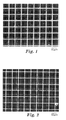
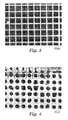
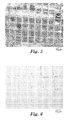
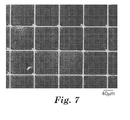
- the resulting etched substrates were characterized according to the above-described procedures, and the results are shown in Table 3 and in Figures 1-7 .
- the amount of gold removed from the functionalized region of the substrate per unit area after etching expressed as a percentage of the amount of gold removed from the unfunctionalized region of the substrate per unit area, was estimated by using transmitted light attenuation in an optical microscope to be 8 percent (%), 5%, 10%, 10%, 14%, 67%, and 100%, respectively.
- a portion of the functionalized region was selected that was considered to be representative of the functionalized region.
- the portion of the functionalized region that was selected for analysis was smaller than the full contact region between the stamp and the substrate.
Landscapes
- Chemical & Material Sciences (AREA)
- Organic Chemistry (AREA)
- Engineering & Computer Science (AREA)
- Nanotechnology (AREA)
- Physics & Mathematics (AREA)
- Chemical Kinetics & Catalysis (AREA)
- General Physics & Mathematics (AREA)
- Crystallography & Structural Chemistry (AREA)
- Polymers & Plastics (AREA)
- Medicinal Chemistry (AREA)
- Health & Medical Sciences (AREA)
- Condensed Matter Physics & Semiconductors (AREA)
- Materials Engineering (AREA)
- Manufacturing & Machinery (AREA)
- Composite Materials (AREA)
- General Chemical & Material Sciences (AREA)
- Life Sciences & Earth Sciences (AREA)
- Wood Science & Technology (AREA)
- Mathematical Physics (AREA)
- Theoretical Computer Science (AREA)
- Organic Low-Molecular-Weight Compounds And Preparation Thereof (AREA)
- Other Surface Treatments For Metallic Materials (AREA)
- Polyethers (AREA)
Applications Claiming Priority (3)
| Application Number | Priority Date | Filing Date | Title |
|---|---|---|---|
| US12160508P | 2008-12-11 | 2008-12-11 | |
| US12159808P | 2008-12-11 | 2008-12-11 | |
| PCT/US2009/066358 WO2010068535A1 (en) | 2008-12-11 | 2009-12-02 | Patterning process |
Publications (3)
| Publication Number | Publication Date |
|---|---|
| EP2370269A1 EP2370269A1 (en) | 2011-10-05 |
| EP2370269A4 EP2370269A4 (en) | 2013-05-08 |
| EP2370269B1 true EP2370269B1 (en) | 2015-08-05 |
Family
ID=42243038
Family Applications (2)
| Application Number | Title | Priority Date | Filing Date |
|---|---|---|---|
| EP09832396.7A Not-in-force EP2370269B1 (en) | 2008-12-11 | 2009-12-02 | Patterning process |
| EP09832393.4A Not-in-force EP2370401B1 (en) | 2008-12-11 | 2009-12-02 | Amide-linked perfluoropolyether thiol compounds and processes for their preparation and use |
Family Applications After (1)
| Application Number | Title | Priority Date | Filing Date |
|---|---|---|---|
| EP09832393.4A Not-in-force EP2370401B1 (en) | 2008-12-11 | 2009-12-02 | Amide-linked perfluoropolyether thiol compounds and processes for their preparation and use |
Country Status (5)
| Country | Link |
|---|---|
| US (4) | US8901263B2 (enExample) |
| EP (2) | EP2370269B1 (enExample) |
| JP (1) | JP5864259B2 (enExample) |
| CN (2) | CN102307851B (enExample) |
| WO (2) | WO2010068531A1 (enExample) |
Families Citing this family (25)
| Publication number | Priority date | Publication date | Assignee | Title |
|---|---|---|---|---|
| US8747599B2 (en) * | 2008-05-29 | 2014-06-10 | Chidella Krishna Sastry | Process for making self-patterning substrates and the product thereof |
| CN102307851B (zh) * | 2008-12-11 | 2015-05-06 | 3M创新有限公司 | 酰胺连接的全氟聚醚硫醇化合物及其制备方法和用途 |
| WO2010099132A2 (en) | 2009-02-26 | 2010-09-02 | 3M Innovative Properties Company | Touch screen sensor and patterned substrate having overlaid micropatterns with low visibility |
| CN102803562B (zh) | 2009-06-25 | 2015-09-30 | 3M创新有限公司 | 湿式蚀刻自组装单层图案化基材和金属图案化制品的方法 |
| US8553400B2 (en) | 2009-06-30 | 2013-10-08 | 3M Innovative Properties Company | Electronic displays and metal micropatterned substrates having a graphic |
| US8258341B2 (en) * | 2009-07-10 | 2012-09-04 | E.I. Du Pont De Nemours And Company | Polyfluorosulfonamido amine and intermediate |
| US8950324B2 (en) | 2009-12-22 | 2015-02-10 | 3M Innovative Properties Company | Apparatus and method for microcontact printing using a pressurized roller |
| WO2012085130A1 (fr) * | 2010-12-23 | 2012-06-28 | Rolex Sa | Composition pour augmenter la lipophobicite d'un composant horloger |
| FR2969663B1 (fr) * | 2010-12-23 | 2013-01-18 | Surfactis Technologies | Composition hydrophobe et lipophobe de molecules bisphosphoniques et thiols |
| JP5904499B2 (ja) | 2011-02-22 | 2016-04-13 | 国立大学法人北海道大学 | 粒子集積体、粒子集積体の製造方法、光増強素子及び光化学反応を利用する装置 |
| KR101593560B1 (ko) * | 2011-03-30 | 2016-02-15 | 후지필름 가부시키가이샤 | 프린트 배선기판 및 그 제조방법, 그리고 금속 표면 처리액 |
| US9449630B2 (en) * | 2014-06-02 | 2016-09-20 | Seagate Technology Llc | Sliders having at least two regions on the trailing edge surface |
| KR102399569B1 (ko) * | 2015-10-28 | 2022-05-19 | 삼성디스플레이 주식회사 | 마스크 어셈블리, 표시 장치의 제조 장치 및 표시 장치의 제조 방법 |
| EP3663087A4 (en) | 2017-08-04 | 2021-04-21 | Daikin Industries, Ltd. | SUBSTRATE FOR PATTERN FORMATION |
| CN107459641B (zh) * | 2017-08-30 | 2019-08-09 | 龙岩思康新材料有限公司 | 一种全氟聚醚改性烯丙氧基体的制备方法 |
| CN109928891B (zh) * | 2017-12-18 | 2022-12-06 | 乳源东阳光氟有限公司 | 一种聚酰胺连接的全氟聚醚及其制备方法和应用 |
| TWI837203B (zh) * | 2018-11-02 | 2024-04-01 | 日商東京威力科創股份有限公司 | 膜形成方法及膜形成裝置 |
| US10934454B2 (en) * | 2019-01-22 | 2021-03-02 | Amazon Technologies, Inc. | Coating composition for a metal substrate |
| CN114891221B (zh) * | 2019-10-14 | 2023-09-15 | 中国科学院上海有机化学研究所 | 聚(γ-硫代丁内酯) |
| US12640236B2 (en) * | 2020-05-11 | 2026-05-26 | Massachusetts Institute Of Technology | DNA canvas for information storage and nanofabrication |
| KR102880388B1 (ko) * | 2020-07-31 | 2025-11-04 | 엘지전자 주식회사 | 가전기기용 외장부재 및 그 제조 방법 |
| US20240166557A1 (en) | 2021-05-06 | 2024-05-23 | 3M Innovative Properties Company | Angular physical vapor deposition for coating substrates |
| JP2023081626A (ja) * | 2021-12-01 | 2023-06-13 | 株式会社東芝 | ヘッドサスペンションアッセンブリ、及び磁気記録再生装置 |
| TW202346474A (zh) * | 2022-02-22 | 2023-12-01 | 日商大金工業股份有限公司 | 含有氟聚醚基之硫醇化合物 |
| CN114957677B (zh) * | 2022-05-29 | 2023-01-31 | 北京化工大学 | 一种应用于19f磁共振成像的含氟聚合物纳米探针的制备方法 |
Family Cites Families (54)
| Publication number | Priority date | Publication date | Assignee | Title |
|---|---|---|---|---|
| US3250807A (en) | 1963-08-23 | 1966-05-10 | Du Pont | Dicarboxylic acids of fluorocarbon ethers and fluorides, esters, amides and salts thereof |
| US3250808A (en) * | 1963-10-31 | 1966-05-10 | Du Pont | Fluorocarbon ethers derived from hexafluoropropylene epoxide |
| US4204064A (en) | 1964-01-29 | 1980-05-20 | L'oreal | Sulfur containing heterocyclic amino acid derivatives |
| US3810874A (en) | 1969-03-10 | 1974-05-14 | Minnesota Mining & Mfg | Polymers prepared from poly(perfluoro-alkylene oxide) compounds |
| US4022928A (en) * | 1975-05-22 | 1977-05-10 | Piwcyzk Bernhard P | Vacuum deposition methods and masking structure |
| EP0148482B1 (en) * | 1983-12-26 | 1992-03-25 | Daikin Industries, Limited | Process for preparing halogen-containing polyether |
| EP0293863A3 (en) * | 1987-06-02 | 1991-01-02 | Daikin Industries, Limited | Fluorine-containing polyether and process for preparing the same |
| JPH01115193A (ja) * | 1987-10-29 | 1989-05-08 | Kashima Kogyo Kk | フレキシブル印刷配線板 |
| EP0303225A3 (en) * | 1987-08-10 | 1990-01-10 | Kashima Industries, Co. | Epoxy resin film covered with metal foil and flexible printed wiring board |
| IT1249319B (it) * | 1991-04-26 | 1995-02-22 | Ausimont Spa | Perfluoropolieteri ad elevata viscosita' e basso contenuto di ossigeno perossidico, e procedimento per la loro preparazione |
| US5182342A (en) * | 1992-02-28 | 1993-01-26 | E. I. Du Pont De Nemours And Company | Hydrofluorocarbon solvents for fluoromonomer polymerization |
| US5190661A (en) | 1992-06-08 | 1993-03-02 | Brigham Young University | Process of removing ions from solutions using a complex with sulfur-containing hydrocarbons |
| US5512131A (en) * | 1993-10-04 | 1996-04-30 | President And Fellows Of Harvard College | Formation of microstamped patterns on surfaces and derivative articles |
| WO1997007429A1 (en) | 1995-08-18 | 1997-02-27 | President And Fellows Of Harvard College | Self-assembled monolayer directed patterning of surfaces |
| JPH10124844A (ja) | 1996-10-23 | 1998-05-15 | Hitachi Ltd | 磁気記録媒体及びそれを用いた磁気記憶装置 |
| FR2761691B1 (fr) * | 1997-04-03 | 1999-05-14 | Oreal | Polymeres a fonction terminale thiol |
| EP1141047B1 (en) * | 1998-11-30 | 2009-03-11 | E.I. Du Pont De Nemours And Company | Fluoromonomer polymerization |
| US6555288B1 (en) * | 1999-06-21 | 2003-04-29 | Corning Incorporated | Optical devices made from radiation curable fluorinated compositions |
| US7041232B2 (en) * | 2001-03-26 | 2006-05-09 | International Business Machines Corporation | Selective etching of substrates with control of the etch profile |
| WO2002092660A2 (en) | 2001-05-14 | 2002-11-21 | Omnova Soltions Inc | Polymeric surfactants derived from cyclic monomers having pendant fluorinated carbon groups |
| ITMI20011340A1 (it) * | 2001-06-26 | 2002-12-26 | Ausimont Spa | Pfpe aventi almeno un terminale alchiletereo e relativo processo dipreparazione |
| US6778753B2 (en) * | 2001-07-25 | 2004-08-17 | E. I. Du Pont De Nemours And Company | Halogenated optical polymer composition |
| US6878634B2 (en) * | 2002-04-10 | 2005-04-12 | Canon Kabushiki Kaisha | Structure having recesses and projections, method of manufacturing structure, and functional device |
| WO2004041061A2 (en) * | 2002-05-22 | 2004-05-21 | Platypus Technologies, Llc | Substrates, devices, and methods for cellular assays |
| SE0202630L (sv) * | 2002-09-06 | 2004-03-07 | Sca Hygiene Prod Ab | Sensoring absorbing article |
| US6923921B2 (en) | 2002-12-30 | 2005-08-02 | 3M Innovative Properties Company | Fluorinated polyether compositions |
| TWI269478B (en) * | 2003-02-06 | 2006-12-21 | Sekisui Chemical Co Ltd | Proton conducting membrane, method for producing the same and fuel cell using the same |
| US20040241396A1 (en) | 2003-05-29 | 2004-12-02 | 3M Innovative Properties Company | Method of modifying a surface of a substrate and articles therefrom |
| US20050164402A1 (en) * | 2003-07-14 | 2005-07-28 | Belisle Christopher M. | Sample presentation device |
| ATE346852T1 (de) * | 2003-08-21 | 2006-12-15 | 3M Innovative Properties Co | Perfluorpolyetheramidgebundene phosphonate, phosphate und derivate davon |
| US7387714B2 (en) * | 2003-11-06 | 2008-06-17 | 3M Innovative Properties Company | Electrochemical sensor strip |
| WO2005101466A2 (en) * | 2003-12-19 | 2005-10-27 | The University Of North Carolina At Chapel Hill | Methods for fabricating isolated micro- and nano- structures using soft or imprint lithography |
| JP2005200304A (ja) * | 2004-01-13 | 2005-07-28 | Hitachi Ltd | 含フッ素化合物、それを用いた撥液膜及びそれを用いた各種製品 |
| US7148360B2 (en) | 2004-01-30 | 2006-12-12 | 3M Innovative Properties Company | Perfluoropolyether benzotriazole compounds |
| US6991826B2 (en) | 2004-04-20 | 2006-01-31 | 3M Innovative Properties Company | Antisoiling coatings for antireflective substrates |
| US7342080B2 (en) | 2004-05-07 | 2008-03-11 | 3M Innovative Properties Company | Polymerizable compositions, methods of making the same, and composite articles therefrom |
| US7160583B2 (en) * | 2004-12-03 | 2007-01-09 | 3M Innovative Properties Company | Microfabrication using patterned topography and self-assembled monolayers |
| US20060216524A1 (en) * | 2005-03-23 | 2006-09-28 | 3M Innovative Properties Company | Perfluoropolyether urethane additives having (meth)acryl groups and hard coats |
| US20060266731A1 (en) * | 2005-05-31 | 2006-11-30 | Yu Steven Y | Etchant rinse method |
| US20070292679A1 (en) | 2006-06-14 | 2007-12-20 | 3M Innovative Properties Company | Optical article having an antistatic fluorochemical surface layer |
| US20080047930A1 (en) * | 2006-08-23 | 2008-02-28 | Graciela Beatriz Blanchet | Method to form a pattern of functional material on a substrate |
| US8764996B2 (en) | 2006-10-18 | 2014-07-01 | 3M Innovative Properties Company | Methods of patterning a material on polymeric substrates |
| EP2121789A1 (en) | 2006-12-20 | 2009-11-25 | 3M Innovative Properties Company | Fluorochemical urethane compounds having pendent silyl groups |
| US7968804B2 (en) | 2006-12-20 | 2011-06-28 | 3M Innovative Properties Company | Methods of patterning a deposit metal on a substrate |
| US7745653B2 (en) | 2007-03-08 | 2010-06-29 | 3M Innovative Properties Company | Fluorochemical compounds having pendent silyl groups |
| US7335786B1 (en) * | 2007-03-29 | 2008-02-26 | 3M Innovative Properties Company | Michael-adduct fluorochemical silanes |
| US20080315459A1 (en) * | 2007-06-21 | 2008-12-25 | 3M Innovative Properties Company | Articles and methods for replication of microstructures and nanofeatures |
| US8015970B2 (en) * | 2007-07-26 | 2011-09-13 | 3M Innovative Properties Company | Respirator, welding helmet, or face shield that has low surface energy hard-coat lens |
| WO2009029733A2 (en) * | 2007-08-28 | 2009-03-05 | Life Biosciences, Inc. | Method of providing a pattern of biological-binding areas for biological testing |
| WO2009045993A2 (en) * | 2007-10-01 | 2009-04-09 | 3M Innovative Properties Company | Compositions comprising cationic fluorinated ether, silanes, and related methods |
| US8080170B2 (en) | 2007-10-01 | 2011-12-20 | 3M Innovative Properties Company | Cationic fluorinated ether silane compositions and related methods |
| US9027480B2 (en) | 2007-12-19 | 2015-05-12 | 3M Innovative Properties Company | Ink solutions for microcontact printing |
| CN102017071B (zh) | 2008-02-28 | 2013-12-18 | 3M创新有限公司 | 图案化基底上的导体的方法 |
| CN102307851B (zh) * | 2008-12-11 | 2015-05-06 | 3M创新有限公司 | 酰胺连接的全氟聚醚硫醇化合物及其制备方法和用途 |
-
2009
- 2009-12-02 CN CN200980156199.4A patent/CN102307851B/zh not_active Expired - Fee Related
- 2009-12-02 US US13/132,673 patent/US8901263B2/en not_active Expired - Fee Related
- 2009-12-02 WO PCT/US2009/066337 patent/WO2010068531A1/en not_active Ceased
- 2009-12-02 EP EP09832396.7A patent/EP2370269B1/en not_active Not-in-force
- 2009-12-02 US US13/130,320 patent/US8858813B2/en not_active Expired - Fee Related
- 2009-12-02 WO PCT/US2009/066358 patent/WO2010068535A1/en not_active Ceased
- 2009-12-02 CN CN200980156190.3A patent/CN102307734B/zh not_active Expired - Fee Related
- 2009-12-02 JP JP2011540782A patent/JP5864259B2/ja not_active Expired - Fee Related
- 2009-12-02 EP EP09832393.4A patent/EP2370401B1/en not_active Not-in-force
-
2014
- 2014-10-30 US US14/527,877 patent/US9688649B2/en not_active Expired - Fee Related
-
2017
- 2017-05-24 US US15/603,495 patent/US20170253570A1/en not_active Abandoned
Also Published As
| Publication number | Publication date |
|---|---|
| EP2370269A1 (en) | 2011-10-05 |
| WO2010068535A1 (en) | 2010-06-17 |
| CN102307734A (zh) | 2012-01-04 |
| WO2010068531A1 (en) | 2010-06-17 |
| US20110226733A1 (en) | 2011-09-22 |
| CN102307734B (zh) | 2015-06-03 |
| EP2370401B1 (en) | 2018-01-24 |
| US20150051362A1 (en) | 2015-02-19 |
| JP2012511635A (ja) | 2012-05-24 |
| US20110237765A1 (en) | 2011-09-29 |
| US8858813B2 (en) | 2014-10-14 |
| US8901263B2 (en) | 2014-12-02 |
| EP2370401A1 (en) | 2011-10-05 |
| EP2370401A4 (en) | 2014-05-28 |
| US9688649B2 (en) | 2017-06-27 |
| CN102307851A (zh) | 2012-01-04 |
| JP5864259B2 (ja) | 2016-02-17 |
| US20170253570A1 (en) | 2017-09-07 |
| CN102307851B (zh) | 2015-05-06 |
| EP2370269A4 (en) | 2013-05-08 |
Similar Documents
| Publication | Publication Date | Title |
|---|---|---|
| US8858813B2 (en) | Patterning process | |
| EP2231793B1 (en) | Ink solutions for microcontact printing | |
| JP6399975B2 (ja) | 自己組織化単層パターン化基材の湿式エッチング方法、及び金属パターン化物品 | |
| US7678426B2 (en) | Perfluoropolyether amide-linked phosphonates, phosphates, and derivatives thereof | |
| JP2012511635A5 (enExample) | ||
| EP1834011A2 (en) | Etchant solutions and additives therefor | |
| Laffineur et al. | Mechanically polished copper surfaces modified with n-dodecanethiol and 3-perfluorooctyl-propanethiol | |
| CN101180419A (zh) | 蚀刻剂溶液及其添加剂 | |
| US20130292877A1 (en) | Nanoimprinting method | |
| JPWO2005091070A1 (ja) | リソグラフィー用基板表面処理剤 |
Legal Events
| Date | Code | Title | Description |
|---|---|---|---|
| PUAI | Public reference made under article 153(3) epc to a published international application that has entered the european phase |
Free format text: ORIGINAL CODE: 0009012 |
|
| 17P | Request for examination filed |
Effective date: 20110627 |
|
| AK | Designated contracting states |
Kind code of ref document: A1 Designated state(s): AT BE BG CH CY CZ DE DK EE ES FI FR GB GR HR HU IE IS IT LI LT LU LV MC MK MT NL NO PL PT RO SE SI SK SM TR |
|
| DAX | Request for extension of the european patent (deleted) | ||
| A4 | Supplementary search report drawn up and despatched |
Effective date: 20130410 |
|
| RIC1 | Information provided on ipc code assigned before grant |
Ipc: C07C 323/52 20060101ALI20130404BHEP Ipc: C08G 65/334 20060101ALI20130404BHEP Ipc: C07C 323/60 20060101ALI20130404BHEP Ipc: B82Y 40/00 20110101ALI20130404BHEP Ipc: C07C 323/41 20060101ALI20130404BHEP Ipc: B05D 1/18 20060101ALI20130404BHEP Ipc: B44C 1/22 20060101AFI20130404BHEP Ipc: H01L 21/64 20060101ALI20130404BHEP Ipc: B82Y 30/00 20110101ALI20130404BHEP Ipc: C09D 171/02 20060101ALI20130404BHEP Ipc: C08G 65/00 20060101ALI20130404BHEP |
|
| 17Q | First examination report despatched |
Effective date: 20140106 |
|
| REG | Reference to a national code |
Ref country code: DE Ref legal event code: R079 Ref document number: 602009032726 Country of ref document: DE Free format text: PREVIOUS MAIN CLASS: B44C0001220000 Ipc: G03F0007000000 |
|
| GRAP | Despatch of communication of intention to grant a patent |
Free format text: ORIGINAL CODE: EPIDOSNIGR1 |
|
| RIC1 | Information provided on ipc code assigned before grant |
Ipc: B05D 1/18 20060101ALI20150119BHEP Ipc: C07C 323/60 20060101ALI20150119BHEP Ipc: B82Y 30/00 20110101ALI20150119BHEP Ipc: H01L 21/64 20060101ALI20150119BHEP Ipc: B44C 1/22 20060101ALI20150119BHEP Ipc: G03F 7/00 20060101AFI20150119BHEP Ipc: C07C 323/41 20060101ALI20150119BHEP Ipc: B82Y 10/00 20110101ALI20150119BHEP Ipc: C08G 65/00 20060101ALI20150119BHEP Ipc: C08G 65/334 20060101ALI20150119BHEP Ipc: C09D 171/02 20060101ALI20150119BHEP Ipc: C07C 323/52 20060101ALI20150119BHEP Ipc: B82Y 40/00 20110101ALI20150119BHEP |
|
| INTG | Intention to grant announced |
Effective date: 20150225 |
|
| RIN1 | Information on inventor provided before grant (corrected) |
Inventor name: ZU, LIJUN Inventor name: IYER, SURESH Inventor name: FREY, MATTHEW H. |
|
| GRAS | Grant fee paid |
Free format text: ORIGINAL CODE: EPIDOSNIGR3 |
|
| GRAA | (expected) grant |
Free format text: ORIGINAL CODE: 0009210 |
|
| AK | Designated contracting states |
Kind code of ref document: B1 Designated state(s): AT BE BG CH CY CZ DE DK EE ES FI FR GB GR HR HU IE IS IT LI LT LU LV MC MK MT NL NO PL PT RO SE SI SK SM TR |
|
| REG | Reference to a national code |
Ref country code: GB Ref legal event code: FG4D |
|
| REG | Reference to a national code |
Ref country code: CH Ref legal event code: EP |
|
| REG | Reference to a national code |
Ref country code: AT Ref legal event code: REF Ref document number: 741038 Country of ref document: AT Kind code of ref document: T Effective date: 20150815 |
|
| REG | Reference to a national code |
Ref country code: IE Ref legal event code: FG4D |
|
| REG | Reference to a national code |
Ref country code: DE Ref legal event code: R096 Ref document number: 602009032726 Country of ref document: DE |
|
| REG | Reference to a national code |
Ref country code: AT Ref legal event code: MK05 Ref document number: 741038 Country of ref document: AT Kind code of ref document: T Effective date: 20150805 |
|
| REG | Reference to a national code |
Ref country code: LT Ref legal event code: MG4D |
|
| REG | Reference to a national code |
Ref country code: NL Ref legal event code: MP Effective date: 20150805 |
|
| PG25 | Lapsed in a contracting state [announced via postgrant information from national office to epo] |
Ref country code: GR Free format text: LAPSE BECAUSE OF FAILURE TO SUBMIT A TRANSLATION OF THE DESCRIPTION OR TO PAY THE FEE WITHIN THE PRESCRIBED TIME-LIMIT Effective date: 20151106 Ref country code: LV Free format text: LAPSE BECAUSE OF FAILURE TO SUBMIT A TRANSLATION OF THE DESCRIPTION OR TO PAY THE FEE WITHIN THE PRESCRIBED TIME-LIMIT Effective date: 20150805 Ref country code: LT Free format text: LAPSE BECAUSE OF FAILURE TO SUBMIT A TRANSLATION OF THE DESCRIPTION OR TO PAY THE FEE WITHIN THE PRESCRIBED TIME-LIMIT Effective date: 20150805 Ref country code: NO Free format text: LAPSE BECAUSE OF FAILURE TO SUBMIT A TRANSLATION OF THE DESCRIPTION OR TO PAY THE FEE WITHIN THE PRESCRIBED TIME-LIMIT Effective date: 20151105 Ref country code: FI Free format text: LAPSE BECAUSE OF FAILURE TO SUBMIT A TRANSLATION OF THE DESCRIPTION OR TO PAY THE FEE WITHIN THE PRESCRIBED TIME-LIMIT Effective date: 20150805 |
|
| PG25 | Lapsed in a contracting state [announced via postgrant information from national office to epo] |
Ref country code: HR Free format text: LAPSE BECAUSE OF FAILURE TO SUBMIT A TRANSLATION OF THE DESCRIPTION OR TO PAY THE FEE WITHIN THE PRESCRIBED TIME-LIMIT Effective date: 20150805 Ref country code: PT Free format text: LAPSE BECAUSE OF FAILURE TO SUBMIT A TRANSLATION OF THE DESCRIPTION OR TO PAY THE FEE WITHIN THE PRESCRIBED TIME-LIMIT Effective date: 20151207 Ref country code: ES Free format text: LAPSE BECAUSE OF FAILURE TO SUBMIT A TRANSLATION OF THE DESCRIPTION OR TO PAY THE FEE WITHIN THE PRESCRIBED TIME-LIMIT Effective date: 20150805 Ref country code: IS Free format text: LAPSE BECAUSE OF FAILURE TO SUBMIT A TRANSLATION OF THE DESCRIPTION OR TO PAY THE FEE WITHIN THE PRESCRIBED TIME-LIMIT Effective date: 20151205 Ref country code: PL Free format text: LAPSE BECAUSE OF FAILURE TO SUBMIT A TRANSLATION OF THE DESCRIPTION OR TO PAY THE FEE WITHIN THE PRESCRIBED TIME-LIMIT Effective date: 20150805 Ref country code: AT Free format text: LAPSE BECAUSE OF FAILURE TO SUBMIT A TRANSLATION OF THE DESCRIPTION OR TO PAY THE FEE WITHIN THE PRESCRIBED TIME-LIMIT Effective date: 20150805 Ref country code: SE Free format text: LAPSE BECAUSE OF FAILURE TO SUBMIT A TRANSLATION OF THE DESCRIPTION OR TO PAY THE FEE WITHIN THE PRESCRIBED TIME-LIMIT Effective date: 20150805 |
|
| PG25 | Lapsed in a contracting state [announced via postgrant information from national office to epo] |
Ref country code: NL Free format text: LAPSE BECAUSE OF FAILURE TO SUBMIT A TRANSLATION OF THE DESCRIPTION OR TO PAY THE FEE WITHIN THE PRESCRIBED TIME-LIMIT Effective date: 20150805 |
|
| PG25 | Lapsed in a contracting state [announced via postgrant information from national office to epo] |
Ref country code: EE Free format text: LAPSE BECAUSE OF FAILURE TO SUBMIT A TRANSLATION OF THE DESCRIPTION OR TO PAY THE FEE WITHIN THE PRESCRIBED TIME-LIMIT Effective date: 20150805 Ref country code: CZ Free format text: LAPSE BECAUSE OF FAILURE TO SUBMIT A TRANSLATION OF THE DESCRIPTION OR TO PAY THE FEE WITHIN THE PRESCRIBED TIME-LIMIT Effective date: 20150805 Ref country code: IT Free format text: LAPSE BECAUSE OF FAILURE TO SUBMIT A TRANSLATION OF THE DESCRIPTION OR TO PAY THE FEE WITHIN THE PRESCRIBED TIME-LIMIT Effective date: 20150805 Ref country code: DK Free format text: LAPSE BECAUSE OF FAILURE TO SUBMIT A TRANSLATION OF THE DESCRIPTION OR TO PAY THE FEE WITHIN THE PRESCRIBED TIME-LIMIT Effective date: 20150805 Ref country code: SK Free format text: LAPSE BECAUSE OF FAILURE TO SUBMIT A TRANSLATION OF THE DESCRIPTION OR TO PAY THE FEE WITHIN THE PRESCRIBED TIME-LIMIT Effective date: 20150805 |
|
| REG | Reference to a national code |
Ref country code: DE Ref legal event code: R097 Ref document number: 602009032726 Country of ref document: DE |
|
| PG25 | Lapsed in a contracting state [announced via postgrant information from national office to epo] |
Ref country code: BE Free format text: LAPSE BECAUSE OF NON-PAYMENT OF DUE FEES Effective date: 20151231 Ref country code: RO Free format text: LAPSE BECAUSE OF FAILURE TO SUBMIT A TRANSLATION OF THE DESCRIPTION OR TO PAY THE FEE WITHIN THE PRESCRIBED TIME-LIMIT Effective date: 20150805 |
|
| PLBE | No opposition filed within time limit |
Free format text: ORIGINAL CODE: 0009261 |
|
| STAA | Information on the status of an ep patent application or granted ep patent |
Free format text: STATUS: NO OPPOSITION FILED WITHIN TIME LIMIT |
|
| 26N | No opposition filed |
Effective date: 20160509 |
|
| PG25 | Lapsed in a contracting state [announced via postgrant information from national office to epo] |
Ref country code: MC Free format text: LAPSE BECAUSE OF FAILURE TO SUBMIT A TRANSLATION OF THE DESCRIPTION OR TO PAY THE FEE WITHIN THE PRESCRIBED TIME-LIMIT Effective date: 20150805 Ref country code: LU Free format text: LAPSE BECAUSE OF FAILURE TO SUBMIT A TRANSLATION OF THE DESCRIPTION OR TO PAY THE FEE WITHIN THE PRESCRIBED TIME-LIMIT Effective date: 20151202 |
|
| REG | Reference to a national code |
Ref country code: CH Ref legal event code: PL |
|
| GBPC | Gb: european patent ceased through non-payment of renewal fee |
Effective date: 20151202 |
|
| PG25 | Lapsed in a contracting state [announced via postgrant information from national office to epo] |
Ref country code: SI Free format text: LAPSE BECAUSE OF FAILURE TO SUBMIT A TRANSLATION OF THE DESCRIPTION OR TO PAY THE FEE WITHIN THE PRESCRIBED TIME-LIMIT Effective date: 20150805 |
|
| REG | Reference to a national code |
Ref country code: IE Ref legal event code: MM4A |
|
| REG | Reference to a national code |
Ref country code: FR Ref legal event code: ST Effective date: 20160831 |
|
| PG25 | Lapsed in a contracting state [announced via postgrant information from national office to epo] |
Ref country code: GB Free format text: LAPSE BECAUSE OF NON-PAYMENT OF DUE FEES Effective date: 20151202 Ref country code: LI Free format text: LAPSE BECAUSE OF NON-PAYMENT OF DUE FEES Effective date: 20151231 Ref country code: CH Free format text: LAPSE BECAUSE OF NON-PAYMENT OF DUE FEES Effective date: 20151231 Ref country code: IE Free format text: LAPSE BECAUSE OF NON-PAYMENT OF DUE FEES Effective date: 20151202 |
|
| PG25 | Lapsed in a contracting state [announced via postgrant information from national office to epo] |
Ref country code: FR Free format text: LAPSE BECAUSE OF NON-PAYMENT OF DUE FEES Effective date: 20151231 |
|
| PG25 | Lapsed in a contracting state [announced via postgrant information from national office to epo] |
Ref country code: BE Free format text: LAPSE BECAUSE OF FAILURE TO SUBMIT A TRANSLATION OF THE DESCRIPTION OR TO PAY THE FEE WITHIN THE PRESCRIBED TIME-LIMIT Effective date: 20150805 |
|
| PG25 | Lapsed in a contracting state [announced via postgrant information from national office to epo] |
Ref country code: BG Free format text: LAPSE BECAUSE OF FAILURE TO SUBMIT A TRANSLATION OF THE DESCRIPTION OR TO PAY THE FEE WITHIN THE PRESCRIBED TIME-LIMIT Effective date: 20150805 Ref country code: HU Free format text: LAPSE BECAUSE OF FAILURE TO SUBMIT A TRANSLATION OF THE DESCRIPTION OR TO PAY THE FEE WITHIN THE PRESCRIBED TIME-LIMIT; INVALID AB INITIO Effective date: 20091202 Ref country code: SM Free format text: LAPSE BECAUSE OF FAILURE TO SUBMIT A TRANSLATION OF THE DESCRIPTION OR TO PAY THE FEE WITHIN THE PRESCRIBED TIME-LIMIT Effective date: 20150805 |
|
| PG25 | Lapsed in a contracting state [announced via postgrant information from national office to epo] |
Ref country code: CY Free format text: LAPSE BECAUSE OF FAILURE TO SUBMIT A TRANSLATION OF THE DESCRIPTION OR TO PAY THE FEE WITHIN THE PRESCRIBED TIME-LIMIT Effective date: 20150805 |
|
| PG25 | Lapsed in a contracting state [announced via postgrant information from national office to epo] |
Ref country code: TR Free format text: LAPSE BECAUSE OF FAILURE TO SUBMIT A TRANSLATION OF THE DESCRIPTION OR TO PAY THE FEE WITHIN THE PRESCRIBED TIME-LIMIT Effective date: 20150805 Ref country code: MT Free format text: LAPSE BECAUSE OF FAILURE TO SUBMIT A TRANSLATION OF THE DESCRIPTION OR TO PAY THE FEE WITHIN THE PRESCRIBED TIME-LIMIT Effective date: 20150805 |
|
| PG25 | Lapsed in a contracting state [announced via postgrant information from national office to epo] |
Ref country code: MK Free format text: LAPSE BECAUSE OF FAILURE TO SUBMIT A TRANSLATION OF THE DESCRIPTION OR TO PAY THE FEE WITHIN THE PRESCRIBED TIME-LIMIT Effective date: 20150805 |
|
| PGFP | Annual fee paid to national office [announced via postgrant information from national office to epo] |
Ref country code: DE Payment date: 20181120 Year of fee payment: 10 |
|
| REG | Reference to a national code |
Ref country code: DE Ref legal event code: R119 Ref document number: 602009032726 Country of ref document: DE |
|
| PG25 | Lapsed in a contracting state [announced via postgrant information from national office to epo] |
Ref country code: DE Free format text: LAPSE BECAUSE OF NON-PAYMENT OF DUE FEES Effective date: 20200701 |