EP2360011A1 - Verfahren zum Herstellen eines Schuhs mit einem porösen Sohlenträger für eine Kautschukschicht - Google Patents
Verfahren zum Herstellen eines Schuhs mit einem porösen Sohlenträger für eine Kautschukschicht Download PDFInfo
- Publication number
- EP2360011A1 EP2360011A1 EP10450184A EP10450184A EP2360011A1 EP 2360011 A1 EP2360011 A1 EP 2360011A1 EP 10450184 A EP10450184 A EP 10450184A EP 10450184 A EP10450184 A EP 10450184A EP 2360011 A1 EP2360011 A1 EP 2360011A1
- Authority
- EP
- European Patent Office
- Prior art keywords
- rubber layer
- heated
- shoe
- porous
- producing
- Prior art date
- Legal status (The legal status is an assumption and is not a legal conclusion. Google has not performed a legal analysis and makes no representation as to the accuracy of the status listed.)
- Granted
Links
Images

Classifications
-
- B—PERFORMING OPERATIONS; TRANSPORTING
- B29—WORKING OF PLASTICS; WORKING OF SUBSTANCES IN A PLASTIC STATE IN GENERAL
- B29D—PRODUCING PARTICULAR ARTICLES FROM PLASTICS OR FROM SUBSTANCES IN A PLASTIC STATE
- B29D35/00—Producing footwear
- B29D35/06—Producing footwear having soles or heels formed and joined on to preformed uppers using a moulding technique, e.g. by injection moulding, pressing and vulcanising
- B29D35/065—Producing footwear having soles or heels formed and joined on to preformed uppers using a moulding technique, e.g. by injection moulding, pressing and vulcanising by compression moulding, vulcanising or the like
- B29D35/068—Producing footwear having soles or heels formed and joined on to preformed uppers using a moulding technique, e.g. by injection moulding, pressing and vulcanising by compression moulding, vulcanising or the like using particular materials for the preformed uppers
Definitions
- the invention relates to a method for producing a shoe having a porous sole support for a rubber layer, wherein viscous latex material is applied to the latter at least partially penetrated into the porous sole body and then vulcanized.
- Pre-vulcanization of the latex material before application to the sole carrier makes the coating process expensive. If the latex material is applied to the sole carrier prior to vulcanization and pressed against the heated contact surface with the sole carrier, there is the risk that the still viscous latex material will unfavorably be distributed and possibly lead to a shifted rubber layer, in particular with comparatively thin rubber layers.
- the invention is thus based on the object, a method of the type described for producing a shoe with a porous sole support for a rubber layer in such a way that with a comparatively low production cost soles with a continuous, a given surface profiling having rubber layer can be made.
- the invention achieves the stated object in that the rubber layer is heated after vulcanization and embossed with a surface profiling.
- the prerequisite for this forming process is that the vulcanized rubber layer for the embossing process is heated sufficiently to dissolve crosslinks due to vulcanization to the extent that under pressure application plastic deformation is possible, which is maintained after cooling and an associated increase in cross-linking.
- the vulcanized rubber layer can be heated on the sole carrier by means of a heated embossing tool and profiled at the same time.
- a heated embossing tool for embossing the surface profiling, the vulcanized rubber layer can be heated on the sole carrier by means of a heated embossing tool and profiled at the same time.
- better results are obtained when the rubber layer is coagulated with the surface profiling after being heated, because in this case there is only a very small restoration of the surface profiling of the rubber layer after demolding.
- the vulcanized rubber layer can be heated to a temperature between 40 and 200 ° C, depending on the latex material used, resulting in a preferred temperature range between 100 and 140 ° C.
- the pressure with which the surface profiling is impressed into the rubber layer can be up to 60 bar and is preferably between 5 and 12 bar.
- the illustrated shoe 1, a slipper has a porous sole support 2, for example made of felt or other textile material. But it is also possible to use a non-textile porous material, because it is essentially only to ensure that the latex material at least partially penetrates into the pores of the sole support 2 and thus a good connection between the continuous tread forming rubber layer 3 and the sole carrier 2 results.
- a corresponding layer of viscous latex material is first applied to the sole support 2, for which purpose a conventional immersion method can be used, but this is not mandatory.
- latex material is crosslinked by a suitable Vulkanisiervorgang, for example in a drying oven at preferably 100 ° C.
- the resulting rubber layer 3 on the sole support 2 can thereby at least partially by the material of the Sole support 2 have certain surface structure, which is not desirable because the rubber layer 3 is to be provided with a predetermined surface profiling 4.
- the rubber layer 3 is heated according to the invention, preferably to a temperature between 100 and 140 ° C.
- the heated rubber layer 3 is then embossed using an embossing tool 5 corresponding to the surface profiling 4 under a pressure application required for the profiling. So that the embossing pressure can be applied, the shoe 1 can be provided with a pressure-transmitting insert.
- the embossing tool 5 cools the embossing of the rubber layer 3 from this, so that after the removal of the shoe 1, the surface profiling 4 of the already cooled rubber layer 3 hardly undergoes elastic recovery.
- the embossing tool 5 may be provided with cooling lines 7, which are indicated by dash-dotted lines in the drawing.
- the contact pressure of the rubber layer 3 on the embossing tool 5 is preferably between 5 and 12 bar.
- the rubber layer 3 Due to the heating of the vulcanized rubber layer 3 and the embossing of the heated rubber layer 3, the rubber layer 3 becomes in the surface area deformed, so that a continuous dense, according to the embossing tool 5 profiled tread for the shoe 1 results.
- the thickness of the rubber layer 3 will preferably be selected between 1 and 3 mm.
- the embossing tool 5 could also be used for heating the vulcanized rubber layer 3, if this embossing tool 5 is not cooled, but provided with a heater.
Landscapes
- Engineering & Computer Science (AREA)
- Mechanical Engineering (AREA)
- Footwear And Its Accessory, Manufacturing Method And Apparatuses (AREA)
- Shaping Of Tube Ends By Bending Or Straightening (AREA)
Abstract
Description
- Die Erfindung bezieht sich auf ein Verfahren zum Herstellen eines Schuhs mit einem porösen Sohlenträger für eine Kautschukschicht, wobei viskoses Latexmaterial unter einem zumindest teilweisen Eindringen in den porösen Sohlenkörper auf diesen aufgebracht und anschließend vulkanisiert wird.
- Um textile Sohlen, beispielsweise aus Filz, insbesondere für Hausschuhe, wasserabweisend zu gestalten, ist es bekannt, die textile Sohle in ein Latexbad zu tauchen, sodass nach einem Vulkanisieren eine wasserabweisende Kautschukbeschichtung erhalten wird, die allerdings sehr dünn ausfällt, weil lediglich die Oberflächenfasern der textilen Sohle mit Kautschuk überzogen werden. Zur Vermeidung dieser Nachteile wurde bereits vorgeschlagen (
EP 0 893 238 A2 ), auf einem textilen Sohlenträger viskoses Latexmaterial aufzubringen, das mit Hilfe einer beheizten Kontaktfläche vor oder nach dem Aufbringen auf den Sohlenträger vorvulkanisiert wird, wodurch eine durchgehende Kautschukschicht erreicht werden soll, die außerdem mit einer Oberflächenprofilierung versehen werden kann, wenn die Kontaktfläche entsprechend profiliert ausgebildet ist. Die Vorvulkanisierung des Latexmaterials vor dem Aufbringen auf den Sohlenträger macht das Beschichtungsverfahren aufwendig. Wird das Latexmaterial vor dem Vulkanisieren auf den Sohlenträger aufgebracht und mit dem Sohlenträger an die erwärmte Kontaktfläche angedrückt, so besteht die Gefahr, dass sich das noch viskose Latexmaterial in ungünstiger Weise verteilt und unter Umständen zu einer verschobenen Kautschukschicht führt, insbesondere bei vergleichsweise dünnen Kautschukschichten. - Der Erfindung liegt somit die Aufgabe zugrunde, ein Verfahren der eingangs geschilderten Art zum Herstellen eines Schuhs mit einem porösen Sohlenträger für eine Kautschukschicht so auszugestalten, dass mit einem vergleichsweise geringen Herstellungsaufwand Sohlen mit einer durchgehenden, eine vorgegebene Oberflächenprofilierung aufweisenden Kautschukschicht gefertigt werden können.
- Die Erfindung löst die gestellte Aufgabe dadurch, dass die Kautschukschicht nach dem Vulkanisieren erwärmt und mit einer Oberflächenprofilierung geprägt wird.
- Aufgrund der erfindungsgemäß vorgenommenen Trennung der Vulkanisierung des auf den porösen Sohlenträger aufgebrachten Latexmaterials von der nachfolgenden Profilierung der vulkanisierten Kautschukschicht können für das Aufbringen des Latexmaterials auf den porösen Sohlenträger und den anschließenden Vulkanisiervorgang vorteilhafte Bedingungen für das Vulkanisieren eingehalten werden, ohne dabei auf eine Oberflächenprofilierung der Kautschukschicht Rücksicht nehmen zu müssen. Erst durch das nachträgliche Prägen der bereits vulkanisierten Kautschukschicht werden nach dem Vulkanisieren noch vorhandene, durch den porösen Sohlenträger bedingte Oberflächenstrukturen der Kautschukschicht durch die eingeprägte Profilierung der Oberfläche überlagert, sodass eine durch die eingeprägte Profilierung bestimmte, durchgehende Lauffläche aus Kautschuk sichergestellt wird. Voraussetzung für diesen Umformvorgang ist, dass die vulkanisierte Kautschukschicht für den Prägevorgang ausreichend erwärmt wird, um Vernetzungen aufgrund der Vulkanisation soweit zu lösen, dass unter Druckanwendung eine plastische Verformung möglich wird, die nach dem Abkühlen und einer damit verbundenen Zunahme der Vernetzung erhalten bleibt.
- Zur Prägung der Oberflächenprofilierung kann die vulkanisierte Kautschukschicht auf dem Sohlenträger mit Hilfe eines erwärmten Prägewerkzeugs erwärmt und zugleich profiliert werden. Bessere Ergebnisse werden jedoch erhalten, wenn die Kautschukschicht nach ihrer Erwärmung unter einer Abkühlung mit der Oberflächenprofilierung geprägt wird, weil sich in diesem Fall eine nur sehr geringe Rückstellung der Oberflächenprofilierung der Kautschukschicht nach der Entformung ergibt.
- Zum Prägen der Oberflächenprofilierung kann die vulkanisierte Kautschukschicht in Abhängigkeit vom eingesetzten Latexmaterial auf eine Temperatur zwischen 40 und 200° C erwärmt werden, wobei sich ein bevorzugter Temperaturbereich zwischen 100 und 140° C ergibt. Der Druck, mit dem die Oberflächenprofilierung in die Kautschukschicht eingeprägt wird, kann bis zu 60 bar betragen und liegt vorzugsweise zwischen 5 und 12 bar.
- Anhand der Zeichnung wird das erfindungsgemäße Verfahren näher erläutert.
- Es zeigen
- Fig. 1
- einen Schuh mit einem Prägewerkzeug zum Profilieren der Kautschukschicht des porösen Sohlenträgers in einem schematischem Längsschnitt und
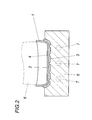
- Fig. 2
- einen Schnitt nach der Linie II-II der
Fig. 1 in einem größeren Maßstab. - Der dargestellte Schuh 1, ein Hausschuh, weist einen porösen Sohlenträger 2 beispielsweise aus Filz oder einem anderen textilen Material auf. Es ist aber auch möglich, ein nicht textiles poröses Material einzusetzen, weil es ja im Wesentlichen nur sicherzustellen gilt, dass das Latexmaterial zumindest teilweise in die Poren des Sohlenträgers 2 eindringt und damit eine gute Verbindung zwischen der eine durchgehende Lauffläche bildenden Kautschukschicht 3 und dem Sohlenträger 2 ergibt. Diese vulkanisierte Kautschukschicht 3, die aus Naturlatex, aus synthetischem Latex oder einer Mischung daraus hergestellt werden kann, wobei durch entsprechende Zusätze in an sich bekannter Weise Einfluss auf die Viskosität, Abriebfestigkeit und Dichte bzw. auf die Vulkanisierbedingungen genommen werden kann, ist mit einer Oberflächenprofilierung 4 versehen.
- Zum Herstellen eines solchen Schuhs 1 wird zunächst auf den Sohlenträger 2 eine entsprechende Schicht eines viskosen Latexmaterials aufgebracht, wofür ein herkömmliches Tauchverfahren eingesetzt werden kann, was jedoch nicht zwingend ist. Nach einem allenfalls notwendigen Abstreifen überschüssigen Latexmaterials wird dieses teilweise in den porösen Sohlenträger 2 eingedrungene Latexmaterial durch einen geeigneten Vulkanisiervorgang vernetzt, beispielsweise in einem Trockenofen bei vorzugsweise 100° C. Die erhaltene Kautschukschicht 3 auf dem Sohlenträger 2 kann dabei eine zumindest teilweise durch das Material des Sohlenträgers 2 bestimmte Oberflächenstruktur aufweisen, die jedoch nicht erwünscht ist, weil die Kautschukschicht 3 mit einer vorgegebenen Oberflächenprofilierung 4 versehen werden soll.
- Um diese Oberflächenprofilierung 4 der Kautschukschicht 3 unter einer Rückbildung der durch den Sohlenträger 2 bestimmten Strukturierung zu erreichen, wird die Kautschukschicht 3 erfindungsgemäß erwärmt, und zwar vorzugsweise auf eine Temperatur zwischen 100 und 140° C. Je tiefer die Oberflächenprofilierung 4 der Kautschukschicht 3 ausfallen soll, umso höher ist die Kautschukschicht 3 aufzuwärmen. Die erwärmte Kautschukschicht 3 wird dann mit Hilfe eines Prägewerkzeugs 5 entsprechend der Oberflächenprofilierung 4 unter einer für die Profilierung erforderlichen Druckanwendung geprägt. Damit der Prägedruck aufgebracht werden kann, kann der Schuh 1 mit einer druckübertragenden Einlage versehen werden. Im dargestellten Ausführungsbeispiel dient hiefür ein strichpunktiert angedeuteter Leisten 6. Das Prägewerkzeug 5 kühlt beim Prägen der Kautschukschicht 3 diese ab, sodass nach dem Entformen des Schuhs 1 die Oberflächenprofilierung 4 der bereits abgekühlten Kautschukschicht 3 kaum eine elastische Rückstellung erfährt. Zur besseren Wärmeabfuhr kann das Prägewerkzeug 5 mit Kühlleitungen 7 versehen sein, die in der Zeichnung strichpunktiert angedeutet sind. Der Anpressdruck der Kautschukschicht 3 an das Prägewerkzeug 5 beträgt vorzugsweise zwischen 5 und 12 bar.
- Aufgrund der Erwärmung der vulkanisierten Kautschukschicht 3 und der Prägung der erwärmten Kautschukschicht 3 wird die Kautschukschicht 3 im Oberflächenbereich umgeformt, sodass sich eine durchgehende dichte, entsprechend dem eingesetzten Prägewerkzeug 5 profilierte Lauffläche für den Schuh 1 ergibt. Die Dicke der Kautschukschicht 3 wird bevorzugt zwischen 1 und 3 mm gewählt werden.
- Die Erfindung ist nicht auf das dargestellte Ausführungsbeispiel begrenzt. So könnte das Prägewerkzeug 5 auch zum Erwärmen der vulkanisierten Kautschukschicht 3 herangezogen werden, wenn dieses Prägewerkzeug 5 nicht gekühlt, sondern mit einer Heizung versehen wird. Die Kautschukschicht 3 des über einen Druckübertragungskörper, beispielsweise einen Leisten 6, an das erwärmte Prägewerkzeug 5 angedrückten Schuhs 1 wird unter einer Erwärmung entsprechend profiliert, wobei nach dem Entformen des Schuhs 1 mit einer größeren Rückstellung der Oberflächenprofilierung 4 gerechnet werden muss, weil ja der profilierte Oberflächenbereich der Kautschukschicht 3 nach der Entformung während der Abkühlung frei verformbar bleibt.
Claims (5)
- Verfahren zum Herstellen eines Schuhs (1) mit einem porösen Sohlenträger (2) für eine Kautschukschicht (3), wobei viskoses Latexmaterial unter einem zumindest teilweisen Eindringen in den porösen Sohlenkörper (2) auf diesen aufgebracht und anschließend vulkanisiert wird, dadurch gekennzeichnet, dass die Kautschukschicht (3) nach dem Vulkanisieren erwärmt und mit einer Oberflächenprofilierung (4) geprägt wird.
- Verfahren nach Anspruch 1, dadurch gekennzeichnet, dass die Kautschukschicht (3) mit Hilfe eines erwärmten Prägewerkzeugs (5) erwärmt und profiliert wird.
- Verfahren nach Anspruch 1, dadurch gekennzeichnet, dass die Kautschukschicht (3) nach ihrer Erwärmung unter einer Abkühlung mit der Oberflächenprofilierung (4) geprägt wird.
- Verfahren mach einem der Ansprüche 1 bis 3, dadurch gekennzeichnet, dass die vulkanisierte Kautschukschicht (3) zum Prägen der Oberflächenprofilierung (4) auf eine Temperatur zwischen 40 und 200° C, vorzugsweise auf eine Temperatur zwischen 100 und 140° C, erwärmt wird.
- Verfahren nach einem der Ansprüche 1 bis 4, dadurch gekennzeichnet, dass die erwärmte Kautschukschicht (3) mit einem Druck zwischen 1 und 60 bar, vorzugsweise zwischen 5 und 12 bar, geprägt wird.
Applications Claiming Priority (1)
| Application Number | Priority Date | Filing Date | Title |
|---|---|---|---|
| AT2282010A AT508121B1 (de) | 2010-02-16 | 2010-02-16 | Verfahren zum herstellen eines schuhs mit einem porösen sohlenträger für eine kautschukschicht |
Publications (2)
| Publication Number | Publication Date |
|---|---|
| EP2360011A1 true EP2360011A1 (de) | 2011-08-24 |
| EP2360011B1 EP2360011B1 (de) | 2019-03-13 |
Family
ID=43038153
Family Applications (1)
| Application Number | Title | Priority Date | Filing Date |
|---|---|---|---|
| EP10450184.6A Active EP2360011B1 (de) | 2010-02-16 | 2010-11-25 | Verfahren zum Herstellen eines Schuhs mit einem porösen Sohlenträger für eine Kautschukschicht |
Country Status (3)
| Country | Link |
|---|---|
| EP (1) | EP2360011B1 (de) |
| AT (1) | AT508121B1 (de) |
| DK (1) | DK2360011T3 (de) |
Citations (5)
| Publication number | Priority date | Publication date | Assignee | Title |
|---|---|---|---|---|
| GB465917A (en) * | 1935-05-10 | 1937-05-19 | Oscar Coda | A machine for the manufacture of sandals and similar footwear |
| FR1018708A (fr) * | 1950-05-22 | 1953-01-12 | Sarl Flande Freres | Procédé de fabrication de chaussures, dispositif en permettant la mise en oeuvre et chaussures ainsi obtenues |
| FR1049526A (de) * | 1953-12-30 | |||
| FR1339392A (fr) * | 1962-11-22 | 1963-10-04 | Procédé de fabrication de sandale et semelle première pour l'application de ce procédé ainsi que sandales conformes à celles ainsi obtenues | |
| EP0893238A2 (de) | 1997-07-25 | 1999-01-27 | Hannes Giesswein | Verfahren zum Versehen eines Schuhs mit einer Sohle aus Latex-material |
-
2010
- 2010-02-16 AT AT2282010A patent/AT508121B1/de not_active IP Right Cessation
- 2010-11-25 EP EP10450184.6A patent/EP2360011B1/de active Active
- 2010-11-25 DK DK10450184.6T patent/DK2360011T3/da active
Patent Citations (5)
| Publication number | Priority date | Publication date | Assignee | Title |
|---|---|---|---|---|
| FR1049526A (de) * | 1953-12-30 | |||
| GB465917A (en) * | 1935-05-10 | 1937-05-19 | Oscar Coda | A machine for the manufacture of sandals and similar footwear |
| FR1018708A (fr) * | 1950-05-22 | 1953-01-12 | Sarl Flande Freres | Procédé de fabrication de chaussures, dispositif en permettant la mise en oeuvre et chaussures ainsi obtenues |
| FR1339392A (fr) * | 1962-11-22 | 1963-10-04 | Procédé de fabrication de sandale et semelle première pour l'application de ce procédé ainsi que sandales conformes à celles ainsi obtenues | |
| EP0893238A2 (de) | 1997-07-25 | 1999-01-27 | Hannes Giesswein | Verfahren zum Versehen eines Schuhs mit einer Sohle aus Latex-material |
Also Published As
| Publication number | Publication date |
|---|---|
| AT508121B1 (de) | 2010-11-15 |
| DK2360011T3 (da) | 2019-06-11 |
| EP2360011B1 (de) | 2019-03-13 |
| AT508121A4 (de) | 2010-11-15 |
Similar Documents
| Publication | Publication Date | Title |
|---|---|---|
| DE1560793B2 (de) | Verfahren zur Herstellung eines leichten wasserdichten, geschmeidigen Schichtmaterials | |
| DE2423284C2 (de) | Verfahren zum Beflocken von flächigen textilen Substraten | |
| EP2360011B1 (de) | Verfahren zum Herstellen eines Schuhs mit einem porösen Sohlenträger für eine Kautschukschicht | |
| EP3615319B1 (de) | Verfahren zur herstellung eines flächigen gewebeverbundmaterials | |
| EP0003968A1 (de) | Verfahren zum Aufbringen eines selbstklemmenden Profilstreifens auf einen Halteflansch und Ausbildung dieses Profilstreifens | |
| DE974178C (de) | Verfahren zur Herstellung von druckempfindlichen Selbstklebebaendern mit rasterfoermig angeordneten klebemassefreien Stellen, insbesondere Pflastern | |
| WO2021043687A1 (de) | Oberflächenharmonisierung für eingebettete funktionsschichten | |
| DE823049C (de) | Verfahren zur Herstellung von Verbindungen von thermoplastischen Materialien mit Textilien, Leder o. dgl. | |
| DE3515756C2 (de) | ||
| DE2037989A1 (de) | ||
| DE102005000774A1 (de) | Verfahren zur Herstellung eines rutschfesten Schaumstoffes | |
| DE10001148A1 (de) | Flächengebilde mit strukturierter Oberfläche und Verfahren zu dessen Herstellung | |
| WO2005040431A1 (de) | Beschichtung von leder mittels einer kunststoffdispersion | |
| DE866549C (de) | Verfahren zur Herstellung von Verbundplatten aus anorganischen Faserstoffen | |
| DE202011004252U1 (de) | Ein wasserfester Verbundwerkstoff | |
| DE1128123B (de) | Verfahren zur Herstellung eines Schichtstoffes aus Polyurethankunst-stoff oder Polyurethanschaumstoff und einem anderen Material | |
| DE1444160C3 (de) | Verfahren zur Herstellung von Kunstleder | |
| DE2045346C3 (de) | Bettdecke | |
| DE1546576B1 (de) | Verfahren zum Herstellen beflockter Traeger | |
| DE593469C (de) | Walzverfahren zur Herstellung von Brems- und Kupplungsbelaegen sowie Dichtungsplatten | |
| DE1779974C3 (de) | Poröses, schichtförmiges, dehnbares Material | |
| DE1794254A1 (de) | Synthetischer flaechenfoermiger Werkstoff und Verfahren zu dessen Herstellung | |
| DE2730756A1 (de) | Verfahren und vorrichtung zur veraenderung des oberflaechenaussehens der rueckseite einer gepraegten kunststoffolie | |
| DE1248006B (de) | Verfahren zum Herstellen von Schichtstoffen | |
| AT205887B (de) | Biegsames Material zum Versteifen von Schuhkappen |
Legal Events
| Date | Code | Title | Description |
|---|---|---|---|
| PUAI | Public reference made under article 153(3) epc to a published international application that has entered the european phase |
Free format text: ORIGINAL CODE: 0009012 |
|
| PUAI | Public reference made under article 153(3) epc to a published international application that has entered the european phase |
Free format text: ORIGINAL CODE: 0009012 |
|
| AK | Designated contracting states |
Kind code of ref document: A1 Designated state(s): AL AT BE BG CH CY CZ DE DK EE ES FI FR GB GR HR HU IE IS IT LI LT LU LV MC MK MT NL NO PL PT RO RS SE SI SK SM TR |
|
| AX | Request for extension of the european patent |
Extension state: BA ME |
|
| 17P | Request for examination filed |
Effective date: 20110831 |
|
| STAA | Information on the status of an ep patent application or granted ep patent |
Free format text: STATUS: EXAMINATION IS IN PROGRESS |
|
| 17Q | First examination report despatched |
Effective date: 20180215 |
|
| GRAP | Despatch of communication of intention to grant a patent |
Free format text: ORIGINAL CODE: EPIDOSNIGR1 |
|
| STAA | Information on the status of an ep patent application or granted ep patent |
Free format text: STATUS: GRANT OF PATENT IS INTENDED |
|
| INTG | Intention to grant announced |
Effective date: 20181025 |
|
| GRAS | Grant fee paid |
Free format text: ORIGINAL CODE: EPIDOSNIGR3 |
|
| GRAA | (expected) grant |
Free format text: ORIGINAL CODE: 0009210 |
|
| STAA | Information on the status of an ep patent application or granted ep patent |
Free format text: STATUS: THE PATENT HAS BEEN GRANTED |
|
| AK | Designated contracting states |
Kind code of ref document: B1 Designated state(s): AL AT BE BG CH CY CZ DE DK EE ES FI FR GB GR HR HU IE IS IT LI LT LU LV MC MK MT NL NO PL PT RO RS SE SI SK SM TR |
|
| REG | Reference to a national code |
Ref country code: GB Ref legal event code: FG4D Free format text: NOT ENGLISH |
|
| REG | Reference to a national code |
Ref country code: CH Ref legal event code: EP Ref country code: AT Ref legal event code: REF Ref document number: 1107125 Country of ref document: AT Kind code of ref document: T Effective date: 20190315 |
|
| REG | Reference to a national code |
Ref country code: IE Ref legal event code: FG4D Free format text: LANGUAGE OF EP DOCUMENT: GERMAN |
|
| REG | Reference to a national code |
Ref country code: DE Ref legal event code: R096 Ref document number: 502010015849 Country of ref document: DE |
|
| REG | Reference to a national code |
Ref country code: CH Ref legal event code: NV Representative=s name: E. BLUM AND CO. AG PATENT- UND MARKENANWAELTE , CH Ref country code: CH Ref legal event code: PUE Owner name: PHILIPP GOTTSTEIN, AT Free format text: FORMER OWNER: GOTTSTEIN, HANSJOERG, AT |
|
| REG | Reference to a national code |
Ref country code: CH Ref legal event code: PK Free format text: BERICHTIGUNGEN |
|
| RAP2 | Party data changed (patent owner data changed or rights of a patent transferred) |
Owner name: GOTTSTEIN, PHILIPP |
|
| REG | Reference to a national code |
Ref country code: NL Ref legal event code: FP |
|
| RIN2 | Information on inventor provided after grant (corrected) |
Inventor name: GOTTSTEIN, HANSJOERG |
|
| REG | Reference to a national code |
Ref country code: DE Ref legal event code: R082 Ref document number: 502010015849 Country of ref document: DE Representative=s name: WOLF & WOLF PATENT- UND RECHTSANWALTSGESELLSCH, DE Ref country code: DE Ref legal event code: R081 Ref document number: 502010015849 Country of ref document: DE Owner name: GOTTSTEIN, PHILIPP, AT Free format text: FORMER OWNER: GOTTSTEIN, HANSJOERG, IMST, AT |
|
| REG | Reference to a national code |
Ref country code: DK Ref legal event code: T3 Effective date: 20190607 |
|
| REG | Reference to a national code |
Ref country code: LT Ref legal event code: MG4D |
|
| PG25 | Lapsed in a contracting state [announced via postgrant information from national office to epo] |
Ref country code: FI Free format text: LAPSE BECAUSE OF FAILURE TO SUBMIT A TRANSLATION OF THE DESCRIPTION OR TO PAY THE FEE WITHIN THE PRESCRIBED TIME-LIMIT Effective date: 20190313 Ref country code: NO Free format text: LAPSE BECAUSE OF FAILURE TO SUBMIT A TRANSLATION OF THE DESCRIPTION OR TO PAY THE FEE WITHIN THE PRESCRIBED TIME-LIMIT Effective date: 20190613 Ref country code: LT Free format text: LAPSE BECAUSE OF FAILURE TO SUBMIT A TRANSLATION OF THE DESCRIPTION OR TO PAY THE FEE WITHIN THE PRESCRIBED TIME-LIMIT Effective date: 20190313 Ref country code: SE Free format text: LAPSE BECAUSE OF FAILURE TO SUBMIT A TRANSLATION OF THE DESCRIPTION OR TO PAY THE FEE WITHIN THE PRESCRIBED TIME-LIMIT Effective date: 20190313 |
|
| REG | Reference to a national code |
Ref country code: AT Ref legal event code: PC Ref document number: 1107125 Country of ref document: AT Kind code of ref document: T Owner name: PHILIPP GOTTSTEIN, AT Effective date: 20190626 |
|
| PG25 | Lapsed in a contracting state [announced via postgrant information from national office to epo] |
Ref country code: LV Free format text: LAPSE BECAUSE OF FAILURE TO SUBMIT A TRANSLATION OF THE DESCRIPTION OR TO PAY THE FEE WITHIN THE PRESCRIBED TIME-LIMIT Effective date: 20190313 Ref country code: RS Free format text: LAPSE BECAUSE OF FAILURE TO SUBMIT A TRANSLATION OF THE DESCRIPTION OR TO PAY THE FEE WITHIN THE PRESCRIBED TIME-LIMIT Effective date: 20190313 Ref country code: BG Free format text: LAPSE BECAUSE OF FAILURE TO SUBMIT A TRANSLATION OF THE DESCRIPTION OR TO PAY THE FEE WITHIN THE PRESCRIBED TIME-LIMIT Effective date: 20190613 Ref country code: GR Free format text: LAPSE BECAUSE OF FAILURE TO SUBMIT A TRANSLATION OF THE DESCRIPTION OR TO PAY THE FEE WITHIN THE PRESCRIBED TIME-LIMIT Effective date: 20190614 Ref country code: HR Free format text: LAPSE BECAUSE OF FAILURE TO SUBMIT A TRANSLATION OF THE DESCRIPTION OR TO PAY THE FEE WITHIN THE PRESCRIBED TIME-LIMIT Effective date: 20190313 |
|
| PG25 | Lapsed in a contracting state [announced via postgrant information from national office to epo] |
Ref country code: EE Free format text: LAPSE BECAUSE OF FAILURE TO SUBMIT A TRANSLATION OF THE DESCRIPTION OR TO PAY THE FEE WITHIN THE PRESCRIBED TIME-LIMIT Effective date: 20190313 Ref country code: SK Free format text: LAPSE BECAUSE OF FAILURE TO SUBMIT A TRANSLATION OF THE DESCRIPTION OR TO PAY THE FEE WITHIN THE PRESCRIBED TIME-LIMIT Effective date: 20190313 Ref country code: AL Free format text: LAPSE BECAUSE OF FAILURE TO SUBMIT A TRANSLATION OF THE DESCRIPTION OR TO PAY THE FEE WITHIN THE PRESCRIBED TIME-LIMIT Effective date: 20190313 Ref country code: PT Free format text: LAPSE BECAUSE OF FAILURE TO SUBMIT A TRANSLATION OF THE DESCRIPTION OR TO PAY THE FEE WITHIN THE PRESCRIBED TIME-LIMIT Effective date: 20190713 Ref country code: CZ Free format text: LAPSE BECAUSE OF FAILURE TO SUBMIT A TRANSLATION OF THE DESCRIPTION OR TO PAY THE FEE WITHIN THE PRESCRIBED TIME-LIMIT Effective date: 20190313 Ref country code: ES Free format text: LAPSE BECAUSE OF FAILURE TO SUBMIT A TRANSLATION OF THE DESCRIPTION OR TO PAY THE FEE WITHIN THE PRESCRIBED TIME-LIMIT Effective date: 20190313 Ref country code: RO Free format text: LAPSE BECAUSE OF FAILURE TO SUBMIT A TRANSLATION OF THE DESCRIPTION OR TO PAY THE FEE WITHIN THE PRESCRIBED TIME-LIMIT Effective date: 20190313 |
|
| PG25 | Lapsed in a contracting state [announced via postgrant information from national office to epo] |
Ref country code: SM Free format text: LAPSE BECAUSE OF FAILURE TO SUBMIT A TRANSLATION OF THE DESCRIPTION OR TO PAY THE FEE WITHIN THE PRESCRIBED TIME-LIMIT Effective date: 20190313 Ref country code: PL Free format text: LAPSE BECAUSE OF FAILURE TO SUBMIT A TRANSLATION OF THE DESCRIPTION OR TO PAY THE FEE WITHIN THE PRESCRIBED TIME-LIMIT Effective date: 20190313 |
|
| REG | Reference to a national code |
Ref country code: DE Ref legal event code: R097 Ref document number: 502010015849 Country of ref document: DE |
|
| PG25 | Lapsed in a contracting state [announced via postgrant information from national office to epo] |
Ref country code: IS Free format text: LAPSE BECAUSE OF FAILURE TO SUBMIT A TRANSLATION OF THE DESCRIPTION OR TO PAY THE FEE WITHIN THE PRESCRIBED TIME-LIMIT Effective date: 20190713 |
|
| PLBE | No opposition filed within time limit |
Free format text: ORIGINAL CODE: 0009261 |
|
| STAA | Information on the status of an ep patent application or granted ep patent |
Free format text: STATUS: NO OPPOSITION FILED WITHIN TIME LIMIT |
|
| 26N | No opposition filed |
Effective date: 20191216 |
|
| PG25 | Lapsed in a contracting state [announced via postgrant information from national office to epo] |
Ref country code: SI Free format text: LAPSE BECAUSE OF FAILURE TO SUBMIT A TRANSLATION OF THE DESCRIPTION OR TO PAY THE FEE WITHIN THE PRESCRIBED TIME-LIMIT Effective date: 20190313 |
|
| PG25 | Lapsed in a contracting state [announced via postgrant information from national office to epo] |
Ref country code: TR Free format text: LAPSE BECAUSE OF FAILURE TO SUBMIT A TRANSLATION OF THE DESCRIPTION OR TO PAY THE FEE WITHIN THE PRESCRIBED TIME-LIMIT Effective date: 20190313 |
|
| PG25 | Lapsed in a contracting state [announced via postgrant information from national office to epo] |
Ref country code: LU Free format text: LAPSE BECAUSE OF NON-PAYMENT OF DUE FEES Effective date: 20191125 Ref country code: MC Free format text: LAPSE BECAUSE OF FAILURE TO SUBMIT A TRANSLATION OF THE DESCRIPTION OR TO PAY THE FEE WITHIN THE PRESCRIBED TIME-LIMIT Effective date: 20190313 |
|
| REG | Reference to a national code |
Ref country code: BE Ref legal event code: MM Effective date: 20191130 |
|
| GBPC | Gb: european patent ceased through non-payment of renewal fee |
Effective date: 20191125 |
|
| PG25 | Lapsed in a contracting state [announced via postgrant information from national office to epo] |
Ref country code: GB Free format text: LAPSE BECAUSE OF NON-PAYMENT OF DUE FEES Effective date: 20191125 Ref country code: IE Free format text: LAPSE BECAUSE OF NON-PAYMENT OF DUE FEES Effective date: 20191125 |
|
| PG25 | Lapsed in a contracting state [announced via postgrant information from national office to epo] |
Ref country code: BE Free format text: LAPSE BECAUSE OF NON-PAYMENT OF DUE FEES Effective date: 20191130 |
|
| PG25 | Lapsed in a contracting state [announced via postgrant information from national office to epo] |
Ref country code: CY Free format text: LAPSE BECAUSE OF FAILURE TO SUBMIT A TRANSLATION OF THE DESCRIPTION OR TO PAY THE FEE WITHIN THE PRESCRIBED TIME-LIMIT Effective date: 20190313 |
|
| PG25 | Lapsed in a contracting state [announced via postgrant information from national office to epo] |
Ref country code: MT Free format text: LAPSE BECAUSE OF FAILURE TO SUBMIT A TRANSLATION OF THE DESCRIPTION OR TO PAY THE FEE WITHIN THE PRESCRIBED TIME-LIMIT Effective date: 20190313 Ref country code: HU Free format text: LAPSE BECAUSE OF FAILURE TO SUBMIT A TRANSLATION OF THE DESCRIPTION OR TO PAY THE FEE WITHIN THE PRESCRIBED TIME-LIMIT; INVALID AB INITIO Effective date: 20101125 |
|
| PG25 | Lapsed in a contracting state [announced via postgrant information from national office to epo] |
Ref country code: MK Free format text: LAPSE BECAUSE OF FAILURE TO SUBMIT A TRANSLATION OF THE DESCRIPTION OR TO PAY THE FEE WITHIN THE PRESCRIBED TIME-LIMIT Effective date: 20190313 |
|
| PGFP | Annual fee paid to national office [announced via postgrant information from national office to epo] |
Ref country code: NL Payment date: 20221124 Year of fee payment: 13 Ref country code: IT Payment date: 20221122 Year of fee payment: 13 |
|
| P01 | Opt-out of the competence of the unified patent court (upc) registered |
Effective date: 20230322 |
|
| P02 | Opt-out of the competence of the unified patent court (upc) changed |
Effective date: 20230322 |
|
| REG | Reference to a national code |
Ref country code: NL Ref legal event code: MM Effective date: 20231201 |
|
| PG25 | Lapsed in a contracting state [announced via postgrant information from national office to epo] |
Ref country code: NL Free format text: LAPSE BECAUSE OF NON-PAYMENT OF DUE FEES Effective date: 20231201 |
|
| PG25 | Lapsed in a contracting state [announced via postgrant information from national office to epo] |
Ref country code: NL Free format text: LAPSE BECAUSE OF NON-PAYMENT OF DUE FEES Effective date: 20231201 |
|
| PG25 | Lapsed in a contracting state [announced via postgrant information from national office to epo] |
Ref country code: IT Free format text: LAPSE BECAUSE OF NON-PAYMENT OF DUE FEES Effective date: 20231125 |
|
| PG25 | Lapsed in a contracting state [announced via postgrant information from national office to epo] |
Ref country code: IT Free format text: LAPSE BECAUSE OF NON-PAYMENT OF DUE FEES Effective date: 20231125 |
|
| REG | Reference to a national code |
Ref country code: CH Ref legal event code: U11 Free format text: ST27 STATUS EVENT CODE: U-0-0-U10-U11 (AS PROVIDED BY THE NATIONAL OFFICE) Effective date: 20251201 |
|
| PGFP | Annual fee paid to national office [announced via postgrant information from national office to epo] |
Ref country code: DE Payment date: 20251111 Year of fee payment: 16 |
|
| PGFP | Annual fee paid to national office [announced via postgrant information from national office to epo] |
Ref country code: AT Payment date: 20251107 Year of fee payment: 16 |
|
| PGFP | Annual fee paid to national office [announced via postgrant information from national office to epo] |
Ref country code: DK Payment date: 20251124 Year of fee payment: 16 |
|
| PGFP | Annual fee paid to national office [announced via postgrant information from national office to epo] |
Ref country code: FR Payment date: 20251124 Year of fee payment: 16 |
|
| PGFP | Annual fee paid to national office [announced via postgrant information from national office to epo] |
Ref country code: CH Payment date: 20251201 Year of fee payment: 16 |