EP2318576B1 - Fiber spinning process using a weakly interacting polymer - Google Patents
Fiber spinning process using a weakly interacting polymer Download PDFInfo
- Publication number
- EP2318576B1 EP2318576B1 EP09792303A EP09792303A EP2318576B1 EP 2318576 B1 EP2318576 B1 EP 2318576B1 EP 09792303 A EP09792303 A EP 09792303A EP 09792303 A EP09792303 A EP 09792303A EP 2318576 B1 EP2318576 B1 EP 2318576B1
- Authority
- EP
- European Patent Office
- Prior art keywords
- process according
- polymer
- fibers
- weakly interacting
- less
- Prior art date
- Legal status (The legal status is an assumption and is not a legal conclusion. Google has not performed a legal analysis and makes no representation as to the accuracy of the status listed.)
- Active
Links
Images
Classifications
-
- D—TEXTILES; PAPER
- D01—NATURAL OR MAN-MADE THREADS OR FIBRES; SPINNING
- D01D—MECHANICAL METHODS OR APPARATUS IN THE MANUFACTURE OF ARTIFICIAL FILAMENTS, THREADS, FIBRES, BRISTLES OR RIBBONS
- D01D5/00—Formation of filaments, threads, or the like
-
- D—TEXTILES; PAPER
- D01—NATURAL OR MAN-MADE THREADS OR FIBRES; SPINNING
- D01D—MECHANICAL METHODS OR APPARATUS IN THE MANUFACTURE OF ARTIFICIAL FILAMENTS, THREADS, FIBRES, BRISTLES OR RIBBONS
- D01D5/00—Formation of filaments, threads, or the like
- D01D5/0007—Electro-spinning
- D01D5/0015—Electro-spinning characterised by the initial state of the material
- D01D5/003—Electro-spinning characterised by the initial state of the material the material being a polymer solution or dispersion
- D01D5/0038—Electro-spinning characterised by the initial state of the material the material being a polymer solution or dispersion the fibre formed by solvent evaporation, i.e. dry electro-spinning
-
- D—TEXTILES; PAPER
- D01—NATURAL OR MAN-MADE THREADS OR FIBRES; SPINNING
- D01D—MECHANICAL METHODS OR APPARATUS IN THE MANUFACTURE OF ARTIFICIAL FILAMENTS, THREADS, FIBRES, BRISTLES OR RIBBONS
- D01D5/00—Formation of filaments, threads, or the like
- D01D5/0007—Electro-spinning
- D01D5/0061—Electro-spinning characterised by the electro-spinning apparatus
- D01D5/0069—Electro-spinning characterised by the electro-spinning apparatus characterised by the spinning section, e.g. capillary tube, protrusion or pin
-
- D—TEXTILES; PAPER
- D01—NATURAL OR MAN-MADE THREADS OR FIBRES; SPINNING
- D01F—CHEMICAL FEATURES IN THE MANUFACTURE OF ARTIFICIAL FILAMENTS, THREADS, FIBRES, BRISTLES OR RIBBONS; APPARATUS SPECIALLY ADAPTED FOR THE MANUFACTURE OF CARBON FILAMENTS
- D01F6/00—Monocomponent artificial filaments or the like of synthetic polymers; Manufacture thereof
- D01F6/02—Monocomponent artificial filaments or the like of synthetic polymers; Manufacture thereof from homopolymers obtained by reactions only involving carbon-to-carbon unsaturated bonds
- D01F6/04—Monocomponent artificial filaments or the like of synthetic polymers; Manufacture thereof from homopolymers obtained by reactions only involving carbon-to-carbon unsaturated bonds from polyolefins
-
- D—TEXTILES; PAPER
- D01—NATURAL OR MAN-MADE THREADS OR FIBRES; SPINNING
- D01F—CHEMICAL FEATURES IN THE MANUFACTURE OF ARTIFICIAL FILAMENTS, THREADS, FIBRES, BRISTLES OR RIBBONS; APPARATUS SPECIALLY ADAPTED FOR THE MANUFACTURE OF CARBON FILAMENTS
- D01F6/00—Monocomponent artificial filaments or the like of synthetic polymers; Manufacture thereof
- D01F6/02—Monocomponent artificial filaments or the like of synthetic polymers; Manufacture thereof from homopolymers obtained by reactions only involving carbon-to-carbon unsaturated bonds
- D01F6/04—Monocomponent artificial filaments or the like of synthetic polymers; Manufacture thereof from homopolymers obtained by reactions only involving carbon-to-carbon unsaturated bonds from polyolefins
- D01F6/06—Monocomponent artificial filaments or the like of synthetic polymers; Manufacture thereof from homopolymers obtained by reactions only involving carbon-to-carbon unsaturated bonds from polyolefins from polypropylene
-
- D—TEXTILES; PAPER
- D01—NATURAL OR MAN-MADE THREADS OR FIBRES; SPINNING
- D01F—CHEMICAL FEATURES IN THE MANUFACTURE OF ARTIFICIAL FILAMENTS, THREADS, FIBRES, BRISTLES OR RIBBONS; APPARATUS SPECIALLY ADAPTED FOR THE MANUFACTURE OF CARBON FILAMENTS
- D01F6/00—Monocomponent artificial filaments or the like of synthetic polymers; Manufacture thereof
- D01F6/02—Monocomponent artificial filaments or the like of synthetic polymers; Manufacture thereof from homopolymers obtained by reactions only involving carbon-to-carbon unsaturated bonds
- D01F6/20—Monocomponent artificial filaments or the like of synthetic polymers; Manufacture thereof from homopolymers obtained by reactions only involving carbon-to-carbon unsaturated bonds from polymers of cyclic compounds with one carbon-to-carbon double bond in the side chain
- D01F6/22—Monocomponent artificial filaments or the like of synthetic polymers; Manufacture thereof from homopolymers obtained by reactions only involving carbon-to-carbon unsaturated bonds from polymers of cyclic compounds with one carbon-to-carbon double bond in the side chain from polystyrene
Definitions
- the present invention relates to a process for forming a fibrous web from an electroblowing process using a weakly interacting polymer in a polymer solution with low electrical conductivity.
- Solution spinning processes are frequently used to manufacture fibers and nonwoven fabrics, and in some cases have the advantage of high throughputs, such that the fibers or fabrics can be made in large, commercially viable quantities. These processes can be used to make fibrous webs that are useful in medical garments, filters and other end uses that require a selective barrier. The performance of these types of fibrous webs can be enhanced with the utilization of fibers with small diameters.
- a type of solution spinning called electrospinning produces very fine fibers by spinning a polymer solution through a spinning nozzle in the presence of an electric field.
- the polymer solution must be conductive.
- Weakly interacting polymers dissolved in weakly interacting solvents provide polymer solutions that have low electrical conductivity and, therefore, unsuitable for electrospinning. What is needed is a solution spinning process utilizing an electric field that can produce fibers made from weakly interacting polymers.
- the present invention is a fiber spinning process comprising: providing a polymer solution, which comprises at least one weakly interacting polymer having a dielectric constant less than about 3 dissolved in at least one weakly interacting solvent having a dielectric constant less than about 3 to a spinneret; issuing the polymer solution in combination with a blowing gas in a direction from at least one spinning nozzle in the spinneret and in the presence of an electric field; forming fibers and collecting the fibers on a collector, wherein the blowing gas is injected at a flow velocity of 50 to 340 m/sec and a temperature from ambient to 300°C.
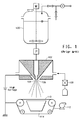
- Figure 1 is a schematic of a prior art electroblowing apparatus useful for preparing a fibrous web according to the invention.
- a typical relaxation time for this process is 0.1 to 0.3 seconds. Relaxation times higher than this range correspond to a charge that cannot redistribute itself in the solvent fast enough.
- the present invention uses an electroblowing process to spin a weakly interacting polymer from a polymer solution with low electrical conductivity into fibers and webs.
- FIG. 1 is a schematic diagram of an electroblowing apparatus useful for carrying out the process of the present invention using electroblowing (or "electro-blown spinning") as described in International Publication Number WO2003/080905 .
- This prior art electroblowing method comprises feeding a solution of a polymer in a solvent from a storage tank 100, through a spinneret 102, to a spinning nozzle 104 to which a high voltage is applied, while compressed gas or blowing gas is directed toward the polymer solution through a blowing gas nozzle 106 as the polymer solution exits the spinning nozzle 104 to form fibers, and collecting the fibers into a web on a grounded collector 110 under vacuum created by vacuum chamber 114 and blower 112.
- the fibers can be used in either continuous or discontinuous form.
- the collection apparatus is preferably a moving collection belt positioned within the electrostatic field between the spinneret 102 and the collector 110. After being collected, the fiber layer is directed to and wound onto a wind-up roll on the downstream side of the collector 110.
- the fibrous web can be deposited onto any of a variety of porous scrim materials arranged on the moving collection belt, such as spunbonded nonwovens, meltblown nonwovens, needle punched nonwovens, woven fabrics, knit fabrics, apertured films, paper and combinations thereof.
- a secondary gas can contact the fibers downstream from the spinneret to help drive off solvent from the fiber.
- the secondary gas can be positioned to impinge the fibers or can be used as a sweeping gas to help remove solvent from the general spinning area.
- the polymers of the present invention are weakly interacting polymers having a dielectric constant of less than about 3. These polymers interact via weak dispersion forces.
- These polymers generally include hydrocarbon polymers.
- hydrocarbon polymers suitable for the present invention include polyolefins, polydienes and polystyrene.
- polyolefins include polyethylene, polypropylene, poly(1-butene), poly(4-methyl-1-pentene), and blends, mixtures and copolymers thereof.
- at least one of these polymers, more typically only one of these polymers at a time is utilized in the process of the present invention.
- Suitable solvents that may be used to dissolve the polymers of the invention include weakly interacting solvents having a dielectric constant of less than about 3. These solvents interact via weak dispersion forces.
- a solvent for a polymer may be found by selecting a solvent with a solubility parameter similar to that of the polymer.
- a typical class of weakly interacting solvents is hydrocarbon solvents. Examples of hydrocarbons are pentane, hexane, heptane, octane, decane, cyclohexane, methylcyclohexane, benzene, toluene, xylene and decalin.
- polymer spinning solutions examples include polyethylene dissolved in solvents of p-xylene or decane, polypropylene dissolved in solvents of p-xylene or methylcyclohexane, poly(4-methyl-1-pentene) dissolved in solvents of methylcyclohexane or cyclohexane, and polystyrene dissolved in toluene or decaline.
- the polymer solution can be spun at discharge rate through the spinning nozzle of the spinneret between about 0.1 to about 100 ml/min/hole, more advantageously between about 1 to about 100 ml/min/hole, still more advantageously between about 6 to about 100 ml/min/hole and most advantageously between about 10 to about 100 ml/min/hole.
- the blowing gas can be selected from the group of air, nitrogen, argon, helium, carbon dioxide, hydrocarbons, halocarbons, halohydrocarbons and mixtures thereof.
- the blowing gas is injected at a flow velocity of about 50 to about 340 m/sec and a temperature from about ambient to about 300°C.
- the fibers produced have a number average fiber diameter preferably less than 1,000 nanometers, more preferably less than 800 nanometers and most preferably less than 500 nanometers.
- the fibers can have an essentially round cross section shape.
- the electric field can have a voltage potential of about 10 to about 100 kV.
- the electric field can be used to create a corona charge.
- the fibers can be collected into a fibrous web comprising continuous, round cross section, weakly interacting polymer fibers having a number average fiber diameter less than about 1,000 nanometers.
- the secondary gas can be selected from the group of air, nitrogen, argon, helium, carbon dioxide, hydrocarbons, halocarbons, halohydrocarbons and mixtures thereof.
- the secondary gas is injected at a flow velocity of about 50 to about 340 m/sec and a temperature from about ambient to about 300°C.
- Fiber Diameter was determined as follows. Two to three scanning electron microscope (SEM) images were taken of each fine fiber layer sample. The diameter of clearly distinguishable fine fibers were measured from the photographs and recorded. Defects were not included (i.e., lumps of fine fibers, polymer drops, intersections of fine fibers). The number average fiber diameter from about 50 to 300 counts for each sample was calculated.
- Air was used for the blowing gas.
- Nitrogen was used for the secondary gas to control the relative humidity (RH) and the temperature in the spin chamber. The flow of nitrogen was sufficient to prevent the concentration of the solvent vapor in the spin chamber from exceeding the lower explosion limit. The RH was controlled to be less than 10%.
- the spin chamber temperature was close to 25 °C for the duration of the experiment.
- a nitrogen pressure of 0.377 MPa was used to maintain a solution flow rate of 1.6 ml/min/hole.
- the blowing gas was controlled to maintain an exit velocity on the order of 150 m/sec.
- the blowing gas temperature was close to 25 °C.
- a magnetic stirrer was used to agitate the hot solution.
- the homogeneous solution was transferred to a sealed glass container and transported to the spin chamber.
- the solution was transferred into the reservoir of the spin chamber and sealed.
- a spinneret with a 0.4064 mm inside diameter single spinning nozzle was used.
- a drum collector was used to collect the sample.
- the spinneret was placed at a negative electrical potential of 100 kV.
- the drum collector was grounded. The distance from the spinning nozzle exit to the collector surface was 51 cm.
- Air was used for the blowing gas and for the secondary gas to control the RH and the temperature in the spin chamber.
- the RH was controlled to be less than 20%.
- the spin chamber temperature was close to 26°C for the duration of the experiment.
- a nitrogen pressure of 0.135 MPa was used to maintain a solution flow rate of 1.27 ml/min/hole.
- the blowing gas was controlled to maintain an exit velocity on the order of 85 m/sec.
- the blowing gas temperature was close to 26°C.
- Engage 8400 an ethylene octene copolymer having a dielectric constant of 2.2, available from DuPont, was dissolved in methylcyclohexane using a reflux condenser. A magnetic stirrer was used to agitate the hot solution. The homogeneous solution was transferred to a sealed glass container and transported to the spin chamber. The solution was transferred into the reservoir of the spin chamber and sealed. A spinneret with a 0.4064 mm inside diameter single spinning nozzle was used. A drum collector was used to collect the sample. The spinneret was placed at a negative potential of 100 kV. The collector was grounded. The distance from the spinning nozzle exit to the collector surface was 30 cm.
- Engage 8400 an ethylene octene copolymer having a dielectric constant of 2.2, available from DuPont
- Air was used for the blowing gas.
- Nitrogen was used for the secondary gas to control the RH and the temperature in the spin chamber. The flow of nitrogen was sufficient to avoid the concentration of the solvent vapor in the spin chamber exceeding the lower explosion limit.
- the RH was controlled to be less than 9%.
- the spin chamber temperature was close to 29 °C for the duration of the experiment.
- a nitrogen pressure of 0.308 MPa was used to maintain a solution flow rate of 12.6 ml/min/hole.
- the blowing gas was controlled to maintain an exit velocity on the order of 156 m/sec.
- the blowing gas temperature was close to 28 °C.
Landscapes
- Engineering & Computer Science (AREA)
- Textile Engineering (AREA)
- Chemical & Material Sciences (AREA)
- Chemical Kinetics & Catalysis (AREA)
- General Chemical & Material Sciences (AREA)
- Mechanical Engineering (AREA)
- Dispersion Chemistry (AREA)
- Spinning Methods And Devices For Manufacturing Artificial Fibers (AREA)
- Nonwoven Fabrics (AREA)
Applications Claiming Priority (2)
| Application Number | Priority Date | Filing Date | Title |
|---|---|---|---|
| US19110308P | 2008-09-05 | 2008-09-05 | |
| PCT/US2009/056181 WO2010028339A1 (en) | 2008-09-05 | 2009-09-08 | Fiber spinning process using a weakly interacting polymer |
Publications (2)
| Publication Number | Publication Date |
|---|---|
| EP2318576A1 EP2318576A1 (en) | 2011-05-11 |
| EP2318576B1 true EP2318576B1 (en) | 2013-03-27 |
Family
ID=41228573
Family Applications (1)
| Application Number | Title | Priority Date | Filing Date |
|---|---|---|---|
| EP09792303A Active EP2318576B1 (en) | 2008-09-05 | 2009-09-08 | Fiber spinning process using a weakly interacting polymer |
Country Status (7)
| Country | Link |
|---|---|
| US (1) | US8211353B2 (enExample) |
| EP (1) | EP2318576B1 (enExample) |
| JP (1) | JP5480904B2 (enExample) |
| KR (1) | KR101693390B1 (enExample) |
| CN (1) | CN102144055B (enExample) |
| BR (1) | BRPI0913520A2 (enExample) |
| WO (1) | WO2010028339A1 (enExample) |
Families Citing this family (15)
| Publication number | Priority date | Publication date | Assignee | Title |
|---|---|---|---|---|
| US20100059906A1 (en) * | 2008-09-05 | 2010-03-11 | E. I. Du Pont De Nemours And Company | High throughput electroblowing process |
| US8465691B1 (en) | 2010-05-26 | 2013-06-18 | The Boeing Company | Method for manufacturing indium tin oxide nanowires |
| KR20130125287A (ko) | 2010-05-29 | 2013-11-18 | 애쉴리 에스. 스코트 | 정전기 유도 용매 분출 또는 입자 형성을 위한 장치, 방법 및 유체 조성물 |
| CN102121173B (zh) * | 2011-02-22 | 2012-05-30 | 天津工业大学 | 一种超细纤维非织造布吸音隔热材料的制备方法 |
| CN102071542B (zh) * | 2011-02-22 | 2012-08-29 | 天津工业大学 | 一种聚合物纳微纤维非织造布的制备方法 |
| CN102505357A (zh) * | 2011-09-22 | 2012-06-20 | 东华大学 | 一种血液过滤用静电纺熔喷复合非织造材料及其制备方法 |
| CN104099674A (zh) * | 2014-05-19 | 2014-10-15 | 浙江大东南集团有限公司 | 一种气流助力式连续纳米纤维膜静电纺丝装置 |
| US10344399B2 (en) | 2015-10-09 | 2019-07-09 | Massachusetts Institute Of Technology | Gel-electrospinning process for preparing high-performance polymer nanofibers |
| US10895028B2 (en) | 2015-12-14 | 2021-01-19 | Dupont Industrial Biosciences Usa, Llc | Nonwoven glucan webs |
| CN107142534B (zh) * | 2017-05-25 | 2019-05-03 | 天津工业大学 | 一种溶液喷射纺丝设备 |
| KR102080990B1 (ko) | 2018-06-05 | 2020-02-24 | 서정옥 | 차량용 홀더형 음료용기 보관용구 |
| EP3747855B1 (de) | 2019-06-04 | 2024-01-10 | OQ Chemicals GmbH | Verfahren zur kontinuierlichen herstellung von diolen aus aldehyden mittels raney-cobalt katalyse |
| EP3954811A1 (en) * | 2020-08-13 | 2022-02-16 | Gelatex Technologies OÜ | Device and method for producing polymer fibers and its uses thereof |
| EP4565732A1 (en) * | 2022-08-05 | 2025-06-11 | Matregenix, Inc. | Electrospinning systems for mass production of nanofibers |
| US20250257497A1 (en) * | 2024-02-09 | 2025-08-14 | Moleaer, Inc. | Nanobubbles for preparation of spun fibrous materials |
Family Cites Families (10)
| Publication number | Priority date | Publication date | Assignee | Title |
|---|---|---|---|---|
| KR100549140B1 (ko) | 2002-03-26 | 2006-02-03 | 이 아이 듀폰 디 네모아 앤드 캄파니 | 일렉트로-브로운 방사법에 의한 초극세 나노섬유 웹제조방법 |
| US20050187605A1 (en) | 2002-04-11 | 2005-08-25 | Greenhalgh Skott E. | Electrospun skin capable of controlling drug release rates and method |
| US8066932B2 (en) * | 2003-09-05 | 2011-11-29 | Board of Supervisors of Louisiana State Universtiy and Agricultural and Mechanical College, on behalf of The University of New Orleans | Process of fabricating nanofibers by reactive electrospinning |
| JP4351094B2 (ja) * | 2004-03-22 | 2009-10-28 | 日本バイリーン株式会社 | 繊維の製造方法及び製造装置 |
| US20060012084A1 (en) * | 2004-07-13 | 2006-01-19 | Armantrout Jack E | Electroblowing web formation process |
| US7887311B2 (en) * | 2004-09-09 | 2011-02-15 | The Research Foundation Of State University Of New York | Apparatus and method for electro-blowing or blowing-assisted electro-spinning technology |
| US7846374B2 (en) | 2004-11-05 | 2010-12-07 | E. I. Du Pont De Nemours And Company | Blowing gases in electroblowing process |
| US20060135020A1 (en) * | 2004-12-17 | 2006-06-22 | Weinberg Mark G | Flash spun web containing sub-micron filaments and process for forming same |
| US7582247B2 (en) | 2005-08-17 | 2009-09-01 | E. I. Du Pont De Nemours And Company | Electroblowing fiber spinning process |
| US8083983B2 (en) | 2005-11-28 | 2011-12-27 | Rabolt John F | Method of solution preparation of polyolefin class polymers for electrospinning processing included |
-
2009
- 2009-09-03 US US12/553,578 patent/US8211353B2/en active Active
- 2009-09-08 WO PCT/US2009/056181 patent/WO2010028339A1/en not_active Ceased
- 2009-09-08 EP EP09792303A patent/EP2318576B1/en active Active
- 2009-09-08 CN CN200980134778.9A patent/CN102144055B/zh active Active
- 2009-09-08 BR BRPI0913520A patent/BRPI0913520A2/pt not_active IP Right Cessation
- 2009-09-08 JP JP2011526261A patent/JP5480904B2/ja active Active
- 2009-09-08 KR KR1020117007757A patent/KR101693390B1/ko active Active
Also Published As
| Publication number | Publication date |
|---|---|
| JP2012502198A (ja) | 2012-01-26 |
| WO2010028339A1 (en) | 2010-03-11 |
| CN102144055A (zh) | 2011-08-03 |
| KR20110055714A (ko) | 2011-05-25 |
| CN102144055B (zh) | 2014-03-05 |
| BRPI0913520A2 (pt) | 2019-04-30 |
| JP5480904B2 (ja) | 2014-04-23 |
| KR101693390B1 (ko) | 2017-01-06 |
| EP2318576A1 (en) | 2011-05-11 |
| US20100059907A1 (en) | 2010-03-11 |
| US8211353B2 (en) | 2012-07-03 |
Similar Documents
| Publication | Publication Date | Title |
|---|---|---|
| US8211353B2 (en) | Fiber spinning process using a weakly interacting polymer | |
| KR101730663B1 (ko) | 부직 중합체성 웨브 | |
| Polat et al. | Solution blowing of thermoplastic polyurethane nanofibers: A facile method to produce flexible porous materials | |
| EP1844188B1 (en) | Process for forming a flash spun web containing sub-micron filaments | |
| EP2321451B1 (en) | High throughput electroblowing process | |
| Spasova et al. | Perspectives on: Criteria for complex evaluation of the morphology and alignment of electrospun polymer nanofibers | |
| US20080063741A1 (en) | Electrospinning in a controlled gaseous environment | |
| JPH0140141B2 (enExample) | ||
| DK157286B (da) | Ansigtsmaske samt fremgangsmaade til fremstilling af et fiberbaneelektreret til brug som filterlag i ansigtsmasken | |
| JPWO2012014501A1 (ja) | 繊維不織布、およびその製造方法と製造装置 | |
| JP2003511577A (ja) | フリー繊維および極性液体による不織繊維エレクトレットウェブを製造するための方法および装置 | |
| JP2005029931A (ja) | 不織布及びその製造方法 | |
| Amirah Md Zubir et al. | Electrospinning of PLA with DMF: Effect of polymer concentration on the bead diameter of the electrospun fibre | |
| KR20080083637A (ko) | 용액 전기방사로 폴리올레핀 마이크로섬유를 제조하는 방법 및 제조된 섬유 | |
| US20170088980A1 (en) | Method for manufacturing ultrafine fiber | |
| Menaka et al. | Electrospinning with curved nozzle spinneret for producing poly (vinyl Alcohol) nanomembrane for filtration | |
| Nayak et al. | Nanotextiles and recent developments | |
| WO2014089458A1 (en) | Apparatus and method using an electric field for creating uniform nanofiber patterns on nonconductive materials to enhance filtration and for embedment of fibers into materials for other applications | |
| KR20110079204A (ko) | 전기방사용 노즐블럭 및 이를 구비하는 전기방사장치 | |
| JP2007224466A (ja) | 極細繊維集合体 | |
| KR20250075072A (ko) | 초극세 나노섬유 부직포 제조용 용융분사 전기방사장치 |
Legal Events
| Date | Code | Title | Description |
|---|---|---|---|
| PUAI | Public reference made under article 153(3) epc to a published international application that has entered the european phase |
Free format text: ORIGINAL CODE: 0009012 |
|
| 17P | Request for examination filed |
Effective date: 20110215 |
|
| AK | Designated contracting states |
Kind code of ref document: A1 Designated state(s): AT BE BG CH CY CZ DE DK EE ES FI FR GB GR HR HU IE IS IT LI LT LU LV MC MK MT NL NO PL PT RO SE SI SK SM TR |
|
| AX | Request for extension of the european patent |
Extension state: AL BA RS |
|
| RIN1 | Information on inventor provided before grant (corrected) |
Inventor name: DEE, GREGORY, T. Inventor name: MEERVELD, JAN, VAN Inventor name: HOVANEC, JOSEPH, BRIAN |
|
| 17Q | First examination report despatched |
Effective date: 20110803 |
|
| DAX | Request for extension of the european patent (deleted) | ||
| GRAP | Despatch of communication of intention to grant a patent |
Free format text: ORIGINAL CODE: EPIDOSNIGR1 |
|
| GRAS | Grant fee paid |
Free format text: ORIGINAL CODE: EPIDOSNIGR3 |
|
| GRAA | (expected) grant |
Free format text: ORIGINAL CODE: 0009210 |
|
| AK | Designated contracting states |
Kind code of ref document: B1 Designated state(s): AT BE BG CH CY CZ DE DK EE ES FI FR GB GR HR HU IE IS IT LI LT LU LV MC MK MT NL NO PL PT RO SE SI SK SM TR |
|
| REG | Reference to a national code |
Ref country code: GB Ref legal event code: FG4D |
|
| REG | Reference to a national code |
Ref country code: CH Ref legal event code: EP |
|
| REG | Reference to a national code |
Ref country code: AT Ref legal event code: REF Ref document number: 603480 Country of ref document: AT Kind code of ref document: T Effective date: 20130415 |
|
| REG | Reference to a national code |
Ref country code: IE Ref legal event code: FG4D |
|
| REG | Reference to a national code |
Ref country code: DE Ref legal event code: R096 Ref document number: 602009014500 Country of ref document: DE Effective date: 20130529 |
|
| PG25 | Lapsed in a contracting state [announced via postgrant information from national office to epo] |
Ref country code: LT Free format text: LAPSE BECAUSE OF FAILURE TO SUBMIT A TRANSLATION OF THE DESCRIPTION OR TO PAY THE FEE WITHIN THE PRESCRIBED TIME-LIMIT Effective date: 20130327 Ref country code: BG Free format text: LAPSE BECAUSE OF FAILURE TO SUBMIT A TRANSLATION OF THE DESCRIPTION OR TO PAY THE FEE WITHIN THE PRESCRIBED TIME-LIMIT Effective date: 20130627 Ref country code: NO Free format text: LAPSE BECAUSE OF FAILURE TO SUBMIT A TRANSLATION OF THE DESCRIPTION OR TO PAY THE FEE WITHIN THE PRESCRIBED TIME-LIMIT Effective date: 20130627 Ref country code: SE Free format text: LAPSE BECAUSE OF FAILURE TO SUBMIT A TRANSLATION OF THE DESCRIPTION OR TO PAY THE FEE WITHIN THE PRESCRIBED TIME-LIMIT Effective date: 20130327 |
|
| REG | Reference to a national code |
Ref country code: AT Ref legal event code: MK05 Ref document number: 603480 Country of ref document: AT Kind code of ref document: T Effective date: 20130327 |
|
| REG | Reference to a national code |
Ref country code: LT Ref legal event code: MG4D |
|
| PG25 | Lapsed in a contracting state [announced via postgrant information from national office to epo] |
Ref country code: GR Free format text: LAPSE BECAUSE OF FAILURE TO SUBMIT A TRANSLATION OF THE DESCRIPTION OR TO PAY THE FEE WITHIN THE PRESCRIBED TIME-LIMIT Effective date: 20130628 Ref country code: LV Free format text: LAPSE BECAUSE OF FAILURE TO SUBMIT A TRANSLATION OF THE DESCRIPTION OR TO PAY THE FEE WITHIN THE PRESCRIBED TIME-LIMIT Effective date: 20130327 Ref country code: SI Free format text: LAPSE BECAUSE OF FAILURE TO SUBMIT A TRANSLATION OF THE DESCRIPTION OR TO PAY THE FEE WITHIN THE PRESCRIBED TIME-LIMIT Effective date: 20130327 Ref country code: FI Free format text: LAPSE BECAUSE OF FAILURE TO SUBMIT A TRANSLATION OF THE DESCRIPTION OR TO PAY THE FEE WITHIN THE PRESCRIBED TIME-LIMIT Effective date: 20130327 |
|
| REG | Reference to a national code |
Ref country code: NL Ref legal event code: VDEP Effective date: 20130327 |
|
| PG25 | Lapsed in a contracting state [announced via postgrant information from national office to epo] |
Ref country code: BE Free format text: LAPSE BECAUSE OF FAILURE TO SUBMIT A TRANSLATION OF THE DESCRIPTION OR TO PAY THE FEE WITHIN THE PRESCRIBED TIME-LIMIT Effective date: 20130327 Ref country code: HR Free format text: LAPSE BECAUSE OF FAILURE TO SUBMIT A TRANSLATION OF THE DESCRIPTION OR TO PAY THE FEE WITHIN THE PRESCRIBED TIME-LIMIT Effective date: 20130327 |
|
| PG25 | Lapsed in a contracting state [announced via postgrant information from national office to epo] |
Ref country code: EE Free format text: LAPSE BECAUSE OF FAILURE TO SUBMIT A TRANSLATION OF THE DESCRIPTION OR TO PAY THE FEE WITHIN THE PRESCRIBED TIME-LIMIT Effective date: 20130327 Ref country code: RO Free format text: LAPSE BECAUSE OF FAILURE TO SUBMIT A TRANSLATION OF THE DESCRIPTION OR TO PAY THE FEE WITHIN THE PRESCRIBED TIME-LIMIT Effective date: 20130327 Ref country code: IS Free format text: LAPSE BECAUSE OF FAILURE TO SUBMIT A TRANSLATION OF THE DESCRIPTION OR TO PAY THE FEE WITHIN THE PRESCRIBED TIME-LIMIT Effective date: 20130727 Ref country code: CZ Free format text: LAPSE BECAUSE OF FAILURE TO SUBMIT A TRANSLATION OF THE DESCRIPTION OR TO PAY THE FEE WITHIN THE PRESCRIBED TIME-LIMIT Effective date: 20130327 Ref country code: SK Free format text: LAPSE BECAUSE OF FAILURE TO SUBMIT A TRANSLATION OF THE DESCRIPTION OR TO PAY THE FEE WITHIN THE PRESCRIBED TIME-LIMIT Effective date: 20130327 Ref country code: PT Free format text: LAPSE BECAUSE OF FAILURE TO SUBMIT A TRANSLATION OF THE DESCRIPTION OR TO PAY THE FEE WITHIN THE PRESCRIBED TIME-LIMIT Effective date: 20130729 Ref country code: AT Free format text: LAPSE BECAUSE OF FAILURE TO SUBMIT A TRANSLATION OF THE DESCRIPTION OR TO PAY THE FEE WITHIN THE PRESCRIBED TIME-LIMIT Effective date: 20130327 Ref country code: NL Free format text: LAPSE BECAUSE OF FAILURE TO SUBMIT A TRANSLATION OF THE DESCRIPTION OR TO PAY THE FEE WITHIN THE PRESCRIBED TIME-LIMIT Effective date: 20130327 Ref country code: ES Free format text: LAPSE BECAUSE OF FAILURE TO SUBMIT A TRANSLATION OF THE DESCRIPTION OR TO PAY THE FEE WITHIN THE PRESCRIBED TIME-LIMIT Effective date: 20130708 |
|
| PG25 | Lapsed in a contracting state [announced via postgrant information from national office to epo] |
Ref country code: CY Free format text: LAPSE BECAUSE OF FAILURE TO SUBMIT A TRANSLATION OF THE DESCRIPTION OR TO PAY THE FEE WITHIN THE PRESCRIBED TIME-LIMIT Effective date: 20130327 Ref country code: PL Free format text: LAPSE BECAUSE OF FAILURE TO SUBMIT A TRANSLATION OF THE DESCRIPTION OR TO PAY THE FEE WITHIN THE PRESCRIBED TIME-LIMIT Effective date: 20130327 |
|
| PG25 | Lapsed in a contracting state [announced via postgrant information from national office to epo] |
Ref country code: DK Free format text: LAPSE BECAUSE OF FAILURE TO SUBMIT A TRANSLATION OF THE DESCRIPTION OR TO PAY THE FEE WITHIN THE PRESCRIBED TIME-LIMIT Effective date: 20130327 |
|
| PLBE | No opposition filed within time limit |
Free format text: ORIGINAL CODE: 0009261 |
|
| STAA | Information on the status of an ep patent application or granted ep patent |
Free format text: STATUS: NO OPPOSITION FILED WITHIN TIME LIMIT |
|
| PG25 | Lapsed in a contracting state [announced via postgrant information from national office to epo] |
Ref country code: IT Free format text: LAPSE BECAUSE OF FAILURE TO SUBMIT A TRANSLATION OF THE DESCRIPTION OR TO PAY THE FEE WITHIN THE PRESCRIBED TIME-LIMIT Effective date: 20130327 |
|
| 26N | No opposition filed |
Effective date: 20140103 |
|
| REG | Reference to a national code |
Ref country code: DE Ref legal event code: R097 Ref document number: 602009014500 Country of ref document: DE Effective date: 20140103 |
|
| PG25 | Lapsed in a contracting state [announced via postgrant information from national office to epo] |
Ref country code: MC Free format text: LAPSE BECAUSE OF FAILURE TO SUBMIT A TRANSLATION OF THE DESCRIPTION OR TO PAY THE FEE WITHIN THE PRESCRIBED TIME-LIMIT Effective date: 20130327 |
|
| REG | Reference to a national code |
Ref country code: CH Ref legal event code: PL |
|
| REG | Reference to a national code |
Ref country code: IE Ref legal event code: MM4A |
|
| PG25 | Lapsed in a contracting state [announced via postgrant information from national office to epo] |
Ref country code: LI Free format text: LAPSE BECAUSE OF NON-PAYMENT OF DUE FEES Effective date: 20130930 Ref country code: CH Free format text: LAPSE BECAUSE OF NON-PAYMENT OF DUE FEES Effective date: 20130930 Ref country code: IE Free format text: LAPSE BECAUSE OF NON-PAYMENT OF DUE FEES Effective date: 20130908 |
|
| PG25 | Lapsed in a contracting state [announced via postgrant information from national office to epo] |
Ref country code: SM Free format text: LAPSE BECAUSE OF FAILURE TO SUBMIT A TRANSLATION OF THE DESCRIPTION OR TO PAY THE FEE WITHIN THE PRESCRIBED TIME-LIMIT Effective date: 20130327 |
|
| PG25 | Lapsed in a contracting state [announced via postgrant information from national office to epo] |
Ref country code: MT Free format text: LAPSE BECAUSE OF FAILURE TO SUBMIT A TRANSLATION OF THE DESCRIPTION OR TO PAY THE FEE WITHIN THE PRESCRIBED TIME-LIMIT Effective date: 20130327 Ref country code: TR Free format text: LAPSE BECAUSE OF FAILURE TO SUBMIT A TRANSLATION OF THE DESCRIPTION OR TO PAY THE FEE WITHIN THE PRESCRIBED TIME-LIMIT Effective date: 20130327 |
|
| PG25 | Lapsed in a contracting state [announced via postgrant information from national office to epo] |
Ref country code: MK Free format text: LAPSE BECAUSE OF FAILURE TO SUBMIT A TRANSLATION OF THE DESCRIPTION OR TO PAY THE FEE WITHIN THE PRESCRIBED TIME-LIMIT Effective date: 20130327 Ref country code: LU Free format text: LAPSE BECAUSE OF NON-PAYMENT OF DUE FEES Effective date: 20130908 Ref country code: HU Free format text: LAPSE BECAUSE OF FAILURE TO SUBMIT A TRANSLATION OF THE DESCRIPTION OR TO PAY THE FEE WITHIN THE PRESCRIBED TIME-LIMIT; INVALID AB INITIO Effective date: 20090908 |
|
| REG | Reference to a national code |
Ref country code: FR Ref legal event code: PLFP Year of fee payment: 8 |
|
| REG | Reference to a national code |
Ref country code: FR Ref legal event code: PLFP Year of fee payment: 9 |
|
| REG | Reference to a national code |
Ref country code: FR Ref legal event code: PLFP Year of fee payment: 10 |
|
| REG | Reference to a national code |
Ref country code: DE Ref legal event code: R081 Ref document number: 602009014500 Country of ref document: DE Owner name: DUPONT SAFETY & CONSTRUCTION, INC., WILMINGTON, US Free format text: FORMER OWNER: E.I. DU PONT DE NEMOURS AND COMPANY, INC., WILMINGTON, DEL., US |
|
| REG | Reference to a national code |
Ref country code: GB Ref legal event code: 732E Free format text: REGISTERED BETWEEN 20221027 AND 20221102 |
|
| P01 | Opt-out of the competence of the unified patent court (upc) registered |
Effective date: 20230528 |
|
| PGFP | Annual fee paid to national office [announced via postgrant information from national office to epo] |
Ref country code: DE Payment date: 20250730 Year of fee payment: 17 |
|
| PGFP | Annual fee paid to national office [announced via postgrant information from national office to epo] |
Ref country code: GB Payment date: 20250731 Year of fee payment: 17 |
|
| PGFP | Annual fee paid to national office [announced via postgrant information from national office to epo] |
Ref country code: FR Payment date: 20250808 Year of fee payment: 17 |