EP2303905B1 - Procede de synthese d'arn par voie chimique - Google Patents
Procede de synthese d'arn par voie chimique Download PDFInfo
- Publication number
- EP2303905B1 EP2303905B1 EP09754068A EP09754068A EP2303905B1 EP 2303905 B1 EP2303905 B1 EP 2303905B1 EP 09754068 A EP09754068 A EP 09754068A EP 09754068 A EP09754068 A EP 09754068A EP 2303905 B1 EP2303905 B1 EP 2303905B1
- Authority
- EP
- European Patent Office
- Prior art keywords
- group
- formula
- natural
- modified
- protected
- Prior art date
- Legal status (The legal status is an assumption and is not a legal conclusion. Google has not performed a legal analysis and makes no representation as to the accuracy of the status listed.)
- Active
Links
- 0 CC1[C@](C)O[C@@](CO)C1* Chemical compound CC1[C@](C)O[C@@](CO)C1* 0.000 description 3
Classifications
-
- C—CHEMISTRY; METALLURGY
- C07—ORGANIC CHEMISTRY
- C07H—SUGARS; DERIVATIVES THEREOF; NUCLEOSIDES; NUCLEOTIDES; NUCLEIC ACIDS
- C07H1/00—Processes for the preparation of sugar derivatives
-
- C—CHEMISTRY; METALLURGY
- C07—ORGANIC CHEMISTRY
- C07H—SUGARS; DERIVATIVES THEREOF; NUCLEOSIDES; NUCLEOTIDES; NUCLEIC ACIDS
- C07H19/00—Compounds containing a hetero ring sharing one ring hetero atom with a saccharide radical; Nucleosides; Mononucleotides; Anhydro-derivatives thereof
- C07H19/02—Compounds containing a hetero ring sharing one ring hetero atom with a saccharide radical; Nucleosides; Mononucleotides; Anhydro-derivatives thereof sharing nitrogen
- C07H19/04—Heterocyclic radicals containing only nitrogen atoms as ring hetero atom
- C07H19/06—Pyrimidine radicals
-
- C—CHEMISTRY; METALLURGY
- C07—ORGANIC CHEMISTRY
- C07H—SUGARS; DERIVATIVES THEREOF; NUCLEOSIDES; NUCLEOTIDES; NUCLEIC ACIDS
- C07H19/00—Compounds containing a hetero ring sharing one ring hetero atom with a saccharide radical; Nucleosides; Mononucleotides; Anhydro-derivatives thereof
- C07H19/02—Compounds containing a hetero ring sharing one ring hetero atom with a saccharide radical; Nucleosides; Mononucleotides; Anhydro-derivatives thereof sharing nitrogen
- C07H19/04—Heterocyclic radicals containing only nitrogen atoms as ring hetero atom
- C07H19/16—Purine radicals
-
- C—CHEMISTRY; METALLURGY
- C07—ORGANIC CHEMISTRY
- C07H—SUGARS; DERIVATIVES THEREOF; NUCLEOSIDES; NUCLEOTIDES; NUCLEIC ACIDS
- C07H21/00—Compounds containing two or more mononucleotide units having separate phosphate or polyphosphate groups linked by saccharide radicals of nucleoside groups, e.g. nucleic acids
- C07H21/02—Compounds containing two or more mononucleotide units having separate phosphate or polyphosphate groups linked by saccharide radicals of nucleoside groups, e.g. nucleic acids with ribosyl as saccharide radical
Definitions
- the present invention relates to a method for synthesizing RNA, a method for releasing protected RNA, and a method for synthesizing protected ribonucleotide monomers.
- RNA interference RNA interference
- RNAs may be natural or modified ribonucleotide units, either by nucleobase or ribose ring modification, as known in the art, and in particular as described in US Pat. Watts, JK et al., Drug Discovery Today, Vol. 13, 19/20, October 2008 , Schram KH et al., Mass Spectrometry Reviews, 1998, 17, 131-251 , and Porcher et al., Helvetica Chimica Acta., Vol. 88, 2005, pp. 2683-2704 .
- RNA synthesis In comparison to DNA synthesis, the production of synthetic RNA is more complex because of the presence of the hydroxyl function at the 2 'position of the ribose sugar which must be protected.
- the search for the ideal protecting group is a crucial point in the success of RNA synthesis.
- the main difficulty of RNA chemistry results from the instability of RNA in basic medium.
- the two most currently used pathways for synthesizing RNAs chemically are, on the one hand, the phosphoramidite pathway, and, on the other hand, the hydrogenphosphonate pathway. (H-phosphonates).
- TSE trimethylsilylethyl
- the trimethylsilylethyl (TSE) group can also be used as a phosphate protecting group, as taught, for example in Parey et al. "First Evaluation of Acyloxymethyl or Acylthiomethyl Groups as Biolabile 2'-O-Protections of RNA", Organic Letters, 2006, Vol.8, No.17, 3869-3872 . But it is indicated in this document that the TSE group was chosen because, unlike the cyanoethyl group, it is not removed under basic conditions but by fluoride ions. It is also indicated in this document that in reality the TSE group has been removed by the iodine solution used for the oxidation carried out to obtain the 3'-5 'phosphodiester bonds.
- RNA In the hydrogenphosphonate route, monomers functionalized at the 3 'end are assembled with a hydrogenophosphonate monoester group, the assembled RNA then having a 3'-5' internucleotide linkage which is a hydrogenphosphonate diester link which is then oxidized to phosphate. In this way, the RNA obtained at the end of elongation and after oxidation has internucleoside bonds 3'-5 'unprotected phosphates.
- TDMS tert- butyldimethylsilyl group
- TOM triisopropylsilyloxymethyl
- ACE bis (2-acetoxyethyloxy) methyl
- DTM tert- butyldithiomethyl
- CEE 1- (2-cyanoethoxy) ethyl
- CEM 2- (4-tolylsulfonyl) ethoxymethyl
- TEM levulinyl and 2-cyanoethyl
- most of these groups are, like TBDMS, removed by fluoride ions. But deprotection by fluoride ions is a major obstacle to obtain pure oligoribonucleotides due to their salt pollution, leading to additional long purification procedures.
- the aim of the invention is to overcome the disadvantages of prior art RNA chemical synthesis methods, both of siRNAs and of longer RNAs, as well as RNAs comprising natural nucleobases and modified or modified nucleobases. than RNA comprising a natural or modified ribose ring, by proposing an RNA synthesis method, which uses a hydroxyl-protecting group at the 2 'position of the ribose which can be removed by a base, without nucleophilic attack of the atom of phosphorus and without breaking the 3'-5 'bonds of the RNA.
- the document CN 1900103A also describes the synthesis of RNA and notably uses as a protective group of the OH function in 2 ', a derivative of acetoscymethyl type, the latter being however hydrolysed in an acidic medium.
- X 3 is a group of formula A.
- X 3 is selected from pivaloyloxymethyl group, isobutyryloxymethyl group, n-butyryloxymethyl group, propionyloxymethyl group and acetyloxymethyl group.
- the nucleobase Bp is natural or modified uracil.
- the four nucleobases uracil, adenine, cytosine and guanine, natural or optionally and independently of one another, are present, and in step b), the removal of the X 3 group is preferably carried out by treatment with a 28% aqueous ammonia solution and then 15% by volume, relative to the volume of ammonia, of isopropylamine is added; then evaporation under reduced pressure.
- the protected RNA and linked to a support of formula I is bound to a solid support by a baso-labile bond.
- the four natural or optionally modified nucleobases independently of each other, thymine, adenine, cytosine, and guanine are present when X 6 is H.
- the invention also proposes a process for synthesizing a double-stranded RNA characterized in that it comprises the synthesis of a single-stranded RNA according to the single-strand RNA synthesis method of the invention, and the hybridization of this single-stranded RNA thus synthesized with a single-stranded RNA having a complementary sequence.
- double-stranded RNA is siRNA.
- the group of formula A is a pivaloyloxymethyl group or an iso- butyryloxymethyl group or an n-butyryloxymethyl group, or a propionyloxymethyl group or an acetyloxymethyl group.
- the protecting group is a dimethoxytrityl group.
- the nucleobase is the cytosine, natural or modified
- the protecting group in step a) is an acetyl group
- the nucleobase is adenine, natural or modified
- the protective group in step a) is a phenoxyacetyl group.
- the nucleobase is guanine, natural or modified
- the protective group in step a) is a tert- butylphenoxyacetyl group or iso propylphenoxyacetyl.
- nucleobase (s) Bp or “Bp” denote a nucleobase uracil, adenine, cytosine or guanine, optionally modified, protected or not as will be clear to those skilled in the art.
- the invention represents a break in prior RNA synthesis strategies, regardless of the number of ribonucleotide units composing it, and that these ribonucleotide units are naturally occurring or chemically modified units in that it utilizes protecting groups of the various reactive functions on ribonucleotides, in particular the phosphate protecting groups of the 3'-5 internucleotide linkages, when the phosphoramidite synthesis route is used, and the hydroxyl protecting groups at the 2 'position of the rings; riboses, which are removed under basic conditions, at the end of the RNA elongation.
- RNA synthesis is incompatible with an entirely baso-labile strategy.
- the key characteristic allowing the use of such an entirely labile-labile strategy is the use, for the protection of the hydroxyl at the 2 'position of the ribose sugar, of protecting groups of the following formula A: wherein X is O or S, R 'is H or CH 3 , and R is selected from linear or branched C 1 -C 4 alkyl and R 1 -OR 2 wherein R 1 is an alkyl group C 1 -C 2 and R 2 is CH 3 or CH 2 CH 2 -O-CH 3 or aryl.
- these protecting groups of formula A are pivaloyloxymethyl or iso- butyryloxymethyl or butyryloxymethyl or propionyloxymethyl or acetyloxymethyl.
- the pivaloyloxymethyl, acetyloxymethyl, pivaloylthiomethyl, and acetylthiomethyl protecting groups have already been introduced at the 2 'position of the ribose ring, forming with the OH at the 2' position of the ribose ring, an O- pivaloyloxymethyl, O- acetyloxymethyl, O- pivaloylthiomethyl or O- acetylthiomethyl, respectively, for the purpose of improving certain properties of the protected RNA, in particular its permeability to cell membranes, its resistance to nucleases, as described in Parey et al, "First Evaluation of Acyloxymethyl or Acylthiomethyl Groups as Biolabile 2'-O-Protections of RNA, Organic Letters", 2006, Vol.8, No.17, 3869-3872. .
- the acetalester groups and in particular the pivaloyloxymethyl, acetyloxymethyl, pivaloylthiomethyl and acetylthiomethyl groups, are described as groups that can allow the RNA thus functionalized at the 2 'position of the ribose ring to cross the membrane. cell and, there, to be deprotected by the cell itself with its enzymatic content.
- These protective groups were therefore described as bio-labile groups and nothing in this document suggests that the use of such protective groups would make it possible to use an RNA synthesis strategy with basofabile protections deprotected under basic conditions.
- the selective introduction of the acetalester group at the 2 'position of the ribonucleoside monomer is carried out by a synthesis in which the Markiewicz reagent (TIPSiCl 2 ) simultaneously blocks the hydroxyls at the 5' and 3 'positions of the ribose and leaves the hydroxyl 2 'free ribose to accept the pivaloyloxymethyl, acetyloxymethyl, pivaloylthiomethyl or acetylthiomethyl group, depending on the selected group.
- TIPSiCl 2 the Markiewicz reagent
- the invention provides a method of synthesizing the ribonucleoside monomer whose nucleobase, and the hydroxyls at the 3 'and 5' position of the ribose are protected in a manner quite conventional in the art, the hydroxyl at the 2-position.
- ribose sugar being protected by an acyloxyalkyl or acylthioalkyl group, more preferably acyloxymethyl, which occurs in four stages with a final yield of between 27% and 37%.
- the first step in this process is to protect the nucleobase when it is different from uracil.
- the second step consists in protecting the hydroxyl at the 5 'position of the ribose ring with a protecting group conventionally used by those skilled in the art for this purpose.
- a protecting group conventionally used by those skilled in the art for this purpose are, inter alia, dimethoxytrityl, monomethoxytrityl and pixyl groups.
- the preferred protecting group used is a dimethoxytrityl acid labile group widely used in oligonucleotide synthesis.
- the third step in the process of synthesizing a ribonucleotide monomer, which serves as a building block for assembling a chain leading to obtaining a single-stranded RNA is the protection of the hydroxyl at the 2-position of ribose by a group of formula A below: wherein X is O or S, R 'is H or CH 3 , and R is selected from linear or branched C 1 -C 4 alkyl and R 1 -OR 2 wherein R 1 is an alkyl group C 1 -C 2 and R 2 is CH 3 or CH 2 CH 2 -O-CH 3 or aryl.
- the hydroxyl protecting group at the 2 'position of the ribose is a pivaloyloxymethyl group or an iso- butyryloxymethyl group, or an n-butyryloxymethyl group, or a propionyloxymethyl group, or an acetyloxymethyl group.
- the hydroxyl protecting group at the 2 'position of the ribose is a pivaloyloxymethyl group.
- the isomer whose hydroxyl at the 2 'position of the ribose ring is protected is separated, and the fourth step of the method for synthesizing the ribonucleotide monomer protected according to the invention then consists in functionalizing the hydroxyl at the 3' position of the ribose with a ribose.
- phosphoryl group well known to those skilled in the art.
- a phosphoramidite group is used, most preferably a 2-cyanoethyl- N, N- diisopropylphosphoramidite group.
- a hydrogenophosphonate monoester group is used for the functionalization of the hydroxyl at the 3 'position.
- the compound of formula III which is then obtained is a compound of formula III in which Bp, X 1 and X 3 are as defined above but X 5 is a hydrogenophosphonate monoester group.
- the method for synthesizing this protected single-stranded RNA is also an object of the invention.
- the synthesis method according to the invention of this single-stranded RNA comprises a step of binding a ribonucleoside or deoxyribonucleoside monomer of formula II with a support as defined above, via a link preferably preferably also labile, followed by a step of assembling such a monomer of formula II with at least one monomer of formula III, and, optionally, an acid treatment step of the monomer assembly obtained to remove the protecting group X 1 , finally, a step of release of the protected RNA thus obtained.
- the RNA on which the release step is carried out is either an RNA of formula I in which X 1 is H when the acid treatment step is performed, or an RNA of formula I in which X 1 is a hydroxyl protecting group when the acid treatment step is not performed.
- the assembly of the ribonucleotide monomers of formula III is generally done by automated synthesis on a solid support.
- the synthesized protected RNA is linked, by its X 4 end in 3 'position, by a bond to the solid support.
- a double-stranded RNA can then be formed by hybridization of the released single-stranded RNA with a single-stranded RNA having a complementary sequence.
- Single-stranded RNA having a complementary sequence may also have been synthesized by the method of the invention, or may have been synthesized by another method.
- siRNA This allows in particular to be able to manufacture siRNA.
- the method for releasing protected single-stranded RNA of formula I is an object of the invention. This method overcomes a prejudice of the prior art in that it consists in eliminating the hydroxyl protecting groups at the 2 'positions of the ribose by a basic treatment.
- this basic treatment comprises a step a) of treating the protected RNA of formula I with a strong base chosen from piperidine, 1,8-diazabicyclo [5.4.0] undec-7-ene (DBU), triethylamine, at room temperature, to release the phosphate internucleotide links 3'-5 '.
- a strong base chosen from piperidine, 1,8-diazabicyclo [5.4.0] undec-7-ene (DBU), triethylamine, at room temperature, to release the phosphate internucleotide links 3'-5 '.
- This step a) is performed only when the phosphoramidite synthesis route is used.
- step a) is followed by a step b) of treatment of the partially liberated RNA obtained in step a), with a strong base chosen from concentrated ammonia, methylamine and potassium carbonate at room temperature. room.
- a strong base chosen from concentrated ammonia, methylamine and potassium carbonate at room temperature. room.
- Step b) is it common for the release of the RNA regardless of the route of synthesis of the RNA used.
- the treatment with piperidine or DBU at ambient temperature is carried out in any appropriate solvent known to those skilled in the art, and more preferably in THF or dry acetonitrile, for 15 minutes (piperidine) or 45 minutes (DBU 0.45M ) or 1 minute (DBU 1 M).
- hydroxyl groups at the 2 'position are then liberated by treatment with concentrated aqueous ammonia at room temperature for 3 hours. No RNA breaks occur at this stage.
- This two-step sequential deprotection with DBU or piperidine first and then with aqueous ammonia is necessary to avoid attack by 2'-hydroxyls released, phosphotriesters or neighboring phosphodiesters, which could lead to chain break.
- a release step of the invention comprises a step of adding 15% isopropylamine after treatment with ammonia.
- the deprotection medium is evaporated under reduced pressure to obtain pure released RNA.
- ribonucleotide monomers of formula III with X 5 is a phosphoramidite group, preferably a 2-cyanoethyl- N, N- diisopropylphosphoramidite group were synthesized according to the following general scheme:
- Bp can also be G i PrPAC , in which case the step of introducing the pivaloyloxymethyl group at the 2 'position of the compound 2a-d is carried out without treatment in the microwaves, as will be explained below. .
- Example 1 Synthesis of monomer 2'-O-pivaloyloxymethyl-5'- O - (4,4'-dimethoxytrityl) uridine-3'-O - (2-cyanoethyl N, N--diisopropylphos phoramidite 5a.
- the monomer synthesized herein has formula III wherein the nucleobase is a uracil nucleobase, the hydroxyl protecting group at the 5 'position of ribose is dimethoxytrityl, the hydroxyl-grafted group at the 3' position of ribose is 2 -cyanoethyl- N, N -diisopropylphosphoramidite, and the hydroxyl protecting group at the 2 'position of the ribose is pivaloyloxymethyl.
- the pivaloyloxymethyl group is first introduced at the 2 'position of the ribose.
- the reaction medium is heated under microwave irradiation (power 300 W) at 75 ° C for 2:30, cooled and the solvent is evaporated.
- reaction mixture is subjected to column chromatography on silica gel with a gradient of acetone (0-40%) in dichloromethane.
- the first eluting isomer is the desired compound 4a. It is obtained in the form of a white foam after evaporation of the solvent.
- This ribonucleotide monomer of formula III is the monomer in which the nucleobase is cytosine, the hydroxyl protecting group at the 5 'position of ribose is dimethoxytrityl, the hydroxyl-grafted group at the 3' position of ribose is 2 -cyanoethyl- N, N- diisopropylphosphoramidite and the hydroxyl protecting group at the 2 'position of the ribose is pivaloyloxymethyl.
- N 4 -acetyl-5'- O- (4,4'-dimethoxytrityl) cytidine 2b is synthesized in this synthesis , which means that this example describes the protection of the OHs at the 2 'and 3' positions of the ribose.
- reaction mixture is subjected to column chromatography on silica gel with a gradient of acetone (40-100%) in dichloromethane.
- the first eluting isomer is the desired compound 4b which is obtained as a white foam after evaporation of the solvent.
- the ribonucleotide monomer of formula III desired 5b is obtained in the form of a white foam after evaporation of the solvent.
- Example 3 Synthesis of N 6 -Phénoxyacétyl-2'-O- pivaloyloxymethyl-5'- O - (4,4'-dimethoxytrityl) adenosine 3'-O- (2-cyanoethyl N, N -diisopropylphosphoramidite) 5c.
- This compound corresponds to the monomer of formula III in which the nucleobase is adenine whose amine is protected by a phenoxyacetyl group, the hydroxyl protecting group at the 5 'position of the ribose is dimethoxytrityl, the group grafted onto the hydroxyl at the 3 'position is 2-cyanoethyl- N, N -diisopropylphosphoramidite, and the hydroxyl protecting group at the 2 'position of the ribose is pivaloyloxymethyl.
- the reaction mixture is subjected to column chromatography on silica gel with a gradient of acetone (0-30%) in dichloromethane.
- the first eluting isomer is the desired compound 4c, in the form of a white foam after evaporation of the solvent.
- the obtained compound 4c (550 mg, 0.67 mmol, 1 eq) is dried by three coevaporations with anhydrous CH 3 CN.
- the residue is then dissolved in anhydrous CH 2 Cl 2 (7 mL) and a mixture of N, N- diisopropylethylamine (211 ⁇ L, 1.21 mmol, 1.8 eq), 2-cyanoethyl- N, N- diisopropylchlorophosphoramidite (223 ⁇ L, 1 mmol, 1.5 eq) and CH 2 Cl 2 (0.5 mL) is added dropwise.
- the mixture is stirred under argon at room temperature for 2 hours. After that, ethyl acetate is added, the reaction mixture is poured into saturated NaHCO 3 solution and Extractions with AcOEt are carried out.
- the mixture obtained after drying the extract on Na 2 SO 4 and removal of the solvent is purified by chromatography on a silica gel column with a gradient of CH 2 Cl 2 (40-100%) in cyclohexane with 1% pyridine .
- the desired ribonucleotide monomer 5c is obtained as a white foam after evaporation of the solvent.
- the compound synthesized in this example is the monomer of formula III 5d in which the nucleobase is guanine protected with tert- butylphenoxyacetyl, the hydroxyl at the 5 'position is dimethoxytrityl, the hydroxyl-grafted group at the 3' position is 2-cyanoethyl- N , N- diisopropylphosphoramidite, and the hydroxyl protecting group at the 2 'position of the ribose is pivaloyloxymethyl.
- ribonucleoside 2d whose nucleobase as well as the hydroxyl group at the 5 'position of the ribose are protected.
- reaction mixture is subjected to column chromatography on silica gel with a gradient of acetone (0-15%) in dichloromethane. isomer
- the eluent first is the desired compound 4d which is obtained as a white foam after evaporation of the solvent.
- the mixture obtained after drying of the extract on Na 2 SO 4 and removal of the solvent is purified by chromatography on a column of silica gel with a gradient of CH 2 Cl 2 (40-100%) in cyclohexane with 1% of pyridine.
- the desired ribonucleotide monomer 5d is obtained as a white foam after evaporation of the solvent.
- the nucleosides 2a-d are solubilized in DCE or anhydrous acetonitrile, then at room temperature, with stirring and under argon are added the dibutyltin oxide (DBTO) and then the tetrabutylammonium bromide (TBAB) and then the chloromethylpivalate or the iodomethylpivalate depending on the nature of the nucleoside.
- DBTO dibutyltin oxide
- TBAB tetrabutylammonium bromide
- the reaction medium is then heated and maintained at 70 ° C. or 75 ° C. under argon for periods ranging from 1 h 30 to 6 h.
- the fourth compound corresponds to the compound 4d described in general scheme but wherein Bp is protected by the i ACPSP group.
- Example 5 Synthesis of single-stranded RNA of formula I by phosphoramidite chemistry with X 3 which is a pivaloyloxymethyl group.
- RNAs of formula I were prepared on an ABI model 381A DNA synthesizer at a scale of 1 ⁇ mol, using the monomers 5a-d of formula III obtained in examples 1 to 4, under the conditions shown in table 1 below. .
- Table 1 Step Surgery Reagent Time (s) 1 unblocking 3% DCA in CH 2 Cl 2 60 2 Coupling 0.1 M amidite in CH 3 CN + 0.3 M BMT in CH 3 CN 180 * 3 hiding (Pac) 2 O in THF / pyridine + 10% NMI in THF 200 4 Oxidation 0.1 MI 2 in THF / H 2 O / Pyr 20
- DCA dichloroacetic acid
- NMI N -methylimidazole
- RNAs ON1 to ON5 (SEQ ID NO: 1 to SEQ ID NO: 5) were synthesized using 5-benzylmercaptotetrazole (BMT) as an activator, a solution of iodine as an oxidizing agent and a mixture of phenoxyacetic anhydride (PAC) 2 O in a mixture of THF / pyridine and N-methylimidazole (NMI) in THF as a masking solution.
- BMT 5-benzylmercaptotetrazole
- PAC phenoxyacetic anhydride
- the oligonucleotides corresponding to the deprotected RNAs were analyzed by RP-HPLC (Dionex DX 600) with a nucleosil 100-5 C 18 column (150 ⁇ 4.6 mm; Nagel), by MALDI-TOF MS (Voyager Perpsective Biosystems) and finally purified by HPLC with a Delta-Pak column (7.8 X 300 mm 15 ⁇ C 18 100 ⁇ ; Waters).
- RNAs labeled ON1 to ON5 were obtained and had the formulas shown in Table 2 below: Table 2 ON [a] SEQ ID NO 5'-sequence-3 ' CT [b] OY [c] AY [d] Raw material [e] 1 U 12 dC 180 96.5 99.7 nd .
- the ribonucleotide monomers of formula III in which the nucleobase is uracil, the hydroxyl protecting group at the 5 'position of ribose is a dimethoxytrityl group and the hydroxyl protecting group at the 2' position of ribose is either a group i sobutyryloxyméthyle (compound 12a: 2'- O - i sobutyryloxyméthyl-3'- O - (2-cyanoethyl N, N -diisopropylphosphoramidite) -5'-O- (4,4'-dimethoxytrityl) uridine) )), or a butyryloxymethyl group (compound 12b : 2'- O- butyryloxymethyl-3'- O- (2-cyanoethyl- N , N -diisopropylphosphoramidite) -5'- O- (4,4'-dimethoxytrityl) uridine)
- 2 'O - is obutyryloxyméthyl-3'-O- (2-cyanoethyl N, N diisopropyl phosphoramidite) -5'-O - (4,4'-dimethoxytrityl) uridine 12a, 2'-O- Butyryloxymethyl-3'-O - (2-Cyanoethyl- N, N- diisopropylphosphoramidite) -5'- O - (4,4'-dimethoxytrityl) uridine 12b , 2'- O -propionyloxymethyl-3'- O- (2-cyanoethyl- N, N- diisopropylphosphoramidite ) -5'- O - (4,4'-dimethoxytrityl) uridine 12c and 2'- O -acetyloxymethyl-3'- O- (2-cyanoethyl- N, N -diisopropylphosphoramidite)
- Example 7 Synthesis of single-stranded RNA of formula I by phosphoramidite chemistry with X 3 which is an isobutyryloxymethyl group or a butyryloxymethyl group or a propionyloxymethyl group or an acetyloxymethyl group.
- RNAs of formula I were prepared according to the process identical to that described in example 5 to obtain ON4 at ON5.
- Rated RNA sequence identical to ON9 ON6 U 19 TT were obtained with the results shown in Table 3 below: Table 3 ON [a] U 19 TT X 3 CT [b] OY [c] AY [d]
- the isobutyryloxymethyl and butyryloxymethyl groups X 3 were removed from the RNA of formula I in 15 min by the treatment with concentrated ammonia and the X 3 propionyloxymethyl and acetyloxymethyl groups were removed in less than 5 min. the concentrated ammonia treatment even if this treatment was prolonged until 1 h 30 to completely break the succinyl bond with the solid support and release the RNAs.
- the ON4 and ON5 RNAs obtained in Example 5 (2 OD units at 260 nm) were incubated with a P1 nuclease (0.25 units) (specific for 3'-5 'internucleoside cleavage cleavages) at 37 ° C. during 48h.
- an alkaline phosphatase (2.5 units) and a buffer (50 mM Tris-HCl, pH 9.3, containing 1 mM MgCl 2 , 0.1 mM ZnCl 2 and 1 mM spermidine; final concentrations) were added to give a total volume of 115 ⁇ l and the mixture was incubated at 37 ° C for an additional 24h. The reaction mixture was analyzed by HPLC.
- RNAs were completely degraded to give the four natural ribonucleosides which proves the integrity of the 3'-5 'internucleotide linkages. No unnatural binding 2'-5 'was detected.
- siRNA duplex activity obtained from ON4 and ON5 single-stranded RNAs hybridized together was evaluated in an interference RNA test that targets the messenger RNA of the Ret / PTC1 oncogene involved in papillary thyroid cancer.
- siRNA ON4 / ON5 duplex activity obtained by the method of the invention was compared with the activity of the same siRNA duplex AS provided by Eurogentec and synthesized by another synthetic route (2'-TBDMS method).
- the cells used to test the siRNA obtained were NIH / 3T3 murine fibroblasts stably transfected with a pBAB vector expressing the human Ret / PTC1 oncogene.
- the cell culture was performed in DMEM medium (GIBCO) containing 10% heat-inactivated newborn bovine serum (10%, GIBCO), penicillin (100 U / ml), streptomycin (100 ⁇ g / ml, GIBCO), and puromycin (2.5 ⁇ g / ml Sigma) at 37 ° C with 5% CO 2 in a humid atmosphere.
- DMEM medium containing 10% heat-inactivated newborn bovine serum (10%, GIBCO), penicillin (100 U / ml), streptomycin (100 ⁇ g / ml, GIBCO), and puromycin (2.5 ⁇ g / ml Sigma) at 37 ° C with 5% CO 2 in a humid atmosphere.
- This cell culture was then treated with the siRNA obtained from ON4 and ON5 single-stranded RNAs as well as commercial siRNA AS.
- siRNA control sequences are SEQ ID NO: 6: 5'-GCCAGUGUCACCGUCAAGGdAdG-3 'and SEQ ID NO: 7: 5'-CCUUGACGGUGACACUGGCdTdT-3' and have been provided by Eurogentec. These are non-specific random sequences of the target mRNA.
- Ret / PTC1 mRNA expression was performed by RT-PCR. Extraction of the mRNA was performed with the TRIzol reagent (Invitrogen) as indicated by the manufacturer. After determining the concentration by UV spectrometry, 1 ⁇ g of the total RNA from either the control cells or the treated cells were incubated with Mo-MuLV RT (Promega), as indicated by the manufacturer, in 20 ⁇ l of volume. final for 1 hour at 42 ° C. Then the expression of Ret / PTC1 mRNA was determined by PCR on 2 .mu.l of reverse transcripts in 50 .mu.l of reaction medium comprising Taq Polymerase (Ozyme).
- GAPDH (531 bp), a gene coding for the enzyme glyceraldehyde 3-phosphate dehydrogenase, was used as a control of the reverse transcription (RT) function with the primer sequences SEQ ID NO: 10: 5'-GACAACTCACTCAAGATTGTCAG-3 ' and SEQ ID NO: 11: 5'-CATTGTCATACCAGGAAATG-3 '.
- PCR products were obtained after 21 or 32 cycles, respectively, and analyzed by 2% agarose gel electrophoresis with Tris Acetate EDTA (TAE) buffer [0.5x].
- TAE Tris Acetate EDTA
- the DNA fragments were detected under UV illumination after staining with ethydium bromide and then quantification was performed with a camera-coupled computer analysis system (Syngene). The experiments were performed in triplicate.
- nucleobase and hydroxyl moiety in the 3 'and 5' position of ribose can be used, provided that the hydroxyl protecting group in position 3 'is baso-labile acyloxyalkyl type or acylthioalkyl.
- the treatment with ammonia used to deprotect the hydroxyl at the 2 'position and the exocyclic amine functions of the nucleobases of the synthesized RNA also allows, at the same time, to release the RNA from its solid support, when it is bound to the solid support by a baso-labile bond such as a succinyl or Q-linker bond.
- protecting group X 1 has been described as being selected from acid labile groups, it will be apparent to those skilled in the art that labile fluorine groups or suitable baso-labiles known to those skilled in the art may also be used to protect the hydroxyl at the 5 'position of the ribose.
Landscapes
- Chemical & Material Sciences (AREA)
- Organic Chemistry (AREA)
- Health & Medical Sciences (AREA)
- Life Sciences & Earth Sciences (AREA)
- Biochemistry (AREA)
- Molecular Biology (AREA)
- Engineering & Computer Science (AREA)
- Biotechnology (AREA)
- General Health & Medical Sciences (AREA)
- Genetics & Genomics (AREA)
- Saccharide Compounds (AREA)
- Pharmaceuticals Containing Other Organic And Inorganic Compounds (AREA)
Description
- L'invention concerne un procédé de synthèse d'ARN, un procédé de libération d'un ARN protégé ainsi qu'un procédé de synthèse de monomères ribonucléotidiques protégés.
- Depuis la découverte de l'ARN interférence (ARNi), un besoin crucial de petits ARN synthétiques, en particulier de petits oligoribonucléotides de 21 nucléotides de long (siARN), est apparu pour la recherche biologique et les applications thérapeutiques.
- Les unités ribonucléotidiques constituant ces ARN peuvent être des unités ribonucléotidiques naturelles ou modifiées, que ce soit par modification de la nucléobase ou du cycle ribose, comme cela est connu dans l'art, et en particulier comme décrit dans Watts, J. K. et al., Drug Discovery Today, Vol. 13, 19/20, octobre 2008, Schram K. H. et al., Mass Spectrometry Reviews, 1998, 17, 131-251, et Porcher et al., Helvetica Chimica Acta., Vol. 88, 2005, pages 2683-2704.
- En comparaison à la synthèse d'ADN, la production d'ARN synthétiques est plus complexe de par la présence de la fonction hydroxyle sur la position 2' du sucre ribose qu'il faut protéger. La recherche du groupe protecteur idéal est un point crucial de la réussite de la synthèse d'ARN. En plus des rendements de couplages plus faibles dans l'assemblage de la chaîne en comparaison à la synthèse d'ADN, la difficulté principale de la chimie de l'ARN résulte de l'instabilité de l'ARN en milieu basique.
- C'est pourquoi il est généralement admis dans l'art que la stratégie de synthèse standard utilisée pour la production d'oligodésoxyribonucléotides (petits ADN) où toutes les fonctions réactives de l'ADN sont protégées avec des groupes protecteurs baso-labiles, c'est-à-dire enlevés à la fin du procédé d'élongation chimique par un seul traitement avec une base n'est pas applicable à la production d'oligoribonucléotides (petits ARN).
- Comme pour la synthèse d'ADN, les deux voies les plus couramment utilisées à l'heure actuelle pour synthétiser des ARN par voie chimique sont, d'une part, la voie aux phosphoramidites, et, d'autre part, la voie aux hydrogénophosphonates (H-phosphonates).
- Dans la voie aux phosphoramidites, on assemble des monomères fonctionnalisés en 3' par un groupe phosphoramidite, l'ARN assemblé ayant alors un lien phosphate internucléotidique 3'-5' protégé, de préférence par un groupe cyanoéthyle.
- Le groupe triméthylsilyléthyle (TSE) peut également être utilisé comme groupe protecteur des phosphates, comme enseigné, par exemple dans Parey et al. "First Evaluation of Acyloxymethyl or Acylthiomethyl Groups as Biolabile 2'-O-Protections of RNA", Organic Letters, 2006, Vol.8, No.17, 3869-3872. Mais il est indiqué, dans ce document, que le groupe TSE a été choisi car, contrairement au groupe cyanoéthyle, il n'est pas éliminé dans des conditions basiques mais par des ions fluorures. Il est également indiqué, dans ce document, qu'en réalité le groupe TSE a été éliminé par la solution d'iode utilisée pour l'oxydation effectuée pour obtenir les liens phosphodiesters 3'-5'.
- Dans la voie aux hydrogénophosphonates, on assemble des monomères fonctionnalisés en 3' par un groupe hydrogénophosphonate monoester, l'ARN assemblé ayant alors un lien internucléotidique 3'-5' qui est un lien hydrogénophosphonate diester qui est ensuite oxydé en phosphate. Dans cette voie, l'ARN obtenu en fin d'élongation et après oxydation a des liens internucléosidiques 3'-5' phosphates non protégés.
- Dans la voie aux phosphoramidites, il est généralement admis dans l'art que la protection de l'hydroxyle en position 2' du sucre ribose ne doit pas être effectuée avec un groupe protecteur baso-labile qui serait enlevé en même temps que le groupe protecteur du phosphate, ce qui entraînerait l'attaque nucléophile par l'hydroxyle en position 2' de l'atome de phosphore dans les liaisons internucléotidiques résultant en une isomérisation 2'-5' des liaisons naturelles 3'-5' ou en une rupture de la liaison 3'-5' dans les conditions de déprotection basique.
- Ainsi, T. KEMPE et al, dans "Nucleic Acids Research", 1982, 10, 6695-6714, ont rapporté des rendements de synthèse d'oligoribonucléotides très faibles en protégeant le groupe hydroxyle en position 2' du ribose, avec un groupe acyle tel qu'un groupe acétyle ou benzoyle.
- Le groupe tert-butyldiméthylsilyle (TBDMS) est certainement le plus utilisé pour la protection de l'hydroxyle en 2' du ribose. Si plusieurs protections ont été proposées pour le remplacer, telles que les groupes triisopropylsilyloxyméthyle (TOM), bis(2-acétoxyéthyloxy)méthyle (ACE), tert-butyldithiométhyle (DTM), 1-(2-cyanoéthoxy)éthyle (CEE), 2-cyanoéthoxyméthyle (CEM), 2-(4-toluylsulfonyl)éthoxyméthyle (TEM), lévulinyle et 2-cyanoéthyle, la plupart de ces groupes sont, comme le TBDMS, éliminés par des ions fluorures. Mais une déprotection par des ions fluorures est un obstacle majeur pour obtenir des oligoribonucléotides purs en raison de leur pollution par des sels, menant à des procédures additionnelles longues de purification.
- L'invention vise à pallier les inconvénients des procédés de synthèse chimique d'ARN de l'art antérieur, aussi bien de siARN que d'ARN de plus grande longueur, aussi bien que d'ARN comprenant des nucléobases naturelles que des nucléobases modifiées ou que d'ARN comprenant un cycle ribose naturel ou modifié, en proposant un procédé de synthèse d'ARN, qui utilise un groupe protecteur des hydroxyles en position 2' du ribose qui peut être enlevé par une base, sans attaque nucléophile de l'atome de phosphore et sans rupture des liaisons 3'-5' de l'ARN.
- Le document
CN 1900103A décrit également la synthèse d'ARN et utilise notemment comme groupement protecteur de la fonction OH en 2', un dérivé de type acétoscyméthyle, celui-ci étant cependant hydrolysé en milieu acide. - A cet effet, l'invention propose un procédé de libération d'un ARN simple brin, à partir d'un ARN simple brin protégé et lié par un lien à un support solide, de formule I suivante :
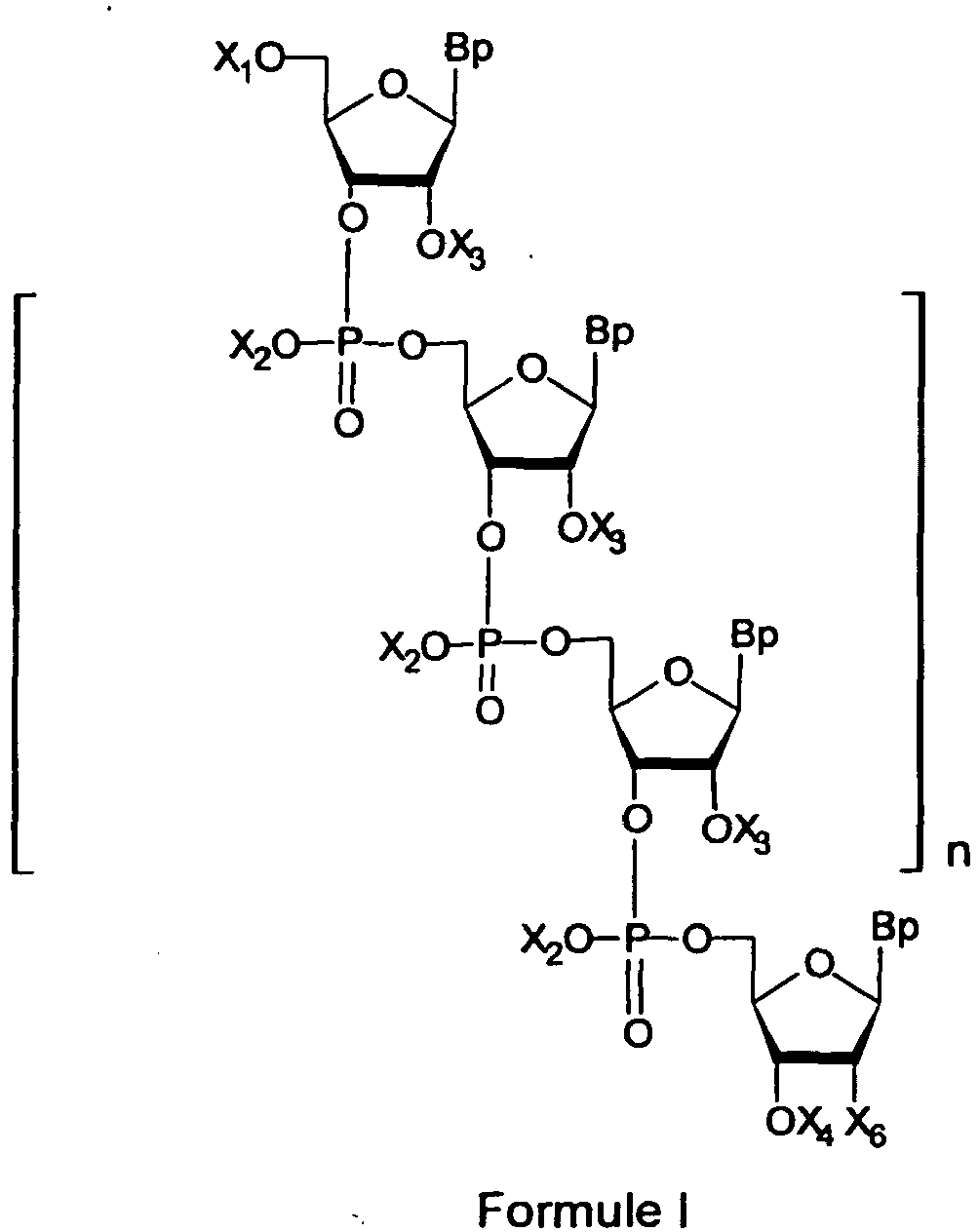
- X1 est H ou un groupe protecteur d'hydroxyle choisi parmi un groupe diméthoxytrityle, un groupe monométhoxytrityle et un groupe pixyle, de préférence un groupe diméthoxytrityle,
- X2 est H ou un groupe protecteur du phosphate β-éliminable, de préférence un groupe cyanoéthyle,
- X3 est un groupe baso-labile protecteur des hydroxyles en position 2' du ribose de formule A suivante :

- X4 représente l'ensemble lien-support solide,
- X6 est H ou OX3 ou OAc,
- Bp est une nucléobase thymine naturelle ou modifiée lorsque X6 est H, uracile naturelle ou modifiée lorsque X6 est OX3 ou OAc, adénine naturelle ou modifiée protégée, cytosine naturelle ou modifiée protégée, ou guanine naturelle ou modifiée protégée quelque soit X6, et
- n est un entier supérieur ou égal à 0,
- De préférence, dans la formule I, X3 est un groupe de formule A.
- Plus préférablement, dans la formule I, X3 est choisi parmi un groupe pivaloyloxyméthyle, un groupe isobutyryloxyméthyle, un groupe n-butyryloxyméthyle, un groupe propionyloxyméthyle et un groupe acétyloxyméthyle.
- Dans un premier mode de mise en oeuvre préféré du procédé de libération de l'invention, dans la formule I, la nucléobase Bp est l'uracile naturelle ou modifiée.
- Dans un second mode de mise en oeuvre préféré du procédé de libération de l'invention, dans la formule I, les quatre nucléobases uracile, adénine, cytosine et guanine, naturelles ou éventuellement et indépendamment l'une de l'autre modifiées sont présentes, et à l'étape b), l'enlèvement du groupe X3 est effectué préférentiellement par un traitement avec une solution aqueuse d'ammoniaque à 28% puis ajout de 15% en volume, par rapport au volume d'ammoniaque, d'isopropylamine puis évaporation sous pression réduite.
- Dans un troisième mode de mise en oeuvre préféré du procédé de libération de l'invention, l'ARN protégé et lié à un support de formule I est lié à un support solide par un lien baso-labile.
- Dans un quatrième mode de mise en oeuvre préféré du procédé de libération de l'invention, dans la formule I, les quatre nucléobases naturelles ou éventuellement modifiées, indépendamment l'une de l'autre, thymine, adénine, cytosine, et guanine sont présentes lorsque X6 est H.
- L'invention propose également un procédé de synthèse d'un ARN simple brin caractérisé en ce qu'il comprend les étapes suivantes :
- a) liaison, à un support, par un lien, d'un monomère de formule II suivante

- Bp est une nucléobase naturelle ou modifiée, cette nucléobase étant une nucléobase uracile lorsque X6 est OX3 ou OAc, ou une nucléobase thymine lorsque X6 est H, ou une nucléobase adénine protégée ou une nucléobase cytosine protégée ou une nucléobase guanine protégée, quelque soit X6
- X1 est un groupe diméthoxytrityle,
- X6 est H ou un groupe OAc ou OX3 dans lequel X3 est un groupe de formule A suivante :

- b) assemblage du monomère de formule II lié à son support obtenu à l'étape a) avec au moins un monomère de formule III suivante :

- c) optionnellement, traitement par un milieu acide de l'assemblage obtenu à l'étape b), et
- d) libération de l'ARN simple brin protégé lié à un support obtenu à l'étape b) ou à l'étape c), par le procédé de libération de l'invention.
- L'invention propose aussi un procédé de synthèse d'un ARN double brin caractérisé en ce qu'il comprend la synthèse d'un ARN simple brin selon le procédé de synthèse d'ARN simple brin de l'invention, et l'hybridation de cet ARN simple brin ainsi synthétisé avec un ARN simple brin ayant une séquence complémentaire.
- De préférence, l'ARN double brin est un siARN.
- Mais l'invention propose encore un procédé de synthèse d'un monomère de formule III suivante:

à partir d'un monomère ribonucléoside de formule IV suivante :
caractérisé en ce qu'il consiste en les étapes suivantes : - a) protection des amines exocycliques des nucléobases Bp, lorsque la nucléobase Bp est différente de l'uracile, éventuellement modifiée,
- b) protection de l'hydroxyle en position 5' du sucre ribose,
- c) protection de l'hydroxyle en position 2' du sucre ribose avec
un groupe de formule A suivante, et
- d) fonctionnalisation de l'hydroxyle en position 3' du sucre ribose avec un groupe hydrogénophosphonate monoester ou phosphoramidite, de préférence un groupe 2-cyanoéthyl-N,N-diisopropylphosphoramidite.
- Plus préférablement, à l'étape c), le groupe de formule A est un groupe pivaloyloxyméthyle ou un groupe isobutyryloxyméthyle ou un groupe n-butyryloxyméthyle, ou un groupe propionyloxyméthyle ou un groupe acétyloxyméthyle.
- Egalement de préférence, à l'étape b), le groupe protecteur est un groupe diméthoxytrityle.
- Dans un premier mode de mise en oeuvre préféré du procédé de synthèse du monomère de formule III selon l'invention, la nucléobase est la cytosine, naturelle ou modifiée, et le groupe protecteur à l'étape a) est un groupe acétyle.
- Dans un second mode de mise en oeuvre préféré du procédé de synthèse du monomère de formule III selon l'invention, la nucléobase est l'adénine, naturelle ou modifiée, et le groupe protecteur à l'étape a) est un groupe phénoxyacétyle.
- Dans un troisième mode de mise en oeuvre préféré du procédé de synthèse du monomère de formule III selon l'invention, la nucléobase est la guanine, naturelle ou modifiée, et le groupe protecteur à l'étape a) est un groupe tert-butylphénoxyacétyle ou isopropylphénoxyacétyle.
- L'invention sera mieux comprise et d'autres avantages et caractéristiques de celle-ci apparaitront plus clairement à la lecture de la description explicative qui suit.
- Dans l'invention, les termes « nucléobase(s) Bp » ou « Bp » désignent une nucléobase uracile, adénine, cytosine ou guanine, éventuellement modifiée, protégée ou non comme cela apparaîtra clairement à l'homme de l'art.
- L'invention représente une rupture dans les stratégies antérieures de synthèse d'ARN, quel que soit le nombre d'unités ribonucléotidiques le composant, et que ces unités ribonucléotidiques soient des unités naturelles ou modifiées, par voie chimique, en ce qu'elle utilise des groupements protecteurs des différentes fonctions réactives sur les ribonucléotides, dont en particulier les groupes protecteurs des phosphates des liens internucléotidiques 3'-5, lorsqu'on utilise la voie de synthèse aux phosphoramidites, et les groupes protecteurs des hydroxyles en position 2' des cycles riboses, qui sont enlevés dans des conditions basiques, à la fin de l'élongation de l'ARN. Ceci permet, lorsque les groupements protecteurs des nucléobases, lorsque présents, et le lien liant l'ARN synthétisé protégé au support sont également baso-labiles, d'utiliser une stratégie de synthèse d'ARN entièrement baso-labile. L'invention est donc une rupture du dogme "la synthèse d'ARN est incompatible avec une stratégie entièrement baso-labile".
- La caractéristique clé permettant d'utiliser une telle stratégie entièrement baso-labile, est l'utilisation, pour protéger l'hydroxyle en position 2' du sucre ribose, de groupes protecteurs de formule A suivante :

- Plus préférablement, ces groupes protecteurs de formule A sont des groupes pivaloyloxyméthyle ou isobutyryloxyméthyle ou butyryloxyméthyle ou propionyloxyméthyle ou acétyloxyméthyle.
- En effet, l'utilisation de tels groupes protecteurs permet de libérer les hydroxyles en position 2' du ribose de l'ARN voulu par un traitement avec une base, sans rupture de l'ARN et sans contamination par les sels fluorures utilisés dans l'art antérieur.
- Les groupements protecteurs pivaloyloxyméthyle, acétyloxyméthyle, pivaloylthiométhyle, et acétylthiométhyle ont déjà été introduits en position 2' du cycle ribose, formant avec l'OH en position 2' du cycle ribose, un groupement O-pivaloyloxyméthyle, O-acétyloxyméthyle, O-pivaloylthiométhyle ou O-acétylthiométhyle, respectivement, dans le but d'améliorer certaines propriétés de l'ARN protégé, en particulier sa perméabilité aux membranes cellulaires, sa résistance aux nucléases, comme décrit dans Parey et al, "First Evaluation of Acyloxymethyl or Acylthiomethyl Groups as Biolabile 2'-O-Protections of RNA, Organic Letters", 2006, Vol.8, No.17, 3869-3872.
- Dans cet article, les groupes acétalesters, et en particulier les groupes pivaloyloxyméthyle, acétyloxyméthyle, pivaloylthiométhyle et acétylthiométhyle, sont décrits comme des groupes pouvant permettre à l'ARN ainsi fonctionnalisé en position 2' du cycle ribose, de traverser la membrane cellulaire et, là, d'être déprotégé par la cellule elle-même avec son contenu enzymatique. Ces groupements protecteurs étaient donc décrits comme des groupements bio-labiles et rien dans ce document ne suggère que l'utilisation de tels groupements protecteurs permettrait d'utiliser une stratégie de synthèse d'ARN avec protections baso-labiles déprotégé dans des conditions basiques.
- De plus, dans ce document, l'introduction sélective du groupement acétalester en position 2' du monomère ribonucléosidique est effectué par une synthèse dans laquelle le réactif de Markiewicz (TIPSiCl2) bloque simultanément les hydroxyles en positions 5' et 3' du ribose et laisse l'hydroxyle en 2' du ribose libre pour accepter le groupement pivaloyloxyméthyle, acétyloxyméthyle, pivaloylthiométhyle ou acétylthiométhyle, selon le groupement choisi. Cette méthode permet d'éviter l'obtention et la séparation des différents isomères 2' et 3' protégés mais elle requiert au moins sept étapes pour la synthèse de l'ARN protégé.
- Bien que ces sept étapes se déroulent avec des rendements élevés, elles sont consommatrices de temps et le TIPSiCl2 est un réactif coûteux.
- L'invention, en contraste, propose un procédé de synthèse du monomère ribonucléosidique dont la nucléobase, et les hydroxyles en position 3' et 5' du ribose sont protégés de manière tout à fait classique dans l'art, l'hydroxyle en position 2' du sucre ribose étant protégé par un groupe acyloxyalkyle ou acylthioalkyle, plus préférablement acyloxyméthyle, qui se déroule en quatre étapes avec un rendement final compris entre 27% et 37%.
- Dans ce procédé on part, comme dans l'art antérieur, des composés de formule IV suivante :
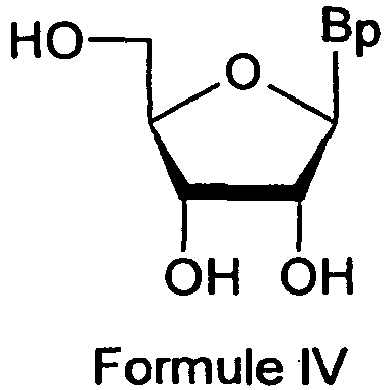
- La première étape de ce procédé consiste à protéger la nucléobase, lorsque celle-ci est différente de l'uracile.
- La seconde étape consiste à protéger l'hydroxyle en position 5' du cycle ribose avec un groupe protecteur classiquement utilisé par l'homme du métier à cet effet. Ces groupes protecteurs classiques utilisés dans l'art pour protéger l'hydroxyle en position 5' du cycle du ribose sont, entre autres, les groupes diméthoxytrityle, monométhoxytrityle et pixyle.
- Dans l'invention, le groupe protecteur préféré utilisé est un groupe diméthoxytrityle acido-labile largement utilisé en synthèse d'oligonucléotides.
- La troisième étape du procédé de synthèse d'un monomère ribonucléotidique, qui sert d'unité de construction pour l'assemblage d'une chaîne menant à l'obtention d'un ARN simple brin, est la protection de l'hydroxyle en position 2' du ribose par un groupement de formule A suivante :

- Plus préférablement, le groupe protecteur de l'hydroxyle en position 2' du ribose est un groupe pivaloyloxyméthyle ou un groupe isobutyryloxyméthyle, ou un groupe n-butyryloxyméthyle, ou un groupe propionyloxyméthyle, ou un groupe acétyloxyméthyle.
- Le plus préférablement, le groupe protecteur de l'hydroxyle en position 2' du ribose est un groupe pivaloyloxyméthyle.
- A cette étape, on obtient deux isomères : l'un avec le groupe hydroxyle en position 3' du ribose naturel ou modifié protégé par le groupe de formule A, et l'autre avec le groupe hydroxyle en position 2' du ribose naturel ou modifié protégé par le groupe de formule A.
- L'isomère dont l'hydroxyle en position 2' du cycle ribose est protégé, est séparé et la quatrième étape du procédé de synthèse du monomère ribonucléotidique protégé selon l'invention consiste alors à fonctionnaliser l'hydroxyle en position 3' du ribose par un groupement phosphorylé bien connu de l'homme du métier. De préférence, dans un premier mode de réalisation, dans le procédé de l'invention on utilise un groupe phosphoramidite, le plus préférablement un groupe 2-cyanoéthyl-N,N-diisopropylphosphoramidite.
- Le composé de formule III suivante est alors obtenu :

- Bp est une nucléobase naturelle ou modifiée, uracile ou une nucléobase adénine protégée ou une nucléobase cytosine protégée ou une nucléobase guanine protégée,
- X1 est un groupe protecteur d'hydroxyle, choisi parmi des groupements acido-labiles et préférentiellement le groupe diméthoxytrityle,
- X5 est un groupe phosphoramidite, de préférence un groupe 2-cyanoéthyl-N,N-diisopropylphosphoramidite,
- X3 est un groupe de formule A telle que définie précédemment.
- Mais, dans un second mode de réalisation, dans le procédé de l'invention, on utilise, pour la fonctionnalisation de l'hydroxyle en position 3', un groupe hydrogénophosphonate monoester.
- Le composé de formule III qui est alors obtenu est un composé de formule III dans lequel Bp, X1, et X3 sont tels que définis précédemment mais X5 est un groupe hydrogénophosphonate monoester.
- A partir des monomères ribonucléotidiques de formule III et du monomère ribonucléotidique de formule II dans laquelle X6 est OX3 ou OAc ou désoxyribonucléotidique de formule II dans laquelle X6 est H, un ARN simple brin protégé est synthétisé sur support solide.
- Le procédé de synthèse de cet ARN simple brin protégé est également un objet de l'invention.
- Cet ARN simple brin protégé a la formule I suivante :

- X1 est H ou un groupe protecteur d'hydroxyle choisi parmi des groupements acido-labiles et préférentiellement un groupe diméthoxytrityle,
- X2 est H ou un groupe protecteur du phosphate, de préférence un groupe 2-cyanoéthyle,
- X3 est un groupe de formule A suivante :

- X4 représente l'ensemble du support solide et du lien qui relie l'oligonucléotide au support. Le support peut être des billes de verre (LCA-CPG : long chain alkylamine-controlled pore glass) ou des billes de résine polystyrène (HCP : highly cross-linked polystyrene). Le lien est choisi parmi des liens rompus par une base à la fin de l'élongation tels que oxalyle, succinyle, glyoxal, hydroquinone-O,O-diacetic acid (Q-linker) et préférentiellement le lien succinyle ou Q-linker ,
- X6 est H ou un groupe OX3 ou OAc,
- Bp est une nucléobase naturelle ou modifiée, thymine lorsque X6 est H ou uracile lorsque X6 est OX3 ou OAc ou alors adénine protégée, ou cytosine protégée, ou guanine protégée, quelque soit X6, et,
- n est un entier supérieur ou égal à 0.
- Lorsque X6 est OAc, les positions de X4 et X6 sont interchangeables.
- Le procédé de synthèse selon l'invention de cet ARN simple brin comprend une étape de liaison d'un monomère ribonucléosidique ou désoxyribonucléosidique de formule II avec un support tel que défini précédemment, par l'intermédiaire d'un lien de préférence lui aussi baso-labile, suivie d'une étape d'assemblage d'un tel monomère de formule II avec au moins un monomère de formule III, et, optionnellement d'une étape de traitement acide de l'assemblage de monomères obtenu pour enlever le groupe protecteur X1, enfin, une étape de libération de l'ARN protégé ainsi obtenu.
- Ainsi, l'ARN sur lequel l'étape de libération est mise en oeuvre est soit un ARN de formule I dans laquelle X1 est H lorsque l'étape de traitement acide est effectuée, soit un ARN de formule I dans laquelle X1 est un groupe protecteur d'hydroxyle lorsque l'étape de traitement acide n'est pas effectuée.
- L'assemblage des monomères ribonucléotidiques de formule III se fait généralement par synthèse automatisée sur un support solide.
- Dans ce cas, l'ARN protégé synthétisé est lié, par son extrémité X4 en position 3', par un lien au support solide.
- Lorsque ce lien est également baso-labile, la libération de l'ARN de son support se fait, dans le procédé de l'invention, en même temps que la déprotection de l'OH en position 2' du ribose, et sans étape additionnelle.
- Cela est vrai pour tout lien baso-labile.
- Une fois l'ARN simple brin libéré, un ARN double brin peut être alors formé par hybridation de l'ARN simple brin libéré avec un ARN simple brin ayant une séquence complémentaire. L'ARN simple brin ayant une séquence complémentaire peut, lui aussi, avoir été synthétisé par le procédé de l'invention, ou encore avoir été synthétisé par un autre procédé.
- Cela permet en particulier de pouvoir fabriquer des siARN.
- Le procédé de libération de l'ARN simple brin protégé de formule I est un objet de l'invention. Ce procédé surmonte un préjugé de l'art antérieur en ce qu'il consiste à éliminer les groupes protecteurs des hydroxyles en positions 2' du ribose par un traitement basique.
- Plus précisément, ce traitement basique comprend une étape a) de traitement de l'ARN protégé de formule I avec une base forte choisie parmi la pipéridine, la 1,8-diazabicyclo[5.4.0]undec-7-ène (DBU), la triéthylamine, à température ambiante, pour libérer le phosphate des liens internucléotidiques 3'-5'.
- Cette étape a) n'est effectuée que lorsque la voie de synthèse aux phosphoramidites est utilisée.
- En effet, lorsque la voie de synthèse aux hydrogénophosphonates est utilisée, l'assemblage des monomères mène à l'obtention de liens internucléosidiques 3'-5' hydrogénophosphonates diesters qui sont ainsi ensuite oxydés en phosphates pour obtenir un ARN, qui sera alors à libérer par le procédé de l'invention, de formule I dans laquelle X2 est H.
- Cette étape a) éventuelle est suivie d'une étape b) de traitement de l'ARN ainsi partiellement libéré obtenu à l'étape a), avec une base forte choisie parmi l'ammoniaque concentré, la méthylamine, le carbonate de potassium à température ambiante.
- L'étape b) est elle commune pour la libération de l'ARN quelle que soit la voie de synthèse de l'ARN utilisée.
- Le traitement avec la pipéridine ou la DBU à température ambiante se fait dans tout solvant approprié connu de l'homme du métier, et plus préférablement dans le THF ou l'acétonitrile sec, pendant 15 minutes (pipéridine) ou 45 minutes (DBU 0.45M) ou 1 minute (DBU 1 M).
- Après cette déprotection du phosphate du lien internucléotidique 3'-5', les groupes protecteurs pivaloyloxyméthyle, isobutyryloxyméthyle, n-butyryloxyméthyle, propionyloxyméthyle, acétyloxyméthyle, selon le groupement utilisé, sont toujours en place.
- Puis les groupes hydroxyles en position 2' sont libérés par traitement avec de l'ammoniac aqueux concentré, à température ambiante, pendant 3h. Aucune rupture des ARN ne se produit à cette étape. Cette déprotection séquentielle en deux étapes avec d'abord la DBU ou la pipéridine puis avec l'ammoniac aqueux est nécessaire pour éviter l'attaque par des hydroxyles en position 2' libérés, des phosphotriesters ou des phosphodiesters avoisinants, ce qui pourrait mener à une rupture de chaîne.
- Cependant, lorsque l'ARN protégé de formule I contient les nucléobases naturelles ou modifiées : thymine ou uracile, adénine, cytosine et guanine c'est-à-dire au moins quatre monomères de formule III dans lesquels les nucléobases sont toutes différentes, le procédé de libération de l'invention comprend de plus une étape d'addition de 15% d'isopropylamine après le traitement avec l'ammoniaque.
- Dans tous les cas, le milieu de déprotection est évaporé sous pression réduite, pour obtenir l'ARN libéré pur.
- Afin de mieux faire comprendre l'invention, on va maintenant en décrire, à titre d'exemples purement illustratifs et non limitatifs plusieurs modes de mise en oeuvre.
- Dans les exemples qui suivent, les monomères ribonucléotidiques de formule III avec X5 est un groupe phosphoramidite, de préférence un groupe 2-cyanoéthyl-N,N-diisopropylphosphoramidite ont été synthétisés selon le schéma général suivant :
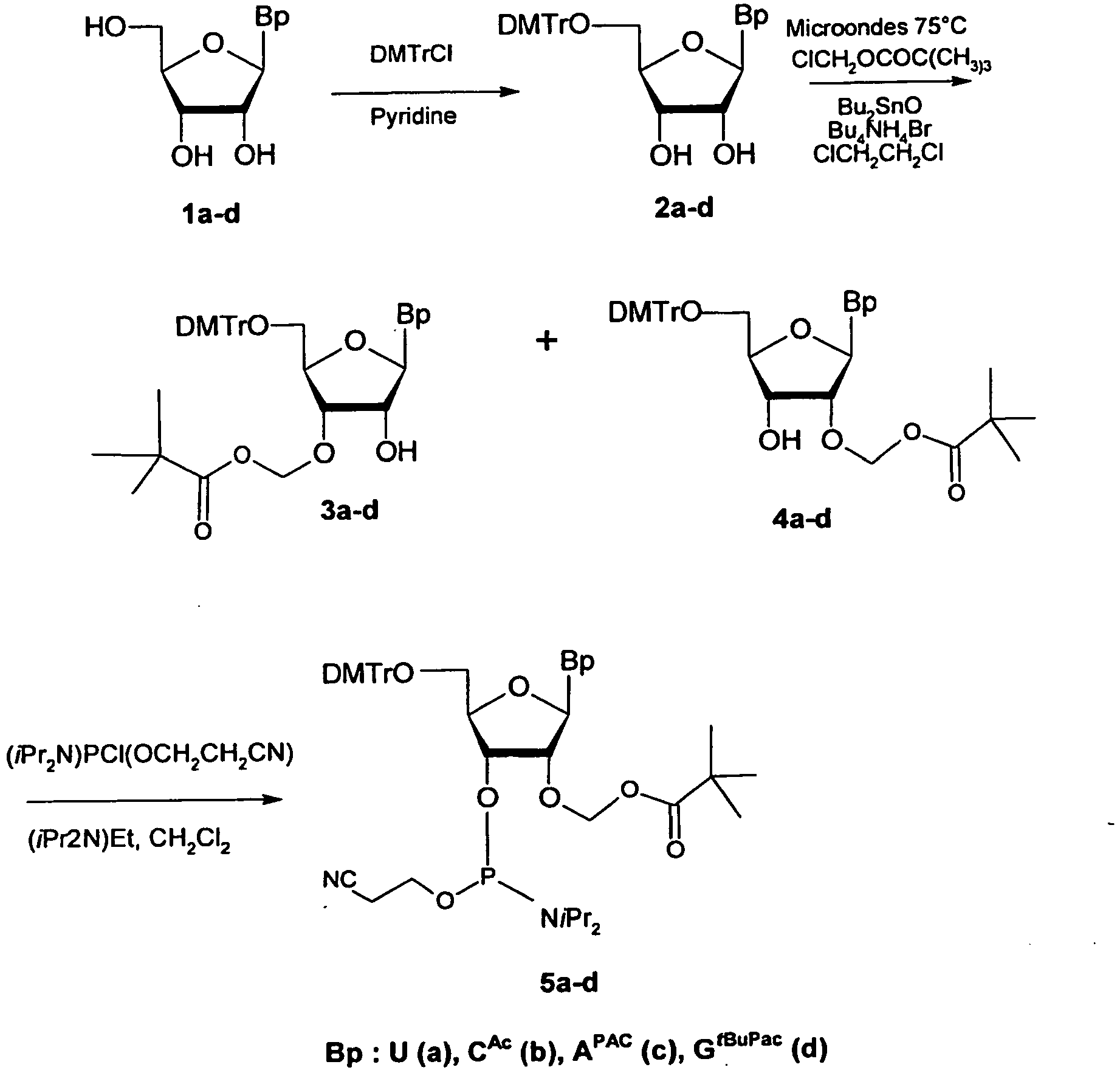
- Dans ce schéma, la première étape de protection des bases guanine, cytosine et adénosine n'est pas indiquée.
- Dans ce schéma, Bp peut être aussi G iPrPAC, auquel cas, l'étape d'introduction du groupe pivaloyloxyméthyl en position 2' du composé 2a-d s'effectue sans traitement aux micro-ondes, comme cela sera expliqué ci-après.
- Le monomère synthétisé ici a la formule III dans laquelle la nucléobase est une nucléobase uracile, le groupe protecteur de l'hydroxyle en position 5' du ribose est le diméthoxytrityle, le groupe greffé sur l'hydroxyle en position 3' du ribose est le 2-cyanoéthyl-N,N-diisopropylphosphoramidite, et le groupe protecteur de l'hydroxyle en position 2' du ribose est le pivaloyloxyméthyle.
- Pour cette synthèse, on démarre de la 5'-O-(4,4'-diméthoxytrityl)uridine 2a. II n'y a donc plus qu'à introduire dans une première étape le groupement pivaloyloxyméthyle en position 2' du ribose et le groupe 2-cyanoéthyl-N,N-diisopropylphosphoramidite en position 3' du monomère.
- Pour cela, le groupe pivaloyloxyméthyle est d'abord introduit en position 2' du ribose.
- Plus précisément, on ajoute à une solution de 5'-O-(4,4'-diméthoxytrityl)uridine 2a (2,5 g, 4,6 mmol, 1 eq) dans du dichloroéthane (DCE) (15 mL), du bromure de tétrabutylammonium (1,93 g, 5,98 mmol, 1,3 eq), de l'oxyde de dibutylétain (1,5 g, 5,98 mmol, 1,3 eq) et du chlorométhyl pivalate (1,67 mL, 11,5 mmol, 2,5 eq).
- Le milieu réactionnel est chauffé sous irradiations micro-ondes (puissance 300 W) à 75°C pendant 2h30, refroidi et le solvant est évaporé.
- Puis, le mélange réactionnel est soumis à une chromatographie sur colonne de gel de silice avec un gradient d'acétone (0-40%) dans du dichlorométhane. L'isomère éluant en premier est le composé désiré 4a. Il est obtenu sous la forme d'une mousse blanche après évaporation du solvant.
- Rendement 4a : 1,1 g, 36%
RMN 1H (300 MHz, HH-COSY, CDCl3): δ 9,57 (s, 1 H, NH); 7,94 (d, JH-6/H-5 = 8.1 Hz, 1H, H-6); 7,37-7,09 (m, 9H, H ar, DMTr); 6,83-6,69 (m, 4H, H ar, DMTr); 5,87 (d, 3JH1'/H2' = 1.8 Hz, 1H, H-1'); 5,52, 5,37 (2dAB, JAB = 6,3 Hz, 1H+1H, OCH 2O); 5,23 (d, JH-5/H-6 = 8,1 Hz, 1H, H-5); 4,39 (ddd, 3JH3'/OH3' = 8,8 Hz; 3JH3'M4'= 7,7 Hz; 3JH3'/H2' = 5,2 Hz, 1H, H-3'); 4,24 (dd, 3JH2'/H3' = 5,2 Hz; 3JH2'/H1' = 1,8 Hz, 1H, H-2'); 3,95 (dt, 3JH4'/H3' = 7.7 Hz; 3JH4'/H5',H5" = 2,1 Hz, 1H, H-4'); 3,71 (s, 6H, 2 OCH 3); 3,48 (dd, 2JH5'/H5" = 11,2 Hz; 3JH5'/H4'= 2,1 Hz, 1H, H-5'); 3,42 (dd, 2JH5"/H5' = 11,2 Hz; 3JH5"/H4' = 2,1 Hz, 1H, H-5"); 2,48 (d, JOH-3'/H-3' = 8,8 Hz, 1H, OH 3'); 1,15 (s, 9H, OCOC(CH3)3). RMN 13C (75 MHz, CDCl3): δ 177,1 (OC=O); 162,5 (C=O); 157,7; 157,6; 143,3; 134,2; 133,9 (Cq, Car); 149,2 (C=O); 138,8 (C6); 129,2; 129,1; 127,1; 127,0; 126,2; 112,3 (CH, Car); 101,2 (C5); 87,2 (C1'); 86,9 (OCH2O); 86,1 (OCq, DMTr); 82,2 (C4'); 81,1 (C2'); 67,5 (C3'); 60,1 (C5'); 54,2 (OCH3, DMTr); 37,8 (Cq, OCOC(CH3)3); 25,9 (OCOC(CH3)3). HRMS (FAB) calculé pour : C36H40N2O10 [M+H]+ 660,2709; trouvé : 660,2683. - A partir du 2'-O-pivaloyloxyméthyl-5'-O-(4,4'-diméthoxytrityl)uridine 4a ainsi obtenu, le 2'-O-pivaloyloxyméthyl-5'-O-(4,4'-diméthoxytrityl)uridine 3'-O-(2-cyanoéthyl-N,N-diisopropylphosphoramidite 5a a été obtenu de la façon suivante :
- Le 2'-O-pivaloyloxyméthyl-5'-O-(4,4'-diméthoxytrityl)uridine obtenu à l'étape précédente 4a (1g, 1,51 mmol, 1 eq) est séché par trois coévaporations avec du CH3CN anhydre. Puis le résidu est dissout dans du CH2Cl2 anhydre (10 mL) et un mélange de N,N-diisopropyléthylamine (474 µL, 2,72 mmol, 1,8 eq), de 2-cyanoéthyl-N,N-diisopropylchlorophosphoramidite (506 µL, 2,27 mmol, 1,5 eq) et de CH2CL2 (1 mL) est ajouté goutte à goutte. Le mélange est agité sous argon, à température ambiante pendant 3h.
- Après cela, de l'acétate d'éthyle est ajouté, le mélange réactionnel est versé dans une solution de NaHCO3 saturé et des extractions avec AcOEt sont effectuées. Le mélange obtenu après séchage de l'extrait sur Na2SO4, élimination du solvant, est purifié par chromatographie sur colonne de gel de silice avec un gradient de CH2Cl2 (60-100%) dans du cyclohexane avec 1% de pyridine. Le monomère de formule III désiré 5a est obtenu. II se présente sous la forme d'une mousse blanche, après évaporation du solvant.
- Rendement 5a : 1,05 g, 81%.
RMN 31P(121 MHz, CD3CN): δ 150,35; 149,20. - Ce monomère ribonucléotidique de formule III est le monomère dans lequel la nucléobase est la cytosine, le groupement protecteur de l'hydroxyle en position 5' du ribose est le diméthoxytrityle, le groupement greffé sur l'hydroxyle en position 3' du ribose est le 2-cyanoéthyl-N,N-diisopropylphosphoramidite et le groupement protecteur de l'hydroxyle en position 2' du ribose est le pivaloyloxyméthyle.
- On part dans cette synthèse du N 4-acétyl-5'-O-(4,4'-diméthoxytrityl) cytidine 2b, ce qui signifie que cet exemple décrit la protection des OH en position 2' et 3' du ribose.
- Ces protections ont été effectuées de la manière suivante :
- A une solution de N 4-acétyl-5'-O-(4,4'-diméthoxytrityl)cytidine 2b (2,5 g, 4,26 mmol, 1 eq) dans du DCE (15 mL) est ajouté du bromure de tétrabutyl ammonium (1,78 g, 5,54 mmol, 1,3 eq), de l'oxyde de dibutylétain (1,39 g, 5,54 mmol, 1,3 eq), et du chlorométhyl pivalate (1,55 mL, 10,65 mmol, 2,5 eq). Le mélange réactionnel est chauffé sous irradiations micro-ondes (puissance 300 W) à 75°C pendant 2h30, refroidi et le solvant est évaporé.
- Le mélange réactionnel est soumis à une chromatographie sur colonne de gel de silice avec un gradient d'acétone (40-100%) dans du dichlorométhane.
- L'isomère éluant en premier est le composé désiré 4b qui est obtenu sous la forme d'une mousse blanche après évaporation du solvant.
- Rendement 4b : 1,14 g, 38%.
RMN 1H (400 MHz, HH-COSY, CDCl3): δ 9,84 (s, 1H, NH); 8,42 (d, JH-6/H-s5= 7.5 Hz, 1H, H-6); 7,34-7,14 (m, 9H, H ar, DMTr); 7,06 (d, JH-5/H-6 = 7,5 Hz, 1H, H-5); 6,80-6,76 (m, 4H, H ar, DMTr); 5,86 (s, 1H, H-1'); 5,60; 5,50 (2dAB, JAB = 6,1 Hz, 1H+1H, OCH2O); 4,34 (dt, 3JH3'/OH3' = 10,6 Hz; 3JH3'/H4',H2'= 5,2 Hz, 1H, H-3'); 4,21 (d, 3JH2'/H3' = 5,2 Hz, 1H, H-2'); 3,98 (dt, 3JH4'/H3' = 5,2 Hz; 3JH4'/H5',H5"= 1,9 Hz, 1H, H-4'); 3,71 (s, 6H, 2 OCH3); 3,52 (dd, 2JH5'/H5" = 11,1 Hz; 3JH5'/H4'= 1,9 Hz, 1H, H-5'); 3,48 (dd, 2JH5"/H5' = 11,1 Hz; 3JH5"/H4'= 1,9 Hz, 1H, H-5"); 2,50 (d, JOH-3'/H-3' = 10,6 Hz, 1H, OH 3'); 2,19 (s, 3H, NHCOCH3); 1,13 (s, 9H, OCOC(CH 3)3). RMN 13C (100 MHz, CDCl3): δ 178,2 (OC=O); 170,6 (NHCO); 163,1 (C4); 158,7 (Cq, Car); 147,4 (C2); 146,6 (C6); 146,3; 135,2 (Cq, Car); 130,1; 129,2; 128,2; 128; 127,9; 127,8; 127,2; 127; 113,3; 113,1 (CH, Car); 96,8 (C5); 91,5 (C1'); 88,0 (OCH2O); 87,6 (OCq, DMTr); 83,1 (C4'); 81,7 (C2'); 67,8 (C3'); 60,7 (C5'); 55,3 (OCH3, DMTr); 38,9 (Cq, OCOC(CH3)3); 27,0 (OCOC(CH3)3); 18,1 (COCH3). HRMS (FAB) calculé pour C38H44N3O10 [M+H]+: 702.3042; trouvé : 702,3027. - Puis, 1,3 g, 1,85 mmol, 1 eq du composé ainsi obtenu 4b sont séchés par trois coévaporations avec du CH3CN anhydre. Le résidu obtenu est dissout dans du CH2Cl2 anhydre (13 mL) et un mélange de N,N-diisopropyléthylamine (580 µL, 3,33 mmol, 1,8 eq) de 2-cyanoéthyl-N,N-diisopropylchlorophosphoramidite (620 µL, 2, 78 mmol, 1,5 eq) et de CH2Cl2 (1 mL) est ajouté goutte à goutte. Le mélangé est agité sous argon, à température ambiante pendant 3h. Après cela, de l'acétate d'éthyle est ajouté, le mélange réactionnel est versé dans une solution de NaHCO3 saturée et des extractions avec AcOEt sont effectuées. Le mélange obtenu après séchage de l'extrait sur Na2SO4, élimination du solvant, est purifié par chromatographie sur colonne de gel de silice avec un gradient de AcOEt (10-80%) dans de l'hexane avec 1% de pyridine.
- Le monomère ribonucléotidique de formule III voulu 5b est obtenu sous la forme d'une mousse blanche après évaporation du solvant.
- Rendement 5b : 1,37 g, 82%.
RMN 31P(121 MHz, CD3CN): δ 150,15; 148,35. - Ce composé correspond au monomère de formule III dans lequel la nucléobase est l'adénine dont l'amine est protégée par un groupement phénoxyacétyle, le groupement protecteur de l'hydroxyle en position 5' du ribose est le diméthoxytrityle, le groupement greffé sur l'hydroxyle en position 3' est le 2-cyanoéthyl-N,N-diisopropylphosphoramidite, et le groupement protecteur de l'hydroxyle en position 2' du ribose est le pivaloyloxyméthyle.
- Pour cette synthèse, on part du ribonucléoside 2c dont la nucléobase et l'hydroxyle en position 5' sont protégés.
- A une solution de N 6-phénoxyacétyl-5'-O-(4,4'-diméthoxytrityl) adénosine 2c (1g, 1,42 mmol, 1eq) dans du DCE (5 mL) est ajouté du tétrabutylammonium bromure (596 mg, 1,85 mmol, 1,3 eq) du dibutylétain oxyde (462 mg, 1,85 mmol, 1,3 eq) et du chlorométhyl pivalate (515 µL, 3,55 mmol, 2,5 eq). Le mélange réactionnel est chauffé sous irradiations micro-ondes (puissance 300 W) à 75°C pendant 2h30, refroidi et le solvant est évaporé. Le mélange réactionnel est soumis à une chromatographie sur colonne de gel de silice avec un gradient d'acétone (0-30%) dans du dichlorométhane. L'isomère éluant en premier est le composé désiré 4c, sous la forme d'une mousse blanche après évaporation du solvant.
- Rendement 4c : 395 mg, 34%.
RMN 1H (400 MHz, HH-COSY, CDCl3): δ 9,50 (s, 1H, NH); 8,72 (s, 1H, H-2); 8,25 (s, 1H, H-8); 7,44-6,81 (m, 18H, H ar, DMTr-Pac); 6,22 (d, 3JH1'/H2' = 4,7 Hz, 1H, H-1'); 5,51; 5,40 (2dAB, JAB = 5,8 Hz, 1H+1H, OCH 2O); 5,08 (t, 3JH2'/H3',H1' = 4,7 Hz; 1H, H-2'); 4,88 (s, 2H, NHCOCH 2Ph); 4,55 (q, 3JH3'/H2',OH3',H4' = 4,7 Hz, 1H; H-3'); 4,28 (m, 1H, H-4'); 3,79 (s, 6H, 2 OCH 3); 3,54 (dd, 2JH5'/H5" = 10,7 Hz; 3JH5'/H4'= 3,3 Hz, 1H, H-5'); 3,43 (dd, 2JH5"/N5' = 10,7 Hz; 3JH5"/H4'= 4 Hz, 1H, H-5"); 2,75 (d, JOH-3'/H-3' = 4,7 Hz, 1H, OH 3'); 1,17 (s, 9H, OCOC(CH 3)3). RMN 13C (100 MHz, CDCl3): δ 177,9 (OC=O); 166,7 (NHCO); 158,6 (Cq, Car); 157,2 (Cq, Pac); 152,6 (C2); 151,5 (C6); 148,4 (C4); 144,4; 135,5 (Cq, Car); 142,2 (C8); 130,1; 129,9; 128,1; 127,9; 122,4; 115; 114,9; 113,2 (CH, Car); 123,2 (C5); 89,0 (OCH2O); 87,3 (C1'); 86,7 (OCq, DMTr); 84,2 (C4'); 81,7 (C2'); 70,5 (C3'); 68,1 (NHCOCH2Ph); 62,9 (C5'); 55,3 (OCH3, DMTr); 38,9 (Cq, OCOC(CH3)3); 27,0 (OCOC(CH3)3). HRMS (FAB) calculé pour C45H48N5O10 [M+H]+ : 818,3401; trouvé : 818,3397. - Le composé obtenu 4c (550 mg, 0,67 mmol, 1 eq) est séché par trois coévaporations avec CH3CN anhydre. Puis le résidu est dissout dans du CH2Cl2 anhydre (7 mL) et un mélange de N,N-diisopropyléthylamine (211 µL, 1,21 mmol, 1,8 eq), de 2-cyanoéthyl-N,N-diisopropylchlorophosphoramidite (223 µL, 1 mmol, 1,5 eq) et de CH2Cl2 (0,5 mL) est ajouté goutte à goutte. Le mélange est agité sous argon, à température ambiante pendant 2h. Après cela, de l'acétate d'éthyle est ajouté, le mélange réactionnel est versé dans une solution saturée de NaHCO3 et des extractions avec AcOEt sont effectuées.
- Le mélange obtenu après séchage de l'extrait sur Na2SO4 et élimination du solvant, est purifié par chromatographie sur colonne de gel silice avec un gradient de CH2Cl2 (40-100%) dans du cyclohexane avec 1% de pyridine. Le monomère ribonucléotidique désiré 5c est obtenu sous la forme d'une mousse blanche après évaporation du solvant.
- Rendement 5c : 540 mg, 79%.
RMN 31P (121 MHz, CDCl3):δ150,85; 150,80. - Le composé synthétisé dans cet exemple est le monomère de formule III 5d dans lequel la nucléobase est la guanine protégée par du tert-butylphénoxyacétyle, l'hydroxyle en position 5' est le diméthoxytrityle, le groupement greffé sur l'hydroxyle en positon 3' est le 2-cyanoéthyl-N,N-diisopropylphosphoramidite, et le groupement protecteur de l'hydroxyle en position 2' du ribose est le pivaloyloxyméthyle.
- On part ici du ribonucléoside 2d dont la nucléobase ainsi que le groupement hydroxyle en position 5' du ribose sont protégés.
- A une solution de N2-tert butylphénoxyacétyl-5'-O-(4,4'-diméthoxytrityl) guanosine 2d (2,6 g, 3,35 mmol, 1 eq) dans du DCE (15 mL) est ajouté du tétrabutylammonium bromure (1,4 g, 4,36 mmol, 1,3 eq), de l'oxyde de dibutylétain (1,1 g, 4,36 mmol, 1,3 eq), et du chlorométhyl pivalate (1,22 mL, 8,38 mmol, 2,5 eq). Le mélange réactionnel est chauffé sous irradiations micro-ondes (puissance 300 W) à 75°C pendant 2h, refroidi et le solvant est évaporé. Le mélange réactionnel est soumis à une chromatographie sur colonne de gel de silice avec un gradient d'acétone (0-15%) dans du dichlorométhane. L'isomère éluant en premier est le composé désiré 4d qui est obtenu sous la forme d'une mousse blanche après évaporation du solvant.
- Rendement 4d : 1,46 g, 49%.
RMN 1H (400 MHz, HH-COSY, CDCl3): 8 11,78 (s, 1H, NH-1); 9,09 (s, 1H, NH Pac); 7,79 (s, 1H, H-8); 7,36-6,73 (m, 18H, H ar, DMTr-tbuPac); 5,99 (d, 3JH1'/H2' = 4,7 Hz, 1H, H-1'); 5,46; 5,36 (2dAB, JAB = 5,3 Hz, 1H+1H, OCH 2O); ); 5,23 (s, 2H, NHCOCH 2Ph); 4,65 (t, 3JH2'/H3',H1' = 4,7 Hz; 1H, H-2'); 4,34 (m, 1H, H-3'); 4,17 (m, 1H, H-4'); 3,70 (s, 6H, 2 OCH 3); 3,38 (dd, 2JH5'/H5" = 10,7 Hz; 3JH5'/H4'= 2,7 Hz, 1H, H-5'); 3,35 (dd, 2JH5"/H5' = 10,7 Hz; 3JH5"/H4'= 2,9 Hz, 1H, H-5"); 2,49 (d, JOH-3'/H-3' = 4,3 Hz, 1H, OH 3'); 1,24 (s, 9H, OCOC(CH 3)3); 1,10 (s, 9H, tbuPac). RMN 13C (100 MHz, CDCl3): δ 177,9 (OC=O); 169,9 (NHCO); 158,6 (Cq, Car); 155,2 (C6); 154,2 (Cq, tbuPac); 147,7 (C2); 146,5 (C4); 145,9 (Cq, tbuPac); 144,3; 135,5 (Cq, Car); 137,0 (C8); 130,1; 128,1; 127,1; 126,9; 126,8; 114,4; 113,3 (CH, Car); 122,3 (C5); 89,3 (OCH2O); 86,8 (OCq, DMTr); 86,1 (C1'); 84,0 (C2'); 82,7 (C4'); 70,4 (C3'); 67,1 (NHCOCH2Ph); 63,1 (C5'); 55,3 (OCH3, DMTr); 38,9 (Cq, OCOC(CH3)3); 34,3 (Cq, PhC(CH3)3); 31.4 (PhC(CH3)3); 27 (OCOC(CH3)3). HRMS (ESI) calculé pour C49H56N5O11 [M+H]+ : 890,3976; trouvé : 890,3934. - Le composé obtenu 4d (700 mg, 0,79 mmol, 1 eq.) est séché par trois coévaporations avec du CH3CN anhydre. Puis le résidu est dissout dans du CH2Cl2 anhydre (5 mL) et un mélange de N,N-diisopropyléthylamine (247 µL, 1,42 mmol, 1,8 eq.), de 2-cyanoethyl-N,N-diisopropylchlorophosphoramidite (265 µL, 1,19 mmol, 1,5 eq.) et de CH2Cl2 (0,5 mL) est ajouté goutte à goutte. Le mélange est agité sous argon, à température ambiante pendant 3 h. Après cela, de l'acétate d'éthyle est ajouté, le mélange réactionnel est versé dans une solution saturée de NaHCO3 et des extractions avec AcOEt sont effectuées.
- Le mélange obtenu après séchage de l'extrait sur Na2SO4 et élimination du solvant, est purifié par chromatographie sur colonne de gel de silice avec un gradient de CH2Cl2 (40-100%) dans du cyclohexane avec 1% de pyridine. Le monomère ribonucléotidique désiré 5d est obtenu sous la forme d'une mousse blanche après évaporation du solvant.
- Rendement 5d : 646 mg, 75%.
NMR 31P (121 MHz, CD3CN): δ 150.43, 149.67. - Le procédé décrit dans les exemples qui précèdent pour obtenir les composés 4a-d, et correspondant à la réaction d'introduction du groupement pivaloyloxyméthyle, implique l'utilisation d'un appareil à micro-ondes. Cette utilisation peut être un frein à sa transposition à grande échelle pour la production des ribonucléotides et le dévéloppement de la méthodologie de la synthèse d'ARN par le procédé de l'invention. Pour cette raison, l'invention propose également un procédé de synthèse des composés 5 ci-dessus ne comportant pas d'utilisation de micro-ondes. Dans ce procédé, d'une part, la nucléobase Bp est protégée par un groupe iPrPAC et, d'autre part, l'étape d'introduction du groupe pivaloyloxyméthyle pour obtenir les composés 4 a été remplacée par la procédure générale suivante:
- Les nucléosides 2a-d sont solubilisés dans du DCE ou de l'acétonitrile anhydre, puis à température ambiante, sous agitation et sous argon sont ajoutés l'oxyde de dibutylétain (DBTO) puis le bromure de tétrabutylammonium (TBAB) puis le chlorométhylpivalate ou le iodométhylpivalate selon la nature du nucléoside. Le milieu réactionnel est alors chauffé et maintenu à 70°C ou 75°C sous argon pendant des temps variant de 1 h30 à 6h.
- Par exemple, pour les composés dans lesquels Bp est G, on procède de la façon suivante :
- Synthèse du monomère 2'-O-pivaloyloxyméthyl-5'-O-(4,4'-diméthoxytrityle) uridine 4a :
- Nucléoside (1 eq), DBTO (1.3 eq), TBAB (1.3 eq), chlorométhylpivalate (2.5 eq) dans acétonitrile à 70°C pendant 3 h.
- Synthèse du N 4-acétyl-2'-O-pivaloxyoxyméthyl-5'-O-(4,4'-diméthoxytrityl) cytidine 4b
- Nucléoside (1 eq), DBTO (1.5 eq), TBAB (1.5 eq), chlorométhylpivalate (3 eq) dans DCE à 75°C pendant 6 h.
- Synthèse du N 6-Phénoxyacétyl-2'-O-pivaloyioxyméthyl-5'-O-(4,4'-diméthoxytrityl) adénosine 4c
- Nucléoside (1 eq), DBTO (1.3 eq), TBAB (1.3 eq), iodométhylpivalate (2.5 eq) dans DCE à 70°C pendant 1 h 30.
- Synthèse du N 2-iso-propylphénoxyacétyl-2'-O-pivaloyloxyméthyl-5'-O-(4,4'-diméthoxytrityl) guanosine 4e.
- Le composé 4e correspond au composé 4d décrit au schéma général mais dans lequel Bp est protégée par le groupe iPrPAC.
- Nucléoside (1 eq), DBTO (1.3 eq), TBAB (1.3 eq), chlorométhylpivalate (3 eq) dans DCE à 75°C pendant 3 h.
- A partir des monomères obtenus 5a-d aux exemples 1 à 4, des ARN simple brin ont été synthétisés.
- Ces ARN protégés de formule I ont été préparés sur un synthétiseur d'ADN ABI modèle 381A à une échelle de 1 µmol, en utilisant les monomères 5a-d de formule III obtenus aux exemples 1 à 4, dans les conditions montrées au tableau 1 suivant.
Tableau 1 Étape Opération Réactif Temps (s) 1 Déblocage 3% DCA dans CH2Cl2 60 2 Couplage 0,1 M amidite dans CH3CN + 0.3 M BMT dans CH3CN 180* 3 Masquage (Pac)2O dans THF/pyridine + 10% NMI dans THF 200 4 Oxydation 0,1 M I2 dans THF/H2O/Pyr 20 DCA = acide dichloroacétique
BMT = benzylmercaptotétrazole
(Pac) 2O = anhydride phénoxyacétique
NMI = N-méthylimidazole - • Un temps de couplage de 300 secondes a également été appliqué pour la synthèse des hétéropolymères mais n'améliore pas significativement le rendement de couplage.
- Les ARN protégés ON1 à ON5 (SEQ ID NO :1 à SEQ ID NO :5) ont été synthétisés en utilisant du 5-benzylmercaptotétrazole (BMT) en tant qu'activateur, une solution d'iode en tant qu'agent oxydant et un mélange d'anhydride phénoxyacétique (Pac)2O dans un mélange de THF/pyridine et N-méthylimidazole (NMI) dans du THF en tant que solution de masquage.
- Après la déprotection dans les conditions décrites ci-dessus, les oligonucléotides correspondants aux ARN, déprotégés, ont été analysés par RP-HPLC (Dionex DX 600) avec une colonne nucléosil 100-5 C18 (150 x 4,6 mm; Macherey-Nagel), par MALDI-TOF MS (Voyager Perpsective Biosystems) et finalement purifiés par HPLC avec une colonne Delta-Pak (7,8 X 300 mm 15µ C18 100Å; Waters).
- Les ARN notés ON1 à ON5 ont été obtenus et avaient les formules montrées au tableau 2 suivant :
Tableau 2 ON[a] SEQ ID NO 5'-séquence-3' CT[b] OY[c] AY[d] Matériau brut[e] 1 U12dC 180 96,5 99,7 n.d.[f] 2 U19TT 180 94,2 99,7 140 3 CCC GUA GCU GTT 180 91,1 99,1 86 4 UGC AUC CUC GAU GGU AAC GdCT 300 82,1 99,0 130 5 CGU UAC CAU CGA GCA UCC AdAT 300 83,8 99,1 125 [a] ON = oligoribonucléotides
[b] = temps de couplage (s) dans le cycle de synthèse automatisé
[c] OY = rendement global de couplage (%)
[d] AY = rendement de couplage moyen par étape
[e] = matériau brut global (Unités D.O = densité optique) mesuré à 260 nm par absorption UV
[f] n.d = non déterminé. - Dans cet exemple, les monomères ribonucléotidiques de formule III dans lesquels la nucléobase est l'uracile, le groupe protecteur de l'hydroxyle en position 5' du ribose est un groupe diméthoxytrityle et le groupe protecteur de l'hydroxyle en position 2' du ribose est soit un groupe isobutyryloxyméthyle (composé 12a : 2'-O-isobutyryloxyméthyl-3'-O-(2-cyanoéthyl-N,N-diisopropylphosphoramidite)-5'-O-(4,4'-diméthoxytrityl)uridine))), soit un groupe butyryloxyméthyle (composé 12b : 2'-O-butyryloxyméthyl-3'-O-(2-cyanoéthyl-N,N-diisopropylphosphoramidite)-5'-O-(4,4'-diméthoxytrityl)uridine, soit un groupe propionyloxyméthyle (composé 12c : 2'-O-propionyloxyméthyl-3'-O-(2-cyanoéthyl-N,N-diisopropylphosphoramidite)-5'-O-(4,4'-diméthoxytrityl)uridine ))), soit un groupe acétyloxyméthyle : (composé 12d: 2'-O-acétyloxyméthyl-3'-O-(2-cyanoéthyl-N,N-diisopropylphosphoramidite)-5'-O-(4,4'-diméthoxytrityl)uridine ont été synthétisés selon le schéma général suivant :

- La première étape de cette synthèse consiste à préparer respectivement les composés 9a à 9d suivants :
- 2'-O-isobutyryloxyméthyl-3',5'-O-(tétraisopropyldisiloxane-1,3-diyl)uridine (9a),
- 2'-O-butyryloxyméthyl-3',5'-O-(tétraisopropyldisiloxane-1,3-diyl)uridine (9b),
- 2'-O-propionyloxyméthyl-3',5'-O-(tétraisopropyldisiloxane-1,3-diyl)uridine (9c),
- 2'-O-acétyloxyméthyl-3',5'-O-(tétraisopropyldisiloxane-1,3-diyl)uridine (9d).
- On procède de la façon suivante :
- A une solution de 2'-O-méthylthiométhyl-3',5'-O-(tétraisopropyldisiloxane-1,3-diyl)uridine 8 (3,07g, 5,61 mmol, 1eq) dans du CH2Cl2 (25 mL) a été ajouté goutte à goutte, sous argon, une solution de chlorure de sulfuryle 1,0M dans du CH2Cl2 (7,0 mL, 7,0 mmol, 1,25 eq). Le mélange réactionnel a été agité à température ambiante pendant 2 heures. Après la fin de la réaction, le dérivé chlorométhyl éther a été obtenu sous la forme d'une mousse brune après évaporation du solvant et a été directement utilisé dans l'étape suivante.
- A une solution du dérivé chlorométhyl éther dans du CH2Cl2 (20 mL) a été ajouté goute à goutte une solution de potassium isobutyrate (1,22 g, 9,60 mmol, 1,72 eq), ou de sodium butyrate (1,06 g, 9,60 mmol, 1,72 eq) ou de sodium propionate (922 mg, 9,60 mmol, 1,72 eq), ou de potassium acétate (926 mg, 9,60 mmol, 1,72 eq) et du dibenzo éther couronne-18-6 (1,48 g, 4,17 mmol, 0,75 eq) dans du CH2Cl2 (10mL) ou de l'éther couronne 15-5 (920 mg, 4,17 mmol, 0,75 eq), selon le cation. Après agitation à température ambiante pendant 3 heures, le mélange a été dilué avec de l'acétate d'éthyle et lavé avec de l'eau. Une extraction avec de l'AcOEt a été mise en oeuvre et l'extrait a été séché sur Na2SO4. Après concentration du solvant, le précipité éther couronne (seulement le dibenzo éther couronne 18-6) a été éliminé par filtration et le filtrat a été évaporé. Le mélange réactionnel a été soumis à une chromatographie sur colonne de gel de silice avec un gradient d'AcOEt (0-50%) dans du cyclohexane. Les composés voulus 9a, 9b, 9c et 9d ont été obtenus sous forme de mousses blanches après évaporation du solvant.
- 9a. (2,30 g, 70%). RMN 1H (400 MHz, HH-COSY, CDCl3) : 8,81 (s, 1H, NH) ; 7,80 (d, J H-6/H-5 = 8,1 Hz, 1H, H-6) ; 5,70 (s, 1H, H-1') ; 5,62 (d, J H-5/H-6= 8,1 Hz, 1H, H-5) ; 5,45 (2dAB, J AB = 6,5 Hz, 2H, OCH 2O) ; 4,25-4,14 (m, 3H, H-2', H-3', H-5a') ; 4,06 (dd, J = 1,8 Hz, J = 9,5 Hz, 1H, H-4') ; 3,90 (dd, J H5'b/H4' = 2,4 Hz, J = 13,6 Hz, 1H, H-5'b ) ; 2,54 (hept, J = 7,0 Hz , 1H, C(O)CH) ; 1,18-0,83 (m, 22H, iPr).
RMN 13C (100 MHz, CDCl3) : 176,6 (OC=O) ; 163,6 (C=O) ; 149,6 (C=O) ; 139,4 (C-6) ; 101,6 (C-5) ; 89,1 (C-1') ; 87,6 (OCH2O) ; 81,7 (C-4') ; 81,3 (C-2') ; 67,8 (C-3') ; 59,3 (C-5') ; 33,9 (C(O)CH) 18,8-18,7-17,5-17,6-17,4-17,3-17,2-17,1-16,9-16,8 (CH3, iPr) ; 13,4-13,2-13,1-12,9-12,5 (CH, iPr). - 9b. (2.90 g, 89%). RMN 1H (400 MHz, HH-COSY, CDCl3) : 8,80 (s, 1H. NH) ; 7,79 (d, J H-6H-5 = 8,1 Hz, 1H, H-6) ; 5,66 (s, 1H, H-1') ; 5,61 (dd, J H-5/H-6 = 8,1 Hz, J H-5/NH = 2,1 Hz, 1H, H-5) ; 5,46 (s, 2H, OCH 2O) ; 4,19-4,13 (m, 3H, H-2', H-3', H-5a') ; 4,06 (dd, J H-4'/H-5'b = 1,8 Hz, J = 9,2 Hz, 1H, H-4') ; 3,90 (dd, J H-5'b/H-4' = 2,3 Hz, J = 13,6 Hz, 1H, H-5'b); 2,28 (td, J = 7,4 Hz, J = 1,3 Hz , 2H, C(O)CH 2) ; 1,60 (sext, J = 7,4 Hz, 2H, CH 2β) ; 1,03-0,92 (m, 28H, iPr) ; 0,89 (t, J = 7,4 Hz, 3H, CH 3γ).
RMN 13C (100 MHz, CDCl3) : 173,2 (OC=O) ; 163,3 (C=O) ; 149,7 (C=O) ; 139,4 (C-6) ; 101,6 (C-5) ; 89,2 (C-1') ; 87,5 (OCH2O) ; 81,7 (C-4') ; 81,3 (C-2') ; 67,8 (C-3') ; 59,3 (C-5') ; 36,1 (C(O)CH2) ; 18,1 (CH2β) ; 17,5-17,4-17,3-17,2-17,1-17,.0-16,9-13,6-13,4-13,0-12,9-12,5 (iPr, TIPS and CH3γ). - 9c. (2,37 g, 77%). RMN 1H (400 MHz, HH-COSY, CDCl3) : 9,18 (s, 1H, NH) ; 7,80 (d, J H-6/H-5 = 8,2 Hz, 1H, H-6) ; 5,67 (s, 1H, H-1') ; 5,61 (dd, J H-5/H-6 = 8,1 Hz, J H-5/NH = 1,6 Hz, 1H, H-5) ; 5,45 (s, 2H, OCH2O) ; 4,20-4,13 (m, 3H, H-2', H-3', H-5a') ; 4,06 (dd, J H-4'/H-S'b = 1,7 Hz, J = 9, Hz, 1H, H-4') ; 3,90 (dd, J H-5'b/H-4' = 2,1 Hz, J = 13,6 Hz, 1H, H-5'b ) ; 2,34 (q, J = 7.6 Hz, 2H, C(O)CH 2) ; 1,08 (t, J = 7,5 Hz, 3H, CH 3β) ; 1.,3-0,88 (m, 28H, iPr).
RMN 13C (100MHz, CDCl3) : 174,0 (OC=O) ; 163,6 (C=O) ; 149,8 (C=O) ; 139,3 (C-6) ; 101,6 (C-5) ; 89,2 (C-1') ; 87,5 (OCH2O) ; 81,7 (C-4') ; 81,3 (C-2') ; 67,7 (C-3') ; 59,3 (C-5') ; 27,5 (C(O)C α ) ; 17,5-17,4-17,3-17,2-17,1-17,.0-16,8-13,4-13,0-12,9-12,5 (iPr, TIPS) ; 8.8 (CH3β). - 9d. L'identification de ce composé est identique à celle décrite pour le même composé dans Parey et al, "First Evaluation of Acyloxymethyl or Acylthiomethyl Groups as Biolabile 2'-O-Protections of RNA, Organic Letters", 2006, Vol.8, No.17, 3869-3872.
- Puis les composés 2'-O-isobutyryloxyméthyl-uridine 10a, 2'-O-butyryloxyméthyl-uridine 10b, 2'-O-propionyloxyméthyl-uridine 10c and 2'-O-acétyloxyméthyl-uridine 10d ont été synthétisés de la manière suivante :
- A une solution de 9a (2,30 g, 3,92 mmol, 1 eq) ou 9b (2,90 g, 4,94 mmol, 1 eq) ou 9c (2,37 g, 4,41 mmol, 1 eq) ou 9d (2,90 g, 5,19 mmol, 1 eq), une solution d'Et3N.3HF (pour 9a : 767 µL, 15,68 mmol, 4 eq; pour 9b : 970 µL, 19,80 mmol, 4 eq; pour 9c : 865 µL, 17,64 mmol, 4, eq et pour 9d : 1017 µL, 20,76 mmol, 4 eq) a été ajoutée. Après agitation entre 1 h30 à 5h à température ambiante, la déprotection était complète et le mélange réactionnel a été traité avec un tampon triéthylammoniumacétate (2M, pH 7), puis évaporé. Le mélange brut a été purifié par chromatographie sur gel de silice avec un gradient de MeOH (0-4,5%) dans CH2Cl2. Les composés voulus 10a à 10d ont été obtenus sous forme de poudres blanches après une lyophilisation avec du dioxane.
- 10a. (1,25 g, 93%). RMN 1H (400 MHz, HH-COSY, DMSO): 11,38 (s, 1H, NH) ; 7,2 (d, J H-6/H-5= 8,2 Hz, 1H, H-6) ; 5,89 (d, J H-1'/H-2' = 5,4 Hz, 1H, H-1') ; 5,68 (d, J H-5/H-6 = 8,0 Hz, 1H, H-5) ; 5,37, 5.,3 (2dAB, J AB = 6,5 Hz 2H, OCH 2O) ; 5,32 (s, 1H, OH-3') ; 5,20 (s, 1H, OH-5') ; 4,26 (t, J = 5,2 Hz, 1H, H-2') ; 4,14 (s, 1H, H-3') ; 3,88 (dd, J H-4'/H-5'b = 3,0 Hz, J = 6,9 Hz, 1H, H-4'); 3,65 (dd, J H-5'a/H-4' = 2,3 Hz, J H-5'a/H-5'b = 11,9 Hz, 1H, H-5'a) ; 3,57 (dd, J H-5'bH-4'= 2,5 Hz, J H-5'b/H-5'a = 11,8 Hz, 1H, H-5'b) ; 2,50 (hept, J CH/CH3= 7,0 Hz, 1H, C(O)CH) ; 1,07 (d, J CH3/CH = 7,0 Hz, 3H, CH3), 1,06 (d, J CH3/CH = 7.0 Hz, 3H, CH3).
RMN 13C (100 MHz, DMSO) : 176,0 (OC=O) ; 163,5 (C=O) ; 151,0 (C=O) ; 140,9 (C-6) ; 102,4 (C-5) ; 88,0 (OCH2O) ; 86,4 (C-1') ; 85,6 (C-4') ; 81,1 (C-2') ; 69,1 (C-3') ; 61,1 (C-5') ; 33,7 (C(O)CH) 18,9 (CH3, 2C). - 10b. (1,56 g, 92%). RMN 1H (400 MHz, HH-COSY, DMSO): 11,42 (s, 1H, NH) ; 7,92 (d, J H-6/H-5 = 8,1 Hz, 1H, H-6) ; 5,94 (d, J H-1'/H-2' = 5,5 Hz, 1H, H-1 ') ; 5,73 (d, J H-5/H-6 = 8,1 Hz, 1H, H-5) ; 5,42, 5,25 (2dAB, J AB = 6,5 Hz 2H, OCH 2O) ; 5,35 (s, 1H, OH-3') ; 5,22 (s, 1H, OH-5'); 4,30 (t, J H-2'/H-3' = 5,3 Hz, 1H, H-2') ; 4,19 (dd, J H-3'/H-2' = 5,2 Hz, J H-3'/H-4' = 9,3 Hz, 1H, H-3') ; 3,93 (dd, J H-4'/H-5'b = 3,1 Hz, J = 6,8 Hz, 1H, H-4'); 3,70 (d, J H-5'a/H-5'b = 12,0 Hz, 1H, H-5'a) ; 3,62 (d, J H-5'b/H-5'a = 12,0 Hz, 1H, H-5'b) ; 2,30 (t, J CH2α/CH2β= 7,3 Hz, 2H, C(O)CH2α ) ; 1,56 (sext, J CH2β/CH2α= J CH2β/CH3γ = 7,4 Hz, 2H, CH2β), 0,91 (t, J CH3γ/CH2β = 7,4 Hz, 3H, CH3).
RMN 13C (100 MHz, DMSO) : 172,2 (OC=O) ; 163,0 (C=O) ; 151,0 (C=O) ; 140,4 (C-6) ; 101,9 (C-5) ; 87,5 (OCH2O) ; 86,0 (C-1') ; 85,1 (C-4') ; 80,7 (C-2') ; 68,7 (C-3') ; 60,6 (C-5') ; 35,3 (C(O)CH2α) ; 17,6 (CH2β) ; 13,3 (CH3γ). - 10c. (1,25 g, 86%). RMN 1H (400 MHz, HH-COSY, DMSO): 11,39 (s, 1H, NH) ; 7,93 (d, J H-6/H-5= 8,1 Hz, 1H, H-6) ; 5,89 (d, J H-1'/H-2' = 3,3 Hz, 1H, H-1') ; 5,69 (d, J H-5/H-6 = 8,1 Hz, 1H, H-5) ; 5,36, 5,23 (2dAB, J AB = 6,5 Hz 2H, OCH 2O) ; 4,25 (t, J H-2'/H-3' = 5,2 Hz, 1H, H-2') ; 4,14 (t, J = 4,5 Hz, 1H, H-3') ; 3,88 (dd, J H-4'/H-5'b = 3,0 Hz, J = 7,0 Hz, 1H, H-4') ; 3,68-3,56 (m, 2H, H-5'a ; H-5'b) ; 2,30 (q, J CH2α/CH3β= 7,5 Hz, 2H, C(O)CH 2α) ; 1,01 (t, J CH3β/CH2 = 7,5 Hz, 3H, CH 3β)
NMR 13C (100 MHz, DMSO) : 173,0 (OC=O) : 163,0 (C=O) ; 151,5 (C=O) ; 140,4 (C-6) ; 101,9 (C-5) ; 87,7 (OCH2O) ; 86,1 (C-1') ; 85,0 (C-4') ; 80,8 (C-2') ; 68,6 (C-3') ; 60,5 (C-5') ; 26,8 (C(O)CH2α) ; 8,6 (CH3β). - 10d. L'identification de ce composé est identique à celle décrite pour le même composé dans Parey et al, "First Evaluation of Acyloxymethyl or Acylthiomethyl Groups as Biolabile 2'-O-Protections of RNA", Organic Letters, 2006, Vol.8, No.17, 3869-3872.
- Ensuite, les composés 11 a à 11 d suivants ont été synthétisés :
- 2'-O-isobutyryloxyméthyl-5'-O-(4,4'-diméthoxytrityl)uridine 11a, 2'-O-butyryloxyméthyl-5'-O-(4,4'-diméthoxytrityl)uridine 11b.
- 2'-O-propionyloxyméthyl-5'-O-(4,4'-diméthoxytrityl)uridine 11c
- Pour cela, les composés 10a (1,25 g, 3,64 mmol, 1 eq), 10b (1,46 g, 4,25 mmol, 1, eq), 10c (1,15 g, 3,49 mmol, 1 eq) et 10d (1,51 g, 4,77 mmol, 1 eq) ont été séchés par trois coévaporations avec de la pyridine anhydre. Puis les solutions de 10a à 10d dans de la pyridine anhydre (20 mL) ont été traitées avec du chlorure de diméthoxytrityle (1,2 eq) ajouté en petites portions en 15 minutes. Les réactions ont été agitées pendant 2 à 4 heures à température ambiante sous argon. A la fin de la réaction, les mélanges ont été concentrés et du CH2Cl2a été ajouté. Les solutions ont été versées dans une solution de NaHCO3 saturée. Des extractions avec du CH2Cl2 ont été effectuées et les extraits ont été séchés sur Na2SO4. Les mélanges obtenus après élimination du solvant ont été soumis à une chromatographie sur colonne de gel de silice avec un gradient de CH2Cl2 (80-100%) dans du cyclohexane avec 1% de pyridine, puis de MeOH (0-1%) dans du CH2Cl2 avec 1% de pyridine. Les composés 11a à 11d voulus ont été obtenus sous la forme de mousses blanches après évaporation du solvant.
- 11a. (1,89 g, 79%). RMN 1H (400 MHz, HH-COSY, CDCl3) 9,40 (s, 1H, NH) ; 7,93 (d, J H-6/H-5 = 8,2 Hz, 1H, H-6) ; 7,32-7,08 (m, 10H, Har) ; 6,79-6,75 (m, 3H, Har) ; 5,88 (d, J H-1'/H-2' = 1,8 Hz, 1H, H-1') ; 5,50, 5,38 (2dAB, J AB= 6,3 Hz, 2H, OCH 2O) ; 5,23 (d, J H-5/H-6= 8,6 Hz, 1H, H-5) ; 4,39 (m, 1H, H-3') ; 4,25 (dd, J H-2'/H-1' = 1,8 Hz, J H-2'/H-3' = 5,2 Hz, 1H, H-2') ; 3,95 (td, J H-4'/H-5'a = J H-4'/H-5'b = 2,1 Hz, J H-4'/H-3'= 7,6 Hz, 1H, H-4') ; 3,72, 3,71 (2s, 6H, OCH 3) ; 3,46 (m, 2H, H-5'a, H-5'b) ; 2,52 (hept, J CH/(CH3)2 = 7,0 Hz, 1H, C(O)CH) ; 1,11 (2d, J CH3/CH = 7,0 Hz, 6H, CH3)
RMN 13C (100 MHz, CDCl3) : 176,6 (OC=O) ; 163,4, 150,3 (C=O) ; 158,8-158,7-144,3-135,2-135,0 (Cq arom.) ; 139,7 (C-6) ; 130,2-130,1-129,2-129,0-128,2-128,1-128,0-127,2-125,3-123,8-113,3-113,1 (CH arom.) ; 102,2 (C-5) ; 88,2 (C-1') ; 87,7 (OCH2O) ; 87,1 (OCq, DMTr) ; 83,2 (C-4') ; 82,1 (C-2') ; 68,5 (C-3') ; 61,2 (C-5') ; 55,3 (OCH3, DMTr) ; 34,0 (C(O)CH) ; 17,8 (CH3, iPr). - 11b. (2,26 g, 79%). RMN 1H (400 MHz, HH-COSY, CDCl3) : 9,20 (s, 1H, NH) ; 7,91 (d, J H-6/H-5 = 8,2 Hz, 1H, H-6) ; 7,33-7,14 (m, 10H, Har) ; 6,79-6,75 (m, 3H, Har) ; 5,88 (d, J H-1'/H-2' = 1,8 Hz, 1H, H-1') ; 5,48, 5,38 (2dAB, J AB = 6,3 Hz 2H, OCH 2O) ; 5,23 (dd, J H-5/NH = 1,9 Hz, J H-5/H-6 = 8,2 Hz, 1H, H-5) ; 4,43-4,37 (m, 1H, H-3') ; 4,26-4,24 (m, 1H, H-2') ; 3,72, 3,71 (2s, 6H, OCH 3) ; 3,96-3,94 (m, 1H, H-4') ; 3,50-3,42 (m, 2H, H-5'a, H-5'b) ; 2,47 (d, J OH-3'/H-3' = 8,9 Hz, 1H, OH-3') ; 2,27 (t, J = 7,5 Hz, 2H, C(O)CH 2α) ; 1.58 (sext, J CH2β/CH2α = J CH2β/CH3γ = 7.5 Hz, 2H, CH2β); 0,88.(t, J CH3γ/CH2β = 7.5 Hz, 3H, CH 3γ).
RMN 13C (100 MHz, CDCl3) : 173,1 (OC=O) ; 163,2, 150,2 (C=O) ; 158,8-158,7-144,3-135,2-135,0 (Cq arom.) ; 139,8 (C-6) ; 130,2-130,1-129,1-129,0-128,1-128,0-127,8-127,2-113,3-113,2-113,1 (CH arom.) ; 102,2 (C-5) ; 88,1 (C-1') ; 87,7 (OCH2O) ; 87,1 (OCq, DMTr) ; 83,2 (C-4') ; 82,0 (C-2') ; 68,6 (C-3') ; 61,2 (C-5') ; 55,3 (OCH3, DMTr) ; 36,1 (C(O)CH2) ; 18,1 (CH2β) ; 13.6 (CH3γ). - 11c. (1,81 g, 82%). RMN 1H (400 MHz, HH-COSY, CDCl3) : 9,27 (s, 1H, NH) ; 7,91 (d, J H-6/H-5 = 8,1 Hz, 1H, H-6) ; 7,31-7,08 (m, 10H, Har) ; 6,78-6,74 (m, 3H, Har) ; 5,88 (d, J H-1'/H-2' = 1,7 Hz, 1H, H-1') ; 5,47, 5,39 (2dAB, J AB = 6,4 Hz 2H, OCH 2O) ; 5,22 (dd, J H-5/NH = 1,0 Hz, J H-5/H-6 = 8,1 Hz, 1H, H-5) ; 4,43-4,37 (m, 1H, H-3') ; 4,25 (m, 1H, H-2') ; 3,95 (d, J = 7,5 Hz, 1H, H-4') ; 3,72, 3,71 (2s, 6H, OCH 3) ; 3,47-3,42 (m, 2H, H-5'a, H-5'b) ; 2,48 (d, J OH-3'/H-3' = 8,5 Hz, 1H, OH-3') ; 2,31 (q, J = 7.5 Hz, 2H, C(O)CH2α) ; 1,07 (t, J CH3β/CH2α = 7,5 Hz, 3H, CH 3β).
RMN 13C (100 MHz, CDCl3): 174,0 (OC=O) ; 163,4, 150,2 (C=O) ; 158,7-144,3-141,5-135,3-135,0 (Cq arom.) ; 139,9 (C-6) ; 130,2-130,1-129,1-128,1-128,0-127,8-127,7-127,2-127,1-113,3-113,2 (CH arom.) ; 102,2 (C-5) ; 88,1 (C-1') ; 87,8 (OCH2O) ; 87,1 (OCq, DMTr) ; 83,2 (C-4') ; 82,0 (C-2') ; 68,6 (C-3') ; 61,2 (C-5') ; 55,3 (2C, OCH3, DMTr) ; 27,5 (C(O)CH2) 8,8 (CH3β). - 11d. L'identification de ce composé est identique à celle décrite pour le même composé dans Parey et al, "First Evaluation of Acyloxymethyl or Acylthiomethyl Groups as Biolabile 2'-O-Protections of RNA, Organic Letters", 2006, Vol.8, No.17, 3869-3872.
- Enfin, les monomères de formule III ont été synthétisés.
- 2'O-isobutyryloxyméthyl-3'-O-(2-cyanoéthyl N,N diisopropylphosphoramidite)-5'-O-(4,4'-diméthoxytrityl)uridine 12a, 2'-O-butyryloxyméthyl-3'-O-(2-cyanoéthyl-N,N-diisopropylphosphoramidite)-5'-O-(4,4'-diméthoxytrityl)uridine 12b, 2'-O-propionyloxyméthyl-3'-O-(2-cyanoéthyl-N,N-diisopropylphosphoramidite)-5'-O-(4,4'-diméthoxytrityl)uridine 12c et 2'-O-acétyloxyméthyl-3'-O-(2-cyanoéthyl-N,N-diisopropylphosphoramidite)-5'-O-(4,4'-diméthoxytrityl)uridine 12d.
- Pour cela, les composés 11a (1,77 g, 2,74 mmol, 1 eq), 11b (2,17 g, 3,36 mmol, 11c (1,80 g, 2,85 mmol) et 11d (1,65 g, 2, 67 mmol) ont été séchés par trois coévaporations avec du CH3CN anhydre. Puis, le résidu a été dissout dans du CH2Cl2 anhydre (14 mL) et un mélange de N,N-diisopropyléthylamine (pour 11a : 859 µL, 4,93 mmol, 1,8 eq; pour 11b : 1050 µL, 6,06 mmol, 1,8 eq; pour 11c : 894 µL, 5,13 mmol, 1,8 eq; et pour 11d : 838 µL, 4,81 mmol, 1,8 eq), et de 2-cyanoéthyl-N,N-düsopropylchlorophosphoramidite (pour 11a : 917 µL, 4,11 mmol, 1,5 eq; pour 11b : 1120 µL, 5,04 mmol, 1,5 eq; pour 11c : 954 µL, 4,28 mmol, 1,5 eq; pour 11d : 895 µL, 4,01 mmol, 1,5 eq) et CH2Cl2 (2 mL) a été ajouté goutte à goutte. Le mélange a été agité sous argon, à température ambiante, pendant 3 heures. Après la fin de la réaction, de l'acétate d'éthyle a été ajouté, le mélange réactionnel a été versé dans une solution de NaHCO3 saturée et des extractions avec de l'AcOEt ont été mises en oeuvre. Le mélange, obtenu après séchage de l'extrait sur Na2SO4 et élimination du solvant a été purifié par chromatographie sur colonne de gel de silice avec un gradient de CH2Cl2 (50-100%) dans du cyclohexane avec 1% de pyridine. Les phosphoramidites voulus 12a à 12d ont été obtenus sous la forme de mousses blanches après évaporation du solvant.
- 12a. (1.63 g, 70%). RMN 31P (121 MHz, CD3CN): δ (ppm): 150.35, 149.15.
- 12b. (1.85 g, 66%). Rmn 31P (121 MHz, CD3CN): δ (ppm): 150.31, 149.09.
- 12c. (1.93 g, 81%). RMN 31P (121 MHz, CD3CN): δ (ppm): 150.30, 149.01.
- 12d. (1.14 g, 52%). RMN 31P (121 MHz, CD3CN): δ (ppm): 150.31, 148.96.
- A partir des monomères obtenus 12a-d à l'exemple 6, des ARN simple brin ont été synthétisés.
- Ces ARN protégés de formule I ont été préparés selon le procédé identique à celui décrit dans l'exemple 5 pour l'obtention des ON4 à ON5. Les ARN notés ON6 à ON9 de séquence identique U19 TT ont été obtenus avec les résultats montrés au tableau 3 suivant :
Tableau 3 ON[a] U19 TT X3 CT[b] OY[c] AY[d] Matériau brut[e] 6 isobutyryloxyméthyle 180 75.9 98.5 122 7 Butyryloxyméthyle 180 68.4 98.1 130 8 Propionyloxyméhtyle 180 77.9 98.7 100 9 Acétyloxyméthyle 180 70.7 98.3 120 [a] ON = oligoribonucléotides
[b] = temps de couplage (s) dans le cycle de synthèse automatisé
[c] OY = rendement global de couplage (%)
[d] AY = rendement de couplage moyen par étape
[e] = matériau brut global (Unités D.O = densité optique) mesuré à 260 nm par absorption UV - Il est à noter que les groupes X3 isobutyryloxyméthyle et butyryloxyméthyle ont été enlevés de l'ARN de formule I en 15 min par le traitement à l'ammoniaque concentré et les groupes X3 propionyloxyméthyle et acétyloxyméthyle ont été enlevés en moins de 5 min par le traitement à l'ammoniaque concentré même si ce traitement a été prolongé jusqu'à 1 h30 pour rompre complètement le lien succinyle avec le support solide et libérer les ARN.
- Les ARN ON4 et ON5 obtenus à l'exemple 5 (2 unités de DO à 260 nm) ont été incubés avec une nucléase P1 (0,25 unités) (spécifique des coupures de liaisons internucléosidiques 3'-5') à 37°C pendant 48h.
- Puis, une phosphatase alcaline (2,5 unités) et un tampon (50 mM Tris-HCl, pH 9,3, contenant 1 mM de MgCl2, 0,1 mM de ZnCl2 et 1 mM de spermidine; concentrations finales) ont été ajoutés pour donner un volume total de 115 µl et le mélange a été incubé à 37°C pendant 24h supplémentaires. Le mélange réactionnel a été analysé par HPLC.
- Les ARN ont été complètement dégradés pour donner les quatre ribonucléosides naturels ce qui prouve l'intégrité des liaisons internucléotidiques 3'-5'. Aucune liaison non naturelle 2'-5' n'a été détectée.
- L'activité du duplex siARN obtenu à partir des ARN simple brin ON4 et ON5 hybridés ensemble a été évaluée dans un test ARN interférence qui cible l'ARN messager de l'oncogène Ret/PTC1 impliqué dans le cancer papillaire de la thyroïde.
- Cette activité du duplex siARN ON4/ON5 obtenu par la méthode de l'invention a été comparée à l'activité du même duplex siARN AS fourni par Eurogentec et synthétisé par une autre voie de synthèse (méthode 2'-TBDMS).
- Les cellules utilisées pour tester le siARN obtenu étaient des fibroblastes murins NIH/3T3 transfectés de façon stable par un vecteur pBAB exprimant l'oncogène humain Ret/PTC1. La culture de cellules a été effectuée dans un milieu DMEM (GIBCO) contenant 10% de sérum bovin de nouveau né inactivé par la chaleur (10%, GIBCO), de la pénicilline (100 U/ml), de la streptomycine (100 µg/ml, GIBCO), et de la puromycine (2,5 µg/ml Sigma) à 37°C avec 5% de CO2 dans une atmosphère humide.
- Cette culture de cellules a été ensuite traitée avec le siARN obtenu à partir des ARN simple brin ON4 et ON5 ainsi qu'avec le siARN AS commercial.
- Un jour avant le traitement, 3.105 cellules ont été ensemencées sur des plaques à six puits. Une transfection a été effectuée en mélangeant 0,05 nmol de siARN dans 50 µl de tampon Hepes 10 mM, pH 7,2, 100 mM de NaCl avec 2 µg de cytofectine (GTS) dans 50 µl du même tampon. Après 10 minutes d'incubation à température ambiante, les complexes ont été ajoutés aux cellules dans 900 µl de milieu de culture frais contenant du sérum pendant 24h. L'expérience a été effectuée en triple. Les séquences de contrôle du siARN sont SEQ ID NO: 6 : 5'-GCCAGUGUCACCGUCAAGGdAdG-3' et SEQ ID NO: 7 : 5'-CCUUGACGGUGACACUGGCdTdT-3' et ont été fournies par Eurogentec. Ce sont des séquences aléatoires non spécifiques de l'ARNm visé.
- Puis, la détection de l'expression de l'ARNm Ret/PTC1 a été effectuée par RT-PCR. L'extraction de l'ARNm a été effectuée avec le réactif TRIzol (Invitrogen) comme indiqué par le fabricant. Après détermination de la concentration par spectrométrie UV, 1 µg de l'ARN total provenant soit des cellules de contrôle, soit des cellules traitées ont été incubés avec Mo-MuLV RT (Promega), comme indiqué par le fabricant, dans 20 µl de volume final pendant 1 h à 42°C. Puis l'expression de l'ARNm Ret/PTC1 a été déterminée par PCR sur 2 µl de produits de transcription inverse dans 50 µl de milieu réactionnel comprenant la Taq Polymerase (Ozyme).
- Les amorces suivantes ont été utilisées pour l'amplification de Ret/PTC1 (290 pb) amorce antisens : SEQ ID NO: 8: 5'-CTGCTTCAGGACGTTGAA-3' et amorce sens SEQ ID NO: 9: 5'-AGATAGAGCTGGAGACCTAC-3'.
- Le GAPDH (531 pb), gène codant pour l'enzyme glyceraldehyde 3-phosphate deshydrogenase, a été utilisé comme contrôle du fonctionnement de la transcription inverse (RT) avec les séquences amorces SEQ ID NO :10: 5'-GACAACTCACTCAAGATTGTCAG-3' et SEQ ID NO :11: 5'-CATTGTCATACCAGGAAATG-3'.
- Les produits de PCR ont été obtenus après 21 ou 32 cycles, respectivement, et analysés par électrophorèse sur gel d'agarose à 2% avec un tampon Tris Acétate EDTA (TAE) [0,5x]. Les fragments d'ADN ont été détectés sous illumination UV après coloration avec du bromure d'éthydium et ensuite une quantification a été effectuée avec un système d'analyse par ordinateur couplé à une caméra (Syngene). Les expériences ont été effectuées en triple.
- Ces différentes expériences (faites en triple) ont montré que le siARN double brin obtenu à partir des ARN ON4 et ON5, eux-mêmes obtenus par la méthode de l'invention avait une meilleure activité pour rendre silencieux le gène (60% d'inhibition) que le siARN AS double brin de même séquence acheté et fabriqué par la méthode chimique de protection avec le TBDMS (40% d'inhibition). Cette meilleure activité pourrait être expliquée par une pureté plus élevée de l'ARN double brin de l'invention purifié par RP-HPLC en comparaison au siARN AS purifié par PAGE.
- Dans tous les cas, ce résultat confirme l'intégrité et la pureté des ARN synthétisés par la méthode de l'invention.
- Il apparaitra clairement à l'homme de l'art que tout autre groupement protecteur des nucléobases, et des hydroxyles en position 3' et 5' du ribose bien connus, peuvent être utilisés, à condition que le groupement protecteur de l'hydroxyle en position 3' soit baso-labile de type acyloxyalkyle ou acylthioalkyle.
- De plus, il apparaîtra clairement à l'homme du métier que le traitement avec l'ammoniaque utilisé pour déprotéger l'hydroxyle en position 2' et les fonctions amines exocycliques des nucléobases de l'ARN synthétisé permet également, et en même temps, de libérer l'ARN de son support solide, lorsqu'il est lié au support solide par un lien baso-labile tel qu'un lien succinyle ou Q-linker.
- De plus, bien que dans la description qui précède et les revendications annexées, le groupe protecteur X1 ait été décrit comme étant choisi parmi des groupes acido-labiles, il apparaitra clairement à l'homme de l'art que des groupes fluor-labiles ou baso-labiles appropriés connus de l'homme du métier pourront également être utilisés pour protéger l'hydroxyle en position 5' du ribose.
Claims (16)
- Procédé de libération d'un ARN simple brin à partir d'un ARN simple brin, protégé et lié par un lien à un support solide, de formule I suivante :
 - X1 est H ou un groupe protecteur d'hydroxyle choisi parmi un groupe diméthoxytrityle, un groupe monométhoxytrityle et un groupe pixyle, de préférence un groupe diméthoxytrityle,- X2 est H ou un groupe protecteur du phosphate β-éliminable, de préférence un groupe cyanoéthyle,- X3 est un groupe baso-labile protecteur des hydroxyles en position 2' du ribose de formule A suivante :dans laquelle X est O ou S, R' est H ou CH3, et R est choisi parmi un groupe alkyle en C1 à C4 linéaire ou ramifié et un groupe R1-O-R2 dans lequel R1 est un groupe alkyle en C1 à C2 et R2 est un groupe CH3 ou CH2CH2-O-CH3 ou aryle,
 - X4 représente l'ensemble lien-support,- X6 est H ou un groupe OX3 ou OAc,- Bp est une nucléobase thymine naturelle ou modifiée lorsque X6 est H ou uracile naturelle ou modifiée lorsque X6 est OX3 ou OAc, ou adénine naturelle ou modifiée protégée, ou cytosine naturelle ou modifiée protégée, ou guanine naturelle ou modifiée protégée quelque soit X6, et- n est un entier supérieur ou égal à 0,caractérisé en ce qu'il comprend une étape a) de traitement de l'ARN simple brin protégé lié à un support de formule 1 avec une base choisie parmi la pipéridine, la 1,8-diazabicyclo[5.4.0]undec-7-ène (DBU), la triéthylamine, à température ambiante, pour libérer le phosphate des liens internucléosidiques 3'-5', lorsque X2 est différent de H, suivie d'une étape b) de traitement de l'ARN partiellement libéré obtenu à l'étape a), avec une base choisie parmi l'ammoniaque concentré, la méthylamine, le carbonate de potassium, à température ambiante.
 - Procédé selon la revendication 1 caractérisé en ce que, dans la formule I, X3 est un groupe pivaloyloxyméthyle, ou un groupe isobutyryloxyméthyle, ou un groupe butyryloxyméthyle ou un groupe propionyloxyméthyle, ou un groupe acétyloxyméthyle.
- Procédé selon l'une quelconque des revendications précédentes caractérisé en ce que, dans la formule I, la nucléobase Bp est l'uracile naturelle ou modifiée.
- Procédé selon la revendication 1 ou 2 caractérisé en ce que, dans la formule I, les quatre nucléobases uracile, adénine, cytosine et guanine, naturelles ou modifiées, sont présentes et en ce qu'à l'étape b) l'enlèvement du groupe protecteur X3 est effectuée par traitement avec de l'ammoniaque, puis ajout de 15% en volume par rapport au volume total d'ammoniaque, d'isopropylamine, puis évaporation sous pression réduite du milieu de déprotection.
- Procédé selon l'une quelconque des revendications précédentes caractérisé en ce que l'ARN, protégé et lié à un support, de formule I, est lié à un support solide par un lien baso-labile.
- Procédé de synthèse d'un ARN simple brin caractérisé en ce qu'il comprend les étapes suivantes :a) liaison à un support solide d'un monomère de formule II suivante
 - X1 est un groupe diméthoxytrityle,- X6 est H ou un groupe OAc ou OX3 dans lequel X3 est un groupe de formule A suivante :dans laquelle X est O ou S, R' est H ou CH3, et R est choisi parmi un groupe alkyle en C1 à C4 linéaire ou ramifié et un groupe R1-O-R2 dans lequel R1 est un groupe alkyle en C1 à C2 et R2 est un groupe CH3 ou CH2CH2-O-CH3 ou aryle,
 - Bp est une nucléobase thymine naturelle ou modifiée lorsque X6 est H ou une nucléobase uracile naturelle ou modifiée lorsque X6 est OAc ou OX3 ou alors une nucléobase adénine naturelle ou modifiée protégée ou une nucléobase cytosine naturelle ou modifiée protégée ou une nucléobase guanine naturelle ou modifiée protégée quelque que soit X6,b) assemblage, avec le monomère de formule II lié à son support obtenu à l'étape a), d'au moins un monomère de formule III suivante :
 c) optionnéllement traitement par un milieu acide de l'assemblage obtenu à l'étape b), etd) libération de l'ARN simple brin protégé lié à un support obtenu à l'étape b) ou à l'étape c), par le procédé de libération selon l'une quelconque des revendications 1 à 6.
 - Procédé de synthèse d'un ARN simple brin selon la revendication 6 caractérisé en ce qu'il comprend de plus, avant l'étape b), une étape a') de synthèse d'un monomère de formule III consistant en les étapes suivantes :a) protection des amines exocycliques des nucléobases Bp, lorsque la nucléobase Bp est différente de l'uracile naturelle ou modifiée,b) protection de l'hydroxyle en position 5' du sucre ribose,c) protection de l'hydroxyle en position 2' du sucre ribose avec un groupe de formule A, etd) fonctionnalisation de l'hydroxyle en position 3' du sucre ribose avec un groupe 2-cyanoéthyl -N,N-diisopropylphosphoramidite.
- Procédé de synthèse d'un ARN double brin caractérisé en ce qu'il comprend la synthèse d'un ARN simple brin selon le procédé de la revendication 6 et l'hybridation de l'ARN simple brin ainsi synthétisé avec un ARN simple brin ayant une séquence complémentaire.
- Procédé de synthèse selon la revendication 7 ou 8 caractérisé en ce que l'ARN double brin est un siARN.
- Procédé de synthèse d'un monomère de formule III suivante:
 - Bp est une nucléobase uracile naturelle ou modifiée ou une nucléobase adénine naturelle ou modifiée protégée ou une nucléobase cytosine naturelle ou modifiée protégée ou une nucléobase guanine naturelle ou modifiée protégée,- X1 est un groupe diméthoxytrityle,- X3 est un groupe baso-labile de formule A suivante :dans laquelle X est O ou S, R' est H ou CH3, et R est choisi parmi un groupe alkyle en C1 à C4 linéaire ou ramifié et un groupe R1-O-R2 dans lequel R1 est un groupe alkyle en C1 à C2 et R2 est un groupe CH3 ou CH2CH2-O-CH3 ou aryle,
 - X5 est un groupe 2-cyanoéthyl-N,N-dilsopropylphosphoramidite à partir d'un monomère ribonucléoside de formule IV suivante :dans laquelle Bp est une nucléobase naturelle ou modifiée uracile, adénine, cytosine, ou guanine,
caractérisé en ce qu'il consiste en les étapes suivantes :a) protection des amines exocycliques des nucléobases Bp, lorsque la nucléobase Bp est différente de l'uracile naturelle ou modifiée,b) protection de l'hydroxyle en position 5' du sucre ribose,c) protection de l'hydroxyle en position 2' du sucre ribose avec un groupe protecteur de formule A, etd) fonctionnalisation de l'hydroxyle en position 3' du sucre ribose avec un groupe 2-cyanoéthyl -N,N-diisopropylphosphoramidite. - Procédé selon la revendication 10 caractérisé en ce qu'à l'étape c) le groupe protecteur est un groupe de formule A choisi parmi un groupe pivaloyloxyméthyle, un groupe isobutyryloxyméthyle, un groupe butyryloxyméthyle, un groupe propionyloxyméthyle, et un groupe acétyloxyméthyle.
- Procédé selon la revendication 10 ou 11 caractérisé en ce qu'à l'étape c), le groupe de formule A est un groupe pivaloyloxyméthyle.
- Procédé selon l'une quelconque des revendications 10 à 12 caractérisé en ce qu'à l'étape b), le groupe protecteur est un groupe diméthoxytrityle
- Procédé selon l'une quelconque des revendications 10 à 13 caractérisé en ce que la nucléobase est la cytosine naturelle ou modifiée et en ce que le groupe protecteur à l'étape a) est un groupe acétyle.
- Procédé selon l'une quelconque des revendications 10 à 13 caractérisé en ce que la nucléobase est l'adénine naturelle ou modifiée et en ce que le groupe protecteur à l'étape a) est un groupe phénoxyacétyle.
- Procédé selon l'une quelconque des revendications 10 à 13 caractérisé en ce que la nucléobase est la guanine naturelle ou modifiée et en ce que le groupe protecteur à l'étape a) est un groupe tert-butylphénoxyacétyle ou iso-propylphénoxyacétyle.
Applications Claiming Priority (2)
| Application Number | Priority Date | Filing Date | Title |
|---|---|---|---|
| FR0802928A FR2931824B1 (fr) | 2008-05-29 | 2008-05-29 | Procede de synthese d'arn par voie chimique. |
| PCT/FR2009/000624 WO2009144418A1 (fr) | 2008-05-29 | 2009-05-28 | Procede de synthese d'arn par voie chimique |
Publications (2)
| Publication Number | Publication Date |
|---|---|
| EP2303905A1 EP2303905A1 (fr) | 2011-04-06 |
| EP2303905B1 true EP2303905B1 (fr) | 2012-11-28 |
Family
ID=39712442
Family Applications (1)
| Application Number | Title | Priority Date | Filing Date |
|---|---|---|---|
| EP09754068A Active EP2303905B1 (fr) | 2008-05-29 | 2009-05-28 | Procede de synthese d'arn par voie chimique |
Country Status (7)
| Country | Link |
|---|---|
| US (1) | US8536318B2 (fr) |
| EP (1) | EP2303905B1 (fr) |
| JP (1) | JP5689054B2 (fr) |
| BR (1) | BRPI0910689A2 (fr) |
| CA (1) | CA2726260C (fr) |
| FR (1) | FR2931824B1 (fr) |
| WO (1) | WO2009144418A1 (fr) |
Families Citing this family (23)
| Publication number | Priority date | Publication date | Assignee | Title |
|---|---|---|---|---|
| WO2011028218A1 (fr) | 2009-09-02 | 2011-03-10 | Alnylam Pharmaceuticals, Inc. | Procédé pour la synthèse d'oligonucléotides triphosphates |
| CA2807552A1 (fr) | 2010-08-06 | 2012-02-09 | Moderna Therapeutics, Inc. | Acides nucleiques modifies et leurs procedes d'utilisation |
| ES3005233T3 (en) | 2010-10-01 | 2025-03-14 | Modernatx Inc | Modified nucleosides, nucleotides, and nucleic acids, and uses thereof |
| JP2014511687A (ja) | 2011-03-31 | 2014-05-19 | モデルナ セラピューティクス インコーポレイテッド | 工学操作された核酸の送達および製剤 |
| US9464124B2 (en) | 2011-09-12 | 2016-10-11 | Moderna Therapeutics, Inc. | Engineered nucleic acids and methods of use thereof |
| EP2763701B1 (fr) | 2011-10-03 | 2018-12-19 | Moderna Therapeutics, Inc. | Nucléosides, nucléotides et acides nucléiques modifiés, et leurs utilisations |
| JP2015501844A (ja) | 2011-12-16 | 2015-01-19 | モデルナ セラピューティクス インコーポレイテッドModerna Therapeutics,Inc. | 修飾ヌクレオシド、ヌクレオチドおよび核酸組成物 |
| US9254311B2 (en) | 2012-04-02 | 2016-02-09 | Moderna Therapeutics, Inc. | Modified polynucleotides for the production of proteins |
| US9572897B2 (en) | 2012-04-02 | 2017-02-21 | Modernatx, Inc. | Modified polynucleotides for the production of cytoplasmic and cytoskeletal proteins |
| WO2013151663A1 (fr) | 2012-04-02 | 2013-10-10 | modeRNA Therapeutics | Polynucléotides modifiés pour la production de protéines membranaires |
| US9283287B2 (en) | 2012-04-02 | 2016-03-15 | Moderna Therapeutics, Inc. | Modified polynucleotides for the production of nuclear proteins |
| JP5757641B2 (ja) | 2012-07-25 | 2015-07-29 | 国立大学法人高知大学 | Rna合成用モノマー、その製造方法、およびrnaの製造方法 |
| ES2921623T3 (es) | 2012-11-26 | 2022-08-30 | Modernatx Inc | ARN modificado terminalmente |
| US8980864B2 (en) | 2013-03-15 | 2015-03-17 | Moderna Therapeutics, Inc. | Compositions and methods of altering cholesterol levels |
| PL221806B1 (pl) | 2013-03-21 | 2016-05-31 | Inst Chemii Bioorg Polskiej Akademii Nauk | Sposób wprowadzania acetalowych i acetaloestrowych grup ochronnych oraz związki do realizacji tego sposobu |
| US20160194625A1 (en) | 2013-09-03 | 2016-07-07 | Moderna Therapeutics, Inc. | Chimeric polynucleotides |
| WO2015048744A2 (fr) | 2013-09-30 | 2015-04-02 | Moderna Therapeutics, Inc. | Polynucléotides codant des polypeptides de modulation immunitaire |
| KR20160067219A (ko) | 2013-10-03 | 2016-06-13 | 모더나 세라퓨틱스, 인코포레이티드 | 저밀도 지단백질 수용체를 암호화하는 폴리뉴클레오타이드 |
| ES2806575T3 (es) | 2013-11-01 | 2021-02-18 | Curevac Ag | ARN modificado con propiedades inmunoestimuladoras disminuidas |
| EP3542802A1 (fr) | 2013-11-01 | 2019-09-25 | CureVac AG | Arn modifié avec des propriétés immunostimulatrices réduites |
| EP3169693B1 (fr) | 2014-07-16 | 2022-03-09 | ModernaTX, Inc. | Polynucléotides chimériques |
| EP4441066A1 (fr) * | 2021-11-29 | 2024-10-09 | Hongene Biotech Corporation | Synthèse de nucléosides protégés 2' acétyl-ester |
| CN114685572B (zh) * | 2022-06-02 | 2022-08-30 | 上海百力格生物技术有限公司 | 用于mgb核酸探针合成的氧化剂组合物及探针的合成方法 |
Family Cites Families (3)
| Publication number | Priority date | Publication date | Assignee | Title |
|---|---|---|---|---|
| US4458066A (en) * | 1980-02-29 | 1984-07-03 | University Patents, Inc. | Process for preparing polynucleotides |
| EP1386925A1 (fr) * | 2002-07-31 | 2004-02-04 | Girindus AG | Procédé de préparation des oligonucleotides |
| CN100484949C (zh) * | 2005-07-18 | 2009-05-06 | 张必良 | 用于rna寡核苷酸合成中的核苷亚磷酰胺及其合成方法 |
-
2008
- 2008-05-29 FR FR0802928A patent/FR2931824B1/fr active Active
-
2009
- 2009-04-28 BR BRPI0910689A patent/BRPI0910689A2/pt not_active IP Right Cessation
- 2009-05-28 EP EP09754068A patent/EP2303905B1/fr active Active
- 2009-05-28 CA CA2726260A patent/CA2726260C/fr active Active
- 2009-05-28 WO PCT/FR2009/000624 patent/WO2009144418A1/fr not_active Ceased
- 2009-05-28 US US12/995,001 patent/US8536318B2/en active Active
- 2009-05-28 JP JP2011511053A patent/JP5689054B2/ja not_active Expired - Fee Related
Also Published As
| Publication number | Publication date |
|---|---|
| FR2931824B1 (fr) | 2014-11-28 |
| WO2009144418A1 (fr) | 2009-12-03 |
| US8536318B2 (en) | 2013-09-17 |
| JP2011521930A (ja) | 2011-07-28 |
| BRPI0910689A2 (pt) | 2016-11-01 |
| US20110275793A1 (en) | 2011-11-10 |
| CA2726260C (fr) | 2017-04-04 |
| FR2931824A1 (fr) | 2009-12-04 |
| CA2726260A1 (fr) | 2009-12-03 |
| JP5689054B2 (ja) | 2015-03-25 |
| EP2303905A1 (fr) | 2011-04-06 |
Similar Documents
| Publication | Publication Date | Title |
|---|---|---|
| CA2726260C (fr) | Procede de synthese d'arn par voie chimique | |
| CA2561741C (fr) | Procedes et reactifs pour la synthese et la purification d'oligonucleotides | |
| US5705629A (en) | Methods for H-phosphonate synthesis of mono- and oligonucleotides | |
| US8901289B2 (en) | Preparation of nucleotide oligomer | |
| CA2878945A1 (fr) | Controle chiral | |
| EP3763815A1 (fr) | Agent thérapeutique pour la maladie du stockage du glycogène de type ia | |
| WO1998008858A1 (fr) | Reactifs ameliores et procede de synthese d'oligonucleotides contenant des liaisons internucleosides phosphorodithioate | |
| KR20160097186A (ko) | 역방향 접근법을 사용한 긴 rna의 고효율 합성 | |
| EP0290583B1 (fr) | OLIGONUCLEOTIDES $g(a) | |
| JPH11510790A (ja) | オリゴヌクレオチド合成のための改良された方法 | |
| JPH08508513A (ja) | リン含有共有結合をつくる方法およびその中間体 | |
| JPH0787982A (ja) | 修飾オリゴデオキシリボヌクレオチド | |
| US5807837A (en) | Composition and method for the treatment or prophylaxis of viral infections using modified oligodeoxyribonucleotides | |
| US5639875A (en) | Methods for H-phosphonate syntheis of oligonucleotides using triphosgene | |
| Thorpe | Reviving H-phosphonate Chemistry: Novel Methods for Sustainable Oligonucleotide Synthesis | |
| Ito et al. | Synthesis and properties of l-lyxo-thioBsNA-pyrimidine nucleoside: a sulfur-containing analogue of boat-shaped pyranosyl nucleic acid | |
| WO2024185697A1 (fr) | Procédé de production d'un produit lié à un polynucléotide | |
| AU2011203074B2 (en) | Processes and reagents for oligonucleotide synthesis and purification | |
| WO2025160574A1 (fr) | Compositions oligonucléotidiques et méthodes associées | |
| Damha | Developments in the chemical synthesis of nucleic acids and their analogues | |
| Mourani | Synthesis, Characterization and Biological Properties of Branched RNA Fragments Containing Chiral (R [subscript] p and S [subscript] p) 2', 5'-phosphorothioate Linkages | |
| FR2612930A1 (fr) | Sondes oligonucleotidiques a | |
| YrxrN | AND PHOSPHONATE DERIVATIVES | |
| HK40041684A (en) | Therapeutic agent for glycogen storage disease type ia | |
| Sabatino | " Copyright by David Sabatino |
Legal Events
| Date | Code | Title | Description |
|---|---|---|---|
| PUAI | Public reference made under article 153(3) epc to a published international application that has entered the european phase |
Free format text: ORIGINAL CODE: 0009012 |
|
| 17P | Request for examination filed |
Effective date: 20101228 |
|
| AK | Designated contracting states |
Kind code of ref document: A1 Designated state(s): AT BE BG CH CY CZ DE DK EE ES FI FR GB GR HR HU IE IS IT LI LT LU LV MC MK MT NL NO PL PT RO SE SI SK TR |
|
| AX | Request for extension of the european patent |
Extension state: AL BA RS |
|
| DAX | Request for extension of the european patent (deleted) | ||
| 17Q | First examination report despatched |
Effective date: 20120229 |
|
| GRAP | Despatch of communication of intention to grant a patent |
Free format text: ORIGINAL CODE: EPIDOSNIGR1 |
|
| GRAS | Grant fee paid |
Free format text: ORIGINAL CODE: EPIDOSNIGR3 |
|
| GRAA | (expected) grant |
Free format text: ORIGINAL CODE: 0009210 |
|
| AK | Designated contracting states |
Kind code of ref document: B1 Designated state(s): AT BE BG CH CY CZ DE DK EE ES FI FR GB GR HR HU IE IS IT LI LT LU LV MC MK MT NL NO PL PT RO SE SI SK TR |
|
| REG | Reference to a national code |
Ref country code: GB Ref legal event code: FG4D Free format text: NOT ENGLISH |
|
| REG | Reference to a national code |
Ref country code: CH Ref legal event code: EP |
|
| REG | Reference to a national code |
Ref country code: AT Ref legal event code: REF Ref document number: 586118 Country of ref document: AT Kind code of ref document: T Effective date: 20121215 |
|
| REG | Reference to a national code |
Ref country code: IE Ref legal event code: FG4D Free format text: LANGUAGE OF EP DOCUMENT: FRENCH |
|
| REG | Reference to a national code |
Ref country code: DE Ref legal event code: R096 Ref document number: 602009011561 Country of ref document: DE Effective date: 20130124 |
|
| REG | Reference to a national code |
Ref country code: CH Ref legal event code: NV Representative=s name: ISLER AND PEDRAZZINI AG, CH |
|
| REG | Reference to a national code |
Ref country code: NL Ref legal event code: T3 |
|
| REG | Reference to a national code |
Ref country code: AT Ref legal event code: MK05 Ref document number: 586118 Country of ref document: AT Kind code of ref document: T Effective date: 20121128 |
|
| REG | Reference to a national code |
Ref country code: LT Ref legal event code: MG4D |
|
| PG25 | Lapsed in a contracting state [announced via postgrant information from national office to epo] |
Ref country code: SE Free format text: LAPSE BECAUSE OF FAILURE TO SUBMIT A TRANSLATION OF THE DESCRIPTION OR TO PAY THE FEE WITHIN THE PRESCRIBED TIME-LIMIT Effective date: 20121128 Ref country code: LT Free format text: LAPSE BECAUSE OF FAILURE TO SUBMIT A TRANSLATION OF THE DESCRIPTION OR TO PAY THE FEE WITHIN THE PRESCRIBED TIME-LIMIT Effective date: 20121128 Ref country code: ES Free format text: LAPSE BECAUSE OF FAILURE TO SUBMIT A TRANSLATION OF THE DESCRIPTION OR TO PAY THE FEE WITHIN THE PRESCRIBED TIME-LIMIT Effective date: 20130311 Ref country code: FI Free format text: LAPSE BECAUSE OF FAILURE TO SUBMIT A TRANSLATION OF THE DESCRIPTION OR TO PAY THE FEE WITHIN THE PRESCRIBED TIME-LIMIT Effective date: 20121128 Ref country code: NO Free format text: LAPSE BECAUSE OF FAILURE TO SUBMIT A TRANSLATION OF THE DESCRIPTION OR TO PAY THE FEE WITHIN THE PRESCRIBED TIME-LIMIT Effective date: 20130228 |
|
| PG25 | Lapsed in a contracting state [announced via postgrant information from national office to epo] |
Ref country code: SI Free format text: LAPSE BECAUSE OF FAILURE TO SUBMIT A TRANSLATION OF THE DESCRIPTION OR TO PAY THE FEE WITHIN THE PRESCRIBED TIME-LIMIT Effective date: 20121128 Ref country code: GR Free format text: LAPSE BECAUSE OF FAILURE TO SUBMIT A TRANSLATION OF THE DESCRIPTION OR TO PAY THE FEE WITHIN THE PRESCRIBED TIME-LIMIT Effective date: 20130301 Ref country code: PL Free format text: LAPSE BECAUSE OF FAILURE TO SUBMIT A TRANSLATION OF THE DESCRIPTION OR TO PAY THE FEE WITHIN THE PRESCRIBED TIME-LIMIT Effective date: 20121128 Ref country code: LV Free format text: LAPSE BECAUSE OF FAILURE TO SUBMIT A TRANSLATION OF THE DESCRIPTION OR TO PAY THE FEE WITHIN THE PRESCRIBED TIME-LIMIT Effective date: 20121128 Ref country code: PT Free format text: LAPSE BECAUSE OF FAILURE TO SUBMIT A TRANSLATION OF THE DESCRIPTION OR TO PAY THE FEE WITHIN THE PRESCRIBED TIME-LIMIT Effective date: 20130328 |
|
| PG25 | Lapsed in a contracting state [announced via postgrant information from national office to epo] |
Ref country code: AT Free format text: LAPSE BECAUSE OF FAILURE TO SUBMIT A TRANSLATION OF THE DESCRIPTION OR TO PAY THE FEE WITHIN THE PRESCRIBED TIME-LIMIT Effective date: 20121128 |
|
| PG25 | Lapsed in a contracting state [announced via postgrant information from national office to epo] |
Ref country code: BG Free format text: LAPSE BECAUSE OF FAILURE TO SUBMIT A TRANSLATION OF THE DESCRIPTION OR TO PAY THE FEE WITHIN THE PRESCRIBED TIME-LIMIT Effective date: 20130228 Ref country code: CZ Free format text: LAPSE BECAUSE OF FAILURE TO SUBMIT A TRANSLATION OF THE DESCRIPTION OR TO PAY THE FEE WITHIN THE PRESCRIBED TIME-LIMIT Effective date: 20121128 Ref country code: DK Free format text: LAPSE BECAUSE OF FAILURE TO SUBMIT A TRANSLATION OF THE DESCRIPTION OR TO PAY THE FEE WITHIN THE PRESCRIBED TIME-LIMIT Effective date: 20121128 Ref country code: SK Free format text: LAPSE BECAUSE OF FAILURE TO SUBMIT A TRANSLATION OF THE DESCRIPTION OR TO PAY THE FEE WITHIN THE PRESCRIBED TIME-LIMIT Effective date: 20121128 Ref country code: EE Free format text: LAPSE BECAUSE OF FAILURE TO SUBMIT A TRANSLATION OF THE DESCRIPTION OR TO PAY THE FEE WITHIN THE PRESCRIBED TIME-LIMIT Effective date: 20121128 |
|
| PG25 | Lapsed in a contracting state [announced via postgrant information from national office to epo] |
Ref country code: RO Free format text: LAPSE BECAUSE OF FAILURE TO SUBMIT A TRANSLATION OF THE DESCRIPTION OR TO PAY THE FEE WITHIN THE PRESCRIBED TIME-LIMIT Effective date: 20121128 Ref country code: IT Free format text: LAPSE BECAUSE OF FAILURE TO SUBMIT A TRANSLATION OF THE DESCRIPTION OR TO PAY THE FEE WITHIN THE PRESCRIBED TIME-LIMIT Effective date: 20121128 |
|
| PLBE | No opposition filed within time limit |
Free format text: ORIGINAL CODE: 0009261 |
|
| STAA | Information on the status of an ep patent application or granted ep patent |
Free format text: STATUS: NO OPPOSITION FILED WITHIN TIME LIMIT |
|
| 26N | No opposition filed |
Effective date: 20130829 |
|
| PG25 | Lapsed in a contracting state [announced via postgrant information from national office to epo] |
Ref country code: CY Free format text: LAPSE BECAUSE OF FAILURE TO SUBMIT A TRANSLATION OF THE DESCRIPTION OR TO PAY THE FEE WITHIN THE PRESCRIBED TIME-LIMIT Effective date: 20121128 |
|
| BERE | Be: lapsed |
Owner name: CENTRE NATIONAL DE LA RECHERCHE SCIENTIFIQUE Effective date: 20130531 Owner name: UNIVERSITE DE MONTPELLIER II Effective date: 20130531 |
|
| REG | Reference to a national code |
Ref country code: DE Ref legal event code: R097 Ref document number: 602009011561 Country of ref document: DE Effective date: 20130829 |
|
| PG25 | Lapsed in a contracting state [announced via postgrant information from national office to epo] |
Ref country code: MC Free format text: LAPSE BECAUSE OF FAILURE TO SUBMIT A TRANSLATION OF THE DESCRIPTION OR TO PAY THE FEE WITHIN THE PRESCRIBED TIME-LIMIT Effective date: 20121128 |
|
| PG25 | Lapsed in a contracting state [announced via postgrant information from national office to epo] |
Ref country code: HR Free format text: LAPSE BECAUSE OF FAILURE TO SUBMIT A TRANSLATION OF THE DESCRIPTION OR TO PAY THE FEE WITHIN THE PRESCRIBED TIME-LIMIT Effective date: 20130731 |
|
| REG | Reference to a national code |
Ref country code: IE Ref legal event code: MM4A |
|
| PG25 | Lapsed in a contracting state [announced via postgrant information from national office to epo] |
Ref country code: BE Free format text: LAPSE BECAUSE OF NON-PAYMENT OF DUE FEES Effective date: 20130531 |
|
| PG25 | Lapsed in a contracting state [announced via postgrant information from national office to epo] |
Ref country code: IE Free format text: LAPSE BECAUSE OF NON-PAYMENT OF DUE FEES Effective date: 20130528 |
|
| PG25 | Lapsed in a contracting state [announced via postgrant information from national office to epo] |
Ref country code: MT Free format text: LAPSE BECAUSE OF FAILURE TO SUBMIT A TRANSLATION OF THE DESCRIPTION OR TO PAY THE FEE WITHIN THE PRESCRIBED TIME-LIMIT Effective date: 20121128 |
|
| REG | Reference to a national code |
Ref country code: FR Ref legal event code: PLFP Year of fee payment: 7 |
|
| PG25 | Lapsed in a contracting state [announced via postgrant information from national office to epo] |
Ref country code: TR Free format text: LAPSE BECAUSE OF FAILURE TO SUBMIT A TRANSLATION OF THE DESCRIPTION OR TO PAY THE FEE WITHIN THE PRESCRIBED TIME-LIMIT Effective date: 20121128 |
|
| PG25 | Lapsed in a contracting state [announced via postgrant information from national office to epo] |
Ref country code: MK Free format text: LAPSE BECAUSE OF FAILURE TO SUBMIT A TRANSLATION OF THE DESCRIPTION OR TO PAY THE FEE WITHIN THE PRESCRIBED TIME-LIMIT Effective date: 20121128 Ref country code: HU Free format text: LAPSE BECAUSE OF FAILURE TO SUBMIT A TRANSLATION OF THE DESCRIPTION OR TO PAY THE FEE WITHIN THE PRESCRIBED TIME-LIMIT; INVALID AB INITIO Effective date: 20090528 Ref country code: LU Free format text: LAPSE BECAUSE OF NON-PAYMENT OF DUE FEES Effective date: 20130528 |
|
| REG | Reference to a national code |
Ref country code: FR Ref legal event code: PLFP Year of fee payment: 8 |
|
| PG25 | Lapsed in a contracting state [announced via postgrant information from national office to epo] |
Ref country code: IS Free format text: LAPSE BECAUSE OF FAILURE TO SUBMIT A TRANSLATION OF THE DESCRIPTION OR TO PAY THE FEE WITHIN THE PRESCRIBED TIME-LIMIT Effective date: 20121128 |
|
| REG | Reference to a national code |
Ref country code: FR Ref legal event code: PLFP Year of fee payment: 9 |
|
| REG | Reference to a national code |
Ref country code: DE Ref legal event code: R082 Ref document number: 602009011561 Country of ref document: DE Representative=s name: PATENTANWAELTE ISENBRUCK BOESL HOERSCHLER PART, DE Ref country code: DE Ref legal event code: R082 Ref document number: 602009011561 Country of ref document: DE Representative=s name: WINTER, BRANDL, FUERNISS, HUEBNER, ROESS, KAIS, DE Ref country code: DE Ref legal event code: R081 Ref document number: 602009011561 Country of ref document: DE Owner name: CHEMGENES CORP., WILMINGTON, US Free format text: FORMER OWNERS: CENTRE NATIONAL DE LA RECHERCHE SCIENTIFIQUE, PARIS, FR; UNIVERSITE DE MONTPELLIER II, MONTPELLIER, FR |
|
| REG | Reference to a national code |
Ref country code: FR Ref legal event code: PLFP Year of fee payment: 10 |
|
| REG | Reference to a national code |
Ref country code: FR Ref legal event code: TP Owner name: CHEMGENES CORPORATION, US Effective date: 20180504 |
|
| REG | Reference to a national code |
Ref country code: DE Ref legal event code: R119 Ref document number: 602009011561 Country of ref document: DE |
|
| REG | Reference to a national code |
Ref country code: CH Ref legal event code: PL |
|
| REG | Reference to a national code |
Ref country code: NL Ref legal event code: MM Effective date: 20190601 |
|
| REG | Reference to a national code |
Ref country code: CH Ref legal event code: AECN Free format text: DAS PATENT WURDE AUFGRUND DES WEITERBEHANDLUNGSANTRAGS VOM 7.1.2020 REAKTIVIERT. |
|
| GBPC | Gb: european patent ceased through non-payment of renewal fee |
Effective date: 20190528 |
|
| PG25 | Lapsed in a contracting state [announced via postgrant information from national office to epo] |
Ref country code: LI Free format text: LAPSE BECAUSE OF NON-PAYMENT OF DUE FEES Effective date: 20190531 Ref country code: CH Free format text: LAPSE BECAUSE OF NON-PAYMENT OF DUE FEES Effective date: 20190531 |
|
| REG | Reference to a national code |
Ref country code: NL Ref legal event code: NE Effective date: 20200129 |
|
| REG | Reference to a national code |
Ref country code: GB Ref legal event code: S28 Free format text: APPLICATION FILED |
|
| PG25 | Lapsed in a contracting state [announced via postgrant information from national office to epo] |
Ref country code: DE Free format text: LAPSE BECAUSE OF NON-PAYMENT OF DUE FEES Effective date: 20191203 Ref country code: GB Free format text: LAPSE BECAUSE OF NON-PAYMENT OF DUE FEES Effective date: 20190528 Ref country code: NL Free format text: LAPSE BECAUSE OF NON-PAYMENT OF DUE FEES Effective date: 20190601 |
|
| PG25 | Lapsed in a contracting state [announced via postgrant information from national office to epo] |
Ref country code: CH Free format text: LAPSE BECAUSE OF NON-PAYMENT OF DUE FEES Effective date: 20190531 Ref country code: LI Free format text: LAPSE BECAUSE OF NON-PAYMENT OF DUE FEES Effective date: 20190531 |
|
| PGRI | Patent reinstated in contracting state [announced from national office to epo] |
Ref country code: CH Effective date: 20200108 Ref country code: LI Effective date: 20200108 |
|
| REG | Reference to a national code |
Ref country code: GB Ref legal event code: S28 Free format text: RESTORATION ALLOWED Effective date: 20200527 |
|
| REG | Reference to a national code |
Ref country code: NL Ref legal event code: NF Effective date: 20200622 |
|
| PG25 | Lapsed in a contracting state [announced via postgrant information from national office to epo] |
Ref country code: FR Free format text: LAPSE BECAUSE OF NON-PAYMENT OF DUE FEES Effective date: 20190531 |
|
| PG25 | Lapsed in a contracting state [announced via postgrant information from national office to epo] |
Ref country code: FR Free format text: LAPSE BECAUSE OF NON-PAYMENT OF DUE FEES Effective date: 20190531 |
|
| PGRI | Patent reinstated in contracting state [announced from national office to epo] |
Ref country code: FR Effective date: 20200616 |
|
| PG25 | Lapsed in a contracting state [announced via postgrant information from national office to epo] |
Ref country code: NL Free format text: LAPSE BECAUSE OF NON-PAYMENT OF DUE FEES Effective date: 20190601 |
|
| PGRI | Patent reinstated in contracting state [announced from national office to epo] |
Ref country code: NL Effective date: 20200622 |
|
| REG | Reference to a national code |
Ref country code: DE Ref legal event code: R073 Ref document number: 602009011561 Country of ref document: DE |
|
| REG | Reference to a national code |
Ref country code: DE Ref legal event code: R082 Ref document number: 602009011561 Country of ref document: DE Representative=s name: PATENTANWAELTE ISENBRUCK BOESL HOERSCHLER PART, DE |
|
| REG | Reference to a national code |
Ref country code: DE Ref legal event code: R074 Ref document number: 602009011561 Country of ref document: DE |
|
| PG25 | Lapsed in a contracting state [announced via postgrant information from national office to epo] |
Ref country code: DE Free format text: LAPSE BECAUSE OF NON-PAYMENT OF DUE FEES Effective date: 20191203 |
|
| PGRI | Patent reinstated in contracting state [announced from national office to epo] |
Ref country code: DE Effective date: 20201023 |
|
| REG | Reference to a national code |
Ref country code: DE Ref legal event code: R082 Ref document number: 602009011561 Country of ref document: DE Representative=s name: PATENTANWAELTE ISENBRUCK BOESL HOERSCHLER PART, DE |
|
| REG | Reference to a national code |
Ref country code: FR Ref legal event code: PLFP Year of fee payment: 15 |
|
| P01 | Opt-out of the competence of the unified patent court (upc) registered |
Effective date: 20230606 |
|
| PGFP | Annual fee paid to national office [announced via postgrant information from national office to epo] |
Ref country code: NL Payment date: 20240515 Year of fee payment: 16 |
|
| PGFP | Annual fee paid to national office [announced via postgrant information from national office to epo] |
Ref country code: CH Payment date: 20240602 Year of fee payment: 16 |
|
| REG | Reference to a national code |
Ref country code: CH Ref legal event code: H13 Free format text: ST27 STATUS EVENT CODE: U-0-0-H10-H13 (AS PROVIDED BY THE NATIONAL OFFICE) Effective date: 20251223 |
|
| REG | Reference to a national code |
Ref country code: NL Ref legal event code: MM Effective date: 20250601 |
|
| PGFP | Annual fee paid to national office [announced via postgrant information from national office to epo] |
Ref country code: DE Payment date: 20251127 Year of fee payment: 17 |
|
| PGFP | Annual fee paid to national office [announced via postgrant information from national office to epo] |
Ref country code: GB Payment date: 20251127 Year of fee payment: 17 |
|
| PGFP | Annual fee paid to national office [announced via postgrant information from national office to epo] |
Ref country code: FR Payment date: 20251127 Year of fee payment: 17 |
|
| PG25 | Lapsed in a contracting state [announced via postgrant information from national office to epo] |
Ref country code: CH Free format text: LAPSE BECAUSE OF NON-PAYMENT OF DUE FEES Effective date: 20250531 |
|
| PG25 | Lapsed in a contracting state [announced via postgrant information from national office to epo] |
Ref country code: NL Free format text: LAPSE BECAUSE OF NON-PAYMENT OF DUE FEES Effective date: 20250601 |