EP2294042B1 - Verfahren zur herstellung von alkylen-glycol - Google Patents
Verfahren zur herstellung von alkylen-glycol Download PDFInfo
- Publication number
- EP2294042B1 EP2294042B1 EP09729352.6A EP09729352A EP2294042B1 EP 2294042 B1 EP2294042 B1 EP 2294042B1 EP 09729352 A EP09729352 A EP 09729352A EP 2294042 B1 EP2294042 B1 EP 2294042B1
- Authority
- EP
- European Patent Office
- Prior art keywords
- catalyst
- hydrolysis catalyst
- hydrolysis
- carboxylation
- additional
- Prior art date
- Legal status (The legal status is an assumption and is not a legal conclusion. Google has not performed a legal analysis and makes no representation as to the accuracy of the status listed.)
- Active
Links
Images
Classifications
-
- C—CHEMISTRY; METALLURGY
- C07—ORGANIC CHEMISTRY
- C07C—ACYCLIC OR CARBOCYCLIC COMPOUNDS
- C07C29/00—Preparation of compounds having hydroxy or O-metal groups bound to a carbon atom not belonging to a six-membered aromatic ring
- C07C29/09—Preparation of compounds having hydroxy or O-metal groups bound to a carbon atom not belonging to a six-membered aromatic ring by hydrolysis
- C07C29/095—Preparation of compounds having hydroxy or O-metal groups bound to a carbon atom not belonging to a six-membered aromatic ring by hydrolysis of esters of organic acids
-
- C—CHEMISTRY; METALLURGY
- C07—ORGANIC CHEMISTRY
- C07C—ACYCLIC OR CARBOCYCLIC COMPOUNDS
- C07C29/00—Preparation of compounds having hydroxy or O-metal groups bound to a carbon atom not belonging to a six-membered aromatic ring
- C07C29/03—Preparation of compounds having hydroxy or O-metal groups bound to a carbon atom not belonging to a six-membered aromatic ring by addition of hydroxy groups to unsaturated carbon-to-carbon bonds, e.g. with the aid of H2O2
- C07C29/04—Preparation of compounds having hydroxy or O-metal groups bound to a carbon atom not belonging to a six-membered aromatic ring by addition of hydroxy groups to unsaturated carbon-to-carbon bonds, e.g. with the aid of H2O2 by hydration of carbon-to-carbon double bonds
- C07C29/05—Preparation of compounds having hydroxy or O-metal groups bound to a carbon atom not belonging to a six-membered aromatic ring by addition of hydroxy groups to unsaturated carbon-to-carbon bonds, e.g. with the aid of H2O2 by hydration of carbon-to-carbon double bonds with formation of absorption products in mineral acids and their hydrolysis
- C07C29/08—Preparation of compounds having hydroxy or O-metal groups bound to a carbon atom not belonging to a six-membered aromatic ring by addition of hydroxy groups to unsaturated carbon-to-carbon bonds, e.g. with the aid of H2O2 by hydration of carbon-to-carbon double bonds with formation of absorption products in mineral acids and their hydrolysis the acid being phosphoric acid
-
- B—PERFORMING OPERATIONS; TRANSPORTING
- B01—PHYSICAL OR CHEMICAL PROCESSES OR APPARATUS IN GENERAL
- B01J—CHEMICAL OR PHYSICAL PROCESSES, e.g. CATALYSIS OR COLLOID CHEMISTRY; THEIR RELEVANT APPARATUS
- B01J8/00—Chemical or physical processes in general, conducted in the presence of fluids and solid particles; Apparatus for such processes
-
- C—CHEMISTRY; METALLURGY
- C07—ORGANIC CHEMISTRY
- C07C—ACYCLIC OR CARBOCYCLIC COMPOUNDS
- C07C31/00—Saturated compounds having hydroxy or O-metal groups bound to acyclic carbon atoms
- C07C31/18—Polyhydroxylic acyclic alcohols
- C07C31/20—Dihydroxylic alcohols
-
- Y—GENERAL TAGGING OF NEW TECHNOLOGICAL DEVELOPMENTS; GENERAL TAGGING OF CROSS-SECTIONAL TECHNOLOGIES SPANNING OVER SEVERAL SECTIONS OF THE IPC; TECHNICAL SUBJECTS COVERED BY FORMER USPC CROSS-REFERENCE ART COLLECTIONS [XRACs] AND DIGESTS
- Y02—TECHNOLOGIES OR APPLICATIONS FOR MITIGATION OR ADAPTATION AGAINST CLIMATE CHANGE
- Y02P—CLIMATE CHANGE MITIGATION TECHNOLOGIES IN THE PRODUCTION OR PROCESSING OF GOODS
- Y02P20/00—Technologies relating to chemical industry
- Y02P20/50—Improvements relating to the production of bulk chemicals
- Y02P20/52—Improvements relating to the production of bulk chemicals using catalysts, e.g. selective catalysts
Definitions
- the present invention relates to a process for the preparation of an alkylene glycol from an alkylene oxide.
- Monoethylene glycol is used as a raw material in the manufacture of polyester fibres, polyethylene terephthalate (PET) bottles and resins. It is also incorporated into automobile antifreeze liquids.
- Monoethylene glycol may be prepared in a highly selective process from ethylene oxide via ethylene carbonate. This is typically carried out in a two-step process wherein the first step is the reaction of ethylene oxide with carbon dioxide to form ethylene carbonate, and the second step is the hydrolysis of ethylene carbonate to form ethylene glycol.
- Catalysts may be supplied to the carboxylation and hydrolysis steps to increase both the rate and selectivity of the reaction.
- WO 2007/144360 discloses a process for the manufacture of alkylene glycol from alkylene oxide via alkylene carbonate, wherein homogeneous carboxylation and hydrolysis catalysts are used.
- a homogeneous catalyst solution (comprising carboxylation catalyst and hydrolysis catalyst) is separated from crude monoethylene glycol and is recycled back to the carboxylation and hydrolysis reactors.
- US 6 080 897 and US 6 187 972 both disclose a continuous process for making alkylene glycol from alkylene oxide and CO2 in the presence of carboxylation catalyst and hydrolysis catalyst. The present inventors have sought to further improve the manufacture of alkylene glycol from alkylene oxide.
- the present invention provides a process for the preparation of an alkylene glycol from an alkylene oxide, wherein alkylene oxide reacts with carbon dioxide in the presence of a carboxylation catalyst to provide alkylene carbonate, wherein alkylene carbonate reacts with water in the presence of a hydrolysis catalyst to provide alkylene glycol, and wherein the active phase of the hydrolysis catalyst is one or more bases, comprising steps of
- the inventors have surprisingly discovered that during the process for the preparation of alkylene glycol, a basic hydrolysis catalyst degrades significantly more rapidly than the known carboxylation catalysts under typical conditions.
- the inventors have also discovered that as the amount of the basic hydrolysis catalyst decreases, there is an increased production of byproducts (e.g. aldehydes, dioxolanes), decreased conversion of alkylene carbonate and decreased selectivity (increased production of dialkylene glycol and higher glycols). Therefore the inventors have devised the process of the invention wherein the degradation and associated activity of the hydrolysis catalyst is monitored and additional hydrolysis catalyst is supplied to the process. By maintaining the amount of the hydrolysis catalyst above a minimum level, the process avoids increased production of byproducts and decreased selectivity.
- additional carboxylation catalyst is not required when the additional charges of hydrolysis catalyst are added.
- no additional carboxylation catalyst is added when an additional charge of hydrolysis catalyst is added.
- the benefits of the invention can still be achieved if small quantities of carboxylation catalyst are added with the additional hydrolysis catalyst, but a significant excess of hydrolysis catalyst should be added, i.e. the weight ratio of additional hydrolysis catalyst to additional carboxylation catalyst should be at least 5:1.
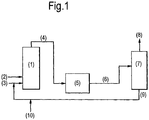
- Figure 1 is a schematic diagram showing a process according to an embodiment of the invention.
- the present invention provides a process for the preparation of an alkylene glycol from an alkylene oxide, proceeding via an alkylene carbonate intermediate:
- R 1 , R 2 , R 3 and R 4 may independently be chosen from hydrogen or an optionally substituted alkyl group having from 1 to 6 carbon atoms, preferably from 1 to 3 carbon atoms.
- substituents moieties such as hydroxy groups may be present.
- R 1 , R 2 and R 3 represent hydrogen atoms and R 4 represents hydrogen or a non-substituted C 1 -C 3 -alkyl group and, more preferably, R 1 , R 2 , R 3 and R 4 all represent hydrogen atoms.
- alkylene oxides examples include ethylene oxide and propylene oxide.
- the most preferred alkylene oxide is ethylene oxide.
- Alkylene oxide reacts with carbon dioxide in the presence of a carboxylation catalyst to provide alkylene carbonate and alkylene carbonate reacts with water in the presence of a hydrolysis catalyst to provide alkylene glycol.
- a carboxylation catalyst to provide alkylene carbonate
- alkylene carbonate reacts with water in the presence of a hydrolysis catalyst to provide alkylene glycol.
- Processes for preparing ethylene glycol by this route are described in detail in US 6, 080, 897 , US 6,187,972 and WO 2009/021830 .
- the reaction of alkylene oxide with carbon dioxide occurs predominantly in one or more carboxylation reactors, and the reaction of alkylene carbonate with water occurs predominantly in one or more hydrolysis reactors, wherein the one or more hydrolysis reactors are downstream of the one or more carboxylation reactors.
- the reaction of alkylene oxide with carbon dioxide and the reaction of alkylene carbonate with water occurs predominantly in a single reactor.
- the carboxylation catalyst may be a heterogeneous or homogeneous catalyst.
- Homogeneous catalysts that are known to promote carboxylation include alkali metal halides such as potassium iodide and potassium bromide, and halogenated organic phosphonium or ammonium salts such as tributylmethylphosphonium iodide, tetrabutylphosphonium iodide, triphenylmethylphosphonium iodide, triphenyl-propylphosphonium bromide, triphenylbenzylphosphonium chloride, tetraethylammonium bromide, tetramethylammonium bromide, benzyltriethylammonium bromide, tetrabutylammonium bromide and tributylmethylammonium iodide.
- Heterogeneous catalysts that promote carboxylation include quaternary ammonium and quaternary phosphonium halides immobilized on silica, quaternary ammonium and quaternary phosphonium halides bound to insoluble polystyrene beads, and metal salts such as zinc salts immobilised on solid supports containing quaternary ammonium or quaternary phosphonium groups, such as ion exchange resins containing quaternary ammonium or quaternary phosphonium groups.
- the carboxylation catalyst is a homogeneous catalyst, most preferably an organic phosphonium iodide or alkali halide salt.
- the active phase of the hydrolysis catalyst is one or more bases.
- the hydrolysis catalyst may be homogeneous or heterogeneous. Homogeneous catalysts that promote hydrolysis and that have a base as the active phase include hydroxides, bicarbonates, carbonates, carboxylates (e.g. acetates and formates) and phosphates. Examples include potassium hydroxide, sodium hydroxide, potassium bicarbonate, sodium bicarbonate, potassium carbonate, sodium carbonate, potassium acetate, potassium formate, tributylmethyl phosphonium hydroxide, potassium phosphate and disodium hydrogen phosphate.
- Heterogeneous catalysts that promote hydrolysis and that have a base as the active phase include hydroxide, bicarbonate and carbonate ions immobilised on solid supports, for example hydroxide, bicarbonate or carbonate immobilised on ion exchange resins containing quaternary ammonium or quaternary phosphonium groups; basic alumina; basic zeolite; and poly-4-vinyl-pyridine.
- the hydrolysis catalyst has bicarbonate anions as the active phase.
- Metal carbonates, hydroxides and bicarbonates such as potassium carbonate, potassium hydroxide and potassium bicarbonate, all provide bicarbonate anions as the active phase.
- Carbon dioxide is present during the hydrolysis reaction (it is a product of the hydrolysis reaction), and in the presence of carbon dioxide, hydroxides, carbonates and bicarbonates react as shown: CO 2 + 2OH - ⁇ HCO 3 - + OH - ⁇ CO 3 2- + H 2 O
- hydroxide and carbonate salts can act as a source of bicarbonate anions.
- the initial charge of the carboxylation catalyst and the initial charge of the hydrolysis catalyst catalyse the reaction of alkylene oxide with carbon dioxide, and catalyse the reaction of alkylene carbonate with water.
- the process preferably uses a catalyst recycle loop whereby catalyst is separated from the alkylene glycol product and is recycled so that it is combined with the alkylene oxide reactant.
- An initial charge of homogeneous catalyst is preferably added by supplying a solution of the catalyst to the catalyst recycle loop such that the catalyst is combined with the alkylene oxide reactant. If both the carboxylation catalyst and the hydrolysis catalyst are homogeneous, then the catalysts are preferably supplied to the catalyst recycle loop as a solution comprising both of the catalysts.
- heterogeneous carboxylation or heterogeneous hydrolysis catalysts are contained within two or more separate vessels arranged in parallel and wherein said vessels have associated switching means such that in operation the feed can be switched between the vessels.
- the degradation and associated activity of the hydrolysis catalyst is monitored.
- the degradation can be measured by taking samples, preferably from a recycle loop, and measuring the concentration of basic hydrolysis catalyst by acid/base titration. From the concentration of hydrolysis catalyst in the recycle loop it is possible to calculate the concentration of hydrolysis catalyst in the reactor, and the activity of the catalyst will be proportional to the concentration of hydrolysis catalyst in the reactor.
- the absolute concentration of the hydrolysis catalyst it is also possible to monitor degradation by measuring the change in ratio of hydrolysis catalyst to carboxylation catalyst, again by taking samples from a recycle loop and carrying out acid/base titration. The relative amount of hydrolysis catalyst will decrease as the hydrolysis catalyst degrades, and the associated activity of the hydrolysis catalyst will also decrease.
- the degradation can be measured by taking a sample of the heterogeneous catalyst, measuring the concentration of basic anions by titration and comparing this with the concentration of basic anions in a sample of fresh catalyst.
- the degradation can be measured by switching reactor vessels packed with heterogeneous catalyst, regenerating the heterogeneous catalyst by passing a solution comprising basic anions through the catalyst bed, and measuring the quantity of basic anions removed from the solution during the regeneration.
- the degradation can be measured by switching reactor vessels packed with heterogeneous catalyst and monitoring the relative activity of fresh and used beds (activity can be assessed by taking samples of the product stream and analysing the samples using standard techniques).
- Monitoring of the degradation of the hydrolysis catalyst is preferably carried out at least once every week and more preferably is carried out every day.
- the hydrolysis catalyst When the activity of the hydrolysis catalyst has fallen below a minimum level, an additional charge of the hydrolysis catalyst is added.
- a preferred way of assessing whether the activity of the hydrolysis catalyst has fallen below a minimum level is to set a minimum concentration of hydrolysis catalyst that must be present in the recycle stream.
- a preferred way of assessing whether the activity of the hydrolysis catalyst has fallen below a minimum level is to set a minimum conversion that must be achieved by a reactor vessel containing hydrolysis catalyst.
- an additional charge of the hydrolysis catalyst is added. If an additional charge of carboxylation catalyst is added when the additional charge of the hydrolysis catalyst is added, the weight ratio of additional hydrolysis catalyst to additional carboxylation catalyst is at least 5:1, preferably at least 10:1, more preferably at least 50:1. Most preferably, the addition charge of the hydrolysis catalyst is added without adding any additional carboxylation catalyst. If the hydrolysis catalyst is homogeneous, the additional charge of catalyst is preferably added by supplying a solution of the hydrolysis catalyst to the catalyst recycle loop. The additional charge does not have to be same catalyst compound as the initial charge.
- the initial charge can be a potassium carbonate solution and the additional charge(s) can be potassium hydroxide solution.
- the additional charge of catalyst is preferably added by replacing the used heterogeneous catalyst with fresh heterogeneous catalyst.
- a simple way to achieve this is to have heterogeneous hydrolysis catalysts contained within two or more separate vessels arranged in parallel, wherein said vessels have associated switching means such that in operation the feed can be switched between the vessels.
- the heterogeneous catalyst can be replaced with fresh heterogeneous catalyst by switching the feed to a vessel containing fresh catalyst.
- Degraded heterogeneous catalyst wherein the heterogeneous comprises basic anions on a support can be regenerated by treatment with a solution of basic anions.
- the hydrolysis catalyst is a homogeneous catalyst, there is likely to be a desirable upper limit on the concentration of the hydrolysis catalyst.
- the inventors have discovered that as the concentration of hydrolysis catalyst increases, the degradation of carboxylation catalysts such as halogenated organic phosphonium or ammonium salts, can also increase. Therefore, when an additional charge of the hydrolysis catalyst is added, the amount of additional catalyst is preferably such that the total concentration of hydrolysis catalyst will not be above an upper limit. This limit can be determined by observing how the carboxylation degrades as the hydrolysis catalyst concentration increases.
- steps (b) and (c) are preferably operated continually, e.g. monitoring of the hydrolysis catalyst is daily or weekly, and addition of additional hydrolysis catalyst occurs as necessary. However, after a period of monitoring and addition of hydrolysis catalyst, e.g. after several weeks or months of monitoring and several additional charges of hydrolysis catalyst, it may then be preferable to add additional charges of both carboxylation catalyst and hydrolysis catalyst. For example, step (c) may be carried out three or more times before additional charges of hydrolysis catalyst and carboxylation catalyst are added.
- FIG. 1 shows a preferred embodiment of the process of the invention.
- the apparatus includes a carboxylation reactor (1), a hydrolysis reactor (5) and a distillation column (7).
- Carbon dioxide (2) is fed to the carboxylation reactor.
- Ethylene oxide and water (3) are also fed to the carboxylation reactor.
- An initial charge of homogeneous carboxylation catalyst and an initial charge of homogeneous hydrolysis catalyst are fed (10) to a line that feeds into the ethylene oxide and water feed line (3). This catalyses the carboxylation reaction.
- a reaction stream comprising ethylene carbonate produced in the carboxylation reactor (1), and also comprising carboxylation catalyst and hydrolysis catalyst is fed (4) to the hydrolysis reactor (5).
- the hydrolysis catalyst catalyses the reaction of ethylene carbonate to ethylene glycol in the hydrolysis reactor (5).
- the product stream from the hydrolysis reactor (5) is fed (6) to a distillation column (7).
- Glycol products (8) are extracted from the distillation column (7) and a catalyst solution of carboxylation catalyst and hydrolysis catalyst is fed (9) back to the ethylene oxide and water feed line (3).
- the concentration of the hydrolysis catalyst is measured every day by taking samples from the recycle loop (9). Acid/base titration of the samples provides a measurement of the concentration of the hydrolysis catalyst. When the concentration of hydrolysis catalyst falls below a minimum level, an additional charge of the homogeneous hydrolysis catalyst is added at point (10) (and no further carboxylation catalyst is added).
- carboxylation reactor (1) ethylene oxide is converted into ethylene carbonate under the influence of the carboxylation catalyst.
- hydrolysis reactor (5) ethylene carbonate is converted into monoethylene glycol under the influence of the hydrolysis catalyst.
- glycols mainly monoethylene glycol, some diethylene glycol
- water are separated from both catalysts(a 20 - 70%wt solution in monoethylene glycol/ diethylene glcyol).
- Table 1 shows the conditions for experiments 1a-1c: Table 1 Exp 1a Exp 1b Exp 1c Water (g) 20 20 20 Monoethylene glycol (g) 20 20 20 20 Ethylene carbonate (g) 40 40 40 40 KI (g) 3.9 3.9 3.9 KI (mol/l) 0.30 0.30 0.30 K 3 PO 4 (g) 0.04 0.09 0.42 K 3 PO 4 (mol/l) 0.003 0.005 0.025 Temperature (°C) 150 150 150 150 CO 2 pressure (barg) 20 20 20 20 Time (h) 4 and 6 4 4 4
- Table 3 shows the conditions for experiments 2a-2c: Table 3 Exp 2a Exp 2b Exp 2c Water (g) 11 11 11 11 Monoethylene glycol (g) 47 47 47 TPAI (g) 2.3 2.3 2.3 TPAI (mol/l) 0.12 0.12 0.12 KOH (g) 0.02 0.34 1.74 KOH (mol/l) 0.006 0.10 0.49 Temperature (°C) 160 160 160 N 2 pressure (barg) 20 20 20 Time (h) 22 22 22 22 After 22h the resulting mixture was analyzed by 13 C NMR; TPAI catalyst degradation is visible by a decline in TPAI content and the formation of TPA (tri-n-propylamine), which is a TPAI degradation product. The results are shown in Table 4: Table 4 Exp 2a Exp 2b Exp 2c TPA formation No Yes Yes Decrease in TPAI content (%) 4 43 91
- the amount of additional catalyst is preferably such that the total concentration of hydrolysis catalyst will not be above an upper limit. This avoids the degradation of carboxylation catalyst illustrated by this experiment.
- Table 5 shows the conditions for experiments 3a-3c: Table 5 Exp 3a Exp 3b Exp 3c Water (g) 11 11 11 11 11 11 11 Monoethylene glycol (g) 47 47 47 TBPB (g) 22.5 23.3 24.7 TBPB (mol/l) 0.80 0.80 0.80 KOH (g) 1.40 3.37 7.14 KOH (mol/l) 0.30 0.70 1.40 Temperature (°C) 165 165 165 N 2 pressure (barg) 12.5 12.5 12.5 Time (h) 193 193 193 193 193 193 193 193 193 193 193 193 193 193 193 193 193 193 193 193 193 193 193 193 193 193 193
- the amount of additional catalyst is preferably such that the total concentration of hydrolysis catalyst will not be above an upper limit. This avoids the degradation of carboxylation catalyst illustrated by this experiment.
Landscapes
- Chemical & Material Sciences (AREA)
- Organic Chemistry (AREA)
- Life Sciences & Earth Sciences (AREA)
- Environmental & Geological Engineering (AREA)
- General Life Sciences & Earth Sciences (AREA)
- Geochemistry & Mineralogy (AREA)
- Geology (AREA)
- Chemical Kinetics & Catalysis (AREA)
- Organic Low-Molecular-Weight Compounds And Preparation Thereof (AREA)
- Low-Molecular Organic Synthesis Reactions Using Catalysts (AREA)
Claims (10)
- Verfahren zur Herstellung eines Alkylenglykols aus einem Alkylenoxid, wobei Alkylenoxid unter Vorhandensein eines Carboxylierungskatalysators mit Kohlendioxid reagiert, um Alkylencarbonat bereitzustellen, wobei Alkylencarbonat unter Vorhandensein eines Hydrolysekatalysators mit Wasser reagiert, um Alkylenglycol bereitzustellen, und wobei die aktive Phase des Hydrolysekatalysators eine oder mehrere Basen umfasst, umfassend die Schritte(a) Zugeben eines anfänglichen Eintrags des Carboxylierungskatalysators und eines anfänglichen Eintrags des Hydrolysekatalysators, um die Reaktion von Alkylenoxid mit Kohlendioxid zu katalysieren und um die Reaktion von Alkylencarbonat mit Wasser zu katalysieren;(b) Überwachen des Abbaus und der Aktivität des Hydrolysekatalysators; und(c) Zugeben eines zusätzlichen Eintrags des Hydrolysekatalysators, wenn die Aktivität des Hydrolysekatalysators unter ein Mindestniveau gefallen ist, wobei, wenn ein zusätzlicher Eintrag des Carboxylierungskatalysators zugegeben wird, das Gewichtsverhältnis von zusätzlichem Hydrolysekatalysator zu zusätzlichem Carboxylierungskatalysator mindestens 5:1 beträgt, wenn der zusätzliche Eintrag des Hydrolysekatalysators zugegeben wird.
- Verfahren nach Anspruch 1, wobei kein zusätzlicher Carboxylierungskatalysator zugegeben wird, wenn der zusätzliche Eintrag des Hydrolysekatalysators zugegeben wird.
- Verfahren nach Anspruch 1 oder Anspruch 2, wobei der Hydrolysekatalysator homogen ist.
- Verfahren nach einem der vorhergehenden Ansprüche, wobei der Hydrolysekatalysator und der Carboxylierungskatalysator homogen sind.
- Verfahren nach Anspruch 4, wobei das Verfahren eine Katalysatorrückführschleife verwendet, wobei der Hydrolysekatalysator und der Carboxylierungskatalysator von dem Alkylenglycolprodukt getrennt werden und derart rückgeführt werden, dass sie mit dem Alkylenoxid kombiniert werden, wobei der anfängliche Eintrag des Hydrolysekatalysators und der anfängliche Eintrag des Carboxylierungskatalysators zugegeben werden, indem der Katalysatorrückführschleife eine den Hydrolysekatalysator und den Carboxylierungskatalysator umfassende Lösung zugeführt wird, und wobei der zusätzliche Eintrag des Hydrolysekatalysators durch Zuführen einer Lösung des Hydrolysekatalysators zu der Katalysatorrückführschleife zugegeben wird.
- Verfahren nach Anspruch 5, wobei der Abbau des Hydrolysekatalysators gemessen wird, indem Proben aus der Rückführschleife entnommen werden und die Konzentration des Hydrolysekatalysators durch Säure/Base-Titration gemessen wird.
- Verfahren nach Anspruch 1 oder Anspruch 2, wobei der Hydrolysekatalysator heterogen ist.
- Verfahren nach Anspruch 7, wobei der heterogene Hydrolysekatalysator in zwei oder mehr getrennten Behältnissen, die parallel angeordnet sind, enthalten ist, wobei die Behältnisse zugeordnete Schaltmittel aufweisen, so dass im Betrieb die Zufuhr zwischen den Behältnissen umgeschaltet werden kann, und wobei der zusätzliche Eintrag des Hydrolysekatalysators zugegeben wird, indem die Zufuhr auf ein Behältnis umgeschaltet wird, das frischen Katalysator enthält.
- Verfahren nach Anspruch 8, wobei der Abbau des Hydrolysekatalysators gemessen wird, indem Reaktorbehältnisse umgeschaltet werden und die relative Aktivität von frischen und benutzten Katalysatorbetten überwacht wird.
- Verfahren nach einem der vorhergehenden Ansprüche, wobei der Hydrolysekatalysator Bicarbonatanionen als aktive Phase aufweist.
Priority Applications (1)
| Application Number | Priority Date | Filing Date | Title |
|---|---|---|---|
| EP09729352.6A EP2294042B1 (de) | 2008-04-10 | 2009-04-08 | Verfahren zur herstellung von alkylen-glycol |
Applications Claiming Priority (3)
| Application Number | Priority Date | Filing Date | Title |
|---|---|---|---|
| EP08103485 | 2008-04-10 | ||
| EP09729352.6A EP2294042B1 (de) | 2008-04-10 | 2009-04-08 | Verfahren zur herstellung von alkylen-glycol |
| PCT/EP2009/054270 WO2009124988A1 (en) | 2008-04-10 | 2009-04-08 | Process for the preparation of alkylene glycol |
Publications (2)
| Publication Number | Publication Date |
|---|---|
| EP2294042A1 EP2294042A1 (de) | 2011-03-16 |
| EP2294042B1 true EP2294042B1 (de) | 2018-08-08 |
Family
ID=39863129
Family Applications (1)
| Application Number | Title | Priority Date | Filing Date |
|---|---|---|---|
| EP09729352.6A Active EP2294042B1 (de) | 2008-04-10 | 2009-04-08 | Verfahren zur herstellung von alkylen-glycol |
Country Status (10)
| Country | Link |
|---|---|
| US (1) | US8110712B2 (de) |
| EP (1) | EP2294042B1 (de) |
| JP (1) | JP2011516531A (de) |
| KR (1) | KR20100135263A (de) |
| CN (1) | CN102036940B (de) |
| BR (1) | BRPI0911055B1 (de) |
| CA (1) | CA2720213A1 (de) |
| RU (1) | RU2490247C2 (de) |
| TW (1) | TWI487691B (de) |
| WO (1) | WO2009124988A1 (de) |
Families Citing this family (4)
| Publication number | Priority date | Publication date | Assignee | Title |
|---|---|---|---|---|
| BR112013008618B1 (pt) * | 2010-10-19 | 2018-12-18 | Shell Internationale Research Maatschappij B.V. | processo para a produção de um alquileno glicol a partir de um alceno |
| SG191979A1 (en) * | 2011-01-24 | 2013-08-30 | Shell Int Research | Process for the production of ethylene oxide |
| CN105272823B (zh) * | 2014-07-03 | 2017-04-19 | 中国石油化工股份有限公司 | 制备c2‑10链烷二醇的方法 |
| CN105272822B (zh) * | 2014-07-03 | 2017-04-19 | 中国石油化工股份有限公司 | 用于碳酸乙烯酯水解制备乙二醇的方法 |
Family Cites Families (9)
| Publication number | Priority date | Publication date | Assignee | Title |
|---|---|---|---|---|
| US4314945A (en) * | 1977-12-22 | 1982-02-09 | Union Carbide Corporation | Alkylene carbonate process |
| US4400559A (en) * | 1982-06-14 | 1983-08-23 | The Halcon Sd Group, Inc. | Process for preparing ethylene glycol |
| US6080897A (en) * | 1998-03-19 | 2000-06-27 | Mitsubishi Chemical Corporation | Method for producing monoethylene glycol |
| SG77264A1 (en) * | 1998-08-10 | 2000-12-19 | Mitsubishi Chem Corp | Process for producing an alkylene glycol |
| PE20001570A1 (es) * | 1998-12-14 | 2001-01-24 | Shell Int Research | Aditivo para la estabilizacion de catalizador en la hidrolisis de oxidos de alquileno |
| CN1309112A (zh) * | 2000-02-17 | 2001-08-22 | 三菱化学株式会社 | 制备烷撑二醇的方法 |
| KR101433970B1 (ko) | 2006-06-13 | 2014-08-25 | 셀 인터나쵸나아레 레사아치 마아츠샤피 비이부이 | 글리콜 분리 및 정제 |
| US7462748B2 (en) * | 2006-09-07 | 2008-12-09 | Shell Oil Company | Process for the preparation of alkylene glycol |
| BRPI0815487B1 (pt) | 2007-08-14 | 2017-09-12 | Shell Internationale Research Maatschappij B.V. | Method for preparing an alkylene glycol from an alken. |
-
2009
- 2009-04-08 EP EP09729352.6A patent/EP2294042B1/de active Active
- 2009-04-08 RU RU2010145531/04A patent/RU2490247C2/ru active
- 2009-04-08 CN CN200980118030XA patent/CN102036940B/zh active Active
- 2009-04-08 JP JP2011503445A patent/JP2011516531A/ja not_active Withdrawn
- 2009-04-08 WO PCT/EP2009/054270 patent/WO2009124988A1/en not_active Ceased
- 2009-04-08 BR BRPI0911055-0A patent/BRPI0911055B1/pt active IP Right Grant
- 2009-04-08 CA CA2720213A patent/CA2720213A1/en not_active Abandoned
- 2009-04-08 TW TW098111724A patent/TWI487691B/zh active
- 2009-04-08 US US12/420,564 patent/US8110712B2/en active Active
- 2009-04-08 KR KR1020107023235A patent/KR20100135263A/ko not_active Ceased
Non-Patent Citations (1)
| Title |
|---|
| None * |
Also Published As
| Publication number | Publication date |
|---|---|
| CN102036940A (zh) | 2011-04-27 |
| TWI487691B (zh) | 2015-06-11 |
| BRPI0911055B1 (pt) | 2017-10-24 |
| RU2490247C2 (ru) | 2013-08-20 |
| US20090259077A1 (en) | 2009-10-15 |
| CN102036940B (zh) | 2013-11-13 |
| BRPI0911055A2 (pt) | 2015-12-29 |
| US8110712B2 (en) | 2012-02-07 |
| TW200948762A (en) | 2009-12-01 |
| RU2010145531A (ru) | 2012-05-20 |
| EP2294042A1 (de) | 2011-03-16 |
| CA2720213A1 (en) | 2009-10-15 |
| JP2011516531A (ja) | 2011-05-26 |
| WO2009124988A1 (en) | 2009-10-15 |
| KR20100135263A (ko) | 2010-12-24 |
Similar Documents
| Publication | Publication Date | Title |
|---|---|---|
| CN101090880B (zh) | 醋酸的制造方法 | |
| EP2380868A1 (de) | Verfahren zur herstellung eines kohlens?uredialkylesters | |
| GB2567032B (en) | Purification process for ethylene glycol via sequential distillation | |
| EP3512828B1 (de) | Verfahren zur herstellung von glykolsäure | |
| EP2819992B1 (de) | Verfahren zur herstellung von dialkylcarbonat- und diolprodukte | |
| US10183906B2 (en) | Catalytic performance in processes for preparing acetic acid | |
| CN103339092A (zh) | 用于生产乙二醇的方法 | |
| CA2662824A1 (en) | Process for the preparation of alkylene glycol | |
| US8110712B2 (en) | Process for the preparation of alkylene glycol | |
| JP5147732B2 (ja) | アルキレンカーボネートの製造方法、ならびにアルカンジオールおよびジアルキルカーボネートの製造における、このように製造されたアルキレンカーボネートの使用 | |
| EP2137176B1 (de) | Verfahren zur herstellung eines 1,2-alkylencarbonats | |
| EP3898571B1 (de) | Verfahren zur herstellung von dialkylcarbonat und alkandiol | |
| TWI457317B (zh) | 碳酸伸烷酯之製造方法 | |
| TWI432404B (zh) | 製備烷二醇之方法 | |
| JP2955866B2 (ja) | ジアルキルカーボネートの製造方法 | |
| MX2007007488A (es) | Proceso para la preparacion de alquilenglicoles en el que se usa un lecho protector antes del lecho catalizador. | |
| EP4038046B1 (de) | Verfahren zur herstellung von dialkylcarbonat und alkandiol |
Legal Events
| Date | Code | Title | Description |
|---|---|---|---|
| PUAI | Public reference made under article 153(3) epc to a published international application that has entered the european phase |
Free format text: ORIGINAL CODE: 0009012 |
|
| 17P | Request for examination filed |
Effective date: 20101104 |
|
| AK | Designated contracting states |
Kind code of ref document: A1 Designated state(s): AT BE BG CH CY CZ DE DK EE ES FI FR GB GR HR HU IE IS IT LI LT LU LV MC MK MT NL NO PL PT RO SE SI SK TR |
|
| AX | Request for extension of the european patent |
Extension state: AL BA RS |
|
| DAX | Request for extension of the european patent (deleted) | ||
| 17Q | First examination report despatched |
Effective date: 20160817 |
|
| STAA | Information on the status of an ep patent application or granted ep patent |
Free format text: STATUS: EXAMINATION IS IN PROGRESS |
|
| RAP1 | Party data changed (applicant data changed or rights of an application transferred) |
Owner name: SHELL INTERNATIONALE RESEARCH MAATSCHAPPIJ B.V. |
|
| GRAP | Despatch of communication of intention to grant a patent |
Free format text: ORIGINAL CODE: EPIDOSNIGR1 |
|
| STAA | Information on the status of an ep patent application or granted ep patent |
Free format text: STATUS: GRANT OF PATENT IS INTENDED |
|
| INTG | Intention to grant announced |
Effective date: 20180515 |
|
| GRAS | Grant fee paid |
Free format text: ORIGINAL CODE: EPIDOSNIGR3 |
|
| GRAA | (expected) grant |
Free format text: ORIGINAL CODE: 0009210 |
|
| STAA | Information on the status of an ep patent application or granted ep patent |
Free format text: STATUS: THE PATENT HAS BEEN GRANTED |
|
| AK | Designated contracting states |
Kind code of ref document: B1 Designated state(s): AT BE BG CH CY CZ DE DK EE ES FI FR GB GR HR HU IE IS IT LI LT LU LV MC MK MT NL NO PL PT RO SE SI SK TR |
|
| REG | Reference to a national code |
Ref country code: GB Ref legal event code: FG4D |
|
| REG | Reference to a national code |
Ref country code: CH Ref legal event code: EP Ref country code: AT Ref legal event code: REF Ref document number: 1026792 Country of ref document: AT Kind code of ref document: T Effective date: 20180815 |
|
| REG | Reference to a national code |
Ref country code: IE Ref legal event code: FG4D |
|
| REG | Reference to a national code |
Ref country code: DE Ref legal event code: R096 Ref document number: 602009053707 Country of ref document: DE |
|
| REG | Reference to a national code |
Ref country code: NL Ref legal event code: FP |
|
| REG | Reference to a national code |
Ref country code: LT Ref legal event code: MG4D |
|
| REG | Reference to a national code |
Ref country code: AT Ref legal event code: MK05 Ref document number: 1026792 Country of ref document: AT Kind code of ref document: T Effective date: 20180808 |
|
| PG25 | Lapsed in a contracting state [announced via postgrant information from national office to epo] |
Ref country code: FI Free format text: LAPSE BECAUSE OF FAILURE TO SUBMIT A TRANSLATION OF THE DESCRIPTION OR TO PAY THE FEE WITHIN THE PRESCRIBED TIME-LIMIT Effective date: 20180808 Ref country code: PL Free format text: LAPSE BECAUSE OF FAILURE TO SUBMIT A TRANSLATION OF THE DESCRIPTION OR TO PAY THE FEE WITHIN THE PRESCRIBED TIME-LIMIT Effective date: 20180808 Ref country code: BG Free format text: LAPSE BECAUSE OF FAILURE TO SUBMIT A TRANSLATION OF THE DESCRIPTION OR TO PAY THE FEE WITHIN THE PRESCRIBED TIME-LIMIT Effective date: 20181108 Ref country code: SE Free format text: LAPSE BECAUSE OF FAILURE TO SUBMIT A TRANSLATION OF THE DESCRIPTION OR TO PAY THE FEE WITHIN THE PRESCRIBED TIME-LIMIT Effective date: 20180808 Ref country code: LT Free format text: LAPSE BECAUSE OF FAILURE TO SUBMIT A TRANSLATION OF THE DESCRIPTION OR TO PAY THE FEE WITHIN THE PRESCRIBED TIME-LIMIT Effective date: 20180808 Ref country code: GR Free format text: LAPSE BECAUSE OF FAILURE TO SUBMIT A TRANSLATION OF THE DESCRIPTION OR TO PAY THE FEE WITHIN THE PRESCRIBED TIME-LIMIT Effective date: 20181109 Ref country code: NO Free format text: LAPSE BECAUSE OF FAILURE TO SUBMIT A TRANSLATION OF THE DESCRIPTION OR TO PAY THE FEE WITHIN THE PRESCRIBED TIME-LIMIT Effective date: 20181108 Ref country code: IS Free format text: LAPSE BECAUSE OF FAILURE TO SUBMIT A TRANSLATION OF THE DESCRIPTION OR TO PAY THE FEE WITHIN THE PRESCRIBED TIME-LIMIT Effective date: 20181208 Ref country code: AT Free format text: LAPSE BECAUSE OF FAILURE TO SUBMIT A TRANSLATION OF THE DESCRIPTION OR TO PAY THE FEE WITHIN THE PRESCRIBED TIME-LIMIT Effective date: 20180808 |
|
| PG25 | Lapsed in a contracting state [announced via postgrant information from national office to epo] |
Ref country code: ES Free format text: LAPSE BECAUSE OF FAILURE TO SUBMIT A TRANSLATION OF THE DESCRIPTION OR TO PAY THE FEE WITHIN THE PRESCRIBED TIME-LIMIT Effective date: 20180808 Ref country code: LV Free format text: LAPSE BECAUSE OF FAILURE TO SUBMIT A TRANSLATION OF THE DESCRIPTION OR TO PAY THE FEE WITHIN THE PRESCRIBED TIME-LIMIT Effective date: 20180808 Ref country code: HR Free format text: LAPSE BECAUSE OF FAILURE TO SUBMIT A TRANSLATION OF THE DESCRIPTION OR TO PAY THE FEE WITHIN THE PRESCRIBED TIME-LIMIT Effective date: 20180808 |
|
| PG25 | Lapsed in a contracting state [announced via postgrant information from national office to epo] |
Ref country code: RO Free format text: LAPSE BECAUSE OF FAILURE TO SUBMIT A TRANSLATION OF THE DESCRIPTION OR TO PAY THE FEE WITHIN THE PRESCRIBED TIME-LIMIT Effective date: 20180808 Ref country code: IT Free format text: LAPSE BECAUSE OF FAILURE TO SUBMIT A TRANSLATION OF THE DESCRIPTION OR TO PAY THE FEE WITHIN THE PRESCRIBED TIME-LIMIT Effective date: 20180808 Ref country code: CZ Free format text: LAPSE BECAUSE OF FAILURE TO SUBMIT A TRANSLATION OF THE DESCRIPTION OR TO PAY THE FEE WITHIN THE PRESCRIBED TIME-LIMIT Effective date: 20180808 |
|
| REG | Reference to a national code |
Ref country code: DE Ref legal event code: R097 Ref document number: 602009053707 Country of ref document: DE |
|
| PG25 | Lapsed in a contracting state [announced via postgrant information from national office to epo] |
Ref country code: DK Free format text: LAPSE BECAUSE OF FAILURE TO SUBMIT A TRANSLATION OF THE DESCRIPTION OR TO PAY THE FEE WITHIN THE PRESCRIBED TIME-LIMIT Effective date: 20180808 Ref country code: SK Free format text: LAPSE BECAUSE OF FAILURE TO SUBMIT A TRANSLATION OF THE DESCRIPTION OR TO PAY THE FEE WITHIN THE PRESCRIBED TIME-LIMIT Effective date: 20180808 |
|
| PLBE | No opposition filed within time limit |
Free format text: ORIGINAL CODE: 0009261 |
|
| STAA | Information on the status of an ep patent application or granted ep patent |
Free format text: STATUS: NO OPPOSITION FILED WITHIN TIME LIMIT |
|
| 26N | No opposition filed |
Effective date: 20190509 |
|
| PG25 | Lapsed in a contracting state [announced via postgrant information from national office to epo] |
Ref country code: SI Free format text: LAPSE BECAUSE OF FAILURE TO SUBMIT A TRANSLATION OF THE DESCRIPTION OR TO PAY THE FEE WITHIN THE PRESCRIBED TIME-LIMIT Effective date: 20180808 Ref country code: EE Free format text: LAPSE BECAUSE OF FAILURE TO SUBMIT A TRANSLATION OF THE DESCRIPTION OR TO PAY THE FEE WITHIN THE PRESCRIBED TIME-LIMIT Effective date: 20180808 |
|
| REG | Reference to a national code |
Ref country code: CH Ref legal event code: PL |
|
| GBPC | Gb: european patent ceased through non-payment of renewal fee |
Effective date: 20190408 |
|
| PG25 | Lapsed in a contracting state [announced via postgrant information from national office to epo] |
Ref country code: MC Free format text: LAPSE BECAUSE OF FAILURE TO SUBMIT A TRANSLATION OF THE DESCRIPTION OR TO PAY THE FEE WITHIN THE PRESCRIBED TIME-LIMIT Effective date: 20180808 Ref country code: LU Free format text: LAPSE BECAUSE OF NON-PAYMENT OF DUE FEES Effective date: 20190408 |
|
| PG25 | Lapsed in a contracting state [announced via postgrant information from national office to epo] |
Ref country code: GB Free format text: LAPSE BECAUSE OF NON-PAYMENT OF DUE FEES Effective date: 20190408 Ref country code: CH Free format text: LAPSE BECAUSE OF NON-PAYMENT OF DUE FEES Effective date: 20190430 Ref country code: LI Free format text: LAPSE BECAUSE OF NON-PAYMENT OF DUE FEES Effective date: 20190430 |
|
| PG25 | Lapsed in a contracting state [announced via postgrant information from national office to epo] |
Ref country code: TR Free format text: LAPSE BECAUSE OF FAILURE TO SUBMIT A TRANSLATION OF THE DESCRIPTION OR TO PAY THE FEE WITHIN THE PRESCRIBED TIME-LIMIT Effective date: 20180808 |
|
| PG25 | Lapsed in a contracting state [announced via postgrant information from national office to epo] |
Ref country code: IE Free format text: LAPSE BECAUSE OF NON-PAYMENT OF DUE FEES Effective date: 20190408 |
|
| PG25 | Lapsed in a contracting state [announced via postgrant information from national office to epo] |
Ref country code: PT Free format text: LAPSE BECAUSE OF FAILURE TO SUBMIT A TRANSLATION OF THE DESCRIPTION OR TO PAY THE FEE WITHIN THE PRESCRIBED TIME-LIMIT Effective date: 20181208 Ref country code: FR Free format text: LAPSE BECAUSE OF NON-PAYMENT OF DUE FEES Effective date: 20190430 |
|
| PG25 | Lapsed in a contracting state [announced via postgrant information from national office to epo] |
Ref country code: CY Free format text: LAPSE BECAUSE OF FAILURE TO SUBMIT A TRANSLATION OF THE DESCRIPTION OR TO PAY THE FEE WITHIN THE PRESCRIBED TIME-LIMIT Effective date: 20180808 |
|
| PG25 | Lapsed in a contracting state [announced via postgrant information from national office to epo] |
Ref country code: MT Free format text: LAPSE BECAUSE OF FAILURE TO SUBMIT A TRANSLATION OF THE DESCRIPTION OR TO PAY THE FEE WITHIN THE PRESCRIBED TIME-LIMIT Effective date: 20180808 Ref country code: HU Free format text: LAPSE BECAUSE OF FAILURE TO SUBMIT A TRANSLATION OF THE DESCRIPTION OR TO PAY THE FEE WITHIN THE PRESCRIBED TIME-LIMIT; INVALID AB INITIO Effective date: 20090408 |
|
| PG25 | Lapsed in a contracting state [announced via postgrant information from national office to epo] |
Ref country code: MK Free format text: LAPSE BECAUSE OF FAILURE TO SUBMIT A TRANSLATION OF THE DESCRIPTION OR TO PAY THE FEE WITHIN THE PRESCRIBED TIME-LIMIT Effective date: 20180808 |
|
| PGFP | Annual fee paid to national office [announced via postgrant information from national office to epo] |
Ref country code: DE Payment date: 20250305 Year of fee payment: 17 |
|
| PGFP | Annual fee paid to national office [announced via postgrant information from national office to epo] |
Ref country code: BE Payment date: 20260317 Year of fee payment: 18 |
|
| PGFP | Annual fee paid to national office [announced via postgrant information from national office to epo] |
Ref country code: NL Payment date: 20260317 Year of fee payment: 18 |