EP2292818B1 - Method for producing an elastic string and elastic string obtained - Google Patents
Method for producing an elastic string and elastic string obtained Download PDFInfo
- Publication number
- EP2292818B1 EP2292818B1 EP10290472A EP10290472A EP2292818B1 EP 2292818 B1 EP2292818 B1 EP 2292818B1 EP 10290472 A EP10290472 A EP 10290472A EP 10290472 A EP10290472 A EP 10290472A EP 2292818 B1 EP2292818 B1 EP 2292818B1
- Authority
- EP
- European Patent Office
- Prior art keywords
- string
- core yarns
- core
- longitudinal axis
- yarns
- Prior art date
- Legal status (The legal status is an assumption and is not a legal conclusion. Google has not performed a legal analysis and makes no representation as to the accuracy of the status listed.)
- Not-in-force
Links
Images

Classifications
-
- D—TEXTILES; PAPER
- D02—YARNS; MECHANICAL FINISHING OF YARNS OR ROPES; WARPING OR BEAMING
- D02G—CRIMPING OR CURLING FIBRES, FILAMENTS, THREADS, OR YARNS; YARNS OR THREADS
- D02G3/00—Yarns or threads, e.g. fancy yarns; Processes or apparatus for the production thereof, not otherwise provided for
- D02G3/22—Yarns or threads characterised by constructional features, e.g. blending, filament/fibre
- D02G3/32—Elastic yarns or threads ; Production of plied or cored yarns, one of which is elastic
- D02G3/326—Elastic yarns or threads ; Production of plied or cored yarns, one of which is elastic the elastic properties due to the construction rather than to the use of elastic material
-
- D—TEXTILES; PAPER
- D04—BRAIDING; LACE-MAKING; KNITTING; TRIMMINGS; NON-WOVEN FABRICS
- D04C—BRAIDING OR MANUFACTURE OF LACE, INCLUDING BOBBIN-NET OR CARBONISED LACE; BRAIDING MACHINES; BRAID; LACE
- D04C1/00—Braid or lace, e.g. pillow-lace; Processes for the manufacture thereof
- D04C1/06—Braid or lace serving particular purposes
- D04C1/12—Cords, lines, or tows
Definitions
- the present invention relates to a method for manufacturing an elastic string or the like, from an assembly of at least two basic threads made of fibers and / or filaments.
- string is not limiting and refers to any linear textile product, of any size or title (from a millimeter to a few centimeters), obtained from an assembly of at least two basic yarns made of fibers and / or filaments, in any natural material (animal and / or vegetable and / or mineral) and / or chemical (synthetic and / or artificial), called according to the applications: thread, string, cord, rope, etc. ., and used in any type of application such as industry, furniture, boating, agri-food, medical, etc.
- Elasticity is defined in the following way: it is the quality of an object to be deformable while resuming its original form when the constraint applied to it disappears.
- the final elasticity of the product depends on the elasticity of the yarn used and its manufacturing process. Some synthetic or artificial fibers have their own elasticity. But for natural fibers, the elasticity is limited or even zero.
- the present invention provides a solution for providing elasticity to the final product made from any type of fibers and / or filaments, including from natural fibers.
- publications are known BE 621 724 A and DE 29 28 692 A an elastic string obtained by twisting together at least two base yarns previously over-twisted in one direction "S" for one and in the other direction "Z” for the other, and then subjecting them to a heat treatment for to stabilize their torsion.
- Some elastic strings are also manufactured by wrapping, an example of which is illustrated in the publication EP 1 746 189 A1 .
- Grape wrapping is a method of assembling a core wire with a wire wrapped around the core wire which is called a wire wrapper.
- the core wire is a spandex, latex or similar yarn, of fairly large size (about 2 mm in diameter), and is coated with one or more cotton or polyester threads. .
- This manufacturing process is controlled and the production yield is high. Thus, the product obtained is cheap.
- wrapping has major disadvantages.
- the core wire is not integral with the coating wire. In fact, when the elastic gimped string is cut, it is common that the ends fray or loosen, leaving apparent the core thread.
- a particular case concerns the use of a gimped elastic string in the food industry, particularly for tying meat pieces, such as paupiettes, roasts, poultry, etc., to ensure the maintenance of different pieces of meat, decoration, stuffing, etc. during cooking.
- meat pieces such as paupiettes, roasts, poultry, etc.
- the meat can shrink and the string used must be able to follow the retraction of the piece of meat while keeping it tight.
- the elastic gimped string retracts rapidly and causes splashes of cooking juices, sauce and the like, in its environment.
- This disadvantage does not exist with a traditional non-elastic string. But in this case, the traditional non-elastic string does not ensure effective maintenance of the piece of meat throughout its cooking and is difficult to mechanize. It must be placed manually to avoid cutting the meat in case of automatic break.
- the present invention aims to provide a solution to the problems mentioned above by proposing a method of manufacturing an elastic string without elastane or latex, having a high power of retraction and whose elasticity is controllable and can be stabilized or even neutralized under certain conditions to avoid the disadvantages mentioned above.
- the invention relates to a method of manufacture of the kind indicated in the preamble, in which one applies an over-twist in a direction S to a first basic thread and an over-twist in the other direction Z to a second base yarn, such that the fibers and / or filaments form an angle ⁇ between 30 ° and 90 ° with the longitudinal axis of said first base yarn and said second base yarn is fixed the over-twist of said yarns
- said overwired basic threads are assembled by a braiding process to form said twine so that, when said twine is in the free state without traction, said over-twisted basic threads have a tendency to away from the longitudinal axis of the string and to orient itself in the direction of an axis perpendicular to said longitudinal axis of the string by forming an angle ⁇ with the longitudinal axis of the string between 30 ° and 90 °.
- this manufacturing process makes it possible to impart great elasticity to the twine made by combining an over-twist of the base yarns with a particular assembly of these basic yarns, without the addition of elastane or latex, the elongation at the rupture obtained which may be at least between 20% and 150%.
- base wires whose title is relatively thin and at least between Nm150 and Nm17 (or between 6 tex and 60 tex).
- T k ⁇ Nm, where T is the value of the twist in r / m and Nm is the metric number of the yarn, a high torsion coefficient k is advantageously chosen between at least 200 and 600 .
- More than two basic threads can be used to make said string.
- the over-twist on said base yarns may be fixed by a vaporizing process or any other equivalent method.
- At least four basic yarns and a braiding machine are used, and the over-twisted basic yarns are arranged in a first direction S on the spindles of the braiding machine going into counterclockwise and the over-twisted basic yarns in the other direction Z on the spindles of the braiding machine going clockwise.
- the basic son is arranged on at least one spindle out of two.
- the invention also relates to an elastic string obtained by the manufacturing method as described above, characterized in that it comprises a braided assembly of at least four basic threads made of fibers and / or filaments, two first base yarns with one S-direction over-torsion and two second base yarns with Z-direction over-twisting, the fibers and / or filaments of the base yarns forming an angle B included in less between 30 ° and 90 ° with the longitudinal axis of each base wire; and the base yarns deviating from the longitudinal axis of the braided string and orienting towards an axis perpendicular to that longitudinal axis of the string at an angle ⁇ with the longitudinal axis of the twine included between 30 ° and 90 °.
- the process according to the invention makes it possible to manufacture a string 10 or any similar product such as thread, cord, rope, etc., from an assembly of at least two base yarns 20 and 30, themselves made of fibers and / or filaments 40, the twine 10 obtained having high elastic properties, moreover controllable, without using elastane, latex or the like.
- the number of basic threads is not limited to two and it is of course possible to manufacture a string according to the invention from an assembly of several basic threads.
- an even number of base yarns are preferred and split into two equal parts to balance the number of over-twisted S-baseline yarns and the number of basic yarns.
- the over-twist value applied to each of the basic threads may be the same or different depending on the desired results. Of course, any combination of basic threads in quality, number, value of torsion, etc. is possible.
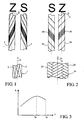
- the twist of the wire can be carried out in the S direction or in the Z direction (cf. Fig. 1 and 2 ).
- the value of the torsion expressed in revolutions / meter is calculated with the Koechlin formula: T towers / m ⁇ k ⁇ nm where k corresponds to the torsion coefficient and Nm corresponds to the title of the wire.
- the figure 3 illustrates the curve of the tensile strength (R) of the yarn as a function of its torsion value (T). There is a saturating twist (Ts) where the tensile strength is the highest. Beyond this, the tensile strength of the wire drops to the critical twist (Tc) where the wire breaks.
- Ts saturating twist
- twisting the resulting yarn is called twisted yarn or double-stranded or stranded or multi-stranded wire or ends.
- the main effect of the twisting is to obtain a wire of larger diameter whose fibers are parallel and oriented along the longitudinal axis of the wire.
- the final twist value is calculated from the same Koechlin formula given previously.
- the spinner selects a torsion coefficient (k) so that the yarn obtained is balanced and has no tendency to twist.
- k torsion coefficient
- twisted twisted yarns 20, 30 are made on conventional twists capable of working on fine threads or small titles. Indeed, if the over-twisted yarn is large, especially greater than about 100 tex, the twist will be only superficial and will not reach the fibers in the heart of the yarn.
- the torsion should preferably apply to fine threads, especially less than about 100 tex, and for example son having a metric number (Nm) of 50 which equals 20 tex.
- Nm metric number
- a torsion coefficient k of 425 would be a good compromise and would give good elasticity.
- a twist of 2100tr / m is obtained for a twisted yarn at two ends, each of Nm50 is 20 tex, to finally obtain a thread of Nm 25 or 40tex, and a twist of 1750tr. / m for a twisted yarn with three ends each of Nm50 to finally obtain a thread of Nm16 or 60 tex.
- This torsion can correspond to the saturating torsion Ts which is the optimal torsion (cf. Fig. 3 ) or approaching it.
- the values mentioned above are not limiting and may vary depending on the title of the wire or the material used, or even depending on the application with a wire having the same or similar characteristics.
- the over-twisted base yarns are nervous and tend to twist.
- the over-torsion of the basic threads 20, 30 is fixed by any known method.
- a steaming method will be chosen in an autoclave at a temperature of 90 ° C. for a determined time equal, for example, to 20 minutes.
- these values are not limiting and are only mentioned by way of example.
- step 2 when the over-twist of the base wires is fixed, they are assembled by a braiding process to make a braided string.
- the spindles of the braiding machine being clockwise are equipped with S-shaped bobbins 3 and the counter-clockwise bobbins are equipped with Z-twisted yarn bobbins 2.
- the braided string 1 obtained by the method classic has little or no elasticity.
- the base yarns 20, 30 have a tendency to deviate from the longitudinal axis A of the braided twine and to orient towards an axis perpendicular to this axis, forming an angle ⁇ with the longitudinal axis A braided twine 10 greater than that of a conventional braided twine, for example beyond 30 ° and between 30 ° and 90 °.
- This phenomenon is visible on Figures 4 and 5 which make it possible to compare the same braided string by a traditional braiding process at the place and by the process of the invention in reverse.
- the same string we mean the same nature of base son, the same value of torsion, the same speed of braiding, the same number of crosses per centimeter, the same speed of traction of the braid.
- the base yarns 20 and 30 and the fibers and / or filaments 40 will tend to regain their preferred orientation, that given by the over-torsion for the fibers and / or filaments 40 and that given by the inverted braiding, resulting in a high elasticity, which can reach at least between 20% and 150% elongation at break and for example 100% elongation.
- the braiding angle or the number of centimeter crossings can be varied while maintaining the elasticity characteristics of the braided twine obtained.
- Additional elasticity can be achieved by releasing the over-twisting of the basic yarns 20, 30. Depending on the needs of the end user, this release may be revealed at the end of the process or during use (see example given below).
- base yarns made of twisted cotton fibers are used at two ends of Nm50 each with an over-twist of 2100 rpm.
- Half of the base wires are applied with an S-twist and at the other half with Z-over-torsion.
- the over-torsion is fixed on all of the base wires with steam at 90 ° C. in an autoclave for 20 minutes.
- Braided basic threads are then assembled on a conventional small-diameter braiding machine with a capacity of sixteen reels, thus provided with sixteen spindles.
- One spindle out of two is used.
- the four S-coils are installed on the spindles of the braiding machine which rotate counter-clockwise and the four Z-coils are installed on the spindles in a clockwise direction - cf. fig.2 and 5 .
- the braided twine thus obtained has a natural elasticity of 120%, in particular allowing it to be used on automatic machines to tie the pieces of meat.
- This string has a good cohesion and can be cut without fray. The ends can be knotted easily by hand or by automatic machine.
- the string When the string is wrapped around the piece of meat, she marries and firmly holds the piece of meat without cutting it.
- the water vapor present in the oven releases the remaining voltage contained in the over-twisted base wires 20, 30.
- the string 10 retracts and thus accompanies the narrowing of the piece of meat.
- the string 10 loses its nervousness, so its elasticity. When cut, it behaves like ordinary string without elasticity and causes no splashing.
Landscapes
- Engineering & Computer Science (AREA)
- Textile Engineering (AREA)
- Mechanical Engineering (AREA)
- Manufacturing & Machinery (AREA)
- Yarns And Mechanical Finishing Of Yarns Or Ropes (AREA)
- Ropes Or Cables (AREA)
- Decoration Of Textiles (AREA)
Abstract
Description
La présente invention concerne un procédé de fabrication d'une ficelle élastique ou similaire, à partir d'un assemblage d'au moins deux fils de base constitués de fibres et/ou de filaments.The present invention relates to a method for manufacturing an elastic string or the like, from an assembly of at least two basic threads made of fibers and / or filaments.
Dans la présente invention, le terme « ficelle » n'est pas limitatif et désigne tout produit textile linéaire, de toute grosseur ou titre (du millimètre à quelques centimètres), obtenu à partir d'un assemblage d'au moins deux fils de base constitués de fibres et/ou de filaments, en toute matière naturelle (animale et/ou végétale et/ou minérale) et/ou chimique (synthétique et/ou artificielle), appelé selon les applications : fil, ficelle, cordelette, corde, etc., et utilisé dans tout type d'application telle que l'industrie, l'ameublement, le nautisme, l'agro-alimentaire, le médical, etc.In the present invention, the term "string" is not limiting and refers to any linear textile product, of any size or title (from a millimeter to a few centimeters), obtained from an assembly of at least two basic yarns made of fibers and / or filaments, in any natural material (animal and / or vegetable and / or mineral) and / or chemical (synthetic and / or artificial), called according to the applications: thread, string, cord, rope, etc. ., and used in any type of application such as industry, furniture, boating, agri-food, medical, etc.
On définit l'élasticité de la manière suivante : c'est la qualité d'un objet à être déformable tout en reprenant sa forme d'origine lorsque la contrainte qu'on lui applique disparaît. Dans le domaine du textile, l'élasticité finale du produit dépend de l'élasticité du fil utilisé ainsi que de son procédé de fabrication. Certaines fibres synthétiques ou artificielles possèdent un caractère élastique propre. Mais pour les fibres naturelles, l'élasticité est restreinte voire nulle. La présente invention apporte une solution pour donner de l'élasticité au produit final fabriqué à partir de tout type de fibres et/ou de filaments, y compris à partir de fibres naturelles.Elasticity is defined in the following way: it is the quality of an object to be deformable while resuming its original form when the constraint applied to it disappears. In the field of textiles, the final elasticity of the product depends on the elasticity of the yarn used and its manufacturing process. Some synthetic or artificial fibers have their own elasticity. But for natural fibers, the elasticity is limited or even zero. The present invention provides a solution for providing elasticity to the final product made from any type of fibers and / or filaments, including from natural fibers.
Il existe déjà des ficelles élastiques sur le marché.There are already elastic strings on the market.
On connaît par exemple des publications
Certaines ficelles élastiques sont par ailleurs fabriquées par guipage dont un exemple est illustré dans la publication
Un cas particulier concerne l'utilisation d'une ficelle élastique guipée dans l'industrie agro-alimentaire notamment pour ficeler les pièces de viande, telles que paupiettes, rôtis, volailles, etc., afin d'assurer le maintien des différents morceaux de viande, de la décoration, de la farce, etc. pendant la cuisson. Selon la qualité des produits, les viandes peuvent rétrécir et la ficelle utilisée doit pouvoir suivre la rétractation de la pièce de viande toute en la maintenant serrée. Aux inconvénients du guipage décrits ci-dessus, s'ajoute dans ce cas un problème physique : après la cuisson et lors de la découpe, la ficelle élastique guipée se rétracte rapidement et provoque des éclaboussures de jus de cuisson, de sauce et autre, dans son environnement. Cet inconvénient n'existe pas avec une ficelle traditionnelle non élastique. Mais dans ce cas, la ficelle traditionnelle non élastique n'assure pas un maintien efficace de la pièce de viande tout au long de sa cuisson et est difficilement mécanisable. Elle doit donc être posée manuellement pour éviter de couper la viande en cas de pause automatique.A particular case concerns the use of a gimped elastic string in the food industry, particularly for tying meat pieces, such as paupiettes, roasts, poultry, etc., to ensure the maintenance of different pieces of meat, decoration, stuffing, etc. during cooking. Depending on the quality of the products, the meat can shrink and the string used must be able to follow the retraction of the piece of meat while keeping it tight. In addition to the disadvantages of the covering described above, there is a physical problem: after cooking and during cutting, the elastic gimped string retracts rapidly and causes splashes of cooking juices, sauce and the like, in its environment. This disadvantage does not exist with a traditional non-elastic string. But in this case, the traditional non-elastic string does not ensure effective maintenance of the piece of meat throughout its cooking and is difficult to mechanize. It must be placed manually to avoid cutting the meat in case of automatic break.
A ce jour, il n'existe pas de solution satisfaisante.To date, there is no satisfactory solution.
La présente invention vise à apporter une solution aux problèmes évoqués ci-dessus en proposant un procédé de fabrication d'une ficelle élastique sans élasthanne ni latex, ayant un fort pouvoir de rétractation et dont l'élasticité est maîtrisable et peut être stabilisée voire neutralisée sous certaines conditions pour éviter les inconvénients évoqués précédemment.The present invention aims to provide a solution to the problems mentioned above by proposing a method of manufacturing an elastic string without elastane or latex, having a high power of retraction and whose elasticity is controllable and can be stabilized or even neutralized under certain conditions to avoid the disadvantages mentioned above.
Dans ce but, l'invention concerne un procédé de fabrication du genre indiqué en préambule, dans lequel on applique une sur-torsion dans un sens S à un premier fil de base et une sur-torsion dans l'autre sens Z à un deuxième fil de base, de manière telle que les fibres et/ou filaments forment un angle β compris entre 30° et 90° avec l'axe longitudinal dudit premier fil de base et dudit deuxième fil de base on fixe la sur-torsion desdits fils de base pour les stabiliser, on assemble lesdits fils de base sur-tordus par un procédé de tressage pour former ladite ficelle de sorte que, lorsque ladite ficelle est à l'état libre sans traction, lesdits fils de base sur-tordus ont tendance à s'écarter de l'axe longitudinal de la ficelle et à s'orienter en direction d'un axe perpendiculaire audit axe longitudinal de la ficelle en formant un angle α avec l'axe longitudinal de la ficelle compris entre 30° et 90°.For this purpose, the invention relates to a method of manufacture of the kind indicated in the preamble, in which one applies an over-twist in a direction S to a first basic thread and an over-twist in the other direction Z to a second base yarn, such that the fibers and / or filaments form an angle β between 30 ° and 90 ° with the longitudinal axis of said first base yarn and said second base yarn is fixed the over-twist of said yarns In order to stabilize them, said overwired basic threads are assembled by a braiding process to form said twine so that, when said twine is in the free state without traction, said over-twisted basic threads have a tendency to away from the longitudinal axis of the string and to orient itself in the direction of an axis perpendicular to said longitudinal axis of the string by forming an angle α with the longitudinal axis of the string between 30 ° and 90 °.
Ainsi ce procédé de fabrication permet de conférer une grande élasticité à la ficelle réalisée en combinant une sur-torsion des fils de base avec un assemblage particulier de ces fils de base, sans adjonction d'élasthanne, ni de latex, l'allongement à la rupture obtenu pouvant être compris au moins entre 20% et 150%.Thus, this manufacturing process makes it possible to impart great elasticity to the twine made by combining an over-twist of the base yarns with a particular assembly of these basic yarns, without the addition of elastane or latex, the elongation at the rupture obtained which may be at least between 20% and 150%.
On utilise de préférence des fils de base dont le titre est relativement fin et compris au moins entre Nm150 et Nm17 (soit entre 6 tex et 60 tex).It is preferred to use base wires whose title is relatively thin and at least between Nm150 and Nm17 (or between 6 tex and 60 tex).
Dans la formule définissant la torsion : T = k√Nm, où T est la valeur de la torsion en tr/m et Nm est le numéro métrique du fil, on choisit avantageusement un coefficient de torsion k élevé compris au moins entre 200 et 600.In the formula defining the twist: T = k√Nm, where T is the value of the twist in r / m and Nm is the metric number of the yarn, a high torsion coefficient k is advantageously chosen between at least 200 and 600 .
On peut utiliser plus de deux fils de base pour fabriquer ladite ficelle. Dans ce cas, on applique à une partie des fils de base une sur-torsion en S et à l'autre partie des fils de base une sur-torsion en Z, ces parties pouvant être égales.More than two basic threads can be used to make said string. In this case, one applies to a portion of the base son a superstructure S and the other part of the base son a Z-over-torsion, these parts may be equal.
On peut fixer la sur-torsion sur lesdits fils de base par un procédé de vaporisage ou tout autre procédé équivalent.The over-twist on said base yarns may be fixed by a vaporizing process or any other equivalent method.
Dans une forme de réalisation préférée de l'invention, on utilise au moins quatre fils de base et une machine de tressage, et on dispose les fils de base sur-tordus dans un premier sens S sur les fuseaux de la machine de tressage allant dans le sens antihoraire et les fils de base sur-tordus dans l'autre sens Z sur les fuseaux de la machine de tressage allant dans le sens horaire.In a preferred embodiment of the invention, at least four basic yarns and a braiding machine are used, and the over-twisted basic yarns are arranged in a first direction S on the spindles of the braiding machine going into counterclockwise and the over-twisted basic yarns in the other direction Z on the spindles of the braiding machine going clockwise.
On peut utiliser une machine de tressage ayant un nombre de fuseaux supérieur au nombre de fils de base à assembler. Dans ce cas, on dispose les fils de base sur au moins un fuseau sur deux.It is possible to use a braiding machine having a number of spindles greater than the number of basic threads to be assembled. In this case, the basic son is arranged on at least one spindle out of two.
L'invention concerne également une ficelle élastique obtenue par le procédé de fabrication tel que décrit ci-dessus, caractérisée en ce qu'elle comporte un assemblage tressé d'au moins quatre fils de base constitués de fibres et/ou de filaments, deux premiers fils de base pourvus d'une sur-torsion dans un sens S et deux deuxièmes fils de base pourvus d'une sur-torsion dans l'autre sens Z, les fibres et/ou filaments des fils de base formant un angle B compris au moins entre 30° et 90° avec l'axe longitudinal de chaque fil de base; et les fils de base s'écartant de l'axe longitudinal de la ficelle tressée et s'orientant en direction d'un axe perpendiculaire à cet axe longitudinal de la ficelle en formant un angle α avec l'axe longitudinal de de la ficelle compris entre 30° et 90°.The invention also relates to an elastic string obtained by the manufacturing method as described above, characterized in that it comprises a braided assembly of at least four basic threads made of fibers and / or filaments, two first base yarns with one S-direction over-torsion and two second base yarns with Z-direction over-twisting, the fibers and / or filaments of the base yarns forming an angle B included in less between 30 ° and 90 ° with the longitudinal axis of each base wire; and the base yarns deviating from the longitudinal axis of the braided string and orienting towards an axis perpendicular to that longitudinal axis of the string at an angle α with the longitudinal axis of the twine included between 30 ° and 90 °.
La présente invention et ses avantages apparaîtront mieux dans la description suivante d'un mode de réalisation donné à titre d'exemple non limitatif, en référence aux dessins annexés, dans lesquels :
- la
figure 1 est une vue schématique et agrandie d'une tresse obtenue à partir de fils de base en Z et en S selon l'art antérieur, - la
figure 2 est une vue similaire à lafigure 1 d'une tresse obtenue à partir de fils de base en S et en Z selon l'invention, - la
figure 3 est un diagramme illustrant la résistance à la traction du fil en fonction de sa torsion, - la
figure 4 est une photographie par microscope d'une tresse de l'art antérieur, et - la
figure 5 est une vue similaire à lafigure 4 d'une tresse selon l'invention.
- the
figure 1 is a schematic and enlarged view of a braid obtained from basic son Z and S according to the prior art, - the
figure 2 is a view similar to thefigure 1 a braid obtained from base son S and Z according to the invention, - the
figure 3 is a diagram illustrating the tensile strength of the yarn as a function of its twist, - the
figure 4 is a microscope photograph of a braid of the prior art, and - the
figure 5 is a view similar to thefigure 4 a braid according to the invention.
Le procédé selon l'invention (cf.
Ce procédé de fabrication comporte au moins les étapes suivantes :
- Etape 1) Appliquer une sur-torsion dans un sens S à un premier fil de
base 20 et une sur-torsion dans l'autre sens Z à un deuxième fil debase 30. Cette sur-torsion confère une élasticité aux fils debase 20 et 30 car les fibres et/oufilaments 40 forment un angle β avec l'axe longitudinal du fil debase 20, 30 (cf.fig. 2 ) plus grand que dans le cas d'un fil 2, 3 ayant une valeur de torsion classique (cf.fig. 1 ), cet angle β étant au moins compris entre 30° et 90°, - Etape 2) Fixer la sur-torsion des fils de
base - Etape 3) Assembler les fils de
base base fig. 2 et5 ) plus grand que dans le cas d'une ficelle 1 classique (cf.fig. 1 et4 ), cet angle α étant compris entre 30° et 90°.
- Step 1) Apply an over-twist in a direction S to a
first base wire 20 and an over-twist in the other direction Z to asecond base wire 30. This over-torsion imparts elasticity to thebase wires 20 and because the fibers and / orfilaments 40 form an angle β with the longitudinal axis of thebase wire 20, 30 (cf.Fig. 2 ) larger than in the case of awire Fig. 1 ), this angle β being at least between 30 ° and 90 °, - Step 2) Fix the over-twisting of the
base wires - Step 3) Assemble the
strands string 10 so that when the string is in the free state without traction, theover-twisted base strands string 10 and to be oriented in the direction of an axis perpendicular to this longitudinal axis by forming an angle α with the longitudinal axis A of the string (cf.Fig. 2 and5 ) larger than in the case of a classical string 1 (cf.Fig. 1 and4 ), this angle α being between 30 ° and 90 °.
Dans le cas où l'on utilise plusieurs fils de base, on préfère un nombre pair de fils de base et on les partage en deux parties égales pour équilibrer le nombre de fils de base sur-tordus en S et le nombre de fils de base sur-tordus en Z. La valeur de sur-torsion appliquée à chacun des fils de base peut être identique ou différente selon les résultats recherchés. Bien entendu, toute combinaison de fils de base en qualité, en nombre, en valeur de sur-torsion, etc. est possible.In the case where more than one base yarn is used, an even number of base yarns are preferred and split into two equal parts to balance the number of over-twisted S-baseline yarns and the number of basic yarns. The over-twist value applied to each of the basic threads may be the same or different depending on the desired results. Of course, any combination of basic threads in quality, number, value of torsion, etc. is possible.
La torsion du fil peut être effectuée dans le sens S ou dans le sens Z (cf. 
où k correspond au coefficient de torsion et Nm correspond au titre du fil.The twist of the wire can be carried out in the S direction or in the Z direction (cf.
where k corresponds to the torsion coefficient and Nm corresponds to the title of the wire.
La
En fonction de la destination du fil, on peut le retordre avec d'autres fils pour obtenir au final un fil plus gros et plus résistant à la traction. Cette opération s'appelle le retordage et le fil obtenu est appelé fil retors ou fil câblé à deux brins ou bouts ou à plusieurs brins ou bouts.Depending on the destination of the yarn, it can be twined with other yarns to ultimately produce a larger, more tensile yarn. This is called twisting and the resulting yarn is called twisted yarn or double-stranded or stranded or multi-stranded wire or ends.
Le principal effet du retordage est d'obtenir un fil de diamètre plus gros dont les fibres sont parallèles et orientées suivant l'axe longitudinal du fil. La valeur de torsion finale est calculée à partir de la même formule de Koechlin donnée précédemment. Habituellement, le filateur choisit un coefficient de torsion (k) de façon à ce que le fil obtenu soit équilibré et ne présente pas de tendance à vriller. Par exemple, pour le coton, on pourra avoir un coefficient de torsion compris entre 75<k<165, en fonction de la longueur des fibres et de l'utilisation (chaîne, trame, bonneterie, etc.).The main effect of the twisting is to obtain a wire of larger diameter whose fibers are parallel and oriented along the longitudinal axis of the wire. The final twist value is calculated from the same Koechlin formula given previously. Usually, the spinner selects a torsion coefficient (k) so that the yarn obtained is balanced and has no tendency to twist. For example, for cotton, it will be possible to have a torsion coefficient of between 75 <k <165, depending on the length of the fibers and the use (warp, weft, hosiery, etc.).
Le fait d'appliquer une valeur de torsion très supérieure à celle utilisée habituellement, par exemple de quatre fois supérieure, pour atteindre un coefficient de torsion k supérieur à 400 et au moins compris entre 200 et 600 environ, permet d'avoir un angle β plus élevé entre l'axe longitudinal du fil et l'orientation des fibres et/ou des filaments. Ceci va créer une instabilité du fil et générer une certaine élasticité. Néanmoins la valeur de cette sur-torsion doit être étudiée. Elle doit être suffisamment élevée pour générer une élasticité, mais ne doit pas être trop grande pour éviter la dégradation des fibres. Une gamme de valeur non exhaustive pour le sur-retordage est précisée ci-après.Applying a much greater torsion value than that usually used, for example four times higher, to achieve a torsion coefficient k greater than 400 and at least between 200 and 600 approximately, allows to have an angle β higher between the longitudinal axis of the wire and the orientation of the fibers and / or filaments. This will create instability of the wire and generate some elasticity. Nevertheless the value of this over-torsion must be studied. It must be high enough to generate elasticity, but must not be too large to avoid fiber degradation. A non-exhaustive value range for over-twisting is specified below.
Dans le procédé de l'invention, on réalise des fils de base 20, 30 retors sur-tordus sur des retordeuses classiques capables de travailler sur des fils fins ou de petits titres. En effet, si le fil sur-retordu est gros, notamment supérieur à 100 tex environ, la torsion ne sera que superficielle et n'atteindra pas les fibres au coeur du fil. La sur-torsion doit s'appliquer de préférence sur des fils fins, notamment inférieur à 100 tex environ, et par exemple des fils ayant un numéro métrique (Nm) de 50 ce qui équivaut à 20 tex. Bien sûr ces valeurs ne sont pas limitatives et ne sont mentionnées qu'à titre d'exemple.In the process of the invention, twisted
Grâce aux tests réalisés, il s'est avéré qu'un coefficient de torsion k de 425 serait un bon compromis et procurerait une bonne élasticité. Pour un coefficient de torsion k de cette valeur, on obtient une torsion de 2100tr/m pour un fil retors à deux bouts, chacun de Nm50 soit 20 tex, pour obtenir au final un fil de Nm 25 soit 40tex, et une torsion de 1750tr/m pour un fil retors à trois bouts chacun de Nm50 pour obtenir au final un fil de Nm16 soit 60 tex. Cette torsion peut correspondre à la torsion saturante Ts qui est la torsion optimale (cf.
A l'issue de l'étape 1, les fils de base sur-tordus sont nerveux et ont tendance à vriller. Afin de pouvoir les manipuler et les travailler lors des opérations suivantes, la sur-torsion des fils de base 20, 30 est fixée par tout procédé connu. Par exemple, pour des fibres de coton, on choisira un procédé de vaporisage dans un autoclave à une température de 90°C pendant un temps déterminé égal par exemple à 20 mn. Bien sûr ces valeurs ne sont pas limitatives et ne sont mentionnées qu'à titre d'exemple. Selon la nature des fibres et/ou filaments 40 qui composent les fils de base 20 et 30, on pourra choisir une durée de vaporisage différente, une vapeur surchauffée, ou un autre procédé de fixation connu, comme par exemple un procédé de thermofixation, un procédé chimique, etc.At the end of
A l'issue de l'étape 2, lorsque la sur-torsion des fils de base est fixée, on les assemble par un procédé de tressage pour fabriquer une ficelle tressée.At the end of
Le principe de fabrication d'une ficelle 1 tressée ordinaire selon l'art antérieur, illustré par les
Dans le procédé de l'invention et en référence à la
Lors de l'utilisation d'une ficelle 1 tressée traditionnelle (cf.
On peut faire varier l'angle de tressage ou le nombre de croisements au centimètre tout en conservant les caractéristiques d'élasticité de la ficelle 10 tressée obtenue.The braiding angle or the number of centimeter crossings can be varied while maintaining the elasticity characteristics of the braided twine obtained.
On peut obtenir une élasticité supplémentaire en libérant la sur-torsion des fils de base 20, 30. En fonction des besoins de l'utilisateur final, cette libération peut-être révélée à la fin du processus ou au cours de l'utilisation (voir exemple donné ci-après).Additional elasticity can be achieved by releasing the over-twisting of the
L'exemple donné ci-dessous permet d'illustrer le procédé de l'invention et son intérêt. Il concerne une application bien spécifique dans l'industrie agro-alimentaire pour laquelle les inconvénients liés à l'utilisation de la ficelle élastique guipée ont déjà été exposés dans l'art antérieur. Pour pallier ces inconvénients, on utilisera une ficelle en coton réalisée selon le procédé de fabrication de l'invention.The example given below makes it possible to illustrate the method of the invention and its interest. It relates to a very specific application in the food industry for which the disadvantages associated with the use of the elastic gimped twine have already been exposed in the prior art. To overcome these drawbacks, a cotton string made according to the manufacturing method of the invention will be used.
Dans ledit exemple, on utilise des fils de base constitués de fibres de coton, retordus, à deux bouts de Nm50 chacun avec une sur-torsion de 2100tr/m.In said example, base yarns made of twisted cotton fibers are used at two ends of Nm50 each with an over-twist of 2100 rpm.
On applique à la moitié des fils de base une sur-torsion en S et à l'autre moitié des fils de base une sur-torsion en Z.Half of the base wires are applied with an S-twist and at the other half with Z-over-torsion.
On fixe la sur-torsion sur l'ensemble des fils de base à la vapeur à 90°C dans un autoclave pendant 20mn.The over-torsion is fixed on all of the base wires with steam at 90 ° C. in an autoclave for 20 minutes.
Pour obtenir une ficelle avec une finesse finale comprise entre 2<Nm<1.6, on utilise huit bobines de fils de base, dont quatre bobines sont équipées avec du fil de base préalablement préparé en S et quatre autres bobines sont équipées avec du fil de base préalablement préparé en Z.To obtain a string with a final fineness of between 2 <Nm <1.6, eight bobbins of basic thread are used, of which four bobbins are equipped with base wire previously prepared in S and four other bobbins are equipped with basic thread. previously prepared in Z.
On assemble ensuite des fils de base par tressage sur une machine classique de tressage de petit diamètre avec une capacité de seize bobines donc pourvue de seize fuseaux. On utilise un fuseau sur deux. Les quatre bobines en S sont installées sur les fuseaux de la machine de tressage qui tournent dans le sens antihoraire et les quatre bobines en Z sont installées sur les fuseaux allants dans le sens horaire - cf.
Dans cet exemple, la ficelle 10 tressée ainsi obtenue atteint une élasticité naturelle de 120% permettant notamment son utilisation sur des machines automatiques à ficeler les pièces de viande. Cette ficelle a une bonne cohésion et peut être coupée sans s'effilocher. Les extrémités peuvent être nouées facilement à la main ou par la machine automatique. Lorsque la ficelle est enroulée autour de la pièce de viande, elle épouse et maintient fermement la pièce de viande sans la couper. Lors de la cuisson de la pièce de viande, la vapeur d'eau présente dans le four libère la tension restante contenue dans les fils de base 20, 30 sur-tordus. La ficelle 10 se rétracte et accompagne ainsi le rétrécissement de la pièce de viande. A la fin de la cuisson, la ficelle 10 perd sa nervosité, donc son élasticité. Lors de sa découpe, elle se comporte comme une ficelle ordinaire sans élasticité et ne provoque aucune éclaboussure.In this example, the braided twine thus obtained has a natural elasticity of 120%, in particular allowing it to be used on automatic machines to tie the pieces of meat. This string has a good cohesion and can be cut without fray. The ends can be knotted easily by hand or by automatic machine. When the string is wrapped around the piece of meat, she marries and firmly holds the piece of meat without cutting it. When cooking the piece of meat, the water vapor present in the oven releases the remaining voltage contained in the
Il ressort clairement de cette description que l'invention permet d'atteindre les buts fixés. La présente invention n'est pas limitée à l'exemple de réalisation décrit mais s'étend à toute modification et variante évidentes pour un homme du métier tout en restant dans l'étendue de la protection définie dans les revendications annexées. De même, les applications de l'invention sont multiples et non limitées au domaine de l'industrie agro-alimentaire.It is clear from this description that the invention achieves the goals. The present invention is not limited to the embodiment described but extends to any modification and variation obvious to a person skilled in the art while remaining within the scope of protection defined in the appended claims. Similarly, the applications of the invention are multiple and not limited to the field of the food industry.
Claims (11)
- Method for producing an elastic string (10) or similar, from an assembly of at least two core yarns (20, 30) made of fibers and/or filaments (40), characterized in that one applies an overtwist in a direction S to a first core yarn (20) and an overtwist in the other direction Z to a second core yarn (30), so that the fibers and/or filaments (40) form an angle β comprised between 30° and 90° with the longitudinal axis of said first core yam (20) and of said second core yam (30), one fixes the overtwist of said core yarns (20, 30) in order to stabilize them, on assembles said overtwisted core yarns by means of a braiding process to form said string (10) so that, when said string is in the free state without traction, said overtwisted core yarns tend to move away from the longitudinal axis (A) of the string and to align in the direction of an axis perpendicular to the longitudinal axis (A) of the string, forming an angle α with the longitudinal axis (A) of the string (10) comprised between 30° and 90°.
- Process according to claim 1, characterized in that core yarns with a relatively low count are used, comprised at least between Nm 150 and Nm17 (i. e. between 6 tex and 60 tex).
- Process according to any of the previous claims, characterized in that in the formula defining the torsion: T = k√/Nm, where T̅ is the value of the torsion in turns/m and Nm is the metric count of the yarn, one chooses a high torsion coefficient k comprised at least between 200 and 600 to obtain an overtwist value with which the fibers and/or filaments (40) form said angle β.
- Process according to any of the previous claims, in which more than two core yarns (20, 30) are used to produce said string, characterized in that one applies an overtwist in a direction S to one part of the core yarns and an overtwist in the other direction Z to the other part of the core yarns.
- Process according to claim 4, characterized in that an even number of core yarns is used and separated in two equal parts.
- Process according to any of the previous claims, characterized in that the overtwist on said core yarns is fixed by means of a steaming process.
- Process according to any of the previous claims, characterized in that at least four core yarns (20, 30) are used.
- Process according to claim 1, characterized in that one uses a braiding machine and one arranges said core yarns (20) overtwisted in a direction S on the spindles of the braiding machine moving in the counter-clockwise direction and the core yarns (30) overtwisted in the other direction Z on the spindles of the braiding machine moving in the clockwise direction.
- Process according to claim 8, characterized in that one uses a braiding machine having a number of spindles higher than the number of core yarns (20, 30) to be assembled and in that one arranges said core yarns on at least every second spindle.
- Elastic string (10) obtained by the manufacturing process according to at least claim 7, characterized in that it comprises a braided assembly of at least four core yarns (20, 30) made of fibers and/or filaments (40), two first core yarns (20) having an overtwist in a direction S and two second core yarns (30) having an overtwist in the other direction Z, the fibers and/or filaments (40) of said core yarns (20, 30) forming an angle (β) comprised at least between 30° and 90° with the longitudinal axis of every core yarn; and said core yarns (20, 30) moving away from the longitudinal axis (A) of the braided string (10) and aligning in the direction of an axis perpendicular to said longitudinal axis (A) of the string, forming an angle α with the longitudinal axis (A) of the string (10) comprised between 30° and 90°.
- String according to claim 10, characterized in that its elongation at break is comprised at least between 20% and 150%.
Applications Claiming Priority (1)
| Application Number | Priority Date | Filing Date | Title |
|---|---|---|---|
| FR0956033A FR2949790B1 (en) | 2009-09-04 | 2009-09-04 | METHOD FOR MANUFACTURING AN ELASTIC OR SIMILAR STRING AND ELASTIC TWINE OBTAINED |
Publications (2)
| Publication Number | Publication Date |
|---|---|
| EP2292818A1 EP2292818A1 (en) | 2011-03-09 |
| EP2292818B1 true EP2292818B1 (en) | 2012-05-09 |
Family
ID=42237170
Family Applications (1)
| Application Number | Title | Priority Date | Filing Date |
|---|---|---|---|
| EP10290472A Not-in-force EP2292818B1 (en) | 2009-09-04 | 2010-09-03 | Method for producing an elastic string and elastic string obtained |
Country Status (4)
| Country | Link |
|---|---|
| EP (1) | EP2292818B1 (en) |
| AT (1) | ATE557123T1 (en) |
| DK (1) | DK2292818T3 (en) |
| FR (1) | FR2949790B1 (en) |
Family Cites Families (5)
| Publication number | Priority date | Publication date | Assignee | Title |
|---|---|---|---|---|
| BE621724A (en) * | ||||
| DE1138669B (en) * | 1960-10-15 | 1962-10-25 | Klaus Uhlmann | Process for the production of highly elastic cotton yarns and threads |
| DE2633903A1 (en) * | 1975-08-27 | 1977-03-10 | Duersteler & Co | MIXED THREAD, PROCESS FOR ITS MANUFACTURING AND USE |
| DE2928692A1 (en) * | 1979-07-16 | 1981-02-12 | Klaus Uhlmann | PROCESS FOR MANUFACTURING AN AT LEAST IN ONE DIRECTION HIGHLY ELASTICALLY EXTENSIBLE FABRIC FROM NATURAL FIBERS |
| FR2888855B1 (en) | 2005-07-19 | 2007-08-31 | Cognon Morin Soc Par Actions S | GUIPE YARN FOR CONSISTING AT LEAST ONE PART OF A CONTENTION ARTICLE, AND ASSOCIATED ARTICLE OF CONTENTION |
-
2009
- 2009-09-04 FR FR0956033A patent/FR2949790B1/en not_active Expired - Fee Related
-
2010
- 2010-09-03 EP EP10290472A patent/EP2292818B1/en not_active Not-in-force
- 2010-09-03 AT AT10290472T patent/ATE557123T1/en active
- 2010-09-03 DK DK10290472.9T patent/DK2292818T3/en active
Also Published As
| Publication number | Publication date |
|---|---|
| ATE557123T1 (en) | 2012-05-15 |
| EP2292818A1 (en) | 2011-03-09 |
| FR2949790A1 (en) | 2011-03-11 |
| FR2949790B1 (en) | 2011-08-19 |
| DK2292818T3 (en) | 2012-08-20 |
Similar Documents
| Publication | Publication Date | Title |
|---|---|---|
| CH361881A (en) | Elastic yarn | |
| EP0126659A1 (en) | Method and device for manufacturing a double yarn | |
| FR2488513A1 (en) | WIRE FOR SURGICAL SUTURES AND METHOD FOR MANUFACTURING SAME | |
| EP0078753B1 (en) | Method of manufacturing elasthane core yarn | |
| EP2807296A1 (en) | Hybrid elastic cable and process for manufacturing such a cable | |
| EP1746189B1 (en) | Core yarn intended for use in a support garment and associated support garment | |
| FR2488512A1 (en) | WIRE FOR SURGICAL SUTURES | |
| EP1753315B1 (en) | Woven strap with a variable width, and products wherein said strap is used | |
| EP2292818B1 (en) | Method for producing an elastic string and elastic string obtained | |
| FR2507634A1 (en) | METHOD AND APPARATUS FOR WIRE THREAD WIRE | |
| FR2576045A1 (en) | Braided cored rope and process for producing such a rope | |
| EP0070210A1 (en) | Method and apparatus of manufacturing a doubled yarn | |
| FR2808697A1 (en) | Composite synthetic string for tennis racket, has inner flat monofilaments surrounded by multifilaments, binding agent and covering | |
| BE646976A (en) | ||
| CH188297A (en) | Elastic thread and method of making it. | |
| BE412683A (en) | ||
| FR2738579A1 (en) | Low cost and easy automatic elasticated string mfr. for agriculture | |
| BE683479A (en) | ||
| FR2920787A1 (en) | Hybrid thread for manufacturing e.g. technical fabric, has two groups of elementary threads assembled by direct cabling method, where one group comprises high-tenacity threads arranged in pot of direct cabling pin | |
| EP2130957A1 (en) | Method for cabling synthetic wires by twisting them together | |
| BE540261A (en) | ||
| FR2749859A1 (en) | METHOD FOR PRODUCING AN EXTENSIBLE MIXED THREAD AND MACHINE FOR IMPLEMENTING SAME | |
| FR2580675A1 (en) | Process for producing a yarn by projecting fibres onto a perforated element | |
| BE551829A (en) | ||
| CH185908A (en) | Process for converting continuous filaments directly into a yarn containing roving fibers, apparatus for carrying out this process, and yarn obtained by means of this process. |
Legal Events
| Date | Code | Title | Description |
|---|---|---|---|
| PUAI | Public reference made under article 153(3) epc to a published international application that has entered the european phase |
Free format text: ORIGINAL CODE: 0009012 |
|
| AK | Designated contracting states |
Kind code of ref document: A1 Designated state(s): AL AT BE BG CH CY CZ DE DK EE ES FI FR GB GR HR HU IE IS IT LI LT LU LV MC MK MT NL NO PL PT RO SE SI SK SM TR |
|
| AX | Request for extension of the european patent |
Extension state: BA ME RS |
|
| 17P | Request for examination filed |
Effective date: 20110907 |
|
| GRAP | Despatch of communication of intention to grant a patent |
Free format text: ORIGINAL CODE: EPIDOSNIGR1 |
|
| RIC1 | Information provided on ipc code assigned before grant |
Ipc: A22C 13/00 20060101ALI20111018BHEP Ipc: D02G 3/32 20060101AFI20111018BHEP Ipc: D04C 1/12 20060101ALI20111018BHEP |
|
| GRAS | Grant fee paid |
Free format text: ORIGINAL CODE: EPIDOSNIGR3 |
|
| GRAA | (expected) grant |
Free format text: ORIGINAL CODE: 0009210 |
|
| AK | Designated contracting states |
Kind code of ref document: B1 Designated state(s): AL AT BE BG CH CY CZ DE DK EE ES FI FR GB GR HR HU IE IS IT LI LT LU LV MC MK MT NL NO PL PT RO SE SI SK SM TR |
|
| REG | Reference to a national code |
Ref country code: GB Ref legal event code: FG4D Free format text: NOT ENGLISH |
|
| REG | Reference to a national code |
Ref country code: AT Ref legal event code: REF Ref document number: 557123 Country of ref document: AT Kind code of ref document: T Effective date: 20120515 Ref country code: CH Ref legal event code: EP |
|
| REG | Reference to a national code |
Ref country code: IE Ref legal event code: FG4D Free format text: LANGUAGE OF EP DOCUMENT: FRENCH |
|
| REG | Reference to a national code |
Ref country code: DE Ref legal event code: R096 Ref document number: 602010001494 Country of ref document: DE Effective date: 20120712 |
|
| REG | Reference to a national code |
Ref country code: DK Ref legal event code: T3 |
|
| REG | Reference to a national code |
Ref country code: NL Ref legal event code: VDEP Effective date: 20120509 |
|
| REG | Reference to a national code |
Ref country code: LT Ref legal event code: MG4D Effective date: 20120509 |
|
| PG25 | Lapsed in a contracting state [announced via postgrant information from national office to epo] |
Ref country code: FI Free format text: LAPSE BECAUSE OF FAILURE TO SUBMIT A TRANSLATION OF THE DESCRIPTION OR TO PAY THE FEE WITHIN THE PRESCRIBED TIME-LIMIT Effective date: 20120509 Ref country code: PL Free format text: LAPSE BECAUSE OF FAILURE TO SUBMIT A TRANSLATION OF THE DESCRIPTION OR TO PAY THE FEE WITHIN THE PRESCRIBED TIME-LIMIT Effective date: 20120509 Ref country code: SE Free format text: LAPSE BECAUSE OF FAILURE TO SUBMIT A TRANSLATION OF THE DESCRIPTION OR TO PAY THE FEE WITHIN THE PRESCRIBED TIME-LIMIT Effective date: 20120509 Ref country code: LT Free format text: LAPSE BECAUSE OF FAILURE TO SUBMIT A TRANSLATION OF THE DESCRIPTION OR TO PAY THE FEE WITHIN THE PRESCRIBED TIME-LIMIT Effective date: 20120509 Ref country code: CY Free format text: LAPSE BECAUSE OF FAILURE TO SUBMIT A TRANSLATION OF THE DESCRIPTION OR TO PAY THE FEE WITHIN THE PRESCRIBED TIME-LIMIT Effective date: 20120509 Ref country code: IS Free format text: LAPSE BECAUSE OF FAILURE TO SUBMIT A TRANSLATION OF THE DESCRIPTION OR TO PAY THE FEE WITHIN THE PRESCRIBED TIME-LIMIT Effective date: 20120909 Ref country code: NO Free format text: LAPSE BECAUSE OF FAILURE TO SUBMIT A TRANSLATION OF THE DESCRIPTION OR TO PAY THE FEE WITHIN THE PRESCRIBED TIME-LIMIT Effective date: 20120809 |
|
| REG | Reference to a national code |
Ref country code: AT Ref legal event code: MK05 Ref document number: 557123 Country of ref document: AT Kind code of ref document: T Effective date: 20120509 |
|
| PG25 | Lapsed in a contracting state [announced via postgrant information from national office to epo] |
Ref country code: LV Free format text: LAPSE BECAUSE OF FAILURE TO SUBMIT A TRANSLATION OF THE DESCRIPTION OR TO PAY THE FEE WITHIN THE PRESCRIBED TIME-LIMIT Effective date: 20120509 Ref country code: GR Free format text: LAPSE BECAUSE OF FAILURE TO SUBMIT A TRANSLATION OF THE DESCRIPTION OR TO PAY THE FEE WITHIN THE PRESCRIBED TIME-LIMIT Effective date: 20120810 Ref country code: PT Free format text: LAPSE BECAUSE OF FAILURE TO SUBMIT A TRANSLATION OF THE DESCRIPTION OR TO PAY THE FEE WITHIN THE PRESCRIBED TIME-LIMIT Effective date: 20120910 Ref country code: HR Free format text: LAPSE BECAUSE OF FAILURE TO SUBMIT A TRANSLATION OF THE DESCRIPTION OR TO PAY THE FEE WITHIN THE PRESCRIBED TIME-LIMIT Effective date: 20120509 Ref country code: SI Free format text: LAPSE BECAUSE OF FAILURE TO SUBMIT A TRANSLATION OF THE DESCRIPTION OR TO PAY THE FEE WITHIN THE PRESCRIBED TIME-LIMIT Effective date: 20120509 |
|
| PG25 | Lapsed in a contracting state [announced via postgrant information from national office to epo] |
Ref country code: NL Free format text: LAPSE BECAUSE OF FAILURE TO SUBMIT A TRANSLATION OF THE DESCRIPTION OR TO PAY THE FEE WITHIN THE PRESCRIBED TIME-LIMIT Effective date: 20120509 Ref country code: CZ Free format text: LAPSE BECAUSE OF FAILURE TO SUBMIT A TRANSLATION OF THE DESCRIPTION OR TO PAY THE FEE WITHIN THE PRESCRIBED TIME-LIMIT Effective date: 20120509 Ref country code: EE Free format text: LAPSE BECAUSE OF FAILURE TO SUBMIT A TRANSLATION OF THE DESCRIPTION OR TO PAY THE FEE WITHIN THE PRESCRIBED TIME-LIMIT Effective date: 20120509 Ref country code: RO Free format text: LAPSE BECAUSE OF FAILURE TO SUBMIT A TRANSLATION OF THE DESCRIPTION OR TO PAY THE FEE WITHIN THE PRESCRIBED TIME-LIMIT Effective date: 20120509 Ref country code: AT Free format text: LAPSE BECAUSE OF FAILURE TO SUBMIT A TRANSLATION OF THE DESCRIPTION OR TO PAY THE FEE WITHIN THE PRESCRIBED TIME-LIMIT Effective date: 20120509 Ref country code: SK Free format text: LAPSE BECAUSE OF FAILURE TO SUBMIT A TRANSLATION OF THE DESCRIPTION OR TO PAY THE FEE WITHIN THE PRESCRIBED TIME-LIMIT Effective date: 20120509 |
|
| PG25 | Lapsed in a contracting state [announced via postgrant information from national office to epo] |
Ref country code: IT Free format text: LAPSE BECAUSE OF FAILURE TO SUBMIT A TRANSLATION OF THE DESCRIPTION OR TO PAY THE FEE WITHIN THE PRESCRIBED TIME-LIMIT Effective date: 20120509 |
|
| PLBE | No opposition filed within time limit |
Free format text: ORIGINAL CODE: 0009261 |
|
| STAA | Information on the status of an ep patent application or granted ep patent |
Free format text: STATUS: NO OPPOSITION FILED WITHIN TIME LIMIT |
|
| BERE | Be: lapsed |
Owner name: CORDERIE MEYER SANSBOEUF S.A.S. Effective date: 20120930 |
|
| 26N | No opposition filed |
Effective date: 20130212 |
|
| PG25 | Lapsed in a contracting state [announced via postgrant information from national office to epo] |
Ref country code: MC Free format text: LAPSE BECAUSE OF NON-PAYMENT OF DUE FEES Effective date: 20120930 Ref country code: ES Free format text: LAPSE BECAUSE OF FAILURE TO SUBMIT A TRANSLATION OF THE DESCRIPTION OR TO PAY THE FEE WITHIN THE PRESCRIBED TIME-LIMIT Effective date: 20120820 |
|
| REG | Reference to a national code |
Ref country code: DE Ref legal event code: R097 Ref document number: 602010001494 Country of ref document: DE Effective date: 20130212 |
|
| REG | Reference to a national code |
Ref country code: IE Ref legal event code: MM4A |
|
| PG25 | Lapsed in a contracting state [announced via postgrant information from national office to epo] |
Ref country code: BG Free format text: LAPSE BECAUSE OF FAILURE TO SUBMIT A TRANSLATION OF THE DESCRIPTION OR TO PAY THE FEE WITHIN THE PRESCRIBED TIME-LIMIT Effective date: 20120809 Ref country code: IE Free format text: LAPSE BECAUSE OF NON-PAYMENT OF DUE FEES Effective date: 20120903 Ref country code: BE Free format text: LAPSE BECAUSE OF NON-PAYMENT OF DUE FEES Effective date: 20120930 |
|
| PG25 | Lapsed in a contracting state [announced via postgrant information from national office to epo] |
Ref country code: AL Free format text: LAPSE BECAUSE OF FAILURE TO SUBMIT A TRANSLATION OF THE DESCRIPTION OR TO PAY THE FEE WITHIN THE PRESCRIBED TIME-LIMIT Effective date: 20120509 Ref country code: MT Free format text: LAPSE BECAUSE OF FAILURE TO SUBMIT A TRANSLATION OF THE DESCRIPTION OR TO PAY THE FEE WITHIN THE PRESCRIBED TIME-LIMIT Effective date: 20120509 |
|
| PG25 | Lapsed in a contracting state [announced via postgrant information from national office to epo] |
Ref country code: TR Free format text: LAPSE BECAUSE OF FAILURE TO SUBMIT A TRANSLATION OF THE DESCRIPTION OR TO PAY THE FEE WITHIN THE PRESCRIBED TIME-LIMIT Effective date: 20120509 |
|
| PG25 | Lapsed in a contracting state [announced via postgrant information from national office to epo] |
Ref country code: LU Free format text: LAPSE BECAUSE OF NON-PAYMENT OF DUE FEES Effective date: 20120903 Ref country code: SM Free format text: LAPSE BECAUSE OF FAILURE TO SUBMIT A TRANSLATION OF THE DESCRIPTION OR TO PAY THE FEE WITHIN THE PRESCRIBED TIME-LIMIT Effective date: 20120509 |
|
| PG25 | Lapsed in a contracting state [announced via postgrant information from national office to epo] |
Ref country code: HU Free format text: LAPSE BECAUSE OF FAILURE TO SUBMIT A TRANSLATION OF THE DESCRIPTION OR TO PAY THE FEE WITHIN THE PRESCRIBED TIME-LIMIT Effective date: 20100903 |
|
| PGFP | Annual fee paid to national office [announced via postgrant information from national office to epo] |
Ref country code: DK Payment date: 20140916 Year of fee payment: 5 Ref country code: DE Payment date: 20140917 Year of fee payment: 5 |
|
| PGFP | Annual fee paid to national office [announced via postgrant information from national office to epo] |
Ref country code: GB Payment date: 20140905 Year of fee payment: 5 |
|
| PGFP | Annual fee paid to national office [announced via postgrant information from national office to epo] |
Ref country code: FR Payment date: 20140925 Year of fee payment: 5 |
|
| REG | Reference to a national code |
Ref country code: CH Ref legal event code: PL |
|
| PG25 | Lapsed in a contracting state [announced via postgrant information from national office to epo] |
Ref country code: LI Free format text: LAPSE BECAUSE OF NON-PAYMENT OF DUE FEES Effective date: 20140930 Ref country code: CH Free format text: LAPSE BECAUSE OF NON-PAYMENT OF DUE FEES Effective date: 20140930 Ref country code: MK Free format text: LAPSE BECAUSE OF FAILURE TO SUBMIT A TRANSLATION OF THE DESCRIPTION OR TO PAY THE FEE WITHIN THE PRESCRIBED TIME-LIMIT Effective date: 20120509 |
|
| REG | Reference to a national code |
Ref country code: DE Ref legal event code: R119 Ref document number: 602010001494 Country of ref document: DE |
|
| REG | Reference to a national code |
Ref country code: DK Ref legal event code: EBP Effective date: 20150930 |
|
| GBPC | Gb: european patent ceased through non-payment of renewal fee |
Effective date: 20150903 |
|
| REG | Reference to a national code |
Ref country code: FR Ref legal event code: ST Effective date: 20160531 |
|
| PG25 | Lapsed in a contracting state [announced via postgrant information from national office to epo] |
Ref country code: DE Free format text: LAPSE BECAUSE OF NON-PAYMENT OF DUE FEES Effective date: 20160401 Ref country code: GB Free format text: LAPSE BECAUSE OF NON-PAYMENT OF DUE FEES Effective date: 20150903 |
|
| PG25 | Lapsed in a contracting state [announced via postgrant information from national office to epo] |
Ref country code: FR Free format text: LAPSE BECAUSE OF NON-PAYMENT OF DUE FEES Effective date: 20150930 |
|
| PG25 | Lapsed in a contracting state [announced via postgrant information from national office to epo] |
Ref country code: DK Free format text: LAPSE BECAUSE OF NON-PAYMENT OF DUE FEES Effective date: 20150930 |