EP2288920B1 - Verfahren zur bestimmung von trichinella-infektionen - Google Patents
Verfahren zur bestimmung von trichinella-infektionen Download PDFInfo
- Publication number
- EP2288920B1 EP2288920B1 EP09768924A EP09768924A EP2288920B1 EP 2288920 B1 EP2288920 B1 EP 2288920B1 EP 09768924 A EP09768924 A EP 09768924A EP 09768924 A EP09768924 A EP 09768924A EP 2288920 B1 EP2288920 B1 EP 2288920B1
- Authority
- EP
- European Patent Office
- Prior art keywords
- trichinella
- antibodies
- infection
- antigen
- igm
- Prior art date
- Legal status (The legal status is an assumption and is not a legal conclusion. Google has not performed a legal analysis and makes no representation as to the accuracy of the status listed.)
- Not-in-force
Links
- 238000000034 method Methods 0.000 title claims description 57
- 206010044608 Trichiniasis Diseases 0.000 title claims description 21
- 239000000427 antigen Substances 0.000 claims description 31
- 102000036639 antigens Human genes 0.000 claims description 29
- 108091007433 antigens Proteins 0.000 claims description 29
- 241000243774 Trichinella Species 0.000 claims description 19
- 238000012360 testing method Methods 0.000 claims description 13
- 241001465754 Metazoa Species 0.000 claims description 10
- 235000013372 meat Nutrition 0.000 claims description 8
- 210000002966 serum Anatomy 0.000 claims description 8
- 101710137302 Surface antigen S Proteins 0.000 claims description 4
- 235000011389 fruit/vegetable juice Nutrition 0.000 claims description 4
- 238000011534 incubation Methods 0.000 claims description 3
- 238000012545 processing Methods 0.000 claims description 2
- 208000015181 infectious disease Diseases 0.000 description 26
- 238000002965 ELISA Methods 0.000 description 16
- 238000001514 detection method Methods 0.000 description 15
- 230000000405 serological effect Effects 0.000 description 15
- 241000282887 Suidae Species 0.000 description 9
- 239000000203 mixture Substances 0.000 description 6
- 241000243777 Trichinella spiralis Species 0.000 description 5
- 230000029087 digestion Effects 0.000 description 5
- 210000001519 tissue Anatomy 0.000 description 5
- 102000004196 processed proteins & peptides Human genes 0.000 description 4
- 108090000765 processed proteins & peptides Proteins 0.000 description 4
- 208000003982 trichinellosis Diseases 0.000 description 4
- 241000244206 Nematoda Species 0.000 description 3
- 241000282898 Sus scrofa Species 0.000 description 3
- 230000005875 antibody response Effects 0.000 description 3
- 238000003556 assay Methods 0.000 description 3
- 230000007423 decrease Effects 0.000 description 3
- 230000028993 immune response Effects 0.000 description 3
- 230000002458 infectious effect Effects 0.000 description 3
- 210000003205 muscle Anatomy 0.000 description 3
- 229920001184 polypeptide Polymers 0.000 description 3
- 230000004044 response Effects 0.000 description 3
- VEXZGXHMUGYJMC-UHFFFAOYSA-N Hydrochloric acid Chemical compound Cl VEXZGXHMUGYJMC-UHFFFAOYSA-N 0.000 description 2
- 241000243778 Trichinella pseudospiralis Species 0.000 description 2
- 239000011324 bead Substances 0.000 description 2
- 238000006243 chemical reaction Methods 0.000 description 2
- 238000003745 diagnosis Methods 0.000 description 2
- 235000013305 food Nutrition 0.000 description 2
- 230000002163 immunogen Effects 0.000 description 2
- 239000003550 marker Substances 0.000 description 2
- 238000000926 separation method Methods 0.000 description 2
- 241000894007 species Species 0.000 description 2
- 229940096911 trichinella spiralis Drugs 0.000 description 2
- 241000271566 Aves Species 0.000 description 1
- 241000196324 Embryophyta Species 0.000 description 1
- 102000004190 Enzymes Human genes 0.000 description 1
- 108090000790 Enzymes Proteins 0.000 description 1
- 241000283086 Equidae Species 0.000 description 1
- 241000282412 Homo Species 0.000 description 1
- 102000035195 Peptidases Human genes 0.000 description 1
- 108091005804 Peptidases Proteins 0.000 description 1
- 239000004365 Protease Substances 0.000 description 1
- 241000700159 Rattus Species 0.000 description 1
- 241000194297 Trichinella britovi Species 0.000 description 1
- 241000243776 Trichinella nativa Species 0.000 description 1
- 241000282458 Ursus sp. Species 0.000 description 1
- 150000001413 amino acids Chemical class 0.000 description 1
- 230000000890 antigenic effect Effects 0.000 description 1
- 210000004369 blood Anatomy 0.000 description 1
- 239000008280 blood Substances 0.000 description 1
- 239000011248 coating agent Substances 0.000 description 1
- 238000000576 coating method Methods 0.000 description 1
- 238000007796 conventional method Methods 0.000 description 1
- 230000008878 coupling Effects 0.000 description 1
- 238000010168 coupling process Methods 0.000 description 1
- 238000005859 coupling reaction Methods 0.000 description 1
- 238000000354 decomposition reaction Methods 0.000 description 1
- 238000002405 diagnostic procedure Methods 0.000 description 1
- 238000002875 fluorescence polarization Methods 0.000 description 1
- 108020001507 fusion proteins Proteins 0.000 description 1
- 102000037865 fusion proteins Human genes 0.000 description 1
- 210000004051 gastric juice Anatomy 0.000 description 1
- 210000001035 gastrointestinal tract Anatomy 0.000 description 1
- 239000011521 glass Substances 0.000 description 1
- 244000144980 herd Species 0.000 description 1
- 230000008348 humoral response Effects 0.000 description 1
- 238000007689 inspection Methods 0.000 description 1
- 238000011835 investigation Methods 0.000 description 1
- 230000001418 larval effect Effects 0.000 description 1
- 210000002751 lymph Anatomy 0.000 description 1
- 238000004519 manufacturing process Methods 0.000 description 1
- 210000003784 masticatory muscle Anatomy 0.000 description 1
- 230000013011 mating Effects 0.000 description 1
- 230000003287 optical effect Effects 0.000 description 1
- 230000003071 parasitic effect Effects 0.000 description 1
- 230000002085 persistent effect Effects 0.000 description 1
- 210000002381 plasma Anatomy 0.000 description 1
- 235000015277 pork Nutrition 0.000 description 1
- 238000011886 postmortem examination Methods 0.000 description 1
- 230000003248 secreting effect Effects 0.000 description 1
- 238000004062 sedimentation Methods 0.000 description 1
- 230000035945 sensitivity Effects 0.000 description 1
- 238000003307 slaughter Methods 0.000 description 1
- 238000011895 specific detection Methods 0.000 description 1
- 210000003699 striated muscle Anatomy 0.000 description 1
- 229940116861 trichinella britovi Drugs 0.000 description 1
- 201000007588 trichinosis Diseases 0.000 description 1
Images

Classifications
-
- G—PHYSICS
- G01—MEASURING; TESTING
- G01N—INVESTIGATING OR ANALYSING MATERIALS BY DETERMINING THEIR CHEMICAL OR PHYSICAL PROPERTIES
- G01N33/00—Investigating or analysing materials by specific methods not covered by groups G01N1/00 - G01N31/00
- G01N33/48—Biological material, e.g. blood, urine; Haemocytometers
- G01N33/50—Chemical analysis of biological material, e.g. blood, urine; Testing involving biospecific ligand binding methods; Immunological testing
- G01N33/53—Immunoassay; Biospecific binding assay; Materials therefor
- G01N33/5308—Immunoassay; Biospecific binding assay; Materials therefor for analytes not provided for elsewhere, e.g. nucleic acids, uric acid, worms, mites
-
- G—PHYSICS
- G01—MEASURING; TESTING
- G01N—INVESTIGATING OR ANALYSING MATERIALS BY DETERMINING THEIR CHEMICAL OR PHYSICAL PROPERTIES
- G01N2333/00—Assays involving biological materials from specific organisms or of a specific nature
- G01N2333/435—Assays involving biological materials from specific organisms or of a specific nature from animals; from humans
- G01N2333/43504—Assays involving biological materials from specific organisms or of a specific nature from animals; from humans from invertebrates
- G01N2333/43526—Assays involving biological materials from specific organisms or of a specific nature from animals; from humans from invertebrates from worms
- G01N2333/4353—Assays involving biological materials from specific organisms or of a specific nature from animals; from humans from invertebrates from worms from nematodes
-
- G—PHYSICS
- G01—MEASURING; TESTING
- G01N—INVESTIGATING OR ANALYSING MATERIALS BY DETERMINING THEIR CHEMICAL OR PHYSICAL PROPERTIES
- G01N2800/00—Detection or diagnosis of diseases
- G01N2800/26—Infectious diseases, e.g. generalised sepsis
Definitions
- the invention relates to a method for the determination of Trichinella infections according to the preamble of claim 1
- Trichinella spp. includes a group of globally occurring nematodes. The predominant species in Europe are Trichinella spiralis, Trichinella britovi, Trichinella pseudospiralis and Trichinella nativa. Trichinella infections can occur in different species including humans, pigs, rats, bears, horses and birds, to name but a few.
- Trichinella are parasitic nematodes that undergo a defined life cycle. The larvae are ingested by eating raw or insufficiently cooked meat. After consumption, they are released by the gastric juices, from where they enter the intestinal tract. Here they grow into adult nematodes. After mating, the females give birth to up to 1,500 new larvae, which enter the striated muscle tissue via the lymph and circulatory system, especially the diaphragm. Tongue, eye and masticatory muscles. The larvae grow up and form larval complexes that calcify over time.
- Trichinella infections are a major problem in animal production. It must be ruled out that people get sick with trichinellosis after eating raw or insufficiently cooked meat from sick animals. Human Trichinellosis is a serious condition that causes significant suffering and death in extreme cases.
- Trichinella species that do not encapsulate such as. B. Trichinella pseudospiralis are not or only very poorly discovered.
- Another approved method is the so-called digestion test, which is more sensitive than the direct detection described above.
- the muscle tissue surrounding the larva is artificially digested with proteases and hydrochloric acid and after passing sedimentation steps, the larvae remain. Subsequently, the number of larvae can be determined microscopically.
- the detection limit is 3 to 5 larvae per gram of tissue.
- Trichinella antigens for example the excretory / secretory (E / S) antigen. Any antibodies present in the serum due to the presence of Trichinella infection will bind to the antigen. The bound antibodies in turn are detected, for example, with labeled anti-pig IgG antibodies.
- Common serological methods work, for example, with immobilized antigens and detect any bound IgG antibodies.
- Special further suitable for serological procedures antigens are eg in the WO 2007/090960 disclosed.
- Reiterova K. et al. discloses determination of Trichinella infection comprising incubation of patient serum with E / S antigen coupled to ELISA plates and determination of IgG and IgM by means of appropriate anti-antibody (abstract).
- the object of the present invention is to provide a safe serological method for the diagnosis of Trichinella infections, with which both early infections and advanced Trichinella infections can be reliably detected.
- the method according to the invention essentially works as stated above.
- a sample of the human or animal to be tested e.g. Serum or meat juice is incubated with preferably immobilized antigens. Any antibodies contained in the sample bind to the antigens.
- the antibody-antigen complexes are then detected with labeled antibodies.
- these may be ELISA methods.
- other methods with other markings e.g. can be detected optically.
- Trichinella assays detect the antibody-antigen complexes with antibodies to IgG antibodies, as these are the persistent antibodies that are increasingly formed in the course of infection.
- the sample is examined for the presence of IgM and IgG antibodies in combination.
- IgM antibodies are predominantly formed while the content of IgG antibodies does not begin until the 15th day after infection.
- the content of IgM antibodies begins to decrease again at about this time.
- IgM antibodies were classified as inappropriate markers of the humoral response of infected animals. An important reason was that, at least according to the opinion expressed in the publication, in particular Trichinella spiralis can not be detected. Another reason is, of course, that the IgM concentration decreases relatively early, and therefore the diagnostic window can only cover early infections.
- IgM antibodies are detected first, IgM and IgG antibodies later in the infection, and then increasingly only IgG antibodies.
- the method according to the invention thus recognizes an infection much earlier than the methods known hitherto and therefore reduces the diagnostic window (see also those discussed below Fig. 3 ).
- Trichinella antigens are added to a sample in conventional and also in the serological method according to the invention.
- the antigens may in particular be the E / S antigen.
- other immunogenic polypeptides are also conceivable, individually or in combination, as described, for example, in US Pat. In the international patent application PCT / EP2007 / 005774 or the WO 2007/090960 to be discribed.
- any antibodies that may be present may provide better binding possibilities, which also leads to an improvement of the statement.
- the antigens are used in immobilized form. It is conceivable z. For example, coat the walls of microtiter plates with the antigens. Another possibility is to bind the antigens to beads. Basically, all immobilizations are suitable with which the antibodies and any antibodies bound to it can be easily separated from the rest of the sample.
- the anti-antibodies have detectable by conventional methods marker. It may be e.g. to be a label suitable for ELISA detection. However, it is also conceivable that others, e.g. optically detectable markings such as, for. B. fluorescent marker.
- the examined tissue samples may in particular be blood, serum, plasma, meat juice.
- the disclosure also relates to a diagnostic composition that can be used in the method.
- Such a composition contains a suitable, in particular immobilized, Trichinella antigen as well as anti-IgG and anti-IgM antibodies provided with a label permitting detection.
- the Trichinella antigens and the anti-antibodies are formulated separately, so that initially a contact between the antigens and the tissue sample can be prepared and then the addition of the anti-antibody can be carried out after a sufficient incubation period.
- the Trichinella antigen is provided in immobilized form. It is conceivable z. As a coupling to beads or a coating of the walls of Mikrotiterwells with the antigen, to name just a few examples.
- immobilization of the antigen serves to facilitate separation of any antigen-antibody complexes from the sample. This separation facilitates the specific detection of the complexes.
- the composition preferably contains as antigen the so-called E / S antigen from Trichinella or immunogenic sections of this antigen.
- E / S antigen from Trichinella
- polypeptides from Trichinella with an antigenic effect.
- all peptides or polypeptides can be used which are a series of amino acids which form a continuous or discontinuous epitope recognized by sera derived from pigs infected with Trichinella.
- antigens may be present as a mixture. It is also conceivable, for example, to provide them coupled together as a fusion protein.
- the labels on the anti-antibodies may be designed to easily permit optical detection. However, preference is given to using ELISA methods. Of course, therefore, the anti-antibodies can also be coupled with appropriate enzymes that allow for the desired ELISA detection.
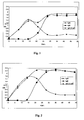
- the Figures 1 and 2 each show the results of 3 ELISA procedures. In each case the course of the IgG ( ⁇ ), the IgM ( ⁇ ) and the combined ( ⁇ ) IgG and IgM response to a Trichinella infection are shown at different times.
- Fig. 1 and Fig. 2 show results of studies carried out under the same conditions on samples obtained from different pig herds.
- IgM reactions that are relatively early to measure after infection and the IgG response detectable from about the 15th day detectable and then relatively constant over the remainder of the lifetime of the animal.
- FIG. 3 (A) shows that the earliest time at which a Trichinella infection can be detected with the artificial digestion test is the 17th day after infection.
- FIG. 3 (B) Figure 2 shows conditions in the identification of Trichinella infections in swine using a conventional E / S ELISA method. This shows that with a conventional serological method, detection of an immune response is possible at the earliest on the 21st day after infection. At this time, larvae may already be infectious.
- FIG. 3 (C) now shows the conditions for the inventive method in the identification of Trichinella-infected pigs.
- the earliest time to detect an antibody response in samples from Trichinella-infected pigs is the 7th day after infection. This is much earlier than the two methods described under (A) and (B). On the 7th day the larvae are still not infectious. It can therefore be assumed that the method according to the invention enables a sufficiently reliable determination of Trichinella infections.
Landscapes
- Health & Medical Sciences (AREA)
- Life Sciences & Earth Sciences (AREA)
- Molecular Biology (AREA)
- Immunology (AREA)
- Engineering & Computer Science (AREA)
- Hematology (AREA)
- Chemical & Material Sciences (AREA)
- Biomedical Technology (AREA)
- Urology & Nephrology (AREA)
- Microbiology (AREA)
- Analytical Chemistry (AREA)
- Biotechnology (AREA)
- Tropical Medicine & Parasitology (AREA)
- Food Science & Technology (AREA)
- Medicinal Chemistry (AREA)
- Physics & Mathematics (AREA)
- Cell Biology (AREA)
- Biochemistry (AREA)
- General Health & Medical Sciences (AREA)
- General Physics & Mathematics (AREA)
- Pathology (AREA)
- Peptides Or Proteins (AREA)
- Investigating Or Analysing Biological Materials (AREA)
Description
- Die Erfindung bezieht sich auf ein Verfahren zur Bestimmung von Trichinella-Infektionen nach dem Oberbegriff des Anspruches 1
- Trichinella spp. umfasst eine Gruppe von weltweit auftretenden Nematoden. Die in Europa vorherrschenden Spezies sind Trichinella spiralis, Trichinella britovi, Trichinella pseudospiralis und Trichinella nativa. Trichinella-Infektionen können bei unterschiedlichen Spezies einschließlich Menschen, Schweinen, Ratten, Bären, Pferden und Vögeln auftreten, um nur einige Beispiele zu nennen.
- Es handelt sich bei Trichinellen um parasitische Nematoden, die einen definierten Lebenszyklus durchlaufen. Die Larven werden durch Verzehr von rohem oder ungenügend gekochtem Fleisch aufgenommen. Nach dem Verzehr werden sie durch die Magensäfte freigegeben, von wo aus sie in den Darmtrakt gelangen. Hier wachsen sie zu adulten Nematoden heran. Nach Paarung bringen die Weibchen bis zu 1500 neue Larven zur Welt, die über die Lymphe und den Blutkreislauf ins quergestreifte Muskelgewebe eindringen, insbesondere das Zwerchfell, Zunge, Auge und Kaumuskeln. Die Larven wachsen heran und bilden Larvenkomplexe, die im Laufe der Zeit kalzifizieren.
- Trichinella-Infektionen stellen ein großes Problem bei der Tiererzeugung dar. Es muss sicher ausgeschlossen werden, dass Menschen nach Genuss von rohem oder nicht ausreichend gekochtem Fleisch von kranken Tieren an Trichinellosis erkranken. Menschliche Trichinellosis ist eine ernste Erkrankung, die erhebliche Leiden verursacht und in Extremfällen zum Tode führt.
- Zum Zwecke der Nahrungsmittelsicherheit müssen z.B. daher alle Schweineschlachtkörper als Teil einer post-mortem Prüfung getestet werden. In der Regel werden die Schlachtkörper unmittelbar nach dem Schlachten weiterverarbeitet. Problematisch bei gängigen Tests ist, dass die Zerlegung in den dem Schlachthaus nachgeschalteten Zerlegebetrieben bereits zu einem gewissen Teil abgeschlossen ist, bevor die Ergebnisse der Trichinella-Tests zur Verfügung stehen. Dies stellt ein erhebliches logistisches Problem dar. Im Zweifelsfall müssen bei positiven Ergebnissen die zerlegten Schweineteile wieder aus dem Verarbeitungskreislauf herausselektiert und vernichtet werden.
- Zugelassen sind zur Zeit Verfahren, in denen Trichinella direkt detektiert wird. Eine ältere nur noch während einer Übergangsfrist zugelassene Methode in Europa ist die sogenannte Trichinoskopie, bei der Gewebe zwischen zwei Glasplatten gepresst und dann mikroskopisch untersucht wird. Dieses Verfahren ist recht unempfindlich und darüber hinaus arbeits- und zeitintensiv. Außerdem können Trichinella-Arten, die sich nicht verkapseln, wie z. B. Trichinella-pseudospiralis nicht bzw. nur sehr schlecht entdeckt werden.
- Eine weitere zugelassene Methode ist der sogenannte Verdautest, der sensitiver als die zuvor beschriebene direkte Detektion ist. Bei diesem Test wird das die Larve umgebende Muskelgewebe künstlich, mit Proteasen und Salzsäure verdaut und nach verscheidenden Sedimentationsschritten bleiben die Larven übrig. Anschließend kann die Anzahl der Larven mikroskopisch bestimmt werden. Das Detektionslimit liegt bei 3 bis 5 Larven pro Gramm Gewebe.
- Wesentlich schneller und mit deutlich höherer Empfindlichkeit sind gattungsgemäße serologische Verfahren, bei denen zumeist auf indirektem Wege Antikörper gegen Trichinella spp. nachgewiesen werden. Solche serologischen Verfahren können zum Beispiel im Blutserum oder Fleischsaft durchgeführt werden. Übliche Verfahren haben ein Detektionslimit von 0,01 Larven auf ein Gramm Muskel-Gewebe.
- Bei gattungsgemäßen serologischen Verfahren werden z.B. Serumproben aus dem zu untersuchenden Organismus mit Trichinella-Antigenen, z.B. dem exkretorischen/sekretorischen (E/S)-Antigen versetzt. Eventuelle aufgrund des Vorliegens einer Trichinella-Infektion im Serum enthaltene Antikörper binden an das Antigen. Die gebundenen Antikörper werden ihrerseits zum Beispiel mit markierten anti-Schwein-IgG-Antikörpern nachgewiesen. Gängige serologische Verfahren arbeiten z.B. mit immobilisierten Antigenen und weisen eventuell gebundene IgG-Antikörper nach. Spezielle weitere für serologische Verfahren geeignete Antigene sind z.B. in der
WO 2007/090960 offenbart. - Reiterova K. et al.;(Infection 35(2); 2007; pp89-93) offenbart Bestimmung von Trichinella Infektion umfassend die Inkubation von Patientenserum mit auf ELISA-Platten gekoppeltem E/S Antigen und Bestimmung von IgG und IgM mittels entsprechender anti-Antikörper (Zusammenfassung).
- Obwohl gattungsgemäße serologische Verfahren sehr empfindlich sind, sind sie im Moment noch nicht zur Fleischinspektion oder in Nahrungsmittel-Sicherheitsprogrammen zugelassen. Zwar sind serologische Verfahren schneller und empfindlicher als die direkten Tests wie z.B. der artifizielle Verdau, jedoch erlauben die vorliegenden EU-Regeln dennoch keine individuelle Testung von Schlachtkörpern mit serologischen Verfahren, da die bekannten serologischen Verfahren insbesondere in der Frühphase der Infektion falsch negative Resultate liefern können. Eine ähnliche Einstellung nimmt die internationale Trichinellosis-Kommission (ICT) ein. Auch hier wird bemängelt, dass das diagnostische Fenster für serologische Methoden nicht ausreicht und eventuell positive Tiere mit den zur Verfügung stehenden Methoden aufgrund des zu geringen Signals in der frühen Infektionsphase übersehen werden. Da aber auch in dieser Phase die Larven bereits im Muskel und damit infektiös sein können, müssen auch Tiere in der frühen Infektionsphase sicher erkannt werden.
- Aufgabe der vorliegenden Erfindung ist es, ein sicheres serologisches Verfahren zur Diagnose von Trichinella-Infektionen bereitzustellen, mit dem sich sowohl frühe Infektionen als auch fortgeschrittene Trichinella-Infektionen sicher nachweisen lassen.
- Gelöst wird die Aufgabe mit einem Verfahren gemäß Anspruch 1 Vorteilhafte Ausgestaltungen sind in den Unteransprüchen angegeben.
- Das erfindungsgemäße Verfahren funktioniert im Wesentlichen wie oben angegeben. Eine Probe des zu untersuchenden Menschen oder Tieres, z.B. Serum oder Fleischsaft, wird mit bevorzugt immobilisierten Antigenen inkubiert. Eventuell in der Probe enthaltene Antikörper binden an die Antigene. Die Antikörper-Antigen-Komplexe werden dann mit markierten Antikörpern nachgewiesen. Es kann sich dabei insbesondere um ELISA-Verfahren handeln. Denkbar sind aber auch andere Verfahren mit anderen Markierungen, die z.B. optisch nachgewiesen werden können.
- Wie oben bereits ausgeführt weisen übliche Trichinella-Tests die Antikörper-Antigen-Komplexe mit Antikörpern gegen IgG-Antikörper nach, da dies die üblicherweise im Infektionsverlauf zunehmend gebildeten persistenten Antikörper sind.
- Erfindungsgemäß ist nun vorgesehen, dass außerdem gleichzeitig untersucht wird, ob IgM-Antikörper gebildet wurden. Dies kann auf einfache Weise durch Zugabe von Antikörpern gegen IgM-Antikörper erfolgen.
- Erfindungsgemäß ist also vorgesehen, dass man die Probe auf das Vorliegen von IgM- und IgG-Antikörpern in Kombination untersucht. In der frühen Phase der Infektion werden vorrangig IgM-Antikörper gebildet, während der Gehalt an IgG-Antikörpern erst ab dem 15. Tag nach der Infektion beginnt. Der Gehalt an IgM-Antikörpern beginnt ungefähr zu diesem Zeitpunkt wieder abzunehmen.
- Die relativ bald nach Infektion zu beobachtende Abnahme des Gehalts an IgM-Antikörpern ist auch ein wesentlicher Grund dafür, warum z. B. ELISA-Verfahren, mit denen IgM-Antikörper bestimmt werden, als nicht geeignet für die Diagnose von Trichinella-Infektionen betrachtet werden. Es wird hierzu stellvertretend auf eine am "Institut für Parasitologie" in Warschau, Polen, durchgeführte Doktorarbeit mit dem Titel "The usefulness of ELISA test for early serological detection of Trichinella spp. infection in pigs" verwiesen, die im Rahmen einer Disputation 2006 vorgestellt wurde. In der Doktorarbeit wurden Methoden einander gegenüber gestellt, in denen einerseits IgG-Antikörper und andererseits IgM-Antikörper detektiert wurden. Im Rahmen dieser Veröffentlichung wurde festgestellt, dass ELISA-Verfahren, mit denen IgG-Antikörper nachgewiesen werden, grundsätzlich zur Detektion von Trichinella-Infektionen geeignet sind. IgM-Antikörper wurden dagegen als nicht geeignete Marker der humoralen Reaktion von infizierten Tieren eingestuft. Ein wesentlicher Grund war, dass zumindest nach der in der Veröffentlichung vertretenen Meinung insbesondere Trichinella spiralis nicht nachgewiesen werden können. Ein weiterer Grund ist natürlich, dass die IgM-Konzentration relativ frühzeitig wieder abnimmt und das diagnostische Fenster daher nur frühe Infektionen abdecken kann.
- In eigenen Untersuchungen, die später anhand der
Figuren 1 und 2 erläutert werden, haben die Anmelder herausgefunden, dass Antikörper der Klasse IgM auch bei Trichinella-spiralis-Infektionen auftreten und sich z. B. mit ELISA nachweisen lassen. Insoweit scheinen IgM-Antikörper entgegen der vertretenen Meinung doch grundsätzlich geeignete Marker zur Bestimmung von frühen Trichinella-Infektionen zu sein. - Ab Infektion mit Trichinellen liegt eine Immun-Antwort im Organismus vor, die sich mit dem erfindungsgemäßen Verfahren wenige Tage später detektieren lässt. Wie in
Fig.1 oder 2 gezeigt, werden zunächst die IgM-Antikörper, im späteren Verlauf der Infektion IgM- und IgG-Antikörper und dann zunehmend nur IgG-Antikörper detektiert. - Das erfindungsgemäße Verfahren erkennt damit eine Infektion wesentlich früher als die bisher bekannten Methoden und verkleinert deshalb das diagnostische Fenster (siehe auch die unten diskutierte
Fig. 3 ). - Mit dem von dem von den Anmeldern konzipierten Test, in dem erstmalig beide Antikörper-Antworten gleichzeitig detektiert werden, lassen sich überraschend die wesentlichen Nachteile bekannter serologischer Verfahren überwinden.
- Im Rahmen der Offenbarung ist es möglich, generell das Vorliegen einer Antikörper-Antwort auf eine Trichinella-Infektion in einer Probe nachzuweisen, ohne die Antikörper einer Klasse zuzuordnen. Will man darüber hinaus auch noch Aufschluss darüber haben, ob es sich um ein frühes oder eher ein späteres Infektionsstadium handelt, dann ist es auch möglich, die in dem erfindungsgemäßen Verfahren eingesetzten Anti-Antikörper mit unterschiedlichen Markierungen zu versehen, je nachdem, ob sie zum Nachweis von IgG- oder IgM-Antikörpern gedacht sind.
- Wie oben ausgeführt, werden in herkömmlichen und auch im erfindungsgemäßen serologischen Verfahren Trichinella-Antigene einer Probe zugesetzt. Bei den Antigenen kann es sich insbesondere um das E/S-Antigen handeln. Denkbar sind aber auch weitere immunogen wirkende Polypeptide, einzeln oder in Kombination, wie sie z. B. in der internationalen Patentanmeldung
PCT/EP2007/005774 WO 2007/090960 beschrieben werden. - Es können natürlich auch mehrere unterschiedliche Antigene, insbesondere Antigene, die zu unterschiedlichen Infektionsstadien auftreten, eingesetzt werden. Auf diese Weise bietet man eventuell enthaltenen Antikörpern unter Umständen bessere Bindungsmöglichkeiten, was ebenfalls zu einer Verbesserung der Aussage führt.
- Um den Nachweis eventuell gebildeter Antigen-Antikörperkomplexe zu erleichtern, ist bevorzugt vorgesehen, dass die Antigene in immobilisierter Form eingesetzt werden. Denkbar ist z. B., die Wände von Mikrotiterplatten mit den Antigenen zu beschichten. Eine weitere Möglichkeit ist, die Antigene an Beads zu binden. Grundsätzlich sind alle Immobilisierungen geeignet, mit denen sich die Antikörper und eventuell daran gebundene Antikörper auf einfache Weise vom Rest der Probe trennen lassen.
- Weiterhin ist erfindungsgemäß vorgesehen, dass die Anti-Antikörper eine mit üblichen Verfahren nachweisbare Markierung aufweisen. Es kann sich dabei z.B. um eine für einen ELISA-Nachweis geeignete Markierung handeln. Denkbar sind aber auch andere, z.B. optisch detektierbare Markierungen wie, z. B. Fluoreszenzmarker.
- Bei den untersuchten Gewebeproben kann es sich insbesondere um Blut, Serum, Plasma, Fleischsaft handeln.
- Neben einem Verfahren betrifft die Offenbarung auch eine diagnostische Zusammensetzung, die in dem Verfahren eingesetzt werden kann.
- Eine solche Zusammensetzung enthält ein geeignetes, insbesondere immobilisiertes, Trichinella-Antigen sowie mit einer eine Detektierung erlaubenden Markierung versehene Anti-IgG- und Anti-IgM-Antikörper. Bevorzugt werden die Trichinella-Antigene und die Anti-Antikörper getrennt konfektioniert, so dass zunächst ein Kontakt zwischen den Antigenen und der Gewebeprobe hergestellt werden kann und nach einer ausreichenden Inkubationszeit dann die Zugabe der Anti-Antikörper erfolgen kann.
- Bevorzugt wird das Trichinella-Antigen in immobilisierter Form vorgesehen. Denkbar ist z. B. eine Kopplung an Beads oder eine Beschichtung der Wände von Mikrotiterwells mit dem Antigen, um nur einige Beispiele zu nennen.
- Im Wesentlichen dient die Immoblisierung des Antigens dazu, eine leichtere Trennung eventueller Antigen-Antikörper-Komplexe von der Probe zu ermöglichen. Diese Abtrennung erleichtert den spezifischen Nachweis der Komplexe.
- Neben heterogenen Assays sind natürlich auch homogene Assays denkbar, d. h. Methoden, in denen das Antigen nicht immobilisiert vorliegt. Eine bevorzugte Methode wäre z.B. ein Fluoreszenz-Polarisationsassay. Die Durchführung einer solchen Methode ist dem Fachmann geläufig. Es soll daher hier nicht weiter darauf eingegangen werden.
- Wie bereits zu dem Verfahren ausgeführt, enthält die Zusammensetzung als Antigen bevorzugt das sogenannte E/S-Antigen aus Trichinella bzw. immunogene Abschnitte dieses Antigens. Denkbar ist selbstverständlich auch der Einsatz weiterer Polypeptide aus Trichinella mit antigener Wirkung. Grundsätzlich können alle Peptide oder Polypeptide eingesetzt werden, die eine Serie von Aminosäuren aufweisen, die ein kontinuierliches oder diskontinuierliches Epitop ausbilden, das von Seren erkannt wird, die von mit Trichinella infizierten Schweinen stammen.
- Denkbar ist selbstverständlich auch, mehrere unterschiedliche Antigene in der Zusammensetzung zu kombinieren. Die Antigene können als Gemisch vorliegen. Denkbar ist aber auch, sie zum Beispiel als Fusionsprotein miteinander gekoppelt vorzusehen.
- Die Markierungen an den Anti-Antikörpern können schließlich so ausgebildet sein, dass sie auf einfache Weise einen optischen Nachweis ermöglichen. Bevorzugt werden jedoch ELISA-Verfahren eingesetzt. Selbstverständlich können die Anti-Antikörper daher auch mit entsprechenden Enzymen gekoppelt werden, die den erwünschten ELISA-Nachweis ermöglichen.
- Die in Verbindung mit der Zusammensetzung beschriebenen Ausgestaltungen lassen sich, soweit dort noch nicht erwähnt, sinngemäß natürlich auch im Rahmen des Verfahrens umsetzen.
- Im Folgenden soll die Erfindung anhand mehrerer Abbildungen im Detail erläutert werden.
- Dabei zeigen:
-
Fig. 1 und Fig. 2 in schematischer Darstellung die Ergebnisse von ELISA-Verfahren bei der Bestimmung der Immunantwort von künstlich oral infizierten Schweinen mit 20.000 T. spiralis Larven und -
Fig. 3 (A)-(C) eine schematische Darstellung der mit unterschiedlichen Verfahren bei der Identifikation von Trichinella-Infektionen abgedeckten diagnostischen Fenster. - Die
Figuren 1 und 2 zeigen jeweils die Ergebnisse von 3 ELISA-Verfahren. Dargestellt ist jeweils der Verlauf der IgG (■), der IgM (◆) sowie der kombinierten(▲) IgG- und IgM-Antwort auf eine Trichinella-Infektion zu unterschiedlichen Zeitpunkten. - Die Schweine wurden künstlich mit 20.000 T. spiralis Larven oral infiziert und Serumproben der infizierten Schweine zu unterschiedlichen Zeitpunkten untersucht.
Fig. 1 und Fig. 2 zeigen Ergebnisse von Untersuchungen, die unter gleichen Bedingungen an Proben durchgeführt wurden, die von unterschiedlichen Schweinebeständen gewonnen wurden. - Proben wurden nach 0, 7, 14, 21, 28, 35, 42 und 49 auf die Infektion folgenden Tage (d. p. i. = Tage nach Infektion) entnommen. Es zeigte sich, dass die kombinierte Detektion der IgM- und IgG-Antwort bereits am 7. auf die Infektion folgenden Tag nachgewiesen werden konnte und dann über die gesamte Lebenszeit des Tieres erhalten blieb.
- Dargestellt sind weiterhin die IgM-Reaktionen, die relativ frühzeitig nach der Infektion zu messen sind und die IgG-Antwort, die ab ca. dem 15. Tag detektierbar und dann relativ konstant über den Rest der Lebenszeit des Tieres nachweisbar ist.
- Beide
Figuren 1 und 2 zeigen ähnliche Verläufe der oben erwähnten Reaktionen. -
Fig. 3 (A)-(C) zeigt schematisch die mit unterschiedlichen Verfahren [(A) = Verdautest; (B) = Herkömmlicher E/S ELISA und (C) = ELISA gemäss der Erfindung] bei der Identifikation von Trichinella-Infektionen abgedeckten diagnostischen Fenster. -
Figur 3 (A) zeigt, dass der früheste Zeitpunkt, bei dem sich eine Trichinella-Infektion mit dem künstlichen Verdautest nachweisen lässt, der 17. Tag nach der Infektion ist. -
Figur 3 (B) zeigt die Bedingungen bei der Identifikation von Trichinella-Infektionen in Schweinen unter Verwendung eines herkömmlichen E/S-ELISA-Verfahrens. Hier zeigt sich, dass mit einem herkömmlichen serologischen Verfahren ein Nachweis einer Immun-Antwort frühestens am 21. Tag nach Infektion möglich ist. Zu diesem Zeitpunkt können Larven bereits infektiös sein. -
Figur 3 (C) zeigt nun die Bedingungen für das erfindungsgemäße Verfahren bei der Identifikation von Trichinella-infizierten Schweinen. Der früheste Zeitpunkt, bei dem sich in Proben aus Trichinella-infizierten Schweinen eine Antikörper-Antwort nachweisen lässt, ist der 7. Tag nach Infektion. Dies ist deutlich früher als bei den beiden unter (A) und (B) dargestellten Verfahren. Am 7. Tag sind die Larven weiterhin noch nicht infektiös. Es ist also davon auszugehen, dass das erfindungsgemäße Verfahren eine ausreichend sichere Bestimmung von Trichinella-Infektionen ermöglicht. - Der Vergleich der unterschiedlichen Nachweismethoden in (A), (B) und (C) ist mit gestrichelten Linien dargestellt. b bezeichnet das diagnostische Fenster für üblicherweise benutzte E/S-ELISA (B), a das diagnostische Fenster für den künstlichen Verdautest (A) während c das diagnostische Fenster für das erfindungsgemäße ELISA-Verfahren (C) zeigt. Auch aus dieser Darstellung wird deutlich, dass mit dem erfindungsgemäßen Verfahren infizierte Schweine zu einem signifikant früheren Zeitpunkt detektiert werden können. Das diagnostische Fenster wird dadurch deutlich enger, eine Detektion einer Trichinella Infektion ist sogar früher möglich als mit dem künstlichen Verdautest und macht ein derartiges Diagnoseverfahren geeignet für individuelle Fleischtestung im Schlachthof.
Claims (6)
- Verfahren zur Bestimmung von Trichinella Infektionen bei einem Tier oder einem Menschen, umfassend die Inkubation einer dem Tier oder dem Menschen entnommenen Gewebeprobe mit Trichinella-Antigenen, die Aufbereitung der Gewebeprobe, die Zugabe von anti-Antikörpern zu der Gewebeprobe und die Überprüfung, ob eine Bindung der anti-Antikörper an eventuell in der Gewebeprobe enthaltene Antigen-Antikörper-Komplexe stattgefunden hat, dadurch gekennzeichnet, dass als anti-Antikörper gleichzeitig anti-IgG-Antikörper und anti-IgM-Antikörper zugesetzt werden.
- Verfahren nach Anspruch 1, dadurch gekennzeichnet, dass als Antigen Trichinella E/S-Antigen eingesetzt wird.
- Verfahren nach Anspruch 1 oder 2, dadurch gekennzeichnet, dass die eingesetzten Antigene in immobilisierter Form vorliegen.
- Verfahren nach einem der vorhergehenden Ansprüche, dadurch gekennzeichnet, dass markierte anti-Antikörper eingesetzt werden.
- Verfahren nach einem der vorhergehenden Ansprüche, dadurch gekennzeichnet, dass anti-IgG-Antikörper mit einer anderen Markierung versehen sind als anti-IgM-Antikörper.
- Verfahren nach einem der vorhergehenden Ansprüche, dadurch gekennzeichnet, dass die Gewebeprobe Serum, Plasma oder Fleischsaft ist.
Priority Applications (1)
| Application Number | Priority Date | Filing Date | Title |
|---|---|---|---|
| PL09768924T PL2288920T3 (pl) | 2008-06-27 | 2009-06-16 | Sposób określania zakażenia Trichinella |
Applications Claiming Priority (2)
| Application Number | Priority Date | Filing Date | Title |
|---|---|---|---|
| DE102008030129A DE102008030129A1 (de) | 2008-06-27 | 2008-06-27 | Verfahren zur Bestimmung von Trichinella-Infektionen und diagnostische Zusammensetzung für solche Verfahren |
| PCT/EP2009/004309 WO2009156075A1 (de) | 2008-06-27 | 2009-06-16 | Verfahren zur bestimmung von trichinella-infektionen und diagnostische zusammensetzung für solche verfahren |
Publications (2)
| Publication Number | Publication Date |
|---|---|
| EP2288920A1 EP2288920A1 (de) | 2011-03-02 |
| EP2288920B1 true EP2288920B1 (de) | 2012-10-24 |
Family
ID=40929600
Family Applications (1)
| Application Number | Title | Priority Date | Filing Date |
|---|---|---|---|
| EP09768924A Not-in-force EP2288920B1 (de) | 2008-06-27 | 2009-06-16 | Verfahren zur bestimmung von trichinella-infektionen |
Country Status (8)
| Country | Link |
|---|---|
| US (1) | US8465932B2 (de) |
| EP (1) | EP2288920B1 (de) |
| CA (1) | CA2723030A1 (de) |
| DE (1) | DE102008030129A1 (de) |
| DK (1) | DK2288920T3 (de) |
| ES (1) | ES2397811T3 (de) |
| PL (1) | PL2288920T3 (de) |
| WO (1) | WO2009156075A1 (de) |
Families Citing this family (1)
| Publication number | Priority date | Publication date | Assignee | Title |
|---|---|---|---|---|
| EP3502686B1 (de) * | 2017-12-20 | 2023-11-22 | Euroimmun Medizinische Labordiagnostika AG | Antigennachweis von trichinella |
Citations (2)
| Publication number | Priority date | Publication date | Assignee | Title |
|---|---|---|---|---|
| US20050009096A1 (en) * | 2002-10-11 | 2005-01-13 | The Regents Of The University Of California | Method for diagnosis and prognosis of multiple sclerosis |
| US20100136040A1 (en) * | 2006-10-05 | 2010-06-03 | Ingen Biosciences | Use of the 7f4 protein in the in vitro diagnosis of mycoplasma pneumoniae infections |
Family Cites Families (3)
| Publication number | Priority date | Publication date | Assignee | Title |
|---|---|---|---|---|
| ATE128738T1 (de) | 1987-07-13 | 1995-10-15 | Verigen Inc | Verfahren zum schnellen und empfindlichen nachweis von igm-antikörpern gegen retrovirale antigene. |
| FR2897063B1 (fr) | 2006-02-07 | 2011-04-01 | Agronomique Inst Nat Rech | Polypeptides reconnus par des anticorps anti-trichinella, et leurs applications. |
| EP2160608A1 (de) | 2007-06-29 | 2010-03-10 | Prionics AG | Diagnostische zusammensetzung und verfahren zum nachweis einer trichinella-infektion |
-
2008
- 2008-06-27 DE DE102008030129A patent/DE102008030129A1/de not_active Withdrawn
-
2009
- 2009-06-16 PL PL09768924T patent/PL2288920T3/pl unknown
- 2009-06-16 DK DK09768924.4T patent/DK2288920T3/da active
- 2009-06-16 US US12/937,129 patent/US8465932B2/en not_active Expired - Fee Related
- 2009-06-16 ES ES09768924T patent/ES2397811T3/es active Active
- 2009-06-16 WO PCT/EP2009/004309 patent/WO2009156075A1/de not_active Ceased
- 2009-06-16 EP EP09768924A patent/EP2288920B1/de not_active Not-in-force
- 2009-06-16 CA CA2723030A patent/CA2723030A1/en not_active Abandoned
Patent Citations (2)
| Publication number | Priority date | Publication date | Assignee | Title |
|---|---|---|---|---|
| US20050009096A1 (en) * | 2002-10-11 | 2005-01-13 | The Regents Of The University Of California | Method for diagnosis and prognosis of multiple sclerosis |
| US20100136040A1 (en) * | 2006-10-05 | 2010-06-03 | Ingen Biosciences | Use of the 7f4 protein in the in vitro diagnosis of mycoplasma pneumoniae infections |
Also Published As
| Publication number | Publication date |
|---|---|
| CA2723030A1 (en) | 2009-12-30 |
| DK2288920T3 (da) | 2013-01-21 |
| US20110033871A1 (en) | 2011-02-10 |
| US8465932B2 (en) | 2013-06-18 |
| ES2397811T3 (es) | 2013-03-11 |
| WO2009156075A1 (de) | 2009-12-30 |
| EP2288920A1 (de) | 2011-03-02 |
| DE102008030129A1 (de) | 2010-01-21 |
| PL2288920T3 (pl) | 2013-04-30 |
Similar Documents
| Publication | Publication Date | Title |
|---|---|---|
| DE69507028T2 (de) | Verfahren und zusammensetzungen zur kontrolle der reaktivität zwischen diagnostischen reagenzien und mikroorganismen | |
| DE3331627A1 (de) | Verfahren zur immunologischen bestimmung fuer proteine in koerperfluessigkeiten, unter verwendung monovalenter antikoerperfragmente | |
| DE69311799T2 (de) | Tierärztliche überwachung von arzneimittelrückständen in frischfleisch | |
| DE69033511T2 (de) | Verfahren zum Nachweis von Knochen- und anderen Bindegewebeerkrankungen in Menschen und Tieren | |
| DE69730479T2 (de) | Marker und immunologisches Reagens für Dialyse verbundenen Amyloidosis, Diabetes Mellitus und Diabetes Mellitus-Komplikationen | |
| EP3502686B1 (de) | Antigennachweis von trichinella | |
| CN110018311A (zh) | 一种检测骆驼乳中掺伪牛乳的免疫检测试剂盒及其应用 | |
| WO2004040311A1 (de) | Mittel und verfahren zur diagnose einer treponemainfektion | |
| DE3879085T2 (de) | Snrnp-a-antigen und fragmente davon. | |
| Grisley et al. | A new application of serological techniques to gut content analysis | |
| DE3030806A1 (de) | Verfahren zur durchfuehrung von enzymimmunobestimmungen. | |
| DE60035267T2 (de) | Verfahren zur analyse der menge an intraabdominalem fettgewebe | |
| DE3609980A1 (de) | Verfahren zur bestimmung von haemoglobin im stuhl | |
| EP2210097B1 (de) | Verfahren zur in vitro-diagnose und/oder in vitro-therapieverfolgung von infektionen | |
| WO2000017653A2 (de) | Salmonellenantigenformulierung und kit zur bestimmung von antikörpern gegen salmonellen | |
| DE60218321T2 (de) | Nachweis des virus der viralen rinderdiarrhoe in gewebsproben | |
| DE60033241T2 (de) | Kompositionen und verfahren zum nachweis von treponema pallidum | |
| EP2288920A1 (de) | Verfahren zur bestimmung von trichinella-infektionen und diagnostische zusammensetzung für solche verfahren | |
| DE68921277T2 (de) | Bestimmung von Getreidepflanzen. | |
| EP2457093A1 (de) | Verfahren, insbesondere enzyme-linked immunosorbent assay (elisa), zum in vitro nachweis von amyloid beta autoantikörpern, mikrotiterplatte und testkit | |
| EP1393076B1 (de) | Verfahren zur vorhersage eines transplantatabstossungsrisikos und immunologischer testkit | |
| DE69119445T2 (de) | Analysemethode für infektiöse Pferdeanämie-Viren (EIA-Virus) | |
| DE4232073C2 (de) | Verfahren zur immunchemischen Quantifizierung von inaktivierten, immunreaktiven Antigenen | |
| DE3915344A1 (de) | Serumdiagnose-verfahren | |
| WO2002057785A1 (de) | Verfahren zum nachweis pankreatitischer und gastrointestinaler erkrankungen |
Legal Events
| Date | Code | Title | Description |
|---|---|---|---|
| PUAI | Public reference made under article 153(3) epc to a published international application that has entered the european phase |
Free format text: ORIGINAL CODE: 0009012 |
|
| 17P | Request for examination filed |
Effective date: 20100901 |
|
| AK | Designated contracting states |
Kind code of ref document: A1 Designated state(s): AT BE BG CH CY CZ DE DK EE ES FI FR GB GR HR HU IE IS IT LI LT LU LV MC MK MT NL NO PL PT RO SE SI SK TR |
|
| AX | Request for extension of the european patent |
Extension state: AL BA RS |
|
| 17Q | First examination report despatched |
Effective date: 20110601 |
|
| DAX | Request for extension of the european patent (deleted) | ||
| GRAP | Despatch of communication of intention to grant a patent |
Free format text: ORIGINAL CODE: EPIDOSNIGR1 |
|
| GRAS | Grant fee paid |
Free format text: ORIGINAL CODE: EPIDOSNIGR3 |
|
| GRAA | (expected) grant |
Free format text: ORIGINAL CODE: 0009210 |
|
| AK | Designated contracting states |
Kind code of ref document: B1 Designated state(s): AT BE BG CH CY CZ DE DK EE ES FI FR GB GR HR HU IE IS IT LI LT LU LV MC MK MT NL NO PL PT RO SE SI SK TR |
|
| REG | Reference to a national code |
Ref country code: GB Ref legal event code: FG4D Free format text: NOT ENGLISH |
|
| REG | Reference to a national code |
Ref country code: CH Ref legal event code: EP |
|
| REG | Reference to a national code |
Ref country code: AT Ref legal event code: REF Ref document number: 581196 Country of ref document: AT Kind code of ref document: T Effective date: 20121115 |
|
| REG | Reference to a national code |
Ref country code: IE Ref legal event code: FG4D Free format text: LANGUAGE OF EP DOCUMENT: GERMAN |
|
| REG | Reference to a national code |
Ref country code: DE Ref legal event code: R096 Ref document number: 502009005195 Country of ref document: DE Effective date: 20121220 |
|
| REG | Reference to a national code |
Ref country code: DK Ref legal event code: T3 |
|
| REG | Reference to a national code |
Ref country code: NL Ref legal event code: T3 |
|
| REG | Reference to a national code |
Ref country code: ES Ref legal event code: FG2A Ref document number: 2397811 Country of ref document: ES Kind code of ref document: T3 Effective date: 20130311 |
|
| PG25 | Lapsed in a contracting state [announced via postgrant information from national office to epo] |
Ref country code: IS Free format text: LAPSE BECAUSE OF FAILURE TO SUBMIT A TRANSLATION OF THE DESCRIPTION OR TO PAY THE FEE WITHIN THE PRESCRIBED TIME-LIMIT Effective date: 20130224 Ref country code: FI Free format text: LAPSE BECAUSE OF FAILURE TO SUBMIT A TRANSLATION OF THE DESCRIPTION OR TO PAY THE FEE WITHIN THE PRESCRIBED TIME-LIMIT Effective date: 20121024 Ref country code: SE Free format text: LAPSE BECAUSE OF FAILURE TO SUBMIT A TRANSLATION OF THE DESCRIPTION OR TO PAY THE FEE WITHIN THE PRESCRIBED TIME-LIMIT Effective date: 20121024 Ref country code: NO Free format text: LAPSE BECAUSE OF FAILURE TO SUBMIT A TRANSLATION OF THE DESCRIPTION OR TO PAY THE FEE WITHIN THE PRESCRIBED TIME-LIMIT Effective date: 20130124 Ref country code: HR Free format text: LAPSE BECAUSE OF FAILURE TO SUBMIT A TRANSLATION OF THE DESCRIPTION OR TO PAY THE FEE WITHIN THE PRESCRIBED TIME-LIMIT Effective date: 20121024 |
|
| REG | Reference to a national code |
Ref country code: PL Ref legal event code: T3 |
|
| PG25 | Lapsed in a contracting state [announced via postgrant information from national office to epo] |
Ref country code: SI Free format text: LAPSE BECAUSE OF FAILURE TO SUBMIT A TRANSLATION OF THE DESCRIPTION OR TO PAY THE FEE WITHIN THE PRESCRIBED TIME-LIMIT Effective date: 20121024 Ref country code: LV Free format text: LAPSE BECAUSE OF FAILURE TO SUBMIT A TRANSLATION OF THE DESCRIPTION OR TO PAY THE FEE WITHIN THE PRESCRIBED TIME-LIMIT Effective date: 20121024 Ref country code: GR Free format text: LAPSE BECAUSE OF FAILURE TO SUBMIT A TRANSLATION OF THE DESCRIPTION OR TO PAY THE FEE WITHIN THE PRESCRIBED TIME-LIMIT Effective date: 20130125 Ref country code: PT Free format text: LAPSE BECAUSE OF FAILURE TO SUBMIT A TRANSLATION OF THE DESCRIPTION OR TO PAY THE FEE WITHIN THE PRESCRIBED TIME-LIMIT Effective date: 20130225 |
|
| REG | Reference to a national code |
Ref country code: DE Ref legal event code: R082 Ref document number: 502009005195 Country of ref document: DE Representative=s name: MEISSNER, BOLTE & PARTNER GBR, DE Ref country code: DE Ref legal event code: R082 Ref document number: 502009005195 Country of ref document: DE Representative=s name: MEISSNER BOLTE & PARTNER GBR, DE |
|
| PG25 | Lapsed in a contracting state [announced via postgrant information from national office to epo] |
Ref country code: EE Free format text: LAPSE BECAUSE OF FAILURE TO SUBMIT A TRANSLATION OF THE DESCRIPTION OR TO PAY THE FEE WITHIN THE PRESCRIBED TIME-LIMIT Effective date: 20121024 Ref country code: CZ Free format text: LAPSE BECAUSE OF FAILURE TO SUBMIT A TRANSLATION OF THE DESCRIPTION OR TO PAY THE FEE WITHIN THE PRESCRIBED TIME-LIMIT Effective date: 20121024 Ref country code: SK Free format text: LAPSE BECAUSE OF FAILURE TO SUBMIT A TRANSLATION OF THE DESCRIPTION OR TO PAY THE FEE WITHIN THE PRESCRIBED TIME-LIMIT Effective date: 20121024 Ref country code: BG Free format text: LAPSE BECAUSE OF FAILURE TO SUBMIT A TRANSLATION OF THE DESCRIPTION OR TO PAY THE FEE WITHIN THE PRESCRIBED TIME-LIMIT Effective date: 20130124 |
|
| PG25 | Lapsed in a contracting state [announced via postgrant information from national office to epo] |
Ref country code: RO Free format text: LAPSE BECAUSE OF FAILURE TO SUBMIT A TRANSLATION OF THE DESCRIPTION OR TO PAY THE FEE WITHIN THE PRESCRIBED TIME-LIMIT Effective date: 20121024 Ref country code: IT Free format text: LAPSE BECAUSE OF FAILURE TO SUBMIT A TRANSLATION OF THE DESCRIPTION OR TO PAY THE FEE WITHIN THE PRESCRIBED TIME-LIMIT Effective date: 20121024 |
|
| PLBE | No opposition filed within time limit |
Free format text: ORIGINAL CODE: 0009261 |
|
| STAA | Information on the status of an ep patent application or granted ep patent |
Free format text: STATUS: NO OPPOSITION FILED WITHIN TIME LIMIT |
|
| 26N | No opposition filed |
Effective date: 20130725 |
|
| REG | Reference to a national code |
Ref country code: DE Ref legal event code: R097 Ref document number: 502009005195 Country of ref document: DE Effective date: 20130725 |
|
| PG25 | Lapsed in a contracting state [announced via postgrant information from national office to epo] |
Ref country code: CY Free format text: LAPSE BECAUSE OF FAILURE TO SUBMIT A TRANSLATION OF THE DESCRIPTION OR TO PAY THE FEE WITHIN THE PRESCRIBED TIME-LIMIT Effective date: 20121024 |
|
| BERE | Be: lapsed |
Owner name: PRIONICS A.G. Effective date: 20130630 |
|
| PG25 | Lapsed in a contracting state [announced via postgrant information from national office to epo] |
Ref country code: MC Free format text: LAPSE BECAUSE OF FAILURE TO SUBMIT A TRANSLATION OF THE DESCRIPTION OR TO PAY THE FEE WITHIN THE PRESCRIBED TIME-LIMIT Effective date: 20121024 |
|
| REG | Reference to a national code |
Ref country code: CH Ref legal event code: PL |
|
| GBPC | Gb: european patent ceased through non-payment of renewal fee |
Effective date: 20130616 |
|
| REG | Reference to a national code |
Ref country code: IE Ref legal event code: MM4A |
|
| PG25 | Lapsed in a contracting state [announced via postgrant information from national office to epo] |
Ref country code: BE Free format text: LAPSE BECAUSE OF NON-PAYMENT OF DUE FEES Effective date: 20130630 |
|
| PG25 | Lapsed in a contracting state [announced via postgrant information from national office to epo] |
Ref country code: GB Free format text: LAPSE BECAUSE OF NON-PAYMENT OF DUE FEES Effective date: 20130616 Ref country code: LI Free format text: LAPSE BECAUSE OF NON-PAYMENT OF DUE FEES Effective date: 20130630 Ref country code: IE Free format text: LAPSE BECAUSE OF NON-PAYMENT OF DUE FEES Effective date: 20130616 Ref country code: CH Free format text: LAPSE BECAUSE OF NON-PAYMENT OF DUE FEES Effective date: 20130630 |
|
| PG25 | Lapsed in a contracting state [announced via postgrant information from national office to epo] |
Ref country code: LT Free format text: LAPSE BECAUSE OF FAILURE TO SUBMIT A TRANSLATION OF THE DESCRIPTION OR TO PAY THE FEE WITHIN THE PRESCRIBED TIME-LIMIT Effective date: 20121024 |
|
| PG25 | Lapsed in a contracting state [announced via postgrant information from national office to epo] |
Ref country code: MT Free format text: LAPSE BECAUSE OF FAILURE TO SUBMIT A TRANSLATION OF THE DESCRIPTION OR TO PAY THE FEE WITHIN THE PRESCRIBED TIME-LIMIT Effective date: 20121024 |
|
| REG | Reference to a national code |
Ref country code: FR Ref legal event code: PLFP Year of fee payment: 7 |
|
| PG25 | Lapsed in a contracting state [announced via postgrant information from national office to epo] |
Ref country code: TR Free format text: LAPSE BECAUSE OF FAILURE TO SUBMIT A TRANSLATION OF THE DESCRIPTION OR TO PAY THE FEE WITHIN THE PRESCRIBED TIME-LIMIT Effective date: 20121024 |
|
| PG25 | Lapsed in a contracting state [announced via postgrant information from national office to epo] |
Ref country code: HU Free format text: LAPSE BECAUSE OF FAILURE TO SUBMIT A TRANSLATION OF THE DESCRIPTION OR TO PAY THE FEE WITHIN THE PRESCRIBED TIME-LIMIT; INVALID AB INITIO Effective date: 20090616 Ref country code: MK Free format text: LAPSE BECAUSE OF FAILURE TO SUBMIT A TRANSLATION OF THE DESCRIPTION OR TO PAY THE FEE WITHIN THE PRESCRIBED TIME-LIMIT Effective date: 20121024 Ref country code: LU Free format text: LAPSE BECAUSE OF NON-PAYMENT OF DUE FEES Effective date: 20130616 |
|
| PGFP | Annual fee paid to national office [announced via postgrant information from national office to epo] |
Ref country code: ES Payment date: 20150611 Year of fee payment: 7 Ref country code: DK Payment date: 20150610 Year of fee payment: 7 |
|
| REG | Reference to a national code |
Ref country code: AT Ref legal event code: MM01 Ref document number: 581196 Country of ref document: AT Kind code of ref document: T Effective date: 20140616 |
|
| PGFP | Annual fee paid to national office [announced via postgrant information from national office to epo] |
Ref country code: PL Payment date: 20150615 Year of fee payment: 7 Ref country code: NL Payment date: 20150609 Year of fee payment: 7 Ref country code: FR Payment date: 20150608 Year of fee payment: 7 |
|
| PG25 | Lapsed in a contracting state [announced via postgrant information from national office to epo] |
Ref country code: AT Free format text: LAPSE BECAUSE OF NON-PAYMENT OF DUE FEES Effective date: 20140616 |
|
| REG | Reference to a national code |
Ref country code: DE Ref legal event code: R082 Ref document number: 502009005195 Country of ref document: DE |
|
| REG | Reference to a national code |
Ref country code: DK Ref legal event code: EBP Effective date: 20160630 |
|
| REG | Reference to a national code |
Ref country code: NL Ref legal event code: MM Effective date: 20160701 |
|
| REG | Reference to a national code |
Ref country code: FR Ref legal event code: ST Effective date: 20170228 |
|
| PG25 | Lapsed in a contracting state [announced via postgrant information from national office to epo] |
Ref country code: FR Free format text: LAPSE BECAUSE OF NON-PAYMENT OF DUE FEES Effective date: 20160630 |
|
| PGFP | Annual fee paid to national office [announced via postgrant information from national office to epo] |
Ref country code: DE Payment date: 20161223 Year of fee payment: 8 |
|
| PG25 | Lapsed in a contracting state [announced via postgrant information from national office to epo] |
Ref country code: NL Free format text: LAPSE BECAUSE OF NON-PAYMENT OF DUE FEES Effective date: 20160701 |
|
| PG25 | Lapsed in a contracting state [announced via postgrant information from national office to epo] |
Ref country code: DK Free format text: LAPSE BECAUSE OF NON-PAYMENT OF DUE FEES Effective date: 20160630 |
|
| REG | Reference to a national code |
Ref country code: DE Ref legal event code: R119 Ref document number: 502009005195 Country of ref document: DE |
|
| PG25 | Lapsed in a contracting state [announced via postgrant information from national office to epo] |
Ref country code: DE Free format text: LAPSE BECAUSE OF NON-PAYMENT OF DUE FEES Effective date: 20180103 |
|
| PG25 | Lapsed in a contracting state [announced via postgrant information from national office to epo] |
Ref country code: ES Free format text: LAPSE BECAUSE OF NON-PAYMENT OF DUE FEES Effective date: 20160617 |
|
| PG25 | Lapsed in a contracting state [announced via postgrant information from national office to epo] |
Ref country code: PL Free format text: LAPSE BECAUSE OF NON-PAYMENT OF DUE FEES Effective date: 20160616 |
|
| REG | Reference to a national code |
Ref country code: ES Ref legal event code: FD2A Effective date: 20181127 |