EP2287568B1 - Model based method to assess road curvature effect on travel time and comfort for route planning - Google Patents
Model based method to assess road curvature effect on travel time and comfort for route planning Download PDFInfo
- Publication number
- EP2287568B1 EP2287568B1 EP10171608.2A EP10171608A EP2287568B1 EP 2287568 B1 EP2287568 B1 EP 2287568B1 EP 10171608 A EP10171608 A EP 10171608A EP 2287568 B1 EP2287568 B1 EP 2287568B1
- Authority
- EP
- European Patent Office
- Prior art keywords
- path
- speed
- profile
- optimal
- speed profile
- Prior art date
- Legal status (The legal status is an assumption and is not a legal conclusion. Google has not performed a legal analysis and makes no representation as to the accuracy of the status listed.)
- Not-in-force
Links
Images






Classifications
-
- G—PHYSICS
- G01—MEASURING; TESTING
- G01C—MEASURING DISTANCES, LEVELS OR BEARINGS; SURVEYING; NAVIGATION; GYROSCOPIC INSTRUMENTS; PHOTOGRAMMETRY OR VIDEOGRAMMETRY
- G01C21/00—Navigation; Navigational instruments not provided for in groups G01C1/00 - G01C19/00
- G01C21/26—Navigation; Navigational instruments not provided for in groups G01C1/00 - G01C19/00 specially adapted for navigation in a road network
- G01C21/34—Route searching; Route guidance
- G01C21/3453—Special cost functions, i.e. other than distance or default speed limit of road segments
- G01C21/3492—Special cost functions, i.e. other than distance or default speed limit of road segments employing speed data or traffic data, e.g. real-time or historical
-
- G—PHYSICS
- G01—MEASURING; TESTING
- G01C—MEASURING DISTANCES, LEVELS OR BEARINGS; SURVEYING; NAVIGATION; GYROSCOPIC INSTRUMENTS; PHOTOGRAMMETRY OR VIDEOGRAMMETRY
- G01C21/00—Navigation; Navigational instruments not provided for in groups G01C1/00 - G01C19/00
- G01C21/26—Navigation; Navigational instruments not provided for in groups G01C1/00 - G01C19/00 specially adapted for navigation in a road network
- G01C21/34—Route searching; Route guidance
- G01C21/3453—Special cost functions, i.e. other than distance or default speed limit of road segments
- G01C21/3461—Preferred or disfavoured areas, e.g. dangerous zones, toll or emission zones, intersections, manoeuvre types or segments such as motorways, toll roads or ferries
-
- G—PHYSICS
- G06—COMPUTING OR CALCULATING; COUNTING
- G06F—ELECTRIC DIGITAL DATA PROCESSING
- G06F17/00—Digital computing or data processing equipment or methods, specially adapted for specific functions
- G06F17/10—Complex mathematical operations
- G06F17/18—Complex mathematical operations for evaluating statistical data, e.g. average values, frequency distributions, probability functions, regression analysis
-
- G—PHYSICS
- G06—COMPUTING OR CALCULATING; COUNTING
- G06F—ELECTRIC DIGITAL DATA PROCESSING
- G06F9/00—Arrangements for program control, e.g. control units
- G06F9/06—Arrangements for program control, e.g. control units using stored programs, i.e. using an internal store of processing equipment to receive or retain programs
- G06F9/44—Arrangements for executing specific programs
- G06F9/448—Execution paradigms, e.g. implementations of programming paradigms
- G06F9/4494—Execution paradigms, e.g. implementations of programming paradigms data driven
Definitions
- the present application relates generally to ground based route planning. Specifically, the present application provides methods and systems for assessing the effect of road curvature on the travel time and the comfort level of a path determined by a ground based route planning system.
- the presently disclosed subject matter is equally amenable to other like applications and/or environments.
- Some ground based route planning systems and/or methods refine estimated traversal times along a path using recorded data from professional drivers.
- refinements are specific to driver preferences and dependent upon traffic conditions.
- refinements are labor intensive and expensive in that they require a driver to traverse every road along a path. Accordingly, it would be advantageous to have a system and/or method that is agnostic to driver preferences and specific traffic conditions, and does not require a driver to traverse all roads that may be used for a path.
- ground based route planning systems and/or methods generally fail to take into account considerations pertaining to the comfort level a user of a ground based route planning system will experience while traversing a path. Instead, such systems focus on the shortest or fastest path between two points. However, it seems axiomatic that many users would be willing to trade a few minutes of additional travel time, or a few extra miles of travel, for an increased comfort and safety level while traversing a path. Accordingly, it would be advantageous to have a ground based route planning system and/or method that takes into consideration the comfort level and safety a user will experience while traversing a path.
- While some ground based route planning systems may take into account driver comfort by virtue of encouraging the use of highways, they fail to take into account one particular consideration directly affecting the comfort level of a user while traversing a path: the curvature of the path.
- the curvature of the path Namely, a NASA study found that the risk of car sickness is increased by acceleration at particular frequencies. Generally, these frequencies fall around the 0.2 hertz mark.
- the curvature variation of a road directly effects the acceleration of a vehicle, both cross track and along track, the curvature of a road may have an effect on the comfort level of an individual.
- curvy roads present more of a driving challenge because of the increased alertness required to traverse such roads, whereby the curvature of a road may affect the comfort level of an individual in spite of motion sickness.
- curvature of a road has an effect on the comfort level of a user, whereby it would be advantageous to have a system and/or method that considers the curvature of roads while determining a path and/or notifies the user of any potential discomfort that might occur.
- WO 02/03351 discloses an assistance system which is used to select a route, comprising a computer, a memory and an input and an output device, wherein each route is described by means of travel-influencing route parameters which are stored in the memory.
- search criteria are inputted, a specific route is selected by the computer and outputted via said output device.
- the computer determines macroscopic route characteristics for each route on the basis of the travel-influencing route parameters. Said characteristics can be interrogated by inputting search criteria for macroscopic route characteristics.
- EP 1890110 describes a method for determining an optimal driving strategy for a motor vehicle, the determination of the optimal driving strategy for a ride from a starting point of the journey to a destination of the trip determine one of a route from the starting point to the target point covers.
- the optimization of the driving strategy and thus made the determination of the route depends on at least two parameters from the attractiveness of the route for an occupant of the vehicle, the travel time of the route and a level of comfort experience by a passenger of the vehicle experienced while driving the route.
- US 2008/004797 discloses a method for the automatic, computer-assisted determination of a route travelable by motor vehicles from a starting point to a destination point based on digitalized map data, wherein a computer acquires a starting point and destination point, and determines the route based on possible road segments, is expanded in such a way that the automatically generated routes have a high recreational value.
- the computer determining the route preferably incorporate those road segments into the route that exhibit a high number of curves.
- the present application contemplates a new and improved system and/or method.
- An exemplary method for assessing road curvature of a path presupposes a path generated by a ground based route planning system.
- the ground based route planning system refers to electronic services such as MapQuestTM, TomTomTM, and other like services. Further, the ground based route planning system may refer to a website (e.g., MapQuestTM), a handheld GPS unit (e.g., TomTom TM ), or other like variations thereon.
- a ground based route planning system generates a path between a start address and an end address entered by the user of the ground based route planning system.
- the generated path is generally used to generate driving directions and/or a driving time, such that the generated path tracks along roads, highways, freeways, and other like ground based paths.
- the generated path may be comprised of a plurality of paths (or sub-paths) corresponding to individual roads, highways, etc.
- the present application is equally amenable to "off-road" path generation, or variations thereon, where the user of a ground based route planning system may, for example, enter start coordinates and end coordinates.
- the path generally refers to the fastest and/or the shortest path between two points.
- the path may be generated using A* with visibility graphs, fast marching with gradient descent, or any other algorithm operative to generate a path between two points.
- low time complexity algorithms are used.
- the path further includes a plurality of waypoints, where the waypoints correspond to points along the path generated by the ground based route planning system.
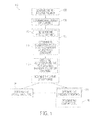
- FIGURE 1 the exemplary method will be described as shown in FIGURE 1 .
- the exemplary method seeks to assess the curvature of a path generated by, for example, MapQuestTM to determine the travel time for the path and/or the comfort level of the path.
- the steps of FIGURE 1 will be described in conjunction with FIGURES 2-5 , as appropriate.
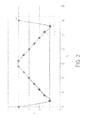
- FIGURE 2 is a graphical illustration of a path.
- FIGURE 3 is a graphical illustration of a portion of the path of FIGURE 2 illustrating the determination of the radius of curvature of a waypoint.
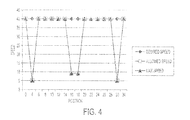
- FIGURE 4 is a graphical illustration of the speed constraints placed upon the traversal of the path in FIGURE 2 .
- FIGURE 5 is a graphical illustration of the optimal speed profile of the graph of FIGURE 2 .
- an exemplary method for assessing road curvature of a path includes the steps of generating the path from a pre-path (optional step 102); determining an allowable speed profile (Step 104); and determining an optimal speed profile (Step 106).
- the method further includes determining the optimal travel time of the optimal speed profile (Step 108), and determining comfort level (Step 110).
- the step of determining an optimal speed profile (Step 106) includes the steps of determining speed constraints (Step 112), determining a speed profile satisfying a negative acceleration constraint (Step 114), and updating the speed profile to satisfy a positive acceleration constraint (Step 116).
- the step of determining the comfort level (Step 110) includes the step of determining the frequency response of the path (Step 118).
- the first, albeit optional, step is generating a path from a pre-path (Step 102).
- the pre-path is the path provided by the ground based route planning system.
- This step entails generating a finer sampling of waypoints than the pre-path, such that the finer sampling of waypoints defines a space-indexed path, w ⁇ R N x 2 , with a curvature that can be numerically estimated.
- N is the number of waypoints.
- the pre-path may be either time-index or space-indexed. If the pre-path is time-index, it is converted into a space-indexed path.
- the finer the sample of waypoints the more accurate the exemplary method will be able to assess the road curvature.
- a finer sampling of waypoints is generally better, it comes at the cost of an increase in computation time. Accordingly, the amount of discretization of the pre-path must be chosen in view of the competing interests of computation time and accuracy.
- Step 104 the next step is to determine an allowable speed profile for the path.
- the cross track acceleration constraint a max depends upon a number of considerations, including, but not limited to, comfort, vehicle capabilities, road conditions, and/or other like considerations.
- Constraining the cross track acceleration to be of magnitude less than a max results in a maximum allowable velocity v i,allow at w i . v i , allow ⁇ a max ⁇ r i
- waypoints w i -1 , w i , and w i +1 are used to define a circle through those waypoints.
- This circle is assumed to have radius of curvature r i , because, as should be appreciated, this is a valid assumption when the waypoints are finely spaced relative to their curvature.
- Waypoints w i -1 and w i define a first line
- waypoints w i and w i +1 define a second line. The intersection of the perpendicular lines through the midpoints of the first line and the second line is at the center of the circle.
- the center point can be computed using the equations above.
- the radius of curvature r i is the norm of the vector connecting w i and the center c i .
- the direction of the curve can be computed for a finite radius of curvature r i using the sign of the cross product of the first and second line segments.
- FIGURE 2 a graph of a path is illustrated, wherein the path includes a plurality of waypoints.
- the graph includes an x-axis and a y-axis, where each point on the graph corresponds to a waypoint.
- the graph further shows a dashed box enclosing three waypoints: w i -1 , w i , and w i +1 . These three waypoints will be used to illustrate how the radius of curvature r i of waypoint w i is determined.
- the first step is to determine first line 302 between waypoints w i -1 and w i and second line 304 between waypoints w i and w i +1 , as shown in FIGURE 2 .
- an intersection between a first perpendicular line 306 and a second perpendicular line 308 is determined. The intersection corresponds to the center c i of a circle through waypoints w i -1 , w i , and w i +1 .
- the first perpendicular line 306 is perpendicular to the first line 302 and runs through the midpoint of the first line 302.
- the second perpendicular line 308 is perpendicular to the second line 304 and runs through the midpoint of the second line 304.
- the radius of curvature r i is simply the length (or norm) of a line extending between the center c i of the circle and waypoint w i .
- the optimal speed profile of the path is determined (Step 106).
- This step entails determining the optimal speed profile satisfying piecewise linear along track acceleration constraints, as well as the minimum of the desired speed and of the allowable speed from the previous step.
- This step includes the sub steps of determining speed constraints (Step 112), determining a speed profile satisfying a negative along track acceleration constraint (Step 114), and updating the speed profile to satisfy a positive along track acceleration constraint (Step 116).
- the speed at every waypoint is constrained by both the desired velocity v i,max and by the constraint imposed for the cross track acceleration constraint v i,allow .
- the pre-path preferably defines the desired velocity.
- the desired velocity for a particular waypoint may, for example, be the speed limit along a road corresponding to the waypoint.
- the desired speed may be dependent upon the capabilities of the vehicle traversing the path, such as the top speed of the vehicle. Notwithstanding how the desired velocity is chosen, the minimum of these two constraints must be satisfied, whereby the maximum velocity v i allowed at each waypoint is defined as shown below.
- v i min v i , max v i , allow
- each waypoint is graphed according to speed and position along the path of FIGURE 2 .
- the allowed speed corresponds to the allowed speed according to the cross track acceleration constraint (i.e., Step 104).
- the desired speed corresponds to the desired speed, as discussed above. In this case, the desired speed for each waypoint was chosen arbitrarily for illustrative purposes.
- the max speed i.e., the speed constraint
- the minimum of the desired speed and the allowed speed corresponds to the minimum of the desired speed and the allowed speed.
- Step 112 a speed profile satisfying a negative along track acceleration constraint is first determined (Step 114). Thereafter, the speed profile from Step 114 is updated so as to satisfy a positive along track acceleration constraint (Step 116).
- these steps rely upon three equations: the time between waypoints ⁇ t , the speed at the next waypoint v i +1 , and the along track acceleration a at,i . Further, these steps rely upon Algorithm 1. Accordingly, these equations, as well as Algorithm 1, are presented below.
- Algorithm 1 operates by incrementing through the waypoints. At waypoint w i , it first determines if it is possible to accelerate between w i and w i +1 . If it can accelerate, it accelerates as fast as required, or saturates at a max . If it cannot accelerate, it next checks if it must slow down to satisfy v i +1 . If it must, it slows down to that speed, using whatever acceleration necessary, even if using a at,i ⁇ - a max is required. Note that it only violates a max to slow down. If it does not need to slow down, then it holds the current speed.
- Step 114 the next step is to determine an acceleration profile satisfying a negative along track acceleration constraint.
- This step is accomplished by using Algorithm 1, shown above, to perform a reverse sweep of the waypoints.
- All along track positions are stored in s and all maximum speeds are stored in v .
- maximum speeds are determined in Step 112 (i.e., the speed constraint).
- Step 112 i.e., the speed constraint.
- the result is that the speed profile satisfies the negative along track acceleration constraint - a max .
- Step 114 After a speed profile satisfying a negative along track acceleration constraint is determined (Step 114), the speed profile is updated to further satisfy a positive along track acceleration constraint (Step 116) using Algorithm 1. This is accomplished via the use of a forward sweep of the waypoints. To begin, the speed constraint v is set to the resulting v from Step 114 (i.e., the reverse sweep). Thereafter, to prepare for sweeping through the points from beginning to end, the arrays, s and v , are again reversed in time, and s is again negated.
- the speed profile satisfies both the negative along track acceleration constraint and the positive along track acceleration constraint, as well as the speed constraint from Step 112.
- the optimal speed profile has been generated.
- a corresponding acceleration profile and a corresponding time profile are generated.
- negative along track acceleration constraint - a max is shown as the negative of the positive along track acceleration constraint a max , it should be appreciated that they need not be symmetrical.
- FIGURE 5 a graphical illustration of the speed profile after sweep two (i.e., the optimal speed profile) of the graph of FIGURE 2 is shown.
- FIGURE 5 further includes the speed profile after sweep one and the speed constraint from Step 112.
- the speed constraint imposes an upper bound on speeds for the first sweep, such that the speeds within the speed profile of the first sweep do not exceed the desired speed and the cross track acceleration constraint.
- the speed profile after the first sweep imposes an upper bound on speeds for the second sweep, such that the speeds within the speed profile of the second sweep do not exceed the desired speed, the cross track acceleration constraint, and the negative along track acceleration constraint.
- speeds within the speed profile of sweep one may not exceed speeds in the speed constraint profile
- speeds within the speed profile of sweep two may not exceed speeds in the speed profile of sweep one.
- the speed profile after sweep one shows acceleration from right to left until the speed meets the speed constraint.
- the speed profile after sweep two accelerates from left to right until the speed meets the speed profile from the first sweep.
- the method may proceed according to one or both of two optional steps.
- the comfort level of the path is determined (Step 110).
- This step includes the sub step of determining the frequency response of the path (Step 118).
- the first is to collect real-time driving data for a path.
- the frequency response is determined from the optimal speed profile, and corresponding cross track and/or along track acceleration profiles.
- acceleration profiles are converted so they are time-indexed, as opposed to space indexed.
- a digital filtering method such as finite impulse response, Fourier transform, and so forth, is performed on the relevant acceleration profiles.
- the frequency response With the frequency response, one may determine whether the frequency response includes frequencies prone to causing motion sickness. As previously mentioned, a study from NASA released a table (see Table 1 below) detailing those frequencies prone to causing motion sickness. Particularly, Table 1 plots frequency (in hertz) versus acceleration (in gravitational units). The generated curves (25 percent, 50 percent, 75 percent) represent equal motion sickness contours based on percentage of emesis within 2 hours for 500 male subjects exposed to vertical sinusoidal motion. As can be seen, a significant increase in motion sickness occurs approximately between 0.15 hertz and 0.25 hertz with a peak at approximately 0.20 herta. Based upon this determination, an approximation of the comfort level one traversing the path would experience can be derived.
- a comfort level can be derived based upon whether the frequency response includes higher frequencies.
- the higher the frequencies present the more curves and/or turns roads along a path have, and the more challenging it is to traverse the roads. Accordingly, a comfort level can be based upon the higher frequencies.
- Table 1 is a classically cited motion sickness example.
- other studies may define different levels. It is to be appreciated, therefore, the above is simply an example, and the present concepts may be implemented using data from other such studies. It is also mentioned that automobile tires can typically handle up to 0.3 g's while staying within most users' comfort levels.
- a user may be notified if the comfort level falls below a predefined threshold.
- this threshold is set by the user while in other embodiments the threshold is set globally for all users.
- a user may request the comfort level of a path after viewing the path.
- a new path is generated automatically when the comfort level of the path falls below a predefined threshold.
- the frequency response and traversal time of a sub-path may be used to penalize the sub-path.
- a ground based route planning system may find that a 2 minute stretch of curvy road is acceptable to save 30 minutes of travel time, whereas a 30 minute stretch of curvy road is not acceptable to save 30 minutes of travel time.
- the frequency response of a path is advantageously employed to improve the comfort of a user traversing a path.
- the exemplary method discussed above are modified to analyze and augment the databases of ground based route planning systems.
- the exemplary method discussed above may be used to pre-compute the speed profiles, acceleration profiles, time profiles, frequency responses and/or driver comforts for the paths (e.g., roads) comprising a database of a ground based route planning system.
- ground based route planning systems can use the augmented databases to determine the path between two points (e.g., a start address and an end address), whereby sub-paths (e.g., roads) may be penalized due to the pre-computed data, e.g., the frequency responses.
- ground based route planning systems to take into account the curvature of a road while generating a path between two points, such that the path may be based upon, for example, more accurate travel times, the frequency response of sub-paths (e.g., roads), and driver comfort.
- the effect on the time and space complexity of the path generation algorithms used by ground based route planning systems should be negligible.
- the databases of ground based route planning systems are augmented while generating paths between two points (i.e., at runtime).
- the speed profiles, acceleration profiles, time profiles, frequency responses and/or driver comforts for the sub-paths (e.g., roads) intermediate and relevant to a path between two points are generated while generating the path between the two points (i.e., at runtime).
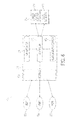
- the system includes one or more users 602, a ground based route planning system 604 and an automobile 614.
- the ground based route planning system includes an interface 606, a path generator 608, a controller 610 and a road curvature assessor 612.
- the interface 606 interfaces with the one or more users 602 and receives requests from the one or more users 602.
- the interface 606 may be a web interface such as MapQuestTM.
- the interface 606 may be a computer interface, such as that of a portable GPS unit like TomTom TM .
- the requests may be requests for driving directions, the comfort level of a path, the time of travel of a path, and/or other like requests. If a request is for driving directions, the request includes a start point and an end point. If the request is for the comfort level and/or travel time of a path, the request includes the path or the location of the path.
- the path generator 608 generates a path in response to a path request, e.g., a request for driving directions.
- the path generator 608 may generate a path using A* with visibility graphs, fast marching with gradient descent, or any other algorithm operative generate a path between two points.
- the road curvature assessor 612 assesses the curvature of a path as described in FIGURE 7 , below, in response to an assessment request.
- the controller 610 acts to bridge and/or relay communications between the components of the grounds based route planning system 604.
- the controller 610 receives the requests from the one or more users via the interface 606. Thereafter, the controller 610 determines how to respond to the request and relays the request as appropriate. If the controller 610 receives a request for driving directions (i.e., a path request), the controller 610 relays the request to the path generator 608 and returns the generated path to the appropriate user via the interface 606 in a visual and/or audible manner. If the controller 610 receives a request for a travel time of a path or a comfort level of a path (i.e., an assessment request), the next step depends upon the information received in the request.
- a request for driving directions i.e., a path request
- the controller 610 relays the request to the path generator 608 and returns the generated path to the appropriate user via the interface 606 in a visual and/or audible manner. If the controller 610 receives a request for
- the controller 610 simply relays the request to the road curvature assessor 612 and responds to the request, via the interface 606, with the assessment of the road curvature assessor 612. However, if the request also includes a request for driving directions (i.e., a path request), the controller 610 first sends the request to the path generator 608 to generate the path. Thereafter, the controller relays the path from the path generator 608 to the road curvature assessor 612 and responds to the request with the path and the assessment of the road curvature assessor 612.
- a request for driving directions i.e., a path request
- the ground based route planning system 604 may further accompany the automobile 614.
- the automobile 614 includes current position indicator 616 and/or speed regulator 618.
- the current position indicator 616 may provide the controller 610 of the ground based route planning system 604 with the current position of the automobile 614 along a path generated by the ground based route planning system.
- the current position indicator 616 may be a GPS unit and/or any other system for ground based navigation.
- the controller 610 can use an optimal speed profile of the path to control a speed regulator 618 of the automobile 614.
- the speed regulator 618 includes, for example, cruise control. This advantageously allows an automobile 614 to slow down for turns when using the speed regulator 618, such as cruise control.
- the controller 610 may facilitate a "one-sided cruise control" where the controller 610 imposes a speed limit on the driver based on user-provided parameters or on preprogrammed parameters. For example, such parameters may limit the ability of a driver to enter a curve too fast for the road conditions. As should be appreciated, this advantageously improves safety.
- the controller 610 can provide a driver with an audio and/or visual warning to slow down. This also advantageously improves safety. Notwithstanding that the foregoing discussion contemplates the controller coordinating the foregoing features, the controller may simply provide the automobile 614 with the speed profile for a path, whereby the automobile 614 may carry out one or more of the foregoing features, such as controlling the speed regulator 618.
- system 700 for assessing the curvature of a path is illustrated.
- the system 700 is suitably embodied by a computer 710, or other digital processing device including a digital processor, such as a microprocessor, microcontroller, graphic processing unit (GPU), etc. and storage.
- the system 700 for assessing road curvature may be embodied by a server including a digital processor and including or having access to digital data storage, such server being suitably accessed via the Internet or a local area network, or by a personal data assistant (PDA) including a digital processor and digital data storage, or so forth.
- PDA personal data assistant
- the computer or other digital processing device suitably includes or is operatively connected with one or more user input devices such as an illustrated keyboard 714 for receiving user input to control the road curvature assessor, and further includes or is operatively connected with one or more display devices such as an illustrated display 712 for displaying output generated based on the output of the road curvature assessor 700.
- the input for controlling the road curvature assessor 700 is received from another program running previously to or concurrently with the road curvature assessor 700 on the computer 710, or from a network connection, or so forth.
- the output may serve as input to another program running subsequent to or concurrently with system 700 on the computer, or may be transmitted via a network connection, or so forth.
- the road curvature assessor system 700 includes an optional pre-path module 702; an allowable speed module 704; an optimal speed module 706; and a user module 708.
- the optional pre-path module 702 receives a pre-path from a source external ( e . g. , the Internet) to the road curvature assessor system 700, and generates a path from the pre-path as described in connection with Step 102 of FIGURE 1 . Thereafter, the allowable speed module 704 receives the path from the pre-path module 702. If the optional pre-path module 702 is not employed, the allowable speed module 704 receives a path from a source external ( e .
- the optimal speed module 706 receives the path and the allowable speed profile from the allowable speed module 704. The optimal speed module 706 thereafter uses the received path and allowable speed profile to generate an optimal speed profile satisfying acceleration constraints and speed constraints. The optimal speed module generates the optimal speed profile as described in connection with Step 106 of FIGURE 1 . Thereafter, the optimal speed profile is output for display, printout and/or implementation into additional decision making mechanisms, such as planners.
- the user module 708 receives the optimal speed profile, and a corresponding acceleration profile, from the optimal speed module. Additionally, the user module 708 receives an external request for one or more of the following: an optimal travel time, a comfort level, or other like requests. Depending upon the request, the user module 708 analyzes the speed profile and/or the acceleration profile as discussed in connection with Steps 108 and 110 of FIGURE 1 . Thereafter, a response to the request is output for display, printout and/or implementation into additional decision making mechanisms, such as planner.
- additional decision making mechanisms such as planner.
- the exemplary methods, discussed above, the road curvature assessor employing the same, and so forth, of the present application are embodied by a storage medium storing instructions executable (for example, by a digital processor) to implement the exemplary methods and/or road curvature assessor.
- the storage medium may include, for example: a magnetic disk or other magnetic storage medium; an optical disk or other optical storage medium; a random access memory (RAM), read-only memory (ROM), or other electronic memory device or chip or set of operatively interconnected chips; an Internet server from which the stored instructions may be retrieved via the Internet or a local area network; or so forth.
- time optimal sweeping algorithm was applied to two exemplary path planning algorithms: an A* algorithm and a fast marching algorithm. Further, all the experiments were run using a 3.4 GHz Pentium IV computer. As will be discussed with more detail below, the time to run the time optimal sweeping algorithm demonstrates that this algorithm is computationally negligible, as expected by its O ( n ) time complexity.
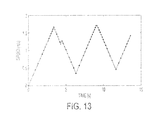
- FIGURE 8 Considering the path generated using A* to find the shortest path through a visibility graph, shown in FIGURE 8 , the generation of the shortest path required under 20 ms using Matlab. However, this method ignored dynamic constraints, which would require an automobile to slow to a halt at sharp corners. To run the optimum time sweeping algorithm, the shortest path was discretized at 0.2 m increments, resulting in a computation time of under 1 ms to run optimum time sweeping. The results are shown in FIGURES 10-13 . The minimum time to traverse the path under acceleration and speed constraints was 13.6 sec.
- this method uses a discrete grid, propagates the cost to reach the goal from the goal outward, increasing with distance. Close proximity to obstacles increases this cost, resulting in the refraction of the wave front around surfaces.
- gradient descent is used to find the best path to the target, according to the cost map.
- the complete path finding algorithm again ran in under 20 ms. Due to the aversion to obstacles, this cost map is not exactly the time to the goal because the vehicle is penalized for being close to obstacles.
- the fast marching path was discretized at 0.2 m increments again, and resulted in a computation time of under 1 ms.
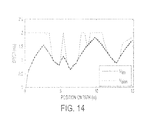
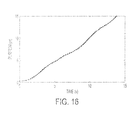
- the results are shown in FIGURES 14-17 .
- the minimum time to traverse the path under acceleration and speed constraints was 13.8 sec.
- the results for fast marching differ from those of the visibility graph.
- the aversion to obstacles results in smoother paths, the paths are always longer than the visibility graph.
- the aversion to obstacles causes fast marching to tend to avoid going through small gaps when possible, which is advantageous if there are winding corners, but hurts performance if there is a simple gap.
- the resulting minimum time acceleration commands for the fast marching path varied much more smoothly than for the visibility graph, due to a lack of corners.
- the maximum velocity constraint due to cross track acceleration was active for more time than it was for the visibility graph path, the minimum values were not as low, so the average speeds were close to equal for the two examples.
- the computation time to find a path through the environment was low because dynamic constraints were first ignored to find the path, and then included by the optimum time sweeping algorithm.
- the overall paths are not optimal.
- the optimum time sweeping algorithm generates a control input and speed plan that traverses the path in minimum time.
Landscapes
- Engineering & Computer Science (AREA)
- Radar, Positioning & Navigation (AREA)
- Remote Sensing (AREA)
- Physics & Mathematics (AREA)
- General Physics & Mathematics (AREA)
- Automation & Control Theory (AREA)
- Software Systems (AREA)
- Theoretical Computer Science (AREA)
- Data Mining & Analysis (AREA)
- Computational Mathematics (AREA)
- Mathematical Analysis (AREA)
- Mathematical Physics (AREA)
- Pure & Applied Mathematics (AREA)
- General Engineering & Computer Science (AREA)
- Mathematical Optimization (AREA)
- Probability & Statistics with Applications (AREA)
- Evolutionary Biology (AREA)
- Operations Research (AREA)
- Bioinformatics & Cheminformatics (AREA)
- Life Sciences & Earth Sciences (AREA)
- Algebra (AREA)
- Bioinformatics & Computational Biology (AREA)
- Databases & Information Systems (AREA)
- Navigation (AREA)
- Instructional Devices (AREA)
- Traffic Control Systems (AREA)
Applications Claiming Priority (2)
| Application Number | Priority Date | Filing Date | Title |
|---|---|---|---|
| US23489809P | 2009-08-18 | 2009-08-18 | |
| US12/544,706 US8306732B2 (en) | 2009-08-18 | 2009-08-20 | Model based method to assess road curvature effect on travel time and comfort for route planning |
Publications (2)
| Publication Number | Publication Date |
|---|---|
| EP2287568A1 EP2287568A1 (en) | 2011-02-23 |
| EP2287568B1 true EP2287568B1 (en) | 2015-11-04 |
Family
ID=42833357
Family Applications (1)
| Application Number | Title | Priority Date | Filing Date |
|---|---|---|---|
| EP10171608.2A Not-in-force EP2287568B1 (en) | 2009-08-18 | 2010-08-02 | Model based method to assess road curvature effect on travel time and comfort for route planning |
Country Status (4)
| Country | Link |
|---|---|
| US (2) | US8306732B2 (https=) |
| EP (1) | EP2287568B1 (https=) |
| JP (1) | JP5476252B2 (https=) |
| KR (1) | KR101620807B1 (https=) |
Families Citing this family (34)
| Publication number | Priority date | Publication date | Assignee | Title |
|---|---|---|---|---|
| US7920962B2 (en) | 2006-06-19 | 2011-04-05 | Kiva Systems, Inc. | System and method for coordinating movement of mobile drive units |
| US7912574B2 (en) | 2006-06-19 | 2011-03-22 | Kiva Systems, Inc. | System and method for transporting inventory items |
| US20130302132A1 (en) | 2012-05-14 | 2013-11-14 | Kiva Systems, Inc. | System and Method for Maneuvering a Mobile Drive Unit |
| US8538692B2 (en) | 2006-06-19 | 2013-09-17 | Amazon Technologies, Inc. | System and method for generating a path for a mobile drive unit |
| US7873469B2 (en) * | 2006-06-19 | 2011-01-18 | Kiva Systems, Inc. | System and method for managing mobile drive units |
| US8220710B2 (en) | 2006-06-19 | 2012-07-17 | Kiva Systems, Inc. | System and method for positioning a mobile drive unit |
| US8649899B2 (en) | 2006-06-19 | 2014-02-11 | Amazon Technologies, Inc. | System and method for maneuvering a mobile drive unit |
| JP4873042B2 (ja) * | 2009-04-13 | 2012-02-08 | トヨタ自動車株式会社 | 車両制御装置および車両制御方法 |
| US8285485B2 (en) * | 2010-03-18 | 2012-10-09 | Harman International Industries, Incorporated | Vehicle navigation system with route determination based on a measure of sportiness |
| US8543308B2 (en) * | 2010-04-19 | 2013-09-24 | GM Global Technology Operations LLC | Systems and methods for communicating optimal driving information |
| US20120195491A1 (en) * | 2010-07-21 | 2012-08-02 | Palo Alto Research Center Incorporated | System And Method For Real-Time Mapping Of An Indoor Environment Using Mobile Robots With Limited Sensing |
| US8892240B1 (en) | 2011-06-29 | 2014-11-18 | Amazon Technologies, Inc. | Modular material handling system for order fulfillment |
| US9045041B2 (en) | 2013-02-27 | 2015-06-02 | Here Global B.V. | Driver behavior from probe data for augmenting a data model |
| KR102037036B1 (ko) * | 2013-04-11 | 2019-10-28 | 현대모비스 주식회사 | 자동주행 제어시스템 |
| JP6161942B2 (ja) * | 2013-04-19 | 2017-07-12 | 株式会社デンソーアイティーラボラトリ | カーブ形状モデル化装置、車両情報処理システム、カーブ形状モデル化方法、及びカーブ形状モデル化プログラム |
| CN103354044B (zh) * | 2013-05-23 | 2017-04-12 | 深圳市有伴科技有限公司 | 用于电子终端的语音应用app中的互动方法及其产品 |
| KR101504252B1 (ko) * | 2013-11-28 | 2015-03-19 | 현대모비스 주식회사 | 곡선 도로에서 차량의 속도를 제어하기 위한 시스템 및 그 방법 |
| US20150158495A1 (en) * | 2013-12-05 | 2015-06-11 | Elwha Llc | Systems and methods for reporting characteristics of operator performance |
| US10049129B2 (en) * | 2014-12-22 | 2018-08-14 | Here Global B.V. | Method and apparatus for providing map updates from distance based bucket processing |
| JP2017072440A (ja) * | 2015-10-06 | 2017-04-13 | クラリオン株式会社 | 運転快適度算出装置、運転快適度算出方法、および運転快適度算出システム |
| JP6414005B2 (ja) * | 2015-10-09 | 2018-10-31 | トヨタ自動車株式会社 | 車両用制御装置 |
| JP6672711B2 (ja) * | 2015-11-04 | 2020-03-25 | 富士通株式会社 | 経路グラフ生成方法、装置、及びプログラム |
| US10234300B2 (en) * | 2015-11-13 | 2019-03-19 | Here Global B.V. | Private and personalized estimation of travel time |
| US10059287B2 (en) * | 2016-02-17 | 2018-08-28 | Toyota Motor Engineering & Manufacturing North America, Inc. | System and method for enhanced comfort prediction |
| US10107635B2 (en) * | 2016-08-19 | 2018-10-23 | Waymo Llc | Method and system for determining and dynamically updating a route and driving style for passenger comfort |
| GB2556876A (en) * | 2016-11-09 | 2018-06-13 | Inventive Cogs Campbell Ltd | Vehicle route guidance |
| GB2567854B (en) * | 2017-10-27 | 2020-01-08 | Jaguar Land Rover Ltd | Motion sickness well being route planner |
| CN108088456B (zh) * | 2017-12-21 | 2021-07-16 | 北京工业大学 | 一种具有时间一致性的无人驾驶车辆局部路径规划方法 |
| US11359925B2 (en) * | 2018-08-02 | 2022-06-14 | Salesforce.Com, Inc. | Utilizing estimated traversal values to accelerate the determination of high quality solutions to routing problems |
| TWI744742B (zh) * | 2019-12-17 | 2021-11-01 | 神達數位股份有限公司 | 潛在危險道路鑑別及資訊共享的方法、雲端伺服器、電腦可讀取的記錄媒體及特殊應用積體電路晶片 |
| IT202000023227A1 (it) * | 2020-10-01 | 2022-04-01 | Laura Quinale | Metodo e dispositivo per determinare un percorso |
| CN112527010B (zh) * | 2020-11-09 | 2022-04-01 | 福州大学 | 基于人工势场与粒子优化的室内变电站无人机多机协同巡检方法 |
| CA3249405A1 (en) * | 2022-01-28 | 2023-03-09 | Boris Valerevich PANKOV | GENERATION OF A RESOURCE-EFFICIENT WAY FOR A MOTOR VEHICLE |
| CN118010059B (zh) * | 2024-04-08 | 2024-07-05 | 逸航汽车零部件无锡有限公司 | 基于个性化舒适度控制的路径规划系统及方法 |
Family Cites Families (13)
| Publication number | Priority date | Publication date | Assignee | Title |
|---|---|---|---|---|
| US4361202A (en) * | 1979-06-15 | 1982-11-30 | Michael Minovitch | Automated road transportation system |
| JP4470311B2 (ja) * | 1999-10-15 | 2010-06-02 | 日産自動車株式会社 | 走行パターン生成装置 |
| DE10031787A1 (de) * | 2000-07-04 | 2002-01-24 | Daimler Chrysler Ag | Assistenzsystem zur Auswahl von Strecken |
| US7096428B2 (en) | 2001-09-28 | 2006-08-22 | Fuji Xerox Co., Ltd. | Systems and methods for providing a spatially indexed panoramic video |
| JP2004046580A (ja) | 2002-05-14 | 2004-02-12 | Sanyo Electric Co Ltd | 搬送装置 |
| US7447593B2 (en) | 2004-03-26 | 2008-11-04 | Raytheon Company | System and method for adaptive path planning |
| US7513508B2 (en) * | 2004-06-04 | 2009-04-07 | Romeo Fernando Malit | Computer assisted driving of vehicles |
| KR100497781B1 (ko) * | 2004-09-24 | 2005-06-28 | 주식회사 삼안 | 에스형, 복합형 및 난형 도로설계에서 크로소이드파라메타 계산방법 |
| JP2007106170A (ja) | 2005-10-11 | 2007-04-26 | Fujifilm Corp | 運転支援システム |
| ES2350232T3 (es) | 2006-06-29 | 2011-01-20 | Navigon Ag | Procedimiento para la determinación automática asistida por ordenador de una ruta que ha de ser recorrida por vehículos. |
| EP1890110A3 (de) | 2006-08-18 | 2013-04-24 | Volkswagen Aktiengesellschaft | Verfahren zur Bestimmung einer optimalen Fahrstrategie eines Kraftfahrzeugs und entsprechend ausgestaltete Vorrichtung sowie zugehörige Anzeige und zugehöriges Kraftfahrzeug |
| JP4946374B2 (ja) * | 2006-11-13 | 2012-06-06 | トヨタ自動車株式会社 | 自動運転車両 |
| JP5023894B2 (ja) * | 2007-08-31 | 2012-09-12 | トヨタ自動車株式会社 | 走行計画生成装置 |
-
2009
- 2009-08-20 US US12/544,706 patent/US8306732B2/en active Active - Reinstated
-
2010
- 2010-08-02 EP EP10171608.2A patent/EP2287568B1/en not_active Not-in-force
- 2010-08-17 JP JP2010182208A patent/JP5476252B2/ja not_active Expired - Fee Related
- 2010-08-17 KR KR1020100079442A patent/KR101620807B1/ko not_active Expired - Fee Related
-
2012
- 2012-10-02 US US13/633,414 patent/US8583340B2/en active Active
Also Published As
| Publication number | Publication date |
|---|---|
| KR101620807B1 (ko) | 2016-05-23 |
| US20130090823A1 (en) | 2013-04-11 |
| US8583340B2 (en) | 2013-11-12 |
| JP5476252B2 (ja) | 2014-04-23 |
| KR20110018847A (ko) | 2011-02-24 |
| EP2287568A1 (en) | 2011-02-23 |
| JP2011039518A (ja) | 2011-02-24 |
| US20110046877A1 (en) | 2011-02-24 |
| US8306732B2 (en) | 2012-11-06 |
Similar Documents
| Publication | Publication Date | Title |
|---|---|---|
| EP2287568B1 (en) | Model based method to assess road curvature effect on travel time and comfort for route planning | |
| US10161758B2 (en) | Method for creating speed profiles for digital maps | |
| US8896464B2 (en) | Navigation device and method for providing warnings for a speed trap | |
| EP2962067B1 (en) | Driver behavior from probe data for augmenting a data model | |
| CN101438133B (zh) | 具适应性导航指令的导航装置 | |
| US8547211B2 (en) | Route retrieval apparatus and navigation apparatus | |
| US20040049339A1 (en) | Assistance system for selecting routes | |
| WO2020060974A1 (en) | Exhaustive driving analytical systems and modelers | |
| Farah et al. | An empirical analysis to assess the operational design domain of lane keeping system equipped vehicles combining objective and subjective risk measures | |
| CN105702042B (zh) | 根据重点营运车辆定位信息判断公路拥堵的方法 | |
| US20190210599A1 (en) | Method for determining a motor vehicle speed profile | |
| JP3999611B2 (ja) | ナビゲーション装置 | |
| Pauzie et al. | Intelligent driver support system functions in cars and their potential consequences for safety | |
| US20250058795A1 (en) | Methods and systems for managing output devices in a vehicle based on proxemic risk | |
| CN118358579A (zh) | 车辆速度控制方法、装置、电子设备及存储介质 | |
| Juhász | Influence of different route-choice decision modes | |
| Tadesse | Analysis of capacity and traffic flow characteristics of mixed traffic on Addis Ababa ring road | |
| Boriboonsomsin et al. | Environmentally Friendly Driving Feedback Systems Research and Development for Heavy Duty Trucks | |
| CN118261306A (zh) | 基于路线规划的驾驶训练方法、终端设备及系统 | |
| Rohani | Consistency and effectiveness of advisory speeds: an evaluation of current posting techniques | |
| Tang et al. | Research Article Highway Design and Safety Consequences: A Case Study of Interstate Highway Vertical Grades | |
| Alsghan | The Effect of Truck Platooning on Sign Occlusion and native tools to assess sign occlusion | |
| Musa | B. Eng. Hons.(Civil), Fourah Bay College, University of Sierra Leone, 1987 M. Sc.(Highway Engineering), University of Birmingham, UK, 1992 |
Legal Events
| Date | Code | Title | Description |
|---|---|---|---|
| PUAI | Public reference made under article 153(3) epc to a published international application that has entered the european phase |
Free format text: ORIGINAL CODE: 0009012 |
|
| AK | Designated contracting states |
Kind code of ref document: A1 Designated state(s): AL AT BE BG CH CY CZ DE DK EE ES FI FR GB GR HR HU IE IS IT LI LT LU LV MC MK MT NL NO PL PT RO SE SI SK SM TR |
|
| AX | Request for extension of the european patent |
Extension state: BA ME RS |
|
| 17P | Request for examination filed |
Effective date: 20110823 |
|
| GRAP | Despatch of communication of intention to grant a patent |
Free format text: ORIGINAL CODE: EPIDOSNIGR1 |
|
| INTG | Intention to grant announced |
Effective date: 20150630 |
|
| GRAS | Grant fee paid |
Free format text: ORIGINAL CODE: EPIDOSNIGR3 |
|
| GRAA | (expected) grant |
Free format text: ORIGINAL CODE: 0009210 |
|
| AK | Designated contracting states |
Kind code of ref document: B1 Designated state(s): AL AT BE BG CH CY CZ DE DK EE ES FI FR GB GR HR HU IE IS IT LI LT LU LV MC MK MT NL NO PL PT RO SE SI SK SM TR |
|
| REG | Reference to a national code |
Ref country code: GB Ref legal event code: FG4D |
|
| REG | Reference to a national code |
Ref country code: CH Ref legal event code: EP |
|
| REG | Reference to a national code |
Ref country code: AT Ref legal event code: REF Ref document number: 759511 Country of ref document: AT Kind code of ref document: T Effective date: 20151115 |
|
| REG | Reference to a national code |
Ref country code: IE Ref legal event code: FG4D |
|
| REG | Reference to a national code |
Ref country code: DE Ref legal event code: R096 Ref document number: 602010028718 Country of ref document: DE |
|
| REG | Reference to a national code |
Ref country code: NL Ref legal event code: MP Effective date: 20151104 |
|
| REG | Reference to a national code |
Ref country code: LT Ref legal event code: MG4D |
|
| REG | Reference to a national code |
Ref country code: AT Ref legal event code: MK05 Ref document number: 759511 Country of ref document: AT Kind code of ref document: T Effective date: 20151104 |
|
| PG25 | Lapsed in a contracting state [announced via postgrant information from national office to epo] |
Ref country code: NO Free format text: LAPSE BECAUSE OF FAILURE TO SUBMIT A TRANSLATION OF THE DESCRIPTION OR TO PAY THE FEE WITHIN THE PRESCRIBED TIME-LIMIT Effective date: 20160204 Ref country code: HR Free format text: LAPSE BECAUSE OF FAILURE TO SUBMIT A TRANSLATION OF THE DESCRIPTION OR TO PAY THE FEE WITHIN THE PRESCRIBED TIME-LIMIT Effective date: 20151104 Ref country code: NL Free format text: LAPSE BECAUSE OF FAILURE TO SUBMIT A TRANSLATION OF THE DESCRIPTION OR TO PAY THE FEE WITHIN THE PRESCRIBED TIME-LIMIT Effective date: 20151104 Ref country code: IT Free format text: LAPSE BECAUSE OF FAILURE TO SUBMIT A TRANSLATION OF THE DESCRIPTION OR TO PAY THE FEE WITHIN THE PRESCRIBED TIME-LIMIT Effective date: 20151104 Ref country code: LT Free format text: LAPSE BECAUSE OF FAILURE TO SUBMIT A TRANSLATION OF THE DESCRIPTION OR TO PAY THE FEE WITHIN THE PRESCRIBED TIME-LIMIT Effective date: 20151104 Ref country code: IS Free format text: LAPSE BECAUSE OF FAILURE TO SUBMIT A TRANSLATION OF THE DESCRIPTION OR TO PAY THE FEE WITHIN THE PRESCRIBED TIME-LIMIT Effective date: 20160304 Ref country code: ES Free format text: LAPSE BECAUSE OF FAILURE TO SUBMIT A TRANSLATION OF THE DESCRIPTION OR TO PAY THE FEE WITHIN THE PRESCRIBED TIME-LIMIT Effective date: 20151104 |
|
| PG25 | Lapsed in a contracting state [announced via postgrant information from national office to epo] |
Ref country code: FI Free format text: LAPSE BECAUSE OF FAILURE TO SUBMIT A TRANSLATION OF THE DESCRIPTION OR TO PAY THE FEE WITHIN THE PRESCRIBED TIME-LIMIT Effective date: 20151104 Ref country code: SE Free format text: LAPSE BECAUSE OF FAILURE TO SUBMIT A TRANSLATION OF THE DESCRIPTION OR TO PAY THE FEE WITHIN THE PRESCRIBED TIME-LIMIT Effective date: 20151104 Ref country code: PT Free format text: LAPSE BECAUSE OF FAILURE TO SUBMIT A TRANSLATION OF THE DESCRIPTION OR TO PAY THE FEE WITHIN THE PRESCRIBED TIME-LIMIT Effective date: 20160304 Ref country code: GR Free format text: LAPSE BECAUSE OF FAILURE TO SUBMIT A TRANSLATION OF THE DESCRIPTION OR TO PAY THE FEE WITHIN THE PRESCRIBED TIME-LIMIT Effective date: 20160205 Ref country code: PL Free format text: LAPSE BECAUSE OF FAILURE TO SUBMIT A TRANSLATION OF THE DESCRIPTION OR TO PAY THE FEE WITHIN THE PRESCRIBED TIME-LIMIT Effective date: 20151104 Ref country code: LV Free format text: LAPSE BECAUSE OF FAILURE TO SUBMIT A TRANSLATION OF THE DESCRIPTION OR TO PAY THE FEE WITHIN THE PRESCRIBED TIME-LIMIT Effective date: 20151104 Ref country code: AT Free format text: LAPSE BECAUSE OF FAILURE TO SUBMIT A TRANSLATION OF THE DESCRIPTION OR TO PAY THE FEE WITHIN THE PRESCRIBED TIME-LIMIT Effective date: 20151104 |
|
| REG | Reference to a national code |
Ref country code: FR Ref legal event code: PLFP Year of fee payment: 7 |
|
| PG25 | Lapsed in a contracting state [announced via postgrant information from national office to epo] |
Ref country code: CZ Free format text: LAPSE BECAUSE OF FAILURE TO SUBMIT A TRANSLATION OF THE DESCRIPTION OR TO PAY THE FEE WITHIN THE PRESCRIBED TIME-LIMIT Effective date: 20151104 |
|
| REG | Reference to a national code |
Ref country code: DE Ref legal event code: R097 Ref document number: 602010028718 Country of ref document: DE |
|
| PG25 | Lapsed in a contracting state [announced via postgrant information from national office to epo] |
Ref country code: RO Free format text: LAPSE BECAUSE OF FAILURE TO SUBMIT A TRANSLATION OF THE DESCRIPTION OR TO PAY THE FEE WITHIN THE PRESCRIBED TIME-LIMIT Effective date: 20151104 Ref country code: EE Free format text: LAPSE BECAUSE OF FAILURE TO SUBMIT A TRANSLATION OF THE DESCRIPTION OR TO PAY THE FEE WITHIN THE PRESCRIBED TIME-LIMIT Effective date: 20151104 Ref country code: SK Free format text: LAPSE BECAUSE OF FAILURE TO SUBMIT A TRANSLATION OF THE DESCRIPTION OR TO PAY THE FEE WITHIN THE PRESCRIBED TIME-LIMIT Effective date: 20151104 Ref country code: SM Free format text: LAPSE BECAUSE OF FAILURE TO SUBMIT A TRANSLATION OF THE DESCRIPTION OR TO PAY THE FEE WITHIN THE PRESCRIBED TIME-LIMIT Effective date: 20151104 Ref country code: DK Free format text: LAPSE BECAUSE OF FAILURE TO SUBMIT A TRANSLATION OF THE DESCRIPTION OR TO PAY THE FEE WITHIN THE PRESCRIBED TIME-LIMIT Effective date: 20151104 |
|
| PLBE | No opposition filed within time limit |
Free format text: ORIGINAL CODE: 0009261 |
|
| STAA | Information on the status of an ep patent application or granted ep patent |
Free format text: STATUS: NO OPPOSITION FILED WITHIN TIME LIMIT |
|
| 26N | No opposition filed |
Effective date: 20160805 |
|
| PG25 | Lapsed in a contracting state [announced via postgrant information from national office to epo] |
Ref country code: SI Free format text: LAPSE BECAUSE OF FAILURE TO SUBMIT A TRANSLATION OF THE DESCRIPTION OR TO PAY THE FEE WITHIN THE PRESCRIBED TIME-LIMIT Effective date: 20151104 |
|
| PG25 | Lapsed in a contracting state [announced via postgrant information from national office to epo] |
Ref country code: BE Free format text: LAPSE BECAUSE OF FAILURE TO SUBMIT A TRANSLATION OF THE DESCRIPTION OR TO PAY THE FEE WITHIN THE PRESCRIBED TIME-LIMIT Effective date: 20151104 |
|
| PG25 | Lapsed in a contracting state [announced via postgrant information from national office to epo] |
Ref country code: MC Free format text: LAPSE BECAUSE OF FAILURE TO SUBMIT A TRANSLATION OF THE DESCRIPTION OR TO PAY THE FEE WITHIN THE PRESCRIBED TIME-LIMIT Effective date: 20151104 |
|
| REG | Reference to a national code |
Ref country code: CH Ref legal event code: PL |
|
| PG25 | Lapsed in a contracting state [announced via postgrant information from national office to epo] |
Ref country code: CH Free format text: LAPSE BECAUSE OF NON-PAYMENT OF DUE FEES Effective date: 20160831 Ref country code: LI Free format text: LAPSE BECAUSE OF NON-PAYMENT OF DUE FEES Effective date: 20160831 |
|
| REG | Reference to a national code |
Ref country code: IE Ref legal event code: MM4A |
|
| REG | Reference to a national code |
Ref country code: FR Ref legal event code: PLFP Year of fee payment: 8 |
|
| PG25 | Lapsed in a contracting state [announced via postgrant information from national office to epo] |
Ref country code: IE Free format text: LAPSE BECAUSE OF NON-PAYMENT OF DUE FEES Effective date: 20160802 |
|
| PG25 | Lapsed in a contracting state [announced via postgrant information from national office to epo] |
Ref country code: LU Free format text: LAPSE BECAUSE OF NON-PAYMENT OF DUE FEES Effective date: 20160802 |
|
| PG25 | Lapsed in a contracting state [announced via postgrant information from national office to epo] |
Ref country code: CY Free format text: LAPSE BECAUSE OF FAILURE TO SUBMIT A TRANSLATION OF THE DESCRIPTION OR TO PAY THE FEE WITHIN THE PRESCRIBED TIME-LIMIT Effective date: 20151104 Ref country code: HU Free format text: LAPSE BECAUSE OF FAILURE TO SUBMIT A TRANSLATION OF THE DESCRIPTION OR TO PAY THE FEE WITHIN THE PRESCRIBED TIME-LIMIT; INVALID AB INITIO Effective date: 20100802 |
|
| PG25 | Lapsed in a contracting state [announced via postgrant information from national office to epo] |
Ref country code: TR Free format text: LAPSE BECAUSE OF FAILURE TO SUBMIT A TRANSLATION OF THE DESCRIPTION OR TO PAY THE FEE WITHIN THE PRESCRIBED TIME-LIMIT Effective date: 20151104 Ref country code: MK Free format text: LAPSE BECAUSE OF FAILURE TO SUBMIT A TRANSLATION OF THE DESCRIPTION OR TO PAY THE FEE WITHIN THE PRESCRIBED TIME-LIMIT Effective date: 20151104 Ref country code: MT Free format text: LAPSE BECAUSE OF NON-PAYMENT OF DUE FEES Effective date: 20160831 |
|
| REG | Reference to a national code |
Ref country code: FR Ref legal event code: PLFP Year of fee payment: 9 |
|
| PG25 | Lapsed in a contracting state [announced via postgrant information from national office to epo] |
Ref country code: BG Free format text: LAPSE BECAUSE OF FAILURE TO SUBMIT A TRANSLATION OF THE DESCRIPTION OR TO PAY THE FEE WITHIN THE PRESCRIBED TIME-LIMIT Effective date: 20151104 |
|
| PG25 | Lapsed in a contracting state [announced via postgrant information from national office to epo] |
Ref country code: AL Free format text: LAPSE BECAUSE OF FAILURE TO SUBMIT A TRANSLATION OF THE DESCRIPTION OR TO PAY THE FEE WITHIN THE PRESCRIBED TIME-LIMIT Effective date: 20151104 |
|
| PGFP | Annual fee paid to national office [announced via postgrant information from national office to epo] |
Ref country code: FR Payment date: 20200721 Year of fee payment: 11 Ref country code: GB Payment date: 20200722 Year of fee payment: 11 |
|
| GBPC | Gb: european patent ceased through non-payment of renewal fee |
Effective date: 20210802 |
|
| PG25 | Lapsed in a contracting state [announced via postgrant information from national office to epo] |
Ref country code: GB Free format text: LAPSE BECAUSE OF NON-PAYMENT OF DUE FEES Effective date: 20210802 Ref country code: FR Free format text: LAPSE BECAUSE OF NON-PAYMENT OF DUE FEES Effective date: 20210831 |
|
| PGFP | Annual fee paid to national office [announced via postgrant information from national office to epo] |
Ref country code: DE Payment date: 20220720 Year of fee payment: 13 |
|
| REG | Reference to a national code |
Ref country code: DE Ref legal event code: R119 Ref document number: 602010028718 Country of ref document: DE |
|
| PG25 | Lapsed in a contracting state [announced via postgrant information from national office to epo] |
Ref country code: DE Free format text: LAPSE BECAUSE OF NON-PAYMENT OF DUE FEES Effective date: 20240301 |