EP2285509B1 - System zum biegen eines metallstreifens - Google Patents
System zum biegen eines metallstreifens Download PDFInfo
- Publication number
- EP2285509B1 EP2285509B1 EP08789962.1A EP08789962A EP2285509B1 EP 2285509 B1 EP2285509 B1 EP 2285509B1 EP 08789962 A EP08789962 A EP 08789962A EP 2285509 B1 EP2285509 B1 EP 2285509B1
- Authority
- EP
- European Patent Office
- Prior art keywords
- bending
- strip
- tools
- tool
- hubs
- Prior art date
- Legal status (The legal status is an assumption and is not a legal conclusion. Google has not performed a legal analysis and makes no representation as to the accuracy of the status listed.)
- Active
Links
Images


Classifications
-
- B—PERFORMING OPERATIONS; TRANSPORTING
- B21—MECHANICAL METAL-WORKING WITHOUT ESSENTIALLY REMOVING MATERIAL; PUNCHING METAL
- B21D—WORKING OR PROCESSING OF SHEET METAL OR METAL TUBES, RODS OR PROFILES WITHOUT ESSENTIALLY REMOVING MATERIAL; PUNCHING METAL
- B21D37/00—Tools as parts of machines covered by this subclass
- B21D37/20—Making tools by operations not covered by a single other subclass
- B21D37/205—Making cutting tools
-
- B—PERFORMING OPERATIONS; TRANSPORTING
- B21—MECHANICAL METAL-WORKING WITHOUT ESSENTIALLY REMOVING MATERIAL; PUNCHING METAL
- B21D—WORKING OR PROCESSING OF SHEET METAL OR METAL TUBES, RODS OR PROFILES WITHOUT ESSENTIALLY REMOVING MATERIAL; PUNCHING METAL
- B21D5/00—Bending sheet metal along straight lines, e.g. to form simple curves
- B21D5/04—Bending sheet metal along straight lines, e.g. to form simple curves on brakes making use of clamping means on one side of the work
- B21D5/042—With a rotational movement of the bending blade
-
- B—PERFORMING OPERATIONS; TRANSPORTING
- B21—MECHANICAL METAL-WORKING WITHOUT ESSENTIALLY REMOVING MATERIAL; PUNCHING METAL
- B21D—WORKING OR PROCESSING OF SHEET METAL OR METAL TUBES, RODS OR PROFILES WITHOUT ESSENTIALLY REMOVING MATERIAL; PUNCHING METAL
- B21D7/00—Bending rods, profiles, or tubes
- B21D7/02—Bending rods, profiles, or tubes over a stationary forming member; by use of a swinging forming member or abutment
- B21D7/022—Bending rods, profiles, or tubes over a stationary forming member; by use of a swinging forming member or abutment over a stationary forming member only
Definitions
- the present invention concerns a system for bending a metallic strip and, in particular, a device and a process for the production of for die-cutting blades starting from a continuous metallic strip which is shaped via successive bending steps and undergoes a final shearing step.
- the devices known in the art for bending metallic strips in particular those intended for the production of die-cutting blades, generally include a system for feeding the continuous metallic strip through a guide aperture, in the vicinity of which one or more bending tools are located. In the majority of cases two bending tools are provided, one to bend the strip to the right (or upwards, for example) and the other to bend the strip to the left (or downwards, for example).
- the strip is fed forward through the guide aperture and temporarily stopped to perform the bending operation.
- the bending tool to be used is positioned near the guide aperture and then rotated to deform the strip as required to the right (or left) at a pre-set angle.
- a bending system with two tools is described, for example, in the United States patent no. US-5870919 , in which the bending tools are retractable tools engaged in appropriate seats of coaxial supporting elements and rotated around their common axis.
- the bending tools can be used in a mutually exclusive way, i.e. keeping one tool in the work position (extended) while the other is kept in the rest position (retracted) and vice versa.
- each tool is supported by a pair of coaxial supporting elements which can rotate around their common axis.
- the supporting elements of a pair are arranged alternately with those of the other pair and, consequently, at least two of them must have a seat for engagement of the bending tool supported, and a groove to permit the movement of the other one.
- the feed section of the strip also has to be changed whenever starting a new production phase with a metallic strip with dimensions or shape different from that of the strip processed previously.
- the object of the present invention is to propose a device and a process for bending metallic strips which overcome the drawbacks of the known technique.
- a particular object of the present invention is to propose a device of the type described above which is mechanically simple to produce.
- a further object of the present invention is to propose a device of the type described above which makes the operations for replacing the bending tools and/or the strip feed section quick and easy.
- the device for bending a metallic strip includes at least one feed section to pass the strip through a guide aperture, at least one pair of bending tools which can rotate around at least one common rotation axis, and means for rotating the bending tools around the common rotation axis.
- the device advantageously includes controllable blocking means to lock the bending tools in positions mutually alongside the guide aperture when they are in the rest condition and to release at least one of the bending tools in the operating condition in which the bending is performed.
- the blocking means can be set to release both the worn tools.
- the new tools can thus be easily positioned and, by setting the blocking means to the locking position, they are ready to proceed with the strip bending operations.
- the blocking means for locking and releasing the bending tools preferably include brackets that can be rotated around an axis perpendicular to the feed direction of the strip.
- the blocking means can be operated in various ways, for example by using pneumatic or electric actuators or similar.
- the bending tools are rotated by means which include controllable engagement members to engage or disengage the opposite ends of the bending tools.
- the means for rotating the bending tools include in particular at least two hubs opposed with respect to the guide aperture; said hubs can rotate around an axis perpendicular to the feed direction of the strip.
- the engagement members are housed in the hubs and are movable in translation along a direction parallel to the rotation axis of the hubs by means of pneumatic or electric actuators or similar.
- the engagement members move between a retracted position inside the hubs, and therefore disengaged from the bending tools, and a position in which they are extracted from the hubs, i.e. engaged with the ends of the bending tools.
- each tool In the bending systems of the known art, in particular in the systems with retractable tools, each tool must necessarily have a slim section throughout its insertion length, as it must fit between the strip being bent and the end of the feed section. The same applies to the known systems with tools engaged in grooves of the rotating supports, which must have a reduced section at the ends in order not to weaken the rotating supports with excessively wide grooves.
- the strip is moved forward through the feed section until a pre-set length emerges from the guide aperture.
- the bending tool to be used After stopping the strip, the bending tool to be used is engaged at its ends by the engagement members which are appropriately extracted from the opposed hubs. In this way, the bending tool to be used rotates integrally with the opposed hubs in order to be rotated around the rotation axis common to both the tools.
- the blocking means combined with the bending tool to be used are then operated to release it from its locking position, while the other tool is kept locked in the rest condition.
- the bending tool to be used is then rotated by a rotation angle sufficient to bend the strip as required, and then re-set to the position corresponding to the rest condition. At this point, if the next bend is required in the same direction, the strip is moved forward again by a pre-set length and, once stopped, bending is performed by the same tool as illustrated previously.
- the tool which has already performed the bend is locked in the rest position by the respective blocking means and the respective engagement members are re-set to the retracted position inside the hubs, so as to disengage the tool that has just performed the bending operation from the rotation drive means.
- the next bend, in the opposite direction to the previous one, will therefore be performed by the other tool following the steps described previously.
- each tool is activated in a mutually exclusive manner. Nevertheless, this does not exclude the possibility of operating both the tools simultaneously, for example if the strip is sheared by means of repeated bending in both directions, if necessary also exploiting a cut-off line previously provided in the strip.
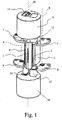
- the device for bending metallic strips according to the invention is illustrated as it is about to perform the bending operation in one of the two directions.
- the device includes a guide aperture 1 positioned vertically and arranged at the end of the feed section 2 via which the strip to be processed (not shown) is fed forward to the point where the bend is required and temporarily locked during the bending step.
- Figure 1 illustrates a configuration of the device in which the guide aperture 1 and the feed section 2 are oriented in a vertical direction, the device can be installed with guide aperture oriented in a horizontal direction.
- the bending tools 3 and 4 are retained alongside the guide aperture 1 by means of four brackets 5, 6, 7 and 8, two for each tool, which can rotate around axes S perpendicular to the feed direction of the strip.
- the brackets 5-8 are movable in pairs between a position in which the tools 3 and 4 are retained in position alongside the guide aperture 1 and a position in which the bending tools are released, for example during the bending phases or during their replacement.
- brackets 7 and 8 are in the position for locking the tool 4 beside the guide aperture 1, while the brackets 5 and 6 are in the position for release of the tool 3.
- Rotation of the brackets 5, 6, 7 and 8 is preferably performed, when required, by means of pneumatic actuators or, alternatively, by means of electric or electromechanical actuators or the like.
- the means for rotating the tools 3 and 4 include a lower hub 9 and an upper hub 10, arranged in opposite positions with respect to the predominant length of the guide aperture 1, which can rotate in a synchronised manner around their common axis M perpendicular to the feed direction of the strip.
- each of the hubs 9 and 10 houses engagement members 11, 12, 13 and 14 which translate in a direction parallel to the axis of rotation of the hubs.
- the movement of the engagement members 11-14 is also performed preferably by means of pneumatic actuators or, alternatively, by means of electric or electromechanical actuators or the like.
- the engagement members move between a tool disengagement position, in which the relative engagement members are retracted inside the hubs, and a tool engagement position, in which the respective engagement members are extracted from the hubs.
- the engagement members 11 and 12 for the tool 3 are in the extracted position and thus engage the ends of the tool 3 permitting rotation by the hubs 9 and 10, while the engagement members 13 and 14 for the tool 4 are in the disengaged position, retracted inside the hubs 9 and 10, thus avoiding rotation of the tool 4.
- Figure 2A shows a detail of the device of Figure 1 without the hubs 9 and 10 to illustrate more clearly the engagement members 11, 12, 13 and 14 in the same engagement and disengagement conditions as just described, i.e. with the engagement members 11 and 12 engaging the ends of the tool 3, while the ends of the tool 4 are disengaged from the engagement members 13 and 14.
- Figure 2B which is a top plan view of the lower hub 10, shows the engagement members 12 and 14 and the respective seats 22 and 24 in which the lower ends of the tools 3 and 4 are engaged respectively.
- the tool to be used in order for the strip passing through the feed section 2 of the guide aperture 1 to be processed, the tool to be used, according to whether the strip has to be bent to the right or the left, must be engaged by the corresponding engagement members to rotate and therefore necessarily be disengaged from the corresponding brackets, which will be rotated towards the outside of the device, so as to release the bending tool from the position alongside the guide aperture where it is retained while at rest.
- the engagement members 11, 12, 13 and 14 in the extracted position allow transmission of the rotation imparted by the motor to the hubs 9 and 10 to the tools 3 or 4 engaging the bending tool at their ends before it is released from the respective brackets 5, 6 or 7, 8 by means of rotation of the latter outwards.
- FIG. 4 shows the detail of the two tools 3 and 4 with the ends free of the engagement members, not shown for the sake of visual simplicity: the brackets 7 and 8 are closed, thus maintaining the tool 4 alongside the guide aperture 1, while the brackets 5 and 6 are in the open position, rotated towards the outside in order to completely release the tool 3 which can be easily replaced.
- the steps of bending the metallic strip by means of the present device include passing the strip through the guide aperture 1 and into its feed section 2 of suitable dimensions in relation to the thickness and size of the strip to be processed, sliding the latter to the point where the bend is required and temporary locking of the same during the actual bending operations. Said operations are performed by engaging the appropriate tool, according to whether the bend is required to the right or left, by means of the engagement members 11, 12, 13 and 14, opening the corresponding brackets and performing synchronised rotation of the hubs 9 and 10 at the required angle. Once the bending operation has been performed, the hubs rotate and return, to their starting position and the strip is moved to the next point to be bent.
- the tool just used is rotated again at the required angle, otherwise it is released, withdrawing the corresponding engagement members into the housings on the two hubs and closing the corresponding brackets; the other tool is then connected, extracting the corresponding engagement members and opening the relative brackets.
- the bends are performed successively according to the profile to be given to the strip.
- the tool 4 is disengaged as the engagement members 13 and 14 are retracted respectively in the hubs 10 and 9 and is positioned alongside the guide aperture 1 by means of the brackets 7 and 8 which are in the closed position. Bending is then performed with the tool 3 as illustrated in Figure 3A , with the hubs 9 and 10 rotating around the common axis M by the required angle in the direction indicated by the arrow L, and the tool 3 rotating integrally with the hubs 9 and 10 by means of the engagement members 11 and 12.
- the tool 4, being disengaged from the hubs 9 and 10 remains positioned alongside the guide aperture 1.
- the hubs 9 and 10 rotate in the opposite direction to the one indicated by the arrow L in Figure 3A , returning to the rest position illustrated in Figure 1 . At this point, if another bend has to be made in the same direction, the strip is moved forward again until it emerges from the guide aperture 1 for the required length, and the tool 3 is rotated again.
- the brackets 5 and 6 must be locked by the brackets 5 and 6 rotated towards the inside by means of an actuator, so that the tool 3 remains locked in position alongside the guide aperture 1 when disengagement occurs by retraction of the engagement members 11 and 12 into the hubs 9 and 10.
- the engagement members 13 and 14 are then extracted to engage the ends of the tool 4 to be used in the next bend, and the brackets 7 and 8 are opened by outward rotation of the device. After moving the strip forward for the required length, rotation of the hubs 9 and 10 begins around the common axis M in the direction indicated by the arrow R of Figure 3B , until completion of the rotation to the required angle.
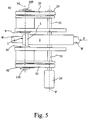
- Figure 5 shows schematically a possible embodiment of the rotation system of the bending tools 3 and 4 for the metallic strip W which is passed through the feed section 2 in the direction of the arrow F until it emerges from the guide aperture 1.
- the system is provided with one single motor 30, for example a gearmotor with shaft 31 on which the pulleys 32 and 33 are fitted.
- the shaft 31 rotates around an axis P, parallel to the axis M, which is obviously offset with respect to the feed section of the strip W.
- the hubs 9 and 10 are connected to respective shafts 109 and 110, with rotation axes coinciding with the axis M, on which the pulleys 42 and 43 are fitted. Synchronised transmission of the movement to the two hubs is provided for example by means of a first timing belt 52 stretched between the pulleys 32 and 42 and a second timing belt 53 stretched between the pulleys 33 and 43.
Landscapes
- Engineering & Computer Science (AREA)
- Mechanical Engineering (AREA)
- Bending Of Plates, Rods, And Pipes (AREA)
Claims (10)
- Eine Vorrichtung zum Biegen eines Metallstreifens einschließlich mindestens eines Zuführungsabschnittes (2), um den Streifen durch eine Führungsöffnung (1) zu führen, zumindest ein Paar von Biegewerkzeugen (3, 4), das um mindestens eine gemeinsame Drehachse (S) gedreht werden kann, und eine Einrichtung zum Drehen der Biegewerkzeuge (3, 4) um die mindestens eine gemeinsame Drehachse (M), wobei steuerbare Blockierungsmittel (5, 6, 7, 8) angeordnet sind, um die Biegewerkzeuge (3, 4) gemeinsam entlang der Führungsöffnung (1) zu verriegeln, wenn sich diese im Ruhezustand befinden, und mindestens eines der Biegewerkzeuge (3, 4) für den Betriebszustand freizugeben, in dem das Biegen durchgeführt wird, dadurch gekennzeichnet, dass das die Einrichtung zum Drehen der Biegewerkzeuge (3, 4) steuerbare Eingriffselemente (11, 12, 13, 14) einschließt, um in die gegenüberliegenden Enden eines Biegewerkzeugs einzugreifen, welches für die Durchführung eines Biegevorgangs verwendet wird, oder sich von den gegenüberliegenden Enden eines Biegewerkzeugs loslösen, wenn das Werkzeug in der Ruheposition verriegelt gehalten wird.
- Die Vorrichtung gemäß Anspruch 1, wobei die Blockierungsmittel (5, 6, 7, 8) zum Verriegeln und Freigeben der Biegewerkzeuge (3, 4) Klammern umfassen, die um eine Achse (S) senkrecht zur Vorschubrichtung des Streifens gedreht werden kann.
- Die Vorrichtung gemäß Anspruch 1, wobei die Einrichtung zum Drehen der Biegewerkzeuge (3, 4) zumindest zwei Naben (9, 10) umfassen, die sich in Bezug auf die Führungsöffnung (1) gegenüber liegen, und die um eine Achse (M) senkrecht zur Vorschubrichtung des Streifens drehen können.
- Die Vorrichtung gemäß Anspruch 3, wobei die Eingriffselemente (11, 12,13, 14) in den Naben (9, 10) untergebracht sind und sich in eine Richtung verschieben, die parallel zur Rotationsachse der Naben (9, 1 0) verläuft, zwischen einer innerhalb der Naben (9, 10) befindlichen zurückgezogenen Stellung, wenn sie sich in einem von den Biegewerkzeugen (3, 4) losgelösten Zustand befinden, und einer aus den Naben (9, 10) herausgefahrenen Stellung, wenn sie sich bezüglich der Biegewerkzeuge (3, 4) in dem eingekuppelten Zustand befinden.
- Vorrichtung gemäß Anspruch 4, wobei die Naben (9, 10) gleichzeitig durch einen einzigen Motor (10) gedreht werden,
- Eine Maschine für die Herstellung von Stanzklingen ausgehend von einem kontinuierlichen Metallstreifen, der durch aufeinanderfolgende Biegeschritte geformt wird und einem abschließenden Abscherschritt unterworfen wird, gekennzeichnet durch das Vorhandensein einer Vorrichtung gemäß irgendeinem der Ansprüche 1 bis 5 und wobei die Führungsöffnung (1) in dem Zuführungsabschnitt (2) in einer horizontalen Richtung ausgerichtet ist.
- Eine Maschine für die Herstellung von Stanzklingen ausgehend von einem kontinuierlichen Metallstreifen, der durch aufeinanderfolgende Biegeschritte geformt wird und einem abschließenden Abscherschritt unterworfen wird, gekennzeichnet durch das Vorhandensein einer Vorrichtung gemäß irgend einem der Ansprüche 1 bis 5 und wobei die Führungsöffnung (1) in dem Zuführungsabschnitt (2) in einer vertikalen Richtung ausgerichtet ist.
- Ein Verfahren zur Herstellung eines Metallstreifens, wobei der Streifen durch einen Zuführungsabschnitt (2) zu einer Führungsöffnung (1) geführt wird und wobei der Streifen durch mindestens ein Paar von Biegewerkzeugen (3, 4) gebogen wird, das nahe der Führungsöffnung (1) positioniert ist und das um zumindest eine gemeinsame Drehachse (M) gedreht werden kann, gekennzeichnet durch das Vorhandensein der folgenden Schritte:i) im Ruhezustand, Halten der Werkzeuge (3, 4) gemeinsam in verriegelter Stellung entlang der Führungsöffnung (1) mittels steuerbarer Blockierungsmittel (5, 6, 7, 8);ii) in Eingriff nehmen eines zu verwendenden Biegewerkzeuges an seinen Enden durch Eingriffsmittel, um es mit einer Einrichtung zum Drehen der Biegewerkzeuge (3, 4) um die zumindest eine gemeinsame Drehachse (M) zu verblocken;iii) Betätigen der Blockierungsmittel (5, 6, 7, 8), die mit dem Biegewerkzeug assoziiert sind, um es aus seiner Verriegelungsposition zu lösen während das andere der Biegewerkzeuge (3, 4) in seiner Ruhestellung verriegelt ist;iv) Drehen des Biegewerkzeuges um einen Drehwinkel, der ausreicht dem Streifen die erforderliche Biegung zu geben;v) Zurücksetzen des Biegewerkzeuges in seine Ruheposition;vi) Betätigen der Blockierungsmittel (5, 6, 7, 8), die mit dem Werkzeug assoziiert sind, um es in seiner Ruhestellung erneut zu verriegeln; undvii) Lösen der Eingriffselemente von den gegenüberliegenden Enden des Biegewerkzeuges, um es von der Einrichtung zum Drehen zu entkoppeln.
- Das Verfahren gemäß Anspruch 8, wobei vor dem Schritt iv) der Streifen vorwärts durch den Zuführungsabschnitt (2) für eine vorgegebene Länge bewegt wird bis er aus der Führungsöffnung (1) austritt.
- Das Verfahren gemäß Anspruch 8 oder 9, wobei nach dem Schritt v) der Streifen wieder für eine vorgegebene Länge nach vorne bewegt wird und der Prozess mit dem Schritt iv) erneut beginnt.
Applications Claiming Priority (1)
| Application Number | Priority Date | Filing Date | Title |
|---|---|---|---|
| PCT/IT2008/000348 WO2009144748A1 (en) | 2008-05-27 | 2008-05-27 | System for bending a metallic strip |
Publications (2)
| Publication Number | Publication Date |
|---|---|
| EP2285509A1 EP2285509A1 (de) | 2011-02-23 |
| EP2285509B1 true EP2285509B1 (de) | 2017-05-10 |
Family
ID=40256966
Family Applications (1)
| Application Number | Title | Priority Date | Filing Date |
|---|---|---|---|
| EP08789962.1A Active EP2285509B1 (de) | 2008-05-27 | 2008-05-27 | System zum biegen eines metallstreifens |
Country Status (3)
| Country | Link |
|---|---|
| US (1) | US8720245B2 (de) |
| EP (1) | EP2285509B1 (de) |
| WO (1) | WO2009144748A1 (de) |
Cited By (1)
| Publication number | Priority date | Publication date | Assignee | Title |
|---|---|---|---|---|
| CN114178359A (zh) * | 2021-12-03 | 2022-03-15 | 湖南骏昊智能科技有限公司 | 一种折弯机构及弯刀机 |
Family Cites Families (4)
| Publication number | Priority date | Publication date | Assignee | Title |
|---|---|---|---|---|
| KR0182069B1 (ko) * | 1995-06-22 | 1999-04-01 | 송병준 | 컷팅블레이드의 절곡시스템 |
| KR100388542B1 (ko) * | 2000-12-01 | 2003-06-25 | 박홍순 | 예각 성형이 우수한 컷팅 블레이드의 절곡장치 |
| US7387009B2 (en) * | 2005-03-24 | 2008-06-17 | Kevin Kane | Automated bending machine |
| JP4435035B2 (ja) * | 2005-05-27 | 2010-03-17 | 聰長 占部 | スチール・ルール抜型の自動曲げ機における刃材の両端切断装置 |
-
2008
- 2008-05-27 EP EP08789962.1A patent/EP2285509B1/de active Active
- 2008-05-27 WO PCT/IT2008/000348 patent/WO2009144748A1/en not_active Ceased
- 2008-05-27 US US12/993,016 patent/US8720245B2/en active Active
Non-Patent Citations (1)
| Title |
|---|
| None * |
Cited By (1)
| Publication number | Priority date | Publication date | Assignee | Title |
|---|---|---|---|---|
| CN114178359A (zh) * | 2021-12-03 | 2022-03-15 | 湖南骏昊智能科技有限公司 | 一种折弯机构及弯刀机 |
Also Published As
| Publication number | Publication date |
|---|---|
| EP2285509A1 (de) | 2011-02-23 |
| US8720245B2 (en) | 2014-05-13 |
| US20110107809A1 (en) | 2011-05-12 |
| WO2009144748A1 (en) | 2009-12-03 |
Similar Documents
| Publication | Publication Date | Title |
|---|---|---|
| EP2514611B1 (de) | Verfahren und Vorrichtung zur Montage eines Luftreifens mit Hilfe eines Roboters | |
| EP3624962B1 (de) | Biegemaschine für metallbleche | |
| CN103781570B (zh) | 用于制造弹簧的方法以及用于执行该方法的弹簧机 | |
| EP2822714B1 (de) | Verfahren und system zum biegen von abstandshaltern | |
| KR101632361B1 (ko) | 모터 코일 권선장치 및 권선방법 | |
| CN105592947B (zh) | 用于弯曲成型段如管的装置 | |
| EP3027332B1 (de) | Biegewerkzeugsystem | |
| TW201603906A (zh) | 板金彎曲機 | |
| EP2691190B1 (de) | Mechanismus zur bewegung des klingenhalters einer plattenbiegevorrichtung zum biegen von blechen | |
| EP2599755B1 (de) | Maschine zum Durchführen von Schneideoperationen auf laminierten Glasplatten | |
| EP2285509B1 (de) | System zum biegen eines metallstreifens | |
| WO2014087328A1 (en) | Improved metal pipes bending machine, both to the right and to the left with respect to the direction of introduction of the pipe | |
| CN114769445B (zh) | 一种导向送料装置以及矫直设备 | |
| EP2374581A1 (de) | Vorrichtung zum Aufschneiden von Lebensmittelprodukten | |
| EP1998909B1 (de) | Vorrichtung und verfahren zum biegen eines metallstreifens | |
| EP3248706B1 (de) | Walzmaschine zum ausbilden von prägungen auf zylindrischen körpern und verfahren zum ersetzen von formwalzen der walzmaschine | |
| EP3978159B1 (de) | Kettenbiegemaschine zum herstellen einer kette | |
| JP6661470B2 (ja) | 多段式鍛造プレス機のトランスファ装置 | |
| EP3050640A1 (de) | Aufwickelvorrichtung und verfahren zum aufwickeln von bändern | |
| EP2982455A1 (de) | Vorrichtung und verfahren zum rohrbiegen | |
| DE102019131338B3 (de) | Positioniersystem und Verfahren zur Erstellung von Fahrzeugreifen | |
| EP4506269A1 (de) | Vorrichtung zum ausrichten einer gruppe von produkten | |
| CN110788247B (zh) | 一种钢筋矫直折弯机 | |
| RU2798135C1 (ru) | Направляющее устройство для направления приводного стержня оправки или оправки при прокатке трубных изделий | |
| EP2451599B1 (de) | Abschrägvorrichtung zur herstellung von schrauben und dergleichen |
Legal Events
| Date | Code | Title | Description |
|---|---|---|---|
| PUAI | Public reference made under article 153(3) epc to a published international application that has entered the european phase |
Free format text: ORIGINAL CODE: 0009012 |
|
| 17P | Request for examination filed |
Effective date: 20101223 |
|
| AK | Designated contracting states |
Kind code of ref document: A1 Designated state(s): AT BE BG CH CY CZ DE DK EE ES FI FR GB GR HR HU IE IS IT LI LT LU LV MC MT NL NO PL PT RO SE SI SK TR |
|
| AX | Request for extension of the european patent |
Extension state: AL BA MK RS |
|
| DAX | Request for extension of the european patent (deleted) | ||
| GRAP | Despatch of communication of intention to grant a patent |
Free format text: ORIGINAL CODE: EPIDOSNIGR1 |
|
| INTG | Intention to grant announced |
Effective date: 20161125 |
|
| GRAJ | Information related to disapproval of communication of intention to grant by the applicant or resumption of examination proceedings by the epo deleted |
Free format text: ORIGINAL CODE: EPIDOSDIGR1 |
|
| GRAR | Information related to intention to grant a patent recorded |
Free format text: ORIGINAL CODE: EPIDOSNIGR71 |
|
| GRAS | Grant fee paid |
Free format text: ORIGINAL CODE: EPIDOSNIGR3 |
|
| GRAA | (expected) grant |
Free format text: ORIGINAL CODE: 0009210 |
|
| INTC | Intention to grant announced (deleted) | ||
| AK | Designated contracting states |
Kind code of ref document: B1 Designated state(s): AT BE BG CH CY CZ DE DK EE ES FI FR GB GR HR HU IE IS IT LI LT LU LV MC MT NL NO PL PT RO SE SI SK TR |
|
| INTG | Intention to grant announced |
Effective date: 20170331 |
|
| REG | Reference to a national code |
Ref country code: GB Ref legal event code: FG4D |
|
| REG | Reference to a national code |
Ref country code: AT Ref legal event code: REF Ref document number: 891751 Country of ref document: AT Kind code of ref document: T Effective date: 20170515 Ref country code: CH Ref legal event code: EP |
|
| REG | Reference to a national code |
Ref country code: IE Ref legal event code: FG4D |
|
| REG | Reference to a national code |
Ref country code: DE Ref legal event code: R096 Ref document number: 602008050233 Country of ref document: DE |
|
| REG | Reference to a national code |
Ref country code: NL Ref legal event code: MP Effective date: 20170510 |
|
| REG | Reference to a national code |
Ref country code: LT Ref legal event code: MG4D |
|
| REG | Reference to a national code |
Ref country code: AT Ref legal event code: MK05 Ref document number: 891751 Country of ref document: AT Kind code of ref document: T Effective date: 20170510 |
|
| PG25 | Lapsed in a contracting state [announced via postgrant information from national office to epo] |
Ref country code: LT Free format text: LAPSE BECAUSE OF FAILURE TO SUBMIT A TRANSLATION OF THE DESCRIPTION OR TO PAY THE FEE WITHIN THE PRESCRIBED TIME-LIMIT Effective date: 20170510 Ref country code: AT Free format text: LAPSE BECAUSE OF FAILURE TO SUBMIT A TRANSLATION OF THE DESCRIPTION OR TO PAY THE FEE WITHIN THE PRESCRIBED TIME-LIMIT Effective date: 20170510 Ref country code: ES Free format text: LAPSE BECAUSE OF FAILURE TO SUBMIT A TRANSLATION OF THE DESCRIPTION OR TO PAY THE FEE WITHIN THE PRESCRIBED TIME-LIMIT Effective date: 20170510 Ref country code: FI Free format text: LAPSE BECAUSE OF FAILURE TO SUBMIT A TRANSLATION OF THE DESCRIPTION OR TO PAY THE FEE WITHIN THE PRESCRIBED TIME-LIMIT Effective date: 20170510 Ref country code: GR Free format text: LAPSE BECAUSE OF FAILURE TO SUBMIT A TRANSLATION OF THE DESCRIPTION OR TO PAY THE FEE WITHIN THE PRESCRIBED TIME-LIMIT Effective date: 20170811 Ref country code: NO Free format text: LAPSE BECAUSE OF FAILURE TO SUBMIT A TRANSLATION OF THE DESCRIPTION OR TO PAY THE FEE WITHIN THE PRESCRIBED TIME-LIMIT Effective date: 20170810 Ref country code: HR Free format text: LAPSE BECAUSE OF FAILURE TO SUBMIT A TRANSLATION OF THE DESCRIPTION OR TO PAY THE FEE WITHIN THE PRESCRIBED TIME-LIMIT Effective date: 20170510 |
|
| PG25 | Lapsed in a contracting state [announced via postgrant information from national office to epo] |
Ref country code: LV Free format text: LAPSE BECAUSE OF FAILURE TO SUBMIT A TRANSLATION OF THE DESCRIPTION OR TO PAY THE FEE WITHIN THE PRESCRIBED TIME-LIMIT Effective date: 20170510 Ref country code: SE Free format text: LAPSE BECAUSE OF FAILURE TO SUBMIT A TRANSLATION OF THE DESCRIPTION OR TO PAY THE FEE WITHIN THE PRESCRIBED TIME-LIMIT Effective date: 20170510 Ref country code: NL Free format text: LAPSE BECAUSE OF FAILURE TO SUBMIT A TRANSLATION OF THE DESCRIPTION OR TO PAY THE FEE WITHIN THE PRESCRIBED TIME-LIMIT Effective date: 20170510 Ref country code: IS Free format text: LAPSE BECAUSE OF FAILURE TO SUBMIT A TRANSLATION OF THE DESCRIPTION OR TO PAY THE FEE WITHIN THE PRESCRIBED TIME-LIMIT Effective date: 20170910 Ref country code: PL Free format text: LAPSE BECAUSE OF FAILURE TO SUBMIT A TRANSLATION OF THE DESCRIPTION OR TO PAY THE FEE WITHIN THE PRESCRIBED TIME-LIMIT Effective date: 20170510 Ref country code: BG Free format text: LAPSE BECAUSE OF FAILURE TO SUBMIT A TRANSLATION OF THE DESCRIPTION OR TO PAY THE FEE WITHIN THE PRESCRIBED TIME-LIMIT Effective date: 20170810 |
|
| REG | Reference to a national code |
Ref country code: CH Ref legal event code: PL |
|
| PG25 | Lapsed in a contracting state [announced via postgrant information from national office to epo] |
Ref country code: SK Free format text: LAPSE BECAUSE OF FAILURE TO SUBMIT A TRANSLATION OF THE DESCRIPTION OR TO PAY THE FEE WITHIN THE PRESCRIBED TIME-LIMIT Effective date: 20170510 Ref country code: RO Free format text: LAPSE BECAUSE OF FAILURE TO SUBMIT A TRANSLATION OF THE DESCRIPTION OR TO PAY THE FEE WITHIN THE PRESCRIBED TIME-LIMIT Effective date: 20170510 Ref country code: EE Free format text: LAPSE BECAUSE OF FAILURE TO SUBMIT A TRANSLATION OF THE DESCRIPTION OR TO PAY THE FEE WITHIN THE PRESCRIBED TIME-LIMIT Effective date: 20170510 Ref country code: CZ Free format text: LAPSE BECAUSE OF FAILURE TO SUBMIT A TRANSLATION OF THE DESCRIPTION OR TO PAY THE FEE WITHIN THE PRESCRIBED TIME-LIMIT Effective date: 20170510 Ref country code: DK Free format text: LAPSE BECAUSE OF FAILURE TO SUBMIT A TRANSLATION OF THE DESCRIPTION OR TO PAY THE FEE WITHIN THE PRESCRIBED TIME-LIMIT Effective date: 20170510 |
|
| REG | Reference to a national code |
Ref country code: DE Ref legal event code: R097 Ref document number: 602008050233 Country of ref document: DE |
|
| REG | Reference to a national code |
Ref country code: IE Ref legal event code: MM4A |
|
| PG25 | Lapsed in a contracting state [announced via postgrant information from national office to epo] |
Ref country code: CH Free format text: LAPSE BECAUSE OF NON-PAYMENT OF DUE FEES Effective date: 20170531 Ref country code: LI Free format text: LAPSE BECAUSE OF NON-PAYMENT OF DUE FEES Effective date: 20170531 |
|
| PLBE | No opposition filed within time limit |
Free format text: ORIGINAL CODE: 0009261 |
|
| STAA | Information on the status of an ep patent application or granted ep patent |
Free format text: STATUS: NO OPPOSITION FILED WITHIN TIME LIMIT |
|
| PG25 | Lapsed in a contracting state [announced via postgrant information from national office to epo] |
Ref country code: LU Free format text: LAPSE BECAUSE OF NON-PAYMENT OF DUE FEES Effective date: 20170527 |
|
| 26N | No opposition filed |
Effective date: 20180213 |
|
| GBPC | Gb: european patent ceased through non-payment of renewal fee |
Effective date: 20170810 |
|
| REG | Reference to a national code |
Ref country code: BE Ref legal event code: MM Effective date: 20170531 |
|
| PG25 | Lapsed in a contracting state [announced via postgrant information from national office to epo] |
Ref country code: IE Free format text: LAPSE BECAUSE OF NON-PAYMENT OF DUE FEES Effective date: 20170527 |
|
| REG | Reference to a national code |
Ref country code: FR Ref legal event code: ST Effective date: 20180404 |
|
| PG25 | Lapsed in a contracting state [announced via postgrant information from national office to epo] |
Ref country code: SI Free format text: LAPSE BECAUSE OF FAILURE TO SUBMIT A TRANSLATION OF THE DESCRIPTION OR TO PAY THE FEE WITHIN THE PRESCRIBED TIME-LIMIT Effective date: 20170510 |
|
| PG25 | Lapsed in a contracting state [announced via postgrant information from national office to epo] |
Ref country code: GB Free format text: LAPSE BECAUSE OF NON-PAYMENT OF DUE FEES Effective date: 20170810 |
|
| PG25 | Lapsed in a contracting state [announced via postgrant information from national office to epo] |
Ref country code: BE Free format text: LAPSE BECAUSE OF NON-PAYMENT OF DUE FEES Effective date: 20170531 Ref country code: FR Free format text: LAPSE BECAUSE OF NON-PAYMENT OF DUE FEES Effective date: 20170710 |
|
| PG25 | Lapsed in a contracting state [announced via postgrant information from national office to epo] |
Ref country code: MT Free format text: LAPSE BECAUSE OF NON-PAYMENT OF DUE FEES Effective date: 20170527 |
|
| PG25 | Lapsed in a contracting state [announced via postgrant information from national office to epo] |
Ref country code: HU Free format text: LAPSE BECAUSE OF FAILURE TO SUBMIT A TRANSLATION OF THE DESCRIPTION OR TO PAY THE FEE WITHIN THE PRESCRIBED TIME-LIMIT; INVALID AB INITIO Effective date: 20080527 Ref country code: MC Free format text: LAPSE BECAUSE OF FAILURE TO SUBMIT A TRANSLATION OF THE DESCRIPTION OR TO PAY THE FEE WITHIN THE PRESCRIBED TIME-LIMIT Effective date: 20170510 |
|
| PG25 | Lapsed in a contracting state [announced via postgrant information from national office to epo] |
Ref country code: CY Free format text: LAPSE BECAUSE OF NON-PAYMENT OF DUE FEES Effective date: 20170510 |
|
| PG25 | Lapsed in a contracting state [announced via postgrant information from national office to epo] |
Ref country code: TR Free format text: LAPSE BECAUSE OF FAILURE TO SUBMIT A TRANSLATION OF THE DESCRIPTION OR TO PAY THE FEE WITHIN THE PRESCRIBED TIME-LIMIT Effective date: 20170510 |
|
| PG25 | Lapsed in a contracting state [announced via postgrant information from national office to epo] |
Ref country code: PT Free format text: LAPSE BECAUSE OF FAILURE TO SUBMIT A TRANSLATION OF THE DESCRIPTION OR TO PAY THE FEE WITHIN THE PRESCRIBED TIME-LIMIT Effective date: 20170510 |
|
| P01 | Opt-out of the competence of the unified patent court (upc) registered |
Effective date: 20230828 |
|
| PGFP | Annual fee paid to national office [announced via postgrant information from national office to epo] |
Ref country code: DE Payment date: 20250428 Year of fee payment: 18 |
|
| PGFP | Annual fee paid to national office [announced via postgrant information from national office to epo] |
Ref country code: IT Payment date: 20250512 Year of fee payment: 18 |