EP2285017A2 - Steuerungsvorrichtung zur Abschirmung eines Raums - Google Patents
Steuerungsvorrichtung zur Abschirmung eines Raums Download PDFInfo
- Publication number
- EP2285017A2 EP2285017A2 EP10183516A EP10183516A EP2285017A2 EP 2285017 A2 EP2285017 A2 EP 2285017A2 EP 10183516 A EP10183516 A EP 10183516A EP 10183516 A EP10183516 A EP 10183516A EP 2285017 A2 EP2285017 A2 EP 2285017A2
- Authority
- EP
- European Patent Office
- Prior art keywords
- signal
- control device
- interference
- interference signal
- room
- Prior art date
- Legal status (The legal status is an assumption and is not a legal conclusion. Google has not performed a legal analysis and makes no representation as to the accuracy of the status listed.)
- Granted
Links
- 238000000034 method Methods 0.000 claims description 23
- 230000010354 integration Effects 0.000 claims 1
- 230000005540 biological transmission Effects 0.000 abstract description 71
- 238000004891 communication Methods 0.000 description 33
- 230000006870 function Effects 0.000 description 10
- 230000005855 radiation Effects 0.000 description 5
- 238000013461 design Methods 0.000 description 4
- 238000005516 engineering process Methods 0.000 description 4
- 230000006978 adaptation Effects 0.000 description 3
- 230000036541 health Effects 0.000 description 3
- 238000012423 maintenance Methods 0.000 description 3
- 230000001105 regulatory effect Effects 0.000 description 3
- 230000011664 signaling Effects 0.000 description 3
- 230000001413 cellular effect Effects 0.000 description 2
- 230000006835 compression Effects 0.000 description 2
- 238000007906 compression Methods 0.000 description 2
- 238000010276 construction Methods 0.000 description 2
- 230000001419 dependent effect Effects 0.000 description 2
- 230000001627 detrimental effect Effects 0.000 description 2
- 230000005670 electromagnetic radiation Effects 0.000 description 2
- 238000009434 installation Methods 0.000 description 2
- 230000002452 interceptive effect Effects 0.000 description 2
- 239000000203 mixture Substances 0.000 description 2
- 238000010295 mobile communication Methods 0.000 description 2
- 230000000422 nocturnal effect Effects 0.000 description 2
- 229920001690 polydopamine Polymers 0.000 description 2
- 238000009877 rendering Methods 0.000 description 2
- 238000012360 testing method Methods 0.000 description 2
- 241000283986 Lepus Species 0.000 description 1
- 230000003044 adaptive effect Effects 0.000 description 1
- 230000003321 amplification Effects 0.000 description 1
- 238000004458 analytical method Methods 0.000 description 1
- 230000008901 benefit Effects 0.000 description 1
- 230000001276 controlling effect Effects 0.000 description 1
- 230000009849 deactivation Effects 0.000 description 1
- 238000011161 development Methods 0.000 description 1
- 238000005562 fading Methods 0.000 description 1
- 230000007257 malfunction Effects 0.000 description 1
- 238000012544 monitoring process Methods 0.000 description 1
- 238000003199 nucleic acid amplification method Methods 0.000 description 1
- 230000002265 prevention Effects 0.000 description 1
- 230000008569 process Effects 0.000 description 1
- 230000009467 reduction Effects 0.000 description 1
- 238000000926 separation method Methods 0.000 description 1
- 238000000638 solvent extraction Methods 0.000 description 1
- 108020001568 subdomains Proteins 0.000 description 1
- 230000003313 weakening effect Effects 0.000 description 1
Images
Classifications
-
- H—ELECTRICITY
- H04—ELECTRIC COMMUNICATION TECHNIQUE
- H04B—TRANSMISSION
- H04B1/00—Details of transmission systems, not covered by a single one of groups H04B3/00 - H04B13/00; Details of transmission systems not characterised by the medium used for transmission
- H04B1/38—Transceivers, i.e. devices in which transmitter and receiver form a structural unit and in which at least one part is used for functions of transmitting and receiving
- H04B1/3827—Portable transceivers
- H04B1/3833—Hand-held transceivers
- H04B1/3838—Arrangements for reducing RF exposure to the user, e.g. by changing the shape of the transceiver while in use
-
- H—ELECTRICITY
- H04—ELECTRIC COMMUNICATION TECHNIQUE
- H04B—TRANSMISSION
- H04B17/00—Monitoring; Testing
- H04B17/30—Monitoring; Testing of propagation channels
- H04B17/309—Measuring or estimating channel quality parameters
- H04B17/345—Interference values
-
- H—ELECTRICITY
- H04—ELECTRIC COMMUNICATION TECHNIQUE
- H04B—TRANSMISSION
- H04B7/00—Radio transmission systems, i.e. using radiation field
- H04B7/14—Relay systems
- H04B7/15—Active relay systems
- H04B7/185—Space-based or airborne stations; Stations for satellite systems
- H04B7/18502—Airborne stations
- H04B7/18506—Communications with or from aircraft, i.e. aeronautical mobile service
-
- H—ELECTRICITY
- H04—ELECTRIC COMMUNICATION TECHNIQUE
- H04W—WIRELESS COMMUNICATION NETWORKS
- H04W52/00—Power management, e.g. Transmission Power Control [TPC] or power classes
- H04W52/04—Transmission power control [TPC]
- H04W52/18—TPC being performed according to specific parameters
- H04W52/24—TPC being performed according to specific parameters using SIR [Signal to Interference Ratio] or other wireless path parameters
- H04W52/243—TPC being performed according to specific parameters using SIR [Signal to Interference Ratio] or other wireless path parameters taking into account interferences
-
- H—ELECTRICITY
- H04—ELECTRIC COMMUNICATION TECHNIQUE
- H04W—WIRELESS COMMUNICATION NETWORKS
- H04W84/00—Network topologies
- H04W84/005—Moving wireless networks
-
- H—ELECTRICITY
- H04—ELECTRIC COMMUNICATION TECHNIQUE
- H04W—WIRELESS COMMUNICATION NETWORKS
- H04W88/00—Devices specially adapted for wireless communication networks, e.g. terminals, base stations or access point devices
- H04W88/08—Access point devices
Definitions
- the present invention relates to the shielding of signals for a mobile radio system, in particular in an aircraft. Furthermore, the present invention in particular relates to a control device for shielding a room, to a system for shielding a room, to a method for shielding a room, and to an aircraft with a control device for shielding a room.
- a control device for shielding a room or a space respectively, a system for shielding a room, a method for shielding a room, and an aircraft comprising a control device for shielding a room are created.
- the term transmitting device may be used for a sending device or transmitting device, respectively.
- a control device for shielding a room wherein the control device comprises a receiving device, an interference device, and a sending device or transmitting device, respectively for an interference signal.
- the receiving device is adapted such that the receiving device is capable receiving a transmission signal.
- the transmission signal is a radio signal that is transmitted for communication purposes by a transmitting station and/or receiving station, a base station or a transmitting-receiving station outside the room.
- transmission signal refers to both the signal that is transmitted or sent by the base station and the signal that is received by the base station.
- the interference device is adapted such that the interference device determines an interference signal from the received transmission signal such that the transmission signal is interferable-with by the determined, detected or calculated interference signal in the case of superposition or that the transmission signal is interferable by superposing of received transmission signal with the interference signal. Furthermore, the transmitting device is adapted such that the transmitting device emits the interference signal determined in this manner.
- a system for shielding a room comprising a control device having the above-mentioned features. Furthermore, the system comprises a transmitting-receiving device inside the room, wherein the control device is adapted such that the control device receives a transmission signal coming from the exterior or from outside the room. This transmission signal is a radio signal. Furthermore, the control device is adapted such that the control device determines an interference signal from the received external transmission signal so that when the interference signal is emitted, the transmission signal is interfered with such that a signal of a local transmitting-receiving device is distinguishable from the interfered-with signal. The interference signal generated in this manner may be emitted by the control device. Emitting of the signal may take place in the room so that inside the room at least a part of the transmission signal, which transmission signal may enter the room may become the interfered-with signal. Thus, the entering transmission signal may be made unrecognisable.
- a method for shielding a room is created or provided.
- a transmission signal is received.
- the transmission signal may be any kind of radio signal.
- a transmission signal is a radio signal that may be emitted by a mobile radio base station, by a mobile phone base station or by a mobile radio terminal or by a mobile radio end device.
- an interference signal may be identified, established or determined from the received transmission signal, such that the transmission signal can be interferable with by emitting the interference signal. This determined interference signal may be finally emitted in order to cause interference to a part of the transmission signal that enters the room.
- an aircraft comprising a control device for shielding a room is provided.
- radio signals may be emitted in a directional manner for example by base stations, base transceiver stations or BTSs, it may still happen that the radio signal also propagates in a certain area or region, respectively above the base station. Because of reflections or fading phenomena it may be encouraged that radio signals propagate to locations where the radio signals may cause interference.
- radio signals may also enter a room or the cabin of an aircraft which aircraft may be overflying this base station.
- the wall of the cabin may be transmissive to radio signals or to electromagnetic waves or penetrable for radio signals, the cabin, and in particular the interior of the cabin, may be penetrated by the signals.
- a transmission signal from a terrestrial base station may unintentionally appear.
- An electronic terminal or an electronic end device which may be adapted for the communication with a corresponding base station, in particular a subscriber terminal, a subscriber end-device, a user equipment (UE), a personal digital assistant (PDA) or a mobile radiotelephone, or a cell phone, may be adapted such that on receiving a weak radio signal the mobile radio telephone may attempt to establish contact with this radio source by transmitting or sending, respectively a corresponding radio signal at high power.
- a base station in particular a subscriber terminal, a subscriber end-device, a user equipment (UE), a personal digital assistant (PDA) or a mobile radiotelephone, or a cell phone
- EMI electromagnetic interference
- a device used on board of an aircraft i.e. in the interior of the cabin or of the room, may try registering with and logging into a remote or external radio network and in particular into a remote transmission station or base station with increased power.
- a mobile subscriber terminal or the use of a subscriber end device by a passenger on board an aircraft may be possible.
- the services may be provided with which the passenger is familiar by using the corresponding device on the ground.
- services are offered to the passenger, which the passenger knows by using the corresponding device on ground.
- a service may be, for example, the short message service (SMS) or the multimedia message service (MMS) or another data service.
- the sending signal that may be present from a base station located outside the aircraft on the ground, or from a terrestrial base station may be detected or identified and a corresponding interference signal may be determined or generated. Therefore, for example, the frequency used, the coding method used and/or the corresponding power of the incoming signal or entering signal, respectively may be determined or identified.
- the control device may transmit or send the determined interference signal in the interior of the room so that by the emission of the interference signal the transmission signal which, for example, may be received from the ground or from outside the aircraft cabin, may no longer be recognised or detected or identified by a terminal or by an end device, respectively as being a valid signal.
- the control device may transmit or send the determined interference signal in the interior of the room so that by the emission of the interference signal, the sending signal or the transmission signal, which for example, may be received from the ground or from the outside the aircraft cabine, may no longer be recognised or detected or identified by a terminal or by an end device, respectively as being a valid signal. Consequently, the mobile terminal or mobile end device, respectively may no longer log into the external transmission source
- an additional base station may be provided which may send out a signal and which may cause a mobile terminal to establish contact with the additional base station.
- the mobile terminal may be made to believe that the base station located on board, i.e. the on-board base station, may be the only counter station or base station located close to the mobile terminal.
- the terminal may log into the base station located on board or the on-board base station, whereby the terminal may become operable, controllable or adjustable by the base station.
- the mobile terminal may only react to the control signals and radio signals of the on-board base station.
- control device may also generate a corresponding combined interference signal so that all external sources may be rendered unrecognisable.
- a control device is created in which the transmission signal is a mobile radio signal or a mobile phone signal, respectively.
- the control device is equipped or adapted for a mobile radio system for an aircraft or for a mobile phone system for an aircraft, respectively.
- the control device may be used for the use of a mobile radio terminal or a mobile phone or a cellular phone.
- the communication by a mobile radiotelephone may be made possible on board and may also be allowed.
- the mobile radiotelephone protocol used for the communication with a mobile radio terminal may also provide a control signal by which control signal the transmission power of a mobile telephone or mobile phone, respectively may be adjusted.
- the base station the mobile telephone may be controlled, its transmission power may be reduced, or the mobile telephone may be switched off if required.
- control device Since the control device may be adapted for a mobile radio system, the system may easily be integrated in an aircraft. Concerning the weight of the control device and concerning the installation dimensions of the control device , the control device may be adapted to the requirements of aircraft construction. Thereby, a light weight may be desirable. Furthermore, particular requirements concerning current terminals or power supply terminals, respectively and concerning power consumption in the design of the control device and as well in the design of the entire on-board mobile radio system or on-board mobile telephone system (OMTS) and of other interfaces may be tailored to aircraft construction. Conventional telephone infrastructure may operate at a voltage supply of +48V. In order to meet the requirements in an aircraft, the control device and all the other elements intended for the installation on board may be supplied with a voltage of 115V and with variable frequency.
- OMTS on-board mobile telephone system
- a control device is created in which the mobile radio signal or the mobile phone signal or mobile radiotelephone signal, respectively may be selected from the group consisting of the mobile radiotelephone signals of a global system mobile (GSM)-signal, a code division multiple access (CDMA)-signal, a universal mobile telecommunications system (UMTS)-signal, a general packed radio service (GPRS)-signal, a high speed circuit switched data (HSCSD)-signal, a personal digital cellular (PDC)-signal, a universal wireless communications (UWC)-signal, an American mobile phone system (AMPS)-signal, an IS 95A-signal and a wireless local area network (WLAN)-signal.
- GSM global system mobile
- CDMA code division multiple access
- UMTS universal mobile telecommunications system
- GPRS general packed radio service
- HCSD high speed circuit switched data
- PDC personal digital cellular
- UWC universal wireless communications
- AMPS American mobile phone system
- WLAN wireless local area network
- control device that reacts such to a corresponding mobile radiotelephone signal it may be possible, also when overflying regions that may use different mobile radiotelephone standards or a mixture of radio standards, to react and to provide a corresponding interfering signal.
- a control device wherein the interference signal is a noise signal.
- interference to a wanted signal entering from the outside may be made unrecognisable to a mobile terminal so that the wanted signal may not be visible to a mobile terminal located on board.
- a noise signal interference to a wanted signal entering from the outside may be made so that the wanted signal entering from the outside may be made unrecognisable to a mobile terminal.
- the interfered-with transmission signal may appear as a noise signal that may not contain any wanted information for a terminal or information useful to a terminal or payload information for a terminal.
- the wanted signal or the useful signal of the corresponding desired base station may quasi jut out from the noisy ambient signal. Consequently a mobile telephone may orient at this jutting-out signal, i.e. a mobile telephone may find its bearings from this jutting-out signal and may register or log in, respectively, in a targeted manner, with the associated base station.
- the noise signal may be white noise.
- other embodiments of a noise signal may also be imaginable.
- a noise signal it may be not only possible to interfere with a certain type of transmission signal of the ground station, but also when several different protocols may be present, these protocols may be interfered with at the same time.
- the entire interior of the room or of the aircraft cabin may be filled with a corresponding counter-noise signal or a corresponding interference mobile radio signal so that the interior region of the room may essentially be shielded by rendering the incoming signals unrecognisable.
- the noise signal or by another interference signal, in a targeted manner certain bands of a mobile radio channel may be interfered-with.
- a noise carpet or a noise floor may emerge, from which only the desired base station may jut out.
- a control device wherein the interference signal is selected from the group consisting of a GSM-signal, a CDMA-signal, a UMTS-signal, a GPRS-signal, an HSCSD-signal, a PDC-signal, a UWC-signal, an AMPS-signal, an IS95A-signal and a WLAN-signal.
- the interference signal is selected from the group consisting of a GSM-signal, a CDMA-signal, a UMTS-signal, a GPRS-signal, an HSCSD-signal, a PDC-signal, a UWC-signal, an AMPS-signal, an IS95A-signal and a WLAN-signal.
- the method used to interfere with the mobile radio network of the corresponding country which country may be flown over may be made dependent on the region which may be flown over.
- the method used to interfere with the mobile radio network of the corresponding country over which the aircraft may fly may be made dependent on the region over which the aircraft may fly.
- a control device in which the interference signal is selectable depending on the received transmission signal.
- the control device it may first be determined, which interfering transmission signals, for example of terrestrial transmitters, in the surroundings and/or in the interior of the room may exist.
- the type of the transmission signal may have been determined, by a correspondingly selected interference signal that may be transmitted into the interior of the room region, in a targeted manner or intentionally interference of one received transmission signal or of the received transmission signal may be achieved.
- an interference signal may be selectable from a database.
- This database may, for example, be connected to a global positioning system (GPS) or to another navigation device of the aircraft so that with the aid of this navigation device it may be possible to determine which country may be flown over at the time or which country the aircraft may be flying over at the time.
- GPS global positioning system
- an allocation may be made of country information to the correspondingly used and standardised mobile radio standards in the corresponding country.
- an adaptation of the interference signal may be effected corresponding to the country that may be overflown at the time.
- a country-specific regulatory provision such as a maximum applicable power may be set up.
- a database it may also be determined where, i.e. in which country, the use of a mobile radiotelephone on board an aircraft may be permitted and in which flight phase the use of a mobile telephone or of another electronic radio terminal may be permissible. Thereby, factors such as the actually achieved altitude, or the square grid being overflown, may be taken into account and may be established via links of the database. In particular flight phases such as in the ascent phase or the descent phase using a mobile device may, for example, be prohibited.
- a control device wherein the interference signal comprises a power, and this power of the interference signal may be adjustable such that the received transmission signal may be covered up by the interference signal, and as a result of this a noise signal may arise which may not contain any usable information.
- the power of the interference signal may moreover be adjustable such that at the same time the signal of a local transmitting-receiving device may be receivable in the room.
- the interior of a space may be shielded such that only the local transmitting-receiving device, which device may, for example, be on board the aircraft, is visible.
- the transmitting-receiving device may, for example, be a base station for a GSM- or UMTS-mobile radio network. With a corresponding number of base stations, a mobile radiotelephone network on board the aircraft may be established.
- This on-board mobile radio network may be comparable to a mobile radio network located on the ground.
- To the terminals or end devices, such an on-board mobile radio network may be transparent like a mobile radio network located on the ground.
- the electrical power of a connection between the terminal and the base station may be selected so as to be correspondingly low. Thereby, it may be prevented, that due to a power may be being too high, and the associated electromagnetic interference (EMI) or electromagnetic compatibility (EMC) factors of influence, interference with critical on-board instruments may be generated.
- EMI electromagnetic interference
- EMC electromagnetic compatibility
- the base station which to the on-board mobile telephone system (OMTS) may be a transmission system, is located on-board the aircraft, the electromagnetic interference (EMI) conformity may be specially considered. Thereby, the form and type of the particular aircraft may be taken into account.
- control device may be connected to the local transmitting-receiving device or to the local base-stations or on-board base stations, respectively.
- the local transmitting-receiving device is a base transceiver station (BTS) or a base station for a mobile radio system or a base station for a mobile radiotelephone system.
- BTS base transceiver station
- a BTS may render the use of the mobile communication for the mobile terminals transparent to the mobile communication deployed on the ground.
- the user or users therefore may do not have to accept any learning, adjustment or re-learning, respectively for the use of their mobile terminals on board an aircraft. Instead, for the user the use of the mobile terminal may turn out to be in the same manner as on ground. In other words, users may use their mobile terminals in the same manner as they do on the ground.
- a passenger may thus also use the services of a mobile radio network that the passenger may know from use on the ground. For example, an SMS or GPRS or some other service may be used. Concerning the services used, it may also be possible to avoid that the user may have to adjust, re-learn or to get accustomed to a different routine. Thereby, the acceptance of the services that may be used on board may be increased.
- a control device is created, wherein the interference signal of the control device in conjunction with the local transmitting-receiving device may be settable or adjustable such that the radio frequency emission of a mobile terminal may be settable or adjustable from a mobile terminal.
- the control device may provide the option of influencing the behaviour of a terminal. This control option or regulation option may be precluded if the terminals being connected to terrestrial base stations. If interference by a terminal may occur, the terminal may be switched off. In other words, if the terminal may cause any interference the terminal may be switched off.
- control signals may be sent to the BTS.
- the BTS may operate according to a mobile radio standard such as the GSM or UMTS systems. Within a mobile radio standard it may be provided for a base station to regulate the power with which a mobile terminal attempts to log into the corresponding base station. Since due to the interfered-with other external radio signals the on-board mobile terminals may all preferably log into the on-board BTS, it may thus be possible to realise a control of the mobile terminals used on board, e.g. by a mobile radiotelephone protocol. This may, for example, be useful if in a critical flight phase the shutdown or the reduction of the power of all the mobile terminals used on board may have to be achieved. Such uniform shutdown may, for example, take place from the cockpit, i.e. controlled from the cockpit.
- a control device wherein the transmitting device comprises an antenna for emitting the interference signal.
- the antenna By the antenna, interference signals may be distributed in a targeted manner in the interior of the room.
- a directional antenna characteristic and in particular with the use of a leaky line antenna or an electronically controlled array antenna, the room region in which transmission signals or sending signals, respectively may have to be interfered with may be defined. In other words this means that in the desired room regions an intruding external signal may be interfered with.
- the antenna is a leaky line antenna.
- a leaky line antenna may be an antenna that may be responsible for transmission and for transmitting and receiving from and to a device of a passenger, e.g. a mobile telephone, a laptop or a PDA. Thereby, it may also be possible to use several antennae. One antenna may be used for receiving and the other may be used for emitting the radio (RF) or the radio signal.
- RF radio
- individual radio cells may be set up within the room or the cabin of the aircraft.
- particular areas such as the first class or the business class, may be provided with a greater number of mobile radio channels than, for example, the economy class.
- the room may thus be subdivided into sub-rooms or sub-spaces, respectively.
- control device further comprises a coordination device.
- the coordination device may be connected to the control device and the coordination device may be adapted such that the coordination device may control the control device.
- the coordination device may act independently of the control device, wherein the control device may be specialised for generating interference signals, while the coordination device may connect several subsystems with each other and may ensure an exchange of data between them.
- the coordination device furthermore may be connected to the local transmitting-receiving device.
- this connection which may for example be a voice-over-IP (VOIP) connection, an exchange of voice information between the transmitting-receiving device and the coordination device may take place.
- VOIP voice-over-IP
- the coordination device may also allow forwarding of voice information from the base station.
- the coordination device comprises a satellite connection device or a satellite modem.
- the satellite connection device may, however, also be integrated in the transmitting device.
- a connection to a satellite transmission system may be established.
- adaptation to the satellite channel may take place.
- the satellite connection device may be adapted such that a signal of the local transmitting-receiving device or of the on-board base station may be transmitted via a satellite connection.
- the coordination device may establish an interface to a satellite transmission system or a satellite connection or to a satellite channel.
- the voice information or data information, respectively that is destined for passengers on board, or that is generated by passengers on board, respectively, may thus be transmitted bundled, via a satellite connection, to a ground station and may be received by the earth station.
- this connection may be established via a fixedly set up link of the aircraft, via a satellite, to a specific ground station.
- the deployment of the satellite link may be an approved and EMI-safe device so that the deployment of which device for the connection may not have any influence or impact on the aircraft instruments.
- this may be handled by a proven and EMI-safe device so that its use for the connection may not have any influence on any aircraft instruments. Consequently the on-board power used for the communication with the on-board base station may happen at an essentially constant power level or at a weak power level, while the communication with the ground may also take place at a constant power level. Interference to the aircraft instruments may be avoided.
- the satellite connection device may, for example, be a satellite modem or a cabin satellite data unit (CSDU) by which a connection to the satellite connection may be established. By this satellite connection voice data of the base station, as well as control information for the control device or for the coordination device may be transmitted. Consequently the satellite connection may also be used to operate the coordination device and the control device from the ground.
- CSDU cabin satellite data unit
- the coordination device comprises a flight attendant panel or a control desk.
- the flight attendant panel FAP
- the flight attendant panel may be adapted such that the coordination device may be operated in the same manner as the control device. This operation may be independent of each other.
- the flight attendant panel it may be possible for the crew to manage a purposeful influence of the on-board devices.
- the system, and in particular the coordination device and the control device may be put into a night mode that may make it possible to set up that essentially no voice transmission may be possible by the mobile terminals.
- nocturnal speech and a background noise caused by nocturnal speech may be prevented.
- the coordination device comprises a server.
- the server or by the server it may be possible to provide various services such as, for example, e-mail services or internet access.
- the server it may also be possible to provide several standards. This provision may have influence when other mobile telephone standards, such as UMTS, CDMA or as well the GSM standard may be deployed, which standards may differ from the common standards such as GSM 1800 and GSM 1900, are demanded. In other words, this provision may have influence when other mobile telephone standards, such as UMTS, CDMA or as well the GSM standard may be demanded, which standards may differ from the common standards such as GSM 1800 and GSM 1900.
- the server may also have a function of informing the passengers as to when they are allowed to use their mobile telephones and when they are not allowed to do so. This may otherwise have to be carried out manually by the cabin crew. Thereby, the current flight phase may automatically be taken into account.
- the system for shielding a room comprises a transmitting device.
- the transmitting device may be connected to the local transmitting-receiving device by the coordination device.
- the transmitting device may be adapted such that the signal of the local transmitting-receiving device may be transmitted.
- voice data or connection data from the aircraft in particular from the room in an aircraft, may be transmitted to the ground.
- the transmitting device comprises a satellite connection.
- the satellite connection may be an Inmarsat satellite connection or a broadband global area network (BGAN) connection comprising the satellite modem (CSDU), the diplexer/low noise amplifier (DLNA) and an antenna, in particular an external antenna.
- BGAN broadband global area network
- the system for shielding a room comprises a communication network, wherein the communication network is connected to the transmitting device.
- the communication network may be connected to a network operation centre (NOC), which network operation centre may establish the connection to the satellite connection.
- NOC network operation centre
- the communication network may be adapted such that the communication network may transmit the signal which signal the communication network may receive from the transmitting device.
- the communication network may establish a separation between a voice service, a signalling service and a data service.
- an information exchange such as, for example, concerning the establishment of a connection, may be set up via the communication network.
- an aircraft comprising a control device, the control device having the above-mentioned features.
- An aircraft may comprise a fuselage that may form a room or a space, respectively in which room signals that may enter from the outside may be shielded.
- the interior of the fuselage and in particular the interior of a passenger cabin located in the interior of a fuselage, may be shielded from signals that enter from outside.
- An aspect of the invention may consist of preventing a direct connection between mobile radio devices that are located on board an aircraft with base stations that are located on the ground and whose signals may enter the aircraft.
- the radiation from terrestrial radio base stations which radiation may enter the aircraft from the outside may be classified for the control device and the protocol used.
- the radiation from terrestrial radio base stations, which radiation may enter the aircraft from the outside may be investigated and classified for the control device according to the protocol used for the radiation.
- an interference signal may be tailored such that the signals, which while being weak are nevertheless present, from the base station may disappear in a noise floor.
- a base station that may be located on board and that may transmit at a higher power than the power of the noise floor, may bind to itself almost all the mobile devices located on board, and may feed the traffic generated by these mobile radio devices in a bundled manner, via a reliable and interference-free satellite connection, into a terrestrial communication network.
- random and uncontrolled logging into possibly inwardly radiating terrestrial mobile radio networks and taking in of states in which states the mobile radio device may transmit at an excessive power or at an excessive level of power, respectively may be prevented.
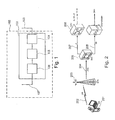
- Fig. 1 shows a control device 100 that is arranged in a room 102 such that by a transmission signal receiving device or antenna 103 the control device can pick up or receive a transmission signal from a terrestrial source, which signal may be present outside or inside the room 102.
- the signals received by the antenna 103 reach the receiving device 104, which is arranged in the interior of the control device 100.
- the receiving device 104 a remote technological reconditioning of the received transmission signal is effected and if necessary an amplification of the received transmission signal is effected.
- the reconditioned signal is forwarded by the receiving device 104 to the interference device 105, which is connected to the receiving device 104.
- the interference device 105 determination or identification of the present mobile radio signal takes place. For example, with the help of a database, querying of the required interference signal can take place. In the interference device 105 an interference signal is determined which interference signal corresponds to the conditions currently present. This interference signal is forwarded to the transmitting device 106 for the interference signal, which transmitting device by the antenna 107 transmits the interference signals into the interior of the room 102.
- the antenna characteristic in particular by a directional antenna or by a leaky line antenna, the interior room of the room or of the cabin 102 can be illuminated such that the interior room of the room 102 is free of any external transmission signals. In other words this means that the transmission signal is interfered within the room such that only a noise signal is present, from which noise signal the terminals can no longer derive any useful signal, a wanted signal or a payload signal.
- Fig. 2 shows the basic structure of a mobile radio network.
- the mobile radio network operates according to the GSM standard.
- GSM Global System for Mobile communications
- an SMS service with, for example, a text message comprising up to 160 standard letters, an MMS service comprising text, images and sound information, or data communication that can be achieved by GPRS can be used.
- a mobile station (MS), a terminal equipment (TE), or a user equipment (UE) is provided, which equipment is a device prepared for GSM, for example a mobile telephone, a PDA, or a laptop computer.
- the MS 201 communicates via the air interface (Um) 202 with the base transceiver station (BTS) 203. From the BTS 203 the communication information is transmitted via the Abis interface 204 to the base station controller (BSC) 205.
- BSC base station controller
- the BSC 205 controls one or several BTS 203.
- the HLR is used for users that reside in this network, i.e. the HLR is used for users who are at home in this network.
- a roaming user originating from another network can also be identified in a visitor location register (VLR). Calls are switched either internally or to another mobile network or fixed network.
- Packet-oriented data or packet switched data for example GPRS connections or data parts of an MMS are transmitted via the Gb interface 208 to the network node which provides GPRS or which serves GPRS.
- This network node routes the data streams either into the intranet, to a walled garden, or to the public internet.
- Public destinations outside the system of the provider are provided by connections via so-called gateway GPRS support nodes (GGSN) or they are provided relating connections via so-called gateway GPRS support nodes (GGSN).
- the GSM network infrastructure by/with a long-distance traffic communication link is connected to the ground station.
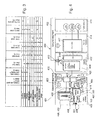
- Fig. 3 shows an overview of worldwide-used frequency bands according to an exemplary embodiment of the present invention.
- country-specific regulations relating to regulations and requirements concerning health and the certification of mobile radio devices. Since the present invention is to be installed on board an aircraft, additional considerations nay have to be made or may have to be taken into account in relation to the fulfillment of requirements for regulation, the health of the on board crew of a flight and passengers, as well as certification.
- control device can be installed in order to ensure that no on-board mobile telephone or mobile telephone on board, independent of the standard or the frequency used, has access to any terrestrial mobile radio network.
- the OMTS can avoid that a mobile telephone emits a radio signal having a high power, wherein the high power would, for example, be necessary in order to reach a distant terrestrial network.
- the control device 100 allows that the BTS 203, which is located on board, not hase to transmit at a high power level.
- the BTS 203 can thus be the preferred point at which the MS 201 that are located on board register or log in. In addition it can be ensured that no MS 201 is used during a critical flight phase or in a region or at a time in which the use of a mobile telephone on board an aircraft is prohibited.
- GSM 1800 has not been released for use in the USA
- GSM 1900 has not been released for use in Europe.
- the prevention of high-powered radio signals is believed to be obligatory to comply with health requirements.
- the emitted radio signals must not have a detrimental influence on the aircraft systems. Detrimental influence on the aircraft systems can also be prevented with the control device according to the invention.
- Parallel to the automatic deactivation of mobile telephones that are used on board, a passenger can be referred to the fact that the use of mobile terminals on board is temporarily prohibited by a display interdicting telephoning (e.g. "No telephone").
- the control device 100 controls at least the frequency bands listed in the table shown in Fig. 3 . Thereby regions designated as item 1, item 2, item 4, item 5, item 7, item 8, item 9 and item 10 are the main regions. It is believed that at the same time at least six frequency bands have to be controlled.
- the frequency range CDMA 450 which comprises the frequencies 420 MHz to 430 MHz and 460 MHz to 470 MHz is considered as two frequency bands.
- Fig. 3 shows that today Europe uses the CDMA 450 (420 MHz) frequency band, the CDMA 450 (460 MHz) frequency band, the GSM 900, GSM 1800 and the UMTS 2000.
- Poland uses the CDMA 450 (420 MHz), CDMA 450 (460 MHz), GSM 850, GSM 900, GSM 1800 and UMTS 2000 frequency bands.
- the table in Fig. 3 shows that Russia uses the CDMA 450 (420 MHz), CDMA 450 (460 MHz), GSM 850, GSM 900, GSM 1800 and UMTS 2000 frequency band.
- the Middle East uses the frequency bands GSM 850, GSM 900, GSM 1800 and UMTS 2000
- Africa uses the frequency bands CDMA 450 (420), GSM 850, GSM 900 and GSM 1800.
- GSM 850 USA and Canada use GSM 850, GSM 1800 and GSM 1900, while Asia uses CDMA 450 (420 MHz), CDMA 450 (460 MHz), GSM 850, GSM 900, GSM 1800.
- the Asia-Pacific region, Australia and Japan use the frequency bands CDMA 450 (420 MHz), CDMA 450 (460 MHz), GSM 850, GSM 900, GSM 1800 and GSM 1900. It should be noted that in the regions Asia, Pacific and Australia no country has presently more than six frequency bands in use.
- the entire system can be adapted such that the design assurance level (DAL) "C” is met.
- DAL design assurance level
- FHA functional hazard analysis
- the quality of voice calls meet the requirements known from terrestrial connections.
- the number of users that are concurrently able to make a call can be influenced.
- the selected mobile radio network operator should be responsible for making forecasts concerning dimensioning in relation to specific requirements of various aircraft types.
- a BTS 203 has a capacity of 7 concurrent voice calls.
- AMR adaptive multi rate
- Voice compression may become a standard feature of mobile telephones within the next few years, as a result of which the channel capacity can be doubled when compared to the GSM standards. I.e. the maximum capacity of 28 concurrent voice connections can be achieved.
- WLAN wireless LAN
- a combining system is used. Thereby, the use of a shared antenna system in the cabin can also be provided.
- This combining device is comprised in OBCE 100 and can provide the required and demanded mobile telephone standards.
- a flexible server system can support this provision of the plurality of standards. This is required if other mobile telephone standards as UMTS or CDMA and likewise GSM are demanded apart from GSM 1800 and GSM 1900.
- Fig. 4 shows an on-board mobile radio system according to an exemplary embodiment of the present invention.
- the mobile radio system 400 of Fig. 4 may be, for example, a GSM on-board system.
- This GSM on-board system can provide several mobile telephone services for GSM 1800 and 1900 on board.
- Fig. 4 shows an overview of the various subsystems 403, 404, 412, 414 and 415.
- the overall system 400 can be divided into the airborne segment 401 and the ground segment 402, which segments in turn comprise so-called sub-domains.
- the on-board mobile telephone system architecture provides or supplies a connection between the airborne segment 401 and the ground segment 402 in the form of a satellite link 413 for the Abis interface 204 in order to connect one or several BTS 203, 406 that are located on board an aircraft, to the BSC 205 (not shown in Fig. 4 ), which is located on the ground.
- the Abis interface 204 is not completely standardised. Thus, it is believed to be advantageous to source the BTS 203 and the BSC 204 from the same manufacturer.
- the airborne segment 401 there are three subsystems, namely the cabin wireless - or room-wireless-subsystem 403, the head end subsystem 404 or the coordination device 404 with a centralised built-in test equipment (BITE), with a server 405 and with a communication management device.
- the third subsystem or the third sub-domain is the satellite transmission line 412, or the transmitting device 412, and in particular the satellite connection 413.
- the cabin wireless domain 403 provides passengers with a connection via various access points.
- the BTS 406, 203 which can be designed or dimensioned to be redundant, provides access for the mobile telephones 201 of the passengers to the GSM network.
- a GSM 1800 and a GSM 1900 BTS can be implemented in order to provide services in Europe or worldwide, respectively and in the US-GSM standard.
- the control device (OBCE) 407 controls all the telephones 201 in the cabin 102 or in the room 102, respectively.
- the control device 407 together with the local BTS 406, 203 can control or regulate, respectively the radio frequency emission of all mobile telephones 201 and can prevent the mobile telephones 201 from attempting to connect the radio network outside the cabin or outside the aircraft (A/C) in the same manner as they prevent the mobile telephones 201 from connecting to the local BTS 406 during critical flight phases.
- a WLAN connection via a WLAN access device may be provided in the cabin wireless 403 or wireless cabin 403, via which WLAN connection the laptops 201 or the PDAs 201 of the passengers may be connected to the network.
- the leaky line antennae 408 are antennae for transmitting and for sending and for receiving from and to devices, for example mobile telephones 201, laptops 201 and PDAs 201 of passengers.
- An antenna may be used as a receiving antenna while the other may be used as a transmitting antenna for the radio signal or as a sending antenna for the radio signal, respectively.
- Shared use of the antennae 408 for WLAN access and access to the mobile radio network may be possible.
- the head-end domain 404 or coordination device 404 comprises a server capacity 405 for GSM services, which server capacity also has GSM software on board.
- the software function can be a base station control functionality.
- the head-end domain 404 connects the mobile telephone system 403 to the satellite modem 409 (cabin satellite unit, CSDU) and the server capacity 405 for e-mail and other internet services.
- the server 405 can comprise a function to inform passengers whether or not they are allowed to use their mobile telephones. Otherwise this will have to be handled manually by the cabin crew.
- the FAP 410 is designed as a PC card.
- the FAP is the interface for the crew. Therewith, the status and possible errors of the system can be monitored.
- the cabin crew can manually switch the system on and off and can also alter the level of GSM communication. This means that a presetting can be made about the power that will be used.
- a night mode can be set, in which may only data communication be possible.
- calm may be established in the aircraft.
- discrete interfaces such as a push button (PB) or as a switch are implemented, neither are shown in Figure 4 . This may allow, for example, to implement an interface to the cockpit 411. Via this interface the wireless function can be deactivated, or a system reset can be carried out.
- PB push button
- a centralised cabin operation and maintenance system (OMS) 423 for maintenance provides a built-in test equipment (BITE) and the monitoring of all connected cabin equipments including satellite transport and the cabin wireless segment.
- BITE built-in test equipment
- This OMS functionality may allow to have simple malfunctions remedied by the cabin crew.
- the control of the necessary functions from a central point is possible.
- a remote maintenance can be carried out from a ground station with an extended functionality.
- the cabin WLAN control and the cabin WLAN management, the communication management for air-to-ground traffic and the connection of the Ethernet cabin equipment 201 comprise a satellite communication with the cabin and a cabin wireless that is provided by the head-end domain 404 and in particular by the coordination device 404.
- the satellite transport domain 412 or transmitting device 412 interconnects the airborne segment 401 and the ground segment 402.
- the satellite connection 413 provides the transport and the connection to service providers on the ground and to backbone networks 414, 415. Therein, by a satellite modem 409, an adaptation of the traffic generated by the server 405 to the satellite connection 413 takes place.
- the satellite system Inmarsat swift broadband system can be used.
- the system is adapted to operation with the Inmarsat 4 satellite, which provides two swift broadband Inmarsat channels. Nonetheless, implementation with any other satellite system is also possible.
- the ground segment 402 comprises a part of the satellite transport 412 or of the transmitting device 412, the service provider segment 414 and the public network 415.
- the network operation centre (NOC) 416 is the part of the transmitting device 412, that is comprised by the ground segment 402, which NOC may allow the operation of the satellite connection 413.
- the ground satellite transport segment 416 is the counterpart of the airborne satellite segment 409, which establishes the connection to all service providers on the ground.
- the service provider domain 414 houses the communication control device, which cooperate with the on-board functions in the aircraft. Therefore, a ground server is provided. Carrying out of the routing in the direction of the aircraft and carrying out of the connection of the aircraft traffic with the traffic on the ground of the backbone network of the public network 414, 415 may be a main features of the ground server.
- the service provider domain 414 comprises the accounting functions and billing functions, the mobility management and the routing functions, thus, an aircraft operator or airline, respectively can provide an own accounting system or billing system.
- the public land mobile network (PLMN) 415 comprises the BSC 205, MSC 206 and the VLR/HLR.
- the public network 415 additionally provides access to the remote terminals to which passengers may desire to establish a connection. This can, for example, be a public fixed network telephone or a public internet for the IP access.
- the ground units 416, 414, 415 provide all the functions and features of a classic mobile radio network, while the BTS 406 is set up in the aircraft or located in the aircraft, respectively, in particular in the aircraft cabin 403, and is connected to the main network 415 via a satellite link 413.
- interference can be generated, which interference keeps the interior of the cabin 403 free of transmission signals from terrestrial base stations, which transmission signals enter from the outside, in that the antenna 408 by superposition of an interference signal renders the useful information or wanted information or payload information of the entering signals unrecognisable.
- the MS 201 can directly establish contact with the BTS 406 that is located in the interior of the cabin 403.
- the interference is generated by the control device 407.
- Aircraft data 418 is also fed to the control device 407.
- the control device 407 can control the BTS 406.
- the BTS 406 is connected to the server 405 (aircraft GSM server). Via the connection 420 an exchange of the received voice signals takes place by the voice-over-IP (VOIP) protocol.
- the server 405 can forward the received voice data via the IP connection 421 by the satellite modem 409 via the satellite connection 413.
- the server 405 can also drive the signal device 422 which, for example, displays that no mobile radio devices must be used.
- the transmitting device 412 comprises the satellite connection 413.
- the head-end segment 404 is also referred to as the coordination device 404.
- partitioning into voice services, signalling messages and data services takes place. These can be distributed via separate virtual private networks.
- the system can be retrofitted to any type of cabin. Consequently it is also possible, for example, to upgrade trains, buses, ships or trams with the OMTS.
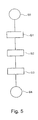
- Fig. 5 shows a method for shielding a room.
- the method starts in an initial state 50 and in S1 receives a transmission signal from terrestrial transmitting stations.
- This transmission signal is a radio signal.
- an associated interference signal is generated or determined that can render the received transmission signal invisible to terminals when the interference signal is emitted.
- this determined interference signal is emitted into the interior of the cabin so that in the interior of the cabin a noise floor is created from which only the existing local transmitting-receiving device juts out.
- the method assumes the final state of S4.
- the received transmission signal may be a mobile radio signal.
- the method for shielding a room may further comprise emitting a noise signal.
- the method for shielding a room may further comprise emitting the interference signal that may be selected from the group consisting of a GSM signal, CDMA signal, UMTS signal, GPRS signal, HSCSD signal, PDC signal, UWC signal, American mobile phone system signal, IS95 A-signal and a wireless local area network-signal.
- the interference signal may be selected from the group consisting of a GSM signal, CDMA signal, UMTS signal, GPRS signal, HSCSD signal, PDC signal, UWC signal, American mobile phone system signal, IS95 A-signal and a wireless local area network-signal.
- the method for shielding a room may further comprise selecting the interference signal from a database.
- the method for shielding a room may further comprise selecting a power of the interference signal such that the received transmission signal may be covered and selecting the power of the interference signal such that the signal of a local transmitting-receiving device may be receivable in the room.
- the method for shielding a room may further comprise adjusting the interference signal by the control device in conjunction with a local transmitting-receiving device such that the radio frequency emission of a mobile terminal may be adjustable.
- the method for shielding a room may further comprise adjusting a signal of the local transmitting-receiving device to a satellite connection and transmitting the signal of the local transmitting-receiving device via the satellite connection.
- the transmission signal is a mobile radio signal and the control device is adapted for a mobile radio system for an aircraft.
- the interference signal has a power, wherein the power of the interference signal is adjustable such that the received transmission signal is covered up and wherein the power of the interference signal is adjustable such that the signal of a local transmitting-receiving device is receivable in the room.
- the interference signal is adjustable by the control device in conjunction with the local transmitting-receiving device such that the radio frequency emission of a mobile terminal is adjustable.
- a system for shielding a room comprising the control device and a transmitting-receiving device, wherein the control device is adapted for receiving a transmission signal, wherein the transmission signal is a radio signal and wherein the control device is adapted to determine an interference signal from the received transmission signal so that when the interference signal is emitted, the transmission signal is interfered with such, that a signal of the transmitting-receiving device is distinguishable from the interference signal, wherein the control device is adapted to emit the determined interference signal.
- the system further comprises a transmitting device, wherein the transmitting device is connected to the transmitting-receiving device by the coordination device and wherein the transmitting device is adapted for transmitting the signal of the transmitting-receiving device.
- the system further comprises a communication network, wherein the communication network is connected to the transmitting device and wherein the communication network is adapted for transmitting the signal of the transmitting device.
Landscapes
- Engineering & Computer Science (AREA)
- Computer Networks & Wireless Communication (AREA)
- Signal Processing (AREA)
- Physics & Mathematics (AREA)
- Astronomy & Astrophysics (AREA)
- Aviation & Aerospace Engineering (AREA)
- General Physics & Mathematics (AREA)
- Quality & Reliability (AREA)
- Electromagnetism (AREA)
- Mobile Radio Communication Systems (AREA)
- Noise Elimination (AREA)
- Telephonic Communication Services (AREA)
Applications Claiming Priority (4)
| Application Number | Priority Date | Filing Date | Title |
|---|---|---|---|
| US82115006P | 2006-08-02 | 2006-08-02 | |
| DE102006036082A DE102006036082A1 (de) | 2006-08-02 | 2006-08-02 | Kontrollvorrichtung für die Abschirmung eines Raums |
| EP07786529A EP2047730A1 (de) | 2006-08-02 | 2007-08-02 | Steuereinrichtung zum abschirmen eines raums |
| PCT/EP2007/006859 WO2008015003A1 (en) | 2006-08-02 | 2007-08-02 | Control device for shielding a room |
Related Parent Applications (2)
| Application Number | Title | Priority Date | Filing Date |
|---|---|---|---|
| EP07786529.3 Division | 2007-08-02 | ||
| EP07786529A Division EP2047730A1 (de) | 2006-08-02 | 2007-08-02 | Steuereinrichtung zum abschirmen eines raums |
Publications (3)
| Publication Number | Publication Date |
|---|---|
| EP2285017A2 true EP2285017A2 (de) | 2011-02-16 |
| EP2285017A3 EP2285017A3 (de) | 2014-12-24 |
| EP2285017B1 EP2285017B1 (de) | 2018-10-10 |
Family
ID=38921861
Family Applications (2)
| Application Number | Title | Priority Date | Filing Date |
|---|---|---|---|
| EP07786529A Withdrawn EP2047730A1 (de) | 2006-08-02 | 2007-08-02 | Steuereinrichtung zum abschirmen eines raums |
| EP10183516.3A Active EP2285017B1 (de) | 2006-08-02 | 2007-08-02 | Steuerungsvorrichtung zur Abschirmung eines Raums |
Family Applications Before (1)
| Application Number | Title | Priority Date | Filing Date |
|---|---|---|---|
| EP07786529A Withdrawn EP2047730A1 (de) | 2006-08-02 | 2007-08-02 | Steuereinrichtung zum abschirmen eines raums |
Country Status (9)
| Country | Link |
|---|---|
| US (2) | US20100112933A1 (de) |
| EP (2) | EP2047730A1 (de) |
| JP (1) | JP2009545901A (de) |
| CN (2) | CN102014601B (de) |
| BR (1) | BRPI0715503A2 (de) |
| CA (1) | CA2657116A1 (de) |
| DE (1) | DE102006036082A1 (de) |
| RU (1) | RU2467531C2 (de) |
| WO (1) | WO2008015003A1 (de) |
Cited By (2)
| Publication number | Priority date | Publication date | Assignee | Title |
|---|---|---|---|---|
| CN109150367A (zh) * | 2018-06-21 | 2019-01-04 | 中国科学院信息工程研究所 | 重要场所的无线信号泄露保护方法及装置 |
| WO2019143720A1 (en) * | 2018-01-17 | 2019-07-25 | Comsat, Inc. | Wideband streaming l-band (wisl) methods and systems |
Families Citing this family (26)
| Publication number | Priority date | Publication date | Assignee | Title |
|---|---|---|---|---|
| DE102007024370B4 (de) | 2007-05-23 | 2010-09-09 | Airbus Deutschland Gmbh | Picozelle in einem Flugzeug und Steuerungsverfahren für drahtlose Datenübertragung |
| DE102007039818B3 (de) * | 2007-08-23 | 2008-10-30 | ROWO Coating Gesellschaft für Beschichtung mbH | Verfahren zum Verhindern des Auslösens des Zündmechanismus eines Sprengsatzes mittels eines Funksignals sowie Vorrichtung hierfür |
| DE102008042208B4 (de) * | 2008-09-18 | 2015-06-03 | Airbus Operations Gmbh | Testvorrichtung und Verfahren zur Durchführung eines Funkionstests eines Kommunikationssystems |
| BRPI0920793A2 (pt) * | 2008-10-01 | 2015-12-22 | Airbus Operations Gmbh | processador de sinal digital, dispositivo de comunicação, sistema de comunicação e processo para a operação de um processador de sinal digital. |
| EP2320699A1 (de) * | 2009-11-10 | 2011-05-11 | Alcatel Lucent | Femtozellen-Basisstation und Verfahren zum Auslösen der Übertragung einer Funkverbindung mit einem Benutzerendgerät von einer Makrozellen-Basisstation zu einer Femtozellen-Basisstation |
| DE102010000831B4 (de) | 2010-01-12 | 2018-07-12 | Airbus Operations Gmbh | Vorrichtung und Verfahren zum Zusammenführen von Hochfrequenzsignalen |
| DE102010000909B4 (de) * | 2010-01-14 | 2017-06-22 | Airbus Operations Gmbh | Vorrichtung zum Bereitstellen von Radiofrequenzsignalverbindungen |
| US8559391B2 (en) * | 2010-02-12 | 2013-10-15 | Wei Lu | Open wireless architecture (OWA) unified airborne and terrestrial communications architecture |
| DE102010014805B4 (de) * | 2010-04-13 | 2012-03-15 | Lufthansa Cargo Ag | Modul und Verfahren zum Erzeugen eines Steuersignals beim Eintritt in ein Flugzeug |
| AT510447B1 (de) * | 2010-09-20 | 2012-04-15 | Siemens Programm-Und Systementwicklung Gmbh & Co K | Verfahren zum deaktivieren von mobilstationen |
| DE102010062339A1 (de) * | 2010-12-02 | 2012-06-06 | Siemens Programm- Und Systementwicklung Gmbh & Co. Kg | Verfahren zum Erkennen von aktiven Mobilstationen |
| US8831110B2 (en) * | 2011-07-20 | 2014-09-09 | James D. Ocon | Electronic news gathering method and system for the prioritized transmission of data |
| DE102011118077B4 (de) * | 2011-11-04 | 2019-08-01 | Airbus Operations Gmbh | Überwachung der Hochfrequenzumgebungsparameter mittels drahtlosen Netzwerks in einem Flugzeug |
| DE102011119892A1 (de) * | 2011-11-29 | 2013-05-29 | Airbus Operations Gmbh | LTE-4G an Bord von Flugzeugen |
| US9015018B2 (en) * | 2012-03-20 | 2015-04-21 | The Boeing Company | Boundary system designer for wireless aircraft networks |
| US9692468B2 (en) | 2015-11-11 | 2017-06-27 | Smartsky Networks, Llc | Spectrum scrubber |
| FR3060886B1 (fr) * | 2016-12-19 | 2022-07-22 | Electricite De France | Gestion d'energie electrique composite |
| CN106899374A (zh) * | 2017-02-07 | 2017-06-27 | 京信通信系统(广州)有限公司 | 一种长期演进lte通信系统的屏蔽方法和装置 |
| CA3056762C (en) * | 2017-03-16 | 2020-11-17 | Systems And Software Enterprises, Llc | Monitoring system for a cellular telephone network |
| CN110572235B (zh) * | 2019-09-16 | 2022-07-08 | 浙江三维通信科技有限公司 | 信号屏蔽装置及方法 |
| CN111465037A (zh) * | 2020-03-27 | 2020-07-28 | 西安中本教育科技有限公司 | 一种手机信号分时分区及功能设置管控方法 |
| CN112888014B (zh) * | 2021-04-02 | 2023-02-07 | 深圳市吉祥腾达科技有限公司 | 路由器产品无线网络测速的稳定性测试系统与方法 |
| CN113393711A (zh) * | 2021-05-11 | 2021-09-14 | 乐宁宁 | 空中交通管制系统及方法 |
| CN115378541A (zh) * | 2021-05-21 | 2022-11-22 | 中兴通讯股份有限公司 | 干扰信号发送方法和装置、电子设备、可读存储介质 |
| EP4307579A1 (de) * | 2022-07-15 | 2024-01-17 | HENSOLDT Sensors GmbH | Schutzsystem und verfahren zum schutz von flugzeugen |
| CN118249936B (zh) * | 2024-05-29 | 2024-08-09 | 福建福启网络科技有限公司 | 一种基站信号智能单向屏蔽方法及装置 |
Family Cites Families (43)
| Publication number | Priority date | Publication date | Assignee | Title |
|---|---|---|---|---|
| US5408515A (en) * | 1988-04-29 | 1995-04-18 | Mobile Telecommunication Technologies | Ground-to-air telephone calling system and related method for directing a call to a particular passenger |
| US5230085A (en) * | 1991-04-05 | 1993-07-20 | E-Systems, Inc. | Method and apparatus for wireless electromagnetic communication within a contained electromagnetic field |
| US5878346A (en) * | 1992-03-06 | 1999-03-02 | Aircell Incorporated | Nonterrestrial cellular mobile telecommunication network |
| US5884166A (en) * | 1992-03-06 | 1999-03-16 | Aircell, Incorporated | Multidimensional cellular mobile telecommunication system |
| US6108539A (en) * | 1992-03-06 | 2000-08-22 | Aircell, Incorporated | Non-terrestrial cellular mobile telecommunication station |
| US6408180B1 (en) * | 1992-03-06 | 2002-06-18 | Aircell, Inc. | Ubiquitous mobile subscriber station |
| US7113780B2 (en) * | 1992-03-06 | 2006-09-26 | Aircell, Inc. | System for integrating an airborne wireless cellular network with terrestrial wireless cellular networks and the public switched telephone network |
| US5444762A (en) * | 1993-03-08 | 1995-08-22 | Aircell, Inc. | Method and apparatus for reducing interference among cellular telephone signals |
| US6650898B2 (en) * | 1992-03-06 | 2003-11-18 | Aircell, Inc. | Signal translating repeater for enabling a terrestrial mobile subscriber station to be operable in a non-terrestrial environment |
| US5557656A (en) * | 1992-03-06 | 1996-09-17 | Aircell, Inc. | Mobile telecommunications for aircraft and land based vehicles |
| US6725035B2 (en) * | 1992-03-06 | 2004-04-20 | Aircell Inc. | Signal translating repeater for enabling a terrestrial mobile subscriber station to be operable in a non-terrestrial environment |
| SE500443C2 (sv) * | 1993-05-26 | 1994-06-27 | Nordictel Ab | Mobilkommunikationssystem |
| US5519761A (en) * | 1994-07-08 | 1996-05-21 | Qualcomm Incorporated | Airborne radiotelephone communications system |
| WO1998046035A2 (en) * | 1997-04-10 | 1998-10-15 | Qualcomm Incorporated | Determining the location of a subscriber unit in a mobile communication system |
| FR2764144B1 (fr) * | 1997-06-02 | 2000-06-02 | Raoul Girod | Appareil pour filtrer les radiotelephones |
| US6185430B1 (en) * | 1997-11-26 | 2001-02-06 | Motorola, Inc. | Voice call group function for a satellite based air traffic control system |
| FR2773931B1 (fr) * | 1998-01-16 | 2000-03-17 | Aerospatiale | Dispositif pour permettre l'utilisation dans un aeronef de moyens de radiocommunication |
| JPH11214092A (ja) * | 1998-01-23 | 1999-08-06 | Molex Inc | カード接続装置 |
| US6477152B1 (en) * | 1998-12-30 | 2002-11-05 | Honeywell Inc. | Apparatus and method for data communications |
| GB2350972A (en) * | 1999-06-08 | 2000-12-13 | Marconi Electronic Syst Ltd | Aircraft communication arrangement |
| JP2001010271A (ja) | 1999-06-30 | 2001-01-16 | Kokuyo Co Ltd | ファイル |
| NZ517214A (en) * | 1999-08-25 | 2003-03-28 | Stratos Global Ltd | Communication between a fixed network and a movable network with means for suspending operation of the moveable network |
| US6768906B2 (en) * | 1999-09-13 | 2004-07-27 | Motorola, Inc. | System and technique for plane switchover in an aircraft based wireless communication system |
| AU2001252489A1 (en) * | 2000-04-14 | 2001-10-30 | Stratos Global Limited | Mobile telephony with a fixed network forwarding calls to a movable network in an active state |
| JP2002094468A (ja) * | 2000-09-14 | 2002-03-29 | Nec Corp | Cdma方式の移動無線装置の利用を制限するシステム |
| US7054593B2 (en) * | 2000-09-28 | 2006-05-30 | The Boeing Company | Return link design for PSD limited mobile satellite communication systems |
| US6959192B1 (en) * | 2000-11-06 | 2005-10-25 | Agere Systems Inc. | System and method for updating stored information portable electronic devices based on geographic location |
| FR2818077A1 (fr) * | 2000-12-07 | 2002-06-14 | Cit Alcatel | Procede de regie des frequences allouees pour des communications radiomobiles, infrastructure de reseau radiomobile, et systeme de communication pour la mise en oeuvre de ce procede |
| US7653385B2 (en) * | 2001-01-26 | 2010-01-26 | Arend Brian L | Wireless telecommunications signal inhibition |
| US7437125B2 (en) * | 2001-02-27 | 2008-10-14 | The Boeing Company | EIRP statistical calculation method |
| US7155168B2 (en) * | 2001-04-04 | 2006-12-26 | The Boeing Company | Method and apparatus using variations in power modulation to determine an interfering mobile terminal |
| CN100341358C (zh) * | 2001-07-18 | 2007-10-03 | 数据传送及通讯有限公司 | 数据安全设备 |
| JP4011368B2 (ja) * | 2002-02-27 | 2007-11-21 | 京セラ株式会社 | 無線通信システム及び無線通信方法 |
| US20040229607A1 (en) * | 2003-05-12 | 2004-11-18 | La Chapelle Michael De | Wireless communication inside shielded envelope |
| US20040242149A1 (en) * | 2003-05-28 | 2004-12-02 | Louis Luneau | Flexible mobile base station |
| US7352893B2 (en) | 2003-07-09 | 2008-04-01 | Hewlett-Packard Development Company, L.P. | Representing extended color gamut information |
| JP2005191739A (ja) * | 2003-12-24 | 2005-07-14 | Mitsubishi Electric Corp | 拡散通信妨害方法およびこの方法を用いた拡散通信妨害装置 |
| CA2570912A1 (en) | 2004-06-17 | 2006-01-05 | Dennis C. Smith | Pigmentation of ionomers |
| US7177638B2 (en) * | 2004-12-28 | 2007-02-13 | Live Tv, Llc | Aircraft in-flight entertainment system including digital radio service and associated methods |
| US7280825B2 (en) * | 2004-12-28 | 2007-10-09 | Live Tv, Llc | Aircraft in-flight entertainment system including low power transceivers and associated methods |
| US7395084B2 (en) * | 2005-01-24 | 2008-07-01 | Sikorsky Aircraft Corporation | Dynamic antenna allocation system |
| US7187927B1 (en) * | 2005-06-13 | 2007-03-06 | Rockwell Collins, Inc. | Global cell phone system and method for aircraft |
| US7343157B1 (en) * | 2005-06-13 | 2008-03-11 | Rockwell Collins, Inc. | Cell phone audio/video in-flight entertainment system |
-
2006
- 2006-08-02 DE DE102006036082A patent/DE102006036082A1/de not_active Withdrawn
-
2007
- 2007-08-02 EP EP07786529A patent/EP2047730A1/de not_active Withdrawn
- 2007-08-02 EP EP10183516.3A patent/EP2285017B1/de active Active
- 2007-08-02 JP JP2009522179A patent/JP2009545901A/ja active Pending
- 2007-08-02 BR BRPI0715503-4A patent/BRPI0715503A2/pt not_active IP Right Cessation
- 2007-08-02 WO PCT/EP2007/006859 patent/WO2008015003A1/en not_active Ceased
- 2007-08-02 CN CN201010578200.7A patent/CN102014601B/zh active Active
- 2007-08-02 RU RU2009107282/07A patent/RU2467531C2/ru not_active IP Right Cessation
- 2007-08-02 US US12/309,944 patent/US20100112933A1/en not_active Abandoned
- 2007-08-02 CA CA002657116A patent/CA2657116A1/en not_active Abandoned
- 2007-08-02 CN CN200780028863.8A patent/CN101502197A/zh active Pending
-
2010
- 2010-12-09 US US12/964,183 patent/US8224316B2/en active Active
Non-Patent Citations (1)
| Title |
|---|
| None |
Cited By (4)
| Publication number | Priority date | Publication date | Assignee | Title |
|---|---|---|---|---|
| WO2019143720A1 (en) * | 2018-01-17 | 2019-07-25 | Comsat, Inc. | Wideband streaming l-band (wisl) methods and systems |
| US10476582B1 (en) | 2018-01-17 | 2019-11-12 | Comsat, Inc. | Wideband streaming L-band (WISL) methods and systems |
| CN109150367A (zh) * | 2018-06-21 | 2019-01-04 | 中国科学院信息工程研究所 | 重要场所的无线信号泄露保护方法及装置 |
| CN109150367B (zh) * | 2018-06-21 | 2020-02-14 | 中国科学院信息工程研究所 | 重要场所的无线信号泄露保护方法及装置 |
Also Published As
| Publication number | Publication date |
|---|---|
| CN102014601B (zh) | 2014-06-25 |
| US20110159798A1 (en) | 2011-06-30 |
| US20100112933A1 (en) | 2010-05-06 |
| EP2047730A1 (de) | 2009-04-15 |
| BRPI0715503A2 (pt) | 2014-05-06 |
| EP2285017B1 (de) | 2018-10-10 |
| CA2657116A1 (en) | 2008-02-07 |
| RU2009107282A (ru) | 2010-09-10 |
| CN102014601A (zh) | 2011-04-13 |
| EP2285017A3 (de) | 2014-12-24 |
| JP2009545901A (ja) | 2009-12-24 |
| WO2008015003A1 (en) | 2008-02-07 |
| RU2467531C2 (ru) | 2012-11-20 |
| US8224316B2 (en) | 2012-07-17 |
| CN101502197A (zh) | 2009-08-05 |
| DE102006036082A1 (de) | 2008-02-14 |
Similar Documents
| Publication | Publication Date | Title |
|---|---|---|
| US8224316B2 (en) | Control device for shielding a room | |
| US8504020B2 (en) | Aircraft cabin personal telephone microcell | |
| US9037169B2 (en) | SMS communication to and from messaging devices in an aircraft | |
| KR101019545B1 (ko) | 무선 피코셀을 생성하기 위한 시스템 및 방법 | |
| EP1216525B1 (de) | Umschaltung einer funkverbindung von einem flugzeug zum anderen | |
| CA2346476C (en) | Mobile subscriber station for terrestrial and non-terrestrial communication | |
| CA2358608C (en) | Aircraft-based network for wireless subscriber stations | |
| US20050026608A1 (en) | Method and arrangements for wireless communication in a vehicle | |
| US9553658B1 (en) | Router for aircraft communications with simultaneous satellite connections | |
| US7783288B2 (en) | Mobile network base station controller comprising a central gateway and a physically separate remote gateway which communicate via a remote link | |
| GB9913351D0 (en) | Communications arrangement | |
| US20040102191A1 (en) | Communications system using high altitude relay platforms | |
| JP4767858B2 (ja) | 航空機で携帯電話を使用するための装置及び方法 | |
| US6771977B1 (en) | Dual mode satellite terminal for emergency operation | |
| US7734288B1 (en) | In-cabin phone service by extending cellular Um interface | |
| Miguélez | GSM operation onboard aircraft | |
| Gonzaga López | GSM on board aircraft |
Legal Events
| Date | Code | Title | Description |
|---|---|---|---|
| PUAI | Public reference made under article 153(3) epc to a published international application that has entered the european phase |
Free format text: ORIGINAL CODE: 0009012 |
|
| 17P | Request for examination filed |
Effective date: 20100930 |
|
| AC | Divisional application: reference to earlier application |
Ref document number: 2047730 Country of ref document: EP Kind code of ref document: P |
|
| AK | Designated contracting states |
Kind code of ref document: A2 Designated state(s): AT BE BG CH CY CZ DE DK EE ES FI FR GB GR HU IE IS IT LI LT LU LV MC MT NL PL PT RO SE SI SK TR |
|
| AX | Request for extension of the european patent |
Extension state: AL BA HR MK RS |
|
| REG | Reference to a national code |
Ref country code: DE Ref legal event code: R079 Ref document number: 602007056485 Country of ref document: DE Free format text: PREVIOUS MAIN CLASS: H04B0007150000 Ipc: H05K0009000000 |
|
| PUAL | Search report despatched |
Free format text: ORIGINAL CODE: 0009013 |
|
| AK | Designated contracting states |
Kind code of ref document: A3 Designated state(s): AT BE BG CH CY CZ DE DK EE ES FI FR GB GR HU IE IS IT LI LT LU LV MC MT NL PL PT RO SE SI SK TR |
|
| AX | Request for extension of the european patent |
Extension state: AL BA HR MK RS |
|
| RIC1 | Information provided on ipc code assigned before grant |
Ipc: H04B 7/185 20060101ALI20141114BHEP Ipc: E06B 5/18 20060101ALI20141114BHEP Ipc: H05K 9/00 20060101AFI20141114BHEP |
|
| GRAP | Despatch of communication of intention to grant a patent |
Free format text: ORIGINAL CODE: EPIDOSNIGR1 |
|
| STAA | Information on the status of an ep patent application or granted ep patent |
Free format text: STATUS: GRANT OF PATENT IS INTENDED |
|
| RIN1 | Information on inventor provided before grant (corrected) |
Inventor name: KNEFELKAMP, SVEN Inventor name: MUELLER, JAN Inventor name: PUMP, JOERG |
|
| INTG | Intention to grant announced |
Effective date: 20180430 |
|
| GRAS | Grant fee paid |
Free format text: ORIGINAL CODE: EPIDOSNIGR3 |
|
| GRAA | (expected) grant |
Free format text: ORIGINAL CODE: 0009210 |
|
| STAA | Information on the status of an ep patent application or granted ep patent |
Free format text: STATUS: THE PATENT HAS BEEN GRANTED |
|
| RAP1 | Party data changed (applicant data changed or rights of an application transferred) |
Owner name: AIRBUS OPERATIONS GMBH |
|
| AC | Divisional application: reference to earlier application |
Ref document number: 2047730 Country of ref document: EP Kind code of ref document: P |
|
| AK | Designated contracting states |
Kind code of ref document: B1 Designated state(s): AT BE BG CH CY CZ DE DK EE ES FI FR GB GR HU IE IS IT LI LT LU LV MC MT NL PL PT RO SE SI SK TR |
|
| REG | Reference to a national code |
Ref country code: GB Ref legal event code: FG4D |
|
| REG | Reference to a national code |
Ref country code: CH Ref legal event code: EP Ref country code: AT Ref legal event code: REF Ref document number: 1052828 Country of ref document: AT Kind code of ref document: T Effective date: 20181015 |
|
| REG | Reference to a national code |
Ref country code: IE Ref legal event code: FG4D |
|
| REG | Reference to a national code |
Ref country code: DE Ref legal event code: R096 Ref document number: 602007056485 Country of ref document: DE |
|
| REG | Reference to a national code |
Ref country code: NL Ref legal event code: MP Effective date: 20181010 |
|
| REG | Reference to a national code |
Ref country code: LT Ref legal event code: MG4D |
|
| REG | Reference to a national code |
Ref country code: AT Ref legal event code: MK05 Ref document number: 1052828 Country of ref document: AT Kind code of ref document: T Effective date: 20181010 |
|
| PG25 | Lapsed in a contracting state [announced via postgrant information from national office to epo] |
Ref country code: NL Free format text: LAPSE BECAUSE OF FAILURE TO SUBMIT A TRANSLATION OF THE DESCRIPTION OR TO PAY THE FEE WITHIN THE PRESCRIBED TIME-LIMIT Effective date: 20181010 |
|
| PG25 | Lapsed in a contracting state [announced via postgrant information from national office to epo] |
Ref country code: FI Free format text: LAPSE BECAUSE OF FAILURE TO SUBMIT A TRANSLATION OF THE DESCRIPTION OR TO PAY THE FEE WITHIN THE PRESCRIBED TIME-LIMIT Effective date: 20181010 Ref country code: BG Free format text: LAPSE BECAUSE OF FAILURE TO SUBMIT A TRANSLATION OF THE DESCRIPTION OR TO PAY THE FEE WITHIN THE PRESCRIBED TIME-LIMIT Effective date: 20190110 Ref country code: IS Free format text: LAPSE BECAUSE OF FAILURE TO SUBMIT A TRANSLATION OF THE DESCRIPTION OR TO PAY THE FEE WITHIN THE PRESCRIBED TIME-LIMIT Effective date: 20190210 Ref country code: LT Free format text: LAPSE BECAUSE OF FAILURE TO SUBMIT A TRANSLATION OF THE DESCRIPTION OR TO PAY THE FEE WITHIN THE PRESCRIBED TIME-LIMIT Effective date: 20181010 Ref country code: AT Free format text: LAPSE BECAUSE OF FAILURE TO SUBMIT A TRANSLATION OF THE DESCRIPTION OR TO PAY THE FEE WITHIN THE PRESCRIBED TIME-LIMIT Effective date: 20181010 Ref country code: ES Free format text: LAPSE BECAUSE OF FAILURE TO SUBMIT A TRANSLATION OF THE DESCRIPTION OR TO PAY THE FEE WITHIN THE PRESCRIBED TIME-LIMIT Effective date: 20181010 Ref country code: PL Free format text: LAPSE BECAUSE OF FAILURE TO SUBMIT A TRANSLATION OF THE DESCRIPTION OR TO PAY THE FEE WITHIN THE PRESCRIBED TIME-LIMIT Effective date: 20181010 Ref country code: LV Free format text: LAPSE BECAUSE OF FAILURE TO SUBMIT A TRANSLATION OF THE DESCRIPTION OR TO PAY THE FEE WITHIN THE PRESCRIBED TIME-LIMIT Effective date: 20181010 |
|
| PG25 | Lapsed in a contracting state [announced via postgrant information from national office to epo] |
Ref country code: PT Free format text: LAPSE BECAUSE OF FAILURE TO SUBMIT A TRANSLATION OF THE DESCRIPTION OR TO PAY THE FEE WITHIN THE PRESCRIBED TIME-LIMIT Effective date: 20190210 Ref country code: SE Free format text: LAPSE BECAUSE OF FAILURE TO SUBMIT A TRANSLATION OF THE DESCRIPTION OR TO PAY THE FEE WITHIN THE PRESCRIBED TIME-LIMIT Effective date: 20181010 Ref country code: GR Free format text: LAPSE BECAUSE OF FAILURE TO SUBMIT A TRANSLATION OF THE DESCRIPTION OR TO PAY THE FEE WITHIN THE PRESCRIBED TIME-LIMIT Effective date: 20190111 |
|
| REG | Reference to a national code |
Ref country code: DE Ref legal event code: R097 Ref document number: 602007056485 Country of ref document: DE |
|
| PG25 | Lapsed in a contracting state [announced via postgrant information from national office to epo] |
Ref country code: DK Free format text: LAPSE BECAUSE OF FAILURE TO SUBMIT A TRANSLATION OF THE DESCRIPTION OR TO PAY THE FEE WITHIN THE PRESCRIBED TIME-LIMIT Effective date: 20181010 Ref country code: CZ Free format text: LAPSE BECAUSE OF FAILURE TO SUBMIT A TRANSLATION OF THE DESCRIPTION OR TO PAY THE FEE WITHIN THE PRESCRIBED TIME-LIMIT Effective date: 20181010 Ref country code: IT Free format text: LAPSE BECAUSE OF FAILURE TO SUBMIT A TRANSLATION OF THE DESCRIPTION OR TO PAY THE FEE WITHIN THE PRESCRIBED TIME-LIMIT Effective date: 20181010 |
|
| PLBE | No opposition filed within time limit |
Free format text: ORIGINAL CODE: 0009261 |
|
| STAA | Information on the status of an ep patent application or granted ep patent |
Free format text: STATUS: NO OPPOSITION FILED WITHIN TIME LIMIT |
|
| PG25 | Lapsed in a contracting state [announced via postgrant information from national office to epo] |
Ref country code: EE Free format text: LAPSE BECAUSE OF FAILURE TO SUBMIT A TRANSLATION OF THE DESCRIPTION OR TO PAY THE FEE WITHIN THE PRESCRIBED TIME-LIMIT Effective date: 20181010 Ref country code: SK Free format text: LAPSE BECAUSE OF FAILURE TO SUBMIT A TRANSLATION OF THE DESCRIPTION OR TO PAY THE FEE WITHIN THE PRESCRIBED TIME-LIMIT Effective date: 20181010 Ref country code: RO Free format text: LAPSE BECAUSE OF FAILURE TO SUBMIT A TRANSLATION OF THE DESCRIPTION OR TO PAY THE FEE WITHIN THE PRESCRIBED TIME-LIMIT Effective date: 20181010 |
|
| 26N | No opposition filed |
Effective date: 20190711 |
|
| PG25 | Lapsed in a contracting state [announced via postgrant information from national office to epo] |
Ref country code: SI Free format text: LAPSE BECAUSE OF FAILURE TO SUBMIT A TRANSLATION OF THE DESCRIPTION OR TO PAY THE FEE WITHIN THE PRESCRIBED TIME-LIMIT Effective date: 20181010 |
|
| PG25 | Lapsed in a contracting state [announced via postgrant information from national office to epo] |
Ref country code: TR Free format text: LAPSE BECAUSE OF FAILURE TO SUBMIT A TRANSLATION OF THE DESCRIPTION OR TO PAY THE FEE WITHIN THE PRESCRIBED TIME-LIMIT Effective date: 20181010 |
|
| PG25 | Lapsed in a contracting state [announced via postgrant information from national office to epo] |
Ref country code: LU Free format text: LAPSE BECAUSE OF NON-PAYMENT OF DUE FEES Effective date: 20190802 Ref country code: CH Free format text: LAPSE BECAUSE OF NON-PAYMENT OF DUE FEES Effective date: 20190831 Ref country code: LI Free format text: LAPSE BECAUSE OF NON-PAYMENT OF DUE FEES Effective date: 20190831 Ref country code: MC Free format text: LAPSE BECAUSE OF FAILURE TO SUBMIT A TRANSLATION OF THE DESCRIPTION OR TO PAY THE FEE WITHIN THE PRESCRIBED TIME-LIMIT Effective date: 20181010 |
|
| REG | Reference to a national code |
Ref country code: BE Ref legal event code: MM Effective date: 20190831 |
|
| PG25 | Lapsed in a contracting state [announced via postgrant information from national office to epo] |
Ref country code: IE Free format text: LAPSE BECAUSE OF NON-PAYMENT OF DUE FEES Effective date: 20190802 |
|
| PG25 | Lapsed in a contracting state [announced via postgrant information from national office to epo] |
Ref country code: BE Free format text: LAPSE BECAUSE OF NON-PAYMENT OF DUE FEES Effective date: 20190831 |
|
| PG25 | Lapsed in a contracting state [announced via postgrant information from national office to epo] |
Ref country code: CY Free format text: LAPSE BECAUSE OF FAILURE TO SUBMIT A TRANSLATION OF THE DESCRIPTION OR TO PAY THE FEE WITHIN THE PRESCRIBED TIME-LIMIT Effective date: 20181010 |
|
| PG25 | Lapsed in a contracting state [announced via postgrant information from national office to epo] |
Ref country code: HU Free format text: LAPSE BECAUSE OF FAILURE TO SUBMIT A TRANSLATION OF THE DESCRIPTION OR TO PAY THE FEE WITHIN THE PRESCRIBED TIME-LIMIT; INVALID AB INITIO Effective date: 20070802 Ref country code: MT Free format text: LAPSE BECAUSE OF FAILURE TO SUBMIT A TRANSLATION OF THE DESCRIPTION OR TO PAY THE FEE WITHIN THE PRESCRIBED TIME-LIMIT Effective date: 20181010 |
|
| PGFP | Annual fee paid to national office [announced via postgrant information from national office to epo] |
Ref country code: DE Payment date: 20240821 Year of fee payment: 18 |
|
| PGFP | Annual fee paid to national office [announced via postgrant information from national office to epo] |
Ref country code: GB Payment date: 20240826 Year of fee payment: 18 |
|
| PGFP | Annual fee paid to national office [announced via postgrant information from national office to epo] |
Ref country code: FR Payment date: 20240828 Year of fee payment: 18 |