EP2268264B1 - Quervernetzte polymermatrix, insbesondere zur verabreichung von wirkstoffen - Google Patents
Quervernetzte polymermatrix, insbesondere zur verabreichung von wirkstoffen Download PDFInfo
- Publication number
- EP2268264B1 EP2268264B1 EP09728884.9A EP09728884A EP2268264B1 EP 2268264 B1 EP2268264 B1 EP 2268264B1 EP 09728884 A EP09728884 A EP 09728884A EP 2268264 B1 EP2268264 B1 EP 2268264B1
- Authority
- EP
- European Patent Office
- Prior art keywords
- polymer matrix
- cross
- matrix according
- agent
- gel
- Prior art date
- Legal status (The legal status is an assumption and is not a legal conclusion. Google has not performed a legal analysis and makes no representation as to the accuracy of the status listed.)
- Active
Links
Images


Classifications
-
- A—HUMAN NECESSITIES
- A61—MEDICAL OR VETERINARY SCIENCE; HYGIENE
- A61K—PREPARATIONS FOR MEDICAL, DENTAL OR TOILETRY PURPOSES
- A61K9/00—Medicinal preparations characterised by special physical form
- A61K9/0012—Galenical forms characterised by the site of application
- A61K9/0019—Injectable compositions; Intramuscular, intravenous, arterial, subcutaneous administration; Compositions to be administered through the skin in an invasive manner
- A61K9/0024—Solid, semi-solid or solidifying implants, which are implanted or injected in body tissue
-
- A—HUMAN NECESSITIES
- A61—MEDICAL OR VETERINARY SCIENCE; HYGIENE
- A61K—PREPARATIONS FOR MEDICAL, DENTAL OR TOILETRY PURPOSES
- A61K9/00—Medicinal preparations characterised by special physical form
- A61K9/0012—Galenical forms characterised by the site of application
- A61K9/0048—Eye, e.g. artificial tears
- A61K9/0051—Ocular inserts or implants
-
- A—HUMAN NECESSITIES
- A61—MEDICAL OR VETERINARY SCIENCE; HYGIENE
- A61P—SPECIFIC THERAPEUTIC ACTIVITY OF CHEMICAL COMPOUNDS OR MEDICINAL PREPARATIONS
- A61P17/00—Drugs for dermatological disorders
- A61P17/02—Drugs for dermatological disorders for treating wounds, ulcers, burns, scars, keloids, or the like
-
- A—HUMAN NECESSITIES
- A61—MEDICAL OR VETERINARY SCIENCE; HYGIENE
- A61P—SPECIFIC THERAPEUTIC ACTIVITY OF CHEMICAL COMPOUNDS OR MEDICINAL PREPARATIONS
- A61P27/00—Drugs for disorders of the senses
- A61P27/02—Ophthalmic agents
Definitions
- the present invention relates to polymer matrices which can be used as a drug carrier and applied locally in the human or animal body.
- the present invention relates to such polymer matrices, which release a incorporated active substance at the place of use in the body over a period of several hours or days and thereby dissolve in the body fluid, so that they no longer have to be removed.
- Embedding in a matrix is a recognized procedure for releasing drugs into the body over a longer period of time.
- the prerequisite for this is a suitable network to delay or even completely prevent diffusion within the matrix.
- hydrogels are often used.
- Hydrogels for example gel-forming polysaccharides such as alginates, are well known and have been extensively described in the literature.
- Alginates are salts of alginic acid containing, inter alia, guluronic acid as monomers.
- the individual polymer chains can be cross-linked by means of polyvalent cations, wherein the cations with the guluronic acid of various polymer chains form ionic bonds.
- DE 103 23 794 A1 relates to a process for the production of large-sized, in particular relatively thick (for example 1 cm or more) alginate-based shaped articles. These moldings have a high wet strength and can be cut into thin layers used as a cosmetic skin layer or medical wound dressing. Further, they are used for oral, buccal or nasal applications. These are durable, poorly soluble gels.
- a method for the controlled cross-linking of alginates is in DE 697 07 475 T2 described. It is proposed to control its properties such as viscosity, elasticity, strength, etc. by adjusting the content of cross-links in the alginate.
- DE 37 21 163 A1 relates to a carrier material for eye medicines.
- an alginate gel is proposed.
- the gelation, that is cross-linking, takes place here in vivo, in that the alginate and the cross-linking agent are applied separately to the eye and the gel is formed on-site on the eye.
- WO 2007/135114 A1 describes microcapsules of hydrogels wherein the gel-forming polymer component used is a mixture of an anionic polysaccharide, for example alginate, and an oligosaccharide derivative of chitosan.
- the resulting capsules can also be used as a drug carrier. A self-dissolution is not provided.
- hydrogels For hydrogels to be able to release the active ingredient in the body over a prolonged period of time as active substance carriers, they must be cross-linked as described above in the prior art. Otherwise, they would swell strongly in the aqueous (physiological) environment and lose their barrier function, with the result that the active ingredient would be released within a very short time. A delayed, gradual release e.g. for hours, is not guaranteed with non-cross-linked hydrogels.
- Collagen and gelatin gels are also known which are covalently crosslinked with reactive substances such as glutaraldehyde to limit swelling. The release from these gels takes place over several hours.
- reactive substances such as glutaraldehyde to limit swelling.
- the release from these gels takes place over several hours.
- the method of preparation of such gels is poorly suited for peptide-based protein drugs because they may be damaged during cross-linking.
- covalently cross-linked gels are limited erodible and thus remain beyond the therapy at the application site, which may have the consequence that they must be removed in order to avoid side effects.
- WO 2007/135114 A1 describes hydrogels that contain drugs encapsulated. Self-dissolution of these hydrogels at the site of application is not provided.
- a polymer solution of the polymers to be crosslinked (alginates) is prepared in a first step, added to the solution in an inactive form a calcium salt such as calcium carbonate or a Ca-EDTA complex in a second step, and in a third step of the solution with inactive Ca ions are added to an agent which hydrolyzes the Ca salts and thus triggers the formation of the hydrogel.
- covalently cross-linked gels In the case of the covalently cross-linked gels, only chemical or enzymatic degradation is considered as mechanisms. However, common covalent bonds are usually quite stable against simple chemical hydrolysis; in the living organism come as a series of biocatalysts of enzymes which also allow this reaction to proceed under physiological conditions. Covalently cross-linked hydrogels can thus be degraded in the living organism, but this process either takes a very long time or it is bound to the presence of the corresponding enzymes at the site of application.
- the above-mentioned crosslinked hydrogels are not suitable.
- the covalently cross-linked hydrogels are unsuitable since, according to the invention, the matrices should dissolve on the one hand within a few hours, but on the other hand should also be applicable to easily accessible body regions, such as the ocular surface, where only a few enzymes are present. Therefore, as a suitable erosion mechanism only a resolution of the matrices into consideration.
- the term “dissolution” refers to a gradual "decomposition" of a solid after it has come into contact with a solvent, the preferred solvents for the present invention being the use of aqueous systems.
- cross-linked gels do not dissolve under such conditions, but only swell.
- Swelling is understood as meaning an increase in the distance between the individual molecules of the gelling agent (such as, for example, polymer chains) due to the incorporation of solvent molecules.
- gels such as the abovementioned alginates, can not dissolve in the conventional sense, since the gelling agent molecules are held together at the nodal points.
- Junctions are the locations in the gel where the molecules of the gelling agent are held together by a cross-linking agent. In order to dissolve a cross-linked hydrogel, this cross-linking agent must be removed or inactivated so as to dissolve the junction.
- a crosslinked polymer matrix which dissolves by itself at the site of application, for example on or in the body of a human or animal, comparatively quickly, in particular within hours.
- the resolution should be independent of the amount of enzyme present at the site of administration.
- the present invention should also be applicable to easily accessible body regions where only a few enzymes are present, such as the ocular surface.
- the polymer matrix according to the invention is based on a hydrogel composed of a ternary system, the three components of which are a gel-forming polymer, a cross-linking agent and a dissolving agent, the structure of which is shown schematically below:
- Polymers are long-chain, composed of repeating units (so-called monomers) macromolecules.
- a polymer suitable for the present invention carries on its monomers in regular or irregular sequence binding sites for the cross-linking agent. Due to its structure, this can be bound by at least two such binding sites and thus connects two or more polymer chains. In this way, the polymer and the crosslinking agent form the gel backbone of the polymer matrix according to the invention.
- the dissolving agent is initially dispersed in an inactive form without being fixed to any of the other components. To re-dissolve such a hydrogel of the invention, the dissolving agent is activated by an external stimulus (eg, a change in pH).
- the dissolution of the hydrogel according to the invention is thus a combination of the abovementioned possibilities a) and c).
- the dissolving agent (above in a) the "soluble receptor") is not added but activated by an external stimulus as described in option c).
- the dissolving agent is freely mobile in the gel.
- the dissolving agent will either bind to the cross-linking agent or its binding site on the polymer and thus dissolve a junction. Consequently, the gel framework is slowly destroyed and the individual components go into solution.
- gel-forming polymers useful in the present invention are polysaccharides containing guluronic acid as one of their monomers.
- the guluronic acid acts as a binding site for the cross-linking agent.
- the guluronic acid must be arranged along the polymer chain in blocks of at least two units in length. Due to their conformation, these blocks form the described binding site for the cross-linking agent.
- guluronic acid-containing polysaccharides are alginates which, in addition to guluronic acid, also contain their isomer mannanic acid as further monomer.
- sodium alginate is used as the gel-forming polymer.
- the content of guluronic acid in the gel-forming polymer such as the alginate should preferably be between 30% (m / m) and 90% (m / m), and in particular between 35% (m / m) and 75%. (m / m).
- crosslinking agents that can bind to the guluronic acid units of such a polymer are polyvalent cations. These are complexed by the guluronic acid blocks of different polysaccharide chains to form a cross-linked gel skeleton. Because of its low toxicity Ca 2+ is preferably used. The amount of calcium ions should be between half and five times the polysaccharide content. As needed and application, other cations such. B. Fe 2 + / 3 + , Al 3+ , Zn 2+ or other cations known from the literature for this purpose are used. The amount of cations to be used can be selected according to the amount of calcium cations.
- Dissolving agents in the sense of the invention which can redissolve such hydrogel cross-linked via polyvalent cations are, for example, complexing agents which form stable complexes with polyvalent cations.
- the stability of a complex is dependent on the one hand on the type of polyvalent cation and on the other of external influences such as the present pH.
- the pH can be used, wherein z.
- the multivalent cation is bound by the polymer but at neutral to alkaline pHs, but by the complexing agent
- An example of such a complexing agent is Na 2 -EDTA (disodium ethylenediamine acetate), which is capable of generating polyvalent cations, e.g. As Ca 2+ ions, dissolve out of the guluronic acid complexation.
- the dissolving agent should be present in the polymer matrix in equimolar proportions to, or binding sites for, the crosslinking agent present.
- the amount of solubilizing agent in the polymer matrix can be varied, for example reduced to half or increased by up to three times (in each case based on the substance amount of the cross-linking agent).
- the dissolving agent may be present in the polymer matrix homogeneously or distributed as required at selected areas. As a rule, a homogeneous distribution is preferred.
- the type of active ingredient which may be incorporated into the polymer matrix is in principle not limited as long as it is compatible with the polymer matrix.
- the matrix according to the invention is suitable for the application of active substances, such as medicaments, which are a protein or peptide. Examples include a growth factor, cytokine, epidermal growth factor, etc. It is also possible to use active substances which form ionic interactions with the polymer matrix.
- the dissolving agent is a complexing agent such as EDTA, the crosslinking agent calcium cation and the gel-forming polymer Na alginate.
- Sodium alginate can be readily cross-linked with Ca 2+ ions even in the cold, so that an active ingredient to be incorporated, in particular protein / peptide, is not affected in its stability.
- the temperature may vary over a wide range, being limited downwards by the freezing point of the corresponding solution; the upper limit is set by the thermal stability of the active ingredient to be incorporated.
- cross-linking In cross-linking, a Ca 2+ ion is complexed by two successive guluronic acid units of two polysaccharide chains and in this way several chains are bonded to one another.
- the resulting cross-linked Hydrogel is dimensionally stable with elastic properties, as in a covalently cross-linked gel.
- the Ca 2+ ions can be bound by complexing agents with increased affinity for Ca 2+ ions, so that they are no longer available for cross-linking.
- the prerequisite for this is that the newly formed complex is sufficiently stable to dissolve the calcium ion from binding to the guluronic acid blocks. This is usually the case for complexing agents which form very stable complexes with polyvalent cations (logarithmic complexation constants in the range of about 7 to 36, depending on the cation).
- this problem is that you have to immerse the cross-linked gel in a solution of the complexing agent, which eliminates biological applications.
- this problem is solved by adding the complexing agent as a dissolving agent in an inactive form, but switchably activatable, to the crosslinked hydrogel.
- the dissolving agent is already incorporated in inactivated form.
- EDTA EDTA
- monovalent cations such as the sodium cation
- a neutral or basic pH in the range of 7 and more, as e.g. B. present in body fluids, a greater complexing affinity with polyvalent cations such as Ca has 2+ .
- the complexing agent used as dissolving agent does not hinder the cross-linking of the polymer chains by the polyvalent cations.
- the complex leading to the dissolution of the matrix, i. the activation of the dissolving agent may therefore only occur after application of the polymer matrix to the place of use.
- the complexing agent may be incorporated as a solid undissolved in the polymer matrix and distributed in this. In contact with a body fluid, the solid gradually dissolves and the complexing agent begins to act.
- the polymer matrix can also be formed as a layer system.
- the spatial separation may be effected by adding the dissolving agent only to a part of the layers while the rest of the layers do not contain a dissolving agent.
- Example 2 A preferred embodiment of the spatial separation in a layer system is shown in Example 2, wherein the layer containing the dissolving agent is uncrosslinked and interposed between crosslinked layers.
- Another, much more elegant method is the temporary lowering of the stability of the complex of polyvalent cation and complexing agent, so that the ions can then be more easily bound by the guluronic acid blocks. Also, this reduction of the complex formation constant must be reversible, which is ensured for example by using EDTA as a complexing agent.
- the preparation of such a polymer matrix can be carried out analogously to the known from the literature method of internal gelation of alginates. In this case, the pH value of a solution of gel-forming polymer is reduced by a hydrolysis-labile, acid-releasing agent. Due to the low pH, Ca 2+ ions are released from the Ca-EDTA complex, which leads to cross-linking of the polymer.
- the resulting gels can be dried.
- the resulting, optionally dried, polymer matrices may be divided into pieces of suitable size for the particular application as needed.
- the pieces, which may have been brought to a desired size, can be used as inserts, which can be stored suitably packed and used directly depending on the active ingredients that may be present.
- insert also includes an implant that is introduced into the body.
- the polymer matrix according to the invention can also be produced directly at the site of application in the body, in situ, by the above method.
- the reaction conditions should preferably be chosen so that the cross-linking is rapid, for example by the pH of the reaction solutions is selected accordingly; in the case of EDTA, therefore, in the acidic region.
- the reaction solutions such as the uncrosslinked gelling polymer and crosslinking agent solution, can be applied to the site on which the crosslinked polymer matrix is to be formed in any manner, such as, for example, spraying, spraying, brushing, etc.
- the swelling of the polymer network assists in the diffusion of the complexing agent to the binding sites with the polyvalent cations, especially in the case of initial spatial separation, in order to complex them.
- the matrix dissolves within a few hours in the surrounding body fluid and does not need to be removed cumbersome after the application.
- the polymer matrix according to the invention is characterized in particular by the fact that it already contains a dissolving agent. Upon activation of the dissolving agent by an external stimulus, the dissolving agent effects the solution of binding between the binding site and the cross-linking agent so that the polymer matrix can dissolve.
- the duration of the dissolution can be adjusted and controlled, for example, by the type and / or amount of dissolving agent and the manner in which the agent is arranged in the matrix.
- the polymer matrix according to the invention is therefore particularly suitable for the production of inserts which, after application in the human or animal body, self-dissolve or are absorbed by the latter.
- the polymer matrix according to the invention or the inserts obtained therefrom can be used for parenteral administration, for example in body cavities, or for the local administration of active ingredients.
- parenteral administration for example in body cavities
- active ingredients An example of this is the local application on the eye.
- the activation of the dissolving agent can be carried out by the tear fluid.
- polymer matrix according to the invention is the use as a membrane, in particular as a barrier membrane, for reducing the postoperative scarring after, for example, surgical interventions in or on the body.
- postoperative scarring encompasses any form of scar tissue formation, such as adhesion, and the formation of adhesions.
- Scarring or adhesion is a condition involving the formation of abnormal tissue connections. These tissue connections have an adverse effect on bodily functions, can occlude the intestine and other parts of the gastrointestinal tract (intestinal obstruction), cause infertility and general ailments, such as pelvic pain. In the worst case, this condition can be life threatening.
- barrier membranes To avoid or reduce scar formation, it is known to spatially separate the freshly operated sites of adjacent surrounding tissue by application of so-called barrier membranes. This prevents or slows cell migration and vessel ingrowth from the adjacent tissue into the newly-operated site, allowing wound healing to proceed undisturbed. For example, after an intervention in the body, a barrier membrane can be placed on the newly operated area, which then, after wound closure, shields the newly operated area of overlying musculature.
- barrier membranes An example of such barrier membranes is described EP 1 588 675 B1 wherein the barrier membrane is a biodegradable polylactide polymer.
- the membrane is here in vitro, outside the body, prepared and placed in a suitable form and applied as needed.
- the polymer matrix according to the invention can be obtained directly in the area of the operated site in situ.
- the reaction solutions for forming a crosslinked gel can be applied directly to the desired location, for example by spraying, spraying, brushing, etc.
- it can also be added to active ingredients that promote wound healing or otherwise support healing and accelerate.
- the polymer matrix according to the invention can be obtained in a thickness and shape suitable for the respective application.
- Suitable thicknesses and shapes for use as a barrier membrane can be, for example, those mentioned above EP 1 588 675 B1 be removed.
- suitable thicknesses are in a range between 10 .mu.m and 300 .mu.m, and preferably between 10 and 100 .mu.m.
- the dissolution period should preferably be between 7 days and 12 weeks.
- the dissolution period can be adjusted in different ways, for example by the type of dissolving agent, amount of dissolving agent, distribution in the membrane, etc.
- membranes with a dissolution period of more than 30 days can also be used as soft tissue support.
- the matrix was prepared from Na alginate (65-75% guluronic acid) in one step by internal cross-linking.
- Na alginate (65-75% guluronic acid)
- CaCl 2 ⁇ 2H 2 O and Na 2 EDTA ⁇ 2H 2 O the pH of the solution with sodium hydroxide solution to 7-7.5 was dissolved in an equimolar ratio in double-distilled water and adjusted. At this pH, the Ca-EDTA complex is the most stable.
- the sodium alginate was mixed with glycerol and then dissolved in the Ca-EDTA solution (2% (w / v) alginate, 5% (w / v) glycerol).
- Example 2 Spatial separation of cations and EDTA by layered structure of the matrices
- FIG. 2 First, CaHPO 4 .2H 2 O in suspended neutral buffer and dissolved in this suspension, the sodium alginate. After addition of glucono- ⁇ -lactone, sterile filtration was performed and the first layer in a Teflon dish was first gelled and then allowed to dry. Thereafter, a sterile-filtered Na alginate solution containing Na 2 -EDTA was added to the dried first layer and allowed to dry without cross-linking. The uppermost layer was sterile filtered and applied analogously to the first. After the matrix had dried completely, eye inserts with a diameter of 5 mm were punched out and examined for erosion. (S. Fig. 3 ).
- the two outer, cross-linked layers prevent immediate release of the matrix. Only after swelling can these two layers dissolve as soon as the free Na 2 -EDTA from the middle layer complexes the Ca 2+ ions of the two outer layers. As a result, it was found that the complete dissolution as in Example 1 was also carried out after about hours, but the degradation after one hour was only about 75%.
- Example 3 Spatial separation of cations and EDTA by use as a solid
- matrices consist of only one layer.
- the complexing agent was incorporated here as a solid (s. FIG. 4 ) and dissolves slowly after contact with body fluid.
- an EDTA suspension was prepared in which a sodium alginate with lower guluronic acid content (35-45%) was dissolved.
- This viscous emulsion was made into a film, dried overnight, and then crosslinked by placing it in a 5% CaCl 2 solution for one minute. After the film was completely dried again, eye inserts with 5mm diameter were punched out. The erosion attempt was carried out analogously to the others. In this matrix structure, however, it was found that the inserts dissolved only very slowly and after 8 hours were not completely dissolved (s. FIG. 5 ).
- Such a structure of the described matrix is thus particularly suitable for long-term use.
Landscapes
- Health & Medical Sciences (AREA)
- Veterinary Medicine (AREA)
- Animal Behavior & Ethology (AREA)
- Public Health (AREA)
- Chemical & Material Sciences (AREA)
- Life Sciences & Earth Sciences (AREA)
- General Health & Medical Sciences (AREA)
- Medicinal Chemistry (AREA)
- Pharmacology & Pharmacy (AREA)
- Epidemiology (AREA)
- Engineering & Computer Science (AREA)
- Ophthalmology & Optometry (AREA)
- Dermatology (AREA)
- Neurosurgery (AREA)
- Chemical Kinetics & Catalysis (AREA)
- Organic Chemistry (AREA)
- Biomedical Technology (AREA)
- Bioinformatics & Cheminformatics (AREA)
- General Chemical & Material Sciences (AREA)
- Nuclear Medicine, Radiotherapy & Molecular Imaging (AREA)
- Medicinal Preparation (AREA)
- Materials For Medical Uses (AREA)
Description
- Gegenstand der vorliegenden Erfindung sind Polymermatrizes, die als Wirkstoffträger eingesetzt und im menschlichen oder tierischen Körper lokal angewendet werden können. Insbesondere betrifft die vorliegende Erfindung derartige Polymermatrizes, die am Einsatzort im Körper über einen Zeitraum von mehreren Stunden oder Tagen einen inkorporierten Wirkstoff verzögert freisetzen und sich dabei in der Körperflüssigkeit auflösen, sodass sie nicht mehr entfernt werden müssen.
- Die Einbettung in eine Matrix ist ein anerkanntes Verfahren, um Wirkstoffe über einen längeren Zeitraum im Körper freizusetzen. Voraussetzung dafür ist ein geeignetes Netzwerk, um die Diffusion innerhalb der Matrix zu verzögern oder sogar ganz zu verhindern. Um eine Freisetzung über mehrere Stunden zu gewährleisten, werden Hydrogele häufig eingesetzt.
- Hydrogele, zum Beispiel aus gelbildenden Polysacchariden wie Alginaten, sind allgemein bekannt und in der Literatur zahlreich beschrieben.
- Alginate sind Salze der Alginsäure, die u. a. Guluron-Säure als Monomere enthalten.
Die einzelnen Polymerketten lassen sich mit Hilfe von mehrwertigen Kationen quer vernetzen, wobei die Kationen mit der Guluron-Säure von verschiedenen Polymerketten ionische Bindungen ausbilden. - Beispielsweise beschreibt
DE 10 2004 019 241 A1 injizierbare vernetzte und unvernetzte Alginate und deren Verwendung in der Medizin und in der ästhetischen Chirurgie als Füllmaterial zur Volumen- und Defektauffüllung, zum Beispiel zur Aufpolsterung von Falten. Es wird beschrieben, dass das injizierte Alginat bei Bedarf am Einsatzort wieder aufgelöst werden kann, indem ein weiteres Mittel injiziert wird, das die Kationen aus der Bindung mit den Polymerketten drängt und somit die Quervernetzung auflöst. Das injizierte Alginat als solches ist jedoch nicht selbstauflösend. -
DE 103 23 794 A1 betrifft ein Verfahren zur Herstellung von großformatigen, insbesondere relativ dicken (zum Beispiel 1 cm oder mehr) Formkörpern auf Alginatbasis. Diese Formkörper weisen eine hohe Nassfestigkeit auf und können in dünne Schichten geschnitten als kosmetische Hautauflage oder medizinische Wundauflage eingesetzt werden. Weiter werden sie für orale, buccale oder nasale Anwendungen eingesetzt.
Es handelt sich hierbei um haltbare, nur schwer lösliche Gele. - Ein Verfahren zur kontrollierten Quervernetzung von Alginaten ist in
DE 697 07 475 T2 beschrieben. Es wird vorgeschlagen, durch Einstellung des Gehalts an Quervernetzungen im Alginat, dessen Eigenschaften wie Viskosität, Elastizität, Festigkeit etc. zu kontrollieren. -
DE 37 21 163 A1 betrifft ein Trägermaterial für Augenarzneimittel. Als Trägermaterial wird ein Alginatgel vorgeschlagen. Die Gelbildung, das heißt Quervernetzung, erfolgt hier in vivo, indem das Alginat und das Vernetzungsmittel separat am Auge appliziert werden und vor Ort am Auge das Gel ausgebildet wird. -
WO 2007/135114 A1 beschreibt Mikrokapseln aus Hydrogelen, wobei als gelbildende Polymerkomponente eine Mischung aus einem anionischen Polysaccharid, zum Beispiel Alginat, und einem Oligosaccharidderivat von Chitosan eingesetzt wird. Die erhaltenen Kapseln lassen sich auch als Wirkstoffträger einsetzen. Eine Selbstauflösung ist nicht vorgesehen. - Damit Hydrogele als Wirkstoffträger den Wirkstoff über einen längeren Zeitraum im Körper freisetzen können, müssen sie wie vorstehend auch im Stand der Technik beschrieben, quervernetzt werden. Andernfalls würden sie im wässrigen (physiologischen) Milieu stark aufquellen und ihre Barrierefunktion verlieren mit der Folge, dass der Wirkstoff innerhalb kürzester Zeit freigesetzt werden würde. Eine verzögerte, allmähliche Freisetzung z.B. über Stunden, ist mit nicht quervernetzten Hydrogelen nicht gewährleistet.
- Es sind auch Kollagen- und Gelatinegele bekannt, die mit reaktiven Substanzen wie Glutardialdehyd kovalent vernetzt werden, um die Quellung einzuschränken. Die Freisetzung aus diesen Gelen erfolgt über mehrere Stunden. Allerdings ist die Herstellungsmethode solcher Gele für Protein-Wirkstoffe auf Peptidbasis nur wenig geeignet, da diese während der Quervernetzung beschädigt werden könnten. Außerdem sind solche kovalent-quervernetzten Gele nur begrenzt erodierbar und verbleiben damit über die Therapie hinaus am Applikationsort, was zur Folge haben kann, dass man sie entfernen muss, um Nebenwirkungen zu vermeiden.
-
WO 2007/135114 A1 beschreibt Hydrogele, die Wirkstoffe verkapsuliert enthalten. Eine Selbstauflösung dieser Hydrogele am Applikationsort ist nicht vorgesehen.
Gemäß einer Herstellungsmethode wird in einem ersten Schritt eine Polymerlösung der zu vernetzenden Polymere (Alginate) hergestellt, der Lösung in einem zweiten Schritt eine inaktive Form eines Kalziumsalzes wie Kalziumcarbonat oder ein Ca-EDTA-Komplex zugesetzt, und in einem dritten Schritt der Lösung mit inaktiven Ca-Ionen ein Mittel zugesetzt, das die Ca-Salze hydrolisiert und somit die Ausbildung des Hydrogels auslöst. - In Masayuki Hara et al.: "Noninvasive detachment of cells on cells", Material Science and Engineering: C, Band 17, Nr. 1-2, 1. November 201, Seiten 107 bis 112 wird die Durchführung einer Zellkultur auf einer Collagenschricht beschrieben. Hierzu ist die Collagenschicht auf eine Ca-Alginatschicht aufgebracht, die wiederum auf einem Membranfilter aufgebracht ist. Diese Publikation betrifft insbesondere die Loslösung der mit einer Zellkultur versehenen Collagenschicht von dem Membranfilter nach Inkubation.
- Dem Fachmann sind drei Möglichkeiten der Bioerosion von Hydrogelen bekannt: chemische Hydrolyse kovalenter Bindungen, enzymatischer Abbau und Auflösen in einem Lösungsmittel, wobei das Lösungsmittel (wie z. B. Wasser) die Interaktionen zwischen den Polymerketten aufhebt.
- Im Falle der kovalent quervernetzten Gele kommt als Mechanismen nur ein chemischer oder enzymatischer Abbau in Betracht. Allerdings sind gängige kovalente Bindungen gegenüber einfacher chemischer Hydrolyse normalerweise recht stabil; im lebenden Organismus kommen als Biokatalysatoren eine Reihe von Enzymen in Betracht, welche diese Reaktion auch unter physiologischen Bedingungen ablaufen lassen. Kovalent quervernetzte Hydrogele können also im lebenden Organismus abgebaut werden, allerdings dauert dieser Vorgang entweder sehr lange oder er ist an das Vorhandensein der entsprechenden Enzyme am Applikationsort gebunden.
- Für die Zwecke der vorliegenden Erfindung sind die vorstehend genannten quervernetzten Hydrogele nicht geeignet. Die kovalent quervernetzten Hydrogele sind ungeeignet, da sich erfindungsgemäß die Matrizes zum einen innerhalb weniger Stunden auflösen sollen, zum anderen aber auch an leicht zugänglichen Körperregionen anwendbar sein sollen, wie zum Beispiel der Augenoberfläche, an der nur wenige Enzyme vorliegen.
Daher kommt als geeigneter Erosionsmechanismus nur eine Auflösung der Matrizes in Betracht. Normalerweise versteht man unter dem Begriff Auflösung einen allmählichen "Abbau" eines Festkörpers nach dessen Kontakt mit einem Lösungsmittel, wobei als Lösungsmittel für die vorliegende Erfindung aufgrund der Anwendung vorzugsweise wässrige Systeme in Betracht kommen. Allerdings lösen sich quervernetzte Gele unter solchen Bedingungen nicht, sondern sie quellen nur. Unter einer Quellung versteht man eine Vergrößerung des Abstands zwischen den einzelnen Molekülen des Gelbildners (wie z. B. Polymerketten) durch Einlagerung von Lösungsmittelmolekülen. Dabei können sich Gele, wie die vorstehend genannten Alginate nicht im herkömmlichen Sinne auflösen, da die Gelbildnermoleküle an den Knotenpunkten zusammengehalten werden. Unter Knotenpunkten versteht man die Stellen im Gel, an denen die Moleküle des Gelbildners durch ein quervernetzendes Agens zusammengehalten werden. Um ein quervernetztes Hydrogel aufzulösen, muss dieses quervernetzende Agens entfernt oder inaktiviert werden, um so den Knotenpunkt aufzulösen. - Sieht man den Knotenpunkt als eine Kombination aus di- oder multivalentem Ligand (= quervernetzendes Agens) und Rezeptor (= Bindungsstelle am Gelbildner), sind folgende Möglichkeiten, oder Kombinationen davon, denkbar um ein quervernetzendes Agens zu inaktivieren und damit ein solches Gel wieder aufzulösen :
- a) Verringerung der Affinität des Liganden zum Rezeptor durch einen zweiten, externen Rezeptor
Im quervernetzten Gel bindet der Ligand mit einer bestimmten Affinität an die Rezeptoren und verbindet somit mehrere Moleküle des Gelbildners. Durch Zugabe eines zweiten, löslichen Rezeptors (der nicht mit dem am Gelbildner fixierten identisch sein muss), wird der Ligand aus seiner Bindung herausgelöst. Voraussetzung dabei ist eine höhere Affinität des Liganden zu dem löslichen Rezeptor als zu dem am Gelbildner fixierten. - b) Verringerung der Affinität des Liganden zum Rezeptor durch Veränderung des Liganden
Durch einen äußeren Schalter, z. B. eine Änderung des pH-Wertes oder der Temperatur, ändert sich die Struktur des Liganden selbst derart, dass er seine Affinität zum Rezeptor am Gelgerüst verliert. Dadurch wird die Bindung zwischen Ligand und Rezeptor gelöst. - c) Verringerung der Affinität des Liganden zum Rezeptor durch Veränderung des Rezeptors
Durch einen äußeren Schalter, z. B. eine Änderung des pH-Wertes oder der Temperatur, ändert sich die Struktur des Rezeptors derart, dass der Ligand seine Affinität zum Rezeptor verliert und folglich die Bindung zwischen Ligand und Rezeptor gelöst wird. - d) Ersatz des Liganden durch eine monovalente Form
Durch Zugabe eines zweiten Liganden, der aufgrund seiner Struktur allerdings nur an jeweils einen Rezeptor binden kann (= monovalent), wird im quervernetzten Gel der multivalente Ligand aus seiner Bindung verdrängt und die fixierten Rezeptoren blockiert.
Nachstehend ist eine schematische Darstellung der genannten Möglichkeiten zur Inaktivierung gezeigt: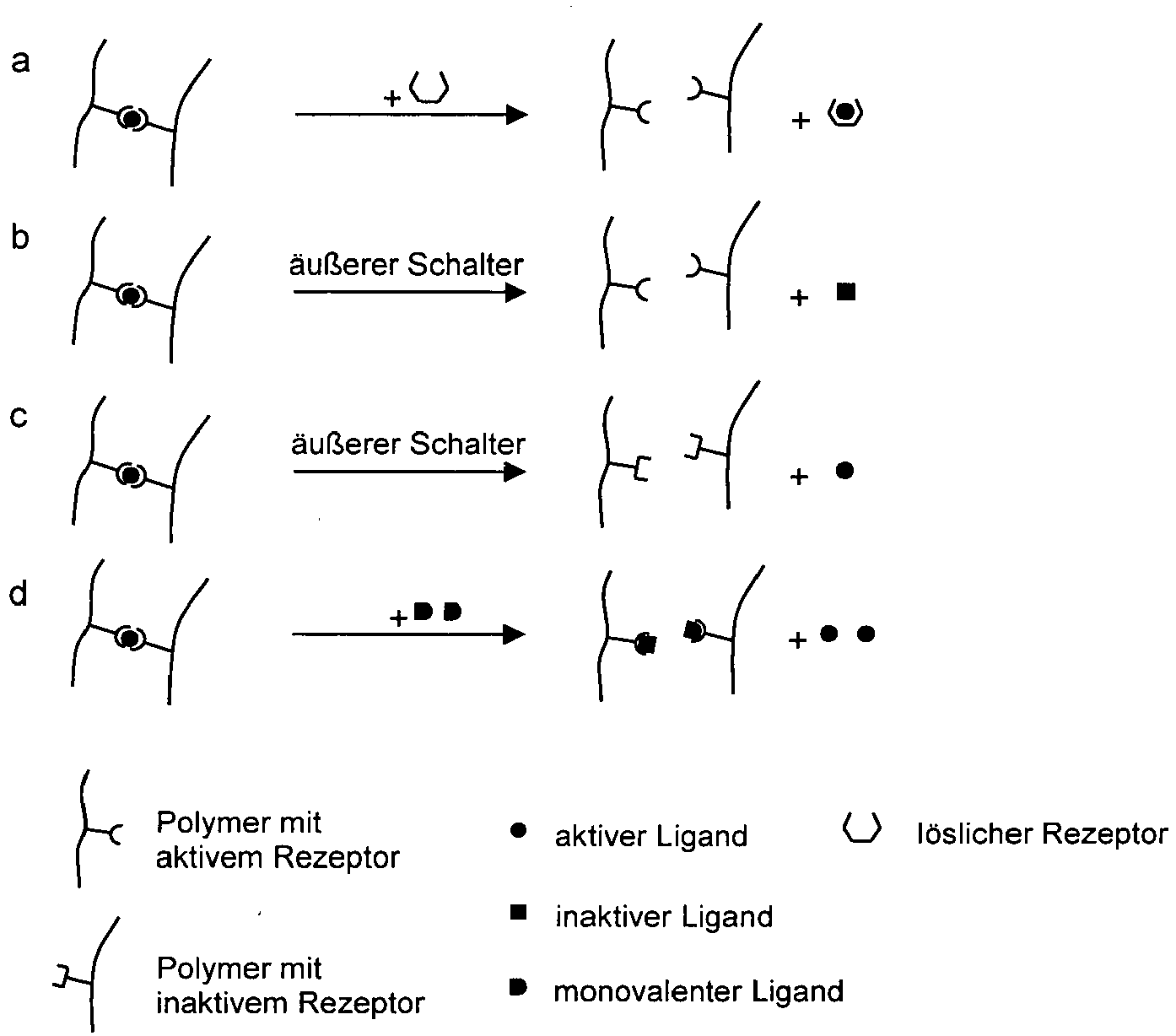
- Der vorliegenden Erfindung liegt damit die Aufgabe zugrunde, eine quervernetzte Polymermatrix bereitzustellen, die als Wirkstoffträger mit verzögerter Wirkstofffreisetzung verwendet werden kann. Insbesondere war es Aufgabe, eine derartige Polymermatrix bereitzustellen, die sich am Applikationsort, zum Beispiel am oder im Körper eines Menschen oder Tieres, vergleichsweise schnell, insbesondere innerhalb von Stunden, von selbst auflöst.
Gemäß einem Aspekt der Erfindung soll die Auflösung unabhängig von der Enzymmenge erfolgen, die am Applikationsort vorliegt. Insbesondere soll die vorliegende Erfindung auch für leicht zugängliche Körperregionen angewendet werden können, an denen nur wenige Enzyme vorliegen, wie zum Beispiel der Augenoberfläche.
Gemäß einem weiteren Aspekt war es Aufgabe der vorliegenden Erfindung, eine Polymermatrix bereitzustellen, die als selbstauflösendes Insert/Implantat zur Applikation in oder an einem Körper eingesetzt werden kann. - Weiter war es Aufgabe der vorliegenden Erfindung, eine Polymermatrix oder ein daraus hergestelltes Insert bereitzustellen, die als Wirkstoffträger einen Wirkstoff über einen längeren Zeitraum im Körper freisetzen kann.
- Die vorstehende Aufgabe wird gelöst durch eine Polymermatrix gemäß Anspruch 1, wobei die Unteransprüche bevorzugte Ausgestaltungsmerkmale der erfindungsgemäßen Polymermatrix betreffen.
- Die erfindungsgemäße Polymermatrix basiert auf einem aus einem ternären System aufgebauten Hydrogel, dessen drei Komponenten ein gelbildendes Polymer, ein quervernetzendes Agens und ein auflösendes Agens sind, dessen Aufbau nachstehend schematisch dargestellt ist:
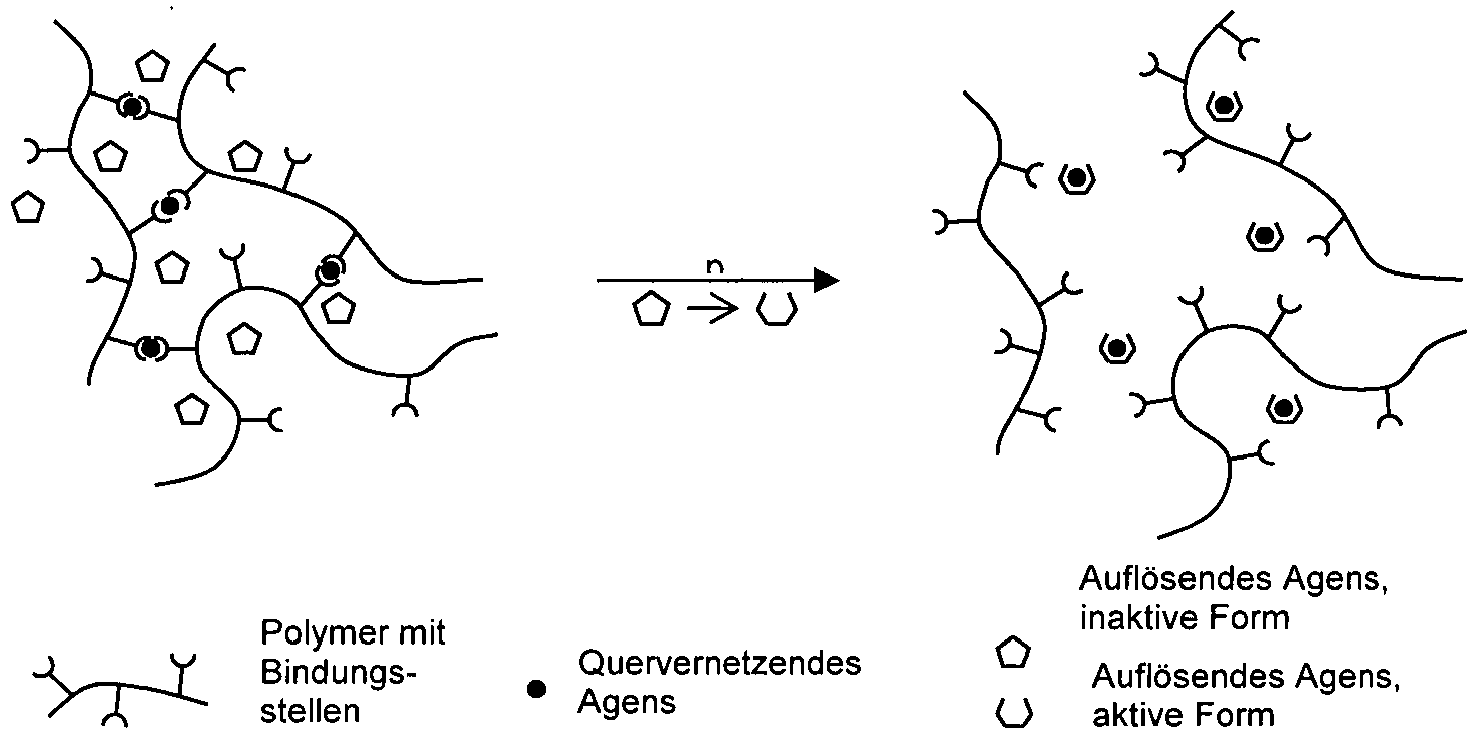
- Polymere sind langkettige, aus sich wiederholenden Einheiten (sogenannten Monomeren) aufgebaute Makromoleküle. Ein für die vorliegende Erfindung geeignetes Polymer trägt an seinen Monomeren in regelmäßiger oder unregelmäßiger Abfolge Bindungsstellen für das quervernetzende Agens. Dieses kann aufgrund seiner Struktur von mindestens zwei solchen Bindungsstellen gebunden werden und verbindet folglich zwei oder mehr Polymerketten. Auf diese Weise bilden das Polymer und das quervernetzende Agens das Gelgerüst der erfindungsgemäßen Polymermatrix aus.
Das auflösende Agens ist darin zunächst in einer inaktiven Form verteilt, ohne an einer der anderen Komponenten fixiert zu sein. Um ein solches erfindungsgemäßes Hydrogel wieder aufzulösen, wird das auflösende Agens durch einen äußeren Stimulus (z.B. eine Änderung des pH-Wertes) aktiviert. - Bei der Auflösung des erfindungsgemäßen Hydrogels handelt es sich demnach um eine Kombination der oben beschriebenen Möglichkeiten a) und c).
- Im Unterschied zum oben beschriebenen Fall a) wird das auflösende Agens (vorstehend in a) der "lösliche Rezeptor") nicht zugegeben, sondern durch einen äußeren Stimulus wie in Möglichkeit c) beschrieben, aktiviert. Im Unterschied zu dem "Rezeptor" in Fall c) liegt erfindungsgemäß das auflösende Agens frei im Gel beweglich vor.
- Wird die Affinität des auflösenden Agens entweder zu dem quervernetzenden Agens oder dessen Bindungsstellen am Polymer durch einen äußeren Einfluss geändert, wird das auflösende Agens entweder an das quervernetzende Agens oder dessen Bindungsstelle am Polymer binden und somit einen Knotenpunkt auflösen.
Folglich wird das Gelgerüst langsam zerstört und die einzelnen Komponenten gehen in Lösung. - Beispiele für für die vorliegende Erfindung geeignete, gelbildende Polymere sind Polysaccharide, die als eines ihrer Monomere Guluronsäure enthalten.
In diesen Polysacchariden wirkt die Guluronsäure als Bindungsstelle für das quervernetzende Agens. Dazu muss die Guluronsäure entlang der Polymerkette in Blöcken von mindestens zwei Einheiten Länge angeordnet sein. Diese Blöcke bilden aufgrund ihrer Konformation die beschriebene Bindungsstelle für das quervernetzende Agens. - Ein Beispiel für derartige guluronsäure-haltige Polysaccharide sind Alginate, die neben der Guluronsäure noch deren Isomer Mannuronsäure als weiteres Monomer enthalten. Gemäß einer bevorzugten Ausführungsform der Erfindung wird Natriumalginat als gelbildendes Polymer verwendet.
- Für die vorliegende Erfindung sollte der Gehalt an Guluronsäure in dem gelbildenden Polymer wie z.B. dem Alginat, vorzugsweise zwischen 30% (m/m) und 90% (m/m) liegen, und insbesondere zwischen 35% (m/m) und 75% (m/m). Beispiele für quervernetzende Agentien, die an die Guluronsäureeinheiten eines solchen Polymers binden können, sind mehrwertige Kationen.
Diese werden von den Guluronsäureblöcken verschiedener Polysaccharidketten komplexiert, so dass ein quervernetztes Gelgerüst entsteht.
Wegen seiner geringen Toxizität wird dabei Ca2+ bevorzugt eingesetzt. Die Stoffmenge an Calciumionen sollte zwischen der Hälfte und dem fünffachen des Polysaccharidgehalts liegen.
Nach Bedarf und Anwendung können auch andere Kationen wie z. B. Fe2+/3+, Al3+, Zn2+ oder weitere an sich aus der Literatur hierfür bekannte Kationen eingesetzt werden. Die zu verwendende Stoffmenge an Kationen kann dabei entsprechend der Stoffmenge an Calciumkationen gewählt werden. - Auflösende Agentien im Sinne der Erfindung, die ein solches über mehrwertige Kationen quervernetztes Hydrogel wieder auflösen können, sind beispielsweise Komplexbildner, die mit mehrwertige Kationen stabile Komplexe bilden.
- Die Stabilität eines Komplexes ist zum einen abhängig von der Art des mehrwertigen Kations und zum anderen von äußeren Einflüssen wie dem vorliegenden pH-Wert. Als äußerer Stimulus kann also der pH-Wert dienen, wobei z. B. bei niedrigen pH-Werten das mehrwertige Kation vom Polymer gebunden wird, bei neutralen bis alkalischen pH-Werten aber vom Komplexbildner
Ein Beispiel für einen solchen Komplexbildner ist Na2-EDTA (Dinatrium-Ethylendiaminacetat), das in der Lage ist, mehrwertige Kationen wie z. B. Ca2+-Ionen, aus der Guluronsäure-Komplexierung herauszulösen. - Das auflösendem Agens sollte in der Polymermatrix im äquimolaren Verhältnis zum enthaltenen quervernetzenden Agens, bzw. zu den Bindungsstellen für dieses, enthalten sein.
Jedoch kann zur Steuerung der Erosion bzw. Abbaugeschwindigkeit die Stoffmenge an auflösendem Agens in der Polymermatrix variiert werden, z.B. auf die Hälfte reduziert oder bis zum Dreifachen gesteigert werden (jeweils bezogen auf die Stoffmenge des quervernetzenden Agens). - Das auflösende Agens kann in der Polymermatrix homogen oder, nach Bedarf, an ausgewählten Bereichen verteilt vorliegen. In der Regel ist eine homogene Verteilung bevorzugt.
- Die Art des Wirkstoffes, der in die Polymermatrix inkorporiert sein kann, unterliegt prinzipiell keinen Beschränkungen, solange er mit der Polymermatrix verträglich ist.
Insbesondere eignet sich die erfindungsgemäße Matrix für die Applikation von Wirkstoffen wie Arzneimittel, die ein Protein oder Peptid sind. Beispiele hierfür sind ein Wachstumgsfaktor, Zytokin, epidermaler Wachstumsfaktor, etc.
Es können auch Wirkstoffe eingesetzt werden, die mit der Polymermatrix ionische Interaktionen ausbilden. - Es zeigen
- Figur 1
- ein Diagramm mit dem Auflösungsverhalten der Polymermatrix nach Beispiel 1,
- Figur 2
- den Aufbau einer Polymermatrix nach Beispiel 2,
- Figur 3
- ein Diagramm des Auflösungsverhaltens der Polymermatrix nach
Figur 2 ; - Figur 4
- schematisch den Aufbau einer Polymermatrix gemäß Beispiel 3; und
- Figur 5
- das Diagramm des Aufösungsverhaltens der Polymermatrix gemäß
Figur 4 . - Nachstehend wird die vorliegende Erfindung, deren Herstellung und Anwendung näher erläutert, gegebenenfalls zur besseren Anschaulichkeit unter Bezugnahme auf eine bevorzugte Ausführungsform, wobei das auflösende Agens ein Komplexbildener, wie insbesondere EDTA, das quervernetzende Agens Calciumkation und das gelbildende Polymer Na-Alginat ist.
- Natriumalginat kann bereits in der Kälte leicht mit Ca2+-Ionen quervernetzt werden, so das ein einzuarbeitender Wirkstoff, wie insbesondere Protein/Peptid, in seiner Stabilität nicht beeinflusst wird. Die Temperatur kann dazu in einem großen Bereich variieren, wobei sie nach unten hin durch den Gefrierpunkt der entsprechenden Lösung begrenzt wird; nach oben wird die Grenze durch die thermische Stabilität des einzuarbeitenden Wirkstoffes gesetzt.
- Bei der Quervernetzung wird ein Ca2+-Ion von jeweils zwei aufeinanderfolgenden Guluronsäureeinheiten zweier Polysaccharidketten komplexiert und auf diese Weise mehrere Ketten aneinander gebunden. Das entstehende quervernetzte Hydrogel ist formstabil mit elastischen Eigenschaften, wie bei einem kovalent quervernetzten Gel.
- Zwei bekannte Methoden für die Herstellung eines quervernetzten Alginatgels werden nachstehend beschrieben:
- 1. Einfaches Eintauchen von Na-Alginatgel, das ein nichtvernetztes Gel ist, in eine Ca2+-enthaltende Lösung, so dass die Ca2+-Ionen in das Gel hinein diffundieren können und die einwertigen Natriumkationen aus ihrer Verbindung verdrängen.
Selbstverständlich ist es auch möglich, die das mehrwertige Kation enthaltende Lösung, dem Na-Alginatgel zuzusetzen. - 2. Durch die sogenannte "innere Gelbildung", wobei die Ca2+-Ionen innerhalb der Natriumalginatlösung freigesetzt werden und so die Polysaccharidketten von innen heraus quervernetzen. Dazu wird entweder ein schwerlösliches Calciumsalz oder ein Komplexbildner eingesetzt, der die Ca2+-Ionen nur langsam abgibt.
- Um ein quervernetztes Calciumalginatgel wieder aufzulösen, müssen die Ca2+-Ionen entfernt und durch einwertige Kationen, z.B. Na+-Ionen, ersetzt werden. Am leichtesten ist das möglich durch einfache Diffusion der einwertigen Kationen, allerdings dauert dieser Vorgang normalerweise sehr lange und erfordert einen Überschuss an einwertigen Kationen.
- Zur Beschleunigung der Auflösung können die Ca2+-Ionen durch Komplexbildner mit erhöhter Affinität gegenüber Ca2+-Ionen gebunden werden, so dass sie nicht mehr zur Quervernetzung zur Verfügung stehen. Voraussetzung dafür ist, dass der neu ausgebildete Komplex ausreichend stabil ist, um das Calciumion aus der Bindung an die Guluronsäureblöcke zu lösen. Das ist normalerweise bei Komplexbildnern der Fall, die mit mehrwertigen Kationen sehr stabile Komplexe eingehen (logarithmische Komplexbildungskonstanten im Bereich von etwa 7 bis 36, je nach Kation).
- Problem bei diesem Vorgehen ist, dass man das quervernetzte Gel in eine Lösung des Komplexbildners tauchen muss, was für biologische Anwendungen ausscheidet.
Erfindungsgemäß wird dieses Problem gelöst, indem der Komplexbildner als auflösendes Agens in inaktiver Form, aber schaltbar aktivierbar, dem quervernetzten Hydrogel zugesetzt ist. Mit anderen Worten, in der erfindungsgemäßen Polymermatrix liegt das auflösende Agens bereits in inaktivierter Form inkorporiert vor. - Ein Beispiel für einen derartigen "schaltbaren" Komplexbildner ist EDTA, das bei niedrigen pH-Werten stabile Komplexe mit einwertigen Kationen, wie dem Natriumkation, bildet, jedoch bei einem neutralen oder basischen pH-Wert im Bereich von 7 und mehr wie er z. B. in Körperflüssigkeiten vorliegt, eine größere Komplexbildungsaffinität mit mehrwertigen Kationen wie Ca2+ hat.
- Bei der Herstellung der erfindungsgemäßen Polymermatrix muss darauf geachtet werden, dass der als auflösendes Agens eingesetzte Komplexbildner die Quervernetzung der Polymerketten durch die mehrwertigen Kationen nicht behindert. Der zur Auflösung der Matrix führende Komplex, d.h. die Aktivierung des auflösenden Agens, darf also erst nach Applikation der Polymermatrix an den Anwendungsort entstehen.
- Dies kann zum Beispiel durch eine räumliche Trennung von Komplexbildner und Kation während der Herstellung geschehen, die dann nach der Applikation durch die vorhandene Körperflüssigkeit wieder rückgängig gemacht wird wie in den Ausführungsformen gemäß Beispielen 2 und 3.
- Hierzu kann der Komplexbildner als Feststoff ungelöst in die Polymermatrix inkorporiert sein und in dieser verteilt vorliegen. In Kontakt mit einer Körperflüssigkeit geht der Feststoff allmählich in Lösung und der Komplexbildner beginnt zu wirken.
- Die Polymermatrix kann auch als Schichtsystem ausgebildet sein.
- In diesem Fall kann die räumliche Trennung dadurch bewirkt werden, dass das auflösende Agens nur einem Teil der Schichten zugesetzt wird, während der Rest der Schichten kein auflösendes Agens enthält.
- Eine bevorzugte Ausführungsform der räumlichen Trennung in einem Schichtsystem zeigt Beispiel 2, wobei die das auflösende Agens enthaltene Schicht unvernetzt ist und zwischen quervernetzen Schichten angeordnet ist.
- Eine andere, weitaus elegantere Methode ist die vorübergehende Absenkung der Stabilität des Komplexes aus mehrwertigen Kation und Komplexbildner, damit die Ionen dann leichter von den Guluronsäureblöcken gebunden werden können. Auch diese Herabsetzung der Komplexbildungskonstante muss reversibel sein, was zum Beispiel durch Benutzung von EDTA als Komplexbildner gewährleistet wird.
Die Herstellung einer solchen Polymermatrix kann analog zu der aus der Literatur bekannten Methode der inneren Gelbildung von Alginaten erfolgen. Dabei wird durch ein hydrolyselabiles, säure-abspaltendes Agens der pH-Wert einer Lösung aus gelbildenden Polymer verringert. Durch den niedrigen pH-Wert werden Ca2+-Ionen aus dem Ca-EDTA-Komplex freigesetzt, die zu der Quervernetzung des Polymers führen. - An Stelle der inneren Gelierung kann auch ein anderes Verfahren zur Quervernetzung benutzt werden, z. B. die einfache Diffusion von Ca2+-Ionen aus einer Lösung oder eine kontrollierte Diffusion durch Membranen, wobei diese Aufzählung nicht erschöpfend ist.
- Die erhaltenen Gele können getrocknet werden.
Die erhaltenen, gegebenenfalls getrockneten, Polymermatrizes können nach Bedarf in Stücke von für die jeweilige Anwendung geeigneter Größe geteilt werden. Die ggf. auf eine gewünschte Größe gebrachten Stücke können als Inserte eingesetzt werden, die in Abhängigkeit der ggf. enthaltenen Wirkstoffe geeignet verpackt lagerbar und unmittelbar einsetzbar sind.
Der Begriff "Insert" umfasst auch ein Implantat, das in den Körper eingebracht wird. - Die erfindungsgemäße Polymermatrix kann nach dem vorstehenden Verfahren auch unmittelbar am Applikationsort im Körper, in situ, erzeugt werden. Hierzu sollten die Reaktionsbedingungen vorzugsweise so gewählt werden, dass die Quervernetzung schnell erfolgt, zum Beispiel indem der pH-Wert der Reaktionslösungen entsprechend gewählt wird; im Falle von EDTA also im sauren Bereich.
Für die in situ Erzeugung können die Reaktionslösungen wie das unvernetzte gelbildende Polymer und Lösung mit quervernetzendem Agens, auf die Stelle, auf der die quervernetzte Polymermatrix ausgebildet werden soll, auf beliebige Weise aufgebracht werden wie zum Beispiel Aufspritzen, Aufsprühen, Aufpinseln etc. - Im Falle einer getrockneten Matrix wird diese bei Anwendung im menschlichen oder tierischen Körper durch Körperflüssigkeit (im Falle der Anwendung am Auge durch die Tränenflüssigkeit) rehydratisiert, wodurch sie leicht aufquillt. Beim physiologischen pH-Wert von 7,4 wird das in die Matrix inkorporierte Na2-EDTA "aktiviert", das heißt die Komplexbildungskonstante wird erhöht, wodurch sich ein stabiler Ca-EDTA-Komplex ausbildet. Die quervernetzenden Ca2+-Ionen werden folglich der Matrix entzogen, so dass sich die Polymerketten langsam auflösen können.
- Die Quellung des Polymernetzwerkes unterstützt, insbesondere auch bei anfänglicher räumlicher Trennung, die Diffusion des Komplexbildners zu den Bindungsstellen mit den mehrwertigen Kationen, um diese zu komplexieren. Auf diese Weise löst sich die Matrix innerhalb weniger Stunden in der sie umgebenden Körperflüssigkeit auf und muss nach der Applikation nicht mehr umständlich entfernt werden.
- Die erfindungsgemäße Polymermatrix zeichnet sich insbesondere dadurch aus, dass sie bereits ein auflösendes Agens inkorporiert enthält. Nach Aktivierung des auflösenden Agens durch einen äußeren Stimulus bewirkt das auflösende Agens die Lösung der Bindung zwischen Bindungsstelle und quervernetzendem Agens, sodass sich die Polymermatrix auflösen kann.
- Die Zeitdauer der Auflösung kann zum Beispiel durch die Art und/oder Menge an auflösenden Agens sowie die Art und Weise in der das Agens in der Matrix angeordnet ist, eingestellt und gesteuert werden.
- Die erfindungsgemäße Polymermatrix eignet sich damit insbesondere zur Herstellung von Inserten, die sich nach Applikation im menschlichen oder tierischen Körper von selbst auflösen beziehungsweise von diesen resorbiert werden.
- Der erfindungsgemäße Polymermatrix beziehungsweise die daraus erhaltenen Inserte können für die parenterale Applikation, zum Beispiel in Körperhöhlungen, oder zur lokalen Verabreichung von Wirkstoffen verwendet werden.
Ein Beispiel hierfür ist die lokale Anwendung am Auge. In diesem Fall kann die Aktivierung des auflösenden Agens durch die Tränenflüssigkeit erfolgen. - Ein weiteres Beispiel einer parenteralen Anwendung der erfindungsgemäßen Polymermatrix ist die Verwendung als Membran, insbesondere als Barrieremembran, zur Verringerung der postoperativen Narbenbildung nach zum Beispiel chirurgischen Eingriffen in oder am Körper.
- Die postoperative Narbenbildung zwischen einer Operationswunde und dem angrenzenden Umgebungsgewebe, auch als Adhäsion bezeichnet, ist ein schwerwiegendes medizinisches Problem in der postoperativen Wundversorgung.
Erfindungsgemäß umfasst der Begriff "postoperative Narbenbildung" jede Form der Ausbildung von Narbengewebe wie zum Beispiel Adhäsion, und Bildung von Verwachsungen. - Narbenbildung oder Adhäsion ist ein Zustand, der die Bildung von anormalen Gewebeverbindungen umfasst. Diese Gewebeverbindungen wirken sich nachteilig auf Körperfunktionen aus, können den Darm und andere Teile des Gastrointestinaltrakts verschließen (Darmobstruktion), Unfruchtbarkeit und allgemeine Beschwerden, beispielsweise Beckenschmerzen, hervorrufen. Im schlimmsten Fall kann dieser Zustand lebensbedrohlich sein.
- Die häufigste Form der Narbenbildung tritt nach einem chirurgischen Eingriff auf, jedoch auch in Folge anderer entzündlicher Prozesse oder Ereignisse wie mechanischen Verletzungen.
- Zur Vermeidung beziehungsweise Verringerung der Narbenbildung ist es bekannt, die frisch operierten Stellen von angrenzendem Umgebungsgewebe durch Applikation von sogenannten Barrieremembranen räumlich zu trennen. Dadurch werden Zellmigration und Gefässeinwachsungen aus dem benachbarten Gewebe in die frischoperierte Stelle verhindert oder verlangsamt, sodass die Wundheilung ungestört verlaufen kann. Beispielsweise kann nach einem Eingriff in den Körper auf den frisch operierten Bereich eine Barrieremembran aufgelegt werden, die dann nach Wundverschluss die frisch operierte Stelle von darüber liegender Muskulatur abschirmt.
- Ein Beispiel für eine derartige Barrieremembranen beschreibt
EP 1 588 675 B1 , wobei die Barrieremembran ein bioabbaubares Polylactidpolymer ist. Die Membran wird hier in vitro, außerhalb des Körpers, hergestellt und in eine geeignete Form gebracht und bei Bedarf appliziert. - Im Gegensatz dazu, kann die erfindungsgemäße Polymermatrix unmittelbar im Bereich der operierten Stelle in situ erhalten werden. Wie vorstehend ausgeführt, können hierzu die Reaktionslösungen zur Ausbildung eines quervernetzten Gels unmittelbar auf die gewünschte Stelle aufgebracht werden, zum Beispiel durch Spritzen, Aufsprühen, Aufpinseln etc.
Insbesondere können ihr auch gleichzeitig Wirkstoffe zugesetzt werden, die die Wundheilung fördern oder auf sonstige Weisung die Heilung unterstützen und beschleunigen. - Wie vorstehend beschrieben, kann die erfindungsgemäße Polymermatrix in für die jeweilige Applikation geeignete Dicke und Gestalt erhalten werden. Geeignete Dicken und Gestalten für den Einsatz als Barrieremembran können zum Beispiel der vorstehend genannten
EP 1 588 675 B1 entnommen werden. Beispielsweise liegen geeignete Dicken in einem Bereich zwischen 10 µm und 300 µm und vorzugsweise zwischen 10 und 100 µm. - Für die Verwendung als Barrieremembran sollte der Auflösungszeitraum vorzugsweise zwischen 7 Tagen und 12 Wochen liegen. Wie bereits ausgeführt, lässt sich der Auflösungszeitraum auf unterschiedliche Weise einstellen, zum Beispiel durch Art des auflösenden Agens, Menge an auflösenden Agens, Verteilung in der Membran usw.
Insbesondere Membranen mit einem Auflösungszeitraum von mehr als 30 Tagen können auch als Softtissue Support eingesetzt werden. - Die Matrix wurde aus Na-Alginat (65-75% Guluronsäure) in einem Schritt mittels innerer Quervernetzung hergestellt. Dazu wurden zunächst CaCl2 · 2H2O und Na2EDTA · 2H2O in äquimolarem Verhältnis in bidestilliertem Wasser gelöst und der pH-Wert der Lösung mit Natronlauge auf 7-7,5 eingestellt. Bei diesem pH-Wert ist der Ca-EDTA-Komplex am stabilsten. Das Natriumalginat wurde mit Glycerol gemischt und dann in der Ca-EDTA-Lösung gelöst (2% (m/V) Alginat, 5% (m/V) Glycerol). Zur dieser Lösung wurde 1% (m/V) Glucono-δ-lacton gegeben, welches in wässriger Lösung langsam zu Gluconsäure hydrolysiert und dadurch den pH-Wert verringert, wodurch der Ca-EDTA-Komplex instabiler wird. Damit die vorzeitige Hydrolyse zu Gluconsäure verhindert wird, wurde die Lösung sofort nach Zugabe des Lactons steril filtriert, und in eine Teflonschale gegossen und abgedeckt stehen gelassen, bis sich das Gel komplett ausgebildet hatte.
Danach wurde das Gel über Nacht bei Raumtemperatur getrocknet und anschließend Augeninserte von 5mm Durchmesser ausgestanzt.
Zur Überprüfung der Erosion wurden diese Inserte in 5 ml Tris-Puffer (pH 7,4) bei 37°C inkubiert; jede Stunde wurde der Zustand der Inserte makroskopisch überprüft und der Überstand abpipettiert. Nach Trocknung des Rückstands wurde dieser gewogen (n=3), um die Auflösung der Inserte graphisch darstellen zu können.
Der Versuch wurde über 8 Stunden durchgeführt.
Im Ergebnis erfolgte innerhalb der ersten Stunde ein Abbau um ca. 90%, mit vollständiger Auflösung nach ca. drei Stunden (s.Figur 1 ). - Zur räumlichen Trennung von Komplexbildner und Kationen wurde die Matrix aus drei Schichten aufgebaut (s.
Figur 2 ) Zunächst wurde CaHPO4 · 2H2O in neutralem Puffer suspendiert und in dieser Suspension das Na-Alginat gelöst. Nach Zugabe von Glucono-δ-lacton wurde sterilfiltriert und die erste Schicht in einer Teflonschale zuerst gelieren und dann trocknen gelassen. Danach wurde eine sterilfiltrierte Na-Alginat-Lösung, die Na2-EDTA enthielt, auf die getrocknete erste Schicht gegeben und ohne Quervernetzung trocknen gelassen. Die oberste Schicht wurde analog der ersten sterilfiltriert und aufgetragen.
Nachdem die Matrix komplett getrocknet war, wurden Augeninserte mit 5mm Durchmesser ausgestanzt und auf ihre Erosion untersucht. (s.Fig. 3 ).
Die beiden äußeren, quervernetzten Schichten verhindern das sofortige Lösen der Matrix. Erst nach erfolgter Quellung können sich diese beiden Schichten auflösen, sobald das freie Na2-EDTA aus der mittleren Schicht die Ca2+-Ionen der beiden äußeren Schichten komplexiert.
Im Ergebnis zeigte sich, dass die vollständige Auflösung wie in Beispiel 1 gleichfalls nach ca. Stunden erfolgt war, jedoch betrug der Abbau nach einer Stunde nur etwa 75%. - Diese Matrizes bestehen aus nur einer Schicht. Der Komplexbildner wurde hier als Feststoff eingearbeitet (s.
Figur 4 ) und löst sich erst nach Kontakt mit Körperflüssigkeit langsam auf. Zunächst wurde eine EDTA-Suspension hergestellt, in der ein Na-Alginat mit geringerem Guluronsäureanteil (35-45 %) gelöst wurde. Diese dickflüssige Emulsion wurde zu einem Film gezogen, über Nacht getrocknet und anschließend durch einminütiges Einlegen in eine 5%ige CaCl2-Lösung quervernetzt. Nachdem der Film wieder vollständig getrocknet war, wurden Augeninserte mit 5mm Durchmesser ausgestanzt.
Der Erosionsversuch wurde analog zu den anderen durchgeführt. Bei diesem Matrixaufbau zeigte sich allerdings, dass die Inserte sich nur sehr langsam lösten und nach 8 Stunden noch nicht komplett aufgelöst waren (s.Figur 5 ). Ein solcher Aufbau der beschriebenen Matrix eignet sich damit insbesondere für eine Langzeitanwendung.
Claims (17)
- Polymermatrix mit der Fähigkeit zur kontrollierten Freisetzung eines darin inkorporierten Wirkstoffes, wobei die Polymermatrix aus gelbildenden Polymeren und einem quervernetzenden Agens gebildet ist, wobei die gelbildenden Polymere Bindungsstellen aufweisen, die mit dem quervernetzenden Agens unter Ausbildung von Quervernetzungen reagieren, wobei die Matrix zusätzlich auflösendes Agens enthält, das nach Aktivierung die Quervernetzung wieder löst und die Selbstauflösung der Polymermatrix bewirkt,- wobei das auflösende Agens ein Komplexbildner ist, dessen Komplexbildungskonstante nach Aktivierung mit dem quervernetzenden Agens höher ist als die Komplexbildungskonstante der Bindungsstelle, wobei die Aktivierung durch die Umgebungsbedingungen am Applikationsort bewirkt wird, und
wobei im Verlauf der Selbstauflösung der Wirkstoff freigesetzt wird. - Polymermatrix nach Anspruch 1,
wobei die gelbildenden Polymere Polysaccharide sind. - Polymermatrix nach Anspruch 1 oder 2,
wobei das quervernetzende Agens mehrwertige Kationen sind. - Polymermatrix nach einem der vorhergehenden Ansprüche,
wobei das gelbildende Polysaccharid ein Alginat ist. - Polymermatrix nach einem der vorhergehenden Ansprüche,
wobei das auflösende Agens in der quervernetzten Matrix verteilt vorliegt. - Polymermatrix nach einem der Ansprüche 1 bis 4,
wobei die Matrix ein Schichtsystem ist, das aus mindestens zwei Schichten gebildet ist, wobei Schichten mit auflösenden Agens vorliegen und die Schichten mit auflösenden Agens optional nicht quervernetzt sind. - Polymermatrix nach Anspruch 6,
wobei eine nicht quervernetzte Schicht mit auflösenden Agens zwischen zwei quervernetzten Schichten ohne auflösenden Agens angeordnet ist. - Polymermatrix nach einem der vorhergehenden Ansprüche,
wobei das auflösende Agens durch Änderung des pH-Wertes aktiviert wird. - Polymermatrix nach einem der vorhergehenden Ansprüche,
wobei die Polymermatrix in getrockneter Form vorliegt. - Polymermatrix nach einem der vorhergehenden Ansprüche,
wobei die Polymermatrix einen Wirkstoff inkorporiert enthält. - Polymermatrix nach Anspruch 10,
wobei der Wirkstoff ein Arzneimittel ist. - Insert zur Applikation am und/oder in einem menschlichen oder tierischen Körper,
wobei das Insert aus einer Polymermatrix nach einem der Ansprüche 1 bis 11 gebildet ist. - Insert nach Anspruch 12,
wobei das auflösende Agens durch Kontakt der Polymermatrix mit einer Körperflüssigkeit aktiviert wird und das Insert sich auflöst. - Polymermatrix nach einem der Ansprüche 1 bis 11 oder eines Inserts nach einem der Ansprüche 12 und 13 zur Verwendung zur Applikation am Auge.
- Polymermatrix nach einem der Ansprüche 1 bis 11 oder eines Inserts nach einem der Ansprüche 12 und 13 zur Verwendung für die parenterale Applikation.
- Polymermatrix nach Anspruch 15 zur Verwendung als resorbierbare Membran zur Verminderung der Bildung von postoperativem Narbengewebe im Bereich einer postoperativen Stelle.
- Polymermatrix nach Anspruch 16, wobei die Membran in situ erzeugt wird.
Applications Claiming Priority (2)
| Application Number | Priority Date | Filing Date | Title |
|---|---|---|---|
| DE102008016998A DE102008016998A1 (de) | 2008-04-03 | 2008-04-03 | Langsam lösliche quervernetzte Matrices zur Verabreichung von Proteinarzneistoffen |
| PCT/EP2009/054023 WO2009121961A1 (de) | 2008-04-03 | 2009-04-03 | Quervernetzte polymermatrix, insbesondere zur verabreichung von wirkstoffen |
Publications (2)
| Publication Number | Publication Date |
|---|---|
| EP2268264A1 EP2268264A1 (de) | 2011-01-05 |
| EP2268264B1 true EP2268264B1 (de) | 2018-10-24 |
Family
ID=41021078
Family Applications (1)
| Application Number | Title | Priority Date | Filing Date |
|---|---|---|---|
| EP09728884.9A Active EP2268264B1 (de) | 2008-04-03 | 2009-04-03 | Quervernetzte polymermatrix, insbesondere zur verabreichung von wirkstoffen |
Country Status (6)
| Country | Link |
|---|---|
| US (1) | US20110117172A1 (de) |
| EP (1) | EP2268264B1 (de) |
| CN (1) | CN102026620B (de) |
| CA (1) | CA2720577C (de) |
| DE (1) | DE102008016998A1 (de) |
| WO (1) | WO2009121961A1 (de) |
Families Citing this family (5)
| Publication number | Priority date | Publication date | Assignee | Title |
|---|---|---|---|---|
| US20080125592A1 (en) * | 2006-10-17 | 2008-05-29 | Penick Corporation | Process for preparing oxymorphone, naltrexone, and buprenorphine |
| CA2674915C (en) * | 2006-10-17 | 2015-06-30 | Penick Corporation | Process for preparing oxymorphone |
| GB201604076D0 (en) * | 2016-03-09 | 2016-04-20 | Norwegian University Of Science And Technology | Methods of forming ionically cross-linked gels |
| WO2024134361A1 (en) * | 2022-12-23 | 2024-06-27 | Alcon Inc. | Salt activatable dissolvable polymeric eye inserts and kit of the same |
| DE102023116900A1 (de) * | 2023-06-27 | 2025-01-02 | Carl Zeiss Meditec Ag | Ophthalmische viskoelastische Vorrichtung und Kit zur Verwendung bei einer Augenoperation |
Citations (1)
| Publication number | Priority date | Publication date | Assignee | Title |
|---|---|---|---|---|
| WO2007135114A1 (en) * | 2006-05-22 | 2007-11-29 | Universita' Degli Studi Di Trieste | Hydrogels of polysaccharide mixtures for tissue engineering and as carriers of active compounds |
Family Cites Families (5)
| Publication number | Priority date | Publication date | Assignee | Title |
|---|---|---|---|---|
| DE3601132A1 (de) * | 1986-01-16 | 1987-07-23 | Christian Bannert | Verfahren zur behandlung der schleimhaut |
| NO305441B1 (no) * | 1996-07-12 | 1999-05-31 | Norsk Hydro As | Anvendelse av G-blokk polysakkarider |
| US6465014B1 (en) * | 2001-03-21 | 2002-10-15 | Isp Investments Inc. | pH-dependent sustained release, drug-delivery composition |
| DE10323794A1 (de) * | 2003-05-23 | 2004-12-09 | Dr. Suwelack Skin & Health Care Ag | Verfahren zur Herstellung von Alginat-haltigen porösen Formkörpern |
| DE102004019241A1 (de) * | 2004-04-16 | 2005-11-03 | Cellmed Ag | Injizierbare vernetzte und unvernetzte Alginate und ihre Verwendung in der Medizin und in der ästhetischen Chirurgie |
-
2008
- 2008-04-03 DE DE102008016998A patent/DE102008016998A1/de not_active Withdrawn
-
2009
- 2009-04-03 US US12/936,259 patent/US20110117172A1/en not_active Abandoned
- 2009-04-03 CA CA2720577A patent/CA2720577C/en active Active
- 2009-04-03 WO PCT/EP2009/054023 patent/WO2009121961A1/de not_active Ceased
- 2009-04-03 CN CN2009801158397A patent/CN102026620B/zh active Active
- 2009-04-03 EP EP09728884.9A patent/EP2268264B1/de active Active
Patent Citations (1)
| Publication number | Priority date | Publication date | Assignee | Title |
|---|---|---|---|---|
| WO2007135114A1 (en) * | 2006-05-22 | 2007-11-29 | Universita' Degli Studi Di Trieste | Hydrogels of polysaccharide mixtures for tissue engineering and as carriers of active compounds |
Non-Patent Citations (1)
| Title |
|---|
| MASAYUKI HARA ET AL: "Noninvasive detachment of cells on cells", MATERIALS SCIENCE AND ENGINEERING: C, vol. 17, no. 1-2, 1 November 2001 (2001-11-01), pages 107 - 112, XP055184304, ISSN: 0928-4931, DOI: 10.1016/S0928-4931(01)00317-4 * |
Also Published As
| Publication number | Publication date |
|---|---|
| WO2009121961A1 (de) | 2009-10-08 |
| CA2720577C (en) | 2017-10-31 |
| DE102008016998A1 (de) | 2009-10-08 |
| EP2268264A1 (de) | 2011-01-05 |
| HK1155391A1 (en) | 2012-05-18 |
| CN102026620A (zh) | 2011-04-20 |
| CN102026620B (zh) | 2013-08-07 |
| US20110117172A1 (en) | 2011-05-19 |
| CA2720577A1 (en) | 2009-10-08 |
Similar Documents
| Publication | Publication Date | Title |
|---|---|---|
| DE60203403T2 (de) | Therapeutische wundpflaster mit exsudat-abhängiger vergrösserung von öffnungen | |
| DE69224131T2 (de) | Polymerzusammensetzungen zur Verwendung als Implantate mit verzögerter Abgabe | |
| DE69625822T2 (de) | Implantierbare, bioresorbierbare membran und verfahren zu ihrer herstellung | |
| DE69006216T2 (de) | Biodegradierbares system zur regeneration des perodontiums. | |
| DE69528739T2 (de) | In Vivo abbaubare medizinische Vorrichtung, Zusammensetzung und Verfahren zu deren Herstellung und Zersetzung | |
| DE69520613T2 (de) | Injizierbares Verabreichungssystem für Arzneistoffe auf Kollagen-Basis und seine Verwendung | |
| DE69425509T2 (de) | Lokale verabreichung von fibrinolyse verstärkendemitteln | |
| DE69529991T2 (de) | Verwendung von stärke zu kinetischer transdermaler anwendung | |
| DE69531254T2 (de) | Arzneistofffreisetzendes chirurgisches implantat bzw. pflastermaterial | |
| EP0808158B1 (de) | Arzneiform zur abgabe von wirkstoffen an wunden | |
| EP1519713B1 (de) | Wirkstofffreisetzungssysteme auf basis von bioabbaubaren oder biokompatiblen polymeren mit formgedaechtniseffekt | |
| DE602004002908T2 (de) | Postchirurgische Antiadhäsionsschicht bestehend aus Carboxymethylchitosan und Carboxymethylcellulose und ihr Herstellungsverfahren | |
| EP2222327A2 (de) | Topische anwendung und formulierung von erythropoietin für die wundheilung der haut | |
| EP1948263A2 (de) | Nervenleitschiene | |
| DE102011007528A1 (de) | Thixotrope Zusammensetzung, insbesondere zur postchirurgischen Adhäsionsprophylaxe | |
| EP2268264A1 (de) | Quervernetzte polymermatrix, insbesondere zur verabreichung von wirkstoffen | |
| DE102012104530A1 (de) | Verwendung einer biokompatiblen Zusammensetzung | |
| EP2147687B1 (de) | Flächiges Implantat | |
| EP0809489B1 (de) | Arzneiform zur abgabe von kollagenase an wunden und verfahren zu ihrer herstellung | |
| DE202023100113U1 (de) | Dreidimensional vernetztes Hydrogel | |
| DE102009027151A1 (de) | Partikel mit induzierbarer Formänderung | |
| EP1137405B1 (de) | Wirkstoffmatrix in form eines porösen vlieses aus kollagenfibrillen, verfahren zu ihrer herstellung und verwendung | |
| DE102019126672B4 (de) | Wirkstoffdepotsystem sowie Kit zur in situ Polymerisation des Wirkstoffdepotsystems | |
| DE10314082A1 (de) | Biodegradierbares injizierbares Implantat | |
| EP1905464A2 (de) | Implantat und Verfahren zu seiner Herstellung |
Legal Events
| Date | Code | Title | Description |
|---|---|---|---|
| PUAI | Public reference made under article 153(3) epc to a published international application that has entered the european phase |
Free format text: ORIGINAL CODE: 0009012 |
|
| 17P | Request for examination filed |
Effective date: 20101004 |
|
| AK | Designated contracting states |
Kind code of ref document: A1 Designated state(s): AT BE BG CH CY CZ DE DK EE ES FI FR GB GR HR HU IE IS IT LI LT LU LV MC MK MT NL NO PL PT RO SE SI SK TR |
|
| AX | Request for extension of the european patent |
Extension state: AL BA RS |
|
| DAX | Request for extension of the european patent (deleted) | ||
| 17Q | First examination report despatched |
Effective date: 20150424 |
|
| STAA | Information on the status of an ep patent application or granted ep patent |
Free format text: STATUS: EXAMINATION IS IN PROGRESS |
|
| GRAP | Despatch of communication of intention to grant a patent |
Free format text: ORIGINAL CODE: EPIDOSNIGR1 |
|
| STAA | Information on the status of an ep patent application or granted ep patent |
Free format text: STATUS: GRANT OF PATENT IS INTENDED |
|
| INTG | Intention to grant announced |
Effective date: 20180507 |
|
| GRAS | Grant fee paid |
Free format text: ORIGINAL CODE: EPIDOSNIGR3 |
|
| GRAA | (expected) grant |
Free format text: ORIGINAL CODE: 0009210 |
|
| STAA | Information on the status of an ep patent application or granted ep patent |
Free format text: STATUS: THE PATENT HAS BEEN GRANTED |
|
| AK | Designated contracting states |
Kind code of ref document: B1 Designated state(s): AT BE BG CH CY CZ DE DK EE ES FI FR GB GR HR HU IE IS IT LI LT LU LV MC MK MT NL NO PL PT RO SE SI SK TR |
|
| REG | Reference to a national code |
Ref country code: GB Ref legal event code: FG4D Free format text: NOT ENGLISH |
|
| REG | Reference to a national code |
Ref country code: CH Ref legal event code: EP |
|
| REG | Reference to a national code |
Ref country code: IE Ref legal event code: FG4D Free format text: LANGUAGE OF EP DOCUMENT: GERMAN |
|
| REG | Reference to a national code |
Ref country code: AT Ref legal event code: REF Ref document number: 1055845 Country of ref document: AT Kind code of ref document: T Effective date: 20181115 |
|
| REG | Reference to a national code |
Ref country code: DE Ref legal event code: R096 Ref document number: 502009015392 Country of ref document: DE |
|
| REG | Reference to a national code |
Ref country code: NL Ref legal event code: MP Effective date: 20181024 |
|
| REG | Reference to a national code |
Ref country code: LT Ref legal event code: MG4D |
|
| PG25 | Lapsed in a contracting state [announced via postgrant information from national office to epo] |
Ref country code: NL Free format text: LAPSE BECAUSE OF FAILURE TO SUBMIT A TRANSLATION OF THE DESCRIPTION OR TO PAY THE FEE WITHIN THE PRESCRIBED TIME-LIMIT Effective date: 20181024 |
|
| PG25 | Lapsed in a contracting state [announced via postgrant information from national office to epo] |
Ref country code: ES Free format text: LAPSE BECAUSE OF FAILURE TO SUBMIT A TRANSLATION OF THE DESCRIPTION OR TO PAY THE FEE WITHIN THE PRESCRIBED TIME-LIMIT Effective date: 20181024 Ref country code: NO Free format text: LAPSE BECAUSE OF FAILURE TO SUBMIT A TRANSLATION OF THE DESCRIPTION OR TO PAY THE FEE WITHIN THE PRESCRIBED TIME-LIMIT Effective date: 20190124 Ref country code: IS Free format text: LAPSE BECAUSE OF FAILURE TO SUBMIT A TRANSLATION OF THE DESCRIPTION OR TO PAY THE FEE WITHIN THE PRESCRIBED TIME-LIMIT Effective date: 20190224 Ref country code: FI Free format text: LAPSE BECAUSE OF FAILURE TO SUBMIT A TRANSLATION OF THE DESCRIPTION OR TO PAY THE FEE WITHIN THE PRESCRIBED TIME-LIMIT Effective date: 20181024 Ref country code: LT Free format text: LAPSE BECAUSE OF FAILURE TO SUBMIT A TRANSLATION OF THE DESCRIPTION OR TO PAY THE FEE WITHIN THE PRESCRIBED TIME-LIMIT Effective date: 20181024 Ref country code: PL Free format text: LAPSE BECAUSE OF FAILURE TO SUBMIT A TRANSLATION OF THE DESCRIPTION OR TO PAY THE FEE WITHIN THE PRESCRIBED TIME-LIMIT Effective date: 20181024 Ref country code: BG Free format text: LAPSE BECAUSE OF FAILURE TO SUBMIT A TRANSLATION OF THE DESCRIPTION OR TO PAY THE FEE WITHIN THE PRESCRIBED TIME-LIMIT Effective date: 20190124 Ref country code: HR Free format text: LAPSE BECAUSE OF FAILURE TO SUBMIT A TRANSLATION OF THE DESCRIPTION OR TO PAY THE FEE WITHIN THE PRESCRIBED TIME-LIMIT Effective date: 20181024 Ref country code: LV Free format text: LAPSE BECAUSE OF FAILURE TO SUBMIT A TRANSLATION OF THE DESCRIPTION OR TO PAY THE FEE WITHIN THE PRESCRIBED TIME-LIMIT Effective date: 20181024 |
|
| PG25 | Lapsed in a contracting state [announced via postgrant information from national office to epo] |
Ref country code: SE Free format text: LAPSE BECAUSE OF FAILURE TO SUBMIT A TRANSLATION OF THE DESCRIPTION OR TO PAY THE FEE WITHIN THE PRESCRIBED TIME-LIMIT Effective date: 20181024 Ref country code: GR Free format text: LAPSE BECAUSE OF FAILURE TO SUBMIT A TRANSLATION OF THE DESCRIPTION OR TO PAY THE FEE WITHIN THE PRESCRIBED TIME-LIMIT Effective date: 20190125 Ref country code: PT Free format text: LAPSE BECAUSE OF FAILURE TO SUBMIT A TRANSLATION OF THE DESCRIPTION OR TO PAY THE FEE WITHIN THE PRESCRIBED TIME-LIMIT Effective date: 20190224 |
|
| REG | Reference to a national code |
Ref country code: DE Ref legal event code: R097 Ref document number: 502009015392 Country of ref document: DE |
|
| PG25 | Lapsed in a contracting state [announced via postgrant information from national office to epo] |
Ref country code: DK Free format text: LAPSE BECAUSE OF FAILURE TO SUBMIT A TRANSLATION OF THE DESCRIPTION OR TO PAY THE FEE WITHIN THE PRESCRIBED TIME-LIMIT Effective date: 20181024 Ref country code: IT Free format text: LAPSE BECAUSE OF FAILURE TO SUBMIT A TRANSLATION OF THE DESCRIPTION OR TO PAY THE FEE WITHIN THE PRESCRIBED TIME-LIMIT Effective date: 20181024 Ref country code: CZ Free format text: LAPSE BECAUSE OF FAILURE TO SUBMIT A TRANSLATION OF THE DESCRIPTION OR TO PAY THE FEE WITHIN THE PRESCRIBED TIME-LIMIT Effective date: 20181024 |
|
| PG25 | Lapsed in a contracting state [announced via postgrant information from national office to epo] |
Ref country code: SK Free format text: LAPSE BECAUSE OF FAILURE TO SUBMIT A TRANSLATION OF THE DESCRIPTION OR TO PAY THE FEE WITHIN THE PRESCRIBED TIME-LIMIT Effective date: 20181024 Ref country code: EE Free format text: LAPSE BECAUSE OF FAILURE TO SUBMIT A TRANSLATION OF THE DESCRIPTION OR TO PAY THE FEE WITHIN THE PRESCRIBED TIME-LIMIT Effective date: 20181024 Ref country code: RO Free format text: LAPSE BECAUSE OF FAILURE TO SUBMIT A TRANSLATION OF THE DESCRIPTION OR TO PAY THE FEE WITHIN THE PRESCRIBED TIME-LIMIT Effective date: 20181024 |
|
| PLBE | No opposition filed within time limit |
Free format text: ORIGINAL CODE: 0009261 |
|
| STAA | Information on the status of an ep patent application or granted ep patent |
Free format text: STATUS: NO OPPOSITION FILED WITHIN TIME LIMIT |
|
| 26N | No opposition filed |
Effective date: 20190725 |
|
| PG25 | Lapsed in a contracting state [announced via postgrant information from national office to epo] |
Ref country code: SI Free format text: LAPSE BECAUSE OF FAILURE TO SUBMIT A TRANSLATION OF THE DESCRIPTION OR TO PAY THE FEE WITHIN THE PRESCRIBED TIME-LIMIT Effective date: 20181024 |
|
| REG | Reference to a national code |
Ref country code: CH Ref legal event code: PL |
|
| REG | Reference to a national code |
Ref country code: BE Ref legal event code: MM Effective date: 20190430 |
|
| PG25 | Lapsed in a contracting state [announced via postgrant information from national office to epo] |
Ref country code: LU Free format text: LAPSE BECAUSE OF NON-PAYMENT OF DUE FEES Effective date: 20190403 Ref country code: MC Free format text: LAPSE BECAUSE OF FAILURE TO SUBMIT A TRANSLATION OF THE DESCRIPTION OR TO PAY THE FEE WITHIN THE PRESCRIBED TIME-LIMIT Effective date: 20181024 |
|
| PG25 | Lapsed in a contracting state [announced via postgrant information from national office to epo] |
Ref country code: LI Free format text: LAPSE BECAUSE OF NON-PAYMENT OF DUE FEES Effective date: 20190430 Ref country code: CH Free format text: LAPSE BECAUSE OF NON-PAYMENT OF DUE FEES Effective date: 20190430 |
|
| PG25 | Lapsed in a contracting state [announced via postgrant information from national office to epo] |
Ref country code: BE Free format text: LAPSE BECAUSE OF NON-PAYMENT OF DUE FEES Effective date: 20190430 |
|
| PG25 | Lapsed in a contracting state [announced via postgrant information from national office to epo] |
Ref country code: TR Free format text: LAPSE BECAUSE OF FAILURE TO SUBMIT A TRANSLATION OF THE DESCRIPTION OR TO PAY THE FEE WITHIN THE PRESCRIBED TIME-LIMIT Effective date: 20181024 |
|
| PG25 | Lapsed in a contracting state [announced via postgrant information from national office to epo] |
Ref country code: IE Free format text: LAPSE BECAUSE OF NON-PAYMENT OF DUE FEES Effective date: 20190403 |
|
| REG | Reference to a national code |
Ref country code: AT Ref legal event code: MM01 Ref document number: 1055845 Country of ref document: AT Kind code of ref document: T Effective date: 20190403 |
|
| PG25 | Lapsed in a contracting state [announced via postgrant information from national office to epo] |
Ref country code: AT Free format text: LAPSE BECAUSE OF NON-PAYMENT OF DUE FEES Effective date: 20190403 |
|
| PG25 | Lapsed in a contracting state [announced via postgrant information from national office to epo] |
Ref country code: CY Free format text: LAPSE BECAUSE OF FAILURE TO SUBMIT A TRANSLATION OF THE DESCRIPTION OR TO PAY THE FEE WITHIN THE PRESCRIBED TIME-LIMIT Effective date: 20181024 |
|
| PG25 | Lapsed in a contracting state [announced via postgrant information from national office to epo] |
Ref country code: HU Free format text: LAPSE BECAUSE OF FAILURE TO SUBMIT A TRANSLATION OF THE DESCRIPTION OR TO PAY THE FEE WITHIN THE PRESCRIBED TIME-LIMIT; INVALID AB INITIO Effective date: 20090403 Ref country code: MT Free format text: LAPSE BECAUSE OF FAILURE TO SUBMIT A TRANSLATION OF THE DESCRIPTION OR TO PAY THE FEE WITHIN THE PRESCRIBED TIME-LIMIT Effective date: 20181024 |
|
| PG25 | Lapsed in a contracting state [announced via postgrant information from national office to epo] |
Ref country code: MK Free format text: LAPSE BECAUSE OF FAILURE TO SUBMIT A TRANSLATION OF THE DESCRIPTION OR TO PAY THE FEE WITHIN THE PRESCRIBED TIME-LIMIT Effective date: 20181024 |
|
| PGFP | Annual fee paid to national office [announced via postgrant information from national office to epo] |
Ref country code: DE Payment date: 20250429 Year of fee payment: 17 |
|
| PGFP | Annual fee paid to national office [announced via postgrant information from national office to epo] |
Ref country code: FR Payment date: 20250424 Year of fee payment: 17 |
|
| PGFP | Annual fee paid to national office [announced via postgrant information from national office to epo] |
Ref country code: GB Payment date: 20260323 Year of fee payment: 18 |