EP2265060B1 - Signalisation du mode sommeil dans un système de communication multi-saut - Google Patents
Signalisation du mode sommeil dans un système de communication multi-saut Download PDFInfo
- Publication number
- EP2265060B1 EP2265060B1 EP10173925A EP10173925A EP2265060B1 EP 2265060 B1 EP2265060 B1 EP 2265060B1 EP 10173925 A EP10173925 A EP 10173925A EP 10173925 A EP10173925 A EP 10173925A EP 2265060 B1 EP2265060 B1 EP 2265060B1
- Authority
- EP
- European Patent Office
- Prior art keywords
- sleep
- control signal
- information
- station
- transmission
- Prior art date
- Legal status (The legal status is an assumption and is not a legal conclusion. Google has not performed a legal analysis and makes no representation as to the accuracy of the status listed.)
- Ceased
Links
Images




Classifications
-
- H—ELECTRICITY
- H04—ELECTRIC COMMUNICATION TECHNIQUE
- H04B—TRANSMISSION
- H04B7/00—Radio transmission systems, i.e. using radiation field
- H04B7/24—Radio transmission systems, i.e. using radiation field for communication between two or more posts
- H04B7/26—Radio transmission systems, i.e. using radiation field for communication between two or more posts at least one of which is mobile
- H04B7/2603—Arrangements for wireless physical layer control
- H04B7/2606—Arrangements for base station coverage control, e.g. by using relays in tunnels
-
- H—ELECTRICITY
- H04—ELECTRIC COMMUNICATION TECHNIQUE
- H04W—WIRELESS COMMUNICATION NETWORKS
- H04W56/00—Synchronisation arrangements
-
- H—ELECTRICITY
- H04—ELECTRIC COMMUNICATION TECHNIQUE
- H04B—TRANSMISSION
- H04B7/00—Radio transmission systems, i.e. using radiation field
- H04B7/14—Relay systems
- H04B7/15—Active relay systems
- H04B7/155—Ground-based stations
-
- H—ELECTRICITY
- H04—ELECTRIC COMMUNICATION TECHNIQUE
- H04W—WIRELESS COMMUNICATION NETWORKS
- H04W52/00—Power management, e.g. Transmission Power Control [TPC] or power classes
- H04W52/02—Power saving arrangements
- H04W52/0209—Power saving arrangements in terminal devices
- H04W52/0225—Power saving arrangements in terminal devices using monitoring of external events, e.g. the presence of a signal
- H04W52/0229—Power saving arrangements in terminal devices using monitoring of external events, e.g. the presence of a signal where the received signal is a wanted signal
- H04W52/0235—Power saving arrangements in terminal devices using monitoring of external events, e.g. the presence of a signal where the received signal is a wanted signal where the received signal is a power saving command
-
- H—ELECTRICITY
- H04—ELECTRIC COMMUNICATION TECHNIQUE
- H04W—WIRELESS COMMUNICATION NETWORKS
- H04W56/00—Synchronisation arrangements
- H04W56/004—Synchronisation arrangements compensating for timing error of reception due to propagation delay
- H04W56/005—Synchronisation arrangements compensating for timing error of reception due to propagation delay compensating for timing error by adjustment in the receiver
-
- H—ELECTRICITY
- H04—ELECTRIC COMMUNICATION TECHNIQUE
- H04W—WIRELESS COMMUNICATION NETWORKS
- H04W88/00—Devices specially adapted for wireless communication networks, e.g. terminals, base stations or access point devices
- H04W88/18—Service support devices; Network management devices
-
- H—ELECTRICITY
- H04—ELECTRIC COMMUNICATION TECHNIQUE
- H04W—WIRELESS COMMUNICATION NETWORKS
- H04W40/00—Communication routing or communication path finding
- H04W40/02—Communication route or path selection, e.g. power-based or shortest path routing
- H04W40/22—Communication route or path selection, e.g. power-based or shortest path routing using selective relaying for reaching a BTS [Base Transceiver Station] or an access point
-
- Y—GENERAL TAGGING OF NEW TECHNOLOGICAL DEVELOPMENTS; GENERAL TAGGING OF CROSS-SECTIONAL TECHNOLOGIES SPANNING OVER SEVERAL SECTIONS OF THE IPC; TECHNICAL SUBJECTS COVERED BY FORMER USPC CROSS-REFERENCE ART COLLECTIONS [XRACs] AND DIGESTS
- Y02—TECHNOLOGIES OR APPLICATIONS FOR MITIGATION OR ADAPTATION AGAINST CLIMATE CHANGE
- Y02D—CLIMATE CHANGE MITIGATION TECHNOLOGIES IN INFORMATION AND COMMUNICATION TECHNOLOGIES [ICT], I.E. INFORMATION AND COMMUNICATION TECHNOLOGIES AIMING AT THE REDUCTION OF THEIR OWN ENERGY USE
- Y02D30/00—Reducing energy consumption in communication networks
- Y02D30/70—Reducing energy consumption in communication networks in wireless communication networks
Definitions
- FIG. 19 illustrates a single-cell two-hop wireless communication system comprising a base station BS (known in the context of 3G communication systems as "node-B" NB) a relay node RN (also known as a relay station RS) and a user equipment UE (also known as mobile station MS).
- BS base station
- RN relay node
- MS user equipment
- the base station comprises the source station (S) and the user equipment comprises the destination station (D).
- the user equipment comprises the source station and the base station comprises the destination station.
- the relay node is an example of an intermediate apparatus (I) and comprises: a receiver, operable to receive data from the source apparatus; and a transmitter, operable to transmit this data, or a derivative thereof, to the destination apparatus.
- Simple analogue repeaters or digital repeaters have been used as relays to improve or provide coverage in dead spots. They can either operate in a different transmission frequency band from the source station to prevent interference between the source transmission and the repeater transmission, or they can operate at a time when there is no transmission from the source station.
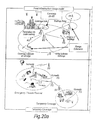
- Figure 20 illustrates a number of applications for relay stations.
- the coverage provided by a relay station may be "in-fill” to allow access to the communication network for mobile stations which may otherwise be in the shadow of other objects or otherwise unable to receive a signal of sufficient strength from the base station despite being within the normal range of the base station.
- Range extension is also shown, in which a relay station allows access when a mobile station is outside the normal data transmission range of a base station.
- in-fill shown at the top right of Figure 20 is positioning of a nomadic relay station to allow penetration of coverage within a building that could be above, at, or below ground level.
- a final application shown in the bottom right of Figure 20 provides access to a network using a relay positioned on a vehicle.
- Relays may also be used in conjunction with advanced transmission techniques to enhance gain of the communications system as explained below.
- pathloss propagation loss
- dB pathloss L
- d (metres) is the transmitter-receiver separation
- the sum of the absolute path losses experienced over the indirect link SI + ID may be less than the pathloss experienced over the direct link SD.
- Multi-hop systems are suitable for use with multi-carrier transmission.
- a multi-carrier transmission system such as FDM (frequency division multiplex), OFDM (orthogonal frequency division multiplex) or DMT (discrete multi-tone)
- FDM frequency division multiplex
- OFDM orthogonal frequency division multiplex
- DMT discrete multi-tone
- a single data stream is modulated onto N parallel sub-carriers, each sub-carrier signal having its own frequency range. This allows the total bandwidth (i.e. the amount of data to be sent in a given time interval) to be divided over a plurality of sub-carriers thereby increasing the duration of each data symbol. Since each sub-carrier has a lower information rate, multi-carrier systems benefit from enhanced immunity to channel induced distortion compared with single carrier systems.
- the channel distortion correction entity within a multicarrier receiver can be of significantly lower complexity of its counterpart within a single carrier receiver when the system bandwidth is in excess of the coherence bandwidth of the channel.
- Orthogonal frequency division multiplexing is a modulation technique that is based on FDM.
- An OFDM system uses a plurality of sub-carrier frequencies which are orthogonal in a mathematical sense so that the sub-carriers' spectra may overlap without interference due to the fact they are mutually independent.
- the orthogonality of OFDM systems removes the need for guard band frequencies and thereby increases the spectral efficiency of the system.
- OFDM has been proposed and adopted for many wireless systems. It is currently used in Asymmetric Digital Subscriber Line (ADSL) connections, in some wireless LAN applications (such as WiFi devices based on the IEEE802.11a/g standard), and in wireless MAN applications such as WiMAX (based on the IEEE 802.16 standard).
- ADSL Asymmetric Digital Subscriber Line
- OFDM is often used in conjunction with channel coding, an error correction technique, to create coded orthogonal FDM or COFDM.
- COFDM is now widely used in digital telecommunications systems to improve the performance of an OFDM based system in a multipath environment where variations in the channel distortion can be seen across both subcarriers in the frequency domain and symbols in the time domain.
- the system has found use in video and audio broadcasting, such as DVB and DAB, as well as certain types of computer networking technology.
- an OFDM symbol is the composite signal of all N sub-carrier signals.
- the sub-carrier vector in (1) onto which each of the source signals is modulated c ⁇ C n , c (c 0 , c 1 ..c N-1 ) is a vector of N constellation symbols from a finite constellation.
- DFT Discrete Fourier Transform
- FFT Fast Fourier Transform
- OFDMA Orthogonal Frequency Division Multiple Access
- FDD frequency division duplexing
- TDD time division duplexing
- Both approaches (TDD & FDD) have their relative merits and are both well used techniques for single hop wired and wireless communication systems.
- IEEE802.16 standard incorporates both an FDD and TDD mode.
- Figure 21 illustrates the single hop TDD frame structure used in the OFDMA physical layer mode of the IEEE802.16 standard (WiMAX).
- Each frame is divided into DL and UL subframes, each being a discrete transmission interval. They are separated by Transmit/Receive and Receive/Transmit Transition Guard interval (TTG and RTG respectively).
- TTG and RTG Transmit/Receive and Receive/Transmit Transition Guard interval respectively.
- Each DL subframe starts with a preamble followed by the Frame Control Header (FCH), the DL-MAP, and the UL-MAP.
- FCH Frame Control Header
- DL-MAP DL-MAP
- UL-MAP UL-MAP
- the FCH contains the DL Frame Prefix (DLFP) to specify the burst profile and the length of the DL-MAP.
- DLFP DL Frame Prefix
- the DLFP is a data structure transmitted at the beginning of each frame and contains information regarding the current frame; it is mapped to the FCH.
- Simultaneous DL allocations can be broadcast, multicast and unicast and they can also include an allocation for another BS rather than a serving BS.
- Simultaneous ULs can be data allocations and ranging or bandwidth requests.
- US2005/016088 discloses a radio communication method, a radio communication system and a wireless terminal by which low power consumption and the flexibility of a network can be realized.
- a base station and wireless terminals change an intermittent receive period and the preamble length of data on the basis of characteristics of the multihop radio network to carry out the intermittent receiving of data.
- a wireless terminal relaying data can receive the data reliably and a useless boot-up of a receiving part and standby time can be largely reduced to achieve low power consumption.
- US2006/0120303 discloses an apparatus, comprising a transceiver capable of dynamic cluster-based sleep/wake scheduling using hierarchical routing, cluster formation, and sleep-wake synchronization.
- the hierarchical routing may comprise a sink node capable of sending periodic route updates, which may propagate through a network to regular nodes and the route updates may include metrics allowing the regular nodes to select a "best" path to the sink node.
- the metrics may include hop count or end-to-end reliability and the regular node may track a next hop which optimizes the metric; and packets originating or forwarded by the regular node to the sink node may be sent to the next hop.
- the route updates may propagate across a backbone network to cluster heads.
- a sleep-mode mobile station will switch its status to sleep or awake, when falling into sleep window or listening window respectively.
- base station BS
- relay station RS
- BS controls the types of sleep mode, and the timing information of each window.
- a BS will schedule listening, and sleep windows for MS.
- the BS will exchange information with MS.
- the BS will transmit a traffic indication to MS during listening window to indicate whether there is buffered packet to MS. Therefore, the MS has to be synchronized with BS to ensure exchanging important information during listening windows.
- the relay station In WiMAX relay systems, the relay station (RS) will relay uplink or downlink information for mobile stations (MSs) and base station (BS).
- MSs mobile stations
- BS base station
- the RS just relays the uplink, then it may have no knowledge about the control messages transmitted by BS to MS (downlink), which affect uplink communication. For example, in WiMAX sleep mode, an RS shall allocate bandwidth for MS on time for a scheduled event, which is instructed by a downlink message. This downlink message may not be decoded by RS. Therefore, new mechanisms should be designed to support RS to obtain the relevant control information sent by downlink messages.
- the RS relays both the uplink and downlink, it should make sure the MS can be synchronized with BS, especially for sleep-mode MSs. For instance, when an RS cannot relay the timing control information within the current frame, the RS shall adjust the timing information transmitted from BS to MS.
- Scenario A Relay Station relays both downlink and uplink
- the relay station only relays MS's uplink, and the MS can receive all downlink information from BS directly, which means the uplink and downlink is asymmetric.
- the RS Since the RS cannot hear control messages transmitted by BS to MS (in downlink), which will affect the uplink communication between MS and BS, then the RS may not perform proper operations, such as resource allocation, to meet the relevant demands of those control messages.
- MSs may perform scheduled operations, such as ranging requests. These operations normally will be instructed by the control message in downlink. If the RS does not decode these messages, it cannot allocate resources to MSs on time, thus the scheduled operations may failed.
- an RS will receive PDUs (Protocol Data Units) from BS. Then, it will extract the MAC messages from the received PDUs, and parse the controlling information, which will influence the uplink transmission. Eventually, in terms of the parsed controlling information, the RS shall properly schedules the resources, such as time window, and subchannels (or frequency bands), for MSs transmitting message to BS.
- PDUs Protocol Data Units
- the RS shall properly schedules the resources, such as time window, and subchannels (or frequency bands), for MSs transmitting message to BS.
- the BS can send a dedicated message to RS to inform the scheduled events in uplink.
- a sleep mode can be requested by MS, RS, or BS.
- Figure 6 shows the message flow chart when an MS wants to start sleep mode.
- an MS If an MS wants to start sleep mode , it shall asks RS to relay a MOB_SLP-REQ message to BS to request to entering sleep mode.
- the BS can approve or refuse the request by sending a message, MOB_SLP-RSP.
- the BS also needs to ensure the RS can receive the corresponding information in this MOB_SLP-RSP message within the same subframe by sending a dedicated message to RS or allowing RS to receive the sleep-mode control messages.
- MOB_SLP-RSP will indicate the timing information of sleep and listening windows, such as start frame number for first sleep window, size information of the listening window, and sleep window. These parameters should also be recorded by RS.
- MS If MS cannot hear any response message from BS within a fixed period, it means the request is failed. Then, if necessary, the MS will restart to send MOB_SLP-REQ to RS.
- the RS can schedule the resources for uplink relaying, or it may stop to allocate bandwidth to the corresponding MS.
- the sleep mode also can be requested by BS .
- Figure 7 shows the message flow chart when a BS wants to start sleep mode.
- the sleep mode also can be requested by RS. For example, when an RS has not enough bandwidth resources for its MSs, it may put some MSs with lower QoS demands into sleep mode.
- Figure 8 shows the message flow chart when a BS wants to start sleep mode.
- the BS will transmit traffic indication to MS, and MS shall be awake to receive the necessary information within downlink subframe.
- the BS also needs to send the traffic indication and other controlling information relating to this MS to the corresponding RS in the same subframe, thus the RS can predict when the MS will fall in sleep, and can avoid communicating with the MS when it is sleeping.
- an MS If an MS receives a traffic indication, which indicates that BS has buffered traffic, the MS will keep awake to receive the information from BS until receiving an MOB_SLP-REQ message from BS again. In terms of the information within the received MOB_SLP-REQ, the MS will fall into sleep mode again or terminate the sleep mode.
- the RS may allocate bandwidth for MS to maintaining the connections with active Power-Saving Class.
- Figure 9 shows the message flow chart, when an MS in sleep mode.
- the sleep mode can be terminated by BS, RS, or MS.
- BS wants to terminate the sleep mode, it has to send a MOB_SLP-RSP to MS and RS within a listen window to tell them when the sleep mode should be ceased.
- the message flow chart is shown in Figure 10 .
- an RS wants to stop a sleep mode for an MS, it will send an MOB_SLP-REO message to BS to request to stop this MS's sleep mode. Then the BS will send the MOB_SLP-RSP message to both the RS and MS to stop the MS's sleep mode, or to refuse to cease the sleep mode.
- the corresponding message flow chart is shown in Figure 11 .
- the MS wants to stop the sleep mode, it firstly needs to send an MOB_SLP-REO message to BS through the RS. Then, the BS will send an MOB_SLP-RSP message to both RS and MS to either stop the sleep mode, or refuse to stop it.
- the message flow chart is shown in Figure 12 .
- the RS relays both the uplink and downlink.
- the RS cannot relay the control messages, which are enclosing timing information, to MSs within the same frame (For example, the RS may not have enough resources to relay the control messages to MSs within current frame), then these control information will be delayed by at least one frame. In this case, the absolute timing information within these timing-related messages for MSs shall be shifted by the corresponding latency introduced by relaying. If the communication is bi-directional, the RS also needs to inform BS the modified the timing information, thus guaranteeing the uplink communication as well.
- a BS informs the MS to enter sleep mode and start a listening window after two frames, which is in the frame n+3#. Since the RS introduces one-frame delay, the MS actually starts the listening window in the frame n+4#, thus losing the synchronization with BS.
- Figure 15 illustrates the proposed algorithm to solve this problem, when RS relays timing-related control message, such as MOB_SLP-RSP, and RNG_RSP messages in WiMAX.
- an RS will receive PDUs (Protocol Data Units) from BS. Then, it will extract the MAC messages from the received PDUs, and parse the controlling information, which will influence the timing control in MSs. If the RS cannot relay a timing-related message within current frame, and the timing information is absolute, it will modify the timing information in this message, and relay the message to MSs to compensate its delay. If the communication is bi-directional, the RS also needs to inform the change of timing information to BS as well.
- PDUs Protocol Data Units
- the proposed algorithm can also be used to maximize the sleep duration for a RS.
- the RS can modify the MS's start time of the first listening window to align the existed sleep-mode MS's start time of listening window, thus the possible listening window in RS can be decreased.
- Figure 17 shows an example that the start time of the first listen window in MS 2# does not aligned with MS 1#.
- Figure 18 shows the listening window in RS can be shortened by aligning the start time of the first listening window in MS 2#.
- Embodiments of the present invention may be implemented in hardware, or as software modules running on one or more processors, or on a combination thereof. That is, those skilled in the art will appreciate that a microprocessor or digital signal processor (DSP) may be used in practice to implement some or all of the functionality of a transmitter embodying the present invention.
- DSP digital signal processor
- the invention may also be embodied as one or more device or apparatus programs (e.g. computer programs and computer program products) for carrying out part or all of any of the methods described herein.
- Such programs embodying the present invention may be stored on computer-readable media, or could, for example, be in the form of one or more signals.
- Such signals may be data signals downloadable from an internet website, or provided on a carrier signal, or in any other form.
- Embodiments of the present invention provide a timing adjustment method for use in a multi-hop communication system, the system comprising a source apparatus, a destination apparatus and one or more intermediate apparatuses, said source apparatus being operable to transmit information along a series of links forming a communication path extending from the source apparatus to the destination apparatus via the or each intermediate apparatus, and the or each intermediate apparatus being operable to receive information from a previous apparatus along the path and to transmit the received information to a subsequent apparatus along the path, the system being configured to transmit information in a plurality of consecutive labelled intervals, the method comprising:
- the or each intermediate apparatus is a relay station.
Landscapes
- Engineering & Computer Science (AREA)
- Computer Networks & Wireless Communication (AREA)
- Signal Processing (AREA)
- Mobile Radio Communication Systems (AREA)
Claims (9)
- Procédé de signalisation destiné à être utilisé dans une signalisation de mode de veille dans un système de communication sans fil, le système comprenant une station de base (BS), une station mobile (MS) et au moins une station relais (RS), le procédé comprenant :la transmission d'un signal de commande relatif au mode de veille depuis la station de base (BS), soit directement soit indirectement, à la station mobile (MS) dans une première transmission ; etla transmission dudit signal de commande ou d'un signal de commande correspondant depuis la station de base (BS) à l'au moins une station relais (RS) également dans la dite première transmission ou dans une deuxième transmission séparée de telle sorte que ladite station relais (RS) configure son fonctionnement en fonction dudit signal de commande, en allouant des ressources de relais sous la forme de bande passante au moment de la transmission programmée de la station mobile (MS) sur la liaison montante en fonction du mode de veille.
- Procédé de signalisation selon la revendication 1, dans lequel le signal de commande comporte un numéro de trame de début pour une première fenêtre de veille et/ou des informations de dimension des fenêtres de veille.
- Procédé de signalisation selon la revendication 1 ou 2, dans lequel le signal de commande correspondant est transmis depuis la station de base (BS) et dans lequel le signal de commande et le signal de commande correspondant sont transmis dans la même trame secondaire.
- Procédé de signalisation selon l'une quelconque des revendications précédentes, dans lequel la station relais analyse des informations de commande pour programmer correctement des ressources de transmission de la station mobile (MS) vers la station de base (BS).
- Station relais (RS) agencée pour :recevoir un signal de commande de mode de veille depuis une station de base (BS) ; etconfigurer son fonctionnement en fonction du signal de commande de mode de veille ;en allouant des ressources de relais sous la forme de bande passante au moment de la transmission programmée de la station mobile (MS) sur la liaison montante en fonction du mode de veille.
- Station relais selon la revendication 5, dans laquelle
le signal de commande comporte un numéro de trame de début pour une première fenêtre de veille et/ou des informations de dimension des fenêtres de veille. - Station de base (BS) agencée pour :transmettre un signal de commande relatif au mode de veille soit directement soit indirectement à une station mobile (MS) dans une première transmission ; ettransmettre ledit signal de commande ou un signal de commande correspondant à au moins une station relais (RS) également dans la première transmission ou dans une deuxième transmission séparée de telle sorte que ladite au moins une station relais (RS) configure son fonctionnement en fonction dudit signal de commande ;en allouant des ressources de relais sous la forme de bande passante au moment de la transmission programmée de la station mobile (MS) sur la liaison montante en fonction du mode de veille.
- Station de base (BS) selon la revendication 7, dans laquelle le signal de commande comporte un numéro de trame de début pour une première fenêtre de veille et/ou des informations de dimension des fenêtres de veille.
- Système de communication sans fil comprenant une station de base (BS) selon la revendication 7, une station relais (RS) selon la revendication 5 et une station mobile (MS).
Applications Claiming Priority (2)
| Application Number | Priority Date | Filing Date | Title |
|---|---|---|---|
| GBGB0616476.8A GB0616476D0 (en) | 2006-08-18 | 2006-08-18 | Communication systems |
| EP07766387A EP2052560B1 (fr) | 2006-08-18 | 2007-07-31 | Ajustement de temporisation dans un système de communication à bonds multiples |
Related Parent Applications (1)
| Application Number | Title | Priority Date | Filing Date |
|---|---|---|---|
| EP07766387.0 Division | 2007-07-31 |
Publications (2)
| Publication Number | Publication Date |
|---|---|
| EP2265060A1 EP2265060A1 (fr) | 2010-12-22 |
| EP2265060B1 true EP2265060B1 (fr) | 2012-05-30 |
Family
ID=37081238
Family Applications (3)
| Application Number | Title | Priority Date | Filing Date |
|---|---|---|---|
| EP10173924A Ceased EP2271154B1 (fr) | 2006-08-18 | 2007-07-31 | Signalisation du mode sommeil dans un système de communication multi-saut |
| EP10173925A Ceased EP2265060B1 (fr) | 2006-08-18 | 2007-07-31 | Signalisation du mode sommeil dans un système de communication multi-saut |
| EP07766387A Ceased EP2052560B1 (fr) | 2006-08-18 | 2007-07-31 | Ajustement de temporisation dans un système de communication à bonds multiples |
Family Applications Before (1)
| Application Number | Title | Priority Date | Filing Date |
|---|---|---|---|
| EP10173924A Ceased EP2271154B1 (fr) | 2006-08-18 | 2007-07-31 | Signalisation du mode sommeil dans un système de communication multi-saut |
Family Applications After (1)
| Application Number | Title | Priority Date | Filing Date |
|---|---|---|---|
| EP07766387A Ceased EP2052560B1 (fr) | 2006-08-18 | 2007-07-31 | Ajustement de temporisation dans un système de communication à bonds multiples |
Country Status (9)
| Country | Link |
|---|---|
| US (3) | US8406161B2 (fr) |
| EP (3) | EP2271154B1 (fr) |
| JP (3) | JP4957802B2 (fr) |
| KR (3) | KR101269722B1 (fr) |
| CN (3) | CN101969338B (fr) |
| DE (1) | DE602007010315D1 (fr) |
| GB (1) | GB0616476D0 (fr) |
| TW (3) | TWI462624B (fr) |
| WO (1) | WO2008020162A2 (fr) |
Families Citing this family (34)
| Publication number | Priority date | Publication date | Assignee | Title |
|---|---|---|---|---|
| US8902866B2 (en) | 2006-01-11 | 2014-12-02 | Qualcomm Incorporated | Communication methods and apparatus which may be used in the absence or presence of beacon signals |
| US8811369B2 (en) | 2006-01-11 | 2014-08-19 | Qualcomm Incorporated | Methods and apparatus for supporting multiple communications modes of operation |
| EP1890447A2 (fr) * | 2006-08-18 | 2008-02-20 | Fujitsu Ltd. | Systèmes de communications |
| GB2440981A (en) * | 2006-08-18 | 2008-02-20 | Fujitsu Ltd | Wireless multi-hop communication system |
| US8595501B2 (en) | 2008-05-09 | 2013-11-26 | Qualcomm Incorporated | Network helper for authentication between a token and verifiers |
| US9867203B2 (en) | 2008-07-11 | 2018-01-09 | Qualcomm Incorporated | Synchronous TDM-based communication in dominant interference scenarios |
| DE102008037123A1 (de) * | 2008-08-08 | 2010-02-11 | Rohde & Schwarz Gmbh & Co. Kg | Verfahren und Funkrelais zur zeitstarren Kopplung |
| WO2010023847A1 (fr) * | 2008-08-28 | 2010-03-04 | 京セラ株式会社 | Répéteur, système de communication, station de base, terminal de radiocommunication, et serveur de gestion |
| JP5106373B2 (ja) * | 2008-12-22 | 2012-12-26 | 株式会社東芝 | 無線通信装置及びその制御方法 |
| JP5402946B2 (ja) * | 2009-01-29 | 2014-01-29 | 富士通株式会社 | 無線通信システム、無線通信方法および中継装置 |
| EP2244433A1 (fr) | 2009-04-23 | 2010-10-27 | Panasonic Corporation | Structure de sous-trame à utiliser dans des systèmes de communication avancés |
| CN101925110B (zh) * | 2009-06-16 | 2013-08-07 | 中兴通讯股份有限公司 | 中继链路上行反馈信息的传输方法、中继站及基站 |
| US8930534B2 (en) * | 2009-07-24 | 2015-01-06 | Broadcom Corporation | Method and system for management based end-to-end sleep limitation in an energy efficient ethernet network |
| WO2011125333A1 (fr) * | 2010-04-09 | 2011-10-13 | パナソニック株式会社 | Station de base pour la communication sans fil, terminal de communication sans fil et procédé de communication sans fil |
| US8381233B2 (en) * | 2010-05-11 | 2013-02-19 | Microsoft Corporation | Extensibility model for stream-based operators and aggregates |
| CN102781074A (zh) * | 2011-05-11 | 2012-11-14 | 中兴通讯股份有限公司 | 中继站休眠的处理方法及系统 |
| GB2491856B (en) | 2011-06-14 | 2015-06-17 | Sca Ipla Holdings Inc | Wireless communications system and method |
| GB2491857B (en) | 2011-06-14 | 2015-07-29 | Sca Ipla Holdings Inc | Wireless communications system and method |
| GB2493782B (en) | 2011-08-19 | 2016-07-27 | Nvidia Corp | Wireless communications system and method |
| GB2493781B (en) * | 2011-08-19 | 2016-07-27 | Nvidia Corp | Wireless communications system and method |
| WO2013031164A1 (fr) * | 2011-08-26 | 2013-03-07 | 京セラ株式会社 | Dispositif relais sans fil, procédé de communication sans fil et processeur pour commander un dispositif relais sans fil |
| US10506450B2 (en) * | 2012-01-16 | 2019-12-10 | Telefonaktiebolaget Lm Ericsson (Publ) | Method and arrangement for relaying |
| US9648573B2 (en) | 2012-08-13 | 2017-05-09 | Telefonaktiebolaget Lm Ericsson (Publ) | Enhancing positioning with transmit-timing adjustment information |
| JP2015536588A (ja) * | 2012-10-10 | 2015-12-21 | テレフオンアクチーボラゲット エル エム エリクソン(パブル) | 不連続受信方法および不連続受信方法を使用するユーザ機器 |
| US8934401B2 (en) * | 2013-02-22 | 2015-01-13 | General Dynamics C4 Systems, Inc. | Apparatus and methods for relay-assisted uplink communication |
| US8934400B2 (en) * | 2013-02-22 | 2015-01-13 | General Dynamics C4 Systems, Inc. | Apparatus and methods for relay-assisted uplink communication |
| US8948078B2 (en) * | 2013-02-22 | 2015-02-03 | General Dynamics C4 Systems, Inc. | Apparatus and methods for relay-assisted uplink communication |
| US10039141B2 (en) | 2015-03-18 | 2018-07-31 | Sony Mobile Communications Inc. | Event-triggered mode switching for a mobile terminal |
| WO2017024569A1 (fr) * | 2015-08-12 | 2017-02-16 | 华为技术有限公司 | Procédé de transmission de données, équipement d'utilisateur, et station de base |
| JP6259541B2 (ja) * | 2017-06-27 | 2018-01-10 | テレフオンアクチーボラゲット エルエム エリクソン(パブル) | 不連続受信方法および不連続受信方法を使用するユーザ機器 |
| KR102392270B1 (ko) * | 2017-09-18 | 2022-04-29 | 에스케이플래닛 주식회사 | 사용자단말 및 그 동작 방법, 그리고 아이오티장치 |
| CN114765832B (zh) * | 2021-01-13 | 2024-06-07 | 维沃移动通信有限公司 | 省电处理方法、装置及终端 |
| WO2022180712A1 (fr) * | 2021-02-25 | 2022-09-01 | 本田技研工業株式会社 | Dispositif de communication, station de base, procédé de commande et programme |
| US20230217391A1 (en) * | 2021-12-30 | 2023-07-06 | Qualcomm Incorporated | System information block delivery in sidelink |
Family Cites Families (61)
| Publication number | Priority date | Publication date | Assignee | Title |
|---|---|---|---|---|
| JPS58182928A (ja) | 1982-04-20 | 1983-10-26 | Nec Corp | 無線中継方式 |
| JPS6027241A (ja) | 1983-07-25 | 1985-02-12 | Nec Corp | 無線中継方式のバツテリセ−ビング方式 |
| JPH0624332B2 (ja) | 1988-06-21 | 1994-03-30 | 日本電気株式会社 | Tdma無線通信システムにおける無線中継局 |
| TW235363B (fr) * | 1993-01-25 | 1994-12-01 | Hitachi Seisakusyo Kk | |
| US5428603A (en) | 1993-05-17 | 1995-06-27 | Hughes Aircraft Company | Synchronous time division multiple access interrogate-respond data communication network |
| GB2301734B (en) | 1995-05-31 | 1999-10-20 | Motorola Ltd | Communications system and method of operation |
| US6052726A (en) * | 1997-06-30 | 2000-04-18 | Mci Communications Corp. | Delay calculation for a frame relay network |
| JP3900668B2 (ja) * | 1998-04-15 | 2007-04-04 | 松下電器産業株式会社 | 無線ネットワークシステム |
| US6862622B2 (en) * | 1998-07-10 | 2005-03-01 | Van Drebbel Mariner Llc | Transmission control protocol/internet protocol (TCP/IP) packet-centric wireless point to multi-point (PTMP) transmission system architecture |
| KR100720840B1 (ko) | 1999-01-13 | 2007-05-25 | 코닌클리케 필립스 일렉트로닉스 엔.브이. | 무선 랜 및 랜 동작 방법 |
| JP3775774B2 (ja) * | 1999-07-26 | 2006-05-17 | 富士通株式会社 | ベアラ統合方法及びその装置 |
| JP2001103559A (ja) | 1999-09-29 | 2001-04-13 | Hitachi Kokusai Electric Inc | ディジタル移動通信システムおよびその無線中継局装置 |
| US7133407B2 (en) * | 2000-01-25 | 2006-11-07 | Fujitsu Limited | Data communications system |
| US6788670B1 (en) * | 2000-10-27 | 2004-09-07 | Telefonaktiebolaget Lm Ericsson (Publ) | Method for forwarding in multi-hop networks |
| JP3715197B2 (ja) | 2000-11-20 | 2005-11-09 | 三菱電機株式会社 | 無線通信システムの省電力モード移行方法と再起動方法 |
| JP3967084B2 (ja) * | 2001-02-26 | 2007-08-29 | 株式会社日立国際電気 | Tdma中継方式 |
| JP4197521B2 (ja) | 2001-10-17 | 2008-12-17 | 株式会社日立国際電気 | デジタル無線中継システムおよび制御局 |
| EP1509050A4 (fr) * | 2002-05-27 | 2009-03-18 | Ntt Docomo Inc | Systeme de communication mobile, station d'emission, station de reception, station relais, procede de decision de chemin de communication et logiciel de decision de chemin de communication |
| WO2004021720A1 (fr) * | 2002-08-28 | 2004-03-11 | Symbol Technologies, Inc. | Reseaux personnels |
| JP2004165712A (ja) * | 2002-09-19 | 2004-06-10 | Ntt Docomo Inc | 移動通信システム、基地局、移動局及び無線制御装置 |
| ATE523042T1 (de) * | 2002-09-23 | 2011-09-15 | Lg Electronics Inc | Bereitstellung von multimedia-rundsende- und multicast-diensten (mbms) |
| US7035677B2 (en) * | 2003-01-21 | 2006-04-25 | Mitsubishi Electric Research Laboratories, Inc. | System and method for reducing power consumption in a wireless communications network |
| US7356561B2 (en) * | 2003-05-01 | 2008-04-08 | Lucent Technologies Inc. | Adaptive sleeping and awakening protocol for an energy-efficient adhoc network |
| MXPA04004719A (es) * | 2003-05-19 | 2004-09-06 | Eaton Corp | Red ad-hoc y metodo de enrutar comunicaciones en una red de comunicaciones. |
| KR100689382B1 (ko) * | 2003-06-20 | 2007-03-02 | 삼성전자주식회사 | 직교분할다중화방식을 기반으로 하는이동통신시스템에서의 송신장치 및 방법 |
| JP2005051473A (ja) * | 2003-07-28 | 2005-02-24 | Sony Corp | ネットワーク相互接続装置及びネットワーク相互接続方法、名前解決装置、並びにコンピュータ・プログラム |
| KR100678140B1 (ko) | 2003-09-01 | 2007-02-02 | 삼성전자주식회사 | 무선 접속 통신 시스템의 슬립모드 제어 방법 및 장치 |
| US7430421B2 (en) * | 2003-09-01 | 2008-09-30 | Samsung Electronics Co., Ltd. | Method for controlling sleep mode in wireless access communication system |
| EP1533950A1 (fr) | 2003-11-21 | 2005-05-25 | Sony International (Europe) GmbH | Procédé de connexion d'un terminal mobile à un système de communication sans fil, système de communication sans fil et terminal mobile pour un système de communication sans fil |
| JP4389575B2 (ja) * | 2003-12-17 | 2009-12-24 | パナソニック株式会社 | 無線中継装置 |
| SE0303602D0 (sv) * | 2003-12-30 | 2003-12-30 | Ericsson Telefon Ab L M | Method and arrangement in self-organizing cooperative network |
| EP1700404B8 (fr) | 2003-12-30 | 2009-12-02 | Nokia Corporation | Système de communication utilisant de stations de base relai avec liaisons de donneés asymétrique |
| JP2005217548A (ja) * | 2004-01-27 | 2005-08-11 | Nec Corp | 無線通信方法、無線通信システム、及び無線端末 |
| JP4128149B2 (ja) * | 2004-02-27 | 2008-07-30 | Kddi株式会社 | 無線ネットワークシステム、および同システムにおける中継端末ならびにプログラム |
| KR20060047692A (ko) * | 2004-05-07 | 2006-05-18 | 엘지전자 주식회사 | 광대역 무선접속 시스템에 적용되는 수면모드 수행 및 제어방법 |
| BRPI0510730A (pt) * | 2004-05-07 | 2007-11-20 | Samsung Electronics Co Ltd | sistema e método para determinação de alcance periódica em um sistema de comunicação de bwa em modo de espera |
| EP2442513A1 (fr) * | 2004-06-24 | 2012-04-18 | Nortel Networks Limited | Préambules d'un système OFDMA |
| JP4032257B2 (ja) * | 2004-06-28 | 2008-01-16 | 日本電気株式会社 | 無線lanにおける省電力化方法、基地局、端末局、無線lanシステム |
| KR20060005219A (ko) * | 2004-07-12 | 2006-01-17 | 삼성전자주식회사 | 시분할 직교 주파수 분할 다중 방식을 사용하는 통신시스템에서 광중계기 동기화를 위한 장치 및 방법 |
| KR100885158B1 (ko) * | 2004-08-09 | 2009-02-23 | 엘지전자 주식회사 | 광대역 무선접속 시스템에서 수면모드 단말의 주기적인레인징방법 |
| JP4494134B2 (ja) | 2004-09-01 | 2010-06-30 | Kddi株式会社 | 無線通信システム、中継局装置および基地局装置 |
| US7609638B2 (en) * | 2004-10-04 | 2009-10-27 | Lg Electronics Inc. | Message transmission in wireless access system |
| US7596152B2 (en) * | 2004-12-07 | 2009-09-29 | Intel Corporation | Apparatus, system and method capable of low duty cycle hierarchical AD HOC networks |
| US7496059B2 (en) * | 2004-12-09 | 2009-02-24 | Itt Manufacturing Enterprises, Inc. | Energy-efficient medium access control protocol and system for sensor networks |
| US7428229B2 (en) * | 2004-12-28 | 2008-09-23 | Motorola, Inc. | Ad hoc cluster idle node coordination |
| JP2006196985A (ja) * | 2005-01-11 | 2006-07-27 | Kddi Corp | 無線システムにおけるメディアアクセス制御方法及び中継局のメディアアクセス制御プログラム |
| WO2007053948A1 (fr) * | 2005-11-10 | 2007-05-18 | Nortel Networks Limited | Systeme et procede pour fournir un plan de commande de couche de controle d'acces au support pour des reseaux de relais sans fil |
| US7599341B2 (en) * | 2006-02-28 | 2009-10-06 | Motorola, Inc. | System and method for managing communication routing within a wireless multi-hop network |
| WO2007147231A1 (fr) * | 2006-05-31 | 2007-12-27 | Nortel Networks Limited | Procédés et systèmes pour réseaux sans fil à relais |
| WO2007141617A1 (fr) * | 2006-06-02 | 2007-12-13 | Nortel Networks Limited | Régions de télémétrie pour stations relais de communication sans fil |
| WO2008004099A2 (fr) * | 2006-06-30 | 2008-01-10 | Nokia Corporation | Relais |
| GB2440982A (en) | 2006-08-18 | 2008-02-20 | Fujitsu Ltd | Wireless multi-hop communication system |
| GB0616472D0 (en) | 2006-08-18 | 2006-09-27 | Fujitsu Ltd | Communication systems |
| GB2440983A (en) | 2006-08-18 | 2008-02-20 | Fujitsu Ltd | Wireless multi-hop communication system |
| GB2440986A (en) | 2006-08-18 | 2008-02-20 | Fujitsu Ltd | Wireless multi-hop communication system |
| GB2440984A (en) | 2006-08-18 | 2008-02-20 | Fujitsu Ltd | Wireless multi-hop communication system |
| GB2440981A (en) | 2006-08-18 | 2008-02-20 | Fujitsu Ltd | Wireless multi-hop communication system |
| GB2440980A (en) | 2006-08-18 | 2008-02-20 | Fujitsu Ltd | Wireless multi-hop communication system |
| GB0616475D0 (en) | 2006-08-18 | 2006-09-27 | Fujitsu Ltd | Communication systems |
| GB2440985A (en) | 2006-08-18 | 2008-02-20 | Fujitsu Ltd | Wireless multi-hop communication system |
| GB2447883A (en) * | 2007-03-02 | 2008-10-01 | Fujitsu Ltd | Bandwidth allocation in multi-hop wireless communication systems |
-
2006
- 2006-08-18 GB GBGB0616476.8A patent/GB0616476D0/en not_active Ceased
-
2007
- 2007-07-31 TW TW099140759A patent/TWI462624B/zh not_active IP Right Cessation
- 2007-07-31 EP EP10173924A patent/EP2271154B1/fr not_active Ceased
- 2007-07-31 KR KR1020107020075A patent/KR101269722B1/ko not_active Expired - Fee Related
- 2007-07-31 TW TW099140761A patent/TWI479934B/zh not_active IP Right Cessation
- 2007-07-31 CN CN201010533795.4A patent/CN101969338B/zh not_active Expired - Fee Related
- 2007-07-31 US US12/377,634 patent/US8406161B2/en not_active Expired - Fee Related
- 2007-07-31 WO PCT/GB2007/002887 patent/WO2008020162A2/fr not_active Ceased
- 2007-07-31 EP EP10173925A patent/EP2265060B1/fr not_active Ceased
- 2007-07-31 KR KR1020087032141A patent/KR101088578B1/ko not_active Expired - Fee Related
- 2007-07-31 CN CN2007800254862A patent/CN101485219B/zh not_active Expired - Fee Related
- 2007-07-31 JP JP2009525093A patent/JP4957802B2/ja active Active
- 2007-07-31 DE DE602007010315T patent/DE602007010315D1/de active Active
- 2007-07-31 EP EP07766387A patent/EP2052560B1/fr not_active Ceased
- 2007-07-31 KR KR1020107020074A patent/KR101094521B1/ko not_active Expired - Fee Related
- 2007-07-31 TW TW096127964A patent/TWI357273B/zh not_active IP Right Cessation
- 2007-07-31 CN CN201010533482.9A patent/CN101977075B/zh not_active Expired - Fee Related
-
2010
- 2010-10-14 JP JP2010231998A patent/JP5263256B2/ja not_active Expired - Fee Related
- 2010-10-14 JP JP2010231999A patent/JP5263257B2/ja not_active Expired - Fee Related
- 2010-10-28 US US12/914,036 patent/US8923175B2/en not_active Expired - Fee Related
- 2010-10-28 US US12/914,059 patent/US20110038294A1/en not_active Abandoned
Also Published As
Similar Documents
| Publication | Publication Date | Title |
|---|---|---|
| EP2265060B1 (fr) | Signalisation du mode sommeil dans un système de communication multi-saut | |
| US7957257B2 (en) | Communication systems | |
| EP1919100B1 (fr) | Systèmes de communication | |
| EP1890446B1 (fr) | Communication sans fils à sauts multiples | |
| EP1890444A2 (fr) | Systèmes de communication | |
| US8259668B2 (en) | Communication systems | |
| EP2178325A2 (fr) | Système et procédé de communication sans fils à bonds multiples |
Legal Events
| Date | Code | Title | Description |
|---|---|---|---|
| PUAI | Public reference made under article 153(3) epc to a published international application that has entered the european phase |
Free format text: ORIGINAL CODE: 0009012 |
|
| AC | Divisional application: reference to earlier application |
Ref document number: 2052560 Country of ref document: EP Kind code of ref document: P |
|
| AK | Designated contracting states |
Kind code of ref document: A1 Designated state(s): DE FR GB IT |
|
| 17P | Request for examination filed |
Effective date: 20110615 |
|
| GRAP | Despatch of communication of intention to grant a patent |
Free format text: ORIGINAL CODE: EPIDOSNIGR1 |
|
| GRAS | Grant fee paid |
Free format text: ORIGINAL CODE: EPIDOSNIGR3 |
|
| GRAA | (expected) grant |
Free format text: ORIGINAL CODE: 0009210 |
|
| AC | Divisional application: reference to earlier application |
Ref document number: 2052560 Country of ref document: EP Kind code of ref document: P |
|
| AK | Designated contracting states |
Kind code of ref document: B1 Designated state(s): DE FR GB IT |
|
| REG | Reference to a national code |
Ref country code: GB Ref legal event code: FG4D |
|
| REG | Reference to a national code |
Ref country code: DE Ref legal event code: R096 Ref document number: 602007023089 Country of ref document: DE Effective date: 20120802 |
|
| PG25 | Lapsed in a contracting state [announced via postgrant information from national office to epo] |
Ref country code: IT Free format text: LAPSE BECAUSE OF FAILURE TO SUBMIT A TRANSLATION OF THE DESCRIPTION OR TO PAY THE FEE WITHIN THE PRESCRIBED TIME-LIMIT Effective date: 20120530 |
|
| PLBE | No opposition filed within time limit |
Free format text: ORIGINAL CODE: 0009261 |
|
| STAA | Information on the status of an ep patent application or granted ep patent |
Free format text: STATUS: NO OPPOSITION FILED WITHIN TIME LIMIT |
|
| 26N | No opposition filed |
Effective date: 20130301 |
|
| REG | Reference to a national code |
Ref country code: DE Ref legal event code: R097 Ref document number: 602007023089 Country of ref document: DE Effective date: 20130301 |
|
| REG | Reference to a national code |
Ref country code: FR Ref legal event code: PLFP Year of fee payment: 10 |
|
| REG | Reference to a national code |
Ref country code: FR Ref legal event code: PLFP Year of fee payment: 11 |
|
| REG | Reference to a national code |
Ref country code: FR Ref legal event code: PLFP Year of fee payment: 12 |
|
| PGFP | Annual fee paid to national office [announced via postgrant information from national office to epo] |
Ref country code: FR Payment date: 20180612 Year of fee payment: 12 |
|
| PGFP | Annual fee paid to national office [announced via postgrant information from national office to epo] |
Ref country code: DE Payment date: 20180717 Year of fee payment: 12 |
|
| PGFP | Annual fee paid to national office [announced via postgrant information from national office to epo] |
Ref country code: GB Payment date: 20180725 Year of fee payment: 12 |
|
| REG | Reference to a national code |
Ref country code: DE Ref legal event code: R119 Ref document number: 602007023089 Country of ref document: DE |
|
| GBPC | Gb: european patent ceased through non-payment of renewal fee |
Effective date: 20190731 |
|
| PG25 | Lapsed in a contracting state [announced via postgrant information from national office to epo] |
Ref country code: DE Free format text: LAPSE BECAUSE OF NON-PAYMENT OF DUE FEES Effective date: 20200201 Ref country code: GB Free format text: LAPSE BECAUSE OF NON-PAYMENT OF DUE FEES Effective date: 20190731 |
|
| PG25 | Lapsed in a contracting state [announced via postgrant information from national office to epo] |
Ref country code: FR Free format text: LAPSE BECAUSE OF NON-PAYMENT OF DUE FEES Effective date: 20190731 |