EP2262736B1 - Composition a base d'un oxyde de zirconium, d'un oxyde de titane ou d'un oxyde mixte de zirconium et de titane sur un support en alumine ou en oxyhydroxyde d'aluminium, procedes de preparation et utilisation comme catalyseur - Google Patents
Composition a base d'un oxyde de zirconium, d'un oxyde de titane ou d'un oxyde mixte de zirconium et de titane sur un support en alumine ou en oxyhydroxyde d'aluminium, procedes de preparation et utilisation comme catalyseur Download PDFInfo
- Publication number
- EP2262736B1 EP2262736B1 EP09720750.0A EP09720750A EP2262736B1 EP 2262736 B1 EP2262736 B1 EP 2262736B1 EP 09720750 A EP09720750 A EP 09720750A EP 2262736 B1 EP2262736 B1 EP 2262736B1
- Authority
- EP
- European Patent Office
- Prior art keywords
- oxide
- zirconium
- alumina
- supported
- aluminum
- Prior art date
- Legal status (The legal status is an assumption and is not a legal conclusion. Google has not performed a legal analysis and makes no representation as to the accuracy of the status listed.)
- Active
Links
Images
Classifications
-
- C—CHEMISTRY; METALLURGY
- C01—INORGANIC CHEMISTRY
- C01G—COMPOUNDS CONTAINING METALS NOT COVERED BY SUBCLASSES C01D OR C01F
- C01G25/00—Compounds of zirconium
- C01G25/02—Oxides
-
- B—PERFORMING OPERATIONS; TRANSPORTING
- B01—PHYSICAL OR CHEMICAL PROCESSES OR APPARATUS IN GENERAL
- B01D—SEPARATION
- B01D53/00—Separation of gases or vapours; Recovering vapours of volatile solvents from gases; Chemical or biological purification of waste gases, e.g. engine exhaust gases, smoke, fumes, flue gases, aerosols
- B01D53/34—Chemical or biological purification of waste gases
- B01D53/74—General processes for purification of waste gases; Apparatus or devices specially adapted therefor
- B01D53/86—Catalytic processes
- B01D53/8621—Removing nitrogen compounds
- B01D53/8625—Nitrogen oxides
- B01D53/8628—Processes characterised by a specific catalyst
-
- B—PERFORMING OPERATIONS; TRANSPORTING
- B01—PHYSICAL OR CHEMICAL PROCESSES OR APPARATUS IN GENERAL
- B01D—SEPARATION
- B01D53/00—Separation of gases or vapours; Recovering vapours of volatile solvents from gases; Chemical or biological purification of waste gases, e.g. engine exhaust gases, smoke, fumes, flue gases, aerosols
- B01D53/34—Chemical or biological purification of waste gases
- B01D53/92—Chemical or biological purification of waste gases of engine exhaust gases
- B01D53/94—Chemical or biological purification of waste gases of engine exhaust gases by catalytic processes
- B01D53/9445—Simultaneously removing carbon monoxide, hydrocarbons or nitrogen oxides making use of three-way catalysts [TWC] or four-way-catalysts [FWC]
- B01D53/945—Simultaneously removing carbon monoxide, hydrocarbons or nitrogen oxides making use of three-way catalysts [TWC] or four-way-catalysts [FWC] characterised by a specific catalyst
-
- B—PERFORMING OPERATIONS; TRANSPORTING
- B01—PHYSICAL OR CHEMICAL PROCESSES OR APPARATUS IN GENERAL
- B01J—CHEMICAL OR PHYSICAL PROCESSES, e.g. CATALYSIS OR COLLOID CHEMISTRY; THEIR RELEVANT APPARATUS
- B01J21/00—Catalysts comprising the elements, oxides, or hydroxides of magnesium, boron, aluminium, carbon, silicon, titanium, zirconium, or hafnium
- B01J21/06—Silicon, titanium, zirconium or hafnium; Oxides or hydroxides thereof
- B01J21/063—Titanium; Oxides or hydroxides thereof
-
- B—PERFORMING OPERATIONS; TRANSPORTING
- B01—PHYSICAL OR CHEMICAL PROCESSES OR APPARATUS IN GENERAL
- B01J—CHEMICAL OR PHYSICAL PROCESSES, e.g. CATALYSIS OR COLLOID CHEMISTRY; THEIR RELEVANT APPARATUS
- B01J21/00—Catalysts comprising the elements, oxides, or hydroxides of magnesium, boron, aluminium, carbon, silicon, titanium, zirconium, or hafnium
- B01J21/06—Silicon, titanium, zirconium or hafnium; Oxides or hydroxides thereof
- B01J21/066—Zirconium or hafnium; Oxides or hydroxides thereof
-
- B—PERFORMING OPERATIONS; TRANSPORTING
- B01—PHYSICAL OR CHEMICAL PROCESSES OR APPARATUS IN GENERAL
- B01J—CHEMICAL OR PHYSICAL PROCESSES, e.g. CATALYSIS OR COLLOID CHEMISTRY; THEIR RELEVANT APPARATUS
- B01J35/00—Catalysts, in general, characterised by their form or physical properties
- B01J35/30—Catalysts, in general, characterised by their form or physical properties characterised by their physical properties
- B01J35/391—Physical properties of the active metal ingredient
- B01J35/393—Metal or metal oxide crystallite size
-
- B—PERFORMING OPERATIONS; TRANSPORTING
- B01—PHYSICAL OR CHEMICAL PROCESSES OR APPARATUS IN GENERAL
- B01J—CHEMICAL OR PHYSICAL PROCESSES, e.g. CATALYSIS OR COLLOID CHEMISTRY; THEIR RELEVANT APPARATUS
- B01J35/00—Catalysts, in general, characterised by their form or physical properties
- B01J35/40—Catalysts, in general, characterised by their form or physical properties characterised by dimensions, e.g. grain size
- B01J35/45—Nanoparticles
-
- B—PERFORMING OPERATIONS; TRANSPORTING
- B01—PHYSICAL OR CHEMICAL PROCESSES OR APPARATUS IN GENERAL
- B01J—CHEMICAL OR PHYSICAL PROCESSES, e.g. CATALYSIS OR COLLOID CHEMISTRY; THEIR RELEVANT APPARATUS
- B01J35/00—Catalysts, in general, characterised by their form or physical properties
- B01J35/60—Catalysts, in general, characterised by their form or physical properties characterised by their surface properties or porosity
- B01J35/61—Surface area
- B01J35/613—10-100 m2/g
-
- B—PERFORMING OPERATIONS; TRANSPORTING
- B01—PHYSICAL OR CHEMICAL PROCESSES OR APPARATUS IN GENERAL
- B01J—CHEMICAL OR PHYSICAL PROCESSES, e.g. CATALYSIS OR COLLOID CHEMISTRY; THEIR RELEVANT APPARATUS
- B01J35/00—Catalysts, in general, characterised by their form or physical properties
- B01J35/60—Catalysts, in general, characterised by their form or physical properties characterised by their surface properties or porosity
- B01J35/61—Surface area
- B01J35/615—100-500 m2/g
-
- B—PERFORMING OPERATIONS; TRANSPORTING
- B01—PHYSICAL OR CHEMICAL PROCESSES OR APPARATUS IN GENERAL
- B01J—CHEMICAL OR PHYSICAL PROCESSES, e.g. CATALYSIS OR COLLOID CHEMISTRY; THEIR RELEVANT APPARATUS
- B01J37/00—Processes, in general, for preparing catalysts; Processes, in general, for activation of catalysts
- B01J37/0009—Use of binding agents; Moulding; Pressing; Powdering; Granulating; Addition of materials ameliorating the mechanical properties of the product catalyst
- B01J37/0027—Powdering
- B01J37/0045—Drying a slurry, e.g. spray drying
-
- B—PERFORMING OPERATIONS; TRANSPORTING
- B01—PHYSICAL OR CHEMICAL PROCESSES OR APPARATUS IN GENERAL
- B01J—CHEMICAL OR PHYSICAL PROCESSES, e.g. CATALYSIS OR COLLOID CHEMISTRY; THEIR RELEVANT APPARATUS
- B01J37/00—Processes, in general, for preparing catalysts; Processes, in general, for activation of catalysts
- B01J37/02—Impregnation, coating or precipitation
- B01J37/0201—Impregnation
- B01J37/0211—Impregnation using a colloidal suspension
-
- B—PERFORMING OPERATIONS; TRANSPORTING
- B01—PHYSICAL OR CHEMICAL PROCESSES OR APPARATUS IN GENERAL
- B01J—CHEMICAL OR PHYSICAL PROCESSES, e.g. CATALYSIS OR COLLOID CHEMISTRY; THEIR RELEVANT APPARATUS
- B01J37/00—Processes, in general, for preparing catalysts; Processes, in general, for activation of catalysts
- B01J37/02—Impregnation, coating or precipitation
- B01J37/03—Precipitation; Co-precipitation
-
- B—PERFORMING OPERATIONS; TRANSPORTING
- B82—NANOTECHNOLOGY
- B82Y—SPECIFIC USES OR APPLICATIONS OF NANOSTRUCTURES; MEASUREMENT OR ANALYSIS OF NANOSTRUCTURES; MANUFACTURE OR TREATMENT OF NANOSTRUCTURES
- B82Y30/00—Nanotechnology for materials or surface science, e.g. nanocomposites
-
- C—CHEMISTRY; METALLURGY
- C01—INORGANIC CHEMISTRY
- C01G—COMPOUNDS CONTAINING METALS NOT COVERED BY SUBCLASSES C01D OR C01F
- C01G23/00—Compounds of titanium
- C01G23/04—Oxides; Hydroxides
- C01G23/047—Titanium dioxide
-
- C—CHEMISTRY; METALLURGY
- C01—INORGANIC CHEMISTRY
- C01G—COMPOUNDS CONTAINING METALS NOT COVERED BY SUBCLASSES C01D OR C01F
- C01G23/00—Compounds of titanium
- C01G23/04—Oxides; Hydroxides
- C01G23/047—Titanium dioxide
- C01G23/08—Drying; Calcining ; After treatment of titanium oxide
-
- C—CHEMISTRY; METALLURGY
- C01—INORGANIC CHEMISTRY
- C01G—COMPOUNDS CONTAINING METALS NOT COVERED BY SUBCLASSES C01D OR C01F
- C01G25/00—Compounds of zirconium
- C01G25/006—Compounds containing zirconium, with or without oxygen or hydrogen, and containing two or more other elements
-
- B—PERFORMING OPERATIONS; TRANSPORTING
- B01—PHYSICAL OR CHEMICAL PROCESSES OR APPARATUS IN GENERAL
- B01D—SEPARATION
- B01D2251/00—Reactants
- B01D2251/20—Reductants
- B01D2251/206—Ammonium compounds
- B01D2251/2067—Urea
-
- B—PERFORMING OPERATIONS; TRANSPORTING
- B01—PHYSICAL OR CHEMICAL PROCESSES OR APPARATUS IN GENERAL
- B01D—SEPARATION
- B01D2255/00—Catalysts
- B01D2255/10—Noble metals or compounds thereof
- B01D2255/102—Platinum group metals
-
- B—PERFORMING OPERATIONS; TRANSPORTING
- B01—PHYSICAL OR CHEMICAL PROCESSES OR APPARATUS IN GENERAL
- B01D—SEPARATION
- B01D2255/00—Catalysts
- B01D2255/10—Noble metals or compounds thereof
- B01D2255/104—Silver
-
- B—PERFORMING OPERATIONS; TRANSPORTING
- B01—PHYSICAL OR CHEMICAL PROCESSES OR APPARATUS IN GENERAL
- B01D—SEPARATION
- B01D2255/00—Catalysts
- B01D2255/20—Metals or compounds thereof
- B01D2255/204—Alkaline earth metals
- B01D2255/2042—Barium
-
- B—PERFORMING OPERATIONS; TRANSPORTING
- B01—PHYSICAL OR CHEMICAL PROCESSES OR APPARATUS IN GENERAL
- B01D—SEPARATION
- B01D2255/00—Catalysts
- B01D2255/20—Metals or compounds thereof
- B01D2255/206—Rare earth metals
-
- B—PERFORMING OPERATIONS; TRANSPORTING
- B01—PHYSICAL OR CHEMICAL PROCESSES OR APPARATUS IN GENERAL
- B01D—SEPARATION
- B01D2255/00—Catalysts
- B01D2255/20—Metals or compounds thereof
- B01D2255/207—Transition metals
- B01D2255/20707—Titanium
-
- B—PERFORMING OPERATIONS; TRANSPORTING
- B01—PHYSICAL OR CHEMICAL PROCESSES OR APPARATUS IN GENERAL
- B01D—SEPARATION
- B01D2255/00—Catalysts
- B01D2255/20—Metals or compounds thereof
- B01D2255/207—Transition metals
- B01D2255/20715—Zirconium
-
- B—PERFORMING OPERATIONS; TRANSPORTING
- B01—PHYSICAL OR CHEMICAL PROCESSES OR APPARATUS IN GENERAL
- B01D—SEPARATION
- B01D2255/00—Catalysts
- B01D2255/20—Metals or compounds thereof
- B01D2255/207—Transition metals
- B01D2255/20723—Vanadium
-
- B—PERFORMING OPERATIONS; TRANSPORTING
- B01—PHYSICAL OR CHEMICAL PROCESSES OR APPARATUS IN GENERAL
- B01D—SEPARATION
- B01D2255/00—Catalysts
- B01D2255/20—Metals or compounds thereof
- B01D2255/207—Transition metals
- B01D2255/2073—Manganese
-
- B—PERFORMING OPERATIONS; TRANSPORTING
- B01—PHYSICAL OR CHEMICAL PROCESSES OR APPARATUS IN GENERAL
- B01D—SEPARATION
- B01D2255/00—Catalysts
- B01D2255/20—Metals or compounds thereof
- B01D2255/207—Transition metals
- B01D2255/20746—Cobalt
-
- B—PERFORMING OPERATIONS; TRANSPORTING
- B01—PHYSICAL OR CHEMICAL PROCESSES OR APPARATUS IN GENERAL
- B01D—SEPARATION
- B01D2255/00—Catalysts
- B01D2255/20—Metals or compounds thereof
- B01D2255/207—Transition metals
- B01D2255/20753—Nickel
-
- B—PERFORMING OPERATIONS; TRANSPORTING
- B01—PHYSICAL OR CHEMICAL PROCESSES OR APPARATUS IN GENERAL
- B01D—SEPARATION
- B01D2255/00—Catalysts
- B01D2255/20—Metals or compounds thereof
- B01D2255/207—Transition metals
- B01D2255/20769—Molybdenum
-
- B—PERFORMING OPERATIONS; TRANSPORTING
- B01—PHYSICAL OR CHEMICAL PROCESSES OR APPARATUS IN GENERAL
- B01D—SEPARATION
- B01D2255/00—Catalysts
- B01D2255/20—Metals or compounds thereof
- B01D2255/207—Transition metals
- B01D2255/20776—Tungsten
-
- B—PERFORMING OPERATIONS; TRANSPORTING
- B01—PHYSICAL OR CHEMICAL PROCESSES OR APPARATUS IN GENERAL
- B01D—SEPARATION
- B01D2255/00—Catalysts
- B01D2255/20—Metals or compounds thereof
- B01D2255/209—Other metals
- B01D2255/2092—Aluminium
-
- B—PERFORMING OPERATIONS; TRANSPORTING
- B01—PHYSICAL OR CHEMICAL PROCESSES OR APPARATUS IN GENERAL
- B01J—CHEMICAL OR PHYSICAL PROCESSES, e.g. CATALYSIS OR COLLOID CHEMISTRY; THEIR RELEVANT APPARATUS
- B01J2235/00—Indexing scheme associated with group B01J35/00, related to the analysis techniques used to determine the catalysts form or properties
- B01J2235/15—X-ray diffraction
-
- B—PERFORMING OPERATIONS; TRANSPORTING
- B01—PHYSICAL OR CHEMICAL PROCESSES OR APPARATUS IN GENERAL
- B01J—CHEMICAL OR PHYSICAL PROCESSES, e.g. CATALYSIS OR COLLOID CHEMISTRY; THEIR RELEVANT APPARATUS
- B01J23/00—Catalysts comprising metals or metal oxides or hydroxides, not provided for in group B01J21/00
- B01J23/10—Catalysts comprising metals or metal oxides or hydroxides, not provided for in group B01J21/00 of rare earths
-
- C—CHEMISTRY; METALLURGY
- C01—INORGANIC CHEMISTRY
- C01P—INDEXING SCHEME RELATING TO STRUCTURAL AND PHYSICAL ASPECTS OF SOLID INORGANIC COMPOUNDS
- C01P2002/00—Crystal-structural characteristics
- C01P2002/70—Crystal-structural characteristics defined by measured X-ray, neutron or electron diffraction data
- C01P2002/72—Crystal-structural characteristics defined by measured X-ray, neutron or electron diffraction data by d-values or two theta-values, e.g. as X-ray diagram
-
- C—CHEMISTRY; METALLURGY
- C01—INORGANIC CHEMISTRY
- C01P—INDEXING SCHEME RELATING TO STRUCTURAL AND PHYSICAL ASPECTS OF SOLID INORGANIC COMPOUNDS
- C01P2004/00—Particle morphology
- C01P2004/60—Particles characterised by their size
- C01P2004/64—Nanometer sized, i.e. from 1-100 nanometer
-
- C—CHEMISTRY; METALLURGY
- C01—INORGANIC CHEMISTRY
- C01P—INDEXING SCHEME RELATING TO STRUCTURAL AND PHYSICAL ASPECTS OF SOLID INORGANIC COMPOUNDS
- C01P2006/00—Physical properties of inorganic compounds
- C01P2006/12—Surface area
-
- C—CHEMISTRY; METALLURGY
- C01—INORGANIC CHEMISTRY
- C01P—INDEXING SCHEME RELATING TO STRUCTURAL AND PHYSICAL ASPECTS OF SOLID INORGANIC COMPOUNDS
- C01P2006/00—Physical properties of inorganic compounds
- C01P2006/12—Surface area
- C01P2006/13—Surface area thermal stability thereof at high temperatures
-
- Y—GENERAL TAGGING OF NEW TECHNOLOGICAL DEVELOPMENTS; GENERAL TAGGING OF CROSS-SECTIONAL TECHNOLOGIES SPANNING OVER SEVERAL SECTIONS OF THE IPC; TECHNICAL SUBJECTS COVERED BY FORMER USPC CROSS-REFERENCE ART COLLECTIONS [XRACs] AND DIGESTS
- Y02—TECHNOLOGIES OR APPLICATIONS FOR MITIGATION OR ADAPTATION AGAINST CLIMATE CHANGE
- Y02T—CLIMATE CHANGE MITIGATION TECHNOLOGIES RELATED TO TRANSPORTATION
- Y02T10/00—Road transport of goods or passengers
- Y02T10/10—Internal combustion engine [ICE] based vehicles
- Y02T10/12—Improving ICE efficiencies
Definitions
- the present invention relates to a composition based on a zirconium oxide, a titanium oxide or a mixed oxide of zirconium and titanium on a support based on alumina or aluminum oxyhydroxide, its processes preparation and its use as a catalyst.
- the catalysts often consist of an active phase which is one which has the desired catalytic properties and a support on which this active phase is deposited.
- the article of VP Shmashkova "Training of supported size-controlled nanoparticles of sulfated zirconia" Reac. Kinet. Catal. Lett. Flight. 91, No. 1, pp. 177-185 (2007) ) describes in particular a composition based on zirconium oxide deposited on an alumina support in which the zirconium oxide particles have a size of between 5 and 10 nm after calcination at 600 ° C.
- FR 2 697 831 A describes an alumina whose specific surface at high temperature is stabilized by barium. This alumina can be used as a catalyst support.
- the active phase is dispersed as finely as possible on the support, that is to say that this active phase is in the form of fine particles, not aggregated on the support.
- the finely divided state of the active phase should also be maintained at these temperatures. In other words, there should be no sintering of the particles.
- the object of the invention is the development of catalysts meeting these conditions.
- the composition of the invention comprises at least one supported oxide selected from zirconium oxide, titanium oxide or a mixed oxide of zirconium and titanium on a support based on alumina or oxyhydroxide of aluminum, characterized in that, after calcination for 4 hours at 900 ° C., the supported oxide is in the form of particles, deposited on said support, the size of which is at most 10 nm when the supported oxide is zirconium oxide; at most 15 nm when the supported oxide is titanium oxide or a mixed oxide of zirconium and titanium.
- Rare earth means the elements of the group constituted by yttrium and the elements of the periodic classification of atomic number inclusive between 57 and 71.
- specific surface area refers to the BET specific surface area determined by nitrogen adsorption in accordance with ASTM D 3663-78 established from the BRUNAUER-EMMETT-TELLER method described in the periodical " The Journal of the American Chemical Society, 60, 309 (1938 ).
- calcinations for a given temperature and duration correspond, unless otherwise indicated, to calcinations under air at a temperature level over the time indicated.
- composition of the invention comprises an oxide supported in the form of particles of nanometric dimensions, these particles being deposited on a support.
- This supported oxide may be first a zirconium oxide, single oxide, ZrO 2 form.
- the supported oxide may also be a doped zirconium oxide, that is to say that it may consist of a zirconium oxide and at least one oxide of another element M chosen from praseodymium, lanthanum, neodymium and yttrium.
- zirconium oxide ZrO 2 is the essential or majority constituent, the element or elements M then constitute the rest of the supported oxide.
- the content of element M is at most 50% by weight, zirconium oxide constituting at least 50% by weight of the supported oxide. This content is expressed as the mass of oxide of the element M or of all the elements M, relative to the mass of the supported oxide as a whole (zirconium oxide and oxide (s) element (s) ) M). This content of element M may vary over a wide range and may especially be between 5% and 40% and more particularly between 10% and 40%. This content may be especially between 10% and 30%.
- the supported oxide may also be TiO 2 titanium oxide.
- the supported oxide may be a mixed oxide of zirconium and titanium.
- mixed oxide is meant here a solid solution of titanium oxide and zirconium in the form of a pure crystallographic phase structure ZrTiO 4 .
- XRD X-ray diffraction technique
- This structure corresponds to reference JCPDS 34-415.
- This solid solution is generally present for proportions which may be between 30% and 40% by weight of titanium oxide relative to the total mass of the mixed oxide.
- composition may comprise several types of oxides on the support, that is to say both zirconium oxide particles, titanium oxide particles and mixed oxide particles, each however, these oxides are in the form of particles having the sizes given above.
- the supported oxide is in crystalline form.
- the particles of the supported oxide can be either individualized or possibly in the form of aggregates.
- the size values given in the present description are average sizes determined by the XRD technique.
- the measured value in XRD corresponds to the size of the coherent domain calculated from the width of the three most intense diffraction lines in the x, y, z space group and using the Debye-Scherrer model.
- the particle sizes of the supported oxide were given above depending on the supported oxide and the calcination conditions of the composition. As indicated above, the particles are deposited on a support. By this is meant that the supported oxide particles are predominantly present on the surface of this support, it being understood that the particles may be present within the pores of the support but remaining on the surface of these pores.
- the supported oxide is entirely in the form of supported particles, in the sense given above, that is to say that in the compositions according to the invention there is not a part of this oxide which would be present under form of a simple mixture of this part of the oxide with the rest of the composition which would thus include the support and the other part of the oxide in supported form.
- the particle size of the supported oxide is at most 9 nm when the supported oxide is a zirconium oxide, optionally doped, and it is at most 12 nm when the supported oxide is an oxide. of titanium or a mixed oxide of zirconium and titanium, this after calcination for 4 hours at 900 ° C.
- the particle size of the supported oxide is at most 20 nm, preferably at most 17 nm, when the supported oxide is a zirconium oxide, optionally doped, and she is at most 30 nm when the supported oxide is a titanium oxide or a mixed oxide of zirconium and titanium.
- the minimum particle sizes are not critical and can be very small.
- the particle size may be at least 4 nm, more particularly at least 6 nm when the supported oxide is a zirconium oxide, optionally doped, and at least 8 nm, more particularly at least 10 nm when the supported oxide is a titanium oxide or a mixed oxide of zirconium and titanium. These minimum values are also given here for compositions calcined for 4 hours at 900 ° C.
- composition of the invention has the advantage, compared to known compositions of the same type, to be able to contain a larger amount of supported oxide without causing sintering of the oxide particles when the composition is subjected to high temperatures. .
- the supported oxide content of the composition of the invention is generally at most 50% by weight of the entire composition. It may be in particular of not more than 30%.
- the minimum supported oxide content is that from which one skilled in the art knows that sufficient catalytic activity can be obtained and is set according to the desired performance of the composition.
- this minimum content is generally at least 3%, more particularly at least 4% by weight. It can also be at least 10%, especially at least 15% and even more particularly at least 20%.
- the supported oxide content may in particular be between 10% and 50%, more particularly between 10% and 30%. It can also be between 15% and 30% or between 20% and 30%.
- the support of the composition of the invention may first be based on alumina.
- this support must have a high and stable surface area, that is to say which remains at a sufficient value even after exposure to a high temperature.
- any type of alumina capable of having a specific surface area sufficient for an application in catalysis can be used here. It is thus possible to use in particular an alumina having a specific surface area of at least 150 m 2 / g, preferably at least 200 m 2 / g and even more preferably at least 300 m 2 / g.
- aluminas resulting from the rapid dehydration of at least one aluminum hydroxide, such as bayerite, hydrargillite or gibbsite, nordstrandite, and / or at least one aluminum oxyhydroxide such as boehmite, pseudoboehmite and diaspore.
- aluminum hydroxide such as bayerite, hydrargillite or gibbsite, nordstrandite
- aluminum oxyhydroxide such as boehmite, pseudoboehmite and diaspore.
- the support may also be based on aluminum oxyhydroxide of the aforementioned type and also having a suitable surface area, that is to say as described above for alumina.
- a stabilized and / or doped alumina or aluminum oxyhydroxide is used.
- a stabilizing and / or doping element mention may be made of rare earths, barium, strontium and silicon.
- a rare earth cerium, praseodymium, neodymium, lanthanum or the lanthanum-neodymium mixture can be particularly mentioned. These elements can be used alone or in combination.
- Advantageous combinations include La-Ba, Ba-Pr, La-Pr-Ba and La-Pr.
- the stabilized and / or doped alumina or aluminum oxyhydroxide is prepared in a manner known per se, in particular by impregnation of alumina or aluminum oxyhydroxide with salt solutions. as the nitrates, stabilizers and / or doping elements above or by cosechage of a precursor of alumina and salts of these elements and calcination.
- alumina powder resulting from the rapid dehydration of an aluminum hydroxide or oxyhydroxide is subjected to a ripening operation in the presence of an agent.
- stabilizer consisting of a lanthanum compound and, optionally, a neodymium compound, this compound may be more particularly a salt.
- the ripening can be done by suspending the alumina in the water and then heating to a temperature of, for example, between 70 and 110 ° C. After ripening, the alumina is subjected to a heat treatment.
- Another preparation consists of a similar type of treatment but with barium or strontium.
- the content of stabilizer and / or dopant expressed as weight of stabilizer and / or dopant oxide relative to stabilized and / or doped alumina or aluminum oxyhydroxide is generally between 1.5% and 35%, or between 1.5% and 25%, especially between 1.5% and 15%. This content may be more especially between 2.5% and 20%, more particularly between 2.5 and 11% or between 5% and 20%.
- the stabilizer is barium and / or strontium in a content expressed by weight of stabilizer oxide relative to alumina or aluminum oxyhydroxide stabilized by at most 10%.
- compositions of the invention may have a high BET surface area which may, after calcination for 4 hours at 900 ° C., be at least 80 m 2 / g, more particularly at least 120 m 2 / g, and still more particularly at least 150 m 2 / g. After calcination for 4 hours at 1000 ° C., these compositions may have an area of at least 50 m 2 / g, more particularly at least 80 m 2 / g and even more particularly at least 100 m 2 / g.
- compositions of the invention can be prepared by various methods which will now be described.
- the first step of this process is therefore to bring together an aluminum compound and the dispersion by forming a mixture from a colloidal dispersion of a zirconium compound or a colloidal dispersion of a titanium compound. or a dispersion comprising both a zirconium compound and a titanium compound, depending on the nature of the oxide supported in the composition to be prepared.
- this mixture further comprises a colloidal dispersion of a oxide of this element. It is also possible to use a single colloidal dispersion in which the colloids are based on a mixed oxide of zirconium and element M.
- the present description applies of course here in the case where the supported oxide comprises several elements M and it is understood that it will then be possible to use in this case several dispersions of the different elements M or possibly a single colloidal dispersion comprising all the elements M.
- we will not do in the rest of the description refers to a dispersion of an element M but the description should be understood as applying to the case given above.
- colloidal dispersion any system consisting of fine solid particles of colloidal dimensions, that is to say dimensions of between about 1 nm and about 100 nm (dimension measured by the quasi-elastic light scattering technique), based on a compound of zirconium, titanium and / or the element M, this compound being generally an oxide and / or a hydrated oxide, in stable suspension in an aqueous liquid phase, said particles possibly also possibly containing quantities residuals of bound or adsorbed ions such as, for example, nitrates, acetates, chlorides or ammoniums.
- zirconium, titanium or element M can be either totally in the form of colloids, or simultaneously in the form of ions and in the form of colloids.
- a mixture of the dispersion is formed with an aluminum compound.
- This aluminum compound may be the support itself, in particular in the form of an alumina or of an aluminum oxyhydroxide, this aluminum alumina or oxyhydroxide having to be understood here as being of the type described above and as being able in particular to be stabilized and / or doped as described above or else it may be a precursor of alumina, ie a compound which after calcination may lead to alumina. It may be dried precursors, that is to say having a loss on ignition of at most 50%, more particularly at most 25%. This compound can thus be chosen from hydroxides or oxyhydroxides of aluminum.
- the aluminum compound may be in the form of a suspension, in particular an aqueous suspension.
- the mixture is in the aqueous phase, generally water and for example distilled or permuted water.
- the second step of the process is a drying step.
- This drying is done by atomization.
- Spray drying is understood to mean spray drying of the mixture in a hot atmosphere (spray-drying).
- the atomization can be carried out using any sprayer known per se, for example by a spraying nozzle of the watering apple or other type. It is also possible to use so-called turbine atomizers.
- spraying techniques can refer in particular to the basic work of MASTERS entitled " SPRAY-DRYING "(second edition, 1976, Editions George Godwin - Lond we).
- the atomization output temperature may be, for example, between 80 ° C and 150 ° C.
- the last step of the process is a calcination step.
- This calcination makes it possible to develop the crystallinity of the supported product and it can also be adjusted and / or chosen as a function of the temperature of subsequent use reserved for the composition according to the invention, and this taking into account the fact that the specific surface of the product is even lower than the calcination temperature used is higher.
- Such calcination is generally carried out under air, but a calcination carried out for example under inert gas or under a controlled atmosphere (oxidizing or reducing) is obviously not excluded.
- the calcination temperature is generally limited to a range of values between 500 ° C. and 800 ° C., preferably between 600 ° C. and 700 ° C.
- the calcination time is adjusted in a known manner, it can vary for example between 30 minutes and 4 hours, this duration being generally lower as the temperature is high.
- compositions of the invention may also be prepared by a second method which will be described below.
- the mixture is made with a zirconium salt and / or a titanium salt and a salt of the element M, in the case of compositions in which the supported oxide is based on an oxide of zirconium and an oxide of another element M.
- This mixture is in aqueous phase, usually water. It will be noted that in the case of the use of an aluminum compound in the form of a suspension, this starting suspension may optionally be acidified.
- the salts may be chosen from nitrates, sulphates, acetates and chlorides.
- zirconyl sulphate, zirconyl nitrate or zirconyl chloride may more particularly be mentioned. It is also possible to use an oxychloride or a titanium oxysulphate.
- the next step of the process is the step of heating the liquid mixture thus formed.
- the temperature at which the liquid mixture is heated is at least 100 ° C and even more preferably at least 130 ° C. It can thus be between 100 ° C. and 150 ° C.
- the heating operation can be carried out by introducing the liquid mixture into a closed enclosure (autoclave type closed reactor). Under the conditions of the temperatures given above, and in aqueous medium, it is thus possible to specify, by way of illustration, that the pressure in the closed reactor can vary between a value greater than 1 bar (10 5 Pa) and 165 bar (1 bar). , 65. 10 7 Pa), preferably between 5 Bar (5 ⁇ 10 5 Pa) and 165 Bar (1.65. 10 7 Pa). It is also possible to carry out heating in an open reactor for temperatures close to 100 ° C.
- the heating may be conducted either in air or in an atmosphere of inert gas, preferably nitrogen.
- the duration of the heating can vary within wide limits, for example between 1 and 48 hours, preferably between 2 and 24 hours.
- the rise in temperature is carried out at a speed which is not critical, and it is thus possible to reach the fixed reaction temperature by heating the liquid mixture for example between 30 minutes and 4 hours, these values being given as to indicative.
- a solid precipitate is recovered which can be separated from its medium by any conventional solid-liquid separation technique such as, for example, filtration, decantation, spinning or centrifugation.
- the product as recovered can then be subjected to washes, which are then operated with water or optionally with a basic solution, for example an ammonia solution or an acidic solution, a nitric acid solution, for example.
- a basic solution for example an ammonia solution or an acidic solution, a nitric acid solution, for example.
- the method comprises a ripening.
- This ripening is generally carried out on a suspension obtained after returning to the water of the precipitate, especially after washing.
- the ripening is done by heating again this suspension.
- the temperature at which the suspension is heated is at least 40.degree. particularly at least 60 ° C and even more particularly at least 100 ° C. Generally, this temperature is at most 200 ° C., more particularly at most 150 ° C.
- the medium is thus maintained at a constant temperature for a period of time which is usually at least 30 minutes and more particularly at least 1 hour.
- the ripening can be done at atmospheric pressure or possibly at a higher pressure.
- compositions with a support based on alumina or aluminum oxyhydroxide stabilized and / or doped with a stabilizing and / or doping element chosen from rare earths, barium and strontium two other processes (third and fourth processes) can be implemented which will now be described.
- step (a 1 ) is in the aqueous phase, generally water.
- any colloidal dispersion of the type described above is used.
- the compound of the stabilizing element may in particular be a salt, such as a nitrate, an acetate, a chloride or a sulphate, in the form of a solution.
- the aluminum compound is of the same type as that described above in the context of the first process.
- the second step of the process consists in bringing the mixture obtained in step (a 1 ) into contact with a base.
- Hydroxide, carbonate or hydroxycarbonate products can be used as the base, for example. Mention may be made of alkali or alkaline earth hydroxides, secondary, tertiary or quaternary amines. However, amines and ammonia may be preferred to the extent where they reduce the risk of pollution by alkaline or alkaline earth cations. We can also mention urea.
- the introduction can be done in any order in a liquid medium.
- the bringing into contact with the base is until a pH of the reaction medium of at least 7.
- the contact with the base leads to the formation of a precipitate suspended in the reaction liquid medium.
- this process may comprise an optional additional step which consists in subjecting the suspension resulting from the preceding step (b 1 ) to maturing.
- the ripening is done by heating the suspension to a temperature of at least 60 ° C, more preferably at least 80 ° C. Generally, this temperature is at most 200 ° C., more particularly at most 150 ° C.
- the medium is thus maintained at a constant temperature for a period of time which is usually at least 30 minutes and more particularly at least 1 hour.
- the ripening can be done at atmospheric pressure or possibly at a higher pressure.
- step (b 1 ) At the end of step (b 1 ) or, optionally of the curing step when this is carried out, the steps (c 1 ) and (d 1 ) mentioned above are carried out. These two steps are similar to the last two steps of the first method of the invention and all that has been described above applies likewise to these steps (c 1 ) and (d 1 ). It should be noted, however, that the drying can be done by means other than atomization, for example in an oven.
- a variant can be used in the context of this third method. This variant consists, at the end of step (b 1 ) or, optionally of the curing step when this is carried out, to separate the precipitate from the suspension, to wash it and put it back into dispersion in water to form a second suspension. It is this latter suspension which is then dried in step (c 1 ).
- This method differs from the third method in that the compound of the stabilizing element is supplied in a different step, at the end of step (b 2 ) or, optionally, in a ripening stage which, again can be implemented after this last step.
- the compound of the stabilizing element is in particular of the same type as previously described.
- the precipitate is separated from the slurry, washed, and resuspended in water to form a second slurry. In this case, the compound of the stabilizing element is added to this second suspension.
- the fourth method described here is particularly applicable to the case where the stabilizing element is barium or strontium.
- the first step of this fifth method is similar to the first of the second method, and what has been described above in this respect applies likewise here.
- the second step consists in obtaining a precipitate by reacting the mixture formed in the preceding stage with a base. What has been described above for step (b 1 ) of the third method likewise applies here.
- the bringing into contact with the base is until a pH of the reaction medium of at least 7.
- compositions of the invention as described above or as obtained by the methods described above are in the form of powders but they may optionally be shaped to be in the form of granules, beads, cylinders or nests. bee of variable dimensions.
- compositions of the invention can be used as catalysts.
- the invention also relates to catalytic systems comprising the compositions of the invention.
- These systems comprise a coating (wash coat) with catalytic properties based on these compositions and a binder of known type, on a substrate of the type for example metallic monolith or ceramic. This coating is obtained by mixing the composition with the binder so as to form a suspension which can then be deposited on the substrate.
- catalytic systems and more particularly the compositions of the invention can find very many applications. They are thus particularly well adapted to, and therefore usable in the catalysis of various reactions such as, for example, dehydration, hydrosulfuration, hydrodenitrification, desulfurization, hydrodesulphurization, dehydrohalogenation, reforming, reforming.
- the catalytic systems and compositions of the invention may finally be used as a catalyst for the selective reduction of NOx by reduction reaction of these NOx by any hydrocarbon reducing agent or else by ammonia or urea and, in this case as a catalyst for the hydrolysis or decomposition reaction of urea to ammonia (SCR process).
- the compositions of the invention can be used in combination with precious metals or transition metals in oxide, sulfide or other form and thus play the role of support for these metals.
- the nature of these metals and the techniques for incorporating them into the support compositions are well known to those skilled in the art.
- the metals can be gold, silver, platinum, rhodium, palladium or iridium, molybdenum, tungsten, nickel, cobalt, manganese or vanadium; they may be used alone or in combination and they may in particular be incorporated into the compositions by impregnation.
- This example relates to the preparation according to the first method of the invention of a composition based on zirconium oxide dispersed on an alumina support in the respective proportions by mass of oxide of 30% and 70%.
- a colloidal solution of ZrO 2 We first proceeded to the preparation of a colloidal solution of ZrO 2 .
- a concentrated solution of ZrO (NO 3 ) 2 is diluted with deionized water to obtain 600 ml of a solution of ZrO (NO 3 ) 2 at 80 g / l eq.
- ZrO 2 having a pH of 2.
- An NH 3 solution of 28% is added instantaneously so that the final pH reaches 10 and the formation of a precipitate is observed.
- the precipitate is filtered and then washed with 6L of deionized water.
- This example relates to the preparation according to the fifth method of the invention of a composition based on zirconium oxide on an alumina support in the respective proportions by mass of oxide of 30% and 70%.
- alumina powder according to Example 1 44.25 g of alumina powder according to Example 1 are mixed in a stirred reactor in 420 ml of water into which 14.5 g of concentrated HNO 3 have been added to obtain a pH of 1.5. 89.45 g of ZrO (NO 3 ) 2 diluted in 138.3 ml of water are then added. 10% NH 4 OH is then introduced in order to reach a pH of 7.
- the whole is transferred to an autoclave and stirred at 300 rpm at 150 ° C. for 4 hours.
- the cooled mixture is filtered off and washed 3 times with isovolume with water at room temperature.
- the cake is then calcined under air at 700 ° C. for 4 hours.
- This example relates to the preparation of a composition based on titanium oxide on an alumina support in the respective proportions by weight of oxide of 30% and 70%.
- a mixture containing 70% of Al 2 O 3 and 30% of TiO 2 is produced by mixing in a stirred reactor 7 g of alumina powder dispersed in 70 ml of water into which 1 g of HNO 3 has been added. concentrated to obtain a pH of 2.
- the alumina used is a transition gamma alumina, stabilized with silicon in a proportion by weight of 90% by weight. alumina and 10% silica, and specific surface after calcination at 600 ° C of 278 m 2 / g. 142.9 g of the 2.1% colloidal TiO 2 solution are then added.
- the suspension thus obtained is kept stirred for 30 minutes and then atomized at 110 ° C. (outlet temperature 110 ° C., inlet temperature 220 ° C.) with a flow rate of 1 L / h.
- the powder obtained is calcined in air at 700 ° C. for 4 hours.
- This example relates to the preparation according to the fifth method of the invention of a composition based on ZrTiO 4 oxide on an alumina support in the respective proportions by mass of oxide of 30% and 70%.
- alumina powder according to Example 1 44.25 g of alumina powder according to Example 1 are mixed in a stirred reactor with 500 ml of water into which 11.4 g of concentrated HNO 3 have been added to obtain a pH of 1. 52 g of ZrOCl 2 and 28.2 g of TiOCl 2 diluted in 203 ml of water. Then 95 g of 10% NH 4 OH (10 ml / min) are added in order to reach a pH of 7.
- the following examples are comparative examples using the known impregnation technique.
- This example relates to the preparation of a composition based on zirconium oxide on an alumina support in the respective proportions by weight of oxide of 30% and 70%.
- This composition is obtained by dry impregnation of 36.9 g of alumina according to Example 1 with an aqueous solution containing 74.54 g of ZrO (NO 3 ) 2 .
- the powder is then dried at 110 ° C. for 2 hours in a ventilated oven and then calcined under air at 700 ° C. for 4 hours.
- This example relates to the preparation of a composition based on titanium oxide on an alumina support in the respective proportions by weight of oxide of 30% and 70%.
- This composition is obtained by dry impregnation of 16.39 g of alumina according to Example 1 with 17.09 g of TiOCl2 diluted in water.
- the powder is then dried at 110 ° C. for 2 hours in a ventilated oven and then calcined under air at 700 ° C. for 4 hours.
- This example relates to the preparation of a composition based on titanium oxide and zirconium on an alumina support in the respective proportions by weight of oxide of 30% and 70%.
- This composition is obtained by dry impregnation of 16.39 g of alumina according to Example 1 with an aqueous solution containing 12.39 g of ZrOCl 2 and 6.72 g of TiOCl 2 .
- the powder is then dried at 110 ° C. for 2 hours in a ventilated oven and then calcined under air at 700 ° C. for 4 hours.
- compositions according to the invention generally have supported oxides whose size is much smaller than those of the oxides of the compositions obtained by the known impregnation technique.
- the supported oxide is, after calcination at 900 ° C. and at 1000 ° C. in the form of a pure ZrTiO 4 phase, whereas for Comparative Example 7, this oxide is present in the form of a pure ZrTiO 4 phase.
- the form of a mixture of phases ZrO 2 , TiO 2 and ZrTiO 4 correspond to those of the ZrTiO 4 particles.
- the ZrO 2 and TiO 2 particles have larger sizes, of the same order as those obtained for the other comparative examples.
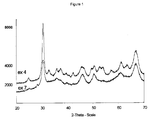
- the attached figure is an X-ray diffraction pattern which was obtained from the products of Examples 4 and 7 after calcination at 900 ° C.
Landscapes
- Chemical & Material Sciences (AREA)
- Engineering & Computer Science (AREA)
- Organic Chemistry (AREA)
- Chemical Kinetics & Catalysis (AREA)
- Materials Engineering (AREA)
- Environmental & Geological Engineering (AREA)
- Inorganic Chemistry (AREA)
- Life Sciences & Earth Sciences (AREA)
- Nanotechnology (AREA)
- General Chemical & Material Sciences (AREA)
- Oil, Petroleum & Natural Gas (AREA)
- Biomedical Technology (AREA)
- Health & Medical Sciences (AREA)
- General Life Sciences & Earth Sciences (AREA)
- Geology (AREA)
- Analytical Chemistry (AREA)
- Composite Materials (AREA)
- Condensed Matter Physics & Semiconductors (AREA)
- General Physics & Mathematics (AREA)
- Crystallography & Structural Chemistry (AREA)
- Physics & Mathematics (AREA)
- Combustion & Propulsion (AREA)
- Catalysts (AREA)
- Production Of Liquid Hydrocarbon Mixture For Refining Petroleum (AREA)
- Exhaust Gas Treatment By Means Of Catalyst (AREA)
- Compositions Of Oxide Ceramics (AREA)
Priority Applications (1)
| Application Number | Priority Date | Filing Date | Title |
|---|---|---|---|
| PL09720750T PL2262736T3 (pl) | 2008-03-05 | 2009-02-23 | Kompozycja na bazie tlenku cyrkonu, tlenku tytanu lub tlenku mieszanego cyrkonu i tytanu na nośniku z tlenku glinu lub z oksywodorotlenku glinu, sposoby przygotowania i zastosowanie jako katalizatora |
Applications Claiming Priority (2)
| Application Number | Priority Date | Filing Date | Title |
|---|---|---|---|
| FR0801203A FR2928364B1 (fr) | 2008-03-05 | 2008-03-05 | Composition a base d'un oxyde de zirconium,d'un oxyde de titane ou d'un oxyde mixte de zirconium et de titane sur un support en alumine,procedes de preparation et utilisation comme catalyseur |
| PCT/EP2009/052129 WO2009112356A1 (fr) | 2008-03-05 | 2009-02-23 | Composition a base d'un oxyde de zirconium, d'un oxyde de titane ou d'un oxyde mixte de zirconium et de titane sur un support en alumine ou en oxyhydroxyde d'aluminium, procedes de preparation et utilisation comme catalyseur |
Publications (2)
| Publication Number | Publication Date |
|---|---|
| EP2262736A1 EP2262736A1 (fr) | 2010-12-22 |
| EP2262736B1 true EP2262736B1 (fr) | 2016-11-09 |
Family
ID=39623702
Family Applications (1)
| Application Number | Title | Priority Date | Filing Date |
|---|---|---|---|
| EP09720750.0A Active EP2262736B1 (fr) | 2008-03-05 | 2009-02-23 | Composition a base d'un oxyde de zirconium, d'un oxyde de titane ou d'un oxyde mixte de zirconium et de titane sur un support en alumine ou en oxyhydroxyde d'aluminium, procedes de preparation et utilisation comme catalyseur |
Country Status (10)
| Country | Link |
|---|---|
| US (1) | US8623778B2 (pl) |
| EP (1) | EP2262736B1 (pl) |
| JP (1) | JP5450457B2 (pl) |
| KR (1) | KR101214738B1 (pl) |
| CN (1) | CN101959801B (pl) |
| CA (1) | CA2716620C (pl) |
| FR (1) | FR2928364B1 (pl) |
| PL (1) | PL2262736T3 (pl) |
| RU (1) | RU2476381C2 (pl) |
| WO (1) | WO2009112356A1 (pl) |
Families Citing this family (17)
| Publication number | Priority date | Publication date | Assignee | Title |
|---|---|---|---|---|
| FR2991713A1 (fr) * | 2012-06-11 | 2013-12-13 | Air Liquide | Dispositif d'epuration des gaz d'echappement d'un moteur thermique comprenant un support ceramique fractionne a l'echelle nanometrique |
| US9511355B2 (en) | 2013-11-26 | 2016-12-06 | Clean Diesel Technologies, Inc. (Cdti) | System and methods for using synergized PGM as a three-way catalyst |
| US9511350B2 (en) | 2013-05-10 | 2016-12-06 | Clean Diesel Technologies, Inc. (Cdti) | ZPGM Diesel Oxidation Catalysts and methods of making and using same |
| US9216382B2 (en) * | 2013-03-15 | 2015-12-22 | Clean Diesel Technologies, Inc. | Methods for variation of support oxide materials for ZPGM oxidation catalysts and systems using same |
| US9511353B2 (en) | 2013-03-15 | 2016-12-06 | Clean Diesel Technologies, Inc. (Cdti) | Firing (calcination) process and method related to metallic substrates coated with ZPGM catalyst |
| US9545626B2 (en) | 2013-07-12 | 2017-01-17 | Clean Diesel Technologies, Inc. | Optimization of Zero-PGM washcoat and overcoat loadings on metallic substrate |
| US9511358B2 (en) | 2013-11-26 | 2016-12-06 | Clean Diesel Technologies, Inc. | Spinel compositions and applications thereof |
| WO2016036592A1 (en) * | 2014-09-05 | 2016-03-10 | Basf Corporation | Titania-doped zirconia as platinum group metal support in catalysts for treatment of combustion engine exhausts streams |
| MX2016008135A (es) * | 2015-06-19 | 2017-09-28 | Petroraza Sas | Manofluidos para la recuperacion de crudo de depositos de crudo ligero de formaciones compactas y metodos para su uso. |
| KR102574147B1 (ko) | 2017-10-24 | 2023-09-04 | 스미또모 가가꾸 가부시끼가이샤 | 알루미나 재료 |
| EP3513872A1 (en) * | 2018-01-22 | 2019-07-24 | SASOL Germany GmbH | Catalyst support comprising homogeneously distributed titanium dioxide and method for production |
| US10570063B1 (en) * | 2019-02-05 | 2020-02-25 | Magnesium Elektron Limited | Zirconia dispersion for use in forming nano ceramics |
| CN111762812B (zh) * | 2019-04-02 | 2021-06-15 | 中国科学院上海硅酸盐研究所 | 一种温度调控亚氧化钛歧化分解转化率的方法 |
| WO2021105253A1 (fr) * | 2019-11-29 | 2021-06-03 | Rhodia Operations | Alumine présentant un profil poreux particulier |
| CN113122345A (zh) * | 2019-12-30 | 2021-07-16 | 中国石油化工股份有限公司 | 一种处理高硫天然气的系统和方法 |
| AU2022263016A1 (en) | 2021-04-21 | 2023-11-09 | Osaka Gas Co., Ltd. | Molded body of carbon dioxide methanation catalyst and method for producing the same |
| CN119680526B (zh) * | 2023-09-22 | 2025-12-19 | 中国石油化工股份有限公司 | 一种克劳斯尾气加氢催化剂及其制备方法和应用 |
Citations (5)
| Publication number | Priority date | Publication date | Assignee | Title |
|---|---|---|---|---|
| US5883037A (en) | 1994-05-27 | 1999-03-16 | Rhone-Poulenc Chimie | Thermally stable/highly reducible catalyst compositions comprising alumina and the oxides of cerium and zirconium |
| US6831036B1 (en) | 1999-09-10 | 2004-12-14 | Mitsui Mining & Smelting Co., Ltd. | Co-catalyst for purifying exhaust gas |
| WO2006009327A1 (en) | 2004-07-22 | 2006-01-26 | Toyota Jidosha Kabushiki Kaisha | Inorganic oxide, exhaust gas purifying catalyst carrier, and exhaust gas purifying catalyst |
| WO2008024635A1 (en) | 2006-08-24 | 2008-02-28 | Millennium Inorganic Chemicals, Inc. | Nanocomposite particle and process of preparing the same |
| US7341976B2 (en) | 2002-10-16 | 2008-03-11 | Conocophillips Company | Stabilized boehmite-derived catalyst supports, catalysts, methods of making and using |
Family Cites Families (35)
| Publication number | Priority date | Publication date | Assignee | Title |
|---|---|---|---|---|
| US4056542A (en) * | 1973-05-16 | 1977-11-01 | Phillips Petroleum Company | Pyrolysis of N-substituted-1-cyclohexene-1,2-dicarboximides |
| US5232889A (en) * | 1989-11-27 | 1993-08-03 | Rhone-Poulenc Chimie | Supported catalysts |
| FR2658433B1 (fr) * | 1990-02-19 | 1994-05-13 | Rhone Poulenc Chimie | Catalyseurs pour le traitement des effluents gazeux contenant des composes du soufre et procede de traitement de ces effluents. |
| JP3260411B2 (ja) * | 1992-03-17 | 2002-02-25 | ズードケミー触媒株式会社 | 炭化水素水蒸気改質用触媒及びその製造方法 |
| FR2697831B1 (fr) * | 1992-11-12 | 1994-12-09 | Rhone Poulenc Chimie | Alumine stabilisée par du baryum et son procédé de préparation. |
| FR2701471B1 (fr) * | 1993-02-10 | 1995-05-24 | Rhone Poulenc Chimie | Procédé de synthèse de compositions à base d'oxydes mixtes de zirconium et de cérium, compositions ainsi obtenues et utilisations de ces dernières. |
| EP0850203B2 (fr) * | 1995-09-15 | 2012-01-04 | Rhodia Chimie | Substrat a revetement photocatalytique a base de dioxyde de titane et dispersions organiques a base de dioxyde de titane |
| EP0863800B1 (en) | 1995-11-30 | 2001-08-01 | Akzo Nobel N.V. | Process for preparing a catalyst suitable for use in isomerising hydrocarbons, the catalyst thus obtained, and its use |
| JPH10277389A (ja) * | 1997-04-02 | 1998-10-20 | Toyota Central Res & Dev Lab Inc | 排ガス浄化用触媒 |
| JP2000169222A (ja) * | 1998-12-04 | 2000-06-20 | Daiichi Kigensokagaku Kogyo Co Ltd | 高温弾性率に優れたジルコニア質焼結体、その原料粉末及びその製造方法 |
| JP4240250B2 (ja) | 1999-06-29 | 2009-03-18 | 株式会社豊田中央研究所 | 排ガス浄化用触媒とその製造方法及び排ガス浄化方法 |
| EP1240943A1 (en) * | 2000-10-21 | 2002-09-18 | Degussa AG | Catalyst support |
| JP3937877B2 (ja) * | 2002-03-05 | 2007-06-27 | 日産自動車株式会社 | 燃料改質触媒 |
| JP5031168B2 (ja) * | 2002-08-22 | 2012-09-19 | 株式会社デンソー | 触媒体 |
| FR2852596B1 (fr) * | 2003-03-18 | 2007-02-23 | Rhodia Elect & Catalysis | Composition a base d'oxydes de cerium et de zirconium a surface specifique stable entre 900 c et 1000 c, son procede de preparation et son utilisation comme catalyseur |
| US7825064B2 (en) * | 2003-06-03 | 2010-11-02 | William Marsh Rice University | Supported catalysts using nanoparticles as the support material |
| JP2005006635A (ja) | 2003-06-20 | 2005-01-13 | Yoshizo Sakakura | 鱗翅目(蝶)の捕獲器(トラップ)の構造。 |
| US7655137B2 (en) * | 2003-07-14 | 2010-02-02 | Headwaters Technology Innovation, Llc | Reforming catalysts having a controlled coordination structure and methods for preparing such compositions |
| CN1513600A (zh) * | 2003-08-19 | 2004-07-21 | 丁章云 | 一种催化剂活性载体及其制备 |
| FR2859470B1 (fr) * | 2003-09-04 | 2006-02-17 | Rhodia Elect & Catalysis | Composition a base d'oxyde de cerium et d'oxyde de zirconium a reductibilite et surface elevees, procede de preparation et utilisation comme catalyseur |
| JP2005111336A (ja) * | 2003-10-06 | 2005-04-28 | Nissan Motor Co Ltd | 耐熱性触媒およびその製造方法 |
| DE10352816A1 (de) * | 2003-11-12 | 2005-06-09 | Sachtleben Chemie Gmbh | Verfahren zur Herstellung eines hochtemperaturstabilen, TiO2-haltigen Katalysators oder Katalysatorträgers |
| US7125536B2 (en) * | 2004-02-06 | 2006-10-24 | Millennium Inorganic Chemicals, Inc. | Nano-structured particles with high thermal stability |
| US7374729B2 (en) * | 2004-03-30 | 2008-05-20 | Basf Catalysts Llc | Exhaust gas treatment catalyst |
| MY142111A (en) * | 2004-04-16 | 2010-09-15 | Nippon Oil Corp | Catalyst for fischer-tropsch synthesis and process for producing hydrocarbons |
| JP2005306635A (ja) * | 2004-04-19 | 2005-11-04 | National Institute Of Advanced Industrial & Technology | 被覆アルミナ粒子、アルミナ成形体、アルミナ焼結体及びこれらの製造方法 |
| WO2005121025A1 (ja) * | 2004-06-11 | 2005-12-22 | Kabushiki Kaisha Toyota Chuo Kenkyusho | 金属酸化物ナノ多孔体、それを得るための被覆組成物、及びそれらの製造方法 |
| US7632775B2 (en) * | 2004-11-17 | 2009-12-15 | Headwaters Technology Innovation, Llc | Multicomponent nanoparticles formed using a dispersing agent |
| CN101080275B (zh) * | 2004-12-14 | 2010-05-05 | 日产自动车株式会社 | 催化剂、排气净化催化剂以及催化剂的制造方法 |
| US7618919B2 (en) * | 2005-01-28 | 2009-11-17 | Kabushiki Kaisha Toyota Chuo Kenkyusho | Catalyst support and method of producing the same |
| US7569510B2 (en) * | 2006-02-27 | 2009-08-04 | Philip Morris Usa Inc. | Catalysts to reduce carbon monoxide such as in the mainstream smoke of a cigarette |
| EP2024084B1 (fr) | 2006-05-15 | 2019-07-10 | Rhodia Opérations | Composition a base d'oxydes de zirconium, de cerium, de lanthane et d'yttrium, de gadolinium ou de samarium, a surface specifique et reductibilite elevees, et utilisation comme catalyseur |
| FR2905371B1 (fr) * | 2006-08-31 | 2010-11-05 | Rhodia Recherches & Tech | Composition a reductibilite elevee a base d'un oxyde de cerium nanometrique sur un support, procede de preparation et utilisation comme catalyseur |
| US7879755B2 (en) * | 2007-08-09 | 2011-02-01 | Basf Corporation | Catalyst compositions |
| CN101491775B (zh) * | 2008-01-23 | 2012-09-12 | 中国石油化工股份有限公司 | 一种催化剂载体及其制备方法 |
-
2008
- 2008-03-05 FR FR0801203A patent/FR2928364B1/fr active Active
-
2009
- 2009-02-23 JP JP2010549089A patent/JP5450457B2/ja active Active
- 2009-02-23 RU RU2010140616/02A patent/RU2476381C2/ru active
- 2009-02-23 CN CN2009801075093A patent/CN101959801B/zh active Active
- 2009-02-23 US US12/920,360 patent/US8623778B2/en active Active
- 2009-02-23 WO PCT/EP2009/052129 patent/WO2009112356A1/fr not_active Ceased
- 2009-02-23 CA CA2716620A patent/CA2716620C/fr active Active
- 2009-02-23 PL PL09720750T patent/PL2262736T3/pl unknown
- 2009-02-23 KR KR1020107019668A patent/KR101214738B1/ko active Active
- 2009-02-23 EP EP09720750.0A patent/EP2262736B1/fr active Active
Patent Citations (5)
| Publication number | Priority date | Publication date | Assignee | Title |
|---|---|---|---|---|
| US5883037A (en) | 1994-05-27 | 1999-03-16 | Rhone-Poulenc Chimie | Thermally stable/highly reducible catalyst compositions comprising alumina and the oxides of cerium and zirconium |
| US6831036B1 (en) | 1999-09-10 | 2004-12-14 | Mitsui Mining & Smelting Co., Ltd. | Co-catalyst for purifying exhaust gas |
| US7341976B2 (en) | 2002-10-16 | 2008-03-11 | Conocophillips Company | Stabilized boehmite-derived catalyst supports, catalysts, methods of making and using |
| WO2006009327A1 (en) | 2004-07-22 | 2006-01-26 | Toyota Jidosha Kabushiki Kaisha | Inorganic oxide, exhaust gas purifying catalyst carrier, and exhaust gas purifying catalyst |
| WO2008024635A1 (en) | 2006-08-24 | 2008-02-28 | Millennium Inorganic Chemicals, Inc. | Nanocomposite particle and process of preparing the same |
Non-Patent Citations (3)
| Title |
|---|
| D. ENACHE ET AL.: "Preparation of Al2O3/ZrO2 mixed supports; their characteristics and hydrothermal stability", COLLOIDS AND SURFACES A: PHYSICOCHEM. ENG. ASPECTS, vol. 220, 2003, pages 223 - 233, XP055407592 |
| J. MONTOYA ET AL.: "The effect of temperature on the structural and textural evo- lution of sol/gel Al2O3-TiO2 mixed oxides", J. MATER. CHEM., vol. 11, 2001, pages 944 - 950, XP055407594 |
| V. SUBRAMANIAN ET AL.: "Synthesis of High-Temperature Titania-Alumina Supports", IND. ENG. CHEM. RES., vol. 45, 2006, pages 3815 - 3820, XP055407598 |
Also Published As
| Publication number | Publication date |
|---|---|
| EP2262736A1 (fr) | 2010-12-22 |
| KR101214738B1 (ko) | 2012-12-21 |
| CA2716620A1 (fr) | 2009-09-17 |
| RU2010140616A (ru) | 2012-04-10 |
| WO2009112356A1 (fr) | 2009-09-17 |
| PL2262736T3 (pl) | 2017-06-30 |
| CA2716620C (fr) | 2017-07-25 |
| JP5450457B2 (ja) | 2014-03-26 |
| FR2928364B1 (fr) | 2011-10-14 |
| CN101959801A (zh) | 2011-01-26 |
| RU2476381C2 (ru) | 2013-02-27 |
| KR20100120194A (ko) | 2010-11-12 |
| US8623778B2 (en) | 2014-01-07 |
| JP2011513055A (ja) | 2011-04-28 |
| FR2928364A1 (fr) | 2009-09-11 |
| US20110053763A1 (en) | 2011-03-03 |
| CN101959801B (zh) | 2013-02-13 |
Similar Documents
| Publication | Publication Date | Title |
|---|---|---|
| EP2262736B1 (fr) | Composition a base d'un oxyde de zirconium, d'un oxyde de titane ou d'un oxyde mixte de zirconium et de titane sur un support en alumine ou en oxyhydroxyde d'aluminium, procedes de preparation et utilisation comme catalyseur | |
| EP2059339B1 (fr) | Composition a réductibilité élevée à base d'un oxyde de cérium nanométrique sur un support, procédé de préparation et utilisation comme catalyseur | |
| EP2403638B1 (fr) | Composition comprenant une perovskite a base de lanthane sur un support en alumine ou en oxyhydroxyde d'aluminium, procede de preparation et utilisation en catalyse | |
| CA2178834C (fr) | Precurseur d'une composition et composition a base d'un oxyde mixte de cerium et de zirconium, procede de preparation et utilisation | |
| EP2454196B1 (fr) | Composition a base d'oxyde de cerium et d'oxyde de zirconium de porosite specifique, procede de preparation et utilisation en catalyse | |
| CA2489772C (fr) | Composition a base d'oxyde de zirconium et d'oxydes de cerium, de lanthane et d'une autre terre rare, son procede de preparation et son utilisation comme catalyseur | |
| EP0802824B1 (fr) | Composition catalytique a base d'oxyde de cerium et d'oxyde de manganese, de fer ou de praseodyme, son procede de preparation et son utilisation en catalyse postcombustion automobile | |
| CA2800653C (fr) | Composition a base d'oxydes de cerium, de niobium et, eventuellement, de zirconium et son utilisation en catalyse | |
| FR2917646A1 (fr) | Oxyde mixte a haute surface specifique de cerium et d'autre terre rare, procede de preparation et utilisation en catalyse | |
| FR2907445A1 (fr) | Composition a acidite elevee a base d'oxyde de zirconium, d'oxyde de titane et d'oxyde de tungstene,procede de preparation et utilisation dans le traitement des gaz d'echappement | |
| EP2262735A1 (fr) | Composition a base d'un oxyde de zirconium, d'un oxyde de titane ou d'un oxyde mixte de zirconium et de titane sur un support en silice, procedes de preparation et utilisation comme catalyseur |
Legal Events
| Date | Code | Title | Description |
|---|---|---|---|
| PUAI | Public reference made under article 153(3) epc to a published international application that has entered the european phase |
Free format text: ORIGINAL CODE: 0009012 |
|
| 17P | Request for examination filed |
Effective date: 20100923 |
|
| AK | Designated contracting states |
Kind code of ref document: A1 Designated state(s): AT BE BG CH CY CZ DE DK EE ES FI FR GB GR HR HU IE IS IT LI LT LU LV MC MK MT NL NO PL PT RO SE SI SK TR |
|
| AX | Request for extension of the european patent |
Extension state: AL BA RS |
|
| DAX | Request for extension of the european patent (deleted) | ||
| 17Q | First examination report despatched |
Effective date: 20120207 |
|
| GRAP | Despatch of communication of intention to grant a patent |
Free format text: ORIGINAL CODE: EPIDOSNIGR1 |
|
| RIC1 | Information provided on ipc code assigned before grant |
Ipc: C01G 23/08 20060101ALI20160504BHEP Ipc: B01J 21/06 20060101ALI20160504BHEP Ipc: B01D 53/94 20060101ALI20160504BHEP Ipc: C01G 25/02 20060101ALI20160504BHEP Ipc: B01J 37/00 20060101ALI20160504BHEP Ipc: B01D 53/56 20060101ALI20160504BHEP Ipc: B01D 53/86 20060101ALI20160504BHEP Ipc: B01J 37/08 20060101ALI20160504BHEP Ipc: B01J 23/10 20060101ALI20160504BHEP Ipc: C01G 25/00 20060101ALI20160504BHEP Ipc: B01J 37/02 20060101ALI20160504BHEP Ipc: B01J 35/10 20060101ALI20160504BHEP Ipc: B01J 37/03 20060101ALI20160504BHEP Ipc: B82Y 30/00 20110101ALI20160504BHEP Ipc: C01G 23/047 20060101AFI20160504BHEP Ipc: B01J 35/00 20060101ALI20160504BHEP |
|
| INTG | Intention to grant announced |
Effective date: 20160603 |
|
| GRAS | Grant fee paid |
Free format text: ORIGINAL CODE: EPIDOSNIGR3 |
|
| GRAA | (expected) grant |
Free format text: ORIGINAL CODE: 0009210 |
|
| AK | Designated contracting states |
Kind code of ref document: B1 Designated state(s): AT BE BG CH CY CZ DE DK EE ES FI FR GB GR HR HU IE IS IT LI LT LU LV MC MK MT NL NO PL PT RO SE SI SK TR |
|
| REG | Reference to a national code |
Ref country code: GB Ref legal event code: FG4D Free format text: NOT ENGLISH |
|
| REG | Reference to a national code |
Ref country code: AT Ref legal event code: REF Ref document number: 843739 Country of ref document: AT Kind code of ref document: T Effective date: 20161115 Ref country code: CH Ref legal event code: EP |
|
| REG | Reference to a national code |
Ref country code: IE Ref legal event code: FG4D Free format text: LANGUAGE OF EP DOCUMENT: FRENCH |
|
| REG | Reference to a national code |
Ref country code: DE Ref legal event code: R096 Ref document number: 602009042245 Country of ref document: DE |
|
| REG | Reference to a national code |
Ref country code: FR Ref legal event code: PLFP Year of fee payment: 9 |
|
| REG | Reference to a national code |
Ref country code: NL Ref legal event code: FP |
|
| REG | Reference to a national code |
Ref country code: SE Ref legal event code: TRGR |
|
| PG25 | Lapsed in a contracting state [announced via postgrant information from national office to epo] |
Ref country code: LV Free format text: LAPSE BECAUSE OF FAILURE TO SUBMIT A TRANSLATION OF THE DESCRIPTION OR TO PAY THE FEE WITHIN THE PRESCRIBED TIME-LIMIT Effective date: 20161109 |
|
| REG | Reference to a national code |
Ref country code: LT Ref legal event code: MG4D |
|
| REG | Reference to a national code |
Ref country code: AT Ref legal event code: MK05 Ref document number: 843739 Country of ref document: AT Kind code of ref document: T Effective date: 20161109 |
|
| PG25 | Lapsed in a contracting state [announced via postgrant information from national office to epo] |
Ref country code: LT Free format text: LAPSE BECAUSE OF FAILURE TO SUBMIT A TRANSLATION OF THE DESCRIPTION OR TO PAY THE FEE WITHIN THE PRESCRIBED TIME-LIMIT Effective date: 20161109 Ref country code: NO Free format text: LAPSE BECAUSE OF FAILURE TO SUBMIT A TRANSLATION OF THE DESCRIPTION OR TO PAY THE FEE WITHIN THE PRESCRIBED TIME-LIMIT Effective date: 20170209 Ref country code: GR Free format text: LAPSE BECAUSE OF FAILURE TO SUBMIT A TRANSLATION OF THE DESCRIPTION OR TO PAY THE FEE WITHIN THE PRESCRIBED TIME-LIMIT Effective date: 20170210 |
|
| RAP2 | Party data changed (patent owner data changed or rights of a patent transferred) |
Owner name: RHODIA OPERATIONS |
|
| PG25 | Lapsed in a contracting state [announced via postgrant information from national office to epo] |
Ref country code: IS Free format text: LAPSE BECAUSE OF FAILURE TO SUBMIT A TRANSLATION OF THE DESCRIPTION OR TO PAY THE FEE WITHIN THE PRESCRIBED TIME-LIMIT Effective date: 20170309 Ref country code: HR Free format text: LAPSE BECAUSE OF FAILURE TO SUBMIT A TRANSLATION OF THE DESCRIPTION OR TO PAY THE FEE WITHIN THE PRESCRIBED TIME-LIMIT Effective date: 20161109 Ref country code: ES Free format text: LAPSE BECAUSE OF FAILURE TO SUBMIT A TRANSLATION OF THE DESCRIPTION OR TO PAY THE FEE WITHIN THE PRESCRIBED TIME-LIMIT Effective date: 20161109 Ref country code: AT Free format text: LAPSE BECAUSE OF FAILURE TO SUBMIT A TRANSLATION OF THE DESCRIPTION OR TO PAY THE FEE WITHIN THE PRESCRIBED TIME-LIMIT Effective date: 20161109 Ref country code: PT Free format text: LAPSE BECAUSE OF FAILURE TO SUBMIT A TRANSLATION OF THE DESCRIPTION OR TO PAY THE FEE WITHIN THE PRESCRIBED TIME-LIMIT Effective date: 20170309 Ref country code: FI Free format text: LAPSE BECAUSE OF FAILURE TO SUBMIT A TRANSLATION OF THE DESCRIPTION OR TO PAY THE FEE WITHIN THE PRESCRIBED TIME-LIMIT Effective date: 20161109 Ref country code: BE Free format text: LAPSE BECAUSE OF NON-PAYMENT OF DUE FEES Effective date: 20170228 |
|
| PG25 | Lapsed in a contracting state [announced via postgrant information from national office to epo] |
Ref country code: DK Free format text: LAPSE BECAUSE OF FAILURE TO SUBMIT A TRANSLATION OF THE DESCRIPTION OR TO PAY THE FEE WITHIN THE PRESCRIBED TIME-LIMIT Effective date: 20161109 Ref country code: SK Free format text: LAPSE BECAUSE OF FAILURE TO SUBMIT A TRANSLATION OF THE DESCRIPTION OR TO PAY THE FEE WITHIN THE PRESCRIBED TIME-LIMIT Effective date: 20161109 Ref country code: CZ Free format text: LAPSE BECAUSE OF FAILURE TO SUBMIT A TRANSLATION OF THE DESCRIPTION OR TO PAY THE FEE WITHIN THE PRESCRIBED TIME-LIMIT Effective date: 20161109 Ref country code: EE Free format text: LAPSE BECAUSE OF FAILURE TO SUBMIT A TRANSLATION OF THE DESCRIPTION OR TO PAY THE FEE WITHIN THE PRESCRIBED TIME-LIMIT Effective date: 20161109 Ref country code: RO Free format text: LAPSE BECAUSE OF FAILURE TO SUBMIT A TRANSLATION OF THE DESCRIPTION OR TO PAY THE FEE WITHIN THE PRESCRIBED TIME-LIMIT Effective date: 20161109 |
|
| REG | Reference to a national code |
Ref country code: DE Ref legal event code: R026 Ref document number: 602009042245 Country of ref document: DE |
|
| PLBI | Opposition filed |
Free format text: ORIGINAL CODE: 0009260 |
|
| PG25 | Lapsed in a contracting state [announced via postgrant information from national office to epo] |
Ref country code: IT Free format text: LAPSE BECAUSE OF FAILURE TO SUBMIT A TRANSLATION OF THE DESCRIPTION OR TO PAY THE FEE WITHIN THE PRESCRIBED TIME-LIMIT Effective date: 20161109 Ref country code: BG Free format text: LAPSE BECAUSE OF FAILURE TO SUBMIT A TRANSLATION OF THE DESCRIPTION OR TO PAY THE FEE WITHIN THE PRESCRIBED TIME-LIMIT Effective date: 20170209 |
|
| PLAX | Notice of opposition and request to file observation + time limit sent |
Free format text: ORIGINAL CODE: EPIDOSNOBS2 |
|
| PLBB | Reply of patent proprietor to notice(s) of opposition received |
Free format text: ORIGINAL CODE: EPIDOSNOBS3 |
|
| 26 | Opposition filed |
Opponent name: SASOL GERMANY GMBH Effective date: 20170808 |
|
| PG25 | Lapsed in a contracting state [announced via postgrant information from national office to epo] |
Ref country code: MC Free format text: LAPSE BECAUSE OF FAILURE TO SUBMIT A TRANSLATION OF THE DESCRIPTION OR TO PAY THE FEE WITHIN THE PRESCRIBED TIME-LIMIT Effective date: 20161109 |
|
| REG | Reference to a national code |
Ref country code: CH Ref legal event code: PL |
|
| PG25 | Lapsed in a contracting state [announced via postgrant information from national office to epo] |
Ref country code: CH Free format text: LAPSE BECAUSE OF NON-PAYMENT OF DUE FEES Effective date: 20170228 Ref country code: LI Free format text: LAPSE BECAUSE OF NON-PAYMENT OF DUE FEES Effective date: 20170228 |
|
| REG | Reference to a national code |
Ref country code: IE Ref legal event code: MM4A |
|
| PG25 | Lapsed in a contracting state [announced via postgrant information from national office to epo] |
Ref country code: SI Free format text: LAPSE BECAUSE OF FAILURE TO SUBMIT A TRANSLATION OF THE DESCRIPTION OR TO PAY THE FEE WITHIN THE PRESCRIBED TIME-LIMIT Effective date: 20161109 |
|
| PG25 | Lapsed in a contracting state [announced via postgrant information from national office to epo] |
Ref country code: LU Free format text: LAPSE BECAUSE OF NON-PAYMENT OF DUE FEES Effective date: 20170223 |
|
| REG | Reference to a national code |
Ref country code: FR Ref legal event code: PLFP Year of fee payment: 10 |
|
| REG | Reference to a national code |
Ref country code: BE Ref legal event code: MM Effective date: 20170228 |
|
| PG25 | Lapsed in a contracting state [announced via postgrant information from national office to epo] |
Ref country code: IE Free format text: LAPSE BECAUSE OF NON-PAYMENT OF DUE FEES Effective date: 20170223 |
|
| PLBP | Opposition withdrawn |
Free format text: ORIGINAL CODE: 0009264 |
|
| PG25 | Lapsed in a contracting state [announced via postgrant information from national office to epo] |
Ref country code: MT Free format text: LAPSE BECAUSE OF FAILURE TO SUBMIT A TRANSLATION OF THE DESCRIPTION OR TO PAY THE FEE WITHIN THE PRESCRIBED TIME-LIMIT Effective date: 20161109 |
|
| PLCK | Communication despatched that opposition was rejected |
Free format text: ORIGINAL CODE: EPIDOSNREJ1 |
|
| STAA | Information on the status of an ep patent application or granted ep patent |
Free format text: STATUS: THE PATENT HAS BEEN GRANTED |
|
| REG | Reference to a national code |
Ref country code: DE Ref legal event code: R100 Ref document number: 602009042245 Country of ref document: DE |
|
| PLBN | Opposition rejected |
Free format text: ORIGINAL CODE: 0009273 |
|
| STAA | Information on the status of an ep patent application or granted ep patent |
Free format text: STATUS: OPPOSITION REJECTED |
|
| 27O | Opposition rejected |
Effective date: 20181026 |
|
| PG25 | Lapsed in a contracting state [announced via postgrant information from national office to epo] |
Ref country code: HU Free format text: LAPSE BECAUSE OF FAILURE TO SUBMIT A TRANSLATION OF THE DESCRIPTION OR TO PAY THE FEE WITHIN THE PRESCRIBED TIME-LIMIT; INVALID AB INITIO Effective date: 20090223 |
|
| PG25 | Lapsed in a contracting state [announced via postgrant information from national office to epo] |
Ref country code: CY Free format text: LAPSE BECAUSE OF NON-PAYMENT OF DUE FEES Effective date: 20161109 |
|
| PG25 | Lapsed in a contracting state [announced via postgrant information from national office to epo] |
Ref country code: TR Free format text: LAPSE BECAUSE OF FAILURE TO SUBMIT A TRANSLATION OF THE DESCRIPTION OR TO PAY THE FEE WITHIN THE PRESCRIBED TIME-LIMIT Effective date: 20161109 |
|
| P01 | Opt-out of the competence of the unified patent court (upc) registered |
Effective date: 20230624 |
|
| PGFP | Annual fee paid to national office [announced via postgrant information from national office to epo] |
Ref country code: MK Payment date: 20250207 Year of fee payment: 17 |
|
| PGFP | Annual fee paid to national office [announced via postgrant information from national office to epo] |
Ref country code: NL Payment date: 20260218 Year of fee payment: 18 |
|
| PGFP | Annual fee paid to national office [announced via postgrant information from national office to epo] |
Ref country code: SE Payment date: 20260218 Year of fee payment: 18 |
|
| PGFP | Annual fee paid to national office [announced via postgrant information from national office to epo] |
Ref country code: GB Payment date: 20260219 Year of fee payment: 18 |
|
| PGFP | Annual fee paid to national office [announced via postgrant information from national office to epo] |
Ref country code: DE Payment date: 20260224 Year of fee payment: 18 |
|
| PGFP | Annual fee paid to national office [announced via postgrant information from national office to epo] |
Ref country code: FR Payment date: 20260223 Year of fee payment: 18 |
|
| PGFP | Annual fee paid to national office [announced via postgrant information from national office to epo] |
Ref country code: PL Payment date: 20260212 Year of fee payment: 18 |