EP2256232B1 - Metallharz-Verbundstoff und Verfahren - Google Patents
Metallharz-Verbundstoff und Verfahren Download PDFInfo
- Publication number
- EP2256232B1 EP2256232B1 EP10164265.0A EP10164265A EP2256232B1 EP 2256232 B1 EP2256232 B1 EP 2256232B1 EP 10164265 A EP10164265 A EP 10164265A EP 2256232 B1 EP2256232 B1 EP 2256232B1
- Authority
- EP
- European Patent Office
- Prior art keywords
- composite
- metal
- polyphenylene sulfide
- metal substrate
- resin
- Prior art date
- Legal status (The legal status is an assumption and is not a legal conclusion. Google has not performed a legal analysis and makes no representation as to the accuracy of the status listed.)
- Active
Links
Images

Classifications
-
- C—CHEMISTRY; METALLURGY
- C23—COATING METALLIC MATERIAL; COATING MATERIAL WITH METALLIC MATERIAL; CHEMICAL SURFACE TREATMENT; DIFFUSION TREATMENT OF METALLIC MATERIAL; COATING BY VACUUM EVAPORATION, BY SPUTTERING, BY ION IMPLANTATION OR BY CHEMICAL VAPOUR DEPOSITION, IN GENERAL; INHIBITING CORROSION OF METALLIC MATERIAL OR INCRUSTATION IN GENERAL
- C23C—COATING METALLIC MATERIAL; COATING MATERIAL WITH METALLIC MATERIAL; SURFACE TREATMENT OF METALLIC MATERIAL BY DIFFUSION INTO THE SURFACE, BY CHEMICAL CONVERSION OR SUBSTITUTION; COATING BY VACUUM EVAPORATION, BY SPUTTERING, BY ION IMPLANTATION OR BY CHEMICAL VAPOUR DEPOSITION, IN GENERAL
- C23C28/00—Coating for obtaining at least two superposed coatings either by methods not provided for in a single one of groups C23C2/00 - C23C26/00 or by combinations of methods provided for in subclasses C23C and C25C or C25D
-
- B—PERFORMING OPERATIONS; TRANSPORTING
- B29—WORKING OF PLASTICS; WORKING OF SUBSTANCES IN A PLASTIC STATE IN GENERAL
- B29C—SHAPING OR JOINING OF PLASTICS; SHAPING OF MATERIAL IN A PLASTIC STATE, NOT OTHERWISE PROVIDED FOR; AFTER-TREATMENT OF THE SHAPED PRODUCTS, e.g. REPAIRING
- B29C45/00—Injection moulding, i.e. forcing the required volume of moulding material through a nozzle into a closed mould; Apparatus therefor
- B29C45/14—Injection moulding, i.e. forcing the required volume of moulding material through a nozzle into a closed mould; Apparatus therefor incorporating preformed parts or layers, e.g. injection moulding around inserts or for coating articles
- B29C45/14778—Injection moulding, i.e. forcing the required volume of moulding material through a nozzle into a closed mould; Apparatus therefor incorporating preformed parts or layers, e.g. injection moulding around inserts or for coating articles the article consisting of a material with particular properties, e.g. porous, brittle
-
- C—CHEMISTRY; METALLURGY
- C23—COATING METALLIC MATERIAL; COATING MATERIAL WITH METALLIC MATERIAL; CHEMICAL SURFACE TREATMENT; DIFFUSION TREATMENT OF METALLIC MATERIAL; COATING BY VACUUM EVAPORATION, BY SPUTTERING, BY ION IMPLANTATION OR BY CHEMICAL VAPOUR DEPOSITION, IN GENERAL; INHIBITING CORROSION OF METALLIC MATERIAL OR INCRUSTATION IN GENERAL
- C23C—COATING METALLIC MATERIAL; COATING MATERIAL WITH METALLIC MATERIAL; SURFACE TREATMENT OF METALLIC MATERIAL BY DIFFUSION INTO THE SURFACE, BY CHEMICAL CONVERSION OR SUBSTITUTION; COATING BY VACUUM EVAPORATION, BY SPUTTERING, BY ION IMPLANTATION OR BY CHEMICAL VAPOUR DEPOSITION, IN GENERAL
- C23C8/00—Solid state diffusion of only non-metal elements into metallic material surfaces; Chemical surface treatment of metallic material by reaction of the surface with a reactive gas, leaving reaction products of surface material in the coating, e.g. conversion coatings, passivation of metals
- C23C8/02—Pretreatment of the material to be coated
-
- C—CHEMISTRY; METALLURGY
- C23—COATING METALLIC MATERIAL; COATING MATERIAL WITH METALLIC MATERIAL; CHEMICAL SURFACE TREATMENT; DIFFUSION TREATMENT OF METALLIC MATERIAL; COATING BY VACUUM EVAPORATION, BY SPUTTERING, BY ION IMPLANTATION OR BY CHEMICAL VAPOUR DEPOSITION, IN GENERAL; INHIBITING CORROSION OF METALLIC MATERIAL OR INCRUSTATION IN GENERAL
- C23C—COATING METALLIC MATERIAL; COATING MATERIAL WITH METALLIC MATERIAL; SURFACE TREATMENT OF METALLIC MATERIAL BY DIFFUSION INTO THE SURFACE, BY CHEMICAL CONVERSION OR SUBSTITUTION; COATING BY VACUUM EVAPORATION, BY SPUTTERING, BY ION IMPLANTATION OR BY CHEMICAL VAPOUR DEPOSITION, IN GENERAL
- C23C8/00—Solid state diffusion of only non-metal elements into metallic material surfaces; Chemical surface treatment of metallic material by reaction of the surface with a reactive gas, leaving reaction products of surface material in the coating, e.g. conversion coatings, passivation of metals
- C23C8/60—Solid state diffusion of only non-metal elements into metallic material surfaces; Chemical surface treatment of metallic material by reaction of the surface with a reactive gas, leaving reaction products of surface material in the coating, e.g. conversion coatings, passivation of metals using solids, e.g. powders, pastes
-
- H—ELECTRICITY
- H01—ELECTRIC ELEMENTS
- H01M—PROCESSES OR MEANS, e.g. BATTERIES, FOR THE DIRECT CONVERSION OF CHEMICAL ENERGY INTO ELECTRICAL ENERGY
- H01M50/00—Constructional details or processes of manufacture of the non-active parts of electrochemical cells other than fuel cells, e.g. hybrid cells
- H01M50/10—Primary casings; Jackets or wrappings
- H01M50/147—Lids or covers
-
- H—ELECTRICITY
- H01—ELECTRIC ELEMENTS
- H01M—PROCESSES OR MEANS, e.g. BATTERIES, FOR THE DIRECT CONVERSION OF CHEMICAL ENERGY INTO ELECTRICAL ENERGY
- H01M50/00—Constructional details or processes of manufacture of the non-active parts of electrochemical cells other than fuel cells, e.g. hybrid cells
- H01M50/10—Primary casings; Jackets or wrappings
- H01M50/147—Lids or covers
- H01M50/155—Lids or covers characterised by the material
- H01M50/157—Inorganic material
- H01M50/159—Metals
-
- H—ELECTRICITY
- H01—ELECTRIC ELEMENTS
- H01M—PROCESSES OR MEANS, e.g. BATTERIES, FOR THE DIRECT CONVERSION OF CHEMICAL ENERGY INTO ELECTRICAL ENERGY
- H01M50/00—Constructional details or processes of manufacture of the non-active parts of electrochemical cells other than fuel cells, e.g. hybrid cells
- H01M50/10—Primary casings; Jackets or wrappings
- H01M50/147—Lids or covers
- H01M50/155—Lids or covers characterised by the material
- H01M50/16—Organic material
-
- H—ELECTRICITY
- H01—ELECTRIC ELEMENTS
- H01M—PROCESSES OR MEANS, e.g. BATTERIES, FOR THE DIRECT CONVERSION OF CHEMICAL ENERGY INTO ELECTRICAL ENERGY
- H01M50/00—Constructional details or processes of manufacture of the non-active parts of electrochemical cells other than fuel cells, e.g. hybrid cells
- H01M50/10—Primary casings; Jackets or wrappings
- H01M50/147—Lids or covers
- H01M50/155—Lids or covers characterised by the material
- H01M50/164—Lids or covers characterised by the material having a layered structure
-
- B—PERFORMING OPERATIONS; TRANSPORTING
- B29—WORKING OF PLASTICS; WORKING OF SUBSTANCES IN A PLASTIC STATE IN GENERAL
- B29C—SHAPING OR JOINING OF PLASTICS; SHAPING OF MATERIAL IN A PLASTIC STATE, NOT OTHERWISE PROVIDED FOR; AFTER-TREATMENT OF THE SHAPED PRODUCTS, e.g. REPAIRING
- B29C45/00—Injection moulding, i.e. forcing the required volume of moulding material through a nozzle into a closed mould; Apparatus therefor
- B29C45/14—Injection moulding, i.e. forcing the required volume of moulding material through a nozzle into a closed mould; Apparatus therefor incorporating preformed parts or layers, e.g. injection moulding around inserts or for coating articles
- B29C45/14311—Injection moulding, i.e. forcing the required volume of moulding material through a nozzle into a closed mould; Apparatus therefor incorporating preformed parts or layers, e.g. injection moulding around inserts or for coating articles using means for bonding the coating to the articles
-
- B—PERFORMING OPERATIONS; TRANSPORTING
- B29—WORKING OF PLASTICS; WORKING OF SUBSTANCES IN A PLASTIC STATE IN GENERAL
- B29K—INDEXING SCHEME ASSOCIATED WITH SUBCLASSES B29B, B29C OR B29D, RELATING TO MOULDING MATERIALS OR TO MATERIALS FOR MOULDS, REINFORCEMENTS, FILLERS OR PREFORMED PARTS, e.g. INSERTS
- B29K2081/00—Use of polymers having sulfur, with or without nitrogen, oxygen or carbon only, in the main chain, as moulding material
- B29K2081/04—Polysulfides, e.g. PPS, i.e. polyphenylene sulfide or derivatives thereof
-
- B—PERFORMING OPERATIONS; TRANSPORTING
- B29—WORKING OF PLASTICS; WORKING OF SUBSTANCES IN A PLASTIC STATE IN GENERAL
- B29K—INDEXING SCHEME ASSOCIATED WITH SUBCLASSES B29B, B29C OR B29D, RELATING TO MOULDING MATERIALS OR TO MATERIALS FOR MOULDS, REINFORCEMENTS, FILLERS OR PREFORMED PARTS, e.g. INSERTS
- B29K2705/00—Use of metals, their alloys or their compounds, for preformed parts, e.g. for inserts
-
- B—PERFORMING OPERATIONS; TRANSPORTING
- B29—WORKING OF PLASTICS; WORKING OF SUBSTANCES IN A PLASTIC STATE IN GENERAL
- B29K—INDEXING SCHEME ASSOCIATED WITH SUBCLASSES B29B, B29C OR B29D, RELATING TO MOULDING MATERIALS OR TO MATERIALS FOR MOULDS, REINFORCEMENTS, FILLERS OR PREFORMED PARTS, e.g. INSERTS
- B29K2705/00—Use of metals, their alloys or their compounds, for preformed parts, e.g. for inserts
- B29K2705/02—Aluminium
-
- B—PERFORMING OPERATIONS; TRANSPORTING
- B29—WORKING OF PLASTICS; WORKING OF SUBSTANCES IN A PLASTIC STATE IN GENERAL
- B29L—INDEXING SCHEME ASSOCIATED WITH SUBCLASS B29C, RELATING TO PARTICULAR ARTICLES
- B29L2031/00—Other particular articles
- B29L2031/34—Electrical apparatus, e.g. sparking plugs or parts thereof
- B29L2031/3468—Batteries, accumulators or fuel cells
-
- Y—GENERAL TAGGING OF NEW TECHNOLOGICAL DEVELOPMENTS; GENERAL TAGGING OF CROSS-SECTIONAL TECHNOLOGIES SPANNING OVER SEVERAL SECTIONS OF THE IPC; TECHNICAL SUBJECTS COVERED BY FORMER USPC CROSS-REFERENCE ART COLLECTIONS [XRACs] AND DIGESTS
- Y02—TECHNOLOGIES OR APPLICATIONS FOR MITIGATION OR ADAPTATION AGAINST CLIMATE CHANGE
- Y02E—REDUCTION OF GREENHOUSE GAS [GHG] EMISSIONS, RELATED TO ENERGY GENERATION, TRANSMISSION OR DISTRIBUTION
- Y02E60/00—Enabling technologies; Technologies with a potential or indirect contribution to GHG emissions mitigation
- Y02E60/10—Energy storage using batteries
-
- Y—GENERAL TAGGING OF NEW TECHNOLOGICAL DEVELOPMENTS; GENERAL TAGGING OF CROSS-SECTIONAL TECHNOLOGIES SPANNING OVER SEVERAL SECTIONS OF THE IPC; TECHNICAL SUBJECTS COVERED BY FORMER USPC CROSS-REFERENCE ART COLLECTIONS [XRACs] AND DIGESTS
- Y10—TECHNICAL SUBJECTS COVERED BY FORMER USPC
- Y10T—TECHNICAL SUBJECTS COVERED BY FORMER US CLASSIFICATION
- Y10T428/00—Stock material or miscellaneous articles
- Y10T428/12—All metal or with adjacent metals
- Y10T428/12389—All metal or with adjacent metals having variation in thickness
Definitions
- the disclosure relates to a metal-resin composite, particularly to a composite of a metal and a polyphenylene sulfide resin, and a method for preparing the same.
- Lithium ion batteries are widely used in the electric industry, information technology industry, and other fields.
- the lithium ion batteries have numerous advantages, such as high voltages, high capacities, no memory effects, low pollutions, small volumes, high specific energy, small resistances, low self-discharge, high-cycle life, safe, and adjustable shapes.
- Lithium ion batteries require that a battery core containing an electrolyte solution is placed in a sealed shell.
- the sealing material of the shell is metal-rubber composites.
- the electrolyte solution may leak from the sealed shell after the battery is recharged for certain times.
- the composite comprises: (1) a magnesium alloy; (2) a layer having a metal oxide, a metal carbonate, or a metal phosphate on the surface of the magnesium alloy; and (3) a resin layer.
- the main component of the resin layer is a polybutylene terephthalate resin or a polyphenylene sulfide resin, a thermosplastic resin with crystalline property.
- the resin is introduced into concavities of the surface of the alloy by an injection molding process.
- Another example in the prior art discloses a method of manufacturing a composite of an aluminum alloy and a resin.
- the method comprises the steps of: immersing the aluminum alloy into at least one selected from the group consisting of ammonia solutions, hydrazine solutions and water-soluble amide compounds; and applying a polyphenylene sulfide resin into the alloy by an injection molding method.
- the method requires complex steps.
- JP 2004 319259 concerns a resin battery case and a metal resin multilayer plate which is integrally formed in the hermetic rechargeable battery cell.
- a layer coming into contact with a metal of the metal resin multilayer plate is formed from modified hydrogenated block copolymer.
- the present invention is directed to a metal-resin composite comprising:
- the present invention is directed to a method for preparing a metal-resin composite, comprising:
- the present invention provides a battery comprising:
- FIG. 1 is a front view of a battery cover plate formed from a composite according to one embodiment of the disclosure.
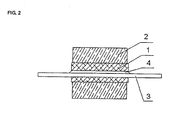
- FIG. 2 is a left side view of a battery cover plate formed from a composite according to one embodiment of the disclosure.
- the number 1 refers to a metal-resin composite.
- 2 is a metal electrode.
- 3 is a metal or an alloy.
- 4 is a component for securing the parts of the cover plate.
- One embodiment discloses a metal-resin composite.
- the composite comprises a metal substrate with concavities in the surface, a first coating layer on the surface of the metal substrate, and a second coating layer on the first coating layer.
- the first coating layer fills the concavities and covers the surface of the substrate.
- the first coating layer comprises a polyphenylene sulfide resin and titanium dioxide particles.
- the second coating layer comprises a polyphenylene sulfide resin and an inorganic material, carbon fibers and/or aromatic polyamide fibers.
- this material is selected from the group consisting of glass fibers, carbon fibers, aromatic polyamide fibers, calcium carbonates, magnesium carbonate, silicon dioxide, talcum powder, and combinations thereof.
- the concavities in the metal surface can be obtained by an etching process.
- the etching process may have an influence on the distributions and depths of the concavities in the metal surface, which affect the adhesive strength between the metal substrate and the first coating layer. If the etching time is too long, the diameters and depths of the concavities will be too large, which may affect the smoothness of the first coating layer, the adhesive strength between the first coating layer and the metal substrate, and sealing properties of the composite. On the other hand, if the etching time is too short, the concavities may have an uneven distribution and small depths, which may affect adhesive property of the first coating layer and the metal substrate and the sealing property of the composite. In the embodiments of the disclosure, the etching time varies according to the types of the metal substrates.
- the first coating layer comprises a polyphenylene sulfide resin and titanium dioxide particles in a weight ratio of the polyphenylene sulfide resin to titanium dioxide from about 1:1 to about 15:1.
- the titanium dioxide particles have an average diameter of from about 100 to about 1000 ⁇ m.
- the titanium dioxide particles have an average particle diameter of from about 200 to about 500 ⁇ m.
- the surface of titanium dioxide particles can be modified to be lipophilic, hydrophilic, or amphipathic. The modification can be achieved by a coupling agent.
- the coupling agent can be any agents known to those with ordinary skills in the art.
- the coupling agent can be selected from titanate coupling agents, alkyl silane coupling agents, and aminosilane coupling agents.
- the coupling agents can be commercially available products, such as KH-550 coupling agent from Nanjing Lipai Chemical Co., Ltd., and KR-12 coupling agent from Kanrich Electronic Corp.
- the first coating layer has a thickness of from about 0.1 to about 2000 ⁇ m. In some embodiments, the first coating layer has a depth of from about 20 to about 300 ⁇ m. In an embodiment, the first coating layer is prepared by coating one time. In other embodiments, the first coating layer is prepared by coating more than one time. In the coating process, an airbrush can be used to apply the coating slurry onto the metal substrate. The operating pressure can be from about 1 to about 10 atm. Preferably, the coated metal substrate is calcined at a temperature of from about 300 °C to about 350 °C , for a period of time from about 20 to 60 minutes, to form a precast composite.
- the temperature is from about 320 °C to about 330 °C.
- the coating process is performed under a vacuum.
- the metal substrate can be calcined one time, or more than one time.
- the coating process is performed under an inert gas.
- the precast composite is cooled down in water. In other embodiments, the precast composite is cooled down in the air.
- the polyphenylene sulfide resin melts into a liquid state.
- the liquid resin can penetrate into the ultrafine concavities in the substrate surface by capillary action.
- the liquid resin also forms a half cross-link layer on the substrate surface.
- the first layer is bonded to the metal substrate closely and covers the surface of the metal substrate.
- the first and second layers are both formed from polyphenylene sulfide resin, they can bond with each other closely. Therefore, the difficulty of applying a second polyphenylene sulfide resin layer on the first layer is overcomed.
- the polyphenylene sulfide resin Because of the low solidification temperature, if the polyphenylene sulfide resin is directly applied onto a metal substrate, it may rapidly cool down and solidify when it contacts with the metal substrate. Moreover, the rapid solidification also prevents the resin from penetrating into the ultrafine concavities in the substrate surface. As a result, the metal substrate may not be fully sealed, and also may not strongly bond to the coating layer.
- the second layer comprises a polyphenylene sulfide resin and an inorganic material, carbon fibers and/or aromatic polyamide fibers.
- the material is preferably selected from the group consisting of glass fibers, carbon fibers, aromatic polyamide fibers, calcium carbonate, magnesium carbonate, silicon dioxide, talcum powder, and combinations thereof.
- the weight ratio of the inorganic material to the polyphenylene sulfide resin is from about 4 to 8.
- the presence of the inorganic material allows the polyphenylene sulfide resin easy to solidify, and reduces its coefficient of linear expansion to be equal with that of the metal substrate.
- the second layer can have any suitable thickness. The thickness can vary as needed.
- the metal substrate referred above can be selected from the group consisting of copper, copper alloys, aluminum, aluminum alloys, stainless steel, iron alloys, and combinations thereof.
- a method for preparing a metal-resin composite comprises the steps of: (1) etching the surface of a metal substrate; (2) preparing a slurry; (3) applying the slurry on the surface of the metal substrate; (4) calcining the metal substrate to form a precast composite; (5) preparing a mixture; and (6) applying the mixture onto the precast composite by an injection molding process to form a metal-resin composite.
- surface conversion treatments can be performed on the metal substrate.
- Surface conversion treatments are well-known to those with ordinary skills in the art, such as polishing, grease removal, and other treatments.
- One object of polishing is to remove the oxidation layer of the metal substrate.
- the other object is to form ultrafine concavities in the surface of the metal substrate.
- concavities with a micrometer-size can be prepared by polishing with 150 to 400 grit abrasive papers or sandblasting devices.
- the object of grease removal is to remove grease and metal powders produced during the polishing process.
- acid or alkali aqueous solutions are employed in the etching process.
- the acid or alkali aqueous solutions are well known to those with ordinary skill in the art, such as hydrochloric acid solutions, sulfuric acid solutions, sodium hydroxide solutions, potassium hydroxide solutions and so on.
- a hydrochloric acid solution with a concentration of from about 0.1 to about 0.5 mol/L, a sulfuric acid solution, or a nitric acid solution with the same concentration is applied to form uneven concavities with depths of from about 0.2 to about 10 ⁇ m on the surface of the metal substrate.
- the concavities have an average diameter of from about 2 to about 5 ⁇ m, and depths of from about 1 to about 2 ⁇ m.
- Etching results may be controlled by varying the etching conditions. The optimal distribution and depth may enhance the bonding between the metal substrate and the first layer, and the sealing property of the composite.
- the slurry for the first layer is prepared by mixing a polyphenylene sulfide resin, an organic solvent, titanium dioxide particles, a coupling agent, and water at a certain ratio.
- the weight ratio of the polyphenylene sulfide resin, the organic solvent, titanium dioxide, the coupling agent, and water is about (15-1): (30-100): 1: (0-10):(0-10).
- the polyphenylene sulfide resin, the organic solvent, titanium dioxide particles, the coupling agent, and water are mixed in a container. The mixture is stirred at a speed of from about 100 to about 300 r/s, a period of time from about 1 to about 120 minutes.
- an ultrasonic wave is applied for about 5 to about 60 minutes to prepare a slurry for the first layer.
- the organic solvent are well known to those with ordinary skills in the art, such as anhydrous alcohols, 70% industrial ethyl alcohol, acetone, and the like.
- the titanium dioxide particles have an average particle diameter of from about 100 to about 1000 nm. In some embodiments, the average particle diameter is from about 200 to about 500 nm.
- the coupling agent can be titanate coupling agents, alkyl silane coupling agents, and aminosilane coupling agents, which can be formed through methods well known to those with ordinary skills in the art, or purchased from vendors.
- the first layer has a thickness of from about 20 to about 300 ⁇ m.
- the step of calcining the metal substrate is performed under a vacuum or an inert gas.
- the vacuum degree is less than 0.01 mPa.
- the inert gas can be selected from the group consisting of helium, argon, nitrogen, other inert gases, and the combination of hydrogen and nitrogen.
- the step of calcining is performed under a temperature of from about 300 to about 350 °C, for a period of from about 10 to about 60 minutes. In other embodiments, the calcining step is performed under a temperature of from about 320 to about 330 °C, for a period of from about 20 to about 30 minutes.
- An extremely high temperature may not favor the formation of the first layer and the bonding with the metal substrate.
- an extremely low temperature may increase the time of the melted resin spreading on the substrate and the viscosity of the melted resin, which makes it more difficult to penetrate into concavities of the metal substrate. Therefore, the efficiency of the bonding between the first layer and the metal substrate may be decreased.
- an extremely high temperature or extremely long heating time may increase the surface oxidation of the metal substrate and the cross-link of the first layer. Neither the oxidation of the metal substrate nor the extremely cross-linked polyphenylene sulfide resin is favoring the adhesion between the metal substrate and the first layer.
- the mixture for the second layer is prepared by mixing and granulating a polyphenylene sulfide resin and an inorganic material, carbon fibers and/or aromatic polyamide fibers at a ratio of from about 4 to 8.
- an aluminum alloy is used as a metal substrate.
- surface conversion treatments are performed, such as polishing, grease removal, and etching.
- the polishing and grease removal methods are well known to those with ordinary skills in the art.
- the etching process comprises the steps of: immersing the metal substrate into a sodium hydroxide solution with a concentration of from about 0.1 to about 0.5 mol/L for about 30 seconds to about 10 minutes; washing the substrate with running water for from about 1 to about 5 minutes; immersing the washed metal substrate in a hydrochloride solution with a concentration of from about 0.1 to about 0.5 mol/L for about 10 seconds to about 5 minutes; washing the substrate with running water for from about 1 to about 5 minutes; optionally immersing the metal substrate in an alcohol solution containing about 0.5 to about 5% by weight of coupling agents for about 1 to about 10 minutes; removing water from the metal substrate under a temperature of about 100 to about 150°C for about 10 to about 60 minutes to provide a pretreated aluminum alloy substrate.
- a slurry is prepared.
- a polyphenylene sulfide resin is mixed with ethanol, titanium dioxide particles.
- a coupling agent and water are added into the mixture.
- the weight ratio of ethanol, titanium dioxide, the coupling agent and water is about (5-40): (30-100): (1-5): (0-5) : (0-5).
- the mixture is stirred in a vessel and dispersed by ultrasonic waves for about 10 to about 30 minutes to provide a slurry.
- the slurry with a thickness of from about 20 to about 300 ⁇ m is coated on the aluminum alloy.
- the coating may be performed by an airbrush with an operating pressure of from about 1 to about 10 atm.
- the coated aluminum alloy is calcined under a temperature of from about 300 to about 350 °C under a vacuum or a protective gas for from about 20 to about 60 minutes to prepare a precast metal substrate. Then the precast metal substrate is cooled down in water or air slowly. In some embodiments, the coating is performed one time or more than one time.
- a mixture is prepared for the second coating layer.
- the mixture contains a polyphenylene sulfide resin, an inorganic material powder, and an inorganic material fiber at a weight ratio of about 1 : (0-4): (0-4).
- the mixture is granulated by a twin screw extruder.
- the precast metal substrate is coated by the mixture prepared above by an injection molding process to provide a metal-resin composite.
- the battery comprises a shell, a core displaced in the shell, an electrolyte; and a cover plate.
- the cover plate closes and seals the shell.
- the cover plate is formed from a metal-resin composite comprising a metal substrate having concavities in the surface, a first coating layer on the surface of the metal substrate, and a second coating layer on the first layer. The first coating layer fills concavities and covers the surface of the substrate.
- Some embodiments can stand the pressure of about 10 atm without gas leakage.
- the embodiment discloses a metal-resin composite and a method for preparing the same.
- An aluminum alloy substrate is cut and pressed to a rectangular shape with a size of 10 cm ⁇ 2 cm ⁇ 0.2 mm.
- the surface of the substrate is polished with a 300 grit abrasive paper for about 2 minutes.
- the substrate is immersed into ethanol, acetone, or detergent solutions for about 30 minutes.
- the substrate is cleaned with running water.
- the substrate is immersed into a sodium hydroxide solution with a concentration of about 0.2 mol/L for about 5 minutes.
- the substrate is cleaned with running deionized water.
- the substrate is immersed into a hydrochloride solution with a concentration of about 0.1 mol/L for about 1 minute.
- the substrate is washed with running deionized water.
- polyphenylene sulfide resin powder (PPS-ha resin powder from Sichuan Deyang chemical Co., Ltd)
- 7 g titanium dioxide particles, 60 g ethanol, and 3 g deionized water are mixed and dispersed by an ultrasonic device to provide a slurry.
- the slurry is coated onto the substrate by a spray gun with a nozzle diameter of about 0.3 mm.
- the coating process is performed one time under a pressure of about 2 atm, to form a metal substrate with a slurry with a thickness of about 200 ⁇ m.
- the coated metal substrate is calcined at a temperature of about 320°C and an atmosphere of argon for about 25 minutes.
- the calcined metal substrate is quenched in water to form a precast metal substrate.
- a mixture is prepared by granulating a polyphenylene sulfide resin, a glass fiber, and talcum powder at a weight ratio of about 1 : 2 : 2.
- the granulating is performed with a twin screw extruder (MT75 co-rotating twin screw extruder bought from Jiangsu Meizlon Machinery CO.,LTD.) to form a mixture.
- MT75 co-rotating twin screw extruder bought from Jiangsu Meizlon Machinery CO.,LTD.
- the precast substrate is placed in an injection molding machine and 80 g of the mixture is injected into the machine to form a metal-resin composite, labeled asT1.
- the embodiment discloses a metal-resin composite and a method for preparing the same.
- An aluminum alloy substrate is cut into a rectangular shape with a size of 10 cm ⁇ 2 cm ⁇ 0.2 mm.
- the surface of the substrate is polished with a 300 grit abrasive paper for about 2 minutes.
- the substrate is immersed into ethanol, acetone or detergent solutions for about 30 minutes.
- the substrate is cleaned with running water.
- the substrate is immersed into a sodium hydroxide solution with a concentration of about 0.15 mol/L for about 10 minutes.
- the surface is cleaned with running deionized water.
- the substrate is immersed into a hydrochloride solution with a concentration of about 0.02 mol/L for about 2 minutes.
- the substrate is cleaned with running deionized water.
- the substrate is immersed into an alcohol solution with 5% by weight of KH570 silane coupling agent for about 5 minutes.
- the substrate is dried at a temperature of about 120°C for about 1 hour.
- PPS-ha resin powder from Sichuan Deyang chemical Co., Lid
- 5 g titanium dioxide 5 g ethanol
- 3 g deioned water 3 g deioned water
- 2 g KH570 silane coupling agent 2 g
- the slurry is coated onto the metal substrate by a spray gun.
- the coating process is performed three times. Each time the substrate is coated with a layer with a thickness of about 100 ⁇ m.
- the substrate has a coating layer with a thickness of about 300 ⁇ m after coating three times.
- the substrate is calcined at a temperature of about 330°C and an atmosphere of nitrogen for about 15 minutes.
- the calcined metal substrate is cooled down to provide a precast metal substrate.
- a polyphenylene sulfide resin, a glass fiber, and talcum powder are mixed at a weight ratio of about 2 : 0.5 : 0.5.
- the mixture is granulated in a twin screw extruder (MT75 co-rotating twin screw extruder bought from Jiangsu Meizlon Machinery CO., LTD.) to form a mixture.
- MT75 co-rotating twin screw extruder bought from Jiangsu Meizlon Machinery CO., LTD.
- the precast substrate is placed in an injection molding machine and 60 g of the mixture is injected into the machine to form a metal-resin composite, labeled as T2.
- the embodiment discloses a metal-resin composite and a method for preparing the same.
- a copper substrate is cut into a rectangular substrate with a size of 10 cm ⁇ 2 cm ⁇ 0.2 mm.
- the surface is polished with a150 grit abrasive paper for about2 minutes.
- the substrate is immersed into ethanol, acetone or detergent solutions for about 30 minutes. Then the substrate is cleaned with running water.
- the substrate is immersed into a sodium persulfate solution with a weight concentration of about 25% for about 3 minutes. Then the substrate is cleaned with running deionized water. The substrate is dried in the air.
- PPS-ha resin powder from Sichuan Deyang chemical Co., Ltd
- titanium dioxide 60 g
- ethanol 60 g
- deionized water 5 g
- the slurry is sprayed onto the metal substrate by a spray gun with a nozzle diameter of about 0.3 mm.
- the coating process is performed by more than one time under a pressure of about 1.5 atm, to form a coating layer of a thickness of about 150 ⁇ m.
- the metal substrate is calcined at a temperature of about 330 °C and an atmosphere of helium for about 20 minutes.
- the substrate is quenched in water to provide a precast metal substrate.
- a polyphenylene sulfide resin, a glass fiber, and talcum powder are mixed at a weight ratio of about 1: 1 : 1.
- the mixture is granulated in a twin screw extruder (MT75 co-rotating twin screw extruder_bought from Jiangsu Meizlon Machinery CO., LTD.) to form a mixture.
- MT75 co-rotating twin screw extruder_bought from Jiangsu Meizlon Machinery CO., LTD.
- the substrate is placed in an injection molding machine and 70 g of the mixture is injected into the machine to provide a metal-resin composite, labeled as T3.
- the Comparison Embodiment is substantially similar in all aspects to that of a reference patent with a publication number CN171170A .
- the composite of the same size as the reference is labeled TC1.
- a tensile testing machine (Sans Testing Machine Inc.) is applied to test the tensile and air tightness of T1 to TC1. The testing results are shown in Table 1. Sealing testing
- gas releasing may not happen to T2 under a pressure of 10 atm, while the TC1 may release gases in the pressure of 0.1 1 atm. Further, T2 has a tensile strength of 27 MPa, while TC1 has a tensile strength of 20 MPa.
Landscapes
- Chemical & Material Sciences (AREA)
- Chemical Kinetics & Catalysis (AREA)
- Mechanical Engineering (AREA)
- Electrochemistry (AREA)
- General Chemical & Material Sciences (AREA)
- Engineering & Computer Science (AREA)
- Materials Engineering (AREA)
- Metallurgy (AREA)
- Organic Chemistry (AREA)
- Inorganic Chemistry (AREA)
- Manufacturing & Machinery (AREA)
- Laminated Bodies (AREA)
- Injection Moulding Of Plastics Or The Like (AREA)
Claims (10)
- Metall-Harz-Verbundmaterial, umfassend
ein Metallsubstrat mit Einbuchtungen in der Oberfläche, worin die Einbuchtungen Tiefen von 0,2 bis 10 µm haben;
eine erste Beschichtung, die ein Polyphenylensulfidharz und Titandioxidpartikel umfasst, auf der Oberfläche des Metallsubstrats;
worin die erste Beschichtung Einbuchtungen ausfüllt und die Oberfläche des Substrats bedeckt; und
eine zweite Beschichtung, die ein Polyphenylensulfidharz und ein anorganisches Material, Kohlefasern und/oder aromatische Polyamidfasern umfasst, auf der ersten Schicht. - Verbundmaterial gemäß Anspruch 1, worin die erste Beschichtung eine Dicke von 20 bis 300 µm hat.
- Verbundmaterial gemäß Anspruch 1, worin die Titandioxidpartikel einen mittleren Durchmesser von 200 bis 500 nm haben.
- Verbundmaterial gemäß Anspruch 1, worin das Gewichtsverhältnis des Polyphenylensulfidharzes zum Titandioxid 1 bis 15 ist.
- Verbundmaterial gemäß Anspruch 1, worin die zweite Beschichtung ein Polyphenylensulfidharz und ein Material ausgewählt aus der Gruppe bestehend aus Glasfasern, Kohlenfasern, aromatischen Polyamidfasern, Kalziumcarbonat, Magnesiumcarbonat, Siliziumdioxid, Talkpulver und Kombinationen davon umfasst.
- Verbundmaterial gemäß Anspruch 1, worin das Gewichtsverhältnis des anorganischen Materials zum Polyphenylensulfidharz von 4 bis 8 ist.
- Verbundmaterial gemäß Anspruch 1, worin das Metallsubstrat aus der Gruppe bestehend aus Kupfer, Kupferlegierungen, Aluminium, Aluminiumlegierungen, Edelstahl, Eisenlegierungen und Kombinationen davon ausgewählt ist.
- Verfahren zur Herstellung eines
Metallharzverbundmaterials, umfassend:Ätzen der Oberfläche eines Metallsubstrats;Herstellung einer Aufschlämmung, die ein Polyphenylensulfidharz, ein organisches Lösungsmittel, Titandioxid, ein Kopplungsmittel und Wasser umfasst;Auftragen der Aufschlämmung auf die Oberfläche des Metallsubstrats;Kalzinieren des beschichteten Metallsubstrats unter dem Schutz eines inerten Gases oder Vakuum, um ein vorgefertigtes Verbundmaterial zu bilden;Herstellung einer Mischung, die ein Polyphenylensulfidharz und ein anorganisches Material, Kohlenfasern und/oder aromatische Polyamidfasern umfasst, worin das Gewichtsverhältnis des anorganischen Materials, Kohlenfaser und/oder aromatischen Polyamidfasern zum Polyphenylensulfidharz von 4 bis 8 ist; undAuftragen der Mischung auf das vorgefertigte Verbundmaterial durch ein Spritzgussverfahren, um ein Metallharzverbundmaterial zu bilden. - Verfahren gemäß Anspruch 8, worin der Kalzinierschritt unter einer Temperatur von 300 bis 350°C über 10 bis 60 Minuten durchgeführt wird.
- Batterie, umfassend:eine Hülle;einen Kern, der in die Hülle eingebracht ist;einen Elektrolyten; undeine Deckplatte, die die Hülle abschließt;worin die Deckplatte das Metall-Harz-Verbundmaterial gemäß Anspruch 1 umfasst.
Applications Claiming Priority (1)
| Application Number | Priority Date | Filing Date | Title |
|---|---|---|---|
| CN2009101075502A CN101901882B (zh) | 2009-05-31 | 2009-05-31 | 一种金属积层板及其制备方法及采用该积层板的电池 |
Publications (3)
| Publication Number | Publication Date |
|---|---|
| EP2256232A2 EP2256232A2 (de) | 2010-12-01 |
| EP2256232A3 EP2256232A3 (de) | 2012-01-04 |
| EP2256232B1 true EP2256232B1 (de) | 2013-10-30 |
Family
ID=42767981
Family Applications (1)
| Application Number | Title | Priority Date | Filing Date |
|---|---|---|---|
| EP10164265.0A Active EP2256232B1 (de) | 2009-05-31 | 2010-05-28 | Metallharz-Verbundstoff und Verfahren |
Country Status (3)
| Country | Link |
|---|---|
| US (1) | US20100304208A1 (de) |
| EP (1) | EP2256232B1 (de) |
| CN (1) | CN101901882B (de) |
Cited By (1)
| Publication number | Priority date | Publication date | Assignee | Title |
|---|---|---|---|---|
| CN112002888A (zh) * | 2020-08-26 | 2020-11-27 | 成都新柯力化工科技有限公司 | 一种利用螺杆挤出机制备锂电池硅碳负极的方法 |
Families Citing this family (5)
| Publication number | Priority date | Publication date | Assignee | Title |
|---|---|---|---|---|
| CN104707769A (zh) * | 2013-12-16 | 2015-06-17 | 黑龙江大鲨鱼商贸有限公司 | 铝合金防腐预处理工艺 |
| CN104485227A (zh) * | 2014-12-22 | 2015-04-01 | 安徽赛福电子有限公司 | 一种聚苯硫醚塑料电容器盖板 |
| CN108081729B (zh) * | 2016-11-23 | 2019-10-11 | 比亚迪股份有限公司 | 一种金属纤维复合板及其制备方法 |
| CN108117273B (zh) * | 2017-12-26 | 2019-10-29 | 中建材蚌埠玻璃工业设计研究院有限公司 | 一种高反射率玻璃微珠及其制备方法 |
| CN114643761B (zh) * | 2020-12-21 | 2023-06-13 | 比亚迪股份有限公司 | 一种聚苯硫醚塑料制品及其制备方法 |
Family Cites Families (12)
| Publication number | Priority date | Publication date | Assignee | Title |
|---|---|---|---|---|
| US3622376A (en) * | 1968-08-15 | 1971-11-23 | Phillips Petroleum Co | TiO{11 {0 IN POLY(ARYLENE SULFIDE) FOR COATING COMPOSITION |
| US4396658A (en) * | 1982-03-05 | 1983-08-02 | Amf Incorporated | Polymer alloy coating for metal substrate |
| US5288535A (en) * | 1989-04-28 | 1994-02-22 | Tonen Corporation | Electrode for electroviscous fluid |
| DE4445496A1 (de) | 1994-12-20 | 1996-06-27 | Varta Batterie | Verfahren zur Rückgewinnung von Metallen aus gebrauchten Nickel-Metallhydrid-Akkumulatoren |
| US6284309B1 (en) * | 1997-12-19 | 2001-09-04 | Atotech Deutschland Gmbh | Method of producing copper surfaces for improved bonding, compositions used therein and articles made therefrom |
| US20020164441A1 (en) * | 2001-03-01 | 2002-11-07 | The University Of Chicago | Packaging for primary and secondary batteries |
| KR100827916B1 (ko) * | 2002-11-08 | 2008-05-07 | 다이세이 플라스 가부시끼가이샤 | 알루미늄 합금과 수지조성물의 복합체 및 그 제조방법 |
| JP4502244B2 (ja) * | 2003-04-16 | 2010-07-14 | 旭化成ケミカルズ株式会社 | 密閉型二次電池電槽 |
| US7875347B2 (en) * | 2003-12-29 | 2011-01-25 | General Electric Company | Composite coatings for groundwall insulation, method of manufacture thereof and articles derived therefrom |
| EP1688188B1 (de) * | 2005-02-02 | 2012-04-11 | Toyo Kohan Co., Ltd. | Mit Polyester beschichtetes Metallblech sowie daraus geformte Metalldosen |
| WO2007040245A1 (ja) * | 2005-10-04 | 2007-04-12 | Taisei Plas Co., Ltd. | 金属と樹脂の複合体及びその製造方法 |
| KR100777097B1 (ko) * | 2006-12-05 | 2007-11-28 | 제일모직주식회사 | 유전체 세라믹과 폴리페닐렌설파이드 수지의 복합체 |
-
2009
- 2009-05-31 CN CN2009101075502A patent/CN101901882B/zh active Active
-
2010
- 2010-05-27 US US12/789,187 patent/US20100304208A1/en not_active Abandoned
- 2010-05-28 EP EP10164265.0A patent/EP2256232B1/de active Active
Cited By (1)
| Publication number | Priority date | Publication date | Assignee | Title |
|---|---|---|---|---|
| CN112002888A (zh) * | 2020-08-26 | 2020-11-27 | 成都新柯力化工科技有限公司 | 一种利用螺杆挤出机制备锂电池硅碳负极的方法 |
Also Published As
| Publication number | Publication date |
|---|---|
| EP2256232A2 (de) | 2010-12-01 |
| EP2256232A3 (de) | 2012-01-04 |
| US20100304208A1 (en) | 2010-12-02 |
| CN101901882B (zh) | 2012-12-12 |
| CN101901882A (zh) | 2010-12-01 |
Similar Documents
| Publication | Publication Date | Title |
|---|---|---|
| US8426058B2 (en) | Metal-resin composite and method | |
| EP2256232B1 (de) | Metallharz-Verbundstoff und Verfahren | |
| JP6477967B1 (ja) | 電池用包装材料、その製造方法、及び電池 | |
| CN101875251B (zh) | 一种铝合金复合体及其制备方法与一种锂离子电池盖板 | |
| EP2143559B1 (de) | Magnesiumlegierungsverbundmaterial und herstellungsverfahren dafür | |
| CN101578170B (zh) | 金属和树脂的复合体及该复合体的制造方法 | |
| EP1559542B1 (de) | Verbundartikel aus aluminiumlegierung und harzzusammensetzung und herstellungsverfahren desselben | |
| US7640646B2 (en) | Method for producing composite of aluminum alloy and thermoplastic resin | |
| CN110998893B (zh) | 电池用包装材料和电池 | |
| CN101547779B (zh) | 高耐蚀性复合体的制造方法 | |
| JP6525121B1 (ja) | 耐食性皮膜、包装材料、包装材料の製造方法、耐食性皮膜付き金属材料、及び樹脂フィルム付き金属材料、電池用包装材料、電池用包装材料の製造方法、及び電池 | |
| JP3954379B2 (ja) | アルミニューム合金と樹脂の複合体とその製造方法 | |
| CN114865177B (zh) | 电池用包装材料、其制造方法、电池和铝合金箔 | |
| JP2004050488A (ja) | アルミニューム合金と樹脂の複合体とその製造方法 | |
| CN106784417A (zh) | 一种用于锂离子电池的软包铝塑膜及其制备方法 | |
| KR102001559B1 (ko) | 밀착력이 향상된 릴투릴 제조방법 | |
| JP2003251654A (ja) | アルミニューム合金と樹脂の複合体とその製造方法 | |
| KR101450260B1 (ko) | 폴리페닐렌설파이드와 구리의 접합체 및 이의 접합 방법 | |
| CN117286361B (zh) | 金属复合材料及其制备方法、电子设备结构件和电子设备 | |
| JP7774270B2 (ja) | ガーネット型酸化物固体電解質の製造方法 |
Legal Events
| Date | Code | Title | Description |
|---|---|---|---|
| PUAI | Public reference made under article 153(3) epc to a published international application that has entered the european phase |
Free format text: ORIGINAL CODE: 0009012 |
|
| AK | Designated contracting states |
Kind code of ref document: A2 Designated state(s): AL AT BE BG CH CY CZ DE DK EE ES FI FR GB GR HR HU IE IS IT LI LT LU LV MC MK MT NL NO PL PT RO SE SI SK SM TR |
|
| AX | Request for extension of the european patent |
Extension state: BA ME RS |
|
| PUAL | Search report despatched |
Free format text: ORIGINAL CODE: 0009013 |
|
| AK | Designated contracting states |
Kind code of ref document: A3 Designated state(s): AL AT BE BG CH CY CZ DE DK EE ES FI FR GB GR HR HU IE IS IT LI LT LU LV MC MK MT NL NO PL PT RO SE SI SK SM TR |
|
| AX | Request for extension of the european patent |
Extension state: BA ME RS |
|
| 17P | Request for examination filed |
Effective date: 20120703 |
|
| RIC1 | Information provided on ipc code assigned before grant |
Ipc: B29C 45/16 20060101ALI20121121BHEP Ipc: C23C 28/00 20060101AFI20121121BHEP Ipc: C23C 8/60 20060101ALI20121121BHEP Ipc: C23C 8/02 20060101ALI20121121BHEP Ipc: B29C 45/14 20060101ALI20121121BHEP Ipc: H01M 2/04 20060101ALI20121121BHEP Ipc: B29C 45/00 20060101ALI20121121BHEP |
|
| GRAP | Despatch of communication of intention to grant a patent |
Free format text: ORIGINAL CODE: EPIDOSNIGR1 |
|
| RIN1 | Information on inventor provided before grant (corrected) |
Inventor name: ZHOU, LIANG Inventor name: GONG, QING |
|
| RIN1 | Information on inventor provided before grant (corrected) |
Inventor name: ZHOU, LIANG Inventor name: GONG, QING Inventor name: LV, XINKUN |
|
| GRAS | Grant fee paid |
Free format text: ORIGINAL CODE: EPIDOSNIGR3 |
|
| GRAP | Despatch of communication of intention to grant a patent |
Free format text: ORIGINAL CODE: EPIDOSNIGR1 |
|
| INTG | Intention to grant announced |
Effective date: 20130705 |
|
| GRAA | (expected) grant |
Free format text: ORIGINAL CODE: 0009210 |
|
| RIN1 | Information on inventor provided before grant (corrected) |
Inventor name: ZHOU, LIANG Inventor name: LV, XINKUN Inventor name: GONG, QING |
|
| AK | Designated contracting states |
Kind code of ref document: B1 Designated state(s): AL AT BE BG CH CY CZ DE DK EE ES FI FR GB GR HR HU IE IS IT LI LT LU LV MC MK MT NL NO PL PT RO SE SI SK SM TR |
|
| REG | Reference to a national code |
Ref country code: GB Ref legal event code: FG4D |
|
| REG | Reference to a national code |
Ref country code: CH Ref legal event code: EP |
|
| REG | Reference to a national code |
Ref country code: AT Ref legal event code: REF Ref document number: 638520 Country of ref document: AT Kind code of ref document: T Effective date: 20131115 |
|
| REG | Reference to a national code |
Ref country code: IE Ref legal event code: FG4D |
|
| REG | Reference to a national code |
Ref country code: DE Ref legal event code: R096 Ref document number: 602010011289 Country of ref document: DE Effective date: 20131219 |
|
| REG | Reference to a national code |
Ref country code: NL Ref legal event code: VDEP Effective date: 20131030 |
|
| REG | Reference to a national code |
Ref country code: AT Ref legal event code: MK05 Ref document number: 638520 Country of ref document: AT Kind code of ref document: T Effective date: 20131030 |
|
| REG | Reference to a national code |
Ref country code: LT Ref legal event code: MG4D |
|
| PG25 | Lapsed in a contracting state [announced via postgrant information from national office to epo] |
Ref country code: NO Free format text: LAPSE BECAUSE OF FAILURE TO SUBMIT A TRANSLATION OF THE DESCRIPTION OR TO PAY THE FEE WITHIN THE PRESCRIBED TIME-LIMIT Effective date: 20140130 Ref country code: BE Free format text: LAPSE BECAUSE OF FAILURE TO SUBMIT A TRANSLATION OF THE DESCRIPTION OR TO PAY THE FEE WITHIN THE PRESCRIBED TIME-LIMIT Effective date: 20131030 Ref country code: LT Free format text: LAPSE BECAUSE OF FAILURE TO SUBMIT A TRANSLATION OF THE DESCRIPTION OR TO PAY THE FEE WITHIN THE PRESCRIBED TIME-LIMIT Effective date: 20131030 Ref country code: IS Free format text: LAPSE BECAUSE OF FAILURE TO SUBMIT A TRANSLATION OF THE DESCRIPTION OR TO PAY THE FEE WITHIN THE PRESCRIBED TIME-LIMIT Effective date: 20140228 Ref country code: HR Free format text: LAPSE BECAUSE OF FAILURE TO SUBMIT A TRANSLATION OF THE DESCRIPTION OR TO PAY THE FEE WITHIN THE PRESCRIBED TIME-LIMIT Effective date: 20131030 Ref country code: SE Free format text: LAPSE BECAUSE OF FAILURE TO SUBMIT A TRANSLATION OF THE DESCRIPTION OR TO PAY THE FEE WITHIN THE PRESCRIBED TIME-LIMIT Effective date: 20131030 Ref country code: FI Free format text: LAPSE BECAUSE OF FAILURE TO SUBMIT A TRANSLATION OF THE DESCRIPTION OR TO PAY THE FEE WITHIN THE PRESCRIBED TIME-LIMIT Effective date: 20131030 Ref country code: NL Free format text: LAPSE BECAUSE OF FAILURE TO SUBMIT A TRANSLATION OF THE DESCRIPTION OR TO PAY THE FEE WITHIN THE PRESCRIBED TIME-LIMIT Effective date: 20131030 |
|
| PG25 | Lapsed in a contracting state [announced via postgrant information from national office to epo] |
Ref country code: CY Free format text: LAPSE BECAUSE OF FAILURE TO SUBMIT A TRANSLATION OF THE DESCRIPTION OR TO PAY THE FEE WITHIN THE PRESCRIBED TIME-LIMIT Effective date: 20131030 Ref country code: AT Free format text: LAPSE BECAUSE OF FAILURE TO SUBMIT A TRANSLATION OF THE DESCRIPTION OR TO PAY THE FEE WITHIN THE PRESCRIBED TIME-LIMIT Effective date: 20131030 Ref country code: ES Free format text: LAPSE BECAUSE OF FAILURE TO SUBMIT A TRANSLATION OF THE DESCRIPTION OR TO PAY THE FEE WITHIN THE PRESCRIBED TIME-LIMIT Effective date: 20131030 Ref country code: LV Free format text: LAPSE BECAUSE OF FAILURE TO SUBMIT A TRANSLATION OF THE DESCRIPTION OR TO PAY THE FEE WITHIN THE PRESCRIBED TIME-LIMIT Effective date: 20131030 |
|
| PG25 | Lapsed in a contracting state [announced via postgrant information from national office to epo] |
Ref country code: PT Free format text: LAPSE BECAUSE OF FAILURE TO SUBMIT A TRANSLATION OF THE DESCRIPTION OR TO PAY THE FEE WITHIN THE PRESCRIBED TIME-LIMIT Effective date: 20140228 |
|
| PG25 | Lapsed in a contracting state [announced via postgrant information from national office to epo] |
Ref country code: EE Free format text: LAPSE BECAUSE OF FAILURE TO SUBMIT A TRANSLATION OF THE DESCRIPTION OR TO PAY THE FEE WITHIN THE PRESCRIBED TIME-LIMIT Effective date: 20131030 |
|
| REG | Reference to a national code |
Ref country code: DE Ref legal event code: R097 Ref document number: 602010011289 Country of ref document: DE |
|
| PG25 | Lapsed in a contracting state [announced via postgrant information from national office to epo] |
Ref country code: IT Free format text: LAPSE BECAUSE OF FAILURE TO SUBMIT A TRANSLATION OF THE DESCRIPTION OR TO PAY THE FEE WITHIN THE PRESCRIBED TIME-LIMIT Effective date: 20131030 Ref country code: PL Free format text: LAPSE BECAUSE OF FAILURE TO SUBMIT A TRANSLATION OF THE DESCRIPTION OR TO PAY THE FEE WITHIN THE PRESCRIBED TIME-LIMIT Effective date: 20131030 Ref country code: CZ Free format text: LAPSE BECAUSE OF FAILURE TO SUBMIT A TRANSLATION OF THE DESCRIPTION OR TO PAY THE FEE WITHIN THE PRESCRIBED TIME-LIMIT Effective date: 20131030 Ref country code: SK Free format text: LAPSE BECAUSE OF FAILURE TO SUBMIT A TRANSLATION OF THE DESCRIPTION OR TO PAY THE FEE WITHIN THE PRESCRIBED TIME-LIMIT Effective date: 20131030 Ref country code: RO Free format text: LAPSE BECAUSE OF FAILURE TO SUBMIT A TRANSLATION OF THE DESCRIPTION OR TO PAY THE FEE WITHIN THE PRESCRIBED TIME-LIMIT Effective date: 20131030 |
|
| PLBE | No opposition filed within time limit |
Free format text: ORIGINAL CODE: 0009261 |
|
| STAA | Information on the status of an ep patent application or granted ep patent |
Free format text: STATUS: NO OPPOSITION FILED WITHIN TIME LIMIT |
|
| PG25 | Lapsed in a contracting state [announced via postgrant information from national office to epo] |
Ref country code: DK Free format text: LAPSE BECAUSE OF FAILURE TO SUBMIT A TRANSLATION OF THE DESCRIPTION OR TO PAY THE FEE WITHIN THE PRESCRIBED TIME-LIMIT Effective date: 20131030 |
|
| 26N | No opposition filed |
Effective date: 20140731 |
|
| REG | Reference to a national code |
Ref country code: DE Ref legal event code: R097 Ref document number: 602010011289 Country of ref document: DE Effective date: 20140731 |
|
| PG25 | Lapsed in a contracting state [announced via postgrant information from national office to epo] |
Ref country code: LU Free format text: LAPSE BECAUSE OF FAILURE TO SUBMIT A TRANSLATION OF THE DESCRIPTION OR TO PAY THE FEE WITHIN THE PRESCRIBED TIME-LIMIT Effective date: 20140528 |
|
| REG | Reference to a national code |
Ref country code: CH Ref legal event code: PL |
|
| PG25 | Lapsed in a contracting state [announced via postgrant information from national office to epo] |
Ref country code: CH Free format text: LAPSE BECAUSE OF NON-PAYMENT OF DUE FEES Effective date: 20140531 Ref country code: MC Free format text: LAPSE BECAUSE OF FAILURE TO SUBMIT A TRANSLATION OF THE DESCRIPTION OR TO PAY THE FEE WITHIN THE PRESCRIBED TIME-LIMIT Effective date: 20131030 Ref country code: LI Free format text: LAPSE BECAUSE OF NON-PAYMENT OF DUE FEES Effective date: 20140531 |
|
| REG | Reference to a national code |
Ref country code: IE Ref legal event code: MM4A |
|
| PG25 | Lapsed in a contracting state [announced via postgrant information from national office to epo] |
Ref country code: SI Free format text: LAPSE BECAUSE OF FAILURE TO SUBMIT A TRANSLATION OF THE DESCRIPTION OR TO PAY THE FEE WITHIN THE PRESCRIBED TIME-LIMIT Effective date: 20131030 |
|
| PG25 | Lapsed in a contracting state [announced via postgrant information from national office to epo] |
Ref country code: IE Free format text: LAPSE BECAUSE OF NON-PAYMENT OF DUE FEES Effective date: 20140528 |
|
| PG25 | Lapsed in a contracting state [announced via postgrant information from national office to epo] |
Ref country code: MT Free format text: LAPSE BECAUSE OF FAILURE TO SUBMIT A TRANSLATION OF THE DESCRIPTION OR TO PAY THE FEE WITHIN THE PRESCRIBED TIME-LIMIT Effective date: 20131030 |
|
| PG25 | Lapsed in a contracting state [announced via postgrant information from national office to epo] |
Ref country code: SM Free format text: LAPSE BECAUSE OF FAILURE TO SUBMIT A TRANSLATION OF THE DESCRIPTION OR TO PAY THE FEE WITHIN THE PRESCRIBED TIME-LIMIT Effective date: 20131030 |
|
| REG | Reference to a national code |
Ref country code: FR Ref legal event code: PLFP Year of fee payment: 7 |
|
| PG25 | Lapsed in a contracting state [announced via postgrant information from national office to epo] |
Ref country code: BG Free format text: LAPSE BECAUSE OF FAILURE TO SUBMIT A TRANSLATION OF THE DESCRIPTION OR TO PAY THE FEE WITHIN THE PRESCRIBED TIME-LIMIT Effective date: 20131030 Ref country code: GR Free format text: LAPSE BECAUSE OF FAILURE TO SUBMIT A TRANSLATION OF THE DESCRIPTION OR TO PAY THE FEE WITHIN THE PRESCRIBED TIME-LIMIT Effective date: 20140131 |
|
| PG25 | Lapsed in a contracting state [announced via postgrant information from national office to epo] |
Ref country code: HU Free format text: LAPSE BECAUSE OF FAILURE TO SUBMIT A TRANSLATION OF THE DESCRIPTION OR TO PAY THE FEE WITHIN THE PRESCRIBED TIME-LIMIT; INVALID AB INITIO Effective date: 20100528 Ref country code: TR Free format text: LAPSE BECAUSE OF FAILURE TO SUBMIT A TRANSLATION OF THE DESCRIPTION OR TO PAY THE FEE WITHIN THE PRESCRIBED TIME-LIMIT Effective date: 20131030 |
|
| REG | Reference to a national code |
Ref country code: FR Ref legal event code: PLFP Year of fee payment: 8 |
|
| REG | Reference to a national code |
Ref country code: FR Ref legal event code: PLFP Year of fee payment: 9 |
|
| PG25 | Lapsed in a contracting state [announced via postgrant information from national office to epo] |
Ref country code: MK Free format text: LAPSE BECAUSE OF FAILURE TO SUBMIT A TRANSLATION OF THE DESCRIPTION OR TO PAY THE FEE WITHIN THE PRESCRIBED TIME-LIMIT Effective date: 20131030 |
|
| PG25 | Lapsed in a contracting state [announced via postgrant information from national office to epo] |
Ref country code: AL Free format text: LAPSE BECAUSE OF FAILURE TO SUBMIT A TRANSLATION OF THE DESCRIPTION OR TO PAY THE FEE WITHIN THE PRESCRIBED TIME-LIMIT Effective date: 20131030 |
|
| REG | Reference to a national code |
Ref country code: DE Ref legal event code: R082 Ref document number: 602010011289 Country of ref document: DE Representative=s name: DEHNSGERMANY PARTNERSCHAFT VON PATENTANWAELTEN, DE Ref country code: DE Ref legal event code: R082 Ref document number: 602010011289 Country of ref document: DE Ref country code: DE Ref legal event code: R082 Ref document number: 602010011289 Country of ref document: DE Representative=s name: DEHNS GERMANY PARTNERSCHAFT MBB, DE |
|
| P01 | Opt-out of the competence of the unified patent court (upc) registered |
Effective date: 20230527 |
|
| REG | Reference to a national code |
Ref country code: DE Ref legal event code: R082 Ref document number: 602010011289 Country of ref document: DE Representative=s name: DEHNSGERMANY PARTNERSCHAFT VON PATENTANWAELTEN, DE Ref country code: DE Ref legal event code: R082 Ref document number: 602010011289 Country of ref document: DE Representative=s name: DEHNS GERMANY PARTNERSCHAFT MBB, DE |
|
| PGFP | Annual fee paid to national office [announced via postgrant information from national office to epo] |
Ref country code: DE Payment date: 20250521 Year of fee payment: 16 |
|
| PGFP | Annual fee paid to national office [announced via postgrant information from national office to epo] |
Ref country code: FR Payment date: 20250528 Year of fee payment: 16 |
|
| PGFP | Annual fee paid to national office [announced via postgrant information from national office to epo] |
Ref country code: GB Payment date: 20260324 Year of fee payment: 17 |