EP2255347B1 - Vorrichtung zur gewinnung von informationen über ein bewegungsmuster, verfahren zur gewinnung von informationen über ein bewegungsmuster, programm zur gewinnung von informationen über ein bewegungsmuster und computerlesbares medium - Google Patents
Vorrichtung zur gewinnung von informationen über ein bewegungsmuster, verfahren zur gewinnung von informationen über ein bewegungsmuster, programm zur gewinnung von informationen über ein bewegungsmuster und computerlesbares medium Download PDFInfo
- Publication number
- EP2255347B1 EP2255347B1 EP09724473A EP09724473A EP2255347B1 EP 2255347 B1 EP2255347 B1 EP 2255347B1 EP 09724473 A EP09724473 A EP 09724473A EP 09724473 A EP09724473 A EP 09724473A EP 2255347 B1 EP2255347 B1 EP 2255347B1
- Authority
- EP
- European Patent Office
- Prior art keywords
- vehicle speed
- motion
- identification information
- vehicle
- road
- Prior art date
- Legal status (The legal status is an assumption and is not a legal conclusion. Google has not performed a legal analysis and makes no representation as to the accuracy of the status listed.)
- Not-in-force
Links
- 238000000034 method Methods 0.000 title claims description 18
- 230000033001 locomotion Effects 0.000 claims abstract description 223
- 238000009826 distribution Methods 0.000 claims abstract description 30
- 230000001419 dependent effect Effects 0.000 claims description 18
- 239000000284 extract Substances 0.000 claims description 3
- 238000012545 processing Methods 0.000 description 38
- 239000000523 sample Substances 0.000 description 36
- 238000004891 communication Methods 0.000 description 12
- 238000004458 analytical method Methods 0.000 description 10
- 230000009897 systematic effect Effects 0.000 description 8
- 230000002159 abnormal effect Effects 0.000 description 6
- 238000010586 diagram Methods 0.000 description 3
- 238000005259 measurement Methods 0.000 description 2
- 230000008520 organization Effects 0.000 description 2
- 238000012360 testing method Methods 0.000 description 2
- 238000012795 verification Methods 0.000 description 2
- 230000003750 conditioning effect Effects 0.000 description 1
- 230000001276 controlling effect Effects 0.000 description 1
- 239000006185 dispersion Substances 0.000 description 1
- 230000000694 effects Effects 0.000 description 1
- 238000011156 evaluation Methods 0.000 description 1
- 230000007717 exclusion Effects 0.000 description 1
- 238000001914 filtration Methods 0.000 description 1
- 238000003064 k means clustering Methods 0.000 description 1
- 238000012986 modification Methods 0.000 description 1
- 230000004048 modification Effects 0.000 description 1
- 230000001105 regulatory effect Effects 0.000 description 1
Images



Classifications
-
- G—PHYSICS
- G08—SIGNALLING
- G08G—TRAFFIC CONTROL SYSTEMS
- G08G1/00—Traffic control systems for road vehicles
- G08G1/09—Arrangements for giving variable traffic instructions
- G08G1/0962—Arrangements for giving variable traffic instructions having an indicator mounted inside the vehicle, e.g. giving voice messages
- G08G1/0968—Systems involving transmission of navigation instructions to the vehicle
- G08G1/096805—Systems involving transmission of navigation instructions to the vehicle where the transmitted instructions are used to compute a route
- G08G1/096811—Systems involving transmission of navigation instructions to the vehicle where the transmitted instructions are used to compute a route where the route is computed offboard
-
- G—PHYSICS
- G08—SIGNALLING
- G08G—TRAFFIC CONTROL SYSTEMS
- G08G1/00—Traffic control systems for road vehicles
- G08G1/01—Detecting movement of traffic to be counted or controlled
- G08G1/0104—Measuring and analyzing of parameters relative to traffic conditions
-
- G—PHYSICS
- G08—SIGNALLING
- G08G—TRAFFIC CONTROL SYSTEMS
- G08G1/00—Traffic control systems for road vehicles
- G08G1/01—Detecting movement of traffic to be counted or controlled
- G08G1/0104—Measuring and analyzing of parameters relative to traffic conditions
- G08G1/0108—Measuring and analyzing of parameters relative to traffic conditions based on the source of data
- G08G1/0112—Measuring and analyzing of parameters relative to traffic conditions based on the source of data from the vehicle, e.g. floating car data [FCD]
-
- G—PHYSICS
- G08—SIGNALLING
- G08G—TRAFFIC CONTROL SYSTEMS
- G08G1/00—Traffic control systems for road vehicles
- G08G1/01—Detecting movement of traffic to be counted or controlled
- G08G1/0104—Measuring and analyzing of parameters relative to traffic conditions
- G08G1/0125—Traffic data processing
- G08G1/0129—Traffic data processing for creating historical data or processing based on historical data
-
- G—PHYSICS
- G08—SIGNALLING
- G08G—TRAFFIC CONTROL SYSTEMS
- G08G1/00—Traffic control systems for road vehicles
- G08G1/01—Detecting movement of traffic to be counted or controlled
- G08G1/0104—Measuring and analyzing of parameters relative to traffic conditions
- G08G1/0137—Measuring and analyzing of parameters relative to traffic conditions for specific applications
- G08G1/0141—Measuring and analyzing of parameters relative to traffic conditions for specific applications for traffic information dissemination
-
- G—PHYSICS
- G08—SIGNALLING
- G08G—TRAFFIC CONTROL SYSTEMS
- G08G1/00—Traffic control systems for road vehicles
- G08G1/09—Arrangements for giving variable traffic instructions
- G08G1/0962—Arrangements for giving variable traffic instructions having an indicator mounted inside the vehicle, e.g. giving voice messages
- G08G1/0968—Systems involving transmission of navigation instructions to the vehicle
- G08G1/096833—Systems involving transmission of navigation instructions to the vehicle where different aspects are considered when computing the route
- G08G1/096844—Systems involving transmission of navigation instructions to the vehicle where different aspects are considered when computing the route where the complete route is dynamically recomputed based on new data
Definitions
- the present invention relates to a travel pattern information obtaining device, method, program, and computer readable medium obtaining information specifying a travel pattern of a vehicle.
- Japanese Patent Application Publication No. JP-A-2001-165684 discloses art in which up to two nodes ahead are used as a reference range. When the traffic signals within the reference range operate in association, such traffic signals are not used to calculate a traffic signal cost, however, when the traffic signals do not operate in association, the traffic signal cost is calculated.
- Patent Citation 1 Japanese Patent Application Publication No. JP-A-2001-165684
- US 2007/208493 A1 discloses a computer-implemented method for assessing road traffic conditions in various ways based on traffic-related data, such as data samples from vehicles and other mobile data sources traveling on the roads, as well as in some situations data from one or more other sources (such as physical sensors near to or embedded in the roads).
- the assessment of road traffic conditions based on the obtained data samples may include various filtering and/or conditioning of the data samples, and various inferences and probabilistic determinations of traffic-related characteristics of interest from the data samples.
- no art has existed in the past for preparing information in order to enable such estimation. Namely, although related art describes a plurality of traffic signals with coordinated lighting, such related art offers no guide for generating information that indicates whether the traffic signals are linked, and coordinated traffic signals are assumed as a precondition.
- the content of controls for coordinating traffic signals is often not disclosed, and preparing accurate information for estimating the content of such coordinating controls and the like has been difficult.
- the present invention was devised in light of the foregoing problem, and it is an object of the present invention to generate information for estimating a motion of a vehicle traveling on a road.
- a travel pattern information obtaining device according to claim 1, a travel pattern information obtaining method according to claim 5, a travel pattern information obtaining program according to claim 6 and a computer readable medium according to claim 7. Accordingly, vehicle speed identification information for identifying vehicle speed of a vehicle on a road is obtained for a plurality of vehicles. Based on a distribution of the vehicle speed identification information, the vehicle speed identification information is classified into groups corresponding to a motion of the vehicle. An occurrence probability of the motion of the vehicle is obtained based on the classification. Namely, when the vehicle performs various motions on a road, a resulting vehicle speed is the vehicle speed corresponding to the motion. Thus, a comparison of vehicles with similar vehicle speed identification information on a specific road makes it possible to estimate that the vehicles are performing a similar motion.
- the vehicle speed identification information included in a group can be considered as corresponding to a specific motion of the vehicle.
- a distribution of possible motions performed by the vehicle can be estimated. Therefore, based on the occurrence probability of the classified group, the occurrence probability of a motion of the vehicle can be obtained.
- the occurrence probability for a motion of the vehicle corresponds to the probability that the vehicle traveling on the road will perform such a motion, and thus enables an estimation of the motion of the vehicle traveling on the road.
- the vehicle speed identification information obtaining unit is not limited provided that the vehicle speed identification information obtaining unit is capable of obtaining vehicle speed identification information that can specify vehicle speed of vehicles.
- various information can be used for the vehicle speed identification information, including information indicating the vehicle speed itself, or information indicating a required time when traveling in a specific section. Namely, various information can be used as the vehicle speed identification information provided that the motion of the vehicle can-be estimated by forming a group based on the vehicle speed and information corresponding to the vehicle speed.
- the vehicle speed identification information is preferably information actually measured for each vehicle, and various structures may be adopted wherein the actual measurement is performed in each vehicle, or performed by a facility installed around the road.
- the targeted road from which the vehicle speed identification information is obtained may be determined in advance, and a road in any sections can be designated as a target from which the vehicle speed identification information is obtained.
- the travel direction of the vehicle can change, depending on a right or left turn and the like, before or after traveling on the road designated as the target from which the vehicle speed identification information is obtained or while traveling on the road.
- Such a motion of the vehicle can signify a motion influenced by traffic congestion or the like. Therefore, in the vehicle speed identification information obtaining unit, the vehicle speed identification information may be obtained for all vehicles traveling on the road, or the vehicle speed identification information may be selected for classification based on various conditions, such as right and left turns, straight travel, and whether there is traffic congestion.
- the vehicle speed identification information classifying unit is not limited provided that the vehicle speed identification information classifying unit classifies the vehicle speed identification information into one or more groups, based on the distribution of the vehicle speed identification information.
- the group corresponds to a motion of the vehicle, for example, a motion is specified in advance in order to classify the vehicle speed identification information into one or more groups.
- similar vehicle speed identification information may be classified into one or more groups, and the classification of the vehicle speed identification information finalized when the group is classified such that the group is associated with a motion of the vehicle.
- the distribution is not limited provided that the distribution contributes to the classification of the vehicle speed identification information into groups of similar information.
- a histogram or probability distribution may be adopted as the distribution.
- the manner for classifying the vehicle speed identification information into one or more groups based on the distribution of the vehicle speed identification information can be realized by various clustering. For example, a nonhierarchical method such as the k-means method, or a hierarchical method such as Ward's method can be used to classify the vehicle speed identification information. Classification may also naturally be performed by a discriminant analysis that specifies a discriminant function.
- the motion occurrence probability obtaining unit is not limited provided that the motion occurrence probability obtaining unit is capable of obtaining an occurrence probability of a motion of the vehicle, based on the classification. Namely, a ratio of a sample quantity comprising the group to a total sample quantity of the vehicle speed identification information is equivalent to an occurrence probability of the group. Therefore, the occurrence probability may be obtained based on the ratio being the occurrence probability of a motion of the vehicle corresponding to the group.
- the target from which the vehicle speed identification information is obtained may be a road comprised by a plurality of road sections that are consecutive between two preset points, and the vehicle speed identification information obtained in each road section. Namely, based on the vehicle speed identification information for the plurality of road sections that are consecutive, if the vehicle speed identification information in each road section is classified into one or more groups to obtain the occurrence probability of a motion of the vehicle corresponding to a group, then it is possible to estimate the motions of the vehicle in each road section of the road comprised by the plurality of road sections that are consecutive. Accordingly, a series of motions when the vehicle is traveling on the road can be estimated. For example, for a road comprised by a plurality of road sections divided by traffic signals, obtaining the occurrence probability of a motion of the vehicle in each road section makes it possible to estimate the motions of the vehicle as influenced by the traffic signals.
- the road comprised of the plurality of road sections that are consecutive may naturally have various shapes, and be a straight road or have curves. For example, if the road sections are consecutive straight sections, then a road comprised of the plurality of road sections is a straight road, whereas if intersecting road sections are employed as road sections that are consecutive, then a road comprised of the plurality of road sections is a curved road.
- a motion in the road sections may be a motion dependent on a motion in a previous road section thereof. Namely, since the vehicle is traveling continuously through the plurality of road sections that are consecutive, a motion the vehicle performs in a certain road section can be dependent on a motion of the vehicle in a previous road section thereof. Hence, if a specific motion in a certain road section is set so as to be dependent on a previous road section thereof, then it is possible to estimate a motion of the vehicle traveling continuously through the plurality of road sections that are consecutive between two preset points.
- various structures may be adopted as a structure for defining a group such that a motion in a certain road section is dependent on a motion in a previous road section thereof.
- a structure may be employed where the vehicle speed identification information for defining a group in a certain road section is defined so as to be dependent on the vehicle speed identification information in a previous road section thereof. That is, vehicle speed identification information when traveling through a plurality of road sections that are consecutive is structured so that information from the same vehicle can be identified as such (structured so that a series of vehicle speed identification information in road sections that are consecutive can be specified as such).
- the vehicle speed identification information in an nth (where n is a natural number) road section is classified into a specific group
- the vehicle speed identification information in an (n+1)th road section obtained from the same vehicle as the vehicle speed identification information classified into a group is identified, and the vehicle speed identification information in the (n+1)th road section is classified into one or more groups.
- the occurrence probability of a motion in the (n+1)th road section is then obtained. According to this structure, it is possible to define a motion of the vehicle in road sections that are consecutive as a motion dependent on the motion of the vehicle in a previous road section thereof.
- Both ends of the road comprised of the plurality of road sections that are consecutive can be determined based on various principles.
- a structure may be adopted where definitions in map information used by a navigation device or the like are utilized in the present invention, e.g. a structure may be employed that refers to map information divided into layers such that higher-ranked layers have a lower density of nodes (number of nodes per unit area). Namely, nodes in a specific layer in the map information are referenced to identify both ends of the plurality of road sections that are consecutive using the nodes designated in the specific layer.
- a structure may also be adopted where the nodes in a layer ranked higher than the specific layer are referenced to select two points corresponding to both ends of the road comprised of the plurality of road sections that are consecutive.
- the node is information that includes coordination information and the like for each point set on a road.
- a layer with a high node density generally has nodes set at shorter intervals on the road compared with a higher-ranked layer having a lower node density. Accordingly, road sections separated by nodes are longer in higher-ranked layers, and more nodes are generally set at intersections between main roads that are more important (in terms of a wide width, high traffic volume, and the like) than roads designated with nodes in a lower-ranked layer.
- selecting two nodes designated in a layer ranked higher than the specific layer enables easy designation of the road comprised of the plurality of road sections that are consecutive.
- the occurrence probability of a motion may be converted into other information and then used.
- the motion in the road sections is a motion identified based on the vehicle speed identification information
- the motion is a motion that corresponds to the vehicle speed of each vehicle.
- the motion classified into a group can be considered a motion that corresponds to a difficulty of travel when traveling from one of the road sections that are consecutive to the next.
- obtaining the occurrence probability for the motion makes it possible to obtain information specifying the difficulty of travel based on the occurrence probability.
- the information specifying the difficulty of travel may adopt various forms.
- a structure may be employed where the information specifying the difficulty of travel may be cost information (a number that increases in value as travel becomes more difficult) in a route search, and a larger occurrence probability for a motion signifying the vehicle is slow is accompanied by an increased cost.
- the difficulty of travel when traveling from one of the road sections that are consecutive to the next may be a difficulty of travel when continuously traveling the road sections that are consecutive.
- the difficulty of travel may correspond to a difficulty of travel when traveling on one of the road sections that are consecutive, or correspond to a difficulty of travel at a boundary between one of the road sections that are consecutive and another, or correspond to both.
- the manner for obtaining the occurrence probability of a motion of the vehicle by classifying vehicle speed identification information as in the present invention is also applicable as a program or method.
- the above-described travel pattern information obtaining device, program, and method include various forms, and may be realized as an individual travel pattern information obtaining device, or realized through the use of respective components provided in the vehicle and common parts.
- a navigation system, method, and program equipped with the above-described travel pattern information obtaining device can be made as appropriate such as using software for a portion or using hardware for a portion.
- the invention is also achieved as a recording medium of a program that controls the travel pattern information obtaining device.
- the recording medium of such software may naturally be a magnetic recording medium or a magneto-optic recording medium, and the same holds for any recording medium developed in the future.
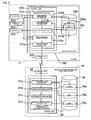
- FIG. 1 is a block diagram showing a structure of a system that includes a travel pattern information obtaining device 10 installed in a road information control center and a navigation device 100 provided in a vehicle C.
- the travel pattern information obtaining device 10 includes a control unit 20 equipped with a CPU, a RAM, a ROM, and the like, and also includes a storage medium 30. Programs stored in the storage medium 30 and the ROM can be executed by the control unit 20.
- a travel pattern information obtaining program 21 can be executed as one such program, wherein information for estimating a travel pattern of the vehicle C on a road is obtained by the travel pattern information obtaining program 21.
- information for estimating the travel pattern is information that specifies the occurrence probability of a motion of the vehicle C on every road sections. This occurrence probability is obtained in the travel pattern information obtaining device 10 based on probe information output by a plurality of vehicles C.
- the travel pattern information obtaining device 10 generates cost information based on the occurrence probability, and sends the cost information to the vehicle C.
- the travel pattern information obtaining device 10 is equipped with a communication unit 22 comprised from a circuit for communicating with the navigation device 100.
- the control unit 20 is capable of receiving the probe information and sending the cost information via the communication unit 22.
- the travel pattern information obtaining program 21 is provided with a sending/receiving control unit 21a, a vehicle speed identification information obtaining unit 21b, a vehicle speed identification information classifying unit 21c, and a motion occurrence probability obtaining unit 21d.
- a function for generating and providing the cost information to the vehicle C is realized through the communication unit 22, the storage medium 30, the RAM of the control unit 20, and the like working in cooperation.
- the sending/receiving control unit 21a is a module for controlling communication with the vehicle C.
- the control unit 20 controls the communication unit 22 through processing of the sending/receiving control unit 21a, and communicates with a communication unit 220 respectively mounted in the plurality of vehicles C. Namely, probe information sent from the vehicle C is obtained and recorded in the storage medium 30 in a state such that the probe information is identifiable as information obtained from the same vehicle C (probe information 30a shown in FIG. 1 ). Cost information 30c generated by processing described later is also obtained and sent to the vehicle C.
- the probe information 30a in the present embodiment includes at least vehicle speed identification information for identifying vehicle speed of the vehicle C, and according to the present embodiment also includes a link number specifying a road section (link) between nodes set on a road, a required time for the vehicle C to travel the road section corresponding to the link number, and an identifier specifying that the probe information 30a was obtained from the same vehicle C (an identifier capable of identifying that the probe information 30a is a series of vehicle speed identification information between road sections that are consecutive).
- map information 30b stored in the storage medium 30 and identifying a distance between road sections corresponding to the link numbers, it is possible to identify the vehicle speed at which the vehicle C traveled through the road sections.
- the map information 30b is stored in advance in the storage medium 30, and the map information 30b includes information, that specifies a position of a node set on a road, as well as information that specifies a link number for identifying a link (road section) indicating connected nodes. Accordingly, the distance of the road section identified by the link number can be identified based on the positions of the nodes corresponding to both ends of the road section.
- Dividing the distance of the road section by the above required time enables identification of the vehicle speed when the vehicle C traveled through the road section. Therefore, in the present embodiment, information specifying the link number, the link required time, and the link distance, as well as the identifier indicating that such information is from the same vehicle, corresponds to the vehicle speed identification information. Naturally, a structure that defines information corresponding to the distance of each road section in the map information 30b, and identifies the distance of the road section based on such information may also be employed.
- map information 30b information specifying a hierarchy is was-sociated with the node on the road. Namely, a plurality of virtual layers are set in the map information 30b, and the positions of the nodes are defined in each layer so that the road can be reproduced for each layer based on the link information between nodes in each layer. Also, a ranking is defined for each layer such that higher-ranked layers have a lower density of nodes (number of nodes per unit area). That is, aside from certain exceptions, a lower-ranked layer with a high node density generally has nodes set at shorter intervals on the road compared with a layer ranked higher. Accordingly, road sections separated by nodes are longer in higher-ranked layers. Furthermore, in the present embodiment, higher-ranked layers are set with more nodes at important (in terms of a wide width, high traffic volume, and the like) points (such as intersections between main roads).
- the vehicle speed identification information obtaining unit 21 b is a module for obtaining the vehicle speed identification information of a road in a predetermined section, based on the obtained probe information 30a and the map information 30b as described above.
- a road between intersections of main roads is set as a road in a predetermined section.
- the control unit 20 refers to the map information 30b through processing of the vehicle speed identification information obtaining unit 21b and extracts two nodes from a layer where nodes corresponding to the position of the intersection of the main roads are defined.
- a road in a section whose ends are the two nodes is set as the road in the predetermined section.
- the control unit 20 also refers to data in a layer ranked lower than the layer from which the above two nodes were extracted in the map information 30b, and extracts from the lower-ranked layer the nodes set on a road identical to the road in the predetermined section. Adjacent nodes among these nodes correspond to end points of the road section. Once road sections that are consecutive using the nodes as end points are defined, it is possible to define road sections that are consecutive that comprise the above road in the predetermined section. After defining the road sections that are consecutive comprising the road in the predetermined section, the control unit 20 obtains vehicle speed identification information regarding the respective road sections sequentially. That is, the control unit 20 sets one end point of the road in the predetermined section as an origin and sets the other end point as a final point.
- the control unit 20 sets a number n (where n is a natural number) that specifies an order of the road sections from the origin to the final point, and refers to the probe information 30a to obtain the vehicle speed identification information in order starting from the road section with the smallest number n.
- the vehicle speed identification information classifying unit 21c is a module for classifying the vehicle speed identification information into one or more groups corresponding to a motion of the vehicle.
- the control unit 20 classifies a plurality of vehicle speed identification information obtained for the road section n by clustering. Such clustering is processing that classifies probability distributions (or histograms) of vehicle speed identification information into groups of mutually similar vehicle speed identification information. Once classification is complete, the group corresponds to a motion of the vehicle.
- the vehicle speed identification information subject to clustering is dependent on the classification of the previous road section.
- the plurality of vehicle speed identification information classified into a specific group in the road section n is referenced in order to specify the identifier thereof.
- Vehicle speed information in the road section (n+1) whose identifier is linked with the same identifier (identifier indicating obtainment from the same vehicle C) is extracted and classified into one or more groups.
- systematic groups are defined in order from the road section with the smallest number n, such that a plurality of vehicle speed identification information comprising one group for the number n is further classified into one or more groups for the number (n+1).
- the motion occurrence probability obtaining unit 21d is a module for obtaining the occurrence probability of a motion of the vehicle C based on the above classification and generating the cost information 30c based on the occurrence probability. Namely, the control unit 20 considers the occurrence probability of the above group as the occurrence probability of a motion of the vehicle C corresponding to the group. The control unit 20 then obtains the occurrence probability of the motion of the vehicle C by dividing the sample number of the vehicle speed identification information comprising the group by the total sample number obtained for the road section. Based on the occurrence probability of the motion, the control unit 20 generates the cost information 30c specifying a difficulty of travel when traveling from one of the road sections that are consecutive to the next, which is stored in the storage medium 30.
- the above occurrence probability is also systematically defined in order starting from the road section with the smallest number n.
- the probability at which a certain motion will be performed in a certain road section (n+1) is dependent on whether a specific motion is performed in a previous road section n.
- the cost information 30c is also systematically defined in accordance with a dependency on the occurrence probability of the motion.
- the motion of the vehicle in a road section 1 (an initial motion described later) is regulated into a plurality of types. Following the initial motion performed, the cost information corresponding to a series of motions performed by the vehicle is then linked to the initial motion and systematically defined.
- the cost information 30c corresponding to the occurrence probability of a motion of the vehicle C.
- the occurrence probability is equivalent to estimating the motion of the vehicle C traveling on the road.
- By generating the cost information 30c based on such an estimation it is possible to perform route guidance for the vehicle C that corresponds to this estimation.
- the navigation device 100 is mounted in the vehicle C traveling on a road.
- the navigation device 100 includes a control unit 200 equipped with a CPU, a RAM, a ROM, and the like, and also includes a storage medium 300. Programs stored in the storage medium 300 and the ROM can be executed by the control unit 200.
- a navigation program 210 can be executed as one such program, wherein a route search using the above cost information 30c can be performed by the navigation program 210.
- the vehicle C according to the present embodiment can also generate and send the probe information 30a based on a road travel history.
- the vehicle C is equipped with a communication unit 220 comprised of a circuit for communicating with the travel pattern information obtaining device 100.
- the control unit 200 is capable of sending the probe information 30a and receiving the cost information 30c via the communication unit 220.
- the cost information 30c obtained by the processing of the sending/receiving control unit 210a is stored along with map information 300a in the storage medium 300.
- the map information 300a defines layers and nodes similar to the above map information 30b, wherein the cost information 30c is recorded as associated with links between nodes and incorporated into the map information 300a.
- the vehicle C is further provided with a GPS receiver 410, a vehicle speed sensor 420, and a guidance unit 430.
- the GPS receiver 410 receives radio waves from a GPS satellite and outputs information for calculating a current position of the vehicle via an interface (not shown).
- the control unit 200 receives a signal therefrom to obtain the current position of the vehicle.
- the vehicle speed sensor 420 outputs a signal that corresponds to a rotational speed of a wheel provided in the vehicle C.
- the control unit 20 obtains this signal via an interface (not shown) to obtain information on the speed of the vehicle C.
- the vehicle speed sensor 420 is utilized for correcting the correct position of the host vehicle as identified from the output signal of the GPS receiver 410, and the like.
- the current position of the host vehicle is corrected as appropriate based on a travel path of the host vehicle.
- various other structures may be employed as the structure for obtaining information specifying the motion of the vehicle.
- Such conceivable structures include a structure that corrects the current position of the host vehicle based on an output signal of a gyro sensor, a structure that identifies the current position of the host vehicle using a sensor or a camera, and a structure that obtains host vehicle motion information using a signal from a GPS, a vehicle path on a map, vehicle-to-vehicle communication, road-to-vehicle communication, or the like.
- the navigation program 210 is provided with an initial motion obtaining unit 210b, an estimated motion obtaining unit 210c, and a guidance control unit 210d.
- the navigation program 210 is also provided with a probe information generating unit 210e for generating the probe information 30a, and works in cooperation with the communication unit 220, the storage medium 300, the RAM in the control unit 200, and the like.
- the initial motion obtaining unit 210b is a module for obtaining information specifying an initial motion of the vehicle when travel starts on the road in the predetermined section. Namely, the control unit 200 obtains output signals from the GPS receiver 410 and the vehicle speed sensor 420 through processing of the initial motion obtaining unit 210b, and identifies a motion (position (longitude and latitude), vehicle speed, and travel direction) of the vehicle C.
- the control unit 200 determines whether the position of the vehicle C is in a first road section (road section 1) among the plurality of road sections comprising the road in the predetermined section. If the position of the vehicle C is in the first road section, then the control unit 200 identifies the motion of the vehicle C as an initial motion.
- the initial motion is not particularly limited provided that the initial motion can be defined in a manner that makes it possible to determine whether the initial motion matches an initial motion linked to the above cost information 30c. For example, a stopping motion or a motion of going through a road section without stopping may be linked to the cost information 30c. In such case, based on the output signals of the GPS receiver 410 and the vehicle speed sensor 420, the initial motion may be identified as being either the stopping motion or the motion of going through the road section without stopping.
- the estimated motion obtaining unit 210c is a module for obtaining prescribed cost information linked to the initial motion.
- the control unit 200 refers to the map information 300a and obtains the cost information 30c linked to the initial motion of the vehicle C identified as described above. Since the cost information 30c is systematically set in accordance with the motions of the vehicle following the initial motion, processing for obtaining the cost information 30c corresponds to processing that indirectly obtains information specifying an estimated motion of the vehicle following an initial motion on the road in the predetermined section.
- the guidance control unit 210d is a module for receiving input of a destination from an input portion (not shown), searching a route to the destination from a travel start point, and outputting guidance for traveling on the road to the guidance unit 430 (a display or the like).
- the guidance control unit 210d is further capable of achieving a function for performing a route search during travel and providing guidance for the searched route.
- the control unit 200 performs a route search for after the first road section based on the cost information 30c.
- the control unit 200 provides the guidance for the searched route by guidance unit 430.
- the probe information generating unit 210e is a module for generating the probe information 30a corresponding to the motion of the vehicle C.
- the control unit 200 obtains the output signal of the GPS receiver 410 through processing of the probe information generating unit 210e, and identifies the position (longitude and latitude) of the vehicle C. Based on the motion of the vehicle C, the probe information 30a is then generated. That is, the control unit 200 refers to the map information 300a and identifies the link number of the road section where the position of the vehicle C resides. The required time for the road section is also obtained.
- the required time is defined by a difference between a time at which the vehicle C entered the road section and a time at which the vehicle C left the road section.
- the required time may naturally be identified based on the vehicle speed and the distance of the road section instead.
- the control unit 200 sends the probe information 30a via the communication unit 220 to the travel pattern information obtaining device 10.
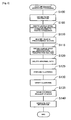
- FIG. 2 is a flowchart showing the cost information generation processing.
- this processing is executed at preset intervals.
- the control unit 20 sequentially obtains the probe information 30a through processing of the sending/receiving control unit 21a, and sequentially records the probe information 30a in the storage medium 30 (step S 100).
- the control unit 20 After the probe information 30a has been accumulated from a plurality of vehicles C, the control unit 20 through processing of the vehicle speed identification information obtaining unit 21b refers to the probe information 30a and obtains the vehicle speed identification information (steps S105 to S120). In the present embodiment, the control unit 20 first refers to the probe information 30a and deletes vehicle speed identification information corresponding to traffic congestion (step S105). Namely, an analysis performed in the present embodiment aims to identify a motion of the vehicle when traveling on the road in the predetermined section with the effect of traffic congestion eliminated. Therefore, vehicle speed identification information sent from the vehicle C during traffic congestion is excluded. Note that whether or not vehicle speed identification information corresponds to traffic congestion can be determined according to various criteria. For example, various structures can be employed, such as one in which vehicle speed identification information is determined as corresponding to traffic congestion when the vehicle travels through a road section at a speed less than 10 kilometers per hour for at least 300 consecutive meters.
- the control unit 20 next identifies the road in the predetermined section (step S110). Namely, the control unit 20 identifies the intersections of main roads based on the map information 30b, and identifies a road between the intersections of the main roads as a road in a predetermined section.
- FIG. 3 shows an example of a road set as a predetermined section. As an example of the road in the predetermined section, the upper portion of FIG. 3 shows a straight road comprised of a plurality of road sections divided by intersections I l to I m (where m is a natural number) installed with traffic signals.
- FIG. 3 also schematically shows a hierarchical structure of the map information 30b, 300a below the road.
- the map information 30b, 300a are set with nodes corresponding to the positions of intersections in each layer.
- nodes N 1l , N 1m specifying the positions of the intersections I l , I m of the main roads are defined in a layer L 1 .
- nodes N 01 to N 0m specifying the positions of all the intersections I l to I m included in the road in the predetermined section are defined.
- the control unit 20 obtains the nodes N 1l , N 1m present in the layer L 1 based on the map information 30b to identify the road in the predetermined section. And in the layer L 0 , the control unit 20 obtains the nodes N 0l , N 0m corresponding to the nodes N 1l , N 1m and identifies the nodes N 02 to N 0m-1 between the nodes N 01 , N 0m . Road sections corresponding to each of the road between adjacent nodes among the nodes N 0l to N 0m are subsequently identified as the plurality of road sections that are consecutive.
- the control unit 20 obtains only the vehicle speed identification information sent by the vehicle C that traveled on a predetermined route (route targeted for analysis), and excludes the vehicle speed identification information sent by the vehicle C that traveled on a route other than the route targeted for analysis (step S115). That is, in the present embodiment, the route targeted for analysis is a route that passes through all roads in the predetermined section.
- the control unit 20 refers to the identifiers included in the probe information 30a and if there are no identifiers indicating the same vehicle throughout all the roads in the predetermined section, then the control unit 20 excludes the vehicle speed identification information linked with such identifiers. For example, since the road in the predetermined section shown in FIG.
- a route traveling straight through all of the predetermined section is set as the route targeted for analysis, and vehicle speed identification information sent from vehicles traveling on other routes (e.g. routes indicated by dashed arrows at the intersections I 2 , I 3 in FIG. 3 ) is excluded.
- abnormal data refers to vehicle speed identification information considered statistically insignificant among a plurality of vehicle speed identification information.
- abnormal data can be determined using various rejection tests (such as the Masuyama, Thompson, or Smirnov rejection tests) and vehicle speed identification information deemed abnormal data excluded.
- FIG. 3 exemplifies the road sections 1 to 3, and shows below the road section 1 arrows indicating required times T 01 , T 11 , T 21 when the vehicles C 0 to C 2 traveled through the road section 1.
- the thickness of the arrows schematically represents the magnitude of required time. Note that the required time for the road section 2 is shown as T 02 , T 12 , T 22 , and the required time for the road section 3 is shown as T 03 , T 13 , T 23 .
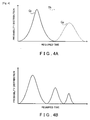
- FIG. 4A is a graph exemplifying a probability distribution of the required time based on the vehicle speed identification information in a certain road section, where a horizontal axis shows the required time and a vertical axis shows the probability distribution.
- Such a probability distribution of the required time in a road section is a distribution corresponding to a motion of the vehicle C in the road section. That is, if there is a high possibility of the vehicle C performing a specific motion, then there is a large distribution for the required time corresponding to that motion. For example, peaks appear in the distribution at certain required times as shown in FIG. 4A . In many cases, the required time of a road section has a distribution divided into two or three peaks. Hence, an example will be described here of two distributions respectively corresponding to either a stop motion of the vehicle C in a road section or a go motion where the vehicle C goes through the road section without stopping.
- FIG. 4A illustrates an example where the probability distribution roughly forms two groups.
- this distribution can be classified into two groups (a group G 1 with a short required time (indicated by a solid line in FIG. 4A ) and a group G 2 with a long required time (indicated by a dashed line in FIG. 4A ).
- a nonhierarchical method such as the k-means method, or a hierarchical method such as Ward's method may be employed.
- k-means clustering can be performed according to the following procedure.
- an initial center may be determined while making assumptions regarding a proper classification. For example, a threshold (threshold Th indicated by a dashed-dotted line in FIG. 4A ) that maximizes a dispersion between groups may be determined according to Otsu's method or the like and initial groups pre-identified, after which centers thereof are then determined.
- a threshold threshold Th indicated by a dashed-dotted line in FIG. 4A
- initial groups pre-identified, after which centers thereof are then determined.
- Various other structures may naturally be employed here.
- a discriminant analysis method may also be adopted, as well as various structures such as one where a distribution peak is set as a center.
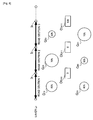
- FIG. 5 is a schematic diagram showing groups in road sections, and shows an initial three road sections (road sections 1 to 3) among the road sections structuring the road in the predetermined section. Below the road sections 1 to 3, groups classified by clustering are shown by open circles.
- FIG. 5 illustrates, when the vehicle speed identification information sent from the vehicle C traveling in the road section 1 is classified into the groups G 1 , G 2 , then in the road section 2 clustering is performed twice based on the vehicle speed identification information corresponding to the groups G 1 , G 2 , respectively.
- vehicle speed identification information linked to an identifier an identifier indicating such information was obtained from the same vehicle C
- FIG. 5 Clustering is then performed using these as the population, and FIG. 5 shows the results thus classified into groups G 3 , G 4 .
- clustering is performed in a similar manner for the vehicle speed identification information linked to an identifier that is the same as one in identifier linked to the vehicle speed identification information classified into the group G 2 in the road section 1, and the results are classified into one or more groups.
- systematic groups are defined such that a plurality of vehicle speed identification information comprising one group in the road section 1 is further classified into one or more groups in the road section 2 onward, and the group in the road section (n+1) is dependent on the group in the road section n.
- FIG. 5 additionally shows dependence in the system organization using right arrows.
- the control unit 20 through processing of the vehicle speed identification information classifying unit 21c verifies the above clustering (step S 130).
- the verification of clustering can be performed by a model evaluation based on the Akaike Information Criterion (AIC), for example. Namely, the number of groups G obtained as a result of clustering and an average required time or the like are used as parameters to calculate the AIC, and classification into appropriate groups is determined when the distribution is well approximated. Note that, when classification into appropriate groups has not been achieved, structures may be employed such as one where the vehicle speed identification information for the road section is deemed as belonging to one group, or one where clustering is performed again after changing the initial center or the like.
- AIC Akaike Information Criterion
- the control unit 20 through processing of the motion occurrence probability obtaining unit 21d obtains the occurrence probability for a motion of the vehicle C corresponding to the groups (step S 135).
- the groups are groups of approximate vehicle speed identification information. Therefore, vehicle speed identification information belonging to the same group is deemed as corresponding to the same motion.
- the two groups as described above correspond in the road section to the motion of the vehicle C stopping or the motion of the vehicle C going through without stopping, respectively.
- the control unit 20 obtains the occurrence probability for each group, wherein the occurrence probability of the group corresponding to a short required time is obtained as the probability at which the vehicle C will go through the road section without stopping. Furthermore, the occurrence probability of the group corresponding to a long required time is obtained as the probability of the vehicle C stopping. For example, if the groups G 1 , G 2 shown in FIG. 5 respectively correspond to the groups G 1 , G 2 shown in FIG. 4A , then the occurrence probability (60% in the example of FIG. 5 ) of the group G 1 corresponding to the short required time is the probability at which the vehicle C will go through the road section without stopping. Meanwhile, the occurrence probability (40% in the example of FIG. 5 ) of the group G 2 corresponding to the long required time is the probability of the vehicle C stopping.
- the control unit 20 through processing of the motion occurrence probability obtaining unit 21d generates the cost information based on the occurrence probability (step S 140). Namely, based on the occurrence probability of the motion, the control unit 20 generates the cost information 30c specifying a difficulty of travel when traveling from one of the road sections that are consecutive to the next, which is stored in the storage medium 30.
- a motion in the road section n indicates a difficulty of travel when traveling to the road section (n+1) from the road section n, and determines the cost at the intersection between the road section n and the road section (n+1).
- a default cost at the intersection is defined as 100
- the cost at an intersection between the road sections n, (n+1) is 0 when the probability of stopping at the road section n is less than the probability of going through.
- the probability of stopping at the road section n is greater than the probability of going through without stopping, then the cost of the intersection between the road sections n, (n+1) is 100.
- the motion of the vehicle C in the road section (n+1) is dependent on the motion of the vehicle C in the road section n. Therefore, the cost at a certain intersection is defined here as a systematic cost designed to be dependent on the cost of a previous intersection.
- the road section 1 is the first road section of the road in the predetermined section. Therefore, the systematic cost information is defined while associating subsequent costs with the initial motion in the road section 1.
- FIG. 6 is a drawing showing an example of systematic costs.
- FIG. 6 illustrates cost values determined based on the occurrence probability of the groups shown in FIG. 5 , and a system thereof.
- the road section 1 corresponds to the first road section of the road in the predetermined section. Therefore, the motion in the road section 1 is divided into a go through without stopping motion and a stop motion, and costs are respectively associated with these motions.
- the group G 1 corresponds to the motion of going through without stopping.
- the cost at the intersection I 2 is set to 0 (a cost Ct 21 shown in FIG. 6 ) and associated with the initial motion, i.e., the motion of going through without stopping.
- the occurrence probability of the group G 3 which corresponds to the motion of going through the road section 2 without stopping, is greater than the occurrence probability of the group G 4 , which corresponds to the motion of stopping. Therefore, the cost at the intersection I 3 is 0 (a cost Ct 31 shown in FIG. 6 ) and linked to the cost Ct 21 .
- the cost at the intersection I 4 is 100 (a cost Ct 41 shown in FIG. 6 ) and linked to the cost Ct 31 .
- FIG. 6 additionally shows the system organization using right arrows.
- the cost at the intersection I 2 is 100 and associated with the initial motion, i.e., the motion of stopping. Similar to the system when the initial motion is the motion of stopping, the cost at the intersection I 3 onward is identified, and the systematic cost information is generated by association with the cost of an immediately prior intersection. Once the cost information is generated as described above in the control unit 20, such cost information is recorded in the storage medium 30 as the cost information 30c.
- FIG. 7 is a flowchart showing processing that is repeatedly executed at a predetermined time interval while such processing is being performed.
- the control unit 200 has already obtained the cost information 30c through processing of the sending/receiving control unit 210a and incorporated the cost information 30c into the map information 300a.
- the control unit 200 through processing of the initial motion obtaining unit 210b obtains information specifying an initial motion of the vehicle when travel starts on the road in the predetermined section. Namely, the output signal from the GPS receiver 410 is obtained to identify the position of the vehicle C, and the map information 300a is referenced to determine whether the current position is a first road section among road sections structuring the road in the above predetermined section (step S200). If it is determined that the current position is not the first road section, then the routine skips processing at step S205 onward.
- step S200 If it is determined at step S200 that the current position is the first road section, then the control unit 200 obtains the motion of the vehicle C based on output information, from the GPS receiver 410 and the vehicle speed sensor 420 through processing of the initial motion obtaining unit 210b, and identifies the motion as an initial motion (step S205).
- the motion of the vehicle corresponding to the examples shown in the above FIGS. 4A and 5 is either a motion where the vehicle C stops or a motion where the vehicle C goes through without stopping.
- control unit 200 in this example may adopt a structure that determines whether the output information of the vehicle speed sensor 420 is a value indicating the vehicle C is stopped in the road section 1, or that determines whether vehicle speed obtained after dividing the distance of the road section 1 by the required time is vehicle speed indicating the vehicle C is stopped.
- the control unit 200 through processing of the estimated motion obtaining unit 210c obtains the system cost information corresponding to the initial motion of the vehicle C (step 5210). For example, if the initial motion is a motion corresponding to the vehicle C stopping, then system cost information (cost Ct 22 , Ct 32 , Ct 42 , and so on) shown in the lower portion of FIG. 6 is obtained; however, if the initial motion is a motion corresponding to the vehicle C going through, then the system cost information (cost Ct 21 , Ct 31 , Ct 41 and so on) shown in the upper portion of FIG. 6 is obtained.
- the control unit 200 then performs a route search based on the obtained system cost information (step S215), and outputs guidance for traveling on the obtained route to the guidance unit 430 (step S220).
- a route search accurately reflecting the difficulty of travel at intersections between the road sections can be performed and guidance provided.
- the above embodiment is an example for carrying out the present invention.
- Various other embodiments may also be employed provided that the occurrence probability of a motion of the vehicle is obtained by classifying the vehicle speed identification information.
- classification of the vehicle speed identification information for example, vehicles for which the vehicle speed identification information is similar on a specific road may be classified into the same group. As a consequence, it is possible to estimate that the vehicles that output vehicle speed identification information classified into respective groups are performing similar motions.
- the vehicle speed identification information may employ various information provided that the motion of the vehicle can be estimated by forming groups based on the vehicle speed and information corresponding to the vehicle speed.
- the vehicle speed identification information is not limited to information that includes the required time as described above, and may also be information that indicates the vehicle speed itself.
- the vehicle speed identification information is preferably information actually measured for each vehicle, wherein the actual measurement may be performed by a structure in each vehicle, as well as by a facility installed around the road.
- the road in the predetermined section may be determined in advance. In addition to a structure that identifies the predetermined section based on nodes defined in a layer ranked higher than a specific layer as described above, a road in any section may be designated as the road in the predetermined section.
- the road in the predetermined section is not limited to a road with a linear configuration as mentioned above, and targets for obtaining vehicle speed identification information are not limited to only vehicle traveling straight.
- a road in a predetermined section comprised of the plurality of road sections can be defined as a curved road.
- the vehicle speed identification information may be obtained for all vehicles traveling on the road, or the vehicle speed identification information may be selected for classification based on various conditions, such as right and left turns, straight travel, and whether there is traffic congestion.
- the vehicle speed identification information is classified into one or more groups by clustering, and motions corresponding to the groups are identified. However, the motions may be identified in advance and the vehicle speed identification information classified such that groups are generated for each identified motion.
- the probe information 30a is generated in the vehicle C based on the output signal of the GPS receiver 410 and the like.
- a structure may be adopted where the travel pattern information obtaining device 10 obtains the output signal of the GPS receiver 410 or the like to generate the probe information 30a.
- FIG. 8 illustrates an example of clusters for a road identical to the road shown in FIG. 3 , when all vehicle speed identification information for each road section (excluding abnormal data and data corresponding to traffic congestion) is subject to clustering without dividing such information according to an identifier.
- FIG. 8 shows a state where the vehicle speed identification information for the road section 1 is classified into the groups G 11 , G 21 , the vehicle speed identification information for the road section 2 is classified into the groups G 31 , G 41 , and the vehicle speed identification information for the road section 3 is classified into the groups G 51 , G 61 .
- the groups G 11 , G 31 , G 51 are groups that correspond to the motion of going through the road section without stopping, while the groups G 21 , G 41 , G 61 are groups that correspond to the motion of stopping in the road section.
- the group G 11 has a greater sample number proportion than the group G 21 (40%). Therefore, the possibility of the vehicle C reaching the road section 2 without stopping in the road section 1 is higher than the possibility of the vehicle C stopping in the road section 1. A cost Ct 211 at the intersection I 2 is thus 0.
- the group G 31 has a greater sample number proportion than the group G 41 (30%), therefore a cost Ct 311 at the intersection I 3 is 0; however, the group G 51 (30%) has a smaller sample number proportion than the group G 61 (70%), therefore a cost Ct 411 at the intersection I 4 is 100.
- the motion of a vehicle traveling on a road can be estimated as a cost, and a route search and route guidance can be performed based on such an estimation.
- a structure is adopted where the motion in the first road section among the plurality of road sections structuring the road in the predetermined section is designated as an initial motion, and subsequent motions (or cost information) of the vehicle are associated with the initial motion.
- a structure may be adopted where a motion of the vehicle upon entering any road section of the road in the predetermined section is designated as an initial motion. For example, if the occurrence probability of groups is systematically defined as in FIGS. 5 and 6 , it is possible to estimate the motion when traveling in a specific direction from any road section (namely, in the examples shown in FIGS. 5 and 6 , a direction where the number n of the road increases).
- the groups in the road section 2 can be classified into two groups corresponding to the motion of stopping in the road section 1 and two groups corresponding to the motion of going through the road section 1 without stopping.
- the four groups are then associated with the motions of stopping and not stopping in the road section 2. Accordingly, the four groups can be classified into groups corresponding to the motion of the vehicle stopping and the motion of the vehicle not stopping.
- the groups for the road section 3 onward are systematically associated with the groups in the road section 2. Therefore, once the motion when the vehicle C starts travel in the road section 2 is identified, it is possible to estimate subsequent motions.
- the initial motion is not limited provided that the initial motion is a motion of the vehicle when starting travel in a road of the predetermined section, or, when the vehicle enters a preset road in the predetermined section and performs a specific motion, this motion can be obtained as the initial motion. Accordingly, a motion of the vehicle immediately before or immediately after entering the road in the predetermined section may be specified.
- the initial motion and the motion of the vehicle corresponding to a group is not limited to the motion of stopping and the motion of going through an intersection without stopping, and may be an average required time or the like in a road section, for example.
- a structure may also be adopted that associates the vehicle speed identification information with periods of time, performs clustering for each period of time, and links the motion of the vehicle and the cost information with a period of time.
- the clustering performed is not limited to the algorithm mentioned above, and classification may be performed by a discriminant analysis that specifies a discriminant function. In the above embodiment, classification into two groups was performed; however, a structure may naturally be adopted where classification into three or more groups is performed.
- FIG. 4B shows a probability distribution in which the vehicle speed identification information may form three groups.
- classification into three groups is preferable.
- an X number of groups may be associated with unique motions whereby X types of motions can be obtained, or (X-1) or fewer types of motions can be obtained.
- the vehicle speed identification information forms three groups as in FIG. 4B
- the three groups may be further classified into one group and two groups, wherein any one of the groups is associated with the motion of stopping and the other groups are associated with the motion of going through without stopping.
- the verification of clustering shown at step S 130 is particularly useful for classification into three or more groups.
- the form of the cost information is not limited to a structure that sets values corresponding to either the motion of stopping or the motion of going through without stopping as described above, and a structure may be adopted where a numerical value fluctuates depending on the occurrence probability of the motion.
- a structure may be employed where, if the default cost of 100 at an intersection is linked to a stop probability of 50% and the stop probability varies between 0%, 25%, 75%, and 100%, then the cost fluctuates between 0, 50, 150, and 200, respectively.
Landscapes
- Physics & Mathematics (AREA)
- General Physics & Mathematics (AREA)
- Engineering & Computer Science (AREA)
- Radar, Positioning & Navigation (AREA)
- Remote Sensing (AREA)
- Chemical & Material Sciences (AREA)
- Analytical Chemistry (AREA)
- Mathematical Physics (AREA)
- Traffic Control Systems (AREA)
- Navigation (AREA)
Claims (7)
- Bewegungsmuster-Information-Erhaltevorrichtung, mit
einer Fahrzeuggeschwindigkeit-Identifikationsinformation-Erhalteeinheit (21b) zum Erhalten einer Fahrzeuggeschwindigkeit-Identifikationsinformation (30a) zum Identifizieren einer Fahrzeuggeschwindigkeit eines Fahrzeugs auf einer Straße für eine Mehrzahl von Fahrzeugen,
eine Fahrzeuggeschwindigkeit-Identifikationsinformation-Klassifiziereinheit (21 c) zum Klassifizieren der Fahrzeuggeschwindigkeit-Identifikationsinformation (30a) in eine Gruppe entsprechend einer Bewegung des Fahrzeugs basierend auf einer Verteilung der Fahrzeuggeschwindigkeit-Identifikationsinformation (30a), und
einer Bewegungseintrittswahrscheinlichkeit-Erhalteeinheit (21d) zum Erhalten einer Eintrittswahrscheinlichkeit der Bewegung des Fahrzeugs basierend auf der Klassifizierung, dadurch gekennzeichnet, dass
die Fahrzeuggeschwindigkeit-Identifikationsinformation-Erhalteeinheit (21b) jeweils die Fahrzeuggeschwindigkeit-Identifikationsinformation (30a) einer Mehrzahl von Straßenabschnitten, die zwischen zwei voreingestellten Punkten aufeinander folgen, erhält, wobei die Fahrzeuggeschwindigkeit-Identifikationsinformation (30a) die Fahrzeuggeschwindigkeit oder die für die Straßenabschnitte benötigte Zeit angibt, die Fahrzeuggeschwindigkeit-Identifikationsinformation-Klassifiziereinheit (21c) die Fahrzeuggeschwindigkeit-Identifikationsinformation (30a) von jedem der Straßenabschnitte in die Gruppe, die derart definiert ist, dass die Gruppe in einem bestimmten Straßenabschnitt abhängig von der Gruppe in einem zu dem bestimmten Straßenabschnitt vorangehenden Straßenabschnitt ist, basierend auf der Bewegung auf dem bestimmten Straßenabschnitt, wobei die Bewegung abhängig von der Bewegung auf dem zu dem bestimmten Straßenabschnitt vorangehenden Straßenabschnitt ist, klassifiziert, und
die Bewegungseintrittswahrscheinlichkeit-Erhalteeinheit (21d) die Eintrittswahrscheinlichkeit der Bewegung des Fahrzeugs auf jedem der Straßenabschnitte erhält. - Bewegungsmuster-Information-Erhaltevorrichtung nach Anspruch 1, bei der die Fahrzeuggeschwindigkeit-Identifikationsinformation-Erhalteeinheit (21b) auf Karteninformation (30b) verweist, die derart in Schichten geteilt ist, dass eine Schicht höheren Rangs eine niedrigere Dichte von Knoten hat, und Knoten (N0l, N02, N03, N04, N0m) unterer Schichten, die auf einer Straße, die identisch zu einer Straße zwischen den zwei voreingestellten Punkten ist, festgelegt sind, aus der Schicht, die einen niedrigeren Rang hat als die Schicht, die die Knoten (N1l, N1m) höherer Schichten, die beiden Enden der Straße zwischen den zwei voreingestellten Punkten entsprechen, enthält, zum Benennen der Knoten (N01, N02, N03, N04, Nom) unterer Schichten als Endpunkte für jeden Straßenabschnitt extrahiert.
- Bewegungsmuster-Information-Erhaltevorrichtung nach Anspruch 1 oder 2, bei der die Bewegungseintrittswahrscheinlichkeit-Erhalteeinheit (21 d) die Eintrittswahrscheinlichkeit für eine Bewegung des Fahrzeugs erhält, die einer Fahrschwierigkeit beim Befahren einer der Straßenabschnitte, die aufeinander folgen, entspricht, und Information erhält, die die Fahrschwierigkeit basierend auf der Eintrittswahrscheinlichkeit spezifiziert.
- Bewegungsmuster-Information-Erhaltevorrichtung nach einem der Ansprüche 1 bis 3, bei der
die Fahrzeuggeschwindigkeit-Identifikationsinformation-Klassifiziereinheit (21 c) die Fahrzeuggeschwindigkeit-Identifikationsinformation (30a) in die Gruppen durch Clustern klassifiziert. - Bewegungsmuster-Information-Erhalteverfahren mit den folgenden Schritten Erhalten von Fahrzeuggeschwindigkeit-Identifikationsinformation zum Identifizieren einer Fahrzeuggeschwindigkeit eines Fahrzeugs auf einer Straße für eine Mehrzahl von Fahrzeugen,
Klassifizieren der Fahrzeuggeschwindigkeit-Identifikationsinformation in eine Gruppe entsprechend einer Bewegung des Fahrzeugs basierend auf einer Verteilung der Fahrzeuggeschwindigkeit-Identifikationsinformation, und
Erhalten einer Eintrittswahrscheinlichkeit der Bewegung des Fahrzeugs basierend auf der Klassifizierung, dadurch gekennzeichnet, dass
der Schritt des Erhaltens der Fahrzeuggeschwindigkeit-Identifikationsinformation jeweils den Schritt des Erhaltens der Fahrzeuggeschwindigkeit-Identifikationsinformation einer Mehrzahl von Straßenabschnitten, die zwischen zwei voreingestellten Punkten aufeinander folgen, aufweist, wobei die Fahrzeuggeschwindigkeit-Identifikationsinformation die Fahrzeuggeschwindigkeit oder die für die Straßenabschnitte benötigte Zeit angibt,
der Schritt des Klassifizierens der Fahrzeuggeschwindigkeit-Identifikationsinformation den Schritt des Klassifizierens der Fahrzeuggeschwindigkeit-Identifikationsinformation von jedem der Straßenabschnitte in die Gruppe, die derart definiert ist, dass die Gruppe in einem bestimmten Straßenabschnitt abhängig von der Gruppe in einem zu dem bestimmten Straßenabschnitt vorangehenden Straßenabschnitt ist, basierend auf der Bewegung auf dem bestimmten Straßenabschnitt, wobei die Bewegung abhängig von der Bewegung auf dem zu dem bestimmten Straßenabschnitt vorangehenden Straßenabschnitt ist, aufweist, und
der Schritt des Erhaltens einer Eintrittswahrscheinlichkeit den Schritt des Erhaltens der Eintrittswahrscheinlichkeit der Bewegung des Fahrzeugs auf jedem der Straßenabschnitte aufweist. - Bewegungsmuster-Information-Erhalteprogramm, das in einem Computer folgende Funktionen ausführt,
Erhalten von Fahrzeuggeschwindigkeit-Identifikationsinformation zum Identifizieren einer Fahrzeuggeschwindigkeit eines Fahrzeugs auf einer Straße für eine Mehrzahl von Fahrzeugen,
Klassifizieren der Fahrzeuggeschwindigkeit-Identifikationsinformation in eine Gruppe entsprechend einer Bewegung des Fahrzeugs basierend auf einer Verteilung der Fahrzeuggeschwindigkeit-Identifikationsinformation, und
Erhalten einer Eintrittswahrscheinlichkeit der Bewegung des Fahrzeugs basierend auf der Klassifizierung, dadurch gekennzeichnet, dass
die Funktion des Erhaltens einer Fahrzeuggeschwindigkeit-Identifikationsinformation die Funktion des Erhaltens der Fahrzeuggeschwindigkeit-Identifikationsinformation jeweils einer Mehrzahl von Straßenabschnitten, die zwischen zwei voreingestellten Punkten aufeinander folgen, aufweist, wobei die Fahrzeuggeschwindigkeit-Identifikationsinformation die Fahrzeuggeschwindigkeit oder die für die Straßenabschnitte benötigte Zeit angibt,
die Funktion des Klassifizierens der Fahrzeuggeschwindigkeit-Identifikationsinformation die Funktion des Klassifizierens der Fahrzeuggeschwindigkeit-Identifikationsinformation von jedem der Straßenabschnitte in die Gruppe, die derart definiert ist, dass die Gruppe in einem bestimmten Straßenabschnitt abhängig von der Gruppe in einem zu dem bestimmten Straßenabschnitt vorangehenden Straßenabschnitt ist, basierend auf der Bewegung auf dem bestimmten Straßenabschnitt, wobei die Bewegung abhängig von der Bewegung auf dem zu dem bestimmten Straßenabschnitt vorangehenden Straßenabschnitt ist, aufweist und
die Funktion des Erhaltens einer Eintrittswahrscheinlichkeit die Funktion des Erhaltens der Eintrittswahrscheinlichkeit der Bewegung des Fahrzeugs auf jedem Straßenabschnitt aufweist. - Computerlesbares Medium, das das Bewegungsmusterinformation-Erhalteprogramm nach Anspruch 6 aufweist.
Applications Claiming Priority (3)
| Application Number | Priority Date | Filing Date | Title |
|---|---|---|---|
| JP2008084028A JP4957612B2 (ja) | 2008-03-27 | 2008-03-27 | 走行パターン情報取得装置、走行パターン情報取得方法および走行パターン情報取得プログラム |
| JP2008084042A JP4572944B2 (ja) | 2008-03-27 | 2008-03-27 | 運転支援装置、運転支援方法および運転支援プログラム |
| PCT/JP2009/000605 WO2009118987A1 (en) | 2008-03-27 | 2009-02-16 | Travel pattern information obtaining device, travel pattern information obtaining method, and travel pattern information obtaining program |
Publications (3)
| Publication Number | Publication Date |
|---|---|
| EP2255347A1 EP2255347A1 (de) | 2010-12-01 |
| EP2255347B1 true EP2255347B1 (de) | 2012-06-20 |
| EP2255347B9 EP2255347B9 (de) | 2012-10-03 |
Family
ID=40670982
Family Applications (2)
| Application Number | Title | Priority Date | Filing Date |
|---|---|---|---|
| EP09724473A Not-in-force EP2255347B9 (de) | 2008-03-27 | 2009-02-16 | Vorrichtung zur gewinnung von informationen über ein bewegungsmuster, verfahren zur gewinnung von informationen über ein bewegungsmuster, programm zur gewinnung von informationen über ein bewegungsmuster und computerlesbares medium |
| EP09724262.2A Not-in-force EP2255349B1 (de) | 2008-03-27 | 2009-02-16 | Fahrunterstützungsvorrichtung, verfahren und computerprogramm |
Family Applications After (1)
| Application Number | Title | Priority Date | Filing Date |
|---|---|---|---|
| EP09724262.2A Not-in-force EP2255349B1 (de) | 2008-03-27 | 2009-02-16 | Fahrunterstützungsvorrichtung, verfahren und computerprogramm |
Country Status (4)
| Country | Link |
|---|---|
| US (2) | US9076333B2 (de) |
| EP (2) | EP2255347B9 (de) |
| CN (2) | CN101965601B (de) |
| WO (2) | WO2009118987A1 (de) |
Cited By (1)
| Publication number | Priority date | Publication date | Assignee | Title |
|---|---|---|---|---|
| WO2020239396A1 (de) * | 2019-05-27 | 2020-12-03 | Volkswagen Aktiengesellschaft | Verfahren zum bestimmen einer parallelfahrwahrscheinlichkeit von kraftfahrzeugen |
Families Citing this family (23)
| Publication number | Priority date | Publication date | Assignee | Title |
|---|---|---|---|---|
| US6587781B2 (en) | 2000-08-28 | 2003-07-01 | Estimotion, Inc. | Method and system for modeling and processing vehicular traffic data and information and applying thereof |
| US7620402B2 (en) | 2004-07-09 | 2009-11-17 | Itis Uk Limited | System and method for geographically locating a mobile device |
| DE102005039103A1 (de) * | 2005-08-18 | 2007-03-01 | Robert Bosch Gmbh | Verfahren für die Erfassung eines Verkehrsraums |
| JP5372802B2 (ja) * | 2010-02-24 | 2013-12-18 | クラリオン株式会社 | トンネル内位置推定機能付きナビゲーション装置 |
| CN102496079B (zh) * | 2011-12-12 | 2015-04-08 | 北京航空航天大学 | 一种道路能耗与排放的监测方法 |
| KR20140100611A (ko) * | 2013-02-05 | 2014-08-18 | 한국전자통신연구원 | 길안내 시스템의 동작 방법 및 휴대 기기의 길안내 방법 |
| TWI471530B (zh) * | 2013-02-22 | 2015-02-01 | Quanta Comp Inc | 導航系統及方法 |
| WO2015147766A2 (en) | 2014-03-26 | 2015-10-01 | Ford Otomotiv Sanayi Anonim Sirketi | A safe monitoring system |
| JP6187370B2 (ja) * | 2014-04-10 | 2017-08-30 | トヨタ自動車株式会社 | 運転行動分類装置および運転行動分類方法 |
| JP6474307B2 (ja) * | 2015-04-27 | 2019-02-27 | アイシン・エィ・ダブリュ株式会社 | 自動運転支援システム、自動運転支援方法及びコンピュータプログラム |
| US10082797B2 (en) * | 2015-09-16 | 2018-09-25 | Ford Global Technologies, Llc | Vehicle radar perception and localization |
| CN105389981B (zh) * | 2015-11-11 | 2018-07-06 | 西安理工大学 | 一种基于移动终端自组网络的道路信息共享方法 |
| US11087291B2 (en) * | 2015-11-24 | 2021-08-10 | Honda Motor Co., Ltd.. | Action planning and execution support device |
| US10127228B2 (en) | 2016-04-13 | 2018-11-13 | Google Llc | Techniques for proactively providing translated text to a traveling user |
| DE102017202943A1 (de) * | 2016-08-25 | 2018-03-01 | Robert Bosch Gmbh | Verfahren und Vorrichtung zum Bereitstellen einer prädizierten Fahrzeugbewegung |
| US11260749B2 (en) * | 2016-09-26 | 2022-03-01 | Transportation Ip Holdings, Llc | Cooling control systems |
| US10720057B2 (en) * | 2016-09-29 | 2020-07-21 | Tomtom Traffic B.V. | Methods and systems for generating profile data for segments of an electronic map |
| CN106548644A (zh) * | 2016-11-30 | 2017-03-29 | 深圳明创自控技术有限公司 | 一种自动驾驶系统 |
| CN108961353B (zh) * | 2017-05-19 | 2023-12-08 | 上海蔚来汽车有限公司 | 道路模型的构建 |
| JP7071533B2 (ja) * | 2018-09-22 | 2022-05-19 | グーグル エルエルシー | 交通状況の視覚化を改善するためのシステムおよび方法 |
| CN109637125A (zh) * | 2018-11-30 | 2019-04-16 | 创发科技有限责任公司 | 智能路况监测系统、装置、方法和计算机可读存储介质 |
| CN111854781A (zh) * | 2020-06-17 | 2020-10-30 | 北京嘀嘀无限科技发展有限公司 | 导航路径推荐方法、装置和电子设备 |
| CN112532953B (zh) * | 2020-12-23 | 2021-07-06 | 深圳市朝阳辉电气设备有限公司 | 一种智慧城市道路照明控制的数据处理方法及系统 |
Family Cites Families (28)
| Publication number | Priority date | Publication date | Assignee | Title |
|---|---|---|---|---|
| US5612881A (en) * | 1993-12-27 | 1997-03-18 | Aisin Aw Co., Ltd. | Map display system |
| JP3355887B2 (ja) | 1995-09-08 | 2002-12-09 | 住友電気工業株式会社 | 旅行時間予測方法および旅行時間予測装置 |
| DE19606258C1 (de) * | 1996-02-06 | 1997-04-30 | Mannesmann Ag | Fahrzeugautonome Detektion von Verkehrsstau |
| DE19724919A1 (de) * | 1997-06-12 | 1999-01-07 | Adolph Michael Dr | Verfahren zum Erzeugen, Verschmelzen und Aktualisieren von in einem Zielführungssystem nutzbaren Daten |
| JP3678639B2 (ja) | 1999-09-29 | 2005-08-03 | 松下電器産業株式会社 | 経路選出方法およびシステム |
| DE60032989T2 (de) | 1999-09-29 | 2007-10-11 | Matsushita Electric Industrial Co., Ltd., Kadoma | Routenauswahlverfahren und -System |
| JP3526422B2 (ja) | 1999-10-28 | 2004-05-17 | 株式会社東芝 | 走行所要時間情報演算システム |
| US6587781B2 (en) * | 2000-08-28 | 2003-07-01 | Estimotion, Inc. | Method and system for modeling and processing vehicular traffic data and information and applying thereof |
| JP4064044B2 (ja) | 2000-08-29 | 2008-03-19 | 三菱電機株式会社 | 交通情報送信システム及び交通情報収集配信システム並びに交通情報収集配信方法 |
| DE10146398A1 (de) * | 2001-09-20 | 2003-04-17 | Siemens Ag | System zum Steuern von Lichtsignalgebern an Kreuzungen |
| US20030128135A1 (en) | 2002-01-10 | 2003-07-10 | Poltorak Alexander I. | Apparatus and method for providing for the remote control of traffic control devices along a travel route |
| US7433889B1 (en) | 2002-08-07 | 2008-10-07 | Navteq North America, Llc | Method and system for obtaining traffic sign data using navigation systems |
| US7355528B2 (en) * | 2003-10-16 | 2008-04-08 | Hitachi, Ltd. | Traffic information providing system and car navigation system |
| JP4177228B2 (ja) * | 2003-10-24 | 2008-11-05 | 三菱電機株式会社 | 予測装置 |
| CN100335337C (zh) * | 2004-06-02 | 2007-09-05 | 上海大众汽车有限公司 | 汽车短暂驻车和起步的驾驶辅助方法及其系统 |
| EP1741591B1 (de) * | 2005-07-06 | 2009-10-14 | Ford Global Technologies, LLC | Verfahren zur Vorhersage von Fahrtsituationen in einem Kraftfahrzeug |
| JP4367431B2 (ja) * | 2005-10-26 | 2009-11-18 | トヨタ自動車株式会社 | 車両用運転支援システム |
| JP4771365B2 (ja) * | 2005-11-30 | 2011-09-14 | アイシン・エィ・ダブリュ株式会社 | 経路案内システム、経路案内方法及びプログラム |
| TW200725500A (en) | 2005-12-27 | 2007-07-01 | Ind Tech Res Inst | Path guiding system and method thereof |
| CN2901460Y (zh) * | 2006-03-01 | 2007-05-16 | 四川交通职业技术学院 | 汽车限速及安全间距控制系统 |
| US20070208493A1 (en) * | 2006-03-03 | 2007-09-06 | Inrix, Inc. | Identifying unrepresentative road traffic condition data obtained from mobile data sources |
| JP2007322304A (ja) | 2006-06-02 | 2007-12-13 | Xanavi Informatics Corp | ナビゲーション装置、ナビゲーション方法 |
| US8126641B2 (en) * | 2006-06-30 | 2012-02-28 | Microsoft Corporation | Route planning with contingencies |
| WO2008015966A1 (en) | 2006-08-04 | 2008-02-07 | Panasonic Corporation | Collision information indicator and its method |
| US9076332B2 (en) * | 2006-10-19 | 2015-07-07 | Makor Issues And Rights Ltd. | Multi-objective optimization for real time traffic light control and navigation systems for urban saturated networks |
| JP4932524B2 (ja) * | 2006-10-20 | 2012-05-16 | 日本電気株式会社 | 旅行時間予測装置、旅行時間予測方法、交通情報提供システム及びプログラム |
| US7680749B1 (en) * | 2006-11-02 | 2010-03-16 | Google Inc. | Generating attribute models for use in adaptive navigation systems |
| US7925423B2 (en) | 2007-08-31 | 2011-04-12 | Embarq Holdings Company, Llc | System and method for traffic condition detection |
-
2009
- 2009-02-16 CN CN200980108213.3A patent/CN101965601B/zh not_active Expired - Fee Related
- 2009-02-16 EP EP09724473A patent/EP2255347B9/de not_active Not-in-force
- 2009-02-16 WO PCT/JP2009/000605 patent/WO2009118987A1/en not_active Ceased
- 2009-02-16 US US12/867,186 patent/US9076333B2/en active Active
- 2009-02-16 WO PCT/JP2009/000607 patent/WO2009118988A1/en not_active Ceased
- 2009-02-16 EP EP09724262.2A patent/EP2255349B1/de not_active Not-in-force
- 2009-02-16 US US12/867,102 patent/US8417443B2/en not_active Expired - Fee Related
- 2009-02-16 CN CN200980108059.XA patent/CN101965600B/zh not_active Expired - Fee Related
Cited By (1)
| Publication number | Priority date | Publication date | Assignee | Title |
|---|---|---|---|---|
| WO2020239396A1 (de) * | 2019-05-27 | 2020-12-03 | Volkswagen Aktiengesellschaft | Verfahren zum bestimmen einer parallelfahrwahrscheinlichkeit von kraftfahrzeugen |
Also Published As
| Publication number | Publication date |
|---|---|
| WO2009118988A1 (en) | 2009-10-01 |
| EP2255347B9 (de) | 2012-10-03 |
| CN101965601A (zh) | 2011-02-02 |
| CN101965601B (zh) | 2014-05-14 |
| WO2009118987A1 (en) | 2009-10-01 |
| EP2255347A1 (de) | 2010-12-01 |
| US20100324806A1 (en) | 2010-12-23 |
| EP2255349A1 (de) | 2010-12-01 |
| EP2255349B1 (de) | 2013-05-08 |
| CN101965600A (zh) | 2011-02-02 |
| US8417443B2 (en) | 2013-04-09 |
| US20100309022A1 (en) | 2010-12-09 |
| US9076333B2 (en) | 2015-07-07 |
| CN101965600B (zh) | 2014-08-20 |
Similar Documents
| Publication | Publication Date | Title |
|---|---|---|
| EP2255347B1 (de) | Vorrichtung zur gewinnung von informationen über ein bewegungsmuster, verfahren zur gewinnung von informationen über ein bewegungsmuster, programm zur gewinnung von informationen über ein bewegungsmuster und computerlesbares medium | |
| JP5424754B2 (ja) | リンク旅行時間算出装置及びプログラム | |
| US10115309B2 (en) | Method for processing measurement data of a vehicle in order to determine the start of a search for a parking space | |
| US12112633B2 (en) | Methods and systems for generating parking related data | |
| EP2650649B1 (de) | Strassennetz-analysesystem | |
| JP5856387B2 (ja) | 車両データの解析方法及び車両データの解析システム | |
| JP2020520520A (ja) | トリップの種類を識別するためのテレマティクスデータの使用 | |
| JP7172491B2 (ja) | 交通流予測装置、交通流予測方法及びプログラム | |
| CN106056903B (zh) | 基于gps数据的道路拥塞区域的检测方法 | |
| US12462680B2 (en) | Method and processing system for processing probe data and probe | |
| CN109489679A (zh) | 一种导航路径中的到达时间计算方法 | |
| JP4572944B2 (ja) | 運転支援装置、運転支援方法および運転支援プログラム | |
| JP4957612B2 (ja) | 走行パターン情報取得装置、走行パターン情報取得方法および走行パターン情報取得プログラム | |
| WO2010101199A1 (ja) | 道路交通情報作成装置および道路交通情報作成方法 | |
| CN110264725B (zh) | 路段流量的确定方法及装置 | |
| CN120544407B (zh) | 三维地形测绘融合车路协同的交通能效控制系统 | |
| CN121430661A (zh) | 基于定位的动态路径规划与寻优方法及系统 | |
| CN112927116A (zh) | 一种智慧交通的智能调度方法、装置及调度中心 | |
| CN120598449A (zh) | 一种基于动态等时圈和车辆轨迹的货车超范围营运研判方法 | |
| JP2014130439A (ja) | 走行状態予測装置、走行状態予測方法、及びプログラム | |
| HK1166846A (en) | Method and device for providing cost information associated with junctions and method of determining a route |
Legal Events
| Date | Code | Title | Description |
|---|---|---|---|
| PUAI | Public reference made under article 153(3) epc to a published international application that has entered the european phase |
Free format text: ORIGINAL CODE: 0009012 |
|
| 17P | Request for examination filed |
Effective date: 20100902 |
|
| AK | Designated contracting states |
Kind code of ref document: A1 Designated state(s): AT BE BG CH CY CZ DE DK EE ES FI FR GB GR HR HU IE IS IT LI LT LU LV MC MK MT NL NO PL PT RO SE SI SK TR |
|
| AX | Request for extension of the european patent |
Extension state: AL BA RS |
|
| DAX | Request for extension of the european patent (deleted) | ||
| GRAP | Despatch of communication of intention to grant a patent |
Free format text: ORIGINAL CODE: EPIDOSNIGR1 |
|
| RIC1 | Information provided on ipc code assigned before grant |
Ipc: G08G 1/01 20060101AFI20120111BHEP Ipc: G08G 1/0968 20060101ALN20120111BHEP |
|
| RTI1 | Title (correction) |
Free format text: TRAVEL PATTERN INFORMATION OBTAINING DEVICE, TRAVEL PATTERN INFORMATION OBTAINING METHOD, TRAVEL PATTERN INFORMATION OBTAINING PROGRAM AND COMPUTER READABLE MEDIUM |
|
| GRAS | Grant fee paid |
Free format text: ORIGINAL CODE: EPIDOSNIGR3 |
|
| GRAA | (expected) grant |
Free format text: ORIGINAL CODE: 0009210 |
|
| AK | Designated contracting states |
Kind code of ref document: B1 Designated state(s): AT BE BG CH CY CZ DE DK EE ES FI FR GB GR HR HU IE IS IT LI LT LU LV MC MK MT NL NO PL PT RO SE SI SK TR |
|
| REG | Reference to a national code |
Ref country code: GB Ref legal event code: FG4D |
|
| REG | Reference to a national code |
Ref country code: CH Ref legal event code: EP |
|
| REG | Reference to a national code |
Ref country code: AT Ref legal event code: REF Ref document number: 563425 Country of ref document: AT Kind code of ref document: T Effective date: 20120715 |
|
| REG | Reference to a national code |
Ref country code: IE Ref legal event code: FG4D |
|
| REG | Reference to a national code |
Ref country code: DE Ref legal event code: R096 Ref document number: 602009007734 Country of ref document: DE Effective date: 20120816 |
|
| PG25 | Lapsed in a contracting state [announced via postgrant information from national office to epo] |
Ref country code: NO Free format text: LAPSE BECAUSE OF FAILURE TO SUBMIT A TRANSLATION OF THE DESCRIPTION OR TO PAY THE FEE WITHIN THE PRESCRIBED TIME-LIMIT Effective date: 20120920 Ref country code: LT Free format text: LAPSE BECAUSE OF FAILURE TO SUBMIT A TRANSLATION OF THE DESCRIPTION OR TO PAY THE FEE WITHIN THE PRESCRIBED TIME-LIMIT Effective date: 20120620 Ref country code: SE Free format text: LAPSE BECAUSE OF FAILURE TO SUBMIT A TRANSLATION OF THE DESCRIPTION OR TO PAY THE FEE WITHIN THE PRESCRIBED TIME-LIMIT Effective date: 20120620 Ref country code: FI Free format text: LAPSE BECAUSE OF FAILURE TO SUBMIT A TRANSLATION OF THE DESCRIPTION OR TO PAY THE FEE WITHIN THE PRESCRIBED TIME-LIMIT Effective date: 20120620 |
|
| REG | Reference to a national code |
Ref country code: NL Ref legal event code: VDEP Effective date: 20120620 |
|
| REG | Reference to a national code |
Ref country code: AT Ref legal event code: MK05 Ref document number: 563425 Country of ref document: AT Kind code of ref document: T Effective date: 20120620 |
|
| REG | Reference to a national code |
Ref country code: LT Ref legal event code: MG4D Effective date: 20120620 |
|
| PG25 | Lapsed in a contracting state [announced via postgrant information from national office to epo] |
Ref country code: GR Free format text: LAPSE BECAUSE OF FAILURE TO SUBMIT A TRANSLATION OF THE DESCRIPTION OR TO PAY THE FEE WITHIN THE PRESCRIBED TIME-LIMIT Effective date: 20120921 Ref country code: LV Free format text: LAPSE BECAUSE OF FAILURE TO SUBMIT A TRANSLATION OF THE DESCRIPTION OR TO PAY THE FEE WITHIN THE PRESCRIBED TIME-LIMIT Effective date: 20120620 Ref country code: SI Free format text: LAPSE BECAUSE OF FAILURE TO SUBMIT A TRANSLATION OF THE DESCRIPTION OR TO PAY THE FEE WITHIN THE PRESCRIBED TIME-LIMIT Effective date: 20120620 Ref country code: HR Free format text: LAPSE BECAUSE OF FAILURE TO SUBMIT A TRANSLATION OF THE DESCRIPTION OR TO PAY THE FEE WITHIN THE PRESCRIBED TIME-LIMIT Effective date: 20120620 |
|
| PG25 | Lapsed in a contracting state [announced via postgrant information from national office to epo] |
Ref country code: SK Free format text: LAPSE BECAUSE OF FAILURE TO SUBMIT A TRANSLATION OF THE DESCRIPTION OR TO PAY THE FEE WITHIN THE PRESCRIBED TIME-LIMIT Effective date: 20120620 Ref country code: EE Free format text: LAPSE BECAUSE OF FAILURE TO SUBMIT A TRANSLATION OF THE DESCRIPTION OR TO PAY THE FEE WITHIN THE PRESCRIBED TIME-LIMIT Effective date: 20120620 Ref country code: CY Free format text: LAPSE BECAUSE OF FAILURE TO SUBMIT A TRANSLATION OF THE DESCRIPTION OR TO PAY THE FEE WITHIN THE PRESCRIBED TIME-LIMIT Effective date: 20120620 Ref country code: IS Free format text: LAPSE BECAUSE OF FAILURE TO SUBMIT A TRANSLATION OF THE DESCRIPTION OR TO PAY THE FEE WITHIN THE PRESCRIBED TIME-LIMIT Effective date: 20121020 Ref country code: AT Free format text: LAPSE BECAUSE OF FAILURE TO SUBMIT A TRANSLATION OF THE DESCRIPTION OR TO PAY THE FEE WITHIN THE PRESCRIBED TIME-LIMIT Effective date: 20120620 Ref country code: RO Free format text: LAPSE BECAUSE OF FAILURE TO SUBMIT A TRANSLATION OF THE DESCRIPTION OR TO PAY THE FEE WITHIN THE PRESCRIBED TIME-LIMIT Effective date: 20120620 Ref country code: CZ Free format text: LAPSE BECAUSE OF FAILURE TO SUBMIT A TRANSLATION OF THE DESCRIPTION OR TO PAY THE FEE WITHIN THE PRESCRIBED TIME-LIMIT Effective date: 20120620 Ref country code: BE Free format text: LAPSE BECAUSE OF FAILURE TO SUBMIT A TRANSLATION OF THE DESCRIPTION OR TO PAY THE FEE WITHIN THE PRESCRIBED TIME-LIMIT Effective date: 20120620 |
|
| PG25 | Lapsed in a contracting state [announced via postgrant information from national office to epo] |
Ref country code: PT Free format text: LAPSE BECAUSE OF FAILURE TO SUBMIT A TRANSLATION OF THE DESCRIPTION OR TO PAY THE FEE WITHIN THE PRESCRIBED TIME-LIMIT Effective date: 20121022 Ref country code: PL Free format text: LAPSE BECAUSE OF FAILURE TO SUBMIT A TRANSLATION OF THE DESCRIPTION OR TO PAY THE FEE WITHIN THE PRESCRIBED TIME-LIMIT Effective date: 20120620 Ref country code: IT Free format text: LAPSE BECAUSE OF FAILURE TO SUBMIT A TRANSLATION OF THE DESCRIPTION OR TO PAY THE FEE WITHIN THE PRESCRIBED TIME-LIMIT Effective date: 20120620 |
|
| PG25 | Lapsed in a contracting state [announced via postgrant information from national office to epo] |
Ref country code: NL Free format text: LAPSE BECAUSE OF FAILURE TO SUBMIT A TRANSLATION OF THE DESCRIPTION OR TO PAY THE FEE WITHIN THE PRESCRIBED TIME-LIMIT Effective date: 20120620 |
|
| PLBE | No opposition filed within time limit |
Free format text: ORIGINAL CODE: 0009261 |
|
| STAA | Information on the status of an ep patent application or granted ep patent |
Free format text: STATUS: NO OPPOSITION FILED WITHIN TIME LIMIT |
|
| PG25 | Lapsed in a contracting state [announced via postgrant information from national office to epo] |
Ref country code: ES Free format text: LAPSE BECAUSE OF FAILURE TO SUBMIT A TRANSLATION OF THE DESCRIPTION OR TO PAY THE FEE WITHIN THE PRESCRIBED TIME-LIMIT Effective date: 20121001 Ref country code: DK Free format text: LAPSE BECAUSE OF FAILURE TO SUBMIT A TRANSLATION OF THE DESCRIPTION OR TO PAY THE FEE WITHIN THE PRESCRIBED TIME-LIMIT Effective date: 20120620 |
|
| 26N | No opposition filed |
Effective date: 20130321 |
|
| REG | Reference to a national code |
Ref country code: DE Ref legal event code: R097 Ref document number: 602009007734 Country of ref document: DE Effective date: 20130321 |
|
| PG25 | Lapsed in a contracting state [announced via postgrant information from national office to epo] |
Ref country code: BG Free format text: LAPSE BECAUSE OF FAILURE TO SUBMIT A TRANSLATION OF THE DESCRIPTION OR TO PAY THE FEE WITHIN THE PRESCRIBED TIME-LIMIT Effective date: 20120920 |
|
| PG25 | Lapsed in a contracting state [announced via postgrant information from national office to epo] |
Ref country code: MC Free format text: LAPSE BECAUSE OF NON-PAYMENT OF DUE FEES Effective date: 20130228 |
|
| REG | Reference to a national code |
Ref country code: CH Ref legal event code: PL |
|
| GBPC | Gb: european patent ceased through non-payment of renewal fee |
Effective date: 20130216 |
|
| PG25 | Lapsed in a contracting state [announced via postgrant information from national office to epo] |
Ref country code: CH Free format text: LAPSE BECAUSE OF NON-PAYMENT OF DUE FEES Effective date: 20130228 Ref country code: LI Free format text: LAPSE BECAUSE OF NON-PAYMENT OF DUE FEES Effective date: 20130228 |
|
| REG | Reference to a national code |
Ref country code: FR Ref legal event code: ST Effective date: 20131031 |
|
| REG | Reference to a national code |
Ref country code: IE Ref legal event code: MM4A |
|
| PG25 | Lapsed in a contracting state [announced via postgrant information from national office to epo] |
Ref country code: IE Free format text: LAPSE BECAUSE OF NON-PAYMENT OF DUE FEES Effective date: 20130216 Ref country code: FR Free format text: LAPSE BECAUSE OF NON-PAYMENT OF DUE FEES Effective date: 20130228 Ref country code: GB Free format text: LAPSE BECAUSE OF NON-PAYMENT OF DUE FEES Effective date: 20130216 |
|
| PG25 | Lapsed in a contracting state [announced via postgrant information from national office to epo] |
Ref country code: MT Free format text: LAPSE BECAUSE OF FAILURE TO SUBMIT A TRANSLATION OF THE DESCRIPTION OR TO PAY THE FEE WITHIN THE PRESCRIBED TIME-LIMIT Effective date: 20120620 |
|
| PG25 | Lapsed in a contracting state [announced via postgrant information from national office to epo] |
Ref country code: TR Free format text: LAPSE BECAUSE OF FAILURE TO SUBMIT A TRANSLATION OF THE DESCRIPTION OR TO PAY THE FEE WITHIN THE PRESCRIBED TIME-LIMIT Effective date: 20120620 |
|
| PG25 | Lapsed in a contracting state [announced via postgrant information from national office to epo] |
Ref country code: MK Free format text: LAPSE BECAUSE OF FAILURE TO SUBMIT A TRANSLATION OF THE DESCRIPTION OR TO PAY THE FEE WITHIN THE PRESCRIBED TIME-LIMIT Effective date: 20120620 Ref country code: HU Free format text: LAPSE BECAUSE OF FAILURE TO SUBMIT A TRANSLATION OF THE DESCRIPTION OR TO PAY THE FEE WITHIN THE PRESCRIBED TIME-LIMIT; INVALID AB INITIO Effective date: 20090216 Ref country code: LU Free format text: LAPSE BECAUSE OF NON-PAYMENT OF DUE FEES Effective date: 20130216 |
|
| PGFP | Annual fee paid to national office [announced via postgrant information from national office to epo] |
Ref country code: DE Payment date: 20200204 Year of fee payment: 12 |
|
| REG | Reference to a national code |
Ref country code: DE Ref legal event code: R119 Ref document number: 602009007734 Country of ref document: DE |
|
| PG25 | Lapsed in a contracting state [announced via postgrant information from national office to epo] |
Ref country code: DE Free format text: LAPSE BECAUSE OF NON-PAYMENT OF DUE FEES Effective date: 20210901 |