EP2248026B1 - Speichersystem - Google Patents
Speichersystem Download PDFInfo
- Publication number
- EP2248026B1 EP2248026B1 EP09711527.3A EP09711527A EP2248026B1 EP 2248026 B1 EP2248026 B1 EP 2248026B1 EP 09711527 A EP09711527 A EP 09711527A EP 2248026 B1 EP2248026 B1 EP 2248026B1
- Authority
- EP
- European Patent Office
- Prior art keywords
- data
- information
- management
- management information
- writing
- Prior art date
- Legal status (The legal status is an assumption and is not a legal conclusion. Google has not performed a legal analysis and makes no representation as to the accuracy of the status listed.)
- Not-in-force
Links
Images







Classifications
-
- G—PHYSICS
- G06—COMPUTING OR CALCULATING; COUNTING
- G06F—ELECTRIC DIGITAL DATA PROCESSING
- G06F11/00—Error detection; Error correction; Monitoring
- G06F11/07—Responding to the occurrence of a fault, e.g. fault tolerance
- G06F11/14—Error detection or correction of the data by redundancy in operations
- G06F11/1402—Saving, restoring, recovering or retrying
- G06F11/1405—Saving, restoring, recovering or retrying at machine instruction level
- G06F11/141—Saving, restoring, recovering or retrying at machine instruction level for bus or memory accesses
-
- G—PHYSICS
- G06—COMPUTING OR CALCULATING; COUNTING
- G06F—ELECTRIC DIGITAL DATA PROCESSING
- G06F11/00—Error detection; Error correction; Monitoring
- G06F11/07—Responding to the occurrence of a fault, e.g. fault tolerance
- G06F11/14—Error detection or correction of the data by redundancy in operations
- G06F11/1402—Saving, restoring, recovering or retrying
- G06F11/1415—Saving, restoring, recovering or retrying at system level
- G06F11/1443—Transmit or communication errors
-
- G—PHYSICS
- G11—INFORMATION STORAGE
- G11C—STATIC STORES
- G11C11/00—Digital stores characterised by the use of particular electric or magnetic storage elements; Storage elements therefor
- G11C11/56—Digital stores characterised by the use of particular electric or magnetic storage elements; Storage elements therefor using storage elements with more than two stable states represented by steps, e.g. of voltage, current, phase, frequency
- G11C11/5621—Digital stores characterised by the use of particular electric or magnetic storage elements; Storage elements therefor using storage elements with more than two stable states represented by steps, e.g. of voltage, current, phase, frequency using charge storage in a floating gate
- G11C11/5628—Programming or writing circuits; Data input circuits
-
- G—PHYSICS
- G11—INFORMATION STORAGE
- G11C—STATIC STORES
- G11C16/00—Erasable programmable read-only memories
- G11C16/02—Erasable programmable read-only memories electrically programmable
- G11C16/04—Erasable programmable read-only memories electrically programmable using variable threshold transistors, e.g. FAMOS
- G11C16/0483—Erasable programmable read-only memories electrically programmable using variable threshold transistors, e.g. FAMOS comprising cells having several storage transistors connected in series
-
- G—PHYSICS
- G11—INFORMATION STORAGE
- G11C—STATIC STORES
- G11C16/00—Erasable programmable read-only memories
- G11C16/02—Erasable programmable read-only memories electrically programmable
- G11C16/06—Auxiliary circuits, e.g. for writing into memory
- G11C16/10—Programming or data input circuits
- G11C16/102—External programming circuits, e.g. EPROM programmers; In-circuit programming or reprogramming; EPROM emulators
-
- G—PHYSICS
- G11—INFORMATION STORAGE
- G11C—STATIC STORES
- G11C16/00—Erasable programmable read-only memories
- G11C16/02—Erasable programmable read-only memories electrically programmable
- G11C16/06—Auxiliary circuits, e.g. for writing into memory
- G11C16/10—Programming or data input circuits
- G11C16/102—External programming circuits, e.g. EPROM programmers; In-circuit programming or reprogramming; EPROM emulators
- G11C16/105—Circuits or methods for updating contents of nonvolatile memory, especially with 'security' features to ensure reliable replacement, i.e. preventing that old data is lost before new data is reliably written
-
- G—PHYSICS
- G11—INFORMATION STORAGE
- G11C—STATIC STORES
- G11C29/00—Checking stores for correct operation ; Subsequent repair; Testing stores during standby or offline operation
- G11C29/04—Detection or location of defective memory elements, e.g. cell constructio details, timing of test signals
-
- G—PHYSICS
- G06—COMPUTING OR CALCULATING; COUNTING
- G06F—ELECTRIC DIGITAL DATA PROCESSING
- G06F11/00—Error detection; Error correction; Monitoring
- G06F11/07—Responding to the occurrence of a fault, e.g. fault tolerance
- G06F11/14—Error detection or correction of the data by redundancy in operations
- G06F11/1471—Error detection or correction of the data by redundancy in operations involving logging of persistent data for recovery
-
- G—PHYSICS
- G11—INFORMATION STORAGE
- G11C—STATIC STORES
- G11C29/00—Checking stores for correct operation ; Subsequent repair; Testing stores during standby or offline operation
Definitions
- the present invention relates to a memory system employing a nonvolatile semiconductor storage device.
- PC personal computers
- a hard disk device as a secondary storage device.
- a technology is known for backing up data that has been stored in the hard disk device to prevent the data from becoming invalid because of some failure. For example, when act of changing data in the hard disk device is detected, a snapshot as a backup copy of the data before the change is taken and a log of changes made to the data is generated. Then, processing for taking a new snapshot, invalidating a log taken in the past before the new snapshot was taken, and generating a new log is repeated at every predetermined time (see, for example, US Patent Application Publication No. 2006/0224636 ). In case data becomes invalid due to some reason, the data can be restored by referring to the snapshot and the log.
- a memory cell configuring a multi-value memory has a field effect transistor structure having a stacked gate structure in which a gate insulating film, a floating gate electrode, an inter-gate insulating film, and a control gate electrode are stacked in order on a channel region and a plurality of threshold voltages can be set according to the number of electrons accumulated in the floating gate electrode.
- the distribution of a threshold voltage corresponding to one data needs to be made extremely narrow.
- a multi-value memory that can store four values
- a method of writing data in such a multi-value memory after data is written in a lower order page of a first memory cell, data is written in a lower order page of a memory cell (a second memory cell) that is adjacent to the first memory cell. After data is written in this adjacent memory cell, data is written in a higher order page of the first memory cell (see, for example, JP-A 2004-192789 (KOKAI)).
- a threshold voltage of the first memory cell in which data has been written earlier fluctuates because of a threshold voltage of the second memory cell in which the data is written later and that is adjacent to the first memory cell. Therefore, in the multi-value memory, it is likely that lower order page breakage occurs in which, if writing is suspended because of, for example, abnormal isolation of a power supply (hereinafter referred to as a short break) while data is being written in a higher order page of a certain memory cell, data in a lower order page in which the data is written earlier is also broken.
- a short break abnormal isolation of a power supply
- WO2007/023674 A1 relates to a nonvolatile storage comprising a nonvolatile memory and a memory controller.
- the nonvolatile memory includes the same memory cells across a plurality of pages.
- a page information instruction unit has the page structure information of the nonvolatile memory. According to this information, a related page specifying unit specifies a page (related page) in which the data may change. The relation data stored in the related page are temporarily stored into a backup memory before an error occurs, and if an error is found, these relation data are used to repair the data that have changed.
- US2006/224636 A1 relates to systems and methods that facilitate providing page-level database restore functionality upon detection of a corruption event.
- Updates to a data page in a database can trigger generation of a snapshot of the data page, and an update log can be maintained that stores information related to page updates.
- Subsequent snapshots can be generated at predetermined intervals and can trigger truncation of a log segment and initiation of a new log segment.
- a most-recent uncorrupt snapshot of the corrupt page can be identified, copied to the location of the corrupt page in the database, and modified according to the log segment associated with the uncorrupt snapshot to make the page current as of the corrupting event, all of which can be performed to restore the database without having to take the database offline.
- a memory system comprises: a volatile first storing unit; a nonvolatile second storing unit in which a plurality of memory cells that can store multi-value data are arranged, the memory cells having a plurality of pages; and a controller that performs data transfer between a host apparatus and the second storing unit via the first storing unit, stores management information including a storage position of the data stored in the second storing unit during a startup operation of the memory system into the first storing unit, and performs, while updating stored management information, data management in the first and second storing units based on the stored management information.
- the controller includes a save processing unit that backs up, before writing data in the second storing unit in a write-once manner, if data has been already written in a lower order page of a memory cell same as that of a page in which the data is written, the data of the lower order page; and a broken-information-restoration processing unit that restores, when the data in the lower order page is broken, the broken data using the data backed-up by the save processing unit.
- a memory system includes a nonvolatile semiconductor storage device and is used as a secondary storage device (SSD: Solid State Drive) of a host apparatus such as a personal computer.
- the memory system has a function of storing data requested by a host apparatus to be written and reading out data requested by the host apparatus to be read out and outputting the data to the host apparatus.
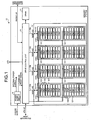
- Fig. 1 is a block diagram of an example of a configuration of a memory system 10 according to the present embodiment.
- This memory system 10 includes a DRAM (Dynamic Random Access Memory) 11 as a first storing unit, a NAND flash memory (hereinafter, "NAND memory”) 12 as a second storing unit, a power supply circuit 13, and a drive control unit 14 as a controller.
- DRAM Dynamic Random Access Memory
- NAND memory NAND flash memory
- the DRAM 11 is used as a storing unit for data transfer, management information recording, or a work area. Specifically, when the DRAM 11 is used as a storing unit for data transfer, the DRAM 11 is used for temporarily storing data requested by the host apparatus to be written before the data is written in the NAND memory 12, and the DRAM 11 is used to read out data requested by the host apparatus to be read out from the NAND memory 12 and temporarily storing the read data.
- the DRAM 11 is used as a storing unit for management information recording, the DRAM 11 is used for storing management information for managing storage positions of data stored in the DRAM 11 and the NAND memory 12.
- the DRAM 11 is used, for example, during expansion of logs used when management information is restored.
- the NAND memory 12 is used as a storing unit for storing therein data. Specifically, the NAND memory 12 stores therein data designated by the host apparatus, stores therein, for backup, management information managed by the DRAM 11, and store therein the management program (firmware) of memory system 10.
- the NAND memory 12 that includes four channel correspondence storage areas 120A to 120D has been shown as an example.
- Each of the channel correspondence storage areas 120A to 120D includes two packages 121 each including eight chips 122 having a storage capacity of a predetermined size (e.g., 2 GB).
- the channel correspondence storage areas 120A to 120D are connected via the drive control unit 14 and buses 15A to 15D. Each bus among the buses 15A to 15D connected to each of the channel correspondence storage areas 120A to 120D forms a channel.
- the power supply circuit 13 receives external power supply and generates a plurality of internal power supplies to be supplied to respective units of the memory system 10 from the external power supply.
- the power supply circuit 13 detects a state of the external power supply, i.e., a rising edge or a falling edge, generates a power-on reset signal based on the detected state, and outputs the power-on reset signal to the drive control unit 14.
- the drive control unit 14 controls the DRAM 11 and the NAND memory 12. As explained in detail later, for example, the drive control unit 14 performs restoration processing for management information and storage processing for management information according to the power-on reset signal from the power supply circuit 13.
- the drive control unit 14 transmits and receives data to and from a host apparatus via an ATA interface (I/F) and transmits and receives data to and from a debugging apparatus via an RS232C I/F. Furthermore, the drive control unit 14 outputs a control signal for controlling on/off of an LED for state display provided on the outside of the memory system 10.
- the NAND memory 12 is configured by arraying a plurality of blocks, which are units of data erasing, on a substrate.
- Fig. 2 is a circuit diagram of an example of a configuration of an arbitrary block of the NAND memory 12.
- left-right direction is set as an X direction and a direction perpendicular to the X direction is set as a Y direction.
- Each block BLK of the NAND memory 12 includes (m+1) (m is an integer equal to or larger than 0) NAND strings NS arrayed in order along the X direction.
- Each NAND string NS has (n+1) (n is an integer equal to or larger than 0) memory cell transistors MT0 to MTn that share a diffusion region (a source region or a drain region) between memory cell transistors MT adjacent to each other in the Y direction.
- the memory cell transistors MT0 to MTn are connected in series in the Y direction.
- selection transistors ST1 and ST2 arranged at both ends of a row of the (n+1) memory transistors MT0 to MTn.
- Each memory cell transistors MT0 to MTn is a field effect transistor having a stacked gate structure formed on a semiconductor substrate.
- the stacked gate structure includes a charge accumulation layer (a floating gate electrode) formed on the semiconductor substrate via a gate insulating film and a control gate electrode formed on the charge accumulating layer via an inter-gate insulating film.
- the memory cell transistors MT0 to MTn are multi-value memories in which a threshold voltage changes according to the number of electrons accumulated in the floating gate electrode and two or more bit data can be stored depending on the difference in the threshold voltage. It is assumed in following explanation that memory cell transistors MT0 to MTn are multi-value memories that can store quaternary values. However, the memory cell transistors MT0 to MTn can be multi-value memories that can store values larger than the quaternary values.
- Word lines WL0 to WLn are respectively connected to the control gate electrodes of the memory cell transistors MT0 to MTn of each NAND string NS.
- the control gate electrodes of the memory cell transistors MTi present on the same row in the block BLK are connected to the same word line WLi.
- a group of the (m+1) memory cell transistors MTi connected to the same word line WLi is a unit that forms one page.
- a group of the memory cell transistors MTi connected to the same word line WLi forms two pages.
- writing and readout of data is performed in units of the pages.
- Bit lines BL0 to BLm are respectively connected to drains of the (m+1) selection transistors ST1 in one block BLK.
- a selection gate line SGD is connected in common to gates of the selection transistors ST1 of each NAND string NS.
- Sources of the selection transistors ST1 are connected to drains of the memory cell transistors MT0.
- a source line SL is connected in common to sources of the (m+1) selection transistors ST2 in one block BLK.
- a selection gate line SGS is connected in common to gates of the selection transistors ST2 of each NAND string NS. Drains of the selection transistors ST2 are connected to sources of the memory cell transistors MTn.
- the NAND strings NS in the same column in the blocks BLK are connected by the same bit line BLj.
- the minimum unit for writing and readout is one page in the memory cell transistor MTi group connected to the same word line WLi and the minimum unit for erasing is one block including a predetermined number of pages (hereinafter referred to as physical block).
- a plurality of the blocks form a plane and a plurality of the planes form one channel correspondence storage areas 120A to 120D.
- a plurality of the channel correspondence storage areas 120A to 120D forms one NAND memory 12. In an example explained below, it is assumed that the number of channels is four and the number of planes is two.
- the channel correspondence storage areas 120A to 120D are connected in plurality to the drive control unit 14 in parallel to one another. Therefore, it is possible to actuate a plurality of channels in parallel, or actuate only one channel at a time.
- Writing and readout processing may be performed or erasing may be performed with a predetermined number of physical blocks as a unit according to setting of the drive control unit 14.
- a set of the predetermined number of physical blocks in this case is referred to as logical block.
- Fig. 3A is a schematic diagram of a functional configuration of the DRAM 11
- Fig. 3B is a schematic diagram of a functional configuration of the NAND memory 12.
- the DRAM 11 includes a write cache area in which data requested by the host apparatus to be written is stored, a read cache area RC in which data requested by the host apparatus to be read out is stored, a temporary storage area 111 in which management information for managing storage positions of data stored in the DRAM 11 and the NAND memory 12 is stored, and a work area 112 used when the management information is restored.
- the NAND memory 12 includes a data storage area 125 in which data requested by the host apparatus to be written is stored, a management information storage area 126 in which management information managed by the temporary storage area 111 of the DRAM 11 is stored, and a save area 127 in which contents of a lower order page are backed up to preserve the contents written in the lower order page from lower order page data breakage in which the lower order page is broken by occurrence of abnormal power supply isolation (short break) or a program error (failure in writing in a NAND memory) while data is written in a higher order page of a memory cell transistor in which the lower order page is already written.
- abnormal power supply isolation short break
- a program error failure in writing in a NAND memory
- the data storage area 125 of the NAND memory 12 is divided into a write-once area 128 in which data is written in a write-once manner and a non-write-once area 129 that is an area other than the write-once area 128 in the data storage area 125 and in which data is collectively written in a unit of one or a predetermined number of physical blocks.
- a data writing unit in the write-once area 128 is a page size unit
- a data writing unit in the non-write-once area 129 is a physical block size unit or an integer times as large as the physical block size unit. Therefore, in the data storage area 125, areas for storing blocks are further divided into areas in page size units and managed. The program error occurs when the memory cell transistor is broken and data cannot be stored.
- Fig. 4 is a diagram of an example of a layer structure for managing data stored in the memory system 10. It is assumed here that this data is the data requested by the host apparatus to be written or read out.
- data management is performed by a three-layer structure: a DRAM management layer 31, a logical NAND management layer 32, and a physical NAND management layer 33.
- the DRAM management layer 31 performs data management in the DRAM 11 that plays a role of a cache.
- the logical NAND management layer 32 performs logical data management in the NAND memory 12.
- the physical NAND management layer 33 performs physical data management in the NAND memory 12, life extension processing for the NAND memory 12, and the like.
- LBA Logical Block Address
- intra-DRAM physical address data designated by a logical address (hereinafter, "LBA (Logical Block Address)" managed by an address managing method of the host apparatus is stored in a physical address in a predetermined range on the DRAM 11 (hereinafter, "intra-DRAM physical address).
- Data in the DRAM management layer 31 is managed by cache management information 41 including a correspondence relation between an LBA of data to be stored and the intra-DRAM physical address and a sector flag indicating presence or absence of data in sector size units in a page.
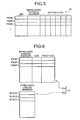
- Fig. 5 illustrates an example of the cache management information 41 in tabular manner.
- the cache management information 41 is one entry for one area of a one page size of the DRAM 11.
- the number of entries is equal to or smaller than the number of pages that fit in the write cache area WC and the read cache area RC.
- the LBA of data of a page size, the intra-DRAM physical address, and a sector flag indicating a position of valid data in each of areas obtained by dividing this page by a sector size are associated.
- NAND memory 12 data from the DRAM 11 is stored in a physical address in a predetermined range (hereinafter, "intra-NAND physical address) on the NAND memory 12.
- intra-NAND physical address a physical address in a predetermined range
- the drive control unit 14 performs control to equalize the numbers of times of rewriting among the blocks configuring the NAND memory 12 to write, in a block different from the original block, data reflecting a portion required to be updated of a block in which the data to be updated is included and invalidate the original block.
- intra-NAND logical address used independently in the NAND memory 12 (hereinafter, "intra-NAND logical address") is provided besides the intra-NAND physical address.
- data in the logical NAND management layer 32 is managed by logical NAND management information 42 indicating a relation between an LBA of data in page size units received from the DRAM 11 and an intra-NAND logical address indicating a logical page position of the NAND memory 12 in which the received data is stored and a relation indicating an address range of a logical block having a size coinciding with that of a block (hereinafter, "physical block") as an erasing unit in the NAND memory 12.
- a collection of a plurality of the physical blocks can be set as a logical block.
- logical-physical conversion information including a correspondence relation between the intra-NAND logical address as the logical block and the intra-NAND physical address as the physical block in the NAND memory 12.
- Fig. 6 illustrates an example of the logical NAND management information 42 in tabular manner.
- Fig. 7 illustrates an example of intra-NAND logical-physical conversion information 43 in tabular manner.
- the logical NAND management information 42 includes logical page management information 42a and logical block management information 42b.
- the logical page management information 42a has one entry for one logical area of a one page size. Each of entries includes an LBA of data of the one page size, an intra-NAND logical address, and a page flag indicating whether this page is valid.
- the logical block management information 42b includes an intra-NAND logical address set for a logical area of the one block size of the NAND memory 12.
- the logical page management information 42a and the logical block management information 42b are created for each of the data storage area 125 and the save area 127 and stored. As shown in Fig. 7 , in the intra-NAND logical-physical conversion information 43, the intra-NAND physical address and the inter-NAND logical address of the NAND memory 12 are associated.
- the management information managed by the DRAM management layer 31 is lost because of power-off or the like so that this management information can be called a volatile table.
- the management information managed by the logical NAND management layer 32 and the physical NAND management layer 33 is lost because of power-off or the like, the lost management information hinders successful startup of the memory system 10 so that measures are required to be taken such that the management information is stored even in the event of power-off or the like. Therefore, this management information can be called a nonvolatile table.
- This nonvolatile table manages data stored in the NAND memory 12. If the nonvolatile table is not present, information stored in the NAND memory 12 cannot be accessed or data stored in an area is erased. Therefore, the nonvolatile table needs to be stored as latest information in preparation for sudden power-off. Therefore, in the first embodiment, management information including at least the nonvolatile table is stored in the latest state in the management information storage area 126 of the NAND memory 12.
- the management information storage information stored in the management information storage area 126 of the NAND memory 12 is explained below. The following explanation assumes that only the nonvolatile table is stored in the management information storage area 126.
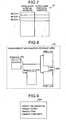
- Fig. 8 is a schematic diagram of an example of contents of the management information storage information stored in the management information storage area 126.
- the management information storage information stored in the management information storage information 126 includes a snapshot 210 as contents of the nonvolatile table at a certain point, a log 220 as difference information between the nonvolatile table after the contents are changed when there is a change in the contents of the nonvolatile table and the snapshot 210 (or the snapshot 210 and a log already generated), and a pointer 230 indicating positions of the snapshot 210 and the log 220 acquired first concerning the snapshot 210 are stored.
- the snapshot 210 is information obtained by storing management information including at least the nonvolatile table at a predetermined point among the management information stored in the temporary storage area 111 of the DRAM 11.
- the log 220 is generated before and after processing in which the management information changes (e.g., processing for writing data in the data storage area 125 of the NAND memory 12).
- a log stored before the processing is referred to as a pre-log 220A and a log stored after the processing is referred to as post-log 220B.
- the snapshot 210, the pre-log 220A, the post-log 220B, and the pointer 230 are stored in different blocks.
- the snapshot 210 is stored in a block for snapshot storage.
- the snapshot 210 includes the logical NAND management information 42 and the intra-NAND logical-physical conversion information 43 as nonvolatile tables in the management information storage area 126 of the NAND memory 12.
- a storage capacity of the NAND memory 12 is equal to or larger than several tens GB
- a size an integer times as large as the physical block is necessary as the size of management information necessary for data management. Therefore, this snapshot storing block is stored in a logical block including a plurality of physical blocks.
- the new snapshot 210 is collectively written in a block different from that for the snapshot 210 stored earlier.
- the pre-log 220A and the post-log 220B are stored in a pre-log storing block and a post-log storing block, respectively, in a write-once manner.
- the pre-log 220A and the post-log 220B are continuously written in the same pre-log storing block and the same post-log storing block, respectively, in a write-once manner even if a generation of the snapshot 210 changes.
- Each of the pre-log storing block and the post-log storing block includes a plurality of physical blocks.
- Fig. 9 is a diagram of an example of the log.
- the log 220 includes target information to be management information of a change target, a target entry as an entry to be a change target in the target information, a target item as an item to be a change target in the target entry, and change contents as contents of a change of the target item.
- the pointer 230 is stored in an instruction information storage block.
- the pointer 230 only has to be a pointer that indicates a top address of a block indicating storage positions of the snapshot 210, the pre-log 220A, and the post-log 220B.
- a portion indicating a storage position of the snapshot 210 in the pointer 230 can be a portion that indicates top addresses of respective kinds of management information included in the snapshot 210.
- the pointer 230 is updated when the snapshot 210 is stored anew or when the physical block storing the log 220 in a log storing block is changed. Pointers of the pre-log 220A and the post-log 220B can be stored in the snapshot 210 rather than in the instruction information storing block.
- Fig. 10 is a block diagram of an example of a functional configuration of the drive control unit.
- the drive control unit 14 includes a data managing unit 141, an ATA command processing unit 142, a security managing unit 143, a boot loader 144, an initialization managing unit 145, and a debug support unit 146.
- the data managing unit 141 performs data transfer between the DRAM 11 and the NAND memory 12 and control of various functions concerning the NAND memory 12.
- the ATA command processing unit 142 performs data transfer processing in cooperation with the data managing unit 141 based on an instruction received from the ATA interface.
- the security managing unit 143 manages various kinds of security information in cooperation with the data managing unit 141 and the ATA command processing unit 142.
- the boot loader 144 loads management programs (firmware) from the NAND memory 12 to a not shown memory (e.g., an SRAM (Static RAM)) during power-on.
- the initialization managing unit 145 performs initialization of respective controllers and circuits in the drive control unit 14.
- the debug support unit 146 processes debug data supplied from the outside via the RS232C interface.
- Fig. 11 is a block diagram of an example of a functional configuration of the data managing unit 141.
- the data managing unit 141 includes a data-transfer processing unit 151, a management-information managing unit 152, a save processing unit 155, a broken-information-restoration processing unit 156, and a management-information restoring unit 157.
- the data-transfer processing unit 151 performs data transfer between the DRAM 11 and the NAND memory 12.
- the management-information managing unit 152 performs change and storage of the management information according to a change in data stored in the DRAM 11 and the NAND memory 12.
- the save processing unit 155 saves, in the save area 127, data likely to be broken by lower order page data breakage during write-once processing of data in the write-once area 128.
- the broken-information-restoration processing unit 156 restores information broken by lower order page data breakage during the write-once processing of data in the write-once area 128 using the data in the save area 127.
- the management-information restoring unit 157 restores latest management information based on the management information stored in the NAND memory 12 during power-on or the like.
- the management-information managing unit 152 includes a management-information writing unit 153 and a management-information storing unit 154.
- the management-information writing unit 153 performs update of the management information stored in the DRAM 11 when update of the management information is necessary according to the change processing for data stored in the DRAM 11 or the NAND memory 12 by the data-transfer processing unit 151.
- the management-information storing unit 154 stores, in the management information storage area 126 of the NAND memory 12, the management information as the snapshot 210 or stores information to be updated in the management information as the log 220.
- the management-information storing unit 154 also performs update processing for the pointer 230.
- Storing of the snapshot 210 is performed by the management-information storing unit 154 when a predetermined condition relating to the memory system 10 is satisfied. Storing of the snapshot 210 is performed, for example, when a log storage area provided to store the log 220 (the pre-log 220A and the post-log 220B) in the management information storage area 126 of the NAND memory 12 becomes full (i.e., the area is completely filled with data).
- Storing of the log 220 is performed by the management-information storing unit 154 during data update (when data writing in the NAND memory 12 is necessary) on the NAND memory 12 involving update of the management information (the nonvolatile table) stored in the DRAM 11.
- the save processing unit 155 When write data is written in the write-once area 128 by the data-transfer processing unit 151 or the management-information storing unit 154, if a page in which the write data is written is a different page (a higher order page) of a memory cell transistor same as that for a written page in which data is already written, the save processing unit 155 performs processing for storing the written data stored in the written page in the save area 127 in preparation for occurrence of lower order page data breakage due to occurrence of a short break or a program error during writing of the write data.
- Figs. 12A to 12D are diagrams of examples of a relation between data in a memory cell and a threshold voltage of the memory cell and order of writing in a NAND memory.
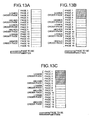
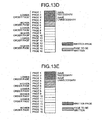
- Figs. 13A to 13E are diagrams for explaining lower order page data breakage during write-once processing.
- the data in the memory cell is set to "0" when an erasing operation is performed.
- the data in the memory cell changes to data "0" and data "2".
- Fig. 12B before writing in a higher order page, data equal to or lower than a threshold voltage of actual data is written in an adjacent cell.
- a distribution of a threshold of the data "2" is expanded by the data written in the cell. Thereafter, when data of the higher order page is written, the data in the memory cell changes to data "0" to "3" having an original threshold voltage as shown in Fig. 12C .
- the data in the memory cell is defined from low to high threshold voltages.
- a writing operation is performed for each of pages from a memory cell close to a source line in a block.
- a source line in a block For convenience of explanation, four word lines are shown.
- first writing In first writing (indicated by encircled 1), 1-bit data is written in a lower order page of a memory cell 1.
- second writing In second writing (indicated by encircled 2), 1-bit data is written in a lower order page of a memory cell 2 adjacent to the memory cell 1 in a word line direction.
- third writing In third writing (indicated by encircled 3), 1-bit data is written in a lower order page of a memory cell 3 adjacent to the memory cell 1 in a bit line direction.
- fourth writing In fourth writing (indicated by encircled 4), 1-bit data is written in a lower order page of a memory cell 4 diagonally adjacent to the memory cell 1.
- 1-bit data is written in a higher order page of the memory cell 5.
- 1-bit data is written in a higher order page of the memory cell 6 adjacent to the memory cell 5 in the word line direction.
- 1-bit data is written in a higher order page of the memory cell 7.
- sixteenth writing is written in a higher order page of the memory cell 8 adjacent to the memory cell 7 in the word line direction.
- the save processing unit 155 stores, as page position information, a relation between the lower order pages and the higher order pages explained above, i.e., a relation between the lower order pages and the higher order pages that are likely to cause lower order page data breakage.
- Pages in one physical block in Fig. 13A correspond to Figs. 12A to 12D .
- pages 1 to 4, 7 to 8, and 11 to 12 are the lower order pages shown in Figs. 12A to 12D .
- Pages 5 to 6, 9 to 10, and 13 to 16 are the higher order pages shown in Figs. 12A to 12D .
- the write-once processing for writing in a block having such a page structure performed when save processing is necessary and the write-once processing performed when the save processing is unnecessary are separately explained below.
- pages are separated into lower order pages and higher order pages for convenience of explanation. However, a combination of the lower order pages and the higher order pages forms one physical block.
- the save processing is unnecessary when data is written only in the lower order pages (e.g., pages 1 to 4) in a write-once manner. This is because, in this case, lower order page data breakage does not occur even if a short break occurs while the data is written in the lower order pages.
- the save processing is necessary when data is written in the lower order pages and the higher order pages not including written pages. This is because, in this case, the data is written in the lower order pages 1 to 4 and the higher order pages 5 to 6 and lower order page data breakage does not occur because the lower order pages 1 and 2 corresponding to the higher order pages 5 and 6 are not written pages.
- the broken-information-restoration processing unit 156 performs processing for restoring data in a position where the lower order page data breakage occurs using the data saved in the save area 127.
- the management-information restoring unit 157 When the power supply of the memory system 10 is turned on, the management-information restoring unit 157 performs restoration processing for the management information based on the management information storage information stored in the management information storage area 126 of the NAND memory 12. Specifically, the management-information restoring unit 157 traces the pointer 230 and the log 220 (the pre-log 220A or the post-log 220B) in order and determines whether the log 220 (the pre-log 220A or the post-log 220B) corresponding to the latest snapshot 210 is present. When the log 220 is not present, the management-information restoring unit 157 restores the snapshot 210 in the snapshot storing block in the DRAM 11 as management information.
- the management-information restoring unit 157 acquires the snapshot 210 from the snapshot storing block, acquires the log 220 (the pre-log 220A or the post-log 220B) from the log storing block, and performs restoration of the management information (the nonvolatile table) reflecting the log 220 on the snapshot 210 on the DRAM 11.
- FIG. 14 is a flowchart of an example of a procedure of processing for writing data in the write-once area of the memory system. It is assumed that the memory system 10 is connected to the host apparatus and operates as the secondary storage device of the host apparatus and the host apparatus (the memory system 10) is in a startup state.
- the save processing unit 155 When the memory system 10 is in the started state, the save processing unit 155.receives an instruction for write-once processing for data (Step S11). The save processing unit 155 acquires a writing position for the data to be subjected to the write-once processing (hereinafter referred to as write data) (Step S12). Subsequently, the save processing unit 155 determines whether a part of the acquired writing position includes a higher order page and determines whether a lower order page corresponding to the higher order page is a written page (Step S13).
- the save processing unit 155 acquires, using the page position information, a lower order page that uses a memory cell same as that for the higher order page in the writing position (Step S14). Subsequently, the management-information managing unit 152 determines an update schedule (including processing for storage in the save area 127) for the management information by execution of the write-once processing (Step S15) and stores the update schedule in the management information storage area 126 of the NAND memory 12 as the pre-log 220A (Step S16).
- the save processing unit 155 stores contents of data stored in the lower order page acquired at Step S14 in the save area 127 (Step S17).
- the data-transfer processing unit 151 saves the post-log 220B in the management information storage area 126 of the NAND memory 12 (Step S19) and the write-once processing for the data ends.
- the management-information managing unit 152 determines an update schedule for the management information by execution of the write-once processing (Step S20) and stores the update schedule in the management information storage area 126 of the NAND memory 12 as the pre-log 220A (Step S21). Thereafter, after writing the write data in the writing position in a write-once manner (Step S22), the data-transfer processing unit 151 saves the post-log 220B in the management information storage area 126 of the NAND memory 12 (Step S23) and the write-once processing for the data ends.
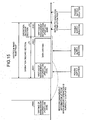
- FIG. 15 is a diagram for explaining an example of a rule for matching the data in the NAND memory and the management information in the write-once processing.
- the abscissa indicates elapsed time t.
- Step S300 after write processing for the post-log 220B with respect to any one of the kinds of processing explained above ends (Step S300), write processing (storage) for the pre-log 220A (Step S301), write-once processing for write data (Step S302), and write processing (storage) for the post-log 220B (Step S303) are performed for the next write-once processing.
- Step S301 When a short break occurs from the write processing for the pre-log 220A (Step S301) to the write-once processing for the write data (Step S302), the processing for writing the write data in the NAND memory 12 has not ended properly due to the short break.
- the processing for writing the write data in the NAND memory 12 has not ended properly due to the short break.
- the operation performed until a time point at which the short break occurred is discarded.
- a time span in which the operation is discarded is referred to as an operation discard section D1.
- Step S302 when the write-once processing for the write data (Step S302) ends and a short break occurs at a stage after the write processing for the post-log 220B (Step S303), the processing for writing the write data in the NAND memory 12 has ended properly.
- the operation until the occurrence of the short break is not discarded and the contents written in the pre-log 220A are adopted as management information, no problem occurs because the write data has been already written in the NAND memory 12. Therefore, in this case, operation that was being executed during the time span in which the short break continued is decided.
- a time span in which the operation is decided is referred to as an operation decision section D2.
- Figs. 16 are 17 are flowcharts of an example of restoration processing for write data after occurrence of a short break. As in the above explanation, it is assumed that the memory system 10 is connected to the host apparatus and operates as the secondary storage device of the host apparatus.
- Step S31 the power supply of the host apparatus is turned on and a startup instruction is issued to the memory system 10 (Step S31).
- the boot loader 144 shown in Fig. 10 transfers a not-shown management program from the NAND memory 12 to a memory such as an SRAM or the DRAM 11 (Step S32) and starts the management program (Step S33).
- Step S32 the management program
- Step S33 the management program
- processing by the respective functional processing units in the data managing unit 141 shown in Fig. 11 can be performed.
- the management-information restoring unit 157 reads the latest pointer 230 in the management information storage area 126 of the NAND memory 12 and acquires addresses of blocks in which the snapshot 210 and the pre-log 220A and the post-log 220B are stored (Step S34).
- the management-information restoring unit 157 reads the snapshot 210 from the address in the NAND memory 12 acquired at Step S34 and restores the snapshot 210 in the temporary storage area 111 of the DRAM 11 (Step S35).
- the management-information restoring unit 157 checks a last writing position of a log referring to the pre-log 220A and the post-log 220B in the NAND memory 12 and compares writable page positions to detect a log written last and timing for power supply isolation (Step S36). Thereafter, the management-information restoring unit 157 determines whether a short break has occurred (Step S37). In determining whether a short break has occurred, the management-information restoring unit 157 compares the number of pages from a writing position to a last writing position of the first pre-log 220A generated for the reference snapshot 210 and the number of pages from a writing position to a last writing position of the first post-log 220B generated in the same manner.
- the management-information restoring unit 157 determines that a short break has occurred. Otherwise, the management-information restoring unit 157 determines that a short break has not occurred.
- the management-information restoring unit 157 compares contents of the logs written last. When the contents are the same, the management-information restoring unit 157 determines that a short break has not occurred. Otherwise, the management-information restoring unit 157 determines that a short break has occurred.
- the management-information restoring unit 157 restores the management information from the snapshot 210 restored in the temporary storage area 111 of the DRAM 11 at Step S35 (Step S38) and the restoration processing ends.
- the management-information restoring unit 157 determines whether a section where the short break has occurred is the operation discard section D1 (Step S39). When the section where the short break has occurred is not the operation discard section D1, i.e., when the section where the short break has occurred is the operation decision section D2 ("No" at Step S39), the management-information restoring unit 157 expands the pre-log 220A present in the storage position acquired at Step S34 in the work area 112 of the DRAM 11 (Step S40). The management-information restoring unit 157 reflects logs on the snapshot 210 in order from the oldest pre-log 220A and restores the management information (Step S41) and the restoration processing ends.
- the management-information restoring unit 157 expands the post-log 220B present in the storage position acquired at Step S34 in the work area 112 of the DRAM 11 (Step S42) and determines whether there is data being written in the save area 127 in a write-once manner (Step S43).
- the management-information restoring unit 157 determines whether there is data being written in the write-once area 128 in a write-once manner (Step S44).
- Step S44 When there is data being written in the write-once area 128 in a write-once manner ("Yes" at Step S44), it means that the power supply isolation is power supply isolation during the write-once processing for writing in a lower order page; therefore, the management-information restoring unit 157 determines that there is no breakage of data in the past by lower order page data breakage (Step S45). The management-information restoring unit 157 invalidates a relevant page or copies a valid page of a relevant block to a block secured anew (Step S46).
- the management-information restoring unit 157 reflects logs on the snapshot 210 in order from the oldest post-log 220B expanded in the DRAM 11 at Step S42 to the post-log 220B at a stage before the discard processing and restores the management information (Step S47) and the restoration processing ends.
- the management-information restoring unit 157 determines that the short break has occurred at a time point before the write-once processing is performed (Step S48). Therefore, recovery processing for the data in the write-once area 128 is unnecessary.
- the management-information restoring unit 157 reflects logs on the snapshot 210 in order from the oldest post-log 220B expanded in the DRAM 11 at Step S42 and restores the management information (Step S49) and the restoration processing ends.
- the management-information restoring unit 157 When there is data being written in the save area 127 in a write-once manner at Step S43 ("Yes" at Step S43), the management-information restoring unit 157 further checks whether there is data being written in the write-once area 128 in a write-once manner (Step S50). When there is data being written in the write-once area 128 in a write-once manner ("Yes” at Step S50), it means that the power supply isolation is power supply isolation during the write-once processing for writing in a higher order page; therefore, the management-information restoring unit 157 determines that breakage of data in the past due to lower order page data breakage is likely to occur (Step S51).
- the management-information restoring unit 157 restores a broken page in the write-once area 128 from the backup in the save area 127 and copies the page to a block secured anew (Step S.52).
- the management-information restoring unit 157 reflects logs on the snapshot 210 in order from the oldest post-log 220B expanded in the DRAM 11 at Step S42 and restores the management information (Step S53) and the restoration processing ends.
- the management-information restoring unit 157 reflects logs on the snapshot 210 in order from the oldest post-log 220B expanded in the DRAM 11 at Step S42 and restores the management information (Step S55) and the restoration processing ends. In this case, the management-information restoring unit 157 performs processing for disabling writing of contents of a page being written in the save area 127 in a write-once manner. According to the procedure explained above, the restoration processing at the time of occurrence of a short break with respect to the write-once data ends.
- the processing for writing in the higher order page is performed after contents of data stored in a lower order page of a multi-value memory cell same as that of the higher order page to be subjected to the write-once processing are stored in the save area 127. Therefore, there is an effect that, even when lower order page data breakage occurs because of occurrence of a short break or occurrence of a program error during the write processing, it is possible to restore data broken by the lower order page data breakage using the data stored in the save area 127..
- the memory cell transistor MT forming the NAND memory 12 is the multi-value memory equal to or larger than 2 bits.
- pages include three or more pages such as a higher order page, an intermediate page, and a lower order page. During writing in the higher order page, it is likely that lower order page data breakage occurs in the intermediate page and the lower order page. In that case, data in the intermediate page and the lower order page are stored in the save area 127.
- the save area 127 is provided in the NAND memory 12.
- a dedicated storing unit for the save area 127 may be provided in a nonvolatile memory of a type different from the NAND memory 12.
- the charge accumulating layer is not limited to the floating gate type and can be a charge trap type including a silicon nitride film such as the MONOS (Metal-Oxide-Nitride-Oxide-Semiconductor) structure and other systems.
Landscapes
- Engineering & Computer Science (AREA)
- Theoretical Computer Science (AREA)
- Microelectronics & Electronic Packaging (AREA)
- Computer Hardware Design (AREA)
- Quality & Reliability (AREA)
- Physics & Mathematics (AREA)
- General Engineering & Computer Science (AREA)
- General Physics & Mathematics (AREA)
- Computer Security & Cryptography (AREA)
- Techniques For Improving Reliability Of Storages (AREA)
- Read Only Memory (AREA)
- Memory System (AREA)
Claims (11)
- Speichersystem (10), umfassend:eine flüchtige erste Speichereinheit (11);eine nicht-flüchtige zweite Speichereinheit (12), die eine Vielzahl von Weltlinien (WLs) enthält, wobei jede der Weltlinien mit einer Vielzahl von Speicherzellen (MTs) verbunden ist, wobei jede der Speicherzellen in der Lage ist zum Speichern mehrerer Bits und zum Bilden einer Vielzahl von Seiten; undeine Steuerung (14), die Verwaltungsinformation, die eine Speicherposition der in der zweiten Speichereinheit (12) während einer Inbetriebnahmeoperation des Speichersystems (10) gespeicherten Daten enthält, in der ersten Speichereinheit (11) speichert und, während einer Aktualisierung von gespeicherter Verwaltungsinformation, eine Datenverwaltung in der zweiten Speichereinheit (12) durchführt, dadurch gekennzeichnet, dassdie Steuerung (14) enthält:eine Transfer- und Verwaltungseinheit (151, 152), die Daten von einer Hostvorrichtung empfängt und Daten in wenigstens eine der Vielzahl von Seiten in dem Datenspeicherbereich (122) der zweiten Speichereinheit (12) speichert und die gespeicherte Verwaltungsinformation aktualisiert, wobei die gespeicherte Verwaltungsinformation anzeigt, dass eine der Vielzahl von Seiten gültig oder ungültig ist;eine Sicherungsverarbeitungseinheit (155), die, vor einem Schreiben von Daten in eine einer der Vielzahl von Weltlinien des Datenspeicherbereichs (125) zugewiesenen niedrige Ordnungsseite, ob gültige Daten in einer dergleichen der Vielzahl von Weltlinien zugewiesenen niedrigen Ordnungsseite gespeichert sind, und, falls gültige Daten in der niedrigen Ordnungsseite gespeichert sind, in der niedrigen Ordnungsseite gespeicherten Daten in einen Sicherungsbereich (127) in der zweiten Speichereinheit (12) sichert; undeine Defektinformationswiederherstellungs-Verarbeitungseinheit (156), die bestimmt, ob eine Wiederherstellung der in der niedrigen Ordnungsseite des Datenspeicherbereichs (125) gespeicherten gültigen Daten nötig ist in Übereinstimmung damit, ob der Sicherungsbereich (127) die von der niedrigen Ordnungsseite gesicherten Daten speichert und ob der Datenspeicherbereich (124) der zweiten Speichereinheit (12) Daten speichert, deren Schreibprozess durch eine abnormale Stromversorgungsisolation unterbrochen wurde,und wobeidie Defektinformationswiederherstellungs-Verarbeitungseinheit (156) eine Wiederherstellung der defekten Daten unter Verwendung der in dem Sicherungsbereich (127) gespeicherten Daten durchführt, falls der Sicherungsbereich (127) die von der niedrigen Ordnungsseite gesicherten Daten speichert und der Datenspeicherbereich (125) der zweiten Speichereinheit (12) Daten speichert, deren Schreibprozess durch eine normale Stromversorgungsisolation unterbrochen wurde, unddie Defektinformationswiederherstellungs-Verarbeitungseinheit (156) die Wiederherstellung der defekten Daten nicht durchführt, falls der Sicherungsbereich (127) die von der niedrigen Ordnungsseite gesicherten Daten nicht speichert und der Datenspeicherbereich (125) der zweiten Speichereinheit (12) Daten speichert, deren Schreibprozess durch eine normale Stromversorgungsisolation unterbrochen wurde.
- Speichersystem (10) nach Anspruch 1, weiterhin umfassend:eine Verwaltungsinformation-Speichereinheit (154), die, wenn das Speichersystem (10) eine vorbestimmte Bedingung erfüllt, die in der ersten Speichereinheit (11) gespeicherte Verwaltungsinformation als Verwaltungsinformation-Speicherinformation speichert; undeine Verwaltungsinformation-Wiederherstellungseinheit (157), die, während der Inbetriebnahmeoperation des Speichersystems (10), eine letzte Verwaltungsinformation unter der Verwaltungsinformation-Speicherinformation (126), gespeichert in der zweiten Speichereinheit (12), in der ersten Speichereinheit (11), wiederherstellt.
- Speichersystem nach Anspruch 2, wobei die Verwaltungsinformation-Speicherinformation enthält:einen Schnappschuss (210) als Inhalt der Verwaltungsinformation an einem bestimmten Punkt;Logs (220) als Differenzinformation zwischen der Verwaltungsinformation, nachdem der Inhalt geändert wurde, wenn es eine Änderung in dem Inhalt der Verwaltungsinformation aufgrund des Schreibens der Daten gibt, und dem Schnappschuss (210) oder Differenzinformation zwischen der Verwaltungsinformation nach der Änderung und dem Schnappschuss und einem bereits erzeugten Log (220); undeinen Zeiger (230), anzeigend Speicherpositionen in der zweiten Speichereinheit (12) des Schnappschuss (210) und den als erstes betreffend den Schnappschuss (210) erfassten Log (220), unddie Verwaltungsinformation-Wiederherstellungseinheit (157) stellt, während der Inbetriebnahmeoperation des Speichersystems (10), die Verwaltungsinformation in der ersten Speichereinheit (11) unter Verwendung des letzten Schnappschusses (210) in der Verwaltungsinformation-Speicherinformation wieder her, unter Verwendung des Logs (220), falls es den Log (22) in dem Schnappschuss (210) gibt, oder unter Verwendung der Daten, falls der Sicherungsbereich (127) die gesicherten Daten speichert.
- Speichersystem (10) nach Anspruch 3, wobei
die Logs (220) vor einem Schreiben der Daten gespeicherte Prälogs (220A) und nach dem Schreiben der Daten gespeicherte Postlogs (220B) enthalten, und
die Verwaltungsinformation Wiederherstellungseinheit (157) einen der Prälogs (220A) und der Postlogs (220B) für eine Wiederherstellung der Verwaltungsinformation verwendet. - Speichersystem (10) nach Anspruch 4, wobei die Verwaltungsinformation-Wiederherstellungseinheit (157), wenn eine Anzahl von Seiten von einer Schreibposition eines betreffend einen Bezugsschnappschuss (210) erzeugten ersten Prälogs (220A) bis zu einer letzten Schreibposition und eine Anzahl von Seiten von einer Schreibposition eines ersten der Postlogs (220B) zu einer finalen Schreibposition gleich sind, die Verwaltungsinformation in der ersten Speichereinheit (11) unter Verwendung eines letzten Schnappschusses (210) in der Verwaltungsinformation-Speicherinformation wiederherstellt.
- Speichersystem (10) nach Anspruch 4, wobei die Verwaltungsinformation-Wiederherstellungseinheit (157), wenn eine Anzahl von Seiten von einer Schreibposition eines betreffend einen Bezugsschnappschuss (210) erzeugten ersten Prälogs (220A) bis zu einer letzten Schreibposition und eine Anzahl von Seiten von einer Schreibposition eines ersten der Postlogs (220B) zu einer finalen Schreibposition unterschiedlich sind, und eine kurze Unterbrechung oder eine Programmunterbrechung während eines Schreibens des Postlogs (220B) auftritt,
die Verwaltungsinformation in der ersten Speichereinheit (11) unter Verwendung eines letzten Schnappschusses (210) in der Verwaltungsinformation-Speicherinformation und aller für den Schnappschuss (210) gespeicherten Prälogs wiederherstellt. - Speichersystem (10) nach Anspruch 4, wobei die Verwaltungsinformation-Wiederherstellungseinheit (157), wenn eine Anzahl von Seiten von einer Schreibposition eines betreffend einen Bezugsschnappschuss (210) erzeugten ersten Prälogs (220A) bis zu einer letzten Schreibposition und eine Anzahl von Seiten von einer Schreibposition eines ersten der Postlogs (220B) zu einer finalen Schreibposition unterschiedlich sind, und eine kurze Unterbrechung oder eine Programmunterbrechung während einer Zeitspanne von einem Schreiben des Prälogs (220A) bis zu einem Ende eines Schreibens der Daten auftritt,
die Verwaltungsinformation in der ersten Speichereinheit (11) unter Verwendung eines letzten Schnappschusses (210) in der Verwaltungsinformation-Speicherinformation und aller für den Schnappschuss (210) normal gespeicherten Postlogs (220B) wiederherstellt. - Speichersystem (10) nach Anspruch 1, wobei die Defektinformationswiederherstellungs-Verarbeitungseinheit (156) die Wiederherstellung der defekten Daten nicht durchführt, falls der Sicherungsbereich (127) die von der niedrigen Ordnungsseite gesicherten Daten nicht speichert und der Datenspeicherbereich (125) der zweiten Speichereinheit (12) keine Daten speichert, deren Schreibprozess durch die abnormale Stromversorgungsisolation unterbrochen wurde.
- Speichersystem (10) nach Anspruch 1, wobei die Defektinformationswiederherstellungs-Verarbeitungseinheit (156), falls der Sicherungsbereich (127) die von der niedrigen Ordnungsseite gesicherten Daten speichert und der Datenspeicherbereich (125) der zweiten Speichereinheit (12) Daten speichert, deren Schreibprozess durch die abnormale Stromversorgungsisolation unterbrochen wurde, Wiederherstellung der defekten Daten von den in dem Sicherungsbereich (107) gesicherten Daten und Kopieren der wiederhergestellten Daten in einen anderen Block durchführt.
- Speichersystem (10) nach Anspruch 1, wobei die Defektinformationswiederherstellungs-Verarbeitungseinheit (156) die Wiederherstellung der defekten Daten nicht durchführt, falls der Sicherungsbereich (127) die von der niedrigen Ordnungsseite gesicherten Daten speichert und der Datenspeicherbereich (125) der zweiten Speichereinheit (12) keine Daten speichert, deren Schreibprozess durch die abnormale Stromversorgungsisolation unterbrochen wurde.
- Speichersystem (10) nach Anspruch 1, wobei die erste Speichereinheit (11) ein DRAM ist, und
die zweite Speichereinheit (12) ein NAND-Flashspeicher ist.
Applications Claiming Priority (2)
| Application Number | Priority Date | Filing Date | Title |
|---|---|---|---|
| JP2008048799A JP2009205555A (ja) | 2008-02-28 | 2008-02-28 | メモリシステム |
| PCT/JP2009/052588 WO2009107505A1 (en) | 2008-02-28 | 2009-02-10 | Memory system |
Publications (3)
| Publication Number | Publication Date |
|---|---|
| EP2248026A1 EP2248026A1 (de) | 2010-11-10 |
| EP2248026A4 EP2248026A4 (de) | 2010-11-10 |
| EP2248026B1 true EP2248026B1 (de) | 2015-08-26 |
Family
ID=41015905
Family Applications (1)
| Application Number | Title | Priority Date | Filing Date |
|---|---|---|---|
| EP09711527.3A Not-in-force EP2248026B1 (de) | 2008-02-28 | 2009-02-10 | Speichersystem |
Country Status (7)
| Country | Link |
|---|---|
| US (1) | US8190812B2 (de) |
| EP (1) | EP2248026B1 (de) |
| JP (1) | JP2009205555A (de) |
| KR (1) | KR101099804B1 (de) |
| CN (1) | CN101681311A (de) |
| TW (1) | TWI419159B (de) |
| WO (1) | WO2009107505A1 (de) |
Cited By (1)
| Publication number | Priority date | Publication date | Assignee | Title |
|---|---|---|---|---|
| TWI677874B (zh) * | 2015-11-27 | 2019-11-21 | 韓商愛思開海力士有限公司 | 記憶體裝置及其操作方法 |
Families Citing this family (24)
| Publication number | Priority date | Publication date | Assignee | Title |
|---|---|---|---|---|
| US8151060B2 (en) | 2006-11-28 | 2012-04-03 | Hitachi, Ltd. | Semiconductor memory system having a snapshot function |
| JP2009211215A (ja) * | 2008-03-01 | 2009-09-17 | Toshiba Corp | メモリシステム |
| JP2011048725A (ja) * | 2009-08-28 | 2011-03-10 | Panasonic Corp | 不揮発性記憶装置および不揮発性メモリコントローラ |
| JP2012128816A (ja) | 2010-12-17 | 2012-07-05 | Toshiba Corp | メモリシステム |
| CN102053916B (zh) * | 2010-12-17 | 2013-06-05 | 曙光信息产业股份有限公司 | 一种分配内核大片连续内存的方法 |
| US8745329B2 (en) * | 2011-01-20 | 2014-06-03 | Google Inc. | Storing data across a plurality of storage nodes |
| CN102693171B (zh) * | 2011-08-05 | 2015-11-18 | 新奥特(北京)视频技术有限公司 | 一种信息录入系统的恢复方法及系统 |
| CN102609370B (zh) * | 2012-02-06 | 2014-12-17 | 记忆科技(深圳)有限公司 | 防止固态硬盘数据丢失的方法及其固态硬盘 |
| CN103377099B (zh) * | 2012-04-19 | 2017-02-08 | 中国移动通信集团公司 | Nfc移动终端数据备份及恢复的方法和装置 |
| JP2013229086A (ja) * | 2012-04-27 | 2013-11-07 | Sony Corp | メモリ装置、メモリ制御装置、メモリ制御方法 |
| EP2909724B1 (de) | 2012-10-19 | 2019-11-27 | Hewlett-Packard Enterprise Development LP | Asynchrone konsistente speicherauszüge bei persistenten speichern |
| KR102002826B1 (ko) | 2012-12-04 | 2019-07-23 | 삼성전자 주식회사 | 저장 장치, 플래시 메모리 및 저장 장치의 동작 방법 |
| US9032271B2 (en) * | 2012-12-07 | 2015-05-12 | Western Digital Technologies, Inc. | System and method for lower page data recovery in a solid state drive |
| KR102094334B1 (ko) | 2013-03-15 | 2020-03-27 | 삼성전자주식회사 | 비휘발성 멀티-레벨 셀 메모리 시스템 및 상기 시스템에서의 적응적 데이터 백업 방법 |
| KR102190399B1 (ko) | 2013-10-11 | 2020-12-11 | 삼성전자주식회사 | 신뢰성을 보장할 수 있는 불휘발성 메모리 장치의 동작 방법 및 상기 방법을 수행하는 메모리 시스템 |
| US9245633B2 (en) | 2014-01-22 | 2016-01-26 | Htc Corporation | Storage device, electronic device, and method for programming memory |
| US9888077B2 (en) | 2014-04-22 | 2018-02-06 | Western Digital Technologies, Inc. | Metadata based data alignment in data storage systems |
| US9811275B2 (en) | 2015-02-27 | 2017-11-07 | Toshiba Memory Corporation | Memory system and data control method |
| WO2016144293A1 (en) * | 2015-03-06 | 2016-09-15 | Hewlett Packard Enterprise Development Lp | Controller control program |
| KR102836064B1 (ko) | 2016-12-28 | 2025-07-18 | 에스케이하이닉스 주식회사 | 데이터 저장 장치 및 그것의 동작 방법 |
| KR102277728B1 (ko) * | 2017-07-31 | 2021-07-14 | 삼성전자주식회사 | 데이터 저장 시스템, 데이터 저장 시스템의 데이터 저장 방법, 및 솔리드 스테이트 드라이브의 제조 방법 |
| JP2020081661A (ja) * | 2018-11-29 | 2020-06-04 | キヤノン株式会社 | 放射線撮影システム、制御装置、制御方法及びプログラム |
| JP2024046239A (ja) | 2022-09-22 | 2024-04-03 | キオクシア株式会社 | メモリシステム、制御方法 |
| CN118885128B (zh) * | 2024-08-28 | 2025-02-07 | 广州菲利斯太阳能科技有限公司 | 一种减少Flash磨损的实时数据管理系统 |
Family Cites Families (14)
| Publication number | Priority date | Publication date | Assignee | Title |
|---|---|---|---|---|
| JPH06266597A (ja) * | 1993-03-11 | 1994-09-22 | Fujitsu Ltd | ログ取得方式 |
| JP4059473B2 (ja) * | 2001-08-09 | 2008-03-12 | 株式会社ルネサステクノロジ | メモリカード及びメモリコントローラ |
| JP2004062759A (ja) | 2002-07-31 | 2004-02-26 | Hitachi Ltd | データベースログの管理方法、その装置およびそのプログラム |
| JP2004086991A (ja) * | 2002-08-27 | 2004-03-18 | Renesas Technology Corp | 不揮発性記憶装置 |
| US7613880B2 (en) * | 2002-11-28 | 2009-11-03 | Renesas Technology Corp. | Memory module, memory system, and information device |
| JP3935139B2 (ja) | 2002-11-29 | 2007-06-20 | 株式会社東芝 | 半導体記憶装置 |
| US7814057B2 (en) | 2005-04-05 | 2010-10-12 | Microsoft Corporation | Page recovery using volume snapshots and logs |
| WO2007023674A1 (ja) * | 2005-08-22 | 2007-03-01 | Matsushita Electric Industrial Co., Ltd. | メモリコントローラ、不揮発性記憶装置、不揮発性記憶システム、及びデータ書き込み方法 |
| JP4805696B2 (ja) * | 2006-03-09 | 2011-11-02 | 株式会社東芝 | 半導体集積回路装置およびそのデータ記録方式 |
| US7945825B2 (en) * | 2007-11-25 | 2011-05-17 | Spansion Isreal, Ltd | Recovery while programming non-volatile memory (NVM) |
| JP5010505B2 (ja) * | 2008-03-01 | 2012-08-29 | 株式会社東芝 | メモリシステム |
| JP5317689B2 (ja) * | 2008-12-27 | 2013-10-16 | 株式会社東芝 | メモリシステム |
| JP5198245B2 (ja) * | 2008-12-27 | 2013-05-15 | 株式会社東芝 | メモリシステム |
| JP5377175B2 (ja) * | 2009-09-08 | 2013-12-25 | 株式会社東芝 | コントローラ、及びデータ記憶装置 |
-
2008
- 2008-02-28 JP JP2008048799A patent/JP2009205555A/ja active Pending
-
2009
- 2009-02-10 WO PCT/JP2009/052588 patent/WO2009107505A1/en not_active Ceased
- 2009-02-10 EP EP09711527.3A patent/EP2248026B1/de not_active Not-in-force
- 2009-02-10 KR KR1020097018050A patent/KR101099804B1/ko not_active Expired - Fee Related
- 2009-02-10 CN CN200980000129A patent/CN101681311A/zh active Pending
- 2009-02-10 US US12/529,235 patent/US8190812B2/en active Active
- 2009-02-19 TW TW098105314A patent/TWI419159B/zh not_active IP Right Cessation
Cited By (1)
| Publication number | Priority date | Publication date | Assignee | Title |
|---|---|---|---|---|
| TWI677874B (zh) * | 2015-11-27 | 2019-11-21 | 韓商愛思開海力士有限公司 | 記憶體裝置及其操作方法 |
Also Published As
| Publication number | Publication date |
|---|---|
| EP2248026A1 (de) | 2010-11-10 |
| KR101099804B1 (ko) | 2011-12-27 |
| TWI419159B (zh) | 2013-12-11 |
| KR20090117761A (ko) | 2009-11-12 |
| WO2009107505A1 (en) | 2009-09-03 |
| CN101681311A (zh) | 2010-03-24 |
| EP2248026A4 (de) | 2010-11-10 |
| US8190812B2 (en) | 2012-05-29 |
| TW200947439A (en) | 2009-11-16 |
| US20110185108A1 (en) | 2011-07-28 |
| JP2009205555A (ja) | 2009-09-10 |
Similar Documents
| Publication | Publication Date | Title |
|---|---|---|
| US8190812B2 (en) | Memory system capable of restoring broken information | |
| US11972115B2 (en) | Memory system storing management information and method of controlling same | |
| US8706988B2 (en) | Memory system | |
| US9043564B2 (en) | Memory system with fixed and variable pointers | |
| US8285954B2 (en) | Memory system managing a plurality of logs | |
| US8108594B2 (en) | Memory system |
Legal Events
| Date | Code | Title | Description |
|---|---|---|---|
| PUAI | Public reference made under article 153(3) epc to a published international application that has entered the european phase |
Free format text: ORIGINAL CODE: 0009012 |
|
| 17P | Request for examination filed |
Effective date: 20090826 |
|
| A4 | Supplementary search report drawn up and despatched |
Effective date: 20100517 |
|
| AK | Designated contracting states |
Kind code of ref document: A1 Designated state(s): AT BE BG CH CY CZ DE DK EE ES FI FR GB GR HR HU IE IS IT LI LT LU LV MC MK MT NL NO PL PT RO SE SI SK TR |
|
| AX | Request for extension of the european patent |
Extension state: AL BA RS |
|
| DAX | Request for extension of the european patent (deleted) | ||
| 17Q | First examination report despatched |
Effective date: 20110506 |
|
| GRAP | Despatch of communication of intention to grant a patent |
Free format text: ORIGINAL CODE: EPIDOSNIGR1 |
|
| RIC1 | Information provided on ipc code assigned before grant |
Ipc: G11C 29/00 20060101ALN20150522BHEP Ipc: G11C 11/56 20060101ALI20150522BHEP Ipc: G11C 16/10 20060101ALI20150522BHEP Ipc: G11C 16/04 20060101ALI20150522BHEP Ipc: G06F 12/00 20060101ALI20150522BHEP Ipc: G06F 11/14 20060101ALN20150522BHEP Ipc: G06F 12/16 20060101AFI20150522BHEP |
|
| INTG | Intention to grant announced |
Effective date: 20150611 |
|
| RIN1 | Information on inventor provided before grant (corrected) |
Inventor name: HATSUDA, KOSUKE Inventor name: YANO, JUNJI Inventor name: MATSUZAKI, HIDENORI |
|
| GRAS | Grant fee paid |
Free format text: ORIGINAL CODE: EPIDOSNIGR3 |
|
| GRAA | (expected) grant |
Free format text: ORIGINAL CODE: 0009210 |
|
| AK | Designated contracting states |
Kind code of ref document: B1 Designated state(s): AT BE BG CH CY CZ DE DK EE ES FI FR GB GR HR HU IE IS IT LI LT LU LV MC MK MT NL NO PL PT RO SE SI SK TR |
|
| REG | Reference to a national code |
Ref country code: GB Ref legal event code: FG4D |
|
| REG | Reference to a national code |
Ref country code: CH Ref legal event code: EP |
|
| REG | Reference to a national code |
Ref country code: AT Ref legal event code: REF Ref document number: 745556 Country of ref document: AT Kind code of ref document: T Effective date: 20150915 |
|
| REG | Reference to a national code |
Ref country code: IE Ref legal event code: FG4D |
|
| REG | Reference to a national code |
Ref country code: DE Ref legal event code: R096 Ref document number: 602009033155 Country of ref document: DE |
|
| REG | Reference to a national code |
Ref country code: FR Ref legal event code: PLFP Year of fee payment: 8 |
|
| REG | Reference to a national code |
Ref country code: AT Ref legal event code: MK05 Ref document number: 745556 Country of ref document: AT Kind code of ref document: T Effective date: 20150826 |
|
| REG | Reference to a national code |
Ref country code: LT Ref legal event code: MG4D |
|
| PG25 | Lapsed in a contracting state [announced via postgrant information from national office to epo] |
Ref country code: NO Free format text: LAPSE BECAUSE OF FAILURE TO SUBMIT A TRANSLATION OF THE DESCRIPTION OR TO PAY THE FEE WITHIN THE PRESCRIBED TIME-LIMIT Effective date: 20151126 Ref country code: LV Free format text: LAPSE BECAUSE OF FAILURE TO SUBMIT A TRANSLATION OF THE DESCRIPTION OR TO PAY THE FEE WITHIN THE PRESCRIBED TIME-LIMIT Effective date: 20150826 Ref country code: LT Free format text: LAPSE BECAUSE OF FAILURE TO SUBMIT A TRANSLATION OF THE DESCRIPTION OR TO PAY THE FEE WITHIN THE PRESCRIBED TIME-LIMIT Effective date: 20150826 Ref country code: FI Free format text: LAPSE BECAUSE OF FAILURE TO SUBMIT A TRANSLATION OF THE DESCRIPTION OR TO PAY THE FEE WITHIN THE PRESCRIBED TIME-LIMIT Effective date: 20150826 Ref country code: GR Free format text: LAPSE BECAUSE OF FAILURE TO SUBMIT A TRANSLATION OF THE DESCRIPTION OR TO PAY THE FEE WITHIN THE PRESCRIBED TIME-LIMIT Effective date: 20151127 |
|
| REG | Reference to a national code |
Ref country code: NL Ref legal event code: MP Effective date: 20150826 |
|
| PG25 | Lapsed in a contracting state [announced via postgrant information from national office to epo] |
Ref country code: ES Free format text: LAPSE BECAUSE OF FAILURE TO SUBMIT A TRANSLATION OF THE DESCRIPTION OR TO PAY THE FEE WITHIN THE PRESCRIBED TIME-LIMIT Effective date: 20150826 Ref country code: AT Free format text: LAPSE BECAUSE OF FAILURE TO SUBMIT A TRANSLATION OF THE DESCRIPTION OR TO PAY THE FEE WITHIN THE PRESCRIBED TIME-LIMIT Effective date: 20150826 Ref country code: HR Free format text: LAPSE BECAUSE OF FAILURE TO SUBMIT A TRANSLATION OF THE DESCRIPTION OR TO PAY THE FEE WITHIN THE PRESCRIBED TIME-LIMIT Effective date: 20150826 Ref country code: IS Free format text: LAPSE BECAUSE OF FAILURE TO SUBMIT A TRANSLATION OF THE DESCRIPTION OR TO PAY THE FEE WITHIN THE PRESCRIBED TIME-LIMIT Effective date: 20151226 Ref country code: PL Free format text: LAPSE BECAUSE OF FAILURE TO SUBMIT A TRANSLATION OF THE DESCRIPTION OR TO PAY THE FEE WITHIN THE PRESCRIBED TIME-LIMIT Effective date: 20150826 Ref country code: PT Free format text: LAPSE BECAUSE OF FAILURE TO SUBMIT A TRANSLATION OF THE DESCRIPTION OR TO PAY THE FEE WITHIN THE PRESCRIBED TIME-LIMIT Effective date: 20151228 Ref country code: SE Free format text: LAPSE BECAUSE OF FAILURE TO SUBMIT A TRANSLATION OF THE DESCRIPTION OR TO PAY THE FEE WITHIN THE PRESCRIBED TIME-LIMIT Effective date: 20150826 |
|
| PG25 | Lapsed in a contracting state [announced via postgrant information from national office to epo] |
Ref country code: NL Free format text: LAPSE BECAUSE OF FAILURE TO SUBMIT A TRANSLATION OF THE DESCRIPTION OR TO PAY THE FEE WITHIN THE PRESCRIBED TIME-LIMIT Effective date: 20150826 |
|
| PG25 | Lapsed in a contracting state [announced via postgrant information from national office to epo] |
Ref country code: IT Free format text: LAPSE BECAUSE OF FAILURE TO SUBMIT A TRANSLATION OF THE DESCRIPTION OR TO PAY THE FEE WITHIN THE PRESCRIBED TIME-LIMIT Effective date: 20150826 Ref country code: CZ Free format text: LAPSE BECAUSE OF FAILURE TO SUBMIT A TRANSLATION OF THE DESCRIPTION OR TO PAY THE FEE WITHIN THE PRESCRIBED TIME-LIMIT Effective date: 20150826 Ref country code: EE Free format text: LAPSE BECAUSE OF FAILURE TO SUBMIT A TRANSLATION OF THE DESCRIPTION OR TO PAY THE FEE WITHIN THE PRESCRIBED TIME-LIMIT Effective date: 20150826 Ref country code: DK Free format text: LAPSE BECAUSE OF FAILURE TO SUBMIT A TRANSLATION OF THE DESCRIPTION OR TO PAY THE FEE WITHIN THE PRESCRIBED TIME-LIMIT Effective date: 20150826 Ref country code: SK Free format text: LAPSE BECAUSE OF FAILURE TO SUBMIT A TRANSLATION OF THE DESCRIPTION OR TO PAY THE FEE WITHIN THE PRESCRIBED TIME-LIMIT Effective date: 20150826 |
|
| PGFP | Annual fee paid to national office [announced via postgrant information from national office to epo] |
Ref country code: DE Payment date: 20160202 Year of fee payment: 8 |
|
| REG | Reference to a national code |
Ref country code: DE Ref legal event code: R097 Ref document number: 602009033155 Country of ref document: DE |
|
| PG25 | Lapsed in a contracting state [announced via postgrant information from national office to epo] |
Ref country code: BE Free format text: LAPSE BECAUSE OF NON-PAYMENT OF DUE FEES Effective date: 20160229 Ref country code: RO Free format text: LAPSE BECAUSE OF FAILURE TO SUBMIT A TRANSLATION OF THE DESCRIPTION OR TO PAY THE FEE WITHIN THE PRESCRIBED TIME-LIMIT Effective date: 20150826 |
|
| PGFP | Annual fee paid to national office [announced via postgrant information from national office to epo] |
Ref country code: GB Payment date: 20160210 Year of fee payment: 8 Ref country code: FR Payment date: 20160108 Year of fee payment: 8 |
|
| PLBE | No opposition filed within time limit |
Free format text: ORIGINAL CODE: 0009261 |
|
| STAA | Information on the status of an ep patent application or granted ep patent |
Free format text: STATUS: NO OPPOSITION FILED WITHIN TIME LIMIT |
|
| 26N | No opposition filed |
Effective date: 20160530 |
|
| PG25 | Lapsed in a contracting state [announced via postgrant information from national office to epo] |
Ref country code: SI Free format text: LAPSE BECAUSE OF FAILURE TO SUBMIT A TRANSLATION OF THE DESCRIPTION OR TO PAY THE FEE WITHIN THE PRESCRIBED TIME-LIMIT Effective date: 20150826 |
|
| PG25 | Lapsed in a contracting state [announced via postgrant information from national office to epo] |
Ref country code: MC Free format text: LAPSE BECAUSE OF FAILURE TO SUBMIT A TRANSLATION OF THE DESCRIPTION OR TO PAY THE FEE WITHIN THE PRESCRIBED TIME-LIMIT Effective date: 20150826 Ref country code: LU Free format text: LAPSE BECAUSE OF FAILURE TO SUBMIT A TRANSLATION OF THE DESCRIPTION OR TO PAY THE FEE WITHIN THE PRESCRIBED TIME-LIMIT Effective date: 20160210 |
|
| REG | Reference to a national code |
Ref country code: CH Ref legal event code: PL |
|
| PG25 | Lapsed in a contracting state [announced via postgrant information from national office to epo] |
Ref country code: LI Free format text: LAPSE BECAUSE OF NON-PAYMENT OF DUE FEES Effective date: 20160229 Ref country code: CH Free format text: LAPSE BECAUSE OF NON-PAYMENT OF DUE FEES Effective date: 20160229 |
|
| REG | Reference to a national code |
Ref country code: IE Ref legal event code: MM4A |
|
| PG25 | Lapsed in a contracting state [announced via postgrant information from national office to epo] |
Ref country code: BE Free format text: LAPSE BECAUSE OF FAILURE TO SUBMIT A TRANSLATION OF THE DESCRIPTION OR TO PAY THE FEE WITHIN THE PRESCRIBED TIME-LIMIT Effective date: 20150826 |
|
| PG25 | Lapsed in a contracting state [announced via postgrant information from national office to epo] |
Ref country code: IE Free format text: LAPSE BECAUSE OF NON-PAYMENT OF DUE FEES Effective date: 20160210 |
|
| PG25 | Lapsed in a contracting state [announced via postgrant information from national office to epo] |
Ref country code: MT Free format text: LAPSE BECAUSE OF FAILURE TO SUBMIT A TRANSLATION OF THE DESCRIPTION OR TO PAY THE FEE WITHIN THE PRESCRIBED TIME-LIMIT Effective date: 20150826 |
|
| REG | Reference to a national code |
Ref country code: DE Ref legal event code: R119 Ref document number: 602009033155 Country of ref document: DE |
|
| GBPC | Gb: european patent ceased through non-payment of renewal fee |
Effective date: 20170210 |
|
| REG | Reference to a national code |
Ref country code: FR Ref legal event code: ST Effective date: 20171031 |
|
| PG25 | Lapsed in a contracting state [announced via postgrant information from national office to epo] |
Ref country code: FR Free format text: LAPSE BECAUSE OF NON-PAYMENT OF DUE FEES Effective date: 20170228 Ref country code: DE Free format text: LAPSE BECAUSE OF NON-PAYMENT OF DUE FEES Effective date: 20170901 |
|
| PG25 | Lapsed in a contracting state [announced via postgrant information from national office to epo] |
Ref country code: GB Free format text: LAPSE BECAUSE OF NON-PAYMENT OF DUE FEES Effective date: 20170210 |
|
| PG25 | Lapsed in a contracting state [announced via postgrant information from national office to epo] |
Ref country code: HU Free format text: LAPSE BECAUSE OF FAILURE TO SUBMIT A TRANSLATION OF THE DESCRIPTION OR TO PAY THE FEE WITHIN THE PRESCRIBED TIME-LIMIT; INVALID AB INITIO Effective date: 20090210 Ref country code: CY Free format text: LAPSE BECAUSE OF FAILURE TO SUBMIT A TRANSLATION OF THE DESCRIPTION OR TO PAY THE FEE WITHIN THE PRESCRIBED TIME-LIMIT Effective date: 20150826 |
|
| PG25 | Lapsed in a contracting state [announced via postgrant information from national office to epo] |
Ref country code: TR Free format text: LAPSE BECAUSE OF FAILURE TO SUBMIT A TRANSLATION OF THE DESCRIPTION OR TO PAY THE FEE WITHIN THE PRESCRIBED TIME-LIMIT Effective date: 20150826 Ref country code: MK Free format text: LAPSE BECAUSE OF FAILURE TO SUBMIT A TRANSLATION OF THE DESCRIPTION OR TO PAY THE FEE WITHIN THE PRESCRIBED TIME-LIMIT Effective date: 20150826 Ref country code: MT Free format text: LAPSE BECAUSE OF FAILURE TO SUBMIT A TRANSLATION OF THE DESCRIPTION OR TO PAY THE FEE WITHIN THE PRESCRIBED TIME-LIMIT Effective date: 20160229 |
|
| PG25 | Lapsed in a contracting state [announced via postgrant information from national office to epo] |
Ref country code: BG Free format text: LAPSE BECAUSE OF FAILURE TO SUBMIT A TRANSLATION OF THE DESCRIPTION OR TO PAY THE FEE WITHIN THE PRESCRIBED TIME-LIMIT Effective date: 20150826 |