EP2242139A1 - Kleinfahrzeug mit Brennstoffzelle - Google Patents
Kleinfahrzeug mit Brennstoffzelle Download PDFInfo
- Publication number
- EP2242139A1 EP2242139A1 EP10158230A EP10158230A EP2242139A1 EP 2242139 A1 EP2242139 A1 EP 2242139A1 EP 10158230 A EP10158230 A EP 10158230A EP 10158230 A EP10158230 A EP 10158230A EP 2242139 A1 EP2242139 A1 EP 2242139A1
- Authority
- EP
- European Patent Office
- Prior art keywords
- exhaust duct
- fuel battery
- vehicle
- air
- bifurcation
- Prior art date
- Legal status (The legal status is an assumption and is not a legal conclusion. Google has not performed a legal analysis and makes no representation as to the accuracy of the status listed.)
- Granted
Links
Images


Classifications
-
- H—ELECTRICITY
- H01—ELECTRIC ELEMENTS
- H01M—PROCESSES OR MEANS, e.g. BATTERIES, FOR THE DIRECT CONVERSION OF CHEMICAL ENERGY INTO ELECTRICAL ENERGY
- H01M8/00—Fuel cells; Manufacture thereof
- H01M8/04—Auxiliary arrangements, e.g. for control of pressure or for circulation of fluids
- H01M8/04007—Auxiliary arrangements, e.g. for control of pressure or for circulation of fluids related to heat exchange
- H01M8/04014—Heat exchange using gaseous fluids; Heat exchange by combustion of reactants
-
- B—PERFORMING OPERATIONS; TRANSPORTING
- B62—LAND VEHICLES FOR TRAVELLING OTHERWISE THAN ON RAILS
- B62K—CYCLES; CYCLE FRAMES; CYCLE STEERING DEVICES; RIDER-OPERATED TERMINAL CONTROLS SPECIALLY ADAPTED FOR CYCLES; CYCLE AXLE SUSPENSIONS; CYCLE SIDECARS, FORECARS, OR THE LIKE
- B62K11/00—Motorcycles, engine-assisted cycles or motor scooters with one or two wheels
- B62K11/02—Frames
- B62K11/10—Frames characterised by the engine being over or beside driven rear wheel
-
- H—ELECTRICITY
- H01—ELECTRIC ELEMENTS
- H01M—PROCESSES OR MEANS, e.g. BATTERIES, FOR THE DIRECT CONVERSION OF CHEMICAL ENERGY INTO ELECTRICAL ENERGY
- H01M8/00—Fuel cells; Manufacture thereof
- H01M8/06—Combination of fuel cells with means for production of reactants or for treatment of residues
- H01M8/0662—Treatment of gaseous reactants or gaseous residues, e.g. cleaning
-
- B—PERFORMING OPERATIONS; TRANSPORTING
- B62—LAND VEHICLES FOR TRAVELLING OTHERWISE THAN ON RAILS
- B62K—CYCLES; CYCLE FRAMES; CYCLE STEERING DEVICES; RIDER-OPERATED TERMINAL CONTROLS SPECIALLY ADAPTED FOR CYCLES; CYCLE AXLE SUSPENSIONS; CYCLE SIDECARS, FORECARS, OR THE LIKE
- B62K2202/00—Motorised scooters
-
- B—PERFORMING OPERATIONS; TRANSPORTING
- B62—LAND VEHICLES FOR TRAVELLING OTHERWISE THAN ON RAILS
- B62K—CYCLES; CYCLE FRAMES; CYCLE STEERING DEVICES; RIDER-OPERATED TERMINAL CONTROLS SPECIALLY ADAPTED FOR CYCLES; CYCLE AXLE SUSPENSIONS; CYCLE SIDECARS, FORECARS, OR THE LIKE
- B62K2204/00—Adaptations for driving cycles by electric motor
-
- H—ELECTRICITY
- H01—ELECTRIC ELEMENTS
- H01M—PROCESSES OR MEANS, e.g. BATTERIES, FOR THE DIRECT CONVERSION OF CHEMICAL ENERGY INTO ELECTRICAL ENERGY
- H01M2250/00—Fuel cells for particular applications; Specific features of fuel cell system
- H01M2250/20—Fuel cells in motive systems, e.g. vehicle, ship, plane
-
- Y—GENERAL TAGGING OF NEW TECHNOLOGICAL DEVELOPMENTS; GENERAL TAGGING OF CROSS-SECTIONAL TECHNOLOGIES SPANNING OVER SEVERAL SECTIONS OF THE IPC; TECHNICAL SUBJECTS COVERED BY FORMER USPC CROSS-REFERENCE ART COLLECTIONS [XRACs] AND DIGESTS
- Y02—TECHNOLOGIES OR APPLICATIONS FOR MITIGATION OR ADAPTATION AGAINST CLIMATE CHANGE
- Y02E—REDUCTION OF GREENHOUSE GAS [GHG] EMISSIONS, RELATED TO ENERGY GENERATION, TRANSMISSION OR DISTRIBUTION
- Y02E60/00—Enabling technologies; Technologies with a potential or indirect contribution to GHG emissions mitigation
- Y02E60/30—Hydrogen technology
- Y02E60/50—Fuel cells
-
- Y—GENERAL TAGGING OF NEW TECHNOLOGICAL DEVELOPMENTS; GENERAL TAGGING OF CROSS-SECTIONAL TECHNOLOGIES SPANNING OVER SEVERAL SECTIONS OF THE IPC; TECHNICAL SUBJECTS COVERED BY FORMER USPC CROSS-REFERENCE ART COLLECTIONS [XRACs] AND DIGESTS
- Y02—TECHNOLOGIES OR APPLICATIONS FOR MITIGATION OR ADAPTATION AGAINST CLIMATE CHANGE
- Y02T—CLIMATE CHANGE MITIGATION TECHNOLOGIES RELATED TO TRANSPORTATION
- Y02T90/00—Enabling technologies or technologies with a potential or indirect contribution to GHG emissions mitigation
- Y02T90/40—Application of hydrogen technology to transportation, e.g. using fuel cells
Definitions
- the present invention relates to a small vehicle mounted with a fuel battery, particularly to a small vehicle mounted with a fuel battery that is provided with an exhaust duct for exhausting air with a smaller airflow resistance. After cooling the fuel battery, the air and hydrogen emitted from the fuel battery are exhausted outside the vehicle.
- the fuel battery is disposed in front of a rear wheel, and a power unit equipped with a motor is attached to a frame so as to swing in a vertical direction with respect to the frame.
- the power unit is provided with a drainpipe for draining water generated within the fuel battery to the outside.
- the drainpipe is disposed inside and through the fuel battery, and extends up to and beyond the rear wheel.
- the drainpipe has a drain port formed at the rear end thereof to drain water while preventing the drained water from splashing onto a rider and/or vehicle body.
- air is introduced to the fuel battery.
- the air introduced into the fuel battery has two functions; i.e., a function as an oxidizing agent for causing hydrogen to react within the fuel battery, and a function as a cooling medium for cooling the fuel battery.
- the air is introduced into the fuel battery using a fan.
- some fuel battery systems employ a fan, which introduces the air to the fuel battery with low power consumption, to control the fuel battery.
- the exhaust duct Conventionally a cylindrical pipe of a small diameter is used for the exhaust duct.
- the sectional area of the airflow path is too small, leading to a large pressure loss in the duct path. Therefore, there is a problem that a fan of small power consumption is not suitable for supplying a satisfactory amount of air to the fuel battery.
- the fuel battery purges hydrogen to the air exhaust. The hydrogen has to be appropriately diluted and discharged out of the vehicle.
- the air within the exhaust duct contains water (vapor) generated by the fuel battery. The water of condensed vapor has to be discharged out of the vehicle to prevent the water from being fed back to the fuel battery.
- An object of the invention is to provide a small vehicle mounted with a fuel battery using a fan that provides a small output with a small power consumption, to supply a satisfactory amount of air to the fuel battery; and equipped with an exhaust duct capable of reducing the pressure loss and accordingly airflow resistance within the duct, and discharging hydrogen purged from the fuel battery and water in the exhaust duct outwardly of the vehicle.
- the invention provides a vehicle mounted with a fuel battery for generating electric power supplied to a motor for driving a drive wheel, the fuel battery being mounted on a frame acting as a vehicle body of the vehicle, comprising:
- the exhaust duct is divided into two parts to avoid the frame. Therefore, the exhaust duct is assembled easily even when the frame has a complicated structure. Thus, a maximum space for airflow is ensured in the exhaust duct.
- a large space for the exhaust duct is ensured. Therefore, pressure loss and accordingly, the airflow resistance within the exhaust duct is reduced. Therefore, a fan of small capacity may be employed. Therefore, the electrical power consumption by the fan can be reduced, and the system efficiency of the fuel battery system can be increased.
- the first exhaust duct is formed with a first inlet port connected to an air outlet port of the fan box, and the first inlet port is provided with a hydrogen purge pipe opened in the vicinity thereof for discharging hydrogen purged from the fuel battery.
- the first exhaust duct is connected to the second exhaust duct with interposition of a seal therebetween.
- the second exhaust duct is bifurcated into two parts; respectively
- the second exhaust duct is formed so that the second upper bifurcation is inclined upward toward the rear side thereof.
- the second exhaust duct may be provided with a water reservoir at the bottom of the second lower bifurcation, and a second water drain port for draining water received in the water reservoir at the side which moves to a lower position when the vehicle is inclined on a side stand.
- the second upper bifurcation and the second lower bifurcation can be formed so as to fit with the shape of a rear combination lamp and a rear fender and the rear fender can be formed so as to fit with the shape of the second lower outlet port of the second lower bifurcation for avoiding a number plate illumination lamp.
- the present invention provides a small vehicle mounted with a fuel battery intended to achieve a smaller or reduced pressure loss at or along an exhaust duct by reducing the airflow resistance which results in smaller power consumption by a fan; and thereby, increase the efficiency of a fuel battery system.
- a fuel battery system 1 supplies hydrogen stored in a fuel tank 2 and air sucked from the outside by a fan 3 to a fuel battery 4, to cause an electrochemical reaction to thereby generate electric power.
- Generated electric power is supplied to a power conversion and distribution unit 6 by a power control unit 5.
- the power conversion and distribution unit 6 supplies the electric power generated by the fuel battery 4 to a secondary battery 7 to charge the same with electric power.
- the electric power from the fuel battery 4 and/or the secondary battery 7 is supplied to a motor 9 through a motor controller 8 to drive the motor 9.
- temperature of the fuel battery 4 rises to a high degree due to hydrogen-oxygen reaction.
- a part of the air introduced by the fan 3 is circulated to cool down the fuel battery 4.
- the air is exhausted through an exhaust duct 10.
- the hydrogen purged from the fuel battery 4 is discharged to the exhaust duct 10 through a hydrogen purge pipe 11.
- a purge valve 12 controls the flow rate and timing of the hydrogen purged through the hydrogen purge pipe 11.
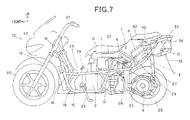
- the fuel battery system 1 is mounted on a small vehicle (for example, a motorcycle) 13 as shown in FIG. 7 .
- the small vehicle 13 has a pair of right and left main frames 14 constituting the vehicle body.
- the pair of main frames 14 are formed in a generally U-like shape with a pair of lower frame portions 15, a pair of front frame portions 16 and a pair of rear frame portions 17.
- the pair of lower frame portions 15 extend in a front-rear direction.
- the pair of front frame portions 16 extend sharply upward at an angle from the front side of the pair of lower frame portions 15.
- the pair of rear frame portions 17 extend sharply upward at an angle from the rear side of the pair of lower frame portions 15.
- the pair of rear frame portions 17 are bent in a half way, and then extend gently upward therefrom at an angle.
- the pair of front frame portions 16 extend sharply upward and are attached to a head pipe 18, respectively at the front ends thereof.
- the head pipe 18 supports a front fork 19 so as to allow the front fork 19 to steer rightward/leftward.
- the front fork 19 pivots a front wheel 20 at the lower end thereof.
- a handlebar 21 is attached to an upper end of the front fork 19.
- a front cover 22 covers the head pipe 18.
- a pair of upper frames 23 bridge the pair of front frame portions 16 and the pair of rear frame portions 17, being connected at a midpoint thereof, respectively.
- a pair of rear frames 24 connect at the rear end of the pair of rear frame portions 17, respectively.
- the pair of rear frames 24 curve upward at an angle and extend upward becoming gradually sharper toward the rear side, and then in the vicinity of the rear end thereof, gently extend straight upward at an angle.
- the pair of rear frame portions 17 pivot the front end of a pair of swing arms 25.
- the pair of swing arms 25 pivot a rear wheel 26 as the drive wheel at the rear end thereof.
- a pair of rear suspensions 27 connect between the pair of swing arms 25 and the pair of rear frames 24 to support the pair of swing arms 25.
- a center stand 28 is provided to the pair of lower frame portions 15 at the rear side thereof and a side stand 29 is provided at the left side thereof.
- the pair of upper frames 23 and the rear frames 24 are provided with a main body 30 attached thereto in the upper side thereof, and a front seat 31 and a rear seat 32 are mounted thereon.
- a tail body 33 is attached to the pair of rear frames 24.
- a rear combination lamp 34 is attached to the tail body 33 in a lower portion thereof.
- a rear fender 35 is attached to the rear combination lamp 34 in a lower portion thereof.
- the rear fender 35 is provided with a number plate 36 and a number plate illumination lamp 37 for illuminating the number plate 36 as shown in FIG. 5 .
- reference numeral 38 denotes a pair of right and left side fenders.
- the small vehicle 13 is mounted with the fuel tank 2 for the fuel battery system 1 disposed between the pair of lower frame portions 15, the pair of front frame portions 16 and the pair of upper frames 23 connected to the pair of rear frame portions 17 in the pair of right and left main frames 14.
- the fuel tank 2 is provided with a hydrogen filling port 39.
- the power conversion and distribution unit 6 and the secondary battery 7 are mounted in an area above the pair of rear frame portions 17 and the pair of upper frames 23 and below the main body 30 in the pair of main frames 14.
- the fan 3, the fuel battery 4 and the exhaust duct 10 are mounted in an area above the pair of rear frames 24 and below the main body 30.
- the hydrogen sensor 40 is provided in an area above the fuel battery 4 and below the main body 30.
- the motor 9 is mounted on the pair of swing arms 25.
- the small vehicle 13 is powered by driving the motor 9 using the electric power from the fuel battery 4 and/or the secondary battery 7 to rotate the rear wheel 26 as the drive wheel.
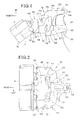
- the fuel battery 4 is mounted on the pair of rear frames 24 constituting the vehicle body as shown in FIG. 1 and FIG. 2 .
- the fuel battery 4 is formed in a box-like shape, which is longer in the width direction of the vehicle.
- a fan box 41 having a similar shape as the fuel battery 4 is attached to the pair of rear frames 24 being inclined downward toward the front side.
- the fan 3 is provided for introducing air to the fuel battery 4.
- An air outlet port 42 is formed behind the fan 3 in the fan box 41.
- the small vehicle 13 is provided with the exhaust duct 10 for exhausting the air introduced by the fan 3 to cool down the fuel battery 4.
- the exhaust duct 10 is constituted of two-divided parts; i.e., a first exhaust duct 43 and a second exhaust duct 44.
- the first exhaust duct 43 is connected to the rear side of the fan box 41 for guiding the air after cooling the fuel battery 4.
- the second exhaust duct 44 is connected to the rear side of the first exhaust duct 43 avoiding the pair of rear frames 24.
- the second exhaust duct 44 exhausts the air from the first exhaust duct 43 to the outside.
- the first exhaust duct 43 has a box-like first body 45 extending in the width direction of the vehicle.
- the first body 45 is formed with a first inlet port 46 in the front side thereof being connected to the air outlet port 42 of the fan box 41.
- the first body 45 is formed with a first central outlet port 47 in a central rear thereof as viewed in the longitudinal direction.
- the first body 45 is formed with a first side outlet port 48 at both sides respectively, in a slightly lower portion in a rear area as viewed in the longitudinal direction.
- the second exhaust duct 44 has a second body 49 having a box-like shape extending in the width direction of the vehicle, and each of the both sides thereof is curved forward.
- the second body 49 is formed with a second central inlet port 50 in a central area thereof, as viewed in the longitudinal direction, connected to the first central outlet port 47 of the first exhaust duct 43.
- the second body 49 is formed with a second side inlet port 51 in a front lower portion at both sides respectively, as viewed in the longitudinal direction thereof.
- the second side inlet port connects to the first side outlet port 48 of the first exhaust duct 43.
- the second central inlet port 50 is connected to the first central outlet port 47; and the second side inlet ports 51 connect to the first side outlet ports 48 of the first exhaust duct 43 respectively, being interposed by a seal 52.
- the exhaust duct 10 is divided into two parts: i.e., the first exhaust duct 43 and the second exhaust duct 44. Therefore, even when the frame has a complicated structure, the two-divided parts can easily connect to each other and avoid the pair of rear frames 24. A maximum space is ensured for the duct path under limitations due to the vehicle structure.
- the exhaust duct 10 is divided into the first exhaust duct 43 and the second exhaust duct 44.
- the first exhaust duct 43 is integrated with the fuel battery 4 and the fan box 41 as a module and assembled with the vehicle body first.
- the second exhaust duct 44 is inserted into the first exhaust duct 43 from the rear side thereof.
- the exhaust duct 10 is arranged so that the first central outlet port 47 and two first side outlet ports 48 of the first exhaust duct 43 and the second central inlet port 50 and two second side inlet ports 51 of the second exhaust duct 44 are prepared separately and connected to each other afterward.
- the exhaust duct 10 is easily assembled with the vehicle body and a large space is ensured for the duct path.
- the exhaust duct 10 achieves a smaller pressure loss and thus a smaller airflow resistance.
- a fan 3 with a smaller output capacity may be employed; and accordingly, the fan 3 consumes less electric power.
- the fuel battery system 1 achieves higher system efficiency.
- the first exhaust duct 43 and the second exhaust duct 44 are connected to each other with interposition of the seal 52. Therefore, air tightness in the connected portion is ensured to prevent air leakage therefrom, and thus the air after cooling the fuel battery 4 is prevented from being fed back into the vehicle body.
- the first exhaust duct 43 is formed with a first side drain port 53 at both sides, respectively, as viewed in the longitudinal direction of the first body 45, in the lowermost portion thereof. Each of the first side drain ports 53 is provided for discharging water collected in the first body 45.
- the first exhaust duct 43 is provided with the hydrogen purge pipe 11 being opened thereto in the vicinity of the first inlet port 46 connected to the air outlet port 42 of the fan 3 as shown in FIG. 3 .
- the hydrogen purge pipe 11 is provided to discharge the hydrogen purged from the fuel battery 4.
- the hydrogen purged from the hydrogen purge pipe 11 is carried into the first exhaust duct 43 by the air flowing into the first inlet port 46 through the air outlet port 42.
- the hydrogen purged from the fuel battery system 1 is diffused swiftly by the airflow within the exhaust duct 10.
- the purged hydrogen is exhausted out, along with the air, from the rear side of the vehicle. Accordingly, the purged hydrogen is prevented from being fed back into the inside of the vehicle by external wind.
- the rear side of the second body 49 is bifurcated into a second upper bifurcation 54 and a second lower bifurcation 55 as shown in FIG. 3 and FIG. 4 .
- the second upper bifurcation 54 guides the air flowing into the first exhaust duct 43 upward in a central area as viewed in the width direction of the vehicle.
- the second lower bifurcation 55 guides the air downward to expand toward both sides thereof as viewed in the width direction of the vehicle.
- the second upper bifurcation 54 is formed with a second upper outlet port 56 opened to the rear side thereof in a central area as viewed in the width direction of the vehicle.
- the second lower bifurcation 55 is formed with a second lower outlet port 57, which expands to both sides of the upper outlet port as viewed in the width direction of the vehicle, and opens to the rear side of the vehicle.
- the second exhaust duct 44 is formed so that the second upper bifurcation 54 is inclined upward toward the rear side with respect to a horizontal line "H" in FIG. 3 .
- the second exhaust duct 44 is bifurcated into the second upper bifurcation 54 and the second lower bifurcation 55 to exhaust the air after cooling the fuel battery 4.
- the second upper outlet port 56 of the second upper bifurcation 54 which is the highest portion in the exhaust duct 10, is open.
- the second exhaust duct 44 is bifurcated into the upper and lower two parts and is opened to the rear side of the vehicle as described above. A large exhaust port is ensured while avoiding the rear combination lamp 34 constituting the rear part of the vehicle. Accordingly, the pressure loss of the air is reduced.
- the second upper bifurcation 54 which is the highest portion within the exhaust duct 10, is open at the second upper outlet port 56. Even when the hydrogen remains mixed with the air within the exhaust duct 10 after the fan 3 stops operating, the hydrogen, the specific gravity of which is less than that of the air, goes upward due to the buoyancy thereof and rises upward. Thus, the hydrogen is prevented from remaining within the exhaust duct 10.
- the second upper bifurcation 54 is inclined upward toward the rear side. Therefore, even after the fan 3 stops operating, hydrogen, the specific gravity of which is less than that of air, is prevented from remaining within the exhaust duct 10.
- the second exhaust duct 44 is formed so that the second upper bifurcation 54 is inclined upward toward the rear side of the vehicle as shown in FIG. 3 and FIG. 4 .
- the second exhaust duct 44 is provided with a water reservoir 58 formed at the bottom of the second lower bifurcation 55 as viewed in the width direction of the vehicle.
- a second water drain port 59 is provided for draining water received in the water reservoir 58 at the side that comes to the lower side when the vehicle is stayed or balanced on the side stand 29.
- the drain port 59 is located at the left side that comes to the lower side when the vehicle is balanced on the side stand 29.
- the water reservoir 58 of the second exhaust duct 44 receives water drops from condensation of vapor generated due to a reaction in the fuel battery 4 and rain water or the like entering from the outside.
- the water received by the water reservoir 58 is discharged to the outside through the second water drain port 59.
- the second water drain port 59 is provided at the left side of the water reservoir 58.
- the fuel battery 4 generates vapor due to the reaction therein and the vapor is condensed into water. Additionally, water enters into the second exhaust duct 44 from the outside. Such water is received by the water reservoir 58 and discharged outside of the vehicle through the second water drain port 59. Thus, water is prevented from being fed back into the fuel battery 4.
- the water is drained swiftly through the second water drain port 59 formed at a lower side while the vehicle is stayed or balanced on the side stand 29.
- the weight thereof is reduced.
- the second upper bifurcation 54 and the second lower bifurcation 55 are formed so as to fit with and about the shape of the rear combination lamp 34 and the rear fender 35 as shown in FIG. 1 .
- the second upper bifurcation 54 and the second lower bifurcation 55 are formed so as to fit with the rear combination lamp 34 and the rear fender 35 at a joint portion 60 therebetween and are sealed to each other.
- the size and weight of the second exhaust duct 44 is reduced, resulting in a cost saving.
- the opening area of the exhaust port is increased. Since the airflow path is not limited by the thickness and outer wall, a larger space is ensured for the duct path.
- the rear fender 35 is formed in a shape that fits with the shape of the second lower outlet port 57 of the second lower bifurcation 55 while avoiding the number plate illumination lamp 37 as shown in FIG. 5 .
- the shape of the rear fender 35 is formed so as to fit with the shape of the opening of the second lower outlet port 57 to ensure or provide the opening marked with slash lines in FIG. 5 . Therefore, a large opening is ensured for the second lower outlet port 57 without changing the installation position of the number plate 36 and the number plate illumination lamp 37. As a result, airflow resistance is reduced without affecting the function of the number plate illumination lamp 37.
- the invention ensures a maximum space for the exhaust duct path under the limitations due to the structure of the small vehicle mounted with a fuel battery.
- the pressure loss and airflow resistance in the exhaust duct are reduced resulting in less electric power consumption by the fan to save electric power.
- the present invention is also applicable to electric bicycles driven by an air-cooled secondary battery with a cooling duct for providing electric power to a motor thereon.
Landscapes
- Engineering & Computer Science (AREA)
- Chemical & Material Sciences (AREA)
- Chemical Kinetics & Catalysis (AREA)
- Sustainable Development (AREA)
- Sustainable Energy (AREA)
- Manufacturing & Machinery (AREA)
- Life Sciences & Earth Sciences (AREA)
- Electrochemistry (AREA)
- General Chemical & Material Sciences (AREA)
- Mechanical Engineering (AREA)
- Combustion & Propulsion (AREA)
- Fuel Cell (AREA)
- Arrangement Or Mounting Of Propulsion Units For Vehicles (AREA)
- Electric Propulsion And Braking For Vehicles (AREA)
Applications Claiming Priority (1)
| Application Number | Priority Date | Filing Date | Title |
|---|---|---|---|
| JP2009096677A JP5382325B2 (ja) | 2009-04-13 | 2009-04-13 | 燃料電池を搭載した小型車両 |
Publications (2)
| Publication Number | Publication Date |
|---|---|
| EP2242139A1 true EP2242139A1 (de) | 2010-10-20 |
| EP2242139B1 EP2242139B1 (de) | 2017-04-05 |
Family
ID=42309171
Family Applications (1)
| Application Number | Title | Priority Date | Filing Date |
|---|---|---|---|
| EP10158230.2A Active EP2242139B1 (de) | 2009-04-13 | 2010-03-29 | Kleinfahrzeug mit Brennstoffzelle |
Country Status (4)
| Country | Link |
|---|---|
| US (1) | US8215431B2 (de) |
| EP (1) | EP2242139B1 (de) |
| JP (1) | JP5382325B2 (de) |
| ES (1) | ES2631511T3 (de) |
Families Citing this family (9)
| Publication number | Priority date | Publication date | Assignee | Title |
|---|---|---|---|---|
| JP5627155B2 (ja) * | 2011-12-28 | 2014-11-19 | 川崎重工業株式会社 | 電動二輪車 |
| CN103241336A (zh) * | 2012-02-03 | 2013-08-14 | 江苏华源氢能科技发展有限公司 | 氢燃料电池电动自行车动力系统 |
| JP6273760B2 (ja) * | 2013-10-18 | 2018-02-07 | スズキ株式会社 | 燃料電池二輪車 |
| JP6369217B2 (ja) * | 2014-08-20 | 2018-08-08 | スズキ株式会社 | 燃料電池二輪車 |
| JP6561769B2 (ja) | 2015-10-27 | 2019-08-21 | スズキ株式会社 | 燃料電池車両の排気ダクト構造 |
| JP6610198B2 (ja) * | 2015-11-24 | 2019-11-27 | スズキ株式会社 | 燃料電池車両の水素検出装置 |
| JP6610299B2 (ja) * | 2016-01-29 | 2019-11-27 | スズキ株式会社 | 空冷式燃料電池の排気装置 |
| JP6463318B2 (ja) * | 2016-03-31 | 2019-01-30 | 本田技研工業株式会社 | 鞍乗り型車両 |
| JP7358972B2 (ja) * | 2019-12-20 | 2023-10-11 | スズキ株式会社 | 燃料電池システム |
Citations (4)
| Publication number | Priority date | Publication date | Assignee | Title |
|---|---|---|---|---|
| EP1495956A2 (de) * | 2003-07-11 | 2005-01-12 | HONDA MOTOR CO., Ltd. | Brennstoffzellenfahrzeug |
| EP1793446A1 (de) * | 2005-11-30 | 2007-06-06 | HONDA MOTOR CO., Ltd. | Kühlvorrichtung für ein Fahrzeug mit einer Brennstoffzelle |
| US20080166607A1 (en) * | 2003-10-24 | 2008-07-10 | Yamaha Hatsudoki Kabushiki Kaisha | Fuel Cell System and Transporting Equipment Including the Same |
| JP2008213742A (ja) | 2007-03-06 | 2008-09-18 | Honda Motor Co Ltd | 燃料電池自動二輪車 |
Family Cites Families (4)
| Publication number | Priority date | Publication date | Assignee | Title |
|---|---|---|---|---|
| JP4292368B2 (ja) * | 2002-12-12 | 2009-07-08 | ソニー株式会社 | 燃料電池及びこれを搭載した電子機器 |
| JP4645006B2 (ja) * | 2003-03-24 | 2011-03-09 | 株式会社エクォス・リサーチ | 車載燃料電池システム |
| KR100930475B1 (ko) * | 2005-09-02 | 2009-12-09 | 주식회사 엘지화학 | 이중 필터 장치를 포함하고 있는 차량용 전지팩의 냉각시스템 |
| JP5076776B2 (ja) * | 2007-09-25 | 2012-11-21 | スズキ株式会社 | 燃料電池二輪車 |
-
2009
- 2009-04-13 JP JP2009096677A patent/JP5382325B2/ja active Active
-
2010
- 2010-01-22 US US12/657,546 patent/US8215431B2/en active Active
- 2010-03-29 EP EP10158230.2A patent/EP2242139B1/de active Active
- 2010-03-29 ES ES10158230.2T patent/ES2631511T3/es active Active
Patent Citations (4)
| Publication number | Priority date | Publication date | Assignee | Title |
|---|---|---|---|---|
| EP1495956A2 (de) * | 2003-07-11 | 2005-01-12 | HONDA MOTOR CO., Ltd. | Brennstoffzellenfahrzeug |
| US20080166607A1 (en) * | 2003-10-24 | 2008-07-10 | Yamaha Hatsudoki Kabushiki Kaisha | Fuel Cell System and Transporting Equipment Including the Same |
| EP1793446A1 (de) * | 2005-11-30 | 2007-06-06 | HONDA MOTOR CO., Ltd. | Kühlvorrichtung für ein Fahrzeug mit einer Brennstoffzelle |
| JP2008213742A (ja) | 2007-03-06 | 2008-09-18 | Honda Motor Co Ltd | 燃料電池自動二輪車 |
Also Published As
| Publication number | Publication date |
|---|---|
| US8215431B2 (en) | 2012-07-10 |
| JP2010247574A (ja) | 2010-11-04 |
| ES2631511T3 (es) | 2017-08-31 |
| US20100258374A1 (en) | 2010-10-14 |
| EP2242139B1 (de) | 2017-04-05 |
| JP5382325B2 (ja) | 2014-01-08 |
Similar Documents
| Publication | Publication Date | Title |
|---|---|---|
| EP2242139B1 (de) | Kleinfahrzeug mit Brennstoffzelle | |
| US9543598B2 (en) | Fuel cell-powered motorcycle | |
| CN101259863B (zh) | 燃料电池摩托车 | |
| US6679345B2 (en) | Fuel battery mounted motorcycle | |
| CN101332767B (zh) | 跨骑式燃料电池车辆 | |
| CN1736748B (zh) | 燃料电池车辆中的排水结构 | |
| EP2662919A1 (de) | Luftzufuhr- und -ablassstruktur für eine Kraftstoffzelle | |
| CN100393574C (zh) | 燃料电池车的悬挂装置 | |
| JP4583836B2 (ja) | 燃料電池車両 | |
| US20060040154A1 (en) | Fuel-cell vehicle | |
| JP6331838B2 (ja) | 燃料電池二輪車 | |
| JP4498856B2 (ja) | 燃料電池車両における水素充填口配置構造 | |
| CN104554558A (zh) | 以燃料电池为动力的两轮车 | |
| US7559393B2 (en) | Exhaust structure for fuel cell vehicles | |
| JP4455222B2 (ja) | 燃料電池車両における吸排気系部材配置構造 | |
| JP2007149606A (ja) | 燃料電池二輪車 | |
| JP6273760B2 (ja) | 燃料電池二輪車 | |
| JP5020594B2 (ja) | 燃料電池自動車 | |
| JP2005123126A (ja) | 車両用アノードガスポンプ | |
| JP2005016489A (ja) | トラックの発電式デフレクタ装置 | |
| JP6471427B2 (ja) | 燃料電池二輪車 | |
| JP2005150106A (ja) | 燃料電池システムおよびそれを用いた輸送機器 | |
| JP2005112094A (ja) | 燃料電池搭載車両 | |
| JP2005125840A (ja) | 燃料電池搭載鞍乗型車両 | |
| JP4547297B2 (ja) | 自動二輪車 |
Legal Events
| Date | Code | Title | Description |
|---|---|---|---|
| PUAI | Public reference made under article 153(3) epc to a published international application that has entered the european phase |
Free format text: ORIGINAL CODE: 0009012 |
|
| 17P | Request for examination filed |
Effective date: 20100329 |
|
| AK | Designated contracting states |
Kind code of ref document: A1 Designated state(s): AT BE BG CH CY CZ DE DK EE ES FI FR GB GR HR HU IE IS IT LI LT LU LV MC MK MT NL NO PL PT RO SE SI SK SM TR |
|
| 17Q | First examination report despatched |
Effective date: 20140416 |
|
| REG | Reference to a national code |
Ref country code: DE Ref legal event code: R079 Ref document number: 602010041237 Country of ref document: DE Free format text: PREVIOUS MAIN CLASS: H01M0008040000 Ipc: B62K0011100000 |
|
| GRAP | Despatch of communication of intention to grant a patent |
Free format text: ORIGINAL CODE: EPIDOSNIGR1 |
|
| RIC1 | Information provided on ipc code assigned before grant |
Ipc: B62K 11/10 20060101AFI20161207BHEP Ipc: H01M 8/0662 20160101ALI20161207BHEP Ipc: H01M 8/04014 20160101ALI20161207BHEP |
|
| INTG | Intention to grant announced |
Effective date: 20170103 |
|
| GRAS | Grant fee paid |
Free format text: ORIGINAL CODE: EPIDOSNIGR3 |
|
| GRAA | (expected) grant |
Free format text: ORIGINAL CODE: 0009210 |
|
| AK | Designated contracting states |
Kind code of ref document: B1 Designated state(s): AT BE BG CH CY CZ DE DK EE ES FI FR GB GR HR HU IE IS IT LI LT LU LV MC MK MT NL NO PL PT RO SE SI SK SM TR |
|
| REG | Reference to a national code |
Ref country code: GB Ref legal event code: FG4D |
|
| REG | Reference to a national code |
Ref country code: CH Ref legal event code: EP |
|
| REG | Reference to a national code |
Ref country code: AT Ref legal event code: REF Ref document number: 881527 Country of ref document: AT Kind code of ref document: T Effective date: 20170415 |
|
| REG | Reference to a national code |
Ref country code: IE Ref legal event code: FG4D |
|
| REG | Reference to a national code |
Ref country code: DE Ref legal event code: R096 Ref document number: 602010041237 Country of ref document: DE |
|
| REG | Reference to a national code |
Ref country code: NL Ref legal event code: MP Effective date: 20170405 |
|
| REG | Reference to a national code |
Ref country code: LT Ref legal event code: MG4D |
|
| REG | Reference to a national code |
Ref country code: ES Ref legal event code: FG2A Ref document number: 2631511 Country of ref document: ES Kind code of ref document: T3 Effective date: 20170831 |
|
| REG | Reference to a national code |
Ref country code: AT Ref legal event code: MK05 Ref document number: 881527 Country of ref document: AT Kind code of ref document: T Effective date: 20170405 |
|
| PG25 | Lapsed in a contracting state [announced via postgrant information from national office to epo] |
Ref country code: NL Free format text: LAPSE BECAUSE OF FAILURE TO SUBMIT A TRANSLATION OF THE DESCRIPTION OR TO PAY THE FEE WITHIN THE PRESCRIBED TIME-LIMIT Effective date: 20170405 |
|
| PG25 | Lapsed in a contracting state [announced via postgrant information from national office to epo] |
Ref country code: FI Free format text: LAPSE BECAUSE OF FAILURE TO SUBMIT A TRANSLATION OF THE DESCRIPTION OR TO PAY THE FEE WITHIN THE PRESCRIBED TIME-LIMIT Effective date: 20170405 Ref country code: LT Free format text: LAPSE BECAUSE OF FAILURE TO SUBMIT A TRANSLATION OF THE DESCRIPTION OR TO PAY THE FEE WITHIN THE PRESCRIBED TIME-LIMIT Effective date: 20170405 Ref country code: HR Free format text: LAPSE BECAUSE OF FAILURE TO SUBMIT A TRANSLATION OF THE DESCRIPTION OR TO PAY THE FEE WITHIN THE PRESCRIBED TIME-LIMIT Effective date: 20170405 Ref country code: AT Free format text: LAPSE BECAUSE OF FAILURE TO SUBMIT A TRANSLATION OF THE DESCRIPTION OR TO PAY THE FEE WITHIN THE PRESCRIBED TIME-LIMIT Effective date: 20170405 Ref country code: GR Free format text: LAPSE BECAUSE OF FAILURE TO SUBMIT A TRANSLATION OF THE DESCRIPTION OR TO PAY THE FEE WITHIN THE PRESCRIBED TIME-LIMIT Effective date: 20170706 Ref country code: NO Free format text: LAPSE BECAUSE OF FAILURE TO SUBMIT A TRANSLATION OF THE DESCRIPTION OR TO PAY THE FEE WITHIN THE PRESCRIBED TIME-LIMIT Effective date: 20170705 |
|
| PG25 | Lapsed in a contracting state [announced via postgrant information from national office to epo] |
Ref country code: IS Free format text: LAPSE BECAUSE OF FAILURE TO SUBMIT A TRANSLATION OF THE DESCRIPTION OR TO PAY THE FEE WITHIN THE PRESCRIBED TIME-LIMIT Effective date: 20170805 Ref country code: BG Free format text: LAPSE BECAUSE OF FAILURE TO SUBMIT A TRANSLATION OF THE DESCRIPTION OR TO PAY THE FEE WITHIN THE PRESCRIBED TIME-LIMIT Effective date: 20170705 Ref country code: LV Free format text: LAPSE BECAUSE OF FAILURE TO SUBMIT A TRANSLATION OF THE DESCRIPTION OR TO PAY THE FEE WITHIN THE PRESCRIBED TIME-LIMIT Effective date: 20170405 Ref country code: SE Free format text: LAPSE BECAUSE OF FAILURE TO SUBMIT A TRANSLATION OF THE DESCRIPTION OR TO PAY THE FEE WITHIN THE PRESCRIBED TIME-LIMIT Effective date: 20170405 Ref country code: PL Free format text: LAPSE BECAUSE OF FAILURE TO SUBMIT A TRANSLATION OF THE DESCRIPTION OR TO PAY THE FEE WITHIN THE PRESCRIBED TIME-LIMIT Effective date: 20170405 |
|
| REG | Reference to a national code |
Ref country code: DE Ref legal event code: R097 Ref document number: 602010041237 Country of ref document: DE |
|
| PG25 | Lapsed in a contracting state [announced via postgrant information from national office to epo] |
Ref country code: CZ Free format text: LAPSE BECAUSE OF FAILURE TO SUBMIT A TRANSLATION OF THE DESCRIPTION OR TO PAY THE FEE WITHIN THE PRESCRIBED TIME-LIMIT Effective date: 20170405 Ref country code: EE Free format text: LAPSE BECAUSE OF FAILURE TO SUBMIT A TRANSLATION OF THE DESCRIPTION OR TO PAY THE FEE WITHIN THE PRESCRIBED TIME-LIMIT Effective date: 20170405 Ref country code: RO Free format text: LAPSE BECAUSE OF FAILURE TO SUBMIT A TRANSLATION OF THE DESCRIPTION OR TO PAY THE FEE WITHIN THE PRESCRIBED TIME-LIMIT Effective date: 20170405 Ref country code: SK Free format text: LAPSE BECAUSE OF FAILURE TO SUBMIT A TRANSLATION OF THE DESCRIPTION OR TO PAY THE FEE WITHIN THE PRESCRIBED TIME-LIMIT Effective date: 20170405 Ref country code: DK Free format text: LAPSE BECAUSE OF FAILURE TO SUBMIT A TRANSLATION OF THE DESCRIPTION OR TO PAY THE FEE WITHIN THE PRESCRIBED TIME-LIMIT Effective date: 20170405 |
|
| PLBE | No opposition filed within time limit |
Free format text: ORIGINAL CODE: 0009261 |
|
| STAA | Information on the status of an ep patent application or granted ep patent |
Free format text: STATUS: NO OPPOSITION FILED WITHIN TIME LIMIT |
|
| PG25 | Lapsed in a contracting state [announced via postgrant information from national office to epo] |
Ref country code: SM Free format text: LAPSE BECAUSE OF FAILURE TO SUBMIT A TRANSLATION OF THE DESCRIPTION OR TO PAY THE FEE WITHIN THE PRESCRIBED TIME-LIMIT Effective date: 20170405 |
|
| 26N | No opposition filed |
Effective date: 20180108 |
|
| PG25 | Lapsed in a contracting state [announced via postgrant information from national office to epo] |
Ref country code: SI Free format text: LAPSE BECAUSE OF FAILURE TO SUBMIT A TRANSLATION OF THE DESCRIPTION OR TO PAY THE FEE WITHIN THE PRESCRIBED TIME-LIMIT Effective date: 20170405 |
|
| REG | Reference to a national code |
Ref country code: DE Ref legal event code: R119 Ref document number: 602010041237 Country of ref document: DE |
|
| REG | Reference to a national code |
Ref country code: CH Ref legal event code: PL |
|
| GBPC | Gb: european patent ceased through non-payment of renewal fee |
Effective date: 20180329 |
|
| PG25 | Lapsed in a contracting state [announced via postgrant information from national office to epo] |
Ref country code: MC Free format text: LAPSE BECAUSE OF FAILURE TO SUBMIT A TRANSLATION OF THE DESCRIPTION OR TO PAY THE FEE WITHIN THE PRESCRIBED TIME-LIMIT Effective date: 20170405 |
|
| REG | Reference to a national code |
Ref country code: BE Ref legal event code: MM Effective date: 20180331 |
|
| REG | Reference to a national code |
Ref country code: IE Ref legal event code: MM4A |
|
| PG25 | Lapsed in a contracting state [announced via postgrant information from national office to epo] |
Ref country code: LU Free format text: LAPSE BECAUSE OF NON-PAYMENT OF DUE FEES Effective date: 20180329 |
|
| PG25 | Lapsed in a contracting state [announced via postgrant information from national office to epo] |
Ref country code: IE Free format text: LAPSE BECAUSE OF NON-PAYMENT OF DUE FEES Effective date: 20180329 Ref country code: DE Free format text: LAPSE BECAUSE OF NON-PAYMENT OF DUE FEES Effective date: 20181002 |
|
| PG25 | Lapsed in a contracting state [announced via postgrant information from national office to epo] |
Ref country code: BE Free format text: LAPSE BECAUSE OF NON-PAYMENT OF DUE FEES Effective date: 20180331 Ref country code: LI Free format text: LAPSE BECAUSE OF NON-PAYMENT OF DUE FEES Effective date: 20180331 Ref country code: CH Free format text: LAPSE BECAUSE OF NON-PAYMENT OF DUE FEES Effective date: 20180331 Ref country code: GB Free format text: LAPSE BECAUSE OF NON-PAYMENT OF DUE FEES Effective date: 20180329 |
|
| PG25 | Lapsed in a contracting state [announced via postgrant information from national office to epo] |
Ref country code: FR Free format text: LAPSE BECAUSE OF NON-PAYMENT OF DUE FEES Effective date: 20180331 |
|
| PG25 | Lapsed in a contracting state [announced via postgrant information from national office to epo] |
Ref country code: MT Free format text: LAPSE BECAUSE OF NON-PAYMENT OF DUE FEES Effective date: 20180329 |
|
| PG25 | Lapsed in a contracting state [announced via postgrant information from national office to epo] |
Ref country code: TR Free format text: LAPSE BECAUSE OF FAILURE TO SUBMIT A TRANSLATION OF THE DESCRIPTION OR TO PAY THE FEE WITHIN THE PRESCRIBED TIME-LIMIT Effective date: 20170405 |
|
| PG25 | Lapsed in a contracting state [announced via postgrant information from national office to epo] |
Ref country code: PT Free format text: LAPSE BECAUSE OF FAILURE TO SUBMIT A TRANSLATION OF THE DESCRIPTION OR TO PAY THE FEE WITHIN THE PRESCRIBED TIME-LIMIT Effective date: 20170405 Ref country code: HU Free format text: LAPSE BECAUSE OF FAILURE TO SUBMIT A TRANSLATION OF THE DESCRIPTION OR TO PAY THE FEE WITHIN THE PRESCRIBED TIME-LIMIT; INVALID AB INITIO Effective date: 20100329 |
|
| PG25 | Lapsed in a contracting state [announced via postgrant information from national office to epo] |
Ref country code: MK Free format text: LAPSE BECAUSE OF NON-PAYMENT OF DUE FEES Effective date: 20170405 Ref country code: CY Free format text: LAPSE BECAUSE OF FAILURE TO SUBMIT A TRANSLATION OF THE DESCRIPTION OR TO PAY THE FEE WITHIN THE PRESCRIBED TIME-LIMIT Effective date: 20170405 |
|
| PGFP | Annual fee paid to national office [announced via postgrant information from national office to epo] |
Ref country code: ES Payment date: 20250403 Year of fee payment: 16 |
|
| PGFP | Annual fee paid to national office [announced via postgrant information from national office to epo] |
Ref country code: IT Payment date: 20260220 Year of fee payment: 17 |