EP2236638B1 - Hochfestes kaltgepresstes Stahlblech mit ausgezeichneter Bearbeitungsfähigkeit und Formgefriereigenschaften - Google Patents
Hochfestes kaltgepresstes Stahlblech mit ausgezeichneter Bearbeitungsfähigkeit und Formgefriereigenschaften Download PDFInfo
- Publication number
- EP2236638B1 EP2236638B1 EP10158525.5A EP10158525A EP2236638B1 EP 2236638 B1 EP2236638 B1 EP 2236638B1 EP 10158525 A EP10158525 A EP 10158525A EP 2236638 B1 EP2236638 B1 EP 2236638B1
- Authority
- EP
- European Patent Office
- Prior art keywords
- steel sheet
- present
- retained austenite
- value
- less
- Prior art date
- Legal status (The legal status is an assumption and is not a legal conclusion. Google has not performed a legal analysis and makes no representation as to the accuracy of the status listed.)
- Not-in-force
Links
- 239000010960 cold rolled steel Substances 0.000 title claims description 21
- 238000007710 freezing Methods 0.000 title description 53
- 230000008014 freezing Effects 0.000 title description 53
- 229910000831 Steel Inorganic materials 0.000 claims description 87
- 239000010959 steel Substances 0.000 claims description 87
- 229910001566 austenite Inorganic materials 0.000 claims description 79
- 230000000717 retained effect Effects 0.000 claims description 76
- 230000014509 gene expression Effects 0.000 claims description 66
- 229910000859 α-Fe Inorganic materials 0.000 claims description 37
- 229910000734 martensite Inorganic materials 0.000 claims description 36
- 229910001335 Galvanized steel Inorganic materials 0.000 claims description 23
- 239000008397 galvanized steel Substances 0.000 claims description 23
- 229910052799 carbon Inorganic materials 0.000 claims description 15
- OKTJSMMVPCPJKN-UHFFFAOYSA-N Carbon Chemical compound [C] OKTJSMMVPCPJKN-UHFFFAOYSA-N 0.000 claims description 14
- 238000005246 galvanizing Methods 0.000 claims description 9
- XEEYBQQBJWHFJM-UHFFFAOYSA-N Iron Chemical compound [Fe] XEEYBQQBJWHFJM-UHFFFAOYSA-N 0.000 claims description 8
- 238000005275 alloying Methods 0.000 claims description 8
- 238000005096 rolling process Methods 0.000 claims description 6
- 229910052804 chromium Inorganic materials 0.000 claims description 4
- 239000012535 impurity Substances 0.000 claims description 4
- 229910052742 iron Inorganic materials 0.000 claims description 4
- 229910052720 vanadium Inorganic materials 0.000 claims description 4
- 229910052748 manganese Inorganic materials 0.000 claims description 3
- 238000002791 soaking Methods 0.000 description 30
- 238000003303 reheating Methods 0.000 description 27
- 239000002436 steel type Substances 0.000 description 27
- 238000000034 method Methods 0.000 description 26
- 238000005279 austempering Methods 0.000 description 24
- 238000001816 cooling Methods 0.000 description 23
- 238000000137 annealing Methods 0.000 description 22
- 239000001177 diphosphate Substances 0.000 description 22
- 238000010438 heat treatment Methods 0.000 description 17
- 229910000794 TRIP steel Inorganic materials 0.000 description 15
- 230000006872 improvement Effects 0.000 description 15
- 238000005482 strain hardening Methods 0.000 description 14
- 230000008569 process Effects 0.000 description 12
- 238000011282 treatment Methods 0.000 description 10
- 239000000783 alginic acid Substances 0.000 description 9
- 238000005452 bending Methods 0.000 description 9
- 238000005098 hot rolling Methods 0.000 description 9
- 239000003973 paint Substances 0.000 description 9
- 238000004519 manufacturing process Methods 0.000 description 8
- 238000012360 testing method Methods 0.000 description 8
- 230000009466 transformation Effects 0.000 description 8
- 229910001563 bainite Inorganic materials 0.000 description 7
- 230000009467 reduction Effects 0.000 description 7
- 239000004134 Dicalcium diphosphate Substances 0.000 description 6
- 239000000470 constituent Substances 0.000 description 6
- 229910001568 polygonal ferrite Inorganic materials 0.000 description 6
- 230000000007 visual effect Effects 0.000 description 5
- 239000003795 chemical substances by application Substances 0.000 description 4
- 229910001562 pearlite Inorganic materials 0.000 description 4
- 239000000126 substance Substances 0.000 description 4
- 239000004925 Acrylic resin Substances 0.000 description 3
- 229920000178 Acrylic resin Polymers 0.000 description 3
- 238000000576 coating method Methods 0.000 description 3
- 238000009749 continuous casting Methods 0.000 description 3
- 229910052802 copper Inorganic materials 0.000 description 3
- 238000005259 measurement Methods 0.000 description 3
- 229910052750 molybdenum Inorganic materials 0.000 description 3
- 238000010422 painting Methods 0.000 description 3
- 238000007747 plating Methods 0.000 description 3
- 229920006395 saturated elastomer Polymers 0.000 description 3
- 239000011265 semifinished product Substances 0.000 description 3
- 229910052710 silicon Inorganic materials 0.000 description 3
- XUIMIQQOPSSXEZ-UHFFFAOYSA-N Silicon Chemical compound [Si] XUIMIQQOPSSXEZ-UHFFFAOYSA-N 0.000 description 2
- 230000015556 catabolic process Effects 0.000 description 2
- 229910001567 cementite Inorganic materials 0.000 description 2
- 230000008859 change Effects 0.000 description 2
- 238000006243 chemical reaction Methods 0.000 description 2
- 238000005097 cold rolling Methods 0.000 description 2
- 230000000052 comparative effect Effects 0.000 description 2
- 239000012141 concentrate Substances 0.000 description 2
- 230000007797 corrosion Effects 0.000 description 2
- 238000005260 corrosion Methods 0.000 description 2
- 239000013078 crystal Substances 0.000 description 2
- 230000006866 deterioration Effects 0.000 description 2
- 230000000694 effects Effects 0.000 description 2
- 238000005516 engineering process Methods 0.000 description 2
- 239000003822 epoxy resin Substances 0.000 description 2
- 238000005242 forging Methods 0.000 description 2
- 230000000977 initiatory effect Effects 0.000 description 2
- KSOKAHYVTMZFBJ-UHFFFAOYSA-N iron;methane Chemical compound C.[Fe].[Fe].[Fe] KSOKAHYVTMZFBJ-UHFFFAOYSA-N 0.000 description 2
- 230000005415 magnetization Effects 0.000 description 2
- 238000000691 measurement method Methods 0.000 description 2
- 238000002844 melting Methods 0.000 description 2
- 230000008018 melting Effects 0.000 description 2
- 239000000203 mixture Substances 0.000 description 2
- 229910052698 phosphorus Inorganic materials 0.000 description 2
- 238000005554 pickling Methods 0.000 description 2
- 229920000647 polyepoxide Polymers 0.000 description 2
- 239000000047 product Substances 0.000 description 2
- 239000002994 raw material Substances 0.000 description 2
- 238000007670 refining Methods 0.000 description 2
- 229920005989 resin Polymers 0.000 description 2
- 239000011347 resin Substances 0.000 description 2
- 239000010703 silicon Substances 0.000 description 2
- 238000005728 strengthening Methods 0.000 description 2
- WURBVZBTWMNKQT-UHFFFAOYSA-N 1-(4-chlorophenoxy)-3,3-dimethyl-1-(1,2,4-triazol-1-yl)butan-2-one Chemical compound C1=NC=NN1C(C(=O)C(C)(C)C)OC1=CC=C(Cl)C=C1 WURBVZBTWMNKQT-UHFFFAOYSA-N 0.000 description 1
- KXGFMDJXCMQABM-UHFFFAOYSA-N 2-methoxy-6-methylphenol Chemical compound [CH]OC1=CC=CC([CH])=C1O KXGFMDJXCMQABM-UHFFFAOYSA-N 0.000 description 1
- 239000009261 D 400 Substances 0.000 description 1
- 239000004640 Melamine resin Substances 0.000 description 1
- 229920000877 Melamine resin Polymers 0.000 description 1
- 229910019142 PO4 Inorganic materials 0.000 description 1
- 238000002441 X-ray diffraction Methods 0.000 description 1
- 230000001133 acceleration Effects 0.000 description 1
- 230000002730 additional effect Effects 0.000 description 1
- 239000000654 additive Substances 0.000 description 1
- 230000000996 additive effect Effects 0.000 description 1
- 229920000180 alkyd Polymers 0.000 description 1
- 230000003064 anti-oxidating effect Effects 0.000 description 1
- 229910052785 arsenic Inorganic materials 0.000 description 1
- 238000005266 casting Methods 0.000 description 1
- 239000011247 coating layer Substances 0.000 description 1
- 238000004040 coloring Methods 0.000 description 1
- 239000007822 coupling agent Substances 0.000 description 1
- 230000007423 decrease Effects 0.000 description 1
- 230000001934 delay Effects 0.000 description 1
- 238000007598 dipping method Methods 0.000 description 1
- 238000004070 electrodeposition Methods 0.000 description 1
- 230000007613 environmental effect Effects 0.000 description 1
- 238000002474 experimental method Methods 0.000 description 1
- 239000003063 flame retardant Substances 0.000 description 1
- 239000000446 fuel Substances 0.000 description 1
- 230000006698 induction Effects 0.000 description 1
- 238000011221 initial treatment Methods 0.000 description 1
- 239000010410 layer Substances 0.000 description 1
- 239000000463 material Substances 0.000 description 1
- 238000005272 metallurgy Methods 0.000 description 1
- 238000012986 modification Methods 0.000 description 1
- 230000004048 modification Effects 0.000 description 1
- 229910052759 nickel Inorganic materials 0.000 description 1
- 229910052757 nitrogen Inorganic materials 0.000 description 1
- 239000007800 oxidant agent Substances 0.000 description 1
- 229910052760 oxygen Inorganic materials 0.000 description 1
- 229920001568 phenolic resin Polymers 0.000 description 1
- 239000005011 phenolic resin Substances 0.000 description 1
- NBIIXXVUZAFLBC-UHFFFAOYSA-K phosphate Chemical compound [O-]P([O-])([O-])=O NBIIXXVUZAFLBC-UHFFFAOYSA-K 0.000 description 1
- 239000010452 phosphate Substances 0.000 description 1
- 239000000049 pigment Substances 0.000 description 1
- 229920001225 polyester resin Polymers 0.000 description 1
- 239000004645 polyester resin Substances 0.000 description 1
- 229920005749 polyurethane resin Polymers 0.000 description 1
- 238000001953 recrystallisation Methods 0.000 description 1
- 230000002787 reinforcement Effects 0.000 description 1
- 238000009877 rendering Methods 0.000 description 1
- 230000001235 sensitizing effect Effects 0.000 description 1
- CDBYLPFSWZWCQE-UHFFFAOYSA-L sodium carbonate Substances [Na+].[Na+].[O-]C([O-])=O CDBYLPFSWZWCQE-UHFFFAOYSA-L 0.000 description 1
- 239000006104 solid solution Substances 0.000 description 1
- 239000000243 solution Substances 0.000 description 1
- 239000002904 solvent Substances 0.000 description 1
- 229910052717 sulfur Inorganic materials 0.000 description 1
- 229910052721 tungsten Inorganic materials 0.000 description 1
- 239000000326 ultraviolet stabilizing agent Substances 0.000 description 1
- XLYOFNOQVPJJNP-UHFFFAOYSA-N water Substances O XLYOFNOQVPJJNP-UHFFFAOYSA-N 0.000 description 1
- 239000013585 weight reducing agent Substances 0.000 description 1
- 239000004246 zinc acetate Substances 0.000 description 1
Images


Classifications
-
- C—CHEMISTRY; METALLURGY
- C22—METALLURGY; FERROUS OR NON-FERROUS ALLOYS; TREATMENT OF ALLOYS OR NON-FERROUS METALS
- C22C—ALLOYS
- C22C38/00—Ferrous alloys, e.g. steel alloys
- C22C38/02—Ferrous alloys, e.g. steel alloys containing silicon
-
- C—CHEMISTRY; METALLURGY
- C22—METALLURGY; FERROUS OR NON-FERROUS ALLOYS; TREATMENT OF ALLOYS OR NON-FERROUS METALS
- C22C—ALLOYS
- C22C38/00—Ferrous alloys, e.g. steel alloys
-
- C—CHEMISTRY; METALLURGY
- C22—METALLURGY; FERROUS OR NON-FERROUS ALLOYS; TREATMENT OF ALLOYS OR NON-FERROUS METALS
- C22C—ALLOYS
- C22C38/00—Ferrous alloys, e.g. steel alloys
- C22C38/04—Ferrous alloys, e.g. steel alloys containing manganese
-
- C—CHEMISTRY; METALLURGY
- C22—METALLURGY; FERROUS OR NON-FERROUS ALLOYS; TREATMENT OF ALLOYS OR NON-FERROUS METALS
- C22C—ALLOYS
- C22C38/00—Ferrous alloys, e.g. steel alloys
- C22C38/06—Ferrous alloys, e.g. steel alloys containing aluminium
-
- C—CHEMISTRY; METALLURGY
- C21—METALLURGY OF IRON
- C21D—MODIFYING THE PHYSICAL STRUCTURE OF FERROUS METALS; GENERAL DEVICES FOR HEAT TREATMENT OF FERROUS OR NON-FERROUS METALS OR ALLOYS; MAKING METAL MALLEABLE, e.g. BY DECARBURISATION OR TEMPERING
- C21D2211/00—Microstructure comprising significant phases
- C21D2211/001—Austenite
-
- C—CHEMISTRY; METALLURGY
- C21—METALLURGY OF IRON
- C21D—MODIFYING THE PHYSICAL STRUCTURE OF FERROUS METALS; GENERAL DEVICES FOR HEAT TREATMENT OF FERROUS OR NON-FERROUS METALS OR ALLOYS; MAKING METAL MALLEABLE, e.g. BY DECARBURISATION OR TEMPERING
- C21D2211/00—Microstructure comprising significant phases
- C21D2211/005—Ferrite
-
- C—CHEMISTRY; METALLURGY
- C21—METALLURGY OF IRON
- C21D—MODIFYING THE PHYSICAL STRUCTURE OF FERROUS METALS; GENERAL DEVICES FOR HEAT TREATMENT OF FERROUS OR NON-FERROUS METALS OR ALLOYS; MAKING METAL MALLEABLE, e.g. BY DECARBURISATION OR TEMPERING
- C21D2211/00—Microstructure comprising significant phases
- C21D2211/008—Martensite
-
- Y—GENERAL TAGGING OF NEW TECHNOLOGICAL DEVELOPMENTS; GENERAL TAGGING OF CROSS-SECTIONAL TECHNOLOGIES SPANNING OVER SEVERAL SECTIONS OF THE IPC; TECHNICAL SUBJECTS COVERED BY FORMER USPC CROSS-REFERENCE ART COLLECTIONS [XRACs] AND DIGESTS
- Y10—TECHNICAL SUBJECTS COVERED BY FORMER USPC
- Y10T—TECHNICAL SUBJECTS COVERED BY FORMER US CLASSIFICATION
- Y10T428/00—Stock material or miscellaneous articles
- Y10T428/12—All metal or with adjacent metals
- Y10T428/12493—Composite; i.e., plural, adjacent, spatially distinct metal components [e.g., layers, joint, etc.]
- Y10T428/12771—Transition metal-base component
- Y10T428/12785—Group IIB metal-base component
- Y10T428/12792—Zn-base component
- Y10T428/12799—Next to Fe-base component [e.g., galvanized]
-
- Y—GENERAL TAGGING OF NEW TECHNOLOGICAL DEVELOPMENTS; GENERAL TAGGING OF CROSS-SECTIONAL TECHNOLOGIES SPANNING OVER SEVERAL SECTIONS OF THE IPC; TECHNICAL SUBJECTS COVERED BY FORMER USPC CROSS-REFERENCE ART COLLECTIONS [XRACs] AND DIGESTS
- Y10—TECHNICAL SUBJECTS COVERED BY FORMER USPC
- Y10T—TECHNICAL SUBJECTS COVERED BY FORMER US CLASSIFICATION
- Y10T428/00—Stock material or miscellaneous articles
- Y10T428/12—All metal or with adjacent metals
- Y10T428/12493—Composite; i.e., plural, adjacent, spatially distinct metal components [e.g., layers, joint, etc.]
- Y10T428/12771—Transition metal-base component
- Y10T428/12861—Group VIII or IB metal-base component
- Y10T428/12951—Fe-base component
- Y10T428/12972—Containing 0.01-1.7% carbon [i.e., steel]
Definitions
- the present invention relates to a high-strength cold-rolled steel sheet, a hot-dip galvanized steel sheet, and an alloyed hot-dip galvanized steel sheet, which are excellent in workability and shape freezing property and have a tensile strength of about 550 to 900 MPa. More specifically, the present invention relates to a technology to improve a TRIP (Transformation Induced Plasticity) steel sheet having an excellent workability and a low springback value in a low strain region.
- TRIP Transformation Induced Plasticity
- a high-strength cold-rolled steel sheet according to the present invention is useful as a high-strength steel sheet constituting the base material (raw material) of a hot-dip galvanized steel sheet or an alloyed hot-dip galvanized steel sheet; and is preferably used, for example, for automobile structural members (body frame members such as a pillar, a member, a reinforcement, and the like and strengthening members such as a bumper, a door guard bar, a seat part, a foot component, and the like) and household electrical appliances, those requiring a high workability.
- automobile structural members body frame members such as a pillar, a member, a reinforcement, and the like and strengthening members such as a bumper, a door guard bar, a seat part, a foot component, and the like
- household electrical appliances those requiring a high workability.
- a steel sheet used for an automobile and an industrial machine by press-forming is required to have both a high strength and a high workability (good balance between strength and elongation) from the viewpoint of the improvement of collision safety and the improvement of fuel efficiency and the weight reduction of a vehicle body accompanied by environmental issues.
- a high-strength steel sheet excellent in workability a TRIP steel sheet is used.
- the TRIP steel sheet is a steel sheet in which an austenitic structure is retained, the retained austenite ( ⁇ R ) is induced-transformed into martensite by stress and strain, and thereby a large elongation is obtained.
- an automobile structural member such as a member to absorb collision energy is required to have an excellent shape freezing property in bending or hat-shaped bending work in addition to the above properties.
- the shape freezing property means the property of freezing (preventing) the change of the shape caused by springback after a steel sheet is worked.
- JP-A No. 61326/1999 discloses that a work hardening coefficient (an n value in 5% to 10% strain) of a steel sheet is useful as an index of the collision safety of an automobile member and, by controlling the average crystal grain size of retained austenite to 5 ⁇ m or less, it is possible to obtain a high strength and a high elongation (TS x EL ⁇ 20,000) and provide a TRIP steel sheet having a high n value.
- JP-A No. 154283/2007 discloses a high-strength steel sheet in which the springback value is low and the residual stress after forming is lower than ever before while a high formability is maintained by mainly comprising a ferrite phase and an austenite phase of 3% or more and controlling the ratio of the portion having an aspect ratio of 2.5 or less in crystal grains at the portion other than the ferrite phase.
- JP-A Nos. 350064/1999 and 218025/2004 disclose technologies in JP-A Nos. 350064/1999 and 218025/2004 , for example.
- a TRIP steel sheet in which the steel sheet comprises the three phases of ferrite, martensite, and 1% to 5% retained austenite and the hardness of the martensite is controlled is disclosed.
- JP-A No. 218025/2004 a TRIP steel sheet having a combined structure comprising tempered martensite and ferrite as the mother phase in which the quantity of retained austenite that transforms into martensite by applying 2% strain in the retained austenite (retained austenite that has a low C content and unstable in the retained austenite) is precisely controlled is disclosed.
- An object of the present invention is to provide a high-strength cold-rolled steel sheet, which is a TRIP steel sheet containing retained austenite, excellent in workability and shape freezing property, in which TS-EL balance is improved and the springback value is reduced in a high-strength region of about 550 to 900 MPa class (the springback value is reduced particularly in a low strain region).
- a cold-rolled steel sheet according to the present invention that solves the above problems: contains, as the steel components, C: 0.10% to 0.20% (% means mass %, the same is applied hereunder), Si: 0.5% to 2.5%, Mn: 0.5% to 2.5%, and Al: 0.01% to 0.10% with the remainder consisting of iron and unavoidable impurities; and optionally N: 0.5% or less, V: 0.15% or less, Mo: 0.5% or less, Cr: 0.8% or less, Cu: 0.5% or less, and B: 0.01% or less, having a structure comprising a mother phase structure of ferrite and a second phase structure of retained austenite and martensite (the martensite may not be included); and satisfies the following expressions (1) and (2) when the volume fraction of the ferrite in the whole structure is represented by Vf (%), the volume fraction of the retained austenite in the whole structure is represented by V Y (%), the carbon content in the retained austenite is represented by C Y (mass
- the present invention includes a hot-dip galvanized steel sheet obtained by applying hot-dip galvanizing to the cold-rolled steel sheet.
- the present invention includes an alloyed hot-dip galvanized steel sheet obtained by applying alloying hot-dip galvanizing to the cold-rolled steel sheet.
- the present invention since the steel components and the structure are controlled appropriately, it is possible to provide a high-strength cold-rolled steel sheet excellent in both TS-EL balance and shape freezing property. More specifically, by the present invention, since a work hardening coefficient at the early stage of working (an n value in 0.5% to 1.0% strain) is kept relatively low and a work hardening coefficient at the late stage of working (an n value in 5% to 10% strain) is kept relatively high, the springback value after forming is kept low. Consequently, a high-strength cold-rolled steel sheet according to the present invention is very useful as a raw material for an automobile structural member such as a member strongly requiring a shape freezing property in bending or hat-shaped bending work.
- the present inventors have worked on studies in order to provide a TRIP steel sheet excellent in workability (TS ⁇ EL balance) and shape freezing property.
- the studies have been worked on from the viewpoint of securing a good workability and a good shape freezing property by keeping a work hardening coefficient under a low strain at the early stage of working (an n value in 0.5% to 1.0% strain) relatively low and a work hardening coefficient under a high strain from the middle stage to the late stage of the working (an n value in 5% to 10% strain) relatively high.
- the expressions (1) and (2) are very useful as parameters representing the superiority of both workability and a shape freezing property. As shown in the after-mentioned example, it has been found that, even though either the expression (1) or the expression (2) is satisfied, it is impossible to improve both workability and a shape freezing property simultaneously and the intended properties can be exhibited only when both the expressions (1) and (2) are satisfied.
- Fig. 1 For reference, the relationship of the above expression (1) with a TS ⁇ EL value as an index of workability and a springback value as an index of a shape freezing property is graphically shown in Fig. 1 .
- the figure is produced by plotting the results in the after-mentioned example.
- a symbol o represents an example of the present invention in which both the above expressions (1) and (2) are satisfied and a symbol ⁇ represents a comparative example in which the above expression (1) is not satisfied.
- Fig. 1 it is understood that the expression (1) has a very good correlation with both a TS ⁇ EL value and a springback value and that the TS ⁇ EL value and the springback value change largely when the P value reaches 300.
- the shortest distance dis between second phase structures stipulated in the expression (2) is specified by the present inventors as a new index contributing to the improvement of workability and a shape freezing property; and is included in the numerator of the P value in the expression (1). Further as stipulated in the expression (1), in the present invention, the constituent requirements contributing (or not contributing) to the improvement of workability and a shape freezing property are not controlled individually but controlled in total.
- the requirements constituting the numerator "(Vf ⁇ V ⁇ ⁇ C ⁇ ⁇ dis)", namely the volume fraction Vf (%) of ferrite in the whole structure, the volume fraction V ⁇ (%) of retained austenite in the whole structure, the carbon content C ⁇ (mass %) in the retained austenite, and the shortest distance dis ( ⁇ m) between the second phase structures are set as positive (plus) constituent requirements contributing to the improvement of workability and a shape freezing property respectively.
- the average grain size dia of the second phase structures that is a parameter constituting the denominator is set as a negative (minus) constituent requirement contributing to the improvement of workability and a shape freezing property. That is, according to the results of the studies by the present inventors, it has been found that, retained austenite and martensite constituting the second phase structures and having large average grain sizes prevent the movement of dislocations in the ferrite governing ductility particularly at the early stage of strain or, even if dislocations move, localize (restrict) the movement of the dislocations, and hence it is impossible to keep the deforming stress low at the early stage of strain and maintain a high work hardening from the middle stage to the late stage of working.
- the expression (1) is set on the basis of the above knowledge and many fundamental experiments conducted by the present inventors.
- the product of the positive (plus) constituent requirements contributing to the improvement of workability and a shape freezing property is set as the numerator
- the negative (minus) constituent requirements is set as the denominator
- the lower limit (P value is 300) of the expression (1) for obtaining a desired property is specified.
- the upper limit of the P value is not particularly limited from the viewpoint of the improvement of workability and a shape freezing property and is appropriately set on the basis of desirable ranges of the parameters constituting the P value respectively. In consideration of cost increase caused by the excessive addition of alloying elements and additional processes for fractionizing the structure, the upper limit of the P value is preferably 1,800 and yet preferably 1,600.
- a dis is the average of the shortest distances when the second phase structures (retained austenite and martensite) are identified in a scanning electron microscopic (SEM) photograph on a cross sectional plane parallel with the rolling direction of the steel sheet and the distances between the second phase structures observed adjacently in the manner of interposing the mother phase structures of ferrite are measured. That is, the dis is obtained as described below.
- the distance between the grain and a grain closest to the grain is measured and the measured distance is defined as "the shortest distance" of the grain.
- the shortest distance" of each of all grains in the photograph is obtained. Then the average of the obtained "shortest distances" is computed and is used as the dis.
- the “distances between the second phase structures” include not only the distances between retained austenite grains and the distances between martensite grains but also distances between the retained austenite grains and the martensite grains. The measuring method is described in detail in the after-mentioned example.
- the lower limit of a dis is 1.0 ⁇ m.
- the larger the dis, the better and the dis is preferably 1.2 ⁇ m or more and yet preferably 1.4 ⁇ m or more.
- the dis is controlled to preferably 7.0 ⁇ m or less, and yet preferably 6.0 ⁇ m or less.
- high strength means that tensile strength is about 550 to 900 MPa.
- excellent in workability means the case where a TS ⁇ EL value is about 20,000 or more (preferably about 22, 000 or more) although the value changes in accordance with a strength level. More specifically, elongation (EL) is preferably about 30% or more in the case of a steel sheet having a strength of a 550 MPa class (not less than 550 to less than 780 MPa) and about 28% or more in the case of a steel sheet having a strength of a 780 MPa class (not less than 780 to less than 900 MPa).
- excellent in shape freezing property means that a springback value is 32° or less when the springback value is measured in a U-bending test described in the after-mentioned example.
- the following expression (3) is stipulated as an index to evaluate both TS ⁇ EL balance and a shape freezing property from the early stage to the late stage of working.
- both a work hardening coefficient in a low strain region "an n value (0.5% to 1.0%)" and a work hardening coefficient in a high strain region "an n value (5% to 10%)” are included and that the expression (3) is satisfied means that the n value at the early stage of strain is relatively low and the n value at the late stage of strain is relatively high.
- a symbol o represents an example of the present invention in which the expression (3) is satisfied and a symbol ⁇ represents a comparative example in which the expression (3) is not satisfied.
- a symbol o represents an example of the present invention in which the expression (3) is satisfied
- a symbol ⁇ represents a comparative example in which the expression (3) is not satisfied.
- the expression (3) has a very good correlation with both a TS ⁇ EL value and a springback value.
- the present invention includes not only a cold-rolled steel sheet but also a hot-dip galvanized steel sheet (GI steel sheet) and an alloyed hot-dip galvanized steel sheet (GA steel sheet). By applying such plating, corrosion resistance improves.
- GI steel sheet hot-dip galvanized steel sheet
- GA steel sheet alloyed hot-dip galvanized steel sheet
- a steel sheet according to the present invention has a mother phase structure of ferrite and a second phase structure of retained austenite and martensite (the martensite may not be included).
- the present invention makes it possible to improve workability and a shape freezing property in a TRIP steel sheet having such structures.
- a “mother phase” means a phase that accounts for half or more of a whole structure (a main phase) and is ferrite in the present invention.
- Ferrite contributes to the improvement of elongation (EL) and is also a structure useful in reducing a springback value caused by working in a low strain region by the movement of dislocations and the discharge of secondary dislocations and improving TS ⁇ EL balance.
- ferrite includes both polygonal ferrite (PF) and bainitic ferrite (BF).
- the volume fraction Vf of ferrite (sum of PF and BF) in a whole structure is preferably 60% or more. If Vf is less than 60%, deformation concentrates into a small amount of ferrite at the early stage of deformation, a high n value cannot be maintained from the middle stage to the late stage of deformation, and the TS ⁇ EL balance lowers.
- a preferable range of Vf is appropriately determined by the balance with the second phase structure and is in the range of about 65% to 90% and yet preferably in the range of 70% to 85%.
- Second phase structure retained austenite and martensite (martensite may not be included)
- a “second phase structure” means retained austenite and martensite (the martensite may not be included). That is, in the present invention, at least retained austenite is included. The retained austenite is useful in improving elongation. Further as it will be described later, the appropriate control of a carbon content C Y in the retained austenite and the appropriate control of the shortest distance dis between the second phase structures including the retained austenite and the average grain size dia of the second phase structures also contribute to the reduction of a springback value caused by working in a low strain region and the improvement of the TS ⁇ EL balance.
- the volume fraction V ⁇ of the retained austenite in a whole structure is preferably in the range of 5.0% to 20%. If V ⁇ is less than 5.0%, a high n value is not maintained from the middle stage to the late stage of deformation and the TS ⁇ EL balance deteriorates. A yet preferable V ⁇ is 7% or more. If V ⁇ exceeds 20% however, in a steel sheet in which the upper limit of a C content in steel is 0.20% like a steel according to the present invention, the highest C content in the retained austenite is only about 0.5 mass % at most and stable retained austenite is not obtained. Consequently, the retained austenite transforms into martensite at the early stage of strain and the TS ⁇ EL balance deteriorates. A yet preferable V ⁇ is 15% or less.
- a carbon content C ⁇ in the retained austenite is preferably 0.7 mass % or more.
- the reason is that, if C ⁇ is less than 0.7%, the retained austenite transforms into martensite at the early stage of strain and the TS ⁇ EL balance deteriorates. From the viewpoint of the improvement of TS ⁇ EL balance, the more the C ⁇ , the better, and C ⁇ is yet preferably 0.8 mass % or more.
- the upper limit of C ⁇ is not particularly limited, can be determined from a C content in steel and the like, and is about 1.5 mass % or less.
- martensite may further be included. That is, the second phase structure either may be composed of only retained austenite or may be a combined structure comprising retained austenite and martensite. The reason is that, as stated above, TS ⁇ EL balance and a shape freezing property are improved by appropriately controlling the shortest distance dis between the second phase structures including martensite and the average grain size dia of the second phase structures.
- the volume fraction Vm of martensite in a whole structure is preferably about 30% or less.
- the average grain size dia of the second phase structures is preferably 5 ⁇ m or less.
- the reason is that, if dis exceeds 5 ⁇ m, stress concentrates at the early stage of working and thereby the TS ⁇ EL balance and the springback value at the early stage of strain lower.
- the lower limit of dia is not particularly limited but, in consideration of cost increase caused by adding production processes due to excessive fractionization and others, the lower limit is preferably about 3 ⁇ m.
- a dia value is obtained by: identifying second phase structures (retained austenite and martensite) in a photograph taken with a scanning electron microscope (SEM); measuring the major axis and the minor axis of each of the second phase grains; using the average of the major axis and the minor axis as the average grain size of each structure; measuring the average grain sizes of all the second phase structures observed in the SEM photograph; and computing the average of all the average grain sizes.
- SEM scanning electron microscope
- a steel sheet according to the present invention may comprise only the mother phase structure and the second phase structure or may further include another structure (a remainder structure) to the extent of not hindering the function of the present invention.
- the "another structure” is a remainder structure unavoidably produced in the production processes for example and the typical examples are pearlite and bainite.
- the content of the "another structure” is preferably about 5 volume % in total. The reason is that, carbon exists abundantly in the structure of the pearlite and the bainite and hence either the quantity of the retained austenite contributing to the improvement of TS ⁇ EL balance reduces or the carbon content C Y in the retained austenite reduces.
- C is an element to secure the strength of a steel sheet and contribute to the generation of retained austenite. If a C content is less than 0.10%, the above effects are not effectively exhibited. If a C content exceeds 0.20% in contrast, weldability deteriorates. Consequently in the present invention, a C content is stipulated in the above range.
- a preferable lower limit of a C content is 0.12% and a preferable upper limit thereof is 0.18%.
- Si is known as a solid solution strengthening element and is an element useful for the generation of retained austenite having a high C content. If a Si content is less than 0.5%, the above functions are not effectively exhibited. If a Si content exceeds 2.5% in contrast, the above functions are saturated and ductility lowers. Consequently in the present invention, a Si content is stipulated in the above range.
- a preferable lower limit of a Si content is 1.0% and a preferable upper limit thereof is 2.0%.
- Mn is an element to stabilize austenite and an element to enhance the generation of stable retained austenite having a high C content and to improve TS ⁇ EL balance. If a Mn content is excessive however, the quantity of ferrite decreases in a steel sheet and ductility and TS-EL balance deteriorate. Consequently in the present invention, a Mn content is stipulated in the above range.
- a preferable lower limit of a Mn content is 1.0% and a preferable upper limit thereof is 2.0%.
- Al functions as a deoxidizing agent.
- the lower limit of an Al content is set at 0.01% in order to effectively exhibit the effect. If an Al content is excessive in contrast, the quantity of oxide-type inclusions increases and the surface quality of a steel sheet deteriorates and hence the upper limit of an Al content is set at 0.10%.
- a preferable lower limit of an Al content is 0.02% and a preferable upper limit thereof is 0.07%.
- a steel sheet according to the present invention contains above components and the remainder consists of iron and unavoidable imparities.
- unavoidable impurities elements unavoidably included in production processes and the like (for example, P, N, S, O, and others) are named.
- a steel sheet according to the present invention may contain elements other than the above elements (allowable elements) that are generally used in a TRIP steel sheet within the range not hindering the functions of the present invention. More specifically, with the aim of the enhancement of strength or the like, the steel sheet may contain Ni: about 0.5% or less, V: about 0.15% or less, Mo: about 0,5% or less, Cr: about 0.8% or less, Cu: about 0.5% or less, and B: about 0.01% or less.
- a high-strength steel sheet according to the present invention is useful as a thin steel sheet such as an automobile steel sheet and the thickness thereof is preferably about 0.8 to 2.3 mm.
- the present invention also includes galvanized steel sheets such as a hot-dip galvanized steel sheet and an alloyed hot-dip galvanized steel sheet. Further, an organic film such as a film laminate, a chemical conversion treatment such as a phosphate treatment, or a painting treatment may be applied to the galvanized steel sheets. In particular, a galvanized steel sheet to which a chemical conversion treatment is applied as the primary treatment prior to a painting treatment is preferably used.
- a known resin such as an epoxy resin, a fluororesin, a silicon acrylic resin, a polyurethane resin, an acrylic resin, a polyester resin, a phenolic resin, an alkyd resin, or a melamine resin
- An epoxy resin, a fluororesin, and a silicon acrylic resin are preferably used from the viewpoint of corrosion resistance.
- a hardening agent may be used together with the above resins.
- the paint may contain a known additive such as a coloring pigment, a coupling agent, a leveling agent, a sensitizing agent, an anti-oxidizing agent, an ultraviolet stabilizer, or a fire retardant.
- the type of paint is not particularly limited in the present invention and any type of paint such as solvent-based paint, water-based paint, water-dispersible paint, powdered paint, or electrodeposition paint can be used.
- the coating method is not particularly limited either and a dipping method, a roll coating method, a splaying method, a curtain-flow coating method, and electrodepositing method can be used.
- the thickness of a coating layer (a plated layer, an organic film, a chemical treatment film, a painted film, or the like) may be appropriately set in accordance with the application.
- CT coiling temperature
- a coiling temperature CT is about 500°C or lower.
- the lower limit of CT is not particularly limited but, in consideration of the deterioration of productivity caused by excessive cooling during production, the lower limit thereof is preferably about 450°C.
- a cold reduction ratio is less than 20%, a thin and long hot-rolled steel sheet is required in order to obtain a steel sheet of an intended thickness and the productivity in pickling and the like deteriorate. If a cold reduction ratio exceeds 60% in contrast, recrystallization advances sufficiently at a low temperature during annealing (during heating), the nuclei of initiating reverse transformation into austenite reduce at the temperature of the succeeding double phase region, and it is impossible to finely disperse the second phase structures after annealing.
- a preferable cold reduction ratio is in the range of about 30% to 50%.
- Heating rate during annealing 0.5 to 5.0°C/sec
- an average heating rate is less than 0.5°C/sec during annealing, productivity deteriorates, recrytallization advances sufficiently at a low temperature during annealing, the nuclei of initiating reverse transformation into austenite reduce at the temperature of the succeeding double phase region, and it is impossible to finely disperse the second phase structures after annealing. If an average heating rate exceeds 5.0°C/sec during annealing in contrast, the heating temperature becomes uneven and the structure after annealing also becomes uneven.
- a preferable average heating rate is in the range of about 1.0 to 4.0°C/sec.
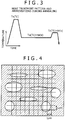
- Soaking temperature (Ts in Fig. 3): 840°C to Ac 3 temperature
- a soaking temperature Ts is lower than 840°C, the quantity of austenite in a double phase region lowers, a C content in austenite increases, hence ferrite is produced insufficiently in the succeeding cooling process, and the shortest distance dis between the second phase structures reduces. If a soaking temperature Ts exceeds the Ac 3 temperature in contrast, only an austenite single phase is formed when soaking is finished and a structure coarsens after annealing.
- a preferable soaking temperature Ts is in the range of about 850°C to 880°C.
- the Ac 3 temperature is computed on the basis of the following expression.
- (%) represents a content (mass %) of each element.
- the expression is described in " The physical metallurgy of Steels, William C Leslie” (published by Maruzen Co., Ltd., author William C Leslie, p273 ).
- Ac 3 910 ⁇ 203 ⁇ % C ⁇ 15.2 % Ni + 44.7 % Si + 104 % V + 31.5 % Mo + 13.1 % W ⁇ 30 % Mn ⁇ 11 % Cr ⁇ 20 % Cu + 700 % P + 400 % Al + 120 % As + 400 % Ti
- Soaking time (ts in Fig. 3): 30 sec or less
- a soaking time means a residence time of a steel sheet in a temperature range of 840°C or higher. If a soaking time ts exceeds 30 sec, retained austenite and martensite coarsen after annealing. A preferable soaking time ts is about 25 sec or less.
- the lower limit of a soaking time ts is not particularly limited but, in consideration of the increase of the quantity of retained Y after annealing and the like, it is desirable to control the soaking time to about 20 sec.
- Average cooling rate from soaking temperature Ts to austempering temperature Ta 1 to 20°C/sec
- an average cooling rate from a soaking temperature Ts is less than 1°C/sec, pearlite harmful to the improvement of TS ⁇ EL balance and the like is generated during cooling. If a cooling rate from the Ts temperature exceeds 20°C/sec in contrast, the ferrite volume fraction reduces.
- a preferable average cooling rate is in the range of about 2 to 15°C/sec.
- cooling in the above temperature range, two-step cooling in which different average cooling rates are applied may be adopted as shown in the after-mentioned example. More specifically, cooling may be applied at an average cooling rate of about 1 to 10°C/sec in the temperature range of a soaking temperature Ts to about 600°C and successively at an average cooling rate of about 3 to 20°C/sec in the temperature range of about 600°C to 390°C.
- Austempering temperature Ta 300°C to 390°C
- an austempering temperature Ta is lower than 300°C, martensite is generated abundantly during cooling, bainite transformation delays, and the quantity of retained austenite reduces after annealing. If an austempering temperature Ta exceeds 390°C in contrast, nuclei to initiate bainite transformation reduce and the second phase structure coarsens.
- An austempering temperature Ta is preferably in the range of about 320°C to 390°C and yet preferably in the range of 340°C to 390°C.
- an austempering time means a residence time of a steel sheet in the temperature range of 300°C to 390°C. If an austempering time ta is less than 30 sec, the time of bainite transformation shortens and the quantity of retained austenite reduces. If an austempering time ta exceeds 1,000 sec in contrast, productivity deteriorates.
- An austempering time ta is preferably in the range of about 35 to 500 sec and yet preferably in the range of 40 to 300 sec.
- Average heating rate during reheating after austempering 1 to 20°C/sec
- An average heating rate is preferably in the range of about 2 to 15°C/sec and yet preferably in the range of 3 to 10°C/sec.
- Reheating temperature Tr 450°C to 550°C
- a reheating temperature Tr is preferably in the range of about 460°C to 530°C.
- Reheating time tr 100 sec or less
- a reheating time means a residence time of a steel sheet in the temperature range of 450°C to 550°C. If a reheating time tr at 450°C or higher exceeds 100 sec, untransformed austenite decomposes into ferrite and cementite and the quantity of retained austenite reduces after annealing.
- a reheating time tr is preferably 90 sec or less and yet preferably 80 sec or less.
- the lower limit of the reheating time tr is not particularly limited but, in consideration of the promotion of bainite transformation and the like, is preferably about 20 sec.
- Average cooling rate after reheating 1 to 50°C/sec
- An average cooling rate after reheating is less than 1°C/see, productivity deteriorates and, if it exceeds 50°C/sec, a structure becomes uneven after annealing due to the unevenness of temperature.
- An average cooling rate is preferably in the range of about 2 to 40°C/sec and yet preferably in the range of about 3 to 30°C/sec.
- the above items are the requirements in the production processes characterizing the present invention.
- it is necessary to precisely control a coiling temperature CT after hot rolling, a soaking process (a soaking temperature Ts and a soaking time ts), an austempering process (an austempering temperature Ta and an austempering time ta), and a reheating process (a reheating temperature Tr and a reheating time tr) after austempering and, if any one of those items deviates from the requirements of the present invention, a steel sheet having desired properties is hardly obtained (refer to the example described later).
- the present invention includes not only a cold-rolled steel sheet but also a hot-dip galvanized steel sheet and an alloyed hot-dip galvanized steel sheet, but it is not intended to limit the methods for hot-dip galvanizing and alloying hot-dip galvanizing and ordinarily used methods can be used.
- molten steel satisfying a composition according to the present invention is produced by a known melting and refining method with a converter or an electric furnace and formed into a semifinished product such as a slab by continuous casting or forging and breakdown rolling.
- the semifinished product is hot-rolled. More specifically, either it is possible to apply hot rolling directly after continuous casting or, when the semifinished product is produced by continuous casting or forging and breakdown rolling, it is also possible to apply hot rolling after cooling it to an appropriate temperature and then heating in a reheating furnace.
- a heating temperature at hot rolling is preferably about 1,100°C or higher (yet preferably 1,150°C or higher) and thereby steel components can easily dissolve uniformly in an austenitic structure.
- a finishing temperature at hot rolling is preferably Ar 3 point or higher and yet preferably Ar 3 point + (30-50)°C.
- a hot-rolled steel sheet is coiled at a prescribed coiling temperature CT as stated earlier, thereafter pickled if necessary, and cold-rolled. Successively, an intended high-strength steel sheet is obtained by applying annealing and then cooling in a continuous annealing line as stated above.
- a hot-dip galvanized steel sheet or an alloyed hot-dip galvanized steel sheet can be produced by using a high-strength cold-rolled steel sheet produced as above and applying hot-dip galvanizing or alloying hot-dip galvanizing on the basis of an ordinary method.
- a temperature of the plating bath is preferably in the range of about 400°C to 600°C (yet preferably 400°C to 500°C).
- alloying is applied additionally, alloying treatment is applied for about 2 to 60 sec at about 450°C to 600°C.
- the heating means is not particularly limited and commonly used various methods (for example, gas heating, induction heating, and the like) can be used.
- the steel types A to H having chemical compositions (the unit is mass % and the remainder consists of iron and unavoidable impurities) shown in Table 1 are produced by melting and refining and then slabs are obtained by casting the steels.
- the slabs are heated to 1,150°C, hot-rolled to a thickness of 2.4 mm at a finishing temperature of 880°C, thereafter cooled at an average cooling rate of 30°C/sec, and coiled at the coiling temperatures (CT) shown in Table 2.
- CT coiling temperatures
- the cold-rolled steel sheets are heated to the soaking temperatures (Ts) shown in Table 2 at an average heating rate of 5°C/sec and retained at the temperatures for the times (ts) shown in Table 2 with an experimental heat treatment apparatus that can simulate a continuous annealing line.
- the annealed steel sheets are cooled to 600°C at an average cooling rate of 3°C/sec and thereafter subjected to austempering treatment by cooling the steel sheets to the austempering temperatures (Ta) shown in Table 2 at an average cooling rate of 10°C/sec and retaining the steel sheets at the temperatures for the austempering times (ta) of 3 to 1, 000 sec.
- the steel sheets are heated to the reheating temperatures (Tr) shown in Table 2 at an average heating rate of 10°C/sec, retained for the times (tr) shown in Table 2, and thereafter cooled to room temperature at an average cooling rate of 10°C/sec.
- a test piece of 2 mm x 20 mm x 20 mm is cut out, a cross sectional plane parallel with the rolling direction is polished and corroded with a nital solution, and thereafter the structure at the t/4 position of the thickness t is observed in a SEM photograph (3, 000 magnifications) . Observation is applied to 10 visual fields in total, the size of each visual field being about 15 ⁇ m ⁇ 15 ⁇ m.
- the volume fractions of ferrite, the second phase structure (retained austenite and martensite), and the other structure (remainder structure, described as "the other” in the table) are measured with lattices of 1 ⁇ m intervals shown in Fig. 4 by the point counting method. That is, the proportion of each structure is obtained by judging the structure at each point at which a vertical line and a horizontal line intersect with each other and totaling up the number of points in each structure over the whole visual field. The same procedure is applied to all the ten visual fields and the average is defined as the volume fraction of each structure.
- the shortest distance dis ( ⁇ m) between the second phase structures and the average grain size dia ( ⁇ m) of the second phase structures are measured on the aforementioned SEM photograph by the aforementioned method.
- volume fraction V ⁇ of retained austenite is measured by a saturated magnetization measurement method.
- the details of the saturated magnetization measurement method are described in JP-A No. 90825/2003 and " R&D Kobe Steel Engineering Reports" (Vol. 52, No. 3, Dec. 2002 ).
- the volume fraction of martensite is computed by deducting the volume fraction of retained austenite from the volume fraction of the second phase structures.
- Vf x V ⁇ ⁇ C ⁇ ⁇ dis Vf x V ⁇ ⁇ C ⁇ ⁇ dis
- dia dia
- a JIS #5 test piece (distance between gauge points: 50 mm, width of parallel portion: 25 mm) is taken out from each of the cold-rolled steel sheets and a tensile strength (TS), a total elongation (EL), and work hardening coefficients (an n value in 0.5% to 1.0% strain and an n value in 5% to 10% strain) are measured in accordance with JIS Z 2241.
- TS tensile strength
- EL total elongation
- work hardening coefficients an n value in 0.5% to 1.0% strain and an n value in 5% to 10% strain
- the product of thus obtained TS (MPa) and EL (%) is computed and a strength-ductility balance (TS ⁇ EL) is obtained.
- a steel sheet is evaluated as being excellent in workability when the TS ⁇ EL balance is 20,000 or more.
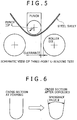
- Three-point U-bending test shown in Fig. 5 is carried out in order to measure a springback value in a low strain region. More specifically, the punch tip R is set at 20 mm, the clearance between a punch and a roller die is set at 1.2 mm, then U-bending test is applied so that the center of the punch tip R and the center of the die tip R may coincide with each other, and the bending test is terminated at 10 mm pushing. As shown in Fig. 6 , an angle after springback (a state where elasticity is recovered after unloaded) is measured and the angle is defined as a springback value.
- a steel sheet is evaluated as "being excellent in shape freezing property" when the springback value is 32.0° or less and “being absolutely excellent in shape freezing property” when the springback value is 31.0° or less.
- Nos. 2 and 3 (the steel type B is used), Nos. 4 and 5 (the steel type C is used), Nos. 6 to 8 (the steel type D is used), Nos. 9 to 13, 16, 17, 22 to 24, 29 to 31, 34 to 36, and 41 to 43 (the steel type E is used), and Nos. 48 and 49 (the steel type F is used) are the cases where the requirements in the present invention are satisfied.
- the TS ⁇ EL balance exceeds 20,000 and is excellent in workability and the springback value is 31° or less and is absolutely excellent in shape freezing property.
- Nos. 36, 42, and 43 are excellent in both workability and shape freezing property since they satisfy the requirements in the present invention but, in any of them, the springback value is somewhat larger than the above cases since the carbon content C Y in the retained austenite deviates from the requirement in the present invention.
- No. 1 is the case where the steel type A having a small C content is used. Since the C content is small, the volume fraction V Y of the retained austenite is small, the TS ⁇ EL balance is as low as 12,000, and the workability is inferior.
- Nos. 14 and 15 are the cases where the steel type E satisfying the requirements in the present invention is used but the steel sheets are produced at a high coiling temperature CT, thus the value of the expression (1) is small and the average grain size dia of the second phase structures exceeds the range stipulated in the present invention. Consequently, the TS ⁇ EL balance lowers and the springback value increases.
- Nos. 18 and 19 are the cases where the steel type E satisfying the requirements in the present invention is used but the steel sheets are produced at a low soaking temperature Ts.
- Table 2 the symbol "-" shown in some boxes of the soaking time ts column means that the steel sheets are not retained at a soaking temperature stipulated in the present invention, and No. 18 is the case where the steel sheet is soaked at a soaking temperature of 780°C for 10 sec and No. 19 is the case where the steel sheet is soaked at a soaking temperature of 830°C for 10 sec.
- the value of the expression (1) is small and the value of the expression (2) (the shortest distance dis between the second phase structures) is also small, the TS ⁇ EL balance and the shape freezing property deteriorate.
- the value of the expression (1) is small and the TS ⁇ EL balance and the shape freezing property deteriorate.
- Nos. 20 and 21 are the cases where the steel type E satisfying the requirements in the present invention is used and the steel sheets are produced at a high soaking temperature Ts.
- the value of the expression (1) is small and the average grain size dia of the second phase structures exceeds the range stipulated in the present invention, the TS ⁇ EL balance and the shape freezing property deteriorate.
- the value of the expression (1) is small and the average grain size dia of the second phase structures, the ferrite volume fraction Vf, and the retained austenite volume fraction V Y deviate from the ranges stipulated in the present invention, the TS ⁇ EL balance and the shape freezing property deteriorate.
- the uniform elongation is lower than 10% (not shown in the table), the work hardening coefficient n value (5% to 10%) cannot be measured and hence the expression (3) cannot be computed.
- Nos. 25 and 26 are the cases where the steel type E satisfying the requirements in the present invention is used but the steel sheets are produced at a low austempering temperature Ta. Since the value of the expression (1) is small and the dia value exceeds the range stipulated in the present invention, the TS ⁇ EL balance and the shape freezing property deteriorate.
- the uniform elongation is lower than 10% (not shown in the table), the work hardening coefficient n value (5% to 10%) cannot be measured and hence the expression (3) cannot be computed.
- Nos. 27 and 28 are the cases where the steel type E satisfying the requirements in the present invention is used and the steel sheets are produced at a high austempering temperature Ta. Since the value of the expression (1) is small and the dia value exceeds the range stipulated in the present invention, the TS ⁇ EL balance and the shape freezing property deteriorate.
- No. 32 is the case where the steel type E satisfying the requirements in the present invention is used but the steel sheet is produced at a short austempering time ta. Since the values of the expressions (1) and (2) are small and the values of dia and Vf deviate from the ranges stipulated in the present invention, the TS ⁇ EL balance and the shape freezing property deteriorate. Meanwhile, No. 33 is the case where the steel type E satisfying the requirements in the present invention is used and the steel sheet is produced at a long austempering time ta. Since the value of the expression (1) is small and the values of dia and Vr deviate from the ranges stipulated in the present invention, the TS ⁇ EL balance and the shape freezing property deteriorate.
- Nos. 37 and 38 are the cases where the steel type E satisfying the requirements in the present invention is used but the steel sheets are produced at low reheating temperature Tr.
- both the expressions (1) and (2) do not satisfy the requirements in the present invention and the value dia deviates from the range stipulated in the present invention, the TS ⁇ EL balance and the shape freezing property deteriorate.
- the expression (1) does not satisfy the requirements in the present invention and the value dia deviates from the range stipulated in the present invention, the TS ⁇ EL balance and the shape freezing property deteriorate.
- Nos. 39 and 40 are the cases where the steel type E satisfying the requirements in the present invention is used and the steel sheets are produced at a high reheating temperature Tr. Since the expression (1) does not satisfy the requirements in the present invention and the value V ⁇ deviates from the range stipulated in the present invention, the TS ⁇ EL balance and the shape freezing property deteriorate.
- Nos. 44 and 45 are the cases where the steel type E satisfying the requirements in the present invention is used but the steel sheets are produced at a short reheating time tr.
- both the expressions (1) and (2) do not satisfy the requirements in the present invention and the values of Vf, V ⁇ , C ⁇ , and dia deviate from the ranges stipulated in the present invention, the TS ⁇ EL balance and the shape freezing property deteriorate.
- the expression (1) does not satisfy the requirements in the present invention and the values of Vf, V ⁇ , C ⁇ , and dia deviate from the ranges stipulated in the present invention, the TS ⁇ EL balance and the shape freezing property deteriorate.
- Nos. 46 and 47 are the cases where the steel type E satisfying the requirements in the present invention is used and the steel sheets are produced at a long reheating time tr. Since the expression (1) does not satisfy the requirements in the present invention and the value V ⁇ deviates from the range stipulated in the present invention, the TS ⁇ EL balance and the shape freezing property deteriorate.
- No. 50 is the case where the steel sheet is produced by using the steel type G having a high Si content. Since the expression (1) does not satisfy the requirements in the present invention and the value V ⁇ deviates from the range stipulated in the present invention, the TS ⁇ EL balance and the shape freezing property deteriorate.
- No. 51 is the case where the steel sheet is produced by using the steel type H having a high Mn content. Since the expression (1) does not satisfy the requirements in the present invention and the values of V ⁇ and dia deviate from the ranges stipulated in the present invention, the TS ⁇ EL balance and the shape freezing property deteriorate. Here, in No. 51, since the uniform elongation is lower than 10% (not shown in the table), the work hardening coefficient n value (5% to 10%) cannot be measured and hence the expression (3) cannot be computed.
- No. 52 is the case where the steel type E satisfying the requirements in the present invention is used but the steel sheet is produced at a low soaking temperature Ts.
- Ts the steel sheet is produced at a low soaking temperature
- the symbol "-" shown in some boxes of the soaking time ts column means that the steel sheets are not retained at a soaking temperature stipulated in the present invention
- No. 52 is the case where the steel sheet is soaked at a soaking temperature of 800°C for 10 sec. Consequently in No. 52, since the expression (1) satisfies the requirements in the present invention but the expression (2) does not satisfy the requirements in the present invention, the TS ⁇ EL balance and the shape freezing property deteriorate.
- a hot-dip galvanized steel sheet and an alloyed hot-dip galvanized steel sheet have the same tendency and a steel sheet satisfying the requirements in the present invention is excellent in both workability and shape freezing property.
Landscapes
- Chemical & Material Sciences (AREA)
- Engineering & Computer Science (AREA)
- Materials Engineering (AREA)
- Mechanical Engineering (AREA)
- Metallurgy (AREA)
- Organic Chemistry (AREA)
- Heat Treatment Of Sheet Steel (AREA)
- Coating With Molten Metal (AREA)
Claims (3)
- Kaltgewalztes Stahlblech:enthaltend, als die Stahlkomponenten, C: 0,10 % bis 0,20 % (% bedeutet Massen-%, dasselbe wird nachfolgend angewendet), Si: 0,5 % bis 2,5 %, Mn: 0,5 % bis 2,5 % und Al: 0.01% bis 0,10 %, wobei der Rest aus Eisen und anderen unvermeidbaren Verunreinigungen besteht; und gegebenenfalls N: 0,5 % oder weniger, V: 0,15 % oder weniger, Mo: 0,5 % oder weniger, Cr: 0,8 % oder weniger, Cu: 0,5 % oder weniger und B: 0,01 % oder weniger;das eine Struktur aufweist, die eine Mutterphasenstruktur von Ferrit und eine zweite Phasenstruktur von Restaustenit und Martensit umfasst (das Martensit muss nicht enthalten sein); unddas die folgenden Ausdrücke (1) und (2) erfüllt, wenn der Volumenanteil des Ferrits in der gesamten Struktur durch Vf (%) dargestellt wird, der Volumenanteil des Restaustenits in der gesamten Struktur durch Vγ (%) dargestellt wird, der Kohlenstoffgehalt in dem Restaustenit durch Cγ (Massen-%) dargestellt wird, die kürzeste Distanz zwischen den zweiten Phasenstrukturen durch dis (µm) dargestellt wird und die mittlere Korngröße der zweiten Phasenstrukturen durch dia (µm) dargestellt wird,wobei: der Volumenanteil Vf % des Ferrits und der gesamten Struktur 60 % oder mehr ist; der Volumenanteil Vγ (%) des Restaustenits in der gesamten Struktur 5,0 % bis 20 % ist; der Kohlenstoffgehalt Cγ (Massen-%) in dem Restaustenit 0,7 % oder mehr ist und die mittlere Korngröße dia (µm) der zweiten Phasenstrukturen 5 µm oder weniger ist;


wobei die kürzeste Distanz zwischen den zweiten Phasenstrukturen und der mittleren Korngröße dia der zweiten Phasenstrukturen auf einer zu der Walzrichtung des Stahlblechs parallelen Querschnittsebene gemessen ist. - Feuerverzinktes Stahlblech, das unter Verwendung des kaltgewalzten Stahlblechs nach Anspruch 1 hergestellt wird.
- Legiertes feuerverzinktes Stahlblech, das durch Anwendung von legierendem Feuerverzinken auf das kaltgewalzte Stahlblech nach Anspruch 1 hergestellt wird.
Applications Claiming Priority (1)
| Application Number | Priority Date | Filing Date | Title |
|---|---|---|---|
| JP2009088088A JP5323563B2 (ja) | 2009-03-31 | 2009-03-31 | 加工性および形状凍結性に優れた高強度冷延鋼板 |
Publications (2)
| Publication Number | Publication Date |
|---|---|
| EP2236638A1 EP2236638A1 (de) | 2010-10-06 |
| EP2236638B1 true EP2236638B1 (de) | 2016-12-14 |
Family
ID=42122910
Family Applications (1)
| Application Number | Title | Priority Date | Filing Date |
|---|---|---|---|
| EP10158525.5A Not-in-force EP2236638B1 (de) | 2009-03-31 | 2010-03-30 | Hochfestes kaltgepresstes Stahlblech mit ausgezeichneter Bearbeitungsfähigkeit und Formgefriereigenschaften |
Country Status (5)
| Country | Link |
|---|---|
| US (1) | US8349471B2 (de) |
| EP (1) | EP2236638B1 (de) |
| JP (1) | JP5323563B2 (de) |
| KR (1) | KR101198449B1 (de) |
| CN (1) | CN101851727B (de) |
Families Citing this family (12)
| Publication number | Priority date | Publication date | Assignee | Title |
|---|---|---|---|---|
| JP5883211B2 (ja) * | 2010-01-29 | 2016-03-09 | 株式会社神戸製鋼所 | 加工性に優れた高強度冷延鋼板およびその製造方法 |
| JP5651964B2 (ja) * | 2010-02-16 | 2015-01-14 | 新日鐵住金株式会社 | 延性及び穴広げ性並びに耐食性に優れた合金化溶融亜鉛めっき鋼板及びその製造方法 |
| JP5771034B2 (ja) | 2010-03-29 | 2015-08-26 | 株式会社神戸製鋼所 | 加工性に優れた超高強度鋼板、およびその製造方法 |
| BR112014002026B1 (pt) * | 2011-07-29 | 2019-03-26 | Nippon Steel & Sumitomo Metal Corporation | Chapa de aço de alta resistência e chapa de aço galvanizado de alta resistência em fixabilidade de forma,e método de produção das mesmas. |
| JP5764549B2 (ja) | 2012-03-29 | 2015-08-19 | 株式会社神戸製鋼所 | 成形性および形状凍結性に優れた、高強度冷延鋼板、高強度溶融亜鉛めっき鋼板および高強度合金化溶融亜鉛めっき鋼板、ならびにそれらの製造方法 |
| WO2013144373A1 (en) | 2012-03-30 | 2013-10-03 | Voestalpine Stahl Gmbh | High strength cold rolled steel sheet and method of producing such steel sheet |
| CN104655472A (zh) * | 2015-02-10 | 2015-05-27 | 西安热工研究院有限公司 | 一种基于染色的奥氏体耐热钢第二相的显示方法 |
| JP6540162B2 (ja) * | 2015-03-31 | 2019-07-10 | 日本製鉄株式会社 | 延性および伸びフランジ性に優れた高強度冷延鋼板、高強度合金化溶融亜鉛めっき鋼板、およびそれらの製造方法 |
| CN108835704A (zh) * | 2018-08-28 | 2018-11-20 | 云南中烟工业有限责任公司 | 一种基于费马点的烟叶配方设计方法及组合烟叶 |
| EP3954791A4 (de) * | 2019-04-08 | 2022-11-23 | Nippon Steel Corporation | Kaltgewalztes stahlblech und verfahren zur herstellung davon |
| JP7031800B1 (ja) * | 2020-06-30 | 2022-03-08 | Jfeスチール株式会社 | 鋼板、部材及びそれらの製造方法 |
| WO2022004820A1 (ja) * | 2020-06-30 | 2022-01-06 | Jfeスチール株式会社 | 亜鉛めっき鋼板、部材及びそれらの製造方法 |
Family Cites Families (12)
| Publication number | Priority date | Publication date | Assignee | Title |
|---|---|---|---|---|
| US6319338B1 (en) * | 1996-11-28 | 2001-11-20 | Nippon Steel Corporation | High-strength steel plate having high dynamic deformation resistance and method of manufacturing the same |
| JPH1161326A (ja) * | 1997-08-06 | 1999-03-05 | Nippon Steel Corp | 耐衝突安全性及び成形性に優れた自動車用高強度鋼板とその製造方法 |
| JPH10273752A (ja) * | 1997-01-29 | 1998-10-13 | Nippon Steel Corp | 耐衝突安全性及び成形性に優れた自動車用高強度鋼板とその製造方法 |
| JP3619357B2 (ja) | 1997-12-26 | 2005-02-09 | 新日本製鐵株式会社 | 高い動的変形抵抗を有する高強度鋼板とその製造方法 |
| JPH11350064A (ja) | 1998-06-08 | 1999-12-21 | Kobe Steel Ltd | 形状凍結性と耐衝撃特性に優れる高強度鋼板及びその製造方法 |
| KR100441414B1 (ko) * | 2000-04-21 | 2004-07-23 | 신닛뽄세이테쯔 카부시키카이샤 | 버링 가공성이 우수한 고피로강도 강판 및 그의 제조방법 |
| WO2002061161A1 (fr) | 2001-01-31 | 2002-08-08 | Kabushiki Kaisha Kobe Seiko Sho | Feuillard en acier a haute resistance ayant une excellente formabilite, et son procede de production |
| JP3840436B2 (ja) | 2002-07-12 | 2006-11-01 | 株式会社神戸製鋼所 | 加工性に優れた高強度鋼板 |
| JP4119758B2 (ja) * | 2003-01-16 | 2008-07-16 | 株式会社神戸製鋼所 | 加工性および形状凍結性に優れた高強度鋼板、並びにその製法 |
| JP4288364B2 (ja) * | 2004-12-21 | 2009-07-01 | 株式会社神戸製鋼所 | 伸びおよび伸びフランジ性に優れる複合組織冷延鋼板 |
| JP4716359B2 (ja) * | 2005-03-30 | 2011-07-06 | 株式会社神戸製鋼所 | 均一伸びに優れた高強度冷延鋼板およびその製造方法 |
| JP4692259B2 (ja) | 2005-12-07 | 2011-06-01 | Jfeスチール株式会社 | 成形性および形状凍結性に優れる高強度鋼板 |
-
2009
- 2009-03-31 JP JP2009088088A patent/JP5323563B2/ja not_active Expired - Fee Related
-
2010
- 2010-02-21 CN CN201010117001.6A patent/CN101851727B/zh not_active Expired - Fee Related
- 2010-03-05 US US12/718,397 patent/US8349471B2/en not_active Expired - Fee Related
- 2010-03-30 KR KR1020100028668A patent/KR101198449B1/ko not_active Expired - Fee Related
- 2010-03-30 EP EP10158525.5A patent/EP2236638B1/de not_active Not-in-force
Also Published As
| Publication number | Publication date |
|---|---|
| KR101198449B1 (ko) | 2012-11-06 |
| EP2236638A1 (de) | 2010-10-06 |
| CN101851727B (zh) | 2013-01-23 |
| US20100247958A1 (en) | 2010-09-30 |
| CN101851727A (zh) | 2010-10-06 |
| KR20100109505A (ko) | 2010-10-08 |
| JP2010236066A (ja) | 2010-10-21 |
| US8349471B2 (en) | 2013-01-08 |
| JP5323563B2 (ja) | 2013-10-23 |
Similar Documents
| Publication | Publication Date | Title |
|---|---|---|
| EP2236638B1 (de) | Hochfestes kaltgepresstes Stahlblech mit ausgezeichneter Bearbeitungsfähigkeit und Formgefriereigenschaften | |
| CN107250409B (zh) | 高强度冷轧薄钢板及其制造方法 | |
| EP2813595B1 (de) | Hochfestes kaltgewalztes stahlblech und verfahren zur herstellung davon | |
| KR101375413B1 (ko) | 고강도 용융 아연 도금 강판 및 그 제조 방법 | |
| EP2415894B1 (de) | Stahlplatte mit herausragender Umformbarkeit und Verfahren zu deren Herstellung | |
| CN106574340B (zh) | 高强度钢板及其制造方法、以及高强度镀锌钢板的制造方法 | |
| EP3730635A1 (de) | Hochfestes stahlblech mit ausgezeichneten schlageigenschaften und verformbarkeit und verfahren zur herstellung davon | |
| CN110291217A (zh) | 高强度钢板及其制造方法 | |
| US20190218652A1 (en) | Metal coated steel sheet, manufacturing method of hot-dip galvanized steel sheet, and manufacturing method of alloyed galvannealed steel sheet | |
| KR20110105404A (ko) | 고강도 용융 아연 도금 강판 및 그 제조 방법 | |
| CN107075627A (zh) | 高强度钢板及其制造方法、以及高强度镀锌钢板的制造方法 | |
| JP6249140B1 (ja) | 高降伏比型高強度亜鉛めっき鋼板及びその製造方法 | |
| WO2013046476A1 (ja) | 高強度鋼板およびその製造方法 | |
| KR20040091751A (ko) | 연성 및 내피로특성에 우수한 고장력 용융 아연도금강판의제조방법 | |
| JP2011149066A (ja) | 冷延鋼板および熱延鋼板ならびにそれらの製造方法 | |
| JP5213643B2 (ja) | 延性および穴拡げ性に優れた高強度冷延鋼板および高強度合金化溶融亜鉛めっき鋼板 | |
| JP4211520B2 (ja) | 耐時効性に優れた高強度高延性亜鉛めっき鋼板およびその製造方法 | |
| CN115151673B (zh) | 钢板、构件和它们的制造方法 | |
| JP5659604B2 (ja) | 高強度鋼板およびその製造方法 | |
| KR102514897B1 (ko) | 강판 및 그 제조 방법 | |
| JP2001207236A (ja) | 高張力溶融亜鉛めっき鋼板およびその製造方法 | |
| WO2025046998A1 (ja) | パネル | |
| KR102540431B1 (ko) | 고강도 강판 및 그 제조 방법 | |
| JP2007077510A (ja) | 耐時効性に優れた高強度高延性亜鉛めっき鋼板およびその製造方法 | |
| JP2002161317A (ja) | 伸びフランジ成形性に優れた高強度溶融亜鉛めっき鋼板の製造方法 |
Legal Events
| Date | Code | Title | Description |
|---|---|---|---|
| PUAI | Public reference made under article 153(3) epc to a published international application that has entered the european phase |
Free format text: ORIGINAL CODE: 0009012 |
|
| 17P | Request for examination filed |
Effective date: 20100330 |
|
| AK | Designated contracting states |
Kind code of ref document: A1 Designated state(s): AT BE BG CH CY CZ DE DK EE ES FI FR GB GR HR HU IE IS IT LI LT LU LV MC MK MT NL NO PL PT RO SE SI SK SM TR |
|
| TPAC | Observations filed by third parties |
Free format text: ORIGINAL CODE: EPIDOSNTIPA |
|
| 17Q | First examination report despatched |
Effective date: 20130311 |
|
| GRAP | Despatch of communication of intention to grant a patent |
Free format text: ORIGINAL CODE: EPIDOSNIGR1 |
|
| INTG | Intention to grant announced |
Effective date: 20151125 |
|
| GRAJ | Information related to disapproval of communication of intention to grant by the applicant or resumption of examination proceedings by the epo deleted |
Free format text: ORIGINAL CODE: EPIDOSDIGR1 |
|
| GRAP | Despatch of communication of intention to grant a patent |
Free format text: ORIGINAL CODE: EPIDOSNIGR1 |
|
| GRAJ | Information related to disapproval of communication of intention to grant by the applicant or resumption of examination proceedings by the epo deleted |
Free format text: ORIGINAL CODE: EPIDOSDIGR1 |
|
| GRAP | Despatch of communication of intention to grant a patent |
Free format text: ORIGINAL CODE: EPIDOSNIGR1 |
|
| INTC | Intention to grant announced (deleted) | ||
| INTG | Intention to grant announced |
Effective date: 20160622 |
|
| INTG | Intention to grant announced |
Effective date: 20160705 |
|
| GRAS | Grant fee paid |
Free format text: ORIGINAL CODE: EPIDOSNIGR3 |
|
| GRAA | (expected) grant |
Free format text: ORIGINAL CODE: 0009210 |
|
| AK | Designated contracting states |
Kind code of ref document: B1 Designated state(s): AT BE BG CH CY CZ DE DK EE ES FI FR GB GR HR HU IE IS IT LI LT LU LV MC MK MT NL NO PL PT RO SE SI SK SM TR |
|
| REG | Reference to a national code |
Ref country code: GB Ref legal event code: FG4D |
|
| REG | Reference to a national code |
Ref country code: CH Ref legal event code: EP |
|
| REG | Reference to a national code |
Ref country code: IE Ref legal event code: FG4D |
|
| REG | Reference to a national code |
Ref country code: AT Ref legal event code: REF Ref document number: 853650 Country of ref document: AT Kind code of ref document: T Effective date: 20170115 |
|
| REG | Reference to a national code |
Ref country code: DE Ref legal event code: R096 Ref document number: 602010038738 Country of ref document: DE |
|
| REG | Reference to a national code |
Ref country code: FR Ref legal event code: PLFP Year of fee payment: 8 |
|
| PG25 | Lapsed in a contracting state [announced via postgrant information from national office to epo] |
Ref country code: LV Free format text: LAPSE BECAUSE OF FAILURE TO SUBMIT A TRANSLATION OF THE DESCRIPTION OR TO PAY THE FEE WITHIN THE PRESCRIBED TIME-LIMIT Effective date: 20161214 |
|
| REG | Reference to a national code |
Ref country code: LT Ref legal event code: MG4D |
|
| REG | Reference to a national code |
Ref country code: NL Ref legal event code: MP Effective date: 20161214 |
|
| PG25 | Lapsed in a contracting state [announced via postgrant information from national office to epo] |
Ref country code: NO Free format text: LAPSE BECAUSE OF FAILURE TO SUBMIT A TRANSLATION OF THE DESCRIPTION OR TO PAY THE FEE WITHIN THE PRESCRIBED TIME-LIMIT Effective date: 20170314 Ref country code: SE Free format text: LAPSE BECAUSE OF FAILURE TO SUBMIT A TRANSLATION OF THE DESCRIPTION OR TO PAY THE FEE WITHIN THE PRESCRIBED TIME-LIMIT Effective date: 20161214 Ref country code: LT Free format text: LAPSE BECAUSE OF FAILURE TO SUBMIT A TRANSLATION OF THE DESCRIPTION OR TO PAY THE FEE WITHIN THE PRESCRIBED TIME-LIMIT Effective date: 20161214 Ref country code: GR Free format text: LAPSE BECAUSE OF FAILURE TO SUBMIT A TRANSLATION OF THE DESCRIPTION OR TO PAY THE FEE WITHIN THE PRESCRIBED TIME-LIMIT Effective date: 20170315 |
|
| PG25 | Lapsed in a contracting state [announced via postgrant information from national office to epo] |
Ref country code: FI Free format text: LAPSE BECAUSE OF FAILURE TO SUBMIT A TRANSLATION OF THE DESCRIPTION OR TO PAY THE FEE WITHIN THE PRESCRIBED TIME-LIMIT Effective date: 20161214 Ref country code: HR Free format text: LAPSE BECAUSE OF FAILURE TO SUBMIT A TRANSLATION OF THE DESCRIPTION OR TO PAY THE FEE WITHIN THE PRESCRIBED TIME-LIMIT Effective date: 20161214 |
|
| PG25 | Lapsed in a contracting state [announced via postgrant information from national office to epo] |
Ref country code: NL Free format text: LAPSE BECAUSE OF FAILURE TO SUBMIT A TRANSLATION OF THE DESCRIPTION OR TO PAY THE FEE WITHIN THE PRESCRIBED TIME-LIMIT Effective date: 20161214 |
|
| PG25 | Lapsed in a contracting state [announced via postgrant information from national office to epo] |
Ref country code: IS Free format text: LAPSE BECAUSE OF FAILURE TO SUBMIT A TRANSLATION OF THE DESCRIPTION OR TO PAY THE FEE WITHIN THE PRESCRIBED TIME-LIMIT Effective date: 20170414 Ref country code: EE Free format text: LAPSE BECAUSE OF FAILURE TO SUBMIT A TRANSLATION OF THE DESCRIPTION OR TO PAY THE FEE WITHIN THE PRESCRIBED TIME-LIMIT Effective date: 20161214 Ref country code: CZ Free format text: LAPSE BECAUSE OF FAILURE TO SUBMIT A TRANSLATION OF THE DESCRIPTION OR TO PAY THE FEE WITHIN THE PRESCRIBED TIME-LIMIT Effective date: 20161214 Ref country code: RO Free format text: LAPSE BECAUSE OF FAILURE TO SUBMIT A TRANSLATION OF THE DESCRIPTION OR TO PAY THE FEE WITHIN THE PRESCRIBED TIME-LIMIT Effective date: 20161214 Ref country code: SK Free format text: LAPSE BECAUSE OF FAILURE TO SUBMIT A TRANSLATION OF THE DESCRIPTION OR TO PAY THE FEE WITHIN THE PRESCRIBED TIME-LIMIT Effective date: 20161214 |
|
| PG25 | Lapsed in a contracting state [announced via postgrant information from national office to epo] |
Ref country code: PT Free format text: LAPSE BECAUSE OF FAILURE TO SUBMIT A TRANSLATION OF THE DESCRIPTION OR TO PAY THE FEE WITHIN THE PRESCRIBED TIME-LIMIT Effective date: 20170414 Ref country code: IT Free format text: LAPSE BECAUSE OF FAILURE TO SUBMIT A TRANSLATION OF THE DESCRIPTION OR TO PAY THE FEE WITHIN THE PRESCRIBED TIME-LIMIT Effective date: 20161214 Ref country code: BG Free format text: LAPSE BECAUSE OF FAILURE TO SUBMIT A TRANSLATION OF THE DESCRIPTION OR TO PAY THE FEE WITHIN THE PRESCRIBED TIME-LIMIT Effective date: 20170314 Ref country code: SM Free format text: LAPSE BECAUSE OF FAILURE TO SUBMIT A TRANSLATION OF THE DESCRIPTION OR TO PAY THE FEE WITHIN THE PRESCRIBED TIME-LIMIT Effective date: 20161214 Ref country code: PL Free format text: LAPSE BECAUSE OF FAILURE TO SUBMIT A TRANSLATION OF THE DESCRIPTION OR TO PAY THE FEE WITHIN THE PRESCRIBED TIME-LIMIT Effective date: 20161214 Ref country code: ES Free format text: LAPSE BECAUSE OF FAILURE TO SUBMIT A TRANSLATION OF THE DESCRIPTION OR TO PAY THE FEE WITHIN THE PRESCRIBED TIME-LIMIT Effective date: 20161214 Ref country code: BE Free format text: LAPSE BECAUSE OF FAILURE TO SUBMIT A TRANSLATION OF THE DESCRIPTION OR TO PAY THE FEE WITHIN THE PRESCRIBED TIME-LIMIT Effective date: 20161214 |
|
| REG | Reference to a national code |
Ref country code: DE Ref legal event code: R097 Ref document number: 602010038738 Country of ref document: DE |
|
| PLBE | No opposition filed within time limit |
Free format text: ORIGINAL CODE: 0009261 |
|
| STAA | Information on the status of an ep patent application or granted ep patent |
Free format text: STATUS: NO OPPOSITION FILED WITHIN TIME LIMIT |
|
| REG | Reference to a national code |
Ref country code: CH Ref legal event code: PL |
|
| 26N | No opposition filed |
Effective date: 20170915 |
|
| GBPC | Gb: european patent ceased through non-payment of renewal fee |
Effective date: 20170330 |
|
| PG25 | Lapsed in a contracting state [announced via postgrant information from national office to epo] |
Ref country code: DK Free format text: LAPSE BECAUSE OF FAILURE TO SUBMIT A TRANSLATION OF THE DESCRIPTION OR TO PAY THE FEE WITHIN THE PRESCRIBED TIME-LIMIT Effective date: 20161214 Ref country code: MC Free format text: LAPSE BECAUSE OF FAILURE TO SUBMIT A TRANSLATION OF THE DESCRIPTION OR TO PAY THE FEE WITHIN THE PRESCRIBED TIME-LIMIT Effective date: 20161214 |
|
| REG | Reference to a national code |
Ref country code: IE Ref legal event code: MM4A |
|
| PG25 | Lapsed in a contracting state [announced via postgrant information from national office to epo] |
Ref country code: LU Free format text: LAPSE BECAUSE OF NON-PAYMENT OF DUE FEES Effective date: 20170330 |
|
| REG | Reference to a national code |
Ref country code: FR Ref legal event code: PLFP Year of fee payment: 9 |
|
| PG25 | Lapsed in a contracting state [announced via postgrant information from national office to epo] |
Ref country code: SI Free format text: LAPSE BECAUSE OF FAILURE TO SUBMIT A TRANSLATION OF THE DESCRIPTION OR TO PAY THE FEE WITHIN THE PRESCRIBED TIME-LIMIT Effective date: 20161214 Ref country code: IE Free format text: LAPSE BECAUSE OF NON-PAYMENT OF DUE FEES Effective date: 20170330 Ref country code: CH Free format text: LAPSE BECAUSE OF NON-PAYMENT OF DUE FEES Effective date: 20170331 Ref country code: GB Free format text: LAPSE BECAUSE OF NON-PAYMENT OF DUE FEES Effective date: 20170330 Ref country code: LI Free format text: LAPSE BECAUSE OF NON-PAYMENT OF DUE FEES Effective date: 20170331 |
|
| PG25 | Lapsed in a contracting state [announced via postgrant information from national office to epo] |
Ref country code: MT Free format text: LAPSE BECAUSE OF NON-PAYMENT OF DUE FEES Effective date: 20170330 |
|
| PG25 | Lapsed in a contracting state [announced via postgrant information from national office to epo] |
Ref country code: HU Free format text: LAPSE BECAUSE OF FAILURE TO SUBMIT A TRANSLATION OF THE DESCRIPTION OR TO PAY THE FEE WITHIN THE PRESCRIBED TIME-LIMIT; INVALID AB INITIO Effective date: 20100330 |
|
| PG25 | Lapsed in a contracting state [announced via postgrant information from national office to epo] |
Ref country code: CY Free format text: LAPSE BECAUSE OF NON-PAYMENT OF DUE FEES Effective date: 20161214 |
|
| REG | Reference to a national code |
Ref country code: AT Ref legal event code: UEP Ref document number: 853650 Country of ref document: AT Kind code of ref document: T Effective date: 20161214 |
|
| PG25 | Lapsed in a contracting state [announced via postgrant information from national office to epo] |
Ref country code: MK Free format text: LAPSE BECAUSE OF FAILURE TO SUBMIT A TRANSLATION OF THE DESCRIPTION OR TO PAY THE FEE WITHIN THE PRESCRIBED TIME-LIMIT Effective date: 20161214 |
|
| PG25 | Lapsed in a contracting state [announced via postgrant information from national office to epo] |
Ref country code: TR Free format text: LAPSE BECAUSE OF FAILURE TO SUBMIT A TRANSLATION OF THE DESCRIPTION OR TO PAY THE FEE WITHIN THE PRESCRIBED TIME-LIMIT Effective date: 20161214 |
|
| PGFP | Annual fee paid to national office [announced via postgrant information from national office to epo] |
Ref country code: DE Payment date: 20220203 Year of fee payment: 13 Ref country code: AT Payment date: 20220225 Year of fee payment: 13 |
|
| PGFP | Annual fee paid to national office [announced via postgrant information from national office to epo] |
Ref country code: FR Payment date: 20220209 Year of fee payment: 13 |
|
| REG | Reference to a national code |
Ref country code: DE Ref legal event code: R119 Ref document number: 602010038738 Country of ref document: DE |
|
| REG | Reference to a national code |
Ref country code: AT Ref legal event code: MM01 Ref document number: 853650 Country of ref document: AT Kind code of ref document: T Effective date: 20230330 |
|
| PG25 | Lapsed in a contracting state [announced via postgrant information from national office to epo] |
Ref country code: FR Free format text: LAPSE BECAUSE OF NON-PAYMENT OF DUE FEES Effective date: 20230331 Ref country code: DE Free format text: LAPSE BECAUSE OF NON-PAYMENT OF DUE FEES Effective date: 20231003 Ref country code: AT Free format text: LAPSE BECAUSE OF NON-PAYMENT OF DUE FEES Effective date: 20230330 |