EP2232369B1 - Computersystem, steuerungsvorrichtung für eine maschine, insbesondere für einen industrieroboter, und industrieroboter - Google Patents
Computersystem, steuerungsvorrichtung für eine maschine, insbesondere für einen industrieroboter, und industrieroboter Download PDFInfo
- Publication number
- EP2232369B1 EP2232369B1 EP09701674.5A EP09701674A EP2232369B1 EP 2232369 B1 EP2232369 B1 EP 2232369B1 EP 09701674 A EP09701674 A EP 09701674A EP 2232369 B1 EP2232369 B1 EP 2232369B1
- Authority
- EP
- European Patent Office
- Prior art keywords
- processor core
- operating system
- tasks
- real
- industrial robot
- Prior art date
- Legal status (The legal status is an assumption and is not a legal conclusion. Google has not performed a legal analysis and makes no representation as to the accuracy of the status listed.)
- Not-in-force
Links
Images

Classifications
-
- G—PHYSICS
- G06—COMPUTING OR CALCULATING; COUNTING
- G06F—ELECTRIC DIGITAL DATA PROCESSING
- G06F9/00—Arrangements for program control, e.g. control units
- G06F9/06—Arrangements for program control, e.g. control units using stored programs, i.e. using an internal store of processing equipment to receive or retain programs
- G06F9/46—Multiprogramming arrangements
- G06F9/50—Allocation of resources, e.g. of the central processing unit [CPU]
- G06F9/5005—Allocation of resources, e.g. of the central processing unit [CPU] to service a request
- G06F9/5027—Allocation of resources, e.g. of the central processing unit [CPU] to service a request the resource being a machine, e.g. CPUs, Servers, Terminals
- G06F9/5044—Allocation of resources, e.g. of the central processing unit [CPU] to service a request the resource being a machine, e.g. CPUs, Servers, Terminals considering hardware capabilities
-
- G—PHYSICS
- G06—COMPUTING OR CALCULATING; COUNTING
- G06F—ELECTRIC DIGITAL DATA PROCESSING
- G06F9/00—Arrangements for program control, e.g. control units
- G06F9/06—Arrangements for program control, e.g. control units using stored programs, i.e. using an internal store of processing equipment to receive or retain programs
- G06F9/46—Multiprogramming arrangements
- G06F9/48—Program initiating; Program switching, e.g. by interrupt
- G06F9/4806—Task transfer initiation or dispatching
- G06F9/4843—Task transfer initiation or dispatching by program, e.g. task dispatcher, supervisor, operating system
- G06F9/4881—Scheduling strategies for dispatcher, e.g. round robin, multi-level priority queues
- G06F9/4887—Scheduling strategies for dispatcher, e.g. round robin, multi-level priority queues involving deadlines, e.g. rate based, periodic
-
- G—PHYSICS
- G06—COMPUTING OR CALCULATING; COUNTING
- G06F—ELECTRIC DIGITAL DATA PROCESSING
- G06F2209/00—Indexing scheme relating to G06F9/00
- G06F2209/48—Indexing scheme relating to G06F9/48
- G06F2209/483—Multiproc
Definitions
- the invention relates to a control device for an industrial robot and an industrial robot.
- the software should do its job only in a frame that is appropriate for human circumstances, ie in the single-digit range of seconds or just below. Since the software determines the movement of the machine in a machine control, it has to work relatively accurately in time and synchronously with the machine movement. The faster and more precisely the machine should move, the more accurate the software must be. In modern, relatively high-precision machines, it is not uncommon for the motors of the machines to have to be readjusted 8,000 times in one second (equivalent to 125 microseconds cycle time) or even more often by the software. So it's not only important that a software does its job relatively correctly, but it has to do it as fast as possible. In this context, one speaks of the real-time capability of the software. The stricter this real-time capability, the faster and more accurately the machine can move.
- Standard operating systems also referred to as "general-purpose" operating systems
- installed on common PCs in the office world are generally not real-time capable, as this is not necessary for the intended application.
- Standard operating systems are more likely to maintain a consistent overall system balance without prioritizing certain applications when the system is heavily used.
- the US 2006/0150185 A1 discloses a computer system with two processors managed by an operating system.
- the object of the present invention is therefore to implement a computer system with a standard operating system such that it is also suitable for the control of industrial robots in real time.
- control device is achieved by a control device according to claim 1.
- the computer system of the control device is equipped with an operating system.
- An operating system in general is software that enables the operation of the computer system. It manages its resources, such as the multi-core processor and possibly connected to the computer system input and output devices, and the execution of running on the computer system computer programs.
- the operating system is a standard operating system, also referred to as a "general-purpose" operating system.
- a "general-purpose” operating system is an operating system that is not intended for a particular application and, more particularly, not specifically for controlling a machine, such as an industrial robot. Even though some manufacturers of "genaral-purpose” operating systems claim that their operating systems are capable of real-time, but this is generally not true for "general-purpose” operating systems. Examples of general-purpose operating systems are the Windows® operating systems of Microsoft® Corporation. The terms "Windows” and “Microsoft” are trademarks of Microsoft Corporation.
- the operating system is configured such that real-time tasks exclusively for the first processor core and other tasks, that is, tasks that are executed in non-real time can be assigned exclusively to the second processor core. This ensures that the at least one first processor core only executes high-priority tasks and does not have to use any computing power for low-priority tasks (the further tasks).
- Low priority tasks are e.g. Operating system internal tasks.
- Real time refers to the time consuming processes in the "real world”.
- model time refers to the runtime self-managed by a computer program.
- a real-time capable system can be understood to mean a system that has to respond to an event within a given time frame.
- the predetermined time frame depends on the particular task that is to be processed with real time, and can be, for example, in the microsecond range for fast digital control and / or control tasks or in the seconds range eg for temperature control or level monitoring.
- the system In the so-called hard real time, exceeding the given time frame means an error. In the case of the so-called soft real time, on the other hand, the system generally processes the relevant inputs within the given time frame, wherein in principle an occasional exceeding of the given time frame is possible and leads to no error. According to one embodiment of the computer system according to the invention, its operating system is configured to assign only the hard real-time tasks to the first processor core. The soft real-time tasks are then part of the further tasks that are assigned exclusively to the second processor core for processing.
- the operating system is configured to assign the first interrupt routine to the first processor core and second interrupt routines triggered by second external interrupts and associated with further tasks to the second processor core based on first external interrupts and associated with the real-time tasks or hard real-time tasks.
- An interrupt is understood in computer science as an external event, such as an elapsed time of a timer or other hardware signal, which forces an interruption of one of the processor cores and branching into a corresponding interrupt routine.
- the interrupt routine also referred to as the interrupt service routine (ISR)
- ISR interrupt service routine
- the normal program sequence is interrupted, to execute the interrupt routine. If the interrupt routine has been executed, the program sequence returns to the position before the interruption.
- interrupt routines triggered by external interrupts and associated with real-time tasks or hard real-time tasks are assigned only to the first processor core for execution.
- the remaining interrupt routines are processed by the second processor core. It is thus ensured that the at least one first processor core is reserved exclusively for executing the interrupt tasks associated with the real-time tasks or the hard real-time tasks.
- DPCs deferred procedure calls
- the operating system is configured to initiate first deferred procedure calls from the first interrupt routines in order to carry out the first interrupt routines assigned to the real-time tasks, and to initiate second deferred procedure calls from the second interrupt routines in order to carry out the second interrupt routines assigned to the further tasks.
- the relevant interrupt routine as such can be performed fully by the relevant processor core, e.g. a communication with running on the computer system threads (Threads) is made possible.
- Threads running on the computer system threads
- Standard operating systems can be designed to put deferred procedure calls into a first-in-first-out (FIFO) buffer. store it in the order of dropping by the interrupt request from the system again in succession.
- the operating system of the computer system is configured to associate the first processor core with a first FIFO buffer and the second processor core with a second FIFO buffer, the first deferred procedure calls in the first FIFO buffer, and the second deferred procedure calls in the second FIFO buffer to ensure that no low priority and second processor core interrupt routines block the supply of higher priority interrupt routines destined for the first processor core.
- the operating system can also be configured to assign the real-time tasks or the hard-real-time tasks associated with first program threads to the first processor core and the second tasks associated with the second program threads to the second processor core.
- Industrial robots are handling machines that are equipped for the automatic handling of objects with appropriate tools and in particular axes of movement in particular in terms of orientation, position and workflow are programmable.
- Industrial robots have a computer system which is essentially formed in the industrial robot according to the invention by the computer system according to the invention.
- the operating system can be configured to prioritize program threads associated with real-time tasks via the multimedia service.
- the multimedia service is provided so that the multi-core processor handles multimedia programs, in particular audio or video playback programs, as interruption-free as possible.
- Multimedia services may be designed to automatically provide more processing time to the particular threads of the program using appropriate programming methods. By means of appropriate programming methods, it is possible to specify certain program threads which the computer system, in particular the multi-core processor, should treat preferentially by giving them more computing time.
- the operating system is a Windows® operating system from Microsoft® Corporation and the multimedia service is the multimedia class scheduler service of this operating system, prioritization of the real-time tasks via information stored in the registry of the operating system is possible.
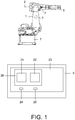
- the Fig. 1 shows an industrial robot with a kinematics for movements in, for example, six degrees of freedom as an example of a machine.
- the industrial robot has a robot arm 1 with six axes of motion, joints, levers 3, 4 and a flange 5 in a generally known manner.
- the robot arm 1 is mounted on a base 7.
- Each of the axes of movement 2 is moved by a drive, not shown.
- the drives include, for example, each an electric motor and transmission, as is well known in the art.
- the industrial robot further comprises a control computer 6, which is connected to the drives of the industrial robot in a manner not shown and controls them by means of a running on the control computer 6 computer program, so that the flange 5 of the industrial robot performs a predetermined movement.
- the control computer 6 has a multi-core processor 20 in the case of the present embodiment.
- the multi-core processor 20 is mounted on a motherboard 23 and has a first processor core 21 and a second processor core 22 within its housing.
- the two processor cores 21, 22 are independent computing units.
- Other resources of the control computer 6, such as memory, and inputs and outputs are not shown in detail.
- the control computer 6 is further configured with an operating system.
- An operating system in general is a software that enables the operation of a computer, in the case of the present embodiment of the control computer 6. It manages the resources of the control computer 6, e.g. the multi-core processor 20 and possibly connected to the control computer 6 input and output devices, and the execution of running on the control computer 6 computer programs, such. the computer program intended for the control of the industrial robot.
- the operating system is a so-called "general-purpose" operating system (standard operating system).
- a "general-purpose” operating system is an operating system that is not intended for a particular application and, more particularly, not specifically for controlling a machine such as the industrial robot.
- the operating computer Windows® Vista® from Microsoft® Corporation runs on the control computer 6.
- the terms "Windows,” “Microsoft,” and “Vista” are trademarks of Microsoft Corporation.
- the term “taxes” should also be understood as “rules”.
- the operating system of the control computer 6 is configured such that it supplies computing tasks which the computer program provided for controlling the industrial robot 1 is to perform in real time, in particular in hard real time, exclusively to the first processor core 21 for processing, and the remaining ones Tasks, such as in particular operating system internal Tasks or non-time critical tasks, but also possibly soft real-time tasks, the second processor core 22 for processing supplies.
- DPCs deferred procedure calls
- program threads A thread known as a thread in English is a single thread.
- An interrupt is understood in computer science as an external event, e.g. an elapsed time of a timer, a pulse in synchronism with rotations of axes of movement 2 of the industrial robot or other hardware signal that forces an interruption of one of the processor cores 21, 22 and the branch into a corresponding interrupt routine.
- the interrupt routine also referred to as the interrupt service routine (ISR)
- ISR interrupt service routine
- DPCs deferred procedure calls
- the operating system of the control computer 6 is configured such that an interrupt routine initiates a deferred procedure call which can perform the interrupt routine as such without limitation by, for example, allowing communication with threads running on the control computer 6 becomes.
- the DPCs are stored in FIFO buffers and retrieved sequentially from the system in the order of their caching by the interrupt routine, to be executed.
- FIFO is the abbreviation for first-in-first-out.
- the operating system of the control computer 6 is designed such that it assigns a separate FIFO buffer to each processor core 21, 22.
- a first FIFO buffer 24 associated with the first processor core 21 and a second FIFO buffer 25 associated with the second processor core 22 are shown.
- deferred procedure calls which are assigned to interrupts whose interrupt routines the first processor core 21 is to execute, are buffered in the first FIFO buffer 24.
- Deferred procedure calls which are assigned to interrupts whose interrupt routines the second processor core 22 is to execute, are, however, buffered in the second FIFO buffer 25.
- program threads (threads) are also processed on the processor 20.
- program threads (threads) which are assigned to the computer program intended for controlling the industrial robot and, in particular, have to be processed in (hard) real time, can be processed by (hard) real-time processor 20, the operating system of the control computer 6 configured such that it assigns the program threads (threads) assigned to the computer program for controlling the industrial robot to the first processor core 21 for processing. All other program threads assigns the operating system of the control computer 6 to the second processor core 22 for execution.
- Multimedia Class Scheduler Service which automatically makes certain program threads (threads) available by means of appropriate programming methods more computing time of the multi-core processor 20.
- the Multimedia Class Scheduler Service uses information stored in the registry to detect corresponding applications (tasks) and to determine the corresponding priority of the threads of these applications. For the corresponding programming methods, e.g. so-called API calls (API is the abbreviation for "Application Program Interface", in German: interface for application programs) are used.
- the program threads (threads) assigned to the computer program for controlling the industrial robot which in particular must be processed by multicore processor 20 in real time, via the Multimedia Class Scheduler Service of the operating system to give a higher priority, so that the multicore processor 20 this preferably works before the remaining threads (threads).
- the Indian Fig. 1 shown multi-core processor 20 has exactly two processor cores 21, 22. It is also possible to use a multi-core processor with more than two processor cores. In this case, at least one of the processor cores is associated with the (hard) real-time tasks and at least one multi-core processor with the remaining tasks.
- the Fig. 2 shows a further control computer 36, instead of in the Fig. 1 shown control computer 6 can be used to control the industrial robot.
- the control computer 36 has a processor 30 with a single processor core 31.
- the control computer 36 may also be provided with a multi-core processor.
- the processor 30 is mounted on a motherboard 33.
- Other resources of the control computer 36, such as memory, and inputs and outputs are not shown in detail.
- the control computer 36 is equipped with an operating system. It manages the resources of the control computer 36, e.g. the processor 30 and possibly connected to the control computer 36 input and output devices, and the execution of running on the control computer 36 computer programs, such. an intended for the control of the industrial robot computer program.
- the operating system is a so-called "general-purpose" operating system.
- the operating computer Windows® Vista® from Microsoft® Corporation also runs on the control computer 6.
- the thread associated with the computer program for controlling the industrial robot which are processed in particular by the processor 30 in hard real-time must give higher priority to the operating system via the Multimedia Class Scheduler Service, so that the processor 30 preferably processes these before the remaining threads.
Landscapes
- Engineering & Computer Science (AREA)
- Software Systems (AREA)
- Theoretical Computer Science (AREA)
- Physics & Mathematics (AREA)
- General Engineering & Computer Science (AREA)
- General Physics & Mathematics (AREA)
- Numerical Control (AREA)
- Control By Computers (AREA)
Description
- Die Erfindung betrifft eine Steuerungsvorrichtung für einen Industrieroboter und einen Industrieroboter.
- Aus Kostengründen ist es erstrebenswert, möglichst keine Speziallösungen, sondern allgemein verfügbare Produkte oder Lösungen zu verwenden. Aus diesem Grund existiert bereits seit Mitte der 1990er Jahre die Tendenz, in der industriellen Maschinensteuerung Produkte aus der Büroumgebung, wie z.B. PCs für die Steuerung und Ethernet als Kommunikationstechnologie, zu verwenden.
- Bei einem Einsatz von Software in Büroumgebungen kommt es jedoch hauptsächlich auf die korrekte Funktion der Software und nicht so sehr auf einen genauen zeitlichen Aspekt an. Die Software sollte ihre Aufgabe lediglich in einem für menschliche Verhältnisse angemessenen Rahmen, also im einstelligen Sekundenbereich oder knapp darunter, erledigen. Da bei einer Maschinensteuerung die Software die Bewegung der Maschine vorgibt, muss sie zeitlich relativ genau und synchron zur Maschinenbewegung arbeiten. Je schneller und genauer sich die Maschine bewegen soll, um so zeitlich genauer muss die Software sein. Bei modernen, relativ hochgenauen Maschinen ist es nicht unüblich, dass Motoren der Maschinen in einer Sekunde 8.000 Mal (entspricht 125 Mikrosekunden Zykluszeit) oder auch öfters von der Software nachgeregelt werden müssen. Hier ist es also nicht nur wichtig, dass eine Software ihre Aufgabe relativ korrekt erfüllt, sondern muss dies auch möglichst schnell tun. Man spricht in diesem Zusammenhang von der Echtzeitfähigkeit der Software. Je strikter diese Echtzeitfähigkeit ist, umso schneller und genauer kann sich die Maschine bewegen.
- Standard-Betriebssysteme, die auch als "General-Purpose" Betriebssysteme bezeichnet werden und auf gängigen PCs in der Bürowelt installiert sind, sind jedoch in der Regel nicht echtzeitfähig, da dies für die vorgesehene Anwendung auch nicht notwendig ist. Standard-Betriebssysteme achten bei einer großen Auslastung des Systems eher auf eine gleichmäßige Ausgewogenheit des Gesamtsystems, ohne bestimmte Anwendungen zu priorisieren.
- Die
US 2006/0150185 A1 offenbart ein Computersystem mit zwei Prozessoren, die von einem Betriebssystem verwaltet werden. - Die Aufgabe der vorliegenden Erfindung ist es daher, ein Computersystem mit einem Standard-Betriebssystem derart auszuführen, dass dieses auch für die Steuerung von Industrierobotern in Echtzeit geeignet ist.
- Die Aufgabe der Erfindung wird gelöst durch eine Steuerungsvorrichtung gemäß dem Anspruch 1.
- Das Computersystem der erfindungsgemäßen Steuerungsvorrichtung ist mit einem Betriebssystem ausgestattet. Ein Betriebssystem im Allgemeinen ist eine Software, die den Betrieb des Computersystems ermöglicht. Es verwaltet seine Ressourcen, wie z.B. den Mehrkernprozessor und eventuell an das Computersystem angeschlossene Ein- und Ausgabegeräte, sowie die Ausführung von auf dem Computersystem laufenden Rechenprogrammen.
- Das Betriebssystem ist insbesondere ein Standard-Betriebssystem, das auch als "General-Purpose" Betriebssystem bezeichnet wird. Ein "General-Purpose" Betriebssystem ist ein Betriebssystem, das nicht für eine spezielle Anwendung und insbesondere nicht speziell zum Steuern einer Maschine, z.B. eines Industrieroboters, vorgesehen ist. Obwohl einige Hersteller von "Genaral-Purpose" Betriebssystemen behaupten, ihre Betriebssysteme seien Echtzeit fähig, trifft dies für "General-Purpose" Betriebssystemen im Allgemeinen nicht zu. Beispiele von "General-Purpose" Betriebssystemen sind die Windows ® Betriebssysteme der Microsoft ® Corporation. Die Begriffe "Windows" und "Microsoft" sind markenrechtlich geschützte Begriffe der Microsoft Corporation.
- Damit mit dem Standard-Betriebssystem, das in der Regel nicht für Echtzeitaufgaben vorgesehen ist, auch Echtzeitanwendungen ausgeführt werden können, ist erfindungsgemäß das Betriebssystem derart konfiguriert, dass Echtzeitaufgaben ausschließlich dem ersten Prozessorkern und weitere Aufgaben, also anfallende Aufgaben, die in Nicht-Echtzeit abgearbeitet werden können, ausschließlich dem zweiten Prozessorkern zugewiesen werden. Somit wird sicher gestellt, dass der wenigstens eine erste Prozessorkern ausschließlich hochpriore Aufgaben abarbeitet und keine Rechenleistung für niederpriore Aufgaben (die weiteren Aufgaben) verwenden muss. Niederpriore Aufgaben sind z.B. betriebssysteminterne Aufgaben.
- In der Informatik wird zwischen den Begriffen "Echtzeit" und "Modellzeit" unterschieden. Echtzeit bezieht sich auf die Zeit, die Abläufe in der "realen Welt" verbrauchen. Modellzeit hingegen bezieht sich dagegen auf die von einem Rechenprogramm selbstverwaltete Laufzeit.
- Unter einem echtzeitfähigen System kann man ein System verstehen, das auf ein Ereignis innerhalb eines vorgegebenen Zeitrahmens reagieren muss. Der vorgegebene Zeitrahmen hängt von der jeweiligen Aufgabe ab, die mit Echtzeit verarbeitet werden soll, und kann beispielsweise im Mikrosekundenbereich z.B. für schnelle digitale Steuerungs- und/oder Regelungsaufgaben oder auch im Sekundenbereich z.B. für Temperaturregelungen oder Füllstandsüberwachungen liegen.
- Bisweilen unterscheidet man zwischen weicher und harter Echtzeit. Bei der sogenannten harten Echtzeit bedeutet ein Überschreiten des vorgegebenen Zeitrahmens einen Fehler. Bei der sogenannten weichen Echtzeit arbeitet dagegen das System die relevanten Eingaben in der Regel innerhalb des vorgegebenen Zeitrahmens ab, wobei grundsätzlich ein vereinzeltes Überschreiten des vorgegebenen Zeitrahmens möglich ist und zu keinem Fehler führt. Nach einer Ausführungsform des erfindungsgemäßen Computersystems ist dessen Betriebssystem konfiguriert, ausschließlich die harten Echtzeitaufgaben dem ersten Prozessorkern zuzuweisen. Die weichen Echtzeitaufgaben sind dann Teil der weiteren Aufgaben, die zur Abarbeitung ausschließlich dem zweiten Prozessorkern zugewiesen werden.
- Das Betriebssystem ist konfiguriert, aufgrund von ersten externen Interrupts ausgelöster und den Echtzeitaufgaben bzw. den harten Echtzeitaufgaben zugeordneter erster Unterbrechungsroutinen dem ersten Prozessorkern und aufgrund von zweiten externen Interrupts ausgelöster und den weiteren Aufgaben zugeordneter zweiter Unterbrechungsroutinen dem zweiten Prozessorkern zuzuweisen.
- Unter einem Interrupt versteht man in der Informatik ein externes Ereignis, z.B. eine abgelaufene Zeit eines Timers oder eines sonstigen Hardwaresignals, das eine Unterbrechung eines der Prozessorkerne und die Verzweigung in eine entsprechende Unterbrechungsroutine erzwingt. Aufgrund eines Interrupts bzw. einer dem Interrupt zugeordneten Unterbrechungsanforderung (Interrupt Request) wird die Unterbrechungsroutine, die auch als "Interrupt Service Routine (ISR)" bezeichnet wird, initiiert, die der Prozessorkern abarbeitet, den das Betriebssystem auswählt. Aufgrund der Unterbrechungsanforderung wird der normale Programmablauf unterbrochen, um die Unterbrechungsroutine auszuführen. Ist die Unterbrechungsroutine abgearbeitet, dann kehrt der Programmablauf wieder an die Stelle vor der Unterbrechung zurück.
- Somit werden von externen Interrupts ausgelöste und den Echtzeitaufgaben bzw. den harten Echtzeitaufgaben zugeordnete Unterbrechungsroutinen lediglich dem ersten Prozessorkern zum Abarbeiten zugewiesen. Die restlichen Unterbrechungsroutinen arbeitet der zweite Prozessorkern ab. Somit wird sicher gestellt, dass der wenigstens eine erste Prozessorkern ausschließlich für das Abarbeiten der den Echtzeitaufgaben bzw. der den harten Echtzeitaufgaben zugeordneten Unterbrechungsroutinen vorbehalten ist.
- Systembedingt kann es sein, dass aus einer Unterbrechungsanforderung bestimmte, wenn nicht gar die meisten Betriebssystemaufrufe nicht durchgeführt werden können. Aus so genannten Deferred Procedure Calls (DPCs) ist dies jedoch möglich. Das Betriebssystem ist derart konfiguriert, aus den ersten Unterbrechungsroutinen erste Deferred Procedure Calls zu initiieren, um daraus die den Echtzeitaufgaben zugeordneten ersten Unterbrechungsroutinen durchzuführen, und aus den zweiten Unterbrechungsroutinen zweite Deferred Procedure Calls zu initiieren, um daraus die den weiteren Aufgaben zugeordneten zweiten Unterbrechungsroutinen durchzuführen. Dadurch ist es möglich, dass die relevante Unterbrechungsroutine als solche uneingeschränkt vom relevanten Prozessorkern durchgeführt werden kann, indem z.B. eine Kommunikation mit auf dem Computersystem laufenden Programmfäden (Threads) ermöglicht wird. Ein Programmfaden, der im Englischen als "Thread" bezeichnet wird, ist ein einzelner Programmablauf.
- Standard-Betriebssysteme können derart ausgeführt sein, dass sie Deferred Procedure Calls in einen FIFO-Puffer ("First-In-First-Out") ablegen und in der Reihenfolge des Ablegens durch die Unterbrechungsanforderung vom System auch wieder nacheinander herausholen. Das Betriebssystem des Computersystems ist konfiguriert, dem ersten Prozessorkern einen ersten FIFO-Puffer und dem zweiten Prozessorkern einen zweiten FIFO-Puffer zuzuordnen, um die ersten Deferred Procedure Calls in den ersten FIFO-Puffer und die zweiten Deferred Procedure Calls in den zweiten FIFO-Puffer zwischen zu speichern, um sicher zu stellen, dass keine niederprioren und für den zweiten Prozessorkern vorgesehene Unterbrechungsroutinen das Zuführen von für den ersten Prozessorkern bestimmten höherprioren Unterbrechungsroutinen blockieren.
- Das Betriebssystem kann auch konfiguriert sein, den Echtzeitaufgaben bzw. den harten Echtzeitaufgaben zugeordneten erste Programmfäden dem ersten Prozessorkern und den weiteren Aufgaben zugeordneten zweite Programmfäden dem zweiten Prozessorkern zuzuweisen. Mit dieser Variante des erfindungsgemäßen Computersystems wird sicher gestellt, dass Programmfäden (Threads), die den Echtzeitaufgaben bzw. den harten Echtzeitaufgaben zugeordnet sind, ausschließlich vom ersten Prozessorkern abgearbeitet werden, und der erste Prozessorkern keine Programmfäden (Threads) abarbeitet, die den weiteren, niederprioren Aufgaben zugeordnet sind.
- Demzufolge ist es möglich, ein Standard-Betriebssystem, das insbesondere nicht für die Steuerung eines Industrieroboters entwickelt wurde, auch als Steuerungsvorrichtung zum Steuern eines Industrieroboters, insbesondere in Echtzeit, zu verwenden. Unter dem Begriff "Steuern" wird hier auch "Regeln" verstanden.
- Industrieroboter sind Handhabungsmaschinen, die zur selbsttätigen Handhabung von Objekten mit zweckdienlichen Werkzeugen ausgerüstet und in mehreren Bewegungsachsen insbesondere hinsichtlich Orientierung, Position und Arbeitsablauf programmierbar sind. Industrieroboter weisen ein Computersystem auf, das beim erfindungsgemäßen Industrieroboter im Wesentlichen durch das erfindungsgemäße Computersystem gebildet ist.
- Weist das Betriebssystem einen Multimediadienst auf, dann kann gemäß einer Ausführungsform der erfindungsgemäßen Steuerungsvorrichtung das Betriebssystem derart konfiguriert sein, den Echtzeitaufgaben zugeordnete Programmfäden über den Multimediadienst zu priorisieren. Der Multimediadienst ist vorgesehen, damit der Mehrkernprozessor Multimedia-Programme, wie insbesondere Audio- oder Video-Wiedergabeprogramme, möglichst unterbrechungsfrei abarbeitet. Multimediadienste können ausgeführt sein, automatisch bestimmten Programmfäden (Threads) mittels entsprechender Programmiermethoden mehr Rechenzeit des Prozessors zur Verfügung zu stellen. Mittels entsprechender Programmiermethoden ist es möglich, bestimmte Programmfäden anzugeben, die das Computersystem, insbesondere der Mehrkernprozessor, bevorzugt behandeln soll, indem ihnen mehr Rechenzeit zur Verfügung gestellt wird.
- Handelt es sich beim Betriebssystem um ein Windows ® Betriebssystem der Firma Microsoft ® Corporation und bei dem Multimediadienst um den so genannten Multimedia Class Scheduler Service dieses Betriebssystems, dann ist die Priorisierung der Echtzeitaufgaben über Informationen, die in der Registry des Betriebssystems gespeichert sind, möglich.
- Ausführungsbeispiele der Erfindung sind exemplarisch in den beigefügten schematischen Zeichnungen dargestellt. Es zeigen:
- Fig. 1
- einen Industrieroboter mit einem Steuerrechner und
- Fig. 2
- ein alternativer Steuerrechner für den Industrieroboter.
- Die
Fig. 1 zeigt einen Industrieroboter mit einer Kinematik für Bewegungen in beispielsweise sechs Freiheitsgraden als Beispiel einer Maschine. Der Industrieroboter weist in allgemein bekannter Weise einen Roboterarm 1 mit sechs Bewegungsachsen, Gelenken, Hebeln 3, 4 und einem Flansch 5 auf. In derFigur 1 ist nur eine der Bewegungsachsen mit dem Bezugszeichen 2 versehen und der Roboterarm 1 ist auf einem Sockel 7 befestigt. - Jede der Bewegungsachsen 2 wird von einem nicht näher dargestellten Antrieb bewegt. Die Antriebe umfassen beispielsweise jeweils einen elektrischen Motor und Getriebe, wie es dem Fachmann allgemein bekannt ist.
- Der Industrieroboter weist ferner einen Steuerrechner 6 auf, der mit den Antrieben des Industrieroboters in nicht dargestellter Weise verbunden ist und diese mittels eines auf dem Steuerrechner 6 laufenden Rechenprogramms steuert, sodass der Flansch 5 des Industrieroboters eine vorgegebene Bewegung durchführt.
- Der Steuerrechner 6 weist im Falle des vorliegenden Ausführungsbeispiels einen Mehrkernprozessor 20 auf. Der Mehrkernprozessor 20 ist auf einem Motherboard 23 befestigt und weist einen ersten Prozessorkern 21 und einen zweiten Prozessorkern 22 innerhalb seines Gehäuses auf. Die beiden Prozessorkerne 21, 22 sind eigenständige Recheneinheiten. Weitere Ressourcen des Steuerrechners 6, wie z.B. Speicher, und Ein- und Ausgänge sind nicht näher gezeigt.
- Der Steuerrechner 6 ist ferner mit einem Betriebssystem konfiguriert. Ein Betriebssystem im Allgemeinen ist eine Software, die den Betrieb eines Computers, im Falle des vorliegenden Ausführungsbeispiels des Steuerrechners 6, ermöglicht. Es verwaltet die Ressourcen des Steuerrechners 6, wie z.B. den Mehrkernprozessor 20 und eventuell an den Steuerrechner 6 angeschlossene Ein- und Ausgabegeräte, sowie die Ausführung von auf dem Steuerrechner 6 laufenden Rechenprogrammen, wie z.B. das für die Steuerung des Industrieroboters vorgesehene Rechenprogramm.
- Im Falle des vorliegenden Ausführungsbeispiels handelt es sich bei dem Betriebssystem um ein so genanntes "General-Purpose" Betriebssystem (Standard-Betriebssystem). Ein "General-Purpose" Betriebssystem ist ein Betriebssystem das nicht für eine spezielle Anwendung und insbesondere nicht speziell zum Steuern einer Maschine, wie den Industrieroboter, vorgesehen ist. Im Falle des vorliegenden Ausführungsbeispiels läuft auf dem Steuerrechner 6 das Betriebssystem Windows ® Vista ® der Microsoft ® Corporation. Die Begriffe "Windows", "Microsoft" und "Vista" sind markenrechtlich geschützte Begriffe der Microsoft Corporation. Unter dem Begriff "Steuern" soll auch "Regeln" verstanden werden.
- Im Falle des vorliegenden Ausführungsbeispiels ist das Betriebssystem des Steuerrechners 6 derart konfiguriert, dass es Rechenaufgaben, die das zur Steuerung des Industrieroboters 1 vorgesehene Rechenprogramm in Echtzeit, insbesondere in harter Echtzeit, durchführen soll, ausschließlich dem ersten Prozessorkern 21 zum Abarbeiten zuführt, und die restlichen Aufgaben, wie insbesondere betriebssysteminterne Aufgaben oder zeitunkritische Aufgaben, aber auch eventuell weiche Echtzeitaufgaben, dem zweiten Prozessorkern 22 zum Abarbeiten zuführt.
- Des Weiteren können folgende Arten von Aufgaben auf unterschiedlichen Arbeitsebenen unterschieden werden: Interrupts, so genannte Deferred Procedure Calls (DPCs) und Programmfäden. Ein Programmfaden, der im Englischen als "Thread" bezeichnet wird, ist ein einzelner Programmablauf.
- Unter einem Interrupt versteht man in der Informatik ein externes Ereignis, z.B. eine abgelaufene Zeit eines Timers, einen Impuls synchron zu Drehungen von Bewegungsachsen 2 des Industrieroboters oder eines sonstigen Hardwaresignals, das eine Unterbrechung eines der Prozessorkerne 21, 22 und die Verzweigung in eine entsprechende Unterbrechungsroutine erzwingt. Aufgrund eines Interrupts bzw. einer dem Interrupt zugeordneten Unterbrechungsanforderung (Interrupt Request) wird die Unterbrechungsroutine, die auch als "Interrupt Service Routine (ISR)" bezeichnet wird, initiiert, die der Prozessorkern 21, 22 abarbeitet, den das Betriebssystem auswählt. Aufgrund der Unterbrechungsanforderung wird der normale Programmablauf des relevanten Prozessorkerns 21, 22 unterbrochen, um die Unterbrechungsroutine auszuführen. Ist die Unterbrechungsroutine abgearbeitet, dann kehrt der Programmablauf wieder an die Stelle vor der Unterbrechung zurück.
- Im Falle des vorliegenden Ausführungsbeispiels wird die Zuordnung bestimmter Aufgaben zu den beiden Prozessorkernen 21, 22 u.A. wie folgt realisiert:
- Die den normalen Programmablauf des Steuerrechners 6 unterbrechende Interrupts haben die höchste Priorität im System und werden von externen Ereignissen ausgelöst. Im Falle des vorliegenden Ausführungsbeispiels ist das Betriebssystem des Steuerrechners 6 derart initialisiert, dass bestimmte Interrupts zur Abarbeitung ihrer Unterbrechungsroutinen nur einem bestimmten der beiden Prozessorkerne 21, 22 zugeführt werden. Im Falle des vorliegenden Ausführungsbeispiels ist das Betriebssystem derart konfiguriert, dass es Interrupts, die zur Steuerung des Industrieroboters vorgesehen sind und deren Unterbrechungsroutinen insbesondere in Echtzeit abgearbeitet werden müssen, ausschließlich dem ersten Prozessorkern 21 zugeführt werden. Alle anderen Interrupts werden dem zweiten Prozessorkern 22 zum Abarbeiten ihrer Unterbrechungsroutinen zugeführt. Somit ist sicher gestellt, dass der erste Prozessorkern 21 im Wesentlichen nur Unterbrechungsroutinen höherpriorer Interrupts, insbesondere in Echtzeit abzuarbeitende Unterbrechungsroutinen zugewiesen bekommt und seine Rechenleistung nicht durch niederpriore Aufgaben verwendet wird.
- Im Falle des hier verwendeten Betriebssystems Windows ® Vista ® ist die Zuordnung bestimmter Interrupts zu vorbestimmten Prozessorkernen 21, 22 durch geeignete Einträge in der so genannten Registry des Betriebssystems möglich.
- Es ist möglich, dass systembedingt aus einer Unterbrechungsanforderung bestimmte, wenn nicht gar die meisten Betriebssystemaufrufen nicht durchgeführt werden können. Aus so genannten Deferred Procedure Calls (DPCs) ist dies jedoch möglich. Aus diesem Grunde ist im Falle des vorliegenden Ausführungsbeispiels das Betriebssystem des Steuerrechners 6 derart konfiguriert, dass eine Unterbrechungsroutine einen Deferred Procedure Call anstößt, welcher die Unterbrechungsroutine als solche uneingeschränkt durchführen kann, indem z.B. eine Kommunikation mit auf dem Steuerrechner 6 laufenden Programmfäden (Threads) ermöglicht wird.
- Im Falle des vorliegenden Ausführungsbeispiels werden die DPCs in FIFO-Puffer zwischen gespeichert und in der Reihenfolge ihrer Zwischenspeicherung durch die Unterbrechungsroutine vom System auch wieder nacheinander abgerufen, um abgearbeitet zu werden. "FIFO" ist die Abkürzung für First-In-First-Out".
- Im Falle des vorliegenden Ausführungsbeispiels ist das Betriebssystem des Steuerrechners 6 derart ausgeführt, dass es jedem Prozessorkern 21, 22 einen eigenen FIFO-Puffer zuordnet. In der
Fig. 1 ist ein dem ersten Prozessorkern 21 zugeordneter erster FIFO-Puffer 24 und ein dem zweiten Prozessorkern 22 zugeordneter zweiter FIFO-Puffer 25 dargestellt. Somit werden im Falle des vorliegenden Ausführungsbeispiels Deferred Procedure Calls, die Interrupts zugeordnet sind, deren Unterbrechungsroutinen der erste Prozessorkern 21 abarbeiten soll, im ersten FIFO-Puffer 24 zwischengespeichert. Deferred Procedure Calls, die Interrupts zugeordnet sind, deren Unterbrechungsroutinen der zweite Prozessorkern 22 abarbeiten soll, werden dagegen im zweiten FIFO-Puffer 25 zwischengespeichert. - Im Falle des vorliegenden Ausführungsbeispiels werden auf dem Prozessor 20 auch Programmfäden (Threads) abgearbeitet. Damit sicher gestellt wird, dass Programmfäden (Threads), die dem zur Steuerung des Industrieroboters vorgesehenen Rechenprogramm zugeordnet sind und insbesondere in (harter) Echtzeit abgearbeitet werden müssen, auch in (harter) Echtzeit vom Prozessor 20 abgearbeitet werden können, ist das Betriebssystem des Steuerrechners 6 derart konfiguriert, dass es die zur Steuerung des Industrieroboters vorgesehenen Rechenprogramms zugeordneten Programmfäden (Threads) dem ersten Prozessorkern 21 zur Abarbeitung zuweist. Alle anderen Programmfäden weist das Betriebssystem des Steuerrechners 6 dem zweiten Prozessorkern 22 zur Abarbeitung zu.
- Bei dem hier verwendeten Windows ® Betriebssystem kann dies durch das Konfigurieren einer so genannten "Thread Affinity Maske" erreicht werden.
- Viele "General-Purpose" Betriebssysteme umfassen einen Multimediadienst, mittels derer Multimedia-Programme, wie insbesondere Audio- oder Video-Wiedergabeprogramme möglichst unterbrechungsfrei abgearbeitet werden können. Beim Microsoft ® Vista ® Betriebssystem wird dieser Mechanismus Multimedia Class Scheduler Service genannt, der automatisch bestimmten Programmfäden (Threads) mittels entsprechender Programmiermethoden mehr Rechenzeit des Mehrkernprozessors 20 zur Verfügung stellt. Der Multimedia Class Scheduler Service bedient sich dabei Informationen, die in der Registry gespeichert sind, um entsprechende Anwendungen (Tasks) zu erkennen und die entsprechende Priorität der Programmfäden (Threads) dieser Anwendungen zu bestimmen. Für die entsprechenden Programmiermethoden können z.B. so genannte API-Aufrufe (API ist die Abkürzung für "Application Program Interface", auf deutsch: Schnittstelle für Anwendungsprogramme) verwendet werden.
- Alternativ oder zusätzlich kann es vorgesehen sein, die dem Rechenprogramm zur Steuerung des Industrieroboters zugeordneten Programmfäden (Threads), die insbesondere vom Mehrkernprozessor 20 in Echtzeit abgearbeitet werden müssen, über den Multimedia Class Scheduler Service des Betriebssystems eine höhere Priorität zu geben, so dass der Mehrkernprozessor 20 diese bevorzugt vor den restlichen Programmfäden (Threads) abarbeitet.
- Der in der
Fig. 1 gezeigte Mehrkernprozessor 20 weist genau zwei Prozessorkerne 21, 22 auf. Es ist auch möglich, einen Mehrkernprozessor mit mehr als zwei Prozessorkernen zu verwenden. In diesem Fall ist wenigstens einer der Prozessorkerne den (harten) Echtzeitaufgaben und wenigstens ein Mehrkernprozessor den übrigen Aufgaben zugeordnet. - Die
Fig. 2 zeigt einen weiteren Steuerrechner 36, der anstelle des in derFig. 1 gezeigten Steuerrechners 6 zum Steuern des Industrieroboters verwendet werden kann. Im Gegensatz zum Steuerrechner 6 derFig. 1 weist der Steuerrechner 36 im Falle des vorliegenden Ausführungsbeispiels einen Prozessor 30 mit einem einzigen Prozessorkern 31 auf. Der Steuerrechner 36 kann aber auch mit einem Mehrkernprozessor versehen sein. Der Prozessor 30 ist auf einem Motherboard 33 befestigt. Weitere Ressourcen des Steuerrechners 36, wie z.B. Speicher, und Ein- und Ausgänge sind nicht näher gezeigt. - Der Steuerrechner 36 ist mit einem Betriebssystem ausgestattet. Es verwaltet die Ressourcen des Steuerrechners 36, wie z.B. den Prozessor 30 und eventuell an den Steuerrechner 36 angeschlossene Ein- und Ausgabegeräte, sowie die Ausführung von auf dem Steuerrechner 36 laufenden Rechenprogrammen, wie z.B. ein für die Steuerung des Industrieroboters vorgesehene Rechenprogramm.
- Im Falle des vorliegenden Ausführungsbeispiels handelt es sich bei dem Betriebssystem um ein so genanntes "General-Purpose" Betriebssystem. Im Falle des vorliegenden Ausführungsbeispiels läuft auf dem Steuerrechner 6 ebenfalls das Betriebssystem Windows ® Vista ® der Microsoft ® Corporation.
- Im Falle des vorliegenden Ausführungsbeispiels ist es vorgesehen, die dem Rechenprogramm zur Steuerung des Industrieroboters zugeordneten Programmfäden (Threads), die insbesondere vom Prozessor 30 in harter Echtzeit abgearbeitet werden müssen, über den Multimedia Class Scheduler Service des Betriebssystems eine höhere Priorität zu geben, so dass der Prozessor 30 diese bevorzugt vor den restlichen Programmfäden (Threads) abarbeitet.
Claims (5)
- Steuerungsvorrichtung zum Steuern eines Industrieroboters, die ein Computersystem aufweist, dadurch gekennzeichnet,
dass das Computersystem einen Mehrkernprozessor (20), der wenigstens einen ersten Prozessorkern (21) und wenigstens einen zweiten Prozessorkern (22) aufweist, und ein "General-Purpose" Betriebssystem, aufweist, und das Betriebssystem konfiguriert ist, Echtzeitaufgaben, die zum Steuern des Industrieroboters vorgesehen und harte Echtzeitaufgaben sind, ausschließlich dem ersten Prozessorkern (21) und weitere Aufgaben ausschließlich dem zweiten Prozessorkern (22) zuzuweisen, aufgrund von ersten externen Interrupts, die zur Steuerung des Industrieroboters vorgesehen sind, ausgelöste und den Echtzeitaufgaben zugeordnete erste Unterbrechungsroutinen dem ersten Prozessorkern (21) und aufgrund von zweiten externen Interrupts ausgelöste und den weiteren Aufgaben zugeordnete zweite Unterbrechungsroutinen dem zweiten Prozessorkern (22) zuzuweisen, und aus den ersten Unterbrechungsroutinen erste Deferred Procedure Calls zu initiieren, um daraus die den Echtzeitaufgaben zugeordneten ersten Unterbrechungsroutinen durchzuführen, und aus den zweiten Unterbrechungsroutinen zweite Deferred Procedure Calls zu initiieren, um daraus die den weiteren Aufgaben zugeordneten zweiten Unterbrechungsroutinen durchzuführen, und das Betriebssystem beschaffen ist, dem ersten Prozessorkern (21) einen ersten FIFO-Puffer (24) und dem zweiten Prozessorkern (22) einen zweiten FIFO-Puffer (25) zuzuordnen, um die ersten Deferred Procedure Calls in den ersten FIFO-Puffer (24) und die zweiten Deferred Procedure Calls in den zweiten FIFO-Puffer (25) zwischen zu speichern,
wodurch sicher gestellt wird, dass keine niederprioren und für den zweiten Prozessorkern vorgesehenen Unterbrechungsroutinen das Zuführen von für den ersten Prozessorkern bestimmten höherprioren Unterbrechungsroutinen blockieren. - Steuerungsvorrichtung nach Anspruch 1, bei der das Betriebssystem konfiguriert ist, den Echtzeitaufgaben zugeordneten erste Programmfäden dem ersten Prozessorkern (21) und den weiteren Aufgaben zugeordneten zweite Programmfäden dem zweiten Prozessorkern (22) zuzuweisen.
- Steuerungsvorrichtung nach Anspruch 1 oder 2, bei der das Betriebssystem des Computersystems einen Multimediadienst aufweist und das Betriebssystem konfiguriert ist, den Echtzeitaufgaben zugeordnete Programmfäden über den Multimediadienst zu priorisieren.
- Industrieroboter, aufweisend einen Roboterarm (1) und eine Steuerungsvorrichtung (6) nach einem der Ansprüche 1 bis 3 zum Steuern einer Bewegung des Roboterarms (1).
- Verwendung eines Multimediadienstes eines Betriebssystems einer Steuerungsvorrichtung (6) nach einem der Ansprüche 1 bis 3 zur Priorisierung von Echtzeitaufgaben die vorgesehen sind, die Bewegung des Industrieroboters zu steuern.
Applications Claiming Priority (2)
| Application Number | Priority Date | Filing Date | Title |
|---|---|---|---|
| DE102008005124A DE102008005124A1 (de) | 2008-01-18 | 2008-01-18 | Computersystem, Steuerungsvorrichtung für eine Maschine, insbesondere für einen Industrieroboter, und Industrieroboter |
| PCT/EP2009/050307 WO2009090164A1 (de) | 2008-01-18 | 2009-01-13 | Computersystem, steuerungsvorrichtung für eine maschine, insbesondere für einen industrieroboter, und industrieroboter |
Publications (2)
| Publication Number | Publication Date |
|---|---|
| EP2232369A1 EP2232369A1 (de) | 2010-09-29 |
| EP2232369B1 true EP2232369B1 (de) | 2017-08-02 |
Family
ID=40549664
Family Applications (1)
| Application Number | Title | Priority Date | Filing Date |
|---|---|---|---|
| EP09701674.5A Not-in-force EP2232369B1 (de) | 2008-01-18 | 2009-01-13 | Computersystem, steuerungsvorrichtung für eine maschine, insbesondere für einen industrieroboter, und industrieroboter |
Country Status (7)
| Country | Link |
|---|---|
| US (1) | US9501324B2 (de) |
| EP (1) | EP2232369B1 (de) |
| KR (1) | KR101222800B1 (de) |
| CN (1) | CN101911019A (de) |
| DE (1) | DE102008005124A1 (de) |
| DK (1) | DK2232369T3 (de) |
| WO (1) | WO2009090164A1 (de) |
Families Citing this family (29)
| Publication number | Priority date | Publication date | Assignee | Title |
|---|---|---|---|---|
| US8321614B2 (en) * | 2009-04-24 | 2012-11-27 | Empire Technology Development Llc | Dynamic scheduling interrupt controller for multiprocessors |
| US8260996B2 (en) * | 2009-04-24 | 2012-09-04 | Empire Technology Development Llc | Interrupt optimization for multiprocessors |
| CN102498470A (zh) * | 2009-08-24 | 2012-06-13 | Abb技术股份有限公司 | 改进的采用自动化控制器的实时应用程序的执行 |
| KR101610828B1 (ko) * | 2009-09-23 | 2016-04-08 | 삼성전자주식회사 | 멀티코어 프로세서의 인터럽트 온/오프 관리 장치와 방법 |
| FR2950714B1 (fr) * | 2009-09-25 | 2011-11-18 | Bull Sas | Systeme et procede de gestion de l'execution entrelacee de fils d'instructions |
| US8234431B2 (en) * | 2009-10-13 | 2012-07-31 | Empire Technology Development Llc | Interrupt masking for multi-core processors |
| JP5743495B2 (ja) | 2010-11-05 | 2015-07-01 | キヤノン株式会社 | ロボット制御装置 |
| DE102011107169A1 (de) | 2011-07-13 | 2013-01-17 | Kuka Roboter Gmbh | Steuerung eines Roboter |
| US9019289B2 (en) * | 2012-03-07 | 2015-04-28 | Qualcomm Incorporated | Execution of graphics and non-graphics applications on a graphics processing unit |
| CN104516333A (zh) * | 2013-09-28 | 2015-04-15 | 沈阳新松机器人自动化股份有限公司 | 多核cpu多操作系统的控制器 |
| IN2013CH04831A (de) * | 2013-10-28 | 2015-08-07 | Empire Technology Dev Llc | |
| KR102205836B1 (ko) * | 2014-01-29 | 2021-01-21 | 삼성전자 주식회사 | 태스크 스케줄링 방법 및 장치 |
| CN104182360B (zh) * | 2014-08-18 | 2017-12-08 | 记忆科技(深圳)有限公司 | 多核环境的跟踪日志输出处理方法及系统 |
| CN104898471A (zh) * | 2015-04-01 | 2015-09-09 | 湖北骐通智能科技股份有限公司 | 机器人的控制系统以及控制方法 |
| JP6333796B2 (ja) * | 2015-11-25 | 2018-05-30 | ファナック株式会社 | 複数のcpuコアで最適な負荷配分を行う数値制御装置 |
| US10894318B2 (en) * | 2016-02-23 | 2021-01-19 | Abb Schweiz Ag | Robot controller system and method therefor |
| US10719063B2 (en) * | 2016-10-06 | 2020-07-21 | Microsoft Technology Licensing, Llc | Real-time equipment control |
| CN107962560B (zh) * | 2016-10-18 | 2020-08-07 | 珠海格力智能装备有限公司 | 机器人及其控制方法和装置 |
| EP3316052B1 (de) * | 2016-10-31 | 2020-03-25 | Schneider Electric Systems USA, Inc. | Multi-protokoll gateway mit mehreren rechnerkernen in einem prozess steuerungs system |
| JP2018097661A (ja) * | 2016-12-14 | 2018-06-21 | オムロン株式会社 | 生産システム、制御装置、および制御方法 |
| EP3370125A1 (de) * | 2017-03-01 | 2018-09-05 | PLETHORA IIoT, S.L. | Vorrichtung und system mit mehreren vorrichtungen zur überwachung und steuerung von maschinen in einer industriellen anlage |
| CN109144717A (zh) * | 2017-07-07 | 2019-01-04 | 广东网金控股股份有限公司 | 一种基于双arm芯片主控方法及终端设备 |
| CN109871275A (zh) * | 2017-12-01 | 2019-06-11 | 晨星半导体股份有限公司 | 多处理器系统及其处理器管理方法 |
| JP6981290B2 (ja) * | 2018-02-14 | 2021-12-15 | オムロン株式会社 | スレーブ装置、制御システム、レスポンスデータの通信方法、および、レスポンスデータの通信プログラム |
| EP3739396A1 (de) | 2019-05-15 | 2020-11-18 | Siemens Aktiengesellschaft | System zur bewegungsführung eines manipulators aufweisend einen ersten und einen zweiten prozessor |
| JP7464386B2 (ja) * | 2019-12-20 | 2024-04-09 | ファナック株式会社 | 制御装置、及び制御方法 |
| CN112686565A (zh) * | 2021-01-08 | 2021-04-20 | 京东数科海益信息科技有限公司 | 信息的处理装置、方法和机器人 |
| CN116225672A (zh) * | 2021-12-03 | 2023-06-06 | 北京灵汐科技有限公司 | 基于众核芯片的任务处理方法及装置、处理核、电子设备 |
| CN118796480B (zh) * | 2024-09-12 | 2025-02-14 | 长沙金维集成电路股份有限公司 | 一种卫星导航基带模块的优化方法及系统 |
Family Cites Families (15)
| Publication number | Priority date | Publication date | Assignee | Title |
|---|---|---|---|---|
| US5506787A (en) * | 1992-08-31 | 1996-04-09 | Siemens Aktiengesellschaft | Configurable man-machine communication structure for machine tool or robot control systems |
| US5568593A (en) * | 1994-01-13 | 1996-10-22 | Ethicon, Inc. | Robotic control system for a needle sorting and feeding apparatus |
| JPH10143380A (ja) * | 1996-11-07 | 1998-05-29 | Hitachi Ltd | マルチプロセッサシステム |
| DE19853205A1 (de) * | 1998-11-18 | 2000-06-15 | Siemens Ag | Verfahren zur Steuerung technischer Prozesse |
| US6519498B1 (en) * | 2000-03-10 | 2003-02-11 | Applied Materials, Inc. | Method and apparatus for managing scheduling in a multiple cluster tool |
| EP1327503B1 (de) * | 2000-10-11 | 2017-12-06 | Sony Corporation | System und verfahren zur steuerung von einem roboter |
| JP4057989B2 (ja) * | 2003-09-26 | 2008-03-05 | 株式会社東芝 | スケジューリング方法および情報処理システム |
| DE102004031485B4 (de) * | 2004-06-30 | 2015-07-30 | Kuka Roboter Gmbh | Verfahren und Vorrichtung zum Steuern des Handhabungsgeräts |
| EP1622009A1 (de) * | 2004-07-27 | 2006-02-01 | Texas Instruments Incorporated | JSM-Architektur und Systeme |
| US7748003B2 (en) * | 2004-12-20 | 2010-06-29 | International Business Machines Corporation | Hard real-time response |
| JP4621073B2 (ja) * | 2005-05-23 | 2011-01-26 | 本田技研工業株式会社 | ロボット制御装置 |
| US7802256B2 (en) * | 2005-06-27 | 2010-09-21 | Microsoft Corporation | Class scheduler for increasing the probability of processor access by time-sensitive processes |
| US7734833B2 (en) * | 2005-09-08 | 2010-06-08 | International Business Machines Corporation | Method for scheduling operations called by a task on a real-time or non-real time processor |
| JP3976065B2 (ja) * | 2006-01-16 | 2007-09-12 | セイコーエプソン株式会社 | マルチプロセッサシステム及びマルチプロセッサシステムの割込み制御方法をコンピュータに実行させるためのプログラム |
| CN101433048B (zh) | 2006-03-28 | 2012-11-07 | 雷帝系统加拿大有限公司 | 并行多核心计算结构的多媒体处理 |
-
2008
- 2008-01-18 DE DE102008005124A patent/DE102008005124A1/de not_active Ceased
-
2009
- 2009-01-13 US US12/811,022 patent/US9501324B2/en not_active Expired - Fee Related
- 2009-01-13 DK DK09701674.5T patent/DK2232369T3/da active
- 2009-01-13 CN CN2009801024053A patent/CN101911019A/zh active Pending
- 2009-01-13 EP EP09701674.5A patent/EP2232369B1/de not_active Not-in-force
- 2009-01-13 WO PCT/EP2009/050307 patent/WO2009090164A1/de not_active Ceased
- 2009-01-13 KR KR1020107018121A patent/KR101222800B1/ko not_active Expired - Fee Related
Non-Patent Citations (1)
| Title |
|---|
| None * |
Also Published As
| Publication number | Publication date |
|---|---|
| EP2232369A1 (de) | 2010-09-29 |
| DK2232369T3 (da) | 2017-11-13 |
| KR20100113569A (ko) | 2010-10-21 |
| WO2009090164A1 (de) | 2009-07-23 |
| US9501324B2 (en) | 2016-11-22 |
| DE102008005124A1 (de) | 2009-07-23 |
| CN101911019A (zh) | 2010-12-08 |
| KR101222800B1 (ko) | 2013-01-16 |
| US20100287556A1 (en) | 2010-11-11 |
Similar Documents
| Publication | Publication Date | Title |
|---|---|---|
| EP2232369B1 (de) | Computersystem, steuerungsvorrichtung für eine maschine, insbesondere für einen industrieroboter, und industrieroboter | |
| DE4011745C2 (de) | ||
| EP2977149B1 (de) | Verfahren und mittel zum auslegen und/oder betreiben eines roboters | |
| DE69622832T2 (de) | Vorrichtung und verfahren für kooperative unterbrechungen in einer preemptiven prozessablauffolgeplanungsumgebung | |
| EP2575039B1 (de) | Verfahren und Anordnung zur Nutzung einer Ressource einer Hardware-Plattform mit zumindest zwei virtuellen Maschinen | |
| DE60122085T2 (de) | Datenverarbeitungsgerät für serielles Kommunikationssystem | |
| DE2747633A1 (de) | Dv-system mit einer unterbrechungseinrichtung | |
| DE112012002647B4 (de) | Erkennen eines durch Interrupt-Verarbeitung verursachten anormalen Betriebs | |
| DE69530048T2 (de) | Verfahren und system zum schützen von geteilten kode und daten in einem multitaskingbetriebssystem | |
| EP0799441B1 (de) | Verfahren zur steuerung von technischen vorgängen | |
| DE102020133748B4 (de) | Fahrzeugsteuergerät mit synchronem treiber | |
| DE4223454A1 (de) | Datenuebertragungssystem fuer eine digitale signalverarbeitungsvorrichtung | |
| EP3739396A1 (de) | System zur bewegungsführung eines manipulators aufweisend einen ersten und einen zweiten prozessor | |
| DE202004021684U1 (de) | Einrichtungen und Vorrichtungen zur Verwendung bei einem Scheduling | |
| EP1552394A1 (de) | Verfahren zur ereignissynchronisation, insbesondere für prozessoren fehlertoleranter systeme | |
| DE102008043530B4 (de) | Maschinensteuerung und elektrische Maschine, insbesondere Industrieroboter | |
| EP0590175B1 (de) | Prozesssteuerungssystem | |
| DE10361364B4 (de) | Vorrichtung zum Behandeln von Interruptereignissen, mit der pegel-sensitive bzw. level-sensitive Interruptanforderungen in flankengetriggerten Interruptnachrichten umgesetzt werden | |
| EP2685377B1 (de) | Verfahren und Anordnung zur Synchronisierung von zwei auf einer Hardware-Plattform ablaufenden Prozessen | |
| DE102011083468A1 (de) | Schaltungsanordnung zur Ablaufplanung bei einer Datenverarbeitung | |
| WO2004034172A2 (de) | Verfahren zur ereignissynchronisation, damit synchronisierte prozessoren und fehlertoleranter systeme mit derartigen prozessoren | |
| DE102020108041A1 (de) | Verfahren zur Lizensierung von Softwaremodulen einer Steuerungseinrichtung | |
| DE69127013T2 (de) | Unterbrechungssteuerschaltung und Mikrocomputersystem, das diese enthält | |
| DE102020201002A1 (de) | Maschinensteuervorrichtung | |
| DE4333952B4 (de) | Numerische Steuerung für Werkzeugmaschinen |
Legal Events
| Date | Code | Title | Description |
|---|---|---|---|
| PUAI | Public reference made under article 153(3) epc to a published international application that has entered the european phase |
Free format text: ORIGINAL CODE: 0009012 |
|
| 17P | Request for examination filed |
Effective date: 20100616 |
|
| AK | Designated contracting states |
Kind code of ref document: A1 Designated state(s): AT BE BG CH CY CZ DE DK EE ES FI FR GB GR HR HU IE IS IT LI LT LU LV MC MK MT NL NO PL PT RO SE SI SK TR |
|
| AX | Request for extension of the european patent |
Extension state: AL BA RS |
|
| RAP1 | Party data changed (applicant data changed or rights of an application transferred) |
Owner name: KUKA LABORATORIES GMBH |
|
| DAX | Request for extension of the european patent (deleted) | ||
| 17Q | First examination report despatched |
Effective date: 20140618 |
|
| RAP1 | Party data changed (applicant data changed or rights of an application transferred) |
Owner name: KUKA ROBOTER GMBH |
|
| GRAP | Despatch of communication of intention to grant a patent |
Free format text: ORIGINAL CODE: EPIDOSNIGR1 |
|
| INTG | Intention to grant announced |
Effective date: 20170126 |
|
| GRAJ | Information related to disapproval of communication of intention to grant by the applicant or resumption of examination proceedings by the epo deleted |
Free format text: ORIGINAL CODE: EPIDOSDIGR1 |
|
| GRAR | Information related to intention to grant a patent recorded |
Free format text: ORIGINAL CODE: EPIDOSNIGR71 |
|
| GRAS | Grant fee paid |
Free format text: ORIGINAL CODE: EPIDOSNIGR3 |
|
| GRAA | (expected) grant |
Free format text: ORIGINAL CODE: 0009210 |
|
| INTC | Intention to grant announced (deleted) | ||
| AK | Designated contracting states |
Kind code of ref document: B1 Designated state(s): AT BE BG CH CY CZ DE DK EE ES FI FR GB GR HR HU IE IS IT LI LT LU LV MC MK MT NL NO PL PT RO SE SI SK TR |
|
| INTG | Intention to grant announced |
Effective date: 20170627 |
|
| REG | Reference to a national code |
Ref country code: GB Ref legal event code: FG4D Free format text: NOT ENGLISH |
|
| REG | Reference to a national code |
Ref country code: AT Ref legal event code: REF Ref document number: 915183 Country of ref document: AT Kind code of ref document: T Effective date: 20170815 Ref country code: CH Ref legal event code: EP |
|
| REG | Reference to a national code |
Ref country code: IE Ref legal event code: FG4D Free format text: LANGUAGE OF EP DOCUMENT: GERMAN |
|
| REG | Reference to a national code |
Ref country code: DE Ref legal event code: R096 Ref document number: 502009014210 Country of ref document: DE |
|
| REG | Reference to a national code |
Ref country code: SE Ref legal event code: TRGR |
|
| REG | Reference to a national code |
Ref country code: DK Ref legal event code: T3 Effective date: 20171107 |
|
| REG | Reference to a national code |
Ref country code: NL Ref legal event code: MP Effective date: 20170802 |
|
| REG | Reference to a national code |
Ref country code: FR Ref legal event code: PLFP Year of fee payment: 10 |
|
| REG | Reference to a national code |
Ref country code: LT Ref legal event code: MG4D |
|
| PG25 | Lapsed in a contracting state [announced via postgrant information from national office to epo] |
Ref country code: NL Free format text: LAPSE BECAUSE OF FAILURE TO SUBMIT A TRANSLATION OF THE DESCRIPTION OR TO PAY THE FEE WITHIN THE PRESCRIBED TIME-LIMIT Effective date: 20170802 Ref country code: LT Free format text: LAPSE BECAUSE OF FAILURE TO SUBMIT A TRANSLATION OF THE DESCRIPTION OR TO PAY THE FEE WITHIN THE PRESCRIBED TIME-LIMIT Effective date: 20170802 Ref country code: HR Free format text: LAPSE BECAUSE OF FAILURE TO SUBMIT A TRANSLATION OF THE DESCRIPTION OR TO PAY THE FEE WITHIN THE PRESCRIBED TIME-LIMIT Effective date: 20170802 Ref country code: FI Free format text: LAPSE BECAUSE OF FAILURE TO SUBMIT A TRANSLATION OF THE DESCRIPTION OR TO PAY THE FEE WITHIN THE PRESCRIBED TIME-LIMIT Effective date: 20170802 Ref country code: NO Free format text: LAPSE BECAUSE OF FAILURE TO SUBMIT A TRANSLATION OF THE DESCRIPTION OR TO PAY THE FEE WITHIN THE PRESCRIBED TIME-LIMIT Effective date: 20171102 |
|
| PG25 | Lapsed in a contracting state [announced via postgrant information from national office to epo] |
Ref country code: BG Free format text: LAPSE BECAUSE OF FAILURE TO SUBMIT A TRANSLATION OF THE DESCRIPTION OR TO PAY THE FEE WITHIN THE PRESCRIBED TIME-LIMIT Effective date: 20171102 Ref country code: ES Free format text: LAPSE BECAUSE OF FAILURE TO SUBMIT A TRANSLATION OF THE DESCRIPTION OR TO PAY THE FEE WITHIN THE PRESCRIBED TIME-LIMIT Effective date: 20170802 Ref country code: PL Free format text: LAPSE BECAUSE OF FAILURE TO SUBMIT A TRANSLATION OF THE DESCRIPTION OR TO PAY THE FEE WITHIN THE PRESCRIBED TIME-LIMIT Effective date: 20170802 Ref country code: IS Free format text: LAPSE BECAUSE OF FAILURE TO SUBMIT A TRANSLATION OF THE DESCRIPTION OR TO PAY THE FEE WITHIN THE PRESCRIBED TIME-LIMIT Effective date: 20171202 Ref country code: GR Free format text: LAPSE BECAUSE OF FAILURE TO SUBMIT A TRANSLATION OF THE DESCRIPTION OR TO PAY THE FEE WITHIN THE PRESCRIBED TIME-LIMIT Effective date: 20171103 Ref country code: LV Free format text: LAPSE BECAUSE OF FAILURE TO SUBMIT A TRANSLATION OF THE DESCRIPTION OR TO PAY THE FEE WITHIN THE PRESCRIBED TIME-LIMIT Effective date: 20170802 |
|
| PG25 | Lapsed in a contracting state [announced via postgrant information from national office to epo] |
Ref country code: CZ Free format text: LAPSE BECAUSE OF FAILURE TO SUBMIT A TRANSLATION OF THE DESCRIPTION OR TO PAY THE FEE WITHIN THE PRESCRIBED TIME-LIMIT Effective date: 20170802 Ref country code: RO Free format text: LAPSE BECAUSE OF FAILURE TO SUBMIT A TRANSLATION OF THE DESCRIPTION OR TO PAY THE FEE WITHIN THE PRESCRIBED TIME-LIMIT Effective date: 20170802 |
|
| REG | Reference to a national code |
Ref country code: DE Ref legal event code: R097 Ref document number: 502009014210 Country of ref document: DE |
|
| PG25 | Lapsed in a contracting state [announced via postgrant information from national office to epo] |
Ref country code: EE Free format text: LAPSE BECAUSE OF FAILURE TO SUBMIT A TRANSLATION OF THE DESCRIPTION OR TO PAY THE FEE WITHIN THE PRESCRIBED TIME-LIMIT Effective date: 20170802 Ref country code: SK Free format text: LAPSE BECAUSE OF FAILURE TO SUBMIT A TRANSLATION OF THE DESCRIPTION OR TO PAY THE FEE WITHIN THE PRESCRIBED TIME-LIMIT Effective date: 20170802 |
|
| PLBE | No opposition filed within time limit |
Free format text: ORIGINAL CODE: 0009261 |
|
| STAA | Information on the status of an ep patent application or granted ep patent |
Free format text: STATUS: NO OPPOSITION FILED WITHIN TIME LIMIT |
|
| 26N | No opposition filed |
Effective date: 20180503 |
|
| PG25 | Lapsed in a contracting state [announced via postgrant information from national office to epo] |
Ref country code: SI Free format text: LAPSE BECAUSE OF FAILURE TO SUBMIT A TRANSLATION OF THE DESCRIPTION OR TO PAY THE FEE WITHIN THE PRESCRIBED TIME-LIMIT Effective date: 20170802 |
|
| REG | Reference to a national code |
Ref country code: CH Ref legal event code: PL |
|
| GBPC | Gb: european patent ceased through non-payment of renewal fee |
Effective date: 20180113 |
|
| PG25 | Lapsed in a contracting state [announced via postgrant information from national office to epo] |
Ref country code: MT Free format text: LAPSE BECAUSE OF FAILURE TO SUBMIT A TRANSLATION OF THE DESCRIPTION OR TO PAY THE FEE WITHIN THE PRESCRIBED TIME-LIMIT Effective date: 20170802 |
|
| REG | Reference to a national code |
Ref country code: DE Ref legal event code: R081 Ref document number: 502009014210 Country of ref document: DE Owner name: KUKA DEUTSCHLAND GMBH, DE Free format text: FORMER OWNER: KUKA ROBOTER GMBH, 86165 AUGSBURG, DE |
|
| PG25 | Lapsed in a contracting state [announced via postgrant information from national office to epo] |
Ref country code: LU Free format text: LAPSE BECAUSE OF NON-PAYMENT OF DUE FEES Effective date: 20180113 |
|
| REG | Reference to a national code |
Ref country code: IE Ref legal event code: MM4A |
|
| REG | Reference to a national code |
Ref country code: BE Ref legal event code: MM Effective date: 20180131 |
|
| PG25 | Lapsed in a contracting state [announced via postgrant information from national office to epo] |
Ref country code: BE Free format text: LAPSE BECAUSE OF NON-PAYMENT OF DUE FEES Effective date: 20180131 Ref country code: GB Free format text: LAPSE BECAUSE OF NON-PAYMENT OF DUE FEES Effective date: 20180113 Ref country code: LI Free format text: LAPSE BECAUSE OF NON-PAYMENT OF DUE FEES Effective date: 20180131 Ref country code: CH Free format text: LAPSE BECAUSE OF NON-PAYMENT OF DUE FEES Effective date: 20180131 |
|
| PG25 | Lapsed in a contracting state [announced via postgrant information from national office to epo] |
Ref country code: IE Free format text: LAPSE BECAUSE OF NON-PAYMENT OF DUE FEES Effective date: 20180113 |
|
| REG | Reference to a national code |
Ref country code: AT Ref legal event code: MM01 Ref document number: 915183 Country of ref document: AT Kind code of ref document: T Effective date: 20180113 |
|
| PG25 | Lapsed in a contracting state [announced via postgrant information from national office to epo] |
Ref country code: AT Free format text: LAPSE BECAUSE OF NON-PAYMENT OF DUE FEES Effective date: 20180113 |
|
| PG25 | Lapsed in a contracting state [announced via postgrant information from national office to epo] |
Ref country code: MC Free format text: LAPSE BECAUSE OF FAILURE TO SUBMIT A TRANSLATION OF THE DESCRIPTION OR TO PAY THE FEE WITHIN THE PRESCRIBED TIME-LIMIT Effective date: 20170802 |
|
| PGFP | Annual fee paid to national office [announced via postgrant information from national office to epo] |
Ref country code: FR Payment date: 20191216 Year of fee payment: 12 |
|
| PG25 | Lapsed in a contracting state [announced via postgrant information from national office to epo] |
Ref country code: TR Free format text: LAPSE BECAUSE OF FAILURE TO SUBMIT A TRANSLATION OF THE DESCRIPTION OR TO PAY THE FEE WITHIN THE PRESCRIBED TIME-LIMIT Effective date: 20170802 |
|
| PGFP | Annual fee paid to national office [announced via postgrant information from national office to epo] |
Ref country code: IT Payment date: 20200114 Year of fee payment: 12 Ref country code: SE Payment date: 20200110 Year of fee payment: 12 Ref country code: DK Payment date: 20200110 Year of fee payment: 12 Ref country code: DE Payment date: 20191231 Year of fee payment: 12 |
|
| PG25 | Lapsed in a contracting state [announced via postgrant information from national office to epo] |
Ref country code: HU Free format text: LAPSE BECAUSE OF FAILURE TO SUBMIT A TRANSLATION OF THE DESCRIPTION OR TO PAY THE FEE WITHIN THE PRESCRIBED TIME-LIMIT; INVALID AB INITIO Effective date: 20090113 Ref country code: PT Free format text: LAPSE BECAUSE OF FAILURE TO SUBMIT A TRANSLATION OF THE DESCRIPTION OR TO PAY THE FEE WITHIN THE PRESCRIBED TIME-LIMIT Effective date: 20170802 |
|
| PG25 | Lapsed in a contracting state [announced via postgrant information from national office to epo] |
Ref country code: MK Free format text: LAPSE BECAUSE OF NON-PAYMENT OF DUE FEES Effective date: 20170802 Ref country code: CY Free format text: LAPSE BECAUSE OF FAILURE TO SUBMIT A TRANSLATION OF THE DESCRIPTION OR TO PAY THE FEE WITHIN THE PRESCRIBED TIME-LIMIT Effective date: 20170802 |
|
| REG | Reference to a national code |
Ref country code: DE Ref legal event code: R119 Ref document number: 502009014210 Country of ref document: DE |
|
| REG | Reference to a national code |
Ref country code: DK Ref legal event code: EBP Effective date: 20210131 |
|
| REG | Reference to a national code |
Ref country code: SE Ref legal event code: EUG |
|
| PG25 | Lapsed in a contracting state [announced via postgrant information from national office to epo] |
Ref country code: FR Free format text: LAPSE BECAUSE OF NON-PAYMENT OF DUE FEES Effective date: 20210131 |
|
| PG25 | Lapsed in a contracting state [announced via postgrant information from national office to epo] |
Ref country code: DE Free format text: LAPSE BECAUSE OF NON-PAYMENT OF DUE FEES Effective date: 20210803 Ref country code: SE Free format text: LAPSE BECAUSE OF NON-PAYMENT OF DUE FEES Effective date: 20210114 |
|
| PG25 | Lapsed in a contracting state [announced via postgrant information from national office to epo] |
Ref country code: DK Free format text: LAPSE BECAUSE OF NON-PAYMENT OF DUE FEES Effective date: 20210131 |
|
| PG25 | Lapsed in a contracting state [announced via postgrant information from national office to epo] |
Ref country code: IT Free format text: LAPSE BECAUSE OF NON-PAYMENT OF DUE FEES Effective date: 20210113 |