EP2228456B1 - Selektion kodierender Nukleinsäure-Konstrukte auf Abwesenheit von Frameshift-Mutationen - Google Patents
Selektion kodierender Nukleinsäure-Konstrukte auf Abwesenheit von Frameshift-Mutationen Download PDFInfo
- Publication number
- EP2228456B1 EP2228456B1 EP10155226A EP10155226A EP2228456B1 EP 2228456 B1 EP2228456 B1 EP 2228456B1 EP 10155226 A EP10155226 A EP 10155226A EP 10155226 A EP10155226 A EP 10155226A EP 2228456 B1 EP2228456 B1 EP 2228456B1
- Authority
- EP
- European Patent Office
- Prior art keywords
- nucleic acid
- expression
- gene
- sequence
- reporter gene
- Prior art date
- Legal status (The legal status is an assumption and is not a legal conclusion. Google has not performed a legal analysis and makes no representation as to the accuracy of the status listed.)
- Active
Links
- 150000007523 nucleic acids Chemical class 0.000 title claims abstract description 111
- 108020004707 nucleic acids Proteins 0.000 title claims abstract description 101
- 102000039446 nucleic acids Human genes 0.000 title claims abstract description 101
- 230000037433 frameshift Effects 0.000 title claims abstract description 36
- 231100000221 frame shift mutation induction Toxicity 0.000 title claims description 30
- 108700008625 Reporter Genes Proteins 0.000 claims abstract description 53
- 108020004705 Codon Proteins 0.000 claims abstract description 47
- 230000000295 complement effect Effects 0.000 claims abstract description 28
- 108091081024 Start codon Proteins 0.000 claims abstract description 25
- 238000000034 method Methods 0.000 claims description 55
- 108090000623 proteins and genes Proteins 0.000 claims description 52
- 210000004027 cell Anatomy 0.000 claims description 45
- 230000008878 coupling Effects 0.000 claims description 23
- 238000010168 coupling process Methods 0.000 claims description 23
- 238000005859 coupling reaction Methods 0.000 claims description 23
- 239000013604 expression vector Substances 0.000 claims description 19
- 239000003550 marker Substances 0.000 claims description 13
- 108091028043 Nucleic acid sequence Proteins 0.000 claims description 10
- 229930027917 kanamycin Natural products 0.000 claims description 9
- 229960000318 kanamycin Drugs 0.000 claims description 9
- SBUJHOSQTJFQJX-NOAMYHISSA-N kanamycin Chemical compound O[C@@H]1[C@@H](O)[C@H](O)[C@@H](CN)O[C@@H]1O[C@H]1[C@H](O)[C@@H](O[C@@H]2[C@@H]([C@@H](N)[C@H](O)[C@@H](CO)O2)O)[C@H](N)C[C@@H]1N SBUJHOSQTJFQJX-NOAMYHISSA-N 0.000 claims description 9
- 229930182823 kanamycin A Natural products 0.000 claims description 9
- 238000011144 upstream manufacturing Methods 0.000 claims description 7
- 239000012634 fragment Substances 0.000 claims description 6
- 239000003242 anti bacterial agent Substances 0.000 claims description 5
- 239000013612 plasmid Substances 0.000 claims description 5
- 230000003115 biocidal effect Effects 0.000 claims description 4
- 102000004169 proteins and genes Human genes 0.000 claims description 4
- 238000004520 electroporation Methods 0.000 claims description 3
- 208000036142 Viral infection Diseases 0.000 claims description 2
- 238000003556 assay Methods 0.000 claims description 2
- 229910000389 calcium phosphate Inorganic materials 0.000 claims description 2
- 239000001506 calcium phosphate Substances 0.000 claims description 2
- 235000011010 calcium phosphates Nutrition 0.000 claims description 2
- 238000006243 chemical reaction Methods 0.000 claims description 2
- 238000000975 co-precipitation Methods 0.000 claims description 2
- 238000004163 cytometry Methods 0.000 claims description 2
- 210000003527 eukaryotic cell Anatomy 0.000 claims description 2
- 238000003384 imaging method Methods 0.000 claims description 2
- 238000001638 lipofection Methods 0.000 claims description 2
- 239000002245 particle Substances 0.000 claims description 2
- QORWJWZARLRLPR-UHFFFAOYSA-H tricalcium bis(phosphate) Chemical compound [Ca+2].[Ca+2].[Ca+2].[O-]P([O-])([O-])=O.[O-]P([O-])([O-])=O QORWJWZARLRLPR-UHFFFAOYSA-H 0.000 claims description 2
- 230000009385 viral infection Effects 0.000 claims description 2
- 239000002299 complementary DNA Substances 0.000 claims 3
- 238000004737 colorimetric analysis Methods 0.000 claims 1
- -1 linker nucleic acid Chemical class 0.000 abstract 2
- 239000005090 green fluorescent protein Substances 0.000 description 18
- 238000013519 translation Methods 0.000 description 17
- 239000013598 vector Substances 0.000 description 17
- 108010043121 Green Fluorescent Proteins Proteins 0.000 description 16
- 102000004144 Green Fluorescent Proteins Human genes 0.000 description 16
- 230000000692 anti-sense effect Effects 0.000 description 14
- 238000012217 deletion Methods 0.000 description 11
- 230000037430 deletion Effects 0.000 description 11
- 238000003780 insertion Methods 0.000 description 11
- 230000037431 insertion Effects 0.000 description 11
- 108700026244 Open Reading Frames Proteins 0.000 description 10
- 229920001184 polypeptide Polymers 0.000 description 10
- 102000004196 processed proteins & peptides Human genes 0.000 description 10
- 108090000765 processed proteins & peptides Proteins 0.000 description 10
- 108020001507 fusion proteins Proteins 0.000 description 9
- 102000037865 fusion proteins Human genes 0.000 description 9
- 230000035772 mutation Effects 0.000 description 9
- 230000015572 biosynthetic process Effects 0.000 description 8
- 238000003752 polymerase chain reaction Methods 0.000 description 7
- 238000003786 synthesis reaction Methods 0.000 description 7
- 238000006467 substitution reaction Methods 0.000 description 6
- 108020004414 DNA Proteins 0.000 description 4
- 241000588724 Escherichia coli Species 0.000 description 4
- 101710175625 Maltose/maltodextrin-binding periplasmic protein Proteins 0.000 description 4
- 229960000723 ampicillin Drugs 0.000 description 4
- AVKUERGKIZMTKX-NJBDSQKTSA-N ampicillin Chemical compound C1([C@@H](N)C(=O)N[C@H]2[C@H]3SC([C@@H](N3C2=O)C(O)=O)(C)C)=CC=CC=C1 AVKUERGKIZMTKX-NJBDSQKTSA-N 0.000 description 4
- 230000003321 amplification Effects 0.000 description 4
- 238000003199 nucleic acid amplification method Methods 0.000 description 4
- 108091033380 Coding strand Proteins 0.000 description 3
- 150000001413 amino acids Chemical class 0.000 description 3
- 230000008859 change Effects 0.000 description 3
- 102000034287 fluorescent proteins Human genes 0.000 description 3
- 108091006047 fluorescent proteins Proteins 0.000 description 3
- 230000004927 fusion Effects 0.000 description 3
- 230000009466 transformation Effects 0.000 description 3
- 108091034117 Oligonucleotide Proteins 0.000 description 2
- JLCPHMBAVCMARE-UHFFFAOYSA-N [3-[[3-[[3-[[3-[[3-[[3-[[3-[[3-[[3-[[3-[[3-[[5-(2-amino-6-oxo-1H-purin-9-yl)-3-[[3-[[3-[[3-[[3-[[3-[[5-(2-amino-6-oxo-1H-purin-9-yl)-3-[[5-(2-amino-6-oxo-1H-purin-9-yl)-3-hydroxyoxolan-2-yl]methoxy-hydroxyphosphoryl]oxyoxolan-2-yl]methoxy-hydroxyphosphoryl]oxy-5-(5-methyl-2,4-dioxopyrimidin-1-yl)oxolan-2-yl]methoxy-hydroxyphosphoryl]oxy-5-(6-aminopurin-9-yl)oxolan-2-yl]methoxy-hydroxyphosphoryl]oxy-5-(6-aminopurin-9-yl)oxolan-2-yl]methoxy-hydroxyphosphoryl]oxy-5-(6-aminopurin-9-yl)oxolan-2-yl]methoxy-hydroxyphosphoryl]oxy-5-(6-aminopurin-9-yl)oxolan-2-yl]methoxy-hydroxyphosphoryl]oxyoxolan-2-yl]methoxy-hydroxyphosphoryl]oxy-5-(5-methyl-2,4-dioxopyrimidin-1-yl)oxolan-2-yl]methoxy-hydroxyphosphoryl]oxy-5-(4-amino-2-oxopyrimidin-1-yl)oxolan-2-yl]methoxy-hydroxyphosphoryl]oxy-5-(5-methyl-2,4-dioxopyrimidin-1-yl)oxolan-2-yl]methoxy-hydroxyphosphoryl]oxy-5-(5-methyl-2,4-dioxopyrimidin-1-yl)oxolan-2-yl]methoxy-hydroxyphosphoryl]oxy-5-(6-aminopurin-9-yl)oxolan-2-yl]methoxy-hydroxyphosphoryl]oxy-5-(6-aminopurin-9-yl)oxolan-2-yl]methoxy-hydroxyphosphoryl]oxy-5-(4-amino-2-oxopyrimidin-1-yl)oxolan-2-yl]methoxy-hydroxyphosphoryl]oxy-5-(4-amino-2-oxopyrimidin-1-yl)oxolan-2-yl]methoxy-hydroxyphosphoryl]oxy-5-(4-amino-2-oxopyrimidin-1-yl)oxolan-2-yl]methoxy-hydroxyphosphoryl]oxy-5-(6-aminopurin-9-yl)oxolan-2-yl]methoxy-hydroxyphosphoryl]oxy-5-(4-amino-2-oxopyrimidin-1-yl)oxolan-2-yl]methyl [5-(6-aminopurin-9-yl)-2-(hydroxymethyl)oxolan-3-yl] hydrogen phosphate Polymers Cc1cn(C2CC(OP(O)(=O)OCC3OC(CC3OP(O)(=O)OCC3OC(CC3O)n3cnc4c3nc(N)[nH]c4=O)n3cnc4c3nc(N)[nH]c4=O)C(COP(O)(=O)OC3CC(OC3COP(O)(=O)OC3CC(OC3COP(O)(=O)OC3CC(OC3COP(O)(=O)OC3CC(OC3COP(O)(=O)OC3CC(OC3COP(O)(=O)OC3CC(OC3COP(O)(=O)OC3CC(OC3COP(O)(=O)OC3CC(OC3COP(O)(=O)OC3CC(OC3COP(O)(=O)OC3CC(OC3COP(O)(=O)OC3CC(OC3COP(O)(=O)OC3CC(OC3COP(O)(=O)OC3CC(OC3COP(O)(=O)OC3CC(OC3COP(O)(=O)OC3CC(OC3COP(O)(=O)OC3CC(OC3COP(O)(=O)OC3CC(OC3CO)n3cnc4c(N)ncnc34)n3ccc(N)nc3=O)n3cnc4c(N)ncnc34)n3ccc(N)nc3=O)n3ccc(N)nc3=O)n3ccc(N)nc3=O)n3cnc4c(N)ncnc34)n3cnc4c(N)ncnc34)n3cc(C)c(=O)[nH]c3=O)n3cc(C)c(=O)[nH]c3=O)n3ccc(N)nc3=O)n3cc(C)c(=O)[nH]c3=O)n3cnc4c3nc(N)[nH]c4=O)n3cnc4c(N)ncnc34)n3cnc4c(N)ncnc34)n3cnc4c(N)ncnc34)n3cnc4c(N)ncnc34)O2)c(=O)[nH]c1=O JLCPHMBAVCMARE-UHFFFAOYSA-N 0.000 description 2
- 238000004458 analytical method Methods 0.000 description 2
- 230000000694 effects Effects 0.000 description 2
- 230000002068 genetic effect Effects 0.000 description 2
- 238000003119 immunoblot Methods 0.000 description 2
- 238000007834 ligase chain reaction Methods 0.000 description 2
- 230000008569 process Effects 0.000 description 2
- 210000003705 ribosome Anatomy 0.000 description 2
- 238000012360 testing method Methods 0.000 description 2
- 238000001890 transfection Methods 0.000 description 2
- 208000004998 Abdominal Pain Diseases 0.000 description 1
- 108010077805 Bacterial Proteins Proteins 0.000 description 1
- 108091026890 Coding region Proteins 0.000 description 1
- 208000002881 Colic Diseases 0.000 description 1
- 230000004543 DNA replication Effects 0.000 description 1
- 108090000204 Dipeptidase 1 Proteins 0.000 description 1
- 102000004190 Enzymes Human genes 0.000 description 1
- 108090000790 Enzymes Proteins 0.000 description 1
- QIVBCDIJIAJPQS-VIFPVBQESA-N L-tryptophane Chemical compound C1=CC=C2C(C[C@H](N)C(O)=O)=CNC2=C1 QIVBCDIJIAJPQS-VIFPVBQESA-N 0.000 description 1
- QIVBCDIJIAJPQS-UHFFFAOYSA-N Tryptophan Natural products C1=CC=C2C(CC(N)C(O)=O)=CNC2=C1 QIVBCDIJIAJPQS-UHFFFAOYSA-N 0.000 description 1
- 229940088710 antibiotic agent Drugs 0.000 description 1
- 230000001580 bacterial effect Effects 0.000 description 1
- 230000008901 benefit Effects 0.000 description 1
- 102000005936 beta-Galactosidase Human genes 0.000 description 1
- 108010005774 beta-Galactosidase Proteins 0.000 description 1
- 102000006635 beta-lactamase Human genes 0.000 description 1
- 230000004071 biological effect Effects 0.000 description 1
- 210000004899 c-terminal region Anatomy 0.000 description 1
- 239000003795 chemical substances by application Substances 0.000 description 1
- 238000012258 culturing Methods 0.000 description 1
- 230000004064 dysfunction Effects 0.000 description 1
- 239000002271 gyrase inhibitor Substances 0.000 description 1
- 230000006801 homologous recombination Effects 0.000 description 1
- 238000002744 homologous recombination Methods 0.000 description 1
- 230000006872 improvement Effects 0.000 description 1
- 238000000338 in vitro Methods 0.000 description 1
- 208000015181 infectious disease Diseases 0.000 description 1
- 238000004020 luminiscence type Methods 0.000 description 1
- 238000012423 maintenance Methods 0.000 description 1
- 238000004519 manufacturing process Methods 0.000 description 1
- 230000001404 mediated effect Effects 0.000 description 1
- 230000009988 metabolic benefit Effects 0.000 description 1
- 244000005700 microbiome Species 0.000 description 1
- 238000010369 molecular cloning Methods 0.000 description 1
- 230000004660 morphological change Effects 0.000 description 1
- 239000002773 nucleotide Substances 0.000 description 1
- 125000003729 nucleotide group Chemical group 0.000 description 1
- 238000005457 optimization Methods 0.000 description 1
- 239000013641 positive control Substances 0.000 description 1
- 231100000683 possible toxicity Toxicity 0.000 description 1
- 230000002028 premature Effects 0.000 description 1
- 210000001236 prokaryotic cell Anatomy 0.000 description 1
- 230000009467 reduction Effects 0.000 description 1
- 230000008844 regulatory mechanism Effects 0.000 description 1
- 230000008263 repair mechanism Effects 0.000 description 1
- 230000010076 replication Effects 0.000 description 1
- 238000005096 rolling process Methods 0.000 description 1
- 238000012216 screening Methods 0.000 description 1
- 230000035939 shock Effects 0.000 description 1
- 239000003053 toxin Substances 0.000 description 1
- 231100000765 toxin Toxicity 0.000 description 1
- 238000013518 transcription Methods 0.000 description 1
- 230000035897 transcription Effects 0.000 description 1
- 230000001960 triggered effect Effects 0.000 description 1
- 241000701161 unidentified adenovirus Species 0.000 description 1
- 241001430294 unidentified retrovirus Species 0.000 description 1
- 108700026220 vif Genes Proteins 0.000 description 1
- 239000013603 viral vector Substances 0.000 description 1
Images


Classifications
-
- C—CHEMISTRY; METALLURGY
- C12—BIOCHEMISTRY; BEER; SPIRITS; WINE; VINEGAR; MICROBIOLOGY; ENZYMOLOGY; MUTATION OR GENETIC ENGINEERING
- C12Q—MEASURING OR TESTING PROCESSES INVOLVING ENZYMES, NUCLEIC ACIDS OR MICROORGANISMS; COMPOSITIONS OR TEST PAPERS THEREFOR; PROCESSES OF PREPARING SUCH COMPOSITIONS; CONDITION-RESPONSIVE CONTROL IN MICROBIOLOGICAL OR ENZYMOLOGICAL PROCESSES
- C12Q1/00—Measuring or testing processes involving enzymes, nucleic acids or microorganisms; Compositions therefor; Processes of preparing such compositions
- C12Q1/68—Measuring or testing processes involving enzymes, nucleic acids or microorganisms; Compositions therefor; Processes of preparing such compositions involving nucleic acids
- C12Q1/6813—Hybridisation assays
- C12Q1/6827—Hybridisation assays for detection of mutation or polymorphism
-
- C—CHEMISTRY; METALLURGY
- C12—BIOCHEMISTRY; BEER; SPIRITS; WINE; VINEGAR; MICROBIOLOGY; ENZYMOLOGY; MUTATION OR GENETIC ENGINEERING
- C12N—MICROORGANISMS OR ENZYMES; COMPOSITIONS THEREOF; PROPAGATING, PRESERVING, OR MAINTAINING MICROORGANISMS; MUTATION OR GENETIC ENGINEERING; CULTURE MEDIA
- C12N15/00—Mutation or genetic engineering; DNA or RNA concerning genetic engineering, vectors, e.g. plasmids, or their isolation, preparation or purification; Use of hosts therefor
- C12N15/09—Recombinant DNA-technology
- C12N15/63—Introduction of foreign genetic material using vectors; Vectors; Use of hosts therefor; Regulation of expression
-
- C—CHEMISTRY; METALLURGY
- C12—BIOCHEMISTRY; BEER; SPIRITS; WINE; VINEGAR; MICROBIOLOGY; ENZYMOLOGY; MUTATION OR GENETIC ENGINEERING
- C12N—MICROORGANISMS OR ENZYMES; COMPOSITIONS THEREOF; PROPAGATING, PRESERVING, OR MAINTAINING MICROORGANISMS; MUTATION OR GENETIC ENGINEERING; CULTURE MEDIA
- C12N15/00—Mutation or genetic engineering; DNA or RNA concerning genetic engineering, vectors, e.g. plasmids, or their isolation, preparation or purification; Use of hosts therefor
- C12N15/09—Recombinant DNA-technology
- C12N15/63—Introduction of foreign genetic material using vectors; Vectors; Use of hosts therefor; Regulation of expression
- C12N15/67—General methods for enhancing the expression
-
- C—CHEMISTRY; METALLURGY
- C12—BIOCHEMISTRY; BEER; SPIRITS; WINE; VINEGAR; MICROBIOLOGY; ENZYMOLOGY; MUTATION OR GENETIC ENGINEERING
- C12Q—MEASURING OR TESTING PROCESSES INVOLVING ENZYMES, NUCLEIC ACIDS OR MICROORGANISMS; COMPOSITIONS OR TEST PAPERS THEREFOR; PROCESSES OF PREPARING SUCH COMPOSITIONS; CONDITION-RESPONSIVE CONTROL IN MICROBIOLOGICAL OR ENZYMOLOGICAL PROCESSES
- C12Q1/00—Measuring or testing processes involving enzymes, nucleic acids or microorganisms; Compositions therefor; Processes of preparing such compositions
- C12Q1/68—Measuring or testing processes involving enzymes, nucleic acids or microorganisms; Compositions therefor; Processes of preparing such compositions involving nucleic acids
- C12Q1/6897—Measuring or testing processes involving enzymes, nucleic acids or microorganisms; Compositions therefor; Processes of preparing such compositions involving nucleic acids involving reporter genes operably linked to promoters
Definitions
- the present invention relates to a method for determining frameshift mutations in coding nucleic acid sequences.
- the probability of a substitution of a base in the synthesis of genes or gene libraries is about 0.1-0.2 ⁇ per position, the probability of insertion / deletion is 1.0-1.5 ⁇ per position.
- a deletion rate of 1.48 ⁇ per position and a substitution rate of 0.3 ⁇ per position are again caused by PCR errors.
- EP 0 872 560 A1 a method for the determination of frameshift mutations, in which a construct is generated by means of homologous recombination, which contains a promoter, a gene to be examined and in the same reading frame with the gene to be examined, a reporter gene. Upon expression of the reading frame, a fusion protein containing the reporter gene function is obtained. This can be proven by phenotypic properties.
- no frameshift mutation is to be understood as meaning that the target nucleic acid either has no frameshift mutation at all or that there are several mutations in the target nucleic acid which in themselves would lead to a shift of the reading frame, but which mutually pick up again. For example, there may be a combination of insertions and deletions in the target nucleic acid, but they cancel each other out so that there is no change in reading frame and the reporter gene can still be read correctly.
- the term "coding" in this context should be understood to mean that the antisense nucleic acid is such as to allow expression of the 3 'linked reporter gene.
- the antisense nucleic acid need not necessarily be defined by an open reading frame for this purpose.
- a host cell which comprises a double-stranded nucleic acid which contains a coding target nucleic acid and a complementary, complementary stranded nucleic acid complementary thereto.
- the target nucleic acid is preferably a synthetically generated sequence.
- the counterstrand nucleic acid is operatively linked in the host cell to a reporter gene located downstream in the 3 'position.
- the expression becomes Obtained fusion polypeptide having the amino acid sequence encoded by the strand nucleic acid and C-terminal thereof the amino acid sequence of the product encoded by the reporter gene.
- the antisense nucleic acid has a frameshift mutation, ie in particular an insertion or deletion which alters the reading frame, this shift in the reading frame results in the reporter gene not being in-frame with the coding antisense nucleic acid. Consequently, the reporter gene is not expressed. The reporter is thus expressed only if the reading frame of the complementary strand is intact.
- the phenomenon of conjugate translation or translational coupling is a regulatory mechanism in which translation of an upstream gene regulates the translation of a downstream gene.
- One theory to explain this phenomenon is that the ribosome is transferred from the translated upstream gene to the downstream gene via a translational coupling signal which acts as a weak ribosome binding site. There is no re-ribosome binding, but the ribosome, upon completion of the translation of the upstream gene, can scan the sequence and initiate translation of the downstream gene. The translational coupling between two cistrons is thus mediated via the same ribosome.
- the ribosome terminates translation at a stop codon in the upstream sequence and then scans the downstream sequence, starting at a start codon in the vicinity of this stop codon for re-translation. This scanning of the ribosome occurs in both directions, so that the continuation of the synthesis can be triggered on a start codon which overlaps with the stop codon of the preceding coding sequence.
- US 6391641 B1 describes a method of selecting missense mutants using an upstream sequence of a target gene and a downstream reporter gene that are translationally coupled.
- WO 2008/077881 A1 describes a method for the selection of genes of a gene library for an improved expression performance, wherein the improved expression is quantified by means of a reporter gene, which is synthesized by translational coupling with the corresponding gene.
- a reporter gene which is synthesized by translational coupling with the corresponding gene.
- open reading frame genes are identified by this method.
- a reporter eg resistance genes or GFP are called.
- the start codon of the reporter gene may overlap both with the stop codon of the open reading frame and may have a spacing of up to 500 nucleotides.
- WO 2008/051619 A1 describes a method for screening DNA libraries for the identification of open-frame DNA fragments that have neither internal ribosomal binding sites nor internal stop codons.
- sequences reporter proteins are used, which are synthesized not by covalent fusion with the corresponding reading frame, but by translational coupling in order to prevent misfolding or dysfunction of a corresponding fusion protein.
- the document also discloses two vector variants which either allow positive selection of open reading frames without stop codons via resistance markers, or cause negative selection of open reading frames with internal ribosomal binding sites via expression of a toxin.
- Ohashi-Kunihiro et al. also describe the selection of open reading frame DNA fragments by translational coupling with a resistance marker that is expressed only in the absence of internal stop codons. In addition, the optimal distance of the open reading frame to the resistance marker is determined.
- Cabantous et al. (PLoS one 3 (6): e2387 ) describes a GFP reporter system capable of displaying a frameshift mutation in a target nucleic acid encoding GFP in the case of a frameshift mutant expressed by translational coupling.
- the counterstrand nucleic acid (and thus also the complementary target nucleic acid) does not exhibit a frameshift mutation, correct reading of the complementary strand is possible up to the stop codon of the translational coupler sequence in the 3'-linked linker.
- the subsequent start codon of the translational coupler sequence then starts translation again. Since the start codon in the linker used according to the invention is in frame to a subsequent reporter gene, in this case also the reporter gene is translated.
- the expression product of the subject strand nucleic acid to be tested and the reporter gene are formed as separate polypeptide chains.
- a coding Martinezstrangnukleinklare is required.
- a reading frame in the opposite strand can be achieved by appropriate optimization of the counterstrand sequence.
- the antisense nucleic acid has no internal stop codons.
- the complementary codons to the three stop codons are relatively rare, so a reading frame in the opposite strand usually contains no stop codons.
- the antisense nucleic acid is optionally optimized so that no internal stop codons are included.
- a translational coupler sequence according to the invention comprises a stop codon which is arranged in frame to the complementary strand nucleic acid and a subsequent start codon which is located in frame to the reporter gene.
- the distance between stop codon and start codon is chosen to allow translational coupling. Preferably, the distance is not more than 10 base pairs.
- the start codon and the stop codon of the translational coupler sequence immediately adjoin one another.
- the translational coupler sequence can be two separate codons, e.g. TAA ATG include.
- the start codon and the stop codon of the translational coupler sequence overlap one another.
- An example of an overlap of the stop codon with the start codon is the translational coupler sequence TAATG.
- the coupling according to the invention of the translation on the genetic level with simultaneous decoupling of the resulting polypeptide chains results in a significant improvement of the method for the identification of correct reading frames.
- the system remains independent of the folding of the polypeptide chain formed by the counterstrand nucleic acid.
- the linker contains further stop codons located in the frames shifted by +1 and -1 upstream of the stop codon of the translational coupler sequence. These stop codons ensure that the translation of the shifted reading frames is stopped before reaching the stop codon of the translational coupler sequence.
- the distance of the further stop codons from the start codon of the translational coupler sequence is preferably chosen so that no translational coupling takes place. A distance of at least 30 base pairs, preferably at least 50 base pairs, has proven particularly suitable.
- the antisense nucleic acid is linked in the 3'-position of the host cell via a linker with a reporter gene and operatively linked in the 5'-position with an expression control sequence.
- An expression control sequence is a nucleic acid sequence that controls and regulates transcription and translation.
- the expression control sequence may be constitutively or regulately active in the host cell.
- the phrase "operably linked" includes a suitable start signal (eg ATG or AUG) in front of the nucleic acid sequence to be expressed and maintenance of the correct reading frame so as to allow expression of the nucleic acid sequence under the control of the expression control sequence and production of the product encoded by the nucleic acid sequence , If a nucleic acid does not contain a suitable start signal, such a start signal can be inserted before the nucleic acid.
- a host cell in step (i) of the method includes introducing an expression vector into a host cell, wherein the expression vector comprises the double-stranded nucleic acid comprising a target nucleic acid encoding nucleic acid and complementary complementary nucleic acid encoding same.
- the antisense nucleic acid is preferably linked to a 3'-position linker which comprises the translational coupler sequence.
- Expression vectors are known to those skilled in the field of molecular biology and, for example, in Sambrook et al., Molecular Cloning, A Laboratory Manual (1989), Cold Spring Harbor, Laboratory Press , described.
- a plasmid or a viral vector can be used as the expression vector.
- the antisense nucleic acid in the expression vector is operably linked to an expression control sequence at the 5 'position.
- the antisense nucleic acid in the expression vector in the 3'-position is linked via a linker with a reporter gene and operatively linked in the 5'-position with an expression control sequence.
- An expression vector may be generated in any manner, for example by culturing in host cells, preferably in bacterial cells such as E. coli cells. Conveniently, the expression vector includes elements that enable replication and selection in the host cell. Alternatively, an expression vector can also be generated in vitro by amplification in sufficient quantity, for example by polymerase chain reaction (PCR), ligase chain reaction (LCR) or rolling circle amplification.
- PCR polymerase chain reaction
- LCR ligase chain reaction
- rolling circle amplification for example by polymerase chain reaction (PCR), ligase chain reaction (LCR) or rolling circle amplification.
- host cells prokaryotic or eukaryotic cells or microorganisms can be used.
- the host cells may be wild type variants or mutant or genetically engineered host cells may be used.
- the reporter gene a gene coding for a detectable gene product can be used.
- the reporter gene may comprise an antibiotic resistance gene, preferably kanamycin resistance.
- a reporter gene encoding a fluorescent protein such as GFP can be used.
- a reporter gene can be used which codes for an enzyme by which a colorimetrically measurable reaction is catalyzed (eg ⁇ -galactosidase).
- the reporter gene may encode a gene product that interacts with a nucleic acid sequence present in the host cell or with a gene product expressed in the host cell, thereby causing a measurable change a metabolic benefit comes.
- expression vector and optionally reporter vector into the host cell is carried out by methods known in the art, for example by (co) transfection, (co) transformation or (co) infection of cells.
- the method is chosen such that the double-stranded nucleic acid is introduced into the host cell such that in the host cell the counterstrand sequence is linked to the reporter gene via the linker which comprises a translational coupler sequence.
- transfection or cotransfection can be carried out, for example, by calcium phosphate coprecipitation, lipofection, electroporation, particle bombardment, use of bacterial proteins or by viral infection via retroviruses, adenoviruses, etc.
- a vector which comprises at least one selection marker gene in addition to the reporter gene linked via a linker to the complementary strand nucleic acid.
- the at least one selection marker gene is selected from any genes coding for a detectable gene product, wherein the gene product is preferably different from the gene product of the reporter gene.
- the selection marker gene may comprise an antibiotic resistance gene such as ⁇ -lactamase for ampicillin resistance.
- a gene coding for a fluorescent protein such as GFP can be used.
- Selection can be made independently of the reporter gene via the selection marker gene. For example, after selection has been made for the first reporter gene (for example, kanamycin resistance), a construct can be further highly amplified by selection by means of the further selection marker gene (eg for ampicillin resistance). In addition, it is possible to constructs that contain a frameshift mutation (eg, a deliberate frameshift mutation) to further amplify by selection via the second selection marker gene.
- the first reporter gene for example, kanamycin resistance
- the further selection marker gene eg for ampicillin resistance
- a frameshift mutation eg, a deliberate frameshift mutation
- the second selection marker gene may help to obscure the existence of the reporter gene in the context of selection that has taken place, thus protecting the process from imitation.
- Step (ii) of the method involves effecting the expression of the antisense nucleic acid in the host cell.
- the host cell is cultured under suitable conditions that allow expression of the stranded nucleic acid.
- Step (iii) involves determining whether expression of the reporter gene occurs in the host cell.
- the determination is based on detecting a gene product encoded by the reporter vector.
- the determination may in principle include the determination of any phenotypically recognizable effects, for example morphological changes, changes in the growth behavior, etc.
- the reporter gene encodes a fluorescent protein such as GFP
- the presence and / or intensity of the luminescence may be e.g. be determined by fluorescence cytometry or imaging assays.
- an antibiotic resistance gene is used as the reporter gene, the determination can be made based on the growth of host cells in the presence of antibiotics.
- a target nucleic acid may be composed of two, three, or more subfragments.
- three partial fragments of oligonucleotides can first be prepared and these partial fragments then fused to a 3 kB fragment, for example via fusion PCR.
- a fused construct of two or more subfragments can then be ligated directly into an expression vector.
- the method frameshift mutations, but no mutations can be determined while preserving the reading frame, in the synthesis of the target nucleic acid by PCR preferably the amplification primer is added as late as possible in order to keep the number of amplification steps as small as possible.
- ofloxazine can be used after the transformation.
- Ofloxazine is a gyrase inhibitor that inhibits DNA replication, host cells such as E.
- colic cells do not kill. During this period, a host cell has the opportunity to cleave heterodimers through an internal repair mechanism.
- ofloxazine may be included in the medium after electroporation or heat shock transformation (0.5-1h at 37 ° C). The cells are then centrifuged off, the medium is removed together with the ofloxazine and the cells are plated out.
- pFroup1 and 2 are synthesized in which a nucleic acid (insert) to be examined via a linker comprising a translational coupler sequence is linked to a reporter gene.
- the vectors differ in the type of translational coupling.
- pFroup1 stop and start consist of two separate codons (TAA ATG).
- TAA ATG the stop codon overlaps the start codon (TAATG).
- any nucleic acid to be checked for frameshift mutations can be inserted.
- targeted model inserts were first tested.
- a nucleic acid sequence coding for the green fluorescent protein (GFP), the reverse complementary sequence (GFPrev) and a part of the maltose binding protein (MBP) were inserted as an insert in pFroup1 and 2.
- the GFP and GFPrev sequences have a correct reading frame, the MBP insert does not have a divisible sequence, ie no correct reading frame.
- the mode of operation of the vectors was first shown in the growth test.
- E. coli host cells containing the vectors pFroup-GFP and pFroup-GFPrev showed resistance to ampicillin and kanamycin.
- the vector pFroup-MBP does not confer kanamycin resistance on the host cell, since the polypeptide Kan2 is not formed due to the incorrect reading frame due to the premature termination of translation in the linker region becomes.
- the synthesized GFP was analyzed by immunoblot analysis ( Figure 5 ) . It was the free GFP, but not a much larger GFP-Kan2 fusion protein can be detected. Thus, a correct operation of the translational coupling in the developed vectors pFroup 1 and 2 was given.
Landscapes
- Health & Medical Sciences (AREA)
- Life Sciences & Earth Sciences (AREA)
- Genetics & Genomics (AREA)
- Chemical & Material Sciences (AREA)
- Engineering & Computer Science (AREA)
- Organic Chemistry (AREA)
- Wood Science & Technology (AREA)
- Zoology (AREA)
- Biotechnology (AREA)
- General Engineering & Computer Science (AREA)
- Bioinformatics & Cheminformatics (AREA)
- Biomedical Technology (AREA)
- Microbiology (AREA)
- Physics & Mathematics (AREA)
- Molecular Biology (AREA)
- Biochemistry (AREA)
- General Health & Medical Sciences (AREA)
- Biophysics (AREA)
- Proteomics, Peptides & Aminoacids (AREA)
- Plant Pathology (AREA)
- Immunology (AREA)
- Analytical Chemistry (AREA)
- Measuring Or Testing Involving Enzymes Or Micro-Organisms (AREA)
- Micro-Organisms Or Cultivation Processes Thereof (AREA)
Description
- Die vorliegende Erfindung betrifft ein Verfahren zur Bestimmung von Frameshift-Mutationen in kodierenden Nukleinsäuresequenzen.
- Genetische Information ist in kodierenden Nukleinsäuren in Form von Basentriplets oder Kodons organisiert. Bei der Gensynthese treten jedoch häufig Fehler in Form unterschiedlicher Arten von Mutationen auf. Bei den Mutationen handelt es sich großteils um Einzelbasendeletionen und Insertionen (ca. 90 %). Im Gegensatz zu den meisten Substitutionen führen nahezu alle Insertionen und Deletionen zu so genannten Frameshifts. Geht eine Base eines Gens im Rahmen einer Mutation verloren (Deletion) oder wird eine Base hinzugefügt (Insertion), so verändert sich das Leseraster der nachfolgenden Basentriplets. Eine Frameshift-Mutation hat biologisch wesentlich größere Auswirkungen als eine Substitution. Ab der Insertion/Deletion werden andere Aminosäuren kodiert und es kommt meist zu einem Abbruch der Translation durch out-of-frame Stoppkodons.
- Mit zunehmender Länge eines synthetisierten Gens steigt die Wahrscheinlichkeit für das Auftreten einer Mutation stark an. Der Großteil der ungewollten Mutationen kommt durch das Fehlen oder die Insertion von Einzelbasen in Oligonukleotiden zustande. Die Wahrscheinlichkeit einer Substitution einer Base liegt bei der Synthese von Genen oder Genbibliotheken bei etwa 0,1-0,2 ‰ pro Position, die Wahrscheinlichkeit für eine Insertion/Deletion liegt bei 1,0-1,5 ‰ pro Position. Beispielsweise beobachteten Kong et al., Nucleic Acid Res. (2007), 35:e61, bei der Chipbasierten Gensynthese eine Deletionsrate von 1,48 ‰ pro Position und eine Substitutionsrate von 0,3 ‰ pro Position. Etwa die Hälfte der Substitutionen kommt wiederum durch PCR-Fehler zustande.
- Die bei Insertionen und Deletionen auftretende Verschiebung des Leserasters kann genutzt werden, um über einen Reportervektor solche Nukleinsäure-Fragmente zu selektieren, deren Leseraster intakt ist. So offenbart die europäische Patentanmeldung
EP 0 872 560 A1 ein Verfahren zur Bestimmung von Frameshift-Mutationen, bei dem mittels homologer Rekombination ein Konstrukt erzeugt wird, das einen Promotor, ein zu untersuchendes Gen und im gleichen Leseraster mit dem zu untersuchenden Gen ein Reportergen enthält. Bei der Expression des Leserasters wird ein Fusionsprotein erhalten, welches die Reportergenfunktion beinhaltet. Dieses kann über phänotypische Eigenschaften nachgewiesen werden. - Problematisch ist allerdings, dass das zu untersuchende Gen für die in
EP 0 872 560 A1 beschriebene Vorgehensweise keine internen Stoppkodons innerhalb des offenen Leserasters (ORF) aufweisen darf. Dies ist jedoch bei vielen synthetisierten Genen der Fall. - Angesichts der obigen Problematik und aufgrund der Notwendigkeit, auch für Nukleinsäuren, welche interne Stoppkodons umfassen, ungewollte Leserastermutationen zu detektieren bzw. auszuselektieren, wurde in dem deutschen Patent
DE 10 2007 052 344 B3 ein Verfahren zur Bestimmung von Frameshift-Mutationen in kodierenden Zielnukleinsäuren offenbart, welches die Schritte umfasst: - (i) Bereitstellen einer Wirtszelle, umfassend eine doppelsträngige Nukleinsäure, welche eine kodierende Zielnukleinsäure und eine dazu komplementäre, kodierende Gegenstrangnukleinsäure umfasst, worin die Gegenstrangnukleinsäure in operativer Verknüpfung mit einem Reportergen in 3' Position vorliegt;
- (ii) Bewirken der Expression der Gegenstrangnukleinsäure; und
- (iii) Bestimmen, ob in der Wirtszelle eine Expression des Reportergens erfolgt,
worin die Expression des Reportergens anzeigt, dass die Zielnukleinsäure keine Frameshift-Mutation aufweist. - Der Begriff "keine Frameshift-Mutation" ist dabei so zu verstehen, dass die Zielnukleinsäure entweder überhaupt keine Frameshift-Mutation aufweist oder dass in der Zielnukleinsäure mehrere Mutationen vorliegen, die für sich betrachtet, zu einer Verschiebung des Leserahmens führen würden, die sich aber gegenseitig wieder aufheben. Beispielsweise kann in der Zielnukleinsäure eine Kombination von Insertionen und Deletionen vorliegen, die sich aber gegenseitig wieder aufheben, so dass keine Änderung des Leserasters auftritt und das Reportergen weiter korrekt abgelesen werden kann.
- Das Prinzip der
DE 10 2007 052 344 B3 besteht darin, dass für die Bestimmung von Frameshift-Mutationen anstelle der kodierenden Zielnukleinsäure eine dazu komplementäre kodierende Gegenstrangnukleinsäure genutzt werden kann. - Der Begriff "kodierend" ist in diesem Zusammenhang so zu verstehen, dass die Gegenstrangnukleinsäure so beschaffen ist, dass sie die Expression des 3' verknüpften Reportergens ermöglicht. Die Gegenstrangnukleinsäure muss zu diesem Zweck aber nicht unbedingt durch einen offenen Leserahmen definiert sein.
- Bei der Durchführung des Verfahrens wird zunächst eine Wirtszelle bereitgestellt, die eine doppelsträngige Nukleinsäure umfasst, welche eine kodierende Zielnukleinsäure und eine dazu komplementäre, kodierende Gegenstrangnukleinsäure enthält. Bei der Zielnukleinsäure handelt es sich vorzugsweise um eine synthetisch erzeugte Sequenz. Die Gegenstrangnukleinsäure ist in der Wirtszelle operativ mit einem Reportergen verknüpft, welches sich stromabwärts in 3'-Position befindet.
- Wenn die Gegenstrangnukleinsäure intakt ist, d.h. keine Mutationen wie insbesondere Insertionen oder Deletionen aufweist, die eine Änderung des Leserasters zur Folge haben, so wird bei der Expression ein Fusionspolypeptid erhalten, das die von der Gegenstrangnukleinsäure kodierte Aminosäuresequenz sowie C-terminal davon die Aminosäuresequenz des von dem Reportergen kodierten Produkts aufweist. Wenn die Gegenstrangnukleinsäure dagegen eine Frameshift-Mutation aufweist, d.h. insbesondere eine Insertion oder Deletion, durch die sich das Leseraster ändert, so führt diese Verschiebung des Leserasters dazu, dass das Reportergen nicht in-frame zu der kodierenden Gegenstrangnukleinsäure liegt. Folglich wird das Reportergen nicht exprimiert. Der Reporter wird also nur dann exprimiert, wenn das Leseraster des Gegenstrangs intakt ist.
- Wenn die Gegenstrangnukleinsäure keine Frameshift-Mutationen aufweist, so kann daraus geschlossen werden, dass auch die komplementäre Zielnukleinsäure selbst intakt ist und keine Frameshift-Mutationen aufweist.
- Das Verfahren der
DE 10 2007 052 344 B3 beruht darauf, dass nur bei Abwesenheit von Frameshift-Mutationen die Translation des Gegenstrangs zu einem Fusionsprotein führt, welches den Reporter umfasst. Unter Umständen weist ein solches Fusionsprotein jedoch aufgrund seiner Größe ein hohes Molekulargewicht auf und kann in Form von denaturierten Aggregaten in der Zelle vorliegen. Die Expression und Funktionalität des Reporters kann also auch bei Einfügen von korrekten Leserahmen durch die Eigenschaften des gebildeten Polypeptids beeinflusst oder sogar inhibiert werden. Dies kann insbesondere bei relativ großen kodierenden Zielnukleinsäuren und entsprechenden Gegenstrangnukleinsäuren zu einer Verringerung der Effizienz des Verfahrens führen. - Angesichts dieser Problematik wurde die in
DE 10 2007 052 344 B3 offenbarte Vorgehensweise von den Erfindern weiterentwickelt. Überraschenderweise wurde herausgefunden, dass die im Fachbereich bekannte Strategie der translationellen Kopplung in dem Verfahren derDE 10 2007 052 344 B3 zur operativen Verknüpfung der kodierenden Gegenstrangnukleinsäure mit einem Reportergen in 3'-Position genutzt werden kann. - Das Phänomen der konjugierten Translation oder der translationellen Kopplung ist ein Regulierungsmechanismus, bei dem die Translation eines stromaufwärtigen Gens die Translation eines stromabwärtigen Gens reguliert. Eine Theorie zur Erklärung dieses Phänoms geht davon aus, dass das Ribosom von dem translatierten stromaufwärtigen Gen an das stromabwärtige Gen über ein Translationskopplungssignal übergeben wird, welches als schwache Ribosomenbindungsstelle fungiert. Dabei erfolgt keine erneute Ribosomenanbindung, sondern das Ribosom kann nach Beendigung der Translation des stromaufwärts gelegenen Gens die Sequenz scannen und die Translation des stromabwärtigen Gens auslösen. Die translationelle Kopplung zwischen zwei Cistrons wird also über dasselbe Ribosom vermittelt. Das Ribosom beendet die Translation an einem Stoppkodon in der stromaufwärts gelegenen Sequenz und scannt daraufhin die stromabwärtige Sequenz, wobei es bei einem Startkodon in der Nähe dieses Stoppkodons mit der erneuten Translation beginnt. Dieser Scannvorgang des Ribosoms erfolgt in beide Richtungen, so dass die Fortsetzung der Synthese an einem Startkodon ausgelöst werden kann, welches mit dem Stoppkodon der vorhergehenden kodierenden Sequenz überlappt.
- Die translationelle Kopplung wurde erstmals von Oppenheim 1980 für das Tryptophan-Operon in E. coli beschrieben (D.S. Oppenheim und C. Yanowski (1980), Genetics 95:789-795). Der Effekt beruht darauf, dass die Translation nach einem Stoppkodon bei einem direkt darauf folgenden Startkodon wieder einsetzt. Dabei entstehen zwei getrennte Polypeptidketten. Voraussetzung für die Synthese des zweiten Polypeptids ist korrektes Ablesen des ersten Leserahmens bis hin zum Stoppkodon.
-
US 6391641 B1 beschreibt ein Verfahren zur Auswahl von Missense-Mutanten unter Verwendung einer "upstream" gelegenen Sequenz eines Zielgens und eines "downstream" gelegenen Reportergens, die translationell gekoppelt sind. -
WO 2008/077881 A1 beschreibt ein Verfahren zur Selektion von Genen einer Genbibliothek auf eine verbesserte Expressionsleistung, wobei die verbesserte Expression mittels eines Reportergens quantifiziert wird, welches durch translationelle Kopplung mit dem entsprechenden Gen synthetisiert wird. Gleichzeitig werden durch dieses Verfahren Gene mit offenem Leserahmen identifiziert. Als Reporter werden z.B. Resistenzgene oder GFP genannt. Es wird zudem darauf hingewiesen, dass das Startkodon des Reportergens sowohl mit dem Stoppkodon des offenen Leserahmens überlappen als auch einen Abstand von bis zu 500 Nukleotiden aufweisen kann. -
WO 2008/051619 A1 beschreibt ein Verfahren zum Screening von DNA-Bibliotheken zur Identifikation von DNA-Fragmenten mit offenem Leserahmen, die weder interne ribosomale Bindestellen noch interne Stoppkodons aufweisen. Zur Selektion der Sequenzen werden Reporterproteine verwendet, die nicht durch kovalente Fusion mit dem entsprechenden Leserahmen, sondern durch translationelle Kopplung synthetisiert werden, um eine Fehlfaltung bzw. Fehlfunktion eines entsprechenden Fusionsproteins zu verhindern. Das Dokument offenbart zudem zwei Vektorvarianten, die entweder eine positive Selektion von offenen Leserahmen ohne Stoppkodons über Resistenzmarker ermöglichen, oder eine negative Selektion von offenen Leserahmen mit internen ribosomalen Bindestellen über Expression eines Toxins bewirken. - Ohashi-Kunihiro et al. (Biotechniques (2007) 43(6):741-2, 754) beschreiben ebenfalls die Selektion von DNA-Fragmenten mit offenem Leserahmen durch translationelle Kopplung mit einem Resistenzmarker, der nur in Abwesenheit von internen Stoppkodons exprimiert wird. Zudem wird der optimale Abstand des offenen Leserahmens zu dem Resistenzmarker ermittelt.
- Cabantous et al. (PLoS one 3(6): e2387) beschreibt ein GFP-Reportersystem, welches dazu geeignet ist eine Frameshift-Mutation in einer kodierenden Zielnukleinsäure anzuzeigen, wobei GFP im Falle einer Frameshift-Mutante durch translationale Kopplung exprimiert wird.
- In der vorliegenden Erfindung wurde nun überraschenderweise herausgefunden, dass die Strategie der translationellen Kopplung in dem in
DE 10 2007 052 344 B3 offenbarten Verfahren zur Selektion kodierender Nukleinsäurekonstrukte auf Abwesenheit von Frameshift-Mutationen genutzt werden kann. Im Gegensatz zu den im Stand der Technik beschriebenen Verfahren wird im erfindungsgemäßen Verfahren jedoch der offene Leserahmen des Gegenstrangs der kodierenden Zielnukleinsäure durch translationelle Kopplung selektioniert. - Die Erfindung stellt daher ein Verfahren zur Bestimmung von Frameshift-Mutationen in kodierenden Zielnukleinsäuren bereit, welches die Schritte umfasst:
- (i) Bereitstellen einer Wirtszelle, umfassend eine doppelsträngige Nukleinsäure, welche eine kodierende Zielnukleinsäure und eine dazu komplementäre kodierende Gegenstrangnukleinsäure umfasst, worin die Gegenstrangnukleinsäure über einen Linker mit einem Reportergen in 3'-Position verknüpft ist;
- (ii) Bewirken der Expression der Gegenstrangnukleinsäure; und
- (iii) Bestimmen, ob in der Wirtszelle eine Expression des Reportergens erfolgt,
worin die Expression des Reportergens anzeigt, dass die Zielnukleinsäure keine Frameshift-Mutation aufweist,
dadurch gekennzeichnet,
dass der Linker eine translationelle Kopplersequenz aufweist, die ein Stoppkodon in frame zu dem Leserahmen der Gegenstrangnukleinsäure und ein Startkodon umfasst, wobei das Reportergen in frame zu dem Startkodon liegt. - Wenn die Gegenstrangnukleinsäure (und damit auch die komplementäre Zielnukleinsäure) keine Frameshift-Mutation aufweist, so ist ein korrektes Ablesen des Gegenstrangs bis hin zu dem Stoppkodon der translationellen Kopplersequenz in dem in 3'-Position angebundenen Linker möglich. An dem darauf folgenden Startkodon der translationellen Kopplersequenz setzt dann die Translation wieder ein. Da das Startkodon in dem erfindungsgemäß eingesetzten Linker in frame zu einem darauf folgenden Reportergen liegt, wird in diesem Fall auch das Reportergen translatiert.
- Durch die Nutzung der translationellen Kopplung in dem Verfahren der vorliegenden Erfindung entstehen somit das Expressionsprodukt der zu überprüfenden Gegenstrangnukleinsäure und des Reportergens als getrennte Polypeptidketten.
- Mit Hilfe des erfindungsgemäßen Verfahrens gelingt es, selbst bei Vorliegen von internen Stoppkodons in einer Zielnukleinsäure Frameshift-Mutationen unter Nutzung der Gegenstrangnukleinsäure mittels eines Reportergens zu bestimmen. Interne Stoppkodons der Zielnukleinsäure werden bei der Nutzung des Leserasters im Gegenstrang als Leu bzw. Ser translatiert. Die Nutzung eines Leserasters im Gegenstrang hat weiterhin den Vorteil, dass eine mögliche Toxizität des von der eigentlichen Zielnukleinsäure kodierten Proteins für die Wirtszelle nicht relevant ist, da nur der Gegenstrang translatiert wird.
- Für die Durchführung des erfindungsgemäßen Verfahrens ist eine kodierende Gegenstrangnukleinsäure erforderlich. Ein Leseraster im Gegenstrang kann gegebenenfalls durch entsprechende Optimierung der Gegenstrangsequenz erreicht werden. In einer bevorzugten Ausführungsform weist die Gegenstrangnukleinsäure keine internen Stoppkodons auf. Die komplementären Kodons zu den drei Stoppkodons sind relativ selten, daher enthält ein Leseraster im Gegenstrang in der Regel keine Stoppkodons. Vorzugsweise wird die Gegenstrangnukleinsäure gegebenenfalls so optimiert, dass keine internen Stoppkodons enthalten sind.
- Eine translationelle Kopplersequenz umfasst erfindungsgemäß ein Stoppkodon, welches in frame zu der Gegenstrangnukleinsäure angeordnet ist, und ein darauffolgendes Startkodon, welches in frame zu dem Reportergen angeordnet ist. Der Abstand zwischen Stoppkodon und Startkodon ist so gewählt, dass eine translationelle Kopplung ermöglicht wird. Vorzugsweise beträgt der Abstand nicht mehr als 10 Basenpaare.
- In einer Ausführungsform der vorliegenden Erfindung schließen Startkodon und Stoppkodon der translationellen Kopplersequenz unmittelbar aneinander an. Beispielsweise kann die translationelle Kopplersequenz zwei getrennte Kodons, z.B. TAA ATG umfassen. In einer anderen Ausführungsform überlappen Startkodon und Stoppkodon der translationellen Kopplersequenz miteinander. Ein Beispiel für eine Überlappung des Stoppkodons mit dem Startkodon ist die translationelle Kopplersequenz TAATG.
- Durch die erfindungsgemäße Kopplung der Translation auf genetischer Ebene bei gleichzeitiger Entkopplung der entstehenden Polypeptidketten ist eine signifikante Verbesserung des Verfahren zur Identifikation von korrekten Leserahmen gegeben. Das System bleibt unabhängig von der Faltung der durch die Gegenstrangnukleinsäure gebildeten Polypeptidkette.
- In einer bevorzugten Ausführungsform der Erfindung enthält der Linker in den um +1 und -1 verschobenen Leserahmen stromaufwärts des Stoppkodons der translationellen Kopplersequenz gelegene weitere Stoppkodons. Diese Stoppkodons gewährleisten, dass die Translation der verschobenen Leserahmen vor dem Erreichen des Stoppkodons der translationellen Kopplersequenz abgebrochen wird. Der Abstand der weiteren Stoppkodons von dem Startkodon der translationellen Kopplersequenz wird dabei vorzugsweise so gewählt, dass keine translationelle Kopplung erfolgt. Als besonders geeignet hat sich ein Abstand von mindestens 30 Basenpaaren, vorzugsweise mindestens 50 Basenpaaren erwiesen.
- Die Vorgehensweise in dem erfindungsgemäßen Verfahren zur Bestimmung von Frameshift-Mutationen entspricht im Übrigen dem Verfahren der
DE 10 2007 052 344 B3 . - In einer bevorzugten Ausführungsform ist die Gegenstrangnukleinsäure in der Wirtszelle in 3'-Position über einen Linker mit einem Reportergen verknüpft und in 5'-Position operativ mit einer Expressionskontrollsequenz verknüpft.
- Eine Expressionskontrollsequenz ist eine Nukleinsäuresequenz, welche die Transkription und Translation kontrolliert und reguliert. Die Expressionskontrollsequenz kann in der Wirtszelle konstitutiv oder regulierbar aktiv sein. Die Formulierung "operativ verknüpft" schließt ein geeignetes Startsignal (z.B. ATG oder AUG) vor der zu exprimierenden Nukleinsäuresequenz und die Beibehaltung des korrekten Leserasters ein, sodass die Expression der Nukleinsäuresequenz unter der Kontrolle der Expressionskontrollsequenz und die Erzeugung des von der Nukleinsäuresequenz kodierten Produktes ermöglicht wird. Wenn eine Nukleinsäure kein geeignetes Startsignal enthält, so kann ein solches Startsignal vor der Nukleinsäure eingefügt werden.
- Die Bereitstellung einer Wirtszelle in Schritt (i) des Verfahrens beinhaltet in einer Ausführungsform das Einbringen eines Expressionsvektors in eine Wirtszelle, wobei der Expressionsvektor die doppelsträngige Nukleinsäure umfasst, welche eine kodierende Zielnukleinsäure und eine dazu komplementäre kodierende Gegenstrangnukleinsäure umfasst. In dem Expressionsvektor ist die Gegenstrangnukleinsäure vorzugsweise mit einem Linker in 3'-Position verbunden, welcher die translationelle Kopplersequenz umfasst.
- Expressionsvektoren sind dem Fachmann auf dem Gebiet der Molekularbiologie bekannt und beispielsweise in Sambrook et al., Molecular Cloning, A Laboratory Manual (1989), Cold Spring Harbour, Laboratory Press, beschrieben. Als Expressionsvektor kann beispielsweise ein Plasmid oder ein viraler Vektor verwendet werden.
- Vorzugsweise ist die Gegenstrangnukleinsäure in dem Expressionsvektor operativ mit einer Expressionskontrollsequenz in 5'-Position verknüpft. In einer besonders bevorzugten Ausführungsform ist die Gegenstrangnukleinsäure in dem Expressionsvektor in 3'-Position über einen Linker mit einem Reportergen verknüpft und in 5'-Position mit einer Expressionskontrollsequenz operativ verknüpft.
- Ein Expressionsvektor kann auf beliebige Weise erzeugt werden, beispielsweise durch Kultivierung in Wirtszellen, vorzugsweise in Bakterienzellen wie etwa E. coli-Zellen. Zweckmäßigerweise beinhaltet der Expressionsvektor Elemente, die eine Replikation und Selektion in der Wirtszelle ermöglichen. Alternativ kann ein Expressionsvektor auch in vitro durch Amplifikation in ausreichender Menge erzeugt werden, beispielsweise durch Polymerase-Kettenreaktion (PCR), Ligase-Kettenreaktion (LCR) oder Rolling-Circle-Amplifikation.
- Als Wirtszellen können prokaryotische oder eukaryotische Zellen oder Mikroorganismen verwendet werden. Bei den Wirtszellen kann es sich um Wildtyp-Varianten handeln oder es können mutierte oder genetisch manipulierte Wirtszellen verwendet werden.
- Als Reportergen kann ein für ein nachweisbares Genprodukt kodierendes Gen verwendet werden. Beispielsweise kann das Reportergen ein Antibiotika-Resistenzgen, vorzugsweise Kanamycin-Resistenz umfassen. In einer anderen Ausführungsform kann ein Reportergen verwendet werden, welches für ein Fluoreszenzprotein wie etwa GFP kodiert. Weiterhin kann ein Reportergen verwendet werden, das für ein Enzym kodiert, durch das eine colorimetrisch messbare Reaktion katalysiert wird (z.B. β-Galaktosidase). In einer weiteren Ausführungsform kann das Reportergen für ein Genprodukt kodieren, welches mit einer in der Wirtszelle vorhandenen Nukleinsäuresequenz oder mit einem in der Wirtszelle exprimierten Genprodukt wechselwirkt, wodurch es zu einer messbaren Veränderung einer Stoffwechselleistung kommt.
- Das Einbringen von Expressionsvektor und gegebenenfalls Reportervektor in die Wirtszelle erfolgt nach im Stand der Technik bekannten Verfahren, beispielsweise durch (Co)Transfektion, (Co)Transformation oder (Co)Infektion von Zellen. Vorzugsweise wird das Verfahren so gewählt, dass die doppelsträngige Nukleinsäure in die Wirtszelle eingebracht wird, sodass in der Wirtszelle die Gegenstrangsequenz über den Linker, welcher eine translationelle Kopplersequenz umfasst, mit dem Reportergen verknüpft ist.
- Bei eukaryotischen Wirtszellen kann die Transfektion bzw. Cotransfektion beispielsweise durch Calciumphosphat-Copräzipitation, Lipofektion, Elektroporation, Partikelbeschuss, Verwendung von Bakterienproteinen oder durch virale Infektion über Retroviren, Adenoviren etc. erfolgen.
- In einer bevorzugten Ausführungsform wird in Schritt (i) des Verfahrens ein Vektor bereitgestellt, der zusätzlich zu dem über einen Linker mit der Gegenstrangnukleinsäure verknüpften Reportergen mindestens ein Selektionsmarkergen umfasst. Das mindestens eine Selektionsmarkergen ist ausgewählt aus beliebigen für ein nachweisbares Genprodukt kodierenden Genen, wobei das Genprodukt vorzugsweise von dem Genprodukt des Reportergens verschieden ist. Beispielsweise kann das Selektionsmarkergen ein Antibiotikaresistenzgen wie etwa β-Lactamase für Ampicilinresistenz umfassen. Alternativ kann als Selektionsmarkergen ein für ein Fluoreszenzprotein wie etwa GFP kodierendes Gen verwendet werden.
- Über das Selektionsmarkergen kann unabhängig von dem Reportergen eine Selektion erfolgen. Beispielsweise kann ein Konstrukt nach erfolgter Selektion auf das erste Reportergen (beispielsweise auf Kanamycinresistenz) über Selektion mittels des weiteren Selektionsmarkergens (z.B. für Ampicillinresistenz) weiter hochamplifiziert werden. Darüber hinaus besteht die Möglichkeit, Konstrukte die eine Frameshift-Mutation enthalten (z.B. eine absichtliche Frameshift-Mutation) durch Selektion über das zweite Selektionsmarkergen weiter zu amplifizieren.
- Schließlich kann das zweite Selektionsmarkergen dazu beitragen, die Existenz des Reportergens im Zusammenhang mit einer stattgefundenen Selektion zu verschleiern, um so das Verfahren vor Nachahmung zu schützen.
- Schritt (ii) des Verfahrens beinhaltet das Bewirken der Expression der Gegenstrangnukleinsäure in der Wirtszelle. Hierzu wird die Wirtszelle unter geeigneten Bedingungen kultiviert, die eine Expression der Gegenstrangnukleinsäure erlauben.
- Schritt (iii) beinhaltet die Bestimmung, ob in der Wirtszelle eine Expression des Reportergens erfolgt. Die Bestimmung beruht darauf, dass ein von dem Reportervektor codiertes Genprodukt nachgewiesen wird. Die Bestimmung kann abhängig von dem verwendeten Reportergen grundsätzlich die Bestimmung beliebiger phänotypisch erkennbarer Effekte umfassen, beispielsweise morphologische Veränderungen, Änderungen des Wachstumsverhaltens, etc, Wenn das Reportergen beispielsweise ein Fluoreszenzprotein wie GFP kodiert, so kann das Vorhandensein und/oder die Intensität der Lumineszenz z.B. mittels Fluoreszenzcytometrie oder Imaging-Assays bestimmt werden. Wenn als Reportergen ein Antibiotika-Resistenzgen verwendet wird, so kann die Bestimmung auf Grundlage des Wachstums von Wirtszellen in Gegenwart von Antibiotika erfolgen.
- In einer Ausführungsform kann eine Zielnukleinsäure aus zwei, drei oder mehreren Teilfragmenten zusammengesetzt sein. Beispielsweise können bei einem Konstrukt mit 3 kB zunächst drei Teilfragmente aus Oligonukleotiden hergestellt werden und diese Teilfragmente dann z.B. über Fusions-PCR zu einem 3 kB-Fragment fusioniert werden. Ein so fusioniertes Konstrukt aus zwei oder mehreren Teilfragmenten kann dann direkt in einen Expressionsvektor ligiert werden.
- Da mit dem Verfahren Frameshift-Mutationen, aber keine Mutationen unter Erhalt des Leserasters bestimmt werden können, wird bei der Synthese der Zielnukleinsäure durch PCR vorzugsweise der Amplifikationsprimer zu einem möglichst späten Zeitpunkt zugegeben, um die Anzahl der Amplifikationsschritte möglichst klein zu halten. Je höher die Anzahl amplifizierbarer Volllängenmoleküle, desto weniger durch PCR zustande gekommene Mutationen sind im PCR-Produkt enthalten.
- Um Substitutionen noch weiter zu verringern, kann beispielsweise Ofloxazin nach der Transformation eingesetzt werden. Ofloxazin ist ein Gyrasehemmer, der die DNA-Replikation hemmt, Wirtszellen wie E. coli-Zellen jedoch kurzfristig nicht tötet. Während dieses Zeitraums besteht für eine Wirtszelle die Möglichkeit, Heterodimere über einen internen Reparaturmechanismus zu spalten. Vorzugsweise kann Ofloxazin im Medium nach der Elektroporation oder Hitzeschocktransformation enthalten sein (0,5-1 h bei 37 °C). Im Anschluss werden die Zellen abzentrifugiert, das Medium zusammen mit dem Ofloxazin entfernt und die Zellen werden ausplattiert.
-
-
Figur 1 zeigt die Plasmidkarte eines Expressionsvektors gemäßDE 10 2007 052 344 B3 . Als Reportergen ist Kanamycin-Resistenz stromabwärts der Gegenstrangnukleinsäure MCS enthalten. -
Figur 2 zeigt eine Teilsequenz eines Vektors pFroup1 zur Verwendung in dem Verfahren der Erfindung. Die Gegenstrangnukleinsäure (Insert) wurde über einen Linker mit einem Kanamycinresistenzgen (kan2) verknüpft. Der gezeigte Linker enthält in den zu dem Leserahmen der Gegenstrangsequenz um +1 und um -1 verschobenen Leserahmen jeweils mehrere Stoppkodons. Weiter enthält der Linker eine translationelle Kopplersequenz (TAA ATG), deren Stoppkodon in frame zu dem Leserahmen der Gegenstrangnukleinsäure liegt, und deren Startkodon in frame zu dem Kanamycinresistenzgen liegt. -
Figur 3 zeigt den Aufbau der erfindungsgemäßen Vektoren pFroup1 und pFroup2. Beide sind für die Verwendung in E.coli konzipiert. Das Plasmid verleiht der Wirtszelle eine Ampicilinresistenz, unabhängig von einem Insert, so dass eine problemlose Vermehrung sichergestellt ist. Das zu untersuchende Insert wird über die Schnittstellen Kpnl und Sacl in den Vektor kloniert. Die Expression steht unter der Kontrolle eines konstitutiven Promotors. -
Figur 4 ist eine Darstellung der Kopplung von Insert und kan2. N-terminal wird an das Insert ein Linker fusioniert, der im +1 und -1 Leserahmen Stopps trägt (out-of-frame Stopps). Bei Deletionen und Insertionen, die den Leserahmen verschieben, wird die Translation an dieser Stelle abgebrochen. Nur bei korrekter Translation des Inserts erfolgt eine Synthese des Resistenzmarkers über translationelle Kopplung, die in diesem Fall zur Kanamycinresistenz der Wirtszelle führt. -
Figur 5 zeigt das Ergebnis einer Immunoblot-Analyse des Expressionsprodukts einer für GFP kodierenden Nukleinsäuresequenz, die in die Plasmide pFroup1 und 2 eingefügt wurde. Das in den transformierten Zellen synthetisierte GFP wurde mittels Immunoblot untersucht, um nachzuweisen, dass über die translationelle Kopplung nicht ein großes Fusionsprotein gebildet wird, sondern zwei getrennte Polypeptidketten entstehen. Als Kontrolle dienten Zellen, die mit GFPrev, der Gegenstrangnukleinsäure von GFP, welche für ein nonsense-Polypeptid kodiert, oder MBP transformiert wurden. Freies GFP hat eine Größe von 40 kDa (weißer Pfeil), das GFP-Kan2 Fusionsprotein wäre 70 kDa groß (schwarzer Pfeil). Als Positivkontrolle (+) ist GFP aus einem Vergleichsvektor aufgetragen. Da hier N-terminal kein Linker vorhanden ist, ist es nur ca. 30 kDa groß. Sowohl in pFroup1 als auch in pFroup2 funktioniert die translationelle Kopplung. Somit wird kein detektierbares Kan2 Fusionsprotein gebildet. - Die Erfindung soll durch das nachstehende Ausführungsbeispiel weiter veranschaulicht werden.
- Es wurden die in
Fig. 2-4 veranschaulichten Vektoren pFroup1 und 2 synthetisiert, in denen eine zu untersuchende Nukleinsäure (Insert) über einen Linker, der eine translationelle Kopplersequenz umfasst, mit einem Reportergen verknüpft ist. Die Vektoren unterscheiden sich in der Art der translationellen Kopplung. Bei pFroup1 bestehen Stopp und Start aus zwei getrennten Kodons (TAA ATG). Bei pFroup2 überlappt das Stoppkodon mit dem Startkodon (TAATG). An der Position des Inserts kann eine beliebige, auf Frameshift-Mutationen zu überprüfende Nukleinsäure eingefügt werden. - Zur Überprüfung der Funktionsfähigkeit der erfindungsgemäßen Vektoren wurden zunächst gezielt Modell-Inserts getestet. Dabei wurde eine für das grün fluoreszierende Protein (GFP) kodierende Nukleinsäuresequenz, die dazu revers komplementäre Sequenz (GFPrev) und ein Teil des Maltose bindenden Proteins (MBP) als Insert in pFroup1 und 2 eingefügt. Die Sequenzen GFP und GFPrev haben ein korrektes Leseraster, das Insert MBP hat keine durch drei teilbare Sequenz, also keinen korrekten Leserahmen.
- Die Funktionsweise der Vektoren wurde zunächst im Wachstumstest gezeigt. E. coli-Wirtszellen, welche die Vektoren pFroup-GFP und pFroup-GFPrev enthalten, zeigten Resistenz gegenüber Ampicillin und Kanamycin. Der Vektor pFroup-MBP verleiht der Wirtszelle keine Kanamycin-Resistenz, da hier aufgrund des inkorrekten Leserahmens durch den vorzeitigen Abbruch der Translation im Linkerbereich das Polypeptid Kan2 nicht gebildet wird. Um auszuschließen, dass die Kanamycinresistenz des Konstrukts pFroup-GFP auf der Ausbildung eines Fusionsproteins aus GFP und Kan2 beruht (das könnte in pFroup1 durch Überlesen des Stopp-Codons geschehen), wurde das synthetisierte GFP mittels Immunoblot-Analyse untersucht (
Fig.5 ). Es konnte das freie GFP, jedoch nicht ein sehr viel größeres GFP-Kan2 Fusionsprotein detektiert werden. Somit war eine korrekte Funktionsweise der translationellen Kopplung in den entwickelten Vektoren pFroup 1 und 2 gegeben. -
- <110> GENEART AG
- <120> Selektion kodierender Nukleinsäure-Konstrukte auf Abwesenheit von Frameshift-Mutationen
- <130> 40860P DE-1
- <140>
DE 10 2009 011 253.7-41
<141> 2009-11-23 - <160> 2
- <170> PatentIn version 3.3
- <210> 1
<211> 1360
<212> DNA
<213> Artificial - <220>
<223> Teilsequenz des Vektors pFroup1 - <400> 1


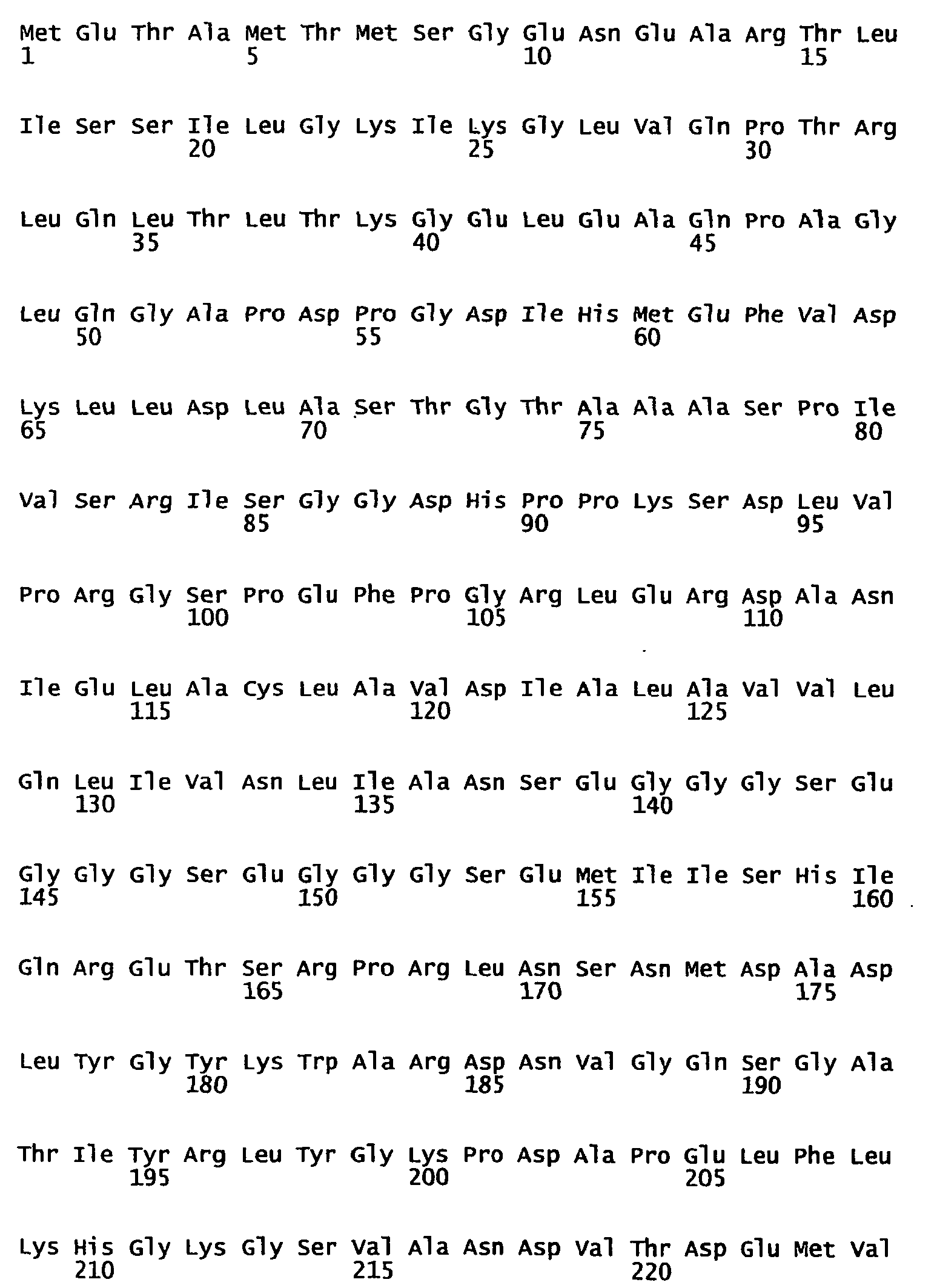
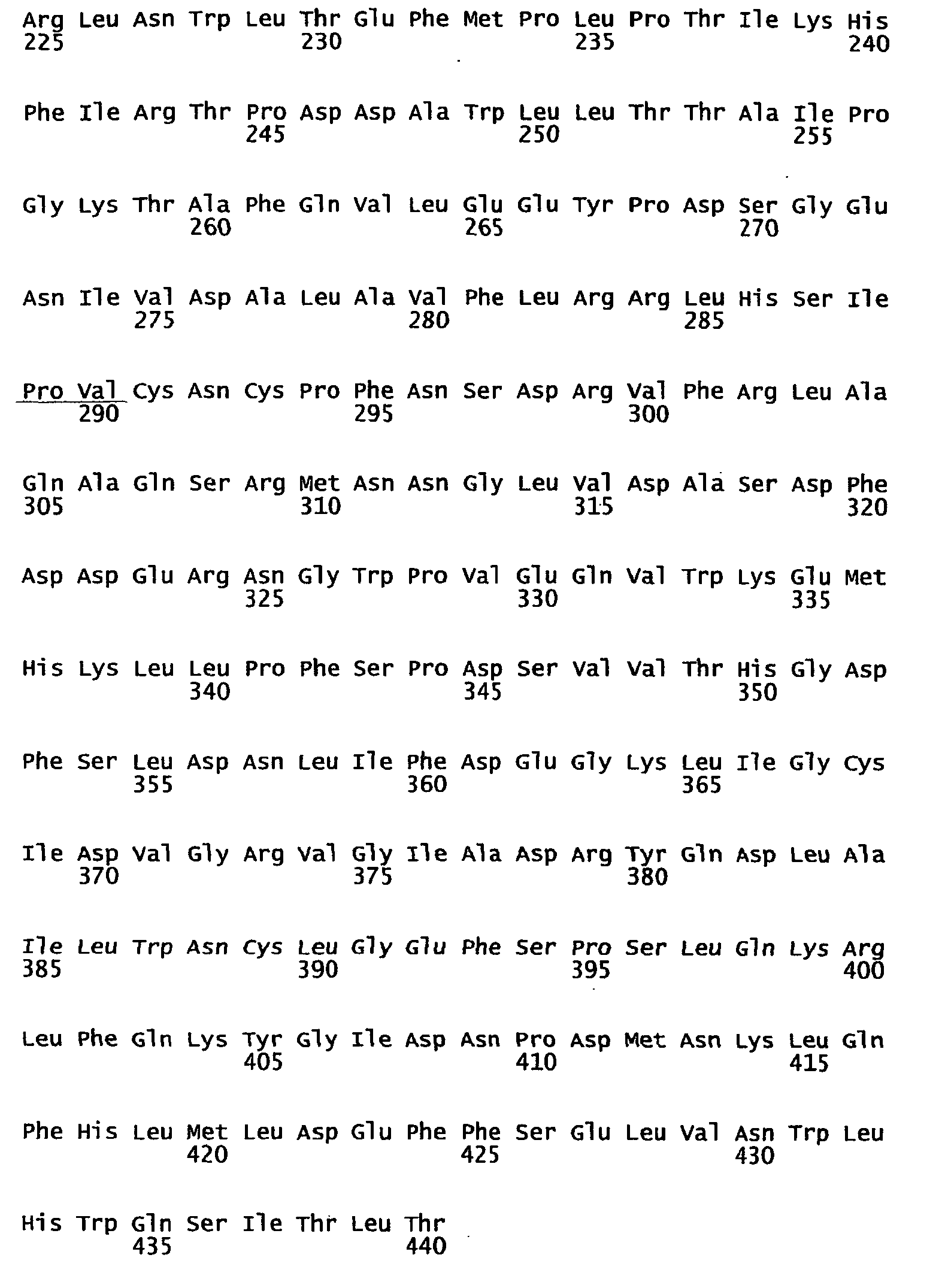
- <210> 2
<211> 440
<212> PRT
<213> Artificial - <220>
<223> Teilsequenz des Vektors pFroup1 - <400> 2
Claims (23)
- Verfahren zur Bestimmung von Frameshift-Mutationen in kodierenden Zielnukleinsäuren, welches die Schritte umfasst:(i) Bereitstellen einer Wirtszelle, umfassend eine doppelsträngige Nukleinsäure, welche eine kodierende Zielnukleinsäure und eine dazu komplementäre, kodierende Gegenstrangnukleinsäure umfasst, worin die Gegenstrangnukleinsäure über einen Linker mit einem Reportergen in 3'-Position verknüpft ist;(ii) Bewirken der Expression der Gegenstrangnukleinsäure; und(iii) Bestimmen, ob in der Wirtszelle eine Expression des Reportergens erfolgt,
worin die Expression des Reportergens anzeigt, dass die Zielnukleinsäure keine Frameshift-Mutation aufweist,
dadurch gekennzeichnet,
dass der Linker eine translationelle Kopplersequenz aufweist, die ein Stoppkodon in frame zu dem Leserahmen der Gegenstrangnukleinsäure und ein Startkodon umfasst, wobei das Reportergen in frame zu dem Startkodon liegt. - Verfahren nach Anspruch 1,
wobei der Linker in den um +1 und -1 verschobenen Leserahmen stromaufwärts des Stoppkodons der translationellen Koppler-Sequenz gelegene weitere Stoppkodons aufweist. - Verfahren nach Anspruch 2,
wobei der Abstand von den weiteren Stoppkodons zu dem Startkodon der translationellen Kopplersequenz so gewählt ist, dass keine translationelle Kopplung erfolgt, vorzugsweise mindestens 30 Basenpaare , insbesondere mindestens 50 Basenpaare. - Verfahren nach einem der Ansprüche 1 bis 3,
wobei Start- und Stoppkodon der translationellen Kopplersequenz unmittelbar aneinander anschließen. - Verfahren nach einem der Ansprüche 1 bis 3,
wobei Start- und Stoppkodon der translationellen Kopplersequenz miteinander überlappen. - Verfahren nach einem der Ansprüche 1 bis 3,
wobei Start- und Stoppkodon der translationellen Kopplersequenz einen Abstand voneinander aufweisen, der so gewählt ist, dass eine translationelle Kopplung ermöglicht wird, vorzugsweise einen Abstand von nicht mehr als 10 Basenpaaren. - Verfahren nach einem der Ansprüche 1 bis 6,
worin die Gegenstrangnukleinsäure weiterhin in operativer Verknüpfung mit einer Expressionskontrollsequenz in 5'-Position vorliegt. - Verfahren nach einem der Ansprüche 1 bis 7,
worin Schritt (i) umfasst:- Einbringen eines Expressionsvektors, umfassend die doppelsträngige Nukleinsäure, welche eine kodierende Zielnukleinsäure und eine dazu komplementäre, kodierende Gegenstrangnukleinsäure umfasst, in eine Wirtszelle, wobei die Gegenstrangnukleinsäure in dem Expressionsvektor über einen Linker mit einem Reportergen in 3'-Position verknüpft ist. - Verfahren nach Anspruch 8, worin die Gegenstrangnukleinsäure in dem Expressionsvektor in operativer Verknüpfung mit einer Expressionskontrollsequenz in 5' Position vorliegt.
- Verfahren nach einem der Ansprüche 8 oder 9, worin in Schritt (i) ein Expressionsvektor verwendet wird, der zusätzlich mindestens ein Selektionsmarkergen umfasst.
- Verfahren nach Anspruch 10, worin das Selektionsmarkergen konstitutiv exprimiert wird.
- Verfahren nach einem der vorhergehenden Ansprüche, worin die Gegenstrangnukleinsäure so optimiert wird, dass sie keine StoppKodons umfasst.
- Verfahren nach einem der vorhergehenden Ansprüche, worin die Nukleinsäuresequenz aus genomischen Sequenzen, cDNA-Sequenzen, oder cDNA-Fragmenten stammt.
- Verfahren nach einem der vorhergehenden Ansprüche, worin die Nukleinsäuresequenz aus einer Bibliothek, die eine Kollektion von Sequenzen enthält, stammt.
- Verfahren nach einem der vorhergehenden Ansprüche, worin die Zielnukleinsäuresequenz aus einer normalisierten cDNA-Bibliothek stammt.
- Verfahren nach einem der vorhergehenden Ansprüche, worin als Expressionsvektor ein Plasmid verwendet wird.
- Verfahren nach einem der vorhergehenden Ansprüche, worin als Wirtszelle eine eukaryotische Zelle verwendet werden.
- Verfahren nach einem der Ansprüche 8 bis 17, worin das Einbringen des Expressionsvektors durch Calciumphosphat-Copräzipitation, Lipofektion, Elektroporation, Partikelbeschuss oder virale Infektion erfolgt.
- Verfahren nach einem der vorhergehenden Ansprüche, worin das Reportergen ein für ein nachweisbares Genprodukt codierendes Gen enthält.
- Verfahren nach Anspruch 19, worin das Reportergen ein Antibiotika-Resistenzgen wie etwa Kanamycin-Resistenz umfasst.
- Verfahren nach Anspruch 19, worin das nachweisbare Genprodukt aus Fluoreszenzproteinen wie vorzugsweise GFP ausgewählt wird.
- Verfahren nach Anspruch 19, worin das nachweisbare Genprodukt eine colorimetrisch messbare Reaktion katalysiert.
- Verfahren nach einem der vorhergehenden Ansprüche, worin die Bestimmung in Schritt (iii) durch Fluoreszenzcytometrie oder Imaging-Assays erfolgt.
Applications Claiming Priority (2)
| Application Number | Priority Date | Filing Date | Title |
|---|---|---|---|
| DE102007052344A DE102007052344B3 (de) | 2007-11-02 | 2007-11-02 | Selektion kodierender Nukleinsäure-Konstrukte auf Abwesenheit von Frameshift-Mutationen |
| DE102009011253A DE102009011253B3 (de) | 2007-11-02 | 2009-03-02 | Selektion kodierender Nukleinsäure-Konstrukte auf Abwesenheit von Frameshift-Mutationen |
Publications (2)
| Publication Number | Publication Date |
|---|---|
| EP2228456A1 EP2228456A1 (de) | 2010-09-15 |
| EP2228456B1 true EP2228456B1 (de) | 2011-11-23 |
Family
ID=40340317
Family Applications (2)
| Application Number | Title | Priority Date | Filing Date |
|---|---|---|---|
| EP08843855.1A Active EP2205767B1 (de) | 2007-11-02 | 2008-10-31 | Verfahren zur feststellung von frameshift-mutationen in kodierenden nukleinsäuren |
| EP10155226A Active EP2228456B1 (de) | 2007-11-02 | 2010-03-02 | Selektion kodierender Nukleinsäure-Konstrukte auf Abwesenheit von Frameshift-Mutationen |
Family Applications Before (1)
| Application Number | Title | Priority Date | Filing Date |
|---|---|---|---|
| EP08843855.1A Active EP2205767B1 (de) | 2007-11-02 | 2008-10-31 | Verfahren zur feststellung von frameshift-mutationen in kodierenden nukleinsäuren |
Country Status (5)
| Country | Link |
|---|---|
| US (1) | US9115390B2 (de) |
| EP (2) | EP2205767B1 (de) |
| AT (1) | ATE534754T1 (de) |
| DE (2) | DE102007052344B3 (de) |
| WO (1) | WO2009056343A1 (de) |
Families Citing this family (6)
| Publication number | Priority date | Publication date | Assignee | Title |
|---|---|---|---|---|
| ATE453716T1 (de) * | 2004-08-03 | 2010-01-15 | Geneart Ag | Verfahren zur modulation der genexpression durch änderung des cpg gehalts |
| DE102007052344B3 (de) | 2007-11-02 | 2009-03-12 | Geneart Ag | Selektion kodierender Nukleinsäure-Konstrukte auf Abwesenheit von Frameshift-Mutationen |
| EP2834357B1 (de) | 2012-04-04 | 2017-12-27 | Life Technologies Corporation | Tal-effektor-montageplattform, kundenspezifische dienste, kits und assays |
| KR101768770B1 (ko) | 2015-07-29 | 2017-08-18 | 배재대학교 산학협력단 | 효모 및 재조합 벡터를 이용한 해독틀 돌연변이 및 종결 돌연변이가 없는 합성유전자의 선택적 선별방법 |
| EP3509635A1 (de) | 2016-09-06 | 2019-07-17 | Vavotar Life Sciences LLC | Verfahren zur behandlung von dreifach negativem brustkrebs unter verwendung von zusammensetzungen aus antikörpern und trägerproteinen |
| US20220349010A1 (en) * | 2018-07-26 | 2022-11-03 | Frame Pharmaceuticals B.V. | Method of preparing subject-specific immunogenic compositions based on a neo open-reading-frame peptide database |
Citations (1)
| Publication number | Priority date | Publication date | Assignee | Title |
|---|---|---|---|---|
| WO2009056343A1 (de) * | 2007-11-02 | 2009-05-07 | Geneart Ag | Verfahren zur feststellung von frameshift-mutationen in kodierenden nukleinsäuren |
Family Cites Families (9)
| Publication number | Priority date | Publication date | Assignee | Title |
|---|---|---|---|---|
| US5876940A (en) * | 1994-11-30 | 1999-03-02 | University Of Utah Research Foundation | Alleles |
| US6682885B1 (en) * | 1996-10-09 | 2004-01-27 | Srl, Inc. | Method for detecting mutations using an URA3 reporter gene |
| US6391641B1 (en) * | 1999-04-29 | 2002-05-21 | University Of Maryland, College Park | Translationally-coupled reporter gene |
| AU2001253092A1 (en) | 2000-07-13 | 2002-01-30 | Transgenomic, Inc. | Method for detection of truncated proteins |
| DE10107317A1 (de) * | 2001-02-16 | 2002-09-12 | Max Planck Gesellschaft | Methode zur Detektion von Mutationen |
| ATE298005T1 (de) * | 2001-07-10 | 2005-07-15 | Apogene Biotechnologie Gmbh & | Verfahren zur identifizierung von leserastermutationen |
| JP4243680B2 (ja) | 2003-02-13 | 2009-03-25 | 独立行政法人産業技術総合研究所 | 外来挿入断片選択マーカー |
| US20120329673A1 (en) | 2006-10-24 | 2012-12-27 | Waldo Geoffrey S | Vectors and methods for selecting open reading frames |
| EP2078078B1 (de) | 2006-12-22 | 2011-09-21 | Novozymes A/S | Auswahl synthetischer gene mit guter expression |
-
2007
- 2007-11-02 DE DE102007052344A patent/DE102007052344B3/de active Active
-
2008
- 2008-10-31 EP EP08843855.1A patent/EP2205767B1/de active Active
- 2008-10-31 WO PCT/EP2008/009223 patent/WO2009056343A1/de not_active Ceased
-
2009
- 2009-03-02 DE DE102009011253A patent/DE102009011253B3/de active Active
-
2010
- 2010-03-01 US US12/714,835 patent/US9115390B2/en active Active
- 2010-03-02 AT AT10155226T patent/ATE534754T1/de active
- 2010-03-02 EP EP10155226A patent/EP2228456B1/de active Active
Patent Citations (1)
| Publication number | Priority date | Publication date | Assignee | Title |
|---|---|---|---|---|
| WO2009056343A1 (de) * | 2007-11-02 | 2009-05-07 | Geneart Ag | Verfahren zur feststellung von frameshift-mutationen in kodierenden nukleinsäuren |
Also Published As
| Publication number | Publication date |
|---|---|
| US20100297642A1 (en) | 2010-11-25 |
| EP2205767B1 (de) | 2016-07-27 |
| EP2205767A1 (de) | 2010-07-14 |
| US9115390B2 (en) | 2015-08-25 |
| ATE534754T1 (de) | 2011-12-15 |
| EP2228456A1 (de) | 2010-09-15 |
| DE102007052344B3 (de) | 2009-03-12 |
| WO2009056343A4 (de) | 2009-09-24 |
| WO2009056343A1 (de) | 2009-05-07 |
| DE102009011253B3 (de) | 2010-07-22 |
Similar Documents
| Publication | Publication Date | Title |
|---|---|---|
| DE69721282T2 (de) | In vitro transpositionsystem unter verwendung einer modifizierten tn5 transposase | |
| DE69918820T2 (de) | Dna hochdurchsatzvektor für sequenzierung | |
| DE102009011253B3 (de) | Selektion kodierender Nukleinsäure-Konstrukte auf Abwesenheit von Frameshift-Mutationen | |
| DE69527951T2 (de) | Ein in-vivo genexpressions-system | |
| DE69838510T2 (de) | Mutationen in atp-abhängigen transpositionsproteinen die die zielortspezifität reduzieren | |
| DD209476A5 (de) | Verfahren zur stabilisierung und selektierung von wirtszellen, die rekombinierende dna enthalten | |
| DE69013811T2 (de) | Verfahren zur Herstellung von antiviralem Protein unter Benützung von E.coli-Transformant, das Gen, das für dieses Protein kodiert und E.coli-Vektor benützt in diesem Verfahren. | |
| EP0460673A1 (de) | Rekombinantes Restriktionsenzym Sau3AI kodierendes DNS | |
| EP0919619B1 (de) | Optimierung von Zellen für die endogene Genaktivierung | |
| EP1025253A1 (de) | Positiv-negativ-selektion bei der homologen rekombination | |
| DE69736673T2 (de) | Rifamycin biosynthese genkluster | |
| EP1326964B1 (de) | THERMOSTABILE POLYMERASE AUS i THERMOCOCCUS PACIFICUS /i | |
| EP1275736B1 (de) | Verfahren zur Identifizierung von Leserastermutationen | |
| EP2499253B1 (de) | Mikroorganismen mit gesteigerter sucrosemutaseaktivität | |
| EP1282715B1 (de) | Verfahren zur mikrobiellen herstellung von difructoseanhydrid-iii, dafür einsetzbarer mikroorganismus sowie enzym mit inulase-ii-aktivität und dafür kodierende dna-sequenzen | |
| EP1337651B1 (de) | Promotor zur funktionellen charakterisierung von g-protein gekoppelten rezeptoren in der hefe saccharomyces cerevisiae | |
| WO2003052094A2 (de) | Expressionsvektor zur herstellung von annexin v | |
| WO2005093040A1 (de) | Phycocyanin exprimierende eukaryontenzelle | |
| DE602004003835T2 (de) | Peptid-inhibitor der proteintranslation und dessen verwendung bei der steuerung der proteintranslation | |
| DE3008647A1 (de) | Plasmid puc1 und verfahren zum isolieren von plasmid puc1 aus streptomyces fradiae | |
| DE4002521A1 (de) | Rekombinantes plasmid | |
| DE3990972C2 (de) | ||
| DE60127687T2 (de) | Testverfahren zur bestimmung der alternativen verlangerung von telomeren in menschlichen zellen | |
| DE10133928A1 (de) | Verfahren zum Herstellen von Deletionsmutanten | |
| WO2025036564A1 (de) | Nukleinsäuresequenz, vektor, screening-verfahren und verfahren zur herstellung von rekombinanten antikörpern |
Legal Events
| Date | Code | Title | Description |
|---|---|---|---|
| PUAI | Public reference made under article 153(3) epc to a published international application that has entered the european phase |
Free format text: ORIGINAL CODE: 0009012 |
|
| 17P | Request for examination filed |
Effective date: 20100302 |
|
| AK | Designated contracting states |
Kind code of ref document: A1 Designated state(s): AT BE BG CH CY CZ DE DK EE ES FI FR GB GR HR HU IE IS IT LI LT LU LV MC MK MT NL NO PL PT RO SE SI SK SM TR |
|
| AX | Request for extension of the european patent |
Extension state: AL BA ME RS |
|
| GRAP | Despatch of communication of intention to grant a patent |
Free format text: ORIGINAL CODE: EPIDOSNIGR1 |
|
| RIC1 | Information provided on ipc code assigned before grant |
Ipc: C12Q 1/68 20060101AFI20110503BHEP |
|
| GRAS | Grant fee paid |
Free format text: ORIGINAL CODE: EPIDOSNIGR3 |
|
| GRAA | (expected) grant |
Free format text: ORIGINAL CODE: 0009210 |
|
| AK | Designated contracting states |
Kind code of ref document: B1 Designated state(s): AT BE BG CH CY CZ DE DK EE ES FI FR GB GR HR HU IE IS IT LI LT LU LV MC MK MT NL NO PL PT RO SE SI SK SM TR |
|
| REG | Reference to a national code |
Ref country code: GB Ref legal event code: FG4D Free format text: NOT ENGLISH |
|
| REG | Reference to a national code |
Ref country code: CH Ref legal event code: EP |
|
| REG | Reference to a national code |
Ref country code: IE Ref legal event code: FG4D Free format text: LANGUAGE OF EP DOCUMENT: GERMAN |
|
| REG | Reference to a national code |
Ref country code: DE Ref legal event code: R096 Ref document number: 502010000237 Country of ref document: DE Effective date: 20120119 |
|
| REG | Reference to a national code |
Ref country code: NL Ref legal event code: VDEP Effective date: 20111123 |
|
| LTIE | Lt: invalidation of european patent or patent extension |
Effective date: 20111123 |
|
| PG25 | Lapsed in a contracting state [announced via postgrant information from national office to epo] |
Ref country code: LT Free format text: LAPSE BECAUSE OF FAILURE TO SUBMIT A TRANSLATION OF THE DESCRIPTION OR TO PAY THE FEE WITHIN THE PRESCRIBED TIME-LIMIT Effective date: 20111123 Ref country code: IS Free format text: LAPSE BECAUSE OF FAILURE TO SUBMIT A TRANSLATION OF THE DESCRIPTION OR TO PAY THE FEE WITHIN THE PRESCRIBED TIME-LIMIT Effective date: 20120323 Ref country code: NO Free format text: LAPSE BECAUSE OF FAILURE TO SUBMIT A TRANSLATION OF THE DESCRIPTION OR TO PAY THE FEE WITHIN THE PRESCRIBED TIME-LIMIT Effective date: 20120223 |
|
| PG25 | Lapsed in a contracting state [announced via postgrant information from national office to epo] |
Ref country code: LV Free format text: LAPSE BECAUSE OF FAILURE TO SUBMIT A TRANSLATION OF THE DESCRIPTION OR TO PAY THE FEE WITHIN THE PRESCRIBED TIME-LIMIT Effective date: 20111123 Ref country code: PT Free format text: LAPSE BECAUSE OF FAILURE TO SUBMIT A TRANSLATION OF THE DESCRIPTION OR TO PAY THE FEE WITHIN THE PRESCRIBED TIME-LIMIT Effective date: 20120323 Ref country code: GR Free format text: LAPSE BECAUSE OF FAILURE TO SUBMIT A TRANSLATION OF THE DESCRIPTION OR TO PAY THE FEE WITHIN THE PRESCRIBED TIME-LIMIT Effective date: 20120224 Ref country code: HR Free format text: LAPSE BECAUSE OF FAILURE TO SUBMIT A TRANSLATION OF THE DESCRIPTION OR TO PAY THE FEE WITHIN THE PRESCRIBED TIME-LIMIT Effective date: 20111123 Ref country code: NL Free format text: LAPSE BECAUSE OF FAILURE TO SUBMIT A TRANSLATION OF THE DESCRIPTION OR TO PAY THE FEE WITHIN THE PRESCRIBED TIME-LIMIT Effective date: 20111123 Ref country code: SI Free format text: LAPSE BECAUSE OF FAILURE TO SUBMIT A TRANSLATION OF THE DESCRIPTION OR TO PAY THE FEE WITHIN THE PRESCRIBED TIME-LIMIT Effective date: 20111123 Ref country code: SE Free format text: LAPSE BECAUSE OF FAILURE TO SUBMIT A TRANSLATION OF THE DESCRIPTION OR TO PAY THE FEE WITHIN THE PRESCRIBED TIME-LIMIT Effective date: 20111123 |
|
| REG | Reference to a national code |
Ref country code: IE Ref legal event code: FD4D |
|
| PG25 | Lapsed in a contracting state [announced via postgrant information from national office to epo] |
Ref country code: CY Free format text: LAPSE BECAUSE OF FAILURE TO SUBMIT A TRANSLATION OF THE DESCRIPTION OR TO PAY THE FEE WITHIN THE PRESCRIBED TIME-LIMIT Effective date: 20111123 |
|
| PG25 | Lapsed in a contracting state [announced via postgrant information from national office to epo] |
Ref country code: CZ Free format text: LAPSE BECAUSE OF FAILURE TO SUBMIT A TRANSLATION OF THE DESCRIPTION OR TO PAY THE FEE WITHIN THE PRESCRIBED TIME-LIMIT Effective date: 20111123 Ref country code: DK Free format text: LAPSE BECAUSE OF FAILURE TO SUBMIT A TRANSLATION OF THE DESCRIPTION OR TO PAY THE FEE WITHIN THE PRESCRIBED TIME-LIMIT Effective date: 20111123 Ref country code: IE Free format text: LAPSE BECAUSE OF FAILURE TO SUBMIT A TRANSLATION OF THE DESCRIPTION OR TO PAY THE FEE WITHIN THE PRESCRIBED TIME-LIMIT Effective date: 20111123 Ref country code: EE Free format text: LAPSE BECAUSE OF FAILURE TO SUBMIT A TRANSLATION OF THE DESCRIPTION OR TO PAY THE FEE WITHIN THE PRESCRIBED TIME-LIMIT Effective date: 20111123 Ref country code: SK Free format text: LAPSE BECAUSE OF FAILURE TO SUBMIT A TRANSLATION OF THE DESCRIPTION OR TO PAY THE FEE WITHIN THE PRESCRIBED TIME-LIMIT Effective date: 20111123 Ref country code: BG Free format text: LAPSE BECAUSE OF FAILURE TO SUBMIT A TRANSLATION OF THE DESCRIPTION OR TO PAY THE FEE WITHIN THE PRESCRIBED TIME-LIMIT Effective date: 20120223 |
|
| PG25 | Lapsed in a contracting state [announced via postgrant information from national office to epo] |
Ref country code: RO Free format text: LAPSE BECAUSE OF FAILURE TO SUBMIT A TRANSLATION OF THE DESCRIPTION OR TO PAY THE FEE WITHIN THE PRESCRIBED TIME-LIMIT Effective date: 20111123 Ref country code: IT Free format text: LAPSE BECAUSE OF FAILURE TO SUBMIT A TRANSLATION OF THE DESCRIPTION OR TO PAY THE FEE WITHIN THE PRESCRIBED TIME-LIMIT Effective date: 20111123 Ref country code: PL Free format text: LAPSE BECAUSE OF FAILURE TO SUBMIT A TRANSLATION OF THE DESCRIPTION OR TO PAY THE FEE WITHIN THE PRESCRIBED TIME-LIMIT Effective date: 20111123 |
|
| PLBE | No opposition filed within time limit |
Free format text: ORIGINAL CODE: 0009261 |
|
| STAA | Information on the status of an ep patent application or granted ep patent |
Free format text: STATUS: NO OPPOSITION FILED WITHIN TIME LIMIT |
|
| BERE | Be: lapsed |
Owner name: GENEART A.G. Effective date: 20120331 |
|
| 26N | No opposition filed |
Effective date: 20120824 |
|
| PG25 | Lapsed in a contracting state [announced via postgrant information from national office to epo] |
Ref country code: MC Free format text: LAPSE BECAUSE OF NON-PAYMENT OF DUE FEES Effective date: 20120331 |
|
| REG | Reference to a national code |
Ref country code: DE Ref legal event code: R097 Ref document number: 502010000237 Country of ref document: DE Effective date: 20120824 |
|
| PG25 | Lapsed in a contracting state [announced via postgrant information from national office to epo] |
Ref country code: BE Free format text: LAPSE BECAUSE OF NON-PAYMENT OF DUE FEES Effective date: 20120331 |
|
| PG25 | Lapsed in a contracting state [announced via postgrant information from national office to epo] |
Ref country code: MK Free format text: LAPSE BECAUSE OF FAILURE TO SUBMIT A TRANSLATION OF THE DESCRIPTION OR TO PAY THE FEE WITHIN THE PRESCRIBED TIME-LIMIT Effective date: 20111123 |
|
| PG25 | Lapsed in a contracting state [announced via postgrant information from national office to epo] |
Ref country code: ES Free format text: LAPSE BECAUSE OF FAILURE TO SUBMIT A TRANSLATION OF THE DESCRIPTION OR TO PAY THE FEE WITHIN THE PRESCRIBED TIME-LIMIT Effective date: 20120305 |
|
| PG25 | Lapsed in a contracting state [announced via postgrant information from national office to epo] |
Ref country code: FI Free format text: LAPSE BECAUSE OF FAILURE TO SUBMIT A TRANSLATION OF THE DESCRIPTION OR TO PAY THE FEE WITHIN THE PRESCRIBED TIME-LIMIT Effective date: 20111123 |
|
| PG25 | Lapsed in a contracting state [announced via postgrant information from national office to epo] |
Ref country code: MT Free format text: LAPSE BECAUSE OF FAILURE TO SUBMIT A TRANSLATION OF THE DESCRIPTION OR TO PAY THE FEE WITHIN THE PRESCRIBED TIME-LIMIT Effective date: 20111123 |
|
| PG25 | Lapsed in a contracting state [announced via postgrant information from national office to epo] |
Ref country code: TR Free format text: LAPSE BECAUSE OF FAILURE TO SUBMIT A TRANSLATION OF THE DESCRIPTION OR TO PAY THE FEE WITHIN THE PRESCRIBED TIME-LIMIT Effective date: 20111123 |
|
| PG25 | Lapsed in a contracting state [announced via postgrant information from national office to epo] |
Ref country code: SM Free format text: LAPSE BECAUSE OF FAILURE TO SUBMIT A TRANSLATION OF THE DESCRIPTION OR TO PAY THE FEE WITHIN THE PRESCRIBED TIME-LIMIT Effective date: 20111123 Ref country code: LU Free format text: LAPSE BECAUSE OF NON-PAYMENT OF DUE FEES Effective date: 20120302 |
|
| PG25 | Lapsed in a contracting state [announced via postgrant information from national office to epo] |
Ref country code: HU Free format text: LAPSE BECAUSE OF FAILURE TO SUBMIT A TRANSLATION OF THE DESCRIPTION OR TO PAY THE FEE WITHIN THE PRESCRIBED TIME-LIMIT Effective date: 20100302 |
|
| REG | Reference to a national code |
Ref country code: CH Ref legal event code: PL |
|
| PG25 | Lapsed in a contracting state [announced via postgrant information from national office to epo] |
Ref country code: CH Free format text: LAPSE BECAUSE OF NON-PAYMENT OF DUE FEES Effective date: 20140331 Ref country code: LI Free format text: LAPSE BECAUSE OF NON-PAYMENT OF DUE FEES Effective date: 20140331 |
|
| REG | Reference to a national code |
Ref country code: FR Ref legal event code: PLFP Year of fee payment: 7 |
|
| REG | Reference to a national code |
Ref country code: AT Ref legal event code: MM01 Ref document number: 534754 Country of ref document: AT Kind code of ref document: T Effective date: 20150302 |
|
| PG25 | Lapsed in a contracting state [announced via postgrant information from national office to epo] |
Ref country code: AT Free format text: LAPSE BECAUSE OF NON-PAYMENT OF DUE FEES Effective date: 20150302 |
|
| REG | Reference to a national code |
Ref country code: FR Ref legal event code: PLFP Year of fee payment: 8 |
|
| REG | Reference to a national code |
Ref country code: FR Ref legal event code: PLFP Year of fee payment: 9 |
|
| PGFP | Annual fee paid to national office [announced via postgrant information from national office to epo] |
Ref country code: DE Payment date: 20250220 Year of fee payment: 16 |
|
| PGFP | Annual fee paid to national office [announced via postgrant information from national office to epo] |
Ref country code: FR Payment date: 20250307 Year of fee payment: 16 |
|
| PGFP | Annual fee paid to national office [announced via postgrant information from national office to epo] |
Ref country code: GB Payment date: 20250307 Year of fee payment: 16 |