EP2222644B1 - Verfahren zur herstellung von vorläufern für l-2-[18f]fluor-phenylalanin und 6-[18f]fluor- l-meta-tyrosin und deren alpha-methylierten derivaten, sowie die vorläufer - Google Patents
Verfahren zur herstellung von vorläufern für l-2-[18f]fluor-phenylalanin und 6-[18f]fluor- l-meta-tyrosin und deren alpha-methylierten derivaten, sowie die vorläufer Download PDFInfo
- Publication number
- EP2222644B1 EP2222644B1 EP08857143A EP08857143A EP2222644B1 EP 2222644 B1 EP2222644 B1 EP 2222644B1 EP 08857143 A EP08857143 A EP 08857143A EP 08857143 A EP08857143 A EP 08857143A EP 2222644 B1 EP2222644 B1 EP 2222644B1
- Authority
- EP
- European Patent Office
- Prior art keywords
- tert
- butyl
- methyl
- compound
- bmi
- Prior art date
- Legal status (The legal status is an assumption and is not a legal conclusion. Google has not performed a legal analysis and makes no representation as to the accuracy of the status listed.)
- Not-in-force
Links
- 0 *C1NCCCC1 Chemical compound *C1NCCCC1 0.000 description 6
Images

Classifications
-
- C—CHEMISTRY; METALLURGY
- C07—ORGANIC CHEMISTRY
- C07D—HETEROCYCLIC COMPOUNDS
- C07D233/00—Heterocyclic compounds containing 1,3-diazole or hydrogenated 1,3-diazole rings, not condensed with other rings
- C07D233/04—Heterocyclic compounds containing 1,3-diazole or hydrogenated 1,3-diazole rings, not condensed with other rings having one double bond between ring members or between a ring member and a non-ring member
- C07D233/28—Heterocyclic compounds containing 1,3-diazole or hydrogenated 1,3-diazole rings, not condensed with other rings having one double bond between ring members or between a ring member and a non-ring member with hetero atoms or with carbon atoms having three bonds to hetero atoms with at the most one bond to halogen, e.g. ester or nitrile radicals, directly attached to ring carbon atoms
- C07D233/30—Oxygen or sulfur atoms
- C07D233/32—One oxygen atom
Definitions
- the invention relates to a process for the preparation of precursors for 2- [18F] fluorophenylalanine (2- [18F] FPhe) and 6- [18F] fluoro-L-meta-tyrosine (6- [18F] FMT) and their ⁇ methyl faced derivatives and the precursors.
- the method should be suitable for automated synthesis operation.
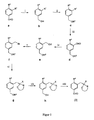
- FIG. 1 there is provided a general reaction scheme according to which the precursor can be prepared for 2- [ 18 F] FPhe and 6- [ 18 F] FMT according to formula 3.
- the aldehyde group of compound a is reduced in step i.
- a metal hydride such as sodium borohydride or lithium aluminum hydride can be used.
- Suitable solvents are in particular when using sodium borohydride, methanol or other alcohols, for example ethanol, propanol or isopropanol.
- the reaction is carried out at room temperature.
- the compound b can be prepared as an educt for the preparation process of the precursor according to the invention by way of example.
- other synthetic routes can also be taken for b.
- a protective group is introduced according to the invention in step ii.
- protecting groups THP, MTM, TBDMS, TBDPS generally silyl protecting groups or MOM can be used.
- p-toluenesulfonic acid can be added as a catalyst.
- the solvent used may be dichloromethane, DMF or tetrahydrofuran.
- the reaction temperature is preferably between 0 ° C and room temperature, for example 17 ° C to 25 ° C.
- step iii in compound c, the substituent R 1 is replaced by a formyl group.
- the formylation can be carried out for example with anilide, formylpiperidine or dimethylformamide in the presence of Metall michsgreagentien, such as sec-butyllithium, n-Buyllithium, tert-butyllithium, lithium or magnesium.
- Metall michsgreagentien such as sec-butyllithium, n-Buyllithium, tert-butyllithium, lithium or magnesium.
- the solvent used can be tetrahydrofuran or, for example, another ether.
- the reaction can be carried out in a temperature range between -20 ° C and -80 ° C, preferably between -50 ° C and -80 ° C, more preferably at -78 ° C, ie dry ice temperature.
- the resulting compound d is reduced to an alcohol e in a following step iv.
- a metal hydride such as sodium borohydride, lithium aluminum hydride can be used.
- Suitable solvents are, in particular when using sodium borohydride, methanol or else other alcohols, such as ethanol, propanol or isopropanol.
- the reaction is carried out at room temperature.
- the alcohol e is halogenated or tosylated in the subsequent reaction v to compound f, with the tosyl group replacing the Br in formula f.
- tetrabromomethane can be used in the presence of triphenylphosphine as oxygen scavenger.
- dichloromethane or generally halogenated hydrocarbons can be used as the solvent.
- the preferred temperature is 0 ° C to about 4 ° C.
- Compound f is reacted in step vi with a chiral amino acid reagent.
- Compound f is prepared with (S) -BOC-BMI: (S) -1- (tert-butoxycarbonyl) -2-tert-butyl-3-methyl-4-imidazolidinone, (S) -Cbz-BMI: ( S) -1- (Benzoylcarbonyl) -2-tert-butyl-3-methyl-4-imidazolidinone, (S) -BDI: (S) -tert-butyl 2-tert-butyl-4-methoxy-2 , 5-dihydroimidazole-1-carboxylate, methyl (S) -BOC-BMI: (2S, 5R) -tert-butyl-2-tert-butyl-3,5-dimethyl-4-oxoimidazolidine-1-carboxylate , Methyl (S) -Cbz-BMI:
- the solvent used may be tetrahydrofuran or an ether, preferably diethyl ether or at least one component thereof.
- the resulting compound g is deprotected at function v. 2 in step vii.
- pyridinium p-toluenesulfonic acid can be used for this purpose.
- any known deprotecting method can be used, such as the use of acids or MgBr 2 .
- Suitable solvents are alcohols, such as ethanol, methanol, propanol or isopropanol.
- reaction product h is oxidized to an aldehyde in step viii.
- oxidation according to Swern can be carried out.
- the reaction is carried out with oxalyl chloride, dimethyl sulfoxide in the presence of triethylamine.
- the reaction takes place in a range of -20 ° C to -80 ° C, -30 ° C to -80 ° C, or preferably, between -50 ° C to -80 ° C. Typically at dry ice temperature of about -78 ° C.
- a halogenated hydrocarbon such as dichloromethane may be used.
- Reaction product is the precursor of formula 3 according to the invention.
- the precursor of formula 3 can be converted to 2- [ 18 F] FPhe or 6- [ 18 F] FMT.
- the position of the substituent R 4 of the precursor according to formula 3 18 F-fluoridated can be carried out by standard methods.
- the phase transfer catalysts cryptofix potassium oxalate, cryptofix potassium carbonate or tetrabutylammonium hydrogen carbonate can be used as anion activator for 18 F-.
- the 18- fluorinated intermediate is separated in a further step.
- the 18- fluorinated intermediate is oxidized to an ester in the case of the 6- [ 18 F] FMT.
- the separation can be carried out by solid phase extraction.
- the reaction mixture is purified via a reverse-phase cartridge.
- the oxidation of the aldehyde group can be carried out, for example, with mCPBA, or peracetic acid or perborate, but other oxidizing agents are also suitable.
- the solvents used may be halogenated hydrocarbons, such as chloroform or methylene chloride.
- Suitable catalysts for the decarbonylation expediently preferably contain one or more transition metals of the I., II., VI., VII. And VIII. Subgroups, such as chromium, manganese, nickel, copper or zinc, but preferably one or more metals from the group of Platinum metals, especially rhodium. It can be used in the heterogeneous system with fixed, supported on catalysts or in the homogeneous system in the liquid phase.
- Soluble rhodium complexes which can be used in a homogeneous liquid system or with which carriers can be impregnated, are, for example, rhodium (I) complexes, such as CIRh (PPh 3 ) 3 ("Wilkinson catalyst"), CIRh (CO ) (PPh 3 ) 2 , [CIRh (CO) 2 ] 2 , acacRh (CO) (PPh 3 ), acacRh (CO) 2 , (C 5 H 5 ) Rh (C 8 H 14 ) and (C 3 H 5 Rh (PPh 3 ), where Ph is phenyl, acac is acetylacetonate, C 8 H 14 is cyclooctene, C 5 H 5 is cyclopentadienyl and C 3 H 5 is allyl.
- rhodium (I) complexes such as CIRh (PPh 3 ) 3 ("Wilkinson catalyst"), CIRh (CO
- rhodium (II) and rhodium (III) complexes such as rhodium (II) acetate, rhodium (II) -2,4-difluoro-benzoate, Rh (acac) 3 , RhCl 3 'x H 2 O, Rh (NO 3 ) 3 and (C 3 H 5 ) PhCl 2 ( PPh 3 ) 2 .
- rhodium (II) acetate, rhodium (II) -2,4-difluoro-benzoate, Rh (acac) 3 , RhCl 3 'x H 2 O, Rh (NO 3 ) 3 and (C 3 H 5 ) PhCl 2 ( PPh 3 ) 2 To these rhodium complexes can advantageously still compounds that can act as ligands, such as phosphines, phosphites or amines, are added.
- the hydrolysis can be carried out in aqueous, preferably concentrated HI or HBr or in a solution with KI and HBr.
- the preparation of an enantiomerically pure product according to formulas 1 and 2 (ee ⁇ 98%) succeeds via a nucleophilic synthesis with only three radioactive steps. This makes an automated routine synthesis for the compounds according to formulas 1 and 2 practicable.
- the precursor is also obtained with an enantiomeric purity of ⁇ 98%.
- Apparatuses for automated synthesis operation generally comprise a receiver vessel into which a supply of reagents is fed from storage vessels which are connected to the receiver vessel via supply lines.
- the filling and emptying of the receiving vessel is usually done by generating an overpressure or a negative pressure.
- the commercially available device TRACERlab FX FN can be mentioned, which is equipped in addition to storage vessels for reagents, a glassy fiberglass and magnetic stirrer and a removable needle, with an activity detector and a vacuum system with cold trap.
- the device has an 18 O-water work-up and a solid phase extraction unit with preparative HPLC, two HPLC eluents and HPLC flow control, UV and radioactivity detectors for HPLC, collecting tank for fractions, solid phase extraction and HPLC solvent recycling.
- Similar devices are made of " One-step high-radiochemical synthesis synthesis of [18F] FP-CIT using a protic solvent system "in Nuc. Med. Biol., 2007; 34: 345-351 from S. Lee, S Oh, D. Chi, S. Kang, H. Kil, J Kim, D. Moon and further by Chen X, Park r, Shahinian AH, et al. -labeled RGD peptide: initial evaluation for imaging brain tumor angiogenesis / Nuc. Med. Biol. 2004; 31: 179-189 known.
- the precursor according to the invention enables a fully automated reaction of such a plant in which an 18 F-fluoridation of the precursor according to formula 3 is carried out and then the work-up to the end product, namely 2- [ 18 F] FPhe or 6- [ 18 F] FMT, he follows.
- 2- [ 18 F] FPhe and 6- [ 18 F] FMT are obtained in an enantiomeric NR of ⁇ 98%.
- the aqueous phase is extracted twice with diethyl ether, the combined organic extracts are dried over sodium sulfate and the solvent is reduced in vacuo.
Landscapes
- Chemical & Material Sciences (AREA)
- Organic Chemistry (AREA)
- Organic Low-Molecular-Weight Compounds And Preparation Thereof (AREA)
- Pharmaceuticals Containing Other Organic And Inorganic Compounds (AREA)
- Pyrrole Compounds (AREA)
Description
- Die Erfindung betrifft ein Verfahren zur Herstellung von Vorläufern für 2-[18F]Fluorphenylalanin (2-[18F]FPhe) und 6-[18F]Fluor-L-meta-tyrosin (6-[18F]FMT) und deren αmethylierten Derivaten sowie den Vorläufern.
- Aus dem Jahre 2001 ist eine Veröffentlichung von T.Tierling, K. Hamacher und H. H. Coenen mit dem Titel "A new nucleophilic asymetric synthesis of 6-[18F]Fluoro-DOPA" bekannt, die in J. Label. Compds. Radiopharm. 44, Suppl. 1 erschienen ist und in der ein Verfahren zur Herstellung eines [18F]FDOPA-Vorläufers und dessen Umsetzung zu 6-[18F]Fluoro-DOPA beschreibt. Nach diesem Verfahren wird ein Vorläufer durch nukleophile Substitution mit einem K2CO3 Kryptand-Komplex zu [18F]FDOPA umgesetzt. Das Produkt wird in einer Enantiomerenreinheit von 85% erhalten.
- Eine elektrophile Synthese von 6-[18F]- und 4-[18F]Fluor- L-meta-tyrosin ist aus dem Artikel Synthesis of 6-[18F]- und 4-[18F]Fluoro- L-meta-tyrosines via Regioselective Radiofluorodestannylaton der Autoren M. Namavari et. al. in Appl. Radiat. Isot. Vol 44, -NR. 3, pp 527-536 aus dem Jahre 1993 bekannt.
- Die Veröffentlichung "Fluorination of aromatic compounds from 1-aryl-3,3-dimethyltriazenes and fluoride anions in acidic medium 2. Synthesis of (S)- [18F]-3-fluoro-α-methylphenylalanine" von Thierry Pages et. al im Journal of Fluorine Chemistry 107 (2001) S. 329-335 offenbart Vorläufer und Herstellungsverfahren von [18F] fluormarkierten aromatischen L-Aminosäuren.
- Die nach dem Stand der Technik bekannten Verfahren zur Herstellung von 2-[18F]FPhe und 2-[18F]FMT-Vorläufern führen zu relativ geringen radiochemischen Ausbeuten und sind daher mit hohem Kostenaufwand verbunden.
- Es ist daher die Aufgabe der Erfindung, Vorläufern von 2-[18F]FPhe, 6-[18F]FMT und deren α-methylierten Derivaten und ein Verfahren zur Herstellung deren Vorläufer von 2-[18F]FPhe, 6-[18F]FMT und deren α-methylierten Derivaten zur Verfügung zu stellen, welches zu größeren radiochemischen Ausbeuten und zu einer größeren Enantiomerenreinheit führt. Außerdem soll das Verfahren für einen automatisierten Synthesebetrieb geeignet sein.
- Die Aufgabe wird erfindungsgemäß gelöst mit den Merkmalen der unabhängigen Ansprüche.
- Mit dem erfindungsgemäßen Verfahren und den Vorläufern ist es nunmehr möglich, 2-[18F]FPhe, 6-[18F]FMT und deren α-methylierte Derivate in nur drei radioaktiven Schritten enantiomerenrein herzustellen. Die Synthese kann automatisiert durchgeführt werden und führt zu Enantiomerenreinheiten von ≥ 98 %.
- Die Figuren zeigen Reaktionschemata für die Herstellung der erfindungsgemäßen Vorläufer sowie für die Herstellung der Zielverbindungen 2-[18F]FPhe und 6-[18F]FMT und deren αmethylierte Derivate.
- Es zeigt:
- Fig.1:
- Ein allgemeines Reaktionsschema für die Herstellung des Vorläufers.
- Fig.2:
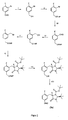
- Ein Reaktionsschema für die Synthese des Vorläufers, mit einzelnen Reaktionsschritten.
- Fig.2a:
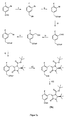
- Ein spezielles Reaktionsschema für die Synthese des Vorläufers, mit einzelnen Reaktionsschritten.
- Fig.3:
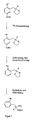
- Allgemeine Schritte zur Herstellung von 2-[18F]FPhe und des α- methylierten Derivates.
- Fig.4:
- Allgemeine Schritte zur Herstellung von 6-[18F]FMT und des α- methylierten Derivates.
- Formel 1 zeigt die Struktur von 2-[18F]FPhe und des α-methylierten Derivates. In ihr ist X = H oder CH3.

- Formel 2 zeigt die Struktur von 6-[18F]FMT und des α-methylierten Derivates. In ihr ist X = H oder CH3.

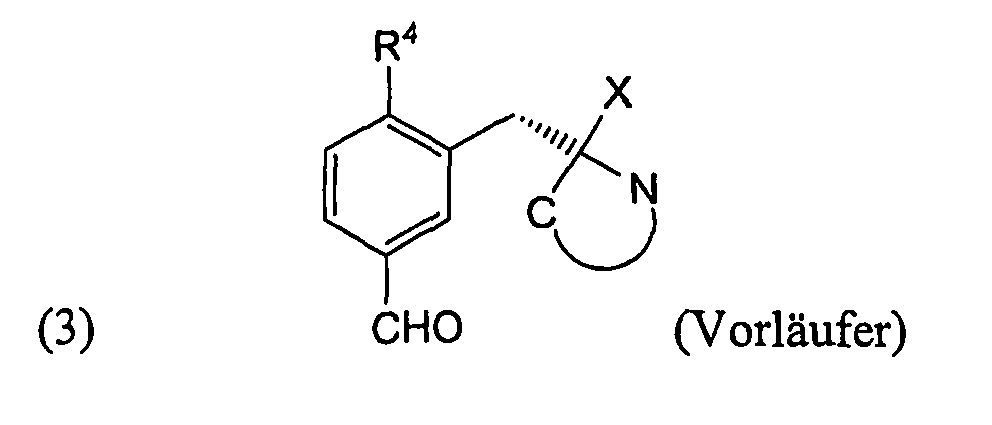
- Formel (3) zeigt die Struktur des Vorläufers. In ihr ist X = H oder CH3.

- Im Folgenden soll die Erfindung in ihrer allgemeinen Form beschrieben werden:
- In den Formeln sowie in den Figuren können als Substituenten R n , X, folgende Gruppen angegeben werden:
- R1
- = Br, I
- R2
- = Tetrahydropyranyl (THP), Methylthiomethyl (MTM), Methoxymethyl (MOM), TBDMS, TBDPS, allgemein Silylschutzgruppen
- R3
- = (S)-BOC-BMI: (S)-1-(tert.-Butoxycarbonyl)-2-tert.-butyl-3-methyl-4- imi- dazolidinon , (S)-Cbz-BMI: (S)-1-(Benzoylcarbonyl)-2-tert.-butyl-3-methyl-4- midazolidinon, (S)-BDI: (S)-tert.-Butyl 2-tert.-butyl-4-methoxy-2,5-dihydroimidazol-1- carboxylat, Methyl-(S)-BOC-BMI: (2S, 5R)-tert.-Butyl-2-tert.-butyl-3,5-dimethyl-4- oxoimidazolidin-1-carboxylat , Methyl-(S)-Cbz-BMI: (S)-1-(Benzoylcarbonyl)-2-tert.-butyl-3,5-dimethyl-4- imidazolidinon oder Methyl-(S)-BDI: (S)-tert.-Butyl-2-tert.-butyl-5-methyl-4-methoxy-2- hydroimidazol-1-carboxylat Formelschreibweise:

- R4
- = nukleophile Abgangsgruppe z. B. F, Br, Cl, NO2 oder -NR3 + mit R = Alkyl, z. B. CH3, C2H5. beispielsweise CH3
- X
- = H oder CH3
- In
Figur 1 ist ein allgemeines Reaktionsschema angegeben, nach dem der Vorläufer für 2-[18F]FPhe und 6-[18F]FMT gemäß Formel 3 hergestellt werden kann. - Die Aldehylgruppe von Verbindung a wird in Schritt i reduziert.
- Als Reduktionsmittel kann beispielsweise ein Metallhydrid, wie Natriumborhydrid oder Lithiumaluminiumhydrid eingesetzt werden.
- Geeignete Lösungsmittel sind insbesondere bei der Verwendung von Natriumborhydrid, Methanol oder auch andere Alkohole, beispielsweise Ethanol, Propanol oder Isopropanol.
- Vorzugsweise wird die Reaktion bei Raumtemperatur durchgeführt.
- Mit diesem Herstellungsverfahren kann die Verbindung b als Edukt für das erfindungsgemäße Herstellungsverfahren des Vorläufers beispielhaft hergestellt werden. Jedoch können für b auch andere Synthesewege eingeschlagen werden.
- In den resultierenden Alkohol b wird erfindungsgemäß in Schritt ii eine Schutzgruppe eingeführt.
Als Schutzgruppen kann THP, MTM, TBDMS, TBDPS, allgemein Silylschutzgruppen oder MOM eingesetzt werden.
Hierzu kann p-Toluolsulfonsäure als Katalysator hinzu gegeben werden. - Als Lösungsmittel kann Dichlormethan, DMF oder Tetrahydrofuran eingesetzt werden.
- Die Reaktionstemperatur liegt vorzugsweise zwischen 0°C und Raumtemperatur, beispielsweise 17°C bis 25°C.
- In einem folgenden Schritt iii wird bei Verbindung c der Substituent R1 durch eine Formylgruppe ersetzt.
- Die Formylierung kann dabei beispielsweise mit Anilid, Formylpiperidin oder Dimethylformamid in Anwesenheit von Metallierungsgreagentien, wie sec.-Butyllithium, n-Buyllithium, tert.-Butyllitium, Lithium oder Magnesium erfolgen.
- Als Lösungsmittel kann Tetrahydrofuran oder beispielsweise ein anderer Ether eingesetzt werden.
- Die Reaktion kann in einem Temperaturbereich zwischen -20°C und -80°C, vorzugsweise zwischen -50°C und -80°C besonders bevorzugt bei -78°C, also Trockeneistemperatur durchgeführt werden.
- Die resultierende Verbindung d wird in einem folgenden Schritt iv zu einem Alkohol e reduziert.
- Als Reduktionsmittel kann beispielsweise ein Metallhydrid, wie Natriumborhydrid, Lithiumaluminiumhydrid eingesetzt werden.
- Geeignete Lösungsmittel sind insbesondere bei der Verwendung von Natriumborhydrid Methanol oder auch andere Alkohole, wie Ethanol, Propanol oder Isopropanol.
- Vorzugsweise wird die Reaktion bei Raumtemperatur durchgeführt.
- Der Alkohol e wird in der Folgereaktion v zu Verbindung f halogeniert oder tosyliert, wobei die Tosylgruppe in an die Stelle des Br in Formel f tritt.
- Hierzu können vorzugsweise Tetrabrommethan in Gegengwart von Triphenylphosphin als Sauerstofffänger eingesetzt werden.
- Als Lösungsmittel können Dichlonnethan oder allgemein halogenierte Kohlenwasserstoffe eingesetzt werden.
- Die bevorzugte Temperatur liegt bei 0°C bis ca. 4°C.
- Verbindung f wird in Reaktionsschritt vi mit einem chiralen Aminosäurereagenz umgesetzt. Hierzu wird Verbindung f mit (S)-BOC-BMI: (S)-1-(tert.-Butoxycarbonyl)-2-tert.-butyl-3-methyl-4-imidazolidinon, (S)-Cbz-BMI: (S)-1-(Benzoylcarbonyl)-2-tert.-butyl-3-methyl-4-imidazolidinon, (S)-BDI: (S)-tert.-Butyl 2-tert.-butyl-4-methoxy-2,5-dihydroimidazol-1-carboxylat, Methyl-(S)-BOC-BMI: (2S,5R)-tert.-Butyl-2-tert.-butyl-3,5-dimethyl-4-oxoimidazolidin-1-carboxylat, Methyl-(S)-Cbz-BMI: (S)-1-(Benzoylcarbonyl)-2-tert.-butyl-3,5-dimethyl-4-imidazolidinon oder Methyl-(S)-BDI: (S)-tert.-Butyl-2-tert.-butyl-5-methyl-4-methoxy-2-hydroimidazol-1-carboxylat umgesetzt.
Die Umsetzung kann in Anwesenheit von Lithiumdiisopropylamin erfolgen. - Als Lösungsmittel kann Tetrahydrofuran oder ein Ether, vorzugsweise Diethylether oder mindestens eine Komponente davon eingesetzt werden.
- Die resultierende Verbindung g wird in Schritt vii an der Funktion OR2 entschützt.
Hierzu kann beispielsweise Pyridinium-p-toluolsulfonsäure verwendet werden. Jedoch kann jedes bekannte Verfahren zur Entfernung der Schutzgruppe eingesetzt werden, wie beispielsweise der Einsatz von Säuren oder MgBr2. - Als Lösungsmittel kommen Alkohole, wie Ethanol, Methanol, Propanol oder Isopropanol in Betracht.
- Das Reaktionsprodukt h wird in Schritt viii zu einem Aldehyd oxidiert.
- Hierzu können bekannte, milde Oxidationsverfahren eingesetzt werden.
- Hierzu kann beispielhaft eine Oxidation nach Swern durchgerührt werden. Die Umsetzung erfolgt mit Oxalylchlorid, Dimethylsulfoxid in Anwesenheit von Triethylamin.
- Die Reaktion findet in einem Bereich von -20°C bis -80°C, -30°C bis -80°C oder bevorzugt, zwischen -50°C bis -80°C statt. Typischerweise bei Trockeneistemperatur von ca. -78°C.
- Als Lösungsmittel kann ein halogenierter Kohlenwasserstoff, wie Dichlormethan verwendet werden.
- Reaktionsprodukt ist der erfindungsgemäße Vorläufer nach Formel 3.
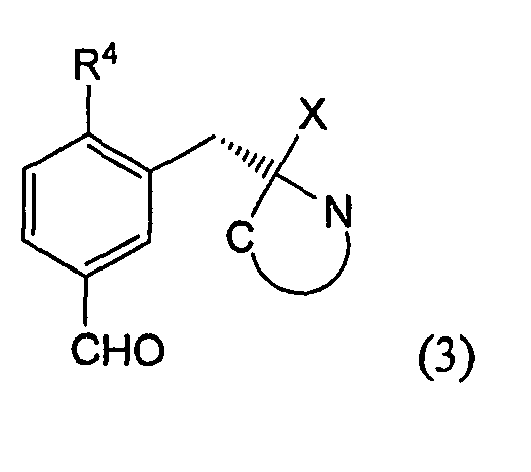
- In einer weiteren Umsetzung kann der Vorläufer nach Formel 3 zu 2-[18F]FPhe oder 6-[18F]FMT umgesetzt werden.
- Hierzu wird die Position des Substituenten R4 des Vorläufers gemäß Formel 3 18F-fluoridiert. Diese Fluoridierung kann durch Standardverfahren erfolgen. Dabei können die Phasentransferkatalysatoren Kryptofix-Kaliumoxalat, Kryptofix-Kaliumcarbonat oder Tetrabutylammoniumhydrogencarbonat als Anionenaktivator für 18F- eingesetzt werden.
- Das 18-fluorierte Zwischenprodukt wird in einem weiteren Schritt abgetrennt. Das 18-fluorierte Zwischenprodukt wird im Falle des 6-[18F]FMT zu einem Ester oxidiert.
- Die Abtrennung kann durch Festphasenextraktion erfolgen. Hierzu wird das Reaktionsgemisch über eine Reverse-phase-Kartusche gereinigt.
- Die Oxidation der Aldehydgruppe kann beispielsweise mit mCPBA, oder Peressigsäure oder Perborat durchgeführt werden, jedoch kommen auch andere Oxidationsmittel in Betracht. Als Lösungsmittel können halogenierte Kohlenwasserstoffe, wie Chloroform oder Methylenchlorid eingesetzt werden.
- Im Falle des 2-[18F]FPhe wird an Stelle der Oxidation eine Decarbonylierung durchgeführt.
- Geeignete Katalysatoren für die Decarbonylierung enthalten zweckmäßig vorzugsweise ein oder mehrere Übergangsmetalle der I., II., VI., VII. und VIII. Nebengruppe, wie Chrom, Mangan, Nickel, Kupfer oder Zink, bevorzugt jedoch ein oder mehrere Metalle aus der Gruppe der Platin-Metalle, insbesondere Rhodium. Dabei kann im heterogenen System mit festen, auf Trägern befindlichen Katalysatoren oder im homogenen System in flüssiger Phase gearbeitet werden.
- Lösliche Rhodium-Komplexe, mit denen in einem homogenen flüssigen System gearbeitet werden kann oder mit denen Träger imprägniert werden können, sind beispielsweise Rhodium(I)-Komplexe, wie CIRh(PPh3)3 ("Wilkinson- Katalysator"), CIRh(CO) (PPh3)2, [CIRh(CO)2]2, acacRh(CO) (PPh3), acacRh(CO)2, (C5H5)Rh(C8H14) und (C3H5)Rh(PPh3), wobei Ph für Phenyl, acac für Acetylacetonat, C8H14 für Cycloocten, C5H5 für Cyclopentadienyl und C3H5 für Allyl stehen. Geeignet sind auch Rhodium(II)- und Rhodium(III)-Komplexe, wie Rhodium(II)-acetat, Rhodium(II)-2,4-difluor-benzoat, Rh(acac)3, RhCl3'xH2O, Rh(NO3)3 und (C3H5)PhCl2(PPh3)2, Zu diesen Rhodium-Komplexen können vorteilhaft noch Verbindungen, die als Liganden wirken können, wie Phosphane, Phosphite oder Amine, zugesetzt werden.
- In einem weiteren Schritt wird das erhaltene Produkt der Oxidation oder Decarbonylierung einer Hydrolyse unterzogen, wobei 2-[18F]FPhe oder 6-[18F]FMT oder deren α-methyliertes Derivat erhalten wird.
- Die Hydrolyse kann in wässriger, vorzugsweise konzentrierter HI oder HBr oder in einer Lösung mit KI und HBr durchgeführt werden.
- Eine Abtrennung des Produktes ist durch HPLC möglich.
- Gegenstand der Erfindung ist auch die Verbindung nach Formel 3 bei der
X = H oder CH3 und
R4= nukleophile Abgangsgruppe, z. B. F, Br, Cl, NO2, -NR3 + mit R = Alkyl, z. B. CH3, C2H5, und
R3= (S)-BOC-BMI: (S)-1-(tert.-Butoxycarbonyl)-2-tert.-butyl-3-methyl-4- imidazolidinon , (S)-Cbz-BMI: (S)-1-Benzoylcarbonyl)-2-tert.-butyl-3-methyl-4-midazolidinon, (S)-BDI: (S)-tert.-Butyl 2-tert.-utyl-4-methoxy-2,5-dihydroimidazol-1-carboxylat, Methyl-(S)-BOC-BMI: (2S,SR)-tert.-butyl-2-tert.-butyl-3,5-dimethyl-4-oxoimidazolidin-1-carboxylat ,Methyl-(S)-Cbz-BMI: (S)-1-(Benzoylcarbonyl)-2-tert.-butyl-3,5-dimethyl-4-imidazolidinon oder Methyl-(S)-BDI: (S)-tert.-Butyl-2-tert.-butyl-5-methyl-4-methoxy-2-hydroimidazol-1-carboxylat ist. - Formelschreibweise:

- Durch Einsatz des neuen Markierungsvorläufers gelingt die Darstellung eines enantiomerenreinen Produktes nach Formel 1 und 2 (ee ≥ 98%) über eine nukleophile Synthese mit nur drei radioaktiven Schritten. Damit wird eine automatisierte Routinesynthese für die Verbindungen nach Formel 1 und 2 praktikabel. Der Vorläufer wird ebenfalls mit einer Enantiomerenreinheit von ≥ 98% erhalten.
- Das erfindungsgemäße Verfahren und der Vorläufer nach Formel 3 ermöglicht eine Synthese, die ab der Nuklidproduktion von 18F- fern bedient oder vollständig automatisiert zu betreiben ist.
- Apparaturen für den automatisierten Synthesebetrieb umfassen in der Regel ein Vorlagegefäß, in welches aus Vorratsgefäßen, welche mit dem Vorlagegefäß über Zuleitungen in Verbindung stehen über eine Steuerung mit Reagentien beschickt wird. Die Befüllung und Entleerung des Vorlagegefäßes erfolgt in der Regel durch Erzeugung eines Überdrucks oder eines Unterdrucks. Beispielhaft kann die kommerziell verfügbare Vorrichtung TRACERlab FX F-N genannt werden, welche neben Vorratsgefäßen für Reagentien, einem Vorlagegefäß aus Glaskohlefaser und Magnetrührer sowie herausziehbarer Nadel, mit einem Aktivitätsdetektor sowie einem Vakuumsystem mit Kühlfalle ausgestattet ist. Die Vorrichtung besitzt eine 18O-Wasser-Aufarbeitung sowie eine Festphasenextraktionseinheit mit präparativer HPLC, zwei HPLC-Eluenten und HPLC Flusskontrolle, UV und Radioaktivitätsdetektoren für die HPLC, Auffangbehälter für Fraktionen, Festphasenextraktion sowie eine HPLC-Lösungsmittelrückführung. Ähnliche Vorrichtungen sind aus "One-step high-radiochemicalyield synthesis of [18F]FP-CIT using a protic solvent system" in Nuc. Med. Biol., 2007; 34: 345-351 von S. Lee, S Oh, D.Chi, S. Kang, H. Kil, J Kim, D. Moon und weiterhin von Chen X, Park r, Shahinian AH, et al. -labeled RGD peptide: initial evaluation for imaging brain tumor angiogenesis /Nuc. Med. Biol.. 2004; 31: 179-189 bekannt.
- Der erfindungsgemäße Vorläufer ermöglicht eine vollautomatisierte Umsetzung einer solchen Anlage, in dem eine 18F-Fluoridierung des Vorläufers nach Formel 3 durchgeführt wird und danach die Aufarbeitung zum Endprodukt, nämlich zu 2-[18F]FPhe oder 6-[18F]FMT, erfolgt. 2-[18F]FPhe und 6-[18F]FMT werden in einer Enantiomere-NReinheit von ≥ 98% erhalten.
- Die Synthese gemäß der
Figur 1 kann mit folgenden Reagenzien durchgeführt werden: - i) Methanol, Natriumborhydrid
- ii) Dichlormethan, Dihydropyan, p-Toluolsulfonsäure
- iii) Tetrahydropyran, sec.-Butyllithium, Dimethylformamid
- iv) Methanol, Natriumborhydrid
- v) Dichlormethan, Tetrabrommethan, Triphenylphosphin
- vi) Tetrahydropyran, Lithiumdiisopropylamin, (S)-Boc-BMI
- vii) Ethanol, Pyridiunium-p-toluolsulfonsäure
- viii) Dichlormethan, Oxalylchlorid, Dimethylsulfoxid, Triethylamin
- Eine Lösung von 5g (24,6 mmol) 3-Brom-4-fluor-benzaldehyd in 20 ml wasserfreiem Methanol wird unter Rühren portionsweise mit 1,38g (36,58 mmol) Natriumborhydrid versetzt und 1 Stunde bei RT gerührt. Nach Zugabe von Wasser wird mit Diethylether extrahiert und die organische Phase über Natriumsulfat getrocknet. Nach Entfernung des Lösungsmittels im Vakuum erhält man den entsprechenden Alkohol. Das Produkt wird in reiner Form erhalten und kann für weitere Reaktionen eingesetzt werden.
Form: farblose Kristalle Ausbeute: 4,68 g (22,9 mmol; 93 %) Rf: 0,41 (Diethylether/n-Hexan = 1:1) - Eine Lösung von 5 g (24,39 mmol) (3-Brom-4-fluor-phenyl)-methanol und 5,6 ml (60,98 mmol) 3,4 Dihydro-2H-pyran in 50 ml absolutem Dichlormethan wird bei 0°C mit einer Spatelspitze Toluolsulfonsäure Monohydrat versetzt und 15 min gerührt. Nach 2 stündigem Rühren bei RT wird mit Diethylether versetzt. Die organische Phase wird abgetrennt, mit Natriumchlorid- und Natriumcarbonat-Lösung sowie Wasser und nochmals mit Natriumchlorid-Lösung gewaschen, über Natriumsulfat getrocknet und das Lösungsmittel im Vakuum entfernt. Das erhaltene Rohprodukt wird säulenchromatographisch an Kieselgel unter Verwendung von Diethylether/n-Hexan (1/3) gereinigt.
Form: farbloses Öl Ausbeute: 6,42 g (22,19 mmol; 91 %) Rf: 0,78 (Diethylether/n-Hexan = 1:1) - 6,42 g (22,19 mmol) 2-(3-Brom-4-fluor-benzyloxy)-tetrahydropyran werden in 50 ml absolutem THF gelöst, bei -78°C unter Argonatmosphäre langsam mit 19,2 ml sec.-BuLi (1,4 M in Cyclohexan) versetzt und 45 min gerührt. Nach Zugabe von 2,6 ml (33,83 mmol) DMF rührt man die Reaktionslösung weitere 60 min bei RT. Nach Zugabe von Wasser wird mit Diethylether extrahiert und die organische Phase über Natriumsulfat getrocknet. Nach Entfernung des Lösungsmittels im Vakuum wird das Rohprodukt anschließend säulenchromatographisch an Kieselgel unter Verwendung von Diethylether/n-Hexan (1/1) gereinigt.
Form: gelbes Öl Ausbeute: 2,5 g (10,49 mmol; 47 %) Rf: 0,68 (Diethylether/n-Hexan= 1:1) - Eine Lösung von 2,5 g (10,49 mmol) 2-Fluor-5-(tetrahydropyran-2-yloxymethyl)-benzaldehyd in wasserfreiem Methanol wird unter Rühren portionsweise mit 0,60 g (15,7 mmol) Natriumborhydrid versetzt und 1 Stunde bei RT gerührt. Nach Zugabe von Wasser wird mit Diethylether extrahiert und die organische Phase über Natriumsulfat getrocknet. Nach Entfernung des Lösungsmittels im Vakuum wird der Benzylalkohol in reiner Form erhalten.
Form: farbloses Öl Ausbeute: 2,04 g (8,49 mmol; 81 %) Rf: 0,25 (Diethylether/n-Hexan = 1:1) - Zu einer eiskalten Lösung von 3 (12,49 mmol) [2-Fluor-5-(tetrahydropyran-2-yloxymethyl)-phenyl]methanol und (15,61 mmol) Tetrabormmethan in 30 ml wasserfreiem Dichlormethan werden 4,44 g (16,94 mmol) Triphenylphosphin in 10 ml Dichlormethan zugetropft und weitere 45 min bei 0°C gerührt. Die Reaktionslösung wird mit Pentan versetzt, der Niederschlag abgesaugt und mit Dichlormethan gewaschen. Das Filtrat wird mit 5% Natriumhydrogencarbonatlösung, Wasser und Natriumchloridlösung gewaschen und über Magnesiumsulfat getrocknet. Nach der Entfernung des Lösungsmittels wird der Rückstand an Kieselgel unter Verwendung von Diethylether/Petrolether 1:10 säulenchromatographisch gereinigt.
Form: farbloses Öl Ausbeute: 1,85 g (6,1 mmol; 49 %) Rf: 0,21 (Diethylether/Petrolether = 1:10) - Zu einer Lösung von 1 g (3,9 mmol) (S)-BOC-BMI in 20 ml wasserfreiem THF werden bei - 78 °C unter Argonatmosphäre 2,6 ml (3,9 mmol) LDA gegeben und 40 min gerührt. Nach Zugabe von 1,18 g (3,9 mmol) 2-(3-Brommethyl-4-fluor-benzyloxy)-tetrahydropyran wird die Reaktionslösung 18 Stunden bei RT gerührt, mit gesättigter Ammoniumchlorid-Lösung versetzt und in Diethylether und Wasser aufgenommen. Die wässrige Phase wird zweimal mit Diethylether extrahiert, die vereinigten organischen Extrakte über Natriumsulfat getrocknet und das Lösungsmittel im Vakuum reduziert. Das Rohprodukt wird säulenchromatographisch an Kieselgel unter Verwendung von Diethylether/Petrolether 2:1 gereinigt.
Form: farbloses Öl Ausbeute: 0,43 g (0,89 mmol; 23%) Rf: 0,58 (Diethylether/Petrolether = 2:1) - 0,43 g (0,89 mmol) (2S,5S)-2-tert.-Butyl-5-[2-fluor-5-(tetrahydro-2H-pyran-2-yloxymethyl)-benzyl]-3-methyl-4-oxo-imidazolin-1-carbonsäure-tert.-butyl ester werden in 10 ml Ethanol gelöst und mit 23 mg (0,09 mmol) Pyridinium-p-toluolsulfonat über Nacht bei 60 °C gerührt. Nach Abkühlung wird das Reaktionsgemisch in Diethylether aufgenommen, mit Natriumchloridlösung gewaschen und über Natriumsulfat getrocknet. Die flüchtigen Bestandteile werden anschließend im Vakuum entfernt.
Ausbeute: 0,34 g (0,88 mmol; 99 %) Form: farbloses Öl Rf: 0,29 (Diethylether/n-Hexan = 10:1) - Unter Argonatmosphäre werden 22 µl (0,26 mmol) Oxalylchlorid in 2 ml Dichlormethan bei -60°C langsam mit 41 µl (0,58 mmol) Dimethylsulfoxid versetzt und 10 min gerührt. Nach Zugabe von 94 mg (0,24 mmol) 2-tert.-Butyl-5-(2-fluor-5-hydroxymethyl-benzyl)-3-methyl-4-oxo-imidazo-lin-1-carbonsäure-tert.-butyl ester in 5 ml Dichlormethan wird weitere 15 min gerührt, die Reaktionslösung mit 167µl (1,2 mmol) Triethylamin versetzt, langsam auf RT erwärmt und nach Zugabe von 5 ml Wasser für weitere 10 min gerührt. Die wässrige Phase wird abgetrennt und mit Dichlormethan extrahiert. Die organische Phase wird über Natriumsulfat getrocknet und das Lösungsmittel im Vakuum entfernt. Das Rohprodukt wird an Kieselgel mit Diethylether/n-Hexan 5:1 chromatographiert.
Form: farbloser Feststoff Ausbeute: 92 mg (0,23 mmol; 98%) Rf: 0,51 (Diethylether/n-Hexan = 5:1)
Claims (2)
- Verbindung der allgemeinen Formel (3)

R4= nukleophile Abgangsgruppe, z. B. F, Br, Cl, NO2, -NR3 + mit R = Alkyl, z. B. CH3, C2H5 und
- Verfahren zur Herstellung der Verbindung nach Formel (3)

R4= nukleophile Abgangsgruppe, z. B. F, Br, Cl, NO2, -NR3 + mit R = Alkyl, z. B. CH3, C2H5 und,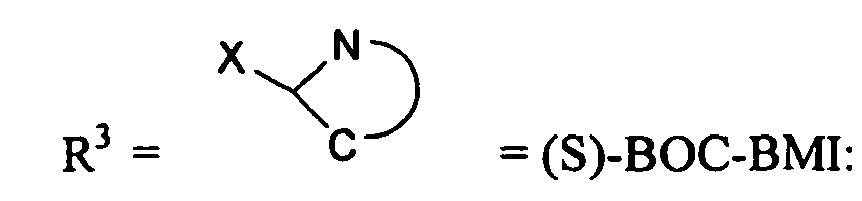

R1 = Br oder I ist
zu Verbindung (c) durch Einführen einer Schutzgruppe
wonach bei Verbindung (c) in einem weiteren Schritt (iii) der Substituent R1 durch eine Formylgruppe ersetzt zu Verbindung (d)
in Verbindung (d) die Formylgruppe in einem Schritt (iv) zu einem Alkohol reduziert wird, wobei das Produkt (e)
Verbindung nach Formel (e) in einem weiteren Schritt (v) zu der Verbindung (f) halogeniert wird , wobei alternativ statt der Br Gruppe eine Tosylgruppe durch Tosylierung eingeführt werden kann ,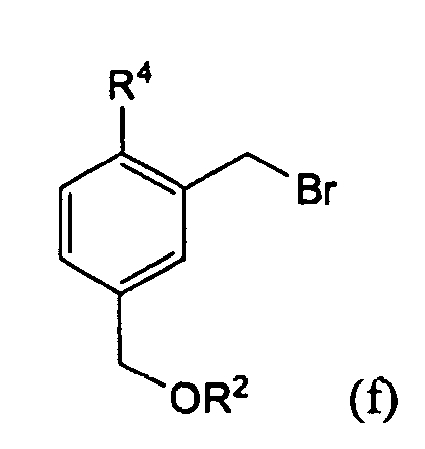
zu dem Produkt (g)
die Verbindung (g) in einem weiteren Schritt (vii) durch Abspalten der Schutzgruppe, R2 zu Verbindung (h)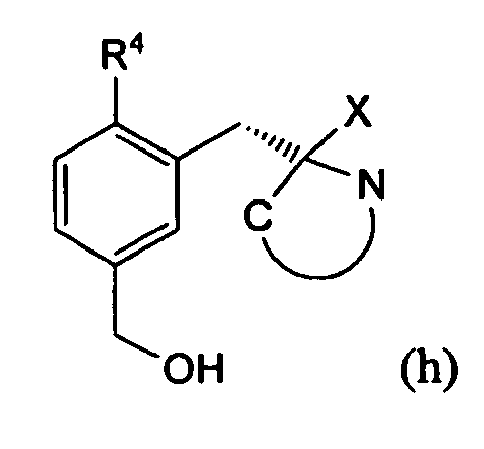

umgesetzt wird, die in Schritt (viii) an der Alkoholfunktion durch Oxidation zu dem Aldehyl nach Formel (3)
Priority Applications (2)
| Application Number | Priority Date | Filing Date | Title |
|---|---|---|---|
| EP11001786.0A EP2357178B1 (de) | 2007-12-07 | 2008-11-21 | Verfahren zur Herstellung von L-2-[18F]Fluor-phenylalanin und 6-[18F]Fluor-L-meta-tyrosin und deren alpha-methylierten Derivaten aus einem Vorläufer |
| DK11001786.0T DK2357178T3 (da) | 2007-12-07 | 2008-11-21 | Fremgangsmåde til fremstillingen af L-2-[18F]fluor-phenylalanin og 6-[18F]fluor-L-meta-tyrosin og deres alfa-alkylerede derivater fra en precursor |
Applications Claiming Priority (2)
| Application Number | Priority Date | Filing Date | Title |
|---|---|---|---|
| DE102007059314A DE102007059314A1 (de) | 2007-12-07 | 2007-12-07 | Verfahren zur Herstellung von Vorläufern für L-2-[18F]Fluor-phenylalanin und -[18F]Fluor-L-meta-tyrosin und deren α-methylierten Derivaten, Vorläufer, so e Verfahren zur Herstellung von L-2-[18F]Fluor-phenylalanin und 6-[18F]Fluor L-meta-tyrosin und deren α-methylierten Derivaten aus dem Vorläufer |
| PCT/DE2008/001936 WO2009071050A2 (de) | 2007-12-07 | 2008-11-21 | VERFAHREN ZUR HERSTELLUNG VON VORLÄUFERN FÜR L-2-[18F]FLUOR-PHENYLALANIN UND 6-[18F]FLUOR- L-META-TYROSIN UND DEREN α-METHYLIERTEN DERIVATEN, VORLÄUFER, SOWIE VERFAHREN ZUR HERSTELLUNG VON 2-[18F]FLUOR-PHENYLALANIN UND 6-[18F]FLUOR-L-META-TYROSIN UND DEREN α- METHYLIERTEN DERIVATEN AUS DEM VORLÄUFER |
Related Child Applications (2)
| Application Number | Title | Priority Date | Filing Date |
|---|---|---|---|
| EP11001786.0A Division EP2357178B1 (de) | 2007-12-07 | 2008-11-21 | Verfahren zur Herstellung von L-2-[18F]Fluor-phenylalanin und 6-[18F]Fluor-L-meta-tyrosin und deren alpha-methylierten Derivaten aus einem Vorläufer |
| EP11001786.0 Division-Into | 2011-03-03 |
Publications (3)
| Publication Number | Publication Date |
|---|---|
| EP2222644A2 EP2222644A2 (de) | 2010-09-01 |
| EP2222644B1 true EP2222644B1 (de) | 2011-08-03 |
| EP2222644B9 EP2222644B9 (de) | 2012-04-18 |
Family
ID=40418914
Family Applications (2)
| Application Number | Title | Priority Date | Filing Date |
|---|---|---|---|
| EP08857143A Not-in-force EP2222644B9 (de) | 2007-12-07 | 2008-11-21 | Verfahren zur herstellung von vorläufern für l-2-[18f]fluor-phenylalanin und 6-[18f]fluor- l-meta-tyrosin und deren alpha-methylierten derivaten, sowie die vorläufer |
| EP11001786.0A Not-in-force EP2357178B1 (de) | 2007-12-07 | 2008-11-21 | Verfahren zur Herstellung von L-2-[18F]Fluor-phenylalanin und 6-[18F]Fluor-L-meta-tyrosin und deren alpha-methylierten Derivaten aus einem Vorläufer |
Family Applications After (1)
| Application Number | Title | Priority Date | Filing Date |
|---|---|---|---|
| EP11001786.0A Not-in-force EP2357178B1 (de) | 2007-12-07 | 2008-11-21 | Verfahren zur Herstellung von L-2-[18F]Fluor-phenylalanin und 6-[18F]Fluor-L-meta-tyrosin und deren alpha-methylierten Derivaten aus einem Vorläufer |
Country Status (6)
| Country | Link |
|---|---|
| US (1) | US8273793B2 (de) |
| EP (2) | EP2222644B9 (de) |
| AT (1) | ATE518838T1 (de) |
| DE (1) | DE102007059314A1 (de) |
| DK (2) | DK2222644T3 (de) |
| WO (1) | WO2009071050A2 (de) |
Families Citing this family (1)
| Publication number | Priority date | Publication date | Assignee | Title |
|---|---|---|---|---|
| KR101269588B1 (ko) | 2010-10-13 | 2013-06-05 | (주)퓨쳐켐 | Fp―cit 전구체로서의 아제티디늄 염, 이의 선택적 제조방법 및 fp―cit의 합성 |
Family Cites Families (1)
| Publication number | Priority date | Publication date | Assignee | Title |
|---|---|---|---|---|
| DE10346228B4 (de) * | 2003-09-25 | 2009-04-09 | Eberhard-Karls-Universität Tübingen Universitätsklinikum | Herstellung von [18F]fluormarkierten aromatischen L-Aminosäuren |
-
2007
- 2007-12-07 DE DE102007059314A patent/DE102007059314A1/de not_active Withdrawn
-
2008
- 2008-11-21 US US12/734,922 patent/US8273793B2/en not_active Expired - Fee Related
- 2008-11-21 DK DK08857143.5T patent/DK2222644T3/da active
- 2008-11-21 EP EP08857143A patent/EP2222644B9/de not_active Not-in-force
- 2008-11-21 DK DK11001786.0T patent/DK2357178T3/da active
- 2008-11-21 EP EP11001786.0A patent/EP2357178B1/de not_active Not-in-force
- 2008-11-21 WO PCT/DE2008/001936 patent/WO2009071050A2/de not_active Ceased
- 2008-11-21 AT AT08857143T patent/ATE518838T1/de active
Also Published As
| Publication number | Publication date |
|---|---|
| US20100256389A1 (en) | 2010-10-07 |
| ATE518838T1 (de) | 2011-08-15 |
| DE102007059314A1 (de) | 2009-07-09 |
| EP2222644A2 (de) | 2010-09-01 |
| WO2009071050A3 (de) | 2009-09-24 |
| DK2222644T3 (da) | 2011-11-28 |
| WO2009071050A2 (de) | 2009-06-11 |
| EP2357178A1 (de) | 2011-08-17 |
| US8273793B2 (en) | 2012-09-25 |
| EP2357178B1 (de) | 2014-05-07 |
| EP2222644B9 (de) | 2012-04-18 |
| DK2357178T3 (da) | 2014-07-07 |
Similar Documents
| Publication | Publication Date | Title |
|---|---|---|
| DE3853386T2 (de) | Enantioselektive Reduktion von Ketonen. | |
| EP2387556B1 (de) | Trennung eines enantiomerengemischs von (r)- und (s)-3-amino-1-butanol | |
| AT401057B (de) | Dioxancarbonsäuren, formylderivate ihrer ester und verfahren zu deren herstellung | |
| EP2222644B1 (de) | Verfahren zur herstellung von vorläufern für l-2-[18f]fluor-phenylalanin und 6-[18f]fluor- l-meta-tyrosin und deren alpha-methylierten derivaten, sowie die vorläufer | |
| EP2336114B1 (de) | Verfahren zur herstellung von l-3,4 dihydroxy-6-[18f]fluor-phenylalanin und 2-[18f]fluor-l-tyrosin und deren alpha-methylierten derivaten aus einem vorläufer | |
| DE69920007T2 (de) | Chemisches verfahren zur stereoselektiven synthese von r-(-)-carnitin | |
| DE602004009831T2 (de) | Verfahren zur gewinnung von tolterodin | |
| EP0374647B1 (de) | Verfahren zur Herstellung von optisch aktiven alpha-Aminoacetalen | |
| KR101874021B1 (ko) | 1-메틸-2-(2-하이드록시에틸)피롤리딘의 효과적인 합성방법 | |
| Suzuki et al. | Highly stereoselective approach to chiral building block possessing three contiguous asymmetric centers. Preparation of four possible diastereomers of β, β′-dimethyl-bis-homoallylic alcohol derivative | |
| EP1413565B1 (de) | Verfahren zur Racematsspaltung von 3-Aminopentannitril | |
| WO2003099746A1 (de) | Verfahren zur herstellung von 18f-fluorierten alpha-aminosäuren | |
| EP0023663B1 (de) | Verfahren zur Herstellung neuer sauerstoffhaltiger Heterocyclen | |
| EP0162235B1 (de) | Enantiomerenreine acetalisch mono-geschützte Diole, deren Herstellung und Verwendung | |
| DE3045916A1 (de) | Verfahren zur herstellung von 4-benzyl- (alpha) -(p-hydroxyphenyl)- (beta) -methyl-1-piperidinaethanol und seinen salzen mit saeuren | |
| DE4032055A1 (de) | Verfahren zur herstellung von optisch aktiven 4-aryl-2-pyrrolidinonen | |
| DE3027325A1 (de) | Neues papaverincarbanion und verfahren zu seiner herstellung | |
| DE19647538A1 (de) | Verfahren zur Herstellung von enantiomerenreinem N-Methyl-N-[1-phenyl-2-(-3-hydroxypyrrolidin-1-yl)ethyl]-2,2-diphenylacetamid | |
| WO1997040008A1 (en) | Process for preparing pyrrolidine derivatives | |
| DE4032054A1 (de) | Verfahren zur herstellung von optisch aktiven 4-aryl-2-pyrrolidinonen | |
| DE3134042A1 (de) | Verfahren zur trennung des racemats s-(carboxymethyl)-(r,s)-cystein (a) | |
| WO1998055456A1 (de) | Verfahren zur herstellung von chiralen 3,4-dehydroprolinen | |
| EP1574508A1 (de) | Verfahren zur Herstellung von Acetalen und Ketalen von 3-Amino-5-(hydroxymethyl)-cyclopentan-1,2-diolen, sowie deren Derivaten und Salzen | |
| JPH09268179A (ja) | 自発的不斉合成による光学活性ピリミジルアルキルアルコールの製造方法 |
Legal Events
| Date | Code | Title | Description |
|---|---|---|---|
| PUAI | Public reference made under article 153(3) epc to a published international application that has entered the european phase |
Free format text: ORIGINAL CODE: 0009012 |
|
| 17P | Request for examination filed |
Effective date: 20100526 |
|
| AK | Designated contracting states |
Kind code of ref document: A2 Designated state(s): AT BE BG CH CY CZ DE DK EE ES FI FR GB GR HR HU IE IS IT LI LT LU LV MC MT NL NO PL PT RO SE SI SK TR |
|
| 17Q | First examination report despatched |
Effective date: 20101022 |
|
| GRAP | Despatch of communication of intention to grant a patent |
Free format text: ORIGINAL CODE: EPIDOSNIGR1 |
|
| RTI1 | Title (correction) |
Free format text: METHOD FOR PRODUCING PRECURSORS FOR L-2-(18F)FLUOROPHENYLALANINE AND 6-(18F)FLUORO-L--META-TYROSINE AND THE ALPHA -METHYLATED DERIVATIVES THEREOF AND THE PRECURSORS |
|
| DAX | Request for extension of the european patent (deleted) | ||
| GRAS | Grant fee paid |
Free format text: ORIGINAL CODE: EPIDOSNIGR3 |
|
| GRAA | (expected) grant |
Free format text: ORIGINAL CODE: 0009210 |
|
| AK | Designated contracting states |
Kind code of ref document: B1 Designated state(s): AT BE BG CH CY CZ DE DK EE ES FI FR GB GR HR HU IE IS IT LI LT LU LV MC MT NL NO PL PT RO SE SI SK TR |
|
| REG | Reference to a national code |
Ref country code: GB Ref legal event code: FG4D Free format text: NOT ENGLISH |
|
| REG | Reference to a national code |
Ref country code: CH Ref legal event code: EP |
|
| REG | Reference to a national code |
Ref country code: IE Ref legal event code: FG4D Free format text: LANGUAGE OF EP DOCUMENT: GERMAN |
|
| REG | Reference to a national code |
Ref country code: DE Ref legal event code: R096 Ref document number: 502008004438 Country of ref document: DE Effective date: 20110929 |
|
| REG | Reference to a national code |
Ref country code: NL Ref legal event code: T3 |
|
| REG | Reference to a national code |
Ref country code: SE Ref legal event code: TRGR |
|
| REG | Reference to a national code |
Ref country code: DK Ref legal event code: T3 |
|
| LTIE | Lt: invalidation of european patent or patent extension |
Effective date: 20110803 |
|
| PG25 | Lapsed in a contracting state [announced via postgrant information from national office to epo] |
Ref country code: HR Free format text: LAPSE BECAUSE OF FAILURE TO SUBMIT A TRANSLATION OF THE DESCRIPTION OR TO PAY THE FEE WITHIN THE PRESCRIBED TIME-LIMIT Effective date: 20110803 Ref country code: NO Free format text: LAPSE BECAUSE OF FAILURE TO SUBMIT A TRANSLATION OF THE DESCRIPTION OR TO PAY THE FEE WITHIN THE PRESCRIBED TIME-LIMIT Effective date: 20111103 Ref country code: LT Free format text: LAPSE BECAUSE OF FAILURE TO SUBMIT A TRANSLATION OF THE DESCRIPTION OR TO PAY THE FEE WITHIN THE PRESCRIBED TIME-LIMIT Effective date: 20110803 Ref country code: PT Free format text: LAPSE BECAUSE OF FAILURE TO SUBMIT A TRANSLATION OF THE DESCRIPTION OR TO PAY THE FEE WITHIN THE PRESCRIBED TIME-LIMIT Effective date: 20111205 Ref country code: FI Free format text: LAPSE BECAUSE OF FAILURE TO SUBMIT A TRANSLATION OF THE DESCRIPTION OR TO PAY THE FEE WITHIN THE PRESCRIBED TIME-LIMIT Effective date: 20110803 Ref country code: IS Free format text: LAPSE BECAUSE OF FAILURE TO SUBMIT A TRANSLATION OF THE DESCRIPTION OR TO PAY THE FEE WITHIN THE PRESCRIBED TIME-LIMIT Effective date: 20111203 |
|
| PG25 | Lapsed in a contracting state [announced via postgrant information from national office to epo] |
Ref country code: SI Free format text: LAPSE BECAUSE OF FAILURE TO SUBMIT A TRANSLATION OF THE DESCRIPTION OR TO PAY THE FEE WITHIN THE PRESCRIBED TIME-LIMIT Effective date: 20110803 Ref country code: CY Free format text: LAPSE BECAUSE OF FAILURE TO SUBMIT A TRANSLATION OF THE DESCRIPTION OR TO PAY THE FEE WITHIN THE PRESCRIBED TIME-LIMIT Effective date: 20110803 Ref country code: LV Free format text: LAPSE BECAUSE OF FAILURE TO SUBMIT A TRANSLATION OF THE DESCRIPTION OR TO PAY THE FEE WITHIN THE PRESCRIBED TIME-LIMIT Effective date: 20110803 Ref country code: GR Free format text: LAPSE BECAUSE OF FAILURE TO SUBMIT A TRANSLATION OF THE DESCRIPTION OR TO PAY THE FEE WITHIN THE PRESCRIBED TIME-LIMIT Effective date: 20111104 Ref country code: PL Free format text: LAPSE BECAUSE OF FAILURE TO SUBMIT A TRANSLATION OF THE DESCRIPTION OR TO PAY THE FEE WITHIN THE PRESCRIBED TIME-LIMIT Effective date: 20110803 |
|
| REG | Reference to a national code |
Ref country code: IE Ref legal event code: FD4D |
|
| PG25 | Lapsed in a contracting state [announced via postgrant information from national office to epo] |
Ref country code: IE Free format text: LAPSE BECAUSE OF FAILURE TO SUBMIT A TRANSLATION OF THE DESCRIPTION OR TO PAY THE FEE WITHIN THE PRESCRIBED TIME-LIMIT Effective date: 20110803 Ref country code: CZ Free format text: LAPSE BECAUSE OF FAILURE TO SUBMIT A TRANSLATION OF THE DESCRIPTION OR TO PAY THE FEE WITHIN THE PRESCRIBED TIME-LIMIT Effective date: 20110803 Ref country code: SK Free format text: LAPSE BECAUSE OF FAILURE TO SUBMIT A TRANSLATION OF THE DESCRIPTION OR TO PAY THE FEE WITHIN THE PRESCRIBED TIME-LIMIT Effective date: 20110803 |
|
| PG25 | Lapsed in a contracting state [announced via postgrant information from national office to epo] |
Ref country code: EE Free format text: LAPSE BECAUSE OF FAILURE TO SUBMIT A TRANSLATION OF THE DESCRIPTION OR TO PAY THE FEE WITHIN THE PRESCRIBED TIME-LIMIT Effective date: 20110803 Ref country code: RO Free format text: LAPSE BECAUSE OF FAILURE TO SUBMIT A TRANSLATION OF THE DESCRIPTION OR TO PAY THE FEE WITHIN THE PRESCRIBED TIME-LIMIT Effective date: 20110803 |
|
| PLBE | No opposition filed within time limit |
Free format text: ORIGINAL CODE: 0009261 |
|
| STAA | Information on the status of an ep patent application or granted ep patent |
Free format text: STATUS: NO OPPOSITION FILED WITHIN TIME LIMIT |
|
| PG25 | Lapsed in a contracting state [announced via postgrant information from national office to epo] |
Ref country code: MC Free format text: LAPSE BECAUSE OF NON-PAYMENT OF DUE FEES Effective date: 20111130 |
|
| 26N | No opposition filed |
Effective date: 20120504 |
|
| REG | Reference to a national code |
Ref country code: DE Ref legal event code: R097 Ref document number: 502008004438 Country of ref document: DE Effective date: 20120504 |
|
| PG25 | Lapsed in a contracting state [announced via postgrant information from national office to epo] |
Ref country code: MT Free format text: LAPSE BECAUSE OF FAILURE TO SUBMIT A TRANSLATION OF THE DESCRIPTION OR TO PAY THE FEE WITHIN THE PRESCRIBED TIME-LIMIT Effective date: 20110803 |
|
| PG25 | Lapsed in a contracting state [announced via postgrant information from national office to epo] |
Ref country code: ES Free format text: LAPSE BECAUSE OF FAILURE TO SUBMIT A TRANSLATION OF THE DESCRIPTION OR TO PAY THE FEE WITHIN THE PRESCRIBED TIME-LIMIT Effective date: 20111114 |
|
| PG25 | Lapsed in a contracting state [announced via postgrant information from national office to epo] |
Ref country code: LU Free format text: LAPSE BECAUSE OF NON-PAYMENT OF DUE FEES Effective date: 20111121 |
|
| PG25 | Lapsed in a contracting state [announced via postgrant information from national office to epo] |
Ref country code: BG Free format text: LAPSE BECAUSE OF FAILURE TO SUBMIT A TRANSLATION OF THE DESCRIPTION OR TO PAY THE FEE WITHIN THE PRESCRIBED TIME-LIMIT Effective date: 20111103 |
|
| PG25 | Lapsed in a contracting state [announced via postgrant information from national office to epo] |
Ref country code: TR Free format text: LAPSE BECAUSE OF FAILURE TO SUBMIT A TRANSLATION OF THE DESCRIPTION OR TO PAY THE FEE WITHIN THE PRESCRIBED TIME-LIMIT Effective date: 20110803 |
|
| PG25 | Lapsed in a contracting state [announced via postgrant information from national office to epo] |
Ref country code: HU Free format text: LAPSE BECAUSE OF FAILURE TO SUBMIT A TRANSLATION OF THE DESCRIPTION OR TO PAY THE FEE WITHIN THE PRESCRIBED TIME-LIMIT Effective date: 20110803 |
|
| PGFP | Annual fee paid to national office [announced via postgrant information from national office to epo] |
Ref country code: DK Payment date: 20141124 Year of fee payment: 7 |
|
| PGFP | Annual fee paid to national office [announced via postgrant information from national office to epo] |
Ref country code: SE Payment date: 20141120 Year of fee payment: 7 Ref country code: GB Payment date: 20141120 Year of fee payment: 7 Ref country code: DE Payment date: 20141011 Year of fee payment: 7 Ref country code: CH Payment date: 20141120 Year of fee payment: 7 |
|
| PGFP | Annual fee paid to national office [announced via postgrant information from national office to epo] |
Ref country code: FR Payment date: 20141118 Year of fee payment: 7 Ref country code: AT Payment date: 20141119 Year of fee payment: 7 Ref country code: NL Payment date: 20141120 Year of fee payment: 7 |
|
| PGFP | Annual fee paid to national office [announced via postgrant information from national office to epo] |
Ref country code: IT Payment date: 20141125 Year of fee payment: 7 |
|
| PGFP | Annual fee paid to national office [announced via postgrant information from national office to epo] |
Ref country code: BE Payment date: 20141125 Year of fee payment: 7 |
|
| REG | Reference to a national code |
Ref country code: DE Ref legal event code: R119 Ref document number: 502008004438 Country of ref document: DE |
|
| REG | Reference to a national code |
Ref country code: DK Ref legal event code: EBP Effective date: 20151130 |
|
| REG | Reference to a national code |
Ref country code: CH Ref legal event code: PL |
|
| REG | Reference to a national code |
Ref country code: AT Ref legal event code: MM01 Ref document number: 518838 Country of ref document: AT Kind code of ref document: T Effective date: 20151121 |
|
| GBPC | Gb: european patent ceased through non-payment of renewal fee |
Effective date: 20151121 |
|
| PG25 | Lapsed in a contracting state [announced via postgrant information from national office to epo] |
Ref country code: CH Free format text: LAPSE BECAUSE OF NON-PAYMENT OF DUE FEES Effective date: 20151130 Ref country code: IT Free format text: LAPSE BECAUSE OF NON-PAYMENT OF DUE FEES Effective date: 20151121 Ref country code: LI Free format text: LAPSE BECAUSE OF NON-PAYMENT OF DUE FEES Effective date: 20151130 |
|
| REG | Reference to a national code |
Ref country code: NL Ref legal event code: MM Effective date: 20151201 |
|
| REG | Reference to a national code |
Ref country code: FR Ref legal event code: ST Effective date: 20160729 |
|
| PG25 | Lapsed in a contracting state [announced via postgrant information from national office to epo] |
Ref country code: AT Free format text: LAPSE BECAUSE OF NON-PAYMENT OF DUE FEES Effective date: 20151121 Ref country code: SE Free format text: LAPSE BECAUSE OF NON-PAYMENT OF DUE FEES Effective date: 20151122 |
|
| PG25 | Lapsed in a contracting state [announced via postgrant information from national office to epo] |
Ref country code: NL Free format text: LAPSE BECAUSE OF NON-PAYMENT OF DUE FEES Effective date: 20151201 |
|
| PG25 | Lapsed in a contracting state [announced via postgrant information from national office to epo] |
Ref country code: GB Free format text: LAPSE BECAUSE OF NON-PAYMENT OF DUE FEES Effective date: 20151121 Ref country code: DK Free format text: LAPSE BECAUSE OF NON-PAYMENT OF DUE FEES Effective date: 20151130 Ref country code: DE Free format text: LAPSE BECAUSE OF NON-PAYMENT OF DUE FEES Effective date: 20160601 |
|
| PG25 | Lapsed in a contracting state [announced via postgrant information from national office to epo] |
Ref country code: FR Free format text: LAPSE BECAUSE OF NON-PAYMENT OF DUE FEES Effective date: 20151130 |
|
| PG25 | Lapsed in a contracting state [announced via postgrant information from national office to epo] |
Ref country code: BE Free format text: LAPSE BECAUSE OF NON-PAYMENT OF DUE FEES Effective date: 20151130 |