EP2203587B1 - Heisssiegelbares, textiles flächengebilde, dessen herstellung und verwendung - Google Patents
Heisssiegelbares, textiles flächengebilde, dessen herstellung und verwendung Download PDFInfo
- Publication number
- EP2203587B1 EP2203587B1 EP07821830.2A EP07821830A EP2203587B1 EP 2203587 B1 EP2203587 B1 EP 2203587B1 EP 07821830 A EP07821830 A EP 07821830A EP 2203587 B1 EP2203587 B1 EP 2203587B1
- Authority
- EP
- European Patent Office
- Prior art keywords
- silane
- heat
- sealable
- fabric
- clothing
- Prior art date
- Legal status (The legal status is an assumption and is not a legal conclusion. Google has not performed a legal analysis and makes no representation as to the accuracy of the status listed.)
- Active
Links
Classifications
-
- D—TEXTILES; PAPER
- D06—TREATMENT OF TEXTILES OR THE LIKE; LAUNDERING; FLEXIBLE MATERIALS NOT OTHERWISE PROVIDED FOR
- D06M—TREATMENT, NOT PROVIDED FOR ELSEWHERE IN CLASS D06, OF FIBRES, THREADS, YARNS, FABRICS, FEATHERS OR FIBROUS GOODS MADE FROM SUCH MATERIALS
- D06M17/00—Producing multi-layer textile fabrics
- D06M17/04—Producing multi-layer textile fabrics by applying synthetic resins as adhesives
-
- A—HUMAN NECESSITIES
- A41—WEARING APPAREL
- A41D—OUTERWEAR; PROTECTIVE GARMENTS; ACCESSORIES
- A41D27/00—Details of garments or of their making
- A41D27/02—Linings
-
- D—TEXTILES; PAPER
- D06—TREATMENT OF TEXTILES OR THE LIKE; LAUNDERING; FLEXIBLE MATERIALS NOT OTHERWISE PROVIDED FOR
- D06N—WALL, FLOOR, OR LIKE COVERING MATERIALS, e.g. LINOLEUM, OILCLOTH, ARTIFICIAL LEATHER, ROOFING FELT, CONSISTING OF A FIBROUS WEB COATED WITH A LAYER OF MACROMOLECULAR MATERIAL; FLEXIBLE SHEET MATERIAL NOT OTHERWISE PROVIDED FOR
- D06N3/00—Artificial leather, oilcloth or other material obtained by covering fibrous webs with macromolecular material, e.g. resins, rubber or derivatives thereof
- D06N3/04—Artificial leather, oilcloth or other material obtained by covering fibrous webs with macromolecular material, e.g. resins, rubber or derivatives thereof with macromolecular compounds obtained by reactions only involving carbon-to-carbon unsaturated bonds
- D06N3/042—Acrylic polymers
-
- D—TEXTILES; PAPER
- D06—TREATMENT OF TEXTILES OR THE LIKE; LAUNDERING; FLEXIBLE MATERIALS NOT OTHERWISE PROVIDED FOR
- D06N—WALL, FLOOR, OR LIKE COVERING MATERIALS, e.g. LINOLEUM, OILCLOTH, ARTIFICIAL LEATHER, ROOFING FELT, CONSISTING OF A FIBROUS WEB COATED WITH A LAYER OF MACROMOLECULAR MATERIAL; FLEXIBLE SHEET MATERIAL NOT OTHERWISE PROVIDED FOR
- D06N3/00—Artificial leather, oilcloth or other material obtained by covering fibrous webs with macromolecular material, e.g. resins, rubber or derivatives thereof
- D06N3/12—Artificial leather, oilcloth or other material obtained by covering fibrous webs with macromolecular material, e.g. resins, rubber or derivatives thereof with macromolecular compounds obtained otherwise than by reactions only involving carbon-to-carbon unsaturated bonds, e.g. gelatine proteins
- D06N3/121—Artificial leather, oilcloth or other material obtained by covering fibrous webs with macromolecular material, e.g. resins, rubber or derivatives thereof with macromolecular compounds obtained otherwise than by reactions only involving carbon-to-carbon unsaturated bonds, e.g. gelatine proteins with polyesters, polycarbonates, alkyds
- D06N3/123—Artificial leather, oilcloth or other material obtained by covering fibrous webs with macromolecular material, e.g. resins, rubber or derivatives thereof with macromolecular compounds obtained otherwise than by reactions only involving carbon-to-carbon unsaturated bonds, e.g. gelatine proteins with polyesters, polycarbonates, alkyds with polyesters
-
- D—TEXTILES; PAPER
- D06—TREATMENT OF TEXTILES OR THE LIKE; LAUNDERING; FLEXIBLE MATERIALS NOT OTHERWISE PROVIDED FOR
- D06N—WALL, FLOOR, OR LIKE COVERING MATERIALS, e.g. LINOLEUM, OILCLOTH, ARTIFICIAL LEATHER, ROOFING FELT, CONSISTING OF A FIBROUS WEB COATED WITH A LAYER OF MACROMOLECULAR MATERIAL; FLEXIBLE SHEET MATERIAL NOT OTHERWISE PROVIDED FOR
- D06N3/00—Artificial leather, oilcloth or other material obtained by covering fibrous webs with macromolecular material, e.g. resins, rubber or derivatives thereof
- D06N3/12—Artificial leather, oilcloth or other material obtained by covering fibrous webs with macromolecular material, e.g. resins, rubber or derivatives thereof with macromolecular compounds obtained otherwise than by reactions only involving carbon-to-carbon unsaturated bonds, e.g. gelatine proteins
- D06N3/14—Artificial leather, oilcloth or other material obtained by covering fibrous webs with macromolecular material, e.g. resins, rubber or derivatives thereof with macromolecular compounds obtained otherwise than by reactions only involving carbon-to-carbon unsaturated bonds, e.g. gelatine proteins with polyurethanes
-
- D—TEXTILES; PAPER
- D06—TREATMENT OF TEXTILES OR THE LIKE; LAUNDERING; FLEXIBLE MATERIALS NOT OTHERWISE PROVIDED FOR
- D06N—WALL, FLOOR, OR LIKE COVERING MATERIALS, e.g. LINOLEUM, OILCLOTH, ARTIFICIAL LEATHER, ROOFING FELT, CONSISTING OF A FIBROUS WEB COATED WITH A LAYER OF MACROMOLECULAR MATERIAL; FLEXIBLE SHEET MATERIAL NOT OTHERWISE PROVIDED FOR
- D06N7/00—Flexible sheet materials not otherwise provided for, e.g. textile threads, filaments, yarns or tow, glued on macromolecular material
- D06N7/0092—Non-continuous polymer coating on the fibrous substrate, e.g. plastic dots on fabrics
-
- D—TEXTILES; PAPER
- D06—TREATMENT OF TEXTILES OR THE LIKE; LAUNDERING; FLEXIBLE MATERIALS NOT OTHERWISE PROVIDED FOR
- D06N—WALL, FLOOR, OR LIKE COVERING MATERIALS, e.g. LINOLEUM, OILCLOTH, ARTIFICIAL LEATHER, ROOFING FELT, CONSISTING OF A FIBROUS WEB COATED WITH A LAYER OF MACROMOLECULAR MATERIAL; FLEXIBLE SHEET MATERIAL NOT OTHERWISE PROVIDED FOR
- D06N2209/00—Properties of the materials
- D06N2209/12—Permeability or impermeability properties
- D06N2209/126—Permeability to liquids, absorption
- D06N2209/128—Non-permeable
-
- D—TEXTILES; PAPER
- D06—TREATMENT OF TEXTILES OR THE LIKE; LAUNDERING; FLEXIBLE MATERIALS NOT OTHERWISE PROVIDED FOR
- D06N—WALL, FLOOR, OR LIKE COVERING MATERIALS, e.g. LINOLEUM, OILCLOTH, ARTIFICIAL LEATHER, ROOFING FELT, CONSISTING OF A FIBROUS WEB COATED WITH A LAYER OF MACROMOLECULAR MATERIAL; FLEXIBLE SHEET MATERIAL NOT OTHERWISE PROVIDED FOR
- D06N2211/00—Specially adapted uses
- D06N2211/10—Clothing
Definitions
- the present invention relates to a heat-sealable textile fabric for reinforcing garments, in particular to articles of clothing rendered hydrophobic, to the production thereof and to particularly advantageous uses thereof.
- Such fabrics use as support material woven, knitted fabric, optionally with weft insertion, and nonwovens, being used as material yarns in particular of polyethylene, polypropylene, polyethylene terephthalate, polyamide, polyacrylonitrile, cellulose or cotton or mixtures thereof.
- material yarns in particular of polyethylene, polypropylene, polyethylene terephthalate, polyamide, polyacrylonitrile, cellulose or cotton or mixtures thereof.
- highly elastic or even less elastic inserts can be produced, wherein said yarns can also be textured yarns.
- a (melt) adhesive layer is then applied, with this adhesive layer, the connection with the garment takes place.
- the chemical and physical-chemical properties of the heat-sealable adhesive layer are selected so that the respective requirements for melting range, melt viscosity, grain size and amount of adhesive applied per area, the greatest possible adhesion of the fabric on the Ensure outer fabric. These requirements are largely determined by the planned use of the fabric. Thus, for example, fabrics are produced whose laminates with the outer fabric only wash at 40 ° C must survive without delamination, other fabrics, especially for workwear, must after repeated washes at temperatures of up to 95 ° C no blistering or delamination. Furthermore, the shrinkage behavior between the fabric and bonded to this upper material must be the same in particular when ironing, so as to avoid an ugly appearance of goods. Further requirements in the clothing sector are the stability of the fixed insert during dry cleaning or a pleasant and soft feel. Such fabrics can also be used for applications other than outerwear such as technical applications, with other criteria being important such as adequate heat resistance, low lamination temperatures, or grade purity.
- the required requirements for the sufficient adhesive forces between the fabric and the outerwear fabric are generally met if the adhesive system is suitably selected.
- the adhesive system is suitably selected.
- polyurethane, copolyester or copolyamide as well as polyacrylate are used as the material of the adhesive.
- EP 1 541 751 A1 describes the use of protective colloid-stabilized polymers for coatings which are used for the production of textile fabrics.
- This polymer is used in the form of a paste, whereby crosslinking can be carried out by addition of compounds with, for example, alcohol, aminosilane, isocyanate radicals or other radicals.
- Subpoint of the double-point coating polyurethane, polyacrylate, copolyester or copolyamide contains and contains the top of the double-point coating a polyurethane, copolyester or copolyamide and additionally at least one silane.
- the mixture between the polymeric material and the at least one silane can be carried out according to a particularly preferred embodiment by the so-called "dry-blending" method.
- This mixture can consist of the powder of the polymeric material and a powder of the at least one silane, these substances being mixed dry in a suitable mixing ratio, usually at room temperature.
- the material for the adhesive layer in the form of a paste.
- the materials to be used for this purpose from the powder of the polymeric material and the powder of the at least one silane are mixed with water, preferably at room temperature, if appropriate with the additional use of a conventional flow aid, a thickener and optionally further customary additives. These materials are mixed into a paste and then applied in the usual way in the form of a so-called paste point.
- a suitable mixing ratio between the at least one silane and the polymeric material is in the range (weight ratio) of 99.95-95.00% of the polymeric material and 0.05-5.00% of the total amount of the silane, preferably 99.90-98 , 00% of the polymer and 0.10-2.00% of the total amount of silane.
- the content of the silane is particularly preferably 0.5-1.5% by weight. If larger quantities of silane are used to produce the mixture of the polymeric material and the silane, a deterioration of the adhesive force may occur. If this adhesive composition is applied in the form of a powder, amounts of more than about 10% by weight of silane can impair the flowability of the resulting scattering powder.
- This invention also relates to a process for producing a heat sealable fabric.
- a raw fabric, raw knit fabric, optionally with weft insertion, or a nonwoven fabric in the usual manner. This is usually followed by a washing and / or shrinking process, optionally followed by a dyeing process. After thermostabilization of the raw fabric, raw knit fabric or nonwoven thus obtained, one side thereof is usually applied in raster form with an adhesive layer in the abovementioned form of the double-point coating.
- the application weight of the adhesive according to the invention is generally 8-15 g / m 2 , preferably 9-13 g / m 2 .
- the adhesive layer is applied to the substrate by the known double-point method.
- This coating method has long been state of the art and can be used according to the invention without restriction.
- the adhesive of the polymeric material with the silane respectively to use for the top and bottom.
- the sub-point is based on polyurethane, polyacrylate, copolyester or copolyamide and thus no mixture with silane is used.
- the upper point consists of the described mixture of the polymeric material with the at least one silane. This results in a particularly good adhesion to a hydrophobically finished outer fabric, which is used for example for rainwear.
- a particularly preferably used adhesive is a composition of copolyamide with the abovementioned N- (2-aminoethyl) -3-aminopropyltrimethoxysilane. This mixture gives particularly good adhesion values.
- the textile fabric described according to the invention will preferably be used to reinforce garments, in particular hydrophobically finished or siliconized garments. Especially when the fabric is used for a rainwear such as a raincoat, rain jacket or pants, good adhesion values are associated with a high waterproofness of the produced composite.
- a polyester fabric made from textured yarns (warp dtex 35 f 24/1, weft dtex 100 f 72/1, basis weight about 25 g / m 2 ) is provided in the usual way with crosslinkable silicone softener (12 g / l, liquor pick-up 85 %) and thermally fixed.
- this interlining material is printed in a known manner with a polyurethane paste prepared from a polyurethane dispersion, acrylate thickener and running aid and sprinkled with copolyamide scattering powder (Vestamelt X1027 80-200 ⁇ m from Degussa). Excess dust is sucked out.
- the coated web is then driven through a Tockenofen, in which the printed polymer dots are dried and sintered.
- the web is cooled by means of cooling rolls and wound up on a quay.
- the coating weight of the insert is 9-11 g / m 2 .
- Example 2 The same polyester fabric as in Example 1 is equipped as described there with silicone plasticizer and thermally fixed.
- the interlining material is printed as described in Example 1 and sprinkled with copolyamide scattering powder to which 1% aminosilane (N- (2-aminoethyl) -3-aminopropyltrimethoxysilane) was mixed homogeneously. After sucking off the excess scattering powder is dried as described in Example 1, sintered, cooled and wound up. The coating weight is 9-11 g / m 2 . (Insert 2)
- a knit fabric made of 100% polyamide (warp dtex 17 f 5; weft dtex 22 f 14/2; basis weight approx. 18 g / m 2 ) is equipped, thermally fixed and coated as described in Example 1.
- the coating weight is 8-10 g / m 2 . (Insert 3)
- a knit fabric of 100% polyamide as described in Example 3 is printed with polyurethane paste as described in Example 2 and sprinkled with silane-modified copolymide (1% aminosilane, 99% copolyamide).
- the product is freed by suction from excess dusting powder and dried in a drying oven and sintered. After cooling on a cooling roller, the coated goods are wound onto a quay.
- the coating weight is 8-10 g / m 2 .
- Thermobonded nonwoven 100% polyamide (basis weight 22 g / m 2 ) is coated and wound up as described in Example 1.
- the coating weight is 10-12 g / m 2 . (Insert 5)
- Thermobonded nonwoven made of 100% polyamide (see Example 5) is printed as described in Example 2 with polyurethane paste and sprinkled with silane-modified Copolyamidstreupulver, sucked off, sintered, cooled and wound up.
- the coating weight is 10-12 g / m 2 .
- a knitwear made of 100% polyamide as described in Example 3 is printed with polyurethane paste as described in Example 2 and copolyamide scattering powder modified with epoxysilane (3-glycidyloxypropyltrimethoxysilane) sprinkled, filtered off with suction, sintered, cooled and wound up.
- the coating weight is 10-13 g / m 2 .
- a knit fabric of 100% polyamide as described in Example 2 is printed with a paste which in addition to the usual paste ingredients such as flow aids and thickeners also copolyamide powder sized 80-200 microns sprinkled, vacuumed, sintered, cooled and wound up.
- the coating weight is 10-13 g / m 2 .
- a knit fabric printed as in Example 8 is sprinkled with aminosilane-modified scattering powder as in Example 2, 3, 4, 5, 6, sucked off, sintered, cooled and wound up.
- the coating weight is 10-13 g / m 2 .
- the test fabric for the adhesion tests is a polyester fabric which has been pad-finished with a three-dimensional cross-linkable silicone.
- the interlining of Example 1-13 were pressed with this outer fabric on a fuser press at 127 ° C joint temperature, a pressure of 1.5 bar and a residence time of 10 s and then cut into 5 cm wide strips. These specimens were tested after storage for 48 hours under standard conditions (DIN 53 802-79) with the aid of an adhesion tester from Instron (INSTRON 44443) with regard to the adhesive strength of the insert on the outer fabric in accordance with DIN 54 310.
- the outer material and the insert are separated by hand so that the outer fabric and insert can be clamped in the clamping device of the Trennkraftprüfauss in the test specimens.
- Inlay and outer fabric are separated at a defined terminal removal speed. It will determines the force required to separate the two interconnected fabrics. The average values from 5 measurements are given.
Landscapes
- Engineering & Computer Science (AREA)
- Textile Engineering (AREA)
- Chemical & Material Sciences (AREA)
- Chemical Kinetics & Catalysis (AREA)
- Dispersion Chemistry (AREA)
- Treatments For Attaching Organic Compounds To Fibrous Goods (AREA)
- Laminated Bodies (AREA)
- Adhesive Tapes (AREA)
- Manufacturing Of Multi-Layer Textile Fabrics (AREA)
Description
- Die vorliegende Erfindung betrifft ein heißsiegelbares, textiles Flächengebilde zur Verstärkung von Bekleidungsstücken, insbesondere hydrophob ausgerüsteten Bekleidungsstücken, dessen Herstellung und besonders günstige Verwendungen davon.
- Zur Verstärkung von Bekleidungsstücken wie insbesondere Mänteln und Jacken werden textile Flächengebilde verwendet. Derartige Flächengebilde oder auch Einlagen werden als sogenannte Ganzteileinlagen auf der linken Seite des Oberstoffes mittels punktförmig auf dem Flächengebilde aufsitzender Klebemassen unter Druck- und Hitzeanwendung auffixiert.
- Derartige Flächengebilde verwenden als Trägermaterial Gewebe, Gewirke, gegebenenfalls mit Schusseintrag, und Vliese, wobei als Material Garne insbesondere aus Polyethylen, Polypropylen, Polyethylenterephtalat, Polyamid, Polyacrylnitril, Cellulose oder Baumwolle oder Mischungen daraus verwendet werden. Je nach Anwendungsgebiet oder Anforderung des Anwenders können stark elastische oder auch weniger elastische Einlagen hergestellt werden, wobei die genannten Garne auch texturierte Garne sein können.
- Auf eine Seite des Trägermaterials wird dann eine (Schmelz-)Klebeschicht aufgetragen, wobei mit dieser Klebeschicht die Verbindung mit dem Bekleidungsstück erfolgt.
- Die chemischen und physikalisch-chemischen Eigenschaften der heißsiegelbaren Klebeschicht werden so ausgewählt, dass die jeweiligen Anforderungen an Schmelzbereich, Schmelzviskosität, Korngröße und Kleberauftragsmenge pro Fläche die größtmögliche Haftung des Flächengebildes auf dem Oberstoff gewährleisten. Diese Anforderungen werden weitgehend auch durch den geplanten Einsatz des Flächengebildes mitbestimmt. So werden beispielsweise Flächengebilde hergestellt, deren Laminate mit dem Oberstoff lediglich Wäschen bei 40°C überstehen müssen, ohne zu delaminieren, andere Flächengebilde, insbesondere für Berufsbekleidung, dürfen nach mehrmaligen Wäschen bei Temperaturen von bis zu 95°C keine Blasenbildung beziehungsweise Delaminierung aufweisen. Weiterhin muss das Schrumpfverhalten zwischen dem Flächengebilde und dem mit diesem verklebten Oberstoff insbesondere beim Bügeln gleich sein, um so ein unschönes Warenbild zu vermeiden. Weitere Anforderungen aus dem Bekleidungsbereich sind die Beständigkeit der fixierten Einlage bei der chemischen Reinigung oder auch ein angenehmer und weicher Griff. Derartige Flächengebilde können auch für andere Anwendungen als die Oberbekleidung wie zum Beispiel für technische Anwendungen eingesetzt werden, wobei hierfür andere Kriterien wichtig sind, wie beispielsweise die ausreichende Wärmestandfestigkeit, niedrige Laminiertemperaturen oder eine Sortenreinheit.
- Die geforderten Anforderungen an die ausreichenden Haftkräfte zwischen Flächengebilde und Oberbekleidungsstoff werden in der Regel erfüllt, wenn das Klebesystem geeignet ausgewählt wird. Üblicherweise werden als Material der Klebemasse Polyurethan, Copolyester oder Copolyamid ebenso wie Polyacrylat verwendet.
- Obwohl die Haftkraft zwischen dem Flächengebilde und dem Oberstoff in den letzten Jahrzehnten Gegenstand vieler Untersuchungen war, besteht immer noch ein Bedürfnis für das Erzielen von ausreichenden Haftkräften, insbesondere wenn der Oberstoff hydrophob ausgerüstet ist. Besonders hat sich erwiesen, dass bei silikonisierten Oberstoffen, die mit vernetzbaren Silikonen ausgerüstet beziehungsweise beschichtet sind, die Haftkraft zum aufgebrachten textilen Flächengewebe Mängel aufweist. Solche stark silikonisierten Oberstoffe werden insbesondere als Regenschutz zum Beispiel im Outdoor-Bereich verwendet. Um die Haftung zu den heißsiegelfähigen, textilen Flächengebilden sicherzustellen, werden häufig derartige Flächengebilde zusätzlich mit dem Oberstoff vernäht. Soll ein hydrophob ausgerüstetes Bekleidungsstück als Regenschutz eingesetzt werden, beispielsweise als Regenmantel oder Regenjacke, führt das Vernähen zu dem Nachteil, dass die geforderte Wasserdichtigkeit nicht mehr sichergestellt werden kann. Aus
EP 1 541 751 A1 ist die Verwendung schutzkolloidstabilisierter Polymere für Beschichtungen bekannt, die zur Erzeugung von textilen Flächengebilden eingesetzt werden. Dieses Polymer wird in Form einer Paste verwendet, wobei durch Zugabe von Verbindungen mit z.B. Alkohol-, Aminosilan-, Isocyanat-Resten oder anderen Resten eine Vernetzung durchgeführt werden kann. - Angesichts dessen war es die Aufgabe der vorliegenden Erfindung, ein heißsiegelfähiges, textiles Flächengebilde bereitzustellen, das insbesondere auf silikonisierten Oberstoffen ausreichend gute Haftungen erzeugt, um somit den aufwendigen und nachteiligen Nähvorgang durch einen zeitgemäßen und auch kostengünstigen Klebvorgang zu ersetzen.
- Überraschenderweise wurde festgestellt, dass dieses Problem gelöst werden kann durch ein heißsiegelfähiges, textiles Flächengebilde mit einem Träger auf Basis eines Gewebes, Gewirkes, gegebenenfalls mit Schusseintrag, oder eines Vlieses und mit einer darauf rasterförmig aufgebrachten Klebeschicht mit einem polymeren Material in Form einer Doppelpunktbeschichtung wobei der Unterpunkt der Doppelpunktbeschichtung Polyurethan, Polyacrylat, Copolyester oder Copolyamid enthält und der Oberpunkt der Doppelpunktbeschichtung ein Polyurethan, Copolyester oder Copolyamid und zusätzlich mindestens ein Silan enthält.
- Es wurde festgestellt, dass besonders bei silikonisierten Bekleidungsstoffen eine hervorragende Haftung mit dem textilen Flächegebilde dieser Erfindung erzielt werden kann, wobei die Haftkräfte zum Teil auch deutlich höher sind als sie üblicherweise erzielt werden können. Ein Nähvorgang kann aus diesem Grunde sogar vollständig weggelassen werden. Somit ist es möglich, insbesondere eine Regenbekleidung zu erhalten, die eine feste Fixierung mit dem textilen Flächengebilde aufweist, ohne dass die Wasserdichtigkeit durch die bisher üblichen Nähvorgänge in Frage gestellt wird. Erfindungsgemäß wird somit eine Mischung aus den polymeren Materialien mit zumindest einem Silan vorgeschlagen. Das polymere Material ist ein für Klebemassen üblicherweise verwendetes Material wie beispielsweise Polyurethan, Copolyester, Copolyamid, aber auch Polyacrylat. Derartige Materialien werden bisher herkömmlich für die rasterförmige Beschichtung von Einlagestoffen verwendet.
- Als das mindestens eine Silan, das in Mischung mit dem polymeren Material eingesetzt wird, werden bevorzugt Epoxysilane, Aminosilane und Acrylsilane oder Mischungen daraus verwendet. Besonders bevorzugt unter diesen Silanen sind die Aminosilane, wobei jene mit alkoxyfunktionellen Gruppen gemäß der folgenden allgemeinen Formel besonders bevorzugt sind:

- R1 =
- Alkylrest mit 1-8 C-Atomen oder ein Alkylrest aus 2 bis 8 C-Atomen, der ein Sauerstoffatom in der Kette enthält
- n =
- 0 oder 1
- R2 =
- H oder Alkylrest mit 1-8 C-Atomen
- R3 =
- Alkylrest aus 1-8 C-Atomen oder ein Aryl- oder Cycloalkylrest oder ein Arylalkylrest
- X =
-
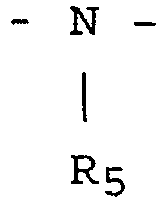
- p =
- 0 oder 1
- R4 =
- Alkylrest aus 1-8 C-Atomen
- q =
- 0 oder 1 mit der Maßgabe, dass q=0, wenn p=0
- Als besonders wirksames und somit erfindungsgemäß besonders bevorzugtes Aminosilan erwies sich
N-(2-Aminoethyl)-3-aminopropyltrimetoxysilan. Aus der Gruppe der Epoxysilane zeigte insbesondere
3-Glycidyloxyproplyltrimethoxysilan eine hervorragende Haftwirkung. - Die Mischung zwischen dem polymeren Material und dem zumindest einen Silan kann nach einer besonders bevorzugten Ausführungsform nach dem sogenannten "Dry-Blending"-Verfahren erfolgen. Diese Mischung kann aus dem Pulver aus dem polymeren Material und einem Pulver aus dem mindestens einen Silan bestehen, wobei diese Substanzen in einem geeigneten Mischungsverhältnis trocken, üblicherweise bei Raumtemperatur miteinander vermischt werden.
- Alternativ ist es auch möglich, das Material für die Klebeschicht in Form einer Paste bereitzustellen. Die hierfür zu verwendenden Materialien aus dem Pulver aus dem polymeren Material und dem Pulver aus dem mindestens einen Silan werden dabei, bevorzugt bei Raumtemperatur mit Wasser vermischt, gegebenenfalls unter zusätzlicher Verwendung eines üblichen Laufhilfsmittels, eines Verdickers und gegebenenfalls weiterer üblicher Zusätze. Diese Materialien werden zu einer Paste angerührt und dann auf übliche Weise in Form eines sogenannten Pastenpunktes aufgetragen.
- Ein geeignetes Mischungsverhältnis zwischen dem mindestens einen Silan und dem polymeren Material liegt im Bereich (Gewichtsverhältnis) von 99,95-95,00 % des polymeren Materials und 0,05-5,00 % der Gesamtmenge des Silans, vorzugsweise 99,90-98,00 % des Polymers und 0,10-2,00 % der Gesamtmenge des Silans. Besonders bevorzugt ist der Gehalt des Silans 0,5-1,5 Gew.-%. Werden größere Silanmengen für die Erzeugung der Mischung aus dem polymeren Material und dem Silan eingesetzt, kann eine Verschlechterung der Haftkraft sich einstellen. Wird diese Haftmasse in Form eines Pulvers aufgetragen, können Mengen von mehr als etwa 10 Gew.-% Silan die Rieselfähigkeit des entstandenen Streupulvers beeinträchtigen.
- Diese Erfindung betrifft auch ein Verfahren zur Erzeugung eines heißsiegelfähigen, textilen Flächengebildes. Hierfür wird zunächst ein Rohgewebe, Rohgewirke, gegebenenfalls mit Schusseintrag, oder ein Vlies auf übliche Art und Weise hergestellt. Daran schließt sich üblicherweise ein Wasch-und/oder Schrurnpfungsvorgang an, gegebenenfalls mit anschließender Durchführung eines Färbevorgangs. Nach einer Thermostabilisierung des somit erhaltenen Rohgewebes, Rohgewirkes oder Vlieses wird eine Seite davon mit einer Klebeschicht in der oben genannten Form der Doppelpunktbeschichtung üblicherweise in Rasterform aufgetragen. Das Auftragsgewicht der erfindungsgemäßen Klebemasse ist im Allgemeinen 8-15 g/m2, bevorzugt 9-13 g/m2.
- Die Klebeschicht wird durch das bekannte Doppelpunktverfahren auf das Trägermaterial aufgetragen. Dieses Beschichtungsverfahren ist seit langem Stand der Technik und kann erfindungsgemäß ohne Einschränkung angewandt werden. Durch Auftragen in Form eines Doppelpunktes, ist es möglich, die Klebemasse aus dem polymeren Material mit dem Silan jeweils für den Oberpunkt und den Unterpunkt zu verwenden. Es ist aber auch möglich, dass der Unterpunkt auf Basis von Polyurethan, Polyacrylat, Copolyester oder Copolyamid besteht und somit keine Mischung mit Silan verwendet wird. In diesem Fall besteht der Oberpunkt aus der beschrieben Mischung aus dem polymeren Material mit dem mindestens einen Silan. Hierdurch ergibt sich eine besonders gute Haftung zu einem hydrophob ausgerüsteten Oberstoff, der beispielsweise für eine Regenbekleidung eingesetzt wird.
- Eine besonders bevorzugt eingesetzte Klebemasse ist eine Masse aus Copolyamid mit dem oben genannten N-(2-Aminoethyl)-3-aminopropyltrimethoxysilan. Diese Mischung ergibt besonders gute Haftwerte.
- Das erfindungsgemäß beschriebene textile Flächengebilde wird bevorzugt zur Verstärkung von Bekleidungsstücken, insbesondere hydrophob ausgerüsteten oder silikonisierten Bekleidungsstücken verwendet werden. Besonders wenn das Flächengebilde für eine Regenbekleidung wie einen Regenmantel, Regenjacke oder -hose verwendet wird, werden gute Haftwerte verbunden mit einer hohen Wasserdichtigkeit des erzeugten Verbundes festgestellt.
- Diese Erfindung wird nachfolgend unter Bezugnahme auf konkrete Beispiele noch näher erläutert.
- Ein aus texturierten Garnen hergestelltes Polyestergewebe (Kette dtex 35 f 24/1; Schuss dtex 100 f 72/1; Flächengewicht ca. 25 g/m2) wird in üblicher Weise mit vernetzbarem Silikon-Weichmacher ausgerüstet (12 g/l, Flottenaufnahme 85 %) und thermisch fixiert. Auf einer Doppelpunkt-Beschichtungsanlage wird dieser Einlagestoff mit einer Polyurethan-Paste, die aus einer Polyurethan-Dispersion, Acrylatverdicker und Laufhilfsmittel hergestellt wurde, in bekannter Weise bedruckt und mit Copolyamid-Streupulver (Vestamelt X1027 80-200 µm der Firma Degussa) bestreut. Überschüssiges Streupulver wird abgesaugt. Die beschichtete Warenbahn wird anschließend durch einen Tockenofen gefahren, in welchem die aufgedruckten Polymerpunkte getrocknet und angesintert werden. Am Ende des Trocknertunnels wird die Warenbahn mittels Kühlwalzen abgekühlt und auf eine Kaule aufgewickelt. Das Beschichtungsgewicht der Einlage beträgt 9-11 g/m2. (Einlage 1)
- Das gleiche Polyestergewebe wie in Beispiel 1 wird wie dort beschrieben mit Silikon-Weichmacher ausgerüstet und thermisch fixiert. Auf der Doppelpunkt-Beschichtungsanlage wird der Einlagestoff wie in Beispiel 1 geschilderter Weise bedruckt und mit Copolyamid-Streupulver bestreut, welchem 1 % Aminosilan (N-(2-Aminoethyl)-3-aminopropyltrimethoxysilan) homogen zugemischt wurde. Nach Absaugen des überschüssigen Streupulvers wird wie in Beispiel 1 beschrieben, getrocknet, gesintert, abgekühlt und aufgewickelt. Das Beschichtungsgewicht beträgt 9-11 g/m2. (Einlage 2)
- Eine Maschenware, hergestellt aus 100 % Polyamid (Kette dtex 17 f 5; Schuss dtex 22 f 14/2; Flächengewicht ca. 18 g/m2) wird wie in Beispiel 1 beschrieben ausgerüstet, thermisch fixiert und beschichtet. Das Beschichtungsgewicht beträgt 8-10 g/m2. (Einlage 3)
- Eine wie in Beispiel 3 beschriebene Maschenware aus 100 % Polyamid wird wie in Beispiel 2 beschrieben mit Polyurethan-Paste bedruckt und mit Silan modifiziertem Copolymid (1 % Aminosilan, 99 % Copolyamid) bestreut. Die Ware wird durch Absaugen von überschüssigem Streupulver befreit und in einem Tockenofen getrocknet und gesintert. Nach dem Abkühlen auf einer Kühlwalze wird die beschichtete Ware auf eine Kaule aufgewickelt. Das Beschichtungsgewicht beträgt 8-10 g/m2.
- Thermobondiertes Vlies aus 100 % Polyamid (Flächengewicht 22 g/m2) wird wie in Beispiel 1 beschrieben beschichtet und aufgewickelt. Das Beschichtungsgewicht beträgt 10-12 g/m2. (Einlage 5)
- Thermobondiertes Vlies aus 100 % Polyamid (siehe Beispiel 5), wird wie in Beispiel 2 beschrieben mit Polyurethan-Paste bedruckt und mit Silan modifiziertem Copolyamidstreupulver bestreut, abgesaugt, gesintert, gekühlt und aufgewickelt. Das Beschichtungsgewicht beträgt 10-12 g/m2. (Einlage 6)
- Eine wie in Beispiel 3 beschriebene Maschenware aus 100 % Polyamid wird wie in Beispiel 2 beschrieben mit Polyurethan-Paste bedruckt und mit Epoxysilan modifiziertem Copolyamidstreupulver (3-Glycidyloxypropyltrimethoxysilan) bestreut, abgesaugt, gesintert, gekühlt und aufgewickelt. Das Beschichtungsgewicht beträgt 10-13 g/m2. (Einlage 7)
- Eine wie in Beispiel 2 beschriebene Maschenware aus 100 % Polyamid wird mit einer Paste bedruckt, die neben den üblichen Pastenbestandteilen wie Laufhilfsmittel und Verdicker auch Copolyamidpulver der Korngröße 80-200 µm bestreut, abgesaugt, gesintert, gekühlt und aufgewickelt. Das Beschichtungsgewicht beträgt 10-13 g/m2. (Einlage 8)
- Eine wie in Beispiel 8 bedruckte Maschenware wird mit Aminosilan modifiziertem Streupulver wie in Beispiel 2, 3, 4, 5, 6 bestreut, abgesaugt, gesintert, gekühlt und aufgewickelt. Das Beschichtungsgewicht beträgt 10-13 g/m2.
- Als Testoberstoff für die Haftungsprüfungen dient ein Polyestergewebe, welches im Foulardverfahren mit einem dreidimensional vernetzbaren Silikon ausgerüstet wurde. Die Einlagestoffe der Beispiel 1-13 wurden mit diesem Oberstoff auf einer Fixierpresse bei 127°C Fugentemperatur, einem Druck von 1,5 bar und einer Verweildauer von 10 s verpresst und anschließend in 5 cm breite Streifen geschnitten. Diese Prüflinge wurden nach Lagerung von 48 Stunden bei Normklima (DIN 53 802-79) mit Hilfe eines Haftungsprüfgerätes der Firma Instron (INSTRON 44443) hinsichtlich Klebkraft der Einlage auf dem Oberstoff gemäß DIN 54 310 geprüft. Dazu werden bei den Prüflingen Oberstoff und Einlage von Hand soweit voneinander getrennt, dass Oberstoff und Einlage in die Klemmvorrichtung des Trennkraftprüfgerätes eingespannt werden können. Einlage und Oberstoff werden bei festgelegter Klemmenabzugsgeschwindigkeit voneinander getrennt. Dabei wird die Kraft ermittelt, die zur Trennung der beiden miteinander verbundenen Flächengebilde erforderlich ist. Angegeben werden die Durchschnittswerte aus 5 Messungen.
-
Doppelpunktbeschichtung Prüfling Streupulver Paste Haftung [N/5 cm] Einlage 1 PES-Webware ohne Silan PU-Paste 10-12 Einlage 2 PES-Webware 1 % Amino-S PU-Paste 18-20 Einlage 3 PA-Maschenware ohne Silan PU-Paste 20-22 Einlage 4 PA-Maschenware 1 % Amino-S PU-Paste 35-37 Einlage 5 PA-Vlies ohne Silan PU-Paste 6-8 Einlage 6 PA-Vlies 1 % Amino-S PU-Paste >14 (Abriss) Einlage 7 PA-Maschenware 1 % Epoxy-S PU-Paste 31-33 Einlage 8 PA-Maschenware ohne Silan PA-Paste 14-16 Einlage 9 PA-Maschenware 1 % Amino-S PA-Paste 27-29
Claims (12)
- Heißsiegelfähiges, textiles Flächengebilde mit einem Träger auf Basis eines Gewebes, Gewirkes, Gewirkes mit Schusseintrag oder eines Vlieses und einer darauf rasterförmig aufgebrachten Klebeschicht mit einem polymeren Material in Form einer Doppelpunktbeschichtung, dadurch gekennzeichnet, dass der Unterpunkt der Doppelpunktbeschichtung Polyurethan, Polyacrylat, Copolyester oder Copolyamid enthält und der Oberpunkt der Doppelpunktbeschichtung ein Polyurethan, Copolyester oder Copolyamid und zusätzlich mindestens ein Silan enthält.
- Heißsiegelfähiges, textiles Flächengebilde nach Anspruch 1, dadurch gekennzeichnet, dass das mindestens eine Silan Epoxysilan, Aminosilan, Acrylsilan oder eine Mischung daraus ist.
- Heißsiegelfähiges, textiles Flächengebilde nach Anspruch 1 oder 2, dadurch gekennzeichnet, dass das Silan Epoxysilan oder Aminosilan ist.
- Heißsiegelfähiges, textiles Flächengebilde nach einem der Ansprüche 1 bis 3, dadurch gekennzeichnet, dass das Silan aus der Gruppe der Epoxysilane 2-Glycidyloxypropyltrimethoxysilan und aus der Gruppe der Aminosilane N-(2-Aminoethyl)-3-aminopropyltrimethoxysilan ausgewählt ist.
- Heißsiegelfähiges, textiles Flächengebilde nach einem der Ansprüche 1 bis 4, dadurch gekennzeichnet, dass das mindestens eine Silan mit dem polymeren Material in einem Gewichtsverhältnis von 0,05-5,00:99,95-95,00 vorliegt.
- Heißsiegelfähiges, textiles Flächengebilde nach Anspruch 5, dadurch gekennzeichnet, dass das mindestens eine Silan mit dem polymeren Material in einem Gewichtsverhältnis von 0,10-2,00:99,90-98,00 vorliegt.
- Heißsiegelfähiges, textiles Flächengebilde nach einem der Ansprüche 1 bis 6, dadurch gekennzeichnet, dass die Klebeschicht eine Mischung Copolyamid und Aminosilan enthält.
- Verfahren zur Herstellung eines heißsiegelfähigen, textilen Flächengewebes wie in einem der Ansprüche 1 bis 7 definiert, durch(a) Herstellung eines Rohgewebes, Rohgewirkes gegebenenfalls mit Schusseintrag oder eines Vlieses;(b) Durchführung eines Wasch- und/oder Schrumpfungsvorgangs;(c) gegebenenfalls Durchführung eines Färbevorgangs;(d) Thermostabilisierung des Rohgewebes, Rohgewirkes oder Vlieses;(e) Beschichtung einer Seite des erhaltenen Rohgewebes, Rohgewirkes oder Vlieses mit einer Klebeschicht, die ein polymeres Material enthält, in Form einer Doppelpunktbeschichtung;dadurch gekennzeichnet, der Unterpunkt der Doppelpunktbeschichtung Polyurethan, Polyacrylat, Copolyester oder Copolyamid enthält und der Oberpunkt der Doppelpunktbeschichtung ein Polyurethan, Copolyester oder Copolyamid und zusätzlich mindestens ein Silan enthält.
- Verwendung eines heißsiegelfähigen, textilen Flächengebildes nach einem der Ansprüche 1 bis 7 oder herstellbar nach dem Verfahren gemäß Anspruch 8 zur Verstärkung von Bekleidungsstücken.
- Verwendung nach Anspruch 9, dadurch gekennzeichnet, dass das Bekleidungsstück ein hydrophob ausgerüstetes Bekleidungsstück ist.
- Verwendung nach Anspruch 9 oder 10, dadurch gekennzeichnet, dass das Bekleidungsstück ein silikonisiertes Bekleidungsstück ist.
- Verwendung nach Anspruch 9 bis 11, dadurch gekennzeichnet, dass das Bekleidungsstück eine Regenbekleidung ist.
Applications Claiming Priority (1)
| Application Number | Priority Date | Filing Date | Title |
|---|---|---|---|
| PCT/EP2007/061467 WO2009052861A1 (de) | 2007-10-25 | 2007-10-25 | Heisssiegelbares, textiles flächengebilde, dessen herstellung und verwendung |
Publications (2)
| Publication Number | Publication Date |
|---|---|
| EP2203587A1 EP2203587A1 (de) | 2010-07-07 |
| EP2203587B1 true EP2203587B1 (de) | 2013-08-28 |
Family
ID=39523745
Family Applications (1)
| Application Number | Title | Priority Date | Filing Date |
|---|---|---|---|
| EP07821830.2A Active EP2203587B1 (de) | 2007-10-25 | 2007-10-25 | Heisssiegelbares, textiles flächengebilde, dessen herstellung und verwendung |
Country Status (10)
| Country | Link |
|---|---|
| EP (1) | EP2203587B1 (de) |
| JP (1) | JP2011500985A (de) |
| KR (1) | KR20100091189A (de) |
| CN (1) | CN101910505A (de) |
| AR (1) | AR069018A1 (de) |
| CA (1) | CA2703353A1 (de) |
| IL (1) | IL205259A0 (de) |
| MX (1) | MX2010004448A (de) |
| PE (1) | PE20091276A1 (de) |
| WO (1) | WO2009052861A1 (de) |
Families Citing this family (4)
| Publication number | Priority date | Publication date | Assignee | Title |
|---|---|---|---|---|
| CN102389174B (zh) * | 2011-07-25 | 2014-04-02 | 温州鸿马科技有限公司 | 双点非织造热熔衬的生产工艺 |
| CN102793319A (zh) * | 2012-07-03 | 2012-11-28 | 昆山市周市镇吉盛服装厂 | 一种高伸展性面料 |
| WO2017062280A1 (en) | 2015-10-06 | 2017-04-13 | Nike Innovate C.V. | Induction heating methods for bonding seams |
| HUE066369T2 (hu) * | 2018-12-28 | 2024-07-28 | Hassan Tekstil Sanayi Ve Ticaret A S | Eljárás motorháztetõ-szigetelõ anyagként használt nemszõtt kelme elõállítására |
Family Cites Families (3)
| Publication number | Priority date | Publication date | Assignee | Title |
|---|---|---|---|---|
| JP3082482B2 (ja) * | 1992-11-02 | 2000-08-28 | 日本ゼオン株式会社 | ホットメルト樹脂浸透防止用組成物及び接着芯地 |
| JP3885466B2 (ja) * | 2000-05-30 | 2007-02-21 | 三菱化学株式会社 | 被服用芯地 |
| ES2259747T3 (es) | 2003-12-12 | 2006-10-16 | DR. TH. BOHME KG CHEM. FABRIK GMBH & CO. | Uso de polimeros estabilizados con coloides protectores para recubrimiento por puntos dobles. |
-
2007
- 2007-10-25 JP JP2010530282A patent/JP2011500985A/ja active Pending
- 2007-10-25 KR KR1020107011244A patent/KR20100091189A/ko not_active Withdrawn
- 2007-10-25 CN CN2007801020918A patent/CN101910505A/zh active Pending
- 2007-10-25 WO PCT/EP2007/061467 patent/WO2009052861A1/de not_active Ceased
- 2007-10-25 MX MX2010004448A patent/MX2010004448A/es active IP Right Grant
- 2007-10-25 CA CA2703353A patent/CA2703353A1/en not_active Abandoned
- 2007-10-25 EP EP07821830.2A patent/EP2203587B1/de active Active
-
2008
- 2008-10-24 AR ARP080104636A patent/AR069018A1/es not_active Application Discontinuation
- 2008-10-24 PE PE2008001824A patent/PE20091276A1/es not_active Application Discontinuation
-
2010
- 2010-04-22 IL IL205259A patent/IL205259A0/en unknown
Also Published As
| Publication number | Publication date |
|---|---|
| PE20091276A1 (es) | 2009-09-03 |
| JP2011500985A (ja) | 2011-01-06 |
| CN101910505A (zh) | 2010-12-08 |
| KR20100091189A (ko) | 2010-08-18 |
| IL205259A0 (en) | 2010-12-30 |
| CA2703353A1 (en) | 2009-04-30 |
| AR069018A1 (es) | 2009-12-23 |
| MX2010004448A (es) | 2010-05-13 |
| WO2009052861A1 (de) | 2009-04-30 |
| EP2203587A1 (de) | 2010-07-07 |
Similar Documents
| Publication | Publication Date | Title |
|---|---|---|
| DE102012009055B4 (de) | Thermisch fixierbares Flächengebilde, Verfahren zu seiner Herstellung und seine Verwendung als Einlagestoff zur Fixierung an einem Oberstoff | |
| EP3701081B1 (de) | Thermisch fixierbares flächengebilde | |
| EP0481109B1 (de) | Schmelzklebermasse zum rasterförmigen Beschichten von Flächengebilden, insbesondere von Einlagestoffen | |
| EP3715516A1 (de) | Thermisch fixierbares textiles flächengebilde | |
| DE2052926B2 (de) | Verwendung eines ternären Äthylen/ Vinylchlorid-Mischpolymerisats als Bindemittel von nicht-gewebtem Fasermaterial | |
| EP2203587A1 (de) | Heisssiegelbares, textiles flächengebilde, dessen herstellung und verwendung | |
| EP0643090A2 (de) | Organische Siliciumverbindungen enthaltende Zusammensetzungen für die Behandlung von Fasermaterialien | |
| EP2611317A1 (de) | Klebemasse für heisssiegelfähige einlagen | |
| EP2488691A2 (de) | Wasserlösliche haftmassenbeschichtung für wasserlösliche einlagestoffe | |
| DE102014005819B4 (de) | Thermisch fixierbares Flächengebilde und Verfahren zu seiner Herstellung | |
| DE2545874C2 (de) | Heißsiegel-Schmelzklebstoff und dessen Verwendung | |
| DE102005006470B4 (de) | Textile Flächengebilde mit verbesserter Beschichtung, deren Herstellung und Verwendung | |
| DE60207361T2 (de) | Wasserdampfdurchlässiges und wasserundurchlässiges verbundgewebe, dieses enthaltender wasserundurchlässiger gegenstand sowie verfahren zur herstellung desselben | |
| DE102018214839B4 (de) | Heißsiegelbares, textiles Flächengebilde mit nachhaltiger Klebstoffbeschichtung und seine Verwendung | |
| DE2325677A1 (de) | Aethylen/vinylchlorid/n-methylolacrylamid/n-(alkoxymethyl)acrylamid | |
| DE102014001776B4 (de) | Thermisch fixierbarer Einlagevliesstoff, Verfahren zu dessen Herstellung und Verwendung | |
| Sen | Coated textiles | |
| DE2052925A1 (de) | ||
| DE102017010022A1 (de) | Thermisch fixierbares Flächengebilde | |
| DD217702A1 (de) | Vliesstoff fuer einlagen und etiketten | |
| DE8135557U1 (de) | "oberstoff fuer bekleidungsstuecke" | |
| WO2004073436A9 (de) | Fixierbarer einlagestoff sowie verfahren zu seiner herstellung und dessen verwendung |
Legal Events
| Date | Code | Title | Description |
|---|---|---|---|
| PUAI | Public reference made under article 153(3) epc to a published international application that has entered the european phase |
Free format text: ORIGINAL CODE: 0009012 |
|
| 17P | Request for examination filed |
Effective date: 20100512 |
|
| AK | Designated contracting states |
Kind code of ref document: A1 Designated state(s): AT BE BG CH CY CZ DE DK EE ES FI FR GB GR HU IE IS IT LI LT LU LV MC MT NL PL PT RO SE SI SK TR |
|
| AX | Request for extension of the european patent |
Extension state: AL BA HR MK RS |
|
| 17Q | First examination report despatched |
Effective date: 20101028 |
|
| DAX | Request for extension of the european patent (deleted) | ||
| GRAP | Despatch of communication of intention to grant a patent |
Free format text: ORIGINAL CODE: EPIDOSNIGR1 |
|
| GRAS | Grant fee paid |
Free format text: ORIGINAL CODE: EPIDOSNIGR3 |
|
| GRAA | (expected) grant |
Free format text: ORIGINAL CODE: 0009210 |
|
| AK | Designated contracting states |
Kind code of ref document: B1 Designated state(s): AT BE BG CH CY CZ DE DK EE ES FI FR GB GR HU IE IS IT LI LT LU LV MC MT NL PL PT RO SE SI SK TR |
|
| REG | Reference to a national code |
Ref country code: GB Ref legal event code: FG4D Free format text: NOT ENGLISH |
|
| REG | Reference to a national code |
Ref country code: CH Ref legal event code: EP |
|
| REG | Reference to a national code |
Ref country code: AT Ref legal event code: REF Ref document number: 629446 Country of ref document: AT Kind code of ref document: T Effective date: 20130915 |
|
| REG | Reference to a national code |
Ref country code: IE Ref legal event code: FG4D Free format text: LANGUAGE OF EP DOCUMENT: GERMAN |
|
| REG | Reference to a national code |
Ref country code: DE Ref legal event code: R096 Ref document number: 502007012218 Country of ref document: DE Effective date: 20131017 |
|
| REG | Reference to a national code |
Ref country code: LT Ref legal event code: MG4D |
|
| REG | Reference to a national code |
Ref country code: NL Ref legal event code: VDEP Effective date: 20130828 |
|
| PG25 | Lapsed in a contracting state [announced via postgrant information from national office to epo] |
Ref country code: CY Free format text: LAPSE BECAUSE OF FAILURE TO SUBMIT A TRANSLATION OF THE DESCRIPTION OR TO PAY THE FEE WITHIN THE PRESCRIBED TIME-LIMIT Effective date: 20130828 Ref country code: PT Free format text: LAPSE BECAUSE OF FAILURE TO SUBMIT A TRANSLATION OF THE DESCRIPTION OR TO PAY THE FEE WITHIN THE PRESCRIBED TIME-LIMIT Effective date: 20131230 Ref country code: IS Free format text: LAPSE BECAUSE OF FAILURE TO SUBMIT A TRANSLATION OF THE DESCRIPTION OR TO PAY THE FEE WITHIN THE PRESCRIBED TIME-LIMIT Effective date: 20131228 Ref country code: LT Free format text: LAPSE BECAUSE OF FAILURE TO SUBMIT A TRANSLATION OF THE DESCRIPTION OR TO PAY THE FEE WITHIN THE PRESCRIBED TIME-LIMIT Effective date: 20130828 Ref country code: SE Free format text: LAPSE BECAUSE OF FAILURE TO SUBMIT A TRANSLATION OF THE DESCRIPTION OR TO PAY THE FEE WITHIN THE PRESCRIBED TIME-LIMIT Effective date: 20130828 |
|
| REG | Reference to a national code |
Ref country code: NL Ref legal event code: VDEP Effective date: 20130828 |
|
| PG25 | Lapsed in a contracting state [announced via postgrant information from national office to epo] |
Ref country code: LV Free format text: LAPSE BECAUSE OF FAILURE TO SUBMIT A TRANSLATION OF THE DESCRIPTION OR TO PAY THE FEE WITHIN THE PRESCRIBED TIME-LIMIT Effective date: 20130828 Ref country code: FI Free format text: LAPSE BECAUSE OF FAILURE TO SUBMIT A TRANSLATION OF THE DESCRIPTION OR TO PAY THE FEE WITHIN THE PRESCRIBED TIME-LIMIT Effective date: 20130828 Ref country code: SI Free format text: LAPSE BECAUSE OF FAILURE TO SUBMIT A TRANSLATION OF THE DESCRIPTION OR TO PAY THE FEE WITHIN THE PRESCRIBED TIME-LIMIT Effective date: 20130828 Ref country code: PL Free format text: LAPSE BECAUSE OF FAILURE TO SUBMIT A TRANSLATION OF THE DESCRIPTION OR TO PAY THE FEE WITHIN THE PRESCRIBED TIME-LIMIT Effective date: 20130828 Ref country code: GR Free format text: LAPSE BECAUSE OF FAILURE TO SUBMIT A TRANSLATION OF THE DESCRIPTION OR TO PAY THE FEE WITHIN THE PRESCRIBED TIME-LIMIT Effective date: 20131129 |
|
| BERE | Be: lapsed |
Owner name: KUFNER TEXTIL G.M.B.H. Effective date: 20131031 |
|
| PG25 | Lapsed in a contracting state [announced via postgrant information from national office to epo] |
Ref country code: RO Free format text: LAPSE BECAUSE OF FAILURE TO SUBMIT A TRANSLATION OF THE DESCRIPTION OR TO PAY THE FEE WITHIN THE PRESCRIBED TIME-LIMIT Effective date: 20130828 Ref country code: EE Free format text: LAPSE BECAUSE OF FAILURE TO SUBMIT A TRANSLATION OF THE DESCRIPTION OR TO PAY THE FEE WITHIN THE PRESCRIBED TIME-LIMIT Effective date: 20130828 Ref country code: DK Free format text: LAPSE BECAUSE OF FAILURE TO SUBMIT A TRANSLATION OF THE DESCRIPTION OR TO PAY THE FEE WITHIN THE PRESCRIBED TIME-LIMIT Effective date: 20130828 Ref country code: CZ Free format text: LAPSE BECAUSE OF FAILURE TO SUBMIT A TRANSLATION OF THE DESCRIPTION OR TO PAY THE FEE WITHIN THE PRESCRIBED TIME-LIMIT Effective date: 20130828 Ref country code: NL Free format text: LAPSE BECAUSE OF FAILURE TO SUBMIT A TRANSLATION OF THE DESCRIPTION OR TO PAY THE FEE WITHIN THE PRESCRIBED TIME-LIMIT Effective date: 20130828 Ref country code: SK Free format text: LAPSE BECAUSE OF FAILURE TO SUBMIT A TRANSLATION OF THE DESCRIPTION OR TO PAY THE FEE WITHIN THE PRESCRIBED TIME-LIMIT Effective date: 20130828 |
|
| PG25 | Lapsed in a contracting state [announced via postgrant information from national office to epo] |
Ref country code: MC Free format text: LAPSE BECAUSE OF FAILURE TO SUBMIT A TRANSLATION OF THE DESCRIPTION OR TO PAY THE FEE WITHIN THE PRESCRIBED TIME-LIMIT Effective date: 20130828 Ref country code: ES Free format text: LAPSE BECAUSE OF FAILURE TO SUBMIT A TRANSLATION OF THE DESCRIPTION OR TO PAY THE FEE WITHIN THE PRESCRIBED TIME-LIMIT Effective date: 20130828 Ref country code: IT Free format text: LAPSE BECAUSE OF FAILURE TO SUBMIT A TRANSLATION OF THE DESCRIPTION OR TO PAY THE FEE WITHIN THE PRESCRIBED TIME-LIMIT Effective date: 20130828 |
|
| REG | Reference to a national code |
Ref country code: DE Ref legal event code: R097 Ref document number: 502007012218 Country of ref document: DE Ref country code: CH Ref legal event code: PL |
|
| PLBE | No opposition filed within time limit |
Free format text: ORIGINAL CODE: 0009261 |
|
| STAA | Information on the status of an ep patent application or granted ep patent |
Free format text: STATUS: NO OPPOSITION FILED WITHIN TIME LIMIT |
|
| GBPC | Gb: european patent ceased through non-payment of renewal fee |
Effective date: 20131128 |
|
| REG | Reference to a national code |
Ref country code: IE Ref legal event code: MM4A |
|
| PG25 | Lapsed in a contracting state [announced via postgrant information from national office to epo] |
Ref country code: CH Free format text: LAPSE BECAUSE OF NON-PAYMENT OF DUE FEES Effective date: 20131031 Ref country code: LI Free format text: LAPSE BECAUSE OF NON-PAYMENT OF DUE FEES Effective date: 20131031 |
|
| 26N | No opposition filed |
Effective date: 20140530 |
|
| REG | Reference to a national code |
Ref country code: DE Ref legal event code: R097 Ref document number: 502007012218 Country of ref document: DE Effective date: 20140530 |
|
| PG25 | Lapsed in a contracting state [announced via postgrant information from national office to epo] |
Ref country code: BE Free format text: LAPSE BECAUSE OF NON-PAYMENT OF DUE FEES Effective date: 20131031 |
|
| PG25 | Lapsed in a contracting state [announced via postgrant information from national office to epo] |
Ref country code: IE Free format text: LAPSE BECAUSE OF NON-PAYMENT OF DUE FEES Effective date: 20131025 |
|
| PG25 | Lapsed in a contracting state [announced via postgrant information from national office to epo] |
Ref country code: GB Free format text: LAPSE BECAUSE OF NON-PAYMENT OF DUE FEES Effective date: 20131128 |
|
| REG | Reference to a national code |
Ref country code: AT Ref legal event code: MM01 Ref document number: 629446 Country of ref document: AT Kind code of ref document: T Effective date: 20131025 |
|
| PG25 | Lapsed in a contracting state [announced via postgrant information from national office to epo] |
Ref country code: AT Free format text: LAPSE BECAUSE OF NON-PAYMENT OF DUE FEES Effective date: 20131025 |
|
| PG25 | Lapsed in a contracting state [announced via postgrant information from national office to epo] |
Ref country code: TR Free format text: LAPSE BECAUSE OF FAILURE TO SUBMIT A TRANSLATION OF THE DESCRIPTION OR TO PAY THE FEE WITHIN THE PRESCRIBED TIME-LIMIT Effective date: 20130828 |
|
| REG | Reference to a national code |
Ref country code: FR Ref legal event code: PLFP Year of fee payment: 9 |
|
| PG25 | Lapsed in a contracting state [announced via postgrant information from national office to epo] |
Ref country code: BG Free format text: LAPSE BECAUSE OF FAILURE TO SUBMIT A TRANSLATION OF THE DESCRIPTION OR TO PAY THE FEE WITHIN THE PRESCRIBED TIME-LIMIT Effective date: 20130828 Ref country code: HU Free format text: LAPSE BECAUSE OF FAILURE TO SUBMIT A TRANSLATION OF THE DESCRIPTION OR TO PAY THE FEE WITHIN THE PRESCRIBED TIME-LIMIT; INVALID AB INITIO Effective date: 20071025 Ref country code: LU Free format text: LAPSE BECAUSE OF NON-PAYMENT OF DUE FEES Effective date: 20131025 |
|
| PG25 | Lapsed in a contracting state [announced via postgrant information from national office to epo] |
Ref country code: MT Free format text: LAPSE BECAUSE OF FAILURE TO SUBMIT A TRANSLATION OF THE DESCRIPTION OR TO PAY THE FEE WITHIN THE PRESCRIBED TIME-LIMIT Effective date: 20130828 |
|
| REG | Reference to a national code |
Ref country code: DE Ref legal event code: R082 Ref document number: 502007012218 Country of ref document: DE Representative=s name: HOFFMANN - EITLE PATENT- UND RECHTSANWAELTE PA, DE Ref country code: DE Ref legal event code: R081 Ref document number: 502007012218 Country of ref document: DE Owner name: KUFNER HOLDING GMBH, DE Free format text: FORMER OWNER: KUFNER TEXTIL GMBH, 81379 MUENCHEN, DE |
|
| REG | Reference to a national code |
Ref country code: FR Ref legal event code: TP Owner name: KUFNER HOLDING GMBH, DE Effective date: 20151228 |
|
| REG | Reference to a national code |
Ref country code: FR Ref legal event code: PLFP Year of fee payment: 10 |
|
| REG | Reference to a national code |
Ref country code: FR Ref legal event code: PLFP Year of fee payment: 11 |
|
| REG | Reference to a national code |
Ref country code: FR Ref legal event code: PLFP Year of fee payment: 12 |
|
| P01 | Opt-out of the competence of the unified patent court (upc) registered |
Effective date: 20230323 |
|
| PGFP | Annual fee paid to national office [announced via postgrant information from national office to epo] |
Ref country code: DE Payment date: 20251028 Year of fee payment: 19 |
|
| PGFP | Annual fee paid to national office [announced via postgrant information from national office to epo] |
Ref country code: FR Payment date: 20251029 Year of fee payment: 19 |