EP2196399A1 - Doppelseitig klebend ausgerüstetes Klebeband, Verfahren zum Verschließen von Kartons oder kartonähnlichen Verpackungen und Verwendung des Klebebands in besagtem Verfahren - Google Patents
Doppelseitig klebend ausgerüstetes Klebeband, Verfahren zum Verschließen von Kartons oder kartonähnlichen Verpackungen und Verwendung des Klebebands in besagtem Verfahren Download PDFInfo
- Publication number
- EP2196399A1 EP2196399A1 EP09177574A EP09177574A EP2196399A1 EP 2196399 A1 EP2196399 A1 EP 2196399A1 EP 09177574 A EP09177574 A EP 09177574A EP 09177574 A EP09177574 A EP 09177574A EP 2196399 A1 EP2196399 A1 EP 2196399A1
- Authority
- EP
- European Patent Office
- Prior art keywords
- adhesive tape
- carrier
- carton
- covering material
- tab
- Prior art date
- Legal status (The legal status is an assumption and is not a legal conclusion. Google has not performed a legal analysis and makes no representation as to the accuracy of the status listed.)
- Granted
Links
Images


Classifications
-
- B—PERFORMING OPERATIONS; TRANSPORTING
- B65—CONVEYING; PACKING; STORING; HANDLING THIN OR FILAMENTARY MATERIAL
- B65D—CONTAINERS FOR STORAGE OR TRANSPORT OF ARTICLES OR MATERIALS, e.g. BAGS, BARRELS, BOTTLES, BOXES, CANS, CARTONS, CRATES, DRUMS, JARS, TANKS, HOPPERS, FORWARDING CONTAINERS; ACCESSORIES, CLOSURES, OR FITTINGS THEREFOR; PACKAGING ELEMENTS; PACKAGES
- B65D5/00—Rigid or semi-rigid containers of polygonal cross-section, e.g. boxes, cartons or trays, formed by folding or erecting one or more blanks made of paper
- B65D5/02—Rigid or semi-rigid containers of polygonal cross-section, e.g. boxes, cartons or trays, formed by folding or erecting one or more blanks made of paper by folding or erecting a single blank to form a tubular body with or without subsequent folding operations, or the addition of separate elements, to close the ends of the body
- B65D5/0236—Rigid or semi-rigid containers of polygonal cross-section, e.g. boxes, cartons or trays, formed by folding or erecting one or more blanks made of paper by folding or erecting a single blank to form a tubular body with or without subsequent folding operations, or the addition of separate elements, to close the ends of the body with end closures formed by inward folding of flaps and securing them by adhesive tapes, labels or the like; for decoration purposes
-
- C—CHEMISTRY; METALLURGY
- C09—DYES; PAINTS; POLISHES; NATURAL RESINS; ADHESIVES; COMPOSITIONS NOT OTHERWISE PROVIDED FOR; APPLICATIONS OF MATERIALS NOT OTHERWISE PROVIDED FOR
- C09J—ADHESIVES; NON-MECHANICAL ASPECTS OF ADHESIVE PROCESSES IN GENERAL; ADHESIVE PROCESSES NOT PROVIDED FOR ELSEWHERE; USE OF MATERIALS AS ADHESIVES
- C09J7/00—Adhesives in the form of films or foils
- C09J7/20—Adhesives in the form of films or foils characterised by their carriers
- C09J7/21—Paper; Textile fabrics
-
- C—CHEMISTRY; METALLURGY
- C09—DYES; PAINTS; POLISHES; NATURAL RESINS; ADHESIVES; COMPOSITIONS NOT OTHERWISE PROVIDED FOR; APPLICATIONS OF MATERIALS NOT OTHERWISE PROVIDED FOR
- C09J—ADHESIVES; NON-MECHANICAL ASPECTS OF ADHESIVE PROCESSES IN GENERAL; ADHESIVE PROCESSES NOT PROVIDED FOR ELSEWHERE; USE OF MATERIALS AS ADHESIVES
- C09J7/00—Adhesives in the form of films or foils
- C09J7/40—Adhesives in the form of films or foils characterised by release liners
- C09J7/405—Adhesives in the form of films or foils characterised by release liners characterised by the substrate of the release liner
-
- C—CHEMISTRY; METALLURGY
- C09—DYES; PAINTS; POLISHES; NATURAL RESINS; ADHESIVES; COMPOSITIONS NOT OTHERWISE PROVIDED FOR; APPLICATIONS OF MATERIALS NOT OTHERWISE PROVIDED FOR
- C09J—ADHESIVES; NON-MECHANICAL ASPECTS OF ADHESIVE PROCESSES IN GENERAL; ADHESIVE PROCESSES NOT PROVIDED FOR ELSEWHERE; USE OF MATERIALS AS ADHESIVES
- C09J2301/00—Additional features of adhesives in the form of films or foils
- C09J2301/10—Additional features of adhesives in the form of films or foils characterized by the structural features of the adhesive tape or sheet
- C09J2301/12—Additional features of adhesives in the form of films or foils characterized by the structural features of the adhesive tape or sheet by the arrangement of layers
- C09J2301/124—Additional features of adhesives in the form of films or foils characterized by the structural features of the adhesive tape or sheet by the arrangement of layers the adhesive layer being present on both sides of the carrier, e.g. double-sided adhesive tape
-
- C—CHEMISTRY; METALLURGY
- C09—DYES; PAINTS; POLISHES; NATURAL RESINS; ADHESIVES; COMPOSITIONS NOT OTHERWISE PROVIDED FOR; APPLICATIONS OF MATERIALS NOT OTHERWISE PROVIDED FOR
- C09J—ADHESIVES; NON-MECHANICAL ASPECTS OF ADHESIVE PROCESSES IN GENERAL; ADHESIVE PROCESSES NOT PROVIDED FOR ELSEWHERE; USE OF MATERIALS AS ADHESIVES
- C09J2301/00—Additional features of adhesives in the form of films or foils
- C09J2301/30—Additional features of adhesives in the form of films or foils characterized by the chemical, physicochemical or physical properties of the adhesive or the carrier
- C09J2301/302—Additional features of adhesives in the form of films or foils characterized by the chemical, physicochemical or physical properties of the adhesive or the carrier the adhesive being pressure-sensitive, i.e. tacky at temperatures inferior to 30°C
-
- C—CHEMISTRY; METALLURGY
- C09—DYES; PAINTS; POLISHES; NATURAL RESINS; ADHESIVES; COMPOSITIONS NOT OTHERWISE PROVIDED FOR; APPLICATIONS OF MATERIALS NOT OTHERWISE PROVIDED FOR
- C09J—ADHESIVES; NON-MECHANICAL ASPECTS OF ADHESIVE PROCESSES IN GENERAL; ADHESIVE PROCESSES NOT PROVIDED FOR ELSEWHERE; USE OF MATERIALS AS ADHESIVES
- C09J2301/00—Additional features of adhesives in the form of films or foils
- C09J2301/30—Additional features of adhesives in the form of films or foils characterized by the chemical, physicochemical or physical properties of the adhesive or the carrier
- C09J2301/312—Additional features of adhesives in the form of films or foils characterized by the chemical, physicochemical or physical properties of the adhesive or the carrier parameters being the characterizing feature
-
- C—CHEMISTRY; METALLURGY
- C09—DYES; PAINTS; POLISHES; NATURAL RESINS; ADHESIVES; COMPOSITIONS NOT OTHERWISE PROVIDED FOR; APPLICATIONS OF MATERIALS NOT OTHERWISE PROVIDED FOR
- C09J—ADHESIVES; NON-MECHANICAL ASPECTS OF ADHESIVE PROCESSES IN GENERAL; ADHESIVE PROCESSES NOT PROVIDED FOR ELSEWHERE; USE OF MATERIALS AS ADHESIVES
- C09J2400/00—Presence of inorganic and organic materials
- C09J2400/20—Presence of organic materials
- C09J2400/26—Presence of textile or fabric
- C09J2400/263—Presence of textile or fabric in the substrate
-
- C—CHEMISTRY; METALLURGY
- C09—DYES; PAINTS; POLISHES; NATURAL RESINS; ADHESIVES; COMPOSITIONS NOT OTHERWISE PROVIDED FOR; APPLICATIONS OF MATERIALS NOT OTHERWISE PROVIDED FOR
- C09J—ADHESIVES; NON-MECHANICAL ASPECTS OF ADHESIVE PROCESSES IN GENERAL; ADHESIVE PROCESSES NOT PROVIDED FOR ELSEWHERE; USE OF MATERIALS AS ADHESIVES
- C09J2423/00—Presence of polyolefin
- C09J2423/04—Presence of homo or copolymers of ethene
- C09J2423/046—Presence of homo or copolymers of ethene in the substrate
Definitions
- the invention relates to a double-sided adhesive tape, method for closing cardboard or cardboard-like packaging and the use of the adhesive tape in said method.
- Cardboard or carton-like packaging made of corrugated or solid board can be closed with double-sided adhesive tapes.
- the adhesive tape is usually cut to length from a roll and stuck with the open adhesive side on the cardboard at the desired location, for example a tab.
- the other side of the double-sided adhesive tape is usually provided with a cover, which must be removed from the adhesive for bonding and thus before closing the carton. Only after removing this cover, for example, the tab can be pressed onto the carton to safely close the carton in this way.
- the dispensing of the adhesive tape takes place automatically in modern production processes for such packaging.
- the adhesive tape is dispensed on the endless board web and then the Zustanzung the sheets, from which each result in the packaging.
- the unfolding and closing of the packaging is automatic.
- the invention relates to a double-sided adhesive, in particular for sealing cardboard or cardboard-like packaging, wherein the adhesive tape has a carrier which is equipped on both sides with an adhesive and wherein the adhesive tape is at least unilaterally covered with a covering material.
- cover material - hereinafter also referred to as liner - a polyolefin film with an elongation at break of at least 200% and a tensile strength of at least 12 N / mm 2 is used.
- the cover material has an elongation at break of at least 5 times the elongation at break of the carrier and / or a tear strength of at least 1.5 times the carrier.
- the liner is made of LDPE.
- the thickness of the liner is 45 to 200 ⁇ m, preferably 75 to 125 ⁇ m.
- the carrier has an elongation at break of at most 4% and a tensile strength of at most 15 N / mm 2 , in particular an elongation at break of at most 0.05 times the liner and / or a tensile strength of at most 0.6 times the Liners.
- the carrier is a non-woven carrier.
- the fleece is preferably a wet-strength long-fiber fleece.
- Such nonwovens are widely used in the manufacture of teabags.
- This so-called tea bag paper (see DIN 6730) is a lightweight (12 g / m 2 to 20 g / m 2 ), highly porous, wet-strength filter paper, which consists of long fibers of vegetable origin (for example Manilahanf) and a small proportion of synthetic fibers (> 30 % By weight).
- the thickness of such a suitable nonwoven is for example 38 microns, the basis weight 13 g / m 2 .
- tissue papers can also be used.
- so-called airmail papers are used. It is a very thin, firm and mostly wood-free writing paper with a basis weight of 16 to 30 g / m 2 .
- the thickness of the support is preferably between 15 and 200 .mu.m, more preferably between 30 and 140 .mu.m, most preferably between 30 and 50 microns.
- a carrier with a self-adhesive or a heat-activated adhesive layer is preferred, which are present on each of the two sides of the adhesive tape, wherein the two adhesives need not be identical, but preferably are. Preferably, however, they are not sealable adhesives but are pressure-sensitive adhesives.
- the carrier is coated for adhesive tape application on one or both sides with a pressure-sensitive adhesive as a solution or dispersion or 100% (for example, from the melt).
- the adhesive layer (s) can be crosslinked by heat or high-energy rays.
- pressure-sensitive adhesives based on acrylate, natural rubber, thermoplastic styrene block copolymer or silicone are suitable.
- the self-adhesive composition used can be blended with one or more additives, such as tackifiers (resins), plasticizers, fillers, pigments, UV absorbers, light stabilizers, aging inhibitors, crosslinking agents, crosslinking promoters or elastomers.
- additives such as tackifiers (resins), plasticizers, fillers, pigments, UV absorbers, light stabilizers, aging inhibitors, crosslinking agents, crosslinking promoters or elastomers.
- Suitable elastomers for blending are, for example, EPDM or EPM rubber, polyisobutylene, butyl rubber, ethylene-vinyl acetate, hydrogenated block copolymers of dienes (for example by hydrogenation of SBR, cSBR, BAN, NBR, SBS, SIS or IR; Example known as SEPS and SEBS) or acrylate copolymers such as ACM.
- Tackifiers are, for example, hydrocarbon resins (for example, unsaturated C 5 or C 7 monomers), terpene-phenolic resins, terpene resins from raw materials such as ⁇ - or ⁇ -pinene, aromatic resins such as cumarone-indene resins or resins of styrene or ⁇ -methylstyrene such as rosin and its derivatives such as disproportionated, dimerized or esterified resins, whereby glycols, glycerol or pentaerythritol can be used.
- Particularly suitable are age-stable resins without olefinic double bond such as hydrogenated resins.
- Suitable fillers and pigments are, for example, carbon black, titanium dioxide, calcium carbonate, zinc carbonate, zinc oxide, silicates or silicic acid.
- the adhesive may be blended with conventional UV absorbers, light stabilizers and anti-aging agents.
- Suitable plasticizers are, for example, aliphatic, cycloaliphatic and aromatic mineral oils, di- or poly-esters of phthalic acid, trimellitic acid or adipic acid, liquid rubbers (for example nitrile or polyisoprene rubbers), liquid polymers of butene and / or isobutene, acrylic esters, polyvinyl ethers, liquid and soft resins based on the raw materials to adhesive resins, wool wax and other waxes or liquid silicones.
- liquid rubbers for example nitrile or polyisoprene rubbers
- liquid polymers of butene and / or isobutene acrylic esters
- polyvinyl ethers polyvinyl ethers
- liquid and soft resins based on the raw materials to adhesive resins, wool wax and other waxes or liquid silicones.
- Crosslinking agents are, for example, phenolic resins or halogenated phenolic resins, melamine and formaldehyde resins.
- Suitable crosslinking promoters are, for example, maleimides, allyl esters, such as triallyl cyanurate, polyfunctional esters of acrylic and methacrylic acid.
- a preferred embodiment contains a pressure-sensitive adhesive of natural rubber, hydrocarbon resin and antioxidant.
- the coating thickness with adhesive is preferably in the range from 18 to 50 g / m 2 , in particular from 22 to 29 g / m 2 .
- the width of the adhesive tape is preferably between 10 and 25 mm, more preferably between 12 and 19 mm.
- adheresive tape encompasses all flat structures such as films or film sections which are expanded in two dimensions, tapes of extended length and limited width, strip sections and the like, and ultimately also diecuts or labels.
- the step of unfolding the carton may also take place at later times, for example only after the adhesive tape has been pressed and therewith the tab on the carton, alternatively between peeling off the liner and pressing the adhesive tape.
- the perforation between the grip area and the closure flap is designed in such a way that the selected packaging material (corrugated board, solid board) is easily severed when the handle is pulled.
- the carrier material of the adhesive tape according to the invention is safely severed due to its low tear strength and elongation at break.
- the cover of the adhesive tape of the invention will hold together securely due to their higher tensile strength. Now, with the handle, the cover can also be safely removed from the adhesive tape on the locking flap.
- the perforation line additionally passes through the adhesive tape and is aligned substantially perpendicular to the longitudinal direction of the adhesive tape (ie in the transverse direction).
- the carrier of the adhesive tape is cut through the additional mechanical weakening even easier, while the liner can not be cut due to the significantly higher elongation at break even at the narrow webs in the region of the perforation.
- the adhesive tape that can be used in the method described can consist of a single adhesive layer (commonly referred to as a strapless fix).
- the adhesive tape has a carrier, to which adhesives are applied on both sides.
- Thickness DIN / EN 1942 Edition 2008
- Tensile strength DIN 29864 Edition 2007 in longitudinal direction DIN EN ISO 527-3 2003 edition
- Elongation at break DIN EN ISO 527-3 2003 edition
- Adhesive data ISO 29862 edition 2007
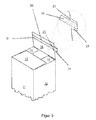
- FIG. 1 a box is shown which is almost completely unfolded.
- the carton consists of a body, which is composed of four side walls 11, 12.
- the lid region consists of a total of four closure tabs 13, 14, 15, 16, which close the carton in a known manner.
- two opposing tabs 14, 15 are folded inwards by 90 °
- the penultimate tab 13 is also folded by 90 ° so that it partially covers the two first tabs 14, 15.
- the fourth closure flap 16 is folded over and glued to the closure flap 13.
- an adhesive strip 30 is used for this purpose, which is glued to the closure flap 16.
- the adhesive strip 30 consists of a double-sided adhesive tape 32, which is covered with a cover 31.
- the adhesive tape 30 is bonded to the closure flap 16 in such a way that the adhesive removed from the cover 31 can stick to the closure flap 31, which closes the cardboard.
- the adhesive strip is automatically applied over the entire length during the production of the cardboard. Then individual sheets are cut, from which later the cardboard boxes are punched. The cardboard boxes are punched so that a gripping area 21 is formed on the closing flap 16, wherein the adhesive tape 30 also extends over the gripping area 21.
- the connection between gripping area 21 and closing flap 16 is weakened by a perforation 22. This perforation 22 also weakens the adhesive tape 32 together with cover material 31. This clearly shows the detail view in FIG. 1 ,
- the covering material 31 has to be removed from the adhesive tape 32 on the closing tab 16.
- the tab 21 is separated at the perforation 22 of the locking tab 16, at the same time the adhesive tape 32 located on the handle 21 is severed. Due to the inventively proposed properties of the adhesive tape carrier and the cover 31, only the adhesive tape 32 is severed, the cover 31 remains intact and adhere to the tape rest on the handle 21, as shown in the FIG. 2 is shown.
- the cover 31 is released from the adhesive tape 32 located on the tab 16 and can be safely removed. Finally, the closure tab 16 is pressed with the exposed adhesive tape 32 on the locking tab 13, the carton is closed.
- connection between the gripping area 21 and closure flap 16 is weakened by a perforation 23
- this perforation does not extend through the adhesive tape 32 together with the covering material 31.
- the adhesive tape 32 is not weakened by a perforation or otherwise, but the adhesive tape 32 tears only because of the inventive design of the carrier of the adhesive tape 32, while the cover material 31 remains intact.
Landscapes
- Chemical & Material Sciences (AREA)
- Organic Chemistry (AREA)
- Engineering & Computer Science (AREA)
- Mechanical Engineering (AREA)
- Adhesive Tapes (AREA)
- Cartons (AREA)
Abstract
Description
- Die Erfindung betrifft ein doppelseitig klebend ausgerüstetes Klebeband, Verfahren zum Verschließen von Kartons oder kartonähnlichen Verpackungen und die Verwendung des Klebebands in besagtem Verfahren.
- Kartons oder kartonähnliche Verpackungen aus Well- oder Vollpappe können mit doppelseitigen Klebebändern verschlossen werden. Hierzu wird das Klebeband zumeist von einer Rolle abgelängt und mit der offenen klebenden Seite auf den Karton an der gewünschten Stelle, zum Beispiel einer Lasche, aufgeklebt. Die andere Seite des doppelseitig klebenden Klebebands ist üblicherweise mit einer Abdeckung versehen, die zum Verkleben und somit vor dem Verschließen des Kartons von der Klebmasse entfernt werden muss. Erst nach dem Entfernen dieser Abdeckung kann beispielsweise die Lasche auf den Karton gedrückt werden, um auf diese Weise den Karton sicher zu verschließen.
Das Verspenden des Klebebands findet in modernen Herstellungsverfahren für derartige Verpackungen automatisch statt. Das Klebeband wird auf die endlose Kartonbahn verspendet und anschließend erfolgt die Zustanzung der Bögen, aus denen sich jeweils die Verpackungen ergeben. Auch die Auffaltung und das Verschließen der Verpackung erfolgt automatisch. - Um das Entfernen der Abdeckung vor dem Verkleben zu vereinfachen, sind verschiedene Möglichkeiten bekannt.
- Eine Möglichkeit besteht darin, die Abdeckung seitlich breiter als den Klebestreifen auszuführen. Dadurch entsteht ein der Fachwelt bekannter, so genannter "Fingerlift". Dieser erleichtert das Entfernen, weil der über die Klebemasse überstehende Bereich der Abdeckung das Greifen der Abdeckung deutlich erleichtert. Dies gelingt um so besser, je breiter dieser Überstand ist.
Ein derartiges Klebeband ist in derDE 101 38 350 A1 beschrieben. - Auf der anderen Seite ist ein möglichst breiter Überstand mit erheblichem Mehraufwand bei der Herstellung des Klebebandes verbunden. Die bekannten Abmessungen derartiger Fingerlifts stellen daher einen Kompromiss zwischen Aufwand bei der Herstellung, Materialverbrauch und leichter Entfernbarkeit dar.
- Der Erfindung liegt die Aufgabe zugrunde, ein doppelseitig klebend ausgerüstetes Klebeband zum Verschließen von Kartons oder kartonähnlichen Verpackungen, das ein zuverlässiges schnelles Verschließen von Kartons ermöglicht, sowie ein Verfahren zum Verschließen unter Verwendung eines doppelseitig klebend ausgerüsteten Klebebands zur Verfügung zu stellen, des Weiteren ein besonders vorteilhaftes Verfahren zum Verschließen von Kartons oder kartonähnlichen Verpackungen.
- Gelöst wird diese Aufgabe durch ein Klebeband, wie es im Hauptanspruch niedergelegt ist. Gegenstand der Unteransprüche sind dabei vorteilhafte Weiterbildungen des Klebebands. Des Weiteren löst die Aufgabe ein Verfahren zum Verschließen von Kartons oder kartonähnlichen Verpackungen. Auch hier sind vorteilhafte Ausführungsformen Gegenstand weiterer Unteransprüche.
- Demgemäß betrifft die Erfindung ein doppelseitig klebendes insbesondere zum Verschließen von Kartons oder kartonähnlichen Verpackungen, wobei das Klebeband einen Träger aufweist, der beidseitig mit einer Klebemasse ausgerüstet ist und wobei das Klebeband zumindest einseitig mit einem Abdeckmaterial eingedeckt ist.
Als Abdeckmaterial - im Folgenden auch Liner genannt - wird eine Polyolefinfolie mit einer Reißdehnung von mindestens 200 % und einer Reißfestigkeit von mindestens 12 N/mm2 eingesetzt. Das Abdeckmaterial weist eine Reißdehnung von mindestens dem 5-fachen der Reißdehnung des Trägers und/oder eine Reißfestigkeit von mindestens dem 1,5-fachen des Trägers auf. - Gemäß einer vorteilhaften Ausführungsform der Erfindung besteht der Liner aus LDPE.
- Gemäß einer weiteren bevorzugten Ausführungsform der Erfindung beträgt die Dicke des Liners 45 bis 200 µm, vorzugsweise 75 bis 125 µm.
- Weiter vorzugsweise weist der Träger eine Reißdehnung von höchstens 4 % und eine Reißfestigkeit von höchstens 15 N/mm2 auf, insbesondere eine Reißdehnung von höchstens dem 0,05-fachen des Liners und/oder eine Reißfestigkeit von höchstens dem 0,6-fachen des Liners.
- Gemäß einer weiteren vorteilhaften Ausführungsform der Erfindung ist der Träger ein Vliesträger.
- Bei dem Vlies handelt es sich vorzugsweise um ein nassfestes Langfaservlies. Derartige Vliese finden breite Verwendung in der Herstellung von Teebeuteln. Dies so genannte Teebeutelpapier (siehe DIN 6730) ist ein leichtgewichtiges (12 g/m2 bis 20 g/m2), hochporöses, nassfestes Filterpapier, welches aus langen Fasern pflanzlicher Herkunft (zum Beispiel Manilahanf) und einem kleinen Anteil Synthesefasern (> 30 Gew.-%) hergestellt wird.
- Die Dicke eines derart geeigneten Vlieses beträgt beispielsweise 38 µm, das Flächengewicht 13 g/m2.
- In einer Variante können auch Seidenpapiere Verwendung finden.
In einer anderen Variante werden so genannte Luftpostpapiere eingesetzt. Es handelt sich dabei um ein sehr dünnes, festes und meist holzfreies Schreibpapier mit einem Flächengewicht von 16 bis 30 g/m2. - Die Dicke des Trägers liegt vorzugsweise zwischen 15 und 200 µm, besonders bevorzugt zwischen 30 und 140 µm, ganz besonders bevorzugt zwischen 30 und 50 µm.
- Als Klebeband wird erfindungsgemäß ein Träger mit einer selbstklebenden oder einer hitzeaktivierbaren Klebstoffschicht bevorzugt, die auf jeder der beiden Seiten des Klebebands vorhanden sind, wobei die beiden Klebemassen nicht identisch sein müssen, vorzugsweise es aber sind. Vorzugsweise handelt es sich jedoch nicht um siegelfähige Klebstoffe, sondern um Haftkleber. Der Träger wird für die Klebebandanwendung ein-oder beidseitig mit Haftkleber als Lösung oder Dispersion oder 100 %ig (zum Beispiel aus der Schmelze) beschichtet. Die Klebeschicht(en) kann durch Wärme oder energiereiche Strahlen vernetzt werden. Insbesondere sind Haftkleber auf Basis Acrylat, Naturkautschuk, thermoplastischem Styrolblockcopolymer oder Silikon geeignet.
- Zur Optimierung der Eigenschaften kann die zum Einsatz kommende Selbstklebemasse mit einem oder mehreren Additiven wie Klebrigmachern (Harzen), Weichmachern, Füllstoffen, Pigmenten, UV-Absorbern, Lichtschutz-, Alterungsschutz, Vernetzungsmitteln, Vernetzungspromotoren oder Elastomeren abgemischt sein.
- Geeignete Elastomere zum Abmischen sind zum Beispiel EPDM- oder EPM-Kautschuk, Polyisobutylen, Butylkautschuk, Ethylen-Vinylacetat, hydrierte Blockcopolymere aus Dienen (zum Beispiel durch Hydrierung von SBR, cSBR, BAN, NBR, SBS, SIS oder IR, solche Polymere sind zum Beispiel als SEPS und SEBS bekannt) oder Acrylatcopolymere wie ACM.
- Klebrigmacher sind beispielsweise Kohlenwasserstoffharze (zum Beispiel aus ungesättigten C5- oder C7-Monomeren), Terpenphenolharze, Terpenharze aus Rohstoffen wie α- oder β-Pinen, aromatische Harze wie Cumaron-Inden-Harze oder Harze aus Styrol oder α-Methylstyrol wie Kolophonium und seine Folgeprodukte wie disproportionierte, dimerisierte oder veresterte Harze, wobei Glycole, Glycerin oder Pentaerythrit eingesetzt werden können. Besonders geeignet sind alterungsstabile Harze ohne olefinische Doppelbindung wie zum Beispiel hydrierte Harze.
- Geeignete Füllstoffe und Pigmente sind beispielsweise Ruß, Titandioxid, Calciumcarbonat, Zinkcarbonat, Zinkoxid, Silicate oder Kieselsäure.
- Des Weiteren kann die Klebemasse mit üblichen UV-Absorbern, Lichtschutz- und Alterungsschutzmitteln abgemischt sein.
- Geeignete Weichmacher sind beispielsweise aliphatische, cycloaliphatische und aromatische Mineralöle, Di- oder Poly-Ester der Phthalsäure, Trimellitsäure oder Adipinsäure, flüssige Kautschuke (zum Beispiel Nitril- oder Polyisoprenkautschuke), flüssige Polymerisate aus Buten und/oder Isobuten, Acrylsäureester, Polyvinylether, Flüssig- und Weichharze auf Basis der Rohstoffe zu Klebharze, Wollwachs und andere Wachse oder flüssige Silikone.
- Vernetzungsmittel sind beispielsweise Phenolharze oder halogenierte Phenolharze, Melamin- und Formaldehydharze. Geeignete Vernetzungspromotoren sind zum Beispiel Maleinimide, Allylester wie Triallylcyanurat, mehrfunktionelle Ester der Acryl- und Methacryläure.
- Eine bevorzugte Ausführungsform enthält einen Haftkleber aus Naturkautschuk, Kohlenwasserstoffharz und Antioxidant.
- Die Beschichtungsstärke mit Klebemasse liegt vorzugsweise im Bereich von 18 bis 50 g/m2, insbesondere 22 bis 29 g/m2.
- Die Breite des Klebebands liegt vorzugsweise zwischen 10 und 25 mm, besonders bevorzugt zwischen 12 und 19 mm.
- Der allgemeine Ausdruck "Klebeband" umfasst im Sinne dieser Erfindung alle flächigen Gebilde wie in zwei Dimensionen ausgedehnte Folien oder Folienabschnitte, Bänder mit ausgedehnter Länge und begrenzter Breite, Bandabschnitte und dergleichen, letztlich auch Stanzlinge oder Etiketten.
- Des Weiteren umfasst die Erfindung ein Verfahren zum Verschließen eines Kartons oder einer kartonähnlichen Verpackung, indem:
- eine Kartonbahn oder eine Bahn aus einem kartonähnlichen Stoff mit einem doppelseitig klebenden Klebeband ausgerüstet wird, dessen freie Seite mit einem Abdeckmaterial eingedeckt ist,
- Stanzen der einzelnen Faltzuschnitte derart, dass das Klebeband sich über eine Lasche erstreckt und auf einem Anfasserbereich endet, der sich an der Lasche befindet,
- Perforieren der Linie zwischen Anfasserbereich und Lasche, wobei das Stanzen und das Perforieren bevorzugt in einem gleichzeitig stattfindenden Arbeitsprozess erfolgen,
- Auffalten des Kartons,
- Abtrennen des Anfasserbereichs an der Perforationslinie von der Lasche,
- dabei gleichzeitig Durchtrennen des Klebebands,
- Abziehen des Abdeckmaterials vom Klebeband mithilfe des Anfassers,
- Verpressen des Klebebands und damit der Lasche auf dem Karton.
- Insbesondere der Verfahrensschritt des Auffaltens des Kartons kann auch zu späteren Zeitpunkten stattfinden, beispielsweise auch erst nach dem Verpressen des Klebebands und damit der Lasche auf dem Karton, alternativ zwischen Abziehen des Liners und Verpressen des Klebebands.
- Die Perforation zwischen Anfasserbereich und Verschlusslasche wird so gestaltet, dass das gewählte Verpackungsmaterial (Wellpappe, Vollpappe) beim Ziehen am Anfasser leicht durchtrennt wird. Hierbei wird das Trägermaterial des erfindungsgemäßen Klebebandes aufgrund seiner geringen Reißfestigkeit und Reißdehnung sicher mit durchtrennt.
Die Abdeckung des erfindungsgemäßen Klebebandes wird dagegen aufgrund ihrer höheren Reißfestigkeit sicher zusammenhalten. Jetzt kann mit dem Anfasser die Abdeckung auch vom Klebeband auf der Verschlusslasche sicher entfernt werden. - In einer alternativen Ausführungsform geht die Perforationslinie zusätzlich durch das Klebeband und ist im Wesentlichen senkrecht zur Längsrichtung des Klebebands (also in Querrichtung) ausgerichtet.
Der Träger des Klebebands wird durch die zusätzliche mechanische Schwächung noch leichter durchtrennt, während der Liner aufgrund der deutlich höheren Reißdehnung auch an den schmalen Stegen im Bereich der Perforation nicht durchtrennt werden kann. - Das in dem beschriebenen Verfahren einsetzbare Klebeband kann aus einer einzigen Klebemassenschicht bestehen (üblicherweise als trägerloses Fix bezeichnet). Gemäß einer vorteilhaften Ausführungsform weist das Klebeband einen Träger auf, auf den beidseitig Klebemassen aufgebracht sind.
- Besonders vorteilhaft ist die Kombination des erfindungsgemäßen Klebebands mit dem erfindungsgemäßen Verfahren.
- Folgende Prüfmethoden werden angewandt, um die angegebenen Parameter zu bestimmen:
Dicke: DIN/EN 1942 Ausgabe 2008 Reißfestigkeit: DIN 29864 Ausgabe 2007 in Längsrichtung DIN EN ISO 527-3 Ausgabe 2003 Reißdehnung: DIN EN ISO 527-3 Ausgabe 2003 Klebtechnische Daten: ISO 29862 Ausgabe 2007 - Nachfolgend wird eine beispielhafte Ausführungsform des erfindungsgemäßen Klebebands beschrieben.
- Eigenschaften des Klebebands:
Dicke: 115 µm Reißdehnung 3% Reißfestigkeit 8 N/mm2 Träger: Nassfestes Langfaservlies mit einer Dicke von 38 µm und einem Flächengewicht 13 g/m2 Klebemasse: harzgemischte Acrylatmasse Auftrag: beidseitig 25 g/m2 Liner LDPE Dicke 80 µm Reißdehnung 250 % Reißfestigkeit 15 N/mm2 - Im Folgenden soll die Erfindung anhand mehrerer Figuren näher erläutert werden, ohne damit die Erfindung unnötig einschränken zu wollen.
- Es zeigen
- Figur 1
- einen Karton, der nahezu vollständig aufgefaltet ist, wobei eine Verschlusslasche mit einem Klebebandstreifen ausgerüstet ist,
- Figur 2
- den Karton kurz vor dem vollständigen Verschließen, wozu vom Klebeband auf der Verschlusslasche das Abdeckmaterial entfernt wird, und
- Figur 3
- in einer alternativen Ausführungsform einen Karton, der nahezu vollständig aufgefaltet ist, wobei eine Verschlusslasche mit einem Klebebandstreifen ausgerüstet ist.
- In der
Figur 1 ist ein Karton gezeigt, der nahezu vollständig aufgefaltet ist. Der Karton besteht aus einem Korpus, der sich aus vier Seitenwänden 11, 12 zusammensetzt. Der Deckelbereich besteht aus insgesamt vier Verschlusslaschen 13, 14, 15, 16, die in bekannter Art den Karton verschließen. Hierzu werden zwei sich gegenüberliegende Laschen 14, 15 nach innen um 90° umgefaltet, die vorletzte Lasche 13 ebenfalls um 90° gefaltet, so dass diese die zwei ersten Laschen 14, 15 teilweise verdeckt. Zum Verschließen des Kartons wird die vierte Verschlusslasche 16 umgefaltet und auf der Verschlusslasche 13 verklebt.
Erfindungsgemäß wird hierzu ein Klebestreifen 30 verwendet, der auf der Verschlusslasche 16 verklebt ist. Der Klebestreifen 30 besteht aus einem doppelseitig klebenden Klebeband 32, das mit einem Abdeckmaterial 31 eingedeckt ist. Das Klebeband 30 ist derartig auf der Verschlusslasche 16 verklebt, dass die von der Abdeckung 31 befreite Klebemasse mit der Verschlusslasche 31 verkleben kann, was den Karton verschließt. Der Klebestreifen wird bei der Herstellung der Kartonage automatisch über die ganze Länge appliziert. Dann werden einzelne Bögen abgelängt, aus denen später die Kartonagen gestanzt werden. Die Kartonagen werden so gestanzt, dass an der Verschlusslasche 16 ein Anfasserbereich 21 entsteht, wobei das Klebeband 30 auch über den Anfasserbereich 21 verläuft. Gleichzeitig wird die Verbindung zwischen Anfasserbereich 21 und Verschlusslasche 16 durch eine Perforation 22 geschwächt. Diese Perforation 22 schwächt dabei auch das Klebeband 32 samt Abdeckmaterial 31. Dies zeigt deutlich die Detailansicht in derFigur 1 . - Um den Karton vollständig zu verschließen, muss vom Klebeband 32 auf der Verschlusslasche 16 das Abdeckmaterial 31 entfernt werden. Hierzu wird der Anfasser 21 an der Perforation 22 von der Verschlusslasche 16 abgetrennt, gleichzeitig das auf dem Anfasser 21 befindliche Klebeband 32 durchtrennt. Aufgrund der erfindungsgemäß vorgeschlagenen Eigenschaften des Klebebandträgers und der Abdeckung 31 wird nur das Klebeband 32 durchtrennt, die Abdeckung 31 bleibt unversehrt und bleibt an dem auf dem Anfasser 21 befindlichen Klebebandrest haften, wie es in der
Figur 2 dargestellt ist. - Wird der Anfasser 21 jetzt parallel zur Ausrichtung des Klebebands 32 über die Verschlusslasche 16 gezogen, löst sich die Abdeckung 31 von dem auf der Lasche 16 befindlichen Klebeband 32 und kann so sicher entfernt werden. Abschließend wird die Verschlusslasche 16 mit dem freigelegten Klebeband 32 auf die Verschlusslasche 13 verpresst, der Karton ist verschlossen.
- Gemäß einer alternativen Ausführungsform wird zwar die Verbindung zwischen Anfasserbereich 21 und Verschlusslasche 16 durch eine Perforation 23 geschwächt, diese Perforation erstreckt sich aber nicht durch das Klebeband 32 samt Abdeckmaterial 31. Dies zeigt deutlich die Detailansicht in der
Figur 3 .
Bevorzugt ist, wenn das Klebeband 32 nicht durch eine Perforation oder sonst wie geschwächt ist, sondern das Klebeband 32 allein aufgrund der erfindungsgemäßen Ausgestaltung des Trägers des Klebebands 32 durchreißt, während das Abdeckmaterial 31 unversehrt bleibt.
Claims (9)
- Doppelseitig klebendes Klebeband insbesondere zum Verschließen von Kartons oder kartonähnlichen Verpackungen, wobei das Klebeband einen Träger aufweist, der beidseitig mit einer Klebemasse ausgerüstet ist und wobei das Klebeband zumindest einseitig mit einem Abdeckmaterial eingedeckt ist,
dadurch gekennzeichnet, dass
als Abdeckmaterial eine Polyolefinfolie mit einer Reißdehnung von mindestens 200 % und einer Reißfestigkeit von mindestens 12 N/mm2 eingesetzt wird und das Abdeckmaterial eine Reißdehnung von mindestens dem 5-fachen der Reißdehnung des Trägers und/oder eine Reißfestigkeit von mindestens dem 1,5-fachen des Trägers aufweist. - Klebeband nach Anspruch 1,
dadurch gekennzeichnet, dass
der Träger eine Reißdehnung von höchstens 4 % und eine Reißfestigkeit von höchstens 15 N/mm2 aufweist, insbesondere eine Reißdehnung von höchstens dem 0,05-fachen des Abdeckmaterials und/oder eine Reißfestigkeit von höchstens dem 0,6-fachen des Abdeckmaterials. - Klebeband nach Anspruch 1 oder 2,
dadurch gekennzeichnet, dass
das Abdeckmaterial aus LDPE besteht. - Klebeband nach zumindest einem der Ansprüche 1 bis 3,
dadurch gekennzeichnet, dass
der Träger ein Vliesträger ist, vorzugsweise ein nassfestes Langfaservlies, besonders bevorzugt ein Teebeutelpapier. - Klebeband nach zumindest einem der vorherigen Ansprüche,
dadurch gekennzeichnet, dass
die Dicke des Liners 45 bis 200 µm, vorzugsweise 75 bis 125 µm - Verfahren zum Verschließen eines Kartons oder einer kartonähnlichen Verpackung, indem• eine Kartonbahn oder eine Bahn aus einem kartonähnlichen Stoff mit einem doppelseitig klebenden Klebeband ausgerüstet wird, dessen freie Seite mit einem Abdeckmaterial eingedeckt ist,• Stanzen der einzelnen Faltzuschnitte des Kartons derart, dass das Klebeband sich über eine Lasche des Kartons erstreckt und auf einem Anfasserbereich endet, der sich an der Lasche befindet,• Perforieren der Linie zwischen Anfasserbereich und Lasche,• Auffalten des Kartons,• Abtrennen des Anfasserbereichs an der Perforationslinie von der Lasche,• dabei gleichzeitig Durchtrennen des Klebebands,• Abziehen des Abdeckmaterials vom Klebeband mithilfe des Anfassers,• Verpressen des Klebebands und damit der Lasche auf dem Karton.
- Verfahren nach Anspruch 6, dadurch gekennzeichnet, dass die Perforationslinie zusätzlich durch das Klebeband geht und im Wesentlichen senkrecht zur Längsrichtung des Klebebands ausgerichtet ist.
- Verfahren nach Anspruch 6 oder 7,
dadurch gekennzeichnet, dass
das Klebeband einen Träger aufweist, auf den beidseitig Klebemassen aufgebracht sind. - Verwendung eines Klebebands nach zumindest einem der Ansprüche 1 bis 5 in einem Verfahren nach zumindest einem der Ansprüche 6 bis 8.
Applications Claiming Priority (1)
| Application Number | Priority Date | Filing Date | Title |
|---|---|---|---|
| DE102008060905 | 2008-12-09 |
Publications (2)
| Publication Number | Publication Date |
|---|---|
| EP2196399A1 true EP2196399A1 (de) | 2010-06-16 |
| EP2196399B1 EP2196399B1 (de) | 2013-08-21 |
Family
ID=41667489
Family Applications (1)
| Application Number | Title | Priority Date | Filing Date |
|---|---|---|---|
| EP09177574.2A Not-in-force EP2196399B1 (de) | 2008-12-09 | 2009-12-01 | VERFAHREN ZUM VERSCHLIEßEN VON KARTONS ODER KARTONÄHNLICHEN VERPACKUNGEN MIT DOPPELSEITIG KLEBEND AUSGERÜSTETEM KLEBEBAND |
Country Status (2)
| Country | Link |
|---|---|
| EP (1) | EP2196399B1 (de) |
| DE (1) | DE102009047325A1 (de) |
Cited By (3)
| Publication number | Priority date | Publication date | Assignee | Title |
|---|---|---|---|---|
| EP2497807A1 (de) * | 2011-03-07 | 2012-09-12 | tesa SE | Klebeband für die Kabelbandagierung |
| FR3086276A1 (fr) * | 2018-09-26 | 2020-03-27 | Ds Smith Packaging France | Emballage d’expedition/reexpedition et flan predecoupe pour la formation de ce dernier |
| KR20210121714A (ko) * | 2020-03-31 | 2021-10-08 | 김형중 | 개봉이 편리한 밀봉테이프가 부착된 포장상자 |
Citations (5)
| Publication number | Priority date | Publication date | Assignee | Title |
|---|---|---|---|---|
| FR2632609A1 (fr) * | 1988-06-13 | 1989-12-15 | Antoine Chandellier | Dispositifs de fermeture des emballages en carton ondule ou compact a decoupe en croix et machine pour realiser ces dispositifs |
| EP0795480A1 (de) * | 1996-03-11 | 1997-09-17 | RCO Spécialités | Kartonverpackung mit integriertem Verschlussband |
| US5893514A (en) * | 1996-05-17 | 1999-04-13 | Linear Products, Incorporated | Blank for a container, and a container having a closing and opening system |
| DE10138350A1 (de) | 2001-08-04 | 2003-02-20 | Tesa Ag | Verwendung eines doppelseitig klebend ausgerüsteten Klebebands zum Verschließen und Öffnen von Kartons oder kartonähnlichen Verpackungen |
| US20070063008A1 (en) * | 2005-09-22 | 2007-03-22 | Ali El-Afandi | Perforated packaging |
Family Cites Families (2)
| Publication number | Priority date | Publication date | Assignee | Title |
|---|---|---|---|---|
| DE10151818A1 (de) * | 2001-10-20 | 2003-05-22 | Tesa Ag | Selbstklebendes Abdeckklebeband für Fahrzeuge und Fahrzeugteile |
| DE10317788A1 (de) * | 2003-04-16 | 2004-12-02 | Tesa Ag | Wiederverwendbare, rückstands- und beschädigungsfrei wiederablösbare, elastische Klebefolie |
-
2009
- 2009-12-01 DE DE102009047325A patent/DE102009047325A1/de not_active Withdrawn
- 2009-12-01 EP EP09177574.2A patent/EP2196399B1/de not_active Not-in-force
Patent Citations (6)
| Publication number | Priority date | Publication date | Assignee | Title |
|---|---|---|---|---|
| FR2632609A1 (fr) * | 1988-06-13 | 1989-12-15 | Antoine Chandellier | Dispositifs de fermeture des emballages en carton ondule ou compact a decoupe en croix et machine pour realiser ces dispositifs |
| EP0795480A1 (de) * | 1996-03-11 | 1997-09-17 | RCO Spécialités | Kartonverpackung mit integriertem Verschlussband |
| US5893514A (en) * | 1996-05-17 | 1999-04-13 | Linear Products, Incorporated | Blank for a container, and a container having a closing and opening system |
| DE10138350A1 (de) | 2001-08-04 | 2003-02-20 | Tesa Ag | Verwendung eines doppelseitig klebend ausgerüsteten Klebebands zum Verschließen und Öffnen von Kartons oder kartonähnlichen Verpackungen |
| EP1285853A1 (de) * | 2001-08-04 | 2003-02-26 | Tesa AG | Verwendung eines doppelseitig klebend ausgerüsteten Klebebands zum Verschliessen und Öffnen von Kartons oder kartonähnlichen Verpackungen |
| US20070063008A1 (en) * | 2005-09-22 | 2007-03-22 | Ali El-Afandi | Perforated packaging |
Cited By (5)
| Publication number | Priority date | Publication date | Assignee | Title |
|---|---|---|---|---|
| EP2497807A1 (de) * | 2011-03-07 | 2012-09-12 | tesa SE | Klebeband für die Kabelbandagierung |
| FR3086276A1 (fr) * | 2018-09-26 | 2020-03-27 | Ds Smith Packaging France | Emballage d’expedition/reexpedition et flan predecoupe pour la formation de ce dernier |
| WO2020065546A1 (fr) * | 2018-09-26 | 2020-04-02 | Ds Smith Packaging France S.A.S. | Emballage d'expedition/reexpedition et flan predecoupe pour la formation de ce dernier |
| US11858700B2 (en) | 2018-09-26 | 2024-01-02 | Ds Smith Packaging France S.A.S. | Shipping/reshipping packaging unit and precut template for forming the latter |
| KR20210121714A (ko) * | 2020-03-31 | 2021-10-08 | 김형중 | 개봉이 편리한 밀봉테이프가 부착된 포장상자 |
Also Published As
| Publication number | Publication date |
|---|---|
| DE102009047325A1 (de) | 2010-06-10 |
| EP2196399B1 (de) | 2013-08-21 |
Similar Documents
| Publication | Publication Date | Title |
|---|---|---|
| EP2189506B1 (de) | Karton ausgerüstet mit einem Streifen eines Klebebands zur Verstärkung insbesondere im Bereich von Stanzungen und gleichzeitig als Aufreißstreifen | |
| EP2756045B1 (de) | VERWENDUNG EINES KLEBEBANDSYSTEM ZUR BILDUNG EINES AUFREIßSTREIFENS AUF EINEM KARTON | |
| EP2704957B1 (de) | Verwendung eines klebebandsystems als aufreissstreifen auf einem karton | |
| WO2008098699A1 (de) | Dichtband für das abdichten einer fuge | |
| EP1858776A1 (de) | Zumindest zweischichtiges etikett zum aufreissen und wiederverschliessen von verpackungen sowie dessen verwendung | |
| DE102016106787A1 (de) | Kunststoffgewebeverbund, Verpackungsbeutel aus einem Kunststoffgewebeverbund sowie Verfahren zur Herstellung eines Verpackungsbeutels | |
| EP0745540A1 (de) | Zuschnittbogen und daraus hergestellte Zigarettenpackung | |
| EP2196399B1 (de) | VERFAHREN ZUM VERSCHLIEßEN VON KARTONS ODER KARTONÄHNLICHEN VERPACKUNGEN MIT DOPPELSEITIG KLEBEND AUSGERÜSTETEM KLEBEBAND | |
| EP2284095A1 (de) | Verpackung mit vorgeschnittener Öffnung, die reversibel geöffnet und verschlossen werden kann, sowie deren Herstellungsverfahren | |
| EP0226958A2 (de) | Tütenförmige Verpackung | |
| EP1401979A1 (de) | Abschlussbandage | |
| EP1785461B1 (de) | Weiterreißfestes Klebeband | |
| EP1714894B1 (de) | Siegelstreifen, zugehörige Folienverpackung und deren Herstellung | |
| DE102006002965A1 (de) | Mehrschichtige Kunststofffolie | |
| EP2377682B1 (de) | Verfahren zur herstellung einer mehrlagigen verpackungsfolie | |
| DE102008028075A1 (de) | Zumindest zweischichtiges Etikett insbesondere zum Aufreißen und Wiederverschließen von flexiblen Verpackungen sowie dessen Verwendung | |
| DE102013018289B4 (de) | Haftklebeband mit stabilisierender Release-Abdeckung | |
| EP3623313B1 (de) | Spendersystem für feuchttücher | |
| DE102012106386A1 (de) | Band, Verpackung mit einem solchen Band sowie Verwendung des Bandes zum Herstellen einer Verpackung | |
| EP3113948A1 (de) | Folienmaterial zur herstellung einer verpackung | |
| DE102004033483B4 (de) | Wiederverschließbarer Folienbeutel | |
| DE1611923C (de) | Klebeband Satz | |
| DE102011118466B4 (de) | Flächenzuschnitt zum Ausbilden einer Lagesicherung, Verwendung und Verfahren zum Herstellen eines Flächenzuschnitts | |
| WO2022258772A1 (de) | Pergaminpapier-material für das einschlagen von haftnotizblöcken | |
| DE102013101669A1 (de) | Selbstklebendes Dichtungsband |
Legal Events
| Date | Code | Title | Description |
|---|---|---|---|
| PUAI | Public reference made under article 153(3) epc to a published international application that has entered the european phase |
Free format text: ORIGINAL CODE: 0009012 |
|
| AK | Designated contracting states |
Kind code of ref document: A1 Designated state(s): AT BE BG CH CY CZ DE DK EE ES FI FR GB GR HR HU IE IS IT LI LT LU LV MC MK MT NL NO PL PT RO SE SI SK SM TR |
|
| 17P | Request for examination filed |
Effective date: 20101216 |
|
| 17Q | First examination report despatched |
Effective date: 20101230 |
|
| GRAP | Despatch of communication of intention to grant a patent |
Free format text: ORIGINAL CODE: EPIDOSNIGR1 |
|
| INTG | Intention to grant announced |
Effective date: 20130607 |
|
| GRAS | Grant fee paid |
Free format text: ORIGINAL CODE: EPIDOSNIGR3 |
|
| GRAA | (expected) grant |
Free format text: ORIGINAL CODE: 0009210 |
|
| AK | Designated contracting states |
Kind code of ref document: B1 Designated state(s): AT BE BG CH CY CZ DE DK EE ES FI FR GB GR HR HU IE IS IT LI LT LU LV MC MK MT NL NO PL PT RO SE SI SK SM TR |
|
| REG | Reference to a national code |
Ref country code: GB Ref legal event code: FG4D Free format text: NOT ENGLISH |
|
| REG | Reference to a national code |
Ref country code: CH Ref legal event code: EP |
|
| REG | Reference to a national code |
Ref country code: AT Ref legal event code: REF Ref document number: 627914 Country of ref document: AT Kind code of ref document: T Effective date: 20130915 |
|
| REG | Reference to a national code |
Ref country code: IE Ref legal event code: FG4D Free format text: LANGUAGE OF EP DOCUMENT: GERMAN |
|
| REG | Reference to a national code |
Ref country code: DE Ref legal event code: R096 Ref document number: 502009007823 Country of ref document: DE Effective date: 20131017 |
|
| REG | Reference to a national code |
Ref country code: NL Ref legal event code: VDEP Effective date: 20130821 |
|
| REG | Reference to a national code |
Ref country code: LT Ref legal event code: MG4D |
|
| PG25 | Lapsed in a contracting state [announced via postgrant information from national office to epo] |
Ref country code: PT Free format text: LAPSE BECAUSE OF FAILURE TO SUBMIT A TRANSLATION OF THE DESCRIPTION OR TO PAY THE FEE WITHIN THE PRESCRIBED TIME-LIMIT Effective date: 20131223 Ref country code: IS Free format text: LAPSE BECAUSE OF FAILURE TO SUBMIT A TRANSLATION OF THE DESCRIPTION OR TO PAY THE FEE WITHIN THE PRESCRIBED TIME-LIMIT Effective date: 20131221 Ref country code: NO Free format text: LAPSE BECAUSE OF FAILURE TO SUBMIT A TRANSLATION OF THE DESCRIPTION OR TO PAY THE FEE WITHIN THE PRESCRIBED TIME-LIMIT Effective date: 20131121 Ref country code: HR Free format text: LAPSE BECAUSE OF FAILURE TO SUBMIT A TRANSLATION OF THE DESCRIPTION OR TO PAY THE FEE WITHIN THE PRESCRIBED TIME-LIMIT Effective date: 20130821 Ref country code: SE Free format text: LAPSE BECAUSE OF FAILURE TO SUBMIT A TRANSLATION OF THE DESCRIPTION OR TO PAY THE FEE WITHIN THE PRESCRIBED TIME-LIMIT Effective date: 20130821 Ref country code: LT Free format text: LAPSE BECAUSE OF FAILURE TO SUBMIT A TRANSLATION OF THE DESCRIPTION OR TO PAY THE FEE WITHIN THE PRESCRIBED TIME-LIMIT Effective date: 20130821 Ref country code: CY Free format text: LAPSE BECAUSE OF FAILURE TO SUBMIT A TRANSLATION OF THE DESCRIPTION OR TO PAY THE FEE WITHIN THE PRESCRIBED TIME-LIMIT Effective date: 20130828 |
|
| PG25 | Lapsed in a contracting state [announced via postgrant information from national office to epo] |
Ref country code: LV Free format text: LAPSE BECAUSE OF FAILURE TO SUBMIT A TRANSLATION OF THE DESCRIPTION OR TO PAY THE FEE WITHIN THE PRESCRIBED TIME-LIMIT Effective date: 20130821 Ref country code: GR Free format text: LAPSE BECAUSE OF FAILURE TO SUBMIT A TRANSLATION OF THE DESCRIPTION OR TO PAY THE FEE WITHIN THE PRESCRIBED TIME-LIMIT Effective date: 20131122 Ref country code: PL Free format text: LAPSE BECAUSE OF FAILURE TO SUBMIT A TRANSLATION OF THE DESCRIPTION OR TO PAY THE FEE WITHIN THE PRESCRIBED TIME-LIMIT Effective date: 20130821 Ref country code: SI Free format text: LAPSE BECAUSE OF FAILURE TO SUBMIT A TRANSLATION OF THE DESCRIPTION OR TO PAY THE FEE WITHIN THE PRESCRIBED TIME-LIMIT Effective date: 20130821 Ref country code: FI Free format text: LAPSE BECAUSE OF FAILURE TO SUBMIT A TRANSLATION OF THE DESCRIPTION OR TO PAY THE FEE WITHIN THE PRESCRIBED TIME-LIMIT Effective date: 20130821 |
|
| PG25 | Lapsed in a contracting state [announced via postgrant information from national office to epo] |
Ref country code: CY Free format text: LAPSE BECAUSE OF FAILURE TO SUBMIT A TRANSLATION OF THE DESCRIPTION OR TO PAY THE FEE WITHIN THE PRESCRIBED TIME-LIMIT Effective date: 20130821 |
|
| PG25 | Lapsed in a contracting state [announced via postgrant information from national office to epo] |
Ref country code: EE Free format text: LAPSE BECAUSE OF FAILURE TO SUBMIT A TRANSLATION OF THE DESCRIPTION OR TO PAY THE FEE WITHIN THE PRESCRIBED TIME-LIMIT Effective date: 20130821 Ref country code: RO Free format text: LAPSE BECAUSE OF FAILURE TO SUBMIT A TRANSLATION OF THE DESCRIPTION OR TO PAY THE FEE WITHIN THE PRESCRIBED TIME-LIMIT Effective date: 20130821 Ref country code: CZ Free format text: LAPSE BECAUSE OF FAILURE TO SUBMIT A TRANSLATION OF THE DESCRIPTION OR TO PAY THE FEE WITHIN THE PRESCRIBED TIME-LIMIT Effective date: 20130821 Ref country code: NL Free format text: LAPSE BECAUSE OF FAILURE TO SUBMIT A TRANSLATION OF THE DESCRIPTION OR TO PAY THE FEE WITHIN THE PRESCRIBED TIME-LIMIT Effective date: 20130821 Ref country code: DK Free format text: LAPSE BECAUSE OF FAILURE TO SUBMIT A TRANSLATION OF THE DESCRIPTION OR TO PAY THE FEE WITHIN THE PRESCRIBED TIME-LIMIT Effective date: 20130821 Ref country code: SK Free format text: LAPSE BECAUSE OF FAILURE TO SUBMIT A TRANSLATION OF THE DESCRIPTION OR TO PAY THE FEE WITHIN THE PRESCRIBED TIME-LIMIT Effective date: 20130821 |
|
| PG25 | Lapsed in a contracting state [announced via postgrant information from national office to epo] |
Ref country code: ES Free format text: LAPSE BECAUSE OF FAILURE TO SUBMIT A TRANSLATION OF THE DESCRIPTION OR TO PAY THE FEE WITHIN THE PRESCRIBED TIME-LIMIT Effective date: 20130821 Ref country code: IT Free format text: LAPSE BECAUSE OF FAILURE TO SUBMIT A TRANSLATION OF THE DESCRIPTION OR TO PAY THE FEE WITHIN THE PRESCRIBED TIME-LIMIT Effective date: 20130821 |
|
| PLBE | No opposition filed within time limit |
Free format text: ORIGINAL CODE: 0009261 |
|
| STAA | Information on the status of an ep patent application or granted ep patent |
Free format text: STATUS: NO OPPOSITION FILED WITHIN TIME LIMIT |
|
| BERE | Be: lapsed |
Owner name: TESA SE Effective date: 20131231 |
|
| 26N | No opposition filed |
Effective date: 20140522 |
|
| REG | Reference to a national code |
Ref country code: CH Ref legal event code: PL |
|
| GBPC | Gb: european patent ceased through non-payment of renewal fee |
Effective date: 20131201 |
|
| PG25 | Lapsed in a contracting state [announced via postgrant information from national office to epo] |
Ref country code: LU Free format text: LAPSE BECAUSE OF FAILURE TO SUBMIT A TRANSLATION OF THE DESCRIPTION OR TO PAY THE FEE WITHIN THE PRESCRIBED TIME-LIMIT Effective date: 20131201 Ref country code: MC Free format text: LAPSE BECAUSE OF FAILURE TO SUBMIT A TRANSLATION OF THE DESCRIPTION OR TO PAY THE FEE WITHIN THE PRESCRIBED TIME-LIMIT Effective date: 20130821 |
|
| REG | Reference to a national code |
Ref country code: DE Ref legal event code: R097 Ref document number: 502009007823 Country of ref document: DE Effective date: 20140522 |
|
| REG | Reference to a national code |
Ref country code: IE Ref legal event code: MM4A |
|
| REG | Reference to a national code |
Ref country code: FR Ref legal event code: ST Effective date: 20140829 |
|
| PG25 | Lapsed in a contracting state [announced via postgrant information from national office to epo] |
Ref country code: IE Free format text: LAPSE BECAUSE OF NON-PAYMENT OF DUE FEES Effective date: 20131201 Ref country code: LI Free format text: LAPSE BECAUSE OF NON-PAYMENT OF DUE FEES Effective date: 20131231 Ref country code: CH Free format text: LAPSE BECAUSE OF NON-PAYMENT OF DUE FEES Effective date: 20131231 Ref country code: BE Free format text: LAPSE BECAUSE OF NON-PAYMENT OF DUE FEES Effective date: 20131231 |
|
| PG25 | Lapsed in a contracting state [announced via postgrant information from national office to epo] |
Ref country code: GB Free format text: LAPSE BECAUSE OF NON-PAYMENT OF DUE FEES Effective date: 20131201 Ref country code: FR Free format text: LAPSE BECAUSE OF NON-PAYMENT OF DUE FEES Effective date: 20131231 |
|
| PG25 | Lapsed in a contracting state [announced via postgrant information from national office to epo] |
Ref country code: SM Free format text: LAPSE BECAUSE OF FAILURE TO SUBMIT A TRANSLATION OF THE DESCRIPTION OR TO PAY THE FEE WITHIN THE PRESCRIBED TIME-LIMIT Effective date: 20130821 |
|
| PG25 | Lapsed in a contracting state [announced via postgrant information from national office to epo] |
Ref country code: TR Free format text: LAPSE BECAUSE OF FAILURE TO SUBMIT A TRANSLATION OF THE DESCRIPTION OR TO PAY THE FEE WITHIN THE PRESCRIBED TIME-LIMIT Effective date: 20130821 |
|
| PG25 | Lapsed in a contracting state [announced via postgrant information from national office to epo] |
Ref country code: BG Free format text: LAPSE BECAUSE OF FAILURE TO SUBMIT A TRANSLATION OF THE DESCRIPTION OR TO PAY THE FEE WITHIN THE PRESCRIBED TIME-LIMIT Effective date: 20130821 Ref country code: MK Free format text: LAPSE BECAUSE OF FAILURE TO SUBMIT A TRANSLATION OF THE DESCRIPTION OR TO PAY THE FEE WITHIN THE PRESCRIBED TIME-LIMIT Effective date: 20130821 Ref country code: HU Free format text: LAPSE BECAUSE OF FAILURE TO SUBMIT A TRANSLATION OF THE DESCRIPTION OR TO PAY THE FEE WITHIN THE PRESCRIBED TIME-LIMIT; INVALID AB INITIO Effective date: 20091201 |
|
| PG25 | Lapsed in a contracting state [announced via postgrant information from national office to epo] |
Ref country code: MT Free format text: LAPSE BECAUSE OF FAILURE TO SUBMIT A TRANSLATION OF THE DESCRIPTION OR TO PAY THE FEE WITHIN THE PRESCRIBED TIME-LIMIT Effective date: 20130821 |
|
| REG | Reference to a national code |
Ref country code: DE Ref legal event code: R081 Ref document number: 502009007823 Country of ref document: DE Owner name: TESA SE, DE Free format text: FORMER OWNER: TESA SE, 20253 HAMBURG, DE |
|
| REG | Reference to a national code |
Ref country code: AT Ref legal event code: MM01 Ref document number: 627914 Country of ref document: AT Kind code of ref document: T Effective date: 20141201 |
|
| PG25 | Lapsed in a contracting state [announced via postgrant information from national office to epo] |
Ref country code: AT Free format text: LAPSE BECAUSE OF NON-PAYMENT OF DUE FEES Effective date: 20141201 |
|
| PGFP | Annual fee paid to national office [announced via postgrant information from national office to epo] |
Ref country code: DE Payment date: 20231214 Year of fee payment: 15 |
|
| REG | Reference to a national code |
Ref country code: DE Ref legal event code: R119 Ref document number: 502009007823 Country of ref document: DE |
|
| PG25 | Lapsed in a contracting state [announced via postgrant information from national office to epo] |
Ref country code: DE Free format text: LAPSE BECAUSE OF NON-PAYMENT OF DUE FEES Effective date: 20250701 |