EP2190502B1 - Combined sensor and infusion set using separated sites - Google Patents
Combined sensor and infusion set using separated sites Download PDFInfo
- Publication number
- EP2190502B1 EP2190502B1 EP08798612.1A EP08798612A EP2190502B1 EP 2190502 B1 EP2190502 B1 EP 2190502B1 EP 08798612 A EP08798612 A EP 08798612A EP 2190502 B1 EP2190502 B1 EP 2190502B1
- Authority
- EP
- European Patent Office
- Prior art keywords
- sensor
- analyte
- electrode
- base
- patient
- Prior art date
- Legal status (The legal status is an assumption and is not a legal conclusion. Google has not performed a legal analysis and makes no representation as to the accuracy of the status listed.)
- Active
Links
Images



Classifications
-
- A—HUMAN NECESSITIES
- A61—MEDICAL OR VETERINARY SCIENCE; HYGIENE
- A61M—DEVICES FOR INTRODUCING MEDIA INTO, OR ONTO, THE BODY; DEVICES FOR TRANSDUCING BODY MEDIA OR FOR TAKING MEDIA FROM THE BODY; DEVICES FOR PRODUCING OR ENDING SLEEP OR STUPOR
- A61M5/00—Devices for bringing media into the body in a subcutaneous, intra-vascular or intramuscular way; Accessories therefor, e.g. filling or cleaning devices, arm-rests
- A61M5/14—Infusion devices, e.g. infusing by gravity; Blood infusion; Accessories therefor
- A61M5/168—Means for controlling media flow to the body or for metering media to the body, e.g. drip meters, counters ; Monitoring media flow to the body
- A61M5/172—Means for controlling media flow to the body or for metering media to the body, e.g. drip meters, counters ; Monitoring media flow to the body electrical or electronic
- A61M5/1723—Means for controlling media flow to the body or for metering media to the body, e.g. drip meters, counters ; Monitoring media flow to the body electrical or electronic using feedback of body parameters, e.g. blood-sugar, pressure
-
- A—HUMAN NECESSITIES
- A61—MEDICAL OR VETERINARY SCIENCE; HYGIENE
- A61B—DIAGNOSIS; SURGERY; IDENTIFICATION
- A61B5/00—Measuring for diagnostic purposes; Identification of persons
- A61B5/145—Measuring characteristics of blood in vivo, e.g. gas concentration or pH-value ; Measuring characteristics of body fluids or tissues, e.g. interstitial fluid or cerebral tissue
- A61B5/14503—Measuring characteristics of blood in vivo, e.g. gas concentration or pH-value ; Measuring characteristics of body fluids or tissues, e.g. interstitial fluid or cerebral tissue invasive, e.g. introduced into the body by a catheter or needle or using implanted sensors
-
- A—HUMAN NECESSITIES
- A61—MEDICAL OR VETERINARY SCIENCE; HYGIENE
- A61B—DIAGNOSIS; SURGERY; IDENTIFICATION
- A61B5/00—Measuring for diagnostic purposes; Identification of persons
- A61B5/145—Measuring characteristics of blood in vivo, e.g. gas concentration or pH-value ; Measuring characteristics of body fluids or tissues, e.g. interstitial fluid or cerebral tissue
- A61B5/14532—Measuring characteristics of blood in vivo, e.g. gas concentration or pH-value ; Measuring characteristics of body fluids or tissues, e.g. interstitial fluid or cerebral tissue for measuring glucose, e.g. by tissue impedance measurement
-
- A—HUMAN NECESSITIES
- A61—MEDICAL OR VETERINARY SCIENCE; HYGIENE
- A61B—DIAGNOSIS; SURGERY; IDENTIFICATION
- A61B5/00—Measuring for diagnostic purposes; Identification of persons
- A61B5/145—Measuring characteristics of blood in vivo, e.g. gas concentration or pH-value ; Measuring characteristics of body fluids or tissues, e.g. interstitial fluid or cerebral tissue
- A61B5/14546—Measuring characteristics of blood in vivo, e.g. gas concentration or pH-value ; Measuring characteristics of body fluids or tissues, e.g. interstitial fluid or cerebral tissue for measuring analytes not otherwise provided for, e.g. ions, cytochromes
-
- A—HUMAN NECESSITIES
- A61—MEDICAL OR VETERINARY SCIENCE; HYGIENE
- A61B—DIAGNOSIS; SURGERY; IDENTIFICATION
- A61B5/00—Measuring for diagnostic purposes; Identification of persons
- A61B5/145—Measuring characteristics of blood in vivo, e.g. gas concentration or pH-value ; Measuring characteristics of body fluids or tissues, e.g. interstitial fluid or cerebral tissue
- A61B5/1468—Measuring characteristics of blood in vivo, e.g. gas concentration or pH-value ; Measuring characteristics of body fluids or tissues, e.g. interstitial fluid or cerebral tissue using chemical or electrochemical methods, e.g. by polarographic means
- A61B5/1473—Measuring characteristics of blood in vivo, e.g. gas concentration or pH-value ; Measuring characteristics of body fluids or tissues, e.g. interstitial fluid or cerebral tissue using chemical or electrochemical methods, e.g. by polarographic means invasive, e.g. introduced into the body by a catheter
-
- A—HUMAN NECESSITIES
- A61—MEDICAL OR VETERINARY SCIENCE; HYGIENE
- A61B—DIAGNOSIS; SURGERY; IDENTIFICATION
- A61B5/00—Measuring for diagnostic purposes; Identification of persons
- A61B5/48—Other medical applications
- A61B5/4836—Diagnosis combined with treatment in closed-loop systems or methods
- A61B5/4839—Diagnosis combined with treatment in closed-loop systems or methods combined with drug delivery
-
- A—HUMAN NECESSITIES
- A61—MEDICAL OR VETERINARY SCIENCE; HYGIENE
- A61B—DIAGNOSIS; SURGERY; IDENTIFICATION
- A61B5/00—Measuring for diagnostic purposes; Identification of persons
- A61B5/68—Arrangements of detecting, measuring or recording means, e.g. sensors, in relation to patient
- A61B5/6846—Arrangements of detecting, measuring or recording means, e.g. sensors, in relation to patient specially adapted to be brought in contact with an internal body part, i.e. invasive
-
- A—HUMAN NECESSITIES
- A61—MEDICAL OR VETERINARY SCIENCE; HYGIENE
- A61B—DIAGNOSIS; SURGERY; IDENTIFICATION
- A61B5/00—Measuring for diagnostic purposes; Identification of persons
- A61B5/68—Arrangements of detecting, measuring or recording means, e.g. sensors, in relation to patient
- A61B5/6846—Arrangements of detecting, measuring or recording means, e.g. sensors, in relation to patient specially adapted to be brought in contact with an internal body part, i.e. invasive
- A61B5/6847—Arrangements of detecting, measuring or recording means, e.g. sensors, in relation to patient specially adapted to be brought in contact with an internal body part, i.e. invasive mounted on an invasive device
- A61B5/6848—Needles
-
- A—HUMAN NECESSITIES
- A61—MEDICAL OR VETERINARY SCIENCE; HYGIENE
- A61B—DIAGNOSIS; SURGERY; IDENTIFICATION
- A61B5/00—Measuring for diagnostic purposes; Identification of persons
- A61B5/68—Arrangements of detecting, measuring or recording means, e.g. sensors, in relation to patient
- A61B5/6846—Arrangements of detecting, measuring or recording means, e.g. sensors, in relation to patient specially adapted to be brought in contact with an internal body part, i.e. invasive
- A61B5/6847—Arrangements of detecting, measuring or recording means, e.g. sensors, in relation to patient specially adapted to be brought in contact with an internal body part, i.e. invasive mounted on an invasive device
- A61B5/6848—Needles
- A61B5/6849—Needles in combination with a needle set
-
- A—HUMAN NECESSITIES
- A61—MEDICAL OR VETERINARY SCIENCE; HYGIENE
- A61M—DEVICES FOR INTRODUCING MEDIA INTO, OR ONTO, THE BODY; DEVICES FOR TRANSDUCING BODY MEDIA OR FOR TAKING MEDIA FROM THE BODY; DEVICES FOR PRODUCING OR ENDING SLEEP OR STUPOR
- A61M5/00—Devices for bringing media into the body in a subcutaneous, intra-vascular or intramuscular way; Accessories therefor, e.g. filling or cleaning devices, arm-rests
- A61M5/14—Infusion devices, e.g. infusing by gravity; Blood infusion; Accessories therefor
- A61M5/142—Pressure infusion, e.g. using pumps
- A61M5/14244—Pressure infusion, e.g. using pumps adapted to be carried by the patient, e.g. portable on the body
- A61M5/14248—Pressure infusion, e.g. using pumps adapted to be carried by the patient, e.g. portable on the body of the skin patch type
-
- A—HUMAN NECESSITIES
- A61—MEDICAL OR VETERINARY SCIENCE; HYGIENE
- A61M—DEVICES FOR INTRODUCING MEDIA INTO, OR ONTO, THE BODY; DEVICES FOR TRANSDUCING BODY MEDIA OR FOR TAKING MEDIA FROM THE BODY; DEVICES FOR PRODUCING OR ENDING SLEEP OR STUPOR
- A61M5/00—Devices for bringing media into the body in a subcutaneous, intra-vascular or intramuscular way; Accessories therefor, e.g. filling or cleaning devices, arm-rests
- A61M5/14—Infusion devices, e.g. infusing by gravity; Blood infusion; Accessories therefor
- A61M5/158—Needles for infusions; Accessories therefor, e.g. for inserting infusion needles, or for holding them on the body
-
- A—HUMAN NECESSITIES
- A61—MEDICAL OR VETERINARY SCIENCE; HYGIENE
- A61M—DEVICES FOR INTRODUCING MEDIA INTO, OR ONTO, THE BODY; DEVICES FOR TRANSDUCING BODY MEDIA OR FOR TAKING MEDIA FROM THE BODY; DEVICES FOR PRODUCING OR ENDING SLEEP OR STUPOR
- A61M5/00—Devices for bringing media into the body in a subcutaneous, intra-vascular or intramuscular way; Accessories therefor, e.g. filling or cleaning devices, arm-rests
- A61M5/14—Infusion devices, e.g. infusing by gravity; Blood infusion; Accessories therefor
- A61M5/168—Means for controlling media flow to the body or for metering media to the body, e.g. drip meters, counters ; Monitoring media flow to the body
- A61M5/172—Means for controlling media flow to the body or for metering media to the body, e.g. drip meters, counters ; Monitoring media flow to the body electrical or electronic
-
- A—HUMAN NECESSITIES
- A61—MEDICAL OR VETERINARY SCIENCE; HYGIENE
- A61B—DIAGNOSIS; SURGERY; IDENTIFICATION
- A61B5/00—Measuring for diagnostic purposes; Identification of persons
- A61B5/0002—Remote monitoring of patients using telemetry, e.g. transmission of vital signals via a communication network
- A61B5/0031—Implanted circuitry
-
- A—HUMAN NECESSITIES
- A61—MEDICAL OR VETERINARY SCIENCE; HYGIENE
- A61B—DIAGNOSIS; SURGERY; IDENTIFICATION
- A61B5/00—Measuring for diagnostic purposes; Identification of persons
- A61B5/145—Measuring characteristics of blood in vivo, e.g. gas concentration or pH-value ; Measuring characteristics of body fluids or tissues, e.g. interstitial fluid or cerebral tissue
- A61B5/1468—Measuring characteristics of blood in vivo, e.g. gas concentration or pH-value ; Measuring characteristics of body fluids or tissues, e.g. interstitial fluid or cerebral tissue using chemical or electrochemical methods, e.g. by polarographic means
- A61B5/1486—Measuring characteristics of blood in vivo, e.g. gas concentration or pH-value ; Measuring characteristics of body fluids or tissues, e.g. interstitial fluid or cerebral tissue using chemical or electrochemical methods, e.g. by polarographic means using enzyme electrodes, e.g. with immobilised oxidase
-
- A—HUMAN NECESSITIES
- A61—MEDICAL OR VETERINARY SCIENCE; HYGIENE
- A61M—DEVICES FOR INTRODUCING MEDIA INTO, OR ONTO, THE BODY; DEVICES FOR TRANSDUCING BODY MEDIA OR FOR TAKING MEDIA FROM THE BODY; DEVICES FOR PRODUCING OR ENDING SLEEP OR STUPOR
- A61M5/00—Devices for bringing media into the body in a subcutaneous, intra-vascular or intramuscular way; Accessories therefor, e.g. filling or cleaning devices, arm-rests
- A61M5/14—Infusion devices, e.g. infusing by gravity; Blood infusion; Accessories therefor
- A61M5/142—Pressure infusion, e.g. using pumps
- A61M5/14244—Pressure infusion, e.g. using pumps adapted to be carried by the patient, e.g. portable on the body
- A61M5/14248—Pressure infusion, e.g. using pumps adapted to be carried by the patient, e.g. portable on the body of the skin patch type
- A61M2005/14252—Pressure infusion, e.g. using pumps adapted to be carried by the patient, e.g. portable on the body of the skin patch type with needle insertion means
-
- A—HUMAN NECESSITIES
- A61—MEDICAL OR VETERINARY SCIENCE; HYGIENE
- A61M—DEVICES FOR INTRODUCING MEDIA INTO, OR ONTO, THE BODY; DEVICES FOR TRANSDUCING BODY MEDIA OR FOR TAKING MEDIA FROM THE BODY; DEVICES FOR PRODUCING OR ENDING SLEEP OR STUPOR
- A61M5/00—Devices for bringing media into the body in a subcutaneous, intra-vascular or intramuscular way; Accessories therefor, e.g. filling or cleaning devices, arm-rests
- A61M5/14—Infusion devices, e.g. infusing by gravity; Blood infusion; Accessories therefor
- A61M5/158—Needles for infusions; Accessories therefor, e.g. for inserting infusion needles, or for holding them on the body
- A61M2005/1585—Needle inserters
-
- A—HUMAN NECESSITIES
- A61—MEDICAL OR VETERINARY SCIENCE; HYGIENE
- A61M—DEVICES FOR INTRODUCING MEDIA INTO, OR ONTO, THE BODY; DEVICES FOR TRANSDUCING BODY MEDIA OR FOR TAKING MEDIA FROM THE BODY; DEVICES FOR PRODUCING OR ENDING SLEEP OR STUPOR
- A61M5/00—Devices for bringing media into the body in a subcutaneous, intra-vascular or intramuscular way; Accessories therefor, e.g. filling or cleaning devices, arm-rests
- A61M5/14—Infusion devices, e.g. infusing by gravity; Blood infusion; Accessories therefor
- A61M5/158—Needles for infusions; Accessories therefor, e.g. for inserting infusion needles, or for holding them on the body
- A61M2005/1586—Holding accessories for holding infusion needles on the body
-
- A—HUMAN NECESSITIES
- A61—MEDICAL OR VETERINARY SCIENCE; HYGIENE
- A61M—DEVICES FOR INTRODUCING MEDIA INTO, OR ONTO, THE BODY; DEVICES FOR TRANSDUCING BODY MEDIA OR FOR TAKING MEDIA FROM THE BODY; DEVICES FOR PRODUCING OR ENDING SLEEP OR STUPOR
- A61M5/00—Devices for bringing media into the body in a subcutaneous, intra-vascular or intramuscular way; Accessories therefor, e.g. filling or cleaning devices, arm-rests
- A61M5/14—Infusion devices, e.g. infusing by gravity; Blood infusion; Accessories therefor
- A61M5/158—Needles for infusions; Accessories therefor, e.g. for inserting infusion needles, or for holding them on the body
- A61M2005/1587—Needles for infusions; Accessories therefor, e.g. for inserting infusion needles, or for holding them on the body suitable for being connected to an infusion line after insertion into a patient
-
- A—HUMAN NECESSITIES
- A61—MEDICAL OR VETERINARY SCIENCE; HYGIENE
- A61M—DEVICES FOR INTRODUCING MEDIA INTO, OR ONTO, THE BODY; DEVICES FOR TRANSDUCING BODY MEDIA OR FOR TAKING MEDIA FROM THE BODY; DEVICES FOR PRODUCING OR ENDING SLEEP OR STUPOR
- A61M5/00—Devices for bringing media into the body in a subcutaneous, intra-vascular or intramuscular way; Accessories therefor, e.g. filling or cleaning devices, arm-rests
- A61M5/14—Infusion devices, e.g. infusing by gravity; Blood infusion; Accessories therefor
- A61M5/168—Means for controlling media flow to the body or for metering media to the body, e.g. drip meters, counters ; Monitoring media flow to the body
- A61M5/172—Means for controlling media flow to the body or for metering media to the body, e.g. drip meters, counters ; Monitoring media flow to the body electrical or electronic
- A61M5/1723—Means for controlling media flow to the body or for metering media to the body, e.g. drip meters, counters ; Monitoring media flow to the body electrical or electronic using feedback of body parameters, e.g. blood-sugar, pressure
- A61M2005/1726—Means for controlling media flow to the body or for metering media to the body, e.g. drip meters, counters ; Monitoring media flow to the body electrical or electronic using feedback of body parameters, e.g. blood-sugar, pressure the body parameters being measured at, or proximate to, the infusion site
-
- A—HUMAN NECESSITIES
- A61—MEDICAL OR VETERINARY SCIENCE; HYGIENE
- A61M—DEVICES FOR INTRODUCING MEDIA INTO, OR ONTO, THE BODY; DEVICES FOR TRANSDUCING BODY MEDIA OR FOR TAKING MEDIA FROM THE BODY; DEVICES FOR PRODUCING OR ENDING SLEEP OR STUPOR
- A61M2230/00—Measuring parameters of the user
- A61M2230/20—Blood composition characteristics
- A61M2230/201—Glucose concentration
Definitions
- Embodiments of the invention relate to apparatuses that combine sensor and infusion elements.
- Insulin must be provided to people with Type 1 and many with Type 2 diabetes. Traditionally, since it cannot be taken orally, insulin has been injected with a syringe. More recently, use of external infusion pump therapy has been increasing, especially for delivering insulin for diabetics using devices worn on a belt, in a pocket, or the like, with the insulin delivered via a catheter with a percutaneous needle or cannula placed in the subcutaneous tissue. For example, as of 1995, less than 5% of Type 1 diabetics in the United States were using pump therapy. There are now about 12% of the currently over 1,000,000 Type 1 diabetics in the U.S. using insulin pump therapy, and the percentage is now growing at an absolute rate of over 2% each year.
- Type 1 diabetics is growing at 3% or more per year.
- growing numbers of insulin using Type 2 diabetics are also using external insulin infusion pumps.
- Physicians have recognized that continuous infusion provides greater control of a diabetic's condition, and are also increasingly prescribing it for patients.
- medication pump therapy is becoming more important for the treatment and control of other medical conditions, such as pulmonary hypertension, HIV and cancer.
- Pump therapy systems have been developed that deliver medication by infusion into subcutaneous tissue using an infusion set with needles and/or a soft cannula.
- the soft cannula of the infusion set is normally inserted into the skin with a needle to prevent kinking of the soft cannula.
- Automatic insertion devices have been utilized to reduce the discomfort and pain involved with the insertion of infusion sets.
- a number of other medical devices have been designed to determine body characteristics by obtaining a sample of bodily fluid.
- a variety of implantable electrochemical sensors have been developed for detecting and/ or quantifying specific agents or compositions in a patient's blood.
- glucose sensors have been developed for use in obtaining an indication of blood glucose levels in a diabetic patient.
- Such readings can be especially useful in monitoring and/or adjusting a treatment regimen that typically includes the regular administration of insulin to the patient.
- blood glucose readings are particularly useful in improving medical therapies with semi-automated medication infusion pumps of the external type, as generally described in U.S. Pat. Nos. 4,562,751 ; 4,678,408 ; and 4,685,903 ; or automated implantable medication infusion pumps, as generally described in U.S. Pat. No. 4,573,994 .
- Document US 2006/0253085 on which the pre-characterizing part of claim 1 is based, shows a dual insertion set, which allows for the insertion of both a cannula and a sensor. Piercing members help insert the cannula or sensor and are then withdrawn.
- Embodiments of the invention disclosed herein include apparatuses that combine sensor elements with elements designed to infuse a fluid to a patient in a manner that optimizes a number of sensor characteristics including for example specificity.
- An illustrative embodiment of the invention is an apparatus for supplying a fluid to a body of a patient (e.g. insulin) and for monitoring a body characteristic of the patient (e.g. blood glucose).
- the apparatus typically comprises a base adapted to secure the apparatus to the skin of a patient, a first piercing member coupled to and extending from the base and operatively coupled to at least one cannula for infusing a fluid to an infusion site as well as a second piercing member coupled to and extending from the base and operatively coupled to an electrochemical sensor having a sensor electrode for determining at least one body characteristic of the patient at a sensor placement site.
- the first and second piercing members are coupled to the base in an orientation such that when the first and second piercing members can be operatively coupled to the base and inserted into a patient, a first perforation channel made by the first piercing member is not in operable contact with a second perforation channel made by the second piercing member.
- This embodiment can be used for example to avoid interference of an electrochemical sensor that monitors a body characteristic of a patient, where the interference is caused by a interferant present in an infusate (e.g. a phenolic preservative).
- a fluid infused to the infusion site (which may contain an interfering species) is prevented from flowing through a perforation channel to the sensor.
- the sensor elements and infusion elements are positioned on the apparatus in a configuration designed to optimize sensor function.
- the first piercing member on the apparatus is shorter than the second piercing member.
- the first and second piercing members e.g. metallic needles
- the base is coupled to the base in orientations designed to dispose the infusion site where the fluid exits the cannula in one in vivo environment and the sensor that senses a physiological characteristic in another in vivo environment.
- the first and second piercing members are coupled to the base in an orientation such that when the first and second piercing members are inserted into a patient, the infusion site is disposed within a layer of the epidermis and the sensor electrode is disposed within a layer of the dermis.
- the first and second piercing members are coupled to the base in orientations designed to dispose the infusion site where the fluid exits the cannula at a first in vivo location that is placed a certain distance from the in vivo location in which the sensor is disposed.
- the first and second piercing members are coupled to the base in an orientation such that when the first and second piercing members are inserted into a patient, the infusion site and the sensor electrode are separated by at least 7 millimeters of tissue.
- a fluid infused to the infusion site (which may contain an interfering species) is absorbed by the surrounding tissue before it can diffuse to the reactive surface of the sensor.
- the first and second piercing members are coupled to the base in an orientation so that when the cannula and the sensor electrode are disposed in a patient, the cannula and the sensor electrode anchor the apparatus to the skin of the patient, thereby stabilizing sensor readings, for example by inhibiting movement of sensor in the environment in which it is sensing an analyte.
- the apparatus can have a modular design that allows the cannula and/or the sensor to be replaced independently of other components of the apparatus.
- the apparatuses disclosed herein iinclude embodiments where the first and second piercing members are disposed on a hub that can operatively engage and disengage from the base.
- the hub comprises a finger grip member that allows the hub to be gripped as it is disengaged from the base.
- the apparatus can include an array of microneedles for infusing a fluid to an infusion site.
- Certain embodiments of the invention can include additional elements, for example infusion set tubing adapted to connect to the cannula.
- Embodiments of the invention can further comprise additional elements designed to facilitate the delivery of a therapeutic composition, for example a medication infusion pump adapted to connect to infusion set tubing.
- the sensor portion of the apparatus comprises a plurality of layers, wherein at least one of the layers comprises a base substrate on which the electrode is disposed, the base substrate including a geometric feature selected to increase the surface area of an electrochemically reactive surface on the electrode disposed thereon such that surface area to volume ratio of the electrochemically reactive surface area of the electrode disposed on the geometric feature is greater than surface area-to-volume ratio of the reactive surface of the electrode when disposed on a flat surface, or an analyte sensing layer that detectably alters the electrical current at the electrode in the presence of an analyte, or an adhesion promoting layer that promotes the adhesion between one or more layers of the sensor, or an analyte modulating layer that modulates the diffusion of a analyte therethrough; or a cover layer that is impermeable to blood glucose, wherein the cover layer includes an aperture.
- kits having an apparatus designed to both infuse a fluid into a patient as well as sensing an analyte as is described above, is provided.
- the kit and/or sensor set typically comprises a container, a label and an apparatus as described above.
- the typical kit comprising a container and, within the container, an apparatus having a design as disclosed herein and instructions for using the apparatus.
- analyte as used herein is a broad term and is used in its ordinary sense, including, without limitation, to refer to a substance or chemical constituent in a fluid such as a biological fluid (for example, blood, interstitial fluid, cerebral spinal fluid, lymph fluid or urine) that can be analyzed.
- a biological fluid for example, blood, interstitial fluid, cerebral spinal fluid, lymph fluid or urine
- Analytes can include naturally occurring substances, artificial substances, metabolites, and/or reaction products.
- the analyte for measurement by the sensing regions, devices, and methods is glucose.
- other analytes are contemplated as well, including but not limited to, lactate. Salts, sugars, proteins fats, vitamins and hormones naturally occurring in blood or interstitial fluids can constitute analytes in certain embodiments.
- the analyte can be naturally present in the biological fluid or endogenous; for example, a metabolic product, a hormone, an antigen, an antibody, and the like.
- the analyte can be introduced into the body or exogenous, for example, a contrast agent for imaging, a radioisotope, a chemical agent, a fluorocarbon-based synthetic blood, or a drug or pharmaceutical composition, including but not limited to insulin.
- a contrast agent for imaging for example, a radioisotope, a chemical agent, a fluorocarbon-based synthetic blood, or a drug or pharmaceutical composition, including but not limited to insulin.
- the metabolic products of drugs and pharmaceutical compositions are also contemplated analytes.
- the term "sensor,” as used herein, is a broad term and is used in its ordinary sense, including, without limitation, the portion or portions of an analyte-monitoring device that detects an analyte.
- the sensor includes an electrochemical cell that has a working electrode, a reference electrode, and optionally a counter electrode passing through and secured within the sensor body forming an electrochemically reactive surface at one location on the body, an electronic connection at another location on the body, and a membrane system affixed to the body and covering the electrochemically reactive surface.
- a biological sample for example, blood or interstitial fluid
- an enzyme for example, glucose oxidase
- electrochemical cell is a broad term and is used in its ordinary sense, including, without limitation, a device in which chemical energy is converted to electrical energy.
- a cell typically consists of two or more electrodes held apart from each other and in contact with an electrolyte solution. Connection of the electrodes to a source of direct electric current renders one of them negatively charged and the other positively charged. Positive ions in the electrolyte migrate to the negative electrode (cathode) and there combine with one or more electrons, losing part or all of their charge and becoming new ions having lower charge or neutral atoms or molecules; at the same time, negative ions migrate to the positive electrode (anode) and transfer one or more electrons to it, also becoming new ions or neutral particles. The overall effect of the two processes is the transfer of electrons from the negative ions to the positive ions, a chemical reaction.
- electrochemically reactive surface and “electroactive surface” as used herein are broad terms and are used in their ordinary sense, including, without limitation, the surface of an electrode where an electrochemical reaction takes place.
- a working electrode measures hydrogen peroxide produced by the enzyme catalyzed reaction of the analyte being detected reacts creating an electric current (for example, detection of glucose analyte utilizing glucose oxidase produces H 2 O 2 as a by product, H 2 O 2 reacts with the surface of the working electrode producing two protons (2H + ), two electrons (2e - ) and one molecule of oxygen (O 2 ) which produces the electronic current being detected).
- a reducible species for example, O 2 is reduced at the electrode surface in order to balance the current being generated by the working electrode.
- sensing region is a broad term and is used in its ordinary sense, including, without limitation, the region of a monitoring device responsible for the detection of a particular analyte.
- the sensing region can comprise a non-conductive body, a working electrode, a reference electrode, and a counter electrode passing through and secured within the body forming electrochemically reactive surfaces on the body and an electronic connective means at another location on the body, and a one or more layers covering the electrochemically reactive surface.
- electrical potential and “potential” as used herein, are broad terms and are used in their ordinary sense, including, without limitation, the electrical potential difference between two points in a circuit which is the cause of the flow of a current.
- system noise as used herein is a broad term and is used in its ordinary sense, including, without limitation, unwanted electronic or diffusion-related noise which can include Gaussian, motion-related, flicker, kinetic, or other white noise, for example.
- interferants and “interfering species,” as used herein, are broad terms and are used in their ordinary sense, including, but not limited to, effects and/or species that interfere with the measurement of an analyte of interest in a sensor to produce a signal that does not accurately represent the analyte measurement.
- an "interferant” or “interfering species” is an electroactive compound other than the analyte of interest which, when present in an ionically conductive material, generates a response unrelated to the concentration (or amount) of analyte being measured by the sampling system, thus interfering with the detection of an analyte in the material.
- interfering species can be for example compounds with an oxidation potential that overlaps with the analyte to be measured.
- phenolic preservative refers to art accepted phenolic preservatives that can be used in therapeutic compositions such as chlorocresol, m-cresol, phenol, or mixtures thereof.
- embodiments of the invention provide apparatuses that include sensor elements of the type used, for example, in subcutaneous or transcutaneous monitoring of blood glucose levels in a diabetic patient. These apparatuses further include infusion elements such as cannulae of the type used, for example, to infuse insulin into a diabetic patient.
- the invention provides a system for regulating the rate of insulin infusion into the body of a patient based on a glucose concentration measurement taken from the body.
- the elements are organized to be spatially separated and further designed to be inserted into proximal yet separate in vivo environments.
- Embodiments of the invention may be employed in various infusion environments including, but not limited to biological implant environments. Other environments include, but are not limited to external infusion devices, pumps, or the like.
- Embodiments of the invention can include an electrochemical sensor that measures a concentration of an analyte of interest or a substance indicative of the concentration or presence of the analyte in fluid.
- the sensor is a continuous device, for example a subcutaneous, transdermal, or intravascular device.
- the sensor embodiments disclosed herein can use any known method, including invasive, minimally invasive, and non-invasive sensing techniques, to provide an output signal indicative of the concentration of the analyte of interest.
- the sensor is of the type that senses a product or reactant of an enzymatic reaction between an analyte and an enzyme in the presence of oxygen as a measure of the analyte in vivo or in vitro.
- Such sensors typically comprise a plurality of layers as discussed in detail below.
- the sensor can use an amperometric, coulometric, conductimetric, and/or potentiometric technique for measuring the analyte.
- Embodiments of the invention include an apparatus having a constellation of elements including a sensor element as well as an infusion element so as to provide a dual insertion set, i.e. an apparatus having a base that is operatively coupled to both infusion delivery elements and physiological characteristic sensor elements.
- the infusion element of the dual insertion set infuses a fluid, such as a fluid that contains medications, chemicals, enzymes, antigens, hormones, vitamins or the like, into a body of a patient.
- the dual insertion set may be coupled to an external infusion device, which includes an RF programming capability, a carbohydrate (or bolus) estimation capability and/or vibration alarm capability, as described in U.S. Pat. No.
- the dual insertion set may be coupled to other infusion pumps such as the Animas IR-1250, the Deltec Cozmo®, the Disetronic D-Tron® plus, the MiniMed Paradigm®515/715, and the Dana Diabecare® coupled to an external infusion device
- the dual insertion set may also include a disconnect cable, allowing the patient to easily disconnect the dual insertion set from the external infusion device to go swimming, take a shower or the like, without having to entirely remove the dual insertion set from the body of the patient.
- Particular embodiments are directed towards use in humans; however, in alternative embodiments, the dual insertion set may be used in animals.
- the dual insertion set may be adapted to fit in an insertion tool, as described in U.S. Pat. No. 5,851,197 entitled “Injector For A Subcutaneous Infusion Set,” U.S. Pat. No. 6,093,172 entitled “Injector For A Subcutaneous Insertion Set,” and U.S. Pat. No. 6,607,509 entitled “Insertion Device For An Insertion Set And Method Of Using The Same,"
- the dual insertion may be further adapted for low profile and unobtrusive placement on the patient.
- the shape of the dual insertion set may be rectangular, circular, square or the like.
- a sensor included in the dual insertion set may be implanted in and/or through subcutaneous, dermal, sub-dermal, inter-peritoneal or peritoneal tissue.
- the sensor may be coupled to a monitor for determining glucose levels in the blood and/or body fluids of the patient without the use of, or necessity of, a wire or cable connection between the transmitter and the monitor.
- the sensor utilizes glucose oxidase to determine glucose levels.
- the sensor may use other materials such as optical, fluorescence or electrical materials to determine glucose levels.
- the senor may also include the capability to be programmed or calibrated using data received by a telemetered characteristic monitor transmitter device, or may be calibrated at the monitor device (or receiver), as described in U.S. Pat. No. 6,809,653 entitled "Telemetered Characteristic Monitor System And Method Of Using The Same,"
- the telemetered characteristic monitor system may be primarily adapted for use in subcutaneous human tissue.
- still further embodiments may be placed in other types of tissue, such as muscle, lymph, organ tissue, veins, arteries or the like, and used in animal tissue.
- Embodiments may provide sensor readings on an intermittent, near-continuous and/or continuous basis.
- the apparatuses of the invention may be coated with medications or other agents that inhibit infection and/or promote healing of the insertion site, as described in U.S. Pat. No. 5,505,713 entitled “Indwelling Catheter With A Stable Enzyme Coating,” U.S. Pat. No. 6,475,196 entitled “Subcutaneous Infusion Cannula,” U.S. Pat. No. 6,770,729 entitled “Polymer Compositions containing Bioactive Agents and Methods for Their Use,” and U.S. Patent Application Publication No. 20030199837 entitled “Anti-Inflammatory Biosensor For Reduced Biofouling And Enhanced Sensor Performance” herein.
- Particular embodiments of the dual insertion set are for transcutaneous placement of the dual insertion set in subcutaneous tissue.
- the sensor portion and infusion portion of the dual insertion may be placed at different depths within the body of the patient.
- the dual insertion set of the invention may be used to monitor body characteristics of the patient
- the sensor portion of the dual insertion set monitors blood glucose levels and can be used in conjunction with automated and/or semi-automated medication infusion pumps.
- the sensor portion may be used to determine the levels of other agents, characteristics or compositions, such as hormones, cholesterol, medication concentrations, pH, oxygen saturation, viral loads (e.g., HIV), or the like.
- the infusion portion of the dual insertion set may be used to provide fluids to the body of a patient.
- the infusion portion provides insulin to a diabetic patient.
- the infusion portion provides medication, chemicals, enzymes, antigens, hormones, vitamins or the like, to the body of the patient.
- embodiments of the invention disclosed herein include sensor and infusion elements and arrangements or configurations of these elements selected to produce optimized sensing properties.
- the disclosure further provides methods for making and using apparatuses having this combination of elements. While some embodiments of the invention pertain to glucose and/or lactate sensors, a variety of the elements disclosed herein (e.g. piercing members having an architectural organization that functions to inhibit an infused fluid from contacting an implanted sensor) can be adapted for use with any one of the wide variety of sensors known in the art.
- the analyte sensor elements, architectures and methods for making and using these elements that are disclosed herein can be used to establish a variety of layered sensor structures.
- Such combined sensor and infusion device elements of the invention exhibit a surprising degree of flexibility and versatility, characteristics which allows these embodiments to be adapted and implemented with a wide variety of known infusion and sensor sets, including for example those described in U.S. Patent Application No. 20050115832 , U.S. Pat. Nos.
- Embodiments of the apparatus design described herein allows the sensor and infusion catheter to be built into a single set, which greatly improves comfort and convenience for the patient. For example, a combination glucose sensor/insulin infusion reduces both the amount of hardware the patient has to wear on their body and the number of needle sticks required for use.
- the 3-D architectural configuration of the elements on the apparatus are arranged so that the relative in vivo positioning of the infusion catheter and the sensor in a patient are precisely controlled so as to inhibit the ability of a liquid infused by the cannula (e.g. a therapeutic insulin composition comprising a phenolic preservative) to flow from the site of infusion to the sensor.
- a liquid infused by the cannula e.g. a therapeutic insulin composition comprising a phenolic preservative
- an apparatus typically a dual insertion set
- the apparatus embodying the invention has two piercing members, to pierce the skin during insertion.
- the piercing member(s) may be a metal needle, hollow, solid, half needle (or other fraction) or the like having a diameter in the range of 18 gauge - 29 gauge, or the like, or any range there between.
- the piercing member(s) may be made out of other materials, such as ceramic, plastic, composites, silicon micro-needles, biodegradable, hydrophilic substances, substances that soften and/or change once in contact with the body and/or bodily fluids, or the like.
- the apparatus may include at least three or more piercing members.
- the piercing member can include and/or be replaced by replace a cannula that remain in the body to deliver fluids.
- Other embodiments include at least two or more piercing members. The at least piercing member(s) are coupled to and extends from the base so as to facilitate insertion of the at least one cannula and/or the at least one sensor.
- Embodiments of the invention disclosed herein include apparatuses that combine elements designed to infuse a fluid to a patient with electrochemical analyte sensor elements in a manner that optimizes a number of sensor characteristics including the specificity of the analyte sensors.
- An illustrative embodiment of the invention is an apparatus for supplying a fluid to a body of a patient (e.g. insulin) and for monitoring a body characteristic of the patient (e.g.
- the apparatus comprising a base adapted to secure the apparatus to the skin of a patient, a first piercing member coupled to and extending from the base, wherein the first piercing member is operatively coupled to at least one cannula for infusing a fluid to an infusion site, a second piercing member coupled to and extending from the base and operatively coupled to an electrochemical sensor having a sensor electrode for determining at least one body characteristic of the patient at a sensor placement site.
- the first and second piercing members are coupled to the base in an orientation such that when the first and second piercing members are operatively coupled to the base and inserted into a patient, a first perforation channel (i.e.
- an in vivo channel created by the piercing member as it is inserted into a tissue) made by the first piercing member is not in operable contact with a second perforation channel made by the second piercing member.
- the first and second piercing members are coupled to the base in orientations designed to dispose the infusion site where the fluid exits the cannula in one in vivo environment and the sensor in another in vivo environment.
- the first and second piercing members are coupled to the base in an orientation such that when the first and second piercing members are inserted into a patient, the infusion site is disposed within a layer of the epidermis and the sensor electrode is disposed within a layer of the dermis.
- the first and second piercing members are coupled to the base in orientations designed to dispose the infusion site where the fluid exits the cannula at a first in vivo location that is placed a certain distance from the in vivo location in which the sensor is disposed.
- This distance is selected to be that where the infusion site and the sensor site are far enough apart so that a fluid infused at an infusion site is absorbed by the surrounding tissue before it can access the sensor element.
- a distance of 7 millimeters is a sufficient distance to allow a fluid infused at an infusion site to be absorbed by the surrounding tissue before it can access the sensor element.
- the optimal distance between the infusion site and the sensor element may vary for example depending upon where the apparatus is to be placed.
- the distance between the infusion site and the sensor element that is sufficient to avoid or inhibit sensor interference caused by the presence of an interfering species in an infused composition in each specific situation can be tested using the illustrative methods and apparatuses disclosed herein. Illustrative tests show that a separation of 7 millimeters of tissue is sufficient under typical conditions used to infuse therapeutic compositions. For example, an approximately 200 ⁇ l volume of fluid containing an interfering compound can be infused over a period of approximately 5-15 minutes at a site that is separated by 7 millimeters of tissue from the electrode of an electrochemical sensor without sensor function being compromised by contact with an interferent.
- the exact distance may be altered depending upon factors including the amount of fluid infused, the rate of infusion (e.g. a slower infusion rate will allow the infused composition to be absorbed at the site and not contact a proximal sensor) and the tissue into which the composition is infused.
- the first and second piercing members are coupled to the base in an orientation such that when the first and second piercing members are inserted into a patient, the infusion site and the sensor electrode are separated by at least 4, 5, 6 or 7, 8 or 9 millimeters of tissue.
- the first and second piercing members are coupled to the base in an orientation so that when the cannula and the sensor electrode are disposed in a patient, the cannula and the sensor electrode anchor the apparatus to the skin of the patient, thereby stabilizing sensor readings, for example by inhibiting movement of sensor in the environment in which it is sensing an analyte.
- this anchoring configuration functions to inhibit movement of sensor in the environment in which it is sensing an analyte, thereby stabilizing the sensor readings by repeatedly obtaining a sample to be tested from the same in vivo environment from which the previous sample was obtained (and not an environment which has shifted due to sensor movement).
- Certain embodiments of the invention include methods which use an apparatus designed to exhibit multiple effects.
- one such embodiment of the invention is a method for inhibiting interference of an electrochemical sensor that monitors a body characteristic of a patient, wherein the interference is caused by a interferant present in an infusate infused by an apparatus for supplying a fluid to a body of a patient.
- the method comprises supplying a fluid to a body of a patient using an apparatus comprising a base adapted to secure the apparatus to the skin of a patient, a first piercing member coupled to and extending from the base, wherein the first piercing member comprises at least one cannula for infusing a fluid to an infusion site, a second piercing member coupled to and extending from the base and including the electrochemical sensor having a sensor electrode for determining at least one body characteristic of the patient at a sensor placement site.
- interference is inhibited by using an apparatus having a organization of elements selected so that the first and second piercing members are coupled to the base in an orientation such that; (1) when the first and second piercing members are inserted into a patient, a first perforation channel made by the first piercing member is not in operable contact with a second perforation channel made by the second piercing member such that a fluid infused to the infusion site cannot flow through the first perforation channel or the second perforation channel to the sensor; (2) the infusion site is disposed within a layer of the epidermis and the sensor electrode is disposed within a layer of the dermis; and (3) the infusion site and the sensor electrode are separated by at least, 4, 5, 6 or 7 millimeters of tissue.
- such methods include those where the first and second piercing members are coupled to the base in an orientation so that when the cannula and the sensor electrode are disposed in a patient, the cannula and the sensor electrode anchor the apparatus to the skin of the patient, thereby stabilizing sensor readings.
- the apparatus is in a modular configuration that allows the cannula and the sensor to be replaced independently of other components of the apparatus.
- the apparatuses disclosed herein include embodiments where the first and second piercing members are disposed on a hub that can operatively engage and disengage from the base.
- the hub comprises a finger grip member that allows the hub to be gripped as it is disengaged from the base.
- the first piercing member on the apparatus is shorter than the second piercing member.
- the apparatus includes an array of microneedles for infusing a fluid to an infusion site.
- Certain embodiments of the invention include additional element, for example infusion set tubing adapted to connect to the cannula.
- Other embodiments of the invention can further comprise a medication infusion pump adapted to connect to the infusion set tubing.
- the sensor portion of the apparatus comprises a plurality of layers, wherein at least one of the layers comprises a base substrate on which the electrode is disposed, the base substrate including a geometric feature selected to increase the surface area of an electrochemically reactive surface on the electrode disposed thereon such that surface area to volume ratio of the electrochemically reactive surface area of the electrode disposed on the geometric feature is greater than surface area-to-volume ratio of the reactive surface of the electrode when disposed on a flat surface, or an analyte sensing layer that detectably alters the electrical current at the electrode in the presence of an analyte, or an adhesion promoting layer that promotes the adhesion between one or more layers of the sensor, or an analyte modulating layer that modulates the diffusion of a analyte there
- While certain embodiments of the invention are directed to avoiding or inhibiting interference believed to be caused by phenolic preservatives present in therapeutic insulin compositions is observed in the electrochemical sensors discussed in detail herein, the apparatuses and methods disclosed herein can be used to avoid interference observed in a variety of sensors and caused by a wide variety of compounds.
- One embodiment of the invention is a dual insertion set for supplying a fluid to a body of a patient and for monitoring a body characteristic of the patient which includes a base, an infusion portion, a sensor portion and at least two piercing members.
- the base is used to secure the dual insertion set to the skin of a patient.
- the infusion portion includes at least one cannula for supplying a fluid to an infusion placement site, which is coupled to and extends from the base.
- the at least one cannula has at least one lumen with a distal end for fluid communication with the placement site and at least one port structure formed near another end of the at least one lumen opposite the distal end.
- the sensor portion includes at least one sensor having at least one sensor electrode formed on a substrate.
- the at least one sensor is for determining at least one body characteristic of the patient at a sensor placement site.
- the piercing members are coupled to and extends from the base to facilitate insertion of the at least one cannula and the at least one sensor.
- the at least one cannula may also include at least one opening for infusing the fluid into the body of the patient.
- the structure, geometry and orientation of the piercing members on the apparatuses of the invention can be precisely controlled so that a liquid infused by the cannula of the apparatus will be absorbed by the body and not flow from the site of infusion to the sensor of the apparatus.
- the piercing member is a metal needle and the infused fluid is insulin.
- the at least one monitored body characteristic is blood glucose. Additional embodiments may include an internal power supply for the at least one sensor. In further embodiments, the internal power supply may drive a leak detection system.
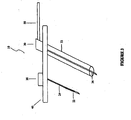
- an apparatus comprising a dual insertion set 10 includes a sensor portion 20, an infusion portion 30, a base 40, a sensor 22, a cannula 33, and piercing members 24 and 34. Both portions 20 and 30 of the dual insertion set 10 are secured to base 40. Infusion portion 30 is connected at one end to tubing 50 that is connected to an external infusion device, pump or the like.
- the sensor portion 20 is particularly designed for facilitating accurate placement of a sensor, i.e., a flexible thin film electrochemical sensor of the type used for monitoring specific blood parameters representative of a patient condition, as described in U.S. Pat. No. 5,391,250 entitled "Method of Fabricating Thin Film Sensors" and U.S.
- the sensor portion 20 is used to monitor blood glucose levels in diabetic patients as described in U.S. Pat. Nos. 5,390,671 , 5,568,806 and 5,586,553 , entitled “Transcutaneous Sensor Insertion Set”.
- embodiments of the apparatuses disclosed herein can be adapted for use with a variety of elements.
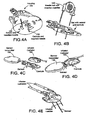
- Embodiments shown in FIG. 4 for example include elements such as a base or housing 100, elements comprising a combination of a sensor and insertion needle 120 or a cannula and insertion needle 130, a hub with insertion needles 140 (the hub having a finger grip member that allows the hub to be gripped as it is disengaged from the base), a sensor transmitter 150 and an infusion catheter 160.
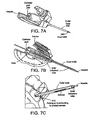
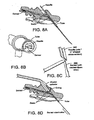
- Embodiments of this apparatus include those that comprise a subcutaneous sensor and a drug infusion catheter into a single housing, but allows them to be inserted into the skin so that they are spatially separated and/or are disposed in vivo a predetermined 3-D configuration.
- This separation and/or configuration is designed to diminish interference effects that interfering species in an infusate might have on the sensor itself.
- this configuration also may reduce sensor responses to local physiological (or metabolic) effects caused by the infusate.
- the sensor and catheter are inserted into the subcutaneous tissue at a fixed distance apart, for example one where the site of infusion is at least 3, 4, 5, 6, or 7 millimeters from the sensor electrode in an electrochemical sensor.
- having two separate sites also improves the stability of the device placement in subcutaneous tissue, for example by inhibiting its dislodging from the skin.
- an optimum depth for each of the infusion site and the sensor are independently selected and the configuration of the elements arranged accordingly.
- one embodiment of the apparatus includes an arrangement of elements designed to dispose the infusion site in a superficial subcutaneous layer, while disposing the sensor electrode deeper in a layer of the dermis.
- the skin includes three distinct layers, a top layer called the epidermis, a middle layer called the dermis and a bottom layer called the subcutaneous layer.
- the epidermis is about 60 to 120 ⁇ m (microns) thick and comprises a number of distinct layers including: a 10 to 20 ⁇ m outer layer, called the stratum comeum, followed by the Stratum lucidum and stratum granulosum, stratum spinosum and stratum germinativum (also called "stratum basale”).
- stratum comeum contains cells filled with bundles of cross-linked keratin and keratohyalin surrounded by an extracellular matrix of lipids.
- the inner layers are collectively referred to as the viable epidermis and have a total thickness in the range of about 50 to 100 ⁇ m.
- the apparatus is designed to have a configuration that results in the infusion site and/or the sensor being located in one of these layers.
- the dermis is much thicker than the epidermis, having a thickness in the range from about 2,000 to 3,000 ⁇ m.
- the dermal layer generally consists of a dense bed of connective tissue, including collagen fibers, and interstitial fluid dispersed throughout these fibers.
- the dermis is structurally divided into two areas: a superficial area adjacent to the epidermis, called the papillary region, and a deep thicker area known as the reticular region.
- the papillary region is composed of loose areolar connective tissue.
- the apparatus is designed to have a configuration that results in the infusion site and/or the sensor being located in one of these layers or areas.
- FIG. 4 One exemplary embodiment of an apparatus of the invention is shown in FIG. 4 .
- the sensor and sensor connector are built toward one edge of the assembly, while the cannula is positioned toward the center; both are at a 90° angle to the skin surface.
- a hub with two needles attached is engaged with the assembly (see, e.g. FIG. 4A ).
- the set is then inserted into the subcutaneous tissue, either manually or with an automatic insertion device.
- the hub with needles is then removed and discarded (see, e.g. FIG. 4B ).
- the infusion catheter can then be the attached and the sensor is plugged into a cable or transmitter (see, e.g. FIG. 4C and 4D ).
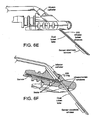
- Alternative embodiments can include for example variations where: an infusion cannula(e) is made from a rigid material, such as stainless steel, that would not require a separate insertion needle; variations where two or more infusion cannulae can be used to further reduce any interference or localized tissue effects (See, e.g. FIG. 4E ); variations where a needle and cannula(e) are built into the set at an angle.
- the sensor and infusion components of the set are designed in a modular fashion modular so that either one can be removed and replaced independently of the other.
- Embodiments of the invention include apparatuses designed to inhibit/avoid sensor interference caused by an interfering substance that is present in an infusate.
- One method of using the apparatus embodying the invention is a method for inhibiting interference of an electrochemical sensor that monitors a body characteristic of a patient, wherein the interference is caused by a interferant present in an infusate (e.g.
- a phenolic preservative that is infused by an apparatus for supplying a fluid to a body of a patient, the method comprising supplying a fluid to a body of a patient using an apparatus comprising a base adapted to secure the apparatus to the skin of a patient, a first piercing member coupled to and extending from the base, wherein the first piercing member comprises at least one cannula for infusing a fluid to an infusion site, a second piercing member coupled to and extending from the base and including the electrochemical sensor having a sensor electrode for determining at least one body characteristic of the patient at a sensor placement site, wherein the first and second piercing members are coupled to the base in an orientation such that when the first and second piercing members are inserted into a patient, a first perforation channel made by the first piercing member is not in operable contact with a second perforation channel made by the second piercing member such that a fluid infused to the infusion site cannot flow through
- Embodiments of the invention further include those having additional and/or multiple methodological functions.
- certain embodiments of the invention are further designed to stabilize the apparatus by securing it to the patient.
- One such embodiment of the invention uses an apparatus where the first and second piercing members are coupled to the base in an orientation so that when the cannula and the sensor electrode are disposed in a patient, they function to anchor the apparatus to the skin of the patient.
- Embodiments of the invention also include those designed for use with certain sensor embodiments.
- the method is designed to inhibit interference observed in a sensor having a plurality of layers, wherein at least one of the layers comprises a base substrate on which the electrode is disposed, the base substrate including a geometric feature selected to increase the surface area of an electrochemically reactive surface on the electrode disposed thereon such that surface area to volume ratio of the electrochemically reactive surface area of the electrode disposed on the geometric feature is greater than surface area-to-volume ratio of the reactive surface of the electrode when disposed on a flat surface, or an analyte sensing layer that detectably alters the electrical current at the electrode in the presence of an analyte, or an adhesion promoting layer that promotes the adhesion between one or more layers of the sensor, or an analyte modulating layer that modulates the diffusion of a analyte therethrough; or a cover layer that is impermeable to blood glucose, wherein the cover layer includes an aperture.
- Yet another embodiment of the invention is a method of making a dual infusion set apparatus for implantation within a mammal comprising the steps of providing a base layer and then disposing an infusion element (or a constellation of infusion elements) on the base and then further disposing a sensor element (or a constellation of sensor elements) on the base to that the apparatus is made.
- the 3-D configuration of these elements is controlled during manufacture so as to precisely control the resulting placement of the elements in vivo.
- the sensor element can be made by forming a conductive layer on the base layer, wherein the conductive layer includes a working electrode; forming an analyte sensing layer on the conductive layer, wherein the analyte sensing layer includes a composition that can alter the electrical current at the working electrode in the conductive layer in the presence of an analyte; optionally forming a protein layer on the analyte sensing layer; forming an adhesion promoting layer on the analyte sensing layer or the optional protein layer; forming an analyte modulating layer disposed on the adhesion promoting layer, wherein the analyte modulating layer includes a composition that modulates the diffusion of the analyte therethrough and then forming a cover layer disposed on at least a portion of the analyte modulating layer, wherein the cover layer further includes an aperture over at least a portion of the analyte modulating layer.
- FIG. 2 illustrates a cross-section of a typical sensor structure that can be used with embodiments of the present invention.
- the sensor is formed from a plurality of components that are typically in the form of layers of various conductive and non-conductive constituents disposed on each other according to a method of the invention to produce a sensor structure.
- the components of the sensor are typically characterized herein as layers because, for example, it allows for a facile characterization of the sensor structure shown in FIG. 2 .
- the sensor constituents are combined such that multiple constituents form one or more heterogeneous layers. In this context, those of skill in the art understand that the ordering of the layered constituents can be altered in various embodiments of the invention.
- the embodiment shown in FIG. 2 includes a base layer 102 to support the sensor.
- the base layer 102 can be made of a material such as a metal and/or a ceramic and/or a polymeric substrate, which may be self-supporting or further supported by another material as is known in the art.
- Embodiments of the invention include a conductive layer 104 which is disposed on and/or combined with the base layer 102.
- the base layer 102 and/or the conductive layer 104 can be constructed to produce electrodes having a configuration where the electrochemically reactive surface area of an electrode is disposed on the geometric feature so that the electrochemically reactive surface area is greater than if it was disposed on a flat surface.
- the conductive layer 104 comprises one or more electrodes.
- An operating sensor typically includes a plurality of electrodes such as a working electrode, a counter electrode and a reference electrode.
- Other embodiments may also include an electrode that performs multiple functions, for example one that functions as both as a reference and a counter electrode.
- Still other embodiments may utilize a separate reference element not formed on the sensor.
- these electrodes are electrically isolated from each other, while situated in close proximity to one another.
- the base layer 102 and/or conductive layer 104 can be generated using many known techniques and materials.
- the electrical circuit of the sensor is defined by etching the disposed conductive layer 104 into a desired pattern of conductive paths.
- a typical electrical circuit for the sensor comprises two or more adjacent conductive paths with regions at a proximal end to form contact pads and regions at a distal end to form sensor electrodes.
- An electrically insulating cover layer 106 such as a polymer coating is optionally disposed on portions of the sensor.
- Acceptable polymer coatings for use as the insulating protective cover layer 106 can include, but are not limited to, non-toxic biocompatible polymers such as silicone compounds, polyimides, biocompatible solder masks, epoxy acrylate copolymers, or the like.
- one or more exposed regions or apertures 108 can be made through the cover layer 106 to open the conductive layer 104 to the external environment and to, for example, allow an analyte such as glucose to permeate the layers of the sensor and be sensed by the sensing elements.
- Apertures 108 can be formed by a number of techniques, including laser ablation, tape masking, chemical milling or etching or photolithographic development or the like.
- a secondary photoresist can also be applied to the protective layer 106 to define the regions of the protective layer to be removed to form the aperture(s) 108.
- the exposed electrodes and/or contact pads can also undergo secondary processing (e.g. through the apertures 108), such as additional plating processing, to prepare the surfaces and/or strengthen the conductive regions.
- an analyte sensing layer 110 (which is typically a sensor chemistry layer, meaning that materials in this layer undergo a chemical reaction to produce a signal that can be sensed by the conductive layer) is disposed on one or more of the exposed electrodes of the conductive layer 104.
- the sensor chemistry layer 110 is an enzyme layer.
- the sensor chemistry layer 110 comprises an enzyme capable of producing and/or utilizing oxygen and/or hydrogen peroxide, for example the enzyme glucose oxidase.
- the enzyme in the sensor chemistry layer is combined with a second carrier protein such as human serum albumin, bovine serum albumin or the like.
- an enzyme such as glucose oxidase in the sensor chemistry layer 110 reacts with glucose to produce hydrogen peroxide, a compound which then modulates a current at an electrode.
- this modulation of current depends on the concentration of hydrogen peroxide, and the concentration of hydrogen peroxide correlates to the concentration of glucose, the concentration of glucose can be determined by monitoring this modulation in the current.
- the hydrogen peroxide is oxidized at a working electrode which is an anode (also termed herein the anodic working electrode), with the resulting current being proportional to the hydrogen peroxide concentration.
- Such modulations in the current caused by changing hydrogen peroxide concentrations can by monitored by any one of a variety of sensor detector apparatuses such as a universal sensor amperometric biosensor detector or one of the other variety of similar devices known in the art such as glucose monitoring devices produced by Medtronic MiniMed.
- sensor detector apparatuses such as a universal sensor amperometric biosensor detector or one of the other variety of similar devices known in the art such as glucose monitoring devices produced by Medtronic MiniMed.
- the analyte sensing layer 110 can be applied over portions of the conductive layer or over the entire region of the conductive layer. Typically the analyte sensing layer 110 is disposed on the working electrode which can be the anode or the cathode. Optionally, the analyte sensing layer 110 is also disposed on a counter and/or reference electrode. While the analyte sensing layer 110 can be up to about 1000 microns ( ⁇ m) in thickness, typically the analyte sensing layer is relatively thin as compared to those found in sensors previously described in the art, and is for example, typically less than 1, 0.5, 0.25 or 0.1 microns in thickness.
- some methods for generating a thin analyte sensing layer 110 include spin coating processes, dip and dry processes, low shear spraying processes, ink-jet printing processes, silk screen processes and the like. Most typically the thin analyte sensing layer 110 is applied using a spin coating process.
- the analyte sensing layer 110 is coated with one or more additional layers.
- the one or more additional layers includes a protein layer 116 disposed upon the analyte sensing layer 110.
- the protein layer 116 comprises a protein such as albumin or the like.
- the protein layer 116 comprises human serum albumin.
- an additional layer includes an analyte modulating layer 112 that is disposed above the analyte sensing layer 110 to regulate analyte contact with the analyte sensing layer 110.
- the analyte modulating membrane layer 112 can comprise a glucose limiting membrane, which regulates the amount of glucose that contacts an enzyme such as glucose oxidase that is present in the analyte sensing layer.
- glucose limiting membranes can be made from a wide variety of materials known to be suitable for such purposes, e.g., silicone compounds such as polydimethyl siloxanes, polyurethanes, polyurea cellulose acetates, Nafion, polyester sulfonic acids (e.g. Kodak AQ), hydrogels or any other suitable hydrophilic membranes known to those skilled in the art.
- the analyte modulating layer comprises a hydrophilic comb-copolymer having a central chain and a plurality of side chains coupled to the central chain, wherein at least one side chain comprises a silicone moiety.
- an adhesion promoter layer 114 is disposed between the analyte modulating layer 112 and the analyte sensing layer 110 as shown in FIG. 2 in order to facilitate their contact and/or adhesion.
- an adhesion promoter layer 114 is disposed between the analyte modulating layer 112 and the protein layer 116 as shown in FIG. 2 in order to facilitate their contact and/or adhesion.
- the adhesion promoter layer 114 can be made from any one of a wide variety of materials known in the art to facilitate the bonding between such layers.
- the adhesion promoter layer 114 comprises a silane compound.
- protein or like molecules in the analyte sensing layer 110 can be sufficiently crosslinked or otherwise prepared to allow the analyte modulating membrane layer 112 to be disposed in direct contact with the analyte sensing layer 110 in the absence of an adhesion promoter layer 114.
- sensors can be designed to contain elements having a combination of some or all of the material properties and/or functions of the elements/constituents discussed below (e.g. an element that serves both as a supporting base constituent and/or a conductive constituent and/or a matrix for the analyte sensing constituent and which further functions as an electrode in the sensor).
- Sensors of the invention typically include a base constituent (see, e.g. element 102 in Figure 2 ).
- base constituent is used herein according to art accepted terminology and refers to the constituent in the apparatus that typically provides a supporting matrix for the plurality of constituents that are stacked on top of one another and comprise the functioning sensor.
- the base constituent comprises a thin film sheet of insulative (e.g. electrically insulative and/or water impermeable) material.
- This base constituent can be made of a wide variety of materials having desirable qualities such as water impermeability and hermeticity. Some materials include metallic ceramic and polymeric substrates or the like.
- the base constituent and/or the conductive constituent can be constructed to produce electrodes having a configuration where the electrochemically reactive surface area of an electrode is disposed on the geometric feature so that the electrochemically reactive surface area is greater than if it was disposed on a flat surface.
- the base constituent may be self-supporting or further supported by another material as is known in the art.
- the base constituent 102 comprises a ceramic.
- the ceramic base comprises a composition that is predominantly Al 2 O 3 (e.g. 96%).
- the use of alumina as an insulating base constituent for use with implantable devices is disclosed in U.S. Pat. Nos. 4,940,858 , 4,678,868 and 6,472,122 ..
- the base constituents of the invention can further include other elements known in the art, for example hermetical vias (see, e.g. WO 03/023388 ).
- the base constituent can be relatively thick constituent (e.g. thicker than 25 microns).
- a nonconductive ceramic such as alumina, in thin constituents, e.g., less than about 25 microns.
- a first embodiment of the invention immobilizes an enzyme onto a thick (1-1,000 micron), porous substrate which functions as an electrode in the sensor.
- the porous electrode is designed to exhibit an increased surface area, for example by constructing it from a lattice of equal-sized adjoining spheres.
- glucose oxidase is immobilized on a thick (1-1,000 micron), porous metallic substrate that is manufactured from a lattice of equal-sized adjoining spheres and which function as a hydrogen peroxide-consuming electrode.
- the hydrogel typically utilized in a variety of analyte sensors is replaced with an essentially rigid, non-swelling porous enzyme-polymer matrix.
- bio-sensing enzymes can be stably immobilized via covalent bonding to a rigid, macroporous polymer that has optionally been molded into a specified shape.
- molded continuous rods of macroporous polymers have been developed for use as chromatographic separation media (see, e.g. US 5,453,185 and WO 93/07945 ).
- Suitable polymers are essentially incompressible and do not change their overall size in response to changes in their solvating environment.
- the electrochemical sensors typically include a conductive constituent disposed upon the base constituent that includes at least one electrode for contacting an analyte or its byproduct (e.g. oxygen and/or hydrogen peroxide) to be assayed (see, e.g. element 104 in Figure 2 ).
- a conductive constituent disposed upon the base constituent that includes at least one electrode for contacting an analyte or its byproduct (e.g. oxygen and/or hydrogen peroxide) to be assayed (see, e.g. element 104 in Figure 2 ).
- analyte or its byproduct e.g. oxygen and/or hydrogen peroxide
- An illustrative example of this is a conductive constituent that can measure an increase or decrease in current in response to exposure to a stimuli such as the change in the concentration of an analyte or its byproduct as compared to a reference electrode that does not experience the change in the concentration of the analyte, a coreactant (e.g. oxygen) used when the analyte interacts with a composition (e.g. the enzyme glucose oxidase) present in analyte sensing constituent 110 or a reaction product of this interaction (e.g. hydrogen peroxide).
- a stimuli such as the change in the concentration of an analyte or its byproduct as compared to a reference electrode that does not experience the change in the concentration of the analyte
- a coreactant e.g. oxygen
- a composition e.g. the enzyme glucose oxidase
- a reaction product of this interaction e.g. hydrogen peroxide
- Illustrative examples of such elements include electrode
- a working electrode which can be made from non-corroding metal or carbon.
- a carbon working electrode may be vitreous or graphitic and can be made from a solid or a paste.
- a metallic working electrode may be made from platinum group metals, including palladium or gold, or a non-corroding metallically conducting oxide, such as ruthenium dioxide.
- the electrode may comprise a silver/silver chloride electrode composition.
- the working electrode may be a wire or a thin conducting film applied to a substrate, for example, by coating or printing. Typically, only a portion of the surface of the metallic or carbon conductor is in electrolytic contact with the analyte-containing solution. This portion is called the working surface of the electrode.
- the remaining surface of the electrode is typically isolated from the solution by an electrically insulating cover constituent 106.
- an electrically insulating cover constituent 106 examples include polymers such as polyimides, polytetrafluoroethylene, polyhexafluoropropylene and silicones such as polysiloxanes.
- the analyte sensors of the invention typically include a reference electrode or a combined reference and counter electrode (also termed a quasi-reference electrode or a counter/reference electrode). If the sensor does not have a counter/reference electrode then it may include a separate counter electrode, which may be made from the same or different materials as the working electrode.
- Typical sensors of the present invention have one or more working electrodes and one or more counter, reference, and/or counter/reference electrodes.
- One exemplary sensor has two, three or four or more working electrodes. These working electrodes in the sensor may be integrally connected or they may be kept separate.
- the analyte sensors are implanted subcutaneously in the skin of a mammal for direct contact with the body fluids of the mammal, such as blood.
- the sensors can be implanted into other regions within the body of a mammal such as in the intraperotineal space.
- multiple working electrodes they may be implanted together or at different positions in the body.
- the counter, reference, and/or counter/reference electrodes may also be implanted either proximate to the working electrode(s) or at other positions within the body of the mammal.
- the electrochemical sensors optionally include an interference rejection constituent disposed between the surface of the electrode and the environment to be assayed.
- an interference rejection constituent disposed between the surface of the electrode and the environment to be assayed.
- certain sensor embodiments rely on the oxidation and/or reduction of hydrogen peroxide generated by enzymatic reactions on the surface of a working electrode at a constant potential applied. Because amperometric detection based on direct oxidation of hydrogen peroxide requires a relatively high oxidation potential, sensors employing this detection scheme may suffer interference from oxidizable species that are present in biological fluids such as ascorbic acid, uric acid and acetaminophen.
- interference rejection constituent refers to a coating or membrane in the sensor that functions to inhibit spurious signals generated by such oxidizable species which interfere with the detection of the signal generated by the analyte to be sensed.
- interference rejection constituents include one or more layers or coatings of compounds such as hydrophilic polyurethanes, cellulose acetate (including cellulose acetate incorporating agents such as poly(ethylene glycol), polyethersulfones, polytetrafluoroethylenes, the perfluoronated ionomer NafionTM, polyphenylenediamine, epoxy and the like.
- the electrochemical sensors may include an analyte sensing constituent disposed on the electrodes of the sensor (see, e.g. element 110 in Figure 2 ).
- analyte sensing constituent is used herein according to art accepted terminology and refers to a constituent comprising a material that is capable of recognizing or reacting with an analyte whose presence is to be detected by the analyte sensor apparatus. Typically this material in the analyte sensing constituent produces a detectable signal after interacting with the analyte to be sensed, typically via the electrodes of the conductive constituent.
- the analyte sensing constituent and the electrodes of the conductive constituent work in combination to produce the electrical signal that is read by an apparatus associated with the analyte sensor.
- the analyte sensing constituent comprises an enzyme capable of reacting with and/or producing a molecule whose change in concentration can be measured by measuring the change in the current at an electrode of the conductive constituent (e.g. oxygen and/or hydrogen peroxide), for example the enzyme glucose oxidase.
- An enzyme capable of producing a molecule such as hydrogen peroxide can be disposed on the electrodes according to a number of processes known in the art.
- the analyte sensing constituent can coat all or a portion of the various electrodes of the sensor.
- the analyte sensing constituent may coat the electrodes to an equivalent degree.
- the analyte sensing constituent may coat different electrodes to different degrees, with for example the coated surface of the working electrode being larger than the coated surface of the counter and/or reference electrode.
- Typical sensors utilize an enzyme (e.g. glucose oxidase) that has been combined with a second protein (e.g. albumin) in a fixed ratio (e.g. one that is typically optimized for glucose oxidase stabilizing properties) and then applied on the surface of an electrode to form a thin enzyme constituent.
- the analyte sensing constituent comprises a GOx and HSA mixture.
- the GOx reacts with glucose present in the sensing environment (e.g.
- a glucose oxidase/albumin is prepared in a physiological solution (e.g., phosphate buffered saline at neutral pH) with the albumin being present in a range of about .5%-10% by weight.
- a physiological solution e.g., phosphate buffered saline at neutral pH
- the stabilized glucose oxidase constituent that is formed on the analyte sensing constituent is very thin as compared to those previously described in the art, for example less than 2, 1, 0.5, 0.25 or 0.1 microns in thickness.
- One illustrative arrangement utilizes a stabilized glucose oxidase constituent for coating the surface of an electrode wherein the glucose oxidase is mixed with a carrier protein in a fixed ratio within the constituent, and the glucose oxidase and the carrier protein are distributed in a substantially uniform manner throughout the constituent.
- the constituent is less than 2 microns in thickness.
- an enzyme layer can be greater 2 microns.
- sensors having these extremely thin analyte sensing constituents have material properties that exceed those of sensors having thicker coatings including enhanced longevity, linearity, regularity as well as improved signal to noise ratios. While not being bound by a specific scientific theory, it is believed that sensors having extremely thin analyte sensing constituents have surprisingly enhanced characteristics as compared to those of thicker constituents because in thicker enzyme constituents only a fraction of the reactive enzyme within the constituent is able to access the analyte to be sensed. In sensors utilizing glucose oxidase, the thick coatings produced by electrodeposition may hinder the ability of hydrogen peroxide generated at the reactive interface of a thick enzyme constituent to contact the sensor surface and thereby generate a signal.
- the enzyme and the second protein are typically treated to form a crosslinked matrix (e.g. by adding a cross-linking agent to the protein mixture).
- crosslinking conditions may be manipulated to modulate factors such as the retained biological activity of the enzyme, its mechanical and/or operational stability.
- Illustrative crosslinking procedures are described in U.S. Patent Application Serial Number 10/335,506 and PCT publication WO 03/035891 .
- an amine cross-linking reagent such as, but not limited to, glutaraldehyde, can be added to the protein mixture.
- the addition of a cross-linking reagent to the protein mixture creates a protein paste.
- the concentration of the cross-linking reagent to be added may vary according to the concentration of the protein mixture. While glutaraldehyde is an illustrative crosslinking reagent, other cross-linking reagents may also be used or may be used in place of glutaraldehyde, including, but not limited to, an amine reactive, homofunctional, cross-linking reagent such as Disuccinimidyl Suberate (DSS). Another example is 1-Ethyl-3 (3-Dimethylaminopropyl) Carbodiimide (EDC), which is a zero-length cross-linker. EDC forms an amide bond between carboxylic acid and amine groups. Other suitable cross-linkers also may be used, as will be evident to those skilled in the art.
- DSS Disuccinimidyl Suberate
- EDC 1-Ethyl-3 (3-Dimethylaminopropyl) Carbodiimide
- EDC forms an amide bond between carboxylic acid and amine groups.
- the GOx and/or carrier protein concentration may vary for different embodiments of the invention.
- the GOx concentration may be within the range of approximately 50 mg/ml (approximately 10,000 U/ml) to approximately 700 mg/ml (approximately 150,000 U/ml).
- the GOx concentration is about 115 mg/ml (approximately 22,000 U/ml).
- the HSA concentration may vary between about 0.5%-30% (w/v), depending on the GOx concentration.
- the HSA concentration is about 1-10% w/v, and most typically is about 5% w/v.
- collagen or BSA or other structural proteins used in these contexts can be used instead of or in addition to HSA.
- GOx is discussed as an illustrative enzyme in the analyte sensing constituent, other proteins and/or enzymes may also be used or may be used in place of GOx, including, but not limited to glucose dehydrogenase or hexokinase, hexose oxidase, lactate oxidase, and the like. Other proteins and/or enzymes may also be used, as will be evident to those skilled in the art.
- HSA is employed in the example embodiment, other structural proteins, such as BSA, collagens or the like, could be used instead of or in addition to HSA.
- concentrations other than those discussed herein may be utilized. For example, depending on the enzyme employed, concentrations ranging from approximately 10% weight per weight to 70% weight per weight may be suitable. The concentration may be varied not only depending on the particular enzyme being employed, but also depending on the desired properties of the resulting protein matrix. For example, a certain concentration may be utilized if the protein matrix is to be used in a diagnostic capacity while a different concentration may be utilized if certain structural properties are desired. Those skilled in the art will understand that the concentration utilized may be varied through experimentation to determine which concentration (and of which enzyme or protein) may yield the desired result.
- the analyte sensing constituent may include a composition (e.g. glucose oxidase) capable of producing a signal (e.g. a change in oxygen and/or hydrogen peroxide concentrations) that can be sensed by the electrically conductive elements (e.g. electrodes which sense changes in oxygen and/or hydrogen peroxide concentrations).
- a composition e.g. glucose oxidase
- the electrically conductive elements e.g. electrodes which sense changes in oxygen and/or hydrogen peroxide concentrations
- other useful analyte sensing constituents can be formed from any composition that is capable of producing a detectable signal that can be sensed by the electrically conductive elements after interacting with a target analyte whose presence is to be detected.
- the composition may comprises an enzyme that modulates hydrogen peroxide concentrations upon reaction with an analyte to be sensed.
- the composition comprises an enzyme that modulates oxygen concentrations upon reaction with an analyte to be sensed.
- an enzyme that modulates oxygen concentrations upon reaction with an analyte to be sensed.
- a wide variety of enzymes that either use or produce hydrogen peroxide and/or oxygen in a reaction with a physiological analyte are known in the art and these enzymes can be readily incorporated into the analyte sensing constituent composition.
- a variety of other enzymes known in the art can produce and/or utilize compounds whose modulation can be detected by electrically conductive elements such as the electrodes that are incorporated into the sensor designs described herein.
- Such enzymes include for example, enzymes specifically described in Table 1, pages 15-29 and/or Table 18, pages 111-112 of Protein Immobilization: Fundamentals and Applications (Bioprocess Technology, Vol 14) by Richard F. Taylor (Editor) Publisher: Marcel Dekker; (January 7, 1991 ).
- analyte sensing constituents can be formed to include antibodies whose interaction with a target analyte is capable of producing a detectable signal that can be sensed by the electrically conductive elements after interacting with the target analyte whose presence is to be detected.
- U.S. Patent No. 5,427,912 describes an antibody-based apparatus for electrochemically determining the concentration of an analyte in a sample. In this device, a mixture is formed which includes the sample to be tested, an enzyme-acceptor polypeptide, an enzyme-donor polypeptide linked to an analyte analog (enzyme-donor polypeptide conjugate), a labeled substrate, and an antibody specific for the analyte to be measured.
- the analyte and the enzyme-donor polypeptide conjugate competitively bind to the antibody.
- the enzyme-donor polypeptide conjugate When the enzyme-donor polypeptide conjugate is not bound to antibody, it will spontaneously combine with the enzyme acceptor polypeptide to form an active enzyme complex.
- the active enzyme then hydrolyzes the labeled substrate, resulting in the generation of an electroactive label, which can then be oxidized at the surface of an electrode.
- a current resulting from the oxidation of the electroactive compound can be measured and correlated to the concentration of the analyte in the sample.
- 5,149,630 describes an electrochemical specific binding assay of a ligand (e.g., antigen, hapten or antibody) wherein at least one of the components is enzyme-labelled, and which includes the step of determining the extent to which the transfer of electrons between the enzyme substrate and an electrode, associated with the substrate reaction, is perturbed by complex formation or by displacement of any ligand complex relative to unbound enzyme-labelled component.
- the electron transfer is aided by electron-transfer mediators which can accept electrons from the enzyme and donate them to the electrode or vice versa (e.g. ferrocene) or by electron-transfer promoters which retain the enzyme in close proximity with the electrode without themselves taking up a formal charge.
- a ligand e.g., antigen, hapten or antibody
- LDH5 lactate dehydrogenase-5
- NAD nicotine-amine adenine dinucleotide
- Anti-LDH5 antibody is bound to a suitable glassy carbon electrode; this is contacted with the substrate containing LDH5, rinsed, inserted into a NAD solution, connected to an amperometric system, and current changes are measured in the presence of differing concentrations of lactic acid, which are indicative of the quantity of LDH-5.
- 6,410,251 describes an apparatus and method for detecting or assaying one constituting member in a specific binding pair; for example, the antigen in an antigen/antibody pair, by utilizing specific binding such as binding between an antigen and an antibody, together with redox reaction for detecting a label, wherein an oxygen micro-electrode with a sensing surface area is used.
- 4,402,819 describes an antibody-selective potentiometric electrode for the quantitative determination of antibodies (as the analyte) in dilute liquid serum samples employing an insoluble membrane incorporating an antigen having bonded thereto an ion carrier effecting the permeability of preselected cations therein, which permeability is a function of specific antibody concentrations in analysis, and the corresponding method of analysis.
- an insoluble membrane incorporating an antigen having bonded thereto an ion carrier effecting the permeability of preselected cations therein, which permeability is a function of specific antibody concentrations in analysis, and the corresponding method of analysis.
- analyte sensing constituents of the sensors disclosed herein include polymers that bind specific types of cells or cell components (e.g. polypeptides, carbohydrates and the like); single-strand DNA; antigens and the like.
- the detectable signal can be, for example, an optically detectable change, such as a color change or a visible accumulation of the desired analyte (e.g., cells).
- Sensing elements can also be formed from materials that are essentially non-reactive (i.e., controls).
- sensor elements are beneficially included, for example, in sensors for use in cell-sorting assays and assays for the presence of pathogenic organisms, such as viruses (HIV, hepatitis-C, etc.), bacteria, protozoa and the like.
- pathogenic organisms such as viruses (HIV, hepatitis-C, etc.), bacteria, protozoa and the like.
- analyte sensors that measure an analyte that is present in the external environment and that can in itself produce a measurable change in current at an electrode.
- the analyte sensing constituent can be optional.
- the electrochemical sensors suitable for use with embodiments of the invention optionally include a protein constituent disposed between the analyte sensing constituent and the analyte modulating constituent (see, e.g. element 116 in Figure 2 ).
- the term "protein constituent" is used herein according to art accepted terminology and refers to constituent containing a carrier protein or the like that is selected for compatibility with the analyte sensing constituent and/or the analyte modulating constituent.
- the protein constituent comprises an albumin such as human serum albumin.
- the HSA concentration may vary between about 0.5%-30% (w/v). Typically the HSA concentration is about 1-10% w/v, and most typically is about 5% w/v.
- collagen or BSA or other structural proteins used in these contexts can be used instead of or in addition to HSA.
- This constituent is typically crosslinked on the analyte sensing constituent according to art accepted protocols.
- the electrochemical sensors can include one or more adhesion promoting (AP) constituents (see, e.g. element 114 in Figure 2 ).
- AP adhesion promoting
- the term "adhesion promoting constituent" is used herein according to art accepted terminology and refers to a constituent that includes materials selected for their ability to promote adhesion between adjoining constituents in the sensor.
- the adhesion promoting constituent is disposed between the analyte sensing constituent and the analyte modulating constituent.
- the adhesion promoting constituent is disposed between the optional protein constituent and the analyte modulating constituent.
- the adhesion promoter constituent can be made from any one of a wide variety of materials known in the art to facilitate the bonding between such constituents and can be applied by any one of a wide variety of methods known in the art.
- the adhesion promoter constituent comprises a silane compound such as ⁇ -aminopropyltrimethoxysilane.
- silane coupling reagents especially those of the formula R'Si(OR) 3 in which R' is typically an aliphatic group with a terminal amine and R is a lower alkyl group
- R' is typically an aliphatic group with a terminal amine and R is a lower alkyl group
- R' is typically an aliphatic group with a terminal amine and R is a lower alkyl group
- R' is typically an aliphatic group with a terminal amine and R is a lower alkyl group
- R is typically an aliphatic group with a terminal amine and R is a lower alkyl group
- the adhesion promoting constituent further comprises one or more compounds that can also be present in an adjacent constituent such as the polydimethyl siloxane (PDMS) compounds that serves to limit the diffusion of analytes such as glucose through the analyte modulating constituent.
- the formulation comprises 0.5-20% PDMS, typically 5-15% PDMS, and most typically 10% PDMS.
- the adhesion promoting constituent may include an agent selected for its ability to crosslink a siloxane moiety present in a proximal constituent such as the analyte modulating constituent.
- the adhesion promoting constituent includes an agent selected for its ability to crosslink an amine or carboxyl moiety of a protein present in a proximal constituent such a the analyte sensing constituent and/or the protein constituent.
- the electrochemical sensors may include an analyte modulating constituent disposed on the sensor (see, e.g. element 112 in Figure 2 ).
- analyte modulating constituent is used herein according to art accepted terminology and refers to a constituent that typically forms a membrane on the sensor that operates to modulate the diffusion of one or more analytes, such as glucose, through the constituent.
- the analyte modulating constituent is an analyte-limiting membrane which operates to prevent or restrict the diffusion of one or more analytes, such as glucose, through the constituents.
- the analyte-modulating constituent operates to facilitate the diffusion of one or more analytes, through the constituents.
- such analyte modulating constituents can be formed to prevent or restrict the diffusion of one type of molecule through the constituent (e.g. glucose), while at the same time allowing or even facilitating the diffusion of other types of molecules through the constituent (e.g. O 2 ).
- one type of molecule e.g. glucose
- other types of molecules e.g. O 2
- glucose and oxygen from blood diffuse through a primary membrane of the sensor.
- an enzyme such as glucose oxidase, catalyzes the conversion of glucose to hydrogen peroxide and gluconolactone.
- the hydrogen peroxide may diffuse back through the analyte modulating constituent, or it may diffuse to an electrode where it can be reacted to form oxygen and a proton to produce a current that is proportional to the glucose concentration.
- the sensor membrane assembly serves several functions, including selectively allowing the passage of glucose therethrough.
- an illustrative analyte modulating constituent is a semi-permeable membrane which permits passage of water, oxygen and at least one selective analyte and which has the ability to absorb water, the membrane having a water soluble, hydrophilic polymer.
- analyte modulating composition includes PDMS.
- the analyte modulating constituent includes an agent selected for its ability to crosslink a siloxane moiety present in a proximal constituent.
- the adhesion promoting constituent includes an agent selected for its ability to crosslink an amine or carboxyl moiety of a protein present in a proximal constituent.
- the analyte modulating constituent may comprise a hydrophilic comb-copolymer having a central chain and a plurality of side chains coupled to the central chain, wherein at least one side chain comprises a silicone moiety.
- the electrochemical sensors may include one or more cover constituents which are typically electrically insulating protective constituents (see, e.g. element 106 in Figure 2 ).
- cover constituents are disposed on at least a portion of the analyte modulating constituent
- Acceptable polymer coatings for use as the insulating protective cover constituent can include, but are not limited to, non-toxic biocompatible polymers such as silicone compounds, polyimides, biocompatible solder masks, epoxy acrylate copolymers, or the like. Further, these coatings can be photo-imageable to facilitate photolithographic forming of apertures through to the conductive constituent.
- a typical cover constituent comprises spun on silicone. As is known in the art, this constituent can be a commercially available RTV (room temperature vulcanized) silicone composition.
- RTV room temperature vulcanized
Landscapes
- Health & Medical Sciences (AREA)
- Life Sciences & Earth Sciences (AREA)
- Engineering & Computer Science (AREA)
- Biomedical Technology (AREA)
- Veterinary Medicine (AREA)
- Public Health (AREA)
- Physics & Mathematics (AREA)
- General Health & Medical Sciences (AREA)
- Animal Behavior & Ethology (AREA)
- Heart & Thoracic Surgery (AREA)
- Surgery (AREA)
- Biophysics (AREA)
- Medical Informatics (AREA)
- Molecular Biology (AREA)
- Pathology (AREA)
- Anesthesiology (AREA)
- Vascular Medicine (AREA)
- Hematology (AREA)
- Optics & Photonics (AREA)
- Chemical & Material Sciences (AREA)
- Emergency Medicine (AREA)
- Chemical Kinetics & Catalysis (AREA)
- General Chemical & Material Sciences (AREA)
- Bioinformatics & Cheminformatics (AREA)
- Medicinal Chemistry (AREA)
- Pharmacology & Pharmacy (AREA)
- Diabetes (AREA)
- Dermatology (AREA)
- Computer Networks & Wireless Communication (AREA)
- Measurement Of The Respiration, Hearing Ability, Form, And Blood Characteristics Of Living Organisms (AREA)
- Infusion, Injection, And Reservoir Apparatuses (AREA)
Priority Applications (2)
| Application Number | Priority Date | Filing Date | Title |
|---|---|---|---|
| EP14154687.9A EP2732837B1 (en) | 2007-08-29 | 2008-08-25 | Combined sensor and infusion set using separated sites |
| DK14154687.9T DK2732837T3 (en) | 2007-08-29 | 2008-08-25 | Combined sensor and infusion set for use on separate sites |
Applications Claiming Priority (2)
| Application Number | Priority Date | Filing Date | Title |
|---|---|---|---|
| US11/897,106 US9968742B2 (en) | 2007-08-29 | 2007-08-29 | Combined sensor and infusion set using separated sites |
| PCT/US2008/074187 WO2009032588A1 (en) | 2007-08-29 | 2008-08-25 | Combined sensor and infusion set using separated sites |
Related Child Applications (2)
| Application Number | Title | Priority Date | Filing Date |
|---|---|---|---|
| EP14154687.9A Division EP2732837B1 (en) | 2007-08-29 | 2008-08-25 | Combined sensor and infusion set using separated sites |
| EP14154687.9A Division-Into EP2732837B1 (en) | 2007-08-29 | 2008-08-25 | Combined sensor and infusion set using separated sites |
Publications (2)
| Publication Number | Publication Date |
|---|---|
| EP2190502A1 EP2190502A1 (en) | 2010-06-02 |
| EP2190502B1 true EP2190502B1 (en) | 2014-10-15 |
Family
ID=40010684
Family Applications (2)
| Application Number | Title | Priority Date | Filing Date |
|---|---|---|---|
| EP08798612.1A Active EP2190502B1 (en) | 2007-08-29 | 2008-08-25 | Combined sensor and infusion set using separated sites |
| EP14154687.9A Active EP2732837B1 (en) | 2007-08-29 | 2008-08-25 | Combined sensor and infusion set using separated sites |
Family Applications After (1)
| Application Number | Title | Priority Date | Filing Date |
|---|---|---|---|
| EP14154687.9A Active EP2732837B1 (en) | 2007-08-29 | 2008-08-25 | Combined sensor and infusion set using separated sites |
Country Status (6)
| Country | Link |
|---|---|
| US (1) | US9968742B2 (https=) |
| EP (2) | EP2190502B1 (https=) |
| JP (1) | JP5688971B2 (https=) |
| CA (1) | CA2695966C (https=) |
| DK (2) | DK2732837T3 (https=) |
| WO (1) | WO2009032588A1 (https=) |
Families Citing this family (316)
| Publication number | Priority date | Publication date | Assignee | Title |
|---|---|---|---|---|
| US6503231B1 (en) * | 1998-06-10 | 2003-01-07 | Georgia Tech Research Corporation | Microneedle device for transport of molecules across tissue |
| US6611707B1 (en) | 1999-06-04 | 2003-08-26 | Georgia Tech Research Corporation | Microneedle drug delivery device |
| EP1345646A2 (en) * | 2000-12-14 | 2003-09-24 | Georgia Tech Research Corporation | Microneedle devices and production thereof |
| EP1815879A3 (en) | 2001-05-18 | 2007-11-14 | Deka Products Limited Partnership | Infusion set for a fluid pump |
| US8034026B2 (en) | 2001-05-18 | 2011-10-11 | Deka Products Limited Partnership | Infusion pump assembly |
| US9237865B2 (en) | 2002-10-18 | 2016-01-19 | Medtronic Minimed, Inc. | Analyte sensors and methods for making and using them |
| US8771183B2 (en) | 2004-02-17 | 2014-07-08 | Abbott Diabetes Care Inc. | Method and system for providing data communication in continuous glucose monitoring and management system |
| AU2003303597A1 (en) | 2002-12-31 | 2004-07-29 | Therasense, Inc. | Continuous glucose monitoring system and methods of use |
| US8066639B2 (en) | 2003-06-10 | 2011-11-29 | Abbott Diabetes Care Inc. | Glucose measuring device for use in personal area network |
| US20190357827A1 (en) | 2003-08-01 | 2019-11-28 | Dexcom, Inc. | Analyte sensor |
| US7299082B2 (en) | 2003-10-31 | 2007-11-20 | Abbott Diabetes Care, Inc. | Method of calibrating an analyte-measurement device, and associated methods, devices and systems |
| WO2005119524A2 (en) | 2004-06-04 | 2005-12-15 | Therasense, Inc. | Diabetes care host-client architecture and data management system |
| US9788771B2 (en) | 2006-10-23 | 2017-10-17 | Abbott Diabetes Care Inc. | Variable speed sensor insertion devices and methods of use |
| US9351669B2 (en) | 2009-09-30 | 2016-05-31 | Abbott Diabetes Care Inc. | Interconnect for on-body analyte monitoring device |
| US8029441B2 (en) | 2006-02-28 | 2011-10-04 | Abbott Diabetes Care Inc. | Analyte sensor transmitter unit configuration for a data monitoring and management system |
| US8112240B2 (en) | 2005-04-29 | 2012-02-07 | Abbott Diabetes Care Inc. | Method and apparatus for providing leak detection in data monitoring and management systems |
| CA2620586A1 (en) | 2005-08-31 | 2007-03-08 | Boris P. Kovatchev | Improving the accuracy of continuous glucose sensors |
| ATE480278T1 (de) * | 2005-09-12 | 2010-09-15 | Unomedical As | Einfürungssystem für ein infusionsset mit einem ersten und zweiten federeinheit |
| US9521968B2 (en) | 2005-09-30 | 2016-12-20 | Abbott Diabetes Care Inc. | Analyte sensor retention mechanism and methods of use |
| US7766829B2 (en) | 2005-11-04 | 2010-08-03 | Abbott Diabetes Care Inc. | Method and system for providing basal profile modification in analyte monitoring and management systems |
| DE602006006477D1 (de) | 2005-12-23 | 2009-06-04 | Unomedical As | Verabreichungsgerät |
| US7885698B2 (en) | 2006-02-28 | 2011-02-08 | Abbott Diabetes Care Inc. | Method and system for providing continuous calibration of implantable analyte sensors |
| AU2007219546B8 (en) | 2006-02-28 | 2012-07-05 | Unomedical A/S | Inserter for infusion part and infusion part provided with needle protector |
| US8346335B2 (en) | 2008-03-28 | 2013-01-01 | Abbott Diabetes Care Inc. | Analyte sensor calibration management |
| US8224415B2 (en) | 2009-01-29 | 2012-07-17 | Abbott Diabetes Care Inc. | Method and device for providing offset model based calibration for analyte sensor |
| US7653425B2 (en) | 2006-08-09 | 2010-01-26 | Abbott Diabetes Care Inc. | Method and system for providing calibration of an analyte sensor in an analyte monitoring system |
| US8140312B2 (en) | 2007-05-14 | 2012-03-20 | Abbott Diabetes Care Inc. | Method and system for determining analyte levels |
| US8219173B2 (en) | 2008-09-30 | 2012-07-10 | Abbott Diabetes Care Inc. | Optimizing analyte sensor calibration |
| US8473022B2 (en) | 2008-01-31 | 2013-06-25 | Abbott Diabetes Care Inc. | Analyte sensor with time lag compensation |
| US9392969B2 (en) | 2008-08-31 | 2016-07-19 | Abbott Diabetes Care Inc. | Closed loop control and signal attenuation detection |
| US7630748B2 (en) | 2006-10-25 | 2009-12-08 | Abbott Diabetes Care Inc. | Method and system for providing analyte monitoring |
| US8478557B2 (en) | 2009-07-31 | 2013-07-02 | Abbott Diabetes Care Inc. | Method and apparatus for providing analyte monitoring system calibration accuracy |
| US7620438B2 (en) | 2006-03-31 | 2009-11-17 | Abbott Diabetes Care Inc. | Method and system for powering an electronic device |
| US9675290B2 (en) | 2012-10-30 | 2017-06-13 | Abbott Diabetes Care Inc. | Sensitivity calibration of in vivo sensors used to measure analyte concentration |
| US7618369B2 (en) | 2006-10-02 | 2009-11-17 | Abbott Diabetes Care Inc. | Method and system for dynamically updating calibration parameters for an analyte sensor |
| US8226891B2 (en) | 2006-03-31 | 2012-07-24 | Abbott Diabetes Care Inc. | Analyte monitoring devices and methods therefor |
| US8374668B1 (en) | 2007-10-23 | 2013-02-12 | Abbott Diabetes Care Inc. | Analyte sensor with lag compensation |
| WO2007140783A2 (en) | 2006-06-07 | 2007-12-13 | Unomedical A/S | Inserter for transcutaneous sensor |
| KR20090028701A (ko) | 2006-06-09 | 2009-03-19 | 우노메디컬 에이/에스 | 장착 패드 |
| US9119582B2 (en) * | 2006-06-30 | 2015-09-01 | Abbott Diabetes Care, Inc. | Integrated analyte sensor and infusion device and methods therefor |
| RU2443436C2 (ru) * | 2006-08-02 | 2012-02-27 | Уномедикал А/С | Канюльное и доставочное устройство |
| EP2083673B1 (en) | 2006-09-29 | 2012-07-04 | Medingo Ltd. | Fluid delivery system with electrochemical sensing of analyte concentration levels |
| AU2007308804A1 (en) | 2006-10-26 | 2008-05-02 | Abbott Diabetes Care, Inc. | Method, system and computer program product for real-time detection of sensitivity decline in analyte sensors |
| KR20090117749A (ko) * | 2007-02-02 | 2009-11-12 | 우노메디컬 에이/에스 | 약물 공급장치 |
| CA2676811A1 (en) * | 2007-02-02 | 2008-08-07 | Unomedical A/S | Injection site for injecting medication |
| US20080199894A1 (en) | 2007-02-15 | 2008-08-21 | Abbott Diabetes Care, Inc. | Device and method for automatic data acquisition and/or detection |
| US8121857B2 (en) | 2007-02-15 | 2012-02-21 | Abbott Diabetes Care Inc. | Device and method for automatic data acquisition and/or detection |
| US8930203B2 (en) * | 2007-02-18 | 2015-01-06 | Abbott Diabetes Care Inc. | Multi-function analyte test device and methods therefor |
| US8732188B2 (en) | 2007-02-18 | 2014-05-20 | Abbott Diabetes Care Inc. | Method and system for providing contextual based medication dosage determination |
| US8123686B2 (en) | 2007-03-01 | 2012-02-28 | Abbott Diabetes Care Inc. | Method and apparatus for providing rolling data in communication systems |
| CA2683959C (en) | 2007-04-14 | 2017-08-29 | Abbott Diabetes Care Inc. | Method and apparatus for providing data processing and control in medical communication system |
| EP2146622B1 (en) | 2007-04-14 | 2016-05-11 | Abbott Diabetes Care Inc. | Method and apparatus for providing dynamic multi-stage signal amplification in a medical device |
| WO2008130898A1 (en) | 2007-04-14 | 2008-10-30 | Abbott Diabetes Care, Inc. | Method and apparatus for providing data processing and control in medical communication system |
| CA2683930A1 (en) | 2007-04-14 | 2008-10-23 | Abbott Diabetes Care Inc. | Method and apparatus for providing data processing and control in medical communication system |
| WO2009096992A1 (en) | 2007-04-14 | 2009-08-06 | Abbott Diabetes Care, Inc. | Method and apparatus for providing data processing and control in medical communication system |
| ES2461090T3 (es) | 2007-04-14 | 2014-05-16 | Abbott Diabetes Care Inc. | Procedimiento y aparato para proporcionar tratamiento y control de datos en un sistema de comunicación médica |
| US7928850B2 (en) | 2007-05-08 | 2011-04-19 | Abbott Diabetes Care Inc. | Analyte monitoring system and methods |
| US8456301B2 (en) | 2007-05-08 | 2013-06-04 | Abbott Diabetes Care Inc. | Analyte monitoring system and methods |
| US8461985B2 (en) | 2007-05-08 | 2013-06-11 | Abbott Diabetes Care Inc. | Analyte monitoring system and methods |
| US8665091B2 (en) | 2007-05-08 | 2014-03-04 | Abbott Diabetes Care Inc. | Method and device for determining elapsed sensor life |
| US8239166B2 (en) | 2007-05-14 | 2012-08-07 | Abbott Diabetes Care Inc. | Method and apparatus for providing data processing and control in a medical communication system |
| US8103471B2 (en) | 2007-05-14 | 2012-01-24 | Abbott Diabetes Care Inc. | Method and apparatus for providing data processing and control in a medical communication system |
| US7996158B2 (en) | 2007-05-14 | 2011-08-09 | Abbott Diabetes Care Inc. | Method and apparatus for providing data processing and control in a medical communication system |
| US10002233B2 (en) | 2007-05-14 | 2018-06-19 | Abbott Diabetes Care Inc. | Method and apparatus for providing data processing and control in a medical communication system |
| US9125548B2 (en) | 2007-05-14 | 2015-09-08 | Abbott Diabetes Care Inc. | Method and apparatus for providing data processing and control in a medical communication system |
| US8600681B2 (en) | 2007-05-14 | 2013-12-03 | Abbott Diabetes Care Inc. | Method and apparatus for providing data processing and control in a medical communication system |
| US8444560B2 (en) | 2007-05-14 | 2013-05-21 | Abbott Diabetes Care Inc. | Method and apparatus for providing data processing and control in a medical communication system |
| US8260558B2 (en) | 2007-05-14 | 2012-09-04 | Abbott Diabetes Care Inc. | Method and apparatus for providing data processing and control in a medical communication system |
| US8560038B2 (en) | 2007-05-14 | 2013-10-15 | Abbott Diabetes Care Inc. | Method and apparatus for providing data processing and control in a medical communication system |
| EP2155311B1 (en) * | 2007-06-20 | 2013-01-02 | Unomedical A/S | A method and an apparatus for making a catheter |
| CN103251414B (zh) | 2007-06-21 | 2017-05-24 | 雅培糖尿病护理公司 | 用于分析物水平的检测的设备 |
| EP2171031B1 (en) | 2007-06-21 | 2018-12-05 | Abbott Diabetes Care Inc. | Health management devices and methods |
| EP2185224A1 (en) | 2007-07-03 | 2010-05-19 | Unomedical A/S | Inserter having bistable equilibrium states |
| RU2010104457A (ru) * | 2007-07-10 | 2011-08-20 | Уномедикал А/С (Dk) | Устройство ввода с двумя пружинами |
| NZ582422A (en) * | 2007-07-18 | 2011-11-25 | Unomedical As | Controlled acceleration device for inserting a penetrating member into a patient |
| US8834366B2 (en) | 2007-07-31 | 2014-09-16 | Abbott Diabetes Care Inc. | Method and apparatus for providing analyte sensor calibration |
| US7768386B2 (en) | 2007-07-31 | 2010-08-03 | Abbott Diabetes Care Inc. | Method and apparatus for providing data processing and control in a medical communication system |
| WO2009016638A1 (en) * | 2007-08-01 | 2009-02-05 | Medingo Ltd. | Device for facilitating infusion of therapeutic fluids and sensing of bodily analytes |
| US20120046533A1 (en) * | 2007-08-29 | 2012-02-23 | Medtronic Minimed, Inc. | Combined sensor and infusion sets |
| US9044178B2 (en) | 2007-08-30 | 2015-06-02 | Pepex Biomedical, Llc | Electrochemical sensor and method for manufacturing |
| US8702932B2 (en) | 2007-08-30 | 2014-04-22 | Pepex Biomedical, Inc. | Electrochemical sensor and method for manufacturing |
| US8216138B1 (en) | 2007-10-23 | 2012-07-10 | Abbott Diabetes Care Inc. | Correlation of alternative site blood and interstitial fluid glucose concentrations to venous glucose concentration |
| US8377031B2 (en) | 2007-10-23 | 2013-02-19 | Abbott Diabetes Care Inc. | Closed loop control system with safety parameters and methods |
| US8409093B2 (en) | 2007-10-23 | 2013-04-02 | Abbott Diabetes Care Inc. | Assessing measures of glycemic variability |
| US20100256593A1 (en) * | 2007-11-21 | 2010-10-07 | Ofer Yodfat | Analyte Monitoring and Fluid Dispensing System |
| US20090164239A1 (en) | 2007-12-19 | 2009-06-25 | Abbott Diabetes Care, Inc. | Dynamic Display Of Glucose Information |
| US20110098652A1 (en) * | 2008-02-13 | 2011-04-28 | Unomedical A/S | Moulded Connection between Cannula and Delivery Part |
| RU2010137844A (ru) | 2008-02-13 | 2012-03-20 | Уномедикал А/С (Dk) | Уплотнение между канюльной частью и путем прохождения текучей среды |
| CA2715667A1 (en) | 2008-02-20 | 2009-08-27 | Unomedical A/S | Insertion device with horizontally moving part |
| BRPI0909361A2 (pt) * | 2008-03-17 | 2015-09-29 | Isense Corp | subconjunto sensor de analito e métodos e aparelhos para inserir um sensor de analito associado com o mesmo |
| EP2303220A1 (en) * | 2008-05-30 | 2011-04-06 | Unomedical A/S | Reservoir filling device |
| US7826382B2 (en) | 2008-05-30 | 2010-11-02 | Abbott Diabetes Care Inc. | Close proximity communication device and methods |
| MX2010014260A (es) * | 2008-07-07 | 2011-03-21 | Unomedical As | Insertador para dispositivo transcutaneo. |
| US8622988B2 (en) | 2008-08-31 | 2014-01-07 | Abbott Diabetes Care Inc. | Variable rate closed loop control and methods |
| US8734422B2 (en) | 2008-08-31 | 2014-05-27 | Abbott Diabetes Care Inc. | Closed loop control with improved alarm functions |
| US9943644B2 (en) | 2008-08-31 | 2018-04-17 | Abbott Diabetes Care Inc. | Closed loop control with reference measurement and methods thereof |
| US20100057040A1 (en) | 2008-08-31 | 2010-03-04 | Abbott Diabetes Care, Inc. | Robust Closed Loop Control And Methods |
| US8986208B2 (en) | 2008-09-30 | 2015-03-24 | Abbott Diabetes Care Inc. | Analyte sensor sensitivity attenuation mitigation |
| US8066672B2 (en) | 2008-10-10 | 2011-11-29 | Deka Products Limited Partnership | Infusion pump assembly with a backup power supply |
| US8708376B2 (en) | 2008-10-10 | 2014-04-29 | Deka Products Limited Partnership | Medium connector |
| US9180245B2 (en) | 2008-10-10 | 2015-11-10 | Deka Products Limited Partnership | System and method for administering an infusible fluid |
| US8262616B2 (en) | 2008-10-10 | 2012-09-11 | Deka Products Limited Partnership | Infusion pump assembly |
| US8267892B2 (en) | 2008-10-10 | 2012-09-18 | Deka Products Limited Partnership | Multi-language / multi-processor infusion pump assembly |
| US12186531B2 (en) | 2008-10-10 | 2025-01-07 | Deka Products Limited Partnership | Infusion pump assembly |
| US12370327B2 (en) | 2008-10-10 | 2025-07-29 | Deka Products Limited Partnership | Infusion pump methods, systems and apparatus |
| US8016789B2 (en) | 2008-10-10 | 2011-09-13 | Deka Products Limited Partnership | Pump assembly with a removable cover assembly |
| US8223028B2 (en) | 2008-10-10 | 2012-07-17 | Deka Products Limited Partnership | Occlusion detection system and method |
| US9326707B2 (en) | 2008-11-10 | 2016-05-03 | Abbott Diabetes Care Inc. | Alarm characterization for analyte monitoring devices and systems |
| CN102256657A (zh) | 2008-12-22 | 2011-11-23 | 犹诺医药有限公司 | 包括粘合垫的医疗器械 |
| CA2993719C (en) | 2009-01-12 | 2022-04-19 | Becton, Dickinson And Company | Infusion set and/or patch pump having at least one of an in-dwelling rigid catheter with flexible features and/or a flexible catheter attachment |
| US9375529B2 (en) * | 2009-09-02 | 2016-06-28 | Becton, Dickinson And Company | Extended use medical device |
| US8103456B2 (en) | 2009-01-29 | 2012-01-24 | Abbott Diabetes Care Inc. | Method and device for early signal attenuation detection using blood glucose measurements |
| US9402544B2 (en) | 2009-02-03 | 2016-08-02 | Abbott Diabetes Care Inc. | Analyte sensor and apparatus for insertion of the sensor |
| US8663538B2 (en) | 2009-02-12 | 2014-03-04 | Picolife Technologies, Llc | Method of making a membrane for use with a flow control system for a micropump |
| US9250106B2 (en) | 2009-02-27 | 2016-02-02 | Tandem Diabetes Care, Inc. | Methods and devices for determination of flow reservoir volume |
| US8573027B2 (en) | 2009-02-27 | 2013-11-05 | Tandem Diabetes Care, Inc. | Methods and devices for determination of flow reservoir volume |
| US8497777B2 (en) | 2009-04-15 | 2013-07-30 | Abbott Diabetes Care Inc. | Analyte monitoring system having an alert |
| DK2241344T3 (en) | 2009-04-16 | 2014-03-03 | Hoffmann La Roche | Portable infusion with feel-testing device |
| EP2419015A4 (en) | 2009-04-16 | 2014-08-20 | Abbott Diabetes Care Inc | ANALYTE SENSOR CALIBRATION MANAGEMENT |
| WO2010127050A1 (en) | 2009-04-28 | 2010-11-04 | Abbott Diabetes Care Inc. | Error detection in critical repeating data in a wireless sensor system |
| US8483967B2 (en) | 2009-04-29 | 2013-07-09 | Abbott Diabetes Care Inc. | Method and system for providing real time analyte sensor calibration with retrospective backfill |
| WO2010127187A1 (en) | 2009-04-29 | 2010-11-04 | Abbott Diabetes Care Inc. | Method and system for providing data communication in continuous glucose monitoring and management system |
| US8597274B2 (en) | 2009-05-22 | 2013-12-03 | Abbott Diabetes Care Inc. | Usability features for integrated insulin delivery system |
| WO2010138856A1 (en) | 2009-05-29 | 2010-12-02 | Abbott Diabetes Care Inc. | Medical device antenna systems having external antenna configurations |
| US10376213B2 (en) * | 2009-06-30 | 2019-08-13 | Waveform Technologies, Inc. | System, method and apparatus for sensor insertion |
| US8926561B2 (en) | 2009-07-30 | 2015-01-06 | Tandem Diabetes Care, Inc. | Infusion pump system with disposable cartridge having pressure venting and pressure feedback |
| JP2013500099A (ja) | 2009-07-30 | 2013-01-07 | ウノメディカル・アー/エス | 水平方向の可動部材を備えた挿入デバイス |
| CN102548598B (zh) * | 2009-08-07 | 2014-09-17 | 犹诺医药有限公司 | 具有传感器和一个或多个插管的传送装置 |
| JP5795584B2 (ja) | 2009-08-31 | 2015-10-14 | アボット ダイアベティス ケア インコーポレイテッドAbbott Diabetes Care Inc. | 医療用装置 |
| WO2011026147A1 (en) | 2009-08-31 | 2011-03-03 | Abbott Diabetes Care Inc. | Analyte signal processing device and methods |
| EP4070727B1 (en) | 2009-08-31 | 2023-07-05 | Abbott Diabetes Care, Inc. | Displays for a medical device |
| EP2473099A4 (en) | 2009-08-31 | 2015-01-14 | Abbott Diabetes Care Inc | ANALYTICAL MONITORING SYSTEM AND METHOD FOR POWERFUL AND NOISE MANAGEMENT |
| USD810279S1 (en) | 2009-09-15 | 2018-02-13 | Medimop Medical Projects Ltd. | Injector device |
| US10071198B2 (en) | 2012-11-02 | 2018-09-11 | West Pharma. Servicees IL, Ltd. | Adhesive structure for medical device |
| US9320461B2 (en) | 2009-09-29 | 2016-04-26 | Abbott Diabetes Care Inc. | Method and apparatus for providing notification function in analyte monitoring systems |
| WO2011053881A1 (en) | 2009-10-30 | 2011-05-05 | Abbott Diabetes Care Inc. | Method and apparatus for detecting false hypoglycemic conditions |
| US8660628B2 (en) * | 2009-12-21 | 2014-02-25 | Medtronic Minimed, Inc. | Analyte sensors comprising blended membrane compositions and methods for making and using them |
| US8348898B2 (en) | 2010-01-19 | 2013-01-08 | Medimop Medical Projects Ltd. | Automatic needle for drug pump |
| EP2353628B1 (en) | 2010-01-28 | 2021-02-17 | F. Hoffmann-La Roche AG | Modular infusion set with an integrated electrically powered functional component |
| WO2011112753A1 (en) | 2010-03-10 | 2011-09-15 | Abbott Diabetes Care Inc. | Systems, devices and methods for managing glucose levels |
| IL211800A (en) * | 2010-03-21 | 2014-03-31 | Isaac Zukier | Liquid or clot injection device |
| ES2881798T3 (es) | 2010-03-24 | 2021-11-30 | Abbott Diabetes Care Inc | Insertadores de dispositivos médicos y procedimientos de inserción y uso de dispositivos médicos |
| CA2792138A1 (en) | 2010-03-30 | 2011-10-06 | Unomedical A/S | Medical device |
| US8635046B2 (en) | 2010-06-23 | 2014-01-21 | Abbott Diabetes Care Inc. | Method and system for evaluating analyte sensor response characteristics |
| US9215995B2 (en) | 2010-06-23 | 2015-12-22 | Medtronic Minimed, Inc. | Sensor systems having multiple probes and electrode arrays |
| US10092229B2 (en) | 2010-06-29 | 2018-10-09 | Abbott Diabetes Care Inc. | Calibration of analyte measurement system |
| US8945094B2 (en) | 2010-09-08 | 2015-02-03 | Honeywell International Inc. | Apparatus and method for medication delivery using single input-single output (SISO) model predictive control |
| EP2433663A1 (en) | 2010-09-27 | 2012-03-28 | Unomedical A/S | Insertion system |
| EP2436412A1 (en) | 2010-10-04 | 2012-04-04 | Unomedical A/S | A sprinkler cannula |
| WO2012048168A2 (en) | 2010-10-07 | 2012-04-12 | Abbott Diabetes Care Inc. | Analyte monitoring devices and methods |
| US8919452B2 (en) | 2010-11-08 | 2014-12-30 | Baker Hughes Incorporated | Casing spears and related systems and methods |
| US9950109B2 (en) | 2010-11-30 | 2018-04-24 | Becton, Dickinson And Company | Slide-activated angled inserter and cantilevered ballistic insertion for intradermal drug infusion |
| US8795230B2 (en) | 2010-11-30 | 2014-08-05 | Becton, Dickinson And Company | Adjustable height needle infusion device |
| US8814831B2 (en) | 2010-11-30 | 2014-08-26 | Becton, Dickinson And Company | Ballistic microneedle infusion device |
| EP3881888A1 (en) | 2011-02-09 | 2021-09-22 | Becton, Dickinson and Company | One-piece molded catheter and method of manufacture |
| ES2732080T3 (es) | 2011-02-09 | 2019-11-20 | Becton Dickinson Co | Dispositivo de infusión subcutánea |
| JP6118734B2 (ja) | 2011-02-09 | 2017-04-19 | ベクトン・ディキンソン・アンド・カンパニーBecton, Dickinson And Company | 薬物送達注入セット用の自蔵式ねじりばね挿入器 |
| US10136845B2 (en) | 2011-02-28 | 2018-11-27 | Abbott Diabetes Care Inc. | Devices, systems, and methods associated with analyte monitoring devices and devices incorporating the same |
| CN103619255B (zh) | 2011-02-28 | 2016-11-02 | 雅培糖尿病护理公司 | 与分析物监测装置关联的装置、系统和方法以及结合了它们的装置 |
| US9248235B2 (en) * | 2011-03-29 | 2016-02-02 | Guilherme Jose Enne de Paula | Core apparatus connectable to a variety of sensors, fluid delivery devices and other devices to form a system, such as for diabetes management system |
| EP3575796B1 (en) | 2011-04-15 | 2020-11-11 | DexCom, Inc. | Advanced analyte sensor calibration and error detection |
| EP4122384A1 (en) | 2011-06-16 | 2023-01-25 | Abbott Diabetes Care, Inc. | Temperature-compensated analyte monitoring devices, systems, and methods thereof |
| EP2763723B1 (en) | 2011-10-05 | 2016-04-13 | Unomedical A/S | Inserter for simultaneous insertion of multiple transcutaneous parts |
| GB201117539D0 (en) | 2011-10-11 | 2011-11-23 | Univ Graz Med | Medical apparatus having infusion and detection capabilities |
| EP2583715A1 (en) | 2011-10-19 | 2013-04-24 | Unomedical A/S | Infusion tube system and method for manufacture |
| US9440051B2 (en) | 2011-10-27 | 2016-09-13 | Unomedical A/S | Inserter for a multiplicity of subcutaneous parts |
| US9622691B2 (en) | 2011-10-31 | 2017-04-18 | Abbott Diabetes Care Inc. | Model based variable risk false glucose threshold alarm prevention mechanism |
| US9069536B2 (en) | 2011-10-31 | 2015-06-30 | Abbott Diabetes Care Inc. | Electronic devices having integrated reset systems and methods thereof |
| CA2840640C (en) | 2011-11-07 | 2020-03-24 | Abbott Diabetes Care Inc. | Analyte monitoring device and methods |
| US9317656B2 (en) | 2011-11-23 | 2016-04-19 | Abbott Diabetes Care Inc. | Compatibility mechanisms for devices in a continuous analyte monitoring system and methods thereof |
| US8710993B2 (en) | 2011-11-23 | 2014-04-29 | Abbott Diabetes Care Inc. | Mitigating single point failure of devices in an analyte monitoring system and methods thereof |
| WO2013078426A2 (en) | 2011-11-25 | 2013-05-30 | Abbott Diabetes Care Inc. | Analyte monitoring system and methods of use |
| US8771229B2 (en) | 2011-12-01 | 2014-07-08 | Picolife Technologies, Llc | Cartridge system for delivery of medicament |
| US8790307B2 (en) | 2011-12-01 | 2014-07-29 | Picolife Technologies, Llc | Drug delivery device and methods therefor |
| AU2012352560B2 (en) | 2011-12-11 | 2017-01-19 | Abbott Diabetes Care Inc. | Analyte sensor devices, connections, and methods |
| US11690973B2 (en) | 2012-01-05 | 2023-07-04 | Becton, Dickinson And Company | Split and side-ported catheter devices |
| US10130759B2 (en) | 2012-03-09 | 2018-11-20 | Picolife Technologies, Llc | Multi-ported drug delivery device having multi-reservoir cartridge system |
| US20130237812A1 (en) * | 2012-03-12 | 2013-09-12 | Ivwatch, Llc | Appliance for an Electromagnetic Spectrum Sensor Monitoring an Intravascular Infusion |
| US9072827B2 (en) | 2012-03-26 | 2015-07-07 | Medimop Medical Projects Ltd. | Fail safe point protector for needle safety flap |
| RS65875B1 (sr) | 2012-03-30 | 2024-09-30 | Insulet Corp | Sredstvo za isporučivanje tečnosti sa alatom za transkutani pristup, mehanizmom za inserciju i praćenje nivoa glukoze u krvi za istovremenu upotrebu |
| US9883834B2 (en) | 2012-04-16 | 2018-02-06 | Farid Amirouche | Medication delivery device with multi-reservoir cartridge system and related methods of use |
| US9180242B2 (en) | 2012-05-17 | 2015-11-10 | Tandem Diabetes Care, Inc. | Methods and devices for multiple fluid transfer |
| US10245420B2 (en) | 2012-06-26 | 2019-04-02 | PicoLife Technologies | Medicament distribution systems and related methods of use |
| IL221634A0 (en) | 2012-08-26 | 2012-12-31 | Medimop Medical Projects Ltd | Universal drug vial adapter |
| US10132793B2 (en) | 2012-08-30 | 2018-11-20 | Abbott Diabetes Care Inc. | Dropout detection in continuous analyte monitoring data during data excursions |
| US9968306B2 (en) | 2012-09-17 | 2018-05-15 | Abbott Diabetes Care Inc. | Methods and apparatuses for providing adverse condition notification with enhanced wireless communication range in analyte monitoring systems |
| EP2901153A4 (en) | 2012-09-26 | 2016-04-27 | Abbott Diabetes Care Inc | METHOD AND DEVICE FOR IMPROVING DELAY CORRECTION FUNCTION DURING IN VIVO MEASUREMENT OF ANALYZ CONCENTRATION WITH ANALYZ CONCENTRATION VARIABILITY AND RANGE DATA |
| US20140155819A1 (en) * | 2012-12-03 | 2014-06-05 | PicoLife Technologies | Medicament Delivery Systems |
| US11224367B2 (en) | 2012-12-03 | 2022-01-18 | Pepex Biomedical, Inc. | Sensor module and method of using a sensor module |
| US9173998B2 (en) | 2013-03-14 | 2015-11-03 | Tandem Diabetes Care, Inc. | System and method for detecting occlusions in an infusion pump |
| US20140276423A1 (en) * | 2013-03-14 | 2014-09-18 | Tandem Diabetes Care, Inc. | Infusion system and methods |
| US10433773B1 (en) | 2013-03-15 | 2019-10-08 | Abbott Diabetes Care Inc. | Noise rejection methods and apparatus for sparsely sampled analyte sensor data |
| US9474475B1 (en) | 2013-03-15 | 2016-10-25 | Abbott Diabetes Care Inc. | Multi-rate analyte sensor data collection with sample rate configurable signal processing |
| US10076285B2 (en) | 2013-03-15 | 2018-09-18 | Abbott Diabetes Care Inc. | Sensor fault detection using analyte sensor data pattern comparison |
| US9867953B2 (en) | 2013-06-21 | 2018-01-16 | Tandem Diabetes Care, Inc. | System and method for infusion set dislodgement detection |
| GB2533714B (en) | 2013-08-07 | 2020-04-08 | Medimop Medical Projects Ltd | Liquid transfer devices for use with infusion liquid containers |
| DE102013224431B4 (de) * | 2013-11-28 | 2015-06-18 | 4A Engineering Gmbh | Setzhilfe zum Setzen eines Katheters für Diabetiker |
| US10279105B2 (en) | 2013-12-26 | 2019-05-07 | Tandem Diabetes Care, Inc. | System and method for modifying medicament delivery parameters after a site change |
| AU2014374361B9 (en) | 2013-12-31 | 2019-07-04 | Abbott Diabetes Care Inc. | Self-powered analyte sensor and devices using the same |
| CN104784777B (zh) * | 2014-01-20 | 2019-01-25 | 上海移宇科技股份有限公司 | 无导管药物流体输注器件 |
| US20170185748A1 (en) | 2014-03-30 | 2017-06-29 | Abbott Diabetes Care Inc. | Method and Apparatus for Determining Meal Start and Peak Events in Analyte Monitoring Systems |
| US20150289788A1 (en) * | 2014-04-10 | 2015-10-15 | Dexcom, Inc. | Sensors for continuous analyte monitoring, and related methods |
| US10441717B2 (en) | 2014-04-15 | 2019-10-15 | Insulet Corporation | Monitoring a physiological parameter associated with tissue of a host to confirm delivery of medication |
| US10004845B2 (en) | 2014-04-18 | 2018-06-26 | Becton, Dickinson And Company | Split piston metering pump |
| US11045124B2 (en) * | 2014-06-04 | 2021-06-29 | Pepex Biomedical, Inc. | Electrochemical sensors and methods for making electrochemical sensors using advanced printing technology |
| US9416775B2 (en) | 2014-07-02 | 2016-08-16 | Becton, Dickinson And Company | Internal cam metering pump |
| US10456064B2 (en) * | 2014-09-03 | 2019-10-29 | Nova Biomedical Corporation | Subcutaneous sensor inserter and method |
| WO2016110838A1 (en) | 2015-01-05 | 2016-07-14 | Medimop Medical Projects Ltd | Dual vial adapter assemblages with quick release drug vial adapter for ensuring correct usage |
| CA2984939A1 (en) | 2015-05-14 | 2016-11-17 | Abbott Diabetes Care Inc. | Compact medical device inserters and related systems and methods |
| US10780222B2 (en) | 2015-06-03 | 2020-09-22 | Pacific Diabetes Technologies Inc | Measurement of glucose in an insulin delivery catheter by minimizing the adverse effects of insulin preservatives |
| CN113181477B (zh) | 2015-06-04 | 2023-07-14 | 麦迪麦珀医疗工程有限公司 | 用于药物释放装置的筒插入 |
| US10448885B2 (en) * | 2015-06-12 | 2019-10-22 | Insulet Corporation | Confirmation of delivery of medication to a host |
| US11553883B2 (en) | 2015-07-10 | 2023-01-17 | Abbott Diabetes Care Inc. | System, device and method of dynamic glucose profile response to physiological parameters |
| JP6367512B1 (ja) | 2015-07-16 | 2018-08-01 | ウエスト・ファーマ.サービシーズ・イスラエル,リミテッド | 注射液バイアルへしっかりと入れ子式スナップ嵌めするための液剤移送デバイス |
| EP4546365A3 (en) | 2015-11-24 | 2025-08-06 | Insulet Corporation | Wearable automated medication delivery system |
| WO2017091584A1 (en) | 2015-11-25 | 2017-06-01 | Insulet Corporation | Wearable medication delivery device |
| EP3380058B1 (en) | 2015-11-25 | 2020-01-08 | West Pharma Services IL, Ltd. | Dual vial adapter assemblage including drug vial adapter with self-sealing access valve |
| JP2017108763A (ja) * | 2015-12-14 | 2017-06-22 | セイコーエプソン株式会社 | 電極針、生体情報測定装置、及び液体供給装置 |
| IL245803A0 (en) | 2016-05-24 | 2016-08-31 | West Pharma Services Il Ltd | Devices with two vial adapters include an aerated drug vial adapter and an aerated liquid vial adapter |
| IL245800A0 (en) | 2016-05-24 | 2016-08-31 | West Pharma Services Il Ltd | A device with two vial adapters includes two identical vial adapters |
| US10363374B2 (en) | 2016-05-26 | 2019-07-30 | Insulet Corporation | Multi-dose drug delivery device |
| US11103652B2 (en) | 2016-06-02 | 2021-08-31 | West Pharma. Services IL, Ltd. | Three position needle retraction |
| IL246073A0 (en) | 2016-06-06 | 2016-08-31 | West Pharma Services Il Ltd | A fluid transport device for use with a slide-driven piston medicine pump cartridge |
| EP3474729B1 (en) * | 2016-06-22 | 2023-04-19 | Roche Diabetes Care GmbH | Medical device for transcutaneously inserting an insertable element into a body tissue |
| US11730892B2 (en) | 2016-08-01 | 2023-08-22 | West Pharma. Services IL, Ltd. | Partial door closure prevention spring |
| WO2018035051A1 (en) | 2016-08-14 | 2018-02-22 | Insulet Corporation | Drug delivery device with detection of position of the plunger |
| IL247376A0 (en) | 2016-08-21 | 2016-12-29 | Medimop Medical Projects Ltd | Injector assembly |
| US10751478B2 (en) | 2016-10-07 | 2020-08-25 | Insulet Corporation | Multi-stage delivery system |
| US10780217B2 (en) | 2016-11-10 | 2020-09-22 | Insulet Corporation | Ratchet drive for on body delivery system |
| IL249408A0 (en) | 2016-12-06 | 2017-03-30 | Medimop Medical Projects Ltd | Liquid transfer device for use with infusion liquid container and pincers-like hand tool for use therewith for releasing intact drug vial therefrom |
| US10603440B2 (en) | 2017-01-19 | 2020-03-31 | Insulet Corporation | Cartridge hold-up volume reduction |
| US11071478B2 (en) | 2017-01-23 | 2021-07-27 | Abbott Diabetes Care Inc. | Systems, devices and methods for analyte sensor insertion |
| WO2018156548A1 (en) | 2017-02-22 | 2018-08-30 | Insulet Corporation | Needle insertion mechanisms for drug containers |
| US10695485B2 (en) | 2017-03-07 | 2020-06-30 | Insulet Corporation | Very high volume user filled drug delivery device |
| US11596330B2 (en) | 2017-03-21 | 2023-03-07 | Abbott Diabetes Care Inc. | Methods, devices and system for providing diabetic condition diagnosis and therapy |
| IL251458A0 (en) | 2017-03-29 | 2017-06-29 | Medimop Medical Projects Ltd | Liquid drug delivery devices are user-operated for use in pre-prepared liquid drug delivery assemblies (rtu) |
| US10413658B2 (en) | 2017-03-31 | 2019-09-17 | Capillary Biomedical, Inc. | Helical insertion infusion device |
| EP3630226B1 (en) | 2017-05-30 | 2025-10-22 | West Pharma. Services Il, Ltd. | Modular drive train for wearable injector |
| EP3662161B1 (en) | 2017-08-03 | 2024-05-01 | Insulet Corporation | Micro piston pump |
| US10973978B2 (en) | 2017-08-03 | 2021-04-13 | Insulet Corporation | Fluid flow regulation arrangements for drug delivery devices |
| US11786668B2 (en) | 2017-09-25 | 2023-10-17 | Insulet Corporation | Drug delivery devices, systems, and methods with force transfer elements |
| US10898656B2 (en) | 2017-09-26 | 2021-01-26 | Insulet Corporation | Needle mechanism module for drug delivery device |
| EP3688450A4 (en) * | 2017-09-28 | 2021-07-28 | California Institute of Technology | PROCESS FOR THE PRODUCTION OF THIN ENZYME-BASED DETECTION LAYERS ON FLAT SENSORS |
| IL254802A0 (en) | 2017-09-29 | 2017-12-31 | Medimop Medical Projects Ltd | A device with two vial adapters includes two identical perforated vial adapters |
| US11382540B2 (en) | 2017-10-24 | 2022-07-12 | Dexcom, Inc. | Pre-connected analyte sensors |
| US11331022B2 (en) | 2017-10-24 | 2022-05-17 | Dexcom, Inc. | Pre-connected analyte sensors |
| US11147931B2 (en) | 2017-11-17 | 2021-10-19 | Insulet Corporation | Drug delivery device with air and backflow elimination |
| BR112020011772A2 (pt) | 2017-12-15 | 2020-11-17 | Gastroklenz Inc. | sistema de monitoramento do sensor para tratamen-tos com base em cateter permanentes |
| JP7402799B2 (ja) | 2017-12-22 | 2023-12-21 | ウェスト ファーマ サービシーズ イスラエル リミテッド | サイズの異なるカートリッジを利用可能な注射器 |
| CN112292078B (zh) | 2018-04-06 | 2024-10-22 | 艾力汇医疗股份有限公司 | 连续葡萄糖监测装置 |
| EP4446424B1 (en) | 2018-04-06 | 2026-01-28 | Allez Health Inc. | Method of making a carbon-enzyme layer for a working electrode of a continuous biological monitor |
| US11504471B2 (en) | 2018-04-12 | 2022-11-22 | Diatech Diabetes, Inc. | Systems and methods for detecting disruptions in fluid delivery devices |
| US10874803B2 (en) | 2018-05-31 | 2020-12-29 | Insulet Corporation | Drug cartridge with drive system |
| US11229736B2 (en) | 2018-06-06 | 2022-01-25 | Insulet Corporation | Linear shuttle pump for drug delivery |
| JP1630477S (https=) | 2018-07-06 | 2019-05-07 | ||
| US11241532B2 (en) | 2018-08-29 | 2022-02-08 | Insulet Corporation | Drug delivery system with sensor having optimized communication and infusion site |
| WO2020097552A1 (en) | 2018-11-08 | 2020-05-14 | Capillary Biomedical, Inc | Linear insertion device with rotational drive |
| AU2019390474B2 (en) | 2018-11-28 | 2023-03-30 | Insulet Corporation | Drug delivery shuttle pump system and valve assembly |
| US11540750B2 (en) * | 2018-12-19 | 2023-01-03 | Medtronic Minimed, Inc | Systems and methods for physiological characteristic monitoring |
| MX2021007294A (es) | 2018-12-21 | 2021-07-15 | Abbott Diabetes Care Inc | Sistemas, dispositivos y metodos para la insercion de sensores de analito. |
| USD923812S1 (en) | 2019-01-16 | 2021-06-29 | West Pharma. Services IL, Ltd. | Medication mixing apparatus |
| JP1648075S (https=) | 2019-01-17 | 2019-12-16 | ||
| WO2020148748A1 (en) | 2019-01-18 | 2020-07-23 | West Pharma. Services IL, Ltd. | Liquid transfer devices for use with intravenous (iv) bottles |
| KR102232218B1 (ko) * | 2019-01-24 | 2021-03-26 | 주식회사 필로시스 | 약물 주입 방법, 장치, 및 시스템 |
| US11918542B2 (en) | 2019-01-31 | 2024-03-05 | West Pharma. Services IL, Ltd. | Liquid transfer device |
| US11464908B2 (en) | 2019-02-18 | 2022-10-11 | Tandem Diabetes Care, Inc. | Methods and apparatus for monitoring infusion sites for ambulatory infusion pumps |
| US12539361B2 (en) | 2019-02-22 | 2026-02-03 | Deka Products Limited Partnership | Infusion set and inserter assembly apparatuses, systems, and methods |
| EP4643904A3 (en) | 2019-02-22 | 2026-04-29 | DEKA Products Limited Partnership | Inserter assembly for infusion sets |
| CN113727747A (zh) * | 2019-03-25 | 2021-11-30 | 比奥林公司 | 用于将微针阵列分析物选择性传感器结合到输液器、贴片泵或自动治疗递送系统中的设备和方法 |
| KR20220013542A (ko) * | 2019-03-25 | 2022-02-04 | 바이오링크 인코포레이티드 | 마이크로니들 어레이 분석물-선택적 센서의 편입을 위한 장치 및 방법 |
| CN113677382B (zh) | 2019-04-09 | 2023-06-09 | 西医药服务以色列有限公司 | 具有集成式注射器的液体输送装置 |
| US11317867B2 (en) * | 2019-04-23 | 2022-05-03 | Medtronic Minimed, Inc. | Flexible physiological characteristic sensor assembly |
| CN118697642A (zh) | 2019-04-30 | 2024-09-27 | 西部制药服务有限公司(以色列) | 液体输送装置以及药用瓶子重构和分配设备 |
| US11844925B2 (en) | 2019-06-06 | 2023-12-19 | Medtronic Minimed, Inc. | Fluid infusion systems |
| EP3990049B1 (en) | 2019-06-26 | 2026-04-01 | Gastroklenz Inc. | Systems, devices, and methods for fluid monitoring |
| USD984637S1 (en) | 2019-06-26 | 2023-04-25 | Gastroklenz Inc. | Measurement vessel |
| USD903126S1 (en) | 2019-06-26 | 2020-11-24 | Gastroklenz Inc. | Monitoring device |
| AU2020313947A1 (en) | 2019-07-16 | 2022-02-24 | Beta Bionics, Inc. | Ambulatory device and components thereof |
| EP4041338A1 (en) * | 2019-10-01 | 2022-08-17 | Unomedical A/S | Connector |
| US11369735B2 (en) | 2019-11-05 | 2022-06-28 | Insulet Corporation | Component positioning of a linear shuttle pump |
| US11944784B2 (en) * | 2019-11-18 | 2024-04-02 | Medtronic Minimed, Inc. | Combined analyte sensor and infusion set |
| USD1099024S1 (en) | 2020-03-10 | 2025-10-21 | Beta Bionics, Inc. | Charging device for medicament infusion pump device |
| USD1031975S1 (en) | 2020-03-10 | 2024-06-18 | Beta Bionics, Inc. | Medicament infusion pump device |
| US11278661B2 (en) | 2020-03-10 | 2022-03-22 | Beta Bionics, Inc. | Infusion system and components thereof |
| USD956958S1 (en) | 2020-07-13 | 2022-07-05 | West Pharma. Services IL, Ltd. | Liquid transfer device |
| JP7827704B2 (ja) * | 2020-08-23 | 2026-03-10 | パシフィック・ダイアビーツ・テクノロジーズ・インコーポレイテッド | インスリン保存剤の悪影響を最小限にすることによるインスリン送達カテーテル近傍でのグルコースの測定:代替配位子および酸化還元メディエーター金属 |
| US12214159B2 (en) | 2020-08-28 | 2025-02-04 | Tandem Diabetes Care, Inc | Insulin infusion set |
| EP4203819B1 (en) | 2020-08-31 | 2024-07-31 | Abbott Diabetes Care Inc. | Systems, devices, and methods for analyte sensor insertion |
| ES3000715T3 (en) | 2020-09-15 | 2025-03-03 | Abbott Diabetes Care Inc | Device for analyte monitoring |
| US12458751B2 (en) | 2020-10-02 | 2025-11-04 | Insulet Corporation | Fluid delivery device having multiple penetrating elements |
| WO2022159393A1 (en) * | 2021-01-19 | 2022-07-28 | Beta Bionics, Inc. | Ambulatory device and components thereof |
| US12433512B2 (en) | 2020-12-18 | 2025-10-07 | Insulet Corporation | Adhesive pad with a metallic coil for securing an on-body medical device |
| AU2022205300B2 (en) | 2021-01-08 | 2025-04-17 | Insulet Corporation | Single actuated precision dose intermediate pumping chamber |
| US12440617B2 (en) | 2021-01-11 | 2025-10-14 | Insulet Corporation | Linear activated drug dosing pump system |
| US11738140B2 (en) * | 2021-01-15 | 2023-08-29 | Medtronic Minimed, Inc. | Insertion device with linkage assembly |
| US20220346677A1 (en) * | 2021-04-28 | 2022-11-03 | Pacific Diabetes Technologies Inc | Systems and methods for blood glucose management using concentrated insulin |
| CN117396242A (zh) | 2021-05-21 | 2024-01-12 | 英赛罗公司 | 用于可穿戴式药物输送装置的紧凑型正排量泵 |
| US12496398B2 (en) | 2021-05-28 | 2025-12-16 | Insulet Corporation | Threshold based automatic glucose control response |
| WO2022251642A1 (en) | 2021-05-28 | 2022-12-01 | Insulet Corporation | Spring-based status sensors |
| EP4101482A1 (en) | 2021-06-07 | 2022-12-14 | Insulet Corporation | Exercise safety prediction based on physiological conditions |
| JP2024527596A (ja) | 2021-07-16 | 2024-07-25 | アボット ダイアベティス ケア インコーポレイテッド | 検体監視のためのシステム、装置、及び方法 |
| USD1013864S1 (en) | 2021-08-26 | 2024-02-06 | Deka Products Limited Partnership | Fluid administration apparatus assembly |
| US11654270B2 (en) | 2021-09-28 | 2023-05-23 | Biolinq Incorporated | Microneedle enclosure and applicator device for microneedle array based continuous analyte monitoring device |
| US12216074B2 (en) | 2021-10-01 | 2025-02-04 | Pacific Diabetes Technologies, Inc. | Biosensors and methods for determining analyte concentration in the kinetic potential region of redox mediators |
| WO2023086482A1 (en) * | 2021-11-12 | 2023-05-19 | Aita Bio Inc. | Device for delivering medicament with integrated infusion catheter and continous glucose monitor sensor assembly |
| USD1033641S1 (en) | 2021-12-17 | 2024-07-02 | Biolinq Incorporated | Microneedle array sensor applicator device |
| US20230233755A1 (en) * | 2022-01-21 | 2023-07-27 | Medtronic Minimed, Inc. | Ambulatory infusion pump device with integrated sensor |
| USD1057153S1 (en) | 2022-04-29 | 2025-01-07 | Biolinq Incorporated | Microneedle array sensor applicator device |
| KR20250044385A (ko) | 2022-08-04 | 2025-03-31 | 인슐렛 코포레이션 | 이중 저장조 및 고정 유체 포트를 갖는 펌프 기구 |
| USD1057941S1 (en) | 2022-08-26 | 2025-01-14 | Deka Products Limited Partnership | Patient care assembly component |
| USD1090862S1 (en) | 2022-08-26 | 2025-08-26 | Deka Products Limited Partnership | Adhering assembly for medical devices and the like |
| USD1043976S1 (en) | 2022-08-26 | 2024-09-24 | Deka Products Limited Partnership | Fluid transfer connector |
| TW202448544A (zh) * | 2023-02-15 | 2024-12-16 | 瑞士商赫孚孟拉羅股份公司 | 用於插入醫療裝置之插入系統及方法 |
| NL2034650B1 (en) * | 2023-04-20 | 2024-10-28 | Inreda Diabetic B V | Infusion element |
| US20240390575A1 (en) * | 2023-05-22 | 2024-11-28 | Medtronic Minimed, Inc. | Ambulatory infusion pump device with an epicyclic inserter |
| WO2025198893A1 (en) * | 2024-03-16 | 2025-09-25 | Becton, Dickinson And Company | Devices for dermal interstitial fluid monitoring and related methods |
Family Cites Families (110)
| Publication number | Priority date | Publication date | Assignee | Title |
|---|---|---|---|---|
| US4573994A (en) * | 1979-04-27 | 1986-03-04 | The Johns Hopkins University | Refillable medication infusion apparatus |
| US4678868A (en) | 1979-06-25 | 1987-07-07 | Medtronic, Inc. | Hermetic electrical feedthrough assembly |
| US4402819A (en) | 1980-03-17 | 1983-09-06 | University Of Delaware | Antibody-selective membrane electrodes |
| US4431004A (en) | 1981-10-27 | 1984-02-14 | Bessman Samuel P | Implantable glucose sensor |
| US4571292A (en) | 1982-08-12 | 1986-02-18 | Case Western Reserve University | Apparatus for electrochemical measurements |
| US4536274A (en) | 1983-04-18 | 1985-08-20 | Diamond Shamrock Chemicals Company | pH and CO2 sensing device and method of making the same |
| US4678408A (en) * | 1984-01-06 | 1987-07-07 | Pacesetter Infusion, Ltd. | Solenoid drive apparatus for an external infusion pump |
| US4685903A (en) * | 1984-01-06 | 1987-08-11 | Pacesetter Infusion, Ltd. | External infusion pump apparatus |
| US4562751A (en) * | 1984-01-06 | 1986-01-07 | Nason Clyde K | Solenoid drive apparatus for an external infusion pump |
| GB8402058D0 (en) | 1984-01-26 | 1984-02-29 | Serono Diagnostics Ltd | Methods of assay |
| US4680268A (en) * | 1985-09-18 | 1987-07-14 | Children's Hospital Medical Center | Implantable gas-containing biosensor and method for measuring an analyte such as glucose |
| US4890620A (en) | 1985-09-20 | 1990-01-02 | The Regents Of The University Of California | Two-dimensional diffusion glucose substrate sensing electrode |
| US4755173A (en) * | 1986-02-25 | 1988-07-05 | Pacesetter Infusion, Ltd. | Soft cannula subcutaneous injection set |
| IL78034A (en) | 1986-03-04 | 1991-08-16 | Univ Ramot | Biosensors comprising antibodies bonded to glassy carbon electrode for immunoassays |
| US4703756A (en) | 1986-05-06 | 1987-11-03 | The Regents Of The University Of California | Complete glucose monitoring system with an implantable, telemetered sensor module |
| US4894253A (en) | 1986-08-12 | 1990-01-16 | University Of Cincinnati | Method for production of coated electrode |
| US5362307A (en) | 1989-01-24 | 1994-11-08 | The Regents Of The University Of California | Method for the iontophoretic non-invasive-determination of the in vivo concentration level of an inorganic or organic substance |
| US5212050A (en) | 1988-11-14 | 1993-05-18 | Mier Randall M | Method of forming a permselective layer |
| US6306594B1 (en) | 1988-11-14 | 2001-10-23 | I-Stat Corporation | Methods for microdispensing patterened layers |
| US4940858A (en) | 1989-08-18 | 1990-07-10 | Medtronic, Inc. | Implantable pulse generator feedthrough |
| US5985129A (en) | 1989-12-14 | 1999-11-16 | The Regents Of The University Of California | Method for increasing the service life of an implantable sensor |
| US5165407A (en) | 1990-04-19 | 1992-11-24 | The University Of Kansas | Implantable glucose sensor |
| US5593852A (en) | 1993-12-02 | 1997-01-14 | Heller; Adam | Subcutaneous glucose electrode |
| JP3168006B2 (ja) | 1991-10-21 | 2001-05-21 | コーネル・リサーチ・フアウンデーシヨン・インコーポレーテツド | マクロ細孔ポリマー媒体が備わっているカラム |
| US5545143A (en) * | 1993-01-21 | 1996-08-13 | T. S. I. Medical | Device for subcutaneous medication delivery |
| US5427912A (en) | 1993-08-27 | 1995-06-27 | Boehringer Mannheim Corporation | Electrochemical enzymatic complementation immunoassay |
| US5390691A (en) | 1994-01-27 | 1995-02-21 | Sproule; Ronald | Bleed valve for water supply for camping vehicle |
| US5390671A (en) * | 1994-03-15 | 1995-02-21 | Minimed Inc. | Transcutaneous sensor insertion set |
| US5391250A (en) * | 1994-03-15 | 1995-02-21 | Minimed Inc. | Method of fabricating thin film sensors |
| US5505713A (en) * | 1994-04-01 | 1996-04-09 | Minimed Inc. | Indwelling catheter with stable enzyme coating |
| WO1995029395A1 (en) | 1994-04-26 | 1995-11-02 | The Regents Of University Of Michigan | Unitary sandwich enzyme immunoassay cassette, device and method of use |
| US5482473A (en) | 1994-05-09 | 1996-01-09 | Minimed Inc. | Flex circuit connector |
| US5705399A (en) | 1994-05-20 | 1998-01-06 | The Cooper Union For Advancement Of Science And Art | Sensor and method for detecting predetermined chemical species in solution |
| US5494562A (en) | 1994-06-27 | 1996-02-27 | Ciba Corning Diagnostics Corp. | Electrochemical sensors |
| US5605152A (en) | 1994-07-18 | 1997-02-25 | Minimed Inc. | Optical glucose sensor |
| IE72524B1 (en) * | 1994-11-04 | 1997-04-23 | Elan Med Tech | Analyte-controlled liquid delivery device and analyte monitor |
| US5568806A (en) * | 1995-02-16 | 1996-10-29 | Minimed Inc. | Transcutaneous sensor insertion set |
| US5586553A (en) * | 1995-02-16 | 1996-12-24 | Minimed Inc. | Transcutaneous sensor insertion set |
| US5882494A (en) | 1995-03-27 | 1999-03-16 | Minimed, Inc. | Polyurethane/polyurea compositions containing silicone for biosensor membranes |
| US5786439A (en) | 1996-10-24 | 1998-07-28 | Minimed Inc. | Hydrophilic, swellable coatings for biosensors |
| US5995860A (en) | 1995-07-06 | 1999-11-30 | Thomas Jefferson University | Implantable sensor and system for measurement and control of blood constituent levels |
| US5735273A (en) | 1995-09-12 | 1998-04-07 | Cygnus, Inc. | Chemical signal-impermeable mask |
| ATE278801T1 (de) | 1995-11-22 | 2004-10-15 | Medtronic Minimed Inc | Detektion von biologischen molekülen unter verwendung von chemischer amplifikation und optischem sensor |
| US5711861A (en) | 1995-11-22 | 1998-01-27 | Ward; W. Kenneth | Device for monitoring changes in analyte concentration |
| US6043437A (en) | 1996-12-20 | 2000-03-28 | Alfred E. Mann Foundation | Alumina insulation for coating implantable components and other microminiature devices |
| US6293925B1 (en) * | 1997-12-31 | 2001-09-25 | Minimed Inc. | Insertion device for an insertion set and method of using the same |
| US6093172A (en) * | 1997-02-05 | 2000-07-25 | Minimed Inc. | Injector for a subcutaneous insertion set |
| US5851197A (en) * | 1997-02-05 | 1998-12-22 | Minimed Inc. | Injector for a subcutaneous infusion set |
| US6607509B2 (en) * | 1997-12-31 | 2003-08-19 | Medtronic Minimed, Inc. | Insertion device for an insertion set and method of using the same |
| DE69809391T2 (de) | 1997-02-06 | 2003-07-10 | Therasense, Inc. | Kleinvolumiger sensor zur in-vitro bestimmung |
| US6001067A (en) | 1997-03-04 | 1999-12-14 | Shults; Mark C. | Device and method for determining analyte levels |
| US6558351B1 (en) | 1999-06-03 | 2003-05-06 | Medtronic Minimed, Inc. | Closed loop system for controlling insulin infusion |
| US5968011A (en) * | 1997-06-20 | 1999-10-19 | Maersk Medical A/S | Subcutaneous injection set |
| US5771868A (en) | 1997-07-03 | 1998-06-30 | Turbodyne Systems, Inc. | Turbocharging systems for internal combustion engines |
| US6081736A (en) | 1997-10-20 | 2000-06-27 | Alfred E. Mann Foundation | Implantable enzyme-based monitoring systems adapted for long term use |
| US6119028A (en) | 1997-10-20 | 2000-09-12 | Alfred E. Mann Foundation | Implantable enzyme-based monitoring systems having improved longevity due to improved exterior surfaces |
| US6155992A (en) | 1997-12-02 | 2000-12-05 | Abbott Laboratories | Method and apparatus for obtaining interstitial fluid for diagnostic tests |
| US6086575A (en) * | 1998-03-20 | 2000-07-11 | Maersk Medical A/S | Subcutaneous infusion device |
| DE69914319T2 (de) | 1998-05-13 | 2004-11-18 | Cygnus, Inc., Redwood City | Signalverarbeitung zur messung von physiologischen analyten |
| US6736797B1 (en) * | 1998-06-19 | 2004-05-18 | Unomedical A/S | Subcutaneous infusion set |
| US6554798B1 (en) | 1998-08-18 | 2003-04-29 | Medtronic Minimed, Inc. | External infusion device with remote programming, bolus estimator and/or vibration alarm capabilities |
| US6248067B1 (en) | 1999-02-05 | 2001-06-19 | Minimed Inc. | Analyte sensor and holter-type monitor system and method of using the same |
| DK1166808T3 (da) | 1998-08-20 | 2004-07-05 | Sooil Dev Co Ltd | Transportabel automatisk spröjteenhed og injektionsnålenhed deraf |
| WO2000018449A2 (en) | 1998-09-30 | 2000-04-06 | Minimed Inc. | Communication station and software for interfacing with an infusion pump, analyte monitor, analyte meter, or the like |
| CA2666429A1 (en) | 1998-10-08 | 2000-04-13 | Medtronic Minimed, Inc. | Telemetered characteristic monitor system |
| JP3395673B2 (ja) | 1998-11-18 | 2003-04-14 | 株式会社豊田中央研究所 | 微小酸素電極を利用した特異的結合対測定方法 |
| US6368274B1 (en) | 1999-07-01 | 2002-04-09 | Medtronic Minimed, Inc. | Reusable analyte sensor site and method of using the same |
| US6413393B1 (en) | 1999-07-07 | 2002-07-02 | Minimed, Inc. | Sensor including UV-absorbing polymer and method of manufacture |
| WO2001049346A2 (en) * | 1999-12-30 | 2001-07-12 | Redeon, Inc. | Stacked microneedle systems |
| US6562001B2 (en) * | 2000-01-21 | 2003-05-13 | Medtronic Minimed, Inc. | Microprocessor controlled ambulatory medical apparatus with hand held communication device |
| US6484045B1 (en) * | 2000-02-10 | 2002-11-19 | Medtronic Minimed, Inc. | Analyte sensor and method of making the same |
| EP1253852B1 (en) | 2000-02-10 | 2007-09-19 | Medtronic MiniMed, Inc. | Analyte sensor |
| US7003336B2 (en) * | 2000-02-10 | 2006-02-21 | Medtronic Minimed, Inc. | Analyte sensor method of making the same |
| DE10009482C1 (de) * | 2000-02-29 | 2001-08-23 | Disetronic Licensing Ag | Vorrichtung zur Gewinnung wenigstens eines Inhaltsstoffs einer Körperflüssigkeit |
| US6706159B2 (en) | 2000-03-02 | 2004-03-16 | Diabetes Diagnostics | Combined lancet and electrochemical analyte-testing apparatus |
| US6461329B1 (en) * | 2000-03-13 | 2002-10-08 | Medtronic Minimed, Inc. | Infusion site leak detection system and method of using the same |
| IT1314759B1 (it) | 2000-05-08 | 2003-01-03 | Menarini Farma Ind | Strumentazione per la misura ed il controllo del contenuto di glucosiolattato o altri metaboliti in fluidi biologici |
| US6400974B1 (en) | 2000-06-29 | 2002-06-04 | Sensors For Medicine And Science, Inc. | Implanted sensor processing system and method for processing implanted sensor output |
| US6475196B1 (en) * | 2000-08-18 | 2002-11-05 | Minimed Inc. | Subcutaneous infusion cannula |
| US6703210B2 (en) | 2000-11-02 | 2004-03-09 | Satake Corporation | Method and device for determining concentration of dioxins |
| US6702857B2 (en) | 2001-07-27 | 2004-03-09 | Dexcom, Inc. | Membrane for use with implantable devices |
| US6740072B2 (en) | 2001-09-07 | 2004-05-25 | Medtronic Minimed, Inc. | System and method for providing closed loop infusion formulation delivery |
| US6671554B2 (en) | 2001-09-07 | 2003-12-30 | Medtronic Minimed, Inc. | Electronic lead for a medical implant device, method of making same, and method and apparatus for inserting same |
| US7323142B2 (en) | 2001-09-07 | 2008-01-29 | Medtronic Minimed, Inc. | Sensor substrate and method of fabricating same |
| US6915147B2 (en) | 2001-09-07 | 2005-07-05 | Medtronic Minimed, Inc. | Sensing apparatus and process |
| US7192766B2 (en) | 2001-10-23 | 2007-03-20 | Medtronic Minimed, Inc. | Sensor containing molded solidified protein |
| US6923936B2 (en) | 2001-10-23 | 2005-08-02 | Medtronic Minimed, Inc. | Sterile device and method for producing same |
| AU2002343567A1 (en) | 2001-10-23 | 2003-05-06 | Medtronic Minimed Inc. | Method and system for non-vascular sensor implantation |
| US20030077702A1 (en) | 2001-10-23 | 2003-04-24 | Rajiv Shah | Method for formulating a glucose oxidase enzyme with a desired property or properties and a glucose oxidase enzyme with the desired property |
| US6809507B2 (en) | 2001-10-23 | 2004-10-26 | Medtronic Minimed, Inc. | Implantable sensor electrodes and electronic circuitry |
| WO2003072164A2 (en) * | 2002-02-26 | 2003-09-04 | Sterling Medivations, Inc. | Insertion device for an insertion set and method of using the same |
| US7500949B2 (en) | 2002-03-01 | 2009-03-10 | Medtronic Minimed, Inc. | Multilumen catheter |
| US7153265B2 (en) * | 2002-04-22 | 2006-12-26 | Medtronic Minimed, Inc. | Anti-inflammatory biosensor for reduced biofouling and enhanced sensor performance |
| US7813780B2 (en) * | 2005-12-13 | 2010-10-12 | Medtronic Minimed, Inc. | Biosensors and methods for making and using them |
| US6758835B2 (en) * | 2002-05-01 | 2004-07-06 | Medtg, Llc | Disposable needle assembly having sensors formed therein permitting the simultaneous drawing and administering of fluids and method of forming the same |
| US7278983B2 (en) | 2002-07-24 | 2007-10-09 | Medtronic Minimed, Inc. | Physiological monitoring device for controlling a medication infusion device |
| US20040068230A1 (en) | 2002-07-24 | 2004-04-08 | Medtronic Minimed, Inc. | System for providing blood glucose measurements to an infusion device |
| DE60234138D1 (de) | 2002-09-04 | 2009-12-03 | Solianis Holding Ag | Verfahren und vorrichtung zur glukosemessung |
| US6770729B2 (en) * | 2002-09-30 | 2004-08-03 | Medtronic Minimed, Inc. | Polymer compositions containing bioactive agents and methods for their use |
| US7544185B2 (en) | 2002-10-07 | 2009-06-09 | Novo Nordisk A/S | Needle device comprising a plurality of needles |
| US20040074785A1 (en) | 2002-10-18 | 2004-04-22 | Holker James D. | Analyte sensors and methods for making them |
| EP1649260A4 (en) | 2003-07-25 | 2010-07-07 | Dexcom Inc | ELECTRODE SYSTEMS FOR ELECTROCHEMICAL DETECTORS |
| EP1502613A1 (en) | 2003-08-01 | 2005-02-02 | Novo Nordisk A/S | Needle device with retraction means |
| US7309326B2 (en) * | 2003-11-18 | 2007-12-18 | Icu Medical, Inc. | Infusion set |
| CN101180093B (zh) | 2005-03-21 | 2012-07-18 | 雅培糖尿病护理公司 | 用于提供结合的药剂输液以及分析物监测系统的方法和系统 |
| US20060253085A1 (en) * | 2005-05-06 | 2006-11-09 | Medtronic Minimed, Inc. | Dual insertion set |
| US9233203B2 (en) * | 2005-05-06 | 2016-01-12 | Medtronic Minimed, Inc. | Medical needles for damping motion |
| IL169807A (en) | 2005-07-21 | 2015-03-31 | Steadymed Ltd | Device for administering a drug |
| US9186455B2 (en) * | 2006-02-14 | 2015-11-17 | B. Braun Medical Inc. | Port access device |
| EP1993637A2 (en) * | 2006-02-15 | 2008-11-26 | Medingo Ltd. | Systems and methods for sensing analyte and dispensing therapeutic fluid |
-
2007
- 2007-08-29 US US11/897,106 patent/US9968742B2/en active Active
-
2008
- 2008-08-25 EP EP08798612.1A patent/EP2190502B1/en active Active
- 2008-08-25 DK DK14154687.9T patent/DK2732837T3/en active
- 2008-08-25 EP EP14154687.9A patent/EP2732837B1/en active Active
- 2008-08-25 DK DK08798612.1T patent/DK2190502T3/en active
- 2008-08-25 WO PCT/US2008/074187 patent/WO2009032588A1/en not_active Ceased
- 2008-08-25 JP JP2010523069A patent/JP5688971B2/ja not_active Expired - Fee Related
- 2008-08-25 CA CA2695966A patent/CA2695966C/en active Active
Also Published As
| Publication number | Publication date |
|---|---|
| US9968742B2 (en) | 2018-05-15 |
| DK2732837T3 (en) | 2016-09-05 |
| DK2190502T3 (en) | 2015-01-19 |
| EP2732837A3 (en) | 2014-08-13 |
| EP2732837A2 (en) | 2014-05-21 |
| JP5688971B2 (ja) | 2015-03-25 |
| JP2010537732A (ja) | 2010-12-09 |
| EP2190502A1 (en) | 2010-06-02 |
| WO2009032588A1 (en) | 2009-03-12 |
| CA2695966C (en) | 2016-05-17 |
| EP2732837B1 (en) | 2016-05-25 |
| CA2695966A1 (en) | 2009-03-12 |
| US20090062767A1 (en) | 2009-03-05 |
Similar Documents
| Publication | Publication Date | Title |
|---|---|---|
| EP2190502B1 (en) | Combined sensor and infusion set using separated sites | |
| CA2787010C (en) | Combined sensor and infusion sets | |
| US10772540B2 (en) | Microarray electrodes useful with analyte sensors and methods for making and using them | |
| EP2344024B1 (en) | Analyte sensor apparatuses comprising multiple implantable sensor elements and methods for making and using them | |
| EP2339958B1 (en) | Analyte sensor apparatuses having improved electrode configurations and methods for making and using them | |
| EP2548013B1 (en) | Glucose sensor | |
| US9008744B2 (en) | Method and apparatus for continuous analyte monitoring | |
| EP2501285B1 (en) | Multi-conductor lead configurations useful with medical device systems |
Legal Events
| Date | Code | Title | Description |
|---|---|---|---|
| PUAI | Public reference made under article 153(3) epc to a published international application that has entered the european phase |
Free format text: ORIGINAL CODE: 0009012 |
|
| 17P | Request for examination filed |
Effective date: 20100219 |
|
| AK | Designated contracting states |
Kind code of ref document: A1 Designated state(s): AT BE BG CH CY CZ DE DK EE ES FI FR GB GR HR HU IE IS IT LI LT LU LV MC MT NL NO PL PT RO SE SI SK TR |
|
| AX | Request for extension of the european patent |
Extension state: AL BA MK RS |
|
| RIN1 | Information on inventor provided before grant (corrected) |
Inventor name: ENEGREN, BRADLEY J. Inventor name: LEMOS, RICHARD Inventor name: VOSKANYAN, GAYANE Inventor name: PHOU, LY Inventor name: SHAH, RAJIV Inventor name: STEIL, GARRY M. Inventor name: VAN ANTWERP, NANNETTE M. |
|
| DAX | Request for extension of the european patent (deleted) | ||
| 17Q | First examination report despatched |
Effective date: 20120209 |
|
| REG | Reference to a national code |
Ref country code: DE Ref legal event code: R079 Ref document number: 602008034921 Country of ref document: DE Free format text: PREVIOUS MAIN CLASS: A61M0005158000 Ipc: A61B0005145000 |
|
| GRAP | Despatch of communication of intention to grant a patent |
Free format text: ORIGINAL CODE: EPIDOSNIGR1 |
|
| RIC1 | Information provided on ipc code assigned before grant |
Ipc: A61M 5/142 20060101ALI20130131BHEP Ipc: A61B 5/00 20060101ALI20130131BHEP Ipc: A61M 5/172 20060101ALI20130131BHEP Ipc: A61B 5/145 20060101AFI20130131BHEP Ipc: A61B 5/1486 20060101ALI20130131BHEP Ipc: A61M 5/158 20060101ALI20130131BHEP |
|
| GRAP | Despatch of communication of intention to grant a patent |
Free format text: ORIGINAL CODE: EPIDOSNIGR1 |
|
| INTG | Intention to grant announced |
Effective date: 20140425 |
|
| GRAS | Grant fee paid |
Free format text: ORIGINAL CODE: EPIDOSNIGR3 |
|
| GRAP | Despatch of communication of intention to grant a patent |
Free format text: ORIGINAL CODE: EPIDOSNIGR1 |
|
| INTG | Intention to grant announced |
Effective date: 20140818 |
|
| GRAA | (expected) grant |
Free format text: ORIGINAL CODE: 0009210 |
|
| AK | Designated contracting states |
Kind code of ref document: B1 Designated state(s): AT BE BG CH CY CZ DE DK EE ES FI FR GB GR HR HU IE IS IT LI LT LU LV MC MT NL NO PL PT RO SE SI SK TR |
|
| REG | Reference to a national code |
Ref country code: GB Ref legal event code: FG4D Ref country code: CH Ref legal event code: EP |
|
| REG | Reference to a national code |
Ref country code: IE Ref legal event code: FG4D |
|
| REG | Reference to a national code |
Ref country code: AT Ref legal event code: REF Ref document number: 691256 Country of ref document: AT Kind code of ref document: T Effective date: 20141115 |
|
| REG | Reference to a national code |
Ref country code: DE Ref legal event code: R096 Ref document number: 602008034921 Country of ref document: DE Effective date: 20141127 |
|
| REG | Reference to a national code |
Ref country code: DK Ref legal event code: T3 Effective date: 20150116 |
|
| REG | Reference to a national code |
Ref country code: NL Ref legal event code: T3 |
|
| REG | Reference to a national code |
Ref country code: AT Ref legal event code: MK05 Ref document number: 691256 Country of ref document: AT Kind code of ref document: T Effective date: 20141015 |
|
| REG | Reference to a national code |
Ref country code: LT Ref legal event code: MG4D |
|
| PG25 | Lapsed in a contracting state [announced via postgrant information from national office to epo] |
Ref country code: NO Free format text: LAPSE BECAUSE OF FAILURE TO SUBMIT A TRANSLATION OF THE DESCRIPTION OR TO PAY THE FEE WITHIN THE PRESCRIBED TIME-LIMIT Effective date: 20150115 Ref country code: ES Free format text: LAPSE BECAUSE OF FAILURE TO SUBMIT A TRANSLATION OF THE DESCRIPTION OR TO PAY THE FEE WITHIN THE PRESCRIBED TIME-LIMIT Effective date: 20141015 Ref country code: IS Free format text: LAPSE BECAUSE OF FAILURE TO SUBMIT A TRANSLATION OF THE DESCRIPTION OR TO PAY THE FEE WITHIN THE PRESCRIBED TIME-LIMIT Effective date: 20150215 Ref country code: FI Free format text: LAPSE BECAUSE OF FAILURE TO SUBMIT A TRANSLATION OF THE DESCRIPTION OR TO PAY THE FEE WITHIN THE PRESCRIBED TIME-LIMIT Effective date: 20141015 Ref country code: LT Free format text: LAPSE BECAUSE OF FAILURE TO SUBMIT A TRANSLATION OF THE DESCRIPTION OR TO PAY THE FEE WITHIN THE PRESCRIBED TIME-LIMIT Effective date: 20141015 Ref country code: PT Free format text: LAPSE BECAUSE OF FAILURE TO SUBMIT A TRANSLATION OF THE DESCRIPTION OR TO PAY THE FEE WITHIN THE PRESCRIBED TIME-LIMIT Effective date: 20150216 |
|
| PG25 | Lapsed in a contracting state [announced via postgrant information from national office to epo] |
Ref country code: PL Free format text: LAPSE BECAUSE OF FAILURE TO SUBMIT A TRANSLATION OF THE DESCRIPTION OR TO PAY THE FEE WITHIN THE PRESCRIBED TIME-LIMIT Effective date: 20141015 Ref country code: AT Free format text: LAPSE BECAUSE OF FAILURE TO SUBMIT A TRANSLATION OF THE DESCRIPTION OR TO PAY THE FEE WITHIN THE PRESCRIBED TIME-LIMIT Effective date: 20141015 Ref country code: SE Free format text: LAPSE BECAUSE OF FAILURE TO SUBMIT A TRANSLATION OF THE DESCRIPTION OR TO PAY THE FEE WITHIN THE PRESCRIBED TIME-LIMIT Effective date: 20141015 Ref country code: LV Free format text: LAPSE BECAUSE OF FAILURE TO SUBMIT A TRANSLATION OF THE DESCRIPTION OR TO PAY THE FEE WITHIN THE PRESCRIBED TIME-LIMIT Effective date: 20141015 Ref country code: CY Free format text: LAPSE BECAUSE OF FAILURE TO SUBMIT A TRANSLATION OF THE DESCRIPTION OR TO PAY THE FEE WITHIN THE PRESCRIBED TIME-LIMIT Effective date: 20141015 Ref country code: GR Free format text: LAPSE BECAUSE OF FAILURE TO SUBMIT A TRANSLATION OF THE DESCRIPTION OR TO PAY THE FEE WITHIN THE PRESCRIBED TIME-LIMIT Effective date: 20150116 Ref country code: HR Free format text: LAPSE BECAUSE OF FAILURE TO SUBMIT A TRANSLATION OF THE DESCRIPTION OR TO PAY THE FEE WITHIN THE PRESCRIBED TIME-LIMIT Effective date: 20141015 |
|
| REG | Reference to a national code |
Ref country code: DE Ref legal event code: R097 Ref document number: 602008034921 Country of ref document: DE |
|
| PG25 | Lapsed in a contracting state [announced via postgrant information from national office to epo] |
Ref country code: EE Free format text: LAPSE BECAUSE OF FAILURE TO SUBMIT A TRANSLATION OF THE DESCRIPTION OR TO PAY THE FEE WITHIN THE PRESCRIBED TIME-LIMIT Effective date: 20141015 Ref country code: SK Free format text: LAPSE BECAUSE OF FAILURE TO SUBMIT A TRANSLATION OF THE DESCRIPTION OR TO PAY THE FEE WITHIN THE PRESCRIBED TIME-LIMIT Effective date: 20141015 Ref country code: RO Free format text: LAPSE BECAUSE OF FAILURE TO SUBMIT A TRANSLATION OF THE DESCRIPTION OR TO PAY THE FEE WITHIN THE PRESCRIBED TIME-LIMIT Effective date: 20141015 Ref country code: CZ Free format text: LAPSE BECAUSE OF FAILURE TO SUBMIT A TRANSLATION OF THE DESCRIPTION OR TO PAY THE FEE WITHIN THE PRESCRIBED TIME-LIMIT Effective date: 20141015 |
|
| REG | Reference to a national code |
Ref country code: FR Ref legal event code: PLFP Year of fee payment: 8 |
|
| PLBE | No opposition filed within time limit |
Free format text: ORIGINAL CODE: 0009261 |
|
| STAA | Information on the status of an ep patent application or granted ep patent |
Free format text: STATUS: NO OPPOSITION FILED WITHIN TIME LIMIT |
|
| 26N | No opposition filed |
Effective date: 20150716 |
|
| PG25 | Lapsed in a contracting state [announced via postgrant information from national office to epo] |
Ref country code: SI Free format text: LAPSE BECAUSE OF FAILURE TO SUBMIT A TRANSLATION OF THE DESCRIPTION OR TO PAY THE FEE WITHIN THE PRESCRIBED TIME-LIMIT Effective date: 20141015 |
|
| PG25 | Lapsed in a contracting state [announced via postgrant information from national office to epo] |
Ref country code: LU Free format text: LAPSE BECAUSE OF FAILURE TO SUBMIT A TRANSLATION OF THE DESCRIPTION OR TO PAY THE FEE WITHIN THE PRESCRIBED TIME-LIMIT Effective date: 20150825 Ref country code: MC Free format text: LAPSE BECAUSE OF FAILURE TO SUBMIT A TRANSLATION OF THE DESCRIPTION OR TO PAY THE FEE WITHIN THE PRESCRIBED TIME-LIMIT Effective date: 20141015 |
|
| REG | Reference to a national code |
Ref country code: CH Ref legal event code: PL |
|
| PG25 | Lapsed in a contracting state [announced via postgrant information from national office to epo] |
Ref country code: LI Free format text: LAPSE BECAUSE OF NON-PAYMENT OF DUE FEES Effective date: 20150831 Ref country code: CH Free format text: LAPSE BECAUSE OF NON-PAYMENT OF DUE FEES Effective date: 20150831 |
|
| REG | Reference to a national code |
Ref country code: IE Ref legal event code: MM4A |
|
| PG25 | Lapsed in a contracting state [announced via postgrant information from national office to epo] |
Ref country code: IE Free format text: LAPSE BECAUSE OF NON-PAYMENT OF DUE FEES Effective date: 20150825 |
|
| REG | Reference to a national code |
Ref country code: FR Ref legal event code: PLFP Year of fee payment: 9 |
|
| PG25 | Lapsed in a contracting state [announced via postgrant information from national office to epo] |
Ref country code: MT Free format text: LAPSE BECAUSE OF FAILURE TO SUBMIT A TRANSLATION OF THE DESCRIPTION OR TO PAY THE FEE WITHIN THE PRESCRIBED TIME-LIMIT Effective date: 20141015 |
|
| PG25 | Lapsed in a contracting state [announced via postgrant information from national office to epo] |
Ref country code: BG Free format text: LAPSE BECAUSE OF FAILURE TO SUBMIT A TRANSLATION OF THE DESCRIPTION OR TO PAY THE FEE WITHIN THE PRESCRIBED TIME-LIMIT Effective date: 20141015 Ref country code: HU Free format text: LAPSE BECAUSE OF FAILURE TO SUBMIT A TRANSLATION OF THE DESCRIPTION OR TO PAY THE FEE WITHIN THE PRESCRIBED TIME-LIMIT; INVALID AB INITIO Effective date: 20080825 |
|
| REG | Reference to a national code |
Ref country code: FR Ref legal event code: PLFP Year of fee payment: 10 |
|
| PG25 | Lapsed in a contracting state [announced via postgrant information from national office to epo] |
Ref country code: TR Free format text: LAPSE BECAUSE OF FAILURE TO SUBMIT A TRANSLATION OF THE DESCRIPTION OR TO PAY THE FEE WITHIN THE PRESCRIBED TIME-LIMIT Effective date: 20141015 |
|
| PG25 | Lapsed in a contracting state [announced via postgrant information from national office to epo] |
Ref country code: BE Free format text: LAPSE BECAUSE OF FAILURE TO SUBMIT A TRANSLATION OF THE DESCRIPTION OR TO PAY THE FEE WITHIN THE PRESCRIBED TIME-LIMIT Effective date: 20141015 |
|
| REG | Reference to a national code |
Ref country code: FR Ref legal event code: PLFP Year of fee payment: 11 |
|
| PGFP | Annual fee paid to national office [announced via postgrant information from national office to epo] |
Ref country code: NL Payment date: 20220721 Year of fee payment: 15 |
|
| PGFP | Annual fee paid to national office [announced via postgrant information from national office to epo] |
Ref country code: IT Payment date: 20220720 Year of fee payment: 15 Ref country code: GB Payment date: 20220721 Year of fee payment: 15 |
|
| REG | Reference to a national code |
Ref country code: DE Ref legal event code: R082 Ref document number: 602008034921 Country of ref document: DE Representative=s name: MEISSNER BOLTE PATENTANWAELTE RECHTSANWAELTE P, DE |
|
| REG | Reference to a national code |
Ref country code: NL Ref legal event code: MM Effective date: 20230901 |
|
| GBPC | Gb: european patent ceased through non-payment of renewal fee |
Effective date: 20230825 |
|
| PG25 | Lapsed in a contracting state [announced via postgrant information from national office to epo] |
Ref country code: NL Free format text: LAPSE BECAUSE OF NON-PAYMENT OF DUE FEES Effective date: 20230901 |
|
| PG25 | Lapsed in a contracting state [announced via postgrant information from national office to epo] |
Ref country code: NL Free format text: LAPSE BECAUSE OF NON-PAYMENT OF DUE FEES Effective date: 20230901 |
|
| PG25 | Lapsed in a contracting state [announced via postgrant information from national office to epo] |
Ref country code: GB Free format text: LAPSE BECAUSE OF NON-PAYMENT OF DUE FEES Effective date: 20230825 |
|
| PG25 | Lapsed in a contracting state [announced via postgrant information from national office to epo] |
Ref country code: IT Free format text: LAPSE BECAUSE OF NON-PAYMENT OF DUE FEES Effective date: 20230825 Ref country code: GB Free format text: LAPSE BECAUSE OF NON-PAYMENT OF DUE FEES Effective date: 20230825 |
|
| PGFP | Annual fee paid to national office [announced via postgrant information from national office to epo] |
Ref country code: DK Payment date: 20250723 Year of fee payment: 18 Ref country code: DE Payment date: 20250724 Year of fee payment: 18 |
|
| PGFP | Annual fee paid to national office [announced via postgrant information from national office to epo] |
Ref country code: FR Payment date: 20250725 Year of fee payment: 18 |