EP2170792B1 - Verfahren zur selektiven oxidation von methan - Google Patents
Verfahren zur selektiven oxidation von methan Download PDFInfo
- Publication number
- EP2170792B1 EP2170792B1 EP08785929A EP08785929A EP2170792B1 EP 2170792 B1 EP2170792 B1 EP 2170792B1 EP 08785929 A EP08785929 A EP 08785929A EP 08785929 A EP08785929 A EP 08785929A EP 2170792 B1 EP2170792 B1 EP 2170792B1
- Authority
- EP
- European Patent Office
- Prior art keywords
- reactor
- quartz
- methane
- tubes
- methanol
- Prior art date
- Legal status (The legal status is an assumption and is not a legal conclusion. Google has not performed a legal analysis and makes no representation as to the accuracy of the status listed.)
- Not-in-force
Links
Images





Classifications
-
- C—CHEMISTRY; METALLURGY
- C07—ORGANIC CHEMISTRY
- C07C—ACYCLIC OR CARBOCYCLIC COMPOUNDS
- C07C29/00—Preparation of compounds having hydroxy or O-metal groups bound to a carbon atom not belonging to a six-membered aromatic ring
- C07C29/48—Preparation of compounds having hydroxy or O-metal groups bound to a carbon atom not belonging to a six-membered aromatic ring by oxidation reactions with formation of hydroxy groups
- C07C29/50—Preparation of compounds having hydroxy or O-metal groups bound to a carbon atom not belonging to a six-membered aromatic ring by oxidation reactions with formation of hydroxy groups with molecular oxygen only
-
- B—PERFORMING OPERATIONS; TRANSPORTING
- B01—PHYSICAL OR CHEMICAL PROCESSES OR APPARATUS IN GENERAL
- B01J—CHEMICAL OR PHYSICAL PROCESSES, e.g. CATALYSIS OR COLLOID CHEMISTRY; THEIR RELEVANT APPARATUS
- B01J19/00—Chemical, physical or physico-chemical processes in general; Their relevant apparatus
- B01J19/0093—Microreactors, e.g. miniaturised or microfabricated reactors
-
- B—PERFORMING OPERATIONS; TRANSPORTING
- B01—PHYSICAL OR CHEMICAL PROCESSES OR APPARATUS IN GENERAL
- B01J—CHEMICAL OR PHYSICAL PROCESSES, e.g. CATALYSIS OR COLLOID CHEMISTRY; THEIR RELEVANT APPARATUS
- B01J19/00—Chemical, physical or physico-chemical processes in general; Their relevant apparatus
- B01J19/02—Apparatus characterised by being constructed of material selected for its chemically-resistant properties
-
- B—PERFORMING OPERATIONS; TRANSPORTING
- B01—PHYSICAL OR CHEMICAL PROCESSES OR APPARATUS IN GENERAL
- B01J—CHEMICAL OR PHYSICAL PROCESSES, e.g. CATALYSIS OR COLLOID CHEMISTRY; THEIR RELEVANT APPARATUS
- B01J19/00—Chemical, physical or physico-chemical processes in general; Their relevant apparatus
- B01J19/24—Stationary reactors without moving elements inside
- B01J19/2415—Tubular reactors
- B01J19/242—Tubular reactors in series
-
- B—PERFORMING OPERATIONS; TRANSPORTING
- B01—PHYSICAL OR CHEMICAL PROCESSES OR APPARATUS IN GENERAL
- B01J—CHEMICAL OR PHYSICAL PROCESSES, e.g. CATALYSIS OR COLLOID CHEMISTRY; THEIR RELEVANT APPARATUS
- B01J19/00—Chemical, physical or physico-chemical processes in general; Their relevant apparatus
- B01J19/24—Stationary reactors without moving elements inside
- B01J19/248—Reactors comprising multiple separated flow channels
- B01J19/249—Plate-type reactors
-
- B—PERFORMING OPERATIONS; TRANSPORTING
- B01—PHYSICAL OR CHEMICAL PROCESSES OR APPARATUS IN GENERAL
- B01J—CHEMICAL OR PHYSICAL PROCESSES, e.g. CATALYSIS OR COLLOID CHEMISTRY; THEIR RELEVANT APPARATUS
- B01J2219/00—Chemical, physical or physico-chemical processes in general; Their relevant apparatus
- B01J2219/00049—Controlling or regulating processes
- B01J2219/00051—Controlling the temperature
- B01J2219/00074—Controlling the temperature by indirect heating or cooling employing heat exchange fluids
- B01J2219/00076—Controlling the temperature by indirect heating or cooling employing heat exchange fluids with heat exchange elements inside the reactor
- B01J2219/00085—Plates; Jackets; Cylinders
-
- B—PERFORMING OPERATIONS; TRANSPORTING
- B01—PHYSICAL OR CHEMICAL PROCESSES OR APPARATUS IN GENERAL
- B01J—CHEMICAL OR PHYSICAL PROCESSES, e.g. CATALYSIS OR COLLOID CHEMISTRY; THEIR RELEVANT APPARATUS
- B01J2219/00—Chemical, physical or physico-chemical processes in general; Their relevant apparatus
- B01J2219/00049—Controlling or regulating processes
- B01J2219/00051—Controlling the temperature
- B01J2219/00159—Controlling the temperature controlling multiple zones along the direction of flow, e.g. pre-heating and after-cooling
-
- B—PERFORMING OPERATIONS; TRANSPORTING
- B01—PHYSICAL OR CHEMICAL PROCESSES OR APPARATUS IN GENERAL
- B01J—CHEMICAL OR PHYSICAL PROCESSES, e.g. CATALYSIS OR COLLOID CHEMISTRY; THEIR RELEVANT APPARATUS
- B01J2219/00—Chemical, physical or physico-chemical processes in general; Their relevant apparatus
- B01J2219/00781—Aspects relating to microreactors
- B01J2219/00819—Materials of construction
- B01J2219/00824—Ceramic
- B01J2219/00826—Quartz
-
- B—PERFORMING OPERATIONS; TRANSPORTING
- B01—PHYSICAL OR CHEMICAL PROCESSES OR APPARATUS IN GENERAL
- B01J—CHEMICAL OR PHYSICAL PROCESSES, e.g. CATALYSIS OR COLLOID CHEMISTRY; THEIR RELEVANT APPARATUS
- B01J2219/00—Chemical, physical or physico-chemical processes in general; Their relevant apparatus
- B01J2219/00781—Aspects relating to microreactors
- B01J2219/00873—Heat exchange
-
- B—PERFORMING OPERATIONS; TRANSPORTING
- B01—PHYSICAL OR CHEMICAL PROCESSES OR APPARATUS IN GENERAL
- B01J—CHEMICAL OR PHYSICAL PROCESSES, e.g. CATALYSIS OR COLLOID CHEMISTRY; THEIR RELEVANT APPARATUS
- B01J2219/00—Chemical, physical or physico-chemical processes in general; Their relevant apparatus
- B01J2219/02—Apparatus characterised by their chemically-resistant properties
- B01J2219/0204—Apparatus characterised by their chemically-resistant properties comprising coatings on the surfaces in direct contact with the reactive components
- B01J2219/0236—Metal based
- B01J2219/024—Metal oxides
-
- B—PERFORMING OPERATIONS; TRANSPORTING
- B01—PHYSICAL OR CHEMICAL PROCESSES OR APPARATUS IN GENERAL
- B01J—CHEMICAL OR PHYSICAL PROCESSES, e.g. CATALYSIS OR COLLOID CHEMISTRY; THEIR RELEVANT APPARATUS
- B01J2219/00—Chemical, physical or physico-chemical processes in general; Their relevant apparatus
- B01J2219/02—Apparatus characterised by their chemically-resistant properties
- B01J2219/025—Apparatus characterised by their chemically-resistant properties characterised by the construction materials of the reactor vessel proper
- B01J2219/0277—Metal based
- B01J2219/0281—Metal oxides
-
- B—PERFORMING OPERATIONS; TRANSPORTING
- B01—PHYSICAL OR CHEMICAL PROCESSES OR APPARATUS IN GENERAL
- B01J—CHEMICAL OR PHYSICAL PROCESSES, e.g. CATALYSIS OR COLLOID CHEMISTRY; THEIR RELEVANT APPARATUS
- B01J2219/00—Chemical, physical or physico-chemical processes in general; Their relevant apparatus
- B01J2219/24—Stationary reactors without moving elements inside
- B01J2219/2401—Reactors comprising multiple separate flow channels
- B01J2219/245—Plate-type reactors
- B01J2219/2461—Heat exchange aspects
-
- B—PERFORMING OPERATIONS; TRANSPORTING
- B01—PHYSICAL OR CHEMICAL PROCESSES OR APPARATUS IN GENERAL
- B01J—CHEMICAL OR PHYSICAL PROCESSES, e.g. CATALYSIS OR COLLOID CHEMISTRY; THEIR RELEVANT APPARATUS
- B01J2219/00—Chemical, physical or physico-chemical processes in general; Their relevant apparatus
- B01J2219/24—Stationary reactors without moving elements inside
- B01J2219/2401—Reactors comprising multiple separate flow channels
- B01J2219/245—Plate-type reactors
- B01J2219/2476—Construction materials
- B01J2219/2483—Construction materials of the plates
- B01J2219/2487—Ceramics
Definitions
- the process of the present invention relates to a process for selective oxidation of methane, advantageously to obtain methanol and or valuable oxygenates.
- US 4618732 provides a process for the direct conversion of natural gas to methanol. This is achieved by reacting natural gas with oxygen or air in the absence of a catalyst in an inert reactor at an elevated temperature and pressure. To obtain a high yield of methanol, the reactant gases, i.e. natural gas and oxygen or air, are first intimately mixed.
- said prior art provides apparatus for carrying out a method of converting natural gas to methanol.
- the apparatus comprises an inert reactor and means for intimately mixing the oxygen or air and natural gas prior to their introduction into the reactor. Means are also provided to ensure that the gases reach at suitable elevated temperature and pressure in the reactor.
- inert reactor a reactor that has internal surfaces made of, or coated with, a material which has no substantial adverse effect upon the methanol yields or selectivity.
- the reactor is made of stainless steel lined with glass or polytetrafluoroethylene.
- the pressures employed in the reactor are generally in the range of 1,013 - 10,133 MPa (10 to 100 atmospheres) more preferably 1013-6,080 MPa (10 to 60 atmospheres), and even more preferable 1,013-5,066 MPa (10 to 50 atmospheres).
- the temperature employed in the reactor is generally in the range of 300°C to 500°C, more preferably 350°C to 450°C.
- the contact time of the gases depends to some extent on the temperature, pressure and relative oxygen concentration, but the normal contact time is within the range of 2 to 1000 seconds, preferably 5 to 15 seconds, and more preferably about 10 seconds. According to fig 5 at 350°C the yield of CO and CO 2 are similar. According to fig 6 at 65 atmospheres and 410-430°C the ratio of CO to CO 2 is about 2.
- US 4982023 describes the synthesis of methanol by the homogeneous direct partial oxidation of natural gas or other source of methane when the reactor space is filled with inert, refractory inorganic particles.
- the reactor is a 16.5 mm i.d. Pyrex-lined tube. Both the yield and the selectivity in the direct homogeneous partial oxidation of a gaseous feed comprising methane and gaseous oxygen are improved when the empty reactor is packed with a low surface area solid such as sand.
- the runs were performed using natural gas feed comprising 95.66 w% methane.
- Example 1 is made with an empty tube at 68 bars, 360°C, 6.4 % O 2 in the feed and 4 minutes residence time. Conversion is 5.5%, CO selectivity 49.4%, CO 2 selectivity 21.8%, methanol selectivity 25.8% and other oxygenates 3%.
- Example 2 is made with a tube filled with sand, at 68 bars, 400°C, 7 % O 2 in the feed and 4 minutes residence time. Conversion is 5.9%, CO selectivity 40%, CO 2 selectivity 21.7%, methanol selectivity 27.2% and other oxygenates
- WO 00-007718 describes a catalytic composition, optionally supported on an inert material, characterized in that it comprises (i) oxides and/or hydroxides of a first metal (M1) and (ii) halides of a second metal (M2), wherein M1 and M2, the same or different, are selected from metals belonging to groups IIa, IIb, IVb, VIII, Ib, Va, Lanthanides, and relative mixtures. It also relates to the selective transformation of methane on said catalytic composition, in example 7 the reactor is made of quartz.
- the methane oxidation to methanol could be made in a silica tube, advantageously a quartz tube, advantageously empty.
- a quartz tube advantageously empty.
- the quartz tube is HF treated.
- the present invention is a process for converting methane to methanol according to claim 1.
- Silica means a composition consisting essentially of silica and comprising no component having an adverse effect to the conversion of methane to methanol.
- this is pure silica under the usual meaning of the man skilled in the art.
- Silica can be amorphous, crystalline or of any structure or can be quartz.
- the internal surface can be made partly with a type of silica and partly with another type of silica.
- the internal surface can be coated partly with a type of silica and partly with another type of silica.
- the internal surface can be a combination of a part made with a type of silica and a part coated with another or same type of silica.
- the reactor is operated under a pressure from 0.1 to 7.5 MPa.
- the reactor is operated at a temperature from 300°C to 600°C.
- the reactor is operated at a residence time from 0.1 to 100s.
- the reactor is operated at a methane to oxygen molar ratio from 1 to 50.
- the reactor is operated under a pressure from 0.1 to 7.5 MPa, a temperature from 300°C to 600°C, a residence time from 0.1 to 100s and a methane to oxygen molar ratio from 1 to 50.
- the present invention also relates to the use of a reactor having an internal surface and treated with HF made of silica (advantageously quartz) or coated with silica (advantageously quartz)
- the internal surface of the reactor can be made partly with a type of quartz.
- the internal surface of the reactor can be made partly with a type of silica and partly with another type of silica.
- the internal surface of the reactor can be coated partly with a type of silica and partly with another type of silica.
- the internal surface of the reactor can be a combination of a part made with a type of silica and a part coated with another or same type of silica.
- the reactor can be made of any type of silica or coated with silica, the following description of the reactor is focused on quartz as an example. This is only to illustrate the present invention without limiting the scope thereof.
- the reactor may consist of a tubular quartz reactor that is straight in nature.
- the tube can consist of plain quartz or any other suitable material that is coated with quartz and has been treated with an acidic HF solution.
- the industrial reactor can consist of many tubes of a given diameter placed in parallel in a big reactor vessel as to obtain a multi-tubular reactor with specific surface-to-volume ratio.
- the inner diameter of the individual quartz tubes can be from 0.1 to 1000 mm, preferentially from 1 to 100 mm and most preferentially from 2 to 10 mm.
- the length of the reactor tubes is such that the desired diameter and desired residence time can be applied.
- the diameter is the most important operation parameter and hence the residence time can be controlled by adjusting the tube length.
- the wall thickness is such that the mechanical strength of the tube is sufficient to be handled and placed in a commercial reactor vessel.
- the reactants enter on one side of the reactor tubes and the reaction products leave at the opposite side.
- the flow direction can be in any way, top-down, down-top or even horizontally (see figure 1 ).
- the reactor tubes can also be placed parallel and linked at the bottom or top to a manifold device so that only reactants can flow in one direction inside the tube and in the other direction at the outside of the tube.
- the inlet of the reactants is hence laterally in the reactor vessel. This configuration allows to heat up the reactant mixture flowing at the outside of the tube by heat transfer through the tube wall with the hot reaction product flowing at the inside of the reactor tube.
- the reactant flow direction can also be the reverse: cold reactant flowing inside and hot reaction product outside of the tubes (see figure 2 ).
- the reactor consist of multiple plates, either made from quartz or from any other suitable material coated with a quartz layer and treated with HF acid solution.
- the distance between the plates is such that the optimum surface-to-volume ratio and residence time is obtained (see figure 3 ).
- the plates can be configured such that a heat exchange can be applied between a cold entering gas and a hot leaving gas (see figure 4 ).
- said reactor is a micro-reactor as described in prior art but coated with silica, advantageously quartz.
- aqueous HF solution contains from 0.1 to 25 wt% of HF, preferentially from 3 to 20% and most preferentially from 5 to 10%.
- the aqueous solution may also contain other acids, exhibiting complexing power that can remove metals from the surface. These are sulphuric acid, nitric acid and phosphorus acid or phosphonic acid. These can be present in concentrations of each 0.1 to 25 wt%, preferentially from 3 to 20%.
- Duration of treatment can be from 0.01 to 5 hours, most preferentially from 0.05 to 2 hours.
- the temperature of the treatment can be from 0 to 100°C, most preferentially from 10 to 50°C.
- a typical treatment taken into account the concentrations of the individual acids, is: Acids solution amount active acid concentration HF @25% 20% 5% H2PHO3 phosphonic acid @75% 10% 7.5% H3PO4 phosphoric acid @60% 10% 6%
- This treatment is carried out in a polypropylene vessel during 10 minutes at room temperature.
- the HF treatment improves the methane conversion and improves the selectivity for oxygenates. It also increases the methanol/formaldehyde ratio.
- methane it could be natural gas or any gas containing a major proportion of methane. It would not depart from the scope of the invention if there are higher hydrocarbons in addition of the methane.
- the methane to oxygen molar ratio is advantageously from 1 to 50, preferentially from 2 to 20 and most preferentially from 3 to 10.
- the reactor can be fed with gaseous air or oxygen or gaseous air enriched with oxygen.
- Residence time in the reactor at the required reaction temperature and pressure is advantageously from 0.1 to 100 seconds, preferentially from 1 to 75 seconds and most preferentially from 2 to 20 seconds.
- the reaction pressure is advantageously from 1 to 75 bars, preferentially from 2 to 50 bars and most preferentially from 4 to 25 bars.
- the temperature is advantageously between 300°C to 600°C and preferably between 400 and 450°C.
- Operating conditions can be any combination of the various ranges of the above parameters.
- the reaction is carried out in the absence in said reaction zone of any added material which measurably affects the rate of the reaction or the yield of the product.
- the tube is advantageously empty.
- the process of the present invention make more CO than CO 2 .
- CO has still a value and can be used for the production of hydrogen through the watergas shift reaction: CO + H 2 O ⁇ ⁇ CO 2 + H 2 CO can also be added to a conventional methanol synthesis process.
- Methanol synthesis only requires a SN ratio of slightly higher than 2.
- the partial methane oxidation (PMO) reaction was carried out in a continuous flow reactor by sending a mixture of methane and oxygen through a tubular reactor. Conversions and selectivities are reported on carbon-basis.
- Example 1 not according to the invention comparison between commercially available quartz tubes.
- the type of quartz used for the reaction tubes has some influence on the selectivity.
- a C 1 oxygenate selectivity of 28% at 9.41 % CH 4 conversion is obtained while this value is only 24% at a conversion of 8.6% in the PS tubes.
- Examining the composition of the quartz tubes revealed some correlations with the activity and selectivity obtained for the PMO reaction in the quartz tubes.
- the different compositions of the impurity level and hydroxyl concentration of the quartz tubes are shown in table 1. It seems that no obvious trends are visible between the activity/selectivity of the PMO reaction in a quartz tube and the impurity content of the quartz in terms of alkali, redox or other metals.
- PH and GE 1 with low activity contain concentrations of hydroxyls below 5 ppm while the more active quartz tubes (e.g. HSQ and GE 2 ) contain significantly higher OH concentrations.
- quartz tubes are obtained from a quartz melt solidifying around a wire of tungsten. This might lead to a small contamination of the quartz tubes with tungsten. It is known by the person skilled in the art that these surface impurities can be removedwith an aqueous solution of HF However, this was not the case for the General Electrics 1 (GE 1 ) quartz tubes and the Philips (PH) tubes.
- Example 2 not according to the invention reactor configuration and importance of empty reactor tube.
- the quartz tube was filled with quartz granules at different positions.
- the quartz reactor tube is always placed in a vertical furnace, divided in 5 different sections, each of 6 cm length ( Figure 7 ).
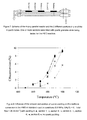
- one of the sections of the HSQ quartz tube was packed with 6 cm quartz granules (250-500 ⁇ m) and tested for the PMO reaction at 0.5 MPa ( Figure 8 ).
- the tube was also completely packed with quartz granules.
- the tubes were treated statically in a polypropylene vessel for 10 minutes. Afterwards, they were thoroughly rinsed with deionized water and dried at room temperature. They were not calcined at high temperatures, but immediately used for reaction.
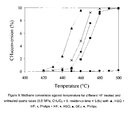
- the methane-oxygen conversion was tested in quartz tubes of 3 mm internal diameter, corresponding to a reactor volume of 1.27 ml and a residence time of 5.8 seconds at 0.5 MPa and 500°C. The results are shown in figures 9 and 10 . Higher methane conversion is observed for the PMO reaction in the HF treated quartz tubes compared to the untreated quartz tubes. The effect is very significant for the Philips tubes, which are inactive at 0.5 MPa and temperatures below 500°C, when not treated with HF.
- the PMO reaction already starts at 440°C in the HF treated Philips quartz tube (PH+HF) as opposed to the untreated Philips tube (PH).
- the conversion-selectivity plot for different quartz tubes is show in figure 10 .
- Table 2 gives a closer look to the results and more specifically to the product distribution in both the HSQ and HSQ+HF tubes.
- the methanol/formaldehyde ratio increases with increasing methane conversion, e.g. in the HSQ tubes from 0.7 at 0.6% X CH4 to 7.7 at 9.4% X CH4 in the HSQ tubes.
- the methanol/formaldehyde ratio at a certain X CH4 conversion differs strongly for reaction in the HSQ versus the HSQ+HF tubes.At a methane conversion of about 9.5%, i.e. 100% oxygen conversion, the methanol/formaldehyde ratio is 7.7 and 28, for the HSQ and HSQ+HF tube, respectively. In other words, whereas the total C 1 oxygenate selectivity only differs slightly, the methanol selectivity is increased from 23 to 28% when the PMO reaction is performed in HSQ+HF reactor quartz tubes.
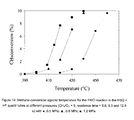
- Figure 11 and 12 show the results for the PMO in untreated and HF treated PN quartz tubes with different inner diameters (2, 3 and 4 mm).
- the methanol selectivity and yield at 100% O 2 conversion obtained in the three PN tubes is very similar, though lower compared the HF treated PN tubes.
- the increase in methanol yield and selectivity at 100% oxygen conversion due to the HF treatment of the quartz tube also depends on the diameter of the quartz tube (Table 3).
- the methanol yield increases from 2.1 to 2.8% upon HF treatment whereas it only increases from 2.1 to 2.5% in the 4 mm PN tube.
- the temperature at which PMO activity starts and at which 100% O 2 conversion is reached, is lower with smaller tube diameter and HF treatment.
- This example demonstrates that the reactor tubes have to be empty. Filling the reactor with quartz particles either without or with HF treatment reduces significantly the methane conversion.
- the methane-oxygen conversion was tested in quartz tubes of 3 mm internal diameter, corresponding to a reactor volume of 1.27 ml and a residence time of 5.8 seconds at 0.5 MPa and 500°C. These tests have been carried out at the same residence time in the reactor of 5.8 seconds by adjusting the flow rate when the reactor is filled with particles.
- the quartz particles have a void fraction of 46%.
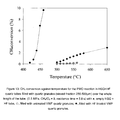
- HF treated HSQ tubes were filled with granulated quartz granules (250-500 ⁇ m) over the whole length of the hot reaction zone (see example 2) The results are shown in figure 13 .
- the CH 4 conversion is much lower as compared to the empty HSQ quartz tubes.
- the larger surface area supplied by the packing appear to promote radical-radical terminations which accounts for the higher temperatures required.
- the selectivity for both the tubes filled with HF treated and untreated quartz granules is much lower compared to the empty quartz tubes.
- the C 1 selectivity at 1 % CH 4 conversion is 53 and 29%, respectively.
- the CO/CO 2 ratio is much lower in the HSQ tubes filled with quartz granules compared to empty quartz tubes.
- methanol is mainly converted to formaldehyde and some CO. Above 450°C, much more methanol is converted and mainly CO x is produced, caused by a further oxidation of HCHO. However, this does not imply that during the PMO reaction some methanol converts to HCHO and/or CO/CO 2 . At high oxygen conversion, less oxygen is available for oxidizing methanol and there will be a competition between the formation of primary products by oxidation of methane and the oxidation of methanol. From table 4, it also follows that the reactor wall or its treatment with HF has no influence on the methanol stability.
- the maximum C 1 oxygenate yield, which is almost exclusively methanol, obtained at 0.5, 0.8 and 1.2 MPa are 2.8, 3.4 and 3.6%, respectively.
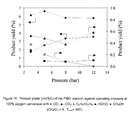
- Figure 16 shows the influence of operating pressure on the product yields at 100% oxygen conversion.
- the methanol yield increases with pressure while the HCHO yield decreases. Therefore the CH 3 OH/HCHO ratio increases with increasing pressure.
- the sum of ethylene and ethane yield decreases because the temperature, at which 100% oxygen conversion is obtained, also decreases with increasing pressure. These temperatures are 480, 460, 440 and 430°C at 0.3, 0.5, 0.8 and 1.2 MPa, respectively.
- Table 6 shows the results for PMO reaction at 0.8 MPa in the HF treated PN tubes with different internal diameters (2 and 4 mm) but equal residence time of 9.3 seconds in the hot zone.
- the smaller diameter HF treated PN tube show a higher activity and selectivity compared to the HF treated 4 mm PN tube.
- the maximum methanol yield is 2.8% with 29% selectivity for the 4 mm tube while it is 3.3% with 33% selectivity for the 2 mm tube.
Landscapes
- Chemical & Material Sciences (AREA)
- Organic Chemistry (AREA)
- Chemical Kinetics & Catalysis (AREA)
- Organic Low-Molecular-Weight Compounds And Preparation Thereof (AREA)
Claims (15)
- Verfahren zum Umwandeln von Methan in Methanol, umfassend:Zuführen von Methan und gasförmiger Luft oder Sauerstoff oder gasförmiger sauerstoffangereicherter Luft in einen Reaktor unter erhöhtem Druck;wobei der Reaktor eine Innenfläche aufweist, die aus Siliciumdioxid hergestellt oder mit Siliciumdioxid beschichtet ist und eine Zone umgibt, in der die Gase reagieren;
undReagieren der Gase in der Reaktionszone bei erhöhter Temperatur unter Bedingungen, die wirksam sind, um Methanol und/oder wertvolle sauerstoffhaltige Komponenten zu produzieren, wobeidie Reaktion ohne hinzugefügtes Material in der Reaktionszone durchgeführt wird, das die Reaktionsrate oder die Ausbeute des Produkts messbar beeinflusst, undder Reaktor bei einer Temperatur von 300 °C bis 600 °C betrieben wird,wobei die Innenfläche, die aus Siliciumdioxid hergestellt oder mit Siliciumdioxid behandelt ist, vor der Umwandlung von Methan in Methanol mit HF behandelt wird. - Verfahren nach Anspruch 1, wobei die Innenfläche aus Quarz hergestellt oder mit Quarz beschichtet ist.
- Verfahren nach einem der vorstehenden Ansprüche, wobei der Reaktor bei einem Druck von 0,1 bis 7,5 MPa betrieben wird.
- Verfahren nach Anspruch 3, wobei der Reaktor bei einem Druck von 0,2 bis 5 MPa betrieben wird.
- Verfahren nach einem der vorstehenden Ansprüche, wobei das Molverhältnis von Methan zu Sauerstoff 1 zu 50 ist.
- Verfahren nach Anspruch 5, wobei das Molverhältnis von Methan zu Sauerstoff 2 zu 20 ist.
- Verfahren nach einem der vorstehenden Ansprüche, wobei die Verweilzeit im Reaktor bei der erforderlichen Reaktionstemperatur und dem erforderlichen Druck 0,1 bis 100 s beträgt.
- Verfahren nach Anspruch 7, wobei die Verweilzeit im Reaktor bei der erforderlichen Reaktionstemperatur und dem erforderlichen Druck 1 bis 75 s beträgt.
- Verfahren nach Anspruch 8, wobei die Verweilzeit im Reaktor bei der erforderlichen Reaktionstemperatur und dem erforderlichen Druck 2 bis 20 s beträgt.
- Verfahren nach einem der vorstehenden Ansprüche, wobei der Reaktor bei einer Temperatur zwischen 400 und 450 °C betrieben wird.
- Verwendung eines Reaktors mit einer Innenfläche, die aus Siliciumdioxid hergestellt oder mit Siliciumdioxid beschichtet ist, und der vor Umwandlung von Methan in Methanol mit HF beschichtet wird, um das Verfahren nach einem der vorstehenden Ansprüche auszuführen.
- Verwendung nach Anspruch 11, wobei die Innenfläche aus Quarz hergestellt oder mit Quarz beschichtet ist.
- Verwendung nach Anspruch 11 oder 12, wobei der Reaktor aus vielen Rohren besteht und der Innendurchmesser der Rohre 2 bis 10 mm beträgt.
- Verwendung nach Anspruch 13, wobei die Reaktionsmittel auf einer Seite der Reaktorrohre eintreten und die Reaktionsprodukte auf der gegenüberliegenden Seite austreten.
- Verwendung nach Anspruch 13 oder 14, wobei die Rohre parallel zueinander platziert und unten oder oben mit einem Verteiler verbunden sind, so dass nur Reaktionsmittel in eine Richtung innerhalb des Rohres und in die andere Richtung außerhalb des Rohres fließen können.
Priority Applications (2)
| Application Number | Priority Date | Filing Date | Title |
|---|---|---|---|
| PL08785929T PL2170792T3 (pl) | 2007-07-19 | 2008-07-04 | Sposób selektywnego utleniania metanu |
| EP08785929A EP2170792B1 (de) | 2007-07-19 | 2008-07-04 | Verfahren zur selektiven oxidation von methan |
Applications Claiming Priority (3)
| Application Number | Priority Date | Filing Date | Title |
|---|---|---|---|
| EP07112759A EP2017249A1 (de) | 2007-07-19 | 2007-07-19 | Verfahren zur selektiven Oxidation von Methan |
| EP08785929A EP2170792B1 (de) | 2007-07-19 | 2008-07-04 | Verfahren zur selektiven oxidation von methan |
| PCT/EP2008/058690 WO2009010407A1 (en) | 2007-07-19 | 2008-07-04 | Process for the selective oxidation of methane |
Publications (2)
| Publication Number | Publication Date |
|---|---|
| EP2170792A1 EP2170792A1 (de) | 2010-04-07 |
| EP2170792B1 true EP2170792B1 (de) | 2013-02-27 |
Family
ID=38787441
Family Applications (2)
| Application Number | Title | Priority Date | Filing Date |
|---|---|---|---|
| EP07112759A Withdrawn EP2017249A1 (de) | 2007-07-19 | 2007-07-19 | Verfahren zur selektiven Oxidation von Methan |
| EP08785929A Not-in-force EP2170792B1 (de) | 2007-07-19 | 2008-07-04 | Verfahren zur selektiven oxidation von methan |
Family Applications Before (1)
| Application Number | Title | Priority Date | Filing Date |
|---|---|---|---|
| EP07112759A Withdrawn EP2017249A1 (de) | 2007-07-19 | 2007-07-19 | Verfahren zur selektiven Oxidation von Methan |
Country Status (6)
| Country | Link |
|---|---|
| US (1) | US8217206B2 (de) |
| EP (2) | EP2017249A1 (de) |
| CN (1) | CN101801899A (de) |
| BR (1) | BRPI0814625A2 (de) |
| PL (1) | PL2170792T3 (de) |
| WO (1) | WO2009010407A1 (de) |
Cited By (1)
| Publication number | Priority date | Publication date | Assignee | Title |
|---|---|---|---|---|
| WO2022053546A1 (en) | 2020-09-11 | 2022-03-17 | Totalenergies Se | Process for synthesis of petrochemicals from liquefied natural gas and installation therefor |
Families Citing this family (10)
| Publication number | Priority date | Publication date | Assignee | Title |
|---|---|---|---|---|
| US7642293B2 (en) | 2004-07-29 | 2010-01-05 | Gas Technologies Llc | Method and apparatus for producing methanol with hydrocarbon recycling |
| CN102648172B (zh) * | 2009-10-29 | 2014-11-19 | 卡迪夫大学学院顾问有限公司 | 使用非均相金催化剂进行的烃的选择性氧化 |
| RU2012129677A (ru) | 2009-12-15 | 2014-01-27 | Басф Се | Способ получения c1-c4-оксигенатов путем частичного окисления углеводородов |
| US8609906B2 (en) | 2009-12-15 | 2013-12-17 | Basf Se | Process for preparing C1-C4-oxygenates by partial oxidation of hydrocarbons |
| RU2455276C1 (ru) * | 2011-02-15 | 2012-07-10 | Государственное образовательное учреждение высшего профессионального образования "Пензенский государственный университет" (ПГУ) | Способ термического окисления метана до метанола |
| US9513267B1 (en) * | 2013-03-21 | 2016-12-06 | Mocon, Inc. | Reactor for near absolute conversion of alternative moiety-containing species into a select moiety-containing species and analytical instrument employing the reactor |
| RU2538970C1 (ru) * | 2013-06-26 | 2015-01-10 | Федеральное государственное бюджетное учреждение науки Институт проблем химической физики Российской академии наук (ИПХФ РАН) | Способ переработки попутных и природных газов |
| WO2017083773A1 (en) * | 2015-11-13 | 2017-05-18 | Massachusetts Institute Of Technology | Catalytic methods for the production of an alcohol from an alkane |
| RU2641701C1 (ru) * | 2016-12-06 | 2018-01-22 | Федеральное государственное бюджетное учреждение науки Институт проблем химической физики Российской академии наук (ИПХФ РАН) | Способ переработки попутных и природных газов |
| US12048919B2 (en) | 2020-03-31 | 2024-07-30 | Massachusetts Institute Of Technology | Catalytic compositions for the oxidation of substrates |
Citations (3)
| Publication number | Priority date | Publication date | Assignee | Title |
|---|---|---|---|---|
| US4618732A (en) * | 1985-05-20 | 1986-10-21 | Gesser Hyman D | Direct conversion of natural gas to methanol by controlled oxidation |
| US4973777A (en) * | 1985-11-08 | 1990-11-27 | Institut Francais Du Petrole | Process for thermally converting methane into hydrocarbons with higher molecular weights, reactor for implementing the process and process for realizing the reactor |
| WO2006087353A1 (de) * | 2005-02-19 | 2006-08-24 | Deutsches Zentrum für Luft- und Raumfahrt e.V. | Fotoreaktor |
Family Cites Families (4)
| Publication number | Priority date | Publication date | Assignee | Title |
|---|---|---|---|---|
| GB1274653A (en) * | 1968-09-04 | 1972-05-17 | Ici Ltd | Oxidation of hydrocarbons |
| US4982023A (en) * | 1989-10-16 | 1991-01-01 | Mobil Oil Corporation | Oxidation of methane to methanol |
| US5220080A (en) * | 1992-06-29 | 1993-06-15 | Sun Company, Inc. (R&M) | Chromia on metal oxide catalysts for the oxidation of methane to methanol |
| DE202005013835U1 (de) * | 2005-09-01 | 2005-11-10 | Syntics Gmbh | Vorrichtung zum schnellen Aufheizen, Abkühlen, Verdampfen oder Kondensieren von Fluiden |
-
2007
- 2007-07-19 EP EP07112759A patent/EP2017249A1/de not_active Withdrawn
-
2008
- 2008-07-04 US US12/669,566 patent/US8217206B2/en not_active Expired - Fee Related
- 2008-07-04 PL PL08785929T patent/PL2170792T3/pl unknown
- 2008-07-04 WO PCT/EP2008/058690 patent/WO2009010407A1/en not_active Ceased
- 2008-07-04 CN CN200880107576A patent/CN101801899A/zh active Pending
- 2008-07-04 EP EP08785929A patent/EP2170792B1/de not_active Not-in-force
- 2008-07-04 BR BRPI0814625-0A2A patent/BRPI0814625A2/pt not_active IP Right Cessation
Patent Citations (3)
| Publication number | Priority date | Publication date | Assignee | Title |
|---|---|---|---|---|
| US4618732A (en) * | 1985-05-20 | 1986-10-21 | Gesser Hyman D | Direct conversion of natural gas to methanol by controlled oxidation |
| US4973777A (en) * | 1985-11-08 | 1990-11-27 | Institut Francais Du Petrole | Process for thermally converting methane into hydrocarbons with higher molecular weights, reactor for implementing the process and process for realizing the reactor |
| WO2006087353A1 (de) * | 2005-02-19 | 2006-08-24 | Deutsches Zentrum für Luft- und Raumfahrt e.V. | Fotoreaktor |
Cited By (1)
| Publication number | Priority date | Publication date | Assignee | Title |
|---|---|---|---|---|
| WO2022053546A1 (en) | 2020-09-11 | 2022-03-17 | Totalenergies Se | Process for synthesis of petrochemicals from liquefied natural gas and installation therefor |
Also Published As
| Publication number | Publication date |
|---|---|
| EP2170792A1 (de) | 2010-04-07 |
| PL2170792T3 (pl) | 2013-08-30 |
| US20100280289A1 (en) | 2010-11-04 |
| WO2009010407A1 (en) | 2009-01-22 |
| US8217206B2 (en) | 2012-07-10 |
| EP2017249A1 (de) | 2009-01-21 |
| CN101801899A (zh) | 2010-08-11 |
| BRPI0814625A2 (pt) | 2015-01-27 |
Similar Documents
| Publication | Publication Date | Title |
|---|---|---|
| EP2170792B1 (de) | Verfahren zur selektiven oxidation von methan | |
| KR101294592B1 (ko) | 메탄 산화이량화 반응촉매, 그 제조방법 및 이를 이용한 메탄 산화이량화 반응방법 | |
| US10858302B2 (en) | Methods and catalysts for the selective production of methanol from carbon dioxide and hydrogen gas for chemical synthesis and gas purification | |
| JP5823873B2 (ja) | 合成ガス混合物中の一酸化炭素含有量を増加させるプロセス | |
| KR100374892B1 (ko) | 수소풍부기체의 제조방법 | |
| EP2419375B1 (de) | Verfahren zur herstellung eines wasserstoffhaltigen produktgases | |
| TW200730517A (en) | Method for regenerated epoxide catalyst preparation | |
| US20080173532A1 (en) | Method and system for producing a hydrogen enriched fuel using microwave assisted methane decomposition on catalyst | |
| EP0780339A2 (de) | Verfahren zur Umwandlung von Methan in Synthesegas | |
| CN108025287A (zh) | 使用La-Ce催化剂的甲烷氧化偶联 | |
| KR20170057378A (ko) | 메탄을 에틸렌으로 전환시키고 외부 열을 전송하는 방법 | |
| Du et al. | Catalytic performance of vanadium incorporated MCM-41 catalysts for the partial oxidation of methane to formaldehyde | |
| EP1974812A1 (de) | Katalysatoren und verfahren zur herstellung von olefinen damit | |
| KR20190064442A (ko) | 고발열량의 합성천연가스 제조방법 및 그 제조장치 | |
| Lemonidou et al. | Partial oxidation of methane to synthesis gas over unpromoted and (0.1-0.5 wt%) Ni-promoted calcium aluminate catalysts | |
| EP0582004B1 (de) | Katalysatoren und ihre Verwendung bei der oxydativen Umwandlung von Methan oder von Erdgas zu Synthesegas | |
| US7355088B2 (en) | Process for producing benzene, ethylene and synthesis gas | |
| KR20250070502A (ko) | 메탄 열분해 반응용 용융 금속촉매 및 이를 이용한 메탄 열분해 방법 | |
| Wang et al. | Structure of catalytic active site for oxidation of methane to methanol by H2 O2 gas mixture over iron-containing catalysts | |
| KR101585219B1 (ko) | 수소의 제조 방법 및 장치 | |
| EP3405448A1 (de) | Umwandlung von methan in ethylen mit integration mit in-situ-ethancracken und direkter umwandlung von co2-nebenprodukt in methanol | |
| JP2000086201A (ja) | 水素の製造方法 | |
| US3953356A (en) | Method of producing gaseous mixture rich in hydrogen | |
| Pyatnitskii | Contemporary methods for the direct catalytic conversion of methane | |
| WO2024133122A1 (en) | Chemical looping process for the production of co from co2 |
Legal Events
| Date | Code | Title | Description |
|---|---|---|---|
| PUAI | Public reference made under article 153(3) epc to a published international application that has entered the european phase |
Free format text: ORIGINAL CODE: 0009012 |
|
| 17P | Request for examination filed |
Effective date: 20100119 |
|
| AK | Designated contracting states |
Kind code of ref document: A1 Designated state(s): AT BE BG CH CY CZ DE DK EE ES FI FR GB GR HR HU IE IS IT LI LT LU LV MC MT NL NO PL PT RO SE SI SK TR |
|
| AX | Request for extension of the european patent |
Extension state: AL BA MK RS |
|
| DAX | Request for extension of the european patent (deleted) | ||
| 17Q | First examination report despatched |
Effective date: 20100607 |
|
| GRAP | Despatch of communication of intention to grant a patent |
Free format text: ORIGINAL CODE: EPIDOSNIGR1 |
|
| RAP1 | Party data changed (applicant data changed or rights of an application transferred) |
Owner name: TOTAL RESEARCH & TECHNOLOGY FELUY |
|
| RIC1 | Information provided on ipc code assigned before grant |
Ipc: B01J 19/02 20060101ALI20120803BHEP Ipc: B01J 19/24 20060101ALI20120803BHEP Ipc: C07C 29/50 20060101AFI20120803BHEP Ipc: C07C 31/04 20060101ALI20120803BHEP Ipc: B01J 19/00 20060101ALI20120803BHEP |
|
| GRAS | Grant fee paid |
Free format text: ORIGINAL CODE: EPIDOSNIGR3 |
|
| GRAA | (expected) grant |
Free format text: ORIGINAL CODE: 0009210 |
|
| AK | Designated contracting states |
Kind code of ref document: B1 Designated state(s): AT BE BG CH CY CZ DE DK EE ES FI FR GB GR HR HU IE IS IT LI LT LU LV MC MT NL NO PL PT RO SE SI SK TR |
|
| REG | Reference to a national code |
Ref country code: GB Ref legal event code: FG4D |
|
| REG | Reference to a national code |
Ref country code: CH Ref legal event code: EP |
|
| REG | Reference to a national code |
Ref country code: AT Ref legal event code: REF Ref document number: 598420 Country of ref document: AT Kind code of ref document: T Effective date: 20130315 |
|
| REG | Reference to a national code |
Ref country code: IE Ref legal event code: FG4D |
|
| REG | Reference to a national code |
Ref country code: DE Ref legal event code: R096 Ref document number: 602008022551 Country of ref document: DE Effective date: 20130425 |
|
| REG | Reference to a national code |
Ref country code: NL Ref legal event code: T3 |
|
| REG | Reference to a national code |
Ref country code: AT Ref legal event code: MK05 Ref document number: 598420 Country of ref document: AT Kind code of ref document: T Effective date: 20130227 |
|
| REG | Reference to a national code |
Ref country code: NO Ref legal event code: T2 Effective date: 20130227 |
|
| REG | Reference to a national code |
Ref country code: LT Ref legal event code: MG4D |
|
| PG25 | Lapsed in a contracting state [announced via postgrant information from national office to epo] |
Ref country code: ES Free format text: LAPSE BECAUSE OF FAILURE TO SUBMIT A TRANSLATION OF THE DESCRIPTION OR TO PAY THE FEE WITHIN THE PRESCRIBED TIME-LIMIT Effective date: 20130607 Ref country code: BG Free format text: LAPSE BECAUSE OF FAILURE TO SUBMIT A TRANSLATION OF THE DESCRIPTION OR TO PAY THE FEE WITHIN THE PRESCRIBED TIME-LIMIT Effective date: 20130527 Ref country code: IS Free format text: LAPSE BECAUSE OF FAILURE TO SUBMIT A TRANSLATION OF THE DESCRIPTION OR TO PAY THE FEE WITHIN THE PRESCRIBED TIME-LIMIT Effective date: 20130627 Ref country code: LT Free format text: LAPSE BECAUSE OF FAILURE TO SUBMIT A TRANSLATION OF THE DESCRIPTION OR TO PAY THE FEE WITHIN THE PRESCRIBED TIME-LIMIT Effective date: 20130227 Ref country code: SE Free format text: LAPSE BECAUSE OF FAILURE TO SUBMIT A TRANSLATION OF THE DESCRIPTION OR TO PAY THE FEE WITHIN THE PRESCRIBED TIME-LIMIT Effective date: 20130227 Ref country code: AT Free format text: LAPSE BECAUSE OF FAILURE TO SUBMIT A TRANSLATION OF THE DESCRIPTION OR TO PAY THE FEE WITHIN THE PRESCRIBED TIME-LIMIT Effective date: 20130227 |
|
| PG25 | Lapsed in a contracting state [announced via postgrant information from national office to epo] |
Ref country code: BE Free format text: LAPSE BECAUSE OF FAILURE TO SUBMIT A TRANSLATION OF THE DESCRIPTION OR TO PAY THE FEE WITHIN THE PRESCRIBED TIME-LIMIT Effective date: 20130227 Ref country code: FI Free format text: LAPSE BECAUSE OF FAILURE TO SUBMIT A TRANSLATION OF THE DESCRIPTION OR TO PAY THE FEE WITHIN THE PRESCRIBED TIME-LIMIT Effective date: 20130227 Ref country code: SI Free format text: LAPSE BECAUSE OF FAILURE TO SUBMIT A TRANSLATION OF THE DESCRIPTION OR TO PAY THE FEE WITHIN THE PRESCRIBED TIME-LIMIT Effective date: 20130227 Ref country code: LV Free format text: LAPSE BECAUSE OF FAILURE TO SUBMIT A TRANSLATION OF THE DESCRIPTION OR TO PAY THE FEE WITHIN THE PRESCRIBED TIME-LIMIT Effective date: 20130227 Ref country code: PT Free format text: LAPSE BECAUSE OF FAILURE TO SUBMIT A TRANSLATION OF THE DESCRIPTION OR TO PAY THE FEE WITHIN THE PRESCRIBED TIME-LIMIT Effective date: 20130627 Ref country code: GR Free format text: LAPSE BECAUSE OF FAILURE TO SUBMIT A TRANSLATION OF THE DESCRIPTION OR TO PAY THE FEE WITHIN THE PRESCRIBED TIME-LIMIT Effective date: 20130528 |
|
| REG | Reference to a national code |
Ref country code: PL Ref legal event code: T3 |
|
| PG25 | Lapsed in a contracting state [announced via postgrant information from national office to epo] |
Ref country code: HR Free format text: LAPSE BECAUSE OF FAILURE TO SUBMIT A TRANSLATION OF THE DESCRIPTION OR TO PAY THE FEE WITHIN THE PRESCRIBED TIME-LIMIT Effective date: 20130227 |
|
| PG25 | Lapsed in a contracting state [announced via postgrant information from national office to epo] |
Ref country code: RO Free format text: LAPSE BECAUSE OF FAILURE TO SUBMIT A TRANSLATION OF THE DESCRIPTION OR TO PAY THE FEE WITHIN THE PRESCRIBED TIME-LIMIT Effective date: 20130227 Ref country code: SK Free format text: LAPSE BECAUSE OF FAILURE TO SUBMIT A TRANSLATION OF THE DESCRIPTION OR TO PAY THE FEE WITHIN THE PRESCRIBED TIME-LIMIT Effective date: 20130227 Ref country code: CZ Free format text: LAPSE BECAUSE OF FAILURE TO SUBMIT A TRANSLATION OF THE DESCRIPTION OR TO PAY THE FEE WITHIN THE PRESCRIBED TIME-LIMIT Effective date: 20130227 Ref country code: EE Free format text: LAPSE BECAUSE OF FAILURE TO SUBMIT A TRANSLATION OF THE DESCRIPTION OR TO PAY THE FEE WITHIN THE PRESCRIBED TIME-LIMIT Effective date: 20130227 Ref country code: DK Free format text: LAPSE BECAUSE OF FAILURE TO SUBMIT A TRANSLATION OF THE DESCRIPTION OR TO PAY THE FEE WITHIN THE PRESCRIBED TIME-LIMIT Effective date: 20130227 |
|
| PGFP | Annual fee paid to national office [announced via postgrant information from national office to epo] |
Ref country code: NL Payment date: 20130719 Year of fee payment: 6 Ref country code: NO Payment date: 20130712 Year of fee payment: 6 |
|
| PG25 | Lapsed in a contracting state [announced via postgrant information from national office to epo] |
Ref country code: CY Free format text: LAPSE BECAUSE OF FAILURE TO SUBMIT A TRANSLATION OF THE DESCRIPTION OR TO PAY THE FEE WITHIN THE PRESCRIBED TIME-LIMIT Effective date: 20130227 |
|
| PGFP | Annual fee paid to national office [announced via postgrant information from national office to epo] |
Ref country code: PL Payment date: 20130702 Year of fee payment: 6 Ref country code: GB Payment date: 20130719 Year of fee payment: 6 Ref country code: FR Payment date: 20130722 Year of fee payment: 6 |
|
| PG25 | Lapsed in a contracting state [announced via postgrant information from national office to epo] |
Ref country code: IT Free format text: LAPSE BECAUSE OF FAILURE TO SUBMIT A TRANSLATION OF THE DESCRIPTION OR TO PAY THE FEE WITHIN THE PRESCRIBED TIME-LIMIT Effective date: 20130227 |
|
| PLBE | No opposition filed within time limit |
Free format text: ORIGINAL CODE: 0009261 |
|
| STAA | Information on the status of an ep patent application or granted ep patent |
Free format text: STATUS: NO OPPOSITION FILED WITHIN TIME LIMIT |
|
| 26N | No opposition filed |
Effective date: 20131128 |
|
| PG25 | Lapsed in a contracting state [announced via postgrant information from national office to epo] |
Ref country code: MC Free format text: LAPSE BECAUSE OF FAILURE TO SUBMIT A TRANSLATION OF THE DESCRIPTION OR TO PAY THE FEE WITHIN THE PRESCRIBED TIME-LIMIT Effective date: 20130227 |
|
| REG | Reference to a national code |
Ref country code: CH Ref legal event code: PL |
|
| REG | Reference to a national code |
Ref country code: DE Ref legal event code: R097 Ref document number: 602008022551 Country of ref document: DE Effective date: 20131128 |
|
| REG | Reference to a national code |
Ref country code: IE Ref legal event code: MM4A |
|
| REG | Reference to a national code |
Ref country code: DE Ref legal event code: R119 Ref document number: 602008022551 Country of ref document: DE Effective date: 20140201 |
|
| PG25 | Lapsed in a contracting state [announced via postgrant information from national office to epo] |
Ref country code: CH Free format text: LAPSE BECAUSE OF NON-PAYMENT OF DUE FEES Effective date: 20130731 Ref country code: LI Free format text: LAPSE BECAUSE OF NON-PAYMENT OF DUE FEES Effective date: 20130731 Ref country code: DE Free format text: LAPSE BECAUSE OF NON-PAYMENT OF DUE FEES Effective date: 20140201 |
|
| PG25 | Lapsed in a contracting state [announced via postgrant information from national office to epo] |
Ref country code: IE Free format text: LAPSE BECAUSE OF NON-PAYMENT OF DUE FEES Effective date: 20130704 |
|
| REG | Reference to a national code |
Ref country code: NL Ref legal event code: V1 Effective date: 20150201 |
|
| GBPC | Gb: european patent ceased through non-payment of renewal fee |
Effective date: 20140704 |
|
| PG25 | Lapsed in a contracting state [announced via postgrant information from national office to epo] |
Ref country code: NL Free format text: LAPSE BECAUSE OF NON-PAYMENT OF DUE FEES Effective date: 20150201 |
|
| REG | Reference to a national code |
Ref country code: FR Ref legal event code: ST Effective date: 20150331 |
|
| PG25 | Lapsed in a contracting state [announced via postgrant information from national office to epo] |
Ref country code: NO Free format text: LAPSE BECAUSE OF NON-PAYMENT OF DUE FEES Effective date: 20140731 |
|
| PG25 | Lapsed in a contracting state [announced via postgrant information from national office to epo] |
Ref country code: GB Free format text: LAPSE BECAUSE OF NON-PAYMENT OF DUE FEES Effective date: 20140704 Ref country code: FR Free format text: LAPSE BECAUSE OF NON-PAYMENT OF DUE FEES Effective date: 20140731 |
|
| PG25 | Lapsed in a contracting state [announced via postgrant information from national office to epo] |
Ref country code: MT Free format text: LAPSE BECAUSE OF FAILURE TO SUBMIT A TRANSLATION OF THE DESCRIPTION OR TO PAY THE FEE WITHIN THE PRESCRIBED TIME-LIMIT Effective date: 20130227 Ref country code: TR Free format text: LAPSE BECAUSE OF FAILURE TO SUBMIT A TRANSLATION OF THE DESCRIPTION OR TO PAY THE FEE WITHIN THE PRESCRIBED TIME-LIMIT Effective date: 20130227 |
|
| PG25 | Lapsed in a contracting state [announced via postgrant information from national office to epo] |
Ref country code: LU Free format text: LAPSE BECAUSE OF NON-PAYMENT OF DUE FEES Effective date: 20130704 Ref country code: HU Free format text: LAPSE BECAUSE OF FAILURE TO SUBMIT A TRANSLATION OF THE DESCRIPTION OR TO PAY THE FEE WITHIN THE PRESCRIBED TIME-LIMIT; INVALID AB INITIO Effective date: 20080704 |
|
| REG | Reference to a national code |
Ref country code: PL Ref legal event code: LAPE |
|
| PG25 | Lapsed in a contracting state [announced via postgrant information from national office to epo] |
Ref country code: PL Free format text: LAPSE BECAUSE OF NON-PAYMENT OF DUE FEES Effective date: 20140704 |