EP2169017A1 - Ink set and method for forming image - Google Patents
Ink set and method for forming image Download PDFInfo
- Publication number
- EP2169017A1 EP2169017A1 EP20090170422 EP09170422A EP2169017A1 EP 2169017 A1 EP2169017 A1 EP 2169017A1 EP 20090170422 EP20090170422 EP 20090170422 EP 09170422 A EP09170422 A EP 09170422A EP 2169017 A1 EP2169017 A1 EP 2169017A1
- Authority
- EP
- European Patent Office
- Prior art keywords
- group
- ink
- substituted
- alkyl
- unsubstituted
- Prior art date
- Legal status (The legal status is an assumption and is not a legal conclusion. Google has not performed a legal analysis and makes no representation as to the accuracy of the status listed.)
- Granted
Links
- 238000000034 method Methods 0.000 title claims description 67
- 239000003963 antioxidant agent Substances 0.000 claims abstract description 40
- 230000003078 antioxidant effect Effects 0.000 claims abstract description 38
- 229910052717 sulfur Inorganic materials 0.000 claims abstract description 23
- 125000004434 sulfur atom Chemical group 0.000 claims abstract description 20
- 125000004432 carbon atom Chemical group C* 0.000 claims description 127
- 150000001875 compounds Chemical class 0.000 claims description 119
- -1 carbamoyloxy group Chemical group 0.000 claims description 115
- 125000000217 alkyl group Chemical group 0.000 claims description 89
- 125000000623 heterocyclic group Chemical group 0.000 claims description 62
- 125000003118 aryl group Chemical group 0.000 claims description 57
- 125000001424 substituent group Chemical group 0.000 claims description 40
- 125000004435 hydrogen atom Chemical group [H]* 0.000 claims description 31
- 125000003917 carbamoyl group Chemical group [H]N([H])C(*)=O 0.000 claims description 23
- 229920000642 polymer Polymers 0.000 claims description 22
- 125000002252 acyl group Chemical group 0.000 claims description 21
- 125000004397 aminosulfonyl group Chemical group NS(=O)(=O)* 0.000 claims description 21
- 125000003277 amino group Chemical group 0.000 claims description 20
- 125000000020 sulfo group Chemical group O=S(=O)([*])O[H] 0.000 claims description 20
- 125000003178 carboxy group Chemical group [H]OC(*)=O 0.000 claims description 18
- 125000005843 halogen group Chemical group 0.000 claims description 18
- 125000002887 hydroxy group Chemical group [H]O* 0.000 claims description 18
- 150000003462 sulfoxides Chemical group 0.000 claims description 18
- 150000003568 thioethers Chemical group 0.000 claims description 18
- NBIIXXVUZAFLBC-UHFFFAOYSA-N Phosphoric acid Chemical compound OP(O)(O)=O NBIIXXVUZAFLBC-UHFFFAOYSA-N 0.000 claims description 15
- 125000005647 linker group Chemical group 0.000 claims description 15
- 125000004093 cyano group Chemical group *C#N 0.000 claims description 14
- 125000006575 electron-withdrawing group Chemical group 0.000 claims description 14
- 229910052757 nitrogen Inorganic materials 0.000 claims description 14
- KWIUHFFTVRNATP-UHFFFAOYSA-N Betaine Natural products C[N+](C)(C)CC([O-])=O KWIUHFFTVRNATP-UHFFFAOYSA-N 0.000 claims description 13
- KWIUHFFTVRNATP-UHFFFAOYSA-O N,N,N-trimethylglycinium Chemical compound C[N+](C)(C)CC(O)=O KWIUHFFTVRNATP-UHFFFAOYSA-O 0.000 claims description 13
- 125000003545 alkoxy group Chemical group 0.000 claims description 13
- 229960003237 betaine Drugs 0.000 claims description 13
- 125000001931 aliphatic group Chemical group 0.000 claims description 12
- 125000004453 alkoxycarbonyl group Chemical group 0.000 claims description 11
- 125000005161 aryl oxy carbonyl group Chemical group 0.000 claims description 11
- 125000004433 nitrogen atom Chemical group N* 0.000 claims description 11
- 125000002947 alkylene group Chemical group 0.000 claims description 10
- 125000000472 sulfonyl group Chemical group *S(*)(=O)=O 0.000 claims description 10
- 125000004390 alkyl sulfonyl group Chemical group 0.000 claims description 9
- 125000004391 aryl sulfonyl group Chemical group 0.000 claims description 9
- 239000010419 fine particle Substances 0.000 claims description 9
- 125000000449 nitro group Chemical group [O-][N+](*)=O 0.000 claims description 9
- 125000004423 acyloxy group Chemical group 0.000 claims description 8
- 125000004104 aryloxy group Chemical group 0.000 claims description 8
- 125000003282 alkyl amino group Chemical group 0.000 claims description 7
- 229910000147 aluminium phosphate Inorganic materials 0.000 claims description 7
- 125000005162 aryl oxy carbonyl amino group Chemical group 0.000 claims description 7
- LSNNMFCWUKXFEE-UHFFFAOYSA-M Bisulfite Chemical compound OS([O-])=O LSNNMFCWUKXFEE-UHFFFAOYSA-M 0.000 claims description 6
- 125000004414 alkyl thio group Chemical group 0.000 claims description 6
- 150000001732 carboxylic acid derivatives Chemical class 0.000 claims description 6
- 125000004122 cyclic group Chemical group 0.000 claims description 6
- 125000004430 oxygen atom Chemical group O* 0.000 claims description 6
- 125000004442 acylamino group Chemical group 0.000 claims description 5
- 125000004644 alkyl sulfinyl group Chemical group 0.000 claims description 5
- 150000003863 ammonium salts Chemical class 0.000 claims description 5
- 125000005135 aryl sulfinyl group Chemical group 0.000 claims description 5
- 125000004466 alkoxycarbonylamino group Chemical group 0.000 claims description 4
- 125000001769 aryl amino group Chemical group 0.000 claims description 4
- 125000005110 aryl thio group Chemical group 0.000 claims description 4
- 125000001951 carbamoylamino group Chemical group C(N)(=O)N* 0.000 claims description 4
- 125000004149 thio group Chemical group *S* 0.000 claims description 4
- 125000005194 alkoxycarbonyloxy group Chemical group 0.000 claims description 3
- 125000004656 alkyl sulfonylamino group Chemical group 0.000 claims description 3
- 125000004657 aryl sulfonyl amino group Chemical group 0.000 claims description 3
- 125000005200 aryloxy carbonyloxy group Chemical group 0.000 claims description 3
- 125000001820 oxy group Chemical group [*:1]O[*:2] 0.000 claims description 3
- 125000004469 siloxy group Chemical group [SiH3]O* 0.000 claims description 3
- 125000003375 sulfoxide group Chemical group 0.000 claims description 3
- 239000000976 ink Substances 0.000 description 291
- 239000000975 dye Substances 0.000 description 119
- 239000003795 chemical substances by application Substances 0.000 description 41
- 239000010410 layer Substances 0.000 description 33
- XLYOFNOQVPJJNP-UHFFFAOYSA-N water Substances O XLYOFNOQVPJJNP-UHFFFAOYSA-N 0.000 description 31
- 239000000123 paper Substances 0.000 description 24
- 239000004094 surface-active agent Substances 0.000 description 24
- 238000011156 evaluation Methods 0.000 description 23
- PEDCQBHIVMGVHV-UHFFFAOYSA-N Glycerine Chemical compound OCC(O)CO PEDCQBHIVMGVHV-UHFFFAOYSA-N 0.000 description 21
- 230000000740 bleeding effect Effects 0.000 description 20
- CBENFWSGALASAD-UHFFFAOYSA-N Ozone Chemical compound [O-][O+]=O CBENFWSGALASAD-UHFFFAOYSA-N 0.000 description 19
- 239000003755 preservative agent Substances 0.000 description 19
- OKKJLVBELUTLKV-UHFFFAOYSA-N Methanol Chemical compound OC OKKJLVBELUTLKV-UHFFFAOYSA-N 0.000 description 18
- DNIAPMSPPWPWGF-UHFFFAOYSA-N Propylene glycol Chemical compound CC(O)CO DNIAPMSPPWPWGF-UHFFFAOYSA-N 0.000 description 18
- MTHSVFCYNBDYFN-UHFFFAOYSA-N diethylene glycol Chemical compound OCCOCCO MTHSVFCYNBDYFN-UHFFFAOYSA-N 0.000 description 17
- 239000002253 acid Substances 0.000 description 16
- 238000007639 printing Methods 0.000 description 16
- 239000000049 pigment Substances 0.000 description 15
- 230000008569 process Effects 0.000 description 14
- 150000001768 cations Chemical class 0.000 description 13
- 239000007788 liquid Substances 0.000 description 13
- QTBSBXVTEAMEQO-UHFFFAOYSA-N Acetic acid Chemical compound CC(O)=O QTBSBXVTEAMEQO-UHFFFAOYSA-N 0.000 description 12
- LFQSCWFLJHTTHZ-UHFFFAOYSA-N Ethanol Chemical compound CCO LFQSCWFLJHTTHZ-UHFFFAOYSA-N 0.000 description 12
- 239000000463 material Substances 0.000 description 12
- 239000000126 substance Substances 0.000 description 12
- 125000003342 alkenyl group Chemical group 0.000 description 11
- QGZKDVFQNNGYKY-UHFFFAOYSA-O ammonium group Chemical group [NH4+] QGZKDVFQNNGYKY-UHFFFAOYSA-O 0.000 description 11
- 125000003710 aryl alkyl group Chemical group 0.000 description 11
- 239000000987 azo dye Substances 0.000 description 11
- 235000011187 glycerol Nutrition 0.000 description 11
- 150000003839 salts Chemical class 0.000 description 11
- 239000007787 solid Substances 0.000 description 11
- 239000002904 solvent Substances 0.000 description 11
- ISWSIDIOOBJBQZ-UHFFFAOYSA-N Phenol Chemical compound OC1=CC=CC=C1 ISWSIDIOOBJBQZ-UHFFFAOYSA-N 0.000 description 10
- 239000000654 additive Substances 0.000 description 10
- 230000007423 decrease Effects 0.000 description 10
- 239000002736 nonionic surfactant Substances 0.000 description 10
- 230000002335 preservative effect Effects 0.000 description 10
- 230000003068 static effect Effects 0.000 description 10
- QEFRNWWLZKMPFJ-ZXPFJRLXSA-N L-methionine (R)-S-oxide Chemical compound C[S@@](=O)CC[C@H]([NH3+])C([O-])=O QEFRNWWLZKMPFJ-ZXPFJRLXSA-N 0.000 description 9
- QEFRNWWLZKMPFJ-UHFFFAOYSA-N L-methionine sulphoxide Natural products CS(=O)CCC(N)C(O)=O QEFRNWWLZKMPFJ-UHFFFAOYSA-N 0.000 description 9
- HEMHJVSKTPXQMS-UHFFFAOYSA-M Sodium hydroxide Chemical compound [OH-].[Na+] HEMHJVSKTPXQMS-UHFFFAOYSA-M 0.000 description 9
- 239000003570 air Substances 0.000 description 9
- 125000000753 cycloalkyl group Chemical group 0.000 description 9
- 230000000694 effects Effects 0.000 description 9
- RTZKZFJDLAIYFH-UHFFFAOYSA-N ether Substances CCOCC RTZKZFJDLAIYFH-UHFFFAOYSA-N 0.000 description 9
- 150000002500 ions Chemical class 0.000 description 9
- 238000004519 manufacturing process Methods 0.000 description 9
- 125000001997 phenyl group Chemical group [H]C1=C([H])C([H])=C(*)C([H])=C1[H] 0.000 description 9
- 238000002360 preparation method Methods 0.000 description 9
- 241000894007 species Species 0.000 description 9
- IAZDPXIOMUYVGZ-UHFFFAOYSA-N Dimethylsulphoxide Chemical compound CS(C)=O IAZDPXIOMUYVGZ-UHFFFAOYSA-N 0.000 description 8
- LYCAIKOWRPUZTN-UHFFFAOYSA-N Ethylene glycol Chemical compound OCCO LYCAIKOWRPUZTN-UHFFFAOYSA-N 0.000 description 8
- PPBRXRYQALVLMV-UHFFFAOYSA-N Styrene Chemical compound C=CC1=CC=CC=C1 PPBRXRYQALVLMV-UHFFFAOYSA-N 0.000 description 8
- 239000011230 binding agent Substances 0.000 description 8
- 125000002091 cationic group Chemical group 0.000 description 8
- 238000004140 cleaning Methods 0.000 description 8
- 239000006185 dispersion Substances 0.000 description 8
- 239000000203 mixture Substances 0.000 description 8
- AJDUTMFFZHIJEM-UHFFFAOYSA-N n-(9,10-dioxoanthracen-1-yl)-4-[4-[[4-[4-[(9,10-dioxoanthracen-1-yl)carbamoyl]phenyl]phenyl]diazenyl]phenyl]benzamide Chemical compound O=C1C2=CC=CC=C2C(=O)C2=C1C=CC=C2NC(=O)C(C=C1)=CC=C1C(C=C1)=CC=C1N=NC(C=C1)=CC=C1C(C=C1)=CC=C1C(=O)NC1=CC=CC2=C1C(=O)C1=CC=CC=C1C2=O AJDUTMFFZHIJEM-UHFFFAOYSA-N 0.000 description 8
- 239000000243 solution Substances 0.000 description 8
- AKEJUJNQAAGONA-UHFFFAOYSA-N sulfur trioxide Inorganic materials O=S(=O)=O AKEJUJNQAAGONA-UHFFFAOYSA-N 0.000 description 8
- 239000001043 yellow dye Substances 0.000 description 8
- 239000004372 Polyvinyl alcohol Substances 0.000 description 7
- VYPSYNLAJGMNEJ-UHFFFAOYSA-N Silicium dioxide Chemical compound O=[Si]=O VYPSYNLAJGMNEJ-UHFFFAOYSA-N 0.000 description 7
- DMSMPAJRVJJAGA-UHFFFAOYSA-N benzo[d]isothiazol-3-one Chemical compound C1=CC=C2C(=O)NSC2=C1 DMSMPAJRVJJAGA-UHFFFAOYSA-N 0.000 description 7
- 235000019642 color hue Nutrition 0.000 description 7
- 239000003086 colorant Substances 0.000 description 7
- 125000001495 ethyl group Chemical group [H]C([H])([H])C([H])([H])* 0.000 description 7
- 229920002451 polyvinyl alcohol Polymers 0.000 description 7
- 239000011369 resultant mixture Substances 0.000 description 7
- COBPKKZHLDDMTB-UHFFFAOYSA-N 2-[2-(2-butoxyethoxy)ethoxy]ethanol Chemical compound CCCCOCCOCCOCCO COBPKKZHLDDMTB-UHFFFAOYSA-N 0.000 description 6
- WEVYAHXRMPXWCK-UHFFFAOYSA-N Acetonitrile Chemical compound CC#N WEVYAHXRMPXWCK-UHFFFAOYSA-N 0.000 description 6
- IJGRMHOSHXDMSA-UHFFFAOYSA-N Atomic nitrogen Chemical compound N#N IJGRMHOSHXDMSA-UHFFFAOYSA-N 0.000 description 6
- VTYYLEPIZMXCLO-UHFFFAOYSA-L Calcium carbonate Chemical compound [Ca+2].[O-]C([O-])=O VTYYLEPIZMXCLO-UHFFFAOYSA-L 0.000 description 6
- IAYPIBMASNFSPL-UHFFFAOYSA-N Ethylene oxide Chemical group C1CO1 IAYPIBMASNFSPL-UHFFFAOYSA-N 0.000 description 6
- VEXZGXHMUGYJMC-UHFFFAOYSA-N Hydrochloric acid Chemical compound Cl VEXZGXHMUGYJMC-UHFFFAOYSA-N 0.000 description 6
- KWYUFKZDYYNOTN-UHFFFAOYSA-M Potassium hydroxide Chemical compound [OH-].[K+] KWYUFKZDYYNOTN-UHFFFAOYSA-M 0.000 description 6
- XSQUKJJJFZCRTK-UHFFFAOYSA-N Urea Chemical compound NC(N)=O XSQUKJJJFZCRTK-UHFFFAOYSA-N 0.000 description 6
- 239000003945 anionic surfactant Substances 0.000 description 6
- 230000015572 biosynthetic process Effects 0.000 description 6
- OSGAYBCDTDRGGQ-UHFFFAOYSA-L calcium sulfate Chemical compound [Ca+2].[O-]S([O-])(=O)=O OSGAYBCDTDRGGQ-UHFFFAOYSA-L 0.000 description 6
- 230000006866 deterioration Effects 0.000 description 6
- 235000014113 dietary fatty acids Nutrition 0.000 description 6
- XBDQKXXYIPTUBI-UHFFFAOYSA-N dimethylselenoniopropionate Natural products CCC(O)=O XBDQKXXYIPTUBI-UHFFFAOYSA-N 0.000 description 6
- 230000002708 enhancing effect Effects 0.000 description 6
- 239000000194 fatty acid Substances 0.000 description 6
- 229930195729 fatty acid Natural products 0.000 description 6
- 239000007789 gas Substances 0.000 description 6
- 230000002209 hydrophobic effect Effects 0.000 description 6
- 238000007641 inkjet printing Methods 0.000 description 6
- 125000002496 methyl group Chemical group [H]C([H])([H])* 0.000 description 6
- 239000003960 organic solvent Substances 0.000 description 6
- 239000011148 porous material Substances 0.000 description 6
- BWHMMNNQKKPAPP-UHFFFAOYSA-L potassium carbonate Chemical compound [K+].[K+].[O-]C([O-])=O BWHMMNNQKKPAPP-UHFFFAOYSA-L 0.000 description 6
- 229920005989 resin Polymers 0.000 description 6
- 239000011347 resin Substances 0.000 description 6
- 238000006277 sulfonation reaction Methods 0.000 description 6
- 238000003786 synthesis reaction Methods 0.000 description 6
- 0 *c1ccccc1 Chemical compound *c1ccccc1 0.000 description 5
- ZMXDDKWLCZADIW-UHFFFAOYSA-N N,N-Dimethylformamide Chemical compound CN(C)C=O ZMXDDKWLCZADIW-UHFFFAOYSA-N 0.000 description 5
- 229920003171 Poly (ethylene oxide) Polymers 0.000 description 5
- GWEVSGVZZGPLCZ-UHFFFAOYSA-N Titan oxide Chemical compound O=[Ti]=O GWEVSGVZZGPLCZ-UHFFFAOYSA-N 0.000 description 5
- 239000003429 antifungal agent Substances 0.000 description 5
- 229940121375 antifungal agent Drugs 0.000 description 5
- 230000008878 coupling Effects 0.000 description 5
- 238000010168 coupling process Methods 0.000 description 5
- 238000005859 coupling reaction Methods 0.000 description 5
- 239000012954 diazonium Substances 0.000 description 5
- 150000001989 diazonium salts Chemical class 0.000 description 5
- 238000001035 drying Methods 0.000 description 5
- 238000001914 filtration Methods 0.000 description 5
- 229910052731 fluorine Inorganic materials 0.000 description 5
- 238000010438 heat treatment Methods 0.000 description 5
- 150000002391 heterocyclic compounds Chemical class 0.000 description 5
- 125000001449 isopropyl group Chemical group [H]C([H])([H])C([H])(*)C([H])([H])[H] 0.000 description 5
- 239000002243 precursor Substances 0.000 description 5
- 238000011085 pressure filtration Methods 0.000 description 5
- 125000004076 pyridyl group Chemical group 0.000 description 5
- 150000003242 quaternary ammonium salts Chemical class 0.000 description 5
- 239000011734 sodium Substances 0.000 description 5
- ZIBGPFATKBEMQZ-UHFFFAOYSA-N triethylene glycol Chemical compound OCCOCCOCCO ZIBGPFATKBEMQZ-UHFFFAOYSA-N 0.000 description 5
- 239000012463 white pigment Substances 0.000 description 5
- AZQWKYJCGOJGHM-UHFFFAOYSA-N 1,4-benzoquinone Chemical compound O=C1C=CC(=O)C=C1 AZQWKYJCGOJGHM-UHFFFAOYSA-N 0.000 description 4
- 125000003903 2-propenyl group Chemical group [H]C([*])([H])C([H])=C([H])[H] 0.000 description 4
- PAYRUJLWNCNPSJ-UHFFFAOYSA-N Aniline Chemical compound NC1=CC=CC=C1 PAYRUJLWNCNPSJ-UHFFFAOYSA-N 0.000 description 4
- VGGSQFUCUMXWEO-UHFFFAOYSA-N Ethene Chemical compound C=C VGGSQFUCUMXWEO-UHFFFAOYSA-N 0.000 description 4
- 239000005977 Ethylene Substances 0.000 description 4
- KFZMGEQAYNKOFK-UHFFFAOYSA-N Isopropanol Chemical compound CC(C)O KFZMGEQAYNKOFK-UHFFFAOYSA-N 0.000 description 4
- LRHPLDYGYMQRHN-UHFFFAOYSA-N N-Butanol Chemical compound CCCCO LRHPLDYGYMQRHN-UHFFFAOYSA-N 0.000 description 4
- SECXISVLQFMRJM-UHFFFAOYSA-N N-Methylpyrrolidone Chemical compound CN1CCCC1=O SECXISVLQFMRJM-UHFFFAOYSA-N 0.000 description 4
- CDBYLPFSWZWCQE-UHFFFAOYSA-L Sodium Carbonate Chemical compound [Na+].[Na+].[O-]C([O-])=O CDBYLPFSWZWCQE-UHFFFAOYSA-L 0.000 description 4
- UIIMBOGNXHQVGW-UHFFFAOYSA-M Sodium bicarbonate Chemical compound [Na+].OC([O-])=O UIIMBOGNXHQVGW-UHFFFAOYSA-M 0.000 description 4
- XLOMVQKBTHCTTD-UHFFFAOYSA-N Zinc monoxide Chemical compound [Zn]=O XLOMVQKBTHCTTD-UHFFFAOYSA-N 0.000 description 4
- 230000000996 additive effect Effects 0.000 description 4
- 229910001413 alkali metal ion Inorganic materials 0.000 description 4
- 125000000129 anionic group Chemical group 0.000 description 4
- 239000003242 anti bacterial agent Substances 0.000 description 4
- TZCXTZWJZNENPQ-UHFFFAOYSA-L barium sulfate Chemical compound [Ba+2].[O-]S([O-])(=O)=O TZCXTZWJZNENPQ-UHFFFAOYSA-L 0.000 description 4
- IOJUPLGTWVMSFF-UHFFFAOYSA-N benzothiazole Chemical group C1=CC=C2SC=NC2=C1 IOJUPLGTWVMSFF-UHFFFAOYSA-N 0.000 description 4
- 239000002738 chelating agent Substances 0.000 description 4
- 238000006243 chemical reaction Methods 0.000 description 4
- 239000012295 chemical reaction liquid Substances 0.000 description 4
- 125000000113 cyclohexyl group Chemical group [H]C1([H])C([H])([H])C([H])([H])C([H])(*)C([H])([H])C1([H])[H] 0.000 description 4
- 238000002845 discoloration Methods 0.000 description 4
- 239000002609 medium Substances 0.000 description 4
- 239000002184 metal Substances 0.000 description 4
- 229910052751 metal Inorganic materials 0.000 description 4
- 150000007524 organic acids Chemical class 0.000 description 4
- 235000005985 organic acids Nutrition 0.000 description 4
- 150000002892 organic cations Chemical class 0.000 description 4
- 150000002989 phenols Chemical class 0.000 description 4
- 239000000523 sample Substances 0.000 description 4
- LPXPTNMVRIOKMN-UHFFFAOYSA-M sodium nitrite Chemical compound [Na+].[O-]N=O LPXPTNMVRIOKMN-UHFFFAOYSA-M 0.000 description 4
- 238000000967 suction filtration Methods 0.000 description 4
- 150000005846 sugar alcohols Polymers 0.000 description 4
- 229910002029 synthetic silica gel Inorganic materials 0.000 description 4
- 125000000999 tert-butyl group Chemical group [H]C([H])([H])C(*)(C([H])([H])[H])C([H])([H])[H] 0.000 description 4
- 229940015975 1,2-hexanediol Drugs 0.000 description 3
- KJCVRFUGPWSIIH-UHFFFAOYSA-N 1-naphthol Chemical compound C1=CC=C2C(O)=CC=CC2=C1 KJCVRFUGPWSIIH-UHFFFAOYSA-N 0.000 description 3
- WFDIJRYMOXRFFG-UHFFFAOYSA-N Acetic anhydride Chemical compound CC(=O)OC(C)=O WFDIJRYMOXRFFG-UHFFFAOYSA-N 0.000 description 3
- CSCPPACGZOOCGX-UHFFFAOYSA-N Acetone Chemical compound CC(C)=O CSCPPACGZOOCGX-UHFFFAOYSA-N 0.000 description 3
- WVDDGKGOMKODPV-UHFFFAOYSA-N Benzyl alcohol Chemical compound OCC1=CC=CC=C1 WVDDGKGOMKODPV-UHFFFAOYSA-N 0.000 description 3
- XEKOWRVHYACXOJ-UHFFFAOYSA-N Ethyl acetate Chemical compound CCOC(C)=O XEKOWRVHYACXOJ-UHFFFAOYSA-N 0.000 description 3
- YCKRFDGAMUMZLT-UHFFFAOYSA-N Fluorine atom Chemical compound [F] YCKRFDGAMUMZLT-UHFFFAOYSA-N 0.000 description 3
- 108010010803 Gelatin Proteins 0.000 description 3
- WMFOQBRAJBCJND-UHFFFAOYSA-M Lithium hydroxide Chemical compound [Li+].[OH-] WMFOQBRAJBCJND-UHFFFAOYSA-M 0.000 description 3
- YNAVUWVOSKDBBP-UHFFFAOYSA-N Morpholine Chemical group C1COCCN1 YNAVUWVOSKDBBP-UHFFFAOYSA-N 0.000 description 3
- 229920002472 Starch Polymers 0.000 description 3
- NINIDFKCEFEMDL-UHFFFAOYSA-N Sulfur Chemical compound [S] NINIDFKCEFEMDL-UHFFFAOYSA-N 0.000 description 3
- GSEJCLTVZPLZKY-UHFFFAOYSA-N Triethanolamine Chemical compound OCCN(CCO)CCO GSEJCLTVZPLZKY-UHFFFAOYSA-N 0.000 description 3
- 125000002777 acetyl group Chemical group [H]C([H])([H])C(*)=O 0.000 description 3
- ZUQAPLKKNAQJAU-UHFFFAOYSA-N acetylenediol Chemical compound OC#CO ZUQAPLKKNAQJAU-UHFFFAOYSA-N 0.000 description 3
- 230000002378 acidificating effect Effects 0.000 description 3
- NIXOWILDQLNWCW-UHFFFAOYSA-N acrylic acid group Chemical group C(C=C)(=O)O NIXOWILDQLNWCW-UHFFFAOYSA-N 0.000 description 3
- 150000001298 alcohols Chemical class 0.000 description 3
- 229910052783 alkali metal Inorganic materials 0.000 description 3
- 150000001340 alkali metals Chemical class 0.000 description 3
- HSFWRNGVRCDJHI-UHFFFAOYSA-N alpha-acetylene Natural products C#C HSFWRNGVRCDJHI-UHFFFAOYSA-N 0.000 description 3
- PNEYBMLMFCGWSK-UHFFFAOYSA-N aluminium oxide Inorganic materials [O-2].[O-2].[O-2].[Al+3].[Al+3] PNEYBMLMFCGWSK-UHFFFAOYSA-N 0.000 description 3
- 125000003368 amide group Chemical group 0.000 description 3
- 150000001412 amines Chemical class 0.000 description 3
- 230000000844 anti-bacterial effect Effects 0.000 description 3
- 239000012736 aqueous medium Substances 0.000 description 3
- QRUDEWIWKLJBPS-UHFFFAOYSA-N benzotriazole Chemical compound C1=CC=C2N[N][N]C2=C1 QRUDEWIWKLJBPS-UHFFFAOYSA-N 0.000 description 3
- 239000012964 benzotriazole Substances 0.000 description 3
- 125000000484 butyl group Chemical group [H]C([*])([H])C([H])([H])C([H])([H])C([H])([H])[H] 0.000 description 3
- 229910000019 calcium carbonate Inorganic materials 0.000 description 3
- 239000004202 carbamide Substances 0.000 description 3
- 150000001767 cationic compounds Chemical class 0.000 description 3
- 239000003093 cationic surfactant Substances 0.000 description 3
- 238000004040 coloring Methods 0.000 description 3
- 239000002131 composite material Substances 0.000 description 3
- 229920001577 copolymer Polymers 0.000 description 3
- 239000007822 coupling agent Substances 0.000 description 3
- 239000013078 crystal Substances 0.000 description 3
- 230000003247 decreasing effect Effects 0.000 description 3
- 230000007547 defect Effects 0.000 description 3
- 239000013530 defoamer Substances 0.000 description 3
- ZBCBWPMODOFKDW-UHFFFAOYSA-N diethanolamine Chemical compound OCCNCCO ZBCBWPMODOFKDW-UHFFFAOYSA-N 0.000 description 3
- 238000010494 dissociation reaction Methods 0.000 description 3
- 230000005593 dissociations Effects 0.000 description 3
- 238000007350 electrophilic reaction Methods 0.000 description 3
- 239000006081 fluorescent whitening agent Substances 0.000 description 3
- 239000011737 fluorine Substances 0.000 description 3
- 125000001153 fluoro group Chemical group F* 0.000 description 3
- 239000008273 gelatin Substances 0.000 description 3
- 229920000159 gelatin Polymers 0.000 description 3
- 235000019322 gelatine Nutrition 0.000 description 3
- 235000011852 gelatine desserts Nutrition 0.000 description 3
- 239000011521 glass Substances 0.000 description 3
- FHKSXSQHXQEMOK-UHFFFAOYSA-N hexane-1,2-diol Chemical compound CCCCC(O)CO FHKSXSQHXQEMOK-UHFFFAOYSA-N 0.000 description 3
- 230000006872 improvement Effects 0.000 description 3
- 229910001411 inorganic cation Inorganic materials 0.000 description 3
- 239000001023 inorganic pigment Substances 0.000 description 3
- 150000007522 mineralic acids Chemical class 0.000 description 3
- 238000002156 mixing Methods 0.000 description 3
- 125000001624 naphthyl group Chemical group 0.000 description 3
- QJGQUHMNIGDVPM-UHFFFAOYSA-N nitrogen group Chemical group [N] QJGQUHMNIGDVPM-UHFFFAOYSA-N 0.000 description 3
- 239000003921 oil Substances 0.000 description 3
- 150000007530 organic bases Chemical class 0.000 description 3
- 230000003647 oxidation Effects 0.000 description 3
- 238000007254 oxidation reaction Methods 0.000 description 3
- 239000003002 pH adjusting agent Substances 0.000 description 3
- 230000036961 partial effect Effects 0.000 description 3
- 230000035515 penetration Effects 0.000 description 3
- 125000001476 phosphono group Chemical group [H]OP(*)(=O)O[H] 0.000 description 3
- 229910000027 potassium carbonate Inorganic materials 0.000 description 3
- 235000011181 potassium carbonates Nutrition 0.000 description 3
- 230000002265 prevention Effects 0.000 description 3
- 230000001737 promoting effect Effects 0.000 description 3
- 235000019260 propionic acid Nutrition 0.000 description 3
- JUJWROOIHBZHMG-UHFFFAOYSA-O pyridinium Chemical compound C1=CC=[NH+]C=C1 JUJWROOIHBZHMG-UHFFFAOYSA-O 0.000 description 3
- 125000000714 pyrimidinyl group Chemical group 0.000 description 3
- HNJBEVLQSNELDL-UHFFFAOYSA-N pyrrolidin-2-one Chemical compound O=C1CCCN1 HNJBEVLQSNELDL-UHFFFAOYSA-N 0.000 description 3
- IUVKMZGDUIUOCP-BTNSXGMBSA-N quinbolone Chemical compound O([C@H]1CC[C@H]2[C@H]3[C@@H]([C@]4(C=CC(=O)C=C4CC3)C)CC[C@@]21C)C1=CCCC1 IUVKMZGDUIUOCP-BTNSXGMBSA-N 0.000 description 3
- 238000001454 recorded image Methods 0.000 description 3
- 238000011160 research Methods 0.000 description 3
- 235000011121 sodium hydroxide Nutrition 0.000 description 3
- 239000008107 starch Substances 0.000 description 3
- 235000019698 starch Nutrition 0.000 description 3
- 238000003756 stirring Methods 0.000 description 3
- HXJUTPCZVOIRIF-UHFFFAOYSA-N sulfolane Chemical compound O=S1(=O)CCCC1 HXJUTPCZVOIRIF-UHFFFAOYSA-N 0.000 description 3
- 125000000565 sulfonamide group Chemical group 0.000 description 3
- 239000011593 sulfur Substances 0.000 description 3
- QAOWNCQODCNURD-UHFFFAOYSA-N sulfuric acid Substances OS(O)(=O)=O QAOWNCQODCNURD-UHFFFAOYSA-N 0.000 description 3
- 125000001544 thienyl group Chemical group 0.000 description 3
- 150000003585 thioureas Chemical class 0.000 description 3
- 125000000391 vinyl group Chemical group [H]C([*])=C([H])[H] 0.000 description 3
- CYSGHNMQYZDMIA-UHFFFAOYSA-N 1,3-Dimethyl-2-imidazolidinon Chemical compound CN1CCN(C)C1=O CYSGHNMQYZDMIA-UHFFFAOYSA-N 0.000 description 2
- 125000000355 1,3-benzoxazolyl group Chemical group O1C(=NC2=C1C=CC=C2)* 0.000 description 2
- JVVRJMXHNUAPHW-UHFFFAOYSA-N 1h-pyrazol-5-amine Chemical compound NC=1C=CNN=1 JVVRJMXHNUAPHW-UHFFFAOYSA-N 0.000 description 2
- HZAXFHJVJLSVMW-UHFFFAOYSA-N 2-Aminoethan-1-ol Chemical compound NCCO HZAXFHJVJLSVMW-UHFFFAOYSA-N 0.000 description 2
- POAOYUHQDCAZBD-UHFFFAOYSA-N 2-butoxyethanol Chemical compound CCCCOCCO POAOYUHQDCAZBD-UHFFFAOYSA-N 0.000 description 2
- GJYCVCVHRSWLNY-UHFFFAOYSA-N 2-butylphenol Chemical compound CCCCC1=CC=CC=C1O GJYCVCVHRSWLNY-UHFFFAOYSA-N 0.000 description 2
- XLLIQLLCWZCATF-UHFFFAOYSA-N 2-methoxyethyl acetate Chemical compound COCCOC(C)=O XLLIQLLCWZCATF-UHFFFAOYSA-N 0.000 description 2
- QCDWFXQBSFUVSP-UHFFFAOYSA-N 2-phenoxyethanol Chemical compound OCCOC1=CC=CC=C1 QCDWFXQBSFUVSP-UHFFFAOYSA-N 0.000 description 2
- HVCNXQOWACZAFN-UHFFFAOYSA-N 4-ethylmorpholine Chemical compound CCN1CCOCC1 HVCNXQOWACZAFN-UHFFFAOYSA-N 0.000 description 2
- 239000005995 Aluminium silicate Substances 0.000 description 2
- XKRFYHLGVUSROY-UHFFFAOYSA-N Argon Chemical compound [Ar] XKRFYHLGVUSROY-UHFFFAOYSA-N 0.000 description 2
- WKBOTKDWSSQWDR-UHFFFAOYSA-N Bromine atom Chemical group [Br] WKBOTKDWSSQWDR-UHFFFAOYSA-N 0.000 description 2
- OKTJSMMVPCPJKN-UHFFFAOYSA-N Carbon Chemical compound [C] OKTJSMMVPCPJKN-UHFFFAOYSA-N 0.000 description 2
- 229920002134 Carboxymethyl cellulose Polymers 0.000 description 2
- VEXZGXHMUGYJMC-UHFFFAOYSA-M Chloride anion Chemical compound [Cl-] VEXZGXHMUGYJMC-UHFFFAOYSA-M 0.000 description 2
- ZHNUHDYFZUAESO-UHFFFAOYSA-N Formamide Chemical compound NC=O ZHNUHDYFZUAESO-UHFFFAOYSA-N 0.000 description 2
- 239000004354 Hydroxyethyl cellulose Substances 0.000 description 2
- 229920000663 Hydroxyethyl cellulose Polymers 0.000 description 2
- 235000000177 Indigofera tinctoria Nutrition 0.000 description 2
- 229920000877 Melamine resin Polymers 0.000 description 2
- AFVFQIVMOAPDHO-UHFFFAOYSA-N Methanesulfonic acid Chemical compound CS(O)(=O)=O AFVFQIVMOAPDHO-UHFFFAOYSA-N 0.000 description 2
- JGFZNNIVVJXRND-UHFFFAOYSA-N N,N-Diisopropylethylamine (DIPEA) Chemical compound CCN(C(C)C)C(C)C JGFZNNIVVJXRND-UHFFFAOYSA-N 0.000 description 2
- AMQJEAYHLZJPGS-UHFFFAOYSA-N N-Pentanol Chemical compound CCCCCO AMQJEAYHLZJPGS-UHFFFAOYSA-N 0.000 description 2
- UEEJHVSXFDXPFK-UHFFFAOYSA-N N-dimethylaminoethanol Chemical compound CN(C)CCO UEEJHVSXFDXPFK-UHFFFAOYSA-N 0.000 description 2
- 229930192627 Naphthoquinone Natural products 0.000 description 2
- 239000004698 Polyethylene Substances 0.000 description 2
- 239000002202 Polyethylene glycol Substances 0.000 description 2
- 229920002873 Polyethylenimine Polymers 0.000 description 2
- 229920001131 Pulp (paper) Polymers 0.000 description 2
- JUJWROOIHBZHMG-UHFFFAOYSA-N Pyridine Chemical compound C1=CC=NC=C1 JUJWROOIHBZHMG-UHFFFAOYSA-N 0.000 description 2
- KAESVJOAVNADME-UHFFFAOYSA-N Pyrrole Chemical compound C=1C=CNC=1 KAESVJOAVNADME-UHFFFAOYSA-N 0.000 description 2
- DBMJMQXJHONAFJ-UHFFFAOYSA-M Sodium laurylsulphate Chemical compound [Na+].CCCCCCCCCCCCOS([O-])(=O)=O DBMJMQXJHONAFJ-UHFFFAOYSA-M 0.000 description 2
- WQDUMFSSJAZKTM-UHFFFAOYSA-N Sodium methoxide Chemical compound [Na+].[O-]C WQDUMFSSJAZKTM-UHFFFAOYSA-N 0.000 description 2
- 239000002174 Styrene-butadiene Substances 0.000 description 2
- DKGAVHZHDRPRBM-UHFFFAOYSA-N Tert-Butanol Chemical compound CC(C)(C)O DKGAVHZHDRPRBM-UHFFFAOYSA-N 0.000 description 2
- DTQVDTLACAAQTR-UHFFFAOYSA-N Trifluoroacetic acid Chemical compound OC(=O)C(F)(F)F DTQVDTLACAAQTR-UHFFFAOYSA-N 0.000 description 2
- 229920001807 Urea-formaldehyde Polymers 0.000 description 2
- 229910021536 Zeolite Inorganic materials 0.000 description 2
- FMRLDPWIRHBCCC-UHFFFAOYSA-L Zinc carbonate Chemical compound [Zn+2].[O-]C([O-])=O FMRLDPWIRHBCCC-UHFFFAOYSA-L 0.000 description 2
- YKTSYUJCYHOUJP-UHFFFAOYSA-N [O--].[Al+3].[Al+3].[O-][Si]([O-])([O-])[O-] Chemical compound [O--].[Al+3].[Al+3].[O-][Si]([O-])([O-])[O-] YKTSYUJCYHOUJP-UHFFFAOYSA-N 0.000 description 2
- 239000002250 absorbent Substances 0.000 description 2
- 230000002745 absorbent Effects 0.000 description 2
- 125000005035 acylthio group Chemical group 0.000 description 2
- 150000005215 alkyl ethers Chemical class 0.000 description 2
- 239000002168 alkylating agent Substances 0.000 description 2
- 229940100198 alkylating agent Drugs 0.000 description 2
- 125000000304 alkynyl group Chemical group 0.000 description 2
- WNROFYMDJYEPJX-UHFFFAOYSA-K aluminium hydroxide Chemical compound [OH-].[OH-].[OH-].[Al+3] WNROFYMDJYEPJX-UHFFFAOYSA-K 0.000 description 2
- 235000012211 aluminium silicate Nutrition 0.000 description 2
- 239000001000 anthraquinone dye Substances 0.000 description 2
- 125000000751 azo group Chemical group [*]N=N[*] 0.000 description 2
- 239000002585 base Substances 0.000 description 2
- 125000003354 benzotriazolyl group Chemical class N1N=NC2=C1C=CC=C2* 0.000 description 2
- 125000003236 benzoyl group Chemical group [H]C1=C([H])C([H])=C(C([H])=C1[H])C(*)=O 0.000 description 2
- 125000001797 benzyl group Chemical group [H]C1=C([H])C([H])=C(C([H])=C1[H])C([H])([H])* 0.000 description 2
- 230000003115 biocidal effect Effects 0.000 description 2
- 230000005587 bubbling Effects 0.000 description 2
- MTAZNLWOLGHBHU-UHFFFAOYSA-N butadiene-styrene rubber Chemical compound C=CC=C.C=CC1=CC=CC=C1 MTAZNLWOLGHBHU-UHFFFAOYSA-N 0.000 description 2
- BTANRVKWQNVYAZ-UHFFFAOYSA-N butan-2-ol Chemical compound CCC(C)O BTANRVKWQNVYAZ-UHFFFAOYSA-N 0.000 description 2
- 239000000378 calcium silicate Substances 0.000 description 2
- 229910052918 calcium silicate Inorganic materials 0.000 description 2
- OYACROKNLOSFPA-UHFFFAOYSA-N calcium;dioxido(oxo)silane Chemical compound [Ca+2].[O-][Si]([O-])=O OYACROKNLOSFPA-UHFFFAOYSA-N 0.000 description 2
- 229910052799 carbon Inorganic materials 0.000 description 2
- 125000005626 carbonium group Chemical group 0.000 description 2
- 239000001768 carboxy methyl cellulose Substances 0.000 description 2
- 235000010948 carboxy methyl cellulose Nutrition 0.000 description 2
- 239000008112 carboxymethyl-cellulose Substances 0.000 description 2
- 239000005018 casein Substances 0.000 description 2
- BECPQYXYKAMYBN-UHFFFAOYSA-N casein, tech. Chemical compound NCCCCC(C(O)=O)N=C(O)C(CC(O)=O)N=C(O)C(CCC(O)=N)N=C(O)C(CC(C)C)N=C(O)C(CCC(O)=O)N=C(O)C(CC(O)=O)N=C(O)C(CCC(O)=O)N=C(O)C(C(C)O)N=C(O)C(CCC(O)=N)N=C(O)C(CCC(O)=N)N=C(O)C(CCC(O)=N)N=C(O)C(CCC(O)=O)N=C(O)C(CCC(O)=O)N=C(O)C(COP(O)(O)=O)N=C(O)C(CCC(O)=N)N=C(O)C(N)CC1=CC=CC=C1 BECPQYXYKAMYBN-UHFFFAOYSA-N 0.000 description 2
- 235000021240 caseins Nutrition 0.000 description 2
- 229920006319 cationized starch Polymers 0.000 description 2
- YMKDRGPMQRFJGP-UHFFFAOYSA-M cetylpyridinium chloride Chemical compound [Cl-].CCCCCCCCCCCCCCCC[N+]1=CC=CC=C1 YMKDRGPMQRFJGP-UHFFFAOYSA-M 0.000 description 2
- 229960001927 cetylpyridinium chloride Drugs 0.000 description 2
- 229910052801 chlorine Inorganic materials 0.000 description 2
- 125000001309 chloro group Chemical group Cl* 0.000 description 2
- 239000011248 coating agent Substances 0.000 description 2
- 238000000576 coating method Methods 0.000 description 2
- 230000000052 comparative effect Effects 0.000 description 2
- 230000000295 complement effect Effects 0.000 description 2
- 239000000470 constituent Substances 0.000 description 2
- SWXVUIWOUIDPGS-UHFFFAOYSA-N diacetone alcohol Chemical compound CC(=O)CC(C)(C)O SWXVUIWOUIDPGS-UHFFFAOYSA-N 0.000 description 2
- 229940028356 diethylene glycol monobutyl ether Drugs 0.000 description 2
- 150000002009 diols Chemical class 0.000 description 2
- HNPSIPDUKPIQMN-UHFFFAOYSA-N dioxosilane;oxo(oxoalumanyloxy)alumane Chemical compound O=[Si]=O.O=[Al]O[Al]=O HNPSIPDUKPIQMN-UHFFFAOYSA-N 0.000 description 2
- CZZYITDELCSZES-UHFFFAOYSA-N diphenylmethane Chemical compound C=1C=CC=CC=1CC1=CC=CC=C1 CZZYITDELCSZES-UHFFFAOYSA-N 0.000 description 2
- 239000002270 dispersing agent Substances 0.000 description 2
- 125000003438 dodecyl group Chemical group [H]C([H])([H])C([H])([H])C([H])([H])C([H])([H])C([H])([H])C([H])([H])C([H])([H])C([H])([H])C([H])([H])C([H])([H])C([H])([H])C([H])([H])* 0.000 description 2
- 239000000839 emulsion Substances 0.000 description 2
- 125000004185 ester group Chemical group 0.000 description 2
- 125000005677 ethinylene group Chemical group [*:2]C#C[*:1] 0.000 description 2
- 125000003754 ethoxycarbonyl group Chemical group C(=O)(OCC)* 0.000 description 2
- 239000004744 fabric Substances 0.000 description 2
- 150000002222 fluorine compounds Chemical class 0.000 description 2
- NVVZQXQBYZPMLJ-UHFFFAOYSA-N formaldehyde;naphthalene-1-sulfonic acid Chemical compound O=C.C1=CC=C2C(S(=O)(=O)O)=CC=CC2=C1 NVVZQXQBYZPMLJ-UHFFFAOYSA-N 0.000 description 2
- 230000009477 glass transition Effects 0.000 description 2
- 125000001072 heteroaryl group Chemical group 0.000 description 2
- 125000005842 heteroatom Chemical group 0.000 description 2
- ZSIAUFGUXNUGDI-UHFFFAOYSA-N hexan-1-ol Chemical compound CCCCCCO ZSIAUFGUXNUGDI-UHFFFAOYSA-N 0.000 description 2
- 235000019447 hydroxyethyl cellulose Nutrition 0.000 description 2
- 229940097275 indigo Drugs 0.000 description 2
- COHYTHOBJLSHDF-UHFFFAOYSA-N indigo powder Natural products N1C2=CC=CC=C2C(=O)C1=C1C(=O)C2=CC=CC=C2N1 COHYTHOBJLSHDF-UHFFFAOYSA-N 0.000 description 2
- 239000011261 inert gas Substances 0.000 description 2
- 229910017053 inorganic salt Inorganic materials 0.000 description 2
- ZXEKIIBDNHEJCQ-UHFFFAOYSA-N isobutanol Chemical compound CC(C)CO ZXEKIIBDNHEJCQ-UHFFFAOYSA-N 0.000 description 2
- 125000000959 isobutyl group Chemical group [H]C([H])([H])C([H])(C([H])([H])[H])C([H])([H])* 0.000 description 2
- NLYAJNPCOHFWQQ-UHFFFAOYSA-N kaolin Chemical compound O.O.O=[Al]O[Si](=O)O[Si](=O)O[Al]=O NLYAJNPCOHFWQQ-UHFFFAOYSA-N 0.000 description 2
- 239000004816 latex Substances 0.000 description 2
- 229920000126 latex Polymers 0.000 description 2
- ZADYMNAVLSWLEQ-UHFFFAOYSA-N magnesium;oxygen(2-);silicon(4+) Chemical compound [O-2].[O-2].[O-2].[Mg+2].[Si+4] ZADYMNAVLSWLEQ-UHFFFAOYSA-N 0.000 description 2
- 238000005259 measurement Methods 0.000 description 2
- 238000002844 melting Methods 0.000 description 2
- 230000008018 melting Effects 0.000 description 2
- DZVCFNFOPIZQKX-LTHRDKTGSA-M merocyanine Chemical compound [Na+].O=C1N(CCCC)C(=O)N(CCCC)C(=O)C1=C\C=C\C=C/1N(CCCS([O-])(=O)=O)C2=CC=CC=C2O\1 DZVCFNFOPIZQKX-LTHRDKTGSA-M 0.000 description 2
- 125000001434 methanylylidene group Chemical group [H]C#[*] 0.000 description 2
- 125000001160 methoxycarbonyl group Chemical group [H]C([H])([H])OC(*)=O 0.000 description 2
- CRVGTESFCCXCTH-UHFFFAOYSA-N methyl diethanolamine Chemical compound OCCN(C)CCO CRVGTESFCCXCTH-UHFFFAOYSA-N 0.000 description 2
- 125000001570 methylene group Chemical group [H]C([H])([*:1])[*:2] 0.000 description 2
- 125000004170 methylsulfonyl group Chemical group [H]C([H])([H])S(*)(=O)=O 0.000 description 2
- 150000002791 naphthoquinones Chemical class 0.000 description 2
- PLDDOISOJJCEMH-UHFFFAOYSA-N neodymium(3+);oxygen(2-) Chemical compound [O-2].[O-2].[O-2].[Nd+3].[Nd+3] PLDDOISOJJCEMH-UHFFFAOYSA-N 0.000 description 2
- 230000007935 neutral effect Effects 0.000 description 2
- 239000012860 organic pigment Substances 0.000 description 2
- 125000002971 oxazolyl group Chemical group 0.000 description 2
- JCGNDDUYTRNOFT-UHFFFAOYSA-N oxolane-2,4-dione Chemical compound O=C1COC(=O)C1 JCGNDDUYTRNOFT-UHFFFAOYSA-N 0.000 description 2
- 229960005323 phenoxyethanol Drugs 0.000 description 2
- 125000004437 phosphorous atom Chemical group 0.000 description 2
- 229910052698 phosphorus Inorganic materials 0.000 description 2
- 239000002985 plastic film Substances 0.000 description 2
- 229920006255 plastic film Polymers 0.000 description 2
- BASFCYQUMIYNBI-UHFFFAOYSA-N platinum Chemical compound [Pt] BASFCYQUMIYNBI-UHFFFAOYSA-N 0.000 description 2
- 229920000233 poly(alkylene oxides) Polymers 0.000 description 2
- 229920000573 polyethylene Polymers 0.000 description 2
- 229920001223 polyethylene glycol Polymers 0.000 description 2
- 229920000098 polyolefin Polymers 0.000 description 2
- SCVFZCLFOSHCOH-UHFFFAOYSA-M potassium acetate Chemical compound [K+].CC([O-])=O SCVFZCLFOSHCOH-UHFFFAOYSA-M 0.000 description 2
- 235000011118 potassium hydroxide Nutrition 0.000 description 2
- JEXVQSWXXUJEMA-UHFFFAOYSA-N pyrazol-3-one Chemical compound O=C1C=CN=N1 JEXVQSWXXUJEMA-UHFFFAOYSA-N 0.000 description 2
- 125000005493 quinolyl group Chemical group 0.000 description 2
- 230000005855 radiation Effects 0.000 description 2
- CRDYSYOERSZTHZ-UHFFFAOYSA-N selenocyanic acid Chemical group [SeH]C#N CRDYSYOERSZTHZ-UHFFFAOYSA-N 0.000 description 2
- 229910052708 sodium Inorganic materials 0.000 description 2
- 229910000030 sodium bicarbonate Inorganic materials 0.000 description 2
- 235000017557 sodium bicarbonate Nutrition 0.000 description 2
- 229910000029 sodium carbonate Inorganic materials 0.000 description 2
- 235000017550 sodium carbonate Nutrition 0.000 description 2
- 235000019333 sodium laurylsulphate Nutrition 0.000 description 2
- 235000010288 sodium nitrite Nutrition 0.000 description 2
- 239000003381 stabilizer Substances 0.000 description 2
- 239000011115 styrene butadiene Substances 0.000 description 2
- 229920003048 styrene butadiene rubber Polymers 0.000 description 2
- 125000000547 substituted alkyl group Chemical class 0.000 description 2
- 238000006467 substitution reaction Methods 0.000 description 2
- 239000000454 talc Substances 0.000 description 2
- 229910052623 talc Inorganic materials 0.000 description 2
- 238000012360 testing method Methods 0.000 description 2
- NHGXDBSUJJNIRV-UHFFFAOYSA-M tetrabutylammonium chloride Chemical compound [Cl-].CCCC[N+](CCCC)(CCCC)CCCC NHGXDBSUJJNIRV-UHFFFAOYSA-M 0.000 description 2
- VZGDMQKNWNREIO-UHFFFAOYSA-N tetrachloromethane Chemical compound ClC(Cl)(Cl)Cl VZGDMQKNWNREIO-UHFFFAOYSA-N 0.000 description 2
- 125000000335 thiazolyl group Chemical group 0.000 description 2
- 125000002813 thiocarbonyl group Chemical group *C(*)=S 0.000 description 2
- ZMZDMBWJUHKJPS-UHFFFAOYSA-M thiocyanate group Chemical group [S-]C#N ZMZDMBWJUHKJPS-UHFFFAOYSA-M 0.000 description 2
- 125000000101 thioether group Chemical group 0.000 description 2
- 239000004408 titanium dioxide Substances 0.000 description 2
- 150000003918 triazines Chemical class 0.000 description 2
- JLGLQAWTXXGVEM-UHFFFAOYSA-N triethylene glycol monomethyl ether Chemical compound COCCOCCOCCO JLGLQAWTXXGVEM-UHFFFAOYSA-N 0.000 description 2
- AAAQKTZKLRYKHR-UHFFFAOYSA-N triphenylmethane Chemical compound C1=CC=CC=C1C(C=1C=CC=CC=1)C1=CC=CC=C1 AAAQKTZKLRYKHR-UHFFFAOYSA-N 0.000 description 2
- 150000003672 ureas Chemical class 0.000 description 2
- 238000011179 visual inspection Methods 0.000 description 2
- 229920003169 water-soluble polymer Polymers 0.000 description 2
- 239000001018 xanthene dye Substances 0.000 description 2
- 239000010457 zeolite Substances 0.000 description 2
- 239000011667 zinc carbonate Substances 0.000 description 2
- 235000004416 zinc carbonate Nutrition 0.000 description 2
- 229910000010 zinc carbonate Inorganic materials 0.000 description 2
- 239000011787 zinc oxide Substances 0.000 description 2
- PUPZLCDOIYMWBV-UHFFFAOYSA-N (+/-)-1,3-Butanediol Chemical compound CC(O)CCO PUPZLCDOIYMWBV-UHFFFAOYSA-N 0.000 description 1
- QGKMIGUHVLGJBR-UHFFFAOYSA-M (4z)-1-(3-methylbutyl)-4-[[1-(3-methylbutyl)quinolin-1-ium-4-yl]methylidene]quinoline;iodide Chemical compound [I-].C12=CC=CC=C2N(CCC(C)C)C=CC1=CC1=CC=[N+](CCC(C)C)C2=CC=CC=C12 QGKMIGUHVLGJBR-UHFFFAOYSA-M 0.000 description 1
- WBYWAXJHAXSJNI-VOTSOKGWSA-M .beta-Phenylacrylic acid Natural products [O-]C(=O)\C=C\C1=CC=CC=C1 WBYWAXJHAXSJNI-VOTSOKGWSA-M 0.000 description 1
- JYEUMXHLPRZUAT-UHFFFAOYSA-N 1,2,3-triazine Chemical compound C1=CN=NN=C1 JYEUMXHLPRZUAT-UHFFFAOYSA-N 0.000 description 1
- ZWVMLYRJXORSEP-UHFFFAOYSA-N 1,2,6-Hexanetriol Chemical compound OCCCCC(O)CO ZWVMLYRJXORSEP-UHFFFAOYSA-N 0.000 description 1
- BCMCBBGGLRIHSE-UHFFFAOYSA-N 1,3-benzoxazole Chemical compound C1=CC=C2OC=NC2=C1 BCMCBBGGLRIHSE-UHFFFAOYSA-N 0.000 description 1
- KEQGZUUPPQEDPF-UHFFFAOYSA-N 1,3-dichloro-5,5-dimethylimidazolidine-2,4-dione Chemical compound CC1(C)N(Cl)C(=O)N(Cl)C1=O KEQGZUUPPQEDPF-UHFFFAOYSA-N 0.000 description 1
- RWNUSVWFHDHRCJ-UHFFFAOYSA-N 1-butoxypropan-2-ol Chemical compound CCCCOCC(C)O RWNUSVWFHDHRCJ-UHFFFAOYSA-N 0.000 description 1
- DLNPJWYSCKUGHI-UHFFFAOYSA-N 1-hydroxypyridine-2-thione;sodium Chemical compound [Na].ON1C=CC=CC1=S DLNPJWYSCKUGHI-UHFFFAOYSA-N 0.000 description 1
- ARXJGSRGQADJSQ-UHFFFAOYSA-N 1-methoxypropan-2-ol Chemical compound COCC(C)O ARXJGSRGQADJSQ-UHFFFAOYSA-N 0.000 description 1
- JUXXCHAGQCBNTI-UHFFFAOYSA-N 1-n,1-n,2-n,2-n-tetramethylpropane-1,2-diamine Chemical compound CN(C)C(C)CN(C)C JUXXCHAGQCBNTI-UHFFFAOYSA-N 0.000 description 1
- 125000001637 1-naphthyl group Chemical group [H]C1=C([H])C([H])=C2C(*)=C([H])C([H])=C([H])C2=C1[H] 0.000 description 1
- VILCJCGEZXAXTO-UHFFFAOYSA-N 2,2,2-tetramine Chemical compound NCCNCCNCCN VILCJCGEZXAXTO-UHFFFAOYSA-N 0.000 description 1
- YQTCQNIPQMJNTI-UHFFFAOYSA-N 2,2-dimethylpropan-1-one Chemical group CC(C)(C)[C]=O YQTCQNIPQMJNTI-UHFFFAOYSA-N 0.000 description 1
- LXOFYPKXCSULTL-UHFFFAOYSA-N 2,4,7,9-tetramethyldec-5-yne-4,7-diol Chemical compound CC(C)CC(C)(O)C#CC(C)(O)CC(C)C LXOFYPKXCSULTL-UHFFFAOYSA-N 0.000 description 1
- SBASXUCJHJRPEV-UHFFFAOYSA-N 2-(2-methoxyethoxy)ethanol Chemical compound COCCOCCO SBASXUCJHJRPEV-UHFFFAOYSA-N 0.000 description 1
- XNWFRZJHXBZDAG-UHFFFAOYSA-N 2-METHOXYETHANOL Chemical compound COCCO XNWFRZJHXBZDAG-UHFFFAOYSA-N 0.000 description 1
- IZXIZTKNFFYFOF-UHFFFAOYSA-N 2-Oxazolidone Chemical compound O=C1NCCO1 IZXIZTKNFFYFOF-UHFFFAOYSA-N 0.000 description 1
- WFSMVVDJSNMRAR-UHFFFAOYSA-N 2-[2-(2-ethoxyethoxy)ethoxy]ethanol Chemical compound CCOCCOCCOCCO WFSMVVDJSNMRAR-UHFFFAOYSA-N 0.000 description 1
- PDHFSBXFZGYBIP-UHFFFAOYSA-N 2-[2-(2-hydroxyethylsulfanyl)ethylsulfanyl]ethanol Chemical compound OCCSCCSCCO PDHFSBXFZGYBIP-UHFFFAOYSA-N 0.000 description 1
- PVDWSJKKDOJLNU-UHFFFAOYSA-N 2-[2-[2-[2-(2-hydroxyethoxy)ethylsulfanyl]ethylsulfanyl]ethoxy]ethanol Chemical compound OCCOCCSCCSCCOCCO PVDWSJKKDOJLNU-UHFFFAOYSA-N 0.000 description 1
- ADIYXAJQYBGPQB-UHFFFAOYSA-N 2-[2-[2-[2-(2-hydroxyethylsulfanyl)ethoxy]ethoxy]ethylsulfanyl]ethanol Chemical compound OCCSCCOCCOCCSCCO ADIYXAJQYBGPQB-UHFFFAOYSA-N 0.000 description 1
- JTXMVXSTHSMVQF-UHFFFAOYSA-N 2-acetyloxyethyl acetate Chemical compound CC(=O)OCCOC(C)=O JTXMVXSTHSMVQF-UHFFFAOYSA-N 0.000 description 1
- 125000004974 2-butenyl group Chemical group C(C=CC)* 0.000 description 1
- 125000004182 2-chlorophenyl group Chemical group [H]C1=C([H])C(Cl)=C(*)C([H])=C1[H] 0.000 description 1
- 125000001731 2-cyanoethyl group Chemical group [H]C([H])(*)C([H])([H])C#N 0.000 description 1
- ZNQVEEAIQZEUHB-UHFFFAOYSA-N 2-ethoxyethanol Chemical compound CCOCCO ZNQVEEAIQZEUHB-UHFFFAOYSA-N 0.000 description 1
- 125000002941 2-furyl group Chemical group O1C([*])=C([H])C([H])=C1[H] 0.000 description 1
- NEAQRZUHTPSBBM-UHFFFAOYSA-N 2-hydroxy-3,3-dimethyl-7-nitro-4h-isoquinolin-1-one Chemical compound C1=C([N+]([O-])=O)C=C2C(=O)N(O)C(C)(C)CC2=C1 NEAQRZUHTPSBBM-UHFFFAOYSA-N 0.000 description 1
- QTWJRLJHJPIABL-UHFFFAOYSA-N 2-methylphenol;3-methylphenol;4-methylphenol Chemical compound CC1=CC=C(O)C=C1.CC1=CC=CC(O)=C1.CC1=CC=CC=C1O QTWJRLJHJPIABL-UHFFFAOYSA-N 0.000 description 1
- QWGRWMMWNDWRQN-UHFFFAOYSA-N 2-methylpropane-1,3-diol Chemical compound OCC(C)CO QWGRWMMWNDWRQN-UHFFFAOYSA-N 0.000 description 1
- 125000001622 2-naphthyl group Chemical group [H]C1=C([H])C([H])=C2C([H])=C(*)C([H])=C([H])C2=C1[H] 0.000 description 1
- 125000001494 2-propynyl group Chemical group [H]C#CC([H])([H])* 0.000 description 1
- 125000004105 2-pyridyl group Chemical group N1=C([*])C([H])=C([H])C([H])=C1[H] 0.000 description 1
- 125000000175 2-thienyl group Chemical group S1C([*])=C([H])C([H])=C1[H] 0.000 description 1
- IPFDTWHBEBJTLE-UHFFFAOYSA-N 2h-acridin-1-one Chemical compound C1=CC=C2C=C3C(=O)CC=CC3=NC2=C1 IPFDTWHBEBJTLE-UHFFFAOYSA-N 0.000 description 1
- XBNVWXKPFORCRI-UHFFFAOYSA-N 2h-naphtho[2,3-f]quinolin-1-one Chemical compound C1=CC=CC2=CC3=C4C(=O)CC=NC4=CC=C3C=C21 XBNVWXKPFORCRI-UHFFFAOYSA-N 0.000 description 1
- QCAHUFWKIQLBNB-UHFFFAOYSA-N 3-(3-methoxypropoxy)propan-1-ol Chemical compound COCCCOCCCO QCAHUFWKIQLBNB-UHFFFAOYSA-N 0.000 description 1
- CYCIDKHJBSFNAY-UHFFFAOYSA-N 3-amino-5-tert-butyl-1h-pyrazole-4-carbonitrile Chemical compound CC(C)(C)C1=NNC(N)=C1C#N CYCIDKHJBSFNAY-UHFFFAOYSA-N 0.000 description 1
- LDMRLRNXHLPZJN-UHFFFAOYSA-N 3-propoxypropan-1-ol Chemical compound CCCOCCCO LDMRLRNXHLPZJN-UHFFFAOYSA-N 0.000 description 1
- 125000004172 4-methoxyphenyl group Chemical group [H]C1=C([H])C(OC([H])([H])[H])=C([H])C([H])=C1* 0.000 description 1
- 125000000590 4-methylphenyl group Chemical group [H]C1=C([H])C(=C([H])C([H])=C1*)C([H])([H])[H] 0.000 description 1
- ZCYVEMRRCGMTRW-UHFFFAOYSA-N 7553-56-2 Chemical group [I] ZCYVEMRRCGMTRW-UHFFFAOYSA-N 0.000 description 1
- 229920002972 Acrylic fiber Polymers 0.000 description 1
- 102100031260 Acyl-coenzyme A thioesterase THEM4 Human genes 0.000 description 1
- 241000894006 Bacteria Species 0.000 description 1
- 229930185605 Bisphenol Natural products 0.000 description 1
- ZOXJGFHDIHLPTG-UHFFFAOYSA-N Boron Chemical group [B] ZOXJGFHDIHLPTG-UHFFFAOYSA-N 0.000 description 1
- GAWIXWVDTYZWAW-UHFFFAOYSA-N C[CH]O Chemical group C[CH]O GAWIXWVDTYZWAW-UHFFFAOYSA-N 0.000 description 1
- WBYWAXJHAXSJNI-SREVYHEPSA-N Cinnamic acid Chemical compound OC(=O)\C=C/C1=CC=CC=C1 WBYWAXJHAXSJNI-SREVYHEPSA-N 0.000 description 1
- RPNUMPOLZDHAAY-UHFFFAOYSA-N Diethylenetriamine Chemical compound NCCNCCN RPNUMPOLZDHAAY-UHFFFAOYSA-N 0.000 description 1
- SNRUBQQJIBEYMU-UHFFFAOYSA-N Dodecane Natural products CCCCCCCCCCCC SNRUBQQJIBEYMU-UHFFFAOYSA-N 0.000 description 1
- BRLQWZUYTZBJKN-UHFFFAOYSA-N Epichlorohydrin Chemical compound ClCC1CO1 BRLQWZUYTZBJKN-UHFFFAOYSA-N 0.000 description 1
- PIICEJLVQHRZGT-UHFFFAOYSA-N Ethylenediamine Chemical compound NCCN PIICEJLVQHRZGT-UHFFFAOYSA-N 0.000 description 1
- 238000005727 Friedel-Crafts reaction Methods 0.000 description 1
- 241000233866 Fungi Species 0.000 description 1
- 101000638510 Homo sapiens Acyl-coenzyme A thioesterase THEM4 Proteins 0.000 description 1
- DGAQECJNVWCQMB-PUAWFVPOSA-M Ilexoside XXIX Chemical compound C[C@@H]1CC[C@@]2(CC[C@@]3(C(=CC[C@H]4[C@]3(CC[C@@H]5[C@@]4(CC[C@@H](C5(C)C)OS(=O)(=O)[O-])C)C)[C@@H]2[C@]1(C)O)C)C(=O)O[C@H]6[C@@H]([C@H]([C@@H]([C@H](O6)CO)O)O)O.[Na+] DGAQECJNVWCQMB-PUAWFVPOSA-M 0.000 description 1
- RAXXELZNTBOGNW-UHFFFAOYSA-O Imidazolium Chemical group C1=C[NH+]=CN1 RAXXELZNTBOGNW-UHFFFAOYSA-O 0.000 description 1
- 239000005909 Kieselgur Substances 0.000 description 1
- 239000002879 Lewis base Substances 0.000 description 1
- HBBGRARXTFLTSG-UHFFFAOYSA-N Lithium ion Chemical compound [Li+] HBBGRARXTFLTSG-UHFFFAOYSA-N 0.000 description 1
- 238000006683 Mannich reaction Methods 0.000 description 1
- WHNWPMSKXPGLAX-UHFFFAOYSA-N N-Vinyl-2-pyrrolidone Chemical compound C=CN1CCCC1=O WHNWPMSKXPGLAX-UHFFFAOYSA-N 0.000 description 1
- AKNUHUCEWALCOI-UHFFFAOYSA-N N-ethyldiethanolamine Chemical compound OCCN(CC)CCO AKNUHUCEWALCOI-UHFFFAOYSA-N 0.000 description 1
- ZCQWOFVYLHDMMC-UHFFFAOYSA-N Oxazole Chemical compound C1=COC=N1 ZCQWOFVYLHDMMC-UHFFFAOYSA-N 0.000 description 1
- 229930182555 Penicillin Natural products 0.000 description 1
- JGSARLDLIJGVTE-MBNYWOFBSA-N Penicillin G Chemical compound N([C@H]1[C@H]2SC([C@@H](N2C1=O)C(O)=O)(C)C)C(=O)CC1=CC=CC=C1 JGSARLDLIJGVTE-MBNYWOFBSA-N 0.000 description 1
- TZRXHJWUDPFEEY-UHFFFAOYSA-N Pentaerythritol Tetranitrate Chemical compound [O-][N+](=O)OCC(CO[N+]([O-])=O)(CO[N+]([O-])=O)CO[N+]([O-])=O TZRXHJWUDPFEEY-UHFFFAOYSA-N 0.000 description 1
- 239000000026 Pentaerythritol tetranitrate Substances 0.000 description 1
- OAICVXFJPJFONN-UHFFFAOYSA-N Phosphorus Chemical compound [P] OAICVXFJPJFONN-UHFFFAOYSA-N 0.000 description 1
- 239000004952 Polyamide Substances 0.000 description 1
- 229920001214 Polysorbate 60 Polymers 0.000 description 1
- 239000004793 Polystyrene Substances 0.000 description 1
- NPYPAHLBTDXSSS-UHFFFAOYSA-N Potassium ion Chemical compound [K+] NPYPAHLBTDXSSS-UHFFFAOYSA-N 0.000 description 1
- WTKZEGDFNFYCGP-UHFFFAOYSA-N Pyrazole Chemical compound C=1C=NNC=1 WTKZEGDFNFYCGP-UHFFFAOYSA-N 0.000 description 1
- 229910006069 SO3H Inorganic materials 0.000 description 1
- 229910006145 SO3Li Inorganic materials 0.000 description 1
- FOIXSVOLVBLSDH-UHFFFAOYSA-N Silver ion Chemical compound [Ag+] FOIXSVOLVBLSDH-UHFFFAOYSA-N 0.000 description 1
- FKNQFGJONOIPTF-UHFFFAOYSA-N Sodium cation Chemical compound [Na+] FKNQFGJONOIPTF-UHFFFAOYSA-N 0.000 description 1
- 239000004288 Sodium dehydroacetate Substances 0.000 description 1
- BCKXLBQYZLBQEK-KVVVOXFISA-M Sodium oleate Chemical compound [Na+].CCCCCCCC\C=C/CCCCCCCC([O-])=O BCKXLBQYZLBQEK-KVVVOXFISA-M 0.000 description 1
- PJANXHGTPQOBST-VAWYXSNFSA-N Stilbene Natural products C=1C=CC=CC=1/C=C/C1=CC=CC=C1 PJANXHGTPQOBST-VAWYXSNFSA-N 0.000 description 1
- 239000004098 Tetracycline Substances 0.000 description 1
- FZWLAAWBMGSTSO-UHFFFAOYSA-N Thiazole Chemical compound C1=CSC=N1 FZWLAAWBMGSTSO-UHFFFAOYSA-N 0.000 description 1
- ZJCCRDAZUWHFQH-UHFFFAOYSA-N Trimethylolpropane Chemical compound CCC(CO)(CO)CO ZJCCRDAZUWHFQH-UHFFFAOYSA-N 0.000 description 1
- 239000005083 Zinc sulfide Substances 0.000 description 1
- 125000003668 acetyloxy group Chemical group [H]C([H])([H])C(=O)O[*] 0.000 description 1
- 239000000999 acridine dye Substances 0.000 description 1
- 230000009471 action Effects 0.000 description 1
- 150000003973 alkyl amines Chemical class 0.000 description 1
- VXAUWWUXCIMFIM-UHFFFAOYSA-M aluminum;oxygen(2-);hydroxide Chemical compound [OH-].[O-2].[Al+3] VXAUWWUXCIMFIM-UHFFFAOYSA-M 0.000 description 1
- HPTYUNKZVDYXLP-UHFFFAOYSA-N aluminum;trihydroxy(trihydroxysilyloxy)silane;hydrate Chemical compound O.[Al].[Al].O[Si](O)(O)O[Si](O)(O)O HPTYUNKZVDYXLP-UHFFFAOYSA-N 0.000 description 1
- 150000001408 amides Chemical class 0.000 description 1
- 150000001409 amidines Chemical class 0.000 description 1
- ZZTCCAPMZLDHFM-UHFFFAOYSA-N ammonium thioglycolate Chemical compound [NH4+].[O-]C(=O)CS ZZTCCAPMZLDHFM-UHFFFAOYSA-N 0.000 description 1
- 229940075861 ammonium thioglycolate Drugs 0.000 description 1
- 239000002280 amphoteric surfactant Substances 0.000 description 1
- 150000001448 anilines Chemical class 0.000 description 1
- MHDLAWFYLQAULB-UHFFFAOYSA-N anilinophosphonic acid Chemical compound OP(O)(=O)NC1=CC=CC=C1 MHDLAWFYLQAULB-UHFFFAOYSA-N 0.000 description 1
- PYKYMHQGRFAEBM-UHFFFAOYSA-N anthraquinone Natural products CCC(=O)c1c(O)c2C(=O)C3C(C=CC=C3O)C(=O)c2cc1CC(=O)OC PYKYMHQGRFAEBM-UHFFFAOYSA-N 0.000 description 1
- 150000004056 anthraquinones Chemical class 0.000 description 1
- 239000002518 antifoaming agent Substances 0.000 description 1
- 239000002216 antistatic agent Substances 0.000 description 1
- 239000007864 aqueous solution Substances 0.000 description 1
- 229910052786 argon Inorganic materials 0.000 description 1
- 150000004982 aromatic amines Chemical class 0.000 description 1
- 125000000732 arylene group Chemical group 0.000 description 1
- 150000004646 arylidenes Chemical group 0.000 description 1
- 239000012298 atmosphere Substances 0.000 description 1
- 125000004429 atom Chemical group 0.000 description 1
- QVGXLLKOCUKJST-UHFFFAOYSA-N atomic oxygen Chemical compound [O] QVGXLLKOCUKJST-UHFFFAOYSA-N 0.000 description 1
- 125000002785 azepinyl group Chemical group 0.000 description 1
- 239000000981 basic dye Substances 0.000 description 1
- 125000003785 benzimidazolyl group Chemical group N1=C(NC2=C1C=CC=C2)* 0.000 description 1
- RWCCWEUUXYIKHB-UHFFFAOYSA-N benzophenone Chemical compound C=1C=CC=CC=1C(=O)C1=CC=CC=C1 RWCCWEUUXYIKHB-UHFFFAOYSA-N 0.000 description 1
- 239000012965 benzophenone Substances 0.000 description 1
- 150000008366 benzophenones Chemical class 0.000 description 1
- 125000001164 benzothiazolyl group Chemical group S1C(=NC2=C1C=CC=C2)* 0.000 description 1
- 235000019445 benzyl alcohol Nutrition 0.000 description 1
- KXHPPCXNWTUNSB-UHFFFAOYSA-M benzyl(trimethyl)azanium;chloride Chemical compound [Cl-].C[N+](C)(C)CC1=CC=CC=C1 KXHPPCXNWTUNSB-UHFFFAOYSA-M 0.000 description 1
- 125000000649 benzylidene group Chemical group [H]C(=[*])C1=C([H])C([H])=C([H])C([H])=C1[H] 0.000 description 1
- KYNFOMQIXZUKRK-UHFFFAOYSA-N bishydroxyethyldisulfide Natural products OCCSSCCO KYNFOMQIXZUKRK-UHFFFAOYSA-N 0.000 description 1
- IISBACLAFKSPIT-UHFFFAOYSA-N bisphenol A Chemical compound C=1C=C(O)C=CC=1C(C)(C)C1=CC=C(O)C=C1 IISBACLAFKSPIT-UHFFFAOYSA-N 0.000 description 1
- 229920001400 block copolymer Polymers 0.000 description 1
- 229910052796 boron Inorganic materials 0.000 description 1
- 150000004657 carbamic acid derivatives Chemical class 0.000 description 1
- 125000000609 carbazolyl group Chemical group C1(=CC=CC=2C3=CC=CC=C3NC12)* 0.000 description 1
- 150000004649 carbonic acid derivatives Chemical class 0.000 description 1
- KXDHJXZQYSOELW-UHFFFAOYSA-N carbonic acid monoamide Natural products NC(O)=O KXDHJXZQYSOELW-UHFFFAOYSA-N 0.000 description 1
- 125000002915 carbonyl group Chemical group [*:2]C([*:1])=O 0.000 description 1
- 125000005708 carbonyloxy group Chemical group [*:2]OC([*:1])=O 0.000 description 1
- XTHPWXDJESJLNJ-UHFFFAOYSA-N chlorosulfonic acid Substances OS(Cl)(=O)=O XTHPWXDJESJLNJ-UHFFFAOYSA-N 0.000 description 1
- 235000013985 cinnamic acid Nutrition 0.000 description 1
- 229930016911 cinnamic acid Natural products 0.000 description 1
- 239000004927 clay Substances 0.000 description 1
- 229910017052 cobalt Inorganic materials 0.000 description 1
- 239000010941 cobalt Substances 0.000 description 1
- GUTLYIVDDKVIGB-UHFFFAOYSA-N cobalt atom Chemical compound [Co] GUTLYIVDDKVIGB-UHFFFAOYSA-N 0.000 description 1
- 239000008119 colloidal silica Substances 0.000 description 1
- 239000000084 colloidal system Substances 0.000 description 1
- 230000003750 conditioning effect Effects 0.000 description 1
- 230000008094 contradictory effect Effects 0.000 description 1
- 150000004696 coordination complex Chemical class 0.000 description 1
- 230000007797 corrosion Effects 0.000 description 1
- 238000005260 corrosion Methods 0.000 description 1
- 229930003836 cresol Natural products 0.000 description 1
- HPXRVTGHNJAIIH-UHFFFAOYSA-N cyclohexanol Chemical compound OC1CCCCC1 HPXRVTGHNJAIIH-UHFFFAOYSA-N 0.000 description 1
- 125000001511 cyclopentyl group Chemical group [H]C1([H])C([H])([H])C([H])([H])C([H])(*)C1([H])[H] 0.000 description 1
- 125000001559 cyclopropyl group Chemical group [H]C1([H])C([H])([H])C1([H])* 0.000 description 1
- 230000006378 damage Effects 0.000 description 1
- 229960002887 deanol Drugs 0.000 description 1
- 230000003635 deoxygenating effect Effects 0.000 description 1
- 238000010612 desalination reaction Methods 0.000 description 1
- 125000004663 dialkyl amino group Chemical group 0.000 description 1
- 150000004891 diazines Chemical class 0.000 description 1
- ZFAKTZXUUNBLEB-UHFFFAOYSA-N dicyclohexylazanium;nitrite Chemical compound [O-]N=O.C1CCCCC1[NH2+]C1CCCCC1 ZFAKTZXUUNBLEB-UHFFFAOYSA-N 0.000 description 1
- NBAUUSKPFGFBQZ-UHFFFAOYSA-N diethylaminophosphonic acid Chemical compound CCN(CC)P(O)(O)=O NBAUUSKPFGFBQZ-UHFFFAOYSA-N 0.000 description 1
- GQOKIYDTHHZSCJ-UHFFFAOYSA-M dimethyl-bis(prop-2-enyl)azanium;chloride Chemical compound [Cl-].C=CC[N+](C)(C)CC=C GQOKIYDTHHZSCJ-UHFFFAOYSA-M 0.000 description 1
- XXBDWLFCJWSEKW-UHFFFAOYSA-N dimethylbenzylamine Chemical compound CN(C)CC1=CC=CC=C1 XXBDWLFCJWSEKW-UHFFFAOYSA-N 0.000 description 1
- 239000012972 dimethylethanolamine Substances 0.000 description 1
- PPSZHCXTGRHULJ-UHFFFAOYSA-N dioxazine Chemical compound O1ON=CC=C1 PPSZHCXTGRHULJ-UHFFFAOYSA-N 0.000 description 1
- SZXQTJUDPRGNJN-UHFFFAOYSA-N dipropylene glycol Chemical compound OCCCOCCCO SZXQTJUDPRGNJN-UHFFFAOYSA-N 0.000 description 1
- 239000000982 direct dye Substances 0.000 description 1
- 239000012990 dithiocarbamate Substances 0.000 description 1
- 150000004659 dithiocarbamates Chemical class 0.000 description 1
- 239000003480 eluent Substances 0.000 description 1
- 238000004945 emulsification Methods 0.000 description 1
- 238000005516 engineering process Methods 0.000 description 1
- 150000002170 ethers Chemical class 0.000 description 1
- 125000001301 ethoxy group Chemical group [H]C([H])([H])C([H])([H])O* 0.000 description 1
- NUVBSKCKDOMJSU-UHFFFAOYSA-N ethylparaben Chemical compound CCOC(=O)C1=CC=C(O)C=C1 NUVBSKCKDOMJSU-UHFFFAOYSA-N 0.000 description 1
- 238000011049 filling Methods 0.000 description 1
- 239000000706 filtrate Substances 0.000 description 1
- 239000006260 foam Substances 0.000 description 1
- 238000005187 foaming Methods 0.000 description 1
- 238000009432 framing Methods 0.000 description 1
- 125000002541 furyl group Chemical group 0.000 description 1
- 238000005227 gel permeation chromatography Methods 0.000 description 1
- 150000002334 glycols Chemical class 0.000 description 1
- 150000002357 guanidines Chemical class 0.000 description 1
- 229910052621 halloysite Inorganic materials 0.000 description 1
- 229910001385 heavy metal Inorganic materials 0.000 description 1
- TZMQHOJDDMFGQX-UHFFFAOYSA-N hexane-1,1,1-triol Chemical compound CCCCCC(O)(O)O TZMQHOJDDMFGQX-UHFFFAOYSA-N 0.000 description 1
- ACCCMOQWYVYDOT-UHFFFAOYSA-N hexane-1,1-diol Chemical compound CCCCCC(O)O ACCCMOQWYVYDOT-UHFFFAOYSA-N 0.000 description 1
- 125000004051 hexyl group Chemical group [H]C([H])([H])C([H])([H])C([H])([H])C([H])([H])C([H])([H])C([H])([H])* 0.000 description 1
- 238000004128 high performance liquid chromatography Methods 0.000 description 1
- 150000002429 hydrazines Chemical class 0.000 description 1
- 125000000717 hydrazino group Chemical group [H]N([*])N([H])[H] 0.000 description 1
- 125000000687 hydroquinonyl group Chemical class C1(O)=C(C=C(O)C=C1)* 0.000 description 1
- 150000004679 hydroxides Chemical class 0.000 description 1
- 239000005457 ice water Substances 0.000 description 1
- 150000002460 imidazoles Chemical class 0.000 description 1
- 125000002883 imidazolyl group Chemical group 0.000 description 1
- 125000005462 imide group Chemical group 0.000 description 1
- 125000001841 imino group Chemical group [H]N=* 0.000 description 1
- 230000001771 impaired effect Effects 0.000 description 1
- 238000010348 incorporation Methods 0.000 description 1
- 150000002468 indanes Chemical class 0.000 description 1
- 125000001041 indolyl group Chemical group 0.000 description 1
- 239000001013 indophenol dye Substances 0.000 description 1
- 239000003112 inhibitor Substances 0.000 description 1
- 150000007529 inorganic bases Chemical class 0.000 description 1
- 230000003993 interaction Effects 0.000 description 1
- 229910052740 iodine Inorganic materials 0.000 description 1
- JEIPFZHSYJVQDO-UHFFFAOYSA-N iron(III) oxide Inorganic materials O=[Fe]O[Fe]=O JEIPFZHSYJVQDO-UHFFFAOYSA-N 0.000 description 1
- OWFXIOWLTKNBAP-UHFFFAOYSA-N isoamyl nitrite Chemical compound CC(C)CCON=O OWFXIOWLTKNBAP-UHFFFAOYSA-N 0.000 description 1
- 150000002605 large molecules Chemical class 0.000 description 1
- 150000007527 lewis bases Chemical class 0.000 description 1
- 229910001416 lithium ion Inorganic materials 0.000 description 1
- ZLNQQNXFFQJAID-UHFFFAOYSA-L magnesium carbonate Chemical compound [Mg+2].[O-]C([O-])=O ZLNQQNXFFQJAID-UHFFFAOYSA-L 0.000 description 1
- 239000001095 magnesium carbonate Substances 0.000 description 1
- 229910000021 magnesium carbonate Inorganic materials 0.000 description 1
- 229940031958 magnesium carbonate hydroxide Drugs 0.000 description 1
- VTHJTEIRLNZDEV-UHFFFAOYSA-L magnesium dihydroxide Chemical compound [OH-].[OH-].[Mg+2] VTHJTEIRLNZDEV-UHFFFAOYSA-L 0.000 description 1
- 239000000347 magnesium hydroxide Substances 0.000 description 1
- 229910001862 magnesium hydroxide Inorganic materials 0.000 description 1
- 239000000391 magnesium silicate Substances 0.000 description 1
- 229910052919 magnesium silicate Inorganic materials 0.000 description 1
- 235000019792 magnesium silicate Nutrition 0.000 description 1
- 230000005499 meniscus Effects 0.000 description 1
- 150000002736 metal compounds Chemical class 0.000 description 1
- 229910021645 metal ion Inorganic materials 0.000 description 1
- LVWZTYCIRDMTEY-UHFFFAOYSA-N metamizole Chemical compound O=C1C(N(CS(O)(=O)=O)C)=C(C)N(C)N1C1=CC=CC=C1 LVWZTYCIRDMTEY-UHFFFAOYSA-N 0.000 description 1
- 229940098779 methanesulfonic acid Drugs 0.000 description 1
- 125000000956 methoxy group Chemical group [H]C([H])([H])O* 0.000 description 1
- 125000006626 methoxycarbonylamino group Chemical group 0.000 description 1
- XELZGAJCZANUQH-UHFFFAOYSA-N methyl 1-acetylthieno[3,2-c]pyrazole-5-carboxylate Chemical compound CC(=O)N1N=CC2=C1C=C(C(=O)OC)S2 XELZGAJCZANUQH-UHFFFAOYSA-N 0.000 description 1
- WBYWAXJHAXSJNI-UHFFFAOYSA-N methyl p-hydroxycinnamate Natural products OC(=O)C=CC1=CC=CC=C1 WBYWAXJHAXSJNI-UHFFFAOYSA-N 0.000 description 1
- GDOPTJXRTPNYNR-UHFFFAOYSA-N methyl-cyclopentane Chemical class CC1CCCC1 GDOPTJXRTPNYNR-UHFFFAOYSA-N 0.000 description 1
- 244000005700 microbiome Species 0.000 description 1
- 239000003094 microcapsule Substances 0.000 description 1
- 239000012046 mixed solvent Substances 0.000 description 1
- 125000004573 morpholin-4-yl group Chemical group N1(CCOCC1)* 0.000 description 1
- 125000004108 n-butyl group Chemical group [H]C([H])([H])C([H])([H])C([H])([H])C([H])([H])* 0.000 description 1
- 125000001280 n-hexyl group Chemical group C(CCCCC)* 0.000 description 1
- 125000004123 n-propyl group Chemical group [H]C([H])([H])C([H])([H])C([H])([H])* 0.000 description 1
- 150000002815 nickel Chemical class 0.000 description 1
- 239000001005 nitro dye Substances 0.000 description 1
- 239000001006 nitroso dye Substances 0.000 description 1
- VQTGUFBGYOIUFS-UHFFFAOYSA-N nitrosylsulfuric acid Chemical compound OS(=O)(=O)ON=O VQTGUFBGYOIUFS-UHFFFAOYSA-N 0.000 description 1
- PDDANVVLWYOEPS-UHFFFAOYSA-N nitrous acid;n-propan-2-ylpropan-2-amine Chemical compound [O-]N=O.CC(C)[NH2+]C(C)C PDDANVVLWYOEPS-UHFFFAOYSA-N 0.000 description 1
- 125000002347 octyl group Chemical group [H]C([*])([H])C([H])([H])C([H])([H])C([H])([H])C([H])([H])C([H])([H])C([H])([H])C([H])([H])[H] 0.000 description 1
- 125000001117 oleyl group Chemical group [H]C([*])([H])C([H])([H])C([H])([H])C([H])([H])C([H])([H])C([H])([H])C([H])([H])C([H])([H])/C([H])=C([H])\C([H])([H])C([H])([H])C([H])([H])C([H])([H])C([H])([H])C([H])([H])C([H])([H])C([H])([H])[H] 0.000 description 1
- 238000005457 optimization Methods 0.000 description 1
- 150000004893 oxazines Chemical class 0.000 description 1
- 230000001590 oxidative effect Effects 0.000 description 1
- 229910052760 oxygen Inorganic materials 0.000 description 1
- 239000001301 oxygen Substances 0.000 description 1
- 125000001037 p-tolyl group Chemical group [H]C1=C([H])C(=C([H])C([H])=C1*)C([H])([H])[H] 0.000 description 1
- 125000000913 palmityl group Chemical group [H]C([*])([H])C([H])([H])C([H])([H])C([H])([H])C([H])([H])C([H])([H])C([H])([H])C([H])([H])C([H])([H])C([H])([H])C([H])([H])C([H])([H])C([H])([H])C([H])([H])C([H])([H])C([H])([H])[H] 0.000 description 1
- 239000002245 particle Substances 0.000 description 1
- 229940049954 penicillin Drugs 0.000 description 1
- 229960004321 pentaerithrityl tetranitrate Drugs 0.000 description 1
- UWJJYHHHVWZFEP-UHFFFAOYSA-N pentane-1,1-diol Chemical compound CCCCC(O)O UWJJYHHHVWZFEP-UHFFFAOYSA-N 0.000 description 1
- 239000003208 petroleum Substances 0.000 description 1
- 125000000951 phenoxy group Chemical group [H]C1=C([H])C([H])=C(O*)C([H])=C1[H] 0.000 description 1
- 125000006678 phenoxycarbonyl group Chemical group 0.000 description 1
- XQYMIMUDVJCMLU-UHFFFAOYSA-N phenoxyperoxybenzene Chemical class C=1C=CC=CC=1OOOC1=CC=CC=C1 XQYMIMUDVJCMLU-UHFFFAOYSA-N 0.000 description 1
- 125000003356 phenylsulfanyl group Chemical group [*]SC1=C([H])C([H])=C([H])C([H])=C1[H] 0.000 description 1
- 125000003170 phenylsulfonyl group Chemical group C1(=CC=CC=C1)S(=O)(=O)* 0.000 description 1
- ABLZXFCXXLZCGV-UHFFFAOYSA-N phosphonic acid group Chemical group P(O)(O)=O ABLZXFCXXLZCGV-UHFFFAOYSA-N 0.000 description 1
- PTMHPRAIXMAOOB-UHFFFAOYSA-N phosphoric acid amide group Chemical group P(N)(O)(O)=O PTMHPRAIXMAOOB-UHFFFAOYSA-N 0.000 description 1
- IEQIEDJGQAUEQZ-UHFFFAOYSA-N phthalocyanine Chemical group N1C(N=C2C3=CC=CC=C3C(N=C3C4=CC=CC=C4C(=N4)N3)=N2)=C(C=CC=C2)C2=C1N=C1C2=CC=CC=C2C4=N1 IEQIEDJGQAUEQZ-UHFFFAOYSA-N 0.000 description 1
- 239000001007 phthalocyanine dye Substances 0.000 description 1
- 125000000587 piperidin-1-yl group Chemical group [H]C1([H])N(*)C([H])([H])C([H])([H])C([H])([H])C1([H])[H] 0.000 description 1
- 125000003386 piperidinyl group Chemical group 0.000 description 1
- 125000005936 piperidyl group Chemical group 0.000 description 1
- 229920003023 plastic Polymers 0.000 description 1
- 239000004033 plastic Substances 0.000 description 1
- 229910052697 platinum Inorganic materials 0.000 description 1
- 239000002798 polar solvent Substances 0.000 description 1
- 229920002401 polyacrylamide Polymers 0.000 description 1
- 229920002647 polyamide Polymers 0.000 description 1
- 229920000768 polyamine Polymers 0.000 description 1
- 229920001083 polybutene Polymers 0.000 description 1
- 125000003367 polycyclic group Chemical group 0.000 description 1
- 229920000139 polyethylene terephthalate Polymers 0.000 description 1
- 239000005020 polyethylene terephthalate Substances 0.000 description 1
- 239000002861 polymer material Substances 0.000 description 1
- 229920001451 polypropylene glycol Polymers 0.000 description 1
- 229920002223 polystyrene Polymers 0.000 description 1
- 229920006316 polyvinylpyrrolidine Polymers 0.000 description 1
- 229920000036 polyvinylpyrrolidone Polymers 0.000 description 1
- 239000001267 polyvinylpyrrolidone Substances 0.000 description 1
- 235000013855 polyvinylpyrrolidone Nutrition 0.000 description 1
- 229910052573 porcelain Inorganic materials 0.000 description 1
- 235000011056 potassium acetate Nutrition 0.000 description 1
- XAEFZNCEHLXOMS-UHFFFAOYSA-M potassium benzoate Chemical compound [K+].[O-]C(=O)C1=CC=CC=C1 XAEFZNCEHLXOMS-UHFFFAOYSA-M 0.000 description 1
- 239000011736 potassium bicarbonate Substances 0.000 description 1
- 235000015497 potassium bicarbonate Nutrition 0.000 description 1
- 229910000028 potassium bicarbonate Inorganic materials 0.000 description 1
- TYJJADVDDVDEDZ-UHFFFAOYSA-M potassium hydrogencarbonate Chemical compound [K+].OC([O-])=O TYJJADVDDVDEDZ-UHFFFAOYSA-M 0.000 description 1
- 229940086066 potassium hydrogencarbonate Drugs 0.000 description 1
- 229910001414 potassium ion Inorganic materials 0.000 description 1
- 238000001556 precipitation Methods 0.000 description 1
- 238000003825 pressing Methods 0.000 description 1
- 239000000047 product Substances 0.000 description 1
- BDERNNFJNOPAEC-UHFFFAOYSA-N propan-1-ol Chemical compound CCCO BDERNNFJNOPAEC-UHFFFAOYSA-N 0.000 description 1
- 125000001501 propionyl group Chemical group O=C([*])C([H])([H])C([H])([H])[H] 0.000 description 1
- 125000001436 propyl group Chemical group [H]C([*])([H])C([H])([H])C([H])([H])[H] 0.000 description 1
- 238000005086 pumping Methods 0.000 description 1
- 238000000746 purification Methods 0.000 description 1
- 125000005412 pyrazyl group Chemical group 0.000 description 1
- UMJSCPRVCHMLSP-UHFFFAOYSA-N pyridine Natural products COC1=CC=CN=C1 UMJSCPRVCHMLSP-UHFFFAOYSA-N 0.000 description 1
- 150000003222 pyridines Chemical class 0.000 description 1
- 125000001453 quaternary ammonium group Chemical group 0.000 description 1
- IZMJMCDDWKSTTK-UHFFFAOYSA-N quinoline yellow Chemical compound C1=CC=CC2=NC(C3C(C4=CC=CC=C4C3=O)=O)=CC=C21 IZMJMCDDWKSTTK-UHFFFAOYSA-N 0.000 description 1
- 230000035484 reaction time Effects 0.000 description 1
- 239000000985 reactive dye Substances 0.000 description 1
- 230000009467 reduction Effects 0.000 description 1
- 230000002829 reductive effect Effects 0.000 description 1
- 239000013557 residual solvent Substances 0.000 description 1
- 125000002914 sec-butyl group Chemical group [H]C([H])([H])C([H])([H])C([H])(*)C([H])([H])[H] 0.000 description 1
- 238000000926 separation method Methods 0.000 description 1
- RMAQACBXLXPBSY-UHFFFAOYSA-N silicic acid Chemical compound O[Si](O)(O)O RMAQACBXLXPBSY-UHFFFAOYSA-N 0.000 description 1
- 150000003377 silicon compounds Chemical class 0.000 description 1
- 235000012239 silicon dioxide Nutrition 0.000 description 1
- 125000003808 silyl group Chemical group [H][Si]([H])([H])[*] 0.000 description 1
- 239000002356 single layer Substances 0.000 description 1
- 238000004513 sizing Methods 0.000 description 1
- 150000003384 small molecules Chemical class 0.000 description 1
- WXMKPNITSTVMEF-UHFFFAOYSA-M sodium benzoate Chemical compound [Na+].[O-]C(=O)C1=CC=CC=C1 WXMKPNITSTVMEF-UHFFFAOYSA-M 0.000 description 1
- 239000004299 sodium benzoate Substances 0.000 description 1
- 235000010234 sodium benzoate Nutrition 0.000 description 1
- 229960003885 sodium benzoate Drugs 0.000 description 1
- 235000019259 sodium dehydroacetate Nutrition 0.000 description 1
- 229940079839 sodium dehydroacetate Drugs 0.000 description 1
- 229910001415 sodium ion Inorganic materials 0.000 description 1
- AKHNMLFCWUSKQB-UHFFFAOYSA-L sodium thiosulfate Chemical compound [Na+].[Na+].[O-]S([O-])(=O)=S AKHNMLFCWUSKQB-UHFFFAOYSA-L 0.000 description 1
- 235000019345 sodium thiosulphate Nutrition 0.000 description 1
- DSOWAKKSGYUMTF-GZOLSCHFSA-M sodium;(1e)-1-(6-methyl-2,4-dioxopyran-3-ylidene)ethanolate Chemical compound [Na+].C\C([O-])=C1/C(=O)OC(C)=CC1=O DSOWAKKSGYUMTF-GZOLSCHFSA-M 0.000 description 1
- 230000006641 stabilisation Effects 0.000 description 1
- 238000011105 stabilization Methods 0.000 description 1
- 239000007858 starting material Substances 0.000 description 1
- 125000004079 stearyl group Chemical group [H]C([*])([H])C([H])([H])C([H])([H])C([H])([H])C([H])([H])C([H])([H])C([H])([H])C([H])([H])C([H])([H])C([H])([H])C([H])([H])C([H])([H])C([H])([H])C([H])([H])C([H])([H])C([H])([H])C([H])([H])C([H])([H])[H] 0.000 description 1
- PJANXHGTPQOBST-UHFFFAOYSA-N stilbene Chemical compound C=1C=CC=CC=1C=CC1=CC=CC=C1 PJANXHGTPQOBST-UHFFFAOYSA-N 0.000 description 1
- 235000021286 stilbenes Nutrition 0.000 description 1
- 125000005504 styryl group Chemical group 0.000 description 1
- 235000000346 sugar Nutrition 0.000 description 1
- 150000008163 sugars Chemical class 0.000 description 1
- IIACRCGMVDHOTQ-UHFFFAOYSA-N sulfamic acid Chemical compound NS(O)(=O)=O IIACRCGMVDHOTQ-UHFFFAOYSA-N 0.000 description 1
- NVBFHJWHLNUMCV-UHFFFAOYSA-N sulfamide Chemical class NS(N)(=O)=O NVBFHJWHLNUMCV-UHFFFAOYSA-N 0.000 description 1
- 150000003455 sulfinic acids Chemical class 0.000 description 1
- 125000000213 sulfino group Chemical group [H]OS(*)=O 0.000 description 1
- 125000000475 sulfinyl group Chemical group [*:2]S([*:1])=O 0.000 description 1
- LSNNMFCWUKXFEE-UHFFFAOYSA-L sulfite Chemical class [O-]S([O-])=O LSNNMFCWUKXFEE-UHFFFAOYSA-L 0.000 description 1
- MBDNRNMVTZADMQ-UHFFFAOYSA-N sulfolene Chemical compound O=S1(=O)CC=CC1 MBDNRNMVTZADMQ-UHFFFAOYSA-N 0.000 description 1
- 150000003871 sulfonates Chemical class 0.000 description 1
- 150000003457 sulfones Chemical class 0.000 description 1
- 125000006296 sulfonyl amino group Chemical group [H]N(*)S(*)(=O)=O 0.000 description 1
- HIFJUMGIHIZEPX-UHFFFAOYSA-N sulfuric acid;sulfur trioxide Chemical compound O=S(=O)=O.OS(O)(=O)=O HIFJUMGIHIZEPX-UHFFFAOYSA-N 0.000 description 1
- 230000002194 synthesizing effect Effects 0.000 description 1
- 229960002180 tetracycline Drugs 0.000 description 1
- 229930101283 tetracycline Natural products 0.000 description 1
- 235000019364 tetracycline Nutrition 0.000 description 1
- 150000003522 tetracyclines Chemical class 0.000 description 1
- BFKJFAAPBSQJPD-UHFFFAOYSA-N tetrafluoroethene Chemical group FC(F)=C(F)F BFKJFAAPBSQJPD-UHFFFAOYSA-N 0.000 description 1
- QEMXHQIAXOOASZ-UHFFFAOYSA-N tetramethylammonium Chemical compound C[N+](C)(C)C QEMXHQIAXOOASZ-UHFFFAOYSA-N 0.000 description 1
- BXYHVFRRNNWPMB-UHFFFAOYSA-N tetramethylphosphanium Chemical compound C[P+](C)(C)C BXYHVFRRNNWPMB-UHFFFAOYSA-N 0.000 description 1
- 150000008334 thiadiazines Chemical class 0.000 description 1
- 239000002562 thickening agent Substances 0.000 description 1
- ZMZDMBWJUHKJPS-UHFFFAOYSA-N thiocyanic acid Chemical class SC#N ZMZDMBWJUHKJPS-UHFFFAOYSA-N 0.000 description 1
- YODZTKMDCQEPHD-UHFFFAOYSA-N thiodiglycol Chemical compound OCCSCCO YODZTKMDCQEPHD-UHFFFAOYSA-N 0.000 description 1
- 229950006389 thiodiglycol Drugs 0.000 description 1
- JOUDBUYBGJYFFP-FOCLMDBBSA-N thioindigo Chemical compound S\1C2=CC=CC=C2C(=O)C/1=C1/C(=O)C2=CC=CC=C2S1 JOUDBUYBGJYFFP-FOCLMDBBSA-N 0.000 description 1
- 125000003396 thiol group Chemical group [H]S* 0.000 description 1
- 150000003583 thiosemicarbazides Chemical class 0.000 description 1
- KJAMZCVTJDTESW-UHFFFAOYSA-N tiracizine Chemical compound C1CC2=CC=CC=C2N(C(=O)CN(C)C)C2=CC(NC(=O)OCC)=CC=C21 KJAMZCVTJDTESW-UHFFFAOYSA-N 0.000 description 1
- OGIDPMRJRNCKJF-UHFFFAOYSA-N titanium oxide Inorganic materials [Ti]=O OGIDPMRJRNCKJF-UHFFFAOYSA-N 0.000 description 1
- 125000003944 tolyl group Chemical group 0.000 description 1
- 125000002088 tosyl group Chemical group [H]C1=C([H])C(=C([H])C([H])=C1C([H])([H])[H])S(*)(=O)=O 0.000 description 1
- 230000001988 toxicity Effects 0.000 description 1
- 231100000419 toxicity Toxicity 0.000 description 1
- ZMANZCXQSJIPKH-UHFFFAOYSA-O triethylammonium ion Chemical compound CC[NH+](CC)CC ZMANZCXQSJIPKH-UHFFFAOYSA-O 0.000 description 1
- 125000002023 trifluoromethyl group Chemical group FC(F)(F)* 0.000 description 1
- GETQZCLCWQTVFV-UHFFFAOYSA-N trimethylamine Chemical compound CN(C)C GETQZCLCWQTVFV-UHFFFAOYSA-N 0.000 description 1
- 125000000026 trimethylsilyl group Chemical group [H]C([H])([H])[Si]([*])(C([H])([H])[H])C([H])([H])[H] 0.000 description 1
- 238000003828 vacuum filtration Methods 0.000 description 1
- 229920002554 vinyl polymer Polymers 0.000 description 1
- 239000004034 viscosity adjusting agent Substances 0.000 description 1
- 239000000080 wetting agent Substances 0.000 description 1
- 150000003739 xylenols Chemical class 0.000 description 1
- 125000005023 xylyl group Chemical group 0.000 description 1
- 150000003751 zinc Chemical class 0.000 description 1
- NWONKYPBYAMBJT-UHFFFAOYSA-L zinc sulfate Chemical compound [Zn+2].[O-]S([O-])(=O)=O NWONKYPBYAMBJT-UHFFFAOYSA-L 0.000 description 1
- 229960001763 zinc sulfate Drugs 0.000 description 1
- 229910000368 zinc sulfate Inorganic materials 0.000 description 1
- 229910052984 zinc sulfide Inorganic materials 0.000 description 1
- DRDVZXDWVBGGMH-UHFFFAOYSA-N zinc;sulfide Chemical compound [S-2].[Zn+2] DRDVZXDWVBGGMH-UHFFFAOYSA-N 0.000 description 1
Classifications
-
- C—CHEMISTRY; METALLURGY
- C09—DYES; PAINTS; POLISHES; NATURAL RESINS; ADHESIVES; COMPOSITIONS NOT OTHERWISE PROVIDED FOR; APPLICATIONS OF MATERIALS NOT OTHERWISE PROVIDED FOR
- C09D—COATING COMPOSITIONS, e.g. PAINTS, VARNISHES OR LACQUERS; FILLING PASTES; CHEMICAL PAINT OR INK REMOVERS; INKS; CORRECTING FLUIDS; WOODSTAINS; PASTES OR SOLIDS FOR COLOURING OR PRINTING; USE OF MATERIALS THEREFOR
- C09D11/00—Inks
- C09D11/30—Inkjet printing inks
- C09D11/32—Inkjet printing inks characterised by colouring agents
- C09D11/328—Inkjet printing inks characterised by colouring agents characterised by dyes
-
- C—CHEMISTRY; METALLURGY
- C09—DYES; PAINTS; POLISHES; NATURAL RESINS; ADHESIVES; COMPOSITIONS NOT OTHERWISE PROVIDED FOR; APPLICATIONS OF MATERIALS NOT OTHERWISE PROVIDED FOR
- C09D—COATING COMPOSITIONS, e.g. PAINTS, VARNISHES OR LACQUERS; FILLING PASTES; CHEMICAL PAINT OR INK REMOVERS; INKS; CORRECTING FLUIDS; WOODSTAINS; PASTES OR SOLIDS FOR COLOURING OR PRINTING; USE OF MATERIALS THEREFOR
- C09D11/00—Inks
- C09D11/30—Inkjet printing inks
- C09D11/38—Inkjet printing inks characterised by non-macromolecular additives other than solvents, pigments or dyes
-
- C—CHEMISTRY; METALLURGY
- C09—DYES; PAINTS; POLISHES; NATURAL RESINS; ADHESIVES; COMPOSITIONS NOT OTHERWISE PROVIDED FOR; APPLICATIONS OF MATERIALS NOT OTHERWISE PROVIDED FOR
- C09D—COATING COMPOSITIONS, e.g. PAINTS, VARNISHES OR LACQUERS; FILLING PASTES; CHEMICAL PAINT OR INK REMOVERS; INKS; CORRECTING FLUIDS; WOODSTAINS; PASTES OR SOLIDS FOR COLOURING OR PRINTING; USE OF MATERIALS THEREFOR
- C09D11/00—Inks
- C09D11/30—Inkjet printing inks
- C09D11/40—Ink-sets specially adapted for multi-colour inkjet printing
Definitions
- the present invention relates to an ink set and a method for forming an image.
- Inkjet recording methods are based on a technique of jetting liquid droplets by applying pressure using a piezoelectric element, a technique of jetting liquid droplets by generating air bubbles within ink by means of heat, a technique of using ultrasonic waves, or a technique of suctioning and jetting liquid droplets using electrostatic force.
- aqueous inks, oil-based inks or solid (melting type) inks are used as the ink for these inkjet recording methods.
- aqueous inks are relatively superior to the oil-based inks or solid (melting type) inks in view of the possibility to obtain a good compatibility among production, handlability, odor, safety and the like, and therefore, the aqueous inks constitute the mainstream of those inks for inkjet recording currently in use.
- the dyes that are used in these inks for inkjet recording are required to have characteristics such as having high solubility in solvents (ink media), being capable of high density recording, having satisfactory color hues, having excellent fastness to light, heat, air, water or chemicals, having good fixability to image receiving materials with less bleeding, having excellent preservability in ink, lacking toxicity, having high purity, and being available at low prices.
- solvents solvents
- an ink for inkjet recording which is intended to achieve a good balance between color hue and light fastness is disclosed (see, for example, JP-A Nos. 61-36362 and 2-212566 ).
- the dyes that are disclosed in these publications are insufficient in solubility with respect to water, when these dyes are to be used in water-soluble inks.
- the dyes described in these publications are used in water-soluble inks for inkjet use, a problem also occurs with respect to fastness to moisture and heat.
- magenta dye having improved ozone resistance and an ink utilizing the dye have been proposed by the present Applicant (see, for example, JP-ANos. 2002-371079 , 2002-371214 and 2007-204632 ).
- JP-ANos. 2002-371079 , 2002-371214 and 2007-204632 a magenta dye having improved ozone resistance and an ink utilizing the dye.
- the fastness of magenta in a secondary color such as red or blue, or in grey color may be lowered.
- the present invention has been made in view of the above circumstances and provide an ink set and a method for forming an inkjet image using the ink set.
- a first aspect of the present invention provides:
- the second aspect to the ninth aspect of the present invention there are provided the following ink sets and a method for forming an inkjet image using the ink set.
- R 1 and R 2 each independently represent a hydrogen atom, a substituted or unsubstituted alkyl group, a substituted or unsubstituted aryl group, or a group containing a substituted or unsubstituted alkyl or aryl group, and R 1 and R 2 may be identical or different, and may be linked to form a ring, provided that at least one of R 1 or R 2 is an alkyl group substituted with a hydrophilic group or a group having a basic nitrogen atom, or a group containing such an alkyl group; R 3 is an alkylene group which may be substituted, and optionally represents an alkylene group having an oxygen atom; m represents an integer from 0 to 10, and when m is 1 or more, the at least one sulfur atom linked to R 3 may be a sulfoxide group or a sulfonyl group; and R 1 and R 2 may each be a residue of a polymer.
- R S4 , R S5 and R S6 each independently represent an alkyl group, an aryl group or a heterocyclic group, and may be linked to each other to form a cyclic structure; and R S7 represents an alkyl group containing a carboxyl group, or an alkyl group containing a sulfo group.
- an ink set capable of forming an image having excellent ozone resistance, and a method for forming an inkjet image using the ink set, may be provided.
- the ink set of the invention is constituted to include at least a yellow ink, a magenta ink and a cyan ink, and the magenta ink and at least one of the yellow ink or the cyan ink each contain an antioxidant having a sulfur atom in the molecule, while the magenta ink contains a dye represented by the following formula (M-1). It is preferable that both the yellow ink and the cyan ink contain the antioxidant having a sulfur atom in the molecule thereof, from the viewpoint of improving ozone resistance.
- the dye will be described below.
- the invention is based on the findings that when a magenta ink and at least one of a yellow ink or a cyan ink are each incorporated with an antioxidant and are used as an ink set, an image (particularly, color image) having excellent ozone resistance is obtained.
- the present inventors have found that an image obtained from spotted ink droplets of a first color does not undergo any noticeable deterioration of ozone resistance, whereas an image obtained from spotted ink droplets of a second or subsequently applied color undergoes conspicuous deterioration of ozone resistance.
- deterioration was conspicuous in a deposit image obtained by a combination of a magenta ink and a yellow ink, or a combination of a magenta ink and a cyan ink, or a deposit gray-scale image obtained by a combination of a magenta ink, a yellow ink and a cyan ink.
- ozone resistance is conspicuously improved by adding an antioxidant having a sulfur atom in the molecule thereof, such as a sulfoxide-based compound or a thioether-based compound, into the magenta ink and another ink (for example, the yellow ink and/or cyan ink) that is used in combination with the magenta ink, and thus the invention has been completed.
- an antioxidant having a sulfur atom in the molecule thereof such as a sulfoxide-based compound or a thioether-based compound
- the antioxidant contained in the inkjet recording medium or in the ink continues to exist in the vicinity of dyes obtained by spotted ink droplets of a first color in the ink receiving layer; however, under the action of the solvent or water in the ink after spotting ink droplets of a second or subsequently applied color, as the antioxidant migrates from the vicinity of the dyes to the support, the function of preventing oxidation of dyes is gradually impaired, and therefore, deterioration of ozone resistance proceeds conspicuously in the case of multiple colors after the second color.
- the ink set of the invention more preferably has a black ink, and other inks may be used according to necessity. Next, ink constituting components such as magenta, yellow, cyan or black inks that are used in the invention will be described.
- the magenta ink and at least one of the yellow ink or the cyan ink each contain an antioxidant having a sulfur atom in the molecule thereof.
- the antioxidant that may be used in the ink set of the invention is not particularly limited as long as it has a sulfur atom in the molecule thereof.
- Specific examples of the antioxidant having a sulfur atom in the molecule include, for example, the compounds described in paragraphs [0175] to [0214] of JP-A No. 2004-299373 .
- a compound having a thioether structure and a compound having a sulfoxide structure are preferred.
- the compound having a thioether structure according to the invention is not particularly limited if the compound contains one or more thioether groups in the molecule, and may be a low molecular weight compound or may be a high molecular weight compound. However, it is preferable that the compound be water-soluble, so as to maintain a uniform state when added to the ink.
- the thioether-based compound preferably has 2 or more carbon atoms, and more preferably has 4 or more carbon atoms.
- the thioether compound preferably further contains an atoms containing a lone pair of electrons (for example, an oxygen atom, a sulfur atom, a nitrogen atom or a phosphorus atom), in addition to a thioether group, carbon atoms and hydrogen atoms.
- a lone pair of electrons for example, an oxygen atom, a sulfur atom, a nitrogen atom or a phosphorus atom
- Examples of the thioether-based compound include compounds represented by the following formula (1a).
- R 1 and R 2 each independently represent a hydrogen atom, a substituted or unsubstituted alkyl group, a substituted or unsubstituted aryl group, or a group containing a substituted or unsubstituted alkyl or aryl group, and R 1 and R 2 may be identical or different, and may be linked to form a ring.
- R 1 or R 2 is an alkyl group substituted with a hydrophilic group such as a hydroxyl group, a sulfo group, a carboxyl group or a (poly)ethylencoxy group, or with a group having a basic nitrogen atom such as an amino group, an amide group, an ammonium group, a nitrogen-containing heterocyclic group, an aminocarbonyl group or an aminosulfonyl group; or a group containing such an alkyl group (for example, this substituted alkyl group may be further linked to a sulfur atom of the thioether via a divalent linking group such as a carbamoyl group, a carbonyl group or a carbonyloxy group).
- a hydrophilic group such as a hydroxyl group, a sulfo group, a carboxyl group or a (poly)ethylencoxy group
- a group having a basic nitrogen atom such as an amino group, an
- R 3 is an alkylene group which may be substituted, and optionally represents an alkylene group having an oxygen atom.
- m represents an integer from 0 to 10, and when m is 1 or more, the at least one sulfur atom linked to R 3 may be a sulfoxide group or a sulfonyl group.
- R 1 and R 2 may each be a residue of a polymer.
- a preferred compound of formula (1a) is a compound in which at least one of R 1 or R 2 has an alkyl group substituted with a hydroxyl group, a carboxyl group, an amino group, or an ammonium group.
- the amino group of the alkyl group substituted with an amino group includes an amino group, a monoalkyl (preferably, an alkyl group having 1 to 5 carbon atoms)-substituted amino group and a dialkyl (preferably, an alkyl group having 1 to 5 carbon atoms)-substituted amino group, and may also be a nitrogen-containing heterocyclic group.
- a compound in which at least one of R 1 or R 2 is a hydroxyl group or a carboxyl group is particularly preferred.
- specific examples of the compound of formula (1a) will be mentioned, but the invention is not intended to be limited to these.
- the compound having sulfoxide structure (sulfoxide-based compound) is not particularly limited, but preferably has one or more structure represented by the following formula (Ib) in the molecule thereof.
- the sulfoxide-based compound having a structure represented by the formula (Ib) may be substituted by a hydrophilic group.
- the hydrophilic group include substituted or unsubstituted amino groups, substituted or unsubstituted carbamoyl groups, substituted or unsubstituted sulfamoyl groups, substituted or unsubstituted ammonium, hydroxyl group, sulfonic acid, carboxylic acid, phosphoric acid, ethyleneoxy acid, and substituted or unsubstituted nitrogen-containing heterocycles.
- the sulfoxide-based compound is preferably a compound represented by the following formula (2).
- R 1 and R 3 each independently represent a substituted or unsubstituted alkyl group, a substituted or unsubstituted aryl group, a substituted or unsubstituted heterocyclic group, or a polymer residue including at least one of these groups.
- R 1 and R 3 may be the same as or different from each other.
- R 1 and R 3 may combine with each other to form a ring.
- R 2 represents a substituted or unsubstituted bi- to hexa-valent linking group.
- R 1 and R 2 , or R 2 and R 3 may combine with each other to form a ring.
- m is 0 or an integer of 1 or greater.
- n is 0 or 1.
- At least one of R 1 , R 2 , or R 3 represents an alkyl group, an aryl group, a heterocyclic group, or a polymer residue each of which is substituted by a hydrophilic group selected from a substituted or unsubstituted amino group, a substituted or unsubstituted carbamoyl group, a substituted or unsubstituted sulfamoyl group, a substituted or unsubstituted ammonium, a hydroxyl group, a sulfonic acid, a carboxylic acid, a phosphoric acid, an ethyleneoxy group, and a substituted or unsubstituted nitrogen-containing heterocycle.
- a hydrophilic group selected from a substituted or unsubstituted amino group, a substituted or unsubstituted carbamoyl group, a substituted or unsubstituted sulfamoyl group, a substituted or unsubstituted ammoni
- the unsubstituted alkyl group represented by R 1 or R 3 in the formula (2) may have a straight-chain, branched, or cyclic structure, and may contain an unsaturated bond.
- alkyl groups having 1 to 22 carbon atoms are preferable.
- the alkyl group is preferably a methyl group, an ethyl group, an allyl group, a n-butyl group, a n-hexyl group, a n-octyl group, a benzyl group, an iso-propyl group, an iso-butyl group, a sec-butyl group, a cyclohexyl group, or a 2-ethylhexyl group, more preferably an alkyl group having 1 to 10 carbon atoms, and particularly preferably a methyl group, an ethyl group, an allyl group, a n-propyl group, an iso-butyl group, a cyclohexyl group, or a 2-ethylhexyl group.
- the unsubstituted aryl group represented by R 1 or R 3 is preferably, for example, an aryl group having 6 to 22 carbon atoms. Specific examples thereof include a phenyl group, a 1-naphthyl group, and a 2-naphthyl group, and a phenyl group is particularly preferable.
- Examples of the unsubstituted heterocyclic group represented by R 1 or R 3 include a thienyl group, a thiazolyl group, an oxazolyl group, a pyridyl group, a pyrazyl group, a thiadiazoyl group, a triazoyl group, a morphoryl group, a piperazyl group, a pyrimidyl group, a triazyl group, an indolyl group, a benzothiazoyl group, and a benzoxazoyl group; among others, a thiazolyl group, an oxazolyl group, a pyridyl group, a thiadiazoyl group, a triazoyl group, a morphoryl group, a pyrimidyl group, a triazyl group, a benzothiazoyl group, and a benzoxazoyl group are particularly preferred.
- R 1 or R 3 represents a polymer residue composed of groups selected from substituted or unsubstituted alkyl groups, aryl groups, and heterocyclic residues
- an example of the polymer residue is a polymer having any of the following units.
- R 4 represents a hydrogen atom, or an alkyl group having 1 to 4 carbon atoms
- R 5 represents an alkylene group
- Q represents a linking group
- R 7 and R 8 each independently represent an alkylene group
- L represents 1 or 2
- P represents 1 or 2
- R 2 , R 3 , m, and n have the same definitions as R 2 , R 3 , m, and n in the formula (2), respectively.
- linking group represented by Q in the above unit is any of the following linking groups:
- R 6 represents a hydrogen atom, an alkyl group, or an aryl group.
- R 1 or R 3 represents a substituted alkyl, aryl, or heterocyclic group
- substituent(s) include substituted or unsubstituted amino groups (e.g. amino groups having 30 or less carbon atoms, an amino group, alkylamino groups, dialkylamino groups, arylamino groups, and acylamino groups); substituted or unsubstituted carbamoyl groups (e.g.
- carbamoyl groups having 30 or less carbon atoms having 30 or less carbon atoms, a carbamoyl group, a methylcarbamoyl group, a dimethylcarbamoyl group, a morpholinocarbamoyl group, and a piperidinocarbamoyl group); substituted or unsubstituted ammoniums (e.g. ammoniums having 30 or less carbon atoms, ammonium, trimethylammonium, triethylammonium, dimethylbenzylammonium, and hydroxyethyldimethylammonium); substituted or unsubstituted sulfamoyl groups (e.g.
- sulfamoyl groups having 30 or less carbon atoms, a sulfamoyl group, a methylsulfamoyl group, a dimethylsulfamoyl group, a morpholinosulfamoyl group, and a piperidinosulfamoyl group); substituted or unsubstituted nitrogen-containing heterocyc groups (e.g.
- a pyridyl group a pyrimidyl group, a morpholino group, a pyrolidino group, a piperidino group, and a piperazyl group
- hydrophilic groups represented by a hydroxyl group, a sulfonic acid, a carboxylic acid, a phosphoric acid, an ethyleneoxy group and the like; a cyano group; halogen atoms (e.g. a fluorine atom, a chlorine atom, and a bromine atom); substituted or unsubstituted alkoxycarbonyl groups (e.g.
- alkoxycarbonyl groups having 30 or less carbon atoms a methoxycarbonyl group, an ethoxycarbonyl group, a dimethylaminoethoxyethoxycarbonyl group, a diethylaminoethoxycarbonyl group, and a hydroxyethoxycarbonyl group); substituted or unsubstituted aryloxycarbonyl groups (e.g. aryloxycarbonyl groups having 30 or less carbon atoms, and a phenoxycarbonyl group); substituted or unsubstituted alkoxy groups (e.g.
- R 1 and R 3 may be the same as or different from each other, and may combine with each other to form a ring.
- R 2 represents a substituted or unsubstituted divalent to hexavalent linking group.
- R 1 and R 2 , or R 2 or R 3 may combine with each other to form a ring.
- Examples of the sulfur-containing heterocycle formed by such a bonding include a thienyl group, a thiazoyl group, a thiazolidyl group, a dithiolan-2-yl group, a trithian-2-yl group, and a dithian-2-yl group.
- Examples of the divalent to hexavalent linking group represented by R 2 include those containing carbon, nitrogen, oxygen, or phosphor; and a specific examples thereof include the following linking groups.
- linking groups may contain a hetero bond such as an ether bond, an ester bond, an amino bond, an amide bond, or a urethane bond, and may have a substituent.
- a polymer composed of a repetition of linking groups selected from the above may also be used, in which the respective linking groups may be the same as or different from each other.
- At least one of R 1 , R 2 , or R 3 represents an alkyl group, an aryl group, a heterocyclic group, or a polymer residue each of which is substituted by a hydrophilic group represented by a substituted or unsubstituted amino group, a substituted or unsubstituted carbamoyl group, a substituted or unsubstituted sulfamoyl group, a substituted or unsubstituted ammonium, a hydroxyl group, a sulfonic acid, a carboxylic acid, a phosphoric acid, an ethyleneoxy group, or a substituted or unsubstituted nitrogen-containing heterocycle.
- the hydrophilic group may be selected from the substituents mentioned in the description of R 1 and R 3 .
- the sulfoxide-based compound according to the invention is preferably water-soluble.
- a sulfoxide-based compound is a Lewis base, which has higher solubility in water than a thioether compound. Therefore, the sulfoxide- based compound can be added in a larger amount than a thioether compound.
- the sulfoxide-based compound which generally has a higher oxidation potential than conventional sulfur-containing compounds (thioethers, thioureas), can achieve higher ozone resistance and higher light resistance when combined with a dye having a high oxidation potential that is advantageous in improvement of ozone resistance and light resistance.
- the sulfoxide-based compound according to the invention may be used solely, or in combination of two or more kinds thereof.
- the azo dye represented by the formula (M-1) may be obtained by any of the following methods, ⁇ 1> and/or ⁇ 2>.
- the method ⁇ 1> is a method including the following processes.
- the diazotizing agent used in the process (a) it is preferable to use a dilute aqueous hydrochloric acid solution of sodium nitrite as the diazotizing agent used in the process (a). Furthermore, isopentyl nitrite, nitrosyl sulfate and the like may also be used as the diazotizing agent.
- the coupling agent used in the process (b) it is most preferable to use a nitrogen-containing 6-membered heterocyclic coupler.
- organic bases such as diisopropylethylamine
- inorganic bases such as potassium carbonate, sodium carbonate, sodium hydrogen carbonate, potassium hydrogen carbonate, sodium hydroxide and potassium hydroxide, may be mentioned.
- the method ⁇ 2> is a method including a process of introducing a water-soluble group to the precursor compound for formula (M-1) by an electrophilic reaction. Furthermore, the electrophilic reaction is preferably carried out by a method that will be described below in detail.
- the electrophilic reaction may be a sulfonation reaction, a Mannich reaction, or a Friedel-Crafts reaction, and among them, sulfonation is preferred.
- sulfonation can be carried out by using a sulfonating agent such as concentrated sulfuric acid, 10% to 60% fuming sulfuric acid, chlorosulfonic acid, sulfur trioxide or amidosulfuric acid.
- a solvent may also be used, and the solvent that may be used include acetic acid, acetic anhydride, sulfolane, ethyl acetate, ether, carbon tetrachloride, acetonitrile, and the like.
- R 3 , R 4 , b (d) and c be sulfonated, and if the substituents for R 3 , R 4 , b (d) and c have reactive sites capable of performing multiple sulfonation, a sulfonated dye having a different substitution position of sulfonation may be incorporated.
- the dye having a different substitution position of sulfonation may be incorporated in a proportion ranging from 0.1% to 20%, in terms of the HPLC area%, based on the main sulfonated dye. It is desirable that the reaction temperature is -5°C to 80°C, and more desirably in the range of 10°C to 70°C. It is desirable that the reaction time is from 30 minutes to 10 hours, and more desirably from 1 hour to 6 hours.
- the deoxygenating conditions in the method for producing the precursor compound for formula (M-1) it is desirable to perform production after filling the reaction system with an inert gas such as nitrogen or argon, and furthermore, it is preferable to subject the reaction liquid to bubbling with such an inert gas.
- an inert gas such as nitrogen or argon
- Aminopyrazole which is a starting material that is used in the process (a) of the method ⁇ 1>, may be synthesized according to the methods described in U.S. Patent No. 3,336,285 ; Heterocycles, 20, 519 (1983 ); Japanese Published Examined Application (JP-B) No. 6-19036 , and the like.
- the pyridine coupler (coupling agent) that is used in the process (b) of the method ⁇ 1> may be synthesized by the methods described in JP-A Nos. 51-83631 , 49-74718 , JP-B No. 52-46230 , and the like.
- the -SO 3 H group in each of the tables shown above may also be suitably a - SO 3 Li group.
- a synthesis example for the azo dye represented by the formula (M-1) will be described below, but the synthesis example is not intended to be limited to this method.
- an example of a compound (d-5) as described below will be presented.
- the mixture was cooled to an internal temperature of 5°C, 3.3 ml of a 25 wt% aqueous solution of sodium hydroxide was added dropwise thereto, and 0.8 ml of a 28 wt% methanol solution of sodium methoxide was further added dropwise. 4 ml of methanol was further added dropwise to the mixture, and an inorganic salt precipitated therefrom was filtered and washed altogether with 2 ml of methanol. 2 g of potassium acetate and 5.6 ml of methanol were added to the filtrate, and 22.5 ml of ethanol was further added thereto. Thereby, the dye was crystallized, and was subjected to suction filtration and washed with ethanol.
- the compound (d-5) as crude crystals was obtained.
- the content of the magenta dye in the magenta ink according to the invention is not particularly limited, but from the viewpoints of the density of developed color after printing and the amount of ink jetting, it is preferable that the magenta dye is contained in the magenta ink in an amount of 0.2% by mass to 20% by mass, and more preferably 0.5% by mass to 10% by mass.
- magenta ink according to the invention is used in combination with a cyan ink, a yellow ink and a black ink, and those inks also use their respective dyes.
- these dyes that may be used in combination include the following.
- the yellow dye used in the yellow ink is not particularly limited, but for example, the compounds described in paragraphs [0109] to [0132] in JP-A No. 2008-101173 , and the like may be suitably used.
- the compounds described in WO 2005/075573 , JP-A Nos. 2004-83903 (paragraphs [0024] to [0062]), 2003-277662 (paragraphs [0022] to [0049]), 2003-277661 (paragraphs [0021] to [0050]), 2003-128953 (paragraphs [0025] to [0076]), 2003-41160 (paragraphs [0028] to [0064]), and the like may be suitably used.
- the compounds described in JP-A Nos. 2007-063520 or 2006-57076 may also be mentioned.
- the cyan dye used in the cyan ink is not particularly limited, but for example, the compounds described in paragraphs [0133] to [0142] of JP-A No. 2008-101173 , and the like may be suitably used.
- the compounds described in WO 2002/60994 , WO 2003/811 , WO 2003/62324 , JP-ANos. 2003-213167 , 2004-75986 , 2004-323605 , 2004-315758 , 2004-315807 , and 2005-179469 may be mentioned.
- the black dye used in the black ink is not particularly limited, but for example, the compounds described in paragraphs [0143] to [0199] of JP-A No. 2008-101173 , and the like may be suitably used.
- the content of the yellow dye in the yellow ink according to the invention is not particularly limited, but from the viewpoints of the density of developed color after printing and the amount of ink jetting, the yellow dye is preferably contained in the yellow ink in an amount of 0.2% by mass to 20% by mass, and more preferably 1% by mass to 10% by mass.
- the content of the cyan dye in the cyan ink according to the invention is not particularly limited, but from the viewpoints of the density of developed color after printing and the amount of ink jetting, the cyan dye is preferably contained in the cyan ink in an amount of 0.2% by mass to 10% by mass, and more preferably 1% by mass to 7% by mass.
- the content of the black dye in the black ink according to the invention is not particularly limited, but from the viewpoints of the density of developed color after printing and the amount of ink jetting, the black dye is preferably contained in the black ink in an amount of 0.2% by mass to 20% by mass, and more preferably 2% by mass to 10% by mass.
- the ink set of the invention other dyes may also be added for the purpose of adjusting the color tone or the color balance at the time of discoloration.
- yellow dye examples include aryl or heteryl azo dyes derived from a phenol, a naphthol, an aniline, a pyrazolone, a pyridone or an open chain type active methylene compound as a coupling component; azomethine dyes derived from an open chain type active methylene compound as a coupling component; methine dyes such as benzylidene dyes or monomethineoxonol dyes; quinone-based dyes such as naphthoquinone dyes and anthraquinone dyes.
- coloring matter species include quinophthalone dyes, nitro/nitroso dyes, acridine dyes, acridinone dyes, and the like. These dyes may be compounds which develop a yellow color for the first time as a result of dissociation of a part of the chromophore, and in this case, the counter cation may be an inorganic cation such as an alkali metal ion or ammonium, or may be an organic cation such as pyridinium or a quaternary ammonium salt. The counter cation may also be a polymeric cation having those cations in a partial structure.
- magenta dye examples include aryl or heteryl azo dyes derived from a phenol, a naphthol, or an aniline compound as a coupling component; azomethine dyes derived from a pyrazolone or a pyrazolotriazole compound as a coupling component; methine dyes such as arylidene dyes, styryl dyes, merocyanine dyes and oxonol dyes; carbonium dyes such as diphenylmethane dyes, triphenylmethane dyes and xanthene dyes; quinone-based dyes such as naphthoquinone, anthraquinone and anthrapyridone; condensed polycyclic dyes such as, for example, dioxazine dyes; and the like.
- These dyes may be compounds which develop a magenta color for the first time as a result of dissociation of a part of the chromophore, and in this case, the counter cation may be an inorganic cation such as an alkali metal ion or ammonium, or may be an organic cation such as pyridinium or a quaternary ammonium salt.
- the counter cation may also be a polymeric cation having those cations in a partial structure.
- cyan dye examples include azomethine dyes such as indoaniline dyes and indophenol dyes; polymethine dyes such as cyanine dyes, oxonol dyes and merocyanine dyes; carbonium dyes such as diphenylmethane dyes, triphenylmethane dyes and xanthene dyes; phthalocyanine dyes; anthraquinone dyes; aryl or heteryl azo dyes derived from a phenol, a naphthol or an aniline compound as a coupling component; indigo, thioindigo dyes; and the like.
- azomethine dyes such as indoaniline dyes and indophenol dyes
- polymethine dyes such as cyanine dyes, oxonol dyes and merocyanine dyes
- carbonium dyes such as diphenylmethane dyes, triphenylmethane dyes and x
- These dyes may be compounds which develop a cyan color for the first time as a result of dissociation of a part of the chromophore, and in this case, the counter cation may be an inorganic cation such as an alkali metal or ammonium, or may be an organic cation such as pyridinium or a quaternary ammonium salt.
- the counter cation may also be a polymeric cation having those cations in a partial structure.
- black dyes such as polyazo dyes may also be used.
- water-soluble dyes such as, for example, the direct dyes, acidic dyes, edible dyes, basic dyes and reactive dyes described in paragraph [0095] of JP-A No. 2007-204632 , or the dyes or pigments described in paragraphs [0096] to [0101] of the same patent document, may be used in combination.
- the betaine-based compound as used herein represents a compound having both a cationic moiety and an anionic moiety in the molecule, and having interfacial activity.
- the cationic moiety include an aminic nitrogen atom, a nitrogen atom of a heteroaryl ring, a boron atom having four bonds with carbon, a phosphorus atom, and the like.
- a nitrogen atom of an ammonium structure and a nitrogen atom of a heteroaryl ring are preferred.
- a quaternary nitrogen atom is particularly preferred.
- the anionic moiety include a hydroxyl group, a thio group, a sulfonamide group, a sulfo group, a carboxyl group, an imide group, a phosphoric acid group, a phosphonic acid group, and the like.
- a carboxyl group and a sulfo group are particularly preferred.
- the betaine-based compound is a compound containing a carboxyl group or a sulfo group.
- the overall charge of the molecule may be cationic, anionic or neutral, but a neutral charge is preferred.
- the betaine-based compound contained in the magenta ink of the invention is preferably an alkylaminobetaine-based compound, and it is particularly preferred that the alkylaminobetaine-based compound is a compound represented by the following formula (B):
- R S4 , R S5 and R S6 each independently represent an alkyl group, an aryl group or a heterocyclic group, and they may also be linked to each other to form a cyclic structure.
- R S4 , R S5 and R S6 each independently represent an alkyl group which may be substituted (preferably, an alkyl group having 1 to 20 carbon atoms, and more preferably 1 to 16 carbon atoms with examples including a methyl group, an ethyl group, a propyl group, a butyl group, a hexyl group, an octyl group, a dodecyl group, a cetyl group, a stearyl group, an oleyl group, and the like), an aryl group which may be substituted (preferably, an aryl group having 6 to 20 carbon atoms, and more preferably 6 to 14 carbon atoms with examples including a phenyl group, a tolyl group,
- R S7 represents a substituent containing a carboxyl group or a sulfo group (preferably an alkyl group, an aryl group or a heterocyclic group containing a carboxyl group or a sulfo group).
- a carboxyl group or a sulfo group preferably an alkyl group, an aryl group or a heterocyclic group containing a carboxyl group or a sulfo group.
- the alkyl group, aryl group or heterocyclic group the same groups as those described for R S4 , R S5 and R S6 may be mentioned, and the same groups as those described as a preferable group for R S4 , R S5 and R S6 are preferred.
- R S7 is preferably a group represented by -L-COO - .
- L represents a divalent linking group, and a preferred example thereof is a divalent linking group containing an alkylene group or an arylene group as a basic constituent unit.
- the linking main chain may contain a heteroatom such as an oxygen atom, a sulfur atom or a nitrogen atom.
- L is preferably an alkylene group (methylene or ethylene is preferred, and methylene is more preferred).
- R S4 , R S5 , R S6 or L may be substituted with various substituents.
- an alkyl group preferably, having 1 to 20 carbon atoms, more preferably 1 to 12 carbon atoms, and particularly preferably 1 to 8 carbon atoms, and examples include methyl, ethyl, isopropyl, tort-butyl, n-octyl, n-decyl, n-hexadecyl, cyclopropyl, cyclopentyl, cyclohexyl, and the like
- an alkenyl group preferably, having 2 to 20 carbon atoms, more preferably 2 to 12 carbon atoms, and particularly preferably 2 to 8 carbon atoms, and examples include vinyl, allyl, 2-butenyl, 3-pentenyl, and the like
- an alkynyl group preferably, having 2 to 20 carbon atoms, more preferably 2 to 12 carbon atoms, and particularly preferably 2 to 8 carbon atoms
- an acylamino group (preferably, having 2 to 20 carbon atoms, more preferably 2 to 16 carbon atoms, and particularly preferably 2 to 10 carbon atoms, and examples include acetylamino, benzoylamino and the like), an alkoxycarbonylamino group (preferably, having 2 to 20 carbon atoms, more preferably 2 to 16 carbon atoms, and particularly preferably 2 to 12 carbon atoms, and examples include methoxycarbonylamino, and the like), an aryloxycarbonylamino group (preferably, having 7 to 20 carbon atoms, more preferably 7 to 16 carbon atoms, and particularly preferably 7 to 12 carbon atoms, and examples include phenyloxycarbonylamino, and the like), a sulfonylamino group (preferably, having 1 to 20 carbon atoms, more preferably 1 to 16 carbon atoms, and particularly preferably 1 to 12 carbon atoms, and examples include methanesulfonylamino, benzene
- an alkylthio group preferably, having 1 to 20 carbon atoms, more preferably 1 to 16 carbon atoms, and particularly preferably 1 to 12 carbon atoms, and examples include methylthio, ethylthio, and the like
- an arylthio group preferably, having 6 to 20 carbon atoms, more preferably 6 to 16 carbon atoms, and particularly preferably 6 to 12 carbon atoms, and examples include phenylthio, and the like
- a sulfonyl group preferably, having 1 to 20 carbon atoms, more preferably 1 to 16 carbon atoms, and particularly preferably 1 to 12 carbon atoms, and examples include mesyl, tosyl, and the like
- a sulfinyl group preferably, having 1 to 20 carbon atoms, more preferably 1 to 16 carbon atoms, and particularly preferably 1 to 12 carbon atoms, and examples include methanesulfinyl, benzenesulfinyl, and the
- the compound represented by the formula (B) that is used in the invention contain a group having 8 or more carbon atoms for any of the groups represented by R S4 , R S5 , R S6 and L. Among them, it is particularly preferable that a long-chain alkyl group having 8 or more carbon atoms is contained in R S4 , R S5 and R S6 . It is more preferable that L is represented by CH(R S8 ) wherein R S8 is represented by a hydrogen atom or an alkyl group having 8 or more carbon atoms, and one of R S4 , R S5 , R S6 and R S8 is represented by an alkyl group having 8 or more carbon atoms.
- a preferred addition amount of the betaine-based compound represented by the formula (B) falls in a wide range, and is preferably 0.01 to 20% by mass, more preferably 0.01 to 15% by mass, even more preferably 0.01 to 10% by mass, and particularly preferably 0.01 to 5% by mass.
- betaine-based compound represented by the formula (B) falls in a wide range, and is preferably 0.01 to 20% by mass, more preferably 0.01 to 15% by mass, even more preferably 0.01 to 10% by mass, and particularly preferably 0.01 to 5% by mass.
- the respective inks used in the ink set of the invention may contain a nonionic surfactant for the purpose of controlling the jetability or surface tension of the ink.
- a nonionic surfactant for example, those described in paragraphs [0128] to [0158] of JP-A No. 2007-204632 may be used.
- the content of the surfactant in the respective inks according to the invention is preferably 0.01 to 20% by mass, more preferably 0.01 to 15% by mass, even more preferably 0.01 to 10% by mass, and particularly preferably 0.01 to 5% by mass. If the concentration in the ink is less than 0.01% by mass, the printing quality tends to conspicuously decrease, as resulting in a decrease in the jetting stability, occurrence of bleeding at the time of color mixing, generation of feathering, or the like. Furthermore, if the concentration of the surfactant in the ink is larger than 20% by mass, printing defects may occur due to the adhesion of ink to hard surfaces at the time of jetting.
- the static surface tension of the ink according to the invention is preferably 20 mN/m or more, and more preferably 25 mN/m or more, at 25°C.
- the static surface tension is also preferably 60 mN/m or less, more preferably 50 mN/m or less, and particularly preferably 40 mN/m or less, at 25°C.
- the static surface tension will be described in more detail hereinbelow.
- the surfactant may be used individually, or may be used in combination of two or more species, and surfactants other than those described above may also be used in combination.
- the effects of the invention owing to the surfactant may be reinforced by adjusting the liquid properties of the ink, such as surface tension, enhancing the jetting stability of the ink, enhancing the water resistance of the image, enhancing the properties of preventing the bleeding of the printed ink, and the like.
- surfactant examples include anionic surfactants such as fatty acid salts, alkylsulfuric acid ester salts, alkylbenzenesulfonic acid salts, alkylnaphthalenesulfonic acid salts, dialkylsulfosuccinic acid salts, alkylphosphoric acid ester salts, naphthalenesulfonic acid-formalin condensate, and polyoxyethylene alkylsulfuric acid ester salts; cationic surfactants such as fatty amine salts, quaternary ammonium salts, and alkylpyridinium salts; fluorine compounds and silicon compounds. These surfactants may be used individually or in combination of two or more species.
- anionic surfactants such as sodium dodecyl sulfate, sodium dodecyl oxysulfonate, and sodium alkylbenzenesulfonate
- cationic surfactants such as cetylpyridinium chloride, trimethylectylammonium chloride, and tetrabutylamonium chloride; and the like.
- the surfactant may also be used in the case where emulsification and dispersion of the below-described colorants is needed, and in the case of using the surfactant as a surface tension adjusting agent, and therefore, further explanations on the surfactant will be added at the respective sections.
- Each of the inks of the invention may be produced by dissolving and/or dispersing the dye and an antioxidants, and if necessary, a surfactant in an aqueous medium.
- aqueous medium means water, or a mixture of water and a small amount of water-soluble organic solvent, to which additives such as a wetting agent, a stabilizer and a preservative have been added if necessary.
- water-soluble organic solvent examples include alcohols (for example, methanol, ethanol, propanol, isopropanol, butanol, isobutanol, sec-butanol, t-butanol, pentanol, hexanol, cyclohexanol, benzyl alcohol), polyhydric alcohols (for example, ethylene glycol, diethylene glycol, triethylene glycol, polyethylene glycol, propylene glycol, dipropylene glycol, polypropylene glycol, butylene glycol, hexanediol, pentanediol, glycerin, hexanetriol), glycol derivatives (for example, ethylene glycol monomethyl ether, ethylene glycol monoethyl ether, ethylene glycol monobutyl ether, diethylene glycol monomethyl ether, diethylene glycol monobutyl ether, propylene glycol monomethyl ether, propylene glycol monomethyl ether,
- the water-soluble organic solvent is a compound which may be liquid or solid at 25°C, and two or more kinds of solvents may be used in combination.
- the use amount of the water-soluble organic solvent is preferably 10 to 80% by mass, and more preferably 20 to 60% by mass, of each of the inks according to the invention.
- the term "water-soluble" as used in the invention means that the solubility in water at 25°C is 1 g/100 g or more.
- additives such as a drying preventing agent for preventing clogging due to drying at the ink jetting nozzle, a penetration promoting agent for allowing ink to efficiently penetrate into paper, an ultraviolet absorbent, an antioxidant, a viscosity adjusting agent, a surface tension adjusting agent, a dispersant, a dispersion stabilizer, an antifungal agent, a rust inhibitor, a pH adjusting agent, a defoamer, and a chelating agent, may be appropriately selected and used in appropriate amounts.
- a water-soluble organic solvent having a vapor pressure less than that of water is preferred.
- Specific examples include polyhydric alcohols represented by ethylene glycol, propylene glycol, diethylene glycol, polyethylene glycol, thiodiglycol, dithiodiglycol, 2-methyl-1,3-propanediol, 1,2,6-hexanetriol, acetylene glycol derivatives, glycerin, and trimethylolpropane; lower alkyl ethers of polyhydric alcohols, such as ethylene glycol monomethyl (or ethyl) ether, diethylene glycol monomethyl (or ethyl) ether, and triethylene glycol monoethyl (or butyl) ether; heterocyclic rings such as 2-pyrrolidone, N-methyl-2-pyrrolidone, 1,3-dimethyl-2-imidazolidinone and N-ethyhnorpholine; sulfur-containing compounds such as sulfate, N-methyl-2-pyr
- drying preventing agent may be used individually, or may be used in combination of two or more species. These drying preventing agents are preferably incorporated into the ink in an amount of 10 to 50% by mass.
- alcohols such as ethanol, isopropanol, butanol, di(tri)ethylene glycol monobutyl ether, and 1,2-hexanediol; sodium lauryl sulfate, sodium oleate, nonionic surfactants, or the like may be used. These exhibit sufficient effects when incorporated into the ink in an amount of 10 to 30% by mass, and it is preferable to use the penetration promoting agent in an addition amount in the scope of causing neither the bleeding of printing, nor paper omission (print-through).
- the benzotriazole-based compounds described in JP-A Nos. 58-185677 , 61-190537 , 2-782 , 5-197075 , 9-34057 and the like As for the ultraviolet absorbent used for enhancing the preservability of image in the invention, the benzotriazole-based compounds described in JP-A Nos. 58-185677 , 61-190537 , 2-782 , 5-197075 , 9-34057 and the like; the benzophenone-based compounds described in JP-A Nos. 46-2784 and 5-194483 , U.S. Patent No. 3214463 , and the like; the cinnamic acid-based compounds described in JP-B Nos. 48-30492 and 56-21141 , JP-A No. 10-88106 , and the like; the triazine-based compounds described in JP-A Nos.
- organic discoloration preventing agents or metal complex-based discoloration preventing agents may also be used, in addition to the antioxidants described above.
- the organic discoloration preventing agents include hydroquinones, alkoxyphenols, dialkoxyphenols, phenols, anilines, amines, indanes, chromans, alkoxyanilines, heterocyclic rings, and the like
- the metal complexes include nickel complexes, zinc complexes, and the like. More specifically, the compounds described in Sections VII-I to J of Research Disclosure (RD) No. 17643; RD No. 15162; page 650, left column of RD No.
- the preservative means a compound having a function of preventing the generation and growth of microorganisms, particularly bacteria and fungi (also called an antifungal agent).
- the following preservatives may be effectively used as the preservatives useful for the invention.
- inorganic preservatives compounds containing heavy metal ions (silver ion-containing substances or copper complex compounds) or salts thereof may be mentioned with preference.
- organic preservatives various agents such as quaternary ammonium salts (tetrabutylammonium chloride, diisopropylammonium nitrite, cetylpyridinium chloride, dicyclohexylammonium nitrite, benzyltrimethylammonium chloride, and the like), phenol derivatives (phenol, cresol, butylphenol, xylenol, bisphenol, and the like), phenoxy ether derivatives (phenoxyethanol, and the like), heterocyclic compounds (benzotriazole, PROXEL (trade name), 1,2-benzoisothiazolin-3-one, and the like), acid amides, carbamic acid, carbamates, amidine/guanidines, pyridines (sodium pyridinethione-1-oxide, and the like),
- various compounds such as those having an oil-soluble structure or those having a water-soluble structure may be used, but water-soluble compounds are preferred.
- PROXEL trade name
- benzotriazole may be preferably used.
- the preservative species if they are used in combination of two or more species, jetting stability of the ink over a long time is remarkably enhanced, and the effects of the invention may be more satisfactorily exhibited.
- the preservative species preferably have skeletons of different chemical structures.
- at least one of the preservatives is a heterocyclic compound.
- the amount of addition of the preservative may range widely, but the amount is 0.001 to 10% by mass, preferably 0.02 to 5.00% by mass, and more preferably 0.1 to 5% by mass.
- the ink according to the invention may contain a chelating agent for the purpose of trapping and dissolving polyvalent metal ions in the ink.
- Preferred examples of the chelating agent include the compounds described in paragraphs [0098] to [0099] of JP-A Mo. 2008-101173 .
- the content of the chelating agent is preferably 0.001 to 1% by mass, more preferably 0.005 to 0.5% by mass and particularly preferably 0.01 to 0.1% by mass, with respect to the ink.
- the pH adjusting agent used in the invention may be suitably used in view of controlling pH, imparting dispersion stability and the like, and it is preferable that the pH of the ink at 25°C be adjusted to 4 to 11. If the pH is less than 4, solubility of the dye is decreased, and the nozzle is likely to be clogged. If the pH is higher than 11, water resistance tends to undergo deterioration.
- the pH conditioning agent there may be mentioned, as basic agents, organic bases, inorganic alkalis and the like, and as acidic agents, organic acids, inorganic acids, and the like.
- Examples of the organic bases include triethanolamine, diethanolamine, N-methyldiethanolamine, and dimethylethanolamine.
- examples of the inorganic alkalis include hydroxides of alkali metals (for example, sodium hydroxide, lithium hydroxide, potassium hydroxide, and the like), carbonates of alkali metals (for example, sodium carbonate, sodium hydrogen carbonate, and the like), and ammonium.
- examples of the organic acids include acetic acid, propionic acid, trifluoroacetic acid, and alkylsulfonic acid.
- Examples of the inorganic acids include hydrochloric acid, sulfuric acid, and phosphoric acid.
- the medium is preferably water, or an aqueous medium which is a mixed solvent of water and a water-soluble organic solvent.
- a process for removing solid residues by filtration is important for an enhancement of stability of the ink and an improvement of color hue.
- This operation uses a filtration filter, and regarding the filtration filter in this case, a filter having an effective diameter of 1 ⁇ m or less, preferably 0.05 ⁇ m or more and 0.3 ⁇ m or less, and even more preferably 0.20 ⁇ m or more and 0.3 ⁇ m or less is used.
- the material of the filter various materials may be used, but particularly in the case of an ink of a water-soluble dye, it is preferable to use a filter produced for use with water-based solvents. Among them, it is particularly preferable to use a jacket type filter produced from a polymer material that hardly generates residues.
- the filtering method the ink may be passed through the jacket by pumping, or alternatively either pressure filtration or vacuum filtration may also be used. After the filtration, air is often incorporated into the solution. Since foams generated by this air frequently cause disturbances in the images produced upon inkjet recording, a defoaming process may be provided separately in the invention. As for the defoaming method, various methods such as ultrasonic defoaming or reduced pressure defoaming methods may be used.
- the ink viscosity according to the invention is preferably 3 to 10 mPa ⁇ s at 23°C. If the viscosity exceeds 10 mPa ⁇ s, the rate of fixation of the recorded image decreases, and the jetting performance also tends to decrease. If the viscosity is less than 3 mPa ⁇ s, the definition may decrease because the recorded image bleeds.
- Control of the viscosity may be arbitrarily achieved by adjusting the amount of addition of the ink solvent.
- the ink solvent include glycerin, diethylene glycol, triethanolamine, 2-pyrrolidone, diethylene glycol monobutyl ether, triethylene glycol monobutyl ether, and the like.
- the method for measuring the viscosity is described in detail in JIS Z8803, but the viscosity can be conveniently measured with a commercially available viscometer.
- a commercially available viscometer for example, there are available rotary type viscometers such as B type viscometer and E type viscometer manufactured by Tokyo Keiki, Inc.
- the viscosity was measured at 23°C using a vibration type viscometer, VM-1013A-L, manufactured by Yamaichi Electronics Co., Ltd.
- the unit of viscosity is pascal-second (Pa ⁇ s), but usually the unit millipascal ⁇ second (mPa ⁇ s) is used.
- the respective inks used in the invention preferably have a static surface tension at 23°C of 25 to 40 mN/m.
- the static surface tension at 23°C is more preferably from 30 to 40 mN/m. If the static surface tension of the ink exceeds 40 mN/m, there may occur marked decreases in the printing quality, such as a decrease in the jetting stability, occurrence of bleeding at the time of color mixing, and generation of feathering (for example, in the case where black characters are printed on a cyan solid image, or the like, thread-like bleeding from the black characters may occur). Furthermore, if the static surface tension of the ink is less than 25 mN/m, printing defects may occur due to the adhesion of ink to hard surfaces at the time of jetting.
- a capillary rise method, a sessile drop method, a ring method and the like are known, but in the invention, a vertical plate method is used as the method for measuring the static surface tension.
- the principle of the vertical plate method will be described below.
- the dynamic surface tension at 23°C of the ink used in the invention is preferably from 25 to 40 mN/m, and more preferably from 30 to 40 mN/m.
- the dynamic surface tension exceeds 40 mN/m, there may occur marked decreases in the printing quality, such as a decrease in the jetting stability, occurrence of bleeding at the time of color mixing, and generation of feathering. Furthermore, if the dynamic surface tension is less than 25 mN/m, printing defects may occur due to the adhesion of ink to hard surfaces at the time of jetting.
- a vibrating jet method, a falling meniscus method, a maximum bubble pressure method, and the like are known, as described in " New Lectures on Experimental Chemistry (in Japanese), Vol. 18, Interface and Colloids," [Maruzen Corp., p. 69-90 (1977 )], and a liquid film destruction method as described in JP-a No. 3-2064 is also known.
- a bubble pressure difference method is used as the method for measuring the dynamic surface tension.
- the principle and method of measurement will be explained.
- a solution containing a surfactant is made uniform by stirring, and when air bubbles are generated in the solution, a new gas-liquid interface is generated, and the surfactant molecules in the solution gather at the water surface at a constant speed.
- the bubble rate rate of air bubble generation
- the maximum bubble pressure immediately before bubbles burst is decreased, and the maximum bubble pressure (surface tension) with respect to the bubble rate may be detected.
- air bubbles are generated in a solution using two probes, one large and one small, the pressure difference between the two probes in the maximum bubble pressure state is measured, and thus the dynamic surface tension is calculated.
- the adjustment of the static surface tension and the dynamic surface tension may be carried out using a surface tension adjusting agent, and the surface tensions may be adjusted to the above-described ranges.
- a surface tension adjusting agent nonionic, cationic or anionic surfactants may be mentioned.
- anionic surfactants include fatty acid salts, alkylsulfuric acid ester salts, alkylarylsulfonic acid salts (for example, alkylbenzenesulfonates, petroleum sulfonates, and the like), dialkylsulfosuccinic acid salts, alkylphosphoric acid ester salts, naphthalenesulfonic acid formalin condensate, polyoxyethylene alkylsulfuric acid ester salts, and the like.
- nonionic surfactants examples include acetylene-based diols (for example, 2,4,7,9-tetramethyl-5-decyne-4,7-diol, and the like), polyoxyethylene alkyl ethers (for example, polyoxyethylene decyl ether, ethylene oxide adducts of acetylene-based diols, and the like), polyoxyethylene fatty acid esters, sorbitan fatty acid esters, polyoxyethylene sorbitan fatty acid esters, polyoxyethylene alkylamine, glycerin fatty acid esters, oxyethylene-oxypropylene block copolymers, and the like.
- acetylene-based diols for example, 2,4,7,9-tetramethyl-5-decyne-4,7-diol, and the like
- polyoxyethylene alkyl ethers for example, polyoxyethylene decyl ether, ethylene oxide adducts of acetylene-
- amine oxide type amphoteric surfactants such as N,N-dimethyl-N-alkylamine oxide are also preferable.
- the substances described as surfactants in JP-ANo. 59-157636 , pp. (37)-(38), and Research Disclosure No. 308119 (1989) may also be used.
- anionic surfactants in which the hydrophobic moiety consists of two chains, or the hydrophobic moiety is branching anionic or nonionic surfactants having a hydrophilic group in the vicinity of the center of the hydrophobic moiety; or nonionic surfactants in which the hydrophobic moiety consists of two chains, or the hydrophobic moiety is branching, are preferred.
- the content of the surfactant for this purpose is 0.001 to 15% by mass, preferably 0.005 to 10% by mass, more preferably 0.01 to 5% by mass, with respect to the ink.
- An image formed by using the ink set including the respective inks according to the invention also has the ink bleeding suppressed to a low level.
- bleeding is at a level where visual inspection is impossible at a distance of distinct vision.
- an image receiving material having a gelatin-containing curable layer as an image recording layer bleeding is at a level where visual inspection is impossible at a distance of distinct vision.
- the causes of bleeding are related to the nature of the dye, as well as to various factors such as the content and type of an auxiliary solvent that is added for controlling the ink properties or preventing dryness, for example, glycerin, diethylene glycol or triethylene glycol monobutyl ether, the amount of residual solvent, the image structure, and the state of overlapping for secondary colors (red and blue).
- an auxiliary solvent that is added for controlling the ink properties or preventing dryness
- glycerin diethylene glycol or triethylene glycol monobutyl ether
- the amount of residual solvent the image structure
- red and blue red and blue
- the degree of bleeding may vary with the image receiving paper, but the inks according of the invention are advantageous in that bleeding does not occur even though the type of the image receiving paper is changed.
- a solvent having low solubility with respect to the dye In order to improve bleeding by the ink composition, it is preferable to use a solvent having low solubility with respect to the dye.
- the dyes according to the invention it is preferable to use, for example, glycerin or PFG (propylene glycol monopropyl ether).
- Another method for improving bleeding is to strengthen the mordanting force, or in other words, to introduce an anchor compound for mordant. Specifically, it is effective to strengthen the interaction between a mordant and a dye, and this is achieved by using a betaine compound.
- the materials for recording an image using the ink set of the invention will be explained. According to the invention, use may be made of known materials for recording, that is, ordinary paper, resin-coated paper, the inkjet-exclusive papers described in, for example, JP-A Nos. 8-169172 , 8-27693 , 2-276670 , 7-276789 , 9-323475 , 62-238783 , 10-153989 , 10-217473 , 10-235995 , 10-337947 , 10-217597 , 10-337947 and the like, films, electrophotographic common-use paper, cloth, glass, metal, porcelain, and the like.
- the recording paper and recording film that are used in inkjet printing using the ink set of the invention will be described.
- the support in the recording paper and recording film use may be made of products that are formed from chemical pulp such as LBKP or NBKP; mechanical pulp such as GP, PGW, RMP, TMP, CTMP, CMP or CGP; recycled pulp such as DIP; or the like, mixed with additives such as conventionally known additives such as a pigment, a binder, a sizing agent, a fixing agent, a cationic agent and a paper force enhancing agent, as necessary, and produced by various apparatuses such as a Fourdrinier paper machine and a cylinder paper machine.
- the support may also be any of synthetic papers and plastic film sheets in addition to these supports, and it is desirable that the support has a thickness of 10 to 250 ⁇ m, and a basis weight of 10 to 250 g/m 2 .
- Such a support may be provided with an ink receiving layer and a back coat layer directly on the surface, and used as an image receiving material for the ink according to the invention, or a support may be provided with a size press layer or an anchor coat layer formed from starch, polyvinyl alcohol or the like, and then provided with an ink receiving layer and a back coat layer for use as an image receiving material.
- the support may be further subjected to a flattening treatment by means of a calendar machine such as a machine calendar, a TG calendar, or a soft calendar.
- a paper and a plastic film laminated with polyolefin for example, polyethylene, polystyrene, polybutene and copolymers thereof
- polyolefin for example, polyethylene, polystyrene, polybutene and copolymers thereof
- polyethylene terephthalate on both sides
- a white pigment for example, titanium oxide or zinc oxide
- a coloring dye for example, cobalt blue, indigo or neodymium oxide
- the ink receiving layer provided on the support will be described.
- the ink receiving layer contains a porous material or an aqueous binder.
- the ink receiving layer preferably contains a pigment in the form of inorganic fine particles, and the pigment is preferably a white pigment.
- the white pigment examples include inorganic white pigments such as calcium carbonate, kaolin, talc, clay, acid earth, synthetic amorphous silica, aluminum silicate, magnesium silicate, calcium silicate, aluminum hydroxide, alumina, lithopone, zeolite, barium sulfate, calcium sulfate, titanium dioxide, zinc sulfide and zinc carbonate; organic pigments such as styrene-based pigments, acrylic pigments, urea resins and melamine resins, and the like. Particularly, porous white inorganic pigments are preferable, and especially synthetic amorphous silica having a large area of fine pores, and the like are suitable.
- the synthetic amorphous silica both silicic anhydride that is obtained according to a dry production method (gas phase method), and hydrous silicic acid that is obtained according to a wet production method may be used.
- the recording paper containing the pigments in the ink receiving layer specifically, those disclosed in JP-A Nos. 10-81064 , 10-119423 , 10-157277 , 10-217601 , 11-348409 , 2001-138621 , 2000-43401 , 2000-211235 , 2000-309157 , 2001-96897 , 2001-138627 , 11-91242 , 8-2087 , 8-2090 , 8-2091 , 8-2093 , 8-174992 , 11-192777 , 2001-301314 and the like may be used.
- aqueous binder contained in the ink receiving layer examples include water-soluble polymers such as polyvinyl alcohol, silanol-modified polyvinyl alcohol, starch, cationized starch, casein, gelatin, carboxymethylcellulose, hydroxyethylcellulose, polyvinylpyrrolidone, polyalkylene oxide and polyalkylene oxide derivatives; water-dispersible polymers such as styrene-butadiene latex, and acrylic emulsions; and the like. These aqueous binders may be used individually or in combination of two or more species.
- polyvinyl alcohol and silanol-modified polyvinyl alcohol are particularly suitable from the viewpoints of adhesiveness to the pigment and peeling resistance of the ink receiving layer.
- the ink receiving layer may contain, in addition to the pigment and the aqueous binder, a mordant, a water resistant additive, a light-fastness improving agent, a gas-fastness improving agent, a surfactant, a film hardening agent, and other additives.
- the mordant that is added to the ink receiving layer is preferably immobilized.
- a polymeric mordant is preferably used in view of preventing bleeding.
- the polymeric mordant is described in JP-ANos. 48-28325 , 54-74430 , 54-124726 , 55-22766 , 55-142339 , 60-23850 , 60-23851 , 60-23852 , 60-23853 , 60-57836 , 60-60643 , 60-118834 , 60-122940 , 60422941 , 60-122942 , 60-235134 , and 1-161236 , U.S. Patent Nos. 2484430 , 2548564 , 3148061 , 3309690 , 4115124 , 4124386 , 4193800 , 4273853 , 4282305 ,and 4450224 .
- the water resistant additive is effective for giving water resistant properties to the image and as such water resistant additive, cationic resins are particularly preferred.
- these cationic resins include polyamide polyamine epichlorohydrin, polyethyleneimine, polyaminesulfone, dimethyldiallylammonium chloride polymer, cation polyacrylamide, and the like.
- the content of these cationic resins is preferably 1 to 15% by mass, and particularly preferably 3 to 10% by mass, relative to the total solid content of the ink receiving layer.
- phenol, compounds, hindered phenol compounds, thioether compounds, thiourea compounds, thiocyanic acid compounds, amine compounds, hindered amine compounds, TEMPO compounds, hydrazine compounds, hydrazide compounds, amidine compounds, vinyl group-containing compounds, ester compounds, amide compounds, ether compounds, alcohol compounds, sulfinic acid compounds, sugars, water-soluble reducing compounds, organic acids, inorganic acids, hydroxy group-containing organic acids, benzotriazole compounds, benzophenone compounds, triazine compounds, heterocyclic compounds, water-soluble metal salts, organic metal compounds, metal complexes, and the like may be mentioned.
- the surfactant functions as a coating aid, a peelability improving agent, a slipping property improving agent or an antistatic agent. Descriptions on the surfactant are given in JP-A Nos. 62-173463 and 62-183457 .
- An organic fluoro compound may be used instead of the surfactant.
- the organic fluoro compound is preferably hydrophobic. Examples of the organic fluoro compound include fluorine-based surfactants, oily fluorine-based compounds (for example, fluorine oil) and solid fluorine compound resins (for example, tetrafluoroethylene resin).
- the organic fluoro compounds are described in JP-B No. 57-9053 (Columns 8 to 17), JP-A Nos.
- the materials described in page 222 of JP-A No. 1-161236 , JP-A Nos. 9-263036 , 10-119423 and 2001-310547 , and the like may be used.
- the other additives that are added to the ink receiving layer include a pigment dispersant, a thickener, a defoamer, a dye, a fluorescent whitening agent, a preservative, a pH adjusting agent, a mat agent, a film hardening agent, and the like.
- the ink receiving layer may be composed of a single layer or two layers.
- the recording paper and the recording film may also be provided with a back coat layer, and the components that may be added to this layer include a white pigment, an aqueous binder and other components.
- white pigment contained in the back coat layer examples include white inorganic pigments such as light calcium carbonate, heavy calcium carbonate, kaolin, talc, calcium sulfate, barium sulfate, titanium dioxide, zinc oxide, zinc sulfate, zinc carbonate, satin white, aluminum silicate, diatomaceous earth, calcium silicate, magnesium silicate, synthetic amorphous silica, colloidal silica, colloidal alumina, pseudoboehmite, aluminum hydroxide, alumina, lithopone, zeolite, hydrated halloysite, magnesium carbonate and magnesium hydroxide; organic pigments such as styrene-based plastic pigments, acrylic plastic pigments, polyethylene, microcapsules, urea resins and melamine resins; and the like.
- white inorganic pigments such as light calcium carbonate, heavy calcium carbonate, kaolin, talc, calcium sulfate, barium sulfate, titanium dioxide, zinc oxide, zinc sulfate,
- aqueous binder contained in the back coat layer examples include water-soluble polymers such as styrene/malcic acid salt copolymers, styrene/acrylic acid salt copolymers, polyvinyl alcohol, silanol-modified polyvinyl alcohol, starch, cationized starch, casein, gelatin, carboxymethylcellulose, hydroxyethylcellulose and polyvinyl pyrrolidine; water-dispersible polymers such as styrene-butadiene latex and acrylic emulsions; and the like.
- the other components contained in the back coat layer include a defoamer, an antifoaming agent, a dye, a fluorescent whitening agent, a preservative, a water resistant additive, and the like.
- the constituent layers (including the back coat layer) of the inkjet recording paper and the recording film may contain polymer fine particle dispersion added thereto.
- the polymer fine particle dispersion is used for improvement of film properties such as stabilization of dimension, prevention of curling, prevention of adhesion, and prevention of cracks in the film.
- the polymer fine particle dispersion is described in JP-A Nos. 62-245258 , 62-1316648 and 62-110066 . If a polymer fine particle dispersion having a low glass transition temperature (40°C or lower) is added to a layer containing a mordant, cracks or curling of the layer may be prevented.
- the use of the ink set including the inks of the invention is not restricted by the inkjet recording system, and the ink set is used in any known systems, for example, an electric charge control system, by which ink is jetted using an electrostatic attractive force; a drop-on-demand system (pressure pulse system), by which ink is jetted using the oscillating pressure of a piezoelectric element; an acoustic inkjet system, by which electric signals are converted to an acoustic beam and irradiated to ink, and thereby the ink is jetted using radiation pressure; a thermal inkjet (BUBBLEJET (registered trademark)) system, by which ink is jetted using a pressure generated by heating the ink and thus forming air bubbles; and the like.
- an electric charge control system by which ink is jetted using an electrostatic attractive force
- a drop-on-demand system pressure pulse system
- acoustic inkjet system by which electric signals are converted to an acoustic beam and
- the inkjet recording systems include a system of jetting a large number of droplets of small volumes of a low-density ink called photo-ink, a system of improving the image quality by using plural of inks having substantially the same color at different concentrations, or a system of using a colorless transparent ink.
- Ion exchanged water was added to the following components in an amount to make the total amount 1000 g and then stirred for one hour while heating at temperature of 30 to 40°C. Subsequently, the resultant mixture was subjected to pressure filtration through a microfilter having an average pore size of 0.2 ⁇ m, to prepare a yellow ink (Y-101).
- Yellow dye (potassium salt of a yellow dye Y-1 represented by the following structural formula) 60.0 g PROXEL XL-2 (trade name, manufactured by Arch Chemicals Japan, Inc.) 1.0 g (Liquid components) Glycerin 81 g Triethylene glycol 96 g Triethylene glycol monobutyl ether 91g Propylene glycol 3 g ORFIN E1010 (trade name, manufactured oxide (10 moles) adduct of acetylenediol by Nisshin Chemical Co., Ltd.; ethylene (nonionic surfactant)) 20 g (Antioxidant) Methionine sulfoxide 50 g Ion exchanged water 598 g (added to adjust the entire system to 1000 g)
- Ion exchanged water was added to the following components in an amount to make the total amount 1000 g and then stirred for one hour while heating at temperature of 30 to 40°C. Subsequently, the resultant mixture was subjected to pressure filtration through a microfilter having an average pore size of 0.2 ⁇ m, to prepare a magenta ink (M-101 ).
- magenta dye (a magenta dye M-1 represented by the following structural formula) 30.0 g Urea 48.0 g PROXEL XL-2 (trade name, manufactured by Arch Chemicals Japan, Inc.) 1.0g (Liquid components) Glycerin 84.0 g Triethylene glycol 20.0 g Triethylene glycol monobutyl ether 99.0 g Propylene glycol 3.0 g Betaine compound W-1 shown below 17.0 g (Antioxidant) Methionine sulfoxide 50 g Ion exchanged water 648 g (added to adjust the entire system to 1000 g)
- Ion exchanged water was added to the following components in an amount to make the total amount 1000 g and then stirred for one hour while heating at temperature of 30 to 40°C. Subsequently, the resultant mixture was subjected to pressure filtration through a microfilter having an average pore size of 0.2 ⁇ m, to prepare a cyan ink (C-101).
- Cyan dye (a cyan dye C-1 represented by the following structural formula) 54.0 g Urea 41.0 g PROXEL XL-2 (trade name, manufactured by Arch Chemicals Japan, Inc.) 1.0 g (Liquid components) Glycerin 91 g Triethylene glycol 18 g Triethylene glycol monobutyl ether 94 g Propylene glycol 3 g 1, 2-Hexanediol 12 g 2-Pyrrolidonel 27 g ORFIN E1010 (trade name, oxide (10 moles) adduct manufactured by Nisshin Chemical Co., Ltd.; ethylene of acetylenediol (nonionic surfactant)) 10g (Antioxidant) Methionine sulfoxide 50.0 g Ion exchanged water 599 g (added to adjust the entire system to 1000 g)
- Cyan dye C-1 One of Rings A to D The other three The mark * indicates a bond site of the phthalocyanine ring.
- Ion exchanged water was added to the following components in an amount to make the total amount 1000 g and then stirred for one hour while heating at temperature of 30 to 40°C. Subsequently, the resultant mixture was subjected to pressure filtration through a microfilter having an average pore size of 0.2 ⁇ m, to prepare a black ink (Bk-101).
- Black dye 1 main dye for black color Bk-1 shown below
- Black dye 2 complementary dye for black color Bk-2 shown below
- PROPEL XL-2 trade name, manufactured by Arch Chemicals Japan, Inc.
- Glycerin 83 g Triethylene glycol 8 g Triethylene glycol monobutyl ether 84 g Propylene glycol 3 g 1,2-Hexanediol 16 g
- ORFIN E1010 trade name, manufactured by Nisshin Chemical Co., oxide (10 moles) adduct of acetylenediol (nonionic surfactant)) Ltd.
- a yellow ink Y-102 was prepared in the same manner as in Example 1, except that the methionine sulfoxide used as an antioxidant for the yellow ink Y-101 in the ink set I of Example 1 was excluded.
- a magenta ink M-102, a cyan ink C-102 and a black ink Bk-102 were prepared in the same manner as in Example 1, except that the methionine sulfoxide used as an antioxidant was excluded from the magenta ink M-101, cyan ink C-101 and black ink Bk-101 of the ink set 1 of Example 1.
- Yellow inks Y-104 to 106 were prepared in the same manner as in Example 1, except that the amount of addition, 50 g (5% by mass), of the methionine sulfoxide used as an antioxidant for the yellow ink Y-101 in the ink set 1 of Example 1 was changed to 10g (1% by mass), 180 g (18% by mass), and 220 g (22% by mass), respectively.
- magenta inks M-104 to 106, cyan inks C-104 to 106 and black inks Bk-104 to 106 were prepared.
- Ink sets 2 to 10 were produced by including a combination of the yellow inks, magenta inks, cyan inks and black inks obtained above, as shown in Table 2.
- Ink jetability test The jetability of the respective inks was evaluated by the following method. Upon exchanging the ink set, head cleaning was performed three times, in order to replace the inks remaining inside the inkjet head, for which testing had been completed, with newly set inks. Subsequently, a nozzle check pattern was printed, and if ink was not jetted from all of the nozzles of all colors, head cleaning was performed again, and then a nozzle check pattern was printed. This operation was repeated, and the number of head cleanings required to make inks come out from all of the nozzles of yellow, magenta, cyan and black colors, was counted and evaluated according to the following evaluation criteria.
Landscapes
- Chemical & Material Sciences (AREA)
- Life Sciences & Earth Sciences (AREA)
- Engineering & Computer Science (AREA)
- Materials Engineering (AREA)
- Wood Science & Technology (AREA)
- Organic Chemistry (AREA)
- Inks, Pencil-Leads, Or Crayons (AREA)
- Ink Jet Recording Methods And Recording Media Thereof (AREA)
- Ink Jet (AREA)
Abstract
Description
- The present invention relates to an ink set and a method for forming an image.
- In recent years, with the spread of use of computers, inkjet printers are widely used both in offices and at home, for printing and image drawing on paper, films, cloth and the like.
Inkjet recording methods are based on a technique of jetting liquid droplets by applying pressure using a piezoelectric element, a technique of jetting liquid droplets by generating air bubbles within ink by means of heat, a technique of using ultrasonic waves, or a technique of suctioning and jetting liquid droplets using electrostatic force. As the ink for these inkjet recording methods, aqueous inks, oil-based inks or solid (melting type) inks are used.
Among these inks, aqueous inks are relatively superior to the oil-based inks or solid (melting type) inks in view of the possibility to obtain a good compatibility among production, handlability, odor, safety and the like, and therefore, the aqueous inks constitute the mainstream of those inks for inkjet recording currently in use. - The dyes that are used in these inks for inkjet recording, are required to have characteristics such as having high solubility in solvents (ink media), being capable of high density recording, having satisfactory color hues, having excellent fastness to light, heat, air, water or chemicals, having good fixability to image receiving materials with less bleeding, having excellent preservability in ink, lacking toxicity, having high purity, and being available at low prices.
However, it is very difficult to search for a dye which satisfies the various requirements described above at a high level. Particularly, excellent color hue and fastness are contradictory to each other in many cases, such that in the case of colorants for magenta ink, it is difficult to find a material which satisfies the various requirements described above, and particularly, it is difficult to find a dye that has a good balance between good magenta color hue and fastness for withstanding an oxidative atmosphere.
Therefore, though a variety of dyes and pigments for inkjet use have already been proposed and put to practical use, a dye which satisfies all of the requirements described above has not yet been discovered at present. - In regard to conventionally well known dyes and pigments, such as those given Color Index (C.I.) numbers, it is difficult to achieve a balance between color hue and fastness that are required with respect to an ink for inkjet recording.
As a dye that enhances fastness, azo dyes derived from arylamines and 5-membered heterocyclic amines have been proposed in Japanese Patent Application Laid-Open (JP-A) No.55-161856
As a technology relevant to the above-described dyes, an ink for inkjet recording which is intended to achieve a good balance between color hue and light fastness is disclosed (see, for example,JP-A Nos. 61-36362 2-212566 - As means for solving these problems, an improved magenta dye and an ink using the dye have been proposed (see, for example, Japanese Patent Application National Phase Publication No.
11-504958
It has been found that when recording is carried out on an inkjet-dedicated glossy paper for photographic image quality, and the recorded paper is put on an indoor wall or the like, the preservability of the image may become markedly poor. Furthermore, if a flow of air is blocked by taking a measure such as framing the image in a glass frame, such deterioration does not tend to occur; however, in this case, the conditions for use become restrictive.
This phenomenon is particularly conspicuous in inkjet- dedicated glossy papers for photographic image quality and is a serious problem for current inkjet recording modes,
where photographic image quality is an important feature.
As means for solving the problems, a magenta dye having improved ozone resistance and an ink utilizing the dye have been proposed by the present Applicant (see, for example,JP-ANos. 2002-371079 2002-371214 2007-204632
However, when a color image is formed using the dye, the fastness of magenta in a secondary color such as red or blue, or in grey color may be lowered. - The present invention has been made in view of the above circumstances and provide an ink set and a method for forming an inkjet image using the ink set.
A first aspect of the present invention provides: - <1> An ink set including a yellow ink, a magenta ink and a cyan ink, wherein the magenta ink and at least one of the yellow ink or the cyan ink each contains an antioxidant having a sulfur atom in the molecule thereof, and the magenta ink contains a dye represented by the following formula (M-1):
- Formula (M-1):

- Hereinafter, specific exemplary embodiments of the present invention will be described in detail.
According to the second aspect to the ninth aspect of the present invention, there are provided the following ink sets and a method for forming an inkjet image using the ink set. - <2> The ink set according to <1>, wherein both the yellow ink and the cyan ink contain an antioxidant having a sulfur atom in the molecule thereof.
- <3> The ink set according to <1> or <2>, further including a black ink.
- <4> The ink set according to any one of <1> to <3>, wherein the antioxidant having a sulfur atom in the molecule is a compound having a thioether structure or a sulfoxide structure.
- <5> The ink set according to any one of <1> to <4>, wherein the antioxidant is a compound represented by the following formula (1a):

- wherein, in formula (1a), R1 and R2 each independently represent a hydrogen atom, a substituted or unsubstituted alkyl group, a substituted or unsubstituted aryl group, or a group containing a substituted or unsubstituted alkyl or aryl group, and R1 and R2 may be identical or different, and may be linked to form a ring, provided that at least one of R1 or R2 is an alkyl group substituted with a hydrophilic group or a group having a basic nitrogen atom, or a group containing such an alkyl group; R3 is an alkylene group which may be substituted, and optionally represents an alkylene group having an oxygen atom; m represents an integer from 0 to 10, and when m is 1 or more, the at least one sulfur atom linked to R3 may be a sulfoxide group or a sulfonyl group; and R1 and R2 may each be a residue of a polymer.
- <6> The ink set according to any one of <1> to <4>, wherein the antioxidant is a compound having a sulfoxide structure represented by the following formula (Ib):
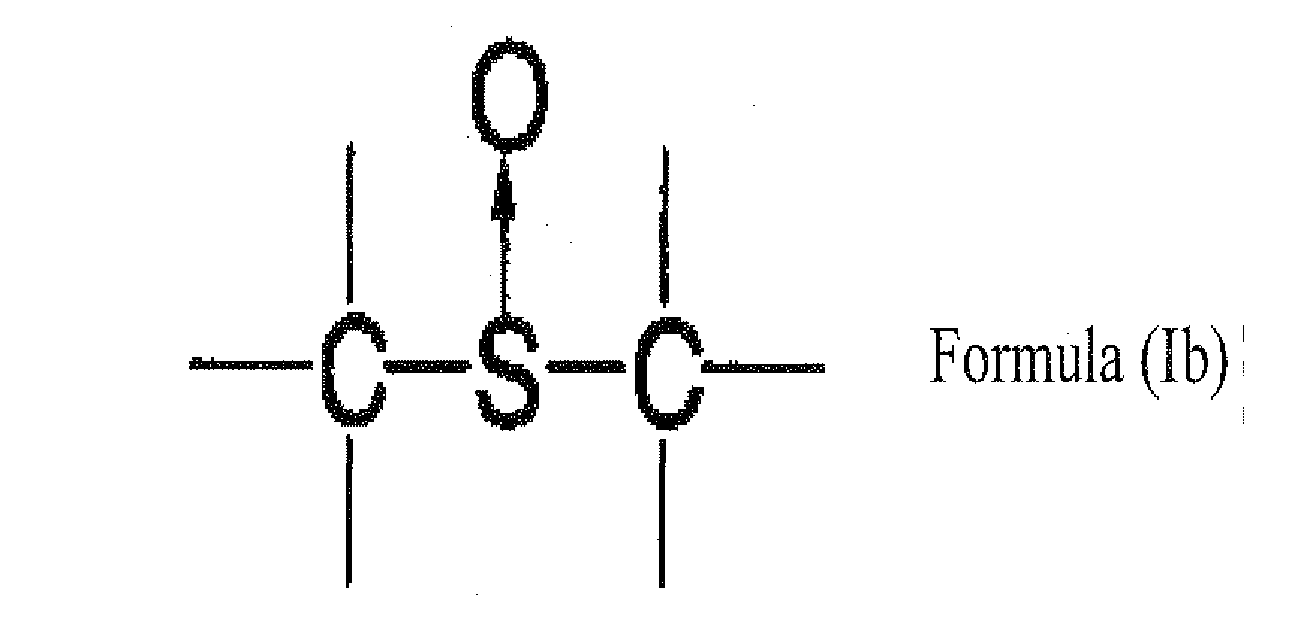
- <7> The ink set according to any one of <1> to <6>, wherein the antioxidant is a compound represented by the following formula (2):

- <8> The ink set according to any one of <1> to <7>, wherein the magenta ink contains a betaine-based compound represented by the following formula (B):

- wherein, in formula (B), RS4, RS5 and RS6 each independently represent an alkyl group, an aryl group or a heterocyclic group, and may be linked to each other to form a cyclic structure; and RS7 represents an alkyl group containing a carboxyl group, or an alkyl group containing a sulfo group.
- <9> A method for forming an inkjet image, including forming an image using the ink set according to any one of <1> to <8> on an inkjet recording medium having an ink receiving layer containing inorganic fine particles disposed on a support.
- According to the invention, an ink set capable of forming an image having excellent ozone resistance, and a method for forming an inkjet image using the ink set, may be provided.
- [Ink set]
The ink set of the invention is constituted to include at least a yellow ink, a magenta ink and a cyan ink, and the magenta ink and at least one of the yellow ink or the cyan ink each contain an antioxidant having a sulfur atom in the molecule, while the magenta ink contains a dye represented by the following formula (M-1). It is preferable that both the yellow ink and the cyan ink contain the antioxidant having a sulfur atom in the molecule thereof, from the viewpoint of improving ozone resistance.
The dye will be described below. - Formula (M-1):
-

- The invention is based on the findings that when a magenta ink and at least one of a yellow ink or a cyan ink are each incorporated with an antioxidant and are used as an ink set, an image (particularly, color image) having excellent ozone resistance is obtained.
Specifically, the present inventors have found that an image obtained from spotted ink droplets of a first color does not undergo any noticeable deterioration of ozone resistance, whereas an image obtained from spotted ink droplets of a second or subsequently applied color undergoes conspicuous deterioration of ozone resistance. In particular, deterioration was conspicuous in a deposit image obtained by a combination of a magenta ink and a yellow ink, or a combination of a magenta ink and a cyan ink, or a deposit gray-scale image obtained by a combination of a magenta ink, a yellow ink and a cyan ink. As a result, it was found that ozone resistance is conspicuously improved by adding an antioxidant having a sulfur atom in the molecule thereof, such as a sulfoxide-based compound or a thioether-based compound, into the magenta ink and another ink (for example, the yellow ink and/or cyan ink) that is used in combination with the magenta ink, and thus the invention has been completed.
In general, it is presumed that the antioxidant contained in the inkjet recording medium or in the ink continues to exist in the vicinity of dyes obtained by spotted ink droplets of a first color in the ink receiving layer; however, under the action of the solvent or water in the ink after spotting ink droplets of a second or subsequently applied color, as the antioxidant migrates from the vicinity of the dyes to the support, the function of preventing oxidation of dyes is gradually impaired, and therefore, deterioration of ozone resistance proceeds conspicuously in the case of multiple colors after the second color. Thus, it is assumed that when an antioxidant is added in plural inks, and the antioxidant is widespread, conspicuous effects of the invention may be obtained.
The ink set of the invention more preferably has a black ink, and other inks may be used according to necessity.
Next, ink constituting components such as magenta, yellow, cyan or black inks that are used in the invention will be described. - (Antioxidant)
In regard to the ink set of the invention, the magenta ink and at least one of the yellow ink or the cyan ink each contain an antioxidant having a sulfur atom in the molecule thereof.
The antioxidant that may be used in the ink set of the invention is not particularly limited as long as it has a sulfur atom in the molecule thereof. Specific examples of the antioxidant having a sulfur atom in the molecule include, for example, the compounds described in paragraphs [0175] to [0214] ofJP-A No. 2004-299373 - - Compound having thioether structure (thioether-based compound) -
The compound having a thioether structure according to the invention is not particularly limited if the compound contains one or more thioether groups in the molecule, and may be a low molecular weight compound or may be a high molecular weight compound. However, it is preferable that the compound be water-soluble, so as to maintain a uniform state when added to the ink.
The thioether-based compound preferably has 2 or more carbon atoms, and more preferably has 4 or more carbon atoms.
The thioether compound preferably further contains an atoms containing a lone pair of electrons (for example, an oxygen atom, a sulfur atom, a nitrogen atom or a phosphorus atom), in addition to a thioether group, carbon atoms and hydrogen atoms.
Examples of the thioether-based compound include compounds represented by the following formula (1a). -
R1-(S-R3)m-S-R2 Formula (1a)
- In the formula (1a), R1 and R2 each independently represent a hydrogen atom, a substituted or unsubstituted alkyl group, a substituted or unsubstituted aryl group, or a group containing a substituted or unsubstituted alkyl or aryl group, and R1 and R2 may be identical or different, and may be linked to form a ring. However, at least one of R1 or R2 is an alkyl group substituted with a hydrophilic group such as a hydroxyl group, a sulfo group, a carboxyl group or a (poly)ethylencoxy group, or with a group having a basic nitrogen atom such as an amino group, an amide group, an ammonium group, a nitrogen-containing heterocyclic group, an aminocarbonyl group or an aminosulfonyl group; or a group containing such an alkyl group (for example, this substituted alkyl group may be further linked to a sulfur atom of the thioether via a divalent linking group such as a carbamoyl group, a carbonyl group or a carbonyloxy group). R3 is an alkylene group which may be substituted, and optionally represents an alkylene group having an oxygen atom. m represents an integer from 0 to 10, and when m is 1 or more, the at least one sulfur atom linked to R3 may be a sulfoxide group or a sulfonyl group. Furthermore, R1 and R2 may each be a residue of a polymer.
- A preferred compound of formula (1a) is a compound in which at least one of R1 or R2 has an alkyl group substituted with a hydroxyl group, a carboxyl group, an amino group, or an ammonium group. The amino group of the alkyl group substituted with an amino group includes an amino group, a monoalkyl (preferably, an alkyl group having 1 to 5 carbon atoms)-substituted amino group and a dialkyl (preferably, an alkyl group having 1 to 5 carbon atoms)-substituted amino group, and may also be a nitrogen-containing heterocyclic group. Among these compounds, a compound in which at least one of R1 or R2 is a hydroxyl group or a carboxyl group is particularly preferred.
Hereinafter, specific examples of the compound of formula (1a) will be mentioned, but the invention is not intended to be limited to these. -
- A-1)
HOCH2CH2SCH2CH2SCH2CH2OH
- A-2)
HOCH2CH2SCH2CH2OH
- A-3)
CH3SCH2CH2OH
- A-4)
CH3CH2SCH2CH2OH
- A-5)
C4H9SCH2CH2OH
- A-6)

- A-7)

- A-8)

- A-9)

- A-10)

- A-11)
HOCH2CH2CH2SCH2CH2CH2OH
- A-12)
HOCH2CH2SCH2CH2CH2SCH2CH2OH
- A-13)

- A-14)

- A-15)
C2H5SCH2CH2SCH2CH2OH
- A-16)
HOOCCH2CH2SCH2CH2COOH
- A-17)
HOOCCH2SCH2COOH
- A-18)
CH3SCH2COOH
- A-19)
C2H5SCH2COOH
- A-20)
C4H9SCH2COOH
- A-21)
C2H6SCH2CH2COOH
- A-22) C4H9SCH2CH2COOH
- A-23)

- A-24)

- A-25)

- A-26)

- A-27)

- A-28)

- A-29)
HOCH2CH2SCH2CH2OCH2CH2SCH2CH2OH
- A-30)
HOCH2CH2SCH2CH2OCH2CH2OCH2CH2SCH2CH2OH
- A-31)
HOCH2CH2OCH2CH2SCH2CH2SCH2CH2OCH2CH2OH
- A-32)

- A-33)
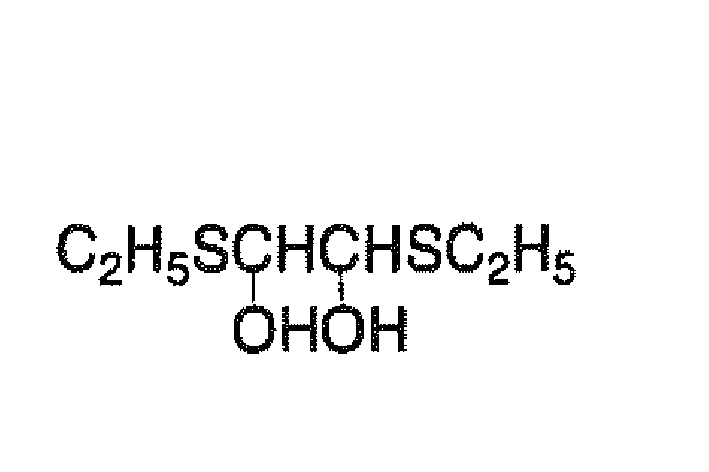
- A-34)
C4H9SCH2CH2CH2SO3Na
- A-35)
C6H13SCH2CH2SO3Na
- A-36)
NaO3SCH2CH2CH2SCH2CH2SCH2CH2CH2SO3Na
- A-37)

- A-38)
C2H5SCH2CH2N(C2H5)2
- A-39)

- A-40)
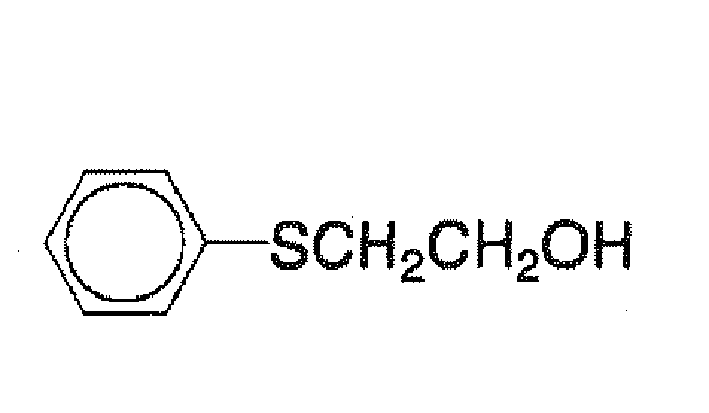
- A-41)

- A-42)

- A-43)

- A-44)

- A-45)

- A-46)
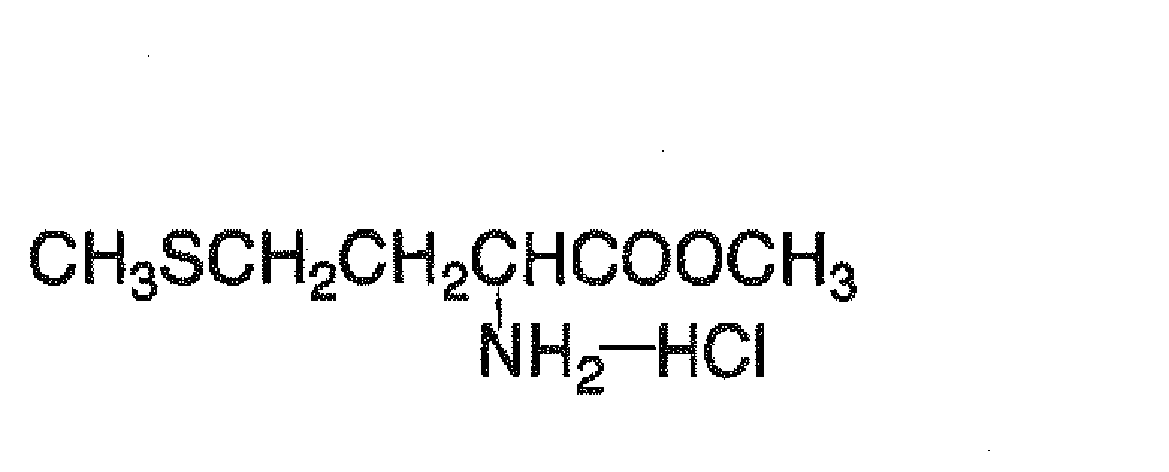
- A-47)

- A-48)

- A-49)
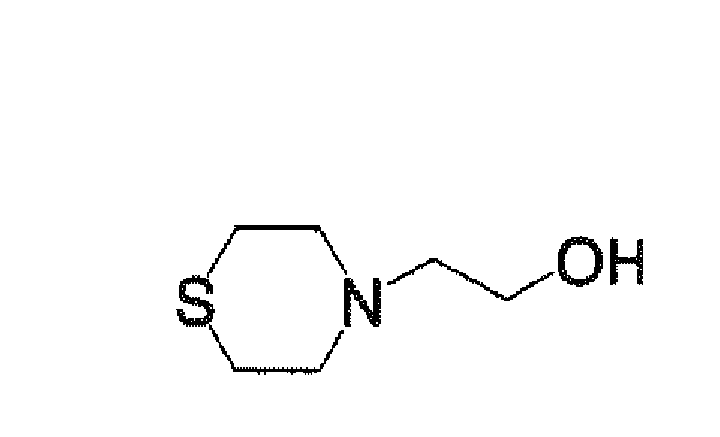
- A-50)

- A-51)

- A-52)

- A-53)

- A-54)
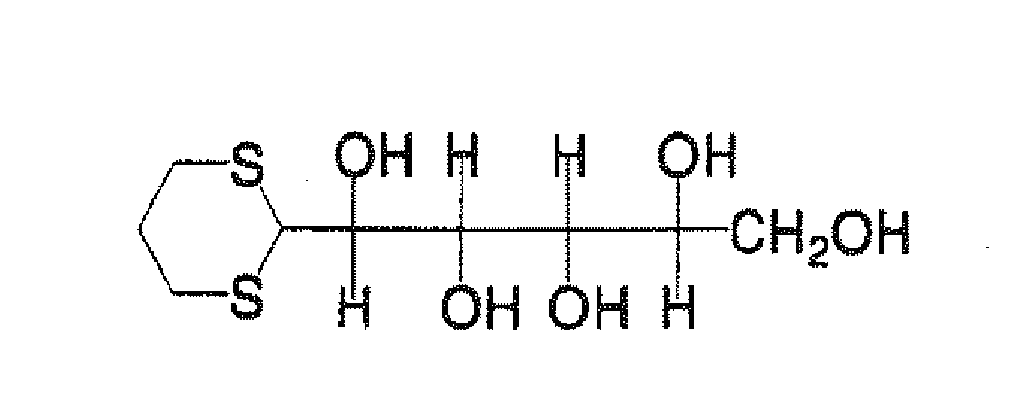
- A-55)

- A-56)

- A-57)

- A-58)

- - Compound having sulfoxide structure (sulfoxide-based compound) -
The compound having sulfoxide structure (sulfoxide-based compound) according to the invention is not particularly limited, but preferably has one or more structure represented by the following formula (Ib) in the molecule thereof.
- The sulfoxide-based compound having a structure represented by the formula (Ib) may be substituted by a hydrophilic group. Examples of the hydrophilic group include substituted or unsubstituted amino groups, substituted or unsubstituted carbamoyl groups, substituted or unsubstituted sulfamoyl groups, substituted or unsubstituted ammonium, hydroxyl group, sulfonic acid, carboxylic acid, phosphoric acid, ethyleneoxy acid, and substituted or unsubstituted nitrogen-containing heterocycles.
- Moreover, the sulfoxide-based compound is preferably a compound represented by the following formula (2).
-

R1 and R2, or R2 and R3 may combine with each other to form a ring. m is 0 or an integer of 1 or greater. n is 0 or 1. At least one of R1, R2, or R3 represents an alkyl group, an aryl group, a heterocyclic group, or a polymer residue each of which is substituted by a hydrophilic group selected from a substituted or unsubstituted amino group, a substituted or unsubstituted carbamoyl group, a substituted or unsubstituted sulfamoyl group, a substituted or unsubstituted ammonium, a hydroxyl group, a sulfonic acid, a carboxylic acid, a phosphoric acid, an ethyleneoxy group, and a substituted or unsubstituted nitrogen-containing heterocycle. - The unsubstituted alkyl group represented by R1 or R3 in the formula (2) may have a straight-chain, branched, or cyclic structure, and may contain an unsaturated bond. For example, alkyl groups having 1 to 22 carbon atoms are preferable. Specifically, the alkyl group is preferably a methyl group, an ethyl group, an allyl group, a n-butyl group, a n-hexyl group, a n-octyl group, a benzyl group, an iso-propyl group, an iso-butyl group, a sec-butyl group, a cyclohexyl group, or a 2-ethylhexyl group, more preferably an alkyl group having 1 to 10 carbon atoms, and particularly preferably a methyl group, an ethyl group, an allyl group, a n-propyl group, an iso-butyl group, a cyclohexyl group, or a 2-ethylhexyl group.
- The unsubstituted aryl group represented by R1 or R3 is preferably, for example, an aryl group having 6 to 22 carbon atoms. Specific examples thereof include a phenyl group, a 1-naphthyl group, and a 2-naphthyl group, and a phenyl group is particularly preferable.
- Examples of the unsubstituted heterocyclic group represented by R1 or R3 include a thienyl group, a thiazolyl group, an oxazolyl group, a pyridyl group, a pyrazyl group, a thiadiazoyl group, a triazoyl group, a morphoryl group, a piperazyl group, a pyrimidyl group, a triazyl group, an indolyl group, a benzothiazoyl group, and a benzoxazoyl group; among others, a thiazolyl group, an oxazolyl group, a pyridyl group, a thiadiazoyl group, a triazoyl group, a morphoryl group, a pyrimidyl group, a triazyl group, a benzothiazoyl group, and a benzoxazoyl group are particularly preferred.
- When R1 or R3 represents a polymer residue composed of groups selected from substituted or unsubstituted alkyl groups, aryl groups, and heterocyclic residues, an example of the polymer residue is a polymer having any of the following units.
-


- An example of the linking group represented by Q in the above unit is any of the following linking groups:
-
-COO-


-CH2CH2- -CH2-
wherein R6 represents a hydrogen atom, an alkyl group, or an aryl group. - When R1 or R3 represents a substituted alkyl, aryl, or heterocyclic group, examples of the substituent(s) include substituted or unsubstituted amino groups (e.g. amino groups having 30 or less carbon atoms, an amino group, alkylamino groups, dialkylamino groups, arylamino groups, and acylamino groups); substituted or unsubstituted carbamoyl groups (e.g. carbamoyl groups having 30 or less carbon atoms, a carbamoyl group, a methylcarbamoyl group, a dimethylcarbamoyl group, a morpholinocarbamoyl group, and a piperidinocarbamoyl group); substituted or unsubstituted ammoniums (e.g. ammoniums having 30 or less carbon atoms, ammonium, trimethylammonium, triethylammonium, dimethylbenzylammonium, and hydroxyethyldimethylammonium); substituted or unsubstituted sulfamoyl groups (e.g. sulfamoyl groups having 30 or less carbon atoms, a sulfamoyl group, a methylsulfamoyl group, a dimethylsulfamoyl group, a morpholinosulfamoyl group, and a piperidinosulfamoyl group); substituted or unsubstituted nitrogen-containing heterocyc groups (e.g. a pyridyl group, a pyrimidyl group, a morpholino group, a pyrolidino group, a piperidino group, and a piperazyl group); hydrophilic groups represented by a hydroxyl group, a sulfonic acid, a carboxylic acid, a phosphoric acid, an ethyleneoxy group and the like; a cyano group; halogen atoms (e.g. a fluorine atom, a chlorine atom, and a bromine atom); substituted or unsubstituted alkoxycarbonyl groups (e.g. alkoxycarbonyl groups having 30 or less carbon atoms, a methoxycarbonyl group, an ethoxycarbonyl group, a dimethylaminoethoxyethoxycarbonyl group, a diethylaminoethoxycarbonyl group, and a hydroxyethoxycarbonyl group); substituted or unsubstituted aryloxycarbonyl groups (e.g. aryloxycarbonyl groups having 30 or less carbon atoms, and a phenoxycarbonyl group); substituted or unsubstituted alkoxy groups (e.g. alkoxy groups having 30 or less carbon atoms, a methoxy group, an ethoxy group, a phenoxyethoxy group, a buthoxyethoxy group, and a hydroxyethoxy group); substituted or unsubstituted aryloxy groups (e.g. aryloxy groups having 30 or less carbon atoms, a phenoxy group); substituted or unsubstituted acyloxy groups (e.g. acyloxy groups having 30 or less carbon atoms, an acetyloxy group, and a propionyloxy group); and substituted or unsubstituted acyl groups (e.g. acyl groups having 30 or less carbon atoms, an acetyl group, and a propionyl group).
R1 and R3 may be the same as or different from each other, and may combine with each other to form a ring. - R2 represents a substituted or unsubstituted divalent to hexavalent linking group. R1 and R2, or R2 or R3 may combine with each other to form a ring. Examples of the sulfur-containing heterocycle formed by such a bonding include a thienyl group, a thiazoyl group, a thiazolidyl group, a dithiolan-2-yl group, a trithian-2-yl group, and a dithian-2-yl group.
- Examples of the divalent to hexavalent linking group represented by R2 include those containing carbon, nitrogen, oxygen, or phosphor; and a specific examples thereof include the following linking groups.
- -CH2CH2- -CH2CH2CH2 -CH2CH2-O-CH2CH2-
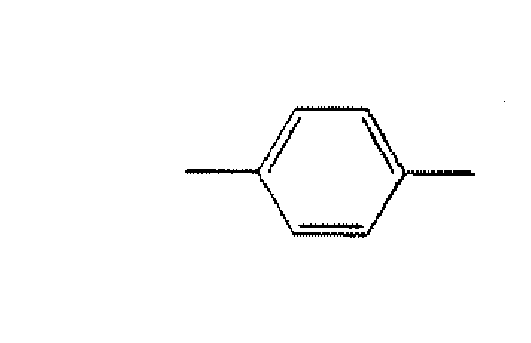

-HC=CH-


- These linking groups may contain a hetero bond such as an ether bond, an ester bond, an amino bond, an amide bond, or a urethane bond, and may have a substituent. A polymer composed of a repetition of linking groups selected from the above may also be used, in which the respective linking groups may be the same as or different from each other.
- At least one of R1, R2, or R3 represents an alkyl group, an aryl group, a heterocyclic group, or a polymer residue each of which is substituted by a hydrophilic group represented by a substituted or unsubstituted amino group, a substituted or unsubstituted carbamoyl group, a substituted or unsubstituted sulfamoyl group, a substituted or unsubstituted ammonium, a hydroxyl group, a sulfonic acid, a carboxylic acid, a phosphoric acid, an ethyleneoxy group, or a substituted or unsubstituted nitrogen-containing heterocycle. The hydrophilic group may be selected from the substituents mentioned in the description of R1 and R3.
- Since the preparation of the inkjet recording medium of the invention involves practically aqueous coating, the sulfoxide-based compound according to the invention is preferably water-soluble.
Such a sulfoxide-based compound is a Lewis base, which has higher solubility in water than a thioether compound. Therefore, the sulfoxide- based compound can be added in a larger amount than a thioether compound. - In the ink according to the invention, the sulfoxide-based compound, which generally has a higher oxidation potential than conventional sulfur-containing compounds (thioethers, thioureas), can achieve higher ozone resistance and higher light resistance when combined with a dye having a high oxidation potential that is advantageous in improvement of ozone resistance and light resistance.
- The sulfoxide-based compound according to the invention may be used solely, or in combination of two or more kinds thereof.
- Specific examples (exemplary compounds A-1 to A-75) of the sulfoxide-based compound will be shown below, but the invention is not limited thereto.
-
- A-1)

- A-2)

- A-3)

- A-4)

- A-5)

- A-6)

- A-7)

- A-8)

- A-9)

- A-10)

- A-11)

- A-12)

- A-13)
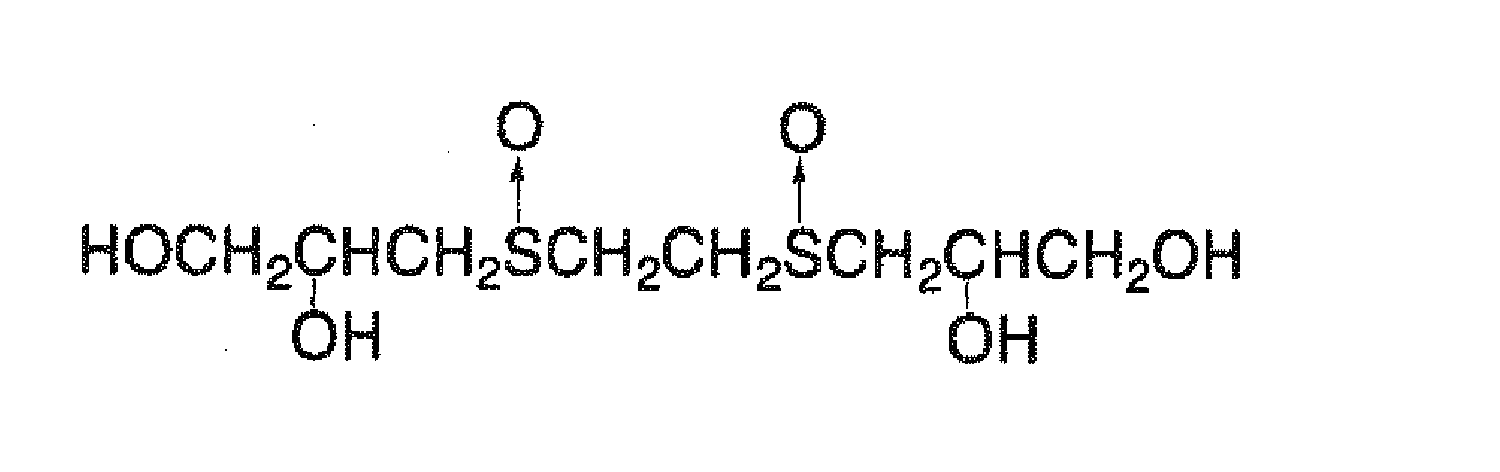
- A-14)

- A-15)

- A-16)

- A-17)

- A-18)

- A-19)

- A-20)

- A-21)

- A-22)

- A-23)

- A-24)

- A-25)

- A-26)

- A-27)

- A-28)

- A-29)
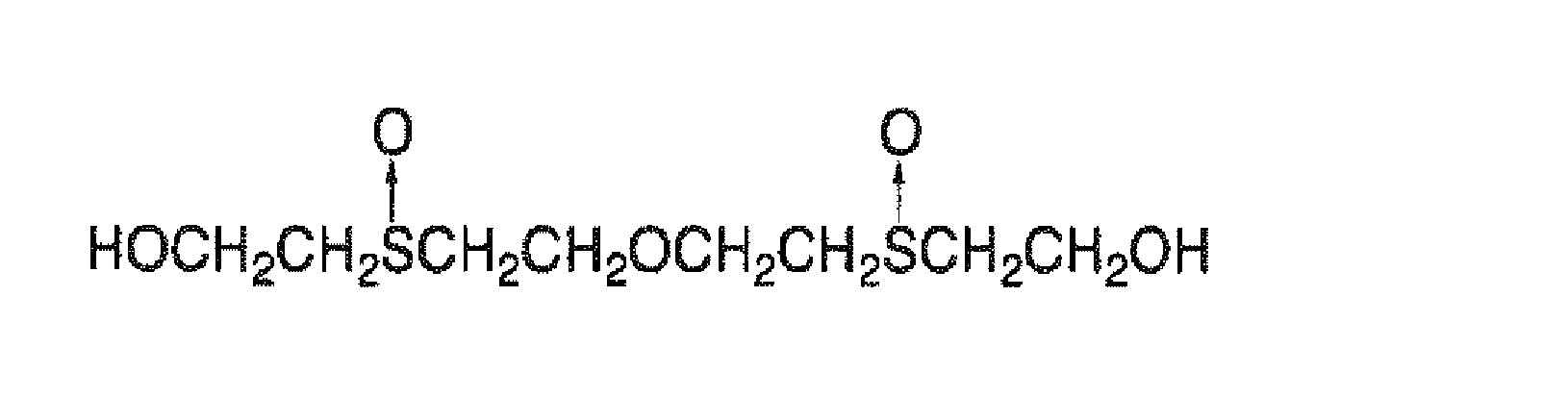
- A-30)

- A-31)

- A-32)

- A-33)

-
- A-34)

- A-35)

- A-36)

- A-37)

- A-38)

- A-39)

- A-40)

- A-41)

- A-42)

- A-43)

- A-44)

- A-45)

- A-46)

-
- A-47)

- A-48)

- A-49) A-50) A-51) A-52)
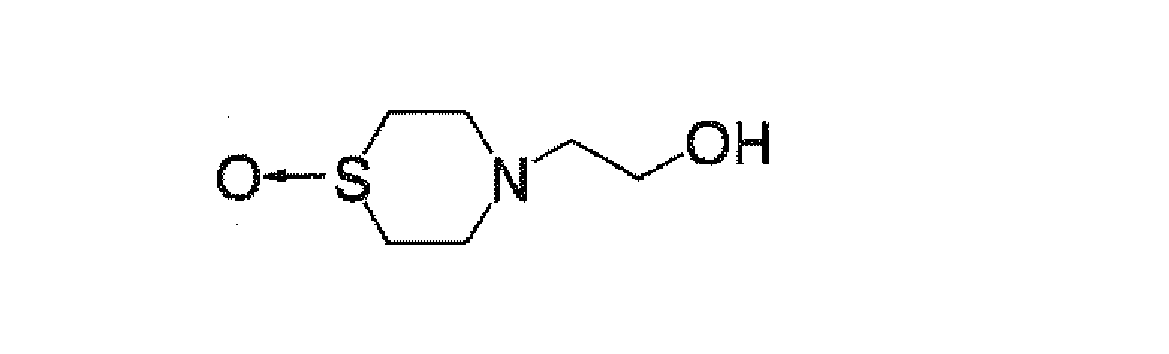


-
- A-53)

- A-54)

- A-55)

- A-56)

- A-57)

- A-58)

-
- A-59)

- A-60)

- A-61)

-
- A-62)

- A-63)

- A-64)

- A-65)

- A-66)
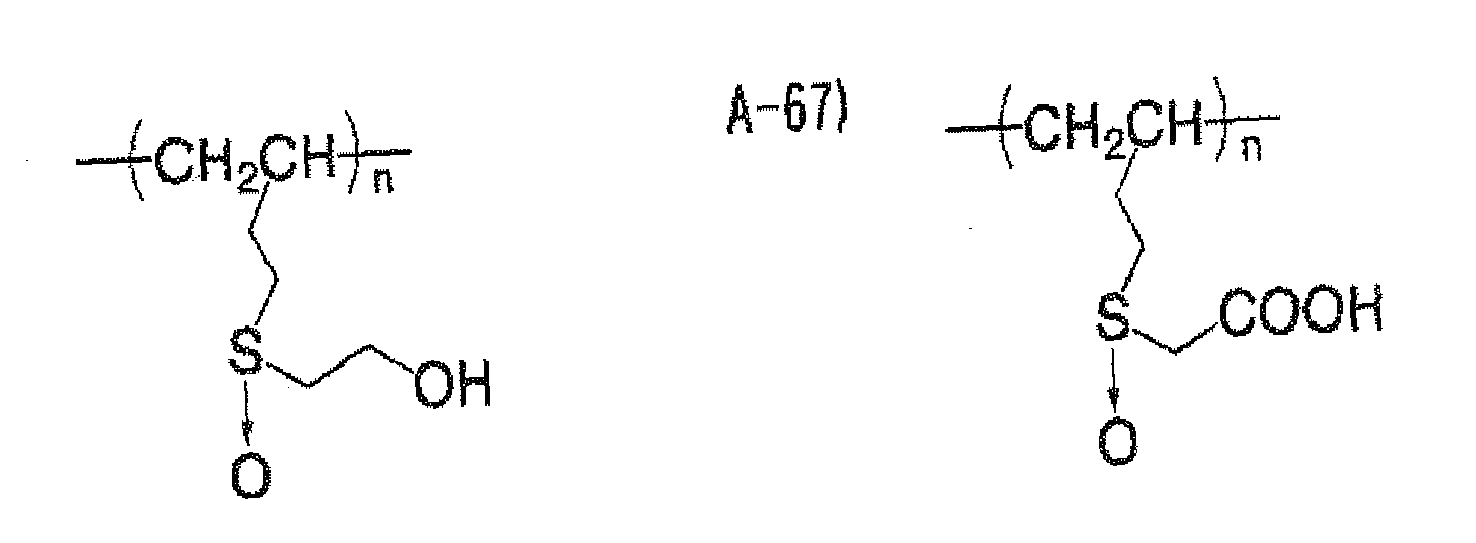
-
- A-68)

- A-69)

- A-70)

- A-71)
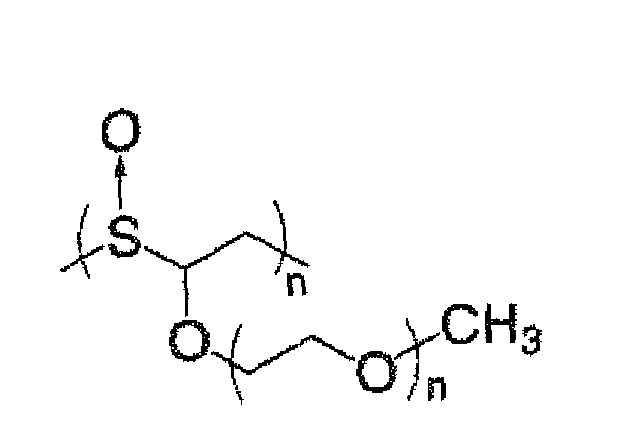
- A-72)

- A-73)


- A-75)

If the content is less than 1% by mass, it is difficult to achieve an effect of improving ozone resistance, and if the content is more than 20% by mass, the printing density when printed decreases, or jetability upon printing is deteriorated, which is not preferable. In regard to the ink set of the invention, jetability is enhanced when the aforementioned amount of an antioxidant having a sulfur atom in the molecule is incorporated into the ink.
(Dye)
The water-soluble dye having a structure represented by the formula (M-1), which is contained in the magenta ink according to the invention, will be described.
Hereinafter, specific exemplary embodiments of the invention will be described in detail.
First, a compound represented by the formula (M-1) (azo dye) will be described.
The compound represented by the formula (M-1) is preferably water-soluble.
R1 and R2 each independently represent a hydrogen atom, a halogen atom, an aliphatic group, an aryl group, a heterocyclic group, a cyano group, a carboxyl group, a carbamoyl group, an alkoxycarbonyl group, an aryloxycarbonyl group, an acyl group, a hydroxyl group, an alkoxy group, an aryloxy group, a silyloxy group, an acyloxy group, a carbamoyloxy group, a heterocyclic oxy group, an alkoxycarbonyloxy group, an aryloxycarbonyloxy group, an alkylamino group, an arylamino group, a heterocyclic amino group, an acylamino group, a ureido group, a sulfamoylamino group, an alkoxycarbonylamino group, an aryloxycarbonylamino group, an alkyl- or arylsulfonylamino group, an aryloxycarbonylamino group, a nitro group, an alkyl- or arylthio group, an alkyl- or arylsulfonyl group, an alkyl- or arylsulfinyl group, a sulfamoyl group, a sulfo group, or a heterocyclic thio group. The respective groups may be further substituted.
R3 and R4 each independently represent a hydrogen atom, an aliphatic group (a substituted or unsubstituted alkyl group, a substituted or unsubstituted alkenyl group, a substituted or unsubstituted alkynyl group, or the like), an aryl group (a substituted or unsubstituted phenyl group, a substituted or unsubstituted naphthyl group, or the like), a heterocyclic group, an acyl group, an alkoxycarbonyl group, an aryloxycarbonyl group, a carbamoyl group, a sulfonyl group (an alkylsulfonyl group, an arylsulfonyl group), or a sulfamoyl group. Preferably, R3 and R4 are each a hydrogen atom, an alkyl group, a cycloalkyl group, an aralkyl group, an alkenyl group, an aryl group, a heterocyclic group, a sulfonyl group, an acyl group, or a carbamoyl group, and the respective groups may be further substituted.
Furthermore, R1 and R2, or R3 and R4 may combine with each other to form a 5- or 6-membered ring. a and e each independently represent an alkyl group, an alkoxy group or a halogen atom, but if a and e are both alkyl groups, the total number of carbon atoms constituting the alkyl groups is 3 or more, and these alkyl groups may be further substituted. b, c and d each independently have the same meanings as those of R1 and R2, and a and b, or e and d may form a condensed ring with each other. However, the formula (M-1) has at least one ionic hydrophilic group.
In the formula (M-1), Z1 represents an electron withdrawing group having a Hammett substituent constant σp value of 0.20 or more.
The electron withdrawing group of Z1 is an electron withdrawing group having a Hammett substituent constant σp value of 0.20 or more, and preferably 0.30 or more. The upper limit of the σp value is preferably 1.0.
Specific examples of the electron withdrawing group having a σp value of 0.20 or more include an acyl group, an acyloxy group, a carbamoyl group, an alkyloxycarbonyl group, an aryloxycarbonyl group, a cyano group, a nitro group, a dialkylphosphono group, a diarylphosphono group, a diarylphosphinyl group, an alkylsulfinyl group, an arylsulfinyl group, an alkylsulfonyl group, an arylsulfonyl group, a sulfonyloxy group, an acylthio group, a sulfamoyl group, a thiocyanate group, a thiocarbonyl group, a halogenated alkyl group, a halogenated alkoxy group, a halogenated aryloxy group, a halogenated alkylamino group, a halogenated alkylthio group, a heterocyclic group, a halogen atom, an azo group, a selenocyanate group, and an aryl group substituted with another electron withdrawing group having a σp value of 0.20 or more. Z1 is preferably a cyano group, a nitro group, or a halogen atom, more preferably a halogen atom or a cyano group, and most preferably a cyano group.
Z2 represents a hydrogen atom, an aliphatic group, an aryl group or a heterocyclic group. Z2 is preferably a hydrogen atom, an alkyl group, a cycloalkyl group, an aralkyl group, an aryl group, a heterocyclic group, an acyl group, an alkenyl group, or a sulfonyl group, and is more preferably an alkyl- group. The respective substituents may be further substituted.
The alkyl group includes an alkyl group having a substituent, and an unsubstituted alkyl group. The alkyl group is preferably an alkyl group having 1 to 12 carbon atoms, excluding the carbon atoms of the substituent, and more preferably an alkyl group having 1 to 6 carbon atoms, excluding the carbon atoms of the substituent. Examples of the substituent include a hydroxyl group, an alkoxy group, a cyano group, a halogen atom, and an ionic hydrophilic group. Examples of the alkyl group include methyl, ethyl, butyl, isopropyl, t-butyl, hydroxyethyl, methoxyethyl, cyanoethyl, trifluoromethyl, 3-sulfopropyl and 4-sulfobutyl groups.
The cycloalkyl group includes a cycloalkyl group having a substituent, and an unsubstituted cycloalkyl group. The cycloalkyl group is preferably a cycloalkyl group having 5 to 12 carbon atoms, excluding the carbon atoms of the substituent. Examples of the substituent include an ionic hydrophilic group. Examples of the cycloalkyl group include a cyclohexyl group.
The aralkyl group includes an aralkyl group having a substituent, and an unsubstituted aralkyl group. The aralkyl group is preferably an aralkyl group having 7 to 12 carbon atoms, excluding the carbon atoms of the substituent. Examples of the substituent include an ionic hydrophilic group. Examples of the aralkyl group include a benzyl group, and a 2-phenethyl group.
The aryl group includes an aryl group having a substituent, and an unsubstituted aryl group. The aryl group is preferably an aryl group having 6 to 12 carbon atoms, excluding the carbon atoms of the substituent. Examples of the substituent include an alkyl group, an alkoxy group, a halogen atom, an alkylamino group, an amide group, a carbamoyl group, a sulfamoyl group, a sulfonamide group, a hydroxyl group, an ester group and an ionic hydrophilic group. Examples of the aryl group include phenyl, p-tolyl, p-methoxyphenyl, o-chlorophenyl, and m-(3-sulfopropylamino) phenyl groups.
The heterocyclic group includes a heterocyclic group having a substituent, and an unsubstituted heterocyclic group. The heterocyclic group is preferably a heterocyclic group having a 5-membered or 6-membered ring. Examples of the substituent include an amide group, a carbamoyl group, a sulfamoyl group, a sulfonamide group, a hydroxyl group, an ester group, and an ionic hydrophilic group. Examples of the heterocyclic group include a 2-pyridyl group, a 2-thienyl group, a 2-thiazolyl group, a 2-benzothiazolyl group and a 2-furyl group.
The acyl group includes an acyl group having a substituent, and an unsubstituted acyl group. The acyl group is preferably an acyl group having 1 to 12 carbon atoms, excluding the carbon atoms of the substituent. Examples of the acyl group include an acetyl group and a benzoyl group.
The alkenyl group includes an alkenyl group having a substituent, and an unsubstituted alkenyl group. The alkenyl group is preferably an alkenyl group having 5 to 12 carbon atoms, excluding the carbon atoms of the substituent. Examples of the substituent include an ionic hydrophilic group. Examples of the alkenyl group include a vinyl group, and an allyl group.
The sulfonyl group includes an alkylsulfonyl group , for example, a methanesulfonyl group, and an arylsulfonyl group, for example, a phenylsulfonyl group.
However, each of R3 and R4 is not a hydrogen atom at the same time.
Q represents a hydrogen atom, an aliphatic group, an aryl group or a heterocyclic group. Q preferably represents an alkyl group, a cycloalkyl group, an aralkyl group, an alkenyl group, an aryl group, or a heterocyclic group, and these substituents may be respectively further substituted. The details of these substituents are the same as those for R1 and R2 mentioned above.
Q is preferably an aryl group or a heterocyclic group, both of which are substituted with an electron withdrawing group.
The electron withdrawing group for Q is an electron withdrawing group having a Hammett substituent constant σp value of 0.20 or more, and preferably 0.30 or more. The upper limit of the σp value is preferably 1.0.
Specific examples for the electron withdrawing group having a σp value of 0.20 or more include an acyl group, an acyloxy group, a carbamoyl group, an alkyloxycarbonyl group, an aryloxycarbonyl group, a cyano group, a nitro group, a dialkylphosphono group, a diarylphosphono group, a diarylphosphinyl group, an alkylsulfinyl group, an arylsulfinyl group, an alkylsulfonyl group, an arylsulfonyl group, a sulfonyloxy group, an acylthio group, a sulfamoyl group, a thiocyanate group, a thiocarbonyl group, a halogenated alkyl group, a halogenated alkoxy group, a halogenated aryloxy group, a halogenated alkylamino group, a halogenated alkylthio group, a heterocyclic group, a halogen atom, an azo group, a selenocyanate group, an aryl group substituted with another electron withdrawing group having a σp value of 0.20 or more. The electron withdrawing group is preferably a cyano group, a nitro group or a halogen atom. The heterocyclic group may not be substituted with an electron withdrawing group.
R3 and R4 are each preferably a hydrogen atom, an alkyl group, an aralkyl group, an aryl group, a heterocyclic group, a sulfonyl group, or an acyl group, and a and e are each preferably an alkyl group or a halogen atom. When a and e are both alkyl groups, a and e are both unsubstituted alkyl groups, and the total number of carbon atoms of a and e is 3 or more (preferably, 5 or less). A preferred combination of a, b, c and d is such that a, b, c and d are each a hydrogen atom, a halogen atom, an alkyl group, or an ionic hydrophilic group (preferably, a hydrogen atom, an alkyl group having 1 to 4 carbon atoms, or an ionic hydrophilic group).
Z1 is most preferably a cyano group.
Z2 is preferably an alkyl group or an aryl group. Furthermore, among alkyl groups, an alkyl group having 3 to 4 carbon atoms (preferably, an isopropyl group or a t-butyl group) is preferred. The aryl group is preferably a phenyl group which is further substituted at any of the 2-position, 4-position and 6-position as viewed from the side of the phenyl group and the pyrazole mother nucleus.
An exemplary combination of preferred substituents with respect to the formula (M-1) will be described below. A preferable combination is that Z1 is a cyano group; Z2 is an isopropyl group, a t-butyl group or a phenyl group (preferably, a t-butyl group); R1 is a hydrogen atom; R2 is a hydrogen atom or an alkyl group having 1 to 4 carbon atoms (preferably, a methyl group); R3 and R4 are each a hydrogen atom, an alkyl group, an aralkyl group, an aryl group, a heterocyclic group, a sulfonyl group, or an acyl group, and preferably a hydrogen atom, a heterocyclic (preferably, benzoxazole ring, benzothiazole ring (preferably, unsubstituted or sulfo-substituted benzothiazole ring)) group, or an alkyl- and/or sulfo-substituted phenyl group; a and e are each an alkyl group, an alkyl group which may be substituted, with the total number of carbon atoms of a + e being 3 or more (preferably, 5 or less), and preferably an unsubstituted alkyl group with the total number of carbon atoms being 4 or more and 5 or less; b, c and d are each a hydrogen atom, a halogen atom, an alkyl group, or an ionic hydrophilic group (preferably, a hydrogen atom, an alkyl group having 1 to 4 carbon atoms, or a sulfo group); and Q is a heterocyclic group preferably including a benzoxazole ring, or a benzothiazole ring (preferably, sulfamoyl- or sulfo-substituted benzoxazole or benzothiazole ring).
The compound represented by the formula (M-1) (azo dye) has at least one (preferably, 3 or more and 6 or less) ionic hydrophilic groups in the molecule. The ionic hydrophilic group may be any group as long as it is an ionic dissociable group. Examples of the ionic hydrophilic group include a sulfo group, a carboxyl group, a phosphono group, and a quaternary ammonium group. The ionic hydrophilic group is preferably a carboxyl group, a phosphono group, or a sulfo group, and among them, a carboxyl group and a sulfo group are preferred. In particular, it is most preferable that at least one ionic hydrophilic group is a sulfo group. The carboxyl group, the phosphono group and the sulfo group may be in the form of a salt, and examples of the counterion capable of forming a salt therewith include an ammonium ion, an alkali metal ion (for example, lithium ion, sodium ion, or potassium ion), and an organic cation (for example, tetramethylammonium ion, tetramethylguanidium ion, or tetramethylphosphonium). Among the counterions, an alkali metal ion is preferred.
The azo dye preferably has 3 or more and 6 or less ionic hydrophilic groups in the molecule, and more preferably has 3 or more and 6 or less sulfo groups, and even more preferably 3 or more and 5 or less sulfo groups, in the molecule. - (Method for producing azo dye)
The azo dye represented by the formula (M-1) may be obtained by any of the following methods, <1> and/or <2>.
The method <1> is a method including the following processes. - (a) A process of reacting an aminopyrazole with a diazotizing agent to form an diazonium salt,
- (b) a process of reacting the diazonium salt formed in the process (a) with a coupling agent to form a compound having a substituent introduced, and
- (c) a process of reacting the compound formed in the process (b) with an alkylating agent, an arylating agent or a heterylating agent in the presence of a base, to form a precursor compound for formula (M-1).
- In the method <1>, it is preferable to use a dilute aqueous hydrochloric acid solution of sodium nitrite as the diazotizing agent used in the process (a). Furthermore, isopentyl nitrite, nitrosyl sulfate and the like may also be used as the diazotizing agent. As for the coupling agent used in the process (b), it is most preferable to use a nitrogen-containing 6-membered heterocyclic coupler. As for the base used together with the alkylating agent, arylating agent or heterylating agent in the process (c), organic bases such as diisopropylethylamine, and inorganic bases such as potassium carbonate, sodium carbonate, sodium hydrogen carbonate, potassium hydrogen carbonate, sodium hydroxide and potassium hydroxide, may be mentioned.
- The method <2> is a method including a process of introducing a water-soluble group to the precursor compound for formula (M-1) by an electrophilic reaction. Furthermore, the electrophilic reaction is preferably carried out by a method that will be described below in detail.
- In regard to the method <2>, the electrophilic reaction may be a sulfonation reaction, a Mannich reaction, or a Friedel-Crafts reaction, and among them, sulfonation is preferred.
Regarding the method of sulfonating the precursor compound for formula (M-1), sulfonation can be carried out by using a sulfonating agent such as concentrated sulfuric acid, 10% to 60% fuming sulfuric acid, chlorosulfonic acid, sulfur trioxide or amidosulfuric acid. A solvent may also be used, and the solvent that may be used include acetic acid, acetic anhydride, sulfolane, ethyl acetate, ether, carbon tetrachloride, acetonitrile, and the like.
In regard to the precursor compound for formula (M-1), it is preferable that R3, R4, b (d) and c be sulfonated, and if the substituents for R3, R4, b (d) and c have reactive sites capable of performing multiple sulfonation, a sulfonated dye having a different substitution position of sulfonation may be incorporated. In this case, the dye having a different substitution position of sulfonation may be incorporated in a proportion ranging from 0.1% to 20%, in terms of the HPLC area%, based on the main sulfonated dye. It is desirable that the reaction temperature is -5°C to 80°C, and more desirably in the range of 10°C to 70°C. It is desirable that the reaction time is from 30 minutes to 10 hours, and more desirably from 1 hour to 6 hours. - As for the deoxygenating conditions in the method for producing the precursor compound for formula (M-1), it is desirable to perform production after filling the reaction system with an inert gas such as nitrogen or argon, and furthermore, it is preferable to subject the reaction liquid to bubbling with such an inert gas.
- Aminopyrazole, which is a starting material that is used in the process (a) of the method <1>, may be synthesized according to the methods described in
U.S. Patent No. 3,336,285 ; Heterocycles, 20, 519 (1983); Japanese Published Examined Application (JP-B) No.6-19036 - The pyridine coupler (coupling agent) that is used in the process (b) of the method <1> may be synthesized by the methods described in
JP-A Nos. 51-83631 49-74718 JP-B No. 52-46230 - Specific examples of the azo dye that is used in the ink composition according to the invention will be presented below, but the invention is not intended to be limited to the following examples.
-


- Here, the -SO3H group in each of the tables shown above may also be suitably a - SO3Li group.
A synthesis example for the azo dye represented by the formula (M-1) will be described below, but the synthesis example is not intended to be limited to this method.
In regard to the method of synthesizing the compound represented by the formula (M-1), an example of a compound (d-5) as described below will be presented.
Synthesis of compound (d-5)
(1) Synthesis of compound (d-5a)
24.1 g (0.147 mol) of 5-amino-3-tert-butyl-4-cyanopyrazole (1), 45 ml of concentrated hydrochloric acid, 30 ml of acetic acid, and 45 ml of propionic acid were stirred at an internal temperature of 0°C, and 10.1 g (0.147 mol) of sodium nitrite dissolved in 20 ml of water was added thereto dropwise over 10 minutes. The resultant mixture was stirred as it was for 30 minutes, to prepare a diazonium salt. 84.7 g (0.147 mol) of a coupler component (2) was dissolved in 231 ml of methanesulfonic acid, 147 ml of acetic acid and 221 ml of propionic acid, the resultant mixture was stirred at 0°C, and the diazonium salt was added over 30 minutes. After the addition of the diazonium salt, the reaction liquid was further stirred for 30 minutes, and then the reaction liquid was slowly added, while stirring, to ice water prepared by adding 750 g of ice into 2250 ml of water. A compound (d-5a) precipitated therefrom was isolated by means of suction filtration. Yield amount 73.8 g, and yield 85%. - (2) Synthesis of compound (d-5b)
26.6 g (157 mmol) of a heterylating agent (3), 21.7 g of potassium carbonate, and 147 ml of DMSO were added to 21 g (35.5 mmol) of the compound (d-5a), and the resultant mixture was heated and stirred at an internal temperature of 92°C for 4 hours while nitrogen bubbling was carried out. After completion of the stirring, the mixture was cooled to room temperature, and a compound (d-5b) precipitated from the reaction system was isolated by means of suction filtration. The resulting crude crystals were further dispersed in 3 L of water to dissolve an excess of potassium carbonate, and then the mixture was subjected to suction filtration to obtain the target compound (d-5b). Yield amount 20.0 g, yield 63.5%, and λmax = 558 nm (DMF solution).
m/Z (POSI) = 858. - (3) Synthesis of compound (d-5)
2 g (2.33 mmol) of the compound (d-5b) was dispersed in 7 g of sulfolane manufactured by Tokyo Chemical Industry Co., Ltd., and 1.7 g of NISSO SULFAN (trade name, sulfur trioxide) was added dropwise thereto at an internal temperature of 15°C. After completion of the dropwise addition, the mixture was allowed to react at an internal temperature of 70°C for 2 hours. After completion of the reaction, the reaction liquid was cooled to 20°C, and 2 ml of water was added dropwise. The mixture was cooled to an internal temperature of 5°C, 3.3 ml of a 25 wt% aqueous solution of sodium hydroxide was added dropwise thereto, and 0.8 ml of a 28 wt% methanol solution of sodium methoxide was further added dropwise. 4 ml of methanol was further added dropwise to the mixture, and an inorganic salt precipitated therefrom was filtered and washed altogether with 2 ml of methanol. 2 g of potassium acetate and 5.6 ml of methanol were added to the filtrate, and 22.5 ml of ethanol was further added thereto. Thereby, the dye was crystallized, and was subjected to suction filtration and washed with ethanol. Thus, the compound (d-5) as crude crystals was obtained. The crude crystals containing the inorganic salt was subjected to desalination and purification by SEPHADEX LH-20 Gel Chromatography (eluent, water/methanol = 1:1 (v/v)) manufactured by Pharmacia Corp., to obtain the compound d-5.
Yield amount 2 g, yield 66%, λmax (DMSO) = 567.1 nm, and ε = 46900. - The content of the magenta dye in the magenta ink according to the invention is not particularly limited, but from the viewpoints of the density of developed color after printing and the amount of ink jetting, it is preferable that the magenta dye is contained in the magenta ink in an amount of 0.2% by mass to 20% by mass, and more preferably 0.5% by mass to 10% by mass.
- Furthermore, in order to constitute a full color ink set, the magenta ink according to the invention is used in combination with a cyan ink, a yellow ink and a black ink, and those inks also use their respective dyes. Examples of these dyes that may be used in combination include the following.
- Next, the yellow dye that is used in the yellow ink in the ink set of the invention will be described.
The yellow dye used in the yellow ink is not particularly limited, but for example, the compounds described in paragraphs [0109] to [0132] inJP-A No. 2008-101173 - Furthermore, as for the yellow dye, the compounds described in
WO 2005/075573 ,JP-A Nos. 2004-83903 2003-277662 2003-277661
The compounds described inJP-A Nos. 2007-063520 2006-57076 - Next, the cyan dye that is used in the cyan ink in the ink set of the invention will be discussed.
The cyan dye used in the cyan ink is not particularly limited, but for example, the compounds described in paragraphs [0133] to [0142] ofJP-A No. 2008-101173 - Furthermore, as for the cyan dye, the compounds described in
WO 2002/60994 WO 2003/811 WO 2003/62324 JP-ANos. 2003-213167 2004-75986 2004-323605 2004-315758 2004-315807 2005-179469 - Next, the black dye that is used in the black ink in the ink set of the invention will be discussed.
The black dye used in the black ink is not particularly limited, but for example, the compounds described in paragraphs [0143] to [0199] ofJP-A No. 2008-101173 - Furthermore, the compounds described in paragraphs [0019] to [0024] of
JP-A No. 2005-239822 - The content of the yellow dye in the yellow ink according to the invention is not particularly limited, but from the viewpoints of the density of developed color after printing and the amount of ink jetting, the yellow dye is preferably contained in the yellow ink in an amount of 0.2% by mass to 20% by mass, and more preferably 1% by mass to 10% by mass.
The content of the cyan dye in the cyan ink according to the invention is not particularly limited, but from the viewpoints of the density of developed color after printing and the amount of ink jetting, the cyan dye is preferably contained in the cyan ink in an amount of 0.2% by mass to 10% by mass, and more preferably 1% by mass to 7% by mass.
The content of the black dye in the black ink according to the invention is not particularly limited, but from the viewpoints of the density of developed color after printing and the amount of ink jetting, the black dye is preferably contained in the black ink in an amount of 0.2% by mass to 20% by mass, and more preferably 2% by mass to 10% by mass. - As for the ink set of the invention, other dyes may also be added for the purpose of adjusting the color tone or the color balance at the time of discoloration.
- Examples of the yellow dye include aryl or heteryl azo dyes derived from a phenol, a naphthol, an aniline, a pyrazolone, a pyridone or an open chain type active methylene compound as a coupling component; azomethine dyes derived from an open chain type active methylene compound as a coupling component; methine dyes such as benzylidene dyes or monomethineoxonol dyes; quinone-based dyes such as naphthoquinone dyes and anthraquinone dyes. Other coloring matter species include quinophthalone dyes, nitro/nitroso dyes, acridine dyes, acridinone dyes, and the like. These dyes may be compounds which develop a yellow color for the first time as a result of dissociation of a part of the chromophore, and in this case, the counter cation may be an inorganic cation such as an alkali metal ion or ammonium, or may be an organic cation such as pyridinium or a quaternary ammonium salt. The counter cation may also be a polymeric cation having those cations in a partial structure.
- Examples of the magenta dye include aryl or heteryl azo dyes derived from a phenol, a naphthol, or an aniline compound as a coupling component; azomethine dyes derived from a pyrazolone or a pyrazolotriazole compound as a coupling component; methine dyes such as arylidene dyes, styryl dyes, merocyanine dyes and oxonol dyes; carbonium dyes such as diphenylmethane dyes, triphenylmethane dyes and xanthene dyes; quinone-based dyes such as naphthoquinone, anthraquinone and anthrapyridone; condensed polycyclic dyes such as, for example, dioxazine dyes; and the like. These dyes may be compounds which develop a magenta color for the first time as a result of dissociation of a part of the chromophore, and in this case, the counter cation may be an inorganic cation such as an alkali metal ion or ammonium, or may be an organic cation such as pyridinium or a quaternary ammonium salt. The counter cation may also be a polymeric cation having those cations in a partial structure.
- Examples of the cyan dye include azomethine dyes such as indoaniline dyes and indophenol dyes; polymethine dyes such as cyanine dyes, oxonol dyes and merocyanine dyes; carbonium dyes such as diphenylmethane dyes, triphenylmethane dyes and xanthene dyes; phthalocyanine dyes; anthraquinone dyes; aryl or heteryl azo dyes derived from a phenol, a naphthol or an aniline compound as a coupling component; indigo, thioindigo dyes; and the like. These dyes may be compounds which develop a cyan color for the first time as a result of dissociation of a part of the chromophore, and in this case, the counter cation may be an inorganic cation such as an alkali metal or ammonium, or may be an organic cation such as pyridinium or a quaternary ammonium salt. The counter cation may also be a polymeric cation having those cations in a partial structure. Furthermore, black dyes such as polyazo dyes may also be used.
- As for other water-soluble dyes, water-soluble dyes such as, for example, the direct dyes, acidic dyes, edible dyes, basic dyes and reactive dyes described in paragraph [0095] of
JP-A No. 2007-204632 - Next, the betaine-based compounds included in the magenta ink of the invention will be discussed.
Addition of a betaine-based compound to the magenta ink is preferable, particularly from the viewpoint that the fastness of the coloring matter is maintained, and the effect of preventing the recorded image from bleeding becomes conspicuous.
The betaine-based compound as used herein represents a compound having both a cationic moiety and an anionic moiety in the molecule, and having interfacial activity. Examples of the cationic moiety include an aminic nitrogen atom, a nitrogen atom of a heteroaryl ring, a boron atom having four bonds with carbon, a phosphorus atom, and the like. Among these, a nitrogen atom of an ammonium structure and a nitrogen atom of a heteroaryl ring (preferably, an imidazolium structure) are preferred. Among them, a quaternary nitrogen atom is particularly preferred. Examples of the anionic moiety include a hydroxyl group, a thio group, a sulfonamide group, a sulfo group, a carboxyl group, an imide group, a phosphoric acid group, a phosphonic acid group, and the like. Among these, a carboxyl group and a sulfo group are particularly preferred. Preferably, the betaine-based compound is a compound containing a carboxyl group or a sulfo group. The overall charge of the molecule may be cationic, anionic or neutral, but a neutral charge is preferred. - The betaine-based compound contained in the magenta ink of the invention is preferably an alkylaminobetaine-based compound, and it is particularly preferred that the alkylaminobetaine-based compound is a compound represented by the following formula (B):
-

- In the formula (B), RS4, RS5 and RS6 each independently represent an alkyl group, an aryl group or a heterocyclic group, and they may also be linked to each other to form a cyclic structure. Specifically, RS4, RS5 and RS6 each independently represent an alkyl group which may be substituted (preferably, an alkyl group having 1 to 20 carbon atoms, and more preferably 1 to 16 carbon atoms with examples including a methyl group, an ethyl group, a propyl group, a butyl group, a hexyl group, an octyl group, a dodecyl group, a cetyl group, a stearyl group, an oleyl group, and the like), an aryl group which may be substituted (preferably, an aryl group having 6 to 20 carbon atoms, and more preferably 6 to 14 carbon atoms with examples including a phenyl group, a tolyl group, a xylyl group, a naphthyl group, a cumyl group, a dodecylphenyl group, and the like), or a heterocyclic group which may be substituted (preferably, a heterocyclic group having 2 to 20 carbon atoms, and more preferably 2 to 12 carbon atoms with examples including a pyridyl group, a quinolyl group, and the like), and they may also be linked to each other to form a cyclic structure. Specific examples of the cyclic structure include, for example, a piperidine ring, a morpholine ring, and the like. As RS4, RS5 or RS6, an alkyl group is particularly preferable.
- RS7 represents a substituent containing a carboxyl group or a sulfo group (preferably an alkyl group, an aryl group or a heterocyclic group containing a carboxyl group or a sulfo group).
As the alkyl group, aryl group or heterocyclic group, the same groups as those described for RS4, RS5 and RS6 may be mentioned, and the same groups as those described as a preferable group for RS4, RS5 and RS6 are preferred. RS7 is preferably a group represented by -L-COO-. Here, L represents a divalent linking group, and a preferred example thereof is a divalent linking group containing an alkylene group or an arylene group as a basic constituent unit. The linking main chain may contain a heteroatom such as an oxygen atom, a sulfur atom or a nitrogen atom. L is preferably an alkylene group (methylene or ethylene is preferred, and methylene is more preferred). - RS4, RS5, RS6 or L may be substituted with various substituents. For example, an alkyl group (preferably, having 1 to 20 carbon atoms, more preferably 1 to 12 carbon atoms, and particularly preferably 1 to 8 carbon atoms, and examples include methyl, ethyl, isopropyl, tort-butyl, n-octyl, n-decyl, n-hexadecyl, cyclopropyl, cyclopentyl, cyclohexyl, and the like), an alkenyl group (preferably, having 2 to 20 carbon atoms, more preferably 2 to 12 carbon atoms, and particularly preferably 2 to 8 carbon atoms, and examples include vinyl, allyl, 2-butenyl, 3-pentenyl, and the like), an alkynyl group (preferably, having 2 to 20 carbon atoms, more preferably 2 to 12 carbon atoms, and particularly preferably 2 to 8 carbon atoms, and examples include propargyl, 3-pentynyl, and the like), an aryl group (preferably, having 6 to 30 carbon atoms, more preferably 6 to 20 carbon atoms, and particularly preferably 6 to 12 carbon atoms, and examples include phenyl, p-methylphenyl, naphthyl, and the like), an amino group (preferably, having 0 to 20 carbon atoms, more preferably 0 to 12 carbon atoms, and particularly preferably 0 to 6 carbon atoms, and examples include amino, methylamino, dimethylamino, diethylamino, diphenylamino, dibenzylamino, and the like), an alkoxy group (preferably, having 1 to 20 carbon atoms, more preferably 1 to 12 carbon atoms, and particularly preferably 1 to 8 carbon atoms, and examples include methoxy, ethoxy, butoxy, and the like), an aryloxy group (preferably, having 6 to 20 carbon atoms, more preferably 6 to 16 carbon atoms, and particularly preferably 6 to 12 carbon atoms, and examples include phenyloxy, 2-naphthyloxy, and the like), an acyl group (preferably, having 1 to 20 carbon atoms, more preferably 1 to 16 carbon atoms, and particularly preferably 1 to 12 carbon atoms, and examples include acetyl, benzoyl, formal, pivaloyl, and the like), an alkoxycarbonyl group (preferably, having 2 to 20 carbon atoms, more preferably 2 to 16 carbon atoms, and particularly preferably 2 to 12 carbon atoms, and examples include methoxycarbonyl, ethoxycarbonyl and the like), an aryloxycarbonyl group (preferably, having 7 to 20 carbon atoms, more preferably 7 to 16 carbon atoms, and particularly preferably 7 to 10 carbon atoms, and examples include phenyloxycarbonyl, and the like), an acyloxy group (preferably, having 2 to 20 carbon atoms, more preferably 2 to 16 carbon atoms, and particularly preferably 2 to 10 carbon atoms, and examples include acetoxy, benzoyloxy, and the like),
- an acylamino group (preferably, having 2 to 20 carbon atoms, more preferably 2 to 16 carbon atoms, and particularly preferably 2 to 10 carbon atoms, and examples include acetylamino, benzoylamino and the like), an alkoxycarbonylamino group (preferably, having 2 to 20 carbon atoms, more preferably 2 to 16 carbon atoms, and particularly preferably 2 to 12 carbon atoms, and examples include methoxycarbonylamino, and the like), an aryloxycarbonylamino group (preferably, having 7 to 20 carbon atoms, more preferably 7 to 16 carbon atoms, and particularly preferably 7 to 12 carbon atoms, and examples include phenyloxycarbonylamino, and the like), a sulfonylamino group (preferably, having 1 to 20 carbon atoms, more preferably 1 to 16 carbon atoms, and particularly preferably 1 to 12 carbon atoms, and examples include methanesulfonylamino, benzenesulfonylamino, and the like), a sulfamoyl group (preferably, having 0 to 20 carbon atoms, more preferably 0 to 16 carbon atoms, and particularly preferably 0 to 12 carbon atoms, and examples include sulfamoyl, methylsulfamoyl, dimethylsulfamoyl, phenylsulfamoyl, and the like), a carbamoyl group (preferably, having 1 to 20 carbon atoms, more preferably 1 to 16 carbon atoms, and particularly preferably 1 to 12 carbon atoms, and examples include carbamoyl, methylcarbamoyl, diethylcarbamoyl, phenylcarbamoyl, and the like),
- an alkylthio group (preferably, having 1 to 20 carbon atoms, more preferably 1 to 16 carbon atoms, and particularly preferably 1 to 12 carbon atoms, and examples include methylthio, ethylthio, and the like), an arylthio group (preferably, having 6 to 20 carbon atoms, more preferably 6 to 16 carbon atoms, and particularly preferably 6 to 12 carbon atoms, and examples include phenylthio, and the like), a sulfonyl group (preferably, having 1 to 20 carbon atoms, more preferably 1 to 16 carbon atoms, and particularly preferably 1 to 12 carbon atoms, and examples include mesyl, tosyl, and the like), a sulfinyl group (preferably, having 1 to 20 carbon atoms, more preferably 1 to 16 carbon atoms, and particularly preferably 1 to 12 carbon atoms, and examples include methanesulfinyl, benzenesulfinyl, and the like), a ureido group (preferably, having 1 to 20 carbon atoms, more preferably 1 to 16 carbon atoms, and particularly preferably 1 to 12 carbon atoms, and examples include ureido, methylureido, phenylureido, and the like), a phosphoric acid amide group (preferably, having 1 to 20 carbon atoms, more preferably 1 to 16 carbon atoms, and particularly preferably 1 to 12 carbon atoms, and examples include diethylphosphoric acid amide, phenylphosphoric acid amide, and the like), a hydroxyl group, a mercapto group, a halogen atom (for example, a fluorine atom, a chlorine atom, a bromine atom, and an iodine atom), a cyano group, a sulfo group, a carboxyl group, a nitro group, a hydroxamic acid group, a sulfino group, a hydrazino group, an imino group, a heterocyclic group (preferably, having 1 to 30 carbon atoms, and more preferably 1 to 12 carbon atoms, and containing, for example, a nitrogen atom, an oxygen atom or a sulfur atom as the heteroatom. Specific examples include imidazolyl, pyridyl, quinolyl, furyl, thienyl, piperidyl, morpholino, benzoxazolyl, benzimidazolyl, benzothiazolyl, carbazolyl, azepinyl, and the like), a silyl group (preferably, having 3 to 40 carbon atoms, more preferably 3 to 30 carbon atoms, and particularly preferably 3 to 24 carbon atoms, and examples include trimethylsilyl, triphenylsilyl, and the like), and the like may be mentioned. These substituents may be further substituted. In the case of having two or more substituents, the substituents may be identical or different. Furthermore, if possible, the substituents may be linked to each other to form a ring. Plural betaine structures may also be included by linking together through RS4, RS5, RS6 or L.
- It is preferable that the compound represented by the formula (B) that is used in the invention contain a group having 8 or more carbon atoms for any of the groups represented by RS4, RS5, RS6 and L. Among them, it is particularly preferable that a long-chain alkyl group having 8 or more carbon atoms is contained in RS4, RS5 and RS6. It is more preferable that L is represented by CH(RS8) wherein RS8 is represented by a hydrogen atom or an alkyl group having 8 or more carbon atoms, and one of RS4, RS5, RS6 and RS8 is represented by an alkyl group having 8 or more carbon atoms.
- A preferred addition amount of the betaine-based compound represented by the formula (B) falls in a wide range, and is preferably 0.01 to 20% by mass, more preferably 0.01 to 15% by mass, even more preferably 0.01 to 10% by mass, and particularly preferably 0.01 to 5% by mass.
Hereinafter, specific examples of the betaine-based compound that are preferably used in the invention will be shown, but as a matter of course, the invention is not intended to be limited to these. -
-
W-1

-
W-2

-
W-3
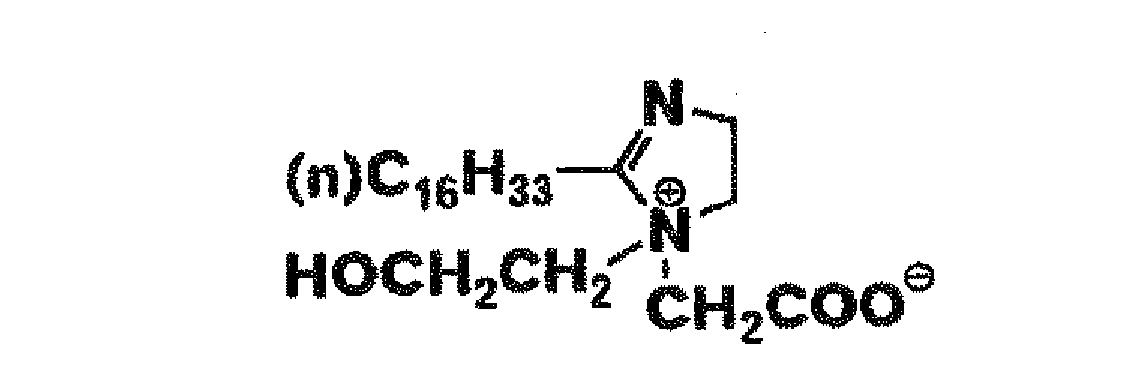
-
W-4

-
W-5

-
W-6

-
W-7

-
W-8

-
W-9

-
W-10

-
W-11

-
W-12

-
W-13

-
W-14

-
W-15

-
W-16

-
-
W-17
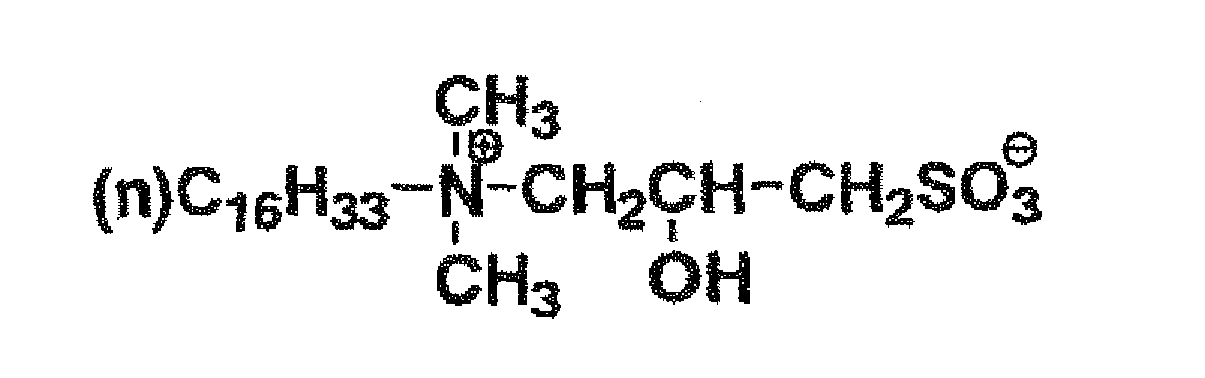
-
W-18

-
-
X-1

-
X-2

-
X-3

-
X-4

-
X-5

-
X-6

-
-
X-7

-
X-8

-
X-9

-
X-10

-
X-11

- X-12
-
-
X-13

-
X-14

-
X-15

-
X-16

- The respective inks used in the ink set of the invention, such as the yellow ink, the magenta ink, the cyan ink and the black ink, may contain a nonionic surfactant for the purpose of controlling the jetability or surface tension of the ink. As for the nonionic surfactant, for example, those described in paragraphs [0128] to [0158] of
JP-A No. 2007-204632 - The content of the surfactant in the respective inks according to the invention is preferably 0.01 to 20% by mass, more preferably 0.01 to 15% by mass, even more preferably 0.01 to 10% by mass, and particularly preferably 0.01 to 5% by mass. If the concentration in the ink is less than 0.01% by mass, the printing quality tends to conspicuously decrease, as resulting in a decrease in the jetting stability, occurrence of bleeding at the time of color mixing, generation of feathering, or the like. Furthermore, if the concentration of the surfactant in the ink is larger than 20% by mass, printing defects may occur due to the adhesion of ink to hard surfaces at the time of jetting.
From this viewpoint, the static surface tension of the ink according to the invention is preferably 20 mN/m or more, and more preferably 25 mN/m or more, at 25°C. The static surface tension is also preferably 60 mN/m or less, more preferably 50 mN/m or less, and particularly preferably 40 mN/m or less, at 25°C. The static surface tension will be described in more detail hereinbelow. - In regard to the respective ink according to the invention, the surfactant may be used individually, or may be used in combination of two or more species, and surfactants other than those described above may also be used in combination.
When surfactants of different species are used in combination, the effects of the invention owing to the surfactant may be reinforced by adjusting the liquid properties of the ink, such as surface tension, enhancing the jetting stability of the ink, enhancing the water resistance of the image, enhancing the properties of preventing the bleeding of the printed ink, and the like.
Examples of the surfactant that may be used in combination with these above-mentioned surfactants include anionic surfactants such as fatty acid salts, alkylsulfuric acid ester salts, alkylbenzenesulfonic acid salts, alkylnaphthalenesulfonic acid salts, dialkylsulfosuccinic acid salts, alkylphosphoric acid ester salts, naphthalenesulfonic acid-formalin condensate, and polyoxyethylene alkylsulfuric acid ester salts; cationic surfactants such as fatty amine salts, quaternary ammonium salts, and alkylpyridinium salts; fluorine compounds and silicon compounds. These surfactants may be used individually or in combination of two or more species. - Specific examples include anionic surfactants such as sodium dodecyl sulfate, sodium dodecyl oxysulfonate, and sodium alkylbenzenesulfonate; cationic surfactants such as cetylpyridinium chloride, trimethylectylammonium chloride, and tetrabutylamonium chloride; and the like.
These surfactants that may be used in combination may be added within the scope of not impairing the effects of the invention, and may be incorporated in the aforementioned range of the content that may be contained in the respective inks. - According to the invention, the surfactant may also be used in the case where emulsification and dispersion of the below-described colorants is needed, and in the case of using the surfactant as a surface tension adjusting agent, and therefore, further explanations on the surfactant will be added at the respective sections.
Each of the inks of the invention may be produced by dissolving and/or dispersing the dye and an antioxidants, and if necessary, a surfactant in an aqueous medium. The term "aqueous medium" according to the invention means water, or a mixture of water and a small amount of water-soluble organic solvent, to which additives such as a wetting agent, a stabilizer and a preservative have been added if necessary. - Examples of other water-soluble organic solvent that may be used include alcohols (for example, methanol, ethanol, propanol, isopropanol, butanol, isobutanol, sec-butanol, t-butanol, pentanol, hexanol, cyclohexanol, benzyl alcohol), polyhydric alcohols (for example, ethylene glycol, diethylene glycol, triethylene glycol, polyethylene glycol, propylene glycol, dipropylene glycol, polypropylene glycol, butylene glycol, hexanediol, pentanediol, glycerin, hexanetriol), glycol derivatives (for example, ethylene glycol monomethyl ether, ethylene glycol monoethyl ether, ethylene glycol monobutyl ether, diethylene glycol monomethyl ether, diethylene glycol monobutyl ether, propylene glycol monomethyl ether, propylene glycol monobutyl ether, dipropylene glycol monomethyl ether, triethylene glycol monomethyl ether, ethylene glycol diacetate, ethyelen glycol monomethyl ether acetate, triethylene glycol monomethyl ether, triethylene glycol monoethyl ether, ethylene glycol monophenyl ether), amines (for example, ethanolamine, diethanolamine, triethanolamine, N-methyldiethanolamine, N-ethyldiethanolamine, morpholine, N-ethylmorpholine, ethylenediamine, diethylenetriamine, triethylenetetramine, polyethyleneimine, tetramethylpropylenediamine), urea, urea derivatives, and other polar solvents (for example, formamide, N,N-dimethylformamide, N,N-dimethylaeetarnide, 2-pyrrolidone, N-methyl-2-pyrrolidone, N-vinyl-2-pyrrolidone, 2-oxazolidone, 1,3-dimethyl-2-imidazolidinone, acetonitrile, acetone). The water-soluble organic solvent is a compound which may be liquid or solid at 25°C, and two or more kinds of solvents may be used in combination.
The use amount of the water-soluble organic solvent is preferably 10 to 80% by mass, and more preferably 20 to 60% by mass, of each of the inks according to the invention. The term "water-soluble" as used in the invention means that the solubility in water at 25°C is 1 g/100 g or more. - For the inks obtained by the invention, additives such as a drying preventing agent for preventing clogging due to drying at the ink jetting nozzle, a penetration promoting agent for allowing ink to efficiently penetrate into paper, an ultraviolet absorbent, an antioxidant, a viscosity adjusting agent, a surface tension adjusting agent, a dispersant, a dispersion stabilizer, an antifungal agent, a rust inhibitor, a pH adjusting agent, a defoamer, and a chelating agent, may be appropriately selected and used in appropriate amounts.
- As for the drying preventing agent used in the invention, a water-soluble organic solvent having a vapor pressure less than that of water is preferred. Specific examples include polyhydric alcohols represented by ethylene glycol, propylene glycol, diethylene glycol, polyethylene glycol, thiodiglycol, dithiodiglycol, 2-methyl-1,3-propanediol, 1,2,6-hexanetriol, acetylene glycol derivatives, glycerin, and trimethylolpropane; lower alkyl ethers of polyhydric alcohols, such as ethylene glycol monomethyl (or ethyl) ether, diethylene glycol monomethyl (or ethyl) ether, and triethylene glycol monoethyl (or butyl) ether; heterocyclic rings such as 2-pyrrolidone, N-methyl-2-pyrrolidone, 1,3-dimethyl-2-imidazolidinone and N-ethyhnorpholine; sulfur-containing compounds such as sulfolane, dimethylsulfoxide and 3-sulfolene; polyfunctional compounds such as diacetone alcohol, and diethanolamine; and urea derivatives. Among these, polyhydric alcohols such as glycerin and diethylene glycol are more preferred. The above-described drying preventing agent may be used individually, or may be used in combination of two or more species. These drying preventing agents are preferably incorporated into the ink in an amount of 10 to 50% by mass.
As for the penetration promoting agent used in the invention, alcohols such as ethanol, isopropanol, butanol, di(tri)ethylene glycol monobutyl ether, and 1,2-hexanediol; sodium lauryl sulfate, sodium oleate, nonionic surfactants, or the like may be used. These exhibit sufficient effects when incorporated into the ink in an amount of 10 to 30% by mass, and it is preferable to use the penetration promoting agent in an addition amount in the scope of causing neither the bleeding of printing, nor paper omission (print-through). - As for the ultraviolet absorbent used for enhancing the preservability of image in the invention, the benzotriazole-based compounds described in
JP-A Nos. 58-185677 61-190537 2-782 5-197075 9-34057 JP-A Nos. 46-2784 5-194483 U.S. Patent No. 3214463 , and the like; the cinnamic acid-based compounds described inJP-B Nos. 48-30492 56-21141 JP-A No. 10-88106 JP-A Nos. 4-298503 8-53427 8-239368 10-182621 8-501291 - According to the invention, as for the antioxidant that is used for enhancing the preservability of image, various organic discoloration preventing agents or metal complex-based discoloration preventing agents may also be used, in addition to the antioxidants described above. Examples of the organic discoloration preventing agents include hydroquinones, alkoxyphenols, dialkoxyphenols, phenols, anilines, amines, indanes, chromans, alkoxyanilines, heterocyclic rings, and the like, and examples of the metal complexes include nickel complexes, zinc complexes, and the like. More specifically, the compounds described in Sections VII-I to J of Research Disclosure (RD) No. 17643; RD No. 15162; page 650, left column of RD No. 18716; page 527 of RD No. 36544; page 872 of RD No. 307105; and RD No. 15162; or the compounds included in the formula and representatively exemplified compounds described in pages 127-137 of
JP-A No. 62-215272 - From the viewpoint of preventing corrosion of the ink according to the invention, it is preferable to further incorporate a preservative into the ink. According to the invention, the preservative means a compound having a function of preventing the generation and growth of microorganisms, particularly bacteria and fungi (also called an antifungal agent).
The following preservatives may be effectively used as the preservatives useful for the invention. - As inorganic preservatives, compounds containing heavy metal ions (silver ion-containing substances or copper complex compounds) or salts thereof may be mentioned with preference. As organic preservatives, various agents such as quaternary ammonium salts (tetrabutylammonium chloride, diisopropylammonium nitrite, cetylpyridinium chloride, dicyclohexylammonium nitrite, benzyltrimethylammonium chloride, and the like), phenol derivatives (phenol, cresol, butylphenol, xylenol, bisphenol, and the like), phenoxy ether derivatives (phenoxyethanol, and the like), heterocyclic compounds (benzotriazole, PROXEL (trade name), 1,2-benzoisothiazolin-3-one, and the like), acid amides, carbamic acid, carbamates, amidine/guanidines, pyridines (sodium pyridinethione-1-oxide, and the like), diazines, triazines, pyrrol/imidazoles, oxazole/oxazines, pentaerythritol tetranitrate, benzotriazoles, thiazole/thiadiazines, thioureas, thiosemicarbazides, dithiocarbamates, sulfides, sulfoxides, sulfones, sulfamides, antibiotic substances (penicillin, tetracycline, and the like), sodium dehydroacetate, sodium benzoate, p-hydroxybenzoic acid ethyl ester, acidic sulfites, sodium thiosulfate, ammonium thioglycolate, 1,2-benzoisothiazolin-3-one and salts thereof, may be used. As for the preservative, the substances described in the Handbook of Antibacterial and Antifungal Agents (Gihodo Shuppan Co., Ltd.: 1986), the Encyclopedia of Antibacterial and Antifungal Agents (edited by the Board of Dictionary Editorial Committee of the Society of Antibacterial and Antifungal Agents, Japan), and the like may also be used.
- Regarding these compounds, various compounds such as those having an oil-soluble structure or those having a water-soluble structure may be used, but water-soluble compounds are preferred. Particularly, PROXEL (trade name) or benzotriazole may be preferably used.
Among them, according to the invention, if these preservatives are used in combination of two or more species, jetting stability of the ink over a long time is remarkably enhanced, and the effects of the invention may be more satisfactorily exhibited. When two or more of the preservatives are combined, the preservative species preferably have skeletons of different chemical structures. Furthermore, when two or more preservatives are incorporated, it is preferable that at least one of the preservatives is a heterocyclic compound. For example, a combination of a heterocyclic compound and an antibiotic substance, a combination of a heterocyclic compound and a phenol derivative, and the like may be mentioned with preference. When two species preservatives are combined, the content ratio is not particularly limited, but the ratio is preferably in the range of preservative A/preservative B = 0.01 to 100 (mass ratio).
The amount of addition of the preservative may range widely, but the amount is 0.001 to 10% by mass, preferably 0.02 to 5.00% by mass, and more preferably 0.1 to 5% by mass. - The ink according to the invention may contain a chelating agent for the purpose of trapping and dissolving polyvalent metal ions in the ink. Preferred examples of the chelating agent include the compounds described in paragraphs [0098] to [0099] of
JP-A Mo. 2008-101173 - The pH adjusting agent used in the invention may be suitably used in view of controlling pH, imparting dispersion stability and the like, and it is preferable that the pH of the ink at 25°C be adjusted to 4 to 11. If the pH is less than 4, solubility of the dye is decreased, and the nozzle is likely to be clogged. If the pH is higher than 11, water resistance tends to undergo deterioration. As for the pH conditioning agent, there may be mentioned, as basic agents, organic bases, inorganic alkalis and the like, and as acidic agents, organic acids, inorganic acids, and the like.
- Examples of the organic bases include triethanolamine, diethanolamine, N-methyldiethanolamine, and dimethylethanolamine. Examples of the inorganic alkalis include hydroxides of alkali metals (for example, sodium hydroxide, lithium hydroxide, potassium hydroxide, and the like), carbonates of alkali metals (for example, sodium carbonate, sodium hydrogen carbonate, and the like), and ammonium. Examples of the organic acids include acetic acid, propionic acid, trifluoroacetic acid, and alkylsulfonic acid. Examples of the inorganic acids include hydrochloric acid, sulfuric acid, and phosphoric acid.
- According to the invention, the medium is preferably water, or an aqueous medium which is a mixed solvent of water and a water-soluble organic solvent.
To produce the ink according to the invention, a process for removing solid residues by filtration is important for an enhancement of stability of the ink and an improvement of color hue. This operation uses a filtration filter, and regarding the filtration filter in this case, a filter having an effective diameter of 1 µm or less, preferably 0.05 µm or more and 0.3 µm or less, and even more preferably 0.20 µm or more and 0.3 µm or less is used. As for the material of the filter, various materials may be used, but particularly in the case of an ink of a water-soluble dye, it is preferable to use a filter produced for use with water-based solvents. Among them, it is particularly preferable to use a jacket type filter produced from a polymer material that hardly generates residues. As for the filtering method, the ink may be passed through the jacket by pumping, or alternatively either pressure filtration or vacuum filtration may also be used.
After the filtration, air is often incorporated into the solution. Since foams generated by this air frequently cause disturbances in the images produced upon inkjet recording, a defoaming process may be provided separately in the invention. As for the defoaming method, various methods such as ultrasonic defoaming or reduced pressure defoaming methods may be used. - These operations are preferably carried out by utilizing clean spaces such as clean room or clean bench, so as to prevent incorporation of residues during the operation. According to the invention, this operation is preferably carried out in particular in a space having a degree of cleanness of class 100 or less.
The ink viscosity according to the invention is preferably 3 to 10 mPa·s at 23°C. If the viscosity exceeds 10 mPa·s, the rate of fixation of the recorded image decreases, and the jetting performance also tends to decrease. If the viscosity is less than 3 mPa·s, the definition may decrease because the recorded image bleeds. - Control of the viscosity may be arbitrarily achieved by adjusting the amount of addition of the ink solvent. Examples of the ink solvent include glycerin, diethylene glycol, triethanolamine, 2-pyrrolidone, diethylene glycol monobutyl ether, triethylene glycol monobutyl ether, and the like.
- The method for measuring the viscosity is described in detail in JIS Z8803, but the viscosity can be conveniently measured with a commercially available viscometer. For example, there are available rotary type viscometers such as B type viscometer and E type viscometer manufactured by Tokyo Keiki, Inc. In the present invention, the viscosity was measured at 23°C using a vibration type viscometer, VM-1013A-L, manufactured by Yamaichi Electronics Co., Ltd. The unit of viscosity is pascal-second (Pa·s), but usually the unit millipascal·second (mPa·s) is used.
- The respective inks used in the invention preferably have a static surface tension at 23°C of 25 to 40 mN/m. The static surface tension at 23°C is more preferably from 30 to 40 mN/m. If the static surface tension of the ink exceeds 40 mN/m, there may occur marked decreases in the printing quality, such as a decrease in the jetting stability, occurrence of bleeding at the time of color mixing, and generation of feathering (for example, in the case
where black characters are printed on a cyan solid image, or the like, thread-like bleeding from the black characters may occur). Furthermore, if the static surface tension of the ink is less than 25 mN/m, printing defects may occur due to the adhesion of ink to hard surfaces at the time of jetting. - As for the method for measuring the static surface tension, a capillary rise method, a sessile drop method, a ring method and the like are known, but in the invention, a vertical plate method is used as the method for measuring the static surface tension. The principle of the vertical plate method will be described below.
When a thin plate made of glass or platinum is partially submerged in a liquid and is suspended vertically, the surface tension at the part where the liquid surface and the plate contact works downward. This surface tension may be measured by balancing with the upward force that is suspending the plate.
The dynamic surface tension at 23°C of the ink used in the invention is preferably from 25 to 40 mN/m, and more preferably from 30 to 40 mN/m. If the dynamic surface tension exceeds 40 mN/m, there may occur marked decreases in the printing quality, such as a decrease in the jetting stability, occurrence of bleeding at the time of color mixing, and generation of feathering. Furthermore, if the dynamic surface tension is less than 25 mN/m, printing defects may occur due to the adhesion of ink to hard surfaces at the time of jetting. - As for the method for measuring the dynamic surface tension, for example, a vibrating jet method, a falling meniscus method, a maximum bubble pressure method, and the like are known, as described in "New Lectures on Experimental Chemistry (in Japanese), Vol. 18, Interface and Colloids," [Maruzen Corp., p. 69-90 (1977)], and a liquid film destruction method as described in
JP-a No. 3-2064
A solution containing a surfactant is made uniform by stirring, and when air bubbles are generated in the solution, a new gas-liquid interface is generated, and the surfactant molecules in the solution gather at the water surface at a constant speed. When the bubble rate (rate of air bubble generation) is changed, if the rate of generation is decreased, more surfactant molecules gather at the surfaces of the bubbles. Thus, the maximum bubble pressure immediately before bubbles burst is decreased, and the maximum bubble pressure (surface tension) with respect to the bubble rate may be detected. In the measurement of the dynamic surface tension according to the invention, air bubbles are generated in a solution using two probes, one large and one small, the pressure difference between the two probes in the maximum bubble pressure state is measured, and thus the dynamic surface tension is calculated. - The adjustment of the static surface tension and the dynamic surface tension may be carried out using a surface tension adjusting agent, and the surface tensions may be adjusted to the above-described ranges.
As the surface tension adjusting agent, nonionic, cationic or anionic surfactants may be mentioned. Examples fo the anionic surfactants include fatty acid salts, alkylsulfuric acid ester salts, alkylarylsulfonic acid salts (for example, alkylbenzenesulfonates, petroleum sulfonates, and the like), dialkylsulfosuccinic acid salts, alkylphosphoric acid ester salts, naphthalenesulfonic acid formalin condensate, polyoxyethylene alkylsulfuric acid ester salts, and the like. Examples of the nonionic surfactants include acetylene-based diols (for example, 2,4,7,9-tetramethyl-5-decyne-4,7-diol, and the like), polyoxyethylene alkyl ethers (for example, polyoxyethylene decyl ether, ethylene oxide adducts of acetylene-based diols, and the like), polyoxyethylene fatty acid esters, sorbitan fatty acid esters, polyoxyethylene sorbitan fatty acid esters, polyoxyethylene alkylamine, glycerin fatty acid esters, oxyethylene-oxypropylene block copolymers, and the like. - Furthermore, amine oxide type amphoteric surfactants such as N,N-dimethyl-N-alkylamine oxide are also preferable. The substances described as surfactants in
JP-ANo. 59-157636
Since it is difficult for precipitation or separation from the respective inks to occur, and the foaming property is small, anionic surfactants in which the hydrophobic moiety consists of two chains, or the hydrophobic moiety is branching; anionic or nonionic surfactants having a hydrophilic group in the vicinity of the center of the hydrophobic moiety; or nonionic surfactants in which the hydrophobic moiety consists of two chains, or the hydrophobic moiety is branching, are preferred.
The content of the surfactant for this purpose is 0.001 to 15% by mass, preferably 0.005 to 10% by mass, more preferably 0.01 to 5% by mass, with respect to the ink. - An image formed by using the ink set including the respective inks according to the invention also has the ink bleeding suppressed to a low level. According to a typical aspect of the invention, in an image receiving material which has an ink receiving layer containing inorganic fine particles (for example, white inorganic pigment particles) on a support, bleeding is at a level where visual inspection is impossible at a distance of distinct vision. In an image receiving material having a gelatin-containing curable layer as an image recording layer, bleeding is at a level where visual inspection is impossible at a distance of distinct vision. Particularly, even if the image is stored under the conditions of high humidity and high temperature, the image drawn using the respective inks according to the invention has excellent bleeding resistance.
The causes of bleeding are related to the nature of the dye, as well as to various factors such as the content and type of an auxiliary solvent that is added for controlling the ink properties or preventing dryness, for example, glycerin, diethylene glycol or triethylene glycol monobutyl ether, the amount of residual solvent, the image structure, and the state of overlapping for secondary colors (red and blue). In order to ameliorate the bleeding problem in an ink prescription, it is effective to achieve reduction of the amount of the auxiliary solvent and optimization of the surface tension of the ink (30 to 37 mN/m, and preferably 30 to 35 mN/m), in addition to making a good selection of the dye. - The degree of bleeding may vary with the image receiving paper, but the inks according of the invention are advantageous in that bleeding does not occur even though the type of the image receiving paper is changed. In order to improve bleeding by the ink composition, it is preferable to use a solvent having low solubility with respect to the dye.
In the case of the dyes according to the invention, it is preferable to use, for example, glycerin or PFG (propylene glycol monopropyl ether). Another method for improving bleeding is to strengthen the mordanting force, or in other words, to introduce an anchor compound for mordant. Specifically, it is effective to strengthen the interaction between a mordant and a dye, and this is achieved by using a betaine compound. - Furthermore, in regard to the method for preparing an ink for inkjet recording, the details are described in
JP-A Nos. 5-148436 5-295312 7-97541 7-82515 7-118584 - The materials for recording an image using the ink set of the invention will be explained. According to the invention, use may be made of known materials for recording, that is, ordinary paper, resin-coated paper, the inkjet-exclusive papers described in, for example,
JP-A Nos. 8-169172 8-27693 2-276670 7-276789 9-323475 62-238783 10-153989 10-217473 10-235995 10-337947 10-217597 10-337947 - Hereinafter, the recording paper and recording film that are used in inkjet printing using the ink set of the invention will be described. For the support in the recording paper and recording film, use may be made of products that are formed from chemical pulp such as LBKP or NBKP; mechanical pulp such as GP, PGW, RMP, TMP, CTMP, CMP or CGP; recycled pulp such as DIP; or the like, mixed with additives such as conventionally known additives such as a pigment, a binder, a sizing agent, a fixing agent, a cationic agent and a paper force enhancing agent, as necessary, and produced by various apparatuses such as a Fourdrinier paper machine and a cylinder paper machine. The support may also be any of synthetic papers and plastic film sheets in addition to these supports, and it is desirable that the support has a thickness of 10 to 250 µm, and a basis weight of 10 to 250 g/m2.
- Such a support may be provided with an ink receiving layer and a back coat layer directly on the surface, and used as an image receiving material for the ink according to the invention, or a support may be provided with a size press layer or an anchor coat layer formed from starch, polyvinyl alcohol or the like, and then provided with an ink receiving layer and a back coat layer for use as an image receiving material. The support may be further subjected to a flattening treatment by means of a calendar machine such as a machine calendar, a TG calendar, or a soft calendar.
As for the support according to the invention, a paper and a plastic film laminated with polyolefin (for example, polyethylene, polystyrene, polybutene and copolymers thereof) or polyethylene terephthalate on both sides are more preferably used. It is preferable to add a white pigment (for example, titanium oxide or zinc oxide) or a coloring dye (for example, cobalt blue, indigo or neodymium oxide) into the polyolefin. - The ink receiving layer provided on the support will be described.
The ink receiving layer contains a porous material or an aqueous binder. Furthermore, the ink receiving layer preferably contains a pigment in the form of inorganic fine particles, and the pigment is preferably a white pigment. Examples of the white pigment include inorganic white pigments such as calcium carbonate, kaolin, talc, clay, acid earth, synthetic amorphous silica, aluminum silicate, magnesium silicate, calcium silicate, aluminum hydroxide, alumina, lithopone, zeolite, barium sulfate, calcium sulfate, titanium dioxide, zinc sulfide and zinc carbonate; organic pigments such as styrene-based pigments, acrylic pigments, urea resins and melamine resins, and the like. Particularly, porous white inorganic pigments are preferable, and especially synthetic amorphous silica having a large area of fine pores, and the like are suitable. As for the synthetic amorphous silica, both silicic anhydride that is obtained according to a dry production method (gas phase method), and hydrous silicic acid that is obtained according to a wet production method may be used. - As the recording paper containing the pigments in the ink receiving layer, specifically, those disclosed in
JP-A Nos. 10-81064 10-119423 10-157277 10-217601 11-348409 2001-138621 2000-43401 2000-211235 2000-309157 2001-96897 2001-138627 11-91242 8-2087 8-2090 8-2091 8-2093 8-174992 11-192777 2001-301314 - Examples of the aqueous binder contained in the ink receiving layer include water-soluble polymers such as polyvinyl alcohol, silanol-modified polyvinyl alcohol, starch, cationized starch, casein, gelatin, carboxymethylcellulose, hydroxyethylcellulose, polyvinylpyrrolidone, polyalkylene oxide and polyalkylene oxide derivatives; water-dispersible polymers such as styrene-butadiene latex, and acrylic emulsions; and the like. These aqueous binders may be used individually or in combination of two or more species. According to the invention, among these aqueous binders, polyvinyl alcohol and silanol-modified polyvinyl alcohol are particularly suitable from the viewpoints of adhesiveness to the pigment and peeling resistance of the ink receiving layer.
The ink receiving layer may contain, in addition to the pigment and the aqueous binder, a mordant, a water resistant additive, a light-fastness improving agent, a gas-fastness improving agent, a surfactant, a film hardening agent, and other additives.
The mordant that is added to the ink receiving layer is preferably immobilized. For that purpose, a polymeric mordant is preferably used in view of preventing bleeding. - The polymeric mordant is described in
JP-ANos. 48-28325 54-74430 54-124726 55-22766 55-142339 60-23850 60-23851 60-23852 60-23853 60-57836 60-60643 60-118834 60-122940 60422941 60-122942 60-235134 1-161236 U.S. Patent Nos. 2484430 ,2548564 ,3148061 ,3309690 ,4115124 ,4124386 ,4193800 ,4273853 ,4282305 ,and4450224 . An image receiving material containing the polymeric mordant described inJP-A No. 1-161236
The water resistant additive is effective for giving water resistant properties to the image and as such water resistant additive, cationic resins are particularly preferred. Examples of these cationic resins include polyamide polyamine epichlorohydrin, polyethyleneimine, polyaminesulfone, dimethyldiallylammonium chloride polymer, cation polyacrylamide, and the like. The content of these cationic resins is preferably 1 to 15% by mass, and particularly preferably 3 to 10% by mass, relative to the total solid content of the ink receiving layer. - As the light fastness improving agent and the gas fastness improving agent, phenol, compounds, hindered phenol compounds, thioether compounds, thiourea compounds, thiocyanic acid compounds, amine compounds, hindered amine compounds, TEMPO compounds, hydrazine compounds, hydrazide compounds, amidine compounds, vinyl group-containing compounds, ester compounds, amide compounds, ether compounds, alcohol compounds, sulfinic acid compounds, sugars, water-soluble reducing compounds, organic acids, inorganic acids, hydroxy group-containing organic acids, benzotriazole compounds, benzophenone compounds, triazine compounds, heterocyclic compounds, water-soluble metal salts, organic metal compounds, metal complexes, and the like may be mentioned.
Specific examples of these compounds include those described inJP-A Nos. 10-182621 2001-260519 2000-260519 JP-B Nos. 4-34953 4-34513 4-34512 JP-A Nos. 11-170686 60-67190 7-276808 2000-94829 8-512255 JP-ANo. 11-321090 - The surfactant functions as a coating aid, a peelability improving agent, a slipping property improving agent or an antistatic agent. Descriptions on the surfactant are given in
JP-A Nos. 62-173463 62-183457
An organic fluoro compound may be used instead of the surfactant. The organic fluoro compound is preferably hydrophobic. Examples of the organic fluoro compound include fluorine-based surfactants, oily fluorine-based compounds (for example, fluorine oil) and solid fluorine compound resins (for example, tetrafluoroethylene resin). The organic fluoro compounds are described inJP-B No. 57-9053 JP-A Nos. 61-20994 62-135826
As for the film hardening agent, the materials described in page 222 ofJP-A No. 1-161236 JP-A Nos. 9-263036 10-119423 2001-310547
The other additives that are added to the ink receiving layer, include a pigment dispersant, a thickener, a defoamer, a dye, a fluorescent whitening agent, a preservative, a pH adjusting agent, a mat agent, a film hardening agent, and the like. Furthermore, the ink receiving layer may be composed of a single layer or two layers.
The recording paper and the recording film may also be provided with a back coat layer, and the components that may be added to this layer include a white pigment, an aqueous binder and other components. - Examples of the white pigment contained in the back coat layer include white inorganic pigments such as light calcium carbonate, heavy calcium carbonate, kaolin, talc, calcium sulfate, barium sulfate, titanium dioxide, zinc oxide, zinc sulfate, zinc carbonate, satin white, aluminum silicate, diatomaceous earth, calcium silicate, magnesium silicate, synthetic amorphous silica, colloidal silica, colloidal alumina, pseudoboehmite, aluminum hydroxide, alumina, lithopone, zeolite, hydrated halloysite, magnesium carbonate and magnesium hydroxide; organic pigments such as styrene-based plastic pigments, acrylic plastic pigments, polyethylene, microcapsules, urea resins and melamine resins; and the like.
Examples of the aqueous binder contained in the back coat layer include water-soluble polymers such as styrene/malcic acid salt copolymers, styrene/acrylic acid salt copolymers, polyvinyl alcohol, silanol-modified polyvinyl alcohol, starch, cationized starch, casein, gelatin, carboxymethylcellulose, hydroxyethylcellulose and polyvinyl pyrrolidine; water-dispersible polymers such as styrene-butadiene latex and acrylic emulsions; and the like. Examples of the other components contained in the back coat layer include a defoamer, an antifoaming agent, a dye, a fluorescent whitening agent, a preservative, a water resistant additive, and the like. - The constituent layers (including the back coat layer) of the inkjet recording paper and the recording film may contain polymer fine particle dispersion added thereto. The polymer fine particle dispersion is used for improvement of film properties such as stabilization of dimension, prevention of curling, prevention of adhesion, and prevention of cracks in the film. The polymer fine particle dispersion is described in
JP-A Nos. 62-245258 62-1316648 62-110066
The use of the ink set including the inks of the invention is not restricted by the inkjet recording system, and the ink set is used in any known systems, for example, an electric charge control system, by which ink is jetted using an electrostatic attractive force; a drop-on-demand system (pressure pulse system), by which ink is jetted using the oscillating pressure of a piezoelectric element; an acoustic inkjet system, by which electric signals are converted to an acoustic beam and irradiated to ink, and thereby the ink is jetted using radiation pressure; a thermal inkjet (BUBBLEJET (registered trademark)) system, by which ink is jetted using a pressure generated by heating the ink and thus forming air bubbles; and the like.
The inkjet recording systems include a system of jetting a large number of droplets of small volumes of a low-density ink called photo-ink, a system of improving the image quality by using plural of inks having substantially the same color at different concentrations, or a system of using a colorless transparent ink. - Hereinafter, the invention will be described more specifically by way of Examples. The scope of the invention is not intended to be limited to the specific examples set forth below. Furthermore, unless stated otherwise, the units "part" and "%" are on a mass basis.
- Example 1
- Ion exchanged water was added to the following components in an amount to make the total amount 1000 g and then stirred for one hour while heating at temperature of 30 to 40°C. Subsequently, the resultant mixture was subjected to pressure filtration through a microfilter having an average pore size of 0.2 µm, to prepare a yellow ink (Y-101).
- [Prescription of yellow ink Y-101]
(Solid components) Yellow dye (potassium salt of a yellow dye Y-1 represented by the following structural formula) 60.0 g PROXEL XL-2 (trade name, manufactured by Arch Chemicals Japan, Inc.) 1.0 g (Liquid components) Glycerin 81 g Triethylene glycol 96 g Triethylene glycol monobutyl ether 91g Propylene glycol 3 g ORFIN E1010 (trade name, manufactured oxide (10 moles) adduct of acetylenediol by Nisshin Chemical Co., Ltd.; ethylene (nonionic surfactant)) 20 g (Antioxidant) Methionine sulfoxide 50 g Ion exchanged water 598 g (added to adjust the entire system to 1000 g) - Yellow Dye Y-1

- Ion exchanged water was added to the following components in an amount to make the total amount 1000 g and then stirred for one hour while heating at temperature of 30 to 40°C. Subsequently, the resultant mixture was subjected to pressure filtration through a microfilter having an average pore size of 0.2 µm, to prepare a magenta ink (M-101 ).
- [Prescription of magenta ink M-101]
(Solid components) Magenta dye (a magenta dye M-1 represented by the following structural formula) 30.0 g Urea 48.0 g PROXEL XL-2 (trade name, manufactured by Arch Chemicals Japan, Inc.) 1.0g (Liquid components) Glycerin 84.0 g Triethylene glycol 20.0 g Triethylene glycol monobutyl ether 99.0 g Propylene glycol 3.0 g Betaine compound W-1 shown below 17.0 g (Antioxidant) Methionine sulfoxide 50 g Ion exchanged water 648 g (added to adjust the entire system to 1000 g) - Magenta Dye M-1

- Betaine Compound W-1

- Ion exchanged water was added to the following components in an amount to make the total amount 1000 g and then stirred for one hour while heating at temperature of 30 to 40°C. Subsequently, the resultant mixture was subjected to pressure filtration through a microfilter having an average pore size of 0.2 µm, to prepare a cyan ink (C-101).
- [Prescription of cyan ink C-101]
(Solid components) Cyan dye (a cyan dye C-1 represented by the following structural formula) 54.0 g Urea 41.0 g PROXEL XL-2 (trade name, manufactured by Arch Chemicals Japan, Inc.) 1.0 g (Liquid components) Glycerin 91 g Triethylene glycol 18 g Triethylene glycol monobutyl ether 94 g Propylene glycol 3 g 1, 2-Hexanediol 12 g 2-Pyrrolidonel 27 g ORFIN E1010 (trade name, oxide (10 moles) adduct manufactured by Nisshin Chemical Co., Ltd.; ethylene of acetylenediol (nonionic surfactant)) 10g (Antioxidant) Methionine sulfoxide 50.0 g Ion exchanged water 599 g (added to adjust the entire system to 1000 g) - Cyan dye C-1


- Ion exchanged water was added to the following components in an amount to make the total amount 1000 g and then stirred for one hour while heating at temperature of 30 to 40°C. Subsequently, the resultant mixture was subjected to pressure filtration through a microfilter having an average pore size of 0.2 µm, to prepare a black ink (Bk-101).
- [Prescription of black ink Bk-101]
(Solid components) Black dye 1 (main dye for black color Bk-1 shown below) 62.0 g Black dye 2 (complementary dye for black color Bk-2 shown below) 10.0 g PROPEL XL-2 (trade name, manufactured by Arch Chemicals Japan, Inc.) 1.0 g (Liquid components) Glycerin 83 g Triethylene glycol 8 g Triethylene glycol monobutyl ether 84 g Propylene glycol 3 g 1,2-Hexanediol 16 g ORFIN E1010 (trade name, manufactured by Nisshin Chemical Co., oxide (10 moles) adduct of acetylenediol (nonionic surfactant)) Ltd.; ethylene 10g (Antioxidant) Methionine sulfoxide 50 g - Primary black dye Bk-1


- An ink set 1 including the yellow ink Y-101, magenta ink M-101, cyan ink C-101 and black ink Bk-101 obtained as described above, was produced.
- A yellow ink Y-102 was prepared in the same manner as in Example 1, except that the methionine sulfoxide used as an antioxidant for the yellow ink Y-101 in the ink set I of Example 1 was excluded.
Similarly, a magenta ink M-102, a cyan ink C-102 and a black ink Bk-102 were prepared in the same manner as in Example 1, except that the methionine sulfoxide used as an antioxidant was excluded from the magenta ink M-101, cyan ink C-101 and black ink Bk-101 of the ink set 1 of Example 1. - (Preparation of yellow ink Y-103, magenta ink M-103, cyan ink C-103 and black ink Bk-103)
A yellow ink Y-103, a magenta ink M-103, a cyan ink C-103 and a black ink Bk-103 were prepared in the same manner as in Example 1, except that the methionine sulfoxide used as an antioxidant for the yellow ink Y- 101, magenta ink M-101, cyan ink C-101 and black ink Bk-101 of the ink set 1 of Example 1, was changed to a thioether compound (3,6-dithia-1,8-octanediol). - (Preparation of yellow inks Y-104 to 106, magenta inks M-104 to 106, cyan inks C-104 to 106 and black inks By-104 to 106)
Yellow inks Y-1 04 to 106 were prepared in the same manner as in Example 1, except that the amount of addition, 50 g (5% by mass), of the methionine sulfoxide used as an antioxidant for the yellow ink Y-101 in the ink set 1 of Example 1 was changed to 10g (1% by mass), 180 g (18% by mass), and 220 g (22% by mass), respectively.
Similarly, magenta inks M-104 to 106, cyan inks C-104 to 106 and black inks Bk-104 to 106 were prepared. - Ink sets 2 to 10 were produced by including a combination of the yellow inks, magenta inks, cyan inks and black inks obtained above, as shown in Table 2.
- <Image recording>
The ink sets 1 to 10 shown in Table 2 were respectively filled in DRY MINILAB 400 (trade name) ink cartridges manufactured by FUJIFILM Corporation, and recording was performed using an inkjet image receiving paper, "KASSAI" roll paper, manufactured by FUJIFILM Corporation, under the environment of 23°C and 50% RH.
Samples having a single color of magenta and having different print densities, and samples having composite gray formed by the four colors of yellow, magenta, cyan and black, and having different print densities, were produced using the ink sets 1 to 10, and the following image evaluation was performed. - The image density Ci of an area where the reflected density (M) immediately after printing was about 0.8, was measured using an X-RITE 310 (trade name), and then the sample was left to stand for 5 days in a box set at an ozone gas concentration of 5 ppm. The image density (Cf) after standing in the ozone gas was measured using a reflection densitometer (trade name: X-RITE 310TR), and the ratio of residual dye, Cf/Ci x 100, was obtained and evaluated according to the following evaluation criteria.
-
- Evaluation 1 : The ratio of residual dye is 90% or more.
- Evaluation 2: The ratio of residual dye is 80% or more and less than 90%.
- Evaluation 3: The ratio of residual dye is 70% or more and less than 80%.
- Evaluation 4: The ratio of residual dye is less than 70%.
- 2. Evaluation of ozone resistance (composite gray)
The image density Ci of an area in a composite gray image, where the reflected density (M) immediately after printing was about 0.8, was measured using an X-RITE 310 (trade name), and then the sample was left to stand for 5 days in a box set at an ozone gas concentration of 5 ppm. The image density (Cf) after standing in the ozone gas was measured using a reflection densitometer (trade name: X-RITE 310TR), and the ratio of residual dyes, Cf/Ci x 100, was obtained and evaluated according to the following evaluation criteria. -
- Evaluation 1: The ratio of residual dyes is 90% or more.
- Evaluation 2: The ratio of residual dyes is 80% or more and less than 90%.
- Evaluation 3: The ratio of residual dyes is 70% or more and less than 80%.
- Evaluation 4: The ratio of residual dyes is less than 70%.
- 3. Ink jetability test
The jetability of the respective inks was evaluated by the following method.
Upon exchanging the ink set, head cleaning was performed three times, in order to replace the inks remaining inside the inkjet head, for which testing had been completed, with newly set inks. Subsequently, a nozzle check pattern was printed, and if ink was not jetted from all of the nozzles of all colors, head cleaning was performed again, and then a nozzle check pattern was printed. This operation was repeated, and the number of head cleanings required to make inks come out from all of the nozzles of yellow, magenta, cyan and black colors, was counted and evaluated according to the following evaluation criteria. -
- Evaluation 1: Zero times of head cleaning (jetting from all of the nozzles after the standard three times of cleaning)
- Evaluation 2: 1 to 2 times of head cleaning
- Evaluation 3: 3 to 4 times of head cleaning
- Evaluation 4: 4 or more times of head cleaning
-
Table 1 Ink Antioxidant (% by mass) Methionine sulfoxide Thioether compound Y-101 5 - Y-102 0 - Y-103 - 5 Y-104 - Y-105 18 - Y-106 22 - M-101 5 - M-102 0 - M-103 - 5 M-104 1 - M-105 18 - M-106 22 - C-101 5 - C-102 0 C-103 - 5 C-104 1 - C-105 18 - C-106 22 - BK-101 5 - BK-102 0 - BK-103 - 5 BK-104 1 - BK-105 18 - BK-106 22 - -
Table 2 Ink set Ink Evaluation Remakes Y M C Bk Ozone resistance Jetability Single color of magenta Magenta in gray 1 Y-101 M-101 C-101 By-101 1 1 1 Invention 2 Y-102 M-102 C-102 Bk-102 2 3 3 * 3 Y-102 M-101 C-102 Bk-102 1 3 3 * 4 Y-101 M-101 C-102 Bk-102 1 1 2 Invention 5 Y-102 M-101 C-101 BlC-102 1 1 2 Invention 6 Y-103 M-103 C-103 Bk-103 1 1 1 Invention 7 Y-101 M-101 C-101 Bk-102 1 1 1 Invention 8 Y-104 M-104 C-104 Bk-104 2 2 1 Invention 9 Y-105 M-105 C-105 Bk-105 1 1 1 Invention 10 Y-106 M-106 C-106 Bk-106 1 1 1. Invention * means Comparative Example - From the results in Table 1 and Table 2, it is understood that when image recording is performed using the ink set of the invention, high-quality images having excellent ozone resistance of not only the single color of magenta but also the magenta color in gray are obtained, and jetability is also conspicuously improved.
Claims (9)
- An ink set comprising a yellow ink, a magenta ink and a cyan ink, wherein the magenta ink and at least one of the yellow ink or the cyan ink each contain an antioxidant having a sulfur atom in the molecule thereof, and the magenta ink contains a dye represented by the following formula (M-1):

- The ink set according to claim 1, wherein both the yellow ink and the cyan ink contain an antioxidant having a sulfur atom in the molecule thereof.
- The ink set according to claim 1or 2, further comprising a black ink.
- The ink set according to any one of claims 1 to 3, wherein the antioxidant is a compound having a thioether structure or a sulfoxide structure.
- The ink set according to any one of claims 1 to 4, wherein the antioxidant is a compound represented by the following formula (1a):R1-(S-R3)m-S-R2 Formula (1a)wherein, in formula (1a), R1 and R2 each independently represent a hydrogen atom, a substituted or unsubstituted alkyl group, a substituted or unsubstituted aryl group, or a group containing a substituted or unsubstituted alkyl or aryl group, and R1 and R2 may be identical or different, and may be linked to form a ring, provided that at least one of R1 or R2 is an alkyl group substituted with a hydrophilic group or a basic nitrogen atom-containing group, or a group containing such an alkyl group; R3 is an alkylene group which may be substituted, and optionally represents an alkylene group having an oxygen atom; m represents an integer from 0 to 10, and when m is 1 or more, the at least one sulfur atom linked to R3 may be a sulfoxide group or a sulfonyl group; and R1 and R2 may each be a residue of a polymer.
- The ink set according to any one of claims 1 to 4, wherein the antioxidant is a compound having a sulfoxide structure represented by the following formula (Ib):

- The ink according to any one of claims 1 to 6, wherein the antioxidant is a compound represented by formula (2):

- The ink set according to any one of claims 1 to 7, wherein the magenta ink contains a betaine-based compound represented by the following formula (B):

- A method for forming an inkjet image, comprising forming an image using the ink set according to any one of claims 1 to 8 on an inkjet recording medium having a support and, provided on or above the support, an ink receiving layer containing inorganic fine particles.
Applications Claiming Priority (1)
| Application Number | Priority Date | Filing Date | Title |
|---|---|---|---|
| JP2008247316A JP2010077285A (en) | 2008-09-26 | 2008-09-26 | Ink set and method for forming image |
Publications (2)
| Publication Number | Publication Date |
|---|---|
| EP2169017A1 true EP2169017A1 (en) | 2010-03-31 |
| EP2169017B1 EP2169017B1 (en) | 2011-12-07 |
Family
ID=41396450
Family Applications (1)
| Application Number | Title | Priority Date | Filing Date |
|---|---|---|---|
| EP20090170422 Not-in-force EP2169017B1 (en) | 2008-09-26 | 2009-09-16 | Ink set and method for forming image |
Country Status (4)
| Country | Link |
|---|---|
| US (1) | US20100080908A1 (en) |
| EP (1) | EP2169017B1 (en) |
| JP (1) | JP2010077285A (en) |
| AT (1) | ATE536396T1 (en) |
Families Citing this family (7)
| Publication number | Priority date | Publication date | Assignee | Title |
|---|---|---|---|---|
| JP2010248486A (en) * | 2009-03-26 | 2010-11-04 | Fujifilm Corp | Ink jet ink and ink jet recording method |
| EP2546309B1 (en) | 2011-01-14 | 2016-06-01 | Dalian University Of Technology | Anthrapyridone sulphonic acid compounds, preparation and use thereof |
| JP5777740B2 (en) | 2011-09-01 | 2015-09-09 | ダーリエン ユニバーシティ オブ テクノロジー | Carbonyl propylsulfonyl anthracene pyridone sulfonic acid compound and its preparation and use |
| JP6203550B2 (en) * | 2013-06-27 | 2017-09-27 | 株式会社パイロットコーポレーション | Reversible thermochromic water-based ink composition, writing instrument using the same, and writing instrument set |
| JP6159174B2 (en) * | 2013-06-27 | 2017-07-05 | 株式会社パイロットコーポレーション | Reversible thermochromic water-based ink composition, writing instrument using the same, and writing instrument set |
| KR101827604B1 (en) * | 2014-10-07 | 2018-02-08 | 주식회사 엘지화학 | Method for making perforation bleaching patterns on a polarizing film |
| CN113631662A (en) * | 2019-03-20 | 2021-11-09 | 富士胶片株式会社 | Dye ink composition, dye ink for inkjet recording, and inkjet recording method |
Citations (133)
| Publication number | Priority date | Publication date | Assignee | Title |
|---|---|---|---|---|
| US2484430A (en) | 1946-12-31 | 1949-10-11 | Eastman Kodak Co | Quaternary salts of polyvinyl pyridine and polyvinyl quinoline |
| US2548564A (en) | 1946-12-31 | 1951-04-10 | Eastman Kodak Co | Photographic silver halide element with mordanted dye layer |
| US3148061A (en) | 1960-08-22 | 1964-09-08 | Polaroid Corp | Photographic diffusion transfer processes employing image receiving layers containing poly-4-vinylpyridine |
| US3214463A (en) | 1960-05-12 | 1965-10-26 | Du Pont | Uv-absorbing sulfonated benzophenone derivatives |
| US3309690A (en) | 1966-05-19 | 1967-03-14 | Melville M Moffitt | Helmet with detecting circuit mounted thereon for indicating approach to an energized powerline |
| US3336285A (en) | 1964-03-23 | 1967-08-15 | Eastman Kodak Co | Monoazo compounds prepared from 3-amino-4-cyanopyrazole compounds |
| JPS462784A (en) | 1971-03-11 | 1971-10-21 | ||
| JPS4828325A (en) | 1971-08-20 | 1973-04-14 | ||
| JPS4830492B1 (en) | 1969-10-07 | 1973-09-20 | ||
| JPS4974718A (en) | 1972-10-21 | 1974-07-18 | ||
| JPS5183631A (en) | 1974-12-06 | 1976-07-22 | Ciba Geigy | |
| JPS5246230B2 (en) | 1972-12-16 | 1977-11-22 | ||
| US4115124A (en) | 1974-09-06 | 1978-09-19 | Eastman Kodak Company | Method of immobilizing optical brighteners |
| US4124386A (en) | 1973-10-24 | 1978-11-07 | Fuji Photo Film Co., Ltd. | Color diffusion transfer receiving layer comprising polymeric quaternary n-heterocyclic mordant |
| JPS5474430A (en) | 1977-10-24 | 1979-06-14 | Konishiroku Photo Ind Co Ltd | Photographic element for color diffusion transfer |
| JPS54124726A (en) | 1978-03-20 | 1979-09-27 | Konishiroku Photo Ind Co Ltd | Photographic material for color diffusion transfer method |
| JPS5522766A (en) | 1978-08-08 | 1980-02-18 | Konishiroku Photo Ind Co Ltd | Photographic element |
| US4193800A (en) | 1977-10-24 | 1980-03-18 | Konishiroku Photo Industry Co., Ltd. | Photographic dye mordant |
| JPS55142339A (en) | 1979-04-23 | 1980-11-06 | Konishiroku Photo Ind Co Ltd | Photographic element |
| JPS55161856A (en) | 1979-06-01 | 1980-12-16 | Eastman Kodak Co | Azo dye or its salt derived from sulfoocontaining aromatic amine and pentaheterocyclic amine |
| JPS5621141B2 (en) | 1975-10-16 | 1981-05-18 | ||
| US4273853A (en) | 1979-03-30 | 1981-06-16 | Eastman Kodak Company | Metal complexes of copolymers comprising vinylimidazole and their use in photographic elements |
| US4282305A (en) | 1979-01-15 | 1981-08-04 | Eastman Kodak Company | Receiving elements for image transfer film units |
| JPS579053B2 (en) | 1978-01-09 | 1982-02-19 | ||
| JPS58185677A (en) | 1982-04-22 | 1983-10-29 | Konishiroku Photo Ind Co Ltd | Uv light absorber |
| US4450224A (en) | 1983-07-06 | 1984-05-22 | Eastman Kodak Company | Polymeric mordants |
| JPS59157636A (en) | 1983-02-25 | 1984-09-07 | Fuji Photo Film Co Ltd | Color image forming method |
| JPS6023851A (en) | 1983-07-19 | 1985-02-06 | Konishiroku Photo Ind Co Ltd | Photographing element |
| JPS6023852A (en) | 1983-07-19 | 1985-02-06 | Konishiroku Photo Ind Co Ltd | Photographic element |
| JPS6023850A (en) | 1983-07-20 | 1985-02-06 | Fuji Photo Film Co Ltd | Novel electron transferring agent and color photographic sensitive material containing it |
| JPS6023853A (en) | 1983-07-19 | 1985-02-06 | Konishiroku Photo Ind Co Ltd | Photographic element |
| JPS6057836A (en) | 1983-09-09 | 1985-04-03 | Fuji Photo Film Co Ltd | Photographic element |
| JPS6060643A (en) | 1983-09-13 | 1985-04-08 | Fuji Photo Film Co Ltd | Photographic element |
| JPS6067190A (en) | 1983-09-22 | 1985-04-17 | Ricoh Co Ltd | Ink jet recording medium |
| JPS60118834A (en) | 1983-11-30 | 1985-06-26 | Fuji Photo Film Co Ltd | Photographic element |
| JPS60122940A (en) | 1983-12-08 | 1985-07-01 | Fuji Photo Film Co Ltd | Photographic element |
| JPS60122942A (en) | 1983-12-08 | 1985-07-01 | Fuji Photo Film Co Ltd | Photographic element |
| JPS60122941A (en) | 1983-12-08 | 1985-07-01 | Fuji Photo Film Co Ltd | Photographic element |
| JPS60235134A (en) | 1984-05-08 | 1985-11-21 | Fuji Photo Film Co Ltd | Photographic element |
| JPS6120994A (en) | 1984-07-10 | 1986-01-29 | 松下電器産業株式会社 | karaoke practice device |
| JPS6136362A (en) | 1984-07-14 | 1986-02-21 | サンド アクチエンゲゼルシヤフト | Anionic monoazo compound |
| JPS61190537A (en) | 1985-01-22 | 1986-08-25 | チバーガイギー アクチエンゲゼルシヤフト | 2-(2-hydroxy-3-branched alkyl-5-methylphenyl)- 2h-benzotriazole mixture, manufacture and stabilized composition |
| JPS62110066A (en) | 1985-11-07 | 1987-05-21 | Aisin Seiki Co Ltd | Transmission |
| JPS62135826A (en) | 1985-12-09 | 1987-06-18 | Konishiroku Photo Ind Co Ltd | Heat developable photosensitive material |
| JPS62173463A (en) | 1986-01-28 | 1987-07-30 | Fuji Photo Film Co Ltd | Image forming method |
| JPS62183457A (en) | 1986-02-07 | 1987-08-11 | Fuji Photo Film Co Ltd | Image forming method |
| JPS62215272A (en) | 1986-02-17 | 1987-09-21 | Fuji Photo Film Co Ltd | Color image forming method |
| JPS62238783A (en) | 1986-04-10 | 1987-10-19 | Nitto Boseki Co Ltd | Ink jet recording paper |
| JPS62245258A (en) | 1986-04-18 | 1987-10-26 | Fuji Photo Film Co Ltd | Image forming method |
| JPH01161236A (en) | 1987-12-17 | 1989-06-23 | Fuji Photo Film Co Ltd | Image forming method |
| JPH02782A (en) | 1987-12-28 | 1990-01-05 | Ciba Geigy Ag | New 2-(2-hydroxyphenyl)benzotriazole derivative |
| JPH02212566A (en) | 1989-02-10 | 1990-08-23 | Fuji Photo Film Co Ltd | Method for ink jet recording |
| JPH02276670A (en) | 1988-12-16 | 1990-11-13 | Asahi Glass Co Ltd | Recording sheet |
| JPH032064A (en) | 1989-05-31 | 1991-01-08 | Canon Inc | Printer |
| JPH0434513B2 (en) | 1984-12-28 | 1992-06-08 | Mitsubishi Paper Mills Ltd | |
| JPH0434512B2 (en) | 1984-12-20 | 1992-06-08 | Mitsubishi Paper Mills Ltd | |
| JPH0434953B2 (en) | 1985-01-14 | 1992-06-09 | Mitsubishi Paper Mills Ltd | |
| JPH04298503A (en) | 1990-05-10 | 1992-10-22 | Ciba Geigy Ag | Radiation-curable light-stabilized composition |
| JPH05148436A (en) | 1991-11-26 | 1993-06-15 | Canon Inc | Ink jet recording liquid, method for producing the same, and ink jet recording method using the same |
| JPH05194483A (en) | 1991-07-03 | 1993-08-03 | Ciba Geigy Ag | Phenyl thiophenyl ketone |
| JPH05197075A (en) | 1991-09-05 | 1993-08-06 | Ciba Geigy Ag | Photographic film material incorporating ultraviolet-ray absorbent |
| JPH05295312A (en) | 1992-04-17 | 1993-11-09 | Canon Inc | Ink, ink jet recording by using it, and machinery using the ink |
| JPH0619036B2 (en) | 1990-12-21 | 1994-03-16 | イーストマン コダック カンパニー | A new synthetic method for pyrazole dyes. |
| JPH0782515A (en) | 1993-06-25 | 1995-03-28 | Fuji Xerox Co Ltd | Ink for ink jet recording, and equipment and method for ink jet recording |
| JPH0797541A (en) | 1992-11-09 | 1995-04-11 | Seiko Epson Corp | Black ink composition with excellent black reproducibility |
| JPH07118584A (en) | 1993-10-20 | 1995-05-09 | Seiko Epson Corp | Inkjet recording ink |
| JPH07276789A (en) | 1994-04-05 | 1995-10-24 | Fuji Photo Film Co Ltd | Recording sheet |
| JPH07276808A (en) | 1994-02-16 | 1995-10-24 | Fuji Photo Film Co Ltd | Thermal recording material |
| JPH082091A (en) | 1994-06-17 | 1996-01-09 | Asahi Glass Co Ltd | Recording sheet and manufacturing method thereof |
| JPH082090A (en) | 1994-06-21 | 1996-01-09 | Asahi Glass Co Ltd | INKJET RECORDING CARD, MANUFACTURING METHOD THEREOF, AND RECORDING MEDIUM THEREOF |
| JPH082093A (en) | 1994-06-20 | 1996-01-09 | Asahi Glass Co Ltd | Recording sheet and manufacturing method thereof |
| JPH082087A (en) | 1994-06-17 | 1996-01-09 | Asahi Glass Co Ltd | Recording sheet and manufacturing method thereof |
| JPH0827693A (en) | 1994-07-12 | 1996-01-30 | Mitsubishi Paper Mills Ltd | Recording paper and base paper for coating |
| JPH08501291A (en) | 1992-09-07 | 1996-02-13 | チバ−ガイギー アクチエンゲゼルシャフト | Hydroxyphenyl-s-triazine |
| JPH0853427A (en) | 1994-07-27 | 1996-02-27 | Ciba Geigy Ag | Trisaryl-s-triazine shifted to red side and composition stabilized therewith |
| JPH08169172A (en) | 1994-12-20 | 1996-07-02 | Mitsubishi Paper Mills Ltd | Inkjet recording sheet |
| JPH08174992A (en) | 1994-12-20 | 1996-07-09 | Fuji Photo Film Co Ltd | Recording sheet |
| JPH08239368A (en) | 1994-10-10 | 1996-09-17 | Ciba Geigy Ag | Bisresorcinyltriazine |
| JPH08512258A (en) | 1994-04-19 | 1996-12-24 | イルフォルト アクチエンゲゼルシャフト | Recording sheet for ink jet printing |
| JPH0934057A (en) | 1995-06-19 | 1997-02-07 | Eastman Kodak Co | Ultraviolet absorbing polymers based on 2'-hydroxyphenylbenztriazole with specific substituents and photographic elements containing same |
| JPH09263036A (en) | 1996-03-27 | 1997-10-07 | Mitsubishi Paper Mills Ltd | Inkjet image receptor |
| JPH09323475A (en) | 1996-06-06 | 1997-12-16 | Konica Corp | Ink jet recording sheet and recording method using it |
| JPH1081064A (en) | 1996-06-20 | 1998-03-31 | Konica Corp | Ink-jet recording paper |
| JPH1088106A (en) | 1996-08-16 | 1998-04-07 | Eastman Kodak Co | Uv-absorbing polymer particle |
| JPH10119423A (en) | 1996-10-25 | 1998-05-12 | Konica Corp | Inkjet recording paper |
| JPH10153989A (en) | 1996-11-22 | 1998-06-09 | Nec Home Electron Ltd | Dot clock circuit |
| JPH10157277A (en) | 1996-11-26 | 1998-06-16 | Konica Corp | Ink jet recording sheet |
| JPH10182621A (en) | 1996-11-20 | 1998-07-07 | Ciba Specialty Chem Holding Inc | Hydroxyphenyl triazine |
| JPH10217473A (en) | 1996-10-14 | 1998-08-18 | Canon Inc | Liquid jet recording head and method of manufacturing the same |
| JPH10217601A (en) | 1997-02-06 | 1998-08-18 | Konica Corp | Ink jet recording paper, and ink jet recording method |
| JPH10217597A (en) | 1997-02-10 | 1998-08-18 | Fuji Photo Film Co Ltd | Image forming method |
| JPH10235995A (en) | 1996-12-26 | 1998-09-08 | Fuji Photo Film Co Ltd | Image-recording medium and image record method |
| JPH10337947A (en) | 1997-06-04 | 1998-12-22 | Fuji Photo Film Co Ltd | Image recording medium |
| JPH1191242A (en) | 1997-09-22 | 1999-04-06 | Taiho Ind Co Ltd | Processing liquid for recording material |
| JPH11170686A (en) | 1997-12-11 | 1999-06-29 | Fuji Photo Film Co Ltd | Image forming material and method for forming image |
| JPH11192777A (en) | 1998-01-05 | 1999-07-21 | Fuji Photo Film Co Ltd | Recording sheet |
| JPH11321090A (en) | 1998-03-17 | 1999-11-24 | Tomoegawa Paper Co Ltd | Ink jet recording sheet |
| JPH11348409A (en) | 1998-06-10 | 1999-12-21 | Konica Corp | Ink jet recording paper |
| JP2000043401A (en) | 1998-07-29 | 2000-02-15 | Mitsubishi Paper Mills Ltd | Inkjet recording sheet |
| JP2000094829A (en) | 1998-09-25 | 2000-04-04 | Konica Corp | Ink jet recording paper |
| JP2000211235A (en) | 1999-01-21 | 2000-08-02 | Mitsubishi Paper Mills Ltd | Sheet for inkjet recording |
| JP2000260519A (en) | 1999-01-01 | 2000-09-22 | Sumitomo Wiring Syst Ltd | Male-type connector |
| JP2000309157A (en) | 1999-04-27 | 2000-11-07 | Mitsubishi Paper Mills Ltd | Inkjet recording sheet |
| JP2001096897A (en) | 1999-09-28 | 2001-04-10 | Mitsubishi Paper Mills Ltd | Inkjet recording materials |
| JP2001138621A (en) | 1999-11-11 | 2001-05-22 | Konica Corp | Ink jet recording sheet |
| JP2001138627A (en) | 1999-08-31 | 2001-05-22 | Mitsubishi Paper Mills Ltd | Inkjet recording sheet |
| JP2001260519A (en) | 2000-01-14 | 2001-09-25 | Mitsubishi Paper Mills Ltd | Inkjet recording materials |
| JP2001301314A (en) | 2000-04-17 | 2001-10-31 | Fuji Photo Film Co Ltd | Ink jet recording sheet |
| JP2001310547A (en) | 2000-04-27 | 2001-11-06 | Fuji Photo Film Co Ltd | Inkjet recording sheet |
| WO2002060994A1 (en) | 2001-01-31 | 2002-08-08 | Fuji Photo Film Co., Ltd. | Phthalocyanine compound, ink, ink for ink-jet recording, ink-jet recording method and method for improving ozone gas resistance of colored imaging material |
| JP2002371079A (en) | 2001-04-09 | 2002-12-26 | Fuji Photo Film Co Ltd | Azo compound and method for producing the same |
| JP2002371214A (en) | 2001-04-09 | 2002-12-26 | Fuji Photo Film Co Ltd | Image-forming coloring composition, inkjet recording ink, inkjet recording method, heat-sensitive recording material, color toner, and color filter |
| WO2003000811A1 (en) | 2001-06-22 | 2003-01-03 | Fuji Photo Film Co., Ltd. | Colored image-forming compositions containing phthalocyanine compound, inks, inkjet inks, inkjet recording method and method of improving toleracne to decoloration due to ozone gas |
| JP2003128953A (en) | 2001-08-16 | 2003-05-08 | Fuji Photo Film Co Ltd | Coloring composition, method for ink-jet recording and method for improving ozone resistance |
| JP2003213167A (en) | 2002-01-22 | 2003-07-30 | Fuji Photo Film Co Ltd | Ink containing water-soluble phthalocyanine compound, ink for inkjet recording, inkjet recording method, and method for improvement in prevention of fading of color image material due to ozone gas |
| WO2003062324A1 (en) | 2002-01-22 | 2003-07-31 | Fuji Photo Film Co., Ltd. | Dye mixture and ink containing the same |
| JP2003277662A (en) | 2002-01-15 | 2003-10-02 | Fuji Photo Film Co Ltd | Ink, inkjet printing method and azo compound |
| JP2003277661A (en) | 2002-01-15 | 2003-10-02 | Fuji Photo Film Co Ltd | Compound, ink and inkjet printing method |
| JP2004075986A (en) | 2002-06-19 | 2004-03-11 | Fuji Photo Film Co Ltd | Phthalocyanine compound, ink containing the same. method for ink jet recording and method for image forming |
| JP2004083903A (en) | 2002-08-06 | 2004-03-18 | Fuji Photo Film Co Ltd | Ink, method for ink jet recording and bisazo compound |
| JP2004299373A (en) | 2003-03-19 | 2004-10-28 | Fuji Photo Film Co Ltd | Ink jet recording method |
| EP1473334A1 (en) * | 2002-02-07 | 2004-11-03 | Fuji Photo Film Co., Ltd. | Jet printing ink and method of ink jet printing |
| JP2004315758A (en) | 2003-04-21 | 2004-11-11 | Nippon Kayaku Co Ltd | Pigment mixture, ink, ink set, inkjet-recording method by using the ink or ink set, colored material, and method for production |
| JP2004315807A (en) | 2003-03-28 | 2004-11-11 | Nippon Kayaku Co Ltd | Phthalocyanine pigment, ink, ink set, inkjet recording method using the ink or the ink set and coloring material |
| JP2004323605A (en) | 2003-04-23 | 2004-11-18 | Nippon Kayaku Co Ltd | Coloring matter mixture, ink, ink set, inkjet recording method using the ink or ink set, colored body, and production method |
| JP2005179469A (en) | 2003-12-18 | 2005-07-07 | Fuji Photo Film Co Ltd | Phthalocyanine compound, ink, inkjet printing method, and method of printed image formation |
| WO2005075573A1 (en) | 2004-02-06 | 2005-08-18 | Fuji Photo Film Co., Ltd. | Dye, ink, ink jet recording method, ink sheet, color toner and color filter |
| JP2005239822A (en) | 2004-02-25 | 2005-09-08 | Seiko Epson Corp | Black aqueous ink composition, ink jet recording method using the same, and recorded matter |
| JP2006057076A (en) | 2004-07-20 | 2006-03-02 | Fuji Photo Film Co Ltd | Ink composition and inkjet recording method |
| JP2007063520A (en) | 2004-10-20 | 2007-03-15 | Fujifilm Corp | Dye, ink, inkjet ink, inkjet recording method, ink sheet, color toner, and color filter |
| US20070176991A1 (en) * | 2006-02-01 | 2007-08-02 | Fujifilm Corporation | Ink composition and recording method using the same |
| WO2007088794A1 (en) * | 2006-02-02 | 2007-08-09 | Fujifilm Corporation | Ink jet recording set and ink jet recording method |
| JP2008101173A (en) | 2006-10-20 | 2008-05-01 | Fujifilm Corp | Ink, ink set and ink jet recording method |
Family Cites Families (11)
| Publication number | Priority date | Publication date | Assignee | Title |
|---|---|---|---|---|
| JPH09132742A (en) * | 1995-11-08 | 1997-05-20 | Sony Corp | Ink jet recording ink diluent and ink jet recording method |
| US5925692A (en) * | 1997-03-12 | 1999-07-20 | Lexmark International, Inc. | High performance ink compositions |
| JP2003312139A (en) * | 2002-04-26 | 2003-11-06 | Mitsubishi Paper Mills Ltd | Ink jet recording material and ink for ink jet recording |
| US6929687B2 (en) * | 2002-07-24 | 2005-08-16 | Fuji Photo Film Co., Ltd. | Ink set for ink jet recording and ink jet recording method |
| EP1548073A4 (en) * | 2002-08-26 | 2011-02-23 | Fujifilm Corp | Inkjet recording ink and method of inkjet recording |
| KR101093031B1 (en) * | 2003-10-23 | 2011-12-13 | 후지필름 가부시키가이샤 | Magenta ink and ink set for inkjet recording |
| JP5144895B2 (en) * | 2005-05-27 | 2013-02-13 | 富士フイルム株式会社 | Ink jet recording ink, ink set, and ink jet recording method |
| US7618484B2 (en) * | 2007-05-01 | 2009-11-17 | Canon Kabushiki Kaisha | Ink jet ink, ink jet recording method, ink cartridge, recording unit and ink jet recording apparatus |
| JP4859256B2 (en) * | 2008-03-19 | 2012-01-25 | キヤノン株式会社 | Ink jet ink, ink jet recording method, ink cartridge, recording unit, and ink jet recording apparatus |
| JP5268696B2 (en) * | 2008-03-19 | 2013-08-21 | キヤノン株式会社 | Ink jet ink, ink jet recording method, ink cartridge, recording unit, and ink jet recording apparatus |
| JP2010248486A (en) * | 2009-03-26 | 2010-11-04 | Fujifilm Corp | Ink jet ink and ink jet recording method |
-
2008
- 2008-09-26 JP JP2008247316A patent/JP2010077285A/en not_active Abandoned
-
2009
- 2009-09-16 EP EP20090170422 patent/EP2169017B1/en not_active Not-in-force
- 2009-09-16 AT AT09170422T patent/ATE536396T1/en active
- 2009-09-16 US US12/560,494 patent/US20100080908A1/en not_active Abandoned
Patent Citations (134)
| Publication number | Priority date | Publication date | Assignee | Title |
|---|---|---|---|---|
| US2484430A (en) | 1946-12-31 | 1949-10-11 | Eastman Kodak Co | Quaternary salts of polyvinyl pyridine and polyvinyl quinoline |
| US2548564A (en) | 1946-12-31 | 1951-04-10 | Eastman Kodak Co | Photographic silver halide element with mordanted dye layer |
| US3214463A (en) | 1960-05-12 | 1965-10-26 | Du Pont | Uv-absorbing sulfonated benzophenone derivatives |
| US3148061A (en) | 1960-08-22 | 1964-09-08 | Polaroid Corp | Photographic diffusion transfer processes employing image receiving layers containing poly-4-vinylpyridine |
| US3336285A (en) | 1964-03-23 | 1967-08-15 | Eastman Kodak Co | Monoazo compounds prepared from 3-amino-4-cyanopyrazole compounds |
| US3309690A (en) | 1966-05-19 | 1967-03-14 | Melville M Moffitt | Helmet with detecting circuit mounted thereon for indicating approach to an energized powerline |
| JPS4830492B1 (en) | 1969-10-07 | 1973-09-20 | ||
| JPS462784A (en) | 1971-03-11 | 1971-10-21 | ||
| JPS4828325A (en) | 1971-08-20 | 1973-04-14 | ||
| JPS4974718A (en) | 1972-10-21 | 1974-07-18 | ||
| JPS5246230B2 (en) | 1972-12-16 | 1977-11-22 | ||
| US4124386A (en) | 1973-10-24 | 1978-11-07 | Fuji Photo Film Co., Ltd. | Color diffusion transfer receiving layer comprising polymeric quaternary n-heterocyclic mordant |
| US4115124A (en) | 1974-09-06 | 1978-09-19 | Eastman Kodak Company | Method of immobilizing optical brighteners |
| JPS5183631A (en) | 1974-12-06 | 1976-07-22 | Ciba Geigy | |
| JPS5621141B2 (en) | 1975-10-16 | 1981-05-18 | ||
| JPS5474430A (en) | 1977-10-24 | 1979-06-14 | Konishiroku Photo Ind Co Ltd | Photographic element for color diffusion transfer |
| US4193800A (en) | 1977-10-24 | 1980-03-18 | Konishiroku Photo Industry Co., Ltd. | Photographic dye mordant |
| JPS579053B2 (en) | 1978-01-09 | 1982-02-19 | ||
| JPS54124726A (en) | 1978-03-20 | 1979-09-27 | Konishiroku Photo Ind Co Ltd | Photographic material for color diffusion transfer method |
| JPS5522766A (en) | 1978-08-08 | 1980-02-18 | Konishiroku Photo Ind Co Ltd | Photographic element |
| US4282305A (en) | 1979-01-15 | 1981-08-04 | Eastman Kodak Company | Receiving elements for image transfer film units |
| US4273853A (en) | 1979-03-30 | 1981-06-16 | Eastman Kodak Company | Metal complexes of copolymers comprising vinylimidazole and their use in photographic elements |
| JPS55142339A (en) | 1979-04-23 | 1980-11-06 | Konishiroku Photo Ind Co Ltd | Photographic element |
| JPS55161856A (en) | 1979-06-01 | 1980-12-16 | Eastman Kodak Co | Azo dye or its salt derived from sulfoocontaining aromatic amine and pentaheterocyclic amine |
| JPS58185677A (en) | 1982-04-22 | 1983-10-29 | Konishiroku Photo Ind Co Ltd | Uv light absorber |
| JPS59157636A (en) | 1983-02-25 | 1984-09-07 | Fuji Photo Film Co Ltd | Color image forming method |
| US4450224A (en) | 1983-07-06 | 1984-05-22 | Eastman Kodak Company | Polymeric mordants |
| JPS6023851A (en) | 1983-07-19 | 1985-02-06 | Konishiroku Photo Ind Co Ltd | Photographing element |
| JPS6023852A (en) | 1983-07-19 | 1985-02-06 | Konishiroku Photo Ind Co Ltd | Photographic element |
| JPS6023853A (en) | 1983-07-19 | 1985-02-06 | Konishiroku Photo Ind Co Ltd | Photographic element |
| JPS6023850A (en) | 1983-07-20 | 1985-02-06 | Fuji Photo Film Co Ltd | Novel electron transferring agent and color photographic sensitive material containing it |
| JPS6057836A (en) | 1983-09-09 | 1985-04-03 | Fuji Photo Film Co Ltd | Photographic element |
| JPS6060643A (en) | 1983-09-13 | 1985-04-08 | Fuji Photo Film Co Ltd | Photographic element |
| JPS6067190A (en) | 1983-09-22 | 1985-04-17 | Ricoh Co Ltd | Ink jet recording medium |
| JPS60118834A (en) | 1983-11-30 | 1985-06-26 | Fuji Photo Film Co Ltd | Photographic element |
| JPS60122940A (en) | 1983-12-08 | 1985-07-01 | Fuji Photo Film Co Ltd | Photographic element |
| JPS60122942A (en) | 1983-12-08 | 1985-07-01 | Fuji Photo Film Co Ltd | Photographic element |
| JPS60122941A (en) | 1983-12-08 | 1985-07-01 | Fuji Photo Film Co Ltd | Photographic element |
| JPS60235134A (en) | 1984-05-08 | 1985-11-21 | Fuji Photo Film Co Ltd | Photographic element |
| JPS6120994A (en) | 1984-07-10 | 1986-01-29 | 松下電器産業株式会社 | karaoke practice device |
| JPS6136362A (en) | 1984-07-14 | 1986-02-21 | サンド アクチエンゲゼルシヤフト | Anionic monoazo compound |
| JPH0434512B2 (en) | 1984-12-20 | 1992-06-08 | Mitsubishi Paper Mills Ltd | |
| JPH0434513B2 (en) | 1984-12-28 | 1992-06-08 | Mitsubishi Paper Mills Ltd | |
| JPH0434953B2 (en) | 1985-01-14 | 1992-06-09 | Mitsubishi Paper Mills Ltd | |
| JPS61190537A (en) | 1985-01-22 | 1986-08-25 | チバーガイギー アクチエンゲゼルシヤフト | 2-(2-hydroxy-3-branched alkyl-5-methylphenyl)- 2h-benzotriazole mixture, manufacture and stabilized composition |
| JPS62110066A (en) | 1985-11-07 | 1987-05-21 | Aisin Seiki Co Ltd | Transmission |
| JPS62135826A (en) | 1985-12-09 | 1987-06-18 | Konishiroku Photo Ind Co Ltd | Heat developable photosensitive material |
| JPS62173463A (en) | 1986-01-28 | 1987-07-30 | Fuji Photo Film Co Ltd | Image forming method |
| JPS62183457A (en) | 1986-02-07 | 1987-08-11 | Fuji Photo Film Co Ltd | Image forming method |
| JPS62215272A (en) | 1986-02-17 | 1987-09-21 | Fuji Photo Film Co Ltd | Color image forming method |
| JPS62238783A (en) | 1986-04-10 | 1987-10-19 | Nitto Boseki Co Ltd | Ink jet recording paper |
| JPS62245258A (en) | 1986-04-18 | 1987-10-26 | Fuji Photo Film Co Ltd | Image forming method |
| JPH01161236A (en) | 1987-12-17 | 1989-06-23 | Fuji Photo Film Co Ltd | Image forming method |
| JPH02782A (en) | 1987-12-28 | 1990-01-05 | Ciba Geigy Ag | New 2-(2-hydroxyphenyl)benzotriazole derivative |
| JPH02276670A (en) | 1988-12-16 | 1990-11-13 | Asahi Glass Co Ltd | Recording sheet |
| JPH02212566A (en) | 1989-02-10 | 1990-08-23 | Fuji Photo Film Co Ltd | Method for ink jet recording |
| JPH032064A (en) | 1989-05-31 | 1991-01-08 | Canon Inc | Printer |
| JPH04298503A (en) | 1990-05-10 | 1992-10-22 | Ciba Geigy Ag | Radiation-curable light-stabilized composition |
| JPH0619036B2 (en) | 1990-12-21 | 1994-03-16 | イーストマン コダック カンパニー | A new synthetic method for pyrazole dyes. |
| JPH05194483A (en) | 1991-07-03 | 1993-08-03 | Ciba Geigy Ag | Phenyl thiophenyl ketone |
| JPH05197075A (en) | 1991-09-05 | 1993-08-06 | Ciba Geigy Ag | Photographic film material incorporating ultraviolet-ray absorbent |
| JPH05148436A (en) | 1991-11-26 | 1993-06-15 | Canon Inc | Ink jet recording liquid, method for producing the same, and ink jet recording method using the same |
| JPH05295312A (en) | 1992-04-17 | 1993-11-09 | Canon Inc | Ink, ink jet recording by using it, and machinery using the ink |
| JPH08501291A (en) | 1992-09-07 | 1996-02-13 | チバ−ガイギー アクチエンゲゼルシャフト | Hydroxyphenyl-s-triazine |
| JPH0797541A (en) | 1992-11-09 | 1995-04-11 | Seiko Epson Corp | Black ink composition with excellent black reproducibility |
| JPH0782515A (en) | 1993-06-25 | 1995-03-28 | Fuji Xerox Co Ltd | Ink for ink jet recording, and equipment and method for ink jet recording |
| JPH07118584A (en) | 1993-10-20 | 1995-05-09 | Seiko Epson Corp | Inkjet recording ink |
| JPH07276808A (en) | 1994-02-16 | 1995-10-24 | Fuji Photo Film Co Ltd | Thermal recording material |
| JPH07276789A (en) | 1994-04-05 | 1995-10-24 | Fuji Photo Film Co Ltd | Recording sheet |
| JPH08512258A (en) | 1994-04-19 | 1996-12-24 | イルフォルト アクチエンゲゼルシャフト | Recording sheet for ink jet printing |
| JPH082087A (en) | 1994-06-17 | 1996-01-09 | Asahi Glass Co Ltd | Recording sheet and manufacturing method thereof |
| JPH082091A (en) | 1994-06-17 | 1996-01-09 | Asahi Glass Co Ltd | Recording sheet and manufacturing method thereof |
| JPH082093A (en) | 1994-06-20 | 1996-01-09 | Asahi Glass Co Ltd | Recording sheet and manufacturing method thereof |
| JPH082090A (en) | 1994-06-21 | 1996-01-09 | Asahi Glass Co Ltd | INKJET RECORDING CARD, MANUFACTURING METHOD THEREOF, AND RECORDING MEDIUM THEREOF |
| JPH0827693A (en) | 1994-07-12 | 1996-01-30 | Mitsubishi Paper Mills Ltd | Recording paper and base paper for coating |
| JPH0853427A (en) | 1994-07-27 | 1996-02-27 | Ciba Geigy Ag | Trisaryl-s-triazine shifted to red side and composition stabilized therewith |
| JPH08239368A (en) | 1994-10-10 | 1996-09-17 | Ciba Geigy Ag | Bisresorcinyltriazine |
| JPH08174992A (en) | 1994-12-20 | 1996-07-09 | Fuji Photo Film Co Ltd | Recording sheet |
| JPH08169172A (en) | 1994-12-20 | 1996-07-02 | Mitsubishi Paper Mills Ltd | Inkjet recording sheet |
| JPH0934057A (en) | 1995-06-19 | 1997-02-07 | Eastman Kodak Co | Ultraviolet absorbing polymers based on 2'-hydroxyphenylbenztriazole with specific substituents and photographic elements containing same |
| JPH09263036A (en) | 1996-03-27 | 1997-10-07 | Mitsubishi Paper Mills Ltd | Inkjet image receptor |
| JPH09323475A (en) | 1996-06-06 | 1997-12-16 | Konica Corp | Ink jet recording sheet and recording method using it |
| JPH1081064A (en) | 1996-06-20 | 1998-03-31 | Konica Corp | Ink-jet recording paper |
| JPH1088106A (en) | 1996-08-16 | 1998-04-07 | Eastman Kodak Co | Uv-absorbing polymer particle |
| JPH10217473A (en) | 1996-10-14 | 1998-08-18 | Canon Inc | Liquid jet recording head and method of manufacturing the same |
| JPH10119423A (en) | 1996-10-25 | 1998-05-12 | Konica Corp | Inkjet recording paper |
| JPH10182621A (en) | 1996-11-20 | 1998-07-07 | Ciba Specialty Chem Holding Inc | Hydroxyphenyl triazine |
| JPH10153989A (en) | 1996-11-22 | 1998-06-09 | Nec Home Electron Ltd | Dot clock circuit |
| JPH10157277A (en) | 1996-11-26 | 1998-06-16 | Konica Corp | Ink jet recording sheet |
| JPH10235995A (en) | 1996-12-26 | 1998-09-08 | Fuji Photo Film Co Ltd | Image-recording medium and image record method |
| JPH10217601A (en) | 1997-02-06 | 1998-08-18 | Konica Corp | Ink jet recording paper, and ink jet recording method |
| JPH10217597A (en) | 1997-02-10 | 1998-08-18 | Fuji Photo Film Co Ltd | Image forming method |
| JPH10337947A (en) | 1997-06-04 | 1998-12-22 | Fuji Photo Film Co Ltd | Image recording medium |
| JPH1191242A (en) | 1997-09-22 | 1999-04-06 | Taiho Ind Co Ltd | Processing liquid for recording material |
| JPH11170686A (en) | 1997-12-11 | 1999-06-29 | Fuji Photo Film Co Ltd | Image forming material and method for forming image |
| JPH11192777A (en) | 1998-01-05 | 1999-07-21 | Fuji Photo Film Co Ltd | Recording sheet |
| JPH11321090A (en) | 1998-03-17 | 1999-11-24 | Tomoegawa Paper Co Ltd | Ink jet recording sheet |
| JPH11348409A (en) | 1998-06-10 | 1999-12-21 | Konica Corp | Ink jet recording paper |
| JP2000043401A (en) | 1998-07-29 | 2000-02-15 | Mitsubishi Paper Mills Ltd | Inkjet recording sheet |
| JP2000094829A (en) | 1998-09-25 | 2000-04-04 | Konica Corp | Ink jet recording paper |
| JP2000260519A (en) | 1999-01-01 | 2000-09-22 | Sumitomo Wiring Syst Ltd | Male-type connector |
| JP2000211235A (en) | 1999-01-21 | 2000-08-02 | Mitsubishi Paper Mills Ltd | Sheet for inkjet recording |
| JP2000309157A (en) | 1999-04-27 | 2000-11-07 | Mitsubishi Paper Mills Ltd | Inkjet recording sheet |
| JP2001138627A (en) | 1999-08-31 | 2001-05-22 | Mitsubishi Paper Mills Ltd | Inkjet recording sheet |
| JP2001096897A (en) | 1999-09-28 | 2001-04-10 | Mitsubishi Paper Mills Ltd | Inkjet recording materials |
| JP2001138621A (en) | 1999-11-11 | 2001-05-22 | Konica Corp | Ink jet recording sheet |
| JP2001260519A (en) | 2000-01-14 | 2001-09-25 | Mitsubishi Paper Mills Ltd | Inkjet recording materials |
| JP2001301314A (en) | 2000-04-17 | 2001-10-31 | Fuji Photo Film Co Ltd | Ink jet recording sheet |
| JP2001310547A (en) | 2000-04-27 | 2001-11-06 | Fuji Photo Film Co Ltd | Inkjet recording sheet |
| WO2002060994A1 (en) | 2001-01-31 | 2002-08-08 | Fuji Photo Film Co., Ltd. | Phthalocyanine compound, ink, ink for ink-jet recording, ink-jet recording method and method for improving ozone gas resistance of colored imaging material |
| JP2002371079A (en) | 2001-04-09 | 2002-12-26 | Fuji Photo Film Co Ltd | Azo compound and method for producing the same |
| JP2002371214A (en) | 2001-04-09 | 2002-12-26 | Fuji Photo Film Co Ltd | Image-forming coloring composition, inkjet recording ink, inkjet recording method, heat-sensitive recording material, color toner, and color filter |
| WO2003000811A1 (en) | 2001-06-22 | 2003-01-03 | Fuji Photo Film Co., Ltd. | Colored image-forming compositions containing phthalocyanine compound, inks, inkjet inks, inkjet recording method and method of improving toleracne to decoloration due to ozone gas |
| JP2003128953A (en) | 2001-08-16 | 2003-05-08 | Fuji Photo Film Co Ltd | Coloring composition, method for ink-jet recording and method for improving ozone resistance |
| JP2003277661A (en) | 2002-01-15 | 2003-10-02 | Fuji Photo Film Co Ltd | Compound, ink and inkjet printing method |
| JP2003277662A (en) | 2002-01-15 | 2003-10-02 | Fuji Photo Film Co Ltd | Ink, inkjet printing method and azo compound |
| WO2003062324A1 (en) | 2002-01-22 | 2003-07-31 | Fuji Photo Film Co., Ltd. | Dye mixture and ink containing the same |
| JP2003213167A (en) | 2002-01-22 | 2003-07-30 | Fuji Photo Film Co Ltd | Ink containing water-soluble phthalocyanine compound, ink for inkjet recording, inkjet recording method, and method for improvement in prevention of fading of color image material due to ozone gas |
| EP1473334A1 (en) * | 2002-02-07 | 2004-11-03 | Fuji Photo Film Co., Ltd. | Jet printing ink and method of ink jet printing |
| JP2004075986A (en) | 2002-06-19 | 2004-03-11 | Fuji Photo Film Co Ltd | Phthalocyanine compound, ink containing the same. method for ink jet recording and method for image forming |
| JP2004083903A (en) | 2002-08-06 | 2004-03-18 | Fuji Photo Film Co Ltd | Ink, method for ink jet recording and bisazo compound |
| JP2004299373A (en) | 2003-03-19 | 2004-10-28 | Fuji Photo Film Co Ltd | Ink jet recording method |
| JP2004315807A (en) | 2003-03-28 | 2004-11-11 | Nippon Kayaku Co Ltd | Phthalocyanine pigment, ink, ink set, inkjet recording method using the ink or the ink set and coloring material |
| JP2004315758A (en) | 2003-04-21 | 2004-11-11 | Nippon Kayaku Co Ltd | Pigment mixture, ink, ink set, inkjet-recording method by using the ink or ink set, colored material, and method for production |
| JP2004323605A (en) | 2003-04-23 | 2004-11-18 | Nippon Kayaku Co Ltd | Coloring matter mixture, ink, ink set, inkjet recording method using the ink or ink set, colored body, and production method |
| JP2005179469A (en) | 2003-12-18 | 2005-07-07 | Fuji Photo Film Co Ltd | Phthalocyanine compound, ink, inkjet printing method, and method of printed image formation |
| WO2005075573A1 (en) | 2004-02-06 | 2005-08-18 | Fuji Photo Film Co., Ltd. | Dye, ink, ink jet recording method, ink sheet, color toner and color filter |
| JP2005239822A (en) | 2004-02-25 | 2005-09-08 | Seiko Epson Corp | Black aqueous ink composition, ink jet recording method using the same, and recorded matter |
| JP2006057076A (en) | 2004-07-20 | 2006-03-02 | Fuji Photo Film Co Ltd | Ink composition and inkjet recording method |
| JP2007063520A (en) | 2004-10-20 | 2007-03-15 | Fujifilm Corp | Dye, ink, inkjet ink, inkjet recording method, ink sheet, color toner, and color filter |
| US20070176991A1 (en) * | 2006-02-01 | 2007-08-02 | Fujifilm Corporation | Ink composition and recording method using the same |
| WO2007088794A1 (en) * | 2006-02-02 | 2007-08-09 | Fujifilm Corporation | Ink jet recording set and ink jet recording method |
| JP2007204632A (en) | 2006-02-02 | 2007-08-16 | Fujifilm Corp | Ink composition and recording method using the same |
| JP2008101173A (en) | 2006-10-20 | 2008-05-01 | Fujifilm Corp | Ink, ink set and ink jet recording method |
Non-Patent Citations (3)
| Title |
|---|
| "Handbook of Antibacterial and Antifungal Agents", 1986, GIHODO SHUPPAN CO., LTD. |
| "Interface and Colloids", vol. 18, 1977, MARUZEN CORP., article "New Lectures on Experimental Chemistry (in Japanese)", pages: 69 - 90 |
| HETEROCYCLES, vol. 20, 1983, pages 519 |
Also Published As
| Publication number | Publication date |
|---|---|
| ATE536396T1 (en) | 2011-12-15 |
| US20100080908A1 (en) | 2010-04-01 |
| EP2169017B1 (en) | 2011-12-07 |
| JP2010077285A (en) | 2010-04-08 |
Similar Documents
| Publication | Publication Date | Title |
|---|---|---|
| JP5144895B2 (en) | Ink jet recording ink, ink set, and ink jet recording method | |
| JP4226860B2 (en) | Ink set, ink cartridge, recording method, printer, and recorded matter | |
| JP2003306623A (en) | Aqueous ink | |
| JP2004083610A (en) | Ink set, ink cartridge, method for recording, printer and record | |
| EP2169017B1 (en) | Ink set and method for forming image | |
| WO2005040292A1 (en) | Ink and ink set for inkjet recording | |
| JP4452436B2 (en) | Black ink for inkjet recording | |
| EP1675921B1 (en) | Ink for inkjet, ink set for inkjet, and inkjet recording method | |
| KR101170373B1 (en) | Ink set and ink jet recording method | |
| JP2007204632A (en) | Ink composition and recording method using the same | |
| JP2007204631A (en) | Ink composition and recording method | |
| US20090238973A1 (en) | Method of forming inkjet image | |
| JP4538226B2 (en) | Ink jet recording ink, ink set for ink jet recording, and ink jet recording method | |
| JP4414795B2 (en) | Black ink stock solution, ink composition, and method for producing the same | |
| JP2005307177A (en) | Stock ink solution, ink composition , and production method for them | |
| JP2005264090A (en) | Ink composition and inkjet recording method | |
| JP2003221534A (en) | Ink set, ink cartridge, method for recording, printer and record | |
| JP2008024909A (en) | Water-based ink and ink set | |
| JP2004123826A (en) | Inkjet recording ink | |
| JP2003041163A (en) | Ink composition and ink-jet printing method | |
| JP2004123860A (en) | Black inkjet recording ink and ink set | |
| JP2005220258A (en) | Coloring composition, ink for ink jet and ink jet recording method using those | |
| JP2004124017A (en) | Black inkjet recording ink | |
| JP2004123772A (en) | Black inkjet recording ink | |
| JP2003292840A (en) | Inkjet ink set |
Legal Events
| Date | Code | Title | Description |
|---|---|---|---|
| PUAI | Public reference made under article 153(3) epc to a published international application that has entered the european phase |
Free format text: ORIGINAL CODE: 0009012 |
|
| AK | Designated contracting states |
Kind code of ref document: A1 Designated state(s): AT BE BG CH CY CZ DE DK EE ES FI FR GB GR HR HU IE IS IT LI LT LU LV MC MK MT NL NO PL PT RO SE SI SK SM TR |
|
| AX | Request for extension of the european patent |
Extension state: AL BA RS |
|
| 17P | Request for examination filed |
Effective date: 20100930 |
|
| GRAP | Despatch of communication of intention to grant a patent |
Free format text: ORIGINAL CODE: EPIDOSNIGR1 |
|
| GRAS | Grant fee paid |
Free format text: ORIGINAL CODE: EPIDOSNIGR3 |
|
| GRAA | (expected) grant |
Free format text: ORIGINAL CODE: 0009210 |
|
| AK | Designated contracting states |
Kind code of ref document: B1 Designated state(s): AT BE BG CH CY CZ DE DK EE ES FI FR GB GR HR HU IE IS IT LI LT LU LV MC MK MT NL NO PL PT RO SE SI SK SM TR |
|
| REG | Reference to a national code |
Ref country code: GB Ref legal event code: FG4D |
|
| REG | Reference to a national code |
Ref country code: CH Ref legal event code: EP |
|
| REG | Reference to a national code |
Ref country code: IE Ref legal event code: FG4D |
|
| REG | Reference to a national code |
Ref country code: DE Ref legal event code: R096 Ref document number: 602009004044 Country of ref document: DE Effective date: 20120301 |
|
| REG | Reference to a national code |
Ref country code: NL Ref legal event code: VDEP Effective date: 20111207 |
|
| PG25 | Lapsed in a contracting state [announced via postgrant information from national office to epo] |
Ref country code: LT Free format text: LAPSE BECAUSE OF FAILURE TO SUBMIT A TRANSLATION OF THE DESCRIPTION OR TO PAY THE FEE WITHIN THE PRESCRIBED TIME-LIMIT Effective date: 20111207 Ref country code: NO Free format text: LAPSE BECAUSE OF FAILURE TO SUBMIT A TRANSLATION OF THE DESCRIPTION OR TO PAY THE FEE WITHIN THE PRESCRIBED TIME-LIMIT Effective date: 20120307 |
|
| LTIE | Lt: invalidation of european patent or patent extension |
Effective date: 20111207 |
|
| PG25 | Lapsed in a contracting state [announced via postgrant information from national office to epo] |
Ref country code: LV Free format text: LAPSE BECAUSE OF FAILURE TO SUBMIT A TRANSLATION OF THE DESCRIPTION OR TO PAY THE FEE WITHIN THE PRESCRIBED TIME-LIMIT Effective date: 20111207 Ref country code: SI Free format text: LAPSE BECAUSE OF FAILURE TO SUBMIT A TRANSLATION OF THE DESCRIPTION OR TO PAY THE FEE WITHIN THE PRESCRIBED TIME-LIMIT Effective date: 20111207 Ref country code: GR Free format text: LAPSE BECAUSE OF FAILURE TO SUBMIT A TRANSLATION OF THE DESCRIPTION OR TO PAY THE FEE WITHIN THE PRESCRIBED TIME-LIMIT Effective date: 20120308 Ref country code: HR Free format text: LAPSE BECAUSE OF FAILURE TO SUBMIT A TRANSLATION OF THE DESCRIPTION OR TO PAY THE FEE WITHIN THE PRESCRIBED TIME-LIMIT Effective date: 20111207 Ref country code: NL Free format text: LAPSE BECAUSE OF FAILURE TO SUBMIT A TRANSLATION OF THE DESCRIPTION OR TO PAY THE FEE WITHIN THE PRESCRIBED TIME-LIMIT Effective date: 20111207 Ref country code: SE Free format text: LAPSE BECAUSE OF FAILURE TO SUBMIT A TRANSLATION OF THE DESCRIPTION OR TO PAY THE FEE WITHIN THE PRESCRIBED TIME-LIMIT Effective date: 20111207 |
|
| PG25 | Lapsed in a contracting state [announced via postgrant information from national office to epo] |
Ref country code: BE Free format text: LAPSE BECAUSE OF FAILURE TO SUBMIT A TRANSLATION OF THE DESCRIPTION OR TO PAY THE FEE WITHIN THE PRESCRIBED TIME-LIMIT Effective date: 20111207 Ref country code: CY Free format text: LAPSE BECAUSE OF FAILURE TO SUBMIT A TRANSLATION OF THE DESCRIPTION OR TO PAY THE FEE WITHIN THE PRESCRIBED TIME-LIMIT Effective date: 20111207 |
|
| PG25 | Lapsed in a contracting state [announced via postgrant information from national office to epo] |
Ref country code: BG Free format text: LAPSE BECAUSE OF FAILURE TO SUBMIT A TRANSLATION OF THE DESCRIPTION OR TO PAY THE FEE WITHIN THE PRESCRIBED TIME-LIMIT Effective date: 20120307 Ref country code: EE Free format text: LAPSE BECAUSE OF FAILURE TO SUBMIT A TRANSLATION OF THE DESCRIPTION OR TO PAY THE FEE WITHIN THE PRESCRIBED TIME-LIMIT Effective date: 20111207 Ref country code: IS Free format text: LAPSE BECAUSE OF FAILURE TO SUBMIT A TRANSLATION OF THE DESCRIPTION OR TO PAY THE FEE WITHIN THE PRESCRIBED TIME-LIMIT Effective date: 20120407 Ref country code: SK Free format text: LAPSE BECAUSE OF FAILURE TO SUBMIT A TRANSLATION OF THE DESCRIPTION OR TO PAY THE FEE WITHIN THE PRESCRIBED TIME-LIMIT Effective date: 20111207 Ref country code: CZ Free format text: LAPSE BECAUSE OF FAILURE TO SUBMIT A TRANSLATION OF THE DESCRIPTION OR TO PAY THE FEE WITHIN THE PRESCRIBED TIME-LIMIT Effective date: 20111207 |
|
| PG25 | Lapsed in a contracting state [announced via postgrant information from national office to epo] |
Ref country code: PL Free format text: LAPSE BECAUSE OF FAILURE TO SUBMIT A TRANSLATION OF THE DESCRIPTION OR TO PAY THE FEE WITHIN THE PRESCRIBED TIME-LIMIT Effective date: 20111207 Ref country code: RO Free format text: LAPSE BECAUSE OF FAILURE TO SUBMIT A TRANSLATION OF THE DESCRIPTION OR TO PAY THE FEE WITHIN THE PRESCRIBED TIME-LIMIT Effective date: 20111207 Ref country code: PT Free format text: LAPSE BECAUSE OF FAILURE TO SUBMIT A TRANSLATION OF THE DESCRIPTION OR TO PAY THE FEE WITHIN THE PRESCRIBED TIME-LIMIT Effective date: 20120409 |
|
| REG | Reference to a national code |
Ref country code: AT Ref legal event code: MK05 Ref document number: 536396 Country of ref document: AT Kind code of ref document: T Effective date: 20111207 |
|
| PLBE | No opposition filed within time limit |
Free format text: ORIGINAL CODE: 0009261 |
|
| STAA | Information on the status of an ep patent application or granted ep patent |
Free format text: STATUS: NO OPPOSITION FILED WITHIN TIME LIMIT |
|
| PG25 | Lapsed in a contracting state [announced via postgrant information from national office to epo] |
Ref country code: DK Free format text: LAPSE BECAUSE OF FAILURE TO SUBMIT A TRANSLATION OF THE DESCRIPTION OR TO PAY THE FEE WITHIN THE PRESCRIBED TIME-LIMIT Effective date: 20111207 |
|
| 26N | No opposition filed |
Effective date: 20120910 |
|
| PG25 | Lapsed in a contracting state [announced via postgrant information from national office to epo] |
Ref country code: IT Free format text: LAPSE BECAUSE OF FAILURE TO SUBMIT A TRANSLATION OF THE DESCRIPTION OR TO PAY THE FEE WITHIN THE PRESCRIBED TIME-LIMIT Effective date: 20111207 |
|
| PGFP | Annual fee paid to national office [announced via postgrant information from national office to epo] |
Ref country code: DE Payment date: 20120917 Year of fee payment: 4 Ref country code: FR Payment date: 20120731 Year of fee payment: 4 |
|
| REG | Reference to a national code |
Ref country code: DE Ref legal event code: R097 Ref document number: 602009004044 Country of ref document: DE Effective date: 20120910 |
|
| PG25 | Lapsed in a contracting state [announced via postgrant information from national office to epo] |
Ref country code: AT Free format text: LAPSE BECAUSE OF FAILURE TO SUBMIT A TRANSLATION OF THE DESCRIPTION OR TO PAY THE FEE WITHIN THE PRESCRIBED TIME-LIMIT Effective date: 20111207 |
|
| PG25 | Lapsed in a contracting state [announced via postgrant information from national office to epo] |
Ref country code: ES Free format text: LAPSE BECAUSE OF FAILURE TO SUBMIT A TRANSLATION OF THE DESCRIPTION OR TO PAY THE FEE WITHIN THE PRESCRIBED TIME-LIMIT Effective date: 20120318 Ref country code: MC Free format text: LAPSE BECAUSE OF NON-PAYMENT OF DUE FEES Effective date: 20120930 |
|
| REG | Reference to a national code |
Ref country code: IE Ref legal event code: MM4A |
|
| PG25 | Lapsed in a contracting state [announced via postgrant information from national office to epo] |
Ref country code: FI Free format text: LAPSE BECAUSE OF FAILURE TO SUBMIT A TRANSLATION OF THE DESCRIPTION OR TO PAY THE FEE WITHIN THE PRESCRIBED TIME-LIMIT Effective date: 20111207 |
|
| PG25 | Lapsed in a contracting state [announced via postgrant information from national office to epo] |
Ref country code: IE Free format text: LAPSE BECAUSE OF NON-PAYMENT OF DUE FEES Effective date: 20120916 |
|
| PG25 | Lapsed in a contracting state [announced via postgrant information from national office to epo] |
Ref country code: MT Free format text: LAPSE BECAUSE OF FAILURE TO SUBMIT A TRANSLATION OF THE DESCRIPTION OR TO PAY THE FEE WITHIN THE PRESCRIBED TIME-LIMIT Effective date: 20111207 |
|
| PG25 | Lapsed in a contracting state [announced via postgrant information from national office to epo] |
Ref country code: TR Free format text: LAPSE BECAUSE OF FAILURE TO SUBMIT A TRANSLATION OF THE DESCRIPTION OR TO PAY THE FEE WITHIN THE PRESCRIBED TIME-LIMIT Effective date: 20111207 |
|
| REG | Reference to a national code |
Ref country code: CH Ref legal event code: PL |
|
| GBPC | Gb: european patent ceased through non-payment of renewal fee |
Effective date: 20130916 |
|
| PG25 | Lapsed in a contracting state [announced via postgrant information from national office to epo] |
Ref country code: LU Free format text: LAPSE BECAUSE OF NON-PAYMENT OF DUE FEES Effective date: 20120916 Ref country code: SM Free format text: LAPSE BECAUSE OF FAILURE TO SUBMIT A TRANSLATION OF THE DESCRIPTION OR TO PAY THE FEE WITHIN THE PRESCRIBED TIME-LIMIT Effective date: 20111207 |
|
| REG | Reference to a national code |
Ref country code: FR Ref legal event code: ST Effective date: 20140530 |
|
| REG | Reference to a national code |
Ref country code: DE Ref legal event code: R119 Ref document number: 602009004044 Country of ref document: DE Effective date: 20140401 |
|
| PG25 | Lapsed in a contracting state [announced via postgrant information from national office to epo] |
Ref country code: GB Free format text: LAPSE BECAUSE OF NON-PAYMENT OF DUE FEES Effective date: 20130916 Ref country code: LI Free format text: LAPSE BECAUSE OF NON-PAYMENT OF DUE FEES Effective date: 20130930 Ref country code: HU Free format text: LAPSE BECAUSE OF FAILURE TO SUBMIT A TRANSLATION OF THE DESCRIPTION OR TO PAY THE FEE WITHIN THE PRESCRIBED TIME-LIMIT Effective date: 20090916 Ref country code: CH Free format text: LAPSE BECAUSE OF NON-PAYMENT OF DUE FEES Effective date: 20130930 |
|
| PG25 | Lapsed in a contracting state [announced via postgrant information from national office to epo] |
Ref country code: FR Free format text: LAPSE BECAUSE OF NON-PAYMENT OF DUE FEES Effective date: 20130930 Ref country code: DE Free format text: LAPSE BECAUSE OF NON-PAYMENT OF DUE FEES Effective date: 20140401 |
|
| PG25 | Lapsed in a contracting state [announced via postgrant information from national office to epo] |
Ref country code: MK Free format text: LAPSE BECAUSE OF FAILURE TO SUBMIT A TRANSLATION OF THE DESCRIPTION OR TO PAY THE FEE WITHIN THE PRESCRIBED TIME-LIMIT Effective date: 20111207 |