EP2168983A1 - Nouveaux composés octapeptidiques et leur utilisation thérapeutique - Google Patents
Nouveaux composés octapeptidiques et leur utilisation thérapeutique Download PDFInfo
- Publication number
- EP2168983A1 EP2168983A1 EP08290917A EP08290917A EP2168983A1 EP 2168983 A1 EP2168983 A1 EP 2168983A1 EP 08290917 A EP08290917 A EP 08290917A EP 08290917 A EP08290917 A EP 08290917A EP 2168983 A1 EP2168983 A1 EP 2168983A1
- Authority
- EP
- European Patent Office
- Prior art keywords
- cys
- val
- tyr
- nal
- thr
- Prior art date
- Legal status (The legal status is an assumption and is not a legal conclusion. Google has not performed a legal analysis and makes no representation as to the accuracy of the status listed.)
- Withdrawn
Links
- 150000001875 compounds Chemical class 0.000 title claims abstract description 111
- 230000001225 therapeutic effect Effects 0.000 title claims description 4
- 239000000203 mixture Substances 0.000 claims abstract description 15
- 239000003814 drug Substances 0.000 claims abstract description 11
- -1 nitro, hydroxy Chemical group 0.000 claims description 70
- 150000001413 amino acids Chemical class 0.000 claims description 55
- 125000001622 2-naphthyl group Chemical group [H]C1=C([H])C([H])=C2C([H])=C(*)C([H])=C([H])C2=C1[H] 0.000 claims description 32
- 125000000999 tert-butyl group Chemical group [H]C([H])([H])C(*)(C([H])([H])[H])C([H])([H])[H] 0.000 claims description 29
- 125000003118 aryl group Chemical group 0.000 claims description 15
- 125000000217 alkyl group Chemical group 0.000 claims description 14
- 125000003983 fluorenyl group Chemical group C1(=CC=CC=2C3=CC=CC=C3CC12)* 0.000 claims description 14
- 150000003839 salts Chemical class 0.000 claims description 11
- MNCMBBIFTVWHIP-UHFFFAOYSA-N 1-anthracen-9-yl-2,2,2-trifluoroethanone Chemical group C1=CC=C2C(C(=O)C(F)(F)F)=C(C=CC=C3)C3=CC2=C1 MNCMBBIFTVWHIP-UHFFFAOYSA-N 0.000 claims description 10
- 125000000175 2-thienyl group Chemical group S1C([*])=C([H])C([H])=C1[H] 0.000 claims description 10
- 125000002496 methyl group Chemical group [H]C([H])([H])* 0.000 claims description 8
- 125000001637 1-naphthyl group Chemical group [H]C1=C([H])C([H])=C2C(*)=C([H])C([H])=C([H])C2=C1[H] 0.000 claims description 7
- XUJNEKJLAYXESH-UWTATZPHSA-N D-Cysteine Chemical compound SC[C@@H](N)C(O)=O XUJNEKJLAYXESH-UWTATZPHSA-N 0.000 claims description 7
- 125000001544 thienyl group Chemical group 0.000 claims description 7
- 125000004196 benzothienyl group Chemical group S1C(=CC2=C1C=CC=C2)* 0.000 claims description 6
- 125000002883 imidazolyl group Chemical group 0.000 claims description 6
- 125000001624 naphthyl group Chemical group 0.000 claims description 5
- 125000005428 anthryl group Chemical group [H]C1=C([H])C([H])=C2C([H])=C3C(*)=C([H])C([H])=C([H])C3=C([H])C2=C1[H] 0.000 claims description 4
- 125000001072 heteroaryl group Chemical group 0.000 claims description 4
- 125000004435 hydrogen atom Chemical group [H]* 0.000 claims description 4
- 125000001997 phenyl group Chemical group [H]C1=C([H])C([H])=C(*)C([H])=C1[H] 0.000 claims description 4
- PEMUHKUIQHFMTH-UHFFFAOYSA-N P-Bromo-DL-phenylalanine Chemical compound OC(=O)C(N)CC1=CC=C(Br)C=C1 PEMUHKUIQHFMTH-UHFFFAOYSA-N 0.000 claims description 3
- 125000004541 benzoxazolyl group Chemical group O1C(=NC2=C1C=CC=C2)* 0.000 claims description 3
- 125000001495 ethyl group Chemical group [H]C([H])([H])C([H])([H])* 0.000 claims description 3
- 125000002541 furyl group Chemical group 0.000 claims description 3
- 125000001449 isopropyl group Chemical group [H]C([H])([H])C([H])(*)C([H])([H])[H] 0.000 claims description 3
- 238000004519 manufacturing process Methods 0.000 claims description 3
- 125000002971 oxazolyl group Chemical group 0.000 claims description 3
- 125000001436 propyl group Chemical group [H]C([*])([H])C([H])([H])C([H])([H])[H] 0.000 claims description 3
- 125000003226 pyrazolyl group Chemical group 0.000 claims description 3
- 125000004076 pyridyl group Chemical group 0.000 claims description 3
- 125000000714 pyrimidinyl group Chemical group 0.000 claims description 3
- 125000003831 tetrazolyl group Chemical group 0.000 claims description 3
- 125000000335 thiazolyl group Chemical group 0.000 claims description 3
- 125000001425 triazolyl group Chemical group 0.000 claims description 3
- 125000003349 3-pyridyl group Chemical group N1=C([H])C([*])=C([H])C([H])=C1[H] 0.000 claims description 2
- 125000000484 butyl group Chemical group [H]C([*])([H])C([H])([H])C([H])([H])C([H])([H])[H] 0.000 claims description 2
- 125000000959 isobutyl group Chemical group [H]C([H])([H])C([H])(C([H])([H])[H])C([H])([H])* 0.000 claims description 2
- 125000000842 isoxazolyl group Chemical group 0.000 claims description 2
- 125000001475 halogen functional group Chemical group 0.000 claims 2
- 108050001286 Somatostatin Receptor Proteins 0.000 abstract description 17
- 102000011096 Somatostatin receptor Human genes 0.000 abstract description 17
- NHXLMOGPVYXJNR-ATOGVRKGSA-N somatostatin Chemical compound C([C@H]1C(=O)N[C@H](C(N[C@@H](CO)C(=O)N[C@@H](CSSC[C@@H](C(=O)N[C@@H](CCCCN)C(=O)N[C@@H](CC(N)=O)C(=O)N[C@@H](CC=2C=CC=CC=2)C(=O)N[C@@H](CC=2C=CC=CC=2)C(=O)N[C@@H](CC=2C3=CC=CC=C3NC=2)C(=O)N[C@@H](CCCCN)C(=O)N[C@H](C(=O)N1)[C@@H](C)O)NC(=O)CNC(=O)[C@H](C)N)C(O)=O)=O)[C@H](O)C)C1=CC=CC=C1 NHXLMOGPVYXJNR-ATOGVRKGSA-N 0.000 abstract description 14
- 229960000553 somatostatin Drugs 0.000 abstract description 13
- 102000005157 Somatostatin Human genes 0.000 abstract description 8
- 108010056088 Somatostatin Proteins 0.000 abstract description 8
- 102000005962 receptors Human genes 0.000 abstract description 7
- 108020003175 receptors Proteins 0.000 abstract description 7
- 208000037265 diseases, disorders, signs and symptoms Diseases 0.000 abstract description 6
- 201000010099 disease Diseases 0.000 abstract description 4
- 229940079593 drug Drugs 0.000 abstract description 4
- 238000009472 formulation Methods 0.000 abstract description 4
- 238000002360 preparation method Methods 0.000 abstract description 4
- 230000001575 pathological effect Effects 0.000 abstract description 3
- 239000008194 pharmaceutical composition Substances 0.000 abstract description 3
- 108090000765 processed proteins & peptides Proteins 0.000 description 50
- 235000001014 amino acid Nutrition 0.000 description 46
- 125000000896 monocarboxylic acid group Chemical group 0.000 description 46
- KLBPUVPNPAJWHZ-UMSFTDKQSA-N (2r)-2-(9h-fluoren-9-ylmethoxycarbonylamino)-3-tritylsulfanylpropanoic acid Chemical compound C([C@@H](C(=O)O)NC(=O)OCC1C2=CC=CC=C2C2=CC=CC=C21)SC(C=1C=CC=CC=1)(C=1C=CC=CC=1)C1=CC=CC=C1 KLBPUVPNPAJWHZ-UMSFTDKQSA-N 0.000 description 44
- 239000011347 resin Substances 0.000 description 43
- 229920005989 resin Polymers 0.000 description 43
- 239000007787 solid Substances 0.000 description 34
- 238000000034 method Methods 0.000 description 33
- 125000003088 (fluoren-9-ylmethoxy)carbonyl group Chemical group 0.000 description 32
- 238000005481 NMR spectroscopy Methods 0.000 description 30
- 230000015572 biosynthetic process Effects 0.000 description 29
- 238000005859 coupling reaction Methods 0.000 description 29
- 238000010168 coupling process Methods 0.000 description 28
- 230000008878 coupling Effects 0.000 description 27
- 239000000243 solution Substances 0.000 description 26
- 238000010511 deprotection reaction Methods 0.000 description 25
- 238000004128 high performance liquid chromatography Methods 0.000 description 25
- 239000002071 nanotube Substances 0.000 description 25
- QTBSBXVTEAMEQO-UHFFFAOYSA-M Acetate Chemical compound CC([O-])=O QTBSBXVTEAMEQO-UHFFFAOYSA-M 0.000 description 24
- UGNIYGNGCNXHTR-SFHVURJKSA-N (2s)-2-(9h-fluoren-9-ylmethoxycarbonylamino)-3-methylbutanoic acid Chemical compound C1=CC=C2C(COC(=O)N[C@@H](C(C)C)C(O)=O)C3=CC=CC=C3C2=C1 UGNIYGNGCNXHTR-SFHVURJKSA-N 0.000 description 23
- UMRUUWFGLGNQLI-QFIPXVFZSA-N (2s)-2-(9h-fluoren-9-ylmethoxycarbonylamino)-6-[(2-methylpropan-2-yl)oxycarbonylamino]hexanoic acid Chemical compound C1=CC=C2C(COC(=O)N[C@@H](CCCCNC(=O)OC(C)(C)C)C(O)=O)C3=CC=CC=C3C2=C1 UMRUUWFGLGNQLI-QFIPXVFZSA-N 0.000 description 23
- JAUKCFULLJFBFN-VWLOTQADSA-N (2s)-2-(9h-fluoren-9-ylmethoxycarbonylamino)-3-[4-[(2-methylpropan-2-yl)oxy]phenyl]propanoic acid Chemical compound C1=CC(OC(C)(C)C)=CC=C1C[C@@H](C(O)=O)NC(=O)OCC1C2=CC=CC=C2C2=CC=CC=C21 JAUKCFULLJFBFN-VWLOTQADSA-N 0.000 description 20
- 125000001301 ethoxy group Chemical group [H]C([H])([H])C([H])([H])O* 0.000 description 20
- XEKOWRVHYACXOJ-UHFFFAOYSA-N Ethyl acetate Chemical compound CCOC(C)=O XEKOWRVHYACXOJ-UHFFFAOYSA-N 0.000 description 19
- 239000011734 sodium Substances 0.000 description 19
- SECXISVLQFMRJM-UHFFFAOYSA-N N-Methylpyrrolidone Chemical compound CN1CCCC1=O SECXISVLQFMRJM-UHFFFAOYSA-N 0.000 description 18
- XLYOFNOQVPJJNP-UHFFFAOYSA-N water Chemical compound O XLYOFNOQVPJJNP-UHFFFAOYSA-N 0.000 description 17
- 238000005259 measurement Methods 0.000 description 16
- 239000002609 medium Substances 0.000 description 16
- WEVYAHXRMPXWCK-UHFFFAOYSA-N Acetonitrile Chemical compound CC#N WEVYAHXRMPXWCK-UHFFFAOYSA-N 0.000 description 15
- YMWUJEATGCHHMB-UHFFFAOYSA-N Dichloromethane Chemical compound ClCCl YMWUJEATGCHHMB-UHFFFAOYSA-N 0.000 description 15
- OKKJLVBELUTLKV-UHFFFAOYSA-N Methanol Chemical compound OC OKKJLVBELUTLKV-UHFFFAOYSA-N 0.000 description 15
- RTZKZFJDLAIYFH-UHFFFAOYSA-N Diethyl ether Chemical compound CCOCC RTZKZFJDLAIYFH-UHFFFAOYSA-N 0.000 description 14
- QTBSBXVTEAMEQO-UHFFFAOYSA-N acetic acid Substances CC(O)=O QTBSBXVTEAMEQO-UHFFFAOYSA-N 0.000 description 14
- 239000000047 product Substances 0.000 description 13
- 238000012360 testing method Methods 0.000 description 13
- 238000006243 chemical reaction Methods 0.000 description 12
- 102000004196 processed proteins & peptides Human genes 0.000 description 12
- IJGRMHOSHXDMSA-UHFFFAOYSA-N Atomic nitrogen Chemical compound N#N IJGRMHOSHXDMSA-UHFFFAOYSA-N 0.000 description 10
- VEXZGXHMUGYJMC-UHFFFAOYSA-N Hydrochloric acid Chemical compound Cl VEXZGXHMUGYJMC-UHFFFAOYSA-N 0.000 description 10
- 238000004458 analytical method Methods 0.000 description 10
- 150000003254 radicals Chemical class 0.000 description 10
- 239000000835 fiber Substances 0.000 description 8
- 239000000499 gel Substances 0.000 description 8
- PXGOKWXKJXAPGV-UHFFFAOYSA-N Fluorine Chemical compound FF PXGOKWXKJXAPGV-UHFFFAOYSA-N 0.000 description 7
- 239000007788 liquid Substances 0.000 description 7
- 238000000746 purification Methods 0.000 description 7
- 230000003068 static effect Effects 0.000 description 7
- CSCPPACGZOOCGX-UHFFFAOYSA-N Acetone Chemical compound CC(C)=O CSCPPACGZOOCGX-UHFFFAOYSA-N 0.000 description 6
- HEMHJVSKTPXQMS-UHFFFAOYSA-M Sodium hydroxide Chemical compound [OH-].[Na+] HEMHJVSKTPXQMS-UHFFFAOYSA-M 0.000 description 6
- 239000013078 crystal Substances 0.000 description 6
- 238000001704 evaporation Methods 0.000 description 6
- 230000008020 evaporation Effects 0.000 description 6
- 230000006870 function Effects 0.000 description 6
- 238000000518 rheometry Methods 0.000 description 6
- DTQVDTLACAAQTR-UHFFFAOYSA-N trifluoroacetic acid Substances OC(=O)C(F)(F)F DTQVDTLACAAQTR-UHFFFAOYSA-N 0.000 description 6
- RYHBNJHYFVUHQT-UHFFFAOYSA-N 1,4-Dioxane Chemical compound C1COCCO1 RYHBNJHYFVUHQT-UHFFFAOYSA-N 0.000 description 5
- WKBOTKDWSSQWDR-UHFFFAOYSA-N Bromine atom Chemical compound [Br] WKBOTKDWSSQWDR-UHFFFAOYSA-N 0.000 description 5
- 206010016654 Fibrosis Diseases 0.000 description 5
- VYPSYNLAJGMNEJ-UHFFFAOYSA-N Silicium dioxide Chemical compound O=[Si]=O VYPSYNLAJGMNEJ-UHFFFAOYSA-N 0.000 description 5
- 125000001797 benzyl group Chemical group [H]C1=C([H])C([H])=C(C([H])=C1[H])C([H])([H])* 0.000 description 5
- 238000002347 injection Methods 0.000 description 5
- 239000007924 injection Substances 0.000 description 5
- 229910052757 nitrogen Inorganic materials 0.000 description 5
- 239000011541 reaction mixture Substances 0.000 description 5
- 238000001338 self-assembly Methods 0.000 description 5
- 238000005160 1H NMR spectroscopy Methods 0.000 description 4
- GQHTUMJGOHRCHB-UHFFFAOYSA-N 2,3,4,6,7,8,9,10-octahydropyrimido[1,2-a]azepine Chemical compound C1CCCCN2CCCN=C21 GQHTUMJGOHRCHB-UHFFFAOYSA-N 0.000 description 4
- 206010012735 Diarrhoea Diseases 0.000 description 4
- COLNVLDHVKWLRT-QMMMGPOBSA-N L-phenylalanine Chemical compound OC(=O)[C@@H](N)CC1=CC=CC=C1 COLNVLDHVKWLRT-QMMMGPOBSA-N 0.000 description 4
- NQRYJNQNLNOLGT-UHFFFAOYSA-N Piperidine Chemical compound C1CCNCC1 NQRYJNQNLNOLGT-UHFFFAOYSA-N 0.000 description 4
- 239000003480 eluent Substances 0.000 description 4
- 230000004761 fibrosis Effects 0.000 description 4
- 229910052731 fluorine Inorganic materials 0.000 description 4
- 238000002844 melting Methods 0.000 description 4
- 230000008018 melting Effects 0.000 description 4
- BDAGIHXWWSANSR-UHFFFAOYSA-N methanoic acid Natural products OC=O BDAGIHXWWSANSR-UHFFFAOYSA-N 0.000 description 4
- 239000002086 nanomaterial Substances 0.000 description 4
- 239000012074 organic phase Substances 0.000 description 4
- 239000012071 phase Substances 0.000 description 4
- 238000001228 spectrum Methods 0.000 description 4
- 238000003756 stirring Methods 0.000 description 4
- 239000000126 substance Substances 0.000 description 4
- 238000003786 synthesis reaction Methods 0.000 description 4
- 238000011282 treatment Methods 0.000 description 4
- 239000003643 water by type Substances 0.000 description 4
- UGNIYGNGCNXHTR-GOSISDBHSA-N (2r)-2-(9h-fluoren-9-ylmethoxycarbonylamino)-3-methylbutanoic acid Chemical compound C1=CC=C2C(COC(=O)N[C@H](C(C)C)C(O)=O)C3=CC=CC=C3C2=C1 UGNIYGNGCNXHTR-GOSISDBHSA-N 0.000 description 3
- KLBPUVPNPAJWHZ-UUWRZZSWSA-N (2s)-2-(9h-fluoren-9-ylmethoxycarbonylamino)-3-tritylsulfanylpropanoic acid Chemical compound C([C@H](C(=O)O)NC(=O)OCC1C2=CC=CC=C2C2=CC=CC=C21)SC(C=1C=CC=CC=1)(C=1C=CC=CC=1)C1=CC=CC=C1 KLBPUVPNPAJWHZ-UUWRZZSWSA-N 0.000 description 3
- 238000001644 13C nuclear magnetic resonance spectroscopy Methods 0.000 description 3
- DHMQDGOQFOQNFH-UHFFFAOYSA-N Glycine Chemical compound NCC(O)=O DHMQDGOQFOQNFH-UHFFFAOYSA-N 0.000 description 3
- 208000032843 Hemorrhage Diseases 0.000 description 3
- PMZURENOXWZQFD-UHFFFAOYSA-L Sodium Sulfate Chemical compound [Na+].[Na+].[O-]S([O-])(=O)=O PMZURENOXWZQFD-UHFFFAOYSA-L 0.000 description 3
- PBCJIPOGFJYBJE-UHFFFAOYSA-N acetonitrile;hydrate Chemical compound O.CC#N PBCJIPOGFJYBJE-UHFFFAOYSA-N 0.000 description 3
- 238000013019 agitation Methods 0.000 description 3
- GDTBXPJZTBHREO-UHFFFAOYSA-N bromine Chemical compound BrBr GDTBXPJZTBHREO-UHFFFAOYSA-N 0.000 description 3
- 210000004027 cell Anatomy 0.000 description 3
- 238000003776 cleavage reaction Methods 0.000 description 3
- 230000000875 corresponding effect Effects 0.000 description 3
- 238000009792 diffusion process Methods 0.000 description 3
- OAYLNYINCPYISS-UHFFFAOYSA-N ethyl acetate;hexane Chemical compound CCCCCC.CCOC(C)=O OAYLNYINCPYISS-UHFFFAOYSA-N 0.000 description 3
- 238000001914 filtration Methods 0.000 description 3
- RMBPEFMHABBEKP-UHFFFAOYSA-N fluorene Chemical compound C1=CC=C2C3=C[CH]C=CC3=CC2=C1 RMBPEFMHABBEKP-UHFFFAOYSA-N 0.000 description 3
- 125000001153 fluoro group Chemical group F* 0.000 description 3
- 239000011521 glass Substances 0.000 description 3
- 229910052739 hydrogen Inorganic materials 0.000 description 3
- 239000001257 hydrogen Substances 0.000 description 3
- 239000012528 membrane Substances 0.000 description 3
- NIHNNTQXNPWCJQ-UHFFFAOYSA-N o-biphenylenemethane Natural products C1=CC=C2CC3=CC=CC=C3C2=C1 NIHNNTQXNPWCJQ-UHFFFAOYSA-N 0.000 description 3
- 239000008188 pellet Substances 0.000 description 3
- 238000002953 preparative HPLC Methods 0.000 description 3
- 230000007017 scission Effects 0.000 description 3
- 239000002904 solvent Substances 0.000 description 3
- 239000000725 suspension Substances 0.000 description 3
- 208000011580 syndromic disease Diseases 0.000 description 3
- SIRPVCUJLVXZPW-LJQANCHMSA-N (2r)-2-(9h-fluoren-9-ylmethoxycarbonylamino)-3-(1h-imidazol-5-yl)propanoic acid Chemical compound C([C@H](C(=O)O)NC(=O)OCC1C2=CC=CC=C2C2=CC=CC=C21)C1=CNC=N1 SIRPVCUJLVXZPW-LJQANCHMSA-N 0.000 description 2
- JAUKCFULLJFBFN-RUZDIDTESA-N (2r)-2-(9h-fluoren-9-ylmethoxycarbonylamino)-3-[4-[(2-methylpropan-2-yl)oxy]phenyl]propanoic acid Chemical compound C1=CC(OC(C)(C)C)=CC=C1C[C@H](C(O)=O)NC(=O)OCC1C2=CC=CC=C2C2=CC=CC=C21 JAUKCFULLJFBFN-RUZDIDTESA-N 0.000 description 2
- UMRUUWFGLGNQLI-JOCHJYFZSA-N (2r)-2-(9h-fluoren-9-ylmethoxycarbonylamino)-6-[(2-methylpropan-2-yl)oxycarbonylamino]hexanoic acid Chemical compound C1=CC=C2C(COC(=O)N[C@H](CCCCNC(=O)OC(C)(C)C)C(O)=O)C3=CC=CC=C3C2=C1 UMRUUWFGLGNQLI-JOCHJYFZSA-N 0.000 description 2
- QWXZOFZKSQXPDC-LLVKDONJSA-N (2r)-2-(9h-fluoren-9-ylmethoxycarbonylamino)propanoic acid Chemical compound C1=CC=C2C(COC(=O)N[C@H](C)C(O)=O)C3=CC=CC=C3C2=C1 QWXZOFZKSQXPDC-LLVKDONJSA-N 0.000 description 2
- GLWFDTWIDROQIY-OAHLLOKOSA-N (2r)-2-amino-3-(9h-fluoren-2-yl)propanoic acid Chemical compound C1=CC=C2C3=CC=C(C[C@@H](N)C(O)=O)C=C3CC2=C1 GLWFDTWIDROQIY-OAHLLOKOSA-N 0.000 description 2
- BQIZNDWONIMCGM-HSZRJFAPSA-N (2r)-3-(1-benzothiophen-3-yl)-2-(9h-fluoren-9-ylmethoxycarbonylamino)propanoic acid Chemical compound C12=CC=CC=C2C2=CC=CC=C2C1COC(=O)N[C@@H](C(=O)O)CC1=CSC2=CC=CC=C12 BQIZNDWONIMCGM-HSZRJFAPSA-N 0.000 description 2
- YOYBJNILTQOYSM-JOCHJYFZSA-N (2r)-3-(9h-fluoren-2-yl)-2-(phenylmethoxycarbonylamino)propanoic acid Chemical compound N([C@H](CC=1C=C2C(C3=CC=CC=C3C2)=CC=1)C(=O)O)C(=O)OCC1=CC=CC=C1 YOYBJNILTQOYSM-JOCHJYFZSA-N 0.000 description 2
- LZOLWEQBVPVDPR-VBKZILBWSA-N (2r,3s)-2-(9h-fluoren-9-ylmethoxycarbonylamino)-3-[(2-methylpropan-2-yl)oxy]butanoic acid Chemical compound C1=CC=C2C(COC(=O)N[C@H]([C@@H](OC(C)(C)C)C)C(O)=O)C3=CC=CC=C3C2=C1 LZOLWEQBVPVDPR-VBKZILBWSA-N 0.000 description 2
- PUDHBTGHUJUUFI-SCTWWAJVSA-N (4r,7s,10s,13r,16s,19r)-10-(4-aminobutyl)-n-[(2s,3r)-1-amino-3-hydroxy-1-oxobutan-2-yl]-19-[[(2r)-2-amino-3-naphthalen-2-ylpropanoyl]amino]-16-[(4-hydroxyphenyl)methyl]-13-(1h-indol-3-ylmethyl)-6,9,12,15,18-pentaoxo-7-propan-2-yl-1,2-dithia-5,8,11,14,17-p Chemical compound C([C@H]1C(=O)N[C@H](CC=2C3=CC=CC=C3NC=2)C(=O)N[C@@H](CCCCN)C(=O)N[C@H](C(N[C@@H](CSSC[C@@H](C(=O)N1)NC(=O)[C@H](N)CC=1C=C2C=CC=CC2=CC=1)C(=O)N[C@@H]([C@@H](C)O)C(N)=O)=O)C(C)C)C1=CC=C(O)C=C1 PUDHBTGHUJUUFI-SCTWWAJVSA-N 0.000 description 2
- RZRRJPNDKJOLHI-UHFFFAOYSA-N 2-(9h-fluoren-9-ylmethoxycarbonylamino)-3-(4-nitrophenyl)propanoic acid Chemical compound C12=CC=CC=C2C2=CC=CC=C2C1COC(=O)NC(C(=O)O)CC1=CC=C([N+]([O-])=O)C=C1 RZRRJPNDKJOLHI-UHFFFAOYSA-N 0.000 description 2
- OSWFIVFLDKOXQC-UHFFFAOYSA-N 4-(3-methoxyphenyl)aniline Chemical compound COC1=CC=CC(C=2C=CC(N)=CC=2)=C1 OSWFIVFLDKOXQC-UHFFFAOYSA-N 0.000 description 2
- 206010000599 Acromegaly Diseases 0.000 description 2
- 108091003079 Bovine Serum Albumin Proteins 0.000 description 2
- OKTJSMMVPCPJKN-UHFFFAOYSA-N Carbon Chemical compound [C] OKTJSMMVPCPJKN-UHFFFAOYSA-N 0.000 description 2
- 230000005526 G1 to G0 transition Effects 0.000 description 2
- 239000004471 Glycine Substances 0.000 description 2
- 108010051696 Growth Hormone Proteins 0.000 description 2
- 206010053759 Growth retardation Diseases 0.000 description 2
- 206010019233 Headaches Diseases 0.000 description 2
- UFHFLCQGNIYNRP-UHFFFAOYSA-N Hydrogen Chemical compound [H][H] UFHFLCQGNIYNRP-UHFFFAOYSA-N 0.000 description 2
- 238000004566 IR spectroscopy Methods 0.000 description 2
- AYFVYJQAPQTCCC-GBXIJSLDSA-N L-threonine Chemical compound C[C@@H](O)[C@H](N)C(O)=O AYFVYJQAPQTCCC-GBXIJSLDSA-N 0.000 description 2
- WMFOQBRAJBCJND-UHFFFAOYSA-M Lithium hydroxide Chemical compound [Li+].[OH-] WMFOQBRAJBCJND-UHFFFAOYSA-M 0.000 description 2
- CSNNHWWHGAXBCP-UHFFFAOYSA-L Magnesium sulfate Chemical compound [Mg+2].[O-][S+2]([O-])([O-])[O-] CSNNHWWHGAXBCP-UHFFFAOYSA-L 0.000 description 2
- 206010028980 Neoplasm Diseases 0.000 description 2
- 208000008589 Obesity Diseases 0.000 description 2
- 229920002873 Polyethylenimine Polymers 0.000 description 2
- CDBYLPFSWZWCQE-UHFFFAOYSA-L Sodium Carbonate Chemical compound [Na+].[Na+].[O-]C([O-])=O CDBYLPFSWZWCQE-UHFFFAOYSA-L 0.000 description 2
- FAPWRFPIFSIZLT-UHFFFAOYSA-M Sodium chloride Chemical class [Na+].[Cl-] FAPWRFPIFSIZLT-UHFFFAOYSA-M 0.000 description 2
- 102100038803 Somatotropin Human genes 0.000 description 2
- HEDRZPFGACZZDS-MICDWDOJSA-N Trichloro(2H)methane Chemical compound [2H]C(Cl)(Cl)Cl HEDRZPFGACZZDS-MICDWDOJSA-N 0.000 description 2
- 239000007983 Tris buffer Substances 0.000 description 2
- 239000002253 acid Substances 0.000 description 2
- 235000004279 alanine Nutrition 0.000 description 2
- 150000001408 amides Chemical class 0.000 description 2
- 239000008346 aqueous phase Substances 0.000 description 2
- 125000004429 atom Chemical group 0.000 description 2
- 238000005102 attenuated total reflection Methods 0.000 description 2
- 230000006399 behavior Effects 0.000 description 2
- 208000034158 bleeding Diseases 0.000 description 2
- 230000000740 bleeding effect Effects 0.000 description 2
- 229940098773 bovine serum albumin Drugs 0.000 description 2
- 229910052794 bromium Inorganic materials 0.000 description 2
- 239000000872 buffer Substances 0.000 description 2
- 229910052799 carbon Inorganic materials 0.000 description 2
- 125000004432 carbon atom Chemical group C* 0.000 description 2
- 239000003153 chemical reaction reagent Substances 0.000 description 2
- 238000002512 chemotherapy Methods 0.000 description 2
- 238000004296 chiral HPLC Methods 0.000 description 2
- 208000019425 cirrhosis of liver Diseases 0.000 description 2
- 239000012043 crude product Substances 0.000 description 2
- 238000004807 desolvation Methods 0.000 description 2
- 208000035475 disorder Diseases 0.000 description 2
- 239000012738 dissolution medium Substances 0.000 description 2
- 239000012153 distilled water Substances 0.000 description 2
- 230000000694 effects Effects 0.000 description 2
- VFRSADQPWYCXDG-LEUCUCNGSA-N ethyl (2s,5s)-5-methylpyrrolidine-2-carboxylate;2,2,2-trifluoroacetic acid Chemical compound OC(=O)C(F)(F)F.CCOC(=O)[C@@H]1CC[C@H](C)N1 VFRSADQPWYCXDG-LEUCUCNGSA-N 0.000 description 2
- 238000002474 experimental method Methods 0.000 description 2
- 239000000706 filtrate Substances 0.000 description 2
- 238000001595 flow curve Methods 0.000 description 2
- 239000011737 fluorine Substances 0.000 description 2
- 235000019253 formic acid Nutrition 0.000 description 2
- 239000007789 gas Substances 0.000 description 2
- 201000000052 gastrinoma Diseases 0.000 description 2
- 239000000122 growth hormone Substances 0.000 description 2
- 231100000001 growth retardation Toxicity 0.000 description 2
- 125000005843 halogen group Chemical group 0.000 description 2
- 231100000869 headache Toxicity 0.000 description 2
- 230000005764 inhibitory process Effects 0.000 description 2
- 229960002437 lanreotide Drugs 0.000 description 2
- 238000000386 microscopy Methods 0.000 description 2
- 235000020824 obesity Nutrition 0.000 description 2
- 230000003534 oscillatory effect Effects 0.000 description 2
- 239000002245 particle Substances 0.000 description 2
- 238000010647 peptide synthesis reaction Methods 0.000 description 2
- COLNVLDHVKWLRT-UHFFFAOYSA-N phenylalanine Natural products OC(=O)C(N)CC1=CC=CC=C1 COLNVLDHVKWLRT-UHFFFAOYSA-N 0.000 description 2
- YBYRMVIVWMBXKQ-UHFFFAOYSA-N phenylmethanesulfonyl fluoride Chemical compound FS(=O)(=O)CC1=CC=CC=C1 YBYRMVIVWMBXKQ-UHFFFAOYSA-N 0.000 description 2
- 239000008363 phosphate buffer Substances 0.000 description 2
- 239000011148 porous material Substances 0.000 description 2
- 239000000377 silicon dioxide Substances 0.000 description 2
- 238000001988 small-angle X-ray diffraction Methods 0.000 description 2
- 229910052938 sodium sulfate Inorganic materials 0.000 description 2
- 235000011152 sodium sulphate Nutrition 0.000 description 2
- VZCYOOQTPOCHFL-UHFFFAOYSA-N trans-butenedioic acid Natural products OC(=O)C=CC(O)=O VZCYOOQTPOCHFL-UHFFFAOYSA-N 0.000 description 2
- ZGYICYBLPGRURT-UHFFFAOYSA-N tri(propan-2-yl)silicon Chemical compound CC(C)[Si](C(C)C)C(C)C ZGYICYBLPGRURT-UHFFFAOYSA-N 0.000 description 2
- LENZDBCJOHFCAS-UHFFFAOYSA-N tris Chemical compound OCC(N)(CO)CO LENZDBCJOHFCAS-UHFFFAOYSA-N 0.000 description 2
- PCJHOCNJLMFYCV-OAQYLSRUSA-N (2r)-2-(9h-fluoren-9-ylmethoxycarbonylamino)-2-phenylacetic acid Chemical compound C1([C@@H](NC(=O)OCC2C3=CC=CC=C3C3=CC=CC=C32)C(=O)O)=CC=CC=C1 PCJHOCNJLMFYCV-OAQYLSRUSA-N 0.000 description 1
- SWZCTMTWRHEBIN-JOCHJYFZSA-N (2r)-2-(9h-fluoren-9-ylmethoxycarbonylamino)-3-(4-hydroxyphenyl)propanoic acid Chemical compound C([C@H](C(=O)O)NC(=O)OCC1C2=CC=CC=C2C2=CC=CC=C21)C1=CC=C(O)C=C1 SWZCTMTWRHEBIN-JOCHJYFZSA-N 0.000 description 1
- CIHPCIUGLIZADU-HSZRJFAPSA-N (2r)-2-(9h-fluoren-9-ylmethoxycarbonylamino)-4-phenylbutanoic acid Chemical compound C([C@H](C(=O)O)NC(=O)OCC1C2=CC=CC=C2C2=CC=CC=C21)CC1=CC=CC=C1 CIHPCIUGLIZADU-HSZRJFAPSA-N 0.000 description 1
- JDTOWOURWBDELG-QHCPKHFHSA-N (2r)-2-[(2-methylpropan-2-yl)oxycarbonylamino]-3-tritylsulfanylpropanoic acid Chemical compound C=1C=CC=CC=1C(C=1C=CC=CC=1)(SC[C@H](NC(=O)OC(C)(C)C)C(O)=O)C1=CC=CC=C1 JDTOWOURWBDELG-QHCPKHFHSA-N 0.000 description 1
- PTHVLIKYGAGHSQ-WJOKGBTCSA-N (2r)-2-amino-3-(9h-fluoren-2-yl)-2-(9h-fluoren-9-ylmethoxycarbonylamino)propanoic acid Chemical compound C12=CC=CC=C2C2=CC=CC=C2C1COC(=O)N[C@](C(O)=O)(N)CC1=CC=C2C3=CC=CC=C3CC2=C1 PTHVLIKYGAGHSQ-WJOKGBTCSA-N 0.000 description 1
- MGHMWKZOLAAOTD-DEOSSOPVSA-N (2s)-2-(9h-fluoren-9-ylmethoxycarbonylamino)-3-(1h-indol-3-yl)propanoic acid Chemical compound C12=CC=CC=C2C2=CC=CC=C2C1COC(=O)N[C@H](C(=O)O)CC1=CNC2=CC=CC=C12 MGHMWKZOLAAOTD-DEOSSOPVSA-N 0.000 description 1
- ADOHASQZJSJZBT-SANMLTNESA-N (2s)-2-(9h-fluoren-9-ylmethoxycarbonylamino)-3-[1-[(2-methylpropan-2-yl)oxycarbonyl]indol-3-yl]propanoic acid Chemical compound C12=CC=CC=C2N(C(=O)OC(C)(C)C)C=C1C[C@@H](C(O)=O)NC(=O)OCC1C2=CC=CC=C2C2=CC=CC=C21 ADOHASQZJSJZBT-SANMLTNESA-N 0.000 description 1
- NWUYHJFMYQTDRP-UHFFFAOYSA-N 1,2-bis(ethenyl)benzene;1-ethenyl-2-ethylbenzene;styrene Chemical compound C=CC1=CC=CC=C1.CCC1=CC=CC=C1C=C.C=CC1=CC=CC=C1C=C NWUYHJFMYQTDRP-UHFFFAOYSA-N 0.000 description 1
- BDNKZNFMNDZQMI-UHFFFAOYSA-N 1,3-diisopropylcarbodiimide Chemical compound CC(C)N=C=NC(C)C BDNKZNFMNDZQMI-UHFFFAOYSA-N 0.000 description 1
- RNHDAKUGFHSZEV-UHFFFAOYSA-N 1,4-dioxane;hydrate Chemical compound O.C1COCCO1 RNHDAKUGFHSZEV-UHFFFAOYSA-N 0.000 description 1
- HUXJXNSHCKHFIL-UHFFFAOYSA-N 1-(2-bromoethoxy)-2-methoxyethane Chemical compound COCCOCCBr HUXJXNSHCKHFIL-UHFFFAOYSA-N 0.000 description 1
- ASOKPJOREAFHNY-UHFFFAOYSA-N 1-Hydroxybenzotriazole Chemical compound C1=CC=C2N(O)N=NC2=C1 ASOKPJOREAFHNY-UHFFFAOYSA-N 0.000 description 1
- PXBMQFMUHRNKTG-UHFFFAOYSA-N 2-(9h-fluoren-9-ylmethoxycarbonylamino)-3-thiophen-2-ylpropanoic acid Chemical compound C12=CC=CC=C2C2=CC=CC=C2C1COC(=O)NC(C(=O)O)CC1=CC=CS1 PXBMQFMUHRNKTG-UHFFFAOYSA-N 0.000 description 1
- JKMHFZQWWAIEOD-UHFFFAOYSA-N 2-[4-(2-hydroxyethyl)piperazin-1-yl]ethanesulfonic acid Chemical compound OCC[NH+]1CCN(CCS([O-])(=O)=O)CC1 JKMHFZQWWAIEOD-UHFFFAOYSA-N 0.000 description 1
- QKNYBSVHEMOAJP-UHFFFAOYSA-N 2-amino-2-(hydroxymethyl)propane-1,3-diol;hydron;chloride Chemical compound Cl.OCC(N)(CO)CO QKNYBSVHEMOAJP-UHFFFAOYSA-N 0.000 description 1
- UNDVTJFWNBYPHI-UHFFFAOYSA-N 2-cyclohexylacetic acid;ethyl acetate Chemical compound CCOC(C)=O.OC(=O)CC1CCCCC1 UNDVTJFWNBYPHI-UHFFFAOYSA-N 0.000 description 1
- XJOMQCZBGLWXEK-UHFFFAOYSA-N 2h-fluorene Chemical compound C1=CC=CC2=CC3=CCC=CC3=C21 XJOMQCZBGLWXEK-UHFFFAOYSA-N 0.000 description 1
- ZCYVEMRRCGMTRW-UHFFFAOYSA-N 7553-56-2 Chemical compound [I] ZCYVEMRRCGMTRW-UHFFFAOYSA-N 0.000 description 1
- MNQGEQSXFDKAPY-UHFFFAOYSA-N 9h-fluorene-2-carbaldehyde Chemical compound C1=CC=C2C3=CC=C(C=O)C=C3CC2=C1 MNQGEQSXFDKAPY-UHFFFAOYSA-N 0.000 description 1
- 238000004483 ATR-FTIR spectroscopy Methods 0.000 description 1
- 208000003200 Adenoma Diseases 0.000 description 1
- 208000024827 Alzheimer disease Diseases 0.000 description 1
- 108010039627 Aprotinin Proteins 0.000 description 1
- 206010003445 Ascites Diseases 0.000 description 1
- 108010001478 Bacitracin Proteins 0.000 description 1
- 208000023328 Basedow disease Diseases 0.000 description 1
- 206010006187 Breast cancer Diseases 0.000 description 1
- 208000026310 Breast neoplasm Diseases 0.000 description 1
- 241000208199 Buxus sempervirens Species 0.000 description 1
- XPPHYKQJPQXDMT-AKNPEKARSA-N CC(C)[C@@H](C(NCC(N[C@@H](C(C)O)C(N)=O)=O)=O)NC([C@H](CCCCN)NC([C@@H](Cc(cc1)ccc1O)NC([C@H](Cc(cc1)ccc1O)NC([C@H](CSSC)NC([C@@H](Cc1cc2ccccc2cc1)N)=O)=O)=O)=O)=O Chemical compound CC(C)[C@@H](C(NCC(N[C@@H](C(C)O)C(N)=O)=O)=O)NC([C@H](CCCCN)NC([C@@H](Cc(cc1)ccc1O)NC([C@H](Cc(cc1)ccc1O)NC([C@H](CSSC)NC([C@@H](Cc1cc2ccccc2cc1)N)=O)=O)=O)=O)=O XPPHYKQJPQXDMT-AKNPEKARSA-N 0.000 description 1
- 206010006895 Cachexia Diseases 0.000 description 1
- OKTJSMMVPCPJKN-OUBTZVSYSA-N Carbon-13 Chemical compound [13C] OKTJSMMVPCPJKN-OUBTZVSYSA-N 0.000 description 1
- 206010007270 Carcinoid syndrome Diseases 0.000 description 1
- KRKNYBCHXYNGOX-UHFFFAOYSA-K Citrate Chemical compound [O-]C(=O)CC(O)(CC([O-])=O)C([O-])=O KRKNYBCHXYNGOX-UHFFFAOYSA-K 0.000 description 1
- 206010009944 Colon cancer Diseases 0.000 description 1
- 208000001333 Colorectal Neoplasms Diseases 0.000 description 1
- 208000011231 Crohn disease Diseases 0.000 description 1
- FEWJPZIEWOKRBE-JCYAYHJZSA-N Dextrotartaric acid Chemical compound OC(=O)[C@H](O)[C@@H](O)C(O)=O FEWJPZIEWOKRBE-JCYAYHJZSA-N 0.000 description 1
- 208000007342 Diabetic Nephropathies Diseases 0.000 description 1
- 206010012689 Diabetic retinopathy Diseases 0.000 description 1
- 208000008279 Dumping Syndrome Diseases 0.000 description 1
- KCXVZYZYPLLWCC-UHFFFAOYSA-N EDTA Chemical compound OC(=O)CN(CC(O)=O)CCN(CC(O)=O)CC(O)=O KCXVZYZYPLLWCC-UHFFFAOYSA-N 0.000 description 1
- 206010051425 Enterocutaneous fistula Diseases 0.000 description 1
- VZCYOOQTPOCHFL-OWOJBTEDSA-N Fumaric acid Chemical compound OC(=O)\C=C\C(O)=O VZCYOOQTPOCHFL-OWOJBTEDSA-N 0.000 description 1
- 102000004862 Gastrin releasing peptide Human genes 0.000 description 1
- 108090001053 Gastrin releasing peptide Proteins 0.000 description 1
- 208000012671 Gastrointestinal haemorrhages Diseases 0.000 description 1
- 206010018265 Gigantism Diseases 0.000 description 1
- 206010018404 Glucagonoma Diseases 0.000 description 1
- 208000015023 Graves' disease Diseases 0.000 description 1
- 239000007995 HEPES buffer Substances 0.000 description 1
- CPELXLSAUQHCOX-UHFFFAOYSA-N Hydrogen bromide Chemical compound Br CPELXLSAUQHCOX-UHFFFAOYSA-N 0.000 description 1
- 206010060378 Hyperinsulinaemia Diseases 0.000 description 1
- 206010020850 Hyperthyroidism Diseases 0.000 description 1
- 208000001953 Hypotension Diseases 0.000 description 1
- 208000008081 Intestinal Fistula Diseases 0.000 description 1
- 206010023421 Kidney fibrosis Diseases 0.000 description 1
- QNAYBMKLOCPYGJ-REOHCLBHSA-N L-alanine Chemical compound C[C@H](N)C(O)=O QNAYBMKLOCPYGJ-REOHCLBHSA-N 0.000 description 1
- OUYCCCASQSFEME-QMMMGPOBSA-N L-tyrosine Chemical compound OC(=O)[C@@H](N)CC1=CC=C(O)C=C1 OUYCCCASQSFEME-QMMMGPOBSA-N 0.000 description 1
- JVTAAEKCZFNVCJ-UHFFFAOYSA-M Lactate Chemical compound CC(O)C([O-])=O JVTAAEKCZFNVCJ-UHFFFAOYSA-M 0.000 description 1
- 108010022337 Leucine Enkephalin Proteins 0.000 description 1
- 241000721701 Lynx Species 0.000 description 1
- 208000037196 Medullary thyroid carcinoma Diseases 0.000 description 1
- AFVFQIVMOAPDHO-UHFFFAOYSA-N Methanesulfonic acid Chemical compound CS(O)(=O)=O AFVFQIVMOAPDHO-UHFFFAOYSA-N 0.000 description 1
- 229910002651 NO3 Inorganic materials 0.000 description 1
- NHNBFGGVMKEFGY-UHFFFAOYSA-N Nitrate Chemical compound [O-][N+]([O-])=O NHNBFGGVMKEFGY-UHFFFAOYSA-N 0.000 description 1
- 206010029748 Noonan syndrome Diseases 0.000 description 1
- 206010030209 Oesophageal varices Diseases 0.000 description 1
- 208000001132 Osteoporosis Diseases 0.000 description 1
- 229910019142 PO4 Inorganic materials 0.000 description 1
- 208000002193 Pain Diseases 0.000 description 1
- 208000006809 Pancreatic Fistula Diseases 0.000 description 1
- 206010061902 Pancreatic neoplasm Diseases 0.000 description 1
- 206010033635 Pancreatic pseudocyst Diseases 0.000 description 1
- 206010033645 Pancreatitis Diseases 0.000 description 1
- 206010033664 Panic attack Diseases 0.000 description 1
- 208000008469 Peptic Ulcer Diseases 0.000 description 1
- 208000010067 Pituitary ACTH Hypersecretion Diseases 0.000 description 1
- 208000007913 Pituitary Neoplasms Diseases 0.000 description 1
- 208000020627 Pituitary-dependent Cushing syndrome Diseases 0.000 description 1
- 239000004743 Polypropylene Substances 0.000 description 1
- 102100024819 Prolactin Human genes 0.000 description 1
- 108010057464 Prolactin Proteins 0.000 description 1
- 206010036832 Prolactinoma Diseases 0.000 description 1
- 206010060862 Prostate cancer Diseases 0.000 description 1
- 208000000236 Prostatic Neoplasms Diseases 0.000 description 1
- 201000004681 Psoriasis Diseases 0.000 description 1
- 208000001647 Renal Insufficiency Diseases 0.000 description 1
- 206010039710 Scleroderma Diseases 0.000 description 1
- 206010072610 Skeletal dysplasia Diseases 0.000 description 1
- QAOWNCQODCNURD-UHFFFAOYSA-L Sulfate Chemical compound [O-]S([O-])(=O)=O QAOWNCQODCNURD-UHFFFAOYSA-L 0.000 description 1
- 201000009594 Systemic Scleroderma Diseases 0.000 description 1
- 206010042953 Systemic sclerosis Diseases 0.000 description 1
- 208000024770 Thyroid neoplasm Diseases 0.000 description 1
- COQLPRJCUIATTQ-UHFFFAOYSA-N Uranyl acetate Chemical compound O.O.O=[U]=O.CC(O)=O.CC(O)=O COQLPRJCUIATTQ-UHFFFAOYSA-N 0.000 description 1
- 208000009311 VIPoma Diseases 0.000 description 1
- 206010046996 Varicose vein Diseases 0.000 description 1
- 201000008629 Zollinger-Ellison syndrome Diseases 0.000 description 1
- CIUQDSCDWFSTQR-UHFFFAOYSA-N [C]1=CC=CC=C1 Chemical compound [C]1=CC=CC=C1 CIUQDSCDWFSTQR-UHFFFAOYSA-N 0.000 description 1
- 238000002835 absorbance Methods 0.000 description 1
- 238000000862 absorption spectrum Methods 0.000 description 1
- KXKVLQRXCPHEJC-UHFFFAOYSA-N acetic acid trimethyl ester Natural products COC(C)=O KXKVLQRXCPHEJC-UHFFFAOYSA-N 0.000 description 1
- ZCLSQRQRWNDNLV-UHFFFAOYSA-N acetic acid;dichloromethane;methanol Chemical compound OC.ClCCl.CC(O)=O ZCLSQRQRWNDNLV-UHFFFAOYSA-N 0.000 description 1
- 230000004913 activation Effects 0.000 description 1
- 239000004480 active ingredient Substances 0.000 description 1
- 230000001154 acute effect Effects 0.000 description 1
- 150000001294 alanine derivatives Chemical class 0.000 description 1
- 125000003295 alanine group Chemical group N[C@@H](C)C(=O)* 0.000 description 1
- 238000005349 anion exchange Methods 0.000 description 1
- 125000002178 anthracenyl group Chemical group C1(=CC=CC2=CC3=CC=CC=C3C=C12)* 0.000 description 1
- 238000000149 argon plasma sintering Methods 0.000 description 1
- 229960003071 bacitracin Drugs 0.000 description 1
- 229930184125 bacitracin Natural products 0.000 description 1
- CLKOFPXJLQSYAH-ABRJDSQDSA-N bacitracin A Chemical compound C1SC([C@@H](N)[C@@H](C)CC)=N[C@@H]1C(=O)N[C@@H](CC(C)C)C(=O)N[C@H](CCC(O)=O)C(=O)N[C@@H]([C@@H](C)CC)C(=O)N[C@@H]1C(=O)N[C@H](CCCN)C(=O)N[C@@H]([C@@H](C)CC)C(=O)N[C@H](CC=2C=CC=CC=2)C(=O)N[C@@H](CC=2N=CNC=2)C(=O)N[C@H](CC(O)=O)C(=O)N[C@@H](CC(N)=O)C(=O)NCCCC1 CLKOFPXJLQSYAH-ABRJDSQDSA-N 0.000 description 1
- 230000008827 biological function Effects 0.000 description 1
- 210000004556 brain Anatomy 0.000 description 1
- 125000002837 carbocyclic group Chemical group 0.000 description 1
- 125000002915 carbonyl group Chemical group [*:2]C([*:1])=O 0.000 description 1
- 230000001925 catabolic effect Effects 0.000 description 1
- 239000003054 catalyst Substances 0.000 description 1
- 210000000170 cell membrane Anatomy 0.000 description 1
- 210000003169 central nervous system Anatomy 0.000 description 1
- 238000012512 characterization method Methods 0.000 description 1
- PBAYDYUZOSNJGU-UHFFFAOYSA-N chelidonic acid Natural products OC(=O)C1=CC(=O)C=C(C(O)=O)O1 PBAYDYUZOSNJGU-UHFFFAOYSA-N 0.000 description 1
- 230000001684 chronic effect Effects 0.000 description 1
- 230000007882 cirrhosis Effects 0.000 description 1
- 239000000084 colloidal system Substances 0.000 description 1
- 230000006957 competitive inhibition Effects 0.000 description 1
- 230000000295 complement effect Effects 0.000 description 1
- 238000007796 conventional method Methods 0.000 description 1
- 230000002596 correlated effect Effects 0.000 description 1
- 238000002425 crystallisation Methods 0.000 description 1
- 230000008025 crystallization Effects 0.000 description 1
- 125000004122 cyclic group Chemical group 0.000 description 1
- 230000001419 dependent effect Effects 0.000 description 1
- 238000000151 deposition Methods 0.000 description 1
- 238000001514 detection method Methods 0.000 description 1
- 206010012601 diabetes mellitus Diseases 0.000 description 1
- 208000033679 diabetic kidney disease Diseases 0.000 description 1
- 238000010586 diagram Methods 0.000 description 1
- 208000017055 digestive system neuroendocrine neoplasm Diseases 0.000 description 1
- 239000001177 diphosphate Substances 0.000 description 1
- XPPKVPWEQAFLFU-UHFFFAOYSA-J diphosphate(4-) Chemical compound [O-]P([O-])(=O)OP([O-])([O-])=O XPPKVPWEQAFLFU-UHFFFAOYSA-J 0.000 description 1
- 235000011180 diphosphates Nutrition 0.000 description 1
- 230000008034 disappearance Effects 0.000 description 1
- 238000004090 dissolution Methods 0.000 description 1
- 238000007922 dissolution test Methods 0.000 description 1
- 238000001035 drying Methods 0.000 description 1
- 238000010894 electron beam technology Methods 0.000 description 1
- 238000010828 elution Methods 0.000 description 1
- 230000005284 excitation Effects 0.000 description 1
- 239000011152 fibreglass Substances 0.000 description 1
- 239000012467 final product Substances 0.000 description 1
- 239000012530 fluid Substances 0.000 description 1
- 238000004108 freeze drying Methods 0.000 description 1
- 208000015419 gastrin-producing neuroendocrine tumor Diseases 0.000 description 1
- PUBCCFNQJQKCNC-XKNFJVFFSA-N gastrin-releasingpeptide Chemical compound C([C@@H](C(=O)N[C@@H](CC(C)C)C(=O)N[C@@H](CCSC)C(N)=O)NC(=O)CNC(=O)[C@@H](NC(=O)[C@H](C)NC(=O)[C@H](CC=1C2=CC=CC=C2NC=1)NC(=O)[C@H](CC=1N=CNC=1)NC(=O)[C@H](CC(N)=O)NC(=O)CNC(=O)[C@H](CCCN=C(N)N)NC(=O)[C@H]1N(CCC1)C(=O)[C@H](CC=1C=CC(O)=CC=1)NC(=O)[C@H](CCSC)NC(=O)[C@H](CCCCN)NC(=O)[C@@H](NC(=O)[C@H](CC(C)C)NC(=O)[C@@H](NC(=O)[C@@H](NC(=O)CNC(=O)CNC(=O)CNC(=O)[C@H](C)NC(=O)[C@H]1N(CCC1)C(=O)[C@H](CC(C)C)NC(=O)[C@H]1N(CCC1)C(=O)[C@@H](N)C(C)C)[C@@H](C)O)C(C)C)[C@@H](C)O)C(C)C)C1=CNC=N1 PUBCCFNQJQKCNC-XKNFJVFFSA-N 0.000 description 1
- 208000021302 gastroesophageal reflux disease Diseases 0.000 description 1
- 208000030304 gastrointestinal bleeding Diseases 0.000 description 1
- 238000001879 gelation Methods 0.000 description 1
- 239000003862 glucocorticoid Substances 0.000 description 1
- 150000002333 glycines Chemical group 0.000 description 1
- 208000037824 growth disorder Diseases 0.000 description 1
- 125000005842 heteroatom Chemical group 0.000 description 1
- 125000004051 hexyl group Chemical group [H]C([H])([H])C([H])([H])C([H])([H])C([H])([H])C([H])([H])C([H])([H])* 0.000 description 1
- 238000000589 high-performance liquid chromatography-mass spectrometry Methods 0.000 description 1
- 229940088597 hormone Drugs 0.000 description 1
- 239000005556 hormone Substances 0.000 description 1
- XMBWDFGMSWQBCA-UHFFFAOYSA-N hydrogen iodide Chemical compound I XMBWDFGMSWQBCA-UHFFFAOYSA-N 0.000 description 1
- NPZTUJOABDZTLV-UHFFFAOYSA-N hydroxybenzotriazole Substances O=C1C=CC=C2NNN=C12 NPZTUJOABDZTLV-UHFFFAOYSA-N 0.000 description 1
- 230000003451 hyperinsulinaemic effect Effects 0.000 description 1
- 201000008980 hyperinsulinism Diseases 0.000 description 1
- 230000036543 hypotension Effects 0.000 description 1
- 210000003016 hypothalamus Anatomy 0.000 description 1
- 238000002329 infrared spectrum Methods 0.000 description 1
- 239000003112 inhibitor Substances 0.000 description 1
- 206010022498 insulinoma Diseases 0.000 description 1
- 230000000968 intestinal effect Effects 0.000 description 1
- 229910052740 iodine Inorganic materials 0.000 description 1
- 239000011630 iodine Substances 0.000 description 1
- 238000005342 ion exchange Methods 0.000 description 1
- 239000003456 ion exchange resin Substances 0.000 description 1
- 229920003303 ion-exchange polymer Polymers 0.000 description 1
- 150000002500 ions Chemical class 0.000 description 1
- 201000006370 kidney failure Diseases 0.000 description 1
- 108010021336 lanreotide Proteins 0.000 description 1
- URLZCHNOLZSCCA-UHFFFAOYSA-N leu-enkephalin Chemical group C=1C=C(O)C=CC=1CC(N)C(=O)NCC(=O)NCC(=O)NC(C(=O)NC(CC(C)C)C(O)=O)CC1=CC=CC=C1 URLZCHNOLZSCCA-UHFFFAOYSA-N 0.000 description 1
- 208000032839 leukemia Diseases 0.000 description 1
- 229910052943 magnesium sulfate Inorganic materials 0.000 description 1
- 235000019341 magnesium sulphate Nutrition 0.000 description 1
- VZCYOOQTPOCHFL-UPHRSURJSA-N maleic acid Chemical compound OC(=O)\C=C/C(O)=O VZCYOOQTPOCHFL-UPHRSURJSA-N 0.000 description 1
- 208000015486 malignant pancreatic neoplasm Diseases 0.000 description 1
- 239000000463 material Substances 0.000 description 1
- 208000023356 medullary thyroid gland carcinoma Diseases 0.000 description 1
- 206010027191 meningioma Diseases 0.000 description 1
- 230000004060 metabolic process Effects 0.000 description 1
- 229910052751 metal Inorganic materials 0.000 description 1
- 239000002184 metal Substances 0.000 description 1
- 125000000325 methylidene group Chemical group [H]C([H])=* 0.000 description 1
- 150000007522 mineralic acids Chemical class 0.000 description 1
- 238000010369 molecular cloning Methods 0.000 description 1
- 239000002858 neurotransmitter agent Substances 0.000 description 1
- 238000000655 nuclear magnetic resonance spectrum Methods 0.000 description 1
- QIQXTHQIDYTFRH-UHFFFAOYSA-N octadecanoic acid Chemical compound CCCCCCCCCCCCCCCCCC(O)=O QIQXTHQIDYTFRH-UHFFFAOYSA-N 0.000 description 1
- 150000007524 organic acids Chemical class 0.000 description 1
- 235000005985 organic acids Nutrition 0.000 description 1
- 229910052760 oxygen Inorganic materials 0.000 description 1
- 230000020477 pH reduction Effects 0.000 description 1
- 230000036407 pain Effects 0.000 description 1
- 201000002528 pancreatic cancer Diseases 0.000 description 1
- 208000008443 pancreatic carcinoma Diseases 0.000 description 1
- 208000021255 pancreatic insulinoma Diseases 0.000 description 1
- 208000019906 panic disease Diseases 0.000 description 1
- 230000007170 pathology Effects 0.000 description 1
- 230000035515 penetration Effects 0.000 description 1
- 125000001147 pentyl group Chemical group C(CCCC)* 0.000 description 1
- 208000011906 peptic ulcer disease Diseases 0.000 description 1
- 230000003285 pharmacodynamic effect Effects 0.000 description 1
- 230000010363 phase shift Effects 0.000 description 1
- 239000010452 phosphate Substances 0.000 description 1
- NBIIXXVUZAFLBC-UHFFFAOYSA-K phosphate Chemical compound [O-]P([O-])([O-])=O NBIIXXVUZAFLBC-UHFFFAOYSA-K 0.000 description 1
- 201000010065 polycystic ovary syndrome Diseases 0.000 description 1
- 229920001155 polypropylene Polymers 0.000 description 1
- 229920003053 polystyrene-divinylbenzene Polymers 0.000 description 1
- 208000007232 portal hypertension Diseases 0.000 description 1
- 239000000843 powder Substances 0.000 description 1
- 239000002244 precipitate Substances 0.000 description 1
- 239000002243 precursor Substances 0.000 description 1
- 229940097325 prolactin Drugs 0.000 description 1
- 238000002731 protein assay Methods 0.000 description 1
- 235000018102 proteins Nutrition 0.000 description 1
- 102000004169 proteins and genes Human genes 0.000 description 1
- 108090000623 proteins and genes Proteins 0.000 description 1
- 208000005069 pulmonary fibrosis Diseases 0.000 description 1
- 239000012429 reaction media Substances 0.000 description 1
- 238000011084 recovery Methods 0.000 description 1
- 230000009467 reduction Effects 0.000 description 1
- 238000010992 reflux Methods 0.000 description 1
- 230000000717 retained effect Effects 0.000 description 1
- 230000002441 reversible effect Effects 0.000 description 1
- 229910052703 rhodium Inorganic materials 0.000 description 1
- 239000010948 rhodium Substances 0.000 description 1
- MHOVAHRLVXNVSD-UHFFFAOYSA-N rhodium atom Chemical compound [Rh] MHOVAHRLVXNVSD-UHFFFAOYSA-N 0.000 description 1
- 230000003248 secreting effect Effects 0.000 description 1
- 201000009881 secretory diarrhea Diseases 0.000 description 1
- 230000035945 sensitivity Effects 0.000 description 1
- 150000004819 silanols Chemical class 0.000 description 1
- 239000000741 silica gel Substances 0.000 description 1
- 229910002027 silica gel Inorganic materials 0.000 description 1
- 201000002859 sleep apnea Diseases 0.000 description 1
- 229910000029 sodium carbonate Inorganic materials 0.000 description 1
- 239000011780 sodium chloride Substances 0.000 description 1
- 238000005063 solubilization Methods 0.000 description 1
- 230000007928 solubilization Effects 0.000 description 1
- 238000000527 sonication Methods 0.000 description 1
- 241000894007 species Species 0.000 description 1
- 238000002798 spectrophotometry method Methods 0.000 description 1
- 239000007921 spray Substances 0.000 description 1
- 238000010186 staining Methods 0.000 description 1
- 238000003860 storage Methods 0.000 description 1
- 238000005556 structure-activity relationship Methods 0.000 description 1
- KDYFGRWQOYBRFD-UHFFFAOYSA-L succinate(2-) Chemical compound [O-]C(=O)CCC([O-])=O KDYFGRWQOYBRFD-UHFFFAOYSA-L 0.000 description 1
- 229910052717 sulfur Inorganic materials 0.000 description 1
- 239000006228 supernatant Substances 0.000 description 1
- 230000001629 suppression Effects 0.000 description 1
- 229940037128 systemic glucocorticoids Drugs 0.000 description 1
- 229940095064 tartrate Drugs 0.000 description 1
- 201000002510 thyroid cancer Diseases 0.000 description 1
- 208000013818 thyroid gland medullary carcinoma Diseases 0.000 description 1
- JOXIMZWYDAKGHI-UHFFFAOYSA-N toluene-4-sulfonic acid Chemical compound CC1=CC=C(S(O)(=O)=O)C=C1 JOXIMZWYDAKGHI-UHFFFAOYSA-N 0.000 description 1
- 230000007704 transition Effects 0.000 description 1
- 238000004627 transmission electron microscopy Methods 0.000 description 1
- 229940108519 trasylol Drugs 0.000 description 1
- 238000001665 trituration Methods 0.000 description 1
- 125000005289 uranyl group Chemical group 0.000 description 1
- 208000027185 varicose disease Diseases 0.000 description 1
- 238000005406 washing Methods 0.000 description 1
- 238000009736 wetting Methods 0.000 description 1
- 230000029663 wound healing Effects 0.000 description 1
Classifications
-
- C—CHEMISTRY; METALLURGY
- C07—ORGANIC CHEMISTRY
- C07K—PEPTIDES
- C07K14/00—Peptides having more than 20 amino acids; Gastrins; Somatostatins; Melanotropins; Derivatives thereof
- C07K14/435—Peptides having more than 20 amino acids; Gastrins; Somatostatins; Melanotropins; Derivatives thereof from animals; from humans
- C07K14/665—Peptides having more than 20 amino acids; Gastrins; Somatostatins; Melanotropins; Derivatives thereof from animals; from humans derived from pro-opiomelanocortin, pro-enkephalin or pro-dynorphin
-
- A—HUMAN NECESSITIES
- A61—MEDICAL OR VETERINARY SCIENCE; HYGIENE
- A61P—SPECIFIC THERAPEUTIC ACTIVITY OF CHEMICAL COMPOUNDS OR MEDICINAL PREPARATIONS
- A61P17/00—Drugs for dermatological disorders
-
- A—HUMAN NECESSITIES
- A61—MEDICAL OR VETERINARY SCIENCE; HYGIENE
- A61P—SPECIFIC THERAPEUTIC ACTIVITY OF CHEMICAL COMPOUNDS OR MEDICINAL PREPARATIONS
- A61P19/00—Drugs for skeletal disorders
-
- A—HUMAN NECESSITIES
- A61—MEDICAL OR VETERINARY SCIENCE; HYGIENE
- A61P—SPECIFIC THERAPEUTIC ACTIVITY OF CHEMICAL COMPOUNDS OR MEDICINAL PREPARATIONS
- A61P3/00—Drugs for disorders of the metabolism
- A61P3/08—Drugs for disorders of the metabolism for glucose homeostasis
- A61P3/10—Drugs for disorders of the metabolism for glucose homeostasis for hyperglycaemia, e.g. antidiabetics
-
- A—HUMAN NECESSITIES
- A61—MEDICAL OR VETERINARY SCIENCE; HYGIENE
- A61P—SPECIFIC THERAPEUTIC ACTIVITY OF CHEMICAL COMPOUNDS OR MEDICINAL PREPARATIONS
- A61P5/00—Drugs for disorders of the endocrine system
- A61P5/02—Drugs for disorders of the endocrine system of the hypothalamic hormones, e.g. TRH, GnRH, CRH, GRH, somatostatin
-
- A—HUMAN NECESSITIES
- A61—MEDICAL OR VETERINARY SCIENCE; HYGIENE
- A61K—PREPARATIONS FOR MEDICAL, DENTAL OR TOILETRY PURPOSES
- A61K38/00—Medicinal preparations containing peptides
Definitions
- the present invention relates to novel octapeptide compounds. Since these products have a good affinity for certain somatostatin receptor subtypes, they are particularly useful for treating pathological conditions or diseases in which one or more somatostatin receptors are involved.
- the invention also relates to pharmaceutical compositions containing said products and their use for the preparation of a medicament.
- Somatostatin is a cyclic tetradecapeptide that has been isolated for the first time from the hypothalamus as a growth hormone inhibitor ( Brazeau P. et al., Science 1973, 179, 77-79 ). It also acts as a neurotransmitter in the brain ( Reisine T. et al., Neuroscience 1995, 67, 777-790 ; Reisine et al., Endocrinology 1995, 16, 427-442 ).
- somatostatin Moreau JP et al., Life Sciences, 1987, 40, 419 ; Harris AG et al., The European Journal of Medicine, 1993, 2, 97-105
- pathological disorders associated with somatostatin for example: acromegaly, pituitary adenomas, Cushing's disease, gonadotropinomas and prolactinomas, catabolic side effects of glucocorticoids, diabetes, diabetic retinopathy, diabetic nephropathy, hyperthyroidism, gigantism, gastroenteropancreatic endocrine tumors including carcinoid syndrome, VIPoma, insulinoma, neidioblastosis, hyperinsulinemia, glucagonoma, gastrinoma and Zollinger-Ellison syndrome, GRFome and acute bleeding of oesophageal varices, gastroesophageal reflux, gastroduodenal reflux, pancreatitis, enterocutaneous and pancreatic fistula
- the Applicant therefore proposes novel octapeptide compounds having a good affinity for somatostatin receptors and / or physico-chemical properties making it possible to envisage various solutions for the formulation of medicaments.
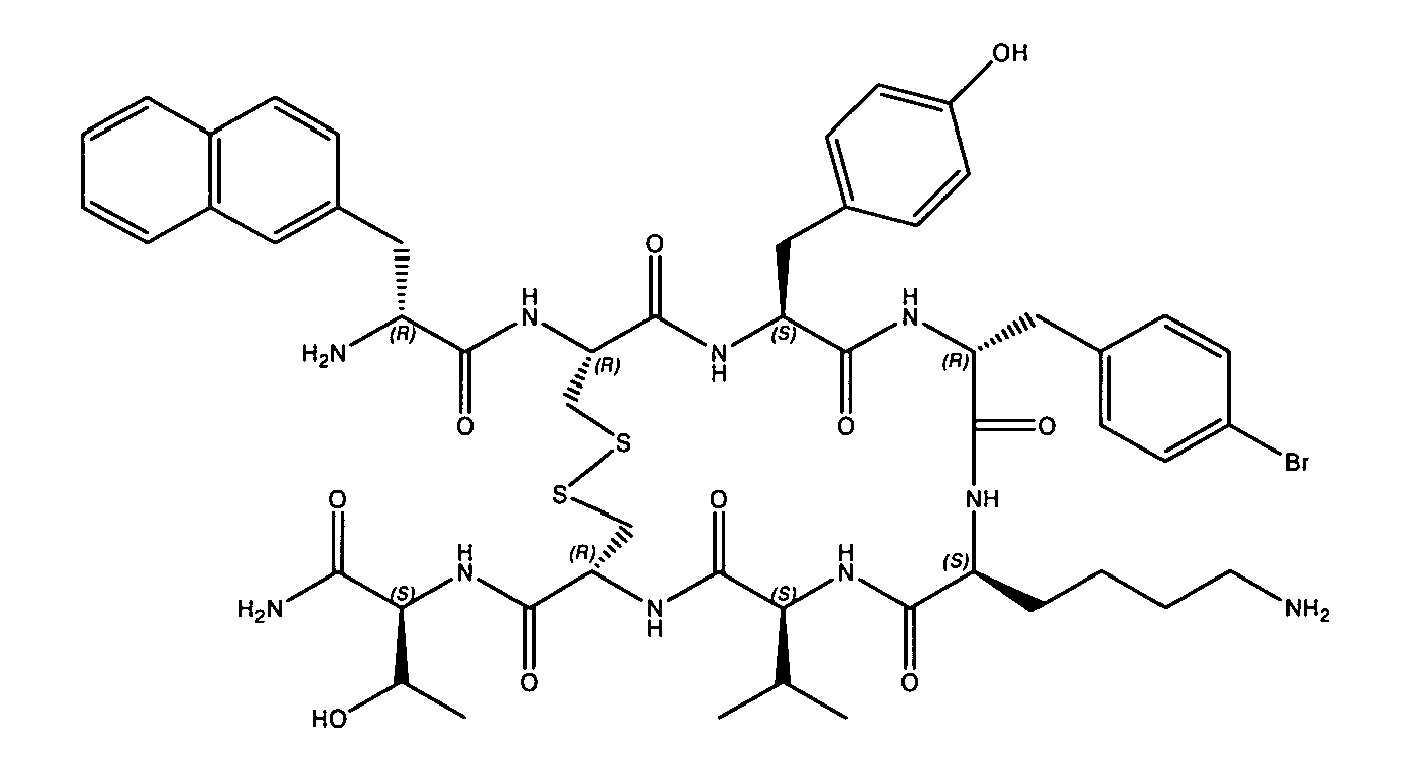
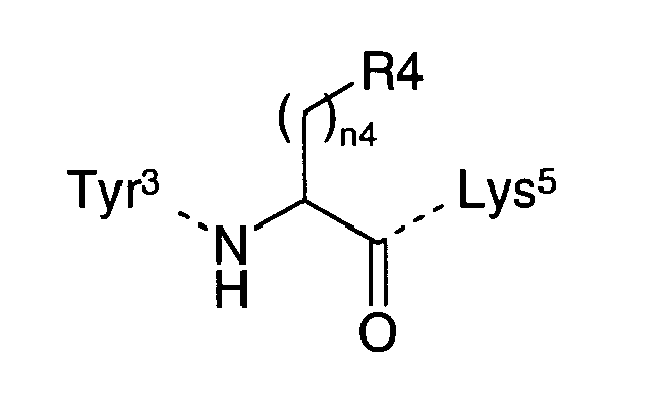
- the subject of the present invention is therefore an octapeptide compound of general formula (I) H-2-Nal 1 -cyclo (Cys 2 -Tyr 3 -AA 4 -Lys 5 -Val 6 -Cys 7 ) -Thr 8 -NH 2 (I) in which AA 4 represents an amino acid of formula in which n4 represents an integer of 0 to 3 and R4 represents a hydrogen atom, an alkyl, aryl or heteroaryl radical, the aryl and heteroaryl radicals being optionally substituted by one or more identical or different radicals chosen from halo, nitro, hydroxy aryl OR41; R41 represents a radical wherein R42 represents an alkyl radical or a hydrogen atom, n is an integer of 2 to 4, and m is an integer of 1 to 4; it being understood that all the amino acids can be of D or L configuration, excluding compounds HD-2-Nal 1 -cyclo (Cys 2 -Tyr 3 - ⁇ - (3
- alkyl when not more precise, is understood to mean a linear or branched alkyl radical containing from 1 to 6 carbon atoms, such as methyl, ethyl, propyl, isopropyl or butyl isobutyl, tert-butyl, pentyl, or hexyl, and preferably 1 to 4 carbon atoms.
- aryl an unsaturated carbocyclic system comprising at least one aromatic ring, and preferably a radical selected from phenyl, naphthyl, anthryl (or anthracenyl) and fluorenyl.
- heteroaryl is understood to mean an aromatic unsaturated ring comprising one or more identical or different heteroatoms chosen from N, O and S, such as the pyridinyl, pyrimidinyl, furyl, thienyl, benzothienyl, oxazolyl, benzoxazolyl and isoxazolyl radicals. , thiazolyl, pyrolyl, pyrazolyl, imidazolyl, triazolyl, tetrazolyl and especially thienyl, benzothienyl and imidazolyl.
- the term pharmaceutically acceptable salt defines inorganic acid addition salts such as hydrochloride, hydrobromide, hydroiodide, sulfate, phosphate, diphosphate and nitrate or organic acids such as acetate, maleate, fumarate, tartrate , succinate, citrate, lactate, methanesulfonate, p-toluenesulfonate, pamoate and stearate.
- inorganic acid addition salts such as hydrochloride, hydrobromide, hydroiodide, sulfate, phosphate, diphosphate and nitrate or organic acids such as acetate, maleate, fumarate, tartrate , succinate, citrate, lactate, methanesulfonate, p-toluenesulfonate, pamoate and stearate.
- organic acids such as acetate, maleate, fumarate, tartrate , succinate, citrate, lactate, methanesul
- the invention more particularly relates to a compound as defined above wherein n4 represents an integer of 0 to 2 and R4 represents an alkyl, aryl or heteroaryl radical, the aryl and heteroaryl radicals being optionally substituted by one or more identical or different radicals chosen from halo, nitro, hydroxy, aryl, OR41; and R41 represents a radical in which R42 represents an alkyl radical, n and m represent 2.
- the subject of the invention is preferably a compound as defined above in which the term aryl represents a radical chosen from phenyl, naphthyl, anthryl and fluorenyl.
- the invention also preferably relates to a compound as defined above in which the term heteroaryl represents a radical chosen from pyridinyl, pyrimidinyl, furyl, thienyl, benzothienyl, oxazolyl, benzoxazolyl, isoxazolyl, thiazolyl, pyrolyl, pyrazolyl, imidazolyl, triazolyl, tetrazolyl and even more preferably, selected from thienyl, benzothienyl and imidazolyl.
- heteroaryl represents a radical chosen from pyridinyl, pyrimidinyl, furyl, thienyl, benzothienyl, oxazolyl, benzoxazolyl, isoxazolyl, thiazolyl, pyrolyl, pyrazolyl, imidazolyl, triazolyl, tetrazolyl and even more preferably, selected from thienyl, be
- alkyl represents a radical chosen from methyl, ethyl, propyl, isopropyl, butyl, isobutyl and tert-butyl.
- the invention relates to an octapeptide compound of general formula (I) wherein AA 4 represents an amino acid selected from Trp, Ala, ⁇ - (3-benzothienyl) -Ala, ⁇ - (2-thienyl) - Ala, ⁇ - (9-anthryl) -Ala, ⁇ - (2-fluorenyl) -Ala, His, Val, 1-Nal, 2-Nal, phenyl-Gly, Homo-Phe, p -Br-Phe, p- F-Phe, m -F-Phe, o -F-Phe, m -Br-Phe, o-Br-Phe, p -NO 2 -Phe, 3,5-difuoro-Phe, 4-phenyl-Phe, Tyr p - (2- (2-methoxyethoxy) ethoxy) -Phe.
- AA 4 represents an amino acid selected from Trp, Ala,
- the invention relates to an octapeptide compound of general formula (I) in which amino acid AA 4 is of configuration D and even more preferably amino acids 2-Nal 1 and AA 4 are of configuration D, the other amino acids being of configuration L.
- the invention relates to an octapeptide compound of general formula (I) in which amino acid AA 4 is of configuration L and even more preferably amino acids 2-Nal 1 and AA 4 are of configuration L, the other amino acids being of configuration D.
- the invention also relates to a medicament comprising a compound according to the invention as defined above.
- the subject of the invention is also a pharmaceutical composition
- a pharmaceutical composition comprising a compound according to the invention as defined above and more particularly when the compound is used as an active ingredient.
- the invention finally relates to the use of a compound as defined above for the manufacture of a medicament; and preferably a drug in which one (or more) somatostatin receptor (s) is (are) involved.
- the system is branded Waters (2525) with in-line degasser and automated injection system (2767). Elution consists of a gradient of water and acetonitrile, with 0.1% formic acid. Detection of the eluted species is via a diode array (2996), a light scattering evaporative detector (DEDL) and a mass spectrometer (see below).
- the column is reverse-phase, grafted C18, model X-Bridge 100 x 4.6 mm with a particle size of 3.5 microns and a pore size of 13.5 nm. The flow rate is set to 1 ml min-1 and the injection volume to 20 ⁇ l.
- the mass spectrometer is a Waters Micromass ZQ. Ionization is by electrospray, with a source temperature of 120 ° C and a cone voltage of 20 V. The sample is introduced continuously at 0.3 ml min-1.
- the analyzer is of the quadrupole type (model ZQ2000). Spectra are recorded using the Mass Lynx 4.0 software in the m / z domain 100-1000 for organic molecules and 100-2000 for peptides.
- Two systems are used for peptide purification.
- the previously described system equipped with a reversed phase type column, grafted C18, model X-Bridge 150 x 19 mm with a particle size of 5 microns and a pore size of 13.5 nm.
- the flow rate is 17 ml min-1.
- the second system is a Waters 2545 similar to the previous one, not equipped with a mass spectrometer.
- the column is a Thermo Hypurity, reverse phase (grafted C18) size 21.2 x 250 mm. It is eluted with a mixture of water and acetonitrile with 0.1% TFA at a flow rate of 20 ml min-1. Both preparative HPLC systems are used in isocratic mode after determination of optimal conditions.
- Nuclear Magnetic Resonance analyzes are performed on a Bruker Advance 400 Ultrashield spectrometer.
- the analysis frequencies are 400 MHz for the proton, 376.4 MHz for the fluorine 19 and 100 MHz for the carbon 13.
- the NMR spectra of the fluorine are recorded with a sequence of a single pulse of 90 ° and of duration 19.5 ⁇ s.
- the window size is 7.5 kHz, the relaxation time is 2 s and the time 0.87 s.
- Sixteen scans are performed at each analysis.
- the spectra are recorded at room temperature, the chemical shifts are expressed in ppm and the coupling constants in Hz.
- the sample solubilized in water is injected into a 50% water-50% methanol stream via an HPLC equipped with an automatic sample changer (Alliance 2795 from Waters®, UK) at a flow rate of 200 ⁇ l min -1.
- the injection volume is 10 ⁇ l.
- the capillary voltage is 2800 V.
- the cone voltage is 40 V.
- the temperature of the source is 120 ° C.
- the desolvation temperature is 250 ° C.
- the flow rate of the desolvation gas (nitrogen) is 500 I h -1.
- the flow rate of the cone gas (nitrogen) is 20 I h -1.
- the infrared spectra of the peptides are recorded by attenuated total reflection and by Fourier transform.
- the device is a Bruker IFS 66 equipped with a module 45 ° N Znse ATR, purged continuously with nitrogen. 10 ⁇ L of solution are deposited on the crystal and thirty scans are averaged at a resolution of 4 cm -1. The water signal is subtracted from the raw spectrum thanks to the OPUS 4.2 software.
- the lyophilizer used is a Christ Alpha 2-4 LD plus connected to a paddle pump to reach voids of about 15 ⁇ bar.
- the aqueous samples are solidified in liquid nitrogen before being connected to this apparatus.
- Peptide synthesis resin is obtained from Novabiochem, a division of Merk Bioscience (Schwalbach, Germany).
- the ion exchange resin is from Bio-Rad Laboratories (Hercules, USA).
- the amino acids are purchased from Bachem (Weil am Rhein, Germany), Fluka (Buchs, Switzerland), Acros Organics (Geel, Belgium) and NeoMPS (Strasbourg, France).
- the asymmetric rhodium catalyst 35 mg, 2 mol%) is added to a solution of methyl 2- (benzyloxycarbonylamino) -3- (9H-fluoren-2-yl) acrylate (1 g, 2 g). 51 mmol) in MeOH (150 ml). The medium is purged from its air and placed under a hydrogen atmosphere (50 bar). After 24 h, the medium is concentrated to quantitatively give the reduction product.
- the 4- (2 ', 4'-dimethoxyphenyl-fluorenylmethoxycarbonylamino-methyl) -phenoxyacetamido-norleucyl- (4-methyl) -benzhydrylamine-polystyrene-divinylbenzene (Rink Amide MBHA) resin is introduced into a syringe equipped with a sintered glass. , from one tap to one end and from one stopper to another. It is filled with NMP and the mixture is stirred gently for 1 hour. The solvent is then removed by filtration.
- the amino acids are coupled to each other in the desired order by means of a coupling reaction.
- the amino acid (2 eq) is introduced with 1-hydroxybenzotriazole (HOBt, 2.2 eq) and N , N- diisopropylcarbodiimide (DIC, 2.2 eq) in N- methylpyrrolidinone (NMP, 5 ml / g). resin) in a test tube and stirred for a few minutes. It is then put in the presence of the resin in its container. The reaction mixture is stirred for 1 h 30 and then filtered.
- the double coupling technique is used: the reaction mixture is filtered when the reaction is about 50% progress, and fresh reagents are reintroduced, in order to optimize the reaction rate and the purity of the final product.
- the second step is to deprotect the new amino acid introduced, to allow a new coupling.
- the deprotection is carried out by three treatments with piperidine in NMP (20% v / v), 5 ml / g of resin followed by three washes with NMP (10 ml / g of resin).
- the peptide must be cyclized by formation of the disulfide bridge.
- the disulfide bridge is formed by three treatments of diode 1 eq in NMP (5 ml / g of resin) for 2 min, 3 min and 5 min, respectively.
- the resin is then washed 5 times with DCM and 5 times with NMP in order to remove the excess of iodine retained in the resin (10 ml / g of resin).
- the resin should be prepared for cleavage by two NMP washes, two methanol washes (MeOH), two dichloromethane (DCM) washes and two diethyl ether (DEE) washes (10 ml per gram of resin).
- the resin is then evacuated for one day.
- the cleavage is done in a glass flask equipped with a magnetic stirrer.
- the reaction mixture is trifluoroacetic acid (TFA, 10 ml / g resin) as well as triisopropylsilane (TIS) and water (3% and 2% v / v).
- TFA trifluoroacetic acid
- TIS triisopropylsilane
- the filtrate is then evaporated to obtain a very white liquid thick. This is dissolved in a 1: 1 water-acetonitrile mixture in order to be lyophilized. After this step, the peptide is in the form of trifluoroacetate salt.
- the purification is carried out by preparative high performance liquid chromatography (HPLC).
- HPLC high performance liquid chromatography
- the stationary phase is called "inverse" because grafted with C 18 alkyl chains.
- the mobile phase consists of a fixed (isocratic) mixture of water and acetonitrile with 0.1% TFA or 1% formic acid to neutralize residual non-grafted silanols that may exist on the stationary phase.
- the peptide must be dissolved in a water-acetonitrile mixture to be injected into preparative HPLC.
- a solubility study is first performed on a small amount. It makes it possible to establish the percentage of optimal acetonitrile and the maximum amount of peptide. The lowest possible percentage of acetonitrile with a very high peptide concentration and a clear resultant solution are ideal conditions.
- the solubility of the 4-para-fluorophenylalanine derivative (Example 13 below) was established at 49 g I -1 in a 58:42 water-acetonitrile solution.
- the fractions containing the purified peptide are combined and evaporated under vacuum.
- the pure peptide is then recovered in large amounts of solvent to be evaporated before freeze drying.
- the peptide is generally in the form of trifluoroacetate salt to be exchanged with an acetate before physicochemical analysis.
- the exchange is carried out on a resin of strong anion exchange type (AG1-X8 Biorad). 245 mg of this resin are first washed with three times 10 ml of 1.6 N acetic acid and then with three times 10 ml of 0.1 M acetic acid. 20 mg of TFA salt peptide are then introduced into 4 ml of water and the vessel is rotated for 1 hour. The liquid is then filtered and the resin washed twice with 1 ml of distilled water. The fractions are pooled and then lyophilized.
- AG1-X8 Biorad strong anion exchange type
- Example 1 HD-2-Nal 1 -cyclo (Cys 2 -Tyr 3 - ⁇ - (3-benzothienyl) -D-Ala 4 -Lys 5 -Val 6 -Cys 7 ) -Thr 8 -NH 2 • 2 CH 3 COOH
- the open peptide is obtained according to the protocol described above by the coupling sequence, deprotection of the Fmoc (9-fluorenylmethyloxycarbonyl) group and coupling of the following amino acid on a solid support in the following order: Fmoc-L-Thr (tBu) -OH then Fmoc-L-Cys (Trt) -OH then Fmoc-L-Val-OH then Fmoc-L-Lys (Boc) -OH then Fmoc- ⁇ - (3-benzothienyl) -D-Ala-OH then Fmoc -L-Tyr (tBu) -OH followed by Fmoc-L-Cys (Trt) -OH and finally Boc- ⁇ - (2-naphthyl) -D-Ala-OH.
- the compound is cyclized by the formation of a disulfide bridge, then cleaved from the resin, purified, and finally obtained in the form of acetate according to the procedure described above to yield the compound HD-2-Nal 1 -cyclo (Cys 2 -Tyr 3 - ⁇ - (3-benzothienyl) -D-Ala 4 -Lys 5 -Val 6 -Cys 7 ) -Thr 8 -NH 2 • 2 CH 3 COOH.
- HPLC : tr 9.8 min
- Example 2 HD-2-Nal 1 -cyclo (Cys 2 -Tyr 3 - ⁇ - (2-thienyl) -D-Ala 4 -Lys 5 -Val 6 -Cys 7 ) -Thr 8 -NH 2 • 2 CH 3 COOH
- the open peptide is obtained according to the protocol described above by the sequence of deprotection of the Fmoc (9-fluorenylmethyloxycarbonyl) group and coupling of the following amino acid on a solid support in the following order: Fmoc-L-Thr (tBu) -OH then Fmoc-L-Cys (Trt) -OH then Fmoc-L-Val-OH then Fmoc-L-Lys (Boc) -OH then Fmoc- ⁇ -thienyl) -D-Ala-OH then Fmoc-L-Tyr ( tBu) -OH then Fmoc-L-Cys (Trt) -OH and finally Boc- ⁇ - (2-naphthyl) -D-Ala-OH.
- the open peptide is obtained according to the protocol described above by the sequence of deprotection of the Fmoc (9-fluorenylmethyloxycarbonyl) group and coupling of the following amino acid on a solid support in the following order: Fmoc-L-Thr (tBu) -OH then Fmoc-L-Cys (Trt) -OH then Fmoc-L-Val-OH then Fmoc-L-Lys (Boc) -OH then Fmoc-D-His-OH then Fmoc-L-Tyr (tBu) -OH then Fmoc-L-Cys (Trt) -OH and finally Boc- ⁇ - (2-naphthyl) -D-Ala-OH.
- the compound is cyclized by the formation of a disulfide bridge, then cleaved from the resin, purified, and finally obtained in the form of acetate according to the procedure described above to yield the compound HD-2-Nal 1 -cyclo (Cys 2 -Tyr 3 -D-His 4 -Lys 5 -Val 6 -Cys 7 ) -Thr 8 -NH 2 • 2 CH 3 COOH.
- HPLC: tr 6.3 min
- the open peptide is obtained according to the protocol described above by the sequence of deprotection of the Fmoc (9-fluorenylmethyloxycarbonyl) group and coupling of the following amino acid on a solid support in the following order: Fmoc-L-Thr (tBu) -OH then Fmoc-L-Cys (Trt) -OH then Fmoc-L-Val-OH then Fmoc-L-Lys (Boc) -OH then Fmoc-D-Ala-OH then Fmoc-L-Tyr (tBu) -OH then Fmoc-L-Cys (Trt) -OH and finally Boc- ⁇ - (2-naphthyl) -D-Ala-OH.
- the compound is cyclized by the formation of a disulfide bridge, then cleaved from the resin, purified, and finally obtained in the form of acetate according to the procedure described above to yield the compound HD-2-Nal 1 -cyclo (Cys 2 -Tyr 3 -D-Ala 4 -Lys 5 -Val 6 -Cys 7 ) -Thr 8 -NH 2 • 2 CH 3 COOH.
- HPLC : tr 9.8 min
- the open peptide is obtained according to the protocol described above by the sequence of deprotection of the Fmoc (9-fluorenylmethyloxycarbonyl) group and coupling of the following amino acid on a solid support in the following order: Fmoc-L-Thr (tBu) -OH then Fmoc-L-Cys (Trt) -OH then Fmoc-L-Val-OH then Fmoc-L-Lys (Boc) -OH then Fmoc-D-Val-OH then Fmoc-L-Tyr (tBu) -OH then Fmoc-L-Cys (Trt) -OH and finally Boc- ⁇ - (2-naphthyl) -D-Ala-OH.
- the open peptide is obtained according to the protocol described above by the sequence of deprotection of the Fmoc (9-fluorenylmethyloxycarbonyl) group and coupling of the following amino acid on a solid support in the following order: Fmoc-L-Thr (tBu) -OH then Fmoc-L-Cys (Trt) -OH then Fmoc-L-Val-OH then Fmoc-L-Lys (Boc) -OH then Fmoc- ⁇ -naphthyl) -D-Ala-OH then Fmoc-L-Tyr ( tBu) -OH then Fmoc-L-Cys (Trt) -OH and finally Boc- ⁇ - (2-naphthyl) -D-Ala-OH.
- Example 7 HD-2-Nal 1 -cyclo (Cys 2 -Tyr 3 -D-Val 4 -Lys 5 -Val 6 -Cys 7 ) -Thr 8 NH 2 • 2 CH 3 COOH
- the open peptide is obtained according to the protocol described above by the sequence of deprotection of the Fmoc (9-fluorenylmethyloxycarbonyl) group and coupling of the following amino acid on a solid support in the following order: Fmoc-L-Thr (tBu) -OH then Fmoc-L-Cys (Trt) -OH then Fmoc-L-Val-OH then Fmoc-L-Lys (Boc) -OH then Fmoc- ⁇ - (2-naphthyl) -D-Ala-OH then Fmoc-L -Tyr (tBu) -OH then Fmoc-L-Cys (Trt) -OH and finally Boc - ⁇ - (2-naphthyl) -D-Ala-OH.
- Example 8 HD-2-Nal 1 -cyclo (Cys 2 -Tyr 3 - ⁇ - (9-anthryl) -D-Ala 4 -Lys 5 -Val 6 -Cys 7 ) -Thr 8 -NH 2 • 2 CH 3 COOH
- the open peptide is obtained according to the protocol described above by the sequence of deprotection of the Fmoc (9-fluorenylmethyloxycarbonyl) group and coupling of the following amino acid on a solid support in the following order: Fmoc-L-Thr (tBu) -OH then Fmoc-L-Cys (Trt) -OH then Fmoc-L-Val-OH then Fmoc-L-Lys (Boc) -OH then Fmoc- ⁇ - (9-anthryl) -D-Ala-OH then Fmoc-L -Tyr (tBu) -OH then Fmoc-L-Cys (Trt) -OH and finally Boc- ⁇ - (2-naphthyl) -D-Ala-OH.
- Example 9 HD-2-Nal 1 -cyclo (Cys 2 -Tyr 3 - ⁇ - (2-fluorenyl) -D-Ala 4 -Lys 5 -Val 6 -Cys 7 ) -Thr 8 -NH 2 • 2 CH 3 COOH
- the open peptide is obtained according to the protocol described above by the sequence of deprotection of the Fmoc (9-fluorenylmethyloxycarbonyl) group and coupling of the following amino acid on a solid support in the following order: Fmoc-L-Thr (tBu) -OH then Fmoc-L-Cys (Trt) -OH then Fmoc-L-Val-OH then Fmoc-L-Lys (Boc) -OH then Fmoc- ⁇ - (2-fluorenyl) -D-Ala-OH and Fmoc-L- Tyr (tBu) -OH then Fmoc-L-Cys (Trt) -OH and finally Boc- ⁇ - (2-naphthyl) -D-Ala-OH.
- Example 10 HD-2-Nal 1 -cyclo (Cys 2 -Tyr 3 -D-Phg 4 -Lys 5 -Val 6 -Cys 7 ) -Thr 8 -NH 2 • 2 CH 3 COOH
- the open peptide is obtained according to the protocol described above by the sequence of deprotection of the Fmoc (9-fluorenylmethyloxycarbonyl) group and coupling of the following amino acid on a solid support in the following order: Fmoc-L-Thr (tBu) -OH then Fmoc-L-Cys (Trt) -OH then Fmoc-L-Val-OH then Fmoc-L-Lys (Boc) -OH then Fmoc-D-Phg-OH then Fmoc-L-Tyr (tBu) -OH then Fmoc L-Cys (Trt) -OH and finally Boc- ⁇ - (2-naphthyl) -D-Ala-OH.
- the compound is cyclized by the formation of a disulfide bridge, then cleaved from the resin, purified, and finally obtained in the form of acetate according to the procedure described above to yield the compound HD-2-Nal 1 -cyclo (Cys 2 -Tyr 3 -D-Phg 4 -Lys 5 -Val 6 -Cys 7 ) -Thr 8 -NH 2 • 2 CH 3 COOH.
- HPLC : tr 8.9 min
- Example 11 HD-2-Nal 1 -cyclo (Cys 2 -Tyr 3 -D-Homophol 4 -Lys 5 -Val 6 -Cys 7 ) -Thr 8 -NH 2 • 2 CH 3 COOH
- the open peptide is obtained according to the protocol described above by the sequence of deprotection of the Fmoc (9-fluorenylmethyloxycarbonyl) group and coupling of the following amino acid on a solid support in the following order: Fmoc-L-Thr (tBu) -OH then Fmoc-L-Cys (Trt) -OH then Fmoc-L-Val-OH then Fmoc-L-Lys (Boc) -OH then Fmoc-D-Homophe-OH then Fmoc-L-Tyr (tBu) -OH then Fmoc-L-Cys (Trt) -OH and finally Boc- ⁇ - (2-naphthyl) -D-Ala-OH.
- the open peptide is obtained according to the protocol described above by the sequence of deprotection of the Fmoc (9-fluorenylmethyloxycarbonyl) group and coupling of the following amino acid on a solid support in the following order: Fmoc-L-Thr (tBu) -OH then Fmoc-L-Cys (Trt) -OH then Fmoc-L-Val-OH then Fmoc-L-Lys (Boc) -OH then Fmoc- p -Br-D-Phe-OH then Fmoc-L-Tyr (tBu) ) -OH then Fmoc-L-Cys (Trt) -OH and finally Boc- ⁇ - (2-naphthyl) -D-Ala-OH.
- Example 13 HD-2-Nal 1 -cyclo (Cys 2 -Tyr 3 - p -FD-Phe 4 -Lys 5 -Val 6 -Cys 7 ) -Thr 8 -NH 2 • 2 CH 3 COOH
- the open peptide is obtained according to the protocol described above by the sequence of deprotection of the Fmoc (9-fluorenylmethyloxycarbonyl) group and coupling of the following amino acid on a solid support in the following order: Fmoc-L-Thr (tBu) -OH then Fmoc-L-Cys (Trt) -OH then Fmoc-L-Val-OH then Fmoc-L-Lys (Boc) -OH then Fmoc- p- FD-Phe-OH then Fmoc-L-Tyr (tBu) - OH then Fmoc-L-Cys (Trt) -OH and finally Boc- ⁇ - (2-naphthyl) -D-Ala-OH.
- Example 14 HD-2-Nal 1 -cyclo (Cys 2 -Tyr 3 -D-Tyr 4 -Lys 5 -Val 6 -Cys 7 ) -Thr 8 -NH 2 • 2 CH 3 COOH
- the open peptide is obtained according to the protocol described above by the sequence of deprotection of the Fmoc (9-fluorenylmethyloxycarbonyl) group and coupling of the following amino acid on a solid support in the following order: Fmoc-L-Thr (tBu) -OH then Fmoc-L-Cys (Trt) -OH then Fmoc-L-Val-OH then Fmoc-L-Lys (Boc) -OH then Fmoc-D-Tyr-OH then Fmoc-L-Tyr (tBu) -OH then Fmoc-L-Cys (Trt) -OH and finally Boc- ⁇ - (2-naphthyl) -D-Ala-OH.
- the open peptide is obtained according to the protocol described above by the sequence of deprotection of the Fmoc (9-fluorenylmethyloxycarbonyl) group and coupling of the following amino acid on a solid support in the following order: Fmoc-L-Thr (tBu) -OH then Fmoc-L-Cys (Trt) -OH then Fmoc-L-Val-OH then Fmoc-L-Lys (Boc) -OH then Fmoc-mFD-Phe-OH then Fmoc-L-Tyr (tBu) -OH then Fmoc-L-Cys (Trt) -OH and finally Boc- ⁇ - (2-naphthyl) -D-Ala-OH.
- the compound is cyclized by the formation of a disulfide bridge, then cleaved from the resin, purified, and finally obtained in the form of acetate according to the procedure described above to yield the compound HH-D-2-Nal 1 -cyclo ( Cys 2 -Tyr 3 -D-Val 4 -Lys 5 -Val 6 -Cys 7 ) -Thr 8 -NH 2 • 2 CH 3 COOH.
- Example 16 HD-2-Nal 1 -cyclo (Cys 2 -Tyr 3 - o -Val 4 -Lys 5 -Val 6 -Cys 7 ) -Thr 8 -NH 2 • 2 CH 3 COOH
- the open peptide is obtained according to the protocol described above by the sequence of deprotection of the Fmoc (9-fluorenylmethyloxycarbonyl) group and coupling of the following amino acid on a solid support in the following order: Fmoc-L-Thr (tBu) -OH then Fmoc-L-Cys (Trt) -OH then Fmoc-L-Val-OH then Fmoc-L-Lys (Boc) -OH then Fmoc-oFD-Phe-OH then Fmoc-L-Tyr (tBu) -OH then Fmoc-L-Cys (Trt) -OH and finally Boc- ⁇ - (2-naphthyl) -D-Ala-OH.
- the compound is cyclized by formation of a disulfide bridge, then cleaved from the resin, purified, and finally obtained as acetate according to the procedure described above to yield the compound HD-2-Nal 1 -cyclo (Cys 2 -Tyr 3 - o -FD-Phe 4 -Lys 5 -Val 6 -Cys 7 ) -Thr 8 -NH 2 • 2 CH 3 COOH.
- the open peptide is obtained according to the protocol described above by the sequence of deprotection of the Fmoc (9-fluorenylmethyloxycarbonyl) group and coupling of the following amino acid on a solid support in the following order: Fmoc-L-Thr (tBu) -OH then Fmoc-L-Cys (Trt) -OH then Fmoc-L-Val-OH then Fmoc-L-Lys (Boc) -OH then Fmoc-3,5-diF-D-Phe-OH then Fmoc-L-Tyr (tBu) -OH followed by Fmoc-L-Cys (Trt) -OH and finally Boc- ⁇ - (2-naphthyl) -D-Ala-OH.
- the compound is cyclized by the formation of a disulfide bridge, then cleaved from the resin, purified, and finally obtained in the form of acetate according to the procedure described above to yield the compound HD-2-Nal 1 -cyclo (Cys 2 -Tyr 3 - o -FD-Phe 4 -Lys 5 -Val 6 -Cys 7 ) -Thr 8 -NH 2 • 2 CH 3 COOH.
- HPLC : tr 8.8 min
- the open peptide is obtained according to the protocol described above by the sequence of deprotection of the Fmoc (9-fluorenylmethyloxycarbonyl) group and coupling of the following amino acid on a solid support in the following order: Fmoc-L-Thr (tBu) -OH then Fmoc-L-Cys (Trt) -OH then Fmoc-L-Val-OH then Fmoc-L-Lys (Boc) -OH then Fmoc-m-Br-D-Phe-OH then Fmoc-L-Tyr (tBu) ) -OH then Fmoc-L-Cys (Trt) -OH and finally Boc- ⁇ - (2-naphthyl) -D-Ala-OH.
- the compound is cyclized by the formation of a disulfide bridge, then cleaved from the resin, purified, and finally obtained in the form of acetate according to the procedure described above to yield the compound HD-2-Nal 1 -cyclo (Cys 2 -Tyr 3 - o -FD-Phe 4 -Lys 5 -Val 6 -Cys 7 ) -Thr 8 -NH 2 • 2 CH 3 COOH.
- HPLC: tr 9.0 min
- Example 19 HD-2-Nal 1 -cyclo (Cys 2 -Tyr 3 - o -FD-Phe 4 -Lys 5 -Val 6 -Cys 7 ) -Thr 8 -NH 2 • 2 CH 3 COOH
- the open peptide is obtained according to the protocol described above by the sequence of deprotection of the Fmoc (9-fluorenylmethyloxycarbonyl) group and coupling of the following amino acid on a solid support in the following order: Fmoc-L-Thr (tBu) -OH then Fmoc-L-Cys (Trt) -OH then Fmoc-L-Val-OH then Fmoc-L-Lys (Boc) -OH then Fmoc-o-Br-D-Phe-OH then Fmoc-L-Tyr (tBu ) -OH then Fmoc-L-Cys (Trt) -OH and finally Boc- ⁇ - (2-naphthyl) -D-Ala-OH.
- Example 20 HD-2-Nal 1 -cyclo (Cys 2 -Tyr 3 - p -nitro-D-Phe 4 -Lys 5 -Val 6 -Cys 7 ) -Thr 8 -NH 2 • 2 CH 3 COOH
- the open peptide is obtained according to the protocol described above by the sequence of deprotection of the Fmoc (9-fluorenylmethyloxycarbonyl) group and coupling of the following amino acid on a solid support in the following order: Fmoc-L-Thr (tBu) -OH then Fmoc-L-Cys (Trt) -OH followed by Fmoc-L-Val-OH followed by Fmoc-L-Lys (Boc) -OH followed by Fmoc- p -nitro-D-Phe-OH and Fmoc-L-Tyr (tBu). ) -OH then Fmoc-L-Cys (Trt) -OH and finally Boc- ⁇ - (2-naphthyl) -D-Ala-OH.
- Example 21 HD-2-Nal 1 -cyclo (Cys 2 -Tyr 3 - p -Ph-D-Phe 4 -Lys 5 -Val 6 -Cys 7 ) -Thr 8 -NH 2 • 2 CH 3 COOH
- the open peptide is obtained according to the protocol described above by the sequence of deprotection of the Fmoc (9-fluorenylmethyloxycarbonyl) group and coupling of the following amino acid on a solid support in the following order: Fmoc-L-Thr (tBu) -OH then Fmoc-L-Cys (Trt) -OH then Fmoc-L-Val-OH then Fmoc-L-Lys (Boc) -OH then Fmoc- p -Ph-D-Phe-OH then Fmoc-L-Tyr (tBu ) -OH then Fmoc-L-Cys (Trt) -OH and finally Boc- ⁇ - (2-naphthyl) -D-Ala-OH.
- Example 22 HD-2-Nal 1 -cyclo (Cys 2 -Tyr 3 - p -2- (2-methoxyethoxy) ethoxy) -D-Phe 4 -Lys 5 -Val 6 -Cys 7 ) -Thr 8 -NH 2 ] • 2 CH 3 COOH
- the open peptide is obtained according to the protocol described above by the sequence of deprotection of the Fmoc (9-fluorenylmethyloxycarbonyl) group and coupling of the following amino acid on a solid support in the following order: Fmoc-L-Thr (tBu) -OH then Fmoc-L-Cys (Trt) -OH and Fmoc-L-Val-OH and Fmoc-L-Lys (Boc) -OH and Fmoc-p -2- (2-methoxyethoxy) ethoxy) -D-Phe-OH then Fmoc-L-Tyr (tBu) -OH then Boc-L-Cys (Trt) -OH and finally Fmoc- ⁇ - (2-naphthyl) -D-Ala-OH.
- the compound is cyclized by the formation of a disulfide bridge, then cleaved from the resin, purified, and finally obtained in the form of acetate according to the procedure described above to yield the compound HD-2-Nal 1 -cyclo (Cys 2 -Tyr 3 - p -2- (2-methoxyethoxy) ethoxy) -D-Phe 4 -Lys 5 -Val 6 -Cys 7 ) -Thr 8 -NH 2 ] • 2 CH 3 COOH.
- Example 23 H-2-Nal 1 -cyclo (D-Cys 2 -D-Tyr 3 -Trp 4 -D-Lys 5 -D-Val 6 -D-Cys 7 ) -D-Thr 8 -NH 2 • 2 CH 3 COOH
- the open peptide is obtained according to the protocol described above by the sequence of deprotection of the Fmoc (9-fluorenylmethyloxycarbonyl) group and coupling of the following amino acid on a solid support in the following order: Fmoc-D-Thr (tBu) -OH then Fmoc-D-Cys (Trt) -OH then Fmoc-D-Val-OH then Fmoc-D-Lys (Boc) -OH then Fmoc-L-Trp-OH then Fmoc-D-Tyr (tBu) -OH then Fmoc-D-Cys (Trt) -OH and finally Boc- ⁇ - (2-naphthyl) -L-Ala-OH.
- the affinity of the compounds of the invention for Somatostatin receptors is determined by measuring the inhibition of [125I-Tyr11] SRIF-14 binding to membrane preparations of transfected CHO-K1 cells.
- CHO-K1 cells stably expressing each of the somatostatin receptor subtypes are collected with 0.5 mM EDTA and centrifuged at 500 xg for 5 minutes at 4 ° C. The pellet is re-suspended in phosphate buffer (PBS) and centrifuged at 500 g for 5 minutes at 4 ° C. The pellet is resuspended in 50 mM Tris buffer pH 7.4 and centrifuged at 500 g for 5 minutes at 4 ° C. The cells are lysed by sonication and centrifuged at 39,000 g for 10 minutes.
- PBS phosphate buffer
- 50 mM Tris buffer pH 7.4 50 mM Tris buffer pH 7.4
- the pellet is resuspended in 50 mM Tris buffer pH 7.4, an aliquot is taken for the protein assay and the remainder is centrifuged at 50,000 g for 10 minutes.
- the membranes obtained in this latter base are stored at -80 ° C.
- the [125I-Tyr11] SRIF-14 bound is separated from the free [125I-Tyr11] SRIF-14 by filtration through GF / C fiberglass plates (Unifilter, Perkin Elmer) pre-impregnated with 0.1% polyethyleneimine (PEI), using a Filtermate 96 (Perkin Elmer). The filters are washed with 50 mM Tris-HCl buffer, pH 7.4 at 4 ° C. and the radioactivity present is determined using a counter (TopCount, Perkin Elmer).
- the data are analyzed by nonlinear regression assisted by the software XLfit 4.2 (IDBS).
- Examples 1, 2, 3, 4, 5, 6, 8, 9, 10, 11, 12, 13, 14, 15, 16, 17, 18, 19, 20 and 21 have an affinity for subtype 2 somatostatin receptors less than or equal to 5 ⁇ M.
- Examples 1, 2, 3, 5, 6, 8, 9, 10, 11, 12, 13, 14, 15, 16, 17, 18, 19, 20 and 21 have an affinity for receptor subtype 2 at somatostatin less than or equal to 700 nM.
- Examples 1, 2, 6, 8, 9, 11, 12, 13, 14, 15, 16, 17, 18, 19, 20 and 21 have an affinity for subtype 2 of somatostatin receptors less than or equal to at 50 nM.
- Examples 1, 6, 12, 13, 14, 15, 16, 17, 18, 19 and 20 have an affinity for somatostatin receptor subtype 2 less than or equal to 5 nM.
- Examples 1, 2, 3, 5, 6, 8, 9, 10, 11, 12, 13, 14, 15, 16, 17, 18, 19, 20 and 21 have an affinity for the receptor subtype 5 with somatostatin less than or equal to 5 ⁇ M.
- Examples 1, 2, 6, 8, 9, 11, 12, 13, 14, 15, 16, 17, 18, 19, 20 and 21 have an affinity for subtype 5 of somatostatin receptors less than or equal to at 1 ⁇ M.
- Examples 1, 6, 8, 9, 12, 15, 17, 18, 19 and 21 have an affinity for somatostatin receptor subtype of less than or equal to 100 nM.
- the peptides obtained are the subject of a study of their self-assembly properties.
- the procedure used has three stages: solution dissolution of the peptides and macroscopic analysis; spectroscopic and microscopic analyzes of formed structures and small angle X-ray diffraction (SAXS) analyzes.
- SAXS small angle X-ray diffraction
- the first step in the characterization of the derivatives is the production of a concentration range of 3 to 15% by weight of peptide in water. Gelation of the solution indicates the presence of self-assembled structures that may be nanotubes but also fibers or other self-organized structures.
- This step aims to verify the presence of self-assembled structures, to characterize their self-assembly and to visualize them by microscopy.
- Infrared spectroscopy provides information on how peptides are stacked in self-assemblies.
- the attenuated total reflection technique uses a crystal on which the sample is deposited, solid or liquid. The infrared light is guided through this crystal at an angle allowing it to be reflected several times inside the crystal, which increases the sensitivity of the technique.
- this device Thanks to the performance of this device, it is then possible to measure relatively dilute solutions.
- the penetration of the beam into the sample deposited on the crystal is a few microns, so that only the molecules / structures that are deposited on the crystal surface are analyzed.
- this technique is nondestructive.
- TEM transmission electron microscopy
- the peptide in solution is first deposited on a carbon grid covered with a carbon film. After depositing the material, excess liquid is removed. In the same way, the dye solution, in our case uranyl acetate, is deposited on the grid, the excess is removed and the grid is dried in the open air. It can then be introduced into the microscope.
- SAXS Small angle X-ray diffraction analysis
- the samples, liquids or gels are introduced into a capillary and subjected to a monochromatic flow of X-rays.
- the scattered intensity is measured as a function of the angle of diffusion with respect to the incident angle.
- the self-assembling derivatives in monodisperse nanotubes of peptides are as follows: Examples 1, 2, 3, 6, 9, 12, 13, 14, 15, 16, 17, 18, and 20. A range of diameters of 9 3 to 35 nm is obtained.
- Example 19 assembles into nanotubes of polydispersed diameters.
- the soluble derivatives at the concentrations studied are the following: Examples 5 and 11.
- the measurements are generally carried out using a Haess 600 Control Stress Rheometer (Haake, Germany) equipped with a cone / plane measurement geometry, with a 20mm diameter cone, a 1 degree angle and a gap. of 52 microns.
- the measurement temperature is set at 25 ° C +/- 0.2 ° C using a thermostatic bath but can be modulated if necessary.
- a flow curve is recorded in static mode (a shear stress ⁇ (Pa) as a function of the shear rate ⁇ (s -1 )).
- This curve gives access to information such as flow behavior, viscosity, limit flow stress and possible thixotropy of the samples.
- the solutions / gels having nanotubes or fibers nanostructures nanostructures behave in general as non-Newtonian fluids.
- theoretical models such as those of Cross ( Cross MM. J Colloid Sci 1965 20; 417-37 ) or Casson ( Casson, N. In Rheology of Disperse Systems, CC Mill ed, 1959, p.
- the storage modulus (also called elastic modulus) is a measure of the elastic energy stored (or restored) per unit volume, while the loss modulus is a measure of the energy dissipated per unit volume.
- These modules must be calculated in the linear viscoelastic region (ie experimental conditions for which these modules are independent of the amplitude of the shear stress). These experimental conditions are generally determined by an experiment called “stress sweep” which consists of a measurement of the elastic modulus and the loss modulus as a function of the amplitude of the imposed deformation (for a given frequency, typically 1 Hz).
- Creep and recovery tests can also be performed to characterize the solutions / gels of the compounds.
- the zero viscosity, ⁇ 0 is then equal to the inverse of the slope of the curve of elastic complacency (J) as a function of time.
- the release medium is a physico-chemically well-controlled liquid medium, preferably a PBS (phosphate buffer saline) buffer adjusted to pH 7.4 and maintained at 37 ° C.
- the release curve is defined as the concentration of the test compound in the dissolution medium (expressed in% of released compound) as a function of time (minutes, hours, days).
- Measurements of concentration of the compound in the release medium are carried out by one or more analytical methods well known in the state of the art such as UV-visible spectrophotometry or HPLC (High Performance Liquid Chromatography).
- the parameters of the analytical methods are adjusted according to the physicochemical characteristics of the compounds.
- Static release studies are conducted without subjecting the samples to controlled agitation or release medium flow. Release medium samples and / or concentration determinations are generally not automated and require manual operations. For example, some static release studies can be performed on samples corresponding to from 2 to 5 mg of pure compound in 20 ml of PBS (typically in 50 ml beakers) kept in an oven at 37 ° C. The concentration measurements are made on representative samples of the release medium made at selected times.
Landscapes
- Health & Medical Sciences (AREA)
- Chemical & Material Sciences (AREA)
- Life Sciences & Earth Sciences (AREA)
- Organic Chemistry (AREA)
- General Health & Medical Sciences (AREA)
- Medicinal Chemistry (AREA)
- Animal Behavior & Ethology (AREA)
- Veterinary Medicine (AREA)
- Public Health (AREA)
- Chemical Kinetics & Catalysis (AREA)
- General Chemical & Material Sciences (AREA)
- Bioinformatics & Cheminformatics (AREA)
- Nuclear Medicine, Radiotherapy & Molecular Imaging (AREA)
- Engineering & Computer Science (AREA)
- Pharmacology & Pharmacy (AREA)
- Diabetes (AREA)
- Proteomics, Peptides & Aminoacids (AREA)
- Genetics & Genomics (AREA)
- Molecular Biology (AREA)
- Zoology (AREA)
- Gastroenterology & Hepatology (AREA)
- Toxicology (AREA)
- Biochemistry (AREA)
- Biophysics (AREA)
- Endocrinology (AREA)
- Physical Education & Sports Medicine (AREA)
- Obesity (AREA)
- Hematology (AREA)
- Emergency Medicine (AREA)
- Dermatology (AREA)
- Medicines That Contain Protein Lipid Enzymes And Other Medicines (AREA)
- Peptides Or Proteins (AREA)
Abstract
Description
- La présente invention concerne de nouveaux composés octapeptidiques. Ces produits ayant une bonne affinité pour certains sous-types de récepteurs de la somatostatine, ils sont particulièrement intéressants pour traiter les états pathologiques ou les maladies dans lesquels un (ou plusieurs) des récepteurs de la somatostatine est (sont) impliqué(s). L'invention concerne également des compositions pharmaceutiques contenant lesdits produits et leur utilisation pour la préparation d'un médicament.
- La somatostatine (SST) est un tétradécapeptide cyclique qui a été isolé pour la première fois de l'hypothalamus en tant que substance inhibitrice de l'hormone de croissance (Brazeau P. et al., Science 1973, 179, 77-79). Elle intervient également en tant que neurotransmetteur dans le cerveau (Reisine T. et al., Neuroscience 1995, 67, 777-790 ; Reisine et al., Endocrinology 1995, 16, 427-442). L'hétérogénéité des fonctions biologiques de la somatostatine et les relations structure-activité de ses analogues peptidiques, ont amené la découverte de 5 sous-types de récepteurs liés à la membrane (Yamada et al., Proc. Natl. Acad. Sci. U.S.A, 89, 251-255, 1992 ; Raynor, K. et al, Mol. Pharmacol., 44, 385-392, 1993). Le clonage moléculaire a permis de montrer que la bioactivité de la somatostatine dépend directement de ces cinq sous-types de récepteurs.
- Les rôles fonctionnels de ces récepteurs sont actuellement activement étudiés. L'activation préférentielle des sous-types 2 et 5 a été associée à la suppression, dans les adénomes sécrétant ces hormones, de l'hormone de croissance GH (acromégalie), de l'hormone TSH et de la prolactine ; mais le rôle précis de chaque sous-type reste à déterminer.
- Parmi les désordres pathologiques associés à la somatostatine (Moreau J.P. et al., Life Sciences, 1987, 40, 419 ; Harris A.G. et al., The European Journal of Medicine, 1993, 2, 97-105), on peut citer par exemple : l'acromégalie, les adénomes hypophysaires, la maladie de Cushing, les gonadotrophinomes et les prolactinomes, les effets secondaires cataboliques des glucocorticoïdes, le diabète, la rétinopathie diabétique, la néphropathie diabétique, l'hyperthyroïdie, le gigantisme, les tumeurs gastroentéropancréatiques endocriniennes dont le syndrôme carcinoïde, le VIPome, l'insulinome, la nésidioblastose, l'hyperinsulinémie, le glucagonome, le gastrinome et le syndrôme de Zollinger-Ellison, le GRFome ainsi que le saignement aigu des varices oesophagiennes, le reflux gastrooesophagien, le reflux gastroduodénal, la pancréatite, les fistules entérocutanées et pancréatiques mais aussi les diarrhées, les diarrhées réfractaires du syndrôme d'immunodépression acquise, la diarrhée chronique sécrétoire, la diarrhée associée avec le syndrôme de l'intestin irrité, les troubles liés au peptide libérateur de gastrine, les pathologies secondaires aux greffes intestinales, l'hypertension portale ainsi que les hémorragies des varices chez des malades avec cirrhose, l'hémorragie gastro-intestinale, l'hémorragie de l'ulcère gastroduodénal, la maladie de Crohn, les scléroses systémiques, le dumping syndrôme, le syndrôme du petit intestin, l'hypotension, la sclérodermie et le carcinome thyroïdien médullaire, les maladies liées à l'hyperprolifération cellulaire comme les cancers et plus particulièrement le cancer du sein, le cancer de la prostate, le cancer thyroïdien ainsi que le cancer pancréatique et le cancer colorectal, les fibroses et plus particulièrement la fibrose du rein, la fibrose du foie, la fibrose du poumon, la fibrose de la peau, également la fibrose du système nerveux central ainsi que celle du nez et la fibrose induite par la chimiothérapie, et d'autres domaines thérapeutiques comme, par exemple, les céphalées y compris les céphalées associées aux tumeurs hypophysaires, les douleurs, les accès de panique, la chimiothérapie, la cicatrisation des plaies, l'insuffisance rénale résultant d'un retard de croissance, l'obésité et retard de croissance lié à l'obésité, le retard de croissance utérin, la dysplasie du squelette, le syndrôme de Noonan, le syndrôme d'apnée du sommeil, la maladie de Graves, la maladie polykystique des ovaires, les pseudokystes pancréatiques et ascites, la leucémie, le méningiome, la cachexie cancéreuse, l'inhibition des H pylori, le psoriasis ainsi que la maladie d'Alzheimer. On peut également citer l'ostéoporose.
De nos jours, une attention croissante est portée aux peptides possédant une affinité sur les récepteurs de la somatostatine. Ainsi, le Lanréotide a été très étudié pour le traitement des maladies liées à l'hormone de croissance (Cendros JM, Peraire C, Trocôniz IF, Obach R. Pharmacokinetics and population pharmacodynamic analysis of lanreotide Autogel. Metabolism. 2005 Oct, 54(10), 1276-81.) - Le besoin de trouver des alternatives aux solutions existantes constitue donc un enjeu majeur. La présente invention s'inscrit dans ce cadre.
- La déposante propose donc de nouveaux composés octapeptidiques possédant une bonne affinité sur les récepteurs de la somatostatine et/ou des propriétés physico-chimiques permettant d'envisager des solutions diverses de formulation de médicaments.
- Les composés selon l'invention présentent de nombreux avantages, en particulier l'une au moins des caractéristiques suivantes :
- leur affinité sur les récepteurs de la somatostatine,
- leur rhéologie permettant des gammes de viscosités associées liées au confort d'injection,
- leur aptitude à être utilisés comme support de formulation,
- leur faculté d'auto-assemblage sous forme de nanotubes de diamètres variables et monodisperses,
- leur faculté d'autoassemblage sous forme de fibres,
- leurs divers degrés de solubilité dans l'eau.
- La présente invention a donc pour objet un composé octapeptidique de formule générale (I)
H-2-Nal1-cyclo(Cys2-Tyr3-AA4-Lys5-Val6-Cys7)-Thr8-NH2 (I)
dans laquelle AA4 représente un acide aminé de formule dans laquelle n4 représente un entier de 0 à 3 et R4 représente un atome d'hydrogène, un radical alkyle, aryle ou hétéroaryle, les radicaux aryle et hétéroaryle étant éventuellement substitués par un ou plusieurs radicaux identiques ou différents choisis parmi halo, nitro, hydroxy, aryle, OR41 ;
R41 représente un radical dans lequel R42 représente un radical alkyle ou un atome d'hydrogène, n est un entier de 2 à 4, et m est un entier de 1 à 4 ;
étant entendu que tous les acides aminés peuvent être de configuration D ou L,
à l'exclusion des composés H-D-2-Nal1-cyclo(Cys2-Tyr3-β-(3-pyridyl)-D-Ala4- Lys5-Val6-Cys7)-Thr8-NH2, H-D-2-Nal1-cyclo(Cys2-Tyr3- D-Phe4- Lys5-Val6-Cys7)-Thr8-NH2, H-D-2-Nal1-cyclo(Cys2-Tyr3-D-Trp4- Lys5-Val6-Cys7)-Thr8-NH2 et de leurs sels,
ou un sel pharmaceutiquement acceptable de ce composé. - Au sens de la présente invention, on entend par alkyle, lorsqu'il n'est pas donné plus de précision, un radical alkyle linéaire ou ramifié comptant de 1 à 6 atomes de carbone, tels que méthyle, éthyle, propyle, isopropyle, butyle, isobutyle, tert-butyle, pentyle, ou hexyle, et de préférence de 1 à 4 atomes de carbone.
- Par aryle, on entend un système carbocyclique insaturé comprenant au moins un cycle aromatique, et de préference un radical choisi parmi phényle, naphtyle, anthryle (ou anthracényle) et fluorényle.
- Par hétéroaryle au sens de la présente invention, on entend un cycle insaturé aromatique comprenant un ou plusieurs hétéroatomes identiques ou différents choisis parmi N, O et S, tels que les radicaux pyridinyle, pyrimidinyle, furyle, thiènyle, benzothiènyle, oxazolyle, benzoxazolyle, isoxazolyle, thiazolyle, pyrolyle, pyrazolyle, imidazolyle, triazolyle, tétrazolyle et tout particulièrement thiènyle, benzothiènyle et imidazolyle.
- Selon la présente invention, l'expression sel pharmaceutiquement acceptable définit des sels d'addition d'acides inorganiques tels que chlorhydrate, bromhydrate, iodhydrate, sulfate, phosphate, diphosphate et nitrate ou d'acides organiques tels que acétate, maléate, fumarate, tartrate, succinate, citrate, lactate, méthanesulfonate, p-toluènesulfonate, pamoate et stéarate. Pour d'autres exemples de sels pharmaceutiquement acceptables, on peut se référer à "Salt selection for basic drugs", Int. J. Pharm. (1986), 33, 201-217.
- Selon la présente invention, les acides aminés représentent les acides aminés connus de l'homme de l'art de configuration D ou L, représentés ici selon leur nomenclature habituelle et les analogues synthétiques modifiés sur les chaînes latérales desdits acides aminés parmi lesquels :
- β-(3-benzothiènyl)-Ala, β-(2-thiènyl)-Ala, β-(1-naphthyl)-Ala, β2-naphthyl)-Ala ou 2-Nal, β-(9-anthryl)-Ala, β-(2-fluorenyl)-Ala représentent une alanine substituée en β respectivement par un radical benzothiènyle sur sa position 3, thiènyle sur sa position 2, naphthyle sur sa position 1, naphthyle sur sa position 2, anthryle sur sa position 9, et fluorényle sur sa position 2 ;
- Ph-Gly ou Phg représente une glycine substituée par un radical phényle ;
- Homo-Phe ou Homophe représente une phénylalanine dont la chaîne latérale est allongée d'un chaînon méthylène ; et,
- p-Br-Phe, p-F-Phe, p-Nitro-Phe, p-Ph-Phe; p-O-2-(2-méthoxyéthoxy)éthoxy-Phe, m-Br-Phe, m-F-Phe, o-Br-Phe, o-F-Phe, 3,5-diF-Phe représentent une phénylalanine dont le noyau phényle est substitué respectivement en para par un atome de brome, de fluor, un radical nitro, phényle et O-2-(2-méthoxyéthoxy)éthoxy, en meta par un atome de brome et de fluor, en ortho par un atome de brome et de fluor et en positions 3 et 5 par deux atomes de fluor.
- De manière préférentielle, l'invention a plus particulièrement pour objet un composé tel que défini ci-dessus dans lequel n4 représente un entier de 0 à 2 et R4 représente un radical alkyle, aryle ou hétéroaryle, les radicaux aryle et hétéroaryle étant éventuellement substitués par un ou plusieurs radicaux identiques ou différents choisis parmi halo, nitro,
hydroxy, aryle, OR41 ; et R41 représente un radical dans lequel
R42 représente un radical alkyle, n et m représentent 2. - L'invention a préférentiellement pour objet un composé tel que défini ci-dessus dans lequel le terme aryle représente un radical choisi parmi phényle, naphtyle, anthryle et fluorényle.
- L'invention a préférentiellement également pour objet un composé tel que défini ci-dessus dans lequel le terme hétéroaryle représente un radical choisi parmi pyridinyle, pyrimidinyle, furyle, thiènyle, benzothiènyle, oxazolyle, benzoxazolyle, isoxazolyle, thiazolyle, pyrolyle, pyrazolyle, imidazolyle, triazolyle, tétrazolyle et encore plus préférentiellement, choisi parmi thiènyle, benzothiènyle et imidazolyle.
- De même, l'invention a préférentiellement également pour objet un composé tel que défini ci-dessus dans lequel le terme alkyle représente un radical choisi parmi méthyle, éthyle, propyle, isopropyle, butyle, isobutyle, tert-butyle.
- De manière plus préférentielle, l'invention concerne un composé octapeptidique de formule générale (I) dans lequel AA4 représente un acide aminé choisi parmi Trp, Ala, β-(3-benzothiényl)-Ala, β-(2-thiényl)-Ala, β-(9-anthryl)-Ala, β-(2-fluorenyl)-Ala, His, Val, 1-Nal, 2-Nal, phényl-Gly, Homo-Phe, p-Br-Phe, p-F-Phe, m-F-Phe, o-F-Phe, m-Br-Phe, o-Br-Phe, p-NO2-Phe, 3,5-difuoro-Phe, 4-phényl-Phe, Tyr, p-(2-(2-méthoxyéthoxy)éthoxy)-Phe.
- De manière encore plus préférentielle, l'invention concerne un composé octapeptidique de formule générale (I) dans laquelle l'acide aminé AA4 est de configuration D et plus préférentiellement encore les acides aminés 2-Nal1 et AA4 sont de configuration D, les autres acides aminés étant de configuration L.
- De manière très préférentielle également, l'invention concerne un composé octapeptidique de formule générale (I) dans laquelle l'acide aminé AA4 est de configuration L et plus préférentiellement encore les acides aminés 2-Nal1 et AA4 sont de configuration L, les autres acides aminés étant de configuration D.
- Préférentiellement, le composé selon l'invention est choisi parmi :
- H-D-2-Nal1-cyclo(Cys2-Tyr3-β-(3-benzothienyl)-D-Ala4-Lys5-Val6-Cys7)-Thr8-NH2
- H-D-2-Nal1-cyclo(Cys2-Tyr3-β-(2-thienyl)-D-Ala4-Lys5-Val6-Cys7)-Thr8-NH2
- H-D-2-Nal1-cyclo(Cys2-Tyr3-D-His4-Lys5-Val6-Cys7)-Thr8-NH2
- H-D-2-Nal1-cyclo(Cys2-Tyr3-D-Ala4-Lys5-Val6-Cys7)-Thr8-NH2
- H-D-2-Na1-cyclo(Cys2-Tyr3-β-(1-naphthyl)-D-Ala4-Lys5-Val6-Cys7)-Thr8-NH2
- H-D-2-Na1-cyclo(Cys2-Tyr3-β-(2-naphthyl)-D-Ala4-Lys5-Val6-Cys7)-Thr8-NH2
- H-D-2-Na1-cyclo(Cys2-Tyr3-β-(9-naphthyl)-D-Ala4-Lys5-Val6-Cys7)-Thr8-NH2
- H-D-2-Na1-cyclo(Cys2-Tyr3-β-(2-naphthyl)-D-Ala4-Lys5-Val6-Cys7)-Thr8-NH2
- H-D-2-Nal1-cyclo(Cys2-Tyr3-Ph-D-Gly4-LysS-Vals-Cys7)-Thr8-NH2
- H-D-2-Nal1-cyclo(Cys2-Tyr3-homo-D-Phe4-Lys5-Val6-Cys7)-Thr8-NH2
- H-D-2-Nal1-cyclo(Cys2-Tyr3-p-Br-D-Phe4-Lys5-Val6-Cys7)-Thr8-NH2
- H-D-2-Nal1-cyclo(Cys2-Tyr3-p-F-D-Phe4-Lys5-Val6-Cys7)-Thr8-NH2
- H-D-2-Nal1-cyclo(Cys2-Tyr3-D-Tyr4-Lys5-Val6-Cys7)-Thr8-NH2
- H-D-2-Nal1-cyclo(Cys2-Tyr3-m-F-D-Phe4-Lys5-Val6-Cys7)-Thr8-NH2
- H-D-2-Nal1-cyclo(Cys2-Tyr3-o-F-D-Phe4-Lys5-Val6-Cys7)-Thr8-NH2
- H-D-2-Na1-cyclo(Cys2-Tyr3-3,5-diF-D-Phe4-Lys5-Val6-Cys7)-Thr8-NH2
- H-D-2-Nal1-cyclo(Cys2-Tyr3-m-Br-D-Phe4-Lys5-Val6-Cys7)-Thr8-NH2
- H-D-2-Nal1-cyclo(Cys2-Tyr3-o-Br-D-Phe4-Lys5-Val6-Cys7)-Thr8-NH2
- H-D-2-Nal1-cyclo(Cys2-Tyr3-p-Nitro-D-Phe4-Lys5-Val6-Cys7)-Thr8-NH2
- H-D-2-Nal1-cyclo(Cys2-Tyr3-p-Ph-D-Phe4-Lys5-Val6-Cys7)-Thr8-NH2
- H-D-2-Nal1-cyclo(Cys2-Tyr3-p-(2-(2-méthoxyéthoxy)éthoxy)-D-Phe4-Lys5-Val6-Cys7)-Thr8-NH2
- H-2-Nal1-cyclo(D-Cys2-D-Tyr3-Trp4-D-Lys5-D-Val6-D-Cys7)-D-Thr8-NH2,
ou un sel pharmaceutiquement acceptable de ce composé. - Plus préférentiellement, le composé selon l'invention est choisi parmi :
- H-D-2-Nal1-cyclo(Cys2-Tyr3-β-(3-benzothienyl)-D-Ala4-Lys5-Val6-Cys7)-Thr8-NH2
- H-D-2-Nal1-cyclo(Cys2-Tyr3-β-(2-thienyl)-D-Ala4-Lys5-Val6-Cys7)-Thr8-NH2
- H-D-2-Nal1-cyclo(Cys2-Tyr3-D-His4-Lys5 -Val6-Cys7)-Thr8-NH2
- H-D-2-Nal1-cyclo(Cys2-Tyr3-β-(1-naphthyl)-D-Ala4-Lys5-Val6-Cys7)-Thr8-NH2
- H-D-2-Nal1-cyclo(Cys2-Tyr3-β-(2-fluorenyl)-D-Ala4-Lys5-Val6-Cys7)-Thr8-NH2
- H-D-2-Nal1-cyclo(Cys2-Tyr3-p-Br-D-Phe4-Lys5-Vals-Cys7)-Thr8-NH2
- H-D-2-Nal1-cyclo(Cys2-Tyr3-p-F-D-Phe4-Lys5-Val6-Cys7)-Thr8-NH2
- H-D-2-Nal1-cyclo(Cys2-Tyr3-D-Tyr4-Lys5-Val6-Cys7)-Thr8-NH2
- H-D-2-Nal1-cyclo(Cys2-Tyr3-m-F-D-Phe4-Lys5-Val6-Cys7)-Thr8-NH2
- H-D-2-Nal1-cyclo(Cys2-Tyr3-o-F-D-Phe4-Lys5-Val6-Cys7)-Thr8-NH2
- H-D-2-Nal1-cyclo(Cys2-Tyr3-3,5-diF-D-Phe4-Lys5-Val6-Cys7)-Thr8-NH2
- H-D-2-Nal1-cyclo(Cys2-Tyr3-m-Br-D-Phe4-Lys5-Val6-Cys7)-Thr8-NH2
- H-D-2-Nal1-cyclo(Cys2-Tyr3-p-Nitro-D-Phe4-Lys5-Val6-Cys7)-Thr8-NH2
- H-D-2-Nal1-cyclo(Cys2-Tyr3-p-(2-(2-méthoxyéthoxy)éthoxy)-D-Phe4-Lys5-Val6-Cys7)-Thr8-NH2.
- Plus préférentiellement également, le composé selon l'invention est choisi parmi :
- H-D-2-Nal'-cyclo(Cys2-Tyr3-D-Ala4-LysS-Vals-Cys')-ThrB-NH2
- H-D-2-Nal1-cyclo(Cys2-Tyr3-Ph-D-Gly4-Lys5-Val6-Cys7)-Thr8-NH2;
ou parmi : - H-D-2-Nal1-cyclo(Cys2-Tyr3-D-Val4-Lys5-Val6-Cys7)-Thr8-NH2
- H-D-2-Nal1-cyclo(Cys2-Tyr3-β-(2-naphthyl)-D-Ala4-Lys5-Val6-Cys7)-Thr8-NH2
- H-D-2-Nal1-cyclo(Cys2-Tyr3-β-(9-anthryl)-D-Ala4-Lys5-Val6-Cys7)-Thr8-NH2
- H-D-2-Nal1-cyclo(Cys2-Tyr3-homo-D-Phe4-Lys5-Val6-Cys7)-Thr8-NH2
- H-D-2-Nal1-cyclo(Cys2-Tyr3-p-Ph-D-Phe4-Lys5-Val6-Cys7)-Thr8-NH2.
- Préférentiellement également, le composé selon l'invention est choisi parmi :
- H-D-2-Nal1-cyclo(Cys2-Tyr3-p-(2-(2-méthoxyéthoxy)éthoxy)-D-Phe4-Lys5-Val6-Cys7)-Thr8-NH2
- H-2-Nal1-cyclo(D-Cys2-D-Tyr3-Trp4-D-Lys5-D-Val6-D-Cys7)-D-Thr8-NH2.
- L'invention a également pour objet un médicament comprenant un composé selon l'invention tel que défini précédemment.
- L'invention a également pour objet une composition pharmaceutique comprenant un composé selon l'invention tel que défini précédemment et plus particulièrement lorsque le composé est utilisé à titre de principe actif.
- L'invention concerne enfin l'utilisation d'un composé tel que défini précédemment pour fabriquer un médicament ; et préférentiellement un médicament dans lequel un (ou plusieurs) récepteur(s) à la somatostatine est (sont) impliqué(s).
- A moins qu'ils ne soient définis d'une autre manière, tous les termes techniques et scientifiques utilisés dans la présente demande ont la même signification que celle couramment comprise par un spécialiste ordinaire du domaine auquel appartient l'invention.
- La partie expérimentale suivante est présentée pour illustrer les procédures ci-dessus et ne doit en aucun cas être considérée comme une limite à la portée de l'invention.
- Le système est de marque Waters (2525) avec dégazeur en ligne et système d'injection automatisé (2767). L'élution consiste en un gradient d'eau et d'acétonitrile, avec 0,1 % d'acide formique. La détection des espèces éluées se fait par une barrette de diodes (2996), un détecteur évaporatif à diffusion de lumière (DEDL) et un spectromètre de masse (voir ci-après). La colonne est de type phase inverse, greffée C18, modèle X-Bridge 100 x 4.6 mm avec une taille de particules de 3,5 µm et une taille de pores de 13,5 nm. Le débit est réglé à 1 ml min-1 et le volume d'injection à 20 µl.
- Le spectromètre de masse est un Micromass ZQ de marque Waters. L'ionisation se fait par électrospray, avec une température de la source de 120 °C et une tension de cône de 20 V. L'échantillon est introduit de façon continue à 0,3 ml min-1. L'analyseur est de type quadripôle (modèle ZQ2000). Les spectres sont enregistrés à l'aide du logiciel Mass Lynx 4.0 dans le domaine de m/z 100-1000 pour les molécules organiques et 100-2000 pour les peptides.
- Deux systèmes sont utilisés pour la purification de peptides. Le système précédemment décrit équipé d'une colonne type phase inverse, greffée C18, modèle X-Bridge 150 x 19 mm avec une taille de particules de 5 µm et une taille de pores de 13,5 nm. Le débit est de 17 ml min-1. Le deuxième système est un Waters 2545 similaire au précédent, non équipé d'un spectromètre de masse. La colonne est une Thermo Hypurity, de type phase inverse (greffée C18) de taille 21,2 x 250 mm. Elle est éluée par un mélange d'eau et d'acétonitrile avec 0,1 % de TFA à un débit de 20 ml min-1. Les deux systèmes de HPLC préparative sont utilisés en mode isocratique après détermination des conditions optimales.
- Les analyses par Résonance Magnétique Nucléaire sont réalisées sur un spectromètre Bruker Advance 400 Ultrashield. Les fréquences d'analyse sont de 400 MHz pour le proton, 376,4 MHz pour le fluor 19 et 100 MHz pour le carbone 13. Les spectres de RMN du fluor sont enregistrés avec une séquence d'une seule impulsion de 90 ° et de durée 19,5 µs. La taille de fenêtre est de 7,5 kHz, le temps de relaxation de 2 s et le temps d'acquisition de 0,87 s. Seize balayages sont réalisés à chaque analyse. Les spectres sont enregistrés à température ambiante, les déplacements chimiques sont exprimés en ppm et les constantes de couplage en Hz. La multiplicité est donnée de la façon suivante : s = singulet, Is = large singulet, d = doublet, Id = large doublet, dd = doublet de doublets, ddd = doublet de doublets dédoublés, t = triplet, lt= large triplet, q = quadruplet, qd = quadruplet dédoublé, m = multiplet, M = massif.
- Les mesures de masse exacte ont été effectuées sur un spectromètre de masse à temps de vol (LCT de Micromass®, UK), muni d'une source electrospray (source Z-spray) en mode positif. La référence externe permettant la mesure de masse exacte est introduite en parallèle de l'échantillon et de façon continue (configuration Lockspray™). Celle ici utilisée est la Leucine Enképhaline qui donne un ion [M+Na]+ à m/z = 578,2591. La résolution de cet appareil est de 6500 et les résultats sont donnés avec un écart par rapport à la masse théorique inférieur à 5 mDa. L'appareil est piloté par le logiciel Masslynx 4.0® L'échantillon solubilisé dans l'eau est injecté dans un flux 50% eau-50% méthanol via une HPLC munie d'un passeur automatique d'échantillons (Alliance 2795 de Waters®, UK) à un débit de 200 µl min-1. Le volume d'injection est de 10 µl. La tension du capillaire est de 2800 V. La tension de cône est de 40 V. La température de la source est de 120°C. La température de désolvatation est de 250°C. Le débit du gaz de désolvatation (azote) est de 500 I h-1. Le débit du gaz de cône (azote) est de 20 I h-1. TDC Stop : 100 mV
- Les spectres infrarouges des peptides sont enregistrés par réflexion totale atténuée et par transformée de Fourier. L'appareil est un Bruker IFS 66 équipé d'un module 45°N Znse ATR, purgé en continu avec de l'azote. 10 µL de solution sont déposés sur le cristal et trente balayages sont moyennés à une résolution de 4 cm-1. Le signal de l'eau est soustrait du spectre brut grâce au logiciel OPUS 4.2.
- Le lyophilisateur utilisé est un Christ Alpha 2-4 LD plus connecté à une pompe à palette permettant d'atteindre des vides d'environ 15 µbar. Les échantillons aqueux sont solidifiés dans l'azote liquide avant d'être connectés à cet appareil.
- MET de type Microscope Phillips CM-20 opérant à 200 kV, et MEB de type Léo-Gémini, field emission gun (canon à émission de champ).
- La résine de synthèse peptidique est obtenue chez Novabiochem, division de Merk Bioscience (Schwalbach, Allemagne). La résine échangeuse d'ions provient des laboratoires Bio-Rad (Hercules, Etats-Unis).
- L'eau utilisée est doublement désionisée par utilisation d'un système échangeur Milli-Q Plus de Millipore (Billerica, Etats-Unis). Les solvants pour les synthèses et pour les purifications sont achetés chez Aldrich et VWR (West Chester, Etats-Unis) et, sauf mention contraire, sont utilisés sans purification.
- Les acide aminés sont achetés chez Bachem (Weil am Rhein, Allemagne), Fluka (Buchs, Suisse), Acros Organics (Geel, Belgique) et NeoMPS (Strasbourg, France).
- Acides aminés précurseurs disponibles commercialement :
- Fmoc-L-Cys(Trt)-OH, Fmoc-L-Tyr(tBu)-OH, Fmoc-L-Lys(Boc)-OH, Fmoc-L-Val-OH, Fmoc-L-Thr(tBu)-OH, Boc-β-(2-naphthyl)-D-Ala-OH ;
- Fmoc-β-(3-benzothienyl)-D-Ala-OH, Fmoc-β-(2-thienyl)-D-Ala-OH, Fmoc-D-His(Boc)-OH, Fmoc-D-Ala-OH, Fmoc-D-Val-OH, Fmoc-β-(1-naphthyl)-D-Ala-OH, Fmoc-β-(2-naphthyl)-D-Ala-OH, Fmoc-β-(9-anthryl)-D-Ala-OH, Fmoc-Ph-D-Gly-OH, Fmoc-homo-D-Phe-OH, Fmoc-p-Br-D-Phe-OH, Fmoc-p-F-D-Phe-OH, Fmoc-D-Tyr(tBu)-OH, Fmoc-m-F-D-Phe-OH, Fmoc-o-F-D-Phe-OH, Fmoc-3,5-diF-D-Phe-OH, Fmoc-m-Br-D-Phe-OH, Fmoc-o-Br-D-Phe-OH, Fmoc-p-Nitro-D-Phe-OH, Fmoc-p-Ph-D-Phe-OH ;
- Fmoc-β-(2-naphtyl)-L-Ala-OH, Fmoc-D-Cys(Trt)-OH, Fmoc-L-Trp(Boc)-OH, Fmoc-D-Lys(Boc)-OH, Fmoc-D-Thr(tBu)-OH.
- À une solution à 0 °C de 2-(benzyloxycarbonylamino)-2-(dimethoxyphosphoryl)acetate de méthyle (2 g, 6,04 mmol, 1 eq) dans du dichlorométhane (60 ml) est ajouté du 1,8-diazabicyclo[5.4.0]undec-7-ene (DBU, 1,35 ml, 1,5 eq). Après 5 min d'agitation le 9H-fluorene-2-carbaldehyde (1,17 mg, 6,04 mmol, 1 eq) est ajouté. Le mélange est laissé 2 h à 0°C sous agitation, puis le bain de glace est retiré, autorisant la température à remonter à une température comprise entre 20 et 30°C. La réaction est laissée sous agitation pendant 2 h. Au milieu réactionnel sont ajoutés 40 mL de dichlorométhane et après lavage par HCl 0,5 M, la phase organique est séchée par du sulfate de sodium, puis évaporée. Une trituration est effectuée grâce à de l'éther diéthylique froid. Le surnageant est récupéré et l'opération est réalisée plusieurs fois. Le solide obtenu est purifié sur gel de silice (Eluant : Hexane-AcOEt 75:25) pour obtenir 1,75 g de produit pur (configuration indéterminée) R = 74 %. L'autre isomère est aussi récupéré. Le rapport des deux isomères est de 95/5.
1H-RMN (CDCl3) : δ 3.84 (M, 2H, fluorène + 3H méthyle); 5,13 (s, 2H, benzyle); 7,25-7,40 (M, 7H), 7,45 (s, 1H); 7,55 (d, J = 7,6, 2H); 7,72 (M, 2H), 7,79 (d, J = 7,6, 1H).
13C-RMN (CDCl3) : δ 36,95; 52,76; 67,63; 120,04; 120,44; 123,36; 125,22; 127,04; 127,52; 128,38, 128,59; 129,17; 132,16; 132,73; 136,07; 141,04; 143,31; 143,52; 144,0; 166,02.
MS (ESI) : m/z 400,0 [M+H]+
IR: λ. (cm-1): 3262, 3034, 2951 (CH alkyle), 1725 (CO), 1699. 1509, 1234, 730.
Point de fusion : 109°C - Dans un réacteur métallique fermé, le catalyseur asymétrique au rhodium (35 mg, 2 % mol) est ajouté à une solution de 2-(benzyloxycarbonylamino)-3-(9H-fluorèn-2-yl)acrylate de méthyle (1 g, 2,51 mmol) dans le MeOH (150 ml). Le milieu est purgé de son air et mis sous atmosphère d'hydrogène (50 bars). Après 24 h, le milieu est concentré pour donner quantitativement le produit de réduction.
1H-RMN (CDCl3) : δ 3,15 (dd, J = 14,0, J =6,4, 1H); 3,22 (dd, J = 14,0, J = 6,0, 1H); 3,73 (s, 3H méthyle); 3,85 (s, 2H fluorène); 4,70 (m, 1H); 5,07 (d, J = 12,4, 1H benzyle); 5,12 (d, J = 12,4, 1H, benzyle); 5,25 (1H, NH); 7,11 (d,, J =7,6, 1H); 7,27-7,38 (M, 8H); 7,53 (d, J = 7,6, 2H); 7,58 (d, J = 7,8, 1H); 7,75 (d, J = 7,6, 1H).
13C-RMN (CDCl3): δ 36,74; 38,38; 52,27; 54,95; 66,91; 119,76; 119,85; 124,96; 125,87; 126,64, 126,70, 127,79, 128,04; 128,11, 128,45, 134,14; 136,17; 140,74; 141,27; 143,12; 143,64; 155,58, 172,01.
MS (ESI) m/z : 402,0 [M+H]+
IR: λ. (cm-1): 3347, 3025. 2949 (CH alkyle), 1741 (CO), 1689, 1523, 1256, 1024, 740
Point de fusion : 125 °C
Excès énantiomérique déterminé par HPLC chirale : 93,4 % - A une solution de (R)-2-(benzyloxycarbonylamino)-3-(9H-fluorèn-2-yl)propanoate de méthyle (800 mg, 1,99 mmol) dans du dioxane (35 ml) à 0°C est ajoutée une solution de LiOH 96 mg dans de l'eau (15 ml). La réaction est suivie par CCM (hexane-AcOEt 1:1) (l'acide formé ne migre pas). La réaction est terminée au bout d'une heure. Le milieu est acidifié par HC1 2 M et le produit est extrait par de l'acétate d'éthyle. Le produit est récupéré de manière quantitative (735 mg) après séchage par du sulfate de sodium, évaporation sous vide et cristallisation dans l'éther.
1H-RMN ((CD3)2SO): δ 2,90 (dd, J = 14,0, J = 9,6, 1H); 3,20 (dd, J = 13,6, J = 4,8, 1H); 3,71 (s, 2H, fluorène); 4,40 (dd, J = 9,6, J = 4,8, 1H); 4,87 (d, J =12,6, 1H benzyle); 4,96 (d, J =12,6, 1H, benzyle); 7,12 (M, 6H); 7,18 (t, J = 7,6, 1H); 7,26 (t, J = 7,6, 1H); 7,32 (s, 1H); 7,43 (d, J = 7,6, 1H); 7,60 (d, J = 7,6, 1H); 7,68 (d, J = 7,8, 1H).
13C-RMN ((CD3)2SO): δ 36,17; 36,60; 55,68; 65,14; 119,59; 119,71; 125,01; 125,77; 126,43; 126,63; 127,40; 127,59; 127,70; 128,45; 128,15; 136,57; 136,89; 139,39; 140,90; 142,82; 142,88; 155,92; 173,27.
MS (ESI) m/z: 388 [M+H]+
IR: λ. (cm-1): 3333; 3035; 2902 (CH alkyle); 1724 (CO); 1705; 1689; 1531; 1245; 1062; 734.
Point de fusion: 141 °C - A une solution d'acide (R)-2-(benzyloxycarbonylamino)-3-(9H-fluorèn-2-yl)propanoïque (650 mg, 1,68 mmol) dans du méthanol (80 mL) est ajouté du Pd/C (65 mg). Le milieu est purgé par de l'azote puis par de l'hydrogène. La réaction est laissée 6 h sous agitation vigoureuse : un précipité apparaît. Le milieu est filtré : un mélange du produit voulu et de Pd/C est récupéré avant solubilisation dans un mélange dioxane-eau (1:1) puis acidification par HCl 2 M de façon à dissoudre l'acide aminé. Cette solution est filtrée, le dioxane est évaporé sous vide puis la phase aqueuse est neutralisée par ajout de NaOH 2 M. Après évaporation, la poudre blanche obtenue est lavée par de l'eau de façon à enlever les sels en excès. 500 mg de l'aminoacide sont récupérés. Le rendement est de 85 %.
MS (ESI) m/z : 254 [M+H]+
IR: λ. (cm-1): 3425; 3019; 2960 (CH alkyle); 1567; 1402; 1316; 737.
Point de fusion : 225 °C
UV λ. (nm): 206 (abs = 0,868), 267 (abs = 0,446), 303 (abs = 0,203)
Fluorescence : (excitation à 267 nm) maximum à 312 nm.
Excès énantiomérique déterminé par HPLC chirale : 93,4 %. - A une solution de l'aminoacide acide (R)-2-amino-3-(9H-fluorèn-2-yl)propanoïque (560 mg. 2,21 mmol, 1 eq.) dans un mélange dioxane (50 mL)-carbonate de sodium à 10 % dans l'eau (30 ml) est ajoutée goutte à goutte une solution de FmocOSu (820 mg, 2,43 mmol, 1,1 eq) dans 20 ml de dioxane. La disparition de FmocOSu est suivie par CCM éluant hexane-AcOEt (1:1). La réaction est agitée pendant 3h. Le mélange réactionnel est extrait par de l'acétate d'éthyle et la phase organique est récupérée et évaporée. Le solide obtenu est cristallisé dans AcOEt avant filtration. 860 mg de produit attendu sont récupérés. R = 82%.
1H-RMN ((CD3)2SO): δ 3,00 (dd, J = 13,2, J = 5,8, 1H); 3,13 (dd, J = 13,2, J = 4,9, 1H); 3,76 (s, 2H, fluorène); 3,81 (dd, J = 6,4, J = 4,8, 1H), 4,12 (dd, J = 9,8, J = 6,4, 1H, CHβ Fmoc); 4,19 (t, J = 6,4, 1H, Fmoc); 4,30 (dd, J = 9,8, J = 6,4, 1H, CHβ Fmoc); 6,35 (s, 1H, NH); 7,12 (d, J = 7,6, 1H); 7,20-7,40 (M, 7H); 7,53 (d, J = 7,4, 1H); 7,62 (t, J = 7,2, 2H); 7,67 (d, J = 7,8, 1H); 7,81 (d, J = 7,6, 1H); 7,7 (d, J = 7,6, 2H).
13C-RMN (CD3SO): la molécule est dégradée.
MS (ESI) m/z : 476,0 [M+H]+
IR: λ. (cm-1): 3382. 3051; 2958 (CH alkyle); 1678; 1605; 1528. 1411; 1254 ; 1037; 735. - 100 mg (0,35 mmol) de Boc-D-tyrosine-OH ainsi que 155 mg (1,12 mmol, 3,1 eq) sont introduits dans 1 ml de DMF et 100 µl de H2O. A 0 °C, 180 µl (1,43 mmol, 4,1 eq) de 1-bromo-2-(2-méthoxyéthoxy)éthane sont introduits et la réaction est mise à chauffer à 50°C pendant 7 h. Le milieu réactionnel est alors dissous dans l'acétate d'éthyle et de l'acide chlorhydrique dilué est ajouté afin d'amener le pH de la phase aqueuse à 2. La phase organique est lavée avec de l'acide chlorhydrique dilué, puis séchée sur du sulfate de magnésium. Après évaporation, on recueille 218,9 mg de solide amorphe. Ce solide est dissous dans 2 ml de soude 1 M et 2 ml de dioxane et laissé sous agitation 1 h 30. Le pH est ajusté à 2 avec de l'acide chlorhydrique dilué, puis le produit est extrait par l'acétate d'éthyle. On recueille 137,7 mg de produit brut. La purification est réalisée par colonne de silice avec un éluant acétate d'éthyle-cyclohexane-acide acétique 60:40:1 %. Après évaporation on recueille 94,6 mg de produit pur, soit un rendement de 68 %.
RMN 1H (400 MHz, CDCl3) : δ 1,41 (s, 9H, tBu); 3,01 (dd, J = 13,7, J = 5,7, 1H, CHβ); 3,11 (dd, J = 13,7, J = 4,8, 1H, CHβ); 3,39 (s, 3H, OCH3); 3,55-3,60 (M, 2H, CH2 éthoxy); 3,69-3,74 (M, 2H, CH2 éthoxy); 3,81-3,87 (M, 2H, CH2 éthoxy); 4,07-4,16 (M, 2H, CH2 éthoxy); 4,50-4,59 (m, 1H CHα); 4,97 (d, J = 7,7, 1H, NH); 6,84 (d, J = 8,3, 2H, CH Ar); 7,07 (d, J = 8,3, 2H, CH Ar).
MS (ESI) m/z : 384,2 [M+H]+ - 1.89 g de N-ter-butyloxycarbonyl-4-(2-(2-méthoxyéthoxy)éthoxy)-D-Phe sont introduits dans 26 ml de HCl 35 % et 74 ml d'acétate d'éthyle. La réaction est laissée 3 h sous agitation. Après évaporation, le solide est trituré trois fois par de l'éther diéthylique pour obtenir 1,12 g de solide blanc, soit un rendement de 66 %.
- RMN 1H ((CD3)2SO) : δ 3,04 (d, J = 6,3, 2H, CHHβ); 3,23 (s, 3H, OCH3); 3,41-3,46 (M, 2H, CH2 éthoxy); 3,53-3,59 (M, 2H, CH2 éthoxy); 3,68-3,73 (M, 2H, CH2 éthoxy); 4,01-4,06 (m, 2H, CH2 éthoxy); 4,09-4,12 (m, 1H CHα); 6,89 (d, J = 8,8, 1H, CH Ar); 7,16 (d, J = 8,8, 1H, CH Ar).
- RMN 13C ((CD3)2SO) : δ 34,84 (Cβ); 53,17 (Cα); 58,11 (CH3O); 67,16 (CH2 éthoxy); 68,97 (CH2 éthoxy); 68,77 (CH2 éthoxy); 71,34 (CH2 éthoxy); 114,57 (C meta Ar); 126,61 (C ortho ar); 130,65 (CH2-C Ar); 157,84 (O-C Ar); 170,30 (CO).
MS (ESI) m/z : 284, 1 [M+H]+ - 812 mg (2,87 mmol) de 4-(2-(2-méthoxyéthoxy)éthoxy)-D-Phe sont introduits dans 4 ml d'eau distillée et 4 ml d'acétone. On y ajoute 300 mg (2,83 mmol, 0,98 eq) de Na2CO3 et 954,6 mg (2,83 mmol, 0,98 eq) de FmocOSu. La suspension blanche est agitée 5 h 30 à une température comprise entre 20 et 30°C. L'acétone est alors évaporée, le milieu ajusté à pH = 2 par de l'acide chlorhydrique et le produit est extrait par l'acétate d'éthyle. Les phases organiques sont rassemblées, lavées par une solution de NaCl saturée puis séchées sur MgSO4 anhydre. Après évaporation, on obtient 1,5 g de produit brut. Ce produit est purifié sur 120 g environ de silice, avec un éluant dichlorométhane-méthanol-acide acétique 98:2:5, pour obtenir 939 mg de solide blanc, soit un rendement de 65 %.
- RMN 1H (CDCl3) : δ 3,05 (dd, J = 14,0, J = 5,7, 1H, CHβ); 3,13 (dd, J = 14,0, J = 5,4, 1H, CH'β); 3,38 (s, 3H, OCH3); 3,55-3,59 (M, 2H, CH2 éthoxy); 3,67-3,72 (M, 2H, CH2 éthoxy); 3,80-3,85 (M, 2H, CH2 éthoxy); 4,04-4,10 (M, 2H, CH2 éthoxy); 4,20 (t, J = 6,8, 1H, CH); 4,34 (dd, J = 10,8, J = 6,8, 1H, CHβ Fmoc); 4,44 (dd, J = 10,8, J = 6,8, 1H, CH'β Fmoc); 4,63 (dd, J = 14,0, J = 5,7, 1H, CHα); 5,30 (s, 1H, NH); 6,81 (d, J = 8,1, 2H, CH ar,); 7,03 (d, J = 8,1, 2H, CH Ar,); 7,30 (t, J = 7,4, 2H, fluorènyle); 7,40 (t, J = 7,4, 2H, fluorènyle); 7,56 ( t, J = 5,8, 2H, fluorènyle); 7,76 (d, J = 7,4, fluorènyle).
- RMN 13C (CDCl3) : δ 36,89 (CH2β); 47,08 (CH Fmoc); 54,66 (CHα); 58,96 (CH3O); 66,96 (CH2 Fmoc); 67,22 (CH2 éthoxy); 69,68 (CH2 éthoxy); 70,55 (CH2 éthoxy); 71,83 (CH2 éthoxy); 114,65 (C meta Phe,); 119,92 (CH fluorènyle); 125,01 (CH fluorènyle); 127,02 (C ortho ar); 127,67 (CH fluorényle); 127,77 (CH fluorènyle); 130,34 (CH2-C Phe,); 141,24 (C fluorènyle); 143,64 (C fluorènyle); 155,70 (CO Fmoc); 157,84 (O-C ar,); 170,30 (CO).
MS (ESI) m/z : 506,0 [M+H]+ -
- La résine 4-(2',4'-diméthoxyphényl-fluorènylméthoxycarbonyl-aminométhyl)-phénoxyacétamido-norleucyl-(4-méthyl)-benzhydrylamine - base polystyrène - divinylbenzène (Rink Amide MBHA) est introduite dans une seringue munie d'un verre fritté, d'un robinet à une extrémité et d'un bouchon à l'autre. On la remplit avec de la NMP et le mélange est mis sous agitation douce pendant 1 h. Le solvant est ensuite éliminé par filtration.
- Les acides aminés sont couplés les uns aux autres dans l'ordre souhaité au moyen d'une réaction de couplage. L'acide aminé (2 eq) est introduit avec le 1-hydroxybenzotriazole (HOBt, 2,2 eq) et le N,N-Diisopropylcarbodiimide (DIC, 2,2eq) dans la N-méthylpyrrolidinone (NMP, 5 ml/g de résine) dans un tube à essai et agité quelques minutes. Il est ensuite mis en présence de la résine dans son récipient. Le mélange réactionnel est agité pendant 1 h 30 puis filtré. La technique du double couplage est utilisée : le mélange réactionnel est filtré quand la réaction est environ à 50 % d'avancement, et des réactifs frais sont réintroduits, afin d'optimiser la vitesse de réaction et la pureté du produit final. La deuxième étape consiste à déprotéger le nouvel acide aminé introduit, afin de permettre un nouveau couplage. La déprotection est réalisée par trois traitements par de la pipéridine dans la NMP (20 % v/v), 5 ml/g de résine suivis par trois lavages à la NMP (10 ml/g de résine). Afin de suivre la réaction, 5 µl du filtrat correspondant au premier traitement, puis 10 µl des deux suivants, ainsi que le premier lavage, soit 4 échantillons, sont introduits dans 2 ml de pipéridine avant mesure de l'absorbance UV à 290 nm. Entre chaque étape, on procède à trois lavages de la résine par la NMP (10 ml/g de résine). Cette étape d'assemblage consiste donc en deux réactions : la réaction de couplage d'acides aminés et la réaction de déprotection du groupement Fmoc, à réaliser itérativement jusqu'à achèvement de la séquence peptidique.
- Une fois la séquence assemblée, le peptide doit être cyclisé par formation du pont disulfure. Le pont disulfure est formé par trois traitements de diiode 1 eq dans la NMP (5 ml/g de résine) pendant respectivement 2 min, 3 min et 5 min. La résine est ensuite lavée 5 fois par du DCM et 5 fois par de la NMP afin d'éliminer l'excès d'iode retenu dans la résine (10 ml/g de résine).
- La résine doit être préparée au clivage par deux lavages à la NMP, deux lavages au méthanol (MeOH), deux lavages au dichlorométhane (DCM) et deux lavages à l'éther diéthylique (DEE) (10 ml par gramme de résine). La résine est ensuite mise sous vide pendant une journée. Le clivage se fait dans un ballon en verre muni d'un agitateur magnétique. Le mélange réactionnel est formé d'acide trifluoroacétique (TFA, 10 ml/g de résine) ainsi que de triisopropylsilane (TIS) et de l'eau (3 % et 2 % v/v). La réaction est agitée 4 h à température ambiante. Le milieu est ensuite filtré sur verre fritté et le solide lavé deux fois par le TFA. Le filtrat est ensuite évaporé pour obtenir un liquide blanc très épais. Celui-ci est dissous dans un mélange eau-acétonitrile 1:1 afin d'être lyophilisé. Après cette étape, le peptide se présente sous forme de sel de trifuoroacétate.
- La purification est réalisée par chromatographie liquide haute performance (HPLC) préparative. La phase stationnaire est dite « inverse » car greffée avec des chaînes alkyles C18. La phase mobile est constituée d'un mélange fixé (isocratique) d'eau et d'acétonitrile avec 0,1 % de TFA ou 1 % d'acide formique servant à neutraliser les silanols non greffés résiduels pouvant exister sur la phase stationnaire.
- Le peptide doit être dissous dans un mélange eau-acétonitrile pour être injecté en HPLC préparative. Une étude de solubilité est d'abord réalisée sur une petite quantité. Elle permet d'établir le pourcentage d'acétonitrile optimal et la quantité maximale de peptide. Un pourcentage d'acétonitrile le plus faible possible avec une concentration de peptide très élevée et une solution résultante limpide constituent des conditions idéales. A titre d'exemple, la solubilité du dérivé 4-para-fluorophénylalanine (exemple 13 ci-après) a été établie à 49 g I-1 dans une solution eau-acétonitrile 58:42.
- Après purification, les fractions contenant le peptide purifié sont rassemblées et évaporées sous vide. Le peptide pur est alors récupéré dans de grandes quantités de solvant à évaporer avant de procéder à une lyophilisation. Le peptide se présente en général sous forme de sel de trifluoroacétate devant être échangé par un acétate avant analyse physico-chimique.
- L'échange est réalisé sur une résine de type échangeuse d'anions forts (AG1-X8 Biorad). 245 mg de cette résine sont d'abord lavés par trois fois 10 ml d'acide acétique 1,6 N puis par trois fois 10 ml d'acide acétique 0,16 M. 20 mg de peptide en sel de TFA sont alors introduits dans 4 ml d'eau et le récipient est agité de manière rotative pendant 1 h. Le liquide est alors filtré et la résine lavée par deux fois 1 ml d'eau distillée. Les fractions sont rassemblées puis lyophilisées.
- Les produits ont été caractérisés selon les méthodes classiques connues de l'homme de l'art décrites précédemment.
-
- Le peptide ouvert est obtenu selon le protocole décrit précédemment par la succession de couplage, déprotection du groupement Fmoc (9-fluorènylméthyloxycarbonyl) et couplage de l'acide aminé suivant sur support solide dans l'ordre suivant : Fmoc-L-Thr(tBu)-OH puis Fmoc-L-Cys(Trt)-OH puis Fmoc-L-Val-OH puis Fmoc-L-Lys(Boc)-OH puis Fmoc-β-(3-benzothiènyl)-D-Ala-OH puis Fmoc-L-Tyr(tBu)-OH puis Fmoc-L-Cys(Trt)-OH et enfin Boc-β-(2-naphthyl)-D-Ala-OH.
- Le composé est cyclisé par la formation d'un pont disulfure, puis clivé de la résine, purifié, et enfin obtenu sous forme d'acétate selon le mode opératoire décrit précédemment pour conduire au composé H-D-2-Nal1-cyclo(Cys2-Tyr3-β-(3-benzothiènyl)-D-Ala4-Lys5-Val6-Cys7)-Thr8-NH2•2 CH3COOH.
HPLC : tr = 9,8 min - 1H NMR (400 Mhz, D 2 O): δ 0,28-0,40 (m, 1H); 0,42-0,54 (m, 1H); 0,90 (d, J = 6,6, 3H); 0,92 (d, J = 6,6, 3H); 1,20 (d, J = 6,4, 3H); 1,28-1,34 (m, 1H); 1,48-1,62 (m, 1H); 1,90 (s, 6H); 1,90-2,20 (m, 1H); 2,44 (dd, J = 14,6, J = 4,2, 1H); 2,57 (dd, J = 14,8, J = 9,3, 1H); 2,65-2,82 (M, 4H); 2,92 (d, J = 7,4, 2H); 3,06 (dd, J = 13,9, J = 5,5, 1H); 3,12-3,22 (m, 1H); 3,29 (dd, J = 13,3, J = 9,5, 1H); 3,43 (dd, J = 13,5, J = 5,5, 1H); 3,81 (dd, J = 10,3, J = 3,7, 1H); 4,24 (dd, J = 6,4, J = 4,1, 1H); 4,26-4,38 (M, 3H); 4,64 (t, J = 7,5, 2H); 6,84 (d, J = 8,2, 2H); 7,12 (d, J = 8,2, 2H); 7,31 (s, 1H); 7,38-7,50 (M, 3H); 7,54 (dd, J = 9,4, J = 3,8, 1H); 7,55 (dd, J = 9,4, J = 3,8, 1H); 7,71 (d, J = 7,7, 1H); 7,78 (s, 1H); 7,85-7,90 (m, 1H); 7,90-7,95 (M, 2H); 7,98 (d, J = 7,5, 1H).
- HRMS (H 2 O) m/z: 1113,4368 [M+H]+ (calc. 1113,4360) C54 H69 N10 O10 S3
-
- Le peptide ouvert est obtenu selon le protocole décrit précédemment par la succession de déprotection du groupement Fmoc (9-fluorènylméthyloxycarbonyl) et couplage de l'acide aminé suivant sur support solide dans l'ordre suivant : Fmoc-L-Thr(tBu)-OH puis Fmoc-L-Cys(Trt)-OH puis Fmoc-L-Val-OH puis Fmoc-L-Lys(Boc)-OH puis Fmoc-β-thiènyl)-D-Ala-OH puis Fmoc-L-Tyr(tBu)-OH puis Fmoc-L-Cys(Trt)-OH et enfin Boc-β-(2-naphthyl)-D-Ala-OH.
- Le composé est cyclisé par la formation d'un pont disulfure, puis clivé de la résine, purifié, et enfin obtenu sous forme d'acétate selon le mode opératoire décrit précédemment pour conduire au composé H-D-2-Nal1-cyclo(Cys2-Tyr3-β-(2-thiènyl)-D-Ala4-Lys5-Val6-Cys7)-Thr8-NH2•2 CH3COOH.
HPLC : tr = 9,7 min - 1H NMR (400 Mhz, D 2 O) : δ 0,76-0,88 (m, 1H); 0,92 (d, J = 6,6, 3H); 0,95 (d, J = 6,6, 3H); 1,19 (d, J = 6,4, 3H); 1,40-1,54 (M, 3H); 1,76-1,88 (m, 1H); 1,93 (s, 6H); 2,14-2,26 (m, 1H); 2,41 (dd, J = 14,8, J = 3,8, 1H); 2,63 (dd, J = 15,4, J = 9,7, 1H); 2,68 (dd, J = 15,0, J = 3,6, 1H); 2,74-2,82 (m, 1H); 2,83-2,95 (M, 4H); 3,10 (d, J = 8,0, 1H); 3,37 (dd, J = 13,6, J = 8,6, 1H); 3,47 (dd, J = 13,8, J = 5,6, 1H); 4,02 (d, J = 9,7, 1H); 4,07 (dd, J = 10,8, J = 3,5, 1H); 4,21 (qd, J = 10,4, J = 6,4, 1H); 4,28 (t, J = 8,1, 1H); 4,31 (d, J = 4,0, 1H); 4,42 (dd, J = 8,6, J = 6,2, 1H); 4,62 (t, J = 7,4, 1H); 4,89 (dd, J = 10,5, J = 3,6, 1H); 4,93 (dd, J = 10,5, J = 3,6, 1H); 6,82 (M, 3H); 6,98 (M, 2H); 7,11 (d, J = 8,4, 2H); 7,31 (d, J = 5,1, 1H); 7,47 (d, J = 8,2, 1H); 7,54 (dd, J = 9,5, J = 3,3, 1H); 7,55 (dd, J = 9,5, J = 3,3, 1H); 7,8 (s, 1H); 7,82-7,88 (M, 3H).
- HRMS (H 2 O) m/z : 1063,4230 [M+H]+ (calc. 1063,4204) C50 H67 N10 O10 S3
-
- Le peptide ouvert est obtenu selon le protocole décrit précédemment par la succession de déprotection du groupement Fmoc (9-fluorènylméthyloxycarbonyl) et couplage de l'acide aminé suivant sur support solide dans l'ordre suivant : Fmoc-L-Thr(tBu)-OH puis Fmoc-L-Cys(Trt)-OH puis Fmoc-L-Val-OH puis Fmoc-L-Lys(Boc)-OH puis Fmoc-D-His-OH puis Fmoc-L-Tyr(tBu)-OH puis Fmoc-L-Cys(Trt)-OH et enfin Boc-β-(2-naphthyl)-D-Ala-OH.
- Le composé est cyclisé par la formation d'un pont disulfure, puis clivé de la résine, purifié, et enfin obtenu sous forme d'acétate selon le mode opératoire décrit précédemment pour conduire au composé H-D-2-Nal1-cyclo(Cys2-Tyr3-D-His4-Lys5-Val6-Cys7)-Thr8-NH2•2 CH3COOH.
HPLC : tr = 6,3 min - 1H NMR (400 Mhz, D 2 O) : δ 0,90 (d, J = 6,6, 3H); 0,94 (d, J = 6,6, 3H); 1,02-1,14 (M, 2H); 1,17 (d, J = 6,6, 3H); 1,51-1,64 (M, 3H); 1,83-1,90 (m, 1H); 1,91 (s, 6H); 2,10-2,18 (m, 1H); 2,53 (dd, J = 14,6, J = 4,4, 1H); 2,60 (dd, J = 14,8, J = 9,5, 1H); 2,70 (dd, J = 14,6, J = 4,4, 1H); 2,75 (dd, J = 14,4, J = 4,2, 1H); 2,84-2,94 (M, 5H); 2,99 (dd, J = 15,2, J = 7,2, 1H); 3,36 (dd, J = 13,9, J = 8,6, 1H); 3,46 (dd, J = 13,8, J = 5,7, 1H); 4,04 (d, J = 9,7, 1H); 4,13-4,23 (M, 2H); 4,26-4,32 (M, 2H); 4,40 (dd, J = 8,7, J = 5,9, 1H); 4,55 (t, J = 7,7, 1H); 4,86 (dd, J = 9,6, J = 4,4, 1H); 4,92 (dd, J = 10,4, J = 4,6, 1H); 6,74 (d, J = 8,6, 2H); 7,01 (d, J = 1,3, 1H); 7,04 (d, J = 8,6, 2H); 7,46 (dd, J = 8,5, J = 1,7, 1H); 7,52 (ddd, J = 6,7, J = 4,4, J = 1,6, 1H); 7,53 (ddd, J = 6,7, J = 4,4, J = 1,6, 1H); 7,80 (s, 1H); 7,93-7,93 (M, 3H); 8,29 (d, J = 1,1; 1H).
- HRMS (H 2 O) m/z: 1047,4507 [M+H]+ (calc. 1047,4545) C49 H66 N12 O10 S2
-
- Le peptide ouvert est obtenu selon le protocole décrit précédemment par la succession de déprotection du groupement Fmoc (9-fluorènylméthyloxycarbonyl) et couplage de l'acide aminé suivant sur support solide dans l'ordre suivant : Fmoc-L-Thr(tBu)-OH puis Fmoc-L-Cys(Trt)-OH puis Fmoc-L-Val-OH puis Fmoc-L-Lys(Boc)-OH puis Fmoc-D-Ala-OH puis Fmoc-L-Tyr(tBu)-OH puis Fmoc-L-Cys(Trt)-OH et enfin Boc-β-(2-naphthyl)-D-Ala-OH.
- Le composé est cyclisé par la formation d'un pont disulfure, puis clivé de la résine, purifié, et enfin obtenu sous forme d'acétate selon le mode opératoire décrit précédemment pour conduire au composé H-D-2-Nal1-cyclo(Cys2-Tyr3-D-Ala4-Lys5-Val6-Cys7)-Thr8-NH2•2 CH3COOH.
HPLC : tr = 9,8 min - 1H NMR (400 Mhz, D 2 O) : δ 0,93 (d, J = 6,6, 3H); 0,96 (d, J = 6,6, 3H); 1,18 (d, J = 7,8, 3H); 1,20 (d, J = 6,6, 3H); 1,34-1,44 (M, 2H); 1,60-1,68 (M, 2H); 1,68-1,80 (M, 2H); 1,90 (s, 6H); 1,92-2,20 (m, 1H); 2,12-2,22 (m, 1H); 2,45 (dd, J = 14,6, J = 4,9, 1H); 2,55 (dd, J = 14,7, J = 8,7, 1H); 2,74 (d, J = 1,3, 1H); 2,76 (s, 1H); 2,90-3,00 (M, 4H); 3,3 (dd, J = 13,5, J = 9,1, 1H); 3,44 (dd, J = 13,7, J = 5,6, 1H); 4,04 (d, J = 9,5, 1H); 4,07 (d, J = 7,3, 1H); 4,2 (dd, J = 9,9, J = 4,1, 1H); 4,24 (dd, J = 6,5, J = 3,9, 1H); 4,28-4,32 (m, 1H); 4,33 (d, J = 4,0, 1H); 4,55 (dd, J = 7,8, J = 7,3, 1H); 4,82-4,88 (m, 1H); 6,82 (d, J = 8,6, 2H); 7,11 (d, J = 8,6, 2H); 7,47 (dd, J = 8,5, J = 1,7, 1H); 7,54 (ddd, J = 5,7, J = 4,7, J = 2,0, 1H); 7,55 (ddd, J = 5,7, J = 4,7, J = 2,0, 1H); 7,79 (d, J = 0,9, 1H); 7,86-7,96 (M, 3H).
- HRMS (H 2 O) m/z : 1003,4161 [M+Na]+ (calc. 1003,4146) C46 H64 Na N10 010 S2
-
- Le peptide ouvert est obtenu selon le protocole décrit précédemment par la succession de déprotection du groupement Fmoc (9-fluorènylméthyloxycarbonyl) et couplage de l'acide aminé suivant sur support solide dans l'ordre suivant : Fmoc-L-Thr(tBu)-OH puis Fmoc-L-Cys(Trt)-OH puis Fmoc-L-Val-OH puis Fmoc-L-Lys(Boc)-OH puis Fmoc-D-Val-OH puis Fmoc-L-Tyr(tBu)-OH puis Fmoc-L-Cys(Trt)-OH et enfin Boc -β-(2-naphthyl)-D-Ala-OH.
- Le composé est cyclisé par la formation d'un pont disulfure, puis clivé de la résine, purifié, et enfin obtenu sous forme d'acétate selon le mode opératoire décrit précédemment pour conduire au composé H-D-2-Nal1-cyclo(Cys2-Tyr3-D-Val4-Lys5-Val6-Cys7)-Thr8-NH2•2 CH3COOH.
HPLC : tr = 10,7 min - 1H NMR (400 Mhz, D 2 O) : δ 0,73 (d, J = 6,6, 3H); 0,80 (d, J = 6,8, 3H); 0,93 (d, J = 6,8, 3H); 0,98 (d, J = 6,6, 3H); 1,19 (d, J = 6,6, 3H); 1,30-1,50 (M, 2H); 1,58-1,82 (M, 4H); 1,60-2,08 (M, 4H); 1,92 (s, 6H); 1,96-2,06 (m, 1H); 2,14-2,24 (m, 1H); 2,51 (dd, J = 14,8, J = 3,8, 1H); 2,62 (dd, J = 14,8, J = 10,0, 1H); 2,69 (dd, J = 14,5, J = 3,5, 1H); 2,79 (dd, J = 14,9, J = 11,2, 1H); 2,88-3,00 (M, 3H); 3,37 (dd, J = 13,9, J = 8,6, 1H); 3,57 (dd, J = 13,9, J = 5,8, 1H); 3,60 (d, J = 9,7, 1H); 4,05 (d, J = 9,7, 1H); 4,21 (dd, J = 6,3, J = 3,9, 1H); 4,25 (dd, J = 10,7, J = 3,7, 1H); 4,30 (d, J = 3,8, 1H); 4,42 (dd, J = 8,6, J) = 5,8, 1H); 4,61 (dd, J = 8,4, J = 6,9, 1H); 4,95 (dd, J = 9,3, J = 3,6, 1H); 4,96 (dd, J = 11,8, J = 2,9, 1H); 6,81 (d, J = 8,6, 2H); 7,12 (d, J = 8,4, 2H); 7,47 (dd, J = 8,4, J = 1,5, 1H); 7,54 (dd, J = 10,2, J = 3,8, 1H); 7,55 (dd, J = 10,2, J = 3,8, 1H); 7,80 (s, 1H); 7,84-7,94 (M, 3H).
- HRMS (H 2 O) m/z : 1009,4627 [M+H]+ (calc. 1009,4640) C48 H69 N10 O10 S2
-
- Le peptide ouvert est obtenu selon le protocole décrit précédemment par la succession de déprotection du groupement Fmoc (9-fluorènylméthyloxycarbonyl) et couplage de l'acide aminé suivant sur support solide dans l'ordre suivant : Fmoc-L-Thr(tBu)-OH puis Fmoc-L-Cys(Trt)-OH puis Fmoc-L-Val-OH puis Fmoc-L-Lys(Boc)-OH puis Fmoc-β-naphthyl)-D-Ala-OH puis Fmoc-L-Tyr(tBu)-OH puis Fmoc-L-Cys(Trt)-OH et enfin Boc-β-(2-naphthyl)-D-Ala-OH.
- Le composé est cyclisé par la formation d'un pont disulfure, puis clivé de la résine, purifié, et enfin obtenu sous forme d'acétate selon le mode opératoire décrit précédemment pour conduire au composé H-D-2-Nal1-cyclo(Cys2-Tyr3-D-Val4-Lys5-Val6-Cys7) Thr8-NH2•2 CH3COOH.
HPLC : tr = 8,9 min - 1H NMR (400 Mhz, D 2 O) : δ -0,10-0,04 (m, 1H); 0,22-0,34 (m, 1H); 0,87 (d, J = 4,6, 3H); 0,89 (d, J = 4,6, 3H); 0,98-1,10 (m, 1H); 1,18 (d, J = 6,4, 3H); 1,20-1,30 (m, 1H); 1,40-1,52 (m, 1H); 1,95 (s, 6H); 2,06-2,18 (m, 1H); 2,42 (dd, J = 14,9, J = 3,9, 1H); 2,57 (dd, J = 14,9, J = 8,8, 1H); 2,64 (t, J = 8,0, 2H); 2,72 (dd, J = 14,8, J = 4,8, 1H); 2,78 (dd, J = 10,8, J = 4,8, 1H); 2,89 (dd, J = 13,3, J = 8,3, 1H); 2,89 (dd, J = 13,6, J = 6,8, 1H); 3,26 (d, J = 8,4, 2H); 3,34 (dd, J = 13,4, J = 9,0, 1H); 3,48 (dd, J = 13,7, J = 6,0, 1H); 3,68 (dd, J = 10,8, J = 3,7, 1H); 3,90 (d, J = 9,7, 1H); 4,21 (ddd, J = 12,7, J = 6,4, J = 4,0, 1H); 4,29 (d, J = 3,8, 1H); 4,31 (t, J = 8,6, 1H); 4,42 (dd, J = 8,7, J = 5,8, 1H); 4,66 (dd, J = 8,5, J = 6,8, 1H); 4,82-4,87 (m, 1H); 6,86 (d, J = 8,6, 2H); 7,14 (d, J = 8,6, 2H); 7,28 (d, J = 7,3, 1H); 7,45 (t, J = 7,7, 1H); 7,46 (d, J = 9,7, 1H); 7,53 (dd, J = 6,4, J = 3,5, 1H); 7,54 (dd, J = 6,4, J = 3,5, 1H); 7,57-7,65 (M, 2H); 7,78 (s, 1H); 7,84-7,97 (M, 6H).
- HRMS (H 2 O) m/z : 1129,4578 [M+Na]+ (calc. 1129,4516) C56 H70 Na N10 O10 S2
-
- Le peptide ouvert est obtenu selon le protocole décrit précédemment par la succession de déprotection du groupement Fmoc (9-fluorènylméthyloxycarbonyl) et couplage de l'acide aminé suivant sur support solide dans l'ordre suivant : Fmoc-L-Thr(tBu)-OH puis Fmoc-L-Cys(Trt)-OH puis Fmoc-L-Val-OH puis Fmoc-L-Lys(Boc)-OH puis Fmoc-β-(2-naphthyl)-D-Ala-OH puis Fmoc-L-Tyr(tBu)-OH puis Fmoc-L-Cys(Trt)-OH et enfin Boc -β-(2-naphthyl)-D-Ala-OH.
- Le composé est cyclisé par la formation d'un pont disulfure, puis clivé de la résine, purifié, et enfin obtenu sous forme d'acétate selon le mode opératoire décrit précédemment pour conduire au composé H-D-2-Nal1-cyclo(Cys2-Tyr3-D-Val4-Lys5-Val6-Cys7) Thr8-NH2•2 CH3COOH.
HPLC : tr = 14,5 min
HRMS (H 2 O) m/z : 1129,4651 [M+H]+ C56 H69 N 10 O 10 S2 -
- Le peptide ouvert est obtenu selon le protocole décrit précédemment par la succession de déprotection du groupement Fmoc (9-fluorènylméthyloxycarbonyl) et couplage de l'acide aminé suivant sur support solide dans l'ordre suivant : Fmoc-L-Thr(tBu)-OH puis Fmoc-L-Cys(Trt)-OH puis Fmoc-L-Val-OH puis Fmoc-L-Lys(Boc)-OH puis Fmoc-β-(9-anthryl)-D-Ala-OH puis Fmoc-L-Tyr(tBu)-OH puis Fmoc-L-Cys(Trt)-OH et enfin Boc-β-(2-naphthyl)-D-Ala-OH.
- Le composé est cyclisé par la formation d'un pont disulfure, puis clivé de la résine, purifié, et enfin obtenu sous forme d'acétate selon le mode opératoire décrit précédemment pour conduire au composé H-D-2-Nal1-cyclo(Cys2-Tyr3-β-(9-anthryl)- D-Ala4-Lys5-Val6-Cys7)-Thr8-NH2•2 CH3COOH.
HPLC : tr= 10,1 min - 1H NMR (400 Mhz, D 2 O) : δ -0,68- -0,58 (m, 1H); -0,36- -0,24 (m, 1H); 0,68-0,72 (m, 1H); 0,83 (d, J = 4,6, 3H); 0,84 (d, J = 4,7, 0,92-1,04 (M, 2H); 1,06-1,12 (m, 1H); 1,18 (d, J = 6,4, 3H); 2,0 (s, 6H); 2,0-2,08 (m, 1H); 2,4 (dd, J = 14,7, J = 4,3, 1H); 2,44-2,54 (M, 3H); 2,78 (d, J = 7,8, 2H); 2,90 (dd, J = 13,2, J = 9,6, 1H); 3,01 (dd, J = 13,3, J = 6,2, 1H); 3,26 (dd, J = 10,4, J = 4,2, 1H); 3,30-3,36 (m, 1H); 3,38-3,52 (M, 2H); 3,84 (d, J = 9,3, 1H); 3,89 (d, J = 13,5, 1H); 4,20-4,30 (M, 2H); 4,32 (d, J = 3,8, 1H); 4,42 (dd, J = 9,1, J = 5,8, 1H); 4,66-4,76 (m, 2H); 6,97 (d, J = 8,6, 2H); 7,23 (d, J = 8,4, 2H); 7,44 (d, J = 8,6, 1H); 7,48-7,60 (M, 5H); 7,75 (s, 1H); 7,82-7,94 (M, 5H); 8,05 (d, J = 8,0, 2H); 8,4 (s, 1H).
HRMS (H 2 O) m/z : 1157,4919 [M+H]+ (calc. 1157,4953) C60 H73 N10 010 S2 -
- Le peptide ouvert est obtenu selon le protocole décrit précédemment par la succession de déprotection du groupement Fmoc (9-fluorènylméthyloxycarbonyl) et couplage de l'acide aminé suivant sur support solide dans l'ordre suivant : Fmoc-L-Thr(tBu)-OH puis Fmoc-L-Cys(Trt)-OH puis Fmoc-L-Val-OH puis Fmoc-L-Lys(Boc)-OH puis Fmoc-β-(2-fluorènyl)-D-Ala-OH puis Fmoc-L-Tyr(tBu)-OH puis Fmoc-L-Cys(Trt)-OH et enfin Boc-β-(2-naphthyl)-D-Ala-OH.
- Le composé est cyclisé par la formation d'un pont disulfure, puis clivé de la résine, purifié, et enfin obtenu sous forme d'acétate selon le mode opératoire décrit précédemment pour conduire au composé H-D-2-Nal1-cyclo(Cys2-Tyr3-β-(2-fluorènyl)-D-Ala4-Lys5-Val6-Cys7)-Thr8-NH2•2 CH3COOH.
HPLC : tr = 9,8 min - 1H NMR (400 Mhz, D 2 O) : δ 0,08-0,20 (m, 1H); 0,32-0,44 (m, 1H); 0,88 (d, J = 6,7, 3H); 0,91 (d, J = 6,6, 3H); 0,96 (t, J = 7,8, 2H); 1,17 (d, J = 6,4, 3H); 1,48-1,60 (m, 1H); 1,96 (s, 6H); 1,80-2,08 (M, 2H); 2,10-2,20 (m, 1H); 2,45 (dd, J = 14,7, J = 3,7, 1H); 2,61 (dd, J = 14,8, J = 9,7, 1H); 2,68 (dd, J = 14,8, J = 3,7, 1H); 2,76 (d, J = 11,0, 1H); 2,81 (dd, J = 11,9, J = 9,2, 1H); 2,88-3,00 (M, 3H); 3,35 (dd, J = 13,7, J = 8,8, 1H); 3,46 (dd, J = 13,7, J = 5,8, 1H); 3,80 (dd, J = 11,0, J = 3,2, 1H); 3,88 (s, 2H); 3,92 (d, J = 9,8, 1H); 4,19 (dd, J = 6,5, J = 3,7, 1H); 4,21 (dd, J = 11,8, J = 5,4, 1H); 4,29 (d, J = 3,8, 1H); 4,41 (dd, J = 8,8, J = 5,8, 1H); 4,63 (t, J = 7,5, 1H); 4,86 (dd, J = 11,7, J = 5,8, 1H); 4,90 (dd, J = 11,7, J = 5,8, 1H); 6,81 (d, J = 8,6, 2H); 7,11 (d, J = 8,6, 2H); 7,17 (d, J = 8,0, 1H); 7,43 (d, J =1,0, 1H); 7,7 (dd, J = 7,4, J = 1,1, 1H); 7,40-7,48 (M, 2H); 7,52 (dd, J = 9,9, J = 3,5, 1H); 7,52 (dd, J = 9,9, J = 3,1, 1H); 7,62 (d, J = 7,3, 1H); 7,78 (s, 1H); 7,79 (d, J = 7,8, 1H); 7,82-7,92 (M, 4H).
HRMS (H 2 O) m/z : 1167,4774 [M+Na]+ (calc. 1167,4772) C59 H72 Na N10 O10 S2 -
- Le peptide ouvert est obtenu selon le protocole décrit précédemment par la succession de déprotection du groupement Fmoc (9-fluorènylméthyloxycarbonyl) et couplage de l'acide aminé suivant sur support solide dans l'ordre suivant : Fmoc-L-Thr(tBu)-OH puis Fmoc-L-Cys(Trt)-OH puis Fmoc-L-Val-OH puis Fmoc-L-Lys(Boc)-OH puis Fmoc-D-Phg-OH puis Fmoc-L-Tyr(tBu)-OH puis Fmoc-L-Cys(Trt)-OH et enfin Boc-β-(2-naphthyl)-D-Ala-OH.
- Le composé est cyclisé par la formation d'un pont disulfure, puis clivé de la résine, purifié, et enfin obtenu sous forme d'acétate selon le mode opératoire décrit précédemment pour conduire au composé H-D-2-Nal1-cyclo(Cys2-Tyr3-D-Phg4-Lys5-Val6-Cys7)-Thr8-NH2•2 CH3COOH.
HPLC : tr = 8,9 min - 1H NMR (400 Mhz, D a O) : δ 0,93 (d, J = 7,0, 3H); 0,96 (d, J = 6,8, 3H); 1,10-1,20 (M, 2H); 1,20 (d, J = 6,4, 3H); 1,47 (q, J = 7,8, 2H); 1,61-1,72 (m, 1H); 1,82-1,92 (m, 1H); 1,97 (s, 6H); 2,12-2,20 (m, 1H); 2,40 (t, J = 8,3, 1H); 2,48 (d, J = 6,5, 2H); 2,68-2,89 (M, 6H); 2,95 (dd, J = 13,3, J = 6,0, 1H); 3,31 (dd, J = 13,0, J = 9,1, 1H); 3,42-3,51 (m, 1H); 4,11 (d, J = 8,4, 1H); 4,14 (dd, J = 10,0, J = 4,2, 1H); 4,39 (dd, J = 9,1, J = 6,0, 1H); 4,60 (dd, J = 9,2, J = 6,5, 1H); 4,66 (t, J = 6,6, 1H); 4,70-4,78 (M, 2H); 6,69 (d, J = 8,1, 2H); 7,03 (d, J = 8,4, 2H); 7,15 (d, J = 6,4, 2H); 7,32-7,42 (M, 3H); 7,46 (dd, J = 8,7, J = 0,5, 1H); 7,52-7,60 (M, 2H); 7,78 (Is, 1H); 7,88-7,98 (M, 3H).
HRMS (H 2 O) m/z : 1065,4276 [M+Na]+ (calc. 1065,4303) C51 H66 Na N10 O10 S2 -
- Le peptide ouvert est obtenu selon le protocole décrit précédemment par la succession de déprotection du groupement Fmoc (9-fluorènylméthyloxycarbonyl) et couplage de l'acide aminé suivant sur support solide dans l'ordre suivant : Fmoc-L-Thr(tBu)-OH puis Fmoc-L-Cys(Trt)-OH puis Fmoc-L-Val-OH puis Fmoc-L-Lys(Boc)-OH puis Fmoc-D-Homophe-OH puis Fmoc-L-Tyr(tBu)-OH puis Fmoc-L-Cys(Trt)-OH et enfin Boc-β-(2-naphthyl)-D-Ala-OH.
- Le composé est cyclisé par la formation d'un pont disulfure, puis clivé de la résine, purifié, et enfin obtenu sous forme d'acétate selon le mode opératoire décrit précédemment pour conduire au composé H-D-2-Nal1-cyclo(Cys2-Tyr3-D-Val4-Lys5-Val6-Cys7)-Thr8-NH2•2 CH3COOH.
HPLC : tr = 8,87 min - 1H NMR (400 Mhz, D 2 O) : δ 0,89 (d, J = 6,7, 3H); 0,92 (d, J = 6,7, 3H); 1,17 (d, J = 6,4, 3H); 1,26-1,36 (M, 2H); 1,54-1,68 (M, 3H); 1,76-1,84 (M, 2H); 1,86-1,92 (m, 1H); 2,08-2,18 (m, 1H); 1,94 (s, 6H); 2,27 (ddd, J = 14,0, J = 7,9, J = 5,9, 1H); 2,36 (ddd, J = 14,2, J = 6,4, J = 5,6, 1H); 2,48 (dd, J = 14,7, J = 4,8, 1H); 2,56 (dd, J = 14,8, J = 8,8, 1H); 2,72 (d, J = 3,7, 1H); 2,74 (s, 1H); 2,84-2,82 (M, 3H); 2,96 (dd, J = 13,4, J = 5,9, 1H); 3,34 (dd, J = 13,8, J = 8,9, 1H); 3,47 (J = 13,7, J = 5,8, 1H); 3,88 (dd, J = 8,5, J = 6,3, 1H); 4,02 (d, J = 9,5, 1H); 4,14 (dd, J = 9,9, J = 4,3, 1H); 4,21 (dd, J = 6,5, J = 3,9, 1H); 4,30 (d, J = 3,9, 1H); 4,40 ( dd, J = 8,9, J = 6,0, 1H); 4,61 (dd, J = 9,9, J = 6,1, 1H); 4,80-4,88 (M, 2H); 6,82 (d, J = 8,6, 2H); 7,03 (dd, J = 6,9, J = 1,4, 1H); 7,14 (d, J = 8,6, 2H); 7,22-7,28 (m, 1H); 7,28-7,34 (M, 2H); 7,45 (dd, J = 8,5, J = 1,7, 1H); 7,52 (ddd, J = 6,9, J = 5,1, J = 2,0, 1H); 7,53 (ddd, J = 6,9, J = 5,1, J = 2,0, 1H), 7,78 (s, 1H); 7,86-7,93 (M, 3H).
- HRMS (H 2 O) m/z : 1129,4609 [M+H]+ (calc. 1093,4616) C53 H70 Na N10 O10 S2
-
- Le peptide ouvert est obtenu selon le protocole décrit précédemment par la succession de déprotection du groupement Fmoc (9-fluorènylméthyloxycarbonyl) et couplage de l'acide aminé suivant sur support solide dans l'ordre suivant : Fmoc-L-Thr(tBu)-OH puis Fmoc-L-Cys(Trt)-OH puis Fmoc-L-Val-OH puis Fmoc-L-Lys(Boc)-OH puis Fmoc-p-Br-D-Phe-OH puis Fmoc-L-Tyr(tBu)-OH puis Fmoc-L-Cys(Trt)-OH et enfin Boc-β-(2-naphthyl)-D-Ala-OH.
- Le composé est cyclisé par la formation d'un pont disulfure, puis clivé de la résine, purifié, et enfin obtenu sous forme d'acétate selon le mode opératoire décrit précédemment pour conduire au composé H-D-2-Nal1-cyclo(Cys2-Tyr3-D-Val4-Lys5-Val6-Cys7)-Thr8 NH2•2 CH3COOH.
HPLC : tr = 9,5 min - 1H NMR (400 Mhz, D 2 O) : δ 0,50-0,62 (m, 1H); 0,70-0,82 (m, 1H); 0,91 (d, J = 6,8, 3H); 0,99 (d, J = 6,6, 3H); 1,18 (d, J = 6,6, 3H); 1,30-1,42 (m, 1H); 1,42-1,52 (m, 2H); 1,70-1,80 (m, 1H) ; 1,96 (s, 6H); 2,12-2,28 (m, 1H); 2,47 (dd, J = 14,8, J = 3,6, 1H); 2,63 (dd, J = 14,6, J = 9,8, 1H); 2,68 (dd, J = 14,7, J = 3,7, 1H); 2,80-2,82 (M, 2H); 2,84-2,96 (M, 4H); 3,36 (dd, J = 13,7, J = 8,7, 1H); 3,48 (dd, J = 13,5, J = 6,2, 1H); 3,95 (dd, J = 11,1, J = 3,5, 1H); 3,98 (d, J = 10,0, 1H); 4,18-4,24 (M, 2H); 4,30 (d, J = 3,8, 1H); 4,42 (dd, J = 8,6, J = 6,0, 1H); 4,62 (t, J = 7,1, 1H); 4,88-4,94 (M, 2H); 6,82 (d, J = 8,6, 2H); 7,07 (d, J = 8,4, 2H); 7,10 (d, J = 8,6, 2H); 7,48-7,52 (M, 3H); 7,53 (dd, J = 9,5, J = 3,3, 1H); 7,55 (dd, J = 9,5, J = 3,7, 1H); 7,80 (s, 1H); 7,84-7,94 (M, 3H).
- HRMS (H 2 O) m/z : 1157,3549 et 1159,3585 [M+Na]+ (calc. 1157,3564 et 1159,3544) C52 H67 Br Na N10 010 S2
-
- Le peptide ouvert est obtenu selon le protocole décrit précédemment par la succession de déprotection du groupement Fmoc (9-fluorènylméthyloxycarbonyl) et couplage de l'acide aminé suivant sur support solide dans l'ordre suivant : Fmoc-L-Thr(tBu)-OH puis Fmoc-L-Cys(Trt)-OH puis Fmoc-L-Val-OH puis Fmoc-L-Lys(Boc)-OH puis Fmoc-p-F-D-Phe-OH puis Fmoc-L-Tyr(tBu)-OH puis Fmoc-L-Cys(Trt)-OH et enfin Boc-β-(2-naphthyl)-D-Ala-OH.
- Le composé est cyclisé par la formation d'un pont disulfure, puis clivé de la résine, purifié, et enfin obtenu sous forme d'acétate selon le mode opératoire décrit précédemment pour conduire au composé H-D-2-Nal1-cyclo(Cys2-Tyr3-D-Val4-Lys5-Val6-Cys7)-Thr8-NH2•2 CH3COOH.
HPLC : tr = 8,7 min - 1H NMR (400 Mhz, D 2 O) : δ 0,50-0,62 (m, 1H); 0,72-0,84 (m, 1H); 0,91 (d, J = 6,8, 3H); 0,93 (d, J = 6,6, 3H); 1,18 (d, J = 6,4, 3H); 1,30-1,50 (M, 4H); 1,70-1,80 (m, 1H); 2,02 (s, 6H); 2,14-2,26 (m, 1H); 2,47 (dd, J = 15,0, J = 3,8, 1H); 2,63 (dd, J = 14,8, J = 9,9, 1H); 2,68 (dd, J = 14,8, J = 3,4, 1H); 2,74-2,98 (M, 6H); 3,37 (dd, J = 13,8, J = 8,8, 1H); 3,48 (dd, J = 13,7, J = 6,0, 1H); 3,92-4,02 (M, 2H); 4,18-4,24 (M, 2H); 4,30 (d, J = 3,8, 1H); 4,43 (dd, J = 8,7, J = 5,9, 1H); 4,62 (t, J = 7,5, 1H); 4,88-4,96 (M, 2H); 6,81 (d, J = 8,4, 2H); 7,04-7,18 (M, 6H); 7,47 (dd, J = 8,5, J = 1,5, 1H); 7,54 (dd, J = 9,7, J = 3,4, 1H); 7,54 (dd, J = 9,6, J = 3,4, 1H); 7,80 (s, 1H); 7,84-7,96 (M, 3H).
- HRMS (H 2 O) m/z : 1097,4332 [M+Na]+ (calc. 1097,4365) C52 H67 F N10 O10 S2
-
- Le peptide ouvert est obtenu selon le protocole décrit précédemment par la succession de déprotection du groupement Fmoc (9-fluorènylméthyloxycarbonyl) et couplage de l'acide aminé suivant sur support solide dans l'ordre suivant : Fmoc-L-Thr(tBu)-OH puis Fmoc-L-Cys(Trt)-OH puis Fmoc-L-Val-OH puis Fmoc-L-Lys(Boc)-OH puis Fmoc-D-Tyr-OH puis Fmoc-L-Tyr(tBu)-OH puis Fmoc-L-Cys(Trt)-OH et enfin Boc-β-(2-naphthyl)-D-Ala-OH.
- Le composé est cyclisé par la formation d'un pont disulfure, puis clivé de la résine, purifié, et enfin obtenu sous forme d'acétate selon le mode opératoire décrit précédemment pour conduire au composé H-D-2-Nal1-cyclo(Cys2-Tyr3-D-Val4-Lys5-Val6-Cys7)-Thr8-NH2•2 CH3COOH.
HPLC : tr = 7,7 min - 1H NMR (400 Mhz, D 2 O) : δ 0,50-0,64 (m, 1H); 0,66-0,80 (m, 1H); 0,91 (d, J = 6,6, 3H); 0,93 (d, J = 6,6, 3H); 1,20 (d, J = 6,4, 3H); 1,28-1,48 (M, 3H); 1,66-1,78 (m, 1H); 1,89 (s, 6H); 2,12-2,24 (m, 1H); 2,41 (dd, J = 14,8, J = 3,7, 1H); 2,55 (dd, J = 14,8, J = 9,5, 1H); 2,64-2,96 (M, 7H); 3,20 (dd, J = 13,4, J = 9,1, 1H); 3,33 (dd, J = 13,2, J = 5,7, 1H); 3,92 (dd, J = 11,0, J = 3,2, 1H); 3,97 (d, J = 9,7, 1H); 4,10-4,20 (M, 2H); 4,24 (qd, J = 10,5, J = 6,4, 1H); 4,32 (d, J = 3,8, 1H); 4,60 (t, J = 7,3, 1H); 6,80 (t, J = 8,3, 4H); 7,02 (d, J = 8,2, 2H); 7,09 (d, J = 8,4, 2H); 7,43 (d, J = 8,4, 1H); 7,48-7,56 (M, 2H); 7,73 (s, 1H); 7,80-7,92 (M, 4H).
HRMS (H 2 O) m/z : 1073,4578 [M+H]+ (calc. 1073,4589) C52 H69 N10 011 S2 -
- Le peptide ouvert est obtenu selon le protocole décrit précédemment par la succession de déprotection du groupement Fmoc (9-fluorènylméthyloxycarbonyl) et couplage de l'acide aminé suivant sur support solide dans l'ordre suivant : Fmoc-L-Thr(tBu)-OH puis Fmoc-L-Cys(Trt)-OH puis Fmoc-L-Val-OH puis Fmoc-L-Lys(Boc)-OH puis Fmoc-m-F-D-Phe-OH puis Fmoc-L-Tyr(tBu)-OH puis Fmoc-L-Cys(Trt)-OH et enfin Boc-β-(2-naphthyl)-D-Ala-OH.
- Le composé est cyclisé par la formation d'un pont disulfure, puis clivé de la résine, purifié, et enfin obtenu sous forme d'acétate selon le mode opératoire décrit précédemment pour conduire au composé HH-D-2-Nal1-cyclo(Cys2-Tyr3-D-Val4-Lys5-Val6-Cys7)-Thr8-NH2•2 CH3COOH.
- HPLC : tr = 8,1 min
- 1H NMR (400 Mhz, D 2 O) : δ 0,60-0,72 (m, 1H); 0,74-0,88 (m, 1H); 0,92 (d, J = 6,7, 3H); 0,95 (d, J = 6,4, 3H); 1,20 (d, J = 6,7, 3H); 1,34-1,51 (M, 3H); 1,72-1,82 (m, 1H); 1,90 (s, 1H); 2,15-2,24 (m, 1H); 2,47 (dd, J = 14,7, J = 3,9, 1H); 2,61 (dd, J = 14,8, J = 9,8, 1H); 2,70 (dd, J = 14,5, J = 3,6, 1H); 2,74-2,84 (M, 4H); 2,86-2,94 (M, 3H); 3,32 (dd, J = 13,8, J = 8,8, 1H); 3,44 (dd, J = 13,7, J = 5,7, 1H); 4,00 (d, J = 9,9, 1H); 4,01 (d, J = 10,8, 1H); 4,23 (dd, J = 6,4, J = 3,8, 1H); 4,25 (dd, J = 10,4, J = 6,4, 1H); 4,32-4,36 (M, 2H); 4,61 (dd, J = 7,1, J = 7,9, 1H); 4,88 (dd, J = 10,0, J = 3,9, 1H); 4,91 (dd, J = 11,5, J = 3,5, 1H); 6,82 (d, J = 8,5, 2H); 6,93 (Id, J = 9,7, 1H); 6,98 (d, J = 7,7, 1H); 7,01-7,08 (m, 1H); 7,10 (d, J = 8,5, 2H); 7,35 (dd, J = 14,7, J = 7,9, 1H); 7,47 (dd, J = 8,6, J = 1,3, 1H); 7,52-7,57 (M, 2H); 7,80 (Is, 1H); 7,86-7,89 (m, 1H); 7,90-7,94 (M, 2H).
HRMS (H 2 O + ACN) m/z : 1075,4492 [M+H]+ (calc, 1075,4545) C52 H68 F N10 O10 S2 -
- Le peptide ouvert est obtenu selon le protocole décrit précédemment par la succession de déprotection du groupement Fmoc (9-fluorènylméthyloxycarbonyl) et couplage de l'acide aminé suivant sur support solide dans l'ordre suivant : Fmoc-L-Thr(tBu)-OH puis Fmoc-L-Cys(Trt)-OH puis Fmoc-L-Val-OH puis Fmoc-L-Lys(Boc)-OH puis Fmoc-o-F-D-Phe-OH puis Fmoc-L-Tyr(tBu)-OH puis Fmoc-L-Cys(Trt)-OH et enfin Boc-β-(2-naphthyl)-D-Ala-OH.
- Le composé est cyclisé par la formation d'un pont disulfure, puis clivé de la résine, purifié, et enfin obtenu sous forme d'acétate selon le mode opératoire décrit précédemment pour conduire au composé H-D-2-Nal1-cyclo(Cys2-Tyr3-o-F-D-Phe4-Lys5-Val6-Cys7)-Thr8-NH2•2 CH3COOH.
- HPLC : tr = 8,1 min
- 1H NMR (400 Mhz, D 2 O) : δ 0,58-0,70 (m, 1H); 0,74-0,86 (m, 1H); 0,91 (d, J = 6,6, 3H); 0,94 (d, J = 6,7, 3H); 1,19 (d, J = 6,4, 3H); 1,33-1,51 (M, 4H); 1,70-1,80 (m, 1H); 1,97 (s, 6H); 2,12-2,25 (m, 1H); 2,47 (Id, J = 13,3, 1H); 2,61 (dd, J = 14,6 , J = 9,3, 1H); 2,64-2,86 (M, 4H); 2,86-2,96 (M, 3H); 3,31-3,41 (m, 1H); 3,42-3,52 (m, 1H); 3,99 (d, J = 10,0, 2H); 4,18-4,22 (m, 1H); 4,28 (dd, J = 10,3 , J = 6,1, 1H); 4,31 (d, J = 4,3, 1H); 4,42 (Is, 1H); 4,62 (dd, J = 7,5 , J = 7,0, 1H); 4,83-4,93 (M, 2H); 6,82 (d, J = 7,9, 2H); 7,06-7,18 (M, 5H); 7,28-7,36 (m, 1H); 7,48 (Id, J = 7,3, 1H); 7,56 (Is, 2H); 7,80 (Is, 1H); 7,84-7,98 (M, 3H).
HRMS (H 2 O) m/z : 1075,4514 [M+H]+ (calc, 1075,4545) C52 H68 N10 O10 S2 -
- Le peptide ouvert est obtenu selon le protocole décrit précédemment par la succession de déprotection du groupement Fmoc (9-fluorènylméthyloxycarbonyl) et couplage de l'acide aminé suivant sur support solide dans l'ordre suivant : Fmoc-L-Thr(tBu)-OH puis Fmoc-L-Cys(Trt)-OH puis Fmoc-L-Val-OH puis Fmoc-L-Lys(Boc)-OH puis Fmoc-3,5-diF-D-Phe-OH puis Fmoc-L-Tyr(tBu)-OH puis Fmoc-L-Cys(Trt)-OH et enfin Boc-β-(2-naphthyl)-D-Ala-OH.
- Le composé est cyclisé par la formation d'un pont disulfure, puis clivé de la résine, purifié, et enfin obtenu sous forme d'acétate selon le mode opératoire décrit précédemment pour conduire au composé H-D-2-Nal1-cyclo(Cys2-Tyr3-o-F-D-Phe4-Lys5-Val6-Cys7)-Thr8-NH2•2 CH3COOH.
HPLC : tr = 8,8 min - 1H NMR (400 Mhz, D 2 O) : δ 0,75-0,85 (m, 1H); 0,92 (d, J = 6,6, 3H); 0,96 (d, J = 6,6, 3H); 1,20 (d, J = 6,6, 3H); 1,40-1,55 (M, 3H); 1,77-1,87 (m, 1H); 1,90 (s, 6H); 2,20 (dd, J = 13,2, J = 6,6, 1H); 2,49 (dd, J = 14,8, J = 4,0, 1H); 2,62 (dd, J = 14,7, J = 9,8, 1H); 2,70 (dd, J = 14,7, J = 3,8, 1H); 2,79 (dd, J = 14,7, J = 11,4, 1H); 2,81-2,95 (M, 6H); 3,34 (dd, J = 13,6, J = 9,0, 1H); 3,45 (dd, J = 13,6, J = 5,8, 1H); 4,01 (d, J = 9,9, 1H); 4,06 (dd, J = 10,8, J = 3,6, 1H); 4,20-4,28 (M, 2H); 4,33 (d, J = 3,8, 1H); 4,35 (dd, J = 8,8, J = 6,0, 1H); 4,61 (d, J = 7,7, 1H); 4,89 (dd, J = 9,8, J = 4,1, 1H); 4,92 (dd, J = 11,3, J = 3,6, 1H); 6,75-6,84 (M, 4H); 6,86-6,92 (m, 1H); 7,09 (d, J = 8,6, 2H); 7,48 (dd, J = 8,2, J = 1,1, 1H); 7,52-7,59 (M, 2H); 7,80 (s, 1H); 7,85-7,95 (M, 3H).
HRMS (H 2 O) m/z : 1093,4406 [M+H]+ (calc. 1093,4451) C52 H67 N10 O10 F2 S2 -
- Le peptide ouvert est obtenu selon le protocole décrit précédemment par la succession de déprotection du groupement Fmoc (9-fluorènylméthyloxycarbonyl) et couplage de l'acide aminé suivant sur support solide dans l'ordre suivant : Fmoc-L-Thr(tBu)-OH puis Fmoc-L-Cys(Trt)-OH puis Fmoc-L-Val-OH puis Fmoc-L-Lys(Boc)-OH puis Fmoc-m-Br-D-Phe-OH puis Fmoc-L-Tyr(tBu)-OH puis Fmoc-L-Cys(Trt)-OH et enfin Boc-β-(2-naphthyl)-D-Ala-OH.
- Le composé est cyclisé par la formation d'un pont disulfure, puis clivé de la résine, purifié, et enfin obtenu sous forme d'acétate selon le mode opératoire décrit précédemment pour conduire au composé H-D-2-Nal1-cyclo(Cys2-Tyr3-o-F-D-Phe4-Lys5-Val6-Cys7)-Thr8-NH2•2 CH3COOH.
HPLC : tr = 9,0 min - 1H NMR (400 Mhz, D 2 O) : δ 0,52-0,68 (m, 1H); 0,76-0,90 (m, 1H); 0,92 (d, J = 6,8, 3H); 0,95 (d, J = 6,6, 3H); 1,21 (d, J = 6,4, 3H); 1,30-1,54 (M, 3H); 1,70-1,82 (m, 1H); 1,93 (s, 6H); 2,12-2,27 (m, 1H); 2,48 (dd, J = 14,8, J = 3,7, 1H); 2,63 (dd, J = 14,8, J = 9,7, 1H); 2,70 (dd, J = 14,5, J = 3,5, 1H); 2,74-2,99 (M, 7H); 2,28 (dd, J = 14,0, J = 9,1, 1H); 3,49 (dd, J = 13,7, J = 5,7, 1H); 3,95-4,05 (M, 2H); 4,19-4,27 (M, 2H); 4,32 (d, J = 3,8, 1H); 4,43 (dd, J = 8,7, J = 5,7, 1H); 4,63 (dd, J = 7,7, J = 7,2, 1H); 4,87-4,95 (m, 1H); 6,83 (d, J = 8,1, 2H); 7,11 (d, J = 8,4, 2H); 7,16 (d, J = 7,5, 1H); 7,27 (t, J = 7,8, 1H); 7,36 (s, 1H); 7,48 (s, 1H); 7,50 (s, 1H); 7,53-7,60 (M, 2H); 7,81 (s, 1H); 7,86-7,96 (M, 3H).
HRMS (H 2 O) m/z : 1135,3741 et 1137,3704 [M+H]+ (calc. 1135,3745 and 1137,3724) C52 H68 Br N10 O10 S2 -
- Le peptide ouvert est obtenu selon le protocole décrit précédemment par la succession de déprotection du groupement Fmoc (9-fluorènylméthyloxycarbonyl) et couplage de l'acide aminé suivant sur support solide dans l'ordre suivant : Fmoc-L-Thr(tBu)-OH puis Fmoc-L-Cys(Trt)-OH puis Fmoc-L-Val-OH puis Fmoc-L-Lys(Boc)-OH puis Fmoc-o-Br-D-Phe-OH puis Fmoc-L-Tyr(tBu)-OH puis Fmoc-L-Cys(Trt)-OH et enfin Boc-β-(2-naphthyl)-D-Ala-OH.
- Le composé est cyclisé par la formation d'un pont disulfure, puis clivé de la résine, purifié, et enfin obtenu sous forme d'acétate selon le mode opératoire décrit précédemment pour conduire au composé H-D-2-Nal1-cyclo(Cys2-Tyr3-o-Br-D-Phe4-Lys5-Val6-Cys7)-Thr8-NH2•2 CH3COOH.
HPLC : tr = 9,3 min - 1H NMR (400 Mhz, D 2 O) : δ 0,52-0,68 (m, 1H); 0,76-0,90 (m, 1H); 0,92 (d, J = 6,8, 3H); 0,95 (d, J = 6,6, 3H); 1,21 (d, J = 6,4, 3H); 1,30-1,54 (M, 3H); 1,70-1,82 (m, 1H); 1,93 (s, 6H); 2,12-2,27 (m, 1H); 2,48 (dd, J = 14,8, J = 3,7, 1H); 2,63 (dd, J = 14,8, J = 9,7, 1H); 2,70 (dd, J = 14,5, J = 3,5, 1H); 2,74-2,99 (M, 7H); 2,28 (dd, J = 14,0, J = 9,1, 1H); 3,49 (dd, J = 13,7, J = 5,7, 1H); 3,95-4,05 (M, 2H); 4,19-4,27 (M, 2H); 4,32 (d, J = 3,8, 1H); 4,43 (dd, J = 8,7, J = 5,7, 1H); 4,63 (dd, J = 7,7, J = 7,2, 1H); 4,87-4,95 (m, 1H); 6,83 (d, J = 8,1, 2H); 7,11 (d, J = 8,4, 2H); 7,16 (d, J = 7,5, 1H); 7,27 (t, J = 7,8, 1H); 7,36 (s, 1H); 7,48 (s, 1H); 7,50 (s, 1H); 7,53-7,60 (M, 2H); 7,81 (s, 1H); 7,86-7,96 (M, 3H).
- HRMS (H 2 O) m/z : 1135,3749 et 1137,3723 [M+H]+ (calc. 1135,3745 et 1137,3724) C52 H68 Br N10 O10 S2
-
- Le peptide ouvert est obtenu selon le protocole décrit précédemment par la succession de déprotection du groupement Fmoc (9-fluorènylméthyloxycarbonyl) et couplage de l'acide aminé suivant sur support solide dans l'ordre suivant : Fmoc-L-Thr(tBu)-OH puis Fmoc-L-Cys(Trt)-OH puis Fmoc-L-Val-OH puis Fmoc-L-Lys(Boc)-OH puis Fmoc-p-nitro-D-Phe-OH puis Fmoc-L-Tyr(tBu)-OH puis Fmoc-L-Cys(Trt)-OH et enfin Boc-β-(2-naphthyl)-D-Ala-OH.
- Le composé est cyclisé par la formation d'un pont disulfure, puis clivé de la résine, purifié, et enfin obtenu sous forme d'acétate selon le mode opératoire décrit précédemment pour conduire au composé H-D-2-Nal1-cyclo(Cys2-Tyr3-p-nitro-D-Phe4-Lys5-Val6-Cys7)-Thr8-NH2•2 CH3COOH.
HPLC : tr = 9,6 min - 1H NMR (400 Mhz, D 2 O) : δ 0,64-0,76 (m, 1H); 0,78-0,90 (m, 1H); 0,91 (d, J = 6,7, 3H); 0,94 (d, J = 6,6, 3H); 1,19 (d, J = 6,5, 3H); 1,35-1,47 (M, 3H); 1,72-1,82 (m, 1H); 1,89 (s, 6H); 2,11- 2,21 (m, 1H); 2,47 (dd, J = 14,6 , J = 4,0, 1H); 2,59 (dd, J = 14,7, J = 9,8, 1H); 2,69 (dd, J = 14,7, J = 3,9, 1H); 2,72-2,81 (M, 3H); 2,84 (d, J = 8,0, 2H); 2,94 (d, J = 2,9, 1H); 3,00 (s, 1H); 3,30 (dd, J = 13,6 , J = 9,0, 1H); 3,42 (dd, J = 13,7 , J = 5,7, 1H); 3,99 (M, 2H); 4,21 (dd, J = 6,6 , J = 4,0, 1H); 4,26-4,34 (M, 3H); 4,59 (t, J = 7,6, 1H); 4,82-4,92 (M, 3H); 6,75 (d, J = 8,5, 2H); 7,05 (d, J = 8,5, 2H); 7,35 (d, J = 8,7, 2H); 7,46 (dd, J = 8,6, J = 1,2, 1H); 7,50-7,56 (M, 2H); 7,78 (Is, 1H); 7,84-7,88 (m, 1H); 7,88-7,94 (M, 2H).
- HRMS (H 2 O) m/z : 1102,4476 [M+H]+ (calc. 1102,4490) C52 H68 N11 O12 S2
-
- Le peptide ouvert est obtenu selon le protocole décrit précédemment par la succession de déprotection du groupement Fmoc (9-fluorènylméthyloxycarbonyl) et couplage de l'acide aminé suivant sur support solide dans l'ordre suivant : Fmoc-L-Thr(tBu)-OH puis Fmoc-L-Cys(Trt)-OH puis Fmoc-L-Val-OH puis Fmoc-L-Lys(Boc)-OH puis Fmoc-p-Ph-D-Phe-OH puis Fmoc-L-Tyr(tBu)-OH puis Fmoc-L-Cys(Trt)-OH et enfin Boc-β-(2-naphthyl)-D-Ala-OH.
- Le composé est cyclisé par la formation d'un pont disulfure, puis clivé de la résine, purifié, et enfin obtenu sous forme d'acétate selon le mode opératoire décrit précédemment pour conduire au composé H-D-2-Nal1-cyclo(Cys2-Tyr3-p-Ph-D-Phe4-Lys5-Val6-Cys7)-Thr8-NH2•2 CH3COOH.
HPLC : tr = 9,9 min - 1H NMR (400 Mhz, D 2 O) : δ 051-062 (m, 1H); 0,62-0,72 (m, 1H); 0,90 (d, J = 6,6, 3H); 0,93 (d, J = 6,6, 3H); 1,20 (d, J = 6,3, 3H); 1,23-1,28 (m, 1H); 1,28-1,36 (m, 1H); 1,62-1,73 (m, 1H); 1,89 (s, 6H); 2,12-2,24 (m, 1H); 2,35-2,46 (M, 3H); 2,54 (dd, J = 14,6, J = 9,5, 1H); 2,67-2,82 (M, 2H); 2,82-2,98 (M, 4H); 3,20 (dd, J = 13,3, J = 9,2, 1H); 3,36 (dd, J = 13,4, J = 5,6, 1H); 3,91 (dd, J = 10,9, J = 3,4, 1H); 3,96 (d, J = 9,8, 1H); 4,15 (dd, J = 8,2, J = 6,2, 1H); 4,20-4,30 (M, 2H); 4,32 (d, J = 3,9, 1H); 4,31 (dd, J = 7,7, J = 7,2, 1H); 4,84-4,90 (M, 2H); 6,81 (d, J = 6,8, 2H); 7,09 (d, J = 8,4, 2H); 7,25 (d, J = 7,9, 2H); 7,41-7,46 (M, 2H); 7,48-7,58 (M, 4H); 7,66 (d, J = 8,0, 2H); 7,71 (d, J = 7,4, 2H); 7,75 (Is, 1H); 7,83-7,87 (m, 1H); 7,87-7,92 (M, 2H).
HRMS (H 2 O) m/z : 1133,5002 [M+H]+ (calc. 1133,4953) C58 H73 N10 O10 S2 -
- Le peptide ouvert est obtenu selon le protocole décrit précédemment par la succession de déprotection du groupement Fmoc (9-fluorènylméthyloxycarbonyl) et couplage de l'acide aminé suivant sur support solide dans l'ordre suivant : Fmoc-L-Thr(tBu)-OH puis Fmoc-L-Cys(Trt)-OH puis Fmoc-L-Val-OH puis Fmoc-L-Lys(Boc)-OH puis Fmoc-p-2-(2-méthoxyéthoxy)éthoxy)-D-Phe-OH puis Fmoc-L-Tyr(tBu)-OH puis Boc-L-Cys(Trt)-OH et enfin Fmoc-β-(2-naphthyl)-D-Ala-OH.
- Le composé est cyclisé par la formation d'un pont disulfure, puis clivé de la résine, purifié, et enfin obtenu sous forme d'acétate selon le mode opératoire décrit précédemment pour conduire au composé H-D-2-Nal1-cyclo(Cys2-Tyr3-p-2-(2-méthoxyéthoxy)éthoxy)-D-Phe4-Lys5-Val6-Cys7)-Thr8-NH2]•2 CH3COOH.
- 1H NMR (400 MHz, D 2 O) : δ 0,64-0,76 (m, 1H); 0,76-0,88 (m, 1H); 0,93 (d, J = 6,9, 3H); 0,96 (d, J = 6,9, 3H); 1,23 (d, J = 6,3, 3H); 1,35-1,52 (M, 2H); 1,72-1,82 (m, 1H); 1,91 (s, 6H); 2,13-2,24 (m, 1H); 2,43 (dd, J = 14,6, J = 4,8, 1H); 2,54 (dd, J = 14,5, J = 9,3, 1H); 2,70-2,95 (M, 4H); 3,19 (dd, J = 13,1, J = 9,6, 1H); 3,36 (s, 3H); 3,60 (t, J = 3,4, 1H); 3,61 (t, J = 4,4, 1H); 3,71 (t, J = 4,4, 1H); 3,72 (t, J = 3,4, 1H); 3,84-3,89 (M, 2H); 3,99 (d, J = 10,8, 1H); 4,00 (d, J = 4,01, 1H); 4,07-4,14 (m, 1H); 4,16-4,20 (M, 2H); 4,23-4,30 (M, 2H); 4,35 (d, J = 3,9, 1H); 4,60 (dd, J = 7,6, J = 6,8, 1H); 4,83-4,88 (M, 2H); 6,82 (d, J = 8,4, 2H); 6,96 (d, J = 8,6, 2H); 7,07 (d, J = 8,4, 2H); 7,13 (d, J = 8,6, 2H); 7,46 (dd, J = 8,5 , J = 1,3, 1H); 7,51-7,56 (M, 2H); 7,76 (Is, 1H); 7,85-7,94 (M, 3H).
-
- Le peptide ouvert est obtenu selon le protocole décrit précédemment par la succession de déprotection du groupement Fmoc (9-fluorènylméthyloxycarbonyl) et couplage de l'acide aminé suivant sur support solide dans l'ordre suivant : Fmoc-D-Thr(tBu)-OH puis Fmoc-D-Cys(Trt)-OH puis Fmoc-D-Val-OH puis Fmoc-D-Lys(Boc)-OH puis Fmoc-L-Trp-OH puis Fmoc-D-Tyr(tBu)-OH puis Fmoc-D-Cys(Trt)-OH et enfin Boc-β-(2-naphthyl)-L-Ala-OH.
- Le composé est cyclisé par la formation d'un pont disulfure, puis clivé de la résine, purifié, et enfin obtenu sous forme d'acétate selon le mode opératoire décrit précédemment pour conduire au composé H-2-Nal1-cyclo(D-Cys2-D-Tyr3-Trp4-D-Lys5-D-Val6-D-Cys7)-D-Thr8-NH2•2 CH3COOH.
HPLC : tr = 9.87 min - 1H NMR (400 MHz, D 2 O) : δ 0.10-0.22 (m, 1H), 0.32-0.46 (m, 1H), 0.90 (d, J = 7,6, 3H), 0.91 (d, J = 7,3, 3H), 1,10-1,30 (M, 4H) 1,19 (d, J = 6,2, 3H), 1,50-1,62 (m, 1H), 1.95 (s, 6H), 2,10-2,20 (m, 1H), 2,45 (dd, J = 14,5, J = 3,9, 1H), 2,52-2,64 (M, 3H), 2,70 (dd, J = 14,8, J = 3,8, 1H), 2,78 (dd, J = 14,3, J = 11,7, 1H), 2,90-3,60 (M, 4H), 3,35 (dd, J = 13,5, J = 9,0, 1H), 3,46 (dd, J = 14,0, J = 6,0, 1H), 3,81 (dd, J = 10,9, J = 3,4, 1H), 3,95 (d, J = 9,4, 1H), 4,18-4,27 (M, 2H), 4,31 (d, J = 3,6, 1H), 4,42 (dd, J = 8,5 , J = 5,9, 1H), 4,64 (t, J = 7,4, 1H), 4,83-4,92 (M, 2H), 6,84 (d, J = 8,6, 2H), 7,12 (d, J = 8,6, 2H), 7,16 (t, J = 7,1, 1H), 7,22 (t, J = 7,1, 1H), 7,43-7,49 (M, 2H), 7,50-7,57 (M, 3H), 7,77 (Is, 1H), 7,83-7,88 (m, 1H), 7,90 (Id, J = 8,9, 2H).
HRMS (H 2 O) m/z : 1096,4749 [M+H]+ - L'affinité des composés de l'invention pour les récepteurs de la Somatostatine est déterminée par la mesure de l'inhibition de la liaison de [125I-Tyr11]SRIF-14 à des préparations membranaires de cellules CHO-K1 transfectées.
- Les cellules CHO-K1 exprimant de façon stable chacun des sous types de récepteurs de la somatostatine sont collectées avec 0,5 mM d'EDTA et centrifugées à 500 g pendant 5 minutes à 4°C. Le culot est re-suspendu dans tampon phosphate (PBS) et centrifugé à 500 g pendant 5 minutes à 4°C. Le culot est re-suspendu dans du tampon Tris 50 mM à pH 7,4 et centrifugé à 500 g pendant 5 minutes à 4°C. Les cellules sont lysées par sonication et centrifugées à 39 000 g pendant 10 minutes. Le culot est re-suspendu dans du tampon Tris 50 mM à pH 7,4, un aliquote est prélevé pour le dosage de protéines et le reste est centrifugé à 50 000 g pendant 10 minutes. Les membranes obtenues dans ce dernier culot sont stockées à -80°C.
- La mesure de l'inhibition compétitive de la liaison de la [125I-Tyr11]SRIF-14 (Perkin Elmer) sur chacun des sous types de récepteurs de la somatostatine est effectuée en duplicats dans des plaques 96 puits en polypropylène. Les membranes cellulaires (5 à 20 µg de protéines/puits) sont incubées avec la [125I-Tyr11]SRIF-14 (0,05 à 0.1 nM) pendant 50 à 90 minutes à 37°C (conditions dépendantes du sous-type de récepteur) dans un milieu tampon HEPES 50 mM pH 7,4, comprenant 0,2 % d'albumine bovine de sérum (BSA), MgCl2 5 mM, Trasylol 200 KIU/mL, Bacitracine 0,02 mg/mL, phénylméthylsulfonyl fluoride 0,02 mg/mL.
- La [125I-Tyr11]SRIF-14 liée est séparée de la [125I-Tyr11]SRIF-14 libre par filtration à travers des plaques de fibre de verre GF/C (Unifilter, Perkin Elmer) pré-imprégnées avec 0,1 % de polyéthylènimine (P.E.I.), en utilisant un Filtermate 96 (Perkin Elmer). Les filtres sont lavés avec du tampon Tris-HCl 50 mM, pH 7,4 à 4°C et la radioactivité présente est déterminée à l'aide d'un compteur (TopCount, Perkin Elmer).
- Les données sont analysées par régression non linéaire assistée par le logiciel XLfit 4.2 (IDBS).
- Les exemples 1, 2, 3, 4, 5, 6, 8, 9, 10, 11, 12, 13, 14, 15, 16, 17, 18, 19, 20 et 21 ont une affinité sur le sous-type 2 des récepteurs à la somatostatine inférieure ou égale à 5 µM.
- Les exemples 1, 2, 3, 5, 6, 8, 9, 10, 11, 12, 13, 14, 15, 16, 17, 18, 19, 20 et 21 ont une affinité sur le sous-type 2 des récepteurs à la somatostatine inférieure ou égale à 700 nM.
- Les exemples 1, 2, 6, 8, 9, 11, 12, 13, 14, 15, 16, 17, 18, 19, 20 et 21 ont une affinité sur le sous-type 2 des récepteurs à la somatostatine inférieure ou égale à 50 nM.
- Les exemples 1, 6, 12, 13, 14, 15, 16, 17, 18, 19 et 20 ont une affinité sur le sous-type 2 des récepteurs à la somatostatine inférieure ou égale à 5 nM.
- Les exemples 1, 2, 3, 5, 6, 8, 9, 10, 11, 12, 13, 14, 15, 16, 17, 18, 19, 20 et 21 ont une affinité sur le sous-type 5 des récepteurs à la somatostatine inférieure ou égale à 5 µM.
- Les exemples 1, 2, 6, 8, 9, 11, 12, 13, 14, 15, 16, 17, 18, 19, 20 et 21 ont une affinité sur le sous-type 5 des récepteurs à la somatostatine inférieure ou égale à 1 µM.
- Les exemples 1, 6, 8, 9, 12, 15, 17, 18, 19 et 21 ont une affinité sur le sous-type 5 des récepteurs à la somatostatine inférieure ou égale à 100 nM.
- Les peptides obtenus font l'objet d'une étude de leurs propriétés d'auto-assemblage.
- La procédure utilisée comporte trois étapes : la mise en solution des peptides et analyse macroscopique ; les analyses spectroscopiques et microscopiques des structures formées et les analyses par diffraction de rayons X aux petits angles (SAXS).
- La première étape de la caractérisation des dérivés est la réalisation d'une gamme de concentrations de 3 à 15 % en masse de peptide dans l'eau. Une gélification de la solution indique la présence de structures auto-assemblées qui peuvent être des nanotubes mais aussi des fibres ou d'autres structures auto-organisées.
- Cette étape a pour but de vérifier la présence de structures auto-assemblées, de caractériser leur auto-assemblage et de les visualiser par microscopie.
- La spectroscopie infrarouge permet d'obtenir des informations sur le mode d'empilement des peptides dans les auto-assemblages. Le spectre de la bande amide, reflétant les spectres d'absorption des fonctions carbonyles du squelette peptidique, donne des informations sur le type de liaison hydrogène dans lequel ces groupements sont impliqués (liaisons H conduisant à la formation de feuillet β, d'hélice α ou encore de boucle ou de conformation aléatoire) et en conséquence sur la structure secondaire et tertiaire des peptides en solution et auto-assemblés. La technique par réflexion totale atténuée (ATR-FTIR) utilise un cristal sur lequel est déposé l'échantillon, solide ou liquide. La lumière infrarouge est guidée à travers ce cristal selon un angle lui permettant de se réfléchir plusieurs fois à l'intérieur du cristal, ce qui augmente la sensibilité de la technique. Grâce aux performances de cet appareil, il est alors possible de faire des mesures sur des solutions relativement diluées. La pénétration du faisceau dans l'échantillon déposé sur le cristal se fait sur quelques microns, ce qui fait que seules les molécules/structures qui se déposent sur la surface du cristal sont analysées. De plus, cette technique est non destructive.
- Les structures assemblées sont ensuite visualisées par microscopie électronique par transmission (MET). Cette technique très puissante, permettant des grossissements supérieurs à 500 000 fois, est l'une des rares techniques capables de visualiser des structures de taille nanométrique. L'échantillon est soumis à un faisceau d'électrons. La visualisation du faisceau transmis se fait soit par un écran photoluminescent, soit par une caméra CCD. L'échantillon dans le microscope étant sous vide, ce sont des échantillons séchés après coloration par des sels d'uranyl pour augmenter le contraste qui sont observés.
- Le peptide en solution est d'abord déposé sur une grille en cuivre recouverte d'un film de carbone. Après dépôt du matériel, l'excès de liquide est éliminé. De la même façon, la solution de colorant, dans notre cas de l'acétate d'uranyle, est déposée sur la grille, l'excès est éliminé et la grille est séchée à l'air libre. Elle peut alors être introduite dans le microscope.
- Les échantillons, liquides ou gels, sont introduits dans un capillaire et soumis à un flux monochromatique de rayons X. L'intensité diffusée est mesurée en fonction de l'angle de diffusion par rapport à l'angle incident.
- Les diagrammes de diffusion ainsi obtenus doivent faire l'objet d'une corrélation avec un modèle théorique proche des structures présentes dans l'échantillon. Dans les cas où les peptides s'auto-assemblent sous forme de nanotubes creux, la modélisation des données expérimentales avec la diffusion théorique produite par des colonnes creuses infiniment longues permet de déterminer avec précision le diamètre des colonnes et d'estimer l'épaisseur de leur paroi (Valéry et al. dans Biophysical journal, 2004, 86(4), 2484-2501 et Proc. Natl. Acad. Sci., 2003, 100(18) 10258-10262). Pour des auto-assemblages polydisperses, nanotubulaires, fibrilaires, micellaires ou lamellaires, c'est la corrélation des données spectroscopiques, microscopiques et de diffusion de RX qui permet d'estimer une gamme de taille pour les objets observés.
- Les résultas d'analyse des propriétés physico-chimiques des composés sont présentés dans le tableau 1 ci-dessous :
Tableau 1 Exemple Assemblage 1 nanotube 20 nm monodisperse 2 nanotube 12 nm monodisperse 3 nanotube 9,3 nm monodisperse 4 fibres 5 soluble 6 nanotube 35 nm monodisperse 7 insoluble 8 insoluble 9 nanotube 22 nm monodisperse 10 fibres 11 soluble 12 nanotube 17 nm monodisperse 13 nanotube 17 nm monodisperse 14 nanotube 18 nm monodisperse 15 nanotube 15,6 nm monodisperse 16 nanotube 17 nm monodisperse 17 nanotube 15,3 nm monodisperse 18 nanotube 18,4-18,8 nm monodisperse 19 nanotube environ 29 nm polydisperse 20 nanotube 17,6 nm monodisperse 21 insoluble 22 nanotube 17,4 nm monodisperse - Certains peptides permettent d'obtenir des nanotubes monodisperses, alors que d'autres s'assemblent en fibres ou nanotubes polydisperses. Enfin, quelques uns sont solubles,
ou au contraire insolubles dans les conditions opératoires mentionnées ci-dessus. - Les dérivés s'auto-assemblant en nanotubes monodisperses de peptides sont les suivants: exemples 1, 2, 3, 6, 9, 12, 13, 14, 15, 16, 17, 18, et 20. Une gamme de diamètres de 9,3 à 35 nm est obtenue.
- Le dérivé de l'exemple 19 s'assemble en nanotubes de diamètres polydisperses.
- Les dérivés permettant d'obtenir des fibres auto-assemblées sont les suivants : exemples 4 et 10.
- Les dérivés solubles aux concentrations étudiées sont les suivants : exemples 5 et 11.
- Enfin, les dérivés insolubles aux concentrations étudiées sont les suivants : exemples 7, 8 et 21.
- Une étude des composés dans d'autres gammes de concentrations pourrait révéler une évolution de ces comportements.
- Les propriétés visqueuses et viscoélastiques des solutions/gels des composés selon l'invention peuvent être étudiées par rhéologie selon les modes opératoires décrits ci-après.
- Les mesures sont en général réalisées en utilisant un rhéomètre de type « Control Stress Haake 600 » (Haake, Allemagne) équipé d'une géométrie de mesure cône/plan, avec un cône de 20mm de diamètre, un angle de 1 degré et un entrefer de 52 microns. La température de mesure est fixée à 25°C +/- 0.2°C à l'aide d'un bain thermostaté mais peut être modulée si nécessaire.
- Deux types complémentaires de tests sont effectués, d'une part des mesures en mode statique et d'autre part des mesures en mode dynamique (rhéologie oscillatoire), toutes deux décrites brièvement ci-après.
- Une courbe d'écoulement est enregistrée en mode statique (une contrainte de cisaillement τ (Pa) en fonction du taux de cisaillement γ (s-1)). Cette courbe permet d'accéder à des informations telles que le comportement de flux, la viscosité, la contrainte limite d'écoulement et une éventuelle thixotropie des échantillons. Les solutions/gels présentant des nanostructures peptidiques de type nanotubes ou fibres se comportent en général comme des fluides non Newtoniens. En adaptant à la courbe de flux expérimentale des modèles théoriques tels que ceux de Cross (Cross MM. J Colloid Sci 1965 20 ; 417-37) ou de Casson (Casson, N. In Rheology of Disperse Systems, C.C. Mill ed, 1959, p. 82, Pergamon Press, New York, NY.), il est possible d'accéder par extrapolation aux valeurs de viscosité infinie (η∞) et viscosité 0, η0 (Pa.s), servant de paramètres de comparaison et de référence pour définir la viscosité de ces solutions/gels.
- Pour les mesures dynamiques, une déformation de cisaillement (strain ) (γ0) (Pa) de type sinusoïdal, d'amplitude et de fréquence connue est appliqué à l'échantillon. La contrainte de cisaillement sinusoïdale résultante est mesurée (amplitude τ0). Les solutions/gels présentant des nanostructures peptidiques de type nanotubes ou fibres sont généralement des systèmes viscoélastiques. Dans ce cas, les sinusoïdes enregistrées pour la déformation de cisaillement (strain) et la contrainte de cisaillement (stress) présentent un déphasage d'un angle δ. Les valeurs de τ0. γ0 et δ permettent d'accéder aux paramètres viscoélastiques :
- Le module complexe
- Le module de conservation G'= |G*| cos δ
- Le module de perte G"= |G*| sin δ
- Le module de conservation (aussi appelé module élastique) est une mesure de l'énergie élastique emmagasinée (ou restituée) par unité de volume, alors que le module de perte est une mesure de l'énergie dissipée par unité de volume. Ces modules doivent être calculés dans la région viscoélastique linéaire (i.e. conditions expérimentales pour lesquelles ces modules sont indépendants de l'amplitude de la contrainte de cisaillement (strain)). Ces conditions expérimentales sont en général déterminées par une expérience dite de « stress sweep » qui consiste en une mesure du module élastique et du module de perte en fonction de l'amplitude de la déformation imposée (pour une fréquence donnée, typiquement 1Hz). L'allure générale est que, pour les faibles déformations, G' et G" varient très peu avec la déformation. Puis, au passage au seuil d'écoulement, on observe une forte diminution de G' et un maximum de G". Cette transition délimite la région de viscoélasticité linéaire. Lorsque la région de viscoélasticité linéaire est connue, d'autres tests peuvent être effectués tels que des mesures de « frequency sweep » consistant à mesurer la dépendance de G' et G" en fonction de la fréquence de cisaillement à une amplitude de déformation fixe, comprise dans la région de viscoélasticité linéaire.
- Des essais de fluage et de récupération peuvent également être réalisés pour caractériser les solutions/gels des composés. Dans ce type de test une contrainte d'amplitude constante à l'instant initial t=0 est imposée à l'échantillon, contrainte qui est maintenue constante au cours du temps. La viscosité zero, η0, est alors égale à l'inverse de la pente de la courbe de la complaisance élastique (J) en fonction du temps.
- Des études de libération peuvent être menées sur les composés octapeptidiques selon l'invention sous forme gel, solide, ou en suspension. Deux types de tests sont envisageables : des tests de libération statiques et/ou des tests dynamiques, tous deux décrits brièvement ci-après.
- Les paramètres expérimentaux sont communs aux deux types de tests. Le milieu de libération est un milieu liquide physico-chimiquement bien contrôlé, préférablement un tampon PBS (phosphate buffer saline) ajusté à pH 7.4 et maintenu à 37°C. La courbe de libération est définie comme la concentration du composé étudié dans le milieu de dissolution (exprimée en % de composé libéré) en fonction du temps (minutes, heures, jours). Pour initier les tests, une quantité connue d'échantillon est placée dans le milieu de dissolution à temps 0 (t=0 min/h/j), l'échantillon étant éventuellement conditionné dans un dispositif adapté à son état physique initial (gel, solide, suspension). Les mesures de concentration du composé dans le milieu de libération sont réalisées par une ou plusieurs méthodes analytiques bien connues de l'état de l'art comme la spectrophotométrie UV-visible ou la HPLC (Chromatographie Liquide à Haute Performance). Les paramètres des méthodes analytiques sont ajustés en fonction des caractéristiques physico-chimiques des composés.
- Les études de libération en mode statique sont conduites sans soumettre les échantillons à une agitation contrôlée ou à un flux de milieu de libération. Les prélèvements de milieu de libération et / ou les déterminations de concentration ne sont généralement pas automatisés et requièrent des opérations manuelles. Par exemple, certaines études statiques de libération peuvent être réalisées sur des échantillons correspondant à de l'ordre de 2 à 5mg de composé pur dans 20mL de PBS (typiquement dans des béchers de 50mL) maintenus dans une étuve à 37°C. Les mesures de concentration sont réalisées sur des prélèvements représentatifs du milieu de libération effectués à des temps choisis.
- Pour les études dynamiques de libération, une agitation contrôlée ou un flux de milieu de libération est appliqué aux échantillons. Dans ce mode, les prélèvements et / ou déterminations de concentration sont généralement automatisés et les études peuvent être conduites dans des systèmes / instruments standardisés et bien connus de l'état de l'art (cf. systèmes de la Pharmacopée Européenne). Par exemple, certaines études en mode dynamique peuvent être réalisées sur des échantillons correspondant à de l'ordre de 10mg de composé pur placés dans 100mL de PBS préalablement introduits dans les béchers standardisés et maintenus à 37°C. L'agitation et les prélèvements / mesures sont contrôlés par un instrument d'essai de dissolution de type appareil 1 ou 2 décrit par la Pharmacopée Européenne.
Claims (20)
- Composé octapeptidique de formule générale (I)
H-2-Nal1-cyclo(Cys2-Tyr3-AA4-Lys5-Val6-Cys7)-Thr8-NH2 (I)
dans laquelle AA4 représente un acide aminé de formule dans laquelle n4 représente un entier de 0 à 3 et R4 représente un atome d'hydrogène, un radical alkyle, aryle ou hétéroaryle, les radicaux aryle et hétéroaryle étant éventuellement substitués par un ou plusieurs radicaux identiques ou différents choisis parmi halo, nitro, hydroxy, aryle, OR41 ;
R41 représente un radical dans lequel R42 représente un radical
alkyle ou un atome d'hydrogène, n est un entier de 2 à 4, et m est un entier de 1 à 4 ; étant entendu que tous les acides aminés peuvent être de configuration D ou L,
à l'exclusion des composés H-D-2-Nal1-cyclo(Cys2-Tyr3-β-(3-pyridyl)-D-Ala4- Lys5-Val6-Cys7)-Thr8-NH2, H-D-2-Nal1-cyclo(Cys2-Tyr3-D-Phe4-Lys5-Val6-Cys7)-Thr8-NH2, H-D-2-Nal1-cyclo(Cys2-Tyr3-D-Trp4-Lys5-Val6-Cys7)-Thr8-NH2 et de leurs sels,
ou un sel pharmaceutiquement acceptable de ce composé. - Composé octapeptidique de formule générale (I) selon la revendication 1 caractérisé en ce que n4 représente un entier de 0 à 2 et R4 représente un radical alkyle, aryle ou hétéroaryle, les radicaux aryle et hétéroaryle étant éventuellement substitués par un ou plusieurs radicaux identiques ou différents choisis parmi halo, nitro, hydroxy, aryle, OR41 ;
R41 représente un radical dans lequel R42 représente un radical alkyle, n et m représentent 2. - Composé octapeptidique de formule générale (I) selon l'une des revendications 1 ou 2 dans laquelle le terme aryle représente un radical choisi parmi phényle, naphtyle, anthryle et fluorényle.
- Composé octapeptidique de formule générale (I) selon l'une des revendications 1 à 3 dans laquelle le terme hétéroaryle représente un radical choisi parmi pyridinyle, pyrimidinyle, furyle, thiènyle, benzothiènyle, oxazolyle, benzoxazolyle, isoxazolyle, thiazolyle, pyrolyle, pyrazolyle, imidazolyle, triazolyle, tétrazolyle.
- Composé octapeptidique de formule générale (I) selon l'une des revendications 1 à 4 dans laquelle le terme hétéroaryle représente un radical choisi parmi thiènyle, benzothiènyle et imidazolyle.
- Composé octapeptidique de formule générale (I) selon l'une des revendications 1 ou 5 dans laquelle le terme alkyle représente un radical choisi parmi méthyle, éthyle, propyle, isopropyle, butyle, isobutyle, tert-butyle.
- Composé octapeptidique de formule générale (I) selon la revendication 1 dans laquelle AA4 représente un acide aminé choisi parmi Trp, Ala, β-(3-benzothiényl)-Ala, β-(2-thiényl)-Ala, β-(9-anthryl)-Ala, β-(2-fluorenyl)-Ala, His, Val, 1-Nal, 2-Nal, phényl-Gly, Homo-Phe, p-Br-Phe, p-F-Phe, m-F-Phe, o-F-Phe, m-Br-Phe, o-Br-Phe, p-NO2-Phe, 3,5-difuoro-Phe, 4-phényl-Phe, Tyr, p-(2-(2-méthoxyéthoxy)éthoxy)-Phe.
- Composé octapeptidique de formule générale (I) selon l'une des revendications 1 à 7 caractérisé en ce que l'acide aminé AA4 est de configuration D.
- Composé octapeptidique de formule générale (I) selon la revendication 8 caractérisé en ce que les acides aminés 2-Nal1 et AA4 sont de configuration D, les autres acides aminés étant de configuration L.
- Composé octapeptidique de formule générale (I) selon l'une des revendications 1 à 7 caractérisé en ce que l'acide aminé AA4 est de configuration L.
- Composé octapeptidique de formule générale (I) selon la revendication 10 caractérisé en ce que les acides aminés 2-Nal1 et AA4 sont de configuration L, les autres acides aminés étant de configuration D.
- Composé octapeptidique de formule générale (I) selon l'une des revendications 1 à 7 caractérisé en ce qu'il s'agit d'un composé choisi parmi :H-D-2-Nal1-cyclo(Cys2-Tyr3-β-(3-benzothienyl)-D-Ala4-Lys5-Val6-Cys7)-Thr8-NH2H-D-2-Nal1-cyclo(Cys2-Tyr3-β-(2-thienyl)-D-Ala4-Lys5-Val6-Cys7)-Thr8-NH2H-D-2-Nal1-cyclo(Cys2-Tyr3-D-His4-Lys5-Val6-Cys7)-Thr8-NH2H-D-2-Nal1-cyclo(Cys2-Tyr3-D-His4-Lys5-Val6-Cys7)-Thr8-NH2H-D-2-Nal1-cyclo(Cys2-Tyr3-D-His4-Lys5-Val6-Cys7)-Thr8-NH2H-D-2-Nal1-cyclo(Cys2-Tyr3-β-(1-naphthyl)-D-Ala4-Lys5-Val6-Cys7)-Thr8-NH2H-D-2-Nal1-cyclo(Cys2-Tyr3-β-(2-naphthyl)-D-Ala4-Lys5-Val6-Cys7)-Thr8-NH2H-D-2-Nal1-cyclo(Cys2-Tyr3-β-(9-anthryl)-D-Ala4-Lys5-Val6-Cys7)-Thr8-NH2H-D-2-Nal1-cyclo(Cys2-Tyr3-β-(2-fluorenyl)-D-Ala4-Lys5-Val6-Cys7)-Thr8-NH2H-D-2-Nal1-cyclo(Cys2-Tyr3-Ph-D-Gly4-Lys5-Val6-Cys7)-Thr8-NH2H-D-2-Nal'-cyclo(Cys2-Tyr3-homo-D-Phe4-LysS-Vals-Cys')-ThrB-NH2H-D-2-Nal'-cyclo(Cys2-Tyr3-p-Br-D-Phe4-LysS-Vals-Cys')-ThrB-NH2H-D-2-Nal1-cyclo(Cys2-Tyr3-p-F-D-Phe4-Lys5-Val6-Cys7)-Thr8-NH2H-D-2-Nal1-cyclo(Cys2-Tyr3-D-Tyr4-Lys5-Val6-Cys7)-Thr8-NH2H-D-2-Nal1-cyclo(Cys2-Tyr3-m-F-D-Phe4-Lys5-Val6-Cys7)-Thr8-NH2H-D-2-Nal1-cyclo(Cys2-Tyr3-o-F-D-Phe4-Lys5-Val6-Cys7)-Thr8-NH2H-D-2-Nal1-cyclo(Cys2-Tyr3-3,5-diF-D-Phe4-Lys5-Val6-Cys7)-Thr8-NH2H-D-2-Nal1-cyclo(Cys2-Tyr3-m-Br-D-Phe4-Lys5-Val6-Cys7)-Thr8-NH2H-D-2-Nal1-cyclo(Cys2-Tyr3-o-Br-D-Phe4-Lys5-Val6-Cys7)-Thr8-NH2H-D-2-Nal1-cyclo(Cys2-Tyr3-p-Nitro-D-Phe4-Lys5-Val6-Cys7)-Thr8-NH2H-D-2-Nal1-cyclo(Cys2-Tyr3-p-Ph-D-Phe4-Lys5-Val6-Cys7)-Thr8-NH2H-D-2-Nal1-cyclo(Cys2-Tyr3-p-(2-(2-méthoxyéthoxy)éthoxy)-D-Phe4-Lys5-Val6-Cys7)-Thr8-NH2H-2-Nal1-cyclo(D-Cys2-D-Tyr3-Trp4-D-Lys5-D-Val6-D-Cys7)-D-Thr8-NH2ou un sel pharmaceutiquement acceptable de ce composé.
- Composé octapeptidique de formule générale (I) selon la revendication 12 caractérisé en ce qu'il s'agit d'un composé choisi parmi :H-D-2-Nal1-cyclo(Cys2-Tyr3-β-(3-benzothienyl)-D-Ala4-Lys5-Val6-Cys7)-Thr8-NH2H-D-2-Nal1-cyclo(Cys2-Tyr3-β-(2-thienyl)-D-Ala4-Lys5-Val6-Cys7)-Thr8-NH2H-D-2-Nal1-cyclo(Cys2-Tyr3-D-His4-Lys5-Val6-Cys7)-Thr8-NH2H-D-2-Nal1-cyclo(Cys2-Tyr3-β-(1-naphthyl)-D-Ala4-Lys5-Val6-Cys7)-Thr8-NH2H-D-2-Nal1-cyclo(Cys2-Tyr3-β-(2-fluorenyl)-D-Ala4-Lys5-Val6-Cys7)-Thr8-NH2H-D-2-Nal1-cyclo(Cys2-Tyr3-p-Br-D-Phe4-Lys5-Val6-Cys7)-Thr8-NH2H-D-2-Nal1-cyclo(Cys2-Tyr3-p-F-D-Phe4-Lys5-Val6-Cys7)-Thr8-NH2H-D-2-Nal1-cyclo(Cys2-Tyr3-D-Tyr4-Lys5-Val6-Cys7)-Thr8-NH2H-D-2-Nal1-cyclo(Cys2-Tyr3-m-F-D-Phe4-Lys5-Val6-Cys7)-Thr8-NH2H-D-2-Nal1-cyclo(Cys2-Tyr3-o-F-D-Phe4-Lys5-Val6-Cys7)-Thr8-NH2H-D-2-Nal1-cyclo(Cys2-Tyr3-3,5-diF-D-Phe4-Lys5-Val6-Cys7)-Thr8-NH2H-D-2-Nal1-cyclo(Cys2-Tyr3-m-Br-D-Phe4-Lys5-Val6-Cys7)-Thr8-NH2H-D-2-Nal1-cyclo(Cys2-Tyr3-p-Nitro-D-Phe4-Lys5-Val6-Cys7)-Thr8-NH2H-D-2-Nal1-cyclo(Cys2-Tyr3-p-(2-(2-méthoxyéthoxy)éthoxy)-D-Phe4-Lys5-Val6-Cys7)-Thr8-NH2.
- Composé octapeptidique de formule générale (I) selon la revendication 12 caractérisé en ce qu'il s'agit d'un composé choisi parmi :H-D-2-Nal1-cyclo(Cys2-Tyr3-D-Ala4-Lys5-Val6-Cys7)-Thr8-NH2H-D-2-Nal1-cyclo(Cys2-Tyr3-Ph-D-Gly4-Lys5-Val6-Cys7)-Thr8-NH2.
- Composé octapeptidique de formule générale (I) selon la revendication 12 caractérisé en ce qu'il s'agit d'un composé choisi parmi :H-D-2-Nal1-cyclo(Cys2-Tyr3-D-Val4-Lys5-Val6-Cys7)-Thr8-NH2H-D-2-Nal1-cyclo(Cys2-Tyr3-β-(2-naphthyl)-D-Ala4-Lys5-Val6-Cys7)-Thr8-NH2H-D-2-Nal1-cyclo(Cys2-Tyr3-β-(9-anthryl)-D-Ala4-Lys5-Val6-Cys7)-Thr8-NH2H-D-2-Nal1-cyclo(Cys2-Tyr3-homo-D-Phe4-Lys5-Val6-Cys7)-Thr8-NH2H-D-2-Nal1-cyclo(Cys2-Tyr3-p-Ph-D-Phe4-Lys5-Val6-Cys7)-Thr8-NH2.
- Composé octapeptidique de formule générale (I) selon la revendication 12 caractérisé en ce qu'il s'agit d'un composé choisi parmi :H-D-2-Nal1-cyclo(Cys2-Tyr3-p-(2-(2-méthoxyéthoxy)éthoxy)-D-Phe4-Lys5-Val6-Cys7)-Thr8-NH2H-2-Nal1-cyclo(D-Cys2-D-Tyr3-Trp4-D-Lys5-D-Val6-D-Cys7)-D-Thr8-NH2.
- Médicament comprenant un composé de formule générale (I) selon l'une des revendications 1 à 16.
- Composition thérapeutique comprenant un composé de formule générale (I) selon l'une des revendications 1 à 16.
- Composition thérapeutique selon la revendication 18 comprenant, à titre de principe actif, un composé de formule générale (I) selon l'une des revendications 1 à 16.
- Utilisation d'un composé octapeptidique de formule générale (I) selon l'une des revendications 1 à 16 pour fabriquer un médicament.
Priority Applications (9)
| Application Number | Priority Date | Filing Date | Title |
|---|---|---|---|
| EP08290917A EP2168983A1 (fr) | 2008-09-30 | 2008-09-30 | Nouveaux composés octapeptidiques et leur utilisation thérapeutique |
| EP09747877.0A EP2344529B1 (fr) | 2008-09-30 | 2009-09-29 | Nouveaux composes octapeptidiques derives de la somatostatine et leur utilisation therapeutique |
| PCT/FR2009/001162 WO2010037930A1 (fr) | 2008-09-30 | 2009-09-29 | Nouveaux composes octapeptidiques derives de la somatostatine et leur utilisation therapeutique |
| RU2011117218/10A RU2547940C2 (ru) | 2008-09-30 | 2009-09-29 | Новые октапептидные соединения, представляющие собой производные соматостатина |
| JP2011529593A JP5781438B2 (ja) | 2008-09-30 | 2009-09-29 | ソマトスタチンに由来する新規なオクタペプチド化合物及びその治療的利用 |
| HK11113991.9A HK1159654B (en) | 2008-09-30 | 2009-09-29 | Novel octapeptide compounds derived from somatostatin and therapeutic use thereof |
| CN200980138353.5A CN102171246B (zh) | 2008-09-30 | 2009-09-29 | 衍生自生长抑素的新八肽化合物及其治疗用途 |
| ES09747877T ES2426125T3 (es) | 2008-09-30 | 2009-09-29 | Nuevos compuestos octapeptídicos derivados de la somatostatina y su uso terapéutico |
| US13/121,928 US9382306B2 (en) | 2008-09-30 | 2009-09-29 | Octapeptide compounds derived from somatostatin and the therapeutic use thereof |
Applications Claiming Priority (1)
| Application Number | Priority Date | Filing Date | Title |
|---|---|---|---|
| EP08290917A EP2168983A1 (fr) | 2008-09-30 | 2008-09-30 | Nouveaux composés octapeptidiques et leur utilisation thérapeutique |
Publications (1)
| Publication Number | Publication Date |
|---|---|
| EP2168983A1 true EP2168983A1 (fr) | 2010-03-31 |
Family
ID=40527577
Family Applications (2)
| Application Number | Title | Priority Date | Filing Date |
|---|---|---|---|
| EP08290917A Withdrawn EP2168983A1 (fr) | 2008-09-30 | 2008-09-30 | Nouveaux composés octapeptidiques et leur utilisation thérapeutique |
| EP09747877.0A Not-in-force EP2344529B1 (fr) | 2008-09-30 | 2009-09-29 | Nouveaux composes octapeptidiques derives de la somatostatine et leur utilisation therapeutique |
Family Applications After (1)
| Application Number | Title | Priority Date | Filing Date |
|---|---|---|---|
| EP09747877.0A Not-in-force EP2344529B1 (fr) | 2008-09-30 | 2009-09-29 | Nouveaux composes octapeptidiques derives de la somatostatine et leur utilisation therapeutique |
Country Status (7)
| Country | Link |
|---|---|
| US (1) | US9382306B2 (fr) |
| EP (2) | EP2168983A1 (fr) |
| JP (1) | JP5781438B2 (fr) |
| CN (1) | CN102171246B (fr) |
| ES (1) | ES2426125T3 (fr) |
| RU (1) | RU2547940C2 (fr) |
| WO (1) | WO2010037930A1 (fr) |
Cited By (2)
| Publication number | Priority date | Publication date | Assignee | Title |
|---|---|---|---|---|
| CN105085618A (zh) * | 2015-06-18 | 2015-11-25 | 浙江海洋学院 | 一种缢蛏活性八肽及其制备方法和应用 |
| EP2914276A4 (fr) * | 2012-11-01 | 2016-07-13 | Ipsen Pharma Sas | Analogues de la somatostatine et dimères associés |
Families Citing this family (10)
| Publication number | Priority date | Publication date | Assignee | Title |
|---|---|---|---|---|
| EP2168983A1 (fr) | 2008-09-30 | 2010-03-31 | Ipsen Pharma | Nouveaux composés octapeptidiques et leur utilisation thérapeutique |
| PT2523653T (pt) | 2010-01-13 | 2018-06-28 | Ipsen Pharma Sas | Processo para a preparação de composições farmacêuticas para a libertação prolongada de análogos de somatostatina |
| EP2399931A1 (fr) | 2010-06-22 | 2011-12-28 | Ipsen Pharma S.A.S. | Nouveaux composés octapeptidiques et leur utilisation thérapeutique |
| TWI523863B (zh) | 2012-11-01 | 2016-03-01 | 艾普森藥品公司 | 體抑素-多巴胺嵌合體類似物 |
| EP2823808A1 (fr) | 2013-07-09 | 2015-01-14 | Ipsen Pharma S.A.S. | Composition pharmaceutique de lanréotide à libération prolongée |
| EP3046933B1 (fr) | 2013-09-18 | 2019-02-27 | BCN Peptides, S.A. | Analogues de cortistatine pour le traitement de maladies inflammatoires et/ou immunitaires |
| KR20250158818A (ko) | 2016-02-09 | 2025-11-06 | 씨디알디 벤쳐스 인코포레이티드 | 소마토스타틴 수용체 길항제 화합물 및 이의 이용 방법 |
| US20190022166A1 (en) * | 2017-07-18 | 2019-01-24 | Creative Bio-Peptides Inc. | Oral anti-inflammatory peptides to treat epilepsy, seizures and cns disorders |
| USRE50630E1 (en) | 2017-10-31 | 2025-10-14 | Creative BioPeptides, Inc. | Use of an all-D-pentapeptide chemokine antagonist to reduce opioid dose in a person with pain |
| US11510961B2 (en) | 2019-12-19 | 2022-11-29 | Creative Bio-Peptides, Inc. | Methods and compositions for use of a chemokine receptor antagonist peptide to treat addiction, substance abuse disorders or symptoms thereof |
Family Cites Families (9)
| Publication number | Priority date | Publication date | Assignee | Title |
|---|---|---|---|---|
| GR862206B (en) * | 1985-09-12 | 1986-12-31 | Univ Tulane | Therapeutic somatostatin analogs |
| MY147327A (en) | 1995-06-29 | 2012-11-30 | Novartis Ag | Somatostatin peptides |
| GB9513224D0 (en) * | 1995-06-29 | 1995-09-06 | Sandoz Ltd | Organic compounds |
| PL345037A1 (en) * | 1998-06-16 | 2001-11-19 | Sod Conseils Rech Applic | Cyclic somatostatin analogs |
| CN1124281C (zh) * | 1999-02-13 | 2003-10-15 | 中国人民解放军军事医学科学院基础医学研究所 | 生长抑素多肽类似物及其应用 |
| ES2306766T3 (es) * | 2001-03-08 | 2008-11-16 | The Administrators Of The Tulane Educational Fund | Antagonistas de somatostatina. |
| US7862825B2 (en) * | 2007-02-21 | 2011-01-04 | Mladen Vranic | Method of controlling tight blood glucose by somatostatin receptor antagonists |
| CN101298472A (zh) * | 2008-06-25 | 2008-11-05 | 韩国霞 | 一种生长抑制激素肽衍生物及其制备方法 |
| EP2168983A1 (fr) | 2008-09-30 | 2010-03-31 | Ipsen Pharma | Nouveaux composés octapeptidiques et leur utilisation thérapeutique |
-
2008
- 2008-09-30 EP EP08290917A patent/EP2168983A1/fr not_active Withdrawn
-
2009
- 2009-09-29 RU RU2011117218/10A patent/RU2547940C2/ru not_active IP Right Cessation
- 2009-09-29 ES ES09747877T patent/ES2426125T3/es active Active
- 2009-09-29 CN CN200980138353.5A patent/CN102171246B/zh not_active Expired - Fee Related
- 2009-09-29 JP JP2011529593A patent/JP5781438B2/ja not_active Expired - Fee Related
- 2009-09-29 WO PCT/FR2009/001162 patent/WO2010037930A1/fr not_active Ceased
- 2009-09-29 EP EP09747877.0A patent/EP2344529B1/fr not_active Not-in-force
- 2009-09-29 US US13/121,928 patent/US9382306B2/en not_active Expired - Fee Related
Non-Patent Citations (15)
| Title |
|---|
| "Salt selection for basic drugs", INT. J. PHARM., vol. 33, 1986, pages 201 - 217 |
| BRAZEAU P. ET AL., SCIENCE, vol. 179, 1973, pages 77 - 79 |
| C VALERY ET AL.: "Molecular origin of the self-assembly of lanreotide into nanotubes: a mutational approach", BIOPHYSICAL JOURNAL, vol. 94, no. 5, 2008, NEW YORK, US, pages 1782 - 1795, XP002523806 * |
| CASSON, N.: "Rheology of Disperse Systems", 1959, PERGAMON PRESS, pages: 82 |
| CENDROS JM ET AL.: "Pharmacokinetics and population pharmacodynamic analysis of lanreotide Autogel", METABOLISM., vol. 4, no. 10, 5 October 2005 (2005-10-05), pages 1276 - 81, XP005067925, DOI: doi:10.1016/j.metabol.2005.04.014 |
| CROSS MM., J COLLOID SCI, vol. 20, 1965, pages 417 - 37 |
| HARRIS A.G. ET AL., THE EUROPEAN JOURNAL OF MEDICINE, vol. 2, 1993, pages 97 - 105 |
| MOREAU J.P. ET AL., LIFE SCIENCES, vol. 40, 1987, pages 419 |
| PROC. NATL. ACAD. SCI., vol. 100, no. 18, 2003, pages 10258 - 10262 |
| Q PANDIT ET AL.: "Self-assembly of the octapeptide lanretide and lanreotide-based derivatives: the role of the aromatic residues", JOURNAL OF PEPTIDE SCIENCE., vol. 14, no. 1, 2008, JOHN WILEY AND SONS LTD., pages 66 - 75, XP002523807 * |
| RAYNOR, K. ET AL., MOL. PHARMACOL., vol. 44, 1993, pages 385 - 392 |
| REISINE ET AL., ENDOCRINOLOGY, vol. 16, 1995, pages 427 - 442 |
| REISINE T. ET AL., NEUROSCIENCE, vol. 67, 1995, pages 777 - 790 |
| VALÉRY ET AL., BIOPHYSICAL JOURNAL, vol. 86, no. 4, 2004, pages 2484 - 2501 |
| YAMADA ET AL., PROC. NATL. ACAD. SCI. U.S.A, vol. 89, 1992, pages 251 - 255 |
Cited By (3)
| Publication number | Priority date | Publication date | Assignee | Title |
|---|---|---|---|---|
| EP2914276A4 (fr) * | 2012-11-01 | 2016-07-13 | Ipsen Pharma Sas | Analogues de la somatostatine et dimères associés |
| CN105085618A (zh) * | 2015-06-18 | 2015-11-25 | 浙江海洋学院 | 一种缢蛏活性八肽及其制备方法和应用 |
| CN105085618B (zh) * | 2015-06-18 | 2020-11-06 | 浙江海洋学院 | 一种缢蛏活性八肽及其制备方法和应用 |
Also Published As
| Publication number | Publication date |
|---|---|
| JP5781438B2 (ja) | 2015-09-24 |
| RU2011117218A (ru) | 2012-11-10 |
| CN102171246B (zh) | 2015-04-08 |
| US9382306B2 (en) | 2016-07-05 |
| JP2012504156A (ja) | 2012-02-16 |
| ES2426125T3 (es) | 2013-10-21 |
| US20110178013A1 (en) | 2011-07-21 |
| HK1159654A1 (en) | 2012-08-03 |
| CN102171246A (zh) | 2011-08-31 |
| RU2547940C2 (ru) | 2015-04-10 |
| WO2010037930A1 (fr) | 2010-04-08 |
| EP2344529A1 (fr) | 2011-07-20 |
| EP2344529B1 (fr) | 2013-06-05 |
Similar Documents
| Publication | Publication Date | Title |
|---|---|---|
| EP2344529B1 (fr) | Nouveaux composes octapeptidiques derives de la somatostatine et leur utilisation therapeutique | |
| CN103946234B (zh) | 附加糖链的多肽和含有该多肽的医药组合物 | |
| EP0955314A2 (fr) | Composés peptidiques analogues du glucagon-like-peptide-1 (7-37), leur procédé de préparation et les compositions pharmaceutiques qui les contiennent | |
| JPH11502110A (ja) | インスリン誘導体 | |
| EA018000B1 (ru) | Пептидомиметики с активностью антагонистов глюкагона и агонистов glp-1 | |
| JPH04504723A (ja) | 線状ソマトスタチン類似体 | |
| KR20020092951A (ko) | 카할라이드 화합물 | |
| JPH11512707A (ja) | ソマトスタチンの環状ペプチド類似体 | |
| TW202304500A (zh) | 升糖素樣肽化合物 | |
| EP2585486B1 (fr) | Nouveaux composés octapeptidiques et leur utilisation thérapeutique | |
| EP1315739B1 (fr) | Procede de couplage, en solution, entre un peptide et un vecteur lipophile et ses applications | |
| JPH04506525A (ja) | カッパオピオイド受容体に特異的なダイノルフィン類似体 | |
| EP4578867A1 (fr) | Peptide cyclique ou sel de celui-ci, et inhibiteur de mdmx | |
| CN103930441B (zh) | 附加糖链的多肽和含有该多肽的医药组合物 | |
| EP4578868A1 (fr) | Peptide cyclique ou sel de celui-ci, et inhibiteur de mdmx | |
| FR3047990A1 (fr) | Composition cosmetique cutanee comprenant un peptide sdkp ou un analogue de celui-ci | |
| HK1159654B (en) | Novel octapeptide compounds derived from somatostatin and therapeutic use thereof | |
| EP0115227B1 (fr) | Nouveaux dérivés peptidiques, leur procédé de fabrication et leur utilisation pharmaceutique | |
| JP2801079B2 (ja) | Anp関連新規ペプチド | |
| EP1140986B1 (fr) | Pseudopeptide, procede de synthese, reactif et applications | |
| FR2838443A1 (fr) | Pentapeptides cycliques et leur preparation |
Legal Events
| Date | Code | Title | Description |
|---|---|---|---|
| PUAI | Public reference made under article 153(3) epc to a published international application that has entered the european phase |
Free format text: ORIGINAL CODE: 0009012 |
|
| AK | Designated contracting states |
Kind code of ref document: A1 Designated state(s): AT BE BG CH CY CZ DE DK EE ES FI FR GB GR HR HU IE IS IT LI LT LU LV MC MT NL NO PL PT RO SE SI SK TR |
|
| AX | Request for extension of the european patent |
Extension state: AL BA MK RS |
|
| 17P | Request for examination filed |
Effective date: 20100930 |
|
| 17Q | First examination report despatched |
Effective date: 20101025 |
|
| AKX | Designation fees paid |
Designated state(s): AT BE BG CH CY CZ DE DK EE ES FI FR GB GR HR HU IE IS IT LI LT LU LV MC MT NL NO PL PT RO SE SI SK TR |
|
| STAA | Information on the status of an ep patent application or granted ep patent |
Free format text: STATUS: THE APPLICATION IS DEEMED TO BE WITHDRAWN |
|
| 18D | Application deemed to be withdrawn |
Effective date: 20110505 |