EP2159463B1 - Leitungsdurchführung mit Kombinationswerkstoff - Google Patents
Leitungsdurchführung mit Kombinationswerkstoff Download PDFInfo
- Publication number
- EP2159463B1 EP2159463B1 EP08015020A EP08015020A EP2159463B1 EP 2159463 B1 EP2159463 B1 EP 2159463B1 EP 08015020 A EP08015020 A EP 08015020A EP 08015020 A EP08015020 A EP 08015020A EP 2159463 B1 EP2159463 B1 EP 2159463B1
- Authority
- EP
- European Patent Office
- Prior art keywords
- gel
- conduit
- wall
- elastomer
- opening
- Prior art date
- Legal status (The legal status is an assumption and is not a legal conclusion. Google has not performed a legal analysis and makes no representation as to the accuracy of the status listed.)
- Not-in-force
Links
- 239000000463 material Substances 0.000 title claims abstract description 19
- 238000007789 sealing Methods 0.000 claims abstract description 35
- 229920001971 elastomer Polymers 0.000 claims description 61
- 239000000806 elastomer Substances 0.000 claims description 61
- 229920005862 polyol Polymers 0.000 claims description 13
- 238000000034 method Methods 0.000 claims description 6
- 239000012948 isocyanate Substances 0.000 claims description 4
- 150000002513 isocyanates Chemical class 0.000 claims description 4
- 239000012530 fluid Substances 0.000 claims description 3
- 238000004519 manufacturing process Methods 0.000 claims description 3
- 229920000642 polymer Polymers 0.000 claims description 3
- 125000001931 aliphatic group Chemical group 0.000 claims description 2
- 125000003118 aryl group Chemical group 0.000 claims description 2
- 239000000470 constituent Substances 0.000 claims 3
- 239000013590 bulk material Substances 0.000 claims 1
- 239000011248 coating agent Substances 0.000 claims 1
- 238000000576 coating method Methods 0.000 claims 1
- 239000004814 polyurethane Substances 0.000 abstract description 13
- 229920002635 polyurethane Polymers 0.000 abstract description 4
- 229920003225 polyurethane elastomer Polymers 0.000 abstract 2
- 230000001747 exhibiting effect Effects 0.000 abstract 1
- 239000000499 gel Substances 0.000 description 85
- 150000003077 polyols Chemical class 0.000 description 13
- 239000013536 elastomeric material Substances 0.000 description 7
- 239000007788 liquid Substances 0.000 description 7
- 239000004721 Polyphenylene oxide Substances 0.000 description 5
- 230000006835 compression Effects 0.000 description 5
- 238000007906 compression Methods 0.000 description 5
- 235000019589 hardness Nutrition 0.000 description 5
- 229920000570 polyether Polymers 0.000 description 5
- UPMLOUAZCHDJJD-UHFFFAOYSA-N 4,4'-Diphenylmethane Diisocyanate Chemical compound C1=CC(N=C=O)=CC=C1CC1=CC=C(N=C=O)C=C1 UPMLOUAZCHDJJD-UHFFFAOYSA-N 0.000 description 4
- GOOHAUXETOMSMM-UHFFFAOYSA-N Propylene oxide Chemical compound CC1CO1 GOOHAUXETOMSMM-UHFFFAOYSA-N 0.000 description 4
- 239000007789 gas Substances 0.000 description 3
- VGGSQFUCUMXWEO-UHFFFAOYSA-N Ethene Chemical compound C=C VGGSQFUCUMXWEO-UHFFFAOYSA-N 0.000 description 2
- 239000005977 Ethylene Substances 0.000 description 2
- IAYPIBMASNFSPL-UHFFFAOYSA-N Ethylene oxide Chemical compound C1CO1 IAYPIBMASNFSPL-UHFFFAOYSA-N 0.000 description 2
- 239000003795 chemical substances by application Substances 0.000 description 2
- 230000001419 dependent effect Effects 0.000 description 2
- 230000000694 effects Effects 0.000 description 2
- 238000005516 engineering process Methods 0.000 description 2
- 125000000524 functional group Chemical group 0.000 description 2
- 229910052751 metal Inorganic materials 0.000 description 2
- 239000002861 polymer material Substances 0.000 description 2
- 238000011282 treatment Methods 0.000 description 2
- IMNIMPAHZVJRPE-UHFFFAOYSA-N triethylenediamine Chemical compound C1CN2CCN1CC2 IMNIMPAHZVJRPE-UHFFFAOYSA-N 0.000 description 2
- XLYOFNOQVPJJNP-UHFFFAOYSA-N water Substances O XLYOFNOQVPJJNP-UHFFFAOYSA-N 0.000 description 2
- LYCAIKOWRPUZTN-UHFFFAOYSA-N Ethylene glycol Chemical compound OCCO LYCAIKOWRPUZTN-UHFFFAOYSA-N 0.000 description 1
- 229920005830 Polyurethane Foam Polymers 0.000 description 1
- 239000004809 Teflon Substances 0.000 description 1
- 229920006362 Teflon® Polymers 0.000 description 1
- UKLDJPRMSDWDSL-UHFFFAOYSA-L [dibutyl(dodecanoyloxy)stannyl] dodecanoate Chemical compound CCCCCCCCCCCC(=O)O[Sn](CCCC)(CCCC)OC(=O)CCCCCCCCCCC UKLDJPRMSDWDSL-UHFFFAOYSA-L 0.000 description 1
- 230000006978 adaptation Effects 0.000 description 1
- 239000002318 adhesion promoter Substances 0.000 description 1
- 230000001070 adhesive effect Effects 0.000 description 1
- 229910052782 aluminium Inorganic materials 0.000 description 1
- XAGFODPZIPBFFR-UHFFFAOYSA-N aluminium Chemical compound [Al] XAGFODPZIPBFFR-UHFFFAOYSA-N 0.000 description 1
- HIFVAOIJYDXIJG-UHFFFAOYSA-N benzylbenzene;isocyanic acid Chemical class N=C=O.N=C=O.C=1C=CC=CC=1CC1=CC=CC=C1 HIFVAOIJYDXIJG-UHFFFAOYSA-N 0.000 description 1
- 229910052797 bismuth Inorganic materials 0.000 description 1
- JCXGWMGPZLAOME-UHFFFAOYSA-N bismuth atom Chemical compound [Bi] JCXGWMGPZLAOME-UHFFFAOYSA-N 0.000 description 1
- CDQSJQSWAWPGKG-UHFFFAOYSA-N butane-1,1-diol Chemical compound CCCC(O)O CDQSJQSWAWPGKG-UHFFFAOYSA-N 0.000 description 1
- 238000005266 casting Methods 0.000 description 1
- 239000003054 catalyst Substances 0.000 description 1
- 239000002131 composite material Substances 0.000 description 1
- 150000001875 compounds Chemical class 0.000 description 1
- 238000003851 corona treatment Methods 0.000 description 1
- 239000012975 dibutyltin dilaurate Substances 0.000 description 1
- 238000004043 dyeing Methods 0.000 description 1
- 239000000835 fiber Substances 0.000 description 1
- 238000005187 foaming Methods 0.000 description 1
- 239000011888 foil Substances 0.000 description 1
- 239000012634 fragment Substances 0.000 description 1
- 238000007373 indentation Methods 0.000 description 1
- 238000009434 installation Methods 0.000 description 1
- 230000001788 irregular Effects 0.000 description 1
- IQPQWNKOIGAROB-UHFFFAOYSA-N isocyanate group Chemical group [N-]=C=O IQPQWNKOIGAROB-UHFFFAOYSA-N 0.000 description 1
- 239000012528 membrane Substances 0.000 description 1
- 239000002184 metal Substances 0.000 description 1
- 239000007769 metal material Substances 0.000 description 1
- 239000000203 mixture Substances 0.000 description 1
- 238000009832 plasma treatment Methods 0.000 description 1
- 239000004033 plastic Substances 0.000 description 1
- 229920003023 plastic Polymers 0.000 description 1
- 239000004014 plasticizer Substances 0.000 description 1
- 229920006395 saturated elastomer Polymers 0.000 description 1
- 239000000126 substance Substances 0.000 description 1
- 230000008961 swelling Effects 0.000 description 1
Images


Classifications
-
- F—MECHANICAL ENGINEERING; LIGHTING; HEATING; WEAPONS; BLASTING
- F16—ENGINEERING ELEMENTS AND UNITS; GENERAL MEASURES FOR PRODUCING AND MAINTAINING EFFECTIVE FUNCTIONING OF MACHINES OR INSTALLATIONS; THERMAL INSULATION IN GENERAL
- F16L—PIPES; JOINTS OR FITTINGS FOR PIPES; SUPPORTS FOR PIPES, CABLES OR PROTECTIVE TUBING; MEANS FOR THERMAL INSULATION IN GENERAL
- F16L5/00—Devices for use where pipes, cables or protective tubing pass through walls or partitions
- F16L5/02—Sealing
- F16L5/10—Sealing by using sealing rings or sleeves only
-
- H—ELECTRICITY
- H02—GENERATION; CONVERSION OR DISTRIBUTION OF ELECTRIC POWER
- H02G—INSTALLATION OF ELECTRIC CABLES OR LINES, OR OF COMBINED OPTICAL AND ELECTRIC CABLES OR LINES
- H02G3/00—Installations of electric cables or lines or protective tubing therefor in or on buildings, equivalent structures or vehicles
- H02G3/22—Installations of cables or lines through walls, floors or ceilings, e.g. into buildings
Definitions
- This invention relates to a conduit bushing for building a sealing closure in a wall opening which is penetrated by a conduit or is to be penetrated.
- cables are routed through walls, in many cases the opening provided for this purpose must be sealed against liquids and / or gases, for which so-called cable bushings are used.
- This can affect a wide variety of walls, such as building walls. Cable bushings are also known for the dense passage of cables through walls other than building walls, such as ships etc.
- a wall in the sense of the invention is thus a dense boundary of a range.
- interior or exterior walls are included, for example, of air, water, space or land vehicles, machinery or technical equipment, the seal may affect liquids and / or gases.
- the line is preferably a power, gas, water, heat, telecommunications or other signal or data line.
- the line can be rigid or flexible.
- the invention also relates to closed cable bushings, which close only the option for a Kirs Stütt forming wall openings; If, therefore, there is talk of a pipe passing through the openings, this may also refer to a future pipe which is optional in this sense.
- the elastomer elements of conventional cable bushings which are responsible for the sealing properties must fit relatively accurately with regard to the pipe dimensions and also the wall opening dimensions, because only limited geometrical tolerances can be bridged in the compression or expansion of elastomers if perfect sealing properties must be ensured.
- sealing systems of elastomers require a certain surface quality of the sealing surface to be brought into contact.
- the invention is intended to specify an improved cable feedthrough which is particularly efficient with regard to the bridging of geometric tolerances and / or the sealing properties in problematic surfaces.
- the invention is directed to a cable bushing for building a sealing closure of an opening penetrated by a line in a wall with a PU elastomer body and a PU gel body, which have an intimate inseparable material connection, wherein the gel body to bear against a sealing surface of the wall and / or the line is designed.
- the invention is further directed to a designed with such a bushing technical housing and to preferred uses of the cable bushing and finally to a method for producing the line feedthrough.
- the basic idea of the invention consists in the combination of a previously known elastomer body with a gel and in the use of specifically a polyurethane-based elastomer (PU) and at the same time also a polyurethane-based gel.
- PU polyurethane-based elastomer
- Extensive testing has shown that this combination make a very good material connection, which is so intimate that it can not be separated in practice. In concrete terms, this means that if the mechanical stresses are too great, the gel body will be destroyed rather than the gel body completely becoming detached from the elastomer body, ie the material connection itself will be destroyed again.
- This property plays an important role for the applications in the line bushing area, because considerable mechanical stresses can occur, in particular, when plugging in cables.
- the gel body should be applied to at least one sealing surface to be sealed, d. H. to a sealing surface of the wall and / or a sealing surface of the line, but preferably to a line sealing surface.
- the elastomeric body should in turn be designed to rest against the wall sealing surface.
- This flat or three-dimensionally formed layers, fibers or spherical disperse composite structures can be constructed, although for the mentioned sealing surface, a gel body surface should be provided. In all cases, the material combination between an elastomer and a gel opens up material properties that were not achievable with prior art single-ended elastomers.
- the elastomer body provides good mechanical strength and dimensional stability and high restoring forces and high average Shorehärten while the gel is a particularly good flow, especially at low temperatures, and a very good conformability even on irregular surfaces with indentations, cracks, notches and similar actually problematic structural features shows
- the PU gel according to the invention acts almost like a liquid even at very low Vertormungs claim and therefore lays particularly well in surface irregularities into it. The resulting sealing qualities are only possible with elastomers at very high pressure forces or not at all.
- the elastomeric body in turn can give space to the described deformation of the gel and thereby generate corresponding restoring forces.
- the gel behaves approximately like a Newtonian fluid, so it is essentially incompressible, and thus quite capable of transmitting forces.
- the gel after compression shows a very good resilience, so that the line feedthrough after removal of the line substantially the same geometric sealing area as before, at least shows no significant changes.
- Elastomers on the other hand, often suffer from the problem of not providing sufficient resilience; they show a so-called compression set.
- the gel body should be used for the sealing installation, in particular on the line.
- the elastomer body preferably supports the gel body and in a certain way forms a positive connection.
- the elastomeric body encloses and holds the gel body on both sides in at least one direction and thus transmits at least part of the basic mechanical stability of the elastomeric body to the gel body.
- this is the case not only in one direction, but in two directions, and more preferably in all directions in a plane, as in the embodiments. In one embodiment, this also applies to a third direction perpendicular to this plane.
- the so-called positive locking should not take the place of the actual material connection, so do not compensate for insufficient adhesive properties, but with the elastomeric body that applies the greater restoring forces, so to speak provide a mechanical framework around the gel around.
- the gel body is completely enclosed in two mutually perpendicular directions and particularly preferably in all directions of this plane of the elastomeric body, the gel body is thus arranged in an opening of the elastomer body and in this for sealingly encompassing the line to be performed is provided.
- the gel body can be completely provided within an opening passing through the elastomer body from its front side to its rear side and arranged between the end edges of the elastomer body which terminate on both sides of this opening. In other words, he does not stand outside the opening.
- the elastomer component can be set by appropriate dimensioning under a certain bias, such as by having over the wall opening an oversize or compared to the line an undersize (the latter, taking into account the gel body). This gives advantageous elastomeric pressure forces for the sealing properties.
- the combination material is used for closing passage openings, through which a long body, for example a cable, a pipe, a rod or the like is guided.
- the elastomeric material preferably forming the outer surface may then form a seal with the surfaces surrounding it, defining them, for example by being pressed from inside to outside by a radially acting force.
- the preferably inside, namely in an elastomeric material through the opening arranged gel surrounds in a sealing manner the long body.
- the gel can be designed such that it in turn has an opening for the long body, wherein the opening preferably has a smaller diameter than the outer diameter of the long body. If the long body is then pushed through the opening in the gel, it pushes the gel outwards.
- the gel behaves like a Newtonian liquid, it is essentially not compressed, but moved outward, pushing the elastomeric material outward.
- This outwardly directed force acting on the elastomeric material can be used to push the elastomeric material against the surfaces of the wall opening and thus develop a sealing effect by adhesion.
- the device acts as an elastomer to the outside.
- the elastomeric material may additionally take over the function of the mechanical Abstutzung the long body. At the same time, the restoring forces of the stretched elastomer material can cause the gel to abut the long body well.
- the elastomer body is in this case completely closed by the gel body, ie the gel body must first be opened when piercing a conduit.
- an opening is already present in the gel body, which can still be increased when performing the line.
- the gel body is not particularly hijacked, so it also has substantially the same material properties on the surface as in the volume, and is also not surface-coated in any other way, such as with a foil lining o. ⁇ . Rather, the inherent gel properties should also come to light on the surface and they should not fundamentally change with substantial deformations of the gel body, such as when a film or skin would stretch or tear.
- line bushings which take into account a plurality of lines. This can be done with the same gel body; but preferred is a design with a corresponding plurality of gel bodies, which are all held by the same elastomeric body. With regard to the exemplary embodiments, these have to be imagined side by side in a plurality, as it were, connected in parallel, the elastomeric body being of uniform design.
- a very particularly preferred application of the invention is in technical housings, in particular for electrical or electronic devices.
- the invention can serve for sealing passages passing through the housing wall.
- the invention is thus also directed to a corresponding housing. Further preferred uses have already been mentioned.
- a housing components are also understood housing from the field of handling of guided in pipes fluids, such as pump housing, pump shafts or the like.
- the invention is also directed to a method for producing the line feedthrough, in which the described intimate and inseparable Material connection is made.
- the gel can be brought to the elastomer body, for example, in a state which is not yet completely cross-linked, for example, to be poured on, in order then to further crosslink in this contact.
- another possibility is to first produce a gel body and then to form the elastomer body around the gel body, for example by, in particular, pressure-free casting or a foaming process.
- PU foams are preferred in terms of the elastomer body.
- a gel is understood to mean a chemically or physically linked polymer network which has swollen in a medium. It consists of at least two components that are more or less continuously distributed in an existing volume. In a preferred embodiment of this invention, the two components are polymer chemically identical. Through the use of polyols with a large number of functionalities and non-saturated side chains, the latter can act as the source medium. For example, two to three out of six existing functional groups may be reacted, leaving three to four. The polyols together with the isocyanate form a polymeric basic structure, the unreacted side chains forming an integrated plasticizer or the swelling medium.
- the gel can have a high elasticity and strength or toughness or tear resistance, so that when piercing the gel body or an opening therein with a line, the line is enclosed, but not too large extent or not at all fragments of the gel to be towed ,
- polyether polyols As preferred polyol components and isocyanate components for the PU material of the gel body and the PU material of the elastomer body, it is possible to use, for example, polyether polyols on the one hand and aliphatic or aromatic di- or oligoisocyanates on the other hand.
- highly functional polyether polyols for example those having a functionality number between 3 and 6, are preferred.
- the gel it can be achieved via the metered addition of the isocyanate component that only a portion of the available functional groups react and polyol side chains remain mobile.
- FIG. 1 is a part of a cable bushing 11 according to the invention shown in a sectional view. Shown are a part of the elastomer body 12 of the conduit bushing 11 and the gel body 13. Between the elastomer body 12 and the Geiisme 13 is at a contact surface 14 an intimate connection. This intimate connection is represented by the dotted lines. The gel body 13 is additionally supported with an edge region 14 in a recess of the elastomer body 12.
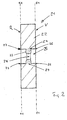
- FIG. 2 shows a cable bushing 21 for sealing a (not shown) cable or pipe outlet of a (also not shown) component housing. Shown are the elastomeric body 22 and the gel body 23. At the contact surface 24 between the elastomer body 22 and the gel body 23 is an intimate connection, but without a recess. The elastomeric body 22 has an opening 25.
- the opening 25 leads from the front side V of the elastomeric body 22 to the rear side R thereof and is delimited by walls which form a circumferential end edge 26, 27 on the front side and the rear side, respectively, so that an opening space is formed which extends from the plane E1, in which the end edge 26 is located on the front side V, to the plane E2, in which the end edge 27 is located on the rear side R, wherein the gel body 23 is arranged in this opening space.
- an opening 28 for passing a long body, such as a cable or a pipe is provided.
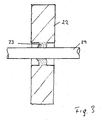
- FIG. 3 shows the device after FIG. 2
- the long body 29 has an outer diameter which is greater than the diameter of the opening 28.
- the inserted long body 29 causes the gel of the gel body 23 to be perpendicular to the longitudinal axis of the long body, ie in the direction of the Elastomer body 22 pushed away.
- the elastomer body 22 gives way to this movement of the gel body 23 elastically.
- the gel body 23 thus pushes the elastomer body 22 outwards so that it is pressed against the wall of the cable and tube outlet (not shown) on its outer circumference.
- a sealing effect is generated by adhesion.
- the elastomer body 22 exerts a restoring force on the gel body 23, which, together with its own restoring force of the gel body 23, results in a sealing engagement of the gel body 23 on the outer circumference of the long body 29.
- FIG. 4 shows a device 30 for sealing a cable or pipe outlet 31.
- the device 30 has an elastomer body 32 with two gel bodies 33, 34.
- the gel body 33 is disposed in an opening 35 of the elastomer body 32 and the gel body 34 in an opening 36 of the elastomer body 32.
- 34 cables 37, 38, 39 are guided, with which the corresponding openings in the gel bodies 33, 34 were first generated.
- the cables 37, 38, 39 were pushed axially by force application through the gel bodies 33, 34.
- the elastomer body 32 has an outer contour which substantially corresponds to the dimensions of the cable or pipe outlet 31. As a result, the elastomer body 32 closes the cable or pipe outlet 31.
- the cable bushings described above are made of the material technology as follows.
- the polyol component is reacted with 13.5 parts by weight of a modified diphenylmethane diisocyanate ("MDI", so-called polymeric MDI, although strictly speaking it is not MDI) having an NCO content of 12%.
- MDI modified diphenylmethane diisocyanate
- the two components are mixed together by means of a conventional low-pressure machine and then introduced into an open mold.
- the aluminum mold encloses a thick-walled hollow cylinder, which is filled by the liquid reacting mass.
- the walls of the mold are coated with a release-friendly plastic (teflon). After about 5 minutes, the finished gel body is removed.
- the soft gel has a Shore 000 hardness of about 65. It is highly elastic with an elongation at break of more than 300%. Shore 000 hardnesses of at least 50, 55 and more preferably at least 60 and of at most 70 and more preferably not more than 65 are advantageous.
- the gel is placed in a mold and forms the inner space of a second cylindrical shape.
- the second form is partially closed.
- a liquid reactive elastomer mixture is mixed with a second low pressure machine and poured into the second mold to make the elastomeric body.
- the polyol component consists of 100 parts by weight of a trifuntionellen polyether polyol having an OH number of 28, 7 parts by weight of butanediol, 1 part by weight of triethylenediamine (33% in monoethylene glycol) and 0.2 parts by weight of dibutyltin dilaurate.
- the isocyanate component which is mixed with the polyol component is a difunctional modified MDI having an NCO content of 23%.
- the resulting elastomer has a Shore A hardness of about 60. Shore A hardnesses of at least 45, 50, 55, and more preferably at least 60, and at most 70, and most preferably at most 65 are advantageous.
- the cable bushing according to the invention allows a very good adaptation to different cable diameters, without any risk of pressure tightness due to differently pronounced strains of pure elastomer membranes or mechanical strength exist or to avoid such difficulties elastomeric parts would have to be replaced line-dependent.
- the elastomer body takes over the seal to the outside to the wall opening or its reveal, such as in an introduction plate of a device housing, and serves for mechanical Abstutzung of the line.
- the gel body serves to adapt the diameter to the actually performed line and to seal against the line. It expands as needed, relying on the elastomeric body, which can expand if necessary. After the line has been pulled in, the restoring forces of the elastomer body, distributed by the attached gel body, act on the line, such as the cable.
- the gel used recovers almost completely after compression, so that the cable leadthrough after removal of the line maintains its sealing area.
- the conduit may have an outer diameter of 30 mm at a previous opening in the gel of only 10 mm.
- the cables only have to be inserted.
- the embodiments may also be designed to be divisible, for example in two halves. The low Shore hardness of the PUR gel allows a corresponding expansion. Introduced cables could be moved even at temperatures of - 20 ° C, without leaking occurred.
Landscapes
- Engineering & Computer Science (AREA)
- General Engineering & Computer Science (AREA)
- Architecture (AREA)
- Civil Engineering (AREA)
- Structural Engineering (AREA)
- Mechanical Engineering (AREA)
- Sealing Material Composition (AREA)
- Insulating Bodies (AREA)
- Compositions Of Macromolecular Compounds (AREA)
- Insulated Conductors (AREA)
- Installation Of Indoor Wiring (AREA)
- Insulators (AREA)
- Cable Accessories (AREA)
- External Artificial Organs (AREA)
- Superconductors And Manufacturing Methods Therefor (AREA)
Priority Applications (4)
| Application Number | Priority Date | Filing Date | Title |
|---|---|---|---|
| EP08015020A EP2159463B1 (de) | 2008-08-26 | 2008-08-26 | Leitungsdurchführung mit Kombinationswerkstoff |
| PL08015020T PL2159463T3 (pl) | 2008-08-26 | 2008-08-26 | Przepust dla przewodów z materiałem kombinowanym |
| DE502008001545T DE502008001545D1 (de) | 2008-08-26 | 2008-08-26 | Leitungsdurchführung mit Kombinationswerkstoff |
| AT08015020T ATE484706T1 (de) | 2008-08-26 | 2008-08-26 | Leitungsdurchführung mit kombinationswerkstoff |
Applications Claiming Priority (1)
| Application Number | Priority Date | Filing Date | Title |
|---|---|---|---|
| EP08015020A EP2159463B1 (de) | 2008-08-26 | 2008-08-26 | Leitungsdurchführung mit Kombinationswerkstoff |
Publications (2)
| Publication Number | Publication Date |
|---|---|
| EP2159463A1 EP2159463A1 (de) | 2010-03-03 |
| EP2159463B1 true EP2159463B1 (de) | 2010-10-13 |
Family
ID=40084298
Family Applications (1)
| Application Number | Title | Priority Date | Filing Date |
|---|---|---|---|
| EP08015020A Not-in-force EP2159463B1 (de) | 2008-08-26 | 2008-08-26 | Leitungsdurchführung mit Kombinationswerkstoff |
Country Status (4)
| Country | Link |
|---|---|
| EP (1) | EP2159463B1 (pl) |
| AT (1) | ATE484706T1 (pl) |
| DE (1) | DE502008001545D1 (pl) |
| PL (1) | PL2159463T3 (pl) |
Families Citing this family (2)
| Publication number | Priority date | Publication date | Assignee | Title |
|---|---|---|---|---|
| EP2866322B1 (de) | 2013-10-27 | 2018-10-10 | Lapp Engineering & Co. | Kabeldurchführungsvorrichtung |
| DE202013012703U1 (de) | 2013-10-27 | 2018-09-10 | Lapp Engineering & Co. | Kabeldurchführungsvorrichtung |
Family Cites Families (2)
| Publication number | Priority date | Publication date | Assignee | Title |
|---|---|---|---|---|
| JPH10505894A (ja) * | 1994-09-21 | 1998-06-09 | レイケム・リミテッド | 封止部材 |
| DE202007002809U1 (de) * | 2007-02-23 | 2007-05-31 | Hauff-Technik Gmbh & Co. Kg | Kombinationswerkstoff und Anwendungen für einen solchen Werkstoff |
-
2008
- 2008-08-26 AT AT08015020T patent/ATE484706T1/de active
- 2008-08-26 DE DE502008001545T patent/DE502008001545D1/de active Active
- 2008-08-26 EP EP08015020A patent/EP2159463B1/de not_active Not-in-force
- 2008-08-26 PL PL08015020T patent/PL2159463T3/pl unknown
Also Published As
| Publication number | Publication date |
|---|---|
| ATE484706T1 (de) | 2010-10-15 |
| EP2159463A1 (de) | 2010-03-03 |
| PL2159463T3 (pl) | 2011-04-29 |
| DE502008001545D1 (de) | 2010-11-25 |
Similar Documents
| Publication | Publication Date | Title |
|---|---|---|
| DE102006059286B4 (de) | Verwendung eines Polyurethan-Gels als Dichtmittel für selbstdichtende Fahrzeugluftreifen, Verfahren zur Herstellung eines selbstdichtenden Fahrzeugluftreifens sowie selbstdichtender Fahrzeugluftreifen | |
| EP1213272B1 (de) | Imprägnierter Körper aus expandiertem Graphit | |
| DE202021102329U1 (de) | Zweischichtiger Laminatboden | |
| EP3642527B1 (de) | Wärmedämmkörper mit schutzschicht | |
| EP2159463B1 (de) | Leitungsdurchführung mit Kombinationswerkstoff | |
| DE102013006623A1 (de) | Kühlmantel für eine elektrische Maschine und Verfahren zur Herstellung einer elektrischen Maschine mit einem Kühlmantel | |
| EP2711593A1 (de) | Dichtungsbalg, Verfahren zu dessen Herstellung und Dichtungsbalg-Anordnung | |
| DE102014211640A1 (de) | RTM-Dichtsystem | |
| DE102019120624A1 (de) | Spendervorrichtung und Verfahren zur Herstellung einer Spendervorrichtung | |
| EP2177810A1 (de) | Stopfen zum dichten Verschliessen eines Rohres | |
| EP1837151B1 (de) | Verfahren zum Herstellen von Kunststoffteilen | |
| DE102007015660A1 (de) | Flexibles wärmeisoliertes Leitungsrohr | |
| DE102011122608A1 (de) | Kunststoffzahnrad mit geschäumtem Kern und ein Verfahren dazu | |
| DE69026009T3 (de) | Verfahren und Vorrichtung zur Herstellung einer Dichtung auf einer Fläche eines Gegenstands | |
| DE202007002809U1 (de) | Kombinationswerkstoff und Anwendungen für einen solchen Werkstoff | |
| WO2011015555A1 (de) | Kontaktierungseinrichtung für eine testanlage | |
| DE102013224027B4 (de) | Durchführungsvorrichtung für Leitungen, insbesondere Hauseinführung | |
| DE202008011342U1 (de) | Leitungsdurchführung mit Kombinationswerkstoff | |
| DE102015225823B4 (de) | Gleitlagerbuchse und Verfahren zur Herstellung der Gleitlagerbuchse | |
| DE102015111078B4 (de) | Schäumwerkzeug mit fahrbarem Dichtungsendstück | |
| EP1961798B1 (de) | Kombinationswerkstoff und Anwendungen für einen solchen Werkstoff | |
| DE102007020227A1 (de) | Dichtung, insbesondere ringförmige Kompressionsdichtung und FIP-Verfahren zur Herstellung einer Dichtung | |
| DE19820498C2 (de) | Verfahren zum Herstellen einer Hülse, insbesondere für die Druckindustrie | |
| EP2441556A2 (de) | Verfahren zur Fertigung von Bauteilen in einem druckdichten Formwerkzeug und druckdichtes Formwerkzeug dafür | |
| DE102010040501B4 (de) | Spritzgussteil |
Legal Events
| Date | Code | Title | Description |
|---|---|---|---|
| PUAI | Public reference made under article 153(3) epc to a published international application that has entered the european phase |
Free format text: ORIGINAL CODE: 0009012 |
|
| 17P | Request for examination filed |
Effective date: 20090130 |
|
| AK | Designated contracting states |
Kind code of ref document: A1 Designated state(s): AT BE BG CH CY CZ DE DK EE ES FI FR GB GR HR HU IE IS IT LI LT LU LV MC MT NL NO PL PT RO SE SI SK TR |
|
| AX | Request for extension of the european patent |
Extension state: AL BA MK RS |
|
| GRAP | Despatch of communication of intention to grant a patent |
Free format text: ORIGINAL CODE: EPIDOSNIGR1 |
|
| RTI1 | Title (correction) |
Free format text: CONDUIT LEAD-THROUGH WITH COMBINATION MATERIAL |
|
| GRAS | Grant fee paid |
Free format text: ORIGINAL CODE: EPIDOSNIGR3 |
|
| GRAA | (expected) grant |
Free format text: ORIGINAL CODE: 0009210 |
|
| AK | Designated contracting states |
Kind code of ref document: B1 Designated state(s): AT BE BG CH CY CZ DE DK EE ES FI FR GB GR HR HU IE IS IT LI LT LU LV MC MT NL NO PL PT RO SE SI SK TR |
|
| REG | Reference to a national code |
Ref country code: GB Ref legal event code: FG4D Free format text: NOT ENGLISH |
|
| REG | Reference to a national code |
Ref country code: CH Ref legal event code: EP |
|
| AKX | Designation fees paid |
Designated state(s): AT BE BG CH CY CZ DE DK EE ES FI FR GB GR HR HU IE IS IT LI LT LU LV MC MT NL NO PL PT RO SE SI SK TR |
|
| REG | Reference to a national code |
Ref country code: IE Ref legal event code: FG4D Free format text: LANGUAGE OF EP DOCUMENT: GERMAN |
|
| REF | Corresponds to: |
Ref document number: 502008001545 Country of ref document: DE Date of ref document: 20101125 Kind code of ref document: P |
|
| REG | Reference to a national code |
Ref country code: CH Ref legal event code: NV Representative=s name: BOVARD AG PATENTANWAELTE |
|
| REG | Reference to a national code |
Ref country code: NL Ref legal event code: T3 |
|
| LTIE | Lt: invalidation of european patent or patent extension |
Effective date: 20101013 |
|
| REG | Reference to a national code |
Ref country code: CH Ref legal event code: PFA Owner name: HAUFF-TECHNIK GMBH & CO. KG Free format text: HAUFF-TECHNIK GMBH & CO. KG#IN DEN STEGWIESEN 18#89542 HERBRECHTINGEN (DE) -TRANSFER TO- HAUFF-TECHNIK GMBH & CO. KG#IN DEN STEGWIESEN 18#89542 HERBRECHTINGEN (DE) |
|
| PG25 | Lapsed in a contracting state [announced via postgrant information from national office to epo] |
Ref country code: NO Free format text: LAPSE BECAUSE OF FAILURE TO SUBMIT A TRANSLATION OF THE DESCRIPTION OR TO PAY THE FEE WITHIN THE PRESCRIBED TIME-LIMIT Effective date: 20110113 Ref country code: LT Free format text: LAPSE BECAUSE OF FAILURE TO SUBMIT A TRANSLATION OF THE DESCRIPTION OR TO PAY THE FEE WITHIN THE PRESCRIBED TIME-LIMIT Effective date: 20101013 |
|
| REG | Reference to a national code |
Ref country code: PL Ref legal event code: T3 |
|
| REG | Reference to a national code |
Ref country code: IE Ref legal event code: FD4D |
|
| PG25 | Lapsed in a contracting state [announced via postgrant information from national office to epo] |
Ref country code: BG Free format text: LAPSE BECAUSE OF FAILURE TO SUBMIT A TRANSLATION OF THE DESCRIPTION OR TO PAY THE FEE WITHIN THE PRESCRIBED TIME-LIMIT Effective date: 20110113 Ref country code: IS Free format text: LAPSE BECAUSE OF FAILURE TO SUBMIT A TRANSLATION OF THE DESCRIPTION OR TO PAY THE FEE WITHIN THE PRESCRIBED TIME-LIMIT Effective date: 20110213 Ref country code: HR Free format text: LAPSE BECAUSE OF FAILURE TO SUBMIT A TRANSLATION OF THE DESCRIPTION OR TO PAY THE FEE WITHIN THE PRESCRIBED TIME-LIMIT Effective date: 20101013 Ref country code: LV Free format text: LAPSE BECAUSE OF FAILURE TO SUBMIT A TRANSLATION OF THE DESCRIPTION OR TO PAY THE FEE WITHIN THE PRESCRIBED TIME-LIMIT Effective date: 20101013 Ref country code: PT Free format text: LAPSE BECAUSE OF FAILURE TO SUBMIT A TRANSLATION OF THE DESCRIPTION OR TO PAY THE FEE WITHIN THE PRESCRIBED TIME-LIMIT Effective date: 20110214 Ref country code: FI Free format text: LAPSE BECAUSE OF FAILURE TO SUBMIT A TRANSLATION OF THE DESCRIPTION OR TO PAY THE FEE WITHIN THE PRESCRIBED TIME-LIMIT Effective date: 20101013 Ref country code: SE Free format text: LAPSE BECAUSE OF FAILURE TO SUBMIT A TRANSLATION OF THE DESCRIPTION OR TO PAY THE FEE WITHIN THE PRESCRIBED TIME-LIMIT Effective date: 20101013 Ref country code: SI Free format text: LAPSE BECAUSE OF FAILURE TO SUBMIT A TRANSLATION OF THE DESCRIPTION OR TO PAY THE FEE WITHIN THE PRESCRIBED TIME-LIMIT Effective date: 20101013 |
|
| PG25 | Lapsed in a contracting state [announced via postgrant information from national office to epo] |
Ref country code: GR Free format text: LAPSE BECAUSE OF FAILURE TO SUBMIT A TRANSLATION OF THE DESCRIPTION OR TO PAY THE FEE WITHIN THE PRESCRIBED TIME-LIMIT Effective date: 20110114 |
|
| PG25 | Lapsed in a contracting state [announced via postgrant information from national office to epo] |
Ref country code: IE Free format text: LAPSE BECAUSE OF FAILURE TO SUBMIT A TRANSLATION OF THE DESCRIPTION OR TO PAY THE FEE WITHIN THE PRESCRIBED TIME-LIMIT Effective date: 20101013 Ref country code: EE Free format text: LAPSE BECAUSE OF FAILURE TO SUBMIT A TRANSLATION OF THE DESCRIPTION OR TO PAY THE FEE WITHIN THE PRESCRIBED TIME-LIMIT Effective date: 20101013 Ref country code: ES Free format text: LAPSE BECAUSE OF FAILURE TO SUBMIT A TRANSLATION OF THE DESCRIPTION OR TO PAY THE FEE WITHIN THE PRESCRIBED TIME-LIMIT Effective date: 20110124 |
|
| PLBE | No opposition filed within time limit |
Free format text: ORIGINAL CODE: 0009261 |
|
| STAA | Information on the status of an ep patent application or granted ep patent |
Free format text: STATUS: NO OPPOSITION FILED WITHIN TIME LIMIT |
|
| PG25 | Lapsed in a contracting state [announced via postgrant information from national office to epo] |
Ref country code: RO Free format text: LAPSE BECAUSE OF FAILURE TO SUBMIT A TRANSLATION OF THE DESCRIPTION OR TO PAY THE FEE WITHIN THE PRESCRIBED TIME-LIMIT Effective date: 20101013 Ref country code: SK Free format text: LAPSE BECAUSE OF FAILURE TO SUBMIT A TRANSLATION OF THE DESCRIPTION OR TO PAY THE FEE WITHIN THE PRESCRIBED TIME-LIMIT Effective date: 20101013 Ref country code: DK Free format text: LAPSE BECAUSE OF FAILURE TO SUBMIT A TRANSLATION OF THE DESCRIPTION OR TO PAY THE FEE WITHIN THE PRESCRIBED TIME-LIMIT Effective date: 20101013 |
|
| 26N | No opposition filed |
Effective date: 20110714 |
|
| REG | Reference to a national code |
Ref country code: DE Ref legal event code: R097 Ref document number: 502008001545 Country of ref document: DE Effective date: 20110714 |
|
| PG25 | Lapsed in a contracting state [announced via postgrant information from national office to epo] |
Ref country code: MT Free format text: LAPSE BECAUSE OF FAILURE TO SUBMIT A TRANSLATION OF THE DESCRIPTION OR TO PAY THE FEE WITHIN THE PRESCRIBED TIME-LIMIT Effective date: 20101013 |
|
| BERE | Be: lapsed |
Owner name: HAUFF-TECHNIK G.M.B.H. & CO. KG Effective date: 20110831 |
|
| PG25 | Lapsed in a contracting state [announced via postgrant information from national office to epo] |
Ref country code: MC Free format text: LAPSE BECAUSE OF NON-PAYMENT OF DUE FEES Effective date: 20110831 |
|
| PG25 | Lapsed in a contracting state [announced via postgrant information from national office to epo] |
Ref country code: BE Free format text: LAPSE BECAUSE OF NON-PAYMENT OF DUE FEES Effective date: 20110831 |
|
| GBPC | Gb: european patent ceased through non-payment of renewal fee |
Effective date: 20120826 |
|
| PG25 | Lapsed in a contracting state [announced via postgrant information from national office to epo] |
Ref country code: CY Free format text: LAPSE BECAUSE OF EXPIRATION OF PROTECTION Effective date: 20101013 |
|
| PG25 | Lapsed in a contracting state [announced via postgrant information from national office to epo] |
Ref country code: GB Free format text: LAPSE BECAUSE OF NON-PAYMENT OF DUE FEES Effective date: 20120826 |
|
| PG25 | Lapsed in a contracting state [announced via postgrant information from national office to epo] |
Ref country code: TR Free format text: LAPSE BECAUSE OF FAILURE TO SUBMIT A TRANSLATION OF THE DESCRIPTION OR TO PAY THE FEE WITHIN THE PRESCRIBED TIME-LIMIT Effective date: 20101013 |
|
| PG25 | Lapsed in a contracting state [announced via postgrant information from national office to epo] |
Ref country code: HU Free format text: LAPSE BECAUSE OF FAILURE TO SUBMIT A TRANSLATION OF THE DESCRIPTION OR TO PAY THE FEE WITHIN THE PRESCRIBED TIME-LIMIT Effective date: 20101013 |
|
| REG | Reference to a national code |
Ref country code: DE Ref legal event code: R082 Ref document number: 502008001545 Country of ref document: DE Representative=s name: KOENIG SZYNKA TILMANN VON RENESSE PATENTANWAEL, DE |
|
| REG | Reference to a national code |
Ref country code: DE Ref legal event code: R081 Ref document number: 502008001545 Country of ref document: DE Owner name: HAUFF-TECHNIK GMBH & CO. KG, DE Free format text: FORMER OWNER: HAUFF-TECHNIK GMBH & CO. KG, 89542 HERBRECHTINGEN, DE Effective date: 20150430 Ref country code: DE Ref legal event code: R082 Ref document number: 502008001545 Country of ref document: DE Representative=s name: KOENIG SZYNKA TILMANN VON RENESSE PATENTANWAEL, DE Effective date: 20150430 |
|
| REG | Reference to a national code |
Ref country code: FR Ref legal event code: PLFP Year of fee payment: 9 |
|
| REG | Reference to a national code |
Ref country code: FR Ref legal event code: PLFP Year of fee payment: 10 |
|
| REG | Reference to a national code |
Ref country code: FR Ref legal event code: PLFP Year of fee payment: 11 |
|
| PGFP | Annual fee paid to national office [announced via postgrant information from national office to epo] |
Ref country code: LU Payment date: 20180822 Year of fee payment: 11 |
|
| PGFP | Annual fee paid to national office [announced via postgrant information from national office to epo] |
Ref country code: ES Payment date: 20180801 Year of fee payment: 11 Ref country code: FR Payment date: 20180824 Year of fee payment: 11 Ref country code: NL Payment date: 20180822 Year of fee payment: 11 |
|
| PGFP | Annual fee paid to national office [announced via postgrant information from national office to epo] |
Ref country code: CH Payment date: 20180827 Year of fee payment: 11 Ref country code: CZ Payment date: 20180816 Year of fee payment: 11 Ref country code: AT Payment date: 20180821 Year of fee payment: 11 Ref country code: PL Payment date: 20180820 Year of fee payment: 11 |
|
| REG | Reference to a national code |
Ref country code: NL Ref legal event code: MM Effective date: 20190901 |
|
| REG | Reference to a national code |
Ref country code: AT Ref legal event code: MM01 Ref document number: 484706 Country of ref document: AT Kind code of ref document: T Effective date: 20190826 |
|
| PG25 | Lapsed in a contracting state [announced via postgrant information from national office to epo] |
Ref country code: AT Free format text: LAPSE BECAUSE OF NON-PAYMENT OF DUE FEES Effective date: 20190826 |
|
| PG25 | Lapsed in a contracting state [announced via postgrant information from national office to epo] |
Ref country code: CZ Free format text: LAPSE BECAUSE OF NON-PAYMENT OF DUE FEES Effective date: 20190826 Ref country code: CH Free format text: LAPSE BECAUSE OF NON-PAYMENT OF DUE FEES Effective date: 20190831 Ref country code: LU Free format text: LAPSE BECAUSE OF NON-PAYMENT OF DUE FEES Effective date: 20190826 Ref country code: LI Free format text: LAPSE BECAUSE OF NON-PAYMENT OF DUE FEES Effective date: 20190831 |
|
| PG25 | Lapsed in a contracting state [announced via postgrant information from national office to epo] |
Ref country code: FR Free format text: LAPSE BECAUSE OF NON-PAYMENT OF DUE FEES Effective date: 20190831 Ref country code: NL Free format text: LAPSE BECAUSE OF NON-PAYMENT OF DUE FEES Effective date: 20190901 |
|
| PG25 | Lapsed in a contracting state [announced via postgrant information from national office to epo] |
Ref country code: IT Free format text: LAPSE BECAUSE OF NON-PAYMENT OF DUE FEES Effective date: 20190826 |
|
| PG25 | Lapsed in a contracting state [announced via postgrant information from national office to epo] |
Ref country code: PL Free format text: LAPSE BECAUSE OF NON-PAYMENT OF DUE FEES Effective date: 20190826 |
|
| PGFP | Annual fee paid to national office [announced via postgrant information from national office to epo] |
Ref country code: DE Payment date: 20220822 Year of fee payment: 15 |
|
| P01 | Opt-out of the competence of the unified patent court (upc) registered |
Effective date: 20230512 |
|
| REG | Reference to a national code |
Ref country code: DE Ref legal event code: R119 Ref document number: 502008001545 Country of ref document: DE |
|
| PG25 | Lapsed in a contracting state [announced via postgrant information from national office to epo] |
Ref country code: DE Free format text: LAPSE BECAUSE OF NON-PAYMENT OF DUE FEES Effective date: 20240301 |