EP2157697A1 - Konfigurierbare schaltung und konfigurationsverfahren - Google Patents
Konfigurierbare schaltung und konfigurationsverfahren Download PDFInfo
- Publication number
- EP2157697A1 EP2157697A1 EP08721040A EP08721040A EP2157697A1 EP 2157697 A1 EP2157697 A1 EP 2157697A1 EP 08721040 A EP08721040 A EP 08721040A EP 08721040 A EP08721040 A EP 08721040A EP 2157697 A1 EP2157697 A1 EP 2157697A1
- Authority
- EP
- European Patent Office
- Prior art keywords
- programmable
- wires
- wire
- configurable circuit
- switch
- Prior art date
- Legal status (The legal status is an assumption and is not a legal conclusion. Google has not performed a legal analysis and makes no representation as to the accuracy of the status listed.)
- Granted
Links
Images




Classifications
-
- H—ELECTRICITY
- H03—ELECTRONIC CIRCUITRY
- H03K—PULSE TECHNIQUE
- H03K19/00—Logic circuits, i.e. having at least two inputs acting on one output; Inverting circuits
- H03K19/02—Logic circuits, i.e. having at least two inputs acting on one output; Inverting circuits using specified components
- H03K19/173—Logic circuits, i.e. having at least two inputs acting on one output; Inverting circuits using specified components using elementary logic circuits as components
- H03K19/177—Logic circuits, i.e. having at least two inputs acting on one output; Inverting circuits using specified components using elementary logic circuits as components arranged in matrix form
- H03K19/17736—Structural details of routing resources
-
- H—ELECTRICITY
- H03—ELECTRONIC CIRCUITRY
- H03K—PULSE TECHNIQUE
- H03K19/00—Logic circuits, i.e. having at least two inputs acting on one output; Inverting circuits
- H03K19/02—Logic circuits, i.e. having at least two inputs acting on one output; Inverting circuits using specified components
- H03K19/173—Logic circuits, i.e. having at least two inputs acting on one output; Inverting circuits using specified components using elementary logic circuits as components
- H03K19/177—Logic circuits, i.e. having at least two inputs acting on one output; Inverting circuits using specified components using elementary logic circuits as components arranged in matrix form
- H03K19/1778—Structural details for adapting physical parameters
Definitions
- the present invention relates to a configurable circuit and a configuration method which can program connections of a plurality of logic blocks.
- a configurable circuit where a plurality of logic blocks are connected in a programmable wire structure such as a Field Programmable Gate Array (FPGA) or a Programmable Logic Device (PLD), has been widely used.
- FPGA Field Programmable Gate Array
- PLD Programmable Logic Device
- FIG. 1 is a block diagram illustrating a configuration example of a related FPGA.
- the FPGA is composed of arrangements of programmable cells 201_x (x is an integer). Although the arrangements are normally two-dimensional, FIG. 1 shows one-dimensional arrangements as a part.
- each of the programmable cells includes programmable logic block 4, wire group 10, programmable switches 2x_y (x and y are integers), and input selectors 3_x (x is an integer).
- programmable cell 201_1 includes programmable switches 21_1, 21_2 and 22_2 and input selectors 3_1 and 3_2.
- Programmable logic block 4 has a plurality of input terminals (A and B of FIG. 1 ) and output terminal C, and realizes a variety of logic functions based on data (configuration data) recorded on a configuration memory (not shown).
- Wire group 10 is to transmit data between different programmable cells.
- Programmable switch 2x_y connects wire 1x_y or output terminal C of programmable logic block 4 to an adjacent wire, or disconnects the adjacent wires (x and y are integers).
- Input selector 3_x selects a signal transmitted via one wire of wire group 10, and supplies the selected signal to the input terminal (A and B of FIG. 1 ) of programmable logic block.
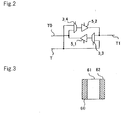
- FIG. 2 is a block diagram illustrating a configuration example of related programmable switch 2x_y (x and y are integers). This switch executes any one of the following three functions according to configuration data. Select a signal input to any one of terminals T0 and T using selector 3_4, and output the signal to terminal T1 via tristate buffer 5_2. Select a signal input to any one of terminals T1 and T using selector 3_3, and output the signal to terminal T0 via tristate buffer 5_1. Disconnect terminals T0 and T1.
- wire group 10 is composed of plural kinds of wires.
- FIG. 1 shows an example in which wire group 10 is composed of short distance wire group 11 and long distance wire group 12.
- Short distance wire group 11 has a length equivalent to a width of the programmable cell, and is appropriate for signal transmission between the neighboring programmable cells.
- Long distance wire group 12 has a length equivalent to two widths of the programmable cell, and is appropriate for signal transmission between the programmable cells spaced apart from each other over two cells.
- FIG. 1 shows two kinds of wires for simplification, actually, more kinds of wires are necessary. Accordingly, the number of the wires increases, so that the area of the programmable cell increases.
- FIG. 3 shows a configuration example of the switch element.
- the memory-type low resistance switch element includes metal electrode 60 which is difficult to ionize, metal electrode 62 which is easy to ionize, and electrolyte 61. Both metal electrodes are connected or disconnected according to a method for applying a voltage between metal electrode 60 which is difficult to ionize and metal electrode 62 which is easy to ionize. Since a resistance of connection of these electrodes is much lower than that of the MOS transistor of the same occupancy area (by over a number of one cipher), it is possible to realize a high performance switch with a small area. Moreover, since the connection or disconnection state once formed is maintained for a certain period of time, memory for memorization is not necessary. As a result, a circuit using the memory-type low resistance switch element can be implemented in a smaller area than a circuit which does not use the same.
- the memory-type low resistance switch element will be applied to the configurable circuit which uses a lot of switches because of the excellent performance of the memory-type low resistance switch element described above.
- the switches e.g. selectors and tristate buffers
- the overall circuit area is seldom reduced.
- the configurable circuit normally includes a plurality of wires and large buffers which occupy a large area, narrowing the switch portions does not sufficiently contribute to a reduction of the overall circuit area.
- An object of the present invention is to provide a configurable circuit and a configuration method which can reduce the circuit area.
- a configurable circuit of the present invention includes a plurality of logic blocks, and a programmable bus which can program connections of the plurality of logic blocks, wherein the programmable bus comprises a plurality of wires which are arranged for each of signal transmission ranges corresponding to the plurality of logic blocks and which connect adjacent logic blocks; a direct wire connection switch which can program whether to directly connect or disconnect the wires between adjacent the signal transmission ranges; an input selector which is arranged to correspond to each of the plurality of logic blocks, which can program a connection with any one of the plurality of wires, and which supplies a signal of a connected wire to the logic block; and a programmable switch which is arranged for each of the signal transmission ranges and which can program whether to make a connection with the wire corresponding to adjacent the signal transmission range via a buffer for each of the plurality of wires, a plurality of programmable switches being arranged for at least one of the plurality of logic blocks.
- the number of the wires and the occupancy area of the buffers are reduced, so that the overall circuit area can be reduced.
- FIG. 4 is a block diagram illustrating a configuration example of a configurable circuit of this exemplary embodiment.
- the configurable circuit of this exemplary embodiment is composed of arrangements of plurality of programmable cells 1_x (x is an integer).
- each of the programmable cells includes programmable logic block 4, short distance wire group 11, direct wire connection switches 711_y, programmable switches 40_y, and input selectors 30_y (y is an integer).
- a programmable bus arranged between plurality of programmable logic blocks 4 includes short distance wire group 11, direct wire connection switches 711_y, programmable switches 40_y, and input selectors 30_y.
- Programmable logic block 4 has a plurality of input terminals (A and B of FIG. 4 ) and output terminal C, and realizes a variety of logic functions based on data recorded on a configuration memory (not shown).
- Short distance wire group 11 is to transmit data between different programmable cells.
- short distance wire group 11 includes plurality of short distance wires 11_y (y is an integer) having a length equivalent to a width of the programmable cell.
- the plurality of short distance wires 11_y between direct wire connection switches 711_y correspond to signal transmission ranges of the present invention.
- Direct wire connection switch 711_y is a memory-type low resistance switch element which programmably connects or disconnects the adjacent short distance wires 11_y.
- the memory-type low resistance switch element is constructed as explained with reference to FIG. 3 .
- Metal electrode 60 which is difficult to ionize is connected to short distance wire 11_y of programmable cell 1_k (k is an arbitrary integer), and metal electrode 62 which is easy to ionize is connected to short distance wire 11_y of programmable cell 1_k+1. Meanwhile, such different kinds of metal electrodes may be disposed reversely.
- short distance wires 11_y of the adjacent programmable cells are connected to metal electrode 60 which is difficult to ionize and metal electrode 62 which is easy to ionize, respectively.
- Programmable switch 40_z (z is an integer) programmably outputs a signal of any one of terminals T0, T1, T2, T3 and T to at least one of terminals T0, T1, T2 and T3 (in this case, input and output terminals are different), or disconnects the terminals.
- Terminal T0 is connected to short distance wire 11_2 of programmable cell 1_1, and terminal T1 is connected to short distance wire 11_2 of programmable cell 1_2.
- Terminal T2 is connected to short distance wire 11_1 of programmable cell 1_1, and terminal T3 is connected to short distance wire 11_1 of programmable cell 1_2.
- Terminal T is connected to terminal T of another programmable switch in the same programmable cell.
- terminals T of programmable switches 40_1 and 40_2 are connected to each other.
- output terminal C of programmable logic block 4 is connected to a wire connecting two terminals T.
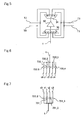
- FIG. 5 is a block diagram illustrating a configuration example of programmable switch 40_z.
- respective terminals T0, T1, T, T2 and T3 are connected to respective input terminals t1, t3, t2, t0 and t4 of input selector 30.
- Input selector 30 programmably sets whether to output a signal of any one of the input terminals to output terminal t, or not to output any signal.
- the output signal of input selector 30 is provided to input terminal t of output selector 31 via buffer 50.
- Respective terminals T0, T1, T2 and T3 are connected to respective output terminals t1, t2, t0 and t3 of output selector 31.
- Output selector 31 programmably sets whether or not to output a signal of input terminal t to each of output terminals t0, t1, t2 and t3.
- FIG. 6 is a circuit view illustrating a configuration example of input selector 30.
- Each of input terminals t0, t1, t2, t3 and t4 is connected to one of two metal electrodes of each of memory-type low resistance switch elements 730_0, 730_1, 730_2, 730_3 and 730_4.
- the other metal electrodes of memory-type low resistance switch elements 730_0, 730_1, 730_2, 730_3 and 730_4 are connected to form output terminal t.
- FIG. 7 is a circuit view illustrating a configuration example of output selector 31.
- Each of output terminals t0, t1, t2 and t3 is connected to one of two metal electrodes of each of memory-type low resistance switch elements 731_0, 731_1, 731_2 and 731_3.
- the other metal electrodes of memory-type low resistance switch elements 731_0, 731_1, 731_2 and 731_3 are connected to form input terminal t.
- the programmable switch of FIG. 5 can output a signal of any one of terminals T0, T1, T2, T3 and T to at least one of terminals T0, T1, T2 and T3 (in this case, input and output terminals are different), or disconnect the terminals.
- the programmable switch is characterized in that the buffer is arranged between the input and output. This buffer has a sufficient driving force to drive one-line short distance wire (e.g. short distance wire 11_1 or 11_2 of FIG. 4 ).
- input selectors 30_1 and 30_2 of FIG. 4 will be explained.
- Two input terminals of input selector 30_1 are connected to short distance wires 11_1 and 11_2, respectively, and an output terminal is connected to input terminal B of programmable logic block 4.
- Two input terminals of input selector 30_2 are connected to short distance wires 11_1 and 11_2, respectively, and an output terminal is connected to input terminal A of programmable logic block 4.
- Each of input selectors 30_1 and 30_2 of FIG. 4 selects a signal from short distance wire group 11, and supplies the selected signal to each of input terminals B and A of programmable logic block 4.
- These selectors basically have the same construction as that of input selector 30 of FIG. 6 except the number of the input terminals.
- the input selectors are formed of MOS transistors.
- FIG. 6 when the input selectors are formed of memory-type low resistance switch elements, there is an advantage that the area and load capacity can be considerably reduced.
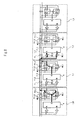
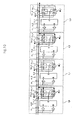
- FIG. 8 is a diagram illustrating a first operation example of the configurable circuit of this exemplary embodiment. Thick arrows indicate signal paths, and thick lines passing through the terminals of direct wire connection switches 711_y, programmable switches 40_y and input selectors 30_y (y is an integer) indicate connections of the corresponding terminals.
- direct wire connection switches 711_1 and 711_2 in programmable cell 1_0 direct wire connection switch 711_1 and programmable switch 40_1 in programmable cell 1_1
- direct wire connection switches 711_1 and 711_2 and programmable switches 40_1 and 40_2 in programmable cell 1_2 are all set to be disconnected.
- output terminal C of programmable logic block 4 in programmable cell 1_1 outputs a signal to short distance wire 11_1 annexed to adjacent programmable cell 1_2 via programmable switch 40_2. This signal is supplied to input terminal A of programmable logic block 4 via input selector 30_2 in programmable cell 1_2.
- output terminal C of programmable logic block 4 in programmable cell 1_0 outputs a signal to short distance wire 11_2 annexed to adjacent programmable cell 1_1 via both programmable switches 40_1 and 40_2.
- This signal is transferred to short distance wire 11_2 annexed to programmable cell 1_2 via direct wire connection switch 711_2 in programmable cell 1_1, and supplied to input terminal B of programmable logic block 4 via input selector 30_1 in programmable cell 1_2.
- Short distance wire 11_1 annexed to programmable cell 1_2 of FIG. 8 is a single segment short distance wire that is disconnected from other short distance wires. Therefore, at least a buffer for a short distance wire, is sufficient to drive its cell. In FIG. 8 , it is driven merely by programmable switch 40_2 in programmable cell 1_1.
- short distance wire 11_2 annexed to programmable cell 1_1 and short distance wire 11_2 annexed to programmable cell 1_2 are connected via direct wire connection switch 711_2 in programmable cell 1_1 to thereby form a long distance wire. Since the connection using the direct wire connection switch is a direct connection which does not pass through a buffer, the long distance wire so formed has the same load capacity as that of a wire having a segment length equivalent to two widths of the programmable cell.
- the same signal (the output from output terminal C of programmable logic block 4) is output to the same short distance wire (short distance wire 11_2 annexed to programmable cell 1_1) via both programmable switches 40_1 and 40_2.
- the two programmable switches are used to double the driving force, it is possible to drive the long distance wire at a high speed.
- the buffer in one programmable switch since the buffer in one programmable switch has a sufficient driving force to drive one short distance wire, if a long distance wire is driven using the one buffer, signal transmission is delayed and performance is degraded.
- a sufficient driving force to drive a long distance wire can be obtained using the two programmable switches.
- an ON resistance of a memory-type low resistance switch is much smaller than that of a transistor. Accordingly, two short distance wires connected via the direct wire connection switch adopting the same are similar to a one-line short distance wire without a joint, which can attain high speed signal transmission.
- the direct wire connection switch is formed of a transistor (e.g. a pass transistor or transmission gate), its resistance and capacity considerably increase. Even if the long distance wire is driven by a buffer with a large driving force, its performance is much lower than that of the one-line long distance wire. Moreover, switches (portions corresponding to switch elements 731_x of FIG. 7 ) constituting an output selector (a portion corresponding to output selector 31 of FIG. 5 ) of a programmable switch should have a low resistance to transfer a large driving force after the buffer. If these switches are formed of the memory-type low resistance switches, they can attain the desired end with a small area. However, if these switches are formed of the transistors, they occupy a very large area and inevitably have a much smaller driving force.
- a transistor e.g. a pass transistor or transmission gate
- the long distance wire is formed by the programmable connection of the short distance wires
- the buffer for the long distance wire is formed by the programmable coupling of the buffers for the short distance wire.
- the memory-type low resistance switch is essential to accomplish practical performance in a small area. The switch formed of the transistor cannot attain the desired end.
- the first operation example of FIG. 8 overlaps signal transmission to an adjacent programmable cell with long distance signal transmission to a programmable cell spaced apart over two programmable cells.
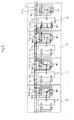
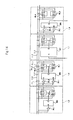
- FIG. 9 is a diagram illustrating the second operation example of the configurable circuit of this exemplary embodiment. Thick arrows indicate those explained in the first operation example.
- direct wire connection switches 711_1 and 711_2 and programmable switch 40_2 in programmable cell 1_0, direct wire connection switches 711_1 and 711_2 in programmable cell 1_1, direct wire connection switches 711_1 and 711_2 in programmable cell 1_2, and direct wire connection switches 711_1 and 711_2 and programmable switches 40_1 and 40_2 in programmable cell 1_3 are all set to be disconnected.
- output terminal C of programmable logic block 4 in programmable cell 1_0 outputs a signal to short distance wire 11_2 annexed to adjacent programmable cell 1_1 via programmable switch 40_1.
- This signal is output to short distance wire 11_2 annexed to programmable cell 1_2 via programmable switch 40_1 in programmable cell 1_1.
- the signal is output to short distance wire 11_2 annexed to programmable cell 1_3 via programmable switch 40_1 in programmable cell 1_2, and supplied to input terminal A of programmable logic block 4 via input selector 30_2. That is, in the signal transmission from programmable cell 1_0 to programmable cell 1_3, the signal is transmitted, buffered by the programmable switch in each programmable cell on a path.
- output terminal C of programmable logic block 4 in programmable cell 1_1 outputs a signal to short distance wire 11_1 annexed to adjacent programmable cell 1_2 via programmable switch 40_2.
- This signal is output to short distance wire 11_1 annexed to programmable cell 1_3 via programmable switch 40_2 in programmable cell 1_2, and supplied to input terminal B of programmable logic block 4 via input selector 30_1. That is, in the signal transmission from programmable cell 1_1 to programmable cell 1_3, the signal is transmitted, buffered by the programmable switch in each programmable cell on a path.
- the long distance wire using direct wire connection switch 711_1 (y is an integer) is not employed. If such a long distance wire is used, since it is necessary to buffer a signal through two or more programmable switches in any programmable cell, it is impossible to secure a programmable switch for an additional one-line signal path.
- the long distance wire using direct wire connection switch 711_y (y is an integer) has a merit such as high speed long distance signal transmission, it uses many programmable switches. It is thus possible to use only a small number of long distance wires.
- both wires may be appropriately used according to a state of using wires or required performance.
- FIG. 10 is a diagram illustrating the third operation example of the configurable circuit of this exemplary embodiment. Thick arrows indicate those explained in the first operation example.
- direct wire connection switches 711_1 and 711_2 in programmable cell 1_0, direct wire connection switch 711_2 and programmable switches 40_1 and 40_2 in programmable cell 1_1, direct wire connection switches 711_1 and 711_2 in programmable cell 1_2, and direct wire connection switch 711_2 and programmable switches 40_1 and 40_2 in programmable cell 1_3 are all set to be disconnected.
- Short distance wire 11_1 annexed to programmable cell 1_0 outputs a signal to short distance wire 11_1 annexed to adjacent programmable cell 1_1 via both programmable switches 40_1 and 40_2.
- Short distance wires 11_1 annexed to programmable cells 1_1 and 1_2 are connected via direct wire connection switch 711_1 in programmable cell 1_1 to form a long distance wire, and the aforementioned signal is transmitted to short distance wire 11_1 annexed to programmable cell 1_2 at a high speed. Thereafter, the signal is output to an adjacent long distance wire via both programmable switches 40_1 and 40_2 in programmable cell 1_2.
- the plurality of programmable switches are used as relay buffers, thereby fulfilling high speed long distance signal transmission. This method is useful when it is not necessary to secure a programmable switch for other purpose.
- the first exemplary embodiment of the present invention has been explained on the assumption that two lines of short distance wires are formed for one programmable cell.
- the number of short distance wires is not limited thereto but is arbitrary.
- FIG. 11 is a block diagram illustrating a configuration example of the programmable cell of this example.
- four lines of short distance wires 11_1, 11_2, 11_3 and 11_4 are arranged for one programmable cell 1a.
- four direct wire connection switches 711_1, 711_2, 711_3 and 711_4 are arranged as direct wire connection switches which connect adjacent short distance wires.
- four programmable switches 40_1, 40_2, 40_3 and 40_4 are arranged, and each of them has nine terminals T0, T1, T2, T3, T4, T5, T6, T7 and T.
- input selector 30 and output selector 31 of FIG. 5 have four more terminals, respectively.
- One of terminals T0, T1, T2, T3, T4, T5, T6, T7 and T is selected to output a signal to T and a terminal other than itself, or the terminals are disconnected.
- any one of the following wire configurations can be set.
- Two two-cell long distance wires Two lines of short distance wires are connected via a direct wire connection switch)
- One two-cell long distance wire and two short distance wires One three-cell long distance wire (three lines of short distance wires are connected via a direct wire connection switch), and one short distance wire
- One four-cell long distance wire four lines of short distance wires are connected via a direct wire connection switch
- the short distance wire is driven by one programmable switch
- the two-cell long distance wire is driven by two programmable switches
- the three-cell long distance wire is driven by three programmable switches
- the four-cell long distance wire is driven by four programmable switches, respectively.
- a variety of wire configurations can be set by increasing the number of the wires and the number of the programmable switches.
- this exemplary embodiment preferably has much fewer wires and programmable switches (or buffers) than the related configurable circuit.
- the related configurable circuit requires a long distance wire for exclusive use and a programmable switch for sufficiently driving the same to perform high speed long distance transmission.
- the first exemplary embodiment does not have such a long distance transmission path for exclusive use, but has short distance wires and programmable switches sufficient to drive the same.
- the high speed long distance transmission can be programmably formed using the short distance wires.
- the related configurable circuit includes many kinds of wire resources, individual application circuits use a small part of them. Although the related configurable circuit includes wire resources appropriate for different uses, respective application circuits use only a part of them. That is, most of the wire resources are not used. The related configurable circuit needs a large area because it has losses to deal with such various circuits.
- the first exemplary embodiment of the present invention if necessary, it is possible to programmably form optimum transmission paths having different lengths. It is thus not necessary to form various transmission paths for exclusive use in advance.
- this example has fewer wires or programmable switches (including buffers) than the related configurable circuit, if necessary, the configurable circuit can flexibly use them as various transmission paths. Accordingly, there is never a lack of transmission paths.
- the wires or buffers occupying a large area in the related configurable circuit can be reduced, a small area configurable circuit can be realized.
- the input number and area of the input selectors (input selectors 30_1 and 30_2 of FIG. 4 or 11 ) also decrease.
- FIG. 12 is a block diagram illustrating a configuration example of the programmable cell of this example.
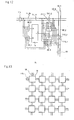
- vertical short distance wire group 15 where a plurality of short distance wires are disposed in a vertical direction is arranged in programmable cell 1 b of this example. Adjacent vertical short distance wires 15_x are programmably connected via direct wire connection switch 715_x (x is an integer). Also, vertical short distance wire 15_x is programmably connected to horizontal short distance wire 11_xb or output terminal C of programmable logic block 4 via programmable switch 40_x. Moreover, a signal transmitted via vertical short distance wire is input to input selector 30_x.
- FIG. 13 is a layout view illustrating an example of use of the programmable cell of this example.
- programmable cells 1 b of FIG. 12 are arranged in a two-dimensional array form, and connected via horizontal short distance wire group 11 b in a horizontal direction and via vertical short distance wire group 15 in a vertical direction.
- FPGA or PLD which is a typical example of the configurable circuit, as shown in FIG. 13 , same programmable cells are arranged in an array form.
- FIG. 14 is a block diagram illustrating a configuration example of a configurable circuit of this exemplary embodiment.
- a plurality of programmable cells 1_x are connected via short distance wires 11_x (x is an integer).
- the programmable cells are not identical.
- logic blocks 305, 306, 307 and 308 are not necessarily identical circuits, and may not be programmable.
- Exemplary logic blocks include circuits for exclusive use, such as an adder, multiplier and memory unit.
- the number of input selectors 30_x (x is an integer) and the number of terminals may be different in each programmable cell.
- two input selectors 30_1 and 30_2 are provided in each of programmable cells 1_6 and 1_8, one input selector 30_1 is provided in programmable cell 1_5, and no input selector is provided in programmable cell 1_7.
- an output of logic block 308 may not be connected to programmable switch 40_x.
- short distance wire group 11, direct wire connection switches 711_x and programmable switches 40_x comprise a configurable bus.
- Arbitrary logic blocks are connected through the configurable bus (the logic blocks are not essentially programmable). Differently from a bus for exclusive use of the related configurable circuit, the configuration of the configurable bus can be changed after chip manufacturing, so that the same chip can be used for plural purposes. Further, it is helpful to correct bugs after manufacturing.
- the entire chip is formed as a configurable circuit like the FPGA, it improves flexibility, but has a much larger area than a circuit for exclusive use. With respect to this, forming only a bus configurable to secure appropriate flexibility may be advantageous in terms of cost performance.
- FIG. 15 is a chip layout view illustrating another example of use of the configurable circuit of FIG. 14 .
- a plurality of I/O cells 90 are arranged in a peripheral portion of chip 100, and a plurality of programmable cells 1_x (x is an integer) are arranged in chip 100. Such cells are connected via short distance wire group 11.
- I/O cell 90 which is a kind of programmable cell shown in FIG 14 , includes as a logic block a circuit for transmitting and receiving data to/from a portion other than the chip such as an I/O buffer. Many different kinds of chips may be manufactured according to more or less specification differences in the position or number of the I/O.
- the circuit of FIG. 15 makes it possible to arrange different kinds of chips of the related configurable circuit into one kind of chip, which reduces costs.
- adjacent wires are connected via a programmable switch or a direct wire connection switch.
- a driving force of the wires in a signal transmission range is supplied from a buffer included in the programmable switch.
- a long distance wire is formed and supplied with a driving force from a plurality of programmable switches.
- the present invention does not need wires for long distance and short distance, respectively, and thus does not need extra wires either.
- a plurality of short distance wires are connected via a memory-type low resistance switch element to form a long distance wire.
- driving buffers for the plurality of short distance wires are coupled via a memory-type low resistance switch element to form a buffer for the long distance wire with a large driving force.
- the wires and buffers can be remarkably reduced.
- the configurable circuit can be embodied in a smaller area than the related configurable circuit.
Landscapes
- Physics & Mathematics (AREA)
- Mathematical Physics (AREA)
- Engineering & Computer Science (AREA)
- Computer Hardware Design (AREA)
- Computing Systems (AREA)
- General Engineering & Computer Science (AREA)
- Computer Networks & Wireless Communication (AREA)
- Design And Manufacture Of Integrated Circuits (AREA)
- Logic Circuits (AREA)
Applications Claiming Priority (2)
| Application Number | Priority Date | Filing Date | Title |
|---|---|---|---|
| JP2007060353 | 2007-03-09 | ||
| PCT/JP2008/053592 WO2008111406A1 (ja) | 2007-03-09 | 2008-02-29 | コンフィギュラブル回路およびコンフィギュレーション方法 |
Publications (3)
| Publication Number | Publication Date |
|---|---|
| EP2157697A1 true EP2157697A1 (de) | 2010-02-24 |
| EP2157697A4 EP2157697A4 (de) | 2011-01-26 |
| EP2157697B1 EP2157697B1 (de) | 2013-02-27 |
Family
ID=39759349
Family Applications (1)
| Application Number | Title | Priority Date | Filing Date |
|---|---|---|---|
| EP08721040A Not-in-force EP2157697B1 (de) | 2007-03-09 | 2008-02-29 | Konfigurierbare schaltung und konfigurationsverfahren |
Country Status (5)
| Country | Link |
|---|---|
| US (1) | US7919980B2 (de) |
| EP (1) | EP2157697B1 (de) |
| JP (1) | JP5170079B2 (de) |
| CN (1) | CN101627541B (de) |
| WO (1) | WO2008111406A1 (de) |
Families Citing this family (2)
| Publication number | Priority date | Publication date | Assignee | Title |
|---|---|---|---|---|
| JP6156151B2 (ja) * | 2012-01-11 | 2017-07-05 | 日本電気株式会社 | 双方向バッファ及びその制御方法 |
| US9030232B2 (en) * | 2012-04-13 | 2015-05-12 | Semiconductor Energy Laboratory Co., Ltd. | Isolator circuit and semiconductor device |
Family Cites Families (15)
| Publication number | Priority date | Publication date | Assignee | Title |
|---|---|---|---|---|
| JP3123977B2 (ja) * | 1998-06-04 | 2001-01-15 | 日本電気株式会社 | プログラマブル機能ブロック |
| US6469540B2 (en) * | 2000-06-15 | 2002-10-22 | Nec Corporation | Reconfigurable device having programmable interconnect network suitable for implementing data paths |
| JP3496661B2 (ja) | 2000-06-15 | 2004-02-16 | 日本電気株式会社 | データパスに適したプログラマブル相互接続網を有する再構成可能デバイス |
| US6580289B2 (en) * | 2001-06-08 | 2003-06-17 | Viasic, Inc. | Cell architecture to reduce customization in a semiconductor device |
| JP2003273336A (ja) | 2002-03-13 | 2003-09-26 | Nec Electronics Corp | 汎用ロジックセルアレイ及びこれを用いたasic |
| JP2005057452A (ja) | 2003-08-01 | 2005-03-03 | Matsushita Electric Ind Co Ltd | プログラマブル論理回路 |
| JP4356542B2 (ja) | 2003-08-27 | 2009-11-04 | 日本電気株式会社 | 半導体装置 |
| JP4621424B2 (ja) | 2003-11-20 | 2011-01-26 | 独立行政法人科学技術振興機構 | プログラマブル論理回路およびプログラマブル論理回路の配線構造 |
| US7056773B2 (en) | 2004-04-28 | 2006-06-06 | International Business Machines Corporation | Backgated FinFET having different oxide thicknesses |
| US7330050B2 (en) * | 2004-11-08 | 2008-02-12 | Tabula, Inc. | Storage elements for a configurable IC and method and apparatus for accessing data stored in the storage elements |
| US7825684B2 (en) * | 2005-03-15 | 2010-11-02 | Tabula, Inc. | Variable width management for a memory of a configurable IC |
| JP2007060353A (ja) | 2005-08-25 | 2007-03-08 | Nec Corp | 携帯電話装置、携帯電話システム、電源ユニット、電源ユニット認証方法、およびプログラム |
| US7765249B1 (en) * | 2005-11-07 | 2010-07-27 | Tabula, Inc. | Use of hybrid interconnect/logic circuits for multiplication |
| US7797497B1 (en) * | 2006-03-08 | 2010-09-14 | Tabula, Inc. | System and method for providing more logical memory ports than physical memory ports |
| US7825685B2 (en) * | 2007-09-06 | 2010-11-02 | Tabula, Inc. | Configuration context switcher with a clocked storage element |
-
2008
- 2008-02-29 EP EP08721040A patent/EP2157697B1/de not_active Not-in-force
- 2008-02-29 WO PCT/JP2008/053592 patent/WO2008111406A1/ja not_active Ceased
- 2008-02-29 JP JP2009503963A patent/JP5170079B2/ja not_active Expired - Fee Related
- 2008-02-29 US US12/526,344 patent/US7919980B2/en active Active
- 2008-02-29 CN CN2008800075299A patent/CN101627541B/zh not_active Expired - Fee Related
Also Published As
| Publication number | Publication date |
|---|---|
| US7919980B2 (en) | 2011-04-05 |
| CN101627541A (zh) | 2010-01-13 |
| CN101627541B (zh) | 2013-04-10 |
| JPWO2008111406A1 (ja) | 2010-06-24 |
| US20100321062A1 (en) | 2010-12-23 |
| JP5170079B2 (ja) | 2013-03-27 |
| EP2157697B1 (de) | 2013-02-27 |
| WO2008111406A1 (ja) | 2008-09-18 |
| EP2157697A4 (de) | 2011-01-26 |
Similar Documents
| Publication | Publication Date | Title |
|---|---|---|
| KR100246903B1 (ko) | 프로그램가능 논리셀과 그 배열 | |
| US5594363A (en) | Logic cell and routing architecture in a field programmable gate array | |
| US6810513B1 (en) | Method and apparatus of programmable interconnect array with configurable multiplexer | |
| US5327023A (en) | Programmable logic device | |
| US10762019B2 (en) | Bus sharing scheme | |
| US7394286B2 (en) | Field programmable gate array long line routing network | |
| US6924664B2 (en) | Field programmable gate array | |
| CN108292629A (zh) | 半导体集成电路装置 | |
| CN104145427A (zh) | 查找表 | |
| US6674303B1 (en) | Programmable input/output cell with bidirectional and shift register capabilities | |
| EP2157697B1 (de) | Konfigurierbare schaltung und konfigurationsverfahren | |
| US6605959B1 (en) | Structure and method for implementing wide multiplexers | |
| US7215141B2 (en) | Merged logic element routing multiplexer | |
| EP0280257B1 (de) | Integrierter Schaltkreis vom "Master slice" Typ | |
| JP5313531B2 (ja) | 互い違いにされた論理アレイブロックのアーキテクチャ | |
| JPH10246754A (ja) | クロックドライバ回路及び半導体集積回路装置 | |
| US5900742A (en) | Interface cell for a programmable integrated circuit employing antifuses | |
| CN112448707B (zh) | 开关箱 | |
| US7605606B1 (en) | Area efficient routing architectures for programmable logic devices | |
| JP2025153349A (ja) | 半導体装置 | |
| JP2000082745A (ja) | 半導体装置 | |
| JP4368722B2 (ja) | 汎用ロジックセルを備えた半導体装置 | |
| US8395189B2 (en) | Semiconductor integrated circuit device | |
| JP2004336253A (ja) | 多結晶半導体薄膜トランジスタを用いる論理回路 | |
| JPH0644709B2 (ja) | プログラマブル配線スイツチ |
Legal Events
| Date | Code | Title | Description |
|---|---|---|---|
| PUAI | Public reference made under article 153(3) epc to a published international application that has entered the european phase |
Free format text: ORIGINAL CODE: 0009012 |
|
| 17P | Request for examination filed |
Effective date: 20090925 |
|
| AK | Designated contracting states |
Kind code of ref document: A1 Designated state(s): AT BE BG CH CY CZ DE DK EE ES FI FR GB GR HR HU IE IS IT LI LT LU LV MC MT NL NO PL PT RO SE SI SK TR |
|
| AX | Request for extension of the european patent |
Extension state: AL BA MK RS |
|
| DAX | Request for extension of the european patent (deleted) | ||
| A4 | Supplementary search report drawn up and despatched |
Effective date: 20101223 |
|
| GRAP | Despatch of communication of intention to grant a patent |
Free format text: ORIGINAL CODE: EPIDOSNIGR1 |
|
| GRAS | Grant fee paid |
Free format text: ORIGINAL CODE: EPIDOSNIGR3 |
|
| GRAA | (expected) grant |
Free format text: ORIGINAL CODE: 0009210 |
|
| AK | Designated contracting states |
Kind code of ref document: B1 Designated state(s): AT BE BG CH CY CZ DE DK EE ES FI FR GB GR HR HU IE IS IT LI LT LU LV MC MT NL NO PL PT RO SE SI SK TR |
|
| REG | Reference to a national code |
Ref country code: GB Ref legal event code: FG4D |
|
| REG | Reference to a national code |
Ref country code: CH Ref legal event code: EP |
|
| REG | Reference to a national code |
Ref country code: AT Ref legal event code: REF Ref document number: 598942 Country of ref document: AT Kind code of ref document: T Effective date: 20130315 |
|
| REG | Reference to a national code |
Ref country code: IE Ref legal event code: FG4D |
|
| REG | Reference to a national code |
Ref country code: DE Ref legal event code: R096 Ref document number: 602008022489 Country of ref document: DE Effective date: 20130425 |
|
| REG | Reference to a national code |
Ref country code: AT Ref legal event code: MK05 Ref document number: 598942 Country of ref document: AT Kind code of ref document: T Effective date: 20130227 |
|
| REG | Reference to a national code |
Ref country code: LT Ref legal event code: MG4D |
|
| PG25 | Lapsed in a contracting state [announced via postgrant information from national office to epo] |
Ref country code: NO Free format text: LAPSE BECAUSE OF FAILURE TO SUBMIT A TRANSLATION OF THE DESCRIPTION OR TO PAY THE FEE WITHIN THE PRESCRIBED TIME-LIMIT Effective date: 20130527 Ref country code: AT Free format text: LAPSE BECAUSE OF FAILURE TO SUBMIT A TRANSLATION OF THE DESCRIPTION OR TO PAY THE FEE WITHIN THE PRESCRIBED TIME-LIMIT Effective date: 20130227 Ref country code: SE Free format text: LAPSE BECAUSE OF FAILURE TO SUBMIT A TRANSLATION OF THE DESCRIPTION OR TO PAY THE FEE WITHIN THE PRESCRIBED TIME-LIMIT Effective date: 20130227 Ref country code: ES Free format text: LAPSE BECAUSE OF FAILURE TO SUBMIT A TRANSLATION OF THE DESCRIPTION OR TO PAY THE FEE WITHIN THE PRESCRIBED TIME-LIMIT Effective date: 20130607 Ref country code: BG Free format text: LAPSE BECAUSE OF FAILURE TO SUBMIT A TRANSLATION OF THE DESCRIPTION OR TO PAY THE FEE WITHIN THE PRESCRIBED TIME-LIMIT Effective date: 20130527 Ref country code: LT Free format text: LAPSE BECAUSE OF FAILURE TO SUBMIT A TRANSLATION OF THE DESCRIPTION OR TO PAY THE FEE WITHIN THE PRESCRIBED TIME-LIMIT Effective date: 20130227 Ref country code: IS Free format text: LAPSE BECAUSE OF FAILURE TO SUBMIT A TRANSLATION OF THE DESCRIPTION OR TO PAY THE FEE WITHIN THE PRESCRIBED TIME-LIMIT Effective date: 20130627 |
|
| REG | Reference to a national code |
Ref country code: NL Ref legal event code: VDEP Effective date: 20130227 |
|
| PG25 | Lapsed in a contracting state [announced via postgrant information from national office to epo] |
Ref country code: SI Free format text: LAPSE BECAUSE OF FAILURE TO SUBMIT A TRANSLATION OF THE DESCRIPTION OR TO PAY THE FEE WITHIN THE PRESCRIBED TIME-LIMIT Effective date: 20130227 Ref country code: PT Free format text: LAPSE BECAUSE OF FAILURE TO SUBMIT A TRANSLATION OF THE DESCRIPTION OR TO PAY THE FEE WITHIN THE PRESCRIBED TIME-LIMIT Effective date: 20130627 Ref country code: FI Free format text: LAPSE BECAUSE OF FAILURE TO SUBMIT A TRANSLATION OF THE DESCRIPTION OR TO PAY THE FEE WITHIN THE PRESCRIBED TIME-LIMIT Effective date: 20130227 Ref country code: BE Free format text: LAPSE BECAUSE OF FAILURE TO SUBMIT A TRANSLATION OF THE DESCRIPTION OR TO PAY THE FEE WITHIN THE PRESCRIBED TIME-LIMIT Effective date: 20130227 Ref country code: LV Free format text: LAPSE BECAUSE OF FAILURE TO SUBMIT A TRANSLATION OF THE DESCRIPTION OR TO PAY THE FEE WITHIN THE PRESCRIBED TIME-LIMIT Effective date: 20130227 Ref country code: PL Free format text: LAPSE BECAUSE OF FAILURE TO SUBMIT A TRANSLATION OF THE DESCRIPTION OR TO PAY THE FEE WITHIN THE PRESCRIBED TIME-LIMIT Effective date: 20130227 Ref country code: GR Free format text: LAPSE BECAUSE OF FAILURE TO SUBMIT A TRANSLATION OF THE DESCRIPTION OR TO PAY THE FEE WITHIN THE PRESCRIBED TIME-LIMIT Effective date: 20130528 |
|
| PG25 | Lapsed in a contracting state [announced via postgrant information from national office to epo] |
Ref country code: HR Free format text: LAPSE BECAUSE OF FAILURE TO SUBMIT A TRANSLATION OF THE DESCRIPTION OR TO PAY THE FEE WITHIN THE PRESCRIBED TIME-LIMIT Effective date: 20130227 |
|
| REG | Reference to a national code |
Ref country code: CH Ref legal event code: PL |
|
| PG25 | Lapsed in a contracting state [announced via postgrant information from national office to epo] |
Ref country code: LI Free format text: LAPSE BECAUSE OF NON-PAYMENT OF DUE FEES Effective date: 20130228 Ref country code: SK Free format text: LAPSE BECAUSE OF FAILURE TO SUBMIT A TRANSLATION OF THE DESCRIPTION OR TO PAY THE FEE WITHIN THE PRESCRIBED TIME-LIMIT Effective date: 20130227 Ref country code: RO Free format text: LAPSE BECAUSE OF FAILURE TO SUBMIT A TRANSLATION OF THE DESCRIPTION OR TO PAY THE FEE WITHIN THE PRESCRIBED TIME-LIMIT Effective date: 20130227 Ref country code: NL Free format text: LAPSE BECAUSE OF FAILURE TO SUBMIT A TRANSLATION OF THE DESCRIPTION OR TO PAY THE FEE WITHIN THE PRESCRIBED TIME-LIMIT Effective date: 20130227 Ref country code: CH Free format text: LAPSE BECAUSE OF NON-PAYMENT OF DUE FEES Effective date: 20130228 Ref country code: CZ Free format text: LAPSE BECAUSE OF FAILURE TO SUBMIT A TRANSLATION OF THE DESCRIPTION OR TO PAY THE FEE WITHIN THE PRESCRIBED TIME-LIMIT Effective date: 20130227 Ref country code: MC Free format text: LAPSE BECAUSE OF NON-PAYMENT OF DUE FEES Effective date: 20130331 Ref country code: EE Free format text: LAPSE BECAUSE OF FAILURE TO SUBMIT A TRANSLATION OF THE DESCRIPTION OR TO PAY THE FEE WITHIN THE PRESCRIBED TIME-LIMIT Effective date: 20130227 Ref country code: DK Free format text: LAPSE BECAUSE OF FAILURE TO SUBMIT A TRANSLATION OF THE DESCRIPTION OR TO PAY THE FEE WITHIN THE PRESCRIBED TIME-LIMIT Effective date: 20130227 |
|
| PG25 | Lapsed in a contracting state [announced via postgrant information from national office to epo] |
Ref country code: CY Free format text: LAPSE BECAUSE OF FAILURE TO SUBMIT A TRANSLATION OF THE DESCRIPTION OR TO PAY THE FEE WITHIN THE PRESCRIBED TIME-LIMIT Effective date: 20130227 |
|
| REG | Reference to a national code |
Ref country code: IE Ref legal event code: MM4A |
|
| PG25 | Lapsed in a contracting state [announced via postgrant information from national office to epo] |
Ref country code: IT Free format text: LAPSE BECAUSE OF FAILURE TO SUBMIT A TRANSLATION OF THE DESCRIPTION OR TO PAY THE FEE WITHIN THE PRESCRIBED TIME-LIMIT Effective date: 20130227 |
|
| PLBE | No opposition filed within time limit |
Free format text: ORIGINAL CODE: 0009261 |
|
| STAA | Information on the status of an ep patent application or granted ep patent |
Free format text: STATUS: NO OPPOSITION FILED WITHIN TIME LIMIT |
|
| PG25 | Lapsed in a contracting state [announced via postgrant information from national office to epo] |
Ref country code: IE Free format text: LAPSE BECAUSE OF NON-PAYMENT OF DUE FEES Effective date: 20130228 |
|
| 26N | No opposition filed |
Effective date: 20131128 |
|
| REG | Reference to a national code |
Ref country code: DE Ref legal event code: R097 Ref document number: 602008022489 Country of ref document: DE Effective date: 20131128 |
|
| PG25 | Lapsed in a contracting state [announced via postgrant information from national office to epo] |
Ref country code: MT Free format text: LAPSE BECAUSE OF FAILURE TO SUBMIT A TRANSLATION OF THE DESCRIPTION OR TO PAY THE FEE WITHIN THE PRESCRIBED TIME-LIMIT Effective date: 20130227 |
|
| PG25 | Lapsed in a contracting state [announced via postgrant information from national office to epo] |
Ref country code: TR Free format text: LAPSE BECAUSE OF FAILURE TO SUBMIT A TRANSLATION OF THE DESCRIPTION OR TO PAY THE FEE WITHIN THE PRESCRIBED TIME-LIMIT Effective date: 20130227 |
|
| PG25 | Lapsed in a contracting state [announced via postgrant information from national office to epo] |
Ref country code: HU Free format text: LAPSE BECAUSE OF FAILURE TO SUBMIT A TRANSLATION OF THE DESCRIPTION OR TO PAY THE FEE WITHIN THE PRESCRIBED TIME-LIMIT; INVALID AB INITIO Effective date: 20080229 Ref country code: LU Free format text: LAPSE BECAUSE OF NON-PAYMENT OF DUE FEES Effective date: 20130228 |
|
| REG | Reference to a national code |
Ref country code: FR Ref legal event code: PLFP Year of fee payment: 9 |
|
| PGFP | Annual fee paid to national office [announced via postgrant information from national office to epo] |
Ref country code: DE Payment date: 20160223 Year of fee payment: 9 |
|
| PGFP | Annual fee paid to national office [announced via postgrant information from national office to epo] |
Ref country code: FR Payment date: 20160108 Year of fee payment: 9 Ref country code: GB Payment date: 20160224 Year of fee payment: 9 |
|
| REG | Reference to a national code |
Ref country code: DE Ref legal event code: R119 Ref document number: 602008022489 Country of ref document: DE |
|
| GBPC | Gb: european patent ceased through non-payment of renewal fee |
Effective date: 20170228 |
|
| REG | Reference to a national code |
Ref country code: FR Ref legal event code: ST Effective date: 20171031 |
|
| PG25 | Lapsed in a contracting state [announced via postgrant information from national office to epo] |
Ref country code: DE Free format text: LAPSE BECAUSE OF NON-PAYMENT OF DUE FEES Effective date: 20170901 Ref country code: FR Free format text: LAPSE BECAUSE OF NON-PAYMENT OF DUE FEES Effective date: 20170228 |
|
| PG25 | Lapsed in a contracting state [announced via postgrant information from national office to epo] |
Ref country code: GB Free format text: LAPSE BECAUSE OF NON-PAYMENT OF DUE FEES Effective date: 20170228 |