EP2155387B1 - Zweistufiges verfahren zur reaktivierung thermisch gealterter stickoxid-speicherkatalysatoren - Google Patents
Zweistufiges verfahren zur reaktivierung thermisch gealterter stickoxid-speicherkatalysatoren Download PDFInfo
- Publication number
- EP2155387B1 EP2155387B1 EP08736263A EP08736263A EP2155387B1 EP 2155387 B1 EP2155387 B1 EP 2155387B1 EP 08736263 A EP08736263 A EP 08736263A EP 08736263 A EP08736263 A EP 08736263A EP 2155387 B1 EP2155387 B1 EP 2155387B1
- Authority
- EP
- European Patent Office
- Prior art keywords
- catalyst
- gas mixture
- process step
- process according
- lean
- Prior art date
- Legal status (The legal status is an assumption and is not a legal conclusion. Google has not performed a legal analysis and makes no representation as to the accuracy of the status listed.)
- Not-in-force
Links
Images

Classifications
-
- B—PERFORMING OPERATIONS; TRANSPORTING
- B01—PHYSICAL OR CHEMICAL PROCESSES OR APPARATUS IN GENERAL
- B01D—SEPARATION
- B01D53/00—Separation of gases or vapours; Recovering vapours of volatile solvents from gases; Chemical or biological purification of waste gases, e.g. engine exhaust gases, smoke, fumes, flue gases, aerosols
- B01D53/34—Chemical or biological purification of waste gases
- B01D53/96—Regeneration, reactivation or recycling of reactants
-
- B—PERFORMING OPERATIONS; TRANSPORTING
- B01—PHYSICAL OR CHEMICAL PROCESSES OR APPARATUS IN GENERAL
- B01J—CHEMICAL OR PHYSICAL PROCESSES, e.g. CATALYSIS OR COLLOID CHEMISTRY; THEIR RELEVANT APPARATUS
- B01J23/00—Catalysts comprising metals or metal oxides or hydroxides, not provided for in group B01J21/00
- B01J23/90—Regeneration or reactivation
- B01J23/96—Regeneration or reactivation of catalysts comprising metals, oxides or hydroxides of the noble metals
-
- B—PERFORMING OPERATIONS; TRANSPORTING
- B01—PHYSICAL OR CHEMICAL PROCESSES OR APPARATUS IN GENERAL
- B01D—SEPARATION
- B01D53/00—Separation of gases or vapours; Recovering vapours of volatile solvents from gases; Chemical or biological purification of waste gases, e.g. engine exhaust gases, smoke, fumes, flue gases, aerosols
- B01D53/34—Chemical or biological purification of waste gases
- B01D53/92—Chemical or biological purification of waste gases of engine exhaust gases
- B01D53/94—Chemical or biological purification of waste gases of engine exhaust gases by catalytic processes
-
- B—PERFORMING OPERATIONS; TRANSPORTING
- B01—PHYSICAL OR CHEMICAL PROCESSES OR APPARATUS IN GENERAL
- B01J—CHEMICAL OR PHYSICAL PROCESSES, e.g. CATALYSIS OR COLLOID CHEMISTRY; THEIR RELEVANT APPARATUS
- B01J23/00—Catalysts comprising metals or metal oxides or hydroxides, not provided for in group B01J21/00
- B01J23/002—Mixed oxides other than spinels, e.g. perovskite
-
- B—PERFORMING OPERATIONS; TRANSPORTING
- B01—PHYSICAL OR CHEMICAL PROCESSES OR APPARATUS IN GENERAL
- B01J—CHEMICAL OR PHYSICAL PROCESSES, e.g. CATALYSIS OR COLLOID CHEMISTRY; THEIR RELEVANT APPARATUS
- B01J23/00—Catalysts comprising metals or metal oxides or hydroxides, not provided for in group B01J21/00
- B01J23/38—Catalysts comprising metals or metal oxides or hydroxides, not provided for in group B01J21/00 of noble metals
- B01J23/54—Catalysts comprising metals or metal oxides or hydroxides, not provided for in group B01J21/00 of noble metals combined with metals, oxides or hydroxides provided for in groups B01J23/02 - B01J23/36
- B01J23/56—Platinum group metals
- B01J23/63—Platinum group metals with rare earths or actinides
-
- B—PERFORMING OPERATIONS; TRANSPORTING
- B01—PHYSICAL OR CHEMICAL PROCESSES OR APPARATUS IN GENERAL
- B01J—CHEMICAL OR PHYSICAL PROCESSES, e.g. CATALYSIS OR COLLOID CHEMISTRY; THEIR RELEVANT APPARATUS
- B01J38/00—Regeneration or reactivation of catalysts, in general
- B01J38/04—Gas or vapour treating; Treating by using liquids vaporisable upon contacting spent catalyst
-
- F—MECHANICAL ENGINEERING; LIGHTING; HEATING; WEAPONS; BLASTING
- F01—MACHINES OR ENGINES IN GENERAL; ENGINE PLANTS IN GENERAL; STEAM ENGINES
- F01N—GAS-FLOW SILENCERS OR EXHAUST APPARATUS FOR MACHINES OR ENGINES IN GENERAL; GAS-FLOW SILENCERS OR EXHAUST APPARATUS FOR INTERNAL-COMBUSTION ENGINES
- F01N3/00—Exhaust or silencing apparatus having means for purifying, rendering innocuous, or otherwise treating exhaust
- F01N3/08—Exhaust or silencing apparatus having means for purifying, rendering innocuous, or otherwise treating exhaust for rendering innocuous
-
- B—PERFORMING OPERATIONS; TRANSPORTING
- B01—PHYSICAL OR CHEMICAL PROCESSES OR APPARATUS IN GENERAL
- B01D—SEPARATION
- B01D2255/00—Catalysts
- B01D2255/20—Metals or compounds thereof
- B01D2255/204—Alkaline earth metals
- B01D2255/2042—Barium
-
- B—PERFORMING OPERATIONS; TRANSPORTING
- B01—PHYSICAL OR CHEMICAL PROCESSES OR APPARATUS IN GENERAL
- B01D—SEPARATION
- B01D2255/00—Catalysts
- B01D2255/20—Metals or compounds thereof
- B01D2255/206—Rare earth metals
- B01D2255/2065—Cerium
-
- B—PERFORMING OPERATIONS; TRANSPORTING
- B01—PHYSICAL OR CHEMICAL PROCESSES OR APPARATUS IN GENERAL
- B01D—SEPARATION
- B01D53/00—Separation of gases or vapours; Recovering vapours of volatile solvents from gases; Chemical or biological purification of waste gases, e.g. engine exhaust gases, smoke, fumes, flue gases, aerosols
- B01D53/34—Chemical or biological purification of waste gases
- B01D53/92—Chemical or biological purification of waste gases of engine exhaust gases
- B01D53/94—Chemical or biological purification of waste gases of engine exhaust gases by catalytic processes
- B01D53/9404—Removing only nitrogen compounds
- B01D53/9409—Nitrogen oxides
- B01D53/9413—Processes characterised by a specific catalyst
- B01D53/9422—Processes characterised by a specific catalyst for removing nitrogen oxides by NOx storage or reduction by cyclic switching between lean and rich exhaust gases (LNT, NSC, NSR)
-
- B—PERFORMING OPERATIONS; TRANSPORTING
- B01—PHYSICAL OR CHEMICAL PROCESSES OR APPARATUS IN GENERAL
- B01J—CHEMICAL OR PHYSICAL PROCESSES, e.g. CATALYSIS OR COLLOID CHEMISTRY; THEIR RELEVANT APPARATUS
- B01J2235/00—Indexing scheme associated with group B01J35/00, related to the analysis techniques used to determine the catalysts form or properties
-
- B—PERFORMING OPERATIONS; TRANSPORTING
- B01—PHYSICAL OR CHEMICAL PROCESSES OR APPARATUS IN GENERAL
- B01J—CHEMICAL OR PHYSICAL PROCESSES, e.g. CATALYSIS OR COLLOID CHEMISTRY; THEIR RELEVANT APPARATUS
- B01J2235/00—Indexing scheme associated with group B01J35/00, related to the analysis techniques used to determine the catalysts form or properties
- B01J2235/15—X-ray diffraction
-
- B—PERFORMING OPERATIONS; TRANSPORTING
- B01—PHYSICAL OR CHEMICAL PROCESSES OR APPARATUS IN GENERAL
- B01J—CHEMICAL OR PHYSICAL PROCESSES, e.g. CATALYSIS OR COLLOID CHEMISTRY; THEIR RELEVANT APPARATUS
- B01J2523/00—Constitutive chemical elements of heterogeneous catalysts
-
- B—PERFORMING OPERATIONS; TRANSPORTING
- B01—PHYSICAL OR CHEMICAL PROCESSES OR APPARATUS IN GENERAL
- B01J—CHEMICAL OR PHYSICAL PROCESSES, e.g. CATALYSIS OR COLLOID CHEMISTRY; THEIR RELEVANT APPARATUS
- B01J38/00—Regeneration or reactivation of catalysts, in general
- B01J38/04—Gas or vapour treating; Treating by using liquids vaporisable upon contacting spent catalyst
- B01J38/06—Gas or vapour treating; Treating by using liquids vaporisable upon contacting spent catalyst using steam
-
- B—PERFORMING OPERATIONS; TRANSPORTING
- B01—PHYSICAL OR CHEMICAL PROCESSES OR APPARATUS IN GENERAL
- B01J—CHEMICAL OR PHYSICAL PROCESSES, e.g. CATALYSIS OR COLLOID CHEMISTRY; THEIR RELEVANT APPARATUS
- B01J38/00—Regeneration or reactivation of catalysts, in general
- B01J38/04—Gas or vapour treating; Treating by using liquids vaporisable upon contacting spent catalyst
- B01J38/08—Gas or vapour treating; Treating by using liquids vaporisable upon contacting spent catalyst using ammonia or derivatives thereof
Definitions
- the invention relates to a two-stage process for reactivating thermally aged nitrogen oxide storage catalysts which contain nitrogen oxide-storing compounds on a cerium oxide-containing support material and platinum as the catalytically active noble metal.
- Nitrogen oxide storage catalysts are used to remove the nitrogen oxides contained in the lean exhaust gas from so-called lean-burn engines.
- the cleaning effect is based on the fact that in a lean phase of operation of the engine, the nitrogen oxides are stored by the storage material of the storage catalyst mainly in the form of nitrates and decomposes the previously formed nitrates in a subsequent rich phase of operation of the engine and the released nitrogen oxides with the reducing exhaust gas components on the storage catalyst be converted to nitrogen, carbon dioxide and water.
- the lean-burn engines include gasoline and diesel engines that can run on a lean air / fuel mixture.
- the nitrogen oxides contained in the exhaust gas of these engines during the lean phases consist to a large extent of nitrogen monoxide.
- Nitrogen storage catalysts accordingly consist of a catalyst material, which is usually applied in the form of a coating on a support body.
- the catalyst material contains a nitrogen oxide storage material and a catalytically active component.
- the nitrogen oxide storage material in turn consists of the actual nitrogen oxide storage component, which is deposited on a carrier material in highly dispersed form.
- the storage components used are predominantly the basic oxides of the alkali metals, the alkaline earth metals and the rare earth metals, but in particular strontium oxide and barium oxide, which react with nitrogen dioxide to give the corresponding nitrates. It is known that these materials are predominantly in air in the form of carbonates and hydroxides. These compounds are also suitable for storing the nitrogen oxides. Therefore, when speaking of the basic storage oxides in the context of the invention, so are the corresponding carbonates and hydroxides included.
- Suitable carrier materials for the storage components are temperature-stable metal oxides with a high surface area of more than 10 m 2 / g, which enable highly dispersed deposition of the storage components.
- the present invention is particularly concerned with memory materials comprising ceria-containing support materials. These include doped cerium oxides and especially cerium-zirconium mixed oxides, which may also be doped.
- the catalytically active components used are the noble metals of the platinum group, which can be present separately from the storage components on a separate carrier material.
- the support material used for the platinum group metals is usually active, high surface area alumina is used, which may also contain doping components.
- the object of the catalytically active components is to convert carbon monoxide and hydrocarbons into carbon dioxide and water in the lean exhaust gas.
- they should oxidize the proportion of the exhaust gas to nitrogen oxide to nitrogen dioxide, so that it can react with the basic storage material to nitrates.
- the nitrates formed are decomposed into nitrogen oxides and reduced with the aid of the catalytically active components and using carbon monoxide, hydrogen and hydrocarbons as a reducing agent to nitrogen to form water and carbon dioxide.
- reaction products of such aging processes are non-volatile.
- the prerequisite is that the reaction conditions are known, under which the products formed in the aging reaction can be specifically recycled back into the catalytically active starting compounds.
- barium carbonate BaCeO 3 which during the thermal aging of nitrogen oxide storage catalysts containing barium oxide as a storage component in a ceria-based nitrogen oxide storage material, by treating with a nitrogen dioxide, water vapor and optionally carbon dioxide-containing gas mixture at 300 ° C to 500 ° C. be decomposed again into barium oxide and cerium oxide.
- WO 07/009679 the applicant describes a process for reactivation of thermally aged nitrogen oxide storage catalysts, which this process is based.
- nitrogen oxides are stored in the storage material in the form of nitrates.
- the storage capacity of the material decreases. Therefore, from time to time a regeneration of the storage material must be done.
- the engine is operated for a short time with rich air / fuel mixtures.
- the interplay of nitrogen oxide storage and regeneration of the storage material results in the characteristic of this type of catalyst cyclic operation of lean and rich phase, the lean phase is typically 5 to 50 times as long as the fat phase.
- reactivation of the catalyst refers exclusively to the partial recovery of catalytic activity, previously in a thermal
- the thermal aging process has been lost.
- the thermal aging process is always superimposed on the cyclic mode of operation, which includes regeneration, when the catalytic converter is exposed to high operating temperatures.
- the reactivation is not part of the standard driving operation, but must, if it can take place in the vehicle at all, specifically initiated and regulated as a separate operating state by the engine control of the vehicle.
- a reactivation of the catalyst can also take place outside the driving operation, for example during maintenance. To do so, it may be necessary to remove the aged and reactivated catalyst from the vehicle and treat it in a separate facility from the vehicle.
- the catalytic activity of a thermally aged nitrogen oxide storage catalyst comprising basic strontium or barium compounds on a ceria-containing support material and, moreover, strontium and / or barium compounds formed by thermal aging with the support material all strontium cerium and / or barium cerium - contains, by treatment with a nitrogen dioxide, water vapor and optionally carbon dioxide-containing gas mixture at 300 ° C to 500 ° C at least partially restored.
- the present invention was based on the object that already in the WO 07/009679 described reactivation process to the effect that the damaged in thermal aging processes catalytically active components are at least partially reactivated.
- the improved aging stability of the catalyst is based essentially on the reversibility of the formation of a solid solution of platinum, barium and cerium oxide of the formula (Ba, Pt) CeO 3 or Ba (Ce, Pt) O 3 .
- Pt is therefore part of the solid solution under slightly lean exhaust conditions. In the transition to a slightly rich atmosphere, it is partially dissolved out of the composite again and deposited separately on the mixed oxide. In a quick change between slightly rich and slightly lean conditions, as is common in the operation of three-way catalysts, platinum remains according to the said document so accessible in an active form.
- platinum oxide PtO 2 is first formed in a first step at high temperatures in an oxygen-containing atmosphere. This has a certain thermal mobility in the catalyst and reacts with the nitrogen oxide storage component barium carbonate at 650 to 700 ° C according to equation (1) to barium platinate: PtO 2 + BaCO 3 ⁇ BaPtO 3 + CO 2 (1)
- the nitrogen oxide storage component is present in supported form on a cerium oxide-containing carrier material, barium cerate is formed at sufficiently high temperatures in a parallel reaction (2).
- the object of the present invention was, as already mentioned, to provide a method by which the original catalytic activity of such a damaged catalyst can be restored as far as possible by returning the barium and the platinum to a catalytically active state.
- This object is achieved by a two-stage process for reactivating a thermally aged nitrogen oxide storage catalyst, wherein the storage catalyst in addition to platinum as a catalytically active component basic strontium or barium compounds or strontium and barium compounds on a cerium oxide-containing support material and also formed by thermal aging strontium - And / or barium compounds with the carrier material including platinum.
- the method is characterized in that the catalyst is heated in a first step in a reducing agent-containing gas mixture to a temperature between 100 ° C and 500 ° C and then in a staggered second method step with a nitrogen dioxide and water vapor-containing gas mixture at temperatures between 300 ° C and 500 ° C is treated.
- the aged catalyst In order to be able to release platinum in the first process step in finely divided, catalytically active form from the ternary, barium, cerium and platinum-containing oxide formed during the thermal aging, the aged catalyst must be treated with a gas mixture which is a suitable reducing agent in sufficient Concentration contains. In order to convert barium back into a nitrogen oxide-storing compound in the second process step, the catalyst must be treated with a gas mixture containing at least nitrogen dioxide and water vapor in suitable concentrations.
- the type of gases required for reactivation determines the two-step nature of the process: In the simultaneous presence of a reducing agent and the nitrogen dioxide acting as an oxidizing agent in a gas mixture, the reaction of the reactants required for the reactivation would be preferred. For the much slower reactivation of the catalyst would not be enough reducing agent or nitrogen dioxide left. It follows that the first and the second process step must be consecutive, ie temporally offset run.
- the gas mixture used in the first process step preferably contains hydrogen or carbon monoxide or ammonia or hydrocarbons or mixtures thereof as reducing agent. Particularly preferred are hydrogen or carbon monoxide or mixtures thereof.
- concentrations of the reducing agent must be selected so that the gas mixture used in the first process step has an average reducing effect, that is proportionately more reducing agent than oxidizing components such as oxygen.
- An exhaust gas optionally used in the first process step must therefore be rich, i. have an air ratio ⁇ ⁇ 1.
- Particularly suitable for use in the first process step are gas mixtures which are free of oxygen.
- the nature of the reducing agent used in the first process step also determines the optimum temperature that should be selected in the first partial reactivation of the thermally aged catalyst to re-release the platinum.
- a gas mixture which contains hydrogen in a concentration of 0.5 to 15 vol .-%, wherein the catalyst is heated to a temperature between 150 ° C and 400 ° C.
- the gas mixture particularly preferably contains 3 to 15% by volume of hydrogen, very particularly preferably 5 to 10% by volume of hydrogen.
- the recovery of the platinum in finely divided, catalytically active form begins in a hydrogen-containing atmosphere even at relatively low temperatures, and then proceeds at higher temperatures with increasing speed.
- the catalyst in the hydrogen-containing atmosphere at 150 ° C to 350 ° C, most preferably heated to 200 ° C to 300 ° C.
- a gas mixture containing hydrocarbons as a reducing agent is used in the first process step, temperatures of at least 300 ° C. are required.
- the catalyst is heated in a 0.1 to 15 vol .-% hydrocarbons containing gas mixture in the first step to a temperature between 300 ° C and 500 ° C.
- the gas mixture particularly preferably contains 1 to 10% by volume of hydrocarbons. If this gas mixture is free of oxygen, the decomposition of the hydrocarbons used takes place from 300 ° C. to form hydrogen. At residual oxygen contents, partial oxidation of the hydrocarbons with formation of carbon monoxide already occurs at slightly lower temperatures.
- a gas mixture is used in the first process step, which contains 0.5 to 15 vol .-% carbon monoxide, wherein the catalyst is heated to 150 ° C to 400 ° C.
- the gas mixture also contains 0.5 to 15% by volume of steam, preferably 5 to 10% by volume of steam, temperatures of 200 ° C. are again followed by a rapid water gas shift reaction, as a result of which the reducing agent is used
- the barium-cerium-platinate produces highly effective hydrogen.
- temperatures in the range from 200 ° C. to 400 ° C. in the first process stage lead to an excellent reactivation result.
- the nitrogen oxide storage catalyst to be reactivated is part of an exhaust gas purification system on a vehicle with a lean-burn engine
- the use of a gas mixture containing ammonia as a reducing agent in the first process step may be particularly advantageous.
- the exhaust gas purification system contains, in addition to the nitrogen oxide storage catalyst, a catalyst for selective catalytic reduction and a device for metering ammonia or a compound which decomposes to ammonia into the exhaust gas line.
- Ammonia can then via a arranged in front of the nitrogen oxide storage catalyst metering in the first process step additionally introduced into the exhaust system and used to reduce the platinum in Ba 2 CePtO 6 .
- the catalyst is treated with a nitrogen dioxide and water vapor-containing gas mixture at temperatures between 300 ° C and 500 ° C.
- the gas mixture preferably contains 0.05 to 35% by volume of nitrogen oxides in addition to 5 to 50% by volume of oxygen and 5 to 30% by volume of steam.
- a particularly rapid and complete decomposition of the barium cerate is achieved when the gas mixture used in the second process stage also contains 5 to 20 vol .-% carbon dioxide.
- the inventive method is suitable for reactivating thermally aged nitrogen oxide storage catalysts that are part of an exhaust gas purification system on a vehicle with a lean-burn engine.
- the catalyst it may be advantageous to expand the catalyst to carry out the reactivation of the vehicle.
- the entire two-stage reactivation process outside of the vehicle can take place in a suitable apparatus. It is also conceivable that only the first stage of the method is performed outside the vehicle, while the second stage of the method is carried out "on board" using the exhaust gas generated by the lean-burn engine at certain operating points.
- the reactivation can take place, for example, in a temperature-controlled oven through which a suitable gas mixture flows.
- the required gas mixtures can be provided premixed in gas pressure vessels.
- the needed Gas mixtures of their constituents which are presented in various gas pressure vessels optionally supplemented by a water tank with evaporator, are prepared in an upstream of the furnace, tempered gas mixing section with optimum composition.
- the advantage of such an embodiment is that both the composition of the gas mixtures used for reactivation and the reactivation times can be optimally adjusted.
- the gas mixture used in the first process step is oxygen-free.
- the nitrogen oxide storage catalytic converter is part of an exhaust gas purification system on a vehicle with a lean-burn engine, then such oxygen-free gas mixture can not be provided by engine exhaust gas, since the exhaust gas that can be generated by the engine has appreciable residual oxygen contents in all usual operating points.
- the implementation of a (partial) reactivation outside the vehicle is therefore appropriate.
- the treatment of the thermally aged nitrogen oxide storage catalytic converter in carrying out the reactivation outside the vehicle takes 0.2 to 12 hours in the first method step, and 0.1 to 5 hours in the second method step.
- the thermally aged nitrogen oxide storage catalytic converter to be reactivated forms part of an exhaust gas purification system on a vehicle with lean-burn engine and exhaust gas recirculation
- the reactivation process can also be carried out "on board" on the vehicle, the gas mixtures required for reactivation being formed by the exhaust gas of the internal combustion engine.
- the gas mixture used in the first process stage is then exhaust gas of the lean-burn engine with an air ratio ⁇ ⁇ 1, and the gas mixture used in the second process stage exhaust gas of the lean-burn engine with a nitrogen dioxide content of 0.02 to 2% by volume.
- the exhaust system upstream of the nitrogen oxide storage catalyst contains at least one further catalyst with significant oxidation power, for example a three-way catalyst or a diesel oxidation catalyst or another nitrogen oxide storage catalyst. This serves to produce in the lean exhaust NO 2 from NO contained in the raw emission in excess and oxygen. In addition, such a catalyst serves to oxidize carbon monoxide from the raw emission to carbon dioxide.
- Embodiments of the method according to the invention in which the nitrogen oxide storage catalyst is removed from the vehicle only in order to carry out the first method step and with a gas mixture containing hydrogen at 150 ° C. to 0.5 to 5 hours in a suitable plant over a period of 0.5 to 5 hours are particularly preferred 400 ° C, preferably 200 ° C to 350 ° C, is treated, while the second process step after re-installation of partially regenerated catalyst while driving a vehicle with lean-burn engine and exhaust gas recirculation takes place.
- the finished catalyst powder contained 7.7 wt .-% platinum and 15.4 wt .-% BaO.
- samples of the thus obtained powder catalyst VK-1 were annealed for each 12 hours in air, with temperatures of 700 ° C, 800 ° C, 900 ° C and 1000 ° C were selected.
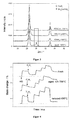
- the thermally aged powders were examined by means of X-ray powder diffractometry in comparison to the freshly prepared catalyst powder. The corresponding diffractograms are in FIG. 1 shown.
- a catalyst was prepared according to the method described in Comparative Example 1, which differs from the catalyst powder prepared in Comparative Example 1 only in the Platinum concentration difference: 20 g of BaO and 1 g of Pt were applied to 100 g of CeO 2 , so that the finished catalyst powder contained 0.8% by weight of Pt and 16.5% by weight of BaO.
- FIG. 2 shows the results of the measurements as Fourier-transformed EXAFS spectra.
- Part A shows the EXAFS spectra of the VK-1 samples as well as comparative spectra of the fresh material, PtO 2 and platinum foil.
- Part B shows the EXAFS spectra of the platinum-poor comparative catalyst VK-2.
- the signals at 3.6 Angstroms and 4.2 Angstroms observed at 800 ° C in both samples are characteristic of the neighboring barium and cerium atoms in the perovskite lattice of Ba 2 CePtO 6 .
- the overview diffractograms not shown, show an increase in the barium carbonate characteristic of the intensities of reflection, as well as the reoccurrence of barium carbonate reflections.
- thermoanalysis investigations were carried out. [For experimental setup and method cf. M. Maciejewski, CA Muller, R. Chan, WD Emmerich, A. Baiker, Thermochim. Acta 295 (1997) 167 ].
- thermogravimetric curves recorded during the experiments are in FIG. 4 shown.
- the main limitation of the reactivity of the aged material results from the loss of regeneration activity.
- NO x regeneration becomes platinum absolutely necessary to keep the "clearing" of the nitrogen oxide storage by the subsequent implementation of the NO x with the reducing agent propene in motion. Since the precious metal is no longer present in the catalytically active state due to the thermal aging processes, this process is inhibited in the aged catalyst, a nitrogen oxide regeneration does not take place practically.
- the hydrogen-reactivated catalyst exhibits nitrogen oxide storage and regeneration activity that is close to that of the freshly prepared catalyst.
Landscapes
- Chemical & Material Sciences (AREA)
- Engineering & Computer Science (AREA)
- Chemical Kinetics & Catalysis (AREA)
- Materials Engineering (AREA)
- Organic Chemistry (AREA)
- Biomedical Technology (AREA)
- Environmental & Geological Engineering (AREA)
- Analytical Chemistry (AREA)
- General Chemical & Material Sciences (AREA)
- Oil, Petroleum & Natural Gas (AREA)
- Health & Medical Sciences (AREA)
- Life Sciences & Earth Sciences (AREA)
- Sustainable Development (AREA)
- Combustion & Propulsion (AREA)
- Mechanical Engineering (AREA)
- General Engineering & Computer Science (AREA)
- Catalysts (AREA)
- Exhaust Gas After Treatment (AREA)
Applications Claiming Priority (2)
| Application Number | Priority Date | Filing Date | Title |
|---|---|---|---|
| DE102007023979A DE102007023979B4 (de) | 2007-05-23 | 2007-05-23 | Zweistufiges Verfahren zur Reaktivierung thermisch gealterter Stickoxid-Speicherkatalysatoren |
| PCT/EP2008/054583 WO2008141875A1 (de) | 2007-05-23 | 2008-04-16 | Zweistufiges verfahren zur reaktivierung thermisch gealterter stickoxid-speicherkatalysatoren |
Publications (2)
| Publication Number | Publication Date |
|---|---|
| EP2155387A1 EP2155387A1 (de) | 2010-02-24 |
| EP2155387B1 true EP2155387B1 (de) | 2011-08-17 |
Family
ID=39689436
Family Applications (1)
| Application Number | Title | Priority Date | Filing Date |
|---|---|---|---|
| EP08736263A Not-in-force EP2155387B1 (de) | 2007-05-23 | 2008-04-16 | Zweistufiges verfahren zur reaktivierung thermisch gealterter stickoxid-speicherkatalysatoren |
Country Status (9)
| Country | Link |
|---|---|
| US (1) | US8383544B2 (pt) |
| EP (1) | EP2155387B1 (pt) |
| JP (1) | JP5222360B2 (pt) |
| KR (1) | KR101380642B1 (pt) |
| AT (1) | ATE520458T1 (pt) |
| BR (1) | BRPI0811096A2 (pt) |
| CA (1) | CA2687615C (pt) |
| DE (1) | DE102007023979B4 (pt) |
| WO (1) | WO2008141875A1 (pt) |
Families Citing this family (7)
| Publication number | Priority date | Publication date | Assignee | Title |
|---|---|---|---|---|
| DE102007023512A1 (de) | 2007-05-18 | 2008-11-20 | Sennheiser Electronic Gmbh & Co. Kg | Elektroakustischer Schallwandler |
| DE102009006403A1 (de) | 2009-01-28 | 2010-08-05 | Süd-Chemie AG | Vanadiumfreier Diesel-Oxidationskatalysator und Verfahren zu dessen Herstellung |
| DE102009006404B3 (de) | 2009-01-28 | 2010-08-26 | Süd-Chemie AG | Diesel-Oxidationskatalysator mit guter Tieftemperaturaktivität |
| CN102481548B (zh) * | 2009-09-10 | 2015-09-16 | 株式会社科特拉 | 废气净化用催化剂 |
| US9527033B2 (en) * | 2015-01-23 | 2016-12-27 | Toyota Motor Engineering & Manufacturing North America, Inc. | Mixed metal oxide catalyst |
| GB2553339A (en) * | 2016-09-02 | 2018-03-07 | Johnson Matthey Plc | Improved NOx trap |
| JP6642473B2 (ja) * | 2017-02-07 | 2020-02-05 | 株式会社豊田中央研究所 | 電解用アノード |
Family Cites Families (5)
| Publication number | Priority date | Publication date | Assignee | Title |
|---|---|---|---|---|
| DE19838282A1 (de) * | 1998-08-24 | 2000-03-02 | Degussa | Stickoxid-Speichermaterial und daraus hergestellter Stickoxid-Speicherkatalysator |
| CA2402999C (en) * | 2001-01-11 | 2007-11-06 | Ict Co., Ltd. | Iridium catalyst for purifying nitrogen oxides in exhaust systems |
| EP1729872B1 (en) * | 2004-03-27 | 2021-03-10 | Umicore AG & Co. KG | Nitrogen oxide storage catalyst |
| JP5106748B2 (ja) * | 2004-11-08 | 2012-12-26 | 株式会社キャタラー | 排ガス浄化用触媒 |
| DE102005034344A1 (de) * | 2005-07-22 | 2007-01-25 | Umicore Ag & Co. Kg | Verfahren zur Reaktivierung thermisch gealterter Stickoxid-Speicherkatalysatoren |
-
2007
- 2007-05-23 DE DE102007023979A patent/DE102007023979B4/de not_active Expired - Fee Related
-
2008
- 2008-04-16 WO PCT/EP2008/054583 patent/WO2008141875A1/de not_active Ceased
- 2008-04-16 CA CA2687615A patent/CA2687615C/en not_active Expired - Fee Related
- 2008-04-16 JP JP2010508765A patent/JP5222360B2/ja not_active Expired - Fee Related
- 2008-04-16 AT AT08736263T patent/ATE520458T1/de active
- 2008-04-16 EP EP08736263A patent/EP2155387B1/de not_active Not-in-force
- 2008-04-16 KR KR1020097024212A patent/KR101380642B1/ko not_active Expired - Fee Related
- 2008-04-16 US US12/599,411 patent/US8383544B2/en not_active Expired - Fee Related
- 2008-04-16 BR BRPI0811096-4A2A patent/BRPI0811096A2/pt active Search and Examination
Also Published As
| Publication number | Publication date |
|---|---|
| JP2010527759A (ja) | 2010-08-19 |
| WO2008141875A1 (de) | 2008-11-27 |
| DE102007023979A1 (de) | 2008-11-27 |
| CA2687615A1 (en) | 2008-11-27 |
| KR20100017187A (ko) | 2010-02-16 |
| DE102007023979B4 (de) | 2009-05-07 |
| EP2155387A1 (de) | 2010-02-24 |
| JP5222360B2 (ja) | 2013-06-26 |
| BRPI0811096A2 (pt) | 2014-12-09 |
| CA2687615C (en) | 2015-12-29 |
| US8383544B2 (en) | 2013-02-26 |
| ATE520458T1 (de) | 2011-09-15 |
| KR101380642B1 (ko) | 2014-04-04 |
| US20100300077A1 (en) | 2010-12-02 |
Similar Documents
| Publication | Publication Date | Title |
|---|---|---|
| EP1911506B1 (de) | Stickoxidspeicherkatalysator mit abgesenkter Entschwefelungstemperatur | |
| EP2326416B1 (de) | Stickoxid-speicherkatalysator zum einsatz im kraftfahrzeug in motornaher position | |
| EP0945608B1 (de) | Verfahren zum Betreiben einer Abgasreinigungsanlage enthaltend eine Schwefelfalle und einen Stickoxid-Speicherkatalysator | |
| DE102007023979B4 (de) | Zweistufiges Verfahren zur Reaktivierung thermisch gealterter Stickoxid-Speicherkatalysatoren | |
| EP0945165B1 (de) | Verfahren zur Entfernung von Schwefeloxiden aus Abgasen einer Brennkraftmaschine | |
| DE69208206T2 (de) | Katalysatorsystem zur Behandlung von Abgasen aus Brennkraftmaschinen mit Verbrennung eines armen Gemisches | |
| DE102004040032B4 (de) | Abgasbehandlungskatalysator und Abgasbehandlungsverfahren | |
| DE3830318C2 (pt) | ||
| EP2043783B1 (de) | Verfahren zur herstellung metalldotierter zeolithe und ihre verwendung bei der katalytischen umwandlung von stickoxiden | |
| DE3856024T2 (de) | Verfahren zur Behandlung von Abgasen mit einem Kupfer- und Ceroxid enthaltenden Katalysator | |
| DE19847008A1 (de) | Stickoxid-Speicherkatalysator | |
| DE19838282A1 (de) | Stickoxid-Speichermaterial und daraus hergestellter Stickoxid-Speicherkatalysator | |
| EP2091635A1 (de) | Vanadiumfreier katalysator zur selektiven katalytischen reduktion und verfahren zu seiner herstellung | |
| EP2958660A1 (de) | Katalysator und verfahren zur reduktion von stickoxiden | |
| EP1180397B1 (de) | Sauerstoff speicherndes Material auf der Basis von Ceroxid, Verfahren zu seiner Herstellung und Verwendung in der Abgasreinigung von Verbrennungsmotoren | |
| DE69816113T2 (de) | Verfahren zur reinigung von abgasen mit einer mangan basierten zusammensetzung als nox-falle | |
| DE60036909T2 (de) | Verfaren zur Entfernung von Stickoxiden mittels eines Werkstoffes mit Ilmenit-Struktur | |
| WO2015059164A1 (de) | Katalysator zur oxidation von co und hc bei niedrigen temperaturen | |
| EP3623047A1 (de) | Katalysator zur reduktion von stickoxiden | |
| EP3695902B1 (de) | Katalysator zur reduktion von stickoxiden | |
| EP1877187B1 (de) | Verfahren zur reaktivierung thermisch gealterter stickoxid-speicherkatalysatoren | |
| DE4435074B4 (de) | Katalysatorkomponente zur Abgasreinigung, ein Verfahren zu deren Herstellung und deren Verwendung zur Herstellung eines Abgasreinigungskatalysatorbestandteils | |
| DE2727198C2 (de) | Ruthenium und ein Seltenes Erdmetalloxid enthaltender Katalysator | |
| DE2845595C2 (pt) | ||
| EP2035665B1 (de) | Verfahren zur on-board-reaktivierung thermisch gealterter stickoxid-speicherkatalysatoren in kraftfahrzeugen mit überwiegend mager betriebenem verbrennungsmotor |
Legal Events
| Date | Code | Title | Description |
|---|---|---|---|
| PUAI | Public reference made under article 153(3) epc to a published international application that has entered the european phase |
Free format text: ORIGINAL CODE: 0009012 |
|
| 17P | Request for examination filed |
Effective date: 20091223 |
|
| AK | Designated contracting states |
Kind code of ref document: A1 Designated state(s): AT BE BG CH CY CZ DE DK EE ES FI FR GB GR HR HU IE IS IT LI LT LU LV MC MT NL NO PL PT RO SE SI SK TR |
|
| AX | Request for extension of the european patent |
Extension state: AL BA MK RS |
|
| RIN1 | Information on inventor provided before grant (corrected) |
Inventor name: HOYER, RUEDIGER Inventor name: KREUZER, THOMAS Inventor name: GRUNWALDT, JAN-DIERK Inventor name: CASAPU, MARIA CRISTINA Inventor name: BAIKER, ALFONS Inventor name: MACIEJEWSKI, MAREK Inventor name: MUELLER, WILFRIED Inventor name: WITTROCK, MEIKE Inventor name: GRISSTEDE, INA Inventor name: GOEBEL, ULRICH Inventor name: ECKHOFF, STEPHAN |
|
| DAX | Request for extension of the european patent (deleted) | ||
| GRAP | Despatch of communication of intention to grant a patent |
Free format text: ORIGINAL CODE: EPIDOSNIGR1 |
|
| GRAS | Grant fee paid |
Free format text: ORIGINAL CODE: EPIDOSNIGR3 |
|
| GRAA | (expected) grant |
Free format text: ORIGINAL CODE: 0009210 |
|
| AK | Designated contracting states |
Kind code of ref document: B1 Designated state(s): AT BE BG CH CY CZ DE DK EE ES FI FR GB GR HR HU IE IS IT LI LT LU LV MC MT NL NO PL PT RO SE SI SK TR |
|
| REG | Reference to a national code |
Ref country code: GB Ref legal event code: FG4D Free format text: NOT ENGLISH |
|
| REG | Reference to a national code |
Ref country code: CH Ref legal event code: EP |
|
| REG | Reference to a national code |
Ref country code: IE Ref legal event code: FG4D Free format text: LANGUAGE OF EP DOCUMENT: GERMAN |
|
| REG | Reference to a national code |
Ref country code: DE Ref legal event code: R096 Ref document number: 502008004532 Country of ref document: DE Effective date: 20111020 |
|
| REG | Reference to a national code |
Ref country code: NL Ref legal event code: VDEP Effective date: 20110817 |
|
| LTIE | Lt: invalidation of european patent or patent extension |
Effective date: 20110817 |
|
| PG25 | Lapsed in a contracting state [announced via postgrant information from national office to epo] |
Ref country code: PT Free format text: LAPSE BECAUSE OF FAILURE TO SUBMIT A TRANSLATION OF THE DESCRIPTION OR TO PAY THE FEE WITHIN THE PRESCRIBED TIME-LIMIT Effective date: 20111219 Ref country code: FI Free format text: LAPSE BECAUSE OF FAILURE TO SUBMIT A TRANSLATION OF THE DESCRIPTION OR TO PAY THE FEE WITHIN THE PRESCRIBED TIME-LIMIT Effective date: 20110817 Ref country code: NL Free format text: LAPSE BECAUSE OF FAILURE TO SUBMIT A TRANSLATION OF THE DESCRIPTION OR TO PAY THE FEE WITHIN THE PRESCRIBED TIME-LIMIT Effective date: 20110817 Ref country code: IS Free format text: LAPSE BECAUSE OF FAILURE TO SUBMIT A TRANSLATION OF THE DESCRIPTION OR TO PAY THE FEE WITHIN THE PRESCRIBED TIME-LIMIT Effective date: 20111217 Ref country code: SE Free format text: LAPSE BECAUSE OF FAILURE TO SUBMIT A TRANSLATION OF THE DESCRIPTION OR TO PAY THE FEE WITHIN THE PRESCRIBED TIME-LIMIT Effective date: 20110817 Ref country code: LT Free format text: LAPSE BECAUSE OF FAILURE TO SUBMIT A TRANSLATION OF THE DESCRIPTION OR TO PAY THE FEE WITHIN THE PRESCRIBED TIME-LIMIT Effective date: 20110817 Ref country code: NO Free format text: LAPSE BECAUSE OF FAILURE TO SUBMIT A TRANSLATION OF THE DESCRIPTION OR TO PAY THE FEE WITHIN THE PRESCRIBED TIME-LIMIT Effective date: 20111117 |
|
| PG25 | Lapsed in a contracting state [announced via postgrant information from national office to epo] |
Ref country code: PL Free format text: LAPSE BECAUSE OF FAILURE TO SUBMIT A TRANSLATION OF THE DESCRIPTION OR TO PAY THE FEE WITHIN THE PRESCRIBED TIME-LIMIT Effective date: 20110817 Ref country code: SI Free format text: LAPSE BECAUSE OF FAILURE TO SUBMIT A TRANSLATION OF THE DESCRIPTION OR TO PAY THE FEE WITHIN THE PRESCRIBED TIME-LIMIT Effective date: 20110817 Ref country code: LV Free format text: LAPSE BECAUSE OF FAILURE TO SUBMIT A TRANSLATION OF THE DESCRIPTION OR TO PAY THE FEE WITHIN THE PRESCRIBED TIME-LIMIT Effective date: 20110817 Ref country code: GR Free format text: LAPSE BECAUSE OF FAILURE TO SUBMIT A TRANSLATION OF THE DESCRIPTION OR TO PAY THE FEE WITHIN THE PRESCRIBED TIME-LIMIT Effective date: 20111118 Ref country code: CY Free format text: LAPSE BECAUSE OF FAILURE TO SUBMIT A TRANSLATION OF THE DESCRIPTION OR TO PAY THE FEE WITHIN THE PRESCRIBED TIME-LIMIT Effective date: 20110817 |
|
| REG | Reference to a national code |
Ref country code: IE Ref legal event code: FD4D |
|
| PG25 | Lapsed in a contracting state [announced via postgrant information from national office to epo] |
Ref country code: IE Free format text: LAPSE BECAUSE OF FAILURE TO SUBMIT A TRANSLATION OF THE DESCRIPTION OR TO PAY THE FEE WITHIN THE PRESCRIBED TIME-LIMIT Effective date: 20110817 Ref country code: CZ Free format text: LAPSE BECAUSE OF FAILURE TO SUBMIT A TRANSLATION OF THE DESCRIPTION OR TO PAY THE FEE WITHIN THE PRESCRIBED TIME-LIMIT Effective date: 20110817 Ref country code: SK Free format text: LAPSE BECAUSE OF FAILURE TO SUBMIT A TRANSLATION OF THE DESCRIPTION OR TO PAY THE FEE WITHIN THE PRESCRIBED TIME-LIMIT Effective date: 20110817 |
|
| PG25 | Lapsed in a contracting state [announced via postgrant information from national office to epo] |
Ref country code: RO Free format text: LAPSE BECAUSE OF FAILURE TO SUBMIT A TRANSLATION OF THE DESCRIPTION OR TO PAY THE FEE WITHIN THE PRESCRIBED TIME-LIMIT Effective date: 20110817 Ref country code: IT Free format text: LAPSE BECAUSE OF FAILURE TO SUBMIT A TRANSLATION OF THE DESCRIPTION OR TO PAY THE FEE WITHIN THE PRESCRIBED TIME-LIMIT Effective date: 20110817 Ref country code: EE Free format text: LAPSE BECAUSE OF FAILURE TO SUBMIT A TRANSLATION OF THE DESCRIPTION OR TO PAY THE FEE WITHIN THE PRESCRIBED TIME-LIMIT Effective date: 20110817 |
|
| PLBE | No opposition filed within time limit |
Free format text: ORIGINAL CODE: 0009261 |
|
| STAA | Information on the status of an ep patent application or granted ep patent |
Free format text: STATUS: NO OPPOSITION FILED WITHIN TIME LIMIT |
|
| PG25 | Lapsed in a contracting state [announced via postgrant information from national office to epo] |
Ref country code: DK Free format text: LAPSE BECAUSE OF FAILURE TO SUBMIT A TRANSLATION OF THE DESCRIPTION OR TO PAY THE FEE WITHIN THE PRESCRIBED TIME-LIMIT Effective date: 20110817 |
|
| 26N | No opposition filed |
Effective date: 20120521 |
|
| PG25 | Lapsed in a contracting state [announced via postgrant information from national office to epo] |
Ref country code: HR Free format text: LAPSE BECAUSE OF FAILURE TO SUBMIT A TRANSLATION OF THE DESCRIPTION OR TO PAY THE FEE WITHIN THE PRESCRIBED TIME-LIMIT Effective date: 20120328 |
|
| REG | Reference to a national code |
Ref country code: DE Ref legal event code: R097 Ref document number: 502008004532 Country of ref document: DE Effective date: 20120521 |
|
| BERE | Be: lapsed |
Owner name: UMICORE A.G. & CO. KG Effective date: 20120430 |
|
| PG25 | Lapsed in a contracting state [announced via postgrant information from national office to epo] |
Ref country code: MC Free format text: LAPSE BECAUSE OF NON-PAYMENT OF DUE FEES Effective date: 20120430 |
|
| REG | Reference to a national code |
Ref country code: CH Ref legal event code: PL |
|
| PG25 | Lapsed in a contracting state [announced via postgrant information from national office to epo] |
Ref country code: BE Free format text: LAPSE BECAUSE OF NON-PAYMENT OF DUE FEES Effective date: 20120430 Ref country code: LI Free format text: LAPSE BECAUSE OF NON-PAYMENT OF DUE FEES Effective date: 20120430 Ref country code: CH Free format text: LAPSE BECAUSE OF NON-PAYMENT OF DUE FEES Effective date: 20120430 |
|
| PG25 | Lapsed in a contracting state [announced via postgrant information from national office to epo] |
Ref country code: ES Free format text: LAPSE BECAUSE OF FAILURE TO SUBMIT A TRANSLATION OF THE DESCRIPTION OR TO PAY THE FEE WITHIN THE PRESCRIBED TIME-LIMIT Effective date: 20111128 |
|
| PG25 | Lapsed in a contracting state [announced via postgrant information from national office to epo] |
Ref country code: BG Free format text: LAPSE BECAUSE OF FAILURE TO SUBMIT A TRANSLATION OF THE DESCRIPTION OR TO PAY THE FEE WITHIN THE PRESCRIBED TIME-LIMIT Effective date: 20111117 |
|
| PG25 | Lapsed in a contracting state [announced via postgrant information from national office to epo] |
Ref country code: MT Free format text: LAPSE BECAUSE OF FAILURE TO SUBMIT A TRANSLATION OF THE DESCRIPTION OR TO PAY THE FEE WITHIN THE PRESCRIBED TIME-LIMIT Effective date: 20110817 |
|
| PG25 | Lapsed in a contracting state [announced via postgrant information from national office to epo] |
Ref country code: HR Free format text: LAPSE BECAUSE OF FAILURE TO SUBMIT A TRANSLATION OF THE DESCRIPTION OR TO PAY THE FEE WITHIN THE PRESCRIBED TIME-LIMIT Effective date: 20110817 |
|
| PG25 | Lapsed in a contracting state [announced via postgrant information from national office to epo] |
Ref country code: TR Free format text: LAPSE BECAUSE OF FAILURE TO SUBMIT A TRANSLATION OF THE DESCRIPTION OR TO PAY THE FEE WITHIN THE PRESCRIBED TIME-LIMIT Effective date: 20110817 |
|
| PG25 | Lapsed in a contracting state [announced via postgrant information from national office to epo] |
Ref country code: LU Free format text: LAPSE BECAUSE OF NON-PAYMENT OF DUE FEES Effective date: 20120416 |
|
| REG | Reference to a national code |
Ref country code: AT Ref legal event code: MM01 Ref document number: 520458 Country of ref document: AT Kind code of ref document: T Effective date: 20130416 |
|
| PG25 | Lapsed in a contracting state [announced via postgrant information from national office to epo] |
Ref country code: HU Free format text: LAPSE BECAUSE OF FAILURE TO SUBMIT A TRANSLATION OF THE DESCRIPTION OR TO PAY THE FEE WITHIN THE PRESCRIBED TIME-LIMIT Effective date: 20080416 |
|
| PG25 | Lapsed in a contracting state [announced via postgrant information from national office to epo] |
Ref country code: AT Free format text: LAPSE BECAUSE OF NON-PAYMENT OF DUE FEES Effective date: 20130416 |
|
| REG | Reference to a national code |
Ref country code: FR Ref legal event code: PLFP Year of fee payment: 9 |
|
| REG | Reference to a national code |
Ref country code: FR Ref legal event code: PLFP Year of fee payment: 10 |
|
| REG | Reference to a national code |
Ref country code: FR Ref legal event code: PLFP Year of fee payment: 11 |
|
| PGFP | Annual fee paid to national office [announced via postgrant information from national office to epo] |
Ref country code: FR Payment date: 20190313 Year of fee payment: 12 |
|
| PGFP | Annual fee paid to national office [announced via postgrant information from national office to epo] |
Ref country code: DE Payment date: 20190402 Year of fee payment: 12 |
|
| PGFP | Annual fee paid to national office [announced via postgrant information from national office to epo] |
Ref country code: GB Payment date: 20190410 Year of fee payment: 12 |
|
| REG | Reference to a national code |
Ref country code: DE Ref legal event code: R119 Ref document number: 502008004532 Country of ref document: DE |
|
| PG25 | Lapsed in a contracting state [announced via postgrant information from national office to epo] |
Ref country code: DE Free format text: LAPSE BECAUSE OF NON-PAYMENT OF DUE FEES Effective date: 20201103 Ref country code: FR Free format text: LAPSE BECAUSE OF NON-PAYMENT OF DUE FEES Effective date: 20200430 |
|
| GBPC | Gb: european patent ceased through non-payment of renewal fee |
Effective date: 20200416 |
|
| PG25 | Lapsed in a contracting state [announced via postgrant information from national office to epo] |
Ref country code: GB Free format text: LAPSE BECAUSE OF NON-PAYMENT OF DUE FEES Effective date: 20200416 |