EP2152687B1 - Verfahren zur herstellung carbonat-terminierter verbindungen - Google Patents
Verfahren zur herstellung carbonat-terminierter verbindungen Download PDFInfo
- Publication number
- EP2152687B1 EP2152687B1 EP08759840A EP08759840A EP2152687B1 EP 2152687 B1 EP2152687 B1 EP 2152687B1 EP 08759840 A EP08759840 A EP 08759840A EP 08759840 A EP08759840 A EP 08759840A EP 2152687 B1 EP2152687 B1 EP 2152687B1
- Authority
- EP
- European Patent Office
- Prior art keywords
- alkyl
- alkylene
- amino
- general formula
- mono
- Prior art date
- Legal status (The legal status is an assumption and is not a legal conclusion. Google has not performed a legal analysis and makes no representation as to the accuracy of the status listed.)
- Not-in-force
Links
- 0 CC(C)(*)N(*)C(OI*C(CO1)OC1=O)=O Chemical compound CC(C)(*)N(*)C(OI*C(CO1)OC1=O)=O 0.000 description 2
Classifications
-
- C—CHEMISTRY; METALLURGY
- C07—ORGANIC CHEMISTRY
- C07D—HETEROCYCLIC COMPOUNDS
- C07D317/00—Heterocyclic compounds containing five-membered rings having two oxygen atoms as the only ring hetero atoms
- C07D317/08—Heterocyclic compounds containing five-membered rings having two oxygen atoms as the only ring hetero atoms having the hetero atoms in positions 1 and 3
- C07D317/10—Heterocyclic compounds containing five-membered rings having two oxygen atoms as the only ring hetero atoms having the hetero atoms in positions 1 and 3 not condensed with other rings
- C07D317/32—Heterocyclic compounds containing five-membered rings having two oxygen atoms as the only ring hetero atoms having the hetero atoms in positions 1 and 3 not condensed with other rings with hetero atoms or with carbon atoms having three bonds to hetero atoms with at the most one bond to halogen, e.g. ester or nitrile radicals, directly attached to ring carbon atoms
- C07D317/34—Oxygen atoms
Definitions
- the present invention relates to a process for the preparation of carbonate-terminated compounds.
- Material surfaces can be made biocompatible by coating with heparin, for example.
- Other applications include antisoiling and bacteriostatic finishing and improving the adhesion of adhesives and paints.
- the targeted modification of biomolecules is desirable in many cases.
- it is known that the biological half-life of various drugs can be improved by adding polyoxyalkylene radicals.
- EP-A-1 541 568 For example, reactive cyclic carbonates of general formula 1 are known, where R 'is C 1 -C 12 alkylene and R "can represent a wide variety of organic radicals These reactive cyclic carbonates can be reacted with nucleophiles, for example hydroxyl or primary or secondary amino groups of biomolecules, polymers or on substrate surfaces Opening of the cyclic carbon ring with simultaneous covalent attachment to the biomolecule, the polymer or other substrate surfaces.
- the preparation of the reactive cyclic carbonates of the formula (1) takes place by reacting the phenyl-substituted cyclic carbonates of the general formula (2), with amines of the general formula (3) H 2 NR "(3)
- the US-A-5,115,045 relates to isocyanate-reactive compositions which are used for the preparation of polyurethanes. These isocyanate-reactive compositions are based on the reaction product of (a) a di- or polychloroformate ester of the type Q- [X-COY] n , where X can be oxygen and Y is chlorine, n is at least 2, and Q is an organic radical (b) a multi-functional compound which, in addition to the functional groups which react with the di- or polychloroformate ester (a), must necessarily contain at least one imino or enamino group. No di- or polychloroformate esters (a) are described which have cyclic carbonate groups.
- the di- or polychloroformate esters are prepared by reacting polyols with acylating agents such as phosgene. From the imino and / or enamino groups contained in the multi-functional compound (b), an isocyanate-reactive amino group can later be obtained by hydrolysis.
- this invention Since there is a high demand for reactive cyclic carbonates for surface treatment, this invention has the object to provide an improved manufacturing process.
- the process of the invention is characterized in that no phenol is formed as a minor component in the reaction. Furthermore, very good yields are obtained, and advantageously the cyclic carbonate ring is retained in the course of the reaction according to the invention and is not opened in a side reaction.
- substituted means in the context of this application that a hydrogen atom on a radical or atom is replaced by one of the specified groups, with the proviso that the valence of the atom indicated does not exceed and the substitution leads to a stable compound.
- alkyl is intended to include straight, branched and cyclic alkyl groups. Unless explicitly stated otherwise in this application, these alkyl groups each have 1 to 30, preferably 1 to 24 and particularly preferably 1 to 18 carbon atoms.
- Suitable alkyl radicals are, for example, methyl, ethyl, n-propyl, isopropyl, n-butyl, sec-butyl, tert-butyl, n-pentyl, 1-methylbutyl, 2-methylbutyl, 3-methylbutyl, neopentyl , 1-ethylpropyl, cyclohexyl, cyclopentyl, n-hexyl, 1,1-dimethylpropyl, 1,2-dimethylpropyl, 1,2-dimethylpropyl, 1-methylpentyl, 2-methylpentyl, 3-methylpentyl, 4-methylpentyl, 1.1 Dimethylbutyl, 1,2-dimethylbutyl
- haloalkyl accordingly means an alkyl group of the aforementioned meaning in which one or more hydrogen atoms are replaced by halogen, preferably chlorine or fluorine.
- hydroxyalkyl accordingly denotes an alkyl group of the abovementioned meaning in which one or more hydrogen atoms have been replaced by hydroxyl groups.
- alkyloxyalkyl is an alkyl radical in which one or more hydrogen atoms are represented by an alkyloxy group, an alkylcarbonyloxy group, an amino group, a mono- or dialkylamino group, an ammonio
- R 2 and / or R 3 is ammonioalkyl or imidazolioalkyl
- the compound is accompanied by one equivalent of an anion, preferably a physiologically acceptable anion, such as a halide, especially chloride or bromide, sulfate, hydrogensulfate, methosulfate or nitrate.
- an anion preferably a physiologically acceptable anion, such as a halide, especially chloride or bromide, sulfate, hydrogensulfate, methosulfate or nitrate.
- alkylene means a divalent aliphatic, branched or unbranched hydrocarbon radical , preferably one - (CH 2 -CH 2 ) -, one - (CH 2 -CH (CH 3 )) -, one - (CH 2 -CH (C 2 H 5 )) - or a - (CH 2 -CH 2 -CH 2 -CH 2 ) - radical.
- the polyoxyalkylene radical is preferably derived from ethylene oxide, propylene oxide, butylene oxide or tetrahydrofuran, more preferably from ethylene oxide or propylene oxide. It is terminated at the distal end by a residue which is hydrogen or a C 1 -C 6 alkyl radical.
- the polysiloxanyl radical is preferably derived from polydimethylsiloxanes and may be straight-chain or branched.
- the saccharide residue is e.g. a glucoxyl residue.
- R 1 represents a C 1 -C 6 -alkylene radical, more preferably a methylene, ethylene, n-propylene, n-butylene or n-hexamethylene radical ,
- R 3 is hydrogen and R 2 is a fluoresceinyl radical or a pyrene, fluorescein, bonded via a C 1 -C 30 -alkylene group, Cumarin, 4,4'-Bisstyrylbiphenyl-, pyrazoline, hydroquinone, benzoxazole, benzisoxazole, benzimidazole or flavonic acid radical, the aforementioned radicals R 2 may also be mono- or polysubstituted.
- substitution patterns which are described in US Pat WO 2005/108961 are described.
- the compounds of the general formula (III) can alternatively also be used in the form of their respective ammonium salts, which have the general formula (IIIA), wherein R 2 and R 3 each have the meanings given in this application in connection with the formula (III) and X is a halide, preferably chlorine, bromine or iodine, or methyl sulfate.
- the amines of the general formula (III) are either commercially available or can be prepared by methods familiar to the person skilled in the art.
- amines of the general formula (III) can be used in the process according to the invention: Polyetheramines, n-octylamine, tert-octylamine, n-hexylamine, 2-ethylhexylamine, taurine, dihexylamine, dodecylamine, octadecylamine, methyloctadecylamine, dioctylamine, N, N-dimethylpropylenediamine, N, N-dimethylethylenediamine, 3-aminopropyltrimethylammonium iodide, 3-aminopropyltrimethylammonium bromide, 3-aminopropyltrimethylammonium chloride, 3-aminoethyltrimethylammonium iodide, 3-aminoethyltrimethylammonium bromide, 3-aminoethyltrimethylammonium chloride, 3-aminoethyltrimethylammoni
- polyetheramines of the general formula (III) can be used in the process according to the invention in the form of commercial products of the Huntsman Corporation such as Jeffamin M-600, Jeffamine M-1000, Jeffamin M-2005 and Jeffamin M-2070.
- amines of the general formula (III) can be used in the process according to the invention: polyetherdiamines, ethylenediamine, propylenediamine, butylenediamine, hexamethylenediamine, MDA, TDA, diaminobenzene, diaminocyclohexane, diaminomethylcyclohexane, TCD-diamine, 1,4-bis (3-aminopropyloxy) butane, tris (2-aminoethyl) amine, 1,4-bis (3-aminopropyl) piperazine, bis (3-aminopropyl) amine and triethylenetetramine.
- polyetherdiamines of the formula (III) in the process according to the invention can be obtained in the form of commercial products of the Huntsman Corporation, such as Jeffamin D-230, Jeffamine D-400, Jeffamin D-2000, Jeffamin D-4000, Jeffamine ED-600, Jeffamin ED-2003 and Jeffamin EDR-148.
- auxiliary bases for example, trimethylamine, triethylamine, tripropylamine, triisopropylamine, tributylamine, pyridine, 1,2-diazine, 1,3-diazine, 1,4-diazine, 1,2,3-triazine, 1,2,4-triazine , 1,3,5-triazine, C 1 -C 30 -alkylpyrrole, isoazole, oxazole, isothiazole, thiazole, C 1 -C 30 -alkylpyrazole, C 1 -C 30 -alkylimidazole, 1,2,4-thiadiazole, C C 1 -C 30 alkyl-1,2,3-triazole, C 1 -C 30 alkyl-1,2,4-triazole, dimethylaniline, dimethylaminopyridine, sodium carbonate, sodium hydrogencarbonate, potassium carbonate, potassium hydrogencarbonate, sodium hydroxide and potassium hydroxide.
- Separation of the hydrochlorides of the auxiliary bases can be carried out, for example, by filtration. Alternatively, a separation can also be carried out by a phase separation at elevated temperature, if the molten salt is optionally deposited in the presence of an inert solvent from the corresponding product. Likewise, a workup can be carried out by adding water or a salt solution and optionally an inert solvent and subsequent phase separation. The auxiliary base used can then optionally be liberated again by addition of a strong base and optionally recycled again after purification.
- auxiliary bases When such auxiliary bases are used, usually up to 3 equivalents of the auxiliary base relative to the amine component of the general formula (III) are used. Preferably, up to 2 and more preferably up to 1.5 equivalents are used.
- the inventive method is usually carried out at a temperature in the range of -10 ° C to 100 ° C.
- the process according to the invention is preferably carried out at a temperature in the range from -5.degree. C. to 80.degree. C., more preferably in the range from 0.degree. C. to 60.degree. C. and in particular in the range from 0.degree. C. to 40.degree.
- the inventive method can be carried out so that the amine of general formula (III), optionally dissolved in an inert solvent, and then the chloroformate of the general formula (II), optionally also dissolved in the same or in a different inert solvent to which amine is added.
- an auxiliary base which may have been added in the abovementioned amounts either to the initially charged amine of the general formula (III) or to the added chloroformate of the general formula (II).
- the auxiliary base can also be added separately continuously or in portions.
- the chloroformate of the general formula (II) is initially charged and then the amine of the general formula (III) is added, it being possible for both substances to be diluted with the same or different inert solvent.
- an auxiliary base may also be added in the aforementioned amounts either to the added chloroformate of the general formula (II) or to the initially charged amine of the general formula (III).
- the auxiliary base can also be added separately continuously or in portions.
- Suitable solvents are, for example, toluene, xylenes, chlorobenzene, 1,2-dichlorobenzene, tetrahydrofuran, diethyl ether, dioxane, methyltetrahydrofuran, cyclopentylmethyl ether, dibutyl ether, 1,2-dichloroethane, dichloromethane, chloroform, dimethoxyethane, acetonitrile, cyclohexane, methylcyclohexane, cyclopentane, heptane, Hexane, diethylene glycol dimethyl ether, ethylbenzene and methyl tert-butyl ether.
- amines are used as compounds of the general formula (III) which as the radicals R 2 and / or R 3 are mono- or di (C 1 -C 18 -alkyl) aminoC 1 -C 30 -alkyl-, Mono- or di (C 7 -C 11 -aralkyl) amino-C 1 -C 30 -alkyl- or mono- or di (allyl) amino-C 1 -C 30 -alkyl radicals, so the tertiary amino groups in these radicals be quaternized in the process of the invention.
- This quaternization is carried out following the process of the invention, for example by adding methyl iodide, methyl bromide, benzyl bromide or dimethyl sulfate.
- the isolation of the compounds of the general formula (I) can be carried out by distillation, crystallization, chromatography or freeze-drying.
- the compounds of general formula (II) may, for example, according to a in DE-A-197 37 329 are prepared starting from the corresponding alcohols of the general formula (IV), wherein R 1 has the meaning given for the general formula (I).
- the compounds of the general formula (I) obtained by the process according to the invention can be reacted with functional groups, for example hydroxyl groups or primary or secondary amino groups, which are contained in biomolecules, polymers or substrate surfaces. This results in the opening of the cyclic carbon ring with covalent attachment to the biomolecule, the polymer or the substrate surface. In this way it is possible to introduce the above-defined plurality of radicals R 2 and R 3 into biomolecules or polymers or to bind them to substrate surfaces.
- functional groups for example hydroxyl groups or primary or secondary amino groups
- biomolecule is intended to include all molecules that can be isolated from biological systems and / or interact with biological systems or parts thereof. These include, in particular, peptides, proteins, proteoglycans, enzymes, markers, antibodies, receptor molecules, antigens and active ingredients. Specific examples are heparin, tissue plasminogen activator, streptokinase and prostaglandins.
- polyamines or polyols can be used as polymers.
- polyamines are polyvinylamine, polyallylamine, polyethyleneimines, chitosan, polyamide-epichlorohydrin resins (available as "Hercosett®” products), polyaminostyrene, peptides or proteins such as gelatin.
- the surfaces of materials are suitable which have amino and / or hydroxyl groups, or surfaces which have been treated by amino acid methods known per se.
- Example 1 (according to the invention):
- glycerol carbonate-chloroformate 91%, 9.40 g was dissolved in chloroform (400 ml).
- chloroform 400 ml
- a suspension of octadecylamine (14.03 g) and triethylamine (5.27 g) in chloroform (70 ml) was added so that the internal temperature remained below 5 ° C.
- the mixture was stirred at 20 ° C for 32 hours, then diluted with chloroform (200 ml) and heated to 40 ° C. At this temperature, the mixture was washed once with saturated sodium chloride solution (400 ml) and once with water (200 ml).
- the organic phase was separated and dried over 10 g of sodium sulfate. After distilling off the volatiles at 20 mbar and a temperature of 40 ° C, the crude product obtained from chloroform (150 ml) was recrystallized. The product was obtained as a white powder (19.49 g, 90.5% of theory).
- glycerol carbonate-chloroformate 91%, 4.50 g was dissolved in tetrahydrofuran (60 ml). At 0 ° C, a suspension of octylamine (2.93 g) and triethylamine (2.29 g) in tetrahydrofuran (30 ml) was added so that the internal temperature remained below 5 ° C. The mixture was filtered and the volatiles of the filtrate were distilled off at 20 mbar and a temperature of 40 ° C.
Landscapes
- Chemical & Material Sciences (AREA)
- Organic Chemistry (AREA)
- Organic Low-Molecular-Weight Compounds And Preparation Thereof (AREA)
- Pharmaceuticals Containing Other Organic And Inorganic Compounds (AREA)
- Polyesters Or Polycarbonates (AREA)
Description
- Die vorliegend Erfindung betrifft ein Verfahren zur Herstellung Carbonat-terminierter Verbindungen.
- Für eine Vielzahl von Materialien und Anwendungen ist die dauerhafte Funkmionalisierung von Oberflächen von Bedeutung. Materialoberflächen können zum Beispiel durch Beschichtung mit Heparin biokompatibel gemacht werden. Andere Anwendungen sind schmutzabweisende und bakteriostatische Ausrüstungen und die Verbesserung der Haftung von Klebstoffen und Lacken.
- Auch die gezielte Modifizierung von Biomolekülen ist in vielen Fällen wünschenswert. So ist es beispielsweise bekannt, dass die biologische Halbwertszeit verschiedener Wirkstoffe durch Anfügen von Polyoxyalkylenresten verbessert werden kann.
- Aus
EP-A-1 541 568 sind beispielsweise reaktive cyclische Carbonate der allgemeinen Formel 1 bekannt,
- Die Herstellung der reaktiven cyclischen Carbonate der Formel (1) erfolgt dabei durch Umsetzung der phenylsubstituierten cyclischen Carbonate der allgemeinen Formel (2),

H2N-R" (3)
- Nachteilig ist bei dieser Synthese die Freisetzung von Phenol als Nebenprodukt der Substitution mit dem Amin in äquimolaren Mengen. Je nach erhaltenem Reaktionsprodukt der Formel (1) ist die Abtrennung des toxikologisch problematischen Phenols mit hohem Aufwand verbunden.
- Die
US-A-5,115,045 betrifft Isocyanat-reaktive Zusammensetzungen, die zur Herstellung von Polyurethanen eingesetzt werden. Diese Isocyanat-reaktiven Zusammensetzungen basieren auf dem Umsetzungsprodukt von (a) einem Di- oder Polychlorformiatester des Typs Q-[X-COY]n, wobei X Sauerstoff und Y Chlor bedeuten kann, n mindestens 2 ist und Q einen organischen Rest darstellt, mit (b) einer mehrfach-funktionellen Verbindung, die neben den funktionellen Gruppen, welche mit dem Di- oder Polychlorformiatester (a) abreagieren, zwingend mindestens eine Imino- oder Enaminogruppe enthalten muss. Es werden keine Di- oder Polychlorformiatester (a) beschrieben, die cyclische Carbonatgruppen aufweisen. Die Herstellung der Di- oder Polychlorformiatester erfolgt durch Umsetzung von Polyolen mit Acylierungsmitteln wie Phosgen. Aus den Iminound/oder Enaminogruppen, die in der mehrfach-funktionellen Verbindung (b) enthalten sind, kann später durch Hydrolyse eine gegenüber Isocyanaten reaktive Aminogruppe erhalten werden. - Da ein hoher Bedarf nach reaktiven cyclischen Carbonaten zur Oberflächenbehandlung besteht, lag dieser Erfindung die Aufgabe zugrunde, ein verbessertes Herstellverfahren bereitzustellen.
- Gegenstand der Erfindung ist ein Verfahren zur Herstellung von Verbindungen der allgemeinen Formel (I),

- R1
- C1-C12-Alkylen bedeutet,
- k
- für 1 oder eine ganze Zahl größer als 1 steht,
- R2 und R3
- gleich oder verschieden sind und für C1-C30-Alkyl, C2-C30-Alkenyl, C1-C30- Halogenalkyl, C1-C30-Hydroxyalkyl, C1-C6-Alkyloxy-C1-C30-alkyl, C1-C6- Alkylcarbonyloxy-C1-C30-alkyl, Amino-C1-C30-alkyl, Mono- oder Di(C1-C18- alkyl)amino-C1-C30-alkyl, Mono- oder Di(C7-C11-aralkyl)amino-C1-C30-alkyl, Mono- oder Di(allyl)amino-C1-C30-alkyl, Ammonio-C1-C30-alkyl, Polyoxyalkylen- C1-C30-alkyl, Polysiloxanyl-C1-C30-alkyl, (Meth)acryloyloxy-C1-C30-alkyl, Sulfono-C1-C30-alkyl, Phosphono-C1-C30-alkyl, Di(C1-C6-alkyl)phosphono-C1-C30- alkyl, Phosphonato-C1-C30-alkyl, Di(C1-C6-alkyl)phosphonato-C1-C30-alkyl, 3- Imidazolio-C1-C30-Alkyl, -[C2-C6-Alkylen-O]x-[C2-C6-Alkylen-O]y-R, wobei R für Wasserstoff oder C1-C6-Alkyl steht, x = 0-50 und y = 0-50 ist, entweder x oder y R3 mindestens 1 ist und die beiden Alkylenreste verschieden sind, wenn x und y beide ungleich 0 sind, oder einen Saccharidrest steht, und statt der vorgenannten Bedeutungen alternativ auch für Wasserstoff stehen kann, oder aber
- R2 und R3
- unter Einbeziehung des Stickstoffatoms, an das sie gebunden sind, einen cyclischen aliphatischen oder aromatischen Rest bilden, der 4 oder 5 Kohlenstoffatome aufweist, wobei ein oder zwei dieser Kohlenstoffatome zusätzlich durch Heteroatome, ausgewählt aus Stickstoff, Schwefel und Sauerstoff, ersetzt sein können, oder aber
- R3
- für Wasserstoff steht und gleichzeitig
- R2
- für einen Fluoresceinyl-Rest oder einen über eine C1-C30-Alkylengruppe gebundenen Pyren-, Fluorescein-, Cumarin-, 4,4'-Bisstyrylbiphenyl-, Pyrazolin-, Hydrochinolon-, Benzoxazol-, Benzisoxazol-, Benzimidazol- oder Flavonsäure- Rest steht,
- R3
- die gleichen Bedeutungen wie für k=1 besitzt und
- R2
- für einen k-valenten aliphatischen, cycloaliphatischen, aromatischen oder araliphatischen Kohlenwasserstoff-Rest steht, der gegebenenfalls ein oder mehrere Heteroatome enthält,
- Das erfindungsgemäße Verfahren zeichnet sich dadurch aus, dass bei der Umsetzung kein Phenol als Nebenkomponente entsteht. Ferner werden sehr gute Ausbeuten erhalten, und vorteilhafterweise bleibt der cyclische Carbonat-Ring im Verlauf der erfindungsgemäßen Reaktion erhalten und wird nicht in einer Nebenreaktion geöffnet.
- Sofern in dieser Anmeldung der Begriff "substituiert" verwendet wird, so bedeutet dies im Sinne dieser Anmeldung, dass ein Wasserstoff-Atom an einem Rest oder Atom durch eine der angegebenen Gruppen ersetzt ist, mit der Maßgabe, dass die Wertigkeit des angegebenen Atoms nicht überschritten wird und die Substitution zu einer stabilen Verbindung führt.
- Im Rahmen dieser Anmeldung und Erfindung können alle zuvor genannten und im Folgenden genannten, allgemeinen oder in Vorzugsbereichen genannten Definitionen von Resten, Parametern oder Erläuterungen untereinander, also auch zwischen den jeweiligen Bereichen und Vorzugsbereichen in beliebiger Weise kombiniert werden.
- Der Begriff "Alkyl" soll geradkettige, verzweigte und cyclische Alkylgruppen umfassen. Sofern in dieser Anmeldung nicht explizit anders angegeben, besitzen diese Alkylgruppen jeweils 1 bis 30, bevorzugt 1 bis 24 und besonders bevorzugt 1 bis 18 Kohlenstoffatome. Geeignet sind als Alkylreste beispielsweise Methyl, Ethyl, n-Propyl, iso-Propyl, n-Butyl, sec.-Butyl, tert.-Butyl, n-Pentyl, 1-Methylbutyl, 2-Methylbutyl, 3-Methylbutyl, neo-Pentyl, 1-Ethylpropyl, Cyclohexyl, Cyclopentyl, n-Hexyl, 1,1-Dimethylpropyl, 1,2-Dimethylpropyl, 1,2-Dimethylpropyl, 1-Methylpentyl, 2-Methylpentyl, 3-Methylpentyl, 4-Methylpentyl, 1,1-Dimethylbutyl, 1,2-Dimethylbutyl, 1,3-Dimethylbutyl, 2,2-Dimethylbutyl, 2,3-Dimethylbutyl, 3,3-Dimethylbutyl, 1-Ethylbutyl, 2-Ethylbutyl, 1,1,2-Trimethylpropyl, 1,2,2-Trimethylpropyl, 1-Ethyl-1-methylpropyl, 1-Ethyl-2-methylpropyl, 1-Ethyl-2-methylpropyl, n-Heptyl, n-Octyl, Pinakyl, Adamantyl, die isomeren Menthyle, n-Nonyl, n-Decyl, n-Dodecyl, n-Tridecyl, n-Tetradecyl, n-Hexadecyl oder n-Octadecyl.
- Der Begriff "Halogenalkyl" bedeutet entsprechend eine Alkylgruppe der vorgenannten Bedeutung, in der eine oder mehrere Wasserstoffatome durch Halogen, vorzugsweise Chlor oder Fluor, ersetzt sind.
- Der Begriff "Hydroxyalkyl" bedeutet entsprechend eine Alkylgruppe der oben genannten Bedeutung, in der ein oder mehrere Wasserstoffatome durch Hydroxygruppen ersetzt sind.
- In gleicher Weise bedeuten im Rahmen der Definitionen der Reste R2 und R3 die Begriffe "Alkyloxyalkyl", "Alkylcarbonyloxyalkyl", "Aminoalkyl", "Mono- oder Di(alkyl)aminoalkyl", "Mono- oder Di(aralkyl)amino-alkyl", "Mono- oder Di(allyl)amino-alkyl", "Ammonioalkyl", "Polyoxyalkylenalkyl", "Polysiloxanylalkyl", "(Meth)acryloyloxyalkyl", "Sulfonoalkyl", "Phosphonoalkyl" und "Dialkylphophonoalkyl", "Phosphonatoalkyl", "Dialkylphosphonatoalkyl" und "Imidazolioalkyl" einen Alkylrest, in dem ein oder mehrere Wasserstoffatome durch eine Alkyloxy-Gruppe, eine Alkylcarbonyloxy-Gruppe, eine Amino-Gruppe, eine Mono- oder Dialkylamino-Gruppe, eine Ammonio-Gruppe ((-NR5 3)+, worin R5 unabhängig voneinander z.B. für C1-C18-Alkyl, C2-C18-Alkenyl oder Benzyl stehen können), einen Polyoxyalkylen-Rest, einen Polysiloxanyl-Rest, eine (Meth)acryloyloxy-Gruppe, eine Sulfonsäure-Gruppe (-SO3H), eine Phosphonsäure-Gruppe (-PO3H2), Phosphorsäureester-Gruppe (-OPO3H2) bzw. eine Imidazolio-Gruppe der folgenden Struktur

- Der Begriff "Alkenyl" bedeutet eine Alkylgruppe mit 2 bis 30, vorzugsweise 2 bis 24 und insbesondere 2 bis 18 Kohlenstoffatomen, enthält jedoch eine oder mehrere mittel- oder auch endständige C=C Doppelbindungen.
- Der Begriff "Alkylen" bedeutet einen divalenten aliphatischen, verzweigten oder unverzweigten Kohlenwasserstoffrest, vorzugsweise einen -(CH2-CH2)-, einen -(CH2-CH(CH3))-, einen -(CH2-CH(C2H5))- oder einen -(CH2-CH2-CH2-CH2)- Rest.
- Der Polyoxyalkylenrest leitet sich vorzugsweise von Ethylenoxid, Propylenoxid, Butylenoxid oder Tetrahydrofuran ab, besonders bevorzugt von Ethylenoxid oder Propylenoxid. Er ist am distalen Ende durch einen Rest terminiert, bei dem es sich um Wasserstoff oder einen C1-C6-Alkyl-Rest handelt.
- Der Polysiloxanylrest leitet sich vorzugsweise von Polydimethylsiloxanen ab und kann geradkettig oder verzweigt sein.
- Bei dem Saccharidrest handelt es sich z.B. um einen Glucoxylrest.
- Im erfindungsgemäßen Verfahren werden bevorzugt Verbindungen der allgemeinen Formel (II) eingesetzt, worin R1 einen C1-C6-Alkylen-Rest, besonders bevorzugt einen Methylen-, Ethylen-, n-Propylen, n-Butylen- oder n-Hexamethylenrest darstellt.
- Sofern im erfindungsgemäßen Verfahren Verbindungen der allgemeinen Formel (III) eingesetzt werden, worin k gleich 1 ist, R3 Wasserstoff bedeutet und R2 für einen Fluoresceinyl-Rest oder einen über eine C1-C30-Alkylengruppe gebundenen Pyren-, Fluorescein-, Cumarin-, 4,4'-Bisstyrylbiphenyl-, Pyrazolin-, Hydrochinolon-, Benzoxazol-, Benzisoxazol-, Benzimidazol- oder Flavonsäure-Rest steht, so können die vorgenannten Reste R2 auch ein- oder mehrfach substituiert sein. Beispielhaft seien hier die Substitutionsmuster genannt, die in der
WO-A-2005/108961 beschrieben sind. - Im erfindungsgemäßen Verfahren können die Verbindungen der allgemeinen Formel (III) alternativ auch in Form ihrer jeweiligen Ammoniumsalze eingesetzt werden, welche die allgemeine Formel (IIIA) besitzen,

- Geeigneterweise werden Verbindungen der allgemeinen Formel (III) eingesetzt, bei denen
- k
- gleich 1 ist und
- R2 und R3
- gleich oder verschieden sind und für C1-C30-Alkyl, C1-C6-Alkyloxy-C1-C30-alkyl, C1-C6-Alkylcarbonyloxy-C1-C30-alkyl, Amino-C1-C30-alkyl, Mono- oder Di(C1-C6- alkyl)amino-C1-C30-alkyl, Mono- oder Di(C7-C11-aralkyl)amino-C1-C30-alkyl, Mono- oder Di(allyl)amino-C1-C30-alkyl, Ammonio-C1-C30-alkyl, Polyoxyalkylen- C1-C30-alkyl, Polysiloxanyl-C1-C30-alkyl, (Meth)acryloyloxy-C1-C30-alkyl, 3- Imidazolio-C1-C30-Alkyl, oder [C2-C6-Alkylen-O]x-[C2-C6-Alkylen-O]y-C1-C6- Alkyl, wobei x = 0-50 und y = 0-40 ist, entweder x oder y mindestens 1 ist und die beiden Alkylenreste verschieden sind, sofern x und y beide ungleich 0 sind, oder
- R3
- alternativ auch für Wasserstoff stehen kann.
- Geeignet sind auch Verbindungen der allgemeinen Formel (III), bei denen
- k
- gleich 1 ist
- R2
- für C1-C18-Alkyl, C1-C6-Alkyloxy-C1-C18-alkyl, C1-C6-Alkylcarbonyloxy-C1-C18- alkyl, Amino-C1-C18-alkyl, Mono- oder Di(C1-C6-alkyl)amino-C1-C18-alkyl, Mono- oder Di(C7-C11-aralkyl)amino-C1-C18-alkyl, Mono- oder Di(allyl)amino-C1-C18- alkyl, Ammonio-C1-C18-alkyl, Polyoxyalkylen-C1-C18-alkyl, Polysiloxanyl-C1-C18- alkyl, (Meth)acryloyloxy-C1-C18-alkyl, 3-Imidazolio-C1C30-Alkyl, oder [C-2-C6- Alkylen-O]x-[C2-C6-Alkylen-O]y-C1-C6-Alkyl, wobei die beiden Alkylenreste verschieden sind und x = 1-50 und y = 1-40, steht und
- R3
- Wasserstoff bedeutet.
- Ebenfalls geeignet sind Verbindungen der allgemeinen Formel (III), bei denen
- k
- gleich 1 ist und
- R2 und R3
- gleich oder verschieden sind und für C1-C18-Alkyl, Amino-C1-C18-alkyl, Mono- oder Di(C1-C6-alkyl)amino-C1-C18-alkyl, Mono- oder Di(C7-C11-aralkyl)amino-C1- C18-alkyl, Mono- oder Di(allyl)amino-C1-C18-alkyl, Ammonio-C1-C18-alkyl, Polyoxyalkylen-C1-C18-alkyl, Polysiloxanyl-C1-C18-alkyl, 3-Imidazolio-C1-C30- Alkyl oder [C2-C6-Alkylen-O]x-[C2-C6-Alkylen-O]y-C1-C6-Alkyl, wobei die beiden Alkylenreste verschieden sind und x = 2-40 und y = 2-20 ist, stehen.
- Weiterhin können Verbindungen der allgemeinen Formel (III) eingesetzt werden, bei denen
- k
- gleich 1 ist,
- R3
- Wasserstoff bedeutet und R2
für -(CH2)n-CH3,
-(CH2)nCH((CH2)m-CH3)-(CH2)o-CH3, wobei n+m+o maximal 27 ergeben,
-(CH2)n-(CF2)p-CF3,
-(CH2)n-[O-Si(-O-Si(CH3)3)3],
-(CH2)n-(O-CH2-CH2)q-O-R4-H,
-R4-OH,
-R4-NR5 2,
-R4-NR5 3 + Y-,
-R4-OC(=O)-CR6=CH2,
-R4-SO3H,
-R4-PO3H2,
-R4-OPO3H2
oder einen Saccharidrest steht,
worin
R4 für C1-C6-Alkylen,
R5 für Wasserstoff, C1-C18 Alkyl, C2-C18 Alkenyl, bevorzugt Allyl, oder Benzyl, R6 für Wasserstoff oder Methyl und
Y für ein Äquivalent eines Anions, bevorzugt Chlorid, Bromid, Sulfat, Hydrogensulfat, Methosulfat oder Nitrat steht, n, m,o unabhängig voneinander eine ganze Zahl von 0 bis 17 sind,
p eine ganze Zahl von 1 bis 12 ist und
q für eine ganze Zahl von 1 bis 100, bevorzugt 2 bis 50 steht. - Im erfindungsgemäßen Verfahren können ferner Verbindungen der allgemeinen Formel (III) eingesetzt werden, bei denen
- k
- eine ganze Zahl größer 1, insbesondere 2 oder 3 ist,
- R2
- für einen k-valenten, insbesondere di- oder trivalenten, aliphatischen, cycloaliphatischen, aromatischen oder araliphatischen Kohlenwasserstoff-Rest steht, der gegebenenfalls ein oder mehrere Heteroatome enthält, und
- R3
- für Wasserstoff, C1-C30-Alkyl, C1-C6-Alkyloxy-C1-C30-alkyl, C1-C6- Alkylcarbonyloxy-C1-C30-alkyl, Amino-C1-C30-alkyl, Mono- oder Di(C1-C6-alkyl)- amino-C1-C30-alkyl, Mono- oder Di(C7-C11-aralkyl)amino-C1-C30-alkyl, Mono- oder Di(allyl)amino-C1-C30-alkyl, Ammonio-C1-C30-alkyl, Polyoxyalkylen-C1-C30- alkyl, Polysiloxanyl-C1-C30-alkyl, (Meth)acryloyloxy-C1-C30-alkyl, 3-Imidazolio- C1-C30-Alkyl oder [C2-C6-Alkylen-O]x-[C2-C6-Alkylen-O]y-C2-C6-Alkyl, wobei x = 0-50 und y = 0-50 ist, aber entweder x oder y mindestens 1 ist und die beiden Alkylenreste verschieden sind, wenn x und x beide ungleich 0 sind, steht.
- Bevorzugt werden Verbindungen der allgemeinen Formel (III) eingesetzt, bei denen
- k
- 2 oder 3 ist,
- R2
- für einen di- oder trivalenten, aliphatischen, cycloaliphatischen, aromatischen oder araliphatischen Kohlenwasserstoff-Rest steht, der gegebenenfalls ausschließlich ein oder mehrere Sauerstoffatome als Heteroatome enthält, und
- R3
- für Wasserstoff, C1-C18-Alkyl, C1-C6-Alkyloxy-C1-C18-alkyl, C1-C6- Alkylcarbonyloxy-C1-C18-alkyl, Amino-C1-C18-alkyl, Mono- oder Di(C1-C6-alkyl)- amino-C1-C18-alkyl, Ammonio-C1-C19-alkyl, Polyoxyalkylen-C1-C18-alkyl, Polysiloxanyl-C1-C18-alkyl, (Meth)acryloyloxy-C1-C18-alkyl, 3-Imidazolio-C1-C30- Alkyl oder [C2-C6-Alkylen-O]x-[C2-C6-Alkylen-O]y-C2-C6-Alkyl, wobei x = 1-50 und y = 1-50 ist und die beiden Alkylenreste verschieden sind, steht.
- Besonders bevorzugt werden ferner Verbindungen der allgemeinen Formel (III) eingesetzt, bei denen
- k
- 2 ist,
- R2
- für eine -[(C2-C6-Alkylen-O-)x-(C2-C6-Alkylen)]- Gruppe steht, worin die beiden Alkylengruppen gleich oder verschieden sind und x = 1-50, bevorzugt x=1-40 ist, oder für eine -[(C2-C6-Alkylen-O-)x-(C2-C6-Alkylen-O-)y-(C2-C6-Alkylen-O-)z-C2-C6-Alkylen]- Gruppe steht, wobei die drei Alkyleneinheiten verschieden sind bzw. die erste mit der dritten identisch sein kann, und wobei x = 0-50, inbesondere x = 1-40, y = 1- 50, insbesondere y = 1-40, und z = 1-50, insbesondere z = 1-40 ist, und
- R3
- Wasserstoff oder C1-C30-Alkyl bedeutet.
- Die Amine der allgemeinen Formel (III) sind entweder käuflich erhältlich oder aber nach dem Fachmann geläufigen Methoden herstellbar.
- Wenn k = 1 ist, können im erfindungsgemäßen Verfahren beispielsweise die folgenden Amine der allgemeinen Formel (III) eingesetzt werden:
Polyetheramine, n-Octylamin, tert-Octylamin, n-Hexylamin, 2-Ethylhexylamin, Taurin, Dihexylamin, Dodecylamin, Octadecylamin, Methyloctadecylamin, Dioctylamin, N,N-Dimethylpropylendiamin, N,N-Dimethylethylendiamin, 3-Aminopropyltrimethylammoniumiodid, 3-Aminopropyltrimethylammoniumbromid, 3-Aminopropyltrimethylammoniumchlorid, 3-Aminoethyltrimethylammoniumiodid, 3-Aminoethyltrimethylammoniumbromid, 3-Aminoethyltrimethylammoniumchlorid, 3-Aminopropyldimethyloctylammoniumchlorid, 3-Aminopropyldimethyloctylammoniumbromid, 3-(Trimethylsilyl)-propylamin, 3-(Tris(trimethyisilyloxy)silyl)-propylamin, 3-(Trimethylsilyl)-ethylamin, 3-(Tris(trimethylsilyloxy)silyl)-ethylamin, 3-Aminopropylimidazol, 2-Aminoethylimidazol, 4-Aminobutylimidazol, 3-Aminopropyl-1-methylimidiazolium-methylsulfat, 3-Aminopropyl-1-butylimidiazoliummethylsulfat, 3-Amino-ethyl-1-methyl-imidiazolium-methylsulfat, 3-Aminoethyl-1-butylimidiazoliummethylsulfat, 3-Aminopropyl-1-methylimidazoliumchlorid, 3-Aminopropyl-1-butylimidiazoliumchlorid, 3-Aminopropyl-1-methylimidiazoliumbromid, 3-Aminopropyl-1-butylimidiazoliumbromid, 3-Aminoethyl-1-methylimidiazoliumchlorid, 3-Aminoethyl-1-butylimidiazoliumchlorid, 3-Aminoethyl-1-methylimidiazoliumbromid und 3-Aminoethyl-1-butylimidiazoliumbromid. - Für den Fall k = 1 können Polyetheramine der allgemeinen Formel (III) im erfindungsgemäßen Verfahren in Form von Handelsprodukten der Huntsman Corporation wie Jeffamin M-600, Jeffamin M-1000, Jeffamin M-2005 und Jeffamin M-2070 eingesetzt werden.
- Wenn k eine ganze Zahl größer 1 ist, können im erfindungsgemäßen Verfahren beispielsweise die folgenden Amine der allgemeinen Formel (III) eingesetzt werden: Polyetherdiamine, Ethylendiamin, Propylendiamin, Butylendiamin, Hexamethylendiamin, MDA, TDA, Diaminobenzol, Diaminocyclohexan, Diaminomethylcyclohexan, TCD-Diamin, 1,4-Bis-(3-aminopropyloxy)butan, Tris-(2-aminoethyl)amin, 1,4-Bis-(3-aminopropyl)piperazin, Bis-(3-aminopropyl)amin und Triethylentetramin.
- Für den Fall, dass k eine ganze Zahl größer 1 ist, können Polyetherdiamine der Formel (III) im erfindungsgemäßen Verfahren in Form von Handelsprodukten der Huntsman Corporation wie Jeffamin D-230, Jeffamin D-400, Jeffamin D-2000, Jeffamin D-4000, Jeffamin ED-600, Jeffamin ED-2003 und Jeffamin EDR-148 eingesetzt werden.
- Möglich ist es auch, bei der Durchführung des erfindungsgemäßen Verfahrens neben dem Amin der allgemeinen Formel (III) eine weitere Hilfsbase einzusetzen, um den bei der Umsetzung entstehenden Chlorwasserstoff zu binden.
- Als solche Hilfsbasen können beispielsweise Trimethylamin, Triethylamin, Tripropylamin, Triisopropylamin, Tributylamin, Pyridin, 1,2-Diazin, 1,3- Diazin, 1,4- Diazin, 1,2,3-Triazin, 1,2,4-Triazin, 1,3,5-Triazin, C1-C30-Alkylpyrrol, Isoazol, Oxazol, Isothiazol, Thiazol, C1-C30-Alkylpyrazol, C1-C30-Alkylimidazol, 1,2,4-Thiadiazol, C1-C30-Alkyl-1,2,3-triazol, C1-C30-Alkyl-1,2,4-triazol, Dimethylanilin, Dimethylaminopyridin, Natriumcarbonat, Natriumhydrogencarbonat, Kaliumcarbonat, Kaliumhydrogencarbonat, Natriumhydroxid und Kaliumhydroxid verwendet werden. Wenn Alkyl-substituierte Hilfsbasen eingesetzt werden, sind jene bevorzugt, die C1-C6-Alkylketten tragen. Weitere mögliche Substitutionsmuster sind beispielsweise in
EP-A- 1 470 136 genannt. - Eine Abtrennung der Hydrochloride der Hilfsbasen kann beispielsweise durch Filtration erfolgen. Alternativ kann eine Abtrennung auch durch eine Phasentrennung bei erhöhter Temperatur erfolgen, wenn sich die Salzschmelze gegebenenfalls in Anwesenheit eines inerten Lösungsmittels vom entsprechenden Produkt abscheidet. Ebenso kann eine Aufarbeitung durch Zugabe von Wasser oder einer Salzlösung und gegebenenfalls einem inerten Lösungsmittel und anschließende Phasentrennung erfolgen. Die eingesetzte Hilfsbase kann dann gegebenenfalls durch Zugabe einer starken Base wieder freigesetzt und gegebenenfalls nach Reinigung wieder recyclisiert werden.
- Wenn derartige Hilfsbasen eingesetzt werden, so werden üblicherweise bis zu 3 Äquivalente der Hilfsbase bezogen auf die Aminkomponente der allgemeinen Formel (III) eingesetzt. Bevorzugt werden bis zu 2 und besonders bevorzugt bis zu 1,5 Äquivalente eingesetzt.
- Bezogen auf die eingesetzte Verbindung der allgemeinen Formel (III) werden nach dem erfindungsgemäßen Verfahren 0,75 bis 4 Äquivalente des Chlorformiats der allgemeinen Formel (II) eingesetzt. Bevorzugt werden 0,9 bis 3 Äquivalente, besonders bevorzugt 1,0 bis 2,0 Äquivalente eingesetzt.
- Das erfindungsgemäße Verfahren wird üblicherweise bei einer Temperatur im Bereich von -10°C bis 100°C durchgeführt. Bevorzugt wird das erfindungsgemäße Verfahren bei einer Temperatur im Bereich von -5°C bis 80°C durchgeführt, besonders bevorzugt im Bereich von 0°C bis 60°C und insbesondere im Bereich von 0°C bis 40°C.
- Das erfindungsgemäße Verfahren kann so durchgeführt werden, dass das Amin der allgemeinen Formel (III), gegebenenfalls gelöst in einem inerten Lösungsmittel, vorgelegt wird und anschließend das Chlorformiat der allgemeinen Formel (II), gegebenenfalls ebenfalls gelöst in dem gleichen oder in einem verschiedenen inerten Lösungsmittel, zu dem Amin gegeben wird. In dieser Ausführungsform kann gegebenenfalls noch eine Hilfsbase verwendet werden, die in den vorgenannten Mengen entweder dem vorgelegten Amin der allgemeinen Formel (III) oder dem zugegebenen Chlorformiat der allgemeinen Formel (II) zugegeben worden sein kann. Weiterhin kann die Hilfsbase auch separat kontinuierlich oder in Portionen zudosiert werden.
- In einer alternativen Ausführungsform wird das Chlorformiat der allgemeinen Formel (II) vorgelegt und anschließend das Amin der allgemeinen Formel (III) zugegeben, wobei beide Substanzen gegebenenfalls mit dem gleichen oder verschiedenen inerten Lösungsmittel verdünnt sein können. In dieser Ausführungsform kann ebenfalls eine Hilfsbase in den vorgenannten Mengen entweder bei dem zugegebenen Chlorformiat der allgemeinen Formel (II) oder dem vorgelegten Amin der allgemeinen Formel (III) zugegeben sein. Weiterhin kann die Hilfsbase auch separat kontinuierlich oder in Portionen zudosiert werden.
- Es sei ausdrücklich erwähnt, dass beide vorgenannten Ausführungsformen auch in Abwesenheit von Lösungsmitteln durchgeführt werden können.
- Geeignete Lösungsmittel sind beispielsweise Toluol, Xylole, Chlorbenzol, 1,2-Dichlorbenzol, Tetrahydrofuran, Diethylether, Dioxan, Methyltetrahydrofuran, Cyclopentylmethylether, Dibutylether, 1,2-Dichlorethan, Dichlormethan, Chloroform, Dimethoxyethan, Acetonitril, Cylohexan, Methylcyclohexan, Cyclopentan, Heptan, Hexan, Diethylenglycoldimethylether, Ethylbenzol und Methyl-tert-butylether.
- Sofern im erfindungsgemäßen Verfahren als Verbindungen der allgemeinen Formel (III) Amine eingesetzt werden, die als Reste R2 und/oder R3 Mono- oder Di(C1-C18-alkyl)amino-C1-C30-alkyl-, Mono- oder Di(C7-C11-aralkyl)amino-C1-C30-alkyl- oder Mono- oder Di(allyl)amino-C1-C30-alkylReste aufweisen, so können die tertiären Aminogruppen in diesen Resten im Rahmen des erfindungsgemäßen Verfahrens auch quaternisiert werden. Diese Quaternisierung erfolgt im Anschluss an das erfindungsgemäße Verfahren beispielsweise durch Zugabe von Methyliodid, Methylbromid, Benzylbromid oder Dimethylsulfat.
- Die Isolierung der Verbindungen der allgemeinen Formel (I) kann durch Destillation, Kristallisation, Chromatographie oder Gefriertrocknung erfolgen.
- Die Verbindungen der allgemeinen Formel (II) können beispielsweise nach einem in
DE-A-197 37 329 beschriebenen Verfahren ausgehend von den entsprechenden Alkoholen der allgemeinen Formel (IV) hergestellt werden,
- Die nach dem erfindungsgemäßen Verfahren erhaltenen Verbindungen der allgemeinen Formel (I) lassen sich mit funktionellen Gruppen wie z.B. Hydroxygruppen oder primären oder sekundären Aminogruppen umsetzen, die in Biomolekülen, Polymeren oder Substratoberflächen enthalten sind. Hierbei kommt es zur Öffnung des cyclischen Carbonatrings unter kovalenter Anbindung an das Biomolekül, das Polymer oder die Substratoberfläche. Auf diese Weise ist es möglich, die oben definierte Vielzahl von Resten R2 und R3 in Biomoleküle oder Polymere einzuführen oder an Substratoberflächen zu binden.
- Der Begriff "Biomolekül" soll dabei alle Moleküle umfassen, die aus biologischen Systemen isoliert werden können und/oder mit biologischen Systemen oder Teilen davon in Wechselwirkung treten können. Hierzu zählen vor allem Peptide, Proteine, Proteoglykane, Enzyme, Markierungsstoffe, Antikörper, Rezeptormoleküle, Antigene und Wirkstoffe. Spezielle Beispiele sind Heparin, Gewebeplasminogenaktivator, Streptokinase und Prostaglandine.
- Als Polymere sind beispielsweise Polyamine oder Polyole einsetzbar. Beispiele für Polyamine sind Polyvinylamin, Polyallylamin, Polyethylenimine, Chitosan, Polyamid-Epichlorhydrin-Harze, (Erhältlich als "Hercosett®" Produkte), Polyaminostyrol, Peptide oder Proteine, wie Gelatine.
- Als Oberflächen, die nach diesem Verfahren behandelt werden können, sind z.B. die Oberflächen von Materialien geeignet, die Amino- und/oder Hydroxygruppen aufweisen, oder Oberflächen, die nach an sich bekannten Verfahren mit Aminosilanen behandelt wurden.
-

- Zu einer Lösung von Dioctylamin (97%ig, 6,936 g) und Triethylamin (2,337 g) in Chloroform (45 ml) wurde bei 0°C unter Rühren eine Lösung aus Glycerolcarbonat-chlorformiat (d.h. (2-Oxo-1,3-dioxolan-4-yl)methyl chlorformiat) (91%ig, 5,562 g) in Chloroform (20 ml) gegeben. Die Lösung wurde eine Stunde bei 0°C und weitere 20 Stunden bei 20°C gerührt. Nach Verdünnung mit je 10 ml THF und 10 mL Diethylether wurde der sich bildende Feststoff abfiltriert und das erhaltene Filtrat mit 10 ml 1%iger HCl-Lösung in Wasser, sowie 10 mL gesättigter Natriumchloridlösung gewaschen. Nach Trocknen der organischen Phase mit 2 g Natriumsulfat wurden die flüchtigen Bestandteile bei 20 mbar und 50°C destillatitv entfernt. Das Produkt wurde als gelbes Öl erhalten (10,912 g, 80% der Theorie).
-

- Zu einer Lösung von Didodecylamin (99%ig, 500 mg) und Triethylamin (145 mg) in Chloroform (2 ml) wurde bei 20°C unter Rühren eine Lösung aus Glycerolcarbonat-chlorformiat (91%ig, 300 mg) in Chloroform (1 ml) gegeben. Die Lösung wurde 3 Stunden bei 20°C gerührt. Nach Verdünnung mit je 1 ml THF und 1 mL Diethylether wurde der sich bildende Feststoff abfiltriert und das erhaltene Filtrat mit 10 ml 5%iger HCl-Lösung in Wasser, sowie 10 mL gesättigter Natriumchloridlösung gewaschen. Nach Trocknen der organischen Phase mit 2 g Natriumsulfat wurden die flüchtigen Bestandteile bei 20 mbar und 50°C destillatitv entfernt. Das Produkt wurde als farbloses Öl erhalten (601mg, 86% der Theorie).
-

- Taurin (99%, 3,88 g) und Natriumhydrogencarbonat (7,81 g) wurden bei 20°C in Wasser (40 ml) suspendiert. Bei 0°C wurde unter Rühren eine Lösung von Glycerolcarbonat-chlorformiat (91%, 6,818 g) in THF (30 mL) zugegeben. Die Lösung wurde eine Stunde bei 0°C und weitere 20 Stunden bei 20°C gerührt. Nach Ansäuern mit 10 ml 5%iger wässriger HCl-Lösung wurde die wässrige Phase dreimal mit je 10 ml Chloroform gewaschen. Die wässrige Phase wurde anschließend gefriergetrocknet. Das Rohprodukt wurde als weisser Feststoff (13,026 g) erhalten.
-

- In einem Zweihalskolben mit Tropftrichter und Thermometer wurden Glycerolcarbonat-chlorformiat (91%ig, 9,40 g) in Chlorform (400 ml) gelöst. Bei 0°C wurde eine Suspension von Octadecylamin (14,03 g) und Triethylamin (5,27 g) in Chloroform (70 ml) so zugegeben, dass die Innentemperatur unter 5°C blieb. Nach beendeter Zugabe wurde die Mischung für 32 Stunden bei 20°C gerührt, dann mit Chlorform (200 ml) verdünnt und auf 40°C erhitzt. Bei dieser Temperatur wurde die Mischung einmal mit gesättigter Natriumchloridlösung (400 ml) und einmal mit Wasser (200 ml) gewaschen. Die organische Phase wurde abgetrennt und über 10 g Natriumsulfat getrocknet. Nach Abdestillieren der flüchtigen Bestandteile bei 20 mbar und einer Temperatur von 40°C wurde das erhaltene Rohprodukt aus Chloroform (150 ml) umkristallisiert. Das Produkt wurde als weißes Pulver erhalten (19,49 g, 90,5% d. Th.)
-

- In einem Zweihalskolben mit Tropftrichter und Thermometer wurde Glycerolcarbonat-chlorformiat (91%ig, 4,50 g) in Tetrahydrofuran (60 ml) gelöst. Bei 0°C wurde eine Suspension von Octylamin (2,93 g) und Triethylamin (2,29 g) in Tetrahydrofuran (30 ml) so zugegeben, dass die Innentemperatur unter 5°C blieb. Die Mischung wurde filtriert und die flüchtigen Bestandteile des Filtrats wurden bei 20 mbar und einer Temperatur von 40°C abdestilliert.
-

- In einem Einhalskolben wurde (2-Oxo-1,3-dioxolan-4-yl)methylchlorformiat (4,784 g) in Chloroform (50 ml) vorgelegt und auf 0 °C gekühlt. Eine Lösung von tert-Octylamin (6,233 g) in Chloroform (40 ml) wurde bei 0 °C langsam zugetropft. Das Gemisch wurde dann 20 Stunden bei 20°C gerührt. Nach Verdünnen mit 70 ml Chloroform wurde die organische Phase dreimal mit je 70 ml Wasser gewaschen. Die organische Phase wurde mit 5 g Na2SO4 getrocknet. Nach Abdestillieren der flüchtigen Bestandteile bei 20 mbar und 40°C wurde eine gelbe ölige Flüssigkeit erhalten (6,630 g, 96 % d. Theorie).

mit einer Verbindung der allgemeinen Formel (III),

k und ebenso R2 und R3 in Abhängigkeit von k die für die allgemeine Formel (I) beschriebenen Bedeutungen haben,
oder einem Salz davon.
Claims (15)
- Verfahren zur Herstellung von Verbindungen der allgemeinen Formel (I),
 R1 C1-C12-Alkylen bedeutet,k für 1 oder eine ganze Zahl größer als 1 steht,
und wobei, wenn k für 1 steht,R2 und R3 gleich oder verschieden sind und für C1-C30-Alkyl, C2-C30-Alkenyl, C1-C30- Halogenalkyl, C1-C30-Hydroxyalkyl, C1-C6-Alkyloxy-C1-C30-alkyl, C1-C6- Alkylcarbonyloxy-C1-C30-alkyl, Amino-C1-C30-alkyl, Mono- oder Di(C1-C18- alkyl)amino-C1-C30-alkyl, Mono- oder Di(C7-C11-aralkyl)amino-C1-C30-alkyl, Mono- oder Di(allyl)amino-C1-C30-alkyl, Ammonio-C1-C30-alkyl, Polyoxyalkylen- C1-C30-alkyl, Polysiloxanyl-C1-C30-alkyl, (Meth)acryloyloxy-C1-C30-alkyl, Sulfono-C1-C30-alkyl, Phosphono-C1-C30-alkyl, Di(C1-C6-alkyl)phosphono-C1-C30- alkyl, Phosphonato-C1-C30-alkyl, Di(C1-C6-alkyl)phosphonato-C1-C30-alkyl, 3- Imidiazolio-C1-C30-Alkyl oder -[C2-C6-Alkylen-O]x-[C2-C6-Alkylen-O]y-R, wobei R für Wasserstoff oder C1-C6-Alkyl steht, x = 0-50 und y=0-50 ist, entweder x oder y mindestens 1 ist und die beiden Alkylenreste verschieden sind, wenn x und y beide ungleich 0 sind, oder einen Saccharidrest steht, und R3 statt der vorgenannten Bedeutungen alternativ auch für Wasserstoff stehen kann, oder aber R2 und R3 unter Einbeziehung des Stickstoffatoms, an das sie gebunden sind, einen cyclischen aliphatischen oder aromatischen Rest bilden, der 4 oder 5 Kohlenstoffatome aufweist, wobei ein oder zwei dieser Kohlenstoffatome zusätzlich durch Heteroatome, ausgewählt aus Stickstoff, Schwefel und Sauerstoff, ersetzt sein können, oder aberR3 für Wasserstoff steht und gleichzeitigR2 für einen Fluoresceinyl-Rest oder einen über eine C1-C30-Alkylengruppe gebundenen Pyren-, Fluorescein-, Cumarin-, 4,4'-Bisstyrylbiphenyl-, Pyrazolin-, Hydrochinolon-, Benzoxazol-, Benzisoxazol-, Benzimidazol- oder Flavonsäure- Rest steht,
und wobei, wenn k für eine ganze Zahl größer als 1 steht,R3 die gleichen Bedeutungen wie für k= besitzt undR2 für einen k-valenten aliphatischen, cycloaliphatischen, aromatischen oder araliphatischen Kohlenwasserstoff-Rest steht, der gegebenenfalls ein oder mehrere Heteroatome enthält,
durch Umsetzung von Verbindungen der allgemeinen Formel (II)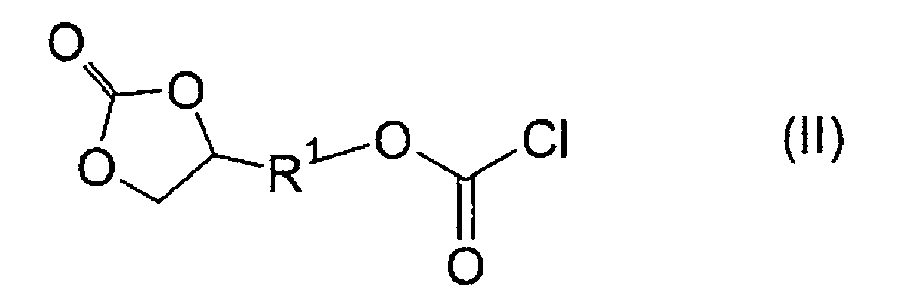
mit einer Verbindung der allgemeinen Formel (III),
- Verfahren nach Anspruch 1, wobei Verbindungen der allgemeinen Formel (II) eingesetzt werden, worin R1 einen C1-C6-Alkylen-Rest, bevorzugt einen Methylen-, Ethylen-, n-Propylen, n-Butylen- oder n-Hexamethylenrest darstellt.
- Verfahren nach Anspruch 1 oder 2, wobei die Verbindungen der allgemeinen Formel (III) in Form der jeweiligen Ammoniumsalze der allgemeinen Formel (IIIA) eingesetzt werden,

- Verfahren nach einem oder mehreren der Ansprüche 1 bis 3, wobei Verbindungen der allgemeinen Formel (III) eingesetzt werden, bei denenk gleich 1 ist undR2 und R3 gleich oder verschieden sind und für C1-C30-Alkyl, C1-C6-Alkyloxy-C1-C30-alkyl, C1-C6-Alkylcarbonyloxy-C1-C30-alkyl, Amino-C1-C30-alkyl, Mono- oder Di(C1-C6- alkyl)amino-C1-C30-alkyl, Mono- oder Di(C7-C11-aralkyl)amino-C1-C30-alkyl, Mono- oder Di(allyl)amino-C1-C30-alkyl, Ammonio-C1-C34-alkyl, Polyoxyalkylen- C1-C30-alkyl, Polysiloxanyl-C1-C30-alkyl, (Meth)acryloyloxy-C1-C30-alkyl, 3- Imidazolio-C1-C30-Alkyl oder [C2-C6-Alkylen-O]x-[C2-C6-Alkylen-O]y-C1-C6- Alkyl, wobei x = 0-50 und y = 0-40 sind, entweder x oder y mindestens 1 ist und die beiden Alkylenreste verschieden sind, wenn x und y beide ungleich 0 sind, stehen oderR3 auch für Wasserstoff stehen kann.
- Verfahren nach einem oder mehreren der Ansprüche 1 bis 4, wobei Verbindungen der allgemeinen Formel (III) eingesetzt werden, bei denenk gleich 1 istR2 für C1-C18-Alkyl, C1-C6-Alkyloxy-C1-C18-alkyl, C1-C6-Alkylcarbonyloxy-C1-C18- alkyl, Amino-C1-C18-alkyl, Mono- oder Di(C1-C6-alkyl)amino-C1-C18-alkyl, Mono- oder Di(C7-C11-aralkyl)amino-C1-C18-alkyl, Mono- oder Di(allyl)ammo-C1-C18- alkyl, Ammonio-C1-C18-alkyl, Polyoxyalkylen-C1-C18-alkyl, Polysiloxanyl-C1-C18- alkyl, (Meth)acryloyloxy-C1-C18-alkyl, 3-Imidazolio-C1-C30-Alkyl oder [C2-C6- Alkylen-O]x-[C2-C6-Alkylen-O]y-C1-C6-Alkyl, wobei die beiden Alkylenreste verschieden sind und x = 1-50 und y = 1-40, steht undR3 Wasserstoff bedeutet.
- Verfahren nach einem oder mehreren der Ansprüche 1 bis 5, wobei Verbindungen der allgemeinen Formel (III) eingesetzt werden, bei denenk gleich 1 ist undR2 und R3 gleich oder verschieden sind und für C1-C18-Alkyl, Amino-C1-C18-alkyl, Mono- oder Di(C1-C6-alkyl)amino-C1-C18-alkyl, Mono- oder Di(C7-C11-aralkyl)amino-C1- C18-alkyl, Mono- oder Di(allyl)amino-C1-C18-alkyl, Ammonio-C1-C18-alkyl, Polyoxyalkylen-C1-C18-alkyl, Polysiloxanyl-C1-C18-alkyl, 3-Imidazolio-C1-C30- Alkyl oder [C2-C6-Alkylen-O]x-[C2-C6-Alkylen-O]y-C1-C6-Alkyl, wobei die beiden Alkylenreste verschieden sind und x = 2-40 und y =2-20, stehen.
- Verfahren nach einem oder mehreren der Ansprüche 1 bis 3, wobei Verbindungen der allgemeinen Formel (III) eingesetzt werden, bei denenk gleich 1 ist,R3 Wasserstoff bedeutet undR2 für -(CH2)n-CH3,
-(CH2)n-CH((CH2)m-CH3)-(CH2)o-CH3, wobei n+m+o maximal 27 ergeben,
-(CH2)n-(CF2)p-CF3,
-(CH2)n-[O-Si(-O-Si(CH3)3)3],
-(CH2)n-(O-CH2-CH2)q-O-R4-H,
-R4-OH,
-R4-NR5 2,
-R4-NR5 3 + Y',
-R4-OC(=O)-CR6=CH2,
-R4-SO3H,
-R4-PO3H2,
-R4-OPO3H2
oder einen Saccharidrest steht,
worinR4 für C1-C6-Alkylen,R5 für Wasserstoff, C1-C18 Alkyl, C2-C18 Alkenyl, bevorzugt Allyl, oder Benzyl,R6 für Wasserstoff oder Methyl undY für ein Äquivalent eines Anions, bevorzugt Chlorid, Bromid, Sulfat, Hydrogensulfat, Methosulfat oder Nitrat steht,n, m,o unabhängig voneinander eine ganze Zahl von 0 bis 17 sind,p eine ganze Zahl von 1 bis 12 ist undq für eine ganze Zahl von 1 bis 100, bevorzugt 2 bis 50 steht. - Verfahren nach einem oder mehreren der Ansprüche 1 bis 3, wobei Verbindungen der allgemeinen Formel (III) eingesetzt, bei denenk eine ganze Zahl größer 1, insbesondere 2 oder 3 ist,R2 für einen k-valenten, insbesondere di- oder trivalenten, aliphatischen, cycloaliphatischen, aromatischen oder araliphatischen Kohlenwasserstoff-Rest steht, der gegebenenfalls ein oder mehrere Heteroatome enthält, undR3 für Wasserstoff, C1-C30-Alkyl, C1-C6-Alkyloxy-C1-C30-alkyl, C1-C6- Alkylcarbonyloxy-C1-C30-alkyl, Amino-C1-C30-alkyl, Mono- oder Di(C1-C6-alkyl)- amino-C1-C30-alkyl, Mono- oder Di(C7-C11-aralkyl)amino-C1-C30-alkyl, Mono- oder Di(allyl)amino-C1-C30-alkyl, Ammonio-C1-C30-alkyl, Polyoxyalkylen-C1-C30- alkyl, Polysiloxanyl-C1-C30-alkyl, (Meth)acryloyloxy-C1-C30-alkyl, 3-Imidazolio- C1-C30-Alkyl oder [C2-C5-Alkylen-O]x-[C2-C6-Alkylen-O]y-C2-C6-Alkyl, wobei x = 0-50 und y= 0-50 sind, aber entweder x oder y mindestens 1 ist und die beiden Alkylenreste verschieden sind, wenn x und x ungleich 0 sind, steht.
- Verfahren nach einem oder mehreren der Ansprüche 1 bis 3 oder 8, wobei Verbindungen der allgemeinen Formel (III) eingesetzt, bei denenk 2 oder 3 ist,R2 für einen di- oder trivalenten, aliphatischen, cycloaliphatischen, aromatischen oder araliphatischen Kohlenwasserstoff-Rest steht, der gegebenenfalls ausschließlich ein oder mehrere Sauerstoffatome als Heteroatome enthält, undR3 für Wasserstoff, C1-C18-Alkyl, C1-C6-Alk-yloxy-C1-C18-alkyl, C1-C6- Alkylcarbonyloxy-C1-C18-alkyl, Amino-C1-C18-alkyl, Mono- oder Di(C1-C6-alkyl)- amino-C1-C18-alkyl, Ammonio-C1-C18-alkyl, Polyoxyalkylen-C1-C18-alkyl, Polysiloxanyl-C1-C18-alkyl, (Meth)acryloyloxy-C1-C18-alk-yl, 3-Imidazolio-C1-C30- Alkyl oder [C2-C6-Alkylen-O]x-[C1-C6-Alkylen-O]x-C2-C6-Alkyl, wobei x = 1-50 und y = 1-50 und die beiden Alkylenreste verschieden sind, steht.
- Verfahren nach einem oder mehreren der Ansprüche 1-3 und 8-9, wobei Verbindungen der allgemeinen Formel (III) eingesetzt, bei denenk 2 ist,R2 eine -[(C2-C6-Alkylen-O-)x-(C2-C6-Alkylen)]- Gruppe, worin die beiden Alkylengruppen gleich oder verschieden sind und x = 1-50 ist, bevorzugt x = 1-40, oder eine -[(C2-C6-Alkylen-O-)x-(C2-C6-Alkylcn-O-)y-(C2-C6-Alkylcn-O-)z-C2-C6-Alkylen]- Gruppe darstellt, wobei die drei Alkyleneinheiten verschieden sind bzw. die erste mit der dritten identisch sein kann, und wobei x = 0-50, inbesondere x = 1-40, y = 1-50, insbesondere y = 1-40, und z = 1-50, insbesondere z = 1-40 undR3 Wasserstoff oder C1-C30-Alkyl bedeutet.
- Verfahren nach einem oder mehreren der Ansprüche 1 bis 3, wobei für den Fall, dass k = 1 ist, als Verbindungen der allgemeinen Formel (III) Polyetheramine, n-Octylamin, tert-Octylamin, n-Hexylamin, 2-Ethylhexylamin, Taurin, Dihexylamin, Dodecylamin, Octadecylamin, Methyloctadecylamin, Dioctylamin, N,N-Dimethylpropylendiamin, N,N-Dimethylethylendiamin, 3-Aminopropyltrimethylammoniumiodid, 3-Aminopropyltrimethylammoniumbromid, 3-Aminopropyltrimethylammoniumchlorid, 3-Aminoethyltrimethylammoniumiodid, 3-Aminoethyltrimethylammoniumbromid, 3-Aminoethyltrimethylammoniumchlorid, 3-Aminopropyldimethyloctylammoniumchlorid, 3-Aminopropyldimethyloctylammoniumbromid, 3-(Trimethylsilyl)-propylamin, 3-(Tris(trimethylsilyloxy)silyl)-propylamin, 3-(Trimethylsilyl)-ethylamin, 3-(Tris(trimethylsilyloxy)silyl)-ethylamin, 3-Aminopropylimidazol, 2-Aminoethylimidazol, 4-Aminobutylimidazol, 3-Aminopropyl-1-methylimidiazolium-methylsulfat, 3-Aminopropyl-1-butylimidiazoliummethylsulfat, 3-Aminoethyl-1-methyl-imidiazoliummethylsulfat, 3-Aminoethyl-1-butylimidiazoliummethylsulfat, 3-Aminopropyl-1-methylimidiazoliumchlorid, 3-Aminopropyl-1-butylimidiazoliumchlorid, 3-Aminopropyl-1-methylimidiazoliumbromid, 3-Aminopropyl-1-butylimidiazoliumbromid, 3-Aminoethyl-1-methylimidiazoliumchlorid, 3-Aminoethyl-1-butylimidiazoliumchlorid, 3-Aminoethyl-1-methylimidiazoliumbromid oder 3-Aminoethyl-1-butylimidiazoliumbromid eingesetzt werden.
- Verfahren nach einem oder mehreren der Ansprüche 1 bis 3, wobei als Verbindungen der allgemeinen Formel (III) für den Fall, dass k eine ganze Zahl größer 1 ist, Polyetherdiamine, Ethylendiamin, Propylendiamin, Butylendiamin, Hexamethylendiamin, MDA, TDA, Diaminobenzol, Diaminocyclohexan, Diaminomethylcyclohexan, TCD-Diamin, 1,4-Bis-(3-aminopropyloxy)butan, Tris-(2-aminoethyl)amin, 1,4-Bis-(3-aminopropyl)piperazin, Bis-(3-aminopropyl)amin oder Triethylentetramin eingesetzt werden.
- Verfahren nach einem oder mehreren der Ansprüche 1 bis 12, wobei zusätzlich eine Hilfsbase eingesetzt wird, bevorzugt Trimethylamin, Triethylamin, Tripropylamin, Triisopropylamin, Tributylamin, Pyridin, 1,2-Diazin, 1,3- Diazin, 1,4- Diazin, 1,2,3-Triazin, 1,2,4-Triazin, 1,3,5-Triazin, C1-C30-Alkylpyrrol, Isoazol, Oxazol, Isothiazol, Thiazol, C1-C30-Alkylpyrazol, C1-C30-Alkylimidazol, 1,2,4-Thiadiazol, C1-C30-Alkyl-1,2,3-triazol, C1-C30-Alkyl-1,2,4-triazol, Dimethylanilin, Dimethylaminopyridin, Natriumcarbonat, Natriumhydrogencarbonat, Kaliumcarbonat, Kaliumhydrogencarbonat, Natriumhydroxid oder Kaliumhydroxid.
- Verfahren nach einem oder mehreren der Ansprüche 1 bis 13, wobei bezogen auf die eingesetzte Verbindung der allgemeinen Formel (III) 0,75 bis 4 Äquivalente des Chlorformiats der allgemeinen Formel (II) eingesetzt werden, bevorzugt 0,9 bis 3 Äquivalente, besonders bevorzugt 1,0 bis 2,0 Äquivalente.
- Verfahren nach einem oder mehreren der Ansprüche 1 bis 14, wobei das Verfahren bei einer Temperatur im Bereich von -10°C bis 100°C durchgeführt wird, bevorzugt bei einer Temperatur im Bereich von -5°C bis 80°C, besonders bevorzugt im Bereich von 0°C bis 60°C und insbesondere im Bereich von 0°C bis 40°C.
Applications Claiming Priority (2)
| Application Number | Priority Date | Filing Date | Title |
|---|---|---|---|
| DE102007023867A DE102007023867A1 (de) | 2007-05-21 | 2007-05-21 | Verfahren zur Herstellung Carbonat-terminierter Verbindungen |
| PCT/EP2008/056236 WO2008142097A2 (de) | 2007-05-21 | 2008-05-21 | Verfahren zur herstellung carbonat-terminierter verbindungen |
Publications (2)
| Publication Number | Publication Date |
|---|---|
| EP2152687A2 EP2152687A2 (de) | 2010-02-17 |
| EP2152687B1 true EP2152687B1 (de) | 2011-01-19 |
Family
ID=39877051
Family Applications (1)
| Application Number | Title | Priority Date | Filing Date |
|---|---|---|---|
| EP08759840A Not-in-force EP2152687B1 (de) | 2007-05-21 | 2008-05-21 | Verfahren zur herstellung carbonat-terminierter verbindungen |
Country Status (4)
| Country | Link |
|---|---|
| EP (1) | EP2152687B1 (de) |
| AT (1) | ATE496040T1 (de) |
| DE (2) | DE102007023867A1 (de) |
| WO (1) | WO2008142097A2 (de) |
Families Citing this family (2)
| Publication number | Priority date | Publication date | Assignee | Title |
|---|---|---|---|---|
| RU2014131118A (ru) | 2011-12-29 | 2016-02-20 | Басф Се | Получение циклокарбонат-функционализованных соединений |
| PL3253815T3 (pl) | 2015-02-05 | 2022-09-26 | Evonik Operations Gmbh | Wolna od izocyjanianu synteza polimerów modyfikowanych węglanem |
Family Cites Families (6)
| Publication number | Priority date | Publication date | Assignee | Title |
|---|---|---|---|---|
| DE3801082A1 (de) * | 1987-04-28 | 1988-11-17 | Bayer Ag | Mittel zur insekten- und milbenabwehr |
| GB8905768D0 (en) | 1989-03-13 | 1989-04-26 | Ici Plc | Compositions of matter |
| DE19737329A1 (de) | 1997-08-27 | 1999-03-04 | Bayer Ag | Verfahren zur Herstellung von Chlorameisensäureestern |
| AR038161A1 (es) | 2002-01-24 | 2004-12-29 | Basf Ag | Procedimiento para separar acidos de mezclas de reaccion quimicas con la ayuda de liquidos ionicos |
| EP1541568A1 (de) | 2003-12-09 | 2005-06-15 | Deutsches Wollforschungsinstitut an der Rheinisch-Westfälischen Technischen Hochschule Aachen e.V. | Reaktive cyclische Carbonate und Harnstoffe zur Modifizierung von Biomolekülen, Polymeren und Oberflächen |
| EA200601856A1 (ru) | 2004-04-05 | 2007-04-27 | Ланксесс Дойчланд Гмбх | Способ маркировки местности |
-
2007
- 2007-05-21 DE DE102007023867A patent/DE102007023867A1/de not_active Withdrawn
-
2008
- 2008-05-21 EP EP08759840A patent/EP2152687B1/de not_active Not-in-force
- 2008-05-21 DE DE502008002407T patent/DE502008002407D1/de active Active
- 2008-05-21 AT AT08759840T patent/ATE496040T1/de active
- 2008-05-21 WO PCT/EP2008/056236 patent/WO2008142097A2/de not_active Ceased
Also Published As
| Publication number | Publication date |
|---|---|
| ATE496040T1 (de) | 2011-02-15 |
| DE102007023867A1 (de) | 2008-11-27 |
| WO2008142097A3 (de) | 2009-01-22 |
| EP2152687A2 (de) | 2010-02-17 |
| WO2008142097A2 (de) | 2008-11-27 |
| DE502008002407D1 (de) | 2011-03-03 |
Similar Documents
| Publication | Publication Date | Title |
|---|---|---|
| EP1692126B1 (de) | Reaktive cyclische carbonate und harnstoffe zur modifizierung von biomolekülen, polymeren und oberflächen | |
| DE112011100578B4 (de) | Cyclische Carbonylverbindung mit anhängenden Pentafluorphenylcarbonatgruppen,Herstellung davon und Polymere davon | |
| DE69422163T2 (de) | Glycerolderivat, vorrichtung und pharmazeutische zusammensetzung | |
| US9617238B2 (en) | 2-oxo-1,3-dioxolane-4-carboxamide building blocks, their preparation and use | |
| DE3723782C2 (de) | ||
| EP3013811B1 (de) | 2-oxo-1,3-dioxolan-4-acylhalogenide, ihre herstellung und verwendung | |
| DE102007023867A1 (de) | Verfahren zur Herstellung Carbonat-terminierter Verbindungen | |
| Pasquier et al. | Polymers with specific adhesion properties for surface modification: synthesis, characterization and applications | |
| DE69703483T2 (de) | Verfahren zur herstellung von glycidylsulfonaten | |
| CH634047A5 (de) | Verfahren zur herstellung von mikrobiziden wirkstoffen und ihre verwendung. | |
| WO2018054713A1 (de) | Verbindungen mit zwei oder mehr exovinylen-cyclocarbonateinheiten | |
| DE69812079T2 (de) | Verfahren zur herstellung eines buthylthuio-isochinolinderivates und zwischenprodukte dafür | |
| DE3217904A1 (de) | Cyclopentenon-derivate und verfahren zu ihrer herstellung | |
| EP0094539B1 (de) | Halogenpropargylformamide | |
| DE69610549T2 (de) | Neue carbamatverbindungen die eine thiocarbamoylgruppe enthalten und verfahren zu ihrer herstellung | |
| DE102007023866A1 (de) | Verfahren zur Herstellung Carbonat-terminierter Urethane | |
| DE69730161T2 (de) | Methode zur nutzung von isocyanatbindungen zur bildung mehrschichtiger kaskadenpolymere | |
| DE2045907B2 (de) | Biscarbamate und Herbizide, die sie als Wirkstoff enthalten | |
| DE60102113T2 (de) | Ammonium-3,5,6-trihydroxyhexansäure-Derivate und Methoden zu ihrer Herstellung | |
| DE2535769A1 (de) | N-propargyl-anilinomethylenmalodinitril-derivate | |
| EP1856134B1 (de) | Verfahren zur herstellung von aminoalkylsilanen | |
| DE1921461A1 (de) | Verfahren zur Herstellung von Organophosphorverbindungen | |
| DE60010516T2 (de) | Verfahren zur herstellung von tetrahydropyranyloxyaminen | |
| DE1643040C3 (de) | Säureadditionssalze von N-(3-DimethylaminopropyO-carbaminsäure- bzw. carba minsäurethiolestern sowie Verfahren zu ihrer Herstellung und diese enthaltenden fungizide und fungistatische Mittel | |
| EP0257448A2 (de) | Optisch aktive Cyclopropancarboxamide |
Legal Events
| Date | Code | Title | Description |
|---|---|---|---|
| PUAI | Public reference made under article 153(3) epc to a published international application that has entered the european phase |
Free format text: ORIGINAL CODE: 0009012 |
|
| 17P | Request for examination filed |
Effective date: 20091221 |
|
| AK | Designated contracting states |
Kind code of ref document: A2 Designated state(s): AT BE BG CH CY CZ DE DK EE ES FI FR GB GR HR HU IE IS IT LI LT LU LV MC MT NL NO PL PT RO SE SI SK TR |
|
| AX | Request for extension of the european patent |
Extension state: AL BA MK RS |
|
| 17Q | First examination report despatched |
Effective date: 20100215 |
|
| GRAP | Despatch of communication of intention to grant a patent |
Free format text: ORIGINAL CODE: EPIDOSNIGR1 |
|
| DAX | Request for extension of the european patent (deleted) | ||
| GRAS | Grant fee paid |
Free format text: ORIGINAL CODE: EPIDOSNIGR3 |
|
| GRAA | (expected) grant |
Free format text: ORIGINAL CODE: 0009210 |
|
| AK | Designated contracting states |
Kind code of ref document: B1 Designated state(s): AT BE BG CH CY CZ DE DK EE ES FI FR GB GR HR HU IE IS IT LI LT LU LV MC MT NL NO PL PT RO SE SI SK TR |
|
| REG | Reference to a national code |
Ref country code: GB Ref legal event code: FG4D Free format text: NOT ENGLISH |
|
| REG | Reference to a national code |
Ref country code: CH Ref legal event code: EP |
|
| REG | Reference to a national code |
Ref country code: IE Ref legal event code: FG4D Free format text: LANGUAGE OF EP DOCUMENT: GERMAN |
|
| REF | Corresponds to: |
Ref document number: 502008002407 Country of ref document: DE Date of ref document: 20110303 Kind code of ref document: P |
|
| REG | Reference to a national code |
Ref country code: DE Ref legal event code: R096 Ref document number: 502008002407 Country of ref document: DE Effective date: 20110303 |
|
| REG | Reference to a national code |
Ref country code: NL Ref legal event code: VDEP Effective date: 20110119 |
|
| LTIE | Lt: invalidation of european patent or patent extension |
Effective date: 20110119 |
|
| PG25 | Lapsed in a contracting state [announced via postgrant information from national office to epo] |
Ref country code: LV Free format text: LAPSE BECAUSE OF FAILURE TO SUBMIT A TRANSLATION OF THE DESCRIPTION OR TO PAY THE FEE WITHIN THE PRESCRIBED TIME-LIMIT Effective date: 20110119 Ref country code: NO Free format text: LAPSE BECAUSE OF FAILURE TO SUBMIT A TRANSLATION OF THE DESCRIPTION OR TO PAY THE FEE WITHIN THE PRESCRIBED TIME-LIMIT Effective date: 20110419 Ref country code: GR Free format text: LAPSE BECAUSE OF FAILURE TO SUBMIT A TRANSLATION OF THE DESCRIPTION OR TO PAY THE FEE WITHIN THE PRESCRIBED TIME-LIMIT Effective date: 20110420 Ref country code: IS Free format text: LAPSE BECAUSE OF FAILURE TO SUBMIT A TRANSLATION OF THE DESCRIPTION OR TO PAY THE FEE WITHIN THE PRESCRIBED TIME-LIMIT Effective date: 20110519 Ref country code: LT Free format text: LAPSE BECAUSE OF FAILURE TO SUBMIT A TRANSLATION OF THE DESCRIPTION OR TO PAY THE FEE WITHIN THE PRESCRIBED TIME-LIMIT Effective date: 20110119 Ref country code: HR Free format text: LAPSE BECAUSE OF FAILURE TO SUBMIT A TRANSLATION OF THE DESCRIPTION OR TO PAY THE FEE WITHIN THE PRESCRIBED TIME-LIMIT Effective date: 20110119 Ref country code: ES Free format text: LAPSE BECAUSE OF FAILURE TO SUBMIT A TRANSLATION OF THE DESCRIPTION OR TO PAY THE FEE WITHIN THE PRESCRIBED TIME-LIMIT Effective date: 20110430 Ref country code: SE Free format text: LAPSE BECAUSE OF FAILURE TO SUBMIT A TRANSLATION OF THE DESCRIPTION OR TO PAY THE FEE WITHIN THE PRESCRIBED TIME-LIMIT Effective date: 20110119 Ref country code: PT Free format text: LAPSE BECAUSE OF FAILURE TO SUBMIT A TRANSLATION OF THE DESCRIPTION OR TO PAY THE FEE WITHIN THE PRESCRIBED TIME-LIMIT Effective date: 20110519 |
|
| REG | Reference to a national code |
Ref country code: IE Ref legal event code: FD4D |
|
| PG25 | Lapsed in a contracting state [announced via postgrant information from national office to epo] |
Ref country code: PL Free format text: LAPSE BECAUSE OF FAILURE TO SUBMIT A TRANSLATION OF THE DESCRIPTION OR TO PAY THE FEE WITHIN THE PRESCRIBED TIME-LIMIT Effective date: 20110119 Ref country code: BG Free format text: LAPSE BECAUSE OF FAILURE TO SUBMIT A TRANSLATION OF THE DESCRIPTION OR TO PAY THE FEE WITHIN THE PRESCRIBED TIME-LIMIT Effective date: 20110419 Ref country code: SI Free format text: LAPSE BECAUSE OF FAILURE TO SUBMIT A TRANSLATION OF THE DESCRIPTION OR TO PAY THE FEE WITHIN THE PRESCRIBED TIME-LIMIT Effective date: 20110119 Ref country code: NL Free format text: LAPSE BECAUSE OF FAILURE TO SUBMIT A TRANSLATION OF THE DESCRIPTION OR TO PAY THE FEE WITHIN THE PRESCRIBED TIME-LIMIT Effective date: 20110119 Ref country code: FI Free format text: LAPSE BECAUSE OF FAILURE TO SUBMIT A TRANSLATION OF THE DESCRIPTION OR TO PAY THE FEE WITHIN THE PRESCRIBED TIME-LIMIT Effective date: 20110119 Ref country code: CY Free format text: LAPSE BECAUSE OF FAILURE TO SUBMIT A TRANSLATION OF THE DESCRIPTION OR TO PAY THE FEE WITHIN THE PRESCRIBED TIME-LIMIT Effective date: 20110119 |
|
| PG25 | Lapsed in a contracting state [announced via postgrant information from national office to epo] |
Ref country code: DK Free format text: LAPSE BECAUSE OF FAILURE TO SUBMIT A TRANSLATION OF THE DESCRIPTION OR TO PAY THE FEE WITHIN THE PRESCRIBED TIME-LIMIT Effective date: 20110119 Ref country code: EE Free format text: LAPSE BECAUSE OF FAILURE TO SUBMIT A TRANSLATION OF THE DESCRIPTION OR TO PAY THE FEE WITHIN THE PRESCRIBED TIME-LIMIT Effective date: 20110119 Ref country code: IE Free format text: LAPSE BECAUSE OF FAILURE TO SUBMIT A TRANSLATION OF THE DESCRIPTION OR TO PAY THE FEE WITHIN THE PRESCRIBED TIME-LIMIT Effective date: 20110119 |
|
| PLBE | No opposition filed within time limit |
Free format text: ORIGINAL CODE: 0009261 |
|
| STAA | Information on the status of an ep patent application or granted ep patent |
Free format text: STATUS: NO OPPOSITION FILED WITHIN TIME LIMIT |
|
| BERE | Be: lapsed |
Owner name: SALTIGO G.M.B.H. Effective date: 20110531 |
|
| PG25 | Lapsed in a contracting state [announced via postgrant information from national office to epo] |
Ref country code: SK Free format text: LAPSE BECAUSE OF FAILURE TO SUBMIT A TRANSLATION OF THE DESCRIPTION OR TO PAY THE FEE WITHIN THE PRESCRIBED TIME-LIMIT Effective date: 20110119 Ref country code: CZ Free format text: LAPSE BECAUSE OF FAILURE TO SUBMIT A TRANSLATION OF THE DESCRIPTION OR TO PAY THE FEE WITHIN THE PRESCRIBED TIME-LIMIT Effective date: 20110119 Ref country code: RO Free format text: LAPSE BECAUSE OF FAILURE TO SUBMIT A TRANSLATION OF THE DESCRIPTION OR TO PAY THE FEE WITHIN THE PRESCRIBED TIME-LIMIT Effective date: 20110119 |
|
| 26N | No opposition filed |
Effective date: 20111020 |
|
| PG25 | Lapsed in a contracting state [announced via postgrant information from national office to epo] |
Ref country code: MC Free format text: LAPSE BECAUSE OF NON-PAYMENT OF DUE FEES Effective date: 20110531 Ref country code: IT Free format text: LAPSE BECAUSE OF FAILURE TO SUBMIT A TRANSLATION OF THE DESCRIPTION OR TO PAY THE FEE WITHIN THE PRESCRIBED TIME-LIMIT Effective date: 20110119 Ref country code: MT Free format text: LAPSE BECAUSE OF FAILURE TO SUBMIT A TRANSLATION OF THE DESCRIPTION OR TO PAY THE FEE WITHIN THE PRESCRIBED TIME-LIMIT Effective date: 20110119 |
|
| REG | Reference to a national code |
Ref country code: DE Ref legal event code: R097 Ref document number: 502008002407 Country of ref document: DE Effective date: 20111020 |
|
| REG | Reference to a national code |
Ref country code: FR Ref legal event code: ST Effective date: 20120131 |
|
| PG25 | Lapsed in a contracting state [announced via postgrant information from national office to epo] |
Ref country code: BE Free format text: LAPSE BECAUSE OF NON-PAYMENT OF DUE FEES Effective date: 20110531 |
|
| PG25 | Lapsed in a contracting state [announced via postgrant information from national office to epo] |
Ref country code: FR Free format text: LAPSE BECAUSE OF NON-PAYMENT OF DUE FEES Effective date: 20110531 |
|
| GBPC | Gb: european patent ceased through non-payment of renewal fee |
Effective date: 20120521 |
|
| PG25 | Lapsed in a contracting state [announced via postgrant information from national office to epo] |
Ref country code: GB Free format text: LAPSE BECAUSE OF NON-PAYMENT OF DUE FEES Effective date: 20120521 |
|
| PG25 | Lapsed in a contracting state [announced via postgrant information from national office to epo] |
Ref country code: LU Free format text: LAPSE BECAUSE OF NON-PAYMENT OF DUE FEES Effective date: 20110521 |
|
| PGFP | Annual fee paid to national office [announced via postgrant information from national office to epo] |
Ref country code: CH Payment date: 20130514 Year of fee payment: 6 Ref country code: DE Payment date: 20130515 Year of fee payment: 6 |
|
| PG25 | Lapsed in a contracting state [announced via postgrant information from national office to epo] |
Ref country code: TR Free format text: LAPSE BECAUSE OF FAILURE TO SUBMIT A TRANSLATION OF THE DESCRIPTION OR TO PAY THE FEE WITHIN THE PRESCRIBED TIME-LIMIT Effective date: 20110119 |
|
| PG25 | Lapsed in a contracting state [announced via postgrant information from national office to epo] |
Ref country code: HU Free format text: LAPSE BECAUSE OF FAILURE TO SUBMIT A TRANSLATION OF THE DESCRIPTION OR TO PAY THE FEE WITHIN THE PRESCRIBED TIME-LIMIT Effective date: 20110119 |
|
| REG | Reference to a national code |
Ref country code: DE Ref legal event code: R119 Ref document number: 502008002407 Country of ref document: DE |
|
| REG | Reference to a national code |
Ref country code: CH Ref legal event code: PL |
|
| REG | Reference to a national code |
Ref country code: AT Ref legal event code: MM01 Ref document number: 496040 Country of ref document: AT Kind code of ref document: T Effective date: 20140521 |
|
| PG25 | Lapsed in a contracting state [announced via postgrant information from national office to epo] |
Ref country code: LI Free format text: LAPSE BECAUSE OF NON-PAYMENT OF DUE FEES Effective date: 20140531 Ref country code: CH Free format text: LAPSE BECAUSE OF NON-PAYMENT OF DUE FEES Effective date: 20140531 |
|
| REG | Reference to a national code |
Ref country code: DE Ref legal event code: R119 Ref document number: 502008002407 Country of ref document: DE Effective date: 20141202 |
|
| PG25 | Lapsed in a contracting state [announced via postgrant information from national office to epo] |
Ref country code: AT Free format text: LAPSE BECAUSE OF NON-PAYMENT OF DUE FEES Effective date: 20140521 |
|
| PG25 | Lapsed in a contracting state [announced via postgrant information from national office to epo] |
Ref country code: DE Free format text: LAPSE BECAUSE OF NON-PAYMENT OF DUE FEES Effective date: 20141202 |