EP2146479A1 - SIP server and communication system - Google Patents
SIP server and communication system Download PDFInfo
- Publication number
- EP2146479A1 EP2146479A1 EP20090002949 EP09002949A EP2146479A1 EP 2146479 A1 EP2146479 A1 EP 2146479A1 EP 20090002949 EP20090002949 EP 20090002949 EP 09002949 A EP09002949 A EP 09002949A EP 2146479 A1 EP2146479 A1 EP 2146479A1
- Authority
- EP
- European Patent Office
- Prior art keywords
- sip
- sip message
- received
- storage unit
- analysis
- Prior art date
- Legal status (The legal status is an assumption and is not a legal conclusion. Google has not performed a legal analysis and makes no representation as to the accuracy of the status listed.)
- Withdrawn
Links
- 238000004891 communication Methods 0.000 title claims abstract description 87
- 238000012546 transfer Methods 0.000 claims abstract description 61
- 238000004458 analytical method Methods 0.000 claims abstract description 42
- 230000008859 change Effects 0.000 claims description 6
- 238000007726 management method Methods 0.000 description 36
- 238000012545 processing Methods 0.000 description 28
- 238000010586 diagram Methods 0.000 description 12
- 230000004044 response Effects 0.000 description 11
- 238000000034 method Methods 0.000 description 9
- 230000006870 function Effects 0.000 description 7
- 230000003068 static effect Effects 0.000 description 5
- 230000008901 benefit Effects 0.000 description 2
- 238000013500 data storage Methods 0.000 description 2
- 230000001902 propagating effect Effects 0.000 description 2
- 230000009467 reduction Effects 0.000 description 2
- 230000005540 biological transmission Effects 0.000 description 1
- 239000000969 carrier Substances 0.000 description 1
- 230000006835 compression Effects 0.000 description 1
- 238000007906 compression Methods 0.000 description 1
- 238000012217 deletion Methods 0.000 description 1
- 230000037430 deletion Effects 0.000 description 1
- 238000005516 engineering process Methods 0.000 description 1
- 230000000977 initiatory effect Effects 0.000 description 1
- 238000012986 modification Methods 0.000 description 1
- 230000004048 modification Effects 0.000 description 1
- 230000002265 prevention Effects 0.000 description 1
- 238000009877 rendering Methods 0.000 description 1
- 239000004065 semiconductor Substances 0.000 description 1
- 230000001629 suppression Effects 0.000 description 1
- 230000007704 transition Effects 0.000 description 1
Images


Classifications
-
- H—ELECTRICITY
- H04—ELECTRIC COMMUNICATION TECHNIQUE
- H04L—TRANSMISSION OF DIGITAL INFORMATION, e.g. TELEGRAPHIC COMMUNICATION
- H04L67/00—Network arrangements or protocols for supporting network services or applications
- H04L67/14—Session management
-
- H—ELECTRICITY
- H04—ELECTRIC COMMUNICATION TECHNIQUE
- H04L—TRANSMISSION OF DIGITAL INFORMATION, e.g. TELEGRAPHIC COMMUNICATION
- H04L61/00—Network arrangements, protocols or services for addressing or naming
- H04L61/45—Network directories; Name-to-address mapping
-
- H—ELECTRICITY
- H04—ELECTRIC COMMUNICATION TECHNIQUE
- H04L—TRANSMISSION OF DIGITAL INFORMATION, e.g. TELEGRAPHIC COMMUNICATION
- H04L61/00—Network arrangements, protocols or services for addressing or naming
- H04L61/30—Managing network names, e.g. use of aliases or nicknames
-
- H—ELECTRICITY
- H04—ELECTRIC COMMUNICATION TECHNIQUE
- H04L—TRANSMISSION OF DIGITAL INFORMATION, e.g. TELEGRAPHIC COMMUNICATION
- H04L67/00—Network arrangements or protocols for supporting network services or applications
- H04L67/14—Session management
- H04L67/142—Managing session states for stateless protocols; Signalling session states; State transitions; Keeping-state mechanisms
-
- H—ELECTRICITY
- H04—ELECTRIC COMMUNICATION TECHNIQUE
- H04L—TRANSMISSION OF DIGITAL INFORMATION, e.g. TELEGRAPHIC COMMUNICATION
- H04L67/00—Network arrangements or protocols for supporting network services or applications
- H04L67/50—Network services
- H04L67/56—Provisioning of proxy services
- H04L67/563—Data redirection of data network streams
-
- H—ELECTRICITY
- H04—ELECTRIC COMMUNICATION TECHNIQUE
- H04L—TRANSMISSION OF DIGITAL INFORMATION, e.g. TELEGRAPHIC COMMUNICATION
- H04L2101/00—Indexing scheme associated with group H04L61/00
- H04L2101/30—Types of network names
- H04L2101/385—Uniform resource identifier for session initiation protocol [SIP URI]
-
- H—ELECTRICITY
- H04—ELECTRIC COMMUNICATION TECHNIQUE
- H04L—TRANSMISSION OF DIGITAL INFORMATION, e.g. TELEGRAPHIC COMMUNICATION
- H04L65/00—Network arrangements, protocols or services for supporting real-time applications in data packet communication
- H04L65/10—Architectures or entities
- H04L65/1016—IP multimedia subsystem [IMS]
Definitions
- This invention relates to a SIP server which uses a cache.
- NGN next generation telecom network
- SIP session initiation protocol
- the NGN includes a group of servers and a group of terminals illustrated in FIG. 1 .
- a communication terminal is a terminal such as an IP telephone terminal used by a user.
- Proxy-CSCF P-CSCF
- I-CSCF interrogating-CSCF
- S-CSCF serving-CSCF
- HSS home subscribe server
- DB database
- URI uniform resource identifier
- a calling flow of the IP telephone is described below (refer to FIG. 4 for details).
- a communication terminal which starts a call is referred to as a calling side
- a communication terminal which receives a call is referred to as a called side.
- the communication terminal of the calling side transmits a SIP message indicating a start of a call to the P-CSCF.
- the transmitted SIP message is transferred in order of the P-CSCF of the calling side, the S-CSCF of the calling side, and the I-CSCF of the called side.
- the I-CSCF asks the HSS for an IP address of the communication terminal of a corresponding node based on a SIP URI of the corresponding node (called side) included in the SIP message.
- the SIP message is transmitted to the IP address of the communication terminal designated in a response from the HSS via the S-CSCF and the P-CSCF of the called side.
- the calling flow in the NGN always passes through the SIP server group and the HSS.
- JP 2002-271420 A the SIP URI and the IP address corresponding to the SIP URI are merely stored (cached).
- the caching method of JP 2002-271420 A cannot be applied because the HSS centrally controls correspondence between the SIP URI and the IP address to perform registration, changing or deletion as occasion demands.
- the SIP server may transfer the SIP message to a wrong corresponding node unless information of the SIP server matches that of the HSS. Further, the SIP server or the HSS cannot judge how long the information cached by the SIP server can be used.
- the present invention provides, in order to reduce network loads in a large system such as NGN, in other words, in order to reduce transferring of SIP messages and inquiry messages to HSS, a method of judging cache use of a SIP server, and a transfer method using a cache.
- a representative aspect of the disclosed system is as follows. That is, there is provided a SIP server coupled to at least one client via a communication line to control a communication session of the at least one client.
- the SIP server receives a SIP message transmitted from the at least one client, transfers the received SIP message to one of another SIP server and another one of the at least one client, and analyzes the received SIP message.
- the SIP server comprising a storage unit for storing a result of the analysis.
- the SIP server compares the result of the analysis and a SIP message received after the analysis, rewrites the SIP message based on a result of the comparison, and changes a transfer destination of the SIP message based on the result of the comparison.
- the SIP server caches information contained in the SIP message, and judges whether or not the cached information is usable.
- the transferring of the SIP messages and the inquiry messages to the HSS are reduced to enable prevention of load concentration on each server of the system, whereby the network loads in the large system such as NGN can be reduced.
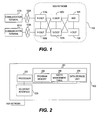
- FIG. 1 is a block diagram illustrating an example of a schematic configuration of an NGN network according to an embodiment of this invention.
- Communication terminals 101A and 101B are IP terminals such as IP telephone terminals used by a user.
- the communication terminal 101A is a side which starts a call (call originator is referred to as a calling side hereinafter), while the communication terminal 101B is a side which receives the call (call incoming side is referred to as a called side hereinafter).
- reference numerals of the drawings having similar numerals but different tail alphabets as described above are used when devices are similar but used for different purposes. Reference numerals with omitted tail alphabets are used when purposes are not differentiated from each other.
- Access gateways 102A and 102B are installed at the end of the NGN network.
- the communication terminals 101A and 101B are coupled to an NGN network 105 via the access gateways 102A and 102B.
- the NGN network 105 includes a group of call session control functions (CSCFs) which are SIP servers, and a home subscriber server (HSS) 106.
- CSCF group includes Proxy-CSCFs (P-CSCFs) 103A and 103B, Serving-CSCFs (S-CSCFs) 107A and 107B, and an Interrogating-CSCF (I-CSCF) 108.
- Pluralities of CSCF groups and HSSs 106 are installed, and classified into groups based on installing bases such as the access gateway 102A and the P-CSCF 103A.
- the P-CSCF 103A is a SIP server of a calling side with which the communication terminal 101A first contacts, and which communicates with the S-CSCF 107A and I-CSCF 108.
- the P-CSCF 103B is a P-CSCF of a called side.
- the S-CSCF 107 is a central SIP server of execution session control of call services, where the S-CSCF 107A belongs to the same calling side as that of the P-CSCF 103A, and the S-CSCF 107B belongs to the same called side as that of the P-CSCF 103B.
- the S-CSCFs 107A and 107B include means for making inquiries to the HSS based on a SIP message received from the communication terminal, and obtaining information such as an IP address of the communication terminal which is a SIP message destination from the HSS.
- the S-CSCF 107 includes means for associating with an application server (AS) (not shown).
- AS application server
- the I-CSCF 108 includes means for receiving a SIP message from an NGN network of another telecommunications house and assigning processing to an appropriate S-CSCF in its own NGN network based on information from the called side, and means for obtaining user information from the HSS.
- the HSS 106 is a database for processing user information, and manages pieces of information such as a SIP URI which is a telephone number in the NGN network, an IP address of the communication terminal, positional information of a user, information of services for which the user has a contract, and security information such as authentication.
- SIP URI which is a telephone number in the NGN network
- IP address of the communication terminal an IP address of the communication terminal
- positional information of a user information of services for which the user has a contract
- security information such as authentication.
- SMF subscriber location function
- a first embodiment is directed to a case where this invention is applied to the P-CSCF 103.
- a case where this invention is applied to the S-CSCF 107 and the I-CSCF 108 is described in a second embodiment.
- the first embodiment assumes an NGN network of one telecommunications house.
- this invention can be applied even among NGN networks of a plurality of telecommunications houses.
- this invention can be applied to a CSCF independently irrespective of NGN networks of telecommunications houses.
- This embodiment is directed to the CSCF of the NGN network.
- this invention can be applied to a SIP server in a large network such as the Internet.
- FIG. 2 is a block diagram illustrating a hardware configuration of the P-CSCF 103 according to the embodiment of this invention.
- the P-CSCF 103 includes a processor 202, a storage device 207, and an I/O circuit interface 203 for transmitting/receiving data to/from the NGN network, which are interconnected via an internal bus.
- the storage device 207 includes a semiconductor memory device or an external storage device such as a hard disk.
- the storage device 207 stores a program memory 204, a cache management table 205, and a data storage unit 206.
- the program memory 204 stores various control programs for realizing the P-CSCF 103.
- the processor 202 executes the programs stored in the program memory 204.
- the program memory 204 stores data used by the programs. Each program may be stored beforehand in the program memory 204, or loaded to the program memory 204 via a detachable storage medium or communication medium (network or carrier wave propagating through the network) (not shown).
- the cache management table 205 stores information extracted from a SIP message received by the P-CSCF 103. However, in addition to the arrangement where the P-CSCF 103 obtains data, and the obtained data is stored in the cache management table 205, data may be obtained from the external storage medium via the communication medium (network or carrier wave propagating through the network) to be stored in the cache management table 205.
- the data storage unit 206 stores information other than pieces of information stored in the program memory 204 and the cache management table 205.
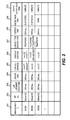
- FIG. 3 illustrates a configuration example of the cache management table 205 according to the embodiment of this invention.
- the cache management table 205 is a table for managing a SIP URI, an IP address of the communication terminal 101, and other pieces of SIP message information (cache information hereinafter).
- Entries of the cache management table 205 include a management ID 301, a SIP URI 302, use judgment start time 303, update time 304, a contact address 305, a transfer address 306, a subscription service type 307, Expires time 308, cache valid time 309, and static cache valid time 310.
- the management ID 301 is an identifier for managing the cache management table 205. Each data is stored for one entry of the management ID 301 to manage the cache management table 205.
- the SIP URI 302 is an identifier for uniquely identifying a user included in a SIP message.
- the use judgment start time 303 is time when the P-CSCF 103 creates an entry or updates entry information.
- the P-CSCF 103 starts judgment as to whether stored cache information is usable at the use judgment start time 303.
- the judgment as to whether the cache information is usable is described below referring to FIGS. 6 and 7 .
- the update time 304 is time when the P-CSCF 103 updates the cache management table 205.
- the cache management table 205 is updated when a SIP message is received. When a SIP message is received, and the cache management table 205 is updated based on received data, even if data to be stored is identical to data before updating, the time of receiving the SIP message is stored.
- the contact address 305 is an IP address of the communication terminal 101 corresponding to the SIP URI 302.
- the transfer address 306 is an IP address of a P-CSCF 103, an S-CSCF 107 or an I-CSCF 108 corresponding to the contact address 205.
- the transfer address 306 can store IP addresses of a plurality of CSCFs. When IP addresses of the plurality of CSCFs have been stored, a SIP message is transferred preferentially from the upper CSCF. When transfer to the upper CSCF fails, the SIP message is transferred to a next upper CSCF.
- the subscription service type 307 indicates a type of a service which the user of the communication terminal 101 subscribes to, such as an IP telephone or a TV telephone
- the Expires time 308 indicates addition of time represented by an Expires header contained in a SIP message of REGISTER which is a SIP command to current time, defining time indicating whether the P-CSCF 103 can use cache information, in other words, a maximum expiration date of the cache information. Cache information that has passed preset prescribed time is deleted.
- the cache valid time 309 indicates how long the cache information can be used from the update time 304 when the P-CSCF 103 can use the cache information. In other words, the cache valid time 309 defines an expiration date of the cache information.
- the cache valid time 309 is dynamically changed by a received SIP message. A value of the cache valid time 309 is equal to or lower than the Expires time 308.
- the static cache valid time 310 is configured time indicating, when the P-CSCF 103 uses the cache information, how long the cache information is usable after the reception of the SIP message.
- the static cache valid time 310 takes a static value while the value of the cache valid time 309 is dynamically changed. In the static cache valid time 310, a value smaller than that of the cache valid time 309 is set.
- the cache management table 205 may include information regarding congestion of a CSCF group for transferring the SIP message, such as the number of timing-out times after transmission of the SIP message or a transfer failure.
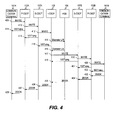
- FIG. 4 is a sequential diagram illustrating a procedure of establishing a session of SIP of the NGN network.
- FIG. 4 illustrates a normal procedure when no cache information is used.
- FIG. 4 a sequence among the communication terminals 101A and 101B, the P-CSCFs 103A and 103B, the S-CSCFs 107A and 107B, the I-CSCF 108, and the HSS 106 illustrated in FIG. 1 is described.
- INVITE indicates a command for establishing a session
- 100Trying and 200OK indicate response codes of a SIP message
- Diameter indicates a message of Diameter which is an authentication protocol.
- Processing of the I-CSCF 108 and the S-CSCF 107 of FIG. 4 may be carried out alternatively by other CSCFs, and order of transfer processing may vary. However, the P-CSCF 103 of this embodiment is not affected when the other CSCF perform the processing in place of the I-CSCF 108 and the S-CSCF 107.
- the communication terminal 101A transmits INVITE 409 to the P-CSCF 103A of the calling side.
- the P-CSCF 103A that has received the INVITE 409 transfers INVITE 410 to the S-CSCF 107A of the calling side, and transmits 100Trying 411 to the communication terminal 101A.
- the S-CSCF 107A that has received the INVITE 410 transfers INVITE 412 to the I-CSCF 108 of the called side, and transmits 100Trying 413 to the P-CSCF 103A.
- the I-CSCF 108 that has received the INVITE 412 transmits Diameter location-information-request (LIR) 414 containing a SIP URI of an arrival destination of the received SIP message to the HSS 106.
- the I-CSCF 108 transmits 100Trying 415 to the S-CSCF 107A.
- LIR Diameter location-information-request
- the HSS 106 that has received the Diameter LIR 414 transmits Diameter location-information-answer (LIA) 416 containing information of a transfer destination (S-CSCF 107B in this case) as a response to the I-CSCF 108.
- LIA Diameter location-information-answer
- the I-CSCF 108 that has received the Diameter LIA 416 transfers INVITE 417 to the S-CSCF 107B of the called side based on the information of the transfer destination contained in the Diameter LIA 416.
- the S-CSCF 107B that has received the INVITE 417 transfers INVITE 418 to the P-CSCF 103B of the called side, and transmits 100Trying 419 to the I-CSCF 108.
- the P-CSCF 103B that has received the INVITE 418 transfers INVITE 420 to the communication terminal 101 B, and transmits 100Trying 421 to the S-CSCF 107B.
- the communication terminal 101B that has received the INVITE 420 transmits 100Trying 422 to the P-CSCF 103B.
- the communication terminal 101B After completion of series of transfer operations of the SIP message from the communication terminal 10 1A to the communication terminal 101B described above, the communication terminal 101B calls the user.
- 180Ringing indicating a status of calling the user, or 183Session Progress for reserving resources of the NGN network may be transferred from the communication terminal 101B to the communication terminal 101A via each CSCF. However, description thereof is omitted for simplicity.
- a response sequence for session establishment is described below.
- the communication terminal 101B transmits 2000K 423 to the P-CSCF 103B.
- the P-CSCF 103B that has received the 200OK 423 transfers 2000K 424 to the S-CSCF 107B.
- the 200OK 424 transferred to the S-CSCF 107B is then transferred to the I-CSCF 108, the S-CSCF 107A, the P-CSCF 103A, and the communication terminal 101A in order.
- a SIP session is established when the communication terminal 101A receives 200OK 428. In other words, call is enabled between the communication terminals 101A and 101B, whereby audio data can be exchanged between the communication terminals 101A and 101B.
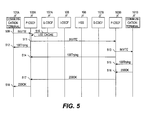
- FIG. 5 is a sequential diagram when the P-CSCF 103 uses the cache information according to the first embodiment.
- the communication terminal 101A transmits INVITE 509 to the P-CSCF 103A of the calling side.
- the P-CSCF 103A that has received the INVITE 509 transfers INVITE 511 to the P-CSCF 103B of the called side by using cache information (Step 510). Details of processing using cache information are described below with reference to FIG. 6 .
- the P-CSCF 103B that has received the INVITE 511 transfers INVITE 513 to the communication terminal 101B, and transmits 100Trying 514 to the P-CSCF 103A.
- the communication terminal 101B that has received the INVITE 513 transmits 100Trying 515 to the P-CSCF 103B.
- the communication terminal 101B After completion of the series of SIP message transfer operations from the communication terminal 101A to the communication terminal 101B described above, the communication terminal 101B calls the user. In this embodiment, after the series of operations described above, 180Ringing indicating a status of calling the user, or 183Session Progress for reserving resources of the NGN network may be transmitted from the communication terminal 101B to the communication terminal 101A. However, description thereof is omitted for simplicity. A response sequence for session establishment is described below.
- the communication terminal 101B transmits 200OK 516 to the P-CSCF 103B.
- the P-CSCF 103B that has received the 2000K 516 transfers 200OK 517 to the P-CSCF 103A.
- the 200OK 517 transferred to the P-CSCF 103A is then transferred to the communication terminal 101A.
- a SIP session is established when the communication terminal 101A receives 200OK 518. In other words, call is enabled between the communication terminals 101A and 101B, whereby audio data can be exchanged between the communication terminals 101A and 101B.
- FIG. 6 illustrates an example of SIP message transfer processing of the P-CSCF 103 according to the first embodiment.
- INVITE is a command for establishing a session.
- REGISTER is a command for registering the IP address of the communication terminal 101 and the SIP URI in the HSS 106 or the S-CSCF 107 by the communication terminal 101.
- functions normally set in the P-CSCF of the NGN network such as normalcy checking of a SIP message, authentication, SIP message compression, and changing or addition of a header such as Request-URI or Via in the SIP message are omitted for simplicity.
- the P-CSCF 103 receives a SIP message from the communication terminal 101, the S-CSCF 107 or the I-CSCF 108 (Step 601).
- the P-CSCF 103 judges whether the received SIP message is INVITE/REGISTER (Step 602). In Step 602, the P-CSCF 103 judges whether the received SIP message contains information to be cached. If the SIP message is not INVITE/REGISTER, the P-CSCF 103 carries out no processing for caching as in the case of the normal P-CSCF function, and transfers the SIP message to a transfer destination (Step 616).
- Step 602 If it is judged in Step 602 that the SIP message is INVITE/REGISTER, the P-CSCF 103 judges whether the SIP message has been transmitted from the communication terminal 101 (Step 605). In Step 605, it is judged which of a P-CSCF 103A of the calling side and a P-CSCF 103B of the called side the P-CSCF is to have received the SIP message.
- the P-CSCF has received the SIP message as the P-CSCF 103 of the called side (P-CSCF 103B). Thus, the P-CSCF 103 obtains cache information to update the cache management table 205. If there is no cache information, a new cache management table 205 is created (Step 603).
- the P-CSCF 103 stores cache information based on SIP URIs of both calling and called sides. Even when the transfer address 306 is a P-CSCF 103 itself (own server), information is stored in the cache management table 205. Specifically, the P-CSCF 103 can obtain a SIP URI 302, a contact address 305, and a transfer address 306 from the received SIP message, and Expires time 308 when the SIP message is REGISTER. The P-CSCF 103 stores use judgment start time 303, and time when the P-CSCF 103 updates the cache management table 205 as update time 304 (refer to FIGS. 9A and 9B for details).
- Step 603 the P-CSCF 103 judges whether a contact address 305 corresponding to the SIP URI of the called side contained in the SIP message is Mobile IP (Step 621).
- the judging method of Step 621 is described below referring to FIG. 8 .
- the Mobile IP is an IP address added to uniquely identify a communication terminal even when a communication network changes.
- the P-CSCF 103 sets cache valid time 309 to store the cache valid time 309 thus set in the cache management table 205 (Step 624).
- the contact address 305 is Mobile IP
- a possibility of IP address changing is low.
- the P-CSCF 103 is permitted to use the cache information for a certain period, and hence cache valid time 309 is set.
- the P-CSCF 103 judges whether the SIP URI matches a specific pattern (Step 622).
- the specific pattern of the SIP URI of Step 622 is a pattern indicating an attribute of the SIP URI (telephone number) such as a number starting from 050 or 03XXXX, and preset in the P-CSCF 103.
- the P-CSCF 103 judges whether the SIP URI matches the specific pattern based on the cache management table 205 and a preset attribute pattern of the SIP URI.
- the P-CSCF 103 sets cache valid time 309 to store the cache valid time 309 thus set in the cache management table 205 (Step 624). For example, when a pattern of the SIP URI is a fixed terminal, a possibility of changing of an IP address is low. Thus, the P-CSCF 103 is permitted to use cache information for a certain period, and hence cache valid time 309 is set.
- the P-CSCF 103 refers to the contact address 305 and the transfer address 306 to judge whether the contact address 305 and the transfer address 306 have been changed within a prescribed period of time (cache use judgment time illustrated in FIGS. 9A and 9B ) preset in the P-CSCF 103 (Step 623).
- the P-CSCF 103 sets cache valid time 309 to store the cache valid time 309 thus set in the cache management table 205 (Step 624). If it is judged that neither the contact address 305 nor the transfer address 306 has been changed within the prescribed period of time preset in the P-CSCF 103, a possibility of changing of an IP address is low. Thus, the P-CSCF 103 is permitted to use the cache information for a certain period, and hence cache valid time 309 is set.
- the P-CSCF 103 transfers a SIP message to the communication terminal to finish the processing (Step 615).
- Steps 621, 622 and 623 If all the judgments of Steps 621, 622 and 623 are "NO", no cache valid time is set. Thus, when permitted to use the cache, the P-CSCF can use the cache only for a short period of time of the set cache valid time 310 from the reception of the SIP message.
- the cache valid time set in Steps 621, 622 and 623 may vary from one step to another.
- Step 605 If it is judged in Step 605 that the received SIP message has been transmitted from the communication terminal 101, the P-CSCF 103 has received the SIP message as a P-CSCF 103 of the calling side (P-CSCF 103A). Then, the P-CSCF 103 judges whether the received SIP message is REGISTER (Step 606).
- the P-CSCF 103 If it is judged that the received SIP message is REGISTER, the P-CSCF 103 starts updating of the cache management table or creation of a new table (Step 611), transfers a SIP message (REGISTER in this case) to the upper CSCF, and receives its response (Step 612) to proceed to Step 603. In Step 611, the P-CSCF 103 can obtain a SIP URI 302 and Expires time 308 from the received REGISTER. The P-CSCF 103 stores use judgment start time 303 and update time 304 (described below in detail referring to FIGS. 9A and 9B ).
- the P-CSCF 103 waits for a response issued from the communication terminal 101B of the called side (200OK 427 or 183Session Progress of FIG. 4 ), and executes, after reception of the response issued from the communication terminal 101B of the called side, processing of Step 603 and thereafter.
- the P-CSCF 103 performs cache use judgment processing as to whether or not the cache information stored in the cache management table 205 is usable (Step 609).
- the cache use judgment processing is described below referring to FIG. 7 .
- the P-CSCF 103 executes processing of Steps 611 to 615.
- Step 612 the P-CSCF 103 transfers INVITE, but does not execute processing of Step 603 and subsequent steps until reception of a response (200OK 427 or 183Session Progress of FIG. 4 ) from the communication terminal 101B of the called side.
- the P-CSCF 103 stands by in status of Step 612 until reception of a response from the communication terminal 101B of the called side.
- the P-CSCF 103 uses the cache information, in other words, the contact address 305 of the cache management table 205 to rewrite Request-URI and other headers of the SIP message (INVITE), and transfers the rewritten SIP message to the transfer address 306 (Step 610).
- the SIP message is transferred to a preferential IP address. If transferring of the SIP message to the preferential IP address fails, the SIP message is transferred to a next IP address.
- a sequence when the P-CSCF 103 uses the cache information is illustrated in FIG. 5 , while a sequence when the P-CSCF 103 does not use any cache information is illustrated in FIG. 4 .
- FIG. 7 is a flowchart illustrating the cache use judgment processing of the P-CSCF 103 according to the first embodiment of this invention.
- the P-CSCF 103 judges whether or not services currently used by the communication terminal (communication terminal 101A in this case) which has transmitted a SIP message (INVITE) are cache-usable services (Step 709). Specifically, the P-CSCF 103 refers to information regarding services contained in the SIP message to judge whether or not the services are cache-usable services.
- Step 709 whether or not the services designated in the SIP message are cache-usable services by the P-CSCF 103 is judged.
- the cache has to be preferentially used in emergency, the fixed terminal can be judged to be a preferentially cache-usable service.
- the P-CSCF 103 judges whether or not the services currently used by the communication terminal 101A are cache-usable services.
- the P-CSCF 103 is inhibited from using the cache (Step 706). If it is judged that the services are cache-usable services (e.g. IP telephone services), the P-CSCF 103 judges whether or not cache information corresponding to a called side SIP URI contained in the SIP message has been stored in the cache management table 205 (Step 701). Having referred to the called side SIP URI contained in the SIP message to judge that no cache information corresponding to the SIP URI has been stored in the cache management table 205, the P-CSCF 103 is inhibited from using the cache (Step 706).
- the services are cache-usable services (e.g. IP telephone services)
- the P-CSCF 103 judges whether or not cache information corresponding to a called side SIP URI contained in the SIP message has been stored in the cache management table 205 (Step 701). Having referred to the called side SIP URI contained in the SIP message to judge that no cache information corresponding to the SIP URI has been stored
- Step 702 is processing normally carried out in the processing of using the cache. If it is judged that the processing is within the set cache valid time 310, the P-CSCF 103 is permitted to use the cache (Step 707).
- the P-CSCF 103 judges whether or not the processing is within the Expires time 308 and within the cache valid time 309 (Step 703). If it is judged that the processing is within the Expires time 308 and within the cache valid time 309, the P-CSCF 103 is permitted to use the cache (Step 707). If it is judged that the processing is neither within the Expires time 308 nor within the cache valid time 309, the P-CSCF 103 is inhibited from using the cache (Step 706).
- FIG. 8 illustrates an example of a configuration of an IP packet of the SIP message.
- FIG. 8 illustrates an IP packet IPv6 (IP version 6) which includes an IP header 801, an extended header 802, and a payload 803.
- IP header 801 is a standard header in which an IP address or the like is written.
- the extended header 802 is not normally added, but used for special purposes.
- the payload 803 indicates data of IP layer and more including a SIP message.
- the extended header 802 is a destination option header and an option type of the extended header 802 is 201, or the extended header 802 is a routing header of a destination option header type 2.
- the P-CSCF 103 can judge whether or not the IP packet is Mobile IP by judging whether or not the IP packet containing the received SIP message includes the above-mentioned characteristics.
- a method may be employed for making judgment by an operation system (OS), another device or a program, obtaining its result by the P-CSCF 103, and making judgment based on the obtained result by the P-CSCF 103.
- OS operation system
- the P-CSCF 103B of the called side may judge that the IP packet is Mobile IP, and transmit the SIP message containing information indicating that the IP packet is Mobile IP.
- the P-CSCF 103A may obtain the information that the IP packet is Mobile IP from the SIP message.
- FIGS. 9A and 9B illustrate examples of cache use judgment from change history of a contact address and a transfer address.
- Points 901 to 905 of FIG. 9A and points 911 to 913 of FIG. 9B indicate that the P-CSCF 103 has received SIP messages of REGISTER or INVITE from the communication terminal 101 or the S-CSCF 107 and its response, and that the P-CSCF 103 updates the cache management table 205 or creates a new table.
- the P-CSCF 103 stores new cache information in the cache management table 205, and time of this point in the use judgment start time 303. If a SIP message received at the point 901 is REGISTER, the P-CSCF 103 also stores Expires time 308.
- the P-CSCF 103 transfers a SIP message as in the normal case to update the update time 304.
- cache use judgment time preset in the P-CSCF 103 has passed from the use start time 303, and the contact address 305 has not been changed within the cache use judgment time.
- the P-CSCF 103 sets cache valid time 309 (906). If the processing is within the cache valid time 309 and within the Expires time 308 (ignored if not has been set) at the point 904, the P-CSCF 103 uses the cache (907). The cache valid time 309 has not passed at the point 905, and hence the P-CSCF 103 does not use any cache information (908).
- FIG. 9B is described below.
- the P-CSCF 103 Upon reception of a signal at the point 911, the P-CSCF 103 stores new cache information in the cache management table 205, and time of this point in the use judgment start time 303. If the received message is REGISTER at the point 911, the P-CSCF 103 registers Expires time 308.
- the P-CSCF 103 detects that the contact address 305 has been changed at the point 912 (914) to update information of the table, and to store time of this point in the use judgment start time 303.
- the cache use judgment time is released once, and cache use judgment time is set again from this point of time. If the processing is within the cache valid time 309 and within the Expires time 308 (ignored if not have been set) of the cache management table 205 at the point 913, the P-CSCF 103 uses the cache (915).
- the second embodiment is directed to a case where this invention is applied to the S-CSCF 107.
- This embodiment is applicable to the I-CSCF 108. Referring to FIGS. 2 and 5 , differences of the second embodiment from the first embodiment are described.
- a P-CSCF 103 and an S-CSCF 107 are similar in configuration, and a program memory 204 includes a basic function of the S-CSCF 107 and a transfer function of this invention.
- cache use (Step 510), in other words, cache use judgment, is carried out by the S-CSCF 107.
- the S-CSCF 107 transfers INVITE 511 to a transfer destination, and receives 100Trying 514 or 2000K 517 from the transfer destination to transfer it to a communication terminal 101A.
- the transfer destination is determined by referring to a transfer address 306. If there are a plurality of transfer destinations, an upper CSCF takes priority for transfer.
- the SIP server caches information contained in the SIP message, and judging whether the cached information is usable enables realization of reduction of loads on a network in a large system such as the NGN.
- Valid time of cache information is set, and hence erroneous calling caused by use of old cache information can be suppressed.
Landscapes
- Engineering & Computer Science (AREA)
- Computer Networks & Wireless Communication (AREA)
- Signal Processing (AREA)
- Telephonic Communication Services (AREA)
- Data Exchanges In Wide-Area Networks (AREA)
Applications Claiming Priority (1)
| Application Number | Priority Date | Filing Date | Title |
|---|---|---|---|
| JP2008184861A JP2010028286A (ja) | 2008-07-16 | 2008-07-16 | Sipサーバおよび通信システム |
Publications (1)
| Publication Number | Publication Date |
|---|---|
| EP2146479A1 true EP2146479A1 (en) | 2010-01-20 |
Family
ID=41210821
Family Applications (1)
| Application Number | Title | Priority Date | Filing Date |
|---|---|---|---|
| EP20090002949 Withdrawn EP2146479A1 (en) | 2008-07-16 | 2009-03-02 | SIP server and communication system |
Country Status (4)
| Country | Link |
|---|---|
| US (1) | US20100017527A1 (enExample) |
| EP (1) | EP2146479A1 (enExample) |
| JP (1) | JP2010028286A (enExample) |
| CN (1) | CN101631142A (enExample) |
Cited By (1)
| Publication number | Priority date | Publication date | Assignee | Title |
|---|---|---|---|---|
| WO2019223167A1 (zh) * | 2018-05-21 | 2019-11-28 | 平安科技(深圳)有限公司 | 获取sip服务器地址的方法、装置、设备和存储介质 |
Families Citing this family (6)
| Publication number | Priority date | Publication date | Assignee | Title |
|---|---|---|---|---|
| US9806965B2 (en) * | 2010-09-29 | 2017-10-31 | Avaya Inc. | Automatic user redundancy determination |
| US8583735B2 (en) | 2010-11-17 | 2013-11-12 | International Business Machines Corporation | Delivery in session initiated protocol (SIP) conferencing |
| JP6363475B2 (ja) * | 2014-11-20 | 2018-07-25 | 日本電信電話株式会社 | 呼処理制御サーバ、呼処理制御システム、呼処理制御方法 |
| JP6526084B2 (ja) * | 2017-03-15 | 2019-06-05 | 西日本電信電話株式会社 | 情報処理装置、情報処理方法、及びプログラム |
| EP4740434A1 (en) * | 2023-07-05 | 2026-05-13 | Jio Platforms Limited | Method and system for extracting desired sip packets at sib node server |
| US12206714B1 (en) * | 2023-07-18 | 2025-01-21 | Oracle International Corporation | Methods, systems, and computer readable media for handling internet protocol (IP) multimedia subsystem (IMS) registration at proxy call session control function (P-CSCF) for roaming users after policy and charging rules function (PCRF) database failure |
Citations (5)
| Publication number | Priority date | Publication date | Assignee | Title |
|---|---|---|---|---|
| JP2002271420A (ja) | 2001-03-06 | 2002-09-20 | Nec Corp | ネットワーク電話システム、それに用いるゲートウェイ装置及びネットワーク電話システムの使用方法 |
| US6963635B1 (en) * | 2003-05-06 | 2005-11-08 | Sprint Spectrum L.P. | Method and system for facilitating collection of subscriber past due balance |
| WO2008070842A1 (en) * | 2006-12-07 | 2008-06-12 | Starent Networks Corporation | Providing location based services for mobile devices |
| JP2008184861A (ja) | 2007-01-31 | 2008-08-14 | Sekisui Jushi Co Ltd | 弾性ポールの形成方法 |
| US20080282254A1 (en) * | 2007-05-09 | 2008-11-13 | Radware, Ltd. | Geographic Resiliency and Load Balancing for SIP Application Services |
Family Cites Families (11)
| Publication number | Priority date | Publication date | Assignee | Title |
|---|---|---|---|---|
| JP4028793B2 (ja) * | 2002-12-03 | 2007-12-26 | 株式会社日立製作所 | 移動端末装置および端末間パケット通信方法 |
| JP4438510B2 (ja) * | 2004-05-25 | 2010-03-24 | 株式会社日立製作所 | 通信システム及び通信制御装置 |
| SE0402396D0 (sv) * | 2004-10-05 | 2004-10-05 | Ericsson Telefon Ab L M | Refresh of cached terminal capabilities data |
| TWI252027B (en) * | 2004-12-30 | 2006-03-21 | Ind Tech Res Inst | System and method for accelerating call setup by caching |
| JP4513604B2 (ja) * | 2005-03-03 | 2010-07-28 | 株式会社日立製作所 | Sipサーバ高速化アーキテクチャ |
| JP4591263B2 (ja) * | 2005-08-01 | 2010-12-01 | 株式会社日立製作所 | 通信制御装置、及び、通信システム |
| JP4804244B2 (ja) * | 2006-07-03 | 2011-11-02 | 株式会社日立製作所 | アプリケーションをフィルタリングする装置、システム及び方法 |
| US20080259909A1 (en) * | 2007-04-17 | 2008-10-23 | Stefan Runeson | Signaling of Early Media Capabilities in IMS Terminals |
| US20090013078A1 (en) * | 2007-07-03 | 2009-01-08 | 4Dk Technologies, Inc. | Optimized Signaling Protocol, Including Session Initiation Protocol (SIP), in a Communications Environment |
| US8199746B2 (en) * | 2007-07-20 | 2012-06-12 | Cisco Technology, Inc. | Using PSTN reachability to verify VoIP call routing information |
| JP4940163B2 (ja) * | 2008-02-05 | 2012-05-30 | 株式会社日立製作所 | 通信ゲートウェイ装置及び中継方法 |
-
2008
- 2008-07-16 JP JP2008184861A patent/JP2010028286A/ja active Pending
-
2009
- 2009-02-26 CN CN200910118524A patent/CN101631142A/zh active Pending
- 2009-03-02 EP EP20090002949 patent/EP2146479A1/en not_active Withdrawn
- 2009-03-04 US US12/397,675 patent/US20100017527A1/en not_active Abandoned
Patent Citations (5)
| Publication number | Priority date | Publication date | Assignee | Title |
|---|---|---|---|---|
| JP2002271420A (ja) | 2001-03-06 | 2002-09-20 | Nec Corp | ネットワーク電話システム、それに用いるゲートウェイ装置及びネットワーク電話システムの使用方法 |
| US6963635B1 (en) * | 2003-05-06 | 2005-11-08 | Sprint Spectrum L.P. | Method and system for facilitating collection of subscriber past due balance |
| WO2008070842A1 (en) * | 2006-12-07 | 2008-06-12 | Starent Networks Corporation | Providing location based services for mobile devices |
| JP2008184861A (ja) | 2007-01-31 | 2008-08-14 | Sekisui Jushi Co Ltd | 弾性ポールの形成方法 |
| US20080282254A1 (en) * | 2007-05-09 | 2008-11-13 | Radware, Ltd. | Geographic Resiliency and Load Balancing for SIP Application Services |
Cited By (1)
| Publication number | Priority date | Publication date | Assignee | Title |
|---|---|---|---|---|
| WO2019223167A1 (zh) * | 2018-05-21 | 2019-11-28 | 平安科技(深圳)有限公司 | 获取sip服务器地址的方法、装置、设备和存储介质 |
Also Published As
| Publication number | Publication date |
|---|---|
| JP2010028286A (ja) | 2010-02-04 |
| US20100017527A1 (en) | 2010-01-21 |
| CN101631142A (zh) | 2010-01-20 |
Similar Documents
| Publication | Publication Date | Title |
|---|---|---|
| CN101023700B (zh) | 通信系统中的用户登记 | |
| RU2429576C2 (ru) | Способ, система и элемент сети для обработки предоставления услуг после того, как данные элемента сети становятся недопустимыми, или отказа элемента сети | |
| US7761600B2 (en) | Method and apparatus for distributing application server addresses in an IMS | |
| US9210224B2 (en) | Service provisioning in a communication system | |
| EP2705647B1 (en) | Method and network entity for s-cscf server allocation in an ims based multimedia over ip network | |
| US8935374B2 (en) | Method, system, and device for realizing registration mechanism of IP multimedia subsystem | |
| US20100287406A1 (en) | Node apparatus, communication system, and method of providing service | |
| US20150142987A1 (en) | Method and System of Transferring a Message in a Session Initiation Protocol Based Communications Network | |
| US20100017527A1 (en) | Sip server and communication system | |
| US8600031B2 (en) | Method for connecting calls between an IP multimedia subsystem (IMS) domain and a circuit switched (CS) domain | |
| EP2898647B1 (en) | Methods and apparatus for processing an ims session | |
| CN101326493B (zh) | 用于多处理器服务器中的负载分配的方法和装置 | |
| US8055774B2 (en) | Method for improving subscriber data integrity in an IMS network | |
| EP2673943B1 (en) | Method for handling public identities in an internet protocol multimedia subsystem network | |
| KR20100102363A (ko) | 아이피 멀티미디어 서브시스템에서의 서비스 등록 방법 및 시스템 | |
| KR100703426B1 (ko) | 아이피 기반 멀티미디어 서브시스템에서 가입자 정보유실시 발신 및 착신 호를 가능하게 하는 방법 및 장치 | |
| KR101075614B1 (ko) | 아이피 기반 멀티미디어 서브시스템에서 가입자 정보유실시 착신호를 가능하게 하는 방법 | |
| US8051129B2 (en) | Arrangement and method for reducing required memory usage between communication servers | |
| CN117675767A (zh) | 信息查询方法、装置、介质及设备 | |
| CN100527874C (zh) | 一种私有业务标识的数据检查方法 | |
| RU2433558C2 (ru) | Вычисление критерия начальной фильтрации |
Legal Events
| Date | Code | Title | Description |
|---|---|---|---|
| PUAI | Public reference made under article 153(3) epc to a published international application that has entered the european phase |
Free format text: ORIGINAL CODE: 0009012 |
|
| AK | Designated contracting states |
Kind code of ref document: A1 Designated state(s): AT BE BG CH CY CZ DE DK EE ES FI FR GB GR HR HU IE IS IT LI LT LU LV MC MK MT NL NO PL PT RO SE SI SK TR |
|
| AX | Request for extension of the european patent |
Extension state: AL BA RS |
|
| 17P | Request for examination filed |
Effective date: 20100331 |
|
| AKX | Designation fees paid |
Designated state(s): DE FR GB |
|
| 17Q | First examination report despatched |
Effective date: 20120718 |
|
| STAA | Information on the status of an ep patent application or granted ep patent |
Free format text: STATUS: THE APPLICATION IS DEEMED TO BE WITHDRAWN |
|
| 18D | Application deemed to be withdrawn |
Effective date: 20121129 |