EP2139751B1 - Aus natürlichem verbundstoff hergestellte sitzstruktur und herstellungsverfahren dafür - Google Patents
Aus natürlichem verbundstoff hergestellte sitzstruktur und herstellungsverfahren dafür Download PDFInfo
- Publication number
- EP2139751B1 EP2139751B1 EP08710037A EP08710037A EP2139751B1 EP 2139751 B1 EP2139751 B1 EP 2139751B1 EP 08710037 A EP08710037 A EP 08710037A EP 08710037 A EP08710037 A EP 08710037A EP 2139751 B1 EP2139751 B1 EP 2139751B1
- Authority
- EP
- European Patent Office
- Prior art keywords
- seating structure
- base element
- composite material
- base
- shell
- Prior art date
- Legal status (The legal status is an assumption and is not a legal conclusion. Google has not performed a legal analysis and makes no representation as to the accuracy of the status listed.)
- Active
Links
Images
Classifications
-
- B—PERFORMING OPERATIONS; TRANSPORTING
- B62—LAND VEHICLES FOR TRAVELLING OTHERWISE THAN ON RAILS
- B62J—CYCLE SADDLES OR SEATS; AUXILIARY DEVICES OR ACCESSORIES SPECIALLY ADAPTED TO CYCLES AND NOT OTHERWISE PROVIDED FOR, e.g. ARTICLE CARRIERS OR CYCLE PROTECTORS
- B62J1/00—Saddles or other seats for cycles; Arrangement thereof; Component parts
Definitions
- the present invention is applicable to the art of sport and leisure accessories and particularly relates to a seating structure made of natural composite material, and a process for making same.
- Bicycle saddles and the like are known to comprise a shell having an underside designed to face towards a bicycle frame and a topside designed to face towards a seated user.
- Comfort elements of the saddle such as inserts of elastomer, foam or gel and/or cover elements for contact with the seated user are generally attached to the top of the shell.
- Bicycle saddle shells are generally formed of a polymeric material such as polypropylene, polyamide, polybutadiene terephthalate or the like. While such polymeric material provides the advantages of having a light weight and a low cost, it exhibits no particularly high mechanical performances.
- the object of the present invention is to overcome the above drawbacks, by providing a seating structure that is highly efficient and relatively cost-effective.
- a particular object is to provide a seating structure that has a relatively low environmental impact.
- a further object of the invention is to provide a seat making process that has a relatively low environmental impact.
- composite material and derivatives thereof shall be meant to indicate a material comprising a thermoplastic or thermosetting polymeric matrix with a fibrous reinforcement embedded therein.
- natural fibers and derivatives thereof shall be meant to indicate fibers of animal or plant origin.
- the invention relates to a process for making the above seating structure, as defined in claim 11.
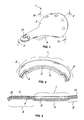
- the seating structure of the invention is embodied herein by a bicycle saddle having an elongate front portion and a widened rear portion for supporting a user. Nonetheless, it will be understood that the seating structure 1 may be configured as a seat, a seating surface of a chair or any other human body support.
- the structure 1 is essentially comprised of a load-bearing shell 2 and a cover element 3 thereon, for contact with a user.
- the seat 1 may further comprise rails 4 or the like for connection to a bicycle frame, not shown but well known per se.
- the shell 2 comprises at least one first base element 5 made from a composite material composed of a thermoplastic or thermosetting synthetic polymeric matrix and a reinforcement containing natural fibers, such as wool, cotton, linen, jute fibers.
- the seating structure of the invention has a lower environmental impact as compared to prior art saddles.
- the natural fiber-containing composite material is much more easily recyclable than traditional composite materials.
- the technical characteristics of the base element 5 as mentioned below shall be generally intended to designate from time to time one or more of the base elements 5, 5', ... of the shell 2.
- the natural fibers may be of the woven and/or nonwoven type and may be combined with polymeric and/or synthetic and/or metal fibers for reinforcing the base element 5.
- the composite material of the latter may be also filled with nanoparticles, that can be of metal and/or mineral and/or polymeric types.
- the synthetic polymeric matrix of the composite material that forms the base element 5 is of thermoplastic type, preferably in fiber form at ambient temperature.
- Such fibers may be selected, for example, from the group comprising: polypropylene, polyamide, polybutadiene terephthalate, polyethylene, polystyrene.
- the polymeric matrix may be provided in other states, e.g. in granules, without departure from the inventive scope as defined in the annexed claims.
- the shell 2 includes at least one substantially sheet-like stiffening element, preferably made of metal, laid on the base element 5 to improve the mechanical properties of the shell 2.
- the shell 2 of the saddle 1 may also consist of the first base element 5 only, without departure from the inventive scope as defined in the annexed claims.
- the stiffening element 6 may be formed of any material, such as a traditional composite, i.e. carbon fiber, glass, Kevlar® or the like, without departure from the inventive scope as defined in the annexed claims.
- the base element 5 may include at least one differential deformable portion, generally designated by numeral 7.
- the saddle will have stiffer areas, designated by numerals 8, 8', which will contribute to the increase of its mechanical strength, and more resilient areas, defined by the differential deformable portions 7, for improved user comfort.
- the term "differential deformable portion" or the like shall be meant to indicate an area within the surface of the seat 1 that, under a load, has a considerably lower deformability than at least another area within the same surface under the same load.
- the differential deformable portion 7 may be located in the ischial and/or prostatic and/or peripheral zones of the saddle, thereby defining high user comfort areas in the regions of the body that are more susceptible to injury and pain during exercise.
- one or more differential deformable portions 7 may be provided at the contact points between the seat 1 and the inner thigh of a user.
- the stiffening element 6 may have at least one aperture 9 coincident with the more deformable portions 7, to allow contact of the user with the more comfortable areas.
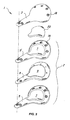
- At least one insert 20 of a viscoelastic material or the like may be interposed between the cover element 3 and the shell 2, as shown in Figure 3 and attached thereto.
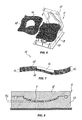
- the base element 5 may be formed by thermoforming at least one sheet element 10 from the composite material consisting of the synthetic polymeric matrix and the natural fiber-containing reinforcement in a specially designed mold 11.
- a sheet element 10 may be used that is formed of jute fibers dispersed in a polypropylene fiber matrix.
- the sheet element 10 may be laid in the mold 11, compressed between the male and female parts 12, 13 thereof and heated to a temperature near the melting or setting temperature of the matrix of the composite material, depending on whether such matrix is of the thermoplastic or thermosetting type. As an indication, such temperature may be in a range from 150°C to 300°C, according to the type of matrix being used.
- the sheet element 10 changes from its initial height H1 to a final height H2 defined by the distance between the male and female parts 12, 13 of the mold 11. It will be understood that the ratio between the heights H1/H2 will determine the compression ratio of the sheet element 10 so that, as the H1/H2 compression ratio increases the base element 5 will have an increasing stiffness.
- the differential deformable portions 7 of the base element 5 may be obtained by differential compression of the base element 5 between the male and female parts 12, 13 of the mold 11, to create areas with different compression ratios.
- At least one layer 10' may be laid on the sheet element 10, preferably made of the same composite material as the sheet element 10, and having at least one aperture coincident with the area designed to define the more deformable portion 7.
- the assembly formed by the sheet element 10 and the layer 10', generally designated by numeral 15, will have differential initial heights, which are designated by H1 at the aperture 14 (defined by the height of the sheet element 10 only) and by H1' at the areas at the periphery of the aperture 14. As particularly shown in Figure 7 , the height H1' is greater than the height H1.
- the base element 5 has been formed in the mold 11, in which the male and female parts 12, 13 are, as mentioned above, at a distance H2, it will have an area at the aperture 14, corresponding to the differential deformable portion 7, in which the compression ratio is H1/H2 and areas at the periphery of the aperture 14, corresponding to the stiffer areas 8, 8', in which the compression ratio is H1'/H2.
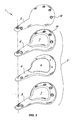
- Figure 2 shows a preferred, non exclusive embodiment of the seating structure of the invention, in which the shell 2 has first and second base elements 5, 5' of a composite material composed of the synthetic polymeric matrix and the natural fiber-containing reinforcement as described above, with the metal stiffening element 6 interposed therebetween.
- the second upper base element 5' has a cover element 3 attached thereto, which is preferably made of leather, skin or the like.
- the latter has a peripheral edge 16 which defines an abutment for the cover element 3, as particularly shown in Figure 5 .
- Figure 3 shows another preferred, non exclusive embodiment of the invention, which is similar to the former except that a viscoelastic insert 20 is coincident with the differential deformed portion 7.
- the insert may be attached to the base element 5 in a known manner.
- additional means may be provided for attachment of the cover element 3 to the shell 2 and/or of the various layers of the shell 2 to each other, such as nuts or rivets 17 to be introduced in respective through holes 18.
- the seating structure as shown in Figures 2 and 3 may be fabricated using a process that includes the following steps.
- first and second base elements 5, 5' shall undergo preventive thermoforming, by following the steps as shown in Figures 6 to 8 . It shall be understood that at least one sheet element 10 has to be thermoformed for each base element 5, 5'.
- thermoplastic matrix a composite material including a thermoplastic matrix will be used, for reasons that will appear more clearly hereinbelow.
- the pre-thermoforming steps on the first and second base elements 5, 5' will be carried out at a temperature slightly below the softening point of the thermoplastic matrix of the composite material that forms the sheet elements 10, so that it can be formed with a shape that allows further shaping and handling of the layers 5, 5', without being the final shape.
- the first and second base elements 5, 5' and the stiffening element 6 interposed therebetween and possibly the insert 20 are laid in the mold in the order as shown from top to bottom in Figures 2 and 3 .
- the cover element 3 may be attached to the upper base element 5' directly in the same mold or after this step.
- the cover element 3 may be glued to the shell 2 after thermoforming thereof.
- the cover element 3 may be first introduced in the mold, followed by the viscoelastic material that is designed to form the insert 20 and then, in the following order, by the second base element 5', the stiffening element 6 and the first base element 5.
- the mold 11 is heated to a temperature near or above the melting temperature of the thermoplastic fibers of the composite material, for the stiffening element 6 to be safely embedded between the first and second base elements 5, 5'. Furthermore, during this step, the thermoplastic matrix of the composite material that forms these elements melts and forms a substantially continuous structure at the points in which the first and second base elements 5, 5' are not separated by the stiffening element 6, as shown in Figures 4 and 5 .
- the seating structure of the invention fulfills the intended purposes and particularly meets the requirement of providing a seating structure that has a relatively low environmental impact.
Landscapes
- Engineering & Computer Science (AREA)
- Mechanical Engineering (AREA)
- Laminated Bodies (AREA)
- Seats For Vehicles (AREA)
- Casting Or Compression Moulding Of Plastics Or The Like (AREA)
- Reinforced Plastic Materials (AREA)
- Superconductors And Manufacturing Methods Therefor (AREA)
- Footwear And Its Accessory, Manufacturing Method And Apparatuses (AREA)
Claims (13)
- Sitzkonstruktion, insbesondere ein Fahrradsattel, die eine Lasttragschale (2) und ein für den Kontakt mit einem Benutzer gestaltetes Abdeckelement (3) umfasst, wobei die Schale (2) mindestens ein erstes Basiselement (5) umfasst, das aus einem Verbundwerkstoff besteht, der aus einer Polymermatrix und einer Fasern enthaltenden Verstärkung besteht, wobei diese Polymermatrix synthetisch ist und die Fasern der Verstärkung Naturfasern sind, wobei die Schale (2) mindestens ein im Wesentlichen flächiges Versteifungselement (6) umfasst, das an dem mindestens einen Basiselement (5) befestigt ist, wobei dieses mindestens eine Versteifungselement (6) in direktem Kontakt mit dem mindestens einen Basiselement (5) ist, dadurch gekennzeichnet, dass die Sitzkonstruktion mindestens ein zweites Basiselement (5') umfasst, wobei das mindestens eine Versteifungselement (6) einen im Wesentlichen bezogen auf das mindestens eine erste und das mindestens eine zweite Basiselement (5, 5') zurückversetzten Umfangsrand aufweist und gleichmäßig dazwischen eingebettet ist.
- Sitzkonstruktion nach Anspruch 1, dadurch gekennzeichnet, dass das synthetische Polymermaterial thermoplastischen Typs ist, und dass dieses thermoplastische synthetische Polymermaterial bei Umgebungstemperatur faserförmig ist.
- Sitzkonstruktion nach Anspruch 2, dadurch gekennzeichnet, dass die synthetischen thermoplastischen Polymerfasern aus der Gruppe ausgewählt sind, die Folgendes umfasst: Polypropylen, Polyamid, Polybutadienterephthalat, Polystyrol und Polyethylen.
- Sitzkonstruktion nach Anspruch 1, dadurch gekennzeichnet, dass die Naturfasern aus der Wolle, Baumwolle, Leinen und Jute umfassenden Gruppe ausgewählt sind.
- Sitzkonstruktion nach einem oder mehreren der Ansprüche von 1 bis 4, dadurch gekennzeichnet, dass der Verbundwerkstoff mit Nanopartikeln gefüllt ist.
- Sitzkonstruktion nach einem oder mehreren der Ansprüche 1 bis 5, dadurch gekennzeichnet, dass das mindestens eine Basiselement (5) mindestens einen unterschiedlich verformbaren Bereich (7) umfasst, der sich in den Sitzbein- und/oder Prostata- und/oder Umfangsbereichen des Sitzes befindet.
- Sitzkonstruktion nach Anspruch 6, wenn abhängig von Anspruch 1, dadurch gekennzeichnet, dass das mindestens eine flächige Versteifungselement (6) eine plane Form aufweist, die der des mindestens einen Basiselements (5) ähnelt, und dass es mindestens eine Öffnung (9) hat, die sich mit dem mindestens einen unterschiedlich verformbaren Bereich (7) deckt.
- Sitzkonstruktion nach einem oder mehreren der Ansprüche 1 bis 7, dadurch gekennzeichnet, dass sie mindestens eine aus einem Material mit viskoelastischem Verhalten bestehende Einlage (20) umfasst, die auf dem mindestens einen ersten Basiselement (5) liegt.
- Sitzkonstruktion nach Anspruch 8, dadurch gekennzeichnet, dass das viskoelastische Material der mindestens einen Einlage (20) ein Polyurethangel ist.
- Sitzkonstruktion nach Anspruch 8, wenn abhängig von Anspruch 6, dadurch gekennzeichnet, dass die aus einem viskoelastischen Material bestehende Einlage (20) deckungsgleich mit dem mindestens einen unterschiedlich verformbaren Bereich (7) angeordnet ist.
- Verfahren zum Herstellen einer Sitzkonstruktion nach einem oder mehreren der Ansprüche 1 bis 10, wobei diese Konstruktion eine Lasttragschale (2) und ein Abdeckelement (3) für den Kontakt mit einem Benutzer umfasst, und wobei diese Schale (2) mindestens ein aus einem Verbundwerkstoff bestehendes Basiselement (5), mindestens ein Versteifungselement (6) und ein aus einem Verbundwerkstoff bestehendes zweites Basiselement (5') umfasst, wobei dieses mindestens eine Basiselement (5) durch Thermoformen einer Polymermatrix mit darin eingebetteten Verstärkungsfasern in einer Form erhalten wird, dadurch gekennzeichnet, dass die Polymermatrix aus synthetischen Polymermatrizen ausgewählt ist und die Verstärkungsfasern aus natürlichen Verstärkungsfasern ausgewählt sind, und dadurch, dass das mindestens eine erste Basiselement (5) durch Thermoformen in der besagten Form von mindestens einem flächigen Element (10) erhalten wird, das aus der synthetischen Polymermatrix mit den darin eingebetteten Naturfasern ausgebildet ist, wobei dieses Verfahren auch das Thermoformen eines ersten und eines zweiten Basiselements (5, 5') vorsieht, die wechselseitig mit mindestens einem dazwischen eingefügten Versteifungselement (6) verbunden sind.
- Verfahren nach Anspruch 11, dadurch gekennzeichnet, dass das Thermoformen ausgeführt wird, indem das mindestens eine flächige Element (10) in das besagte Element gelegt und auf eine Temperatur nahe der Schmelztemperatur der synthetischen Polymermatrix erhitzt wird.
- Verfahren nach Anspruch 12, dadurch gekennzeichnet, dass das mindestens eine Basiselement (5) erhalten wird, indem eine Anordnung (15) bereitgestellt wird, die aus mindestens einem ersten flächigen Element (10) und mindestens einem zweiten flächigen Element (10') gebildet ist, das im Wesentlichen dem vorgenannten Element ähnlich ist und mindestens eine Öffnung (14) aufweist, die sich mit dem Sitzbein-, Prostata- oder Umfangsbereich des Sitzes deckt, und indem diese Anordnung (15) in der besagten Form gepresst wird, um ihr eine im Wesentlichen einheitliche Dicke zu verleihen, wobei sich mindestens ein unterschiedlich verformbarer Bereich (7) bei der mindestens einen Öffnung (14) befindet.
Applications Claiming Priority (2)
| Application Number | Priority Date | Filing Date | Title |
|---|---|---|---|
| IT000042A ITVI20070042A1 (it) | 2007-02-16 | 2007-02-16 | Struttura di seduta in materiale composito naturale, nonche' metodo di realizzazione della stessa. |
| PCT/IB2008/050539 WO2008099364A1 (en) | 2007-02-16 | 2008-02-14 | Seating structure made of natural composite material and process for making same |
Publications (2)
| Publication Number | Publication Date |
|---|---|
| EP2139751A1 EP2139751A1 (de) | 2010-01-06 |
| EP2139751B1 true EP2139751B1 (de) | 2011-10-12 |
Family
ID=39580037
Family Applications (1)
| Application Number | Title | Priority Date | Filing Date |
|---|---|---|---|
| EP08710037A Active EP2139751B1 (de) | 2007-02-16 | 2008-02-14 | Aus natürlichem verbundstoff hergestellte sitzstruktur und herstellungsverfahren dafür |
Country Status (9)
| Country | Link |
|---|---|
| US (1) | US8308234B2 (de) |
| EP (1) | EP2139751B1 (de) |
| JP (1) | JP2010519104A (de) |
| CN (1) | CN101641252A (de) |
| AT (1) | ATE528199T1 (de) |
| DK (1) | DK2139751T3 (de) |
| IT (1) | ITVI20070042A1 (de) |
| TW (1) | TWI443039B (de) |
| WO (1) | WO2008099364A1 (de) |
Families Citing this family (23)
| Publication number | Priority date | Publication date | Assignee | Title |
|---|---|---|---|---|
| IT1400939B1 (it) | 2010-05-13 | 2013-07-02 | Selle Royal Spa | Supporto migliorato per seduta |
| CN102371697B (zh) * | 2010-08-12 | 2014-07-02 | 米玛国际控股有限公司 | 婴儿座椅的制造方法 |
| EP2616314B1 (de) * | 2010-09-16 | 2015-11-25 | Luca Cassani | Verfahren zur herstellung von satteln und dergleichen |
| ITVR20110160A1 (it) * | 2011-07-28 | 2013-01-29 | Selle Royal Spa | Supporto per parti di corpo umano e simili |
| DE102011052297B4 (de) * | 2011-07-29 | 2018-02-15 | Ulrich Schmid | Sattel für ein Zweiradfahrzeug |
| US10165862B2 (en) * | 2011-10-31 | 2019-01-01 | Johann Burkhard Schmitz | Support structure for saddle-form seat surface |
| DE102011057020B4 (de) * | 2011-12-23 | 2013-07-04 | Louis Chuang | Fahrradsattel |
| CH706685A2 (it) | 2012-06-27 | 2013-12-31 | Ergoview Ag | Struttura di supporto migliorata per il corpo umano. |
| USD718543S1 (en) | 2013-04-24 | 2014-12-02 | Brooks England Ltd. | Saddle |
| ITVR20130143A1 (it) * | 2013-06-17 | 2014-12-18 | Brooks England Ltd | Seduta per selle di biciclette e simili, e procedimento per la sua fabbricazione. |
| CN104816769A (zh) * | 2014-02-05 | 2015-08-05 | 株式会社丸井 | 自行车用鞍座及其制造方法 |
| JP2015164833A (ja) * | 2014-02-05 | 2015-09-17 | 株式会社マルイ | 自転車用サドルとその製造方法 |
| TWI565617B (zh) | 2015-08-03 | 2017-01-11 | Bicycle seat cushion body with auxiliary function sheet and manufacturing method thereof | |
| IT201700077584A1 (it) * | 2017-07-10 | 2019-01-10 | Selle Royal Spa | Stampo per un elemento di supporto per il corpo umano, quale una sella |
| US11173974B2 (en) | 2017-09-18 | 2021-11-16 | Versal Manufacturing, Inc. | Moldable bicycle saddles, external saddle heaters, fitting procedures, and related technologies |
| EP4427979A3 (de) | 2017-09-18 | 2024-11-27 | Versal Manufacturing, Inc. | Formbare fahrradsättel, montageverfahren und zugehörige technologien |
| US12365410B2 (en) | 2017-09-18 | 2025-07-22 | Reform Technologies Inc. | Moldable bicycle saddles, external saddle heaters, fitting procedures, and related technologies |
| WO2022084986A1 (en) * | 2020-10-19 | 2022-04-28 | Tetro Ltd. | Hybrid structure having suspension quality |
| US11472504B2 (en) | 2020-11-13 | 2022-10-18 | David Niles | Bicycle saddles with an ischial-perineal suspension region |
| TWI789905B (zh) * | 2021-09-13 | 2023-01-11 | 許秀政 | 複合式自行車坐墊 |
| FR3135441B1 (fr) | 2022-05-10 | 2024-04-12 | Berthoud Cycles | Assise à base de lin pour selle cycliste |
| IT202300008919A1 (it) | 2023-05-05 | 2024-11-05 | Selle Royal Group Spa | Elemento di supporto per il corpo umano comprendente un materiale riciclato e metodo per la sua realizzazione |
| IT202300012519A1 (it) * | 2023-06-19 | 2024-12-19 | Selle Royal Group S P A | Gruppo di sommità o di seduta per una sella per veicoli. |
Family Cites Families (18)
| Publication number | Priority date | Publication date | Assignee | Title |
|---|---|---|---|---|
| US4098537A (en) * | 1977-03-07 | 1978-07-04 | The Jacobs Corporation | Bicycle saddle |
| JPS61222880A (ja) * | 1985-11-09 | 1986-10-03 | 東京シ−ト株式会社 | 熱可塑性合成樹脂ブロ−成形の二輪車用サドル型シ−ト用フレ−ム |
| US5356205A (en) * | 1992-09-18 | 1994-10-18 | Inmotion, Inc. | Seat assembly with a defined flexure region, venting or support nodules |
| US5766704A (en) * | 1995-10-27 | 1998-06-16 | Acushnet Company | Conforming shoe construction and gel compositions therefor |
| US6756412B2 (en) * | 1996-04-25 | 2004-06-29 | Georgia Composites, Inc. | Fiber-reinforced recycled thermoplastic composite and method |
| US6116684A (en) * | 1997-06-06 | 2000-09-12 | Bleachercomfort Llc | Ultra lightweight closed cell foam bicycle saddle |
| IT1294713B1 (it) * | 1997-09-19 | 1999-04-12 | Selle Royal Spa | Struttura di supporto elastico integrale con elementi ornamentali, nonche' metodo di realizzazione di tale struttura. |
| DE19806703A1 (de) | 1998-02-18 | 1999-11-04 | Marx Gmbh J J | Verfahren und Maschine zur Herstellung einer Matte aus einem Naturfaservlies |
| IT1317436B1 (it) * | 2000-04-28 | 2003-07-09 | Selle Italia Srl | Struttura di sella, particolarmente studiata per cicli |
| US6409865B1 (en) * | 2000-05-01 | 2002-06-25 | Paul M. Yates | Bicycle saddle production method |
| IT1315498B1 (it) | 2000-08-04 | 2003-02-18 | Selle Royal Spa | Sella in materiale composito, in particolare per bicicletta e metodoper la sua realizzazione |
| TWI233903B (en) * | 2003-12-05 | 2005-06-11 | Selle Tech Ind Co Ltd | Shell for bicycle saddle |
| US7341308B2 (en) * | 2004-04-26 | 2008-03-11 | Tom Milton | Bicycle saddle |
| US6957857B1 (en) * | 2004-09-20 | 2005-10-25 | Ching-Song Lee | Shell construction for a bicycle seat |
| ITVI20040254A1 (it) | 2004-10-26 | 2005-01-26 | Selle Royal Spa | Struttura di sella a memoria di forma, particolarmente per veicoli a pedali, nonche' metodo di realizzazione di tale struttura |
| ITVI20050025A1 (it) * | 2005-01-28 | 2006-07-29 | Selle Royal Spa | Struttura di supporto ergonomica in materiale composito, particolarmente per sostenere parti del corpo umano, nonche' metodo di realizzazione della stessa |
| ITVI20050040A1 (it) | 2005-02-10 | 2006-08-11 | Selle Royal Spa | Struttura ergonomica di supporto, particolarmente per sostenere parti del corpo umano, nonche' metodo di realizzazione della stessa |
| US7547064B2 (en) * | 2006-05-23 | 2009-06-16 | Louis Garneau Sports Inc. | Ventilated saddle for sporting equipment |
-
2007
- 2007-02-16 IT IT000042A patent/ITVI20070042A1/it unknown
-
2008
- 2008-02-14 US US12/527,229 patent/US8308234B2/en active Active
- 2008-02-14 AT AT08710037T patent/ATE528199T1/de not_active IP Right Cessation
- 2008-02-14 EP EP08710037A patent/EP2139751B1/de active Active
- 2008-02-14 CN CN200880009162A patent/CN101641252A/zh active Pending
- 2008-02-14 WO PCT/IB2008/050539 patent/WO2008099364A1/en not_active Ceased
- 2008-02-14 JP JP2009549882A patent/JP2010519104A/ja active Pending
- 2008-02-14 DK DK08710037.6T patent/DK2139751T3/da active
- 2008-02-15 TW TW097105283A patent/TWI443039B/zh active
Also Published As
| Publication number | Publication date |
|---|---|
| TW200911602A (en) | 2009-03-16 |
| DK2139751T3 (da) | 2012-02-06 |
| CN101641252A (zh) | 2010-02-03 |
| EP2139751A1 (de) | 2010-01-06 |
| WO2008099364A1 (en) | 2008-08-21 |
| ATE528199T1 (de) | 2011-10-15 |
| ITVI20070042A1 (it) | 2008-08-17 |
| JP2010519104A (ja) | 2010-06-03 |
| US20100013278A1 (en) | 2010-01-21 |
| US8308234B2 (en) | 2012-11-13 |
| TWI443039B (zh) | 2014-07-01 |
Similar Documents
| Publication | Publication Date | Title |
|---|---|---|
| US8308234B2 (en) | Seating structure made of natural composite material and process for making same | |
| US8128164B2 (en) | Human body supporting structure, particularly bicycle saddle and method of making same | |
| US6409269B1 (en) | Vehicle seat assembly with thermoformed fibrous suspension panel | |
| EP2144804B1 (de) | Sitzstruktur und herstellungsverfahren dafür | |
| US8512842B2 (en) | Composite material human body support and process for making same | |
| US20140159445A1 (en) | Support for human body parts | |
| JP2018525279A (ja) | 自転車シート、及び自転車サドルを製造する方法 | |
| CH706858A2 (it) | Sella traspirante per cicli, motocicli e/o altre macchine a pedali. | |
| WO1999043229A1 (en) | Thermoformable fabric shoe sole and upper | |
| US9751580B2 (en) | Seat for bicycle saddles and the like, and method for its manufacturing | |
| US20190061853A1 (en) | Bicycle Saddle | |
| US8002345B2 (en) | Ultra light saddle structure, particularly for pedal-driven vehicles and process for making its support frame | |
| EP1846282B1 (de) | Ergonomische stützstruktur aus verbundmaterial für menschliche körperteile und herstellungsverfahren dafür | |
| US11584468B2 (en) | Bicycle saddle | |
| US8746791B2 (en) | Shape-memory saddle structure, particularly for pedal driven vehicles, and process for making such structure | |
| JPH0518965Y2 (de) | ||
| TWI501894B (zh) | Bicycle saddle | |
| KR20060079843A (ko) | 스프링구조 수지성형품으로 이루어진 쿠션재 및 그쿠션재의 제조방법 및 상기 제조방법에 이용되는 틀 |
Legal Events
| Date | Code | Title | Description |
|---|---|---|---|
| PUAI | Public reference made under article 153(3) epc to a published international application that has entered the european phase |
Free format text: ORIGINAL CODE: 0009012 |
|
| 17P | Request for examination filed |
Effective date: 20090915 |
|
| AK | Designated contracting states |
Kind code of ref document: A1 Designated state(s): AT BE BG CH CY CZ DE DK EE ES FI FR GB GR HR HU IE IS IT LI LT LU LV MC MT NL NO PL PT RO SE SI SK TR |
|
| DAX | Request for extension of the european patent (deleted) | ||
| 17Q | First examination report despatched |
Effective date: 20100429 |
|
| RAP1 | Party data changed (applicant data changed or rights of an application transferred) |
Owner name: BROOKS ENGLAND LIMITED |
|
| GRAP | Despatch of communication of intention to grant a patent |
Free format text: ORIGINAL CODE: EPIDOSNIGR1 |
|
| GRAS | Grant fee paid |
Free format text: ORIGINAL CODE: EPIDOSNIGR3 |
|
| GRAA | (expected) grant |
Free format text: ORIGINAL CODE: 0009210 |
|
| AK | Designated contracting states |
Kind code of ref document: B1 Designated state(s): AT BE BG CH CY CZ DE DK EE ES FI FR GB GR HR HU IE IS IT LI LT LU LV MC MT NL NO PL PT RO SE SI SK TR |
|
| REG | Reference to a national code |
Ref country code: GB Ref legal event code: FG4D |
|
| REG | Reference to a national code |
Ref country code: CH Ref legal event code: EP |
|
| REG | Reference to a national code |
Ref country code: IE Ref legal event code: FG4D |
|
| REG | Reference to a national code |
Ref country code: DE Ref legal event code: R096 Ref document number: 602008010390 Country of ref document: DE Effective date: 20111215 |
|
| REG | Reference to a national code |
Ref country code: NL Ref legal event code: T3 |
|
| REG | Reference to a national code |
Ref country code: DK Ref legal event code: T3 |
|
| REG | Reference to a national code |
Ref country code: CH Ref legal event code: NV Representative=s name: ISLER & PEDRAZZINI AG |
|
| LTIE | Lt: invalidation of european patent or patent extension |
Effective date: 20111012 |
|
| REG | Reference to a national code |
Ref country code: AT Ref legal event code: MK05 Ref document number: 528199 Country of ref document: AT Kind code of ref document: T Effective date: 20111012 |
|
| PG25 | Lapsed in a contracting state [announced via postgrant information from national office to epo] |
Ref country code: LT Free format text: LAPSE BECAUSE OF FAILURE TO SUBMIT A TRANSLATION OF THE DESCRIPTION OR TO PAY THE FEE WITHIN THE PRESCRIBED TIME-LIMIT Effective date: 20111012 Ref country code: NO Free format text: LAPSE BECAUSE OF FAILURE TO SUBMIT A TRANSLATION OF THE DESCRIPTION OR TO PAY THE FEE WITHIN THE PRESCRIBED TIME-LIMIT Effective date: 20120112 Ref country code: BE Free format text: LAPSE BECAUSE OF FAILURE TO SUBMIT A TRANSLATION OF THE DESCRIPTION OR TO PAY THE FEE WITHIN THE PRESCRIBED TIME-LIMIT Effective date: 20111012 Ref country code: IS Free format text: LAPSE BECAUSE OF FAILURE TO SUBMIT A TRANSLATION OF THE DESCRIPTION OR TO PAY THE FEE WITHIN THE PRESCRIBED TIME-LIMIT Effective date: 20120212 |
|
| PG25 | Lapsed in a contracting state [announced via postgrant information from national office to epo] |
Ref country code: HR Free format text: LAPSE BECAUSE OF FAILURE TO SUBMIT A TRANSLATION OF THE DESCRIPTION OR TO PAY THE FEE WITHIN THE PRESCRIBED TIME-LIMIT Effective date: 20111012 Ref country code: SE Free format text: LAPSE BECAUSE OF FAILURE TO SUBMIT A TRANSLATION OF THE DESCRIPTION OR TO PAY THE FEE WITHIN THE PRESCRIBED TIME-LIMIT Effective date: 20111012 Ref country code: SI Free format text: LAPSE BECAUSE OF FAILURE TO SUBMIT A TRANSLATION OF THE DESCRIPTION OR TO PAY THE FEE WITHIN THE PRESCRIBED TIME-LIMIT Effective date: 20111012 Ref country code: PT Free format text: LAPSE BECAUSE OF FAILURE TO SUBMIT A TRANSLATION OF THE DESCRIPTION OR TO PAY THE FEE WITHIN THE PRESCRIBED TIME-LIMIT Effective date: 20120213 Ref country code: LV Free format text: LAPSE BECAUSE OF FAILURE TO SUBMIT A TRANSLATION OF THE DESCRIPTION OR TO PAY THE FEE WITHIN THE PRESCRIBED TIME-LIMIT Effective date: 20111012 Ref country code: GR Free format text: LAPSE BECAUSE OF FAILURE TO SUBMIT A TRANSLATION OF THE DESCRIPTION OR TO PAY THE FEE WITHIN THE PRESCRIBED TIME-LIMIT Effective date: 20120113 |
|
| PG25 | Lapsed in a contracting state [announced via postgrant information from national office to epo] |
Ref country code: CY Free format text: LAPSE BECAUSE OF FAILURE TO SUBMIT A TRANSLATION OF THE DESCRIPTION OR TO PAY THE FEE WITHIN THE PRESCRIBED TIME-LIMIT Effective date: 20111012 |
|
| PG25 | Lapsed in a contracting state [announced via postgrant information from national office to epo] |
Ref country code: CZ Free format text: LAPSE BECAUSE OF FAILURE TO SUBMIT A TRANSLATION OF THE DESCRIPTION OR TO PAY THE FEE WITHIN THE PRESCRIBED TIME-LIMIT Effective date: 20111012 Ref country code: BG Free format text: LAPSE BECAUSE OF FAILURE TO SUBMIT A TRANSLATION OF THE DESCRIPTION OR TO PAY THE FEE WITHIN THE PRESCRIBED TIME-LIMIT Effective date: 20120112 Ref country code: SK Free format text: LAPSE BECAUSE OF FAILURE TO SUBMIT A TRANSLATION OF THE DESCRIPTION OR TO PAY THE FEE WITHIN THE PRESCRIBED TIME-LIMIT Effective date: 20111012 Ref country code: EE Free format text: LAPSE BECAUSE OF FAILURE TO SUBMIT A TRANSLATION OF THE DESCRIPTION OR TO PAY THE FEE WITHIN THE PRESCRIBED TIME-LIMIT Effective date: 20111012 |
|
| PLBE | No opposition filed within time limit |
Free format text: ORIGINAL CODE: 0009261 |
|
| STAA | Information on the status of an ep patent application or granted ep patent |
Free format text: STATUS: NO OPPOSITION FILED WITHIN TIME LIMIT |
|
| PG25 | Lapsed in a contracting state [announced via postgrant information from national office to epo] |
Ref country code: PL Free format text: LAPSE BECAUSE OF FAILURE TO SUBMIT A TRANSLATION OF THE DESCRIPTION OR TO PAY THE FEE WITHIN THE PRESCRIBED TIME-LIMIT Effective date: 20111012 Ref country code: RO Free format text: LAPSE BECAUSE OF FAILURE TO SUBMIT A TRANSLATION OF THE DESCRIPTION OR TO PAY THE FEE WITHIN THE PRESCRIBED TIME-LIMIT Effective date: 20111012 |
|
| 26N | No opposition filed |
Effective date: 20120713 |
|
| PG25 | Lapsed in a contracting state [announced via postgrant information from national office to epo] |
Ref country code: MC Free format text: LAPSE BECAUSE OF NON-PAYMENT OF DUE FEES Effective date: 20120229 |
|
| REG | Reference to a national code |
Ref country code: DE Ref legal event code: R097 Ref document number: 602008010390 Country of ref document: DE Effective date: 20120713 |
|
| REG | Reference to a national code |
Ref country code: IE Ref legal event code: MM4A |
|
| PG25 | Lapsed in a contracting state [announced via postgrant information from national office to epo] |
Ref country code: IE Free format text: LAPSE BECAUSE OF NON-PAYMENT OF DUE FEES Effective date: 20120214 Ref country code: AT Free format text: LAPSE BECAUSE OF FAILURE TO SUBMIT A TRANSLATION OF THE DESCRIPTION OR TO PAY THE FEE WITHIN THE PRESCRIBED TIME-LIMIT Effective date: 20111012 |
|
| PG25 | Lapsed in a contracting state [announced via postgrant information from national office to epo] |
Ref country code: FI Free format text: LAPSE BECAUSE OF FAILURE TO SUBMIT A TRANSLATION OF THE DESCRIPTION OR TO PAY THE FEE WITHIN THE PRESCRIBED TIME-LIMIT Effective date: 20111012 |
|
| PG25 | Lapsed in a contracting state [announced via postgrant information from national office to epo] |
Ref country code: MT Free format text: LAPSE BECAUSE OF FAILURE TO SUBMIT A TRANSLATION OF THE DESCRIPTION OR TO PAY THE FEE WITHIN THE PRESCRIBED TIME-LIMIT Effective date: 20111012 |
|
| PG25 | Lapsed in a contracting state [announced via postgrant information from national office to epo] |
Ref country code: ES Free format text: LAPSE BECAUSE OF FAILURE TO SUBMIT A TRANSLATION OF THE DESCRIPTION OR TO PAY THE FEE WITHIN THE PRESCRIBED TIME-LIMIT Effective date: 20120123 |
|
| PG25 | Lapsed in a contracting state [announced via postgrant information from national office to epo] |
Ref country code: TR Free format text: LAPSE BECAUSE OF FAILURE TO SUBMIT A TRANSLATION OF THE DESCRIPTION OR TO PAY THE FEE WITHIN THE PRESCRIBED TIME-LIMIT Effective date: 20111012 |
|
| REG | Reference to a national code |
Ref country code: DE Ref legal event code: R082 Ref document number: 602008010390 Country of ref document: DE Representative=s name: TETZNER & PARTNER MBB PATENT- UND RECHTSANWAEL, DE |
|
| PG25 | Lapsed in a contracting state [announced via postgrant information from national office to epo] |
Ref country code: LU Free format text: LAPSE BECAUSE OF NON-PAYMENT OF DUE FEES Effective date: 20120214 |
|
| PG25 | Lapsed in a contracting state [announced via postgrant information from national office to epo] |
Ref country code: HU Free format text: LAPSE BECAUSE OF FAILURE TO SUBMIT A TRANSLATION OF THE DESCRIPTION OR TO PAY THE FEE WITHIN THE PRESCRIBED TIME-LIMIT Effective date: 20080214 |
|
| REG | Reference to a national code |
Ref country code: FR Ref legal event code: PLFP Year of fee payment: 9 |
|
| REG | Reference to a national code |
Ref country code: FR Ref legal event code: PLFP Year of fee payment: 10 |
|
| REG | Reference to a national code |
Ref country code: FR Ref legal event code: PLFP Year of fee payment: 11 |
|
| P01 | Opt-out of the competence of the unified patent court (upc) registered |
Effective date: 20230427 |
|
| REG | Reference to a national code |
Ref country code: CH Ref legal event code: U11 Free format text: ST27 STATUS EVENT CODE: U-0-0-U10-U11 (AS PROVIDED BY THE NATIONAL OFFICE) Effective date: 20260301 |
|
| PGFP | Annual fee paid to national office [announced via postgrant information from national office to epo] |
Ref country code: NL Payment date: 20260226 Year of fee payment: 19 |
|
| PGFP | Annual fee paid to national office [announced via postgrant information from national office to epo] |
Ref country code: GB Payment date: 20260227 Year of fee payment: 19 |
|
| PGFP | Annual fee paid to national office [announced via postgrant information from national office to epo] |
Ref country code: DK Payment date: 20260225 Year of fee payment: 19 Ref country code: DE Payment date: 20260227 Year of fee payment: 19 |
|
| PGFP | Annual fee paid to national office [announced via postgrant information from national office to epo] |
Ref country code: IT Payment date: 20260216 Year of fee payment: 19 |
|
| PGFP | Annual fee paid to national office [announced via postgrant information from national office to epo] |
Ref country code: FR Payment date: 20260225 Year of fee payment: 19 |
|
| PGFP | Annual fee paid to national office [announced via postgrant information from national office to epo] |
Ref country code: CH Payment date: 20260301 Year of fee payment: 19 |