EP2138552B1 - Verfahren zur Umwandlung von aus erneuerbaren Quellen stammenden Einsätzen zu Dieselkraftstoffgemischen guter Qualität unter Einsatz eines Zeolith-Katalysators - Google Patents
Verfahren zur Umwandlung von aus erneuerbaren Quellen stammenden Einsätzen zu Dieselkraftstoffgemischen guter Qualität unter Einsatz eines Zeolith-Katalysators Download PDFInfo
- Publication number
- EP2138552B1 EP2138552B1 EP09290438.2A EP09290438A EP2138552B1 EP 2138552 B1 EP2138552 B1 EP 2138552B1 EP 09290438 A EP09290438 A EP 09290438A EP 2138552 B1 EP2138552 B1 EP 2138552B1
- Authority
- EP
- European Patent Office
- Prior art keywords
- hydrogen
- catalyst
- feedstock
- stage
- oils
- Prior art date
- Legal status (The legal status is an assumption and is not a legal conclusion. Google has not performed a legal analysis and makes no representation as to the accuracy of the status listed.)
- Active
Links
Images
Classifications
-
- C—CHEMISTRY; METALLURGY
- C10—PETROLEUM, GAS OR COKE INDUSTRIES; TECHNICAL GASES CONTAINING CARBON MONOXIDE; FUELS; LUBRICANTS; PEAT
- C10G—CRACKING HYDROCARBON OILS; PRODUCTION OF LIQUID HYDROCARBON MIXTURES, e.g. BY DESTRUCTIVE HYDROGENATION, OLIGOMERISATION, POLYMERISATION; RECOVERY OF HYDROCARBON OILS FROM OIL-SHALE, OIL-SAND, OR GASES; REFINING MIXTURES MAINLY CONSISTING OF HYDROCARBONS; REFORMING OF NAPHTHA; MINERAL WAXES
- C10G3/00—Production of liquid hydrocarbon mixtures from oxygen-containing organic materials, e.g. fatty oils, fatty acids
- C10G3/50—Production of liquid hydrocarbon mixtures from oxygen-containing organic materials, e.g. fatty oils, fatty acids in the presence of hydrogen, hydrogen donors or hydrogen generating compounds
-
- B—PERFORMING OPERATIONS; TRANSPORTING
- B01—PHYSICAL OR CHEMICAL PROCESSES OR APPARATUS IN GENERAL
- B01J—CHEMICAL OR PHYSICAL PROCESSES, e.g. CATALYSIS OR COLLOID CHEMISTRY; THEIR RELEVANT APPARATUS
- B01J23/00—Catalysts comprising metals or metal oxides or hydroxides, not provided for in group B01J21/00
- B01J23/70—Catalysts comprising metals or metal oxides or hydroxides, not provided for in group B01J21/00 of the iron group metals or copper
- B01J23/76—Catalysts comprising metals or metal oxides or hydroxides, not provided for in group B01J21/00 of the iron group metals or copper combined with metals, oxides or hydroxides provided for in groups B01J23/02 - B01J23/36
- B01J23/84—Catalysts comprising metals or metal oxides or hydroxides, not provided for in group B01J21/00 of the iron group metals or copper combined with metals, oxides or hydroxides provided for in groups B01J23/02 - B01J23/36 with arsenic, antimony, bismuth, vanadium, niobium, tantalum, polonium, chromium, molybdenum, tungsten, manganese, technetium or rhenium
- B01J23/85—Chromium, molybdenum or tungsten
- B01J23/88—Molybdenum
- B01J23/883—Molybdenum and nickel
-
- B—PERFORMING OPERATIONS; TRANSPORTING
- B01—PHYSICAL OR CHEMICAL PROCESSES OR APPARATUS IN GENERAL
- B01J—CHEMICAL OR PHYSICAL PROCESSES, e.g. CATALYSIS OR COLLOID CHEMISTRY; THEIR RELEVANT APPARATUS
- B01J29/00—Catalysts comprising molecular sieves
- B01J29/04—Catalysts comprising molecular sieves having base-exchange properties, e.g. crystalline zeolites
- B01J29/06—Crystalline aluminosilicate zeolites; Isomorphous compounds thereof
- B01J29/70—Crystalline aluminosilicate zeolites; Isomorphous compounds thereof of types characterised by their specific structure not provided for in groups B01J29/08 - B01J29/65
- B01J29/72—Crystalline aluminosilicate zeolites; Isomorphous compounds thereof of types characterised by their specific structure not provided for in groups B01J29/08 - B01J29/65 containing iron group metals, noble metals or copper
- B01J29/74—Noble metals
-
- B—PERFORMING OPERATIONS; TRANSPORTING
- B01—PHYSICAL OR CHEMICAL PROCESSES OR APPARATUS IN GENERAL
- B01J—CHEMICAL OR PHYSICAL PROCESSES, e.g. CATALYSIS OR COLLOID CHEMISTRY; THEIR RELEVANT APPARATUS
- B01J29/00—Catalysts comprising molecular sieves
- B01J29/04—Catalysts comprising molecular sieves having base-exchange properties, e.g. crystalline zeolites
- B01J29/06—Crystalline aluminosilicate zeolites; Isomorphous compounds thereof
- B01J29/70—Crystalline aluminosilicate zeolites; Isomorphous compounds thereof of types characterised by their specific structure not provided for in groups B01J29/08 - B01J29/65
- B01J29/78—Crystalline aluminosilicate zeolites; Isomorphous compounds thereof of types characterised by their specific structure not provided for in groups B01J29/08 - B01J29/65 containing arsenic, antimony, bismuth, vanadium, niobium, tantalum, polonium, chromium, molybdenum, tungsten, manganese, technetium or rhenium
-
- B—PERFORMING OPERATIONS; TRANSPORTING
- B01—PHYSICAL OR CHEMICAL PROCESSES OR APPARATUS IN GENERAL
- B01J—CHEMICAL OR PHYSICAL PROCESSES, e.g. CATALYSIS OR COLLOID CHEMISTRY; THEIR RELEVANT APPARATUS
- B01J37/00—Processes, in general, for preparing catalysts; Processes, in general, for activation of catalysts
- B01J37/20—Sulfiding
-
- B—PERFORMING OPERATIONS; TRANSPORTING
- B01—PHYSICAL OR CHEMICAL PROCESSES OR APPARATUS IN GENERAL
- B01J—CHEMICAL OR PHYSICAL PROCESSES, e.g. CATALYSIS OR COLLOID CHEMISTRY; THEIR RELEVANT APPARATUS
- B01J37/00—Processes, in general, for preparing catalysts; Processes, in general, for activation of catalysts
- B01J37/28—Phosphorising
-
- C—CHEMISTRY; METALLURGY
- C10—PETROLEUM, GAS OR COKE INDUSTRIES; TECHNICAL GASES CONTAINING CARBON MONOXIDE; FUELS; LUBRICANTS; PEAT
- C10G—CRACKING HYDROCARBON OILS; PRODUCTION OF LIQUID HYDROCARBON MIXTURES, e.g. BY DESTRUCTIVE HYDROGENATION, OLIGOMERISATION, POLYMERISATION; RECOVERY OF HYDROCARBON OILS FROM OIL-SHALE, OIL-SAND, OR GASES; REFINING MIXTURES MAINLY CONSISTING OF HYDROCARBONS; REFORMING OF NAPHTHA; MINERAL WAXES
- C10G3/00—Production of liquid hydrocarbon mixtures from oxygen-containing organic materials, e.g. fatty oils, fatty acids
- C10G3/42—Catalytic treatment
- C10G3/44—Catalytic treatment characterised by the catalyst used
- C10G3/45—Catalytic treatment characterised by the catalyst used containing iron group metals or compounds thereof
- C10G3/46—Catalytic treatment characterised by the catalyst used containing iron group metals or compounds thereof in combination with chromium, molybdenum, tungsten metals or compounds thereof
-
- C—CHEMISTRY; METALLURGY
- C10—PETROLEUM, GAS OR COKE INDUSTRIES; TECHNICAL GASES CONTAINING CARBON MONOXIDE; FUELS; LUBRICANTS; PEAT
- C10G—CRACKING HYDROCARBON OILS; PRODUCTION OF LIQUID HYDROCARBON MIXTURES, e.g. BY DESTRUCTIVE HYDROGENATION, OLIGOMERISATION, POLYMERISATION; RECOVERY OF HYDROCARBON OILS FROM OIL-SHALE, OIL-SAND, OR GASES; REFINING MIXTURES MAINLY CONSISTING OF HYDROCARBONS; REFORMING OF NAPHTHA; MINERAL WAXES
- C10G3/00—Production of liquid hydrocarbon mixtures from oxygen-containing organic materials, e.g. fatty oils, fatty acids
- C10G3/54—Production of liquid hydrocarbon mixtures from oxygen-containing organic materials, e.g. fatty oils, fatty acids characterised by the catalytic bed
-
- C—CHEMISTRY; METALLURGY
- C10—PETROLEUM, GAS OR COKE INDUSTRIES; TECHNICAL GASES CONTAINING CARBON MONOXIDE; FUELS; LUBRICANTS; PEAT
- C10G—CRACKING HYDROCARBON OILS; PRODUCTION OF LIQUID HYDROCARBON MIXTURES, e.g. BY DESTRUCTIVE HYDROGENATION, OLIGOMERISATION, POLYMERISATION; RECOVERY OF HYDROCARBON OILS FROM OIL-SHALE, OIL-SAND, OR GASES; REFINING MIXTURES MAINLY CONSISTING OF HYDROCARBONS; REFORMING OF NAPHTHA; MINERAL WAXES
- C10G45/00—Refining of hydrocarbon oils using hydrogen or hydrogen-generating compounds
- C10G45/02—Refining of hydrocarbon oils using hydrogen or hydrogen-generating compounds to eliminate hetero atoms without changing the skeleton of the hydrocarbon involved and without cracking into lower boiling hydrocarbons; Hydrofinishing
-
- C—CHEMISTRY; METALLURGY
- C10—PETROLEUM, GAS OR COKE INDUSTRIES; TECHNICAL GASES CONTAINING CARBON MONOXIDE; FUELS; LUBRICANTS; PEAT
- C10G—CRACKING HYDROCARBON OILS; PRODUCTION OF LIQUID HYDROCARBON MIXTURES, e.g. BY DESTRUCTIVE HYDROGENATION, OLIGOMERISATION, POLYMERISATION; RECOVERY OF HYDROCARBON OILS FROM OIL-SHALE, OIL-SAND, OR GASES; REFINING MIXTURES MAINLY CONSISTING OF HYDROCARBONS; REFORMING OF NAPHTHA; MINERAL WAXES
- C10G45/00—Refining of hydrocarbon oils using hydrogen or hydrogen-generating compounds
- C10G45/02—Refining of hydrocarbon oils using hydrogen or hydrogen-generating compounds to eliminate hetero atoms without changing the skeleton of the hydrocarbon involved and without cracking into lower boiling hydrocarbons; Hydrofinishing
- C10G45/04—Refining of hydrocarbon oils using hydrogen or hydrogen-generating compounds to eliminate hetero atoms without changing the skeleton of the hydrocarbon involved and without cracking into lower boiling hydrocarbons; Hydrofinishing characterised by the catalyst used
- C10G45/06—Refining of hydrocarbon oils using hydrogen or hydrogen-generating compounds to eliminate hetero atoms without changing the skeleton of the hydrocarbon involved and without cracking into lower boiling hydrocarbons; Hydrofinishing characterised by the catalyst used containing nickel or cobalt metal, or compounds thereof
- C10G45/08—Refining of hydrocarbon oils using hydrogen or hydrogen-generating compounds to eliminate hetero atoms without changing the skeleton of the hydrocarbon involved and without cracking into lower boiling hydrocarbons; Hydrofinishing characterised by the catalyst used containing nickel or cobalt metal, or compounds thereof in combination with chromium, molybdenum, or tungsten metals, or compounds thereof
-
- C—CHEMISTRY; METALLURGY
- C10—PETROLEUM, GAS OR COKE INDUSTRIES; TECHNICAL GASES CONTAINING CARBON MONOXIDE; FUELS; LUBRICANTS; PEAT
- C10G—CRACKING HYDROCARBON OILS; PRODUCTION OF LIQUID HYDROCARBON MIXTURES, e.g. BY DESTRUCTIVE HYDROGENATION, OLIGOMERISATION, POLYMERISATION; RECOVERY OF HYDROCARBON OILS FROM OIL-SHALE, OIL-SAND, OR GASES; REFINING MIXTURES MAINLY CONSISTING OF HYDROCARBONS; REFORMING OF NAPHTHA; MINERAL WAXES
- C10G45/00—Refining of hydrocarbon oils using hydrogen or hydrogen-generating compounds
- C10G45/58—Refining of hydrocarbon oils using hydrogen or hydrogen-generating compounds to change the structural skeleton of some of the hydrocarbon content without cracking the other hydrocarbons present, e.g. lowering pour point; Selective hydrocracking of normal paraffins
- C10G45/60—Refining of hydrocarbon oils using hydrogen or hydrogen-generating compounds to change the structural skeleton of some of the hydrocarbon content without cracking the other hydrocarbons present, e.g. lowering pour point; Selective hydrocracking of normal paraffins characterised by the catalyst used
- C10G45/64—Refining of hydrocarbon oils using hydrogen or hydrogen-generating compounds to change the structural skeleton of some of the hydrocarbon content without cracking the other hydrocarbons present, e.g. lowering pour point; Selective hydrocracking of normal paraffins characterised by the catalyst used containing crystalline alumino-silicates, e.g. molecular sieves
-
- C—CHEMISTRY; METALLURGY
- C10—PETROLEUM, GAS OR COKE INDUSTRIES; TECHNICAL GASES CONTAINING CARBON MONOXIDE; FUELS; LUBRICANTS; PEAT
- C10G—CRACKING HYDROCARBON OILS; PRODUCTION OF LIQUID HYDROCARBON MIXTURES, e.g. BY DESTRUCTIVE HYDROGENATION, OLIGOMERISATION, POLYMERISATION; RECOVERY OF HYDROCARBON OILS FROM OIL-SHALE, OIL-SAND, OR GASES; REFINING MIXTURES MAINLY CONSISTING OF HYDROCARBONS; REFORMING OF NAPHTHA; MINERAL WAXES
- C10G65/00—Treatment of hydrocarbon oils by two or more hydrotreatment processes only
- C10G65/02—Treatment of hydrocarbon oils by two or more hydrotreatment processes only plural serial stages only
- C10G65/04—Treatment of hydrocarbon oils by two or more hydrotreatment processes only plural serial stages only including only refining steps
- C10G65/043—Treatment of hydrocarbon oils by two or more hydrotreatment processes only plural serial stages only including only refining steps at least one step being a change in the structural skeleton
-
- C—CHEMISTRY; METALLURGY
- C10—PETROLEUM, GAS OR COKE INDUSTRIES; TECHNICAL GASES CONTAINING CARBON MONOXIDE; FUELS; LUBRICANTS; PEAT
- C10G—CRACKING HYDROCARBON OILS; PRODUCTION OF LIQUID HYDROCARBON MIXTURES, e.g. BY DESTRUCTIVE HYDROGENATION, OLIGOMERISATION, POLYMERISATION; RECOVERY OF HYDROCARBON OILS FROM OIL-SHALE, OIL-SAND, OR GASES; REFINING MIXTURES MAINLY CONSISTING OF HYDROCARBONS; REFORMING OF NAPHTHA; MINERAL WAXES
- C10G2300/00—Aspects relating to hydrocarbon processing covered by groups C10G1/00 - C10G99/00
- C10G2300/10—Feedstock materials
- C10G2300/1011—Biomass
- C10G2300/1014—Biomass of vegetal origin
-
- C—CHEMISTRY; METALLURGY
- C10—PETROLEUM, GAS OR COKE INDUSTRIES; TECHNICAL GASES CONTAINING CARBON MONOXIDE; FUELS; LUBRICANTS; PEAT
- C10G—CRACKING HYDROCARBON OILS; PRODUCTION OF LIQUID HYDROCARBON MIXTURES, e.g. BY DESTRUCTIVE HYDROGENATION, OLIGOMERISATION, POLYMERISATION; RECOVERY OF HYDROCARBON OILS FROM OIL-SHALE, OIL-SAND, OR GASES; REFINING MIXTURES MAINLY CONSISTING OF HYDROCARBONS; REFORMING OF NAPHTHA; MINERAL WAXES
- C10G2300/00—Aspects relating to hydrocarbon processing covered by groups C10G1/00 - C10G99/00
- C10G2300/10—Feedstock materials
- C10G2300/1011—Biomass
- C10G2300/1018—Biomass of animal origin
-
- C—CHEMISTRY; METALLURGY
- C10—PETROLEUM, GAS OR COKE INDUSTRIES; TECHNICAL GASES CONTAINING CARBON MONOXIDE; FUELS; LUBRICANTS; PEAT
- C10G—CRACKING HYDROCARBON OILS; PRODUCTION OF LIQUID HYDROCARBON MIXTURES, e.g. BY DESTRUCTIVE HYDROGENATION, OLIGOMERISATION, POLYMERISATION; RECOVERY OF HYDROCARBON OILS FROM OIL-SHALE, OIL-SAND, OR GASES; REFINING MIXTURES MAINLY CONSISTING OF HYDROCARBONS; REFORMING OF NAPHTHA; MINERAL WAXES
- C10G2300/00—Aspects relating to hydrocarbon processing covered by groups C10G1/00 - C10G99/00
- C10G2300/40—Characteristics of the process deviating from typical ways of processing
- C10G2300/4006—Temperature
-
- C—CHEMISTRY; METALLURGY
- C10—PETROLEUM, GAS OR COKE INDUSTRIES; TECHNICAL GASES CONTAINING CARBON MONOXIDE; FUELS; LUBRICANTS; PEAT
- C10G—CRACKING HYDROCARBON OILS; PRODUCTION OF LIQUID HYDROCARBON MIXTURES, e.g. BY DESTRUCTIVE HYDROGENATION, OLIGOMERISATION, POLYMERISATION; RECOVERY OF HYDROCARBON OILS FROM OIL-SHALE, OIL-SAND, OR GASES; REFINING MIXTURES MAINLY CONSISTING OF HYDROCARBONS; REFORMING OF NAPHTHA; MINERAL WAXES
- C10G2300/00—Aspects relating to hydrocarbon processing covered by groups C10G1/00 - C10G99/00
- C10G2300/40—Characteristics of the process deviating from typical ways of processing
- C10G2300/4012—Pressure
-
- C—CHEMISTRY; METALLURGY
- C10—PETROLEUM, GAS OR COKE INDUSTRIES; TECHNICAL GASES CONTAINING CARBON MONOXIDE; FUELS; LUBRICANTS; PEAT
- C10G—CRACKING HYDROCARBON OILS; PRODUCTION OF LIQUID HYDROCARBON MIXTURES, e.g. BY DESTRUCTIVE HYDROGENATION, OLIGOMERISATION, POLYMERISATION; RECOVERY OF HYDROCARBON OILS FROM OIL-SHALE, OIL-SAND, OR GASES; REFINING MIXTURES MAINLY CONSISTING OF HYDROCARBONS; REFORMING OF NAPHTHA; MINERAL WAXES
- C10G2300/00—Aspects relating to hydrocarbon processing covered by groups C10G1/00 - C10G99/00
- C10G2300/40—Characteristics of the process deviating from typical ways of processing
- C10G2300/4018—Spatial velocity, e.g. LHSV, WHSV
-
- Y—GENERAL TAGGING OF NEW TECHNOLOGICAL DEVELOPMENTS; GENERAL TAGGING OF CROSS-SECTIONAL TECHNOLOGIES SPANNING OVER SEVERAL SECTIONS OF THE IPC; TECHNICAL SUBJECTS COVERED BY FORMER USPC CROSS-REFERENCE ART COLLECTIONS [XRACs] AND DIGESTS
- Y02—TECHNOLOGIES OR APPLICATIONS FOR MITIGATION OR ADAPTATION AGAINST CLIMATE CHANGE
- Y02P—CLIMATE CHANGE MITIGATION TECHNOLOGIES IN THE PRODUCTION OR PROCESSING OF GOODS
- Y02P30/00—Technologies relating to oil refining and petrochemical industry
- Y02P30/20—Technologies relating to oil refining and petrochemical industry using bio-feedstock
Definitions
- fillers include for example vegetable oils, animal fats, raw or having undergone prior treatment, as well as mixtures of such fillers.
- These fillers contain chemical structures of the triglyceride or ester or fatty acid type, the structure and the hydrocarbon chain length of the latter being compatible with the hydrocarbons present in the gas oils.
- Triglycerides which are essentially such charges, are then converted, in the presence of an alcohol and a catalyst, into corresponding esters.
- a / the increase of NOx emissions, due to the presence of oxygen in the esters are disadvantages of this route.
- b / the relatively high boiling temperature of the order of 360 ° C, which can be problematic to meet the end-point specifications.
- Patent Application No. EP 1, 681.337 A describes the transformation of charges from renewable sources by decarboxylation to produce middle distillates. The advantage of this way is to limit the necessary hydrogen consumption.
- the process comprises an optional pre-treatment step followed by an isomerization step using a catalyst containing a molecular sieve selected from SAPO-11, SAPO-41, ZSM-22, ferrierite or ZSM-2. 23 and a group VIII metal chosen from palladium, platinum and nickel, said process operating at a temperature of between 200 and 500 ° C., and at a pressure of between 2 and 15 MPa, the catalysts used being metal catalysts .
- the gas oil base yields obtained according to this process are however not maximized.
- the patent US 4,992,605 describes a process for producing bases for the diesel fuel pool produced from the direct transformation of vegetable oils (rapeseed, palm, soya, sunflower) or lignocellulosic biomass into saturated hydrocarbons after hydrotreatment or hydrorefining of these products in the presence of a catalyst based on cobalt and molybdenum at a temperature between 350 and 450 ° C and a pressure of between about 4.8 MPa and 15.2 MPa.
- These conditions make it possible to obtain products with a high cetane number.
- the pro-cetane additives thus obtained are mixed with the gas oil at contents of 5 to 30% by volume.
- this method has the major disadvantage of high hydrogen consumption due to methanization reactions or displacement of gas to water ("water-gas shift reaction").
- the oxygen contained in the triglycerides is generally decomposed by hydrodeoxygenation in the presence of hydrotreatment catalyst, which is expensive in hydrogen.
- the patent application EP1 741 768 discloses a process comprising hydrotreatment followed by a hydroisomerization step to improve the cold properties of the linear paraffins obtained.
- the catalysts used in the hydroisomerization step are bifunctional catalysts consist of a metal active phase comprising a Group VIII metal selected from palladium, platinum and nickel, dispersed on a molecular sieve type acid support selected from SAPO-11, SAPO-41, ZSM-22, ferrierite or ZSM-23, said process operating at a temperature between 200 and 500 ° C, and at a pressure of between 2 and 15 MPa. Nevertheless, the use of this type of solid leads to a loss of average distillate yield for the production of diesel.
- One of the advantages of the invention is to provide a process which makes it possible, starting from charges originating from renewable sources, to obtain high yields of gasoil bases while allowing reduced consumption of the quantity of hydrogen.
- the present invention relates to a continuous process for conversion into gasolines fuel bases, charges from renewable sources.
- the feedstocks are derived from renewable sources, such as vegetable or animal oils and fats, or mixtures of such fillers, containing triglycerides and / or fatty acids and / or esters.
- vegetable oils they can be raw or refined, wholly or in part, and derived from the following plants: rapeseed, sunflower, soybean, palm, palm kernel, olive, coconut, jatropha this list is not limiting.
- Algae or fish oils are also relevant.
- animal fats such as bacon or fats consisting of residues from the food industry or from the food service industries.
- the charges thus defined contain triglyceride and / or fatty acid structures, whose fatty chains contain a number of carbon atoms of between 8 and 25.
- the method described in the present invention therefore aims to maximize the yield of gas oil, and seeks to promote the hydrogenation mechanism described in a /.
- the choice of catalysts and operating conditions will therefore aim to guide the selectivity to the benefit of hydrogenation, while seeking to limit the necessary hydrogen consumption, and in particular that which would result in the case of undesired reactions.
- the method described in the present invention also aims to substantially isomerize the paraffins of the diesel fuel cut while limiting their cracking in lighter fraction undesired such as for example the naphtha cut.
- the present invention is particularly dedicated to the preparation of diesel fuel bases corresponding to the new environmental standards, from charges from renewable sources.
- These fillers consist of all the vegetable oils and animal fats, essentially containing triglycerides and fatty acids or esters, with hydrocarbonaceous fatty chains having a number of carbon atoms of between 6 and 25. palm, palm kernel, coconut, castor oil and cotton oils, peanut, flax, crambe, jatropha oils, all oils derived for example from sunflower or rapeseed by genetic modification or hybridization as well as than seaweed oils. Cooking oils, various animal oils such as fish oils, tallow, lard can be used.
- the densities at 15 ° C. of these oils are between 850 and 970 kg / m 3 and their kinematic viscosities at 40 ° C. are between 20 and 400 mm 2 / s, more generally between 30 and 50 mm 2 / s.
- feeds are free or have low sulfur, nitrogen and aromatics contents: sulfur and nitrogen contents typically less than 500 ppm, and aromatic contents of less than 5% by weight.
- the feedstock may undergo before step a) of the process according to the invention a pre-treatment or pre-refining step so as to eliminate, by appropriate treatment, contaminants such as metals, such as alkaline compounds for example on ion exchange resins, alkaline earths and phosphorus.
- Suitable treatments may for example be heat and / or chemical treatments well known to those skilled in the art.
- the optional pretreatment consists of a mild pre-hydrogenation of said feedstock so as to avoid secondary reactions of the double bonds.
- the soft pre-hydrogenation preferably operates at a temperature of between 50 and 400 ° C. and at a hydrogen pressure of between 0.1 and 10 MPa and, preferably, at a temperature of between 150 and 200 ° C.
- the pre-hydrogenation catalyst advantageously comprises metals of group VIII and / or VIB and, preferably, the pre-hydrogenation catalyst is a catalyst based on palladium, nickel platinum, nickel and molybdenum or based on cobalt and molybdenum, supported by an alumina and / or silica support.
- the metals of the catalysts used in the optional pretreatment stage of the process according to the invention are sulphide metals or metal phases and preferably metal phases.
- pre-refined fillers are used in the process according to the invention.
- step a) of the process according to the invention the charge, possibly pretreated, is brought into contact with a heterogeneous catalyst at a temperature of between 200 and 450.degree. C., preferably between 220 and 350.degree. between 220 and 320 ° C, and even more preferably between 220 and 310 ° C.
- the pressure is between 1 MPa and 10 MPa, preferably between 1 MPa and 6 MPa and even more preferably between 1 MPa and 4 MPa.
- the hourly space velocity is between 0.1 h -1 and 10 h -1 .
- the filler is contacted with the catalyst in the presence of hydrogen.
- the total amount of hydrogen mixed with the feed is such that the hydrogen / feed ratio is between 150 and 750 Nm 3 of hydrogen / m 3 of feed, very preferably between 150 and 700 Nm 3 of hydrogen / m 3 of charge, even more preferably between 150 and 650 Nm 3 of hydrogen / m 3 of filler and even more preferably between 150 and 600, this corresponds to a quantity of hydrogen added to the load present at least generally 0.5% by weight of hydrogen relative to the load.
- step a) of the process according to the invention at least one fixed bed of hydrotreatment catalyst comprising a hydro-dehydrogenating function and a support is used.
- a catalyst is used, the support of which is for example chosen from the group formed by alumina, silica, silica-aluminas, magnesia, clays and mixtures of at least two of these minerals.
- This support may also contain other compounds and for example oxides chosen from the group formed by boron oxide, zirconia, titanium oxide and phosphoric anhydride.
- a support of alumina is preferably used, and alumina ⁇ , ⁇ or ⁇ is very preferably used.
- Said hydrogenating function of the catalyst used in step a) of the process according to the invention is advantageously ensured by at least one metal of group VIII and / or group VI B.
- Said catalyst may advantageously be a catalyst comprising Group VIII metals such as, for example, nickel and / or cobalt, most often in combination with at least one Group VIB metal, for example molybdenum and / or tungsten.
- a catalyst comprising from 0.5 to 10% by weight of nickel oxide (NiO) and preferably from 1 to 5% by weight of nickel oxide and from 1 to 30% by weight of nickel may be employed.
- molybdenum oxide (MoO 3 ) preferably from 5 to 25% by weight of molybdenum oxide on an amorphous mineral support, the percentages being expressed in% by weight relative to the total mass of the catalyst.
- the total content of metal oxides of groups VIB and VIII in the catalyst used in step a) is advantageously between 5 and 40% by weight and preferably between 6 and 30% by weight relative to the total mass. catalyst.
- the weight ratio expressed as metal oxide between metal (or metals) of group VIB on metal (or metals) of group VIII is advantageously between 20 and 1 and preferably between 10 and 2.
- Said catalyst used in step a) of the process according to the invention must advantageously be characterized by a high hydrogenating power so as to orient as much as possible the selectivity of the reaction towards a hydrogenation preserving the number of carbon atoms of the fatty chains. This is to maximize the yield of hydrocarbons entering the gas oil distillation range. This is why, preferably, one operates at a relatively low temperature. Maximizing the hydrogenating function also makes it possible to limit the polymerization and / or condensation reactions leading to the formation of coke which would degrade the stability of the catalytic performances.
- a Ni or NiMo type catalyst is used.
- Said catalyst used in step a) of hydrotreating of the process according to the invention may also advantageously contain an element such as phosphorus and / or boron.
- This element can be introduced into the matrix or preferably be deposited on the support. It is also possible to deposit silicon on the support, alone or with phosphorus and / or boron and / or fluorine.
- the oxide weight content of said element is usually advantageously less than 20% and preferably less than 10% and is usually advantageously at least 0.001%.
- the metals of the catalysts used in step a) of hydrotreatment of the process according to the invention are sulphide metals or metal phases.
- a preferred metal catalyst used in step a) of hydrotreating the process according to the invention comprises a nickel content of between 20% and 80% by weight and preferably between 55% and 65% by weight.
- the support of said catalyst is advantageously chosen from the group formed by alumina, magnesium oxide and silica, and preferably the support is composed of alumina.
- step a) of the process according to the invention simultaneously or successively, with a single catalyst or several different catalysts.
- This step can be carried out industrially in one or more reactors with one or more catalytic beds and preferably downflow of liquid.
- step b) of the process according to the invention the hydrotreated effluent is subjected at least in part, and preferably entirely, to one or more separations.
- the purpose of this step is to separate the gases from the liquid, and in particular to recover the hydrogen-rich gases which may also contain gases such as CO and CO 2 and at least one base.
- liquid hydrocarbon with a sulfur content of less than 10 ppm by weight The water possibly formed during step a) is separated at least partly from the hydrocarbon product.
- the separation step b) can therefore be followed by a step of removing the water.
- the purpose of the optional water removal step is to remove at least a portion of the water produced during the hydrotreatment reactions.
- the elimination of water is the elimination of the water produced by the hydrodeoxygenation (HDO) reactions.
- the more or less complete elimination of water may be a function of the water tolerance of the hydroisomerization catalyst used in the subsequent step of the process according to the invention.
- the removal of water can be carried out by all the methods and techniques known to those skilled in the art, for example by drying, passage on a desiccant, flash, decantation ....
- At least a portion and preferably all of the liquid hydrocarbon base obtained at the end of step b) is hydroisomerized in the presence of a selective hydroisomerization catalyst.
- the hydroisomerization catalysts used in stage c) of the process according to the invention are advantageously of the bifunctional type, that is to say that they have a hydro / dehydrogenating function and a hydroisomerizing function.
- the hydroisomerisation catalyst comprises at least one Group VIII metal and / or at least one Group VIB metal as a hydrodehydrogenating function and at least one molecular sieve as as hydroisomerizing function.
- the hydroisomerization catalyst comprises either at least one noble metal of group VIII preferably chosen from platinum or palladium, active in their reduced form, or at least one metal of group VIB, preferably chosen from molybdenum or tungsten, in combination with at least one non-noble group VIII metal, preferably selected from nickel and cobalt, preferably used in their sulfurized form.
- the total noble metal content of the hydroisomerization catalyst used in stage c) of the process according to the invention is advantageously between 0, 01 and 5% in weight with respect to the finished catalyst, preferably between 0.1 and 4% by weight and very preferably between 0.2 and 2% by weight.
- the group VIB metal content of the hydroisomerization catalyst used in step c) of according to the invention is advantageously comprised, in oxide equivalent, of between 5 and 40% by weight relative to the finished catalyst, preferably between 10 and 35% by weight and very preferably between 15 and 30% by weight and the group VIII metal content of said catalyst is advantageously comprised, in oxide equivalent, of between 0.5 and 10% by weight relative to the finished catalyst, preferably between 1 and 8% by weight and very preferably between 1, 5 and 6% by weight.
- the hydro / dehydrogenating metal function can advantageously be introduced on said catalyst by any method known to those skilled in the art, such as, for example, comalaxing, dry impregnation, exchange impregnation.
- the hydroisomerization catalyst comprises at least one one-dimensional 10 MR zeolite molecular sieve as a hydroisomerizing function.
- Zeolitic molecular sieves are defined in the classification " Atlas of Zeolite Structure Types ", W. Meier M, DH Oison and Ch. Baerlocher, 5th revised edition, 2001, Elsevier to which the present application also refers. Zeolites are classified according to the size of their pore openings or channels.
- One-dimensional 10 MR zeolite molecular sieves have pores or channels whose opening is defined by a ring of 10 oxygen atoms (10 MR aperture).
- the zeolite molecular sieve channels having a 10 MR aperture are advantageously unidirectional one-dimensional channels that open directly to the outside of said zeolite.
- the one-dimensional 10 MR zeolite molecular sieves present in said hydroisomerization catalyst advantageously comprise silicon and at least one element T selected from the group formed by aluminum, iron, gallium, phosphorus and boron, preferably aluminum.
- the Si / Al ratios of the zeolites described above are advantageously those obtained in the synthesis or obtained after post-synthesis dealumination treatments well known to those skilled in the art, such as and not limited to the hydrothermal treatments followed. or not acid attacks or even direct acid attacks by solutions of mineral or organic acids. They are preferably almost completely in acid form, that is to say that the atomic ratio between the monovalent compensation cation (for example sodium) and the element T inserted in the crystalline lattice of the solid is advantageously less than 0.1, preferably less than 0.05 and most preferably less than 0.01.
- the zeolites used in the composition of said selective hydroisomerization catalyst are advantageously calcined and exchanged by at least one treatment with a solution of at least one ammonium salt so as to obtain the ammonium form of the zeolites which, once calcined, lead to to the acid form of said zeolites.
- said one-dimensional 10 MR zeolite molecular sieve is chosen from zeolitic molecular sieves ZSM-48 and ZBM-30, taken alone or as a mixture.
- said one-dimensional 10 MR zeolite molecular sieve is ZBM-30 and even more preferably, said one-dimensional 10 MR zeolite molecular sieve is ZBM-30 synthesized with the organic structuring agent triethylenetetramine.
- Zeolite ZBM-30 is described in the patent EP-A-46504 .
- the one-dimensional 10 MR zeolite molecular sieve content is advantageously between 5 and 95% by weight, preferably between 10 and 90% by weight, more preferably between 15 and 85% by weight and very preferably between 20 and 80% by weight. compared to the finished catalyst.
- said hydroisomerization catalyst also comprises a binder consisting of a porous mineral matrix.
- Said binder may advantageously be used during the shaping step of said hydroisomerization catalyst.
- the shaping is carried out with a binder consisting of a matrix containing alumina, in all its forms known to those skilled in the art, and very preferably with a matrix containing gamma-alumina.
- the hydroisomerization catalysts obtained are shaped in the form of grains of different shapes and sizes. They are generally used in the form of cylindrical or multi-lobed extrusions such as bilobed, trilobed, straight-lobed or twisted, but can optionally be manufactured and used in the form of crushed powders, tablets, rings, balls , wheels. Other techniques than extrusion, such as pelletizing or coating, can advantageously be used.
- the noble metal contained in said hydroisomerization catalyst must advantageously be reduced.
- One of the preferred methods for conducting the reduction of the metal is hydrogen treatment at a temperature between 150 ° C and 650 ° C and a total pressure of between 1 and 250 bar. For example, a reduction consists of a plateau at 150 ° C. for two hours and then a rise in temperature up to 450 ° C. at a rate of 1 ° C./min and then a two-hour stage at 450 ° C. throughout this reduction step, the flow of hydrogen is 1000 normal m 3 hydrogen / m 3 catalyst and the total pressure kept constant at 1 bar. Any ex-situ reduction method can advantageously be considered.
- step c) of the process according to the invention in the hydroisomerisation zone, the feedstock is brought into contact, in the presence of hydrogen with said hydroisomerization catalyst, at operating temperatures and pressures advantageously allowing hydroisomerize the non-converting charge.
- the hydroisomerization is carried out with a conversion of the fraction 150 ° C + fraction 150 ° C - less than 20% by weight, preferably less than 10% by weight and very preferably less than 5% by weight. weight.
- step c) of hydroisomerization of the process according to the invention operates at a temperature between 150 and 500 ° C, preferably between 150 ° C and 450 ° C, and very preferably between 200 and 450 ° C, at a pressure of between 1 MPa and 10 MPa, preferably between 2 MPa and 10 MPa and very preferably between 1 MPa and 9 MPa, at an hourly space velocity advantageously between 0.1 h -1 and 10 h -1 , preferably between 0.2 and 7 h -1 and very preferably between 0.5 and 5 h -1 at a hydrogen flow rate such that the volume ratio hydrogen / hydrocarbons is advantageously between 70 and 1000 Nm 3 / m 3 of filler, between 100 and 1000 normal m 3 of hydrogen per m 3 of filler and preferably between 150 and 1000 normal m 3 of hydrogen per m 3 of filler.
- the optional hydroisomerization step operates cocurrently.
- step d) of the process according to the invention the hydroisomerized effluent is subjected at least in part, and preferably entirely, to one or more separations.
- the purpose of this step is to separate the gases from the liquid, and in particular to recover the hydrogen-rich gases that may also contain light such as the C 1 -C 4 cut and at least one diesel cut and a naphtha cut.
- the recovery of the naphtha fraction is not the subject of the present invention, but this section can advantageously be sent to a steam cracking or catalytic reforming unit.
- the hydrogen-containing gas which has been separated in steps b) and d) is, if necessary, at least partly treated to reduce its light (C 1 to C 4 ) content.
- a certain amount of sulfur compound such as DMDS, di-methyl disulfide
- the amount of sulfur compound introduced is such that the content of H 2 S in the recycle gas is at least 15 ppm vol, preferably at least 0.1% vol, or even at least 0.2% vol.
- the recycle hydrogen can advantageously be introduced with the feedstock entering step a) and / or in step c) and / or in the form of quenching hydrogen between the hydrotreatment catalyst beds and / or hydroisomerization.
- the invention also relates to an installation that can be used to implement the method according to the invention.
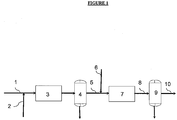
- the feed from renewable sources is admitted via line (1) in the hydrotreating zone (3) operating in the presence of hydrogen, the hydrogen being fed through the pipe (2).
- the charge is brought into contact with a hydrotreatment catalyst described above.
- the hydrotreated effluent is then introduced into a separation zone (4) so as to separate the gases from the liquids.
- the hydrogen-rich gases are recovered and discharged into the pipe (5) and the liquid hydrocarbon fraction is recovered and sent to a subsequent hydroisomerization step (7) using the selective zeolitic hydroisomerization catalyst by the pipe ( 5).
- the liquid gas oil base fraction is introduced, thus a flow of hydrogen through line (6), into the hydroisomerisation zone (7) containing the selective hydroisomerization catalyst described above.
- the effluent thus hydroisomérisé is then sent via the tubing (8) in the zone (9) of separation so as to separate the gas from at least one gas oil cut recovered via the pipe (10) and recoverable in the diesel fuel pool.
- a temperature controlled reactor so as to provide isothermal and fixed bed operation charged with 190 ml of hydrotreatment catalyst based on nickel and molybdenum, having a nickel oxide content equal to 3% by weight, and a content in molybdenum oxide equal to 16% by weight and a P 2 O 5 content equal to 6%, the catalyst being previously sulphurized, 170 g / h of pre-refined rapeseed oil with a density of 920 kg / m 3 , not containing of aromatics and having a sulfur content of less than 10 ppm by weight, with a cetane number of 35, a filterability limit temperature of + 20 ° C.
- Glycerides of fatty acid nature of fatty chain % by weight Palmitic C16: 0 4 palmitoleic C16: 1 ⁇ 0.5 stearic C18: 0 2 oleic C18: 1 61 linoleic C18: 2 20 linoleic C18: 3 9 arachidic C20: 0 ⁇ 0.5 gadoleic C20: 1 1 behenic C22: 0 ⁇ 0.5 erucic C22: 1 ⁇ 1
- All of the hydrotreated effluent from step a) is separated so as to recover the hydrogen-rich gases and a liquid gas oil base.
- the hydroisomerization catalyst is a noble metal-containing catalyst and a one-dimensional 10 MR zeolite ZBM-30.
- This catalyst is obtained according to the procedure described below.
- Zeolite ZBM-30 is synthesized according to the BASF patent EP-A-46504 with the organic structuring triethylenetetramine.
- the synthetic ZBM-30 zeolite is subjected to calcination at 550 ° C. under a stream of dry air for 12 hours.
- the zeolite H-ZBM-30 (acid form) thus obtained has a Si / Al ratio of 45.
- the zeolite is kneaded with an alumina gel of SB3 type supplied by Condisputeda-Sasol.
- the kneaded paste is then extruded through a die diameter 1.4 mm.
- the extrudates thus obtained are calcined at 500 ° C. for 2 hours in air.
- the weight content H-ZBM-30 is 20% by weight.
- the support extrudates are subjected to a dry impregnation step with an aqueous solution of the platinum salt Pt (NH 3) 42+, 2OH-, left to mature in a water-based maturator for 24 hours at room temperature and then calcined during two hours in dry air in a bed traversed at 500 ° C (ramp temperature rise of 5 ° C / min).
- the weight content of platinum of the finished catalyst after calcination is 0.48%.
- the process according to the invention thus makes it possible to obtain diesel base of excellent quality corresponding to the specifications in force.
- a filler identical to that of Example 1 is used in a process comprising a hydrotreating step a) operating under the same operating conditions and on the same catalyst as in step a) of Example 1, a separation step b) of the hydrotreated effluent from step a) so as to recover the hydrogen-rich gases and a liquid gas oil base and then a hydroisomerization step operating under the same operating conditions as step c) of Example 1 but on a different hydroisomerization catalyst.
- the hydroisomerization catalyst is a noble metal-containing catalyst and a zeolite 10 MR one-dimensional ZSM 22.
- This catalyst is obtained according to the procedure described below.
- Zeolite ZSM 22 is synthesized according to the method presented by Ernst et al. ( Applied Catalysis, 1989, 48, 137 ): 72 grams of silica sol (Ludox AS40, DuPont) are diluted in 124 ml of water; another solution containing 3.54 grams of Al 2 (SO 4 ) 3 , 18 H 2 O, 7.75 grams of KOH and 16.7 grams of diaminohexane in 177 ml of water is added to the first solution and stirred. The resulting gel is then placed in stainless steel autoclaves at 50 ° C.
- the autoclaves are opened and the synthesized zeolite is washed with water and filtered.
- the Si / Al atomic ratio of the crystallized structure is 30.
- the solid is then thermally treated under nitrogen flow (10 ml N 2 / minute / gram of solid) for 5 hours at 400 ° C. and then for 16 hours at 550 ° C. ° C under oxygen flow (10 ml O 2 / minute / gram of solid).
- the solid is then refluxed for 4 hours in an aqueous solution of ammonium chloride (100 ml of solution / gram of solid, 0.5 M ammonium chloride concentration). ).
- the sample is finally washed with distilled water to remove the alkaline chloride (negative silver nitrate test) and then dried overnight in an oven at 60 ° C.
- the zeolite is then kneaded with a type SB3 alumina gel supplied by Condisputeda-Sasol.
- the kneaded paste is then extruded through a die diameter 1.4 mm.
- the extrudates thus obtained are calcined at 500 ° C. for 2 hours in air.
- the content of H-ZSM 22 is 14% by weight.
- the support extrudates are subjected to a step of dry impregnation with an aqueous solution of the platinum salt Pt (NH 3 ) 4 2+ , 2OH - , left to mature in a water-based maturator for 24 hours at room temperature and then calcined for two hours in dry bed air through at 500 ° C (ramp temperature rise of 5 ° C / min).
- the weight content of platinum of the finished catalyst after calcination is 0.35%.
- the catalyst reduction stage is the same as that of the hydroisomerization catalyst C1, as are the operating conditions of the hydroisomerization test The temperature is adjusted so as to have product qualities comparable to those obtained with the catalyst C1.
Landscapes
- Chemical & Material Sciences (AREA)
- Oil, Petroleum & Natural Gas (AREA)
- Engineering & Computer Science (AREA)
- Chemical Kinetics & Catalysis (AREA)
- Organic Chemistry (AREA)
- General Chemical & Material Sciences (AREA)
- Materials Engineering (AREA)
- Crystallography & Structural Chemistry (AREA)
- Production Of Liquid Hydrocarbon Mixture For Refining Petroleum (AREA)
- Catalysts (AREA)
Claims (11)
- Verfahren zum Behandeln einer Charge, die aus einer erneuerbaren Quelle stammt, umfassend die folgenden Schritte:a) Hydrobehandeln in Gegenwart eines Festbettkatalysators, wobei der Katalysator eine hydrierende/dehydrierende Funktion und einen amorphen Träger umfasst, bei einer Temperatur im Bereich zwischen 200 und 450 °C, bei einem Druck im Bereich zwischen 1 MPa und 10 MPa, bei einer Raumgeschwindigkeit pro Stunde im Bereich zwischen 0,1 h-1 und 10 h-1 und in Gegenwart einer Gesamtmenge an Wasserstoff, die mit der Charge derart gemischt ist, dass das Verhältnis Wasserstoff/Charge im Bereich zwischen 150 und 750 Nm3 Wasserstoff/m3 Charge liegt,b) Abtrennen des Wasserstoffs, der Gase und mindestens eines Kohlenwasserstoffgrundstoffs von dem aus Schritt a) stammenden Abstrom,c) Hydroisomerisieren mindestens eines Teils des aus Schritt b) stammenden Kohlenwasserstoffgrundstoffs in Gegenwart eines selektiven Festbett-Hydroisomerisierungskatalysators, wobei der Katalysator mindestens ein Metall der Gruppe VIII und/oder der Gruppe VIB und mindestens ein eindimensionales zeolithisches 10-MR-Molekularsieb umfasst, ausgewählt aus den zeolithischen ZSM-48- und ZBM-30-Molekularsieben, allein oder als Gemisch, wobei Schritt c) bei einer Temperatur im Bereich zwischen 150 und 500 °C, bei einem Druck im Bereich zwischen 1 MPa und 10 MPa, bei einer Raumgeschwindigkeit pro Stunde im Bereich zwischen 0,1 und 10 h-1 und in Gegenwart einer Gesamtmenge an Wasserstoff durchgeführt wird, die derart mit der Charge gemischt ist, dass das Verhältnis Wasserstoff/Charge im Bereich zwischen 70 und 1.000 Nm3/m3 Charge liegt,d) Abtrennen des Wasserstoffs, der Gase und mindestens eines Dieselgrundstoffs von dem aus Schritt c) stammenden Abstrom.
- Verfahren nach Anspruch 1, wobei Schritt a) in Gegenwart einer Gesamtmenge an Wasserstoff arbeitet, die derart mit der Charge gemischt ist, dass das Verhältnis Wasserstoff/Charge im Bereich zwischen 150 und 700 Nm3 Wasserstoff/m3 Charge liegt.
- Verfahren nach Anspruch 2, wobei Schritt a) in Gegenwart einer Gesamtmenge an Wasserstoff arbeitet, die derart mit der Charge gemischt ist, dass das Verhältnis Wasserstoff/Charge im Bereich zwischen 150 und 650 Nm3 Wasserstoff/m3 Charge liegt.
- Verfahren nach Anspruch 2, wobei Schritt a) in Gegenwart einer Gesamtmenge an Wasserstoff arbeitet, die derart mit der Charge gemischt ist, dass das Verhältnis Wasserstoff/Charge im Bereich zwischen 150 und 600 Nm3 Wasserstoff/m3 Charge liegt.
- Verfahren nach einem der Ansprüche 1 bis 4, wobei der Gesamtgehalt an Oxiden der Metalle der Gruppen VIB und VIII in dem in Schritt a) verwendeten Katalysator bezogen auf die Gesamtmasse des Katalysators im Bereich zwischen 5 und 40 Gew.-% liegt.
- Verfahren nach einem der Ansprüche 1 bis 5, wobei das eindimensionale zeolithische 10-MR-Molekularsieb ZBM-30 ist.
- Verfahren nach Anspruch 6, wobei das eindimensionale zeolithische 10-MR-Molekularsieb ZBM-30, synthetisiert mit dem organischen Strukturmittel Triethylentetramin, ist.
- Verfahren nach einem der Ansprüche 1 bis 7, wobei der Hydroisomerisierungskatalysator entweder mindestens ein Edelmetall der Gruppe VIII oder mindestens ein Metall der Gruppe VIB, in Kombination mit mindestens einem Nichtedelmetall der Gruppe VIII umfasst.
- Verfahren nach einem der Ansprüche 1 bis 8, wobei der Gehalt an Edelmetall des in Schritt c) verwendeten Hydroisomerisierungskatalysators bezogen auf den fertigen Katalysator im Bereich zwischen 0,01 und 5 Gew.-% liegt.
- Verfahren nach einem der Ansprüche 1 bis 9, wobei der Gehalt an Edelmetall der Gruppe VIB des in Schritt c) verwendeten Hydroisomerisierungskatalysators bezogen auf den fertigen Katalysator, in Oxidäquivalent, im Bereich zwischen 5 und 40 Gew.-% liegt, und der Gehalt an Metall der Gruppe VIII des Katalysator in Oxidäquivalent, im Bereich zwischen 0,5 und 10 Gew.-% liegt.
- Verfahren nach einem der Ansprüche 1 bis 10, wobei die Charge aus der Gesamtheit der Pflanzenöle und der tierischen Fette bestehen, die im Wesentlichen Triglyceride und Fettsäuren oder Ester mit Kohlenwasserstofffettketten enthalten, die eine Anzahl an Kohlenstoffatomen im Bereich zwischen 6 und 25 aufweisen, wobei die Öle Palm-, Palmkern-, Kopra-, Rizinus- und Baumwollöle, Erdnuss-, Lein-, Krambe-, Jatrophaöle, alle Öle aus Sonnenblumen- und Rapssamen, die durch genetische Modifikation oder Hybridisierung erhalten wurden, sowie Algenöle, Frittieröle oder tierische Öle sein können.
Applications Claiming Priority (1)
| Application Number | Priority Date | Filing Date | Title |
|---|---|---|---|
| FR0803530A FR2932811B1 (fr) | 2008-06-24 | 2008-06-24 | Procede de conversion de charges issues de sources renouvelables en bases carburants gazoles de bonne qualite mettant en oeuvre un catalyseur de type zeolithique |
Publications (2)
| Publication Number | Publication Date |
|---|---|
| EP2138552A1 EP2138552A1 (de) | 2009-12-30 |
| EP2138552B1 true EP2138552B1 (de) | 2018-08-08 |
Family
ID=40292577
Family Applications (1)
| Application Number | Title | Priority Date | Filing Date |
|---|---|---|---|
| EP09290438.2A Active EP2138552B1 (de) | 2008-06-24 | 2009-06-12 | Verfahren zur Umwandlung von aus erneuerbaren Quellen stammenden Einsätzen zu Dieselkraftstoffgemischen guter Qualität unter Einsatz eines Zeolith-Katalysators |
Country Status (7)
| Country | Link |
|---|---|
| US (1) | US8324439B2 (de) |
| EP (1) | EP2138552B1 (de) |
| JP (1) | JP5723518B2 (de) |
| BR (1) | BRPI0903654B1 (de) |
| FR (1) | FR2932811B1 (de) |
| MY (1) | MY151442A (de) |
| SG (1) | SG158051A1 (de) |
Cited By (1)
| Publication number | Priority date | Publication date | Assignee | Title |
|---|---|---|---|---|
| WO2025078717A1 (en) | 2023-10-13 | 2025-04-17 | Neste Oyj | A method for producing transportation fuels and components thereto |
Families Citing this family (29)
| Publication number | Priority date | Publication date | Assignee | Title |
|---|---|---|---|---|
| CN102216427B (zh) | 2008-11-06 | 2015-03-18 | 埃克森美孚研究工程公司 | 对于生物柴油机燃料和掺和物的加氢处理 |
| EP2290045A1 (de) * | 2009-07-27 | 2011-03-02 | Total Petrochemicals Research Feluy | Verfahren zur Herstellung von biologischem Rohbenzin aus komplexen Gemischen natürlich vorkommender Fette und Öle |
| AU2010292845A1 (en) * | 2009-08-28 | 2012-03-22 | Exxonmobil Research And Engineering Company | Reducing hydrogen consumption in hydrotreating of biocomponent feeds |
| FR2950895B1 (fr) * | 2009-10-06 | 2012-02-17 | Inst Francais Du Petrole | Procede d'hydrotraitement et d'hydroisomerisation de charges issues de source renouvelable mettant en oeuvre un catalyseur a base de carbure de silicium |
| FR2951190B1 (fr) * | 2009-10-13 | 2012-08-17 | Inst Francais Du Petrole | Procede d'hydrotraitement et d'hydroisomerisation de charges issues de source renouvelable mettant en oeuvre une zeolithe modifiee |
| FR2953854B1 (fr) * | 2009-12-16 | 2012-12-28 | Inst Francais Du Petrole | Procede de conversion de charges issues de sources renouvelables avec pretraitement des charges par dephosphatation a chaud |
| KR101354235B1 (ko) * | 2010-04-14 | 2014-02-13 | 에스케이이노베이션 주식회사 | 수소화 탈왁스 공정을 위한 촉매 및 이의 제조 방법 |
| US8657999B2 (en) * | 2010-07-28 | 2014-02-25 | General Electric Company | Methods for preparing fuel compositions from renewable sources, and related systems |
| US8877669B2 (en) | 2010-08-02 | 2014-11-04 | Basf Corporation | Hydroisomerization catalysts for biological feedstocks |
| US8673028B2 (en) | 2010-09-02 | 2014-03-18 | The Regents Of The University Of Michigan | Method of producing biodiesel from a wet biomass |
| US8772562B2 (en) * | 2010-11-10 | 2014-07-08 | Exxonmobil Research And Engineering Company | Process for making basestocks from renewable feedstocks |
| EP2655559A4 (de) * | 2010-12-24 | 2014-07-23 | Sapphire Energy Inc | Herstellung von aromastoffen aus nachwachsenden rohstoffen |
| FR2981942B1 (fr) * | 2011-10-27 | 2013-11-15 | IFP Energies Nouvelles | Procede d'hydrotraitement et d'hydroisomerisation de charges issues de la biomasse dans lequel l'effluent a hydrosiomeriser et le flux d'hydrogene contiennent une teneur limitee en oxygene |
| FR2984911B1 (fr) | 2011-12-22 | 2014-08-29 | IFP Energies Nouvelles | Procede de conversion de charges paraffiniques issues de la biomasse en bases distillats moyens mettant en oeuvre au moins un catalyseur a base de zeolithe izm-2 |
| US20130165717A1 (en) * | 2011-12-23 | 2013-06-27 | Exxonmobil Research And Engineering Company | Process for increased production of fcc gasoline |
| FR2988399B1 (fr) | 2012-03-20 | 2014-03-28 | IFP Energies Nouvelles | Procede de pretraitement de charges issues de sources renouvelables utilisant un oxyde refractaire poreux impregne de phosphate d'alcalino terreux |
| FR3003561B1 (fr) * | 2013-03-21 | 2015-03-20 | Ifp Energies Now | Procede de conversion de charges issues de sources renouvelables mettant en oeuvre un catalyseur comprenant une zeolithe nu-10 et une zeolithe zsm-48 |
| FR3003563B1 (fr) | 2013-03-21 | 2015-03-20 | IFP Energies Nouvelles | Procede de conversion de charges issues de sources renouvelables mettant en oeuvre un catalyseur comprenant une zeolithe nu-10 et une silice alumine |
| TW201602336A (zh) | 2014-06-09 | 2016-01-16 | W R 康格雷氏公司 | 天然油及脂之催化脫氧方法 |
| EP3095844A1 (de) * | 2015-05-21 | 2016-11-23 | Neste Oyj | Verfahren zur herstellung von bio-kohlenwasserstoffen durch thermisches cracken eines bio-erneuerbaren rohstoffes |
| FR3051682B1 (fr) | 2016-05-30 | 2021-03-19 | Ifp Energies Now | Dispositif anti-colmatant pour la circulation ascendante d'un fluide |
| CN107488462B (zh) * | 2016-06-13 | 2019-11-15 | 中国石油化工股份有限公司 | 一种生产生物航煤的异构降凝方法以及用于该方法的催化剂 |
| CN107597819B (zh) * | 2017-11-02 | 2020-03-06 | 钦州学院 | 利用负载钼氧化物的介孔y型分子筛催化剂处理生活垃圾的方法 |
| FR3157422B1 (fr) | 2023-12-21 | 2026-08-14 | Ifp Energies Now | Procede de production de kerosene ou de gazole renouvelable par hydroprocessing en 2 etapes utilisant un catalyseur specifique pour l’etape d’hydroconversion sans recycle |
| FR3157420B1 (fr) | 2023-12-21 | 2026-08-14 | Ifp Energies Now | Procede de production de kerosene renouvelable comprenant deux etapes d’hydroconversion et utilisant un catalyseur specifique dans la seconde etape d’hydroconversion |
| FR3157424B1 (fr) | 2023-12-21 | 2026-08-14 | Ifp Energies Now | Procede de co-production de kerosene et de gazole renouvelable par hydroprocessing en 2 etapes utilisant un catalyseur specifique pour l’etape d’hydroconversion sans recycle |
| FR3157421A1 (fr) | 2023-12-21 | 2025-06-27 | IFP Energies Nouvelles | Procede de production de kerosene renouvelable par hydroprocessing en 2 etapes utilisant un catalyseur specifique dans l’etape d’hydroconversion avec recyclage d’une fraction lourde |
| WO2025174809A1 (en) * | 2024-02-13 | 2025-08-21 | Chevron U.S.A. Inc. | Process run procedure for biofeedstock processing |
| WO2025174805A1 (en) * | 2024-02-13 | 2025-08-21 | Chevron U.S.A. Inc. | Startup procedure for biofeedstock processing |
Family Cites Families (23)
| Publication number | Priority date | Publication date | Assignee | Title |
|---|---|---|---|---|
| DE3031557C2 (de) | 1980-08-21 | 1986-05-22 | Basf Ag, 6700 Ludwigshafen | Kristalliner Borsilikatzeolith ZBM-30 und Verfahren zu seiner Herstellung |
| EP0065400B1 (de) | 1981-05-20 | 1986-03-05 | Imperial Chemical Industries Plc | Zeolithe |
| NZ202099A (en) | 1981-10-21 | 1986-07-11 | Ici Plc | Preparation of zeolite nu-10 |
| US4992605A (en) | 1988-02-16 | 1991-02-12 | Craig Wayne K | Production of hydrocarbons with a relatively high cetane rating |
| CA2149685C (en) * | 1994-06-30 | 1999-09-14 | Jacques Monnier | Conversion of depitched tall oil to diesel fuel additive |
| US7232935B2 (en) * | 2002-09-06 | 2007-06-19 | Fortum Oyj | Process for producing a hydrocarbon component of biological origin |
| DE60312446T3 (de) * | 2002-09-06 | 2017-04-27 | Neste Oil Oyj | Vefahren zur Herstellung einer Kohlenwasserstoffkomponente biologischer Herkunft |
| FR2846664B1 (fr) * | 2002-10-30 | 2006-09-08 | Inst Francais Du Petrole | Procede flexible de production de bases huiles et de distillats moyens avec une etape de pretraitement convertissant suivie d'un deparaffinage catalytique |
| FR2852864B1 (fr) * | 2003-03-24 | 2005-05-06 | Inst Francais Du Petrole | Catalyseur comprenant au moins une zeolithe choisie parmi zbm-30, zsm-48, eu-2 et eu-11 et au moins une zeolithe y et procede d'hydroconversion de charges hydrocarbonees utilisant un tel catalyseur |
| US7491858B2 (en) * | 2005-01-14 | 2009-02-17 | Fortum Oyj | Method for the manufacture of hydrocarbons |
| ATE490298T1 (de) | 2005-01-14 | 2010-12-15 | Neste Oil Oyj | Verfahren zur herstellung von kohlenwasserstoffen |
| FR2881128B1 (fr) * | 2005-01-24 | 2007-03-23 | Inst Francais Du Petrole | Nouvelle methode de synthese de la zeolithe zbm-30 a partir d'un melange de composes amines |
| US7465696B2 (en) * | 2005-01-31 | 2008-12-16 | Chevron Oronite Company, Llc | Lubricating base oil compositions and methods for improving fuel economy in an internal combustion engine using same |
| BRPI0500591A (pt) * | 2005-02-18 | 2006-10-03 | Petroleo Brasileiro Sa | processo para a hidroconversão de óleos vegetais |
| FR2882744B1 (fr) | 2005-03-07 | 2008-06-06 | Inst Francais Du Petrole | Solide cristallise cok-7, procede de preparation et utilisation pour la transformation d'hydrocarbures |
| HUE025942T2 (en) * | 2005-07-04 | 2016-05-30 | Neste Oil Oyj | A method for producing hydrocarbons in the form of diesel fuels |
| US8278492B2 (en) * | 2005-07-05 | 2012-10-02 | Neste Oil Oyj | Process for the manufacture of diesel range hydrocarbons |
| US7550634B2 (en) * | 2006-01-30 | 2009-06-23 | Conocophillips Company | Process for converting triglycerides to hydrocarbons |
| JP5072008B2 (ja) * | 2006-05-17 | 2012-11-14 | Jx日鉱日石エネルギー株式会社 | 軽油組成物の製造方法 |
| US7691159B2 (en) * | 2006-09-19 | 2010-04-06 | Applied Research Associates, Inc. | Method of converting triglycerides to biofuels |
| FR2910483B1 (fr) * | 2006-12-21 | 2010-07-30 | Inst Francais Du Petrole | Procede de conversion de charges issues de sources renouvelables en bases carburants gazoles de bonne qualite. |
| FR2911866B1 (fr) | 2007-01-30 | 2009-03-06 | Inst Francais Du Petrole | Solide cristalise izm-1 et son procede de preparation. |
| US7626063B2 (en) * | 2007-05-11 | 2009-12-01 | Conocophillips Company | Propane utilization in direct hydrotreating of oils and/or fats |
-
2008
- 2008-06-24 FR FR0803530A patent/FR2932811B1/fr active Active
-
2009
- 2009-06-12 EP EP09290438.2A patent/EP2138552B1/de active Active
- 2009-06-19 BR BRPI0903654-7A patent/BRPI0903654B1/pt active IP Right Grant
- 2009-06-23 SG SG200904326-6A patent/SG158051A1/en unknown
- 2009-06-23 US US12/489,885 patent/US8324439B2/en active Active
- 2009-06-24 MY MYPI20092677 patent/MY151442A/en unknown
- 2009-06-24 JP JP2009149236A patent/JP5723518B2/ja active Active
Non-Patent Citations (1)
| Title |
|---|
| None * |
Cited By (1)
| Publication number | Priority date | Publication date | Assignee | Title |
|---|---|---|---|---|
| WO2025078717A1 (en) | 2023-10-13 | 2025-04-17 | Neste Oyj | A method for producing transportation fuels and components thereto |
Also Published As
| Publication number | Publication date |
|---|---|
| JP5723518B2 (ja) | 2015-05-27 |
| US8324439B2 (en) | 2012-12-04 |
| FR2932811B1 (fr) | 2010-09-03 |
| FR2932811A1 (fr) | 2009-12-25 |
| SG158051A1 (en) | 2010-01-29 |
| US20090318740A1 (en) | 2009-12-24 |
| EP2138552A1 (de) | 2009-12-30 |
| BRPI0903654B1 (pt) | 2018-03-20 |
| MY151442A (en) | 2014-05-30 |
| BRPI0903654A2 (pt) | 2011-09-06 |
| JP2010047744A (ja) | 2010-03-04 |
Similar Documents
| Publication | Publication Date | Title |
|---|---|---|
| EP2138553B1 (de) | Konvertierungsverfahren von Belastungen aus erneuerbaren Quellen auf der Basis von Dieselbrennstoffen guter Qualität, bei dem ein Katalysator vom Typ Zeolith ohne Zwischentrennung von Flüssiggas zum Einsatz gebracht wird | |
| EP2138552A1 (de) | Verfahren zur Umwandlung von aus erneuerbaren Quellen stammenden Einsätzen zu Dieselkraftstoffgemischen guter Qualität unter Einsatz eines Zeolith-Katalysators | |
| EP2228423B1 (de) | Hydrodesoxigenationsverfahren von Ölen oder Fetten mit begrenzter Umwandlung in Decarboxylierung mittels Einsatz eines heterogenen Katalysators | |
| EP2210663B1 (de) | Umwandlungsverfahren von Einsatzstoffe erneuerbaren Urspungs in einen Kraftstoff ausgezeichneter Qualität unter Einsatz eines Katalysators auf Molybdenbasis | |
| EP2106428B1 (de) | Verfahren zur umwandlung von lasten aus erneuerbaren quellen in dieselkraftstoff-basismaterialien von hoher qualität | |
| EP2473274B1 (de) | Verfahren zur umwandlung von ladungen aus erneuerbaren quellen mittels gemeinsamer verarbeitung mit einem erdölstoff und verwendung eines katalysators auf molybdän- und nickelbasis | |
| EP2316909B1 (de) | Verfahren für die Hydrobehandlung von erneuerbaren Quellen durch indirekte Erhitzung mittels Einsatz eines Katalysators auf Molybdenbasis | |
| FR2999596A1 (fr) | Procede de conversion de charges issues de sources renouvelables en bases de combustibles marins | |
| FR2950895A1 (fr) | Procede d'hydrotraitement et d'hydroisomerisation de charges issues de source renouvelable mettant en oeuvre un catalyseur a base de carbure de silicium | |
| WO2011027044A1 (fr) | Procede de conversion de charges issues de sources renouvelables en co-traitement avec une charge petroliere mettant en oeuvre un catalyseur a base de molybdene | |
| EP2316908B1 (de) | Verfahren für die Hydrobehandlung von erneuerbaren Quellen durch indirekte Erhitzung | |
| EP2316910B1 (de) | Verfahren für die Hydrobehandlung von erneurerbaren Quellen durch indirekte Erhitzung mittels Einsatz eines katalysators auf Nickel- und Molybdenbasis mit einem spezifischen Atomverhältnis | |
| FR2951190A1 (fr) | Procede d'hydrotraitement et d'hydroisomerisation de charges issues de source renouvelable mettant en oeuvre une zeolithe modifiee | |
| EP2581436B1 (de) | Herstellungsverfahren von Mitteldestillaten aus einer Mischung einer aus erneuerbaren Energiequellen stammenden Charge und einem Paraffin-Abfallprodukt | |
| FR2981942A1 (fr) | Procede d'hydrotraitement et d'hydroisomerisation de charges issues de la biomasse dans lequel l'effluent a hydrosiomeriser et le flux d'hydrogene contiennent une teneur limitee en oxygene | |
| EP2880126B2 (de) | Wasserstoffbehandlungs- und hydroisomerisationsverfahren von rohstoffen aus biomasse bei welchem der zu behandelnde ausgangsstrom und der wasserstoffstrom eine begrenzte kohlenmonoxidkonzentration enthalten |
Legal Events
| Date | Code | Title | Description |
|---|---|---|---|
| PUAI | Public reference made under article 153(3) epc to a published international application that has entered the european phase |
Free format text: ORIGINAL CODE: 0009012 |
|
| AK | Designated contracting states |
Kind code of ref document: A1 Designated state(s): AT BE BG CH CY CZ DE DK EE ES FI FR GB GR HR HU IE IS IT LI LT LU LV MC MK MT NL NO PL PT RO SE SI SK TR |
|
| 17P | Request for examination filed |
Effective date: 20100630 |
|
| 17Q | First examination report despatched |
Effective date: 20100722 |
|
| RAP1 | Party data changed (applicant data changed or rights of an application transferred) |
Owner name: IFP ENERGIES NOUVELLES |
|
| RIC1 | Information provided on ipc code assigned before grant |
Ipc: C10G 45/64 20060101ALI20170803BHEP Ipc: B01J 23/883 20060101ALI20170803BHEP Ipc: B01J 37/28 20060101ALI20170803BHEP Ipc: C10G 45/02 20060101ALI20170803BHEP Ipc: C10G 45/08 20060101ALI20170803BHEP Ipc: B01J 29/74 20060101ALI20170803BHEP Ipc: B01J 29/78 20060101ALI20170803BHEP Ipc: C10G 65/04 20060101ALI20170803BHEP Ipc: C10G 3/00 20060101AFI20170803BHEP Ipc: B01J 37/20 20060101ALI20170803BHEP |
|
| GRAP | Despatch of communication of intention to grant a patent |
Free format text: ORIGINAL CODE: EPIDOSNIGR1 |
|
| STAA | Information on the status of an ep patent application or granted ep patent |
Free format text: STATUS: GRANT OF PATENT IS INTENDED |
|
| INTG | Intention to grant announced |
Effective date: 20171009 |
|
| RAP1 | Party data changed (applicant data changed or rights of an application transferred) |
Owner name: IFP ENERGIES NOUVELLES |
|
| GRAJ | Information related to disapproval of communication of intention to grant by the applicant or resumption of examination proceedings by the epo deleted |
Free format text: ORIGINAL CODE: EPIDOSDIGR1 |
|
| STAA | Information on the status of an ep patent application or granted ep patent |
Free format text: STATUS: EXAMINATION IS IN PROGRESS |
|
| GRAP | Despatch of communication of intention to grant a patent |
Free format text: ORIGINAL CODE: EPIDOSNIGR1 |
|
| STAA | Information on the status of an ep patent application or granted ep patent |
Free format text: STATUS: GRANT OF PATENT IS INTENDED |
|
| INTC | Intention to grant announced (deleted) | ||
| INTG | Intention to grant announced |
Effective date: 20180222 |
|
| GRAS | Grant fee paid |
Free format text: ORIGINAL CODE: EPIDOSNIGR3 |
|
| GRAA | (expected) grant |
Free format text: ORIGINAL CODE: 0009210 |
|
| STAA | Information on the status of an ep patent application or granted ep patent |
Free format text: STATUS: THE PATENT HAS BEEN GRANTED |
|
| AK | Designated contracting states |
Kind code of ref document: B1 Designated state(s): AT BE BG CH CY CZ DE DK EE ES FI FR GB GR HR HU IE IS IT LI LT LU LV MC MK MT NL NO PL PT RO SE SI SK TR |
|
| REG | Reference to a national code |
Ref country code: GB Ref legal event code: FG4D Free format text: NOT ENGLISH |
|
| REG | Reference to a national code |
Ref country code: CH Ref legal event code: EP Ref country code: AT Ref legal event code: REF Ref document number: 1026985 Country of ref document: AT Kind code of ref document: T Effective date: 20180815 |
|
| REG | Reference to a national code |
Ref country code: IE Ref legal event code: FG4D Free format text: LANGUAGE OF EP DOCUMENT: FRENCH |
|
| REG | Reference to a national code |
Ref country code: DE Ref legal event code: R096 Ref document number: 602009053692 Country of ref document: DE |
|
| REG | Reference to a national code |
Ref country code: NL Ref legal event code: FP |
|
| REG | Reference to a national code |
Ref country code: LT Ref legal event code: MG4D |
|
| REG | Reference to a national code |
Ref country code: AT Ref legal event code: MK05 Ref document number: 1026985 Country of ref document: AT Kind code of ref document: T Effective date: 20180808 |
|
| PG25 | Lapsed in a contracting state [announced via postgrant information from national office to epo] |
Ref country code: PL Free format text: LAPSE BECAUSE OF FAILURE TO SUBMIT A TRANSLATION OF THE DESCRIPTION OR TO PAY THE FEE WITHIN THE PRESCRIBED TIME-LIMIT Effective date: 20180808 Ref country code: GR Free format text: LAPSE BECAUSE OF FAILURE TO SUBMIT A TRANSLATION OF THE DESCRIPTION OR TO PAY THE FEE WITHIN THE PRESCRIBED TIME-LIMIT Effective date: 20181109 Ref country code: SE Free format text: LAPSE BECAUSE OF FAILURE TO SUBMIT A TRANSLATION OF THE DESCRIPTION OR TO PAY THE FEE WITHIN THE PRESCRIBED TIME-LIMIT Effective date: 20180808 Ref country code: BG Free format text: LAPSE BECAUSE OF FAILURE TO SUBMIT A TRANSLATION OF THE DESCRIPTION OR TO PAY THE FEE WITHIN THE PRESCRIBED TIME-LIMIT Effective date: 20181108 Ref country code: NO Free format text: LAPSE BECAUSE OF FAILURE TO SUBMIT A TRANSLATION OF THE DESCRIPTION OR TO PAY THE FEE WITHIN THE PRESCRIBED TIME-LIMIT Effective date: 20181108 Ref country code: LT Free format text: LAPSE BECAUSE OF FAILURE TO SUBMIT A TRANSLATION OF THE DESCRIPTION OR TO PAY THE FEE WITHIN THE PRESCRIBED TIME-LIMIT Effective date: 20180808 Ref country code: IS Free format text: LAPSE BECAUSE OF FAILURE TO SUBMIT A TRANSLATION OF THE DESCRIPTION OR TO PAY THE FEE WITHIN THE PRESCRIBED TIME-LIMIT Effective date: 20181208 Ref country code: AT Free format text: LAPSE BECAUSE OF FAILURE TO SUBMIT A TRANSLATION OF THE DESCRIPTION OR TO PAY THE FEE WITHIN THE PRESCRIBED TIME-LIMIT Effective date: 20180808 |
|
| PG25 | Lapsed in a contracting state [announced via postgrant information from national office to epo] |
Ref country code: HR Free format text: LAPSE BECAUSE OF FAILURE TO SUBMIT A TRANSLATION OF THE DESCRIPTION OR TO PAY THE FEE WITHIN THE PRESCRIBED TIME-LIMIT Effective date: 20180808 Ref country code: ES Free format text: LAPSE BECAUSE OF FAILURE TO SUBMIT A TRANSLATION OF THE DESCRIPTION OR TO PAY THE FEE WITHIN THE PRESCRIBED TIME-LIMIT Effective date: 20180808 Ref country code: LV Free format text: LAPSE BECAUSE OF FAILURE TO SUBMIT A TRANSLATION OF THE DESCRIPTION OR TO PAY THE FEE WITHIN THE PRESCRIBED TIME-LIMIT Effective date: 20180808 |
|
| PG25 | Lapsed in a contracting state [announced via postgrant information from national office to epo] |
Ref country code: RO Free format text: LAPSE BECAUSE OF FAILURE TO SUBMIT A TRANSLATION OF THE DESCRIPTION OR TO PAY THE FEE WITHIN THE PRESCRIBED TIME-LIMIT Effective date: 20180808 Ref country code: CZ Free format text: LAPSE BECAUSE OF FAILURE TO SUBMIT A TRANSLATION OF THE DESCRIPTION OR TO PAY THE FEE WITHIN THE PRESCRIBED TIME-LIMIT Effective date: 20180808 Ref country code: EE Free format text: LAPSE BECAUSE OF FAILURE TO SUBMIT A TRANSLATION OF THE DESCRIPTION OR TO PAY THE FEE WITHIN THE PRESCRIBED TIME-LIMIT Effective date: 20180808 |
|
| REG | Reference to a national code |
Ref country code: DE Ref legal event code: R097 Ref document number: 602009053692 Country of ref document: DE |
|
| PG25 | Lapsed in a contracting state [announced via postgrant information from national office to epo] |
Ref country code: DK Free format text: LAPSE BECAUSE OF FAILURE TO SUBMIT A TRANSLATION OF THE DESCRIPTION OR TO PAY THE FEE WITHIN THE PRESCRIBED TIME-LIMIT Effective date: 20180808 Ref country code: SK Free format text: LAPSE BECAUSE OF FAILURE TO SUBMIT A TRANSLATION OF THE DESCRIPTION OR TO PAY THE FEE WITHIN THE PRESCRIBED TIME-LIMIT Effective date: 20180808 |
|
| PLBE | No opposition filed within time limit |
Free format text: ORIGINAL CODE: 0009261 |
|
| STAA | Information on the status of an ep patent application or granted ep patent |
Free format text: STATUS: NO OPPOSITION FILED WITHIN TIME LIMIT |
|
| 26N | No opposition filed |
Effective date: 20190509 |
|
| PG25 | Lapsed in a contracting state [announced via postgrant information from national office to epo] |
Ref country code: SI Free format text: LAPSE BECAUSE OF FAILURE TO SUBMIT A TRANSLATION OF THE DESCRIPTION OR TO PAY THE FEE WITHIN THE PRESCRIBED TIME-LIMIT Effective date: 20180808 |
|
| REG | Reference to a national code |
Ref country code: DE Ref legal event code: R119 Ref document number: 602009053692 Country of ref document: DE |
|
| PG25 | Lapsed in a contracting state [announced via postgrant information from national office to epo] |
Ref country code: MC Free format text: LAPSE BECAUSE OF FAILURE TO SUBMIT A TRANSLATION OF THE DESCRIPTION OR TO PAY THE FEE WITHIN THE PRESCRIBED TIME-LIMIT Effective date: 20180808 |
|
| REG | Reference to a national code |
Ref country code: CH Ref legal event code: PL |
|
| GBPC | Gb: european patent ceased through non-payment of renewal fee |
Effective date: 20190612 |
|
| REG | Reference to a national code |
Ref country code: BE Ref legal event code: MM Effective date: 20190630 |
|
| PG25 | Lapsed in a contracting state [announced via postgrant information from national office to epo] |
Ref country code: TR Free format text: LAPSE BECAUSE OF FAILURE TO SUBMIT A TRANSLATION OF THE DESCRIPTION OR TO PAY THE FEE WITHIN THE PRESCRIBED TIME-LIMIT Effective date: 20180808 |
|
| PG25 | Lapsed in a contracting state [announced via postgrant information from national office to epo] |
Ref country code: GB Free format text: LAPSE BECAUSE OF NON-PAYMENT OF DUE FEES Effective date: 20190612 Ref country code: DE Free format text: LAPSE BECAUSE OF NON-PAYMENT OF DUE FEES Effective date: 20200101 Ref country code: IE Free format text: LAPSE BECAUSE OF NON-PAYMENT OF DUE FEES Effective date: 20190612 |
|
| PG25 | Lapsed in a contracting state [announced via postgrant information from national office to epo] |
Ref country code: BE Free format text: LAPSE BECAUSE OF NON-PAYMENT OF DUE FEES Effective date: 20190630 Ref country code: LI Free format text: LAPSE BECAUSE OF NON-PAYMENT OF DUE FEES Effective date: 20190630 Ref country code: CH Free format text: LAPSE BECAUSE OF NON-PAYMENT OF DUE FEES Effective date: 20190630 Ref country code: LU Free format text: LAPSE BECAUSE OF NON-PAYMENT OF DUE FEES Effective date: 20190612 |
|
| PG25 | Lapsed in a contracting state [announced via postgrant information from national office to epo] |
Ref country code: PT Free format text: LAPSE BECAUSE OF FAILURE TO SUBMIT A TRANSLATION OF THE DESCRIPTION OR TO PAY THE FEE WITHIN THE PRESCRIBED TIME-LIMIT Effective date: 20181208 |
|
| PG25 | Lapsed in a contracting state [announced via postgrant information from national office to epo] |
Ref country code: CY Free format text: LAPSE BECAUSE OF FAILURE TO SUBMIT A TRANSLATION OF THE DESCRIPTION OR TO PAY THE FEE WITHIN THE PRESCRIBED TIME-LIMIT Effective date: 20180808 |
|
| PG25 | Lapsed in a contracting state [announced via postgrant information from national office to epo] |
Ref country code: HU Free format text: LAPSE BECAUSE OF FAILURE TO SUBMIT A TRANSLATION OF THE DESCRIPTION OR TO PAY THE FEE WITHIN THE PRESCRIBED TIME-LIMIT; INVALID AB INITIO Effective date: 20090612 Ref country code: MT Free format text: LAPSE BECAUSE OF FAILURE TO SUBMIT A TRANSLATION OF THE DESCRIPTION OR TO PAY THE FEE WITHIN THE PRESCRIBED TIME-LIMIT Effective date: 20180808 |
|
| PG25 | Lapsed in a contracting state [announced via postgrant information from national office to epo] |
Ref country code: MK Free format text: LAPSE BECAUSE OF FAILURE TO SUBMIT A TRANSLATION OF THE DESCRIPTION OR TO PAY THE FEE WITHIN THE PRESCRIBED TIME-LIMIT Effective date: 20180808 |
|
| P01 | Opt-out of the competence of the unified patent court (upc) registered |
Effective date: 20230712 |
|
| PGFP | Annual fee paid to national office [announced via postgrant information from national office to epo] |
Ref country code: IT Payment date: 20260623 Year of fee payment: 18 |
|
| PGFP | Annual fee paid to national office [announced via postgrant information from national office to epo] |
Ref country code: FI Payment date: 20260622 Year of fee payment: 18 |
|
| PGFP | Annual fee paid to national office [announced via postgrant information from national office to epo] |
Ref country code: NL Payment date: 20260622 Year of fee payment: 18 |
|
| PGFP | Annual fee paid to national office [announced via postgrant information from national office to epo] |
Ref country code: FR Payment date: 20260622 Year of fee payment: 18 |