EP2126059B1 - Verfahren zur herstellung aromatischer moleküle in streptomyceten - Google Patents
Verfahren zur herstellung aromatischer moleküle in streptomyceten Download PDFInfo
- Publication number
- EP2126059B1 EP2126059B1 EP08762131A EP08762131A EP2126059B1 EP 2126059 B1 EP2126059 B1 EP 2126059B1 EP 08762131 A EP08762131 A EP 08762131A EP 08762131 A EP08762131 A EP 08762131A EP 2126059 B1 EP2126059 B1 EP 2126059B1
- Authority
- EP
- European Patent Office
- Prior art keywords
- seq
- sequence seq
- nucleotide sequence
- vector
- eugenol
- Prior art date
- Legal status (The legal status is an assumption and is not a legal conclusion. Google has not performed a legal analysis and makes no representation as to the accuracy of the status listed.)
- Active
Links
Images


Classifications
-
- C—CHEMISTRY; METALLURGY
- C12—BIOCHEMISTRY; BEER; SPIRITS; WINE; VINEGAR; MICROBIOLOGY; ENZYMOLOGY; MUTATION OR GENETIC ENGINEERING
- C12P—FERMENTATION OR ENZYME-USING PROCESSES TO SYNTHESISE A DESIRED CHEMICAL COMPOUND OR COMPOSITION OR TO SEPARATE OPTICAL ISOMERS FROM A RACEMIC MIXTURE
- C12P7/00—Preparation of oxygen-containing organic compounds
- C12P7/40—Preparation of oxygen-containing organic compounds containing a carboxyl group including Peroxycarboxylic acids
- C12P7/42—Hydroxy-carboxylic acids
-
- C—CHEMISTRY; METALLURGY
- C12—BIOCHEMISTRY; BEER; SPIRITS; WINE; VINEGAR; MICROBIOLOGY; ENZYMOLOGY; MUTATION OR GENETIC ENGINEERING
- C12N—MICROORGANISMS OR ENZYMES; COMPOSITIONS THEREOF; PROPAGATING, PRESERVING, OR MAINTAINING MICROORGANISMS; MUTATION OR GENETIC ENGINEERING; CULTURE MEDIA
- C12N9/00—Enzymes; Proenzymes; Compositions thereof; Processes for preparing, activating, inhibiting, separating or purifying enzymes
- C12N9/0004—Oxidoreductases (1.)
- C12N9/0006—Oxidoreductases (1.) acting on CH-OH groups as donors (1.1)
-
- C—CHEMISTRY; METALLURGY
- C12—BIOCHEMISTRY; BEER; SPIRITS; WINE; VINEGAR; MICROBIOLOGY; ENZYMOLOGY; MUTATION OR GENETIC ENGINEERING
- C12P—FERMENTATION OR ENZYME-USING PROCESSES TO SYNTHESISE A DESIRED CHEMICAL COMPOUND OR COMPOSITION OR TO SEPARATE OPTICAL ISOMERS FROM A RACEMIC MIXTURE
- C12P7/00—Preparation of oxygen-containing organic compounds
- C12P7/02—Preparation of oxygen-containing organic compounds containing a hydroxy group
- C12P7/22—Preparation of oxygen-containing organic compounds containing a hydroxy group aromatic
-
- C—CHEMISTRY; METALLURGY
- C12—BIOCHEMISTRY; BEER; SPIRITS; WINE; VINEGAR; MICROBIOLOGY; ENZYMOLOGY; MUTATION OR GENETIC ENGINEERING
- C12P—FERMENTATION OR ENZYME-USING PROCESSES TO SYNTHESISE A DESIRED CHEMICAL COMPOUND OR COMPOSITION OR TO SEPARATE OPTICAL ISOMERS FROM A RACEMIC MIXTURE
- C12P7/00—Preparation of oxygen-containing organic compounds
- C12P7/24—Preparation of oxygen-containing organic compounds containing a carbonyl group
Definitions
- the present invention relates to the production of natural aromatic molecules. More particularly, the present invention relates to the bioconversion in a bacterium of substrates, preferably eugenol, to phenolic derivatives including coniferyl alcohol and ferulic acid, said derivatives being usable for the production of natural vanillin used in food flavoring or in perfumery (aromas or fragrances).
- Vanillin (3-methoxy-4-hydroxybenzaldehyde) is the main component responsible for the olfactory and gustatory properties of vanilla extract derived from Vanillia planifolia pods . It is one of the most used aromatic molecules in the industry. However, the production of natural vanillin from vanilla bean or vanilla extract covers only 20% of this market; its use is limited because of a share of the potential of pods available worldwide and partly because of the high, very fluctuating price of these pods (of the order of 30 € / kg to 450 € / kg at least 1500 € / kg natural vanillin potential).
- Synthetic vanillin is therefore frequently used as a cheap substitute (around 15 € / kg) for natural vanillin for applications in perfumery, cosmetics and the food industry.
- synthetic flavors are less appreciated by consumers than natural flavors.
- bioconversion is understood to mean the biological transformation of a substrate, preferably from a natural source, to obtain aromas, fragrances or precursors of natural flavors or fragrances.
- Vanillin can be produced according to the following reaction scheme:
- the patent EP 0885968 describes a method for producing vanillin in a bacterium belonging to the genus Streptomyces.
- This method comprises: a) culturing in a suitable medium a bacterium belonging to the genus Streptomyces so as to form a fermentation broth, b) adding in said broth 5 to 40 gL-1 of ferulic acid, of to produce vanillin, and c) the extraction of vanillin and guaiacol produced.
- Overhage et al. discloses 1) the expression of the vanillyl alcohol oxidase gene in Escherichia coli and 2) the expression of the calA genes (encoding coniferyl alcohol dehydrogenase) and calB (coding for coniferyl aldehyde dehydrogenase). This process would allow the production of ferulic acid as the main product of the eugenol conversion by the final recombinant strain E.
- Coli XL1 Blue (pSKvaom-PcalAmcalB) (Highly efficient biotransformation of eugenol to ferulic acid and further conversion to vanillin in recombinant strains of Escherichia coli, 2003, Applied and Environmental Microbiology p 6569-6576 ). It is indicated that the ferulic acid produced by this strain could serve as a substrate for a second multi-recombinant strain E. coli (pSKechE / Hfcs) to produce natural vanillin ( J. Overhage et al. Appl. Approx. Microbiol. 65: 4837-4847, 1999 )
- WO 2007/099230 describes a method for producing ferulic acid, coniferous alcohol and / or vanillin from eugenol in yeast but makes no mention of the genus Streptomycetaceae as a potential host for heterologous expression of the vao gene.
- WO 01/55342 describes various synthetic nucleic acid sequences, optimized to increase their expression in heterologous system. More particularly, this document discloses the synthetic sequence of the vaoA gene (SEQ ID No. 67 page 30, lines 33-38) which is also identical to 84% to the optimized sequence SEQ No. 1 and 78% to the optimized sequence SEQ ID No. 8 taken in its entire length. However, in this document, the synthetic genes are obtained for increased expression in enteric bacteria (including E Coli) but not in Streptomycetaceae.
- This article discloses the expression of the vanillyl alcohol oxidase gene in the strain Amycolatopsis sp HR167 making it possible to catalyze the conversion of eugenol to coniferyl alcohol, coniferyl aldehyde, ferulic acid, guaiacol, vanillic acid
- These three examples of production of natural vanillin precursors or natural vanillin itself have the disadvantage for the first to have a relatively high cost of production due to the use of purified ferulic acid which is an expensive raw material, and for others to be difficult to to implement industrially because of 1) the use of non-food multirecombinated strains, 2) the low yield of bioconversions.
- the inventors have thus sought to develop a process for producing precursors of natural vanillin or natural vanillin itself, which is simple to implement industrially, that is to say preferably comprising only one step, and whose production cost is less than that of the prior art.
- the solution proposed by the invention is to use a natural and inexpensive natural substrate which is eugenol and a strain of class 1 belonging to the genus Streptomyces, such as for example Streptomyces griseus.
- the present invention relates to a process for the manufacture of vanillin or vanillin precursors such as ferulic acid or coniferyl alcohol, or a mixture comprising the precursors of vanillin and vanillin, by bioconversion of eugenol, in a bacterium belonging to the genus Streptomyces as defined in claim 1 .
- the method of the invention makes it possible to manufacture vanillin.
- the process of the invention makes it possible to manufacture ferulic acid.
- the process of the invention makes it possible to manufacture coniferyl alcohol.
- the process of the invention makes it possible to manufacture a mixture of coniferyl alcohol, ferulic acid and / or vanillin.
- the method of the invention is carried out using a bacterium belonging to the genus Streptomyces comprising the sequence SEQ ID NO: 1 or the sequence SEQ ID NO: 8 or any nucleotide sequence having at least 70%, preferably 80%, very preferably 90% identity with the sequence SEQ ID NO: 1 or any sequence having at least 80%, preferably 90% identity with the sequence SEQ ID NO: 8.
- the sequences SEQ ID NO: 1 and SEQ ID NO: 8 correspond to the vanillyl alcohol oxidase gene present in the genome of the filamentous fungus Penicillium simplicissimum, said gene having been optimized for reading in a bacterium belonging to the genus Streptomyces.
- the present invention therefore has the advantage of allowing the production in a single step, via a biological catalyst, natural vanillin, coniferyl alcohol and / or natural ferulic acid, essentially free of impurity and low price.
- Another subject of the invention is a bacterium belonging to the genus Streptomyces comprising at least one nucleotide sequence SEQ ID NO: 1 or SEQ ID NO 8 or any nucleotide sequence having at least 70%, preferably 80%, very preferably 90% d identity with the sequence SEQ ID NO: 1 or any sequence having at least 80%, preferably 90% identity with SEQ ID NO: 8.
- the bacterium is Streptomyces griseus.
- Another subject of the invention is the nucleotide sequence SEQ ID NO: 1 and the sequence SEQ ID NO: 8.
- the original sequence of vanillyl alcohol oxidase is present in the genome of the filamentous fungus Penicillium simplicissimum.
- the codons present in Penicillium simplicissimum DNA can not be used for transcription by a bacterium belonging to the genus Streptomyces.
- the inventors have therefore replaced these codons by appropriate codons read by a bacterium belonging to the genus Streptomyces, so as to obtain an optimized nucleotide sequence (SEQ ID NO: 1 and SEQ ID NO: 8).
- vectors comprising at least one nucleotide sequence SEQ ID NO: 1 or at least one SEQ ID NO: 8 sequence.
- vector or "expression vector” is intended to mean any DNA sequence in which it is possible to insert foreign nucleic acid fragments, the vectors making it possible to introduce foreign DNA into a host cell.
- vectors are plasmids, cosmids, artificial yeast chromosomes (YAC), chromosomes artificial bacteria (BAC) and artificial chromosomes derived from bacteriophage P1 (PAC) or vectors derived from viruses.
- the expression vector comprising the nucleotide sequence SEQ ID NO: 1 or the sequence SEQ ID NO: 8 is a bifunctional vector which is specific for bacteria belonging to the genus Streptomyces.
- bifunctional vector any plasmid capable of replicating in two different host organisms because it carries two different origins of replication and can, therefore, be used to transfer genes from one host to another.
- a specific bifunctional vector of bacteria belonging to the genus Streptomyces is a vector comprising means allowing its expression in said bacteria.
- the bifunctional vector comprises an oriT gene which allows inter-generic conjugation and in particular expression in both E. coli and a bacterium belonging to the genus Streptomyces.
- the expression vector used in the invention comprises: 1) sequences (either an integration gene or a replication gene) allowing the introduction and maintenance of the sequence SEQ ID NO: 1 or of the sequence SEQ ID NO: 8 in the strain, 2) an antibiotic resistance gene, 3) sequences allowing the selection marker to be excised in the final industrial strain, 4) an RP4-type oriT transfer origin allowing intergenic conjugation between E. Coli and Streptomyces, 5) a strong promoter and 6) a terminator for expression of the sequence SEQ ID NO: 1 or SEQ ID NO: 8 and 7) a MCS sequence.
- the expression vector is chosen from an integrative vector or a highly replicative multicopy vector.
- the vector is chosen from the integrative vectors pFLA2 and pFLA3.
- integrative vectors have the advantage of allowing simple or multiple integration of a gene of interest into the final strain. Excision of the selection marker makes it possible to reuse the same vector to transform the strain again and thus increase the number of copies of the gene of interest.
- the highly replicative multicopy vector is the pFLA4 vector.
- This vector has the advantage of replicating many times in the host, thus ensuring a large number of copies of the gene of interest in the host.
- Another subject of the invention is a process for producing ferulic acid, coniferyl alcohol and / or vanillin, comprising the bioconversion of eugenol by a bacterium belonging to the genus Streptomyces comprising at least one nucleotide sequence SEQ ID NO: 1 or SEQ ID NO: 8 or any nucleotide sequence having at least 70%, preferably 80%, very preferably 90% identity with the sequence SEQ ID NO: 1 or any sequence having at least 80%, preferably 90% ID with SEQ ID NO: 8.
- the sequence SEQ ID NO: 1 or the sequence SEQ ID NO: 8 is cloned into an expression vector, said vector preferably being a bifunctional vector specific for bacteria belonging to the genus Streptomyces.
- the nucleotide sequence SEQ NO: 1 or SEQ ID NO: 8 included in a vector of pUC57 type and said expression vector are firstly digested with one or more restriction enzymes.
- the sequence SEQ ID NO: 1 or SEQ ID NO: 8 is then inserted by simple ligation or other means of insertion into the expression vector.
- E. coli DH5 ⁇ bacteria are transformed according to any known method with the ligation product (expression vector comprising the sequence SEQ ID NO: 1 or SEQ ID NO: 8).
- the bacteria containing the expression vector are then selected by means of the selection marker, preferably an antibiotic resistance gene, present on the expression vector.
- this selection marker is the thiostrepton resistance gene.
- the expression vector is then introduced by transformation into competent bacteria, preferably strain E. Coli ET12567.
- the transformants are then selected according to the method described above.
- the transfer of the vanillyl alcohol oxidase gene into a bacterium belonging to the genus Streptomyces can be carried out by conjugation or transformation.
- Said bacteria comprising the gene for vanillyl alcohol oxidase integrated or not into their genome are selected according to the method described above.
- the bacteria belonging to the genus Streptomyces and comprising the vanillyl alcohol oxidase gene are then cultured under the conditions allowing the expression of said gene and in the presence of eugenol.
- the bacteria are incubated in a medium whose pH is less than 10, preferably between 6 and 9.5, and preferably between 7 and 9, and more preferably between 7.5 and 8.5; and whose temperature is between 27 and 40 ° C, preferably between 27 and 39 ° C, more preferably between 29 and 37 ° C and even more preferably between 36 and 37 ° C, or even is equal to 37 ° C.
- the eugenol substrate is preferably added in a single dose in the culture medium of said bacterium and the amount of eugenol introduced is between 5 and 40 g / l. preferably from 10 to 25 g / l.
- the eugenol solution added comprises a mixture of eugenol, glucose and oil or a mixture of eugenol, glycerol and oil.
- said bacteria are incubated in a medium whose pH is between 8 and 10, preferably between 7 and 9 and more preferably is equal to 9.
- the aeration of the medium is preferably between 0.1 and 1 L. air / min.
- the agitation of the medium is preferably less than 1000 rpm for 3 L medium, and very preferably is 900 rpm for 3 L of medium.
- the temperature of the medium is preferably between 27 and 40 ° C, preferably between 27 and 39 ° C, more preferably between 27 and 37 ° C and very preferably is 37 ° C.
- the conversion rate of eugenol to coniferyl alcohol is generally between about 50 and 95% for an amount of substrate introduced varying from 10 to 25 g / l. Coniferyl alcohol is produced at a level of 10 to 25 g / l.
- the substrate is preferably added continuously to the culture medium of said bacterium and the amount of final eugenol introduced is between 5 and 30 g / l, preferably from 10 to 25 g / l.
- the eugenol solution added comprises a mixture of eugenol, glucose and oil or a mixture of eugenol, glycerol and oil.
- the eugenol solution is added continuously in the medium over 3 to 5 days with a flow rate of between 0.2 g / L / H and 0.12 g / L / H.
- said bacteria are incubated in a medium whose pH is between 8 and 10, preferably between 7 and 9 and more preferably between 7 and 8.5.
- the aeration of the medium is preferably between 0.1 and 1 L of air / min.
- the agitation of the medium is preferably less than 1000 rpm for 3 L of medium, and very preferably is 900 rpm for 3 L of medium.
- the temperature of the medium is preferably between 27 and 40 ° C, preferably between 27 and 39 ° C, more preferably between 27 and 37 ° C and very preferably is 37 ° C.
- the substrate flow rate in the 3L fermenter is between 0.05 g eugenol / L / hour and 1 g eugenol / L / hour.
- the flow of eugenol is set between 0.15 and 0.7 g of eugenol / L / hour.
- the degree of conversion to ferulic acid is generally between about 50 and 95% for a amount of substrate introduced varying from 10 to 25 g / l. Ferulic acid is produced at a level of 10 to 25 g / l.
- said bacteria are preferably incubated in a medium whose pH is less than 10, preferably between 7 and 9, and more preferably between 7 and 9. , 5 and 8.5.
- the aeration of the medium is preferably between 0.1 and 1 L of air / min.
- the agitation of the medium is preferably less than 1000 rpm for 3 L of medium, and very preferably is 900 rpm for 3 L of medium.
- the temperature of the medium is preferably between 27 and 40 ° C, preferably between 27 and 39 ° C, more preferably between 27 and 37 ° C and very preferably is 37 ° C.
- the amount of eugenol added to the culture medium of said bacterium is between 5 to 50 g / l, preferably 10 to 35 g / l.
- the addition of eugenol may be continuous or in a single dose.
- the eugenol solution added comprises a mixture of eugenol, glucose and oil or a mixture of eugenol, glycerol and oil.
- the addition is made over 3 to 5 days with a flow rate of between 0.2 g / L / H and 0.12 g / L / H.
- the conversion rate into vanillin is between 30 and 72% for a quantity of eugenol dispensed varying from 10 to 35 g / l.
- Another subject of the invention is a process for producing vanillin from ferulic acid by the same bacterium belonging to the genus Streptomyces. Indeed, the strain naturally has the genetic and enzymatic inheritance allowing it to execute this reaction. Thus, whether or not it contains the sequence SEQ ID NO: 1 or SEQ ID NO: 8, it is capable of converting ferulic acid to vanillin. It can indeed be verified that under appropriate conditions, the amount of vanillin produced can be between 10 and 25 g / l, preferably between 14 and 24 g / l when administered to the strain between 28 and 36 g / l of ferulic acid.
- the step of converting ferulic acid to vanillin is carried out enzymatically or biochemically, in particular according to the processes described in the patents.
- EP 0 606 441 and EP 0 804 606 are described in the patents.
- codons of the vanillyl alcohol oxidase gene present in Penicillium simplicissimum are probably not read by bacteria belonging to the genus Streptomyces.
- the codons that have a frequency of use in bacteria belonging to the genus Streptomyces less than 10 per 1000 are considered as "probably unread" codons.
- the frequency of codon usage is described by the database "codon usage database” ( http://www.kasuka.or.jp/codon/ ). According to the frequency inventors have created an optimal sequence SEQ ID NO: 1 for the expression of vanillyl alcohol oxidase in these cells.
- Restriction sites were introduced at 5 'and 3' to allow cloning of the sequence into a vector.
- the restriction sites added are a function of the restriction sites present in the multi-site cloning zones (MCS) of the vectors.
- the optimized sequence SEQ ID NO: 1 is synthesized in the plasmid pUC57 by the company GenScript.
- the plasmid pRES19 was used as a source of the bla gene coding for beta-lactamase.
- the bla gene was amplified by PCR with the bla1F primers (5'CTCGAGAGACGAACTCCTTGAACC3 ', SEQ ID NO: 2) and bla1R (5'GGCCTTACCAATGCTTAATCAG3', SEQ ID NO: 3) to obtain a 1.4 kb fragment digested by the XhoI and HaeIII restriction enzymes.
- the tsr gene of plasmid pANT849 was amplified by the tsr1F primers (5 ' GAGCTC TGACTGAGTTGGACAC3', SEQ ID NO: 4) and tsrlR (5 ' CTCGAC TTATCGGTTGGCCG3', SEQ ID NO: 5) and the fragment of 821 bp obtained was digested with SacI and XhoI enzymes.
- the DNA fragments bla 1.4kb (the XhoI / HaeIII ends) and tsr 819 bp (the ends XhoI / NdeI) were cloned into the vector pSET152 digested with NaeI and SacI restriction enzymes to form pFLA2b.
- the LacZ gene of pFLA2b was replaced by a strong Streptomyces promoter: the ermEp * promoter.
- the ermEp * gene was synthesized in the pUC57 vector by GenScript Corporation and the insert was isolated by digestion of the vector (pU57-ermEp) with restriction enzymes XbaI and EcoRI.
- the pFLA2b vector was also digested with the restriction enzymes XbaI and EcoRI in order to open the LacZ sequence and to clone the ermEp * promoter by simple ligation between the two cleavage sites.
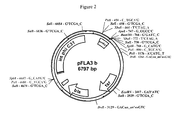
- the vector pFLA4b is constructed from the vector pFLA3b.
- the int phIC31 and attP genes are excised from the pFLA3 vector by an endonuclease AfeI and SbfI digestion.
- the cohesive end (3 ') generated by SbfI is made blunt by the action of nuclease S1 and both ends are connected by simple ligation. 1771 bp are thus removed from the vector pFLA3b to obtain the vector pFLA3-2b.
- a 1.8 kb nucleotide fragment comprising the rep gene is amplified by PCR on the pIJ101 vector isolated from Streptomyces lividans using the rep1F primers (5'ACATGTGTTAGTGCGAAGTGGGC3 ', SEQ ID NO: 6 ) and resp1R (5'CTGCGAGTTCAG3 ', SEQ ID NO: 7).
- the PCR products were digested with PciI and DrdI endonucleases and the insert thus obtained was cloned into the pFLA3-2b vector between the PciI and DrdI sites to obtain the pFLA4b vector of 6727 bp.
- sequence SEQ ID NO: 1 comprises the BamHI (GGATCC) (5 ') and XbaI (3') ends, when cloning is provided in the pFLA2 vector.
- sequence SEQ ID NO: 1 comprises the ApaI (5 ') and BamHI (GGATCC) ends (3'), when cloning is provided in the pFLA3 vector.
- sequence SEQ ID NO: 1 comprises the KpnI (GGTACC) (5 ') and XbaI (TCT AGA) ends (3'), when cloning is provided in the pFLA4 vector.
- E. Coli DH5 ⁇ bacteria are transformed with one of the previously constructed vectors comprising the sequence SEQ ID NO: 1. These vectors are then introduced into E. coli strain ET12567 (pUZ8002), made competent. This strain is deficient in methylation which avoids restrictions on DNA when it is introduced into a bacterium belonging to the genus Streptomyces.
- the transformants obtained are selected in the presence of antibiotic Apramycin: the resistant strains are those comprising the sequence SEQ ID NO: 1.
- the bacterial cells are cultured from a stored stock at -80 ° C and the expression of VAO is constitutive due to the strong promoters used in the cloning vectors.
- the cells are then sonicated and the total extract (Fraction T) centrifuged to remove cell debris and show the presence of VAO in the soluble fraction.
- SDS-PAGE analysis shows that the VAO protein whose expected theoretical size is about 64.7kDa is well produced. It is mostly soluble.
- the cloned protein having a polyhistidinic tail at its N-terminal end, it is purified on a nickel column and the level of expression is analyzed in SDS-PAGE.
- the amount of vanillyl alcohol oxidase produced in E. Coli varies from 2 to 5 ⁇ g per ml of culture for an OD of 2.3 to 600 nm.
- the enzymatic activity of the vanillyl alcohol oxidase is analyzed by conversion of the vanillic alcohol and eugenol with the purified protein on a Ni NTA column from 10 ml of E. coli bacteria culture comprising the sequence SEQ ID NO: 1 .
- the aromatic products derived from these conversions are analyzed by HPLC.
- the vanillic alcohol is converted into vanillin whether the enzyme is purified or the reaction takes place on a must of E. coli DH5 ⁇ cells.
- the optimum pH for the conversion is between 7 and 10 and under these conditions, the amount of vanillin produced varies from 0.41 to 1 g / l from 0.5 to 1 g / l of vanillic alcohol dispensed.
- Vanillyl alcohol oxidase also catalyzes the conversion of eugenol to coniferyl alcohol.
- the cloned gene in E.Coli DH5 ⁇ encoding VAO converts up to 10 g / l eugenol to coniferyl alcohol in 90% yield in pH 10 medium. The reaction is effective both with the purified enzyme with a must of recombinant E. coli DH5 ⁇ cells.
- the transformed bacteria are cultured on complete agar medium (YPD) and then subcultured in 100 ml of liquid Strepto medium until the end of exponential growth phase under the following conditions: 35 ° C, 175 rpm.
- the substrate is then added to the medium after taking up the cells in a 0.5M phosphate buffer, pH 8.5, at a level of 2.5 g / l of eugenol.
- the bioconversion conditions are as follows: 35 ° C, 175 rpm, 48H. Daily monitoring calculates bioconversion yields.
- the analyzes are conducted by HPLC. All phenolic derivatives are measured and quantified.
- the amount of vanillic acid or vanillin synthesized by the best candidate is of the order of 1 to 2 g / l from 2.5 g / l of eugenol supplied at the beginning of bioconversion.
- the bioconversion of eugenol is optimized in a 3-liter fermenter.
- the conversion rate in 4 days is between 30 and 72% for a quantity of distributed substrate ranging from 10 to 25 g / l.
- the optimum pH conditions during the conversion are as follows: the pH is regulated between 7 and 10 and preferably between 7 and 9.
- the aeration is between 0.1 and 0.8 volume of air / volume of medium / min.
- the stirring is 900 rpm for 3L of medium and the temperature regulated at 37 ° C during the culture and conversion phases.
- the addition of eugenol is made continuously over 3 days (for 15 g / l of eugenol, addition of 15 g / l of glucose + 200 g of oil) with a flow rate of 0.2 g / l / H or 5 days (the flow rate is then 0.12 g / l / H.
- the fermentation conditions are as follows: pH regulated between 7 and 9, aeration between 0.2 to 1 L air / min.
- eugenol is made continuously over 5 days (for 20 g / l of eugenol, addition of 10 g / l of glucose + 85 g / l of oil) with a flow rate of 0.17 g / l / H.
- the fermentation conditions are as follows: pH regulated between 7 and 9, aeration of between 0.2 and 1 L / min.
- the bioconversion of eugenol to ferulic acid is optimized in a 3-liter fermentor.
- the conversion rate in 5 days is between 30 and 90% for a quantity of distributed substrate ranging from 10 to 25 g / l.
- the optimum pH conditions during the conversion are as follows: the pH is regulated between 7 and 10 and preferably at 7.
- the aeration is between 0.1 and 0.8 volume of air / volume of medium / min.
- the stirring is 900 rpm for 3L of medium and the temperature regulated at 37 ° C during the culture and conversion phases.
- eugenol is made continuously over 4 days (for 15 g / l of eugenol, addition of 15 g / l of glucose + 200 g of oil) with a flow rate of 0.15 g / l / H.
- the fermentation conditions are as follows: pH regulated at 7, aeration of between 0.2 and 1 L / min.
- the bioconversion of eugenol is optimized in a 3-liter fermenter.
- the conversion rate in 2 days is between 40 and 95% for a quantity of distributed substrate varying from 10 at 25 g / l.
- the optimum pH conditions during the conversion are as follows: the pH is regulated between 7 and 10 and preferably between 7 and 9.
- the aeration is between 0.1 and 0.8 volume of air / volume of medium / min.
- the stirring is 900 rpm for 3L of medium and the temperature regulated at 37 ° C during the culture and conversion phases.
- the vanillin crystallizes. It is washed with ethanol and recrystallized to obtain an HPLC purity greater than 99.5%.
Landscapes
- Chemical & Material Sciences (AREA)
- Organic Chemistry (AREA)
- Life Sciences & Earth Sciences (AREA)
- Engineering & Computer Science (AREA)
- Zoology (AREA)
- Wood Science & Technology (AREA)
- Health & Medical Sciences (AREA)
- Genetics & Genomics (AREA)
- Bioinformatics & Cheminformatics (AREA)
- General Health & Medical Sciences (AREA)
- Biochemistry (AREA)
- General Engineering & Computer Science (AREA)
- Microbiology (AREA)
- Biotechnology (AREA)
- Chemical Kinetics & Catalysis (AREA)
- General Chemical & Material Sciences (AREA)
- Medicinal Chemistry (AREA)
- Molecular Biology (AREA)
- Biomedical Technology (AREA)
- Micro-Organisms Or Cultivation Processes Thereof (AREA)
- Preparation Of Compounds By Using Micro-Organisms (AREA)
- Organic Low-Molecular-Weight Compounds And Preparation Thereof (AREA)
Claims (18)
- Verfahren zur Produktion von natürlicher Ferulasäure, von natürlichem Coniferylalkohol und/oder von natürlichem Vanillin, umfassend die Biokonversion von Eugenol durch ein Bakterium, das zur Gattung Streptomyces gehört und das mindestens eine Nukleotidsequenz SEQ ID NO :1 oder SEQ ID NO :8 oder eine beliebige Nukleotidsequenz mit mindestens 70%, vorzugsweise 80%, sehr stark bevorzugt 90% Identität zu der Sequenz SEQ ID NO :1 aufweist oder jegliche Sequenz, die mindestens 80%, bevorzugt 90%, Identität zu der Sequenz SEQ ID NO :8 aufweist, umfasst.
- Verfahren nach Anspruch 1, das Folgendes umfasst:1) Kultur eines Bakteriums, das zur Gattung Streptomyces gehört und das mindestens eine Nukleotidsequenz SEQ ID NO :1 oder SEQ ID NO :8 oder eine beliebige Nukleotidsequenz mit mindestens 70%, vorzugsweise 80%, sehr stark bevorzugt 90% Identität zu der Sequenz SEQ ID NO :1 aufweist oder jegliche Sequenz, die mindestens 80%, bevorzugt 90%, Identität zu der Sequenz SEQ ID NO :8 aufweist, umfasst,2) kontinuierliches Zugeben oder Zugeben in einer Portion von Eugenol als Substrat für die Biokonversion in dem Fermentationsmedium in einer Menge von 5 bis 50 g/l, vorzugsweise 10 bis 35 g/l,3) Extraktion des Vanillins aus dem Fermentationsmedium.
- Verfahren nach Anspruch 1, das Folgendes umfasst:1) Kultur eines Bakteriums, das zur Gattung Streptomyces gehört und das mindestens eine Nukleotidsequenz SEQ ID NO :1 oder SEQ ID NO :8 oder eine beliebige Nukleotidsequenz mit mindestens 70%, vorzugsweise 80%, sehr stark bevorzugt 90% Identität zu der Sequenz SEQ ID NO :1 aufweist oder jegliche Sequenz, die mindestens 80%, bevorzugt 90%, Identität zu der Sequenz SEQ ID NO :8 aufweist, umfasst,2) Zugeben in einer Portion von Eugenol als Substrat für die Biokonversion in dem Fermentationsmedium in einer Menge von 5 bis 40 g/l, vorzugsweise 10 bis 35 g/l,3) Extraktion des Coniferylalkohols aus dem Fermentationsmedium.
- Verfahren nach Anspruch 1, das Folgendes umfasst:1) Kultur eines Bakteriums, das zur Gattung Streptomyces gehört und das mindestens eine Nukleotidsequenz SEQ ID NO :1 oder SEQ ID NO :8 oder eine beliebige Nukleotidsequenz mit mindestens 70%, vorzugsweise 80%, sehr stark bevorzugt 90% Identität zu der Sequenz SEQ ID NO :1 aufweist oder jegliche Sequenz, die mindestens 80%, bevorzugt 90%, Identität zu der Sequenz SEQ ID NO :8 aufweist, umfasst,2) kontinuierliches Zugeben von Eugenol als Substrat für die Biokonversion in dem Fermentationsmedium in einer Menge von 5 bis 30 g/l, vorzugsweise 10 bis 25 g/l,3) Extraktion der Ferulasäure aus dem Fermentationsmedium.
- Verfahren nach einem der Ansprüche 1 bis 4, wobei das Bakterium in einem Medium inkubiert wird, dessen pH-Wert unter 10 liegt.
- Verfahren nach einem der Ansprüche 1 bis 5, wobei das Bakterium bei einer Temperatur zwischen 27 und 40°C, vorzugsweise bei einer Temperatur von 37°C, inkubiert wird.
- Verfahren nach Anspruch 1, wobei das Bakterium durch Folgendes erhalten wird:a) Klonieren der Nukleotidsequenz SEQ ID NO :1 oder SEQ ID NO :8 in einem Expressionsvektor, vorzugsweise einem für Bakterien, die zur Gattung Streptomyces gehören, spezifischen Expressionsvektor,b) Transformation des in a) erhaltenen Expressionsvektors in ein kompetentes Bakterium, vorzugsweise E. Coli DH5α,c) Transfer des Expressionsvektors, der die SEQ ID NO :1 oder SEQ ID NO :8 umfasst, in E. coli ET12567,d) Transformation oder Konjugation eines Bakteriums, das zur Gattung Streptomyces gehört, mit dem in c) erhaltenen Bakterium,e) Selektion der besten in d) erhaltenen Transformanten in Gegenwart des Substrats Eugenol.
- Bakterium, das zur Gattung Streptomyces gehört und das mindestens eine Nukleotidsequenz SEQ ID NO :1 oder SEQ ID NO :8 oder eine beliebige Nukleotidsequenz mit mindestens 70%, vorzugsweise 80%, sehr stark bevorzugt 90% Identität zu der Sequenz SEQ ID NO :1 aufweist oder jegliche Sequenz, die mindestens 80%, bevorzugt 90%, Identität zu der Sequenz SEQ ID NO :8 aufweist, umfasst.
- Bakterium nach Anspruch 8, bei dem es sich vorzugsweise um Streptomyces griseus handelt.
- Nukleotidsequenz SEQ ID NO :1.
- Nukleotidsequenz SEQ ID NO :8.
- Expressionsvektor, der mindestens eine Sequenz SEQ ID NO :1 oder SEQ ID NO :8 umfasst.
- Vektor nach Anspruch 11, dadurch gekennzeichnet, dass es sich um einen für Bakterien, die zur Gattung Streptomyces gehören, spezifischen Shuttle-Vektor handelt.
- Vektor nach Anspruch 12, dadurch gekennzeichnet, dass er aus der Reihe integrierender Vektor oder replizierender Vektor des Multicopy-Typs ausgewählt ist.
- Vektor nach Anspruch 13, dadurch gekennzeichnet, dass er aus der Reihe pFLA2 und pFLA3 ausgewählt ist.
- Vektor nach Anspruch 13, dadurch gekennzeichnet, dass es sich um den Vektor pFLA4 handelt.
- Verfahren nach Anspruch 1, bei dem das Vanillin, die Ferulasäure oder der Coniferylalkohol in einer Menge von 10 bis 25 g/l produziert wird.
- Verfahren nach Anspruch 1, bei dem die Konversion der Ferulasäure zu Vanillin in demselben Bakterium, das zur Gattung Streptomyces gehört, erfolgt oder auf biochemischem oder enzymatischem Weg erfolgt.
Priority Applications (2)
| Application Number | Priority Date | Filing Date | Title |
|---|---|---|---|
| PL08762131T PL2126059T3 (pl) | 2007-02-21 | 2008-02-20 | Sposób wytwarzania cząsteczek aromatycznych u Streptomyces |
| SI200830842T SI2126059T1 (sl) | 2007-02-21 | 2008-02-20 | Postopek za proizvodnjo aromatičnih molekul v streptomicinih |
Applications Claiming Priority (2)
| Application Number | Priority Date | Filing Date | Title |
|---|---|---|---|
| FR0701229A FR2912758B1 (fr) | 2007-02-21 | 2007-02-21 | Systeme de production de molecules aromatiques chez streptomyces. |
| PCT/FR2008/050284 WO2008113936A2 (fr) | 2007-02-21 | 2008-02-20 | Systeme de production de molecules aromatiques chez streptomyces |
Publications (2)
| Publication Number | Publication Date |
|---|---|
| EP2126059A2 EP2126059A2 (de) | 2009-12-02 |
| EP2126059B1 true EP2126059B1 (de) | 2012-09-12 |
Family
ID=38357993
Family Applications (1)
| Application Number | Title | Priority Date | Filing Date |
|---|---|---|---|
| EP08762131A Active EP2126059B1 (de) | 2007-02-21 | 2008-02-20 | Verfahren zur herstellung aromatischer moleküle in streptomyceten |
Country Status (9)
| Country | Link |
|---|---|
| US (1) | US8344119B2 (de) |
| EP (1) | EP2126059B1 (de) |
| DK (1) | DK2126059T3 (de) |
| ES (1) | ES2394677T3 (de) |
| FR (1) | FR2912758B1 (de) |
| PL (1) | PL2126059T3 (de) |
| PT (1) | PT2126059E (de) |
| SI (1) | SI2126059T1 (de) |
| WO (1) | WO2008113936A2 (de) |
Families Citing this family (2)
| Publication number | Priority date | Publication date | Assignee | Title |
|---|---|---|---|---|
| WO2015066722A1 (en) | 2013-11-04 | 2015-05-07 | Bgn Tech Llc | Methods of making vanillin via the microbial fermentation of ferulic acid from eugenol using a plant dehydrogenase. |
| FR3041655B1 (fr) * | 2015-09-29 | 2017-11-24 | Lesaffre & Cie | Nouvelles souches bacteriennes pour la production de vanilline |
Family Cites Families (4)
| Publication number | Priority date | Publication date | Assignee | Title |
|---|---|---|---|---|
| CA2238215A1 (en) * | 1997-06-19 | 1998-12-19 | Markus Wetli | Process for the production of vanillin |
| US6818752B2 (en) * | 2000-01-31 | 2004-11-16 | Biocatalytics, Inc. | Synthetic genes for enhanced expression |
| FR2898131B1 (fr) * | 2006-03-01 | 2012-08-31 | Mane Fils V | Systeme de production de molecules aromatiques par bioconversion |
| FR2898132B1 (fr) * | 2006-03-01 | 2012-09-28 | Mane Fils V | Systeme d'expression d'un gene d'interet chez la levure |
-
2007
- 2007-02-21 FR FR0701229A patent/FR2912758B1/fr active Active
-
2008
- 2008-02-20 DK DK08762131.4T patent/DK2126059T3/da active
- 2008-02-20 PL PL08762131T patent/PL2126059T3/pl unknown
- 2008-02-20 WO PCT/FR2008/050284 patent/WO2008113936A2/fr not_active Ceased
- 2008-02-20 EP EP08762131A patent/EP2126059B1/de active Active
- 2008-02-20 SI SI200830842T patent/SI2126059T1/sl unknown
- 2008-02-20 PT PT87621314T patent/PT2126059E/pt unknown
- 2008-02-20 ES ES08762131T patent/ES2394677T3/es active Active
- 2008-02-20 US US12/528,000 patent/US8344119B2/en active Active
Also Published As
| Publication number | Publication date |
|---|---|
| PT2126059E (pt) | 2012-12-24 |
| SI2126059T1 (sl) | 2013-04-30 |
| US20100184172A1 (en) | 2010-07-22 |
| EP2126059A2 (de) | 2009-12-02 |
| PL2126059T3 (pl) | 2013-02-28 |
| WO2008113936A2 (fr) | 2008-09-25 |
| WO2008113936A3 (fr) | 2008-12-18 |
| US8344119B2 (en) | 2013-01-01 |
| FR2912758A1 (fr) | 2008-08-22 |
| DK2126059T3 (da) | 2013-01-02 |
| ES2394677T3 (es) | 2013-02-04 |
| FR2912758B1 (fr) | 2009-05-15 |
Similar Documents
| Publication | Publication Date | Title |
|---|---|---|
| JP2001505041A (ja) | 組換えジオールデヒドラターゼを発現する組換え菌によるグリセロールからの1,3−プロパンジオールの製造 | |
| FR2678637A1 (fr) | Nouvelles souches de levure pour la production de xylitol. | |
| Labuda | Biotechnology of vanillin: vanillin from microbial sources | |
| EP2048231B1 (de) | Plasmid, transformante und verfahren zur herstellung von 3-carboxymuconolacton | |
| JP6110542B2 (ja) | シロ‐イノシトールの製造方法 | |
| EP2766332B1 (de) | Herstellung von isopropanol durch verbesserte rekombinante stämme | |
| WO2008113936A2 (fr) | Systeme de production de molecules aromatiques chez streptomyces | |
| EP1173585B1 (de) | Epoxidhydrolase aus aspergillus | |
| JP2011067139A (ja) | 組換えベクター、形質転換体、及び2h−ピラン−2−オン−4,6−ジカルボン酸の製造方法 | |
| US8951771B2 (en) | Modified 13-hydroperoxide lyases and uses thereof | |
| JP2007533319A (ja) | 芳香族酸の微生物生産 | |
| JP7163659B2 (ja) | グルカル酸生産能を有する高耐酸性微生物、及びそれを用いたグルカル酸の製造方法 | |
| EP4603580A1 (de) | Verfahren zur biotechnologischen herstellung von vanillin oder 4-vinylguaiacol | |
| JP4914041B2 (ja) | ガリック酸からの2−ピロン−4,6−ジカルボン酸の製造方法とこれに使用するガリック酸から2−ピロン−4,6−ジカルボン酸を生産する組み換えプラスミドならびにガリック酸からの2−ピロン−4,6−ジカルボン酸の生産能を具備した形質転換細胞 | |
| CN116083330B (zh) | 一种利用重组大肠杆菌全细胞合成5-羟基阿魏酸的方法 | |
| JP5704650B2 (ja) | (s)−1−置換プロパン−1−オール誘導体の製造方法 | |
| JP5812235B2 (ja) | 3−メチルガリク酸3,4−ジオキシゲナーゼ遺伝子導入によるpdcの生産 | |
| EP3259359B1 (de) | L-arabinose-assimilationspfad und verwendungen davon | |
| WO2014045298A2 (en) | Microbial biotransformation of aromatic acids to their reduced carbon aromatic acids | |
| JPWO2005044973A1 (ja) | 新規アセトアセチルCoA還元酵素および光学活性アルコールの製造方法 |
Legal Events
| Date | Code | Title | Description |
|---|---|---|---|
| PUAI | Public reference made under article 153(3) epc to a published international application that has entered the european phase |
Free format text: ORIGINAL CODE: 0009012 |
|
| 17P | Request for examination filed |
Effective date: 20090819 |
|
| AK | Designated contracting states |
Kind code of ref document: A2 Designated state(s): AT BE BG CH CY CZ DE DK EE ES FI FR GB GR HR HU IE IS IT LI LT LU LV MC MT NL NO PL PT RO SE SI SK TR |
|
| 17Q | First examination report despatched |
Effective date: 20101110 |
|
| REG | Reference to a national code |
Ref country code: DE Ref legal event code: R079 Ref document number: 602008018747 Country of ref document: DE Free format text: PREVIOUS MAIN CLASS: C12N0009020000 Ipc: C12N0009040000 |
|
| GRAP | Despatch of communication of intention to grant a patent |
Free format text: ORIGINAL CODE: EPIDOSNIGR1 |
|
| RIC1 | Information provided on ipc code assigned before grant |
Ipc: C12P 7/22 20060101ALI20120322BHEP Ipc: C12N 9/02 20060101ALI20120322BHEP Ipc: C12P 7/42 20060101ALI20120322BHEP Ipc: C12R 1/545 20060101ALI20120322BHEP Ipc: C12P 7/24 20060101ALI20120322BHEP Ipc: C12N 9/04 20060101AFI20120322BHEP |
|
| DAX | Request for extension of the european patent (deleted) | ||
| GRAS | Grant fee paid |
Free format text: ORIGINAL CODE: EPIDOSNIGR3 |
|
| GRAA | (expected) grant |
Free format text: ORIGINAL CODE: 0009210 |
|
| AK | Designated contracting states |
Kind code of ref document: B1 Designated state(s): AT BE BG CH CY CZ DE DK EE ES FI FR GB GR HR HU IE IS IT LI LT LU LV MC MT NL NO PL PT RO SE SI SK TR |
|
| REG | Reference to a national code |
Ref country code: GB Ref legal event code: FG4D Free format text: NOT ENGLISH |
|
| REG | Reference to a national code |
Ref country code: CH Ref legal event code: EP |
|
| REG | Reference to a national code |
Ref country code: AT Ref legal event code: REF Ref document number: 575112 Country of ref document: AT Kind code of ref document: T Effective date: 20120915 |
|
| REG | Reference to a national code |
Ref country code: IE Ref legal event code: FG4D Free format text: LANGUAGE OF EP DOCUMENT: FRENCH |
|
| REG | Reference to a national code |
Ref country code: DE Ref legal event code: R096 Ref document number: 602008018747 Country of ref document: DE Effective date: 20121108 |
|
| REG | Reference to a national code |
Ref country code: RO Ref legal event code: EPE |
|
| REG | Reference to a national code |
Ref country code: SE Ref legal event code: TRGR |
|
| REG | Reference to a national code |
Ref country code: PT Ref legal event code: SC4A Free format text: AVAILABILITY OF NATIONAL TRANSLATION Effective date: 20121210 |
|
| REG | Reference to a national code |
Ref country code: DK Ref legal event code: T3 |
|
| REG | Reference to a national code |
Ref country code: NL Ref legal event code: T3 |
|
| REG | Reference to a national code |
Ref country code: NO Ref legal event code: T2 Effective date: 20120912 |
|
| PG25 | Lapsed in a contracting state [announced via postgrant information from national office to epo] |
Ref country code: LT Free format text: LAPSE BECAUSE OF FAILURE TO SUBMIT A TRANSLATION OF THE DESCRIPTION OR TO PAY THE FEE WITHIN THE PRESCRIBED TIME-LIMIT Effective date: 20120912 Ref country code: FI Free format text: LAPSE BECAUSE OF FAILURE TO SUBMIT A TRANSLATION OF THE DESCRIPTION OR TO PAY THE FEE WITHIN THE PRESCRIBED TIME-LIMIT Effective date: 20120912 Ref country code: CY Free format text: LAPSE BECAUSE OF FAILURE TO SUBMIT A TRANSLATION OF THE DESCRIPTION OR TO PAY THE FEE WITHIN THE PRESCRIBED TIME-LIMIT Effective date: 20120912 Ref country code: HR Free format text: LAPSE BECAUSE OF FAILURE TO SUBMIT A TRANSLATION OF THE DESCRIPTION OR TO PAY THE FEE WITHIN THE PRESCRIBED TIME-LIMIT Effective date: 20120912 |
|
| REG | Reference to a national code |
Ref country code: ES Ref legal event code: FG2A Ref document number: 2394677 Country of ref document: ES Kind code of ref document: T3 Effective date: 20130204 |
|
| REG | Reference to a national code |
Ref country code: LT Ref legal event code: MG4D Effective date: 20120912 |
|
| PG25 | Lapsed in a contracting state [announced via postgrant information from national office to epo] |
Ref country code: GR Free format text: LAPSE BECAUSE OF FAILURE TO SUBMIT A TRANSLATION OF THE DESCRIPTION OR TO PAY THE FEE WITHIN THE PRESCRIBED TIME-LIMIT Effective date: 20121213 Ref country code: LV Free format text: LAPSE BECAUSE OF FAILURE TO SUBMIT A TRANSLATION OF THE DESCRIPTION OR TO PAY THE FEE WITHIN THE PRESCRIBED TIME-LIMIT Effective date: 20120912 |
|
| REG | Reference to a national code |
Ref country code: PL Ref legal event code: T3 |
|
| REG | Reference to a national code |
Ref country code: SK Ref legal event code: T3 Ref document number: E 13178 Country of ref document: SK |
|
| PG25 | Lapsed in a contracting state [announced via postgrant information from national office to epo] |
Ref country code: IS Free format text: LAPSE BECAUSE OF FAILURE TO SUBMIT A TRANSLATION OF THE DESCRIPTION OR TO PAY THE FEE WITHIN THE PRESCRIBED TIME-LIMIT Effective date: 20130112 Ref country code: EE Free format text: LAPSE BECAUSE OF FAILURE TO SUBMIT A TRANSLATION OF THE DESCRIPTION OR TO PAY THE FEE WITHIN THE PRESCRIBED TIME-LIMIT Effective date: 20120912 |
|
| PLBE | No opposition filed within time limit |
Free format text: ORIGINAL CODE: 0009261 |
|
| STAA | Information on the status of an ep patent application or granted ep patent |
Free format text: STATUS: NO OPPOSITION FILED WITHIN TIME LIMIT |
|
| 26N | No opposition filed |
Effective date: 20130613 |
|
| PG25 | Lapsed in a contracting state [announced via postgrant information from national office to epo] |
Ref country code: MC Free format text: LAPSE BECAUSE OF NON-PAYMENT OF DUE FEES Effective date: 20130228 |
|
| REG | Reference to a national code |
Ref country code: DE Ref legal event code: R097 Ref document number: 602008018747 Country of ref document: DE Effective date: 20130613 |
|
| REG | Reference to a national code |
Ref country code: HU Ref legal event code: AG4A Ref document number: E016947 Country of ref document: HU |
|
| PG25 | Lapsed in a contracting state [announced via postgrant information from national office to epo] |
Ref country code: MT Free format text: LAPSE BECAUSE OF FAILURE TO SUBMIT A TRANSLATION OF THE DESCRIPTION OR TO PAY THE FEE WITHIN THE PRESCRIBED TIME-LIMIT Effective date: 20120912 |
|
| REG | Reference to a national code |
Ref country code: FR Ref legal event code: PLFP Year of fee payment: 8 |
|
| PG25 | Lapsed in a contracting state [announced via postgrant information from national office to epo] |
Ref country code: LU Free format text: LAPSE BECAUSE OF NON-PAYMENT OF DUE FEES Effective date: 20130220 |
|
| REG | Reference to a national code |
Ref country code: FR Ref legal event code: PLFP Year of fee payment: 9 |
|
| REG | Reference to a national code |
Ref country code: FR Ref legal event code: PLFP Year of fee payment: 10 |
|
| REG | Reference to a national code |
Ref country code: FR Ref legal event code: PLFP Year of fee payment: 11 |
|
| P01 | Opt-out of the competence of the unified patent court (upc) registered |
Effective date: 20230524 |
|
| PGFP | Annual fee paid to national office [announced via postgrant information from national office to epo] |
Ref country code: NL Payment date: 20260127 Year of fee payment: 19 |
|
| REG | Reference to a national code |
Ref country code: CH Ref legal event code: U11 Free format text: ST27 STATUS EVENT CODE: U-0-0-U10-U11 (AS PROVIDED BY THE NATIONAL OFFICE) Effective date: 20260301 |
|
| PGFP | Annual fee paid to national office [announced via postgrant information from national office to epo] |
Ref country code: HU Payment date: 20260120 Year of fee payment: 19 |
|
| PGFP | Annual fee paid to national office [announced via postgrant information from national office to epo] |
Ref country code: SE Payment date: 20260219 Year of fee payment: 19 |
|
| PGFP | Annual fee paid to national office [announced via postgrant information from national office to epo] |
Ref country code: GB Payment date: 20260219 Year of fee payment: 19 |
|
| PGFP | Annual fee paid to national office [announced via postgrant information from national office to epo] |
Ref country code: ES Payment date: 20260309 Year of fee payment: 19 |
|
| PGFP | Annual fee paid to national office [announced via postgrant information from national office to epo] |
Ref country code: DE Payment date: 20260206 Year of fee payment: 19 Ref country code: NO Payment date: 20260127 Year of fee payment: 19 Ref country code: IE Payment date: 20260121 Year of fee payment: 19 Ref country code: DK Payment date: 20260129 Year of fee payment: 19 |
|
| PGFP | Annual fee paid to national office [announced via postgrant information from national office to epo] |
Ref country code: AT Payment date: 20260120 Year of fee payment: 19 |
|
| PGFP | Annual fee paid to national office [announced via postgrant information from national office to epo] |
Ref country code: RO Payment date: 20260119 Year of fee payment: 19 Ref country code: BE Payment date: 20260223 Year of fee payment: 19 Ref country code: IT Payment date: 20260210 Year of fee payment: 19 |
|
| PGFP | Annual fee paid to national office [announced via postgrant information from national office to epo] |
Ref country code: FR Payment date: 20260227 Year of fee payment: 19 |
|
| PGFP | Annual fee paid to national office [announced via postgrant information from national office to epo] |
Ref country code: TR Payment date: 20260213 Year of fee payment: 19 |
|
| PGFP | Annual fee paid to national office [announced via postgrant information from national office to epo] |
Ref country code: CH Payment date: 20260301 Year of fee payment: 19 Ref country code: CZ Payment date: 20260130 Year of fee payment: 19 Ref country code: PT Payment date: 20260119 Year of fee payment: 19 |
|
| PGFP | Annual fee paid to national office [announced via postgrant information from national office to epo] |
Ref country code: PL Payment date: 20260121 Year of fee payment: 19 |
|
| PGFP | Annual fee paid to national office [announced via postgrant information from national office to epo] |
Ref country code: SK Payment date: 20260121 Year of fee payment: 19 |
|
| PGFP | Annual fee paid to national office [announced via postgrant information from national office to epo] |
Ref country code: SI Payment date: 20260120 Year of fee payment: 19 |
|
| PGFP | Annual fee paid to national office [announced via postgrant information from national office to epo] |
Ref country code: BG Payment date: 20260130 Year of fee payment: 19 |