EP2114168B1 - Production of sheeted fruit and vegetable snacks - Google Patents
Production of sheeted fruit and vegetable snacks Download PDFInfo
- Publication number
- EP2114168B1 EP2114168B1 EP08714011A EP08714011A EP2114168B1 EP 2114168 B1 EP2114168 B1 EP 2114168B1 EP 08714011 A EP08714011 A EP 08714011A EP 08714011 A EP08714011 A EP 08714011A EP 2114168 B1 EP2114168 B1 EP 2114168B1
- Authority
- EP
- European Patent Office
- Prior art keywords
- fruit
- less
- vegetable
- serving
- dry matter
- Prior art date
- Legal status (The legal status is an assumption and is not a legal conclusion. Google has not performed a legal analysis and makes no representation as to the accuracy of the status listed.)
- Not-in-force
Links
- 235000012055 fruits and vegetables Nutrition 0.000 title abstract description 7
- 235000011888 snacks Nutrition 0.000 title description 44
- 238000004519 manufacturing process Methods 0.000 title description 2
- 235000013311 vegetables Nutrition 0.000 claims abstract description 124
- 235000002595 Solanum tuberosum Nutrition 0.000 claims abstract description 54
- 244000061456 Solanum tuberosum Species 0.000 claims abstract description 54
- XLYOFNOQVPJJNP-UHFFFAOYSA-N water Substances O XLYOFNOQVPJJNP-UHFFFAOYSA-N 0.000 claims abstract description 48
- 235000013399 edible fruits Nutrition 0.000 claims description 100
- 235000013312 flour Nutrition 0.000 claims description 67
- 239000000843 powder Substances 0.000 claims description 48
- 239000007787 solid Substances 0.000 claims description 43
- 240000007594 Oryza sativa Species 0.000 claims description 37
- 235000007164 Oryza sativa Nutrition 0.000 claims description 37
- 235000009566 rice Nutrition 0.000 claims description 37
- 229920000881 Modified starch Polymers 0.000 claims description 33
- 239000004368 Modified starch Substances 0.000 claims description 33
- 235000019426 modified starch Nutrition 0.000 claims description 33
- 239000002285 corn oil Substances 0.000 claims description 30
- 235000005687 corn oil Nutrition 0.000 claims description 30
- 235000007688 Lycopersicon esculentum Nutrition 0.000 claims description 22
- 240000003768 Solanum lycopersicum Species 0.000 claims description 22
- 125000005456 glyceride group Chemical group 0.000 claims description 20
- 235000009854 Cucurbita moschata Nutrition 0.000 claims description 12
- 235000011430 Malus pumila Nutrition 0.000 claims description 12
- 235000015103 Malus silvestris Nutrition 0.000 claims description 12
- 235000000832 Ayote Nutrition 0.000 claims description 11
- 240000004244 Cucurbita moschata Species 0.000 claims description 11
- 235000009804 Cucurbita pepo subsp pepo Nutrition 0.000 claims description 11
- 235000015136 pumpkin Nutrition 0.000 claims description 11
- 235000015097 nutrients Nutrition 0.000 claims description 10
- 235000002732 Allium cepa var. cepa Nutrition 0.000 claims description 9
- 235000019197 fats Nutrition 0.000 claims description 7
- DGAQECJNVWCQMB-PUAWFVPOSA-M Ilexoside XXIX Chemical compound C[C@@H]1CC[C@@]2(CC[C@@]3(C(=CC[C@H]4[C@]3(CC[C@@H]5[C@@]4(CC[C@@H](C5(C)C)OS(=O)(=O)[O-])C)C)[C@@H]2[C@]1(C)O)C)C(=O)O[C@H]6[C@@H]([C@H]([C@@H]([C@H](O6)CO)O)O)O.[Na+] DGAQECJNVWCQMB-PUAWFVPOSA-M 0.000 claims description 6
- 235000016127 added sugars Nutrition 0.000 claims description 6
- 239000011734 sodium Substances 0.000 claims description 6
- 229910052708 sodium Inorganic materials 0.000 claims description 6
- 235000010692 trans-unsaturated fatty acids Nutrition 0.000 claims description 6
- 244000144730 Amygdalus persica Species 0.000 claims description 5
- 235000016068 Berberis vulgaris Nutrition 0.000 claims description 5
- 241000335053 Beta vulgaris Species 0.000 claims description 5
- 235000004936 Bromus mango Nutrition 0.000 claims description 5
- 240000004160 Capsicum annuum Species 0.000 claims description 5
- 235000008534 Capsicum annuum var annuum Nutrition 0.000 claims description 5
- 235000016623 Fragaria vesca Nutrition 0.000 claims description 5
- 240000009088 Fragaria x ananassa Species 0.000 claims description 5
- 235000011363 Fragaria x ananassa Nutrition 0.000 claims description 5
- 235000014826 Mangifera indica Nutrition 0.000 claims description 5
- 240000007228 Mangifera indica Species 0.000 claims description 5
- 235000006040 Prunus persica var persica Nutrition 0.000 claims description 5
- 235000009184 Spondias indica Nutrition 0.000 claims description 5
- 240000000851 Vaccinium corymbosum Species 0.000 claims description 5
- 235000003095 Vaccinium corymbosum Nutrition 0.000 claims description 5
- 240000001717 Vaccinium macrocarpon Species 0.000 claims description 5
- 235000012545 Vaccinium macrocarpon Nutrition 0.000 claims description 5
- 235000017537 Vaccinium myrtillus Nutrition 0.000 claims description 5
- 235000002118 Vaccinium oxycoccus Nutrition 0.000 claims description 5
- 235000021014 blueberries Nutrition 0.000 claims description 5
- 235000004634 cranberry Nutrition 0.000 claims description 5
- 235000021003 saturated fats Nutrition 0.000 claims description 5
- 244000291564 Allium cepa Species 0.000 claims 4
- 239000004615 ingredient Substances 0.000 abstract description 46
- 239000000203 mixture Substances 0.000 abstract description 9
- 238000009472 formulation Methods 0.000 abstract 1
- 235000011494 fruit snacks Nutrition 0.000 abstract 1
- 235000010675 chips/crisps Nutrition 0.000 description 40
- 235000013305 food Nutrition 0.000 description 8
- 235000016709 nutrition Nutrition 0.000 description 8
- 239000012467 final product Substances 0.000 description 7
- IIZPXYDJLKNOIY-JXPKJXOSSA-N 1-palmitoyl-2-arachidonoyl-sn-glycero-3-phosphocholine Chemical compound CCCCCCCCCCCCCCCC(=O)OC[C@H](COP([O-])(=O)OCC[N+](C)(C)C)OC(=O)CCC\C=C/C\C=C/C\C=C/C\C=C/CCCCC IIZPXYDJLKNOIY-JXPKJXOSSA-N 0.000 description 6
- 230000008901 benefit Effects 0.000 description 6
- 239000000787 lecithin Substances 0.000 description 6
- 229940067606 lecithin Drugs 0.000 description 6
- 235000010445 lecithin Nutrition 0.000 description 6
- 235000012015 potatoes Nutrition 0.000 description 6
- 235000000346 sugar Nutrition 0.000 description 6
- 241000234282 Allium Species 0.000 description 5
- 239000011324 bead Substances 0.000 description 5
- 238000010411 cooking Methods 0.000 description 5
- 235000008935 nutritious Nutrition 0.000 description 5
- 239000003921 oil Substances 0.000 description 5
- 235000019198 oils Nutrition 0.000 description 5
- 235000013606 potato chips Nutrition 0.000 description 5
- 239000000047 product Substances 0.000 description 5
- UIIMBOGNXHQVGW-UHFFFAOYSA-M Sodium bicarbonate Chemical compound [Na+].OC([O-])=O UIIMBOGNXHQVGW-UHFFFAOYSA-M 0.000 description 4
- 235000011194 food seasoning agent Nutrition 0.000 description 4
- 238000002844 melting Methods 0.000 description 4
- 230000008018 melting Effects 0.000 description 4
- 241000220225 Malus Species 0.000 description 3
- 238000005520 cutting process Methods 0.000 description 3
- 239000000835 fiber Substances 0.000 description 3
- 239000000796 flavoring agent Substances 0.000 description 3
- 235000019634 flavors Nutrition 0.000 description 3
- 229910052500 inorganic mineral Inorganic materials 0.000 description 3
- 150000002632 lipids Chemical class 0.000 description 3
- 238000000034 method Methods 0.000 description 3
- 239000011707 mineral Substances 0.000 description 3
- 235000010755 mineral Nutrition 0.000 description 3
- 239000002245 particle Substances 0.000 description 3
- 235000019684 potato crisps Nutrition 0.000 description 3
- 235000013343 vitamin Nutrition 0.000 description 3
- 239000011782 vitamin Substances 0.000 description 3
- 229940088594 vitamin Drugs 0.000 description 3
- 229930003231 vitamin Natural products 0.000 description 3
- 241000230533 Gulo gulo Species 0.000 description 2
- 239000006057 Non-nutritive feed additive Substances 0.000 description 2
- 229920002472 Starch Polymers 0.000 description 2
- 239000003963 antioxidant agent Substances 0.000 description 2
- 235000006708 antioxidants Nutrition 0.000 description 2
- YYRMJZQKEFZXMX-UHFFFAOYSA-L calcium bis(dihydrogenphosphate) Chemical compound [Ca+2].OP(O)([O-])=O.OP(O)([O-])=O YYRMJZQKEFZXMX-UHFFFAOYSA-L 0.000 description 2
- 239000001506 calcium phosphate Substances 0.000 description 2
- HVYWMOMLDIMFJA-DPAQBDIFSA-N cholesterol Chemical compound C1C=C2C[C@@H](O)CC[C@]2(C)[C@@H]2[C@@H]1[C@@H]1CC[C@H]([C@H](C)CCCC(C)C)[C@@]1(C)CC2 HVYWMOMLDIMFJA-DPAQBDIFSA-N 0.000 description 2
- 235000009508 confectionery Nutrition 0.000 description 2
- 235000005911 diet Nutrition 0.000 description 2
- 238000009826 distribution Methods 0.000 description 2
- 239000008157 edible vegetable oil Substances 0.000 description 2
- 208000019622 heart disease Diseases 0.000 description 2
- 239000007788 liquid Substances 0.000 description 2
- 229910000150 monocalcium phosphate Inorganic materials 0.000 description 2
- 235000019691 monocalcium phosphate Nutrition 0.000 description 2
- 230000035764 nutrition Effects 0.000 description 2
- 229910000030 sodium bicarbonate Inorganic materials 0.000 description 2
- 235000017557 sodium bicarbonate Nutrition 0.000 description 2
- 235000019698 starch Nutrition 0.000 description 2
- 239000008107 starch Substances 0.000 description 2
- 150000003626 triacylglycerols Chemical class 0.000 description 2
- XDIYNQZUNSSENW-UUBOPVPUSA-N (2R,3S,4R,5R)-2,3,4,5,6-pentahydroxyhexanal Chemical compound OC[C@@H](O)[C@@H](O)[C@H](O)[C@@H](O)C=O.OC[C@@H](O)[C@@H](O)[C@H](O)[C@@H](O)C=O XDIYNQZUNSSENW-UUBOPVPUSA-N 0.000 description 1
- OWEGMIWEEQEYGQ-UHFFFAOYSA-N 100676-05-9 Natural products OC1C(O)C(O)C(CO)OC1OCC1C(O)C(O)C(O)C(OC2C(OC(O)C(O)C2O)CO)O1 OWEGMIWEEQEYGQ-UHFFFAOYSA-N 0.000 description 1
- ZCYVEMRRCGMTRW-UHFFFAOYSA-N 7553-56-2 Chemical compound [I] ZCYVEMRRCGMTRW-UHFFFAOYSA-N 0.000 description 1
- 235000011299 Brassica oleracea var botrytis Nutrition 0.000 description 1
- 235000017647 Brassica oleracea var italica Nutrition 0.000 description 1
- 240000003259 Brassica oleracea var. botrytis Species 0.000 description 1
- 235000006481 Colocasia esculenta Nutrition 0.000 description 1
- 244000205754 Colocasia esculenta Species 0.000 description 1
- 240000008067 Cucumis sativus Species 0.000 description 1
- 235000010799 Cucumis sativus var sativus Nutrition 0.000 description 1
- 240000001980 Cucurbita pepo Species 0.000 description 1
- 235000009852 Cucurbita pepo Nutrition 0.000 description 1
- 241000196324 Embryophyta Species 0.000 description 1
- 229930091371 Fructose Natural products 0.000 description 1
- 239000005715 Fructose Substances 0.000 description 1
- RFSUNEUAIZKAJO-ARQDHWQXSA-N Fructose Chemical compound OC[C@H]1O[C@](O)(CO)[C@@H](O)[C@@H]1O RFSUNEUAIZKAJO-ARQDHWQXSA-N 0.000 description 1
- 244000017020 Ipomoea batatas Species 0.000 description 1
- 235000002678 Ipomoea batatas Nutrition 0.000 description 1
- GUBGYTABKSRVRQ-QKKXKWKRSA-N Lactose Natural products OC[C@H]1O[C@@H](O[C@H]2[C@H](O)[C@@H](O)C(O)O[C@@H]2CO)[C@H](O)[C@@H](O)[C@H]1O GUBGYTABKSRVRQ-QKKXKWKRSA-N 0.000 description 1
- 240000004322 Lens culinaris Species 0.000 description 1
- 235000014647 Lens culinaris subsp culinaris Nutrition 0.000 description 1
- GUBGYTABKSRVRQ-PICCSMPSSA-N Maltose Natural products O[C@@H]1[C@@H](O)[C@H](O)[C@@H](CO)O[C@@H]1O[C@@H]1[C@@H](CO)OC(O)[C@H](O)[C@H]1O GUBGYTABKSRVRQ-PICCSMPSSA-N 0.000 description 1
- 235000005135 Micromeria juliana Nutrition 0.000 description 1
- 235000003805 Musa ABB Group Nutrition 0.000 description 1
- 240000005561 Musa balbisiana Species 0.000 description 1
- 235000018290 Musa x paradisiaca Nutrition 0.000 description 1
- 206010028980 Neoplasm Diseases 0.000 description 1
- 240000004713 Pisum sativum Species 0.000 description 1
- 235000010582 Pisum sativum Nutrition 0.000 description 1
- 241000013557 Plantaginaceae Species 0.000 description 1
- 235000015266 Plantago major Nutrition 0.000 description 1
- DNIAPMSPPWPWGF-UHFFFAOYSA-N Propylene glycol Chemical class CC(O)CO DNIAPMSPPWPWGF-UHFFFAOYSA-N 0.000 description 1
- 235000014443 Pyrus communis Nutrition 0.000 description 1
- 240000001987 Pyrus communis Species 0.000 description 1
- 235000007315 Satureja hortensis Nutrition 0.000 description 1
- 240000002114 Satureja hortensis Species 0.000 description 1
- 229930182558 Sterol Natural products 0.000 description 1
- 229930006000 Sucrose Natural products 0.000 description 1
- CZMRCDWAGMRECN-UGDNZRGBSA-N Sucrose Chemical compound O[C@H]1[C@H](O)[C@@H](CO)O[C@@]1(CO)O[C@@H]1[C@H](O)[C@@H](O)[C@H](O)[C@@H](CO)O1 CZMRCDWAGMRECN-UGDNZRGBSA-N 0.000 description 1
- 235000009754 Vitis X bourquina Nutrition 0.000 description 1
- 235000012333 Vitis X labruscana Nutrition 0.000 description 1
- 240000006365 Vitis vinifera Species 0.000 description 1
- 235000014787 Vitis vinifera Nutrition 0.000 description 1
- 235000002017 Zea mays subsp mays Nutrition 0.000 description 1
- 241000482268 Zea mays subsp. mays Species 0.000 description 1
- 150000001491 aromatic compounds Chemical class 0.000 description 1
- 150000001720 carbohydrates Chemical class 0.000 description 1
- 235000014633 carbohydrates Nutrition 0.000 description 1
- 235000012000 cholesterol Nutrition 0.000 description 1
- 239000003086 colorant Substances 0.000 description 1
- 150000001875 compounds Chemical class 0.000 description 1
- 239000000470 constituent Substances 0.000 description 1
- 230000001419 dependent effect Effects 0.000 description 1
- 206010012601 diabetes mellitus Diseases 0.000 description 1
- 230000037213 diet Effects 0.000 description 1
- 230000000378 dietary effect Effects 0.000 description 1
- 230000001079 digestive effect Effects 0.000 description 1
- 208000037265 diseases, disorders, signs and symptoms Diseases 0.000 description 1
- 208000035475 disorder Diseases 0.000 description 1
- 239000003814 drug Substances 0.000 description 1
- 229940079593 drug Drugs 0.000 description 1
- 230000000694 effects Effects 0.000 description 1
- 150000002148 esters Chemical class 0.000 description 1
- 229930182830 galactose Natural products 0.000 description 1
- 239000000499 gel Substances 0.000 description 1
- 239000008187 granular material Substances 0.000 description 1
- 230000036541 health Effects 0.000 description 1
- 235000004280 healthy diet Nutrition 0.000 description 1
- 235000001497 healthy food Nutrition 0.000 description 1
- 201000010235 heart cancer Diseases 0.000 description 1
- 208000024348 heart neoplasm Diseases 0.000 description 1
- 230000006872 improvement Effects 0.000 description 1
- 239000011630 iodine Substances 0.000 description 1
- 229910052740 iodine Inorganic materials 0.000 description 1
- 230000002427 irreversible effect Effects 0.000 description 1
- 239000008101 lactose Substances 0.000 description 1
- -1 lipid compounds Chemical class 0.000 description 1
- 230000000704 physical effect Effects 0.000 description 1
- 229920000223 polyglycerol Chemical class 0.000 description 1
- 229920001592 potato starch Polymers 0.000 description 1
- 102000004169 proteins and genes Human genes 0.000 description 1
- 108090000623 proteins and genes Proteins 0.000 description 1
- 230000009467 reduction Effects 0.000 description 1
- 229920006395 saturated elastomer Polymers 0.000 description 1
- 235000003441 saturated fatty acids Nutrition 0.000 description 1
- 235000015424 sodium Nutrition 0.000 description 1
- 239000007921 spray Substances 0.000 description 1
- 235000020354 squash Nutrition 0.000 description 1
- 235000003702 sterols Nutrition 0.000 description 1
- 150000003432 sterols Chemical class 0.000 description 1
- 239000005720 sucrose Substances 0.000 description 1
- 150000008163 sugars Chemical class 0.000 description 1
- 239000001993 wax Substances 0.000 description 1
- 230000037221 weight management Effects 0.000 description 1
- 235000020985 whole grains Nutrition 0.000 description 1
Images
Classifications
-
- A—HUMAN NECESSITIES
- A21—BAKING; EDIBLE DOUGHS
- A21D—TREATMENT OF FLOUR OR DOUGH FOR BAKING, e.g. BY ADDITION OF MATERIALS; BAKING; BAKERY PRODUCTS
- A21D2/00—Treatment of flour or dough by adding materials thereto before or during baking
- A21D2/08—Treatment of flour or dough by adding materials thereto before or during baking by adding organic substances
- A21D2/36—Vegetable material
-
- A—HUMAN NECESSITIES
- A21—BAKING; EDIBLE DOUGHS
- A21D—TREATMENT OF FLOUR OR DOUGH FOR BAKING, e.g. BY ADDITION OF MATERIALS; BAKING; BAKERY PRODUCTS
- A21D13/00—Finished or partly finished bakery products
- A21D13/04—Products made from materials other than rye or wheat flour
- A21D13/043—Products made from materials other than rye or wheat flour from tubers, e.g. manioc or potato
-
- A—HUMAN NECESSITIES
- A21—BAKING; EDIBLE DOUGHS
- A21D—TREATMENT OF FLOUR OR DOUGH FOR BAKING, e.g. BY ADDITION OF MATERIALS; BAKING; BAKERY PRODUCTS
- A21D13/00—Finished or partly finished bakery products
- A21D13/40—Products characterised by the type, form or use
-
- A—HUMAN NECESSITIES
- A21—BAKING; EDIBLE DOUGHS
- A21D—TREATMENT OF FLOUR OR DOUGH FOR BAKING, e.g. BY ADDITION OF MATERIALS; BAKING; BAKERY PRODUCTS
- A21D2/00—Treatment of flour or dough by adding materials thereto before or during baking
- A21D2/08—Treatment of flour or dough by adding materials thereto before or during baking by adding organic substances
- A21D2/14—Organic oxygen compounds
- A21D2/18—Carbohydrates
- A21D2/186—Starches; Derivatives thereof
-
- A—HUMAN NECESSITIES
- A21—BAKING; EDIBLE DOUGHS
- A21D—TREATMENT OF FLOUR OR DOUGH FOR BAKING, e.g. BY ADDITION OF MATERIALS; BAKING; BAKERY PRODUCTS
- A21D2/00—Treatment of flour or dough by adding materials thereto before or during baking
- A21D2/08—Treatment of flour or dough by adding materials thereto before or during baking by adding organic substances
- A21D2/36—Vegetable material
- A21D2/366—Tubers, roots
-
- A—HUMAN NECESSITIES
- A23—FOODS OR FOODSTUFFS; TREATMENT THEREOF, NOT COVERED BY OTHER CLASSES
- A23L—FOODS, FOODSTUFFS OR NON-ALCOHOLIC BEVERAGES, NOT OTHERWISE PROVIDED FOR; PREPARATION OR TREATMENT THEREOF
- A23L19/00—Products from fruits or vegetables; Preparation or treatment thereof
- A23L19/09—Mashed or comminuted products, e.g. pulp, purée, sauce, or products made therefrom, e.g. snacks
-
- A—HUMAN NECESSITIES
- A23—FOODS OR FOODSTUFFS; TREATMENT THEREOF, NOT COVERED BY OTHER CLASSES
- A23L—FOODS, FOODSTUFFS OR NON-ALCOHOLIC BEVERAGES, NOT OTHERWISE PROVIDED FOR; PREPARATION OR TREATMENT THEREOF
- A23L7/00—Cereal-derived products; Malt products; Preparation or treatment thereof
- A23L7/10—Cereal-derived products
- A23L7/117—Flakes or other shapes of ready-to-eat type; Semi-finished or partly-finished products therefor
- A23L7/126—Snacks or the like obtained by binding, shaping or compacting together cereal grains or cereal pieces, e.g. cereal bars
-
- A—HUMAN NECESSITIES
- A23—FOODS OR FOODSTUFFS; TREATMENT THEREOF, NOT COVERED BY OTHER CLASSES
- A23P—SHAPING OR WORKING OF FOODSTUFFS, NOT FULLY COVERED BY A SINGLE OTHER SUBCLASS
- A23P20/00—Coating of foodstuffs; Coatings therefor; Making laminated, multi-layered, stuffed or hollow foodstuffs
- A23P20/20—Making of laminated, multi-layered, stuffed or hollow foodstuffs, e.g. by wrapping in preformed edible dough sheets or in edible food containers
Definitions
- the present invention relates to a method for making an improved baked snack food and more particularly to a method for making a baked, sheeted snack food having high contents of fruits or vegetables and a shape and texture similar to a potato crisp.
- Baked snack foods such as potato chips are popular consumer items for which there exists a great demand.
- Potato chips have a light, crispy texture and can be prepared by cooking slices of whole potatoes. They can also be created by using potato flakes and water to create a starchy dough.
- the dough is sheeted, cut into pieces of a desired shape, and cooked.
- the dough is compressed between a pair of counter rotating sheeter/cutter rollers that are located closely together, thereby providing a pinch point through which the dough is formed into sheets and cut into a desired shape.
- the desired snack piece shape is that of a square or circle. After the dough is cut into pieces, the pieces are transported towards and through an oven, which reduces their moisture content. The snack pieces are then sent to be packaged.
- potatoes fall into the broad category of vegetables, the nutritional benefits offered by potatoes are different from the nutritional benefits offered by other more colorful, less starchy vegetables. Because potato starch is the main source of nutrition in conventional potato chips, a snack chip that prominently features other vegetables as additional sources of nutrition is an improvement over potato chips.
- Nutritious snacks can ideally meet several criteria that include limits on the amount of fat, including saturated and trans-fatty acids, cholesterol, sodium, and added sugar.
- the criteria should also include products formulated to have specific health or wellness benefits.
- a nutritious snack might contain, per serving of about 28 grams (1 ounce serving), no more than 5g of fat, low in saturated fat, zero trans-fatty acids, less than 25% calories from added sugar, and no more than 240 milligrams of sodium.
- Fruits and non-starchy vegetables are generally good sources of vitamins, minerals and other healthy compounds such as anti-oxidants. Different fruits and vegetables are rich in different nutrients, and the United States Department of Agriculture (USDA) recommends consumption of between 5 and 13 servings of a variety of fruit and vegetables per day, depending on the specific individual's needs. According to the Food and Drug Administration, a diet that is high in fiber can reduce a person's risk of certain cancers, diabetes, digestive disorders, and heart diseases, as well as aid weight management. Furthermore, vitamins and minerals are widely recognized as part of a healthy diet, and antioxidants may reduce the risk of heart disease and cancer.
- USDA United States Department of Agriculture
- Prior art fruit and vegetable snack foods generally take the form of dehydrated slices of whole fruits or vegetables. These prior art dehydrated slices are not sheeted snack chips and do not have the light, crispy texture desired by consumers. Sheeted fruit or vegetable chips in the prior art have included trivial or insubstantial amounts of fruit or vegetables, thus they are not nutritionally different from traditional potato chips. No prior art snack food has been able to deliver high levels of fruits or vegetables, along with the additional hallmarks of nutritious snacks listed above, in the form of a light, crispy snack chip produced from sheeted dough.
- EP-A-0331820 discloses expanded crunchy snacks including dried vegetables and/or fruits.
- US-A-4970084 discloses potato-based chip products containing intact non-potato pieces, such as vegetable pieces.
- the present invention provides a vegetable chip comprising by weight: 10% to 16% modified starch dry matter; 20% to 30% rice flour dry matter; 5% to 15% whole oat flour dry matter; 20% to 30% potato flakes dry matter; at least 14% vegetable solids; less than about 3% corn oil; and less than about 4% water.
- the present invention further provides a vegetable chip dough comprising by weight: 5% to 15% modified starch;10% to 30% rice flour;3% to 12% whole oat flour; 10% to 30% potato flakes; at least 8% vegetable powder; less than about 3% corn oil; less than about 1% glycerides; and 30% to 40% water.
- the present invention further provides a fruit chip comprising by weight: 10% to 16% modified starch dry matter; 15% to 25% rice flour dry matter; 5% to 15% whole oat flour dry matter; 15% to 5% potato flakes dry matter; at least 20% fruit solids; less than about 3% corn oil; and less than about 4% water.
- the present invention further provides a fruit chip dough comprising by weight: 5% to 15% modified starch; 8% to 20% rice flour; 3% to 15% whole oat flour; 8% to 20% potato flakes; at least 12% fruit powder; less than about 3% corn oil; and 27% to 37% water.
- the present invention thus provides a great tasting, healthy snack chip having a high content of fruit or vegetable solids, and a form and texture similar to a potato chip.
- the snack chip of the present invention preferably has at least 1/3 serving of vegetables or fruit per serving of about 28 grams (1 ounce serving) of snack chips.
- the snack chip of the present invention has at least 1/2 serving of vegetables or fruit per serving of about 28 grams (1 ounce serving).
- the snack chip of the present invention has at least 1 serving of vegetables or fruit per serving of about 28 grams (1 ounce serving).
- a powdered blend of fruit solids is used as a healthy ingredient in sheeted, baked snack chips.
- a powdered blend of vegetable solids is used as a healthy ingredient in sheeted, baked snack chips.
- blends of modified starch, whole oat flour, rice flour and potato flakes are used to give the snack chips a light, crispy texture similar to a potato chip.
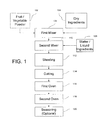
- Figure 1 is a flowchart indicating the processing steps for the present invention.
- the baked snack chips of the present invention are high in vegetable or fruit content.
- the nutritional goals for the snack chips of the present invention include, per serving of about 28 grams (1 ounce serving) of snack chips: no more than 5g of fat, 1 gram or less of saturated fat, zero trans-fatty acids, less than 25% calories from added sugar, and no more than 240 milligrams of sodium.
- the term fruit is used in the culinary sense and includes those botanical fruits that are sweet and fleshy. Examples of fruit include, without limitation, apple, strawberry, blueberry, cranberry, plum, peach, mango, banana, pear, grape and orange.
- the term vegetable is used herein in the culinary sense and includes those plant fruits that are savory, as opposed to sweet.
- non-starchy vegetables only includes non-starchy vegetables and specifically excludes potatoes and other starchy vegetables, such as sweet potatoes, sweet corn, yarns, taro, plantains, green peas and lentils.
- non-starchy vegetables include, without limitation, pumpkin, tomato, onion, bell pepper, beet, cucumber, broccoli and squash.
- Each of the different fruits and non-starchy vegetables used in the present invention are rich in different nutrients and have nutritional benefits different from potatoes and other starchy vegetables.
- the ingredient that gives the baked chips of the present invention their high content of vegetables and fruits is a powderized blend of several different fruits or vegetables.
- the baked chips of the present invention incorporate at least 1/3 serving of fruits or vegetables per serving of about 28 grams (1 ounce serving) of the snack chips.
- the baked chips of the present invention incorporate at least 1/2 serving of fruits or vegetables per serving of about 28 grams (1 ounce serving) of the snack chips.
- the baked chips of the present invention incorporate at least 1 serving of fruits or vegetables per serving of about 28 grams (1 ounce serving) of the snack chips.
- the United States Department of Agriculture defines a serving of vegetables as 1/2 cup of chopped vegetables.
- 1/2 cup of (2.54cm) 1 inch cubes of raw pumpkin constitutes 1 serving of pumpkin
- 1/2 cup of chopped or sliced raw tomatoes constitutes 1 serving of tomato under the USDA guidelines.
- a serving of vegetables can be understood as having a moisture content and a solids content.
- Vegetable solids and fruit solids are defined herein as the non-water components of vegetables and fruits, respectively.
- a serving of vegetables comprises a vegetable solids content on a dry basis and a serving of fruit comprises a fruit solids content on a dry basis.
- the USDA National Nutrient Database for Standard Reference defines the weight of the edible portion of a vegetable in that 1/2 cup and defines the average moisture and thus the vegetable solids content of the edible portion of a vegetable.
- Table 1 depicts the nutrient profile for 1-cup or 180 grams of a red, ripe, raw, year round average tomato as accessed at http://www.nal.usda.gov/fnic/foodcomp/search/. Table 1 . Tomatoes, red, ripe, raw, year round average Nutrient Units Value per 100 Number of Data grams points Error Std.
- Carbohydrate by difference g 3.92 0 7.06 Fiber, total dietary g 1.2 5 0.234 2.2 Sugars, total g 2.63 0 4.73 Sucrose g 0.00 12 0.002 0.00 Glucose (dextrose) g 1.25 16 0.135 2.25 Fructose g 1.37 17 0.073 2.47 Lactose g 0.00 9 0 0.00 Maltose g 0.00 9 0 0.00 Galactose g 0.00 4 0 0.00 Starch g 0.00 4 0 0.00 USDA National Nutrient Database for Standard Reference, Release 19 (2006)
- a serving of fruit or a serving of vegetables is defined as the amount of fruit solids or vegetable solids content that is equivalent to 1/2 cup (118 cubic centimeters) of chopped fruit or vegetables on a dry basis based on the USDA National Nutrient Database for Standard Reference, Release 19, 2006.
- one cup of red, ripe, raw, year round average tomatoes weighs 180 grams, has a water content of 94.5 % by weight and a vegetable solids content of 5.5%.
- One vegetable serving of raw tomatoes (1/2 cup) has a total weight of 90 grams. Consequently, 4.95 grams (5.5% solids content x 90 grams total weight) of tomato solids in a finished product is equivalent to one serving of vegetables.
- a snack chip having a one-third vegetable serving would have approximately 1.65 grams of tomato solids in a serving of about 28 grams (1 ounce serving) of chips
- a snack chip having a one-half vegetable serving would have approximately 2.48 grams of tomato solids in a serving of about 28 grams (1 ounce serving) of chips
- a snack chip having one vegetable serving would have approximately 4.95 grams of tomato solids in a serving of about 28 grams (1 ounce serving) of chips.
- vegetable powder can be added in an amount sufficient to provide for a one-third vegetable serving, in a preferred embodiment in an amount sufficient to provide for a one-half vegetable serving, and in another preferred embodiment in an amount sufficient to provide for one vegetable serving.
- one serving of fruit or one serving of vegetables is defined as the amount of fruit or vegetable solids that is equivalent to 1/2 cup (118 cubic centimeters) of a chopped fruit or vegetables on a dry basis based on the USDA National Nutrient Database for Standard Reference, Release 19, 2006.
- vegetable powder is used as an ingredient in dough that is sheeted, cut into pieces of a desirable shape and cooked to produce vegetable chips.
- the term vegetable powder, as used herein, is defined as partially dehydrated flakes of vegetable solids. Typically, vegetable powder will contain between about 1% and about 4% moisture. Vegetable powder may also contain ingredients such as rice flour and/or lecithin as processing aids.
- the vegetable powder contains pumpkin, tomato, onion, bell pepper, and beet. In a more preferred embodiment, the vegetable powder comprises about 35% to about 45% pumpkin, about 35% to about 45% tomato, about 10% to about 15% onion, about 5% to about 10% bell pepper, and less than about 3% beet.
- the vegetable powder contains pumpkin, tomato, and onion.
- the vegetable powder comprises about 75% to about 85% pumpkin, about 5% to about 15% tomato, and about 5% to about 15% onion. These ingredients are preferred due to considerations such as taste, cost, color, browning characteristics during cooking and vegetable solids content per serving.
- fruit powder is used as an ingredient in dough that is sheeted, cut into pieces of a desirable shape and cooked to produce fruit chips.
- the term fruit powder, as used herein, is defined as partially dehydrated flakes of fruit solids. Typically, fruit powder will contain between about 1% and about 4% moisture. Fruit powder may also contain ingredients such as rice flour and/or lecithin as processing aids.
- the fruit powder contains apple.
- the fruit powder contains apple, blueberry, cranberry, and strawberry.
- the fruit powder comprises about 80% to about 90% apple, about 3% to about 8% strawberry, about 3% to about 8% blueberry, and about 3% to about 8% cranberry.
- the fruit powder contains apple, peach and mango.
- the fruit powder comprises at least about 95% apple, at least about 1% peach and at least about 1% mango. These ingredients are preferred due to considerations such as flavor (sweetness), cost, color, sugar content and fruit solids content.
- the fruit or vegetable powders are mixed with dry ingredients, water and oil to form a dough.
- natural or artificial colors can be included as ingredients in the dough.
- the other dry ingredients help maintain dough cohesiveness and expansion during cooking, and contribute to the final product light, crispy texture and enhanced flavor, among other things.
- the other dry ingredients are comprised of a dry matter component and a moisture component.
- the dry matter component of any dry ingredient is defined as the non-water components of that particular dry ingredient.
- potato flakes have a potato flakes dry matter component and a potato flakes moisture component.
- the potato flakes dry matter component is defined as all of the non-water components that make up the potato flakes.
- the moisture component of each dry ingredient is defined as the water component of each dry ingredient.
- the moisture component for the potato flakes is defined as all of the water in the potato flakes.
- the moisture component of each dry ingredient will typically be less than about 10.5% by weight of the particular dry ingredient.
- rice flour is included as an ingredient in the dough to maintain cohesiveness, contribute to the final product texture and reduce breakage of the final product.
- the rice flour has a rice flour dry matter component and a moisture component.
- the rice flour is pre-gelatinized rice flour.
- Pre-gelatinized rice flour is rice flour that has a starchy component that has undergone an irreversible loss of molecular order, which allows it to more easily form pastes or gels when mixed with water.
- An example of pre-gelatinized rice flour suitable for use in the present invention can be obtained from Sage V Foods, under the brand RF GLX080.
- potato flakes are included as an ingredient to help the dough expand as it cooks, and give the final product its light, crispy texture.
- the potato flakes have a potato flakes dry matter component and a moisture component.
- Potato flakes are made from potatoes that have been cooked, mashed, and dried. For example, Idaho Pacific Corporation in Ririe, Idaho produces potato flakes under the brand name Potato Flakes #124 that can be used as herein described.
- modified starch is included as an ingredient in the dough to aid cohesiveness, expansion, texture, and breakage reduction.
- the modified starch has a modified starch dry matter component and a moisture component.
- An example of a modified starch that can be used in the present invention is XPAND'R starch, available from AE Staley Manufacturing Company, headquartered in London, U.K.
- whole oat flour (one suitable example of which is available from Can-Oat Milling, headquartered in Manitoba, Canada) is included as an ingredient to improve the flavor of the final product and to enhance the nutritional value of the snack by adding whole grain fiber, vitamins and minerals.
- Whole oat flour has a whole oat flour dry matter component and a moisture component.
- a mixture of mono-, di-, and/or tri-glycerides are included as an ingredient to reduce the "pillowing" or "blistering" effect that can take place during cooking by providing small vents that allow steam to escape while the snack chip is cooking.
- the mixture of glycerides has a dry matter component and a moisture component.
- hard stock beads are used in place of the glycerides mixture to reduce pillowing or blistering. Hard stock beads, as used herein, are defined as small granules of glycerides which are made of hydrogenated edible oils or non-hydrogenated, high melting fraction of edible oil having a predetermined particle size distribution.
- a preferred particle size distribution for the hard stock beads is as follows: about 0.58% sit on a U.S. #18 mesh screen, about 18.90% sit on a U.S. #30 mesh screen, about 65.62% sit on a U.S. #60 screen, and about 14.90% pass through a #60 U.S. mesh screen.
- the melting point of these hard stock glycerides is preferably between about 49°C and about 82°C, more preferably between about 57°C and about 79°C, and in the preferred embodiment between 60°C and 71°C. Glycerides encompassing a range of Iodine Values less than 80 can meet these melting point needs.
- lipids examples include DATEMs, propylene glycol esters, polyglycerol esters, as well as waxes, sterols and other higher melting lipid compounds.
- hard stock beads that are suitable for use in the present invention are described in U.S. Patent Number 6,893,673 - Method For Controlling Snack Product Blistering Through The Use Of Solid Lipid Particles, which is owned by the same assignee as the present application.
- the term "glycerides” is defined as covering both the mixture of mono-, di- and/or tri-glycerides and hard stock beads.
- water and corn oil are mixed with the vegetable powder and dry ingredients to make a dough high in vegetable content.
- the resultant dough comprises about 5% to about 15% modified starch, about 10% to about 30% rice flour, about 3% to about 12% whole oat flour, about 10% to about 30% potato flakes, at least 8% vegetable powder, less than about 3% corn oil, less than about 1% glycerides and about 30% to about 40% water. All percentages used herein are by weight unless otherwise noted.
- the resultant dough comprises about 7% to about 14% modified starch, about 15% to about 25% rice flour, about 5% to about 10% whole oat flour, about 15% to about 25% potato flakes, at least 9% vegetable powder, less than about 3% corn oil, less than about 1% glycerides and about 32% to about 38% water.
- the resultant dough comprises about 8% to about 13% modified starch, about 16% to about 23% rice flour, about 5% to about 8% whole oat flour, about 16% to about 23% potato flakes, at least 10% vegetable powder, less than about 3% corn oil, less than about 1% glycerides and about 33% to about 37% water.
- water and corn oil are mixed with the fruit powder and dry ingredients to make a dough high in fruit content.
- the resultant dough comprises about 5% to about 15% modified starch, about 8% to about 20% rice flour, about 3% to about 15% whole oat flour, about 8% to about 20% potato flakes, at least 12% fruit powder, less than about 3% corn oil, less than about 1% glycerides and about 27% to about 37% water.
- the resultant dough comprises about 6% to about 13% modified starch, about 9% to about 18% rice flour, about 4% to about 12% whole oat flour, about 9% to about 19% potato flakes, at least 13% fruit powder, less than about 3% corn oil, less than about 1% glycerides and about 28% to about 36% water.
- the resultant dough comprises about 7% to about 12% modified starch, about 10% to about 17% rice flour, about 5% to about 10% whole oat flour, about 10% to about 18% potato flakes, at least 15% fruit powder, less than about 3% corn oil, less than about 1% glycerides and about 30% to about 35% water.
- FIG. 1 therein is depicted a flowchart indicating the general processing steps for producing the fruit and vegetable chips of the present invention.
- the vegetable or fruit powder 102 and other dry ingredients 104 are mixed in a first mixer 106. These ingredients are then combined with water and other liquid ingredients 108 in a second mixer 110 to produce a dough.
- the mixing may occur at room temperature, generally about 20°C (68°F) to about 30°C (86°F), but preferably occurs at chilled temperatures, with the ambient temperature being between about 7°C (45°F) and 18°C (65°F) and with the mixer being chilled using water at above about 1.7°C (35°F).
- the dough preferably exits the second mixer between about 16°C (60°F) and about 27°C (80°F). Controlling the water temperature helps to control the dough temperature.
- the dough then undergoes a sheeting step 112, whereby the dough is compressed between at least one pair of counter rotating sheeter/cutter rollers that are located closely together, thereby providing a pinch point through which the dough is formed into sheets.
- the sheet of dough for the fruit chips is preferably between about 0.69 mm (0.027 inches) and about 0.89 mm (0.035 inches) thick, and more preferably about 0.84 mm (0.033 inches) thick after the sheeting step.
- the sheet of dough for the citrus chips is preferably between about 0.79 mm (0.031 inches) and about 0.99 mm (0.039 inches), and more preferably about 0.89 mm (0.035 inches) after the sheeting step.
- the preferred thickness is preferably accomplished by passing the dough through several successive stages of rollers, with each successive stage having the rollers located progressively closer together, more preferably 2, 3 or 4 stages of rollers. Passing the dough through several stages of rollers minimizes the amount of work done on the dough during the sheeting step by any particular set of rollers, thereby reducing the influence of the sheeting step on the physical properties of the dough that are established during the mixing step.
- the rollers are preferably chilled to between about 1.7°C (35°F) and about 18°C (65°F) to reduce the likelihood of the dough sticking to the rollers.
- the sheet of dough is then cut into a plurality of pieces 114, preferably using a rotary cutting unit.
- the pieces are then baked in a first oven 116 at an oven temperature between about 177°C (350°F) and about 282°C (540°F) until they have a moisture content of about 5% to about 15%.
- the pieces are then baked in a second oven 118 at an oven temperature between about 113°C (235°F) and about 138°C (280°F) to form vegetable or fruit chips having a final moisture content between about 2% and about 4% of the total product weight.
- the snack food can then optionally be seasoned 120 in an oil spray and seasoning tumbler and then packaged.
- the seasoning can optionally include aromatic compounds that impart a fruity smell onto the snack chips.
- the resultant vegetable chip in one preferred embodiment comprises about 10% to about 16% modified starch dry matter, about 20% to about 30% rice flour dry matter, about 5% to about 15% whole oat flour dry matter, about 20% to about 30% potato flakes dry matter, at least 14% vegetable solids, less than about 3% corn oil and less than about 4% water.
- the resultant vegetable chip in another preferred embodiment comprises about 12% to about 14% modified starch dry matter, about 23% to about 27% rice flour dry matter, about 8% to about 12% whole oat flour dry matter, about 23% to about 29% potato flakes dry matter, at least 15% vegetable solids, less than about 3% corn oil and less than about 4% water.
- the resultant fruit chip in one preferred embodiment comprises about 10% to about 16% modified starch dry matter, about 15% to about 25% rice flour dry matter, about 5% to about 15% whole oat flour dry matter, about 15% to about 25% potato flakes dry matter, at least about 20% fruit solids, less than about 3% corn oil and less than about 4% water.
- the resultant fruit chip in another preferred embodiment comprises about 12% to about 15% modified starch dry matter, about 18% to about 22% rice flour dry matter, about 8% to about 12% whole oat flour dry matter, about 18% to about 22% potato flakes dry matter, at least about 20% fruit solids, less than about 3% corn oil and less than about 4% water.
- the vegetable powder and other dry ingredients were mixed together in a batch mixer.
- the well mixed dry ingredients, water and oil were combined in a twin screw continuous wet mixer for about 30 to about 60 seconds to create the dough.
- the dough exited the mixer at between 20°C (68°F) and 31°C (88°F).
- the dough was then sheeted using 4 stages of rollers to produce a sheet of dough about 0.89 mm (0.035 inches) thick.
- the sheet of dough then passed through a rotary cutting step that produced a plurality of square shaped, ridged pieces of dough.
- the pieces were then baked in an 8-zone Wolverine jet impingement oven at 191°C (375°F) to 293°C (500°F) to produce partially baked snack pieces having a total moisture content between 5% and 15% by weight.
- the partially baked pieces were then allowed to cool.
- the cooled pieces were then dried in a 2 zone Wenger convection oven at 127°C (260°F) to 138°C (280°F) until the pieces had a final moisture content between 2% and 4%.
- the final snack pieces were then seasoned using a tumbler, where they were lightly sprayed with oil and seasoning.
- the fruit powder and other dry ingredients were mixed together in a batch mixer.
- the well mixed dry ingredients, water and other liquid ingredients were combined in a twin screw continuous wet mixer for about 30 to about 60 seconds to create the dough.
- the dough exited the mixer at between 20°C (68°F) and 31°C (88°F).
- the dough was then sheeted using 4 stages of rollers to produce a sheet of dough about 0.84 mm (0.033 inches) thick.
- the sheet of dough then passed through a rotary cutting step that produced a plurality of square shaped pieces of dough.
- the pieces were then baked in an 8-zone Wolverine jet impingement oven at 177°C (350°F) to 282°C (540°F) to produce partially baked snack pieces having a total moisture content between 5% and 15% by weight.
- the partially baked pieces were then allowed to cool.
- the cooled pieces were then dried in a 2-zone Wenger convection oven at 113°C (235°F) to 121°C (250°F) until the pieces had a final moisture content between 2% and 4%.
- the final snack pieces were then seasoned using a tumbler, where they were lightly sprayed with oil and seasoning.
- the vegetable and fruit chips described in the above examples contained at least 1/2 serving of vegetables and fruit, respectively. They also had a light, crispy texture similar to that of a potato crisp.
- the fruit and vegetable chips disclosed herein met or exceeded the other preferred nutritional goals. Specifically, the chips disclosed above had, per serving of about 28 grams (1 ounce serving), less than 5g of fat, 1 gram or less of saturated fat, zero trans-fatty acids, less than 25% calories from added sugar, and no more than 240 milligrams of sodium. In sum, the result is a healthy, nutritious snack chip high in vegetable or fruit content and having a light, crispy texture similar to a potato crisp.
Landscapes
- Life Sciences & Earth Sciences (AREA)
- Engineering & Computer Science (AREA)
- Food Science & Technology (AREA)
- Health & Medical Sciences (AREA)
- Chemical & Material Sciences (AREA)
- Polymers & Plastics (AREA)
- Nutrition Science (AREA)
- Molecular Biology (AREA)
- Preparation Of Fruits And Vegetables (AREA)
- Confectionery (AREA)
- Paper (AREA)
- Laminated Bodies (AREA)
Priority Applications (1)
| Application Number | Priority Date | Filing Date | Title |
|---|---|---|---|
| PL08714011T PL2114168T3 (pl) | 2007-01-31 | 2008-01-25 | Wytwarzanie wałkowanych przekąsek owocowych i warzywnych |
Applications Claiming Priority (2)
| Application Number | Priority Date | Filing Date | Title |
|---|---|---|---|
| US11/669,751 US20080182003A1 (en) | 2007-01-31 | 2007-01-31 | Production of Sheeted Fruit and Vegetable Snacks |
| PCT/US2008/052049 WO2008094830A1 (en) | 2007-01-31 | 2008-01-25 | Production of sheeted fruit and vegetable snacks |
Publications (3)
| Publication Number | Publication Date |
|---|---|
| EP2114168A1 EP2114168A1 (en) | 2009-11-11 |
| EP2114168A4 EP2114168A4 (en) | 2010-03-10 |
| EP2114168B1 true EP2114168B1 (en) | 2011-06-15 |
Family
ID=39668295
Family Applications (1)
| Application Number | Title | Priority Date | Filing Date |
|---|---|---|---|
| EP08714011A Not-in-force EP2114168B1 (en) | 2007-01-31 | 2008-01-25 | Production of sheeted fruit and vegetable snacks |
Country Status (16)
| Country | Link |
|---|---|
| US (1) | US20080182003A1 (enExample) |
| EP (1) | EP2114168B1 (enExample) |
| JP (1) | JP5546868B2 (enExample) |
| CN (1) | CN101626692B (enExample) |
| AT (1) | ATE512595T1 (enExample) |
| AU (1) | AU2008210779B2 (enExample) |
| BR (1) | BRPI0807076B1 (enExample) |
| CA (1) | CA2676887C (enExample) |
| CL (1) | CL2008000296A1 (enExample) |
| ES (1) | ES2368188T3 (enExample) |
| MX (1) | MX2009008149A (enExample) |
| PL (1) | PL2114168T3 (enExample) |
| PT (1) | PT2114168E (enExample) |
| RU (1) | RU2414146C1 (enExample) |
| WO (1) | WO2008094830A1 (enExample) |
| ZA (1) | ZA200905383B (enExample) |
Families Citing this family (19)
| Publication number | Priority date | Publication date | Assignee | Title |
|---|---|---|---|---|
| US20080182004A1 (en) * | 2007-01-31 | 2008-07-31 | Rosemary Shine Baker | Production of Sheeted Fruit and Vegetable Snacks |
| AU2008211598B2 (en) * | 2007-02-01 | 2011-05-19 | Kellogg Europe Trading Limited | Nutritious fabricated snack products |
| US8277865B2 (en) | 2007-03-02 | 2012-10-02 | Paul Ralph Bunke | Nutritious fabricated snack products |
| US20090202700A1 (en) * | 2007-08-16 | 2009-08-13 | Paul Ralph Bunke | Nutritious snack products |
| RU2501308C2 (ru) * | 2011-05-13 | 2013-12-20 | Общество с ограниченной ответственностью "ФудФрукт" | Способ производства пищевого продукта из плодового сырья |
| RU2569480C2 (ru) * | 2011-08-03 | 2015-11-27 | Нестек С.А. | Овощные и фруктово-овощные пастилки, способ их изготовления и потребления (варианты) |
| CN103110064A (zh) * | 2012-12-14 | 2013-05-22 | 苏州科谷米业有限公司 | 一种番茄红素谷物纸片型食品的制法 |
| GB2510351B (en) * | 2013-01-31 | 2017-10-18 | Frito Lay Trading Co Gmbh | Fruit-containing snack foods and manufacture thereof |
| US9747625B2 (en) * | 2014-04-16 | 2017-08-29 | Dean Travis | Device for adding enhancers to pet food and method of using same |
| CN103829162B (zh) * | 2014-03-20 | 2015-10-28 | 宁波亿拍客网络科技有限公司 | 一种谷油米皮及加工方法 |
| CN103960624A (zh) * | 2014-05-29 | 2014-08-06 | 安徽荃力电子科技有限公司 | 一种南瓜薯片及其制作方法 |
| CA2957752A1 (en) * | 2014-08-11 | 2016-02-18 | Christopher Plummer | Vegetable-based slices for improved nutrition and methods of making |
| WO2017027659A1 (en) | 2015-08-11 | 2017-02-16 | The Hershey Company | Food product having stable crispy texture |
| EP3462910B1 (en) * | 2016-06-05 | 2020-12-16 | Mondelez Europe GmbH | Baked savory food composition comprising shredded root vegetable and method of making the same |
| USD864516S1 (en) | 2018-05-14 | 2019-10-29 | Intercontinental Great Brands Llc | Thin food cluster |
| CN111109558A (zh) | 2019-10-25 | 2020-05-08 | 新疆红旗坡农业发展集团有限公司 | 非油炸型原味苹果干脆片及加工技术 |
| IL299621B2 (en) * | 2021-06-28 | 2024-08-01 | Anina Culinary Art Ltd | Thin sheets of food and their use |
| GB2623778B (en) * | 2022-10-26 | 2025-04-16 | Pepsico International Ltd | Vegetable- and/or fruit-containing snack food products and manufacture thereof |
| PL444405A1 (pl) * | 2023-04-14 | 2024-10-21 | Uniwersytet Przyrodniczy we Wrocławiu | Przekąska bogatoresztkowa i sposób wytwarzania przekąski bogatoresztkowej |
Family Cites Families (23)
| Publication number | Priority date | Publication date | Assignee | Title |
|---|---|---|---|---|
| CA860263A (en) * | 1967-07-18 | 1971-01-05 | Imperial Tobacco Company Of Canada | Process for producing chip-type food products |
| JPS61265046A (ja) * | 1985-05-20 | 1986-11-22 | Morinaga & Co Ltd | 果実、野菜のスナツクの製造法 |
| NL8800087A (nl) | 1988-01-15 | 1989-08-01 | Preservenbedrijf Bv | Werkwijze voor het bereiden van geexpandeerde knapperige hapjes of een halfprodukt daarvoor, waarbij men een gedroogd zetmeelprodukt en/of een geheel of gedeeltelijk verstijfseld zetmeelprodukt en een kleine hoeveelheid van een niet-giftig zout tot een deeg aanmaakt, het deeg extrudeert en het geextrudeerde produkt in stukjes snijdt, de stukjes bij gematigde temperatuur droogt en het aldus verkregen halfprodukt desgewenst expandeert. |
| US4970084A (en) * | 1989-06-30 | 1990-11-13 | The Procter & Gamble Company | Process for making potato-based chip products containing intact non-potato pieces |
| JPH044845A (ja) * | 1990-04-23 | 1992-01-09 | Fujikame:Kk | 野菜、果物、種子を含有したスナック及びその製造方法 |
| JP2631150B2 (ja) * | 1990-06-12 | 1997-07-16 | ハウス食品株式会社 | 野菜含有スナック食品の製造方法 |
| US5523106A (en) * | 1994-02-03 | 1996-06-04 | Nabisco, Inc. | Juice-based expanded snacks and process for preparing them |
| JP3026432U (ja) * | 1995-12-28 | 1996-07-12 | 日研フード株式会社 | 野菜入りスナック菓子 |
| US6251466B1 (en) * | 1996-08-15 | 2001-06-26 | Brookside Foods, Ltd. | Particulate natural fruit product and method of making same |
| AU8286098A (en) * | 1997-07-02 | 1999-01-25 | Procter & Gamble Company, The | Suspension for adding a controlled amount of ingredient to food product |
| US6086933A (en) * | 1998-06-05 | 2000-07-11 | Rockstrom; Erik I. | Process for preparing dehydrated vegetable products |
| US20020025367A1 (en) * | 2000-04-18 | 2002-02-28 | The Procter & Gamble Co. | Snack with improved flavor |
| US20020034571A1 (en) * | 2000-05-27 | 2002-03-21 | The Procter & Gamble Co. | Process for preparing tortilla chip dough |
| JP2003310179A (ja) * | 2002-04-19 | 2003-11-05 | Ajinomoto Co Inc | ニュートラシューティカルチップスおよびその製造法 |
| US6893673B2 (en) * | 2002-07-18 | 2005-05-17 | Frito-Lay North America, Inc. | Method for controlling snack product blistering through the use of solid lipid particles |
| EP1646286A4 (en) * | 2003-06-30 | 2007-02-14 | Visarion Ivanov Dimitrov | BREAD-BASED PRODUCT AND METHOD OF PRODUCTION |
| US7569244B2 (en) * | 2005-04-08 | 2009-08-04 | J. Kirk Jordan | Ready-to-eat dry fruit products and process |
| US8367142B2 (en) * | 2005-04-29 | 2013-02-05 | Kraft Foods Global Brands Llc | Production of shredded or flaked whole grain-containing composite food products |
| EP1887885B1 (en) * | 2005-06-07 | 2017-08-23 | Pringles S.a.r.l. | Method for making compositions with rice flour and rice starch |
| CA2742652C (en) * | 2005-06-09 | 2014-12-02 | The Procter & Gamble Company | Sweet potato compositions |
| GB2428958B (en) * | 2005-08-10 | 2010-11-03 | Univ Manchester Metropolitan | Snackfood product |
| JP2009528047A (ja) * | 2006-02-28 | 2009-08-06 | ザ プロクター アンド ギャンブル カンパニー | 果物系生地及びそれから作製される加工スナック製品 |
| US7829128B2 (en) * | 2006-06-30 | 2010-11-09 | Kraft Foods Global Brands Llc | Production of whole grain-containing composite food products |
-
2007
- 2007-01-31 US US11/669,751 patent/US20080182003A1/en not_active Abandoned
-
2008
- 2008-01-25 CN CN2008800076304A patent/CN101626692B/zh not_active Expired - Fee Related
- 2008-01-25 PT PT08714011T patent/PT2114168E/pt unknown
- 2008-01-25 BR BRPI0807076A patent/BRPI0807076B1/pt not_active IP Right Cessation
- 2008-01-25 AT AT08714011T patent/ATE512595T1/de active
- 2008-01-25 MX MX2009008149A patent/MX2009008149A/es active IP Right Grant
- 2008-01-25 EP EP08714011A patent/EP2114168B1/en not_active Not-in-force
- 2008-01-25 JP JP2009548371A patent/JP5546868B2/ja not_active Expired - Fee Related
- 2008-01-25 AU AU2008210779A patent/AU2008210779B2/en not_active Ceased
- 2008-01-25 WO PCT/US2008/052049 patent/WO2008094830A1/en not_active Ceased
- 2008-01-25 CA CA2676887A patent/CA2676887C/en not_active Expired - Fee Related
- 2008-01-25 ES ES08714011T patent/ES2368188T3/es active Active
- 2008-01-25 RU RU2009132602/13A patent/RU2414146C1/ru not_active IP Right Cessation
- 2008-01-25 PL PL08714011T patent/PL2114168T3/pl unknown
- 2008-01-31 CL CL200800296A patent/CL2008000296A1/es unknown
-
2009
- 2009-07-31 ZA ZA200905383A patent/ZA200905383B/xx unknown
Also Published As
| Publication number | Publication date |
|---|---|
| JP5546868B2 (ja) | 2014-07-09 |
| ATE512595T1 (de) | 2011-07-15 |
| CN101626692B (zh) | 2013-04-24 |
| AU2008210779B2 (en) | 2012-04-12 |
| AU2008210779A1 (en) | 2008-08-07 |
| PL2114168T3 (pl) | 2011-11-30 |
| RU2414146C1 (ru) | 2011-03-20 |
| MX2009008149A (es) | 2009-10-12 |
| EP2114168A4 (en) | 2010-03-10 |
| CA2676887C (en) | 2015-11-24 |
| BRPI0807076A2 (pt) | 2014-04-08 |
| CN101626692A (zh) | 2010-01-13 |
| CA2676887A1 (en) | 2008-08-07 |
| CL2008000296A1 (es) | 2008-08-29 |
| EP2114168A1 (en) | 2009-11-11 |
| BRPI0807076B1 (pt) | 2015-10-27 |
| JP2010516294A (ja) | 2010-05-20 |
| ZA200905383B (en) | 2010-07-28 |
| PT2114168E (pt) | 2011-09-02 |
| ES2368188T3 (es) | 2011-11-15 |
| WO2008094830A1 (en) | 2008-08-07 |
| US20080182003A1 (en) | 2008-07-31 |
Similar Documents
| Publication | Publication Date | Title |
|---|---|---|
| CA2676887C (en) | Sheeted fruit and vegetable snacks | |
| AU2008210781C1 (en) | Production of sheeted fruit and vegetable snacks | |
| US8192784B2 (en) | Fruit and vegetable snacks | |
| US7820223B2 (en) | Sweet potato flake process | |
| RU2433621C2 (ru) | Производство составных пищевых продуктов, содержащих цельное зерно | |
| US20070087107A1 (en) | Food products containing legume products and processes for producing the food products | |
| AU2009234115B2 (en) | Fruit or vegetable and grain snack mixture | |
| Sengev et al. | Physical, chemical and sensory properties of cookies produced from sweet potato and mango mesocarp flours. | |
| US20080102182A1 (en) | Baked Nut Snack Chip | |
| MXPA00006769A (en) | Crisp fried in grapeseed oil |
Legal Events
| Date | Code | Title | Description |
|---|---|---|---|
| PUAI | Public reference made under article 153(3) epc to a published international application that has entered the european phase |
Free format text: ORIGINAL CODE: 0009012 |
|
| 17P | Request for examination filed |
Effective date: 20090820 |
|
| AK | Designated contracting states |
Kind code of ref document: A1 Designated state(s): AT BE BG CH CY CZ DE DK EE ES FI FR GB GR HR HU IE IS IT LI LT LU LV MC MT NL NO PL PT RO SE SI SK TR |
|
| RIC1 | Information provided on ipc code assigned before grant |
Ipc: A21D 2/36 20060101ALI20100128BHEP Ipc: A23L 1/212 20060101AFI20100128BHEP |
|
| A4 | Supplementary search report drawn up and despatched |
Effective date: 20100205 |
|
| DAX | Request for extension of the european patent (deleted) | ||
| 17Q | First examination report despatched |
Effective date: 20100517 |
|
| RIC1 | Information provided on ipc code assigned before grant |
Ipc: A21D 2/36 20060101ALI20101026BHEP Ipc: A23L 1/212 20060101AFI20101026BHEP |
|
| GRAP | Despatch of communication of intention to grant a patent |
Free format text: ORIGINAL CODE: EPIDOSNIGR1 |
|
| GRAS | Grant fee paid |
Free format text: ORIGINAL CODE: EPIDOSNIGR3 |
|
| GRAA | (expected) grant |
Free format text: ORIGINAL CODE: 0009210 |
|
| AK | Designated contracting states |
Kind code of ref document: B1 Designated state(s): AT BE BG CH CY CZ DE DK EE ES FI FR GB GR HR HU IE IS IT LI LT LU LV MC MT NL NO PL PT RO SE SI SK TR |
|
| REG | Reference to a national code |
Ref country code: GB Ref legal event code: FG4D Ref country code: CH Ref legal event code: EP |
|
| REG | Reference to a national code |
Ref country code: IE Ref legal event code: FG4D |
|
| REG | Reference to a national code |
Ref country code: DE Ref legal event code: R096 Ref document number: 602008007615 Country of ref document: DE Effective date: 20110804 |
|
| REG | Reference to a national code |
Ref country code: CH Ref legal event code: NV Representative=s name: BOVARD AG |
|
| REG | Reference to a national code |
Ref country code: PT Ref legal event code: SC4A Free format text: AVAILABILITY OF NATIONAL TRANSLATION Effective date: 20110819 |
|
| REG | Reference to a national code |
Ref country code: SE Ref legal event code: TRGR |
|
| REG | Reference to a national code |
Ref country code: NL Ref legal event code: T3 |
|
| REG | Reference to a national code |
Ref country code: GR Ref legal event code: EP Ref document number: 20110402040 Country of ref document: GR Effective date: 20110916 |
|
| PG25 | Lapsed in a contracting state [announced via postgrant information from national office to epo] |
Ref country code: LT Free format text: LAPSE BECAUSE OF FAILURE TO SUBMIT A TRANSLATION OF THE DESCRIPTION OR TO PAY THE FEE WITHIN THE PRESCRIBED TIME-LIMIT Effective date: 20110615 Ref country code: NO Free format text: LAPSE BECAUSE OF FAILURE TO SUBMIT A TRANSLATION OF THE DESCRIPTION OR TO PAY THE FEE WITHIN THE PRESCRIBED TIME-LIMIT Effective date: 20110915 Ref country code: HR Free format text: LAPSE BECAUSE OF FAILURE TO SUBMIT A TRANSLATION OF THE DESCRIPTION OR TO PAY THE FEE WITHIN THE PRESCRIBED TIME-LIMIT Effective date: 20110615 |
|
| REG | Reference to a national code |
Ref country code: ES Ref legal event code: FG2A Ref document number: 2368188 Country of ref document: ES Kind code of ref document: T3 Effective date: 20111115 |
|
| PG25 | Lapsed in a contracting state [announced via postgrant information from national office to epo] |
Ref country code: LV Free format text: LAPSE BECAUSE OF FAILURE TO SUBMIT A TRANSLATION OF THE DESCRIPTION OR TO PAY THE FEE WITHIN THE PRESCRIBED TIME-LIMIT Effective date: 20110615 Ref country code: FI Free format text: LAPSE BECAUSE OF FAILURE TO SUBMIT A TRANSLATION OF THE DESCRIPTION OR TO PAY THE FEE WITHIN THE PRESCRIBED TIME-LIMIT Effective date: 20110615 Ref country code: CY Free format text: LAPSE BECAUSE OF FAILURE TO SUBMIT A TRANSLATION OF THE DESCRIPTION OR TO PAY THE FEE WITHIN THE PRESCRIBED TIME-LIMIT Effective date: 20110615 Ref country code: SI Free format text: LAPSE BECAUSE OF FAILURE TO SUBMIT A TRANSLATION OF THE DESCRIPTION OR TO PAY THE FEE WITHIN THE PRESCRIBED TIME-LIMIT Effective date: 20110615 |
|
| REG | Reference to a national code |
Ref country code: PL Ref legal event code: T3 |
|
| REG | Reference to a national code |
Ref country code: HU Ref legal event code: AG4A Ref document number: E012033 Country of ref document: HU |
|
| PG25 | Lapsed in a contracting state [announced via postgrant information from national office to epo] |
Ref country code: EE Free format text: LAPSE BECAUSE OF FAILURE TO SUBMIT A TRANSLATION OF THE DESCRIPTION OR TO PAY THE FEE WITHIN THE PRESCRIBED TIME-LIMIT Effective date: 20110615 Ref country code: IS Free format text: LAPSE BECAUSE OF FAILURE TO SUBMIT A TRANSLATION OF THE DESCRIPTION OR TO PAY THE FEE WITHIN THE PRESCRIBED TIME-LIMIT Effective date: 20111015 |
|
| PG25 | Lapsed in a contracting state [announced via postgrant information from national office to epo] |
Ref country code: SK Free format text: LAPSE BECAUSE OF FAILURE TO SUBMIT A TRANSLATION OF THE DESCRIPTION OR TO PAY THE FEE WITHIN THE PRESCRIBED TIME-LIMIT Effective date: 20110615 Ref country code: RO Free format text: LAPSE BECAUSE OF FAILURE TO SUBMIT A TRANSLATION OF THE DESCRIPTION OR TO PAY THE FEE WITHIN THE PRESCRIBED TIME-LIMIT Effective date: 20110615 |
|
| PLBE | No opposition filed within time limit |
Free format text: ORIGINAL CODE: 0009261 |
|
| STAA | Information on the status of an ep patent application or granted ep patent |
Free format text: STATUS: NO OPPOSITION FILED WITHIN TIME LIMIT |
|
| PGFP | Annual fee paid to national office [announced via postgrant information from national office to epo] |
Ref country code: HU Payment date: 20120130 Year of fee payment: 5 Ref country code: CH Payment date: 20120125 Year of fee payment: 5 |
|
| 26N | No opposition filed |
Effective date: 20120316 |
|
| PGFP | Annual fee paid to national office [announced via postgrant information from national office to epo] |
Ref country code: PT Payment date: 20120119 Year of fee payment: 5 |
|
| PG25 | Lapsed in a contracting state [announced via postgrant information from national office to epo] |
Ref country code: DK Free format text: LAPSE BECAUSE OF FAILURE TO SUBMIT A TRANSLATION OF THE DESCRIPTION OR TO PAY THE FEE WITHIN THE PRESCRIBED TIME-LIMIT Effective date: 20110615 |
|
| PGFP | Annual fee paid to national office [announced via postgrant information from national office to epo] |
Ref country code: GR Payment date: 20120130 Year of fee payment: 5 Ref country code: SE Payment date: 20120127 Year of fee payment: 5 |
|
| REG | Reference to a national code |
Ref country code: DE Ref legal event code: R097 Ref document number: 602008007615 Country of ref document: DE Effective date: 20120316 |
|
| PG25 | Lapsed in a contracting state [announced via postgrant information from national office to epo] |
Ref country code: MC Free format text: LAPSE BECAUSE OF NON-PAYMENT OF DUE FEES Effective date: 20120131 |
|
| PGFP | Annual fee paid to national office [announced via postgrant information from national office to epo] |
Ref country code: IE Payment date: 20130125 Year of fee payment: 6 |
|
| PGFP | Annual fee paid to national office [announced via postgrant information from national office to epo] |
Ref country code: PL Payment date: 20130102 Year of fee payment: 6 |
|
| PG25 | Lapsed in a contracting state [announced via postgrant information from national office to epo] |
Ref country code: BG Free format text: LAPSE BECAUSE OF FAILURE TO SUBMIT A TRANSLATION OF THE DESCRIPTION OR TO PAY THE FEE WITHIN THE PRESCRIBED TIME-LIMIT Effective date: 20110915 |
|
| PGFP | Annual fee paid to national office [announced via postgrant information from national office to epo] |
Ref country code: AT Payment date: 20130103 Year of fee payment: 6 |
|
| PG25 | Lapsed in a contracting state [announced via postgrant information from national office to epo] |
Ref country code: MT Free format text: LAPSE BECAUSE OF FAILURE TO SUBMIT A TRANSLATION OF THE DESCRIPTION OR TO PAY THE FEE WITHIN THE PRESCRIBED TIME-LIMIT Effective date: 20110615 |
|
| REG | Reference to a national code |
Ref country code: PT Ref legal event code: MM4A Free format text: LAPSE DUE TO NON-PAYMENT OF FEES Effective date: 20130725 |
|
| REG | Reference to a national code |
Ref country code: CH Ref legal event code: PL |
|
| REG | Reference to a national code |
Ref country code: SE Ref legal event code: EUG |
|
| REG | Reference to a national code |
Ref country code: GR Ref legal event code: ML Ref document number: 20110402040 Country of ref document: GR Effective date: 20130802 |
|
| PG25 | Lapsed in a contracting state [announced via postgrant information from national office to epo] |
Ref country code: CH Free format text: LAPSE BECAUSE OF NON-PAYMENT OF DUE FEES Effective date: 20130131 Ref country code: PT Free format text: LAPSE BECAUSE OF NON-PAYMENT OF DUE FEES Effective date: 20130725 Ref country code: SE Free format text: LAPSE BECAUSE OF NON-PAYMENT OF DUE FEES Effective date: 20130126 Ref country code: LI Free format text: LAPSE BECAUSE OF NON-PAYMENT OF DUE FEES Effective date: 20130131 Ref country code: CZ Free format text: LAPSE BECAUSE OF NON-PAYMENT OF DUE FEES Effective date: 20130125 Ref country code: GR Free format text: LAPSE BECAUSE OF NON-PAYMENT OF DUE FEES Effective date: 20130802 Ref country code: HU Free format text: LAPSE BECAUSE OF NON-PAYMENT OF DUE FEES Effective date: 20130126 |
|
| PGFP | Annual fee paid to national office [announced via postgrant information from national office to epo] |
Ref country code: NL Payment date: 20140126 Year of fee payment: 7 |
|
| PGFP | Annual fee paid to national office [announced via postgrant information from national office to epo] |
Ref country code: TR Payment date: 20140109 Year of fee payment: 7 |
|
| REG | Reference to a national code |
Ref country code: AT Ref legal event code: MM01 Ref document number: 512595 Country of ref document: AT Kind code of ref document: T Effective date: 20140125 |
|
| REG | Reference to a national code |
Ref country code: IE Ref legal event code: MM4A |
|
| PG25 | Lapsed in a contracting state [announced via postgrant information from national office to epo] |
Ref country code: AT Free format text: LAPSE BECAUSE OF NON-PAYMENT OF DUE FEES Effective date: 20140125 |
|
| PG25 | Lapsed in a contracting state [announced via postgrant information from national office to epo] |
Ref country code: IE Free format text: LAPSE BECAUSE OF NON-PAYMENT OF DUE FEES Effective date: 20140125 |
|
| PGFP | Annual fee paid to national office [announced via postgrant information from national office to epo] |
Ref country code: IT Payment date: 20150122 Year of fee payment: 8 |
|
| REG | Reference to a national code |
Ref country code: PL Ref legal event code: LAPE |
|
| PG25 | Lapsed in a contracting state [announced via postgrant information from national office to epo] |
Ref country code: PL Free format text: LAPSE BECAUSE OF NON-PAYMENT OF DUE FEES Effective date: 20140125 |
|
| PG25 | Lapsed in a contracting state [announced via postgrant information from national office to epo] |
Ref country code: LU Free format text: LAPSE BECAUSE OF NON-PAYMENT OF DUE FEES Effective date: 20130125 |
|
| REG | Reference to a national code |
Ref country code: NL Ref legal event code: V1 Effective date: 20150801 |
|
| PG25 | Lapsed in a contracting state [announced via postgrant information from national office to epo] |
Ref country code: NL Free format text: LAPSE BECAUSE OF NON-PAYMENT OF DUE FEES Effective date: 20150801 |
|
| REG | Reference to a national code |
Ref country code: DE Ref legal event code: R079 Ref document number: 602008007615 Country of ref document: DE Free format text: PREVIOUS MAIN CLASS: A23L0001212000 Ipc: A23L0019000000 |
|
| REG | Reference to a national code |
Ref country code: FR Ref legal event code: PLFP Year of fee payment: 9 |
|
| PGFP | Annual fee paid to national office [announced via postgrant information from national office to epo] |
Ref country code: DE Payment date: 20160127 Year of fee payment: 9 Ref country code: ES Payment date: 20160126 Year of fee payment: 9 |
|
| PGFP | Annual fee paid to national office [announced via postgrant information from national office to epo] |
Ref country code: BE Payment date: 20160127 Year of fee payment: 9 Ref country code: GB Payment date: 20160127 Year of fee payment: 9 Ref country code: FR Payment date: 20160126 Year of fee payment: 9 |
|
| PG25 | Lapsed in a contracting state [announced via postgrant information from national office to epo] |
Ref country code: IT Free format text: LAPSE BECAUSE OF NON-PAYMENT OF DUE FEES Effective date: 20160125 |
|
| PG25 | Lapsed in a contracting state [announced via postgrant information from national office to epo] |
Ref country code: BE Free format text: LAPSE BECAUSE OF NON-PAYMENT OF DUE FEES Effective date: 20170131 |
|
| REG | Reference to a national code |
Ref country code: DE Ref legal event code: R119 Ref document number: 602008007615 Country of ref document: DE |
|
| PG25 | Lapsed in a contracting state [announced via postgrant information from national office to epo] |
Ref country code: TR Free format text: LAPSE BECAUSE OF NON-PAYMENT OF DUE FEES Effective date: 20150125 |
|
| GBPC | Gb: european patent ceased through non-payment of renewal fee |
Effective date: 20170125 |
|
| REG | Reference to a national code |
Ref country code: FR Ref legal event code: ST Effective date: 20170929 |
|
| PG25 | Lapsed in a contracting state [announced via postgrant information from national office to epo] |
Ref country code: FR Free format text: LAPSE BECAUSE OF NON-PAYMENT OF DUE FEES Effective date: 20170131 |
|
| PG25 | Lapsed in a contracting state [announced via postgrant information from national office to epo] |
Ref country code: GB Free format text: LAPSE BECAUSE OF NON-PAYMENT OF DUE FEES Effective date: 20170125 Ref country code: DE Free format text: LAPSE BECAUSE OF NON-PAYMENT OF DUE FEES Effective date: 20170801 |
|
| REG | Reference to a national code |
Ref country code: BE Ref legal event code: MM Effective date: 20170131 |
|
| PG25 | Lapsed in a contracting state [announced via postgrant information from national office to epo] |
Ref country code: ES Free format text: LAPSE BECAUSE OF NON-PAYMENT OF DUE FEES Effective date: 20170126 |
|
| REG | Reference to a national code |
Ref country code: ES Ref legal event code: FD2A Effective date: 20180626 |
|
| P01 | Opt-out of the competence of the unified patent court (upc) registered |
Effective date: 20230518 |